WO2021193565A1 - 環式化合物またはその誘導体の製造方法 - Google Patents
環式化合物またはその誘導体の製造方法 Download PDFInfo
- Publication number
- WO2021193565A1 WO2021193565A1 PCT/JP2021/011787 JP2021011787W WO2021193565A1 WO 2021193565 A1 WO2021193565 A1 WO 2021193565A1 JP 2021011787 W JP2021011787 W JP 2021011787W WO 2021193565 A1 WO2021193565 A1 WO 2021193565A1
- Authority
- WO
- WIPO (PCT)
- Prior art keywords
- cyclic compound
- solution
- derivative
- treatment
- raw material
- Prior art date
- Legal status (The legal status is an assumption and is not a legal conclusion. Google has not performed a legal analysis and makes no representation as to the accuracy of the status listed.)
- Ceased
Links
Images

Classifications
-
- B—PERFORMING OPERATIONS; TRANSPORTING
- B01—PHYSICAL OR CHEMICAL PROCESSES OR APPARATUS IN GENERAL
- B01D—SEPARATION
- B01D9/00—Crystallisation
- B01D9/02—Crystallisation from solutions
-
- C—CHEMISTRY; METALLURGY
- C07—ORGANIC CHEMISTRY
- C07C—ACYCLIC OR CARBOCYCLIC COMPOUNDS
- C07C51/00—Preparation of carboxylic acids or their salts, halides or anhydrides
- C07C51/42—Separation; Purification; Stabilisation; Use of additives
- C07C51/43—Separation; Purification; Stabilisation; Use of additives by change of the physical state, e.g. crystallisation
-
- C—CHEMISTRY; METALLURGY
- C07—ORGANIC CHEMISTRY
- C07C—ACYCLIC OR CARBOCYCLIC COMPOUNDS
- C07C62/00—Compounds having carboxyl groups bound to carbon atoms of rings other than six—membered aromatic rings and containing any of the groups OH, O—metal, —CHO, keto, ether, groups, groups, or groups
- C07C62/30—Unsaturated compounds
- C07C62/32—Unsaturated compounds containing hydroxy or O-metal groups
-
- C—CHEMISTRY; METALLURGY
- C07—ORGANIC CHEMISTRY
- C07C—ACYCLIC OR CARBOCYCLIC COMPOUNDS
- C07C65/00—Compounds having carboxyl groups bound to carbon atoms of six—membered aromatic rings and containing any of the groups OH, O—metal, —CHO, keto, ether, groups, groups, or groups
- C07C65/01—Compounds having carboxyl groups bound to carbon atoms of six—membered aromatic rings and containing any of the groups OH, O—metal, —CHO, keto, ether, groups, groups, or groups containing hydroxy or O-metal groups
- C07C65/03—Compounds having carboxyl groups bound to carbon atoms of six—membered aromatic rings and containing any of the groups OH, O—metal, —CHO, keto, ether, groups, groups, or groups containing hydroxy or O-metal groups monocyclic and having all hydroxy or O-metal groups bound to the ring
Definitions
- the present invention relates to a method for producing a cyclic compound or a derivative thereof.
- Patent Document 1 discloses a method of producing methane from biomass by microbial fermentation, then producing benzene from methane by a catalytic reaction, and further producing a benzene derivative from this benzene. Since the benzene derivative produced in this manner is used as a raw material for an aromatic polymer, it is possible to realize a polymer that does not depend on fossil resources.
- the conventional method does not yet have sufficient efficiency in producing benzene derivatives. Specifically, when producing a benzene derivative such as phthalic acid from biomass via methane and benzene, there is a problem that the amount of benzene derivative synthesized is small for the labor and energy input.
- Patent Document 1 discloses that benzene is purified by a distillation method or the like, and although it is possible to increase the purity of the benzene derivative by this, a large amount of energy is still consumed in that case.
- An object of the present invention is to provide a production method capable of producing a high-purity cyclic compound or a derivative thereof in a high yield.
- It has a crystallization step of precipitating the cyclic compound or its derivative from the raw material liquid by a crystallization treatment for controlling the temperature of the raw material liquid containing the cyclic compound or its derivative and a solvent.
- the crystallization treatment is a treatment for controlling the temperature of the raw material liquid so that the concentration of the cyclic compound or its derivative in the raw material liquid is located in the semi-stable region. Derivative manufacturing method.
- a high-purity cyclic compound or a derivative thereof can be produced in a high yield.
- FIG. 1 is a process diagram for explaining a method for producing a cyclic compound or a derivative thereof according to the first embodiment of the present invention.
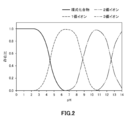
- FIG. 2 is a graph showing an example of the relationship between the abundance ratio of a cyclic compound in a solution, the abundance ratio of ions of a cyclic compound in a solution, and pH.
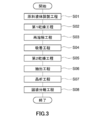
- FIG. 3 is a process diagram for explaining a method for producing a cyclic compound or a derivative thereof according to a third embodiment of the present invention.
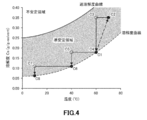
- FIG. 4 is a diagram for explaining the crystallization treatment according to the third embodiment of the present invention, in which the horizontal axis represents the temperature of the extract and the vertical axis represents the solubility of the cyclic compound in the extract.
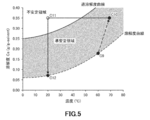
- FIG. 5 is a diagram for explaining the crystallization treatment according to the comparative example, and when the horizontal axis represents the temperature of the extract and the vertical axis represents the solubility of the cyclic compound in the extract, the relationship between them. It is a figure which shows.
- FIG. 1 is a process diagram for explaining a method for producing a cyclic compound or a derivative thereof according to the first embodiment of the present invention.
- the method for producing the cyclic compound or its derivative according to the present embodiment includes a raw material liquid preparation step S01, a first drying step S02, a redissolving step S03, an adsorption step S04, a second drying step S05, and an extraction step. It has S06, a precipitation step S07, and a solid-liquid separation step S08. According to such a method for producing a cyclic compound, a solid and high-purity cyclic compound or a derivative thereof can be produced in a high yield.
- each step will be described in sequence.
- the cyclic compound or its derivative is abbreviated as "cyclic compound”.
- the method for producing a cyclic compound or a derivative thereof is omitted and is also referred to as a "method for producing a cyclic compound”. The cyclic compound will be described in detail later.
- Biomass refers to organic resources derived from plants. Specific examples thereof include those that have been converted into starch, cellulose, or the like and stored, the body of an animal that grows by eating a plant, a product that can be processed from a plant or an animal, and the like.
- cellulose-based crops pulp, kenaf, straw, rice straw, used paper, paper residue, etc.
- wood, charcoal, compost natural rubber, cotton, sugar cane, okara, fats and oils (rapeseed oil, cottonseed oil, soybean oil, etc.) , coconut oil, castor oil, etc.
- Carbohydrate crops corn, potatoes, wheat, rice, rice husks, rice bran, old rice, cassaba, sago palm, etc.
- bagasse buckwheat, soybean, essential oil (pine root oil, orange oil, eucalyptus oil, etc.) Etc.), pulp black liquor, food waste, vegetable oil residue, marine product residue, livestock excrement, food waste, wastewater sludge, etc.
- the biomass is pretreated to obtain a mixed sugar.
- pretreatment include physical treatment, chemical treatment, physicochemical treatment, biological treatment, and the like, and one or a combination of two or more of these is adopted. ..
- physical processing includes, for example, miniaturization processing by a disk mill, grinder, etc., compression processing, electromagnetic wave irradiation processing, electron beam irradiation processing, and the like.
- the chemical treatment includes, for example, treatment with ionic liquids such as sulfuric acid, nitric acid, hydrochloric acid, phosphoric acid, and alkali, hydrothermal treatment, subcritical water treatment, supercritical fluid treatment, catalytic treatment, oxidant treatment, and heat.
- ionic liquids such as sulfuric acid, nitric acid, hydrochloric acid, phosphoric acid, and alkali
- hydrothermal treatment subcritical water treatment, supercritical fluid treatment, catalytic treatment, oxidant treatment, and heat.
- Examples include a process of imparting energy and a process of imparting light energy.
- examples of the physicochemical treatment include steam blasting treatment and ammonia blasting treatment.
- the mixed sugar includes straw (rice straw, barley straw, wheat straw, rye straw, oat straw, etc.), non-edible agricultural waste such as bagasse, switchgrass, napier grass, and miscanthus.
- Energy crops such as, wood chips, waste paper, etc. are saccharified with saccharifying enzymes, and saccharified liquids, or those containing molasses are also used.
- Transformation treatment Next, the transformant is cultured or reacted in a reaction solution containing a mixed sugar to prepare a raw material liquid.
- transformant is preferably cultured and grown in a medium prior to reaction with the mixed sugar.
- the medium used includes a natural medium or a synthetic medium containing a carbon source, a nitrogen source, inorganic salts, other nutritional substances and the like.
- the concentration of the nitrogen source in the medium varies depending on the nitrogen source used, but is, for example, 0.1 to 10 (w / v%).
- the concentration of inorganic salts in the medium varies depending on the inorganic salts used, but is, for example, 0.01 to 1 (w / v%).
- the concentration of the nutritional substance in the medium varies depending on the nutritional substance used, but is, for example, 0.1 to 10 (w / v%).
- the pH of the medium is not particularly limited, but is preferably about 6 to 8.
- reaction solution a natural reaction solution or a synthetic reaction solution containing a carbon source, a nitrogen source, inorganic salts and the like is used.
- the concentration of the mixed sugar in the reaction solution is preferably 1 to 20 (w / v%), more preferably 2 to 10 (w / v%), and 2 to 5 (w / v%). Is more preferable.
- the concentration of the total carbon source containing the mixed sugar is preferably 2 to 5 (w / v%).
- the nitrogen source a nitrogen source appropriately selected from the above-mentioned nitrogen sources is used.
- the concentration of the nitrogen source in the reaction solution varies depending on the concentration of the nutrient substance used, but is, for example, 0.01 to 1 (w / v%).
- the inorganic salts those appropriately selected from the above-mentioned inorganic salts are used.
- the concentration of the inorganic salts in the reaction solution varies depending on the concentration of the nutritional substance used, but is, for example, 0.1 to 10 (w / v%). Further, if necessary, those appropriately selected from the above-mentioned vitamins are used.
- reaction temperature of the mixed sugar and the transformant that is, the survival temperature of the transformant is preferably 20 to 50 ° C, more preferably 25 to 47 ° C. Within this temperature range, cyclic compounds can be efficiently produced.
- the reaction time is preferably 1 to 7 days, more preferably 1 to 3 days.
- the culture may be a batch type, a fed-batch type, or a continuous type, but a batch type is particularly preferable.
- the reaction may be carried out under aerobic conditions or under reducing conditions.
- an aqueous solution for a reaction solution under reducing conditions can be obtained by removing the dissolved gas by heat treatment or decompression treatment.
- the dissolved gas (particularly) is treated by treating with a reduced pressure of preferably 10 mmHg or less, more preferably 5 mmHg or less, still more preferably 3 mmHg or less for about 1 to 60 minutes, more preferably about 5 to 40 minutes.
- Dissolved oxygen can be removed to prepare an aqueous solution for a reaction solution under reducing conditions.
- an appropriate reducing agent for example, thioglycolic acid, ascorbic acid, cystine hydrochloride, mercaptoacetic acid, thiol acetic acid, glutathione, sodium sulfide, etc.
- an appropriate reducing agent for example, thioglycolic acid, ascorbic acid, cystine hydrochloride, mercaptoacetic acid, thiol acetic acid, glutathione, sodium sulfide, etc.
- these methods may be combined as appropriate.
- the transformant After preparing the raw material liquid, the transformant is separated and removed.
- the separation / removal method include a sedimentation separation method, a centrifugation method, a filtration separation method, and the like. Further, a method in which a plurality of these are combined may be used.
- this step may be provided as needed, and may be replaced by, for example, a step of preparing a liquid containing a cyclic compound produced by recycling or the like.
- the method for producing a cyclic compound or a derivative thereof according to the present embodiment includes a raw material liquid preparation step which is a step of preparing a raw material liquid from biomass as described above.
- a raw material liquid preparation step which is a step of preparing a raw material liquid from biomass as described above.
- the obtained raw material liquid may be concentrated if necessary.
- concentration method examples include distillation, adsorption, extraction, membrane separation, dialysis, reverse osmosis, etc., and one or more of these are used in combination.
- the raw material liquid is put into a stirring tank whose inner wall surface is a heat transfer surface, and the raw material liquid accumulated at the bottom is pumped up. Then, the raw material liquid is concentrated using a device that stirs the raw material liquid while spraying it on the inner wall surface.
- the effective area of the heat transfer surface can be used to the maximum, and the concentration efficiency can be improved.
- the generation of charring due to the drying of the heat transfer surface can be suppressed, and the coloring of the finally recovered solid can be suppressed.
- the heating temperature in the concentration treatment is not particularly limited, but is preferably about 15 to 120 ° C, more preferably about 20 to 90 ° C. As a result, the efficiency of concentration can be improved while suppressing the generation of charring and the denaturation of solutes.
- the raw material solution in the concentration treatment may be placed under reduced pressure. As a result, the volatilization of the solvent is promoted, and the concentration efficiency can be increased.
- the pressure of the environment in which the raw material solution is placed is not particularly limited, but is preferably 80 kPa or less, and more preferably 0.1 to 50 kPa.
- a salt of the cyclic compound may be prepared using a basic substance and dissolved in an aqueous medium. Further, the concentration treatment may be performed as needed and may be omitted.
- the depressurization operation and the normal pressure return operation may be repeated as necessary.
- the bubbles contract and expand, and the bubbles contained therein are promoted to rise and burst, so that the bubbles can be efficiently extinguished.
- a decrease in concentration efficiency can be suppressed.
- the time of the depressurization operation is not particularly limited, but is preferably about 1 to 10 seconds as an example. As a result, air bubbles can be efficiently removed.
- First drying step S02 the raw material liquid is dried by a vacuum drying method to obtain a dried product (dry solid). Specifically, in the vacuum drying method, the raw material liquid is placed in a closed container and the inside of the closed container is depressurized. As a result, the difference in solvent partial pressure between the raw material liquid and the inside of the container is increased, and drying is promoted. As a result, the raw material liquid can be reliably dried in a short time to obtain a dried product. In addition, since small molecule impurity components can be efficiently removed, the purity and whiteness of the finally obtained cyclic compound can be increased.
- the drying process by the vacuum drying method according to the present embodiment is a process of heating at a temperature of 65 to 125 ° C. at a pressure of 10 Pa or less.
- heating under such conditions it is possible to more efficiently remove low-molecular-weight impurity components while suppressing the formation and coloring of the cyclic compound such as oxidation.
- the purity and whiteness of the finally obtained cyclic compound can be increased.
- the decrease of the cyclic compound can be suppressed, so that the yield of the finally obtained cyclic compound can be increased.
- the pressure in the drying treatment is preferably 5.0 Pa or less, and more preferably 1.0 ⁇ 10 -6 Pa or more and 1.0 Pa or less in consideration of economic efficiency.
- the temperature in the drying treatment is preferably 60 to 120 ° C, more preferably 90 to 110 ° C. This makes it possible to remove small molecule impurity components particularly efficiently without lowering the yield.
- the cyclic compound may be denatured and the purity and yield may decrease.
- the purity may decrease or the drying time may become long.
- the heating time is appropriately set according to the progress of evaporation of the solvent, but as an example, it is preferably about 10 minutes to 24 hours, and more preferably about 30 minutes to 6 hours.
- a vacuum dryer equipped with the above-mentioned closed container and vacuum pump can be used.
- the first drying step may be a step of obtaining an incompletely dried product.
- the obtained dried product may be crushed or crushed as needed.
- the specific surface area of the dried product is increased, so that the dissolution efficiency of the cyclic compound can be increased in the redissolution step described later.
- Redissolution step S03 Next, the obtained dried product is dissolved in a redissolving solvent to prepare a solution (resolving solution). By preparing the solution, the adsorption step described later becomes possible.
- Adsorption step S04 the solution is subjected to an adsorption treatment, but prior to that, a treatment for ionizing the cyclic compound contained in the solution may be performed.
- This treatment is a treatment for increasing the ionization rate by changing the conditions of the solution by utilizing the ionization tendency of the cyclic compound. By performing such a treatment, the abundance ratio of the cyclic compound in the solution can be reduced.
- the solution when preparing the solution (first solution) to be subjected to the adsorption treatment, the solution is prepared so that the abundance of the cyclic compound in the solution is smaller than the abundance of ions of the cyclic compound. As a result, in the subsequent adsorption treatment, it is possible to prevent the cyclic compound from being adsorbed on the adsorption medium and reduce the yield of the final cyclic compound.
- the pH of the solution after the addition of the alkali is preferably about 5.0 to 7.5, and more preferably about 5.5 to 6.5. This makes it possible to reduce the abundance ratio of the cyclic compound in the solution. As a result, the probability that the cyclic compound is adsorbed on the adsorption medium can be reduced in the adsorption treatment described later.
- the alkali include sodium hydroxide, potassium hydroxide and the like.
- the adsorption treatment is a treatment in which the adsorption medium is brought into contact with the solution and the polymer components and the like in the solution are adsorbed on the adsorption medium.
- impurities in the solution for example, organic components of the polymer are removed.
- the purity of the finally obtained cyclic compound can be increased and coloring can be suppressed.
- what is adsorbed and removed in the adsorption treatment is not limited to the organic component of the polymer, and any impurity may be used.
- the temperature of the solution in the adsorption treatment is, for example, about 30 to 150 ° C.
- the time of the adsorption treatment is not particularly limited, but is preferably about 10 minutes to 10 hours.
- the amount of activated carbon added to 100 g of the solution is not particularly limited, but is preferably 0.01 to 3.0 g, more preferably 0.1 to 1.0 g. .. As a result, impurities can be adsorbed with a high probability, the purity of the final cyclic compound can be increased, and coloring can be suppressed.
- this step may be performed as needed or may be omitted.
- the redissolving step and the second drying step may be omitted in addition to the adsorption step.
- the order of the adsorption steps is not limited to this embodiment, and may be, for example, before the first drying step or between the extraction step and the precipitation step.
- the adsorption medium after the adsorption treatment is removed by a solid-liquid separation treatment such as filtration.
- Second drying step S05 the solution that has undergone the adsorption step is dried to obtain a dried product, but prior to that, a treatment for deionizing the ions of the cyclic compound contained in the solution may be performed.
- This treatment is a treatment for lowering the ionization rate by changing the conditions of the solution by utilizing the ionization tendency of the cyclic compound. By performing such a treatment, the abundance ratio of the cyclic compound in the solution can be increased.
- the solution when preparing the solution (second solution) to be subjected to the drying treatment, the solution is prepared so that the abundance of the cyclic compound in the solution that has undergone the adsorption step is smaller than the abundance of ions of the cyclic compound. Prepare. As a result, the yield of the cyclic compound can be increased in the extraction step after this step.
- Examples of the treatment for lowering the ionization rate include a treatment for adding an acid.
- the pH of the solution after the addition of the acid is preferably about 2.0 to 4.5, more preferably about 2.5 to 3.5. This makes it possible to increase the abundance ratio of the cyclic compound in the solution. As a result, the yield of the cyclic compound can be increased in the extraction step described later.
- a concentration treatment may be performed separately from or in combination with the treatment for lowering the ionization rate. As a result, the time required for drying can be shortened and the required energy can be reduced. This concentration treatment can be performed under the conditions described above.
- the solution that has undergone the adsorption step is dried.
- the drying method in the second drying step include a boiling drying method, a spray drying method, a heat transfer drying method, an infrared drying method, a warm air drying method, and a vacuum drying method. Further, a plurality of types of drying methods including these drying methods may be applied in combination.
- the same method as the first drying step described above, that is, the vacuum drying method may be used, but a different method may be used.
- three typical drying methods other than the vacuum drying method will be sequentially described.
- Boil-drying method In the boiling-drying method (boil-drying method), for example, a heating device such as a hot plate is used to heat the raw material liquid contained in the container. When the container is heated by heat conduction, the solvent in the raw material liquid evaporates. As the solvent evaporates, the solid dries and a dried product is obtained. According to such a boiling and drying method, since a simple device can be used, there is an advantage that the manufacturing cost can be easily reduced.
- the heating temperature may be set above the temperature at which the solvent evaporates, so it differs depending on the type of solvent.
- the temperature is preferably about 70 to 200 ° C, more preferably about 80 to 150 ° C.
- the heating time is appropriately set according to the progress of evaporation of the solvent, but as an example, it is preferably about 10 minutes to 10 hours, and more preferably about 30 minutes to 6 hours.
- heating may be performed under a non-oxidizing gas, or heating may be performed while blowing a non-oxidizing gas, if necessary.
- the obtained dried product may be crushed or crushed as needed.
- the specific surface area of the dried product is increased, so that the dissolution efficiency of the cyclic compound can be increased in the redissolution step described later.
- Spray drying method is, for example, a method in which a raw material liquid is atomized by a nozzle in a drying chamber and brought into contact with warm air (spray drying). As a result, the solvent in the raw material liquid evaporates, and the precipitated solute is formed into particles. Therefore, a dried product that is easy to handle can be obtained.
- the raw material liquid is atomized prior to drying, the specific surface area of the raw material liquid becomes large. Therefore, it is possible to raise the temperature uniformly in a short time, and it is possible to minimize the denaturation and decomposition of the solute.
- the dried product has a high dissolution efficiency of the cyclic compound in the redissolution step described later.
- the dried product obtained by the spray drying method has particles having a relatively uniform particle size. Therefore, the subsequent classification process can be omitted or simplified, and a dried product having high fluidity and easy handling can be obtained while suppressing the manufacturing cost.
- the average particle size of the produced particulate dried product is not particularly limited, but is preferably about 5 to 300 ⁇ m, and more preferably about 10 to 200 ⁇ m. As a result, a dried product having high treatment efficiency in the steps described later and easy to handle from the viewpoint of fluidity and the like can be obtained.
- the inlet temperature of the warm air is appropriately set according to the boiling point of the solvent, but as an example, it is preferably about 30 to 200 ° C, more preferably about 40 to 150 ° C.
- the spray drying method since it can be dried in a closed space, it can be dried under an inert gas such as nitrogen or argon, if necessary. This makes it possible to suppress the oxidation of the dried product.
- the heat transfer drying method is a method of indirectly heating the raw material liquid through, for example, a heat transfer surface. As a result, the solvent in the raw material liquid in contact with the heat transfer surface evaporates, and a dried product is obtained.
- Examples of the heat transfer surface include metal bodies in the shape of discs, drums, cylinders, and the like.
- the heat transfer drying method when the raw material liquid is sprayed on these heat transfer surfaces, it dries in a short time, and a dried product is obtained on the heat transfer surfaces. This dried product is scraped off with a scraper or the like and collected as a lump or a granular material.
- the specific surface area of the raw material liquid becomes large. Therefore, it is possible to raise the temperature uniformly in a short time, and it is possible to minimize the denaturation and decomposition of the solute.
- the temperature of the heat transfer surface is appropriately set according to the boiling point of the solvent, but is preferably about 70 to 200 ° C., more preferably about 80 to 150 ° C., for example.
- the solvent can be efficiently evaporated while suppressing denaturation, decomposition, coloring and the like of the cyclic compound.
- the heat transfer surface may be placed under reduced pressure. This makes it possible to increase the evaporation efficiency of the solvent and suppress oxidation and scorching of the cyclic compound.
- the heating time is appropriately set according to the progress of evaporation of the solvent, but as an example, it is preferably about 10 minutes to 10 hours, and more preferably about 30 minutes to 6 hours.
- the obtained dried product may be crushed or crushed as needed. As a result, the specific surface area of the dried product is increased, so that the dissolution efficiency of the cyclic compound can be increased in the extraction step described later.
- the content of the solvent in the dried product is preferably 30% by mass or less, and more preferably 1% by mass or more and 20% by mass or less. As a result, the time and energy required for final drying can be reduced, so that efficient processing becomes possible.
- Extraction step S06 the dried product is subjected to a solid-liquid extraction treatment with a solvent for solid-liquid extraction (extraction solvent) to obtain an extract.
- the solid-liquid extraction process is a process for selectively extracting a cyclic compound contained in a dried product by utilizing its solubility in a solvent for solid-liquid extraction. That is, the cyclic compound can be selectively transferred to the solvent side where the cyclic compound is dissolved, and impurities such as inorganic salts can be left in the dried product. As a result, the purity of the cyclic compound contained in the extract can be increased.
- Examples of the solvent for solid-liquid extraction include water, methanol, ethanol, isopropanol, acetone, acetonitrile, hexane, chloroform, tetrahydrofuran and the like.
- the temperature of the solid-liquid extraction treatment is not particularly limited, but is preferably about 5 to 80 ° C, more preferably about 10 to 50 ° C.
- the solubility of the solution can be optimized, so that the purity of the cyclic compound to be extracted and the extraction rate (extraction ability) can be compatible with each other.
- the extraction rate may decrease.
- the temperature exceeds the upper limit value, impurities are likely to migrate, and the purity of the cyclic compound may decrease.
- the time of the solid-liquid extraction process is appropriately set according to the temperature, and is, for example, about 30 minutes to 10 hours.
- the extraction rate can also be increased by heating under pressure.
- the amount of the solvent for solid-liquid extraction is not particularly limited, but is preferably about 3 to 200 g per 1 g of the dried product, and more preferably about 10 to 50 g. This optimizes the amount of solvent. That is, if the amount of the solvent is less than the lower limit, the dissolution of the extract may be saturated and the extract may not be completely extracted. On the other hand, if the amount of the solvent exceeds the upper limit value, excess solvent may be generated and wasted. In addition, the amount of impurities extracted may increase, and the purity of the cyclic compound may decrease.
- the solution after the adsorption step may be subjected to a liquid-liquid extraction treatment instead of the solid-liquid extraction treatment while omitting the second drying step.
- the liquid-liquid extraction process is a process for selectively extracting a cyclic compound from a cyclic compound and other impurities contained in the solution by utilizing the difference in solubility in a solvent for liquid-liquid extraction. be.
- the cyclic compound can be selectively transferred to the solvent side for liquid-liquid extraction. As a result, it becomes possible to take out a cyclic compound having a higher purity.
- solvent for liquid-liquid extraction examples include n-butanol, isobutanol, iso-n-pentanol, isopentyl alcohol, n-hexanol, 2-hexanol, chloroform, hexane, diethyl ether, dichloromethane, carbon tetrachloride and the like. Can be mentioned.
- Precipitation step S07 the extract is subjected to a precipitation treatment to precipitate the solute of the extract as a solid.
- This precipitation treatment may be any treatment as long as the solvent in the extract can be removed. Specific examples of such a precipitation treatment include concentrated dryness, crystallization and the like.
- concentrated dry solid is a process for extracting solutes by evaporating the solvent contained in the extract. According to such a treatment, the solid of the cyclic compound can be easily taken out from the extract by a simple operation such as heating or depressurizing. Moreover, since the solute can be taken out and dried at the same time, highly efficient processing becomes possible.
- Examples of such a concentrated dry-solid treatment include a heating method, a decompression method, a gas spraying method, and the like, and one or a combination of these methods is used.
- the method of heating the extract to volatilize the solvent is preferably used.
- the heating temperature is not particularly limited as long as it is a temperature at which the solvent can be volatilized and is lower than the melting point of the cyclic compound, but is preferably about 50 to 300 ° C., preferably about 80 to 250 ° C. It is more preferable to have it. As a result, the solvent can be efficiently removed while suppressing the alteration of the cyclic compound.
- Crystallization is a process of precipitating a solute by lowering the solubility of the solute in the extract. According to such a treatment, a highly pure cyclic compound can be taken out in a high yield.
- the solvent is volatilized and removed from the extract by a treatment of changing the temperature of the extract and crystallization utilizing the temperature dependence of the solubility, heating or depressurization, and crystals.
- the treatment of crystallization, the treatment of adding a solvent with low solubility of the solute and crystallization using the solvent type dependence of the solubility, the treatment of changing the pH of the extract and crystallization using the pH responsiveness of the solubility, etc. are mentioned, and one or more of these are used in combination.
- the method of manipulating the temperature of the extract is preferably used. Since the temperature of the extract can be manipulated relatively easily, the method of manipulating the temperature of the extract is useful from the viewpoint of high workability.
- the temperature range operated in the crystallization treatment varies depending on the composition of the cyclic compound, the type of solvent, and the like, and is not particularly limited, but is preferably about 5 to 80 ° C., for example, about 10 to 70 ° C. Is more preferable. This makes it possible to achieve both the purity and the yield of the cyclic compound to be taken out.
- the crystallization treatment may be a batch treatment or a continuous treatment. Further, for the crystallization treatment, for example, a known stirring tank can be used.
- the method of manipulating the temperature of the extract includes, in particular, an operation of lowering the temperature of the extract as a raw material liquid and an operation of stirring the extract, one operation at a time or an operation of repeating the operation a plurality of times. Is preferable. As a result, a high-purity cyclic compound can be finally recovered in a high yield.
- the plurality of times is particularly preferably 3 times or more.
- the amount of decrease in the operation of lowering the temperature is not particularly limited, and is appropriately selected according to the number of operations. As an example, it is preferably 1.0 ° C. or higher and 50 ° C. or lower, and more preferably 5.0 ° C. or higher and 30 ° C. or lower.
- the rate of decrease in the operation of lowering the temperature is not particularly limited, but is preferably about 0.1 ° C./min or more and 5.0 ° C./min or less.
- the cyclic compound can be efficiently precipitated while suppressing the entrainment of impurities, so that a high-purity cyclic compound can be finally obtained with high productivity.
- the time for stirring the extract is not particularly limited, and is appropriately determined based on the precipitation rate of the cyclic compound. As an example, it is preferably about 3 hours or more and 72 hours or less, and more preferably about 10 hours or more and 48 hours or less.
- the crystallization treatment preferably includes an operation of adding a seed crystal of a cyclic compound or a derivative thereof to be precipitated to the extract. By including such an operation, crystallization of the cyclic compound can be promoted. As a result, a higher purity cyclic compound can be precipitated.
- the metastable region is a region between a solubility curve showing the temperature distribution of solubility and a persolubility curve showing the temperature distribution of persolubility in a Cartesian coordinate system with temperature and concentration as each axis.
- the region where the concentration is higher than the metastable region is called the unstable region. If the temperature is changed by a route in which the concentration passes through the unstable region, the purity of the crystal may decrease. Therefore, the purity of the finally obtained cyclic compound may decrease.
- Solid-liquid separation step S08 Next, the extract in which the cyclic compound is precipitated is subjected to a solid-liquid separation treatment.
- the solid-liquid separation treatment examples include filtration separation, sedimentation separation, vacuum dehydration, pressure dehydration and the like, and filtration separation is particularly preferably used from the viewpoint of ease of operation and separation accuracy. Specifically, a centrifugal filter can be used. Further, the solid-liquid separation treatment may be a batch treatment or a continuous treatment.
- the drying may be forced drying or natural drying.
- the cyclic compound in the extract is separated and recovered.
- the recovered cyclic compound may be subjected to other steps additionally provided.
- Examples of other steps additionally provided include a series of steps of sequentially performing the same steps as the above-mentioned redissolving step and adsorption step, and then performing a reprecipitation step.
- the reprecipitation step is a step of sequentially performing the same steps as the redissolution step and the same steps as the adsorption step, and then adding a poor solvent to the obtained solution.
- a poor solvent By adding the poor solvent, precipitation of the cyclic compound can be obtained in the solution.
- a cyclic compound having further increased purity By subjecting this precipitate to the same step as the solid-liquid separation step, a cyclic compound having further increased purity can be obtained.
- the poor solvent is not particularly limited as long as it is miscible with water and has a lower solubility of the cyclic compound than water.
- an arbitrary step other than the above may be added to this embodiment.
- the method for producing a cyclic compound or a derivative thereof is a first drying step, which is a drying step of subjecting a raw material liquid containing the cyclic compound or a derivative thereof to a drying treatment to obtain a dried product. It also has an extraction step of extracting the cyclic compound or its derivative from the dried product into an extraction solvent to obtain an extract, and a precipitation step of precipitating the cyclic compound or its derivative from the extract.
- the drying treatment is a treatment of heating the raw material liquid at a temperature of 65 to 125 ° C. at a pressure of 10 Pa or less. That is, such a drying treatment is a treatment by a vacuum drying method in which heating is performed in the above-mentioned temperature range.
- the raw material liquid preparation step includes a concentration treatment for concentrating the raw material liquid, as described above.
- concentration treatment for concentrating the raw material liquid, as described above.
- the method for producing a cyclic compound or a derivative thereof according to the present embodiment includes a redissolving step and an adsorption step as described above.
- the remelting step is a step provided between the first drying step and the extraction step, which are the drying steps, that is, after the first drying step and before the extraction step, and is a dried product. Is a step of preparing a re-dissolved solution by dissolving the above in a re-dissolving solvent.
- the adsorption step is a step provided between the re-dissolution step and the extraction step, that is, after the re-dissolution step and before the extraction step, and is a step of applying the adsorption treatment to the re-dissolved solution.
- the method for producing the cyclic compound or its derivative according to the present embodiment is the same as that of the first embodiment described above, that is, the raw material liquid preparation step S01, the first drying step S02, the remelting step S03, and the adsorption step S04. , A second drying step S05, an extraction step S06, a precipitation step S07, and a solid-liquid separation step S08.
- the method for producing a cyclic compound of the present embodiment can also produce a solid, high-purity cyclic compound or a derivative thereof in a high yield.
- each step will be described in sequence. Since the raw material liquid preparation step S01 is the same step as the raw material liquid preparation step S01 of the first embodiment described above, the description thereof will be omitted.
- First drying step S02 The raw material liquid obtained in the raw material liquid preparation step S01 is dried to obtain a dried product (dry solid).
- Examples of the method for drying the raw material liquid include the above-mentioned boiling drying method, spray drying method, heat transfer drying method, infrared drying method, warm air drying method, vacuum drying method and the like. Further, a plurality of types of drying methods including these drying methods may be applied in combination. Of the four typical drying methods, as for the boiling drying method, the spray drying method and the heat transfer drying method, each method described in the above-described first embodiment can be used.
- the vacuum drying method as the drying method of the present embodiment will be described below.
- Vacuum drying method In the vacuum drying method, the raw material liquid is placed in a closed container and the pressure inside the closed container is reduced. As a result, the difference in solvent partial pressure between the raw material liquid and the inside of the container is increased, and drying is promoted. As a result, the raw material liquid can be reliably dried in a short time to obtain a dried product. In addition, since small molecule impurity components can be efficiently removed, the purity and whiteness of the finally obtained cyclic compound can be increased.
- the raw material liquid may be heated if necessary.
- the heating temperature in that case is appropriately set according to the boiling point of the solvent, but as an example, it is preferably about 30 to 200 ° C., more preferably about 40 to 150 ° C., and about 60 to 120 ° C. It is even more preferable to have it.
- the heating time is appropriately set according to the progress of evaporation of the solvent, but as an example, it is preferably about 10 minutes to 24 hours, and more preferably about 30 minutes to 6 hours.
- the pressure in the closed container in vacuum drying is not particularly limited as long as it is less than atmospheric pressure, but as an example, it is preferably 100 Pa or less, more preferably 20 Pa or less, and further preferably 10 Pa or less. As a result, it can be dried particularly efficiently, so that denaturation of the cyclic compound due to heating can be minimized. In addition, denaturation and coloring due to oxidation can be minimized.
- the obtained dried product may be crushed or crushed as needed. As a result, the specific surface area of the dried product is increased, so that the dissolution efficiency of the cyclic compound can be increased in the redissolution step described later.
- the first drying step may be a step of obtaining an incompletely dried product.
- the content of the solvent in the dried product is preferably 30% by mass or less, and more preferably 1% by mass or more and 20% by mass or less. As a result, the time and energy required for final drying can be reduced, so that efficient processing becomes possible.
- the redissolving solvent a good solvent that dissolves the dried product is used.
- the good solvent include water, methanol, hexane, chloroform and the like.
- the valence of the cyclic compound is 0.
- the ions of the cyclic compound are different depending on the type (chemical species) of the ions, but include, for example, monovalent ions, divalent ions and trivalent ions.
- These valences are known to be pH dependent or temperature dependent. For example, when it has a pH dependence, it is possible to control whether the valence becomes 0 or 1, 2 or 3 by changing the pH of the extract. Become. Thereby, the abundance of the cyclic compound and the abundance of ions of the cyclic compound can be appropriately controlled in the solution.
- FIG. 2 is a graph showing an example of the relationship between the abundance ratio of a cyclic compound in a solution, the abundance ratio of ions of a cyclic compound in a solution, and pH.
- the abundance ratio of the cyclic compound having a valence of 0 gradually decreases, while the abundance ratio of the ion having a valence of 1 gradually increases.
- the abundance ratio of the ion having a valence of 1 gradually decreases, while the abundance ratio of the ion having a valence of 2 gradually increases.
- the abundance ratio of ions having a valence of 2 gradually decreases, while the abundance ratio of ions having a valence of 3 gradually increases.
- the pH of the solution may be manipulated as an example. Thereby, the ionization rate of the cyclic compound in the solution can be controlled.
- the pH of the solution after the addition of the alkali is preferably about 5.0 to 7.5, and more preferably about 5.5 to 6.5. This makes it possible to reduce the abundance ratio of the cyclic compound in the solution. As a result, the probability that the cyclic compound is adsorbed on the adsorption medium can be reduced in the adsorption treatment described later.
- the alkali include sodium hydroxide, potassium hydroxide and the like.
- Examples of the acid include formic acid, acetic acid, hydrochloric acid, propionic acid, butyric acid, valeric acid and the like.
- the abundance of the cyclic compound in the solution (first solution) is smaller than the abundance of ions of the cyclic compound means that when the abundance of the former is 1, the abundance of the latter is , It means that the molar ratio to the former is less than 1. In this case, the abundance of the latter is preferably 0.9 or less, more preferably 0.8 or less, in terms of the molar ratio with respect to the former. This makes it possible to further reduce the probability that the cyclic compound will be adsorbed on the adsorption medium.
- the adsorption treatment is a treatment in which the adsorption medium is brought into contact with the solution and the polymer components and the like in the solution are adsorbed on the adsorption medium.
- impurities in the solution for example, organic components of the polymer are removed.
- the purity of the finally obtained cyclic compound can be increased and coloring can be suppressed.
- what is adsorbed and removed in the adsorption treatment is not limited to the organic component of the polymer, and any impurity may be used.
- the adsorption medium is not particularly limited as long as it has an adsorptive ability, but is, for example, activated carbon, silica gel, zeolite, or the like. Then, in the adsorption treatment, any method is used as long as the adsorption medium can be brought into contact with the solution.
- the amount of activated carbon added to 100 g of the solution is not particularly limited, but is preferably 0.01 to 3.0 g, more preferably 0.1 to 1.0 g. .. As a result, impurities can be adsorbed with a high probability, the purity of the final cyclic compound can be increased, and coloring can be suppressed.
- the order of the adsorption steps is not limited to this embodiment, and may be, for example, before the first drying step or between the extraction step and the precipitation step. Further, the adsorption medium after the adsorption treatment is removed by a solid-liquid separation treatment such as filtration.
- the abundance of the cyclic compound in the solution (second solution) that has undergone the adsorption step is such that the abundance of the cyclic compound is equal to or greater than the abundance of ions of the cyclic compound.
- the yield of the cyclic compound can be increased in the extraction step after this step.
- Examples of the treatment for lowering the ionization rate include a treatment for adding an acid.
- the pH of the solution after the addition of the acid is preferably about 2.0 to 4.5, more preferably about 2.5 to 3.5. This makes it possible to increase the abundance ratio of the cyclic compound in the solution. As a result, the yield of the cyclic compound can be increased in the extraction step described later.
- the difference between the pH of the solution (first solution) to be subjected to the adsorption treatment and the pH of the solution (second solution) that has undergone the adsorption step is preferably 1.5 or more and 5.0 or less, and 2.0 or more. It is more preferably 4.0 or less.
- a concentration treatment may be performed separately from or in combination with the treatment for lowering the ionization rate. As a result, the time required for drying can be shortened and the required energy can be reduced. This concentration treatment can be performed under the conditions described above.
- the solution (second solution) that has undergone the adsorption step is dried.
- the second drying step may be performed in the same manner as the first drying step described above, but the method may be the same as or different from the first drying step.
- Extraction step S06 in the same manner as in the first embodiment described above, the dried product is subjected to a solid-liquid extraction treatment with a solvent for solid-liquid extraction (extraction solvent) to obtain an extract.
- Precipitation step S07 the extract is subjected to a precipitation treatment in the same manner as in the first embodiment described above, and the solute of the extract is precipitated as a solid.
- Solid-liquid separation step S08 Next, in the same manner as in the first embodiment described above, the extract in which the cyclic compound is precipitated is subjected to a solid-liquid separation treatment.
- the reprecipitation step is a step of sequentially performing the same steps as the redissolution step and the same steps as the adsorption step, and then adding a poor solvent to the obtained solution.
- a poor solvent By adding the poor solvent, precipitation of the cyclic compound can be obtained in the solution.
- a cyclic compound having further increased purity By subjecting this precipitate to the same step as the solid-liquid separation step, a cyclic compound having further increased purity can be obtained.
- the poor solvent is not particularly limited as long as it is miscible with water and has a lower solubility of the cyclic compound than water.
- an arbitrary step other than the above may be added to this embodiment.
- the method for producing a cyclic compound or a derivative thereof is a first drying step, which is a drying step of subjecting a raw material solution containing the cyclic compound or a derivative thereof to a drying treatment to obtain a dried product.
- the first solution is prepared so that the abundance of the cyclic compound or its derivative in the first solution is smaller than the abundance of ions of the cyclic compound or its derivative.
- the cyclic compound or its derivative is used as an adsorption medium in the adsorption treatment. It is possible to suppress the adsorption to the compound. As a result, it is possible to suppress a decrease in the yield of the final cyclic compound. Further, by going through these steps, the energy required for purifying the cyclic compound can be reduced, so that the energy required for extracting the highly pure cyclic compound can be reduced.
- the abundance of the cyclic compound or its derivative in the second solution after the adsorption step is the cyclic compound or its derivative.
- the second solution is prepared so that the amount of the ions is equal to or greater than the abundance of the ions.
- the first solution and the second solution are prepared, respectively, so that the pH of the first solution to be subjected to the adsorption treatment is higher than the pH of the second solution that has undergone the adsorption step.
- pH affects the abundance ratio of the cyclic compound in each solution and the ion abundance ratio of the cyclic compound in each solution.
- the pH dependence of the abundance ratio of the cyclic compound and the pH dependence of the abundance ratio of the ions satisfy the opposite relationship with each other. Therefore, by manipulating the pH, the magnitude relationship as described above can be easily satisfied between the abundance of the cyclic compound and the abundance of ions. As a result, the yield of the cyclic compound can be easily increased.
- FIG. 3 is a process diagram for explaining a method for producing a cyclic compound or a derivative thereof according to a third embodiment of the present invention.
- the method for producing the cyclic compound or its derivative according to the present embodiment includes a raw material liquid preparation step S01, a first drying step S02, a redissolving step S03, an adsorption step S04, a second drying step S05, and an extraction step. It has S06, a crystallization step S07, and a solid-liquid separation step S08.
- the method for producing a cyclic compound of the present embodiment can also produce a solid, high-purity cyclic compound or a derivative thereof in a high yield.
- each step will be described in sequence. Since the raw material liquid preparation step S01 is the same step as the raw material liquid preparation step S01 of the first embodiment described above, the description thereof will be omitted.
- First drying step S02 The raw material liquid obtained in the raw material liquid preparation step S01 is dried to obtain a dried product (dry solid).
- Examples of the method for drying the raw material liquid include the above-mentioned boiling drying method, spray drying method, heat transfer drying method, infrared drying method, warm air drying method, vacuum drying method and the like. Further, a plurality of types of drying methods including these drying methods may be applied in combination. As for the four typical drying methods, the boiling drying method, the spray drying method, the heat transfer drying method, and the vacuum drying method, each method described in the second embodiment described above can be used.
- Redissolution step S03 the obtained dried product is dissolved in a solvent to prepare a solution.
- the adsorption step described later becomes possible.
- the solvent a good solvent that dissolves the dried product is used.
- the good solvent include water, methanol, hexane, chloroform and the like.
- Adsorption step S04 the solution is subjected to an adsorption treatment, but prior to that, a treatment for ionizing the cyclic compound contained in the solution may be performed.
- This treatment is a treatment for increasing the ionization rate by changing the conditions of the solution by utilizing the ionization tendency of the cyclic compound.
- the abundance ratio of the cyclic compound in the solution can be reduced.
- the conditions of the solution to be changed include, for example, the pH of the solution, the temperature of the solution, and the like.
- an acid or an alkali is added to the solution.
- the pH can be increased by adding alkali. This makes it possible to increase the ionization rate of the cyclic compound in the solution.
- the addition of acid can lower the pH. As a result, the ionization rate of the cyclic compound in the solution decreases, and conversely, the abundance ratio of the cyclic compound increases.
- the pH of the solution after the addition of the alkali is preferably about 5.0 to 7.5, and more preferably about 5.5 to 6.5. This makes it possible to reduce the abundance ratio of the cyclic compound in the solution. As a result, the probability that the cyclic compound is adsorbed on the adsorption medium can be reduced in the adsorption treatment described later.
- the alkali include sodium hydroxide, potassium hydroxide and the like.
- Examples of the acid include formic acid, acetic acid, hydrochloric acid, propionic acid, butyric acid, valeric acid and the like.
- the adsorption treatment is a treatment in which the adsorption medium is brought into contact with the solution and the polymer components and the like in the solution are adsorbed on the adsorption medium.
- impurities in the solution for example, organic components of the polymer are removed.
- the purity of the finally obtained cyclic compound can be increased and coloring can be suppressed.
- what is adsorbed and removed in the adsorption treatment is not limited to the organic component of the polymer, and any impurity may be used.
- the adsorption medium is not particularly limited as long as it has an adsorptive ability, but is, for example, activated carbon, silica gel, zeolite, or the like. Then, in the adsorption treatment, any method is used as long as the adsorption medium can be brought into contact with the solution.
- the temperature of the solution in the adsorption treatment is, for example, about 30 to 150 ° C.
- the time of the adsorption treatment is not particularly limited, but is preferably about 10 minutes to 10 hours.
- the amount of activated carbon added to 100 g of the solution is not particularly limited, but is preferably 0.01 to 3.0 g, more preferably 0.1 to 1.0 g. .. As a result, impurities can be adsorbed with a high probability, the purity of the final cyclic compound can be increased, and coloring can be suppressed.
- this step may be performed as needed or may be omitted.
- the order of the adsorption steps is not limited to this embodiment, and may be, for example, before the first drying step or between the extraction step and the crystallization step.
- the adsorption medium after the adsorption treatment is removed by a solid-liquid separation treatment such as filtration.
- Second drying step S05 Next, the solution that has undergone the adsorption step is dried to obtain a dried product, but prior to that, a treatment for deionizing the ions of the cyclic compound contained in the solution may be performed.
- This treatment is a treatment for lowering the ionization rate by changing the conditions of the solution by utilizing the ionization tendency of the cyclic compound. By performing such a treatment, the abundance ratio of the cyclic compound in the solution can be increased. As a result, the yield of the cyclic compound can be increased in the subsequent extraction step.
- Examples of the treatment for lowering the ionization rate include a treatment for adding an acid.
- the pH of the solution after the addition of the acid is preferably about 2.0 to 4.5, more preferably about 2.5 to 3.5. This makes it possible to increase the abundance ratio of the cyclic compound in the solution. As a result, the yield of the cyclic compound can be increased in the extraction step described later.
- a concentration treatment may be performed separately from or in combination with the treatment for lowering the ionization rate. As a result, the time required for drying can be shortened and the required energy can be reduced. This concentration treatment can be performed under the conditions described above.
- the solution that has undergone the adsorption step is dried.
- the second drying step may be performed in the same manner as the first drying step described above, but the method may be the same as or different from the first drying step.
- Extraction step S06 in the same manner as in the first embodiment described above, the dried product is subjected to a solid-liquid extraction treatment with a solvent for solid-liquid extraction (extraction solvent) to obtain an extract.
- Crystallization step S07 the extract is subjected to a crystallization treatment to precipitate the solute of the extract as a solid.
- a crystallization treatment a cyclic compound is precipitated by lowering the solubility of the solute in the extract. Therefore, a highly pure cyclic compound is recovered by undergoing a subsequent solid-liquid separation step. can do. Therefore, a highly pure cyclic compound can be produced in a high yield.
- the crystallization treatment according to the present embodiment is a treatment in which the temperature of the extract is controlled so that the concentration of the cyclic compound with respect to the solvent in the extract is located in the metastable region.
- FIG. 4 is a diagram for explaining the crystallization treatment according to the third embodiment of the present invention, in which the horizontal axis represents the temperature of the extract and the vertical axis represents the solubility of the cyclic compound in the extract. It is a figure which shows the relationship between these.
- FIG. 4 is an example when shikimic acid is used as a cyclic compound which is a solute contained in the extract and methanol is used as a solvent for solid-liquid extraction.
- the solid line curve shown in FIG. 4 is the persolubility curve of the cyclic compound in the extract.
- This persolubility curve is a curve obtained by experiments from the relationship between the persolubility of the cyclic compound and the temperature.
- the hypersolubility refers to the concentration at which crystals start to precipitate spontaneously at that temperature. In other words, it is the lowest concentration at which primary nucleation occurs. Therefore, the concentration region exceeding the persolubility at each temperature is an unstable region where primary nucleation is likely to occur. In the unstable region, crystals are likely to precipitate rapidly, so that impurities are likely to be involved. Therefore, there is a concern that the purity of the precipitated cyclic compound may decrease.
- the temperature of the extract when the temperature of the extract is manipulated in the crystallization treatment, the temperature of the extract is manipulated so that the relationship between the solubility of the cyclic compound in the extract and the temperature is located in the metastable region.
- the crystallization treatment is started from the state C1 in which the extract is heated to 60 ° C.
- State C1 is located in the metastable region. That is, at a temperature of 60 ° C., the concentration of shikimic acid with respect to methanol is higher than the solubility and lower than the hypersolubility.
- the temperature of the extract is raised by 10 ° C. from the state C1.
- the boiling point of methanol which is a solvent, is exceeded. Therefore, in the extract, the volatilization of methanol proceeds.
- the extract is concentrated, so that the concentration of the extract gradually increases.
- the temperature reaches 70 ° C., the state shifts to the state C2.
- This state C2 is also located in the metastable region.
- the temperature of the extract is lowered by 10 ° C. from the state C2.
- the cooling rate at this time is not particularly limited, but is about 0.1 ° C./min or more and 5.0 ° C./min or less.
- shikimic acid can be efficiently precipitated while suppressing the inclusion of impurities, so that high-purity shikimic acid can be finally obtained with high productivity.
- the state shifts to the state C3. This state C3 is also located in the metastable region.
- the seed crystal of shikimic acid is added to the extract in the state C3.
- the seed crystal becomes a nucleus in the crystallization treatment and is used to promote the crystallization of shikimic acid.
- the seed crystal for example, powdery, granular, or lumpy crystals are used. The addition of seed crystals may be performed as needed or may be omitted.
- the extract is left for a predetermined time from the state C3.
- shikimic acid is precipitated with the seed crystal as the nucleus.
- the state shifts to the state C4.
- This state C4 is also located in the metastable region.
- the time for leaving the extract to stand is not particularly limited, and is appropriately determined based on the precipitation rate of shikimic acid. As an example, it is preferably about 3 hours or more and 72 hours or less, and more preferably about 10 hours or more and 48 hours or less.
- the concentration of the extract can be made uniform, and the precipitation rate of shikimic acid is less likely to decrease. Then, high-purity shikimic acid can be efficiently precipitated.
- the temperature of the extract is lowered by 20 ° C. from the state C4.
- the cooling rate at this time is also preferably within the above-mentioned range.
- the state shifts to the state C5.
- This state C5 is also located in the metastable region.
- the extract is left for a predetermined time from the state C5.
- the crystals of shikimic acid contained in the extract grow further, or new crystals are precipitated.
- the state shifts to the state C6.
- This state C6 is also located in the metastable region.
- the time for leaving the extract to stand is not particularly limited, and is appropriately determined based on the precipitation rate of shikimic acid. As an example, it is preferably within the above range.
- the temperature of the extract is lowered by 30 ° C. from the state C6.
- the cooling rate at this time is also preferably within the above-mentioned range.
- the state shifts to the state C7.
- This state C7 is also located in the metastable region.
- the extract is left for a predetermined time from the state C7.
- the crystals of shikimic acid contained in the extract grow further, or new crystals are precipitated.
- the state shifts to the state C8.
- This state C8 is also located in the metastable region.
- the time for leaving the extract to stand is not particularly limited, and is appropriately determined based on the precipitation rate of shikimic acid. As an example, it is preferably within the above range.
- a series of temperature operations can be performed so as to follow the path from the state C1 to the state C8 as described above, and finally most of the cyclic compounds contained in the extract can be precipitated.
- the above-mentioned first drying step, redissolving step, adsorption step, second drying step and extraction step may be performed as needed.
- the raw material liquid prepared in the raw material liquid preparation step is already a cyclic compound. These steps may be omitted if the liquid is contained in a purified state.
- the crystallization step is a step of precipitating the cyclic compound from the raw material liquid. Therefore, the above-mentioned raw material liquid and various liquids such as a solution and an extract obtained by starting from the raw material liquid can be regarded as the raw material liquid.
- the method for producing a cyclic compound or a derivative thereof is a cyclic compound from the raw material liquid by a crystallization treatment for controlling the temperature of the raw material liquid containing the cyclic compound or its derivative and a solvent. It has a crystallization step of precipitating a compound or a derivative thereof.
- the crystallization treatment is a treatment in which the temperature of the raw material liquid is controlled so that the concentration of the cyclic compound or its derivative with respect to the solvent is located in the metastable region.
- the method for producing a cyclic compound or a derivative thereof according to the present embodiment finally obtains a high-purity cyclic compound in a high yield through a solid-liquid separation step described later. It can be recovered. In addition, since it can be efficiently recovered, the energy required for recovery can be reduced, which is useful from the viewpoint of energy efficiency.
- the crystallization treatment may be a batch treatment or a continuous treatment. Further, for the crystallization treatment, for example, a known stirring tank can be used.
- the crystallization treatment according to the present embodiment includes an operation of lowering the temperature of the extract which is the raw material liquid and an operation of stirring the extract.
- the cyclic compound can be precipitated from the extract without waste with a relatively simple operation.
- a high-purity cyclic compound can be finally recovered in a high yield.
- the operation of lowering the temperature of the extract and the operation of stirring the extract are performed three times each, but the number of times is not particularly limited, and even if it is two times or less, it is four times. It may be the above. However, from the viewpoint of further increasing the yield, it is preferably 2 times or more, and more preferably 3 times or more.
- the maximum reduction width in the operation of lowering the temperature is not particularly limited, and is appropriately selected according to the number of operations.
- the temperature is preferably 50 ° C. or lower, and more preferably 5.0 ° C. or higher and 40 ° C. or lower. This makes it possible to control the temperature according to the slope of the solubility curve or the persolubility curve, and it is possible to suppress a decrease in purity by preventing abrupt crystallization.
- the temperature of the extract and the concentration of the cyclic compound in the extract may be continuously monitored and fed back to the temperature operation.
- the operation may be performed based on the actual results of. This makes it possible to monitor the temperature and concentration in real time and operate according to the monitoring result. This makes it possible to precipitate a highly pure cyclic compound while further shortening the overall required time.
- two or more operations may be performed simultaneously in time.
- the operation of lowering the temperature of the extract and the operation of stirring the extract may be performed simultaneously in time.
- the total required time can be further shortened.
- the crystallization treatment according to the present embodiment includes an operation of adding a seed crystal of a cyclic compound or a derivative thereof to be precipitated to the extract which is the raw material liquid, as described above.
- crystallization of the cyclic compound can be promoted even in the metastable region. As a result, a higher-purity cyclic compound can be precipitated.
- Solid-liquid separation step S08 Next, in the same manner as in the first embodiment described above, the extract in which the cyclic compound is precipitated is subjected to a solid-liquid separation treatment.
- Examples of other steps additionally provided include a series of steps of sequentially performing the same steps as the above-mentioned redissolving step and adsorption step, and then performing a reprecipitation step.
- the reprecipitation step is a step of sequentially performing the same steps as the redissolution step and the same steps as the adsorption step, and then adding a poor solvent to the obtained solution.
- a poor solvent By adding the poor solvent, precipitation of the cyclic compound can be obtained in the solution.
- a cyclic compound having further increased purity By subjecting this precipitate to the same step as the solid-liquid separation step, a cyclic compound having further increased purity can be obtained.
- the poor solvent is not particularly limited as long as it is miscible with water and has a lower solubility of the cyclic compound than water.
- an arbitrary step other than the above may be added to this embodiment.
- cyclic compound or derivative thereof an example of the cyclic compound produced by the method for producing a cyclic compound according to the above-described embodiment will be described.
- a cyclic compound is, for example, a compound represented by the following formula (1).
- Examples of the 5-membered ring of the saturated ring, the partially saturated ring or the aromatic ring include a furan structure, a thiophene structure, a pyrrole structure, a pyrrolidine structure, a tetrahydrofuran structure, a 2,3-dihydrofuran structure, a pyrazole structure, an imidazole structure and an oxazole structure.
- Examples thereof include an isooxazole structure, a thiazole structure, and an isothiazole structure.
- Examples of the 6-membered ring of the saturated ring include a hydrocarbon-based saturated ring such as a cyclohexane structure, a piperidine structure, a piperazine structure, a triadinan structure, a tetradinane structure, a pentadinane structure, and a nitrogen-containing saturated ring such as a quinuclidine structure, and a tetrahydropyran structure.
- An oxygen-containing saturated ring such as a morpholine structure, a sulfur-containing saturated ring such as a tetrahydropyran structure, and the like.
- the 6-membered ring of the partially saturated ring includes a cyclohexene structure, a hydrocarbon-based partially saturated ring such as a cyclohexadiene structure, a nitrogen-containing partially saturated ring such as a piperidine structure, an oxygen-containing partially saturated ring such as a pyran structure, and a thiazine structure.
- a cyclohexene structure such as a cyclohexadiene structure
- a nitrogen-containing partially saturated ring such as a piperidine structure
- an oxygen-containing partially saturated ring such as a pyran structure
- thiazine structure such as sulfur-containing partially saturated ring and the like can be mentioned.
- the 6-membered ring of the aromatic ring includes a hydrocarbon-based aromatic ring such as a benzene structure, a pyridine structure, a pyridazine structure, a pyrimidine structure, a pyrazine structure, a triazine structure, a tetrazine structure, and a nitrogen-containing aromatic ring (nitrogen-containing structure) such as a pentazine structure. (Unsaturated ring) and the like.
- a hydrocarbon-based aromatic ring such as a benzene structure, a pyridine structure, a pyridazine structure, a pyrimidine structure, a pyrazine structure, a triazine structure, a tetrazine structure, and a nitrogen-containing aromatic ring (nitrogen-containing structure) such as a pentazine structure. (Unsaturated ring) and the like.
- fused ring of the two 6-membered rings examples include quinoline-based structures such as quinoline, isoquinoline, quinolizidine, quinoxaline, cinnoline, quinazoline, phthalazine, diazanaphthalene, and pteridine.
- X is a single bond or a bond containing one or more carbon atoms.
- the oxygen atom is directly bonded to the ring-constituting atom of ring A.
- examples of the bond containing one or more carbon atoms include a hydrocarbon group having 1 to 4 carbon atoms, an ether bond, an ester bond, an amide bond, a carbonyl group, a vinylidene group, and the like, and one of them. It is considered to be a species or a combination of two or more species.
- Y is a hydrogen atom or an alkyl group.
- the number of carbon atoms of the alkyl group is preferably 1 to 12, and more preferably 1 to 4.
- R 2 to R 6 are independently hydrogen atoms, hydroxyl groups, amino groups, alkoxy groups, carboxyl groups or carbonyl groups.
- R 2 to R 5 are independently hydrogen atoms, hydroxyl groups, amino groups, alkoxy groups, carboxyl groups or carbonyl groups.
- R 2 to R 6 when the ring A is a 6-membered ring , or any of R 2 to R 5 when the ring A is a 5-membered ring is a carbonyl group
- the ring is a ring.
- a carbonyl group refers to a structure in which the ring-constituting atom of A is a carbon atom and the carbon atom and the oxygen atom have a double bond.
- cyclic compound examples include benzoic acid, phthalic acid, isophthalic acid, terephthalic acid, hemmellitic acid, trimellitic acid, trimesic acid, melophonic acid, planar acid, pyromellitic acid, phenylacetic acid and hydroxyphenylacetic acid.
- Phenylbutyric acid (phenyllactate), hydroxyphenylbutyric acid, phenylpyrvic acid, hydroxyphenylpyrvic acid, phenyllactic acid, hydroxyphenyllactic acid, anthranilic acid, hydroatropic acid, atropic acid, hydrosilicic acid (kumalic acid), silicic acid, salicylic acid (2-Hydroxybenzoic acid), m-salicylic acid (3-hydroxybenzoic acid), p-salicylic acid (4-hydroxybenzoic acid), methoxybenzoic acid, aminobenzoic acid, hydroxybenzoic acid, pyrocatechuic acid (2,3-dihydroxy) Benzoic acid), ⁇ -resorcilic acid (2,4-dihydroxybenzoic acid), gentidic acid (2,5-dihydroxybenzoic acid), ⁇ -resorcilic acid (2,6-dihydroxybenzoic acid), protocatechuic acid (3,4) -Dihydroxybenzo
- Acids isophthalonic acid, terephthalonic acid, atrolactinic acid, tropic acid, melirot acid, floret acid, dihydrocaffeic acid, hydroferulic acid, hydroisoferulic acid, umbiliic acid, caffeic acid (coffee acid), ferulic acid, isoferulic acid, Examples thereof include synapic acid, syringic acid, dehydroquinic acid, dehydroshikimic acid, shikimic acid, corismic acid, L-tryptophan, L-tyrosine, prefenic acid, allogenic acid, L-phenylalanine and the like.
- cyclic compound flavonoids, lignans, chalcones, stilbenoids, alkaloids, curcuminoids, terpenoids, saponins, various glycosides, polyphenols such as various polyphenol aromatic compounds, as well as amino acids, Examples include vitamins.
- flavonoids include, for example, aurantidin, cyanidin, delphinidin, Europeanidin, luteolinidin, pelargonidin, malvidin, peonidin, petunidin, anthocyanidin such as rosinidin, anthocyanidin such as procyanidin, naringenin, eriocitrin, pinosembrin, Flavanones such as thiol, flavans such as catechin, apigenin, luteolin, baicalene, flavones such as chrycin, quercetin, flavonols such as kempferol, isoflavones, isoflavans, isoflavandiols, isoflavonoids such as genistein, etc. Examples thereof include neo-flavonoids, biflavonoids, aurones, prenyl flavonoids, and O-methylated flavonoids.
- lignans examples include pinoresinol, lariciresinol, secoisolariciresinol, matairesinol, hydroxymatairesinol, cilingalesinol, sesamin, arctigenin, sesaminol, podophyllotoxin, and steganacin.
- curcuminoids examples include curcumin and ginger.
- aromatic compounds include vanillin, 2-phenylethanol, phenylacetic acid, synamic alcohol, isoeugenol, ferulic acid, 4-aminobenzoic acid, anetol, estragor, methyl anthranilate, and methyl cinnamic acid.
- Examples of the alicyclic compound include carveol, perilla alcohol, borneol, methyl jasmonate, 1,8-cineole, L-menthone, valencene, nootkatone, ⁇ -pinene, camphene, L-carboxylic, perillaaldehyde, and myltenal. , L-menthyl acetate, ⁇ -ionone and the like.
- examples of the aliphatic compound include cis-3-hexenol, cis-3-hexenyl acetate, acetoin, nerol, farnesol, arginine, muconic acid and the like.
- examples of the derivative of the cyclic compound include esters, acid anhydrides, amides, acid halides, salts and the like of the above-mentioned compounds, or all compounds derived from the cyclic compound.
- the molecular weight of the cyclic compound or its derivative is not particularly limited, but is preferably 120 to 1000, and more preferably 130 to 800.
- Ring A cyclic compound represented by the above formula (1) is, when the ring constituent atoms are all 5-membered ring saturated ring or partially saturated ring are carbon atoms, R 2 ⁇ R 5 and X It is preferable that one or more of the carbon atoms of the ring A to be bonded are asymmetric carbon atoms. Also, Ring A cyclic compound represented by the above formula (1) is, when the ring constituent atoms are all 6-membered ring saturated ring or partially saturated ring are carbon atoms, R 2 ⁇ R 6 and X It is preferable that one or more of the carbon atoms of the ring A to be bonded are asymmetric carbon atoms.
- the cyclic compound becomes a stereoisomer.
- the carbon atom of the ring A to which X is bonded is C 1
- the carbon atom of the ring A to which R 2 is bonded is C 2
- the ring to which R 3 is bonded is bonded.
- the carbon atom of A is C 3
- the carbon atom of ring A to which R 4 is bonded is C 4
- the carbon atom of ring A to which R 5 is bonded is C 5
- the carbon atom of ring A to which R 6 is bonded is C 5.
- a combination of these carbon atoms is an asymmetric carbon atom is preferably one selected from the group consisting of the following (a) ⁇ (h).
- ring A is a 5-membered ring of a saturated ring, a partially saturated ring or an aromatic ring, or a 6-membered ring of a partially saturated ring or an aromatic ring
- X is a single bond or one or more rings. It is a bond containing the number of carbon atoms
- Y is a hydrogen atom or an alkyl group
- R 2 to R 6 R 2 to R 5 when the ring A is a 5-membered ring
- C 1 to C 6 are carbon atoms as ring constituent atoms of ring A, respectively.
- the cyclic compound and its derivative are compounds represented by the above formula (2), and in particular, 3-dehydroquinate, 3-dehydroshikimic acid, shikimic acid, chorismic acid or prephenic acid. preferable. These compounds are compounds used in many fields, and their structures are represented by the following formulas.
- the uses of the above cyclic compounds or derivatives thereof are not particularly limited, but for example, fragrance compositions, cosmetic compositions, pharmaceuticals, pesticides, chemicals, materials for electrical and electronic parts, synthetic fibers, resins, etc.
- Examples include various chemical products such as food additives.
- the cyclic compound or its derivative is also used as a raw material for various chemical products. Examples of this raw material include fragrance raw materials, cosmetic raw materials, pharmaceutical raw materials, agricultural chemical raw materials, chemical raw materials, electric / electronic parts raw materials, synthetic fiber raw materials, resin raw materials, food additive raw materials and the like.
- the raw material refers to an intermediate used for the synthesis of chemical products.
- the grown transformant was reacted with a mixed sugar to obtain a culture solution.
- the obtained culture solution was centrifuged to obtain a supernatant solution (raw material liquid).
- the concentration of the solute in the raw material liquid was 7% by mass.
- the purity of shikimic acid, that is, the ratio of the mass of shikimic acid to the total mass of the solute was 48%.
- the obtained raw material liquid was dried by a vacuum drying method to obtain a dried product (first drying step).
- the drying conditions are a temperature of 65 ° C. for 1 hour and a pressure of 0.67 Pa or less.
- the obtained dried product was redissolved in pure water to obtain a solution.
- the amount of pure water used for redissolution was 5 g with respect to 1 g of the dried product.
- the pH-adjusted solution was dried by a vacuum drying method to obtain a dried product (second drying step).
- the drying conditions are a temperature of 65 ° C. for 1 hour and a pressure of 0.67 Pa or less.
- the dried product was subjected to a solid-liquid extraction treatment to obtain an extract.
- Methanol was used as the solvent for solid-liquid extraction.
- the temperature of the solid-liquid extraction treatment was 30 ° C., the time was 2 hours, and the amount of the solvent was 20 g with respect to 1 g of the dried product.
- the obtained extract was subjected to crystallization treatment to precipitate shikimic acid (cyclic compound).
- the temperature was controlled so that the temperature and concentration of the extract were located within the metastable region.
- Example 2A-4A Shikimic acid was recovered in the same manner as in Example 1A except that the heating temperatures in the first drying step and the second drying step were changed as shown in Table 1.
- Example 5A Shikimic acid was recovered in the same manner as in Example 1A except that the adsorption step, the second drying step, and the extraction step were omitted.
- Example 6A Shikimic acid was recovered in the same manner as in Example 1A except that the second drying step was omitted and the extraction step was changed to a liquid-liquid extraction treatment.
- 1-butanol was used as a solvent for liquid-liquid extraction.
- the temperature at the time of extraction was 30 ° C., and the extraction time was 2 hours. Further, the mass of the liquid-liquid extraction solvent used was 5 g with respect to 1 g of the solution that had undergone the adsorption step.
- Example 7A Shikimic acid was recovered in the same manner as in Example 1A except that the second drying step was changed to drying by the spray drying method.
- Example 8A Shikimic acid was recovered in the same manner as in Example 7A except that the crystallization treatment in the precipitation step was changed to concentrated dry solid.
- the pH of the obtained first solution was adjusted to 6.0 so that the abundance of the compound in the first solution was smaller than the abundance of ions.
- the first solution was treated with activated carbon (adsorption step).
- 0.4 g of activated carbon was used with respect to 100 g of the first solution.
- the pH of the second solution treated with activated carbon was adjusted to 3.0 so that the abundance of the compound in the second solution was equal to or greater than the abundance of ions.
- Example 5B Shikimic acid was recovered in the same manner as in Example 1B except that the second drying step was omitted and the extraction step was changed to a liquid-liquid extraction treatment.
- 1-butanol was used as a solvent for liquid-liquid extraction.
- the temperature at the time of extraction was 30 ° C., and the extraction time was 2 hours. Further, the mass of the liquid-liquid extraction solvent used was 5 g with respect to 1 g of the solution that had undergone the adsorption step.
- Example 8B Shikimic acid was recovered in the same manner as in Example 1B except that the second drying step was changed to drying by the spray drying method.
- the grown transformant was reacted with a mixed sugar to obtain a culture solution.
- the obtained culture solution was centrifuged to obtain a supernatant solution (raw material liquid).
- the concentration of the solute in the raw material liquid was 7% by mass.
- the purity of shikimic acid, that is, the ratio of the mass of shikimic acid to the total mass of the solute was 48%.
- the obtained raw material liquid was dried by a vacuum drying method to obtain a dried product (first drying step).
- the drying conditions are a temperature of 65 ° C. for 1 hour and a pressure of 0.67 Pa or less.
- the pH of the obtained solution was adjusted to 6.0. Subsequently, the solution was treated with activated carbon (adsorption step). In addition, 0.4 g of activated carbon was used with respect to 100 g of the solution. Subsequently, the pH of the activated carbon-treated solution was adjusted to 3.0.
- the pH-adjusted solution was dried by a vacuum drying method to obtain a dried product (second drying step).
- the drying conditions are a temperature of 65 ° C. for 1 hour and a pressure of 0.67 Pa or less.
- the obtained extract was subjected to crystallization treatment to precipitate shikimic acid (cyclic compound).
- the crystallization treatment the operation of changing the temperature of the extract and the operation of stirring the extract were repeated from the state C1 to the state C8 shown in FIG. That is, the temperature was manipulated so that the temperature and the concentration of the cyclic compound in the extract were located within the metastable region shown in FIG.
- Example 9C Shikimic acid was recovered in the same manner as in Example 1C except that the adsorption step, the second drying step, and the extraction step were omitted.
- Example 10C Shikimic acid was recovered in the same manner as in Example 1C except that the second drying step was omitted and the extraction step was changed to a liquid-liquid extraction treatment.
- 1-butanol was used as a solvent for liquid-liquid extraction.
- the temperature at the time of extraction was 30 ° C., and the extraction time was 2 hours. Further, the mass of the liquid-liquid extraction solvent used was 5 g with respect to 1 g of the solution that had undergone the adsorption step.
- a high-purity cyclic compound could be precipitated in a high yield. Therefore, even after the final solid-liquid separation step, a high-purity cyclic compound can be recovered in a high yield.
- the yield could be increased by repeating the operation of lowering the temperature of the extract and the operation of stirring the extract three times or more.
- the first drying step using a vacuum drying method of heating in an appropriate temperature range since the first drying step using a vacuum drying method of heating in an appropriate temperature range is provided, a high-purity cyclic compound is finally recovered in a high yield. can do. Further, by passing through the first drying step, the extraction step and the precipitation step, the organic component and the inorganic component which are impurities can be sequentially removed, and from this viewpoint as well, high purity and high yield can be achieved. .. Furthermore, the whiteness of the obtained cyclic compound can be increased. Further, in the vacuum drying method, the drying treatment can be performed in a particularly short time, and the energy required for extracting the cyclic compound can be reduced by utilizing extraction and precipitation. As a result, a high-purity cyclic compound or a derivative thereof can be produced in a high yield. Therefore, the present invention has industrial applicability.
Landscapes
- Chemical & Material Sciences (AREA)
- Organic Chemistry (AREA)
- Crystallography & Structural Chemistry (AREA)
- Engineering & Computer Science (AREA)
- Oil, Petroleum & Natural Gas (AREA)
- Chemical Kinetics & Catalysis (AREA)
- Organic Low-Molecular-Weight Compounds And Preparation Thereof (AREA)
Priority Applications (1)
| Application Number | Priority Date | Filing Date | Title |
|---|---|---|---|
| JP2022510501A JPWO2021193565A1 (https=) | 2020-03-27 | 2021-03-22 |
Applications Claiming Priority (6)
| Application Number | Priority Date | Filing Date | Title |
|---|---|---|---|
| JP2020058083 | 2020-03-27 | ||
| JP2020-058080 | 2020-03-27 | ||
| JP2020058080 | 2020-03-27 | ||
| JP2020-058083 | 2020-03-27 | ||
| JP2020-062063 | 2020-03-31 | ||
| JP2020062063 | 2020-03-31 |
Publications (1)
| Publication Number | Publication Date |
|---|---|
| WO2021193565A1 true WO2021193565A1 (ja) | 2021-09-30 |
Family
ID=77890295
Family Applications (1)
| Application Number | Title | Priority Date | Filing Date |
|---|---|---|---|
| PCT/JP2021/011787 Ceased WO2021193565A1 (ja) | 2020-03-27 | 2021-03-22 | 環式化合物またはその誘導体の製造方法 |
Country Status (2)
| Country | Link |
|---|---|
| JP (1) | JPWO2021193565A1 (https=) |
| WO (1) | WO2021193565A1 (https=) |
Citations (5)
| Publication number | Priority date | Publication date | Assignee | Title |
|---|---|---|---|---|
| JP2001011013A (ja) * | 1999-07-01 | 2001-01-16 | Toray Ind Inc | シキミ酸の精製方法 |
| WO2001068891A1 (en) * | 2000-03-16 | 2001-09-20 | Ajinomoto Co., Inc. | Method of purifying shikimic acid |
| WO2014081275A1 (en) * | 2012-11-26 | 2014-05-30 | Sime Darby Malaysia Berhad | A method for isolating shikimic acid from oil palm waste |
| WO2020040017A1 (ja) * | 2018-08-23 | 2020-02-27 | 住友ベークライト株式会社 | 医薬品、抗がん剤、医薬中間体および環式カルボン酸化合物またはその誘導体の製造方法 |
| JP2021038157A (ja) * | 2019-08-30 | 2021-03-11 | 住友ベークライト株式会社 | 環式化合物またはその誘導体の製造方法 |
-
2021
- 2021-03-22 JP JP2022510501A patent/JPWO2021193565A1/ja active Pending
- 2021-03-22 WO PCT/JP2021/011787 patent/WO2021193565A1/ja not_active Ceased
Patent Citations (5)
| Publication number | Priority date | Publication date | Assignee | Title |
|---|---|---|---|---|
| JP2001011013A (ja) * | 1999-07-01 | 2001-01-16 | Toray Ind Inc | シキミ酸の精製方法 |
| WO2001068891A1 (en) * | 2000-03-16 | 2001-09-20 | Ajinomoto Co., Inc. | Method of purifying shikimic acid |
| WO2014081275A1 (en) * | 2012-11-26 | 2014-05-30 | Sime Darby Malaysia Berhad | A method for isolating shikimic acid from oil palm waste |
| WO2020040017A1 (ja) * | 2018-08-23 | 2020-02-27 | 住友ベークライト株式会社 | 医薬品、抗がん剤、医薬中間体および環式カルボン酸化合物またはその誘導体の製造方法 |
| JP2021038157A (ja) * | 2019-08-30 | 2021-03-11 | 住友ベークライト株式会社 | 環式化合物またはその誘導体の製造方法 |
Non-Patent Citations (1)
| Title |
|---|
| HIRAYAMA NORIAKI: "Handbook of organic compounds crystallization - principles and know-how", 1 January 2008, XX , JP , ISBN: 978-4-621-07991-1, article NORIAKI HIRAYAMA: "Passage, YUKI KAGOBUTSU KESSHO SAKUSEI HANDBOOK -GENRI TO KNOW HOW [Handbook of organic compound crystal preparation: principle and know-how]", pages: 22 - 23, XP009508206 * |
Also Published As
| Publication number | Publication date |
|---|---|
| JPWO2021193565A1 (https=) | 2021-09-30 |
Similar Documents
| Publication | Publication Date | Title |
|---|---|---|
| Machmudah et al. | Subcritical water extraction enhancement by adding deep eutectic solvent for extracting xanthone from mangosteen pericarps | |
| Oreopoulou et al. | Extraction of polyphenols from aromatic and medicinal plants: an overview of the methods and the effect of extraction parameters | |
| Patil et al. | Extraction and purification of curcuminoids from Curcuma longa using microwave assisted deep eutectic solvent based system and cost estimation | |
| CN103998617B (zh) | 木质素分解物的制造方法 | |
| Martínez et al. | Downstream process for xylitol produced from fermented hydrolysate | |
| JP7811625B2 (ja) | 水溶性添加剤組成物 | |
| JP2008271787A (ja) | 植物系繊維材料の分解方法 | |
| CN108689803B (zh) | 一种废弃烟叶综合利用的方法 | |
| Segneanu et al. | Biomass extraction methods | |
| CN106496019A (zh) | 一种从微生物发酵液或酶转化液中同时提取α‑酮戊二酸和丙酮酸的方法 | |
| CN109320400B (zh) | 一种从罗汉果甜苷生产废液中提取天然甘露醇的方法 | |
| CN113308305A (zh) | 一种百里香精油及百里香总黄酮无有机溶剂联合提取方法 | |
| WO2021193565A1 (ja) | 環式化合物またはその誘導体の製造方法 | |
| CN108003204B (zh) | 一种从管花肉苁蓉中提取苯乙醇苷类物质的方法及其应用 | |
| CN103571221B (zh) | 一种板栗壳棕红色素的提取纯化方法 | |
| JP7476499B2 (ja) | シキミ酸またはその誘導体の製造方法 | |
| Sonkar et al. | Green downstream processing method for xylooligosaccharide purification and assessment of its prebiotic properties | |
| WO1999033939A1 (en) | Barley malt oil containing vegetable ceramide-associated substances and process for producing the same | |
| JP7476498B2 (ja) | 4-ヒドロキシ安息香酸またはその誘導体の製造方法および化成品の製造方法 | |
| Zhai et al. | Atmospheric one-pot fractionation and catalytic conversion of lignocellulose in multifunctional deep eutectic solvent system | |
| WO2021157413A1 (ja) | 化粧料、および、環式化合物またはその誘導体の製造方法 | |
| WO2023190117A1 (ja) | エラグ酸含有組成物の製造方法及びエラグ酸含有組成物 | |
| CN113087666B (zh) | 无定形喹啉甲酰胺衍生物的制备方法 | |
| KR101502660B1 (ko) | 미역에서 후코산틴과 후코이단을 추출하는 방법 | |
| CN106380402A (zh) | 一种从紫锥菊中提取高纯度菊苣酸的制备方法 |
Legal Events
| Date | Code | Title | Description |
|---|---|---|---|
| 121 | Ep: the epo has been informed by wipo that ep was designated in this application |
Ref document number: 21776850 Country of ref document: EP Kind code of ref document: A1 |
|
| ENP | Entry into the national phase |
Ref document number: 2022510501 Country of ref document: JP Kind code of ref document: A |
|
| NENP | Non-entry into the national phase |
Ref country code: DE |
|
| 122 | Ep: pct application non-entry in european phase |
Ref document number: 21776850 Country of ref document: EP Kind code of ref document: A1 |