WO2021192198A1 - 営業支援システム、営業支援方法およびプログラム記録媒体 - Google Patents
営業支援システム、営業支援方法およびプログラム記録媒体 Download PDFInfo
- Publication number
- WO2021192198A1 WO2021192198A1 PCT/JP2020/013918 JP2020013918W WO2021192198A1 WO 2021192198 A1 WO2021192198 A1 WO 2021192198A1 JP 2020013918 W JP2020013918 W JP 2020013918W WO 2021192198 A1 WO2021192198 A1 WO 2021192198A1
- Authority
- WO
- WIPO (PCT)
- Prior art keywords
- sales
- customers
- data
- customer
- time series
- Prior art date
- Legal status (The legal status is an assumption and is not a legal conclusion. Google has not performed a legal analysis and makes no representation as to the accuracy of the status listed.)
- Ceased
Links
Images






Classifications
-
- G—PHYSICS
- G06—COMPUTING OR CALCULATING; COUNTING
- G06Q—INFORMATION AND COMMUNICATION TECHNOLOGY [ICT] SPECIALLY ADAPTED FOR ADMINISTRATIVE, COMMERCIAL, FINANCIAL, MANAGERIAL OR SUPERVISORY PURPOSES; SYSTEMS OR METHODS SPECIALLY ADAPTED FOR ADMINISTRATIVE, COMMERCIAL, FINANCIAL, MANAGERIAL OR SUPERVISORY PURPOSES, NOT OTHERWISE PROVIDED FOR
- G06Q30/00—Commerce
- G06Q30/02—Marketing; Price estimation or determination; Fundraising
- G06Q30/0201—Market modelling; Market analysis; Collecting market data
- G06Q30/0202—Market predictions or forecasting for commercial activities
-
- G—PHYSICS
- G06—COMPUTING OR CALCULATING; COUNTING
- G06Q—INFORMATION AND COMMUNICATION TECHNOLOGY [ICT] SPECIALLY ADAPTED FOR ADMINISTRATIVE, COMMERCIAL, FINANCIAL, MANAGERIAL OR SUPERVISORY PURPOSES; SYSTEMS OR METHODS SPECIALLY ADAPTED FOR ADMINISTRATIVE, COMMERCIAL, FINANCIAL, MANAGERIAL OR SUPERVISORY PURPOSES, NOT OTHERWISE PROVIDED FOR
- G06Q30/00—Commerce
Definitions
- the present invention is a technique for predicting customers who are likely to receive orders, and in particular, is a technique for predicting customers who are likely to receive orders based on the initial actions of sales activities.
- a sales support system that supports sales activities is widely used. Many sales support systems have customer management functions. However, as part of sales activities, among the new customer groups that are taking initial actions in sales activities such as holding seminars, what kind of products should be focused on for which customers and what kind of products should be focused on in sales activities? Often decided based on the experience of the sales person. Therefore, it is desirable to be able to predict the customers and products that are likely to receive orders among new customers, and the technology for predicting the customers and products that are likely to receive orders is being developed. As a technique for predicting such customers and products having a high possibility of receiving an order, for example, a technique such as Patent Document 1 is disclosed.
- Patent Document 1 relates to a sales support system that predicts new prospective customers.
- the sales support system of Patent Document 1 predicts candidates for new transactions with customers based on statistical data, data such as past purchase records of customers, and lifestyle data.
- Patent Document 1 the technology of Patent Document 1 is not sufficient for the following reasons.
- the sales support system of Patent Document 1 predicts new transaction candidates from data such as the customer's past purchase record. However, it is not possible to predict the customers and products that are likely to receive orders, considering the actions that are already being taken as sales activities.
- the present invention is a sales support system and sales that can predict customers who are likely to receive orders and products that are likely to receive orders among customers who are taking action in sales activities.
- the purpose is to provide support methods and program recording media.
- the sales support system of the present invention includes an acquisition unit and a prediction unit.
- the acquisition department includes attribute data of each of a plurality of target customers who are candidates for sales, and sales process time series data related to a time series of actions included in sales activities for each of a plurality of target customers performed up to a predetermined time point.
- the forecasting department purchases recommended products for multiple target customers and recommended products among multiple target customers by using the prediction model and the attribute data of multiple target customers acquired by the acquisition unit and the sales process time series data. Predict with customers to do.
- the forecast model includes attribute data for each of multiple existing customers who have been in sales before a given point in time, and sales process time-series data that shows the time-series order of multiple actions included in sales activities for multiple existing customers. , Generated based on product data related to products purchased by multiple existing customers through sales activities.
- the sales support method of the present invention is a sales process relating to attribute data of each of a plurality of target customers that are candidates for sales and a time series of actions included in sales activities for each of the plurality of target customers performed up to a predetermined time point. Get time series data.
- the sales support method of the present invention uses a prediction model, acquired attribute data of a plurality of target customers, and sales process time-series data to select recommended products for a plurality of target customers and recommended products among a plurality of target customers. Predict with customers to buy.
- the forecast model includes attribute data for each of multiple existing customers who have been in sales before a given point in time, and sales process time-series data that shows the time-series order of multiple actions included in sales activities for multiple existing customers. , Generated based on product data related to products purchased by multiple existing customers through sales activities.
- the program recording medium of the present invention records a sales support program.
- the sales support program is a sales process time series data related to the attribute data of each of a plurality of target customers who are candidates for sales and the time series of actions included in the sales activities for each of the plurality of target customers performed up to a predetermined time point.
- the sales support program uses a forecast model, acquired attribute data of multiple target customers, and sales process time series data to purchase recommended products for multiple target customers and recommended products among multiple target customers.
- the forecast model includes attribute data for each of multiple existing customers who have been in sales before a given point in time, and sales process time-series data that shows the time-series order of multiple actions included in sales activities for multiple existing customers. , Generated based on product data related to products purchased by multiple existing customers through sales activities.
- the sales support system and the like of the present invention can predict the customers who are likely to receive orders and the products which are likely to receive orders among the customers who are engaged in sales activities. As a result, it is possible to support sales activities such as improving the success probability of orders and the efficiency of sales activities.
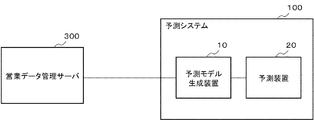
- FIG. 1 is a diagram showing an outline of the configuration of the sales support system of the present embodiment.
- the sales support system of this embodiment includes a prediction system 100 and a sales data management server 300.
- the prediction system 100 and the sales data management server 300 are connected to each other via a network.
- the sales support system of the present embodiment is a new customer with a high possibility of receiving an order based on a prediction model generated by inputting the attribute data of the customer, the activity history of the sales activity, and the attribute data of the product targeted for sales. It is a system that predicts products. New customers are customers who have a track record of attending seminars, etc., but who have no record of purchasing products for sale and customers who are included in a customer group who has no record of transactions. In the initial stage of sales activities, activities during the period when specific sales activities for receiving orders are not conducted for individual customers are also called marketing.
- the prediction system 100 includes a prediction model generation device 10 and a prediction device 20.
- the prediction model generation device 10 and the prediction device 20 are connected via a network. Further, the prediction model generation device 10 and the prediction device 20 may be formed as an integrated device. Further, the functions of the respective parts constituting the prediction model generation device 10 and the prediction device 20 may be realized by devices different from each other.
- FIG. 2 is a diagram showing a configuration of the prediction model generation device 10.
- the prediction model generation device 10 includes an acquisition unit 11, a storage unit 12, a graph generation unit 13, a prediction model generation unit 14, a prediction model storage unit 15, and a prediction model output unit 16.
- the prediction model generator 10 is a sales target, that is, the attributes of each of a plurality of customers (also referred to as existing customers) who have a sales record in the past, the activity history of sales activities for each existing customer, and the sales target. It is a device that generates a prediction model used when predicting customers and products that are likely to receive orders from the attributes of the products that have been received.
- the customers who are predicted to have a high possibility of receiving an order by forecasting using a forecasting model are also referred to as customers of interest.
- a product that is predicted to have a high possibility of receiving an order by forecasting using a prediction model is also called a recommended product in the sense that it is a product recommended to a noted customer who is predicted to have a high possibility of receiving an order.
- the goods may include services.
- the sales support system in the present embodiment can also predict customers and products that are unlikely to receive orders, instead of customers and products that are likely to receive orders.
- the acquisition unit 11 acquires the data used to generate the prediction model.
- the acquisition unit 11 has been the target of sales activities in the past, that is, the identification information of each of a plurality of customers (existing customers) who have a sales record in the past, and each of the customers (existing customers).
- the acquisition unit 11 acquires, for example, customer company name or name data as customer (existing customer) identification information, and acquires customer industry data as customer attribute data.
- the customer identification information may be any information that can identify an organization or an individual, such as a company code, a membership number, or an ID (Identifier) assigned to each customer.
- the acquisition unit 11 acquires product type data as attribute data of the product that is the target of the sales activity, for example.
- the acquisition unit 11 acquires time-series data of the activity history for each case from the first action to each customer (existing customer) to the determination of the success / failure result of the order from the sales data management server 300 for the past sales activities. ..
- the activity history data is composed of actions performed in sales activities for each case for each existing customer and information on the date and time when each action was executed. Therefore, from the activity history data, it is possible to acquire information on the actions performed in the sales activities for each existing customer and the time-series order information of each action.
- the activity history data that is, the actions of sales activities performed on existing customers and the information indicating the time-series order of each action is also referred to as sales process time-series data.
- An action is an individual sales action performed by a sales person for a customer.
- actions include holding a seminar for a customer, calling a customer, sending an e-mail newsletter to a customer, hearing a customer, visiting a customer, discussing with a customer, negotiating with a customer / negotiation (including price negotiation and product proposal).
- Product and system demonstrations to customers, exhibition invitations, factory tours, customer get-togethers, but not limited to any actions taken as part of general sales activities.
- the storage unit 12 stores each data input from the acquisition unit 11.
- the graph generation unit 13 generates a graph as graph structure data from the sales process time series data.
- the graph structure data generated from the sales process time series data is composed of a node showing each action in the sales activity for an existing customer and an edge showing the order of each action by connecting two consecutive actions.
- the graph structure data shows the time series order of each action in the sales activity. Therefore, the graph structure data shows the sales process.
- the action of the activity history of the sales activity may include an action in the marketing stage where the sales activity such as the sale of a specific product has not been started.
- FIG. 3 schematically shows an example of a graph generated by the graph generation unit 13.
- FIG. 3 shows a graph generated from the activity history of a plurality of projects as one graph.
- the white circles in FIG. 3 indicate each action in the sales process set as a node.
- the black circle in FIG. 3 indicates the first action for each case, that is, the action for first contacting the customer in the sales activity of the target case.
- the action when first contacting the customer is also called an entry point.
- the prediction model generation unit 14 inputs graph structure data based on the activity history of sales activities, attribute data of customers (existing customers), and attribute data of products to be sold, and receives orders based on labels indicating success or failure of orders. Generate a forecast model for forecasting likely customers and products. For example, the prediction model generation unit 14 uses machine learning using graph structure data generated from activity history, customer attribute data, product attribute data as learning data, and success / failure of orders as a result of sales activities as labels. Generate a prediction model by. The prediction model generation unit 14 generates a prediction model by calculating the feature amount of the graph by machine learning using NN (Neural Network).
- NN Neurological Network
- the prediction model generation unit 14 may generate a prediction model by performing machine learning using the attribute data of the product purchased by the customer as a label instead of the success or failure of the order.
- the predictive model may be generated using any machine learning method such as supervised learning, unsupervised learning, semi-supervised learning or reinforcement learning.
- the prediction model generation unit 14 generates a prediction model by calculating the feature amount of the graph by, for example, the STAR method.
- a prediction model is generated by calculating the feature amount of the graph by inputting the graph structure data at a plurality of time points.
- the STAR method can identify important nodes on the two axes of time and space among the nodes that make up the graph.
- the prediction model generation unit 14 may generate a prediction model by calculating the feature amount of the graph by the TGNet method.
- TGNet method machine learning is performed by inputting dynamic data, static data, and label data, and a trained model is generated. Details of the TGNet method are described in Qi Song, et al., "TGNet: Learning to Rank Nodes in Temporal Graphs", Proceedings of the 27th ACM International Conference on Information and Knowledge Management, p.97-106.
- the prediction model generation unit 14 may generate a prediction model by extracting the feature amount using, for example, a method for extracting the feature amount such as the Netwalk method, and combining a method for analyzing the feature amount such as the InerHAT method. good. Details of the Network method are described in Wenchow Yu, et al., "NetWalk: A Flexible Deep Embedding Approach for Anomaly Detection in Dynamic Networks", KDD 2018, p.2672-2681. The details of the InerHAT method are described in Zeyu Li, et al., “Interpretable Click-Through Rate Prediction through Hierarchical Attention", WSDM 2020: The Thirteenth ACM International Conference on Web Search and Data Mining.
- the prediction model generation unit 14 may generate a prediction model by using another method as long as it is a method of analyzing graph data and extracting a feature pattern.
- the prediction model storage unit 15 stores the prediction model generated by the prediction model generation unit 14.
- the prediction model output unit 16 outputs the prediction model stored in the prediction model storage unit 15 to the prediction device 20.
- Each process in the acquisition unit 11, the storage unit 12, the graph generation unit 13, the prediction model generation unit 14, and the prediction model output unit 16 is performed by executing a computer program on the CPU (Central Processing Unit). Further, a GPU (Graphics Processing Unit) may be combined with the CPU.
- CPU Central Processing Unit
- GPU Graphics Processing Unit
- the storage unit 12 and the prediction model storage unit 15 are configured by using, for example, a hard disk drive.
- the storage unit 12 and the prediction model storage unit 15 may be composed of a non-volatile semiconductor storage device or a combination of a plurality of types of storage devices.
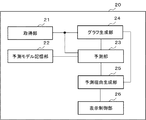
- FIG. 4 is a diagram showing the configuration of the prediction device 20.
- the prediction device 20 includes an acquisition unit 21, a prediction model storage unit 22, a prediction unit 23, a graph generation unit 24, a prediction reason generation unit 25, and a display control unit 26.
- the acquisition unit 21 acquires input data for predicting customers (customers of interest) and products that are likely to receive orders using a prediction model.
- the acquisition unit 21 acquires data used for prediction from, for example, the sales data management server 300.
- the input data may be input to the prediction device 20 by the operator.
- the acquisition unit 21 includes attribute data of a plurality of customers (target customers) who are candidates for sales at the time of prediction, and sales activities executed by the time of prediction. Acquire the activity history data of the sales process as time series data.
- the prediction model storage unit 22 stores the prediction model sent from the prediction model output unit 16 of the prediction model generation device 10.
- the prediction unit 23 predicts the customers and products with a high possibility of receiving an order and the sales process with a high possibility of receiving an order from the input data.
- the prediction unit 23 inputs attribute data of a plurality of customers (target customers) and data of actions at the initial stage of sales activities performed for each customer (time-series data of the sales process for the target customers). Use a forecasting model to predict customers and products that are likely to receive orders and sales processes that are likely to receive orders.
- the graph generation unit 24 generates a graph based on the sales process for customers who are likely to receive orders included in the prediction result of the prediction unit 23, and outputs the graph structure data to the prediction reason generation unit 25.
- the graph generation unit 24 generates a graph showing each action included in the sales process as a node and the order between the actions as an edge.
- the forecast reason generation unit 25 extracts the reason for the forecast by combining the customer with a high possibility of receiving an order, the product with a high possibility of receiving an order, and the forecast result of the sales process.
- the display control unit 26 controls the display unit (not shown) included in the prediction device 20 or the display device outside the prediction device 20 so as to display the prediction result to which the reason for the prediction is added. Further, the display control unit 26 may control the display on the display device by transmitting the prediction result with the reason for the prediction added to the terminal of the user who uses the prediction result, but the display control method is based on this. Not limited.
- the display control unit 26 generates display data for displaying the prediction result.
- the display control unit 26 displays display data for displaying as a candidate of attention customer who recommends a customer who has a high possibility of receiving an order as a target of sales activities and a candidate of a attention customer who recommends a product having a high possibility of receiving an order as a target of sales.
- the display control unit 26 ranks a plurality of customers in descending order of the possibility of receiving an order and generates display data.
- the order of orderability is calculated by the forecasting unit 23 using the similarity between the input customer attribute data and activity history data and the forecasting model, and the past ordering record.
- the similarity is calculated, for example, when the prediction unit 23 predicts a product with a high possibility of receiving an order and a customer of interest using a prediction model generated by using the STAR method. Further, the display control unit 26 adds graph structure data indicating the reason for the prediction and the sales process having a high possibility of receiving an order to the display data for displaying the prediction result of the prediction unit 23. The display control unit 26 controls the display of the display data of the prediction result and the reason for the prediction on the display device. Thereby, the present invention can more preferably support the sales activity by presenting the sales person in addition to the customer and the product having a high possibility of receiving an order and the reason for the order.
- Each process in the acquisition unit 21, the prediction unit 23, the graph generation unit 24, the prediction reason generation unit 25, and the display control unit 26 is performed by the processor executing the instruction executing a computer program.
- the processor may be a CPU, a GPU, or a combination of a CPU and a GPU.
- the prediction model storage unit 22 is configured by using, for example, a hard disk drive.
- the prediction model storage unit 22 may be composed of a non-volatile semiconductor storage device or a combination of a plurality of types of storage devices.
- the sales data management server 300 manages activity history data for each sales activity.
- the activity history data for example, data input by a sales person via a terminal device is used.
- the activity history data may be data extracted from the business diary.
- the sales person can change the date and time from the business diary that states "Introduce product A to the company by e-mail on March 2" to "March 2".
- the target "Company X" and the "email” indicating the action in the sales activity may be extracted as the activity history data.
- the business data management server 300 transmits the activity history data to the prediction model generation device 10.
- FIG. 5 is a diagram showing an operation flow when the prediction model generation device 10 generates a prediction model for predicting customers and products that are likely to receive orders.
- the acquisition unit 11 uses the attribute data of the target customer (existing customer) in a plurality of sales activities performed in the past as the attribute data, the attribute data of the product that has been sold, and the success or failure of the order for each sales activity.
- Data is acquired (step S11).
- the success / failure data of an order is composed of information indicating whether the order was successful or unsuccessful for each sales activity.
- Each data may be input by an operator or may be obtained from another server having each data.
- the acquisition unit 11 may acquire information indicating the actual result of whether or not an order has been received for each sales activity from the sales data management server 300. When each data is acquired, the acquisition unit 11 stores each acquired data in the storage unit 12.
- FIG. 6 is a diagram showing an example of customer (existing customer) information used as attribute data.
- customer attribute data of FIG. 6 the customer's company name, the type of business, the type of business (details) in which the type of business is further classified, and the annual sales are linked.
- FIG. 7 is a diagram showing an example of order success / failure data used as a label.
- the business history number which is the identification information of the activity history, the company name of the customer, the product that has been in business, and the result of success or failure of the order are linked.
- the acquisition unit 11 acquires the sales process time series data indicating the activity history data for each sales activity from the sales data management server 300 (step S12). When the business process time series data is acquired, the acquisition unit 11 stores the acquired activity history data in the storage unit 12.
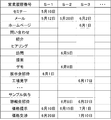
- FIG. 8 is a diagram showing an example of sales process time series data.
- the sales history number which is the identification information of the activity history, is associated with the date when each action is performed in the sales activity.
- the business history number in FIG. 8 corresponds to the business history number in FIG. 7.
- the graph generation unit 13 When the sales process time series data is stored in the storage unit 12, the graph generation unit 13 generates graph structure data based on the sales process time series data (step S13). The graph generation unit 13 generates graph structure data in which the actions executed in each sales process are arranged in chronological order, with each action in the activity history as a node and the order between each action as an edge. When the graph structure data is generated, the graph generation unit 13 sends the generated graph structure data to the prediction model generation unit 14.
- the prediction model generation unit 14 reads out each data used for generating the prediction model from the storage unit 12.
- the attribute data of each of multiple customers (existing customers), the attribute data of the product, and the graph structure data generated from the activity history are input data, and machine learning is performed using the success or failure of the order as a label to receive the order.
- Generate a prediction model for predicting likely customers and products step S14).
- the prediction model generation unit 14 stores the generated prediction model as a learned model in the prediction model storage unit 15.
- the prediction model output unit 16 outputs the prediction model to the prediction device 20 (step S15).
- the prediction model input to the prediction device 20 is stored in the prediction model storage unit 22.
- the prediction model generated by the prediction model generation device 10 may be updated by re-learning.
- the prediction model generation unit 14 inputs the attribute data of the customer who newly performed the sales activity based on the prediction result, the attribute data of the product, and the graph data generated from the activity history, and whether or not the order is acquired.
- the prediction model is retrained by machine learning labeled with.
- the prediction model generation unit 14 updates the prediction model stored in the prediction model storage unit 15. By performing re-learning based on the prediction result in this way, the prediction accuracy by the trained model is improved.
- the prediction model generation unit 14 inputs the attribute data of the customer who performed the sales activity based on the result, the attribute data of the product, and the graph data generated from the activity history as input data, and labels whether or not the order has been won.
- a new prediction model may be generated by the machine learning.
- FIG. 9 is a diagram showing an operation flow when predicting customers and products with a high possibility of receiving an order by using a prediction model in the prediction device 20.
- the acquisition unit 21 stores the customer attribute data and the activity history data of the sales activities performed up to the time of prediction for each customer for a plurality of customers (target customers) to be predicted by the sales data management server. Obtained from 300 (step S21). Each data may be input to the prediction device 20 by an operator.
- the activity history data of the sales activity performed up to the forecast time for each customer is time-series data indicating the action performed in the initial stage of the sales activity and the time-series order in which the action was performed.
- the acquisition unit 21 may select a customer group from the customer groups layered according to the attributes and use it as a prediction target. For example, a customer group in which attribute data is set as an industry, the upper hierarchy is classified as manufacturing and wholesale, and the lower hierarchy is further classified as manufacturing and pharmaceutical manufacturing. Suppose it has been generated. At this time, for example, the acquisition unit 21 may select all the customer groups included in the manufacturing industry according to the input by the worker or the like, or only the customer groups included in the food manufacturing in the lower hierarchy. May be selected.
- the prediction unit 23 uses the prediction model stored in the prediction model storage unit 22 to obtain the attribute data of the customer (target customer) and the activity history data (sales process). By inputting (time-series data), customers (customers of interest) who are likely to receive orders, products (recommended products), and sales processes are predicted (step S22).
- the forecasting unit 23 uses the data of customers and products that are likely to receive orders and the data of sales processes that are likely to receive orders as prediction results in the graph generation unit. Send to 24.
- the forecast results include information on attribute data that contributes significantly to the forecast when customers and products that are likely to receive orders are predicted using a forecast model.
- the graph generation unit 24 Upon receiving the forecast result, the graph generation unit 24 generates graph structure data to be used when displaying the forecast result from the sales process included in the forecast result and having a high possibility of receiving an order (step S23).
- the graph generation unit 24 generates graph structure data showing actions included in a sales process with a high possibility of receiving an order as nodes and the order between actions as edges.
- the graph generation unit 24 adds the graph structure data to the prediction result and sends the prediction result to the prediction reason generation unit 25.
- the prediction reason generation unit 25 Upon receiving the prediction result, the prediction reason generation unit 25 generates the reason for the prediction (step S24).
- the prediction reason generation unit 25 extracts, for example, attribute data having a high degree of contribution to the success of an order from the prediction result data as the reason for the prediction.
- the prediction reason generation unit 25 When the attribute data having a high degree of contribution to the prediction is an industry, the prediction reason generation unit 25 generates, for example, information indicating that there is a purchase record in another company in the same industry as the reason for the prediction.
- the prediction reason generation unit 25 further adds the reason for the prediction to the prediction result and outputs it to the display control unit 26.
- the display control unit 26 Upon receiving the prediction result, the display control unit 26 generates display data for displaying the prediction result. When the display data is generated, the display control unit 26 controls the display device and displays the prediction result on the display device (step S25). The display control unit 26 may control the transmission of the prediction result data to the user's terminal so that the prediction result is displayed on the display device of the user's terminal that uses the prediction result.
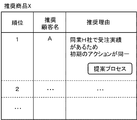
- FIG. 10 is a diagram showing an example of display data of the prediction result.
- the display data of the prediction result of FIG. 10 shows an example of display data in which the product X having a high possibility of receiving an order is the product X and is displayed as the recommended product X. Further, the display data of the prediction result of FIG. 10 is composed of a ranking indicating the high possibility of receiving an order, a recommended customer name, and a recommended reason indicating the reason for the prediction.
- the recommended customer name indicates the name of the customer who is recommended as a target of sales activities because it is a noteworthy customer who has a high possibility of receiving an order.
- FIG. 10 is a diagram showing an example of display data of the prediction result.
- the display data of the prediction result of FIG. 10 shows an example of display data in which the product X having a high possibility of receiving an order is the product X and is displayed as the recommended product X. Further, the display data of the prediction result of FIG. 10 is composed of a ranking indicating the high possibility of receiving an order,
- the prediction reason generation unit 25 holds in advance, for example, information on a representative customer name that has received an order in the past for each combination of attribute data and a product.
- the prediction reason generation unit 25 extracts the customers corresponding to the combination of the attribute data having a high contribution to the prediction result and the recommended product from the information held, and sets the extracted customers as the customers. Extract the fact that there is an order record as the reason for the forecast.
- Typical customers who have received orders in the past include, for example, customers who have received orders for each attribute data and have a large management scale and are well-known, or customers who have received more orders in the past than other companies. ..
- the prediction reason generation unit 25 may generate a prediction reason based on a predefined template.
- the prediction reason generation unit 25 holds a template that says, for example, "Because there is an order record at XX company in the same industry", and when the representative company of the ordering company is "A company", "A company in the same industry” Generate the reason for the prediction "because there is an order record”.
- FIG. 10 shows an example in which a button for displaying a sales process with a high possibility of receiving an order is set as a "proposal process" in the recommendation reason column.
- FIG. 11 shows an example of a sales process with a high possibility of receiving an order, which is displayed when the “proposal process” button is pressed.
- seminars and emails are shown as executed actions, and sales processes that are likely to receive orders are shown as recommended processes.
- the recommended process as shown in FIG. 11 may be displayed by placing the cursor on the "proposal process” button on the display screen of FIG. Further, in FIG. 10, when the mouse click or tap of the "proposal process" portion on the display screen is performed, the recommended process shown in FIG. 11 may be displayed.
- the edges of the graph structure data used when generating the prediction model show only the order of actions, but the edges may include the length of time between actions.
- the edges may include the length of time between actions.
- the industry, industry (details), and annual sales were used for the customer attribute data, but the customer attribute data includes industry, capital, number of employees, sales, profit, material purchase amount, and branch office. At least one item may be included among the number, the number of factories, the business form, the transaction performance, or other indicators representing the characteristics of the customer's company.
- hierarchical data such as major classification, middle classification and minor classification defined by JIS (Japanese Industrial Standards) may be used.
- the customer may be an individual. If the customer is an individual, the customer's attribute data includes age, gender, income, place of employment, number of family members, place of residence, transaction record, membership status, and e-mail newsletter subscription. At least one item may be included. In addition to customer attribute data, etc., the classification of products or services to be sold, the products or services to be sold, the sales of customers to be sold, the sales person, the position of the sales person, or the position of the sales person At least one item of the class may be used as input data when generating a prediction model. Further, when the attribute data of the customer or the sales person who is the target of these sales activities is used for generating the prediction model, it can be used for input as the attribute data even in the prediction stage.
- the attribute data when generating and forecasting the forecast model includes the classification of the product or service to be sold, the product or service to be sold, the sales of the customer to be sold, and the sales person, instead of the attribute data of the customer.
- the position of the sales person, or the information of one or more attributes of the company or the sales person who is the target of the sales activity such as the class of the sales person may be used as the input data.
- the above attribute data may be used in addition to the customer attribute data. Further, when the attribute data of the customer or the sales person who is the target of these sales activities is used for generating the prediction model, it can be used for input as the attribute data even in the prediction stage.
- the reasons for the forecast are sales, annual profit, number of employees, purchase record, classification of products or services to be sold, products to be sold or products to be sold, instead of having orders received from customers whose industry matches the customer of interest. It may include one or more of the service, the sales of the customer to be sold, the sales person, and the position of the sales person. In addition, the reasons for these predictions may be used together with the reason that there is an order record in a customer whose industry is the same as that of the customer of interest.
- the sales support system of the present embodiment uses the prediction model generator 10 to generate attribute data of a plurality of customers, graph structure data generated based on activity history data of sales activities for each customer, and product attribute data.
- a prediction model is generated by machine learning as input.
- the customers and products that are highly likely to receive an order from the attribute data of each customer and the action of the sales activity performed on each customer. Forecast the sales process.
- the sales support system of this embodiment predicts customers who are likely to receive orders and products that are likely to receive orders from among the customers who are taking action in sales activities, and also recommends sales processes from the present time onward. Can be predicted.
- the sales support system of this embodiment presents customers who are likely to receive orders, products, and sales processes as forecast results, so that efficient sales activities can be performed without depending on the skills of sales staff. Information to do can be presented. Therefore, the sales support system of the present embodiment increases the success probability of orders and sales by predicting the customers who are likely to receive orders and the products which are likely to receive orders among the customers who are engaged in sales activities. It is possible to support sales activities such as improving the efficiency of activities.
- FIG. 12 is a diagram showing an outline of the configuration of the sales support system of the present embodiment.
- the sales support system of this embodiment includes an acquisition unit 31 and a prediction unit 32.
- the acquisition unit 31 and the prediction unit 32 may be provided in a single device, or may be provided in different devices.
- the acquisition unit 31 has attribute data of each of a plurality of target customers who are candidates for sales, and sales process time series data regarding a time series of actions included in sales activities for each of the plurality of target customers performed up to a predetermined time point. And get.
- the acquisition unit 31 is an example of acquisition means.
- An example of the acquisition unit 31 is the acquisition unit 21 of the prediction device 20 of the first embodiment.
- the prediction unit 32 uses the prediction model, the attribute data of the plurality of target customers acquired by the acquisition unit 31, and the sales process time series data, and recommends the products for the plurality of target customers and the recommended products among the plurality of target customers. Predict with customers to buy.
- the forecast model is based on the attribute data of each of a plurality of existing customers who have a sales record in the past from a predetermined time point, the sales process time series data, and the product data related to the products purchased by the multiple existing customers by the sales activity. Has been generated in. Sales process time series data shows the time series order of multiple actions included in sales activities for multiple existing customers.
- the prediction unit 32 is an example of a prediction means.
- An example of the prediction unit 32 is the prediction unit 23 of the prediction device 20 of the first embodiment.
- FIG. 13 is a diagram showing an operation flow of the sales support system of the present embodiment.
- the acquisition unit 31 describes the attribute data of each of the plurality of target customers who are candidates for sales, and the sales process regarding the time series of the actions included in the sales activities for each of the plurality of target customers performed up to a predetermined time point.
- Acquire time series data step S31.
- the prediction unit 32 recommends from the attribute data of each target customer and the sales process time series data using the prediction model. Predict the product and the customer who purchases the recommended product (step S32).
- the sales support system of the present embodiment inputs recommended products and recommended products that are highly likely to be ordered by inputting actions for the target customer up to a predetermined time point, which is the prediction time point, and attribute data of the target customer into the prediction model. Predict customers who are likely to buy. Further, since the sales support system of the present embodiment makes a prediction using the action of the sales activity up to the prediction time point, it is possible to make a prediction in consideration of the activity by performing the prediction up to the prediction time point. Therefore, the sales support system of the present embodiment can predict the customers and products that are likely to receive orders among the customers who are taking action in the initial stage of the sales activity.
- FIG. 14 shows an example of the configuration of a computer 40 that executes a computer program that performs each process in the prediction model generation device 10 and the prediction device 20.
- the computer 40 includes a CPU 41, a memory 42, a storage device 43, an input / output I / F (Interface) 44, and a communication I / F 45.
- each process in the sales data management server 300 of the first embodiment and the sales support system of the second embodiment can also be performed by executing a computer program on the computer 40 having the same configuration.
- the CPU 41 reads a computer program that performs each process from the storage device 43 and executes it.
- the arithmetic processing unit that executes the computer program may be configured by a combination of a CPU and a GPU instead of the CPU 41.
- the memory 42 is composed of a DRAM (Dynamic Random Access Memory) or the like, and temporarily stores a computer program executed by the CPU 41 and data being processed.
- the storage device 43 stores a computer program executed by the CPU 41.
- the storage device 43 is composed of, for example, a non-volatile semiconductor storage device. Other storage devices such as a hard disk drive may be used as the storage device 43.
- the input / output I / F 44 is an interface for receiving input from an operator and outputting display data and the like.
- the communication I / F 45 is an interface for transmitting and receiving data between each device in the sales support system and the terminal of the user.
- the computer program used for executing each process by the CPU 41 can be stored in a recording medium and distributed.
- a recording medium for example, a magnetic tape for data recording or a magnetic disk such as a hard disk can be used.
- an optical disk such as a CD-ROM (Compact Disc Read Only Memory) can also be used.
- a non-volatile semiconductor storage device may be used as the recording medium.
- [Appendix 1] Acquire attribute data of each of a plurality of target customers that are candidates for sales, and sales process time series data related to a time series of actions included in sales activities for each of the plurality of target customers performed up to a predetermined time point.
- the prediction model generated based on the product data related to the products purchased by the plurality of existing customers by the sales activity, the attribute data of the plurality of target customers acquired by the acquisition means, and the sales process time series data.
- a sales support system including a prediction means for predicting a recommended product for the plurality of target customers and a customer who purchases the recommended product among the plurality of target customers.
- Appendix 2 The sales support system according to Appendix 1, further comprising a display control means for controlling a display device so as to display a prediction result by the prediction means and a reason for the prediction.
- the display control means is a display device so as to display the plurality of target customers in the order of priority of sales activities based on the attribute data of each of the plurality of existing customers and the attribute data of each of the plurality of target customers.
- the predictor is during a sales process that indicates the attribute data of each of the plurality of existing customers, the attribute data of each of the plurality of target customers, and the time-series order of a plurality of actions included in the sales activities for the plurality of existing customers. Attributes between each of the plurality of existing customers and each of the plurality of target customers based on the series data and the sales process time series data relating to the time series of actions included in the sales activities for each of the plurality of target customers. And the degree of customer similarity, which indicates the similarity of sales activities, is calculated.
- the display control means controls the display device so as to display the business process after the predetermined time point for the customer who is predicted to purchase the recommended product by the prediction means. Described sales support system.
- the display control means describes the recommended sales process as a graph structure including nodes corresponding to each of a plurality of actions included in the sales process and edges indicating the order between the actions. Sales support system.
- the customer attribute data includes the customer's industry, the number of employees, capital, sales, profit, material purchase amount, number of branches, number of factories, business form, and transaction record.
- the sales support system according to any one of Appendix 1 to 6, including at least one.
- the attribute data of the product includes the type of the product, the period during which the product is sold, the sales performance, the number of trading companies, the variation, the presence or absence of advertisement, the country of origin, and the form provided.
- the sales support system according to any one of Appendix 1 to 7, including at least one.
- Appendix 9 Attribute data of each of a plurality of existing customers who have a sales record in the past from the predetermined time point, sales process time series data showing a time series order of a plurality of actions included in sales activities for the plurality of existing customers, and the above. Described in any one of Appendix 1 to 8, further comprising a predictive model generating means for generating the predictive model by performing machine learning by inputting product data related to the products purchased by the plurality of existing customers by sales activities. Sales support system.
- the prediction model generation means includes attribute data of each customer of sales activities executed based on the prediction result by the prediction means, sales process time series data showing a time series order of a plurality of actions performed for each customer, and sales process time series data.
- the sales support system according to Appendix 9 which relearns the prediction model based on product data related to products purchased by the customer through the sales activities.
- [Appendix 11] Acquire the attribute data of each of a plurality of target customers that are candidates for sales, and the sales process time series data related to the time series of actions included in the sales activities for each of the plurality of target customers performed up to a predetermined time point. , Attribute data of each of a plurality of existing customers who have a sales record in the past from the predetermined time point, sales process time series data showing a time series order of a plurality of actions included in sales activities for the plurality of existing customers, and the above. Using the prediction model generated based on the product data related to the products purchased by the plurality of existing customers by the sales activity, and the acquired attribute data of the plurality of target customers and the sales process time series data, the plurality of said.
- a sales support method including predicting a recommended product for a target customer and a customer who purchases the recommended product among the plurality of target customers.
- Appendix 12 The sales support method according to Appendix 11, which controls a display device to display a prediction result and a reason for the prediction.
- Appendix 14 The attribute data of each of the plurality of existing customers, the attribute data of each of the plurality of target customers, the sales process time series data indicating the time series order of a plurality of actions included in the sales activities for the plurality of existing customers, and the above. Similar attributes and sales activities between each of the plurality of existing customers and each of the plurality of target customers based on the sales process time series data regarding the time series of actions included in the sales activities for each of the plurality of target customers. Calculate the customer similarity that indicates gender, The sales support method according to Appendix 13, which controls the display device so as to display the plurality of target customers in the order of priority of sales activities based on the customer similarity.
- Appendix 16 The sales support method according to Appendix 15, which displays the recommended sales process as a graph structure including nodes corresponding to each of a plurality of actions included in the sales process and edges indicating the order between the actions.
- the customer attribute data includes the customer's industry, the number of employees, capital, sales, profit, material purchase amount, number of branches, number of factories, business form, and transaction record.
- the sales support method according to any one of Appendix 11 to 16, including at least one.
- the attribute data of the product includes the type of the product, the period during which the product is sold, the sales performance, the number of trading companies, the variation, the presence or absence of advertisement, the country of origin, and the form provided.
- the sales support method according to any one of Appendix 11 to 17, including at least one.
- Appendix 19 Attribute data of each of a plurality of existing customers who have a sales record in the past from the predetermined time point, sales process time series data showing a time series order of a plurality of actions included in sales activities for the plurality of existing customers, and the above.
- Appendix 20 Attribute data of each customer of the sales activity executed based on the prediction result, sales process time series data showing the time series order of a plurality of actions performed for each customer, and the product purchased by the customer by the sales activity.
- [Appendix 21] Acquire attribute data of each of a plurality of target customers that are candidates for sales, and sales process time series data related to a time series of actions included in sales activities for each of the plurality of target customers performed up to a predetermined time point. Processing and Attribute data of each of a plurality of existing customers who have a sales record in the past from the predetermined time point, sales process time series data showing a time series order of a plurality of actions included in sales activities for the plurality of existing customers, and the above. Using the prediction model generated based on the product data related to the products purchased by the plurality of existing customers by the sales activity, the attribute data of the plurality of target customers acquired, and the sales process time series data, the plurality of said.
- a program recording medium that records a sales support program that causes a computer to execute a process of predicting a recommended product for a target customer and a customer who purchases the recommended product among the plurality of target customers.
- [Appendix 22] Acquire attribute data of each of a plurality of target customers that are candidates for sales, and sales process time series data related to a time series of actions included in sales activities for each of the plurality of target customers performed up to a predetermined time point. Acquisition method and Attribute data of each of a plurality of existing customers who have a sales record in the past from the predetermined time point, sales process time series data showing a time series order of a plurality of actions included in sales activities for the plurality of existing customers, and the above. Using the prediction model generated based on the product data related to the products purchased by the plurality of existing customers by the sales activity, the attribute data of the plurality of target customers acquired by the acquisition means, and the sales process time series data.
- a sales support device including a prediction means for predicting a recommended product for the plurality of target customers and a customer who purchases the recommended product among the plurality of target customers.
- Prediction model generator 11 Acquisition unit 12 Storage unit 13 Graph generation unit 14 Prediction model generation unit 15 Prediction model storage unit 16 Prediction model output unit 20 Prediction device 21 Acquisition unit 22 Prediction model storage unit 23 Prediction unit 24 Graph generation unit 25 Prediction Reason generation unit 26 Display control unit 31 Acquisition unit 32 Prediction unit 40 Computer 41 CPU 42 Memory 43 Storage device 44 I / O I / F 45 Communication I / F 100 Forecasting system 300 Sales data management server
Landscapes
- Business, Economics & Management (AREA)
- Strategic Management (AREA)
- Engineering & Computer Science (AREA)
- Accounting & Taxation (AREA)
- Development Economics (AREA)
- Finance (AREA)
- Entrepreneurship & Innovation (AREA)
- General Business, Economics & Management (AREA)
- Economics (AREA)
- Marketing (AREA)
- Physics & Mathematics (AREA)
- General Physics & Mathematics (AREA)
- Theoretical Computer Science (AREA)
- Game Theory and Decision Science (AREA)
- Data Mining & Analysis (AREA)
- Management, Administration, Business Operations System, And Electronic Commerce (AREA)
Priority Applications (3)
| Application Number | Priority Date | Filing Date | Title |
|---|---|---|---|
| PCT/JP2020/013918 WO2021192198A1 (ja) | 2020-03-27 | 2020-03-27 | 営業支援システム、営業支援方法およびプログラム記録媒体 |
| US17/908,379 US20230334515A1 (en) | 2020-03-27 | 2020-03-27 | Sales assistance system, sales assistance method, and program recording medium |
| JP2022510306A JP7556385B2 (ja) | 2020-03-27 | 2020-03-27 | 営業支援システム、営業支援方法および営業支援プログラム |
Applications Claiming Priority (1)
| Application Number | Priority Date | Filing Date | Title |
|---|---|---|---|
| PCT/JP2020/013918 WO2021192198A1 (ja) | 2020-03-27 | 2020-03-27 | 営業支援システム、営業支援方法およびプログラム記録媒体 |
Publications (1)
| Publication Number | Publication Date |
|---|---|
| WO2021192198A1 true WO2021192198A1 (ja) | 2021-09-30 |
Family
ID=77889935
Family Applications (1)
| Application Number | Title | Priority Date | Filing Date |
|---|---|---|---|
| PCT/JP2020/013918 Ceased WO2021192198A1 (ja) | 2020-03-27 | 2020-03-27 | 営業支援システム、営業支援方法およびプログラム記録媒体 |
Country Status (3)
| Country | Link |
|---|---|
| US (1) | US20230334515A1 (https=) |
| JP (1) | JP7556385B2 (https=) |
| WO (1) | WO2021192198A1 (https=) |
Cited By (4)
| Publication number | Priority date | Publication date | Assignee | Title |
|---|---|---|---|---|
| US20240005241A1 (en) * | 2022-06-30 | 2024-01-04 | Dell Products L.P. | Automatically determining enterprise-related action sequences using artificial intelligence techniques |
| WO2024189680A1 (ja) * | 2023-03-10 | 2024-09-19 | 日本電気株式会社 | 動作診断システム、動作診断方法および記録媒体 |
| JP7628332B1 (ja) | 2023-08-21 | 2025-02-10 | ライフデザインパートナーズ株式会社 | 営業支援方法、営業支援システム、営業支援プログラム、並びにこれらに用いうる学習済みモデル、その生成方法及びその実行プログラム |
| JP7636838B1 (ja) | 2024-07-12 | 2025-02-27 | 株式会社テクロス | 情報処理装置及び情報処理方法 |
Families Citing this family (3)
| Publication number | Priority date | Publication date | Assignee | Title |
|---|---|---|---|---|
| US12579480B2 (en) | 2021-09-30 | 2026-03-17 | Nasdaq, Inc. | Systems and methods to generate data messages indicating a probability of execution for data transaction objects using machine learning |
| US20240127080A1 (en) * | 2022-10-18 | 2024-04-18 | Nasdaq, Inc. | Systems and methods of optimizing resource allocation using machine learning and predictive control |
| JP7724937B1 (ja) * | 2024-11-25 | 2025-08-18 | 第一生命保険株式会社 | 情報処理装置、システム、及びシステムの動作方法 |
Citations (4)
| Publication number | Priority date | Publication date | Assignee | Title |
|---|---|---|---|---|
| JP2005322094A (ja) * | 2004-05-11 | 2005-11-17 | Hitachi Ltd | 営業支援方法および営業支援システム |
| JP2016118865A (ja) * | 2014-12-19 | 2016-06-30 | インターナショナル・ビジネス・マシーンズ・コーポレーションInternational Business Machines Corporation | 生成装置、生成方法、及び、プログラム |
| JP2019079302A (ja) * | 2017-10-25 | 2019-05-23 | 日本電気株式会社 | 営業活動支援システム、営業活動支援方法および営業活動支援プログラム |
| JP2019211871A (ja) * | 2018-05-31 | 2019-12-12 | パナソニックIpマネジメント株式会社 | 営業支援システム、営業支援方法及びプログラム |
Family Cites Families (4)
| Publication number | Priority date | Publication date | Assignee | Title |
|---|---|---|---|---|
| US7672865B2 (en) * | 2005-10-21 | 2010-03-02 | Fair Isaac Corporation | Method and apparatus for retail data mining using pair-wise co-occurrence consistency |
| US20150134413A1 (en) * | 2013-10-31 | 2015-05-14 | International Business Machines Corporation | Forecasting for retail customers |
| US20180374138A1 (en) * | 2017-06-23 | 2018-12-27 | Vufind Inc. | Leveraging delayed and partial reward in deep reinforcement learning artificial intelligence systems to provide purchase recommendations |
| US11373233B2 (en) * | 2019-02-01 | 2022-06-28 | Target Brands, Inc. | Item recommendations using convolutions on weighted graphs |
-
2020
- 2020-03-27 JP JP2022510306A patent/JP7556385B2/ja active Active
- 2020-03-27 US US17/908,379 patent/US20230334515A1/en not_active Abandoned
- 2020-03-27 WO PCT/JP2020/013918 patent/WO2021192198A1/ja not_active Ceased
Patent Citations (4)
| Publication number | Priority date | Publication date | Assignee | Title |
|---|---|---|---|---|
| JP2005322094A (ja) * | 2004-05-11 | 2005-11-17 | Hitachi Ltd | 営業支援方法および営業支援システム |
| JP2016118865A (ja) * | 2014-12-19 | 2016-06-30 | インターナショナル・ビジネス・マシーンズ・コーポレーションInternational Business Machines Corporation | 生成装置、生成方法、及び、プログラム |
| JP2019079302A (ja) * | 2017-10-25 | 2019-05-23 | 日本電気株式会社 | 営業活動支援システム、営業活動支援方法および営業活動支援プログラム |
| JP2019211871A (ja) * | 2018-05-31 | 2019-12-12 | パナソニックIpマネジメント株式会社 | 営業支援システム、営業支援方法及びプログラム |
Cited By (8)
| Publication number | Priority date | Publication date | Assignee | Title |
|---|---|---|---|---|
| US20240005241A1 (en) * | 2022-06-30 | 2024-01-04 | Dell Products L.P. | Automatically determining enterprise-related action sequences using artificial intelligence techniques |
| US12086746B2 (en) * | 2022-06-30 | 2024-09-10 | Dell Products L.P. | Automatically determining enterprise-related action sequences using artificial intelligence techniques |
| WO2024189680A1 (ja) * | 2023-03-10 | 2024-09-19 | 日本電気株式会社 | 動作診断システム、動作診断方法および記録媒体 |
| JP7628332B1 (ja) | 2023-08-21 | 2025-02-10 | ライフデザインパートナーズ株式会社 | 営業支援方法、営業支援システム、営業支援プログラム、並びにこれらに用いうる学習済みモデル、その生成方法及びその実行プログラム |
| JP2025029352A (ja) * | 2023-08-21 | 2025-03-06 | ライフデザインパートナーズ株式会社 | 営業支援方法、営業支援システム、営業支援プログラム、並びにこれらに用いうる学習済みモデル、その生成方法及びその実行プログラム |
| JP7636838B1 (ja) | 2024-07-12 | 2025-02-27 | 株式会社テクロス | 情報処理装置及び情報処理方法 |
| WO2026013977A1 (ja) * | 2024-07-12 | 2026-01-15 | 株式会社テクロス | 情報処理装置及び情報処理方法 |
| JP2026011995A (ja) * | 2024-07-12 | 2026-01-23 | 株式会社テクロス | 情報処理装置及び情報処理方法 |
Also Published As
| Publication number | Publication date |
|---|---|
| JP7556385B2 (ja) | 2024-09-26 |
| JPWO2021192198A1 (https=) | 2021-09-30 |
| US20230334515A1 (en) | 2023-10-19 |
Similar Documents
| Publication | Publication Date | Title |
|---|---|---|
| JP7556385B2 (ja) | 営業支援システム、営業支援方法および営業支援プログラム | |
| Alfian et al. | Customer behavior analysis using real-time data processing: A case study of digital signage-based online stores | |
| Nguyen et al. | A personalized product recommendation model in e-commerce based on retrieval strategy | |
| JP7533571B2 (ja) | 人流予測システム、人流予測方法および人流予測プログラム | |
| Sardar et al. | The future of big data in customer experience and inventory management | |
| US20180240158A1 (en) | Computer implemented system and method for customer profiling using micro-conversions via machine learning | |
| JP2024105572A (ja) | 営業支援システム、営業支援方法および営業支援プログラム | |
| Harsoor et al. | Forecast of sales of Walmart store using big data applications | |
| Chinnaraju | AI-powered consumer segmentation and targeting: A theoretical framework for precision marketing by autonomous (Agentic) AI | |
| Singh et al. | Evaluating critical success factors for acceptance of digital assistants for online shopping using grey–DEMATEL | |
| Zhong | E-commerce utilization analysis and growth strategy for smes using an artificial intelligence | |
| Pardeshi et al. | Applications of artificial intelligence and machine learning in E-commerce | |
| Soni et al. | Big data analytics for market prediction via consumer insight | |
| Hanini et al. | Dynamic and adaptive grouping maintenance strategies: New scalable optimization algorithms | |
| Lin | An integrated model examining frontline employee willingness to work with retail service robots | |
| Fayed | Smarter CRM solutions in the emerging technologies age | |
| Skenderi et al. | On the use of learning-based forecasting methods for ameliorating fashion business processes: A position paper | |
| Hütsch et al. | A Structured Literature Review on the Application of Machine Learning in Retail. | |
| Sharma et al. | The technological shift: AI in big data and IoT | |
| Athanasoulias et al. | Increasing business intelligence through a CRM approach: An implementation scheme and application framework | |
| Izang et al. | Automated market basket analysis system | |
| KR102714646B1 (ko) | 전이학습 기반 마케팅 퍼널 전환 예측 시스템 및 그 제어방법 | |
| Adhisekar et al. | A Review-Based Analysis on the Application of AI in Retail Management for Sustainable Business in India | |
| WO2022064688A1 (ja) | 推定システム、推定方法およびプログラム記録媒体 | |
| Kulkarni | Customer Behaviour Prediction |
Legal Events
| Date | Code | Title | Description |
|---|---|---|---|
| 121 | Ep: the epo has been informed by wipo that ep was designated in this application |
Ref document number: 20927823 Country of ref document: EP Kind code of ref document: A1 |
|
| ENP | Entry into the national phase |
Ref document number: 2022510306 Country of ref document: JP Kind code of ref document: A |
|
| NENP | Non-entry into the national phase |
Ref country code: DE |
|
| 122 | Ep: pct application non-entry in european phase |
Ref document number: 20927823 Country of ref document: EP Kind code of ref document: A1 |