WO2021181859A1 - 転送装置、転送方法、及び転送プログラム - Google Patents
転送装置、転送方法、及び転送プログラム Download PDFInfo
- Publication number
- WO2021181859A1 WO2021181859A1 PCT/JP2021/000908 JP2021000908W WO2021181859A1 WO 2021181859 A1 WO2021181859 A1 WO 2021181859A1 JP 2021000908 W JP2021000908 W JP 2021000908W WO 2021181859 A1 WO2021181859 A1 WO 2021181859A1
- Authority
- WO
- WIPO (PCT)
- Prior art keywords
- data
- information processing
- transfer
- processing devices
- value
- Prior art date
- Legal status (The legal status is an assumption and is not a legal conclusion. Google has not performed a legal analysis and makes no representation as to the accuracy of the status listed.)
- Ceased
Links
Images


Classifications
-
- G—PHYSICS
- G06—COMPUTING OR CALCULATING; COUNTING
- G06F—ELECTRIC DIGITAL DATA PROCESSING
- G06F3/00—Input arrangements for transferring data to be processed into a form capable of being handled by the computer; Output arrangements for transferring data from processing unit to output unit, e.g. interface arrangements
- G06F3/06—Digital input from, or digital output to, record carriers, e.g. RAID, emulated record carriers or networked record carriers
- G06F3/0601—Interfaces specially adapted for storage systems
- G06F3/0602—Interfaces specially adapted for storage systems specifically adapted to achieve a particular effect
- G06F3/061—Improving I/O performance
- G06F3/0611—Improving I/O performance in relation to response time
-
- G—PHYSICS
- G06—COMPUTING OR CALCULATING; COUNTING
- G06F—ELECTRIC DIGITAL DATA PROCESSING
- G06F3/00—Input arrangements for transferring data to be processed into a form capable of being handled by the computer; Output arrangements for transferring data from processing unit to output unit, e.g. interface arrangements
- G06F3/06—Digital input from, or digital output to, record carriers, e.g. RAID, emulated record carriers or networked record carriers
- G06F3/0601—Interfaces specially adapted for storage systems
- G06F3/0628—Interfaces specially adapted for storage systems making use of a particular technique
- G06F3/0655—Vertical data movement, i.e. input-output transfer; data movement between one or more hosts and one or more storage devices
-
- G—PHYSICS
- G06—COMPUTING OR CALCULATING; COUNTING
- G06F—ELECTRIC DIGITAL DATA PROCESSING
- G06F13/00—Interconnection of, or transfer of information or other signals between, memories, input/output devices or central processing units
- G06F13/14—Handling requests for interconnection or transfer
- G06F13/16—Handling requests for interconnection or transfer for access to memory bus
- G06F13/1605—Handling requests for interconnection or transfer for access to memory bus based on arbitration
- G06F13/1652—Handling requests for interconnection or transfer for access to memory bus based on arbitration in a multiprocessor architecture
- G06F13/1657—Access to multiple memories
-
- G—PHYSICS
- G06—COMPUTING OR CALCULATING; COUNTING
- G06F—ELECTRIC DIGITAL DATA PROCESSING
- G06F3/00—Input arrangements for transferring data to be processed into a form capable of being handled by the computer; Output arrangements for transferring data from processing unit to output unit, e.g. interface arrangements
- G06F3/06—Digital input from, or digital output to, record carriers, e.g. RAID, emulated record carriers or networked record carriers
- G06F3/0601—Interfaces specially adapted for storage systems
- G06F3/0602—Interfaces specially adapted for storage systems specifically adapted to achieve a particular effect
- G06F3/0604—Improving or facilitating administration, e.g. storage management
-
- G—PHYSICS
- G06—COMPUTING OR CALCULATING; COUNTING
- G06F—ELECTRIC DIGITAL DATA PROCESSING
- G06F3/00—Input arrangements for transferring data to be processed into a form capable of being handled by the computer; Output arrangements for transferring data from processing unit to output unit, e.g. interface arrangements
- G06F3/06—Digital input from, or digital output to, record carriers, e.g. RAID, emulated record carriers or networked record carriers
- G06F3/0601—Interfaces specially adapted for storage systems
- G06F3/0628—Interfaces specially adapted for storage systems making use of a particular technique
- G06F3/0638—Organizing or formatting or addressing of data
- G06F3/064—Management of blocks
-
- G—PHYSICS
- G06—COMPUTING OR CALCULATING; COUNTING
- G06F—ELECTRIC DIGITAL DATA PROCESSING
- G06F3/00—Input arrangements for transferring data to be processed into a form capable of being handled by the computer; Output arrangements for transferring data from processing unit to output unit, e.g. interface arrangements
- G06F3/06—Digital input from, or digital output to, record carriers, e.g. RAID, emulated record carriers or networked record carriers
- G06F3/0601—Interfaces specially adapted for storage systems
- G06F3/0668—Interfaces specially adapted for storage systems adopting a particular infrastructure
- G06F3/0671—In-line storage system
- G06F3/0673—Single storage device
- G06F3/0682—Tape device
-
- G—PHYSICS
- G06—COMPUTING OR CALCULATING; COUNTING
- G06F—ELECTRIC DIGITAL DATA PROCESSING
- G06F3/00—Input arrangements for transferring data to be processed into a form capable of being handled by the computer; Output arrangements for transferring data from processing unit to output unit, e.g. interface arrangements
- G06F3/06—Digital input from, or digital output to, record carriers, e.g. RAID, emulated record carriers or networked record carriers
- G06F3/0601—Interfaces specially adapted for storage systems
- G06F3/0668—Interfaces specially adapted for storage systems adopting a particular infrastructure
- G06F3/0671—In-line storage system
- G06F3/0683—Plurality of storage devices
- G06F3/0686—Libraries, e.g. tape libraries, jukebox
Definitions
- This disclosure relates to a transfer device, a transfer method, and a transfer program.
- a technique for using a data length for determining a storage node for storing data in an object storage system including a plurality of storage nodes is disclosed (Japanese Patent Laid-Open No. 2014-203329).
- load balancing is performed according to the data length, the number of data, and the like when recording data in a plurality of storage devices. Therefore, the storage device for recording the data is determined without considering the characteristics of the data.
- the data recording destination is a magnetic tape
- a plurality of data that are relatively likely to be requested to be read within a certain period of time are recorded on the same magnetic tape. This is because the plurality of data can be read by one reading process, and as a result, the reading time of the plurality of data can be shortened as compared with the case where the plurality of data are recorded on different magnetic tapes. Because.
- JP-A-2014-203329 and JP-A-2004-252957 do not consider the possibility that a plurality of data are requested to be read within a certain period of time, data recording is performed.
- the tip is a magnetic tape, the data reading time may become long.
- the present disclosure has been made in view of the above circumstances, and an object of the present disclosure is to provide a transfer device, a transfer method, and a transfer program capable of shortening the data reading time.
- the transfer device of the present disclosure is a transfer device that distributes and transfers a plurality of data to a plurality of information processing devices that control recording of data on a magnetic tape, and includes at least one processor. , The value indicating the possibility that the data is transferred to the plurality of information processing devices so that the number of data is leveled among the plurality of information processing devices and the plurality of data can be read within a predetermined period is equal to or more than the threshold value. Transfer multiple data of the above to the same information processing device.
- the processor may further transfer data to a plurality of information processing devices so that the size of the data is leveled.
- the value indicating the possibility may be a larger value as the frequency of reading a plurality of data in the past within a predetermined period is higher.
- the value representing the possibility becomes a larger value as the frequency of reading a plurality of data having the same attribute value as the plurality of data in the past within a predetermined period is higher. May be good.
- the transfer method of the present disclosure is a transfer method executed by a processor included in a transfer device that distributes and transfers a plurality of data to a plurality of information processing devices that control recording of data on a magnetic tape.
- the value indicating the possibility that the data is transferred to the plurality of information processing devices so that the number of data is leveled among the plurality of information processing devices and the plurality of data can be read within a predetermined period is equal to or more than the threshold value. This is to transfer a plurality of data of the above to the same information processing device.
- the transfer program of the present disclosure is a transfer program for causing a processor included in a transfer device that distributes and transfers a plurality of data to a plurality of information processing devices that control recording of data on a magnetic tape.
- a processor included in a transfer device that distributes and transfers a plurality of data to a plurality of information processing devices that control recording of data on a magnetic tape.
- a plurality of data exceeding the threshold value are transferred to the same information processing device.
- the data reading time can be shortened.
- the recording / playback system 10 includes a plurality of (two in this embodiment) information processing devices 12, a tape library 14, and a transfer device 16. Each information processing device 12 and the transfer device 16 are communicably connected via a network.
- a system for managing medical data is applied as the recording / playback system 10 will be described.
- the number of information processing devices 12 is not limited to two, and may be three or more.
- the tape library 14 includes a plurality of slots (not shown) and a plurality of tape drives 18, and each slot stores a magnetic tape T as an example of a recording medium.
- Each tape drive 18 is connected to each information processing device 12.
- An example of the magnetic tape T is an LTO (Linear Tape-Open) tape.
- An example of the information processing device 12 is a server computer or the like.
- the magnetic tape T to be written or read is loaded from the slot into a predetermined tape drive 18.
- the magnetic tape T is unloaded from the tape drive 18 into the slot originally stored.
- data to be saved by the user such as document data and image data and metadata related to the data are included as a unit for handling the data to be recorded on the magnetic tape T.
- An example of a form to which an object is applied will be described.
- the metadata is referred to as “meta”.
- the storage system that handles this object is called an object storage system.
- a form example in which medical data according to a predetermined standard such as DICOM (Digital Imaging and COmmunications in Medicine) is applied as the data to be recorded on the magnetic tape T will be described.
- DICOM Digital Imaging and COmmunications in Medicine
- the metadata includes, for example, object identification information such as an object ID (Identifier), data identification information such as a data name, data size, and attribute information such as a time stamp.
- object identification information such as an object ID (Identifier)
- data identification information such as a data name
- data size such as a data size
- attribute information such as a time stamp.
- the recording order of the data and the metadata when the object is recorded on the magnetic tape T is not particularly limited, and may be the order of the metadata and the data, or the order of the data and the metadata.
- the transfer device 16 distributes and transfers a plurality of objects to a plurality of information processing devices 12 that control recording of an object as an example of data on the magnetic tape T.
- An example of the transfer device 16 is a load balancer or the like.
- the transfer device 16 includes a CPU (Central Processing Unit) 20, a memory 21 as a temporary storage area, and a non-volatile storage unit 22. Further, the transfer device 16 includes a display unit 23 such as a liquid crystal display, an input unit 24 such as a keyboard and a mouse, and a network I / F (InterFace) 25 connected to a network.
- the CPU 20, the memory 21, the storage unit 22, the display unit 23, the input unit 24, and the network I / F 25 are connected to the bus 27.
- the storage unit 22 is realized by an HDD (Hard Disk Drive), an SSD (Solid State Drive), a flash memory, or the like.
- the transfer program 30 is stored in the storage unit 22 as a storage medium.
- the CPU 20 reads the transfer program 30 from the storage unit 22, expands it into the memory 21, and executes the expanded transfer program 30.
- the storage unit 22 is log data representing a reading history of an object that has been read from a recording medium (for example, a storage unit included in a magnetic tape T and an information processing device 12) in the past according to an instruction from a user terminal.
- the read log 32 is stored.
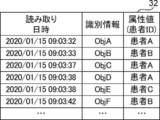
- FIG. 4 shows an example of the read log 32.
- the read log 32 stores the date and time when the object was read (hereinafter referred to as “read date and time”), the identification information of the object, and the attribute value of the object.
- read date and time the date and time when the object was read
- the identification information of the object hereinafter referred to as “read date and time”
- attribute value of the object hereinafter referred to as “patient ID”
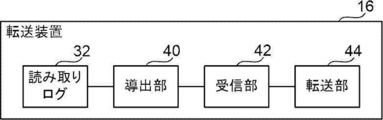
- the transfer device 16 includes a lead-out unit 40, a reception unit 42, and a transfer unit 44.
- the CPU 20 executes the transfer program 30, it functions as a derivation unit 40, a reception unit 42, and a transfer unit 44.
- the derivation unit 40 derives a value V1 indicating the possibility that a plurality of objects can be read within a predetermined period T1.
- a value V1 indicating the possibility that a plurality of objects can be read within a predetermined period T1.
- a larger value is applied as the frequency with which a plurality of objects are read within the period T1 for each combination of attribute values is higher.
- a predetermined period can be applied as a period in which it is assumed that a plurality of objects are read from the magnetic tape T at one time.
- the derivation unit 40 uses the log data of the latest fixed period in the read log 32 at a periodic timing such as once a day, and for each combination of attribute values, for each period T1. The number of times a plurality of objects having the attribute values of the combination are read within the period T1 is derived. Further, the out-licensing unit 40 derives the total value of the number of times of out-licensing for each period T1 within the latest fixed period as the value V1. Then, the derivation unit 40 stores (updates) the derived value V1 in the storage unit 22. For example, the derivation unit 40 may derive the value V1 at the timing when the transfer unit 44, which will be described later, transfers a plurality of objects.
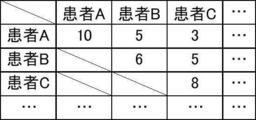
- FIG. 6 shows an example of the value V1.
- the value V1 representing the possibility that a plurality of objects having the attribute value “patient A” can be read within the period T1 is 10.
- the value V1 indicating the possibility that the object whose attribute value is "patient A” and the object whose attribute value is “patient B” can be read within the period T1 is 5.
- the value V1 becomes a larger value as a plurality of objects each having a combination of attribute values that are frequently read within the period T1.
- the attribute value is not limited to the patient ID, and may be, for example, the date when the object was created, the hospital name, or a combination of a plurality of attribute values.
- the receiving unit 42 receives the object transmitted from the user terminal.
- the transfer device 16 according to the present embodiment has a buffering function, and temporarily stores a plurality of objects received within a predetermined period such as within 1 second in the memory 21.
- the transfer unit 44 transfers objects to the plurality of information processing devices 12 so that the number of objects is leveled among the plurality of information processing devices 12, and transfers a plurality of objects having a value V1 equal to or greater than a threshold value to the same information processing device 12. Transfer to.
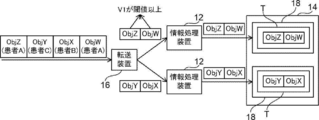
- FIG. 7 A specific example of the transfer process by the transfer unit 44 will be described with reference to FIG. 7.
- FIG. 7 an example in which four objects are input to the transfer device 16 will be described.
- the description in parentheses in the rectangle representing the object in FIG. 7 indicates the attribute value of the object.
- the value V1 for a plurality of objects having an attribute value of "patient A" is equal to or greater than the threshold value, and the value V1 for a plurality of objects having other combinations of attribute values is less than the threshold value. do.
- the value V1 which is a larger value as the frequency of reading a plurality of objects having the same attribute value as “patient A” in the past period T1 in the past is greater than or equal to the threshold value.
- Two objects (“ObjW” and “ObjZ” in the example of FIG. 7) are transferred to the same information processing device 12. Further, the transfer unit 44 sets the remaining two objects (in the example of FIG. 7, "ObjX”) so that the number of objects is leveled between the two information processing devices 12, that is, the number of objects is the same. And "ObjY”) are transferred to the remaining one information processing device 12.
- Each information processing device 12 controls to record a plurality of objects transferred from the transfer device 16 on the same magnetic tape T. As a result, a plurality of objects that are likely to be read at one time are recorded on the same magnetic tape T. On the other hand, for example, when the transfer device 16 transfers a plurality of objects by the round-robin method, the plurality of objects that are likely to be read at one time may be recorded on different magnetic tapes T. Therefore, according to the present embodiment, it is possible to shorten the data reading time while distributing the load.
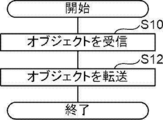
- the object transfer process shown in FIG. 8 is executed, for example, when a plurality of objects transmitted from the user terminal are input to the transfer device 16.
- step S10 of FIG. 8 the receiving unit 42 receives a plurality of objects transmitted from the user terminal.
- step S12 the transfer unit 44 transfers the plurality of objects received in step S10 to the plurality of information processing devices 12 so that the number of objects is leveled among the plurality of information processing devices 12.
- the transfer unit 44 has a larger value as the frequency with which a plurality of objects having the same attribute value in the past are read within the period T1 among all the objects received in step S10 is higher.
- a plurality of objects whose value V1 is equal to or larger than the threshold value are transferred to the same information processing apparatus 12.
- the data reading time can be shortened.
- the transfer unit 44 may further transfer the object to a plurality of information processing devices 12 so that the size of the object is leveled.
- the case where a plurality of objects having the same attribute value as the object to be transferred in the past are applied as the value V1 as the frequency of being read within the predetermined period T1 is higher is applied.
- the value V1 a larger value may be applied as the frequency with which a plurality of objects to be transferred have been read within a predetermined period T1 in the past is higher.
- the derivation unit 40 refers to the read log 32 for each combination of two objects out of the four objects, and two objects having the same identification information are read within the period T1. The number of times may be derived as the value V1.
- the present invention is not limited to this.
- the disclosed technology may be applied to a file storage system that handles data in file units.
- the various processors include a CPU, which is a general-purpose processor that executes software (program) and functions as various processing units, and a circuit after manufacturing an FPGA (Field Programmable Gate Array) or the like.
- Dedicated electricity which is a processor with a circuit configuration specially designed to execute specific processing such as programmable logic device (PLD), ASIC (Application Specific Integrated Circuit), which is a processor whose configuration can be changed. Circuits and the like are included.
- One processing unit may be composed of one of these various processors, or a combination of two or more processors of the same type or different types (for example, a combination of a plurality of FPGAs or a combination of a CPU and an FPGA). It may be composed of a combination). Further, a plurality of processing units may be configured by one processor.
- one processor is configured by a combination of one or more CPUs and software, as represented by a computer such as a client and a server.
- a processor functions as a plurality of processing units.
- SoC System on Chip
- the various processing units are configured by using one or more of the above-mentioned various processors as a hardware structure.
- an electric circuit in which circuit elements such as semiconductor elements are combined can be used.
- the mode in which the transfer program 30 is stored (installed) in the storage unit 22 in advance has been described, but the present invention is not limited to this. Even if the transfer program 30 is provided in a form recorded on a recording medium such as a CD-ROM (Compact Disc Read Only Memory), a DVD-ROM (Digital Versatile Disc Read Only Memory), and a USB (Universal Serial Bus) memory. good. Further, the transfer program 30 may be downloaded from an external device via a network.
- a recording medium such as a CD-ROM (Compact Disc Read Only Memory), a DVD-ROM (Digital Versatile Disc Read Only Memory), and a USB (Universal Serial Bus) memory.
- the transfer program 30 may be downloaded from an external device via a network.
Landscapes
- Engineering & Computer Science (AREA)
- Theoretical Computer Science (AREA)
- Physics & Mathematics (AREA)
- General Engineering & Computer Science (AREA)
- General Physics & Mathematics (AREA)
- Human Computer Interaction (AREA)
- Library & Information Science (AREA)
- Information Retrieval, Db Structures And Fs Structures Therefor (AREA)
Abstract
転送装置は、データを磁気テープに記録する制御を行う複数の情報処理装置に対して、複数のデータを分散して転送する転送装置であって、複数の情報処理装置の間でデータ数が平準化されるようデータを複数の情報処理装置に転送し、かつ複数のデータが予め定められた期間内に読み取られる可能性を表す値が閾値以上の複数のデータを同じ情報処理装置に転送する。
Description
本開示は、転送装置、転送方法、及び転送プログラムに関する。
複数のストレージノードを備えたオブジェクトストレージシステムにおけるデータの格納先のストレージノードの決定に、データ長を用いる技術が開示されている(特開2014-203329号公報)。
複数のストレージを備えたシステムにおいて、ファイルとファイルの格納先のストレージとを対応付ける際に、各ストレージに均等にファイルが分配されるように、ファイルの格納先のストレージを決定する技術が開示されている(特開2004-252957号公報)。
特開2014-203329号公報及び特開2004-252957号公報に記載の技術では、複数のストレージ装置にデータを記録するにあたり、データ長及びデータ数等に従って負荷分散を行っている。従って、データの特性は考慮されずに、データの記録先のストレージ装置が決定される。
データの記録先が磁気テープである場合、一定期間内に読み取り要求がされる可能性が比較的高い複数のデータは、同じ磁気テープに記録されることが好ましい。これは、一度の読み取り処理でその複数のデータを読み取ることができる結果、その複数のデータが異なる磁気テープに記録されている場合に比較して、複数のデータの読み取り時間を短縮することができるためである。
しかしながら、特開2014-203329号公報及び特開2004-252957号公報に記載の技術では、複数のデータに対して一定期間内に読み取り要求がされる可能性を考慮していないため、データの記録先が磁気テープの場合にデータの読み取り時間が長くなってしまう場合があった。
本開示は、以上の事情を鑑みてなされたものであり、データの読み取り時間を短縮することができる転送装置、転送方法、及び転送プログラムを提供することを目的とする。
本開示の転送装置は、データを磁気テープに記録する制御を行う複数の情報処理装置に対して、複数のデータを分散して転送する転送装置であって、少なくとも一つのプロセッサを備え、プロセッサは、複数の情報処理装置の間でデータ数が平準化されるようデータを複数の情報処理装置に転送し、かつ複数のデータが予め定められた期間内に読み取られる可能性を表す値が閾値以上の複数のデータを同じ情報処理装置に転送する。
なお、本開示の転送装置は、プロセッサが、更に、データのサイズが平準化されるようデータを複数の情報処理装置に転送してもよい。
また、本開示の転送装置は、可能性を表す値が、過去に複数のデータが予め定められた期間内に読み取られた頻度が高いほど大きい値であってもよい。
また、本開示の転送装置は、可能性を表す値が、過去に複数のデータと同じ属性値を有する複数のデータが予め定められた期間内に読み取られた頻度が高いほど大きい値であってもよい。
また、本開示の転送方法は、データを磁気テープに記録する制御を行う複数の情報処理装置に対して、複数のデータを分散して転送する転送装置が備えるプロセッサが実行する転送方法であって、複数の情報処理装置の間でデータ数が平準化されるようデータを複数の情報処理装置に転送し、かつ複数のデータが予め定められた期間内に読み取られる可能性を表す値が閾値以上の複数のデータを同じ情報処理装置に転送するものである。
また、本開示の転送プログラムは、データを磁気テープに記録する制御を行う複数の情報処理装置に対して、複数のデータを分散して転送する転送装置が備えるプロセッサに実行させるための転送プログラムであって、複数の情報処理装置の間でデータ数が平準化されるようデータを複数の情報処理装置に転送し、かつ複数のデータが予め定められた期間内に読み取られる可能性を表す値が閾値以上の複数のデータを同じ情報処理装置に転送するものである。
本開示によれば、データの読み取り時間を短縮することができる。
以下、図面を参照して、本開示の技術を実施するための形態例を詳細に説明する。
まず、図1を参照して、本実施形態に係る記録再生システム10の構成を説明する。図1に示すように、記録再生システム10は、複数(本実施形態では、2台)の情報処理装置12、テープライブラリ14、及び転送装置16を含む。各情報処理装置12と転送装置16とは、ネットワークを介して通信可能に接続される。本実施形態では、記録再生システム10として、医用データを管理するシステムを適用した形態例を説明する。なお、情報処理装置12の数は、2台に限定されず、3台以上でもよい。
テープライブラリ14は、複数のスロット(図示省略)及び複数のテープドライブ18を備え、各スロットには記録媒体の一例としての磁気テープTが格納される。各テープドライブ18は、各情報処理装置12に接続される。なお、磁気テープTの例としては、LTO(Linear Tape-Open)テープが挙げられる。また、情報処理装置12の例としては、サーバコンピュータ等が挙げられる。
情報処理装置12により磁気テープTに対するデータの書き込み又は読み取りを行う場合、書き込み対象又は読み取り対象の磁気テープTがスロットから所定のテープドライブ18にロードされる。テープドライブ18にロードされた磁気テープTに対するデータの書き込み又は読み取りが完了すると、磁気テープTは、テープドライブ18から元々格納されていたスロットにアンロードされる。
本実施形態では、一例として図2に示すように、磁気テープTに記録するデータを取り扱う単位として、文書データ及び画像データ等のユーザが保存対象とするデータと、そのデータに関するメタデータとを含むオブジェクトを適用した形態例を説明する。図2の例では、メタデータを「メタ」と表記している。なお、このオブジェクトを取り扱うストレージシステムは、オブジェクトストレージシステムと称される。また、本実施形態では、磁気テープTに記録するデータとして、DICOM(Digital Imaging and COmmunications in Medicine)等の予め定められた規格に従った医用データを適用した形態例を説明する。メタデータには、例えば、オブジェクトID(Identifier)等のオブジェクトの識別情報、データ名等のデータの識別情報、データのサイズ、及びタイムスタンプ等の属性情報が含まれる。なお、オブジェクトを磁気テープTに記録する際のデータ及びメタデータの記録順は特に限定されず、メタデータ及びデータの順でもよいし、データ及びメタデータの順でもよい。
転送装置16は、データの一例としてのオブジェクトを磁気テープTに記録する制御を行う複数の情報処理装置12に対して、複数のオブジェクトを分散して転送する。転送装置16の例としては、ロードバランサ等が挙げられる。
次に、図3を参照して、本実施形態に係る転送装置16のハードウェア構成を説明する。図3に示すように、転送装置16は、CPU(Central Processing Unit)20、一時記憶領域としてのメモリ21、及び不揮発性の記憶部22を含む。また、転送装置16は、液晶ディスプレイ等の表示部23、キーボードとマウス等の入力部24、及びネットワークに接続されるネットワークI/F(InterFace)25を含む。CPU20、メモリ21、記憶部22、表示部23、入力部24、及びネットワークI/F25は、バス27に接続される。
記憶部22は、HDD(Hard Disk Drive)、SSD(Solid State Drive)、又はフラッシュメモリ等によって実現される。記憶媒体としての記憶部22には、転送プログラム30が記憶される。CPU20は、記憶部22から転送プログラム30を読み出してからメモリ21に展開し、展開した転送プログラム30を実行する。
また、記憶部22には、過去に、ユーザ端末からの指示によって記録媒体(例えば、磁気テープT及び情報処理装置12が備える記憶部等)から読み取られたオブジェクトの読み取り履歴を表すログデータである読み取りログ32が記憶される。図4に、読み取りログ32の一例を示す。図4に示すように、読み取りログ32には、オブジェクトが読み取られた日時(以下、「読み取り日時」という)、オブジェクトの識別情報、及びオブジェクトが有する属性値が記憶される。本実施形態では、読み取りログ32に記憶される属性値として、「患者ID」という属性名の属性の属性値を適用した形態例を説明する。
次に、図5を参照して、本実施形態に係る転送装置16の機能的な構成について説明する。図5に示すように、転送装置16は、導出部40、受信部42、及び転送部44を含む。CPU20が転送プログラム30を実行することにより、導出部40、受信部42、及び転送部44として機能する。
導出部40は、複数のオブジェクトが予め定められた期間T1内に読み取られる可能性を表す値V1を導出する。本実施形態では、値V1として、属性値の組み合わせ毎に複数のオブジェクトが期間T1内に読み取られた頻度が高いほど大きい値を適用する。期間T1としては、例えば、一度に複数のオブジェクトが磁気テープTから読み取られたと想定される期間として予め定められた期間を適用することができる。
具体的には、導出部40は、1日1回等の定期的なタイミングで、読み取りログ32における直近の一定期間のログデータを用いて、属性値の各組み合わせについて、期間T1毎に、その期間T1内にその組み合わせの属性値をそれぞれ有する複数のオブジェクトが読み取られた回数を導出する。また、導出部40は、直近の一定期間内について期間T1毎に導出した回数の合計値を値V1として導出する。そして、導出部40は、導出した値V1を記憶部22に記憶(更新)する。なお、例えば、導出部40は、後述する転送部44が複数のオブジェクトを転送するタイミングで値V1を導出してもよい。
図6に、値V1の一例を示す。図6の例では、属性値が「患者A」の複数のオブジェクトが期間T1内に読み取られる可能性を表す値V1が10であることを表している。同様に、属性値が「患者A」のオブジェクトと「患者B」のオブジェクトとが期間T1内に読み取られる可能性を表す値V1が5であることを表している。「患者B」と「患者C」との組み合わせ等、上記の組み合わせ以外についても同様であるため説明を省略する。このように、値V1は、期間T1内に読み取られた頻度が高い組み合わせの属性値をそれぞれ有する複数のオブジェクトほど大きい値となる。すなわち、この値V1が大きいほど、その組み合わせの属性値をそれぞれ有する複数のオブジェクトが、一度に読み取られる可能性が高いことを表す。なお、属性値は、患者IDに限定されず、例えば、オブジェクトが生成された日付でもよいし、病院名でもよいし、複数の属性値の組み合わせでもよい。
受信部42は、ユーザ端末から送信されたオブジェクトを受信する。本実施形態に係る転送装置16は、バッファリング機能を有しており、例えば、1秒以内等の予め定められた期間内に受信した複数のオブジェクトをメモリ21に一時的に記憶する。
転送部44は、複数の情報処理装置12の間でオブジェクト数が平準化されるようオブジェクトを複数の情報処理装置12に転送し、かつ値V1が閾値以上の複数のオブジェクトを同じ情報処理装置12に転送する。
図7を参照して、転送部44による転送処理の具体的な一例を説明する。図7に示すように、ここでは、4つのオブジェクトが転送装置16に入力される例を説明する。図7のオブジェクトを表す矩形内の括弧内の記載は、そのオブジェクトが有する属性値を示している。また、ここでは、属性値が「患者A」の複数のオブジェクトについての値V1が閾値以上であり、それ以外の組み合わせの属性値をそれぞれ有する複数のオブジェクトについての値V1が閾値未満であるものとする。
図7に示すように、転送部44は、「患者A」と同じ属性値を有する複数のオブジェクトが過去に期間T1内に読み取られた頻度が高いほど大きい値である値V1が閾値以上である2つのオブジェクト(図7の例では、「ObjW」と「ObjZ」)を同じ1台の情報処理装置12に転送する。更に、転送部44は、2台の情報処理装置12の間でオブジェクト数が平準化されるよう、すなわち、同じオブジェクト数となるように、残りの2つのオブジェクト(図7の例では、「ObjX」と「ObjY」)を残りの1台の情報処理装置12に転送する。
各情報処理装置12は、転送装置16から転送された複数のオブジェクトを同じ磁気テープTに記録する制御を行う。これにより、一度に読み取られる可能性が高い複数のオブジェクトは同じ磁気テープTに記録される。これに対し、例えば、転送装置16がラウンドロビン方式で複数のオブジェクトを転送した場合、一度に読み取られる可能性が高い複数のオブジェクトが異なる磁気テープTに記録されてしまう場合もある。従って、本実施形態によれば、負荷分散をしつつ、データの読み取り時間を短縮することができる。
次に、図8を参照して、本実施形態に係る転送装置16の作用を説明する。CPU20が転送プログラム30を実行することによって、図8に示すオブジェクト転送処理が実行される。図8に示すオブジェクト転送処理は、例えば、ユーザ端末から送信された複数のオブジェクトが転送装置16に入力された場合に実行される。
図8のステップS10で、受信部42は、ユーザ端末から送信された複数のオブジェクトを受信する。ステップS12で、転送部44は、複数の情報処理装置12の間でオブジェクト数が平準化されるようステップS10で受信された複数のオブジェクトを複数の情報処理装置12に転送する。この際、転送部44は、前述したように、ステップS10で受信された全てのオブジェクトのうち、過去に同じ属性値を有する複数のオブジェクトが期間T1内に読み取られた頻度が高いほど大きい値である値V1が閾値以上の複数のオブジェクトを同じ情報処理装置12に転送する。ステップS12の処理が終了すると、オブジェクト転送処理が終了する。
以上説明したように、本実施形態によれば、データの読み取り時間を短縮することができる。
なお、上記実施形態において、転送部44は、更に、オブジェクトのサイズが平準化されるようオブジェクトを複数の情報処理装置12に転送してもよい。
また、上記実施形態では、値V1として、過去に転送対象のオブジェクトと同じ属性値を有する複数のオブジェクトが予め定められた期間T1内に読み取られた頻度が高いほど大きい値を適用した場合について説明したが、これに限定されない。例えば、値V1として、過去に転送対象の複数のオブジェクトが予め定められた期間T1内に読み取られた頻度が高いほど大きい値を適用してもよい。この場合、図7の例では、導出部40は、4つのオブジェクトのうちの2つのオブジェクトの各組み合わせについて、読み取りログ32を参照し、同じ識別情報を有する2つのオブジェクトが期間T1内に読み取られた回数を値V1として導出すればよい。
また、上記実施形態では、開示の技術をオブジェクトストレージシステムに適用した場合について説明したが、これに限定されない。開示の技術を、データをファイル単位で取り扱うファイルストレージシステムに適用する形態としてもよい。
また、上記実施形態において、例えば、導出部40、受信部42、及び転送部44といった各種の処理を実行する処理部(processing unit)のハードウェア的な構造としては、次に示す各種のプロセッサ(processor)を用いることができる。上記各種のプロセッサには、前述したように、ソフトウェア(プログラム)を実行して各種の処理部として機能する汎用的なプロセッサであるCPUに加えて、FPGA(Field Programmable Gate Array)等の製造後に回路構成を変更可能なプロセッサであるプログラマブルロジックデバイス(Programmable Logic Device:PLD)、ASIC(Application Specific Integrated Circuit)等の特定の処理を実行させるために専用に設計された回路構成を有するプロセッサである専用電気回路等が含まれる。
1つの処理部は、これらの各種のプロセッサのうちの1つで構成されてもよいし、同種又は異種の2つ以上のプロセッサの組み合わせ(例えば、複数のFPGAの組み合わせや、CPUとFPGAとの組み合わせ)で構成されてもよい。また、複数の処理部を1つのプロセッサで構成してもよい。
複数の処理部を1つのプロセッサで構成する例としては、第1に、クライアント及びサーバ等のコンピュータに代表されるように、1つ以上のCPUとソフトウェアの組み合わせで1つのプロセッサを構成し、このプロセッサが複数の処理部として機能する形態がある。第2に、システムオンチップ(System on Chip:SoC)等に代表されるように、複数の処理部を含むシステム全体の機能を1つのIC(Integrated Circuit)チップで実現するプロセッサを使用する形態がある。このように、各種の処理部は、ハードウェア的な構造として、上記各種のプロセッサの1つ以上を用いて構成される。
更に、これらの各種のプロセッサのハードウェア的な構造としては、より具体的には、半導体素子などの回路素子を組み合わせた電気回路(circuitry)を用いることができる。
また、上記実施形態では、転送プログラム30が記憶部22に予め記憶(インストール)されている態様を説明したが、これに限定されない。転送プログラム30は、CD-ROM(Compact Disc Read Only Memory)、DVD-ROM(Digital Versatile Disc Read Only Memory)、及びUSB(Universal Serial Bus)メモリ等の記録媒体に記録された形態で提供されてもよい。また、転送プログラム30は、ネットワークを介して外部装置からダウンロードされる形態としてもよい。
2020年3月13日に出願された日本国特許出願2020-044486号の開示は、その全体が参照により本明細書に取り込まれる。また、本明細書に記載された全ての文献、特許出願、及び技術規格は、個々の文献、特許出願、及び技術規格が参照により取り込まれることが具体的かつ個々に記された場合と同程度に、本明細書中に参照により取り込まれる。
Claims (6)
- データを磁気テープに記録する制御を行う複数の情報処理装置に対して、複数のデータを分散して転送する転送装置であって、
少なくとも一つのプロセッサを備え、
前記プロセッサは、
前記複数の情報処理装置の間でデータ数が平準化されるようデータを前記複数の情報処理装置に転送し、かつ
複数のデータが予め定められた期間内に読み取られる可能性を表す値が閾値以上の複数のデータを同じ情報処理装置に転送する
転送装置。 - 前記プロセッサは、更に、データのサイズが平準化されるようデータを前記複数の情報処理装置に転送する
請求項1に記載の転送装置。 - 前記可能性を表す値は、過去に前記複数のデータが前記予め定められた期間内に読み取られた頻度が高いほど大きい値である
請求項1又は請求項2に記載の転送装置。 - 前記可能性を表す値は、過去に前記複数のデータと同じ属性値を有する複数のデータが前記予め定められた期間内に読み取られた頻度が高いほど大きい値である
請求項1から請求項3の何れか1項に記載の転送装置。 - データを磁気テープに記録する制御を行う複数の情報処理装置に対して、複数のデータを分散して転送する転送装置が備えるプロセッサが実行する転送方法であって、
前記複数の情報処理装置の間でデータ数が平準化されるようデータを前記複数の情報処理装置に転送し、かつ
複数のデータが予め定められた期間内に読み取られる可能性を表す値が閾値以上の複数のデータを同じ情報処理装置に転送する
転送方法。 - データを磁気テープに記録する制御を行う複数の情報処理装置に対して、複数のデータを分散して転送する転送装置が備えるプロセッサに実行させるための転送プログラムであって、
前記複数の情報処理装置の間でデータ数が平準化されるようデータを前記複数の情報処理装置に転送し、かつ
複数のデータが予め定められた期間内に読み取られる可能性を表す値が閾値以上の複数のデータを同じ情報処理装置に転送する
転送プログラム。
Priority Applications (2)
| Application Number | Priority Date | Filing Date | Title |
|---|---|---|---|
| JP2022505796A JPWO2021181859A1 (ja) | 2020-03-13 | 2021-01-13 | |
| US17/822,807 US20220413746A1 (en) | 2020-03-13 | 2022-08-29 | Transfer device, transfer method, and transfer program |
Applications Claiming Priority (2)
| Application Number | Priority Date | Filing Date | Title |
|---|---|---|---|
| JP2020044486 | 2020-03-13 | ||
| JP2020-044486 | 2020-03-13 |
Related Child Applications (1)
| Application Number | Title | Priority Date | Filing Date |
|---|---|---|---|
| US17/822,807 Continuation US20220413746A1 (en) | 2020-03-13 | 2022-08-29 | Transfer device, transfer method, and transfer program |
Publications (1)
| Publication Number | Publication Date |
|---|---|
| WO2021181859A1 true WO2021181859A1 (ja) | 2021-09-16 |
Family
ID=77672189
Family Applications (1)
| Application Number | Title | Priority Date | Filing Date |
|---|---|---|---|
| PCT/JP2021/000908 Ceased WO2021181859A1 (ja) | 2020-03-13 | 2021-01-13 | 転送装置、転送方法、及び転送プログラム |
Country Status (4)
| Country | Link |
|---|---|
| US (1) | US20220413746A1 (ja) |
| JP (1) | JPWO2021181859A1 (ja) |
| TW (1) | TW202134894A (ja) |
| WO (1) | WO2021181859A1 (ja) |
Citations (3)
| Publication number | Priority date | Publication date | Assignee | Title |
|---|---|---|---|---|
| JPH06332759A (ja) * | 1993-05-20 | 1994-12-02 | Hitachi Ltd | ライブラリ装置の負荷分散制御方式 |
| JP2008059438A (ja) * | 2006-09-01 | 2008-03-13 | Hitachi Ltd | 記憶システム、そのデータ再配置方法、データ再配置プログラム |
| JP2018190393A (ja) * | 2017-05-01 | 2018-11-29 | 富士通株式会社 | 情報処理装置、ファイル格納方法およびプログラム |
-
2021
- 2021-01-13 JP JP2022505796A patent/JPWO2021181859A1/ja not_active Abandoned
- 2021-01-13 WO PCT/JP2021/000908 patent/WO2021181859A1/ja not_active Ceased
- 2021-02-04 TW TW110104130A patent/TW202134894A/zh unknown
-
2022
- 2022-08-29 US US17/822,807 patent/US20220413746A1/en not_active Abandoned
Patent Citations (3)
| Publication number | Priority date | Publication date | Assignee | Title |
|---|---|---|---|---|
| JPH06332759A (ja) * | 1993-05-20 | 1994-12-02 | Hitachi Ltd | ライブラリ装置の負荷分散制御方式 |
| JP2008059438A (ja) * | 2006-09-01 | 2008-03-13 | Hitachi Ltd | 記憶システム、そのデータ再配置方法、データ再配置プログラム |
| JP2018190393A (ja) * | 2017-05-01 | 2018-11-29 | 富士通株式会社 | 情報処理装置、ファイル格納方法およびプログラム |
Also Published As
| Publication number | Publication date |
|---|---|
| TW202134894A (zh) | 2021-09-16 |
| JPWO2021181859A1 (ja) | 2021-09-16 |
| US20220413746A1 (en) | 2022-12-29 |
Similar Documents
| Publication | Publication Date | Title |
|---|---|---|
| US11763840B2 (en) | Information processing device, information processing method, and information processing program | |
| US20220413746A1 (en) | Transfer device, transfer method, and transfer program | |
| WO2021171815A1 (ja) | 情報処理装置、情報処理方法、及び情報処理プログラム | |
| US20240094935A1 (en) | Information processing apparatus, information processing method, and information processing program | |
| WO2022049832A1 (ja) | 情報処理装置、情報処理方法、及び情報処理プログラム | |
| US20230065229A1 (en) | Information processing apparatus, information processing method, and information processing program | |
| US20230047128A1 (en) | Information processing apparatus, information processing method, and information processing program | |
| US20230064391A1 (en) | Information processing apparatus, information processing method, and information processing program | |
| US20230048156A1 (en) | Information processing apparatus, information processing method, and information processing program | |
| CN116643910A (zh) | 信息处理装置、信息处理方法及存储介质 | |
| JP2024037470A (ja) | 情報処理装置、情報処理方法、及び情報処理プログラム | |
| WO2022044458A1 (ja) | 情報処理装置、情報処理方法、及び情報処理プログラム | |
| WO2022163078A1 (ja) | 情報処理装置、情報処理方法、及び情報処理プログラム | |
| WO2021186774A1 (ja) | 情報処理装置、情報処理方法、及び情報処理プログラム | |
| WO2022044459A1 (ja) | 情報処理装置、情報処理方法、及び情報処理プログラム | |
| WO2022172549A1 (ja) | 情報処理装置、情報処理方法、及び情報処理プログラム | |
| WO2022185650A1 (ja) | 情報処理装置、情報処理方法、及び情報処理プログラム | |
| WO2022176345A1 (ja) | 情報処理装置、情報処理方法、及び情報処理プログラム | |
| JP2024053282A (ja) | 情報処理装置、情報処理方法、及び情報処理プログラム | |
| JP2024044866A (ja) | 情報処理装置、情報処理方法、及び情報処理プログラム | |
| WO2022168399A1 (ja) | 情報処理装置、情報処理方法、及び情報処理プログラム | |
| JP2023063950A (ja) | 情報処理装置、情報処理方法、及び情報処理プログラム | |
| WO2022172550A1 (ja) | 情報処理装置、情報処理方法、及び情報処理プログラム | |
| WO2022176344A1 (ja) | 情報処理装置、情報処理方法、及び情報処理プログラム | |
| WO2022044434A1 (ja) | 情報処理装置、情報処理方法、及び情報処理プログラム |
Legal Events
| Date | Code | Title | Description |
|---|---|---|---|
| 121 | Ep: the epo has been informed by wipo that ep was designated in this application |
Ref document number: 21768990 Country of ref document: EP Kind code of ref document: A1 |
|
| ENP | Entry into the national phase |
Ref document number: 2022505796 Country of ref document: JP Kind code of ref document: A |
|
| NENP | Non-entry into the national phase |
Ref country code: DE |
|
| 122 | Ep: pct application non-entry in european phase |
Ref document number: 21768990 Country of ref document: EP Kind code of ref document: A1 |