WO2021157718A1 - 文書作成支援装置、文書作成支援方法及びプログラム - Google Patents
文書作成支援装置、文書作成支援方法及びプログラム Download PDFInfo
- Publication number
- WO2021157718A1 WO2021157718A1 PCT/JP2021/004410 JP2021004410W WO2021157718A1 WO 2021157718 A1 WO2021157718 A1 WO 2021157718A1 JP 2021004410 W JP2021004410 W JP 2021004410W WO 2021157718 A1 WO2021157718 A1 WO 2021157718A1
- Authority
- WO
- WIPO (PCT)
- Prior art keywords
- texts
- document creation
- classification
- support device
- text
- Prior art date
- Legal status (The legal status is an assumption and is not a legal conclusion. Google has not performed a legal analysis and makes no representation as to the accuracy of the status listed.)
- Ceased
Links
Images






Classifications
-
- G—PHYSICS
- G06—COMPUTING OR CALCULATING; COUNTING
- G06F—ELECTRIC DIGITAL DATA PROCESSING
- G06F40/00—Handling natural language data
- G06F40/10—Text processing
- G06F40/166—Editing, e.g. inserting or deleting
-
- G—PHYSICS
- G06—COMPUTING OR CALCULATING; COUNTING
- G06F—ELECTRIC DIGITAL DATA PROCESSING
- G06F40/00—Handling natural language data
- G06F40/40—Processing or translation of natural language
- G06F40/55—Rule-based translation
- G06F40/56—Natural language generation
-
- G—PHYSICS
- G06—COMPUTING OR CALCULATING; COUNTING
- G06F—ELECTRIC DIGITAL DATA PROCESSING
- G06F40/00—Handling natural language data
- G06F40/40—Processing or translation of natural language
- G06F40/42—Data-driven translation
- G06F40/44—Statistical methods, e.g. probability models
-
- G—PHYSICS
- G06—COMPUTING OR CALCULATING; COUNTING
- G06T—IMAGE DATA PROCESSING OR GENERATION, IN GENERAL
- G06T1/00—General purpose image data processing
-
- G—PHYSICS
- G06—COMPUTING OR CALCULATING; COUNTING
- G06T—IMAGE DATA PROCESSING OR GENERATION, IN GENERAL
- G06T7/00—Image analysis
- G06T7/0002—Inspection of images, e.g. flaw detection
- G06T7/0012—Biomedical image inspection
-
- G—PHYSICS
- G06—COMPUTING OR CALCULATING; COUNTING
- G06V—IMAGE OR VIDEO RECOGNITION OR UNDERSTANDING
- G06V10/00—Arrangements for image or video recognition or understanding
- G06V10/70—Arrangements for image or video recognition or understanding using pattern recognition or machine learning
- G06V10/764—Arrangements for image or video recognition or understanding using pattern recognition or machine learning using classification, e.g. of video objects
-
- G—PHYSICS
- G06—COMPUTING OR CALCULATING; COUNTING
- G06V—IMAGE OR VIDEO RECOGNITION OR UNDERSTANDING
- G06V20/00—Scenes; Scene-specific elements
- G06V20/70—Labelling scene content, e.g. deriving syntactic or semantic representations
-
- G—PHYSICS
- G16—INFORMATION AND COMMUNICATION TECHNOLOGY [ICT] SPECIALLY ADAPTED FOR SPECIFIC APPLICATION FIELDS
- G16H—HEALTHCARE INFORMATICS, i.e. INFORMATION AND COMMUNICATION TECHNOLOGY [ICT] SPECIALLY ADAPTED FOR THE HANDLING OR PROCESSING OF MEDICAL OR HEALTHCARE DATA
- G16H15/00—ICT specially adapted for medical reports, e.g. generation or transmission thereof
-
- G—PHYSICS
- G16—INFORMATION AND COMMUNICATION TECHNOLOGY [ICT] SPECIALLY ADAPTED FOR SPECIFIC APPLICATION FIELDS
- G16H—HEALTHCARE INFORMATICS, i.e. INFORMATION AND COMMUNICATION TECHNOLOGY [ICT] SPECIALLY ADAPTED FOR THE HANDLING OR PROCESSING OF MEDICAL OR HEALTHCARE DATA
- G16H30/00—ICT specially adapted for the handling or processing of medical images
- G16H30/20—ICT specially adapted for the handling or processing of medical images for handling medical images, e.g. DICOM, HL7 or PACS
-
- G—PHYSICS
- G16—INFORMATION AND COMMUNICATION TECHNOLOGY [ICT] SPECIALLY ADAPTED FOR SPECIFIC APPLICATION FIELDS
- G16H—HEALTHCARE INFORMATICS, i.e. INFORMATION AND COMMUNICATION TECHNOLOGY [ICT] SPECIALLY ADAPTED FOR THE HANDLING OR PROCESSING OF MEDICAL OR HEALTHCARE DATA
- G16H30/00—ICT specially adapted for the handling or processing of medical images
- G16H30/40—ICT specially adapted for the handling or processing of medical images for processing medical images, e.g. editing
-
- G—PHYSICS
- G16—INFORMATION AND COMMUNICATION TECHNOLOGY [ICT] SPECIALLY ADAPTED FOR SPECIFIC APPLICATION FIELDS
- G16H—HEALTHCARE INFORMATICS, i.e. INFORMATION AND COMMUNICATION TECHNOLOGY [ICT] SPECIALLY ADAPTED FOR THE HANDLING OR PROCESSING OF MEDICAL OR HEALTHCARE DATA
- G16H40/00—ICT specially adapted for the management or administration of healthcare resources or facilities; ICT specially adapted for the management or operation of medical equipment or devices
- G16H40/60—ICT specially adapted for the management or administration of healthcare resources or facilities; ICT specially adapted for the management or operation of medical equipment or devices for the operation of medical equipment or devices
- G16H40/67—ICT specially adapted for the management or administration of healthcare resources or facilities; ICT specially adapted for the management or operation of medical equipment or devices for the operation of medical equipment or devices for remote operation
-
- G—PHYSICS
- G16—INFORMATION AND COMMUNICATION TECHNOLOGY [ICT] SPECIALLY ADAPTED FOR SPECIFIC APPLICATION FIELDS
- G16H—HEALTHCARE INFORMATICS, i.e. INFORMATION AND COMMUNICATION TECHNOLOGY [ICT] SPECIALLY ADAPTED FOR THE HANDLING OR PROCESSING OF MEDICAL OR HEALTHCARE DATA
- G16H50/00—ICT specially adapted for medical diagnosis, medical simulation or medical data mining; ICT specially adapted for detecting, monitoring or modelling epidemics or pandemics
- G16H50/20—ICT specially adapted for medical diagnosis, medical simulation or medical data mining; ICT specially adapted for detecting, monitoring or modelling epidemics or pandemics for computer-aided diagnosis, e.g. based on medical expert systems
-
- G—PHYSICS
- G16—INFORMATION AND COMMUNICATION TECHNOLOGY [ICT] SPECIALLY ADAPTED FOR SPECIFIC APPLICATION FIELDS
- G16H—HEALTHCARE INFORMATICS, i.e. INFORMATION AND COMMUNICATION TECHNOLOGY [ICT] SPECIALLY ADAPTED FOR THE HANDLING OR PROCESSING OF MEDICAL OR HEALTHCARE DATA
- G16H50/00—ICT specially adapted for medical diagnosis, medical simulation or medical data mining; ICT specially adapted for detecting, monitoring or modelling epidemics or pandemics
- G16H50/70—ICT specially adapted for medical diagnosis, medical simulation or medical data mining; ICT specially adapted for detecting, monitoring or modelling epidemics or pandemics for mining of medical data, e.g. analysing previous cases of other patients
-
- G—PHYSICS
- G16—INFORMATION AND COMMUNICATION TECHNOLOGY [ICT] SPECIALLY ADAPTED FOR SPECIFIC APPLICATION FIELDS
- G16H—HEALTHCARE INFORMATICS, i.e. INFORMATION AND COMMUNICATION TECHNOLOGY [ICT] SPECIALLY ADAPTED FOR THE HANDLING OR PROCESSING OF MEDICAL OR HEALTHCARE DATA
- G16H70/00—ICT specially adapted for the handling or processing of medical references
- G16H70/60—ICT specially adapted for the handling or processing of medical references relating to pathologies
-
- G—PHYSICS
- G06—COMPUTING OR CALCULATING; COUNTING
- G06T—IMAGE DATA PROCESSING OR GENERATION, IN GENERAL
- G06T2207/00—Indexing scheme for image analysis or image enhancement
- G06T2207/10—Image acquisition modality
- G06T2207/10072—Tomographic images
-
- G—PHYSICS
- G06—COMPUTING OR CALCULATING; COUNTING
- G06T—IMAGE DATA PROCESSING OR GENERATION, IN GENERAL
- G06T2207/00—Indexing scheme for image analysis or image enhancement
- G06T2207/10—Image acquisition modality
- G06T2207/10116—X-ray image
-
- G—PHYSICS
- G06—COMPUTING OR CALCULATING; COUNTING
- G06T—IMAGE DATA PROCESSING OR GENERATION, IN GENERAL
- G06T2207/00—Indexing scheme for image analysis or image enhancement
- G06T2207/20—Special algorithmic details
- G06T2207/20084—Artificial neural networks [ANN]
-
- G—PHYSICS
- G06—COMPUTING OR CALCULATING; COUNTING
- G06T—IMAGE DATA PROCESSING OR GENERATION, IN GENERAL
- G06T2207/00—Indexing scheme for image analysis or image enhancement
- G06T2207/30—Subject of image; Context of image processing
- G06T2207/30004—Biomedical image processing
- G06T2207/30061—Lung
-
- G—PHYSICS
- G06—COMPUTING OR CALCULATING; COUNTING
- G06T—IMAGE DATA PROCESSING OR GENERATION, IN GENERAL
- G06T2207/00—Indexing scheme for image analysis or image enhancement
- G06T2207/30—Subject of image; Context of image processing
- G06T2207/30004—Biomedical image processing
- G06T2207/30096—Tumor; Lesion
-
- G—PHYSICS
- G06—COMPUTING OR CALCULATING; COUNTING
- G06V—IMAGE OR VIDEO RECOGNITION OR UNDERSTANDING
- G06V2201/00—Indexing scheme relating to image or video recognition or understanding
- G06V2201/03—Recognition of patterns in medical or anatomical images
Definitions
- Disclosure technology relates to document creation support devices, document creation support methods and programs.
- Japanese Patent Application Laid-Open No. 2019-153250 includes an input receiving unit that accepts input of a keyword representing a finding based on a displayed medical image, an analysis result acquisition unit that acquires an analysis result of a medical image, and a keyword and an analysis result.
- a medical document creation support device including a document creation unit for creating a medical document related to a medical image is described.
- a desired term is selected from a plurality of terms prepared in advance, and a fixed phrase generated according to a combination of the selected terms or an input candidate is used as a sentence.
- a registration means for selecting what to do, accepting corrections to the selected sentence, and registering the combination of terms selected by the operation input control means and the correction sentence in the dictionary as a correction sentence.
- the search means for searching the dictionary for the correction sentence in which the combination of the terms selected by the operation input control means and the combination of the terms associated with the registration means match, and the correction sentence searched by the search means are operated.
- a document creation support device including a display control means for displaying as an input candidate of a sentence selected by the input control means is described.
- the text that is automatically generated based on the medical image may lack important matters or contain non-important matters, and may not always generate text that meets the user's request. ..
- it is preferable that the description contents or expressions of the plurality of candidate texts are varied. As a result, there is a high possibility that a plurality of candidate texts that meet the user's request are included.
- the disclosed technology was made in view of the above points, and aims to generate a plurality of texts having a variety of description contents or expressions when automatically generating texts based on images.
- the document creation support device is a document creation support device including at least one processor, and the processor generates a plurality of texts including different descriptions for at least one feature portion included in the image. Then, control is performed to display each of the plurality of texts on the display unit.
- the processor may generate a plurality of different texts describing the properties of the feature portion.
- the processor identifies the properties of the feature portion for each of the plurality of predetermined property items, and at least one of the specified properties is described in each of the plurality of texts, and is described in each of the plurality of texts.
- a plurality of texts may be generated so that the combination of property items corresponding to the properties is different from each other among the plurality of texts.
- the processor may derive a property score indicating the prominence of the property for each of the plurality of property items, and determine a combination based on the property score.
- the processor may generate a plurality of texts so that each text contains a description of the same content whose expression is different from each other among the plurality of texts.
- the processor may generate a plurality of texts so that the description of the specified property has the same content having different expressions among the plurality of texts among the plurality of properties specified for the feature portion. ..
- the processor may generate a plurality of different texts describing the classification of the disease corresponding to the characteristic part.
- the processor may generate a plurality of texts such that the disease classifications described in each of the plurality of texts differ from each other.
- the processor may estimate the classification of the disease corresponding to the characteristic portion, or may control the display unit to arrange a plurality of texts in order according to the estimation result of the classification of the disease.
- the processor may generate multiple texts to include both a text indicating that the disease is benign and a text indicating that the disease is malignant.
- the processor may generate a plurality of texts such that the representation of the probability that the disease falls under the classification in the description of the classification of the disease differs among the texts.
- the processor may include in at least one of the plurality of texts a description of the relevant part related to the classification of the disease described in each of the plurality of texts for the feature portion.
- the processor may generate a plurality of texts so that the number or combination of related parts described in the plurality of texts differs from each other among the plurality of texts.
- the processor may include a description of the relevant part only in the text of the plurality of texts in which the disease classification described for the characteristic part is a specific classification.
- the processor may include a description of the relevant part only in the text of the plurality of texts in which the disease classification described for the characteristic part is malignant.
- the processor may accept the designation of the feature portion and control the display unit to display a plurality of texts related to the designated feature portion among the plurality of texts generated in advance.
- the processor may generate a plurality of texts so that the description regarding the size of the feature portion is different from each other among the plurality of texts.
- the processor may generate a plurality of texts so that the description regarding the number, the amount, the density, or the distribution state of the feature portions is different from each other among the plurality of texts.
- the document creation support method generates a plurality of different texts describing the properties of the feature parts for at least one feature part included in the image, and displays each of the plurality of texts on the display unit.
- the program according to the disclosed technology causes a computer to generate a plurality of different texts describing the properties of the feature portions for at least one feature portion included in the image, and display each of the plurality of texts on the display unit. It is a program to be executed.
- FIG. 1 is a diagram showing a schematic configuration of a medical information system 1 to which a document creation support device according to an embodiment of the disclosed technique is applied.
- the medical information system 1 is based on an examination order from a doctor in a clinical department using a known ordering system, photographs of a part to be inspected of a subject, storage of a medical image acquired by the photography, and interpretation of a medical image by an image interpreting doctor.
- This is a system for creating an interpretation report, viewing the interpretation report by the doctor of the requesting clinical department, and observing the details of the medical image to be interpreted.
- the medical information system 1 includes a plurality of imaging devices 2, a plurality of image interpretation workstations (WS) 3, a clinical department workstation (WS) 4, an image server 5, an image database 6, an image interpretation report server 7, and an image interpretation terminal.
- the report database 8 is configured to be connected to each other via a wired or wireless network 9 so as to be able to communicate with each other.
- Each device is a computer on which an application program for functioning as a component of the medical information system 1 is installed.
- the application program is recorded and distributed on a recording medium such as a DVD (Digital Versatile Disc) or a CD-ROM (Compact Disc Read Only Memory), and is installed on the computer from the recording medium.
- a recording medium such as a DVD (Digital Versatile Disc) or a CD-ROM (Compact Disc Read Only Memory)
- it is stored in the storage device of the server computer connected to the network 9 or in the network storage in a state where it can be accessed from the outside, and is downloaded and installed in the computer upon request.
- the photographing device 2 is a device that generates a medical image representing the diagnosis target part by photographing the part to be diagnosed of the subject.
- the imaging device 2 may be, for example, a simple X-ray imaging device, a CT device, an MRI device, a PET (Positron Emission Tomography) device, or the like.
- the medical image generated by the imaging device 2 is transmitted to the image server 5 and stored.
- the clinical department WS4 is a computer used by clinical department doctors for detailed observation of medical images, viewing of interpretation reports, creation of electronic medical records, etc., and is used for processing devices, display devices such as displays, and input of keyboards and mice. It is composed of devices.
- a patient's medical record electronic medical record
- an image viewing request is made to the image server 5
- a medical image received from the image server 5 is displayed, and an area suspected of having a disease in the medical image is automatically detected or highlighted.
- Each process such as a request for viewing the image interpretation report to the image interpretation report server 7 and a display of the image interpretation report received from the image interpretation report server 7 is performed by executing a software program for each process.
- the image server 5 is a general-purpose computer in which a software program that provides a database management system (DataBase Management System: DBMS) function is installed. Further, the image server 5 includes an image database 6 including storage.
- the image database 6 may be a hard disk device connected to the image server 5 by a data bus, or a disk device connected to NAS (Network Attached Storage) and SAN (Storage Area Network) connected to network 9. It may be.
- NAS Network Attached Storage
- SAN Storage Area Network
- the image data of the medical image acquired by the imaging device 2 and the incidental information incidental to the image data are registered in the image database 6.
- the incidental information is assigned to, for example, an image ID for identifying each medical image, a patient ID (identification) for identifying the patient who is the subject, an examination ID for identifying the examination content, and each medical image.
- Unique ID UID: unique identification
- examination date when the medical image was generated examination time
- type of imaging device used in the examination to acquire the medical image patient information such as patient name, age, gender, etc.
- Examination site imaging site
- imaging information imaging protocol, imaging sequence, imaging method, imaging conditions, presence / absence of contrast medium, etc. Series number or collection number when multiple medical images are acquired in one examination, etc. Information is included.
- the image server 5 receives the viewing request from the image interpretation WS3 via the network 9, the image server 5 searches for the medical image registered in the image database 6 and transmits the searched medical image to the requester's image interpretation WS3.
- the interpretation report server 7 incorporates a software program that provides the functions of a database management system to a general-purpose computer.
- the image interpretation report server 7 receives the image interpretation report registration request from the image interpretation WS3, the image interpretation report server 7 prepares the image interpretation report in a database format and registers it in the image interpretation report database 8. Further, when the search request for the interpretation report is received, the interpretation report is searched from the interpretation report database 8.
- an image ID for identifying a medical image to be interpreted for example, an image ID for identifying a medical image to be interpreted, an image radiologist ID for identifying an image diagnostician who performed image interpretation, a lesion name, lesion position information, findings, and conviction of findings are stored in the image interpretation report database 8.
- An interpretation report in which information such as the degree is recorded is registered.
- Network 9 is a wired or wireless local area network that connects various devices in the hospital.
- the network 9 may be configured such that the local area networks of each hospital are connected to each other by the Internet or a dedicated line. In any case, it is preferable that the network 9 has a configuration capable of realizing high-speed transfer of medical images such as an optical network.
- the interpretation WS3 requests the image server 5 to browse the medical image, various image processes for the medical image received from the image server 5, display of the medical image, analysis process for the medical image, highlighting of the medical image based on the analysis result, and analysis result. For each process, such as creating an image interpretation report based on the above, supporting the creation of an image interpretation report, requesting the image interpretation report server 7 to register and view the image interpretation report, and displaying the image interpretation report received from the image interpretation report server 7. This is done by executing the software program of.
- the interpretation WS3 includes the document creation support device 10 described later, and among the above-mentioned processes, the processes other than the processes performed by the document creation support device 10 are performed by a well-known software program. The description is omitted.
- the image interpretation WS3 does not perform any processing other than the processing performed by the document creation support device 10, and a computer that performs the processing is separately connected to the network 9, and the computer requests the processing in response to the processing request from the interpretation WS3.
- the processed processing may be performed.
- the document creation support device 10 included in the interpretation WS3 will be described in detail.
- FIG. 2 is a diagram showing an example of the hardware configuration of the document creation support device 10.
- the document creation support device 10 includes a CPU (Central Processing Unit) 101, a memory 102, a storage unit 103, a display unit 104 such as a liquid crystal display, an input unit 105 such as a keyboard and a mouse, and an external I / F (InterFace) 106. ..
- the input unit 105 may be provided with a microphone that accepts voice input.
- the CPU 101, the memory 102, the storage unit 103, the display unit 104, the input unit 105, and the external I / F 106 are connected to the bus 107.
- the document creation support device 10 is connected to the network 9 of the medical information system 1 via the external I / F 106.
- the CPU 101 is an example of a processor in the disclosed technology.
- the storage unit 103 is realized by an HDD (Hard Disk Drive), an SSD (Solid State Drive), a flash memory, or the like.
- the document creation support program 108 is stored in the storage unit 103.
- the document creation support program 108 is recorded and distributed on a recording medium such as a DVD or a CD-ROM, and is installed in the document creation support device 10 from the recording medium.
- it is stored in the storage device of the server computer connected to the network or the network storage in a state of being accessible from the outside, and is downloaded and installed in the document creation support device 10 as requested.
- the CPU 101 reads the document creation support program 108 from the storage unit 103, expands it into the memory 102, and executes the expanded document creation support program 108.
- FIG. 3 is a functional block diagram showing an example of the functional configuration of the document creation support device 10.
- the document creation support device 10 includes an image acquisition unit 11, a feature extraction unit 12, an analysis unit 13, a text generation unit 14, and a display control unit 15.
- the document creation support device 10 functions as an image acquisition unit 11, a feature extraction unit 12, an analysis unit 13, a text generation unit 14, and a display control unit 15 when the CPU 101 executes the document creation support program 108.
- the image acquisition unit 11 acquires a medical image to be diagnosed (hereinafter referred to as a diagnosis target image).
- the image to be diagnosed is stored in the image database 6, is transmitted from the image database 6 to the document creation support device 10 in response to a request from the document creation support device 10 (interpretation workstation 3), and is stored in the storage unit 103.
- NS The image acquisition unit 11 acquires a diagnosis target image stored in the storage unit 103.
- the image acquisition unit 11 may directly acquire the image to be diagnosed stored in the image database 6 from the image database 6. In the following, a case where the image to be diagnosed is a chest CT image will be described as an example.
- the feature extraction unit 12 extracts a shadow (hereinafter referred to as an abnormal shadow) suspected of having a disease such as a nodule or a mass from the image to be diagnosed acquired by the image acquisition unit 11 as a feature portion.
- the feature extraction unit 12 may extract an abnormal shadow using, for example, a learned model learned by machine learning such as deep learning.
- the trained model is learned by machine learning using, for example, a plurality of combinations of a medical image including an abnormal shadow and information specifying a region in an image in which the abnormal shadow exists as training data.
- the trained model described above takes a medical image as an input and outputs a result of identifying an abnormal shadow region in the medical image.
- FIG. 4 shows an example in which an abnormal shadow SH is extracted from the image to be diagnosed 200.
- the analysis unit 13 analyzes the abnormal shadows extracted by the feature extraction unit 12 to specify the properties of the abnormal shadows for each of a plurality of predetermined property items.
- the property items specified for the abnormal shadow include the position, size, presence / absence of spicula, presence / absence of marginal irregularity, presence / absence of pleural invagination, type of disease, etc. in the abnormal shadow.
- the analysis unit 13 may identify the nature of the abnormal shadow using, for example, a learned model learned by machine learning such as deep learning.
- the trained model is learned by machine learning using, for example, a plurality of combinations of a medical image including an abnormal shadow and a property label representing the property of the abnormal shadow as training data.
- the trained model described above takes a medical image as an input, and outputs a property score derived for each property item in the abnormal shadow included in the medical image.
- the property score is a score indicating the prominence of the property for the property item.
- the property score takes, for example, a value of 0 or more and 1 or less, and the larger the value of the property score, the more remarkable the property.
- the property score for "presence or absence of spicula" which is one of the property items of the abnormal shadow
- the property for "presence or absence of spicula" of the abnormal shadow is “spicula”. If it is identified as “yes (positive)" and the property score for "presence or absence of spicula” is, for example, less than 0.5, the property for the presence or absence of spicula in the abnormal shadow is "no spicula (negative)”. Identify that.
- the threshold value 0.5 used for the property determination is merely an example, and is set to an appropriate value for each property item.
- the properties of the abnormal shadow SH extracted from the image to be diagnosed 200 are shown in "upper left lobe”, “pleural invagination +", “irregular margin +", “spicula +”, and “4".
- An example is shown in which ".2 cm” and “mass” were identified. The "+” notation in the specified property indicates that the property is positive.
- the text generation unit 14 generates a plurality of different texts describing the properties of the abnormal shadow as candidate text for the abnormal shadow extracted by the feature extraction unit 12.
- the text generation unit 14 generates a plurality of texts so that at least one property for each of the plurality of property items specified by the analysis unit 13 is described in each text. Further, the text generation unit 14 generates a plurality of texts so that the combination of the property items corresponding to the properties described in each of the plurality of texts is different from each other among the plurality of texts.
- FIG. 4 shows an example in which the text generation unit 14 generates four different texts that describe the properties of the abnormal shadow SH.
- the text generator 14 is the first among the properties specified for each of the plurality of property items, including the description "a mass is found in the upper left lobe” based on, for example, “upper left lobe” and “mass”. Generate text T1.
- the text generation unit 14 has the "upper left lobe” based on, for example, “upper left lobe”, “pleural invagination +", “4.2 cm”, and "mass" among the properties specified for each of the plurality of property items.
- the text generation unit 14 at least one of the properties specified for each of the plurality of predetermined property items is described in each of the plurality of texts, and the property is described in each of the plurality of texts. Generate multiple texts so that the combination of corresponding property items is different from each other among the texts.
- the number of texts generated by the text generation unit 14 may be 3 or less, or 5 or more.
- the text generation unit 14 may generate text for all combinations in which M (M ⁇ N) or more property items are selected from N property items. Further, the number of property items included in each text may be different from each other or may be the same among a plurality of texts.
- the user may specify essential property items that must be included in each of the plurality of texts. In this case, the text generation unit 14 may generate a plurality of texts including the description regarding the essential property items and having different combinations of property items other than the essential property items.
- the text generation unit 14 includes a recurrent neural network that has been trained to create text from input words.
- FIG. 5 is a diagram showing a schematic configuration of a recurrent neural network.
- the recurrent neural network 20 includes an encoder 21 and a decoder 22. Characters corresponding to the properties specified by the analysis unit 13 are input to the encoder 21.
- the encoder 21 has the “upper left lobe”, the “pleural invagination”, and the “upper left lobe” in which the properties specified by the analysis unit 13 are transcribed. "Irregular margin”, “Spicula”, “4.2 cm”, and “mass" are input.
- the decoder 22 has been learned to document the words input to the encoder 21. From the above input words, the decoder 22 has a size of 4.2 cm having a spicula with an irregular margin and pleural invagination in the upper left lobe. Generate a fourth text T4 that says "A mass is found.” In FIG. 5, "EOS" indicates the end of the sentence (End Of Sentence).
- the display control unit 15 controls the display unit 104 to display a plurality of texts generated by the text generation unit 14.
- FIG. 6 is a diagram showing an example of a display mode of information displayed on the display screen 300 of the display unit 104 under the control of the display control unit 15.
- the first to fourth texts T1 to T4 generated by the text generation unit 14 are displayed on the display screen 300.
- the diagnosis target image 200 including the abnormal shadow SH corresponding to the first to fourth texts T1 to T4 is displayed on the display screen 300.
- the diagnosis target image 200 may be given a mark 201 indicating the position of the abnormal shadow SH.
- a property label 202 indicating the property for each property item, which is specified for the abnormal shadow SH, is displayed.
- a property label 203 indicating the property described in the text is displayed.
- the user can select any one of the plurality of texts displayed on the display screen 300 and use the selected text as a part or all of the document (interpretation report) created by the user. ..
- the text can be selected, for example, by clicking the display area of the text to be selected with the pointer.
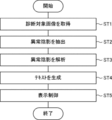
- FIG. 7 is a flowchart showing an example of the flow of the document creation support process executed by the CPU 101 executing the document creation support program 108.
- the document creation support program 108 is executed, for example, when an instruction to start execution is input by the user via the input unit 105. It is assumed that the image to be diagnosed is downloaded from the image server 5 to the document creation support device 10 (interpretation workstation 3) and stored in the storage unit 103.
- step ST1 the image acquisition unit 11 acquires the image to be diagnosed stored in the storage unit 103.
- step ST2 the feature extraction unit 12 extracts an abnormal shadow as a feature portion from the diagnosis target image acquired by the image acquisition unit 11.
- step ST3 the analysis unit 13 analyzes the abnormal shadow extracted from the image to be diagnosed, and identifies the property of the abnormal shadow for each of the plurality of predetermined property items.
- step ST4 the text generation unit 14 generates a plurality of different texts describing the properties specified in step ST3.
- the text generation unit 14 at least one of the properties for each of the plurality of predetermined property items is described in each of the plurality of texts, and the combination of the property items corresponding to the properties described in each of the plurality of texts. Generates multiple texts so that they differ from each other.
- step ST5 the display control unit 15 controls to display a plurality of texts generated by the text generation unit 14 on the display screen of the display unit 104.
- the user can select any one of the plurality of texts displayed on the display unit 104 and use the selected text as a part or all of the document (interpretation report) created by the user. ..
- a plurality of different texts describing the properties of the abnormal shadow extracted from the image to be diagnosed are generated as candidate documents.
- the combination of property items corresponding to the properties described in each text is different from each other. This makes it possible to create a plurality of texts whose description contents are varied. As a result, there is a high possibility that a plurality of texts that meet the user's request are included, and it becomes possible to effectively support the user in creating a document (interpretation report).
- FIG. 8 is a diagram showing an example of the property score derived by the analysis unit 13.
- the analysis unit 13 analyzes the abnormal shadow extracted by the feature extraction unit 12 to derive a property score indicating the prominence of the property for each property item.
- the property score takes a value of 0 or more and 1 or less. The larger the property score, the more prominent the property.
- the range of the property score is not limited to 0 or more and 1 or less, and can be appropriately determined.
- the text generation unit 14 Similar to the first embodiment, the text generation unit 14 generates a plurality of texts so that the combination of the property items described in each of the plurality of texts is different from each other among the plurality of texts. In the present embodiment, the text generation unit 14 determines a combination of property items described in each of the plurality of texts based on the property score derived by the analysis unit 13. The text generation unit 14 generates, for example, a text describing only properties having a property score of, for example, 0.9 or more as the first text, and a second text describing only properties having a property score of, for example, 0.7 or more. A text describing only properties having a property score of, for example, 0.5 or more is generated as a third text.
- the threshold value of the property score is not limited to 0.9, 0.7, and 0.5 described above, and can be appropriately set.
- the text generation unit 14 determines that “a mass is formed in the upper left lobe” based on the properties “upper left lobe” and “mass” having a property score of 0.9 or more. Generate a first text that contains the statement “Accepted.” In addition, the text generation unit 14 is accompanied by "pleural invagination in the upper left lobe” based on the properties "upper left lobe", “pleural invagination +", “4.2 cm” and “mass” having a property score of 0.7 or more.
- a second text containing the statement "A mass 4.2 cm in size is found.”
- the text generation unit 14 has properties with a property score of 0.5 or more, “upper left lobe”, “marginal irregularity +”, “pleural invagination +”, “spicula +”, “4.2 cm”, and “mass”.
- the document creation support device it is possible to create a plurality of texts having various description contents as in the first embodiment. Further, by determining the combination of the property items described in the text according to the property score, it is possible to generate a plurality of texts having different accuracy of the description contents. For example, multiple texts including a first text containing a description of a high-accuracy property item, a second text containing a description of a medium-accuracy property item, and a third text containing a description of a low-accuracy property item. Can be generated.
- the text generation unit 14 according to the first and second embodiments described above generates a plurality of texts so that the combination of the property items described in each of the plurality of texts is different from each other among the plurality of texts. Met.
- the text generation unit 14 according to the third embodiment of the disclosed technique generates a plurality of texts so that each text includes a description having the same content having different expressions among the plurality of texts.
- FIG. 9 is a diagram showing an example of a display mode of information displayed on the display screen 300 according to the third embodiment of the disclosed technology.
- FIG. 9 shows an example in which the analysis unit 13 has identified the “upper left lobe”, “partially solid type”, and “mass” as the properties of the abnormal shadow SH extracted from the image to be diagnosed 200.
- a property label 202 indicating each of the above-mentioned properties specified for the abnormal shadow SH is displayed.
- the text generation unit 14 found a "partially solid mass in the upper left lobe” based on the properties identified for the abnormal shadow SH, “upper left lobe”, “partially solid”, and “mass”. Generate the first text T1 containing the description "Masu.” In addition, the text generation unit 14 is based on the properties identified for the abnormal shadow SH, that is, “upper left lobe”, “partially solid type”, and “mass”, and "the center is solid in the upper left lobe and the periphery is frosted glass".
- the expressions of "partially enriched type" described in the first text T1 and "the center is solid and the periphery is frosted glass” described in the second text T2 are different, these The meaning is the same.
- the text generation unit 14 according to the third embodiment of the disclosed technique generates a plurality of texts so as to include descriptions having the same contents whose expressions are different from each other among the plurality of texts.
- the text generation unit 14 according to the present embodiment can be realized by using a trained model trained to create a plurality of texts having the same content with different expressions from the input words.
- the document creation support device According to the document creation support device according to the third embodiment of the disclosed technology, it is possible to create a plurality of texts having various description contents as in the first embodiment. In addition, since multiple texts include descriptions of the same content that are expressed differently from each other, there is a high possibility that multiple texts that meet the user's request are included, and the document (interpretation report) by the user. It becomes possible to effectively support the creation of.
- the text generation unit 14 generates a plurality of texts so that the description of the specified property has the same content with different expressions among the plurality of properties among the plurality of properties specified for the abnormal shadow. May be good.
- the document creation support device generates a plurality of different texts describing the properties of the feature portions.
- the document creation support device according to the fourth embodiment of the disclosed technique generates a plurality of different texts describing the classification of the disease corresponding to the feature portion.
- the disease classification includes, for example, disease names and diagnosis names such as nodules, hemangiomas, cysts, lymphadenopathy, pleural effusion, and hamartoma, and the disease is benign or malignant (cancer). Also includes the classification.
- the analysis unit 13 analyzes the abnormal shadow extracted from the image to be diagnosed and estimates the classification of the disease corresponding to the abnormal shadow.
- the analysis unit 13 may estimate the classification of the disease using, for example, a learned model learned by machine learning such as deep learning.
- the trained model is learned by machine learning using, for example, learning data in which a medical image containing an abnormal shadow is given a classification of a disease corresponding to the abnormal shadow as a correct answer label.
- the analysis unit 13 derives a classification determination score indicating the probability that the disease falls under the classification for each candidate for the classification of the disease corresponding to the abnormal shadow.
- the text generation unit 14 generates a plurality of different texts that describe the classification of the disease corresponding to the abnormal shadow extracted from the image to be diagnosed. More specifically, the text generation unit 14 generates a plurality of texts so that the classification of the disease described in each of the plurality of texts is different from each other among the plurality of texts. For example, the text generation unit 14 may use all or part of the disease classification candidates for which the classification determination score is derived in the analysis unit 13 as the classification of the description target.
- FIG. 10 shows an example in which the text generation unit 14 generates three texts describing the classifications of different diseases corresponding to the abnormal shadows extracted from the image to be diagnosed.
- the text generation unit 14 generates a first text T1 including the description "nodules are recognized” as a description regarding the classification of the disease corresponding to the abnormal shadow.
- the text generation unit 14 generates a second text T2 including a description of "recognizing hemangiomas” as a description regarding the classification of diseases corresponding to abnormal shadows.
- the text generation unit 14 generates a third text T3 including the description "a cyst is recognized” as a description regarding the classification of the disease corresponding to the abnormal shadow.
- the display control unit 15 controls the display unit 104 to arrange a plurality of texts generated by the text generation unit 14 in order according to the estimation result of the disease classification in the analysis unit 13. For example, when the classification judgment score of "nodule" is the highest among the classification judgment scores derived for each disease classification candidate by the analysis unit 13, the display control unit 15 describes that "nodule is recognized.”
- the first text T1 including the text T1 may be arranged and displayed above the display screen with respect to the other texts T2 and T3.
- FIG. 11 is a diagram showing another example of a plurality of texts generated by the text generation unit 14.
- the text generation unit 14 generates a first text T1 including the description "suspect primary lung cancer” as a description regarding the classification of diseases corresponding to abnormal shadows.
- the text generation unit 14 generates a second text T2 including the description "there is a high possibility of benign" as a description regarding the classification of the disease corresponding to the abnormal shadow.
- the classification of the disease may be the classification of whether the disease is benign or malignant
- the text generation unit 14 includes a text including a description that the disease is malignant and the disease. Both may be generated with text containing a statement that it is benign.
- each of the plurality of texts may include not only a description regarding the classification of the disease but also a description regarding the nature of the abnormal shadow.
- the document creation support device since the classification of the disease is described in each of the plurality of texts, it is effective to support the user in creating a document (interpretation report). It becomes possible to do.
- multiple texts are generated so that the classification of the disease described in each text is different from each other among the plurality of texts, the possibility that the multiple texts meet the user's request is increased. be able to.
- the display control unit 15 controls the display unit 104 to arrange the plurality of texts generated by the text generation unit 14 in the order according to the estimation result of the disease classification in the analysis unit 13, the text by the user. Can be facilitated.
- the text generation unit 14 Similar to the case of the fourth embodiment described above, the text generation unit 14 according to the fifth embodiment of the disclosed technique is different from each other and describes the classification of the disease corresponding to the abnormal shadow extracted from the image to be diagnosed. Generate text for. In the present embodiment, the text generation unit 14 generates a plurality of texts so that the expression indicating the probability that the disease corresponds to the classification differs among the plurality of texts in the description regarding the classification of the disease.
- FIG. 12 shows an example in which the text generation unit 14 generates three texts having different expressions indicating the probability that the disease corresponds to the classification (primary lung cancer).
- the text generation unit 14 generates a first text T1 including a description using the assertive expression "It is primary lung cancer" as a description regarding the classification of the disease. That is, the first text T1 includes an expression indicating that the disease is highly likely to correspond to primary lung cancer.
- the text generation unit 14 generates a second text T2 including a description using a speculative expression such as "I suspect primary lung cancer” as a description regarding the classification of the disease. That is, the second text T2 includes an expression indicating that the disease has a relatively high probability of being a primary lung cancer.
- the text generation unit 14 generates a third text T3 including a description using a description that is neither positive nor negative, such as "the possibility of primary lung cancer cannot be ruled out” as a description regarding the classification of the disease. .. That is, the third text T3 includes an expression indicating that the disease is relatively unlikely to correspond to primary lung cancer. As illustrated in FIG. 12, each of the plurality of texts may include not only a description regarding the classification of the disease but also a description regarding the nature of the abnormal shadow.
- the analysis unit 13 may analyze the abnormal shadow extracted from the image to be diagnosed and estimate the classification of the disease corresponding to the abnormal shadow. That is, the analysis unit 13 may derive a classification determination score indicating the probability that the disease corresponds to the classification for each candidate for the classification of the disease corresponding to the abnormal shadow.
- the text generation unit 14 may generate a plurality of texts having different expressions as described above for the classification of the disease having the highest classification determination score derived by the analysis unit 13. Further, the text generation unit 14 may generate a plurality of texts having different expressions as described above for each of the classifications of two or more diseases having relatively high scores derived by the analysis unit 13.
- the plurality of texts include a description regarding the classification of the disease, in which the expressions indicating the accuracy corresponding to the classification are different from each other.
- the text will meet the user's request, and it will be possible to effectively support the user in creating a document (interpretation report).
- FIG. 13 is a functional block diagram showing an example of the functional configuration of the document creation support device according to the sixth embodiment of the disclosed technology.
- the document creation support device 10 according to the present embodiment includes a feature partial analysis unit 13A and a related partial analysis unit 13B.
- the feature partial analysis unit 13A analyzes the abnormal shadow extracted from the image to be diagnosed and estimates the classification of the disease corresponding to the abnormal shadow. Specifically, the feature partial analysis unit 13A derives a classification determination score indicating the probability that the disease corresponds to the classification for each candidate for classification of the disease corresponding to the abnormal shadow. That is, the function of the feature partial analysis unit 13A is the same as that of the analysis unit 13 according to the fourth embodiment described above.
- the related part analysis unit 13B identifies the related part related to the classification of the disease having the highest classification judgment score derived by the feature part analysis unit 13A, and determines a predetermined judgment item for the specified related part.
- the related part is a part in the image to be diagnosed in which the classification of the disease corresponding to the abnormal shadow (characteristic part) and the classification of other diseases that are expected to occur can occur.
- FIG. 14 is an example of the table 30 referred to by the related partial analysis unit 13B.
- the table 30 is stored in the storage unit 103.
- "pulmonary nodules” are expected to develop with “pleural effusion” and “lymphadenopathy.” Therefore, in Table 30, “lung node” is associated with "between visceral pleura and parietal pleura” where "pleural effusion” can occur as the first related part, and “lymphadenopathy”. The “lymph nodes” where can develop are associated as the second relevant part. Further, in Table 30, “presence or absence of pleural effusion” is associated as a determination item for the first related portion, and “presence or absence of lymphadenopathy” is associated as a determination item for the second related portion. Has been done.
- the related part analysis unit 13B identifies "between the visceral pleura and the parietal pleura” as the first related part based on Table 30. , "Presence or absence of pleural effusion” is determined for the first related portion. Further, the related part analysis unit 13B identifies the "lymph node” as the second related part based on the table 30, and determines "presence or absence of lymphadenopathy” for the second related part.
- the text generation unit 14 generates a plurality of different texts describing the classification of the disease corresponding to the abnormal shadow extracted from the image to be diagnosed, as in the case of the fourth and fifth embodiments described above.
- the text generation unit 14 includes a description regarding the classification of the disease having the highest classification determination score derived by the feature partial analysis unit 13A in each of the plurality of texts.
- the text generation unit 14 includes, in each of the plurality of texts, a description relating to the relevant portion related to the classification of the disease corresponding to the abnormal shadow described in each of the plurality of texts.
- the text generation unit 14 generates a description regarding the related portion based on the determination result for the related portion derived by the related portion analysis unit 13B.
- the text generation unit 14 generates a plurality of texts so that the number or combination of related parts described in the plurality of texts is different from each other among the plurality of texts.
- FIG. 15 is a diagram showing an example of a plurality of texts generated by the text generation unit 14.
- the classification of the disease having the highest classification determination score derived by the feature partial analysis unit 13A is "solid nodule".
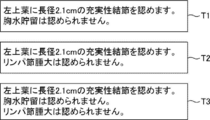
- the related part analysis unit 13B identified the area between the visceral pleura and the parietal pleura as the first related part, and derived "no pleural effusion" as the judgment result for the first related part. do. Further, it is assumed that the related part analysis unit 13B identifies the lymph node as the second related part and derives "no lymphadenopathy" as a judgment result for the second related part.
- the text generator 14 generates the first text T1 containing the description "A solid nodule with a major axis of 2.1 cm is observed in the upper left lobe. Pleural effusion is not observed.” That is, the first text T1 includes "solid nodules” as a description of the classification of diseases corresponding to abnormal shadows, and "no pleural effusion is observed” as a description of related parts.
- the text generator 14 generates a second text T2 containing the description "A solid nodule with a major axis of 2.1 cm is observed in the upper left lobe. No lymphadenopathy is observed.” That is, the second text T2 includes the description "solid nodule” as a description regarding the classification of the disease corresponding to the abnormal shadow, and the description "no lymphadenopathy is observed” as the description regarding the related part. ..
- the text generator 14 contains a third statement including the statement, "A solid nodule with a major axis of 2.1 cm is observed in the upper left lobe. Pleural effusion is not observed. Lymphadenopathy is not observed.”
- Generate text T3 includes the description of "solid nodule” as a description of the classification of the disease corresponding to the abnormal shadow, and the description of "no pleural effusion” and “lymphadenopathy” as the description of the related part. Large is not allowed.
- the text generation unit 14 may further generate a fourth text (not shown) that includes a description of the classification of the disease corresponding to the abnormal shadow and does not include a description of the related portion.
- the display control unit 15 controls the display unit 104 to display a plurality of texts generated by the text generation unit 14.
- FIG. 16 is a flowchart showing an example of the flow of the document creation support process implemented by the CPU 101 executing the document creation support program 108 according to the present embodiment.
- step ST11 the image acquisition unit 11 acquires the image to be diagnosed stored in the storage unit 103.
- step ST12 the feature extraction unit 12 extracts an abnormal shadow as a feature portion from the diagnosis target image acquired by the image acquisition unit 11.
- step ST13 the feature partial analysis unit 13A analyzes the abnormal shadow extracted from the image to be diagnosed, and classifies each candidate for the classification of the disease corresponding to the abnormal shadow to indicate the probability that the disease corresponds to the classification. Derive the judgment score.
- step S14 the related partial analysis unit 13B identifies the related portion related to the classification of the disease having the highest classification determination score derived by the characteristic partial analysis unit 13A in step ST13 based on the table 30.
- step ST15 the related part analysis unit 13B analyzes the related part specified in step ST14 and makes a determination about a predetermined determination item for the related part. The related partial analysis unit 13B identifies the determination item based on the table 30.
- step ST16 the text generation unit 14 describes the description related to the classification of the disease having the highest classification determination score derived by the feature partial analysis unit 13A in step ST13, and the related portion derived by the related partial analysis unit 13B in step ST15. Generate multiple texts, each containing a description of the determination result.
- step ST17 the display control unit 15 controls to display a plurality of texts generated by the text generation unit 14 in step ST16 on the display screen of the display unit 104.
- the user can select any one of the plurality of texts displayed on the display unit 104 and use the selected text as a part or all of the document (interpretation report) created by the user. ..
- each of the plurality of texts includes not only a description regarding the classification of the disease corresponding to the abnormal shadow but also a related part related to the classification of the disease. Since the description about is included, it is possible to effectively support the user in creating a document (interpretation report). In addition, since multiple texts are generated so that the number or combination of related parts described in each text is different between the plurality of texts, it is possible that the plurality of texts may include those that match the user's request. You can improve your sex.
- the text generation unit 14 includes the description regarding the classification of the disease having the highest classification determination score derived by the feature partial analysis unit 13A in each of the plurality of texts has been illustrated. Not limited to. As in the case of the fourth embodiment described above, the text generation unit 14 may generate a plurality of texts so that the classification of the disease described in each of the plurality of texts is different from each other among the plurality of texts. For example, the text generation unit 14 may use all or part of the disease classification candidates for which the classification determination score is derived in the feature partial analysis unit 13A as the classification of the description target.
- the related part analysis unit 13B identifies the related part for each of all or a part of the classification candidates of the disease for which the classification judgment score is derived, and determines a predetermined judgment about the specified related part. Judgment is made for the item.
- the text generation unit 14 generates a description regarding the related part corresponding to the classification of the disease described in each text based on the determination result of the related part derived by the related part analysis unit 13B, and generates the description corresponding to the related part. Include in. As shown in Table 30 (see FIG. 14), when there is no related part related to the classification of the disease corresponding to the abnormal shadow, the text describing the classification of such a disease describes the related part. Will not be included. That is, the text generation unit 14 includes the description regarding the relevant part only in the text in which the classification of the disease described for the abnormal shadow is a specific classification.
- FIG. 17 is a diagram showing other examples of a plurality of texts that can be generated by the text generation unit 14.
- the text generator 14 contains the first text T1 containing the statement, "A solid nodule with a major axis of 2.1 cm is found in the upper left lobe. No pleural effusion is found. No lymphadenopathy is found.” To generate. That is, the first text T1 includes "solid nodules” as a description of the classification of diseases corresponding to abnormal shadows, and "no pleural effusion” and “lymphadenopathy” as descriptions of related parts. It is not allowed. "
- the text generation unit 14 generates a second text T2 including the description "Atelectasis with a major axis of 2.1 cm is found in the upper left lobe.” That is, the second text T2 includes the description "atelectasis” as a description of the classification of the disease corresponding to the abnormal shadow, and does not include the description of the related part.
- the reason why the second text T2 does not include the description about the related part is that there is no related part related to "atelectasis" and there is no determination result about the related part.
- FIG. 18 is a diagram showing another example of a plurality of texts generated by the text generation unit 14.
- Text generator 14 states, "A solid nodule with a major axis of 2.1 cm is found in the upper left lobe. Primary lung cancer is suspected. Pleural effusion is not found. Lymphadenopathy is not found.” Generates a first text T1 containing. That is, the first text T1 includes a description of "solid nodule” and a description of "suspect primary lung cancer” as a description of the classification of diseases corresponding to abnormal shadows, and a description of "pleural effusion retention” as a related part. Includes the statement “No lymphadenopathy” and "No lymphadenopathy”.
- the text generation unit 14 generates a second text including the description "A solid nodule with a major axis of 2.1 cm is recognized in the upper left lobe. It is highly possible that it is benign." That is, the second text T2 includes the description of "solid nodule” and the description of "probably benign” as the description of the classification of the disease corresponding to the abnormal shadow, and does not include the description of the related part. ..
- the text generation unit 14 includes the description regarding the related part in the text in which the classification of the disease described for the abnormal shadow is malignant among the plurality of texts, while the classification of the disease described for the abnormal shadow is classified.
- the benign text does not have to include a description of the relevant part. This is because, for benign diseases, it is common that the relevant part does not exist, or even if it does exist, there is no interest in the relevant part.
- FIG. 19 is a functional block diagram showing an example of the functional configuration of the document creation support device according to the seventh embodiment of the disclosed technology.
- the document creation support device 10 according to the present embodiment is different from the document creation support device 10 (see FIG. 13) according to the sixth embodiment in that it has a designated reception unit 16 instead of the feature extraction unit 12.
- the designated reception unit 16 receives the designation of the abnormal shadow (feature portion) included in the image to be diagnosed.
- the abnormal shadow can be specified, for example, by the user clicking or dragging a partial area in the image to be diagnosed displayed on the display screen of the display unit 104 using an input device such as a mouse. ..
- the feature partial analysis unit 13A analyzes the abnormal shadow related to the designation received by the designated reception unit 16 and estimates the classification of the disease corresponding to the abnormal shadow. Specifically, the feature partial analysis unit 13A derives a classification determination score indicating the probability that the disease falls under the classification for each candidate for the classification of the disease corresponding to the designated abnormal shadow.
- the related part analysis unit 13B identifies the related part related to the classification of the disease having the highest classification judgment score derived by the feature part analysis unit 13A, and determines a predetermined judgment item for the specified related part.
- the text generation unit 14 generates a plurality of different texts that describe the classification of the disease corresponding to the abnormal shadow related to the designation received by the designated reception unit 16.
- the text generation unit 14 includes a description regarding the classification of the disease having the highest classification determination score derived by the feature partial analysis unit 13A in each of the plurality of texts.
- the text generation unit 14 includes, in each of the plurality of texts, a description relating to the relevant portion related to the classification of the disease corresponding to the abnormal shadow described in each of the plurality of texts.
- the text generation unit 14 generates a description of the related part based on the determination result of the related part derived by the related part analysis unit 13B.
- the text generation unit 14 generates a plurality of texts so that the number or combination of related parts described in the plurality of texts is different from each other among the plurality of texts.
- the display control unit 15 controls the display unit 104 to display a plurality of texts generated by the text generation unit 14.
- the document creation support device since a plurality of texts are generated for the abnormal shadow (feature portion) specified by the user, the user can support the creation of the document (interpretation report). It becomes possible to do it effectively.
- the text generation unit 14 includes the description regarding the classification of the disease having the highest classification determination score derived by the feature partial analysis unit 13A in each of the plurality of texts has been illustrated. Not limited to. As in the case of the fourth embodiment described above, the text generation unit 14 may generate a plurality of texts so that the classification of the disease described in each of the plurality of texts is different from each other among the plurality of texts. For example, the text generation unit 14 may use all or part of the disease classification candidates for which the classification determination score is derived in the feature partial analysis unit 13A as the classification of the description target.
- the related part analysis unit 13B identifies the related part for each of all or a part of the classification candidates of the disease for which the classification judgment score is derived, and determines a predetermined judgment about the specified related part. Judgment is made for the item.
- the text generation unit 14 generates a description regarding the related part corresponding to the classification of the disease described in each text based on the analysis result in the related part analysis unit 13B, and includes this in the corresponding text.
- the document management creation support device may generate and display a plurality of texts as follows. For example, before accepting the designation of the abnormal shadow (feature portion) by the user, a plurality of texts may be generated in advance for each of the plurality of abnormal shadows (feature portion). After that, when an abnormal shadow (feature part) is specified by the user, a plurality of texts related to the specified abnormal shadow (feature part) are selected from a plurality of pre-generated texts, and a plurality of selected texts are selected.
- the text may be controlled to be displayed on the display unit 104.
- the displayed text may or may not contain a description of the relevant part.
- the description regarding the property of the abnormal shadow (feature portion) included in each of the plurality of texts may be related to the size of the abnormal shadow (feature portion). That is, the text generation unit 14 may generate a plurality of texts so that the description regarding the size of the abnormal shadow (feature portion) differs between the plurality of texts. For example, the text generator 14 generates a first text containing the description "acknowledge cysts", a second text containing the description "acknowledge small cysts", and "microcysts". You may generate a third text containing the statement "I accept.”
- the description regarding the property of the abnormal shadow (characteristic part) included in each of the plurality of texts may be related to the number, the amount, the density, or the distribution state of the abnormal shadow (characteristic part). That is, the text generation unit 14 may generate a plurality of texts so that the description regarding the number, the amount, the density, or the distribution state of the abnormal shadows (characteristic portions) differs between the plurality of texts. For example, the text generator 14 generates a first text containing the description "I admit cysts" and a second text containing the description "Cysts are scattered.” A third text may be generated that includes the statement "I have a cyst.”
- the hardware structure of the processing unit that executes various processes such as each functional unit of the document creation support device 10 according to the first to seventh embodiments described above includes various processors shown below.
- the various processors include a CPU, which is a general-purpose processor that executes software (program) and functions as various processing units, and after manufacturing an FPGA (field-programmable gate array) or the like.
- Dedicated processor with a circuit configuration designed exclusively for executing specific processing such as programmable logic device (PLD) and ASIC (Application Specific Integrated Circuit), which are processors whose circuit configuration can be changed. Includes electrical circuits and the like.
- One processing unit may be composed of one of these various processors, or a combination of two or more processors of the same type or different types (for example, a combination of a plurality of FPGAs or a combination of a CPU and an FPGA). It may be composed of a combination). Further, a plurality of processing units may be configured by one processor.
- one processor is configured by a combination of one or more CPUs and software, as represented by a computer such as a client and a server.
- the processor functions as a plurality of processing units.
- SoC System On Chip
- the various processing units are configured by using one or more of the above-mentioned various processors as a hardware structure.
- an electric circuit in which circuit elements such as semiconductor elements are combined can be used.
Landscapes
- Engineering & Computer Science (AREA)
- Health & Medical Sciences (AREA)
- General Health & Medical Sciences (AREA)
- Theoretical Computer Science (AREA)
- Medical Informatics (AREA)
- Physics & Mathematics (AREA)
- Public Health (AREA)
- General Physics & Mathematics (AREA)
- Epidemiology (AREA)
- Primary Health Care (AREA)
- Biomedical Technology (AREA)
- Computational Linguistics (AREA)
- Artificial Intelligence (AREA)
- Radiology & Medical Imaging (AREA)
- Nuclear Medicine, Radiotherapy & Molecular Imaging (AREA)
- Computer Vision & Pattern Recognition (AREA)
- General Engineering & Computer Science (AREA)
- Databases & Information Systems (AREA)
- Audiology, Speech & Language Pathology (AREA)
- Data Mining & Analysis (AREA)
- Multimedia (AREA)
- Quality & Reliability (AREA)
- Pathology (AREA)
- Computing Systems (AREA)
- Evolutionary Computation (AREA)
- Software Systems (AREA)
- General Business, Economics & Management (AREA)
- Business, Economics & Management (AREA)
- Probability & Statistics with Applications (AREA)
- Medical Treatment And Welfare Office Work (AREA)
- Machine Translation (AREA)
- Document Processing Apparatus (AREA)
- User Interface Of Digital Computer (AREA)
Priority Applications (4)
| Application Number | Priority Date | Filing Date | Title |
|---|---|---|---|
| JP2021576194A JP7479405B2 (ja) | 2020-02-07 | 2021-02-05 | 文書作成支援装置、文書作成支援方法及びプログラム |
| DE112021000934.6T DE112021000934T5 (de) | 2020-02-07 | 2021-02-05 | Unterstützungsvorrichtung für dokumentenerstellung, unterstützungsverfahren für dokumentenerstellung und programm |
| US17/878,038 US12282730B2 (en) | 2020-02-07 | 2022-07-31 | Document creation support apparatus, document creation support method, and program |
| JP2023195360A JP7542710B2 (ja) | 2020-02-07 | 2023-11-16 | 文書作成支援装置、文書作成支援方法及びプログラム |
Applications Claiming Priority (4)
| Application Number | Priority Date | Filing Date | Title |
|---|---|---|---|
| JP2020020144 | 2020-02-07 | ||
| JP2020-020144 | 2020-02-07 | ||
| JP2020-212842 | 2020-12-22 | ||
| JP2020212842 | 2020-12-22 |
Related Child Applications (1)
| Application Number | Title | Priority Date | Filing Date |
|---|---|---|---|
| US17/878,038 Continuation US12282730B2 (en) | 2020-02-07 | 2022-07-31 | Document creation support apparatus, document creation support method, and program |
Publications (1)
| Publication Number | Publication Date |
|---|---|
| WO2021157718A1 true WO2021157718A1 (ja) | 2021-08-12 |
Family
ID=77200258
Family Applications (1)
| Application Number | Title | Priority Date | Filing Date |
|---|---|---|---|
| PCT/JP2021/004410 Ceased WO2021157718A1 (ja) | 2020-02-07 | 2021-02-05 | 文書作成支援装置、文書作成支援方法及びプログラム |
Country Status (4)
| Country | Link |
|---|---|
| US (1) | US12282730B2 (https=) |
| JP (2) | JP7479405B2 (https=) |
| DE (1) | DE112021000934T5 (https=) |
| WO (1) | WO2021157718A1 (https=) |
Cited By (1)
| Publication number | Priority date | Publication date | Assignee | Title |
|---|---|---|---|---|
| WO2023199956A1 (ja) * | 2022-04-12 | 2023-10-19 | 富士フイルム株式会社 | 情報処理装置、情報処理方法及び情報処理プログラム |
Families Citing this family (2)
| Publication number | Priority date | Publication date | Assignee | Title |
|---|---|---|---|---|
| WO2021141051A1 (ja) * | 2020-01-09 | 2021-07-15 | ファナック株式会社 | ワーク画像解析装置、ワーク画像解析方法、及びプログラム |
| US20230290485A1 (en) * | 2022-03-09 | 2023-09-14 | International Business Machines Corporation | Artificial intelligence prioritization of abnormal radiology scans |
Citations (3)
| Publication number | Priority date | Publication date | Assignee | Title |
|---|---|---|---|---|
| JPS62197354A (ja) * | 1986-02-26 | 1987-09-01 | トヨタ自動車株式会社 | 炭化ケイ素焼結体の製造方法 |
| JPH0731591A (ja) * | 1993-07-19 | 1995-02-03 | Toshiba Corp | 読影レポート作成支援装置 |
| JP2009082443A (ja) * | 2007-09-28 | 2009-04-23 | Canon Inc | 診断支援装置及びその制御方法 |
Family Cites Families (18)
| Publication number | Priority date | Publication date | Assignee | Title |
|---|---|---|---|---|
| JPS62197864A (ja) * | 1986-02-26 | 1987-09-01 | Toshiba Corp | 言語情報提供装置 |
| EP0973116A1 (en) | 1993-03-01 | 2000-01-19 | Kabushiki Kaisha Toshiba | Medical information processing system for supporting diagnosis |
| US6785410B2 (en) * | 1999-08-09 | 2004-08-31 | Wake Forest University Health Sciences | Image reporting method and system |
| US7450114B2 (en) * | 2000-04-14 | 2008-11-11 | Picsel (Research) Limited | User interface systems and methods for manipulating and viewing digital documents |
| JP4026158B1 (ja) * | 2006-09-27 | 2007-12-26 | 国立大学法人岐阜大学 | 読影支援装置、読影支援方法及びプログラム |
| JP5288866B2 (ja) | 2008-04-16 | 2013-09-11 | 富士フイルム株式会社 | 文書作成支援装置、文書作成支援方法、並びに文書作成支援プログラム |
| CN103294888B (zh) * | 2012-03-02 | 2017-12-12 | 东芝医疗系统株式会社 | 读影报告制成支援系统、装置以及读影委托装置 |
| JP6510196B2 (ja) * | 2014-08-12 | 2019-05-08 | キヤノンメディカルシステムズ株式会社 | 読影レポート作成支援装置 |
| EP3182366B1 (en) * | 2015-12-17 | 2020-10-07 | Leibniz-Institut für Photonische Technologien e.V. | Property measurement on a biological tissue sample |
| US10733372B2 (en) * | 2017-01-10 | 2020-08-04 | Microsoft Technology Licensing, Llc | Dynamic content generation |
| US10453456B2 (en) * | 2017-10-03 | 2019-10-22 | Google Llc | Tailoring an interactive dialog application based on creator provided content |
| JP2019153250A (ja) | 2018-03-06 | 2019-09-12 | 富士フイルム株式会社 | 医療文書作成支援装置、方法およびプログラム |
| CN108491497B (zh) * | 2018-03-20 | 2020-06-02 | 苏州大学 | 基于生成式对抗网络技术的医疗文本生成方法 |
| JP6652986B2 (ja) * | 2018-05-02 | 2020-02-26 | 株式会社Fronteo | 危険行動予測装置、予測モデル生成装置および危険行動予測用プログラム |
| US11141115B2 (en) * | 2018-07-24 | 2021-10-12 | Warsaw Orthopedic, Inc. | Pre-operative assessment system |
| JP2020020144A (ja) | 2018-07-31 | 2020-02-06 | カヤバ システム マシナリー株式会社 | エレクター装置 |
| WO2021108771A1 (en) * | 2019-11-28 | 2021-06-03 | Braid Health Inc. | Medical imaging processing system |
| WO2021107098A1 (ja) * | 2019-11-29 | 2021-06-03 | 富士フイルム株式会社 | 文書作成支援装置、文書作成支援方法及び文書作成支援プログラム |
-
2021
- 2021-02-05 DE DE112021000934.6T patent/DE112021000934T5/de active Pending
- 2021-02-05 JP JP2021576194A patent/JP7479405B2/ja active Active
- 2021-02-05 WO PCT/JP2021/004410 patent/WO2021157718A1/ja not_active Ceased
-
2022
- 2022-07-31 US US17/878,038 patent/US12282730B2/en active Active
-
2023
- 2023-11-16 JP JP2023195360A patent/JP7542710B2/ja active Active
Patent Citations (3)
| Publication number | Priority date | Publication date | Assignee | Title |
|---|---|---|---|---|
| JPS62197354A (ja) * | 1986-02-26 | 1987-09-01 | トヨタ自動車株式会社 | 炭化ケイ素焼結体の製造方法 |
| JPH0731591A (ja) * | 1993-07-19 | 1995-02-03 | Toshiba Corp | 読影レポート作成支援装置 |
| JP2009082443A (ja) * | 2007-09-28 | 2009-04-23 | Canon Inc | 診断支援装置及びその制御方法 |
Cited By (1)
| Publication number | Priority date | Publication date | Assignee | Title |
|---|---|---|---|---|
| WO2023199956A1 (ja) * | 2022-04-12 | 2023-10-19 | 富士フイルム株式会社 | 情報処理装置、情報処理方法及び情報処理プログラム |
Also Published As
| Publication number | Publication date |
|---|---|
| JP7542710B2 (ja) | 2024-08-30 |
| US20220382967A1 (en) | 2022-12-01 |
| DE112021000934T5 (de) | 2022-12-15 |
| JPWO2021157718A1 (https=) | 2021-08-12 |
| JP2024009108A (ja) | 2024-01-19 |
| JP7479405B2 (ja) | 2024-05-08 |
| US12282730B2 (en) | 2025-04-22 |
Similar Documents
| Publication | Publication Date | Title |
|---|---|---|
| US10628476B2 (en) | Information processing apparatus, information processing method, information processing system, and storage medium | |
| US11062448B2 (en) | Machine learning data generation support apparatus, operation method of machine learning data generation support apparatus, and machine learning data generation support program | |
| JP7542710B2 (ja) | 文書作成支援装置、文書作成支援方法及びプログラム | |
| JP2019153250A (ja) | 医療文書作成支援装置、方法およびプログラム | |
| JP2014029644A (ja) | 類似症例検索装置および類似症例検索方法 | |
| JP2017509946A (ja) | コンテキスト依存医学データ入力システム | |
| CN107077528A (zh) | 具有基于文本识别的文本图像链接的图片归档系统 | |
| US20220285011A1 (en) | Document creation support apparatus, document creation support method, and program | |
| WO2022215530A1 (ja) | 医用画像装置、医用画像方法、及び医用画像プログラム | |
| US20230005580A1 (en) | Document creation support apparatus, method, and program | |
| JP7504987B2 (ja) | 情報処理装置、情報処理方法及び情報処理プログラム | |
| JP7102509B2 (ja) | 医療文書作成支援装置、医療文書作成支援方法、及び医療文書作成支援プログラム | |
| EP3954277A1 (en) | Medical document generation device, method, and program | |
| JP2019149005A (ja) | 医療文書作成支援装置、方法およびプログラム | |
| WO2021107098A1 (ja) | 文書作成支援装置、文書作成支援方法及び文書作成支援プログラム | |
| JPWO2019193983A1 (ja) | 医療文書表示制御装置、医療文書表示制御方法、及び医療文書表示制御プログラム | |
| US12094584B2 (en) | Document creation support apparatus, document creation support method, and program | |
| JP7420914B2 (ja) | 情報処理装置、情報処理方法及び情報処理プログラム | |
| WO2022230641A1 (ja) | 文書作成支援装置、文書作成支援方法、及び文書作成支援プログラム | |
| JP7798808B2 (ja) | 文書作成支援装置、文書作成支援方法及びプログラム | |
| US20240338407A1 (en) | Information processing apparatus, method, and program | |
| US20230070906A1 (en) | Information processing apparatus, method, and program | |
| WO2022239593A1 (ja) | 文書作成支援装置、文書作成支援方法、及び文書作成支援プログラム | |
| JP2025073887A (ja) | 情報処理装置、情報処理方法及び情報処理プログラム | |
| WO2022224848A1 (ja) | 文書作成支援装置、文書作成支援方法、及び文書作成支援プログラム |
Legal Events
| Date | Code | Title | Description |
|---|---|---|---|
| 121 | Ep: the epo has been informed by wipo that ep was designated in this application |
Ref document number: 21750940 Country of ref document: EP Kind code of ref document: A1 |
|
| ENP | Entry into the national phase |
Ref document number: 2021576194 Country of ref document: JP Kind code of ref document: A |
|
| 122 | Ep: pct application non-entry in european phase |
Ref document number: 21750940 Country of ref document: EP Kind code of ref document: A1 |