WO2021153689A1 - Cofを含む複合材料、放蓄熱部材及び該複合材料の製造方法並びにcof単結晶及びその製造方法 - Google Patents
Cofを含む複合材料、放蓄熱部材及び該複合材料の製造方法並びにcof単結晶及びその製造方法 Download PDFInfo
- Publication number
- WO2021153689A1 WO2021153689A1 PCT/JP2021/003090 JP2021003090W WO2021153689A1 WO 2021153689 A1 WO2021153689 A1 WO 2021153689A1 JP 2021003090 W JP2021003090 W JP 2021003090W WO 2021153689 A1 WO2021153689 A1 WO 2021153689A1
- Authority
- WO
- WIPO (PCT)
- Prior art keywords
- cof
- group
- single crystal
- composite material
- heat
- Prior art date
- Legal status (The legal status is an assumption and is not a legal conclusion. Google has not performed a legal analysis and makes no representation as to the accuracy of the status listed.)
- Ceased
Links
Images


Classifications
-
- C—CHEMISTRY; METALLURGY
- C09—DYES; PAINTS; POLISHES; NATURAL RESINS; ADHESIVES; COMPOSITIONS NOT OTHERWISE PROVIDED FOR; APPLICATIONS OF MATERIALS NOT OTHERWISE PROVIDED FOR
- C09K—MATERIALS FOR MISCELLANEOUS APPLICATIONS, NOT PROVIDED FOR ELSEWHERE
- C09K5/00—Heat-transfer, heat-exchange or heat-storage materials, e.g. refrigerants; Materials for the production of heat or cold by chemical reactions other than by combustion
- C09K5/16—Materials undergoing chemical reactions when used
-
- B—PERFORMING OPERATIONS; TRANSPORTING
- B01—PHYSICAL OR CHEMICAL PROCESSES OR APPARATUS IN GENERAL
- B01J—CHEMICAL OR PHYSICAL PROCESSES, e.g. CATALYSIS OR COLLOID CHEMISTRY; THEIR RELEVANT APPARATUS
- B01J20/00—Solid sorbent compositions or filter aid compositions; Sorbents for chromatography; Processes for preparing, regenerating or reactivating thereof
- B01J20/22—Solid sorbent compositions or filter aid compositions; Sorbents for chromatography; Processes for preparing, regenerating or reactivating thereof comprising organic material
- B01J20/24—Naturally occurring macromolecular compounds, e.g. humic acids or their derivatives
-
- B—PERFORMING OPERATIONS; TRANSPORTING
- B01—PHYSICAL OR CHEMICAL PROCESSES OR APPARATUS IN GENERAL
- B01J—CHEMICAL OR PHYSICAL PROCESSES, e.g. CATALYSIS OR COLLOID CHEMISTRY; THEIR RELEVANT APPARATUS
- B01J20/00—Solid sorbent compositions or filter aid compositions; Sorbents for chromatography; Processes for preparing, regenerating or reactivating thereof
- B01J20/28—Solid sorbent compositions or filter aid compositions; Sorbents for chromatography; Processes for preparing, regenerating or reactivating thereof characterised by their form or physical properties
-
- B—PERFORMING OPERATIONS; TRANSPORTING
- B01—PHYSICAL OR CHEMICAL PROCESSES OR APPARATUS IN GENERAL
- B01J—CHEMICAL OR PHYSICAL PROCESSES, e.g. CATALYSIS OR COLLOID CHEMISTRY; THEIR RELEVANT APPARATUS
- B01J20/00—Solid sorbent compositions or filter aid compositions; Sorbents for chromatography; Processes for preparing, regenerating or reactivating thereof
- B01J20/30—Processes for preparing, regenerating, or reactivating
-
- C—CHEMISTRY; METALLURGY
- C07—ORGANIC CHEMISTRY
- C07C—ACYCLIC OR CARBOCYCLIC COMPOUNDS
- C07C211/00—Compounds containing amino groups bound to a carbon skeleton
- C07C211/43—Compounds containing amino groups bound to a carbon skeleton having amino groups bound to carbon atoms of six-membered aromatic rings of the carbon skeleton
- C07C211/44—Compounds containing amino groups bound to a carbon skeleton having amino groups bound to carbon atoms of six-membered aromatic rings of the carbon skeleton having amino groups bound to only one six-membered aromatic ring
- C07C211/53—Compounds containing amino groups bound to a carbon skeleton having amino groups bound to carbon atoms of six-membered aromatic rings of the carbon skeleton having amino groups bound to only one six-membered aromatic ring having the nitrogen atom of at least one of the amino groups further bound to a hydrocarbon radical substituted by amino groups
-
- C—CHEMISTRY; METALLURGY
- C07—ORGANIC CHEMISTRY
- C07C—ACYCLIC OR CARBOCYCLIC COMPOUNDS
- C07C47/00—Compounds having —CHO groups
- C07C47/52—Compounds having —CHO groups bound to carbon atoms of six—membered aromatic rings
- C07C47/544—Diformyl benzenes; Alkylated derivatives thereof
-
- F—MECHANICAL ENGINEERING; LIGHTING; HEATING; WEAPONS; BLASTING
- F28—HEAT EXCHANGE IN GENERAL
- F28D—HEAT-EXCHANGE APPARATUS, NOT PROVIDED FOR IN ANOTHER SUBCLASS, IN WHICH THE HEAT-EXCHANGE MEDIA DO NOT COME INTO DIRECT CONTACT
- F28D20/00—Heat storage plants or apparatus in general; Regenerative heat-exchange apparatus not covered by groups F28D17/00 or F28D19/00
- F28D20/003—Heat storage plants or apparatus in general; Regenerative heat-exchange apparatus not covered by groups F28D17/00 or F28D19/00 using thermochemical reactions
-
- F—MECHANICAL ENGINEERING; LIGHTING; HEATING; WEAPONS; BLASTING
- F28—HEAT EXCHANGE IN GENERAL
- F28D—HEAT-EXCHANGE APPARATUS, NOT PROVIDED FOR IN ANOTHER SUBCLASS, IN WHICH THE HEAT-EXCHANGE MEDIA DO NOT COME INTO DIRECT CONTACT
- F28D20/00—Heat storage plants or apparatus in general; Regenerative heat-exchange apparatus not covered by groups F28D17/00 or F28D19/00
- F28D20/02—Heat storage plants or apparatus in general; Regenerative heat-exchange apparatus not covered by groups F28D17/00 or F28D19/00 using latent heat
-
- F—MECHANICAL ENGINEERING; LIGHTING; HEATING; WEAPONS; BLASTING
- F28—HEAT EXCHANGE IN GENERAL
- F28D—HEAT-EXCHANGE APPARATUS, NOT PROVIDED FOR IN ANOTHER SUBCLASS, IN WHICH THE HEAT-EXCHANGE MEDIA DO NOT COME INTO DIRECT CONTACT
- F28D20/00—Heat storage plants or apparatus in general; Regenerative heat-exchange apparatus not covered by groups F28D17/00 or F28D19/00
- F28D2020/0004—Particular heat storage apparatus
- F28D2020/0008—Particular heat storage apparatus the heat storage material being enclosed in plate-like or laminated elements, e.g. in plates having internal compartments
-
- F—MECHANICAL ENGINEERING; LIGHTING; HEATING; WEAPONS; BLASTING
- F28—HEAT EXCHANGE IN GENERAL
- F28D—HEAT-EXCHANGE APPARATUS, NOT PROVIDED FOR IN ANOTHER SUBCLASS, IN WHICH THE HEAT-EXCHANGE MEDIA DO NOT COME INTO DIRECT CONTACT
- F28D20/00—Heat storage plants or apparatus in general; Regenerative heat-exchange apparatus not covered by groups F28D17/00 or F28D19/00
- F28D2020/0004—Particular heat storage apparatus
- F28D2020/0017—Particular heat storage apparatus the heat storage material being enclosed in porous or cellular or fibrous structures
-
- Y—GENERAL TAGGING OF NEW TECHNOLOGICAL DEVELOPMENTS; GENERAL TAGGING OF CROSS-SECTIONAL TECHNOLOGIES SPANNING OVER SEVERAL SECTIONS OF THE IPC; TECHNICAL SUBJECTS COVERED BY FORMER USPC CROSS-REFERENCE ART COLLECTIONS [XRACs] AND DIGESTS
- Y02—TECHNOLOGIES OR APPLICATIONS FOR MITIGATION OR ADAPTATION AGAINST CLIMATE CHANGE
- Y02E—REDUCTION OF GREENHOUSE GAS [GHG] EMISSIONS, RELATED TO ENERGY GENERATION, TRANSMISSION OR DISTRIBUTION
- Y02E60/00—Enabling technologies; Technologies with a potential or indirect contribution to GHG emissions mitigation
- Y02E60/14—Thermal energy storage
Definitions
- the present invention relates to a composite material containing a covalent organic framework (hereinafter abbreviated as "COF"), a heat storage member, and a method for producing the composite material.
- COF covalent organic framework
- the present invention also relates to a COF single crystal and a method for producing the same.
- a heat storage / heat dissipation system that uses reaction heat and latent heat has been proposed.
- One example is a system that utilizes the hydration reaction of magnesium oxide.
- the heat heats magnesium hydroxide to obtain magnesium oxide and water.
- magnesium oxide and water are hydrated to output the heat of reaction (Patent Document 1).
- Sodium acetate trihydrate has a melting point (freezing point) near 57.5 ° C., and can store heat as heat of fusion and dissipate heat as heat of fusion (Patent Document 2).
- COF porous material
- raw material compounds consisting of a "main body part (linker)" which is a basic skeleton and a “hand part (linkage)” which is a binding group for connecting linkers to each other. ”) Is a skeletal structural material constructed by covalently bonding to each other by polycondensation.
- the COF is characterized by having a microscopic periodic order, a well-defined structure, a high specific surface area and a uniform pore size.
- COF has a low environmental load because it consists only of light elements such as H, C, N, O, B, and Si, and has high thermal and chemical stability because it is formed by covalent bonds.
- Linker and linkage It has various merits such as being able to design the structure and function expression in a predictable form by selecting.
- the COF is determined to be a two-dimensional COF or a three-dimensional COF depending on the number and direction of linkages of the building unit molecule.
- the two-dimensional COF has a planar laminated structure, and the three-dimensional COF has a three-dimensional three-dimensional structure. Take.
- the COF can freely design a uniform pore size by appropriately selecting the linker and linkage. Further, since COF has a network structure formed by covalent bonds, it is chemically more stable than a metal-organic framework (MOF) which is a network structure formed by metal coordination bonds. Therefore, it is expected to be used as a gas storage, separation, catalyst, etc. (Patent Document 3).
- MOF metal-organic framework
- thermal conductivity is about the same as that of cotton or the like, and is one digit smaller than that of resin such as polypropylene, two orders of magnitude smaller than that of soda glass, three orders of magnitude smaller than that of SUS, and four orders of magnitude smaller than that of aluminum. That is, COF was considered to be a material with low thermal conductivity.
- COF is a crystal that shows a peak by X-ray diffraction, but until recently, a single crystal having a length of several tens of ⁇ m or more has not been known, and only a powder composed of a fine single crystal has been known.
- a single crystal having a size of about 60 to 100 ⁇ m was produced for COF-300 or the like by a production method using aniline or the like as an equilibrium adjusting agent (Non-Patent Document 2). It is described in this document that a single crystal having a size of more than 100 ⁇ m takes 30 to 40 days to prepare.
- the existing heat storage / heat dissipation system has a problem that the heat storage / heat dissipation rate is low. That is, magnesium oxide, sodium acetate trihydrate, etc., which are heat storage and heat dissipation materials, have low thermal conductivity. Therefore, it takes time for the generated heat and the absorbed heat to diffuse from the surface.
- the use of COF as a heat storage / heat dissipation material has not been reported so far. Since it has been reported that COF, which has a stable network structure, has low thermal conductivity as described above, its use as a heat storage / heat dissipation material has not been considered so far.
- COF which has a stable network structure
- conventionally known single crystals of COF have a particle size (length of the major axis) of less than 100 ⁇ m, and this size generally belongs to the microscale from the viewpoint of engineering application, and the above idea is realized. It was an obstacle to.
- An object of the present invention is to provide a COF single crystal having a larger particle size than the conventional one, which is suitable for engineering applications and has excellent heat transportability, and a method for producing the same.
- Another object of the present invention is to provide a composite material having excellent heat storage characteristics using such a COF single crystal, a heat storage member containing the composite material, and a method for producing the composite material.
- the inventors have found that a COF single crystal larger than the conventional one can be produced by using a solution containing an equilibrium adjusting agent and an ionic liquid at the same time when synthesizing COF. Then, the present inventors can achieve both high heat conductivity and high heat storage and heat dissipation amount by combining a heat conduction path due to such a large COF single crystal network structure and a compound that stores heat and dissipates heat. I thought that this might be the case, and came to complete the present invention.
- COF covalent organic framework
- the covalent organic framework (COF) is (A) A linker selected from the group consisting of the following formulas (I) to (VII), (Here, X is a carbon atom or a silicon atom.
- the hydrogen bonded to the aromatic rings (benzene ring, benzoimidazole ring, and pyrrole ring) of the formulas (I) to (VII) is an alkyl group, an alkenyl group, and the like.
- the covalent organic framework is at least one selected from the group consisting of COF-300, COF-303, LZU-79, and LZU-111 [1]. ] The composite material described in.
- the heat-storing compound is at least one selected from the group consisting of water, sodium sulfate decahydrate, sodium acetate trihydrate, and potassium aluminum sulfate dihydrate.
- a heat storage member comprising the composite material according to any one of [1] to [6] as a heat storage / heat dissipation material.
- [8] A heat storage layer made of the composite material according to any one of [1] to [6] and a heat dissipation layer that comes into contact with the heat storage layer and dissipates heat from the heat storage layer.
- [11] The method for producing a composite material according to any one of [1] to [6].
- a single crystal of COF is grown by reacting a covalent organic skeleton (COF) raw material compound (building unit molecule above) via a solution containing an "equilibrium regulator” and an "ionic liquid or organic salt”.
- COF covalent organic skeleton
- Single crystal manufacturing process and A compounding step of adding the heat storage compound to the COF single crystal to form a composite material and A method for producing a composite material, which comprises.
- a single crystal of a covalent organic framework (COF).
- COF covalent organic framework
- the covalent organic framework (COF) is (A) A linker selected from the group consisting of the following formulas (I) to (VII), (Here, X is a carbon atom or a silicon atom.
- the hydrogen bonded to the aromatic rings (benzene ring, benzoimidazole ring, and pyrrole ring) of the formulas (I) to (VII) is an alkyl group, an alkenyl group, and the like.
- [16] The COF single crystal according to [12], which is at least one selected from the group consisting of COF-300, COF-303, LZU-79, and LZU-111.
- [17] The method for producing a COF single crystal according to any one of [12] to [16]. It is characterized by having a single crystal production process for growing a single crystal of COF by reacting a raw material compound of a covalent organic skeleton (COF) via a solution containing an ionic liquid or an organic salt and an equilibrium preparation agent. A method for producing a COF single crystal.
- COF covalent organic skeleton
- the ionic liquid or organic salt was selected from the group consisting of methyltrioctylammonium bistrifluoromethanesulfonylimide, methyltrioctylammonium chloride, methyltributylphosphonium bistrifluoromethanesulfonylimide, and methyltributylphosphonium iodide.
- the present invention it is possible to provide a COF single crystal having a larger particle size than the conventional one and a method for producing the same. Further, according to the present invention, it is possible to provide a composite material having excellent heat storage characteristics, a heat storage member containing the composite material, and a method for producing the composite material by using such a COF single crystal.
- COF single crystal hereinafter, the COF single crystal of the present invention will be described.
- the COF single crystal of the present invention has a major axis (c-axis) length of 120 ⁇ m or more.
- the covalent organic framework has a skeletal structure composed of a linker and a bond connecting the linkers.
- the linker is a substituted or unsubstituted aromatic ring, a substituted or unsubstituted heterocyclic aromatic ring, a substituted or unsubstituted non-aromatic ring, a substituted or unsubstituted heterocyclic non-aromatic ring, a substituted or unsubstituted hydrocarbon group. It is preferably an organic group containing one or more atomic groups selected from the group consisting of.
- a linker selected from the group consisting of the following formulas (I) to (VII), and (Here, X is a carbon atom or a silicon atom.
- the hydrogen bonded to the aromatic rings (benzene ring, benzoimidazole ring, and pyrrole ring) of the formulas (I) to (VII) is an alkyl group, an alkenyl group, and the like.
- the COF of the present invention is preferably at least one selected from the group consisting of COF-300, COF-303, LZU-79, and LZU-111.
- the difference between COF-300 and COF-303 is that COF-300 has linkage carbon (C) on the formula (I) side and nitrogen (N) on the formula (V) side, whereas COF-303 On the contrary, the carbon (C) of the linkage is on the formula (V) side, and the nitrogen (N) is on the formula (I) side.
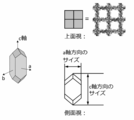
- FIG. 1 shows a schematic diagram of a COF single crystal (COF-300).
- the left side of this figure is a perspective view of a COF single crystal, and the right side is a side view.
- the COF single crystal is a tetragonal system, and when viewed with reference to the three axes (a-axis, b-axis, and c-axis), the top view (bottom view) seen from the c-axis direction is a "ta" character (ta). It has a cross shape inside the square, and the side view seen from the a-axis and b-axis directions has a hexagonal shape.
- the long axis in the present invention is the c-axis in the figure, and the COF single crystal of the present invention has a length (size) of 120 ⁇ m or more in the c-axis direction.
- the length of the major axis of the COF single crystal is preferably 150 ⁇ m or more, more preferably 200 ⁇ m or more, and particularly preferably 250 ⁇ m or more.
- the upper limit of the length of the major axis of the COF single crystal is, for example, 1 mm, further 10 mm, but may be 10 mm or more.
- the COF single crystal has pores between its network-like skeleton.
- the theoretical pore diameter is reported to be 7.8 angstroms (FJ Uribe-Romo et al. J. Am. Chem. Soc. 131, 4570 (2009)).
- change the linker for example, change the linker p-phenylenedialdehyde to 4,4'-diformylbiphenyl or 4,4''-diformyl-p-terphenyl. Therefore, it can be easily increased.
- the COF single crystal exhibits various characteristics by putting elements, compounds, etc. in the pores and complexing them.
- the COF single crystal has a very strong structure in which the skeletons are nested like a ring of wisdom and penetrate each other. Therefore, the COF single crystal has thermally, chemically, and physically stable properties.
- the thermal conductivity of the COF single crystal is preferably 0.1 Wm -1 K -1 or more, more preferably 0.2 Wm -1 K -1 or more, still more preferably 0.5 Wm -1 K -1 or more, most preferably 0.5 Wm -1 K -1 or more. It is 1 Wm -1 K -1 or more.
- the method for producing a COF single crystal is a single crystal in which a COF single crystal is grown by reacting a COF raw material compound (building unit molecule) with an ionic liquid or an organic salt via a solution containing an equilibrium preparation agent. Has a manufacturing process.
- the covalent organic framework can be prepared as a building unit molecule using raw material compounds in various linkage and linker combinations.
- the raw material compound constituting the COF include an aldehyde having a plurality of formyl groups on the aromatic ring (for example, a benzene ring and a pyrrole ring, the same applies hereinafter) and an amine having a plurality of amino groups on the aromatic ring.
- an aldehyde having a plurality of formyl groups on the aromatic ring for example, a benzene ring and a pyrrole ring, the same applies hereinafter
- an amine having a plurality of amino groups on the aromatic ring can be done.
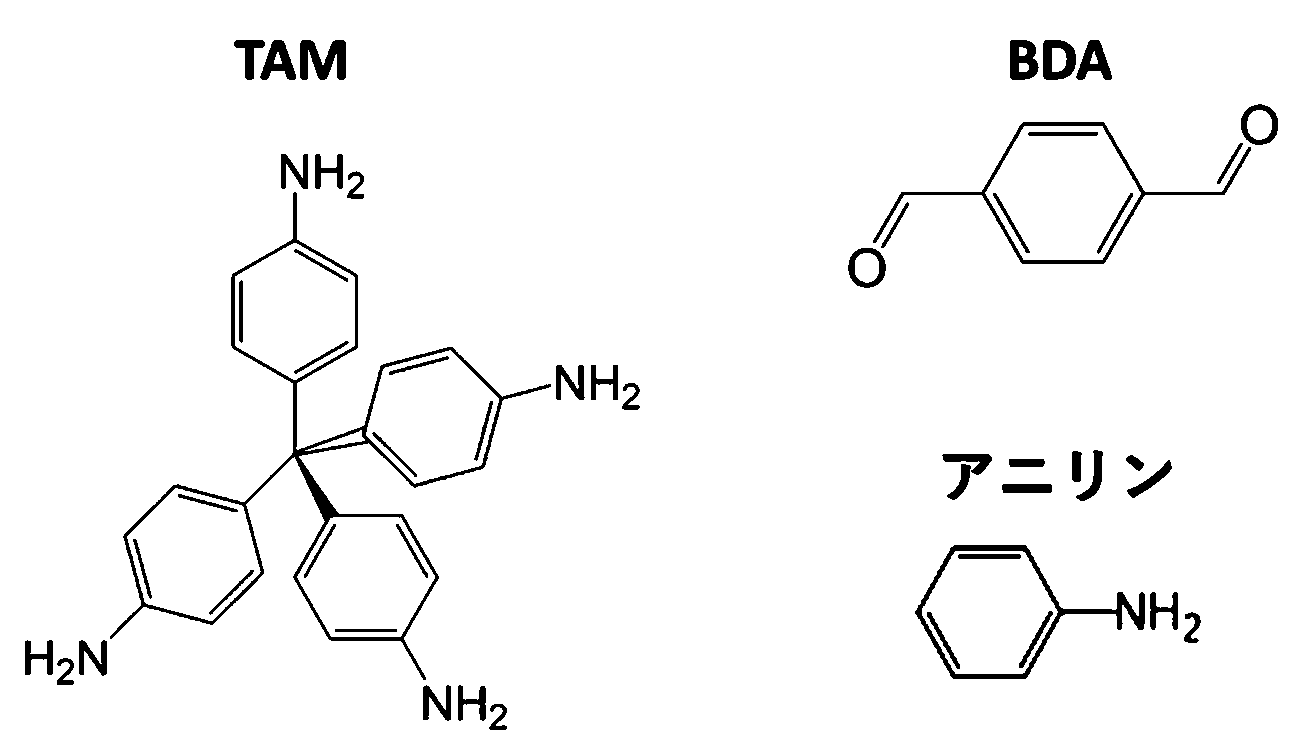
- Examples of the raw material compound for producing COF include tetrakis (4-aminophenyl) methane (TAM) and terephthalaldehyde (BDA) in COF-300.
- TAM tetrakis (4-aminophenyl) methane
- BDA terephthalaldehyde
- raw material compounds tetrakis (4-formylphenyl) methane (TFM) and phenylenediamine (PDA) are used for COF-303, and TAM and 4,7-bis (4-formylbenzyl) -1H- for LZU-79.
- Benzimidazole (BFBZ) and TAM and tetrakis (4-formylphenyl) silane (TFS) in LZU-111 can be mentioned respectively.
- the equilibrium adjuster is like a catalyst in the condensation reaction, is not consumed by itself, and serves to enhance the reversibility of the condensation reaction.
- the equilibrium adjusting agent include aromatic aldehydes having a single formyl group and aromatic amines having a single amino group.
- Specific examples of the equilibrium adjusting agent include aniline and benzaldehyde.
- the equilibrium adjusting agent is preferably used in an excess amount with respect to the raw material compound.
- the equilibrium adjusting agent is preferably 2 to 200 mol, more preferably 10 to 100 mol, and particularly preferably 20 to 80 mol, based on 1 mol of the total amount of the raw material compound.
- the raw material compound and the equilibrium adjusting agent are dissolved in an aqueous or non-aqueous solvent before use.
- solvents include water, pentane, hexane, benzene, toluene, xylene, chloroform, nitrobenzene, cyanobenzene, naphthalene, naphtha, methanol, ethanol, n-propanol, isopropanol, acetone, 1,2,-dichloroethane.
- the ionic liquid is a room temperature molten salt consisting of only ions, and anions and cations are paired. Similar to ionic liquids, organic salts have anions and cations in pairs, but are solid at room temperature.
- the ionic liquid is used as a solvent and an acid catalyst at the same time instead of the organic solvent previously used because it has an acid catalytic effect of promoting condensation (imine formation reaction) between the raw material compounds. was done.
- the building unit molecule for example, the Tetracis (4-aminophenyl) molecule used in the present invention
- the present inventors expected a control action (described later) on the COF crystal growth rate of an ionic liquid different from that of Non-Patent Document 3, and used a uniform solution not as a solvent but as an additive to an organic solvent. Is used to generate a COF single crystal.
- acetic acid is added about 9 times the amount of the catalyst (1.2 mmol of acetic acid) used in Non-Patent Document 2 while growing with anions constituting the ionic liquid.
- the ionic liquid or the organic salt include methyltrioctylammonium bistrifluoromethanesulfonylimide, methyltrioctylammonium chloride, methyltributylphosphonium bistrifluoromethanesulfonylimide, and methyltributylphosphonium iodide.
- the ionic liquid or organic salt is preferably 0.1 to 100 mol, more preferably 0.5 to 10 mol, and particularly preferably 1 to 5 mol, based on 1 mol of the total amount of the raw material compound.
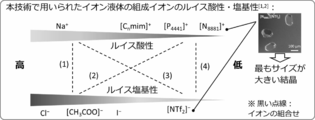
- an ionic liquid or organic salt in which both the Lewis acidity of the cation and the Lewis basicity of the anion are weak is preferable from the viewpoint of producing a large-sized COF single crystal.
- methyltrioctylammonium bistrifluoromethanesulfonylimide [N 8881 ] [NTf 2 ] is particularly preferable. The reason will be described below.
- an acid catalyst is required for the reaction of forming the imine bond.
- an ionic liquid having a strong Lewis acidity cation such as Na +
- the cation becomes a Lewis acid catalyst
- the COF formation reaction is greatly promoted, a large amount of crystal nuclei are generated, and a large amount of the raw material compound is produced.
- a hydrogen bond is formed between the anion of the ionic liquid and the unreacted functional group existing on the surface of the COF single crystal.
- the stronger the Lewis basicity of the anion the stronger the hydrogen bond, which inhibits the COF formation reaction and slows down nucleation and crystal growth.
- anions having different Lewis basicities were used to control the rate of crystal growth.
- [NTf 2 ] - which has the weakest Lewis basicity, has the optimum Lewis basic strength, and the largest COF crystal is obtained.
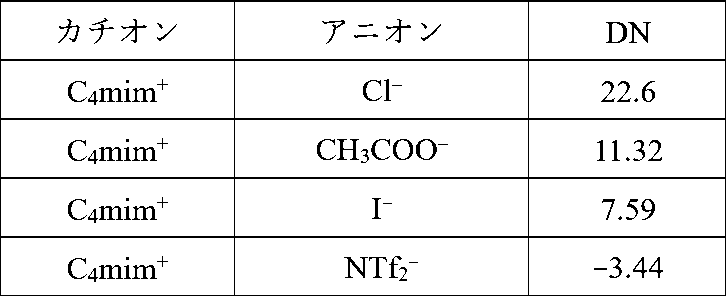
- FIG. 2 is a diagram showing the Lewis acidity of the cation of the ionic liquid or the organic salt mentioned in the above specific example and the Lewis basicity of the anion.
- methyltrioctylammonium bistrifluoromethanesulfonylimide [N 8881 ] [NTf 2 ]
- has the weakest Lewis-acidic methyltrioctylammonium [N 8881 ]) and the most Lewis-basic. It is a combination with a weak bistrifluoromethanesulfonylimide ([NTf 2]).
- Donor Number Donor Number: DN
- acceptor number AN
- the Lewis acidity of the cation of the ionic liquid and the Lewis basicity of the anion can be quantitatively evaluated by the number of acceptors of the cation and the number of donors of the anion, respectively.
- the table below shows the number of donors of anions in the ionic liquid used in the present invention (Source: M. Holzweber et al. Chem. Eur. J. 19, 288-293 (2013)). Under the condition that the same cation (1-butyl-3-methylmidazole: C 4 min + ) is used, the number of anion donors is in the order shown in this table. The smaller the number of donors, the weaker the Lewis basicity.
- the number of donors (DN) of anions is preferably 0 or less, and more preferably ⁇ 3.00 or less under the condition that the cation is C 4 min +.
- an acid catalyst other than an ionic liquid or an organic salt cation in combination.
- examples of such an acid catalyst include acetic acid and hydrochloric acid.
- the acid catalyst is preferably 2 to 200 mol, more preferably 10 to 150 mol, and particularly preferably 50 to 100 mol, based on 1 mol of the total amount of the raw material compound.
- the COF formation reaction can be carried out under preferable conditions as appropriate.
- the temperature of the COF formation reaction can be, for example, 10 to 60 ° C., preferably 20 to 50 ° C., and more preferably room temperature (about 25 ° C.).
- Growth of a COF single crystal exceeding 120 ⁇ m can be completed in about 1 to 30 days, and can be completed within 10 days (7 days in the examples described later) depending on the conditions. It is also an effect of the production method of the present invention that a COF single crystal having a large size can be obtained in such a short period of time as compared with the technique described in Non-Patent Document 2.
- the composite material of the present invention comprises a single crystal of a covalent organic skeleton (COF) having a major axis length of more than 120 ⁇ m or a polycrystal of COF composed of a plurality of the single crystals, and at least one heat-storing compound.
- COF covalent organic skeleton
- the COF single crystal As the COF single crystal, the COF single crystal described above can be used.
- a COF polycrystal consists of a plurality of COF single crystals.
- the COF single crystal preferably has a higher thermal conductivity than the bulk heat storage compound.
- the thermal conductivity in the bulk state means the thermal conductivity in the state of only the heat storage compound, not the thermal conductivity of the heat storage compound in the state of being composited with the COF single crystal.
- the heat-storing compound is (1) a compound that generates heat or endothermic due to adsorption or desorption of COF to a single crystal, or (2) a compound that generates heat or absorbs heat due to a phase change or chemical reaction occurring in the range of -20 to 200 ° C. be. It is preferable that these adsorption, desorption, phase change, and chemical reaction are reversible because the composite material can be repeatedly used as a heat storage member described later.
- the heat storage compound of (1) can be adsorbed on the surface or inside (pores) of the COF single crystal and store heat as adsorption enthalpy, while the stored enthalpy by desorbing from the COF single crystal is heat. It is possible to release as. Examples of such a heat storage compound include water.
- the heat storage compound of (2) is a compound that absorbs and releases heat by latent heat due to its own phase change or chemical reaction.
- the phase-changing material is generally called PCM (phase-changing material: Phase Change Material).
- the heat storage compound (2) in the present invention is a compound that generates heat or absorbs heat due to a phase change or chemical reaction that occurs in the range of ⁇ 20 to 200 ° C.
- Examples of such a heat storage compound include sodium sulfate decahydrate, sodium acetate trihydrate, potassium aluminum sulfate dodecahydrate and the like.
- these heat storage compounds may be used not only one kind but also two or more kinds in combination.
- the molecular diameter of the heat storage compound is preferably smaller than the pore diameter of COF.
- the heat storage compound can be taken into the pores of the COF to store and dissipate heat.
- the present invention is not limited to this, and even if the molecular diameter of the heat storage compound is larger than the pore diameter of the COF, heat absorption / heat generation may occur due to the heat storage compound on the surface of the COF single crystal or the like.
- FIG. 3 shows a schematic diagram in which heat is released and stored using the composite material of the present invention.
- the heat storage compound water in this figure
- the thermal conductivity of the composite material is preferably 0.05 Wm -1 K -1 or more from the viewpoint of enabling rapid heat exchange.
- the composite material preferably has a higher thermal conductivity than the bulk state of the heat storage compound constituting the composite material.
- the single crystal production step described in the above method for producing a COF single crystal is carried out, and then a heat-storing compound is added to the obtained COF single crystal to form a composite. It has a compounding step as a material. Since the single crystal manufacturing process has been described above, detailed description thereof will be omitted here.
- a heat storage compound is added to the COF single crystal to obtain a composite material.
- the method of adding the heat storage compound to the COF single crystal is not particularly limited, and under appropriate conditions (for example, 10 to 50 ° C., 1 to 100 hours, etc.) depending on the type of the COF single crystal and the heat storage compound. It can be carried out.
- a method of immersing a COF single crystal in a molten heat storage compound under a temperature condition at which the heat storage compound liquefies and impregnating the pores of the COF with the heat storage compound molecule can be mentioned. More specifically, for example, in the case of sodium acetate trihydrate, it is compounded by melting at 57.5 ° C. or higher and contacting it with a COF single crystal.
- Heat storage member The composite material of the present invention can be suitably used as a heat storage / heat dissipation material in a heat storage member.
- the heat storage member of the present invention comes into contact with the heat storage layer made of a composite material and from the heat storage layer (including the case of passing through a brazing layer made of a "low melting point metal material” described later). It has a heat diverging layer that radiates heat.
- a metal having a high thermal conductivity or the like is preferable, and aluminum is particularly preferable.
- FIG. 4 is a schematic view showing an example of a heat storage member, in which (a) is an example in which a COF single crystal having a large particle size of the present invention is used, and (b) is a case where a conventional COF fine powder is used. It shows a possible example.
- a heat conduction path (passage) is formed in the COF single crystal due to the skeleton structure of the COF, and this heats from the surface of the COF single crystal to another surface through the inside.
- the COF single crystal of the present invention has a large major axis length of 120 ⁇ m or more, the length of the heat conduction path is also long.
- a COF single crystal is grown directly on a material constituting the heat divergence layer, and then a heat storage compound is added to the COF single crystal.
- a composite material is obtained by brazing a COF single crystal onto a material constituting the heat dissipation layer with a method for forming a composite material or a metal material having a low melting point, for example, indium, and then adding a heat storage compound to the COF single crystal.
- a method of adding a heat storage compound to a COF single crystal to form a composite material, and then brazing on a material constituting a heat dissipation layer can be mentioned.
- the heat storage member can be used as a radiator.
- Examples of applications of the heat storage member include automobiles, computers, home televisions, OA equipment, mobile phones, smartphones, lighting, air conditioners, power supply devices, and the like.
- Example 1 Synthesis of COF-300 single crystal 1-1: Preparation of solution and crystal growth First, in a glass vial having a capacity of 6 mL, 3.35 mg (0.025 mmol; Weighed in (1 equal volume). Next, 0.25 mL of dioxane and 0.03 mL of aniline (both liquid) were weighed and placed in this vial. Subsequently, ultrasonic dispersion was performed for 10 minutes to dissolve the BDA to prepare liquid A.
- TAM Tetrakis (4-aminophenyl) methane
- the molecular structure of the additives is shown below.
- liquid A and liquid C were mixed in a glass vial having a capacity of 2 mL, and ultrasonic dispersion was performed for about 5 minutes. Then, liquid B was gently added to this vial, and the mixture was allowed to stand in a dark place for 7 days. Crystals appeared on the bottom surface and inner wall surface of this vial from the 2nd day, and almost stopped growing on the 7th day. Then, the crystals were taken out by the following procedure, washed and dried.
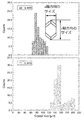
- FIG. 6 shows a histogram.
- the upper part of the figure shows the result of the length of the a-axis (short axis), and the lower part shows the result of the length of the c-axis (long axis). It can be seen that the length of the a-axis eventually exceeds 60 ⁇ m, and the length of the c-axis exceeds 120 ⁇ m. The largest one had a c-axis length of approximately 200 ⁇ m.
- water vapor corresponds to the "heat storage compound” of the present invention
- a sample saturated with water vapor adsorption (water vapor saturated COF-300 single crystal) corresponds to the "composite material” of the present application.
- the thermal diffusivity of the COF-300 single crystal obtained by the above additive # 8 was measured by a thermal wave thermal analysis method.
- the temperature wave thermal analysis method is a method of measuring the phase lag of the AC temperature in the thickness direction of the sample, and obtains the thermal diffusivity from the change in the phase lag of the temperature wave measured at different frequencies. The measurement was performed in the atmosphere, and the water vapor adsorption state of the single crystal sample is unknown.
- FIG. 9 shows the outline and results of this measurement. The outline of the measurement cell is as shown in the "schematic diagram of the measurement cell" in the figure.
- a crystal sample is placed on an ITO thin film formed on the surface of a glass substrate, and a temperature wave is detected by an electrode.
- the heating direction of the crystal is the lateral direction (a-axis direction) of the crystal.
- thermal conductivity of COF-300 single crystal was calculated using the values of specific heat and thermal diffusivity measured so far.
- the density of the single crystal sample was calculated by Material Studio using the crystal structure data of the COF-300 single crystal of Non-Patent Document 2. As a result, the density ⁇ of the COF-300 single crystal was 0.735 [g / cm 3 ], and the unit cell volume was 5209.63 ⁇ 3 .
Landscapes
- Chemical & Material Sciences (AREA)
- Organic Chemistry (AREA)
- Engineering & Computer Science (AREA)
- Chemical Kinetics & Catalysis (AREA)
- Physics & Mathematics (AREA)
- Thermal Sciences (AREA)
- Analytical Chemistry (AREA)
- Mechanical Engineering (AREA)
- General Engineering & Computer Science (AREA)
- Combustion & Propulsion (AREA)
- Materials Engineering (AREA)
- General Chemical & Material Sciences (AREA)
- Heterocyclic Carbon Compounds Containing A Hetero Ring Having Nitrogen And Oxygen As The Only Ring Hetero Atoms (AREA)
- Crystals, And After-Treatments Of Crystals (AREA)
Abstract
Description
該蓄熱性化合物が、該COFの単結晶への吸着若しくは脱着、又は-20~200℃の範囲内で生じる相変化若しくは化学反応により、発熱又は吸熱する化合物であることを特徴とする複合材料。
(a)下記式(I)~(VII)からなる群より選択されるリンカーと、
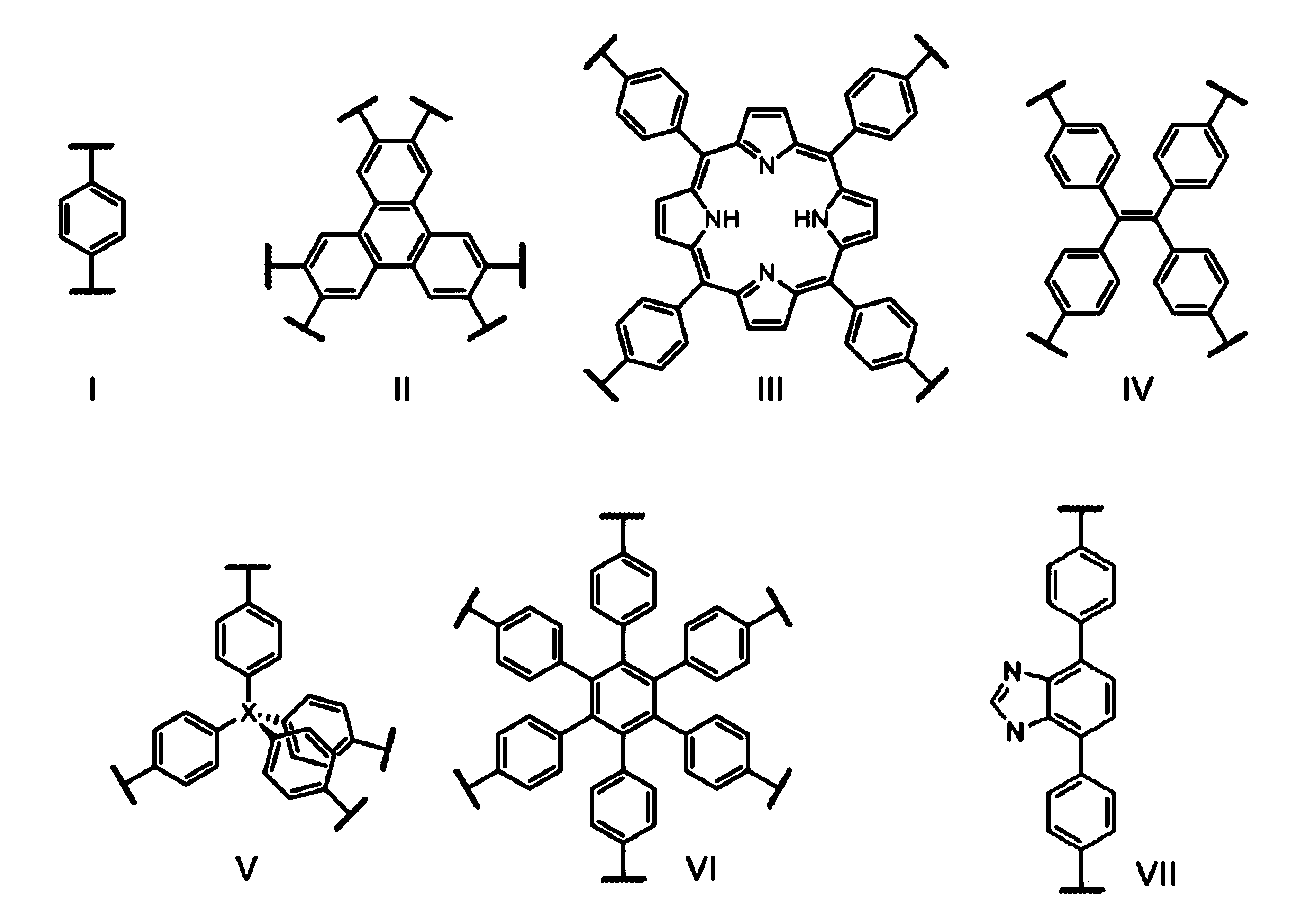
(b)-B(-O-)2、-C=C-、-C-N-、-C=N-、―C-N=C-、-N-B-N-からなる群より選択され、前記リンカー同士をつなぐ結合と、
から構成される骨格構造を有することを特徴とする〔1〕に記載の複合材料。
共有結合性有機骨格(COF)の原料化合物(上記のビルディング・ユニット分子)を、「平衡調整剤」及び「イオン液体又は有機塩」を含む溶液を介して反応させることによってCOFの単結晶を成長させる単結晶製造工程と、
前記COF単結晶に前記蓄熱性化合物を添加して複合材料とする複合化工程と、
を有することを特徴とする複合材料の製造方法。
長軸の長さが120μmより大きいことを特徴とするCOF単結晶。
(a)下記式(I)~(VII)からなる群より選択されるリンカーと、
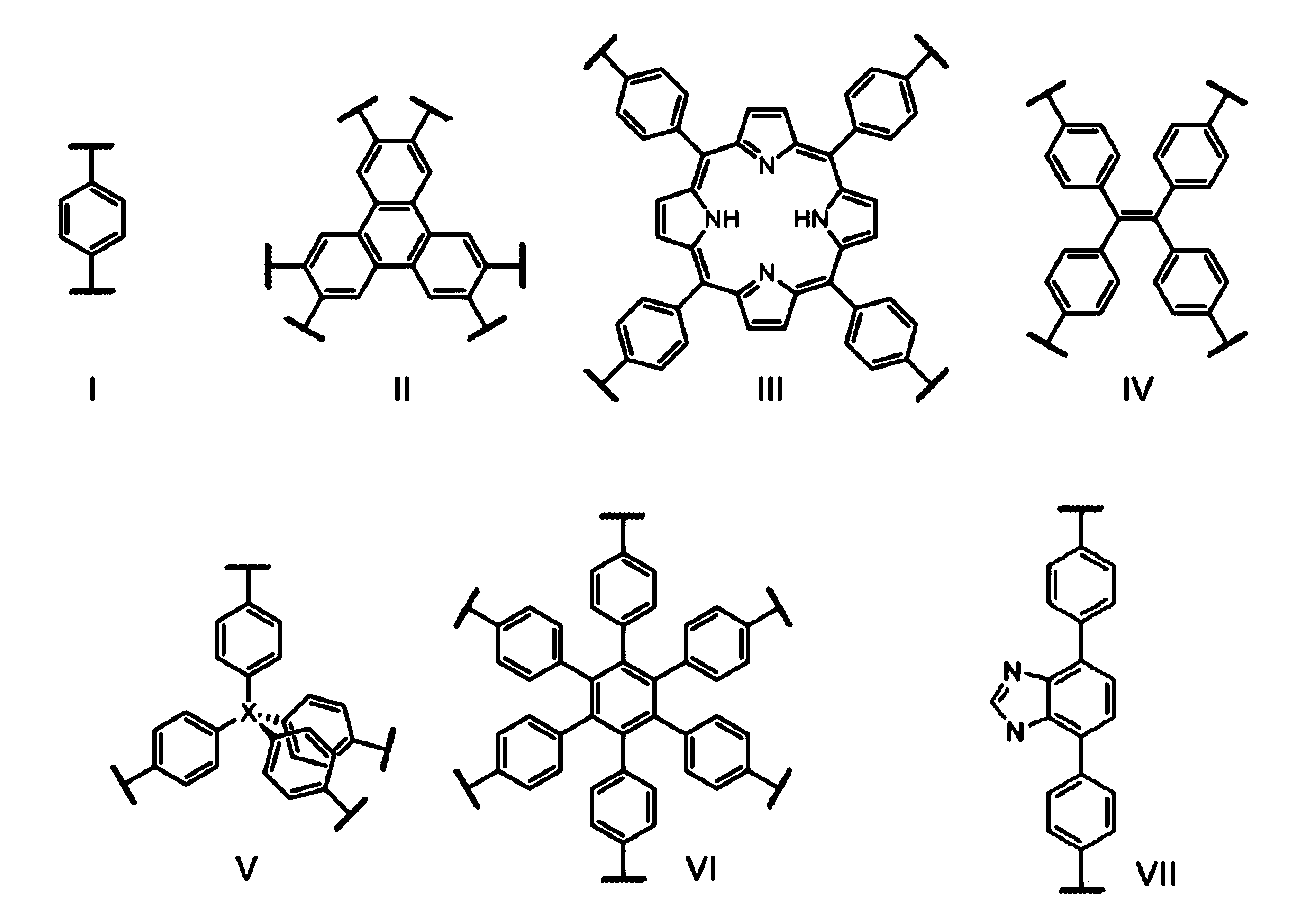
(b)-B(-O-)2、-C=C-、-C-N-、-C=N-、―C-N=C-、-N-B-N-からなる群より選択され、前記リンカー同士をつなぐ結合と、
から構成される骨格構造を有することを特徴とする〔12〕に記載のCOF単結晶。
共有結合性有機骨格(COF)の原料化合物を、イオン液体又は有機塩と平衡調製剤とを含む溶液を介して反応させることによってCOFの単結晶を成長させる単結晶製造工程を有することを特徴とするCOF単結晶の製造方法。
〔22〕:熱伝導率が0.05Wm-1K-1以上であることを特徴とする〔1〕に記載の複合材料。
以下、本発明のCOF単結晶について説明する。本発明のCOF単結晶は、長軸(c軸)の長さが120μm以上である。
リンカーは、置換又は非置換芳香族環、置換又は非置換複素環式芳香族環、置換又は非置換非芳香族環、置換又は非置換複素環式非芳香族環、置換又は非置換炭化水素基からなる群より選択された1つ又はそれ以上の原子団を含む有機基であることが好ましい。
より好ましくは、(a)下記式(I)~(VII)からなる群より選択されるリンカーと、

(b)-B(-O-)2、-C=C-、-C-N-、-C=N-、―C-N=C-、-N-B-N-からなる群より選択され、前記リンカー同士をつなぐ結合と、
から構成される骨格構造を有する。
以下、COF単結晶の製造法について説明する。COF単結晶の製造方法は、COFの原料化合物(ビルディング・ユニット分子)を、イオン液体又は有機塩と、平衡調製剤とを含む溶液を介して反応させることによってCOFの単結晶を成長させる単結晶製造工程を有する。
以下、COF単結晶を用いた複合材料について説明する。本発明の複合材料は、長軸の長さが120μmより大きい共有結合性有機骨格(COF)の単結晶又は複数の該単結晶からなるCOFの多結晶と、少なくとも1種の蓄熱性化合物とを含む。
該複合材料の熱伝導率は、速やかな熱交換を可能にするという観点から、0.05Wm-1K-1以上であることが好ましい。より好ましくは0.1Wm-1K-1以上、さらに好ましくは0.2Wm-1K-1以上、さらに好ましくは0.5Wm-1K-1以上、最も好ましくは1Wm-1K-1以上である。室温付近で,該複合材料は、該複合材料を構成する蓄熱性化合物のバルク状態よりも熱伝導率が高いことが好ましい。
本発明の複合材料の製造方法は、上記のCOF単結晶の製造方法で説明した単結晶製造工程を行い、続いて得られたCOF単結晶に蓄熱性化合物を添加して複合材料とする複合化工程と、を有する。単結晶製造工程については上記で説明したため、ここでは詳細な説明は省略する。複合化工程では、COF単結晶に蓄熱性化合物を添加して複合材料とする。COF単結晶への蓄熱性化合物の添加方法としては、特に制限はなく、COF単結晶と蓄熱性化合物の種類などに応じて、適切な条件(例えば10~50℃、1~100時間など)で行うことができる。例えば、蓄熱性化合物が液化する温度条件でCOF単結晶を溶融状態の蓄熱性化合物に浸し、蓄熱性化合物分子をCOFの細孔に含浸させる方法が挙げられる。より具体的には、例えば酢酸ナトリウム三水和物の場合は、57.5℃以上で融解させてCOF単結晶と接触させることで複合化する。
本発明の複合材料は、放蓄熱部材における蓄熱・放熱材料として好適に用いることができる。本発明の放蓄熱部材は、複合材料からなる放蓄熱層と、この放蓄熱層と接触し(後述する「低融点の金属材料」からなるろう付け層を介する場合を含む)放蓄熱層からの熱を発散する熱発散層とを有する。熱発散層としては、熱伝導率が高い金属などが好ましく、特にアルミニウムが好適である。
複合材料からなる放蓄熱層と熱発散層とを積層する方法としては、熱発散層を構成する材料の上に直接COF単結晶を成長させた後に該COF単結晶に蓄熱性化合物を添加して複合材料とする方法や、低融点の金属材料、例えばインジウム、でCOF単結晶を、熱発散層を構成する材料の上にろう付けした後に該COF単結晶に蓄熱性化合物を添加して複合材料とする方法や、COF単結晶に蓄熱性化合物を添加して複合材料とした後に熱発散層を構成する材料の上にろう付けする方法が挙げられる。
1-1: 溶液の作製と結晶成長
まず、容量6mLのガラスバイアルに、Terephthalaldehyde(以下,BDA)の固体粉末を3.35mg(0.025mmol;これを1等量とする)秤量して入れた。次に、このバイアルに、0.25mLのジオキサン及び0.03mLのアニリン(ともに液体)を秤量して入れた。続いて、10分間超音波分散を行い、BDAを溶解させて、液Aとした。
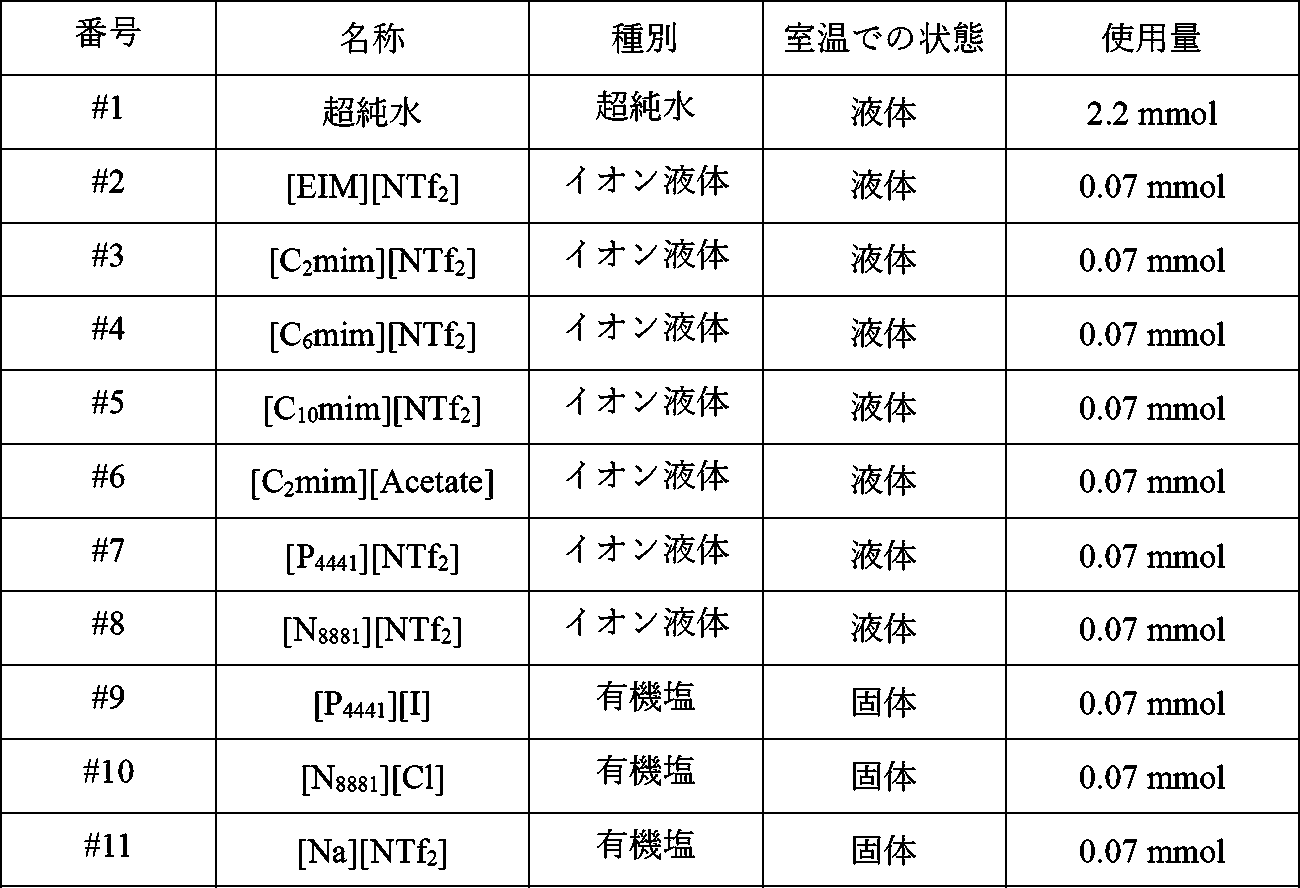

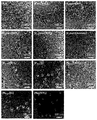
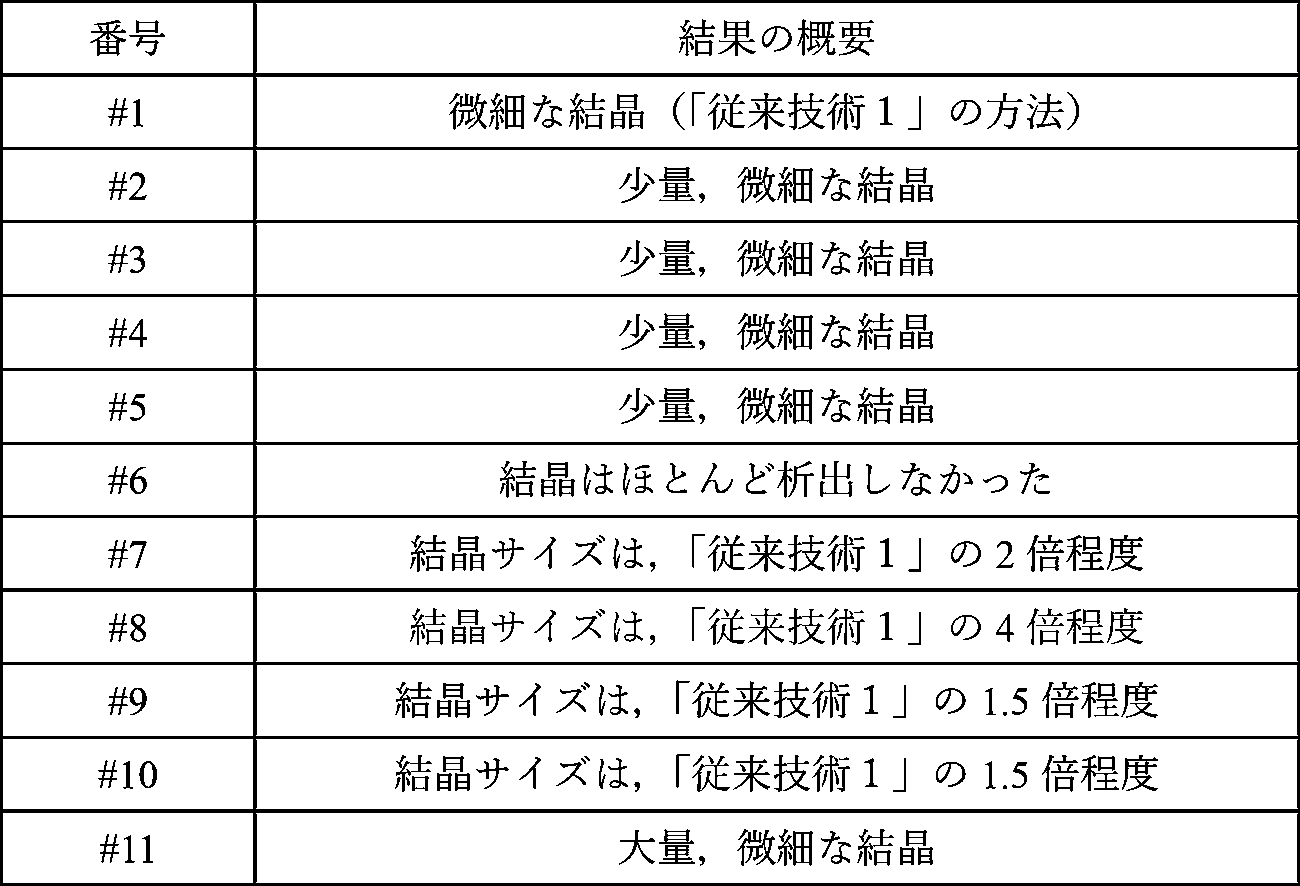
上記の結晶成長後、パスツールピペットによる吸引によって、成長したCOF-300の単結晶群を取得した。これに対して、ジオキサン、アセトン、トルエンの順番で洗浄を行った。最後のトルエン洗浄において、単結晶群を濾紙により分離した。この単結晶群を、濾紙ごと環状電気炉に入れ、乾燥窒素ガスを流しながら、95℃で8時間乾燥した。結果の概要を下記表に示す。また、得られた結晶の顕微鏡写真を図5に示す。
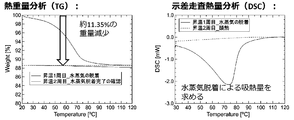
上記の添加物#8で得られたCOF-300単結晶について水蒸気吸着熱を計測した。示差走査熱量測定装置(島津製作所,DSC-60)を使用し、水蒸気吸着飽和の試料を使用し、COF-300単結晶を測定用セルに入れ、乾燥窒素環境、5℃/min昇温の条件で熱重量分析(TG)及び示差走査熱量分析(DSC)を行った。なお、本計測において、水蒸気が本願発明の「蓄熱性化合物」に該当し、水蒸気吸着飽和した試料(水蒸気飽和COF-300単結晶)が本願の「複合材料」に該当する。その結果を図7に示す。昇温1周目では水蒸気の脱着を行い、昇温2周目では1周目で水蒸気の脱着が完了したことの確認を行った。
これらの結果から、COF-300単結晶の水蒸気吸着熱は、上記で計測された吸熱量を吸着された水の重量で除すことによりΔh=2345.5kJ/kg(H2O)と求められた。これは、室温での水の蒸発エンタルピーとほぼ等しい。このことから、H2O分子とCOF-300の骨格との相互作用はH2O分子同士の相互作用と同程度と考えられ強いことが示唆される。本願発明においては、後述するように単結晶のサイズを大きくすることで粉体の数倍の熱伝導率とできたので、蓄熱・放熱速度を改善した蓄熱・放熱システムとすることができる。
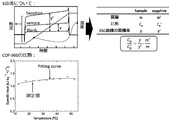
上記の添加物#8で得られたCOF-300単結晶について、示差走査熱量測定装置(PerkinElmer, DSC 8000)装置を用いてDSCを用い、三点法により比熱を測定した。本計測には乾燥したCOF-300試料を使用した。比熱の計測は、10~55℃の間に3点法を用い、5℃間隔で比熱を求めた。計測の誤差は、上記の示差走査熱量測定装置に付属のサファイアの測定値と文献値の違いによって補正した。その結果を図8に示す。この結果から、COF-300単結晶の比熱CPは1.19kJkg-1K-1であった。
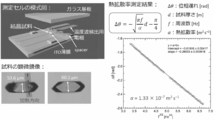
上記の添加物#8で得られたCOF-300単結晶について、温度波熱分析法により熱拡散率を測定した。温度波熱分析法は、交流温度の位相遅れを試料の厚さ方向に計測する方法であり、周波数を変えて測定される温度波の位相遅れの変化から、熱拡散率を求める。測定は大気中で行い、単結晶試料の水蒸気吸着状態は不明である。図9は、本計測の概要と結果を示している。測定セルの概要は図中「測定セルの模式図」に示したとおりである。この図に示すように、ガラス基板の表面に形成されたITO薄膜上に結晶試料を載せて電極で温度波を検出する。結晶の加熱方向は、結晶の横方向(a軸方向)としている。その結果、COF-300単結晶の熱拡散率は、α=1.33×10⁻⁷m2s-1であった。
次に、これまで計測した比熱と熱拡散率の値を用い、COF-300単結晶の熱伝導率を算出した。単結晶サンプルの熱伝導率λは以下の式で計算した。
λ=α・CP・ρ (式)
(ここで、α:熱拡散率、CP:比熱、ρ:密度)
ここで、単結晶サンプルの密度は、非特許文献2のCOF-300単結晶の結晶構造データを用い、Material Studioで計算した。その結果、COF-300単結晶の密度ρは0.735[g/cm3]、単位格子体積は5209.63Å3であった。
Claims (22)
- 長軸の長さが120μmより大きい共有結合性有機骨格(COF)の単結晶又は複数の該単結晶からなるCOFの多結晶と、少なくとも1種の蓄熱性化合物とを含み、
該蓄熱性化合物が、該COFの単結晶への吸着若しくは脱着、又は-20~200℃の範囲内で生じる相変化若しくは化学反応により、発熱又は吸熱する化合物であることを特徴とする複合材料。 - 前記吸着若しくは脱着、前記相変化、及び前記化学反応が、可逆的であることを特徴とする請求項1記載の複合材料。
- 前記共有結合性有機骨格(COF)は、
(a)下記式(I)~(VII)からなる群より選択されるリンカーと、
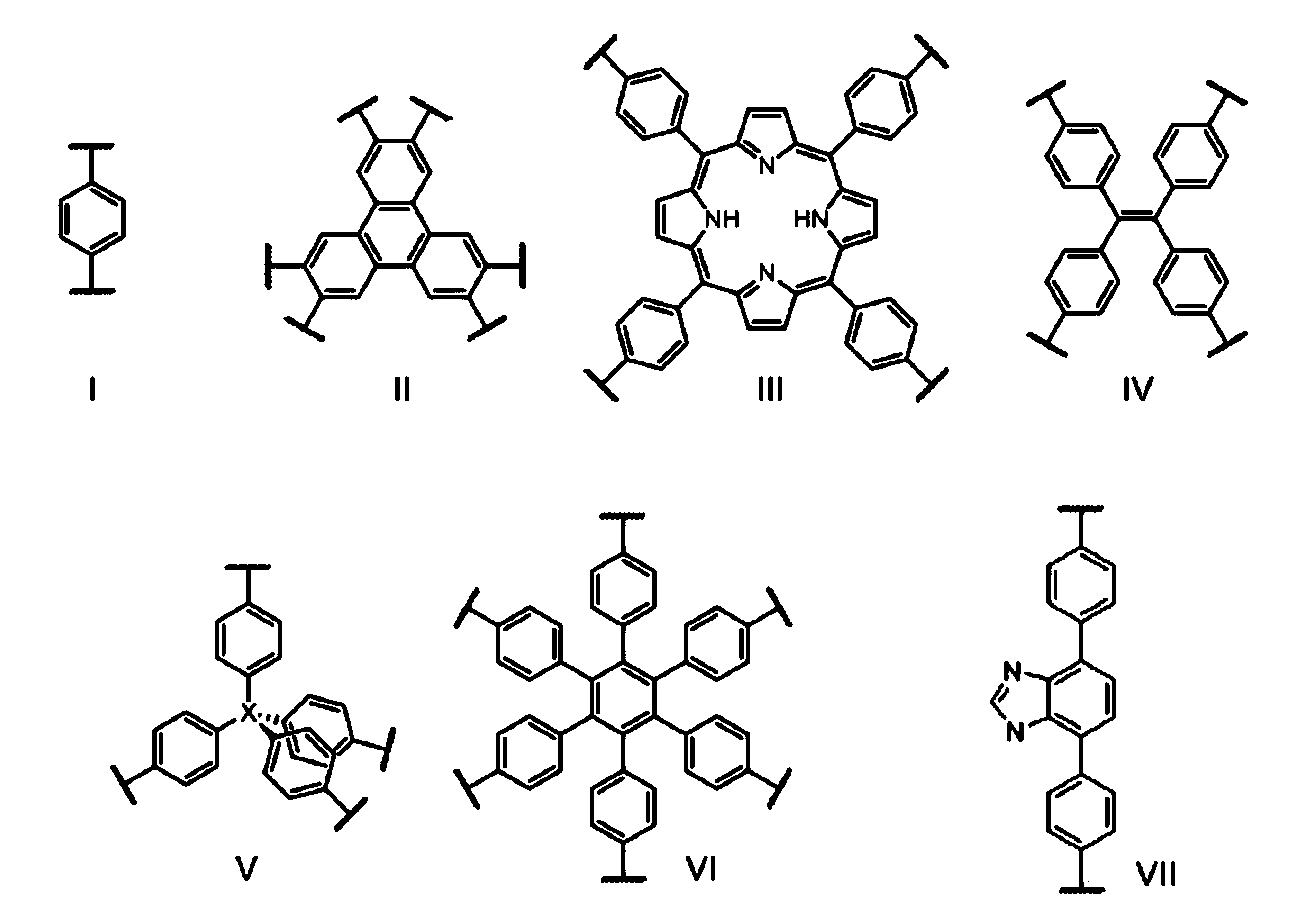
(b)-B(-O-)2、-C=C-、-C-N-、-C=N-、―C-N=C-、-N-B-N-からなる群より選択され、前記リンカー同士をつなぐ結合と、
から構成される骨格構造を有することを特徴とする請求項1に記載の複合材料。 - 前記共有結合性有機骨格(COF)は、COF-300、COF-303、LZU-79、及びLZU-111からなる群から選択された少なくとも1種であることを特徴とする請求項1に記載の複合材料。
- 上記蓄熱性化合物の分子径が、前記共有結合性有機骨格の細孔径よりも小さいことを特徴とする請求項1に記載の複合材料。
- 前記蓄熱性化合物が、水、硫酸ナトリウム十水和物、酢酸ナトリウム三水和物、及び硫酸カリウムアルミニウム十二水和物からなる群から選択された少なくとも1種であることを特徴とする請求項1に記載の複合材料。
- 請求項1~6のいずれか1項に記載の複合材料を蓄熱・放熱材料として含むことを特徴とする放蓄熱部材。
- 請求項1~6のいずれか1項に記載の複合材料からなる放蓄熱層と、該放蓄熱層と接触し前記放蓄熱層からの熱を発散する熱発散層とを有することを特徴とする請求項7に記載の放蓄熱部材。
- 前記熱発散層が金属からなることを特徴とする請求項8に記載の放蓄熱部材。
- 前記熱発散層がアルミニウムからなることを特徴とする請求項9に記載の放蓄熱部材。
- 請求項1~6のいずれか1項に記載の複合材料の製造方法であって、
共有結合性有機骨格(COF)の原料化合物を、イオン液体又は有機塩と平衡調整剤とを含む溶液を介して反応させることによってCOFの単結晶を成長させる単結晶製造工程と、
前記COF単結晶に前記蓄熱性化合物を添加して複合材料とする複合化工程と、
を有することを特徴とする複合材料の製造方法。 - 共有結合性有機骨格(COF)の単結晶であって、
長軸の長さが120μmより大きいことを特徴とするCOF単結晶。 - 熱伝導率が0.05Wm-1K-1以上であることを特徴とする請求項12に記載のCOF単結晶。
- 前記共有結合性有機骨格(COF)は、
(a)下記式(I)~(VII)からなる群より選択されるリンカーと、
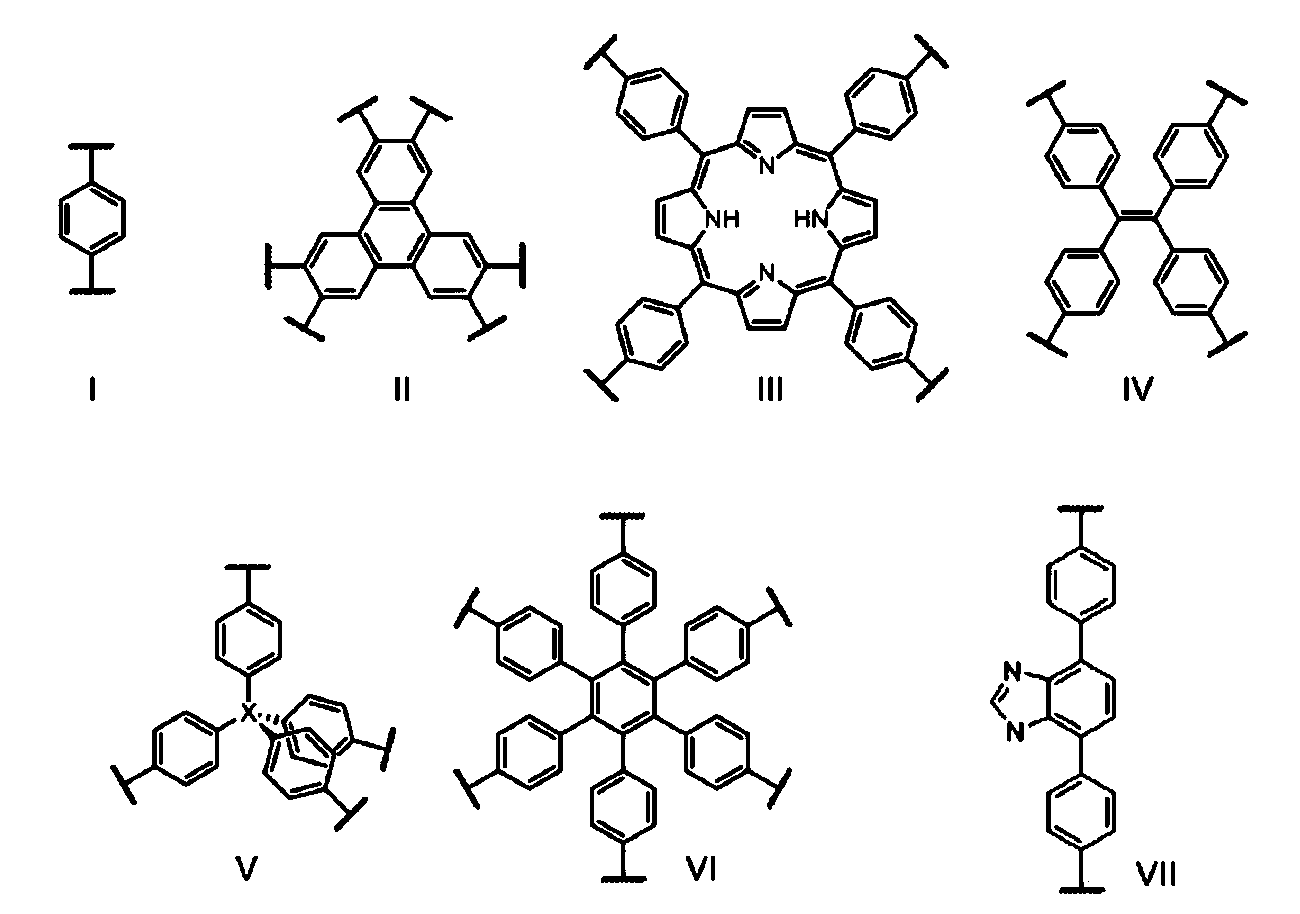
(b)-B(-O-)2、-C=C-、-C-N-、-C=N-、―C-N=C-、-N-B-N-からなる群より選択され、前記リンカー同士をつなぐ結合と、
から構成される骨格構造を有することを特徴とする請求項12に記載のCOF単結晶。 - 前記結合が-C=N-であることを特徴とする請求項14に記載のCOF単結晶。
- COF-300、COF-303、LZU-79、及びLZU-111からなる群から選択された少なくとも1種であることを特徴とする請求項12に記載のCOF単結晶。
- 請求項12~16のいずれか1項に記載のCOF単結晶の製造方法であって、
共有結合性有機骨格(COF)の原料化合物を、イオン液体又は有機塩と平衡調整剤とを含む溶液を介して反応させることによってCOFの単結晶を成長させる単結晶製造工程を有することを特徴とするCOF単結晶の製造方法。 - 前記原料化合物が、複数のホルミル基を有するアルデヒドと、複数のアミノ基を有するアミンである、請求項17記載のCOF単結晶の製造方法。
- 前記平衡調整剤が、単数のホルミル基を有するアルデヒド、又は単数のアミノ基を有するアミンである、請求項17に記載のCOF単結晶の製造方法。
- 前記イオン液体又は有機塩が、メチルトリオクチルアンモニウムビストリフルオロメタンスルホニルイミド、メチルトリオクチルアンモニウムクロライド、メチルトリブチルホスホニウムビストリフルオロメタンスルホニルイミド、及びメチルトリブチルホスホニウムイオダイドからなる群から選択された1種以上の化合物であることを特徴とする請求項17に記載のCOF単結晶の製造方法。
- 前記イオン液体又は有機塩が、メチルトリオクチルアンモニウムビストリフルオロメタンスルホニルイミドであることを特徴とする請求項20に記載のCOF単結晶の製造方法。
- 熱伝導率が0.05Wm-1K-1以上であることを特徴とする請求項1に記載の複合材料。
Priority Applications (3)
| Application Number | Priority Date | Filing Date | Title |
|---|---|---|---|
| CN202180010929.0A CN115427533B (zh) | 2020-01-29 | 2021-01-28 | 包含cof的复合材料、放蓄热构件和该复合材料的制造方法以及cof单晶及其制造方法 |
| JP2021574119A JP7751162B2 (ja) | 2020-01-29 | 2021-01-28 | Cofを含む複合材料、放蓄熱部材及び該複合材料の製造方法並びにcof単結晶及びその製造方法 |
| US17/796,026 US12492331B2 (en) | 2020-01-29 | 2021-01-28 | Composite material including COF, heat dissipation/storage member, and method for producing said composite material, and COF single crystal and production method therefor |
Applications Claiming Priority (2)
| Application Number | Priority Date | Filing Date | Title |
|---|---|---|---|
| JP2020-012455 | 2020-01-29 | ||
| JP2020012455 | 2020-01-29 |
Publications (1)
| Publication Number | Publication Date |
|---|---|
| WO2021153689A1 true WO2021153689A1 (ja) | 2021-08-05 |
Family
ID=77079400
Family Applications (1)
| Application Number | Title | Priority Date | Filing Date |
|---|---|---|---|
| PCT/JP2021/003090 Ceased WO2021153689A1 (ja) | 2020-01-29 | 2021-01-28 | Cofを含む複合材料、放蓄熱部材及び該複合材料の製造方法並びにcof単結晶及びその製造方法 |
Country Status (4)
| Country | Link |
|---|---|
| US (1) | US12492331B2 (ja) |
| JP (1) | JP7751162B2 (ja) |
| CN (1) | CN115427533B (ja) |
| WO (1) | WO2021153689A1 (ja) |
Cited By (4)
| Publication number | Priority date | Publication date | Assignee | Title |
|---|---|---|---|---|
| CN113797902A (zh) * | 2021-09-18 | 2021-12-17 | 福州大学 | 一种以单晶共价有机框架材料为固定相的液相色谱柱 |
| CN114920894A (zh) * | 2022-06-27 | 2022-08-19 | 齐齐哈尔大学 | 一种Cu2+和Al3+双功能荧光共价有机框架材料及其制备方法和应用 |
| CN116550310A (zh) * | 2023-05-10 | 2023-08-08 | 江南大学 | 一种基于共价有机骨架的色谱柱及其制备方法与应用 |
| JP2024521853A (ja) * | 2021-05-28 | 2024-06-04 | 清華大学 | 三次元カルボン酸共有結合性有機構造体材料及び製造方法並びに使用 |
Families Citing this family (8)
| Publication number | Priority date | Publication date | Assignee | Title |
|---|---|---|---|---|
| CN115433331B (zh) * | 2022-08-12 | 2023-10-31 | 南昌大学 | 一种烯烃连接的共价有机框架的制备方法及其光催化应用 |
| CN117205971A (zh) * | 2023-09-11 | 2023-12-12 | 天津工业大学 | 一种新型的花状共价有机框架/纳米Pt复合催化剂及其制备方法 |
| CN117417499B (zh) * | 2023-10-17 | 2026-07-17 | 山东省农业科学院 | 一种氟化共价有机框架材料及其制备方法和应用 |
| CN118027325B (zh) * | 2024-01-26 | 2025-05-13 | 苏州大学 | 一种三维单晶共价有机骨架的水相制备方法 |
| CN120904412A (zh) * | 2024-05-07 | 2025-11-07 | 无锡新储材料科技有限公司 | 一种共价有机框架材料及其制备方法 |
| CN118440498B (zh) * | 2024-05-28 | 2025-02-14 | 广东工业大学 | 一种COFs纳米/BD树脂复合材料及其制备方法和应用 |
| CN118852563B (zh) * | 2024-06-28 | 2025-10-03 | 浙江工业大学 | 一种氢键诱导多级孔共价有机框架材料及其组装方法与应用 |
| CN119875589B (zh) * | 2025-01-22 | 2025-12-19 | 塔里木大学 | 一种CaCl2•6H2O/COF/PAE复合相变材料及其制备方法 |
Citations (5)
| Publication number | Priority date | Publication date | Assignee | Title |
|---|---|---|---|---|
| JP2013540760A (ja) * | 2010-09-27 | 2013-11-07 | ザ レジェンツ オブ ザ ユニヴァースティ オブ カリフォルニア | 伝導性の開骨格 |
| US20140148596A1 (en) * | 2010-04-07 | 2014-05-29 | Cornell University | Covalent Organic Frameworks and Methods of Making Same |
| JP2017508121A (ja) * | 2014-01-10 | 2017-03-23 | ブライ・エアー・アジア・ピーヴイティー・リミテッド | ハイブリッド吸着装置熱交換デバイスおよび製造方法 |
| JP2019503407A (ja) * | 2015-11-27 | 2019-02-07 | ザ リージェンツ オブ ザ ユニバーシティ オブ カリフォルニア | 織状構造を有する共有結合性有機構造体 |
| CN109317206A (zh) * | 2018-10-15 | 2019-02-12 | 吉林化工学院 | 一种苯乙烯环氧化催化剂及其制备方法和应用 |
Family Cites Families (8)
| Publication number | Priority date | Publication date | Assignee | Title |
|---|---|---|---|---|
| JP2510120B2 (ja) | 1993-01-20 | 1996-06-26 | 善男 吉澤 | ケミカルヒ―トポンプ |
| MX2007004679A (es) | 2004-10-22 | 2007-10-03 | Univ Michigan | Estructuras y poliedros organicos covalentemente enlazados. |
| JP2013087276A (ja) | 2011-10-14 | 2013-05-13 | Yoshinobu Yamaguchi | 潜熱蓄熱体の形態 |
| JP6607594B2 (ja) * | 2015-03-04 | 2019-11-20 | 国立大学法人 東京大学 | 細孔性高分子化合物、分離対象化合物の分離方法、単結晶、結晶構造解析用試料の作製方法、解析対象化合物の分子構造決定方法、及びキラル化合物の絶対配置の決定方法 |
| CN104710965A (zh) * | 2015-04-02 | 2015-06-17 | 北京科技大学 | 一种多级孔道碳基复合相变材料的制备方法 |
| WO2016174468A1 (en) | 2015-04-30 | 2016-11-03 | The University Of Liverpool | Porous materials |
| CN108117526B (zh) * | 2016-11-29 | 2020-11-03 | 中国科学院大连化学物理研究所 | 一种炔基功能化共价有机框架材料及其合成方法和应用 |
| CN110484214B (zh) * | 2019-08-19 | 2021-03-02 | 苏州阿德旺斯新材料有限公司 | 一种定型mof基复合相变材料及其制备方法和应用 |
-
2021
- 2021-01-28 US US17/796,026 patent/US12492331B2/en active Active
- 2021-01-28 JP JP2021574119A patent/JP7751162B2/ja active Active
- 2021-01-28 WO PCT/JP2021/003090 patent/WO2021153689A1/ja not_active Ceased
- 2021-01-28 CN CN202180010929.0A patent/CN115427533B/zh active Active
Patent Citations (5)
| Publication number | Priority date | Publication date | Assignee | Title |
|---|---|---|---|---|
| US20140148596A1 (en) * | 2010-04-07 | 2014-05-29 | Cornell University | Covalent Organic Frameworks and Methods of Making Same |
| JP2013540760A (ja) * | 2010-09-27 | 2013-11-07 | ザ レジェンツ オブ ザ ユニヴァースティ オブ カリフォルニア | 伝導性の開骨格 |
| JP2017508121A (ja) * | 2014-01-10 | 2017-03-23 | ブライ・エアー・アジア・ピーヴイティー・リミテッド | ハイブリッド吸着装置熱交換デバイスおよび製造方法 |
| JP2019503407A (ja) * | 2015-11-27 | 2019-02-07 | ザ リージェンツ オブ ザ ユニバーシティ オブ カリフォルニア | 織状構造を有する共有結合性有機構造体 |
| CN109317206A (zh) * | 2018-10-15 | 2019-02-12 | 吉林化工学院 | 一种苯乙烯环氧化催化剂及其制备方法和应用 |
Non-Patent Citations (2)
| Title |
|---|
| FREITAS SUNNY K. S., BORGES RAQUEL S., MERLINI CLAUDIA, BARRA GUILHERME M. O., ESTEVES PIERRE M.: "Thermal Conductivity of Covalent Organic Frameworks as a Function of Their Pore Size", THE JOURNAL OF PHYSICAL CHEMISTRY C, AMERICAN CHEMICAL SOCIETY, US, vol. 121, no. 48, 7 December 2017 (2017-12-07), US, pages 27247 - 27252, XP055843571, ISSN: 1932-7447, DOI: 10.1021/acs.jpcc.7b10487 * |
| MA TIANQIONG, KAPUSTIN EUGENE A., YIN SHAWN X., LIANG LIN, ZHOU ZHENGYANG, NIU JING, LI LI-HUA, WANG YINGYING, SU JIE, LI JIAN, WA: "Single-crystal x-ray diffraction structures of covalent organic frameworks", SCIENCE, AMERICAN ASSOCIATION FOR THE ADVANCEMENT OF SCIENCE, US, vol. 361, no. 6397, 6 July 2018 (2018-07-06), US, pages 48 - 52, XP055843569, ISSN: 0036-8075, DOI: 10.1126/science.aat7679 * |
Cited By (4)
| Publication number | Priority date | Publication date | Assignee | Title |
|---|---|---|---|---|
| JP2024521853A (ja) * | 2021-05-28 | 2024-06-04 | 清華大学 | 三次元カルボン酸共有結合性有機構造体材料及び製造方法並びに使用 |
| CN113797902A (zh) * | 2021-09-18 | 2021-12-17 | 福州大学 | 一种以单晶共价有机框架材料为固定相的液相色谱柱 |
| CN114920894A (zh) * | 2022-06-27 | 2022-08-19 | 齐齐哈尔大学 | 一种Cu2+和Al3+双功能荧光共价有机框架材料及其制备方法和应用 |
| CN116550310A (zh) * | 2023-05-10 | 2023-08-08 | 江南大学 | 一种基于共价有机骨架的色谱柱及其制备方法与应用 |
Also Published As
| Publication number | Publication date |
|---|---|
| CN115427533A (zh) | 2022-12-02 |
| US12492331B2 (en) | 2025-12-09 |
| JPWO2021153689A1 (ja) | 2021-08-05 |
| US20230095617A1 (en) | 2023-03-30 |
| JP7751162B2 (ja) | 2025-10-08 |
| CN115427533B (zh) | 2025-07-18 |
Similar Documents
| Publication | Publication Date | Title |
|---|---|---|
| JP7751162B2 (ja) | Cofを含む複合材料、放蓄熱部材及び該複合材料の製造方法並びにcof単結晶及びその製造方法 | |
| Li et al. | Function-oriented synthesis of two-dimensional (2D) covalent organic frameworks–from 3D solids to 2D sheets | |
| Martínez‐Abadía et al. | Structural approaches to control interlayer interactions in 2D covalent organic frameworks | |
| Zou et al. | Hydrophilic modification of expanded graphite to develop form-stable composite phase change material based on modified CaCl2· 6H2O | |
| Atinafu et al. | Introduction of organic-organic eutectic PCM in mesoporous N-doped carbons for enhanced thermal conductivity and energy storage capacity | |
| Li et al. | Synthesis and characterization of PEG/ZSM-5 composite phase change materials for latent heat storage | |
| CN103044463B (zh) | 一种高效制备沸石咪唑类金属有机框架zif-90的方法 | |
| Zhou et al. | A porous cobalt (II)–organic framework exhibiting high room temperature proton conductivity and field-induced slow magnetic relaxation | |
| CN111718492A (zh) | 大尺寸单层二维mof纳米片的制备及其应用 | |
| Qian et al. | The effect of hydrophilic modification of expanded graphite on the thermophysical properties of magnesium chloride hexahydrate: Y. Qian et al. | |
| Xiao et al. | Unprecedented cucurbituril-based ternary host–guest supramolecular polymers mediated through included alkyl chains | |
| Munoz‐Alonso et al. | Highly Crystalline and Oriented Thin Films of Fully Conjugated 3D‐Covalent Organic Frameworks | |
| Han et al. | Preparation and characterization of the shape-stabilized phase change material based on sebacic acid and mesoporous MCM-41 | |
| Hekimoğlu et al. | Shape stabilized microcrystalline cellulose/methyl stearate/graphene nanoplatelet composite with enriched thermal conductivity and thermal energy storage/release performance | |
| Yuan et al. | Effect of water content on the phase transition temperature, latent heat and water uptake of PEG polymers acting as endothermal-hydroscopic materials | |
| Fan et al. | Form‐stable phase‐change materials supported by 1‐octadecylamine‐modified montmorillonite for latent heat storage | |
| PP et al. | Synthesis and characterization of a 2D covalent organic framework (COF) of hexagonal topology using boronate linkages | |
| Maspero et al. | Facile preparation of polytopic azoles: synthesis, characterization, and X-ray powder diffraction studies of 1, 4-bis (pyrazol-4-yl)-and 1, 4-bis (tetrazol-5-yl) benzene | |
| Zhou et al. | Four new metal–organic supramolecular networks based on aromatic acid and flexible bis (imidazole) ligand: Synthesis, structures and luminescent properties | |
| JP2017149682A (ja) | 多孔高分子金属錯体、これを用いたガス吸着材、ガス分離装置、ガス貯蔵装置、触媒、導電性材料、センサー | |
| Li et al. | The self-assembly of single-walled metal–organic nanotubes constructed from CuCl2 chains and ditetrazoles | |
| US20250333631A1 (en) | Metal-organic framework as a matrix for polyethylene glycol in thermal energy storage and preparations thereof | |
| Wang et al. | TEMPERATURE DEPENDENCE OF THE CRYSTAL GROWTH OF IMINE-BONDED 3-DIMENSIONAL COVALENT ORGANIC FRAMEWORK (3D-COF) | |
| Zheng | Studies on phase/structure transformable copper coordination polymers using bis (trifluoromethanesulfonyl) imide anion | |
| CN106188109A (zh) | 1,4‑二溴‑2,5‑二亚甲基双三唑二维镉配合物单晶与应用 |
Legal Events
| Date | Code | Title | Description |
|---|---|---|---|
| 121 | Ep: the epo has been informed by wipo that ep was designated in this application |
Ref document number: 21748138 Country of ref document: EP Kind code of ref document: A1 |
|
| ENP | Entry into the national phase |
Ref document number: 2021574119 Country of ref document: JP Kind code of ref document: A |
|
| NENP | Non-entry into the national phase |
Ref country code: DE |
|
| 122 | Ep: pct application non-entry in european phase |
Ref document number: 21748138 Country of ref document: EP Kind code of ref document: A1 |
|
| WWG | Wipo information: grant in national office |
Ref document number: 202180010929.0 Country of ref document: CN |