WO2021153119A1 - バイオセンサ - Google Patents
バイオセンサ Download PDFInfo
- Publication number
- WO2021153119A1 WO2021153119A1 PCT/JP2020/048216 JP2020048216W WO2021153119A1 WO 2021153119 A1 WO2021153119 A1 WO 2021153119A1 JP 2020048216 W JP2020048216 W JP 2020048216W WO 2021153119 A1 WO2021153119 A1 WO 2021153119A1
- Authority
- WO
- WIPO (PCT)
- Prior art keywords
- heat
- biosensor
- sensitive portion
- enzyme
- sensitive
- Prior art date
- Legal status (The legal status is an assumption and is not a legal conclusion. Google has not performed a legal analysis and makes no representation as to the accuracy of the status listed.)
- Ceased
Links
Images



Classifications
-
- G—PHYSICS
- G01—MEASURING; TESTING
- G01K—MEASURING TEMPERATURE; MEASURING QUANTITY OF HEAT; THERMALLY-SENSITIVE ELEMENTS NOT OTHERWISE PROVIDED FOR
- G01K7/00—Measuring temperature based on the use of electric or magnetic elements directly sensitive to heat ; Power supply therefor, e.g. using thermoelectric elements
- G01K7/16—Measuring temperature based on the use of electric or magnetic elements directly sensitive to heat ; Power supply therefor, e.g. using thermoelectric elements using resistive elements
- G01K7/22—Measuring temperature based on the use of electric or magnetic elements directly sensitive to heat ; Power supply therefor, e.g. using thermoelectric elements using resistive elements the element being a non-linear resistance, e.g. thermistor
-
- G—PHYSICS
- G01—MEASURING; TESTING
- G01N—INVESTIGATING OR ANALYSING MATERIALS BY DETERMINING THEIR CHEMICAL OR PHYSICAL PROPERTIES
- G01N27/00—Investigating or analysing materials by the use of electric, electrochemical, or magnetic means
- G01N27/02—Investigating or analysing materials by the use of electric, electrochemical, or magnetic means by investigating impedance
- G01N27/04—Investigating or analysing materials by the use of electric, electrochemical, or magnetic means by investigating impedance by investigating resistance
-
- G—PHYSICS
- G01—MEASURING; TESTING
- G01N—INVESTIGATING OR ANALYSING MATERIALS BY DETERMINING THEIR CHEMICAL OR PHYSICAL PROPERTIES
- G01N27/00—Investigating or analysing materials by the use of electric, electrochemical, or magnetic means
- G01N27/02—Investigating or analysing materials by the use of electric, electrochemical, or magnetic means by investigating impedance
- G01N27/04—Investigating or analysing materials by the use of electric, electrochemical, or magnetic means by investigating impedance by investigating resistance
- G01N27/14—Investigating or analysing materials by the use of electric, electrochemical, or magnetic means by investigating impedance by investigating resistance of an electrically-heated body in dependence upon change of temperature
-
- G—PHYSICS
- G01—MEASURING; TESTING
- G01N—INVESTIGATING OR ANALYSING MATERIALS BY DETERMINING THEIR CHEMICAL OR PHYSICAL PROPERTIES
- G01N27/00—Investigating or analysing materials by the use of electric, electrochemical, or magnetic means
- G01N27/26—Investigating or analysing materials by the use of electric, electrochemical, or magnetic means by investigating electrochemical variables; by using electrolysis or electrophoresis
- G01N27/28—Electrolytic cell components
- G01N27/30—Electrodes, e.g. test electrodes; Half-cells
-
- G—PHYSICS
- G01—MEASURING; TESTING
- G01N—INVESTIGATING OR ANALYSING MATERIALS BY DETERMINING THEIR CHEMICAL OR PHYSICAL PROPERTIES
- G01N27/00—Investigating or analysing materials by the use of electric, electrochemical, or magnetic means
- G01N27/26—Investigating or analysing materials by the use of electric, electrochemical, or magnetic means by investigating electrochemical variables; by using electrolysis or electrophoresis
- G01N27/28—Electrolytic cell components
- G01N27/30—Electrodes, e.g. test electrodes; Half-cells
- G01N27/327—Biochemical electrodes, e.g. electrical or mechanical details for in vitro measurements
Definitions
- the present invention relates to a biosensor capable of detecting glucose and the like with high accuracy.
- Patent Document 1 an immobilized biological element (immobilized enzyme) is filled and immobilized in a column which is a closed container, a biological substance is introduced therein, and the heat generation in the enzyme reaction is measured by a temperature sensor such as a thermistor.
- a temperature sensor such as a thermistor.
- An enzyme thermistor device with a mechanism is described.
- Patent Document 2 describes a biosensor in which an enzyme (glucose oxidase (GOD) having a function of discriminating against glucose) is directly immobilized on a thermistor to reduce the size of the device and simplify the configuration. ..
- GOD glucose oxidase
- Patent Document 3 includes a thin film temperature sensor (temperature sensitive portion) such as a thermistor having a pair of electrodes, and an adhesive layer formed on the electrodes and containing an enzyme to selectively promote a chemical reaction of a biological material sample.
- a calorimetric biosensor is described.
- Patent Document 4 describes an electric resistance type detection sensor in which a set of electrodes are relative to each other on the surface of a substrate to form a film of conductive fine particles modified with a probe on or between the electrodes. ..
- the present invention has been made in view of the above-mentioned problems, and an object of the present invention is to provide a biosensor which is small in size, has a small heat capacity, and can immobilize many enzymes to perform highly sensitive and highly accurate measurement.
- the biosensor according to the first invention is a biosensor including an enzyme, which comprises a heat-sensitive portion, a pair of counter electrodes connected to the heat-sensitive portion and formed so as to face each other, and at least the heat-sensitive portion. It is characterized in that the enzyme is fixed, the heat-sensitive portion is in the form of a thin film, and the enzyme is fixed at least on the surface of the heat-sensitive portion.
- the heat-sensitive part is thin-film and the enzyme is fixed at least on the surface of the heat-sensitive part, it is possible to arrange a large amount of enzyme directly on the heat-sensitive part with a large specific surface area and a small heat capacity. can.
- the biosensor according to the second invention is a thin film thermistor in which the heat-sensitive portion is formed of a thermistor material in the first invention, and the pair of counter electrodes have a plurality of comb portions on the heat-sensitive portion.
- the comb-shaped electrodes are arranged so as to face each other, and the enzyme is fixed to at least a heat-sensitive portion between the comb portions. That is, in this biosensor, since the enzyme is fixed to at least the heat-sensitive portion between the comb portions, a recess is formed between the comb portions by the plurality of comb portions, so that an anchor effect is generated and the adhesion of the enzyme is improved.
- the amount of enzyme fixation can be further increased.
- the comb portions alternately at equal intervals, it becomes possible to uniformly arrange the enzyme throughout.
- the heat capacity in the heat-sensitive part can be sufficiently reduced, and even a minute heat generation can cause a sufficient temperature change for measurement.
- the biosensor according to the third invention is characterized in that, in the first and second inventions, the heat-sensitive portion is formed of an Al-containing nitride thermistor material containing Al. That is, in this biosensor, since the heat-sensitive part is formed of an Al-containing nitride thermistor material, even a thin film can be measured with high sensitivity and high accuracy due to the thermistor characteristics having a high B constant.
- the biosensor according to the fourth invention is characterized in that, in any one of the first to third inventions, the composition of the surface of the heat-sensitive portion is an inorganic substance containing an oxygen atom. That is, in this biosensor, since the composition of the surface of the heat-sensitive portion is an inorganic substance containing oxygen atoms, the enzyme is easily bound to the inorganic substance containing oxygen atoms having high hydrophilicity, and the adhesion of the enzyme is improved.
- the heat-sensitive portion is formed of a thermista material of an Al-containing nitride containing Al, and the Al-containing nitride is formed on the surface of the heat-sensitive portion.
- An oxidized Al-containing nitride film is formed, and the Al-containing nitride film has higher hydrophilicity than the Al-containing nitride. That is, in this biosensor, since the Al-containing nitride film has higher hydrophilicity than the Al-containing nitride, an enzyme having a hydrophilic site on the surface of the highly hydrophilic Al-containing nitride.
- the material of the Al-containing oxynitride film is M—Al—NO (where M is Ti, Fe, Co, Mn, Cu, Ni, It is characterized by containing at least one of Zr, Nb, Mo, Hf, Ta, W, Zn, V and Cr).
- the material of the Al-containing oxynitride film is M—Al—NO (where M is Ti, Fe, Co, Mn, Cu, Ni, Zr, Nb, Mo, Hf, Ta, Since it contains at least one of W, Zn, V and Cr.),
- M—Al—NO M—Al—NO
- the calorific value due to the enzymatic reaction can be made more accurate. It becomes possible to measure.
- the biosensor according to the seventh invention is characterized in that, in any one of the first to sixth inventions, the heat-sensitive portion is provided on an insulating film. That is, in this biosensor, since the heat sensitive portion is provided on the insulating film, the heat capacity can be further reduced by using a flexible and thin film as the substrate, and the insulating film is also formed on a curved surface or the like. Can be bent and easily mounted.
- the biosensor according to the eighth invention is characterized in that, in any one of the first to seventh inventions, the surface of the counter electrode is formed of Au or a metal containing Au. That is, in this biosensor, since the surface of the counter electrode is formed of Au or a metal containing Au, chemical modification is facilitated, and a highly active immobilized enzyme can be immobilized on the counter electrode. can.
- the biosensor according to the present invention since the heat-sensitive portion is in the form of a thin film and the enzyme is fixed at least on the surface of the heat-sensitive portion, a large amount of enzyme is directly applied on the heat-sensitive portion with a large specific surface area and a small heat capacity. Can be placed in. Therefore, the biosensor of the present invention can immobilize many enzymes, can be miniaturized, and can measure a very small amount of biological substances such as glucose with high accuracy, and self-measurement of blood glucose. Suitable for vessels, triglyceride measuring instruments, urinalysis instruments, etc.
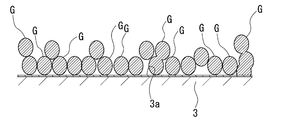
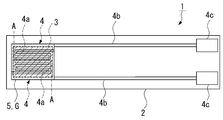
- FIG. 3 It is a schematic cross-sectional view (A-A line cross-sectional view of FIG. 3) which shows the embodiment of the biosensor which concerns on this invention. It is a schematic cross-sectional view of the main part in the biosensor of this embodiment. It is a top view which shows the biosensor of this embodiment. It is a photograph which shows the contact angle of water measured on the surface of a heat sensitive part in Example 1 (a) and Example 2 (b) of the biosensor which concerns on this invention. It is an enlarged photograph which shows the enzyme fixed on the heat sensitive part and the counter electrode in Example 1 (a) and Example 3 (b) of the biosensor which concerns on this invention.
- the biosensor 1 of the present embodiment is a biosensor including an enzyme that selectively reacts with a specific substrate component to be measured, and as shown in FIGS. 1 to 3, the biosensor 1 and the insulating film 2 A heat-sensitive portion 3 provided on the insulating film 2, a pair of counter electrodes 4 connected to the heat-sensitive portion 3 and formed so as to face each other, and an enzyme G fixed to at least the heat-sensitive portion 3 are provided. ..
- the heat-sensitive portion 3 is in the form of a thin film, and the enzyme G is fixed to at least the surface of the heat-sensitive portion 3.
- the heat sensitive portion 3 is a thin film thermistor formed of a thermistor material.
- the pair of counter electrodes 4 are comb-shaped electrodes having a plurality of comb portions 4a on the heat-sensitive portion 3 and arranged opposite to each other.
- the enzyme G is fixed to the heat-sensitive portion 3 between at least the comb portions 4a.
- the heat sensitive portion 3 is made of an Al-containing nitride thermistor material containing Al.
- the surface composition of the heat-sensitive portion 3 is an inorganic substance containing oxygen atoms. That is, the heat-sensitive portion 3 is formed of an Al-containing Al-containing nitride thermistor material, and an Al-containing oxynitride film 3a obtained by oxidizing the Al-containing nitride is formed on the surface of the heat-sensitive portion 3.
- the Al-containing nitride film 3a has higher hydrophilicity than the Al-containing nitride film.
- the material of the Al-containing nitride film 3a is M—Al—NO (where M is Ti, Fe, Co, Mn, Cu, Ni, Zr, Nb, Mo, Hf, Ta, W, Zn, V. And at least one of Cr.) Is included. That is, the material of the Al-containing oxynitride film 3a, which is an Al-containing oxynitride, is M—Al—NO obtained by oxidizing the above-mentioned thermista material (however, M is Ti, Fe, Co, Mn, Cu, Ni, It contains at least one of Zr, Nb, Mo, Hf, Ta, W, Zn, V and Cr). It is preferable that this material is the main material of the Al-containing oxynitride film 3a.
- Zn x Al y N z (0.70 ⁇ y / (x + y) ⁇ 0.98, 0.4.
- M x Al y (N 1 -w O w) z (where, M is at least one of Fe, Co, Mn, Cu and Ni
- M is at least one of Fe, Co, Mn, Cu and Ni
- the metal nitride represented by the above, the crystal structure of which is a hexagonal wurtz ore type single phase, and as described in JP-A-2014-123647, the general formula: Cr x Al y (N 1-w O w ) z (0.70 ⁇ y / (x + y) ⁇ 0.95, 0.45 ⁇ z ⁇ 0.55, 0 ⁇ w ⁇ 0.35, x + y + z 1) It is possible to act on a metal nitride represented by the above, the crystal structure of which is a hexagonal wurtz ore type single phase.
- the heat-sensitive portion 3 is a film having a high degree of c-axis orientation in the film thickness direction.
- the heat-sensitive portion 3 is formed by, for example, a reactive sputtering method in a nitrogen-containing atmosphere.
- a reactive sputtering method in a nitrogen-containing atmosphere.
- nitrogen gas partial pressure 30% in a mixed gas atmosphere of Ar gas + nitrogen gas.
- the insulating film 2 extends in a strip shape, and the heat-sensitive portion 3 is arranged on one end side of the insulating film 2.
- the insulating film 2 is formed of, for example, a polyimide resin sheet having a thickness of 7.5 to 125 ⁇ m.
- PET polyethylene terephthalate
- PEN polyethylene naphthalate and the like can also be produced.
- the biosensor 1 of the present embodiment includes a pair of pattern wirings 4b in which one end is connected to a pair of counter electrodes 4 and a pattern is formed on the surface of the insulating film 2.
- the pair of the pattern wirings 4b extend along the insulating film 2 and have a pad portion 4c at the other end.
- the pad portion 4c is a terminal portion formed wider than the main portion of the pattern wiring 4b extending to connect the lead wire or the like.
- the surface of the counter electrode 4 is formed of Au or a metal containing Au. That is, the counter electrode 4 and the pattern wiring 4b include, for example, a Cr or NiCr bonding layer 4A having a film thickness of 5 to 100 nm, and an electrode layer 4B having an Au film thickness of 50 to 1000 nm formed on the bonding layer 4A. is doing.
- the Al-containing nitride film 3a has a film thickness of 3 to 10 nm.
- the thickness of the Al-containing oxynitride film 3a is thinner than 3 nm, sufficient enzymes are not immobilized, and when the thermistor material of the heat sensitive portion 3 is heated and oxidized until it becomes thicker than 10 nm, the enzymes are transferred to the heat sensitive portion. 3 There is a risk that the thermistor characteristics of the heat sensitive unit 3 will deteriorate due to diffusion to the inside of the 3 and the interface of the electrodes.
- glucose oxidase (enzyme G)
- the enzyme G is used. , It is fixed in close contact with the surface of the heat sensitive portion 3 with a small contact angle.
- Glucose oxidase of enzyme G shows the following enzymatic reaction. (Glucose oxidase) Glucose + O 2 ⁇ Gluconolactone + H 2 O 2
- the glucose concentration can be measured by detecting the change in the resistance value of the heat-sensitive portion 3 due to the heat generated under this sensitive assumption.
- the heat-sensitive portion 3 is in the form of a thin film, and the enzyme G is fixed to at least the surface of the heat-sensitive portion 3, so that a large amount of enzyme G can be produced with a large specific surface area and a small heat capacity. It can be arranged directly on the heat sensitive unit 3. Further, since the enzyme G is fixed to at least the heat-sensitive portion 3 between the comb portions 4a, a recess is formed between the comb portions 4a by the plurality of comb portions 4a, so that an anchor effect is generated and the adhesion of the enzyme G is improved. At the same time, a large amount of enzyme G tends to remain directly above the thin-film heat-sensitive portion 3, and the amount of enzyme fixed can be further increased.
- the enzyme can be uniformly arranged throughout.
- the heat-sensitive part 3 as a thin film thermistor, the heat capacity in the heat-sensitive part 3 can be sufficiently reduced, and even a minute heat generation can cause a sufficient temperature change for measurement.
- the heat-sensitive portion 3 is formed of an Al-containing nitride thermistor material, even a thin film can be measured with high sensitivity and high accuracy due to the thermistor characteristics having a high B constant.
- the surface composition of the heat-sensitive portion 3 is an inorganic substance containing an oxygen atom
- the enzyme G is easily bound to the inorganic substance containing an oxygen atom having high hydrophilicity, and the adhesion of the enzyme G is improved.
- the Al-containing nitride film 3a has higher hydrophilicity than the Al-containing nitride
- the enzyme G having a hydrophilic moiety easily binds to the surface of the highly hydrophilic Al-containing nitride. Therefore, the number of highly active immobilized enzymes increases, and it becomes possible to increase the calorific value in the enzyme reaction.
- the highly hydrophilic Al-containing oxynitride film 3a can be easily formed only by oxidizing the surface of the thermistor material. The method of oxidation may be heating in an oxygen-containing atmosphere or natural oxidation.
- the material of the Al-containing oxynitride film 3a is M—Al—NO (where M is Ti, Fe, Co, Mn, Cu, Ni, Zr, Nb, Mo, Hf, Ta, W, Zn, Since it contains at least one of V and Cr), the calorific value due to the enzymatic reaction can be measured with higher accuracy by forming the surface with the above M—Al—NO having a good B constant. Becomes possible. Further, since the heat sensitive portion 3 is provided on the insulating film 2, the heat capacity can be further reduced by using a flexible and thin film as the substrate, and the insulating film 2 can be bent on a curved surface or the like. Can be easily implemented. Further, since the surface of the counter electrode 4 is formed of Au or a metal containing Au, chemical modification is facilitated, and a highly active immobilized enzyme can be immobilized on the counter electrode.
- Example 1 of the present invention the Ti—Al—N thin film thermistor is formed on a polyimide insulating film having a length of 50 ⁇ m by a sputtering method at a film thickness of 100 nm, and a rectangle of about 2 mm ⁇ 1.8 mm is etched.
- the heat-sensitive portion 3 was formed by patterning.
- the pair of counter electrodes 4 were formed by forming a Cr bonding layer 4A having a film thickness of 20 nm and an electrode layer 4B of Au having a film thickness of 200 nm on the heat-sensitive portion 3 and etching them into a comb shape. After that, the mixture was heated to 150 ° C. in the air to form a 3 nm Al-containing nitride nitride film 3a on the exposed surface of the heat-sensitive portion 3. Enzyme G was fixed by the above-mentioned production method. A dilute glucose solution (5 mol / l) was measured using the biosensor of Example 1 of the present invention produced in this manner.
- the temperature of the glucose solution and the phosphate buffer solution (PBS: reference solution) was maintained at 25 ° C., and the biosensors were alternately immersed to confirm the resistance value.
- PBS phosphate buffer solution
- a connector was connected to the pad portion 4c of the biosensor of the first embodiment, and the resistance value was continuously recorded using a data logger.
- the glucose solution was set to a detectable glucose concentration if the change in resistance value when immersed in this glucose solution was 1% or more. ..
- the surface of the heat-sensitive part 3 was not oxidized, and the enzyme G was directly dropped onto the heat-sensitive part 3 of the thin film thermistor, and the measurement was carried out in the same manner.
- Example 1 of the present invention the resistance value was 315.3 k ⁇ and the B constant was 2680 K.
- Example 2 the surface of the heat-sensitive portion 3 was hydrophobic, so that Example 1 was used.
- the enzyme G was not sufficiently fixed, the calorific value was insufficient, and the change in resistance value was smaller than that in Example 1 of the present invention.
- Example 2 As shown in FIG. 4A, on the Al-containing oxide nitride film 3a (Ti—Al—NO) on the surface of the heat-sensitive portion 3 which is Ti—Al—N. Water was dropped and the contact angle of the water was measured. Further, in Example 2, as shown in FIG. 4B, water was similarly dropped on the surface of the heat-sensitive portion 3 which is Ti—Al—N, and the contact angle of the water was measured. As a result of these measurements, in Example 2 above, the contact angle of water was 86.5 °, whereas in Example 1 of the present invention, the contact angle of water was as small as 68.2 °.
- Example 1 in which the Al-containing nitride film 3a is present, the surface is made hydrophilic and the wettability is improved as compared with Example 2 in which the Al-containing nitride film 3a is not present.
- Al—Ti—N in FIG. 4 indicates the same substance as Ti—Al—N.
- the description of Al—Ti—ON also indicates the same substance as Ti—Al—NO.
- Example 1 of the present invention an enlarged photograph when the enzyme G was dropped onto the pair of counter electrodes 4 and the heat-sensitive portion 3 (Al-containing nitride film 3a), which are comb-shaped electrodes, and the enzyme G was fixed. Is shown in FIG. 5 (a).
- the counter electrode was not a comb-shaped electrode, but was simply formed into a pair of rectangular shapes and dropped onto the counter electrode and the heat-sensitive portion 3 (Al-containing nitride nitride film 3a) facing each other to fix the enzyme G.
- An enlarged photograph of the case is shown in FIG. 5 (b).
- Example 1 of the present invention a large amount of enzyme G is fixed on the surface of the heat-sensitive portion 3 (Al-containing nitrided oxide film 3a) exposed between the comb portions 4a and appears black.
- Example 3 when the enzyme G is dropped, aggregation occurs on the surface of the heat-sensitive portion 3 (Al-containing nitrided oxide film 3a), and the region where the enzyme G is immobilized is localized. Therefore, the amount of enzyme G fixed to the heat-sensitive portion 3 is less than that in Example 1.
- Example 1 provided with the counter electrode which is a comb-shaped electrode, more enzymes G are fixed to the surface of the heat-sensitive portion 3.
- the surface of the heat-sensitive portion which is an Al-containing nitride is oxidized to form an Al-containing nitride film, but the heat-sensitive portion itself is formed of an Al-containing nitride having thermista characteristics. It doesn't matter.
- the heat-sensitive portion is formed of Ti-M-NO having thermistor characteristics
- the surface is also Ti-M-NO, which is an Al-containing oxidative nitride, and the surface is highly hydrophilic without being oxidized. have.
Landscapes
- Chemical & Material Sciences (AREA)
- Health & Medical Sciences (AREA)
- Life Sciences & Earth Sciences (AREA)
- Physics & Mathematics (AREA)
- General Physics & Mathematics (AREA)
- Electrochemistry (AREA)
- Analytical Chemistry (AREA)
- Biochemistry (AREA)
- General Health & Medical Sciences (AREA)
- Chemical Kinetics & Catalysis (AREA)
- Immunology (AREA)
- Pathology (AREA)
- Molecular Biology (AREA)
- Nonlinear Science (AREA)
- Apparatus Associated With Microorganisms And Enzymes (AREA)
Abstract
小型で熱容量が小さく、多くの酵素を固定させて高感度・高精度な測定が可能なバイオセンサを提供する。本発明に係るバイオセンサは、酵素(G)を備えたバイオセンサ(1)であって、感熱部(3)と、感熱部に接続され互いに対向して形成された一対の対向電極(4)と、少なくとも感熱部に固定された酵素とを備え、感熱部が薄膜状であり、酵素が少なくとも感熱部の表面に固定されている。特に、感熱部がサーミスタ材料で形成された薄膜サーミスタであり、一対の対向電極が、感熱部上で複数の櫛部を有して互いに対向配置された櫛形電極であり、酵素が、少なくとも櫛部の間の感熱部に固定されていることが好ましい。
Description
本発明は、グルコース等を高精度に検出可能なバイオセンサに関する。
従来、バイオマーカーを反応熱でセンシングするバイオセンサが開発されている。例えば、特許文献1では、密閉容器であるカラム内に固定化生体素子(固定化酵素)を充填、固定化し、そこへ生体物質を導入し、酵素反応における発熱をサーミスタ等の温度センサで測定する機構を備えた酵素サーミスタ装置が記載されている。
また、特許文献2では、サーミスタに、酵素(グルコースに対する識別機能を有するグルコースオキシダーゼ(GOD))を直接固定化することで、装置の小型化や、構成を簡略化したバイオセンサが記載されている。
また、特許文献2では、サーミスタに、酵素(グルコースに対する識別機能を有するグルコースオキシダーゼ(GOD))を直接固定化することで、装置の小型化や、構成を簡略化したバイオセンサが記載されている。
また、特許文献3では、一対の電極を有したサーミスタ等の薄膜温度センサ(感温部)と、電極に形成され酵素を含み選択的に生体物質試料の化学反応を促進させる接着層とを備えたカロリメトリックバイオセンサが記載されている。
さらに、特許文献4では、基板表面に一組の電極が相対峙され、電極上又は電極間にプローブで修飾された導電性微粒子の膜が形成されてなる電気抵抗型検出センサが記載されている。
さらに、特許文献4では、基板表面に一組の電極が相対峙され、電極上又は電極間にプローブで修飾された導電性微粒子の膜が形成されてなる電気抵抗型検出センサが記載されている。
上記従来の技術には、以下の課題が残されている。
すなわち、特許文献1に記載の技術では、反応系を高温に保つための恒温槽が必要になり、装置が大型になってしまうと共に、恒温のための機器構成や制御系も必要になり、高コストであった。また、酵素反応におけるエンタルピー変化は1~100kj/mol程度であり、温度変化が非常に小さく、高精度の測定が困難であった。
また、特許文献2に記載の技術では、構成が簡略化され、温度変化も比較的大きくできるが、反応系の熱容量が大きく、十分な精度を確保することがやはり困難であった。
さらに、特許文献1~4に記載の技術よりも多くの酵素を固定することが要望されている。
すなわち、特許文献1に記載の技術では、反応系を高温に保つための恒温槽が必要になり、装置が大型になってしまうと共に、恒温のための機器構成や制御系も必要になり、高コストであった。また、酵素反応におけるエンタルピー変化は1~100kj/mol程度であり、温度変化が非常に小さく、高精度の測定が困難であった。
また、特許文献2に記載の技術では、構成が簡略化され、温度変化も比較的大きくできるが、反応系の熱容量が大きく、十分な精度を確保することがやはり困難であった。
さらに、特許文献1~4に記載の技術よりも多くの酵素を固定することが要望されている。
本発明は、前述の課題に鑑みてなされたもので、小型で熱容量が小さく、多くの酵素を固定させて高感度・高精度な測定が可能なバイオセンサを提供することを目的とする。
本発明は、前記課題を解決するために以下の構成を採用した。すなわち、第1の発明に係るバイオセンサは、酵素を備えたバイオセンサであって、感熱部と、前記感熱部に接続され互いに対向して形成された一対の対向電極と、少なくとも前記感熱部に固定された前記酵素とを備え、前記感熱部が薄膜状であり、前記酵素が少なくとも前記感熱部の表面に固定されていることを特徴とする。
すなわち、このバイオセンサでは、感熱部が薄膜状であり、酵素が少なくとも感熱部の表面に固定されているので、比表面積が大きく、小さい熱容量で大量の酵素を直接感熱部上に配置することができる。
第2の発明に係るバイオセンサは、第1の発明において、前記感熱部がサーミスタ材料で形成された薄膜サーミスタであり、一対の前記対向電極が、前記感熱部上で複数の櫛部を有して互いに対向配置された櫛形電極であり、前記酵素が、少なくとも前記櫛部の間の感熱部に固定されていることを特徴とする。
すなわち、このバイオセンサでは、酵素が、少なくとも櫛部の間の感熱部に固定されているので、複数の櫛部によって櫛部間に凹部が形成されることでアンカー効果が生じて酵素の密着性が向上すると共に薄膜状の感熱部の直上に多くの酵素が残り易くなり、酵素固定量をより増やすことができる。さらに、櫛部を交互に等間隔に並べることで、全体に均一に酵素を配置することが可能になる。また、感熱部を薄膜サーミスタとすることで、感熱部における熱容量を十分に低減することができ、微小な発熱でも十分な温度変化を生じさせて測定することができる。
すなわち、このバイオセンサでは、酵素が、少なくとも櫛部の間の感熱部に固定されているので、複数の櫛部によって櫛部間に凹部が形成されることでアンカー効果が生じて酵素の密着性が向上すると共に薄膜状の感熱部の直上に多くの酵素が残り易くなり、酵素固定量をより増やすことができる。さらに、櫛部を交互に等間隔に並べることで、全体に均一に酵素を配置することが可能になる。また、感熱部を薄膜サーミスタとすることで、感熱部における熱容量を十分に低減することができ、微小な発熱でも十分な温度変化を生じさせて測定することができる。
第3の発明に係るバイオセンサは、第1及び第2の発明において、前記感熱部が、Alを含有したAl含有窒化物のサーミスタ材料で形成されていることを特徴とする。
すなわち、このバイオセンサでは、感熱部が、Alを含有したAl含有窒化物のサーミスタ材料で形成されているので、薄膜でも高B定数のサーミスタ特性により高感度・高精度な測定が可能になる。
すなわち、このバイオセンサでは、感熱部が、Alを含有したAl含有窒化物のサーミスタ材料で形成されているので、薄膜でも高B定数のサーミスタ特性により高感度・高精度な測定が可能になる。
第4の発明に係るバイオセンサは、第1から第3の発明のいずれかにおいて、前記感熱部の前記表面の組成が、酸素原子を含む無機物であることを特徴とする。
すなわち、このバイオセンサでは、感熱部の表面の組成が、酸素原子を含む無機物であるので、親水性が高い酸素原子を含む無機物に酵素が結合し易くなり、酵素の密着性が向上する。
すなわち、このバイオセンサでは、感熱部の表面の組成が、酸素原子を含む無機物であるので、親水性が高い酸素原子を含む無機物に酵素が結合し易くなり、酵素の密着性が向上する。
第5の発明に係るバイオセンサは、第4の発明において、前記感熱部が、Alを含有したAl含有窒化物のサーミスタ材料で形成され、前記感熱部の前記表面に、前記Al含有窒化物が酸化したAl含有酸化窒化膜が形成され、前記Al含有酸化窒化膜が、前記Al含有窒化物よりも高い親水性を有していることを特徴とする。
すなわち、このバイオセンサでは、Al含有酸化窒化膜が、Al含有窒化物よりも高い親水性を有しているので、親水性が高いAl含有酸化窒化物の表面に、親水性部位を有する酵素が結合し易くなり、活性の高い固定化酵素が増え、酵素反応における発熱量を増加させることが可能になる。また、サーミスタ材料の表面を酸化させるだけで、親水性の高いAl含有酸化窒化膜を容易に形成することができる。
すなわち、このバイオセンサでは、Al含有酸化窒化膜が、Al含有窒化物よりも高い親水性を有しているので、親水性が高いAl含有酸化窒化物の表面に、親水性部位を有する酵素が結合し易くなり、活性の高い固定化酵素が増え、酵素反応における発熱量を増加させることが可能になる。また、サーミスタ材料の表面を酸化させるだけで、親水性の高いAl含有酸化窒化膜を容易に形成することができる。
第6の発明に係るバイオセンサは、第5の発明において、前記Al含有酸化窒化膜の材料が、M-Al-N-O(但し、MはTi,Fe,Co,Mn,Cu,Ni,Zr,Nb,Mo,Hf,Ta,W,Zn,V及びCrの少なくとも1種を示す。)を含むことを特徴とする。
すなわち、このバイオセンサでは、Al含有酸化窒化膜の材料が、M-Al-N-O(但し、MはTi,Fe,Co,Mn,Cu,Ni,Zr,Nb,Mo,Hf,Ta,W,Zn,V及びCrの少なくとも1種を示す。)を含むので、良好なB定数を有する上記M-Al-N-Oで表面を構成することで、酵素反応による発熱量をより高精度に測定することが可能になる。
すなわち、このバイオセンサでは、Al含有酸化窒化膜の材料が、M-Al-N-O(但し、MはTi,Fe,Co,Mn,Cu,Ni,Zr,Nb,Mo,Hf,Ta,W,Zn,V及びCrの少なくとも1種を示す。)を含むので、良好なB定数を有する上記M-Al-N-Oで表面を構成することで、酵素反応による発熱量をより高精度に測定することが可能になる。
第7の発明に係るバイオセンサは、第1から第6の発明のいずれかにおいて、前記感熱部が、絶縁性フィルム上に設けられていることを特徴とする。
すなわち、このバイオセンサでは、感熱部が、絶縁性フィルム上に設けられているので、柔軟で薄いフィルムを基板とすることで、さらに熱容量を低減することができると共に、曲面などにも絶縁性フィルムを曲げて容易に実装することが可能になる。
すなわち、このバイオセンサでは、感熱部が、絶縁性フィルム上に設けられているので、柔軟で薄いフィルムを基板とすることで、さらに熱容量を低減することができると共に、曲面などにも絶縁性フィルムを曲げて容易に実装することが可能になる。
第8の発明に係るバイオセンサは、第1から第7の発明のいずれかにおいて、前記対向電極の表面が、Au又はAuを含有する金属で形成されていることを特徴とする。
すなわち、このバイオセンサでは、対向電極の表面が、Au又はAuを含有する金属で形成されているので、化学修飾が容易になり、対向電極上にも活性の高い固定化酵素を固定することができる。
すなわち、このバイオセンサでは、対向電極の表面が、Au又はAuを含有する金属で形成されているので、化学修飾が容易になり、対向電極上にも活性の高い固定化酵素を固定することができる。
本発明によれば、以下の効果を奏する。
すなわち、本発明に係るバイオセンサによれば、感熱部が薄膜状であり、酵素が少なくとも感熱部の表面に固定されているので、比表面積が大きく、小さい熱容量で大量の酵素を直接感熱部上に配置することができる。
したがって、本発明のバイオセンサでは、多くの酵素を固定することが可能になり、小型化が可能であると共に、グルコース等の微少量の生体物質について高精度な測定が可能になり、血糖自己測定器,中性脂肪測定器,尿検査機器等に好適である。
すなわち、本発明に係るバイオセンサによれば、感熱部が薄膜状であり、酵素が少なくとも感熱部の表面に固定されているので、比表面積が大きく、小さい熱容量で大量の酵素を直接感熱部上に配置することができる。
したがって、本発明のバイオセンサでは、多くの酵素を固定することが可能になり、小型化が可能であると共に、グルコース等の微少量の生体物質について高精度な測定が可能になり、血糖自己測定器,中性脂肪測定器,尿検査機器等に好適である。
以下、本発明に係るバイオセンサにおける実施形態を、図1から図3を参照しながら説明する。なお、以下の説明に用いる図面の一部では、各部を認識可能又は認識容易な大きさとするために必要に応じて縮尺を適宜変更している。
本実施形態のバイオセンサ1は、測定対象となる特定の基質成分に対して選択的に反応する酵素を備えたバイオセンサであって、図1から図3に示すように、絶縁性フィルム2と、絶縁性フィルム2上に設けられた感熱部3と、感熱部3に接続され互いに対向して形成された一対の対向電極4と、少なくとも感熱部3に固定された酵素Gとを備えている。
上記感熱部3は薄膜状であり、酵素Gが少なくとも感熱部3の表面に固定されている。
上記感熱部3は薄膜状であり、酵素Gが少なくとも感熱部3の表面に固定されている。
すなわち、感熱部3はサーミスタ材料で形成された薄膜サーミスタである。
上記一対の対向電極4は、感熱部3上で複数の櫛部4aを有して互いに対向配置された櫛形電極である。
上記酵素Gは、少なくとも櫛部4aの間の感熱部3に固定されている。
上記一対の対向電極4は、感熱部3上で複数の櫛部4aを有して互いに対向配置された櫛形電極である。
上記酵素Gは、少なくとも櫛部4aの間の感熱部3に固定されている。
感熱部3は、Alを含有したAl含有窒化物のサーミスタ材料で形成されている。
また、感熱部3の表面の組成は、酸素原子を含む無機物である。
すなわち、感熱部3は、Alを含有したAl含有窒化物のサーミスタ材料で形成され、感熱部3の表面に、Al含有窒化物が酸化したAl含有酸化窒化膜3aが形成されている。
上記Al含有酸化窒化膜3aは、Al含有窒化物よりも高い親水性を有している。
また、感熱部3の表面の組成は、酸素原子を含む無機物である。
すなわち、感熱部3は、Alを含有したAl含有窒化物のサーミスタ材料で形成され、感熱部3の表面に、Al含有窒化物が酸化したAl含有酸化窒化膜3aが形成されている。
上記Al含有酸化窒化膜3aは、Al含有窒化物よりも高い親水性を有している。
上記Al含有酸化窒化膜3aの材料は、M-Al-N-O(但し、MはTi,Fe,Co,Mn,Cu,Ni,Zr,Nb,Mo,Hf,Ta,W,Zn,V及びCrの少なくとも1種を示す。)を含んでいる。
すなわち、Al含有酸化窒化物であるAl含有酸化窒化膜3aの材料は、上記サーミスタ材料を酸化させたM-Al-N-O(但し、MはTi,Fe,Co,Mn,Cu,Ni,Zr,Nb,Mo,Hf,Ta,W,Zn,V及びCrの少なくとも1種を示す。)を含んだものである。なお、この材料は、Al含有酸化窒化膜3aの主な材料であることが好ましい。
すなわち、Al含有酸化窒化物であるAl含有酸化窒化膜3aの材料は、上記サーミスタ材料を酸化させたM-Al-N-O(但し、MはTi,Fe,Co,Mn,Cu,Ni,Zr,Nb,Mo,Hf,Ta,W,Zn,V及びCrの少なくとも1種を示す。)を含んだものである。なお、この材料は、Al含有酸化窒化膜3aの主な材料であることが好ましい。
例えば、上記サーミスタ材料のAl含有窒化物は、特開2013-179161号公報に記載されているように、一般式:TixAlyNz(0.70≦y/(x+y)≦0.95、0.4≦z≦0.5、x+y+z=1)で示される金属窒化物からなり、その結晶構造が、六方晶系のウルツ鉱型の単相であるものが採用可能である。
その他、特開2015-65408号公報に記載されているように、一般式:MxAlyNz(但し、MはFe,Co,Mn,Cu及びNiの少なくとも1種を示す。0.70≦y/(x+y)≦0.98、0.4≦z≦0.5、x+y+z=1)で示される金属窒化物からなり、その結晶構造が、六方晶系のウルツ鉱型の単相であるもの、また特開2016-136609号公報に記載されているように、一般式:MxAlyNz(但し、MはZr,Nb,Mo,Hf,Ta及びWの少なくとも1種を示す。0.65≦y/(x+y)≦0.98、0.35≦z≦0.5、x+y+z=1)で示される金属窒化物からなり、その結晶構造が、六方晶系のウルツ鉱型の単相であるもの、また特開2016-143807号公報に記載されているように、一般式:ZnxAlyNz(0.70≦y/(x+y)≦0.98、0.4≦z≦0.5、x+y+z=1)で示される金属窒化物からなり、その結晶構造が、六方晶系のウルツ鉱型の単相であるもの、また特開2014-236204号公報に記載されているように、一般式:VxAlyNz(0.70≦y/(x+y)≦0.98、0.4≦z≦0.5、x+y+z=1)で示される金属窒化物からなり、その結晶構造が、六方晶系のウルツ鉱型の単相であるもの、また特開2014-123646号公報に記載されているように、一般式:CrxAlyNz(0.70≦y/(x+y)≦0.95、0.4≦z≦0.5、x+y+z=1)で示される金属窒化物からなり、その結晶構造が、六方晶系のウルツ鉱型の単相であるものが採用可能である。
その他、特開2015-65408号公報に記載されているように、一般式:MxAlyNz(但し、MはFe,Co,Mn,Cu及びNiの少なくとも1種を示す。0.70≦y/(x+y)≦0.98、0.4≦z≦0.5、x+y+z=1)で示される金属窒化物からなり、その結晶構造が、六方晶系のウルツ鉱型の単相であるもの、また特開2016-136609号公報に記載されているように、一般式:MxAlyNz(但し、MはZr,Nb,Mo,Hf,Ta及びWの少なくとも1種を示す。0.65≦y/(x+y)≦0.98、0.35≦z≦0.5、x+y+z=1)で示される金属窒化物からなり、その結晶構造が、六方晶系のウルツ鉱型の単相であるもの、また特開2016-143807号公報に記載されているように、一般式:ZnxAlyNz(0.70≦y/(x+y)≦0.98、0.4≦z≦0.5、x+y+z=1)で示される金属窒化物からなり、その結晶構造が、六方晶系のウルツ鉱型の単相であるもの、また特開2014-236204号公報に記載されているように、一般式:VxAlyNz(0.70≦y/(x+y)≦0.98、0.4≦z≦0.5、x+y+z=1)で示される金属窒化物からなり、その結晶構造が、六方晶系のウルツ鉱型の単相であるもの、また特開2014-123646号公報に記載されているように、一般式:CrxAlyNz(0.70≦y/(x+y)≦0.95、0.4≦z≦0.5、x+y+z=1)で示される金属窒化物からなり、その結晶構造が、六方晶系のウルツ鉱型の単相であるものが採用可能である。
また、Al含有酸化窒化膜3aは、特開2013-179162号公報に記載されているように、一般式:TixAly(N1-wOw)z(0.70≦y/(x+y)≦0.95、0.45≦z≦0.55、0<w≦0.35、x+y+z=1)で示される金属窒化物からなり、その結晶構造が、六方晶系のウルツ鉱型の単相であるものが採用可能である。
その他、特開2015-65409号公報に記載されているように、一般式:MxAly(N1-wOw)z(但し、MはFe,Co,Mn,Cu及びNiの少なくとも1種を示す。0.70≦y/(x+y)≦0.98、0.45≦z≦0.55、0<w≦0.35、x+y+z=1)で示される金属窒化物からなり、その結晶構造が、六方晶系のウルツ鉱型の単相であるもの、また特開2016-136610号公報に記載されているように、一般式:MxAly(N1-uOu)z(但し、MはZr,Nb,Mo,Hf,Ta及びWの少なくとも1種を示す。0.65≦y/(x+y)≦0.98、0.40≦z≦0.55、0<u≦0.35、x+y+z=1)で示される金属窒化物からなり、その結晶構造が、六方晶系のウルツ鉱型の単相であるもの、また特開2016-143808号公報に記載されているように、一般式:ZnxAly(N1-wOw)z(0.70≦y/(x+y)≦0.98、0.45≦z≦0.55、0<w≦0.35、x+y+z=1)で示される金属窒化物からなり、その結晶構造が、六方晶系のウルツ鉱型の単相であるもの、また特開2014-236205号公報に記載されているように、一般式:VxAly(N1-wOw)z(0.70≦y/(x+y)≦0.98、0.45≦z≦0.55、0<w≦0.35、x+y+z=1)で示される金属窒化物からなり、その結晶構造が、六方晶系のウルツ鉱型の単相であるもの、また特開2014-123647号公報に記載されているように、一般式:CrxAly(N1-wOw)z(0.70≦y/(x+y)≦0.95、0.45≦z≦0.55、0<w≦0.35、x+y+z=1)で示される金属窒化物からなり、その結晶構造が、六方晶系のウルツ鉱型の単相であるものが作用可能である。
その他、特開2015-65409号公報に記載されているように、一般式:MxAly(N1-wOw)z(但し、MはFe,Co,Mn,Cu及びNiの少なくとも1種を示す。0.70≦y/(x+y)≦0.98、0.45≦z≦0.55、0<w≦0.35、x+y+z=1)で示される金属窒化物からなり、その結晶構造が、六方晶系のウルツ鉱型の単相であるもの、また特開2016-136610号公報に記載されているように、一般式:MxAly(N1-uOu)z(但し、MはZr,Nb,Mo,Hf,Ta及びWの少なくとも1種を示す。0.65≦y/(x+y)≦0.98、0.40≦z≦0.55、0<u≦0.35、x+y+z=1)で示される金属窒化物からなり、その結晶構造が、六方晶系のウルツ鉱型の単相であるもの、また特開2016-143808号公報に記載されているように、一般式:ZnxAly(N1-wOw)z(0.70≦y/(x+y)≦0.98、0.45≦z≦0.55、0<w≦0.35、x+y+z=1)で示される金属窒化物からなり、その結晶構造が、六方晶系のウルツ鉱型の単相であるもの、また特開2014-236205号公報に記載されているように、一般式:VxAly(N1-wOw)z(0.70≦y/(x+y)≦0.98、0.45≦z≦0.55、0<w≦0.35、x+y+z=1)で示される金属窒化物からなり、その結晶構造が、六方晶系のウルツ鉱型の単相であるもの、また特開2014-123647号公報に記載されているように、一般式:CrxAly(N1-wOw)z(0.70≦y/(x+y)≦0.95、0.45≦z≦0.55、0<w≦0.35、x+y+z=1)で示される金属窒化物からなり、その結晶構造が、六方晶系のウルツ鉱型の単相であるものが作用可能である。
本実施形態の感熱部3が、例えばTi-Al-Nのサーミスタ材料で矩形状に形成されている場合、上述したように、感熱部3は、一般式:TixAlyNz(0.70≦y/(x+y)≦0.95、0.4≦z≦0.5、x+y+z=1)で示される金属窒化物からなり、その結晶構造が、六方晶系のウルツ鉱型の単相である。この感熱部3は、膜厚方向にc軸配向度が高い膜である。
この感熱部3は、例えば窒素含有雰囲気中の反応性スパッタ法にて成膜される。その時のスパッタ条件は、例えば、組成比Al/(Al+Ti)比=0.85のTi-Al合金スパッタリングターゲットを用い、到達真空度:4×10-5Pa、スパッタガス圧:0.2Pa、ターゲット投入電力(出力):200Wで、Arガス+窒素ガスの混合ガス雰囲気下において窒素ガス分圧:30%とする。
上記絶縁性フィルム2は、帯状に延在し、感熱部3は、絶縁性フィルム2の一端側に配されている。
上記絶縁性フィルム2は、例えば厚さ7.5~125μmのポリイミド樹脂シートで形成されている。なお、絶縁性フィルム2としては、他にPET:ポリエチレンテレフタレート,PEN:ポリエチレンナフタレート等でも作製できる。
上記絶縁性フィルム2は、例えば厚さ7.5~125μmのポリイミド樹脂シートで形成されている。なお、絶縁性フィルム2としては、他にPET:ポリエチレンテレフタレート,PEN:ポリエチレンナフタレート等でも作製できる。
また、本実施形態のバイオセンサ1は、一対の対向電極4に一端が接続されて絶縁性フィルム2の表面にパターン形成された一対のパターン配線4bを備えている。
一対の上記パターン配線4bは、絶縁性フィルム2に沿って延在し、他端にパッド部4cを有している。
上記パッド部4cは、リード線等を接続するために、延在しているパターン配線4bの主部よりも幅広に形成された端子部である。
一対の上記パターン配線4bは、絶縁性フィルム2に沿って延在し、他端にパッド部4cを有している。
上記パッド部4cは、リード線等を接続するために、延在しているパターン配線4bの主部よりも幅広に形成された端子部である。
上記対向電極4の表面は、Au又はAuを含有する金属で形成されている。
すなわち、上記対向電極4及びパターン配線4bは、例えば膜厚5~100nmのCr又はNiCrの接合層4Aと、該接合層4A上にAuで膜厚50~1000nm形成された電極層4Bとを有している。
上記Al含有酸化窒化膜3aは、膜厚が3~10nmである。なお、Al含有酸化窒化膜3aの膜厚が3nmより薄いと、十分な酵素が固定化されないと共に、10nmよりも厚くなるまで感熱部3のサーミスタ材料を加熱して酸化させると、酵素が感熱部3内部や電極界面まで拡散し、感熱部3のサーミスタ特性に劣化が生じるおそれがある。
すなわち、上記対向電極4及びパターン配線4bは、例えば膜厚5~100nmのCr又はNiCrの接合層4Aと、該接合層4A上にAuで膜厚50~1000nm形成された電極層4Bとを有している。
上記Al含有酸化窒化膜3aは、膜厚が3~10nmである。なお、Al含有酸化窒化膜3aの膜厚が3nmより薄いと、十分な酵素が固定化されないと共に、10nmよりも厚くなるまで感熱部3のサーミスタ材料を加熱して酸化させると、酵素が感熱部3内部や電極界面まで拡散し、感熱部3のサーミスタ特性に劣化が生じるおそれがある。
本実施形態のバイオセンサ1を、上記基質成分としてグルコースを検出するグルコースセンサとして用いる場合、上記酵素Gとして、例えばグルコースオキシダーゼ(GOD)が採用可能である。
このグルコースオキシダーゼ(酵素G)は、リン酸緩衝溶液(pH=7)にグルコースオキシダーゼを溶解させ、12UμL-1の溶液を作成し、この溶液を、感熱部3及び対向電極4上に滴下することで、感熱部3及び対向電極4に固定する。このとき、感熱部3の表面が、Ti-Al-Nであるサーミスタ材料よりも親水化され濡れ性が向上したTi-Al-N-OのAl含有酸化窒化膜3aであるため、酵素Gは、小さい接触角で感熱部3の表面に密着して固定される。
このグルコースオキシダーゼ(酵素G)は、リン酸緩衝溶液(pH=7)にグルコースオキシダーゼを溶解させ、12UμL-1の溶液を作成し、この溶液を、感熱部3及び対向電極4上に滴下することで、感熱部3及び対向電極4に固定する。このとき、感熱部3の表面が、Ti-Al-Nであるサーミスタ材料よりも親水化され濡れ性が向上したTi-Al-N-OのAl含有酸化窒化膜3aであるため、酵素Gは、小さい接触角で感熱部3の表面に密着して固定される。
酵素Gのグルコースオキシダーゼは、以下のような酵素反応を示す。
(グルコースオキシダーゼ)
グルコース+O2 → グルコノラクトン+H2O2
この感応仮定で生じた熱による感熱部3の抵抗値変化を検出することで、グルコース濃度を測定することができる。
(グルコースオキシダーゼ)
グルコース+O2 → グルコノラクトン+H2O2
この感応仮定で生じた熱による感熱部3の抵抗値変化を検出することで、グルコース濃度を測定することができる。
このように本実施形態のバイオセンサ1では、感熱部3が薄膜状であり、酵素Gが少なくとも感熱部3の表面に固定されているので、比表面積が大きく、小さい熱容量で大量の酵素Gを直接感熱部3上に配置することができる。
また、酵素Gが、少なくとも櫛部4aの間の感熱部3に固定されているので、複数の櫛部4aによって櫛部4a間に凹部が形成されることでアンカー効果が生じて酵素Gの密着性が向上すると共に薄膜状の感熱部3の直上に多くの酵素Gが残り易くなり、酵素固定量をより増やすことができる。
また、酵素Gが、少なくとも櫛部4aの間の感熱部3に固定されているので、複数の櫛部4aによって櫛部4a間に凹部が形成されることでアンカー効果が生じて酵素Gの密着性が向上すると共に薄膜状の感熱部3の直上に多くの酵素Gが残り易くなり、酵素固定量をより増やすことができる。
さらに、櫛部4aを交互に等間隔に並べることで、全体に均一に酵素を配置することが可能になる。また、感熱部3を薄膜サーミスタとすることで、感熱部3における熱容量を十分に低減することができ、微小な発熱でも十分な温度変化を生じさせて測定することができる。
また、感熱部3が、Alを含有したAl含有窒化物のサーミスタ材料で形成されているので、薄膜でも高B定数のサーミスタ特性により高感度・高精度な測定が可能になる。
また、感熱部3が、Alを含有したAl含有窒化物のサーミスタ材料で形成されているので、薄膜でも高B定数のサーミスタ特性により高感度・高精度な測定が可能になる。
また、感熱部3の表面の組成が、酸素原子を含む無機物であるので、親水性が高い酸素原子を含む無機物に酵素Gが結合し易くなり、酵素Gの密着性が向上する。
特に、Al含有酸化窒化膜3aが、Al含有窒化物よりも高い親水性を有しているので、親水性が高いAl含有酸化窒化物の表面に、親水性部位を有する酵素Gが結合し易くなり、活性の高い固定化酵素が増え、酵素反応における発熱量を増加させることが可能になる。また、サーミスタ材料の表面を酸化させるだけで、親水性の高いAl含有酸化窒化膜3aを容易に形成することができる。なお、酸化の方法は、酸素含有雰囲気化で加熱してもよく、自然酸化でもよい。
特に、Al含有酸化窒化膜3aが、Al含有窒化物よりも高い親水性を有しているので、親水性が高いAl含有酸化窒化物の表面に、親水性部位を有する酵素Gが結合し易くなり、活性の高い固定化酵素が増え、酵素反応における発熱量を増加させることが可能になる。また、サーミスタ材料の表面を酸化させるだけで、親水性の高いAl含有酸化窒化膜3aを容易に形成することができる。なお、酸化の方法は、酸素含有雰囲気化で加熱してもよく、自然酸化でもよい。
また、Al含有酸化窒化膜3aの材料が、M-Al-N-O(但し、MはTi,Fe,Co,Mn,Cu,Ni,Zr,Nb,Mo,Hf,Ta,W,Zn,V及びCrの少なくとも1種を示す。)を含むので、良好なB定数を有する上記M-Al-N-Oで表面を構成することで、酵素反応による発熱量をより高精度に測定することが可能になる。
また、感熱部3が、絶縁性フィルム2上に設けられているので、柔軟で薄いフィルムを基板とすることで、さらに熱容量を低減することができると共に、曲面などにも絶縁性フィルム2を曲げて容易に実装することが可能になる。
さらに、対向電極4の表面が、Au又はAuを含有する金属で形成されているので、化学修飾が容易になり、対向電極上にも活性の高い固定化酵素を固定することができる。
また、感熱部3が、絶縁性フィルム2上に設けられているので、柔軟で薄いフィルムを基板とすることで、さらに熱容量を低減することができると共に、曲面などにも絶縁性フィルム2を曲げて容易に実装することが可能になる。
さらに、対向電極4の表面が、Au又はAuを含有する金属で形成されているので、化学修飾が容易になり、対向電極上にも活性の高い固定化酵素を固定することができる。
上記実施形態のバイオセンサを実施例1として作製し、この実施例1でグルコース濃度を測定した結果を以下に示す。
本発明の実施例1は、長さ50μmのポリイミドの絶縁性フィルム上に上記Ti-Al-Nの薄膜サーミスタを膜厚100nmでスパッタリング法により成膜し、エッチングにより約2mm×1.8mmの長方形にパターニングすることで、感熱部3を形成した。
本発明の実施例1は、長さ50μmのポリイミドの絶縁性フィルム上に上記Ti-Al-Nの薄膜サーミスタを膜厚100nmでスパッタリング法により成膜し、エッチングにより約2mm×1.8mmの長方形にパターニングすることで、感熱部3を形成した。
一対の対向電極4は、感熱部3上に膜厚20nmのCrの接合層4Aと膜厚200nmのAuの電極層4Bとを成膜し、エッチングにより櫛形にして形成した。
この後、大気中で150℃に加熱し、感熱部3の露出している表面に3nmのAl含有酸化窒化膜3aを形成させた。
酵素Gは、上述した製法で固定を行った。
このように製作した本発明の実施例1のバイオセンサを用いて、希薄なグルコース溶液(5mol/l)を測定した。
この後、大気中で150℃に加熱し、感熱部3の露出している表面に3nmのAl含有酸化窒化膜3aを形成させた。
酵素Gは、上述した製法で固定を行った。
このように製作した本発明の実施例1のバイオセンサを用いて、希薄なグルコース溶液(5mol/l)を測定した。
なお、グルコース溶液とリン酸緩衝溶液(PBS:基準溶液)との温度を25℃に保ち、交互にバイオセンサを浸して抵抗値を確認した。
この抵抗値測定では、本実施例1のバイオセンサのパッド部4cにコネクタを接続し、データロガーを用いて抵抗値を連続的に記録した。
この抵抗値測定では、本実施例1のバイオセンサのパッド部4cにコネクタを接続し、データロガーを用いて抵抗値を連続的に記録した。
また、25℃のリン酸緩衝溶液に浸した際の抵抗値を基準とし、グルコース溶液は、このグルコース溶液に浸した際の抵抗値変化が1%以上であれば、検出可能なグルコース濃度とした。
なお、実施例2として、感熱部3の表面を酸化させず、上記薄膜サーミスタの感熱部3上に直接、酵素Gを滴下したものも作製し、同様に測定を行った。
なお、実施例2として、感熱部3の表面を酸化させず、上記薄膜サーミスタの感熱部3上に直接、酵素Gを滴下したものも作製し、同様に測定を行った。
なお、本発明の実施例1及び実施例2は、抵抗値が315.3kΩであり、B定数が2680Kであった。
上記測定の結果、本発明の実施例1では、1%以上の良好な抵抗値変化が得られたのに対し、実施例2では、感熱部3表面が疎水性であるため、実施例1に比べて酵素Gが十分に固定されず、発熱量が不足して本発明の実施例1よりも抵抗値変化が小さかった。
上記測定の結果、本発明の実施例1では、1%以上の良好な抵抗値変化が得られたのに対し、実施例2では、感熱部3表面が疎水性であるため、実施例1に比べて酵素Gが十分に固定されず、発熱量が不足して本発明の実施例1よりも抵抗値変化が小さかった。
次に、上記実施例1において、図4の(a)に示すように、Ti-Al-Nである感熱部3の表面のAl含有酸化窒化膜3a(Ti-Al-N-O)上に水を滴下し、その水の接触角を測定した。また、上記実施例2において、図4の(b)に示すように、Ti-Al-Nである感熱部3の表面にも同様に水を滴下し、その水の接触角を測定した。
これら測定の結果、上記実施例2では、水の接触角が86.5°であったのに対し、本発明の実施例1では、水の接触角が68.2°と小さくなっており、Al含有酸化窒化膜3aが無い実施例2に比べ、Al含有酸化窒化膜3aが有る本実施例1では、表面が親水化されて濡れ性が向上していることが分かる。
なお、図4におけるAl-Ti-NはTi-Al-Nと同じ物質を示している。また、同様にAl-Ti-O-Nの記載もTi-Al-N-Oと同じ物質を示している。
これら測定の結果、上記実施例2では、水の接触角が86.5°であったのに対し、本発明の実施例1では、水の接触角が68.2°と小さくなっており、Al含有酸化窒化膜3aが無い実施例2に比べ、Al含有酸化窒化膜3aが有る本実施例1では、表面が親水化されて濡れ性が向上していることが分かる。
なお、図4におけるAl-Ti-NはTi-Al-Nと同じ物質を示している。また、同様にAl-Ti-O-Nの記載もTi-Al-N-Oと同じ物質を示している。
次に、本発明の実施例1において、櫛形電極である一対の対向電極4及び感熱部3(Al含有酸化窒化膜3a)の上に酵素Gを滴下し、酵素Gを固定した際の拡大写真を図5の(a)に示す。なお、実施例3として、対向電極を櫛形電極とせず、単に一対の長方形型にして対向させた対向電極及び感熱部3(Al含有酸化窒化膜3a)の上に滴下し、酵素Gを固定した際の拡大写真を図5の(b)に示す。
これらの写真から分かるように、本発明の実施例1では、櫛部4aの間に露出している感熱部3(Al含有酸化窒化膜3a)の表面に酵素Gが多く固定されて黒く写っているが、実施例3では、酵素Gの滴下時に感熱部3(Al含有酸化窒化膜3a)の表面で凝集が起こり、酵素Gの固定化される領域が局在化する。そのため、感熱部3に固定されている酵素Gが実施例1よりも少なくなる。このように、櫛形電極である対向電極を備えた実施例1の方が、多くの酵素Gを感熱部3の表面に固定していることがわかる。
なお、本発明の技術範囲は上記実施形態に限定されるものではなく、本発明の趣旨を逸脱しない範囲において種々の変更を加えることが可能である。
例えば、上記実施形態では、Al含有窒化物である感熱部の表面を酸化させてAl含有酸化窒化膜を形成しているが、感熱部自体をサーミスタ特性を有するAl含有酸化窒化物で形成しても構わない。例えば、サーミスタ特性を有するTi-M-N-Oで感熱部を形成した場合、表面もAl含有酸化窒化物であるTi-M-N-Oであり、表面を酸化しなくても高い親水性を有している。
例えば、上記実施形態では、Al含有窒化物である感熱部の表面を酸化させてAl含有酸化窒化膜を形成しているが、感熱部自体をサーミスタ特性を有するAl含有酸化窒化物で形成しても構わない。例えば、サーミスタ特性を有するTi-M-N-Oで感熱部を形成した場合、表面もAl含有酸化窒化物であるTi-M-N-Oであり、表面を酸化しなくても高い親水性を有している。
1,…バイオセンサ、2…絶縁性フィルム、3…感熱部、3a…Al含有酸化窒化膜、4…対向電極、G…酵素
Claims (8)
- 酵素を備えたバイオセンサであって、
感熱部と、
前記感熱部に接続され互いに対向して形成された一対の対向電極と、
少なくとも前記感熱部に固定された前記酵素とを備え、
前記感熱部が薄膜状であり、前記酵素が少なくとも前記感熱部の表面に固定されていることを特徴とするバイオセンサ。 - 請求項1に記載のバイオセンサにおいて、
前記感熱部がサーミスタ材料で形成された薄膜サーミスタであり、
一対の前記対向電極が、前記感熱部上で複数の櫛部を有して互いに対向配置された櫛形電極であり、
前記酵素が、少なくとも前記櫛部の間の前記感熱部に固定されていることを特徴とするバイオセンサ。 - 請求項1に記載のバイオセンサにおいて、
前記感熱部が、Alを含有したAl含有窒化物のサーミスタ材料で形成されていることを特徴とするバイオセンサ。 - 請求項1に記載のバイオセンサにおいて、
前記感熱部の前記表面の組成が、酸素原子を含む無機物であることを特徴とするバイオセンサ。 - 請求項4に記載のバイオセンサにおいて、
前記感熱部が、Alを含有したAl含有窒化物のサーミスタ材料で形成され、
前記感熱部の前記表面に、前記Al含有窒化物が酸化したAl含有酸化窒化膜が形成され、
前記Al含有酸化窒化膜が、前記Al含有窒化物よりも高い親水性を有していることを特徴とするバイオセンサ。 - 請求項5に記載のバイオセンサにおいて、
前記Al含有酸化窒化膜の材料が、M-Al-N-O(但し、MはTi,Fe,Co,Mn,Cu,Ni,Zr,Nb,Mo,Hf,Ta,W,Zn,V及びCrの少なくとも1種を示す。)を含むことを特徴とするバイオセンサ。 - 請求項1に記載のバイオセンサにおいて、
前記感熱部が、絶縁性フィルム上に設けられていることを特徴とするバイオセンサ。 - 請求項1に記載のバイオセンサにおいて、
前記対向電極の表面が、Au又はAuを含有する金属で形成されていることを特徴とするバイオセンサ。
Applications Claiming Priority (2)
| Application Number | Priority Date | Filing Date | Title |
|---|---|---|---|
| JP2020-012126 | 2020-01-29 | ||
| JP2020012126A JP2021117172A (ja) | 2020-01-29 | 2020-01-29 | バイオセンサ |
Publications (1)
| Publication Number | Publication Date |
|---|---|
| WO2021153119A1 true WO2021153119A1 (ja) | 2021-08-05 |
Family
ID=77078733
Family Applications (1)
| Application Number | Title | Priority Date | Filing Date |
|---|---|---|---|
| PCT/JP2020/048216 Ceased WO2021153119A1 (ja) | 2020-01-29 | 2020-12-23 | バイオセンサ |
Country Status (2)
| Country | Link |
|---|---|
| JP (1) | JP2021117172A (ja) |
| WO (1) | WO2021153119A1 (ja) |
Citations (9)
| Publication number | Priority date | Publication date | Assignee | Title |
|---|---|---|---|---|
| JPS6183948A (ja) * | 1984-09-29 | 1986-04-28 | Shimadzu Corp | 反応熱検知型化学センサ− |
| JPH02501860A (ja) * | 1987-12-24 | 1990-06-21 | イゲン,インコーポレーテッド | 触媒的抗体を用いる化学センサー |
| US5017494A (en) * | 1986-04-02 | 1991-05-21 | Seiko Instruments & Electronics Ltd. | Bio-thermo tip sensor |
| JPH05332847A (ja) * | 1992-06-02 | 1993-12-17 | Toto Ltd | サーミスタ |
| JPH08233757A (ja) * | 1995-02-28 | 1996-09-13 | Mitsubishi Materials Corp | 化学センサ |
| JP2011137767A (ja) * | 2009-12-29 | 2011-07-14 | Nipro Corp | バイオセンサ、及び当該バイオセンサを有する測定装置 |
| JP2015200611A (ja) * | 2014-04-10 | 2015-11-12 | 学校法人東北学院 | カロリメトリックバイオセンサ |
| JP2018036245A (ja) * | 2016-08-29 | 2018-03-08 | 三菱マテリアル株式会社 | 温度センサ及びその製造方法 |
| JP2019129188A (ja) * | 2018-01-22 | 2019-08-01 | 三菱マテリアル株式会社 | サーミスタ及びその製造方法並びにサーミスタセンサ |
-
2020
- 2020-01-29 JP JP2020012126A patent/JP2021117172A/ja active Pending
- 2020-12-23 WO PCT/JP2020/048216 patent/WO2021153119A1/ja not_active Ceased
Patent Citations (9)
| Publication number | Priority date | Publication date | Assignee | Title |
|---|---|---|---|---|
| JPS6183948A (ja) * | 1984-09-29 | 1986-04-28 | Shimadzu Corp | 反応熱検知型化学センサ− |
| US5017494A (en) * | 1986-04-02 | 1991-05-21 | Seiko Instruments & Electronics Ltd. | Bio-thermo tip sensor |
| JPH02501860A (ja) * | 1987-12-24 | 1990-06-21 | イゲン,インコーポレーテッド | 触媒的抗体を用いる化学センサー |
| JPH05332847A (ja) * | 1992-06-02 | 1993-12-17 | Toto Ltd | サーミスタ |
| JPH08233757A (ja) * | 1995-02-28 | 1996-09-13 | Mitsubishi Materials Corp | 化学センサ |
| JP2011137767A (ja) * | 2009-12-29 | 2011-07-14 | Nipro Corp | バイオセンサ、及び当該バイオセンサを有する測定装置 |
| JP2015200611A (ja) * | 2014-04-10 | 2015-11-12 | 学校法人東北学院 | カロリメトリックバイオセンサ |
| JP2018036245A (ja) * | 2016-08-29 | 2018-03-08 | 三菱マテリアル株式会社 | 温度センサ及びその製造方法 |
| JP2019129188A (ja) * | 2018-01-22 | 2019-08-01 | 三菱マテリアル株式会社 | サーミスタ及びその製造方法並びにサーミスタセンサ |
Also Published As
| Publication number | Publication date |
|---|---|
| JP2021117172A (ja) | 2021-08-10 |
Similar Documents
| Publication | Publication Date | Title |
|---|---|---|
| Koncki et al. | Screen-printed ruthenium dioxide electrodes for pH measurements | |
| Harsanyi | Sensors in biomedical applications: fundamentals, technology and applications | |
| Subramanian et al. | Glucose biosensing using an enzyme-coated microcantilever | |
| US8900430B2 (en) | Biosensor, biosensor chip and biosensor device | |
| TWI493188B (zh) | 選通電流測定法 | |
| JPH08233774A (ja) | 多重電極型バイオセンサー及びその製造方法 | |
| WO2006057722A1 (en) | Biosensors comprising semiconducting electrodes or ruthenium containing mediators and method of using the same | |
| JP2001235444A (ja) | 熱伝導性センサー | |
| JPH08285814A (ja) | バイオセンサ | |
| CN109148564A (zh) | 场效应晶体管、生物传感器及其制造方法 | |
| US7435610B2 (en) | Fabrication of array pH sensitive EGFET and its readout circuit | |
| WO2021153119A1 (ja) | バイオセンサ | |
| TW201007164A (en) | Potentiometric biosensor and the forming method thereof | |
| WO2021153118A1 (ja) | バイオセンサ | |
| CN113358726B (zh) | 用于电化学方法检测肌酐的电极、试纸及其制备方法 | |
| TWI351435B (en) | Separative extended gate field effect transistor b | |
| JPS59211854A (ja) | 金属酸化物電極 | |
| JP2023077607A (ja) | バイオセンサ及びその製造方法 | |
| JP2025119138A (ja) | 温度センサ及びこれを備えたバイオセンサ | |
| Li et al. | The Role of Electrochemical Sensors in Enhancing HIV Detection | |
| WO2009060878A1 (ja) | 電気化学測定装置用電極およびバイオセンサ用電極 | |
| TW202334645A (zh) | 用於生物晶片的結構 | |
| Chakraborty et al. | Highly sensitive and selective detection of diabetic nephropathy markers by a perovskite LaNiO3− x based potentiometric sensor | |
| JP2024114436A (ja) | バイオセンサ | |
| Bag et al. | Enhancing Sensitivity Beyond Nernst Limits Using a CeO₂ Capacitive EIS Sensor for ssDNA Detection Applications |
Legal Events
| Date | Code | Title | Description |
|---|---|---|---|
| 121 | Ep: the epo has been informed by wipo that ep was designated in this application |
Ref document number: 20916390 Country of ref document: EP Kind code of ref document: A1 |
|
| NENP | Non-entry into the national phase |
Ref country code: DE |
|
| 122 | Ep: pct application non-entry in european phase |
Ref document number: 20916390 Country of ref document: EP Kind code of ref document: A1 |