WO2021070943A1 - 改変フェニルアラニン脱水素酵素 - Google Patents
改変フェニルアラニン脱水素酵素 Download PDFInfo
- Publication number
- WO2021070943A1 WO2021070943A1 PCT/JP2020/038341 JP2020038341W WO2021070943A1 WO 2021070943 A1 WO2021070943 A1 WO 2021070943A1 JP 2020038341 W JP2020038341 W JP 2020038341W WO 2021070943 A1 WO2021070943 A1 WO 2021070943A1
- Authority
- WO
- WIPO (PCT)
- Prior art keywords
- motif
- amino acid
- phenylalanine
- substitution
- seq
- Prior art date
- Legal status (The legal status is an assumption and is not a legal conclusion. Google has not performed a legal analysis and makes no representation as to the accuracy of the status listed.)
- Ceased
Links
Images

Classifications
-
- C—CHEMISTRY; METALLURGY
- C12—BIOCHEMISTRY; BEER; SPIRITS; WINE; VINEGAR; MICROBIOLOGY; ENZYMOLOGY; MUTATION OR GENETIC ENGINEERING
- C12N—MICROORGANISMS OR ENZYMES; COMPOSITIONS THEREOF; PROPAGATING, PRESERVING, OR MAINTAINING MICROORGANISMS; MUTATION OR GENETIC ENGINEERING; CULTURE MEDIA
- C12N9/00—Enzymes; Proenzymes; Compositions thereof; Processes for preparing, activating, inhibiting, separating or purifying enzymes
- C12N9/0004—Oxidoreductases (1.)
- C12N9/0012—Oxidoreductases (1.) acting on nitrogen containing compounds as donors (1.4, 1.5, 1.6, 1.7)
- C12N9/0014—Oxidoreductases (1.) acting on nitrogen containing compounds as donors (1.4, 1.5, 1.6, 1.7) acting on the CH-NH2 group of donors (1.4)
- C12N9/0016—Oxidoreductases (1.) acting on nitrogen containing compounds as donors (1.4, 1.5, 1.6, 1.7) acting on the CH-NH2 group of donors (1.4) with NAD or NADP as acceptor (1.4.1)
- C12N9/0018—Phenylalanine dehydrogenase (1.4.1.20)
-
- C—CHEMISTRY; METALLURGY
- C07—ORGANIC CHEMISTRY
- C07K—PEPTIDES
- C07K7/00—Peptides having 5 to 20 amino acids in a fully defined sequence; Derivatives thereof
- C07K7/04—Linear peptides containing only normal peptide links
- C07K7/06—Linear peptides containing only normal peptide links having 5 to 11 amino acids
-
- C—CHEMISTRY; METALLURGY
- C12—BIOCHEMISTRY; BEER; SPIRITS; WINE; VINEGAR; MICROBIOLOGY; ENZYMOLOGY; MUTATION OR GENETIC ENGINEERING
- C12M—APPARATUS FOR ENZYMOLOGY OR MICROBIOLOGY; APPARATUS FOR CULTURING MICROORGANISMS FOR PRODUCING BIOMASS, FOR GROWING CELLS OR FOR OBTAINING FERMENTATION OR METABOLIC PRODUCTS, i.e. BIOREACTORS OR FERMENTERS
- C12M1/00—Apparatus for enzymology or microbiology
- C12M1/34—Measuring or testing with condition measuring or sensing means, e.g. colony counters
-
- C—CHEMISTRY; METALLURGY
- C12—BIOCHEMISTRY; BEER; SPIRITS; WINE; VINEGAR; MICROBIOLOGY; ENZYMOLOGY; MUTATION OR GENETIC ENGINEERING
- C12M—APPARATUS FOR ENZYMOLOGY OR MICROBIOLOGY; APPARATUS FOR CULTURING MICROORGANISMS FOR PRODUCING BIOMASS, FOR GROWING CELLS OR FOR OBTAINING FERMENTATION OR METABOLIC PRODUCTS, i.e. BIOREACTORS OR FERMENTERS
- C12M1/00—Apparatus for enzymology or microbiology
- C12M1/40—Apparatus specially designed for the use of free, immobilised, or carrier-bound enzymes, e.g. apparatus containing a fluidised bed of immobilised enzymes
-
- C—CHEMISTRY; METALLURGY
- C12—BIOCHEMISTRY; BEER; SPIRITS; WINE; VINEGAR; MICROBIOLOGY; ENZYMOLOGY; MUTATION OR GENETIC ENGINEERING
- C12N—MICROORGANISMS OR ENZYMES; COMPOSITIONS THEREOF; PROPAGATING, PRESERVING, OR MAINTAINING MICROORGANISMS; MUTATION OR GENETIC ENGINEERING; CULTURE MEDIA
- C12N11/00—Carrier-bound or immobilised enzymes; Carrier-bound or immobilised microbial cells; Preparation thereof
-
- C—CHEMISTRY; METALLURGY
- C12—BIOCHEMISTRY; BEER; SPIRITS; WINE; VINEGAR; MICROBIOLOGY; ENZYMOLOGY; MUTATION OR GENETIC ENGINEERING
- C12N—MICROORGANISMS OR ENZYMES; COMPOSITIONS THEREOF; PROPAGATING, PRESERVING, OR MAINTAINING MICROORGANISMS; MUTATION OR GENETIC ENGINEERING; CULTURE MEDIA
- C12N15/00—Mutation or genetic engineering; DNA or RNA concerning genetic engineering, vectors, e.g. plasmids, or their isolation, preparation or purification; Use of hosts therefor
- C12N15/09—Recombinant DNA-technology
- C12N15/10—Processes for the isolation, preparation or purification of DNA or RNA
-
- C—CHEMISTRY; METALLURGY
- C12—BIOCHEMISTRY; BEER; SPIRITS; WINE; VINEGAR; MICROBIOLOGY; ENZYMOLOGY; MUTATION OR GENETIC ENGINEERING
- C12N—MICROORGANISMS OR ENZYMES; COMPOSITIONS THEREOF; PROPAGATING, PRESERVING, OR MAINTAINING MICROORGANISMS; MUTATION OR GENETIC ENGINEERING; CULTURE MEDIA
- C12N15/00—Mutation or genetic engineering; DNA or RNA concerning genetic engineering, vectors, e.g. plasmids, or their isolation, preparation or purification; Use of hosts therefor
- C12N15/09—Recombinant DNA-technology
- C12N15/63—Introduction of foreign genetic material using vectors; Vectors; Use of hosts therefor; Regulation of expression
-
- C—CHEMISTRY; METALLURGY
- C12—BIOCHEMISTRY; BEER; SPIRITS; WINE; VINEGAR; MICROBIOLOGY; ENZYMOLOGY; MUTATION OR GENETIC ENGINEERING
- C12N—MICROORGANISMS OR ENZYMES; COMPOSITIONS THEREOF; PROPAGATING, PRESERVING, OR MAINTAINING MICROORGANISMS; MUTATION OR GENETIC ENGINEERING; CULTURE MEDIA
- C12N15/00—Mutation or genetic engineering; DNA or RNA concerning genetic engineering, vectors, e.g. plasmids, or their isolation, preparation or purification; Use of hosts therefor
- C12N15/09—Recombinant DNA-technology
- C12N15/63—Introduction of foreign genetic material using vectors; Vectors; Use of hosts therefor; Regulation of expression
- C12N15/70—Vectors or expression systems specially adapted for E. coli
-
- C—CHEMISTRY; METALLURGY
- C12—BIOCHEMISTRY; BEER; SPIRITS; WINE; VINEGAR; MICROBIOLOGY; ENZYMOLOGY; MUTATION OR GENETIC ENGINEERING
- C12N—MICROORGANISMS OR ENZYMES; COMPOSITIONS THEREOF; PROPAGATING, PRESERVING, OR MAINTAINING MICROORGANISMS; MUTATION OR GENETIC ENGINEERING; CULTURE MEDIA
- C12N5/00—Undifferentiated human, animal or plant cells, e.g. cell lines; Tissues; Cultivation or maintenance thereof; Culture media therefor
- C12N5/10—Cells modified by introduction of foreign genetic material
-
- C—CHEMISTRY; METALLURGY
- C12—BIOCHEMISTRY; BEER; SPIRITS; WINE; VINEGAR; MICROBIOLOGY; ENZYMOLOGY; MUTATION OR GENETIC ENGINEERING
- C12P—FERMENTATION OR ENZYME-USING PROCESSES TO SYNTHESISE A DESIRED CHEMICAL COMPOUND OR COMPOSITION OR TO SEPARATE OPTICAL ISOMERS FROM A RACEMIC MIXTURE
- C12P7/00—Preparation of oxygen-containing organic compounds
- C12P7/40—Preparation of oxygen-containing organic compounds containing a carboxyl group including Peroxycarboxylic acids
-
- C—CHEMISTRY; METALLURGY
- C12—BIOCHEMISTRY; BEER; SPIRITS; WINE; VINEGAR; MICROBIOLOGY; ENZYMOLOGY; MUTATION OR GENETIC ENGINEERING
- C12Q—MEASURING OR TESTING PROCESSES INVOLVING ENZYMES, NUCLEIC ACIDS OR MICROORGANISMS; COMPOSITIONS OR TEST PAPERS THEREFOR; PROCESSES OF PREPARING SUCH COMPOSITIONS; CONDITION-RESPONSIVE CONTROL IN MICROBIOLOGICAL OR ENZYMOLOGICAL PROCESSES
- C12Q1/00—Measuring or testing processes involving enzymes, nucleic acids or microorganisms; Compositions therefor; Processes of preparing such compositions
- C12Q1/26—Measuring or testing processes involving enzymes, nucleic acids or microorganisms; Compositions therefor; Processes of preparing such compositions involving oxidoreductase
- C12Q1/32—Measuring or testing processes involving enzymes, nucleic acids or microorganisms; Compositions therefor; Processes of preparing such compositions involving oxidoreductase involving dehydrogenase
Definitions
- the present invention relates to a modified phenylalanine dehydrogenase and a method for analyzing phenylalanine using the same.
- Phenylalanine a type of amino acid, is a biomarker that is abundantly stored in the blood and urine of patients with phenylketonuria (hereditary phenylalanine metabolism disorder), and measurement of phenylalanine is extremely important for clinical diagnosis. ..
- patients with phenylketonuria require dietary restriction of low phenylalanine content, and measurement of phenylalanine content in food is also important.
- a method for measuring phenylalanine an enzymatic measurement method using phenylalanine dehydrogenase derived from Thermoactinomyces intermediaus (for example, Patent Document 1) is known.
- Patent Document 1 As a method for measuring phenylalanine, an enzymatic measurement method using phenylalanine dehydrogenase derived from Thermoactinomyces intermediaus (for example, Patent Document 1) is known. In addition, amino acid residues involved in the activity of phenylalanine dehydrogenase and the like have been analyzed (Non-Patent Documents 1 to 4).
- the characteristics of the enzyme related to the measurement of phenylalanine eg, substrate specificity, solubility, and enzyme activity
- the wild-type phenylalanine dehydrogenase has a problem that the substrate specificity is low and the measurement accuracy of phenylalanine is low because it exhibits reactivity to tyrosine, for example.
- wild-type phenylalanine dehydrogenase since wild-type phenylalanine dehydrogenase has low water solubility, it is provided in a suspension state, and segregation of the amount of enzyme used occurs due to aggregation or the like, which may affect the measurement accuracy of phenylalanine. Therefore, in order to put it into practical use for more accurate phenylalanine measurement, an enzyme having higher substrate specificity, solubility, and enzyme activity is required.
- An object of the present invention is to provide a modified phenylalanine dehydrogenase suitable for practical use for more accurate phenylalanine measurement.
- the phenylalanine concentration may be measured by using an enzyme having improved properties related to the measurement of phenylalanine (eg, substrate specificity, solubility, and enzyme activity). He came up with the idea and succeeded in developing a phenylalanine dehydrogenase with improved such properties, which led to the completion of the present invention.
- an enzyme having improved properties related to the measurement of phenylalanine eg, substrate specificity, solubility, and enzyme activity.
- the present invention is as follows. [1] In a phenylalanine dehydrogenase containing at least one motif selected from the group consisting of motifs (1) to (6) (X indicates an arbitrary amino acid), from the group consisting of motifs (1) to (6). At least one amino acid residue in at least one motif chosen is mutated and It has phenylalanine dehydrogenase activity and has at least one property selected from the group consisting of substrate specificity, solubility, and phenylalanine dehydrogenase activity, which is higher than that of wild-type phenylalanine dehydrogenase.
- the phenylalanine dehydrogenase is a modified phenylalanine dehydrogenase according to any one of [1] to [3], which comprises all of the motifs (1) to (6) in this order.
- a phenylalanine dehydrogenase containing any of the amino acid sequences of an amino acid sequence having 90% or more identity with respect to following: R2, R10, Y11, C19, L41, G42, G43, C44, A50, S51, M66, C70, F77, K90, Y112, T115, D116, F124, R129, L137, K139, S140, K144, T147, K173, C200, C210, K216, K220, Q222, N227, R228, C234, C240, R255, C256, L257, N264, R271, Q277, K278, R279, S280, C282, N290, G293, L294, Q296, V297, R326, K328, N329, N331, C335, R340, K347, and K348 Contains mutations in amino acid residues that correspond to one or more amino acid residues selected from Has phenylalanine dehydrogenase activity
- Modified phenylalanine dehydrogenase [8] The modified phenylalanine dehydrogenase of [7], which comprises the substitution of an amino acid residue corresponding to one or more amino acid residues selected from the following: R2D, R2E, R10D, R10E, Y11E, Y11D, C19A, C19S, L41W, L41F, L41Y, L41M, G42A, G43A, C44A, C44S, A50D, A50E, S51D, S51E, M66I, M66L, M66V, C70A F77L, F77I, F77R, K90E, Y112L, T115S, D116E, F124L, F124I, R129K, L137V, K139E, S140A, K144G, T147A, T147S, T147N, K173E, K173D, C200A, C200S, K2 K220D, K220
- a method for analyzing phenylalanine which comprises measuring phenylalanine contained in a test sample using the modified phenylalanine dehydrogenase according to any one of [1] to [8].
- the method of [9] which comprises mixing the test sample with nicotinamide adenine dinucleotide (NAD + ) and detecting NADH produced from NAD + by the action of modified phenylalanine dehydrogenase.
- a method for producing phenylpyruvic acid which comprises producing phenylpyruvic acid from phenylalanine using the modified phenylalanine dehydrogenase according to any one of [1] to [8].
- a method for producing a modified phenylalanine dehydrogenase which comprises producing using the transformant of the above.
- a kit for phenylalanine analysis containing the modified phenylalanine dehydrogenase according to any one of [1] to [8].
- the phenylalanine analysis kit of [16] further comprising at least one of a reaction buffer or buffer salt and nicotinamide adenine dinucleotide (NAD +).
- An enzyme sensor for phenylalanine analysis comprising the modified phenylalanine dehydrogenase according to any one of [1] to [8] fixed or arranged on (a) a detection electrode and (b) a detection electrode.
- the modified phenylalanine dehydrogenase of the present invention is useful for rapid, highly accurate, and highly sensitive measurement of phenylalanine and / or production of phenylpyruvic acid because its substrate specificity is improved. Since the modified phenylalanine dehydrogenase of the present invention also has improved solubility, segregation of the amount of the enzyme used due to aggregation or the like does not occur, and it is useful for uniform and highly accurate measurement of phenylalanine. The modified phenylalanine dehydrogenase of the present invention is further useful for rapid and sensitive measurement of phenylalanine and / or production of phenylpyruvic acid because of its improved phenylalanine dehydrogenase activity.
- the modified phenylalanine dehydrogenase of the present invention is particularly useful as a liquid reagent.
- the analytical method of the present invention is useful for diagnosing diseases such as phenylketonuria and measuring the content of phenylalanine in foods.
- FIG. 1 is a diagram showing an alignment of amino acid sequences in the vicinity of the motif (1) (GPALGGXXRM (SEQ ID NO: 3) motif) of wild-type phenylalanine dehydrogenase derived from each species. Arrows indicate representative mutation points (L41, G42, and G43) for designing modified phenylalanine dehydrogenase.
- FIG. 2 is a diagram showing an alignment of amino acid sequences in the vicinity of the motif (2) (GRFXTGTDDMGT (SEQ ID NO: 4) motif) and the motif (3) (DF motif) of wild-type phenylalanine dehydrogenase derived from each organism. Arrows indicate representative mutation points (T115 and F124).
- FIG. 1 is a diagram showing an alignment of amino acid sequences in the vicinity of the motif (1) (GPALGGXXRM (SEQ ID NO: 3) motif) of wild-type phenylalanine dehydrogenase derived from each species. Arrows indicate representative mutation points (L41, G42
- FIG. 3 shows the motif (4) (GXANN (SEQ ID NO: 5) motif), motif (5) (RH motif), and motif (6) (VNXGGLIQV (SEQ ID NO: 6)) of wild-type phenylalanine dehydrogenase derived from each organism. Motif) It is a figure which showed the alignment of the amino acid sequence in the vicinity. Arrows indicate representative mutation points (N264, R271, N290, G293, L294, Q296, and V297) for designing modified phenylalanine dehydrogenase.
- the present invention provides a modified phenylalanine dehydrogenase.
- the modified phenylalanine dehydrogenase of the present invention is used for measuring phenylalanine, which is selected from the group consisting of substrate specificity, solubility, and phenylalanine dehydrogenase activity (hereinafter, also simply referred to as "enzyme activity” or "activity").
- the at least one amino acid residue may be mutated to improve one or more related properties.
- Mutations in amino acid residues include, for example, substitutions, deletions, additions and insertions, with substitutions being preferred.
- the amino acid residues to be mutated are the naturally occurring L- ⁇ -amino acids L-alanine (A), L-asparagine (N), L-cysteine (C), L-glutamine (Q), L-isoleucine ( I), L-leucine (L), L-methionine (M), L-phenylalanine (F), L-proline (P), L-serine (S), L-threonine (T), L-tryptophan (W) ), L-tyrosine (Y), L-valine (V), L-aspartic acid (D), L-glutamic acid (E), L-arginine (R), L-histidine (H), or L-lysine ( K) or glycine (G). If the mutation is a substitution, addition or insertion, the amino acid residue substituted, added or inserted is similar to the mutated amino acid residue described above.
- L and ⁇ may be omitted.
- Phenylalanine dehydrogenase (sometimes referred to as Phenylalanine dehydrogenase) is an oxidoreductase that catalyzes the following reactions (EC 1.4.1.20).
- the phenylalanine dehydrogenase from which the modified phenylalanine dehydrogenase of the present invention is derived includes, for example, enzymes derived from any organism (eg, microorganisms such as bacteria, actinomycetes and fungi, and insects, fish, animals, and plants).
- organism eg, microorganisms such as bacteria, actinomycetes and fungi, and insects, fish, animals, and plants.
- Thermoactinomyces bacteria e.g., Thermoactinomyces intermedius, Thermoactinomyces sp.
- Lihuaxuella bacteria e.g., Lihuaxuella thermophile
- Baia bacteria e.g., Baia soyae
- Caldalkalibacillus bacteria e.g., Caldalkalibacillus thermarum
- Bacillus bacteria e.g., Bacillus badius, Bacillus sp., Bacillus halodurans, Lysinibacillus sphaericus (also referred to as Bacillus sphaericus)
- Fictibacillus bacteria e.g., Fictibacillus nanhaiensis
- Lysinibacillus bacteria e.g., Lysinibacillus sphaericus (Bacillus sphaericus both )
- the bacterium belonging to the genus Thermoactinomyces is preferable, and the Themoactinomyces intermediaius is more preferable.
- Examples of wild-type phenylalanine dehydrogenase are shown in Table 1 below.
- wild-type phenylalanine dehydrogenase for example, at least one motif (eg, 1, 2, 3, 4, 5, or 6) selected from the group consisting of the following motifs (1) to (6) is used. Included wild-type phenylalanine dehydrogenase. Wild-type phenylalanine dehydrogenase preferably contains a plurality of (eg, 2, 3, 4, 5, or 6) motifs selected from the group consisting of motifs (1) to (6) in this order (“order”). May include the order from the N-terminal to the C-terminal in the amino acid sequence), more preferably all of the motifs (1) to (6), and even more preferably the motif (). All of 1) to (6) may be included in this order.
- order May include the order from the N-terminal to the C-terminal in the amino acid sequence), more preferably all of the motifs (1) to (6), and even more preferably the motif (). All of 1) to (6) may be included in this order.
- X is an arbitrary amino acid (20 kinds of amino acids constituting the protein, that is, alanine (A), asparagine (N), cysteine (C), glutamine (Q), isoleucine).
- A alanine
- N asparagine
- C cysteine
- Q glutamine
- I leucine
- M methionine
- M phenylalanine
- F proline
- S serine
- T threonine
- W tryptophan
- Y valine
- V valine
- D glutamic acid
- E arginine
- H histidine
- G glycine
- the motifs (1), (2), (4), and (6) are the following motifs (1a), (2a), (4a), (6a), and (6a) as motifs represented by shorter amino acid sequences. 6b) is included. Therefore, the wild-type phenylalanine dehydrogenase is, for example, at least one selected from the group consisting of motifs (1a), (2a), (3), (4a), (5), (6a), and (6b).
- It may be a wild-type phenylalanine dehydrogenase containing (eg, 1, 2, 3, 4, 5, 6, or 7) motifs, preferably motifs (1a), (2a), (3), Multiple (eg, 2, 3, 4, 5, 6, or 7) motifs selected from the group consisting of (4a), (5), (6a), and (6b) may be included in this order. , More preferably all of the motifs (1a), (2a), (3), (4a), (5), (6a), and (6b) are included, and even more preferably the motif (1a). , (2a), (3), (4a), (5), (6a), and (6b) may all be included in this order.
- the modified phenylalanine dehydrogenase of the present invention is the above-mentioned wild-type phenylalanine dehydrogenase, in which at least one amino acid residue (eg, motif) in at least one motif selected from the group consisting of motifs (1) to (6). (At least one amino acid residue in at least one motif selected from the group consisting of (1a), (2a), (3), (4a), (5), (6a), and (6b)) is mutated.
- the mutation that improves the properties of phenylalanine dehydrogenase associated with the measurement of phenylalanine is leucine in the amino acid sequence motif (1) (GPALGGXRM (SEQ ID NO: 3) motif) of wild-type phenylalanine dehydrogenase. It is a substitution of glycine, which is the 5th amino acid residue, or glycine, which is the 6th amino acid residue.
- the motif (1) is composed of nine consecutive amino acid residues of GPALGGXXRM (SEQ ID NO: 3) (X indicates an arbitrary amino acid residue).
- the amino acid residue to be substituted is leucine in the motif (1a) (GPALGG (SEQ ID NO: 7) motif) represented by the shorter amino acid sequence in the motif (1), and the fifth amino acid residue is glycine. , Or as glycine, which is the 6th amino acid residue.
- the position of the motif (1) or (1a) in the amino acid sequence of wild phenylalanine dehydrogenase may vary depending on the origin of the enzyme, but those skilled in the art may use the motif (1) or in the amino acid sequence of wild phenylalanine dehydrogenase. Since the position of (1a) can be appropriately determined, the position of leucine or glycine (fifth or sixth) to be replaced can be specified.
- the motif (1) is in the amino acid region at positions 38 to 46
- the motif (1a) is in the amino acid region at positions 38 to 43
- the leucine to be substituted is 41.
- the glycine to be substituted (5th) is in position 42 and the glycine to be substituted (6th) is in position 43 (see eg Table 2, FIG. 1).
- the mutation that improves the properties of phenylalanine dehydrogenase associated with the measurement of phenylalanine is the seventh in the amino acid sequence motif (2) (GRFXTGDTDMGT (SEQ ID NO: 4) motif) of wild-type phenylalanine dehydrogenase. It is a substitution of threonine, which is an amino acid residue of. Motif (2) is composed of 11 consecutive amino acid residues of GRFXTGTDDMGT (SEQ ID NO: 4) (where X indicates any amino acid residue).
- the amino acid residue to be substituted is specified as threonine, which is the third amino acid residue in the motif (2a) (TGTDMGT (SEQ ID NO: 8) motif) represented by the shorter amino acid sequence in the motif (2). You can also do it.
- the position of motif (2) or (2a) in the amino acid sequence of wild-type phenylalanine dehydrogenase may vary depending on the origin of the enzyme, but those skilled in the art may use the motif (2) or (2) in the amino acid sequence of wild-type phenylalanine dehydrogenase. Since the position of (2a) can be appropriately determined, the position of threonine to be replaced can be specified.
- the motif (2) is in the amino acid region of positions 109 to 119
- the motif (2a) is in the amino acid region of positions 113 to 119
- the threonine to be substituted is 115. It is in place (see, eg, Table 3, Figure 2).
- the mutation that improves the properties of phenylalanine dehydrogenase associated with the measurement of phenylalanine is the substitution of phenylalanine in the amino acid sequence motif (3) (DF motif) of wild-type phenylalanine dehydrogenase.
- Motif (3) is composed of two consecutive amino acid residues of DF.
- the position of the motif (3) in the amino acid sequence of the wild phenylalanine dehydrogenase may differ depending on the origin of the enzyme, but those skilled in the art appropriately determine the position of the motif (3) in the amino acid sequence of the wild phenylalanine dehydrogenase. Therefore, the position of phenylalanine to be replaced can be specified.
- the motif (3) is in the amino acid region at positions 123-124 and the phenylalanine to be substituted is at position 124 (see, eg, Table 4, FIG. 2).
- the mutation that improves the properties of phenylalanine dehydrogenase associated with the measurement of phenylalanine is the fourth in the amino acid sequence motif (4) (GXANN (SEQ ID NO: 5) motif) of wild-type phenylalanine dehydrogenase. It is a substitution of asparagine, which is an amino acid residue of. Motif (4) is composed of five consecutive amino acid residues of GXANN (SEQ ID NO: 5) (X indicates any amino acid residue). The amino acid residue to be substituted can also be specified as asparagine, which is the second amino acid residue in the motif (4a) (ANN motif) represented by the shorter amino acid sequence in the motif (4).
- the position of the motif (4) or (4a) in the amino acid sequence of wild phenylalanine dehydrogenase may vary depending on the origin of the enzyme, but those skilled in the art may use the motif (4) or (4a) in the amino acid sequence of wild phenylalanine dehydrogenase. Since the position of (4a) can be appropriately determined, the position of asparagine to be replaced can be specified. Normally, in the amino acid sequence of phenylalanine dehydrogenase, the motif (4) is in the amino acid region of positions 261 to 265, the motif (4a) is in the amino acid region of positions 263 to 265, and the asparagine to be substituted is 264. It is in place (see, eg, Table 5, Figure 3).
- the mutation that improves the properties of phenylalanine dehydrogenase associated with the measurement of phenylalanine is the substitution of arginine in the amino acid sequence motif (5) (RH motif) of wild-type phenylalanine dehydrogenase.
- Motif (5) is composed of two consecutive amino acid residues of RH.
- the position of the motif (5) in the amino acid sequence of the wild phenylalanine dehydrogenase may differ depending on the origin of the enzyme, but those skilled in the art appropriately determine the position of the motif (5) in the amino acid sequence of the wild phenylalanine dehydrogenase. Therefore, the position of arginine to be replaced can be specified.
- the motif (5) is in the amino acid region at positions 271 to 272, and the arginine to be substituted is at position 271 (see, eg, Table 6, FIG. 3).
- the mutation that improves the properties of phenylalanine dehydrogenase associated with the measurement of phenylalanine is asparagine in the amino acid sequence motif (6) (VNXGGLIQV (SEQ ID NO: 6) motif) of wild-type phenylalanine dehydrogenase. It is a substitution of the fifth amino acid residue, glycine, leucine, glutamine, or the ninth amino acid residue, valine. Motif (6) is composed of nine consecutive amino acid residues of VNXGGLIQV (SEQ ID NO: 6) (where X indicates any amino acid residue).
- amino acid residue to be substituted is indicated by the shorter amino acid sequence in the motif (6), asparagine in the motif (6a) (VN motif), or the shorter amino acid sequence in the motif (6). It can also be specified as the second amino acid residue in motif (6b) (GGLIQV (SEQ ID NO: 9) motif), glycine, leucine, glutamine, or valine.
- the location of motifs (6), (6a), or (6b) in the amino acid sequence of wild-type phenylalanine dehydrogenase may vary depending on the origin of the enzyme, but those skilled in the art may use it in the amino acid sequence of wild-type phenylalanine dehydrogenase.
- the position of the motif (6), (6a), or (6b) can be appropriately determined, the position of asparagine, glycine, leucine, glutamine, or valine to be substituted can be specified.
- the motif (6) is in the amino acid region at positions 289 to 297
- the motif (6a) is in the amino acid region at positions 289 to 290
- the motif (6b) is in the amino acid region from 292 to 292.
- asparagine to be substituted is at position 290
- glycine to be substituted is at position 293
- leucine to be substituted is at position 294
- glutamine to be substituted is at position 296.
- the valine to be replaced is at position 297 (see, eg, Table 7, Figure 3).
- the modified phenylalanine dehydrogenase of the present invention can be prepared by introducing a mutation into a wild-type enzyme having one or more motifs selected from the motifs (1) to (6).
- the wild-type enzyme may have two motifs selected from the motifs (1) to (6), may have three motifs, or may have four motifs, and 5 It may have one motif or six motifs.
- the modified phenylalanine dehydrogenase of the present invention has one or more motifs selected from the motifs (1a), (2a), (3), (4a), (5), (6a), and (6b). It can be prepared by introducing a mutation into a wild-type enzyme having.
- the wild-type enzyme may have two motifs selected from the motifs (1a), (2a), (3), (4a), (5), (6a), and (6b). It may have a motif, it may have four motifs, it may have five motifs, it may have six motifs, it may have seven motifs. May be good.
- phenylalanine dehydrogenase related to the measurement of phenylalanine include substrate specificity, solubility, and enzyme activity.
- the modified phenylalanine dehydrogenase of the present invention may have only one of the above-mentioned properties, but may also have two or three of the above-mentioned properties.
- the amino acid residues specified by the motifs (1) to (6) are the motifs (1a), (2a), (3), (4a), (5), (6a), based on the above-mentioned correspondence. And (6b) may be specified.
- the mutations that improve at least one property selected from substrate specificity, solubility, and enzymatic activity include, for example, the following.
- A Substitution of leucine in motif (1) with tryptophan, phenylalanine, tyrosine, or methionine
- a + Substitution of glycine, the fifth amino acid residue in motif (1), with alanine
- a ++ Substitution of glycine, the sixth amino acid residue in motif (1), with alanine
- B Substitution of threonine, the 7th amino acid residue in motif (2), with serine
- C Substitution of phenylalanine in motif (3) with leucine or isoleucine
- D Substitution of asparagine, the fourth amino acid residue in motif (4), with glycine, glutamine, threonine, lysine, proline, or
- the modified phenylalanine dehydrogenase of the present invention is obtained by mutating two or more amino acid residues of the above phenylalanine dehydrogenase, at least one, preferably at least two, of the mutations of the amino acid residues are described above. It may be selected from the mutations of the amino acid residues. Even more preferably, all of the amino acid residue mutations may be selected from the amino acid residue mutations described above.
- the modified phenylalanine dehydrogenase contains two or more mutations, it is preferable to contain one or more mutations selected from the following: (A) Substitution of leucine in motif (1); (B) Substitution of threonine, the 7th amino acid residue in motif (2); (C) Substitution of phenylalanine in motif (3); (E) Substitution of arginine in motif (5); (F) Substitution of asparagine in motif (6); (G) Substitution of leucine in motif (6); (H) Substitution of glutamine in motif (6); and (i) Substitution of valine, the ninth amino acid residue in motif (6).
- the modified phenylalanine dehydrogenase contains more than one mutation, it preferably contains a combination of one or more mutations selected from: (1) (f) Substitution of asparagine in motif (6), (B) Substitution of threonine, the 7th amino acid residue in motif (2), (C) Substitution of phenylalanine in motif (3), (E) Substitution of arginine in motif (5), A combination of (h) substitution of glutamine in motif (6) or (i) substitution of valine, the ninth amino acid residue in motif (6); (2) Substitution of phenylalanine in (c) motif (3), (B) Substitution of threonine, the 7th amino acid residue in motif (2), (G) Substitution of leucine in motif (6), A combination of (h) substitution of glutamine in motif (6) or (i) substitution of valine, the ninth amino acid residue in motif (6); (3) Substitution of threonine, which is the 7th amino acid residue in motif (2), A combination of (g) replacement of
- the modified phenylalanine dehydrogenase contains two or more mutations, it is more preferred to contain one or more mutations selected from: (A) Substitution of leucine in tryptophan in motif (1); (B) Substitution of threonine, the 7th amino acid residue in motif (2), with serine; (C) Substitution of phenylalanine in motif (3) with leucine or isoleucine; (E) Substitution of arginine in motif (5) with aspartic acid; (F) Substitution of asparagine in motif (6) with aspartic acid, methionine, glutamine, or cysteine; (G) Substitution of leucine in motif (6) with glutamine or asparagine; (H) Substitution of glutamine in motif (6) for aspartic acid; and (i) Substitution of valine, the ninth amino acid residue in motif (6), for glycine, phenylalanine, or arginine.
- A Substitution of leucine in tryptophan in motif (1)
- the modified phenylalanine dehydrogenase contains two or more mutations, it is more preferred to include a combination of one or more mutations selected from: (1) Substitution of asparagine in motif (6) with aspartic acid, methionine, glutamine, or cysteine, (B) Substitution of threonine, which is the 7th amino acid residue in motif (2), with serine, (C) Substitution of phenylalanine in motif (3) with leucine or isoleucine, (E) Substitution of arginine in motif (5) with aspartic acid, A combination of (h) substitution of glutamine in motif (6) for aspartic acid, or (i) substitution of valine, the ninth amino acid residue in motif (6), for glycine, phenylalanine, or arginine; (2) Substitution of phenylalanine in motif (3) with leucine or isoleucine, (B) Substitution of threonine, which is the 7th amino acid residue in motif (2), with serine,
- the modified phenylalanine dehydrogenase of the present invention is obtained by mutating three or more amino acid residues of the above phenylalanine dehydrogenase, at least one, preferably at least two, of the mutations in the amino acid residues is more preferable. At least three may be selected from the above-mentioned mutations in amino acid residues. Even more preferably, all of the amino acid residue mutations may be selected from the amino acid residue mutations described above.
- the modified phenylalanine dehydrogenase contains 3 or more mutations, it is preferable to contain 1 or more mutations selected from the following: (A) Substitution of leucine in motif (1); (B) Substitution of threonine, the 7th amino acid residue in motif (2); (C) Substitution of phenylalanine in motif (3); (E) Substitution of arginine in motif (5); (F) Substitution of asparagine in motif (6); and (i) Substitution of valine, the ninth amino acid residue in motif (6).
- the modified phenylalanine dehydrogenase contains 3 or more mutations, it is preferred to include a combination of the following mutations: (F) Substitution of asparagine in motif (6), (B) Substitution of threonine, the 7th amino acid residue in motif (2), A combination of (c) substitution of phenylalanine in motif (3) or (e) substitution of arginine in motif (5).
- the modified phenylalanine dehydrogenase contains 3 or more mutations, it is more preferable to contain 1 or more mutations selected from the following: (A) Substitution of leucine in tryptophan in motif (1); (B) Substitution of threonine, the 7th amino acid residue in motif (2), with serine; (C) Substitution of phenylalanine in motif (3) with isoleucine; (E) Substitution of arginine in motif (5) with aspartic acid; (F) Substitution of asparagine in motif (6) for aspartic acid or methionine; and (i) Substitution of valine, the ninth amino acid residue in motif (6), for phenylalanine.
- A Substitution of leucine in tryptophan in motif (1)
- B Substitution of threonine, the 7th amino acid residue in motif (2), with serine
- C Substitution of phenylalanine in motif (3) with isoleucine
- E Substitution of arginine in motif (5)
- the modified phenylalanine dehydrogenase contains 3 or more mutations, it is more preferred to include a combination of the following mutations: (F) Substitution of asparagine in motif (6) with aspartic acid or methionine, (B) Substitution of threonine, which is the 7th amino acid residue in motif (2), with serine, A combination of (c) substitution of phenylalanine in motif (3) with isoleucine, or (e) substitution of arginine in motif (5) with aspartic acid.
- the modified phenylalanine dehydrogenase of the present invention is obtained by mutating four or more amino acid residues of the above phenylalanine dehydrogenase, at least one, preferably at least two, of the mutations in the amino acid residues is more preferable. May be selected from at least three, and even more preferably at least four, of the amino acid residue mutations described above. Even more preferably, all of the amino acid residue mutations may be selected from the amino acid residue mutations described above.
- the modified phenylalanine dehydrogenase contains 4 or more mutations, it is preferable to contain 1 or more mutations selected from the following: (B) Substitution of threonine, the 7th amino acid residue in motif (2); (C) Substitution of phenylalanine in motif (3); (E) Substitution of arginine in motif (5); and (f) Substitution of asparagine in motif (6).
- the modified phenylalanine dehydrogenase contains 4 or more mutations, it is preferred to include a combination of the following mutations: (F) Substitution of asparagine in motif (6), (B) Substitution of threonine, the 7th amino acid residue in motif (2), A combination of (c) substitution of phenylalanine in motif (3) or (e) substitution of arginine in motif (5).
- the modified phenylalanine dehydrogenase contains 4 or more mutations, it is more preferable to contain 1 or more mutations selected from the following: (B) Substitution of threonine, the 7th amino acid residue in motif (2), with serine; (C) Substitution of phenylalanine in motif (3) with isoleucine; (E) Substitution of arginine in motif (5) with aspartic acid; (F) Substitution of asparagine in motif (6) with aspartic acid.
- the modified phenylalanine dehydrogenase contains 4 or more mutations, it is more preferred to include a combination of the following mutations: (F) Substitution of asparagine in motif (6) with aspartic acid, (B) Substitution of threonine, which is the 7th amino acid residue in motif (2), with serine, A combination of (c) substitution of phenylalanine in motif (3) with isoleucine, or (e) substitution of arginine in motif (5) with aspartic acid.
- the phenylalanine dehydrogenase before the mutation may be a phenylalanine dehydrogenase containing any of the following amino acid sequences (A) to (C).
- A Amino acid sequence represented by SEQ ID NO: 1
- B In the amino acid sequence represented by SEQ ID NO: 1, an amino acid sequence containing substitution, deletion, insertion, or addition of one or several amino acid residues, or
- C an amino acid sequence represented by SEQ ID NO: 1. Amino acid sequence having 90% or more identity with respect to.
- the amino acid sequence represented by SEQ ID NO: 1 is a wild-type phenylalanine dehydrogenase (TiPheDH (wt)) derived from Thermoactinomyces intermediaius, and is encoded by, for example, the codon-optimized nucleotide sequence of TipheDH (wt) (SEQ ID NO: 2). ..
- amino acid residues that are the targets of mutations are usually natural L- ⁇ -amino acids, L-alanine (A), L-asparagine (N), and L.
- the amino acid sequence of (B) above may contain mutations (eg, substitutions, deletions, insertions, and additions) of one or several amino acid residues.
- the number of mutations is, for example, 1 to 50, preferably 1 to 45, 1 to 40, 1 to 35, 1 to 30, or 1 to 25, more preferably 1 to 20, and even more preferably.
- the amino acid sequence of (C) above may have at least 90% or more amino acid sequence identity with respect to the amino acid sequence represented by SEQ ID NO: 1.
- the percent identity of the amino acid sequence is preferably 91% or higher, 92% or higher, 93% or higher or 94% or higher, more preferably 95% or higher or 96% or higher, even more preferably 97% or higher, most preferably 98%. It may be more than or equal to 99% or more.
- the proteins specified by the amino acid sequences of (B) and (C) have 50% or more, 60% or more of the phenylalanine dehydrogenase activity of the protein having the amino acid sequence of (A) above, when measured under the same conditions. It preferably has 70% or more, 80% or more, 90% or more, or 95% or more activity.
- amino acid sequence identities are described, for example, in the algorithms BLAST (Pro. Natl. Acad. Sci. USA, 90, 5873 (1993)) by Karlin and Altschul, FASTA (Methos Enzymol., 183, 63 (1990)) by Pearson. ) Can be used. Since programs called BLASTP have been developed based on this algorithm BLAST (see http://www.ncbi.nlm.nih.gov), these programs are used with default settings to identify amino acid sequences. May be calculated.
- substitutions of amino acid residues may be conservative substitutions.
- conservative substitution means replacing a predetermined amino acid residue with an amino acid residue having a similar side chain. A family of amino acid residues with similar side chains is well known in the art.
- such families include amino acids with basic side chains (eg, lysine, arginine, histidine), amino acids with acidic side chains (eg, aspartic acid, glutamate), amino acids with uncharged polar side chains.
- amino acids with basic side chains eg, lysine, arginine, histidine
- amino acids with acidic side chains eg, aspartic acid, glutamate
- amino acids with uncharged polar side chains eg, asparagine, glutamine, serine, threonine, tyrosine, cysteine
- amino acids with non-polar side chains eg, glycine, alanine, valine, leucine, isoleucine, proline, phenylalanine, methionine, tryptophan
- Amino acids with eg, threonine, valine, isoleucine
- amino acids with aromatic side chains eg, tyrosine,
- Amino acids having an uncharged polar side chain and amino acids having a non-polar side chain may be collectively referred to as neutral amino acids.
- the conservative substitutions of amino acids are between aspartic acid and glutamic acid, between arginine and lysine and histidine, between tryptophan and phenylalanine, between phenylalanine and valine. , Substitution between leucine and isoleucine and alanine, and substitution between glycine and alanine.
- the modified phenylalanine dehydrogenase of the present invention is more preferably described below.
- V297R, R326E, K328E, K328D, N329D, N331E, N331D, C335A, C335S, R340D, R340E, K347D, and K348E Includes substitution of amino acid residues corresponding to one or more amino acid residues selected from, has enzymatic activity, and improves one or more properties selected from the group consisting of substrate specificity, solubility, and enzymatic activity. It may be a modified phenylalanine dehydrogenase that has been used.
- substrate specificity is improved as a property of phenylalanine dehydrogenase associated with the measurement of phenylalanine. Improving the substrate specificity of phenylalanine dehydrogenase to phenylalanine means that the reactivity of the modified phenylalanine dehydrogenase to phenylalanine is more improved than that of the wild-type enzyme. In other words, it means that the reactivity of the modified phenylalanine dehydrogenase with amino acids other than phenylalanine is reduced.
- amino acids other than phenylalanine examples include L- ⁇ -amino acids other than phenylalanine.
- L- ⁇ -amino acids other than phenylalanine examples include 19 types of L- ⁇ -amino acids other than phenylalanine that constitute proteins, and cystine, taurine, citrulline, ornithine and ⁇ -aminobutyric acid. Be done.
- Substrate specificity is measured by measuring the low reactivity (relative activity) with amino acids other than phenylalanine (eg, tyrosine) as compared with the reactivity of phenylalanine dehydrogenase with phenylalanine.
- the reactivity of phenylalanine dehydrogenase may be measured based on the amount of NADH produced by the enzymatic reaction.
- the degree of improvement in the substrate specificity of the modified phenylalanine dehydrogenase with respect to the wild-type enzyme is preferably more than 1 when the wild-type characteristic is 1, 1.01, 1.03, 1.04, 1. 05, 1.1, 1.2, 1.3, 1.4, 1.5, 2.0, 3.0, 4.0, 5.0, 6.0, 7.0, 8.0, More preferably, it exceeds 9.0, 10.0, 11.0 or 12.0, respectively.
- Mutations that are suitable for improving substrate specificity preferably include: (I) Mutations (eg, substitutions) of at least one amino acid residue in at least one motif selected from the group consisting of motifs (1) to (6); (II) One or more permutations selected from the group consisting of the following: (A) Substitution of leucine in motif (1); (B) Substitution of threonine, the 7th amino acid residue in motif (2); (C) Substitution of phenylalanine in motif (3); (D) Substitution of asparagine, the fourth amino acid residue in motif (4); (E) Substitution of arginine in motif (5); (F) Substitution of asparagine in motif (6); (G) Substitution of leucine in motif (6); (H) Substitution of glutamine in motif (6); and (i) Substitution of valine, the ninth amino acid residue in motif (6).
- Mutations that are suitable for improving substrate specificity include more preferably: (I) One or more permutations selected from the group consisting of the following: (A) Substitution of leucine in motif (1) with tryptophan, phenylalanine, tyrosine, or methionine; (B) Substitution of threonine, the 7th amino acid residue in motif (2), with serine; (C) Substitution of phenylalanine in motif (3) with leucine or isoleucine; (D) Substitution of asparagine, the fourth amino acid residue in motif (4), with glycine, glutamine, threonine, lysine, proline, or serine; (E) Substitution of arginine in motif (5) with aspartic acid; (F) Substitution of asparagin in motif (6) with valine, aspartic acid, methionine, glutamine, proline, isoleucine, histidine, alanine, threonine, glycine, or cyste
- the solubility of phenylalanine dehydrogenase is improved as a property of phenylalanine dehydrogenase associated with the measurement of phenylalanine. Improving the solubility of phenylalanine dehydrogenase means that the solubility of the modified phenylalanine dehydrogenase is higher than that of the wild-type enzyme. Specifically, the solubility of phenylalanine dehydrogenase can be measured, for example, by using the concentration of the supernatant when the phenylalanine dehydrogenase aqueous solution is concentrated until it aggregates as an index.
- the degree of improvement in the solubility of the modified phenylalanine dehydrogenase with respect to the wild-type enzyme is preferably more than 1 when the wild-type characteristic is 1, 1.01, 1.03, 1.04, 1.05. , 1.1, 1.2, 1.3, 1.4, 1.5, 2.0, 3.0, 4.0, 5.0, 6.0, 7.0, 8.0, 9 More preferably, it exceeds 0.0, 10.0, 11.0 or 12.0, respectively.
- Mutations that are suitable for improving solubility preferably include: (I) Mutations (eg, substitutions) of at least one amino acid residue in at least one motif selected from the group consisting of motifs (1)-(3), (5) and (6); (II) One or more permutations selected from the group consisting of the following: (A) Substitution of leucine in motif (1); (B) Substitution of threonine, the 7th amino acid residue in motif (2); (C) Substitution of phenylalanine in motif (3); (E) Substitution of arginine in motif (5); (F) Substitution of asparagine in motif (6); and (i) Substitution of valine, the ninth amino acid residue in motif (6).
- Mutations that are suitable for improving solubility include more preferably: (I) One or more permutations selected from the group consisting of the following: (A) Substitution of leucine in tryptophan in motif (1); (B) Substitution of threonine, the 7th amino acid residue in motif (2), with serine; (C) Substitution of phenylalanine in motif (3) with isoleucine; (E) Substitution of arginine in motif (5) with aspartic acid or glutamic acid; (F) Substitution of asparagine in motif (6) with aspartic acid or methionine; and (i) Substitution of valine, the ninth amino acid residue in motif (6), with phenylalanine.
- the activity of phenylalanine dehydrogenase on phenylalanine is improved as a property of phenylalanine dehydrogenase associated with the measurement of phenylalanine. Improving the activity of phenylalanine dehydrogenase on phenylalanine means that the activity of the modified phenylalanine dehydrogenase on phenylalanine is more improved than that of the wild-type enzyme.
- the improvement of the activity of phenylalanine dehydrogenase with respect to phenylalanine is when the activity of wild-type phenylalanine dehydrogenase with respect to phenylalanine at a predetermined concentration (eg, a concentration of either low concentration or high concentration) is set to 100.
- a predetermined concentration eg, a concentration of either low concentration or high concentration
- Such modified phenylalanine dehydrogenase enables rapid and sensitive measurement of phenylalanine, and as a result, is useful for measurement of phenylalanine.
- the degree of improvement in the activity of the modified phenylalanine dehydrogenase with respect to the wild-type enzyme is preferably more than 1 when the wild-type characteristic is 1, 1.01, 1.03, 1.04, 1.05, 1.1, 1.2, 1.3, 1.4, 1.5, 2.0, 3.0, 4.0, 5.0, 6.0, 7.0, 8.0, 9. More preferably, it exceeds 0, 10.0, 11.0 or 12.0, respectively.
- Mutations that are suitable for improving activity preferably include: (I) Mutations (eg, substitutions) of at least one amino acid residue in at least one motif selected from the group consisting of motifs (3), (5) and (6); (II) One or more permutations selected from the group consisting of the following: (C) Substitution of phenylalanine in motif (3); (E) Substitution of arginine in motif (5); (F) Substitution of asparagine in motif (6); (G) Substitution of leucine in motif (6); (H) Substitution of glutamine in motif (6); and (i) Substitution of valine, the ninth amino acid residue in motif (6).
- Mutations that are suitable for improving activity include more preferably: (I) One or more permutations selected from the group consisting of the following: (C) Substitution of phenylalanine in motif (3) with isoleucine; (E) Substitution of arginine in motif (5) with aspartic acid or glutamic acid; (F) Substitution of asparagine in motif (6) with aspartic acid, threonine, or cysteine; (G) Substitution of leucine in motif (6) with glutamine; (H) Substitution of glutamine in aspartic acid or glutamic acid in motif (6); and (i) Substitution of valine, the ninth amino acid residue in motif (6), with threonine or glycine.
- the modified phenylalanine dehydrogenase of the present invention has at least 90% or more of the amino acid sequence of the (wild type) phenylalanine dehydrogenase before the mutation by having the above-mentioned mutation alone or both the above-mentioned mutation and additional mutation. It may contain an amino acid sequence having the same amino acid sequence of.
- the percentage identity of the amino acid sequence may be preferably 92% or higher, more preferably 95% or higher, even more preferably 97% or higher, most preferably 98% or higher or 99% or higher.
- the modified phenylalanine dehydrogenase of the present invention may also have another peptide component (eg, tag portion) at the C-terminal or N-terminal.
- Other peptide components that can be added to the modified phenylalanine dehydrogenase of the present invention include, for example, peptide components that facilitate purification of the target protein (eg, tag portions such as histidine tag, Strip-tag II; glutathione-S- Proteins commonly used for purification of target proteins such as transferases and maltose-binding proteins), peptide components that improve the solubility of target proteins (eg, Nus-tag), peptide components that act as chapelons (eg, trigger factors), and other functions. Examples thereof include a protein having a protein, a domain of a protein, or a peptide component as a linker connecting them.
- the position of the amino acid residue into which the additional mutation can be introduced in the amino acid sequence is clear to those skilled in the art, and for example, the additional mutation can be introduced with reference to the alignment of the amino acid sequence.
- those skilled in the art will 1) compare the amino acid sequences of a plurality of homologs (eg, the amino acid sequence represented by SEQ ID NO: 1 and the amino acid sequences of other homologs) and 2) be relatively conserved.
- the areas that are and the areas that are relatively unconserved are clarified, and then 3) the areas that can play an important role in the function from the areas that are relatively conserved and the areas that are not relatively conserved, respectively.
- the site where the additional mutation is introduced may be an amino acid residue other than the above-mentioned amino acid residue.
- substitution of the amino acid residue may be a conservative substitution.
- conservative substitution refers to substituting a given amino acid residue with an amino acid residue having a similar side chain.
- a family of amino acid residues with similar side chains is well known in the art. For example, such families include amino acids with basic side chains (eg, lysine, arginine, histidine), amino acids with acidic side chains (eg, aspartic acid, glutamate), amino acids with uncharged polar side chains.
- amino acids with non-polar side chains eg, glycine, alanine, valine, leucine, isoleucine, proline, phenylalanine, methionine, tryptophan
- amino acids with aromatic side chains eg, tyrosine, phenylalanine, tryptophan, histidine
- amino acids with hydroxyl groups eg, alcoholic, phenolic
- examples include serine, threonine, tyrosine), and amino acids with sulfur-containing side chains (eg, cysteine, methionine).
- the conservative substitutions of amino acids are between aspartic acid and glutamic acid, between arginine and lysine and histidine, between tryptophan and phenylalanine, between phenylalanine and valine. , Substitution between leucine and isoleucine and alanine, and substitution between glycine and alanine.
- the present invention also provides a polynucleotide encoding the modified phenylalanine dehydrogenase of the present invention.
- the polynucleotide of the present invention may be DNA or RNA, but is preferably DNA.
- the modified phenylalanine dehydrogenase of the present invention can be prepared by using the transformant of the present invention expressing the modified phenylalanine dehydrogenase of the present invention, or by using a cell-free system or the like.
- the transformant of the present invention can be prepared, for example, by preparing an expression vector of the present invention and then introducing this expression vector into a host.
- the present invention provides an expression vector.
- the expression vector of the present invention contains the polynucleotide of the present invention or the polynucleotide encoding the modified phenylalanine dehydrogenase of the present invention.
- the expression vector of the present invention contains the polynucleotide of the present invention (eg, DNA, RNA) encoding the modified phenylalanine dehydrogenase of the present invention.
- the expression vectors of the invention further include regions such as regions encoding promoter, terminator and drug (eg, tetracycline, ampicillin, kanamycin, hygromycin, phosphinoslicin) resistance genes.
- the expression vector of the present invention may be a plasmid or an integrated vector.
- the expression vector of the present invention may also be a viral vector or a cell-free vector.
- polynucleotides include polynucleotides, polynucleotides encoding peptide components that act as chapelons, proteins with other functions or domains of proteins, or polynucleotides encoding peptide components as linkers that connect them.
- Various expression vectors are available, including polynucleotides encoding other peptide components. Therefore, such an expression vector may be used for producing the expression vector of the present invention.
- an expression vector containing a polynucleotide encoding a peptide component that facilitates purification of the target protein eg, pET-15b, pET-51b, pET-41a, pMAL-p5G
- a peptide component that improves the solubility of the target protein eg, pET-15b, pET-51b, pET-41a, pMAL-p5G
- Expression vector containing a polynucleotide encoding a polynucleotide eg, pET-50b
- an expression vector containing a polynucleotide encoding a peptide component acting as a chapelon eg, pCold TF
- an expression vector containing a polynucleotide encoding a peptide component as a linker to connect with can be used.
- the expression vector of the present invention comprises a region encoding a cleavage site by a protease, which is a modification of the present invention. It may be included between the polynucleotide encoding phenylalanine dehydrogenase and the polynucleotide encoding other peptide components.
- Examples of the host for expressing the modified phenylalanine dehydrogenase of the present invention include Escherichia bacteria such as Escherichia coli, Corinebacterium bacteria [eg, Corynebacterium glutamicum], and the like. And various prokaryotic cells such as Bacillus subtilis [eg, Bacillus subtilis], Saccharomyces cerevisiae [eg, Saccharomyces cerevisiae], Phia picia (eg, Phia piciae) Various eukaryotic cells can be used, including stipitis)] and bacteria of the genus Aspergillus [eg, Aspergillus oryzae]. As the host, a strain lacking a predetermined gene may be used. Examples of the transformant include a transformant having an expression vector in the cytoplasm and a transformant having a target gene introduced into the genome.
- the transformant of the present invention is a host cell capable of producing the modified phenylalanine dehydrogenase of the present invention, or expressing the polynucleotide of the present invention to produce the modified phenylalanine dehydrogenase.
- the transformant of the present invention is a host cell containing an expression unit containing the polynucleotide of the present invention.
- Examples of the host cell containing the expression unit containing the polynucleotide of the present invention include a host cell into which the expression vector of the present invention has been introduced as a whole and a host into which the expression unit in the expression vector of the present invention has been introduced into the genome. Examples include cells.
- the host cell is not particularly limited as long as it can express the modified phenylalanine dehydrogenase of the present invention.
- the host cell may be homologous or heterologous to the modified phenylalanine dehydrogenase of the invention and the polynucleotide of the invention, but is preferably heterologous.
- the host cell may also be homologous or heterologous to the promoter, but is preferably heterologous.
- Host cells include, for example, animal cells, plant cells, insect cells, and microorganisms, with microorganisms being preferred. More preferably, the host cell used in the present invention is a bacterium or a fungus.
- the bacterium may be a gram-positive bacterium or a gram-negative bacterium.
- the transformant of the present invention can be cultured using a predetermined culture device (eg, test tube, flask, jar fermenter), for example, in a medium having the composition described below.
- Culture conditions can be set as appropriate. Specifically, the culture temperature may be 10 ° C. to 37 ° C., the pH may be 6.5 to 7.5, and the culture time may be 1 h to 100 h.
- the culture may be carried out while controlling the dissolved oxygen concentration.
- the dissolved oxygen concentration (DO value) in the culture solution may be used as an index for control. Control the aeration / stirring conditions so that the relative dissolved oxygen concentration DO value when the oxygen concentration in the atmosphere is 21% does not fall below, for example, 1 to 10%, preferably 3% to 8%.
- the culture may be batch culture or fed-batch culture.
- the culture can be continued by continuously or discontinuously adding a solution serving as a sugar source or a solution containing phosphoric acid to the culture solution.
- the host to be transformed is as described above, but if Escherichia coli is described in detail, it can be selected from Escherichia coli JM109 strain, DH5 ⁇ strain, HB101 strain, BL21 (DE3) strain and the like, which are subspecies of Escherichia coli K12 strain. ..
- a method for performing transformation and a method for selecting a transformant are also described in Molecular Cloning: A Laboratory Manual, 3rd edition, Cold Spring Harbor press (2001/01/15) and the like.
- a method for producing a transformed Escherichia coli and producing a predetermined enzyme using the transformed Escherichia coli will be described more specifically as an example.
- promoter for expressing the polynucleotide of the present invention usually E.I.
- Promoters used for heterologous protein production in colli can be used, such as PhoA, PhoC, T7 promoter, lac promoter, trp promoter, trc promoter, tac promoter, lambda phage PR promoter, PL promoter, T5 promoter and the like. Strong promoters are mentioned, with PhoA, PhoC, and lac being preferred.
- the vector examples include pUC (eg, pUC19, pUC18), pSTV, pBR (eg, pBR322), pHSG (eg, pHSG299, pHSG298, pHSG399, pHSG398), RSF (eg, RSF1010), pACYC (eg, RSF1010), pACYC (eg, pHSG1010).
- pACYC177, pACYC184 pMW (eg, pMW119, pMW118, pMW219, pMW218), pQE (eg, pQE30), and derivatives thereof may be used.
- a vector of phage DNA may be used.
- an expression vector containing a promoter and capable of expressing the inserted DNA sequence may be used.
- the vector may be pUC, pSTV, pMW.
- a terminator which is a transcription termination sequence, may be linked downstream of the polynucleotide of the present invention.
- examples of such a terminator include a T7 terminator, an fd phage terminator, a T4 terminator, a tetracycline resistance gene terminator, and an Escherichia coli trpA gene terminator.
- the vector for introducing the polynucleotide of the present invention into Escherichia coli is preferably a so-called multi-copy type, and examples thereof include a plasmid having a replication origin derived from ColE1, such as a pUC-based plasmid, a pBR322-based plasmid, or a derivative thereof. Be done.
- the "derivative” means a plasmid that has been modified by base substitution, deletion, insertion and / or addition.
- the vector has a marker such as an ampicillin resistance gene.
- a marker such as an ampicillin resistance gene.
- an expression vector having a strong promoter is commercially available [eg, pUC type (manufactured by Takara Bio Inc.), pPROK type (manufactured by Clonetech Co., Ltd.), pKK233-2 (manufactured by Clonetech Co., Ltd.)].
- the modified phenylalanine dehydrogenase of the present invention can be obtained by transforming Escherichia coli with the obtained expression vector of the present invention and culturing this Escherichia coli.
- a medium usually used for culturing Escherichia coli such as M9-casamino acid medium and LB medium
- the medium may contain a predetermined carbon source, nitrogen source, coenzyme (eg, pyridoxine hydrochloride).
- coenzyme eg, pyridoxine hydrochloride
- peptone, yeast extract, NaCl, glucose, sulfonyl 4 , ammonium sulfate, potassium dihydrogen phosphate, ferric sulfate, manganese sulfate, and the like may be used.
- the culture conditions and production induction conditions are appropriately selected according to the types of markers, promoters, host bacteria, etc. of the vector used.
- the modified phenylalanine dehydrogenase of the present invention recovers the transformant of the present invention and then disrupts (eg, sonication, homogenization) or lyses (eg, lysozyme treatment) the cells to obtain a crushed product and a lysozyme treatment. It can be obtained as a lysate.
- the modified phenylalanine dehydrogenase of the present invention can be obtained by subjecting such crushed products and lysates to techniques such as extraction, precipitation, filtration, and column chromatography.
- the present invention provides a method for analyzing phenylalanine.
- the analytical method of the present invention may include measuring phenylalanine contained in a test sample using the modified phenylalanine dehydrogenase of the present invention.
- the test sample is not particularly limited as long as it is a sample suspected of containing phenylalanine, and is, for example, a biological sample (eg, blood, urine, saliva, tears, etc.), a food or beverage product (eg, an energy drink or an amino acid drink). Etc.). Phenylalanine in the test sample may be at a low concentration (eg, a concentration of less than 1 mM such as 1 ⁇ M or more and less than 1 mM) or a high concentration (eg, a concentration of 1 mM or more such as 1 mM or more and less than 1 M). ..
- the analysis method of the present invention is not particularly limited as long as phenylalanine can be measured using the modified phenylalanine dehydrogenase of the present invention, but the test sample is, for example, under alkaline or neutral conditions, preferably in an alkaline buffer. Is mixed with nicotinamide adenine dinucleotide (NAD + ), then the mixed sample is subjected to an enzymatic reaction using the modified phenylalanine dehydrogenase of the present invention, and finally NAD + by the action of the modified phenylalanine dehydrogenase of the present invention. Phenylalanine is measured by detecting NADH produced from.
- NAD + nicotinamide adenine dinucleotide
- NAD + nicotinamide adenine dinucleotide
- the modified phenylalanine dehydrogenase is allowed to act on the test sample in an alkaline buffer to cause the amino group of the substrate contained in the biological sample. Is oxidatively deaminated and the reduced form (NADH) is produced from nicotinamide adenine dinucleotide (NAD +). Therefore, phenylalanine can be quantified by detecting NADH by absorbance (340 nm) or the like. Methods for measuring amino acids by such a methodology are known (see, eg, Ueatrongchit T, Assano Y, Anal Biochem.
- phenylalanine can also be measured by reducing the dye with the generated NADH and detecting the color development of the reducing dye as absorbance or the like. Furthermore, it is possible to detect NADH by an electrochemical method. For example, under alkaline or neutral conditions, NADH produced by reacting a modified phenylalanine dehydrogenase on a test sample is electrochemically oxidized, the oxidation current is measured, and electrons coexisting with the generated NADH. It is possible to measure phenylalanine by reducing the mediator and measuring the electrochemical oxidation current of the reduced electron mediator. A catalyst may intervene in the electron transfer between NADH and the electron mediator. The measurement of phenylalanine is preferably carried out by the rate method (initial velocity method).
- the modified phenylalanine dehydrogenase of the present invention does not react with amino acids other than phenylalanine, or has low reactivity with it. Therefore, even when the test sample contains not only phenylalanine but also other amino acids, the amount of phenylalanine in the test sample can be evaluated by using the modified phenylalanine dehydrogenase of the present invention. ..
- the present invention includes a kit for phenylalanine analysis, which comprises the modified phenylalanine dehydrogenase of the present invention.
- the kit of the present invention can further include a reaction buffer or buffer salt, and at least one of nicotinamide adenine dinucleotide (NAD +).
- NAD + nicotinamide adenine dinucleotide
- the reaction buffer or buffer salt is used to maintain the pH in the reaction solution at a value suitable for the desired enzymatic reaction.
- the reaction buffer or buffer salt is, for example, alkaline or neutral, preferably alkaline.
- the kit of the present invention may further contain a dye reduced by NADH.
- the dye is reduced by NADH produced from NAD + by the action of the modified phenylalanine dehydrogenase of the present invention, and the color development of the reducing dye can be detected by absorbance or the like.
- a substance that acts as an electron mediator may be involved in the reduction of the dye.
- the present invention also provides an enzyme sensor for phenylalanine analysis, which comprises (a) a detection electrode and (b) a modified phenylalanine dehydrogenase of the invention fixed or placed on the detection electrode.
- the modified phenylalanine dehydrogenase of the present invention is fixed or placed directly or indirectly on the electrode.
- the detection electrode for example, a biosensor that directly or indirectly detects a product or by-product (NH 3 + NADH + H + ) generated from phenylalanine by the modified phenylalanine dehydrogenase of the present invention can be used. More specifically, examples thereof include a detection electrode using the modified phenylalanine dehydrogenase of the present invention and nicotinamide adenine dinucleotide (NAD +). As such a detection electrode, for example, those described in International Publication No. 2005/075970 and International Publication No. 00/57166 can be used.
- Example 1 Construction of plasmid for PhedH (wild type) expression A recombinant expression system for PhDH using Escherichia coli was constructed. First, a plasmid for recombinant expression was constructed. As a sequence for inserting pET-24a (Merck), in the nucleotide sequence (codon-optimized PhDH, SEQ ID NO: 2) encoding the amino acid sequence (SEQ ID NO: 1) of wild-type Phedh derived from Thermoactinomyces intermediaius, NdeI site + at the 5'end.
- pET-24a Merck
- a plasmid (PhedH expression plasmid) containing a PhdH sequence amino acid sequence is SEQ ID NO: 111, nucleotide sequence is SEQ ID NO: 112 to which His-tag is added to the N-terminal is subjected to BL21 (DE3) by pET24a-PheDH and pET24a-PheDH.
- pET24a-PheDH-BL21 (DE3) Is referred to as pET24a-PheDH-BL21 (DE3).
- Example 2 Construction of plasmid for expressing the PhedH mutant
- the PhedH mutant was prepared as follows. Using KAPA HiFi HS ReadyMix (Kapa Biosystems), mutations were introduced into the PhedH gene according to a standard method using pET24a-PheDH as a template. When introducing a plurality of mutations, additional mutations were sequentially introduced using the plasmid containing the mutation as a template. The introduction of the desired mutation into the plasmid was confirmed using a standard DNA sequence analysis method using each expression plasmid as a template. Transformants of E. coli BL21 (DE3) were obtained according to standard methods.
- Example 3 Preparation of Phed (Preparation of PhDH for substrate specificity evaluation) The preparation of PhedH for substrate specificity evaluation was carried out as follows. First, glycerol stocks of transformants of various Escherichia coli BL21 (DE3) obtained in Examples 1 and 2 were inoculated into LB plates containing 25 ⁇ g / mL kanamycin, and cultured at 37 ° C. overnight. 2 mL of LB liquid medium containing 25 ⁇ g / mL kanamycin was placed in a 14 mL volume tube, single colonies on the LB plate were inoculated, and cultured at 37 ° C. overnight with reciprocating shaking.
- glycerol stocks of transformants of various Escherichia coli BL21 (DE3) obtained in Examples 1 and 2 were inoculated into LB plates containing 25 ⁇ g / mL kanamycin, and cultured at 37 ° C. overnight. 2 mL of LB liquid medium containing 25 ⁇
- the culture solution 50 ⁇ L of the culture solution was added to 4 mL of LB liquid medium containing 25 ⁇ g / mL kanamycin, and the cells were cultured at 37 ° C. by reciprocating shaking until the value of OD600 became about 0.9.
- the cells were allowed to stand at 30 ° C. for 30 minutes, IPTG was added to a final concentration of 0.5 mM, and the cells were cultured overnight at 30 ° C. with reciprocating shaking and then collected in a 2 mL tube.
- the cells were suspended in a crushing buffer (200 mM Tris-HCl, pH 8.0) and crushed using an ultrasonic crusher (BIORUPTOR, manufactured by Cosmo Bio Co., Ltd.). This crushed solution was centrifuged at 6,000 ⁇ g for 10 minutes, and the target protein, PhedH, was recovered as a supernatant.
- a crushing buffer 200 mM Tris-HCl, pH 8.0
- an ultrasonic crusher BIORUPTOR, manufactured by Cosmo Bio Co., Ltd.
- 300 ⁇ L of the culture solution was added to 30 mL of the LB liquid medium containing 25 ⁇ g / mL kanamycin, and the cells were cultured at 37 ° C. by reciprocating shaking until the value of OD600 became about 0.9.
- the cells were allowed to stand at 30 ° C. for 30 minutes, IPTG was added to a final concentration of 0.5 mM, and the cells were cultured overnight at 30 ° C. with reciprocating shaking and then collected in a 50 mL tube.
- the cells were suspended in a Wash buffer (50 mM HEPES, 500 mM NaCl, 50 mM imidazole, pH 7.5) and crushed using an ultrasonic crusher (BIORUPTOR, manufactured by Cosmo Bio Co., Ltd.). This crushed solution was centrifuged at 14,000 xg for 10 minutes to collect the supernatant, and then added to Ni Sepharose 6 Fast Flow (manufactured by GE Healthcare Japan) equilibrated with a Wash buffer for 5 minutes at room temperature. After mild inversion and mixing, the solution was removed by free fall using an empty column of Econospin (trademark) (manufactured by Gene Design).
- Econospin trademark
- the target protein, PheDH was eluted with an elution buffer (50 mM HEPES, 500 mM NaCl, 500 mM imidazole, pH 7.5).
- the PhDH solution was replaced with a stock buffer (100 mM Tris-HCl, pH 8.0) by ultrafiltration.
- Example 4 Evaluation of substrate specificity of PhedH The substrate specificity of each enzyme prepared in Example 3 was evaluated by the following procedure. Prepare PhDH to 0.5 mg / mL, 200 mM Glycine-KCl-KOH, pH 10.0 to 100 ⁇ L, 50 mM NAD + (manufactured by Fujifilm Wako Pure Chemical Industries, Ltd.) for 20 ⁇ L of PhDH, 4 ⁇ L, 10 mM L.
- the WT value the average value of the results of preparing the wild-type HeDH 16 times and evaluating the substrate specificity was used.
- a mutant PhDH in which a plurality of mutations are introduced is shown, the introduced mutations are separated by / and described in succession.
- C19S / N290D means that it is a mutant HeDH having two mutations, C19S and N290D.
- WT means wild type.
- Example 5 Evaluation of Solubility of The PhDH The solubility of each enzyme prepared in Example 3 was evaluated by the following procedure. The solvent-substituted PhDH in the stock buffer was concentrated by ultrafiltration until it aggregated, and 30 ⁇ L of PhDH was placed in a 1.5 mL volume tube and centrifuged at 18,500 ⁇ g for 60 minutes to collect the supernatant. The concentration of the collected wild-type and mutant supernatants after centrifugation was defined as the solubility. The results of comparison with the solubility of wild-type PhDH are shown in Tables 10 and 11.
- Example 6 Evaluation of Enzyme Activity of PhDH The activity of each enzyme prepared in Example 3 was evaluated by the following procedure.
- the solvent-substituted PhDH in the stock buffer was prepared to be 0.1 mg / mL, and 200 mM Glycine-KCl-KOH, pH 10.0 was 100 ⁇ L, and 50 mM NAD + (Fuji Film Wako Pure Chemical Industries, Ltd.) for 20 ⁇ L of Phed.
- the modified phenylalanine dehydrogenase of the present invention is useful for rapid, accurate and sensitive measurement of phenylalanine and / or for the production of phenylpyruvic acid.
- the modified phenylalanine dehydrogenase of the present invention is also useful as a liquid reagent.
- the modified phenylalanine dehydrogenase of the present invention is particularly useful as a liquid reagent.
- the analytical method of the present invention is useful for diagnosing diseases such as phenylketonuria and measuring the content of phenylalanine in foods.
- SEQ ID NO: 1 shows the amino acid sequence of Thermoactinomyces intermediaius phenylalanine dehydrogenase (PheDH).
- SEQ ID NO: 2 shows a codon-optimized nucleotide sequence encoding the amino acid sequence (SEQ ID NO: 1) of Thermoactinomyces intermediaus PheDH.
- SEQ ID NOs: 3 to 6 show the amino acid sequence of each motif in The PhDH.
- SEQ ID NOs: 7-9 indicate the amino acid sequence of each motif represented by the shorter amino acid sequence in The PhDH.
- SEQ ID NOs: 10 to 12 show the amino acid sequences in the vicinity of each motif in Thermoactinomyces intermediaus PheDH.
- SEQ ID NOs: 13 to 15 indicate consensus amino acid sequences (amino acid sequences having a high degree of commonality) in the vicinity of each motif in The PhDH.
- SEQ ID NOs: 16, 26, 35, 44, 54, 62, 70, 79, 88, 97, and 106 represent the amino acid sequences of PhedH from each species.
- SEQ ID NOs: 17-22, 27-31, 36-40, 45-50, 55-58, 63-66, 71-75, 80-84, 89-93, 98-102, and 107 are derived from each species. The amino acid sequence of the conserved region corresponding to each motif in PhedH is shown.
- SEQ ID Nos: 23-25, 32-34, 41-43, 51-53, 59-61, 67-69, 76-78, 85-87, 94-96, 103-105, and 108-110 are the respective organisms.
- the amino acid sequence near each motif in the species-derived PhDH is shown.
- SEQ ID NO: 111 shows the amino acid sequence of Thermoactinomyces intermediaus PheDH to which His-tag is added to the N-terminal.
- SEQ ID NO: 112 shows a codon-optimized nucleotide sequence encoding the amino acid sequence (SEQ ID NO: 111) of Thermoactinomyces intermediaus PheDH with His-tag added to the N-terminal.
- SEQ ID NO: 113 shows a linker nucleotide sequence (NdeI site + start codon + His-tag coding sequence) added to the 5'end of the nucleotide sequence of SEQ ID NO: 2 to form a DNA fragment consisting of the nucleotide sequence of SEQ ID NO: 112. .. SEQ ID NO: 114 shows a linker nucleotide sequence (stop codon + BamHI site) added to the 3'end of the nucleotide sequence of SEQ ID NO: 2 to form a DNA fragment consisting of the nucleotide sequence of SEQ ID NO: 112.
Landscapes
- Chemical & Material Sciences (AREA)
- Health & Medical Sciences (AREA)
- Life Sciences & Earth Sciences (AREA)
- Engineering & Computer Science (AREA)
- Organic Chemistry (AREA)
- Genetics & Genomics (AREA)
- Wood Science & Technology (AREA)
- Zoology (AREA)
- Bioinformatics & Cheminformatics (AREA)
- Biotechnology (AREA)
- General Engineering & Computer Science (AREA)
- Biomedical Technology (AREA)
- Biochemistry (AREA)
- General Health & Medical Sciences (AREA)
- Microbiology (AREA)
- Molecular Biology (AREA)
- Biophysics (AREA)
- Medicinal Chemistry (AREA)
- Physics & Mathematics (AREA)
- Plant Pathology (AREA)
- Proteomics, Peptides & Aminoacids (AREA)
- Sustainable Development (AREA)
- Analytical Chemistry (AREA)
- Crystallography & Structural Chemistry (AREA)
- Cell Biology (AREA)
- Immunology (AREA)
- Chemical Kinetics & Catalysis (AREA)
- General Chemical & Material Sciences (AREA)
- Enzymes And Modification Thereof (AREA)
- Measuring Or Testing Involving Enzymes Or Micro-Organisms (AREA)
- Micro-Organisms Or Cultivation Processes Thereof (AREA)
- Apparatus Associated With Microorganisms And Enzymes (AREA)
- Preparation Of Compounds By Using Micro-Organisms (AREA)
Abstract
本発明は、より高精度なフェニルアラニン測定に有用な手段および方法を提供する。より具体的には、本発明は、フェニルアラニンの測定に関連するフェニルアラニン脱水素酵素の特性(例、基質特異性、溶解性、およびフェニルアラニン脱水素酵素活性)を改善するようにその少なくとも1つのアミノ酸残基を変異させた、改変フェニルアラニン脱水素酵素;ならびに当該改変フェニルアラニン脱水素酵素を用いて被検試料中に含まれるフェニルアラニンを測定することを含む、フェニルアラニンの分析方法などを提供する。
Description
本発明は、改変フェニルアラニン脱水素酵素、およびそれを用いるフェニルアラニンの分析方法などに関する。
アミノ酸の一種であるフェニルアラニンは、フェニルケトン尿症(遺伝性フェニルアラニン代謝異常疾患)の患者の血中、尿中に多量に貯留されるバイオマーカーであり、フェニルアラニンの測定は臨床診断上きわめて重要である。また、フェニルケトン尿症患者は、低フェニルアラニン含量の食餌制限が必要であり、食品中のフェニルアラニン含量の測定も重要である。フェニルアラニンの測定方法としては、Thermoactinomyces intermedius由来フェニルアラニン脱水素酵素を用いた酵素的測定方法(例えば、特許文献1)が知られている。
フェニルアラニンの測定方法としては、Thermoactinomyces intermedius由来フェニルアラニン脱水素酵素を用いた酵素的測定方法(例えば、特許文献1)が知られている。また、フェニルアラニン脱水素酵素の活性等に関与するアミノ酸残基の解析が行われている(非特許文献1~4)。
J Biochem. 1994 Dec;116(6):1370-1376
Biochemistry 2000, 39, 31, 9174-9187
Journal of Biotechnology Volume 142, Issue 2, 15 June 2009, Pages 127-134
PNAS 2016 113 (47) E7383-E7389
前述の酵素を用いたフェニルアラニン測定では、フェニルアラニンの測定に関連する酵素の特性(例、基質特異性、溶解性、および酵素活性)が優れることが望ましい。しかし、野生型フェニルアラニン脱水素酵素は、例えば、チロシンに対する反応性を示すことから基質特異性が低く、フェニルアラニンの測定精度が低くなる問題がある。また、野生型フェニルアラニン脱水素酵素は、水溶性が低いことから懸濁液の状態で提供され、凝集等により酵素使用量の偏析が生じ、フェニルアラニンの測定精度への影響が懸念される。そこで、より高精度なフェニルアラニン測定への実用化に際し、より高い基質特異性、溶解性、および酵素活性を有する酵素が求められている。
本発明は、より高精度なフェニルアラニン測定への実用化に適した改変フェニルアラニン脱水素酵素を提供することを目的とする。
本発明者らは、鋭意検討した結果、フェニルアラニンの測定に関連する特性(例、基質特異性、溶解性、および酵素活性)を改善した酵素を用いることにより、フェニルアラニン濃度を測定すればよいことを着想し、そして、このような特性が改善されたフェニルアラニン脱水素酵素を開発することに成功し、もって本発明を完成するに至った。
すなわち、本発明は、以下のとおりである。
〔1〕モチーフ(1)~(6)(Xは任意のアミノ酸を示す)からなる群より選ばれる少なくとも1つのモチーフを含むフェニルアラニン脱水素酵素において、モチーフ(1)~(6)からなる群より選ばれる少なくとも1つのモチーフ中の少なくとも1つのアミノ酸残基が変異しており、
フェニルアラニン脱水素酵素活性を有し、かつ
基質特異性、溶解性、およびフェニルアラニン脱水素酵素活性からなる群より選ばれる少なくとも1つの特性が、野生型フェニルアラニン脱水素酵素よりも高い、
改変フェニルアラニン脱水素酵素:
モチーフ(1):GPALGGXRM(配列番号3)モチーフ;
モチーフ(2):GRFXTGTDMGT(配列番号4)モチーフ;
モチーフ(3):DFモチーフ;
モチーフ(4):GXANN(配列番号5)モチーフ;
モチーフ(5):RHモチーフ;
モチーフ(6):VNXGGLIQV(配列番号6)モチーフ。
〔2〕変異が、フェニルアラニン脱水素酵素のアミノ酸配列における、下記からなる群より選ばれる1以上の置換である、〔1〕の改変フェニルアラニン脱水素酵素:
(a)GPALGGXRM(配列番号3)モチーフ中のロイシンの置換;
(b)GRFXTGTDMGT(配列番号4)モチーフ中の7番目のアミノ酸残基であるスレオニンの置換;
(c)DFモチーフ中のフェニルアラニンの置換;
(d)GXANN(配列番号5)モチーフ中の4番目のアミノ酸残基であるアスパラギンの置換;
(e)RHモチーフ中のアルギニンの置換;
(f)VNXGGLIQV(配列番号6)モチーフ中のアスパラギンの置換;
(g)VNXGGLIQV(配列番号6)モチーフ中のロイシンの置換;
(h)VNXGGLIQV(配列番号6)モチーフ中のグルタミンの置換;および
(i)VNXGGLIQV(配列番号6)モチーフ中の9番目のアミノ酸残基であるバリンの置換。
〔3〕変異が、フェニルアラニン脱水素酵素のアミノ酸配列における、下記からなる群より選ばれる1以上の置換である、〔2〕の改変フェニルアラニン脱水素酵素:
(a)GPALGGXRM(配列番号3)モチーフ中のロイシンのトリプトファン、フェニルアラニン、チロシン、またはメチオニンへの置換;
(b)GRFXTGTDMGT(配列番号4)モチーフ中の7番目のアミノ酸残基であるスレオニンのセリンへの置換;
(c)DFモチーフ中のフェニルアラニンのロイシンまたはイソロイシンへの置換;
(d)GXANN(配列番号5)モチーフ中の4番目のアミノ酸残基であるアスパラギンのグリシン、グルタミン、スレオニン、リジン、プロリン、またはセリンへの置換;
(e)RHモチーフ中のアルギニンのアスパラギン酸またはグルタミン酸への置換;
(f)VNXGGLIQV(配列番号6)モチーフ中のアスパラギンのバリン、アスパラギン酸、メチオニン、グルタミン、プロリン、イソロイシン、ヒスチジン、アラニン、スレオニン、グリシン、またはシステインへの置換;
(g)VNXGGLIQV(配列番号6)モチーフ中のロイシンのフェニルアラニン、グルタミン、ヒスチジン、アスパラギン、イソロイシン、アスパラギン酸、グリシン、グルタミン酸、スレオニン、またはセリンへの置換;
(h)VNXGGLIQV(配列番号6)モチーフ中のグルタミンのアスパラギン酸、グルタミン酸、リジン、アスパラギン、セリン、またはアルギニンへの置換;および
(i)VNXGGLIQV(配列番号6)モチーフ中の9番目のアミノ酸残基であるバリンのチロシン、トリプトファン、グルタミン酸、アスパラギン、スレオニン、イソロイシン、リジン、グリシン、セリン、ロイシン、メチオニン、グルタミン、フェニルアラニン、システイン、またはアルギニンへの置換。
〔4〕フェニルアラニン脱水素酵素は、モチーフ(1)~(6)の全てをこの順序で含む、〔1〕~〔3〕のいずれかの改変フェニルアラニン脱水素酵素。
〔5〕フェニルアラニン脱水素酵素が、Thermoactinomyces属に由来する、〔1〕~〔4〕のいずれかの改変フェニルアラニン脱水素酵素。
〔6〕フェニルアラニン脱水素酵素が、
(A)配列番号1で表されるアミノ酸配列、
(B)配列番号1で表されるアミノ酸配列において、1もしくは数個のアミノ酸残基の置換、欠失、挿入、もしくは付加を含むアミノ酸配列、または
(C)配列番号1で表されるアミノ酸配列に対して90%以上の同一性を有するアミノ酸配列
を含む、〔1〕~〔5〕のいずれかの改変フェニルアラニン脱水素酵素。
〔7〕下記:
(A)配列番号1で表されるアミノ酸配列、
(B)配列番号1で表されるアミノ酸配列において、1もしくは数個のアミノ酸残基の置換、欠失、挿入、もしくは付加を含むアミノ酸配列、または
(C)配列番号1で表されるアミノ酸配列に対して90%以上の同一性を有するアミノ酸配列
のいずれかのアミノ酸配列を含むフェニルアラニン脱水素酵素において、
下記:
R2、R10、Y11、C19、L41、G42、G43、C44、A50、S51、M66、C70、F77、K90、Y112、T115、D116、F124、R129、L137、K139、S140、K144、T147、K173、C200、C210、K216、K220、Q222、N227、R228、C234、C240、R255、C256、L257、N264、R271、Q277、K278、R279、S280、C282、N290、G293、L294、Q296、V297、R326、K328、N329、N331、C335、R340、K347、およびK348
より選ばれる1以上のアミノ酸残基に相当するアミノ酸残基の変異を含み、
フェニルアラニン脱水素酵素活性を有し、かつ、
基質特異性、溶解性、およびフェニルアラニン脱水素酵素活性からなる群より選ばれる1以上の特性が改善されている、
改変フェニルアラニン脱水素酵素。
〔8〕下記より選ばれる1以上のアミノ酸残基に相当するアミノ酸残基の置換を含む、〔7〕の改変フェニルアラニン脱水素酵素:
R2D、R2E、R10D、R10E、Y11E、Y11D、C19A、C19S、L41W、L41F、L41Y、L41M、G42A、G43A、C44A、C44S、A50D、A50E、S51D、S51E、M66I、M66L、M66V、C70A、C70S、F77L、F77I、F77R、K90E、Y112L、T115S、D116E、F124L、F124I、R129K、L137V、K139E、S140A、K144G、T147A、T147S、T147N、K173E、K173D、C200A、C200S、C210S、C210A、K216D、K216E、K220D、K220E、Q222E、Q222D、N227D、N227E、R228E、R228D、C234A、C234S、C240S、C240A、R255E、R255D、C256A、C256S、L257K、N264G、N264Q、N264T、N264K、N264P、N264S、R271D、R271E、Q277D、K278D、K278E、R279D、R279E、S280D、C282S、C282A、N290V、N290D、N290M、N290Q、N290P、N290I、N290H、N290A、N290T、N290G、N290C、G293A、L294F、L294Q、L294H、L294N、L294I、L294D、L294G、L294E、L294T、L294S、Q296D、Q296E、Q296K、Q296N、Q296S、Q296R、V297Y、V297W、V297E、V297N、V297T、V297I、V297K、V297G、V297S、V297L、V297M、V297Q、V297F、V297C、V297R、R326E、K328E、K328D、N329D、N331E、N331D、C335A、C335S、R340D、R340E、K347D、およびK348E。
〔9〕〔1〕~〔8〕のいずれかの改変フェニルアラニン脱水素酵素を用いて被検試料中に含まれるフェニルアラニンを測定することを含む、フェニルアラニンの分析方法。
〔10〕被検試料をニコチンアミドアデニンジヌクレオチド(NAD+)と混合し、改変フェニルアラニン脱水素酵素の作用によりNAD+から生成したNADHを検出することを含む、〔9〕の方法。
〔11〕〔1〕~〔8〕のいずれかの改変フェニルアラニン脱水素酵素を用いてフェニルアラニンからフェニルピルビン酸(phenylpyruvate)を生成することを含む、フェニルピルビン酸(phenylpyruvate)の製造方法。
〔12〕〔1〕~〔8〕のいずれかの改変フェニルアラニン脱水素酵素をコードするポリヌクレオチド。
〔13〕〔12〕のポリヌクレオチドを含む発現ベクター。
〔14〕〔1〕~〔8〕のいずれかの改変フェニルアラニン脱水素酵素をコードするポリヌクレオチドの発現単位を含む形質転換体。
〔15〕基質特異性、溶解性、およびフェニルアラニン脱水素酵素活性からなる群より選ばれる1以上の特性を改善するようにその少なくとも1つのアミノ酸残基を変異させた改変フェニルアラニン脱水素酵素を、〔14〕の形質転換体を用いて生成することを含む、改変フェニルアラニン脱水素酵素の製造方法。
〔16〕〔1〕~〔8〕のいずれかの改変フェニルアラニン脱水素酵素を含む、フェニルアラニン分析用キット。
〔17〕反応用緩衝液または緩衝塩、およびニコチンアミドアデニンジヌクレオチド(NAD+)の少なくとも一つをさらに含む、〔16〕のフェニルアラニン分析用キット。
〔18〕(a)検出用電極、および(b)検出用電極に固定または配置された、〔1〕~〔8〕のいずれかの改変フェニルアラニン脱水素酵素を含む、フェニルアラニン分析用酵素センサー。
〔1〕モチーフ(1)~(6)(Xは任意のアミノ酸を示す)からなる群より選ばれる少なくとも1つのモチーフを含むフェニルアラニン脱水素酵素において、モチーフ(1)~(6)からなる群より選ばれる少なくとも1つのモチーフ中の少なくとも1つのアミノ酸残基が変異しており、
フェニルアラニン脱水素酵素活性を有し、かつ
基質特異性、溶解性、およびフェニルアラニン脱水素酵素活性からなる群より選ばれる少なくとも1つの特性が、野生型フェニルアラニン脱水素酵素よりも高い、
改変フェニルアラニン脱水素酵素:
モチーフ(1):GPALGGXRM(配列番号3)モチーフ;
モチーフ(2):GRFXTGTDMGT(配列番号4)モチーフ;
モチーフ(3):DFモチーフ;
モチーフ(4):GXANN(配列番号5)モチーフ;
モチーフ(5):RHモチーフ;
モチーフ(6):VNXGGLIQV(配列番号6)モチーフ。
〔2〕変異が、フェニルアラニン脱水素酵素のアミノ酸配列における、下記からなる群より選ばれる1以上の置換である、〔1〕の改変フェニルアラニン脱水素酵素:
(a)GPALGGXRM(配列番号3)モチーフ中のロイシンの置換;
(b)GRFXTGTDMGT(配列番号4)モチーフ中の7番目のアミノ酸残基であるスレオニンの置換;
(c)DFモチーフ中のフェニルアラニンの置換;
(d)GXANN(配列番号5)モチーフ中の4番目のアミノ酸残基であるアスパラギンの置換;
(e)RHモチーフ中のアルギニンの置換;
(f)VNXGGLIQV(配列番号6)モチーフ中のアスパラギンの置換;
(g)VNXGGLIQV(配列番号6)モチーフ中のロイシンの置換;
(h)VNXGGLIQV(配列番号6)モチーフ中のグルタミンの置換;および
(i)VNXGGLIQV(配列番号6)モチーフ中の9番目のアミノ酸残基であるバリンの置換。
〔3〕変異が、フェニルアラニン脱水素酵素のアミノ酸配列における、下記からなる群より選ばれる1以上の置換である、〔2〕の改変フェニルアラニン脱水素酵素:
(a)GPALGGXRM(配列番号3)モチーフ中のロイシンのトリプトファン、フェニルアラニン、チロシン、またはメチオニンへの置換;
(b)GRFXTGTDMGT(配列番号4)モチーフ中の7番目のアミノ酸残基であるスレオニンのセリンへの置換;
(c)DFモチーフ中のフェニルアラニンのロイシンまたはイソロイシンへの置換;
(d)GXANN(配列番号5)モチーフ中の4番目のアミノ酸残基であるアスパラギンのグリシン、グルタミン、スレオニン、リジン、プロリン、またはセリンへの置換;
(e)RHモチーフ中のアルギニンのアスパラギン酸またはグルタミン酸への置換;
(f)VNXGGLIQV(配列番号6)モチーフ中のアスパラギンのバリン、アスパラギン酸、メチオニン、グルタミン、プロリン、イソロイシン、ヒスチジン、アラニン、スレオニン、グリシン、またはシステインへの置換;
(g)VNXGGLIQV(配列番号6)モチーフ中のロイシンのフェニルアラニン、グルタミン、ヒスチジン、アスパラギン、イソロイシン、アスパラギン酸、グリシン、グルタミン酸、スレオニン、またはセリンへの置換;
(h)VNXGGLIQV(配列番号6)モチーフ中のグルタミンのアスパラギン酸、グルタミン酸、リジン、アスパラギン、セリン、またはアルギニンへの置換;および
(i)VNXGGLIQV(配列番号6)モチーフ中の9番目のアミノ酸残基であるバリンのチロシン、トリプトファン、グルタミン酸、アスパラギン、スレオニン、イソロイシン、リジン、グリシン、セリン、ロイシン、メチオニン、グルタミン、フェニルアラニン、システイン、またはアルギニンへの置換。
〔4〕フェニルアラニン脱水素酵素は、モチーフ(1)~(6)の全てをこの順序で含む、〔1〕~〔3〕のいずれかの改変フェニルアラニン脱水素酵素。
〔5〕フェニルアラニン脱水素酵素が、Thermoactinomyces属に由来する、〔1〕~〔4〕のいずれかの改変フェニルアラニン脱水素酵素。
〔6〕フェニルアラニン脱水素酵素が、
(A)配列番号1で表されるアミノ酸配列、
(B)配列番号1で表されるアミノ酸配列において、1もしくは数個のアミノ酸残基の置換、欠失、挿入、もしくは付加を含むアミノ酸配列、または
(C)配列番号1で表されるアミノ酸配列に対して90%以上の同一性を有するアミノ酸配列
を含む、〔1〕~〔5〕のいずれかの改変フェニルアラニン脱水素酵素。
〔7〕下記:
(A)配列番号1で表されるアミノ酸配列、
(B)配列番号1で表されるアミノ酸配列において、1もしくは数個のアミノ酸残基の置換、欠失、挿入、もしくは付加を含むアミノ酸配列、または
(C)配列番号1で表されるアミノ酸配列に対して90%以上の同一性を有するアミノ酸配列
のいずれかのアミノ酸配列を含むフェニルアラニン脱水素酵素において、
下記:
R2、R10、Y11、C19、L41、G42、G43、C44、A50、S51、M66、C70、F77、K90、Y112、T115、D116、F124、R129、L137、K139、S140、K144、T147、K173、C200、C210、K216、K220、Q222、N227、R228、C234、C240、R255、C256、L257、N264、R271、Q277、K278、R279、S280、C282、N290、G293、L294、Q296、V297、R326、K328、N329、N331、C335、R340、K347、およびK348
より選ばれる1以上のアミノ酸残基に相当するアミノ酸残基の変異を含み、
フェニルアラニン脱水素酵素活性を有し、かつ、
基質特異性、溶解性、およびフェニルアラニン脱水素酵素活性からなる群より選ばれる1以上の特性が改善されている、
改変フェニルアラニン脱水素酵素。
〔8〕下記より選ばれる1以上のアミノ酸残基に相当するアミノ酸残基の置換を含む、〔7〕の改変フェニルアラニン脱水素酵素:
R2D、R2E、R10D、R10E、Y11E、Y11D、C19A、C19S、L41W、L41F、L41Y、L41M、G42A、G43A、C44A、C44S、A50D、A50E、S51D、S51E、M66I、M66L、M66V、C70A、C70S、F77L、F77I、F77R、K90E、Y112L、T115S、D116E、F124L、F124I、R129K、L137V、K139E、S140A、K144G、T147A、T147S、T147N、K173E、K173D、C200A、C200S、C210S、C210A、K216D、K216E、K220D、K220E、Q222E、Q222D、N227D、N227E、R228E、R228D、C234A、C234S、C240S、C240A、R255E、R255D、C256A、C256S、L257K、N264G、N264Q、N264T、N264K、N264P、N264S、R271D、R271E、Q277D、K278D、K278E、R279D、R279E、S280D、C282S、C282A、N290V、N290D、N290M、N290Q、N290P、N290I、N290H、N290A、N290T、N290G、N290C、G293A、L294F、L294Q、L294H、L294N、L294I、L294D、L294G、L294E、L294T、L294S、Q296D、Q296E、Q296K、Q296N、Q296S、Q296R、V297Y、V297W、V297E、V297N、V297T、V297I、V297K、V297G、V297S、V297L、V297M、V297Q、V297F、V297C、V297R、R326E、K328E、K328D、N329D、N331E、N331D、C335A、C335S、R340D、R340E、K347D、およびK348E。
〔9〕〔1〕~〔8〕のいずれかの改変フェニルアラニン脱水素酵素を用いて被検試料中に含まれるフェニルアラニンを測定することを含む、フェニルアラニンの分析方法。
〔10〕被検試料をニコチンアミドアデニンジヌクレオチド(NAD+)と混合し、改変フェニルアラニン脱水素酵素の作用によりNAD+から生成したNADHを検出することを含む、〔9〕の方法。
〔11〕〔1〕~〔8〕のいずれかの改変フェニルアラニン脱水素酵素を用いてフェニルアラニンからフェニルピルビン酸(phenylpyruvate)を生成することを含む、フェニルピルビン酸(phenylpyruvate)の製造方法。
〔12〕〔1〕~〔8〕のいずれかの改変フェニルアラニン脱水素酵素をコードするポリヌクレオチド。
〔13〕〔12〕のポリヌクレオチドを含む発現ベクター。
〔14〕〔1〕~〔8〕のいずれかの改変フェニルアラニン脱水素酵素をコードするポリヌクレオチドの発現単位を含む形質転換体。
〔15〕基質特異性、溶解性、およびフェニルアラニン脱水素酵素活性からなる群より選ばれる1以上の特性を改善するようにその少なくとも1つのアミノ酸残基を変異させた改変フェニルアラニン脱水素酵素を、〔14〕の形質転換体を用いて生成することを含む、改変フェニルアラニン脱水素酵素の製造方法。
〔16〕〔1〕~〔8〕のいずれかの改変フェニルアラニン脱水素酵素を含む、フェニルアラニン分析用キット。
〔17〕反応用緩衝液または緩衝塩、およびニコチンアミドアデニンジヌクレオチド(NAD+)の少なくとも一つをさらに含む、〔16〕のフェニルアラニン分析用キット。
〔18〕(a)検出用電極、および(b)検出用電極に固定または配置された、〔1〕~〔8〕のいずれかの改変フェニルアラニン脱水素酵素を含む、フェニルアラニン分析用酵素センサー。
本発明の改変フェニルアラニン脱水素酵素は、その基質特異性が改善されていることから、フェニルアラニンの迅速、高精度、かつ高感度な測定および/またはフェニルピルビン酸(phenylpyruvate)の製造に有用である。本発明の改変フェニルアラニン脱水素酵素はまた、溶解性が向上しているため、凝集等による酵素使用量の偏析が生じず、均一かつ高精度なフェニルアラニンの測定に有用である。本発明の改変フェニルアラニン脱水素酵素はさらに、フェニルアラニン脱水素酵素活性が向上しているため、フェニルアラニンの迅速かつ高感度な測定および/またはフェニルピルビン酸(phenylpyruvate)の製造に有用である。本発明の改変フェニルアラニン脱水素酵素は、特に液状試薬として有用である。本発明の分析方法は、例えば、フェニルケトン尿症等の疾患の診断、および食品中のフェニルアラニン含量の測定に有用である。
本発明は、改変フェニルアラニン脱水素酵素を提供する。本発明の改変フェニルアラニン脱水素酵素は、基質特異性、溶解性、およびフェニルアラニン脱水素酵素活性(以下、単に「酵素活性」または「活性」とも呼ぶ。)からなる群より選ばれる、フェニルアラニンの測定に関連する1以上の特性を改善するようにその少なくとも1つのアミノ酸残基を変異させたものであり得る。
アミノ酸残基の変異としては、例えば、置換、欠失、付加および挿入が挙げられるが、置換が好ましい。
変異されるアミノ酸残基は、天然のL-α-アミノ酸である、L-アラニン(A)、L-アスパラギン(N)、L-システイン(C)、L-グルタミン(Q)、L-イソロイシン(I)、L-ロイシン(L)、L-メチオニン(M)、L-フェニルアラニン(F)、L-プロリン(P)、L-セリン(S)、L-スレオニン(T)、L-トリプトファン(W)、L-チロシン(Y)、L-バリン(V)、L-アスパラギン酸(D)、L-グルタミン酸(E)、L-アルギニン(R)、L-ヒスチジン(H)、またはL-リジン(K)、あるいはグリシン(G)である。変異が置換、付加または挿入である場合、置換、付加または挿入されるアミノ酸残基は、上述した変異されるアミノ酸残基と同様である。以下、アミノ酸の表記について、Lおよびαを省略することがある。
フェニルアラニン脱水素酵素(phenylalanine dehydrogenase:PheDHと表記することがある)は、以下の反応を触媒する酸化還元酵素である(EC 1.4.1.20)。
L-フェニルアラニン+NAD++H2O ←→
フェニルピルビン酸(phenylpyruvate)+NH4 ++NADH
L-フェニルアラニン+NAD++H2O ←→
フェニルピルビン酸(phenylpyruvate)+NH4 ++NADH
本発明の改変フェニルアラニン脱水素酵素が由来するフェニルアラニン脱水素酵素としては、例えば、任意の生物(例、細菌、放線菌および真菌等の微生物、ならびに昆虫、魚類、動物、および植物)に由来する酵素を用いることができ、例えば、Thermoactinomyces属細菌(例えば、Thermoactinomyces intermedius、Thermoactinomyces sp.)、Lihuaxuella属細菌(例えば、Lihuaxuella thermophile)、Baia属細菌(例えば、Baia soyae)、Caldalkalibacillus属細菌(例えば、Caldalkalibacillus thermarum)、Bacillus属細菌(例えば、Bacillus badius、Bacillus sp.、Bacillus halodurans、Lysinibacillus sphaericus (Bacillus sphaericusとも呼ばれる))、Fictibacillus属細菌(例えば、Fictibacillus nanhaiensis )、Lysinibacillus属細菌(例えば、Lysinibacillus sphaericus (Bacillus sphaericusとも呼ばれる))、Sporosarcina属細菌(例えば、Sporosarcina ureae)、Rhodococcus属細菌(例えば、Rhodococcus sp.)およびこの近縁属等の細菌に由来するフェニルアラニン脱水素酵素が挙げられる。前記細菌のうち、Thermoactinomyces属細菌が好ましく、Thermoactinomyces intermediusがより好ましい。野生型フェニルアラニン脱水素酵素の例を、下記表1に示す。
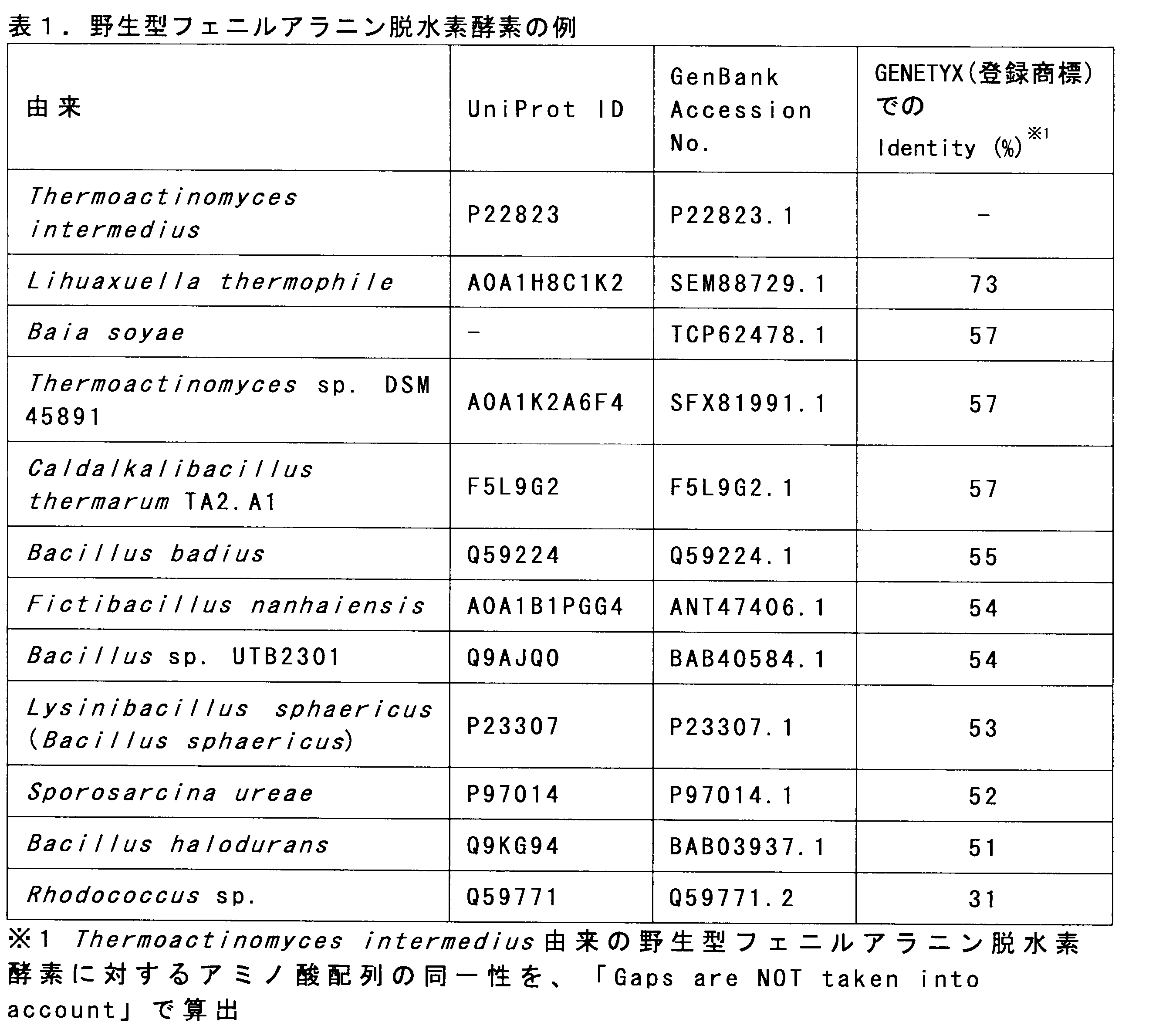
野生型フェニルアラニン脱水素酵素としては、例えば、以下のモチーフ(1)~(6)からなる群より選ばれる少なくとも1つ(例、1、2、3、4、5、または6個)のモチーフを含む野生型フェニルアラニン脱水素酵素が挙げられる。野生型フェニルアラニン脱水素酵素は、好ましくはモチーフ(1)~(6)からなる群より選ばれる複数個(例、2、3、4、5、または6個)のモチーフをこの順序(「順序」とは、アミノ酸配列中のN末端からC末端に向かう順序をいう。)で含んでもよく、より好ましくはモチーフ(1)~(6)の全てを含んでいてもよく、さらにより好ましくはモチーフ(1)~(6)の全てをこの順序で含んでいてもよい。以下、モチーフは一文字表記のアミノ酸配列で示され、Xは任意のアミノ酸(タンパク質を構成する20種類のアミノ酸、すなわちアラニン(A)、アスパラギン(N)、システイン(C)、グルタミン(Q)、イソロイシン(I)、ロイシン(L)、メチオニン(M)、フェニルアラニン(F)、プロリン(P)、セリン(S)、スレオニン(T)、トリプトファン(W)、チロシン(Y)、バリン(V)、アスパラギン酸(D)、グルタミン酸(E)、アルギニン(R)、ヒスチジン(H)、リジン(K)、およびグリシン(G)のいずれか)を示す。
モチーフ(1):GPALGGXRM(配列番号3)モチーフ;
モチーフ(2):GRFXTGTDMGT(配列番号4)モチーフ;
モチーフ(3):DFモチーフ;
モチーフ(4):GXANN(配列番号5)モチーフ;
モチーフ(5):RHモチーフ;
モチーフ(6):VNXGGLIQV(配列番号6)モチーフ。
モチーフ(1):GPALGGXRM(配列番号3)モチーフ;
モチーフ(2):GRFXTGTDMGT(配列番号4)モチーフ;
モチーフ(3):DFモチーフ;
モチーフ(4):GXANN(配列番号5)モチーフ;
モチーフ(5):RHモチーフ;
モチーフ(6):VNXGGLIQV(配列番号6)モチーフ。
モチーフ(1)、(2)、(4)、および(6)は、より短いアミノ酸配列で示されるモチーフとして、以下のモチーフ(1a)、(2a)、(4a)、(6a)、および(6b)を含む。したがって、野生型フェニルアラニン脱水素酵素は、例えば、モチーフ(1a)、(2a)、(3)、(4a)、(5)、(6a)、および(6b)からなる群より選ばれる少なくとも1つ(例、1、2、3、4、5、6、または7個)のモチーフを含む野生型フェニルアラニン脱水素酵素であってもよく、好ましくはモチーフ(1a)、(2a)、(3)、(4a)、(5)、(6a)、および(6b)からなる群より選ばれる複数個(例、2、3、4、5、6、または7個)のモチーフをこの順序で含んでもよく、より好ましくはモチーフ(1a)、(2a)、(3)、(4a)、(5)、(6a)、および(6b)の全てを含んでいてもよく、さらにより好ましくはモチーフ(1a)、(2a)、(3)、(4a)、(5)、(6a)、および(6b)の全てをこの順序で含んでいてもよい。
モチーフ(1a):モチーフ(1)中のGPALGG(配列番号7)モチーフ;
モチーフ(2a):モチーフ(2)中のTGTDMGT(配列番号8)モチーフ;
モチーフ(4a):モチーフ(4)中のANNモチーフ;
モチーフ(6a):モチーフ(6)中のVNモチーフ;
モチーフ(6b):モチーフ(6)中のGGLIQV(配列番号9)モチーフ。
モチーフ(1a):モチーフ(1)中のGPALGG(配列番号7)モチーフ;
モチーフ(2a):モチーフ(2)中のTGTDMGT(配列番号8)モチーフ;
モチーフ(4a):モチーフ(4)中のANNモチーフ;
モチーフ(6a):モチーフ(6)中のVNモチーフ;
モチーフ(6b):モチーフ(6)中のGGLIQV(配列番号9)モチーフ。
本発明の改変フェニルアラニン脱水素酵素は、上述した野生型フェニルアラニン脱水素酵素において、モチーフ(1)~(6)からなる群より選ばれる少なくとも1つのモチーフ中の少なくとも1つのアミノ酸残基(例、モチーフ(1a)、(2a)、(3)、(4a)、(5)、(6a)、および(6b)からなる群より選ばれる少なくとも1つのモチーフ中の少なくとも1つのアミノ酸残基)が変異しており、フェニルアラニン脱水素酵素活性を有し、かつ、基質特異性、溶解性、およびフェニルアラニン脱水素酵素活性からなる群より選ばれる少なくとも1つの特性が、野生型フェニルアラニン脱水素酵素よりも高い、改変フェニルアラニン脱水素酵素であってもよい。
好ましい実施形態では、フェニルアラニンの測定に関連するフェニルアラニン脱水素酵素の特性を改善する変異は、野生型フェニルアラニン脱水素酵素のアミノ酸配列のモチーフ(1)(GPALGGXRM(配列番号3)モチーフ)中のロイシン、5番目のアミノ酸残基であるグリシン、または6番目のアミノ酸残基であるグリシンの置換である。モチーフ(1)は、GPALGGXRM(配列番号3)の連続した9つのアミノ酸残基(Xは任意のアミノ酸残基を示す)から構成される。また、置換されるべきアミノ酸残基は、モチーフ(1)中のより短いアミノ酸配列で示されるモチーフ(1a)(GPALGG(配列番号7)モチーフ)中のロイシン、5番目のアミノ酸残基であるグリシン、または6番目のアミノ酸残基であるグリシンとして特定することもできる。野生型フェニルアラニン脱水素酵素のアミノ酸配列中のモチーフ(1)または(1a)の位置は酵素の由来によって異なり得るが、当業者は、野生型フェニルアラニン脱水素酵素のアミノ酸配列中のモチーフ(1)または(1a)の位置を適宜決定できるため、置換されるべきロイシンまたはグリシン(5番目もしくは6番目)の位置を特定できる。通常、フェニルアラニン脱水素酵素のアミノ酸配列において、モチーフ(1)は38~46位のアミノ酸領域内にあり、モチーフ(1a)は38~43位のアミノ酸領域内にあり、置換されるべきロイシンは41位にあり、置換されるべきグリシン(5番目)は42位にあり、置換されるべきグリシン(6番目)は43位にある(例、表2、図1を参照)。
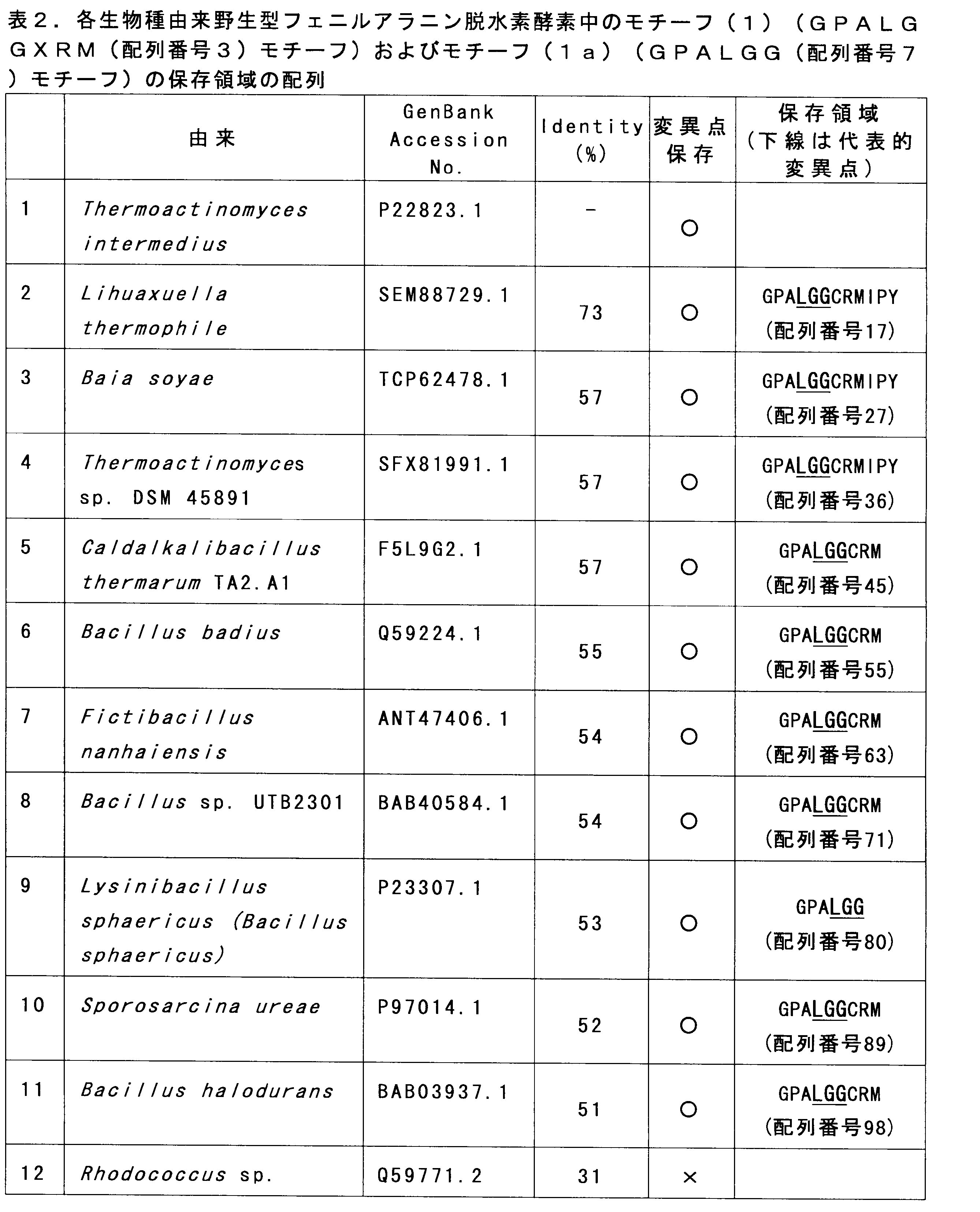
好ましい実施形態では、フェニルアラニンの測定に関連するフェニルアラニン脱水素酵素の特性を改善する変異は、野生型フェニルアラニン脱水素酵素のアミノ酸配列のモチーフ(2)(GRFXTGTDMGT(配列番号4)モチーフ)中の7番目のアミノ酸残基であるスレオニンの置換である。モチーフ(2)は、GRFXTGTDMGT(配列番号4)の連続した11つのアミノ酸残基(Xは任意のアミノ酸残基を示す)から構成される。また、置換されるべきアミノ酸残基は、モチーフ(2)中のより短いアミノ酸配列で示されるモチーフ(2a)(TGTDMGT(配列番号8)モチーフ)中の3番目のアミノ酸残基であるスレオニンとして特定することもできる。野生型フェニルアラニン脱水素酵素のアミノ酸配列中のモチーフ(2)または(2a)の位置は酵素の由来によって異なり得るが、当業者は、野生型フェニルアラニン脱水素酵素のアミノ酸配列中のモチーフ(2)または(2a)の位置を適宜決定できるため、置換されるべきスレオニンの位置を特定できる。通常、フェニルアラニン脱水素酵素のアミノ酸配列において、モチーフ(2)は109~119位のアミノ酸領域内にあり、モチーフ(2a)は113~119位のアミノ酸領域内にあり、置換されるべきスレオニンは115位にある(例、表3、図2を参照)。
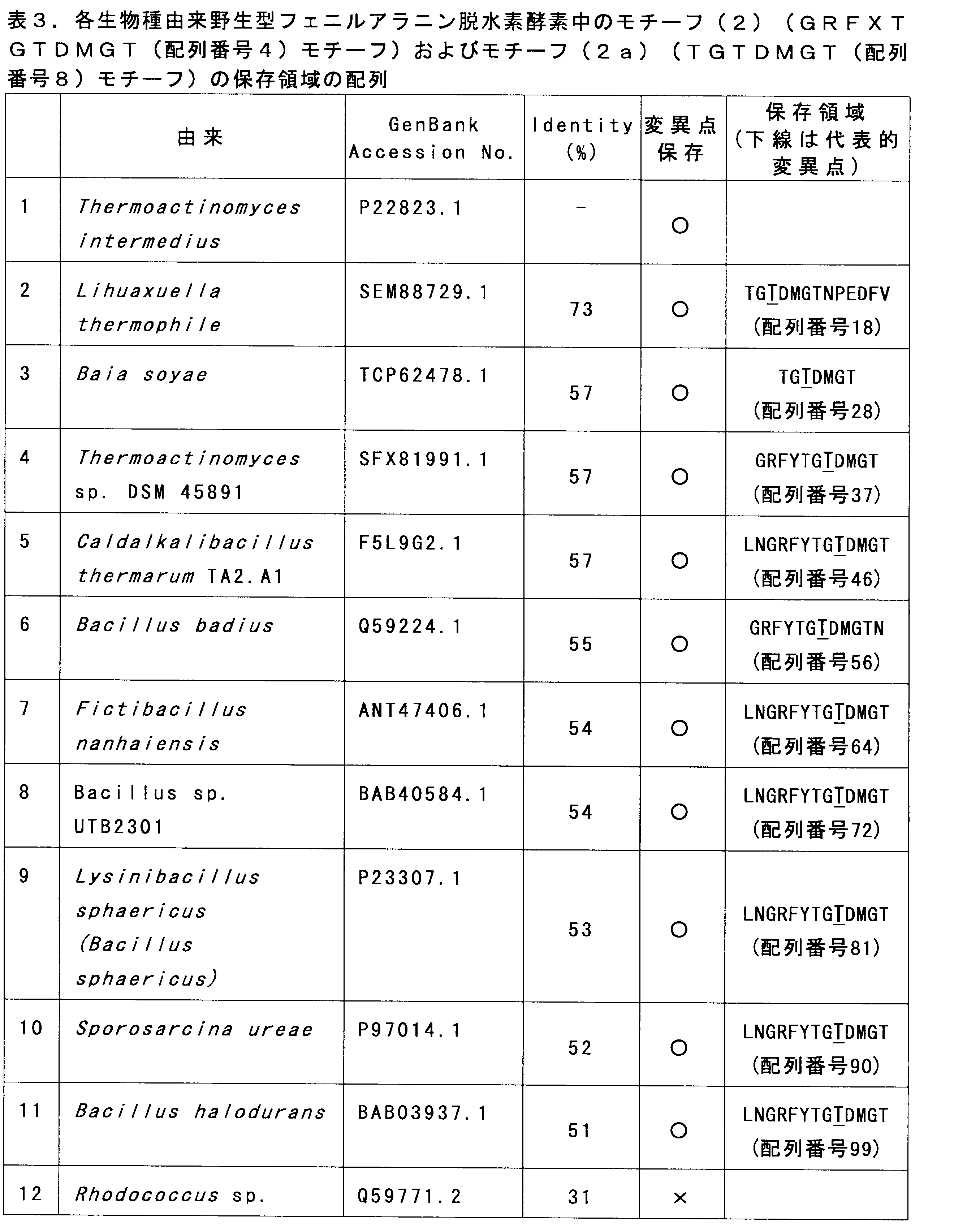
好ましい実施形態では、フェニルアラニンの測定に関連するフェニルアラニン脱水素酵素の特性を改善する変異は、野生型フェニルアラニン脱水素酵素のアミノ酸配列のモチーフ(3)(DFモチーフ)中のフェニルアラニンの置換である。モチーフ(3)は、DFの連続した2つのアミノ酸残基から構成される。野生型フェニルアラニン脱水素酵素のアミノ酸配列中のモチーフ(3)の位置は酵素の由来によって異なり得るが、当業者は、野生型フェニルアラニン脱水素酵素のアミノ酸配列中のモチーフ(3)の位置を適宜決定できるため、置換されるべきフェニルアラニンの位置を特定できる。通常、フェニルアラニン脱水素酵素のアミノ酸配列において、モチーフ(3)は123~124位のアミノ酸領域内にあり、置換されるべきフェニルアラニンは124位にある(例、表4、図2を参照)。

好ましい実施形態では、フェニルアラニンの測定に関連するフェニルアラニン脱水素酵素の特性を改善する変異は、野生型フェニルアラニン脱水素酵素のアミノ酸配列のモチーフ(4)(GXANN(配列番号5)モチーフ)中の4番目のアミノ酸残基であるアスパラギンの置換である。モチーフ(4)は、GXANN(配列番号5)の連続した5つのアミノ酸残基(Xは任意のアミノ酸残基を示す)から構成される。また、置換されるべきアミノ酸残基は、モチーフ(4)中のより短いアミノ酸配列で示されるモチーフ(4a)(ANNモチーフ)中の2番目のアミノ酸残基であるアスパラギンとして特定することもできる。野生型フェニルアラニン脱水素酵素のアミノ酸配列中のモチーフ(4)または(4a)の位置は酵素の由来によって異なり得るが、当業者は、野生型フェニルアラニン脱水素酵素のアミノ酸配列中のモチーフ(4)または(4a)の位置を適宜決定できるため、置換されるべきアスパラギンの位置を特定できる。通常、フェニルアラニン脱水素酵素のアミノ酸配列において、モチーフ(4)は261~265位のアミノ酸領域内にあり、モチーフ(4a)は263~265位のアミノ酸領域内にあり、置換されるべきアスパラギンは264位にある(例、表5、図3を参照)。
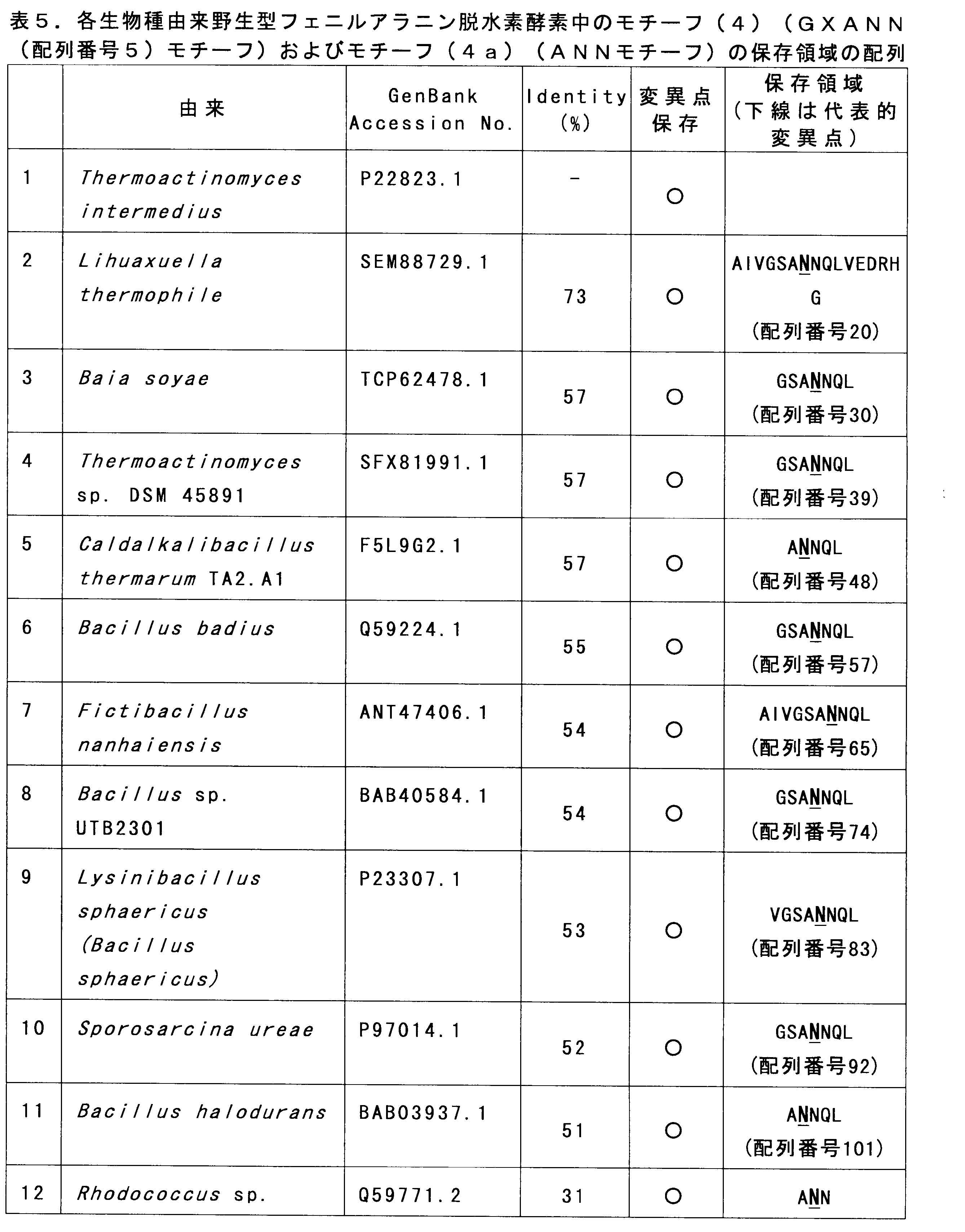
好ましい実施形態では、フェニルアラニンの測定に関連するフェニルアラニン脱水素酵素の特性を改善する変異は、野生型フェニルアラニン脱水素酵素のアミノ酸配列のモチーフ(5)(RHモチーフ)中のアルギニンの置換である。モチーフ(5)は、RHの連続した2つのアミノ酸残基から構成される。野生型フェニルアラニン脱水素酵素のアミノ酸配列中のモチーフ(5)の位置は酵素の由来によって異なり得るが、当業者は、野生型フェニルアラニン脱水素酵素のアミノ酸配列中のモチーフ(5)の位置を適宜決定できるため、置換されるべきアルギニンの位置を特定できる。通常、フェニルアラニン脱水素酵素のアミノ酸配列において、モチーフ(5)は271~272位のアミノ酸領域内にあり、置換されるべきアルギニンは271位にある(例、表6、図3を参照)。
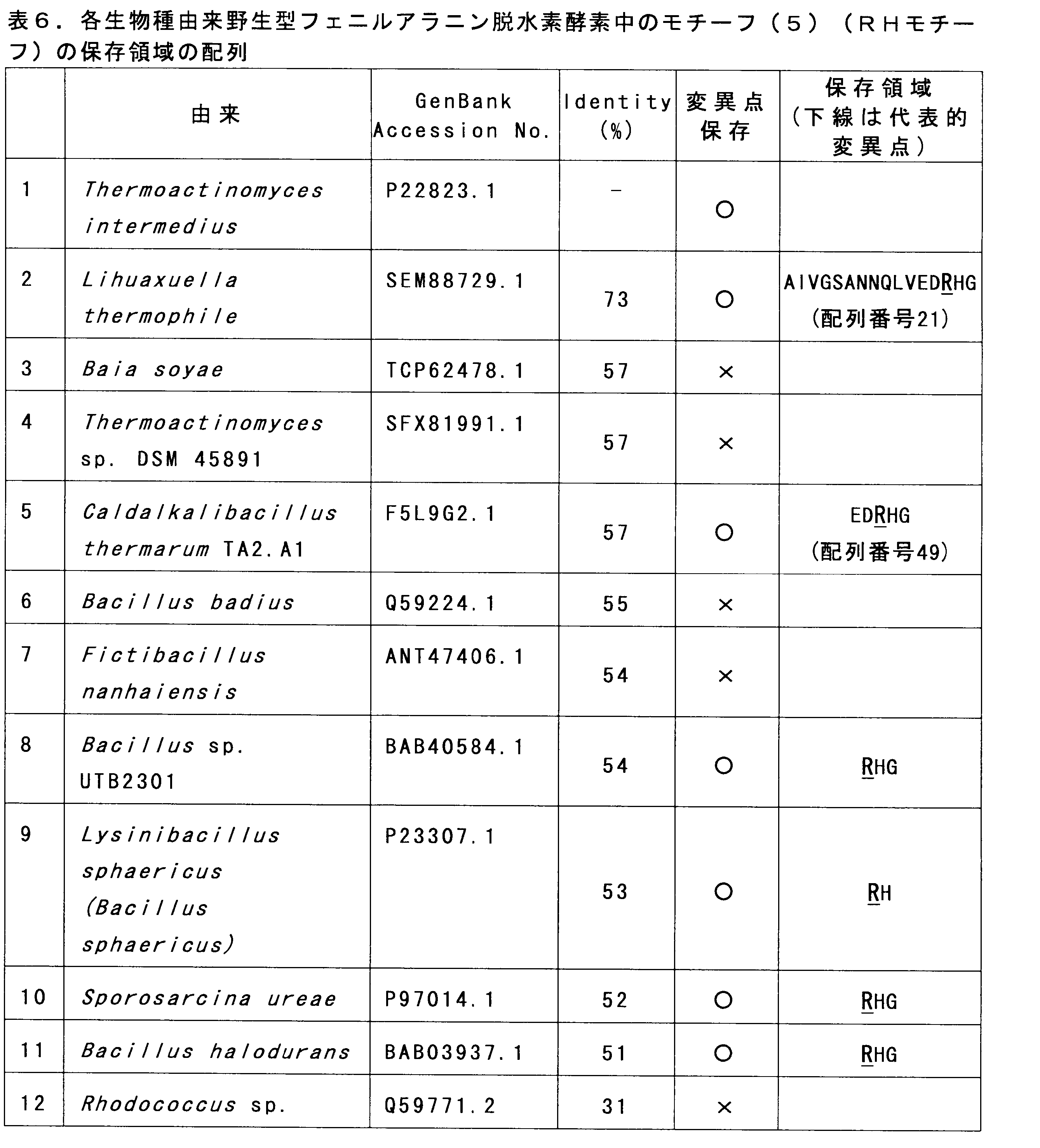
好ましい実施形態では、フェニルアラニンの測定に関連するフェニルアラニン脱水素酵素の特性を改善する変異は、野生型フェニルアラニン脱水素酵素のアミノ酸配列のモチーフ(6)(VNXGGLIQV(配列番号6)モチーフ)中のアスパラギン、5番目のアミノ酸残基であるグリシン、ロイシン、グルタミン、または9番目のアミノ酸残基であるバリンの置換である。モチーフ(6)は、VNXGGLIQV(配列番号6)の連続した9つのアミノ酸残基(Xは任意のアミノ酸残基を示す)から構成される。また、置換されるべきアミノ酸残基は、モチーフ(6)中のより短いアミノ酸配列で示されるモチーフ(6a)(VNモチーフ)中のアスパラギン、またはモチーフ(6)中のより短いアミノ酸配列で示されるモチーフ(6b)(GGLIQV(配列番号9)モチーフ)中の2番目のアミノ酸残基であるグリシン、ロイシン、グルタミン、もしくはバリンとして特定することもできる。野生型フェニルアラニン脱水素酵素のアミノ酸配列中のモチーフ(6)、(6a)、または(6b)の位置は酵素の由来によって異なり得るが、当業者は、野生型フェニルアラニン脱水素酵素のアミノ酸配列中のモチーフ(6)、(6a)、または(6b)の位置を適宜決定できるため、置換されるべきアスパラギン、グリシン、ロイシン、グルタミン、またはバリンの位置を特定できる。通常、フェニルアラニン脱水素酵素のアミノ酸配列において、モチーフ(6)は289~297位のアミノ酸領域内にあり、モチーフ(6a)は289~290位のアミノ酸領域内にあり、モチーフ(6b)は292~297位のアミノ酸領域内にあり、置換されるべきアスパラギンは290位にあり、置換されるべきグリシンは293位にあり、置換されるべきロイシンは294位にあり、置換されるべきグルタミンは296位にあり、置換されるべきバリンは297位にある(例、表7、図3を参照)。
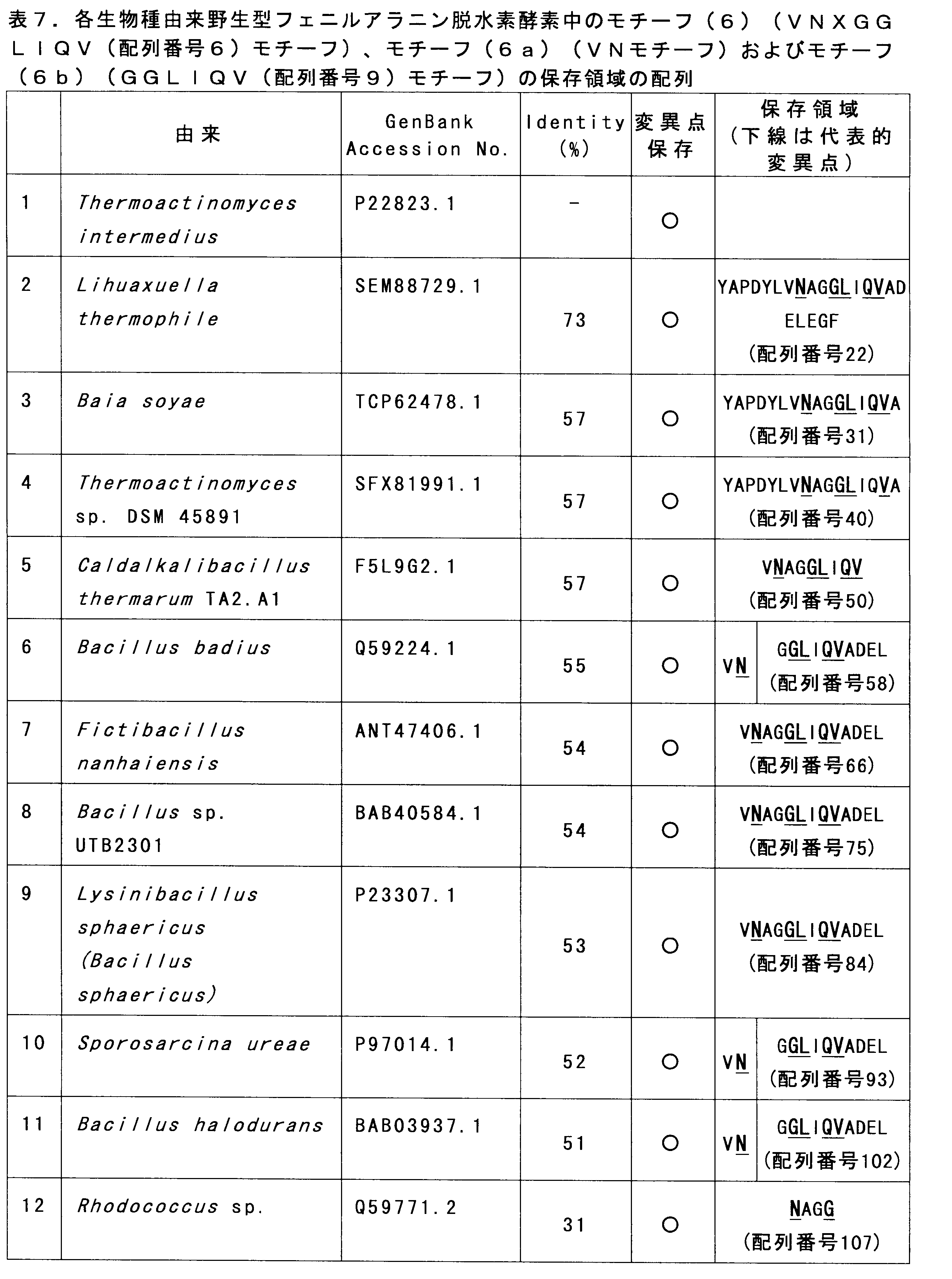
本発明の改変フェニルアラニン脱水素酵素は、モチーフ(1)~(6)から選ばれる1つ以上のモチーフを有する野生型酵素に対して変異を導入することにより、作製することができる。野生型酵素は、モチーフ(1)~(6)から選ばれる2つのモチーフを有していてもよく、3つのモチーフを有していてもよく、4つのモチーフを有していてもよく、5つのモチーフを有していてもよく、6つのモチーフを有していてもよい。また、本発明の改変フェニルアラニン脱水素酵素は、モチーフ(1a)、(2a)、(3)、(4a)、(5)、(6a)、および(6b)から選ばれる1つ以上のモチーフを有する野生型酵素に対して変異を導入することにより、作製することができる。野生型酵素は、モチーフ(1a)、(2a)、(3)、(4a)、(5)、(6a)、および(6b)から選ばれる2つのモチーフを有していてもよく、3つのモチーフを有していてもよく、4つのモチーフを有していてもよく、5つのモチーフを有していてもよく、6つのモチーフを有していてもよく、7つのモチーフを有していてもよい。
フェニルアラニンの測定に関連するフェニルアラニン脱水素酵素の特性としては、基質特異性、溶解性、および酵素活性が挙げられる。本発明の改変フェニルアラニン脱水素酵素は、上述した特性のうち1つのみを有していてもよいが、上述した特性のうち2つまたは3つの特性を併有していてもよい。
モチーフ(1)~(6)で特定されるアミノ酸残基は、上述した対応関係に基づいて、モチーフ(1a)、(2a)、(3)、(4a)、(5)、(6a)、および(6b)で特定してもよい。
上述した6つのモチーフ中の変異について、基質特異性、溶解性、および酵素活性から選ばれる少なくとも1つの特性を改善する変異(単独の変異または他の変異との組合せ)としては、例えば、以下が挙げられる:
(a)モチーフ(1)中のロイシンのトリプトファン、フェニルアラニン、チロシン、またはメチオニンへの置換;
(a+)モチーフ(1)中の5番目のアミノ酸残基であるグリシンのアラニンへの置換;
(a++)モチーフ(1)中の6番目のアミノ酸残基であるグリシンのアラニンへの置換;
(b)モチーフ(2)中の7番目のアミノ酸残基であるスレオニンのセリンへの置換;
(c)モチーフ(3)中のフェニルアラニンのロイシンまたはイソロイシンへの置換;
(d)モチーフ(4)中の4番目のアミノ酸残基であるアスパラギンのグリシン、グルタミン、スレオニン、リジン、プロリン、またはセリンへの置換;
(e)モチーフ(5)中のアルギニンのアスパラギン酸またはグルタミン酸への置換;
(f)モチーフ(6)中のアスパラギンのバリン、アスパラギン酸、メチオニン、グルタミン、プロリン、イソロイシン、ヒスチジン、アラニン、スレオニン、グリシン、またはシステインへの置換;
(g-)モチーフ(6)中の5番目のアミノ酸残基であるグリシンのアラニンへの置換;
(g)モチーフ(6)中のロイシンのフェニルアラニン、グルタミン、ヒスチジン、アスパラギン、イソロイシン、アスパラギン酸、グリシン、グルタミン酸、スレオニン、またはセリンへの置換;
(h)モチーフ(6)中のグルタミンのアスパラギン酸、グルタミン酸、リジン、アスパラギン、セリン、またはアルギニンへの置換;および
(i)モチーフ(6)中の9番目のアミノ酸残基であるバリンのチロシン、トリプトファン、グルタミン酸、アスパラギン、スレオニン、イソロイシン、リジン、グリシン、セリン、ロイシン、メチオニン、グルタミン、フェニルアラニン、システイン、またはアルギニンへの置換。
(a)モチーフ(1)中のロイシンのトリプトファン、フェニルアラニン、チロシン、またはメチオニンへの置換;
(a+)モチーフ(1)中の5番目のアミノ酸残基であるグリシンのアラニンへの置換;
(a++)モチーフ(1)中の6番目のアミノ酸残基であるグリシンのアラニンへの置換;
(b)モチーフ(2)中の7番目のアミノ酸残基であるスレオニンのセリンへの置換;
(c)モチーフ(3)中のフェニルアラニンのロイシンまたはイソロイシンへの置換;
(d)モチーフ(4)中の4番目のアミノ酸残基であるアスパラギンのグリシン、グルタミン、スレオニン、リジン、プロリン、またはセリンへの置換;
(e)モチーフ(5)中のアルギニンのアスパラギン酸またはグルタミン酸への置換;
(f)モチーフ(6)中のアスパラギンのバリン、アスパラギン酸、メチオニン、グルタミン、プロリン、イソロイシン、ヒスチジン、アラニン、スレオニン、グリシン、またはシステインへの置換;
(g-)モチーフ(6)中の5番目のアミノ酸残基であるグリシンのアラニンへの置換;
(g)モチーフ(6)中のロイシンのフェニルアラニン、グルタミン、ヒスチジン、アスパラギン、イソロイシン、アスパラギン酸、グリシン、グルタミン酸、スレオニン、またはセリンへの置換;
(h)モチーフ(6)中のグルタミンのアスパラギン酸、グルタミン酸、リジン、アスパラギン、セリン、またはアルギニンへの置換;および
(i)モチーフ(6)中の9番目のアミノ酸残基であるバリンのチロシン、トリプトファン、グルタミン酸、アスパラギン、スレオニン、イソロイシン、リジン、グリシン、セリン、ロイシン、メチオニン、グルタミン、フェニルアラニン、システイン、またはアルギニンへの置換。
本発明の改変フェニルアラニン脱水素酵素が、上記フェニルアラニン脱水素酵素の2以上のアミノ酸残基を変異させたものである場合、アミノ酸残基の変異のうち少なくとも1つ、好ましくは少なくとも2つは、上述したアミノ酸残基の変異から選ばれてもよい。さらにより好ましくは、アミノ酸残基の変異の全ては、上述したアミノ酸残基の変異から選ばれてもよい。
改変フェニルアラニン脱水素酵素が2以上の変異を含む場合、以下から選ばれる1以上の変異を含むことが好ましい:
(a)モチーフ(1)中のロイシンの置換;
(b)モチーフ(2)中の7番目のアミノ酸残基であるスレオニンの置換;
(c)モチーフ(3)中のフェニルアラニンの置換;
(e)モチーフ(5)中のアルギニンの置換;
(f)モチーフ(6)中のアスパラギンの置換;
(g)モチーフ(6)中のロイシンの置換;
(h)モチーフ(6)中のグルタミンの置換;および
(i)モチーフ(6)中の9番目のアミノ酸残基であるバリンの置換。
改変フェニルアラニン脱水素酵素が2以上の変異を含む場合、以下から選ばれる1以上の変異の組合せを含むことが好ましい:
(1)(f)モチーフ(6)中のアスパラギンの置換と、
(b)モチーフ(2)中の7番目のアミノ酸残基であるスレオニンの置換、
(c)モチーフ(3)中のフェニルアラニンの置換、
(e)モチーフ(5)中のアルギニンの置換、
(h)モチーフ(6)中のグルタミンの置換、または
(i)モチーフ(6)中の9番目のアミノ酸残基であるバリンの置換
の組み合わせ;
(2)(c)モチーフ(3)中のフェニルアラニンの置換と、
(b)モチーフ(2)中の7番目のアミノ酸残基であるスレオニンの置換、
(g)モチーフ(6)中のロイシンの置換、
(h)モチーフ(6)中のグルタミンの置換、または
(i)モチーフ(6)中の9番目のアミノ酸残基であるバリンの置換
の組み合わせ;
(3)(b)モチーフ(2)中の7番目のアミノ酸残基であるスレオニンの置換と、
(g)モチーフ(6)中のロイシンの置換、または
(h)モチーフ(6)中のグルタミンの置換
の組み合わせ;
(4)(h)モチーフ(6)中のグルタミンの置換と、
(i)モチーフ(6)中の9番目のアミノ酸残基であるバリン置換の組み合わせ。
(a)モチーフ(1)中のロイシンの置換;
(b)モチーフ(2)中の7番目のアミノ酸残基であるスレオニンの置換;
(c)モチーフ(3)中のフェニルアラニンの置換;
(e)モチーフ(5)中のアルギニンの置換;
(f)モチーフ(6)中のアスパラギンの置換;
(g)モチーフ(6)中のロイシンの置換;
(h)モチーフ(6)中のグルタミンの置換;および
(i)モチーフ(6)中の9番目のアミノ酸残基であるバリンの置換。
改変フェニルアラニン脱水素酵素が2以上の変異を含む場合、以下から選ばれる1以上の変異の組合せを含むことが好ましい:
(1)(f)モチーフ(6)中のアスパラギンの置換と、
(b)モチーフ(2)中の7番目のアミノ酸残基であるスレオニンの置換、
(c)モチーフ(3)中のフェニルアラニンの置換、
(e)モチーフ(5)中のアルギニンの置換、
(h)モチーフ(6)中のグルタミンの置換、または
(i)モチーフ(6)中の9番目のアミノ酸残基であるバリンの置換
の組み合わせ;
(2)(c)モチーフ(3)中のフェニルアラニンの置換と、
(b)モチーフ(2)中の7番目のアミノ酸残基であるスレオニンの置換、
(g)モチーフ(6)中のロイシンの置換、
(h)モチーフ(6)中のグルタミンの置換、または
(i)モチーフ(6)中の9番目のアミノ酸残基であるバリンの置換
の組み合わせ;
(3)(b)モチーフ(2)中の7番目のアミノ酸残基であるスレオニンの置換と、
(g)モチーフ(6)中のロイシンの置換、または
(h)モチーフ(6)中のグルタミンの置換
の組み合わせ;
(4)(h)モチーフ(6)中のグルタミンの置換と、
(i)モチーフ(6)中の9番目のアミノ酸残基であるバリン置換の組み合わせ。
改変フェニルアラニン脱水素酵素が2以上の変異を含む場合、以下から選ばれる1以上の変異を含むことがより好ましい:
(a)モチーフ(1)中のロイシンのトリプトファンへの置換;
(b)モチーフ(2)中の7番目のアミノ酸残基であるスレオニンのセリンへの置換;
(c)モチーフ(3)中のフェニルアラニンのロイシンまたはイソロイシンへの置換;
(e)モチーフ(5)中のアルギニンのアスパラギン酸への置換;
(f)モチーフ(6)中のアスパラギンのアスパラギン酸、メチオニン、グルタミン、またはシステインへの置換;
(g)モチーフ(6)中のロイシンのグルタミンまたはアスパラギンへの置換;
(h)モチーフ(6)中のグルタミンのアスパラギン酸への置換;および
(i)モチーフ(6)中の9番目のアミノ酸残基であるバリンのグリシン、フェニルアラニン、またはアルギニンへの置換。
改変フェニルアラニン脱水素酵素が2以上の変異を含む場合、以下から選ばれる1以上の変異の組合せを含むことがより好ましい:
(1)(f)モチーフ(6)中のアスパラギンのアスパラギン酸、メチオニン、グルタミン、またはシステインへの置換と、
(b)モチーフ(2)中の7番目のアミノ酸残基であるスレオニンのセリンへの置換、
(c)モチーフ(3)中のフェニルアラニンのロイシンまたはイソロイシンへの置換、
(e)モチーフ(5)中のアルギニンのアスパラギン酸への置換、
(h)モチーフ(6)中のグルタミンのアスパラギン酸への置換、または
(i)モチーフ(6)中の9番目のアミノ酸残基であるバリンのグリシン、フェニルアラニン、またはアルギニンへの置換
の組み合わせ;
(2)(c)モチーフ(3)中のフェニルアラニンのロイシンもしくはイソロイシンへの置換と、
(b)モチーフ(2)中の7番目のアミノ酸残基であるスレオニンのセリンへの置換、
(g)モチーフ(6)中のロイシンのグルタミンもしくはアスパラギンへの置換、
(h)モチーフ(6)中のグルタミンのアスパラギン酸への置換、または
(i)モチーフ(6)中の9番目のアミノ酸残基であるバリンのグリシン、フェニルアラニン、またはアルギニンへの置換
の組み合わせ;
(3)(b)モチーフ(2)中の7番目のアミノ酸残基であるスレオニンのセリンへの置換と、
(g)モチーフ(6)中のロイシンのグルタミンもしくはアスパラギンへの置換、または
(h)モチーフ(6)中のグルタミンのアスパラギン酸への置換
の組み合わせ;
(4)(h)モチーフ(6)中のグルタミンのアスパラギン酸への置換と、
(i)モチーフ(6)中の9番目のアミノ酸残基であるバリンのグリシン、フェニルアラニン、またはアルギニンへの置換の組み合わせ。
(a)モチーフ(1)中のロイシンのトリプトファンへの置換;
(b)モチーフ(2)中の7番目のアミノ酸残基であるスレオニンのセリンへの置換;
(c)モチーフ(3)中のフェニルアラニンのロイシンまたはイソロイシンへの置換;
(e)モチーフ(5)中のアルギニンのアスパラギン酸への置換;
(f)モチーフ(6)中のアスパラギンのアスパラギン酸、メチオニン、グルタミン、またはシステインへの置換;
(g)モチーフ(6)中のロイシンのグルタミンまたはアスパラギンへの置換;
(h)モチーフ(6)中のグルタミンのアスパラギン酸への置換;および
(i)モチーフ(6)中の9番目のアミノ酸残基であるバリンのグリシン、フェニルアラニン、またはアルギニンへの置換。
改変フェニルアラニン脱水素酵素が2以上の変異を含む場合、以下から選ばれる1以上の変異の組合せを含むことがより好ましい:
(1)(f)モチーフ(6)中のアスパラギンのアスパラギン酸、メチオニン、グルタミン、またはシステインへの置換と、
(b)モチーフ(2)中の7番目のアミノ酸残基であるスレオニンのセリンへの置換、
(c)モチーフ(3)中のフェニルアラニンのロイシンまたはイソロイシンへの置換、
(e)モチーフ(5)中のアルギニンのアスパラギン酸への置換、
(h)モチーフ(6)中のグルタミンのアスパラギン酸への置換、または
(i)モチーフ(6)中の9番目のアミノ酸残基であるバリンのグリシン、フェニルアラニン、またはアルギニンへの置換
の組み合わせ;
(2)(c)モチーフ(3)中のフェニルアラニンのロイシンもしくはイソロイシンへの置換と、
(b)モチーフ(2)中の7番目のアミノ酸残基であるスレオニンのセリンへの置換、
(g)モチーフ(6)中のロイシンのグルタミンもしくはアスパラギンへの置換、
(h)モチーフ(6)中のグルタミンのアスパラギン酸への置換、または
(i)モチーフ(6)中の9番目のアミノ酸残基であるバリンのグリシン、フェニルアラニン、またはアルギニンへの置換
の組み合わせ;
(3)(b)モチーフ(2)中の7番目のアミノ酸残基であるスレオニンのセリンへの置換と、
(g)モチーフ(6)中のロイシンのグルタミンもしくはアスパラギンへの置換、または
(h)モチーフ(6)中のグルタミンのアスパラギン酸への置換
の組み合わせ;
(4)(h)モチーフ(6)中のグルタミンのアスパラギン酸への置換と、
(i)モチーフ(6)中の9番目のアミノ酸残基であるバリンのグリシン、フェニルアラニン、またはアルギニンへの置換の組み合わせ。
本発明の改変フェニルアラニン脱水素酵素が、上記フェニルアラニン脱水素酵素の3以上のアミノ酸残基を変異させたものである場合、アミノ酸残基の変異のうち少なくとも1つ、好ましくは少なくとも2つ、より好ましくは少なくとも3つは、上述したアミノ酸残基の変異から選ばれてもよい。さらにより好ましくは、アミノ酸残基の変異の全ては、上述したアミノ酸残基の変異から選ばれてもよい。
改変フェニルアラニン脱水素酵素が3以上の変異を含む場合、以下から選ばれる1以上の変異を含むことが好ましい:
(a)モチーフ(1)中のロイシンの置換;
(b)モチーフ(2)中の7番目のアミノ酸残基であるスレオニンの置換;
(c)モチーフ(3)中のフェニルアラニンの置換;
(e)モチーフ(5)中のアルギニンの置換;
(f)モチーフ(6)中のアスパラギンの置換;および
(i)モチーフ(6)中の9番目のアミノ酸残基であるバリンの置換。
改変フェニルアラニン脱水素酵素が3以上の変異を含む場合、以下の変異の組合せを含むことが好ましい:
(f)モチーフ(6)中のアスパラギンの置換と、
(b)モチーフ(2)中の7番目のアミノ酸残基であるスレオニンの置換、
(c)モチーフ(3)中のフェニルアラニンの置換、または
(e)モチーフ(5)中のアルギニンの置換
の組み合わせ。
(a)モチーフ(1)中のロイシンの置換;
(b)モチーフ(2)中の7番目のアミノ酸残基であるスレオニンの置換;
(c)モチーフ(3)中のフェニルアラニンの置換;
(e)モチーフ(5)中のアルギニンの置換;
(f)モチーフ(6)中のアスパラギンの置換;および
(i)モチーフ(6)中の9番目のアミノ酸残基であるバリンの置換。
改変フェニルアラニン脱水素酵素が3以上の変異を含む場合、以下の変異の組合せを含むことが好ましい:
(f)モチーフ(6)中のアスパラギンの置換と、
(b)モチーフ(2)中の7番目のアミノ酸残基であるスレオニンの置換、
(c)モチーフ(3)中のフェニルアラニンの置換、または
(e)モチーフ(5)中のアルギニンの置換
の組み合わせ。
改変フェニルアラニン脱水素酵素が3以上の変異を含む場合、以下から選ばれる1以上の変異を含むことがより好ましい:
(a)モチーフ(1)中のロイシンのトリプトファンへの置換;
(b)モチーフ(2)中の7番目のアミノ酸残基であるスレオニンのセリンへの置換;
(c)モチーフ(3)中のフェニルアラニンのイソロイシンへの置換;
(e)モチーフ(5)中のアルギニンのアスパラギン酸への置換;
(f)モチーフ(6)中のアスパラギンのアスパラギン酸またはメチオニンへの置換;および
(i)モチーフ(6)中の9番目のアミノ酸残基であるバリンのフェニルアラニンへの置換。
改変フェニルアラニン脱水素酵素が3以上の変異を含む場合、以下の変異の組合せを含むことがより好ましい:
(f)モチーフ(6)中のアスパラギンのアスパラギン酸またはメチオニンへの置換と、
(b)モチーフ(2)中の7番目のアミノ酸残基であるスレオニンのセリンへの置換、
(c)モチーフ(3)中のフェニルアラニンのイソロイシンへの置換、または
(e)モチーフ(5)中のアルギニンのアスパラギン酸への置換
の組み合わせ。
(a)モチーフ(1)中のロイシンのトリプトファンへの置換;
(b)モチーフ(2)中の7番目のアミノ酸残基であるスレオニンのセリンへの置換;
(c)モチーフ(3)中のフェニルアラニンのイソロイシンへの置換;
(e)モチーフ(5)中のアルギニンのアスパラギン酸への置換;
(f)モチーフ(6)中のアスパラギンのアスパラギン酸またはメチオニンへの置換;および
(i)モチーフ(6)中の9番目のアミノ酸残基であるバリンのフェニルアラニンへの置換。
改変フェニルアラニン脱水素酵素が3以上の変異を含む場合、以下の変異の組合せを含むことがより好ましい:
(f)モチーフ(6)中のアスパラギンのアスパラギン酸またはメチオニンへの置換と、
(b)モチーフ(2)中の7番目のアミノ酸残基であるスレオニンのセリンへの置換、
(c)モチーフ(3)中のフェニルアラニンのイソロイシンへの置換、または
(e)モチーフ(5)中のアルギニンのアスパラギン酸への置換
の組み合わせ。
本発明の改変フェニルアラニン脱水素酵素が、上記フェニルアラニン脱水素酵素の4以上のアミノ酸残基を変異させたものである場合、アミノ酸残基の変異のうち少なくとも1つ、好ましくは少なくとも2つ、より好ましくは少なくとも3つ、さらにより好ましくは少なくとも4つは、上述したアミノ酸残基の変異から選ばれてもよい。さらにより好ましくは、アミノ酸残基の変異の全ては、上述したアミノ酸残基の変異から選ばれてもよい。
改変フェニルアラニン脱水素酵素が4以上の変異を含む場合、以下から選ばれる1以上の変異を含むことが好ましい:
(b)モチーフ(2)中の7番目のアミノ酸残基であるスレオニンの置換;
(c)モチーフ(3)中のフェニルアラニンの置換;
(e)モチーフ(5)中のアルギニンの置換;および
(f)モチーフ(6)中のアスパラギンの置換。
改変フェニルアラニン脱水素酵素が4以上の変異を含む場合、以下の変異の組合せを含むことが好ましい:
(f)モチーフ(6)中のアスパラギンの置換と、
(b)モチーフ(2)中の7番目のアミノ酸残基であるスレオニンの置換、
(c)モチーフ(3)中のフェニルアラニンの置換、または
(e)モチーフ(5)中のアルギニンの置換
の組み合わせ。
(b)モチーフ(2)中の7番目のアミノ酸残基であるスレオニンの置換;
(c)モチーフ(3)中のフェニルアラニンの置換;
(e)モチーフ(5)中のアルギニンの置換;および
(f)モチーフ(6)中のアスパラギンの置換。
改変フェニルアラニン脱水素酵素が4以上の変異を含む場合、以下の変異の組合せを含むことが好ましい:
(f)モチーフ(6)中のアスパラギンの置換と、
(b)モチーフ(2)中の7番目のアミノ酸残基であるスレオニンの置換、
(c)モチーフ(3)中のフェニルアラニンの置換、または
(e)モチーフ(5)中のアルギニンの置換
の組み合わせ。
改変フェニルアラニン脱水素酵素が4以上の変異を含む場合、以下から選ばれる1以上の変異を含むことがより好ましい:
(b)モチーフ(2)中の7番目のアミノ酸残基であるスレオニンのセリンへの置換;
(c)モチーフ(3)中のフェニルアラニンのイソロイシンへの置換;
(e)モチーフ(5)中のアルギニンのアスパラギン酸への置換;
(f)モチーフ(6)中のアスパラギンのアスパラギン酸への置換。
改変フェニルアラニン脱水素酵素が4以上の変異を含む場合、以下の変異の組合せを含むことがより好ましい:
(f)モチーフ(6)中のアスパラギンのアスパラギン酸への置換と、
(b)モチーフ(2)中の7番目のアミノ酸残基であるスレオニンのセリンへの置換、
(c)モチーフ(3)中のフェニルアラニンのイソロイシンへの置換、または
(e)モチーフ(5)中のアルギニンのアスパラギン酸への置換
の組み合わせ。
(b)モチーフ(2)中の7番目のアミノ酸残基であるスレオニンのセリンへの置換;
(c)モチーフ(3)中のフェニルアラニンのイソロイシンへの置換;
(e)モチーフ(5)中のアルギニンのアスパラギン酸への置換;
(f)モチーフ(6)中のアスパラギンのアスパラギン酸への置換。
改変フェニルアラニン脱水素酵素が4以上の変異を含む場合、以下の変異の組合せを含むことがより好ましい:
(f)モチーフ(6)中のアスパラギンのアスパラギン酸への置換と、
(b)モチーフ(2)中の7番目のアミノ酸残基であるスレオニンのセリンへの置換、
(c)モチーフ(3)中のフェニルアラニンのイソロイシンへの置換、または
(e)モチーフ(5)中のアルギニンのアスパラギン酸への置換
の組み合わせ。
変異前のフェニルアラニン脱水素酵素は、以下のアミノ酸配列(A)~(C)のいずれかを含むフェニルアラニン脱水素酵素であってもよい。
(A)配列番号1で表されるアミノ酸配列、
(B)配列番号1で表されるアミノ酸配列において、1もしくは数個のアミノ酸残基の置換、欠失、挿入、もしくは付加を含むアミノ酸配列、または
(C)配列番号1で表されるアミノ酸配列に対して90%以上の同一性を有するアミノ酸配列。
(A)配列番号1で表されるアミノ酸配列、
(B)配列番号1で表されるアミノ酸配列において、1もしくは数個のアミノ酸残基の置換、欠失、挿入、もしくは付加を含むアミノ酸配列、または
(C)配列番号1で表されるアミノ酸配列に対して90%以上の同一性を有するアミノ酸配列。
配列番号1で表されるアミノ酸配列は、Thermoactinomyces intermedius由来野生型フェニルアラニン脱水素酵素(TiPheDH(wt))であり、例えば、TiPheDH(wt)のコドン最適化ヌクレオチド配列(配列番号2)によりコードされる。
本発明において置換、欠失、挿入、付加等の変異の対象であるアミノ酸残基は、通常は天然のL-α-アミノ酸である、L-アラニン(A)、L-アスパラギン(N)、L-システイン(C)、L-グルタミン(Q)、L-イソロイシン(I)、L-ロイシン(L)、L-メチオニン(M)、L-フェニルアラニン(F)、L-プロリン(P)、L-セリン(S)、L-スレオニン(T)、L-トリプトファン(W)、L-チロシン(Y)、L-バリン(V)、L-アスパラギン酸(D)、L-グルタミン酸(E)、L-アルギニン(R)、L-ヒスチジン(H)、またはL-リジン(K)、あるいはグリシン(G)である。変異が置換、付加または挿入である場合、置換、付加または挿入されるアミノ酸残基は、上述した変異されるアミノ酸残基と同様である。本明細書において、アミノ酸の表記について、Lおよびαを省略することがある。
上記(B)のアミノ酸配列は、1または数個のアミノ酸残基の変異(例、置換、欠失、挿入、および付加)を含んでいてもよい。変異の数は、例えば1~50個、好ましくは1~45個、1~40個、1~35個、1~30個、または1~25個、より好ましくは1~20個、さらにより好ましくは1~15個、最も好ましくは1~10個(例、1、2、3、4、5、6、7、8、9または10個)である。
上記(C)のアミノ酸配列は、配列番号1で表されるアミノ酸配列に対して少なくとも90%以上のアミノ酸配列同一性を有していてもよい。アミノ酸配列の同一性パーセントは、好ましくは91%以上、92%以上、93%以上または94%以上、より好ましくは95%以上または96%以上、さらにより好ましくは97%以上、最も好ましくは98%以上または99%以上であってもよい。
(B)および(C)のアミノ酸配列で特定されるタンパク質は、同一条件で測定された場合、上記(A)のアミノ酸配列を有するタンパク質のフェニルアラニン脱水素酵素活性の50%以上、60%以上、70%以上、80%以上、90%以上または95%以上の活性を有することが好ましい。
本明細書においてアミノ酸配列の同一性は、例えばKarlinおよびAltschulによるアルゴリズムBLAST(Pro.Natl.Acad.Sci.USA,90,5873(1993))、PearsonによるFASTA(MethodsEnzymol.,183,63(1990))を用いて決定することができる。このアルゴリズムBLASTに基づいて、BLASTPとよばれるプログラムが開発されているので(http://www.ncbi.nlm.nih.gov参照)、これらのプログラムをデフォルト設定で用いて、アミノ酸配列の同一性を計算してもよい。また、アミノ酸配列の同一性としては、例えば、Lipman-Pearson法を採用している株式会社ゼネティックスのソフトウェアGENETYX Ver7.0.9を使用し、ORFにコードされるポリペプチド部分全長を用いて、「Gaps are NOT taken into account」の設定、またはUnit Size to Compare=2の設定でSimilarityをpercentage計算させた際の数値を用いてもよい。アミノ酸配列の同一性として、これらの計算で導き出される値のうち、最も低い値を採用してもよい。
(B)配列番号1で表されるアミノ酸配列において、1もしくは数個のアミノ酸残基の置換、欠失、挿入、もしくは付加を含むアミノ酸配列、および(C)配列番号1で表されるアミノ酸配列に対して90%以上の同一性を有するアミノ酸配列の調製のため、配列番号1で表されるアミノ酸配列に対してアミノ酸残基の変異が導入され、かつ当該アミノ酸残基の変異が置換である場合、アミノ酸残基のこのような置換は、保存的置換であってもよい。本明細書において用語「保存的置換」とは、所定のアミノ酸残基を、類似の側鎖を有するアミノ酸残基で置換することをいう。類似の側鎖を有するアミノ酸残基のファミリーは、当該分野で周知である。例えば、このようなファミリーとしては、塩基性側鎖を有するアミノ酸(例、リジン、アルギニン、ヒスチジン)、酸性側鎖を有するアミノ酸(例、アスパラギン酸、グルタミン酸)、非荷電性極性側鎖を有するアミノ酸(例、アスパラギン、グルタミン、セリン、スレオニン、チロシン、システイン)、非極性側鎖を有するアミノ酸(例、グリシン、アラニン、バリン、ロイシン、イソロイシン、プロリン、フェニルアラニン、メチオニン、トリプトファン)、β位分岐側鎖を有するアミノ酸(例、スレオニン、バリン、イソロイシン)、芳香族側鎖を有するアミノ酸(例、チロシン、フェニルアラニン、トリプトファン、ヒスチジン)、ヒドロキシル基(例、アルコール性、フェノール性)含有側鎖を有するアミノ酸(例、セリン、スレオニン、チロシン)、および硫黄含有側鎖を有するアミノ酸(例、システイン、メチオニン)が挙げられる。非荷電性極性側鎖を有するアミノ酸および非極性側鎖を有するアミノ酸を包括的に、中性アミノ酸と呼称することがある。好ましくは、アミノ酸の保存的置換は、アスパラギン酸とグルタミン酸との間での置換、アルギニンとリジンとヒスチジンとの間での置換、トリプトファンとフェニルアラニンとの間での置換、フェニルアラニンとバリンとの間での置換、ロイシンとイソロイシンとアラニンとの間での置換、およびグリシンとアラニンとの間での置換であってもよい。
変異前のフェニルアラニン脱水素酵素が、上述した(A)~(C)のいずれかを含むフェニルアラニン脱水素酵素である場合、本発明の改変フェニルアラニン脱水素酵素は、好ましくは、下記:
R2、R10、Y11、C19、L41、G42、G43、C44、A50、S51、M66、C70、F77、K90、Y112、T115、D116、F124、R129、L137、K139、S140、K144、T147、K173、C200、C210、K216、K220、Q222、N227、R228、C234、C240、R255、C256、L257、N264、R271、Q277、K278、R279、S280、C282、N290、G293、L294、Q296、V297、R326、K328、N329、N331、C335、R340、K347、およびK348
より選ばれる1以上のアミノ酸残基に相当するアミノ酸残基の変異を含み、酵素活性を有し、かつ、基質特異性、溶解性、および酵素活性からなる群より選ばれる1以上の特性が改善されている、改変フェニルアラニン脱水素酵素であってもよい。
R2、R10、Y11、C19、L41、G42、G43、C44、A50、S51、M66、C70、F77、K90、Y112、T115、D116、F124、R129、L137、K139、S140、K144、T147、K173、C200、C210、K216、K220、Q222、N227、R228、C234、C240、R255、C256、L257、N264、R271、Q277、K278、R279、S280、C282、N290、G293、L294、Q296、V297、R326、K328、N329、N331、C335、R340、K347、およびK348
より選ばれる1以上のアミノ酸残基に相当するアミノ酸残基の変異を含み、酵素活性を有し、かつ、基質特異性、溶解性、および酵素活性からなる群より選ばれる1以上の特性が改善されている、改変フェニルアラニン脱水素酵素であってもよい。
変異前のフェニルアラニン脱水素酵素が、上述した(A)~(C)のいずれかを含むフェニルアラニン脱水素酵素である場合、本発明の改変フェニルアラニン脱水素酵素は、より好ましくは、下記:
R2D、R2E、R10D、R10E、Y11E、Y11D、C19A、C19S、L41W、L41F、L41Y、L41M、G42A、G43A、C44A、C44S、A50D、A50E、S51D、S51E、M66I、M66L、M66V、C70A、C70S、F77L、F77I、F77R、K90E、Y112L、T115S、D116E、F124L、F124I、R129K、L137V、K139E、S140A、K144G、T147A、T147S、T147N、K173E、K173D、C200A、C200S、C210S、C210A、K216D、K216E、K220D、K220E、Q222E、Q222D、N227D、N227E、R228E、R228D、C234A、C234S、C240S、C240A、R255E、R255D、C256A、C256S、L257K、N264G、N264Q、N264T、N264K、N264P、N264S、R271D、R271E、Q277D、K278D、K278E、R279D、R279E、S280D、C282S、C282A、N290V、N290D、N290M、N290Q、N290P、N290I、N290H、N290A、N290T、N290G、N290C、G293A、L294F、L294Q、L294H、L294N、L294I、L294D、L294G、L294E、L294T、L294S、Q296D、Q296E、Q296K、Q296N、Q296S、Q296R、V297Y、V297W、V297E、V297N、V297T、V297I、V297K、V297G、V297S、V297L、V297M、V297Q、V297F、V297C、V297R、R326E、K328E、K328D、N329D、N331E、N331D、C335A、C335S、R340D、R340E、K347D、およびK348E
より選ばれる1以上のアミノ酸残基に相当するアミノ酸残基の置換を含み、酵素活性を有し、かつ、基質特異性、溶解性、および酵素活性からなる群より選ばれる1以上の特性が改善されている、改変フェニルアラニン脱水素酵素であってもよい。
R2D、R2E、R10D、R10E、Y11E、Y11D、C19A、C19S、L41W、L41F、L41Y、L41M、G42A、G43A、C44A、C44S、A50D、A50E、S51D、S51E、M66I、M66L、M66V、C70A、C70S、F77L、F77I、F77R、K90E、Y112L、T115S、D116E、F124L、F124I、R129K、L137V、K139E、S140A、K144G、T147A、T147S、T147N、K173E、K173D、C200A、C200S、C210S、C210A、K216D、K216E、K220D、K220E、Q222E、Q222D、N227D、N227E、R228E、R228D、C234A、C234S、C240S、C240A、R255E、R255D、C256A、C256S、L257K、N264G、N264Q、N264T、N264K、N264P、N264S、R271D、R271E、Q277D、K278D、K278E、R279D、R279E、S280D、C282S、C282A、N290V、N290D、N290M、N290Q、N290P、N290I、N290H、N290A、N290T、N290G、N290C、G293A、L294F、L294Q、L294H、L294N、L294I、L294D、L294G、L294E、L294T、L294S、Q296D、Q296E、Q296K、Q296N、Q296S、Q296R、V297Y、V297W、V297E、V297N、V297T、V297I、V297K、V297G、V297S、V297L、V297M、V297Q、V297F、V297C、V297R、R326E、K328E、K328D、N329D、N331E、N331D、C335A、C335S、R340D、R340E、K347D、およびK348E
より選ばれる1以上のアミノ酸残基に相当するアミノ酸残基の置換を含み、酵素活性を有し、かつ、基質特異性、溶解性、および酵素活性からなる群より選ばれる1以上の特性が改善されている、改変フェニルアラニン脱水素酵素であってもよい。
一実施形態では、フェニルアラニンの測定に関連するフェニルアラニン脱水素酵素の特性として、基質特異性(フェニルアラニンに対するフェニルアラニン脱水素酵素の基質特異性)が、改善される。フェニルアラニンに対するフェニルアラニン脱水素酵素の基質特異性の改善とは、フェニルアラニンに対する改変フェニルアラニン脱水素酵素の反応性が、野生型酵素のものに比べてより向上することを意味する。換言すれば、フェニルアラニン以外のアミノ酸に対する改変フェニルアラニン脱水素酵素の反応性が低下することを意味する。フェニルアラニン以外のアミノ酸としては、例えば、フェニルアラニン以外のL-α-アミノ酸が挙げられる。具体的には、フェニルアラニン以外のL-α-アミノ酸としては、例えば、タンパク質を構成する、フェニルアラニン以外の19種のL-α-アミノ酸、ならびにシスチン、タウリン、シトルリン、オルニチンおよびα-アミノ酪酸が挙げられる。基質特異性は、フェニルアラニン脱水素酵素のフェニルアラニンに対する反応性に比してのフェニルアラニン以外のアミノ酸(例、チロシン)に対する反応性(相対活性)の低さを指標として測定される。フェニルアラニン脱水素酵素の反応性は、酵素反応で生成されるNADH生成量に基づいて測定してもよい。野生型酵素に対する改変フェニルアラニン脱水素酵素の基質特異性の向上の程度は、野生型の特性を1とした場合に1を超えることが好ましく、1.01、1.03、1.04、1.05、1.1、1.2、1.3、1.4、1.5、2.0、3.0、4.0、5.0、6.0、7.0、8.0、9.0、10.0、11.0または12.0をそれぞれ超えることがより好ましい。
基質特異性の改善に好適である変異としては、好ましくは、以下が挙げられる:
(I)モチーフ(1)~(6)からなる群より選ばれる少なくとも1つのモチーフ中の少なくとも1つのアミノ酸残基の変異(例、置換);
(II)下記からなる群より選ばれる1以上の置換:
(a)モチーフ(1)中のロイシンの置換;
(b)モチーフ(2)中の7番目のアミノ酸残基であるスレオニンの置換;
(c)モチーフ(3)中のフェニルアラニンの置換;
(d)モチーフ(4)中の4番目のアミノ酸残基であるアスパラギンの置換;
(e)モチーフ(5)中のアルギニンの置換;
(f)モチーフ(6)中のアスパラギンの置換;
(g)モチーフ(6)中のロイシンの置換;
(h)モチーフ(6)中のグルタミンの置換;および
(i)モチーフ(6)中の9番目のアミノ酸残基であるバリンの置換。
(III)下記より選ばれる1以上のアミノ酸残基に相当するアミノ酸残基の変異(例、置換):
R10、Y11、C19、L41、G42、G43、C44、M66、C70、F77、Y112、T115、D116、F124、R129、L137、K139、S140、K144、T147、K173、C200、C210、Q222、R228、C234、C240、R255、C256、N264、R271、K278、C282、N290、G293、L294、Q296、V297、およびC335。
(I)モチーフ(1)~(6)からなる群より選ばれる少なくとも1つのモチーフ中の少なくとも1つのアミノ酸残基の変異(例、置換);
(II)下記からなる群より選ばれる1以上の置換:
(a)モチーフ(1)中のロイシンの置換;
(b)モチーフ(2)中の7番目のアミノ酸残基であるスレオニンの置換;
(c)モチーフ(3)中のフェニルアラニンの置換;
(d)モチーフ(4)中の4番目のアミノ酸残基であるアスパラギンの置換;
(e)モチーフ(5)中のアルギニンの置換;
(f)モチーフ(6)中のアスパラギンの置換;
(g)モチーフ(6)中のロイシンの置換;
(h)モチーフ(6)中のグルタミンの置換;および
(i)モチーフ(6)中の9番目のアミノ酸残基であるバリンの置換。
(III)下記より選ばれる1以上のアミノ酸残基に相当するアミノ酸残基の変異(例、置換):
R10、Y11、C19、L41、G42、G43、C44、M66、C70、F77、Y112、T115、D116、F124、R129、L137、K139、S140、K144、T147、K173、C200、C210、Q222、R228、C234、C240、R255、C256、N264、R271、K278、C282、N290、G293、L294、Q296、V297、およびC335。
基質特異性の改善に好適である変異としては、より好ましくは、以下が挙げられる:
(I)下記からなる群より選ばれる1以上の置換:
(a)モチーフ(1)中のロイシンのトリプトファン、フェニルアラニン、チロシン、またはメチオニンへの置換;
(b)モチーフ(2)中の7番目のアミノ酸残基であるスレオニンのセリンへの置換;
(c)モチーフ(3)中のフェニルアラニンのロイシンまたはイソロイシンへの置換;
(d)モチーフ(4)中の4番目のアミノ酸残基であるアスパラギンのグリシン、グルタミン、スレオニン、リジン、プロリン、またはセリンへの置換;
(e)モチーフ(5)中のアルギニンのアスパラギン酸への置換;
(f)モチーフ(6)中のアスパラギンのバリン、アスパラギン酸、メチオニン、グルタミン、プロリン、イソロイシン、ヒスチジン、アラニン、スレオニン、グリシン、またはシステインへの置換;
(g)モチーフ(6)中のロイシンのフェニルアラニン、グルタミン、ヒスチジン、アスパラギン、イソロイシン、アスパラギン酸、グリシン、グルタミン酸、スレオニン、またはセリンへの置換;
(h)モチーフ(6)中のグルタミンのアスパラギン酸、グルタミン酸、リジン、アスパラギン、セリン、またはアルギニンへの置換;および
(i)モチーフ(6)中の9番目のアミノ酸残基であるバリンのチロシン、トリプトファン、グルタミン酸、アスパラギン、スレオニン、イソロイシン、リジン、グリシン、セリン、ロイシン、メチオニン、グルタミン、フェニルアラニン、システイン、またはアルギニンへの置換。
(II)下記より選ばれる1以上のアミノ酸残基に相当するアミノ酸残基の変異(例、置換):
R10D、Y11E、C19A、C19S、L41W、L41F、L41Y、L41M、G42A、G43A、C44A、C44S、M66I、M66L、M66V、C70A、C70S、F77L、F77I、F77R、Y112L、T115S、D116E、F124L、F124I、R129K、L137V、K139E、S140A、K144G、T147A、T147S、T147N、K173E、C200A、C210S、C210A、Q222D、R228E、C234A、C234S、C240S、C240A、R255E、C256A、C256S、N264G、N264Q、N264T、N264K、N264P、N264S、R271D、K278D、C282S、C282A、N290V、N290D、N290M、N290Q、N290P、N290I、N290H、N290A、N290T、N290G、N290C、G293A、L294F、L294Q、L294H、L294N、L294I、L294D、L294G、L294E、L294T、L294S、Q296D、Q296E、Q296K、Q296N、Q296S、Q296R、V297Y、V297W、V297E、V297N、V297T、V297I、V297K、V297G、V297S、V297L、V297M、V297Q、V297F、V297C、V297R、C335A、およびC335S。
(I)下記からなる群より選ばれる1以上の置換:
(a)モチーフ(1)中のロイシンのトリプトファン、フェニルアラニン、チロシン、またはメチオニンへの置換;
(b)モチーフ(2)中の7番目のアミノ酸残基であるスレオニンのセリンへの置換;
(c)モチーフ(3)中のフェニルアラニンのロイシンまたはイソロイシンへの置換;
(d)モチーフ(4)中の4番目のアミノ酸残基であるアスパラギンのグリシン、グルタミン、スレオニン、リジン、プロリン、またはセリンへの置換;
(e)モチーフ(5)中のアルギニンのアスパラギン酸への置換;
(f)モチーフ(6)中のアスパラギンのバリン、アスパラギン酸、メチオニン、グルタミン、プロリン、イソロイシン、ヒスチジン、アラニン、スレオニン、グリシン、またはシステインへの置換;
(g)モチーフ(6)中のロイシンのフェニルアラニン、グルタミン、ヒスチジン、アスパラギン、イソロイシン、アスパラギン酸、グリシン、グルタミン酸、スレオニン、またはセリンへの置換;
(h)モチーフ(6)中のグルタミンのアスパラギン酸、グルタミン酸、リジン、アスパラギン、セリン、またはアルギニンへの置換;および
(i)モチーフ(6)中の9番目のアミノ酸残基であるバリンのチロシン、トリプトファン、グルタミン酸、アスパラギン、スレオニン、イソロイシン、リジン、グリシン、セリン、ロイシン、メチオニン、グルタミン、フェニルアラニン、システイン、またはアルギニンへの置換。
(II)下記より選ばれる1以上のアミノ酸残基に相当するアミノ酸残基の変異(例、置換):
R10D、Y11E、C19A、C19S、L41W、L41F、L41Y、L41M、G42A、G43A、C44A、C44S、M66I、M66L、M66V、C70A、C70S、F77L、F77I、F77R、Y112L、T115S、D116E、F124L、F124I、R129K、L137V、K139E、S140A、K144G、T147A、T147S、T147N、K173E、C200A、C210S、C210A、Q222D、R228E、C234A、C234S、C240S、C240A、R255E、C256A、C256S、N264G、N264Q、N264T、N264K、N264P、N264S、R271D、K278D、C282S、C282A、N290V、N290D、N290M、N290Q、N290P、N290I、N290H、N290A、N290T、N290G、N290C、G293A、L294F、L294Q、L294H、L294N、L294I、L294D、L294G、L294E、L294T、L294S、Q296D、Q296E、Q296K、Q296N、Q296S、Q296R、V297Y、V297W、V297E、V297N、V297T、V297I、V297K、V297G、V297S、V297L、V297M、V297Q、V297F、V297C、V297R、C335A、およびC335S。
別の実施形態では、フェニルアラニンの測定に関連するフェニルアラニン脱水素酵素の特性として、フェニルアラニン脱水素酵素の溶解性が、改善される。フェニルアラニン脱水素酵素の溶解性の改善とは、改変フェニルアラニン脱水素酵素の溶解性が、野生型酵素のものに比べてより向上することを意味する。具体的には、フェニルアラニン脱水素酵素の溶解性は、例えば、フェニルアラニン脱水素酵素水溶液を凝集するまで濃縮した場合の上清の濃度を指標として測定することができる。野生型酵素に対する改変フェニルアラニン脱水素酵素の溶解性の向上の程度は、野生型の特性を1とした場合に1を超えることが好ましく、1.01、1.03、1.04、1.05、1.1、1.2、1.3、1.4、1.5、2.0、3.0、4.0、5.0、6.0、7.0、8.0、9.0、10.0、11.0または12.0をそれぞれ超えることがより好ましい。
溶解性の改善に好適である変異としては、好ましくは、以下が挙げられる:
(I)モチーフ(1)~(3)、(5)および(6)からなる群より選ばれる少なくとも1つのモチーフ中の少なくとも1つのアミノ酸残基の変異(例、置換);
(II)下記からなる群より選ばれる1以上の置換:
(a)モチーフ(1)中のロイシンの置換;
(b)モチーフ(2)中の7番目のアミノ酸残基であるスレオニンの置換;
(c)モチーフ(3)中のフェニルアラニンの置換;
(e)モチーフ(5)中のアルギニンの置換;
(f)モチーフ(6)中のアスパラギンの置換;および
(i)モチーフ(6)中の9番目のアミノ酸残基であるバリンの置換。
(III)下記より選ばれる1以上のアミノ酸残基に相当するアミノ酸残基の変異(例、置換):
R2、R10、Y11、C19、L41、C44、A50、S51、C70、K90、T115、F124、K173、C200、C210、K216、K220、Q222、N227、R228、C240、R255、C256、L257、R271、Q277、K278、R279、C282、N290、V297、R326、N329、N331、C335、R340、およびK348。
(I)モチーフ(1)~(3)、(5)および(6)からなる群より選ばれる少なくとも1つのモチーフ中の少なくとも1つのアミノ酸残基の変異(例、置換);
(II)下記からなる群より選ばれる1以上の置換:
(a)モチーフ(1)中のロイシンの置換;
(b)モチーフ(2)中の7番目のアミノ酸残基であるスレオニンの置換;
(c)モチーフ(3)中のフェニルアラニンの置換;
(e)モチーフ(5)中のアルギニンの置換;
(f)モチーフ(6)中のアスパラギンの置換;および
(i)モチーフ(6)中の9番目のアミノ酸残基であるバリンの置換。
(III)下記より選ばれる1以上のアミノ酸残基に相当するアミノ酸残基の変異(例、置換):
R2、R10、Y11、C19、L41、C44、A50、S51、C70、K90、T115、F124、K173、C200、C210、K216、K220、Q222、N227、R228、C240、R255、C256、L257、R271、Q277、K278、R279、C282、N290、V297、R326、N329、N331、C335、R340、およびK348。
溶解性の改善に好適である変異としては、より好ましくは、以下が挙げられる:
(I)下記からなる群より選ばれる1以上の置換:
(a)モチーフ(1)中のロイシンのトリプトファンへの置換;
(b)モチーフ(2)中の7番目のアミノ酸残基であるスレオニンのセリンへの置換;
(c)モチーフ(3)中のフェニルアラニンのイソロイシンへの置換;
(e)モチーフ(5)中のアルギニンのアスパラギン酸またはグルタミン酸への置換;
(f)モチーフ(6)中のアスパラギンのアスパラギン酸またはメチオニンへの置換;および
(i)モチーフ(6)中の9番目のアミノ酸残基であるバリンのフェニルアラニンへの置換。
(II)下記より選ばれる1以上のアミノ酸残基に相当するアミノ酸残基の変異(例、置換):
R2D、R2E、R10D、R10E、Y11E、Y11D、C19A、C19S、L41W、C44A、C44S、A50D、A50E、S51D、S51E、C70A、C70S、K90E、T115S、F124I、K173E、K173D、C200A、C200S、C210S、C210A、K216D、K216E、K220D、K220E、Q222E、Q222D、N227D、N227E、R228E、R228D、C240S、C240A、R255E、R255D、C256A、L257K、R271D、R271E、Q277D、K278D、K278E、R279E、C282S、C282A、N290D、N290M、V297F、R326E、N329D、N331E、N331D、C335A、C335S、R340D、およびK348E。
(I)下記からなる群より選ばれる1以上の置換:
(a)モチーフ(1)中のロイシンのトリプトファンへの置換;
(b)モチーフ(2)中の7番目のアミノ酸残基であるスレオニンのセリンへの置換;
(c)モチーフ(3)中のフェニルアラニンのイソロイシンへの置換;
(e)モチーフ(5)中のアルギニンのアスパラギン酸またはグルタミン酸への置換;
(f)モチーフ(6)中のアスパラギンのアスパラギン酸またはメチオニンへの置換;および
(i)モチーフ(6)中の9番目のアミノ酸残基であるバリンのフェニルアラニンへの置換。
(II)下記より選ばれる1以上のアミノ酸残基に相当するアミノ酸残基の変異(例、置換):
R2D、R2E、R10D、R10E、Y11E、Y11D、C19A、C19S、L41W、C44A、C44S、A50D、A50E、S51D、S51E、C70A、C70S、K90E、T115S、F124I、K173E、K173D、C200A、C200S、C210S、C210A、K216D、K216E、K220D、K220E、Q222E、Q222D、N227D、N227E、R228E、R228D、C240S、C240A、R255E、R255D、C256A、L257K、R271D、R271E、Q277D、K278D、K278E、R279E、C282S、C282A、N290D、N290M、V297F、R326E、N329D、N331E、N331D、C335A、C335S、R340D、およびK348E。
さらに別の実施形態では、フェニルアラニンの測定に関連するフェニルアラニン脱水素酵素の特性として、フェニルアラニンに対するフェニルアラニン脱水素酵素の活性が、改善される。フェニルアラニンに対するフェニルアラニン脱水素酵素の活性の改善とは、フェニルアラニンに対する改変フェニルアラニン脱水素酵素の活性が、野生型酵素のものに比べてより向上することを意味する。具体的には、フェニルアラニンに対するフェニルアラニン脱水素酵素の活性の改善は、所定の濃度(例、低濃度または高濃度のいずれかの濃度)におけるフェニルアラニンに対する野生型フェニルアラニン脱水素酵素の活性を100としたときに、同濃度におけるフェニルアラニンに対する改変フェニルアラニン脱水素酵素の活性が100よりも大きい場合に、達成され得る。このような改変フェニルアラニン脱水素酵素は、フェニルアラニンの迅速かつ高感度な測定を可能にし、結果としてフェニルアラニンの測定に有用である。野生型酵素に対する改変フェニルアラニン脱水素酵素の活性の向上の程度は、野生型の特性を1とした場合に1を超えることが好ましく、1.01、1.03、1.04、1.05、1.1、1.2、1.3、1.4、1.5、2.0、3.0、4.0、5.0、6.0、7.0、8.0、9.0、10.0、11.0または12.0をそれぞれ超えることがより好ましい。
活性の改善に好適である変異としては、好ましくは、以下が挙げられる:
(I)モチーフ(3)、(5)および(6)からなる群より選ばれる少なくとも1つのモチーフ中の少なくとも1つのアミノ酸残基の変異(例、置換);
(II)下記からなる群より選ばれる1以上の置換:
(c)モチーフ(3)中のフェニルアラニンの置換;
(e)モチーフ(5)中のアルギニンの置換;
(f)モチーフ(6)中のアスパラギンの置換;
(g)モチーフ(6)中のロイシンの置換;
(h)モチーフ(6)中のグルタミンの置換;および
(i)モチーフ(6)中の9番目のアミノ酸残基であるバリンの置換。
(III)下記より選ばれる1以上のアミノ酸残基に相当するアミノ酸残基の変異(例、置換):
R10、Y11、C19、F77、F124、T147、K173、C200、C210、K216、K220、Q222、N227、R228、C234、C240、R255、C256、R271、K278、R279、S280、C282、N290、L294、Q296、V297、K328、N329、N331、C335、R340、およびK347。
(I)モチーフ(3)、(5)および(6)からなる群より選ばれる少なくとも1つのモチーフ中の少なくとも1つのアミノ酸残基の変異(例、置換);
(II)下記からなる群より選ばれる1以上の置換:
(c)モチーフ(3)中のフェニルアラニンの置換;
(e)モチーフ(5)中のアルギニンの置換;
(f)モチーフ(6)中のアスパラギンの置換;
(g)モチーフ(6)中のロイシンの置換;
(h)モチーフ(6)中のグルタミンの置換;および
(i)モチーフ(6)中の9番目のアミノ酸残基であるバリンの置換。
(III)下記より選ばれる1以上のアミノ酸残基に相当するアミノ酸残基の変異(例、置換):
R10、Y11、C19、F77、F124、T147、K173、C200、C210、K216、K220、Q222、N227、R228、C234、C240、R255、C256、R271、K278、R279、S280、C282、N290、L294、Q296、V297、K328、N329、N331、C335、R340、およびK347。
活性の改善に好適である変異としては、より好ましくは、以下が挙げられる:
(I)下記からなる群より選ばれる1以上の置換:
(c)モチーフ(3)中のフェニルアラニンのイソロイシンへの置換;
(e)モチーフ(5)中のアルギニンのアスパラギン酸またはグルタミン酸への置換;
(f)モチーフ(6)中のアスパラギンのアスパラギン酸、スレオニン、またはシステインへの置換;
(g)モチーフ(6)中のロイシンのグルタミンへの置換;
(h)モチーフ(6)中のグルタミンのアスパラギン酸またはグルタミン酸の置換;および
(i)モチーフ(6)中の9番目のアミノ酸残基であるバリンのスレオニンまたはグリシンへの置換。
(II)下記より選ばれる1以上のアミノ酸残基に相当するアミノ酸残基の変異(例、置換):
R10D、Y11E、C19S、F77L、F124I、T147S、K173E、K173D、C200A、C200S、C210S、K216D、K216E、K220D、K220E、Q222E、Q222D、N227D、N227E、R228E、R228D、C234A、C234S、C240S、C240A、R255E、R255D、C256A、R271D、R271E、K278D、R279D、R279E、S280D、C282S、N290D、N290T、N290C、L294Q、Q296D、Q296E、V297T、V297G、K328E、K328D、N329D、N331D、C335A、R340E、およびK347D。
(I)下記からなる群より選ばれる1以上の置換:
(c)モチーフ(3)中のフェニルアラニンのイソロイシンへの置換;
(e)モチーフ(5)中のアルギニンのアスパラギン酸またはグルタミン酸への置換;
(f)モチーフ(6)中のアスパラギンのアスパラギン酸、スレオニン、またはシステインへの置換;
(g)モチーフ(6)中のロイシンのグルタミンへの置換;
(h)モチーフ(6)中のグルタミンのアスパラギン酸またはグルタミン酸の置換;および
(i)モチーフ(6)中の9番目のアミノ酸残基であるバリンのスレオニンまたはグリシンへの置換。
(II)下記より選ばれる1以上のアミノ酸残基に相当するアミノ酸残基の変異(例、置換):
R10D、Y11E、C19S、F77L、F124I、T147S、K173E、K173D、C200A、C200S、C210S、K216D、K216E、K220D、K220E、Q222E、Q222D、N227D、N227E、R228E、R228D、C234A、C234S、C240S、C240A、R255E、R255D、C256A、R271D、R271E、K278D、R279D、R279E、S280D、C282S、N290D、N290T、N290C、L294Q、Q296D、Q296E、V297T、V297G、K328E、K328D、N329D、N331D、C335A、R340E、およびK347D。
本発明の改変フェニルアラニン脱水素酵素は、上述した変異単独、または上述した変異および追加変異の双方を有することにより、変異前の(野生型)フェニルアラニン脱水素酵素のアミノ酸配列に対して少なくとも90%以上のアミノ酸配列同一性を有するアミノ酸配列を含むものであってもよい。アミノ酸配列の同一性パーセントは、好ましくは92%以上、より好ましくは95%以上、さらにより好ましくは97%以上、最も好ましくは98%以上または99%以上であってもよい。
本発明の改変フェニルアラニン脱水素酵素はまた、C末端またはN末端に、他のペプチド成分(例、タグ部分)を有していてもよい。本発明の改変フェニルアラニン脱水素酵素に付加され得る他のペプチド成分としては、例えば、目的タンパク質の精製を容易にするペプチド成分(例、ヒスチジンタグ、Strep-tag II等のタグ部分;グルタチオン-S-トランスフェラーゼ、マルトース結合タンパク質等の目的タンパク質の精製に汎用されるタンパク質)、目的タンパク質の可溶性を向上させるペプチド成分(例、Nus-tag)、シャペロンとして働くペプチド成分(例、トリガーファクター)、他の機能をもつタンパク質あるいはタンパク質のドメインあるいはそれらとをつなぐリンカーとしてのペプチド成分が挙げられる。
アミノ酸配列の同一性は、例えばKarlinおよびAltschulによるアルゴリズムBLAST(Pro.Natl.Acad.Sci.USA,90,5873(1993))、PearsonによるFASTA(MethodsEnzymol.,183,63(1990))を用いて決定することができる。このアルゴリズムBLASTに基づいて、BLASTPとよばれるプログラムが開発されているので(http://www.ncbi.nlm.nih.gov参照)、これらのプログラムをデフォルト設定で用いて、アミノ酸配列の同一性を計算してもよい。また、アミノ酸配列の同一性としては、例えば、Lipman-Pearson法を採用している株式会社ゼネティックスのソフトウェアGENETYX Ver7.0.9を使用し、ORFにコードされるポリペプチド部分全長を用いて、Unit Size to Compare=2の設定でSimilarityをpercentage計算させた際の数値を用いてもよい。アミノ酸配列の同一性として、これらの計算で導き出される値のうち、最も低い値を採用してもよい。
アミノ酸配列において追加変異を導入され得るアミノ酸残基の位置は、当業者に明らかであり、例えば、アミノ酸配列のアライメントを参考にして追加変異を導入することができる。具体的には、当業者は、1)複数のホモログのアミノ酸配列(例、配列番号1で表されるアミノ酸配列、および他のホモログのアミノ酸配列)を比較し、2)相対的に保存されている領域、および相対的に保存されていない領域を明らかにし、次いで、3)相対的に保存されている領域および相対的に保存されていない領域から、それぞれ、機能に重要な役割を果たし得る領域および機能に重要な役割を果たし得ない領域を予測できるので、構造・機能の相関性を認識できる。また、フェニルアラニン脱水素酵素については、上述したように立体構造の解析結果が報告されているので、当業者は、立体構造の解析結果に基づき、上述した特性の保持を可能にするように、追加変異を導入することができる。追加変異が導入される部位は、上述したアミノ酸残基以外のアミノ酸残基であってもよい。
アミノ酸残基の追加変異が置換である場合、アミノ酸残基のこのような置換は、保存的置換であってもよい。用語「保存的置換」とは、所定のアミノ酸残基を、類似の側鎖を有するアミノ酸残基で置換することをいう。類似の側鎖を有するアミノ酸残基のファミリーは、当該分野で周知である。例えば、このようなファミリーとしては、塩基性側鎖を有するアミノ酸(例、リジン、アルギニン、ヒスチジン)、酸性側鎖を有するアミノ酸(例、アスパラギン酸、グルタミン酸)、非荷電性極性側鎖を有するアミノ酸(例、アスパラギン、グルタミン、セリン、スレオニン、チロシン、システイン)、非極性側鎖を有するアミノ酸(例、グリシン、アラニン、バリン、ロイシン、イソロイシン、プロリン、フェニルアラニン、メチオニン、トリプトファン)、β位分岐側鎖を有するアミノ酸(例、スレオニン、バリン、イソロイシン)、芳香族側鎖を有するアミノ酸(例、チロシン、フェニルアラニン、トリプトファン、ヒスチジン)、ヒドロキシル基(例、アルコール性、フェノール性)含有側鎖を有するアミノ酸(例、セリン、スレオニン、チロシン)、および硫黄含有側鎖を有するアミノ酸(例、システイン、メチオニン)が挙げられる。好ましくは、アミノ酸の保存的置換は、アスパラギン酸とグルタミン酸との間での置換、アルギニンとリジンとヒスチジンとの間での置換、トリプトファンとフェニルアラニンとの間での置換、フェニルアラニンとバリンとの間での置換、ロイシンとイソロイシンとアラニンとの間での置換、およびグリシンとアラニンとの間での置換であってもよい。
本発明はまた、本発明の改変フェニルアラニン脱水素酵素をコードするポリヌクレオチドを提供する。本発明のポリヌクレオチドは、DNAであってもRNAであってもよいが、DNAであることが好ましい。
本発明の改変フェニルアラニン脱水素酵素は、本発明の改変フェニルアラニン脱水素酵素を発現する本発明の形質転換体を用いて、または無細胞系等を用いて、調製することができる。本発明の形質転換体は、例えば、本発明の発現ベクターを作製し、次いで、この発現ベクターを宿主に導入することにより作製できる。
本発明は、発現ベクターを提供する。本発明の発現ベクターは、本発明のポリヌクレオチド、または本発明の改変フェニルアラニン脱水素酵素をコードするポリヌクレオチドを含む。
本発明の発現ベクターは、本発明の改変フェニルアラニン脱水素酵素をコードする本発明のポリヌクレオチド(例、DNA、RNA)を含む。本発明の発現ベクターはまた、本発明のポリヌクレオチドに加えて、プロモーター、ターミネーターおよび薬剤(例、テトラサイクリン、アンピシリン、カナマイシン、ハイグロマイシン、ホスフィノスリシン)耐性遺伝子をコードする領域等の領域をさらに含むことができる。本発明の発現ベクターは、プラスミドであっても組込み型(integrative)ベクターであってもよい。本発明の発現ベクターはまた、ウイルスベクターであっても無細胞系用ベクターであってもよい。本発明の発現ベクターはさらに、本発明のポリヌクレオチドに対して3’または5’末端側に、本発明の改変フェニルアラニン脱水素酵素に付加され得る他のペプチド成分をコードするポリヌクレオチドを含んでいてもよい。他のペプチド成分をコードするポリヌクレオチドとしては、例えば、上述したような目的タンパク質の精製を容易にするペプチド成分をコードするポリヌクレオチド、上述したような目的タンパク質の可溶性を向上させるペプチド成分をコードするポリヌクレオチド、シャペロンとして働くペプチド成分をコードするポリヌクレオチド、他の機能をもつタンパク質あるいはタンパク質のドメインあるいはそれらとをつなぐリンカーとしてのペプチド成分をコードするポリヌクレオチドが挙げられる。他のペプチド成分をコードするポリヌクレオチドを含む種々の発現ベクターが利用可能である。したがって、本発明の発現ベクターの作製のため、このような発現ベクターを利用してもよい。例えば、目的タンパク質の精製を容易にするペプチド成分をコードするポリヌクレオチドを含む発現ベクター(例、pET-15b、pET-51b、pET-41a、pMAL-p5G)、目的タンパク質の可溶性を向上させるペプチド成分をコードするポリヌクレオチドを含む発現ベクター(例、pET-50b)、シャペロンとして働くペプチド成分をコードするポリヌクレオチドを含む発現ベクター(例、pCold TF)、他の機能をもつタンパク質あるいはタンパク質のドメインあるいはそれらとをつなぐリンカーとしてのペプチド成分をコードするポリヌクレオチドを含む発現ベクターを利用することができる。本発明の改変フェニルアラニン脱水素酵素とそれに付加された他のペプチド成分との切断をタンパク質発現後に可能にするため、本発明の発現ベクターは、プロテアーゼによる切断部位をコードする領域を、本発明の改変フェニルアラニン脱水素酵素をコードするポリヌクレオチドと他のペプチド成分をコードするポリヌクレオチドとの間に含んでいてもよい。
本発明の改変フェニルアラニン脱水素酵素を発現させるための宿主としては、例えばエシェリヒア・コリ(Escherichia coli)等のエシェリヒア属細菌、コリネバクテリウム属細菌〔例、コリネバクテリウム・グルタミカム(Corynebacterium glutamicum)〕、およびバチルス属細菌〔例、バチルス・ズブチリス(Bacillus subtilis)〕をはじめとする種々の原核細胞、サッカロマイセス属細菌〔例、サッカロマイセス・セレビシエ(Saccharomyces cerevisiae)〕、ピヒア属細菌〔例、ピヒア・スティピティス(Pichia stipitis)〕、アスペルギルス属細菌〔例、アスペルギルス・オリゼ(Aspergillus oryzae)〕をはじめとする種々の真核細胞を用いることができる。宿主としては、所定の遺伝子を欠損する株を用いてもよい。形質転換体としては、例えば、細胞質中に発現ベクターを保有する形質転換体、およびゲノム上に目的遺伝子が導入された形質転換体が挙げられる。
本発明の形質転換体は、本発明の改変フェニルアラニン脱水素酵素を産生できる、または本発明のポリヌクレオチドを発現して改変フェニルアラニン脱水素酵素を産生できる宿主細胞である。具体的には、本発明の形質転換体は、本発明のポリヌクレオチドを含む発現単位を含む宿主細胞である。本発明のポリヌクレオチドを含む発現単位を含む宿主細胞としては、例えば、本発明の発現ベクターが全体として導入された宿主細胞、および本発明の発現ベクター中の発現単位がそのゲノムに導入された宿主細胞が挙げられる。宿主細胞は、本発明の改変フェニルアラニン脱水素酵素を発現できる限り特に限定されない。宿主細胞は、本発明の改変フェニルアラニン脱水素酵素および本発明のポリヌクレオチドに対して同種であっても異種であってもよいが、異種であることが好ましい。宿主細胞はまた、上記プロモーターに対して同種であっても異種であってもよいが、異種であることが好ましい。宿主細胞としては、例えば、動物細胞、植物細胞、昆虫細胞、および微生物が挙げられるが、微生物が好ましい。より好ましくは、本発明に用いられる宿主細胞は、細菌又は真菌である。細菌としては、グラム陽性菌であってもグラム陰性菌であってもよい。
本発明の形質転換体は、所定の培養装置(例、試験管、フラスコ、ジャーファーメンター)を用いて、例えば後述の組成を有する培地において培養することができる。培養条件は適宜設定することができる。具体的には、培養温度は10℃~37℃であってもよく、pHは6.5~7.5であってもよく、培養時間は1h~100hであってもよい。また、溶存酸素濃度を管理しつつ培養を行っても良い。この場合、培養液中の溶存酸素濃度(DO値)を制御の指標として用いることがある。大気中の酸素濃度を21%とした場合の相対的な溶存酸素濃度DO値が、例えば1~10%を、好ましくは3%~8%を下回らない様に、通気・攪拌条件を制御することが出来る。また、培養はバッチ培養であっても、フェドバッチ培養であっても良い。フェドバッチ培養の場合は糖源となる溶液やリン酸を含む溶液を培養液に連続的あるいは不連続的に逐次添加して、培養を継続することも出来る。
形質転換される宿主は、上述したとおりであるが、大腸菌について詳述すると、大腸菌K12株亜種のエシェリヒア・コリ JM109株、DH5α株、HB101株、BL21(DE3)株などから選択することが出来る。形質転換を行う方法、および形質転換体を選別する方法は、Molecular Cloning: A Laboratory Manual,3rd edition,Cold Spring Harbor press(2001/01/15)などにも記載されている。以下、形質転換された大腸菌を作製し、これを用いて所定の酵素を製造する方法を、一例としてより具体的に説明する。
本発明のポリヌクレオチドを発現させるプロモーターとしては、通常E.coliにおける異種タンパク質生産に用いられるプロモーターを使用することができ、例えば、PhoA、PhoC、T7プロモーター、lacプロモーター、trpプロモーター、trcプロモーター、tacプロモーター、ラムダファージのPRプロモーター、PLプロモーター、T5プロモーター等の強力なプロモーターが挙げられ、PhoA、PhoC、lacが好ましい。また、ベクターとしては、例えば、pUC(例、pUC19、pUC18)、pSTV、pBR(例、pBR322)、pHSG(例、pHSG299、pHSG298、pHSG399、pHSG398)、RSF(例、RSF1010)、pACYC(例、pACYC177、pACYC184)、pMW(例、pMW119、pMW118、pMW219、pMW218)、pQE(例、pQE30)、およびその誘導体等を用いてもよい。他のベクターとしては、ファージDNAのベクターを利用してもよい。さらに、プロモーターを含み、挿入DNA配列を発現させることができる発現ベクターを使用してもよい。好ましくは、ベクターは、pUC、pSTV、pMWであってもよい。
また、本発明のポリヌクレオチドの下流に転写終結配列であるターミネーターを連結してもよい。このようなターミネーターとしては、例えば、T7ターミネーター、fdファージターミネーター、T4ターミネーター、テトラサイクリン耐性遺伝子のターミネーター、大腸菌trpA遺伝子のターミネーターが挙げられる。
本発明のポリヌクレオチドを大腸菌に導入するためのベクターとしては、いわゆるマルチコピー型のものが好ましく、ColE1由来の複製開始点を有するプラスミド、例えばpUC系のプラスミドやpBR322系のプラスミドあるいはその誘導体が挙げられる。ここで、「誘導体」とは、塩基の置換、欠失、挿入および/または付加などによってプラスミドに改変を施したものを意味する。
また、形質転換体を選別するために、ベクターがアンピシリン耐性遺伝子等のマーカーを有することが好ましい。このようなプラスミドとして、強力なプロモーターを持つ発現ベクターが市販されている〔例、pUC系(タカラバイオ社製)、pPROK系(クローンテック社製)、pKK233-2(クローンテック社製)〕。
得られた本発明の発現ベクターを用いて大腸菌を形質転換し、この大腸菌を培養することにより、本発明の改変フェニルアラニン脱水素酵素を得ることができる。
培地としては、M9-カザミノ酸培地、LB培地など、大腸菌を培養するために通常用いる培地を用いてもよい。培地は、所定の炭素源、窒素源、補酵素(例、塩酸ピリドキシン)を含有していてもよい。具体的には、ペプトン、酵母エキス、NaCl、グルコース、MgSO4、硫酸アンモニウム、リン酸2水素カリウム、硫酸第二鉄、硫酸マンガン、などを用いても良い。また、培養条件、生産誘導条件は、用いたベクターのマーカー、プロモーター、宿主菌等の種類に応じて適宜選択される。
本発明の改変フェニルアラニン脱水素酵素を回収するには、以下の方法などがある。本発明の改変フェニルアラニン脱水素酵素は、本発明の形質転換体を回収した後、菌体を破砕(例、ソニケーション、ホモジナイゼーション)あるいは溶解(例、リゾチーム処理)することにより、破砕物および溶解物として得ることができる。このような破砕物および溶解物を、抽出、沈澱、濾過、カラムクロマトグラフィー等の手法に供することにより、本発明の改変フェニルアラニン脱水素酵素を得ることができる。
本発明は、フェニルアラニンの分析方法を提供する。本発明の分析方法は、本発明の改変フェニルアラニン脱水素酵素を用いて、被検試料中に含まれるフェニルアラニンを測定することを含み得る。
被検試料としては、フェニルアラニンを含有すると疑われる試料である限り特に限定されず、例えば、生体由来試料(例、血液、尿、唾液、涙など)や食飲料品(例、栄養ドリンクやアミノ酸飲料など)が挙げられる。被検試料中のフェニルアラニンは、低濃度(例、1μM以上1mM未満等の1mM未満の濃度)であっても、高濃度(例、1mM以上1M未満等の1mM以上の濃度)であってもよい。
本発明の分析方法は、本発明の改変フェニルアラニン脱水素酵素を用いてフェニルアラニンを測定できる限り特に限定されないが、例えば、アルカリ性または中性条件下において、好ましくは、アルカリ性緩衝液中において、被検試料をニコチンアミドアデニンジヌクレオチド(NAD+)と混合し、次いで、混合試料を本発明の改変フェニルアラニン脱水素酵素を用いる酵素反応に供し、最後に、本発明の改変フェニルアラニン脱水素酵素の作用によりNAD+から生成されるNADHを検出することにより、フェニルアラニンが測定される。具体的には、ニコチンアミドアデニンジヌクレオチド(NAD+)の存在下、アルカリ性緩衝液中において、改変フェニルアラニン脱水素酵素を被検試料に作用させることにより、生体由来試料中に含まれる基質のアミノ基が酸化的脱アミノ化されるとともに、ニコチンアミドアデニンジヌクレオチド(NAD+)から還元型(NADH)が生成される。したがって、NADHを、吸光度(340nm)等により検出することにより、フェニルアラニンの定量を行うことができる。このような方法論によるアミノ酸の測定方法は、知られている(例、Ueatrongchit T,Asano Y,Anal Biochem.2011 Mar 1;410(1):44-56を参照)。また、生成したNADHにより色素を還元し、その還元性色素の発色を吸光度等として検出することで、フェニルアラニンの測定を行うこともできる。更に、電気化学的な手法によるNADHの検出も可能である。例えば、アルカリ性または中性条件下において、改変フェニルアラニン脱水素酵素を被検試料に作用させることにより生成したNADHを電気化学的に酸化し、その酸化電流を測定する他、生成したNADHにより共存する電子メディエーターを還元し、その還元型電子メディエーターの電気化学的酸化電流を測定することで、フェニルアラニンを測定することが可能である。NADHと電子メディエーター間の電子移動において、触媒が介在しても良い。なお、フェニルアラニンの測定は、好ましくは、レート法(初速度法)により行われる。
本発明の改変フェニルアラニン脱水素酵素は、フェニルアラニン以外のアミノ酸に対して反応しないか、またはそれに対する反応性が低い。したがって、被験試料中に、フェニルアラニンのみならず、他のアミノ酸が含まれている場合にも、本発明の改変フェニルアラニン脱水素酵素を用いることで、被験試料中のフェニルアラニンの量を評価することができる。
さらに、本発明は、本発明の改変フェニルアラニン脱水素酵素を含む、フェニルアラニン分析用キットを包含する。
本発明のキットは、反応用緩衝液または緩衝塩、およびニコチンアミドアデニンジヌクレオチド(NAD+)の少なくとも一つをさらに含むことができる。
本発明のキットは、反応用緩衝液または緩衝塩、およびニコチンアミドアデニンジヌクレオチド(NAD+)の少なくとも一つをさらに含むことができる。
反応用緩衝液または緩衝塩は、反応液中のpHを目的の酵素反応に適した値に維持するために用いられる。反応用緩衝液または緩衝塩は、例えば、アルカリ性または中性であり、好ましくはアルカリ性である。
本発明のキットがニコチンアミドアデニンジヌクレオチド(NAD+)を含む場合、本発明のキットはNADHにより還元される色素をさらに含んでいてもよい。この場合、本発明の改変フェニルアラニン脱水素酵素の作用によりNAD+から生成するNADHにより色素が還元され、その還元性色素の発色を吸光度等により検出することができる。色素の還元には、電子メディエーターとして働く物質などが関与してもよい。
本発明はまた、(a)検出用電極、および(b)検出用電極に固定または配置された本発明の改変フェニルアラニン脱水素酵素を含む、フェニルアラニン分析用酵素センサーを提供する。本発明の改変フェニルアラニン脱水素酵素は、電極に直接または間接的に固定または配置される。
前記の検出用電極としては、例えば、本発明の改変フェニルアラニン脱水素酵素によりフェニルアラニンから生じた生成物または副生物(NH3+NADH+H+)を直接的または間接的に検出するバイオセンサーを用いることが可能であり、より具体的には、本発明の改変フェニルアラニン脱水素酵素およびニコチンアミドアデニンジヌクレオチド(NAD+)を利用した検出用電極などが例として挙げられる。このような検出用電極としては、例えば、国際公開第2005/075970号、国際公開第00/57166号に記載のものを使用することができる。
以下の実施例により本発明をより詳細に説明するが、本発明は以下の実施例に限定されるものではない。
〔実施例1〕PheDH(野生型)発現用プラスミドの構築
大腸菌を用いたPheDHの組換え発現系を構築した。まず、組換え発現用のプラスミドを構築した。pET-24a(Merck社)挿入用配列として、Thermoactinomyces intermedius由来野生型PheDHのアミノ酸配列(配列番号1)をコードするヌクレオチド配列(コドン最適化PheDH、配列番号2)において、5’末端にNdeIサイト+開始コドン+His-tagコード配列を含むヌクレオチド配列(CATATGCATCACCATCACCACCAC、配列番号113)および3’末端に停止コドン+BamHIサイトを含むヌクレオチド配列(TAATGAGGATCC、配列番号114)を付加したDNA断片(配列番号112)を化学合成にて作成し、pET-24aのNdeIおよびBamHIの制限酵素サイトに組み込み、PheDH(野生型)発現用プラスミドを得た。このプラスミドを鋳型として標準的なDNA配列の解析法を用いて、プラスミドへの目的遺伝子の挿入を確認した。標準的な方法に従って大腸菌BL21(DE3)の形質転換体を取得した。
大腸菌を用いたPheDHの組換え発現系を構築した。まず、組換え発現用のプラスミドを構築した。pET-24a(Merck社)挿入用配列として、Thermoactinomyces intermedius由来野生型PheDHのアミノ酸配列(配列番号1)をコードするヌクレオチド配列(コドン最適化PheDH、配列番号2)において、5’末端にNdeIサイト+開始コドン+His-tagコード配列を含むヌクレオチド配列(CATATGCATCACCATCACCACCAC、配列番号113)および3’末端に停止コドン+BamHIサイトを含むヌクレオチド配列(TAATGAGGATCC、配列番号114)を付加したDNA断片(配列番号112)を化学合成にて作成し、pET-24aのNdeIおよびBamHIの制限酵素サイトに組み込み、PheDH(野生型)発現用プラスミドを得た。このプラスミドを鋳型として標準的なDNA配列の解析法を用いて、プラスミドへの目的遺伝子の挿入を確認した。標準的な方法に従って大腸菌BL21(DE3)の形質転換体を取得した。
以後、His-tagがN末に付加されたPheDH配列(アミノ酸配列は配列番号111、ヌクレオチド配列は配列番号112)を含むプラスミド(PheDH発現用プラスミド)をpET24a-PheDH、pET24a-PheDHによるBL21(DE3)の形質転換体をpET24a-PheDH-BL21(DE3)と呼ぶ。
〔実施例2〕PheDH変異体発現用プラスミドの構築
PheDH変異体を、下記のようにして調製した。KAPA HiFi HS ReadyMix(Kapa Biosystems社)を用いて、pET24a-PheDHを鋳型として標準的な方法に従い、PheDH遺伝子への変異導入を行った。変異を複数導入する際には、変異を入れたプラスミドを鋳型として用いて追加変異を順次導入していくことで行った。それぞれの発現プラスミドを鋳型として標準的なDNA配列の解析法を用いて、プラスミドへの目的変異の導入を確認した。標準的な方法に従って大腸菌BL21(DE3)の形質転換体を取得した。
PheDH変異体を、下記のようにして調製した。KAPA HiFi HS ReadyMix(Kapa Biosystems社)を用いて、pET24a-PheDHを鋳型として標準的な方法に従い、PheDH遺伝子への変異導入を行った。変異を複数導入する際には、変異を入れたプラスミドを鋳型として用いて追加変異を順次導入していくことで行った。それぞれの発現プラスミドを鋳型として標準的なDNA配列の解析法を用いて、プラスミドへの目的変異の導入を確認した。標準的な方法に従って大腸菌BL21(DE3)の形質転換体を取得した。
〔実施例3〕PheDHの調製
(基質特異性評価用のPheDHの調製)
基質特異性評価用のPheDHの調製は、下記のようにして行った。まず、実施例1および実施例2で取得した各種大腸菌BL21(DE3)の形質転換体のグリセロールストックから25μg/mLカナマイシンを含むLBプレートへ植菌し、37℃で一晩、静置培養した。25μg/mLカナマイシンを含むLB液体培地2mLを14mL容量のチューブに入れ、LBプレート上のシングルコロニーを植菌し、37℃で一晩往復振盪にて培養した。25μg/mLカナマイシンを含むLB液体培地4mLに培養液50μLを添加し、37℃でOD600の値が0.9程度になるまで往復振盪にて培養した。30℃の下30分間静置し、IPTGを終濃度0.5mMとなるように添加し、30℃で往復振盪にて一晩培養した後に2mLチューブに集菌した。
(基質特異性評価用のPheDHの調製)
基質特異性評価用のPheDHの調製は、下記のようにして行った。まず、実施例1および実施例2で取得した各種大腸菌BL21(DE3)の形質転換体のグリセロールストックから25μg/mLカナマイシンを含むLBプレートへ植菌し、37℃で一晩、静置培養した。25μg/mLカナマイシンを含むLB液体培地2mLを14mL容量のチューブに入れ、LBプレート上のシングルコロニーを植菌し、37℃で一晩往復振盪にて培養した。25μg/mLカナマイシンを含むLB液体培地4mLに培養液50μLを添加し、37℃でOD600の値が0.9程度になるまで往復振盪にて培養した。30℃の下30分間静置し、IPTGを終濃度0.5mMとなるように添加し、30℃で往復振盪にて一晩培養した後に2mLチューブに集菌した。
破砕用バッファー(200mM Tris-HCl、pH8.0)にて菌体を懸濁し、超音波破砕機(BIORUPTOR,コスモ・バイオ社製)を用いて破砕した。この破砕液を6,000×gで10分間遠心し、目的タンパク質であるPheDHを上清として回収した。
(溶解性および活性評価用のPheDHの調製)
溶解性および活性評価用のPheDHの調製は、下記のようにして行った。まず、実施例1および実施例2で取得した各種大腸菌BL21(DE3)の形質転換体のグリセロールストックから25μg/mLカナマイシンを含むLBプレートへ植菌し、37℃で一晩、静置培養した。25μg/mLカナマイシンを含むLB液体培地2mLを14mL容量のチューブに入れ、LBプレート上のシングルコロニーを植菌し、37℃で一晩往復振盪にて培養した。25μg/mLカナマイシンを含むLB液体培地30mLに培養液300μLを添加し、37℃でOD600の値が0.9程度になるまで往復振盪にて培養した。30℃の下30分間静置し、IPTGを終濃度0.5mMとなるように添加し、30℃で往復振盪にて一晩培養した後に50mLチューブに集菌した。
溶解性および活性評価用のPheDHの調製は、下記のようにして行った。まず、実施例1および実施例2で取得した各種大腸菌BL21(DE3)の形質転換体のグリセロールストックから25μg/mLカナマイシンを含むLBプレートへ植菌し、37℃で一晩、静置培養した。25μg/mLカナマイシンを含むLB液体培地2mLを14mL容量のチューブに入れ、LBプレート上のシングルコロニーを植菌し、37℃で一晩往復振盪にて培養した。25μg/mLカナマイシンを含むLB液体培地30mLに培養液300μLを添加し、37℃でOD600の値が0.9程度になるまで往復振盪にて培養した。30℃の下30分間静置し、IPTGを終濃度0.5mMとなるように添加し、30℃で往復振盪にて一晩培養した後に50mLチューブに集菌した。
Wash用バッファー(50mM HEPES、500mM NaCl、50 mM imidazole、pH7.5)にて菌体を懸濁し、超音波破砕機(BIORUPTOR,コスモ・バイオ社製)を用いて破砕した。この破砕液を14,000×gで10分間遠心し上清を回収した後、Wash用バッファーで平衡化したNi Sepharose 6 Fast Flow(GEヘルスケア・ジャパン社製)へ添加し、室温で5分穏和に転倒混和した後、エコノスピン(商標)空カラム(ジーンデザイン社製)を用いて自然落下により溶液を除いた。続いてWash用バッファーで洗浄した後、溶出バッファー(50mM HEPES、500mM NaCl、500 mM imidazole、pH7.5)で目的タンパク質であるPheDHを溶出した。PheDH溶液は、限外濾過によりストック用バッファー(100mM Tris-HCl、pH8.0)へ溶媒を置換した。
〔実施例4〕PheDHの基質特異性の評価
実施例3で調製した各酵素の基質特異性の評価は下記手順にて行った。PheDHを0.5mg/mLとなるように調製し、20μLのPheDHに対して200mM Glycine-KCl-KOH、pH10.0を100μL、50mM NAD+(富士フイルム和光純薬社製)を4μL、10mM L-フェニルアラニン水溶液または10mM L-チロシン水溶液を20μL、超純水56μLを加えた溶液の波長340nmにおける吸光度の経時変化をマイクロプレートリーダー(SpectraMax M2e、モレキュラーデバイス社製)で5分間測定した。野生型および変異体に対してそれぞれ、L-フェニルアラニン水溶液測定時の5分後の吸光度値を100%とした際のL-チロシン水溶液測定時の相対活性を表8および9に示す。表8および9の結果は、同一サンプルについて2回実験を行った際の平均値より算出した。WTの値は、野生型PheDHを16回調製および基質特異性評価した結果の平均値を用いた。なお、変異を複数導入した変異型PheDHを示す場合、導入した変異を/で区切り、続けて記載する。例えば、C19S/N290Dは、C19SとN290Dの2つの変異を有する変異型PheDHであることを意味する。WTは野生型であることを意味する。
実施例3で調製した各酵素の基質特異性の評価は下記手順にて行った。PheDHを0.5mg/mLとなるように調製し、20μLのPheDHに対して200mM Glycine-KCl-KOH、pH10.0を100μL、50mM NAD+(富士フイルム和光純薬社製)を4μL、10mM L-フェニルアラニン水溶液または10mM L-チロシン水溶液を20μL、超純水56μLを加えた溶液の波長340nmにおける吸光度の経時変化をマイクロプレートリーダー(SpectraMax M2e、モレキュラーデバイス社製)で5分間測定した。野生型および変異体に対してそれぞれ、L-フェニルアラニン水溶液測定時の5分後の吸光度値を100%とした際のL-チロシン水溶液測定時の相対活性を表8および9に示す。表8および9の結果は、同一サンプルについて2回実験を行った際の平均値より算出した。WTの値は、野生型PheDHを16回調製および基質特異性評価した結果の平均値を用いた。なお、変異を複数導入した変異型PheDHを示す場合、導入した変異を/で区切り、続けて記載する。例えば、C19S/N290Dは、C19SとN290Dの2つの変異を有する変異型PheDHであることを意味する。WTは野生型であることを意味する。
表8の結果から、表8に示される変異の導入により、PheDHのL-チロシンに対する反応性を抑制できることが分かる。さらに、表9の結果から、表9に示される複数変異の導入により、PheDHのL-チロシンに対する反応性を抑制できることが分かる。

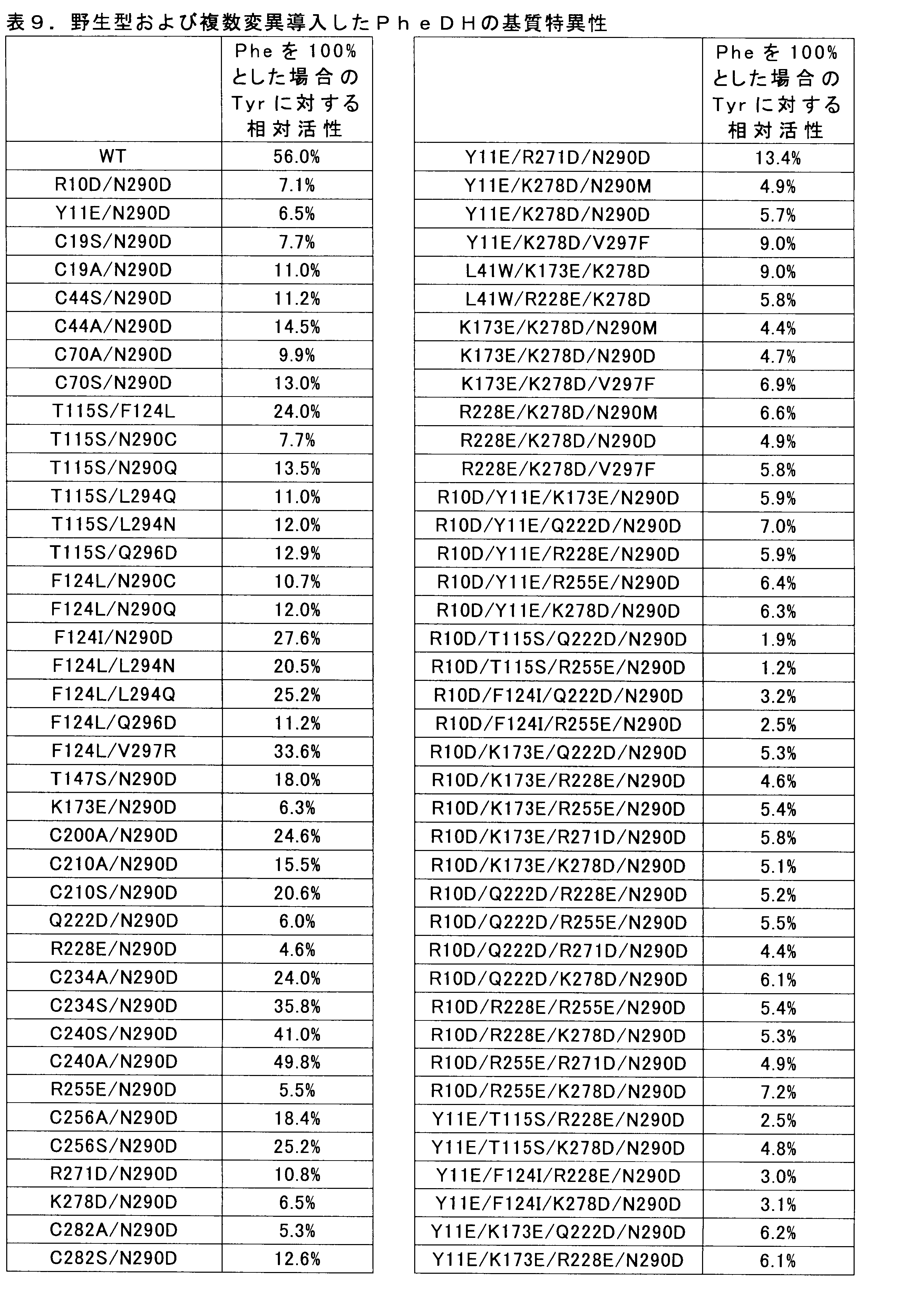
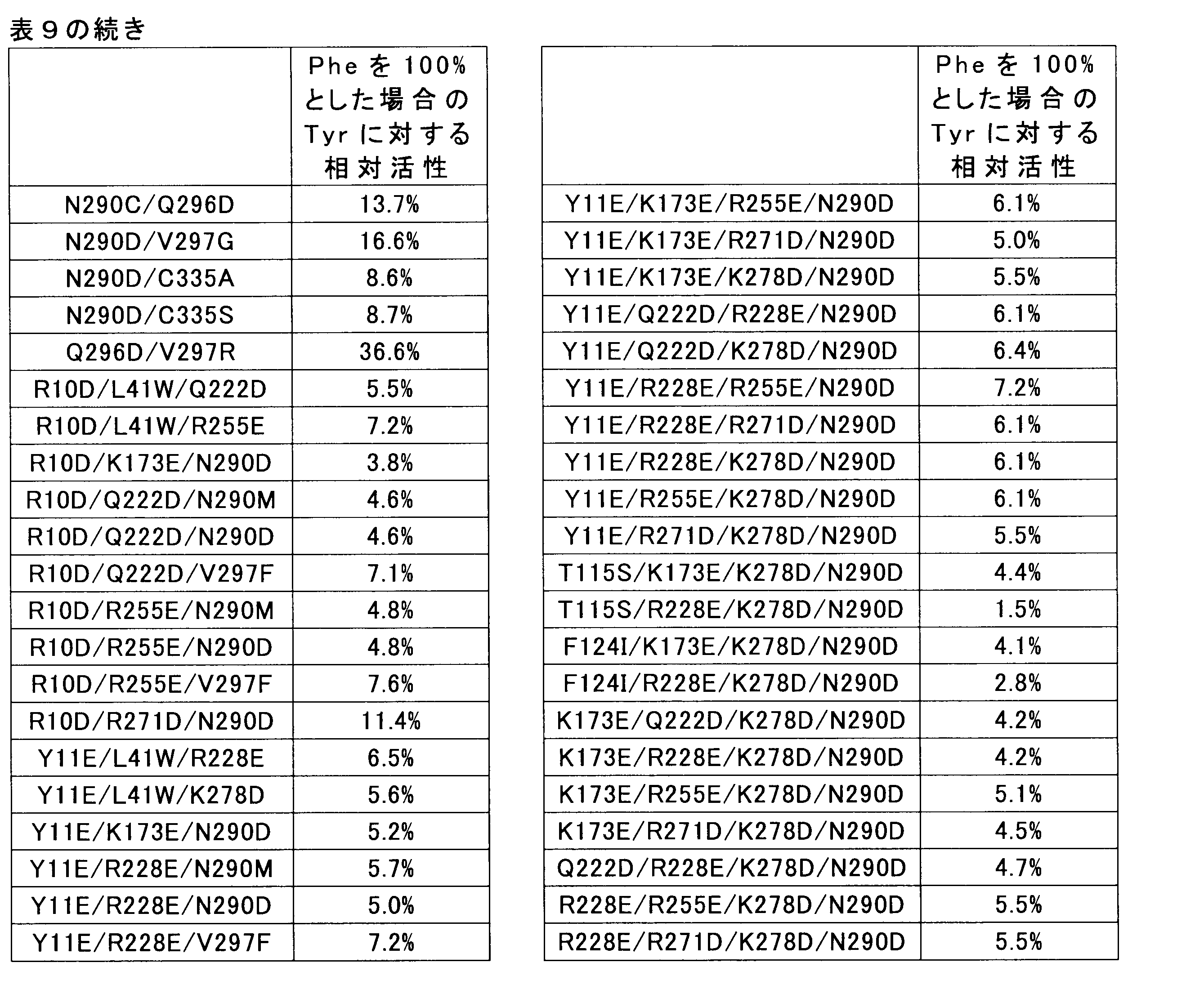
〔実施例5〕PheDHの溶解性の評価
実施例3で調製した各酵素の溶解性の評価は下記手順にて行った。ストック用バッファーに溶媒置換したPheDHが凝集するまで限外濾過により濃縮し、PheDH 30μLを1.5mL容量のチューブに入れ、18,500×gで60分間遠心し上清を回収した。回収した野生型および変異体の遠心後上清の濃度を溶解度とした。野生型PheDHの溶解度と比較した結果を表10および11に示す。
実施例3で調製した各酵素の溶解性の評価は下記手順にて行った。ストック用バッファーに溶媒置換したPheDHが凝集するまで限外濾過により濃縮し、PheDH 30μLを1.5mL容量のチューブに入れ、18,500×gで60分間遠心し上清を回収した。回収した野生型および変異体の遠心後上清の濃度を溶解度とした。野生型PheDHの溶解度と比較した結果を表10および11に示す。
表10の結果から、表10に示される変異の導入により、PheDHの溶解性が上昇していることが分かる。さらに、表11の結果から、表11に示される複数変異の導入により、PheDHの溶解性が上昇していることが分かる。

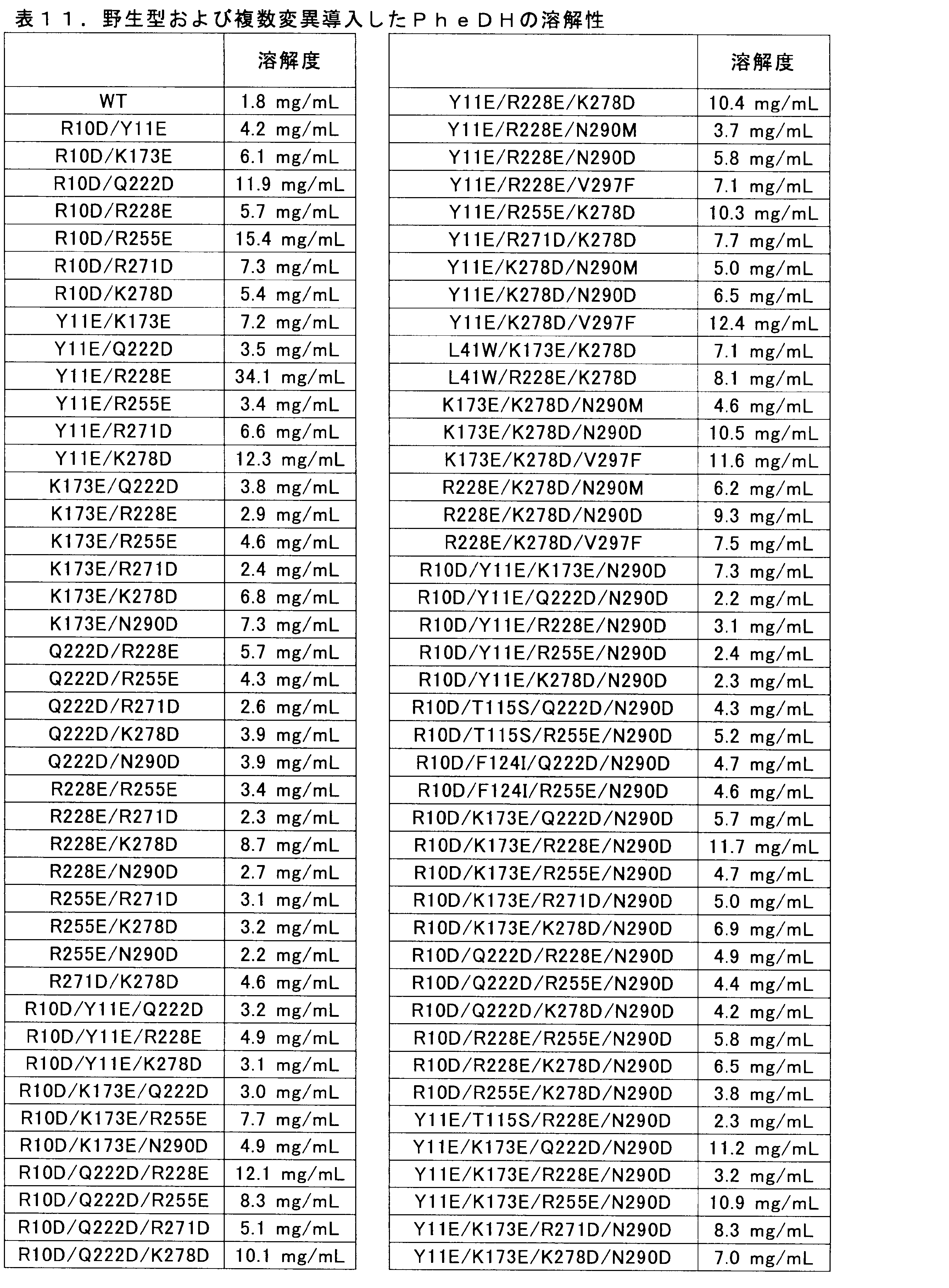
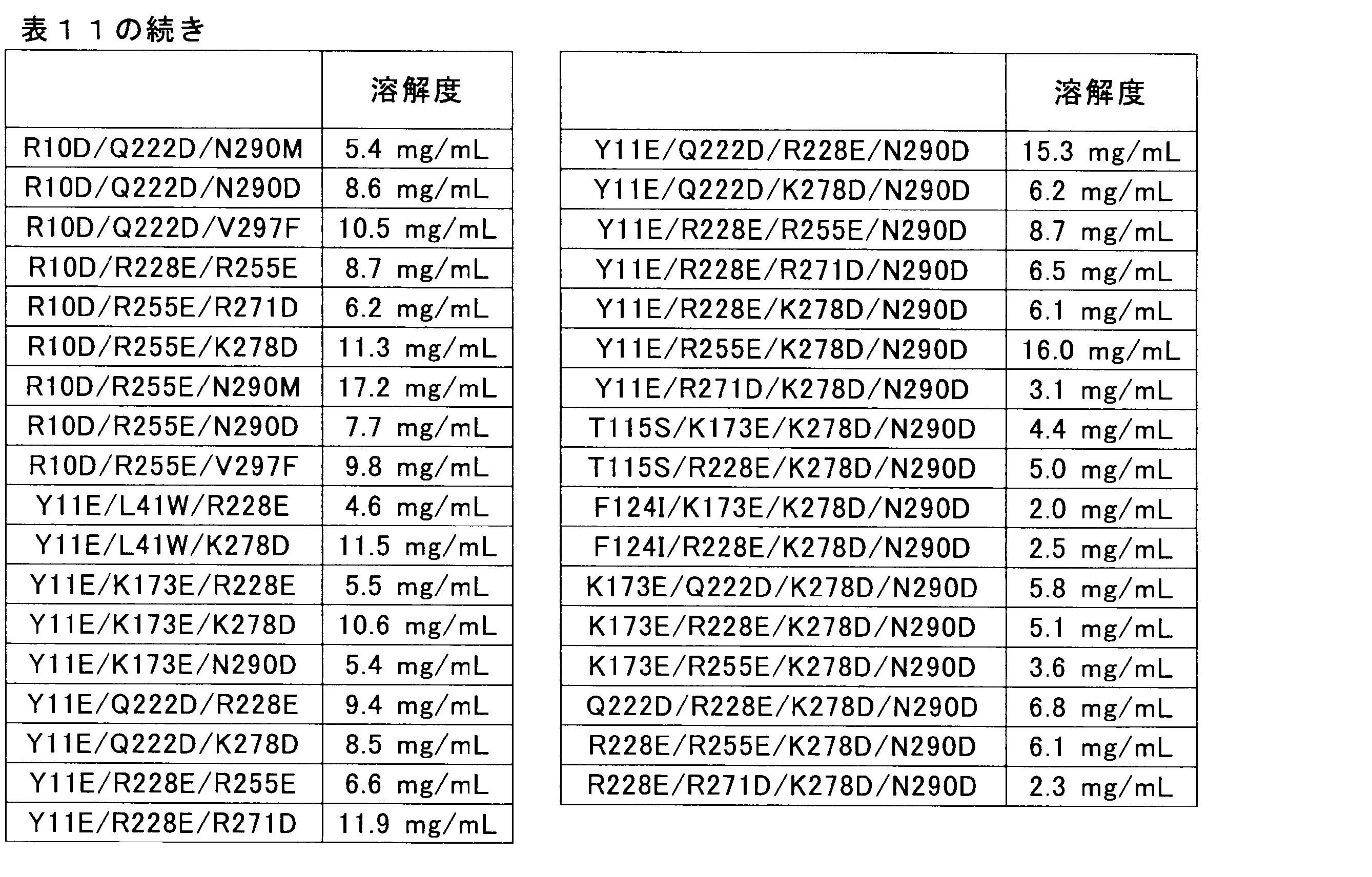
〔実施例6〕PheDHの酵素活性の評価
実施例3で調製した各酵素の活性の評価は下記手順にて行った。ストック用バッファーに溶媒置換したPheDHを0.1mg/mLとなるように調製し、20μLのPheDHに対して200mM Glycine-KCl-KOH、pH10.0を100μL、50mM NAD+(富士フイルム和光純薬社製)を4μL、10mM L-フェニルアラニン水溶液を20μL、超純水56μLを加えた溶液の波長340nmにおける吸光度の経時変化をマイクロプレートリーダー(SpectraMax M2e、モレキュラーデバイス社製)で5分間測定した。野生型PheDHの値をコントロールとして比較した相対活性を表12および13に示す。表12および13の結果は、同一サンプルについて2回実験を行った際の平均値より算出した。
実施例3で調製した各酵素の活性の評価は下記手順にて行った。ストック用バッファーに溶媒置換したPheDHを0.1mg/mLとなるように調製し、20μLのPheDHに対して200mM Glycine-KCl-KOH、pH10.0を100μL、50mM NAD+(富士フイルム和光純薬社製)を4μL、10mM L-フェニルアラニン水溶液を20μL、超純水56μLを加えた溶液の波長340nmにおける吸光度の経時変化をマイクロプレートリーダー(SpectraMax M2e、モレキュラーデバイス社製)で5分間測定した。野生型PheDHの値をコントロールとして比較した相対活性を表12および13に示す。表12および13の結果は、同一サンプルについて2回実験を行った際の平均値より算出した。
表12の結果から、表12に示される変異の導入により、PheDHのL-フェニルアラニンに対する反応性を向上できることが分かる。さらに、表13の結果から、表13に示される複数変異の導入により、PheDHのL-フェニルアラニンに対する反応性を向上できることが分かる。

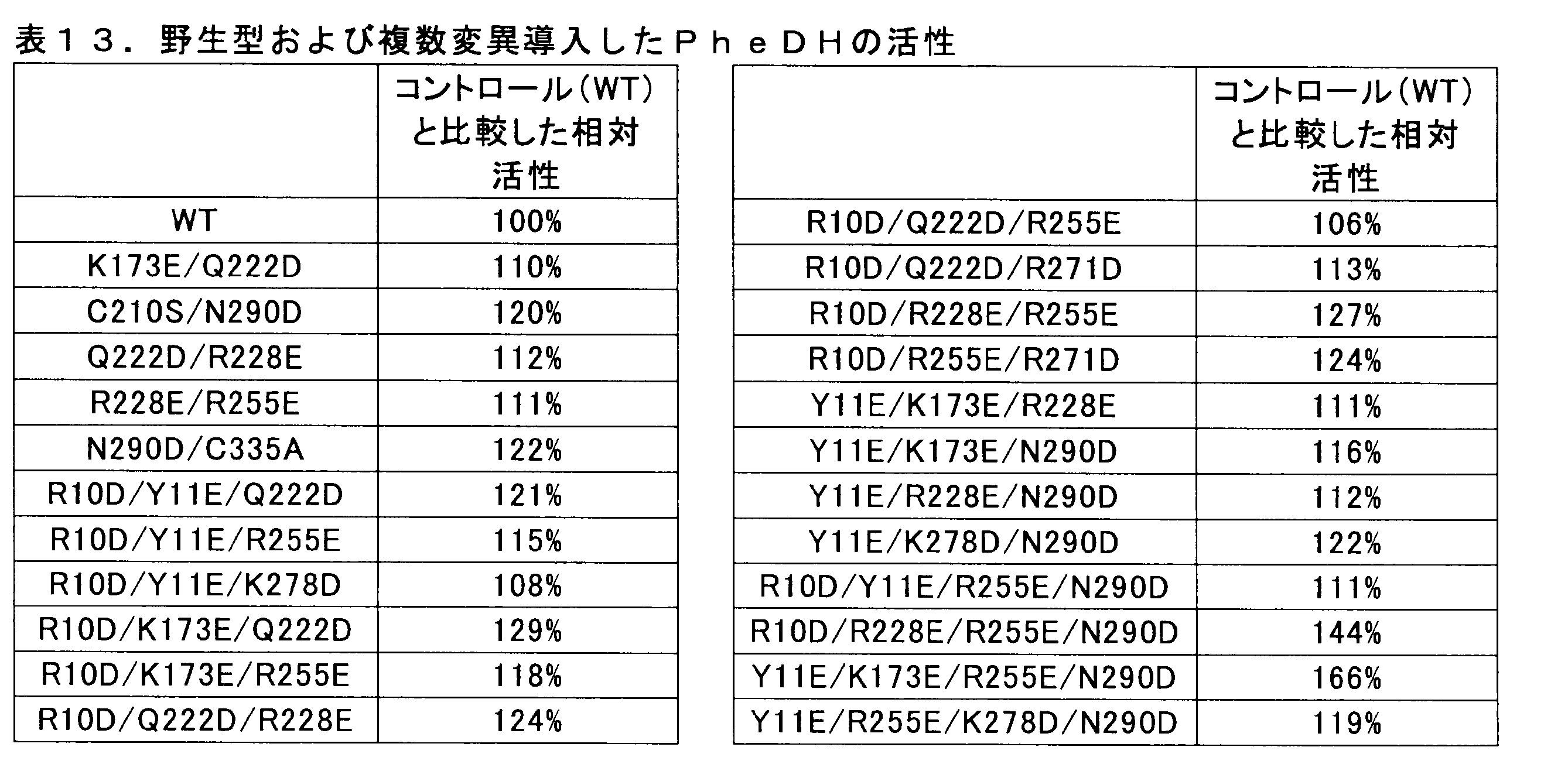
本発明の改変フェニルアラニン脱水素酵素は、フェニルアラニンの迅速、高精度、かつ高感度な測定、および/またはフェニルピルビン酸(phenylpyruvate)の製造に有用である。本発明の改変フェニルアラニン脱水素酵素はまた、液状試薬として有用である。本発明の改変フェニルアラニン脱水素酵素は、特に液状試薬として有用である。本発明の分析方法は、例えば、フェニルケトン尿症等の疾患の診断、および食品中のフェニルアラニン含量の測定に有用である。
配列番号1は、Thermoactinomyces intermediusフェニルアラニン脱水素酵素(PheDH)のアミノ酸配列を示す。
配列番号2は、Thermoactinomyces intermedius PheDHのアミノ酸配列(配列番号1)をコードするコドン最適化ヌクレオチド配列を示す。
配列番号3~6は、PheDH中の各モチーフのアミノ酸配列を示す。
配列番号7~9は、PheDH中のより短いアミノ酸配列で示される各モチーフのアミノ酸配列を示す。
配列番号10~12は、Thermoactinomyces intermedius PheDH中の各モチーフ近傍のアミノ酸配列を示す。
配列番号13~15は、PheDH中の各モチーフ近傍のコンセンサスアミノ酸配列(共通度の高いアミノ酸配列)を示す。
配列番号16、26、35、44、54、62、70、79、88、97、および106は、各生物種由来PheDHのアミノ酸配列を示す。
配列番号17~22、27~31、36~40、45~50、55~58、63~66、71~75、80~84、89~93、98~102、および107は、各生物種由来PheDH中の各モチーフに相当する保存領域のアミノ酸配列を示す。
配列番号23~25、32~34、41~43、51~53、59~61、67~69、76~78、85~87、94~96、103~105、および108~110は、各生物種由来PheDH中の各モチーフ近傍のアミノ酸配列を示す。
配列番号111は、His-tagがN末に付加されたThermoactinomyces intermedius PheDHのアミノ酸配列を示す。
配列番号112は、His-tagがN末に付加されたThermoactinomyces intermedius PheDHのアミノ酸配列(配列番号111)をコードするコドン最適化ヌクレオチド配列を示す。
配列番号113は、配列番号112のヌクレオチド配列からなるDNA断片を形成するために配列番号2のヌクレオチド配列の5’末端に付加したリンカーヌクレオチド配列(NdeIサイト+開始コドン+His-tagコード配列)を示す。
配列番号114は、配列番号112のヌクレオチド配列からなるDNA断片を形成するために配列番号2のヌクレオチド配列の3’末端に付加したリンカーヌクレオチド配列(停止コドン+BamHIサイト)を示す。
配列番号2は、Thermoactinomyces intermedius PheDHのアミノ酸配列(配列番号1)をコードするコドン最適化ヌクレオチド配列を示す。
配列番号3~6は、PheDH中の各モチーフのアミノ酸配列を示す。
配列番号7~9は、PheDH中のより短いアミノ酸配列で示される各モチーフのアミノ酸配列を示す。
配列番号10~12は、Thermoactinomyces intermedius PheDH中の各モチーフ近傍のアミノ酸配列を示す。
配列番号13~15は、PheDH中の各モチーフ近傍のコンセンサスアミノ酸配列(共通度の高いアミノ酸配列)を示す。
配列番号16、26、35、44、54、62、70、79、88、97、および106は、各生物種由来PheDHのアミノ酸配列を示す。
配列番号17~22、27~31、36~40、45~50、55~58、63~66、71~75、80~84、89~93、98~102、および107は、各生物種由来PheDH中の各モチーフに相当する保存領域のアミノ酸配列を示す。
配列番号23~25、32~34、41~43、51~53、59~61、67~69、76~78、85~87、94~96、103~105、および108~110は、各生物種由来PheDH中の各モチーフ近傍のアミノ酸配列を示す。
配列番号111は、His-tagがN末に付加されたThermoactinomyces intermedius PheDHのアミノ酸配列を示す。
配列番号112は、His-tagがN末に付加されたThermoactinomyces intermedius PheDHのアミノ酸配列(配列番号111)をコードするコドン最適化ヌクレオチド配列を示す。
配列番号113は、配列番号112のヌクレオチド配列からなるDNA断片を形成するために配列番号2のヌクレオチド配列の5’末端に付加したリンカーヌクレオチド配列(NdeIサイト+開始コドン+His-tagコード配列)を示す。
配列番号114は、配列番号112のヌクレオチド配列からなるDNA断片を形成するために配列番号2のヌクレオチド配列の3’末端に付加したリンカーヌクレオチド配列(停止コドン+BamHIサイト)を示す。
Claims (18)
- モチーフ(1)~(6)(Xは任意のアミノ酸を示す)からなる群より選ばれる少なくとも1つのモチーフを含むフェニルアラニン脱水素酵素において、モチーフ(1)~(6)からなる群より選ばれる少なくとも1つのモチーフ中の少なくとも1つのアミノ酸残基が変異しており、
フェニルアラニン脱水素酵素活性を有し、かつ
基質特異性、溶解性、およびフェニルアラニン脱水素酵素活性からなる群より選ばれる少なくとも1つの特性が、野生型フェニルアラニン脱水素酵素よりも高い、
改変フェニルアラニン脱水素酵素:
モチーフ(1):GPALGGXRM(配列番号3)モチーフ;
モチーフ(2):GRFXTGTDMGT(配列番号4)モチーフ;
モチーフ(3):DFモチーフ;
モチーフ(4):GXANN(配列番号5)モチーフ;
モチーフ(5):RHモチーフ;
モチーフ(6):VNXGGLIQV(配列番号6)モチーフ。 - 変異が、フェニルアラニン脱水素酵素のアミノ酸配列における、下記からなる群より選ばれる1以上の置換である、請求項1記載の改変フェニルアラニン脱水素酵素:
(a)GPALGGXRM(配列番号3)モチーフ中のロイシンの置換;
(b)GRFXTGTDMGT(配列番号4)モチーフ中の7番目のアミノ酸残基であるスレオニンの置換;
(c)DFモチーフ中のフェニルアラニンの置換;
(d)GXANN(配列番号5)モチーフ中の4番目のアミノ酸残基であるアスパラギンの置換;
(e)RHモチーフ中のアルギニンの置換;
(f)VNXGGLIQV(配列番号6)モチーフ中のアスパラギンの置換;
(g)VNXGGLIQV(配列番号6)モチーフ中のロイシンの置換;
(h)VNXGGLIQV(配列番号6)モチーフ中のグルタミンの置換;および
(i)VNXGGLIQV(配列番号6)モチーフ中の9番目のアミノ酸残基であるバリンの置換。 - 変異が、フェニルアラニン脱水素酵素のアミノ酸配列における、下記からなる群より選ばれる1以上の置換である、請求項2記載の改変フェニルアラニン脱水素酵素:
(a)GPALGGXRM(配列番号3)モチーフ中のロイシンのトリプトファン、フェニルアラニン、チロシン、またはメチオニンへの置換;
(b)GRFXTGTDMGT(配列番号4)モチーフ中の7番目のアミノ酸残基であるスレオニンのセリンへの置換;
(c)DFモチーフ中のフェニルアラニンのロイシンまたはイソロイシンへの置換;
(d)GXANN(配列番号5)モチーフ中の4番目のアミノ酸残基であるアスパラギンのグリシン、グルタミン、スレオニン、リジン、プロリン、またはセリンへの置換;
(e)RHモチーフ中のアルギニンのアスパラギン酸またはグルタミン酸への置換;
(f)VNXGGLIQV(配列番号6)モチーフ中のアスパラギンのバリン、アスパラギン酸、メチオニン、グルタミン、プロリン、イソロイシン、ヒスチジン、アラニン、スレオニン、グリシン、またはシステインへの置換;
(g)VNXGGLIQV(配列番号6)モチーフ中のロイシンのフェニルアラニン、グルタミン、ヒスチジン、アスパラギン、イソロイシン、アスパラギン酸、グリシン、グルタミン酸、スレオニン、またはセリンへの置換;
(h)VNXGGLIQV(配列番号6)モチーフ中のグルタミンのアスパラギン酸、グルタミン酸、リジン、アスパラギン、セリン、またはアルギニンへの置換;および
(i)VNXGGLIQV(配列番号6)モチーフ中の9番目のアミノ酸残基であるバリンのチロシン、トリプトファン、グルタミン酸、アスパラギン、スレオニン、イソロイシン、リジン、グリシン、セリン、ロイシン、メチオニン、グルタミン、フェニルアラニン、システイン、またはアルギニンへの置換。 - フェニルアラニン脱水素酵素は、モチーフ(1)~(6)の全てをこの順序で含む、請求項1~3のいずれか一項記載の改変フェニルアラニン脱水素酵素。
- フェニルアラニン脱水素酵素が、Thermoactinomyces属に由来する、請求項1~4のいずれか一項記載の改変フェニルアラニン脱水素酵素。
- フェニルアラニン脱水素酵素が、
(A)配列番号1で表されるアミノ酸配列、
(B)配列番号1で表されるアミノ酸配列において、1もしくは数個のアミノ酸残基の置換、欠失、挿入、もしくは付加を含むアミノ酸配列、または
(C)配列番号1で表されるアミノ酸配列に対して90%以上の同一性を有するアミノ酸配列
を含む、請求項1~5のいずれか一項記載の改変フェニルアラニン脱水素酵素。 - 下記:
(A)配列番号1で表されるアミノ酸配列、
(B)配列番号1で表されるアミノ酸配列において、1もしくは数個のアミノ酸残基の置換、欠失、挿入、もしくは付加を含むアミノ酸配列、または
(C)配列番号1で表されるアミノ酸配列に対して90%以上の同一性を有するアミノ酸配列
のいずれかのアミノ酸配列を含むフェニルアラニン脱水素酵素において、
下記:
R2、R10、Y11、C19、L41、G42、G43、C44、A50、S51、M66、C70、F77、K90、Y112、T115、D116、F124、R129、L137、K139、S140、K144、T147、K173、C200、C210、K216、K220、Q222、N227、R228、C234、C240、R255、C256、L257、N264、R271、Q277、K278、R279、S280、C282、N290、G293、L294、Q296、V297、R326、K328、N329、N331、C335、R340、K347、およびK348
より選ばれる1以上のアミノ酸残基に相当するアミノ酸残基の変異を含み、
フェニルアラニン脱水素酵素活性を有し、かつ、
基質特異性、溶解性、およびフェニルアラニン脱水素酵素活性からなる群より選ばれる1以上の特性が改善されている、
改変フェニルアラニン脱水素酵素。 - 下記より選ばれる1以上のアミノ酸残基に相当するアミノ酸残基の置換を含む、請求項7記載の改変フェニルアラニン脱水素酵素:
R2D、R2E、R10D、R10E、Y11E、Y11D、C19A、C19S、L41W、L41F、L41Y、L41M、G42A、G43A、C44A、C44S、A50D、A50E、S51D、S51E、M66I、M66L、M66V、C70A、C70S、F77L、F77I、F77R、K90E、Y112L、T115S、D116E、F124L、F124I、R129K、L137V、K139E、S140A、K144G、T147A、T147S、T147N、K173E、K173D、C200A、C200S、C210S、C210A、K216D、K216E、K220D、K220E、Q222E、Q222D、N227D、N227E、R228E、R228D、C234A、C234S、C240S、C240A、R255E、R255D、C256A、C256S、L257K、N264G、N264Q、N264T、N264K、N264P、N264S、R271D、R271E、Q277D、K278D、K278E、R279D、R279E、S280D、C282S、C282A、N290V、N290D、N290M、N290Q、N290P、N290I、N290H、N290A、N290T、N290G、N290C、G293A、L294F、L294Q、L294H、L294N、L294I、L294D、L294G、L294E、L294T、L294S、Q296D、Q296E、Q296K、Q296N、Q296S、Q296R、V297Y、V297W、V297E、V297N、V297T、V297I、V297K、V297G、V297S、V297L、V297M、V297Q、V297F、V297C、V297R、R326E、K328E、K328D、N329D、N331E、N331D、C335A、C335S、R340D、R340E、K347D、およびK348E。 - 請求項1~8のいずれか一項記載の改変フェニルアラニン脱水素酵素を用いて被検試料中に含まれるフェニルアラニンを測定することを含む、フェニルアラニンの分析方法。
- 被検試料をニコチンアミドアデニンジヌクレオチド(NAD+)と混合し、改変フェニルアラニン脱水素酵素の作用によりNAD+から生成したNADHを検出することを含む、請求項9記載の方法。
- 請求項1~8のいずれか一項記載の改変フェニルアラニン脱水素酵素を用いてフェニルアラニンからフェニルピルビン酸(phenylpyruvate)を生成することを含む、フェニルピルビン酸(phenylpyruvate)の製造方法。
- 請求項1~8のいずれか一項記載の改変フェニルアラニン脱水素酵素をコードするポリヌクレオチド。
- 請求項12記載のポリヌクレオチドを含む発現ベクター。
- 請求項1~8のいずれか一項記載の改変フェニルアラニン脱水素酵素をコードするポリヌクレオチドの発現単位を含む形質転換体。
- 基質特異性、溶解性、およびフェニルアラニン脱水素酵素活性からなる群より選ばれる1以上の特性を改善するようにその少なくとも1つのアミノ酸残基を変異させた改変フェニルアラニン脱水素酵素を、請求項14記載の形質転換体を用いて生成することを含む、改変フェニルアラニン脱水素酵素の製造方法。
- 請求項1~8のいずれか一項記載の改変フェニルアラニン脱水素酵素を含む、フェニルアラニン分析用キット。
- 反応用緩衝液または緩衝塩、およびニコチンアミドアデニンジヌクレオチド(NAD+)の少なくとも一つをさらに含む、請求項16記載のフェニルアラニン分析用キット。
- (a)検出用電極、および(b)検出用電極に固定または配置された、請求項1~8のいずれか一項記載の改変フェニルアラニン脱水素酵素を含む、フェニルアラニン分析用酵素センサー。
Priority Applications (3)
| Application Number | Priority Date | Filing Date | Title |
|---|---|---|---|
| JP2021551726A JP7707917B2 (ja) | 2019-10-11 | 2020-10-09 | 改変フェニルアラニン脱水素酵素 |
| US17/714,537 US20220235333A1 (en) | 2019-10-11 | 2022-04-06 | Modified Phenylalanine Dehydrogenase |
| JP2025065143A JP2025106504A (ja) | 2019-10-11 | 2025-04-10 | 改変フェニルアラニン脱水素酵素 |
Applications Claiming Priority (2)
| Application Number | Priority Date | Filing Date | Title |
|---|---|---|---|
| JP2019-187753 | 2019-10-11 | ||
| JP2019187753 | 2019-10-11 |
Related Child Applications (1)
| Application Number | Title | Priority Date | Filing Date |
|---|---|---|---|
| US17/714,537 Continuation US20220235333A1 (en) | 2019-10-11 | 2022-04-06 | Modified Phenylalanine Dehydrogenase |
Publications (1)
| Publication Number | Publication Date |
|---|---|
| WO2021070943A1 true WO2021070943A1 (ja) | 2021-04-15 |
Family
ID=75438195
Family Applications (1)
| Application Number | Title | Priority Date | Filing Date |
|---|---|---|---|
| PCT/JP2020/038341 Ceased WO2021070943A1 (ja) | 2019-10-11 | 2020-10-09 | 改変フェニルアラニン脱水素酵素 |
Country Status (3)
| Country | Link |
|---|---|
| US (1) | US20220235333A1 (ja) |
| JP (2) | JP7707917B2 (ja) |
| WO (1) | WO2021070943A1 (ja) |
Cited By (1)
| Publication number | Priority date | Publication date | Assignee | Title |
|---|---|---|---|---|
| CN118006576A (zh) * | 2024-03-27 | 2024-05-10 | 江南大学 | 胺脱氢酶突变体及非α-氨基酸的合成方法 |
Families Citing this family (2)
| Publication number | Priority date | Publication date | Assignee | Title |
|---|---|---|---|---|
| CN116286703B (zh) * | 2023-05-25 | 2023-08-08 | 鲁东大学 | L-丙氨酸脱氢酶突变体、工程菌及应用 |
| CN117844773B (zh) * | 2024-02-27 | 2024-11-15 | 江南大学 | 一种苯丙氨酸脱氢酶突变体及其在合成l-非天然氨基酸中的应用 |
Citations (4)
| Publication number | Priority date | Publication date | Assignee | Title |
|---|---|---|---|---|
| JPS6332482A (ja) * | 1986-07-24 | 1988-02-12 | Sagami Chem Res Center | L−フエニルアラニン脱水素酵素及びその製造法 |
| JPH07114713B2 (ja) * | 1987-03-06 | 1995-12-13 | ユニチカ株式会社 | フエニルアラニン又はフエニルピルビン酸定量用試薬 |
| WO2008029921A1 (en) * | 2006-09-08 | 2008-03-13 | Toyama Prefecture | Function-modified phenylalanine dehydrogenase, and method for analysis of amino acid in biological sample using the enzyme |
| CN108795893A (zh) * | 2018-06-27 | 2018-11-13 | 凯莱英医药集团(天津)股份有限公司 | 一种氨基酸脱氢酶突变体及其制备方法和应用 |
Family Cites Families (1)
| Publication number | Priority date | Publication date | Assignee | Title |
|---|---|---|---|---|
| WO2014062985A1 (en) * | 2012-10-17 | 2014-04-24 | University Of Maryland, Office Of Technology Commercialization | Device and methods of using device for detection of aminoacidopathies |
-
2020
- 2020-10-09 WO PCT/JP2020/038341 patent/WO2021070943A1/ja not_active Ceased
- 2020-10-09 JP JP2021551726A patent/JP7707917B2/ja active Active
-
2022
- 2022-04-06 US US17/714,537 patent/US20220235333A1/en active Pending
-
2025
- 2025-04-10 JP JP2025065143A patent/JP2025106504A/ja active Pending
Patent Citations (4)
| Publication number | Priority date | Publication date | Assignee | Title |
|---|---|---|---|---|
| JPS6332482A (ja) * | 1986-07-24 | 1988-02-12 | Sagami Chem Res Center | L−フエニルアラニン脱水素酵素及びその製造法 |
| JPH07114713B2 (ja) * | 1987-03-06 | 1995-12-13 | ユニチカ株式会社 | フエニルアラニン又はフエニルピルビン酸定量用試薬 |
| WO2008029921A1 (en) * | 2006-09-08 | 2008-03-13 | Toyama Prefecture | Function-modified phenylalanine dehydrogenase, and method for analysis of amino acid in biological sample using the enzyme |
| CN108795893A (zh) * | 2018-06-27 | 2018-11-13 | 凯莱英医药集团(天津)股份有限公司 | 一种氨基酸脱氢酶突变体及其制备方法和应用 |
Cited By (1)
| Publication number | Priority date | Publication date | Assignee | Title |
|---|---|---|---|---|
| CN118006576A (zh) * | 2024-03-27 | 2024-05-10 | 江南大学 | 胺脱氢酶突变体及非α-氨基酸的合成方法 |
Also Published As
| Publication number | Publication date |
|---|---|
| US20220235333A1 (en) | 2022-07-28 |
| JPWO2021070943A1 (ja) | 2021-04-15 |
| JP2025106504A (ja) | 2025-07-15 |
| JP7707917B2 (ja) | 2025-07-15 |
Similar Documents
| Publication | Publication Date | Title |
|---|---|---|
| JP6119738B2 (ja) | 改変ロイシン脱水素酵素 | |
| US12146174B2 (en) | Mutated histidine decarboxylase and use thereof | |
| JP2025106504A (ja) | 改変フェニルアラニン脱水素酵素 | |
| JP5212996B2 (ja) | 生体試料中のl−トリプトファン分析方法およびそれに用いるキット | |
| US20230203456A1 (en) | L-glutamate oxidase mutant | |
| JP6350519B2 (ja) | 改変グリシン酸化酵素 | |
| US10961560B2 (en) | Tryptophan oxidase and use thereof |
Legal Events
| Date | Code | Title | Description |
|---|---|---|---|
| 121 | Ep: the epo has been informed by wipo that ep was designated in this application |
Ref document number: 20874403 Country of ref document: EP Kind code of ref document: A1 |
|
| ENP | Entry into the national phase |
Ref document number: 2021551726 Country of ref document: JP Kind code of ref document: A |
|
| NENP | Non-entry into the national phase |
Ref country code: DE |
|
| 122 | Ep: pct application non-entry in european phase |
Ref document number: 20874403 Country of ref document: EP Kind code of ref document: A1 |