WO2021059329A1 - 情報収集装置、情報収集方法、及びプログラム - Google Patents
情報収集装置、情報収集方法、及びプログラム Download PDFInfo
- Publication number
- WO2021059329A1 WO2021059329A1 PCT/JP2019/037283 JP2019037283W WO2021059329A1 WO 2021059329 A1 WO2021059329 A1 WO 2021059329A1 JP 2019037283 W JP2019037283 W JP 2019037283W WO 2021059329 A1 WO2021059329 A1 WO 2021059329A1
- Authority
- WO
- WIPO (PCT)
- Prior art keywords
- information
- image
- character string
- web content
- question
- Prior art date
- Legal status (The legal status is an assumption and is not a legal conclusion. Google has not performed a legal analysis and makes no representation as to the accuracy of the status listed.)
- Ceased
Links
Images


Classifications
-
- G—PHYSICS
- G06—COMPUTING OR CALCULATING; COUNTING
- G06F—ELECTRIC DIGITAL DATA PROCESSING
- G06F21/00—Security arrangements for protecting computers, components thereof, programs or data against unauthorised activity
- G06F21/60—Protecting data
- G06F21/62—Protecting access to data via a platform, e.g. using keys or access control rules
- G06F21/6218—Protecting access to data via a platform, e.g. using keys or access control rules to a system of files or objects, e.g. local or distributed file system or database
-
- G—PHYSICS
- G06—COMPUTING OR CALCULATING; COUNTING
- G06F—ELECTRIC DIGITAL DATA PROCESSING
- G06F16/00—Information retrieval; Database structures therefor; File system structures therefor
- G06F16/90—Details of database functions independent of the retrieved data types
- G06F16/95—Retrieval from the web
- G06F16/955—Retrieval from the web using information identifiers, e.g. uniform resource locators [URL]
-
- G—PHYSICS
- G06—COMPUTING OR CALCULATING; COUNTING
- G06F—ELECTRIC DIGITAL DATA PROCESSING
- G06F21/00—Security arrangements for protecting computers, components thereof, programs or data against unauthorised activity
- G06F21/30—Authentication, i.e. establishing the identity or authorisation of security principals
-
- G—PHYSICS
- G06—COMPUTING OR CALCULATING; COUNTING
- G06F—ELECTRIC DIGITAL DATA PROCESSING
- G06F2221/00—Indexing scheme relating to security arrangements for protecting computers, components thereof, programs or data against unauthorised activity
- G06F2221/21—Indexing scheme relating to G06F21/00 and subgroups addressing additional information or applications relating to security arrangements for protecting computers, components thereof, programs or data against unauthorised activity
- G06F2221/2133—Verifying human interaction, e.g., Captcha
Definitions
- the present invention relates to an information collecting device, an information collecting method, and a program for collecting web content information.
- An authentication method is used to confirm that the viewer of the website is a human being, for the purpose of suppressing the increase in server load due to machine collection.
- CAPTCHA Completely Automated Public Turing test to tell Computers and Humans Apart
- Patent Documents 1 and 2 disclose an apparatus for performing such an inverted Turing test.
- the correct character string is estimated by the recognition process based on the visual characteristics of the character such as OCR (Optical Character Recognition / Reader). Can be done.
- OCR Optical Character Recognition / Reader
- An object of the present invention is to provide an information collecting device, an information collecting method, and a program capable of efficiently collecting accessible web contents according to an answer of a correct character string.
- the information collecting device uses the web address information to access the second web content from the collecting unit that collects the first web content and the first web content.
- the extraction unit that extracts the image information and two or more discrimination models for discriminating the character string from the image are associated with the above web address information.
- a discrimination unit that discriminates the correct character string from the question image information using the discrimination model is provided, and each of the two or more discrimination models has a plurality of candidates according to an image generation rule including a process of adding a background image. This is a trained model that is machine-learned using a plurality of candidate question images generated from correct character strings as training data.
- the information collection method uses the web address information to collect the first web content and to access the second web content from the first web content.
- Discrimination model associated with the above web address information from two or more discrimination models for extracting the question image information with the image effect applied to the correct character string for the purpose and discriminating the character string from the image.
- the correct answer character string is discriminated from the question image information by using, and each of the two or more discriminant models has a plurality of candidate correct answer character strings according to an image generation rule including a process of adding a background image.
- This is a trained model that is machine-learned using a plurality of candidate question images generated from the data as training data.
- the program uses the web address information to collect the first web content and to access the second web content from the first web content.
- the discrimination model associated with the above web address information from two or more discrimination models for extracting the question image information with the image effect applied to the correct character string and discriminating the character string from the image.
- the computer is made to discriminate the correct answer character string from the question image information, and each of the two or more discriminant models has a plurality of candidate correct answer characters according to an image generation rule including a process of adding a background image.
- This is a trained model that is machine-trained using a plurality of candidate question images generated from columns as training data.
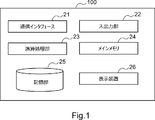
- FIG. 1 is a block diagram showing an example of a hardware configuration of the information collecting device 100 according to the first embodiment.
- FIG. 2 is a block diagram showing an example of a configuration realized by the information collecting device 100.
- FIG. 3 is a diagram showing a specific example of the type of image generation rule.
- FIG. 4 is a diagram schematically showing a process for generating a discrimination model.
- FIG. 5 is a diagram showing a specific example of information stored by the discrimination model storage unit 121.
- FIG. 6 is a block diagram showing an example of a schematic configuration of the information collecting device 100 according to the second embodiment.
- the correct character string can be estimated by recognition processing based on the visual characteristics of the character, for example, OCR (Optical Character Recognition / Reader).
- the first web content is collected using the web address information, and the correct character for accessing the second web content from the first web content is described. It is used to generate the question image information according to the web address information from two or more image generation rules including the process of extracting the question image information with the image effect applied to the column and adding the background image.
- the correct character is estimated from the question image information by estimating the first image generation rule and using a discrimination model based on a plurality of candidate question images generated from a plurality of candidate correct answer character strings according to the first image generation rule. Determine the column.
- FIG. 1 is a block diagram showing an example of a hardware configuration of the information collecting device 100 according to the first embodiment.
- the information collecting device 100 includes a communication interface 21, an input / output unit 22, an arithmetic processing unit 23, a main memory 24, and a storage unit 25.
- the communication interface 21 transmits / receives data to / from an external device.
- the communication interface 21 communicates with an external device via a wired communication path.
- the arithmetic processing unit 23 is, for example, a CPU (Central Processing Unit), a GPU (Graphics Processing Unit), or the like.
- the main memory 24 is, for example, a RAM (Random Access Memory), a ROM (Read Only Memory), or the like.
- the storage unit 25 is, for example, an HDD (Hard Disk Drive), an SSD (Solid State Drive), a memory card, or the like. Further, the storage unit 25 may be a memory such as a RAM or a ROM.
- the transfer control program stored in the storage unit 25 is read into the main memory 24 and executed by the arithmetic processing unit 23 to realize the functional unit as shown in FIG.
- These programs may be read onto the main memory 24 and then executed, or may be executed without being read onto the main memory 24.
- the main memory 24 and the storage unit 25 also play a role of storing information and data held by the components included in the information collecting device 100.
- Non-temporary computer-readable media include various types of tangible storage media.
- Examples of non-temporary computer-readable media include magnetic recording media (eg, flexible disks, magnetic tapes, hard disk drives), opto-magnetic recording media (eg, opto-magnetic discs), CD-ROMs (Compact Disc-ROMs), CDs. -R (CD-Recordable), CD-R / W (CD-ReWritable), semiconductor memory (for example, mask ROM, PROM (Programmable ROM), EPROM (Erasable PROM), flash ROM, RAM.
- the program also includes.
- the computer-readable medium can supply the program to the computer via a wired communication path such as an electric wire and an optical fiber, or a wireless communication path.
- the display device 26 is a device that displays a screen corresponding to drawing data processed by the arithmetic processing unit 23, such as an LCD (Liquid Crystal Display), a CRT (Cathode Ray Tube) display, and a monitor.
- LCD Liquid Crystal Display
- CRT Cathode Ray Tube
- FIG. 2 is a block diagram showing an example of a configuration realized by the information collecting device 100.
- the information collecting device 100 includes a collection destination URL input unit 101 and a collection destination URL storage unit 103. Further, the information collecting device 100 includes a collecting unit 111, an extracting unit 113, a discriminating unit 115, and a response processing unit 117. Further, the information collecting device 100 includes a discrimination model storage unit 121, a machine learning unit 123, and a question image feature storage unit 125. The specific operation or processing of each of these functional parts will be described later.
- the information collecting device 100 collects the first web content by using the web address information.
- the information collecting device 100 extracts the question image information in which the image effect is applied to the correct character string for accessing the second web content from the first web content.
- the information collecting device 100 uses the discriminant model associated with the web address information from among two or more discriminant models for discriminating the character string from the image, and uses the discriminant model associated with the web address information to obtain the question image.
- the correct answer character string is determined from the information.
- each of the above two or more discrimination models is machine-learned using a plurality of candidate question images generated from a plurality of candidate correct answer character strings according to an image generation rule including a process of adding a background image as learning data. It is a finished model.
- the collection of the first web content is performed, for example, as follows.
- the user or the management system inputs a set of URLs indicating the location of the content to be collected by using the collection destination URL input unit 101.
- the set of URLs is stored in the collection destination URL storage unit 103.
- the collection destination URL input unit 101 may be a keyboard, an external storage device, or an external network connected to the information collection device 100.
- the collection unit 111 reads out one URL from the set of URLs stored in the collection destination URL storage unit 103 as the above web address information. Then, the collecting unit 111 accesses the Internet, acquires the web content indicated by the web address information (the first web content), and then connects the URL (the web address information) and the first web content. The pair is stored in the web content storage unit 131.
- the collecting unit 111 is configured to extract the URL included in the first web content and re-enter the extracted URL.
- the collection unit 111 may use an access assist function such as a proxy necessary for accessing the hidden overlay network in consideration of the case where the extracted URL is, for example, an underground site.
- the extraction unit 113 extracts the question image information from the first web content by using the information stored in the question image feature storage unit 125.
- the question image feature storage unit 125 stores, for example, a regular expression for extracting the question image from the content accessible by each URL stored in the collection destination URL storage unit 103.
- the extraction unit 113 is a pair of the web address information and the first web content collected by the collection unit 111, a URL stored in the question image feature storage unit 125, and a regular expression for extracting the question image. Match pairs of. Then, the extraction unit 113 can extract the question image information from the first web content according to the collation result.
- FIG. 3 is a diagram showing a specific example of a type of image generation rule. For example, image generation rules are divided into four types as shown in FIG.
- the question image 31 generated according to the first type of image generation rule has a feature that, for example, the background and the color tone of the characters are similar and the characters are distorted.
- the question image 32 generated according to the second type of image generation rule has a feature that, for example, the characters included in the background figure are the answer targets and the characters are distorted.
- the question images 33a and 33b generated according to the third type of image generation rule have a feature that, for example, the arrangement of characters is dispersed and the characters are embedded in the background image.
- the question image 34 generated according to the fourth type of image generation rule has a feature that, for example, the background and the color tone of the characters are similar, and the arrangement of the characters is dispersed.
- the question image 35 generated according to the fifth type of image generation rule has a feature that, for example, the background and the color tone of the characters are similar, and the arrangement of the characters is dispersed.
- Such first to fifth types of image generation rules can be regarded as, for example, CAPTCHA (Completely Automated Public Turing test to tell Computers and Humans Apart) questioning rules.
- each of the first to fifth types of image generation rules sets the character type included in the character string, sets the number of characters included in the character string, and provides information on the typeface for displaying the character string. Includes setting and setting information about the background image. With such a plurality of settings, it is possible to generate question image information having the above-mentioned characteristics from the correct answer character string.
- each of the above two or more discrimination models is generated by, for example, the machine learning unit 123 as shown below.
- FIG. 4 is a diagram schematically showing a process for generating a discrimination model.
- step S401 the machine learning unit 123 has an image generation rule and an image generation rule associated with one web address (hereinafter, also referred to as a target web address) stored in the collection destination URL storage unit 103.
- the image generation library code pair is acquired and the process proceeds to step S403.
- the machine learning unit 123 may acquire a pair of the image generation rule and the image generation library code associated with the target web address by accessing the question image feature storage unit 125.
- the question image feature storage unit 125 stores the image generation rule and the image generation library code pair in association with each web address stored in the collection destination URL storage unit 103. Such an association is made by, for example, a user operation.
- step S403 the machine learning unit 123 generates a learning sample by repeatedly executing the image generation library code acquired in step S401.
- step S403 the machine learning unit 123 sets the character type and the number of characters that the candidate correct answer character string can take according to the image generation rule associated with the target web address, and sets the candidate correct answer character string according to the set conditions. Generate at random. As an example, alphanumeric characters are set as the character type, and 6 to 8 are set as the number of characters.
- the machine learning unit 123 has information on the typeface for displaying the character string (font, character thickness, character color, etc.) and information on the background image (pattern, pattern thickness, pattern, etc.) according to the image generation rule. (Color, etc.) is set, and candidate question images corresponding to each candidate correct answer character string are generated according to the set conditions.
- the machine learning unit 123 generates a discrimination model using the learning sample (a plurality of correct character strings and a plurality of candidate question images) generated in step S403 as learning data, and proceeds to step S407.
- the discriminant model is obtained by an arbitrary machine learning algorithm.
- the machine learning algorithm may be a support vector machine or deep learning.
- the discrimination model includes, for example, an evaluation function for evaluating the correlation between image information (luminance information and color difference information of each pixel) composed of an arbitrary number of pixels and a candidate correct answer character string. Based on the evaluation result using such an evaluation function, the correct character string can be determined from the image.
- step S407 the machine learning unit 123 determines whether or not the discrimination accuracy of the discrimination model is equal to or higher than the threshold value, and if it is equal to or higher than the threshold value, the process proceeds to step S409 (S407: Yes), and if it is less than the threshold value (S407: No) Returning to step S403, step S403 and step S405 are repeated.
- step S409 the machine learning unit 123 stores the discrimination model generated in step S405 in the discrimination model storage unit 121 in association with the target web address, and proceeds to step S411.
- FIG. 5 is a diagram showing a specific example of information stored by the discrimination model storage unit 121.
- the discriminant model storage unit 121 has a data table 500 in which web address information is associated with each of the two or more discriminant models.
- step S411 the machine learning unit 123 determines whether or not all the discrimination models corresponding to all the web addresses stored in the collection destination URL storage unit 103 have been generated, and all the discrimination models are generated. In the case (S411: Yes), the process shown in FIG. 4 is terminated, and in the case (S411: No), the process returns to step S401 and the processes of steps S401 to S409 are repeated.
- the machine learning unit 123 can generate a discrimination model.
- the discrimination unit 115 identifies the discrimination model associated with the web address information with reference to the discrimination model storage unit 121, and uses the identified discrimination model. , The correct character string is determined from the question image information. For example, referring to the data table 500 shown in FIG. 5, when the web address information is the web address URL1, the discrimination unit 115 uses the discrimination model 1 associated with the web address URL 1 to obtain the above question image information from the question image information. The correct character string can be determined.
- Answer processing The answer processing unit 117 answers the question image information using the correct answer character string determined as described above. In this case, the collecting unit 111 further collects the second web content in response to the above answer.
- the collecting unit 111 transmits the answer information to the server device indicated by the web address information via the Internet 200. Then, the collection unit 111 transmits the login success information as a response from the server device.
- the login success information is, for example, the Set-Cookie header.
- the login success information is not limited to the Set-Cookie header, and may be a Cookie header of another method such as the Set-Cookie2 header. After that, the collecting unit 111 collects the second web content and stores it in the web content storage unit 131 by using the login success information.
- the web content output unit 133 outputs information regarding the second content, for example, in response to a request from the user.
- the information regarding the second content is displayed on the display device 26 included in the information collecting device 100.
- the user can efficiently browse the information related to the second content without, for example, decoding the question image information and answering the correct answer character string.
- the above-mentioned second content includes the exchange information on the underground site
- the user can efficiently collect the exchange information only by accessing the information collection device 100, which can be used as a security measure. It can be used for security measures.
- Second embodiment >> Subsequently, a second embodiment of the present invention will be described with reference to FIG.
- the first embodiment described above is a specific embodiment, but the second embodiment is a more generalized embodiment.
- FIG. 6 is a block diagram showing an example of a schematic configuration of the information collecting device 100 according to the second embodiment.
- the information collecting device 100 includes a collecting unit 150, an extracting unit 160, and a discriminating unit 170.
- the collecting unit 150, the extracting unit 160, and the discriminating unit 170 may be implemented by one or more processors, a memory (for example, a non-volatile memory and / or a volatile memory), and / or a hard disk.
- the collection unit 150, the extraction unit 160, and the discrimination unit 170 may be implemented by the same processor, or may be separately implemented by different processors.
- the memory may be contained in the one or more processors, or may be outside the one or more processors.
- the information collecting device 100 collects the first web content by using the web address information.
- the information collecting device 100 extracts the question image information in which the image effect is applied to the correct character string for accessing the second web content from the first web content.
- the information collecting device 100 uses the discriminant model associated with the web address information from among two or more discriminant models for discriminating the character string from the image, and uses the discriminant model associated with the web address information to obtain the question image.
- the correct answer character string is determined from the information.
- each of the above two or more discrimination models is machine-learned using a plurality of candidate question images generated from a plurality of candidate correct answer character strings according to an image generation rule including a process of adding a background image as learning data. It is a finished model.
- the collection unit 150, the extraction unit 160, and the discrimination unit 170 of the second embodiment have the collection unit 111, the extraction unit 113, and the determination unit 170 of the first embodiment, respectively.
- the operation of the unit 115 may be performed. In this case, the description of the first embodiment may also be applied to the second embodiment.
- the second embodiment is not limited to this example.
- the second embodiment has been described above. According to the second embodiment, for example, it becomes possible to efficiently collect the web contents that can be accessed according to the answer of the correct answer character string.
- the steps in the processing described herein do not necessarily have to be performed in chronological order in the order described in the sequence diagram.
- the steps in the process may be executed in an order different from the order described in the sequence diagram, or may be executed in parallel.
- some of the steps in the process may be deleted, and additional steps may be added to the process.
- the devices for example, a plurality of devices (or units) constituting the information collecting device
- the components of the information collecting device described in the present specification for example, a collecting unit, an extracting unit, and / or a discriminating unit.
- One or more devices (or units), or modules for one of the plurality of devices (or units) described above) may be provided.
- a method including the processing of the above-mentioned component may be provided, and a program for causing the processor to execute the processing of the above-mentioned component may be provided.
- a non-transitory computer readable medium may be provided that can be read by the computer on which the program is recorded.
- such devices, modules, methods, programs, and computer-readable non-temporary recording media are also included in the present invention.
- a collection department that collects the first web content using web address information
- An extraction unit that extracts question image information in which an image effect is applied to a correct character string for accessing the second web content from the first web content
- an extraction unit that discriminates the correct character string from the question image information by using the discriminant model associated with the web address information from two or more discriminant models for discriminating the character string from the image.
- Each of the two or more discrimination models is a trained model machine-learned using a plurality of candidate question images generated from a plurality of candidate correct answer character strings according to an image generation rule including a process of adding a background image as learning data.
- Appendix 2 The information collecting device according to Appendix 1, wherein the image generation rule further includes setting a character type included in a character string.
- Appendix 3 The information collecting device according to Appendix 1 or 2, wherein the image generation rule further includes setting the number of characters included in the character string.
- each of the two or more image generation rules further includes setting information about a typeface for displaying a character string.
- the discriminant unit refers to a data table in which web address information is associated with each of the two or more discriminant models, and identifies the discriminant model associated with the web address information.
- the information collecting device according to item 1.
- an answer processing unit for answering the question image information using the determined correct answer character string is provided.
- the information collecting device according to any one of Supplementary note 1 to 6, wherein the collecting unit further collects the second web content in response to the answer.
- Appendix 8 The information collecting device according to Appendix 7, further comprising a web content output unit that outputs information related to the second web content in response to a request from a user.
- Collection destination URL input unit 103 Collection destination URL storage unit 111, 150 Collection unit 113, 160 Extraction unit 115, 170 Discrimination unit 117 Answer processing unit 121 Discrimination model storage unit 123 Machine learning unit 125 Question image feature storage unit 131 Web content storage unit 133 Web content output unit 200 Internet
Landscapes
- Engineering & Computer Science (AREA)
- Theoretical Computer Science (AREA)
- Databases & Information Systems (AREA)
- Physics & Mathematics (AREA)
- General Engineering & Computer Science (AREA)
- General Physics & Mathematics (AREA)
- Computer Security & Cryptography (AREA)
- Software Systems (AREA)
- Computer Hardware Design (AREA)
- Data Mining & Analysis (AREA)
- Health & Medical Sciences (AREA)
- Bioethics (AREA)
- General Health & Medical Sciences (AREA)
- Information Retrieval, Db Structures And Fs Structures Therefor (AREA)
- Image Analysis (AREA)
- Character Discrimination (AREA)
Priority Applications (3)
| Application Number | Priority Date | Filing Date | Title |
|---|---|---|---|
| PCT/JP2019/037283 WO2021059329A1 (ja) | 2019-09-24 | 2019-09-24 | 情報収集装置、情報収集方法、及びプログラム |
| US17/640,478 US20220350909A1 (en) | 2019-09-24 | 2019-09-24 | Information collection apparatus, information collecting method, and program |
| JP2021548001A JP7342961B2 (ja) | 2019-09-24 | 2019-09-24 | 情報収集装置、情報収集方法、及びプログラム |
Applications Claiming Priority (1)
| Application Number | Priority Date | Filing Date | Title |
|---|---|---|---|
| PCT/JP2019/037283 WO2021059329A1 (ja) | 2019-09-24 | 2019-09-24 | 情報収集装置、情報収集方法、及びプログラム |
Publications (1)
| Publication Number | Publication Date |
|---|---|
| WO2021059329A1 true WO2021059329A1 (ja) | 2021-04-01 |
Family
ID=75165154
Family Applications (1)
| Application Number | Title | Priority Date | Filing Date |
|---|---|---|---|
| PCT/JP2019/037283 Ceased WO2021059329A1 (ja) | 2019-09-24 | 2019-09-24 | 情報収集装置、情報収集方法、及びプログラム |
Country Status (3)
| Country | Link |
|---|---|
| US (1) | US20220350909A1 (https=) |
| JP (1) | JP7342961B2 (https=) |
| WO (1) | WO2021059329A1 (https=) |
Families Citing this family (1)
| Publication number | Priority date | Publication date | Assignee | Title |
|---|---|---|---|---|
| US12470556B2 (en) * | 2023-03-22 | 2025-11-11 | Microsoft Technology Licensing, Llc | Generating captchas using generative imaging models |
Family Cites Families (8)
| Publication number | Priority date | Publication date | Assignee | Title |
|---|---|---|---|---|
| US7624277B1 (en) * | 2003-02-25 | 2009-11-24 | Microsoft Corporation | Content alteration for prevention of unauthorized scripts |
| US8631503B2 (en) * | 2007-10-03 | 2014-01-14 | Ebay Inc. | System and methods for key challenge validation |
| US8245277B2 (en) * | 2008-10-15 | 2012-08-14 | Towson University | Universally usable human-interaction proof |
| JP2015069256A (ja) * | 2013-09-27 | 2015-04-13 | 株式会社日立製作所 | 文字識別システム |
| CN106157344B (zh) * | 2015-04-23 | 2020-11-10 | 深圳市腾讯计算机系统有限公司 | 验证图片的生成方法及装置 |
| JP2017211689A (ja) * | 2016-05-23 | 2017-11-30 | 株式会社ツクタ技研 | 分類モデル装置、分類モデル学習方法、および分類モデル学習プログラム |
| US10841323B2 (en) * | 2018-05-17 | 2020-11-17 | Adobe Inc. | Detecting robotic internet activity across domains utilizing one-class and domain adaptation machine-learning models |
| US10496809B1 (en) * | 2019-07-09 | 2019-12-03 | Capital One Services, Llc | Generating a challenge-response for authentication using relations among objects |
-
2019
- 2019-09-24 WO PCT/JP2019/037283 patent/WO2021059329A1/ja not_active Ceased
- 2019-09-24 US US17/640,478 patent/US20220350909A1/en not_active Abandoned
- 2019-09-24 JP JP2021548001A patent/JP7342961B2/ja active Active
Non-Patent Citations (2)
| Title |
|---|
| GEORGE DILEEP ET AL.: "A generative vision model that trains with high data efficiency and breaks text-based CAPTCHAs", SCIENCE, THE AMERICAN ASSOCIATION FOR THE ADVANCEMENT OF SCIENCE, 8 December 2017 (2017-12-08), XP055809512, Retrieved from the Internet <URL:https://science.sciencemag.org/content/358/6368/eaag2612.ful1> [retrieved on 20191029] * |
| vol. 118, no. 124, 4 July 2018 (2018-07-04), pages 25 - 30, ISSN: 2432-6380, Retrieved from the Internet <URL:https://www.ieice.org/ken/user/index.php?cmd=download&p=X3RP&t=IEICE-NS&1=865f03745eb1304541dc28fd69a335a6c45686464a48b713c4c23bc78d079e3a&lang=> [retrieved on 20180816] * |
Also Published As
| Publication number | Publication date |
|---|---|
| US20220350909A1 (en) | 2022-11-03 |
| JPWO2021059329A1 (https=) | 2021-04-01 |
| JP7342961B2 (ja) | 2023-09-12 |
Similar Documents
| Publication | Publication Date | Title |
|---|---|---|
| CN113128241B (zh) | 文本识别方法、装置及设备 | |
| US12238138B2 (en) | Method and device for clustering phishing web resources based on visual content image | |
| CN110399291A (zh) | 基于图像识别的用户页面测试方法及相关设备 | |
| US8348756B2 (en) | Apparatus and method for inputting password using game | |
| CN112559355B (zh) | 测试用例的生成方法、装置、电子设备及存储介质 | |
| CN108566399A (zh) | 钓鱼网站识别方法及系统 | |
| US12284199B2 (en) | Method and computing device for detection of malicious web resource | |
| CN112347457A (zh) | 异常账户检测方法、装置、计算机设备和存储介质 | |
| CN114356747A (zh) | 显示内容的测试方法、装置、设备、存储介质及程序产品 | |
| CN107797917A (zh) | 性能测试脚本生成方法及装置 | |
| JP2022122740A (ja) | 判定装置、判定方法および判定プログラム | |
| JP7342961B2 (ja) | 情報収集装置、情報収集方法、及びプログラム | |
| CN110276183B (zh) | 反向图灵验证方法及装置、存储介质、电子设备 | |
| JP6520955B2 (ja) | データ検証プログラム、データ検証方法及びデータ検証装置 | |
| CN113508371B (zh) | 用于改进计算机标识的系统和方法 | |
| US12556576B2 (en) | Method and device for clustering phishing web resources based on visual content image | |
| CN112016077A (zh) | 一种基于滑动轨迹模拟的页面信息获取方法、装置和电子设备 | |
| WO2024118772A1 (en) | Three-dimensional animated personality assessment | |
| JP7459962B2 (ja) | 検知装置、検知方法および検知プログラム | |
| CN117272256A (zh) | 敏感数据的检测方法、装置、计算机设备及存储介质 | |
| US20210248206A1 (en) | Systems and methods for generating data retrieval steps | |
| CN115935310A (zh) | 登录页面中弱口令的检测方法、装置、设备和存储介质 | |
| JP7345744B2 (ja) | データ処理装置 | |
| CN114218574A (zh) | 一种数据检测方法、装置、电子设备以及存储介质 | |
| CN115905743B (zh) | 页面处理方法、装置、存储介质及计算机设备 |
Legal Events
| Date | Code | Title | Description |
|---|---|---|---|
| 121 | Ep: the epo has been informed by wipo that ep was designated in this application |
Ref document number: 19946817 Country of ref document: EP Kind code of ref document: A1 |
|
| ENP | Entry into the national phase |
Ref document number: 2021548001 Country of ref document: JP Kind code of ref document: A |
|
| NENP | Non-entry into the national phase |
Ref country code: DE |
|
| 122 | Ep: pct application non-entry in european phase |
Ref document number: 19946817 Country of ref document: EP Kind code of ref document: A1 |