WO2021010420A1 - 情報処理装置、情報処理方法、及びプログラム - Google Patents
情報処理装置、情報処理方法、及びプログラム Download PDFInfo
- Publication number
- WO2021010420A1 WO2021010420A1 PCT/JP2020/027521 JP2020027521W WO2021010420A1 WO 2021010420 A1 WO2021010420 A1 WO 2021010420A1 JP 2020027521 W JP2020027521 W JP 2020027521W WO 2021010420 A1 WO2021010420 A1 WO 2021010420A1
- Authority
- WO
- WIPO (PCT)
- Prior art keywords
- information
- user
- electronic
- note
- area
- Prior art date
- Legal status (The legal status is an assumption and is not a legal conclusion. Google has not performed a legal analysis and makes no representation as to the accuracy of the status listed.)
- Ceased
Links
Images













Classifications
-
- G—PHYSICS
- G06—COMPUTING OR CALCULATING; COUNTING
- G06F—ELECTRIC DIGITAL DATA PROCESSING
- G06F13/00—Interconnection of, or transfer of information or other signals between, memories, input/output devices or central processing units
-
- G—PHYSICS
- G06—COMPUTING OR CALCULATING; COUNTING
- G06F—ELECTRIC DIGITAL DATA PROCESSING
- G06F3/00—Input arrangements for transferring data to be processed into a form capable of being handled by the computer; Output arrangements for transferring data from processing unit to output unit, e.g. interface arrangements
- G06F3/01—Input arrangements or combined input and output arrangements for interaction between user and computer
- G06F3/048—Interaction techniques based on graphical user interfaces [GUI]
-
- G—PHYSICS
- G06—COMPUTING OR CALCULATING; COUNTING
- G06Q—INFORMATION AND COMMUNICATION TECHNOLOGY [ICT] SPECIALLY ADAPTED FOR ADMINISTRATIVE, COMMERCIAL, FINANCIAL, MANAGERIAL OR SUPERVISORY PURPOSES; SYSTEMS OR METHODS SPECIALLY ADAPTED FOR ADMINISTRATIVE, COMMERCIAL, FINANCIAL, MANAGERIAL OR SUPERVISORY PURPOSES, NOT OTHERWISE PROVIDED FOR
- G06Q50/00—Information and communication technology [ICT] specially adapted for implementation of business processes of specific business sectors, e.g. utilities or tourism
- G06Q50/10—Services
-
- G—PHYSICS
- G09—EDUCATION; CRYPTOGRAPHY; DISPLAY; ADVERTISING; SEALS
- G09B—EDUCATIONAL OR DEMONSTRATION APPLIANCES; APPLIANCES FOR TEACHING, OR COMMUNICATING WITH, THE BLIND, DEAF OR MUTE; MODELS; PLANETARIA; GLOBES; MAPS; DIAGRAMS
- G09B29/00—Maps; Plans; Charts; Diagrams, e.g. route diagram
Definitions
- the present invention has been made in view of such a situation, and an object of the present invention is to provide a new method of handling information.
- the information processing device of one aspect of the present invention is An information storage control means that executes control to store information input by the first user in association with a type 1 area determined based on the existence position of the first user in the real world.
- An information presentation control means that executes a control for presenting the attached and stored information to the second user, and To be equipped.
- Information can be stored and presented to each of a plurality of unit areas existing in at least two-dimensional directions, which are divided according to a predetermined rule so as not to overlap with other parts from the three-dimensional space in the real world. Further equipped with management means to associate and manage each of the "electronic vessels"
- the information storage control means is input by the first user with the unit area determined based on the existence position of the first user in the real world when the information is input as the first type area.
- the control of storing the information in the "electronic device” associated with the type 1 area is executed, and the information is stored.
- the information presentation control means has at least a part of the second type region determined based on the existence position of the second user in the real world.
- a control for presenting the information stored in the "electronic device” associated with the unit area as the first type area included to the second user is executed. Can be done.
- one closed region formed by the adjacent grids is defined as the unit region. Can be done.
- FIG. 1 is a diagram illustrating an outline of a service (hereinafter, referred to as “the service”) realized by applying the information processing system according to the embodiment of the present invention.
- the information input by the first user is stored in an "electronic vessel" associated with a unit area determined based on the position of the first user in the real world.
- the unit area determined based on the existence position of the first user in the real world is a unit area in which an "electronic device” to be written is arranged (associated), and is typically Is a unit area (section) that includes the position of the first user in the real world.
- the unit area determined based on the existence position of the second user in the real world is the one in which the "electronic vessel" to be presented (read) is arranged (associated). Typically, it is a unit area (compartment) that includes the position of the second user in the real world.
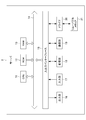
- FIG. 3 is a block diagram showing an example of the hardware configuration of the server in the information processing system of FIG.
- the output unit 16 is composed of a display, a speaker, and the like, and outputs various information as images and sounds.
- the input unit 17 is composed of a keyboard, a mouse, and the like, and inputs various information.
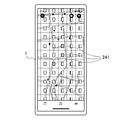
- the note arrangement image ma of FIG. 5 described later includes nine “partition GA1” to “partition GA9” surrounded by the frame AM as candidates for the “writing target section”.
- the user UK operates the user terminal 1-K to determine a desired one of the candidates for the "write target section” as the "write target section”.
- the user UK operates the user terminal 1-K to determine an "electronic note” arranged in a desired one from the candidates of the "writing target section” as a writing target.
- the writing note presentation control unit 66 presents the image indicating the "electronic note” to be written (hereinafter referred to as "note image”) to the user UK by displaying it on the user terminal 1-K.
- note image the image indicating the "electronic note” to be written
- the user UH operates the user terminal 1-H to request that the "electronic notebook” arranged in the "viewing target section” be viewed (hereinafter referred to as "note viewing request”). ) Is entered.
- the user terminal 1-H transmits a note viewing request to the server 2 via the network N. Therefore, the browsing request acquisition unit 71 acquires the note browsing request via the communication unit 19 and provides it to the browsing note presentation control unit 74.
- the write target section and the read target section are in the same area.
- the write target section and the read target section are considered to be independent of each other, and even if the user UK and the user UH exist at the same position, they are necessarily in the same area. No need.
- the note management unit 53 refers to each of a plurality of "compartments” existing in at least two-dimensional directions, which are divided according to a predetermined rule so as not to overlap with other parts from the three-dimensional space in the real world.
- Each of the "electronic notes” is associated and stored in the note DB 81 for management.
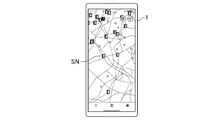
- FIG. 5 is a diagram showing an example of a note arrangement image among the screens displayed on the user terminal of FIG. 2.
- the note arrangement image ma in the note arrangement image ma, the grids in the latitude direction and the longitude direction are arranged at predetermined intervals (30 m in this example) with respect to the map including the position of the user terminal 1 (the position of the user U). It is an image drawn by superimposing on. That is, one closed region formed by adjacent grids represents one "partition”. In one "section”, one "electronic notebook” icon placed there is drawn.
- the note arrangement image ma includes nine "section GA1" to "section GA9" surrounded by the frame AM as candidates for the "write target section" or the "view target section".
- the "electronic notebook” icons arranged in each section are displayed in a display form (for example, a color according to the state) according to the state.
- the states of the "electronic notebook” include, for example, a first state in which writing has already been performed by a user who intends to write or browse, and a second state in which some writing has been performed by one or more. It is possible to adopt a third state in which no writing is performed.
- the different colors (shades in the example of FIG. 5) corresponding to each of the first to third states make it possible to express the state of the "electronic notebook". For example, in the example of FIG.
- the icon of the "electronic notebook SN5" arranged in the compartment GA5 and the icon of the "electronic notebook SN8" arranged in the compartment GA8 are displayed in the darkest color. .. This means that the "electronic note SN5" and the “electronic note SB8" are in the first state in which writing has already been made by a user who intends to write or browse. Further, for example, in the example of FIG. 5, the icon of the "electronic notebook SN4" arranged in the compartment GA4 and the icon of the "electronic notebook SN7" arranged in the compartment GA7 are displayed in neutral colors.
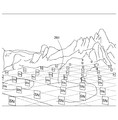
- FIG. 7 is a diagram showing an example of a note arrangement image among the screens displayed on the user terminal of FIG. 2, and is a diagram showing an example different from that of FIG.
- the layout image of the example of FIG. 7 is the same as that of FIG.
- the note arrangement image of the example of FIG. 8 has the same scale as the note arrangement image of the example of FIG. 7, but has a different viewpoint.
- the note arrangement image of the example of FIG. 9 has the same viewpoint as the note arrangement image of the example of FIG. 7, but has a different scale. As shown in FIG. 9, when the scale becomes a certain level or less, it becomes difficult to display the “section” of 30 m ⁇ 30 m (do not overlap with others), so that the display of the “section” disappears.
- FIG. 11 is a diagram showing an example of a note arrangement image among the screens displayed on the user terminal of FIG. 2, and is a diagram showing an example different from FIGS. 5 and 7. Since the scale of the note-arranged image in the example of FIG. 11 is reduced, the unit of one displayable area includes a large number of "sections". Therefore, for each unit of this one area, the number of arrangements of "electronic notes" in a predetermined state (for example, a second state in which some writing is made) SNG ("electronic notes” in a predetermined state) An icon indicating the total number of "sections” in which "" is placed SNG) is displayed. The higher the number of SNGs arranged in the "electronic notebook" in a predetermined state, the higher the height of the icon.
- the "section” in which the "electronic notebook” is placed is a two-dimensional plane existing on the earth's surface, but is not particularly limited to this, and has a constant height. It may be a three-dimensional space.
- the arrangement position of the "section” in the three-dimensional space may be in the range of any height. That is, even if they are in the same area in terms of latitude and longitude (in terms of two-dimensional coordinates), separate “sections” are provided for each different height, and separate “electronic notes” are placed. It will be.
- the height direction may be a positive direction toward the sky or a negative direction toward the downward direction.
- an “electronic notebook” in the above-described embodiment, but it is not particularly limited to this, and an “electronic container” is sufficient. That is, the “electronic notebook” is merely an example of an “electronic vessel”. In addition, electronic bulletin boards, electronic stone monuments, etc. can be adopted as another example of "electronic vessel”.
- the unit in which the "electronic vessel” (“electronic note”) is arranged (associated) is a grid surrounded by a grid along latitude and longitude, respectively.
- “compartment” it is not particularly limited. That is, “electronic vessel” for each of a plurality of unit regions existing in at least two-dimensional directions, which are divided according to a predetermined rule so as not to overlap with other parts from the three-dimensional space in the real world. It suffices to place (associate) with.
- the position of the user is specified based on the GNSS information of the user terminal 1 held by the user in the above-described embodiment, but is not particularly limited to this, for example, Wifi (registered trademark) of the user terminal 1.
- the user's position may be specified using the function.
- the information (written information) input by the first user existing at the predetermined position is placed in the unit area (the "section" of the example) including the predetermined position. It was integrated into an "electronic vessel". Then, the information (written information) input by the first user is presented to the second user by browsing the "electronic device" by the second user existing in the unit area.
- the timing and unit of information aggregation are not particularly limited to this.
- the information (written information) input by the first user existing at a predetermined position is stored in association with the predetermined position (1 point) at that time.
- a predetermined range determined based on the position where the second user exists when the second user requests the viewing for example, a circle having a radius of 30 m centered on the reference.
- Information existing in the internal range) (information stored in association with one point) may be aggregated and presented to the second user. In this case, if the "predetermined position" in which the first user once existed is included in the "predetermined range" determined when the second user requests to view the information, the first user determines. The input information (written information) will be presented to the second user.
- the information storage control function is a function that executes control to store information input by the first user in association with a type 1 area determined based on the existence position of the first user in the real world. ..
- the information presentation control function includes at least a part of the second type region determined based on the existence position of the second user in the real world when the presentation of information is requested by the second user. This is a function for executing control of presenting information stored in association with the first-class area to the second user.
- information may be stored and presented so that it can be stored and presented only within the range based on the unit area.
- it can be set so that information can be stored and presented from an arbitrary position (for example, a distant position).
- the areas that can be read and viewed in the "electronic notebook” are arranged so as not to overlap, but adjacent areas may be overlapped.
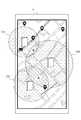
- the size and shape of the area may be different for each of the areas 131 and 132, and the areas may overlap as in the areas 131 and 132.
- an icon in which a plurality of "electronic notes" of the areas 131 and 132 are arranged is displayed. The user can read and browse the "electronic notebook" by selecting and pressing a desired icon from the plurality of icons.
- the second system that manages the area where the information can be browsed.
- the user can input information into the "electronic note”.
- information can be read and viewed from "electronic notes”.
- the first information acquisition pattern is a pattern in which posts are decomposed into the latitude and longitude of each post at the time of writing, and posts included in a new range at the time of browsing are acquired.
- the second information acquisition pattern retains the post aggregation area of the note adopted at the time of writing, and acquires all if the post aggregation area of the note at the time of writing included in the new area at the time of browsing overlaps even a little. It is a pattern.
- the section is a square of 30 m square and the position and shape of the section are invariable.
- the user may freely create the "position" and "shape" of the range. It may also be changed.
- the service side may change the area depending on the number of writes, the time, the place, and the like. For example, as shown in FIG. 14, a range of a trapezoid 141 or other polygons formed by randomly drawing a grid GI vertically, horizontally, and diagonally may be used as a partition. Further, as shown in FIG. 15, it may be a section formed by an independent area.
- a beacon signal is transmitted with a strength that can reach only the inside of the actual store, and when the user enters the actual store, the application of the user terminal detects the beacon signal and virtualizes it on the screen of the user terminal.
- the store may be displayed in a pop-up.
- an "electronic vessel” is used as a unit area in a three-dimensional space, which will be described later. Specifically, for example, a cube address in which one cube is specified from latitude, longitude, and altitude is used. The cube address shown here is an example, and the three-dimensional address of the unit area may be indicated by another indication.
- the mirror space can be realized not only for restaurants but also for any real space from facilities such as museums and stadiums to classrooms in schools.
- the shopkeeper can edit and decorate the virtual store to his liking.
- the authority of the shopkeeper of the virtual store is given to the shopkeeper or the clerk of the actual store, but it may be given to other people.
- the alphabetic character r represents the distance from the center, and ⁇ and ⁇ represent the direction from the origin.
- This polar coordinate system is a method of geodetic datum in which ⁇ is the north latitude (south latitude) and ⁇ is the east longitude (west longitude) in association with the latitude and longitude on the surface of the earth. The angle is different from the latitude and longitude of the world geodetic system.
- the information storage control unit 64 sets an arbitrary character string, sequence, or symbol for the area in which the "electronic device" is arranged. , And a unique ID generated by any of the combinations thereof.
- the area of the "electronic vessel” in the present embodiment the shape of the unit area is determined based on the same standard for all the places on the earth, an ID is given to each unit area, and each ID is an address ("electronic"). It can be said that the existing addresses are completely different from each other in that the address is assigned to the boundary line of the site, while it is managed as the location of "Nakki". That is, assigning an address ID to an area that is uniform and non-variable (a regular polygon such as a square section formed by intersecting grids or a honeycomb structure) is completely different from the existing address system.
- the information storage control unit 64 includes a mass (contains a position specified by the latitude, longitude, altitude, or polar coordinate system of the world geodetic system specified by GNSS, WiFi, a wireless base station of a mobile carrier, or the like. Area) is specified.
- the latitude, longitude, altitude (altitude) of the world geodetic system and the angle of the polar coordinate system It is used to specify a place (address) in 3D space by the ID of one cube in a virtual space containing a point (position) derived from the above.
- a place (address) in 3D space by the ID of one cube in a virtual space containing a point (position) derived from the above.
- the position of the cube 311 arranged at the position of one corner of the building created in the 3D space is specified and managed by the cube ID.
- the unit region may be in the shape of a prism or the like in which the surfaces of the masses are stacked in the height direction.
- the shape of the mass at this time may be a regular polygon such as an equilateral triangle or a regular hexagon in addition to the square.
- the global address system which is not restricted by the address allocation of each country, is a game that searches for and acquires monsters in a complex real world that imitates the earth (a virtual world superimposed on the real world) in addition to the earth.
- the world of virtual reality different from the real earth (the world of games where virtual humans spend time creating a new living environment with animals, the world of games created by simulating the virtual world itself, etc.) ),
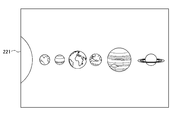
- Mirror world which is a digital twin of the earth, celestial bodies other than the earth (planets of the solar system (moon, Mars, Jupiter, Saturn, etc.)), etc.
Landscapes
- Engineering & Computer Science (AREA)
- Theoretical Computer Science (AREA)
- Physics & Mathematics (AREA)
- General Physics & Mathematics (AREA)
- Business, Economics & Management (AREA)
- General Engineering & Computer Science (AREA)
- Tourism & Hospitality (AREA)
- General Business, Economics & Management (AREA)
- Health & Medical Sciences (AREA)
- Primary Health Care (AREA)
- Marketing (AREA)
- Human Resources & Organizations (AREA)
- General Health & Medical Sciences (AREA)
- Economics (AREA)
- Strategic Management (AREA)
- Human Computer Interaction (AREA)
- Mathematical Physics (AREA)
- Educational Administration (AREA)
- Educational Technology (AREA)
- User Interface Of Digital Computer (AREA)
- Management, Administration, Business Operations System, And Electronic Commerce (AREA)
Priority Applications (1)
| Application Number | Priority Date | Filing Date | Title |
|---|---|---|---|
| JP2021533086A JP7192126B2 (ja) | 2019-07-18 | 2020-07-15 | 情報処理装置、情報処理方法、及びプログラム |
Applications Claiming Priority (2)
| Application Number | Priority Date | Filing Date | Title |
|---|---|---|---|
| JP2019133011 | 2019-07-18 | ||
| JP2019-133011 | 2019-07-18 |
Publications (1)
| Publication Number | Publication Date |
|---|---|
| WO2021010420A1 true WO2021010420A1 (ja) | 2021-01-21 |
Family
ID=74210917
Family Applications (1)
| Application Number | Title | Priority Date | Filing Date |
|---|---|---|---|
| PCT/JP2020/027521 Ceased WO2021010420A1 (ja) | 2019-07-18 | 2020-07-15 | 情報処理装置、情報処理方法、及びプログラム |
Country Status (2)
| Country | Link |
|---|---|
| JP (1) | JP7192126B2 (https=) |
| WO (1) | WO2021010420A1 (https=) |
Cited By (1)
| Publication number | Priority date | Publication date | Assignee | Title |
|---|---|---|---|---|
| JP2024137545A (ja) * | 2023-03-24 | 2024-10-07 | 東日本メディコム株式会社 | 情報処理システム、サーバ、情報処理方法及びプログラム |
Citations (2)
| Publication number | Priority date | Publication date | Assignee | Title |
|---|---|---|---|---|
| US20180350144A1 (en) * | 2018-07-27 | 2018-12-06 | Yogesh Rathod | Generating, recording, simulating, displaying and sharing user related real world activities, actions, events, participations, transactions, status, experience, expressions, scenes, sharing, interactions with entities and associated plurality types of data in virtual world |
| US20190149949A1 (en) * | 2017-09-30 | 2019-05-16 | Oracle International Corporation | Scaling out moving objects for geo-fence proximity determination |
-
2020
- 2020-07-15 JP JP2021533086A patent/JP7192126B2/ja active Active
- 2020-07-15 WO PCT/JP2020/027521 patent/WO2021010420A1/ja not_active Ceased
Patent Citations (2)
| Publication number | Priority date | Publication date | Assignee | Title |
|---|---|---|---|---|
| US20190149949A1 (en) * | 2017-09-30 | 2019-05-16 | Oracle International Corporation | Scaling out moving objects for geo-fence proximity determination |
| US20180350144A1 (en) * | 2018-07-27 | 2018-12-06 | Yogesh Rathod | Generating, recording, simulating, displaying and sharing user related real world activities, actions, events, participations, transactions, status, experience, expressions, scenes, sharing, interactions with entities and associated plurality types of data in virtual world |
Cited By (1)
| Publication number | Priority date | Publication date | Assignee | Title |
|---|---|---|---|---|
| JP2024137545A (ja) * | 2023-03-24 | 2024-10-07 | 東日本メディコム株式会社 | 情報処理システム、サーバ、情報処理方法及びプログラム |
Also Published As
| Publication number | Publication date |
|---|---|
| JP7192126B2 (ja) | 2022-12-19 |
| JPWO2021010420A1 (https=) | 2021-01-21 |
Similar Documents
| Publication | Publication Date | Title |
|---|---|---|
| US11977832B2 (en) | Map note annotations at corresponding geographic locations | |
| Brennan-Horley et al. | Where is creativity in the city? Integrating qualitative and GIS methods | |
| KR101302929B1 (ko) | 위치지정 가능한 장소에서 사람이 경험한 감정을 나타내는 데이터를 기록하는 방법 및 장치, 그리고 그 연관 서버 | |
| Philips et al. | Immersive 3D geovisualization in higher education | |
| Andri et al. | Examining effectiveness and user experiences in 3d mobile based augmented reality for msu virtual tour | |
| US11886527B2 (en) | Digital map based online platform | |
| CN108337664A (zh) | 基于地理位置的旅游景区增强现实互动导览系统及方法 | |
| JP2022501708A (ja) | 個別化されたデジタルマップ上に表示するための関心地点の選択 | |
| Vert et al. | Augmented and virtual reality for public space art | |
| Jacob et al. | Collaborative augmented reality for cultural heritage, tourist sites and museums: sharing Visitors’ experiences and interactions | |
| Liberato et al. | Technology applications in the competitiveness of tourism destinations | |
| JP7192126B2 (ja) | 情報処理装置、情報処理方法、及びプログラム | |
| Sachenko et al. | The use of augmented reality for renovation of cultural heritage sites | |
| Rakshit et al. | Application of virtual globes in education | |
| Tahyudin et al. | Implementation of a mobile augmented reality application with location based service for exploring tourism objects | |
| Saputra et al. | cARica: enhancing travelling experiences in wonosobo through location-based mobile augmented reality | |
| Gallagher et al. | Towards Designing Immersive Geovisualisations: Literature Review and Recommendations for Future Research | |
| Methimakis et al. | Geolocalized AR exploration of shepherd settlements in the Psiloritis mountain | |
| Harrington et al. | Google Earth Forensics: Using Google Earth Geo-Location in Digital Forensic Investigations | |
| Lei et al. | A mobile geo-wand enabling gesture based POI search an user generated directional POI photography | |
| Wu et al. | Augmented reality navigation app and metadata icon design for children’s library | |
| Rees | Designing for discovery: Using web maps in the digital humanities | |
| JP7304758B2 (ja) | 地理情報システム | |
| Bennett et al. | Developing an online book finding tool for a university library | |
| Tatić et al. | War Museum of Niš under the Open Sky |
Legal Events
| Date | Code | Title | Description |
|---|---|---|---|
| 121 | Ep: the epo has been informed by wipo that ep was designated in this application |
Ref document number: 20840144 Country of ref document: EP Kind code of ref document: A1 |
|
| ENP | Entry into the national phase |
Ref document number: 2021533086 Country of ref document: JP Kind code of ref document: A |
|
| NENP | Non-entry into the national phase |
Ref country code: DE |
|
| 32PN | Ep: public notification in the ep bulletin as address of the adressee cannot be established |
Free format text: NOTING OF LOSS OF RIGHTS PURSUANT TO RULE 112(1) EPC (EPO FORM 1205A DATED 29/04/2022) |
|
| 122 | Ep: pct application non-entry in european phase |
Ref document number: 20840144 Country of ref document: EP Kind code of ref document: A1 |