WO2020255906A1 - 蛍光標識剤用連結体 - Google Patents
蛍光標識剤用連結体 Download PDFInfo
- Publication number
- WO2020255906A1 WO2020255906A1 PCT/JP2020/023340 JP2020023340W WO2020255906A1 WO 2020255906 A1 WO2020255906 A1 WO 2020255906A1 JP 2020023340 W JP2020023340 W JP 2020023340W WO 2020255906 A1 WO2020255906 A1 WO 2020255906A1
- Authority
- WO
- WIPO (PCT)
- Prior art keywords
- binding group
- fluorescent
- antibody
- probe molecule
- fluorescent labeling
- Prior art date
- Legal status (The legal status is an assumption and is not a legal conclusion. Google has not performed a legal analysis and makes no representation as to the accuracy of the status listed.)
- Ceased
Links
Images
Classifications
-
- C—CHEMISTRY; METALLURGY
- C07—ORGANIC CHEMISTRY
- C07K—PEPTIDES
- C07K16/00—Immunoglobulins [IG], e.g. monoclonal or polyclonal antibodies
- C07K16/18—Immunoglobulins [IG], e.g. monoclonal or polyclonal antibodies against material from animals or humans
- C07K16/28—Immunoglobulins [IG], e.g. monoclonal or polyclonal antibodies against material from animals or humans against receptors, cell surface antigens or cell surface determinants
- C07K16/2869—Immunoglobulins [IG], e.g. monoclonal or polyclonal antibodies against material from animals or humans against receptors, cell surface antigens or cell surface determinants against hormone receptors
-
- C—CHEMISTRY; METALLURGY
- C07—ORGANIC CHEMISTRY
- C07K—PEPTIDES
- C07K1/00—General methods for the preparation of peptides, i.e. processes for the organic chemical preparation of peptides or proteins of any length
- C07K1/13—Labelling of peptides
-
- C—CHEMISTRY; METALLURGY
- C07—ORGANIC CHEMISTRY
- C07K—PEPTIDES
- C07K16/00—Immunoglobulins [IG], e.g. monoclonal or polyclonal antibodies
- C07K16/18—Immunoglobulins [IG], e.g. monoclonal or polyclonal antibodies against material from animals or humans
- C07K16/32—Immunoglobulins [IG], e.g. monoclonal or polyclonal antibodies against material from animals or humans against translation products of oncogenes
-
- C—CHEMISTRY; METALLURGY
- C12—BIOCHEMISTRY; BEER; SPIRITS; WINE; VINEGAR; MICROBIOLOGY; ENZYMOLOGY; MUTATION OR GENETIC ENGINEERING
- C12N—MICROORGANISMS OR ENZYMES; COMPOSITIONS THEREOF; PROPAGATING, PRESERVING, OR MAINTAINING MICROORGANISMS; MUTATION OR GENETIC ENGINEERING; CULTURE MEDIA
- C12N15/00—Mutation or genetic engineering; DNA or RNA concerning genetic engineering, vectors, e.g. plasmids, or their isolation, preparation or purification; Use of hosts therefor
- C12N15/09—Recombinant DNA-technology
- C12N15/11—DNA or RNA fragments; Modified forms thereof; Non-coding nucleic acids having a biological activity
- C12N15/115—Aptamers, i.e. nucleic acids binding a target molecule specifically and with high affinity without hybridising therewith ; Nucleic acids binding to non-nucleic acids, e.g. aptamers
-
- G—PHYSICS
- G01—MEASURING; TESTING
- G01N—INVESTIGATING OR ANALYSING MATERIALS BY DETERMINING THEIR CHEMICAL OR PHYSICAL PROPERTIES
- G01N33/00—Investigating or analysing materials by specific methods not covered by groups G01N1/00 - G01N31/00
- G01N33/48—Biological material, e.g. blood, urine; Haemocytometers
- G01N33/50—Chemical analysis of biological material, e.g. blood, urine; Testing involving biospecific ligand binding methods; Immunological testing
- G01N33/53—Immunoassay; Biospecific binding assay; Materials therefor
- G01N33/531—Production of immunochemical test materials
- G01N33/532—Production of labelled immunochemicals
- G01N33/533—Production of labelled immunochemicals with fluorescent label
-
- C—CHEMISTRY; METALLURGY
- C07—ORGANIC CHEMISTRY
- C07K—PEPTIDES
- C07K2317/00—Immunoglobulins specific features
- C07K2317/50—Immunoglobulins specific features characterized by immunoglobulin fragments
- C07K2317/56—Immunoglobulins specific features characterized by immunoglobulin fragments variable (Fv) region, i.e. VH and/or VL
- C07K2317/569—Single domain, e.g. dAb, sdAb, VHH, VNAR or nanobody®
-
- C—CHEMISTRY; METALLURGY
- C12—BIOCHEMISTRY; BEER; SPIRITS; WINE; VINEGAR; MICROBIOLOGY; ENZYMOLOGY; MUTATION OR GENETIC ENGINEERING
- C12N—MICROORGANISMS OR ENZYMES; COMPOSITIONS THEREOF; PROPAGATING, PRESERVING, OR MAINTAINING MICROORGANISMS; MUTATION OR GENETIC ENGINEERING; CULTURE MEDIA
- C12N2310/00—Structure or type of the nucleic acid
- C12N2310/10—Type of nucleic acid
- C12N2310/16—Aptamers
-
- C—CHEMISTRY; METALLURGY
- C12—BIOCHEMISTRY; BEER; SPIRITS; WINE; VINEGAR; MICROBIOLOGY; ENZYMOLOGY; MUTATION OR GENETIC ENGINEERING
- C12N—MICROORGANISMS OR ENZYMES; COMPOSITIONS THEREOF; PROPAGATING, PRESERVING, OR MAINTAINING MICROORGANISMS; MUTATION OR GENETIC ENGINEERING; CULTURE MEDIA
- C12N2310/00—Structure or type of the nucleic acid
- C12N2310/30—Chemical structure
- C12N2310/35—Nature of the modification
- C12N2310/351—Conjugate
- C12N2310/3517—Marker; Tag
Definitions
- the present invention relates to a conjugate for a fluorescent labeling agent.
- the labeling agent includes a probe molecule such as an antibody having a high affinity for the target substance, and a luminescent material that emits light by a predetermined excitation light.
- a probe molecule such as an antibody having a high affinity for the target substance
- a luminescent material that emits light by a predetermined excitation light.
- phosphor-accumulated nanoparticles Phosper
- PID Integrated Dots nanoparticles
- Patent Document 1 describes a probe biological substance bound to a first binding base substance via a polymer-derived spacer having a length of 30 angstroms to 1000 angstroms, and a first substance capable of specifically binding to the first binding base substance.
- Fluorescent labeling agents containing phosphor-accumulated nanoparticles having a two-binding base substance are disclosed.
- the fluorescent labeling agent of Patent Document 1 suppresses non-specific adsorption of substances other than the target substance to the probe molecule and the phosphor-accumulated nanoparticles in fluorescent immunostaining by setting the spacer to a predetermined length.
- the generation of noise due to bright spots other than the target substance is suppressed to some extent.
- further improvement is made to suppress noise due to non-specific adsorption.
- the present inventor determines the labeling rate of the adsorbent to the probe molecule in the conjugate for fluorescent labeling agent in which the probe molecule and the adsorbent are bonded via the linker molecule.
- the present invention relates to, for example, the following [1] to [7].
- Agent conjugate [2] The conjugate for a fluorescent labeling agent according to [1], wherein the labeling rate of the binding group with respect to the probe molecule is 20 or less. [3] The conjugate for a fluorescent labeling agent according to [1] or [2], wherein the linker molecule has a hydrophilic polymer composed of a structural unit derived from polyalkylene glycol. [4] The conjugate for a fluorescent labeling agent according to [3], wherein the polyalkylene glycol is polyethylene glycol or polypropylene glycol.
- the probe molecule and the binding group are directly bound or are bound via a linker molecule having a chain length of more than 0 angstroms and less than 30 angstroms [1] to [4].
- the conjugate for fluorescent labeling according to any one of. [6] The fluorescence according to any one of [1] to [5], wherein the binding group is at least one selected from the group consisting of biotin, avidin, streptavidin, neutravidin, hapten and anti-hapten antibody. Linkage for labeling agent.
- the present invention it is possible to reduce the non-specific adsorption of a substance other than the target substance on the probe molecule, and it is possible to suppress the generation of bright spot noise due to the non-specific adsorption substance other than the target substance in the fluorescence immunostaining image. it can.
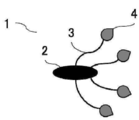
- FIG. 1 is a schematic view of a conjugate for a fluorescent labeling agent of the present invention.
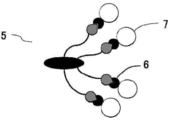
- FIG. 2 is a schematic view of a fluorescent labeling agent in which the conjugate for a fluorescent labeling agent of the present invention and a fluorescent material are bonded via an affinity substance.
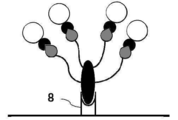
- FIG. 3 is a schematic view when the fluorescent labeling agent containing the conjugate for the fluorescent labeling agent of the present invention is bound to the target substance.
- the link for a fluorescent labeling agent according to the present invention is a link for a fluorescent labeling agent in which a probe molecule and a binding group are bonded directly or via a linker molecule, and the linking group for the fluorescent labeling agent is attached to the probe molecule.
- the labeling rate is 3 or more.
- the labeling rate is preferably 20 or less.
- the probe molecule and the target substance are directly bound or indirectly between the probe molecule and the target substance via one or more other binding molecules (for example, an aptamer or an antibody).
- binding molecules for example, an aptamer or an antibody.
- the conjugate for a fluorescent labeling agent is particularly limited as long as the binding group and the fluorescent material can be bonded directly or indirectly between the probe molecule and the fluorescent material via one or more affinity substances. Although not, it is preferable that it can be directly bound or indirectly bound via one affinity substance.
- the link for the fluorescent labeling agent plays a role of linking the target substance and the fluorescent material by specifically binding to the target substance and the fluorescent material.
- FIG. 1 is an example of a schematic diagram of the conjugate for a fluorescent labeling agent of the present invention.
- a binding group 4 is bound to the probe molecule 2 via a linker molecule 3, and the labeling rate is 4.
- the probe molecule is measured by an immunoassay method, it may be a molecule that specifically binds to a target substance by an antigen-antibody reaction, and is preferably selected from an aptamer and an antibody.
- the aptamer is not particularly limited as long as it can specifically recognize the target substance by a method similar to the immunostaining method used for the antibody.
- the aptamer may be a primary aptamer that specifically binds to a target substance, a primary antibody that binds to a target substance, a secondary aptamer that specifically binds to a primary aptamer, or a higher-order aptamer. However, a primary aptamer or a secondary aptamer is preferable.
- Aptamers can be broadly divided into nucleic acid (DNA or RNA) aptamers and peptide aptamers, but as long as they can specifically recognize and bind to a target substance or an antibody or lower-order aptamer bound to the target substance. Can also be used.
- a nucleic acid aptamer is preferable from the viewpoint of availability of oligonucleic acid. Nucleic acid aptamers and peptide aptamers can be prepared by known methods, or commercially available products can be purchased and used.
- Antibodies include not only complete antibodies but also any antibody fragment, derivative or complex, for example, in addition to complete antibodies, Fab, F (ab') 2 , CDR, chimeric antibody, humanized antibody, multifunctional antibody. , Single chain antibody (scFv), VHH antibody, antibody-drug complex.
- the VHH antibody is an antibody consisting of a variable region of a heavy chain antibody derived from an animal belonging to the camelid family such as llama, alpaca, camel or a cartilage fish such as a shark.
- the above antibody can be prepared by a known method, or a commercially available antibody can be purchased and used.
- the target substance to which the probe molecule binds examples include proteins such as amino acids and polypeptides, complexes with these sugars and lipids, and haptens such as DNP, DIG and FITC. Specifically, it includes protein cancer markers, gene cancer markers, signal transduction substances, hormones, or antibodies existing in the living body, artificial antibodies (antibody drugs), and other administered drugs.
- cancer markers include immune system proteins expressed in cancer cells, pathway proteins expressed in cancer cells, and metastatic proteins expressed in cancer cells.
- Various proteins are known as these cancer-related proteins, and appropriate ones can be selected according to the purpose of diagnosis or treatment, the mechanism of action of the drug to be used, and the like, and are not particularly limited.
- the proteins encoded by the genes of the immune system (Immune) gene panel, pathway system (Pathway) gene panel, and transfer system (Progression) gene panel included in the cancer-related gene expression panel provided by nCounter are respectively. It corresponds to immune system proteins, pathway proteins, and metastatic proteins expressed in cancer cells.
- mutant proteins corresponding to the mutant genes of these genes can also be included in immune system proteins, pathway proteins, and metastatic proteins.
- immune system proteins expressed in cancer cells include immune checkpoint proteins CD40, TL1A, GITR-L, 4-188-L, CX4D-L, CD70, HHLA2, ICOS-L, CD85, CD86, etc.
- pathway proteins expressed in cancer cells include endothelial growth factor or cancer cell growth factor receptor EGFR (HER1), HER2, HER3, HER4, IGFR, HGFR; cell surface antigen, vascular growth.
- metastatic proteins expressed in cancer cells include cancer metastasis markers ACTG2, ALDOA, APC, BRMS1, CADM1, CAMK2A, CAMK2B, CAMK2D, CCL5, CD82, CDKN1A, CDKN2A, CHD4, CNN1, CST7, CTSL, CXCR2, YBB, DCC, DENR, DLC1, EGLN2, EGLN3, EIF4E2, EIF4EBP1, ENO1, ENO2, ENO3, ETV4, FGFR4, GSN, HK2, HK3, HKDC1, HLA-DPB1, HKDC1, HLA-DPB1, HUNK11 LIFR, MED23, MET, MGAT5, MAP2K4, MT3, MTA1, MTBP, MTOR, MYCL, MYH11, NDRG1, NF2, NFKB1, NME1, NME4, NOS2, NR4A3, PDK1, PEBP4, PFKFB1, PFKFB1 Examples thereof include RB
- nucleic acid molecules are included as gene cancer markers. That is, naturally occurring nucleic acids such as DNA and RNA (mRNA, tRNA, miRNA, siRNA, non-cording-RNA, etc.) and artificial nucleic acids such as PNA, LNA (or BNA: Bridged Nucleic Acid) are included.
- a marker for detecting the following genes can be arbitrarily designed by the nucleic acid probe sequence. That is, as genes related to cancer growth and response rate of molecular target drug, HER2, TOP2A, HER3, EGFR, P53, MET and the like can be mentioned. Further, as a gene known as a cancer-related gene, the following can be mentioned.
- ALK, FLT3, AXL, FLT4 (VEGFR3, DDR1, FMS (CSF1R), DDR2, EGFR (ERBB1), HER4 (ERBB4), EML4-ALK, IGF1R, EPHA1, INSR, EPHA2, IRR (INSRR) ), EPHA3, KIT, EPHA4, LTK, EPHA5, MER (MERTK), EPHA6, MET, EPHA7, MUSK, EPHA8, NPM1-ALK, EPHB1, PDGFR ⁇ (PDGFRA), EPHB2, PDGFR ⁇ (PDGFRB), PD-L1, BMI1 , LGR5, EPHB3, RET, EPHB4, RON (MST1R), FGFR1, ROS (ROS1), FGFR2, TIE2 (TEK), FGFR3, TRKA (NTRK1), FGFR4, TRKB (NTRK2), FLT1 (VEGFR1), ).
- Breast cancer-related genes include ATM, BRCA1, BRCA2, BRCA3, CCND1, E-Cadherin, ERBB2, ETV6, FGFR1, HRAS, KRAS, NRAS, NTRK3, p53, and PTEN.
- Genes associated with carcinoid tumors include BCL2, BRD4, CCND1, CDKN1A, CDKN2A, CTNNNB1, HES1, MAP2, MEN1, NF1, NOTCH1, NUT, RAF, SDHD, VEGFA.
- colorectal cancer-related genes include APC, MSH6, AXIN2, MYH, BMPR1A, p53, DCC, PMS2, KRAS2 (or Ki-ras), PTEN, MLH1, SMAD4, MSH2, STK11, and MSH6.
- Lung cancer-related genes include ALK, PTEN, CCND1, RASSF1A, CDKN2A, RB1, EGFR, RET, EML4, ROS1, KRAS2, TP53, and MYC.
- genes related to liver cancer include Axin1, MALAT1, b-catenin, p16 INK4A, c-ERBB-2, p53, CTNNNB1, RB1, Cyclin D1, SMAD2, EGFR, SMAD4, IGFR2, TCF1, and KRAS.
- kidney cancer-related genes include Alpha, PRCC, ASPSCR1, PSF, CLTC, TFE3, p54nrb / NONO, and TFEB.
- thyroid cancer-related genes include AKAP10, NTRK1, AKAP9, RET, BRAF, TFG, ELE1, TPM3, H4 / D10S170, and TPR.
- Examples of ovarian cancer-related genes include AKT2, MDM2, BCL2, MYC, BRCA1, NCOA4, CDKN2A, p53, ERBB2, PIK3CA, GATA4, RB, HERAS, RET, KRAS, and RNASET2.
- Prostate cancer-related genes include AR, KLK3, BRCA2, MYC, CDKN1B, NKX3.1, EZH2, p53, GSTP1, and PTEN.
- Examples of the bone tumor-related gene include CDH11, COL12A1, CNBP, OMD, COL1A1, THRAP3, COL4A5, and USP6.
- An antibody drug is a drug whose main component is an antibody (immunoglobulin) that recognizes an antigen.
- the antibody drug may be one that has already been put on the market and is used clinically, or it may be a candidate drug used in clinical trials or clinical trials.
- Examples of marketed antibody drugs include humanized anti-HER2 antibody trastuzumab (Herceptin®), anti-CD30 monoclonal antibody Brentuximab, anti-VEGF monoclonal antibody bevacizumab, humanized anti-CD33 antibody gemtuzumab, and humanized anti-PD-1.
- Antibodies Pembrolizumab and nibolumab, anti-CTLA-4 ipilimumab monoclonal antibodies can be mentioned.
- Nucleic acid drugs are also included as detection targets as artificial nucleic acids.
- Nucleic acid drugs include, for example, decoy, antisense, siRNA, ribozyme, miRNA-mic, aptamer, and as molecules targeting genes such as PDGF-B, C5, MCP-1, SDF-1, and Hepcidin. Can be designed arbitrarily.
- the binding group is a molecule that specifically binds to an affinity substance that is bound to a fluorescent material described later.
- the binding group include biotin, avidin, streptavidin, neutravidin, hapten, and anti-hapten antibody. These binding groups may be only one kind or two or more kinds.
- the hapten include FITC (fluorescein isothiocyanate), DIG (digoxigenin), and DNP (dinitrophenol). Of these, biotin, streptavidin, FITC, and anti-FITC antibody are preferable from the viewpoint of binding force.
- the affinity substance has a contrasting relationship with the binding group, for example, when the former is biotin, the latter is avidin, streptavidin or neutravidin, and vice versa. Similarly, when the former is a hapten, the latter is an anti-hapten antibody, and vice versa (see FIG. 2).
- binding group one in which the binding group and the linker molecule are bonded in advance may be used.
- pre-bonded linking group and linker molecule examples include EZ-LinkTM Maleimide-PEG2-Biotin (product number: 21901, manufactured by Thermo Fisher Scientific), NHS-dPEG4-Biotin (product number: 10200,).
- Examples include Quanta BioDesign (manufactured by Quanta BioDesign), Fluorescein-5-maleimide (product number: F0810, manufactured by Tokyo Chemical Industry Co., Ltd.), 5-Carboxyfluorescein N-Succinimidyl Ester (product number: C2479, manufactured by Tokyo Chemical Industry Co., Ltd.) and the like.
- the probe molecule and the binding group may be bonded via a linker molecule. Further, the probe molecule and the binding group may be directly bonded.
- the linker molecule may be any molecule as long as the labeling rate of the binding group with respect to the probe molecule can be 3 or more, preferably 20 or less, and is not particularly limited, but is usually a dimer, a trimer, or the like.
- Organic substances such as multimers (oligomers) and monomers can be used.
- the linker molecule preferably has a hydrophilic polymer composed of a structural unit derived from polyalkylene glycol.
- the polyalkylene glycol include polyethylene glycol and polypropylene glycol, and polyethylene glycol (PEG) is more preferable from the viewpoint that the chain length of the linker molecule can be easily set by the number of oxyethylene units.
- linker molecule examples include ficol, polyvinyl alcohol, styrene-maleic anhydride copolymer, divinyl ether-maleic anhydride copolymer, polyvinylpyrrolidone, polyvinylmethyl ether, polyvinylmethyloxazoline, polyethyloxazoline, and polyhydroxy. Even with at least one selected from propyl oxazoline, polyhydroxypropyl metaacrylamide, polymethacrylamide, polydimethylacrylamide, polyhydroxypropyl methacrylate, polyhydroxyethyl acrylate, hydroxymethyl cellulose, hydroxyethyl cellulose, and polyaspartamide. Good.
- the chain length of the linker molecule means the length of the chemical structure portion derived from the linker molecule between the probe molecule and the binding group when the probe molecule and the binding group described later are linked.
- the chain length of the linker molecule can be calculated by the method described in WO 2015/133523.
- PEG is used as a linker molecule, an amino group is introduced at both ends of the PEG by an amidation reaction, then an amino group at one end and biotin as a binding group are bonded, and an amino group at the other end is used.
- the chain length of the linker molecule is different from the nitrogen atom of the amide bond at one end. The length of the amide bond at the end to the oxygen atom.
- the chain length of the linker molecule can be calculated as an integrated value of the distances of chemical bonds between atoms.
- the chemical bond distance can be calculated as an integrated value of theoretical values of chemical bond distances between atoms based on the self-consistent approach.
- the NC bond length is 1.46 angstroms
- the CC bond length is 1.50 angstroms
- the CO bond length is calculated as 1.38 angstroms.
- the chain length of the linker molecule is usually more than 0 angstroms and less than 30 angstroms.
- the labeling rate of the binding group with respect to the probe molecule can be set to a suitable range, which is preferable. Further, in the above range, non-specific adsorption of substances other than the target substance to the probe molecule is suppressed, and noise due to bright spots of the non-specific adsorbed substance in the fluorescent immunostaining image can be reduced.
- the linker molecule when the linker molecule is derived from PEG, the length of the linker molecule can be expressed as an oxyethylene unit (n) which is a constituent unit.
- n oxyethylene unit
- the unit is 1 to 5 or the probe molecule and the binding group are directly bonded, non-specific adsorption of a substance other than the target substance to the probe molecule is suppressed, and the non-specific adsorption substance in the fluorescent immunostaining image is suppressed. Noise due to bright spots can be reduced.
- the linker molecule such as PEG can be synthesized by a known method. Further, for example, a linker molecule having a desired length commercially available from Sigma-Aldrich, Thermo Fisher Scientific, etc. can be purchased. It is also possible to set the number of repetitions of the chemical structure such as the oxyethylene unit so that the chain length exceeds 0 angstroms and becomes less than 30 angstroms, and request the production by a reagent manufacturer or the like.
- linker molecule to which a functional group (for example, N-hydroxyester group, maleimide group, etc.) for binding to the above-mentioned binding group and probe molecule is previously bonded may be used.
- a functional group for example, N-hydroxyester group, maleimide group, etc.
- the labeling rate of the binding group with respect to the probe molecule is the ratio of the binding group bound to each probe molecule.
- the labeling rate can be calculated, for example, by dividing the concentration of the binding group of the conjugate for fluorescent labeling of the present invention by the concentration of the probe molecule, and is 3 or more, preferably 20 or less, and more preferably 10 or less. ..
- the labeling rate can be controlled by adjusting the chain length of the linker molecule.
- the concentration of the binding group and the probe molecule can be measured by a known method. For example, if the binding group and probe molecule have the property of absorbing light of a specific wavelength, it can be determined by measuring the absorbance. Alternatively, if the binding group has a property of exhibiting light emission such as fluorescence, it can be determined by measuring the light emission intensity.
- the concentration of the probe molecule can be calculated, for example, from the molecular weight of the probe molecule with respect to the solvent used in the production of the conjugate for the fluorescent labeling agent of the present invention.
- the labeling rate can be determined by measurement using, for example, MALDI-TOFMS (matrix-assisted laser desorption / ionization time-of-flight mass spectrometer). That is, according to the measurement, the link for the fluorescent labeling agent to which the probe molecule and the binding group are bonded is linked to the molecular weight side of the probe molecule alone according to the number of binding groups bonded to the probe molecule. Since a plurality of peaks derived from the body are usually detected, it can be calculated by multiplying the ratio of each peak area to the total sum of each peak area by the number of binding groups at each peak.
- MALDI-TOFMS matrix-assisted laser desorption / ionization time-of-flight mass spectrometer
- the fluorescent material can emit predetermined fluorescence after forming a fluorescent labeling agent by directly binding to the binding group of the conjugate for fluorescent labeling of the present invention or indirectly via an affinity substance.
- the phosphor-accumulated nanoparticles are preferable because they are not particularly limited, but are less likely to fade and can be observed and imaged for a long time.
- the fluorescent material is a general substance that is excited by being irradiated with X-rays, ultraviolet rays, visible rays, near-infrared rays, etc. from the outside and emits light in the process from the excited state to the ground state. Point to.
- the fluorescent material referred to in the present invention does not ask what the transition mode is when returning from the excited state to the ground state, and is a substance that emits fluorescence in a narrow sense, which is light emission accompanying deactivation from the excited singlet. It may be a substance that emits phosphorescence, which is a luminescence associated with deactivation from the triplet.
- the fluorescent material is not limited by the emission lifetime after blocking the excitation light. Therefore, it may be a substance known as a phosphorescent substance such as zinc sulfide and strontium aluminate. Such fluorescent materials can be roughly classified into organic fluorescent materials and inorganic fluorescent materials.
- Fluorescent material-accumulated nanoparticles are nano-sized particles having a diameter of less than 1 ⁇ m and having a structure in which a plurality of fluorescent materials such as fluorescent dyes are accumulated inside or on the surface of a parent particle made of an organic substance or an inorganic substance.
- Fluorescent Accumulated Nanoparticles Particles that can emit fluorescence with sufficient brightness with one particle are preferable.
- the average particle size of the phosphor-accumulated nanoparticles is preferably 40 to 300 nm, more preferably 80 to 150 nm.
- the coefficient of variation of the particle size is preferably 5 to 15%.
- the average particle size and the coefficient of variation of the particle size can be calculated by, for example, observing with a scanning electron microscope and measuring the particle size of 20 particles.
- the fluorescent material accumulated in the phosphor-accumulated nanoparticles is not particularly limited, and for example, known organic fluorescent dyes and semiconductor nanoparticles (sometimes referred to as quantum dots or the like) can be used.
- organic fluorescent dye-accumulated nanoparticles when the organic fluorescent dye is used as the phosphor are referred to as organic fluorescent dye-accumulated nanoparticles
- the phosphor-accumulated nanoparticles when the inorganic phosphor is used as the phosphor are referred to as the inorganic phosphor-accumulated nano. It is called a particle.
- a phosphor that emits light of a predetermined wavelength (color) can be selected according to the application.
- a combination of phosphors that emit fluorescence of different wavelengths corresponding to each can be selected, and phosphor-accumulated nanoparticles in which the respective phosphors are integrated can be produced. In that case, it is preferable to select phosphors whose fluorescence wavelength peaks are separated from each other by 100 nm or more.
- Organic fluorescent dye-accumulated nanoparticles are nano-sized fluorescent materials in which a plurality of organic fluorescent dyes are accumulated inside or on the surface of a substance that is a base of particles.
- organic fluorescent dye examples include rhodamine dye, pyrromethene dye, fluorescein dye, Alexa Fluor (registered trademark, Invigen) dye, BODIPY (registered trademark, Invigen) dye, Cascade (registered trademark, Invitrogen). Consists of low-molecular-weight organic compounds that are not high-molecular organic compounds such as polymers, such as Invitrogen's) dyes, coumarin dyes, NBD® dyes, pyrene dyes, cyanine dyes, perylene dyes, and oxazine dyes. Fluorescent dyes can be mentioned.
- rhodamine dyes such as TAMRA (registered trademark), sulfordamine 101 and its hydrochloride, TexasRed (registered trademark), pyrromethene dyes such as pyrromethene 556, and perylene dyes such as perylene diimide have high light resistance. preferable.
- Examples of the base material constituting the organic fluorescent dye-accumulated nanoparticles include substances such as resin and silica that can accumulate the organic fluorescent dye by physical or chemical binding force. Specifically, polystyrene, polyamide, polylactic acid, polyacrylonitrile, polyglycidyl methacrylate, polymelamine, polyurea, polybenzoguanamine, polyfuran, polyxylene, phenol resin, ASA resin (acrylonitrile-styrene-methyl acrylate copolymer), etc.
- Resins, polysaccharides, and hydrophobic compounds such as silica are preferable, and melamine resins and styrene resins are more preferable because they can easily produce fluorescent dye-accumulated nanoparticles and can obtain particles having high luminescence intensity.
- organic fluorescent dye-accumulated nanoparticles produced by using a fluorescent dye such as TAMRA (registered trademark) or pyrromethene as a phosphor and using a resin such as melamine resin or silica as a matrix are resistant to fading and have high brightness. Therefore, it is preferable as phosphor-accumulated nanoparticles.
- a fluorescent dye such as TAMRA (registered trademark) or pyrromethene
- a resin such as melamine resin or silica as a matrix
- Inorganic phosphor-accumulated nanoparticles are nano-sized fluorescent materials in which a plurality of semiconductor nanoparticles are integrated inside or on the surface of a substance that is a base of particles.
- Examples of the semiconductor nanoparticles include quantum dots containing II-VI group compounds, III-V group compounds or IV group elements, and quantum dots such as CdSe exemplified in International Publication No. 2012/13047.
- these semiconductor nanoparticles may be used alone or in a mixture of a plurality of types.
- Quantum dots with semiconductor nanoparticles as the core and shells around them can be used as the inorganic phosphor-accumulated nanoparticles.
- examples of the semiconductor nanoparticles having a shell include CdSe / Zn exemplified in International Publication No. 2012/13047. ..
- semiconductor nanoparticles surface-treated with an organic polymer or the like can be used as the inorganic phosphor-accumulated nanoparticles.
- the surface-treated semiconductor nanoparticles include CdSe / ZnS (manufactured by Invitrogen) whose particle surface is modified with a carboxyl group and CdSe / ZnS (manufactured by Invitrogen) whose particle surface is modified with an amino group. Made by).
- Examples of the matrix constituting the inorganic phosphor-accumulated nanoparticles include a substance capable of accumulating inorganic phosphors by physical or chemical binding force such as resin and silica.
- Examples of the resin include melamine resin and the like.
- Thermocurable resins such as urea resin, benzoguanamine resin, phenol resin, and xylene resin, as well as styrene resin, (meth) acrylic resin, polyacrylonitrile, AS resin (acrylonitrile-styrene copolymer), and ASA resin (acrylonitrile-styrene).
- -Methyl acrylate copolymer) and the like, and examples thereof include various homopolymers and copolymers prepared by using one kind or two or more kinds of monomers.
- the conjugate for a fluorescent labeling agent of the present invention can bind to a target substance via a probe molecule (see FIG. 3).
- a probe is prepared after the link for a fluorescent labeling agent is bound to a fluorescent material via an affinity substance to prepare a fluorescent labeling agent. It may be carried out using a substance that is bound to the target substance via a molecule, or a substance that is bound to the fluorescent material via an affinity substance after the conjugate for a fluorescent labeling agent is bound to the target substance. You may use it.
- a conjugate for fluorescent labeling agent for example, when directly binding a probe molecule and a binding group, the probe molecule and the end of the linker molecule are bonded, and then another terminal of the linker molecule and a binding group are used.
- the binding mode is not particularly limited when the binding group is bound to the terminal of the linker molecule and then the probe molecule is bound to another terminal of the linker molecule.
- an appropriate bonding mode such as covalent bond, ionic bond, hydrogen bond, coordination bond, physical adsorption, or chemical adsorption can be used for bonding.
- a covalent bond such as an amide bond, an ester bond, an imide bond, or a bond utilizing thiol addition to a maleimide group is preferable from the viewpoint of the strength of the binding force.
- Specific examples thereof include a thiol group-maleimide group coupling reaction method, a cross-linking reaction method using a cross-linking agent, and an ionic bonding method.
- the binding group, linker molecule and probe molecule can be bonded to each other by a known method after maleimide, amination, thiolization and the like at the ends of these molecules by, for example, the following known methods.
- Maleimideization can be carried out by many conventionally known methods such as a method obtained by dehydrating maleic anhydride and a primary amine.
- Amination can be carried out, for example, by a reductive amination reaction of an aldehyde or ketone with a primary amine.
- Thiolization can be carried out by reducing the intramolecular disulfide bond with, for example, a suitable reducing agent such as Dithiothreitol (DTT).
- DTT Dithiothreitol
- the order of bonding with the linker among the linking group and the probe molecule is not particularly limited.
- the probe molecule may be bound after the binding group and the linker molecule are bound, or the binding group may be bound after the probe molecule and the linker molecule are bound.
- a commercially available linker molecule in which a binding group is pre-bonded may be obtained and a probe molecule may be bound to the probe molecule, or a commercially available linker molecule to which a probe molecule is pre-bonded may be obtained and a binding group may be bonded. May be good.
- Example 1 (1) Preparation of reduced antibody solution An anti-rabbit IgG antibody was used as a probe molecule. After dissolving 50 ⁇ g of anti-rabbit IgG antibody (LO-RG-1) in a 50 mM Tris solution, a Dithiothreitol (DTT) solution was added and mixed so that the final concentration was 3 mM. The mixed solution was reacted at 37 ° C. for 30 minutes and then treated with a desalting column to purify the reduced anti-rabbit IgG antibody. Of the purified antibody, 200 ⁇ L was dissolved in a 50 mM Tris solution to prepare a reduced antibody solution.
- DTT Dithiothreitol
- Fluorescein-5-maleimide (product number: F0810, manufactured by TCI) was used as a binding group.
- a 0.4 mM binding group solution was prepared using DMSO.
- Example 2 5-Carboxyfluorescein-labeled anti-rabbit IgG of Example 2 by the same method as in Example 1 except that 5-Caboxyfluorescein N-Succinimidyl Ester (product number: C2479, manufactured by TCI) was used as the binding group. An antibody solution was prepared.
- Example 3 A biotin-labeled anti-VHH antibody solution of Example 3 was prepared by the same method as in Example 1 except that the anti-rabbit IgG antibody was changed to an anti-rabbit VHH antibody (hereinafter, simply referred to as “anti-VHH antibody”). ..
- Example 4 The same method as in Example 1 except that the binding group was changed to EZ-LinkTM maleimide-PEG2-Biotin (product number: 21901, manufactured by Thermo Fisher Scientific Co., Ltd.) in which the binding group and the linker molecule were previously bonded.
- EZ-LinkTM maleimide-PEG2-Biotin product number: 21901, manufactured by Thermo Fisher Scientific Co., Ltd.
- the chain length of the linker was 16.1 angstroms.
- Example 5 Examples except that the anti-rabbit IgG antibody was changed to an anti-VHH antibody and the binding group was changed to NHS-dPEG4-Biotin (product number: 10200, manufactured by Quanta BioDesign) in which the binding group and the linker molecule were previously bound.
- the biotin-labeled anti-VHH antibody solution of Example 5 was prepared by the same method as in 1. The chain length of the linker was 25.7 angstroms.
- Comparative Example 1 Comparative Example by the same method as in Example 1 except that the binding group was changed to Biotin-PEG6-NH-Mal (product number: 2461006-250, manufactured by PurePEG) in which the binding group and the linker molecule were previously bonded. A biotin-labeled anti-rabbit IgG antibody solution of 1 was prepared. The chain length of the linker was 33.6 angstroms.
- Comparative Example 2 Comparative Example by the same method as in Example 1 except that the binding group was changed to FITC-PEG-Mal, 500 (product number: FL04022-500, manufactured by Biochemipeg) in which the binding group and the linker molecule were previously bonded.
- a FITC-labeled anti-rabbit IgG antibody solution of 2 was prepared. The chain length of the linker was 55.5 angstroms.
- Comparative Example 3 By the same method as in Example 1 except that the binding group was changed to EZ-LinkTM maleimide-PEG11-Biotin (product number: 21911, manufactured by Thermo Fisher Scientific Co., Ltd.) in which the binding group and the linker molecule were previously bonded. , A biotin-labeled anti-rabbit IgG antibody solution of Comparative Example 3 was prepared. The chain length of the linker was 55.5 angstroms.
- Comparative Example 4 Comparative Example by the same method as in Example 1 except that the binding group was changed to FITC-PEG-Mal, 600 (product number: FL04022-600, manufactured by Biochemipeg) in which the binding group and the linker molecule were previously bonded.
- a FITC-labeled anti-rabbit IgG antibody solution of No. 4 was prepared.
- the chain length of the linker was 64.7 angstroms.
- Comparative Example 5 By the same method as in Example 1 except that the binding group was changed to Biotin-PEG-Mal, MW1000 (product number: PG2-BNML-1k, manufactured by Nanocs) in which the binding group and the linker molecule were previously bonded. A biotin-labeled anti-rabbit IgG antibody solution of Comparative Example 5 was prepared. The chain length of the linker was 104.7 angstroms.
- Comparative Example 6 was subjected to the same method as in Example 1 except that the binding group was changed to FITC PEG maleimide (product number: PG2-FCML-2k, manufactured by Nanocs) in which the binding group and the linker molecule were previously bonded. A FITC-labeled anti-rabbit IgG antibody solution was prepared. The chain length of the linker was 202.0 angstroms.
- Comparative Example 7 by the same method as in Example 1 except that the binding group was changed to FITC PEG NHS (product number: PG2-FCNS-2k, manufactured by Nanocs) in which the binding group and the linker molecule were previously bonded.
- FITC PEG NHS product number: PG2-FCNS-2k, manufactured by Nanocs
- a FITC-labeled anti-rabbit IgG antibody solution was prepared.
- the chain length of the linker was 202.0 angstroms.
- Comparative Example 8 The anti-rabbit IgG body was changed to an anti-VHH antibody, and the binding group was changed to Biotin-PEG-SCM, 2 kDa (product number: PJK-1900, manufactured by Craftive PEG Works) in which the binding group and the linker molecule were previously bound.
- a biotin-labeled anti-VHH antibody solution of Comparative Example 8 was prepared by the same method as in Example 1 except. The chain length of the linker was 202.0 angstroms.
- Comparative Example 9 By the same method as in Example 1, except that the binding group was changed to Biotin-PEG-SCM, MW2000 (product number: PG2-BNML-2k, manufactured by Nanocs) in which the binding group and the linker molecule were previously bonded. A biotin-labeled anti-rabbit IgG antibody solution of Comparative Example 9 was prepared. The chain length of the linker was 202.0 angstroms.
- Comparative Example 10 The anti-rabbit IgG body was changed to an anti-VHH antibody, and the binding group was changed to Biotin-PEG-NHS (product number: PG2-BNNS-5K-1, manufactured by Nanocs) in which the binding group and the linker molecule were previously bound.
- a biotin-labeled anti-rabbit IgG antibody solution of Comparative Example 10 was prepared by the same method as in Example 1 except. The chain length of the linker was 494.0 angstroms.
- Comparative Example 11 By the same method as in Example 1 except that the binding group was changed to Biotin-PEG-SCM, MW5000 (product number: PG2-BNML-5k, manufactured by Nanocs) in which the binding group and the linker molecule were previously bonded. A biotin-labeled anti-rabbit IgG antibody solution of Comparative Example 11 was prepared. The chain length of the linker was 494.0 angstroms.
- Comparative Example 12 By the same method as in Example 1, except that the binding group was changed to Biotin-PEG-SCM, MW10000 (product number: PG2-BNML-10k, manufactured by Nanocs) in which the binding group and the linker molecule were previously bonded. A biotin-labeled anti-rabbit IgG antibody solution of Comparative Example 12 was prepared. The chain length of the linker was 980.7 angstroms.
- the absorbance at each wavelength was applied to the following formulas (1) and (2) to calculate the concentrations of fluorescein / FITC and anti-rabbit IgG antibody / anti-VHH antibody.
- the fluorescein / FITC concentration was divided by the anti-rabbit IgG antibody / anti-VHH antibody to calculate the concentration ratio and use it as the labeling rate. The results are shown in Table 1.
- a HER2 score of "-" is a tissue section defined as a score of "0" in the HER2 guidelines (3rd edition) prepared by the Trastuzumab Pathology Subcommittee.
- the DAB method is used to "cell membrane”. It is a tissue section confirmed to have no positive reaction.
- ⁇ Fluorescent immunostaining 2> Instead of the biotin-labeled anti-rabbit IgG antibody or the like used in the above ⁇ fluorescent immunostaining 1>, the fluorescein-labeled anti-rabbit IgG antibody or the like prepared in Examples 1 and 2 and Comparative Examples 2, 4, 6 and 7 was used. ⁇ Fluorescent immunostaining, except that the tissue array slide of HER2 (-) was changed to the tissue array slide of progesterone receptor (PgR) (-) and (+) ("Posicon slide series", manufactured by Pasology Laboratory). An observation slide targeting the PgR antigen was obtained by the same method as for staining 1>.
- PgR progesterone receptor
- a fluorescence microscope (“BX-53”, manufactured by Olympus Co., Ltd.) and a digital camera for a microscope (“DP73”, Olympus Co., Ltd.) are shown in a state in which the observation slide is irradiated with predetermined excitation light to emit fluorescence.
- the observation and imaging were performed by (manufactured by).
- the excitation light was set to 575 to 600 nm by passing through an optical filter.
- the range of the wavelength (nm) of the fluorescence to be observed was also set to 612 to 692 nm by passing through an optical filter.
- the conditions of the excitation wavelength at the time of microscopic observation and image acquisition were such that the irradiation energy near the center of the visual field was 900 W / cm 2 when excited at 580 nm.
- the exposure time at the time of image acquisition was arbitrarily set (set to 20 msec) so that the brightness of the image was not saturated, and the image was taken.
- the number of bright spots in the HER2 ( ⁇ ) tissue was taken as the average value of 1000 cells measured by the ImageJ FindMaxims method based on the image taken at 400 times.
- the number of bright spots in the PgR ( ⁇ ) tissue was taken as the average value of 1000 cells measured by the ImageJ FindMaxims method based on the image taken at 40 times. The results are shown in Table 1.
- the exposure time at the time of image acquisition was arbitrarily set (set to 20 msec) so that the brightness of the image was not saturated, and the image was taken.
- the number of bright spots in the PgR (+) tissue was taken as the average value of 1000 cells measured by the ImageJ FindMaxims method based on the image taken at 40 times. Further, the value obtained by dividing the number of bright spots of the PgR (+) tissue by the number of bright spots of the PgR ( ⁇ ) tissue was calculated as the detection sensitivity. The results are shown in Table 2.
- Example 4 Comparative Examples 8 and 10 when the same anti-VHH antibody was used to detect the target substance HER2.
Landscapes
- Health & Medical Sciences (AREA)
- Chemical & Material Sciences (AREA)
- Life Sciences & Earth Sciences (AREA)
- Immunology (AREA)
- Engineering & Computer Science (AREA)
- Molecular Biology (AREA)
- Biomedical Technology (AREA)
- Organic Chemistry (AREA)
- Genetics & Genomics (AREA)
- Biochemistry (AREA)
- General Health & Medical Sciences (AREA)
- Medicinal Chemistry (AREA)
- Biotechnology (AREA)
- Urology & Nephrology (AREA)
- Hematology (AREA)
- Biophysics (AREA)
- Microbiology (AREA)
- Physics & Mathematics (AREA)
- Analytical Chemistry (AREA)
- Proteomics, Peptides & Aminoacids (AREA)
- Wood Science & Technology (AREA)
- General Engineering & Computer Science (AREA)
- Zoology (AREA)
- Bioinformatics & Cheminformatics (AREA)
- General Physics & Mathematics (AREA)
- Pathology (AREA)
- Food Science & Technology (AREA)
- Cell Biology (AREA)
- Plant Pathology (AREA)
- Oncology (AREA)
- Endocrinology (AREA)
- Neurology (AREA)
- Investigating, Analyzing Materials By Fluorescence Or Luminescence (AREA)
- Investigating Or Analysing Biological Materials (AREA)
Priority Applications (3)
| Application Number | Priority Date | Filing Date | Title |
|---|---|---|---|
| US17/612,919 US20220229047A1 (en) | 2019-06-20 | 2020-06-15 | Linked body for fluorescent labeling agents |
| JP2021528201A JPWO2020255906A1 (https=) | 2019-06-20 | 2020-06-15 | |
| EP20827192.4A EP3950701A4 (en) | 2019-06-20 | 2020-06-15 | CONNECTED BODY FOR FLUORESCENT MARKERS |
Applications Claiming Priority (2)
| Application Number | Priority Date | Filing Date | Title |
|---|---|---|---|
| JP2019-114690 | 2019-06-20 | ||
| JP2019114690 | 2019-06-20 |
Publications (1)
| Publication Number | Publication Date |
|---|---|
| WO2020255906A1 true WO2020255906A1 (ja) | 2020-12-24 |
Family
ID=74040194
Family Applications (1)
| Application Number | Title | Priority Date | Filing Date |
|---|---|---|---|
| PCT/JP2020/023340 Ceased WO2020255906A1 (ja) | 2019-06-20 | 2020-06-15 | 蛍光標識剤用連結体 |
Country Status (4)
| Country | Link |
|---|---|
| US (1) | US20220229047A1 (https=) |
| EP (1) | EP3950701A4 (https=) |
| JP (1) | JPWO2020255906A1 (https=) |
| WO (1) | WO2020255906A1 (https=) |
Citations (4)
| Publication number | Priority date | Publication date | Assignee | Title |
|---|---|---|---|---|
| WO2005075997A1 (ja) * | 2004-02-03 | 2005-08-18 | Asahi Kasei Kabushiki Kaisha | 磁気ビーズを用いた被検物質の検出方法 |
| WO2012133047A1 (ja) | 2011-03-25 | 2012-10-04 | コニカミノルタエムジー株式会社 | 免疫組織染色法、およびこれを用いた抗体医薬の有効性を判定する方法 |
| WO2015133523A1 (ja) | 2014-03-06 | 2015-09-11 | コニカミノルタ株式会社 | 蛍光体集積ナノ粒子標識剤、およびこれを用いた蛍光免疫染色法 |
| WO2015146896A1 (ja) * | 2014-03-24 | 2015-10-01 | コニカミノルタ株式会社 | 多重免疫染色法に基づく生体物質の定量方法 |
Family Cites Families (4)
| Publication number | Priority date | Publication date | Assignee | Title |
|---|---|---|---|---|
| WO2012099364A2 (en) * | 2011-01-17 | 2012-07-26 | Lg Electronics Inc. | Kit for amplifying detected signal in immunosensor and method for detecting target antigen using the same |
| US10323271B2 (en) * | 2014-03-20 | 2019-06-18 | Konica Minolta, Inc. | Probe reagent and fish using probe reagent |
| US10036765B2 (en) * | 2015-07-10 | 2018-07-31 | Honeywell International Inc. | Reducing hysteresis effects in an accelerometer |
| US20180092993A1 (en) * | 2016-09-01 | 2018-04-05 | Life Technologies Corporation | Compositions and methods for enhanced fluorescence |
-
2020
- 2020-06-15 JP JP2021528201A patent/JPWO2020255906A1/ja active Pending
- 2020-06-15 WO PCT/JP2020/023340 patent/WO2020255906A1/ja not_active Ceased
- 2020-06-15 EP EP20827192.4A patent/EP3950701A4/en not_active Withdrawn
- 2020-06-15 US US17/612,919 patent/US20220229047A1/en active Pending
Patent Citations (4)
| Publication number | Priority date | Publication date | Assignee | Title |
|---|---|---|---|---|
| WO2005075997A1 (ja) * | 2004-02-03 | 2005-08-18 | Asahi Kasei Kabushiki Kaisha | 磁気ビーズを用いた被検物質の検出方法 |
| WO2012133047A1 (ja) | 2011-03-25 | 2012-10-04 | コニカミノルタエムジー株式会社 | 免疫組織染色法、およびこれを用いた抗体医薬の有効性を判定する方法 |
| WO2015133523A1 (ja) | 2014-03-06 | 2015-09-11 | コニカミノルタ株式会社 | 蛍光体集積ナノ粒子標識剤、およびこれを用いた蛍光免疫染色法 |
| WO2015146896A1 (ja) * | 2014-03-24 | 2015-10-01 | コニカミノルタ株式会社 | 多重免疫染色法に基づく生体物質の定量方法 |
Non-Patent Citations (3)
| Title |
|---|
| ANONYMOUS: "Avidin-Biotin Technical Handbook", 2009, JP, pages 12 - 13, XP009531275, Retrieved from the Internet <URL:https://www.thermofisher.com/document-connect/document-connect.html?url=https%3A%2F%2Fassets.thermofisher.com%2FTFS-Assets%2FLSG%2Fbrochures%2F1601675-Avidin-Biotin-Handbook.pdf&title=VGhlcm1vIFNjaWVudGlmaWMgQXZpZGluLUJpb3RpbiBUZWNobmljYWwgSGFuZGJvb2s=> * |
| ANONYMOUS: "ReadiLink TM Protein Biotinylation Kit", AAT BIOQUEST, no. 5520, 2014, pages 1 - 2, XP055773677 * |
| See also references of EP3950701A4 |
Also Published As
| Publication number | Publication date |
|---|---|
| EP3950701A1 (en) | 2022-02-09 |
| JPWO2020255906A1 (https=) | 2020-12-24 |
| US20220229047A1 (en) | 2022-07-21 |
| EP3950701A4 (en) | 2022-03-23 |
Similar Documents
| Publication | Publication Date | Title |
|---|---|---|
| JP6129330B2 (ja) | 蛍光体集積ナノ粒子標識剤、およびこれを用いた蛍光免疫染色法 | |
| JP6740906B2 (ja) | 抗体結合蛍光体集積ナノ粒子、抗体結合蛍光体集積ナノ粒子の製造方法および免疫染色キット | |
| JP6614161B2 (ja) | 蛍光観察に使用する蛍光体集積ナノ粒子 | |
| WO2015045961A1 (ja) | 蛍光ナノ粒子標識体、多重免疫染色剤キットおよび多重免疫染色法 | |
| US11662348B2 (en) | Method for detecting constituent component of antibody-drug conjugate | |
| JPWO2015159776A1 (ja) | 蛍光体集積ナノ粒子、これを用いた染色試薬、キットおよび蛍光免疫染色法 | |
| WO2016072341A1 (ja) | 免疫染色法、およびこれに用いられる免疫染色試薬キット | |
| JP6725045B2 (ja) | 蛍光ナノ粒子用希釈液、これを用いた蛍光免疫染色用キット、蛍光免疫染色用溶液、および蛍光免疫染色法、遺伝子染色法 | |
| WO2020255906A1 (ja) | 蛍光標識剤用連結体 | |
| JP6443581B2 (ja) | がんまたは免疫系が関係する疾患の診断または治療のための情報取得方法 | |
| WO2019131727A1 (ja) | 医薬の評価方法 | |
| WO2020148985A1 (ja) | 標的物質検出用蛍光体集積ナノ粒子 | |
| JP7001083B2 (ja) | 蛍光観察に使用する蛍光体集積ナノ粒子 | |
| Sidorov et al. | Study of quantum dots conjugation with antibodies to be used in a lateral flow immunochromatographic assay | |
| Malik et al. | Quantum dots and their immunochemical applications | |
| WO2019130503A1 (ja) | 情報取得方法 |
Legal Events
| Date | Code | Title | Description |
|---|---|---|---|
| 121 | Ep: the epo has been informed by wipo that ep was designated in this application |
Ref document number: 20827192 Country of ref document: EP Kind code of ref document: A1 |
|
| ENP | Entry into the national phase |
Ref document number: 2021528201 Country of ref document: JP Kind code of ref document: A |
|
| ENP | Entry into the national phase |
Ref document number: 2020827192 Country of ref document: EP Effective date: 20211028 |
|
| NENP | Non-entry into the national phase |
Ref country code: DE |