WO2020241809A1 - 幸福感の評価方法及び幸福感を評価するためのデータ取得方法 - Google Patents
幸福感の評価方法及び幸福感を評価するためのデータ取得方法 Download PDFInfo
- Publication number
- WO2020241809A1 WO2020241809A1 PCT/JP2020/021261 JP2020021261W WO2020241809A1 WO 2020241809 A1 WO2020241809 A1 WO 2020241809A1 JP 2020021261 W JP2020021261 W JP 2020021261W WO 2020241809 A1 WO2020241809 A1 WO 2020241809A1
- Authority
- WO
- WIPO (PCT)
- Prior art keywords
- cytokine
- stimulus
- evaluation
- happiness
- amount
- Prior art date
- Legal status (The legal status is an assumption and is not a legal conclusion. Google has not performed a legal analysis and makes no representation as to the accuracy of the status listed.)
- Ceased
Links
Images


Classifications
-
- C—CHEMISTRY; METALLURGY
- C07—ORGANIC CHEMISTRY
- C07K—PEPTIDES
- C07K14/00—Peptides having more than 20 amino acids; Gastrins; Somatostatins; Melanotropins; Derivatives thereof
- C07K14/435—Peptides having more than 20 amino acids; Gastrins; Somatostatins; Melanotropins; Derivatives thereof from animals; from humans
- C07K14/52—Cytokines; Lymphokines; Interferons
- C07K14/54—Interleukins [IL]
-
- G—PHYSICS
- G01—MEASURING; TESTING
- G01N—INVESTIGATING OR ANALYSING MATERIALS BY DETERMINING THEIR CHEMICAL OR PHYSICAL PROPERTIES
- G01N33/00—Investigating or analysing materials by specific methods not covered by groups G01N1/00 - G01N31/00
- G01N33/48—Biological material, e.g. blood, urine; Haemocytometers
- G01N33/50—Chemical analysis of biological material, e.g. blood, urine; Testing involving biospecific ligand binding methods; Immunological testing
- G01N33/68—Chemical analysis of biological material, e.g. blood, urine; Testing involving biospecific ligand binding methods; Immunological testing involving proteins, peptides or amino acids
Definitions
- the present invention relates to a method of evaluating whether or not the evaluation target has a feeling of happiness, and a method of acquiring data for evaluating whether or not the evaluation target has a feeling of happiness.
- biomarker As a means of objective evaluation, but a biomarker that can evaluate whether or not a person has a feeling of happiness (whether or not he / she feels happy) is available. , Has not been discovered yet.
- cytokines in a method for evaluating the effect of stress on epidermal cells, a technique for evaluating an increase or decrease in the expression level as an index of the degree of stress load has been proposed (see, for example, Patent Document 2), but cytokines are used. None is known about its relationship to happiness.
- An object of the present invention is to solve the above-mentioned conventional problems and to achieve the following objects. That is, the present invention is an evaluation method capable of evaluating with high accuracy whether or not the evaluation target has a feeling of happiness, and for evaluating with high accuracy whether or not the evaluation target has a feeling of happiness. The purpose is to provide a method for retrieving the data of.
- the present inventors have received the tactile stimulus, and the amount of a specific cytokine in the sample derived from the subject obtained the sensation of happiness has not received the tactile stimulus. It was found that the amount of cytokine was significantly different from that of the corresponding cytokine in the sample derived from the subject.
- the present invention is based on the above-mentioned findings by the present inventors, and the means for solving the above-mentioned problems are as follows. That is, ⁇ 1> Whether or not the evaluation target has a feeling of happiness, which comprises an evaluation step of evaluating whether or not the sample has a feeling of happiness using the amount of cytokine in the sample derived from the evaluation target as an index. Is a method of evaluating. ⁇ 2> A method for acquiring data for evaluating whether or not an evaluation target has a feeling of well-being, which comprises a measurement step of measuring the amount of cytokines in a sample derived from the evaluation target.
- an evaluation method and evaluation capable of solving the above-mentioned problems in the past, achieving the above-mentioned object, and evaluating whether or not the evaluation target has a feeling of happiness with high accuracy. It is possible to provide a method for acquiring data for evaluating with high accuracy whether or not a subject has a feeling of happiness.
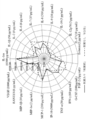
- FIG. 1A is a graph showing the average concentration of the remaining 21 types of cytokines, excluding the 6 types of cytokines that were below the detection limit in Example 1, in the saliva collected at the first time.
- the “solid line” indicates the average value of cytokine concentration contained in saliva collected from the group with tactile stimulation, and the “dotted line” indicates the average value of cytokine concentration in the group without tactile stimulation.
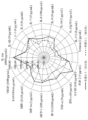
- FIG. 1B is a graph showing the average concentration of the remaining 21 types of cytokines, excluding the 6 types of cytokines that were below the detection limit in Example 1, in the saliva collected a second time.
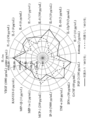
- FIG. 1C is a graph showing the average concentration of the remaining 21 types of cytokines, excluding the 6 types of cytokines that were below the detection limit in Example 1, in saliva collected a third time.
- the "solid line” indicates the average value of cytokine concentration contained in saliva collected from the group with tactile stimulation, and the “dotted line” indicates the average value of cytokine concentration in the group without tactile stimulation.
- 1D is a graph showing the average concentration of the remaining 21 types of cytokines, excluding the 6 types of cytokines that were below the detection limit in Example 1, in saliva collected at the 4th time.
- the "solid line” indicates the average value of cytokine concentration contained in saliva collected from the group with tactile stimulation, and the “dotted line” indicates the average value of cytokine concentration in the group without tactile stimulation.
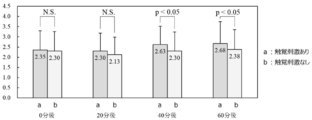
- FIG. 2A is a graph showing the average value of happiness.
- FIG. 2B is a graph showing the average arousal level.
- the method for evaluating whether or not the evaluation target of the present invention has a feeling of happiness includes at least an evaluation step, and further, if necessary, further. Includes other steps such as measurement steps.
- the sense of well-being refers to a sense of well-being with a high degree of arousal caused by some kind of stimulus.
- ⁇ Evaluation process> In the evaluation step in the evaluation method of happiness, whether or not the evaluation target has a feeling of happiness using the amount of cytokine (hereinafter, also referred to as "concentration") in the sample derived from the evaluation target as an index. This is the process of evaluating whether or not (sometimes referred to as "whether or not you feel happy"). In the present invention, whether or not the person has the feeling of happiness includes the degree of the feeling of happiness.
- the amount of cytokine in the sample derived from the evaluation target may be measured in the measurement step described later, or may be separately measured.
- the unit of the data on the amount of the cytokine is not particularly limited and may be appropriately selected depending on the intended purpose. For example, it can be obtained by adding, subtracting, multiplying or dividing a molar concentration, a weight concentration, or an arbitrary constant to these concentrations. Things and so on.
- the evaluation target is not particularly limited as long as it is a target for which evaluation of whether or not it has a feeling of happiness is required, and it can be appropriately selected according to the purpose.
- the type of the evaluation target is not particularly limited and may be appropriately selected depending on the intended purpose, and may be a human or a non-human animal.
- the gender of the evaluation target is not particularly limited and may be appropriately selected depending on the purpose, and may be a man or a woman.
- the age of the evaluation target is not particularly limited and can be appropriately selected according to the purpose.
- sample derived from the evaluation target is not particularly limited, and a sample containing cells, tissues, or a part thereof, etc. collected from the evaluation target can be appropriately selected depending on the purpose, for example, blood, serum, and the like.
- examples include cerebrospinal fluid, saliva, pharyngeal swab, sweat, urine, tears, lymph, semen, ascites, and breast milk. These may be used alone or in combination of two or more.
- blood, saliva, sweat and urine are preferable, and saliva, saliva and urine are more preferable, and saliva is particularly preferable in that non-invasively can be obtained.
- the method for preparing the sample (hereinafter, also referred to as “collection method”) is not particularly limited, and a known method can be appropriately selected.
- a method of collecting blood using a normal syringe can be mentioned.
- the sample is saliva, for example, a method of directly collecting saliva, a method of using a salivat or a commercially available collecting device, and the like can be mentioned.
- the collection time of the sample derived from the evaluation target (hereinafter, may also be referred to as “collection time zone”) is not particularly limited and may be appropriately selected depending on the purpose, but the target to be compared in the evaluation process. It is preferable that the time is about the same as the time when the sample is taken from. In particular, when the sample is saliva, the amount of cytokines contained in saliva may fluctuate greatly during the day, so it is preferable to carry out the sample at a certain time of the day.
- the sample derived from the evaluation target may be subjected to a treatment such as dilution, if necessary.
- the cytokine is a general term for relatively small proteins (approximately 5 to 20 kDa) that play important roles in cell signaling.
- the cytokine used in the evaluation step is not particularly limited and may be appropriately selected depending on the intended purpose.
- interleukin for example, interleukin; phosphokine; chemokine such as RANTES (regulated on activation, normal T cell expressed and secret); interferon.
- RANTES regulated on activation, normal T cell expressed and secret
- Hematopoietic factors such as colony stimulating factor (CSF), granulocyte colony stimulating factor (G-CSF), erythropoetin (EPO); epithelial growth factor (EGF), fibroblast growth factor (FGF), platelet-derived growth factor (PDGF) ), Cell growth factors such as hepatocellular growth factor (HGF), transforming growth factor (TGF); cytotoxic factors such as tumor necrosis factor (TNF- ⁇ ), phosphorus photoxin (TNF- ⁇ ); leptin, TNF- Adipokines such as ⁇ ; neurotrophic factors such as nerve growth factor (NGF) and the like can be mentioned.
- CSF colony stimulating factor
- G-CSF granulocyte colony stimulating factor
- EPO erythropoetin
- EGF epithelial growth factor
- FGF fibroblast growth factor
- PDGF platelet-derived growth factor
- Cell growth factors such as hepatocellular growth factor (HGF), transforming growth factor (TGF
- the cytokine may be used alone or in combination of two or more.
- interleukin-1 receptor antagonist protein IL-1ra
- interleukin-1 ⁇ IL-1 ⁇
- interleukin-2 IL-2
- Interleukin-4 IL-4
- Interleukin-5 IL-5
- Interleukin-6 IL-6
- Interleukin-7 IL-7
- Interleukin-8 IL-8
- Interleukin-9 IL-9
- Interleukin-10 IL-10
- Interleukin-12 p70 Interleukin-12 p70
- Interleukin-13 Interleukin-13
- Interleukin-15 IL- 15
- interleukin-17A IL-17A
- eotaxin FGF-2, granulocyte colony stimulator (G-CSF), granulocyte macrophage colony stimulator (GM-CSF), interferon- ⁇ (IFN - ⁇ ), TNF- ⁇ , interleukin-inducing protein 10 (IP-10), monocytic chemotactic protein-1 (MCP-1), macrophage inflammatory protein
- IL-9 is even more preferable, and any combination of IL-9 and IL-17A and any one selected from the group consisting of IL-17A are particularly preferable.
- the evaluation method is not particularly limited as long as it can evaluate whether or not the evaluation target has a feeling of happiness, and can be appropriately selected according to the purpose.
- the evaluation method there is a method including a process of comparing the amount of cytokine in the sample derived from the evaluation target with the reference value.
- the reference value is not particularly limited and may be appropriately selected depending on the intended purpose.
- value without happiness the amount of cytokine in a sample derived from a subject that has not been stimulated
- value with happiness a value based on the amount of cytokine in the sample derived from the stimulated subject
- the stimulus is not particularly limited as long as it is confirmed that a feeling of happiness can be obtained, and can be appropriately selected depending on the purpose.
- visual stimulus auditory stimulus, tactile stimulus, and taste stimulus.
- Smell stimulus and the like.
- Specific examples include a tactile stimulus stroking between the shoulder blades with the fingertips of the hand at a speed of 5 cm per second and a strength of 200 g, as described in the item of Examples described later. ..
- the non-stimulated object or the stimulated object used for the reference value may be the same as or different from the evaluation object.
- the target used for the reference value is a target different from the evaluation target, an individual of the same type as the evaluation target and having a similar age is preferable.
- the reference value can be easily determined by a person skilled in the art from the matters described in the present specification, for example, as follows.
- the value based on the (I) no happiness value is not particularly limited and may be appropriately selected depending on the purpose. For example, the same value as the no happiness value or the same value as the no happiness value or with reference to the no happiness value. For example, setting the value close to the value without feeling of happiness can be mentioned.
- the value based on the (II) happiness value is not particularly limited and may be appropriately selected depending on the purpose. For example, the same value as the happiness value or the same value as the happiness value or with reference to the happiness value. For example, setting the value close to the value with a feeling of happiness can be mentioned.
- the amount of cytokine in the sample derived from the evaluation target is larger than the value based on the no happiness value, the evaluation target. However, it can be evaluated as having a feeling of happiness.
- the evaluation is made when the amount of cytokine in the sample derived from the evaluation target is equal to or more than the value based on the value with happiness. It can be evaluated that the subject has a feeling of happiness.
- cytokine concentration in the sample derived from the evaluation target is the reference value (for example, derived from an unstimulated target). It can be judged by whether or not it exceeds the value based on the cytokine concentration in the sample of the above, and "the cytokine concentration is low (the amount of cytokine is small)” means that the cytokine concentration in the sample derived from the evaluation target is high. However, it can be determined by whether or not it is below the reference value.
- the reference value may be set based on the amount of cytokine in the sample measured at the time of carrying out the method for evaluating happiness, or may be set based on the amount of cytokine in the sample already measured. The set one may be used.
- evaluation method there is also a method using an evaluation formula capable of evaluating whether or not the person has a feeling of happiness.
- the evaluation target can evaluate the happiness.
- the evaluation formula includes a variable to which the data on the amount of the cytokine (hereinafter, also referred to as “cytokine concentration value”) is substituted.
- the number of the variables is not particularly limited as long as it is at least one, and can be appropriately selected depending on the intended purpose, but at least two are preferable in that the accuracy of evaluation can be further improved.
- an evaluation formula capable of evaluating whether or not a person has a feeling of well-being based on data on the amount of two or more cytokines selected from the cytokines, two or more cytokines selected from the cytokines It comprises substituting data on the amount of cytokines, and the evaluation formula preferably includes at least two variables to which data on the amounts of two or more substances selected from the cytokines are substituted.
- the mode of the two or more kinds of cytokines selected from the cytokines is not particularly limited and may be appropriately selected depending on the intended purpose.
- the evaluation formula is not particularly limited and may be appropriately selected according to the purpose.
- a logistic regression formula for example, a division formula, a linear discriminant formula, a multiple regression formula, a formula created by a support vector machine, and a Mahalanobis distance.
- Examples include formulas created by the method, formulas created by canonical discriminant analysis, and formulas created by decision trees. As a result, it is possible to further improve the reliability of information that can be used as a reference for knowing the feeling of happiness.
- the formula adopted as the evaluation formula means the format of the formula generally used in multivariate analysis.
- a fractional formula, a multiple regression formula, a multiple logistic regression formula, a linear discriminant function, a Mahalanobis distance, and a positive formula examples include quasi-discriminant functions, support vector machines, decision trees, and expressions such as those represented by the sum of different forms of expressions.
- a coefficient and a constant term are added to each variable, and the coefficient and the constant term may be preferably real numbers, and more preferably.
- the formula (concentration of cytokine A) + (concentration of cytokine B) can be mentioned. According to this, it is possible to quantify the evaluation of whether or not the person has a feeling of happiness as a concrete numerical value.
- weighting may be performed for each type of cytokine based on the results obtained by examining the correlation between various cytokines and happiness in advance.
- the value of cytokine concentration may be corrected according to age, gender, race, and the like.
- the degree of these corrections and the presence or absence of these corrections may be changed depending on the type of cytokine.
- the evaluation value obtained as described above may be compared with the value of a general person (for example, the average value of Japanese people), and whether or not the person has a feeling of happiness may be evaluated by the magnification. ..
- cytokine in the method using the evaluation formula examples include those similar to those described in the above-mentioned item-Cytokine-, and preferred embodiments are also the same.
- AUC Absolute Under the Curve
- ROC curve Receiveiver Operating Characteristic Curve; receiver operating characteristic curve
- a cytokine having the maximum AUC or a combination of cytokines can be obtained by a variable reduction method.
- the other steps in the method for evaluating happiness are not particularly limited as long as the effects of the present invention are not impaired, and can be appropriately selected depending on the intended purpose. Examples thereof include a measurement step and a sample preparation step. ..
- the measurement step in the evaluation method of happiness is a step of measuring the amount of cytokine in the sample derived from the evaluation target.
- Examples of the sample and cytokine in the measurement step are the same as those described in the item of ⁇ evaluation step> described above, and the preferred embodiment is also the same.
- the measurement step may be performed in combination with the measurement of the amount of a substance other than the cytokine.
- the method for measuring the amount of the cytokine in the sample is not particularly limited, and a known method can be appropriately selected. Examples thereof include a method for measuring the amount of protein and a method for measuring the amount of mRNA. Be done. These may be used alone or in combination of two or more.
- the amino acid sequence and base sequence of the cytokine can be easily obtained through a public database such as GenBank (NCBI).
- the method for measuring the amount of the cytokine protein is not particularly limited, and a known method can be appropriately selected.
- the measurement is performed by an immunological method using an antibody that specifically recognizes the cytokine. How to do it.
- the immunological method is not particularly limited, and a known method can be appropriately selected.
- a known method can be appropriately selected.
- antibody array flow cytometry analysis, radioimmunoassay immunoassay (RIA method), ELISA method (Methods in). Enzymol. 70: 419-439 (1980)), dot blot method, immunonuclide assay method, western blot method, immune tissue staining method and the like can be mentioned.
- the ELISA method include a direct method in which a target cytokine is immobilized on a microplate and an antibody that recognizes the labeled cytokine is allowed to act, an indirect method that uses a labeled secondary antibody that recognizes an anti-cytokine antibody, and an anti-cytokine method.
- the method for measuring the amount of the mRNA is not particularly limited, and a known method can be appropriately selected, and examples thereof include a PCR method, a real-time PCR method, a DNA array method, and a Northern blotting method.
- the amount of the cytokine in the sample can also be measured using a commercially available cytokine amount measurement kit.
- Sample preparation process is a step of preparing a sample derived from the evaluation target, and a known method can be appropriately selected depending on the type of the sample.
- the method for evaluating happiness of the present invention can also be performed in combination with evaluation by other means such as interviews.
- the method for evaluating happiness of the present invention it is possible to evaluate with high accuracy whether or not the evaluation target has happiness by using the amount of the cytokine in the sample derived from the evaluation target as an index. it can.
- the present invention includes an evaluation step of evaluating whether or not a person feels comfortable by using the amount of cytokine in the sample derived from the evaluation target as an index, and the evaluation target further includes the other steps as necessary. It also relates to a method of evaluating whether or not a person feels comfortable (hereinafter, may be referred to as a “comfort evaluation method”).
- the comfort evaluation method can be performed in the same manner as the happiness evaluation method of the present invention.
- the present invention is a method for evaluating the arousal state of an evaluation target, which includes an evaluation step of evaluating the arousal state using the amount of cytokines in a sample derived from the evaluation target as an index, and further includes the other steps as necessary. (Hereinafter, it may be referred to as "evaluation method of arousal state").
- the arousal state is not particularly limited and may be appropriately selected depending on the intended purpose.
- Examples thereof include whether or not the state of energy arousal is high and whether or not the state of tension arousal is low.
- the method for evaluating the arousal state can be performed in the same manner as the method for evaluating the feeling of well-being of the present invention.
- the present invention is a bio for evaluating whether or not the evaluation target has a feeling of happiness, for evaluating whether or not the evaluation target feels comfortable, or for evaluating the arousal state of the evaluation target. It is a marker and is also related to a biomarker consisting of cytokines.
- evaluation data acquisition method The method of acquiring data for evaluating whether or not the evaluation target of the present invention has a feeling of happiness (hereinafter, may be referred to as “evaluation data acquisition method") includes at least a measurement step. Additional steps are included as needed.
- the measurement step in the evaluation data acquisition method is a step of measuring the amount of cytokine in the sample derived from the evaluation target, and is described in the item of ⁇ Other steps> of (Evaluation method of happiness) of the present invention described above. It can be carried out in the same manner as in the ⁇ measurement step >>, and the preferred embodiment can also be the same.
- the other steps in the evaluation data acquisition method are not particularly limited as long as the effects of the present invention are not impaired, and can be appropriately selected depending on the intended purpose. Examples thereof include a sample preparation step.
- the sample preparation step in the evaluation data acquisition method is a step of preparing a sample derived from the evaluation target, and is described in the item of ⁇ Other steps> of (Evaluation method of happiness) of the present invention described above.
- the sample preparation step >> can be performed in the same manner.
- the evaluation data acquisition method may be performed in combination with the measurement of the amount of a substance other than the cytokine.
- the evaluation data acquisition method of the present invention it is possible to collect useful data for evaluating with high accuracy whether or not the evaluation target has a feeling of happiness.
- the present invention is “whether the evaluation target feels comfortable”. It is also related to "a method of acquiring data for evaluating whether or not” or "a method of acquiring data for evaluating the arousal state of an evaluation target”. In the "method of acquiring data for evaluating whether or not the evaluation target feels comfortable” or "method of acquiring data for evaluating the arousal state of the evaluation target", the evaluation target is happy. It can be performed in the same manner as the method of acquiring data for evaluating whether or not a person has a feeling.
- the present invention also relates to a kit for evaluating whether or not the evaluation target has a feeling of happiness (hereinafter, may be referred to as a “kit for evaluating a feeling of happiness”).
- the happiness evaluation kit includes at least a cytokine detecting means, and further includes other configurations as necessary.
- the cytokine detecting means is not particularly limited as long as the target cytokine in the sample can be detected, and can be appropriately selected depending on the purpose. However, in order to immunologically detect the cytokine, It is preferable to include a detection device in which an antibody against the cytokine is immobilized.
- Examples of the cytokine include those described in the item of-cytokine-in the ⁇ evaluation step> in the method for evaluating happiness of the present invention, and the preferred embodiment is also the same.
- the target for fixing the antibody against the cytokine is not particularly limited as long as it is a carrier that is a solid or insoluble material, and can be appropriately selected depending on the intended purpose.
- the reaction mixture is subjected to filtration, precipitation, magnetic separation or the like. Examples thereof include carriers that can be separated from the above.
- the shape of the carrier is not particularly limited and may be appropriately selected depending on the intended purpose. Examples thereof include beads, magnetic beads, thin films, microtubules, filters, plates, microplates, carbon nanotubes, and sensor chips. Be done.
- the flat carrier such as the thin film or the plate may be provided with pits, grooves, filter bottoms and the like.
- the other configurations are not particularly limited, and the configurations included in known diagnostic kits and the like can be appropriately selected depending on the purpose. For example, reagents used for immunological measurement and instruction manuals for kits. And so on.
- the happiness evaluation kit it is possible to evaluate with high accuracy whether or not the evaluation target has a feeling of happiness.
- the present invention since the present invention also relates to the "comfort evaluation method” or the “awakening state evaluation method", the present invention is a “comfort evaluation kit” or. It is also related to the "Awakening Evaluation Kit”.
- the "comfort evaluation kit” or the “awakening state evaluation kit” may have the same configuration as the happiness evaluation kit.
- the present invention also relates to a method for screening at least one stimulus selected from the group consisting of stimuli that impart happiness to a subject, stimuli that impart comfort to a subject, and stimuli that change the arousal state of the subject. ..
- the stimulus for changing the arousal state is not particularly limited and may be appropriately selected depending on the intended purpose. Examples thereof include a stimulus for increasing the state of energy arousal and a stimulus for lowering the state of tension arousal.
- the stimulus screening method includes at least an evaluation step, and if necessary, further includes other steps such as a stimulus applying step and a measuring step.
- the stimulus changes the stimulus that imparts happiness, the stimulus that imparts comfort, and the arousal state using the amount of cytokine in the sample derived from the subject to which the stimulus is applied as an index. It is a step of evaluating whether or not it corresponds to at least one stimulus selected from the group consisting of stimuli to be caused. In the present invention, whether or not the stimulus corresponds to the above includes the degree of happiness, the degree of comfort, and the degree of arousal.
- the stimulus may be a stimulus for which it is desired to evaluate whether or not it corresponds to at least one stimulus selected from the group consisting of the stimulus that imparts happiness, the stimulus that imparts comfort, and the stimulus that changes the arousal state.
- the present invention is not particularly limited and may be appropriately selected depending on the intended purpose. Examples thereof include visual stimulus, auditory stimulus, tactile stimulus, taste stimulus, and olfactory stimulus.
- the application of the stimulus to the target may be performed in the stimulus application step described later, or may be performed separately.
- the amount of cytokine in the sample derived from the subject to which the stimulus is applied may be measured in the measurement step described later, or may be separately measured.
- the unit of the data on the amount of the cytokine is not particularly limited and may be appropriately selected depending on the intended purpose. For example, it can be obtained by adding, subtracting, multiplying or dividing a molar concentration, a weight concentration, or an arbitrary constant to these concentrations. Things and so on.
- the target to which the stimulus is given is not particularly limited and may be appropriately selected depending on the purpose. For example, the same as that described in the above-mentioned (Evaluation method of happiness) -evaluation target-. And the preferred embodiment can be the same.
- sample derived from the subject to which the stimulus has been applied is not particularly limited and may be appropriately selected depending on the purpose.
- the item of the above-mentioned (method for evaluating happiness) -sample derived from the evaluation target- It can be the same as that described in the above, and the preferred embodiment can also be the same.
- cytokine is not particularly limited and may be appropriately selected depending on the intended purpose. For example, it can be the same as that described in the above-mentioned (method for evaluating happiness) -cytokine-.
- the preferred embodiment can be the same.
- the stimulus corresponds to at least one stimulus selected from the group consisting of a stimulus that imparts happiness, a stimulus that imparts comfort, and a stimulus that changes the alert state. If it can be evaluated, there is no particular limitation, and it can be appropriately selected according to the purpose. For example, it can be the same as that described in the above-mentioned (evaluation method of happiness) -evaluation-. , The preferred embodiment can be the same.
- the evaluation method there is a method including a process of comparing the amount of cytokine in the sample derived from the subject with the reference value.
- the reference value is not particularly limited and may be appropriately selected depending on the intended purpose. For example, (i) a value based on the amount of cytokine in a sample derived from a subject that has not been stimulated, and (ii) a feeling of well-being.
- the reference value can be easily determined by those skilled in the art from the matters described in the present specification, for example, as follows.
- the non-stimulated object or the stimulated object used for the reference value may be the same as or different from the object.
- the target used for the reference value is different from the target, an individual of the same type as the target and having a similar age is preferable.
- the value based on the amount of cytokine in the sample derived from the subject (i) not stimulated is not particularly limited and may be appropriately selected depending on the purpose.
- the value (i) not stimulated is not received.
- the same value as the amount of cytokines in the sample derived from the subject (i) not stimulated or the amount of cytokines in the sample derived from the subject not stimulated (i). For example, set a value close to.
- the value based on the amount of cytokine in the sample of origin is not particularly limited and may be appropriately selected depending on the purpose.
- a stimulus that imparts happiness, a stimulus that imparts comfort, and a stimulus that imparts comfort is not particularly limited and may be appropriately selected depending on the purpose.
- a stimulus that imparts happiness is a stimulus that imparts comfort, and a stimulus that imparts comfort.
- the above-mentioned (ii) happiness is imparted with reference to the amount of cytokines in a sample derived from a stimulated subject, which is known to correspond to at least one stimulus selected from the group consisting of stimuli that change the wakefulness state.
- the amount of cytokines in a sample from a stimulated subject that has been found to correspond to at least one stimulus selected from the group consisting of stimuli that provide stimuli, stimuli that provide comfort, and stimuli that alter wakefulness.
- the reference value is (i) a value based on the amount of cytokines in the unstimulated sample from the subject
- the amount of cytokines in the sample from the subject is (i) stimulated.
- the stimulus is selected from the group consisting of a stimulus that imparts happiness, a stimulus that imparts comfort, and a stimulus that changes the state of alertness when the value is higher than the value based on the amount of cytokine in the sample derived from the non-subject. It can be evaluated as corresponding to at least one stimulus.
- the reference value corresponds to at least one stimulus selected from the group consisting of (ii) a stimulus that imparts happiness, a stimulus that imparts comfort, and a stimulus that changes the arousal state.
- the amount of cytokine in the sample derived from the subject is (ii) the stimulus that imparts happiness, the stimulus that imparts comfort, and the stimulus that imparts comfort.
- the amount is equal to or greater than the value based on the amount of cytokine in the sample derived from the stimulated subject, which is known to correspond to at least one stimulus selected from the group consisting of stimuli that change the wakefulness state. It can be evaluated that the stimulus corresponds to at least one stimulus selected from the group consisting of a stimulus that imparts happiness, a stimulus that imparts comfort, and a stimulus that changes the state of alertness.
- the stimulus that has been found to correspond to at least one stimulus selected from the group consisting of the stimulus that imparts a feeling of well-being, the stimulus that imparts comfort, and the stimulus that changes the arousal state is not particularly limited. , Can be appropriately selected according to the purpose. For example, as described in the item of Examples described later, using the fingertips of the hand between the shoulder blades, the speed is 5 cm per second and the weight is 200 g. There is a tactile stimulus that is stroked.
- the concentration of cytokine is high can be determined by whether or not the concentration of cytokine in the sample derived from the subject exceeds the reference value.
- concentration of cytokine is low can be determined by whether or not the concentration of cytokine in the sample derived from the subject is lower than the reference value.
- the reference value may be set based on the amount of cytokine in the sample measured at the time of carrying out the screening method, or may be set based on the amount of cytokine in the sample already measured. May be used.
- the evaluation method whether or not the stimulus corresponds to at least one stimulus selected from the group consisting of a stimulus that imparts happiness, a stimulus that imparts comfort, and a stimulus that changes the arousal state.
- evaluation method of happiness an evaluation formula capable of evaluating the above-mentioned (evaluation method of happiness), which can be carried out in the same manner as described in the item of --- evaluation formula ---, and a preferred embodiment is also used. The same can be done.
- the other steps in the screening method are not particularly limited as long as the effects of the present invention are not impaired, and can be appropriately selected depending on the intended purpose. Examples thereof include a stimulation application step, a measurement step, and a sample preparation step. Be done.
- the stimulus applying step in the screening method is a step of applying the stimulus to the subject.
- Examples of the stimulus include those described in the above-mentioned-stimulus-item.
- the method of applying the stimulus can be appropriately selected according to the stimulus to be evaluated.
- the measurement step in the screening method is a step of measuring the amount of cytokines in the sample derived from the subject, and is the same as that described in the item of ⁇ Measurement step >> of the above-mentioned (method for evaluating happiness). It can be done, and the preferred embodiment can be the same.
- the sample preparation step in the screening method is a step of preparing a sample derived from the target, and is carried out in the same manner as described in the item ⁇ Sample preparation step >> of the above-mentioned (method for evaluating happiness). And the preferred embodiment can be the same.
- the screening method of the present invention can also be performed in combination with evaluation by other means such as interviews.
- a stimulus that imparts happiness to the subject by using the amount of the cytokine in the sample derived from the subject as an index, a stimulus that imparts happiness to the subject, a stimulus that imparts comfort to the subject, and a wakefulness state of the subject can be determined.
- At least one stimulus selected from the group consisting of varying stimuli can be screened.
- the present invention determines whether the stimulus corresponds to at least one stimulus selected from the group consisting of a stimulus that imparts a feeling of well-being, a stimulus that imparts comfort to the subject, and a stimulus that changes the arousal state of the subject. It also relates to a method of acquiring data for evaluation (hereinafter, may be referred to as “method of acquiring data for stimulus evaluation”).
- the method for acquiring the evaluation data of the stimulus includes at least a measurement step, and further includes other steps if necessary.
- the measurement step in the method for acquiring stimulus evaluation data is a step of measuring the amount of cytokines in a sample derived from a target, and is described in the item of ⁇ Measurement step >> of the above-mentioned (stimulus screening method). The same can be performed in the same manner as in
- the other steps in the method for acquiring the evaluation data of the stimulus are not particularly limited as long as the effects of the present invention are not impaired, and can be appropriately selected depending on the intended purpose. Examples thereof include a sample preparation step. ..
- the sample preparation step in the method for acquiring stimulus evaluation data is a step of preparing a sample derived from the target, and is described in the item of ⁇ Other steps> of the above-mentioned (stimulation screening method) ⁇ sample preparation. It can be performed in the same manner as in Step >>.
- the method for acquiring the evaluation data of the stimulus may be performed in combination with the measurement of the amount of a substance other than the cytokine.
- the stimulus is selected from a group consisting of a stimulus that imparts a feeling of well-being, a stimulus that imparts comfort to the subject, and a stimulus that changes the arousal state of the subject. It is possible to collect useful data for highly accurate evaluation of whether or not one stimulus is applicable.
- Example 1 saliva samples are collected from female subjects under two conditions, one is when the female practitioner presents tactile stimulus using her own hand and the other is when she does not present tactile stimulus. A logistic model was created for the cytokine concentration in the saliva.
- the analysis sample was selected based on the results of the occult blood test conducted before the first saliva collection under each condition.
- the occult blood test was performed using a perioscreen "Sunstar” (Sunstar Co., Ltd.).
- the analysis samples were 312 samples excluding the sample having the highest occult blood concentration under each condition of "with tactile stimulation” and "without tactile stimulation”.
- Cytokine analyzer Bio-Plex (Bio-Radra Volatries Co., Ltd.)
- Cytokine analysis kit Bio-Plex Pro Human Cytokine 27 plex Kit (Bio-Radola Volunteers Co., Ltd.) (8 pieces)
- the LOD value Limit of Detection; the concentration obtained by adding the concentration fluctuation observed between the blanks to the concentration of the blank, and the lower limit of the measurement obtained from the blank.
- the LOD / 2 value was used as the measurement value only when the blank value + 2 ⁇ the SD value of the blank could be calculated.
- LLOQ low concentration range of the standard solution.
- the LOD value was calculated using the coefficient of the standard curve regression equation obtained from the measured values of the eight standard concentrations. However, when the LOD / 2 value was higher than the standard thinnest concentration value (S8), the S8 concentration value / 2 was substituted as the measured value.
- Table 1-1 shows the results of the itemized mean values of cytokine concentrations in saliva collected in the group without tactile stimulation
- Table 1-2 shows the results of the itemized mean values of cytokine concentrations in saliva collected in the group with tactile stimulation.
- the six cytokines (IL-4, IL-5, IL-13, IL-15, GM-CSF, PDGF-BB) that were below the detection limit are not listed in the table.
- the "LOD number" in Table 1-1 indicates the number of samples in which the cytokine concentration was below the detection limit and the LOD value was calculated out of all 156 samples in the no tactile stimulation group.
- the "LOD number" in Table 1-2 indicates the number of samples in which the cytokine concentration was below the detection limit and the LOD value was calculated out of all 156 samples in the tactile stimulation group.
- the concentration of cytokines in saliva collected in the group with tactile stimulation changed in many cytokines after stimulation.
- FIGS. 1A to 1D show comparison charts of cytokine concentrations for each saliva collection period.
- the “solid line” indicates the cytokine concentration in the tactile stimulus group
- the “dotted line” indicates the cytokine concentration in the non-tactile stimulus group.
- FIG. 1A is the first saliva collection (before stimulation, 0 minutes later)
- FIG. 1B is the second saliva collection (20 minutes later)
- FIG. 1C is the third saliva collection (40 minutes later)
- FIG. 1D is the fourth saliva collection. The result of saliva collection (after 60 minutes) is shown.
- Cytokine group 27 items IL-1ra, IL-1 ⁇ , IL-2, IL-4, IL-5, IL-6, IL-7, IL-8, IL-9, IL-10, IL-12 p70, IL-13, IL -15, IL-17A, Eotaxin, FGF-2, G-CSF, GM-CSF, IFN- ⁇ , TNF- ⁇ , IP-10, MCP-1, MIP-1 ⁇ , MIP-1 ⁇ , PDGF-BB, RANTES , VEGF 2) Presence or absence of tactile stimulation (2 categories) 3) Elapsed time: Group with tactile stimulation: Before stimulation, 20 minutes after stimulation, 40 minutes after stimulation, 60 minutes after stimulation (4 categories) Group without tactile stimulation: 0 minutes, 20 minutes, 40 minutes, 60 minutes (4 categories)
- ⁇ Analysis step 1 Adjustment of data used >> The following work was performed to create data that can compare cytokine groups with different concentration ranges. -Selection of data used- Of the 27 types of cytokines analyzed, 6 cytokines (IL-4, IL-5, IL-13, IL-15, GM-CSF, PDGF-BB) that were below the detection limit were excluded as usage data.
- 21 cytokines (IL-1ra, IL-1 ⁇ , IL-2, IL-6, IL-7, IL-8, IL-9, IL-10, IL-12 p70, IL-17A, Eotaxin, FGF -2, G-CSF, IFN- ⁇ , TNF- ⁇ , IP-10, MCP-1, MIP-1 ⁇ , MIP-1 ⁇ , RANTES, VEGF) were selected.
- ⁇ Analysis Step 3 Diagnosis of Multicollinearity >> In the above ⁇ analysis step 2 >>, for cytokines in which only the "tactile stimulus group" showed a significant difference, removal of the cytokine causing multicollinearity was carried out by a method for diagnosing multicollinearity from a single correlation. Combinations showing high single-correlation values (correlation coefficient R> 0.7) among cytokines were excluded. Diagnosis was made under two conditions: before stimulation-20 minutes after stimulation and before stimulation-60 minutes after stimulation in the group with tactile stimulation.
- ⁇ Analysis Step 4 Modeling by Logistic Regression Analysis and Evaluation of Model by ROC Analysis >> For the cytokines remaining in ⁇ Analysis Step 3 >>, modeling by logistic regression analysis using the stepwise method and determination ability (AUC) of the model by ROC analysis were further calculated. Table 3 shows the calculated values of AUC (Area Under Curve) by ROC analysis of cytokines alone or in combination.
- the AUC was 0.9 or more in the combination of IL-17A alone and IL-9 and IL-17A.
- JUMACL examines the effect of tactile stimuli on two arousals (Tense Arousal (hereinafter sometimes referred to as "TA”) and Energy Arousal (hereinafter sometimes referred to as "EA”)). Therefore, both the "tactile stimulus group” and the “tactile stimulus-free group” were performed immediately before saliva collection four times ((1), (4), (6), (8) in the above experimental steps).
- TA Tense Arousal
- EA Energy Arousal
- the concentration of cytokine in the sample fluctuated, and as described in the item ⁇ Significance test result of mood rating >>. It was found that the group with tactile stimulation tended to have higher happiness and the group without tactile stimulation tended to have higher arousal level. Therefore, by using the amount of cytokines contained in the sample derived from the evaluation target as an index, whether or not the evaluation target has a feeling of happiness, particularly a feeling of well-being with a high degree of arousal (whether or not the feeling of happiness). It was found that the evaluation can be performed with high accuracy. Further, as the index, it was shown that IL-17A alone having an AUC of 0.9 or more and a combination of IL-9 and IL-17A are preferable.
- Examples of aspects of the present invention include the following. ⁇ 1> Whether or not the evaluation target has a feeling of happiness, which comprises an evaluation step of evaluating whether or not the sample has a feeling of happiness using the amount of cytokine in the sample derived from the evaluation target as an index. Is a method of evaluating. ⁇ 2> The evaluation step includes a process of comparing the amount of cytokine in the sample derived from the evaluation target with the reference value.
- the reference value is at least one of a value based on the amount of cytokine in the sample derived from the unstimulated subject and a value based on the amount of cytokine in the sample derived from the stimulated subject.
- the method according to ⁇ 1> which is a step of evaluating that the evaluation target has a feeling of happiness in at least one of the cases where the amount is equal to or more than the above.
- the evaluation step includes substituting the cytokine amount data into an evaluation formula capable of evaluating whether or not the patient has a feeling of happiness based on the cytokine amount data.
- the evaluation step includes substituting the cytokine amount data into an evaluation formula capable of evaluating whether or not the patient has a feeling of happiness based on the cytokine amount data.
- ⁇ 5> The method according to any one of ⁇ 1> to ⁇ 4>, wherein the cytokine is one selected from the combination of IL-9 and IL-17A and the group consisting of IL-17A.
- ⁇ 6> The method according to any one of ⁇ 1> to ⁇ 5>, further comprising a measurement step of measuring the amount of cytokine in the sample derived from the evaluation target.
- ⁇ 7> The method according to any one of ⁇ 1> to ⁇ 6>, wherein the sample derived from the evaluation target is saliva.
- cytokine is either a combination of IL-9 and IL-17A and selected from the group consisting of IL-17A.
- a screening method for at least one stimulus selected from a group consisting of a stimulus that imparts happiness to a subject, a stimulus that imparts comfort to the subject, and a stimulus that changes the arousal state of the subject.
- the stimulus is selected from at least a group consisting of a stimulus that imparts happiness, a stimulus that imparts comfort, and a stimulus that changes the wakefulness state. It is a stimulus screening method comprising a step of evaluating whether or not it corresponds to one stimulus.
- the evaluation step includes a process of comparing the amount of cytokine in the sample derived from the subject with the reference value.
- the reference value is selected from the group consisting of a value based on the amount of cytokine in the sample derived from the subject not received the stimulus, a stimulus that imparts happiness, a stimulus that imparts comfort, and a stimulus that changes the wakefulness state. At least one of the values based on the amount of cytokines in the sample from the stimulated subject known to correspond to at least one stimulus.
- the amount of cytokine in the sample derived from the subject is larger than the value based on the amount of cytokine in the sample derived from the unstimulated subject, and the stimulus that imparts happiness, the stimulus that imparts comfort, and arousal.
- At least one of the values equal to or greater than the amount of cytokines in a sample derived from a stimulated subject known to correspond to at least one stimulus selected from the group consisting of state-changing stimuli.
- the step of evaluating that the stimulus corresponds to at least one stimulus selected from the group consisting of a stimulus that imparts happiness, a stimulus that imparts comfort, and a stimulus that changes the arousal state. 11>.
- the evaluation step is selected from the group consisting of a stimulus that imparts a feeling of well-being, a stimulus that imparts comfort, and a stimulus that changes the wakefulness state, based on the data on the amount of the cytokine.
- the evaluation formula includes substituting the data of the amount of the cytokine into an evaluation formula capable of evaluating whether or not it corresponds to at least one stimulus, and the data of the amount of the cytokine is substituted into the evaluation formula at least.
- the evaluation step is selected from the group consisting of a stimulus that imparts a feeling of well-being, a stimulus that imparts comfort, and a stimulus that changes the wakefulness state, based on the data on the amount of the cytokine.
- the evaluation formula includes substituting the data of the amount of the cytokine into an evaluation formula capable of evaluating whether or not it corresponds to at least one stimulus, and the evaluation formula includes at least two substituting the data of the cytokine.
- ⁇ 15> The method according to any one of ⁇ 11> to ⁇ 14>, wherein the cytokine is one selected from the combination of IL-9 and IL-17A and the group consisting of IL-17A.
- ⁇ 16> The method according to any one of ⁇ 11> to ⁇ 15>, wherein the method further includes a step of giving a stimulus to the subject.
- ⁇ 17> The method according to any one of ⁇ 11> to ⁇ 16>, further comprising a measuring step of measuring the amount of cytokine in a sample derived from a subject.
- ⁇ 18> The method according to any one of ⁇ 11> to ⁇ 17>, wherein the sample derived from the subject is saliva.
- a stimulus that includes a measurement step of measuring the amount of cytokines in a sample derived from a subject, a stimulus that imparts a feeling of well-being, a stimulus that imparts comfort to the subject, and a change in the arousal state of the subject.
- the cytokine is one selected from the group consisting of a combination of IL-9 and IL-17A and IL-17A.
- the sample derived from the subject is saliva.
Landscapes
- Life Sciences & Earth Sciences (AREA)
- Health & Medical Sciences (AREA)
- Chemical & Material Sciences (AREA)
- Engineering & Computer Science (AREA)
- Molecular Biology (AREA)
- Urology & Nephrology (AREA)
- Biomedical Technology (AREA)
- Immunology (AREA)
- Hematology (AREA)
- Medicinal Chemistry (AREA)
- Biochemistry (AREA)
- General Health & Medical Sciences (AREA)
- Food Science & Technology (AREA)
- Proteomics, Peptides & Aminoacids (AREA)
- Organic Chemistry (AREA)
- Analytical Chemistry (AREA)
- General Physics & Mathematics (AREA)
- Biotechnology (AREA)
- Cell Biology (AREA)
- Pathology (AREA)
- Microbiology (AREA)
- Physics & Mathematics (AREA)
- Gastroenterology & Hepatology (AREA)
- Toxicology (AREA)
- Zoology (AREA)
- Genetics & Genomics (AREA)
- Biophysics (AREA)
- Investigating Or Analysing Biological Materials (AREA)
- Measuring Or Testing Involving Enzymes Or Micro-Organisms (AREA)
Abstract
Description
<1> 評価対象由来の試料におけるサイトカインの量を指標として、幸福感を有しているか否かを評価する評価工程を含むことを特徴とする、評価対象が幸福感を有しているか否かを評価する方法である。
<2> 評価対象由来の試料におけるサイトカインの量を測定する測定工程を含むことを特徴とする、評価対象が幸福感を有しているか否かを評価するためのデータを取得する方法である。
本発明の評価対象が幸福感を有しているか否かを評価する方法(以下、「幸福感の評価方法」と称することがある。)は、評価工程を少なくとも含み、必要に応じて更に、測定工程等のその他の工程を含む。
本発明において、幸福感とは、何らかの刺激によって生じる覚醒度の高い幸福感のことをいう。
前記幸福感の評価方法における評価工程は、評価対象由来の試料におけるサイトカインの量(以下、「濃度」と称することもある。)を指標として、前記評価対象が、幸福感を有しているか否か(「幸福な気持ちであるか否か」と称することもある。)を評価する工程である。
本発明において、前記幸福感を有しているか否かには、幸福感の程度も含まれる。
前記サイトカインの量のデータの単位としては、特に制限はなく、目的に応じて適宜選択することができ、例えば、モル濃度、重量濃度、これらの濃度に任意の定数を加減乗除することで得られるものなどが挙げられる。
前記評価対象としては、幸福感を有しているか否かの評価が求められる対象であれば、特に制限はなく、目的に応じて適宜選択することができる。
前記評価対象の種類としては、特に制限はなく、目的に応じて適宜選択することができ、ヒトであってもよいし、ヒト以外の動物であってもよい。
前記評価対象の性別としては、特に制限はなく、目的に応じて適宜選択することができ、男であってもよいし、女であってもよい。
前記評価対象の年齢としても、特に制限はなく、目的に応じて適宜選択することができる。
前記評価対象由来の試料としては、特に制限はなく、評価対象から採取された細胞、組織、又はその一部等を含む試料を目的に応じて適宜選択することができ、例えば、血液、血清、脳脊髄液、唾液、咽頭ぬぐい液、汗、尿、涙、リンパ液、精液、腹水、母乳などが挙げられる。これらは、1種単独で使用してもよいし、2種以上を併用してもよい。
これらの中でも、血液、唾液、汗、尿が好ましく、非侵襲的に得ることができる点で、唾液、汗、尿がより好ましく、唾液が特に好ましい。
例えば、前記試料が血液の場合は、例えば、通常のシリンジを用いて採血する方法などが挙げられる。
また、前記試料が、唾液の場合は、例えば、唾液を直接採取する方法、サリベットや市販の採取用器具を用いる方法などが挙げられる。
前記サイトカインは、細胞シグナリングにおいて重要な役割を果たす、比較的小型のタンパク質(およそ5~20kDa)の総称である。
前記評価工程に用いるサイトカインとしては、特に制限はなく、目的に応じて適宜選択することができ、例えば、インターロイキン;リンフォカイン;RANTES(regulated on activation、normal T cell expressed and secreted)等のケモカイン;インターフェロン;コロニー刺激因子(CSF)、顆粒球コロニー刺激因子(G-CSF)、エリスロポエチン(EPO)等の造血因子;上皮成長因子(EGF)、線維芽細胞成長因子(FGF)、血小板由来成長因子(PDGF)、肝細胞成長因子(HGF)、トランスフォーミング成長因子(TGF)等の細胞増殖因子;腫瘍壊死因子(TNF-α)、リンフォトキシン(TNF-β)等の細胞障害因子;レプチン、TNF-α等のアディポカイン;神経成長因子(NGF)等の神経栄養因子などが挙げられる。
前記評価の方法としては、評価対象が、幸福感を有しているか否かを評価することができれば、特に制限はなく、目的に応じて適宜選択することができる。
具体例としては、後述する実施例の項目に記載したような、肩甲骨の間を手の指先を使って、左右に秒速5cmの速さ、200g重の強さで撫でる触覚刺激などが挙げられる。
また、前記評価の方法としては、幸福感を有しているか否かを評価することが可能な評価式を用いる方法も挙げられる。
ここで、前記評価式には、前記サイトカインの量のデータ(以下、「サイトカインの濃度値」と称することもある。)が代入される変数が含まれている。
前記変数の数としては、少なくとも1つあれば、特に制限はなく、目的に応じて適宜選択することができるが、より評価の精度を高めることができる点で、少なくとも2つが好ましい。即ち、前記サイトカインから選択される2種以上のサイトカインの量のデータに基づいて幸福感を有しているか否かを評価することが可能な評価式に、前記サイトカインから選択される2種以上のサイトカインの量のデータを代入することを含み、前記評価式には、前記サイトカインから選択される2種以上の物質の量のデータが代入される少なくとも2つの変数が含まれていることが好ましい。
前記サイトカインから選択される2種以上のサイトカインの態様としては、特に制限はなく、目的に応じて適宜選択することができる。
また、前記サイトカインを抽出するにあたり、例えば、ROC曲線(Receiver Operating Characteristic curve;受信者動作特性曲線)のAUC(Area Under the Curve)などを用いることができる。なお、本発明においては、例えば、変数減少法によってAUCが最大となるサイトカイン、又はサイトカインの組合せを求めることができる。
前記幸福感の評価方法におけるその他の工程としては、本発明の効果を損なわない限り、特に制限はなく、目的に応じて適宜選択することができ、例えば、測定工程、試料調製工程などが挙げられる。
前記幸福感の評価方法における測定工程は、前記評価対象由来の試料におけるサイトカインの量を測定する工程である。
前記測定工程は、前記サイトカイン以外の物質の量の測定と組み合わせて行ってもよい。
前記試料における前記サイトカインの量を測定する方法としては、特に制限はなく、公知の方法を適宜選択することができ、例えば、タンパク質の量を測定する方法、mRNAの量を測定する方法などが挙げられる。これらは、1種単独で使用してもよいし、2種以上を併用してもよい。
なお、前記サイトカインのアミノ酸配列や塩基配列は、GenBank(NCBI)などの公共データベースを通じて容易に入手することができる。
前記幸福感の評価方法における試料調製工程は、前記評価対象由来の試料を調製する工程であり、前記試料の種類に応じて、公知の方法を適宜選択することができる。
したがって、本発明は、評価対象由来の試料におけるサイトカインの量を指標として、心地良さを感じているか否かを評価する評価工程を含み、必要に応じて更に前記その他の工程を含む、評価対象が心地良さを感じているか否かを評価する方法(以下、「心地良さの評価方法」と称することがある。)にも関する。
前記心地良さの評価方法は、本発明の幸福感の評価方法と同様にして行うことができる。
したがって、本発明は、評価対象由来の試料におけるサイトカインの量を指標として、覚醒状態を評価する評価工程を含み、必要に応じて更に前記その他の工程を含む、評価対象の覚醒状態を評価する方法(以下、「覚醒状態の評価方法」と称することがある。)にも関する。
前記覚醒状態としては、特に制限はなく、目的に応じて適宜選択することができ、例えば、エネルギー覚醒の状態が高いか否か、緊張覚醒の状態が低いか否かなどが挙げられる。
前記覚醒状態の評価方法は、本発明の幸福感の評価方法と同様にして行うことができる。
本発明の評価対象が幸福感を有しているか否かを評価するためのデータを取得する方法(以下、「評価用データ取得方法」と称することがある。)は、測定工程を少なくとも含み、必要に応じて更にその他の工程を含む。
前記評価用データ取得方法における測定工程は、評価対象由来の試料におけるサイトカインの量を測定する工程であり、上記した本発明の(幸福感の評価方法)の<その他の工程>の項目に記載した<<測定工程>>と同様にして行うことができ、好ましい態様も同様とすることができる。
前記評価用データ取得方法におけるその他の工程としては、本発明の効果を損なわない限り、特に制限はなく、目的に応じて適宜選択することができ、例えば、試料調製工程などが挙げられる。
前記評価用データ取得方法における試料調製工程は、前記評価対象由来の試料を調製する工程であり、上記した本発明の(幸福感の評価方法)の<その他の工程>の項目に記載した<<試料調製工程>>と同様にして行うことができる。
前記「評価対象が心地良さを感じているか否かを評価するためのデータを取得する方法」、又は「評価対象の覚醒状態を評価するためのデータを取得する方法」は、前記評価対象が幸福感を有しているか否かを評価するためのデータを取得する方法と同様にして行うことができる。
上記したように、本発明の幸福感の評価方法によれば、評価対象由来の試料における前記サイトカインの量を指標とすることで、前記評価対象が幸福感を有しているか否かを高い精度で評価することができるので、本発明は、評価対象が幸福感を有しているか否かの評価用キット(以下、「幸福感の評価用キット」と称することがある。)にも関する。
前記サイトカイン検出手段としては、前記試料における目的のサイトカインを検出することができる限り、特に制限はなく、目的に応じて適宜選択することができるが、前記サイトカインを免疫学的に検出するために、前記サイトカインに対する抗体を固定した検出器具が含まれることが好ましい。
前記その他の構成としては、特に制限はなく、公知の診断用キットなどに含まれる構成を目的に応じて適宜選択することができ、例えば、免疫学的測定法に用いる試薬、キットの取扱説明書などが挙げられる。
前記「心地良さの評価用キット」、又は「覚醒状態の評価用キット」は、前記幸福感の評価用キットと同様の構成とすることができる。
後述する実施例の項目に記載のように、刺激を付与された対象では、幸福感、特に、覚醒度が高い幸福感が得られ、また、心地良さを感じ、更に、覚醒状態が変化していた。
したがって、本発明は、対象に幸福感を付与する刺激、対象に心地良さを付与する刺激、及び対象の覚醒状態を変化させる刺激からなる群から選択される少なくとも1つの刺激のスクリーニング方法にも関する。
前記覚醒状態を変化させる刺激としては、特に制限はなく、目的に応じて適宜選択することができ、例えば、エネルギー覚醒の状態を高める刺激、緊張覚醒の状態を低くする刺激などが挙げられる。
前記刺激のスクリーニング方法における評価工程は、刺激を付与された対象由来の試料におけるサイトカインの量を指標として、前記刺激が、幸福感を付与する刺激、心地良さを付与する刺激、及び覚醒状態を変化させる刺激からなる群から選択される少なくとも1つの刺激に該当するか否かを評価する工程である。
本発明において、前記刺激に該当するか否かには、幸福感の程度、心地良さの程度、及び覚醒状態の程度も含まれる。
前記刺激としては、前記幸福感を付与する刺激、心地良さを付与する刺激、及び覚醒状態を変化させる刺激からなる群から選択される少なくとも1つの刺激に該当するか否かを評価したい刺激であれば、特に制限はなく、目的に応じて適宜選択することができ、例えば、視覚刺激、聴覚刺激、触覚刺激、味覚刺激、嗅覚刺激などが挙げられる。
前記サイトカインの量のデータの単位としては、特に制限はなく、目的に応じて適宜選択することができ、例えば、モル濃度、重量濃度、これらの濃度に任意の定数を加減乗除することで得られるものなどが挙げられる。
前記刺激を付与する対象としては、特に制限はなく、目的に応じて適宜選択することができ、例えば、上述の(幸福感の評価方法)の-評価対象-の項目に記載のものと同様とすることができ、好ましい態様も同様とすることができる。
前記刺激を付与された対象由来の試料としては、特に制限はなく、目的に応じて適宜選択することができ、例えば、上述の(幸福感の評価方法)の-評価対象由来の試料-の項目に記載のものと同様とすることができ、好ましい態様も同様とすることができる。
前記サイトカインとしては、特に制限はなく、目的に応じて適宜選択することができ、例えば、上述の(幸福感の評価方法)の-サイトカイン-の項目に記載のものと同様とすることができ、好ましい態様も同様とすることができる。
前記評価の方法としては、前記刺激が、幸福感を付与する刺激、心地良さを付与する刺激、及び覚醒状態を変化させる刺激からなる群から選択される少なくとも1つの刺激に該当するか否かを評価することができれば、特に制限はなく、目的に応じて適宜選択することができ、例えば、上述の(幸福感の評価方法)の-評価-の項目に記載のものと同様とすることができ、好ましい態様も同様とすることができる。
前記参照値は、本明細書に記載の事項から、例えば、以下のようにして当業者は容易に決定することができる。
前記スクリーニング方法におけるその他の工程としては、本発明の効果を損なわない限り、特に制限はなく、目的に応じて適宜選択することができ、例えば、刺激付与工程、測定工程、試料調製工程などが挙げられる。
前記スクリーニング方法における刺激付与工程は、前記対象に前記刺激を付与する工程である。
前記刺激としては、上述の-刺激-の項目に記載したものなどが挙げられる。前記刺激の付与方法としては、評価する刺激に応じて適宜選択することができる。
前記スクリーニング方法における測定工程は、前記対象由来の試料におけるサイトカインの量を測定する工程であり、上述の(幸福感の評価方法)の<<測定工程>>の項目に記載のものと同様にして行うことができ、好ましい態様も同様とすることができる。
前記スクリーニング方法における試料調製工程は、前記対象由来の試料を調製する工程であり、上述の(幸福感の評価方法)の<<試料調製工程>>の項目に記載のものと同様にして行うことができ、好ましい態様も同様とすることができる。
本発明は、刺激が、幸福感を付与する刺激、対象に心地良さを付与する刺激、及び対象の覚醒状態を変化させる刺激からなる群から選択される少なくとも1つの刺激に該当するか否かを評価するためのデータを取得する方法(以下、「刺激の評価用データの取得方法」と称することがある。)にも関する。
前記刺激の評価用データの取得方法における測定工程は、対象由来の試料におけるサイトカインの量を測定する工程であり、上述の(刺激のスクリーニング方法)の<<測定工程>>の項目に記載のものと同様にして行うことができ、好ましい態様も同様とすることができる。
前記刺激の評価用データの取得方法におけるその他の工程としては、本発明の効果を損なわない限り、特に制限はなく、目的に応じて適宜選択することができ、例えば、試料調製工程などが挙げられる。
前記刺激の評価用データの取得方法における試料調製工程は、前記対象由来の試料を調製する工程であり、上述の(刺激のスクリーニング方法)の<その他の工程>の項目に記載した<<試料調製工程>>と同様にして行うことができる。
以下のようにして、女性被検者を対象に、女性施術者が自身の手を用いて触覚刺激を呈示した場合と、触覚刺激を呈示しない場合の2条件において、唾液検体を採取し、唾液中のサイトカイン濃度についてロジスティックモデルを作成した。
-被検者-
下記の条件を満たす40名を対象とした。
(1) 性別 : 女性。
(2) 年齢 : 33歳~37歳(平均年齢:34.68±1.37歳)。
(3) 婚姻状況 : 独身、子どもなし。
(4) 職業 : デスクワークをメインとする事務員等で、年収300万円以上。
(5) 居住地 : 首都圏。
(6) 既往歴 : 精神疾患の通院歴がない、かつ直近3ヶ月でステロイド及び経口避妊薬を使用していない。
(7) 見ず知らずの他人から背中を撫でられても不快に感じない。
施術者として、親しみやすい外見の女性7名(平均年齢:36.0±3.11歳)を採用した。なお、被検者には、予め施術者の写真を見せ、被検者が不快感を覚える施術者はいないことを確認した。施術者は、全員触覚刺激未経験者である。
実験は、同一人物に「触覚刺激あり」条件と「触覚刺激なし」条件の2通りを行った。具体的な実験工程は、以下の通りとした。各条件は、別日に実施した。両条件で、唾液採取は全4回行った。
4回の唾液採取の直前には毎回、「JUMACL(日本語版UWIST気分チェックリスト)」と「気分評定」の2種類の質問紙で「気分評定」を行った。また、実験終了時に「事後調査」で施術者や触覚刺激について簡単な質問を行った。
なお、下記(2)の後、実験終了までの間、被検者は読書を行った。
(1) 気分評定(1回目)を5分間行う。
(2) 前記(1)の後に、唾液採取(1回目)を行う。
(3) 前記(2)の後に、「触覚刺激あり」又は「触覚刺激なし」を15分間行う。
(4) 前記(3)の後に、気分評定(2回目)を5分間行う。
(5) 前記(4)の後に、唾液採取(2回目:前記(3)の開始から20分間後)を行う。
(6) 気分評定(3回目)を下記(7)唾液採取(3回目)前の5分間で行う。
(7) 前記(3)の開始から40分間後に、唾液採取(3回目)を行う。
(8) 気分評定(4回目)を下記(9)唾液採取(4回目)の前の5分間で行う。
(9) 前記(3)の開始から60分間後に、唾液採取(4回目)を行う。
(10) 事後調査を行う。
被検者は、Tシャツに着替えて実験に参加した。被検者・施術者はともに座った状態で、施術者が被験者のTシャツの上から背中の上部を手で撫でた。撫で方は、肩甲骨の間を手の指先を使って、左右に秒速5cmの速さ、200g重の強さで行った。被検者に気持ち良さが感じられない場合、適宜、撫で方について希望を施術者に伝えるようにした。刺激の際に撫でる速さを秒速5cmにするため、Tシャツの上にメジャーテープを貼り、時計を見ながら一定速度でなでた。
実験は1つの部屋で行い、パーテーションで区切った空間で5名同時に行った。実験は、室温27℃、湿度40%の無音空間で行った。
分析検体は、各条件で、1回目の唾液採取前に行った潜血試験結果をもとに選定した。潜血試験は、ペリオスクリーン「サンスター」(サンスター株式会社)を用いて行った。分析検体は、「触覚刺激あり」・「触覚刺激なし」の各条件において、最も潜血濃度が高かった検体を除外した312検体とした。
サイトカイン分析装置、サイトカイン分析キット、分析を行ったサイトカインの種類、及び分析方法の詳細を以下に示す。
・ サイトカイン分析装置 : Bio-Plex(バイオ・ラッドラボラトリーズ(株))
・ サイトカイン分析キット :
Bio-Plex Pro Human Cytokine 27 plex Kit(バイオ・ラッドラボラトリーズ(株))(8個)
・ 分析を行ったサイトカインの種類 :
IL-1ra、IL-1β、IL-2、IL-4、IL-5、IL-6、IL-7、IL-8、IL-9、IL-10、IL-12 p70、IL-13、IL-15、IL-17A、Eotaxin、FGF-2、G-CSF、GM-CSF、IFN-γ、TNF-α、IP-10、MCP-1、MIP-1α、MIP-1β、PDGF-BB、RANTES、VEGF
・ 検査方法 :
(I)唾液からの測定サンプルの採取方法
i) 採取カップ(日本メディカル:型番MS-50)を2つ用意し、IDを記入する(2つの採取カップのIDは同一とする)。
ii) 採取カップに採取量 200μLのラインを入れる。
iii) 2つのカップに必要量(およそ200μL)の唾液を入れ、冷所に保管し、検体収集機関に郵送後、-80℃で凍結保存する。
以上のようにして採取したサンプルについて、上記した分析装置及び分析キットを用いて27種類のサイトカインの濃度を測定した。
LOD値は、8個のスタンダード濃度の実測値から求めたスタンダードカーブ回帰式の係数を用いて算出した。ただし、LOD/2値がスタンダードの最も薄い濃度値(S8)よりも高い場合は、S8濃度値/2を測定値として代用した。
触覚刺激なし群において採取した唾液中のサイトカイン濃度の項目別平均値結果を表1-1、触覚刺激あり群において採取した唾液中のサイトカイン濃度の項目別平均値結果を表1-2に示した。なお、検出限界以下であった6項目のサイトカイン(IL-4、IL-5、IL-13、IL-15、GM-CSF、PDGF-BB)は、表中には記載していない。

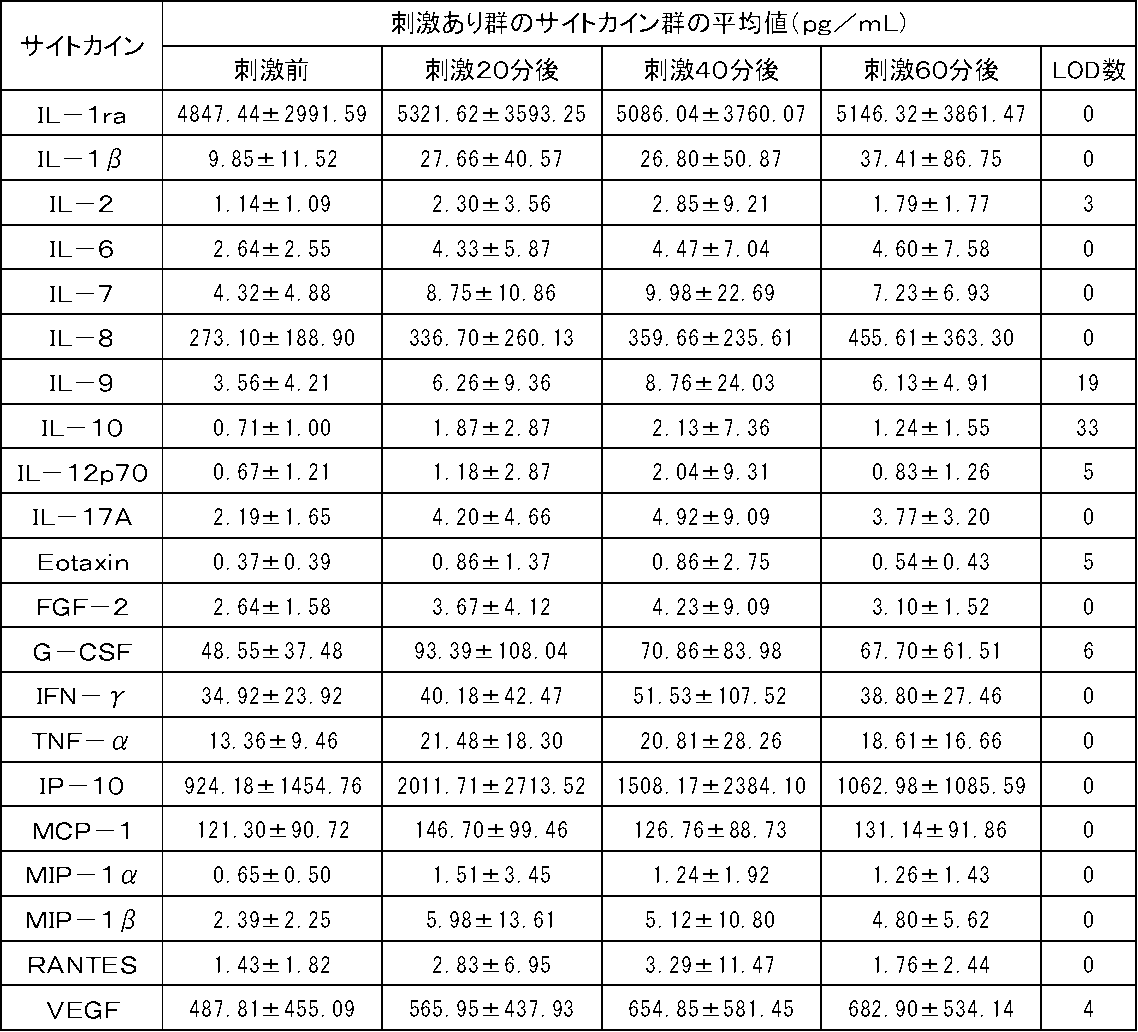
図1Aから1D中、「実線」は触覚刺激あり群、「点線」は触覚刺激なし群におけるサイトカインの濃度を示す。図1Aは1回目の唾液採取(刺激前、0分後)、図1Bは2回目の唾液採取(20分後)、図1Cは3回目の唾液採取(40分後)、図1Dは4回目の唾液採取(60分後)の結果を示す。
触覚刺激によって変化するサイトカインを特定し、モデル化するため、統計解析を行った。
[変数と量]
1)サイトカイン群27項目:
IL-1ra、IL-1β、IL-2、IL-4、IL-5、IL-6、IL-7、IL-8、IL-9、IL-10、IL-12 p70、IL-13、IL-15、IL-17A、Eotaxin、FGF-2、G-CSF、GM-CSF、IFN-γ、TNF-α、IP-10、MCP-1、MIP-1α、MIP-1β、PDGF-BB、RANTES、VEGF
2)触覚刺激の有無(2カテゴリ)
3)経過時間:
触覚刺激あり群 ・・・ 刺激前、刺激20分後、刺激40分後、刺激60分後(4カテゴリ)
触覚刺激なし群 ・・・ 0分後、20分後、40分後、60分後(4カテゴリ)
濃度範囲が異なるサイトカイン群同士を比較できるデータを作成するために以下の作業を行った。
-使用したデータの選定-
分析した27種類のサイトカインのうち、検出限界以下であった6項目のサイトカイン(IL-4、IL-5、IL-13、IL-15、GM-CSF、PDGF-BB)を除き、使用データとして、21項目のサイトカイン(IL-1ra、IL-1β、IL-2、IL-6、IL-7、IL-8、IL-9、IL-10、IL-12 p70、IL-17A、Eotaxin、FGF-2、G-CSF、IFN-γ、TNF-α、IP-10、MCP-1、MIP-1α、MIP-1β、RANTES、VEGF)を選定した。
サイトカインの分布に偏りが観察されたため、サイトカイン21項目を対数変換し、サイトカイン濃度のヒストグラムで正規性を確認した。
また、サイトカイン21項目で、最大で3桁の濃度差があったため、サイトカイン濃度を、サイトカイン21項目全てについて標準正規分布([X-平均]÷標準偏差)に変換した。
以後の統計解析では、対数変換し、かつ標準正規分布変換したデータを用いた。
前記<<解析ステップ1>>において選定したサイトカイン21項目について、触覚刺激あり・なしの2条件において、「触覚刺激あり」のみでサイトカイン濃度が有意に変化している項目の抽出を以下のようにして行った。
実験開始直後と、触覚刺激後又は触覚刺激せずに時間をおいた場合の2群間でサイトカイン濃度の有意差を検定した。
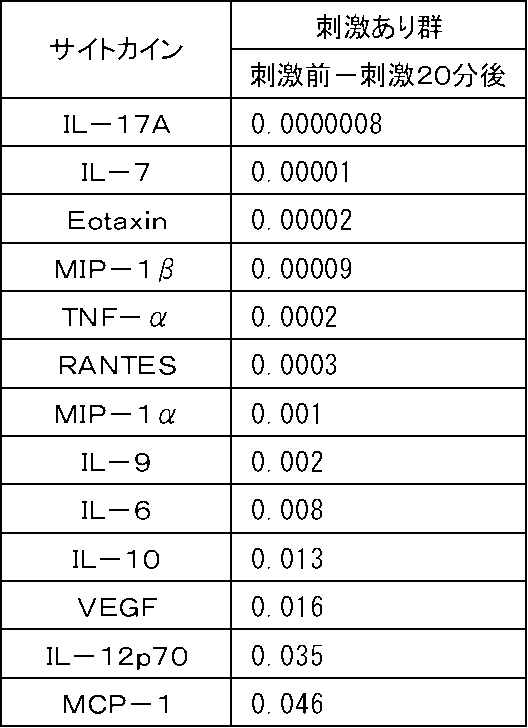
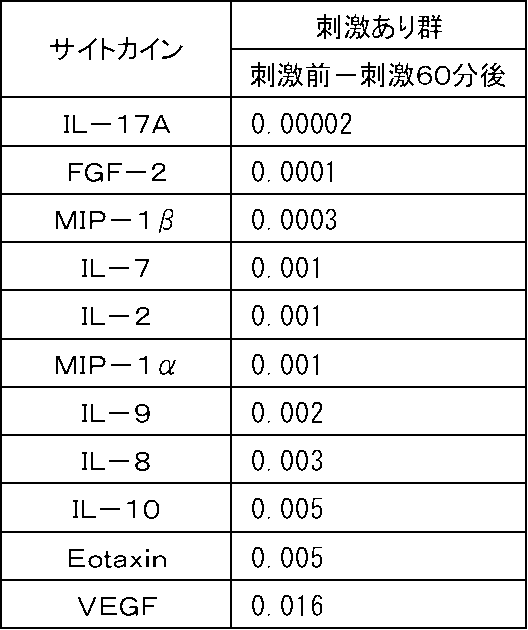
「触覚刺激あり」群のみでサイトカイン濃度が有意(有意確率p<0.05)に変化していた項目は、以下の通りであった。また、表2-1~2-2に各p値を示した。
[触覚刺激前-触覚刺激20分後]
IL-17A、IL-7、Eotaxin、MIP-1β、TNF-α、RANTES、MIP-1α、IL-9、IL-6、IL-10、VEGF、IL-12 p70、及びMCP-1の13項目(いずれのサイトカインも、「触覚刺激20分後」の濃度が「触覚刺激前」の濃度より有意に高かった。)
[触覚刺激前-触覚刺激60分後]
IL-17A、FGF-2、MIP-1β、IL-7、IL-2、MIP-1α、IL-9、IL-8、IL-10、Eotaxin、及びVEGFの11項目(いずれのサイトカインも、「触覚刺激60分後」の濃度が「触覚刺激前」の濃度より有意に高かった。)
前記<<解析ステップ2>>において、「触覚刺激あり群」のみが有意差を示したサイトカインについて、多重共線性を引き起こしているサイトカインの除去を単相関からの多重共線性診断方法で実施し、サイトカイン間で単相関の値が高値(相関係数R>0.7)を示す組合せを除いた。診断は、触覚刺激あり群の刺激前-刺激20分後と、刺激前-刺激60分後の2条件で行った。
[触覚刺激前-触覚刺激20分後]
Eotaxin、TNF-α、MIP-1β、及びRANTESの4項目を除外し、以下の9項目のサイトカインが残った。
IL-6、IL-7、IL-9、IL-10、IL-12 p70、IL-17A、MCP-1、MIP-1α、及びVEGF。
[触覚刺激前-触覚刺激60分後]
IL-2、MIP-1α、Eotaxin、及びVEGFの4項目を除外し、以下の7項目のサイトカインが残った。
IL-7、IL-8、IL-9、IL-10、IL-17A、FGF-2、及びMIP-1β。
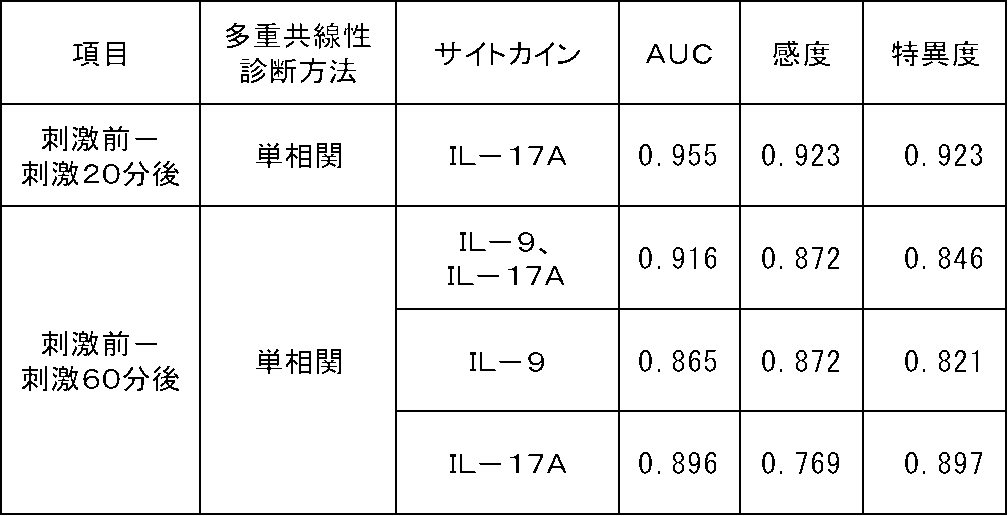
前記<<解析ステップ3>>で残ったサイトカインについて、更に、ステップワイズ法を用いたロジスティック回帰分析によるモデル化、及びROC解析によるモデルの判定能(AUC)を算出した。
サイトカイン単独又は組合せにおけるROC解析によるAUC(Area Under Curve)の算出値を表3に示す。
<<事後調査結果>>
前記実験工程(10)の「事後調査」は、被検者にとって施術が不快な気分でないことを担保する主観調査として行った。この調査は、「触覚刺激あり群」にのみ、実験の最後に1度行った。質問及び選択肢と、回答結果を表4に示す(n=40)。

JUMACLは触覚刺激の、2つの覚醒(緊張覚醒(Tense Arousal、以下「TA」と称することがある。)、エネルギー覚醒(Energetic Arousal、以下「EA」と称することがある。))に対する効果を調べるため、「触覚刺激あり群」、「触覚刺激なし群」ともに、4回の唾液採取の直前(前記実験工程の(1)、(4)、(6)、(8))に行った。
なお、「緊張覚醒」は、心が緊張しているなど、ネガティブな状態を表し、情動と密接な関係がある。緊張覚醒が高い状態では、注意力が狭い範囲にしか届かず、緊張覚醒が低い状態では、注意力が広い範囲に届く傾向がある。
「エネルギー覚醒」は、「活動的である」、「元気がある」など、エネルギッシュな状態を表し、知的活動と密接な関係がある。エネルギー覚醒が高い状態では、記憶力が良く、注意力が良くなる傾向がある。
触覚刺激の有無と覚醒状態の変化との関係を明らかにするため、各得点について有意差検定(ウィルコクソン検定)を行った。その結果、触覚刺激あり群では、触覚刺激なし群よりもTA得点が低い傾向にあることが示唆された。
気分評定は、触覚刺激の有無に対する被検者の幸福感及び覚醒度を経時的に調べる目的で、「触覚刺激あり群」、「触覚刺激なし群」ともに、4回の唾液採取の直前(前記実験工程の(1)、(4)、(6)、(8))に行った。
表5-1に質問と点数を示す。
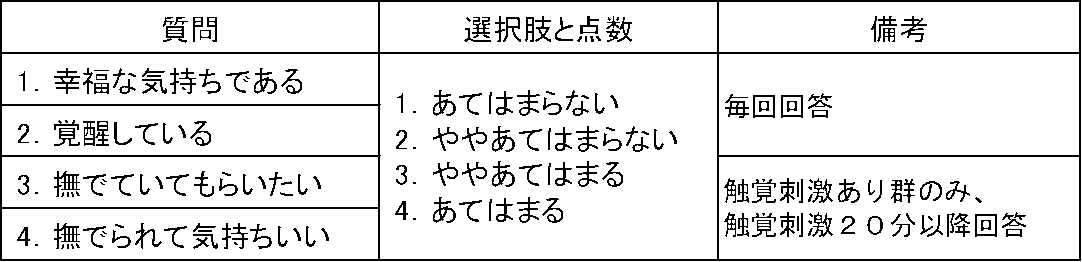
--「質問1.幸福な気持ちである」--
触覚刺激の有無と幸福度との関係を明らかにするため、幸福な気持ちに基づく得点(以下、「幸福度」と称することがある。)について有意差検定(ウィルコクソン検定)を行った。図2Aに幸福度平均値を示し、表5-2に有意差検定結果を示した。
図2A中、「a」は触覚刺激あり群、「b」は触覚刺激なし群の結果を示し、「0分後」は、触覚刺激あり群における「刺激前」、触覚刺激なし群における「0分後」を示し、「20分後」は、触覚刺激あり群における「刺激20分後」、触覚刺激なし群における「20分後」を示し、「40分後」は、触覚刺激あり群における「刺激40分後」、触覚刺激なし群における「40分後」を示し、「60分後」は、触覚刺激あり群における「刺激60分後」、触覚刺激なし群における「60分後」を示す。

触覚刺激の有無と覚醒度との関係を明らかにするため、覚醒に基づく得点(以下、「覚醒度」と称することがある。)について有意差検定(ウィルコクソン検定)を行った。図2Bに覚醒度平均値を示し、表5-3に有意差検定結果を示した。
図2B中、「a」は触覚刺激あり群、「b」は触覚刺激なし群の結果を示し、「0分後」は、触覚刺激あり群における「刺激前」、触覚刺激なし群における「0分後」を示し、「20分後」は、触覚刺激あり群における「刺激20分後」、触覚刺激なし群における「20分後」を示し、「40分後」は、触覚刺激あり群における「刺激40分後」、触覚刺激なし群における「40分後」を示し、「60分後」は、触覚刺激あり群における「刺激60分後」、触覚刺激なし群における「60分後」を示す。

したがって、評価対象由来の試料に含まれるサイトカインの量を指標とすることで、評価対象者が幸福感、特に覚醒度の高い幸福感、を有しているか否か(幸福な気持ちであるか否か)を高い精度で評価できることが分かった。また、前記指標としては、AUCが0.9以上であったIL-17A単独、及びIL-9とIL-17Aとの組合せが好ましいことが示された。
<1> 評価対象由来の試料におけるサイトカインの量を指標として、幸福感を有しているか否かを評価する評価工程を含むことを特徴とする、評価対象が幸福感を有しているか否かを評価する方法である。
<2> 前記評価工程が、前記評価対象由来の試料におけるサイトカインの量と、基準値とを比較する処理を含み、
前記基準値が、刺激を受けていない対象由来の試料におけるサイトカインの量に基づく値及び刺激を受けた対象由来の試料におけるサイトカインの量に基づく値の少なくともいずれかであり、
前記評価対象由来の試料におけるサイトカインの量が、前記刺激を受けていない対象由来の試料におけるサイトカインの量に基づく値より多い場合、及び前記刺激を受けた対象由来の試料におけるサイトカインの量に基づく値と同量以上の場合の少なくともいずれかの場合に、前記評価対象が、幸福感を有していると評価する工程である前記<1>に記載の方法である。
<3> 前記評価工程が、前記サイトカインの量のデータに基づいて幸福感を有しているか否かを評価することが可能な評価式に前記サイトカインの量のデータを代入することを含み、前記評価式には、前記サイトカインの量のデータが代入される少なくとも1つの変数が含まれている前記<1>に記載の方法である。
<4> 前記評価工程が、前記サイトカインの量のデータに基づいて幸福感を有しているか否かを評価することが可能な評価式に前記サイトカインの量のデータを代入することを含み、前記評価式には、前記サイトカイのデータが代入される少なくとも2つの変数が含まれている前記<3>に記載の方法である。
<5> 前記サイトカインが、IL-9とIL-17Aとの組合せ及びIL-17Aからなる群から選択されるいずれかである前記<1>から<4>のいずれかに記載の方法である。
<6> 前記方法が、評価対象由来の試料におけるサイトカインの量を測定する測定工程を更に含む前記<1>から<5>のいずれかに記載の方法である。
<7> 前記評価対象由来の試料が、唾液である前記<1>から<6>のいずれかに記載の方法である。
<8> 評価対象由来の試料におけるサイトカインの量を測定する測定工程を含むことを特徴とする、評価対象が幸福感を有しているか否かを評価するためのデータを取得する方法である。
<9> 前記サイトカインが、IL-9とIL-17Aとの組合せ及びIL-17Aからなる群から選択されるいずれかである前記<8>に記載の方法である。
<10> 前記評価対象由来の試料が、唾液である前記<8>から<9>のいずれかに記載の方法である。
<11> 対象に幸福感を付与する刺激、対象に心地良さを付与する刺激、及び対象の覚醒状態を変化させる刺激からなる群から選択される少なくとも1つの刺激のスクリーニング方法であって、
刺激を付与された対象由来の試料におけるサイトカインの量を指標として、前記刺激が、幸福感を付与する刺激、心地良さを付与する刺激、及び覚醒状態を変化させる刺激からなる群から選択される少なくとも1つの刺激に該当するか否かを評価する工程を含むことを特徴とする、刺激のスクリーニング方法である。
<12> 前記評価工程が、前記対象由来の試料におけるサイトカインの量と、参照値とを比較する処理を含み、
前記参照値が、前記刺激を受けていない対象由来の試料におけるサイトカインの量に基づく値並びに幸福感を付与する刺激、心地良さを付与する刺激、及び覚醒状態を変化させる刺激からなる群から選択される少なくとも1つの刺激に該当することが判明している刺激を受けた対象由来の試料におけるサイトカインの量に基づく値の少なくともいずれかであり、
前記対象由来の試料におけるサイトカインの量が、前記刺激を受けていない対象由来の試料におけるサイトカインの量に基づく値より多い場合、並びに前記幸福感を付与する刺激、心地良さを付与する刺激、及び覚醒状態を変化させる刺激からなる群から選択される少なくとも1つの刺激に該当することが判明している刺激を受けた対象由来の試料におけるサイトカインの量に基づく値と同量以上の場合の少なくともいずれかの場合に、前記刺激が、幸福感を付与する刺激、心地良さを付与する刺激、及び覚醒状態を変化させる刺激からなる群から選択される少なくとも1つの刺激に該当すると評価する工程である前記<11>に記載の方法である。
<13> 前記評価工程が、前記サイトカインの量のデータに基づいて、前記刺激が、幸福感を付与する刺激、心地良さを付与する刺激、及び覚醒状態を変化させる刺激からなる群から選択される少なくとも1つの刺激に該当するか否かを評価することが可能な評価式に前記サイトカインの量のデータを代入することを含み、前記評価式には、前記サイトカインの量のデータが代入される少なくとも1つの変数が含まれている前記<11>に記載の方法である。
<14> 前記評価工程が、前記サイトカインの量のデータに基づいて、前記刺激が、幸福感を付与する刺激、心地良さを付与する刺激、及び覚醒状態を変化させる刺激からなる群から選択される少なくとも1つの刺激に該当するか否かを評価することが可能な評価式に前記サイトカインの量のデータを代入することを含み、前記評価式には、前記サイトカインのデータが代入される少なくとも2つの変数が含まれている前記<13>に記載の方法である。
<15> 前記サイトカインが、IL-9とIL-17Aとの組合せ及びIL-17Aからなる群から選択されるいずれかである前記<11>から<14>のいずれかに記載の方法である。
<16> 前記方法が、対象に刺激を付与する工程を更に含む前記<11>から<15>のいずれかに記載の方法である。
<17> 前記方法が、対象由来の試料におけるサイトカインの量を測定する測定工程を更に含む前記<11>から<16>のいずれかに記載の方法である。
<18> 前記対象由来の試料が、唾液である前記<11>から<17>のいずれかに記載の方法である。
<19> 対象由来の試料におけるサイトカインの量を測定する測定工程を含むことを特徴とする、刺激が、幸福感を付与する刺激、対象に心地良さを付与する刺激、及び対象の覚醒状態を変化させる刺激からなる群から選択される少なくとも1つの刺激に該当するか否かを評価するためのデータを取得する方法である。
<20> 前記サイトカインが、IL-9とIL-17Aとの組合せ及びIL-17Aからなる群から選択されるいずれかである前記<19>に記載の方法である。
<21> 前記対象由来の試料が、唾液である前記<19>から<20>のいずれかに記載の方法である。
Claims (9)
- 評価対象由来の試料におけるサイトカインの量を指標として、幸福感を有しているか否かを評価する評価工程を含むことを特徴とする、評価対象が幸福感を有しているか否かを評価する方法。
- 前記評価工程が、前記評価対象由来の試料におけるサイトカインの量と、基準値とを比較する処理を含み、
前記基準値が、刺激を受けていない対象由来の試料におけるサイトカインの量に基づく値及び刺激を受けた対象由来の試料におけるサイトカインの量に基づく値の少なくともいずれかであり、
前記評価対象由来の試料におけるサイトカインの量が、前記刺激を受けていない対象由来の試料におけるサイトカインの量に基づく値より多い場合、及び前記刺激を受けた対象由来の試料におけるサイトカインの量に基づく値と同量以上の場合の少なくともいずれかの場合に、前記評価対象が、幸福感を有していると評価する工程である請求項1に記載の方法。 - 前記評価工程が、前記サイトカインの量のデータに基づいて幸福感を有しているか否かを評価することが可能な評価式に前記サイトカインの量のデータを代入することを含み、前記評価式には、前記サイトカインの量のデータが代入される少なくとも1つの変数が含まれている請求項1に記載の方法。
- 前記サイトカインが、IL-9とIL-17Aとの組合せ及びIL-17Aからなる群から選択されるいずれかである請求項1から3のいずれかに記載の方法。
- 前記方法が、評価対象由来の試料におけるサイトカインの量を測定する測定工程を更に含む請求項1から4のいずれかに記載の方法。
- 前記評価対象由来の試料が、唾液である請求項1から5のいずれかに記載の方法。
- 評価対象由来の試料におけるサイトカインの量を測定する測定工程を含むことを特徴とする、評価対象が幸福感を有しているか否かを評価するためのデータを取得する方法。
- 前記サイトカインが、IL-9とIL-17Aとの組合せ及びIL-17Aからなる群から選択されるいずれかである請求項7に記載の方法。
- 前記評価対象由来の試料が、唾液である請求項7から8のいずれかに記載の方法。
Priority Applications (1)
| Application Number | Priority Date | Filing Date | Title |
|---|---|---|---|
| JP2021522890A JP7209981B2 (ja) | 2019-05-31 | 2020-05-29 | 触覚刺激に対する幸福感の評価を補助するための方法及び触覚刺激に対する幸福感を評価するためのデータ取得方法 |
Applications Claiming Priority (2)
| Application Number | Priority Date | Filing Date | Title |
|---|---|---|---|
| JP2019-102056 | 2019-05-31 | ||
| JP2019102056 | 2019-05-31 |
Publications (1)
| Publication Number | Publication Date |
|---|---|
| WO2020241809A1 true WO2020241809A1 (ja) | 2020-12-03 |
Family
ID=73553180
Family Applications (1)
| Application Number | Title | Priority Date | Filing Date |
|---|---|---|---|
| PCT/JP2020/021261 Ceased WO2020241809A1 (ja) | 2019-05-31 | 2020-05-29 | 幸福感の評価方法及び幸福感を評価するためのデータ取得方法 |
Country Status (2)
| Country | Link |
|---|---|
| JP (1) | JP7209981B2 (ja) |
| WO (1) | WO2020241809A1 (ja) |
Citations (3)
| Publication number | Priority date | Publication date | Assignee | Title |
|---|---|---|---|---|
| WO2007094472A1 (ja) * | 2006-02-17 | 2007-08-23 | Atsuo Sekiyama | 生体負荷の指標剤および生体負荷の測定方法 |
| JP2011520095A (ja) * | 2008-03-12 | 2011-07-14 | リッジ ダイアグノスティックス,インコーポレイテッド | うつ障害をモニタリングするための炎症バイオマーカー |
| US20140200151A1 (en) * | 2010-12-20 | 2014-07-17 | Cambridge Enterprise Limited | Biomarkers |
Family Cites Families (5)
| Publication number | Priority date | Publication date | Assignee | Title |
|---|---|---|---|---|
| JP3183666B2 (ja) * | 1991-07-19 | 2001-07-09 | アツセイ・リサーチ・インコーポレーテツド | 内因性サイトカイン類の測定方法およびキット |
| JP5219048B2 (ja) * | 2008-09-17 | 2013-06-26 | 独立行政法人農業・食品産業技術総合研究機構 | 抗豚インターロイキン−18抗体を用いた動物のストレス評価方法 |
| JP4717962B2 (ja) * | 2009-04-14 | 2011-07-06 | 片倉工業株式会社 | 慢性ストレスの評価方法 |
| MX2013006708A (es) * | 2010-12-15 | 2013-09-13 | Olatec Ind Llc | Composicion de 3-metanosulfonilpropionitrilo para el tratamiento de la inflamacion y el dolor. |
| CN110678755A (zh) * | 2017-05-24 | 2020-01-10 | 皇家飞利浦有限公司 | 基于唾液白介素-1β以及MMP-9的轻度或重度牙周炎的诊断 |
-
2020
- 2020-05-29 JP JP2021522890A patent/JP7209981B2/ja active Active
- 2020-05-29 WO PCT/JP2020/021261 patent/WO2020241809A1/ja not_active Ceased
Patent Citations (3)
| Publication number | Priority date | Publication date | Assignee | Title |
|---|---|---|---|---|
| WO2007094472A1 (ja) * | 2006-02-17 | 2007-08-23 | Atsuo Sekiyama | 生体負荷の指標剤および生体負荷の測定方法 |
| JP2011520095A (ja) * | 2008-03-12 | 2011-07-14 | リッジ ダイアグノスティックス,インコーポレイテッド | うつ障害をモニタリングするための炎症バイオマーカー |
| US20140200151A1 (en) * | 2010-12-20 | 2014-07-17 | Cambridge Enterprise Limited | Biomarkers |
Non-Patent Citations (6)
| Title |
|---|
| B RAEL CAHN, MATTHEW S GOODMAN , CHRISTINE T PETERSON, RAJ MATURI , PAUL J MILLS: "Yoga, meditation and mind-body health: increased BDNF, cortisol awakening response, and altered inflammatory marker expression after a 3-month yoga and meditation retreat", FRONTIERS IN HUMAN NEUROSCIENCE, vol. 11, 315, 2017, pages 1 - 13, XP055769397 * |
| JHA, M. K. ET AL.: "Association of T and non-T cell cytokines with anhedonia: role of gender differences", PSYCHONEUROENDOCRINOLOGY, vol. 95, 2018, pages 1 - 7, XP085449765, DOI: 10.1016/j.psyneuen.2018.05.017 * |
| MASAHIRO MATSUNAGA, ISHII KEIKO, OHTSUBO YOHSUKE, NOGUCHI YASUKI, OCHI MISAKI, YAMASUE HIDENORI: "Association between salivary serotonin and the social sharing of happiness", PLOS ONE, vol. 12, no. 7, 2017, pages 1 - 15, XP055769398 * |
| MASAHIRO MATSUNAGA, TOKIKO ISOWA , KAORI YAMAKAWA , HIROHITO TSUBOI , YOKO KAWANISHI , HIROSHI KANEKO , KUNIO KASUGAI , MASASHI Y: "Association between perceived happiness levels and peripheral circulating pro-inflammatory cytokine levels in middle-aged adults in Japan", NEUROENDOCRINOLOGY LETTERS, vol. 32, no. 4, 2011, pages 458 - 463, XP055769374 * |
| MATSUNAGA MASAHIRO, KANEKO HIROSHI , TSUBOI HIROHITO , KAWANISHI YOKO: "Psychosomatic approach to health from the perspective of positive psychology", JAPANESE JOURNAL OF PSYCHOSOMATIC MEDICINE, vol. 51, no. 2, 2011, pages 135 - 140, XP055769370 * |
| MATSUNAGA, MASAHIRO ET AL.: "Relationship between subjective happiness and activation of the immune system under acute stress load,", JAPANESE JOURNAL OF PSYCHOSOMATIC MEDICINE, vol. 49, no. 6, pages 534 * |
Also Published As
| Publication number | Publication date |
|---|---|
| JP7209981B2 (ja) | 2023-01-23 |
| JPWO2020241809A1 (ja) | 2020-12-03 |
Similar Documents
| Publication | Publication Date | Title |
|---|---|---|
| Koff et al. | Effects of coping style and negative body image on eating disturbance | |
| Beckett et al. | The quality of retrospective data: An examination of long-term recall in a developing country | |
| Vedhara et al. | Psychosocial factors associated with indices of cortisol production in women with breast cancer and controls | |
| Weaver et al. | Interleukin-6 and risk of cognitive decline: MacArthur studies of successful aging | |
| Kennedy et al. | The healthy immigrant effect and immigrant selection: evidence from four countries | |
| Nicolaou et al. | Allergy or tolerance in children sensitized to peanut: prevalence and differentiation using component-resolved diagnostics | |
| Sachdev et al. | Anthropometric indicators of body composition in young adults: relation to size at birth and serial measurements of body mass index in childhood in the New Delhi birth cohort | |
| Ursache et al. | Socioeconomic status, hair cortisol and internalizing symptoms in parents and children | |
| Borchert et al. | Gender schema and gender role discrepancy as correlates of body image | |
| Guérin et al. | Trajectories of mood and stress and relationships with protective factors during the transition to menopause: results using latent class growth modeling in a Canadian cohort: Guérin E. et al. | |
| Rogers et al. | The effect of obesity | |
| Lykouras et al. | Beck Depression Inventory in the detection of depression among neurological inpatients | |
| Edinborough et al. | Stressed Out: Reconsidering stress in the study of archaeological human remains | |
| Tamm et al. | Evidence of fatigue, disordered sleep and peripheral inflammation, but not increased brain TSPO expression, in seasonal allergy: A [11C] PBR28 PET study | |
| Mitchell et al. | Differentiation of Women With Three Perimentstrual Symptom Patterns | |
| Plank et al. | Comparison of C-reactive protein in dried blood spots and saliva of healthy adolescents | |
| CN119414023A (zh) | 抑郁症诊断标志物及其应用 | |
| JP4717962B2 (ja) | 慢性ストレスの評価方法 | |
| Dohrenwend et al. | Ethnicity, Socioeconomic Status, and Psychiatric Disorders: A Test of the | |
| Schenk et al. | Identification of inflammatory markers suitable for non-invasive, repeated measurement studies in biobehavioral research: A feasibility study | |
| Field et al. | Race differences in accuracy of self‐reported childhood body size among white and black women | |
| JP7209981B2 (ja) | 触覚刺激に対する幸福感の評価を補助するための方法及び触覚刺激に対する幸福感を評価するためのデータ取得方法 | |
| Khairullah et al. | Height-based indices of pubertal timing in male adolescents | |
| YAMAGUCHI et al. | A salivary cytokine panel discriminates moods states following a touch massage intervention | |
| EP3936865A1 (en) | Depression evaluation method and method for evaluating depression treatment method, and data acquisition method for evaluating depression or result of depression treatment method |
Legal Events
| Date | Code | Title | Description |
|---|---|---|---|
| 121 | Ep: the epo has been informed by wipo that ep was designated in this application |
Ref document number: 20814281 Country of ref document: EP Kind code of ref document: A1 |
|
| ENP | Entry into the national phase |
Ref document number: 2021522890 Country of ref document: JP Kind code of ref document: A |
|
| NENP | Non-entry into the national phase |
Ref country code: DE |
|
| 32PN | Ep: public notification in the ep bulletin as address of the adressee cannot be established |
Free format text: NOTING OF LOSS OF RIGHTS PURSUANT TO RULE 112(1) EPC (EPO FORM 1205A DATED 21/03/2022) |
|
| 122 | Ep: pct application non-entry in european phase |
Ref document number: 20814281 Country of ref document: EP Kind code of ref document: A1 |