WO2020220475A1 - 通信方法和装置 - Google Patents
通信方法和装置 Download PDFInfo
- Publication number
- WO2020220475A1 WO2020220475A1 PCT/CN2019/095585 CN2019095585W WO2020220475A1 WO 2020220475 A1 WO2020220475 A1 WO 2020220475A1 CN 2019095585 W CN2019095585 W CN 2019095585W WO 2020220475 A1 WO2020220475 A1 WO 2020220475A1
- Authority
- WO
- WIPO (PCT)
- Prior art keywords
- sequence
- mod
- integer
- base sequences
- absolute value
- Prior art date
- Legal status (The legal status is an assumption and is not a legal conclusion. Google has not performed a legal analysis and makes no representation as to the accuracy of the status listed.)
- Ceased
Links
Images


Classifications
-
- H—ELECTRICITY
- H04—ELECTRIC COMMUNICATION TECHNIQUE
- H04L—TRANSMISSION OF DIGITAL INFORMATION, e.g. TELEGRAPHIC COMMUNICATION
- H04L5/00—Arrangements affording multiple use of the transmission path
-
- H—ELECTRICITY
- H04—ELECTRIC COMMUNICATION TECHNIQUE
- H04W—WIRELESS COMMUNICATION NETWORKS
- H04W72/00—Local resource management
- H04W72/04—Wireless resource allocation
-
- H—ELECTRICITY
- H04—ELECTRIC COMMUNICATION TECHNIQUE
- H04W—WIRELESS COMMUNICATION NETWORKS
- H04W72/00—Local resource management
- H04W72/12—Wireless traffic scheduling
Definitions
- This application relates to the field of communications, in particular to communication methods and devices in the field of communications.
- uplink reference signals such as uplink demodulation reference signal (DMRS) and uplink sounding reference signal (SRS)
- DMRS uplink demodulation reference signal
- SRS uplink sounding reference signal
- the base sequence may be generated according to the ZC (Zadoff-Chu) sequence.
- the base sequence may be the ZC sequence itself, or the base sequence may be a sequence generated by the ZC sequence through cyclic expansion or interception.
- the ZC sequence of length N can be expressed in the following form:
- N is the length of the ZC sequence, which is an integer greater than 1;
- q is the root of the ZC sequence, which is a natural number that is relatively prime to N, and 0 ⁇ q ⁇ N.
- This article defines the reference sequence generated from the ZC sequence as the base sequence as Where q is the root of the ZC sequence, and ⁇ is the value determined by the time domain cyclic shift.
- the upstream sounding reference signal is SRS
- the terminal device needs to determine the SRS sequence according to the base sequence before sending the SRS.
- 3GPP 3rd generation partnership project
- each cell can allocate two base sequences of the same length to the terminal device to generate the final transmitted SRS sequence.
- each terminal device that transmits an SRS sequence of the same length on the same time-frequency resource uses the SRS sequence generated by the same base sequence in the group.
- these terminal devices obtain orthogonality between the SRS sequences by using different time-domain cyclic shifts and/or time-frequency domain resources.
- two base sequences with the same length in the same group are used as hopping sequences, that is, at different moments, the base sequence used by a terminal device can be designed between the two base sequences in this group.
- the pattern of is hopping, and its purpose is to randomize inter-cell interference.
- sequence hopping process on the same time-frequency resource, all terminal devices in a cell that send the same length SRS sequence still use the same base sequence to generate the SRS sequence. Therefore, in the current system, on the same time-frequency resource, there is only one available root for the SRS sequence of a cell.
- the number of terminal devices in each cell is large (for example, 200), and the number of time-domain cyclic shifts that can obtain good orthogonality in the actual system and the number of available time-frequency domain resources are very limited. .
- the current number of available SRS sequences in a cell is far from sufficient for the huge number of terminal devices.
- the channel has time-varying characteristics, and the large SRS period causes the channel state information obtained through SRS to be easily outdated.
- the channel state information during downlink data transmission is very different from the channel state information measured by the previous SRS, which seriously affects the system Performance.
- the present application provides a communication method and device that can reduce the interference of different terminal devices in the same cell when transmitting SRS sequences on the basis of increasing the number of roots used in each cell, and improve system performance.
- a communication method including: obtaining a reference signal sequence of length M, where M is an integer greater than 1, sending the reference signal sequence to a network device; wherein, the reference signal sequence is composed of The first base sequence of M is determined, the first base sequence belongs to the first sequence group, the number of base sequences of length M in the first sequence group is X, and the X base sequences have the same group Index, the X base sequences are determined by X ZC sequences of length N, N is an integer greater than 1, X is an integer greater than or equal to 2, and any two base sequences in the X base sequences correspond to The roots of the ZC sequence of are q 1 and (q 1 +V 1 )mod N, q 1 is an integer from 1 to N-1, V 1 is an integer, and the absolute value of V 1 ranges from [K 1 ,K 2 ] ⁇ [K 3 ,K 4 ], K 1 , K 2 , K 3 and K 4 are all integers, K 1 >1, K 4 ⁇
- a sequence group includes at least two base sequences of the same length
- different terminal devices in the same cell can use at least two base sequences of the same length in the sequence group.
- Determine the reference signal sequence and send the reference signal sequence on the same time-frequency resource, so that in the cell corresponding to the sequence group, the number of terminal devices that can simultaneously send reference signals of the same length at the same frequency increases, increasing the number of reference signals
- the number of sequences can also ensure that the interference power between the reference signal sequences is very low, which is beneficial to improve the accuracy of channel measurement by the network equipment based on the reference signal.
- the value range of the absolute value of V 1 is [K 1 ,K 2 ] ⁇ [K 3 ,K 4 ], K 1 >1, K 4 ⁇ N-1, when N is an odd number, When N is even, Not only can the interference power between the reference signal sequences generated based on any two base sequences in the same sequence group and any cyclic shift value be sufficiently low, for example, the sequence generated by the base sequences r 1 (m) and ⁇ 1 And the sequence generated by the base sequence r 2 (m) and ⁇ 2 The interference power is low enough, and it can make multiple reference signal sequences generated by the same base sequence and multiple cyclic shift values to generate the reference signal sequence generated by another base sequence and any cyclic shift value.
- the total interference power is sufficiently low, for example, f reference signal sequences generated from the base sequence r 1 (m) and f different cyclic shift values ⁇ 1 , ⁇ 2 ,..., ⁇ f
- the total interference power generated is small enough, where f is a positive integer greater than or equal to 1.
- the total interference here refers to the expected value or variance value or instantaneous value of the total interference power, which is not limited. In this way, different terminal devices in the same cell can use different base sequences in the sequence group corresponding to the cell to generate their respective reference signal sequences, and can send them on the same time-frequency resource.
- the method before the terminal device acquires the reference signal sequence of length M, the method further includes: the terminal device receives configuration information sent by the network device, and according to the configuration information The first base sequence is determined, and the reference signal sequence is determined according to the first base sequence.
- the embodiment of the present application defines the second sequence group as a set of all base sequences having the same group index (or cell index). Therefore, the above-mentioned first sequence group is a set of all or part of the base sequences in the second sequence group.
- the first sequence group is the set of all base sequences in the second sequence group.
- the first sequence group is the second sequence group.
- the configuration information may include first indication information and second indication information, where the first indication information is used to indicate the first sequence group; the second indication information is used to indicate the first sequence group in the first sequence group.
- Base sequence. The terminal device may receive the first indication information and the second indication information, and obtain a reference signal sequence of length M according to the first indication information and the second indication information.
- the first sequence group is a collection of partial base sequences in the second sequence group.
- the foregoing configuration information may include first indication information, second indication information, and third indication information.
- the terminal device may obtain a reference signal sequence of length M according to the first indication information, the second indication information, and the third indication information.
- the terminal device can determine the final reference signal sequence according to the above three indication information in various ways. For example, the terminal device may determine the first sequence group through the first indication information and the third indication information, and then determine the first base sequence based on the above-mentioned first sequence group through the second indication information, thereby determining the reference according to the first base sequence Signal sequence.
- the terminal device may determine the potential multiple base sequences in the second sequence group through the first indication information and the second indication information, and then determine based on the first base sequence among the multiple base sequences through the third indication information, thereby The reference signal sequence is determined according to the first base sequence.
- the terminal device may also determine the first base sequence in other ways, which is not limited in this embodiment of the application.
- the first sequence group belongs to Y sequence groups, and Y is an integer greater than or equal to 2; the y-th sequence group in the Y sequence groups
- the number of base sequences with length M is X (y)
- the X (y) base sequences with length M are determined by X (y) ZC sequences with length N
- X (y) is An integer greater than or equal to 2
- the roots of the ZC sequence corresponding to any two of the base sequences of length M in the X (y) base sequences are q′ and (q′+V′) mod N
- q′ is An integer from 1 to N-1
- V' is an integer
- each sequence group in the Y sequence groups includes at least two base sequences with a length of M, so that each cell corresponding to the Y sequence groups can simultaneously send terminals with the same length of reference signals
- the number of devices is at least doubled. While increasing the number of reference signal sequences, it can ensure that the interference power between the reference signal sequences generated by any two base sequences of the same length in the same sequence group is very low. , The interference between reference signal sequences is much lower than that of the signal, which facilitates flexible network planning and improves the accuracy of channel measurement of network equipment based on reference signal sequences.
- the absolute value of V 1 belongs to the set
- the absolute value of V 1 belongs to the set Represents the smallest integer greater than or equal to A.
- the absolute value of V′ belongs to the set
- the absolute value of V'belongs to the set Represents the smallest integer greater than or equal to A.
- the first threshold and the second threshold may be the same or different, which is not limited in the embodiment of the present application. It should be understood that the foregoing first threshold may be determined by a network device, and the terminal device does not need to know the first threshold. In other words, the network device may determine the first threshold, and determine one or more values of the absolute value of V 1 and/or the absolute value of V′ according to the first threshold and N, and the network device may determine the absolute value of V 1 One or more values of the absolute value of V and/or the absolute value of V'are assigned to the terminal device, and the terminal device can be directly based on one or more of the absolute value of V 1 and/or the absolute value of V'sent by the network device. Take a value, determine the base sequence, and then determine the reference signal sequence and send it. The second threshold is the same and will not be repeated here.
- the absolute value of V 1 and/or the range of the absolute value of V' can be optimized for different ⁇ and different channel coherence bandwidths, so that under the frequency domain flatness of different channels, when there is
- ⁇ terminal devices determine reference signal sequences based on the same base sequence of a sequence group and ⁇ different cyclic shift values, the interference power of these reference signal sequences to the reference signal sequence determined based on another base sequence of the sequence group Very low.
- the embodiment of the present application does not increase the interference between the reference signal sequences determined based on the base sequences of different sequence groups.
- X is an integer greater than or equal to 3
- the X base sequences include three base sequences, and the roots of the ZC sequence corresponding to the three base sequences They are q 2 , (q 2 +V 2 ) mod N and (q 2 + W 1 ) mod N respectively, where q 2 is an integer from 1 to N-1, V 2 is an integer, and the absolute value of V 2 is The value range is [K 1 ,K 2 ] ⁇ [K 3 ,K 4 ], W 1 is an integer, and the value range of the absolute value of W 1 is [K 1 ,K 2 ] ⁇ [K 3 ,K 4 ].
- the three base sequences in this embodiment may include at least one of the two base sequences in the foregoing embodiment, or may be other sequences different from the foregoing two base sequences, that is, q 2 and q 1 may be equal , It may not be equal, V 2 and V 1 may be equal or not, which is not limited in the embodiment of the present application.
- W 1 may be determined according to V 2
- V 2 may be determined according to W 1
- V 2 and W 1 may be independently designed values, and there is no clear and direct relationship between each other.
- This application The embodiment also does not limit this.
- X is an integer greater than or equal to 4
- the X base sequences include four base sequences, and the roots of the ZC sequences corresponding to the four base sequences are respectively Is q 3 , (q 3 +V 3 ) mod N, (q 3 +W 2 ) mod N, and (q 3 +O 1 ) mod N, where q 3 is an integer from 1 to N-1, and V 3 is Integer, and the value range of the absolute value of V 3 is [K 1 ,K 2 ] ⁇ [K 3 ,K 4 ], W 2 is an integer, and the value range of the absolute value of W 2 is [K 1 ,K 2 ] ⁇ [K 3 ,K 4 ], O 1 is an integer, and the range of the absolute value of O 1 is [K 1 ,K 2 ] ⁇ [K 3 ,K 4 ].
- the four base sequences in this embodiment may include at least one of the base sequences mentioned in the above-mentioned embodiments, or may be other sequences different from the above-mentioned base sequences, that is, q 3 and q 1 or q 2 It can be equal or unequal.
- V 3 and V 1 or V 2 can be equal or unequal.
- W 2 and W 1 can be equal or unequal, which is not limited in the embodiment of the application.
- W 2 may be determined based on V 3
- V 3 may be determined based on W 2
- V 3 and W 2 may be independently designed values, and there is no clear and direct relationship between each other.
- O 1 can be determined based on V 3
- V 3 can be determined based on O 1
- V 3 and O 1 can be independently designed values, and there is no clear and direct relationship between them.
- X is an integer greater than or equal to 5
- the X base sequences include five base sequences, and the five base sequences correspond to the roots of the ZC sequence They are q 4 , (q 4 +V 4 )mod N, (q 4 +W 3 )mod N, (q 4 +O 2 )mod N and (q 4 +P)mod N, where q 4 is 1.
- V 4 is an integer
- the range of the absolute value of V 4 is [K 1 ,K 2 ] ⁇ [K 3 ,K 4 ]
- W 3 is an integer
- the absolute value of W 3 The value range of is [K 1 ,K 2 ] ⁇ [K 3 ,K 4 ]
- O 2 is an integer
- the absolute value of O 2 ranges from [K 1 ,K 2 ] ⁇ [K 3 ,K 4 ]
- P is an integer
- the range of the absolute value of P is [K 1 ,K 2 ] ⁇ [K 3 ,K 4 ].
- the five base sequences in this embodiment may include at least one of the base sequences already mentioned in the above-mentioned embodiment, or may be other sequences different from the above-mentioned base sequence, that is, q 4 and q 1 , q 2 Or q 3 can be equal or unequal, V 4 and V 1 , V 2 or V 3 can be equal or unequal, W 3 and W 1 or W 2 can be equal or unequal, O 2 and O 1 may be equal or unequal, which is not limited in the embodiment of the present application.
- W 3 may be determined according to V 4
- V 4 may be determined according to W 3
- V 4 and W 3 may be independently designed values, and there is no clear and direct relationship between each other.
- O 2 can be determined based on V 4
- V 4 can be determined based on O 2
- V 4 and O 2 can be independently designed values, and there is no clear and direct relationship between each other.
- P can be determined based on V 4 , or V 4 can be determined based on P, or V 4 and P can be independently designed values, and there is no clear and direct relationship between them.
- another communication method including: sending configuration information, the configuration information is used to configure a first sequence group, the number of base sequences of length M in the first sequence group is X, so The X base sequences have the same group index, the X base sequences are determined by X ZC sequences of length N, N is an integer greater than 1, X is an integer greater than or equal to 2, and the X
- the roots of the ZC sequence corresponding to any two base sequences in the base sequence are q 1 and (q 1 +V 1 ) mod N respectively, q 1 is an integer from 1 to N-1, V 1 is an integer, and the absolute value of V 1
- the value range is [K 1 ,K 2 ] ⁇ [K 3 ,K 4 ], K 1 , K 2 , K 3 and K 4 are all integers, K 1 >1, K 4 ⁇ N-1, when N is an odd number, When N is even, Represents the largest integer less than or equal to A, [A, B] represents a collection of integers greater than
- the first sequence group belongs to Y sequence groups, and Y is an integer greater than or equal to 2; the y-th sequence group in the Y sequence groups
- the number of base sequences with length M is X (y)
- the X (y) base sequences with length M are determined by X (y) ZC sequences with length N
- X (y) is An integer greater than or equal to 2
- the roots of the ZC sequence corresponding to any two of the base sequences of length M in the X (y) base sequences are q′ and (q′+V′) mod N
- q′ is An integer from 1 to N-1
- V' is an integer
- the absolute value of V 1 belongs to the set
- the absolute value of V 1 belongs to the set Represents the smallest integer greater than or equal to A.
- X is an integer greater than or equal to 3
- the X base sequences include three base sequences, and the roots of the ZC sequence corresponding to the three base sequences They are q 2 , (q 2 +V 2 ) mod N and (q 2 + W 1 ) mod N respectively, where q 2 is an integer from 1 to N-1, V 2 is an integer, and the absolute value of V 2 is The value range is [K 1 ,K 2 ] ⁇ [K 3 ,K 4 ], W 1 is an integer, and the value range of the absolute value of W 1 is [K 1 ,K 2 ] ⁇ [K 3 ,K 4 ].
- X is an integer greater than or equal to 4
- the X base sequences include four base sequences, and the roots of the ZC sequences corresponding to the four base sequences are respectively Is q 3 , (q 3 +V 3 ) mod N, (q 3 +W 2 ) mod N, and (q 3 +O 1 ) mod N, where q 3 is an integer from 1 to N-1, and V 3 is Integer, and the value range of the absolute value of V 3 is [K 1 ,K 2 ] ⁇ [K 3 ,K 4 ], W 2 is an integer, and the value range of the absolute value of W 2 is [K 1 ,K 2 ] ⁇ [K 3 ,K 4 ], O 1 is an integer, and the range of the absolute value of O 1 is [K 1 ,K 2 ] ⁇ [K 3 ,K 4 ].
- X is an integer greater than or equal to 5
- the X base sequences include five base sequences, and the five base sequences correspond to the roots of the ZC sequence They are q 4 , (q 4 +V 4 )mod N, (q 4 +W 3 )mod N, (q 4 +O 2 )mod N and (q 4 +P)mod N, where q 4 is 1.
- V 4 is an integer
- the range of the absolute value of V 4 is [K 1 ,K 2 ] ⁇ [K 3 ,K 4 ]
- W 3 is an integer
- the absolute value of W 3 The value range of is [K 1 ,K 2 ] ⁇ [K 3 ,K 4 ]
- O 2 is an integer
- the absolute value of O 2 ranges from [K 1 ,K 2 ] ⁇ [K 3 ,K 4 ]
- P is an integer
- the range of the absolute value of P is [K 1 ,K 2 ] ⁇ [K 3 ,K 4 ].
- a device for executing the above-mentioned aspects or methods in any possible implementation manners of the aspects.
- the device includes a unit for executing the above-mentioned aspects or methods in any possible implementation manners of the aspects.
- the device may include modules that perform one-to-one correspondence of the methods/operations/steps/actions described in the above aspects.
- the modules may be hardware circuits, software, or hardware circuits combined with software. .
- a device which includes a communication interface, a memory, and a processor.
- the processor is configured to implement the foregoing aspects or methods in any possible implementation manner of each aspect
- the memory is coupled with the processor.
- the communication interface, the memory, and the processor communicate with each other through an internal connection path, the memory is used to store instructions, and the processor is used to execute the instructions stored in the memory, so as to implement the foregoing aspects or any possible aspects of each aspect. The method in the implementation mode.
- a system in a fifth aspect, includes a device for implementing any one of the foregoing first aspect or the first aspect, and a device for implementing any one of the foregoing second or second aspects.
- a possible method of implementation; or the system includes a device for implementing the third aspect or any of the possible methods of the third aspect, and a device for implementing any of the fourth aspect or the fourth aspect Possible methods of implementation.
- the system includes a device for implementing a method executed by a terminal device and a device for implementing a method executed by a network device.
- a computer program product includes: computer program code, when the computer program code is run by a computer, the computer can execute each of the above aspects or any of the possibilities The method in the implementation mode.
- a computer-readable medium for storing instructions that, when the instructions run on a computer, cause the computer to execute the above aspects or the methods in any possible implementation manners of the aspects Instructions.
- the embodiments of the present application provide a chip system, which includes one or more processors, configured to call and execute instructions stored in the memory from the memory, so that the above aspects or any of the above aspects The methods in one possible implementation are executed.
- the chip system can be composed of chips, or can include chips and other discrete devices.
- Fig. 1 shows a schematic diagram of an application scenario of an embodiment of the present application.
- Fig. 2 shows a schematic flowchart of a communication method according to an embodiment of the present application.
- Figure 3 shows a schematic diagram of a sequence group in an embodiment of the present application.
- Fig. 4 shows a schematic diagram of another sequence group in an embodiment of the present application.
- Fig. 5 shows a schematic block diagram of a device according to an embodiment of the present application.
- Fig. 6 shows a schematic block diagram of another apparatus according to an embodiment of the present application.
- Fig. 7 shows a schematic block diagram of another apparatus according to an embodiment of the present application.
- GSM global system for mobile communications
- CDMA code division multiple access
- WCDMA broadband code division multiple access
- GPRS general packet radio service
- LTE long term evolution
- FDD frequency division duplex
- TDD LTE Time division duplex
- UMTS universal mobile telecommunication system
- WiMAX worldwide interoperability for microwave access
- the terminal device involved in the embodiments of the present application may be referred to as a terminal for short, which may be a device with a wireless transceiver function.
- the terminal can be deployed on land, including indoor or outdoor, handheld or vehicle-mounted; it can also be deployed on the water (such as a ship, etc.); it can also be deployed in the air (such as aeroplane, balloon, satellite, etc.).
- the terminal equipment may be user equipment (UE).
- UEs include handheld devices, vehicle-mounted devices, wearable devices, or computing devices with wireless communication functions.
- the UE may be a mobile phone, a tablet computer, or a computer with wireless transceiver function.
- Terminal equipment can also be virtual reality (VR) terminal equipment, augmented reality (augmented reality, AR) terminal equipment, wireless terminals in industrial control, wireless terminals in unmanned driving, wireless terminals in telemedicine, and smart Wireless terminals in power grids, wireless terminals in smart cities, wireless terminals in smart homes, and so on.
- the device used to implement the function of the terminal may be a terminal; it may also be a device capable of supporting the terminal to implement the function, such as a chip system, and the device may be installed in the terminal.
- the chip system may be composed of chips, or may include chips and other discrete devices.
- the device used to implement the functions of the terminal is an example to describe the technical solutions provided by the embodiments of the present application.
- the network device in the embodiment of the application may be a device used to communicate with a terminal device.
- the network device may be a global system for mobile communications (GSM) system or code division multiple access (CDMA)
- GSM global system for mobile communications
- CDMA code division multiple access
- the base transceiver station (BTS) in the LTE system can also be the Node B (NodeB, NB) in the wideband code division multiple access (WCDMA) system, or the evolved Node B in the LTE system.
- NodeB, NB Node B
- WCDMA wideband code division multiple access
- a base station may be a device that is deployed in a wireless access network and can communicate with a terminal wirelessly.
- Base stations may come in many forms, such as macro base stations, micro base stations, relay stations, and access points.
- the base station involved in the embodiment of this application may be a base station in 5G or a base station in LTE, where the base station in 5G may also be called a transmission reception point (TRP) or gNB (generation NodeB) .
- the device used to implement the function of the network device may be a network device; it may also be a device capable of supporting the network device to implement the function, such as a chip system, and the device may be installed in the network device.
- the device for implementing the functions of the network equipment is a network device as an example to describe the technical solutions provided by the embodiments of the present application.
- the terminal device or the network device includes a hardware layer, an operating system layer running on the hardware layer, and an application layer running on the operating system layer.
- the hardware layer includes hardware such as a central processing unit (CPU), a memory management unit (MMU), and memory (also referred to as main memory).
- the operating system may be any one or more computer operating systems that implement business processing through processes, for example, Linux operating system, Unix operating system, Android operating system, iOS operating system, or windows operating system.
- the application layer includes applications such as browsers, address books, word processing software, and instant messaging software.
- the embodiments of the application do not specifically limit the specific structure of the execution subject of the methods provided in the embodiments of the application, as long as they can communicate according to the methods provided in the embodiments of the application, for example, the execution of the methods provided in the embodiments of the application
- the main body can be a terminal device or a network device, or a functional module that can execute a program in the terminal device or the network device.
- various aspects or features of the embodiments of the present application may be implemented as methods, devices, or products using standard programming and/or engineering techniques.
- article of manufacture as used in this application encompasses a computer program accessible from any computer-readable device, carrier, or medium.
- computer-readable media may include, but are not limited to: magnetic storage devices (for example, hard disks, floppy disks, or tapes, etc.), optical disks (for example, compact discs (CD), digital versatile discs (DVD)) Etc.), smart cards and flash memory devices (for example, erasable programmable read-only memory (EPROM), cards, sticks or key drives, etc.).
- various storage media described herein may represent one or more devices and/or other machine-readable media for storing information.
- the term "machine-readable medium” may include, but is not limited to, various other media capable of storing, containing, and/or carrying instructions and/or data.
- Fig. 1 shows a communication system 100 to which an embodiment of the present application can be applied.
- the communication system 100 may include one or more network devices 110 and one or more terminal devices 120 located within the coverage area of the network device 110.
- Figure 1 exemplarily shows one network device and two terminal devices.
- the communication system 100 may include multiple network devices and the coverage of each network device may include other numbers of terminal devices. The embodiment does not limit this.
- the wireless communication system 100 may also include other network entities such as a network controller and a mobility management entity, and the embodiment of the present application is not limited thereto.
- Base sequence base sequence
- ZC sequence ZC sequence
- the sequence of the uplink reference signal (such as DMRS, SRS) is generated based on the base sequence. For example, if the base sequence of length M is r(m), the sequence generated by the base sequence can be:
- A is a complex number
- ⁇ is a real number determined by a time-domain cyclic shift (also called a cyclic shift value in this article)
- j Is an imaginary unit
- exp represents an exponential function with e as the base.
- the base sequence may be a sequence generated from the ZC sequence.
- the base sequence may be the ZC sequence itself, or the base sequence may also be a sequence generated by the ZC sequence through cyclic shift expansion or interception.
- a ZC sequence of length N is z q (n), which can be expressed in the following form:
- N is an integer greater than 1
- q is the root of the ZC sequence (also called root index or root index), a natural number that is relatively prime to N, and 0 ⁇ q ⁇ N.
- the reference sequence generated from the base sequence is q
- ⁇ is a value determined according to the time domain cyclic shift, which is also called the cyclic shift value.
- the terminal device can map the reference signal sequence of length M to M subcarriers in the order of subcarrier index from small to large (or from large to small), and then perform inverse Fourier on the frequency domain sequence Leaf transform (inverse fourier transform, IDFT) to obtain the corresponding time-domain sequence and send it to the network device.
- inverse Fourier transform inverse fourier transform, IDFT
- the uplink reference signal is the reference signal sent by the terminal equipment, for example, SRS, DMRS of the uplink control channel, discrete Fourier transform extended orthogonal frequency division multiplexing (discrete fourier transform-spread orthogonal frequency division multiplexing, DFT-s) -OFDM) DMRS of physical uplink shared channel (PUSCH) under waveform.
- the uplink reference signal can be used to obtain uplink channel state information, which can be used for demodulation and detection of uplink data.
- uplink reference signals can also be used to obtain downlink channel state information.
- the network device obtains downlink channel state information by measuring the SRS sequence sent by the terminal device.
- the channel state information is used for precoding during downlink data transmission, determination of modulation and coding methods, and so on. Therefore, obtaining accurate channel state information based on the uplink reference signal is very important for the efficiency of uplink data transmission or downlink data transmission.
- SRS uses a sequence generated from a ZC sequence.
- the roots of the ZC sequences used by all terminal devices in a cell are the same, and the orthogonality of the SRS sequences of different terminal devices can be obtained through different cyclic shifts and frequency domain resources.
- 3rd generation partnership project 3rd generation partnership project
- 3GPP 3rd generation partnership project
- 60 base sequences are defined respectively.
- the 60 base sequences are generated from ZC sequences with the same length and different roots. Further, the 60 base sequences are divided into 30 sequence groups, and the base sequences of different sequence groups can be allocated to different cells.
- the formula for determining root q currently defined by 3GPP is:
- v 0 or 1
- u 0,1,...,29.
- u is the group serial number, representing 30 groups, and each group has two root serial numbers, which are determined by v. u and v are configured for terminal equipment by sending configuration information through network equipment.
- the relationship between the root q of these 60 ZC sequences and the group number u of the base sequence can be shown in Table 1 below Show:
- each terminal device that sends the same length of SRS sequence on the same time-frequency resource uses the same u and v, that is, the same cell sends the same length of SRS sequence on the same time-frequency resource
- Each terminal device in the group uses the SRS sequence generated by the same base sequence in the group.
- these terminal devices obtain the orthogonality between the SRS sequences by using different time-domain cyclic shifts.
- two base sequences with the same length in the same group are used as hopping sequences, that is, at different moments, the base sequence used by a terminal device can be designed between the two base sequences in this group.
- the pattern of hops, and the two base sequences in the group are used in turn, the purpose of which is to randomize inter-cell interference.
- sequence hopping process at the same moment, all terminal devices in a cell that send the same length SRS sequence on the same time-frequency resource still use the same base sequence to generate the SRS sequence. Therefore, in the current system, there is only one available root for the SRS sequence of a cell on the same time-frequency resource.
- the number of terminal devices in each cell is large (for example, 200), and the number of time-domain cyclic shifts that can obtain good orthogonality in the actual system and the number of available time-frequency domain resources are very limited. . Therefore, the current number of available SRS sequences in a cell is far from sufficient for the huge number of terminal devices. This leads to the need to allow different terminal devices to send SRS in turn in a time division manner, resulting in a larger SRS cycle (for example, 20 ms).
- the channel has time-varying characteristics, and the large SRS period causes the channel state information obtained through SRS to be easily outdated. The channel state information during downlink data transmission is very different from the channel state information measured by the previous SRS, which seriously affects the system Performance.
- an embodiment of the present application proposes a method for increasing the number X of base sequences with the same length in the sequence group.
- the X base sequences with the same length are determined by the ZC sequences with different roots, X>1.
- the X base sequences in the sequence group can be allocated to different terminal devices in a cell for determining reference signals.
- the embodiments of the present application are beneficial to solve the problem of large interference between reference signal sequences determined by different base sequences when these different terminal devices transmit reference signals determined by the base sequences allocated to them on the same time-frequency resource. problem.
- the method in the embodiments of the present application can be applied not only to uplink reference signal sequences, but also to downlink reference signal sequences.
- V2X vehicle to everything
- LTE-V long term evolution-vehicle
- vehicle-to-vehicle vehicle-to-vehicle
- -to-vehicle, V2V machine type communication
- IoT internet of things
- LTE-M long term evolution-metro
- machine-to-machine machine-to-machine to machine, M2M etc.
- FIG. 2 shows a schematic flowchart of a communication method 200 according to an embodiment of the present application.
- the method 200 can be applied to the communication system 100 shown in FIG. 1, but the embodiment of the present application is not limited thereto.
- the terminal device obtains a reference signal sequence with a length of M, where M is an integer greater than 1.
- the terminal device sends the reference signal sequence to the network device; correspondingly, the network device receives the reference signal sequence.
- the foregoing method 200 further includes:
- S230 The network device performs channel measurement according to the received reference signal sequence.
- a terminal device sends a reference signal sequence x(m) of length M
- a network device receives a signal y(m) containing a reference signal sequence x(m)
- h(m) is channel information and n(m) is noise.
- the network device can generate the reference signal sequence x(m) locally, and then obtain the estimated value of the channel information h(m) through the following operations
- x * (m) is the conjugate of x (m). estimated value It is the channel measurement value of the above-mentioned network equipment.
- the aforementioned reference signal sequence is determined by the first base sequence of length M.
- the first base sequence belongs to the first sequence group, and the number of base sequences of length M in the first sequence group is X.
- the X base sequences have the same group index, and the X base sequences are determined by X ZC sequences of length N, where N is an integer greater than 1, and X is an integer greater than or equal to 2.
- the roots of the ZC sequence corresponding to any two of the X base sequences are q 1 and (q 1 +V 1 ) mod N respectively.
- q 1 is an integer from 1 to N-1
- V 1 is an integer
- the range of the absolute value of V 1 is [K 1 ,K 2 ] ⁇ [K 3 ,K 4 ]
- K 1 , K 2 , K 3 and K 4 are both integers, K 1 >1, K 4 ⁇ N-1.
- N odd
- N even
- [A,B] represents a set of integers greater than or equal to A and less than or equal to B
- a mod B represents A modulo B
- the result is greater than or equal to zero and less than B Integer
- ⁇ represents the union.
- the base sequence in the first sequence group can be allocated to different terminal devices in a cell, that is, the base sequence in the first sequence group is used for different terminal devices in the same cell to determine Reference signal.
- the advantage of this implementation method is that the X base sequences included in the first sequence group proposed in this application are allocated to terminal equipment in the same cell for use, which can ensure that the mutual interference of reference signals of different terminal equipment in the cell is greatly reduced and improved The accuracy of channel estimation.
- the base sequence in the first sequence group can be allocated to terminal equipment in different cells.
- the base sequence 1 in the first sequence group can be used to determine the terminal equipment in cell 1.
- the base sequence 2 in the first sequence group may be used for the terminal equipment in the cell 2 to determine the reference signal.
- the cell 1 and the cell 2 are two different cells.
- base sequences in different base sequence groups can be allocated to terminal devices in the same cell.
- X base sequences in the first sequence group are used for some terminal equipment in cell 1 to determine reference signals
- X'base sequences in the second sequence group are used for another part of terminal equipment in cell 1 to determine reference signals.
- the first sequence group does not correspond to a specific cell, and the network device determines which terminal equipment in which cell the sequence in the first sequence group is used to determine the reference signal.
- the X base sequences in the first sequence group have the same group index.
- the base sequences with the same group index belong to a base sequence group.
- the first implementation maintains 30 base sequence groups, but the number of base sequences of the same length in each base sequence group increases to X>1, and these X base sequences Sequences can be allocated to terminal devices that send reference signals on the same time-frequency resource, rather than being used for a certain terminal device to hop sequences at different times.
- the base sequences with the same group index belong to different base sequence groups. For example, currently 3GPP defines 30 base sequence groups.
- the second implementation method increases the base sequence groups to 30*X.
- the base sequence of the same length in each base sequence group is still 1.
- the base sequence in the sequence group is allocated to terminal equipment in the same cell.
- a preferred solution is that the network equipment allocates base sequences with the same group index in different base sequence groups to terminal equipment in the same cell.
- u denote the group index of the first sequence group
- the network device can configure u in multiple ways.
- u may be determined according to the sequence index.
- I represents the sequence index (sequenceId) of the first base sequence in the first sequence group
- the value range of I can be 0-1023, or 0-2047, or other value ranges.
- This embodiment of the application does not make this limited. That is, the sequence index pair corresponding to the base sequence in the same sequence group The result is the same after modulo. Is a positive integer, for example It should be understood that the above sequence index may be configured by the network device through terminal-specific signaling.
- u may be determined according to the cell index.
- J represents the cell index
- the value range of J may be 0 to 503, or 0 to 1023, or other value ranges, which are not limited in the embodiment of the present application. That is, the cell index pair corresponding to the base sequence in the same sequence group The result is the same after modulo. Is a positive integer, for example
- the cell index can be configured by the network equipment through cell-specific signaling.
- first sequence group may include base sequences of different lengths.
- the number of base sequences of length M is X.
- the first sequence group may also include X 1 base sequences with a length of M 1 and X 2 base sequences with a length of M 2.
- M, M 1 , and M 2 are not equal, and X, X 1 , X 2 can be equal or not equal.
- the number of base sequences with a part length equal to 1, and the number of base sequences with another part length greater than 1.
- the number of base sequences with a length of M 3 Is X 3 and the number of base sequences with length M 4 is X 4 , where X 3 is equal to 1, and X 4 is greater than 1.
- the number of base sequences of each length is greater than 1, which is not limited in the embodiment of the present application.
- the foregoing first sequence group may be allocated by the network device to the terminal device through terminal device specific signaling (such as dedicated (dedicated) radio resource control (Radio Resource Control, RRC) signaling), or it may be Network equipment uses cell-level signaling (such as cell-specific RRC signaling, system information block (SIB) signaling, master information block (MIB) signaling, etc.)
- the base sequence of a sequence group is allocated to a plurality of terminal devices served by the network device, thereby being allocated to the terminal device.
- the embodiment of the present application is not limited to this, and will not be repeated here.
- the purpose of allocating the above-mentioned first sequence group to the terminal device is to allocate a group of base sequences to the terminal device, and the group of base sequences represents the potential base sequence used by the terminal device to determine the reference signal sequence.
- the terminal device may further use other configuration information to determine which base sequence in the first sequence group the reference signal sequence sent at a certain moment is determined based on.
- the terminal device acquiring the reference signal sequence of length M may be the terminal device generating the reference signal sequence according to the first base sequence and a predefined rule, or the terminal device may obtain the pre-generated reference signal sequence by looking up the table.
- the application embodiment does not limit this.
- the above-mentioned reference signal sequence is determined by the first base sequence of length M. It can be understood that the reference signal sequence may be generated from the first base sequence, or the reference signal sequence may be obtained by looking up the table according to the first base sequence of. In the same way, the above-mentioned first base sequence is determined by a ZC sequence of length N. It can be understood that the first base sequence may be generated from the ZC sequence, or the first base sequence may be a table lookup based on the ZC sequence. owned. The embodiments of this application do not limit this
- the first base sequence is generated from the ZC sequence
- the reference signal sequence is generated from the first base sequence
- the terminal device may generate the reference signal sequence to be sent according to the base sequence (the first base sequence in this embodiment) among the aforementioned X base sequences according to predefined rules and/or other signaling configurations.
- the terminal device can obtain the group index or the cell index, the sequence index of the first base sequence, or the index of the root of the ZC sequence generating the first base sequence, and the ZC generating the first base sequence can be obtained through the following predefined formula
- u is determined according to the group index or cell index
- v is determined according to the index of the root.
- N is the length of the ZC sequence generating the first base sequence
- the terminal device can use the root q 1 and the following formula to generate the first base sequence r(m) of length M:
- the terminal equipment uses the first base sequence r(m) and ⁇ to obtain the reference signal sequence x(m):
- A is a complex number
- j is an imaginary unit
- exp represents an exponential function with e as the base
- ⁇ is a real number determined according to the cyclic shift value
- the cyclic shift value can be determined by the terminal device according to the configuration information of the network device, or Determined according to predefined rules.
- the group index may be determined according to the cell index.
- the above-mentioned terminal device can obtain the group index or the cell index. If the base sequence in the first sequence group can be allocated to multiple different cells, and the group index is not equal to the cell index, the terminal device needs to obtain the sequence index or the group index to determine the root q 1 of the ZC sequence of the first base sequence .
- the first sequence group allocated to the terminal device does not require the terminal device to store all X base sequences of the first sequence group according to the result of the allocation, but the terminal The device can generate the reference signal sequence to be sent according to the first base sequence among the X base sequences when needed according to predefined rules and/or other signaling configuration.
- the first base sequence is obtained by looking up the table, and the reference signal sequence is generated from the first base sequence.
- the terminal device can directly store all the base sequences in the first sequence group generated in advance, and the correspondence between the base sequences and the respective ZC sequences (or roots of the ZC sequences). After the terminal device has determined the M and ZC sequence (or the root of the ZC sequence), it can directly determine the first base sequence by looking up the table. Further, the terminal device can generate the reference signal sequence through the first base sequence according to the above formula, which will not be repeated here.
- the reference signal sequence is obtained by looking up the table.
- the terminal device can directly store multiple pre-generated reference signal sequences, and the correspondence between the reference signal sequence and the respective base sequence (or the ZC sequence corresponding to the base sequence, or the root of the ZC sequence corresponding to the base sequence), ⁇ relationship. After determining ⁇ and the first base sequence (or the ZC sequence corresponding to the first base sequence, or the root of the ZC sequence corresponding to the first base sequence), the terminal device can directly determine the reference signal sequence by looking up the table.
- the roots of the ZC sequence corresponding to any two of the X base sequences are q 1 and (q 1 +V 1 ) mod N, which means that in the above X base sequences
- two base sequences are arbitrarily selected, for example, the first base sequence and the second base sequence
- q 1 represents the root of the first ZC sequence generating the first base sequence
- (q 1 +V 1 ) mod N represents the second base sequence
- the root of the second ZC sequence of the sequence using the above method to represent the roots of any two base sequences of ZC sequences, the absolute value of V 1 ranges from [K 1 ,K 2 ] ⁇ [K 3 , K 4 ]. It should be noted that the first base sequence and the second base sequence do not specify the sequence of the sequence.
- the ZC sequence corresponding to a base sequence refers to the ZC sequence that generates the base sequence.
- the first base sequence corresponding to the first ZC sequence refers to the first ZC that generates the first base sequence. sequence.
- the "correspondence" in this article refers to the relationship in which the ZC sequence generates the base sequence.
- a base sequence is generated by a ZC sequence. That is, the above-mentioned X base sequences are generated from X length N ZC sequences, which means that the X base sequences are respectively generated from respective corresponding ZC sequences, and their respective corresponding ZC sequences are not the same. In other words, different base sequences are generated from ZC sequences with different roots.
- the value range of the absolute value of V 1 is [K 1 ,K 2 ] ⁇ [K 3 ,K 4 ], K 1 >1, K 4 ⁇ N-1, when N is an odd number, When N is even, Not only can the interference power between the reference signal sequences generated based on any two base sequences in the same sequence group and any cyclic shift value be sufficiently low, for example, the sequence generated by the base sequences r 1 (m) and ⁇ 1 And the sequence generated by the base sequence r 2 (m) and ⁇ 2 The interference power is low enough, and it can make multiple reference signal sequences generated by the same base sequence and multiple cyclic shift values to generate the reference signal sequence generated by another base sequence and any cyclic shift value.
- the total interference power is sufficiently low, for example, f reference signal sequences generated from the base sequence r 1 (m) and f different cyclic shift values ⁇ 1 , ⁇ 2 ,..., ⁇ f
- the total interference power generated is small enough, where f is a positive integer greater than or equal to 1.
- the total interference here refers to the expected value or variance value or instantaneous value of the total interference power, which is not limited. In this way, different terminal devices in the same cell can use different base sequences in the sequence group corresponding to the cell to generate their respective reference signal sequences, and can send them on the same time-frequency resource.
- a sequence group includes at least two base sequences of the same length
- different terminal devices in the same cell can use at least two base sequences of the same length in the sequence group.
- the sequence determines the reference signal sequence, and transmits the reference signal on the same time-frequency resource, so that the number of terminal devices that can transmit reference signals of the same length at the same frequency increases, and the number of reference signal sequences can be increased while ensuring the reference
- the interference power between signal sequences is very low, which is beneficial to improve the accuracy of channel measurement by network equipment based on the reference signal.
- N is an odd number
- the absolute value range of V 1 in the embodiment of the present application does not include 1, And N-1. If N is an odd number, then the roots of the ZC sequences corresponding to the two base sequences in the first sequence group are q 1 and (q 1 is an integer from 1 to N-1), the interference power between the two reference signal sequences generated by the two base sequences is very large. If the terminal device sends the reference signal sequence generated based on the above two base sequences on the same time-frequency resource, it will cause greater inter-sequence interference, which will cause serious distortion of the channel measurement result of the network device.
- the roots of the ZC sequences corresponding to the two base sequences in the first sequence group are q 1 and (q 1 is an integer from 1 to N-1), the interference power between the two reference signal sequences generated by the two base sequences is also very large, and will not be repeated here.
- the value range of the absolute value of V 1 in the embodiment of the present application does not include 1, N-1. If If N is an even number, the roots of the ZC sequences corresponding to two base sequences in the first sequence group are q 1 and (q 1 is an integer from 1 to N-1), the interference power between the two reference signal sequences generated by the two base sequences is also very large, and will not be repeated here.
- the first sequence group may be determined from Y sequence groups.
- the Y sequence groups have different sequence group indexes or cell indexes.
- the terminal device determines the first sequence group according to the group index or cell index indicated by the configuration information by receiving the configuration information, and then can determine a group of base sequences allocated to itself, and the group of base sequences may include base sequences of multiple lengths, Among them, the number of base sequences of length M is X.
- the method 200 further includes:
- the network device sends configuration information to the terminal device, where the configuration information is used to configure the first sequence group.
- the terminal device receives the configuration information, determines the first base sequence according to the configuration information, and determines the reference signal sequence according to the first base sequence.
- the embodiment of the present application defines the second sequence group as a set of all base sequences having the same group index (or cell index). Therefore, the above-mentioned first sequence group is a set of all or part of the base sequences in the second sequence group.
- the first sequence group is the set of all base sequences in the second sequence group.
- the first sequence group is the second sequence group.
- the configuration information may include first indication information and second indication information, where the first indication information is used to indicate the first sequence group; the second indication information is used to indicate the first sequence group in the first sequence group.
- Base sequence. The terminal device may receive the first indication information and the second indication information, and obtain a reference signal sequence of length M according to the first indication information and the second indication information.
- first instruction information and the second instruction information may be sent through the same instruction or through different instructions, which is not limited in the embodiment of the present application.
- first indication information and/or the second indication information may be display configuration, for example, the first indication information indicates the group index of the first sequence group, and the second indication information indicates the base sequence index in the first sequence group; or The first indication information and/or the second indication information may also be implicitly obtained through the configuration of other information, which is not limited in the embodiment of the present application.
- the first sequence group is a collection of partial base sequences in the second sequence group.
- the foregoing configuration information may include first indication information, second indication information, and third indication information.
- the terminal device may obtain a reference signal sequence of length M according to the first indication information, the second indication information, and the third indication information.
- the terminal device can determine the final reference signal sequence according to the above three indication information in various ways. For example, the terminal device may determine the first sequence group through the first indication information and the third indication information, and then determine the first base sequence based on the above-mentioned first sequence group through the second indication information, thereby determining the reference according to the first base sequence Signal sequence.
- the terminal device may determine the potential multiple base sequences in the second sequence group through the first indication information and the second indication information, and then determine based on the first base sequence among the multiple base sequences through the third indication information, thereby The reference signal sequence is determined according to the first base sequence.
- the terminal device may also determine the first base sequence in other ways, which is not limited in this embodiment of the application.
- the terminal device may obtain the sequence group index or the cell index of the second sequence group according to the first indication information.
- the second sequence group includes a sub-sequence group g 0 and a sub-sequence group g 1 , as shown in FIG. 3,
- the roots of the ZC sequence corresponding to the base sequence of length M in the subsequence group g 0 are 0 , 0+V 1 , 0+2 ⁇ V 1
- the subsequence group The roots of the ZC sequence corresponding to the base sequence of length M in g 1 are 1 , 1+V 1 , and 1+2 ⁇ V 1 respectively .
- the third indication information is hopping sequence group indication information, and the terminal device may determine the first sequence group according to the third indication information.
- the hopping sequence group indication information indicates that it is off, the first sequence group is the subsequence group g 0 ; when the hopping sequence group indication information indicates that it is on, the first sequence group is the subsequence group g n , where n belongs to the set ⁇ 0,1 ⁇ , and the value of n will change according to the time unit of the hopping sequence pattern (such as sub-frames, symbols, etc.), that is, at different moments, the first sequence group indicated by the third indication information is in the sub-sequence group g
- the hopping between 0 and the sub-sequence group g 1 is performed according to the designed pattern, and the purpose is to randomize the interference between cells.
- the first sequence group is the sub-sequence group g 0
- the interference of this cell to other cells is the interference caused by the reference signal generated by the base sequence in the sub-sequence group g 0 to the signals of other cells.
- the first sequence group is the sub-sequence group g 1
- the interference of this cell to other cells is the interference caused by the reference signal generated by the base sequence in the sub-sequence group g 1 to the signals of other cells. Therefore, hopping
- the sequence group method can randomize the interference caused by the reference signal of the cell to the signals of other cells.
- the terminal equipment in the same cell that transmits the reference signal sequence of the same length on the same time-frequency resource still uses the reference signal sequence generated by the base sequence in the same subsequence group.
- the terminal device may obtain a base sequence in the sub-sequence group by receiving the second indication information.
- the second sequence group in this embodiment may or may not carry the index of the subsequence group.
- the base sequence of length M in the subsequence group g 0 is derived from the root with Determined by the ZC sequence, with The corresponding v is 0, 0+V 1 , 0+2 ⁇ V 1
- the base sequence of length M in the subsequence group g 1 is derived from the root with Determined by the ZC sequence, with The corresponding v is 1 , 1+V 1 , and 1+2 ⁇ V 1 respectively .
- the terminal device may obtain the sequence group index or the cell index of the second sequence group according to the first indication information, assuming that the second sequence group includes a sub-sequence group g 2 and a sub-sequence group g 3 .
- the sub-sequence group g 2 is composed of base sequences that are already supported by the current standard (legacy).
- M is greater than or equal to 60
- the number of base sequences of length M is two, and these two base sequences are used for hopping sequences.
- G 3 group sequence length M is the number of the base sequence of the X. As shown in FIG.
- the roots of the ZC sequence corresponding to the base sequence of length M in the subsequence group g 2 are 0 and 1, respectively, and in the sub sequence group g 3
- the roots of the ZC sequence corresponding to the base sequence of length M are 0, 0+V 1 , and 0+2 ⁇ V 1 respectively .
- the third indication information is used to indicate which subsequence group to use, that is, the terminal device can determine the first sequence group according to the third indication information. For example, for terminal devices that cannot support the embodiments of the present application, such as release 15 (R15) and/or R16 terminal devices, the third indication information may indicate that such terminal devices adopt the sub-sequence group g 2 .
- the third indication information may indicate that this type of terminal your device uses the sub-sequence group g 3 .
- the foregoing two types of terminal devices can transmit reference signal sequences determined by the base sequences in the respective sequence groups on different time-frequency resources, without causing interference between each other.
- Multiple terminal devices that can support the embodiments of the present application can transmit reference signal sequences determined by different base sequences in the first sequence group on the same time-frequency resource, and the interference between each other is relatively small. Therefore, the application embodiment can support more terminal devices to send reference signals at the same frequency at the same time, and ensure that the reference signal interference between the terminal devices is small enough to ensure the channel measurement accuracy of this type of terminal device by the network device.
- the base sequence of length M in the sub-sequence group g 2 is derived from the root with Determined by the ZC sequence, with The corresponding v is 0 and 1, respectively.
- the base sequence of length M in the subsequence group g 3 is derived from the root with Determined by the ZC sequence, with The corresponding v are 0, 0+V 1 , and 0+2 ⁇ V 1 respectively .
- the foregoing third indication information may use a separate field to display the configuration as a part of the reference signal resource configuration information; or, the third indication information may be bound to other information and be indicated in an implicit manner.
- the base sequences included in the sub-sequence group g 0 and the sub-sequence group g 1 may be completely different or partly the same.
- the base sequences included in the sub-sequence group g 2 and the sub-sequence group g 3 may be completely different or partly the same.
- first instruction information, the second instruction information, and the third instruction information may be sent through the same instruction or through different instructions, which is not limited in the embodiment of the present application.
- the terminal device can substitute the parameters configured in the configuration information (for example, group index or cell index, hopping sequence group indicator parameters, etc.) into the reference signal sequence generation formula to obtain the assigned A set of base sequences, or the reference signal sequence can be obtained.
- the parameters configured in the configuration information for example, group index or cell index, hopping sequence group indicator parameters, etc.
- the terminal device may obtain the root q of the ZC sequence corresponding to the first base sequence of the reference signal sequence through the following predefined formula:
- u is determined according to the first indication information
- f s is determined according to the third indication information
- v is determined according to the second indication information
- N is the length of the ZC sequence that generates the first base sequence
- the terminal device can use the root q and the following formula to generate the first base sequence r(m) of length M:
- the terminal equipment uses the first base sequence r(m) and ⁇ to obtain the reference signal sequence x(m):
- the terminal device can obtain a set of base sequences allocated to itself according to the predefined table and the above configuration information.
- a predefined table defines one or more base sequences included in each sequence group, and the terminal device can learn the X base sequences through configuration information.
- a predefined table defines the roots of the ZC sequence that generates one or more base sequences of the sequence group included in each sequence group, and the terminal device can learn the ZC sequence that generates the X base sequences through configuration information The root.
- the i-th base sequence r i (m) in the X base sequences of the above-mentioned first sequence group is a ZC sequence whose length is N and the root index is q i
- the specific generating formula is:
- the first sequence group belongs to Y sequence groups, and Y is an integer greater than or equal to 2; the y-th sequence group in the Y sequence groups has a base sequence of length M
- the number is X (y) , the X (y) base sequences of length M are determined by the ZC sequence of length N, X (y) is an integer greater than or equal to 2, the X (y)
- the roots of the ZC sequence corresponding to any two base sequences in a base sequence of length M are q′ and (q′+V′) mod N respectively, q′ is an integer from 1 to N-1, and V′ is an integer, And the value range of the absolute value of V'is [K 1 ,K 2 ] ⁇ [K 3 ,K 4 ].
- each sequence group in the Y sequence groups includes at least two base sequences with a length of M, so that each cell corresponding to the Y sequence groups can simultaneously send terminals with the same length of reference signals
- the number of devices is at least doubled. While increasing the number of reference signal sequences, it can ensure that the interference power between the reference signal sequences generated by any two base sequences of the same length in the same sequence group is very low. , The interference between reference signal sequences is much lower than that of the signal, which facilitates flexible network planning and improves the accuracy of channel measurement of network equipment based on reference signal sequences.
- the number of terminal equipment in each cell corresponding to the Y sequence groups that can simultaneously transmit reference signals of the same length becomes at least the original 2 times, while increasing the number of reference signal sequences, it can ensure that the interference power between the reference signal sequences generated by any two base sequences of the same length in the same sequence group is very low, so that the interference between the reference signal sequences is relatively low. It is much lower than the signal, which is conducive to flexible network planning and improves the accuracy of channel measurement of network equipment based on the reference signal sequence.
- base sequences in the same sequence group are allocated to terminal devices in the same or different cells, there are at least 60 base sequences in the entire network for flexible scheduling. For example, for a cell with a small number of terminal devices, 1 base sequence can be allocated For a cell with a large number of terminal devices, multiple base sequences can be allocated. At this time, a possible implementation is to allocate the base sequences in the same sequence group to different terminal devices in the same cell as much as possible. In a cell with a large number of terminal devices, the base sequences in multiple sequence groups can be allocated. The sequence is allocated to the terminal equipment in the cell.
- the absolute value of V 1 belongs to the set
- the absolute value of V 1 belongs to the set Represents the smallest integer greater than or equal to A.
- the absolute value of V′ belongs to the set
- the absolute value of V'belongs to the set Represents the smallest integer greater than or equal to A.
- the first threshold and the second threshold may be the same or different, which is not limited in the embodiment of the present application. It should be understood that the foregoing first threshold may be determined by a network device, and the terminal device does not need to know the first threshold. In other words, the network device may determine the first threshold, and determine one or more values of the absolute value of V 1 and/or the absolute value of V′ according to the first threshold and N, and the network device may determine the absolute value of V 1 One or more values of the absolute value of V and/or the absolute value of V'are assigned to the terminal device, and the terminal device can be directly based on one or more of the absolute value of V 1 and/or the absolute value of V'sent by the network device. Take a value, determine the base sequence, and then determine the reference signal sequence and send it. The second threshold is the same and will not be repeated here.
- the value of the first threshold and/or the second threshold may be any one of B 1 , B 2 or B 3 , where the relationship between B 1 , B 2 or B 3 and ⁇ satisfies the following table 2 At least one line in.
- the absolute value of V 1 and/or the range of the absolute value of V' can be optimized for different ⁇ and different channel coherence bandwidths, so that under the frequency domain flatness of different channels, when there are ⁇
- the terminal device determines the reference signal sequence based on the same base sequence of a sequence group and ⁇ different cyclic shift values, the interference power of these reference signal sequences to the reference signal sequence determined based on another base sequence of the sequence group is very low .
- the embodiment of the present application does not increase the interference between the reference signal sequences determined based on the base sequences of different sequence groups.
- the coherence bandwidth corresponding to B 1 , B 2 or B 3 is sequentially increased.
- the network device may determine to use the above B 1 , B 2 or B 3 according to the coherent bandwidth.
- the coherence bandwidth is about 3-5 resource blocks (resource block, RB), 6RB, 8RB or 10RB, the first threshold and/or the second threshold belong to B 1 ; if the coherence bandwidth is about 6RB Or 12RB, the first threshold and/or the second threshold belong to B 2 ; if the coherence bandwidth is about 12 RB or 24 RB, the first threshold and/or the second threshold belong to B 3 .
- the network device may further combine the comb teeth and the coherent bandwidth to determine to use the foregoing B 1 , B 2 or B 3 .
- the first threshold and/or the second threshold belong to B 1 ; if The coherence bandwidth is about 6RB, and the first threshold and/or the second threshold belong to B 2 ; if the coherence bandwidth is about 12 RB, the first threshold and/or the second threshold belong to B 3 .
- the first threshold and/or the second threshold belong to B 1 ; if the coherence bandwidth is about If it is 12RB, the first threshold and/or the second threshold belong to B 2 ; if the coherence bandwidth is about 24 RB, the first threshold and/or the second threshold belong to B 3 .
- the set A ⁇ , ⁇ represents the set corresponding to the column ⁇ and the row ⁇ .
- the absolute value range of V 1 can be optimized for different ⁇ and different channel coherence bandwidths, so that under the flatness of the frequency domain of different channels, when there are ⁇ terminal devices based on a sequence group
- the interference power of these reference signal sequences to the reference signal sequence determined based on the other base sequence of the sequence group is very low.
- the embodiment of the present application does not increase the interference between the reference signal sequences determined based on the base sequences of different sequence groups.
- the coherence bandwidths corresponding to A 1, ⁇ to A 4, ⁇ increase sequentially.
- the network device can determine which set to use according to the coherent bandwidth.
- the coherence bandwidth is about 3RB or 6RB, the absolute value of V 1 belongs to A 1, ⁇ ; if the coherence bandwidth is about 4RB or 8RB, the absolute value of V 1 belongs to A 2, ⁇ ;
- the bandwidth is about 5RB or 10RB, and the absolute value of V 1 belongs to A 3, ⁇ ; if the coherence bandwidth is about 6RB or 12RB, the absolute value of V 1 belongs to A 4, ⁇ .
- the network device may further combine comb teeth and coherent bandwidth to determine which set to use.
- the absolute value of V 1 belongs to A 1, ⁇ ; if the coherence bandwidth is about The absolute value of 4RB, V 1 belongs to A 2, ⁇ ; if the coherence bandwidth is about 5RB, the absolute value of V 1 belongs to A 3, ⁇ ; if the coherence bandwidth is about 6RB, the absolute value of V 1 belongs to A 4, ⁇ .
- a 1, ⁇ to A 4, ⁇ can also correspond to other coherence bandwidths and/or other comb teeth, which will not be repeated here.
- the value range of the absolute value of V 1 may be determined for at least one value of ⁇ and/or at least one value of ⁇ .
- the absolute value of V 1 The value of can adopt any of the following schemes:
- This scheme is suitable for optimizing only for a certain coherent bandwidth.
- the inter-sequence interference power of the two reference signal sequences determined by the root q 1 and the root (q 1 +V 1 ) mod N is very low when the coherence bandwidth is 3RB and 4RB (or 6RB and 8RB).
- the root q i of the ZC sequence of the i-th base sequence in the above X base sequences satisfies at least one of the following formulas:
- u is an integer determined according to the group index or cell index of the first sequence group or the second sequence group.
- c i is an integer determined according to V 1.
- V 1 The characteristics of V 1 are:
- V 1 is an integer
- V 1 For different u, the value of V 1 can be the same or different
- V 1 can be the same or different
- V 1 belongs to [K 1 ,K 2 ] ⁇ [K 3 ,K 4 ].
- N is an odd number, K 1 >1, K 4 ⁇ N-1; when N is an even number, K 1 >1, K 4 ⁇ N-1.
- the number of base sequences of length M in the first sequence group is greater than or equal to 2.
- X 2 as an example for description.
- the two base sequences of length M in the first sequence group be the first base sequence and the second base sequence, respectively, and the root of the first ZC sequence used to generate the first base sequence is q 1 , which is used to generate the first base sequence.
- the value of can be divided into the following situations.
- V 1 It may belong to the set A 1 shown in Table 4 below, and the corresponding relationship between A 1 and N satisfies at least one row in Table 4.
- at least one of formulas (1) to (4) can be used to determine the root q 1 of the first ZC sequence and the root q 2 of the second ZC sequence.
- the design according to the above table To determine q 1 and q 2 , under the frequency domain flatness of different channels, when ⁇ terminal devices determine the reference signal sequence based on the same base sequence of a sequence group and ⁇ different cyclic shift values, The sum of the interference power of these reference signal sequences to the reference signal determined based on another base sequence of the sequence group is very low. At the same time, this solution does not increase the interference between the reference signal sequences determined based on the base sequences of different sequence groups.
- this embodiment can be applied to different ⁇ values (for example, 1, 2, 4, 8) and different channel coherence bandwidths (for example, when the comb is 2, the coherence bandwidth is 4RB, 5RB, 6RB or 12RB ; Or, when the comb tooth is 4, the coherence bandwidth is 8RB, 10RB, 12RB or 24RB).
- ⁇ values for example, 1, 2, 4, 8
- channel coherence bandwidths for example, when the comb is 2, the coherence bandwidth is 4RB, 5RB, 6RB or 12RB ; Or, when the comb tooth is 4, the coherence bandwidth is 8RB, 10RB, 12RB or 24RB).
- the absolute value of V 1 It may belong to the set A 2 shown in Table 5 below, and the corresponding relationship between A 2 and N satisfies at least one row in Table 5.
- the root q 1 of the first ZC sequence and the root q 2 of the second ZC sequence may be determined according to formula (1).
- the design according to the above table To determine q 1 and q 2 , under the frequency domain flatness of different channels, when ⁇ terminal devices determine the reference signal sequence based on the same base sequence of a sequence group and ⁇ different cyclic shift values, The sum of the interference power of these reference signal sequences to the reference signal determined based on another base sequence of the sequence group is very low. At the same time, this solution does not increase the interference between the reference signal sequences determined based on the base sequences of different sequence groups.
- this embodiment can be applied to different ⁇ values (for example, 1, 2, 4, 8) and different channel coherence bandwidths (for example, when the comb is 2, the coherence bandwidth is 4RB, 5RB, 6RB or 12RB ; Or, when the comb tooth is 4, the coherence bandwidth is 8RB, 10RB, 12RB or 24RB).
- ⁇ values for example, 1, 2, 4, 8
- channel coherence bandwidths for example, when the comb is 2, the coherence bandwidth is 4RB, 5RB, 6RB or 12RB ; Or, when the comb tooth is 4, the coherence bandwidth is 8RB, 10RB, 12RB or 24RB).
- the absolute value of V 1 It can belong to the set A 3 shown in the following table, and the corresponding relationship between A 3 and N satisfies at least one row in Table 6.
- the root q 1 of the first ZC sequence and the root q 2 of the second ZC sequence may be determined according to formula (3).
- the design according to the above table To determine q 1 and q 2 , under the frequency domain flatness of different channels, when ⁇ terminal devices determine the reference signal sequence based on the same base sequence of a sequence group and ⁇ different cyclic shift values, The sum of the interference power of these reference signal sequences to the reference signal determined based on another base sequence of the sequence group is very low. At the same time, this solution does not increase the interference between the reference signal sequences determined based on the base sequences of different sequence groups.
- this embodiment can be applied to different ⁇ values (for example, 1, 2, 4, 8) and different channel coherence bandwidths (for example, when the comb is 2, the coherence bandwidth is 4RB, 5RB, 6RB or 12RB ; Or, when the comb tooth is 4, the coherence bandwidth is 8RB, 10RB, 12RB or 24RB).
- ⁇ values for example, 1, 2, 4, 8
- channel coherence bandwidths for example, when the comb is 2, the coherence bandwidth is 4RB, 5RB, 6RB or 12RB ; Or, when the comb tooth is 4, the coherence bandwidth is 8RB, 10RB, 12RB or 24RB).
- V 1 It can belong to the set A 4 shown in Table 7 below, and the corresponding relationship between A 4 and N satisfies at least one row in Table 7.
- at least one of formulas (1) to (4) can be used to determine the root q 1 of the first ZC sequence and the root q 2 of the second ZC sequence.
- the design according to the above table To determine q 1 and q 2 , under the frequency domain flatness of different channels, when ⁇ terminal devices determine the reference signal sequence based on the same base sequence of a sequence group and ⁇ different cyclic shift values, The sum of the interference power of these reference signal sequences to the reference signal determined based on another base sequence of the sequence group is very low. At the same time, this solution does not increase the interference between the reference signal sequences determined based on the base sequences of different sequence groups.
- this embodiment can be applied to different ⁇ values (for example, 1, 2, 4, 8) and different channel coherence bandwidths (for example, when the comb tooth is 2, the coherence bandwidth is 3RB, 4RB, 5RB, 6RB Or 12RB; or, when the comb tooth is 4, the coherence bandwidth is 6RB, 8RB, 10RB, 12RB or 24RB).
- ⁇ values for example, 1, 2, 4, 8
- channel coherence bandwidths for example, when the comb tooth is 2, the coherence bandwidth is 3RB, 4RB, 5RB, 6RB Or 12RB; or, when the comb tooth is 4, the coherence bandwidth is 6RB, 8RB, 10RB, 12RB or 24RB).
- V 1 It may belong to the set A 5 shown in Table 8 below, and the corresponding relationship between A 5 and N satisfies at least one row in Table 8.
- formula (3) may be used to determine the root q 1 of the first ZC sequence and the root q 2 of the second ZC sequence.
- the design according to the above table To determine q 1 and q 2 , under the frequency domain flatness of different channels, when ⁇ terminal devices determine the reference signal sequence based on the same base sequence of a sequence group and ⁇ different cyclic shift values, The sum of the interference power of these reference signal sequences to the reference signal determined based on another base sequence of the sequence group is very low. At the same time, this solution does not increase the interference between the reference signal sequences determined based on the base sequences of different sequence groups.
- this embodiment can be applied to different ⁇ values (for example, 1, 2, 4, 8) and different channel coherence bandwidths (for example, when the comb tooth is 2, the coherence bandwidth is 3RB, 4RB, 5RB, 6RB Or 12RB; or, when the comb tooth is 4, the coherence bandwidth is 6RB, 8RB, 10RB, 12RB or 24RB).
- ⁇ values for example, 1, 2, 4, 8
- channel coherence bandwidths for example, when the comb tooth is 2, the coherence bandwidth is 3RB, 4RB, 5RB, 6RB Or 12RB; or, when the comb tooth is 4, the coherence bandwidth is 6RB, 8RB, 10RB, 12RB or 24RB).
- V 1 It can be equal to A 6 or A 7 , and the corresponding relationship between A 6 or A 7 and N satisfies at least one row in Table 9.
- formula (3) may be used to determine the root q 1 of the first ZC sequence and the root q 2 of the second ZC sequence.
- the design according to the above table To determine q 1 and q 2 , under the frequency domain flatness of different channels, when ⁇ terminal devices determine the reference signal sequence based on the same base sequence of a sequence group and ⁇ different cyclic shift values, The sum of the interference power of these reference signal sequences to the reference signal determined based on another base sequence of the sequence group is very low. At the same time, this solution does not increase the interference between the reference signal sequences determined based on the base sequences of different sequence groups.
- this embodiment can be applied to different ⁇ values (for example, 1, 2, 4, 8) and different channel coherence bandwidths (for example, when the comb is 2, the coherence bandwidth is 4RB, 5RB, 6RB or 12RB ; Or, when the comb tooth is 4, the coherence bandwidth is 8RB, 10RB, 12RB or 24RB).
- ⁇ values for example, 1, 2, 4, 8
- the coherence bandwidth is 4RB, 5RB, 6RB or 12RB ;
- the coherence bandwidth is 8RB, 10RB, 12RB or 24RB.
- Belongs to A 7 for other scenarios, Belongs to A 7 ; for other scenarios, It can belong to A 6 or A 7 .
- a 6 and A 7 can also correspond to other coherence bandwidths and other ⁇ values, which will not be repeated here.
- X is an integer greater than or equal to 3
- the X base sequences include three base sequences, and the roots of the ZC sequences corresponding to the three base sequences are q 2 , (q 2 +V 2 )mod N and (q 2 +W 1 )mod N, where q 2 is an integer from 1 to N-1, V 2 is an integer, and the absolute value of V 2 ranges from [K 1 , K 2 ] ⁇ [K 3 ,K 4 ], W 1 is an integer, and the range of the absolute value of W 1 is [K 1 ,K 2 ] ⁇ [K 3 ,K 4 ].
- the three base sequences in this embodiment may include at least one of the two base sequences in the foregoing embodiment, or may be other sequences different from the foregoing two base sequences, that is, q 2 and q 1 may be equal , It may not be equal, V 2 and V 1 may be equal or not, which is not limited in the embodiment of the present application.
- c i is an integer determined according to V 2 .
- W 1 may be determined according to V 2
- V 2 may be determined according to W 1
- V 2 and W 1 may be independently designed values, and there is no clear and direct relationship between each other.
- This application The embodiment also does not limit this.
- V 2 The characteristics of V 2 are:
- V 2 is an integer
- V 2 can be the same or different
- V 2 belongs to [K 1 ,K 2 ] ⁇ [K 3 ,K 4 ].
- W 1 The characteristics of W 1 are:
- W 1 is an integer
- the value of W 1 can be the same or different
- the number of base sequences with a length of M in the first sequence group is greater than or equal to 3.
- X is an integer greater than or equal to 3
- the root of the first ZC sequence of the sequence is q 1
- the root of the second ZC sequence used to generate the second base sequence is q 2
- the root of the third ZC sequence used to generate the third base sequence is q 3 ,
- the absolute values of V 2 and W 1 can be divided into the following situations.
- N and V 2 It may belong to the set A 8 or A 9 shown in Table 10 below, and the correspondence between the set A 8 or A 9 and N satisfies at least one row in Table 10.
- a 50 The union of the above set A 8 and the set A 9 can be referred to as A 50 .
- the design according to the above table To determine q 1 , q 2 and q 3 , it is possible to determine the reference signal based on the same base sequence of a sequence group and ⁇ different cyclic shift values under the frequency domain flatness of different channels when there are ⁇ terminal devices During the sequence, the sum of the interference power of these reference signal sequences to the reference signal determined based on the other base sequence of the sequence group is very low. At the same time, this solution does not increase the interference between the reference signal sequences determined based on the base sequences of different sequence groups.
- this embodiment can be applied to different ⁇ values (for example, 1, 2, 4, 8) and different channel coherence bandwidths (for example, when the comb is 2, the coherence bandwidth is 4RB, 5RB, 6RB or 12RB ; Or, when the comb tooth is 4, the coherence bandwidth is 8RB, 10RB, 12RB or 24RB).
- ⁇ values for example, 1, 2, 4, 8
- channel coherence bandwidths for example, when the comb is 2, the coherence bandwidth is 4RB, 5RB, 6RB or 12RB ; Or, when the comb tooth is 4, the coherence bandwidth is 8RB, 10RB, 12RB or 24RB.
- a 8 and A 9 can also correspond to other ⁇ values, which will not be repeated here.
- N and V 2 It may belong to the set A 10 or A 11 shown in Table 11 below, and the correspondence between the set A 10 or A 11 and N satisfies at least one row in Table 11.
- the design according to the above table To determine q 1 , q 2 and q 3 , it is possible to determine the reference signal based on the same base sequence of a sequence group and ⁇ different cyclic shift values under the frequency domain flatness of different channels when there are ⁇ terminal devices During the sequence, the sum of the interference power of these reference signal sequences to the reference signal determined based on the other base sequence of the sequence group is very low. At the same time, this solution does not increase the interference between the reference signal sequences determined based on the base sequences of different sequence groups.
- this embodiment can be applied to different ⁇ values (for example, 1, 2, 4, 8) and different channel coherence bandwidths (for example, when the comb is 2, the coherence bandwidth is 4RB, 5RB, 6RB or 12RB ; Or, when the comb tooth is 4, the coherence bandwidth is 8RB, 10RB, 12RB or 24RB).
- ⁇ values for example, 1, 2, 4, 8
- channel coherence bandwidths for example, when the comb is 2, the coherence bandwidth is 4RB, 5RB, 6RB or 12RB ; Or, when the comb tooth is 4, the coherence bandwidth is 8RB, 10RB, 12RB or 24RB.
- a 10 and A 11 can also correspond to other ⁇ values, which will not be repeated here.
- N and V 2 It may belong to the set A 12 or A 13 shown in Table 12 below, and the correspondence between the set A 12 or A 13 and N satisfies at least one row in Table 12.
- the design according to the above table To determine q 1 , q 2 and q 3 , it is possible to determine the reference signal based on the same base sequence of a sequence group and ⁇ different cyclic shift values under the frequency domain flatness of different channels when there are ⁇ terminal devices During the sequence, the sum of the interference power of these reference signal sequences to the reference signal determined based on the other base sequence of the sequence group is very low. At the same time, this solution does not increase the interference between the reference signal sequences determined based on the base sequences of different sequence groups.
- this embodiment can be applied to different ⁇ values (for example, 1, 2, 4, 8) and different channel coherence bandwidths (for example, when the comb tooth is 2, the coherent bandwidth is 3RB; or, the comb tooth is At 4, the coherent bandwidth is 6RB).
- ⁇ values for example, 1, 2, 4, 8
- different channel coherence bandwidths for example, when the comb tooth is 2, the coherent bandwidth is 3RB; or, the comb tooth is At 4, the coherent bandwidth is 6RB.
- N and V 2 It can be A 14 or A 15 , and the corresponding relationship between A 14 or A 15 and N satisfies at least one row in Table 13.
- the design according to the above table To determine q 1 , q 2 and q 3 , it is possible to determine the reference signal based on the same base sequence of a sequence group and ⁇ different cyclic shift values under the frequency domain flatness of different channels when there are ⁇ terminal devices During the sequence, the sum of the interference power of these reference signal sequences to the reference signal determined based on the other base sequence of the sequence group is very low. At the same time, this solution does not increase the interference between the reference signal sequences determined based on the base sequences of different sequence groups.
- this embodiment can be applied to different ⁇ values (for example, 1, 2, 4, 8) and different channel coherence bandwidths (for example, when the comb is 2, the coherence bandwidth is 4RB, 5RB, 6RB or 12RB ; Or, when the comb tooth is 4, the coherence bandwidth is 8RB, 10RB, 12RB or 24RB).
- ⁇ values for example, 1, 2, 4, 8
- channel coherence bandwidths for example, when the comb is 2, the coherence bandwidth is 4RB, 5RB, 6RB or 12RB ; Or, when the comb tooth is 4, the coherence bandwidth is 8RB, 10RB, 12RB or 24RB.
- a 10 and A 11 can also correspond to other ⁇ values, which will not be repeated here.
- X is an integer greater than or equal to 4
- the X base sequences include four base sequences, and the roots of the ZC sequences corresponding to the four base sequences are q 3 , (q 3 + V 3 )mod N, (q 3 +W 2 )mod N, and (q 3 +O 1 )mod N, where q 3 is an integer from 1 to N-1, V 3 is an integer, and the absolute value of V 3
- the value range of is [K 1 ,K 2 ] ⁇ [K 3 ,K 4 ]
- W 2 is an integer
- the absolute value of W 2 ranges from [K 1 ,K 2 ] ⁇ [K 3 ,K 4 ]
- O 1 is an integer
- the range of the absolute value of O 1 is [K 1 ,K 2 ] ⁇ [K 3 ,K 4 ].
- the four base sequences in this embodiment may include at least one of the base sequences mentioned in the above-mentioned embodiments, or may be other sequences different from the above-mentioned base sequences, that is, q 3 and q 1 or q 2 It can be equal or unequal.
- V 3 and V 1 or V 2 can be equal or unequal.
- W 2 and W 1 can be equal or unequal, which is not limited in the embodiment of the application.
- c i is an integer determined according to V 3 .
- W 2 may be determined based on V 3
- V 3 may be determined based on W 2
- V 3 and W 2 may be independently designed values, and there is no clear and direct relationship between each other.
- O 1 can be determined based on V 3
- V 3 can be determined based on O 1
- V 3 and O 1 can be independently designed values, and there is no clear and direct relationship between them.
- V 3 The characteristics of V 3 are:
- V 3 is an integer
- V 3 can be the same or different
- V 3 belongs to [K 1 ,K 2 ] ⁇ [K 3 ,K 4 ].
- W 2 is an integer
- the value of W 2 can be the same or different
- O 1 is characterized by:
- O 1 is an integer
- the value of O 1 can be the same or different
- the number of base sequences with a length of M in the first sequence group is greater than or equal to 4.
- the root of the first ZC sequence used to generate the first base sequence is q 1
- the root of the second ZC sequence used to generate the second base sequence is q 2
- the root of the third ZC sequence used to generate the third base sequence
- the root is q 3
- N and V 3 It may belong to the set A 16 , A 17 or A 18 shown in Table 14 below, and the correspondence between the set A 16 , A 17 or A 18 and N satisfies at least one row in Table 14.
- at least one formula in formulas (1) to (4) can be used to determine the root q 1 of the first ZC sequence, the root q 2 of the second ZC sequence, and the root q 2 of the third ZC sequence.
- the design according to the above table To determine q 1 , q 2 , q 3 and q 4 , it can make the frequency domain flatness of different channels, when there are ⁇ terminal devices based on the same base sequence of a sequence group and ⁇ different cyclic shift values
- the sum of the interference power of these reference signal sequences to the reference signal determined based on the other base sequence of the sequence group is very low.
- this solution does not increase the interference between the reference signal sequences determined based on the base sequences of different sequence groups.
- this embodiment can be applied to different ⁇ values (for example, 1, 2, 4, 8) and different channel coherence bandwidths (for example, when the comb tooth is 2, the coherence bandwidth is 3RB, 4RB, 5RB, 6RB Or 12RB; or, when the comb tooth is 4, the coherence bandwidth is 6RB, 8RB, 10RB, 12RB or 24RB).
- ⁇ values for example, 1, 2, 4, 8
- channel coherence bandwidths for example, when the comb tooth is 2, the coherence bandwidth is 3RB, 4RB, 5RB, 6RB Or 12RB; or, when the comb tooth is 4, the coherence bandwidth is 6RB, 8RB, 10RB, 12RB or 24RB).
- the coherence bandwidth is 4RB, 5RB, 6RB or 12RB (comb is 2), or the coherence bandwidth is 8RB, 10RB, 12RB or 24RB (comb is 4), Belongs to A 16 ;
- the coherence bandwidth is 3RB (comb is 2), or the coherence bandwidth is 6RB (comb is 4), Belongs to A 17 ;
- the coherence bandwidth is 4RB, 5RB, 6RB or 12RB (comb is 2), or the coherence bandwidth is 8RB, 10RB, 12RB or 24RB (comb is 4), Belongs to A 18 .
- a 16 , A 17 and A 18 can also correspond to other ⁇ values and other coherent bandwidths, which will not be repeated here.
- N and V 3 It may belong to the set A 19 , A 20 or A 21 shown in Table 15 below, and the correspondence between the set A 19 , A 20 or A 21 and N satisfies at least one row in Table 15.
- the design according to the above table To determine q 1 , q 2 , q 3 and q 4 , it can make the frequency domain flatness of different channels, when there are ⁇ terminal devices based on the same base sequence of a sequence group and ⁇ different cyclic shift values
- the sum of the interference power of these reference signal sequences to the reference signal determined based on the other base sequence of the sequence group is very low.
- this solution does not increase the interference between the reference signal sequences determined based on the base sequences of different sequence groups.
- this embodiment can be applied to different ⁇ values (for example, 1, 2, 4, 8) and different channel coherence bandwidths (for example, when the comb tooth is 2, the coherence bandwidth is 3RB, 4RB, 5RB, 6RB Or 12RB; or, when the comb tooth is 4, the coherence bandwidth is 6RB, 8RB, 10RB, 12RB or 24RB).
- ⁇ values for example, 1, 2, 4, 8
- channel coherence bandwidths for example, when the comb tooth is 2, the coherence bandwidth is 3RB, 4RB, 5RB, 6RB Or 12RB; or, when the comb tooth is 4, the coherence bandwidth is 6RB, 8RB, 10RB, 12RB or 24RB).
- the coherence bandwidth is 4RB, 5RB, 6RB or 12RB (comb is 2), or the coherence bandwidth is 8RB, 10RB, 12RB or 24RB (comb is 4), Belongs to A 19 ;
- the coherence bandwidth is 3RB (comb is 2), or the coherence bandwidth is 6RB (comb is 4), Belongs to A 20 ;
- the coherence bandwidth is 4RB, 5RB, 6RB or 12RB (comb is 2), or the coherence bandwidth is 8RB, 10RB, 12RB or 24RB (comb is 4), Belongs to A 21 .
- a 19 , A 20 and A 21 can also correspond to other ⁇ values and other coherent bandwidths, which will not be repeated here.
- N and V 3 It can be equal to the set A 22 , A 23 or A 24 , and the corresponding relationship between the set A 22 , A 23 or A 24 and N satisfies at least one row in Table 16.
- the design according to the above table To determine q 1 , q 2 , q 3 and q 4 , it can make the frequency domain flatness of different channels, when there are ⁇ terminal devices based on the same base sequence of a sequence group and ⁇ different cyclic shift values
- the sum of the interference power of these reference signal sequences to the reference signal determined based on the other base sequence of the sequence group is very low.
- this solution does not increase the interference between the reference signal sequences determined based on the base sequences of different sequence groups.
- this embodiment can be applied to different ⁇ values (for example, 1, 2, 4, 8) and different channel coherence bandwidths (for example, when the comb tooth is 2, the coherence bandwidth is 3RB, 4RB, 5RB, 6RB Or 12RB; or, when the comb tooth is 4, the coherence bandwidth is 6RB, 8RB, 10RB, 12RB or 24RB).
- ⁇ values for example, 1, 2, 4, 8
- channel coherence bandwidths for example, when the comb tooth is 2, the coherence bandwidth is 3RB, 4RB, 5RB, 6RB Or 12RB; or, when the comb tooth is 4, the coherence bandwidth is 6RB, 8RB, 10RB, 12RB or 24RB).
- the coherence bandwidth is 4RB, 5RB, 6RB or 12RB (comb is 2), or the coherence bandwidth is 8RB, 10RB, 12RB or 24RB (comb is 4), Belongs to A 22 ;
- the coherence bandwidth is 3RB (comb is 2), or the coherence bandwidth is 6RB (comb is 4), Belongs to A 23 ;
- the coherence bandwidth is 4RB, 5RB, 6RB or 12RB (comb is 2), or the coherence bandwidth is 8RB, 10RB, 12RB or 24RB (comb is 4), Belongs to A 24 .
- a 22 , A 23 and A 24 can also correspond to other ⁇ values and other coherent bandwidths, which will not be repeated here.
- X is an integer greater than or equal to 5
- the X base sequences include five base sequences, and the roots of the ZC sequences corresponding to the five base sequences are q 4 , (q 4 +V 4 )mod N, (q 4 +W 3 )mod N, (q 4 +O 2 )mod N and (q 4 +P)mod N, where q 4 is an integer from 1 to N-1, and V 4 is an integer, and the range of the absolute value of V 4 is [K 1 ,K 2 ] ⁇ [K 3 ,K 4 ], W 3 is an integer, and the range of the absolute value of W 3 is [K 1 ,K 2 ] ⁇ [K 3 ,K 4 ], O 2 is an integer, and the range of the absolute value of O 2 is [K 1 ,K 2 ] ⁇ [K 3 ,K 4 ], P is an integer, and The range of the absolute value of P is [K 1 ,K 2 ] ⁇ [K 3 ,K 4 ].
- the five base sequences in this embodiment may include at least one of the base sequences already mentioned in the above-mentioned embodiment, or may be other sequences different from the above-mentioned base sequence, that is, q 4 and q 1 , q 2 Or q 3 can be equal or unequal, V 4 and V 1 , V 2 or V 3 can be equal or unequal, W 3 and W 1 or W 2 can be equal or unequal, O 2 and O 1 may be equal or unequal, which is not limited in the embodiment of the present application.
- c i is an integer determined according to V 4 .
- W 3 may be determined according to V 4
- V 4 may be determined according to W 3
- V 4 and W 3 may be independently designed values, and there is no clear and direct relationship between each other.
- O 2 can be determined based on V 4
- V 4 can be determined based on O 2
- V 4 and O 2 can be independently designed values, and there is no clear and direct relationship between each other.
- P can be determined based on V 4 , or V 4 can be determined based on P, or V 4 and P can be independently designed values, and there is no clear and direct relationship between them.
- V 4 The characteristics of V 4 are:
- V 4 is an integer
- V 4 can be the same or different
- V 4 belongs to [K 1 ,K 2 ] ⁇ [K 3 ,K 4 ].
- W 3 is an integer
- the value of W 3 can be the same or different
- O 2 The characteristics of O 2 are:
- O 2 is an integer
- the value of O 2 can be the same or different
- the value of P can be the same or different
- the number of base sequences of length M in the first sequence group is greater than or equal to 5.
- the root of the first ZC sequence used to generate the first base sequence is q 1
- the root of the second ZC sequence used to generate the second base sequence is q 2
- the root of the third base sequence The root of the third ZC sequence is q 3
- the root of the fourth ZC sequence used to generate the fourth base sequence is q 4
- the root of the fifth ZC sequence used to generate the fifth base sequence is q 5 , then
- W 3 -V 4
- O 2 (2 ⁇ V 4 ) mod N
- P (-2 ⁇ V 4 ) mod N; or,
- V 4 The absolute value of V 4 can be divided into the following situations.
- the absolute values of N, V 4 , W 3 , O 2 , and P can belong to the following table 17
- the sets A 25 and A 26 are shown .
- N and V 4 It may belong to the set A 25 or A 26 shown in Table 17 below, and the correspondence between the set A 25 or A 26 and N satisfies at least one row in Table 17.
- at least one formula in formulas (1) to (4) can be used to determine the root q 1 of the first ZC sequence, the root q 2 of the second ZC sequence, and the root q 2 of the third ZC sequence. q. 3 root, root ZC sequence q 4 of the fourth and the fifth root ZC sequence q.
- the design according to the above table To determine q 1 , q 2 , q 3 , q 4, and q 5 , which can make the frequency domain flatness of different channels when there are ⁇ terminal devices based on the same base sequence of a sequence group and ⁇ different cycles
- the reference signal sequence is determined by the shift value, the sum of the interference power of these reference signal sequences to the reference signal determined based on the other base sequence of the sequence group is very low.
- this solution does not increase the interference between the reference signal sequences determined based on the base sequences of different sequence groups.
- this embodiment can be applied to different ⁇ values (for example, 1, 2, 4) and different channel coherence bandwidths (for example, when the comb tooth is 2, the coherence bandwidth is 4RB, 5RB, 6RB or 12RB; or , When the comb tooth is 4, the coherence bandwidth is 8RB, 10RB, 12RB or 24RB).
- the coherence bandwidth is 4RB (comb is 2), or the coherence bandwidth is 8RB (comb is 4), Belongs to A 25 ;
- the coherence bandwidth is 5RB, 6RB or 12RB (comb is 2), or the coherence bandwidth is 10RB, 12RB or 24RB (comb is 4), Belongs to A 26 .
- a 25 and A 26 can also correspond to other ⁇ values and other coherent bandwidths, which will not be repeated here.
- N and V 4 It may belong to the set A 27 or A 28 shown in Table 18 below, and the correspondence between the set A 27 or A 28 and N satisfies at least one row in Table 18.
- the design according to the above table To determine q 1 , q 2 , q 3 , q 4, and q 5 , which can make the frequency domain flatness of different channels when there are ⁇ terminal devices based on the same base sequence of a sequence group and ⁇ different cycles
- the reference signal sequence is determined by the shift value, the sum of the interference power of these reference signal sequences to the reference signal determined based on the other base sequence of the sequence group is very low.
- this solution does not increase the interference between the reference signal sequences determined based on the base sequences of different sequence groups.
- this embodiment can be applied to different ⁇ values (for example, 1, 2, 4) and different channel coherence bandwidths (for example, when the comb tooth is 2, the coherence bandwidth is 4RB, 5RB, 6RB or 12RB; or , When the comb tooth is 4, the coherence bandwidth is 8RB, 10RB, 12RB or 24RB).
- the coherence bandwidth is 4RB (comb is 2), or the coherence bandwidth is 8RB (comb is 4), Belongs to A 27 ;
- the coherence bandwidth is 5RB, 6RB or 12RB (comb is 2), or the coherence bandwidth is 10RB, 12RB or 24RB (comb is 4), Belongs to A 28 .
- a 27 and A 28 can also correspond to other ⁇ values and other coherent bandwidths, which will not be repeated here.
- N and V 4 It can be equal to the set A 29 or A 30 , and the corresponding relationship between the value of the set A 29 or A 30 and N satisfies at least one row in Table 19.
- the design according to the above table To determine q 1 , q 2 , q 3 , q 4, and q 5 , which can make the frequency domain flatness of different channels when there are ⁇ terminal devices based on the same base sequence of a sequence group and ⁇ different cycles
- the reference signal sequence is determined by the shift value, the sum of the interference power of these reference signal sequences to the reference signal determined based on the other base sequence of the sequence group is very low.
- this solution does not increase the interference between the reference signal sequences determined based on the base sequences of different sequence groups.
- this embodiment can be applied to different ⁇ values (for example, 1, 2, 4) and different channel coherence bandwidths (for example, when the comb tooth is 2, the coherence bandwidth is 4RB, 5RB, 6RB or 12RB; or , When the comb tooth is 4, the coherence bandwidth is 8RB, 10RB, 12RB or 24RB).
- the coherence bandwidth is 4RB (comb is 2), or the coherence bandwidth is 8RB (comb is 4), Belongs to A 29 ;
- the coherence bandwidth is 5RB, 6RB or 12RB (comb is 2), or the coherence bandwidth is 10RB, 12RB or 24RB (comb is 4), Belongs to A 30 .
- a 29 and A 30 can also correspond to other ⁇ values and other coherent bandwidths, which will not be repeated here.
- the length of the first sequence group X is the number of sequence number of M 1, and / or the length of a first sequence group 1 is a sequence of M 2 X 2, also a method of the above-described embodiment can be expanded employed.
- Other sequence groups are similar, so I won’t repeat them here.
- This application provides another communication method 300, and the method 300 includes:
- the terminal device obtains a reference signal sequence of length M, where M is an integer greater than 1.
- the terminal device sends the reference signal sequence to the network device; correspondingly, the network device receives the reference signal sequence.
- the above method 300 further includes: the network device performs channel measurement according to the received reference signal sequence.
- the aforementioned reference signal sequence is determined by a first base sequence of length M, the first base sequence is obtained according to configuration information, and the first base sequence is one of L candidate base sequences of length M.
- the L candidate base sequences are composed of base sequences indicated by all possible values of the configuration information, L is an integer greater than 30, and the L candidate base sequences are composed of L ZCs of length N
- N is an integer greater than 1
- the L candidate base sequences include L 0 base sequences
- L 0 is an integer
- the root of the ZC sequence corresponding to the base sequence is q i .
- all possible values of configuration information can be the value of the sequence index of the base sequence available in the network, for example, there are a total of 60 available base sequences in the network, and all possible values of the configuration information are the 60 The value of the sequence index of the available base sequence.
- the L candidate base sequences are composed of all the base sequences indicated by the possible values of the configuration information.
- the L candidate base sequences are specified in the standard and used to configure the first base sequence
- the base sequence indicated by all possible values of all configuration information For example, in the current 3GPP standard, configuration information includes sequence group index and sequence number (sequence number), where the value range of sequence group index is 0-29, and the value of the sequence number is 0 or 1, then the configuration information
- the base sequences indicated by all possible values are 60 base sequences indicated by the 30 possible values of the sequence group index and the 2 possible values of the sequence number.
- the value of q i belongs to the set among them, D is a positive integer, Reason Certain integers, It is an integer from 0 to N-1, V 1 is an integer, and the absolute value of V 1 ranges from [K 1 ,K 2 ] ⁇ [K 3 ,K 4 ], K 1 , K 2 , K 3 and K 4 is an integer, K 1 >1, K 4 ⁇ N-1, when N is an odd number, When N is even,
- K 1 , K 2 , K 3 and K 4 are all as described above, and will not be described in detail later.
- [A, B] represents a set of integers greater than or equal to A and less than or equal to B
- a mod B represents that A modulates B. I won't repeat it later.
- the value of q i belongs to the set among them, D is a positive integer, Reason Certain integers, Is an integer from 0 to N-1, V 2 is an integer, and the absolute value of V 2 ranges from [K 1 ,K 2 ] ⁇ [K 3 ,K 4 ], W 1 is an integer, and the value of W 1 The range of absolute value is [K 1 ,K 2 ] ⁇ [K 3 ,K 4 ].
- the value of q i belongs to the set among them, D is a positive integer, Reason Certain integers, It is an integer from 0 to N-1, V 3 is an integer, and the range of the absolute value of V 3 is [K 1 ,K 2 ] ⁇ [K 3 ,K 4 ], W 2 is an integer, and W 2 The absolute value range is [K 1 ,K 2 ] ⁇ [K 3 ,K 4 ], O 1 is an integer, and the absolute value range of O 1 is [K 1 ,K 2 ] ⁇ [K 3 ,K 4 ].
- 120 ⁇ L ⁇ 150 the value of q i belongs to the set among them, D is a positive integer, Reason Certain integers, It is an integer from 0 to N-1, V 4 is an integer, and the range of the absolute value of V 4 is [K 1 ,K 2 ] ⁇ [K 3 ,K 4 ], W 3 is an integer, and W 3
- the absolute value range is [K 1 ,K 2 ] ⁇ [K 3 ,K 4 ]
- O 2 is an integer
- the absolute value range of O 2 is [K 1 ,K 2 ] ⁇ [K 3 ,K 4 ]
- P is an integer
- the range of the absolute value of P is [K 1 ,K 2 ] ⁇ [K 3 ,K 4 ].
- the absolute value ranges of V 1 , V 2 , V 3 , W 1 , W 2 , O 1 , O 2 , and P in this embodiment are the same as those in the above method 200, and compared with the method 200,
- the relationship between the partial base sequences of the L candidate base sequences in this embodiment is the same as the relationship between the base sequences in the first sequence group in the method 200, and therefore regarding V 1 , V 2 , V 3 , and W 1
- the range of the absolute values of, W 2 , O 1 , O 2 , and P please refer to the above method 200, which will not be repeated here.
- the terminal device acquiring the reference signal sequence of length M may be the terminal device generating the reference signal sequence according to the first base sequence and a predefined rule, or the terminal device may obtain the pre-generated reference signal sequence by looking up the table.
- the application embodiment does not limit this.
- the above-mentioned reference signal sequence is determined by the first base sequence of length M. It can be understood that the reference signal sequence may be generated from the first base sequence, or the reference signal sequence may be obtained by looking up the table according to the first base sequence of. In the same way, the above-mentioned first base sequence is determined by a ZC sequence of length N. It can be understood that the first base sequence may be generated from the ZC sequence, or the first base sequence may be a table lookup based on the ZC sequence. owned. The embodiments of this application do not limit this.
- the first base sequence is generated from the ZC sequence
- the reference signal sequence is generated from the first base sequence
- the terminal device may generate the reference signal sequence to be sent according to the base sequence (the first base sequence in this embodiment) among the aforementioned X base sequences according to predefined rules and/or other signaling configurations.
- the terminal device may obtain the sequence index of the first base sequence or the index of the root of the ZC sequence generating the first base sequence, to obtain the root q 1 of the ZC sequence generating the first base sequence.
- the terminal device can use the root q 1 and the following formula to generate the first base sequence r(m) of length M:
- the terminal equipment uses the first base sequence r(m) and ⁇ to obtain the reference signal sequence x(m):
- A is a complex number
- j is an imaginary unit
- exp represents an exponential function with e as the base
- ⁇ is a real number determined according to the cyclic shift value
- the cyclic shift value can be determined by the terminal device according to the configuration information of the network device, or Determined according to predefined rules.
- the terminal device is not required to store the L candidate base sequences. Instead, the terminal device can be configured according to predefined rules and/or other signaling, and can be configured according to the L when needed.
- the first base sequence in the candidate base sequence generates the reference signal sequence to be transmitted.
- the first base sequence is obtained by looking up the table, and the reference signal sequence is generated from the first base sequence.
- the terminal device can directly store all the L candidate base sequences generated in advance, and the corresponding relationship between the base sequence and the respective ZC sequence (or the root of the ZC sequence).
- the terminal device After the terminal device has determined the M and ZC sequence (or the root of the ZC sequence), it can directly determine the first base sequence by looking up the table. Further, the terminal device can generate the reference signal sequence through the first base sequence according to the above formula, which will not be repeated here.
- the ZC sequence corresponding to a base sequence refers to the ZC sequence that generates the base sequence.
- the first base sequence corresponding to the first ZC sequence refers to the first ZC that generates the first base sequence. sequence.
- the "correspondence" in this article refers to the relationship in which the ZC sequence generates the base sequence.
- the aforementioned L base sequences are generated from L ZC sequences of length N, which means that the L base sequences are respectively generated from their corresponding ZC sequences, and their corresponding ZC sequences are different.
- the number of base sequences schedulable by the base station is increased, so that different terminal devices in the same cell can use multiple base sequences of the same length to determine the reference signal sequence, and operate at the same time and frequency.
- the reference signal is transmitted on the resource, so that the number of terminal devices that can simultaneously transmit the reference signal of the same length at the same frequency increases. While increasing the number of reference signal sequences, it can ensure that the interference power between reference signal sequences is very low, which is beneficial Improve the accuracy of channel measurement by network equipment based on reference signals.
- the above method 300 further includes:
- the network device sends configuration information to the terminal device, where the configuration information is used to configure the first base sequence.
- the terminal device receives the configuration information, determines the first base sequence according to the configuration information, and determines the reference signal sequence according to the first base sequence.
- the foregoing configuration information may include fourth indication information, and the fourth indication information is used to indicate the first base sequence from the foregoing L candidate base sequences.
- the terminal device may receive fourth indication information, and obtain a reference signal sequence of length M according to the fourth indication information.
- the foregoing fourth indication information indicates the first base sequence, which may be a direct indication or an indirect indication, which is not limited in the embodiment of the present application.
- the fourth indication information may indicate the sequence index of the first base sequence, and the terminal device may directly determine the first base sequence according to the sequence index; or, the fourth indication information may indicate the sequence index and parameters of the first base sequence Among them, the sequence index of the first base sequence is used to determine the parameter Terminal equipment can be based on parameters with Calculate the root q 1 of the first base sequence; or, the fourth indication information may indicate the parameters used to generate the first base sequence with Terminal equipment can be based on parameters with Calculate the root q 1 of the first base sequence, and then generate the first base sequence according to the following method; or, the fourth indication information can be directly the root q 1 of the first base sequence, and the terminal device can use the root q 1 and The following formula generates the first base sequence r(m) of length M:
- the terminal equipment uses the first base sequence r(m) and ⁇ to obtain the reference signal sequence x(m):
- the root of the ZC sequence corresponding to the i-th base sequence in the L base sequences Meet at least one of the following formulas:
- Is a collection Elements in c j is an integer
- I i is the sequence index (sequenceId) corresponding to the i-th base sequence in the L base sequences
- i is an integer greater than or equal to 1 and less than or equal to L.
- c j is an integer determined according to V 1 .
- V 1 The characteristics of V 1 are:
- V 1 is an integer
- V 1 belongs to [K 1 ,K 2 ] ⁇ [K 3 ,K 4 ].
- V 2 The characteristics of V 2 are:
- V 2 is an integer
- V 2 belongs to [K 1 ,K 2 ] ⁇ [K 3 ,K 4 ].
- W 1 The characteristics of W 1 are:
- W 1 is an integer
- V 3 The characteristics of V 3 are:
- V 3 is an integer
- V 3 belongs to [K 1 ,K 2 ] ⁇ [K 3 ,K 4 ].
- W 2 is an integer
- O 1 is characterized by:
- O 1 is an integer
- V 4 The characteristics of V 4 are:
- V 4 is an integer
- V 4 belongs to [K 1 ,K 2 ] ⁇ [K 3 ,K 4 ].
- W 3 is an integer
- O 2 The characteristics of O 2 are:
- O 2 is an integer
- W 3 (2 ⁇ V 4 ) mod N
- O 2 (3 ⁇ V 4 ) mod N
- P (4 ⁇ V 4 ) mod N.
- Fig. 5 shows an apparatus 500 provided by an embodiment of the present application.
- the device 500 may be a terminal device, or a device capable of supporting the terminal device to realize its functions, for example, a chip or a chip system that can be used in the terminal device.
- the device 500 includes a processing unit 510 and a sending unit 520.
- the apparatus 500 is configured to execute each process and step corresponding to the terminal device in the method provided in the embodiment of the present application.
- the processing unit 510 is configured to: obtain a reference signal sequence of length M, where M is an integer greater than 1;
- the sending unit 520 is configured to send the reference signal sequence to a network device
- the reference signal sequence is determined by a first base sequence of length M, the first base sequence belongs to a first sequence group, and the number of base sequences of length M in the first sequence group is X ,
- the X base sequences have the same group index, the X base sequences are determined by X ZC sequences of length N, where N is an integer greater than 1, and X is an integer greater than or equal to 2.
- the roots of the ZC sequence corresponding to any two of the X basis sequences are q 1 and (q 1 +V 1 )mod N, q 1 is an integer from 1 to N-1, V 1 is an integer, and V 1
- the range of the absolute value of is [K 1 ,K 2 ] ⁇ [K 3 ,K 4 ], K 1 , K 2 , K 3 and K 4 are all integers, K 1 >1, K 4 ⁇ N-1, when N is an odd number, When N is even, Represents the largest integer less than or equal to A, [A,B] represents a set of integers greater than or equal to A and less than or equal to B, and A mod B represents that A modulates B.
- the first sequence group belongs to Y sequence groups, and Y is an integer greater than or equal to 2; the number of base sequences with length M in the y-th sequence group in the Y sequence groups is X (y) , the X (y) base sequences of length M are determined by X (y) ZC sequences of length N, X (y) is an integer greater than or equal to 2, the X (y ) The roots of the ZC sequence corresponding to any two of the base sequences of length M are q′ and (q′+V′) mod N, q′ is an integer from 1 to N-1, and V′ is an integer , And the value range of the absolute value of V'is [K 1 ,K 2 ] ⁇ [K 3 ,K 4 ].
- the absolute value of V 1 belongs to the set
- N is an odd number greater than or equal to the first threshold
- the absolute value of V 1 belongs to the set
- N is an odd number greater than or equal to the first threshold
- the absolute value of V 1 belongs to the set
- the absolute value of V′ belongs to the set
- the absolute value of V'belongs to the set Represents the smallest integer greater than or equal to A.
- X is an integer greater than or equal to 3
- the X base sequences include three base sequences, and the roots of the ZC sequences corresponding to the three base sequences are q 2 , (q 2 +V 2 ), respectively mod N and (q 2 +W 1 ) mod N, where q 2 is an integer from 1 to N-1, V 2 is an integer, and the absolute value of V 2 ranges from [K 1 ,K 2 ] ⁇ [K 3 ,K 4 ], W 1 is an integer, and the range of the absolute value of W 1 is [K 1 ,K 2 ] ⁇ [K 3 ,K 4 ].
- X is an integer greater than or equal to 4
- the X base sequences include four base sequences, and the roots of the ZC sequences corresponding to the four base sequences are q 3 , (q 3 +V 3 ) mod N, (q 3 +W 2 )mod N and (q 3 +O 1 )mod N, where q 3 is an integer from 1 to N-1, V 3 is an integer, and the range of the absolute value of V 3 Is [K 1 ,K 2 ] ⁇ [K 3 ,K 4 ], W 2 is an integer, and the absolute value of W 2 ranges from [K 1 ,K 2 ] ⁇ [K 3 ,K 4 ], O 1 is an integer, and the range of the absolute value of O 1 is [K 1 ,K 2 ] ⁇ [K 3 ,K 4 ].
- X is an integer greater than or equal to 5
- the X base sequences include five base sequences, and the roots of the ZC sequences corresponding to the five base sequences are q 4 , (q 4 +V 4 ), respectively mod N, (q 4 +W 3 )mod N, (q 4 +O 2 )mod N, and (q 4 +P)mod N, where q 4 is an integer from 1 to N-1, and V 4 is an integer, And the range of the absolute value of V 4 is [K 1 ,K 2 ] ⁇ [K 3 ,K 4 ], W 3 is an integer, and the range of the absolute value of W 3 is [K 1 ,K 2 ] ⁇ [K 3 ,K 4 ], O 2 is an integer, and the range of the absolute value of O 2 is [K 1 ,K 2 ] ⁇ [K 3 ,K 4 ], P is an integer, and the absolute value of P The value range of is [K 1 ,K 2 ] ⁇ [K 3 ,K 4 ].
- the device 500 here is embodied in the form of a functional unit.
- the term "unit” here can refer to application specific integrated circuit (application specific integrated circuit, ASIC), electronic circuit, processor for executing one or more software or firmware programs (such as shared processor, proprietary processor or group Processor, etc.) and memory, merge logic circuits and/or other suitable components that support the described functions.
- ASIC application specific integrated circuit
- the apparatus 500 may be specifically the terminal device in the foregoing embodiment, and the apparatus 500 may be used to execute each process and/or step corresponding to the terminal device in the foregoing method embodiment. To avoid repetition, I won’t repeat them here.
- FIG. 6 shows an apparatus 600 provided by an embodiment of the present application.
- the device 600 may be a network device, or a device capable of supporting the network device to realize its functions, for example, a chip or a chip system that can be used in the network device.
- the device 600 includes a sending unit 610 and a receiving unit 620.
- the sending unit 610 is configured to send configuration information to a terminal device, where the configuration information is used to configure a first sequence group, the number of base sequences of length M in the first sequence group is X, and the X base sequences Sequences have the same group index, the X base sequences are determined by X ZC sequences, N is an integer greater than 1, X is an integer greater than or equal to 2, any two base sequences in the X base sequences
- the roots of the corresponding ZC sequence are q 1 and (q 1 +V 1 )mod N respectively, q 1 is an integer from 1 to N-1, V 1 is an integer, and the absolute value of V 1 ranges from [K 1 ,K 2 ] ⁇ [K 3 ,K 4 ], K 1 , K 2 , K 3 and K 4 are all integers, K 1 >1, K 4 ⁇ N-1, when N is an odd number, When N is even, Represents the largest integer less than or equal to A, [A, B] represents a set of integers greater than
- the receiving unit 620 is configured to receive a reference signal sequence, the reference signal sequence is determined by a first base sequence, and the first base sequence belongs to the first sequence group.
- the first sequence group belongs to Y sequence groups, and Y is an integer greater than or equal to 2; the number of base sequences with length M in the y-th sequence group in the Y sequence groups is X (y) , the X (y) base sequences of length M are determined by X (y) ZC sequences of length N, X (y) is an integer greater than or equal to 2, the X (y ) The roots of the ZC sequence corresponding to any two of the base sequences of length M are q′ and (q′+V′) mod N, q′ is an integer from 1 to N-1, and V′ is an integer , And the value range of the absolute value of V'is [K 1 ,K 2 ] ⁇ [K 3 ,K 4 ].
- the absolute value of V 1 belongs to the set
- N is an odd number greater than or equal to the first threshold
- the absolute value of V 1 belongs to the set
- N is an odd number greater than or equal to the first threshold
- the absolute value of V 1 belongs to the set
- the absolute value of V′ belongs to the set
- the absolute value of V'belongs to the set Represents the smallest integer greater than or equal to A.
- X is an integer greater than or equal to 3
- the X base sequences include three base sequences, and the roots of the ZC sequences corresponding to the three base sequences are q 2 , (q 2 +V 2 ), respectively mod N and (q 2 +W 1 ) mod N, where q 2 is an integer from 1 to N-1, V 2 is an integer, and the absolute value of V 2 ranges from [K 1 ,K 2 ] ⁇ [K 3 ,K 4 ], W 1 is an integer, and the range of the absolute value of W 1 is [K 1 ,K 2 ] ⁇ [K 3 ,K 4 ].
- X is an integer greater than or equal to 4
- the X base sequences include four base sequences, and the roots of the ZC sequences corresponding to the four base sequences are q 3 , (q 3 +V 3 ) mod N, (q 3 +W 2 )mod N and (q 3 +O 1 )mod N, where q 3 is an integer from 1 to N-1, V 3 is an integer, and the range of the absolute value of V 3 Is [K 1 ,K 2 ] ⁇ [K 3 ,K 4 ], W 2 is an integer, and the absolute value of W 2 ranges from [K 1 ,K 2 ] ⁇ [K 3 ,K 4 ], O 1 is an integer, and the range of the absolute value of O 1 is [K 1 ,K 2 ] ⁇ [K 3 ,K 4 ].
- X is an integer greater than or equal to 5
- the X base sequences include five base sequences, and the roots of the ZC sequences corresponding to the five base sequences are q 4 , (q 4 +V 4 ), respectively mod N, (q 4 +W 3 )mod N, (q 4 +O 2 )mod N, and (q 4 +P)mod N, where q 4 is an integer from 1 to N-1, and V 4 is an integer, And the range of the absolute value of V 4 is [K 1 ,K 2 ] ⁇ [K 3 ,K 4 ], W 3 is an integer, and the range of the absolute value of W 3 is [K 1 ,K 2 ] ⁇ [K 3 ,K 4 ], O 2 is an integer, and the range of the absolute value of O 2 is [K 1 ,K 2 ] ⁇ [K 3 ,K 4 ], P is an integer, and the absolute value of P The value range of is [K 1 ,K 2 ] ⁇ [K 3 ,K 4 ].
- the device 600 here is embodied in the form of a functional unit.
- the term "unit” here can refer to application specific integrated circuit (application specific integrated circuit, ASIC), electronic circuit, processor for executing one or more software or firmware programs (such as shared processor, proprietary processor or group Processor, etc.) and memory, merge logic circuits and/or other suitable components that support the described functions.
- ASIC application specific integrated circuit
- the apparatus 500 may be specifically the network device in the above-mentioned embodiment, and the apparatus 600 may be used to execute each process and/or step corresponding to the network device in the above-mentioned method embodiment. To avoid repetition, I won’t repeat them here.
- the apparatus 500 and the apparatus 600 of the above solutions respectively have the functions of implementing the corresponding steps performed by the terminal equipment and the network equipment in the above methods; the functions can be implemented by hardware, or by hardware executing corresponding software.
- the hardware or software includes one or more modules corresponding to the above-mentioned functions; for example, the sending unit and the receiving unit can be replaced by a communication interface, and other units, such as a processing unit, can be replaced by a processor to execute the respective method embodiments. Send and receive operations and related processing operations.
- the communication interface may be a circuit, module, bus, bus interface, transceiver, and other devices that can implement communication functions.
- the devices in FIG. 5 and FIG. 6 may also be a chip or a chip system, such as a system on chip (system on chip, SoC).
- the receiving unit and the sending unit may be the transceiver circuit of the chip, which is not limited here.
- FIG. 7 shows another apparatus 700 provided by an embodiment of the present application.
- the device 700 includes a processor 710 and a communication interface 720.
- the device 700 may further include a memory 750.
- the memory 750 may be included in the processor 710.
- the processor 710, the communication interface 720, and the memory 750 communicate with each other through an internal connection path, the memory 750 is used to store instructions, and the processor 710 is used to execute instructions stored in the memory 750 to implement the method provided in the embodiments of the present application.
- the apparatus 700 is configured to execute each process and step corresponding to the terminal device in the method provided in the embodiment of the present application.
- the processor 710 is configured to: obtain a reference signal sequence of length M, where M is an integer greater than 1, and send the reference signal sequence to the network device through the communication interface 720; wherein, the reference signal sequence is composed of a length of M
- the first base sequence is determined by the first base sequence, the first base sequence belongs to a first sequence group, the number of base sequences with a length of M in the first sequence group is X, and the X base sequences have the same group index ,
- the X base sequences are determined by X ZC sequences of length N, N is an integer greater than 1, X is an integer greater than or equal to 2, and any two base sequences in the X base sequences correspond to
- the roots of the ZC sequence are respectively q 1 and (q 1 +V 1 )mod N, q 1 is an integer from 1 to N-1, V 1 is an integer, and the absolute value of V 1 ranges from [K 1 , K 2 ] ⁇ [K 3 ,K 4 ], K 1 , K 2 ,
- the apparatus 700 is configured to execute each process and step corresponding to the network device in the method provided in the embodiment of this application.
- the processor 710 is configured to send configuration information to the terminal device through the communication interface 720, the configuration information is used to configure a first sequence group, and the number of base sequences of length M in the first sequence group is X,
- the X base sequences have the same group index, and the X base sequences are determined by X ZC sequences with a length of N, where N is an integer greater than 1, and X is an integer greater than or equal to 2.
- the roots of the ZC sequence corresponding to any two of the base sequences are q 1 and (q 1 +V 1 )mod N, q 1 is an integer from 1 to N-1, V 1 is an integer, and the value of V 1
- the absolute value range is [K 1 ,K 2 ] ⁇ [K 3 ,K 4 ], K 1 , K 2 , K 3 and K 4 are all integers, K 1 >1, K 4 ⁇ N-1, when N is an odd number, When N is even, Represents the largest integer less than or equal to A, [A, B] represents a collection of integers greater than or equal to A and less than or equal to B, A mod B represents A modulo B; the reference signal sequence is received through the communication interface 720, The reference signal sequence is determined by a first base sequence, and the first base sequence belongs to the first sequence group.
- the apparatus 700 may be specifically a terminal device or a network device in the foregoing embodiment, and may be used to execute various steps and/or processes corresponding to the terminal device or the network device in the foregoing method embodiment.
- the memory 750 may include a read-only memory and a random access memory, and provide instructions and data to the processor. A part of the memory may also include a non-volatile random access memory.
- the memory can also store device type information.
- the processor 710 may be configured to execute instructions stored in the memory, and when the processor 710 executes the instructions stored in the memory, the processor 710 is configured to execute the steps and/or steps of the above-mentioned method embodiment corresponding to the terminal device or the network device. Or process.
- the processor of the above-mentioned device may be a central processing unit (CPU), and the processor may also be other general-purpose processors, digital signal processors (DSP), or application-specific integrated circuits. (ASIC), Field Programmable Gate Array (FPGA) or other programmable logic devices, discrete gates or transistor logic devices, discrete hardware components, etc.
- the general-purpose processor may be a microprocessor or the processor may also be any conventional processor or the like.
- the steps of the above method can be completed by hardware integrated logic circuits in the processor or instructions in the form of software.
- the steps of the method disclosed in the embodiments of the present application may be directly embodied as being executed and completed by a hardware processor, or executed and completed by a combination of hardware and software units in the processor.
- the software unit may be located in a mature storage medium in the field such as random access memory, flash memory, read-only memory, programmable read-only memory, or electrically erasable programmable memory, registers.
- the storage medium is located in the memory, and the processor executes the instructions in the memory and completes the steps of the above method in combination with its hardware. To avoid repetition, it will not be described in detail here.
- At least one refers to one or more, and “multiple” refers to two or more.
- And/or describes the association relationship of the associated objects, indicating that there can be three relationships, for example, A and/or B, which can mean: A alone exists, A and B exist at the same time, and B exists alone, where A, B can be singular or plural.
- the character “/” generally indicates that the associated objects are in an “or” relationship.
- "The following at least one item (a)” or similar expressions refers to any combination of these items, including any combination of a single item (a) or plural items (a).
- At least one item (a) of a, b, or c can represent: a, b, c, a-b, a-c, b-c or a-b-c, where a, b, and c can be single or multiple.
- the disclosed system, device, and method may be implemented in other ways.
- the device embodiments described above are only illustrative.
- the division of the units is only a logical function division, and there may be other divisions in actual implementation, for example, multiple units or components can be combined or It can be integrated into another system, or some features can be ignored or not implemented.
- the displayed or discussed mutual coupling or direct coupling or communication connection may be indirect coupling or communication connection through some interfaces, devices or units, and may also be electrical, mechanical or other forms of connection.
- the units described as separate components may or may not be physically separated, and the components displayed as units may or may not be physical units, that is, they may be located in one place, or they may be distributed on multiple network units. Some or all of the units may be selected according to actual needs to achieve the objectives of the solutions of the embodiments of the present application.
- the functional units in the various embodiments of the present application may be integrated into one processing unit, or each unit may exist alone physically, or two or more units may be integrated into one unit.
- the above-mentioned integrated unit can be implemented in the form of hardware or software functional unit.
- the integrated unit is implemented in the form of a software functional unit and sold or used as an independent product, it can be stored in a computer readable storage medium.
- the methods provided in the embodiments of the present application may be implemented in whole or in part by software, hardware, firmware, or any combination thereof.
- software When implemented by software, it can be implemented in the form of a computer program product in whole or in part.
- the computer program product includes one or more computer instructions.
- the computer may be a general-purpose computer, a dedicated computer, a computer network, network equipment, user equipment, or other programmable devices.
- the computer instructions may be stored in a computer-readable storage medium or transmitted from one computer-readable storage medium to another computer-readable storage medium. For example, the computer instructions may be transmitted from a website, computer, server, or data center.
- the computer-readable storage medium may be any available medium that can be accessed by a computer or a data storage device such as a server or data center integrated with one or more available media.
- the usable medium may be a magnetic medium (for example, a floppy disk, a hard disk, a magnetic tape), an optical medium (for example, a digital video disc (digital video disc, DVD)), or a semiconductor medium (for example, SSD).
Landscapes
- Engineering & Computer Science (AREA)
- Signal Processing (AREA)
- Computer Networks & Wireless Communication (AREA)
- Mobile Radio Communication Systems (AREA)
- Medicines That Contain Protein Lipid Enzymes And Other Medicines (AREA)
Abstract
本申请提供了一种通信方法和装置,能够增加每个小区内使用的根的个数,降低同一小区的不同终端设备在发送参考信号序列时的干扰。该方法可以应用于通信系统,例如V2X、LTE-V、V2V、MTC、IoT、LTE-M、M2M等。该方法包括:获取长度为M的参考信号序列,并向网络设备发送该参考信号序列。该参考信号序列是由长度为M、属于第一序列组的第一基序列确定的,该第一序列组中长度为M的基序列的个数为X。该X个基序列由X个长度为N的ZC序列确定。其中任意两个基序列对应的ZC序列的根分别为q 1和(q 1+V 1)modN,q 1为1到N-1的整数,V 1为整数。N为奇数时,V 1的绝对值的取值范围不包括1、式(I)、式(II)和N-1。N为偶数时,V 1的绝对值的取值范围不包括1、式(I)和N-1。
Description
本申请要求于2019年4月28日提交中国受理局、申请号为PCT/CN2019/084864、申请名称为“通信方法和装置”的国际专利申请的优先权,其全部内容通过引用结合在本申请中。
本申请涉及通信领域,特别涉及通信领域中的通信方法和装置。
长期演进(long term evolution,LTE)以及新无线(new radio,NR)等系统中,上行参考信号,例如上行解调参考信号(demodulation reference signal,DMRS)和上行探测参考信号(sounding reference signal,SRS)和随机接入前导序列信号的序列都是根据基序列(base sequence)生成的。其中,基序列可以是根据ZC(Zadoff-Chu)序列生成的,例如,基序列可以是ZC序列本身,或者,基序列可以是ZC序列通过循环扩充或者截取生成的序列。在一种可能的设计中,长度为N的ZC序列可以表示为:z
q(n),n=0,1,...,N-1,则由该ZC序列生成的长度为M的序列可以表示为:z
q(m mod N),m=0,1,...,M-1。其中,长度为N的ZC序列具体可以表示为如下形式:

其中,N为ZC序列的长度,是大于1的整数;q是ZC序列的根,是与N互质的自然数,且0<q<N。本文定义由以ZC序列为基序列生成的参考序列为
 其中q为ZC序列的根,α为由时域循环移位确定的值。
以上行探测参考信号为SRS为例,终端设备在发送SRS之前,需要根据基序列确定出SRS序列。第三代伙伴计划(the 3rd generation partnership project,3GPP)标准中,给定了多种SRS序列的长度M,并且针对大于或等于72的M取值,分别定义了60个基序列,这60个基序列是由长度相同、根不同的ZC序列生成的。进一步地,这60个基序列被分为30个序列组,不同序列组的基序列可以分配给不同的小区。以M=72为例,生成30组基序列的是长度为71的ZC序列,这些ZC序列的根与基序列的组号之间的关系可以如下表一所示:
表一


当基序列的长度大于60时,每个小区可以给终端设备分配2个相同长度的基序列用以生成最终发送的SRS序列。一个小区内,在相同时频资源上发送相同长度的SRS序列的各终端设备,使用的是该组内的同一个基序列生成的SRS序列。在用同一个基序列生成SRS序列时,这些终端设备通过采用不同的时域循环移位和/或时频域资源获得SRS序列之间的正交性的。实际系统中,同一组的两个长度相同的基序列是用来做跳序列使用的,即不同的时刻,一个终端设备采用的基序列可以在这一组内的2个基序列之间按照设计的图样进行跳变,其目的在于小区间干扰随机化。在跳序列过程中,在相同的时频资源上,一个小区内的所有发送相同长度SRS序列的终端设备仍然使用相同的基序列生成SRS序列。因此,在当前系统里,在相同的时频资源上,一个小区的SRS序列可用的根只有1个。但是,每个小区内的终端设备个数很多(例如200个),能够在实际系统中获得较好正交性的时域循环移位的个数和可用的时频域资源的个数很有限。
因此,目前的一个小区内的可用SRS序列个数远不能满足庞大的终端设备个数。这导致需要通过时分的方式让不同的终端设备轮番发送SRS,导致了较大的SRS周期(例如20ms)。但是,信道具有时变特性,较大的SRS周期导致通过SRS获得的信道状态信息很容易过时,下行数据传输时的信道状态信息与之前根据SRS测量到的信道状态信息相差很大,严重影响系统的性能。
发明内容
本申请提供一种通信方法和装置,能够在增加每个小区内使用的根的个数的基础之上,降低同一小区的不同终端设备在发送SRS序列时的干扰,提高系统性能。
第一方面,提供了一种通信方法,包括:获取长度为M的参考信号序列,M为大于1的整数;向网络设备发送所述参考信号序列;其中,所述参考信号序列是由长度为M的第一基序列确定的,所述第一基序列属于第一序列组,所述第一序列组中长度为M的基序列的个数为X,所述X个基序列具有相同的组索引,所述X个基序列是由X个长度为N的ZC序列确定的,N为大于1的整数,X为大于或等于2的整数,所述X个基序列中任意两个基序列对应的ZC序列的根分别为q
1和(q
1+V
1)mod N,q
1为1到N-1的整数,V
1为整数,且V
1的绝对值的取值范围为[K
1,K
2]∪[K
3,K
4],K
1、K
2、K
3和K
4均为整数,K
1>1,
 K
4<N-1,当N为奇数时,
K
4<N-1,当N为奇数时,
 当N为偶数时,
 表示小于或等于A的最大整数,[A,B]表示由大于或等于A且小于或等于B的整数组成的集合,A mod B表示A对B取模。
本申请实施例提供的通信方法,在一个序列组中包括至少两个相同长度的基序列的情况下,同一个小区内的不同终端设备可以使用该序列组中的至少两个相同长度的基序列确定参考信号序列,并在相同的时频资源上发送该参考信号序列,使得该序列组对应的小区中,能够同时同频发送相同长度的参考信号的终端设备的个数增加,在增加参考信号序列个数的同时可以保证参考信号序列之间的干扰功率很低,有利于提高网络设备基于参考信号进行信道测量的准确性。
在本申请实施例中,V
1的绝对值的取值范围为[K
1,K
2]∪[K
3,K
4],K
1>1,
 K
4<N-1,当N为奇数时,
K
4<N-1,当N为奇数时,
 当N为偶数时,
 不但能够使得基于同一序列组中的任意两个基序列和任意循环移位值生成的参考信号序列之间的干扰功率足够低,例如,由基序列r
1(m)和α
1生成的序列
不但能够使得基于同一序列组中的任意两个基序列和任意循环移位值生成的参考信号序列之间的干扰功率足够低,例如,由基序列r
1(m)和α
1生成的序列
 与由基序列r
2(m)和α
2生成的序列
与由基序列r
2(m)和α
2生成的序列
 之间的干扰功率足够低,而且能够使得由同一个基序列和多个循环移位值生成的多个参考信号序列,对由另一个基序列和任意循环移位值生成的参考信号序列产生的总干扰功率足够低,例如,由基序列r
1(m)和f个不同的循环移位值α
1,α
2,...,α
f,生成的f个参考信号序列
之间的干扰功率足够低,而且能够使得由同一个基序列和多个循环移位值生成的多个参考信号序列,对由另一个基序列和任意循环移位值生成的参考信号序列产生的总干扰功率足够低,例如,由基序列r
1(m)和f个不同的循环移位值α
1,α
2,...,α
f,生成的f个参考信号序列
 对由基序列r
2(m)和循环移位值α生成的参考信号序列
对由基序列r
2(m)和循环移位值α生成的参考信号序列
 产生的总干扰功率的足够小,其中,f为大于等于1的正整数。可选的,这里的总干扰指的是总干扰功率的期望值或方差值或瞬时值,不做限定。这样,同一小区中的不同终端设备可以采用与该小区对应的序列组中的不同基序列生成各自的参考信号序列,并可以在相同的时频资源上发送。
结合第一方面,在第一方面的某些实现方式中,在终端设备获取长度为M的参考信号序列之前,所述方法还包括:终端设备接收网络设备发送的配置信息,并根据该配置信息确定第一基序列,根据该第一基序列确定所述参考信号序列。
本申请实施例定义第二序列组为具有相同组索引(或者小区索引)的所有基序列组成的集合,因此,上述第一序列组为第二序列组中全部或者部分基序列的集合。
在一种可能的设计中,所述第一序列组为第二序列组中全部基序列的集合,在这种情况下,第一序列组就是第二序列组。示例性地,上述配置信息可以包括第一指示信息和第二指示信息,该第一指示信息用于指示上述第一序列组;该第二指示信息用于指示上述第一序列组中的第一基序列。该终端设备可以接收第一指示信息和第二指示信息,根据第一指示信息和第二指示信息,获取长度为M的参考信号序列。
在另一种可能的设计中,第一序列组为第二序列组中部分基序列的集合。在这种情况下,示例性地,上述配置信息可以包括第一指示信息、第二指示信息和第三指示信息。该终端设备可以根据第一指示信息、第二指示信息和第三指示信息,获取长度为M的参考信号序列。该终端设备可以通过多种方式,根据上述三个指示信息来确定最终的参考信号序列。例如,终端设备可以通过第一指示信息和第三指示信息确定第一序列组,再通过第二指示信息确定基于上述第一序列组中的第一基序列,从而根据该第一基序列确定参考信号序列。又例如,终端设备可以通过第一指示信息和第二指示信息确定第二序列组中潜在的多个基序列,然后通过第三指示信息确定基于上述多个基序列中的第一基序列,从而根据该第一基序列确定参考信号序列。终端设备还可以通过其他方式确定第一基序列,本申请实施例对此不作限定。
结合第一方面,在第一方面的某些实现方式中,所述第一序列组属于Y个序列组,Y为大于或等于2的整数;所述Y个序列组中的第y个序列组中长度为M的基序列的个数为X
(y),所述X
(y)个长度为M的基序列是由X
(y)个长度为N的ZC序列确定的,X
(y)为大于或等于2的整数,所述X
(y)个长度为M的基序列中任意两个基序列对应的ZC序列的根分别为q′和(q′+V′)mod N,q′为1到N-1的整数,V′为整数,且V′的绝对值的取值范围为[K
1,K
2]∪[K
3,K
4]。
在本实施例中,Y个序列组中的每个序列组都包括至少两个长度为M的基序列,使得该Y个序列组对应的每个小区中能够同时发送相同长度的参考信号的终端设备的个数至少变为原来的2倍,在增加参考信号序列个数的同时可以保证由同一个序列组中的任意两个相同长度的基序列生成的参考信号序列之间的干扰功率很低,使得参考信号序列间的干扰相比于信号低很多,有利于灵活的网络规划,提高网络设备基于参考信号序列的信道测量精确度。
结合第一方面,在第一方面的某些实现方式中,当N为大于或等于第一阈值的奇数时,V
1的绝对值属于集合
 或者,当N为大于或等于第二阈值的偶数时,V
1的绝对值属于集合
或者,当N为大于或等于第二阈值的偶数时,V
1的绝对值属于集合
 表示大于或等于A的最小整数。
结合第一方面,在第一方面的某些实现方式中,当N为大于或等于第一阈值的奇数时,V′的绝对值属于集合
 或者,当N为大于或等于第二阈值的偶数时,V′的绝对值属于集合
 表示大于或等于A的最小整数。
第一阈值和第二阈值可以相同,也可以不同,本申请实施例对此不作限定。应理解,上述第一阈值可以是网络设备确定的,终端设备并不需要知道第一阈值。换句话说,网络设备可以确定第一阈值,并根据该第一阈值以及N,确定V
1的绝对值和/或V′的绝对值的一个或多个取值,该网络设备可以将V
1的绝对值和/或V′的绝对值的一个或多个取值分配给终端设备,该终端设备可以直接根据网络设备发送的V
1的绝对值和/或V′的绝对值的一个或多个取值,确定基序列,进而确定参考信号序列并发送。第二阈值同理,此处不再赘述。
可选地,可以针对不同的β和不同的信道相干带宽,对V
1的绝对值和/或V′的绝对值的取值范围进行优化,使得在不同信道的频域平坦程度下,当有β个终端设备基于一个序列组的同一个基序列和β个不同的循环移位值确定参考信号序列时,这些参考信号序列对基于该序列组的另外一个基序列确定的参考信号序列的干扰功率很低。同时,本申请实施例不增加基于不同序列组的基序列确定的参考信号序列之间的干扰。
结合第一方面,在第一方面的某些实现方式中,X为大于或等于3的整数,所述X个基序列中包括三个基序列,所述三个基序列对应的ZC序列的根分别为q
2、(q
2+V
2)mod N和(q
2+W
1)mod N,其中,q
2为1到N-1的整数,V
2为整数,且V
2的绝对值的取值范围为[K
1,K
2]∪[K
3,K
4],W
1为整数,且W
1的绝对值的取值范围为[K
1,K
2]∪[K
3,K
4]。
应理解,本实施例中的三个基序列可以包括上述实施例中的两个基序列中的至少一个,也可以是不同于上述两个基序列的其他序列,即q
2与q
1可以相等,也可以不相等,V
2与V
1可以相等,也可以不相等,本申请实施例对此不作限定。
在该实施例中,W
1可以是根据V
2确定的,或者V
2可以是根据W
1确定的,或者V
2和W
1可以是独立设计的值,彼此没有明确的直接确定关系,本申请实施例对此也不作限定。
结合第一方面,在第一方面的某些实现方式中,V
2和W
1的关系满足下列公式中的任一个:W
1=-V
2,或W
1=(2×V
2)mod N。
结合第一方面,在第一方面的某些实现方式中,X为大于或等于4的整数,所述X个 基序列包括四个基序列,所述四个基序列对应的ZC序列的根分别为q
3、(q
3+V
3)mod N、(q
3+W
2)mod N和(q
3+O
1)mod N,其中,q
3为1到N-1的整数,V
3为整数,且V
3的绝对值的取值范围为[K
1,K
2]∪[K
3,K
4],W
2为整数,且W
2的绝对值的取值范围为[K
1,K
2]∪[K
3,K
4],O
1为整数,且O
1的绝对值的取值范围为[K
1,K
2]∪[K
3,K
4]。
应理解,本实施例中的四个基序列可以包括上述实施例中已经提及的基序列中的至少一个,也可以是不同与上述基序列的其他序列,即q
3与q
1或q
2可以相等,也可以不相等,V
3与V
1或V
2可以相等,也可以不相等,W
2与W
1可以相等,也可以不相等,本申请实施例对此不作限定。
在该实施例中,W
2可以是根据V
3确定的,或者V
3可以是根据W
2确定的,或者V
3和W
2可以是独立设计的值,彼此没有明确的直接确定关系,本申请实施例对此也不作限定。同理,O
1可以是根据V
3确定的,或者V
3可以是根据O
1确定的,或者V
3和O
1可以是独立设计的值,彼此没有明确的直接确定关系。
结合第一方面,在第一方面的某些实现方式中,V
3和W
2的关系满足下列公式中的任一个:W
2=-V
3,或W
2=(2×V
3)mod N;或者,V
3和O
1的关系满足下列公式中的任一个:O
1=(2×V
3)mod N,或O
1=(3×V
3)mod N。
结合第一方面,在第一方面的某些实现方式中,X为大于或等于5的整数,所述X个基序列中包括五个基序列,所述五个基序列对应的ZC序列的根分别为q
4、(q
4+V
4)mod N、(q
4+W
3)mod N、(q
4+O
2)mod N和(q
4+P)mod N,其中,q
4为1到N-1的整数,V
4为整数,且V
4的绝对值的取值范围为[K
1,K
2]∪[K
3,K
4],W
3为整数,且W
3的绝对值的取值范围为[K
1,K
2]∪[K
3,K
4],O
2为整数,且O
2的绝对值的取值范围为[K
1,K
2]∪[K
3,K
4],P为整数,且P的绝对值的取值范围为[K
1,K
2]∪[K
3,K
4]。
应理解,本实施例中的五个基序列可以包括上述实施例中已经提及的基序列中的至少一个,也可以是不同与上述基序列的其他序列,即q
4与q
1、q
2或q
3可以相等,也可以不相等,V
4与V
1、V
2或V
3可以相等,也可以不相等,W
3与W
1或W
2可以相等,也可以不相等,O
2与O
1可以相等,也可以不相等,本申请实施例对此不作限定。
在该实施例中,W
3可以是根据V
4确定的,或者V
4可以是根据W
3确定的,或者V
4和W
3可以是独立设计的值,彼此没有明确的直接确定关系,本申请实施例对此也不作限定。同理,O
2可以是根据V
4确定的,或者V
4可以是根据O
2确定的,或者V
4和O
2可以是独立设计的值,彼此没有明确的直接确定关系。同理,P可以是根据V
4确定的,或者V
4可以是根据P确定的,或者V
4和P可以是独立设计的值,彼此没有明确的直接确定关系。
结合第一方面,在第一方面的某些实现方式中,V
4和W
3的关系满足下列公式中的任一个:W
3=-V
4,或W
3=(2×V
4)mod N;或者,V
4和O
2的关系满足下列公式中的任一个:O
2=(2×V
4)mod N,或O
2=(3×V
4)mod N;或者,V
4和P的关系满足下列公式中的任一个:P=(-2×V
4)mod N,P=(3×V
4)mod N,P=(4×V
4)mod N。
第二方面,提供了另一种通信方法,包括:发送配置信息,所述配置信息用于配置第一序列组,所述第一序列组中长度为M的基序列的个数为X,所述X个基序列具有相同的组索引,所述X个基序列是由X个长度为N的ZC序列确定的,N为大于1的整数,X为大于或等于2的整数,所述X个基序列中任意两个基序列对应的ZC序列的根分别为q
1和(q
1+V
1)mod N,q
1为1到N-1的整数,V
1为整数,且V
1的绝对值的取值范围为 [K
1,K
2]∪[K
3,K
4],K
1、K
2、K
3和K
4均为整数,K
1>1,
 K
4<N-1,当N为奇数时,
K
4<N-1,当N为奇数时,
 当N为偶数时,
 表示小于或等于A的最大整数,[A,B]表示由大于或等于A且小于或等于B的整数组成的集合,A mod B表示A对B取模;接收参考信号序列,所述参考信号序列是由第一基序列确定的,所述第一基序列属于所述第一序列组。
结合第二方面,在第二方面的某些实现方式中,所述第一序列组属于Y个序列组,Y为大于或等于2的整数;所述Y个序列组中的第y个序列组中长度为M的基序列的个数为X
(y),所述X
(y)个长度为M的基序列是由X
(y)个长度为N的ZC序列确定的,X
(y)为大于或等于2的整数,所述X
(y)个长度为M的基序列中任意两个基序列对应的ZC序列的根分别为q′和(q′+V′)mod N,q′为1到N-1的整数,V′为整数,且V′的绝对值的取值范围为[K
1,K
2]∪[K
3,K
4]。
结合第二方面,在第二方面的某些实现方式中,当N为大于或等于第一阈值的奇数时,V
1的绝对值属于集合
 或者,当N为大于或等于第二阈值的偶数时,V
1的绝对值属于集合
或者,当N为大于或等于第二阈值的偶数时,V
1的绝对值属于集合
 表示大于或等于A的最小整数。
结合第二方面,在第二方面的某些实现方式中,X为大于或等于3的整数,所述X个基序列中包括三个基序列,所述三个基序列对应的ZC序列的根分别为q
2、(q
2+V
2)mod N和(q
2+W
1)mod N,其中,q
2为1到N-1的整数,V
2为整数,且V
2的绝对值的取值范围为[K
1,K
2]∪[K
3,K
4],W
1为整数,且W
1的绝对值的取值范围为[K
1,K
2]∪[K
3,K
4]。
结合第二方面,在第二方面的某些实现方式中,V
2和W
1的关系满足下列公式中的任一个:W
1=-V
2,或W
1=(2×V
2)mod N。
结合第二方面,在第二方面的某些实现方式中,X为大于或等于4的整数,所述X个基序列包括四个基序列,所述四个基序列对应的ZC序列的根分别为q
3、(q
3+V
3)mod N、(q
3+W
2)mod N和(q
3+O
1)mod N,其中,q
3为1到N-1的整数,V
3为整数,且V
3的绝对值的取值范围为[K
1,K
2]∪[K
3,K
4],W
2为整数,且W
2的绝对值的取值范围为[K
1,K
2]∪[K
3,K
4],O
1为整数,且O
1的绝对值的取值范围为[K
1,K
2]∪[K
3,K
4]。
结合第二方面,在第二方面的某些实现方式中,V
3和W
2的关系满足下列公式中的任一个:W
2=-V
3,或W
2=(2×V
3)mod N;或者,V
3和O
1的关系满足下列公式中的任一个:O
1=(2×V
3)mod N,或O
1=(3×V
3)mod N。
结合第二方面,在第二方面的某些实现方式中,X为大于或等于5的整数,所述X个基序列中包括五个基序列,所述五个基序列对应的ZC序列的根分别为q
4、(q
4+V
4)mod N、(q
4+W
3)mod N、(q
4+O
2)mod N和(q
4+P)mod N,其中,q
4为1到N-1的整数,V
4为整数,且V
4的绝对值的取值范围为[K
1,K
2]∪[K
3,K
4],W
3为整数,且W
3的绝对值的取值范围为[K
1,K
2]∪[K
3,K
4],O
2为整数,且O
2的绝对值的取值范围为[K
1,K
2]∪[K
3,K
4],P为整数,且P的绝对值的取值范围为[K
1,K
2]∪[K
3,K
4]。
结合第二方面,在第二方面的某些实现方式中,V
4和W
3的关系满足下列公式中的任一个:W
3=-V
4,或W
3=(2×V
4)mod N;或者,V
4和O
2的关系满足下列公式中的任一 个:O
2=(2×V
4)mod N,或O
2=(3×V
4)mod N;或者,V
4和P的关系满足下列公式中的任一个:P=(-2×V
4)mod N,P=(3×V
4)mod N,P=(4×V
4)mod N。
第三方面,提供了一种装置,用于执行上述各个方面或各个方面任意可能的实现方式中的方法。具体地,该装置包括用于执行上述各个方面或各个方面任意可能的实现方式中的方法的单元。一种设计中,该装置可以包括执行上述各个方面中所描述的方法/操作/步骤/动作所一一对应的模块,该模块可以是硬件电路,也可是软件,也可以是硬件电路结合软件实现。
第四方面,提供了一种装置,该装置包括:通信接口、存储器和处理器。其中,该处理器用于实现上述各个方面或各个方面任意可能的实现方式中的方法,该存储器和该处理器耦合。可选地,该通信接口、该存储器和该处理器通过内部连接通路互相通信,该存储器用于存储指令,该处理器用于执行该存储器存储的指令,以实现上述各个方面或各个方面任意可能的实现方式中的方法。
第五方面,提供了一种系统,该系统包括用于实现上述第一方面或第一方面的任一种可能实现的方法的装置,以及用于实现上述第二方面或第二方面的任一种可能实现的方法的装置;或者该系统包括用于实现上述第三方面或第三方面的任一种可能实现的方法的装置,以及用于实现上述第四方面或第四方面的任一种可能实现的方法的装置。
在一种设计中,该系统包括用于实现终端设备执行的方法的装置,以及用于实现网络设备执行的方法的装置。
第六方面,提供了一种计算机程序产品,所述计算机程序产品包括:计算机程序代码,当所述计算机程序代码被计算机运行时,使得所述计算机执行上述各个方面或各个方面的任一种可能实现方式中的方法。
第七方面,提供了一种计算机可读介质,用于存储指令,当所述指令在计算机上运行时,使所述计算机执行上述各个方面或各个方面的任一种可能的实现方式中的方法的指令。
第八方面,本申请实施例提供了一种芯片系统,该芯片系统包括一个或多个处理器,用于从存储器中调用并运行存储器中存储的指令,使得上述各个方面或各个方面的任一种可能实现方式中的方法被执行。该芯片系统可以由芯片构成,也可以包含芯片和其他分立器件。
图1示出了本申请实施例的应用场景的示意图。
图2示出了本申请实施例的通信方法的示意性流程图。
图3示出了本申请实施例的序列组的示意图。
图4示出了本申请实施例的另一序列组的示意图。
图5示出了本申请实施例的装置的示意性框图。
图6示出了本申请实施例的另一装置的示意性框图。
图7示出了本申请实施例的另一装置的示意性框图。
下面将结合附图,对本申请中的技术方案进行描述。
本申请实施例的技术方案可以应用于各种通信系统,例如:全球移动通信(global system for mobile communications,GSM)系统、码分多址(code division multiple access,CDMA)系统、宽带码分多址(wideband code division multiple access,WCDMA)系统、通用分组无线业务(general packet radio service,GPRS)、长期演进(long term evolution,LTE)系统、LTE频分双工(frequency division duplex,FDD)系统、LTE时分双工(time division duplex,TDD)、通用移动通信系统(universal mobile telecommunication system,UMTS)、全球互联微波接入(worldwide interoperability for microwave access,WiMAX)通信系统、第五代(5th generation,5G)系统或新无线(new radio,NR)等。
本申请实施例涉及的终端设备可以简称为终端,其可以是一种具有无线收发功能的设备。终端可以被部署在陆地上,包括室内或室外、手持或车载;也可以被部署在水面上(如轮船等);还可以被部署在空中(例如飞机、气球和卫星上等)。终端设备可以是用户设备(user equipment,UE)。UE包括具有无线通信功能的手持式设备、车载设备、可穿戴设备或计算设备。示例性地,UE可以是手机(mobile phone)、平板电脑或带无线收发功能的电脑。终端设备还可以是虚拟现实(virtual reality,VR)终端设备、增强现实(augmented reality,AR)终端设备、工业控制中的无线终端、无人驾驶中的无线终端、远程医疗中的无线终端、智能电网中的无线终端、智慧城市(smart city)中的无线终端、智慧家庭(smart home)中的无线终端等等。本申请实施例中,用于实现终端的功能的装置可以是终端;也可以是能够支持终端实现该功能的装置,例如芯片系统,该装置可以被安装在终端中。本申请实施例中,芯片系统可以由芯片构成,也可以包括芯片和其他分立器件。本申请实施例提供的技术方案中,以用于实现终端的功能的装置是终端为例,描述本申请实施例提供的技术方案。
本申请实施例中的网络设备可以是用于与终端设备通信的设备,该网络设备可以是全球移动通信(global system for mobile communications,GSM)系统或码分多址(code division multiple access,CDMA)中的基站(base transceiver station,BTS),也可以是宽带码分多址(wideband code division multiple access,WCDMA)系统中的节点B(NodeB,NB),还可以是LTE系统中的演进型节点B(evolved NodeB,eNB或eNodeB),还可以是云无线接入网络(cloud radio access network,CRAN)场景下的无线控制器,或者该网络设备可以为中继站、接入点、车载设备、可穿戴设备以及未来5G网络中的网络设备或者未来演进的公用陆地移动网(public land mobile network,PLMN)中的网络设备等,本申请实施例并不限定。基站可以是一种部署在无线接入网中能够和终端进行无线通信的设备。基站可能有多种形式,比如宏基站、微基站、中继站和接入点等。示例性地,本申请实施例涉及到的基站可以是5G中的基站或LTE中的基站,其中,5G中的基站还可以称为传输接收点(transmission reception point,TRP)或gNB(generation NodeB)。本申请实施例中,用于实现网络设备的功能的装置可以是网络设备;也可以是能够支持网络设备实现该功能的装置,例如芯片系统,该装置可以被安装在网络设备中。在本申请实施例提供的技术方案中,以用于实现网络设备的功能的装置是网络设备为例,描述本申请实施例提供的技术方案。
在本申请实施例中,终端设备或网络设备包括硬件层、运行在硬件层之上的操作系统 层、以及运行在操作系统层上的应用层。该硬件层包括中央处理器(central processing unit,CPU)、内存管理单元(memory management unit,MMU)和内存(也称为主存)等硬件。该操作系统可以是任意一种或多种通过进程(process)实现业务处理的计算机操作系统,例如,Linux操作系统、Unix操作系统、Android操作系统、iOS操作系统或windows操作系统等。该应用层包含浏览器、通讯录、文字处理软件、即时通信软件等应用。并且,本申请实施例并未对本申请实施例提供的方法的执行主体的具体结构特别限定,只要能够根据本申请实施例提供的方法进行通信即可,例如,本申请实施例提供的方法的执行主体可以是终端设备或网络设备,或者,是终端设备或网络设备中能够执行程序的功能模块。
另外,本申请实施例的各个方面或特征可以实现成方法、装置或使用标准编程和/或工程技术的制品。本申请中使用的术语“制品”涵盖可从任何计算机可读器件、载体或介质访问的计算机程序。例如,计算机可读介质可以包括,但不限于:磁存储器件(例如,硬盘、软盘或磁带等),光盘(例如,压缩盘(compact disc,CD)、数字通用盘(digital versatile disc,DVD)等),智能卡和闪存器件(例如,可擦写可编程只读存储器(erasable programmable read-only memory,EPROM)、卡、棒或钥匙驱动器等)。另外,本文描述的各种存储介质可代表用于存储信息的一个或多个设备和/或其它机器可读介质。术语“机器可读介质”可包括但不限于,能够存储、包含和/或承载指令和/或数据的各种其它介质。
图1示出了本申请实施例可以应用的通信系统100。该通信系统100可以包括一个或多个网络设备110和位于网络设备110覆盖范围内的一个或多个终端设备120。图1示例性地示出了一个网络设备和两个终端设备,可选地,该通信系统100可以包括多个网络设备并且每个网络设备的覆盖范围内可以包括其它数量的终端设备,本申请实施例对此不做限定。
可选地,该无线通信系统100还可以包括网络控制器、移动管理实体等其他网络实体,本申请实施例不限于此。
为便于理解,下面先介绍本申请所涉及的相关术语。
1、基序列(base sequence)和ZC序列
上行参考信号(如DMRS、SRS)的序列都是根据基序列生成的。例如,长度为M的基序列为r(m),则该基序列生成的序列可以是:
A·exp(jαm)r(m)
其中,m=0,1,2,…,M-1,M为大于1的整数,A是复数,α是由时域循环移位确定的实数(本文又称为循环移位值),j为虚数单位,exp表示以e为底的指数函数。
基序列可以是根据ZC序列生成的序列,例如,基序列可以是ZC序列本身,或者,基序列也可以是ZC序列通过循环移位扩充或者截取生成的序列。例如,长度为N的ZC序列为z
q(n),具体可以表示为如下形式:

其中,N为大于1的整数,q是ZC序列的根(也可以称为根指标或根索引),是与N互质的自然数,且0<q<N。
在本文中,定义由基序列生成的参考序列为
 其中,生成该基序列的ZC序列的根为q,α为根据时域循环移位确定的值,又称为循环移位值。
在获得参考信号序列之后,终端设备可以将长度为M的参考信号序列按照子载波指标从小到大(或者从大到小)的顺序映射到M个子载波上,再将频域序列进行反傅里叶变换(inverse fourier transform,IDFT),从而得到对应的时域序列,并发送给网络设备。
2、上行参考信号
上行参考信号是由终端设备发送的参考信号,例如,SRS、上行控制信道的DMRS、离散傅里叶变换扩展正交频分多路复用(discrete fourier transform-spread orthogonal frequency division multiplexing,DFT-s-OFDM)波形下物理上行共享信道(physical uplink shared channel,PUSCH)的DMRS。上行参考信号可以用于获得上行信道状态信息,该信道状态信息可以用于上行数据的解调和检测。在时分双工(time division duplex,TDD)系统中,利用信道互异性,上行参考信号还可以用于获得下行信道状态信息。以SRS为例,网络设备通过测量终端设备发送的SRS序列获得下行的信道状态信息。该信道状态信息用于下行数据传输时的预编码、调制编码方式的确定等等。因此,基于上行参考信号获得准确的信道状态信息对于上行数据传输或下行数据传输的效率而言很重要。
下面,以SRS序列为例进行说明,其他上行参考信号的设计原理类似,不再赘述。
当前系统中,SRS采用由ZC序列生成的序列。在相同时频资源上,一个小区内的所有终端设备使用的ZC序列的根是相同的,可以通过不同的循环移位和频域资源来获得不同终端设备的SRS序列的正交性。
第三代伙伴计划(the 3rd generation partnership project,3GPP)标准中,给定了多种SRS序列的长度,并且针对大于或等于72的SRS序列的长度取值,分别定义了60个基序列,这60个基序列是由长度相同、根不同的ZC序列生成的。进一步地,这60个基序列被分为30个序列组,不同序列组的基序列可以分配给不同的小区。目前3GPP定义的根q的确定公式为:

其中,v=0或1,u=0,1,…,29。u即为组序号,代表30个组,每个组内有两个根序号,由v确定。u和v是通过网络设备发送配置信息为终端设备配置的。
以M=72为例,生成30组基序列的是长度为71的ZC序列,由上述公式可以计算出u=0,1,…,29和v=0的情况下的30个ZC序列的根,以及u=0,1,…,29和v=1的情况下的30个ZC序列的根,这60个ZC序列的根q与基序列的组号u之间的关系可以如下表一所示:
表一

同一小区内,在相同时频资源上发送相同长度的SRS序列的各终端设备使用的u和v 都是一样的,也就是说,同一个小区内在相同的时频资源上发送相同长度的SRS序列的各终端设备,使用的是该组内的同一个基序列生成的SRS序列。在用同一个基序列生成SRS序列时,这些终端设备通过采用不同的时域循环移位获得SRS序列之间的正交性。实际系统中,同一组的两个长度相同的基序列是用来做跳序列使用的,即不同的时刻,一个终端设备采用的基序列可以在这一组内的2个基序列之间按照设计的图样进行跳变,轮流使用该组内的这2个基序列,其目的在于小区间干扰随机化。在跳序列过程中,在相同的时刻,一个小区内的在相同的时频资源上所有发送相同长度SRS序列的终端设备仍然使用相同的基序列生成SRS序列。因此,在当前系统里,同一时频资源上,一个小区的SRS序列可用的根只有1个。
但是,每个小区内的终端设备个数很多(例如200个),能够在实际系统中获得较好正交性的时域循环移位的个数和可用的时频域资源的个数很有限。因此,目前的一个小区内的可用SRS序列个数远不能满足庞大的终端设备个数。这导致需要通过时分的方式让不同的终端设备轮番发送SRS,导致了较大的SRS周期(例如20ms)。但是,信道具有时变特性,较大的SRS周期导致通过SRS获得的信道状态信息很容易过时,下行数据传输时的信道状态信息与之前根据SRS测量到的信道状态信息相差很大,严重影响系统的性能。
为了提高信道状态信息的准确性,避免严重的信道状态信息过时问题,一种解决方案是增加每个小区内使用的根的个数,使得每个小区可以支持更多的终端设备同时发送SRS序列。然而,简单地增加根的个数很可能导致同一小区的不同终端设备使用的SRS序列之间干扰很大。
有鉴于此,本申请实施例提出了一种方法,用于增加序列组中的具有相同长度的基序列的个数X。这X个具有相同长度的基序列是由具有不同根的ZC序列确定的,X>1。该序列组中这X个基序列可以分配给一个小区内的不同终端设备用于确定参考信号。本申请实施例有利于解决当这些不同的终端设备在相同的时频资源上发送由分配给自己的基序列确定的参考信号时,由不同的基序列确定的参考信号序列之间干扰较大的问题。本申请实施例的方法不仅可用应用于上行参考信号序列,也可以应用于下行参考信号序列。
本申请实施例提供的方法可以应用于多种通信系统,例如,车辆外联(vehicle to everything,V2X)、车间通信长期演进技术(long term evolution-vehicle,LTE-V)、车到车(vehicle-to-vehicle,V2V)、机器类型通信(machine type communication,MTC)、物联网(internet of things,IoT)、地铁长期演进技术(long term evolution-metro,LTE-M)、机器到机器(machine to machine,M2M)等。
图2示出了本申请实施例的通信方法200的示意性流程图。该方法200可以应用于图1所示的通信系统100,但本申请实施例不限于此。
S210,终端设备获取长度为M的参考信号序列,M为大于1的整数。
S220,该终端设备向网络设备发送所述参考信号序列;则对应地,网络设备接收参考信号序列。
可选地,上述方法200还包括:
S230,网络设备根据接收到的参考信号序列,进行信道测量。
例如,终端设备发送长度为M的参考信号序列x(m),网络设备接收包含参考信号序 列x(m)的信号y(m),
y(m)=h(m)x(m)+n(m),m=0,2,...M-1,
其中,h(m)为信道信息,n(m)为噪声。为了测量信道信息h(m),网络设备可以在本地生成所述参考信号序列x(m),然后通过下列运算得到信道信息h(m)的估计值


其中,x
*(m)为x(m)的共轭。估计值
 即为上述网络设备的信道测量值。
上述参考信号序列是由长度为M的第一基序列确定的。该第一基序列属于第一序列组,该第一序列组中长度为M的基序列的个数为X。这X个基序列具有相同的组索引,且X个基序列是由X个长度为N的ZC序列确定的,N为大于1的整数,X为大于或等于2的整数。该X个基序列中任意两个基序列对应的ZC序列的根分别为q
1和(q
1+V
1)mod N。q
1为1到N-1的整数,V
1为整数,且V
1的绝对值的取值范围为[K
1,K
2]∪[K
3,K
4],K
1、K
2、K
3和K
4均为整数,K
1>1,
 K
4<N-1。当N为奇数时,
K
4<N-1。当N为奇数时,
 当N为偶数时,
 表示小于或等于A的最大整数,[A,B]表示由大于或等于A且小于或等于B的整数组成的集合,A mod B表示A对B取模,结果为大于或等于零且小于B的整数,∪表示取并集。
在第一种可能的实现方式中,上述第一序列组中的基序列可以分配给一个小区的不同终端设备,即该第一序列组中的基序列用于同一个小区中的不同终端设备确定参考信号。该实现方式的好处是,将本申请所提出的第一序列组包括的X个基序列分配给同一个小区的终端设备使用,可以保证小区内不同终端设备的参考信号的相互干扰大大降低,提高信道估计的精度。
在第二种可能的实现方式中,上述第一序列组中的基序列可以分配给不同小区的终端设备,例如,该第一序列组中的基序列1可以用于小区1中的终端设备确定参考信号,该第一序列组中的基序列2可以用于小区2中的终端设备确定参考信号,该小区1和小区2是不同的两个小区。或者,不同基序列组中的基序列可以分配给相同小区的终端设备。例如,该第一序列组中的X个基序列用于小区1中的部分终端设备确定参考信号,第二序列组中的X’个基序列用于小区1中的另外一部分终端设备确定参考信号。此时,第一序列组不对应某个特定的小区,由网络设备确定第一序列组中的序列用于哪些小区的哪些终端设备确定参考信号。
不论是上述哪种实现方式,第一序列组中的X个基序列具有相同的组索引。在上述第一种实现方式中,具有相同组索引的基序列属于一个基序列组。例如,目前3GPP定义了30个基序列组,第一种实现方式维持30个基序列组,但每个基序列组中相同长度的基序列个数增加为X>1个,并且这X个基序列可以分配给在相同时频资源上发送参考信号的终端设备,而不是用于某一个终端设备在不同时刻跳序列的。在上述第二种实现方式中,具有相同组索引的基序列属于不同的基序列组。例如,目前3GPP定义了30个基序列组,第二种实现方式将基序列组增加至30*X个,每个基序列组中相同长度的基序列仍然是1个,网络设备可以将不同基序列组中的基序列分配给同一个小区的终端设备。此时,优选的方案是网络设备将不同基序列组中具有相同组索引的基序列分配给同一个小区的终端设备。
令u表示第一序列组的组索引,则网络设备可以通过多种方式配置u。在一种实现方式中,u可以是根据序列索引确定的。例如,定义
 即
即
 其中,I表示第一序列组中第一基序列的序列索引(sequenceId),I的取值范围可以是0~1023,或者0~2047,或者是其他取值范围,本申请实施例对此不作限定。即同一个序列组中的基序列所对应的序列索引对
 取模后结果相同。
 为正整数,例如
 应理解,上述序列索引可以由网络设备通过终端特定的信令进行配置。在另外一种实现方式中,u可以是根据小区索引确定的。例如,定义
 即
即
 其中,J表示小区索引,J的取值范围可以是0~503,或者0~1023,或者是其他取值范围,本申请实施例对此不作限定。即同一个序列组中的基序列所对应的小区索引对
 取模后结果相同。
 为正整数,例如
 小区索引可以由网络设备通过小区特定的信令进行配置。
应理解,上述第一序列组可以包括不同长度的基序列。在上述第一序列组中,长度为M的基序列的个数为X。示例性地,第一序列组还可以包括X
1个长度为M
1的基序列,还可以包括X
2个长度为M
2的基序列,M、M
1、M
2不相等,X、X
1、X
2可以相等,也可以不相等。
此外,第一序列组中可以存在一部分长度的基序列的个数等于1,另一部分长度的基序列的个数大于1,例如,在第一序列组中,长度为M
3的基序列个数为X
3,长度为M
4的基序列个数为X
4,其中,X
3等于1,X
4大于1。或者,在第一序列组中,各个长度的基序列的个数均大于1,本申请实施例对此不作限定。
示例性地,上述第一序列组可以是网络设备通过终端设备特定的信令(如专用(dedicated)无线资源控制(radio resource control,RRC)信令)分配给所述终端设备的,也可以是网络设备通过小区级别的信令(如小区特定(cell-specific)RRC信令、系统信息块(system information block,SIB)信令、主信息块(master information block,MIB)信令等)将第一序列组的基序列分配给该网络设备服务的多个终端设备,从而分配给所述终端设备的。本申请实施例对此并不限定,在此不再赘述。
需要说明的是,将上述第一序列组分配给终端设备的目的是分配一组基序列给该终端设备,该组基序列即表示该终端设备潜在可用的用于确定参考信号序列的基序列。可选地,终端设备可以进一步通过其他配置信息来确定在某个时刻发送的参考信号序列是根据该第一序列组中的哪个基序列确定的。
应理解,终端设备获取长度为M的参考信号序列,可以是终端设备根据第一基序列以及预定义的规则生成参考信号序列,也可以是终端设备通过查表得到预先生成的参考信号序列,本申请实施例对此不作限定。
上述参考信号序列是由长度为M的第一基序列确定的,可以理解为,参考信号序列可以是由该第一基序列生成的,或者,参考信号序列可以是根据第一基序列查表得到的。同理,上述第一基序列是由一个长度为N的ZC序列确定的,可以理解为,第一基序列可以是由该ZC序列生成的,或者,第一基序列可以是根据ZC序列查表得到的。本申请实施例对此不作限定
在一种可能的设计中,第一基序列是由ZC序列生成的,参考信号序列是由第一基序列生成的。可选地,终端设备可以根据预定义的规则和/或其他信令的配置,根据上述X个基序列中的基序列(本实施例为第一基序列)生成要发送的参考信号序列。
例如,终端设备可以获取组索引或小区索引、第一基序列的序列索引或生成该第一基序列的ZC序列的根的索引,通过下述预定义的公式可以得到生成第一基序列的ZC序列的根q
1:

其中,u是根据上述组索引或小区索引确定的,v是根据上述根的索引确定的N为生成第一基序列的ZC序列的长度,D为大于1的整数,例如D=31。
终端设备可以使用根q
1和下述公式生成长度为M的第一基序列r(m):

终端设备使用第一基序列r(m)和α即可得到参考信号序列x(m):
x(m)=Aexp(jαm)r(m)
其中,A是复数,j为虚数单位,exp表示以e为底的指数函数,α是根据循环移位值确定的实数,循环移位值可以是终端设备根据网络设备的配置信息确定的,或者根据预定义的规则确定的。
应理解,若上述第一序列组中的基序列仅分配给同一个小区的终端设备,组索引可以根据小区索引确定。上述终端设备可以获取组索引,也可以获取小区索引。若上述第一序列组中的基序列可以分配给多个不同的小区,组索引不等于小区索引,上述终端设备需要获取序列索引或组索引,来确定第一基序列的ZC序列的根q
1。
需要说明的是,在本实施例中,所述分配给所述终端设备的第一序列组,并不要求终端设备根据分配的结果存储第一序列组的所有X个基序列,而是说终端设备可以根据预定义的规则和/或其他信令的配置,能够在需要的时候根据所述X个基序列中的第一基序列生成要发送的参考信号序列。
在另一种可能的设计中,第一基序列是查表得到的,参考信号序列是由第一基序列生成的。这样,终端设备可以直接存储预先生成的第一序列组中的所有基序列,以及基序列与各自的ZC序列(或者ZC序列的根)之间的对应关系。终端设备在确定了M和ZC序列(或者ZC序列的根)之后,就可以通过查表直接将第一基序列确定出来。进一步地,终端设备可以再根据上述公式,通过第一基序列生成参考信号序列,此处不再赘述。
在另一种可能的设计中,参考信号序列是查表得到的。这样,终端设备可以直接存储预先生成的多个参考信号序列,以及参考信号序列与各自的基序列(或者基序列对应的ZC序列、或者基序列对应的ZC序列的根)、α之间的对应关系。终端设备在确定了α和第一基序列(或者第一基序列对应的ZC序列、或者第一基序列对应的ZC序列的根)之后,就可以通过查表直接将参考信号序列确定出来。
在本申请实施例中,所述X个基序列中任意两个基序列对应的ZC序列的根分别为q
1和(q
1+V
1)mod N,指的是,在上述X个基序列中,任意选择两个基序列,例如第一基序列和第二基序列,q
1表示生成第一基序列的第一ZC序列的根,(q
1+V
1)mod N表示生成第二基序列的第二ZC序列的根,则使用上述方法表示生成任意两个基序列的ZC序列的根时,V
1的绝对值的取值范围都为[K
1,K
2]∪[K
3,K
4]。需要说明的是,第一基序列和第二基序列不指定序列的顺序。
在本申请实施例中,一个基序列对应的ZC序列指的是生成该基序列的ZC序列,例如,上述第一基序列对应第一ZC序列指的是生成该第一基序列的第一ZC序列。本文中的“对应”指的是这种由ZC序列生成基序列的关系。此外,一个基序列是由一个ZC序 列生成的。即上述X个基序列是由X个长度为N的ZC序列生成的,指的是,X个基序列分别是由各自对应的ZC序列生成的,其各自对应的ZC序列不相同。换句话说,不同的基序列是由具有不同根的ZC序列生成的。
在本申请实施例中,V
1的绝对值的取值范围为[K
1,K
2]∪[K
3,K
4],K
1>1,
 K
4<N-1,当N为奇数时,
K
4<N-1,当N为奇数时,
 当N为偶数时,
 不但能够使得基于同一序列组中的任意两个基序列和任意循环移位值生成的参考信号序列之间的干扰功率足够低,例如,由基序列r
1(m)和α
1生成的序列
不但能够使得基于同一序列组中的任意两个基序列和任意循环移位值生成的参考信号序列之间的干扰功率足够低,例如,由基序列r
1(m)和α
1生成的序列
 与由基序列r
2(m)和α
2生成的序列
与由基序列r
2(m)和α
2生成的序列
 之间的干扰功率足够低,而且能够使得由同一个基序列和多个循环移位值生成的多个参考信号序列,对由另一个基序列和任意循环移位值生成的参考信号序列产生的总干扰功率足够低,例如,由基序列r
1(m)和f个不同的循环移位值α
1,α
2,...,α
f,生成的f个参考信号序列
之间的干扰功率足够低,而且能够使得由同一个基序列和多个循环移位值生成的多个参考信号序列,对由另一个基序列和任意循环移位值生成的参考信号序列产生的总干扰功率足够低,例如,由基序列r
1(m)和f个不同的循环移位值α
1,α
2,...,α
f,生成的f个参考信号序列
 对由基序列r
2(m)和循环移位值α生成的参考信号序列
对由基序列r
2(m)和循环移位值α生成的参考信号序列
 产生的总干扰功率的足够小,其中,f为大于等于1的正整数。可选的,这里的总干扰指的是总干扰功率的期望值或方差值或瞬时值,不做限定。这样,同一小区中的不同终端设备可以采用与该小区对应的序列组中的不同基序列生成各自的参考信号序列,并可以在相同的时频资源上发送。
通过本申请实施例提供的通信方法,在一个序列组中包括至少两个相同长度的基序列的情况下,同一个小区内的不同终端设备可以使用该序列组中的至少两个相同长度的基序列确定参考信号序列,并在相同的时频资源上发送该参考信号,使得能够同时同频发送相同长度的参考信号的终端设备的个数增加,在增加参考信号序列个数的同时可以保证参考信号序列之间的干扰功率很低,有利于提高网络设备基于参考信号进行信道测量的准确性。
需要说明的是,当N为奇数时,本申请实施例中V
1的绝对值的取值范围中不包括1、
 和N-1。若
 N为奇数,则上述第一序列组中存在两个基序列对应的ZC序列的根分别为q
1和
N为奇数,则上述第一序列组中存在两个基序列对应的ZC序列的根分别为q
1和
 (q
1为1到N-1的整数),则由这两个基序列生成的两个参考信号序列之间的干扰功率很大。若终端设备在相同的时频资源上发送基于上述两个基序列生成的参考信号序列,则会引起较大的序列间干扰,从而使得网络设备的信道测量结果严重失真。示例性地,假设N=191且q
1=6,若
(q
1为1到N-1的整数),则由这两个基序列生成的两个参考信号序列之间的干扰功率很大。若终端设备在相同的时频资源上发送基于上述两个基序列生成的参考信号序列,则会引起较大的序列间干扰,从而使得网络设备的信道测量结果严重失真。示例性地,假设N=191且q
1=6,若
 根分别为q
1=6和
根分别为q
1=6和
 的两个ZC序列可以生成两个基序列,经计算可得,由这两个基序列生成的两个参考信号序列之间的干扰功率为-7dB;若V
1的绝对值属于上述集合[K
1,K
2]∪[K
3,K
4],例如V
1=67,根为q
1=6和根为(q
1+67)mod191=73的两个ZC序列可以生成两个基序列,经计算可得,由这两个基序列生成的两个参考信号序列之间的干扰功率为-20dB,远小于上述根据
的两个ZC序列可以生成两个基序列,经计算可得,由这两个基序列生成的两个参考信号序列之间的干扰功率为-7dB;若V
1的绝对值属于上述集合[K
1,K
2]∪[K
3,K
4],例如V
1=67,根为q
1=6和根为(q
1+67)mod191=73的两个ZC序列可以生成两个基序列,经计算可得,由这两个基序列生成的两个参考信号序列之间的干扰功率为-20dB,远小于上述根据
 生成的两个参考信号序列之间的干扰功率-7dB。
同理,若V
1=1,N为奇数,则上述第一序列组中存在两个基序列对应的ZC序列的根分别为q
1和(q
1+1)mod N(q
1为1到N-1的整数),由这两个基序列生成的两个参考信 号序列之间的干扰功率同样很大,此处不再赘述。
同理,若
 N为奇数,则上述第一序列组中存在两个基序列对应的ZC序列的根分别为q
1和
N为奇数,则上述第一序列组中存在两个基序列对应的ZC序列的根分别为q
1和
 (q
1为1到N-1的整数),由这两个基序列生成的两个参考信号序列之间的干扰功率同样很大,此处不再赘述。
(q
1为1到N-1的整数),由这两个基序列生成的两个参考信号序列之间的干扰功率同样很大,此处不再赘述。
同理,若V
1=N-1,N为奇数,则上述第一序列组中存在两个基序列对应的ZC序列的根分别为q
1和(q
1+N-1)mod N(q
1为1到N-1的整数),由这两个基序列生成的两个参考信号序列之间的干扰功率同样很大,此处不再赘述。
与上述N为奇数的情况类似,当N为偶数时,本申请实施例中V
1的绝对值的取值范围中不包括1、
 N-1。若
N-1。若
 N为偶数,则上述第一序列组中存在两个基序列对应的ZC序列的根分别为q
1和
N为偶数,则上述第一序列组中存在两个基序列对应的ZC序列的根分别为q
1和
 (q
1为1到N-1的整数),则由这两个基序列生成的两个参考信号序列之间的干扰功率同样很大,此处不再赘述。
(q
1为1到N-1的整数),则由这两个基序列生成的两个参考信号序列之间的干扰功率同样很大,此处不再赘述。
同理,若V
1=1,N为偶数,则上述第一序列组中存在两个基序列对应的ZC序列的根分别为q
1和(q
1+1)mod N(q
1为1到N-1的整数),则由这两个基序列生成的两个参考信号序列之间的干扰功率同样很大,此处不再赘述。
若V
1=N-1,N为偶数,则上述第一序列组中存在两个基序列对应的ZC序列的根分别为q
1和(q
1+N-1)mod N(q
1为1到N-1的整数),则由这两个基序列生成的两个参考信号序列之间的干扰功率同样很大,此处不再赘述。
可选地,在本实施例中,第一序列组可以是从Y个序列组中确定的。该Y个序列组具有不同的序列组索引或小区索引。终端设备通过接收配置信息,根据配置信息指示的组索引或小区索引,来确定第一序列组,进而可以确定分配给自己的一组基序列,该组基序列可以包括多个长度的基序列,其中,长度为M的基序列个数为X。
可选地,在终端设备获取长度为M的参考信号序列之前,所述方法200还包括:
S240,网络设备向终端设备发送配置信息,所述配置信息用于配置所述第一序列组。则对应地,终端设备接收该配置信息,并根据该配置信息确定第一基序列,根据该第一基序列确定所述参考信号序列。
本申请实施例定义第二序列组为具有相同组索引(或者小区索引)的所有基序列组成的集合,因此,上述第一序列组为第二序列组中全部或者部分基序列的集合。
在一种可能的设计中,所述第一序列组为第二序列组中全部基序列的集合,在这种情况下,第一序列组就是第二序列组。示例性地,上述配置信息可以包括第一指示信息和第二指示信息,该第一指示信息用于指示上述第一序列组;该第二指示信息用于指示上述第一序列组中的第一基序列。该终端设备可以接收第一指示信息和第二指示信息,根据第一指示信息和第二指示信息,获取长度为M的参考信号序列。
需要说明的是,第一指示信息和第二指示信息可以通过相同的指令发送,也可以通过不同的指令发送,本申请实施例对此并不限定。此外,第一指示信息和/或第二指示信息可以是显示配置的,例如,第一指示信息指示第一序列组的组索引,第二指示信息指示第一序列组中的基序列索引;或者,第一指示信息和/或第二指示信息也可以是通过其他信 息的配置隐式获得的,本申请实施例对此也不作限定。
在另一种可能的设计中,第一序列组为第二序列组中部分基序列的集合。在这种情况下,示例性地,上述配置信息可以包括第一指示信息、第二指示信息和第三指示信息。该终端设备可以根据第一指示信息、第二指示信息和第三指示信息,获取长度为M的参考信号序列。该终端设备可以通过多种方式,根据上述三个指示信息来确定最终的参考信号序列。例如,终端设备可以通过第一指示信息和第三指示信息确定第一序列组,再通过第二指示信息确定基于上述第一序列组中的第一基序列,从而根据该第一基序列确定参考信号序列。又例如,终端设备可以通过第一指示信息和第二指示信息确定第二序列组中潜在的多个基序列,然后通过第三指示信息确定基于上述多个基序列中的第一基序列,从而根据该第一基序列确定参考信号序列。终端设备还可以通过其他方式确定第一基序列,本申请实施例对此不作限定。
示例性地,终端设备可以根据第一指示信息来获取第二序列组的序列组索引或小区索引,假设第二序列组包括子序列组g
0和子序列组g
1,如图3所示,在第一指示信息所指示的第二序列组中,子序列组g
0中长度为M的基序列对应的ZC序列的根分别为0、0+V
1、0+2×V
1,子序列组g
1中长度为M的基序列对应的ZC序列的根分别为1、1+V
1、1+2×V
1。第三指示信息为跳序列组指示信息,终端设备可以根据第三指示信息确定第一序列组。当跳序列组指示信息指示关闭时,第一序列组为子序列组g
0;当跳序列组指示信息指示开启时,第一序列组为子序列组g
n,其中n属于集合{0,1},且n的取值会根据跳序列图案的时间单元(如子帧、符号等)的变化而变化,即在不同的时刻,第三指示信息所指示的第一序列组在子序列组g
0和子序列组g
1之间按照设计的图样进行跳变,其目的在于随机化小区之间的干扰。例如,在某一时刻,第一序列组为子序列组g
0,则本小区对其他小区的干扰为由子序列组g
0中的基序列生成的参考信号对其他小区的信号造成的干扰,在另外一个时刻,第一序列组为子序列组g
1,则本小区对其他小区的干扰为由子序列组g
1中的基序列生成的参考信号对其他小区的信号造成的干扰,因此,采用跳序列组的方式可以随机化本小区的参考信号对其他小区的信号造成的干扰。在跳序列组的过程中,同一个小区内的、在相同的时频资源上、发送相同长度参考信号序列的终端设备,仍然使用同一个子序列组中的基序列生成的参考信号序列。对某个特定的终端设备而言,该终端设备可以通过接收第二指示信息获取子序列组中的一个基序列。需要说明的是,本实施例中的第二序列组可以携带子序列组的索引,也可以不携带子序列组的索引。
在一种实现方式中,如图3所示,在第一指示信息所指示的第二序列组中,子序列组g
0中长度为M的基序列是由根为
 和
和
 的ZC序列确定的,
 和
和
 对应的v分别为0、0+V
1、0+2×V
1,子序列组g
1中长度为M的基序列是由根为
对应的v分别为0、0+V
1、0+2×V
1,子序列组g
1中长度为M的基序列是由根为
 和
和
 的ZC序列确定的,
 和
和
 对应的v分别为1、1+V
1、1+2×V
1。
对应的v分别为1、1+V
1、1+2×V
1。
示例性地,终端设备可以根据第一指示信息来获取第二序列组的序列组索引或小区索引,假设第二序列组包括子序列组g
2和子序列组g
3。子序列组g
2由当前标准已经支持(legacy)的基序列组成,其中,M大于等于60时,长度为M的基序列的个数为2个,这两个基序列用于跳序列。子序列组g
3中长度为M的基序列的个数为X个。如图4所示,在第一指示信息所指示的第二序列组中,子序列组g
2中长度为M的基序列对应的ZC序列的根分别为0和1,子序列组g
3中长度为M的基序列对应的ZC序列的根分别为0、0+V
1、 0+2×V
1。第三指示信息用于指示采用哪个子序列组,即终端设备可以根据第三指示信息确定第一序列组。例如,对于不能支持本申请实施例的终端设备,如版本15(release 15,R15)和/或R16的终端设备,第三指示信息可以指示这类终端设备采用子序列组g
2。对于可以支持本申请实施例的终端设备,如R17的终端设备,第三指示信息可以指示这类终端你设备采用子序列组g
3。上述两类终端设备可以在不同的时频资源上发送由各自对应的序列组中的基序列确定的参考信号序列,不会造成彼此之间的干扰。能够支持本申请实施例的多个终端设备可以在相同的时频资源上发送由上述第一序列组中的不同基序列确定的参考信号序列,彼此之间的干扰比较小。因此,申请实施例能够支持更多的终端设备同时同频发送参考信号,并保证终端设备彼此之间的参考信号干扰足够小,保证网络设备对这一类终端设备的信道测量精度。
在一种实现方式中,如图4所示,在第一指示信息所指示的第二序列组中,子序列组g
2中长度为M的基序列是由根为
 和
和
 的ZC序列确定的,
 和
和
 对应的v分别为0和1,子序列组g
3中长度为M的基序列是由根为
对应的v分别为0和1,子序列组g
3中长度为M的基序列是由根为
 和
和
 的ZC序列确定的,
 和
和
 对应的v分别为0、0+V
1、0+2×V
1。
对应的v分别为0、0+V
1、0+2×V
1。
可选地,上述第三指示信息可以使用一个单独的字段来显示配置,作为参考信号资源配置信息的一部分;或者,第三指示信息可以与其他信息绑定,采用隐式的方式指示。
可选地,子序列组g
0和子序列组g
1中所包括的基序列可以完全不同,也可以部分相同。子序列组g
2和子序列组g
3中所包括的基序列可以完全不同,也可以部分相同。
需要说明的是,第一指示信息、第二指示信息和第三指示信息可以通过相同的指令发送,也可以通过不同的指令发送,本申请实施例对此并不限定。
在一种可能的实现方式中,终端设备可以根据参考信号序列的生成公式,将配置信息中配置的参数(例如,组索引或小区索引、跳序列组指示参数等)代入,得到分配给自己的一组基序列,或得到所述参考信号序列。
例如,终端设备可以通过下述预定义的公式得到生成所述参考信号序列的第一基序列对应的ZC序列的根q:

其中,u是根据上述第一指示信息确定的,f
s是根据上述第三指示信息确定的,v是根据上述第二指示信息确定的,N为生成第一基序列的ZC序列的长度,D为大于1的整数,例如D=31。
终端设备可以使用根q和下述公式生成长度为M的第一基序列r(m):
r(m)=z
q(m mod N),m=0,1,...M-1;
终端设备使用第一基序列r(m)和α即可得到参考信号序列x(m):
x(m)=A·exp(jαm)r(m)
在一种可能的实现方式中,终端设备可以根据预定义的表格和上述配置信息,得到分配给自己的一组基序列。例如,预定义的表格定义了每个序列组包括的一个或多个基序列,终端设备可以通过配置信息得知所述X个基序列。又例如,预定义的表格定义了每个序列组包括的生成该序列组的一个或多个基序列的ZC序列的根,终端设备可以通过配置信息得知生成所述X个基序列的ZC序列的根。示例性地,上述第一序列组的X个基序列中第i个基序列r
i(m)是由长度为N且根指标为q
i的ZC序列
 生成的,具体的生成公式为:

其中,i=0,1,...,X,m=0,1,...,M-1,n=0,1,...,N-1。
作为一个可选的实施例,所述第一序列组属于Y个序列组,Y为大于或等于2的整数;所述Y个序列组中的第y个序列组中长度为M的基序列的个数为X
(y),所述X
(y)个长度为M的基序列是由长度为N的ZC序列确定的,X
(y)为大于或等于2的整数,所述X
(y)个长度为M的基序列中任意两个基序列对应的ZC序列的根分别为q′和(q′+V′)mod N,q′为1到N-1的整数,V′为整数,且V′的绝对值的取值范围为[K
1,K
2]∪[K
3,K
4]。
上述Y个序列组中的不同序列组的V′的取值可以相同,也可以不同,本申请实施例对此不作限定。在本实施例中,Y个序列组中的每个序列组都包括至少两个长度为M的基序列,使得该Y个序列组对应的每个小区中能够同时发送相同长度的参考信号的终端设备的个数至少变为原来的2倍,在增加参考信号序列个数的同时可以保证由同一个序列组中的任意两个相同长度的基序列生成的参考信号序列之间的干扰功率很低,使得参考信号序列间的干扰相比于信号低很多,有利于灵活的网络规划,提高网络设备基于参考信号序列的信道测量精确度。
当同一个序列组中的基序列分配给同一个小区的终端设备时,使得该Y个序列组对应的每个小区中能够同时发送相同长度的参考信号的终端设备的个数至少变为原来的2倍,在增加参考信号序列个数的同时可以保证由同一个序列组中的任意两个相同长度的基序列生成的参考信号序列之间的干扰功率很低,使得参考信号序列间的干扰相比于信号低很多,有利于灵活的网络规划,提高网络设备基于参考信号序列的信道测量精确度。
当同一个序列组中的基序列分配给相同或者不同小区的终端设备时,整个网络至少存在60个基序列可供灵活调度,例如,对于终端设备数量较少的小区,可以分配1个基序列,对于终端设备数量较多的小区可以分配多个基序列。此时,一种可能的实现方式是尽量将同一个序列组中的基序列分配给同一个小区内的不同终端设备,在终端设备数量较多的小区中,可以将多个序列组中的基序列分配给该小区内的终端设备。
作为一个可选的实施例,当N为大于或等于第一阈值的奇数时,V
1的绝对值属于集合
 或者,当N为大于或等于第二阈值的偶数时,V
1的绝对值属于集合
或者,当N为大于或等于第二阈值的偶数时,V
1的绝对值属于集合
 表示大于或等于A的最小整数。
作为一个可选的实施例,当N为大于或等于第一阈值的奇数时,V′的绝对值属于集合
 或者,当N为大于或等于第二阈值的偶数时,V′的绝对值属于集合
 表示大于或等于A的最小整数。
第一阈值和第二阈值可以相同,也可以不同,本申请实施例对此不作限定。应理解,上述第一阈值可以是网络设备确定的,终端设备并不需要知道第一阈值。换句话说,网络设备可以确定第一阈值,并根据该第一阈值以及N,确定V
1的绝对值和/或V′的绝对值的一个或多个取值,该网络设备可以将V
1的绝对值和/或V′的绝对值的一个或多个取值分配给终端设备,该终端设备可以直接根据网络设备发送的V
1的绝对值和/或V′的绝对值的一个或多个取值,确定基序列,进而确定参考信号序列并发送。第二阈值同理,此处不再赘 述。
示例性地,上述第一阈值和/或第二阈值的取值可以为B
1、B
2或B
3中的任意一个,其中,B
1、B
2或B
3与β的关系满足如下表二中的至少一行。
表二

这样,可以针对不同的β和不同的信道相干带宽,对V
1的绝对值和/或V′的绝对值的取值范围进行优化,使得在不同信道的频域平坦程度下,当有β个终端设备基于一个序列组的同一个基序列和β个不同的循环移位值确定参考信号序列时,这些参考信号序列对基于该序列组的另外一个基序列确定的参考信号序列的干扰功率很低。同时,本申请实施例不增加基于不同序列组的基序列确定的参考信号序列之间的干扰。
可选地,B
1、B
2或B
3对应的相干带宽是依次增加的。网络设备可以根据相干带宽,确定采用上述B
1、B
2或B
3。在一种可能的设计中,若相干带宽约为3-5资源块(resource block,RB)、6RB、8RB或10RB,第一阈值和/或第二阈值属于B
1;若相干带宽约为6RB或12RB,第一阈值和/或第二阈值属于B
2;若相干带宽约为12RB或24RB,第一阈值和/或第二阈值属于B
3。
可选地,网络设备可以进一步结合梳齿和相干带宽,确定采用上述B
1、B
2或B
3。以SRS序列为例,在一种可能的设计中,当SRS以梳齿2向频域资源映射时,若相干带宽约为3-5RB,第一阈值和/或第二阈值属于B
1;若相干带宽约为6RB,第一阈值和/或第二阈值属于B
2;若相干带宽约为12RB,第一阈值和/或第二阈值属于B
3。在另一种可能的设计中,当SRS以梳齿4向频域资源映射时,若相干带宽约为6RB、8RB或10RB,第一阈值和/或第二阈值属于B
1;若相干带宽约为12RB,第一阈值和/或第二阈值属于B
2;若相干带宽约为24RB,第一阈值和/或第二阈值属于B
3。
当然,以上只是示例,上述B1、B
2或B3还可以对应其它相干带宽和/或其他梳齿,在此不再赘述。
应理解,为便于描述,后面仅针对V
1的绝对值的取值范围进行详细解释,V′的绝对值的取值范围与V
1的绝对值的取值范围相同,不再赘述。
示例性地,针对不同的β和不同的相干带宽,V
1的绝对值的取值范围可以属于下表三所示的集合A
γ,β,β=1,2,4,8,γ=1,2,3,4。其中,集合A
γ,β表示列γ和行β对应的集合。
表三


这样,可以针对不同的β和不同的信道相干带宽,对V
1的绝对值的取值范围进行优化,可以使得在不同信道的频域平坦程度下,当有β个终端设备基于一个序列组的同一个基序列和β个不同的循环移位值确定参考信号序列时,这些参考信号序列对基于该序列组的另外一个基序列确定的参考信号序列的干扰功率很低。同时,本申请实施例不增加基于不同序列组的基序列确定的参考信号序列之间的干扰。
可选地,A
1,β至A
4,β(β∈{1,2,4,8})对应的相干带宽是依次增加的。网络设备可以 根据相干带宽,确定采用上述哪一个集合。在一种可能的设计中,若相干带宽约为3RB或6RB,V
1的绝对值属于A
1,β;若相干带宽约为4RB或8RB,V
1的绝对值属于A
2,β;若相干带宽约为5RB或10RB,V
1的绝对值属于A
3,β;若相干带宽约为6RB或12RB,V
1的绝对值属于A
4,β。
可选地,网络设备可以进一步结合梳齿和相干带宽,确定采用上述哪一个集合。以SRS序列为例,在一种可能的设计中,当SRS以梳齿2向频域资源映射时,若相干带宽约为3RB,V
1的绝对值属于A
1,β;若相干带宽约为4RB,V
1的绝对值属于A
2,β;若相干带宽约为5RB,V
1的绝对值属于A
3,β;若相干带宽约为6RB,V
1的绝对值属于A
4,β。在另一种可能的设计中,当SRS以梳齿4向频域资源映射时,若相干带宽约为6RB,V
1的绝对值属于A
1,β;若相干带宽约为8RB,V
1的绝对值属于A
2,β;若相干带宽约为10RB,V
1的绝对值属于A
3,β;若相干带宽约为12RB,V
1的绝对值属于A
4,β。
当然,以上只是示例,A
1,β至A
4,β(β∈{1,2,4,8})还可以对应其它相干带宽和/或其他梳齿,在此不再赘述。
应理解,可以针对上述γ的至少一个取值和/或β的至少一个取值确定V
1的绝对值的取值范围。例如,V
1的绝对值
 的取值可以采用如下方案中的任意一种:
(1)令
 γ∈{1,2,3,4}。
该方案适用于仅针对某个相干带宽做优化。例如,相干带宽约为4RB或8RB,按照γ=2进行优化,则
 不同的相干带宽适用于不同的信道频选特性,相干带宽越大,越适用于在频域上平坦的信道。
(2)令
 β∈{1,2,4,8}。
该方案适用于仅针对某个不同的参考信号序列个数做优化。例如,按照β=2进行优化,则

(3)令
 β∈{1,2,4,8},γ∈{1,2,3,4}。
该方案适用于针对某个相干带宽和某个不同的参考信号序列个数做优化。例如,按照γ=2和β=4进行优化,则

(4)令
 γ
1,γ
2,…,γ
k∈{1,2,3,4}且γ
1,γ
2,…,γ
k互不相同,k为整数且k≤4。
γ
1,γ
2,…,γ
k∈{1,2,3,4}且γ
1,γ
2,…,γ
k互不相同,k为整数且k≤4。
该方案适用于针对几个不同的相干带宽做联合优化。例如,对每一个序列组,选择的
 使得由根q
1和根(q
1+V
1)mod N确定的两个参考信号序列在相干带宽为3RB和4RB(或者,6RB和8RB)下序列间干扰功率很低。
使得由根q
1和根(q
1+V
1)mod N确定的两个参考信号序列在相干带宽为3RB和4RB(或者,6RB和8RB)下序列间干扰功率很低。
(5)令
 β
1,β
2,…,β
l∈{1,2,4,8}且β
1,β
2,…,β
l互不相同,l为整数且l≤4。
β
1,β
2,…,β
l∈{1,2,4,8}且β
1,β
2,…,β
l互不相同,l为整数且l≤4。
该方案适用于针对几个不同的β做联合优化。例如,对每一个序列组,选择的
 使得由根q
1和根(q
1+V
1)mod N确定的两个参考信号序列在β=1和β=2两种情况下序列间的干扰功率很低。
使得由根q
1和根(q
1+V
1)mod N确定的两个参考信号序列在β=1和β=2两种情况下序列间的干扰功率很低。
作为一个可选的实施例,上述X个基序列中的第i个基序列的ZC序列的根q
i满足以下公式中的至少一个:


其中,D是大于1的整数,例如D=31。当上述第一序列组为上述第二序列组时,f
s=0,或者,当上述第一序列组只包含上述第二序列组中的部分基序列时,f
s是根据第三指示信息确定的、大于或等于零的整数,vi是集合C={0,c
1,...,c
X-1}中的元素,ci为整数。u是根据上述第一序列组或第二序列组的组索引或小区索引确定的整数。
作为一个可选的实施例,当X是大于或等于2的整数时,|c
i|∈[K
1,K
2]∪[K
3,K
4],i=1,2,...,X-1。可选地,c
i为根据V
1确定的整数。
V
1的特征在于:
(1)V
1为整数;
(2)存在不同的N,使得V
1的取值不同;
(3)对于不同的u,V
1的取值可以相同,也可以不同;
(4)对于不同的f
s,V
1的取值可以相同,也可以不同;
(5)存在N和u和f
s,使得V
1的绝对值属于[K
1,K
2]∪[K
3,K
4],当N为奇数时,K
1>1,
 K
4<N-1;当N为偶数时,K
1>1,
K
4<N-1;当N为偶数时,K
1>1,
 K
4<N-1。
K
4<N-1。
当X为大于或等于2的整数时,该第一序列组中长度为M的基序列的个数大于或等于2。为了描述方便,以X=2为例进行说明。令第一序列组中长度为M的两个基序列分别为第一基序列和第二基序列,用于生成该第一基序列的第一ZC序列的根为q
1,用于生成该第二基序列的第二ZC序列的根为q
2,则在上述四个公式(1)~(4)中,至少存在一个公式可以用于确定上述第一ZC序列的根q
1和上述第二ZC序列的根q
2,其中,v
1=0,
 D=31。V
1的绝对值
D=31。V
1的绝对值
 的取值可以分下列多种情况。
需要注意的是,对于任意整数K,由于
 即
即
 时根据上述四个公式中的公式(1)(或者其他公式)生成的根,与
 时根据上述公式(1)(或者其他公式)生成的根相等。因此,对于任意整数E和任意整数F,如果E mod N=F mod N,那么
 与
与
 等价。后续其他实施例(例如,V
2、V
3、V
4、W
1、W
2、W
3、O
1、O
2或P)同理,不再赘述。
等价。后续其他实施例(例如,V
2、V
3、V
4、W
1、W
2、W
3、O
1、O
2或P)同理,不再赘述。
情况一
针对不同的N,V
1的绝对值
 可以属于下表四所示的集合A
1,A
1与N的对应关系满足表四中的至少一行。可选地,公式(1)~(4)中至少存在一个公式可以用于确定所述第一ZC序列的根q
1和所述第二ZC序列的根q
2。
可以属于下表四所示的集合A
1,A
1与N的对应关系满足表四中的至少一行。可选地,公式(1)~(4)中至少存在一个公式可以用于确定所述第一ZC序列的根q
1和所述第二ZC序列的根q
2。
表四


在本申请实施例中,根据上表所设计的
 来确定q
1和q
2,可以使得在不同信道的频域平坦程度下,当有β个终端设备基于一个序列组的同一个基序列和β个不同的循环移位值确定参考信号序列时,这些参考信号序列对基于该序列组的另外一个基序列确定的参考信号的干扰功率总和很低。同时,该方案不增加基于不同序列组的基序列确定的参考信号序列之间的干扰。
来确定q
1和q
2,可以使得在不同信道的频域平坦程度下,当有β个终端设备基于一个序列组的同一个基序列和β个不同的循环移位值确定参考信号序列时,这些参考信号序列对基于该序列组的另外一个基序列确定的参考信号的干扰功率总和很低。同时,该方案不增加基于不同序列组的基序列确定的参考信号序列之间的干扰。
可选地,本实施例可以应用于不同的β取值(例如1,2,4,8)以及不同的信道相干带宽(例如,梳齿为2时,相干带宽为4RB、5RB、6RB或12RB;或者,梳齿为4时,相干带宽为8RB、10RB、12RB或24RB)。
情况二
针对不同的N,V
1的绝对值
 可以属于下表五所示的集合A
2,A
2与N的对应关系满足表五中的至少一行。可选地,可以根据公式(1)确定所述第一ZC序列的根q
1和所述 第二ZC序列的根q
2。
可以属于下表五所示的集合A
2,A
2与N的对应关系满足表五中的至少一行。可选地,可以根据公式(1)确定所述第一ZC序列的根q
1和所述 第二ZC序列的根q
2。
表五


在本申请实施例中,根据上表所设计的
 来确定q
1和q
2,可以使得在不同信道的频域平坦程度下,当有β个终端设备基于一个序列组的同一个基序列和β个不同的循环移位值确定参考信号序列时,这些参考信号序列对基于该序列组的另外一个基序列确定的参考信号的干扰功率总和很低。同时,该方案不增加基于不同序列组的基序列确定的参考信号序列之间的干扰。
来确定q
1和q
2,可以使得在不同信道的频域平坦程度下,当有β个终端设备基于一个序列组的同一个基序列和β个不同的循环移位值确定参考信号序列时,这些参考信号序列对基于该序列组的另外一个基序列确定的参考信号的干扰功率总和很低。同时,该方案不增加基于不同序列组的基序列确定的参考信号序列之间的干扰。
可选地,本实施例可以应用于不同的β取值(例如1,2,4,8)以及不同的信道相干带宽(例如,梳齿为2时,相干带宽为4RB、5RB、6RB或12RB;或者,梳齿为4时,相干带宽为8RB、10RB、12RB或24RB)。
情况三
针对不同的N,V
1的绝对值
 可以属于下表就所示的集合A
3,A
3与N的对应关系满足表六中的至少一行。可选地,可以根据公式(3)确定所述第一ZC序列的根q
1和所述 第二ZC序列的根q
2。
可以属于下表就所示的集合A
3,A
3与N的对应关系满足表六中的至少一行。可选地,可以根据公式(3)确定所述第一ZC序列的根q
1和所述 第二ZC序列的根q
2。
表六


在本申请实施例中,根据上表所设计的
 来确定q
1和q
2,可以使得在不同信道的频域平坦程度下,当有β个终端设备基于一个序列组的同一个基序列和β个不同的循环移位值确定参考信号序列时,这些参考信号序列对基于该序列组的另外一个基序列确定的参考信号的干扰功率总和很低。同时,该方案不增加基于不同序列组的基序列确定的参考信号序列之间的干扰。
来确定q
1和q
2,可以使得在不同信道的频域平坦程度下,当有β个终端设备基于一个序列组的同一个基序列和β个不同的循环移位值确定参考信号序列时,这些参考信号序列对基于该序列组的另外一个基序列确定的参考信号的干扰功率总和很低。同时,该方案不增加基于不同序列组的基序列确定的参考信号序列之间的干扰。
可选地,本实施例可以应用于不同的β取值(例如1,2,4,8)以及不同的信道相干带宽(例如,梳齿为2时,相干带宽为4RB、5RB、6RB或12RB;或者,梳齿为4时,相干带宽为8RB、10RB、12RB或24RB)。
情况四
针对不同的N,V
1的绝对值
 可以属于下表七所示的集合A
4,A
4与N的对应关系满足表七中的至少一行。可选地,公式(1)~(4)中至少存在一个公式可以用于确定所述第一ZC序列的根q
1和所述第二ZC序列的根q
2。
可以属于下表七所示的集合A
4,A
4与N的对应关系满足表七中的至少一行。可选地,公式(1)~(4)中至少存在一个公式可以用于确定所述第一ZC序列的根q
1和所述第二ZC序列的根q
2。
表七


在本申请实施例中,根据上表所设计的
 来确定q
1和q
2,可以使得在不同信道的频域平坦程度下,当有β个终端设备基于一个序列组的同一个基序列和β个不同的循环移位值确定参考信号序列时,这些参考信号序列对基于该序列组的另外一个基序列确定的参考信号的干扰功率总和很低。同时,该方案不增加基于不同序列组的基序列确定的参考信号序列之间的干扰。
来确定q
1和q
2,可以使得在不同信道的频域平坦程度下,当有β个终端设备基于一个序列组的同一个基序列和β个不同的循环移位值确定参考信号序列时,这些参考信号序列对基于该序列组的另外一个基序列确定的参考信号的干扰功率总和很低。同时,该方案不增加基于不同序列组的基序列确定的参考信号序列之间的干扰。
可选地,本实施例可以应用于不同的β取值(例如1,2,4,8)以及不同的信道相干带宽(例如,梳齿为2时,相干带宽为3RB、4RB、5RB、6RB或12RB;或者,梳齿为4时,相干带宽为6RB、8RB、10RB、12RB或24RB)。
情况五
针对不同的N,V
1的绝对值
 可以属于下表八所示的集合A
5,A
5与N的对应关系满足表八中的至少一行。可选地,可以使用公式(3)确定所述第一ZC序列的根q
1和所述第二ZC序列的根q
2。
可以属于下表八所示的集合A
5,A
5与N的对应关系满足表八中的至少一行。可选地,可以使用公式(3)确定所述第一ZC序列的根q
1和所述第二ZC序列的根q
2。
表八


在本申请实施例中,根据上表所设计的
 来确定q
1和q
2,可以使得在不同信道的频域平坦程度下,当有β个终端设备基于一个序列组的同一个基序列和β个不同的循环移位值确定参考信号序列时,这些参考信号序列对基于该序列组的另外一个基序列确定的参考信号的干扰功率总和很低。同时,该方案不增加基于不同序列组的基序列确定的参考信号序列之间的干扰。
来确定q
1和q
2,可以使得在不同信道的频域平坦程度下,当有β个终端设备基于一个序列组的同一个基序列和β个不同的循环移位值确定参考信号序列时,这些参考信号序列对基于该序列组的另外一个基序列确定的参考信号的干扰功率总和很低。同时,该方案不增加基于不同序列组的基序列确定的参考信号序列之间的干扰。
可选地,本实施例可以应用于不同的β取值(例如1,2,4,8)以及不同的信道相 干带宽(例如,梳齿为2时,相干带宽为3RB、4RB、5RB、6RB或12RB;或者,梳齿为4时,相干带宽为6RB、8RB、10RB、12RB或24RB)。
情况六
针对不同的N,V
1的绝对值
 可以等于A
6或者A
7,A
6或者A
7与N的对应关系满足表九中的至少一行。可选地,可以使用公式(3)确定所述第一ZC序列的根q
1和所述第二ZC序列的根q
2。
可以等于A
6或者A
7,A
6或者A
7与N的对应关系满足表九中的至少一行。可选地,可以使用公式(3)确定所述第一ZC序列的根q
1和所述第二ZC序列的根q
2。
表九
| N | A 6 | A 7 |
| 113 | 31 | 17 |
| 131 | 3 | 46 |
| 139 | 38 | 21 |
| 151 | 4 | 53 |
| 167 | 79 | 25 |
| 179 | 49 | 27 |
| 191 | 30 | 67 |
| 199 | 44 | 30 |
| 211 | 100 | 74 |
| 227 | 6 | 34 |
| 239 | 113 | 36 |
| 251 | 119 | 88 |
| 263 | 72 | 92 |
| 271 | 74 | 95 |
| 283 | 134 | 99 |
| 311 | 148 | 109 |
| 317 | 150 | 127 |
| 331 | 46 | 50 |
| 359 | 170 | 36 |
| 383 | 138 | 134 |
| 389 | 9 | 39 |
| 401 | 191 | 40 |
| 431 | 10 | 43 |
| 449 | 162 | 45 |
| 479 | 131 | 48 |
| 503 | 70 | 50 |
| 523 | 248 | 52 |
| 547 | 259 | 55 |
| 571 | 272 | 86 |
| 619 | 86 | 248 |
| 647 | 15 | 226 |
| 661 | 92 | 231 |
| 719 | 17 | 288 |
| 761 | 18 | 76 |
| 787 | 284 | 275 |
| 811 | 19 | 81 |
| 863 | 20 | 130 |
| 911 | 21 | 365 |
| 953 | 22 | 333 |
| 997 | 23 | 99 |
| 1051 | 501 | 421 |
| 1103 | 26 | 166 |
| 1151 | 27 | 461 |
| 1237 | 29 | 123 |
| 1291 | 30 | 451 |
| 1327 | 31 | 132 |
| 1439 | 34 | 143 |
| 1531 | 36 | 152 |
| 1583 | 37 | 553 |
| 1627 | 38 | 245 |
在本申请实施例中,根据上表所设计的
 来确定q
1和q
2,可以使得在不同信道的频域平坦程度下,当有β个终端设备基于一个序列组的同一个基序列和β个不同的循环移位值确定参考信号序列时,这些参考信号序列对基于该序列组的另外一个基序列确定的参考信号的干扰功率总和很低。同时,该方案不增加基于不同序列组的基序列确定的参考信号序列之间的干扰。
来确定q
1和q
2,可以使得在不同信道的频域平坦程度下,当有β个终端设备基于一个序列组的同一个基序列和β个不同的循环移位值确定参考信号序列时,这些参考信号序列对基于该序列组的另外一个基序列确定的参考信号的干扰功率总和很低。同时,该方案不增加基于不同序列组的基序列确定的参考信号序列之间的干扰。
可选地,本实施例可以应用于不同的β取值(例如1,2,4,8)以及不同的信道相干带宽(例如,梳齿为2时,相干带宽为4RB、5RB、6RB或12RB;或者,梳齿为4时,相干带宽为8RB、10RB、12RB或24RB)。例如,针对梳齿为2且相干带宽为4RB的场景,或者梳齿为4且相干带宽为8RB的场景,
 属于A
7;针对其他场景,
属于A
7;针对其他场景,
 可以属于A
6,也可以属于A
7。当然,以上只是示例,A
6和A
7还可以对应其它相干带宽和其他β值,在此不再赘述。
可以属于A
6,也可以属于A
7。当然,以上只是示例,A
6和A
7还可以对应其它相干带宽和其他β值,在此不再赘述。
作为一个可选的实施例,X为大于或等于3的整数,所述X个基序列中包括三个基序列,所述三个基序列对应的ZC序列的根分别为q
2、(q
2+V
2)mod N和(q
2+W
1)mod N,其中,q
2为1到N-1的整数,V
2为整数,且V
2的绝对值的取值范围为[K
1,K
2]∪[K
3,K
4],W
1为整数,且W
1的绝对值的取值范围为[K
1,K
2]∪[K
3,K
4]。
应理解,本实施例中的三个基序列可以包括上述实施例中的两个基序列中的至少一个,也可以是不同于上述两个基序列的其他序列,即q
2与q
1可以相等,也可以不相等,V
2与V
1可以相等,也可以不相等,本申请实施例对此不作限定。
作为一个可选的实施例,当X是大于或等于3的整数时,|c
i|∈[K
1,K
2]∪[K
3,K
4],i=1,2,...,X-1。可选地,c
i为根据V
2确定的整数。
在该实施例中,W
1可以是根据V
2确定的,或者V
2可以是根据W
1确定的,或者V
2和W
1可以是独立设计的值,彼此没有明确的直接确定关系,本申请实施例对此也不作限定。
作为一个可选的实施例,V
2和W
1的关系满足下列公式中的任一个:W
1=-V
2,或W
1=(2×V
2)mod N。
V
2的特征在于:
(1)V
2为整数;
(2)存在不同的N,使得V
2的取值不同;
(3)对于不同的u,V
2的取值可以相同,也可以不同;
(4)存在N和u,使得V
2的绝对值属于[K
1,K
2]∪[K
3,K
4]。
W
1的特征在于:
(1)W
1为整数;
(2)存在不同的N,使得W
1的取值不同;
(3)对于不同的u,W
1的取值可以相同,也可以不同;
(4)存在N和u,使得W
1的绝对值属于[K
1,K
2]∪[K
3,K
4]。
当X为大于或等于3的整数时,该第一序列组中长度为M的基序列的个数大于或等于3。为了描述方便,以X=3为例进行说明。假设该三个基序列包括上述X=2的实施例中的两个基序列,针对第一序列组中的第一基序列、第二基序列和第三基序列,用于生成该第一基序列的第一ZC序列的根为q
1,用于生成该第二基序列的第二ZC序列的根为q
2,用于生成该第三基序列的第三ZC序列的根为q
3,则在上述四个公式(1)~(4)中,i=1,2,3,v
1=0,
 或者v
1=0,
或者v
1=0,
 当
当
 时,W
1=-V
2;当
时,W
1=-V
2;当
 时,W
1=(2×V
2)mod N。V
2和W
1的绝对值的取值可以分下列多种情况。
时,W
1=(2×V
2)mod N。V
2和W
1的绝对值的取值可以分下列多种情况。
情况一
针对不同的N,V
2的绝对值
 可以属于下表十所示的集合A
8或者A
9,集合A
8或者A
9与N的对应关系满足表十中的至少一行。可选地,公式(1)~(4)中至少存在一个公式可以用于确定所述第一ZC序列的根q
1、所述第二ZC序列的根q
2和所述第三ZC序列的根q
3,其中,i=1,2,3,v
1=0,
可以属于下表十所示的集合A
8或者A
9,集合A
8或者A
9与N的对应关系满足表十中的至少一行。可选地,公式(1)~(4)中至少存在一个公式可以用于确定所述第一ZC序列的根q
1、所述第二ZC序列的根q
2和所述第三ZC序列的根q
3,其中,i=1,2,3,v
1=0,
 或者v
1=0,
或者v
1=0,


表十
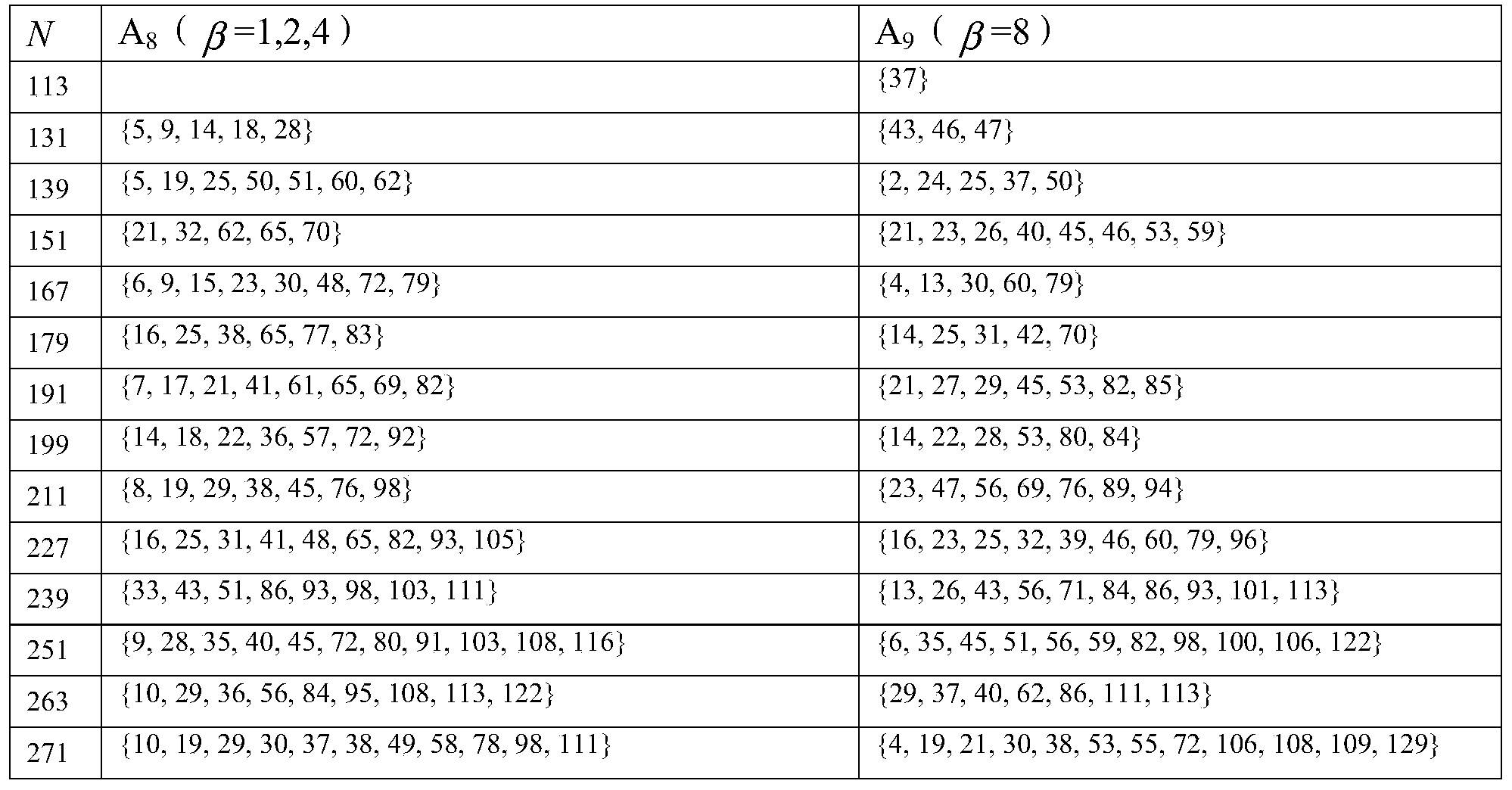


上述集合A
8和集合A
9的并集可以称为A
50。
在本申请实施例中,根据上表所设计的
 来确定q
1、q
2和q
3,可以使得在不同信道 的频域平坦程度下,当有β个终端设备基于一个序列组的同一个基序列和β个不同的循环移位值确定参考信号序列时,这些参考信号序列对基于该序列组的另外一个基序列确定的参考信号的干扰功率总和很低。同时,该方案不增加基于不同序列组的基序列确定的参考信号序列之间的干扰。
来确定q
1、q
2和q
3,可以使得在不同信道 的频域平坦程度下,当有β个终端设备基于一个序列组的同一个基序列和β个不同的循环移位值确定参考信号序列时,这些参考信号序列对基于该序列组的另外一个基序列确定的参考信号的干扰功率总和很低。同时,该方案不增加基于不同序列组的基序列确定的参考信号序列之间的干扰。
可选地,本实施例可以应用于不同的β取值(例如1,2,4,8)以及不同的信道相干带宽(例如,梳齿为2时,相干带宽为4RB、5RB、6RB或12RB;或者,梳齿为4时,相干带宽为8RB、10RB、12RB或24RB)。例如,针对β=1,2或4的场景,
 属于A
8;针对β=8的场景,
属于A
8;针对β=8的场景,
 属于A
9。当然,以上只是示例,A
8和A
9还可以对应其他β值,在此不再赘述。
属于A
9。当然,以上只是示例,A
8和A
9还可以对应其他β值,在此不再赘述。
情况二
针对不同的N,V
2的绝对值
 可以属于下表十一所示的集合A
10或者A
11,集合A
10或者A
11与N的对应关系满足表十一中的至少一行。可选地,可以根据公式(3)确定所述第一ZC序列的根q
1、所述第二ZC序列的根q
2和所述第三ZC序列的根q
3,其中,i=1,2,3,v
1=0,
可以属于下表十一所示的集合A
10或者A
11,集合A
10或者A
11与N的对应关系满足表十一中的至少一行。可选地,可以根据公式(3)确定所述第一ZC序列的根q
1、所述第二ZC序列的根q
2和所述第三ZC序列的根q
3,其中,i=1,2,3,v
1=0,

表十一


在本申请实施例中,根据上表所设计的
 来确定q
1、q
2和q
3,可以使得在不同信道的频域平坦程度下,当有β个终端设备基于一个序列组的同一个基序列和β个不同的循环移位值确定参考信号序列时,这些参考信号序列对基于该序列组的另外一个基序列确定的参考信号的干扰功率总和很低。同时,该方案不增加基于不同序列组的基序列确定的参考信号序列之间的干扰。
来确定q
1、q
2和q
3,可以使得在不同信道的频域平坦程度下,当有β个终端设备基于一个序列组的同一个基序列和β个不同的循环移位值确定参考信号序列时,这些参考信号序列对基于该序列组的另外一个基序列确定的参考信号的干扰功率总和很低。同时,该方案不增加基于不同序列组的基序列确定的参考信号序列之间的干扰。
可选地,本实施例可以应用于不同的β取值(例如1,2,4,8)以及不同的信道相干带宽(例如,梳齿为2时,相干带宽为4RB、5RB、6RB或12RB;或者,梳齿为4时,相干带宽为8RB、10RB、12RB或24RB)。例如,针对β=1,2或4的场景,
 属于A
10;针对β=8的场景,
属于A
10;针对β=8的场景,
 属于A
11。当然,以上只是示例,A
10和A
11还可以对应其他β值,在此不再赘述。
属于A
11。当然,以上只是示例,A
10和A
11还可以对应其他β值,在此不再赘述。
情况三
针对不同的N,V
2的绝对值
 可以属于下表十二所示的集合A
12或者A
13,集合A
12或者A
13与N的对应关系满足表十二中的至少一行。可选地,公式(1)~(4)中至少存在一个公式可以用于确定所述第一ZC序列的根q
1、所述第二ZC序列的根q
2和所述第三ZC序列的根q
3,其中,i=1,2,3,v
1=0,
可以属于下表十二所示的集合A
12或者A
13,集合A
12或者A
13与N的对应关系满足表十二中的至少一行。可选地,公式(1)~(4)中至少存在一个公式可以用于确定所述第一ZC序列的根q
1、所述第二ZC序列的根q
2和所述第三ZC序列的根q
3,其中,i=1,2,3,v
1=0,
 或者v
1=0,
或者v
1=0,


表十二


在本申请实施例中,根据上表所设计的
 来确定q
1、q
2和q
3,可以使得在不同信道的频域平坦程度下,当有β个终端设备基于一个序列组的同一个基序列和β个不同的循环移位值确定参考信号序列时,这些参考信号序列对基于该序列组的另外一个基序列确定的参考信号的干扰功率总和很低。同时,该方案不增加基于不同序列组的基序列确定的参考信号序列之间的干扰。
来确定q
1、q
2和q
3,可以使得在不同信道的频域平坦程度下,当有β个终端设备基于一个序列组的同一个基序列和β个不同的循环移位值确定参考信号序列时,这些参考信号序列对基于该序列组的另外一个基序列确定的参考信号的干扰功率总和很低。同时,该方案不增加基于不同序列组的基序列确定的参考信号序列之间的干扰。
可选地,本实施例可以应用于不同的β取值(例如1,2,4,8)以及不同的信道相干带宽(例如,梳齿为2时,相干带宽为3RB;或者,梳齿为4时,相干带宽为6RB)。例如,针对β=1,2或4的场景,
 属于A
12;针对β=8的场景,
属于A
12;针对β=8的场景,
 属于A
13。当然,以上只是示例,A
12和A
13还可以对应其他β值,在此不再赘述。
属于A
13。当然,以上只是示例,A
12和A
13还可以对应其他β值,在此不再赘述。
情况四
针对不同的N,V
2的绝对值
 可以为A
14或者A
15,A
14或者A
15与N的对应关系满足表十三中的至少一行。可以根据公式(3)确定所述第一ZC序列的根q
1、所述第二ZC序列的根q
2和所述第三ZC序列的根q
3,其中,i=1,2,3,v
1=0,
可以为A
14或者A
15,A
14或者A
15与N的对应关系满足表十三中的至少一行。可以根据公式(3)确定所述第一ZC序列的根q
1、所述第二ZC序列的根q
2和所述第三ZC序列的根q
3,其中,i=1,2,3,v
1=0,

表十三
| N | A 14(β=1,2,4) | A 15(β=8) |
| 113 | ||
| 131 | 18 | |
| 139 | 19 | 24 |
| 151 | 21 | 21 |
| 167 | 23 | 4 |
| 179 | 65 | 25 |
| 191 | 69 | 27 |
| 199 | 18 | 14 |
| 211 | 8 | 23 |
| 227 | 31 | 16 |
| 239 | 33 | 43 |
| 251 | 35 | 35 |
| 263 | 36 | 29 |
| 271 | 37 | 19 |
| 283 | 102 | 4 |
| 311 | 113 | 17 |
| 317 | 115 | 32 |
| 331 | 46 | 46 |
| 359 | 49 | 39 |
| 383 | 139 | 21 |
| 389 | 54 | 30 |
| 401 | 55 | 11 |
| 431 | 59 | 6 |
| 449 | 163 | 100 |
| 479 | 174 | 37 |
| 503 | 69 | 51 |
| 523 | 73 | 53 |
| 547 | 75 | 8 |
| 571 | 78 | 8 |
| 619 | 85 | 34 |
| 647 | 235 | 50 |
| 661 | 240 | 51 |
| 719 | 261 | 73 |
| 761 | 104 | 18 |
| 787 | 109 | 12 |
| 811 | 111 | 12 |
| 863 | 118 | 95 |
| 911 | 125 | 22 |
| 953 | 132 | 14 |
| 997 | 362 | 14 |
| 1051 | 144 | 50 |
| 1103 | 151 | 16 |
| 1151 | 418 | 17 |
| 1237 | 449 | 18 |
| 1291 | 177 | 18 |
| 1327 | 182 | 31 |
| 1439 | 197 | 34 |
| 1531 | 210 | 22 |
| 1583 | 217 | 37 |
| 1627 | 223 | 24 |
在本申请实施例中,根据上表所设计的
 来确定q
1、q
2和q
3,可以使得在不同信道的频域平坦程度下,当有β个终端设备基于一个序列组的同一个基序列和β个不同的循环移位值确定参考信号序列时,这些参考信号序列对基于该序列组的另外一个基序列确定的参考信号的干扰功率总和很低。同时,该方案不增加基于不同序列组的基序列确定的参考信号序列之间的干扰。
来确定q
1、q
2和q
3,可以使得在不同信道的频域平坦程度下,当有β个终端设备基于一个序列组的同一个基序列和β个不同的循环移位值确定参考信号序列时,这些参考信号序列对基于该序列组的另外一个基序列确定的参考信号的干扰功率总和很低。同时,该方案不增加基于不同序列组的基序列确定的参考信号序列之间的干扰。
可选地,本实施例可以应用于不同的β取值(例如1,2,4,8)以及不同的信道相干带宽(例如,梳齿为2时,相干带宽为4RB、5RB、6RB或12RB;或者,梳齿为4时,相干带宽为8RB、10RB、12RB或24RB)。例如,针对β=1,2或4的场景,
 属于A
10;针对β=8的场景,
属于A
10;针对β=8的场景,
 属于A
11。当然,以上只是示例,A
10和A
11还可以对应其他β值,在此不再赘述。
属于A
11。当然,以上只是示例,A
10和A
11还可以对应其他β值,在此不再赘述。
作为一个可选的实施例,X为大于或等于4的整数,所述X个基序列包括四个基序列,所述四个基序列对应的ZC序列的根分别为q
3、(q
3+V
3)mod N、(q
3+W
2)mod N和(q
3+O
1)mod N,其中,q
3为1到N-1的整数,V
3为整数,且V
3的绝对值的取值范围为[K
1,K
2]∪[K
3,K
4],W
2为整数,且W
2的绝对值的取值范围为[K
1,K
2]∪[K
3,K
4],O
1为整数,且O
1的绝对值的取值范围为[K
1,K
2]∪[K
3,K
4]。
应理解,本实施例中的四个基序列可以包括上述实施例中已经提及的基序列中的至少一个,也可以是不同与上述基序列的其他序列,即q
3与q
1或q
2可以相等,也可以不相等,V
3与V
1或V
2可以相等,也可以不相等,W
2与W
1可以相等,也可以不相等,本申请实施例对此不作限定。
作为一个可选的实施例,当X是大于或等于4的整数时,|c
i|∈[K
1,K
2]∪[K
3,K
4],i=1,2,...,X-1。可选地,c
i为根据V
3确定的整数。
在该实施例中,W
2可以是根据V
3确定的,或者V
3可以是根据W
2确定的,或者V
3和W
2可以是独立设计的值,彼此没有明确的直接确定关系,本申请实施例对此也不作限定。同理,O
1可以是根据V
3确定的,或者V
3可以是根据O
1确定的,或者V
3和O
1可以是独立设计的值,彼此没有明确的直接确定关系。
作为一个可选的实施例,V
3和W
2的关系满足下列公式中的任一个:W
2=-V
3,或W
2=(2×V
3)mod N;或者,V
3和O
1的关系满足下列公式中的任一个:O
1=(2×V
3)mod N,或O
1=(3×V
3)mod N。
作为一个可选的实施例,W
2=-V
3,O
1=(2×V
3)mod N;或者,W
2=(2×V
3)mod N,O
1=(3×V
3)mod N。
V
3的特征在于:
(1)V
3为整数;
(2)存在不同的N,使得V
3的取值不同;
(3)对于不同的u,V
3的取值可以相同,也可以不同;
(4)存在N和u,使得V
3的绝对值属于[K
1,K
2]∪[K
3,K
4]。
W
2的特征在于:
(1)W
2为整数;
(2)存在不同的N,使得W
2的取值不同;
(3)对于不同的u,W
2的取值可以相同,也可以不同;
(4)存在N和u,使得W
2的绝对值属于[K
1,K
2]∪[K
3,K
4]。
O
1的特征在于:
(1)O
1为整数;
(2)存在不同的N,使得O
1的取值不同;
(3)对于不同的u,O
1的取值可以相同,也可以不同;
(4)存在N和u,使得O
1的绝对值属于[K
1,K
2]∪[K
3,K
4]。
当X为大于或等于4的整数时,该第一序列组中长度为M的基序列的个数大于或等于4。为了描述方便,以X=4为例进行说明。假设该四个基序列包括上述X=3的实施例中的三个基序列,针对第一序列组中的第一基序列、第二基序列、第三基序列和第四基序列,用于生成该第一基序列的第一ZC序列的根为q
1,用于生成该第二基序列的第二ZC序列的根为q
2,用于生成该第三基序列的第三ZC序列的根为q
3,用于生成该第四基序列的第四ZC序列的根为q
4,则在上述四个公式(1)~(4)中,i=1,2,3,4,v
1=0,

 此时,W
2=-V
3,O
1=(2×V
3)mod N;或者,v
1=0,
此时,W
2=-V
3,O
1=(2×V
3)mod N;或者,v
1=0,
 此时,W
2=(2×V
3)mod N,O
1=(2×V
3)mod N。V
3的绝对值
此时,W
2=(2×V
3)mod N,O
1=(2×V
3)mod N。V
3的绝对值
 的取值可以分下列多种情况。
情况一
针对不同的N,V
3的绝对值
 可以属于下表十四所示的集合A
16、A
17或者A
18,集合A
16、A
17或者A
18与N的对应关系满足表十四中的至少一行。可选地,公式(1)~(4)中至少存在一个公式可以用于确定所述第一ZC序列的根q
1、所述第二ZC序列的根q
2、所述第三ZC序列的根q
3和所述第四ZC序列的根q
4,其中,i=1,2,3,4,v
1=0,
可以属于下表十四所示的集合A
16、A
17或者A
18,集合A
16、A
17或者A
18与N的对应关系满足表十四中的至少一行。可选地,公式(1)~(4)中至少存在一个公式可以用于确定所述第一ZC序列的根q
1、所述第二ZC序列的根q
2、所述第三ZC序列的根q
3和所述第四ZC序列的根q
4,其中,i=1,2,3,4,v
1=0,

 W
2=-V
3,O
1=(2×V
3)mod N;或者,v
1=0,
W
2=-V
3,O
1=(2×V
3)mod N;或者,v
1=0,
 W
2=(2×V
3)mod N,O
1=(2×V
3)mod N。
W
2=(2×V
3)mod N,O
1=(2×V
3)mod N。
表十四


在本申请实施例中,根据上表所设计的
 来确定q
1、q
2、q
3和q
4,可以使得在不同信道的频域平坦程度下,当有β个终端设备基于一个序列组的同一个基序列和β个不同的循环移位值确定参考信号序列时,这些参考信号序列对基于该序列组的另外一个基序列确定的参考信号的干扰功率总和很低。同时,该方案不增加基于不同序列组的基序列确定的参考信号序列之间的干扰。
来确定q
1、q
2、q
3和q
4,可以使得在不同信道的频域平坦程度下,当有β个终端设备基于一个序列组的同一个基序列和β个不同的循环移位值确定参考信号序列时,这些参考信号序列对基于该序列组的另外一个基序列确定的参考信号的干扰功率总和很低。同时,该方案不增加基于不同序列组的基序列确定的参考信号序列之间的干扰。
可选地,本实施例可以应用于不同的β取值(例如1,2,4,8)以及不同的信道相干带宽(例如,梳齿为2时,相干带宽为3RB、4RB、5RB、6RB或12RB;或者,梳齿为4时,相干带宽为6RB、8RB、10RB、12RB或24RB)。例如,针对β=1,2或4,相干带宽为4RB、5RB、6RB或12RB(梳齿为2),或者,相干带宽为8RB、10RB、12RB或24RB(梳齿为4)的场景,
 属于A
16;针对β=1,2或4,相干带宽为3RB(梳齿为2),或者,相干带宽为6RB(梳齿为4)的场景,
属于A
16;针对β=1,2或4,相干带宽为3RB(梳齿为2),或者,相干带宽为6RB(梳齿为4)的场景,
 属于A
17;针对β=8,相干带宽为4RB、5RB、6RB或12RB(梳齿为2),或者,相干带宽为8RB、10RB、12RB或24RB(梳齿为4)的场景,
属于A
17;针对β=8,相干带宽为4RB、5RB、6RB或12RB(梳齿为2),或者,相干带宽为8RB、10RB、12RB或24RB(梳齿为4)的场景,
 属于A
18。当然,以上只是示例,A
16、A
17和A
18还可以对应其他β值和其他相干带宽,在此不再赘述。
属于A
18。当然,以上只是示例,A
16、A
17和A
18还可以对应其他β值和其他相干带宽,在此不再赘述。
情况二
针对不同的N,V
3的绝对值
 可以属于下表十五所示的集合A
19、A
20或者A
21,集合A
19、A
20或者A
21与N的对应关系满足表十五中的至少一行。可选地,可以使用公式(3)确定所述第一ZC序列的根q
1、所述第二ZC序列的根q
2、所述第三ZC序列的根q
3和所述第四ZC序列的根q
4,其中,i=1,2,3,4,v
1=0,
可以属于下表十五所示的集合A
19、A
20或者A
21,集合A
19、A
20或者A
21与N的对应关系满足表十五中的至少一行。可选地,可以使用公式(3)确定所述第一ZC序列的根q
1、所述第二ZC序列的根q
2、所述第三ZC序列的根q
3和所述第四ZC序列的根q
4,其中,i=1,2,3,4,v
1=0,

 W
2=-V
3,O
1=(2×V
3)mod N。
W
2=-V
3,O
1=(2×V
3)mod N。
表十五


在本申请实施例中,根据上表所设计的
 来确定q
1、q
2、q
3和q
4,可以使得在不同信道的频域平坦程度下,当有β个终端设备基于一个序列组的同一个基序列和β个不同的循环移位值确定参考信号序列时,这些参考信号序列对基于该序列组的另外一个基序列确定的参考信号的干扰功率总和很低。同时,该方案不增加基于不同序列组的基序列确定的参考信号序列之间的干扰。
来确定q
1、q
2、q
3和q
4,可以使得在不同信道的频域平坦程度下,当有β个终端设备基于一个序列组的同一个基序列和β个不同的循环移位值确定参考信号序列时,这些参考信号序列对基于该序列组的另外一个基序列确定的参考信号的干扰功率总和很低。同时,该方案不增加基于不同序列组的基序列确定的参考信号序列之间的干扰。
可选地,本实施例可以应用于不同的β取值(例如1,2,4,8)以及不同的信道相干带宽(例如,梳齿为2时,相干带宽为3RB、4RB、5RB、6RB或12RB;或者,梳齿为4时,相干带宽为6RB、8RB、10RB、12RB或24RB)。例如,针对β=1,2或4,相干带宽为4RB、5RB、6RB或12RB(梳齿为2),或者,相干带宽为8RB、10RB、12RB 或24RB(梳齿为4)的场景,
 属于A
19;针对β=1,2或4,相干带宽为3RB(梳齿为2),或者,相干带宽为6RB(梳齿为4)的场景,
属于A
19;针对β=1,2或4,相干带宽为3RB(梳齿为2),或者,相干带宽为6RB(梳齿为4)的场景,
 属于A
20;针对β=8,相干带宽为4RB、5RB、6RB或12RB(梳齿为2),或者,相干带宽为8RB、10RB、12RB或24RB(梳齿为4)的场景,
属于A
20;针对β=8,相干带宽为4RB、5RB、6RB或12RB(梳齿为2),或者,相干带宽为8RB、10RB、12RB或24RB(梳齿为4)的场景,
 属于A
21。当然,以上只是示例,A
19、A
20和A
21还可以对应其他β值和其他相干带宽,在此不再赘述。
属于A
21。当然,以上只是示例,A
19、A
20和A
21还可以对应其他β值和其他相干带宽,在此不再赘述。
情况三
针对不同的N,V
3的绝对值
 可以等于集合A
22、A
23或者A
24,集合A
22、A
23或者A
24与N的对应关系满足表十六中的至少一行。可选地,可以使用公式(3)确定所述第一ZC序列的根q
1、所述第二ZC序列的根q
2、所述第三ZC序列的根q
3和所述第四ZC序列的根q
4,其中,i=1,2,3,4,v
1=0,
可以等于集合A
22、A
23或者A
24,集合A
22、A
23或者A
24与N的对应关系满足表十六中的至少一行。可选地,可以使用公式(3)确定所述第一ZC序列的根q
1、所述第二ZC序列的根q
2、所述第三ZC序列的根q
3和所述第四ZC序列的根q
4,其中,i=1,2,3,4,v
1=0,
 W
2=-V
3,O
1=(2×V
3)mod N。
W
2=-V
3,O
1=(2×V
3)mod N。
表十六
| N | A 22(β=1,2,4) | A 23(β=1,2,4) | A 24(β=8) |
| 113 | |||
| 131 | 28 | ||
| 139 | 19 | ||
| 151 | 40 | ||
| 167 | 12 | ||
| 179 | 7 | 62 | |
| 191 | 75 | 38 | |
| 199 | 14 | 36 | 59 |
| 211 | 8 | 42 | 5 |
| 227 | 31 | 79 | 23 |
| 239 | 9 | 48 | 71 |
| 251 | 66 | 87 | 51 |
| 263 | 36 | 40 | 2 |
| 271 | 37 | 49 | 55 |
| 283 | 81 | 43 | 42 |
| 311 | 89 | 16 | 102 |
| 317 | 12 | 63 | 104 |
| 331 | 12 | 17 | 88 |
| 359 | 49 | 55 | 73 |
| 383 | 14 | 76 | 9 |
| 389 | 14 | 20 | 152 |
| 401 | 15 | 139 | 141 |
| 431 | 59 | 66 | 64 |
| 449 | 17 | 156 | 214 |
| 479 | 18 | 73 | 191 |
| 503 | 19 | 77 | 51 |
| 523 | 19 | 80 | 53 |
| 547 | 20 | 190 | 218 |
| 571 | 78 | 87 | 58 |
| 619 | 225 | 215 | 295 |
| 647 | 24 | 99 | 96 |
| 661 | 25 | 101 | 315 |
| 719 | 27 | 110 | 73 |
| 761 | 104 | 116 | 113 |
| 787 | 286 | 120 | 80 |
| 811 | 111 | 124 | 19 |
| 863 | 118 | 132 | 236 |
| 911 | 331 | 139 | 363 |
| 953 | 36 | 331 | 335 |
| 997 | 37 | 346 | 148 |
| 1051 | 382 | 365 | 156 |
| 1103 | 151 | 383 | 112 |
| 1151 | 418 | 176 | 27 |
| 1237 | 169 | 189 | 29 |
| 1291 | 469 | 197 | 353 |
| 1327 | 482 | 461 | 31 |
| 1439 | 197 | 220 | 326 |
| 1531 | 556 | 234 | 347 |
| 1583 | 575 | 242 | 37 |
| 1627 | 591 | 565 | 38 |
在本申请实施例中,根据上表所设计的
 来确定q
1、q
2、q
3和q
4,可以使得在不同信道的频域平坦程度下,当有β个终端设备基于一个序列组的同一个基序列和β个不同的循环移位值确定参考信号序列时,这些参考信号序列对基于该序列组的另外一个基序列确定的参考信号的干扰功率总和很低。同时,该方案不增加基于不同序列组的基序列确定的参考信号序列之间的干扰。
来确定q
1、q
2、q
3和q
4,可以使得在不同信道的频域平坦程度下,当有β个终端设备基于一个序列组的同一个基序列和β个不同的循环移位值确定参考信号序列时,这些参考信号序列对基于该序列组的另外一个基序列确定的参考信号的干扰功率总和很低。同时,该方案不增加基于不同序列组的基序列确定的参考信号序列之间的干扰。
可选地,本实施例可以应用于不同的β取值(例如1,2,4,8)以及不同的信道相干带宽(例如,梳齿为2时,相干带宽为3RB、4RB、5RB、6RB或12RB;或者,梳齿为4时,相干带宽为6RB、8RB、10RB、12RB或24RB)。例如,针对β=1,2或4,相干带宽为4RB、5RB、6RB或12RB(梳齿为2),或者,相干带宽为8RB、10RB、12RB或24RB(梳齿为4)的场景,
 属于A
22;针对β=1,2或4,相干带宽为3RB(梳齿为2),或者,相干带宽为6RB(梳齿为4)的场景,
属于A
22;针对β=1,2或4,相干带宽为3RB(梳齿为2),或者,相干带宽为6RB(梳齿为4)的场景,
 属于A
23;针对β=8,相干带宽为4RB、5RB、6RB或12RB(梳齿为2),或者,相干带宽为8RB、10RB、12RB或24RB(梳齿为4)的场景,
属于A
23;针对β=8,相干带宽为4RB、5RB、6RB或12RB(梳齿为2),或者,相干带宽为8RB、10RB、12RB或24RB(梳齿为4)的场景,
 属于A
24。当然,以上只是示例,A
22、A
23和A
24还可以对应其他β值和其他相干带宽,在此不再赘述。
属于A
24。当然,以上只是示例,A
22、A
23和A
24还可以对应其他β值和其他相干带宽,在此不再赘述。
作为一个可选的实施例,X为大于或等于5的整数,所述X个基序列中包括五个基序列,所述五个基序列对应的ZC序列的根分别为q
4、(q
4+V
4)mod N、(q
4+W
3)mod N、(q
4+O
2)mod N和(q
4+P)mod N,其中,q
4为1到N-1的整数,V
4为整数,且V
4的绝对值的取值范围为[K
1,K
2]∪[K
3,K
4],W
3为整数,且W
3的绝对值的取值范围为[K
1,K
2]∪[K
3,K
4],O
2为整数,且O
2的绝对值的取值范围为[K
1,K
2]∪[K
3,K
4],P为整数,且P的绝对值的取值范围为[K
1,K
2]∪[K
3,K
4]。
应理解,本实施例中的五个基序列可以包括上述实施例中已经提及的基序列中的至少一个,也可以是不同与上述基序列的其他序列,即q
4与q
1、q
2或q
3可以相等,也可以不相等,V
4与V
1、V
2或V
3可以相等,也可以不相等,W
3与W
1或W
2可以相等,也可以不相等,O
2与O
1可以相等,也可以不相等,本申请实施例对此不作限定。
作为一个可选的实施例,当X是大于或等于5的整数时,|c
i|∈[K
1,K
2]∪[K
3,K
4],i=1,2,...,X-1。可选地,c
i为根据V
4确定的整数。
在该实施例中,W
3可以是根据V
4确定的,或者V
4可以是根据W
3确定的,或者V
4和W
3可以是独立设计的值,彼此没有明确的直接确定关系,本申请实施例对此也不作限定。同理,O
2可以是根据V
4确定的,或者V
4可以是根据O
2确定的,或者V
4和O
2可以是独立设计的值,彼此没有明确的直接确定关系。同理,P可以是根据V
4确定的,或者V
4可以是根据P确定的,或者V
4和P可以是独立设计的值,彼此没有明确的直接确定关系。
作为一个可选的实施例,V
4和W
3的关系满足下列公式中的任一个:W
3=-V
4,或W
3=(2×V
4)mod N;或者,V
4和O
2的关系满足下列公式中的任一个:O
2=(2×V
4)mod N,或O
2=(3×V
4)mod N;或者,V
4和P的关系满足下列公式中的任一个:P=(-2×V
4)mod N,P=(3×V
4)mod N,P=(4×V
4)mod N。
作为一个可选的实施例,W
3=-V
4,O
2=(2×V
4)mod N,P=(-2×V
4)mod N;或者,W
3=-V
4,O
2=(2×V
4)mod N,P=(3×V
4)mod N;或者,W
3=(2×V
4)mod N,O
2=(3×V
4)mod N,P=(4×V
4)mod N。
V
4的特征在于:
(1)V
4为整数;
(2)存在不同的N,使得V
4的取值不同;
(3)对于不同的u,V
4的取值可以相同,也可以不同;
(4)存在N和u,使得V
4的绝对值属于[K
1,K
2]∪[K
3,K
4]。
W
3的特征在于:
(1)W
3为整数;
(2)存在不同的N,使得W
3的取值不同;
(3)对于不同的u,W
3的取值可以相同,也可以不同;
(4)存在N和u,使得W
3的绝对值属于[K
1,K
2]∪[K
3,K
4]。
O
2的特征在于:
(1)O
2为整数;
(2)存在不同的N,使得O
2的取值不同;
(3)对于不同的u,O
2的取值可以相同,也可以不同;
(4)存在N和u,使得O
2的绝对值属于[K
1,K
2]∪[K
3,K
4]。
P的特征在于:
(1)P为整数;
(2)存在不同的N,使得P的取值不同;
(3)对于不同的u,P的取值可以相同,也可以不同;
(4)存在N和u,使得P的绝对值属于[K
1,K
2]∪[K
3,K
4]。
当X为大于或等于5的整数时,该第一序列组中长度为M的基序列的个数大于或等 于5。为了描述方便,以X=5为例进行说明。假设该五个基序列包括上述X=4的实施例中的四个基序列,针对第一序列组中的第一基序列、第二基序列、第三基序列、第四基序列和第五基序列,用于生成该第一基序列的第一ZC序列的根为q
1,用于生成该第二基序列的第二ZC序列的根为q
2,用于生成该第三基序列的第三ZC序列的根为q
3,用于生成该第四基序列的第四ZC序列的根为q
4,用于生成该第五基序列的第五ZC序列的根为q
5,则在上述四个公式(1)~(4)中,i=1,2,3,4,5,v
1=0,

 此时,W
3=-V
4,O
2=(2×V
4)mod N,P=(-2×V
4)mod N;或者,
此时,W
3=-V
4,O
2=(2×V
4)mod N,P=(-2×V
4)mod N;或者,
v
1=0,
 此时,W
3=-V
4,O
2=(2×V
4)mod N,P=(3×V
4)mod N;或者,
此时,W
3=-V
4,O
2=(2×V
4)mod N,P=(3×V
4)mod N;或者,
v
1=0,

 此时,W
3=(2×V
4)mod N,O
2=(3×V
4)mod N,P=(4×V
4)mod N。
此时,W
3=(2×V
4)mod N,O
2=(3×V
4)mod N,P=(4×V
4)mod N。
V
4的绝对值的取值可以分下列多种情况。
情况一
若根是通过上述四个公式(1)~(4)中的任一个公式计算得到的,那么针对不同的N,V
4、W
3、O
2、和P的绝对值可以属于下表十七所示的集合A
25和A
26。针对不同的N,V
4的绝对值
 可以属于下表十七所示的集合A
25或者A
26,集合A
25或者A
26与N的对应关系满足表十七中的至少一行。可选地,公式(1)~(4)中至少存在一个公式可以用于确定所述第一ZC序列的根q
1、所述第二ZC序列的根q
2、所述第三ZC序列的根q
3、所述第四ZC序列的根q
4和所述第五ZC序列的根q
5,其中,i=1,2,3,4,5,v
1=0,
可以属于下表十七所示的集合A
25或者A
26,集合A
25或者A
26与N的对应关系满足表十七中的至少一行。可选地,公式(1)~(4)中至少存在一个公式可以用于确定所述第一ZC序列的根q
1、所述第二ZC序列的根q
2、所述第三ZC序列的根q
3、所述第四ZC序列的根q
4和所述第五ZC序列的根q
5,其中,i=1,2,3,4,5,v
1=0,

 W
3=-V
4,O
2=(2×V
4)mod N,P=(-2×V
4)mod N;或者,v
1=0,
W
3=-V
4,O
2=(2×V
4)mod N,P=(-2×V
4)mod N;或者,v
1=0,

 W
3=-V
4,O
2=(2×V
4)mod N,P=(3×V
4)mod N;或者,v
1=0,
W
3=-V
4,O
2=(2×V
4)mod N,P=(3×V
4)mod N;或者,v
1=0,

 W
3=(2×V
4)mod N,O
2=(3×V
4)mod N,P=(4×V
4)mod N。
W
3=(2×V
4)mod N,O
2=(3×V
4)mod N,P=(4×V
4)mod N。
表十七


在本申请实施例中,根据上表所设计的
 来确定q
1、q
2、q
3、q
4和q
5,可以使得在不同信道的频域平坦程度下,当有β个终端设备基于一个序列组的同一个基序列和β个不同的循环移位值确定参考信号序列时,这些参考信号序列对基于该序列组的另外一个基序列确定的参考信号的干扰功率总和很低。同时,该方案不增加基于不同序列组的基序列确定的参考信号序列之间的干扰。
来确定q
1、q
2、q
3、q
4和q
5,可以使得在不同信道的频域平坦程度下,当有β个终端设备基于一个序列组的同一个基序列和β个不同的循环移位值确定参考信号序列时,这些参考信号序列对基于该序列组的另外一个基序列确定的参考信号的干扰功率总和很低。同时,该方案不增加基于不同序列组的基序列确定的参考信号序列之间的干扰。
可选地,本实施例可以应用于不同的β取值(例如1,2,4)以及不同的信道相干带宽(例如,梳齿为2时,相干带宽为4RB、5RB、6RB或12RB;或者,梳齿为4时,相干带宽为8RB、10RB、12RB或24RB)。例如,针对β=1,2或4,相干带宽为4RB(梳齿为2),或者,相干带宽为8RB(梳齿为4)的场景,
 属于A
25;针对β=1,2或4,相干带宽为5RB、6RB或12RB(梳齿为2),或者,相干带宽为10RB、12RB或24RB(梳齿为4)的场景,
属于A
25;针对β=1,2或4,相干带宽为5RB、6RB或12RB(梳齿为2),或者,相干带宽为10RB、12RB或24RB(梳齿为4)的场景,
 属于A
26。当然,以上只是示例,A
25和A
26还可以对应其他β值和其他相干带宽,在此不再赘述。
属于A
26。当然,以上只是示例,A
25和A
26还可以对应其他β值和其他相干带宽,在此不再赘述。
情况二
针对不同的N,V
4的绝对值
 可以属于下表十八所示的集合A
27或者A
28,集合A
27或者A
28与N的对应关系满足表十八中的至少一行。可选地,可以使用公式(3)确定所述第一ZC序列的根q
1、所述第二ZC序列的根q
2、所述第三ZC序列的根q
3、所述第四ZC序列的根q
4和所述第五ZC序列的根q
5,其中,i=1,2,3,4,5,v
1=0,
可以属于下表十八所示的集合A
27或者A
28,集合A
27或者A
28与N的对应关系满足表十八中的至少一行。可选地,可以使用公式(3)确定所述第一ZC序列的根q
1、所述第二ZC序列的根q
2、所述第三ZC序列的根q
3、所述第四ZC序列的根q
4和所述第五ZC序列的根q
5,其中,i=1,2,3,4,5,v
1=0,

 W
3=-V
4,O
2=(2×V
4)mod N,P=(-2×V
4)mod N。
W
3=-V
4,O
2=(2×V
4)mod N,P=(-2×V
4)mod N。
表十八


在本申请实施例中,根据上表所设计的
 来确定q
1、q
2、q
3、q
4和q
5,可以使得在不同信道的频域平坦程度下,当有β个终端设备基于一个序列组的同一个基序列和β个不同的循环移位值确定参考信号序列时,这些参考信号序列对基于该序列组的另外一个基序列确定的参考信号的干扰功率总和很低。同时,该方案不增加基于不同序列组的基序列确定的参考信号序列之间的干扰。
来确定q
1、q
2、q
3、q
4和q
5,可以使得在不同信道的频域平坦程度下,当有β个终端设备基于一个序列组的同一个基序列和β个不同的循环移位值确定参考信号序列时,这些参考信号序列对基于该序列组的另外一个基序列确定的参考信号的干扰功率总和很低。同时,该方案不增加基于不同序列组的基序列确定的参考信号序列之间的干扰。
可选地,本实施例可以应用于不同的β取值(例如1,2,4)以及不同的信道相干带宽(例如,梳齿为2时,相干带宽为4RB、5RB、6RB或12RB;或者,梳齿为4时,相干带宽为8RB、10RB、12RB或24RB)。例如,针对β=1,2或4,相干带宽为4RB(梳齿为2),或者,相干带宽为8RB(梳齿为4)的场景,
 属于A
27;针对β=1,2或4,相干带宽为5RB、6RB或12RB(梳齿为2),或者,相干带宽为10RB、12RB或24RB(梳齿为4)的场景,
属于A
27;针对β=1,2或4,相干带宽为5RB、6RB或12RB(梳齿为2),或者,相干带宽为10RB、12RB或24RB(梳齿为4)的场景,
 属于A
28。当然,以上只是示例,A
27和A
28还可以对应其他β值和其他相干带宽,在此不再赘述。
属于A
28。当然,以上只是示例,A
27和A
28还可以对应其他β值和其他相干带宽,在此不再赘述。
情况三
针对不同的N,V
4的绝对值
 可以等于集合A
29或者A
30,集合A
29或者A
30的取值与N的对应关系满足表十九中的至少一行。可选地,可以使用公式(3)确定所述第一ZC序列的根q
1、所述第二ZC序列的根q
2、所述第三ZC序列的根q
3、所述第四ZC序列的根q
4和所述第五ZC序列的根q
5,其中,i=1,2,3,4,5,v
1=0,
可以等于集合A
29或者A
30,集合A
29或者A
30的取值与N的对应关系满足表十九中的至少一行。可选地,可以使用公式(3)确定所述第一ZC序列的根q
1、所述第二ZC序列的根q
2、所述第三ZC序列的根q
3、所述第四ZC序列的根q
4和所述第五ZC序列的根q
5,其中,i=1,2,3,4,5,v
1=0,

 W
3=-V
4,O
2=(2×V
4)mod N,P=(-2×V
4)mod N。
W
3=-V
4,O
2=(2×V
4)mod N,P=(-2×V
4)mod N。
表十九
| N | A 29(β=1,2,4,γ=24) | A 30(β=1,2,4,γ=30,36,72) |
| 113 | ||
| 131 | ||
| 139 | ||
| 151 | ||
| 167 | ||
| 179 | ||
| 191 | 75 | 58 |
| 199 | 36 | 46 |
| 211 | 38 | 4 |
| 227 | 41 | 50 |
| 239 | 43 | 98 |
| 251 | 112 | 58 |
| 263 | 6 | 58 |
| 271 | 49 | 5 |
| 283 | 51 | 26 |
| 311 | 56 | 28 |
| 317 | 22 | 6 |
| 331 | 23 | 73 |
| 359 | 25 | 83 |
| 383 | 69 | 183 |
| 389 | 27 | 53 |
| 401 | 128 | 193 |
| 431 | 30 | 39 |
| 449 | 81 | 216 |
| 479 | 153 | 9 |
| 503 | 35 | 242 |
| 523 | 167 | 48 |
| 547 | 175 | 224 |
| 571 | 103 | 126 |
| 619 | 198 | 56 |
| 647 | 207 | 19 |
| 661 | 211 | 318 |
| 719 | 130 | 41 |
| 761 | 243 | 168 |
| 787 | 142 | 182 |
| 811 | 259 | 179 |
| 863 | 156 | 295 |
| 911 | 291 | 201 |
| 953 | 172 | 18 |
| 997 | 180 | 220 |
| 1051 | 190 | 243 |
| 1103 | 199 | 255 |
| 1151 | 208 | 266 |
| 1237 | 223 | 548 |
| 1291 | 233 | 206 |
| 1327 | 424 | 25 |
| 1439 | 260 | 82 |
| 1531 | 276 | 29 |
| 1583 | 286 | 486 |
| 1627 | 294 | 376 |
在本申请实施例中,根据上表所设计的
 来确定q
1、q
2、q
3、q
4和q
5,可以使得在不同信道的频域平坦程度下,当有β个终端设备基于一个序列组的同一个基序列和β个不同的循环移位值确定参考信号序列时,这些参考信号序列对基于该序列组的另外一个基序列确定的参考信号的干扰功率总和很低。同时,该方案不增加基于不同序列组的基序列确定的参考信号序列之间的干扰。
来确定q
1、q
2、q
3、q
4和q
5,可以使得在不同信道的频域平坦程度下,当有β个终端设备基于一个序列组的同一个基序列和β个不同的循环移位值确定参考信号序列时,这些参考信号序列对基于该序列组的另外一个基序列确定的参考信号的干扰功率总和很低。同时,该方案不增加基于不同序列组的基序列确定的参考信号序列之间的干扰。
可选地,本实施例可以应用于不同的β取值(例如1,2,4)以及不同的信道相干带宽(例如,梳齿为2时,相干带宽为4RB、5RB、6RB或12RB;或者,梳齿为4时,相干带宽为8RB、10RB、12RB或24RB)。例如,针对β=1,2或4,相干带宽为4RB(梳齿为2),或者,相干带宽为8RB(梳齿为4)的场景,
 属于A
29;针对β=1,2或4,相干带宽为5RB、6RB或12RB(梳齿为2),或者,相干带宽为10RB、12RB或24RB(梳齿为4)的场景,
属于A
29;针对β=1,2或4,相干带宽为5RB、6RB或12RB(梳齿为2),或者,相干带宽为10RB、12RB或24RB(梳齿为4)的场景,
 属于A
30。当然,以上只是示例,A
29和A
30还可以对应其他β值和其他相干带宽,在此不再赘述。
属于A
30。当然,以上只是示例,A
29和A
30还可以对应其他β值和其他相干带宽,在此不再赘述。
上述多个实施例均针对将第一序列组中长度为M的基序列的个数扩充至X(X=2,3,4,5)进行了描述,应理解,针对第一序列组中长度为M
1的序列的个数X
1,和/或第一序列组中长度为M
2的序列的个数X
2,也可以采用上述实施例中的方法进行扩充。例如,按照上述X=2的实施例,将长度为M
1的基序列的个数增加至X
1=2个;或者,按照上述X=3的实施例,将长度为M
1的基序列的个数增加至X
1=3个。又例如,按照上述X=4的实施例,将长度为M
2的基序列的个数增加至X
2=4个。其他序列组类似,此处不再赘述。
本申请提供了另一种通信方法300,该方法300包括:
终端设备获取长度为M的参考信号序列,M为大于1的整数。
该终端设备向网络设备发送所述参考信号序列;则对应地,网络设备接收参考信号序列。
可选地,上述方法300还包括:网络设备根据接收到的参考信号序列,进行信道测量。
上述参考信号序列是由长度为M的第一基序列确定的,所述第一基序列是根据配置信息获得的,所述第一基序列是L个长度为M的候选基序列中的一个基序列,所述L个候选基序列是由所述配置信息的所有可能取值指示的基序列组成的,L为大于30的整数,所述L个候选基序列是由L个长度为N的ZC序列确定的,N为大于1的整数,所述L个候选基序列包括L
0个基序列,L
0为整数,且30<L
0≤L,所述L
0个基序列中的第i个基序列对应的ZC序列的根为q
i。
上述“配置信息的所有可能取值”可以是网络中可用的基序列的序列索引的取值,例如,网络中总共有60个可用的基序列,该配置信息的所有可能取值为该60个可用的基序列的序列索引的取值。
上述“所述L个候选基序列是由所述配置信息的所有可能取值指示的基序列组成的”指的是:L个候选基序列为标准中规定的、用于配置第一基序列的所有配置信息的所有可能取值所指示的基序列。例如,在当前的3GPP标准中,配置信息包括序列组索引和序列号(sequence number),其中序列组索引的取值范围为0~29,序列号的取值为0或1,则配置信息的所有可能取值所指示的基序列为根据序列组索引的30个可能取值和序列号的2个可能取值所指示的60个基序列。
在一种可能的实现方式中,30<L≤60,q
i的取值属于集合
 其中,
其中,
 D为正整数,
 为由
为由
 确定的整数,
 为0到N-1的整数,V
1为整数,且V
1的绝对值的取值范围为[K
1,K
2]∪[K
3,K
4],K
1、K
2、K
3和K
4均为整数,K
1>1,
为0到N-1的整数,V
1为整数,且V
1的绝对值的取值范围为[K
1,K
2]∪[K
3,K
4],K
1、K
2、K
3和K
4均为整数,K
1>1,
 K
4<N-1,当N为奇数时,
K
4<N-1,当N为奇数时,
 当N为偶数时,

在本文的各个实施例中,K
1、K
2、K
3和K
4的取值范围均如上所述,后续不再赘述。此外,
 表示小于或等于A的最大整数,[A,B]表示由大于或等于A且小于或等于B的整数组成的集合,A mod B表示A对B取模。后续不再赘述。
在另一种可能的实现方式中,60<L≤90,q
i的取值属于集合
 其中,
其中,

 D为正整数,
 为由
为由
 确定的整数,
 为0到N-1的整数,V
2为整数,且V
2的绝对值的取值范围为[K
1,K
2]∪[K
3,K
4],W
1为整数,且W
1的绝对值的取值范围为[K
1,K
2]∪[K
3,K
4]。
为0到N-1的整数,V
2为整数,且V
2的绝对值的取值范围为[K
1,K
2]∪[K
3,K
4],W
1为整数,且W
1的绝对值的取值范围为[K
1,K
2]∪[K
3,K
4]。
在另一种可能的实现方式中,90<L≤120,q
i的取值属于集合
 其中,
其中,

 D为正整数,
 为由
为由
 确定的整数,
 为0到N-1的整数,V
3为整数,且V
3的绝对值的取值范围为[K
1,K
2]∪[K
3,K
4],W
2为整数,且W
2的绝对值的取值范围为[K
1,K
2]∪[K
3,K
4],O
1为整数,且O
1的绝对值的取值范围为[K
1,K
2]∪[K
3,K
4]。
为0到N-1的整数,V
3为整数,且V
3的绝对值的取值范围为[K
1,K
2]∪[K
3,K
4],W
2为整数,且W
2的绝对值的取值范围为[K
1,K
2]∪[K
3,K
4],O
1为整数,且O
1的绝对值的取值范围为[K
1,K
2]∪[K
3,K
4]。
在另一种可能的实现方式中,120<L≤150,q
i的取值属于集合
 其中,
其中,

 D为正整数,
 为由
为由
 确定的整数,
 为0到N-1的整数,V
4为整数,且V
4的绝对值的取值范围为[K
1,K
2]∪[K
3,K
4],W
3为整数,且W
3的绝对值的取值范围为[K
1,K
2]∪[K
3,K
4],O
2为整数,且O
2的绝对值的取值范围为[K
1,K
2]∪[K
3,K
4],P为整数,且P的绝对值的取值范围为[K
1,K
2]∪[K
3,K
4]。
为0到N-1的整数,V
4为整数,且V
4的绝对值的取值范围为[K
1,K
2]∪[K
3,K
4],W
3为整数,且W
3的绝对值的取值范围为[K
1,K
2]∪[K
3,K
4],O
2为整数,且O
2的绝对值的取值范围为[K
1,K
2]∪[K
3,K
4],P为整数,且P的绝对值的取值范围为[K
1,K
2]∪[K
3,K
4]。
应理解,本实施例中的V
1、V
2、V
3、W
1、W
2、O
1、O
2、P的绝对值的取值范围与上述方法200中相同,与方法200相比较,本实施例中所述L个候选基序列的部分基序列之间的关系与方法200中的第一序列组中基序列之间的关系相同,因此关于V
1、V
2、V
3、W
1、W
2、O
1、O
2、P的绝对值的取值范围的描述可参考上述方法200,此处不再赘述。
在本申请实施例中,不存在序列组的概念,上述第一基序列是终端设备直接从L个长度为M的候选基序列中确定的。
应理解,终端设备获取长度为M的参考信号序列,可以是终端设备根据第一基序列以及预定义的规则生成参考信号序列,也可以是终端设备通过查表得到预先生成的参考信号序列,本申请实施例对此不作限定。
上述参考信号序列是由长度为M的第一基序列确定的,可以理解为,参考信号序列可以是由该第一基序列生成的,或者,参考信号序列可以是根据第一基序列查表得到的。同理,上述第一基序列是由一个长度为N的ZC序列确定的,可以理解为,第一基序列可以是由该ZC序列生成的,或者,第一基序列可以是根据ZC序列查表得到的。本申请实施例对此不作限定。
在一种可能的设计中,第一基序列是由ZC序列生成的,参考信号序列是由第一基序列生成的。可选地,终端设备可以根据预定义的规则和/或其他信令的配置,根据上述X个基序列中的基序列(本实施例为第一基序列)生成要发送的参考信号序列。
例如,终端设备可以获取第一基序列的序列索引或生成该第一基序列的ZC序列的根的索引,得到生成第一基序列的ZC序列的根q
1。终端设备可以使用根q
1和下述公式生成长度为M的第一基序列r(m):

终端设备使用第一基序列r(m)和α即可得到参考信号序列x(m):
x(m)=Aexp(jαm)r(m)
其中,A是复数,j为虚数单位,exp表示以e为底的指数函数,α是根据循环移位值确定的实数,循环移位值可以是终端设备根据网络设备的配置信息确定的,或者根据预定义的规则确定的。
需要说明的是,本实施例中并不要求终端设备存储该L个候选基序列,而是说终端设备可以根据预定义的规则和/或其他信令的配置,能够在需要的时候根据该L候选基序列中的第一基序列生成要发送的参考信号序列。
在另一种可能的设计中,第一基序列是查表得到的,参考信号序列是由第一基序列生成的。这样,终端设备可以直接存储预先生成的所有L个候选基序列,以及基序列与各自的ZC序列(或者ZC序列的根)之间的对应关系。终端设备在确定了M和ZC序列(或者ZC序列的根)之后,就可以通过查表直接将第一基序列确定出来。进一步地,终端设备可以再根据上述公式,通过第一基序列生成参考信号序列,此处不再赘述。
在本申请实施例中,一个基序列对应的ZC序列指的是生成该基序列的ZC序列,例如,上述第一基序列对应第一ZC序列指的是生成该第一基序列的第一ZC序列。本文中的“对应”指的是这种由ZC序列生成基序列的关系。此外,上述L个基序列是由L个长度为N的ZC序列生成的,指的是,L个基序列分别是由各自对应的ZC序列生成的,其各自对应的ZC序列不相同。
通过本申请实施例提供的通信方法,增加基站可调度的基序列的个数,使得同一个小区内的不同终端设备可以使用多个相同长度的基序列确定参考信号序列,并在相同的时频资源上发送该参考信号,使得能够同时同频发送相同长度的参考信号的终端设备的个数增加,在增加参考信号序列个数的同时可以保证参考信号序列之间的干扰功率很低,有利于 提高网络设备基于参考信号进行信道测量的准确性。
可选地,在终端设备获取长度为M的参考信号序列之前,上述方法300还包括:
网络设备向终端设备发送配置信息,所述配置信息用于配置所述第一基序列。则对应地,终端设备接收该配置信息,并根据该配置信息确定第一基序列,根据该第一基序列确定所述参考信号序列。
在一种可能的实现方式中,上述配置信息可以包括第四指示信息,该第四指示信息用于从上述L个候选基序列中指示第一基序列。该终端设备可以接收第四指示信息,根据该第四指示信息获取长度为M的参考信号序列。上述第四指示信息指示第一基序列,可以是直接指示,也可以是间接指示,本申请实施例对此不作限定。例如,该第四指示信息可以指示第一基序列的序列索引,终端设备可以直接根据该序列索引确定第一基序列;或者,该第四指示信息可以指示第一基序列的序列索引和参数
 其中,第一基序列的序列索引用于确定参数
 终端设备可以根据参数
 和
和
 计算出第一基序列的根q
1;或者,该第四指示信息可以指示用于生成上述第一基序列的参数
计算出第一基序列的根q
1;或者,该第四指示信息可以指示用于生成上述第一基序列的参数
 和
和
 终端设备可以根据参数
 和
和
 计算出第一基序列的根q
1,再按照下面的方法生成第一基序列;或者,该第四指示信息可以直接为上述第一基序列的根q
1,终端设备可以使用根q
1和下述公式生成长度为M的第一基序列r(m):
计算出第一基序列的根q
1,再按照下面的方法生成第一基序列;或者,该第四指示信息可以直接为上述第一基序列的根q
1,终端设备可以使用根q
1和下述公式生成长度为M的第一基序列r(m):

终端设备使用第一基序列r(m)和α即可得到参考信号序列x(m):
x(m)=A·exp(jαm)r(m)
作为一个可选的实施例,所述L个基序列中的第i个基序列对应的ZC序列的根
 满足以下公式中的至少一个:


其中,D是大于1的整数,例如D=31。
 是集合
是集合
 中的元素,c
j为整数,
中的元素,c
j为整数,
 I
i为所述L个基序列中第i个基序列对应的序列索引(sequenceId),i为大于或等于1且小于或等于L的整数。
I
i为所述L个基序列中第i个基序列对应的序列索引(sequenceId),i为大于或等于1且小于或等于L的整数。
作为一个可选的实施例,L是大于30的整数时,|c
j|∈[K
1,K
2]∪[K
3,K
4]。可选地,c
j为根据V
1确定的整数。
V
1的特征在于:
(1)V
1为整数;
(2)存在不同的N,使得V
1的取值不同;
(3)存在N,使得V
1的绝对值属于[K
1,K
2]∪[K
3,K
4]。
当L为大于30且小于或等于60的整数时,上述四个公式(5)~(8)中,至少存在一个公式可以用于确定所述L
0个候选基序列对应的ZC序列的根,其中,
 D=31。
D=31。
作为一个可选的实施例,当L为大于60且小于或等于90的整数时,|c
j|∈[K
1,K
2]∪[K
3,K
4]。可选地,c
j为根据V
2确定的整数。
V
2的特征在于:
(1)V
2为整数;
(2)存在不同的N,使得V
2的取值不同;
(3)存在N,使得V
2的绝对值属于[K
1,K
2]∪[K
3,K
4]。
W
1的特征在于:
(1)W
1为整数;
(2)存在不同的N,使得W
1的取值不同;
(3)存在N,使得W
1的绝对值属于[K
1,K
2]∪[K
3,K
4]。
当L为大于60且小于或等于90的整数时,上述四个公式(5)~(8)中,至少存在一个公式可以用于确定所述L
0个候选基序列对应的ZC序列的根,其中,D=31,

 或者
或者

作为一个可选的实施例,当L为大于90且小于或等于120的整数时,|c
j|∈[K
1,K
2]∪[K
3,K
4]。可选地,c
j为根据V
3确定的整数。
V
3的特征在于:
(1)V
3为整数;
(2)存在不同的N,使得V
3的取值不同;
(3)存在N,使得V
3的绝对值属于[K
1,K
2]∪[K
3,K
4]。
W
2的特征在于:
(1)W
2为整数;
(2)存在不同的N,使得W
2的取值不同;
(4)存在N,使得W
2的绝对值属于[K
1,K
2]∪[K
3,K
4]。
O
1的特征在于:
(1)O
1为整数;
(2)存在不同的N,使得O
1的取值不同;
(3)存在N,使得O
1的绝对值属于[K
1,K
2]∪[K
3,K
4]。
当L为大于90且小于或等于120的整数时,上述四个公式(5)~(8)中,至少存在一个公式可以用于确定所述L
0个候选基序列对应的ZC序列的根,其中,D=31,

 此时,W
2=-V
3,O
1=(2×V
3)mod N;或者,
此时,W
2=-V
3,O
1=(2×V
3)mod N;或者,
 此时,W
2=(2×V
3)mod N,O
1=(2×V
3)mod N。
此时,W
2=(2×V
3)mod N,O
1=(2×V
3)mod N。
作为一个可选的实施例,当L为大于120且小于或等于150的整数时,|c
j|∈[K
1,K
2]∪[K
3,K
4]。可选地,c
j为根据V
4确定的整数。
V
4的特征在于:
(1)V
4为整数;
(2)存在不同的N,使得V
4的取值不同;
(3)存在N,使得V
4的绝对值属于[K
1,K
2]∪[K
3,K
4]。
W
3的特征在于:
(1)W
3为整数;
(2)存在不同的N,使得W
3的取值不同;
(3)存在N,使得W
3的绝对值属于[K
1,K
2]∪[K
3,K
4]。
O
2的特征在于:
(1)O
2为整数;
(2)存在不同的N,使得O
2的取值不同;
(3)存在N,使得O
2的绝对值属于[K
1,K
2]∪[K
3,K
4]。
P的特征在于:
(1)P为整数;
(2)存在不同的N,使得P的取值不同;
(3)存在N,使得P的绝对值属于[K
1,K
2]∪[K
3,K
4]。
当L为大于120且小于或等于150的整数时,上述四个公式(5)~(8)中,至少存在一个公式可以用于确定所述L
0个候选基序列对应的ZC序列的根,其中,D=31,

 此时,W
3=-V
4,O
2=(2×V
4)mod N,P=(-2×V
4)mod N;或者,
此时,W
3=-V
4,O
2=(2×V
4)mod N,P=(-2×V
4)mod N;或者,


应理解,上述各过程的序号的大小并不意味着执行顺序的先后,各过程的执行顺序应以其功能和内在逻辑确定,而不应对本申请实施例的实施过程构成任何限定。
上文中结合图1至图4,详细描述了根据本申请实施例的通信方法,下面将结合图5至图7,详细描述根据本申请实施例的装置。
图5示出了本申请实施例提供的装置500。该装置500可以是终端设备,也可以是能够支持终端设备实现其功能的装置,例如是可以用于终端设备中的芯片或芯片系统。该装置500包括:处理单元510和发送单元520。
在一种可能的实现方式中,装置500用于执行本申请实施例提供的方法中终端设备对应的各个流程和步骤。
该处理单元510用于:获取长度为M的参考信号序列,M为大于1的整数;
该发送单元520用于:用于向网络设备发送所述参考信号序列;
其中,所述参考信号序列是由长度为M的第一基序列确定的,所述第一基序列属于第一序列组,所述第一序列组中长度为M的基序列的个数为X,所述X个基序列具有相同的组索引,所述X个基序列是由X个长度为N的ZC序列确定的,N为大于1的整数,X为大于或等于2的整数,所述X个基序列中任意两个基序列对应的ZC序列的根分别为q
1和(q
1+V
1)mod N,q
1为1到N-1的整数,V
1为整数,且V
1的绝对值的取值范围为[K
1,K
2]∪[K
3,K
4],K
1、K
2、K
3和K
4均为整数,K
1>1,
 K
4<N-1,当N为奇数时,
K
4<N-1,当N为奇数时,
 当N为偶数时,
 表示小于或等于A的最大整数, [A,B]表示由大于或等于A且小于或等于B的整数组成的集合,A mod B表示A对B取模。
可选地,所述第一序列组属于Y个序列组,Y为大于或等于2的整数;所述Y个序列组中的第y个序列组中长度为M的基序列的个数为X
(y),所述X
(y)个长度为M的基序列是由X
(y)个长度为N的ZC序列确定的,X
(y)为大于或等于2的整数,所述X
(y)个长度为M的基序列中任意两个基序列对应的ZC序列的根分别为q′和(q′+V′)mod N,q′为1到N-1的整数,V′为整数,且V′的绝对值的取值范围为[K
1,K
2]∪[K
3,K
4]。
可选地,当N为大于或等于第一阈值的奇数时,V
1的绝对值属于集合
 或者,当N为大于或等于第二阈值的偶数时,V
1的绝对值属于集合
或者,当N为大于或等于第二阈值的偶数时,V
1的绝对值属于集合
 表示大于或等于A的最小整数。
可选地,当N为大于或等于第一阈值的奇数时,V′的绝对值属于集合
 或者,当N为大于或等于第二阈值的偶数时,V′的绝对值属于集合
 表示大于或等于A的最小整数。
可选地,X为大于或等于3的整数,所述X个基序列中包括三个基序列,所述三个基序列对应的ZC序列的根分别为q
2、(q
2+V
2)mod N和(q
2+W
1)mod N,其中,q
2为1到N-1的整数,V
2为整数,且V
2的绝对值的取值范围为[K
1,K
2]∪[K
3,K
4],W
1为整数,且W
1的绝对值的取值范围为[K
1,K
2]∪[K
3,K
4]。
可选地,V
2和W
1的关系满足下列公式中的任一个:W
1=-V
2,或W
1=(2×V
2)mod N。
可选地,X为大于或等于4的整数,所述X个基序列包括四个基序列,所述四个基序列对应的ZC序列的根分别为q
3、(q
3+V
3)mod N、(q
3+W
2)mod N和(q
3+O
1)mod N,其中,q
3为1到N-1的整数,V
3为整数,且V
3的绝对值的取值范围为[K
1,K
2]∪[K
3,K
4],W
2为整数,且W
2的绝对值的取值范围为[K
1,K
2]∪[K
3,K
4],O
1为整数,且O
1的绝对值的取值范围为[K
1,K
2]∪[K
3,K
4]。
可选地,V
3和W
2的关系满足下列公式中的任一个:W
2=-V
3,或W
2=(2×V
3)mod N;或者,V
3和O
1的关系满足下列公式中的任一个:O
1=(2×V
3)mod N,或O
1=(3×V
3)mod N。
可选地,X为大于或等于5的整数,所述X个基序列中包括五个基序列,所述五个基序列对应的ZC序列的根分别为q
4、(q
4+V
4)mod N、(q
4+W
3)mod N、(q
4+O
2)mod N和(q
4+P)mod N,其中,q
4为1到N-1的整数,V
4为整数,且V
4的绝对值的取值范围为[K
1,K
2]∪[K
3,K
4],W
3为整数,且W
3的绝对值的取值范围为[K
1,K
2]∪[K
3,K
4],O
2为整数,且O
2的绝对值的取值范围为[K
1,K
2]∪[K
3,K
4],P为整数,且P的绝对值的取值范围为[K
1,K
2]∪[K
3,K
4]。
可选地,V
4和W
3的关系满足下列公式中的任一个:W
3=-V
4,或W
3=(2×V
4)mod N;或者,V
4和O
2的关系满足下列公式中的任一个:O
2=(2×V
4)mod N,或O
2=(3×V
4)mod N;或者,V
4和P的关系满足下列公式中的任一个:P=(-2×V
4)mod N,P=(3×V
4)mod N,P=(4×V
4)mod N。
应理解,这里的装置500以功能单元的形式体现。这里的术语“单元”可以指应用特有集成电路(application specific integrated circuit,ASIC)、电子电路、用于执行一个或多个软件或固件程序的处理器(例如共享处理器、专有处理器或组处理器等)和存储器、合并逻辑电路和/或其它支持所描述的功能的合适组件。在一个可选例子中,本领域技术人员可以理解,装置500可以具体为上述实施例中的终端设备,装置500可以用于执行上述方法实施例中与终端设备对应的各个流程和/或步骤,为避免重复,在此不再赘述。
图6示出了本申请实施例提供的装置600。该装置600可以是网络设备,也可以是能够支持网络设备实现其功能的装置,例如是可以用于网络设备中的芯片或芯片系统。该装置600包括:发送单元610和接收单元620。
该发送单元610用于:向终端设备发送配置信息,所述配置信息用于配置第一序列组,所述第一序列组中长度为M的基序列的个数为X,所述X个基序列具有相同的组索引,所述X个基序列是由X个ZC序列确定的,N为大于1的整数,X为大于或等于2的整数,所述X个基序列中任意两个基序列对应的ZC序列的根分别为q
1和(q
1+V
1)mod N,q
1为1到N-1的整数,V
1为整数,且V
1的绝对值的取值范围为[K
1,K
2]∪[K
3,K
4],K
1、K
2、K
3和K
4均为整数,K
1>1,
 K
4<N-1,当N为奇数时,
K
4<N-1,当N为奇数时,
 当N为偶数时,
 表示小于或等于A的最大整数,[A,B]表示由大于或等于A且小于或等于B的整数组成的集合,A mod B表示A对B取模;
该接收单元620用于:接收参考信号序列,所述参考信号序列是由第一基序列确定的,所述第一基序列属于所述第一序列组。
可选地,所述第一序列组属于Y个序列组,Y为大于或等于2的整数;所述Y个序列组中的第y个序列组中长度为M的基序列的个数为X
(y),所述X
(y)个长度为M的基序列是由X
(y)个长度为N的ZC序列确定的,X
(y)为大于或等于2的整数,所述X
(y)个长度为M的基序列中任意两个基序列对应的ZC序列的根分别为q′和(q′+V′)mod N,q′为1到N-1的整数,V′为整数,且V′的绝对值的取值范围为[K
1,K
2]∪[K
3,K
4]。
可选地,当N为大于或等于第一阈值的奇数时,V
1的绝对值属于集合
 或者,当N为大于或等于第二阈值的偶数时,V
1的绝对值属于集合
或者,当N为大于或等于第二阈值的偶数时,V
1的绝对值属于集合
 表示大于或等于A的最小整数。
可选地,当N为大于或等于第一阈值的奇数时,V′的绝对值属于集合
 或者,当N为大于或等于第二阈值的偶数时,V′的绝对值属于集合
 表示大于或等于A的最小整数。
可选地,X为大于或等于3的整数,所述X个基序列中包括三个基序列,所述三个基序列对应的ZC序列的根分别为q
2、(q
2+V
2)mod N和(q
2+W
1)mod N,其中,q
2为1到N-1的整数,V
2为整数,且V
2的绝对值的取值范围为[K
1,K
2]∪[K
3,K
4],W
1为整数,且W
1的绝对值的取值范围为[K
1,K
2]∪[K
3,K
4]。
可选地,V
2和W
1的关系满足下列公式中的任一个:W
1=-V
2,或W
1=(2×V
2)mod N。
可选地,X为大于或等于4的整数,所述X个基序列包括四个基序列,所述四个基序列对应的ZC序列的根分别为q
3、(q
3+V
3)mod N、(q
3+W
2)mod N和(q
3+O
1)mod N,其中,q
3为1到N-1的整数,V
3为整数,且V
3的绝对值的取值范围为[K
1,K
2]∪[K
3,K
4],W
2为整数,且W
2的绝对值的取值范围为[K
1,K
2]∪[K
3,K
4],O
1为整数,且O
1的绝对值的取值范围为[K
1,K
2]∪[K
3,K
4]。
可选地,V
3和W
2的关系满足下列公式中的任一个:W
2=-V
3,或W
2=(2×V
3)mod N;或者,V
3和O
1的关系满足下列公式中的任一个:O
1=(2×V
3)mod N,或O
1=(3×V
3)mod N。
可选地,X为大于或等于5的整数,所述X个基序列中包括五个基序列,所述五个基序列对应的ZC序列的根分别为q
4、(q
4+V
4)mod N、(q
4+W
3)mod N、(q
4+O
2)mod N和(q
4+P)mod N,其中,q
4为1到N-1的整数,V
4为整数,且V
4的绝对值的取值范围为[K
1,K
2]∪[K
3,K
4],W
3为整数,且W
3的绝对值的取值范围为[K
1,K
2]∪[K
3,K
4],O
2为整数,且O
2的绝对值的取值范围为[K
1,K
2]∪[K
3,K
4],P为整数,且P的绝对值的取值范围为[K
1,K
2]∪[K
3,K
4]。
可选地,V
4和W
3的关系满足下列公式中的任一个:W
3=-V
4,或W
3=(2×V
4)mod N;或者,V
4和O
2的关系满足下列公式中的任一个:O
2=(2×V
4)mod N,或O
2=(3×V
4)mod N;或者,V
4和P的关系满足下列公式中的任一个:P=(-2×V
4)mod N,P=(3×V
4)mod N,P=(4×V
4)mod N。
应理解,这里的装置600以功能单元的形式体现。这里的术语“单元”可以指应用特有集成电路(application specific integrated circuit,ASIC)、电子电路、用于执行一个或多个软件或固件程序的处理器(例如共享处理器、专有处理器或组处理器等)和存储器、合并逻辑电路和/或其它支持所描述的功能的合适组件。在一个可选例子中,本领域技术人员可以理解,装置500可以具体为上述实施例中的网络设备,装置600可以用于执行上述方法实施例中与网络设备对应的各个流程和/或步骤,为避免重复,在此不再赘述。
上述各个方案的装置500和装置600分别具有实现上述方法中终端设备和网络设备执行的相应步骤的功能;所述功能可以通过硬件实现,也可以通过硬件执行相应的软件实现。所述硬件或软件包括一个或多个与上述功能相对应的模块;例如发送单元和接收单元可以由通信接口替代,其它单元,如处理单元等可以由处理器替代,分别执行各个方法实施例中的收发操作以及相关的处理操作。在本申请实施例中,通信接口可以是电路、模块、总线、总线接口、收发器等可以实现通信功能的装置。
在本申请的实施例,图5和图6中的装置也可以是芯片或者芯片系统,例如:片上系统(system on chip,SoC)。对应的,接收单元和发送单元可以是该芯片的收发电路,在此不做限定。
图7示出了本申请实施例提供的另一装置700。该装置700包括处理器710、通信接口720。可选地,该装置700还可以包括存储器750。可选地,存储器750可以包括于处理器710中。其中,处理器710、通信接口720和存储器750通过内部连接通路互相通信,存储器750用于存储指令,处理器710用于执行存储器750存储的指令,以实现本申请实施例提供的方法。
在一种可能的实现方式中,装置700用于执行本申请实施例提供的方法中终端设备对应的各个流程和步骤。
其中,处理器710用于:获取长度为M的参考信号序列,M为大于1的整数;通过通信接口720向网络设备发送所述参考信号序列;其中,所述参考信号序列是由长度为M的第一基序列确定的,所述第一基序列属于第一序列组,所述第一序列组中长度为M的基序列的个数为X,所述X个基序列具有相同的组索引,所述X个基序列是由X个长度为N的ZC序列确定的,N为大于1的整数,X为大于或等于2的整数,所述X个基序列中任意两个基序列对应的ZC序列的根分别为q
1和(q
1+V
1)mod N,q
1为1到N-1的整数,V
1为整数,且V
1的绝对值的取值范围为[K
1,K
2]∪[K
3,K
4],K
1、K
2、K
3和K
4均为整数,K
1>1,
 K
4<N-1,当N为奇数时,
K
4<N-1,当N为奇数时,
 当N为偶数时,

 表示小于或等于A的最大整数,[A,B]表示由大于或等于A且小于或等于B的整数组成的集合,A mod B表示A对B取模。
在一种可能的实现方式中,装置700用于执行本申请实施例提供的方法中网络设备对应的各个流程和步骤。
其中,处理器710用于:通过通信接口720向终端设备发送配置信息,所述配置信息用于配置第一序列组,所述第一序列组中长度为M的基序列的个数为X,所述X个基序列具有相同的组索引,所述X个基序列是由X个长度为N的ZC序列确定的,N为大于1的整数,X为大于或等于2的整数,所述X个基序列中任意两个基序列对应的ZC序列的根分别为q
1和(q
1+V
1)mod N,q
1为1到N-1的整数,V
1为整数,且V
1的绝对值的取值范围为[K
1,K
2]∪[K
3,K
4],K
1、K
2、K
3和K
4均为整数,K
1>1,
 K
4<N-1,当N为奇数时,
K
4<N-1,当N为奇数时,
 当N为偶数时,
 表示小于或等于A的最大整数,[A,B]表示由大于或等于A且小于或等于B的整数组成的集合,A mod B表示A对B取模;通过通信接口720接收参考信号序列,所述参考信号序列是由第一基序列确定的,所述第一基序列属于所述第一序列组。
应理解,装置700可以具体为上述实施例中的终端设备或网络设备,并且可以用于执行上述方法实施例中与终端设备或网络设备对应的各个步骤和/或流程。可选地,存储器750可以包括只读存储器和随机存取存储器,并向处理器提供指令和数据。存储器的一部分还可以包括非易失性随机存取存储器。例如,存储器还可以存储设备类型的信息。处理器710可以用于执行存储器中存储的指令,并且当处理器710执行存储器中存储的指令时,处理器710用于执行上述与该终端设备或网络设备对应的方法实施例的各个步骤和/或流程。
应理解,在本申请实施例中,上述装置的处理器可以是中央处理单元(central processing unit,CPU),该处理器还可以是其他通用处理器、数字信号处理器(DSP)、专用集成电路(ASIC)、现场可编程门阵列(FPGA)或者其他可编程逻辑器件、分立门或者晶体管逻辑器件、分立硬件组件等。通用处理器可以是微处理器或者该处理器也可以是任何常规的处理器等。
在实现过程中,上述方法的各步骤可以通过处理器中的硬件的集成逻辑电路或者软件形式的指令完成。结合本申请实施例所公开的方法的步骤可以直接体现为硬件处理器执行 完成,或者用处理器中的硬件及软件单元组合执行完成。软件单元可以位于随机存储器,闪存、只读存储器,可编程只读存储器或者电可擦写可编程存储器、寄存器等本领域成熟的存储介质中。该存储介质位于存储器,处理器执行存储器中的指令,结合其硬件完成上述方法的步骤。为避免重复,这里不再详细描述。
在本申请中,“至少一个”是指一个或者多个,“多个”是指两个或两个以上。“和/或”,描述关联对象的关联关系,表示可以存在三种关系,例如,A和/或B,可以表示:单独存在A,同时存在A和B,单独存在B的情况,其中A、B可以是单数或者复数。字符“/”一般表示前后关联对象是一种“或”的关系。“以下至少一项(个)”或其类似表达,是指的这些项中的任意组合,包括单项(个)或复数项(个)的任意组合。例如,a、b或c中的至少一项(个),可以表示:a,b,c,a-b,a-c,b-c或a-b-c,其中a,b,c可以是单个,也可以是多个。
本领域普通技术人员可以意识到,结合本文中所公开的实施例中描述的各方法步骤和单元,能够以电子硬件、计算机软件或者二者的结合来实现,为了清楚地说明硬件和软件的可互换性,在上述说明中已经按照功能一般性地描述了各实施例的步骤及组成。这些功能究竟以硬件还是软件方式来执行,取决于技术方案的特定应用和设计约束条件。本领域普通技术人员可以对每个特定的应用来使用不同方法来实现所描述的功能,但是这种实现不应认为超出本申请的范围。
所属领域的技术人员可以清楚地了解到,为了描述的方便和简洁,上述描述的系统、装置和单元的具体工作过程,可以参考前述方法实施例中的对应过程,在此不再赘述。在本申请实施例中,在无逻辑矛盾的前提下,各实施例之间可以相互引用,例如方法实施例之间的方法和/或术语可以相互引用,例如装置实施例之间的功能和/或术语可以相互引用,例如装置实施例和方法实施例之间的功能和/或术语可以相互引用。
在本申请所提供的几个实施例中,应该理解到,所揭露的系统、装置和方法,可以通过其它的方式实现。例如,以上所描述的装置实施例仅仅是示意性的,例如,所述单元的划分,仅仅为一种逻辑功能划分,实际实现时可以有另外的划分方式,例如多个单元或组件可以结合或者可以集成到另一个系统,或一些特征可以忽略,或不执行。另外,所显示或讨论的相互之间的耦合或直接耦合或通信连接可以是通过一些接口、装置或单元的间接耦合或通信连接,也可以是电的,机械的或其它的形式连接。
所述作为分离部件说明的单元可以是或者也可以不是物理上分开的,作为单元显示的部件可以是或者也可以不是物理单元,即可以位于一个地方,或者也可以分布到多个网络单元上。可以根据实际的需要选择其中的部分或者全部单元来实现本申请实施例方案的目的。
另外,在本申请各个实施例中的各功能单元可以集成在一个处理单元中,也可以是各个单元单独物理存在,也可以是两个或两个以上单元集成在一个单元中。上述集成的单元既可以采用硬件的形式实现,也可以采用软件功能单元的形式实现。
所述集成的单元如果以软件功能单元的形式实现并作为独立的产品销售或使用时,可以存储在一个计算机可读取存储介质中。
本申请实施例提供的方法中,可以全部或部分地通过软件、硬件、固件或者其任意组合来实现。当使用软件实现时,可以全部或部分地以计算机程序产品的形式实现。所述计 算机程序产品包括一个或多个计算机指令。在计算机上加载和执行所述计算机程序指令时,全部或部分地产生按照本申请实施例所述的流程或功能。所述计算机可以是通用计算机、专用计算机、计算机网络、网络设备、用户设备或者其他可编程装置。所述计算机指令可以存储在计算机可读存储介质中,或者从一个计算机可读存储介质向另一个计算机可读存储介质传输,例如,所述计算机指令可以从一个网站站点、计算机、服务器或数据中心通过有线(例如同轴电缆、光纤、数字用户线(digital subscriber line,DSL))或无线(例如红外、无线、微波等)方式向另一个网站站点、计算机、服务器或数据中心进行传输。所述计算机可读存储介质可以是计算机可以存取的任何可用介质或者是包含一个或多个可用介质集成的服务器、数据中心等数据存储设备。所述可用介质可以是磁性介质(例如,软盘、硬盘、磁带)、光介质(例如,数字视频光盘(digital video disc,DVD))、或者半导体介质(例如,SSD)等。
以上所述,仅为本申请的具体实施方式,但本申请的保护范围并不局限于此,任何熟悉本技术领域的技术人员在本申请揭露的技术范围内,可轻易想到各种等效的修改或替换,这些修改或替换都应涵盖在本申请的保护范围之内。因此,本申请的保护范围应以权利要求的保护范围为准。
Claims (43)
- 一种通信方法,其特征在于,包括:获取长度为M的参考信号序列,M为大于1的整数;向网络设备发送所述参考信号序列;其中,所述参考信号序列是由长度为M的第一基序列确定的,所述第一基序列属于第一序列组,所述第一序列组中长度为M的基序列的个数为X,所述X个基序列具有相同的组索引,所述X个基序列是由X个长度为N的ZC序列确定的,N为大于1的整数,X为大于或等于2的整数,所述X个基序列中任意两个基序列对应的ZC序列的根分别为q 1和(q 1+V 1)mod N,q 1为1到N-1的整数,V 1为整数,且V 1的绝对值的取值范围为[K 1,K 2]∪[K 3,K 4],K 1、K 2、K 3和K 4均为整数,K 1>1,K 4<N-1,当N为奇数时,
 当N为偶数时,
 表示小于或等于A的最大整数,[A,B]表示由大于或等于A且小于或等于B的整数组成的集合,A mod B表示A对B取模。
- 根据权利要求1所述的方法,其特征在于,所述第一序列组属于Y个序列组,Y为大于或等于2的整数;所述Y个序列组中的第y个序列组中长度为M的基序列的个数为X (y),所述X (y)个基序列是由X (y)个长度为N的ZC序列确定的,X (y)为大于或等于2的整数,所述X (y)个基序列中任意两个基序列对应的ZC序列的根分别为q′和(q′+V′)mod N,q′为1到N-1的整数,V′为整数,且V′的绝对值的取值范围为[K 1,K 2]∪[K 3,K 4]。
- 根据权利要求1或2所述的方法,其特征在于,当N为大于或等于第一阈值的奇数时,V 1的绝对值属于集合或者,
 当N为大于或等于第二阈值的偶数时,V 1的绝对值属于集合表示大于或等于A的最小整数。
- 根据权利要求1-3中任一项所述的方法,其特征在于,V 1的绝对值属于集合A 1,所述集合A 1与N的对应关系满足以下表格中的至少一行:


- 根据权利要求1-3中任一项所述的方法,其特征在于,X为大于或等于3的整数,所述X个基序列中包括三个基序列,所述三个基序列对应的ZC序列的根分别为q 2、(q 2+V 2)mod N和(q 2+W 1)mod N,其中,q 2为1到N-1的整数,V 2为整数,且V 2的绝对值的取值范围为[K 1,K 2]∪[K 3,K 4],W 1为整数,且W 1的绝对值的取值范围为[K 1,K 2]∪[K 3,K 4]。
- 根据权利要求5所述的方法,其特征在于,V 2和W 1的关系满足下列公式中的任一个:W 1=-V 2,或W 1=(2×V 2)mod N。
- 根据权利要求5或6所述的方法,其特征在于,所述V 2的绝对值属于集合A 50,所述集合A 50与N的关系满足以下表格中至少一行:


- 根据权利要求1-3中任一项所述的方法,其特征在于,X为大于或等于4的整数,所述X个基序列包括四个基序列,所述四个基序列对应的ZC序列的根分别为q 3、(q 3+V 3)mod N、(q 3+W 2)mod N和(q 3+O 1)mod N,其中,q 3为1到N-1的整数,V 3为整数,且V 3的绝对值的取值范围为[K 1,K 2]∪[K 3,K 4],W 2为整数,且W 2的绝对值的取值范围为[K 1,K 2]∪[K 3,K 4],O 1为整数,且O 1的绝对值的取值范围为[K 1,K 2]∪[K 3,K 4]。
- 根据权利要求8所述的方法,其特征在于,V 3和W 2的关系满足下列公式中的任一个:W 2=-V 3,或W 2=(2×V 3)mod N;或者,V 3和O 1的关系满足下列公式中的任一个:O 1=(2×V 3)mod N,或O 1=(3×V 3)mod N。
- 根据权利要求1-3中任一项所述的方法,其特征在于,X为大于或等于5的整数,所述X个基序列中包括五个基序列,所述五个基序列对应的ZC序列的根分别为q 4、(q 4+V 4)mod N、(q 4+W 3)mod N、(q 4+O 2)mod N和(q 4+P)mod N,其中,q 4为1到N-1的整数,V 4为整数,且V 4的绝对值的取值范围为[K 1,K 2]∪[K 3,K 4],W 3为整数,且W 3的绝对值的取值范围为[K 1,K 2]∪[K 3,K 4],O 2为整数,且O 2的绝对值的取值范围为[K 1,K 2]∪[K 3,K 4],P为整数,且P的绝对值的取值范围为[K 1,K 2]∪[K 3,K 4]。
- 根据权利要求10所述的方法,其特征在于,V 4和W 3的关系满足下列公式中的任一个:W 3=-V 4,或W 3=(2×V 4)mod N;或者,V 4和O 2的关系满足下列公式中的任一个:O 2=(2×V 4)mod N,或O 2=(3×V 4)mod N;或者,V 4和P的关系满足下列公式中的任一个:P=(-2×V 4)mod N,P=(3×V 4)mod N,P=(4×V 4)mod N。
- 一种通信方法,其特征在于,包括:向终端设备发送配置信息,所述配置信息用于配置第一序列组,所述第一序列组中长度为M的基序列的个数为X,所述X个基序列具有相同的组索引,所述X个基序列是由X个长度为N的ZC序列确定的,N为大于1的整数,X为大于或等于2的整数,所述X个基序列中任意两个基序列对应的ZC序列的根分别为q 1和(q 1+V 1)mod N,q 1为1到N-1的整数,V 1为整数,且V 1的绝对值的取值范围为[K 1,K 2]∪[K 3,K 4],K 1、K 2、K 3和K 4均为整数,K 1>1,K 4<N-1,当N为奇数时,
 当N为偶数时,
 表示小于或等于A的最大整数,[A,B]表示由大于或等于A且小于或等于B的整数组成的集合,A mod B表示A对B取模;
 接收参考信号序列,所述参考信号序列是由第一基序列确定的,所述第一基序列属于所述第一序列组。
 - 根据权利要求12所述的方法,其特征在于,所述第一序列组属于Y个序列组,Y为大于或等于2的整数;所述Y个序列组中的第y个序列组中长度为M的基序列的个数为X (y),所述X (y)个长度为M的基序列是由X (y)个长度为N的ZC序列确定的,X (y)为大于或等于2的整数, 所述X (y)个长度为M的基序列中任意两个基序列对应的ZC序列的根分别为q′和(q′+V′)mod N,q′为1到N-1的整数,V′为整数,且V′的绝对值的取值范围为[K 1,K 2]∪[K 3,K 4]。
- 根据权利要求12或13所述的方法,其特征在于,当N为大于或等于第一阈值的奇数时,V 1的绝对值属于集合或者,
 当N为大于或等于第二阈值的偶数时,V 1的绝对值属于集合表示大于或等于A的最小整数。
- 根据权利要求12-14中任一项所述的方法,其特征在于,X为大于或等于3的整数,所述X个基序列中包括三个基序列,所述三个基序列对应的ZC序列的根分别为q 2、(q 2+V 2)mod N和(q 2+W 1)mod N,其中,q 2为1到N-1的整数,V 2为整数,且V 2的绝对值的取值范围为[K 1,K 2]∪[K 3,K 4],W 1为整数,且W 1的绝对值的取值范围为[K 1,K 2]∪[K 3,K 4]。
- 根据权利要求15所述的方法,其特征在于,V 2和W 1的关系满足下列公式中的任一个:W 1=-V 2,或W 1=(2×V 2)mod N。
- 根据权利要求12-14中任一项所述的方法,其特征在于,X为大于或等于4的整数,所述X个基序列包括四个基序列,所述四个基序列对应的ZC序列的根分别为q 3、(q 3+V 3)mod N、(q 3+W 2)mod N和(q 3+O 1)mod N,其中,q 3为1到N-1的整数,V 3为整数,且V 3的绝对值的取值范围为[K 1,K 2]∪[K 3,K 4],W 2为整数,且W 2的绝对值的取值范围为[K 1,K 2]∪[K 3,K 4],O 1为整数,且O 1的绝对值的取值范围为[K 1,K 2]∪[K 3,K 4]。
- 根据权利要求17所述的方法,其特征在于,V 3和W 2的关系满足下列公式中的任一个:W 2=-V 3,或W 2=(2×V 3)mod N;或者,V 3和O 1的关系满足下列公式中的任一个:O 1=(2×V 3)mod N,或O 1=(3×V 3)mod N。
- 根据权利要求12-14中任一项所述的方法,其特征在于,X为大于或等于5的整数,所述X个基序列中包括五个基序列,所述五个基序列对应的ZC序列的根分别为q 4、(q 4+V 4)mod N、(q 4+W 3)mod N、(q 4+O 2)mod N和(q 4+P)mod N,其中,q 4为1到N-1的整数,V 4为整数,且V 4的绝对值的取值范围为[K 1,K 2]∪[K 3,K 4],W 3为整数,且W 3的绝对值的取值范围为[K 1,K 2]∪[K 3,K 4],O 2为整数,且O 2的绝对值的取值范围为[K 1,K 2]∪[K 3,K 4],P为整数,且P的绝对值的取值范围为[K 1,K 2]∪[K 3,K 4]。
- 根据权利要求19所述的方法,其特征在于,V 4和W 3的关系满足下列公式中的任一个:W 3=-V 4,或W 3=(2×V 4)mod N;或者,V 4和O 2的关系满足下列公式中的任一个:O 2=(2×V 4)mod N,或O 2=(3×V 4)mod N;或者,V 4和P的关系满足下列公式中的任一个:P=(-2×V 4)mod N,P=(3×V 4)mod N,P=(4×V 4)mod N。
- 一种装置,其特征在于,包括:处理单元,用于获取长度为M的参考信号序列,M为大于1的整数;发送单元,用于向网络设备发送所述参考信号序列;其中,所述参考信号序列是由长度为M的第一基序列确定的,所述第一基序列属于第一序列组,所述第一序列组中长度为M的基序列的个数为X,所述X个基序列具有相同的组索引,所述X个基序列是由X个长度为N的ZC序列确定的,N为大于1的整数,X为大于或等于2的整数,所述X个基序列中任意两个基序列对应的ZC序列的根分别为q 1和(q 1+V 1)mod N,q 1为1到N-1的整数,V 1为整数,且V 1的绝对值的取值范围为[K 1,K 2]∪[K 3,K 4],K 1、K 2、K 3和K 4均为整数,K 1>1,K 4<N-1,当N为奇数时,
 当N为偶数时,
 表示小于或等于A的最大整数,[A,B]表示由大于或等于A且小于或等于B的整数组成的集合,A mod B表示A对B取模。
- 根据权利要求21所述的装置,其特征在于,所述第一序列组属于Y个序列组,Y为大于或等于2的整数;所述Y个序列组中的第y个序列组中长度为M的基序列的个数为X (y),所述X (y)个长度为M的基序列是由X (y)个长度为N的ZC序列确定的,X (y)为大于或等于2的整数,所述X (y)个长度为M的基序列中任意两个基序列对应的ZC序列的根分别为q′和(q′+V′)mod N,q′为1到N-1的整数,V′为整数,且V′的绝对值的取值范围为[K 1,K 2]∪[K 3,K 4]。
- 根据权利要求21或22所述的装置,其特征在于,当N为大于或等于第一阈值的奇数时,V 1的绝对值属于集合或者,
 当N为大于或等于第二阈值的偶数时,V 1的绝对值属于集合表示大于或等于A的最小整数。
- 根据权利要求21-23中任一项所述的装置,其特征在于,X为大于或等于3的整数,所述X个基序列中包括三个基序列,所述三个基序列对应的ZC序列的根分别为q 2、(q 2+V 2)mod N和(q 2+W 1)mod N,其中,q 2为1到N-1的整数,V 2为整数,且V 2的绝对值的取值范围为[K 1,K 2]∪[K 3,K 4],W 1为整数,且W 1的绝对值的取值范围为[K 1,K 2]∪[K 3,K 4]。
- 根据权利要求24所述的装置,其特征在于,V 2和W 1的关系满足下列公式中的任一个:W 1=-V 2,或W 1=(2×V 2)mod N。
- 根据权利要求21-23中任一项所述的装置,其特征在于,X为大于或等于4的整数,所述X个基序列包括四个基序列,所述四个基序列对应的ZC序列的根分别为q 3、(q 3+V 3)mod N、(q 3+W 2)mod N和(q 3+O 1)mod N,其中,q 3为1到N-1的整数,V 3为整数,且V 3的绝对值的取值范围为[K 1,K 2]∪[K 3,K 4],W 2为整数,且W 2的绝对值的取值范围为[K 1,K 2]∪[K 3,K 4],O 1为整数,且O 1的绝对值的取值范围为[K 1,K 2]∪[K 3,K 4]。
- 根据权利要求26所述的装置,其特征在于,V 3和W 2的关系满足下列公式中的 任一个:W 2=-V 3,或W 2=(2×V 3)mod N;或者,V 3和O 1的关系满足下列公式中的任一个:O 1=(2×V 3)mod N,或O 1=(3×V 3)mod N。
- 根据权利要求21-23中任一项所述的装置,其特征在于,X为大于或等于5的整数,所述X个基序列中包括五个基序列,所述五个基序列对应的ZC序列的根分别为q 4、(q 4+V 4)mod N、(q 4+W 3)mod N、(q 4+O 2)mod N和(q 4+P)mod N,其中,q 4为1到N-1的整数,V 4为整数,且V 4的绝对值的取值范围为[K 1,K 2]∪[K 3,K 4],W 3为整数,且W 3的绝对值的取值范围为[K 1,K 2]∪[K 3,K 4],O 2为整数,且O 2的绝对值的取值范围为[K 1,K 2]∪[K 3,K 4],P为整数,且P的绝对值的取值范围为[K 1,K 2]∪[K 3,K 4]。
- 根据权利要求28所述的装置,其特征在于,V 4和W 3的关系满足下列公式中的任一个:W 3=-V 4,或W 3=(2×V 4)mod N;或者,V 4和O 2的关系满足下列公式中的任一个:O 2=(2×V 4)mod N,或O 2=(3×V 4)mod N;或者,V 4和P的关系满足下列公式中的任一个:P=(-2×V 4)mod N,P=(3×V 4)mod N,P=(4×V 4)mod N。
- 一种装置,其特征在于,包括:发送单元,用于向终端设备发送配置信息,所述配置信息用于配置第一序列组,所述第一序列组中长度为M的基序列的个数为X,所述X个基序列具有相同的组索引,所述X个基序列是由X个长度为N的ZC序列确定的,N为大于1的整数,X为大于或等于2的整数,所述X个基序列中任意两个基序列对应的ZC序列的根分别为q 1和(q 1+V 1)mod N,q 1为1到N-1的整数,V 1为整数,且V 1的绝对值的取值范围为[K 1,K 2]∪[K 3,K 4],K 1、K 2、K 3和K 4均为整数,K 1>1,K 4<N-1,当N为奇数时,
 当N为偶数时,
 表示小于或等于A的最大整数,[A,B]表示由大于或等于A且小于或等于B的整数组成的集合,A mod B表示A对B取模;
 接收单元,用于接收参考信号序列,所述参考信号序列是由第一基序列确定的,所述第一基序列属于所述第一序列组。
 - 根据权利要求30所述的装置,其特征在于,所述第一序列组属于Y个序列组,Y为大于或等于2的整数;所述Y个序列组中的第y个序列组中长度为M的基序列的个数为X (y),所述X (y)个长度为M的基序列是由X (y)个长度为N的ZC序列确定的,X (y)为大于或等于2的整数,所述X (y)个长度为M的基序列中任意两个基序列对应的ZC序列的根分别为q′和(q′+V′)mod N,q′为1到N-1的整数,V′为整数,且V′的绝对值的取值范围为[K 1,K 2]∪[K 3,K 4]。
- 根据权利要求30或31所述的装置,其特征在于,当N为大于或等于第一阈值的 奇数时,V 1的绝对值属于集合或者,
 当N为大于或等于第二阈值的偶数时,V 1的绝对值属于集合表示大于或等于A的最小整数。
- 根据权利要求30-32中任一项所述的装置,其特征在于,X为大于或等于3的整数,所述X个基序列中包括三个基序列,所述三个基序列对应的ZC序列的根分别为q 2、(q 2+V 2)mod N和(q 2+W 1)mod N,其中,q 2为1到N-1的整数,V 2为整数,且V 2的绝对值的取值范围为[K 1,K 2]∪[K 3,K 4],W 1为整数,且W 1的绝对值的取值范围为[K 1,K 2]∪[K 3,K 4]。
- 根据权利要求33所述的装置,其特征在于,V 2和W 1的关系满足下列公式中的任一个:W 1=-V 2,或W 1=(2×V 2)mod N。
- 根据权利要求30-32中任一项所述的装置,其特征在于,X为大于或等于4的整数,所述X个基序列包括四个基序列,所述四个基序列对应的ZC序列的根分别为q 3、(q 3+V 3)mod N、(q 3+W 2)mod N和(q 3+O 1)mod N,其中,q 3为1到N-1的整数,V 3为整数,且V 3的绝对值的取值范围为[K 1,K 2]∪[K 3,K 4],W 2为整数,且W 2的绝对值的取值范围为[K 1,K 2]∪[K 3,K 4],O 1为整数,且O 1的绝对值的取值范围为[K 1,K 2]∪[K 3,K 4]。
- 根据权利要求35所述的装置,其特征在于,V 3和W 2的关系满足下列公式中的任一个:W 2=-V 3,或W 2=(2×V 3)mod N;或者,V 3和O 1的关系满足下列公式中的任一个:O 1=(2×V 3)mod N,或O 1=(3×V 3)mod N。
- 根据权利要求30-32中任一项所述的装置,其特征在于,X为大于或等于5的整数,所述X个基序列中包括五个基序列,所述五个基序列对应的ZC序列的根分别为q 4、(q 4+V 4)mod N、(q 4+W 3)mod N、(q 4+O 2)mod N和(q 4+P)mod N,其中,q 4为1到N-1的整数,V 4为整数,且V 4的绝对值的取值范围为[K 1,K 2]∪[K 3,K 4],W 3为整数,且W 3的绝对值的取值范围为[K 1,K 2]∪[K 3,K 4],O 2为整数,且O 2的绝对值的取值范围为[K 1,K 2]∪[K 3,K 4],P为整数,且P的绝对值的取值范围为[K 1,K 2]∪[K 3,K 4]。
- 根据权利要求37所述的装置,其特征在于,V 4和W 3的关系满足下列公式中的任一个:W 3=-V 4,或W 3=(2×V 4)mod N;或者,V 4和O 2的关系满足下列公式中的任一个:O 2=(2×V 4)mod N,或O 2=(3×V 4)mod N;或者,V 4和P的关系满足下列公式中的任一个:P=(-2×V 4)mod N,P=(3×V 4)mod N,P=(4×V 4)mod N。
- 一种装置,其特征在于,包括:存储器与一个或多个处理器,所述一个或多个处理器与所述存储器耦合,所述一个或多个处理器用于执行权利要求1至20中任一项所述的方法。
- 一种计算机可读存储介质,所述计算机可读存储介质存储有计算机程序,其特征 在于,当所述计算机程序被计算机执行时,使得所述计算机实现如权利要求1至20中任一项所述的方法。
- 一种计算机程序产品,所述计算机程序产品中包含指令,其特征在于,当所述指令在计算机上运行时,使得计算机实现如权利要求1至20中任一项所述的方法。
- 一种芯片,其特征在于,包括:一个或多个处理器,用于从存储器中调用并运行所述存储器中存储的指令,使得如权利要求1至20中任一项所述的方法被执行。
- 一种通信系统,其特征在于,包括权利要求21至29中任一项所述的装置和权利要求30至38中任一项所述的装置。
Priority Applications (1)
| Application Number | Priority Date | Filing Date | Title |
|---|---|---|---|
| CN201980096769.9A CN114026932B (zh) | 2019-04-28 | 2019-07-11 | 通信方法和装置 |
Applications Claiming Priority (2)
| Application Number | Priority Date | Filing Date | Title |
|---|---|---|---|
| PCT/CN2019/084864 WO2020220176A1 (zh) | 2019-04-28 | 2019-04-28 | 通信方法和装置 |
| CNPCT/CN2019/084864 | 2019-04-28 |
Publications (1)
| Publication Number | Publication Date |
|---|---|
| WO2020220475A1 true WO2020220475A1 (zh) | 2020-11-05 |
Family
ID=73028715
Family Applications (2)
| Application Number | Title | Priority Date | Filing Date |
|---|---|---|---|
| PCT/CN2019/084864 Ceased WO2020220176A1 (zh) | 2019-04-28 | 2019-04-28 | 通信方法和装置 |
| PCT/CN2019/095585 Ceased WO2020220475A1 (zh) | 2019-04-28 | 2019-07-11 | 通信方法和装置 |
Family Applications Before (1)
| Application Number | Title | Priority Date | Filing Date |
|---|---|---|---|
| PCT/CN2019/084864 Ceased WO2020220176A1 (zh) | 2019-04-28 | 2019-04-28 | 通信方法和装置 |
Country Status (2)
| Country | Link |
|---|---|
| CN (1) | CN114026932B (zh) |
| WO (2) | WO2020220176A1 (zh) |
Cited By (1)
| Publication number | Priority date | Publication date | Assignee | Title |
|---|---|---|---|---|
| WO2025030981A1 (zh) * | 2023-08-04 | 2025-02-13 | 华为技术有限公司 | 参考信号的传输方法及装置 |
Citations (3)
| Publication number | Priority date | Publication date | Assignee | Title |
|---|---|---|---|---|
| CN103974418A (zh) * | 2013-01-24 | 2014-08-06 | 中兴通讯股份有限公司 | Dmrs处理方法及装置 |
| CN108123785A (zh) * | 2017-11-17 | 2018-06-05 | 中兴通讯股份有限公司 | 通信方法及系统 |
| WO2019029651A1 (en) * | 2017-08-10 | 2019-02-14 | Huawei Technologies Co., Ltd. | SYSTEM AND METHOD FOR SENDING REFERENCE SIGNAL TRANSMISSION |
Family Cites Families (11)
| Publication number | Priority date | Publication date | Assignee | Title |
|---|---|---|---|---|
| JP5421125B2 (ja) * | 2007-02-02 | 2014-02-19 | エルジー エレクトロニクス インコーポレイティド | グルーピングを用いた参照信号シーケンス生成方法 |
| KR101426987B1 (ko) * | 2010-05-13 | 2014-08-07 | 엘지전자 주식회사 | 무선 통신 시스템에서 참조 신호 시퀀스 생성 방법 및 장치 |
| US8681727B2 (en) * | 2012-01-20 | 2014-03-25 | Nokia Corporation | Flexible radio channel sounding |
| EP2811802B1 (en) * | 2012-01-30 | 2019-10-09 | Sun Patent Trust | Terminal device and communication method for transmitting reference signals |
| CN106817210B (zh) * | 2015-12-02 | 2020-01-31 | 华为技术有限公司 | 参考信号序列的传输方法和设备 |
| CN107888351B (zh) * | 2016-09-29 | 2020-03-20 | 华为技术有限公司 | 参考信号发送方法、参考信号处理方法及设备 |
| CN106507467A (zh) * | 2016-11-29 | 2017-03-15 | 重庆邮电大学 | 一种非实时lte上行链路数据定时同步的方法 |
| CN109150464B (zh) * | 2017-06-16 | 2020-09-29 | 华为技术有限公司 | 无线通信方法和无线通信装置 |
| CN109219134B (zh) * | 2017-06-30 | 2020-11-06 | 华为技术有限公司 | 一种发送方法及装置 |
| CN109245844B (zh) * | 2017-06-30 | 2020-11-03 | 华为技术有限公司 | 无线通信方法、装置及系统 |
| WO2019017002A1 (en) * | 2017-07-19 | 2019-01-24 | Nec Corporation | SOUND REFERENCE SIGNALS (SRS) IN NEW RADIO (NR) COMMUNICATION SYSTEMS |
-
2019
- 2019-04-28 WO PCT/CN2019/084864 patent/WO2020220176A1/zh not_active Ceased
- 2019-07-11 CN CN201980096769.9A patent/CN114026932B/zh active Active
- 2019-07-11 WO PCT/CN2019/095585 patent/WO2020220475A1/zh not_active Ceased
Patent Citations (3)
| Publication number | Priority date | Publication date | Assignee | Title |
|---|---|---|---|---|
| CN103974418A (zh) * | 2013-01-24 | 2014-08-06 | 中兴通讯股份有限公司 | Dmrs处理方法及装置 |
| WO2019029651A1 (en) * | 2017-08-10 | 2019-02-14 | Huawei Technologies Co., Ltd. | SYSTEM AND METHOD FOR SENDING REFERENCE SIGNAL TRANSMISSION |
| CN108123785A (zh) * | 2017-11-17 | 2018-06-05 | 中兴通讯股份有限公司 | 通信方法及系统 |
Non-Patent Citations (2)
| Title |
|---|
| QUALCOMM INC.: "Lower PAPR reference signals", 3GPP TSG RAN WG1 MEETING #95 R1-1813898, 16 November 2018 (2018-11-16), XP051555798, DOI: 20191218161844 * |
| ZTE: "Discussion on Low PAPR RS", 3GPP TSG RAN WG1 MEETING #95 R1-1812259, 16 November 2018 (2018-11-16), XP051554142, DOI: 20191218162347 * |
Cited By (1)
| Publication number | Priority date | Publication date | Assignee | Title |
|---|---|---|---|---|
| WO2025030981A1 (zh) * | 2023-08-04 | 2025-02-13 | 华为技术有限公司 | 参考信号的传输方法及装置 |
Also Published As
| Publication number | Publication date |
|---|---|
| CN114026932B (zh) | 2024-10-11 |
| WO2020220176A1 (zh) | 2020-11-05 |
| CN114026932A (zh) | 2022-02-08 |
Similar Documents
| Publication | Publication Date | Title |
|---|---|---|
| US11095408B2 (en) | Generating reference signal(s) using Zadoff-Chu sequence(s) | |
| CN110365455B (zh) | 一种定位参考信号传输方法及装置 | |
| WO2019095828A1 (zh) | 参考信号的传输方法和传输装置 | |
| CN112583569B (zh) | 信号处理的方法和装置 | |
| WO2021195975A1 (zh) | 传输参考信号的方法和装置 | |
| BR112020009824A2 (pt) | método de processamento de sinal baseado em sequência e aparelho de processamento de sinal | |
| WO2021062872A1 (zh) | 一种通信方法及装置 | |
| JP2018207520A (ja) | データを伝送するための方法およびデバイス | |
| WO2021208390A1 (zh) | 通信的方法和装置 | |
| TWI902791B (zh) | 功率控制方法、通訊節點及電腦可讀儲存媒體 | |
| WO2018228181A1 (zh) | 一种pbch专属解调参考信号传输方法及装置 | |
| WO2022041081A1 (zh) | 通信方法及装置 | |
| WO2020143780A1 (zh) | 信号处理的方法和装置 | |
| WO2020220475A1 (zh) | 通信方法和装置 | |
| WO2019096268A1 (zh) | 基于序列的信号处理方法及信号处理装置 | |
| CN111294306B (zh) | 一种参考信号的传输方法及装置 | |
| WO2022067798A1 (zh) | 一种通信方法及装置 | |
| WO2024032417A1 (zh) | 参考信号传输方法及通信装置 | |
| WO2019062885A1 (zh) | 基于序列的信号处理方法及装置 | |
| CN113170486B (zh) | 一种通信方法及装置 | |
| CN111786752B (zh) | Csi测量方法及装置 | |
| WO2025092836A1 (zh) | 通信方法及装置 | |
| WO2025223456A1 (zh) | 通信方法及装置 | |
| WO2023011198A1 (zh) | 信号处理方法及装置 | |
| WO2025223125A1 (zh) | 通信方法及装置 |
Legal Events
| Date | Code | Title | Description |
|---|---|---|---|
| 121 | Ep: the epo has been informed by wipo that ep was designated in this application |
Ref document number: 19927375 Country of ref document: EP Kind code of ref document: A1 |
|
| NENP | Non-entry into the national phase |
Ref country code: DE |
|
| 122 | Ep: pct application non-entry in european phase |
Ref document number: 19927375 Country of ref document: EP Kind code of ref document: A1 |