WO2020211563A1 - 吲唑类化合物及其制备方法和应用 - Google Patents
吲唑类化合物及其制备方法和应用 Download PDFInfo
- Publication number
- WO2020211563A1 WO2020211563A1 PCT/CN2020/078034 CN2020078034W WO2020211563A1 WO 2020211563 A1 WO2020211563 A1 WO 2020211563A1 CN 2020078034 W CN2020078034 W CN 2020078034W WO 2020211563 A1 WO2020211563 A1 WO 2020211563A1
- Authority
- WO
- WIPO (PCT)
- Prior art keywords
- indazol
- ethyl
- pyridin
- fluoro
- aminopurine
- Prior art date
- Legal status (The legal status is an assumption and is not a legal conclusion. Google has not performed a legal analysis and makes no representation as to the accuracy of the status listed.)
- Ceased
Links
- NRQALXRUZKPBKP-UHFFFAOYSA-N CN(C(c1n[nH]c2c1cccc2)=O)OC Chemical compound CN(C(c1n[nH]c2c1cccc2)=O)OC NRQALXRUZKPBKP-UHFFFAOYSA-N 0.000 description 2
- 0 C*c1ccccc1 Chemical compound C*c1ccccc1 0.000 description 1
- BJEQUPDOOXOTLG-UHFFFAOYSA-N CC(c1n[nH]c2ccccc12)=O Chemical compound CC(c1n[nH]c2ccccc12)=O BJEQUPDOOXOTLG-UHFFFAOYSA-N 0.000 description 1
- QVOCNQLAMBTWCZ-NSHDSACASA-N C[C@@H](c(c(cc1)c2cc1Cl)n[n]2-c1cnccc1)Nc1c2[nH]cnc2ncn1 Chemical compound C[C@@H](c(c(cc1)c2cc1Cl)n[n]2-c1cnccc1)Nc1c2[nH]cnc2ncn1 QVOCNQLAMBTWCZ-NSHDSACASA-N 0.000 description 1
- TXMOMLZSKVGPJC-NSHDSACASA-N C[C@@H](c(c1c2cccc1)n[n]2-c1cnccc1)Nc(nc(N)nc1N)c1C#N Chemical compound C[C@@H](c(c1c2cccc1)n[n]2-c1cnccc1)Nc(nc(N)nc1N)c1C#N TXMOMLZSKVGPJC-NSHDSACASA-N 0.000 description 1
- BHXVYTQDWMQVBI-UHFFFAOYSA-N OC(c1n[nH]c2ccccc12)=O Chemical compound OC(c1n[nH]c2ccccc12)=O BHXVYTQDWMQVBI-UHFFFAOYSA-N 0.000 description 1
Classifications
-
- A—HUMAN NECESSITIES
- A61—MEDICAL OR VETERINARY SCIENCE; HYGIENE
- A61P—SPECIFIC THERAPEUTIC ACTIVITY OF CHEMICAL COMPOUNDS OR MEDICINAL PREPARATIONS
- A61P35/00—Antineoplastic agents
-
- A—HUMAN NECESSITIES
- A61—MEDICAL OR VETERINARY SCIENCE; HYGIENE
- A61P—SPECIFIC THERAPEUTIC ACTIVITY OF CHEMICAL COMPOUNDS OR MEDICINAL PREPARATIONS
- A61P35/00—Antineoplastic agents
- A61P35/02—Antineoplastic agents specific for leukemia
-
- C—CHEMISTRY; METALLURGY
- C07—ORGANIC CHEMISTRY
- C07D—HETEROCYCLIC COMPOUNDS
- C07D401/00—Heterocyclic compounds containing two or more hetero rings, having nitrogen atoms as the only ring hetero atoms, at least one ring being a six-membered ring with only one nitrogen atom
- C07D401/14—Heterocyclic compounds containing two or more hetero rings, having nitrogen atoms as the only ring hetero atoms, at least one ring being a six-membered ring with only one nitrogen atom containing three or more hetero rings
-
- C—CHEMISTRY; METALLURGY
- C07—ORGANIC CHEMISTRY
- C07D—HETEROCYCLIC COMPOUNDS
- C07D403/00—Heterocyclic compounds containing two or more hetero rings, having nitrogen atoms as the only ring hetero atoms, not provided for by group C07D401/00
- C07D403/02—Heterocyclic compounds containing two or more hetero rings, having nitrogen atoms as the only ring hetero atoms, not provided for by group C07D401/00 containing two hetero rings
- C07D403/12—Heterocyclic compounds containing two or more hetero rings, having nitrogen atoms as the only ring hetero atoms, not provided for by group C07D401/00 containing two hetero rings linked by a chain containing hetero atoms as chain links
-
- C—CHEMISTRY; METALLURGY
- C07—ORGANIC CHEMISTRY
- C07D—HETEROCYCLIC COMPOUNDS
- C07D473/00—Heterocyclic compounds containing purine ring systems
- C07D473/26—Heterocyclic compounds containing purine ring systems with an oxygen, sulphur, or nitrogen atom directly attached in position 2 or 6, but not in both
- C07D473/32—Nitrogen atom
- C07D473/34—Nitrogen atom attached in position 6, e.g. adenine
Definitions
- the invention belongs to the field of medicinal chemistry, and specifically relates to an indazole compound, a preparation method and application in the preparation of antitumor drugs.
- Malignant tumors have been a serious threat to human health, especially B-cell malignancies, including chronic lymphocytic leukemia, acute lymphocytic leukemia, non-Hodgkin’s lymphoma, and follicular lymphoma.
- the early treatment is mainly to relieve the symptoms of patients through traditional cytotoxic drugs.
- various physiological processes in tumor cells such as signal pathway transduction, cell cycle regulation, Cell apoptosis and angiogenesis have gradually been recognized by people.
- the PI3K/Akt signaling pathway is an important signaling pathway in mammals, and the abnormal activation of its signaling is believed to be closely related to the occurrence and development of tumors.
- PI3Ks is an important nodal protein. It is a type of lipid kinase with serine/threonine (ser/Thr) kinase activity and phosphatidylinositol kinase activity. Its function is mainly phosphorylation. The 3'hydroxyl of phosphatidylinositol.
- PI3Ks are mainly activated in two ways, one is through RTKs or GPCRs, and the other is through the combination of catalytic subunit p110 and Ras to promote PI3K activation. Activated PI3Ks phosphorylate PIP2 to form PIP3.
- PIP3 acts as a second messenger to recruit and activate protein kinases PDK1 and Akt, thereby activating downstream effectors and regulating cell proliferation, differentiation, survival and migration.
- PI3K ⁇ as an important member of the PI3Ks family, specifically exists in hematopoietic cells and immune cells, and plays an important role in the signal transduction of receptors on the surface of B cells, regulating the proliferation, differentiation and survival of B cells.
- PI3K ⁇ is considered to be an important target for the treatment of B cell malignancies and immune diseases.
- Idelalisib which was launched by Gliade in 2014 for the treatment of B-cell non-Hodgkin's lymphoma (NHL), and Idelalisib, which is used in combination with rituximab to treat chronic lymphocytic leukemia
- NHL B-cell non-Hodgkin's lymphoma
- Idelalisib which is used in combination with rituximab to treat chronic lymphocytic leukemia
- Duvelisib is an oral drug for patients with relapsed, refractory chronic lymphocytic leukemia, small lymphocytic lymphoma, and dual-resistant follicular lymphoma.
- the marketed drugs have a significant therapeutic effect on the treatment of B-cell malignancies, they also have some serious clinical side effects and drug interactions. Therefore, there is an urgent need
- the purpose of the present invention is to provide an indazole compound, the general structural formula (I) is as follows:
- R 1 , R 2 , R 3 , and R 4 are the same or different, and are selected from hydrogen, halogen atom, C 1-6 alkyl, halogenated C 1-6 alkyl or C 1-6 alkoxy;
- R 5 is selected from C 1-6 alkyl, C 1-6 alkyl cycloalkyl
- R 6 is selected from mono- or poly-substituted aromatic rings or aromatic heterocycles; the substituents on the ring are selected from hydrogen, halogen atoms, C 1-6 alkyl, C 1-6 alkoxy, sulfone, cyano, Amide
- R 7 is selected from mono- or poly-substituted aromatic rings or aromatic heterocycles; the substituents on the ring are selected from hydrogen, halogen atoms, C 1-6 alkyl, C 1-6 alkoxy, sulfone, cyano, Amide.
- Another object of the present invention is to provide a method for preparing the above-mentioned indazole compounds, which is characterized by being achieved by the following steps:
- Mono- or poly-substituted aniline (compound 1) reacts with chloral hydrate and hydroxylamine hydrochloride in an aqueous sodium sulfate solution to form compound 2.
- Compound 2 is reacted with concentrated sulfuric acid to form compound 3
- compound 3 undergoes ring opening, diazotization, and reduction , Cyclization to form substituted indazole-3-carboxylic acid 4, and then condensation with dimethylhydroxylamine hydrochloride to form compound 5.
- Compound 5 forms a ketone (compound 6) under the action of Grignard reagent, then Ullman coupling of 6 and bromide to form compound 7, compound 7 is condensed with R-(+)-tert-butylsulfinamide to form compound 8, compound 8 is in Under the action of lithium tri-sec-butyl borohydride or sodium borohydride, it is reduced to produce compound 9, and then the tert-butyl sulfinyl group is removed under acidic conditions to form compound 10, and finally it undergoes a nucleophilic substitution reaction with the chloride to produce the target compound;
- the formula is as follows:
- R 1 , R 2 , R 3 , R 4 , R 5 , R 6 , and R 7 are the same as those described in claim 1 respectively.
- Another object of the present invention is to provide the application of the indazole compound in the preparation of antitumor drugs, and the tumor is chronic lymphocytic leukemia, acute lymphocytic leukemia, non-Hodgkin’s lymphoma, follicular lymphoma or Liver cancer, breast cancer.
- the tumor is chronic lymphocytic leukemia, acute lymphocytic leukemia, non-Hodgkin’s lymphoma, follicular lymphoma or Liver cancer, breast cancer.
- One or more of immune diseases is chronic lymphocytic leukemia, acute lymphocytic leukemia, non-Hodgkin’s lymphoma, follicular lymphoma or Liver cancer, breast cancer.
- Another object of the present invention is to provide the application of the indazole compound in the preparation of active drugs for inhibiting PI3K ⁇ kinase.
- the invention provides a class of compounds with novel structures, low-cost and easy-to-obtain raw materials, simple preparation methods and suitable for large-scale production.
- the indazole compound showed better kinase subtype selectivity, and showed better in vitro proliferation inhibitory activity on tumor cell lines.
- dihydrate sodium chloride Tin (28.2g, 125mmol) was dissolved in 20mL of concentrated hydrochloric acid, slowly added dropwise to the reaction solution, keeping the internal temperature below 0°C, and adding a small amount of ether to prevent a large amount of foam.
- racemate uses sodium borohydride as a reducing agent to reduce imine in this step.
- the preparation method is the same as that of preparation examples 1-9, column chromatography yields yellow solid 12 with a yield of 37%
- the preparation method is the same as the preparation example 1-9, the light yellow solid 13 by column chromatography, the yield is 52%.
- the preparation method is the same as that of Preparation Example 1-9, the light yellow solid 14 was obtained by column chromatography, and the yield was 65%.
- the preparation method is the same as the preparation examples 1-9, the light yellow solid 15 by column chromatography, the yield is 54%
- the preparation method is the same as the preparation example 1-9, the light yellow solid 16 of column chromatography, the yield is 55%
- the preparation method is the same as the preparation examples 1-9, the light yellow solid 17 by column chromatography, the yield is 72%
- the preparation method is the same as the preparation examples 1-9, the light yellow solid 18 by column chromatography, the yield is 75%
- the preparation method is the same as the preparation examples 1-9, the pale yellow solid 19 of column chromatography, the yield is 50%
- the preparation method is the same as the preparation examples 1-9, the light yellow solid 20 by column chromatography, the yield is 48%
- the preparation method is the same as the preparation examples 1-9, the light yellow solid 21 by column chromatography, the yield is 43%
- the preparation method is the same as the preparation examples 1-9, the light yellow solid 22 by column chromatography, the yield is 32%
- the preparation method is the same as the preparation examples 1-9, the light yellow solid 23 by column chromatography, the yield is 56%
- the preparation method is the same as the preparation examples 1-9, the light yellow solid 24 by column chromatography, the yield is 65%
- the preparation method is the same as the preparation examples 1-9, the light yellow solid 25 by column chromatography, the yield is 31%
- the preparation method is the same as the preparation examples 1-9, the light yellow solid 26 by column chromatography, the yield is 54%
- the preparation method is the same as the preparation examples 1-9, the light yellow solid 27 by column chromatography, the yield is 52%
- the preparation method is the same as the preparation examples 1-9, the light yellow solid 28 by column chromatography, the yield is 25%
- the preparation method is the same as the preparation examples 1-9, the light yellow solid 29 by column chromatography, the yield is 65%
- the preparation method is the same as that of Preparation Example 1-9, the light yellow solid 30 by column chromatography, the yield is 56%.
- the preparation method is the same as the preparation example 1-9, the light yellow solid 31 by column chromatography, the yield is 68%.
- the preparation method is the same as the preparation example 1-9, the light yellow solid 32 by column chromatography, the yield is 56%.
- the preparation method is the same as the preparation examples 1-9, the light yellow solid 33 by column chromatography, the yield is 72%.
- the preparation method is the same as the preparation examples 1-9, and the column chromatography obtains a pale yellow solid 34 with a yield of 62%.
- the preparation method is the same as the preparation examples 1-9, and the column chromatography obtains a light yellow solid 35 with a yield of 45%.
- the preparation method is the same as the preparation examples 1-9, the column chromatography yields a pale yellow solid 36 with a yield of 58%
- ADP-Glo TM Kinase experiment was used to determine. Dilute the test compound to a series of concentrations required for the test, and transfer 50nL of each to a 384-well plate. Add 50nl of DMSO to the negative control wells and the positive control wells, and use kinase buffer solution to mix PI3K ⁇ , ⁇ , ⁇ and Dilute ⁇ to 1.25nM, 1.25nM, 10nM, 1.25nM, and then add 2 ⁇ L per well to a 384-well plate, add 2.5 ⁇ L to the negative and positive control wells, centrifuge for 30 seconds, shake and mix and incubate at room temperature for 10 minutes , Add 2.5 ⁇ L ATP and PIP2 mixed solution, centrifuge for 30 seconds, shake and mix and incubate at room temperature for 2 hours, add 5 ⁇ L ADP-Glo Reagent, shake and mix, incubate at room temperature for 3 hours, add 10 ⁇ L Kinase Detection Reagent, shake and
- the MTS method was used to determine the in vitro inhibitory effects of some indazole compounds on acute leukemia cells MV-4-11, and the half inhibitory concentration was calculated. The results showed that the synthesized indazole compounds all showed good tumor inhibitory activity in cells, and most of the compounds showed better inhibitory activity than the positive drug Idelalisib.
- Idelalisib a selective inhibitor of PI3K ⁇ kinase that is currently on the market, is used as a positive control. Some of the compounds with a new structure of this type show good inhibitory activity, and most of the compounds are more active than the positive control Idelalisib. It provides a new basis for the preparation of cancer treatment drugs.
Landscapes
- Chemical & Material Sciences (AREA)
- Organic Chemistry (AREA)
- Health & Medical Sciences (AREA)
- Chemical Kinetics & Catalysis (AREA)
- General Chemical & Material Sciences (AREA)
- Medicinal Chemistry (AREA)
- Nuclear Medicine, Radiotherapy & Molecular Imaging (AREA)
- Pharmacology & Pharmacy (AREA)
- Life Sciences & Earth Sciences (AREA)
- Animal Behavior & Ethology (AREA)
- General Health & Medical Sciences (AREA)
- Public Health (AREA)
- Veterinary Medicine (AREA)
- Hematology (AREA)
- Oncology (AREA)
- Pharmaceuticals Containing Other Organic And Inorganic Compounds (AREA)
Abstract
本发明提供一种吲唑类化合物及制备方法和应用。本发明以吲唑作为结构母核,设计并合成了一系列全新的小分子PI3Kδ抑制剂,并对该类化合物进行了PI3Kδ激酶抑制活性测试和MV-4-11细胞活性测试,本发明提供的吲唑类化合物表现出更好的激酶亚型选择性,并且对肿瘤细胞株表现出了更好的体外增殖抑制活性。可在制备抗肿瘤药物以及在制备抑制PI3Kδ激酶的活性药物中的应用,为抗肿瘤药物研究提供了新的途径。本发明原料廉价易得、制备方法简单、适合大规模生产。结构通式如下:(I)
Description
本发明属于药物化学领域,具体涉及一种吲唑类化合物及制备方法和在制备抗肿瘤药物中的应用。
一直以来,恶性肿瘤严重威胁着人类健康,特别是B细胞恶性肿瘤,包括慢性淋巴细胞白血病、急性淋巴细胞白血病、非霍奇金淋巴瘤、滤泡性淋巴瘤等。早期的治疗手段主要是通过传统的细胞毒药物来缓解患者的症状随着生物学家们对肿瘤形成机制的深入研究,肿瘤细胞内各种生理过程如信号通路的转导、细胞周期的调控、细胞调亡、血管生成等逐渐被人们所认识。其中PI3K/Akt信号传导通路是哺乳动物中重要的信号通路,其信号传导的异常激活被认为与肿瘤的发生和发展密切相关。
在PI3K/Akt信号通路中,PI3Ks是重要的节点蛋白,它是一类脂激酶,具有丝氨酸/苏氨酸(ser/Thr)激酶活性和磷脂酰肌醇激酶的活性,其功能主要是磷酸化磷脂酰肌醇的3′羟基。PI3Ks主要通过两种方式激活,一种是通过RTKs或GPCRs激活,另一种方式是通过催化亚基p110与Ras结合促使PI3K活化。被激活的PI3Ks磷酸化PIP2形成PIP3,PIP3作为第二信使,募集和激活蛋白激酶PDK1和Akt,从而激活下游效应器,调控细胞的增殖、分化、存活和迁移。
PI3Kδ作为PI3Ks家族中的重要一员,特异性存在于造血细胞和免疫细胞中,在B细胞表面受体信号转导中发挥着重要作用,调控B细胞的增殖、分化与存活。PI3Kδ被认为是治疗B细胞恶性肿瘤和免疫性疾病的重要靶点。目前已有三个PI3Kδ抑制剂被FDA批准上市,分别是2014年Gliade公司上市的用于治疗B细胞非霍奇金淋巴瘤(NHL)以及和利妥昔单抗联用治疗慢性淋巴细胞白血病的Idelalisib、2017年Bayer公司上市的用于治疗至少2种系统性疗法治疗后病情复发的滤泡性淋巴瘤(FL)成人患者的静脉注射类药物Copanlisib以及2018年Intellikine公司上市的首个单药疗法治疗复发性、难治性慢性淋巴白血病、小淋巴细胞淋巴瘤患者及双重耐药的滤泡性淋巴瘤患者的口服药物Duvelisib。尽管上市药物对治疗B细胞恶性肿瘤有显著地治疗效果,但也具有一些严重的临床副作用和药物相互作用。因此急需开发一种新型更安全的PI3Kδ选择性抑制剂。
发明内容
本发明的目的是提供一种吲唑类化合物,结构通式(Ⅰ)如下:

及其光学异构体或其药学上可接受的盐或溶剂合物,
其中:R
1、R
2、R
3、R
4相同或不同,选自氢、卤原子、C
1-6烷基、卤代的C
1-6烷基或C
1-6烷氧基;
R
5选自C
1-6烷基、C
1-6烷基环烷基;
R
6选自单取代或多取代芳环或芳杂环;所述环上取代基选自氢、卤原子、C
1-6烷基、C
1-6烷氧基、砜基、氰基、酰胺;
R
7选自单取代或多取代芳环或芳杂环;所述环上取代基选自氢、卤原子、C
1-6烷基、C
1-6烷氧基、砜基、氰基、酰胺。
更具体地,本发明通式(Ⅰ)结构的优选化合物选自:
(S)-N-(1-(1-(吡啶-3-基)-1H-吲唑-3-基)乙基)-6-氨基嘌呤(11)
N-(1-(1-(吡啶-3-基)-1H-吲唑-3-基)乙基)-6-氨基嘌呤(12)
(S)-N-(1-(6-氟-1-(吡啶-3-基)-1H-吲唑-3-基)乙基)-6-氨基嘌呤(13)
(S)-N-(1-(6-氟-1-(吡啶-3-基)-1H-吲唑-3-基)丙基)-6-氨基嘌呤(14)
(S)-N-(1-(6-氟-1-(吡啶-3-基)-1H-吲唑-3-基)-2-甲基丙基)-6-氨基嘌(15)
(S)-N-(1-(6-氯-1-(吡啶-3-基)-1H-吲唑-3-基)乙基)-6-氨基嘌呤(16)
(S)-N-(1-(5-甲基-1-(吡啶-3-基)-1H-吲唑-3-基)乙基)-6-氨基嘌呤(17)
(S)-N-(1-(5-氟-1-(吡啶-3-基)-1H-吲唑-3-基)乙基)-6-氨基嘌呤(18)
(S)-N-(1-(6-氟-1-(3-氟苯基)-1H-吲唑-3-基)乙基)-6-氨基嘌呤(19)
(S)-N-(1-(1-(3,5-二氟苯基)-6-氟-3-基)乙基)-6-氨基嘌呤(20)
(S)-N-(1-(6-氟-1-(吡啶-4-基)-1H-吲唑-3-基)乙基)-6-氨基嘌呤(21)
(S)-N-(1-(6-氟-1-(吡啶-2-基)-1H-吲唑-3-基)乙基)-6-氨基嘌呤(22)
(S)-4-(3-(1-((7H-嘌呤-6-基)氨基)乙基)-6-氟-1-吲唑基)苄腈(23)
(S)-N-(1-(6-氟-1-(3-(甲磺酰基)苯基)-1H-吲唑-3-基)乙基)-6-氨基嘌呤(24)
(S)-N
6-(1-(6-氟-1-(吡啶-3-基)-1H-吲唑-3-基)乙基)-2,6-二氨基嘌呤(25)
(S)-4-氨基-6-((1-(6-氟-1-(吡啶-3-基)-1H-吲唑-3-基)乙基)氨基)-5-氰基嘧啶(26)
(S)-2,4-二氨基-6-((1-(6-氟-1-(吡啶-3-基)-1H-吲唑-3-基)乙基)氨基)-5-氰基嘧啶(27)
(S)-2-((1-(6-氟-1-(吡啶-3-基)-1H-吲唑-3-基)乙基)氨基)烟腈(28)
(S)-2,4-二氨基-6-((1-(6-氟-1-(吡啶-3-基)-1H-吲唑-3-基)丙基)氨基)-5-氰基嘧啶(29)
(S)-2,4-二氨基-6-((1-(6-氟-1-(4-吡啶基)-1H-吲唑-3-基)乙基)氨基)-5-氰基嘧啶(30)
(S)-2,4-二氨基-6-((1-(6-氟-1-(3-(甲磺酰基)苯基)-1H-吲唑-3-基)乙基)氨基)-5-氰基嘧啶(31)
(S)-2,4-二氨基-6-((-(6-氯-1-(3-(甲磺酰基)苯基)-1H-吲唑-3-基)乙基)氨基)-5-氰基嘧啶(32)
(S)-2,4-二氨基-6-((1-(6-氯-1-(吡啶-3-基)-1H-吲唑-3-基)丙基)氨基)-5-氰基嘧啶(33)
(S)-2,4-二氨基-6-((1-(6-氯-1-(吡啶-3-基)-1H-吲唑-3-基)乙基)氨基)-5-氰基嘧啶(34)
(S)-2,4-二氨基-6-((1-(1-(吡啶-3-基)-1H-吲唑-3-基)乙基)氨基)-5-氰基嘧啶(35)
(S)-2,4-二氨基-6-((1-(1-(吡啶-3-基)-6-(三氟甲基)-1H-吲唑-3-基)乙基)氨基)-5-氰基嘧啶(36)
及其这些化合物的光学异构体或其药学上可接受的盐或溶剂合物。
本发明的另一个目的是提供上述吲唑类化合物的制备方法,其特征在于,通过以下步骤实现:
单取代或多取代的苯胺(化合物1)与水合氯醛、盐酸羟胺在硫酸钠水溶液中反应生成化合物2,化合物2经浓硫酸作用后生成化合物3,化合物3发生开环、重氮化、还原、环化形成取代吲唑-3-甲酸4,再与二甲羟胺盐酸盐缩合形成化合物5。化合物5在格式试剂作用下形成酮(化合物6),随后6与溴代物发生Ullman偶联生成化合物7,化合物7与R-(+)-叔丁基亚磺酰胺缩合生成化合物8,化合物8在三仲丁基硼氢化锂或硼氢化钠作用下还原生成化合物9,然后在酸性条件下脱去叔丁基亚磺酰基形成化合物10,最后再与氯代物发生亲核取代反应生成目标化合物;反应式如下:

R
1,R
2,R
3,R
4,R
5,R
6,R
7分别同权利要求1中所述。
本发明的再一个目的是提供所述吲唑类化合物在制备抗肿瘤药物中的应用,所述肿瘤为慢性淋巴细胞白血病、急性淋巴细胞白血病、非霍奇金淋巴瘤、滤泡性淋巴瘤或者肝癌、乳腺癌。免疫性疾病中的一种或多种。
本发明的又一个目的是提供所述吲唑类化合物在制备抑制PI3Kδ激酶的活性药物中的应用。
本发明提供的是一类结构新颖的化合物,原料廉价易得、制备方法简单、适合大规模生产。与阳性对照相比,该吲唑类化合物表现出更好的激酶亚型选择性,并且对肿瘤细胞株表现出了更好的体外增殖抑制活性。
本发明结合实施例作进一步的说明。以下的实施例是说明本发明,而不是以任何方式限制本发明。
制备实施例1 2-(羟乙胺)-N-苯乙酰胺2的合成

将水合氯醛(19.8g,0.12mol)溶于150mL水中,50℃下分批加入硫酸钠(99.4g,0.7mol),搅拌至全部溶解备用。3-氟苯胺(9.3g,0.1mol)溶于6M盐酸水溶液(20mL)中,缓慢滴加到混合溶液,再将盐酸羟胺(20.9g,0.3mol)溶于少量水中滴加到反应液中,升温至80-90℃反应2h,缓慢冷却至60℃,抽滤,固体用大量温水洗涤,经干燥后得粗品2。
制备实施例2 靛红3的合成

在两口瓶中加入50mL浓硫酸,升温至60℃,将原料2分批加入到浓硫酸中,保持内温不超过65℃,反应30min后,升温至内温85℃左右反应15min,缓慢冷却至室温,将反应液缓慢倒入冰水中保持温度不超过25℃,搅拌一段时间后有大量固体析出,抽滤,滤液用乙酸乙酯萃取,硫酸钠干燥,旋干与滤饼合并。将粗产品溶于50℃氢氧化钠溶液中,搅拌1h后将不溶物抽滤除去,滤液冷却至0℃,滴加盐酸至PH=1,搅拌2h后抽滤,冰水洗涤,收集固体烘干得靛红3(11.76g,两步合并收率80%)。
制备实施例3 吲唑-3-甲酸4的合成

将靛红3(7.35g,50mmol)溶解于5M的氢氧化钠(2g,50mmol)溶液中,反应30min后溶液澄清,冷却至0℃,缓慢加入亚硝酸钠(4.14g,60mmol)水溶液,保持内温低于4℃,反应30min后,将反应液缓慢滴加至硫酸溶液中(50mL,2N),加入少量乙醚阻止泡沫的产生,0℃下反应30min,机械搅拌下将二水合氯化亚锡(28.2g,125mmol)溶于20mL浓盐酸中,缓慢滴加到反应液中,保持内温低于0℃,加入少量乙醚阻止大量泡沫的产生。搅拌2h后,抽滤,大量温水洗,收集固体溶于氢氧化钠溶液中,乙酸乙酯萃取,收集水相,低温下加入盐酸调节PH=3左右有淡黄色固体析出,抽滤,水洗,收集固体烘干得吲唑-3-甲酸4粗品。
制备实施例4 N-甲氧基-N-甲基-1H-吲唑-3-甲酰胺5的合成

将吲唑-3-甲酸、二甲羟胺盐酸盐(7.3g,75mmol)加入到反应瓶中,加入50mL THF,冷却到0℃,滴加吡啶(7.9g,0.1mol),搅拌1h后移至室温搅拌30min,加入EDCI(12.5g,65mmol),吡啶(8.7g,0.11mol),室温搅拌过夜。TLC检测反应进度,反应完成后将溶剂旋干,加入水超声,抽滤,大量水洗。收集固体,用二氯甲烷溶解,抽滤除去不溶物,滤液加水萃取,收集有机层,饱和食盐水洗,无水硫酸钠干燥,浓缩后通过EA/PE(v/v,1:5)的淋洗剂柱层析分离纯化得淡黄色固体5(4.6g,两步合并收率45%)
制备实施例5 3-乙酰吲唑6的合成

将原料5(4.1g,20mmol)加入到两口瓶中,抽真空通氩气,置换三次,加入无水THF,将反应液冷却至-10℃,缓慢滴加甲基氯化镁(20mL,3.0M in THF),滴加完成后移至室温反应,反应完成后在低温下加入饱和氯化铵溶液淬灭反应,收集有机层,饱和食盐水洗,硫酸钠干燥,浓缩,用EA/PE(v/v,1:10)的淋洗剂柱层析分离得淡黄色固体6(2.56g,80%)
制备实施例6 1-(3-吡啶基)-3-乙酰吲唑7的合成

称取6(2.4g,15mmol),碘化亚铜(572mg,3mmol),L-脯氨酸(690mg,6mmol),碳酸钾(4.14g,30mmol)加入到两口瓶中,氩气保护加入30mL DMSO,室温下加入3-溴吡啶(3.56g,22.5mmol)升温至120℃反应。反应完成后,冷却至室温,加入50mL乙酸乙酯搅拌20min,抽滤除去不溶物,滤液加入水,收集有机层,饱和食盐水洗,硫酸钠干燥,浓缩,粗品用PE/EA重结晶,抽滤得黄色固体7(2.92g,82%)。
制备实施例7 (R)-2-甲基-N-(1-(1-(吡啶-3-基)-3-吲唑基)亚乙基)丙烷-2-亚磺酰胺8的合成

将7(2.37g,10mmol),R-(+)-叔丁基亚磺酰胺(1.82g,15mmol),加入到两口瓶中,氩气保护,加入20mL无水THF,加入钛酸四乙酯(2.28g,10mmol),加热回流反应过夜。反应完成后加入水搅拌20min,有大量固体产生,反复抽滤直至滤液澄清,乙酸乙酯洗,分层,收集有机层,饱和食盐水洗,无水硫酸钠干燥,浓缩得粗品8。
制备实施例8 (R)-2-甲基-N-((S)-1-(1-(吡啶-3-基)-1H-吲唑-3-基)乙基)丙烷-2-亚磺酰胺9的合成

将粗品8放入两口瓶中,氩气保护,加入无水THF溶解,冷却至-78℃,缓慢加入三仲丁基硼氢化锂(10mL,1M in THF),反应3h,加入水淬灭反应,加入乙酸乙酯分层,收集有机层,饱和食盐水洗,无水硫酸钠干燥,浓缩,用EA/PE(v/v,2:1)的淋洗剂经柱层析分离得淡黄色固体9(1.73g,50%over two steps)。
注意:消旋体的制备在此步使用硼氢化钠做还原剂还原亚胺。
制备实施例9 (S)-1-(1-(吡啶-3-基)-3-吲唑基)乙-1-胺10的合成

称取9(1.73g,5mmol)放入单口瓶中,加入甲醇溶解,室温下加入5mL 6N HCl,反应2h后旋干甲醇,加入水/乙酸乙酯分层,收集水层加入氢氧化钠调至碱性,加入乙酸乙酯萃取,收集有机层,饱和食盐水洗,无水硫酸钠干燥,浓缩后得粗品,用PE/EA重结晶得淡黄色固体2-10c(952mg,80%)。
制备实施例10 (S)-N-(1-(1-(吡啶-3-基)-1H-吲唑-3-基)乙基)-6-氨基嘌呤11

称取10(238mg,1mmol)和6-氯嘌呤(232mg,1.5mmol)放入耐压管中,加入正丁醇溶解,加入DIPEA(258mg,2mmol),升温至140℃反应过夜,反应完成后加入水/乙酸乙酯分层,收集有机层,饱和食盐水洗,无水硫酸钠干燥,浓缩,用DCM/MeOH(v/v,50:1)的淋洗剂经柱层析分离得淡黄色固体11(107mg,30%)。
m.p.221-223℃;
1H NMR(400MHz,CDCl3)δ9.08(s,1H),8.57-8.55(m,1H),8.49(s,1H),8.07(d,J=6.8Hz,1H),7.97(s,1H),7.92-7.89(m,1H),7.72-7.68(m,1H),7.47-7.40(m,2H),7.29-7.17(m,2H),6.23(s,1H),1.89(d,J=5.6Hz,3H);
13C NMR(100MHz,CDCl3)δ154.1,152.5,149.6,147.2,143.3,139.9,138.5,137.0,129.7,128.0,124.2,123.3,122.0,121.2,119.4,110.2,103.7,60.5,29.8;HRMS(ESI)m/z Calcd for C
19H
16N
8(M
+):356.1498;Found:356.1498.
制备实施例11 N-(1-(1-(吡啶-3-基)-1H-吲唑-3-基)乙基)-6-氨基嘌呤12

制备方法同制备实施例1-9,柱层析得黄色固体12,收率37%
m.p.212-214℃;
1H NMR(400MHz,CD
3OD)δ8.76(d,J=8.4Hz,1H),8.50-8.48(m,1H),8.32(s,1H),8.12(s,1H),8.09-8.07(m,1H),7.91-7.85(m.3H),7.49-7.45(m,1H),7.25-7.18(m,2H),6.13(s,1H)1.87(d,J=7.2Hz,3H);
13C NMR(100MHz,CD3OD)δ155.6,153.9,153.1,150.9,148.8,141.3,139.7,129.1,127.8,124.8,123.5,122.3,121.3,121.0,116.5,1144,11.1,61.6,30.8;HRMS(ESI)m/z Calcd for C
21H
16N
8(M
+):356.1498;Found:356.1498.
制备实施例12 ((S)-N-(1-(6-氟-1-(吡啶-3-基)-1H-吲唑-3-基)乙基)-6-氨基嘌呤13

制备方法同制备实施案例1-9,柱层析的淡黄色固体13,收率52%。
m.p.218-220℃;
1H NMR(400MHz,CD
3OD)δ9.01(d,J=2.4Hz,1H),8.55(d,J=4.8Hz,1H),8.30(s,1H),8.26(dd,J
1=1.2Hz,J
2=8.0Hz,1H),8.11(s,1H),7.97(dd,J
1=4.8Hz,J
2=8.8Hz,1H),7.64(dd,J
1=4.8Hz,J
2=8.0Hz,1H),7.55(dd,J
1=2.0Hz,J
2=9.2Hz,1H),7.06(td,J
1=2.0Hz,J
2=9.2Hz,1H),6.13(s,1H),1.86(d,J=7.2Hz,3H);
13C NMR(150MHz,DMSO-d
6)δ163.1,161.5,152.3,150.6,147.4,143.0,139.8 and 139.7,136.1,129.2,124.5,123.33 and 123.26,120.0,111.3 and 111.0,97.0 and 96.8,43.5,20.3;HRMS(ESI)m/z Calcd for C
19H
15FN
8(M
+):374.1404;Found:374.1404.
制备实施例13 (S)-N-(1-(6-氟-1-(吡啶-3-基)-1H-吲唑-3-基)丙基)-6-氨基嘌呤14

制备方法同制备实施案例1-9,柱层析的淡黄色固体14,收率65%。
m.p.180-182℃;
1H NMR(400MHz,CDCl
3)δ9.03(d,J=2.4Hz,1H),8.62(dd,J
1=1.6Hz,J
2=4.8Hz,1H),8.49(s,1H),8.06-8.03(m,1H),7.98(s,1H),7.90(dd,J
1=5.2Hz,J
2=8.8Hz,1H),7.49(dd,J
1=4.8Hz,J
2=8.0Hz,1H),7.37(dd,J
1=2.0Hz,J
2=9.6Hz,1H),7.03-6.98(m,1H),6.63(s,1H),6.07(s,1H),2.41-2.18(m,2H),1.07(t,J=7.2Hz,3H);
13C NMR(100MHz,CDCl
3)δ164.5,162.0,152.6,149.0,147.7,143.5,140.4 and 140.2,138.3,136.7,129.8,124.3,122.8,122.7,120.6,111.9 and 111.6,95.6 and 96.3,60.5,29.8,10.4;HRMS(ESI)m/z Calcd for C
20H
17FN
8(M
+):388.1560;Found:388.1560.
制备实施例14 (S)-N-(1-(6-氟-1-(吡啶-3-基)-1H-吲唑-3-基)-2-甲基丙基)-6-氨基嘌呤15

制备方法同制备实施案例1-9,柱层析的淡黄色固体15,收率54%
m.p.72-74℃;
1H NMR(400MHz,CDCl
3)δ9.04-9.02(m,1H),8.59(d,J=2.8Hz,1H),8.45(s,1H),8.04-7.94(m,3H),7.48-7.36(m,2H),7.06-6.97(m,2H),5.99(s,1H),2.64-2.61(m,1H),1.15(d,J=6.0Hz,3H),1.09(d,J=6.4Hz,3H);
13C NMR(100MHz,CDCl
3)δ164.3,161.9,154.7,152.4,149.8,148.7,147.5,143.3,140.0 and 139.9,138.5,136.7,129.7,124.2,122.9,121.1,119.4,111.8 and 111.6,96.5 and 96.2,60.5,29.8,19.7,19.1;HRMS(ESI)m/z Calcd for C
21H
19FN
8(M
+):402.1717;Found:402.1707.
制备实施例15 (S)-N-(1-(6-氯-1-(吡啶-3-基)-1H-吲唑-3-基)乙基)-6氨基嘌呤16

制备方法同制备实施案例1-9,柱层析的淡黄色固体16,收率55%
m.p.86-88℃;
1H NMR(400MHz,CD
3OD)δ9.00(s,1H),8.56(s,1H),8.30(s,1H),8.24(d,J=8.0Hz,1H),8.11(s,1H),7.92(d,J=8.4Hz,1H),7.82(s,1H),7.66-7.63(m,1H),7.23-7.20(m,1H),6.14(s,1H),1.86(d,J=5.6Hz,1H);
13C NMR(100MHz,CD
3OD)δ153.8,151.5,148.1, 144.2,141.7,141.08,141.06,138.2,135.6,131.3,125.9,124.0,123.5,123.2,111.2,100.0,45.2,21.0;HRMS(ESI)m/z Calcd for C
19H
15ClN
8(M
+):390.1108;Found:390.1108.
制备实施例16 (S)-N-(1-(5-甲基-1-(吡啶-3-基)-1H-吲唑-3-基)乙基)-6-氨基嘌呤17

制备方法同制备实施案例1-9,柱层析的淡黄色固体17,收率72%
m.p.81-83℃;
1H NMR(400MHz,CDCl
3)δ9.08(d,J=2.4Hz,1H),8.56(dd,J
1=2.4Hz,J
2=4.8Hz,1H),8.50(s,1H),8.10-8.07(m,1H),7.99(s,1H),7.67(s,1H),7.63(d,J=8.8Hz,1H),7.46(dd,J
1=4.8Hz,J
2=8.4Hz,1H),7.29(dd,J
1=6.0Hz,J
2=9.2Hz,1H),7.02(d,J=8.0Hz,1H),6.16(s,1H),2.45(s,3H),1.88(d,J=6.8Hz,3H);
13C NMR(100MHz,CDCl
3)δ154.1,152.5,149.0,147.1,143.2,138.6,138.4,137.2,131.7,130.1,129.5,124.2,123.6,120.3,110.0,100.1,60.6,29.8,21.5;HRMS(ESI)m/z Calcd for C
20H
18N
8(M
+):370.1654;Found:370.1654.
制备实施例17 (S)-N-(1-(5-氟-1-(吡啶-3-基)-1H-吲唑-3-基)乙基)-6-氨基嘌呤18

制备方法同制备实施案例1-9,柱层析的淡黄色固体18,收率75%
m.p.212-241℃;
1H NMR(400MHz,CDCl
3)δ9.05(d,J=2.4Hz,1H),8.62(dd,J
1=0.8Hz,J
2=4.4Hz,1H)8.52(s,1H),8.07(d,J=8.4Hz,1H),8.00(s,1H),7.66(dd,J
1=4.0Hz,J
2=9.2Hz,1H),7.56(dd,J
1=2.0Hz,J
2=8.8Hz,1H),7.49(dd,J
1=4.8Hz,J
2=8.4Hz,1H),7.23(m,1H),6.71-6.69(m,1H),6.19(s,1H),1.90(d,J=6.8Hz,3H);
13C NMR(100MHz,CDCl
3)δ157.1,152.7,149.4,147.9,143.5,13.3,137.0,136.8,129.9,124.3,123.7,123.6,117.7,117.54,111.5,105.9,6.1,29.8;HRMS(ESI)m/z Calcd for C
19H
15FN
8(M
+):374.1404;Found:374.1404.
制备实施例18 (S)-N-(1-(6-氟-1-(3-氟苯基)-1H-吲唑-3-基)乙基)-6-氨基嘌呤19

制备方法同制备实施案例1-9,柱层析的淡黄色固体19,收率50%
m.p.209-211℃;
1H NMR(400M,CD
3OD)δ8.30(s,1H),8.10(s,1H),7.95-7.91(m,1H),7.58-7.49(m,4H),7.15-7.09(m,1H),7.02(td,J
1=2.0Hz,J
2=8.8Hz,1H),6.13(s,1H),1.85(d,J=6.8Hz,3H);
13C NMR(150MHz,DMSO-d
6)δ163.4,163.1,161.7 and 161.5,152.3,150.2,140.9 and 140.8,139.5 and 139.4,131.56 and 131.50,123.3 and 123.2,120.0,117.60 and 117.59,113.3 and 113.1,111.2 and 111.0,109.1 and 108.9,97.2 and 97.0,43.4;20.3;HRMS(ESI)m/z Calcd for C
20H
15F
2N
7(M
+):391.1357;Found:391.1359.
制备实施例19 (S)-N-(1-(1-(3,5-二氟苯基)-6-氟-3-基)乙基)-6-氨基嘌呤20

制备方法同制备实施案例1-9,柱层析的淡黄色固体20,收率48%
m.p.158-160℃;
1H NMR(400MHz,CDCl
3)δ8.50(s,1H),7.98(s,1H),7.86(dd,J
1=5.2Hz,J
2=8.8Hz,1H),7.41(dd,J
1=2.0Hz,J
2=9.6Hz,1H),7.30(dd,J
1=2.0Hz,J
2=9.6Hz,1H),7.00(td,J
1=2.0Hz,J
2=8.8Hz,1H),6.83-6.78(m,1H),1.88(d,J=6.8Hz,3H);
13C NMR(150MHz,DMSO-d
6)δ163.7and163.6,163.2,162. 1 and 162.0,161.6,152.2,150.7,141.64 and 141.55,140.0,139.5 and 139.4,123.3 and 123.2,120.5 and 120.2,111.5 and 111.3,108.1,105(dd,J
1=7.5Hz,J
2=22.5Hz,1C),101.6(t,J=25.5Hz,1C),97.6 and 97.4,43.5,20.1;HRMS(ESI)m/z Calcd for C
20H
14F
3N
7(M
+):409.1263;Found:409.1263.
制备实施例20 (S)-N-(1-(6-氟-1-(吡啶-4-基)-1H-吲唑-3-基)乙基)-6-氨基嘌呤21

制备方法同制备实施案例1-9,柱层析的淡黄色固体21,收率43%
m.p.224-226℃;
1H NMR(400MHz,CDCl
3)δ8.74(d,J=6.0Hz,2H),8.50(s,1H),8.00(s,1H),7.90-7.87(m,1H),7.74(d,J=6.0Hz,2H),7.54(d,J=9.2Hz,1H),7.06-7.02(m,1H),6.76-6.75(m,1H),6.20(s,1H),1.89(d,J=6.8Hz,3H);
13C NMR(150MHz,DMSO-d
6)δ163.3,161.7,152.3,151.5,151.2,145.8,139.5 and 139.4,123.5 a nd 123.4,120.8,114.5,111.8 and 111.6,98.3 and 98.1,43.4,20.1;
HRMS(ESI)m/z Calcd for C
19H
15FN
8(M
+):374.1404;Found:374.1404.
制备实施例21 (S)-N-(1-(6-氟-1-(吡啶-2-基)-1H-吲唑-3-基)乙基)-6-氨基嘌呤22

制备方法同制备实施案例1-9,柱层析的淡黄色固体22,收率32%
m.p.114-116℃;
1H NMR(400MHz,CD
3OD)δ8.53-8.43(m,3H),8.05-7.96(m,2H),7.80-7.74(m,2H),7.22-7.20(m,3H),7.10-7.07(m,1H),6.99-6.93(m,1H),6.17(s,1H),1.88(d,J=6.0Hz,3H);
13C NMR(100MHz,CDCl
3)δ164.3,161.9,154.0,152.5,149.5,147.7,140.5 and 140.3,138.5,138.4,121.5 and 121.4,120.4,120.0,113.3 112.1 and 11.8,102.1 and 101.8,60.6,29.8;HRMS(ESI)m/z Calcd for C
19H
15FN
8(M
+):374.1404;Found:374.1404.
制备实施例22 (S)-4-(3-(1-((7H-嘌呤-6-基)氨基)乙基)-6-氟-1-吲唑基)苄腈23

制备方法同制备实施案例1-9,柱层析的淡黄色固体23,收率56%
m.p.228-230℃;
1H NMR(400MHz,CDCl
3)δ8.51(s,1H),8.0(s,1H),7.90-7.82(m,5H),7.44(dd,J
1=2.0Hz,J
2=9.2Hz,1H),7.03(td,J
1=2.0Hz,J
2=8.8Hz,1H),6.65(s,1H),6.20(s,1H),1.88(d,J=6.8Hz,3H);
13C NMR(150MHz,DMSO-d
6)δ163.2 and 161.6,152.4,151.2,142.9,139.5 and 139.4,139.1,123.4 and 123.3,121.5,120.5,118.6,111.6 and 111.4,108.0,106.1,97.7 and 97.5,57.3,29.0;HRMS(ESI)m/z Calcd for C
21H
15FN
8(M
+):398.1404;Found:398.1410.
制备实施例23 (S)-N-(1-(6-氟-1-(3-(甲磺酰基)苯基)-1H-吲唑-3-基)乙基)-6-氨基嘌呤24

制备方法同制备实施案例1-9,柱层析的淡黄色固体24,收率65%
m.p.93-95℃;
1H NMR(400MHz,CDCl
3)δ8.49(s,1H),8.34-8.30(m,1H),8.03-8.00(m,4H),7.92-7.86(m,2H),7.77-7.73(m,1H),7.38(dd,J
1=2.0Hz,J
2=9.2Hz,1H),7.00(td,J
1=2.0Hz,J
2=8.8Hz,1H),6.91(s,1H),6.20(s,1H),1.89(d,J=6.8Hz,3H);
13C NMR(100MHz,CDCl
3)δ162.6,162.1,152.6,150.0,142.4,142.3,141.0,138.4,131.0,130.9,126.8,125.1,122.9and 122.8,121.0,120.3,112.1and 111.8,100.1,96.5,66.7,44.5,29.6;HRMS(ESI)m/z Calcd for C
21H
18FN
7O
2S(M
+):451.1227;Found:451.1227.
制备实施例24 (S)-N
6-(1-(6-氟-1-(吡啶-3-基)-1H-吲唑-3-基)乙基)-2,6-二氨基嘌呤25

制备方法同制备实施案例1-9,柱层析的淡黄色固体25,收率31%
m.p.89-91℃;
1H NMR(400MHz,CD
3OD)δ9.00(s,1H),8.53-8.51(m,1H),8.20(d,J=8.4Hz,1H),7.96-7.92(m,1H),7.73(s,1H),7.62-7.58(m,1H),7.48(d,J=9.6Hz,1H),7.00(t,J=9.2Hz,1H),6.05(s,1H),1.80(d,J=6.8Hz,3H);
13C NMR(100MHz,CD
3OD)δ165.7,163.3,161.9,155.2,151.8,147.8,143.9,141.6 and 141.5,138.3,137.7,131.0,125.8,124.3 and 124.1121.4,112.6,112.3,97.5 and 97.3,66.5,20.9;HRMS(ESI)m/z Calcd for C
19H
16FN
9(M
+):389.1513;Found:389.1520.
制备实施例25 (S)-4-氨基-6-((1-(6-氟-1-(吡啶-3-基)-1H-吲唑-3-基)乙基)氨基)-5-氰基嘧啶26

制备方法同制备实施案例1-9,柱层析的淡黄色固体26,收率54%
m.p.204-206℃;
1H NMR(400MHz,CD
3OD)δ9.00(s,1H),8.55(s,1H),8.24(d,J=8.0Hz,1H),8.08(d,J=2.4Hz,1H),7.91-7.87(m,1H),7.66-7.62(m,1H),7.56-7.53(m,1H),7.12-7.07(m,1H),6.04-5.99(m,1H),4.61(s,1H),1.78(d,J=6.4Hz,3H);
13C NMR(150MHz,DMSO-d
6)δ164.6,161.9,161.6,159.9,149.9,147.4,142.9,139.8 and 139.7,136.1,129.2,124.6,123.1 and 123.0,115.5,111.4 and 111.3,97.1 and 96.9,67.8,44.1,19.8;HRMS(ESI)m/z Calcd for C
19H
15FN
8(M
+):374.1404;Found:374.1404.
制备实施例26 (S)-2,4-二氨基-6-((1-(6-氟-1-(吡啶-3-基)-1H-吲唑-3-基)乙基)氨基)-5-氰基嘧啶27

制备方法同制备实施案例1-9,柱层析的淡黄色固体27,收率52%
m.p.96-98℃;
1H NMR(400MHz,CDCl
3)δ9.02(d,J=2.4Hz,1H),8.62(d,J=4.4Hz,1H),8.04(d,J=8.0Hz,1H),7.77(dd,J
1=4.8Hz,J
2=8.8Hz,1H),7.50(dd,J
1=4.4Hz,J
2=8.0Hz,1H),7.38-7.36(m,1H),7.02(td,J
1=2.4Hz,J
2=8.8Hz,1H),5.93-5.86(m,2H),5.32(s,2H),5.17(s,2H),1.72(d,J=6.0Hz,3H);
13C NMR(100MHz,CDCl
3)δ165.2,164.4,163.03 and 163.00,162.0,149.5,147.8,143.4,140.5 and 140.4,136.6,129.8,124.3,122.5 and 122.4,120.0,116.9,112.0 and 111.7,96.7 and 96.4,62.6,44.0,29.8;HRMS(ESI)m/z Calcd for C
19H
10FN
9(M
+):389.1513;Found:389.1515.
制备实施例27 (S)-2-((1-(6-氟-1-(吡啶-3-基)-1H-吲唑-3-基)乙基)氨基)烟腈28

制备方法同制备实施案例1-9,柱层析的淡黄色固体28,收率25%
m.p.108-110℃;
1H NMR(400MHz,CD
3OD)δ8.99(s,1H),8.54(s,1H),8.28-8.22(m,2H),7.96-7.93(m,1H),7.84-7.87(m,1H),7.66-7.62(m,1H),7.54(d,J=8.8Hz,1H),6.71-6.67(m,1H),5.96-5.93(m,1H),1.80(d,J=6.8Hz,3H);
13C NMR(150MHz,DMSO-d
6)δ163.1,161.5,157.3,152.8,150.3,147.4,143.0 and 142.9,139.8 and 139.7,136.0,129.1,124.5,123.2 and 123.1,119.9,116.8,112.3,111.3 and 111.1,97.1 and 96.9,90.9,44.5,20.0;HRMS(ESI)m/z Calcd for C
20H
15FN
6(M
+):358.1342;Found:358.1343.
制备实施例28 (S)-2,4-二氨基-6-((1-(6-氟-1-(吡啶-3-基)-1H-吲唑-3-基)丙基)氨基)-5-氰基嘧啶29

制备方法同制备实施案例1-9,柱层析的淡黄色固体29,收率65%
m.p.97-99℃;
1H NMR(400MHz,CD
3OD)δ8.99(s,1H),8.54(d,J=3.2Hz,1H),8.22(d,J=8.8Hz,1H),7.97(dd,J
1=5.2Hz,J
2=8.8Hz 1H),7.63(dd,J
1=4.8Hz,J
2=8.0Hz,1H),7.52(dd,J
1=2.4Hz,J
2=9.6Hz 1H),7.07(td,J
1=1.6Hz,J
2=8.8Hz 1H),5.82(t,J=6.8Hz,1H),2.30-2.10(m,2H),1.03(t,J=7.2Hz,3H);
13C NMR(100MHz,CD
3OD)δ167.0,165.8,165.0,164.8 and 163.4,151.0,148.0,144.0,141.6 and 141.5,138.3,131.1,125.9,124.3 and 124.2,121.8,118.1,112.7and 112.4,97.6 and 97.3,61.7,50.5,28.4,10.9;HRMS(ESI)m/z Calcd for C
20H
18FN
9(M
+):403.1669;Found:403.1669.
制备实施例29 (S)-2,4-二氨基-6-((1-(6-氟-1-(4-吡啶基)-1H-吲唑-3-基)乙基)氨基)-5-氰基嘧啶30

制备方法同制备实施案例1-9,柱层析的淡黄色固体30,收率56%。
m.p.97-99℃;
13H NMR(600MHz,DMSO-d
6)δ8.69(d,J=6.0Hz,1H),7.96-7.91(m,2H),7.89-7.86(m,2H),7.26(d,J=8.4Hz,1H),7.23(td,J
1=1.8Hz,J
2=9.0Hz,1H),6.66(s,2H),6.53(s,2H),6.00-5.95(m,1H),1.69(d,J=7.8Hz,3H);
13C NMR(150MHz,DMSO-d
6)δ165.5,163.4,163.1 and 162.9,161.8,151.2,145.9,139.5 and 139.4,123.53 and 123.45,121.0,117.7,114.5,111.8 and 111.7,98.2 and 98.1,59.9,43.1,19.6;HRMS(ESI)m/z Calcd for C
19H
16FN
9(M
+):389.1513;Found:389.1513.
制备实施例30 (S)-2,4-二氨基-6-((1-(6-氟-1-(3-(甲磺酰基)苯基)-1H-吲唑-3-基)乙基)氨基)-5-氰基嘧啶31

制备方法同制备实施案例1-9,柱层析的淡黄色固体31,收率68%。
m.p.112-114℃;
1H NMR(400MHz,CD
3OD)δ8.31(s,1H),8.12(d,J=8.4Hz,1H),7.96-7.93(m,2H),7.84(t,J=8.0Hz,1H),7.55(dd,J
1=9.6Hz,J
2=2.4Hz,1H),7.09(t,J=8.8Hz,1H),6.02-5.97(m,1H),3.23(s,1H),1.76(d,J=6.8Hz,3H);
13C NMR(150MHz,DMSO-d
6)δ165.5,163.1,162.9,161.6,150.4,142.3,140.0,139.6 and 139.5,131.3,126.3,124.7,123.5,120.3,117.6,111.5 and 111.3,97.0 and 96.8,60.0,43.5,43.1,19.9;HRMS(ESI)m/z Calcd for C
21H
19FN
8O
2S(M
+):466.1336;Found:466.1338。
制备实施例31 (S)-2,4-二氨基-6-((-(6-氯-1-(3-(甲磺酰基)苯基)-1H-吲唑-3-基)乙基)氨基)-5-氰基嘧啶32

制备方法同制备实施案例1-9,柱层析的淡黄色固体32,收率56%。
m.p.108-110℃;
1H NMR(400MHz,CD
3OD)δ8.29(s,1H),8.10-8.08(m,1H),7.95-7.79(m,4H),7.24(d,J=9.2Hz,1H),6.01-5.95(m,1H),3.22(s,3H),1.75(d,J=6.8Hz,3H);
13C NMR(100MHz,CD
3OD)δ167.0,164.8,164.6,151.6,143.7,141.8,141.5,135.6,132.1,127.9,126.2,124.0,123.7,123.3,122.0,118.1,111.2,61.8,45.1,44.3,20.6;HRMS(ESI)m/z Calcd for C
21H
19ClN
8O
2S(M
+):482.1040;Found:482.1040.
制备实施例32 (S)-2,4-二氨基-6-((1-(6-氯-1-(吡啶-3-基)-1H-吲唑-3-基)丙基)氨基)-5-氰基嘧啶33

制备方法同制备实施案例1-9,柱层析的淡黄色固体33,收率72%。
m.p.83-85℃;
1H NMR(400MHz,CD
3OD)δ8.99(s,1H),8.56(s,1H),8.23(d,J=8.4Hz,1H),7.94(d,J=7.2Hz,1H),7.81(s,1H),7.64(s,1H),7.26(d,J=8.8Hz,1H),5.82(s,1H),2.26-2.13(m,2H),1.03(m,3H);
13C NMR(100MHz,CD
3OD)δ167.0,165.0,164.8,151.0,148.2,144.2,141.6,138.2,135.7,131.4,125.9,124.0,123.7,118.1,111.1,100.0,83.4,50.5,28.4,10.9;HRMS(ESI)m/z Calcd for C
20H
18ClN
9(M
+):419.1374;Found:419.1370.
制备实施例33 (S)-2,4-二氨基-6-((1-(6-氯-1-(吡啶-3-基)-1H-吲唑-3-基)乙基)氨基)-5-氰基嘧啶34

制备方法同制备实施案例1-9,柱层析得淡黄色固体34,收率62%。
m.p.100-102℃;
1H NMR(400MHz,CD
3OD)δ8.98(s,1H),8.55(d,J=4.4Hz,1H),8.23(d,J=8.4Hz,1H),7.89(d,J=8.4Hz,1H),7.80(s,1H),7.66-7.62(m,1H),7.25(d,J=8.8Hz,1H),6.02-5.96(m,1H),1.75(d,J=6.8Hz,3H);
13C NMR(100MHz,CD
3OD)δ167.0,164.8,164.6,151.7,148.1,144.2,141.7,138.2,135.6,131.3,125.9,123.7,123.3,118.1,117.5,111.1,61.8,45.1,20.6;HRMS(ESI)m/z Calcd for C
19H
16ClN
9(M
+):405.1217;Found:405.1215.
制备实施例34 (S)-2,4-二氨基-6-((1-(1-(吡啶-3-基)-1H-吲唑-3-基)乙基)氨基)-5-氰基嘧啶35

制备方法同制备实施案例1-9,柱层析得淡黄色固体35,收率45%。
m.p.90-91℃;
1H NMR(400MHz,CD
3OD)δ9.06(s,1H),8.53(d,J=3.6Hz 1H),8.25(d,J=8.0Hz,1H),7.95-7.90(m,1H),7.81-7.77(m,1H),7.65-7.62(m,1H),7.51(t,J=7.6Hz,1H),7.27(t,J=7.6Hz,1H),6.03-5.97(m,1H),1.76(d,J=6.8Hz,3H);
13C NMR(100MHz,CD
3OD)δ167.0,164.8,164.6,151.6,147.6,143.9,138.7,131.3,129.3,125.9,124.5,123.1,122.6,122.4,118.1,111.3,61.7,45.3,20.8;HRMS(ESI)m/z Calcd for C
19H
17N
9(M
+):371.1607;Found:371.1607。
制备实施例35 (S)-2,4-二氨基-6-((1-(1-(吡啶-3-基)-6-(三氟甲基)-1H-吲唑-3-基)乙基)氨基)-5-氰基嘧啶36
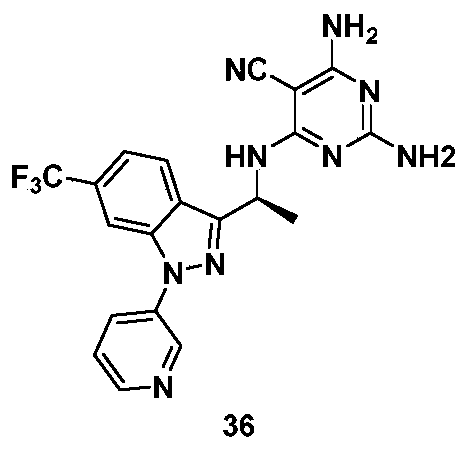
制备方法同制备实施案例1-9,柱层析得淡黄色固体36,收率58%
m.p.128-130℃;
1H NMR(400MHz,CD
3OD)δ9.01(s,1H),8.59(d,J=4.8Hz,1H),8.26(d,J=8.0Hz,1H),8.13(d,J=8.4Hz,1H),8.04(s,1H),7.68-7.65(m,1H),7.52(d,J=8.4Hz,1H),6.09-6.04(m,1H),1.79(d,J=6.8Hz,3H);
13C NMR(100MHz,CD
3OD)δ167.1,164.8,164.6,151.8,148.5,144.5,140.4,138.0,131.8,131.1 and 130.8,127.1 and 126.5,126.6,124.4, 123.9,119.4 and 119.3,118.0,108.91 and 108.86,61.8,45.1,20.5;HRMS(ESI)m/z Calcd for C
20H
18FN
9(M
+):439.1481;Found:439.1481.
生物实验实施例1:吲唑类衍生物对PI3Kδ的抑制活性测试
采用ADP-Glo
TM Kinase实验来测定。将受试化合物稀释成测试所需的一系列浓度,各取50nL转移到384孔板上,阴性对照孔和阳性对照孔中分别加50nl的DMSO,用激酶缓冲溶液将将PI3Kα,β,γ和δ分别稀释至1.25nM,1.25nM,10nM,1.25nM,然后以每孔2μL加到384孔板上,在阴性和阳性对照孔中加入2.5μL,离心30秒,振荡混匀后室温孵育10分钟,加入2.5μL ATP和PIP2的混合溶液,离心30秒,振荡混匀后室温孵育2小时,加入5μL ADP-Glo Reagent振荡混匀后室温孵育3小时后加入10μL Kinase Detection Reagent,振荡混匀后室温孵育1小时,样品经离心等处理后,用Enspire酶标仪读取RLU值,并根据公式计算抑制率。
以浓度的log值作为X轴,百分比抑制率为Y轴,采用分析软件GraphPad Prism 5的log(inhibitor)vs.response-Variable slope拟合量效曲线,从而得出各个化合物对酶活性的IC
50值。
表1吲唑类衍生物的PI3Kδ抑制活性

由表1可知,以泛Ⅰ型PI3K激酶抑制剂PI-103作为阳性对照,该类全新结构的化合物中大部分化合物表现出了较好的PI3Kδ抑制活性,为制备癌症治疗药物的研究提供了新的依据。
表2化合物的亚型选择性评价

由表2可知,化合物16、27、32、33和34相对于阳性对照药物PI-103均表现出了优秀的亚型选择性。
生物实验实施例2吲唑类衍生物的体外抗肿瘤活性
采用MTS法测定部分吲唑类化合物对急性白血病细胞MV-4-11的体外抑制作用,并计算半数抑制浓度。结果表明,所合成的吲唑类化合物在细胞中均显示出良好的肿瘤抑制活性,并且大部分化合物表现出与阳性药Idelalisib更好的抑制活性。
表3部分化合物对MV-4-11的体外抑制活性
| 化合物 | MV-4-11 IC 50(μM) |
| 11 | 7.02±1.65 |
| 13 | 6.54±2.45 |
| 16 | 8.57±1.58 |
| 22 | 3.01±0.75 |
| 24 | 2.91±0.47 |
| 25 | 5.70±1.41 |
| 27 | 3.51±0.41 |
| 29 | 4.02±0.98 |
| 30 | 3.24±0.53 |
| 31 | 3.54±0.67 |
| 32 | 0.46±0.07 |
| 33 | 1.61±0.26 |
| 34 | 0.69±0.16 |
| 35 | 11.77±2.11 |
| Idelalisib | 7.08±2.58 |
由表3可知,以目前已经上市的PI3Kδ激酶选择性抑制剂Idelalisib作为阳性对照,该类全新结构的化合物中有部分化合物表现出了较好的抑制活性,大部分化合物的活性超过阳性对照Idelalisib,为制备癌症治疗药物的研究提供了新的依据。
Claims (5)
- 一种吲唑类衍生物,其特征在于,结构通式如下:
 及其光学异构体或其药学上可接受的盐或溶剂合物,其中:R 1、R 2、R 3、R 4相同或不同,选自氢、卤原子、C 1-6烷基、卤代的C 1-6烷基或C 1-6烷氧基;R 5选自C 1-6烷基、C 1-6烷基环烷基;R 6选自单取代或多取代芳环或芳杂环;所述环上取代基选自氢、卤原子、C 1-6烷基、C 1-6烷氧基、砜基、氰基、酰胺;R 7选自单取代或多取代芳环或芳杂环;所述环上取代基选自氢、卤原子、C 1-6烷基、C 1-6烷氧基、砜基、氰基、酰胺。
- 根据权利要求1所述的一种吲唑类衍生物,其特征在于,选自以下化合物:(S)-N-(1-(1-(吡啶-3-基)-1H-吲唑-3-基)乙基)-6-氨基嘌呤N-(1-(1-(吡啶-3-基)-1H-吲唑-3-基)乙基)-6-氨基嘌呤(S)-N-(1-(6-氟-1-(吡啶-3-基)-1H-吲唑-3-基)乙基)-6-氨基嘌呤(S)-N-(1-(6-氟-1-(吡啶-3-基)-1H-吲唑-3-基)丙基)-6-氨基嘌呤(S)-N-(1-(6-氟-1-(吡啶-3-基)-1H-吲唑-3-基)-2-甲基丙基)-6-氨基嘌呤(S)-N-(1-(6-氯-1-(吡啶-3-基)-1H-吲唑-3-基)乙基)-6-氨基嘌呤(S)-N-(1-(5-甲基-1-(吡啶-3-基)-1H-吲唑-3-基)乙基)-6-氨基嘌呤(S)-N-(1-(5-氟-1-(吡啶-3-基)-1H-吲唑-3-基)乙基)-6-氨基嘌呤(S)-N-(1-(6-氟-1-(3-氟苯基)-1H-吲唑-3-基)乙基)-6-氨基嘌呤(S)-N-(1-(1-(3,5-二氟苯基)-6-氟-3-基)乙基)-6-氨基嘌呤(S)-N-(1-(6-氟-1-(吡啶-4-基)-1H-吲唑-3-基)乙基)-6-氨基嘌呤(S)-N-(1-(6-氟-1-(吡啶-2-基)-1H-吲唑-3-基)乙基)-6-氨基嘌呤(S)-4-(3-(1-((7H-嘌呤-6-基)氨基)乙基)-6-氟-1-吲唑基)苄腈(S)-N-(1-(6-氟-1-(3-(甲磺酰基)苯基)-1H-吲唑-3-基)乙基)-6-氨基嘌呤(S)-N 6-(1-(6-氟-1-(吡啶-3-基)-1H-吲唑-3-基)乙基)-2,6-二氨基嘌呤(S)-4-氨基-6-((1-(6-氟-1-(吡啶-3-基)-1H-吲唑-3-基)乙基)氨基)-5-氰基嘧啶(S)-2,4-二氨基-6-((1-(6-氟-1-(吡啶-3-基)-1H-吲唑-3-基)乙基)氨基)-5-氰基嘧啶(S)-2-((1-(6-氟-1-(吡啶-3-基)-1H-吲唑-3-基)乙基)氨基)烟腈(S)-2,4-二氨基-6-((1-(6-氟-1-(吡啶-3-基)-1H-吲唑-3-基)丙基)氨基)-5-氰基嘧啶(S)-2,4-二氨基-6-((1-(6-氟-1-(4-吡啶基)-1H-吲唑-3-基)乙基)氨基)-5-氰基嘧啶(S)-2,4-二氨基-6-((1-(6-氟-1-(3-(甲磺酰基)苯基)-1H-吲唑-3-基)乙基)氨基)-5-氰基嘧啶(S)-2,4-二氨基-6-((-(6-氯-1-(3-(甲磺酰基)苯基)-1H-吲唑-3-基)乙基)氨基)-5-氰基嘧啶(S)-2,4-二氨基-6-((1-(6-氯-1-(吡啶-3-基)-1H-吲唑-3-基)丙基)氨基)-5-氰基嘧啶(S)-2,4-二氨基-6-((1-(6-氯-1-(吡啶-3-基)-1H-吲唑-3-基)乙基)氨基)-5-氰基嘧啶(S)-2,4-二氨基-6-((1-(1-(吡啶-3-基)-1H-吲唑-3-基)乙基)氨基)-5-氰基嘧啶(S)-2,4-二氨基-6-((1-(1-(吡啶-3-基)-6-(三氟甲基)-1H-吲唑-3-基)乙基)氨基)-5-氰基嘧啶及其这些化合物的光学异构体或其药学上可接受的盐或溶剂合物。
- 根据权利要求1所述的一种吲唑类衍生物的制备方法,其特征在于,通过以下步骤实现:化合物1与水合氯醛、盐酸羟胺在硫酸钠水溶液中反应生成化合物2,化合物2经浓硫酸作用后生成化合物3,化合物3发生开环、重氮化、还原、环化形成取代吲唑-3-甲酸4,再与二甲羟胺盐酸盐缩合形成化合物5。化合物5在格式试剂作用下形成化合物6,随后6与溴代物发生Ullman偶联生成化合物7,化合物7与R-(+)-叔丁基亚磺酰胺缩合生成化合物8,化合物8在三仲丁基硼氢化锂或硼氢化钠作用下还原生成化合物9,然后在酸性条件下脱去叔丁基亚磺酰基形成化合物10,最后再与氯代物发生亲核取代反应生成目标化合物,反应式如下:
 其中R 1、R 2、R 3、R 4、R 5、R 6、R 7的定义同权利要求1中所述。
- 根据权利要求1所述的一种吲唑类衍生物在制备抗肿瘤药物中的应用,其特征在于,所述肿瘤为慢性淋巴细胞白血病、急性淋巴细胞白血病、非霍奇金淋巴瘤、滤泡性淋巴瘤或者肝癌、乳腺癌。免疫性疾病中的一种或多种。
- 根据权利要求4所述一种吲唑类衍生物在制备抑制PI3Kδ激酶的活性药物中的应用。
Applications Claiming Priority (2)
| Application Number | Priority Date | Filing Date | Title |
|---|---|---|---|
| CN201910299910.7A CN110156785B (zh) | 2019-04-15 | 2019-04-15 | 吲唑类化合物及其制备方法和应用 |
| CN201910299910.7 | 2019-04-15 |
Publications (1)
| Publication Number | Publication Date |
|---|---|
| WO2020211563A1 true WO2020211563A1 (zh) | 2020-10-22 |
Family
ID=67639485
Family Applications (1)
| Application Number | Title | Priority Date | Filing Date |
|---|---|---|---|
| PCT/CN2020/078034 Ceased WO2020211563A1 (zh) | 2019-04-15 | 2020-03-05 | 吲唑类化合物及其制备方法和应用 |
Country Status (2)
| Country | Link |
|---|---|
| CN (1) | CN110156785B (zh) |
| WO (1) | WO2020211563A1 (zh) |
Cited By (2)
| Publication number | Priority date | Publication date | Assignee | Title |
|---|---|---|---|---|
| WO2023097195A1 (en) * | 2021-11-24 | 2023-06-01 | Genentech, Inc. | Therapeutic indazole compounds and methods of use in the treatment of cancer |
| US12275745B2 (en) | 2021-11-24 | 2025-04-15 | Genentech, Inc. | Therapeutic compounds and methods of use |
Families Citing this family (7)
| Publication number | Priority date | Publication date | Assignee | Title |
|---|---|---|---|---|
| CN110156785B (zh) * | 2019-04-15 | 2020-08-28 | 浙江大学 | 吲唑类化合物及其制备方法和应用 |
| CA3151277A1 (en) * | 2019-09-16 | 2021-03-25 | Aten Porus Lifesciences Pvt. Ltd. | 2-amino-s6-substituted thiopurine compounds as inhibitors of the enpp1 protein |
| CN114591335B (zh) * | 2021-03-29 | 2023-06-27 | 浙江大学 | 吲唑类化合物及其制备方法和应用 |
| CN115304583B (zh) * | 2022-09-07 | 2023-07-21 | 中国药科大学 | 靶向抑制clk2的5-吡啶-1h-吲唑类化合物及其应用 |
| CN116003326A (zh) * | 2023-03-03 | 2023-04-25 | 河南师范大学 | 含三氟甲基吲唑衍生物的合成方法 |
| CN118164979B (zh) * | 2024-03-21 | 2026-06-19 | 浙江大学 | 氮杂吲哚类PI3Kδ抑制剂、其制备方法和应用 |
| CN119371366A (zh) * | 2024-09-20 | 2025-01-28 | 西南大学 | 一种n1-和n2-烷基吲唑的制备方法 |
Citations (3)
| Publication number | Priority date | Publication date | Assignee | Title |
|---|---|---|---|---|
| CN101087609A (zh) * | 2004-10-26 | 2007-12-12 | 詹森药业有限公司 | 因子Xa化合物 |
| CN106660996A (zh) * | 2014-07-16 | 2017-05-10 | 格吕伦塔尔有限公司 | 作为pde4抑制剂的新型2,5‑取代的嘧啶类 |
| CN110156785A (zh) * | 2019-04-15 | 2019-08-23 | 浙江大学 | 吲唑类化合物及其制备方法和应用 |
Family Cites Families (3)
| Publication number | Priority date | Publication date | Assignee | Title |
|---|---|---|---|---|
| EP1945222B1 (en) * | 2005-11-02 | 2012-12-26 | Bayer Pharma Aktiengesellschaft | Pyrrolo[2,1-f] [1,2,4]-triazin-4-ylamines as igf-1r kinase inhibitors for the treatment of cancer and other hyperproliferative diseases |
| ES2750791T3 (es) * | 2014-06-17 | 2020-03-27 | Chiesi Farm Spa | Derivados de indolizina como inhibidores de fosfoinositido 3-quinasas |
| WO2016064958A1 (en) * | 2014-10-22 | 2016-04-28 | Bristol-Myers Squibb Company | Heteroaryl substituted pyrrolotriazine amine compounds as pi3k inhibitors |
-
2019
- 2019-04-15 CN CN201910299910.7A patent/CN110156785B/zh not_active Expired - Fee Related
-
2020
- 2020-03-05 WO PCT/CN2020/078034 patent/WO2020211563A1/zh not_active Ceased
Patent Citations (3)
| Publication number | Priority date | Publication date | Assignee | Title |
|---|---|---|---|---|
| CN101087609A (zh) * | 2004-10-26 | 2007-12-12 | 詹森药业有限公司 | 因子Xa化合物 |
| CN106660996A (zh) * | 2014-07-16 | 2017-05-10 | 格吕伦塔尔有限公司 | 作为pde4抑制剂的新型2,5‑取代的嘧啶类 |
| CN110156785A (zh) * | 2019-04-15 | 2019-08-23 | 浙江大学 | 吲唑类化合物及其制备方法和应用 |
Cited By (4)
| Publication number | Priority date | Publication date | Assignee | Title |
|---|---|---|---|---|
| WO2023097195A1 (en) * | 2021-11-24 | 2023-06-01 | Genentech, Inc. | Therapeutic indazole compounds and methods of use in the treatment of cancer |
| US20230202984A1 (en) * | 2021-11-24 | 2023-06-29 | Genentech, Inc. | Therapeutic compounds and methods of use |
| US12110276B2 (en) * | 2021-11-24 | 2024-10-08 | Genentech, Inc. | Pyrazolo compounds and methods of use thereof |
| US12275745B2 (en) | 2021-11-24 | 2025-04-15 | Genentech, Inc. | Therapeutic compounds and methods of use |
Also Published As
| Publication number | Publication date |
|---|---|
| CN110156785B (zh) | 2020-08-28 |
| CN110156785A (zh) | 2019-08-23 |
Similar Documents
| Publication | Publication Date | Title |
|---|---|---|
| CN110156785B (zh) | 吲唑类化合物及其制备方法和应用 | |
| CA2478799C (en) | Di-aryl substituted tetrazole modulators of metabotropic glutamate receptor-5 | |
| TWI644909B (zh) | 磷脂酸肌醇3-激酶抑制劑 | |
| AU2013339167B2 (en) | Novel amine derivative or salt thereof | |
| CA2469821C (en) | Heteroaryl substituted triazole modulators of metabotropic glutamate receptor-5 | |
| EP1434773B1 (en) | Heteroaryl substituted tetrazole modulators of metabotropic glutamate receptor-5 | |
| RU2606497C2 (ru) | Тиазолилфенилбензолсульфонамидопроизводные в качестве ингибиторов киназ | |
| CN1103772C (zh) | 新的2,3-二取代-4(3h)-喹唑啉酮类化合物 | |
| TWI535442B (zh) | A nitrogen-containing heterocyclic compound having an action of inhibiting the production of canine erythritine | |
| EP2909193B1 (en) | Phenyl linked quinolinyl modulators of ror-gamma-t | |
| JP5539216B2 (ja) | 非ヌクレオシド系逆転写酵素阻害剤 | |
| AU2012259234A1 (en) | Novel imidazole derivatives useful for the treatment of arthritis | |
| CA3002610A1 (en) | N-substituted indole derivatives as pge2 receptor modulators | |
| WO2005035501A1 (ja) | 新規オレフィン誘導体 | |
| JP2011063516A (ja) | アミド誘導体 | |
| EP3838898A1 (en) | Isoindolin-1-on derivative, method for preparing same, and pharmaceutical composition comprising same as effective component for preventing or treating cancer | |
| CA2521399A1 (en) | Di-aryl substituted pyrrole modulators of metabotropic glutamate receptor-5 | |
| CA3174865A1 (en) | Quinazoline compound and preparation method, application, and pharmaceutical composition thereof | |
| CN103739550B (zh) | 2,3-二甲基-6-脲-2h-吲唑类化合物及其制备方法与应用 | |
| US20050038067A1 (en) | Asymmetric benzimidazoles and related compounds as potassium channel modulators | |
| WO2020135210A1 (zh) | 取代芳基化合物及其制备方法和用途 | |
| TW202613091A (zh) | 乳酸脫氫酶抑制劑、包含該抑制劑的組合物及其使用方法 | |
| KR101778938B1 (ko) | 신규 퀴놀린 화합물 및 이를 포함하는 암의 예방 또는 치료용 약학 조성물 | |
| Arif et al. | A new class of potential anti-diabetic acetohydrazides: Synthesis, in vivo anti-diabetic activity and molecular docking studies | |
| CN111662275A (zh) | 苯磺酰胺类idh突变体抑制剂、其制备方法和用途 |
Legal Events
| Date | Code | Title | Description |
|---|---|---|---|
| 121 | Ep: the epo has been informed by wipo that ep was designated in this application |
Ref document number: 20791657 Country of ref document: EP Kind code of ref document: A1 |
|
| NENP | Non-entry into the national phase |
Ref country code: DE |
|
| 122 | Ep: pct application non-entry in european phase |
Ref document number: 20791657 Country of ref document: EP Kind code of ref document: A1 |