WO2020209274A1 - レドックスフロー電池用負極電解液及びレドックスフロー電池 - Google Patents
レドックスフロー電池用負極電解液及びレドックスフロー電池 Download PDFInfo
- Publication number
- WO2020209274A1 WO2020209274A1 PCT/JP2020/015759 JP2020015759W WO2020209274A1 WO 2020209274 A1 WO2020209274 A1 WO 2020209274A1 JP 2020015759 W JP2020015759 W JP 2020015759W WO 2020209274 A1 WO2020209274 A1 WO 2020209274A1
- Authority
- WO
- WIPO (PCT)
- Prior art keywords
- negative electrode
- redox flow
- solvent
- positive electrode
- flow battery
- Prior art date
- Legal status (The legal status is an assumption and is not a legal conclusion. Google has not performed a legal analysis and makes no representation as to the accuracy of the status listed.)
- Ceased
Links
Images


Classifications
-
- H—ELECTRICITY
- H01—ELECTRIC ELEMENTS
- H01M—PROCESSES OR MEANS, e.g. BATTERIES, FOR THE DIRECT CONVERSION OF CHEMICAL ENERGY INTO ELECTRICAL ENERGY
- H01M8/00—Fuel cells; Manufacture thereof
- H01M8/08—Fuel cells with aqueous electrolytes
-
- H—ELECTRICITY
- H01—ELECTRIC ELEMENTS
- H01M—PROCESSES OR MEANS, e.g. BATTERIES, FOR THE DIRECT CONVERSION OF CHEMICAL ENERGY INTO ELECTRICAL ENERGY
- H01M8/00—Fuel cells; Manufacture thereof
- H01M8/18—Regenerative fuel cells, e.g. redox flow batteries or secondary fuel cells
- H01M8/184—Regeneration by electrochemical means
- H01M8/188—Regeneration by electrochemical means by recharging of redox couples containing fluids; Redox flow type batteries
-
- H—ELECTRICITY
- H01—ELECTRIC ELEMENTS
- H01M—PROCESSES OR MEANS, e.g. BATTERIES, FOR THE DIRECT CONVERSION OF CHEMICAL ENERGY INTO ELECTRICAL ENERGY
- H01M2300/00—Electrolytes
-
- H—ELECTRICITY
- H01—ELECTRIC ELEMENTS
- H01M—PROCESSES OR MEANS, e.g. BATTERIES, FOR THE DIRECT CONVERSION OF CHEMICAL ENERGY INTO ELECTRICAL ENERGY
- H01M2300/00—Electrolytes
- H01M2300/0002—Aqueous electrolytes
-
- Y—GENERAL TAGGING OF NEW TECHNOLOGICAL DEVELOPMENTS; GENERAL TAGGING OF CROSS-SECTIONAL TECHNOLOGIES SPANNING OVER SEVERAL SECTIONS OF THE IPC; TECHNICAL SUBJECTS COVERED BY FORMER USPC CROSS-REFERENCE ART COLLECTIONS [XRACs] AND DIGESTS
- Y02—TECHNOLOGIES OR APPLICATIONS FOR MITIGATION OR ADAPTATION AGAINST CLIMATE CHANGE
- Y02E—REDUCTION OF GREENHOUSE GAS [GHG] EMISSIONS, RELATED TO ENERGY GENERATION, TRANSMISSION OR DISTRIBUTION
- Y02E60/00—Enabling technologies; Technologies with a potential or indirect contribution to GHG emissions mitigation
- Y02E60/30—Hydrogen technology
- Y02E60/50—Fuel cells
Definitions
- the present invention relates to a negative electrode electrolyte solution for a redox flow battery and a redox flow battery.
- a redox flow battery is known as a storage battery for storing such a large capacity energy.
- Redox flow batteries do not use flammable or explosive substances, so they have excellent stability, can ensure a long life even after repeated charging and discharging, are highly durable, are low in cost, and require less maintenance. Has advantages. Further, since the active material can be stored in the external tank, it has an advantage that it is easy to increase the size and capacity.
- the redox flow battery Since the redox flow battery stores energy in the liquid, for example, in the energy replenishment process of the electric vehicle, it is completed by replenishing, filling, and exchanging the precharged liquid. Therefore, the charging time of the electric vehicle of the current lithium-ion battery Compared with, the time required for charging can be significantly reduced.
- the redox flow battery has, for example, a positive half-cell, a negative half-cell, a separator that separates the two half-cells, two electrodes, and two electrolyte containers outside the battery, the positive half-cell and the negative.
- a redox flow battery is disclosed in which the half-cell has an electrolyte containing at least one ionic liquid (see, for example, Patent Document 1).
- One aspect of the present invention has been made in view of the above circumstances, and provides a negative electrode electrolyte solution for a redox flow battery that can have a high energy density at a high voltage when used in a redox flow battery. With the goal.
- One aspect of the negative electrode electrolytic solution for a redox flow battery according to the present invention has a negative electrode active material, a negative electrode supporting salt, and a negative electrode solvent, and the negative electrode solvent has a water-octanol partition coefficient LogP OW represented by LogP of 1. .5 or more solvents.
- a second aspect of the present invention is the negative electrode electrolytic solution for a redox flow battery according to the above aspect, wherein the negative electrode solvent contains an ether group.
- a third aspect of the present invention is the negative electrode electrolytic solution for a redox flow battery according to the second aspect, wherein the anions of the negative electrode supporting salt are N (SO 2 CF 3 ) 2 , N (SO 2 CH 3).
- a fourth aspect of the present invention is the negative electrode electrolyte solution for a redox flow battery according to the second or third aspect, wherein the negative electrode solvent comprises methoxycyclopentane, diethylene glycol dibutyl ether and ethylene glycol dibenzyl ether.
- a fifth aspect of the present invention is the negative electrode electrolyte solution for a redox flow battery according to the above aspect, wherein the negative electrode solvent is 1-methyl-1-propylpyrrolidinium bis (trifluoromethanesulfonyl) imide1-.
- a sixth aspect of the present invention is the negative electrode electrolyte solution for a redox flow battery according to any one of the first to fifth aspects, wherein the negative electrode solvent has a solubility of 5 g or less in 100 g of water at room temperature. ..
- the redox flow battery of the present invention Positive electrode electrolyte and A positive electrode current collector that oxidizes and reduces the positive electrode active material contained in the positive electrode electrolytic solution, and Negative electrode electrolyte and A negative electrode current collector that oxidizes and reduces the negative electrode active material contained in the negative electrode electrolytic solution, and An ionic conductive isolation portion that separates the positive electrode electrolyte and the negative electrode electrolyte is provided.
- the negative electrode electrolytic solution is the negative electrode electrolytic solution for a redox flow battery according to any one of the first to sixth aspects.
- One aspect of the negative electrode electrolyte solution for a redox flow battery according to the present invention can have a high energy density at a high voltage when used in a redox flow battery.
- the negative electrode electrolytic solution for a redox flow battery according to the embodiment of the present invention (hereinafter, simply referred to as "negative electrode electrolytic solution”) is a negative electrode electrolytic solution used for a redox flow battery, and is a negative electrode active material and a negative electrode solvent (both negative electrode solvent). It has a negative electrode support salt.
- Negative electrode active material As the negative electrode active material, a negative electrode solid active material or an organic active material that is liquid at room temperature can be used.
- Negative electrode solid active materials include lithium, sodium, potassium, calcium, magnesium, aluminum, graphite (graphite), hard carbon, soft carbon, silicon, silicon oxide, tin, lithium titanate, titanium oxide, molybdenum oxide, sulfur, Zinc or the like can be used. These may be used alone or in combination of two or more. Among these, graphite can be particularly preferably used.
- the negative electrode electrolytic solution may contain a mediator which is an electron transfer mediator from the negative electrode current collector to the negative electrode active material, and a conductive agent such as copper or carbon.
- organic active material that is liquid at room temperature
- examples of such organic active substances that are liquid at room temperature include 2-methylquinoxalin, 2-methyl-3-propylquinoxalin, 2-methoxy-3-methylpyrazine, 2,3,5-trimethylpyrazine, and 2,3-dimethyl.
- Pyrazine, 2,5-dimethylpyrazine, 2-ethylpyrazine, 2-propylpyrazine, 2-ethoxypyrazine, 2-methoxypyrazine, chloropyrazine, 4-tert-butylpyrazine, 2,6-di-tert-butylpyridine, 2,5-Difluoropyrazine, 2,3,5,6-tetramethylpyrazine, 3-ethylbiphenyl, 2-methylnaphthalene, 1-methylnaphthalene, 2-methylpyrazine and the like can be used. These may be used alone or in combination of two or more. Among these, 2,3,5-trimethylpyrazine and 2-methylquinoxaline can be preferably used.
- the negative electrode solvent is a solvent having a water-octanol partition coefficient LogP OW of 1.5 or more, which is represented by LogP.
- LogP OW is preferably 1.8 or more, and more preferably 3.4 or more.
- the partition coefficient LogPower is an octanol / water partition coefficient, that is, a coefficient representing the degree of partitioning when an organic solvent is partitioned between the octanol phase and the aqueous phase.
- LogPower is represented by, for example, the following formula (1). Note that C o in formula (1) is the molar concentration of the organic solvent in the octanol phase, C w is the molar concentration of the organic solvent in the aqueous phase.
- LogP ow Log (C o / C w) ⁇ (1)
- the negative electrode solvent is preferably a hydrophobic solvent.
- hydrophobicity is defined as a solvent having a solubility in 100 g of water at room temperature (23 ° C. ⁇ 2 ° C.) of 5 g or less as a hydrophobic solvent.
- a solvent having a solubility in 100 g of water at room temperature of 5 g or less, more preferably 1 g or less in 100 g of water at room temperature is used.
- the negative electrode solvent preferably contains an ether group, and preferably contains a structure having an ether group. Since the negative electrode electrolytic solution is an electrolytic solution on the negative electrode side, it is mainly used in a reducing atmosphere. In order to achieve a higher voltage as a redox flow battery, it is preferable that the redox potential of the negative electrode active material is lower. That is, it is preferable that the negative electrode solvent does not cause reduction decomposition at least at a potential equal to or less than the redox potential of the negative electrode active material used. Since the ether group is unlikely to cause reductive decomposition and can enhance the reduction resistance of the negative electrode solvent, the negative electrode solvent preferably has a structure having an ether group capable of enhancing the reduction resistance.
- a negative electrode solvent for example, methoxycyclopentane, diethylene glycol dibutyl ether, ethylene glycol dibenzyl ether and the like can be used. These may be used alone or in combination of two or more.
- an ionic liquid may be used as the negative electrode solvent.
- 1-methyl-1-propylpyrrolidinium bis (trifluoromethanesulfonyl) imide 1, 1-methyl-1-propylpyrrolidinium bis (fluorosulfonyl) imide
- Triethyl- (2-methoxyethyl) phosphonium bis (trifluoromethanesulfonyl) imide and triethyl- (2-methoxyethyl) phosphonium bis (fluoromethanesulfonyl) imide can be used. These may be used alone or in combination of two or more. Among these, it is preferable to use 1-methyl-1-propylpyrrolidinium bis (trifluoromethanesulfonyl) imide having high hydrophobicity.
- the negative electrode supporting salt preferably contains a large bulky anion. Thereby, the negative electrode supporting salt can delocalize the electronic state.
- the hydrophobic solvent that can be used as the negative electrode solvent is a non-polar solvent having high hydrophobicity and low polarity.
- the polarity is an electrical bias existing in the molecule, and is generated by the electric dipole moment.
- Hydrophobic substances are generally electrically neutral non-polar substances, and supporting salts are substances composed of positive ions and negative ions, and are polar molecules.
- non-polar molecules are easily dissolved in a non-polar solvent, and polar molecules are easily dissolved in a polar solvent.
- the negative electrode supporting salt which is a polar substance
- a hydrophobic solvent which is a non-polar solvent. Therefore, the negative electrode supporting salt needs to be dissolved even in a non-polar solvent.
- N (SO 2 CF 3 ) 2 , N (SO 2 CH 3 ) 2 , N (SO 2 C 4 H 9 ) 2 , N (SO 2 C 2 F 5 ) 2 , N ( SO 2 C 4 F 9 ) 2 , N (SO 2 F 3 ) (SO 2 C 4 F 9 ), N (SO 2 C 2 F 5 ) (SO 2 C 4 F 9 ), N (SO 2 C 2 F) 4 SO 2 ), N (SO 2 F) 2 , N (SO 2 F) (SO 2 CF 3 ) and the like can be used. These may be used alone or in combination of two or more. Among these, N (SO 2 CF 3 ) 2 and N (SO 2 F) 2 are preferable.
- the cation of the negative electrode supporting salt may be an anion or cation that passes through the ionic conductive isolation membrane when the positive electrode active material is oxidized.
- the cation of the negative electrode supporting salt lithium ion, sodium ion, potassium ion, magnesium ion, aluminum ion, calcium ion, ammonium ion and the like can be used.
- the negative electrode electrolytic solution according to the present embodiment includes a negative electrode active material, a negative electrode supporting salt, and a negative electrode solvent, and by using a solvent having a water-octanol partition coefficient LogP OW represented by LogP of 1.5 or more as the negative electrode solvent. Since the negative electrode solvent is a solvent having hydrophobicity, the electrolysis of water can be suppressed. Therefore, the negative electrode electrolytic solution according to the present embodiment can have a high energy density at a high voltage when used in a redox flow battery.
- the negative electrode electrolytic solution according to the present embodiment contains a hydrophobic negative electrode solvent, it is possible to take out a voltage higher than the electrolysis of water. Further, even in an open system, the invasion of water can be suppressed.
- the negative electrode electrolytic solution according to the present embodiment can be effectively used as a negative electrode electrolytic solution for a redox flow battery, and is suitably used for a redox flow battery using a negative electrode electrolytic solution, an application using a redox flow battery, and the like. be able to.
- the negative electrode solvent can contain an ether group.
- the negative electrode solvent can improve the resistance to the reductive decomposition of the negative electrode solvent itself, so that a negative electrode active material capable of exhibiting a higher voltage can be used. Therefore, the negative electrode electrolytic solution is less likely to undergo reductive decomposition and can be a stable negative electrode electrolytic solution. Therefore, the negative electrode electrolyte can take out a voltage higher than that of water electrolysis. Further, the negative electrode electrolytic solution can suppress the invasion of water even in an open system.
- the negative electrode electrolyte according to this embodiment has N (SO 2 CF 3 ) 2 , N (SO 2 CH 3 ) 2 , N (SO 2 C 4 H 9 ) 2 , and N (SO 2 ) as anions of the negative electrode supporting salt.
- the electrons of the negative electrode supporting salt can be delocalized, so that the electrons can be dissolved in a hydrophobic solvent having low polarity. Therefore, the negative electrode electrolytic solution can obtain a negative electrode supporting salt that can be dissolved in a hydrophobic solvent having low polarity.
- the anion of the negative electrode supporting salt can have a solvate structure at the solid-liquid interface with water with respect to the invading water. Therefore, even if a small amount of water invades, the anion of the negative electrode supporting salt takes a solvate structure with respect to the invaded water molecules, so that the electrolysis of water can be suppressed.
- the negative electrode electrolytic solution according to the present embodiment has a strict closed structure even in the atmosphere by containing a negative electrode solvent having high hydrophobicity and reduction resistance and a supporting salt containing an anion in which electrons are delocalized. It is possible to suppress the invasion of water into the electrolytic solution without the need for it, and to suppress the occurrence of electrolysis of water even if water invades. Therefore, the negative electrode electrolytic solution can be more effectively used as the negative electrode electrolytic solution for a redox flow battery.
- the negative electrode electrolytic solution according to the present embodiment, one or more components selected from the group consisting of methoxycyclopentane, diethylene glycol dibutyl ether and ethylene glycol dibenzyl ether can be used as the negative electrode solvent.
- the negative electrode electrolytic solution can have high hydrophobicity.
- the negative electrode electrolyte solution uses 1-methyl-1-propylpyrrolidinium bis (trifluoromethanesulfonyl) imide 1-methyl-1-propylpyrrolidinium bis (fluoromethanesulfonyl) imide as a negative solvent.
- One or more components selected from the group consisting of triethyl- (2-methoxyethyl) phosphonium bis (trifluoromethanesulfonyl) imide and triethyl- (2-methoxyethyl) phosphonium bis (fluoromethanesulfonyl) imide can be used. ..
- the negative electrode electrolytic solution can obtain a negative electrode solvent that can exhibit a hydrophobic effect and also an effect as a negative electrode supporting salt.
- the negative electrode electrolytic solution according to the present embodiment can have a solubility of 100 g in water at room temperature of 5 g or less as a negative electrode solvent.
- the negative electrode solvent can have sufficient hydrophobicity, so that the negative electrode electrolytic solution can have high hydrophobicity.
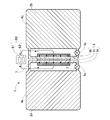
- FIG. 1 is a cross-sectional view schematically showing a redox flow battery using the negative electrode electrolytic solution according to the embodiment of the present invention. Note that FIG. 1 illustrates only the elements necessary for explaining the redox flow battery, but includes other configurations (not shown) for actually driving or the like.
- the redox flow battery 1 includes a positive electrode electrolyte 2a, a negative electrode electrolyte (negative electrode electrolyte) 2b for a redox flow battery, a redox flow battery body (battery body) 3, a positive electrode electrolyte tank 4a, and a negative electrode electrolysis. It includes a liquid tank 4b, a positive electrode pump 5a, a negative electrode pump 5b, a power supply / load unit 6, and a connecting pipe 7.
- the battery body 3, the positive electrode electrolyte tank 4a, the negative electrode electrolyte tank 4b, the positive electrode pump 5a, and the negative electrode pump 5b are connected by a connecting pipe 7.
- the positive electrode electrolyte 2a filled in the positive electrode electrolyte tank 4a and the negative electrode electrolyte 2b filled in the negative electrode electrolyte tank 4b are circulated in the battery body 3 by the positive electrode pump 5a and the negative electrode pump 5b, respectively. Is supplied.
- the positive electrode electrolytic solution 2a a known positive electrode electrolytic solution can be used.
- the positive electrode electrolytic solution 2a may also contain a mediator that is an electron transfer mediator from the positive electrode current collector to the positive electrode active material, and a conductive agent such as aluminum or carbon.
- the negative electrode electrolytic solution 2b uses the negative electrode electrolytic solution according to the present embodiment, the description thereof will be omitted.
- the battery body 3 has a positive electrode current collector 3a, a negative electrode current collector 3b, and an ion conductive isolation film (isolation portion) 3c.
- the positive electrode electrolyte 2a supplied to the battery body 3 passes between the ion conductive isolation film 3c and the positive electrode current collector 3a and returns to the inside of the positive electrode electrolyte tank 4a.
- the negative electrode electrolyte 2b supplied to the battery body 3 passes between the ion conductive isolation film 3c and the negative electrode current collector 3b, and returns to the inside of the negative electrode electrolyte tank 4b.
- the positive electrode current collector 3a contains a positive electrode active material, a positive electrode solvent and a positive electrode supporting salt
- the negative electrode current collector 3b contains a negative electrode active material, a negative electrode solvent and a negative electrode supporting salt.
- the positive electrode active material is a transition metal oxide containing at least one of lithium, sodium, potassium, magnesium, and aluminum, an organometallic complex such as ferrocene, and 2,2,6,6-tetramethylpiperidin 1-oxyl.
- Organic compounds capable of generating radicals such as quinone and quinone can be used.
- the positive electrode solvent is a liquid capable of dissolving or dispersing the positive electrode active material, and is not particularly limited, but is water, ethylene carbonate, propylene carbonate, methyl ethyl carbonate, diethyl carbonate, dimethyl carbonate, diethyl carbonate, dimethylformamide, and ionic liquid.
- Methoxycyclopentane 1-ethyl-3-methylimidazolium bis (trifluoromethanesulfonyl) imide, 1-butyl-2,3-dimethylimidazolium bis (trifluoromethanesulfonylimide), 1-butyl-2,3-dimethyl Imidazolium bis (fluorosulfonylimide), 1-butyl-3-methylimidazolium hexafluorophosphate, 1-methyl-1-propyl imidazolium bis (trifluoromethanesulfonylimide), 1-methyl-1-propyl imidazolium Bis (fluorosulfonylimide), triethyl- (2-methoxyethyl) phosphonium bis (trifluoromethanesulfonyl) imide, triethyl- (2-methoxyethyl) phosphonium bis (fluorosulfonyl) imide, triethylmeth, tri
- the positive electrode support salt may be a salt that dissolves in the positive electrode solvent, and may be lithium hexafluorophosphate, sodium hexafluorophosphate, lithium bis (trifluoromethanesulfonyl) imide, lithium bis (fluorosulfonyl) imide, or sodium bis (. Trifluoromethanesulfonyl) imide, sodium bis (fluorosulfonyl) imide, lithium bisoxalate boronate, sodium bisoxalate boronate and the like are preferable.
- the positive electrode solvent is an ionic liquid
- the ionic liquid becomes the positive electrode supporting salt, so it is not necessary to add the positive electrode supporting salt.
- the positive electrode current collector 3a transfers electrons from its surface to the positive electrode active material and the mediator. That is, a material having a larger surface area is preferable because it has a larger amount of electrochemical reaction. Further, since it is exposed to the positive electrode charge / discharge potential, it is necessary to use a material that does not oxidatively dissolve or oxidatively decompose even at least at the redox potential of the positive electrode active material and the mediator. As such a material, carbon paper, carbon felt and the like can be used.
- the surface of the positive electrode current collector 3a may be surface-treated, or a material that can be a positive electrode active material may be fixed to the surface of the positive electrode current collector 3a with a binder.
- the positive electrode current collector 3a can store electric charges on its surface, so that it can cope with the momentary demand for large current discharge.
- the negative electrode active material As the negative electrode active material, the negative electrode solvent and the negative electrode supporting salt contained in the negative electrode current collector 3b, known negative electrode active materials, the negative electrode solvent and the negative electrode supporting salt may be used, and the negative electrode electrolytic solution according to the present embodiment may be used.
- the negative electrode active material, the negative electrode solvent, and the negative electrode supporting salt contained therein may be used.
- the ion conductive isolation film 3c is a cation transfer type in which the cation moves from the positive electrode to the negative electrode during charging and the cation moves from the negative electrode to the positive electrode during discharging, and the anion moves from the negative electrode to the positive electrode during charging and the positive electrode during discharging.
- Any type of anion transfer type in which an anion moves from the negative electrode to the negative electrode may be used.
- a cation exchange membrane such as an oxide solid electrolyte or a polymer solid electrolyte can be used.
- an alkaline type anion exchange membrane or the like can be used.
- a porous membrane having continuous pores smaller than the size of the active material may be used as the ion conductive isolation membrane 3c.
- the positive electrode electrolyte tank 4a is a tank for storing the positive electrode electrolyte 2a.
- the negative electrode electrolyte tank 4b is a tank for storing the negative electrode electrolyte 2b.
- the positive electrode pump 5a is provided in the connecting pipe 7 and supplies the positive electrode electrolyte 2a in the positive electrode electrolyte tank 4a to the battery body 3.
- the negative electrode pump 5b is provided in the connecting pipe 7 and supplies the negative electrode electrolyte 2b in the negative electrode electrolyte tank 4b to the battery body 3.
- the power supply / load unit 6 includes a DC power supply such as a battery and a load such as a motor, and the load functions during charging and the power supply functions during discharging.
- the connecting tube 7 connects the battery body 3 and the positive electrode electrolyte tank 4a, and also connects the battery body 3 and the negative electrode electrolyte tank 4b, and uses the positive electrode electrolyte 2a in the positive electrode electrolyte tank 4a as the battery body. 3 is circulated between the positive electrode electrolyte tank 4a, and the negative electrode electrolyte 2b in the negative electrode electrolyte tank 4b is circulated between the battery body 3 and the negative electrode electrolyte tank 4b.
- FIG. 2 is an explanatory diagram showing an example of electron flow at the time of discharging in the redox flow battery 1.
- the arrows in FIG. 2 indicate the flow of electrons.
- electrons move from the negative electrode active material contained in the negative electrode electrolytic solution 2b to the negative electrode current collector 3b, and move to the load 61 via wiring. After that, the electrons move from the positive electrode current collector 3a to the positive electrode active material contained in the positive electrode electrolytic solution 2a through the load 61.
- cations move from the negative electrode electrolytic solution 2b to the positive electrode electrolytic solution 2a through the ion conductive isolation film 3c.
- anions move from the positive electrode to the negative electrode through the ion conductive isolation film 3c.
- FIG. 3 is an explanatory diagram showing an example of the flow of electrons during charging in the redox flow battery 1.
- the arrows in FIG. 3 indicate the flow of electrons.
- electrons move from the positive electrode active material contained in the positive electrode electrolytic solution 2a to the positive electrode current collector 3a, pass through the DC power supply 62, and the negative electrode activity contained in the negative electrode electrolytic solution 2b from the negative electrode current collector 3b. Electrons move to the substance.
- the anion moves from the negative electrode electrolytic solution 2b to the positive electrode electrolytic solution 2a through the ion conductive isolation film 3c. Further, the cation moves from the positive electrode to the negative electrode through the ion conductive isolation film 3c.
- the redox flow battery 1 uses the negative electrode electrolytic solution according to the present embodiment as the negative electrode electrolytic solution 2b as described above, the electrolysis of water can be suppressed. Therefore, the redox flow battery 1 can have a high energy density at a high voltage.
- the redox flow battery 1 is provided with the negative electrode electrolytic solution according to the present embodiment, so that the redox flow battery can be configured without using vanadium, which has been remarkably soaring in recent years. Further, as described above, since the porous membrane can be used as the ion conductive isolation membrane, the installation cost can be significantly reduced by using the porous membrane as the ion conductive isolation membrane.
- Negative electrode active material (2,3,5-trimethylpyrazine, manufactured by Tokyo Chemical Industry Co., Ltd.) 1.988 g (16.3 mmol) and negative electrode supporting salt (lithium bis (trifluoromethanesulfonyl) imide (LiTFSI), Tokyo Chemical Industry Co., Ltd.) (Manufactured by) 1.168 g (4.07 mmol) was mixed to form a mixture, and then a hydrophobic solvent (methoxycyclopentane (MCP), LogP OW : 1.575, manufactured by Tokyo Chemical Industry Co., Ltd.) was added to the mixture as a negative electrode solvent. 1.291 g was added to obtain a negative electrode electrolyte. The total volume of the obtained negative electrode electrolytic solution was 4.07 ml, and the concentration of the negative electrode active material was 4.00 mol / L.
- MCP methoxycyclopentane
- Positive electrode active material (4-methoxy-2,2,6,6-tetramethylpiperidin 1-oxyl free radical, manufactured by Tokyo Chemical Industry Co., Ltd.) 3.031 g (16.3 mmol) and positive electrode supporting salt (lithium bis (fluoro)) After mixing 3.043 g (16.3 mmol) of sulfonyl) imide and Tokyo Chemical Industry Co., Ltd. to form a mixture, 0.774 g of ion-exchanged water was added to the mixture to obtain a positive electrode electrolyte. The total volume of the obtained positive electrode electrolytic solution was 5.00 ml, and the concentration of the positive electrode active material was 3.25 mol / L.
- Nafion (registered trademark) 117 (manufactured by Sigma-Aldrich Japan LLC) was used as the ion conductive isolation membrane. Since Nafion (registered trademark) 117 is a proton foam, ion exchange from protons to lithium ions was performed by immersing it in a 1 mol / L lithium hydroxide aqueous solution at room temperature for about 12 hours.
- Redox flow battery A positive electrode current collector was brought into contact with one side of the ion conductive isolation film, and a negative electrode current collector was brought into contact with the other side to fabricate a power generation unit.
- the positive electrode electrolyte tank and the power generation unit, and the negative electrode electrolyte tank and the power generation unit were connected by a silicone rubber tube having an inner diameter of 2 mm, and a tube pump was connected to the silicone rubber tube to manufacture a redox flow battery.
- Example 2 In Example 1, the same procedure as in Example 1 was carried out except that the configuration of the negative electrode electrolytic solution was changed. (Preparation of negative electrode electrolyte) 2.346 g (16.3 mmol) of negative electrode active material (2-methylquinoxalin, manufactured by Tokyo Chemical Industry Co., Ltd.) and negative electrode solvent (1-methyl-1-propylpyrrolidinium bis (trifluoromethanesulfonyl) imide; PP13 TFSI, PropP OW : 4.8165, manufactured by Tokyo Chemical Industry Co., Ltd.) 2.827 g was mixed to obtain a negative electrode electrolyte.
- negative electrode active material (2-methylquinoxalin, manufactured by Tokyo Chemical Industry Co., Ltd.
- negative electrode solvent 1-methyl-1-propylpyrrolidinium bis (trifluoromethanesulfonyl) imide
- PP13 TFSI, PropP OW 4.8165, manufactured by Tokyo Chemical Industry Co., Ltd.
- 1-methyl-1-propylpyrrolidinium bis (trifluoromethanesulfonyl) imide is a hydrophobic ionic liquid and also functions as a supporting salt
- a negative electrode supporting salt was not added separately.
- the total volume of this negative electrode electrolytic solution was 4.07 ml, and the concentration of the active material was 4.00 mol / L.
- Example 1 In Example 1, the same procedure as in Example 1 was carried out except that the configuration of the negative electrode electrolytic solution was changed. (Preparation of negative electrode electrolyte) Negative electrode active material (lithium bis (trifluoromethanesulfonyl) imide, manufactured by Tokyo Chemical Industry Co., Ltd.) 1.988 g (16.3 mmol) and negative electrode supporting salt (NN'dimethylformamide, manufactured by Tokyo Chemical Industry Co., Ltd.) 1.168 g After mixing with (4.07 mmol) to form a mixture, 1.411 g of a negative electrode solvent (2,3,5-trimethylpyrazine, LogP OW : 1.40180, manufactured by Tokyo Chemical Industry Co., Ltd.) was added to the mixture. A negative electrode electrolyte was obtained. The total volume of the obtained negative electrode electrolytic solution was 4.07 ml, and the concentration of the active material was 4.00 mol / L.
- Negative electrode active material lithium bis (trifluoromethanesulfonyl) imide,
- Negative electrode active material (graphite) 1.55 g, negative electrode solvent (methoxycyclopentane (MCP), LogP OW : 1.575, manufactured by Sigma Aldrich Japan LLC) 1.40 g, negative electrode supporting salt (lithium bis (trifluoromethanesulfonyl) ) Imid (LiTFSI), manufactured by Kishida Chemical Co., Ltd.) 0.59 g was placed in a container and mixed to prepare a mixed solution. The prepared mixed solution was stirred at a rotation speed of 2000 rpm for 60 seconds using a hybrid mixer. This stirring was repeated 5 times.
- the negative electrode active material in the mixed solution remained in a dispersed state without being dissolved.
- the total volume of this negative electrode electrolyte was 2.76 mL, the concentration of the negative electrode active material was 25 vol%, and the salt concentration of the negative electrode electrolyte was 1 mol / L.
- the positive electrode active material did not dissolve and remained in a dispersed state.
- the total volume of the obtained positive electrode electrolytic solution was 4.28 mL, the concentration of the positive electrode active material was 25 vol%, and the salt concentration of the positive electrode electrolytic solution was 1 mol / L.
- Polyethylene ribs are arranged so that a space of 100 ⁇ m is formed between the ion conductive isolation film and the positive electrode current collector, and a space of 100 ⁇ m is formed between the ion conductive isolation film and the negative electrode current collector.
- the ribs made of polyethylene were arranged so as to be used, and a power generation unit was manufactured.
- the positive electrode electrolyte tank and the power generation unit, and the negative electrode electrolyte tank and the power generation unit were connected by an ethylene propylene diene rubber tube having an inner diameter of 2 mm, and a tube pump was connected to the ethylene propylene diene rubber tube to prepare a redox flow battery.
- the positive electrode electrolyte and the negative electrode electrolyte were injected into the positive electrode electrolyte tank and the negative electrode electrolyte tank, respectively, using a redox flow battery, and the flow was performed at a rate of 10 mL / min by a tube pump.
- the positive electrode electrolyte was flowed into a space formed by ribs provided between the ion conductive isolation film and the positive electrode current collector.
- the negative electrode electrolyte was flowed into the space formed by the ribs provided between the ion conductive isolation film and the negative electrode current collector.
- Example 4 In Example 3, the same procedure as in Example 3 was carried out except that the type of the negative electrode solvent constituting the negative electrode electrolytic solution, the type of the positive electrode solvent constituting the positive electrode electrolytic solution, and the addition amount thereof were changed. (Preparation of negative electrode electrolyte) In Example 3, the same procedure as in Example 3 was carried out except that the negative electrode solvent was changed to diethylene glycol dibutyl ether (DEGDBE, LogP OW : 1.92, manufactured by Tokyo Chemical Industry Co., Ltd.). Even after stirring, the negative electrode active material in the mixed solution did not dissolve and remained in a dispersed state.
- DEGDBE diethylene glycol dibutyl ether
- the total volume of the negative electrode electrolyte was 2.76 mL, the concentration of the negative electrode active material was 25 vol%, and the salt concentration of the negative electrode electrolyte was 1 mol / L.
- Preparation of positive electrode electrolyte In Example 3, the same procedure as in Example 3 was carried out except that the positive electrode solvent was changed to diethylene glycol dibutyl ether DEGDBE (manufactured by Tokyo Chemical Industry Co., Ltd.) and the amount of the positive electrode solvent added was changed to 2.36 g. Even after stirring, the positive electrode active material did not dissolve and remained in a dispersed state.
- the total volume of the obtained positive electrode electrolytic solution was 4.28 mL, the concentration of the positive electrode active material was 20 vol%, and the salt concentration of the positive electrode electrolytic solution was 1 mol / L.
- Example 5 In Example 3, the same procedure as in Example 3 was carried out except that the type and the amount of the negative electrode solvent constituting the negative electrode electrolytic solution and the type of the positive electrode solvent constituting the positive electrode electrolytic solution and the amount thereof were changed. It was. (Preparation of negative electrode electrolyte) In Example 3, the negative electrode solvent was changed to ethylene glycol dibenzyl ether (EGDBE, LogP OW : 3.42, manufactured by Tokyo Chemical Industry Co., Ltd.), and the amount of the negative electrode solvent added was changed to 1.72 g. The procedure was the same as in Example 3. Even after stirring, the negative electrode active material in the mixed solution did not dissolve and remained in a dispersed state.
- EGDBE ethylene glycol dibenzyl ether
- the total volume of the negative electrode electrolyte was 2.76 mL, the concentration of the negative electrode active material was 25 Vol%, and the salt concentration of the negative electrode electrolyte was 1 mol / L.
- the positive electrode solvent was changed to ethylene glycol dibenzyl ether EGDBE (manufactured by Tokyo Chemical Industry Co., Ltd.) and the amount of the positive electrode solvent added was changed to 2.83 g. .. Even after stirring, the positive electrode active material did not dissolve and remained in a dispersed state.
- the total volume of the obtained positive electrode electrolytic solution was 4.28 mL, the concentration of the positive electrode active material was 20 vol%, and the salt concentration of the positive electrode electrolytic solution was 1 mol / L.
- Example 6 ⁇ Example 6> In Example 3, except that the types of the negative electrode solvent and the negative electrode supporting salt constituting the negative electrode electrolyte and the amount of these additions, and the type of the positive electrode solvent constituting the positive electrode electrolytic solution and the amount of the addition thereof were changed. It was done in the same way as. (Preparation of negative electrode electrolyte) In Example 3, the negative electrode solvent was changed to diethylene glycol dibutyl ether (DEGDBE, LogP OW : 1.92, manufactured by Tokyo Kasei Kogyo Co., Ltd.), the amount of the negative electrode solvent added was 1.46 g, and the negative electrode supporting salt was lithium bis (penta).
- DEGDBE diethylene glycol dibutyl ether
- LogP OW 1.92
- Example 3 The procedure was the same as in Example 3 except that the amount of the negative electrode supporting salt was changed to 0.80 g by changing to fluoroethanesulfonyl) imide LiBETI. Even after stirring, the negative electrode active material in the mixed solution did not dissolve and remained in a dispersed state.
- the total volume of the negative electrode electrolyte was 2.76 mL, the concentration of the negative electrode active material was 25 vol%, and the salt concentration of the negative electrode electrolyte was 1 mol / L.
- Example 3 (Preparation of positive electrode electrolyte)
- the positive electrode solvent was changed to diethylene glycol dibutyl ether DEGDBE (manufactured by Tokyo Kasei Kogyo Co., Ltd.), the amount of the positive electrode solvent added was changed to 2.40 g, and the positive electrode supporting salt was lithium bis (pentafluoroethanesulfonyl) imide LiBETI.
- the procedure was the same as in Example 3 except that the amount of the negative electrode supporting salt added was changed to 1.32 g. Even after stirring, the positive electrode active material did not dissolve and remained in a dispersed state.
- the total volume of the obtained positive electrode electrolytic solution was 4.28 mL
- the concentration of the positive electrode active material was 20 vol%
- the salt concentration of the positive electrode electrolytic solution was 1 mol / L.
- Example 3 except that the types of the negative electrode solvent and the negative electrode supporting salt constituting the negative electrode electrolytic solution and their addition amounts, and the types of the positive electrode solvents constituting the positive electrode electrolytic solution and the addition amounts thereof are changed. It was done in the same way as. (Preparation of negative electrode electrolyte) In Example 3, the negative electrode solvent was changed to a mixture containing ethylene carbonate EC, ethyl methyl carbonate EMC, and diethyl carbonate DMC in an equal volume ratio (LogP OW : 0.707, manufactured by Tokyo Kasei Kogyo Co., Ltd.), and the negative electrode solvent was added.
- Example 3 except that the amount was 2.10 g, the negative electrode supporting salt was changed to lithium hexafluorophosphate LiPF 6 (manufactured by Kishida Chemical Co., Ltd.), and the amount of the negative electrode supporting salt added was changed to 0.31 g. It was done in the same way. Even after stirring, the negative electrode active material in the mixed solution did not dissolve and remained in a dispersed state.
- the total volume of the negative electrode electrolyte was 2.76 mL, the concentration of the negative electrode active material was 25 vol%, and the salt concentration of the negative electrode electrolyte was 1 mol / L.
- Example 3 (Preparation of positive electrode electrolyte)
- the positive electrode solvent was changed to a mixture containing ethylene carbonate EC, ethyl methyl carbonate EMC, and diethyl carbonate DMC in an equal volume ratio (manufactured by Kishida Chemical Co., Ltd.), and the amount of the positive electrode solvent added was changed to 3.46 g.
- the procedure was the same as in Example 3 except that the positive electrode supporting salt was changed to lithium hexafluorophosphate LIPF 6 (manufactured by Kishida Chemical Co., Ltd.) and the amount of the positive electrode supporting salt added was changed to 0.31 g. .. Even after stirring, the positive electrode active material did not dissolve and remained in a dispersed state.
- the total volume of the obtained positive electrode electrolytic solution was 4.28 mL
- the concentration of the positive electrode active material was 20 vol%
- the salt concentration of the positive electrode electrolytic solution was 1 mol / L.
- Table 1 shows the results of measuring the charge / discharge capacity, discharge capacity, Coulomb efficiency, and theoretical discharge capacity of each Example and Comparative Example.
- the Coulomb efficiency was 83% or more. In particular, in Examples 1 and 2, the Coulomb efficiency was 94%. On the other hand, in Comparative Examples 1 and 2, the Coulomb efficiency was 43%. Further, in Examples 1 to 6, the discharge capacity was 389 mAh or more. On the other hand, in Comparative Examples 1 and 2, the discharge capacity was 198 mAh or less.
- the magnitude of the value of LogP indicates the high degree of hydrophobicity.
- the negative electrode electrolytes of Examples 1 to 6 use a highly hydrophobic negative electrode solvent having a water-octanol distribution coefficient LogP OW of 1.58 or more in the atmosphere. In the above, since electrolysis of water is unlikely to occur even at a high voltage, the redox flow battery configured by using the negative electrode electrolyte can improve the Coulomb efficiency and can have a high capacity.
- Example 2 it was confirmed that the green LED emits light when the green LED is connected to the positive electrode current collector and the negative electrode current collector.
- the green LED needs 2.0 V or more to emit light, and in Example 2, a voltage of 2.0 V or more, which is the theoretical voltage (1.3 V) or more for electrolysis of water in the atmosphere containing water, can be taken out and has a high mass energy density. Was confirmed to have. Therefore, it was confirmed that it is effective to use the negative electrode electrolytic solution according to the present embodiment in order to achieve a voltage of 2.0 V, which is higher than the electrolysis of water, while suppressing the electrolysis of water.
- Comparative Example 1 the charge capacity exceeded the theoretical discharge capacity with respect to the difference between the charge capacity and the theoretical discharge capacity calculated from the mass of the negative electrode active material used. This indicates that the current is consumed in addition to charging the negative electrode active material, and it is presumed that water was electrolyzed during charging because a non-hydrophobic solvent was used in Comparative Example 1.
- the negative electrode electrolyte solution according to the present embodiment when used in a redox flow battery, it has a high energy density at a high voltage, so that it can have excellent charge / discharge characteristics. Therefore, the redox flow battery using the negative electrode electrolyte according to the present embodiment is easy to handle and has a high energy density. Therefore, for example, when applied to an energy storage facility, a large amount of electric energy can be stored on the same scale. .. Further, in an electric vehicle, it is possible to travel a longer distance by exchanging the electrolyte solution once.
- the redox flow battery of the present invention is not limited to the embodiment described above and shown in the drawings, and various modifications can be made without departing from the gist thereof. That is, it may be applied to a system in which charging / discharging is completed only by passing the electrolytic solution through the redox flow battery body once, instead of circulating the electrolytic solution through the redox flow battery body to charge / discharge. Further, the redox flow battery of the present invention is driven not only by an energy storage facility and an electric vehicle attached to a power generation facility, but also by using at least a part of the electric power from the mounted redox flow battery. It can also be applied to, etc., and it can also be applied to each of them for residential use and factory use in power consumption facilities.
Landscapes
- Life Sciences & Earth Sciences (AREA)
- Engineering & Computer Science (AREA)
- Manufacturing & Machinery (AREA)
- Sustainable Development (AREA)
- Sustainable Energy (AREA)
- Chemical & Material Sciences (AREA)
- Chemical Kinetics & Catalysis (AREA)
- Electrochemistry (AREA)
- General Chemical & Material Sciences (AREA)
- Fuel Cell (AREA)
Priority Applications (5)
| Application Number | Priority Date | Filing Date | Title |
|---|---|---|---|
| CN202080027269.2A CN113728477A (zh) | 2019-04-08 | 2020-04-08 | 氧化还原液流电池用负极电解液及氧化还原液流电池 |
| TW109111832A TW202105816A (zh) | 2019-04-08 | 2020-04-08 | 氧化還原液流電池用負極電解液及氧化還原液流電池 |
| EP20787773.9A EP3955351A1 (en) | 2019-04-08 | 2020-04-08 | Negative electrode electrolyte solution for redox flow batteries, and redox flow battery |
| JP2021513659A JPWO2020209274A1 (https=) | 2019-04-08 | 2020-04-08 | |
| US17/602,389 US20220166043A1 (en) | 2019-04-08 | 2020-04-08 | Negative electrode electrolyte solution for redox flow batteries, and redox flow battery |
Applications Claiming Priority (2)
| Application Number | Priority Date | Filing Date | Title |
|---|---|---|---|
| JP2019-073282 | 2019-04-08 | ||
| JP2019073282 | 2019-04-08 |
Publications (1)
| Publication Number | Publication Date |
|---|---|
| WO2020209274A1 true WO2020209274A1 (ja) | 2020-10-15 |
Family
ID=72750728
Family Applications (1)
| Application Number | Title | Priority Date | Filing Date |
|---|---|---|---|
| PCT/JP2020/015759 Ceased WO2020209274A1 (ja) | 2019-04-08 | 2020-04-08 | レドックスフロー電池用負極電解液及びレドックスフロー電池 |
Country Status (6)
| Country | Link |
|---|---|
| US (1) | US20220166043A1 (https=) |
| EP (1) | EP3955351A1 (https=) |
| JP (1) | JPWO2020209274A1 (https=) |
| CN (1) | CN113728477A (https=) |
| TW (1) | TW202105816A (https=) |
| WO (1) | WO2020209274A1 (https=) |
Cited By (1)
| Publication number | Priority date | Publication date | Assignee | Title |
|---|---|---|---|---|
| CN113707927A (zh) * | 2021-10-28 | 2021-11-26 | 长沙理工大学 | 高体积容量液流电池系统 |
Families Citing this family (1)
| Publication number | Priority date | Publication date | Assignee | Title |
|---|---|---|---|---|
| US11894590B2 (en) * | 2020-07-10 | 2024-02-06 | Washington University | Electrode-decoupled redox flow battery |
Citations (5)
| Publication number | Priority date | Publication date | Assignee | Title |
|---|---|---|---|---|
| WO2011101992A1 (ja) * | 2010-02-22 | 2011-08-25 | トヨタ自動車株式会社 | 非水電解液型二次電池及び非水電解液型二次電池用非水電解液 |
| JP2013251211A (ja) * | 2012-06-04 | 2013-12-12 | Hitachi Ltd | マグネシウムイオン二次電池用電解液、マグネシウムイオン二次電池 |
| JP5468090B2 (ja) | 2009-02-18 | 2014-04-09 | フラウンホーファー − ゲゼルシャフト ツル フェーデルング デル アンゲヴァントテン フォルシュング エー.ファォ. | イオン性液体中に電気エネルギーを蓄える方法 |
| JP2018018816A (ja) * | 2016-07-19 | 2018-02-01 | パナソニックIpマネジメント株式会社 | フロー電池 |
| JP2019073282A (ja) | 2014-11-07 | 2019-05-16 | 大日本印刷株式会社 | 表示装置及び移動体 |
Family Cites Families (4)
| Publication number | Priority date | Publication date | Assignee | Title |
|---|---|---|---|---|
| JP2010018840A (ja) * | 2008-07-10 | 2010-01-28 | Teijin Pharma Ltd | 電解質中の水除去方法、その装置、及び水分量測定装置 |
| JP2010244972A (ja) * | 2009-04-09 | 2010-10-28 | Sharp Corp | レドックスフロー電池 |
| KR102014987B1 (ko) * | 2012-12-14 | 2019-08-27 | 삼성전자주식회사 | 레독스 플로우 전지 |
| KR20150008353A (ko) * | 2014-12-01 | 2015-01-22 | 주식회사 씨트리 | 비스플로로술포닐이미드 음이온을 갖는 전해질용 이온성 액체 |
-
2020
- 2020-04-08 JP JP2021513659A patent/JPWO2020209274A1/ja active Pending
- 2020-04-08 TW TW109111832A patent/TW202105816A/zh unknown
- 2020-04-08 US US17/602,389 patent/US20220166043A1/en not_active Abandoned
- 2020-04-08 CN CN202080027269.2A patent/CN113728477A/zh active Pending
- 2020-04-08 EP EP20787773.9A patent/EP3955351A1/en not_active Withdrawn
- 2020-04-08 WO PCT/JP2020/015759 patent/WO2020209274A1/ja not_active Ceased
Patent Citations (5)
| Publication number | Priority date | Publication date | Assignee | Title |
|---|---|---|---|---|
| JP5468090B2 (ja) | 2009-02-18 | 2014-04-09 | フラウンホーファー − ゲゼルシャフト ツル フェーデルング デル アンゲヴァントテン フォルシュング エー.ファォ. | イオン性液体中に電気エネルギーを蓄える方法 |
| WO2011101992A1 (ja) * | 2010-02-22 | 2011-08-25 | トヨタ自動車株式会社 | 非水電解液型二次電池及び非水電解液型二次電池用非水電解液 |
| JP2013251211A (ja) * | 2012-06-04 | 2013-12-12 | Hitachi Ltd | マグネシウムイオン二次電池用電解液、マグネシウムイオン二次電池 |
| JP2019073282A (ja) | 2014-11-07 | 2019-05-16 | 大日本印刷株式会社 | 表示装置及び移動体 |
| JP2018018816A (ja) * | 2016-07-19 | 2018-02-01 | パナソニックIpマネジメント株式会社 | フロー電池 |
Cited By (2)
| Publication number | Priority date | Publication date | Assignee | Title |
|---|---|---|---|---|
| CN113707927A (zh) * | 2021-10-28 | 2021-11-26 | 长沙理工大学 | 高体积容量液流电池系统 |
| CN113707927B (zh) * | 2021-10-28 | 2022-02-15 | 长沙理工大学 | 高体积容量液流电池系统 |
Also Published As
| Publication number | Publication date |
|---|---|
| US20220166043A1 (en) | 2022-05-26 |
| CN113728477A (zh) | 2021-11-30 |
| JPWO2020209274A1 (https=) | 2020-10-15 |
| TW202105816A (zh) | 2021-02-01 |
| EP3955351A1 (en) | 2022-02-16 |
Similar Documents
| Publication | Publication Date | Title |
|---|---|---|
| Zhang et al. | Toward high-energy-density aqueous zinc–iodine batteries: multielectron pathways | |
| Xu et al. | Nucleophilic interfacial layer enables stable Zn anodes for aqueous Zn batteries | |
| US9941559B2 (en) | Water enhanced ionic liquid electrolytes for metal-air batteries | |
| JP5050847B2 (ja) | 二次電池とこれを用いた電源システム、電源システムの使用方法 | |
| Xu et al. | Bifunctional redox mediator supported by an anionic surfactant for long-cycle Li–O2 batteries | |
| US9666916B2 (en) | Biphase electrolyte for a metal-air battery | |
| JP2016519842A (ja) | 電気化学デバイスのための共溶媒電解質 | |
| WO2010124172A2 (en) | A metal air battery system | |
| CN104303360A (zh) | 包括蓄电池和空-铝电池组的系统 | |
| US10396349B2 (en) | Semi-solid flow Li/O2 battery | |
| JP2020198289A (ja) | 三層系電解液を含む電気化学デバイス | |
| JP2019505967A (ja) | レドックスフロー電池用電解液およびレドックスフロー電池 | |
| Ventosa et al. | Aqueous mixed-cation semi-solid hybrid-flow batteries | |
| Gautam et al. | Triphasic electrolytes for membrane-free high-voltage redox flow battery | |
| US8773072B2 (en) | Refuelable storage battery | |
| Zhong et al. | Regulation of aqueous electrolyte interface via electrolyte strategies for uniform zinc deposition | |
| KR20190135620A (ko) | 리튬 레독스 흐름전지용 고 이온전도도를 갖는 전해질 조성물 | |
| WO2020209274A1 (ja) | レドックスフロー電池用負極電解液及びレドックスフロー電池 | |
| JP6643183B2 (ja) | 再充電可能な電池のための有機活物質 | |
| US20220399574A1 (en) | Electrolyte for lithium metal batteries | |
| US12062795B2 (en) | Flow batteries incorporating active materials containing doubly bridged aromatic groups | |
| WO2020241686A1 (ja) | 三層系電解液を含む電気化学デバイス | |
| Zhang et al. | Sacrificial Co-solvent Electrolyte to Construct a Stable Solid Electrolyte Interphase in Lithium–Oxygen Batteries | |
| KR20190135339A (ko) | 리튬 레독스 흐름전지용 고 이온전도도를 갖는 전해질 조성물 | |
| Rahman et al. | Ionic liquids for sustainable energy-storage devices |
Legal Events
| Date | Code | Title | Description |
|---|---|---|---|
| 121 | Ep: the epo has been informed by wipo that ep was designated in this application |
Ref document number: 20787773 Country of ref document: EP Kind code of ref document: A1 |
|
| ENP | Entry into the national phase |
Ref document number: 2021513659 Country of ref document: JP Kind code of ref document: A |
|
| NENP | Non-entry into the national phase |
Ref country code: DE |
|
| ENP | Entry into the national phase |
Ref document number: 2020787773 Country of ref document: EP Effective date: 20211108 |