WO2020189665A1 - ビニル系重合体の製造方法 - Google Patents
ビニル系重合体の製造方法 Download PDFInfo
- Publication number
- WO2020189665A1 WO2020189665A1 PCT/JP2020/011639 JP2020011639W WO2020189665A1 WO 2020189665 A1 WO2020189665 A1 WO 2020189665A1 JP 2020011639 W JP2020011639 W JP 2020011639W WO 2020189665 A1 WO2020189665 A1 WO 2020189665A1
- Authority
- WO
- WIPO (PCT)
- Prior art keywords
- copper
- compound
- reducing agent
- polyamine
- vinyl
- Prior art date
- Legal status (The legal status is an assumption and is not a legal conclusion. Google has not performed a legal analysis and makes no representation as to the accuracy of the status listed.)
- Ceased
Links
Classifications
-
- C—CHEMISTRY; METALLURGY
- C08—ORGANIC MACROMOLECULAR COMPOUNDS; THEIR PREPARATION OR CHEMICAL WORKING-UP; COMPOSITIONS BASED THEREON
- C08F—MACROMOLECULAR COMPOUNDS OBTAINED BY REACTIONS ONLY INVOLVING CARBON-TO-CARBON UNSATURATED BONDS
- C08F20/00—Homopolymers and copolymers of compounds having one or more unsaturated aliphatic radicals, each having only one carbon-to-carbon double bond, and only one being terminated by only one carboxyl radical or a salt, anhydride, ester, amide, imide or nitrile thereof
-
- C—CHEMISTRY; METALLURGY
- C08—ORGANIC MACROMOLECULAR COMPOUNDS; THEIR PREPARATION OR CHEMICAL WORKING-UP; COMPOSITIONS BASED THEREON
- C08F—MACROMOLECULAR COMPOUNDS OBTAINED BY REACTIONS ONLY INVOLVING CARBON-TO-CARBON UNSATURATED BONDS
- C08F4/00—Polymerisation catalysts
- C08F4/40—Redox systems
Definitions
- the present invention relates to a living radical polymerization method for vinyl-based monomers.
- ARGET ATRP An Activator's Regenerated by Electron Transfer Atom Transfer Radical Polymerization: ARGET ATRP, which is characterized by allowing a reducing agent to act on a highly oxidized transition metal complex to rotate a catalytic cycle, has been found (Patent Document 1).
- Patent Document 2 it has been reported that the polymerization of a (meth) acrylic acid ester having an ester group having 8 to 22 carbon atoms can be controlled by using methanol as a solvent.
- Patent Documents 1 to 3 there is a tendency that an induction period in which polymerization does not start even when a reducing agent is added appears, and it may be difficult to control polymerization by dropping the reducing agent (for example, control of polymerization rate and / or polymerization heat generation). there were.
- One embodiment of the present invention has been made in view of the above problems, and an object of the present invention is to provide a novel method for producing a vinyl polymer, which can eliminate or shorten the induction period. ..
- the present inventor has found that the induction period can be eliminated or shortened by using a metal compound other than highly oxidized copper in combination with the copper complex. Understood, I came to complete the present invention.
- the method for producing a vinyl polymer according to an embodiment of the present invention is to carry out living radical polymerization in the presence of the following (A) to (E): Metallic copper or copper compound (A), Polyamine (B), Bases other than polyamines (C), A metal compound (E) other than the reducing agent (D) and highly oxidized copper.
- living radical polymerization is carried out in the presence of the following (A), (B), (D) and (E), and ( (B), which is 0.8 to 1.5 times the total number of moles of the transition metal atom in A) and the transition metal atom in (E), is used: Metallic copper or copper compound (A), Polyamine (B), A metal compound (E) other than the reducing agent (D) and highly oxidized copper.
- the production method according to one embodiment of the present invention makes it possible to eliminate or shorten the induction period by using a copper complex and a highly oxidized metal species in combination in the synthesis of a vinyl polymer, and as a result, It has the effect of simplifying the polymerization control by dropping the reducing agent.
- One embodiment of the present invention relates to a method for living radical polymerization of a vinyl-based monomer catalyzed by (a) a transition metal or a transition metal compound, and (b) a transition metal complex composed of a ligand.
- the living radical polymerization consisting of these equilibria is ATRP.
- SET-LRP in the case of a copper complex, a zero-valent metallic copper or a copper complex abstracts halogen at the polymer terminal to generate radicals and becomes a monovalent copper complex.
- the divalent copper complex returns halogen to the radical at the polymerization terminal to become a monovalent copper complex.
- the monovalent copper complex is disproportionated into zero-valent and divalent copper complexes.
- the living radical polymerization consisting of these equilibria is SET-LRP.
- the living radical polymerization of one embodiment of the present invention can also be interpreted as a living radical polymerization system of either ATRP or SET-LRP.
- ATRP and SET-LRP are not particularly distinguished, and a living radical polymerization system using (a) a transition metal or a transition metal compound and (b) a ligand as a catalyst is one of the present inventions.
- a living radical polymerization system using (a) a transition metal or a transition metal compound and (b) a ligand as a catalyst is one of the present inventions.
- the living radical polymerization according to one embodiment of the present invention may be a living radical polymerization system of ARGET ATRP, which is an improved formulation of ATRP.
- ARGET ATRP, ATRP, and SET-LRP are not particularly distinguished, and living radical polymerization using (a) a transition metal or a transition metal compound and (b) a ligand as a catalyst.
- the system is treated as a category of one embodiment of the present invention.
- the present invention includes at least the "first embodiment” and the "second embodiment” shown below.
- a method for producing a vinyl polymer which comprises performing living radical polymerization in the presence of the following (A) to (E): Metallic copper or copper compound (A), Polyamine (B), Bases other than polyamines (C), A metal compound (E) other than the reducing agent (D) and highly oxidized copper.
- Living radical polymerization is carried out in the presence of the following (A), (B), (D) and (E), and the total number of moles of the transition metal atom in (A) and the transition metal atom in (E)
- a method for producing a vinyl polymer which comprises using (B) 0.8 to 1.5 times as many as the number of moles: Metallic copper or copper compound (A), Polyamine (B), A metal compound (E) other than the reducing agent (D) and highly oxidized copper.
- the first embodiment of the present invention has the above-mentioned configuration, it is possible to eliminate or shorten the induction period, and as a result, by adding the reducing agent (D). It has the advantage of simplifying polymerization control.
- ⁇ Metallic copper or copper compound (A)> The metallic copper or the copper compound (A) forms a copper complex together with the ligand.
- polyamine (B) is used as this ligand. That is, in one embodiment of the present invention, metallic copper or the copper compound (A) and the polyamine (B) form a copper complex. It is not necessary that all of the metallic copper or the copper compound (A) used forms a copper complex with the polyamine (B).
- the method for producing a vinyl polymer according to the first embodiment of the present invention is to carry out living radical polymerization in the presence of at least metallic copper or a copper compound (A). This is intended as long as at least one of metallic copper or a copper compound is present in the reaction system of living radical polymerization of the method for producing a vinyl polymer according to the first embodiment of the present invention. Is. In the reaction system of living radical polymerization of the method for producing a vinyl polymer according to the first embodiment of the present invention, the aspect in which both metallic copper and the copper compound are present is not excluded.
- living radical polymerization is carried out in the presence of at least metallic copper or a copper compound (A) and polyamine (B). Therefore, vinyl carrying out living radical polymerization in the presence of a copper complex. It can be said to be a method for producing a radical polymer.
- the first embodiment of the present invention may have the following aspects.
- a method for producing a vinyl-based polymer which comprises performing living radical polymerization in the presence of metallic copper or a copper complex composed of a copper compound (A) and a polyamine (B), and the following (C) to (E). : Bases other than polyamines (C), A metal compound (E) other than the reducing agent (D) and highly oxidized copper.
- the first embodiment of the present invention may have the following aspects.
- a method for producing a vinyl-based polymer which comprises performing living radical polymerization in the presence of metallic copper or a copper complex composed of a copper compound (A) and a polyamine (B), and the following (B) to (E). : Polyamine (B), Bases other than polyamines (C), A metal compound (E) other than the reducing agent (D) and highly oxidized copper.
- Metallic copper or metallic copper in the copper compound (A) is a simple substance of copper such as powdered copper and copper foil.
- Examples of the copper compound in metallic copper or the copper compound (A) include copper chloride, bromide, iodide, cyanide, oxide, hydroxide, acetate, sulfate, and glass oxide. , Not limited to them.
- Copper atom can have 0 valence, 1 valence and 2 valence depending on the electronic state.
- the valence of the copper atom in the metallic copper or the copper compound (A) is not limited.
- the weight of the copper atom in the metallic copper or the copper compound (A) is preferably 5 to 50 ppm, more preferably 5 to 15 ppm, and particularly preferably 5 to 10 ppm, based on the total weight of the vinyl-based monomer charged.
- the weight of the copper atom in the metallic copper or the copper compound (A) is less than 5 ppm with respect to the total weight of the vinyl-based monomer charged, it takes an extremely long time to obtain a polymer having a narrow molecular weight distribution. It is not preferable because it is necessary to proceed with the polymerization.
- metallic copper and copper compounds are solids, it is difficult to charge metallic copper or copper compound (A) into the reaction system. Therefore, it is preferable to mix the metallic copper or the copper compound (A) with the solvent and the polyamine (B) in advance and charge the reaction system in a solution state in which the metallic copper or the copper compound (A) is dissolved.
- the copper atom in metallic copper or copper compound (A) monovalent copper and divalent copper are more easily dissolved in various solvents than monovalent copper, and divalent copper is more easily dissolved than monovalent copper. preferable.
- reaction system is intended to be a system in which a living radical polymerization reaction is proceeding, and may be referred to as a "polymerization system".
- reaction system and the “polymerization system” are interchangeable.
- the polyamine (B) refers to a compound having two or more nitrogen atoms having an electron pair that can be coordinated to a metal atom.
- Polyamines according to an embodiment of the present invention are, for example, aliphatic amines and aromatic amines.
- the polyamine according to the embodiment of the present invention may have a structure in which electron pairs of nitrogen atoms resonate, such as pyridine polyamines, pyrrole polyamines, and imine polyamines.
- polyamine (B) used as a ligand examples include 2,2-bipyridine, 4,4'-di- (5-nonyl) -2,2'-bipyridine, N- (n-propyl) pyridylmethaneimine, N- (n-octyl) ) Pyridylmethaneimine tridentate polyamines: N, N, N', N'', N''-pentamethyldiethylenetriamine, N-propyl-N, N-di (2-pyridylmethyl) amine tetradentate Polyamines: hexamethyltris (2-aminoethyl) amines, N, N-bis (2-dimethylaminoethyl) -N, N'-dimethylethylenediamine, 2,5,9,12-tetramethyl-2,5,9 , 12-Tetraa
- polyamine (B) examples include polyethyleneimine as a polyamine other than those described above.
- the polyamine (B) represented by the general formula (1) or the general formula (4) is preferable.
- R 1 , R 2 and R 3 independently represent the general formula (2) or the general formula (3), respectively.
- R 4 , R 5 , R 6 and R 7 each independently represent a hydrogen atom or an alkyl group having 1 to 3 carbon atoms.
- R 8 , R 9 , R 10 , R 11 and R 12 each independently represent a hydrogen atom or an alkyl group having 1 to 3 carbon atoms.
- R 18 , R 19 , R 20 and R 21 each independently represent a hydrogen atom or an alkyl group having 1 to 3 carbon atoms.
- R 13 , R 14 , R 15 , R 16 and R 17 independently represent the general formula (2) or the general formula (3)).
- polyamines (B) may be used alone or in combination of two or more.
- polyamines other than the polyamine represented by the general formula (1) or the general formula (4) it is possible to obtain a polymer having a narrow molecular weight distribution when polymerized over a long period of time, but when the polymerization proceeds in a short time, the polymer The molecular weight distribution of is widened. Therefore, the polyamine represented by the general formula (1) or the general formula (4) is preferable to the polyamine other than the polyamine represented by the general formula (1) or the general formula (4).
- the amount of polyamine (B) used is preferably 70 mmol% or less, more preferably 40 mmol% or less, still more preferably 20 mmol% or less, based on the total amount of vinyl-based monomer charged (100 mol%). Further, 150 mol% or less is preferable, 120 mol% or less is more preferable, 110 mol% or less is further preferable, and 100 mol% or less is particularly preferable with respect to the total amount (100 mol%) of copper atoms in metallic copper or copper compound (A).
- the base (C) other than the polyamine in one embodiment of the present invention means a base compound other than the polyamine (B).
- the base (C) other than the polyamine is for neutralizing the acid existing in the polymerization system or the acid generated, and preventing the accumulation of the acid.
- Bases other than polyamines (C) have unshared electron pairs that meet the definition of (a) Bronsted bases, compounds that accept protons, or (b) the definition of Lewis bases. Any compound that can be awarded and has the property of forming a coordination bond may be used.
- Specific examples of bases (C) other than polyamines are illustrated below, but bases (C) other than polyamines are not limited thereto.
- Examples of the base (C) other than the polyamine include monoamine-based bases, polyamine-based bases, and inorganic bases as shown below.
- Monoamine-based bases indicate compounds in one molecule that have only one site that acts as the base defined above, and are illustrated below, but are not limited thereto.
- Examples of monoamine-based bases include (a) primary amines such as methylamine, aniline and lysine, (b) secondary amines such as dimethylamine and piperidine, (c) tertiary amines such as trimethylamine and triethylamine, and (d) pyridine.
- Examples include aromatic systems such as pyrrole, and (e) ammonia.
- Polyamine-based bases examples include (a) diamines such as ethylenediamine and tetramethylethylenediamine, (b) triamines such as diethylenetriamine and pentamethyldiethylenetriamine, and (c) triethylenetetramine, hexamethyltriethylenetetramine and hexamethylenetetramine. Et al., (d) Polyethyleneimine, and the like.
- Bases that are inorganic bases indicate simple substances or compounds of groups 1 and 2 in the periodic table, and are exemplified below, but are not limited thereto.
- Examples of the bases that are inorganic bases include (a) simple groups of groups 1 and 2 of the periodic table such as lithium, sodium, and calcium, and (b) sodium methoxydo, potassium ethoxide, methyl lithium, sodium hydroxide, and potassium hydroxide.
- Examples include Group 1 and Group 2 compounds of the periodic table such as potassium phenoxy, sodium ascorbate and potassium ascorbate, and (c) salts of weak acids and strong bases such as ammonium hydroxide.
- the base (C) other than these polyamines may be used alone or in combination of two or more.
- the base (C) other than the polyamine may be added directly to the reaction system or may be generated in the reaction system.
- the base (C) other than the polyamine is used to protect the polyamine (B) from the acid, it is preferable that the basicity of the base (C) other than the polyamine is as strong as or stronger than that of the polyamine (B). ..
- the base dissociation constant (pKb) of the base (C) other than the polyamine is preferably less than or equal to the pKb of the polyamine (B).
- the entire amount of the base (C) other than the polyamine may be charged into the reaction system at once before the start of the reaction, or may be gradually added to the reaction system during the reaction. However, it is preferable that the content is always 100 mol% or more with respect to the electrons transferred by the added reducing agent (D).
- the order in which the polyamine (B) and the base (C) other than the polyamine are added to the metallic copper or the copper compound is not particularly limited.
- the order in which the base (C) other than the polyamine and the reducing agent (D) are added to the metallic copper or the copper compound (A) is not particularly limited.
- a hydride reducing agent is used as the reducing agent (D)
- the reducing agent (D) and the base (C) other than the polyamine are mixed with the transition metal atom in this order, the polymerization rate decreases and the molecular weight distribution of the polymer is distributed. Spreads. Therefore, when a hydride reducing agent is used as the reducing agent (D), the base (C) other than the polyamine and the reducing agent (D) are used in this order, or at the same time, with a transition metal atom (for example, metallic copper or copper compound (A)). It is preferable to mix.
- the reducing agent (D) when a hydride reducing agent is used as the reducing agent (D), the reducing agent (D) generates hydrogen halide when the transition metal atom (for example, metallic copper or copper compound (A)) is reduced. It is presumed that the polyamine (B) is ammonium chloride.
- the transition metal atom for example, metallic copper or copper compound (A)
- the polyamine (B) is ammonium chloride.
- One embodiment of the present invention is not limited to such speculation.
- a base other than the hydride reducing agent when a base other than the hydride reducing agent is used as the reducing agent (D), no acid is generated when the reducing agent (D) reduces the transition metal atom, so that the metallic copper or the copper compound (A) is used.
- the order in which the base (C) other than polyamine and the reducing agent (D) are added is not limited. However, “simultaneous” here means mixing at approximately the same timing, and is not strict.
- the effect of the base (C) other than polyamine is reduced depending on the solubility of the base (C) other than polyamine. Therefore, when a base (C) other than polyamine that is difficult to dissolve in a polymerization solvent is used, the base (C) other than polyamine is dissolved in a good solvent in advance, and the base (C) other than polyamine is dissolved in a solution. It is preferable to add to.
- the term "good solvent” as used herein means a solvent having excellent solubility of a base (C) other than polyamine.
- the amount of the base (C) other than the polyamine it is preferable that an excessive amount is added to the polyamine (B) in order to protect the polyamine (B).
- a hydride reducing agent is used as the reducing agent (D)
- hydrogen halide is generated when the added reducing agent (D) reduces a transition metal atom (for example, metallic copper or a copper compound (A)).
- the amount of the base (C) other than the polyamine is always preferably 100 mol% or more, more preferably 150 mol% or more, based on the electrons transferred by the reducing agent (D). 200 mol% or more is more preferable, and 300 mol% or more is further preferable.
- ⁇ Reducing agent (D)> In living radical polymerization catalyzed by a copper complex composed of metallic copper or a copper compound (A) and polyamine (B), an excess ligand (for example, polyamine (B)) is required by using a reducing agent in combination. However, it has been found to improve activity (ARGET ATRP). It is considered that the activity of this ARGET ATRP is improved by reducing the highly copper oxide complex that causes reaction delay and reaction termination generated by coupling radicals during polymerization with a reducing agent. This ARGET ATRP makes it possible to reduce the copper complex, which normally requires hundreds to thousands of ppm, to tens to hundreds of ppm. In one embodiment of the present invention, the reducing agent (D) has the same function as ARGET ATRP.
- the reducing agent (D) used in one embodiment of the present invention will be illustrated below, but the reducing agent (D) is not limited to these reducing agents.
- the reducing agent (D) include (a) a reducing agent that does not generate an acid when reducing the copper complex, and (b) a reducing agent (hydride reducing agent) that generates an acid when reducing the copper complex. Be done.
- reducing agent that does not generate acid when reducing copper complex examples include metals, metal compounds, organotin compounds, phosphorus or phosphorus compounds, sulfur or sulfur compounds, and the like, as exemplified below.
- the metal include (a) alkali metals such as lithium, sodium and potassium; (b) alkaline earth metals such as beryllium, magnesium, calcium and barium; (c) aluminum; (d) zinc and the like.
- the metal compound examples include (a) a salt of a typical metal or a transition metal and a salt with a main group element, and (b) a typical metal or a transition metal containing carbon monoxide, an olefin, a nitrogen-containing compound, an oxygen-containing compound, and a phosphorus-containing compound. Examples thereof include a complex in which a compound, a sulfur-containing compound, etc. are coordinated.
- the metal compound (a) a compound of a metal and ammonia / amine, titanium trichloride, titanium alkoxide, chromium chloride, chromium sulfate, chromium acetate, tin chloride, zinc acetate, zinc hydroxide, (b) Ni. Carbonyl complexes such as (CO) 4 , Co 2 CO 8 and olefin complexes such as (c) [Ni (cod) 2 ], [RuCl 2 (cod)] and [PtCl 2 (cod)] (however, cod is cycloocta).
- organic tin compound examples include tin octylate, tin 2-ethylhexylate, dibutyl tin diacetate, dibutyl tin dilaurate, dibutyl tin mercaptide, dibutyl tin thiocarboxylate, dibutyl tin dimaleate, dioctyl tin thiocarboxylate and the like.
- phosphorus or a phosphorus compound examples include phosphorus, trimethylphosphine, triethylphosphine, triphenylphosphine, trimethylphosphine, triethylphosphine, triphenylphosphine, hexamethylphosphorustriamide, hexaethylphosphorustriamide and the like. Can be mentioned.
- sulfur or sulfur compounds include sulfur, longalits, hydrosulfites, thiourea dioxide and the like.
- Longarit is a formaldehyde derivative of sulfoxyphosphate and is represented by MSO 2 ⁇ CH 2 O (M indicates Na or Zn).
- Specific examples of longalite include sodium formaldehyde sulfoxylate and zinc formaldehyde sulfoxylate.
- Hydrosulfite is a general term for sodium hyposulfite and formaldehyde derivatives of sodium hyposulfite.
- reducing agent that generates acid when reducing copper complex examples include metal hydrides, silicon hydrides, boron hydrides, nitrogen hydrogen compounds, phosphorus or phosphorus compounds, as illustrated below. Examples thereof include sulfur or a sulfur compound, an organic compound exhibiting a reducing action, and hydrogen.
- the metal hydride include (a) sodium hydride; (b) germanium hydride; (c) tungsten hydride; (d) diisobutylaluminum hydride, lithium aluminum hydride, sodium aluminum hydrogen, hydride tri.
- Aluminum hydrides such as sodium ethoxyaluminum and bis (2-methoxyethoxy) hydrogenated aluminum; (e) triphenyltin hydride, tri-n-butyltin hydride, diphenyltin hydride, di-n-butyltin hydride, Organic tin hydrides such as triethyltin hydride and trimethyltin hydride; etc. may be mentioned.
- Specific examples of the silicon hydride include trichlorosilane, trimethylsilane, triethylsilane, diphenylsilane, phenylsilane, polymethylhydrosiloxane, and the like.
- boron hydrides borane, diborane, sodium borohydride, sodium trimethoxyborate hydride, sodium borohydride, sodium borohydride cyanide, lithium borohydride cyanide, lithium boron hydride, triethyl hydride Borane lithium, tri-s-butylborane lithium borohydride, tri-t-butylborane borohydride, calcium borohydride, potassium borohydride, zinc borohydride, tetra-n-butylammonium hydride, etc. Be done.
- nitrogen-hydrogen compound include hydrazine and diimide.
- phosphorus or a phosphorus compound include phosphine and diazaphosphoren.
- sulfur or sulfur compounds include hydrogen sulfide.
- organic compound exhibiting a reducing action include alcohols, aldehydes, phenols and organic acid compounds.
- the alcohol include methanol, ethanol, propanol, isopropanol and the like.
- the aldehyde include formaldehyde, acetaldehyde, benzaldehyde, formic acid and the like.
- phenols include phenol, hydroquinone, dibutylhydroxytoluene, tocopherol and the like.
- the organic acid compound include citric acid, oxalic acid, ascorbic acid, ascorbic acid salt, ascorbic acid ester and the like.
- the hydride reducing agent that generates an acid when the copper complex is reduced causes a decrease in the polymerization rate and a widening of the molecular weight distribution due to deterioration of the polymerization control when the base (C) other than the polyamine is not used in combination.
- the combined use of a base (C) other than the above is more effective. It is presumed that this is because the generated acid ammonium chlorides the polyamine (B) forming the transition metal complex and destroys the complex structure.
- One embodiment of the present invention is not limited to such speculation.
- the reducing agent (D) is preferably at least one reducing agent selected from the group consisting of organotin compounds, ascorbic acid, ascorbic acid esters, ascorbic acid salts, hydrazines, and boron hydrides.
- the reducing agent (D) is also removed from the polymer after the polymerization. Therefore, as the reducing agent (D), (a) hydrazine, oxalic acid, etc., whose oxides are easily volatilized and removed, and (b) sodium borohydride, sodium borohydride, hydrazine, citric acid, which are easily removed by oil-water separation, are used. Oxalic acid, ascorbic acid, ascorbic acid salt, ascorbic acid ester and the like are preferable.
- ascorbic acid, ascorbic acid salt, ascorbic acid ester, and hydrazine are more preferable, and ascorbic acid, ascorbic acid salt, and ascorbic acid ester are particularly preferable.
- These reducing agents (D) may be used alone or in combination of two or more.
- the reducing agent (D) may be added directly to the reaction system or may be generated in the reaction system.
- the latter also includes electrolytic reduction. It is known that in electrolytic reduction, the electrons generated at the cathode show a reducing action immediately or after solvating once. That is, a reducing agent (D) produced by electrolysis can also be used.
- the amount of the reducing agent (D) added is preferably 10 to 100,000 ppm, more preferably 10 to 10000 ppm, further preferably 10 to 1000 ppm, and particularly preferably 10 to 500 ppm, based on the total amount of the vinyl-based monomer charged.
- the reducing agent (D) When the reducing agent (D) is solid at room temperature, it is preferable to add the reducing agent (D) as a solution dissolved in a good solvent to the reaction system because it can exert more effect.
- good solvent as used herein means a solvent having excellent solubility of the reducing agent (D).
- the reducing agent (D) when the reducing agent (D) is added in an excessive amount at one time, the divalent copper complex for controlling radicals is insufficient, and the molecular weight distribution is widened by coupling or the like. Therefore, the reducing agent (D) is preferably added little by little as the polymerization progresses, specifically, 1 to 1000 mol% / hour with respect to the copper complex (100 mol%), and 5 to 700 mol%. It is more preferable to add at / hour, and it is particularly preferable to add at 10 to 500 mol% / hour.
- the order in which the base (C) other than the polyamine and the reducing agent (D) are added to the copper complex is not particularly limited.
- a hydride reducing agent is used as the reducing agent (D)
- the reducing agent (D) and the base other than the polyamine (C) are mixed with the copper atom in this order, the polymerization rate decreases and the molecular weight distribution of the polymer increases.
- the base (C) other than the polyamine and the reducing agent (D) are mixed in advance to obtain the reducing agent (D) and the base (C) other than the polyamine. Solubility in organic solvents is improved and operability is improved. Therefore, particularly when ascorbic acid is used as the reducing agent (D), it is preferable to add the base (C) other than the polyamine and the reducing agent (D) to the reaction system at the same time.
- Metal compound (E) other than highly oxidized copper means a metal compound that satisfies both of the following two conditions.
- the metal species of the metal compound (E) other than highly oxidized copper is not particularly limited as long as it is a metal having a plurality of oxidation states at normal temperature and pressure and exhibits a high oxidation number.
- metal species of the metal compound (E) other than highly oxidized copper is not particularly limited as long as it is a metal having a plurality of oxidation states at normal temperature and pressure and exhibits a high oxidation number.
- Fe in the case of Fe, it is known that Fe (II) and Fe (III) can be oxidized at normal temperature and pressure. Therefore, highly oxidized Fe (III) is a metal compound other than highly oxidized copper. It corresponds to E).
- Zn (IV), Mn (IV), Sn (VI), Cr (II), Co (III), Rh (II), Ru (III), Sc (III), Te (III), Bi Highly oxidized transition metals such as III) and Sb (III) are also mentioned as metal species of the highly oxidized metal compound (E) other than copper.
- the highly oxidized metal compound (E) other than copper include metal compounds of these metal species such as chlorides, bromides, iodides, cyanides, oxides, hydroxides, acetates, sulfates, and glass oxides. Examples are given, but are not limited to them.
- iron chloride (III), iron bromide (III), iron iodide (III) and tri More preferably, it is at least one selected from the group consisting of diiron oxide (Fe 2 O 3 ) (III). According to this configuration, there is an advantage that the effect of shortening the induction period is high.
- the amount of the highly oxidized metal compound (E) other than copper is such that the molar ratio of metallic copper or copper compound (A) / highly oxidized metal compound (E) other than copper is 0.9 / 0.1 to 0. It is preferably 2 / 0.8. According to this configuration, there is an advantage that a polymer having a narrow molecular weight distribution can be obtained while having an effect of shortening the induction period.
- the highly oxidized metal compound (E) other than copper is a solid, it is difficult to charge it into the reaction system. Therefore, it is preferable to mix the highly oxidized metal compound (E) other than copper with a solvent in advance and charge the reaction system in a solution state in which the highly oxidized metal compound (E) other than copper is dissolved.
- the weight (usage amount) of the highly oxidized metal compound (E) other than copper is preferably within a certain molar ratio with that of the metallic copper or the copper compound (A). If the amount of the highly oxidized metal compound (E) other than copper can be reduced, it becomes easy to remove the highly oxidized metal compound (E) other than copper. Therefore, the weight (usage amount) of the highly oxidized metal compound (E) other than copper is preferably 1 to 200 ppm, more preferably 1 to 100 ppm, and 1 to 40 ppm, based on the total weight of the vinyl-based monomer charged. Is particularly preferable.
- the weight (amount used) of the highly oxidized metal compound (E) other than copper is converted into the weight of the metal atom in the highly oxidized metal compound (E) other than copper, and the total weight of the vinyl-based monomer charged.
- 1 to 200 ppm is preferable, 1 to 100 ppm is more preferable, and 1 to 40 ppm is particularly preferable.
- the highly oxidized metal compound (E) other than copper reacts with the reducing agent (D) to produce a low oxidation metal compound other than copper.
- This low-oxidation metal compound other than copper either (a) reduces the copper complex consisting of metallic copper or copper compound (A) and polyamine (B), or (b) reacts directly with the initiator to generate radicals. Therefore, it is presumed that the induction period generated by the reaction between the copper complex and the reducing agent (D) is shortened. Therefore, it is desirable to add the reducing agent (D) to the reaction system after adding the metallic copper or the copper compound (A), the polyamine (B) and the metal compound (E) other than the highly oxidized copper to the reaction system.
- the reducing agent (D) after mixing the metallic copper or the copper compound (A), the polyamine (B), and the metal compound (E) other than the highly oxidized copper. It should be noted that one embodiment of the present invention is not limited to such speculation.
- vinyl-based monomer (monomer) examples include (meth) acrylic-based monomer, acrylamide-based monomer, styrene-based monomer, vinyl chloride-based monomer, and vinyl carboxylate.
- a system monomer, etc. can be mentioned.
- (meth) acrylic monomers, acrylamide-based monomers and styrene-based monomers are preferable, and (meth) acrylic-based monomers are particularly preferable.
- (meth) acrylic means “acrylic” and / or “methacryl”.
- Examples of the (meth) acrylic monomer in one embodiment of the present invention include methyl (meth) acrylic acid, ethyl (meth) acrylic acid, -n-propyl (meth) acrylic acid, and isopropyl (meth) acrylic acid.
- the (meth) acrylic polymer obtained when the (meth) acrylic monomer is used as the vinyl-based monomer is repeatedly derived from the (meth) acrylic-based monomer.
- the unit preferably has 5% by weight or more in all the repeating units, more preferably 50% by weight or more, and even more preferably 80% by weight or more.
- the vinyl polymer obtained in one embodiment of the present invention preferably contains 5% by weight or more of the repeating units derived from the vinyl-based monomer, more preferably 50% by weight or more, based on all the repeating units. , 80% by weight or more is even more preferable.
- an organic halide having a highly reactive carbon-halogen bond can be used as the polymerization initiator.
- the organic halide include a carbonyl compound having a halogen at the ⁇ -position, a compound having a halogen at the benzyl position, a halide sulfonyl compound and the like.
- C 6 H 5- CH 2 X C 6 H 5- C (H) (X) CH 3 , C 6 H 5- C (X) (CH 3 ) 2
- C 6 H 5 is a phenyl group, X is chlorine, bromine, or iodine
- R 3- C (H) (X) -CO 2 R 4 R 3- C (CH 3 ) (X) -CO 2 R 4 , R 3- C (H) (X) -C (O) R 4 , R 3- C (CH 3 ) (X) -C (O) R 4
- R 3- C (CH 3 ) (X) -C (O) R 4 (in the formula, R 3 , R 4 is a hydrogen atom or an alkyl group having 1 to 20 carbon atoms, an aryl group, or an aralkyl group, X is chlorine, bromine, or iodine);
- R 3- C 6 H 4- SO 2 X in the formula, R 3 is A hydrogen atom or an alkyl group having 1
- an organic halide having two or more starting points or a sulfonyl halide compound having two or more starting points may be used as an initiator.
- a feature of living radical polymerization is that the desired polymer molecular weight can be set by adjusting the ratio of the amount of monomer to the amount of initiator.
- the molecular weight of the polymer can be set by the ratio of the amount of monomer to the amount of initiator.
- the lower the set molecular weight the more difficult it is to control the amount of radicals generated and the easier it is for the molecular weight distribution to spread.
- the amount of the initiator is preferably 0.0001 to 10 mol%, more preferably 0.001 to 20 mol%, based on the amount of the monomer (100 mol%).
- solvent in one embodiment of the present invention will be exemplified below, but the solvent is not particularly limited when this living radical polymerization method is used.
- Highly polar aprotonic solvent dimethylsulfoxide (DMSO), dimethylformamide (DMF), N, N-dimethylacetamide (DMAc), N-methylpyrrolidone and other carbonate solvents: ethylene carbonate, propylene carbonate and other alcohol solvents: methanol, Ethylene-based solvent such as ethanol, propanol, isopropanol, n-butyl alcohol, tert-butyl alcohol: acetonitrile, propionitrile, benzonitrile, etc.
- DMSO dimethylsulfoxide
- DMF dimethylformamide
- DMAc N-dimethylacetamide
- N-methylpyrrolidone and other carbonate solvents ethylene carbonate
- propylene carbonate and other alcohol solvents methanol
- Ethylene-based solvent such as
- Ketone-based solvent acetone, methyl ethyl ketone, methyl isobutyl ketone, etc.
- Ether-based solvent diethyl ether, tetrahydrofuran, etc.
- Halogenated carbide solvent Methylene chloride, chloroform, etc.
- Ester solvent Ethyl acetate, butyl acetate, etc.
- Hydrocarbon solvent Pentan, hexane, cyclohexane, octane, decane, benzene, toluene, etc.
- Ionic liquid water and the like.
- a supercritical fluid may be used as the solvent in one embodiment of the present invention.
- the above solvent can be used alone or in combination of two or more.
- the amount of the solvent is preferably 0.5 to 60 parts by weight, more preferably 2 to 20 parts by weight, based on 100 parts by weight of the total weight of the vinyl-based monomer charged.
- the initiator is uniform in the reaction system in terms of reaction control, polymerization reaction rate, ease of preparation and scale-up risk. Therefore, it is preferable to select a solvent that dissolves them.
- the solubility of the reducing agent (D) greatly affects the reducing power of the reducing agent (D). Therefore, as the solvent, ascorbic acid or a salt of ascorbic acid is used.
- a solvent capable of dissolving the ester of ascorbic acid for example, (a) an alcohol solvent such as methanol, ethanol, propanol, isopropanol, n-butyl alcohol, tert-butyl alcohol, (b) dimethyl sulfoxide (DMSO), dimethylformamide ( Highly polar aprotic solvents such as DMF), N, N-dimethylacetamide (DMAc), N-methylpyrrolidone, and (c) water are preferred. It is also useful to improve the solubility of ascorbic acid, which is the reducing agent (D), by mixing these solvents with other solvents and using them as a mixed solvent.
- an alcohol solvent such as methanol, ethanol, propanol, isopropanol, n-butyl alcohol, tert-butyl alcohol
- DMSO dimethyl sulfoxide
- DMAc N-dimethylacetamide
- N-methylpyrrolidone N-methylpyrroli
- the second embodiment of the present invention has the above-mentioned configuration, it is possible to eliminate or shorten the induction period, and as a result, by adding the reducing agent (D). It has the advantage of simplifying polymerization control.
- the metallic copper or the copper compound (A) in the second embodiment is the same as that in the first embodiment.
- the polyamine (B) in the second embodiment is the same as that in the first embodiment.
- the polyamine (B) of the second embodiment also plays the role of a base (C) other than the polyamine in the first embodiment.
- the amount of polyamine (B) used in the second embodiment is as follows.
- the amount of the polyamine (B) used is preferably 80 to 150 mol%, more preferably 90 to 120 mol%, and 95 to 120 mol% with respect to the transition metal atom (100 mol%) present in the polymerization system. 110 mol% is more preferable, and 100 mol% is particularly preferable. Further, in the second embodiment, it is preferable that the polyamine (B) is separately added to the polymerization system in a plurality of times. The polyamine (B) added later (added after the second time) is often for neutralizing the acid existing in the polymerization system or the acid generated, and preventing the accumulation of the acid.
- ⁇ Reducing agent (D)> The reducing agent (D) in the second embodiment is the same as that in the first embodiment.
- the vinyl-based monomer (monomer) in the second embodiment is the same as that in the first embodiment.
- the initiator in the second embodiment is the same as that in the first embodiment.
- the number average molecular weight of the vinyl polymer obtained by the production method according to the embodiment of the present invention is not particularly limited, but is preferably in the range of 500 to 1,000,000, preferably in the range of 1,000 to 500,000. More preferably, the range of 3,000 to 300,000 is further preferable, and 5,000 to 300,000 is particularly preferable.
- the molecular weight distribution of the vinyl polymer obtained by the production method according to the embodiment of the present invention is 1. It is preferably 1.1 to 1.8, more preferably 1.1 to 1.7, more preferably 1.1 to 1.5, and even more preferably 1.1 to 1.3. ..
- chloroform is usually used as the mobile phase, the measurement is performed on a polystyrene gel column, and the number average molecular weight and the like can be determined in terms of polystyrene.
- the conversion rate of the vinyl-based monomer which is the monomer of the vinyl-based polymer obtained by the production method according to the embodiment of the present invention, that is, the number of moles of the vinyl-based monomer remaining in the reaction system and the vinyl-based simple substance.
- Ratio of the total number of moles charged of the quantity of substance ((total number of moles charged of vinyl-based monomer-number of moles of vinyl-based monomer remaining in the reaction system) / total number of charged moles of vinyl-based monomer ⁇ 100 ) (%) Is not particularly limited, but is preferably 85% or more, preferably 90% or more, and more preferably 95% or more.
- the polymerization time from the start of mixing all the metal compounds (E) other than copper is not particularly limited, but is preferably 360 minutes or less, preferably 300 minutes or less, and more preferably 240 minutes or less.
- Metallic copper or a metal compound (E) other than metallic copper or copper compound (A), polyamine (B), reducing agent (D) and highly oxidized copper of the vinyl polymer obtained by the production method according to the second embodiment of the present invention is not particularly limited, but is preferably 360 minutes or less, preferably 300 minutes or less, and more preferably 240 minutes or less.
- the polymerization temperature is not limited, but if it is too low, the reaction rate may slow down, and if the temperature is high, a side reaction (serialization path reaction) is likely to occur. Therefore, a range of 0 to 100 ° C. is preferable, and 20 to 90 ° C. °C is more preferable, and 40 to 70 ° C is even more preferable.
- the polymerization atmosphere is not limited, but when the polymerization reaction is carried out in the presence of oxygen, metallic copper or a copper compound (A), a metal compound (E) other than highly oxidized copper, and these are reduced by a reducing agent (D). There is a risk that the compound will be oxidized by oxygen and the polymerization control will deteriorate. Therefore, the polymerization reaction is preferably carried out in an inert gas atmosphere, and more preferably carried out in a nitrogen atmosphere in consideration of production cost and the like.
- the vinyl polymer main chain obtained by the production method according to the embodiment of the present invention may be linear or may have branches.
- the vinyl-based polymer obtained by the production method according to the embodiment of the present invention is preferably a (meth) acrylic-based polymer. According to this structure, there is an advantage that a polymer having a narrow molecular weight distribution can be easily obtained.
- a "(meth) acrylic polymer” is intended a polymer containing a repeating unit derived from a (meth) acrylic monomer.
- the vinyl polymer obtained by the production method according to the embodiment of the present invention preferably contains 5% by weight or more of the repeating units derived from the (meth) acrylic monomer in all the repeating units. 50% by weight or more is more preferable, and 80% by weight or more is even more preferable. According to this structure, there is an advantage that a polymer having a narrow molecular weight distribution can be obtained.
- One embodiment of the present invention may have the following configuration.
- a method for producing a vinyl-based polymer which comprises performing living radical polymerization in the presence of the following (A) to (E): metallic copper or copper compound (A), polyamine (B), other than polyamine. Base (C), reducing agent (D), and highly oxidized metal compound (E) other than copper.
- [2] Living radical polymerization is performed in the presence of the following (A), (B), (D) and (E), and the transition metal atom in (A) and the transition metal atom in (E)
- a method for producing a vinyl polymer which comprises using (B) 0.8 to 1.5 times the total number of moles: metallic copper or copper compound (A), polyamine (B). ), The reducing agent (D), and the highly oxidized metal compound (E) other than copper.
- the trivalent iron compound is one or more compounds selected from the group consisting of iron chloride, iron bromide, iron iodide and ferric trioxide (Fe 2 O 3 ).
- the molar ratio of the metallic copper or the copper compound (A) / the metal compound (E) other than the highly oxidized copper is 0.9 / 0.1 to 0.2 / 0.8.
- a metal compound (E) other than the highly oxidized copper having a weight of 1 to 40 ppm in terms of the weight of a metal atom is used with respect to the total charge of the vinyl-based monomer [7].
- the reducing agent (D) is at least one reducing agent selected from the group consisting of an organotin compound, ascorbic acid, ascorbic acid ester, ascorbate, hydrazine, and boron hydride.
- the method for producing a vinyl-based polymer according to any one of [1] to [8].
- One embodiment of the present invention may have the following configuration.
- a polydentate amine (B) and a polydentate amine other than the polydentate amine are used with respect to the (meth) acrylic monomer.
- a method for producing a (meth) acrylic polymer which comprises a metal compound (E) other than the base (C), a reducing agent (D) and highly oxidized copper in the reaction system.
- the trivalent iron compound (E) is one or more compounds selected from the group consisting of iron chloride, iron bromide, iron iodide and ferric trioxide (Fe2O3).
- the molar ratio of the copper complex / highly oxidized metal compound (E) other than copper is 0.9 / 0.1 to 0.2 / 0.8 [1] to [3]. ].
- the method for producing a (meth) acrylic polymer according to any one of.
- [5] It is characterized by containing a metal atom of a metal compound (E) other than highly oxidized copper having a weight of 1 to 40 ppm with respect to the total charge of the (meth) acrylic monomer [1] to.
- the reducing agent (D) is at least one selected from the group consisting of an organotin compound, ascorbic acid, ascorbic acid ester, ascorbate, hydrazine, and boron hydride [1] to.
- the (meth) acrylic polymer according to any one of [6].
- a solution obtained by dissolving 8 parts of methanol (Fe amount 7 ppm with respect to the total weight of the reaction system excluding) and 0.020 part of hexamethyltris (2-aminoethyl) amine (Me 6 TREN) (of Cu and Fe). Equal amounts (103.2 mol%) with respect to the total molar amount (100 mol%) were prepared separately, these were added to the reaction system, and the raw materials in the reaction system were mixed. Further, 0.015 parts of ascorbic acid and 0.017 parts of triethylamine were prepared with 3.0 parts of methanol, and the obtained ascorbic acid solution was added dropwise to the reaction system.
- the reaction solution generated heat and polymerization started. During the polymerization, heating and stirring of the reaction solution were continued so that the temperature of the reaction solution became 40 to 60 ° C.
- the reaction rate (polymerization conversion rate) of 2-methoxyethyl acrylate was 27 mol%, the number average molecular weight was 1,200, and the molecular weight distribution was 1.30. At this point (ie, 30 minutes after the start of polymerization), 60 parts of 2-methoxyethyl acrylate was added dropwise to the reaction system over 2 hours.
- the ascorbic acid solution was added dropwise to the reaction system, and the reaction solution was continuously heated and stirred so that the temperature of the reaction solution became 40 ° C. to 60 ° C. 240 minutes after the start of dropping the ascorbic acid solution, the reaction rate of 2-methoxyethyl acrylate was 81 mol%, the number average molecular weight was 4,800, the molecular weight distribution was 1.16, and the total dropping amount of ascorbic acid was the ascorbic acid solution. It was 32 ppm with respect to the total weight of the reaction system excluding. By such an operation, a vinyl polymer was obtained.
- Example 1 the amount of copper atom (Cu) in the metallic copper or the copper compound (A), copper bromide, relative to the total amount of (a) 2-methoxyethyl acrylate, which is a vinyl-based monomer, was 42. It is 7 ppm, and the iron atom (Fe) in the iron bromide (III), which is a metal compound (E) other than highly oxidized copper, with respect to the total amount of (b) 2-methoxyethyl acrylate, which is a vinyl-based monomer.
- the rate of addition of the ascorbic acid solution to%) was 8.3 mol% / hour, and the molar ratio of (f) metallic copper or copper compound (A) / highly oxidized metal compound (E) other than copper was 0.8 /.
- CuII) bromide CuBr 2
- Fe 2 O 3 ferric trioxide
- a solution prepared by dissolving 0007 parts (Fe amount with respect to the total weight of the reaction system excluding the ascorbic acid solution 4 ppm) in 8 parts of methanol, and hexamethyltris (2-aminoethyl) amine (Me 6 TREN) 0. 020 parts (equal amounts (101.2 mol%) with respect to the total molar amount of Cu and Fe (100 mol%)) were separately prepared, these were added to the reaction system, and the raw materials in the reaction system were mixed. Further, 0.015 parts of ascorbic acid and 0.017 parts of triethylamine were prepared with 3.0 parts of methanol, and the obtained ascorbic acid solution was added dropwise to the reaction system.
- Example 2 the amount of copper atom (Cu) in the metallic copper or the copper compound (A), copper bromide, was 49 ppm with respect to the total amount of 2-methoxyethyl acrylate, which is a vinyl-based monomer.
- the amount is 4.9 ppm, and (c) the amount of hexamethyltris (2-aminoethyl) amine (Me 6 TREN) (polyamine (B)) relative to the total charge (100 mol%) of 2-methoxyethyl acrylate is It is 11 mmol%, and (d) the amount of triethylamine (base (C) other than polyamine) with respect to electrons transferred by ascorbic acid (reducing agent (D)) is always 100 mol%, and (e) copper complex (100 mol%).
- the rate of addition of the ascorbic acid solution to) is 22.0 mol% / hour until the start of polymerization (that is, until 20 minutes have passed from the start of dropping the ascorbic acid solution), and 4.6 mol% / hour after the start of polymerization.
- the molar ratio of (f) metallic copper or copper compound (A) / metal compound (E) other than highly oxidized copper is 0.9 / 0.1, and (g) acrylic acid which is a vinyl-based monomer.
- the total amount of ascorbic acid added dropwise to the total amount of 2-methoxyethyl charged was 27 ppm.
- the reaction rate of 2-methoxyethyl acrylate was 96 mol%
- the number average molecular weight was 5,600
- the molecular weight distribution was 1.08
- the total dropping amount of ascorbic acid was the ascorbic acid solution. It was 52 ppm with respect to the total weight of the reaction system excluding. By such an operation, a vinyl polymer was obtained.
- the amount of triethylamine (base other than polyamine) to the electrons transferred by (reducing agent) is always 100 mol%, and (d) the rate of addition of the ascorbic acid solution to the copper complex (100 mol%) is until the start of polymerization (that is, ascorbin). (From the start of dropping the acid solution to the elapse of 50 minutes) is 9.9 mol% / hour, 6.0 mol% / hour after the start of polymerization, and (e) 2-methoxyacrylic acid, which is a vinyl-based monomer. The total amount of ascorbic acid added dropwise to the total amount of ethyl charged was 42 ppm.
- ethyl) amine (Me 6 TREN) 0.020 parts (molar amount of Fe (100 mol%) separately preparing an equal volume (102.6Mol%)) with respect to adding these to the reaction system, the reaction system
- the raw materials were mixed.
- 0.015 parts of ascorbic acid and 0.017 parts of triethylamine were prepared with 3.0 parts of methanol, and the obtained ascorbic acid solution was added dropwise to the reaction system.
- the reaction solution generated heat and polymerization started. During the polymerization, heating and stirring of the reaction solution were continued so that the temperature of the reaction solution became 40 to 60 ° C.
- the reaction rate (polymerization conversion rate) of 2-methoxyethyl acrylate was 14 mol%, the number average molecular weight was 86,400, and the molecular weight distribution was 2.29.
- 60 parts of 2-methoxyethyl acrylate was added dropwise to the reaction system over 2 hours.
- the ascorbic acid solution was added dropwise to the reaction system, and the reaction solution was continuously heated and stirred so that the temperature of the reaction solution became 40 ° C. to 60 ° C.
- the reaction rate of 2-methoxyethyl acrylate was 91 mol%
- the number average molecular weight was 86,370
- the molecular weight distribution was 2.51
- the total dropping amount of ascorbic acid was the ascorbic acid solution. It was 52 ppm with respect to the total weight of the reaction system excluding.
- Comparative Example 1 is a system using metallic copper or a copper compound alone (manufacturing method), that is, a system using metallic copper or a copper compound but not using a metal compound other than highly oxidized copper (manufacturing method). is there.
- the system of Comparative Example 1 there is a region (induction phase) in which the polymerization reaction does not proceed even if ascorbic acid as a reducing agent is added. This induction period is terminated by adding a predetermined amount of ascorbic acid, and the polymerization reaction is started.
- the end time of the induction period in other words, the time from the addition of ascorbic acid to the start of the polymerization reaction is slightly different.
- Examples 1 and 2 use a part of copper (copper compound) as a highly oxidized metal compound (E) other than copper. It is a system (manufacturing method) replaced with iron (III) bromide or diiron trioxide (III).
- iron (III) bromide which is a metallic copper or copper compound (A)
- iron (III) bromide which is a metal compound (E) other than highly oxidized copper, or dioxide trioxide. It is a system (manufacturing method) using iron (III) and.
- Comparative Example 2 is a system (manufacturing method) in which a copper complex is not used, that is, metallic copper or a copper compound is not used, and only iron (III) bromide, which is a metal compound other than highly oxidized copper, is used.
- a copper complex is not used, that is, metallic copper or a copper compound is not used, and only iron (III) bromide, which is a metal compound other than highly oxidized copper, is used.
- the induction period was not observed as in Example 1, and the polymerization started at the same time as the addition of ascorbic acid.
- the molecular weight and the molecular weight distribution of the obtained polymer were greatly widened, and the reaction could not be controlled.
- the reaction control ability is high and the induction period can be shortened by using a copper catalyst having a high reaction control ability but having an induction period and an iron catalyst having a low reaction control ability but no induction period. It can be seen that the polymerization method of the vinyl-based polymer could be achieved.
Landscapes
- Chemical & Material Sciences (AREA)
- Health & Medical Sciences (AREA)
- Chemical Kinetics & Catalysis (AREA)
- Medicinal Chemistry (AREA)
- Polymers & Plastics (AREA)
- Organic Chemistry (AREA)
- Engineering & Computer Science (AREA)
- Materials Engineering (AREA)
- Polymerization Catalysts (AREA)
Abstract
誘導期をなくすもしくは短くすることにより、還元剤滴下による重合制御を簡便にできるビニル系重合体の製造方法を提供することを課題とする。以下の(A)~(E)の存在下でリビングラジカル重合をおこなうビニル系重合体の製造方法を提供することで前記課題を解決する:金属銅又は銅化合物(A)、ポリアミン(B)、ポリアミン以外の塩基(C)、還元剤(D)、および高酸化の銅以外の金属化合物(E)。
Description
本発明はビニル系単量体のリビングラジカル重合方法に関する。
高酸化遷移金属錯体に還元剤を作用させ、触媒サイクルを回すことを特徴とするActivators Regenerated by Electron Transfer Atom Transfer Radical Polymerization:ARGET ATRPが見出されている(特許文献1)。
これらの重合法を用いて、極めて少量の銅およびポリアミンを用いて、さらに塩基、および還元剤の併用をすることにより、短時間で高い転化率まで重合反応を進行させ、且つ分子量分布の狭い重合体を得ることができている(特許文献2)。また、同様の処方において、溶媒としてメタノールを使用することにより、エステル基の炭素数が8~22の(メタ)アクリル酸エステルの重合が制御できることが報告されている(特許文献3)。
特許文献1~3では、還元剤を添加しても重合が開始しない誘導期があらわれる傾向があり、還元剤の滴下による重合制御(例えば重合速度及び/又は重合発熱の制御)が困難な場合があった。
本発明の一実施形態は、前記問題点に鑑みなされたものであり、その目的は、誘導期を無くす、もしくは短くすることができる、ビニル系重合体の新規の製造方法を提供することである。
本発明者は、上記の課題を解決すべく鋭意研究を重ねた結果、銅錯体に対して高酸化の銅以外の金属化合物を併用することによって、誘導期を無くす、もしくは短くすることができることが分かり、本発明を完成させるに至った。
すなわち、本発明の一実施形態に係るビニル系重合体の製造方法は、以下の(A)~(E)の存在下でリビングラジカル重合をおこなうものである:
金属銅又は銅化合物(A)、
ポリアミン(B)、
ポリアミン以外の塩基(C)、
還元剤(D)、および
高酸化の銅以外の金属化合物(E)。
金属銅又は銅化合物(A)、
ポリアミン(B)、
ポリアミン以外の塩基(C)、
還元剤(D)、および
高酸化の銅以外の金属化合物(E)。
また、本発明の他の一実施形態に係るビニル系重合体の製造方法は、以下の(A)、(B)、(D)および(E)の存在下でリビングラジカル重合をおこない、なおかつ(A)中の遷移金属原子と(E)中の遷移金属原子との合計モル数に対して、モル数で0.8~1.5倍の(B)を使用するものである:
金属銅又は銅化合物(A)、
ポリアミン(B)、
還元剤(D)、および
高酸化の銅以外の金属化合物(E)。
金属銅又は銅化合物(A)、
ポリアミン(B)、
還元剤(D)、および
高酸化の銅以外の金属化合物(E)。
本発明の一実施形態に係る製造方法は、ビニル系重合体の合成において、銅錯体と高酸化の金属種との併用により、誘導期をなくすこと、もしくは短くすることが可能となり、その結果、還元剤滴下による重合制御が簡便になるという効果を奏する。
まず最初に、本発明の一実施形態に係る製造方法におけるリビングラジカル重合法について説明する。
<リビングラジカル重合>
本発明の一実施形態は、(a)遷移金属または遷移金属化合物、および(b)配位子から成る遷移金属錯体を触媒とするビニル系単量体のリビングラジカル重合方法に関する。
本発明の一実施形態は、(a)遷移金属または遷移金属化合物、および(b)配位子から成る遷移金属錯体を触媒とするビニル系単量体のリビングラジカル重合方法に関する。
遷移金属錯体を触媒とするリビングラジカル重合は現在、原子移動ラジカル重合;Atom Transfer Radical Polymerization:ATRP(J.Am.Chem.Soc.1995,117,5614、Macromolecules.1995,28,1721)とSigle Electron Transfer Polymerization:SET-LRP(J.Am.Chem.Soc.2006,128,14156、JPSChem 2007,45,1607)の二通りの解釈が考えられている。ATRPは、例えば銅錯体では、1価銅錯体が重合体末端のハロゲンを引き抜いてラジカルを発生させて2価銅錯体になる。2価銅錯体は重合末端のラジカルに対してハロゲンを戻して1価銅錯体になる。これら平衡からなるリビングラジカル重合がATRPである。一方、SET-LRPは、銅錯体の場合、0価の金属銅あるいは銅錯体が重合体末端のハロゲンを引き抜いてラジカルを発生させて1価銅錯体になる。2価銅錯体は重合末端のラジカルに対してハロゲンを戻して1価銅錯体になる。1価銅錯体は不均化して0価と2価の銅錯体になる。これら平衡からなるリビングラジカル重合がSET-LRPである。本発明の一実施形態のリビングラジカル重合も、ATRPおよびSET-LRPのいずれかのリビングラジカル重合系として解釈されうる。本発明の一実施形態では、ATRPおよびSET-LRPを特に区別せず、触媒に(a)遷移金属又は遷移金属化合物と(b)配位子とを用いたリビングラジカル重合系を本発明の一実施形態の範疇として取り扱う。
また、還元剤を用いて重合遅延又は重合停止の原因となる高酸化遷移金属錯体を減らすことにより、遷移金属錯体が少ない低触媒条件であっても速やかに、高反応率まで重合反応を進行させることができるActivators Regenerated by Electron Transfer:ARGET(Macromolecules.2006,39,39)がATRPの改良処方として報告されている。本発明の一実施形態に係るリビングラジカル重合は、ATRPの改良処方であるARGET ATRPのリビングラジカル重合系であってもよい。すなわち、本発明の一実施形態では、ARGET ATRPとATRPとSET-LRPとを特に区別せず、触媒に(a)遷移金属又は遷移金属化合物と(b)配位子とを用いたリビングラジカル重合系を本発明の一実施形態の範疇として取り扱う。
<<第一の実施形態と第二の実施形態>>
本発明は、少なくとも、以下に示す「第一の実施形態」及び「第二の実施形態」を含むものである。
本発明は、少なくとも、以下に示す「第一の実施形態」及び「第二の実施形態」を含むものである。
[第一の実施形態]
以下の(A)~(E)の存在下でリビングラジカル重合をおこなうことを特徴とするビニル系重合体の製造方法:
金属銅又は銅化合物(A)、
ポリアミン(B)、
ポリアミン以外の塩基(C)、
還元剤(D)、および
高酸化の銅以外の金属化合物(E)。
以下の(A)~(E)の存在下でリビングラジカル重合をおこなうことを特徴とするビニル系重合体の製造方法:
金属銅又は銅化合物(A)、
ポリアミン(B)、
ポリアミン以外の塩基(C)、
還元剤(D)、および
高酸化の銅以外の金属化合物(E)。
[第二の実施形態]
以下の(A)、(B)、(D)および(E)の存在下でリビングラジカル重合をおこない、なおかつ(A)中の遷移金属原子と(E)中の遷移金属原子との合計モル数に対して、モル数で0.8~1.5倍の(B)を使用することを特徴とするビニル系重合体の製造方法:
金属銅又は銅化合物(A)、
ポリアミン(B)、
還元剤(D)、および
高酸化の銅以外の金属化合物(E)。
以下の(A)、(B)、(D)および(E)の存在下でリビングラジカル重合をおこない、なおかつ(A)中の遷移金属原子と(E)中の遷移金属原子との合計モル数に対して、モル数で0.8~1.5倍の(B)を使用することを特徴とするビニル系重合体の製造方法:
金属銅又は銅化合物(A)、
ポリアミン(B)、
還元剤(D)、および
高酸化の銅以外の金属化合物(E)。
以下、第一の実施形態および第二の実施形態について具体的に説明する。
[1]第一の実施形態
本発明の第一の実施形態は、上述した構成を有するため、誘導期をなくすこと、もしくは短くすることが可能となり、その結果、還元剤(D)の添加による重合制御が簡便になるという利点を有する。
本発明の第一の実施形態は、上述した構成を有するため、誘導期をなくすこと、もしくは短くすることが可能となり、その結果、還元剤(D)の添加による重合制御が簡便になるという利点を有する。
<金属銅又は銅化合物(A)>
金属銅又は銅化合物(A)は、配位子とともに銅錯体を形成する。本発明の一実施形態ではこの配位子にポリアミン(B)を用いる。すなわち、本発明の一実施形態では、金属銅又は銅化合物(A)とポリアミン(B)とが銅錯体を形成している。なお、使用する金属銅又は銅化合物(A)の全てがポリアミン(B)と銅錯体を形成している必要はない。
金属銅又は銅化合物(A)は、配位子とともに銅錯体を形成する。本発明の一実施形態ではこの配位子にポリアミン(B)を用いる。すなわち、本発明の一実施形態では、金属銅又は銅化合物(A)とポリアミン(B)とが銅錯体を形成している。なお、使用する金属銅又は銅化合物(A)の全てがポリアミン(B)と銅錯体を形成している必要はない。
本発明の第一の実施形態に係るビニル系重合体の製造方法は、少なくとも金属銅又は銅化合物(A)の存在下でリビングラジカル重合を行うものである。これは、本発明の第一の実施形態に係るビニル系重合体の製造方法のリビングラジカル重合の反応系において、少なくとも金属銅または銅化合物の何れかが存在していればよいことを意図するものである。本発明の第一の実施形態に係るビニル系重合体の製造方法のリビングラジカル重合の反応系において、金属銅および銅化合物の両方が存在する態様を排除するものではない。
本発明の第一の実施形態は、少なくとも金属銅又は銅化合物(A)およびポリアミン(B)の存在下でリビングラジカル重合をおこなうものであるから、銅錯体の存在下でリビングラジカル重合をおこなうビニル系重合体の製造方法ともいえる。
すなわち、本発明の第一の実施形態は、以下のような態様であってもよい。
金属銅又は銅化合物(A)およびポリアミン(B)からなる銅錯体、並びに、以下の(C)~(E)の存在下でリビングラジカル重合をおこなうことを特徴とするビニル系重合体の製造方法:
ポリアミン以外の塩基(C)、
還元剤(D)、および
高酸化の銅以外の金属化合物(E)。
金属銅又は銅化合物(A)およびポリアミン(B)からなる銅錯体、並びに、以下の(C)~(E)の存在下でリビングラジカル重合をおこなうことを特徴とするビニル系重合体の製造方法:
ポリアミン以外の塩基(C)、
還元剤(D)、および
高酸化の銅以外の金属化合物(E)。
また、本発明の第一の実施形態は、以下のような態様であってもよい。
金属銅又は銅化合物(A)およびポリアミン(B)からなる銅錯体、並びに、以下の(B)~(E)の存在下でリビングラジカル重合をおこなうことを特徴とするビニル系重合体の製造方法:
ポリアミン(B)、
ポリアミン以外の塩基(C)、
還元剤(D)、および
高酸化の銅以外の金属化合物(E)。
金属銅又は銅化合物(A)およびポリアミン(B)からなる銅錯体、並びに、以下の(B)~(E)の存在下でリビングラジカル重合をおこなうことを特徴とするビニル系重合体の製造方法:
ポリアミン(B)、
ポリアミン以外の塩基(C)、
還元剤(D)、および
高酸化の銅以外の金属化合物(E)。
金属銅又は銅化合物(A)における金属銅は粉末銅、銅箔等の銅単体である。
金属銅又は銅化合物(A)における銅化合物としては、銅の塩化物、臭素化物、ヨウ素化物、シアン化物、酸化物、水酸化物、酢酸化物、硫酸化物、硝酸化物等が例として挙げられるが、それらに限定されたものではない。
銅原子は電子状態によって0価、1価、2価の価数をとりうる。金属銅又は銅化合物(A)における銅原子の価数は限定されるものではない。
銅原子の量を減量できれば銅原子を除くことが容易になり、さらに遷移金属量(銅原子量)に付随してポリアミン(B)の量も減る。そのため、金属銅又は銅化合物(A)における銅原子の重量はビニル系単量体の仕込み総重量に対して、5~50ppmが好ましく、5~15ppmがより好ましく、5~10ppmが特に好ましい。しかし、金属銅又は銅化合物(A)における銅原子の重量がビニル系単量体の仕込み総重量に対して5ppm未満の場合、分子量分布の狭い重合体を得るためには極めて長い時間をかけて重合を進める必要があるため好ましくない。
金属銅および銅化合物は固体であるため、金属銅又は銅化合物(A)は反応系に仕込むのが困難である。そこで予め、金属銅又は銅化合物(A)を溶媒およびポリアミン(B)と混合し、金属銅又は銅化合物(A)が溶解した溶液状態で反応系に仕込むことが好ましい。その点、金属銅又は銅化合物(A)における銅原子は、0価銅よりは1価銅および2価銅の方が、1価銅よりは2価銅の方が各種溶剤に溶解しやすくより好ましい。
本明細書において「反応系」とは、リビングラジカル重合反応が進行している系を意図し、「重合系」と称する場合もある。「反応系」と「重合系」とは相互置換可能である。
<ポリアミン(B)>
本発明の一実施形態に係るポリアミン(B)とは、金属原子に配位可能な電子対を持つ窒素原子を2個以上有する化合物をいう。本発明の一実施形態に係るポリアミンは、例えば脂肪族アミンおよび芳香族アミンである。本発明の一実施形態に係るポリアミンは、例えばピリジン類ポリアミン、ピロール類ポリアミン、イミン類ポリアミンなど、窒素原子の電子対が共鳴する構造のものでもよい。
本発明の一実施形態に係るポリアミン(B)とは、金属原子に配位可能な電子対を持つ窒素原子を2個以上有する化合物をいう。本発明の一実施形態に係るポリアミンは、例えば脂肪族アミンおよび芳香族アミンである。本発明の一実施形態に係るポリアミンは、例えばピリジン類ポリアミン、ピロール類ポリアミン、イミン類ポリアミンなど、窒素原子の電子対が共鳴する構造のものでもよい。
配位子として使用されるポリアミン(B)の具体例を以下に例示するが、ポリアミン(B)はこれらに限られるものではない。
二座配位のポリアミン:2,2-ビピリジン、4,4’-ジ-(5-ノニル)-2,2’-ビピリジン、N-(n-プロピル)ピリジルメタンイミン、N-(n-オクチル)ピリジルメタンイミン
三座配位のポリアミン:N,N,N’,N’’,N’’-ペンタメチルジエチレントリアミン、N-プロピル-N,N-ジ(2-ピリジルメチル)アミン
四座配位のポリアミン:ヘキサメチルトリス(2-アミノエチル)アミン、N,N-ビス(2-ジメチルアミノエチル)-N,N’-ジメチルエチレンジアミン、2,5,9,12-テトラメチル-2,5,9,12-テトラアザテトラデカン、2,6,9,13-テトラメチル-2,6,9,13-テトラアザテトラデカン、4,11-ジメチル-1,4,8,11-テトラアザビシクロヘキサデカン、N’,N’’-ジメチル-N’,N’’-ビス((ピリジン-2-イル)メチル)エタン-1,2-ジアミン、トリス[(2-ピリジル)メチル]アミン、2,5,8,12-テトラメチル-2,5,8,12-テトラアザテトラデカン
五座配位のポリアミン:N,N,N’,N’’,N’’’,N’’’’,N’’’’-ヘプタメチルテトラエチレンテトラミン
六座配位のポリアミン:N,N,N’,N’-テトラキス(2-ピリジルメチル)エチレンジアミン。
二座配位のポリアミン:2,2-ビピリジン、4,4’-ジ-(5-ノニル)-2,2’-ビピリジン、N-(n-プロピル)ピリジルメタンイミン、N-(n-オクチル)ピリジルメタンイミン
三座配位のポリアミン:N,N,N’,N’’,N’’-ペンタメチルジエチレントリアミン、N-プロピル-N,N-ジ(2-ピリジルメチル)アミン
四座配位のポリアミン:ヘキサメチルトリス(2-アミノエチル)アミン、N,N-ビス(2-ジメチルアミノエチル)-N,N’-ジメチルエチレンジアミン、2,5,9,12-テトラメチル-2,5,9,12-テトラアザテトラデカン、2,6,9,13-テトラメチル-2,6,9,13-テトラアザテトラデカン、4,11-ジメチル-1,4,8,11-テトラアザビシクロヘキサデカン、N’,N’’-ジメチル-N’,N’’-ビス((ピリジン-2-イル)メチル)エタン-1,2-ジアミン、トリス[(2-ピリジル)メチル]アミン、2,5,8,12-テトラメチル-2,5,8,12-テトラアザテトラデカン
五座配位のポリアミン:N,N,N’,N’’,N’’’,N’’’’,N’’’’-ヘプタメチルテトラエチレンテトラミン
六座配位のポリアミン:N,N,N’,N’-テトラキス(2-ピリジルメチル)エチレンジアミン。
ポリアミン(B)としては、上述した以外のポリアミンとしてポリエチレンイミンなども挙げられる。
遷移金属原子の総重量がビニル系単量体の仕込み総重量に対して50ppm以下の低濃度触媒条件下で、十分な反応速度で重合を進行させ、分子量分布の狭い重合体を得るためには、一般式(1)あるいは一般式(4)で表されるポリアミン(B)が好ましい。

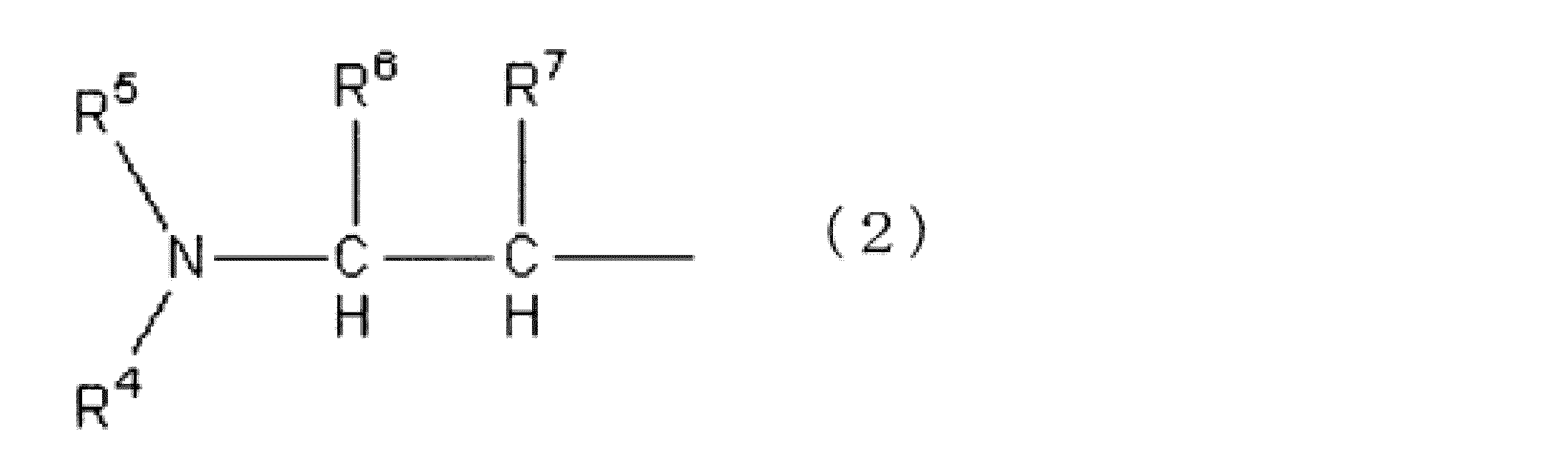

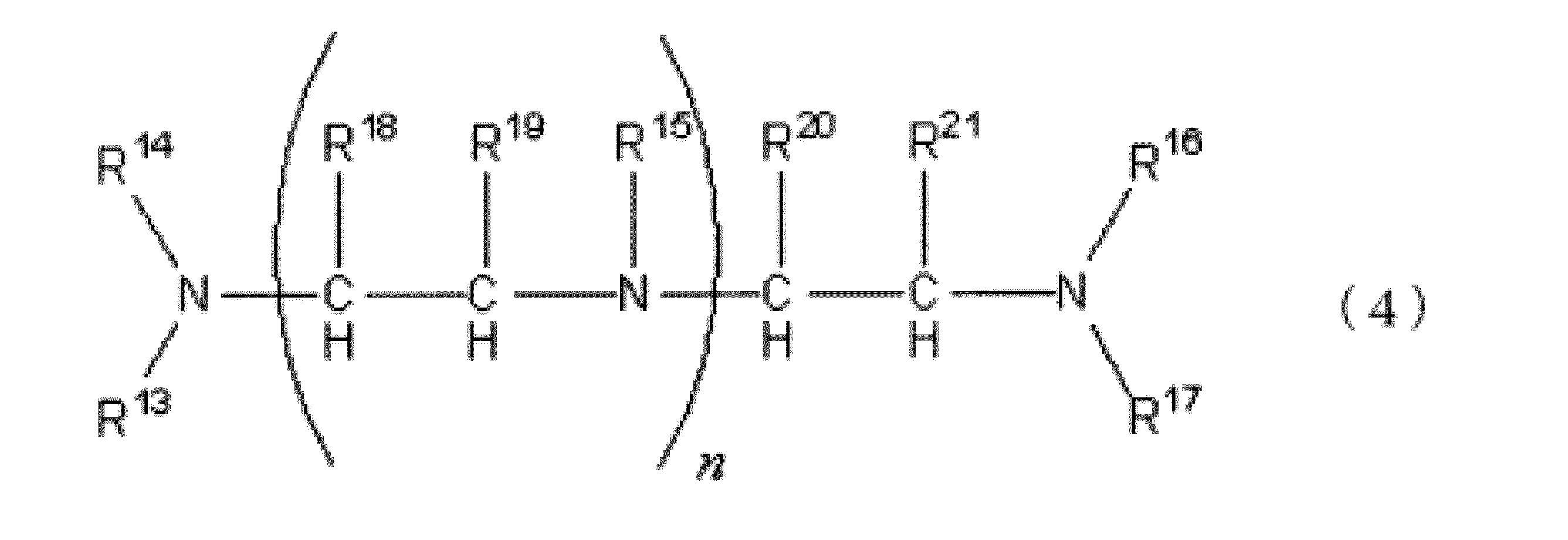
これらポリアミン(B)は、単独で用いても良いし、複数種を組み合わせて使用しても構わない。
一般式(1)あるいは一般式(4)で表されるポリアミン以外のポリアミンでは長時間かけて重合したときには分子量分布の狭い重合体を得ることも可能だが、短時間で重合を進めたときには重合体の分子量分布が広がる。そのため、一般式(1)あるいは一般式(4)で表されるポリアミン以外のポリアミンよりも、一般式(1)あるいは一般式(4)で表されるポリアミンの方が好ましい。
数あるポリアミンの中でも特に一般式(1)および一般式(4)で示される特定のポリアミン(B)は工業的に入手が困難であるという制約がある。
ポリアミン(B)の使用量はビニル系単量体の総仕込み(100mol%)に対して、物質量にして70mmol%以下が好ましく、40mmol%以下がより好ましく、20mmol%以下がさらに好ましい。また、金属銅又は銅化合物(A)における銅原子の総量(100mol%)に対して150mol%以下が好ましく、120mol%以下がより好ましく、110mol%以下がさらに好ましく、100mol%以下が特に好ましい。
<ポリアミン以外の塩基(C)>
本発明の一実施形態におけるポリアミン以外の塩基(C)とは、上記ポリアミン(B)以外の塩基化合物をいう。ポリアミン以外の塩基(C)は重合系中に存在する酸あるいは発生する酸を中和し、酸の蓄積を防ぐためのものである。ポリアミン以外の塩基(C)は(a)ブレンステッドの塩基の定義に当てはまる、プロトンを受け入れる性質を持つ化合物、あるいは(b)ルイスの塩基の定義に当てはまる、非共有電子対を持っていてそれを授与することができ配位結合をつくる性質を有する化合物であれば良い。ポリアミン以外の塩基(C)の具体例を下に例示するが、ポリアミン以外の塩基(C)はそれらに限定されるものではない。ポリアミン以外の塩基(C)としては、以下に示すようなモノアミン系塩基、ポリアミン系塩基および無機塩基である塩基などが挙げられる。
本発明の一実施形態におけるポリアミン以外の塩基(C)とは、上記ポリアミン(B)以外の塩基化合物をいう。ポリアミン以外の塩基(C)は重合系中に存在する酸あるいは発生する酸を中和し、酸の蓄積を防ぐためのものである。ポリアミン以外の塩基(C)は(a)ブレンステッドの塩基の定義に当てはまる、プロトンを受け入れる性質を持つ化合物、あるいは(b)ルイスの塩基の定義に当てはまる、非共有電子対を持っていてそれを授与することができ配位結合をつくる性質を有する化合物であれば良い。ポリアミン以外の塩基(C)の具体例を下に例示するが、ポリアミン以外の塩基(C)はそれらに限定されるものではない。ポリアミン以外の塩基(C)としては、以下に示すようなモノアミン系塩基、ポリアミン系塩基および無機塩基である塩基などが挙げられる。
モノアミン系塩基:モノアミン系塩基は1分子中に上記で定義される塩基として作用する部位が1つしかない化合物を示し、以下に例示するがそれらに限定されるものではない。モノアミン系塩基としては、(a)メチルアミン、アニリン、リシン等の一級アミン、(b)ジメチルアミン、ピペリジン等の二級アミン、(c)トリメチルアミン、トリエチルアミン等の三級アミン、(d)ピリジン、ピロール等の芳香族系、および(e)アンモニアが挙げられる。
ポリアミン系塩基:ポリアミン系塩基としては、(a)エチレンジアミン、テトラメチルエチレンジアミン等のジアミン、(b)ジエチレントリアミン、ペンタメチルジエチレントリアミン等のトリアミン、(c)トリエチレンテトラミン、ヘキサメチルトリエチレンテトラミン、ヘキサメチレンテトラミン等のテトラミン、(d)ポリエチレンイミン、等が挙げられる。
無機塩基である塩基:無機塩基である塩基は周期表の一族および二族の単体あるいは化合物を示し、下記に例示するがそれに限定されるものではない。無機塩基である塩基としては、(a)リチウム、ナトリウム、カルシウム等の周期表の一族および二族の単体、(b)ナトリウムメトキシド、カリウムエトキシド、メチルリチウム、水酸化ナトリウム、水酸化カリウム、炭酸カリウム、炭酸水素ナトリウム、炭酸水素アンモニウム、リン酸三ナトリウム、リン酸水素二ナトリウム、リン酸三カリウム、リン酸水素二カリウム、酢酸ナトリウム、酢酸カリウム、シュウ酸ナトリウム、シュウ酸カリウム、フェノキシナトリウム、フェノキシカリウム、アスコルビン酸ナトリウム、アスコルビン酸カリウム等の周期表の一族および二族の化合物、(c)水酸化アンモニウムなどの、弱酸と強塩基との塩、などが挙げられる。
これらポリアミン以外の塩基(C)は、単独で用いても良いし、複数種を組み合わせて使用しても構わない。
また、ポリアミン以外の塩基(C)は、直接反応系に添加してもよいし、反応系中で発生させてもよい。
ポリアミン以外の塩基(C)はポリアミン(B)を酸から保護するために用いられているため、ポリアミン以外の塩基(C)の塩基性はポリアミン(B)と同程度、あるいはより強い方が好ましい。言い換えるならばポリアミン以外の塩基(C)の塩基解離定数(pKb)はポリアミン(B)のpKb以下であることが好ましい。
ポリアミン以外の塩基(C)は反応開始前に全量を一括で反応系に仕込んでも良いし、反応中に徐々に反応系に追加していっても良い。ただし、添加された還元剤(D)により移動する電子に対して常に100mol%以上であることが好ましい。
金属銅または銅化合物に対してポリアミン(B)およびポリアミン以外の塩基(C)を加える順番については特に限定されない。
金属銅又は銅化合物(A)に対してポリアミン以外の塩基(C)および還元剤(D)を加える順番については特に限定されない。還元剤(D)として水素化物還元剤を用いる場合、還元剤(D)、そしてポリアミン以外の塩基(C)の順で遷移金属原子と混合させたときには、重合速度が低下し重合体の分子量分布が広がる。そのため、還元剤(D)として水素化物還元剤を用いる場合、ポリアミン以外の塩基(C)、そして還元剤(D)の順、あるいは同時に遷移金属原子(例えば金属銅又は銅化合物(A))と混合させることが好ましい。これは、還元剤(D)として水素化物還元剤を用いる場合、還元剤(D)が遷移金属原子(例えば金属銅又は銅化合物(A))を還元させたときにハロゲン化水素を発生させ、ポリアミン(B)がアンモニウム塩化されるためと推測する。本発明の一実施形態はかかる推測に限定されない。一方、還元剤(D)として水素化物還元剤以外の塩基を用いる場合には、還元剤(D)が遷移金属原子を還元させたときに酸が発生しないため、金属銅又は銅化合物(A)に対してポリアミン以外の塩基(C)および還元剤(D)を加える順序は制限されない。ただし、ここで言う「同時」とはおおよそ同じタイミングで混合させることを示しており、厳密なものではない。
ポリアミン以外の塩基(C)の溶解性に依存して、ポリアミン以外の塩基(C)の効果が低減する。そのため、ポリアミン以外の塩基(C)として重合溶媒に溶解しにくい塩基を用いる場合は、予めポリアミン以外の塩基(C)を良溶媒で溶解させて、ポリアミン以外の塩基(C)を溶液で反応系に添加することが好ましい。なお、ここでいう「良溶媒」とは、ポリアミン以外の塩基(C)の溶解性に優れる溶媒を意図する。
ポリアミン以外の塩基(C)の量について、ポリアミン(B)を保護するために、ポリアミン(B)に対して過剰量添加されていることが好ましい。また還元剤(D)に水素化物還元剤を用いた場合、添加された還元剤(D)が遷移金属原子(例えば金属銅又は銅化合物(A))を還元させたときにハロゲン化水素を発生させる。そのため、ポリアミン以外の塩基(C)の量は、還元剤(D)により移動する電子に対して、常に100mol%以上のポリアミン以外の塩基(C)の量が好ましく、150mol%以上がより好ましく、200mol%以上がよりに好ましく、300mol%以上がさらに好ましい。ポリアミン以外の塩基(C)にモノアミン、あるいは無機塩基を用いた場合には、真空脱揮、あるいは油水分離による抽出が可能であるため、ポリアミン以外の塩基(C)を過剰に使用することに制限がなくなる。
<還元剤(D)>
金属銅又は銅化合物(A)とポリアミン(B)とからなる銅錯体を触媒とするリビングラジカル重合において、還元剤を併用することで、過剰な配位子(例えばポリアミン(B))が必要となるものの、活性が向上することが見出されている(ARGET ATRP)。このARGET ATRPは重合中にラジカル同士のカップリング等で生じた、反応遅延および反応停止の原因となる高酸化銅錯体を還元剤により還元して減少させることで活性が向上すると考えられている。このARGET ATRPは、通常数百~数千ppm必要な銅錯体を数十~数百ppmまで減らすことを可能にしている。本発明の一実施形態においても還元剤(D)はARGET ATRPと同様の働きをしている。
金属銅又は銅化合物(A)とポリアミン(B)とからなる銅錯体を触媒とするリビングラジカル重合において、還元剤を併用することで、過剰な配位子(例えばポリアミン(B))が必要となるものの、活性が向上することが見出されている(ARGET ATRP)。このARGET ATRPは重合中にラジカル同士のカップリング等で生じた、反応遅延および反応停止の原因となる高酸化銅錯体を還元剤により還元して減少させることで活性が向上すると考えられている。このARGET ATRPは、通常数百~数千ppm必要な銅錯体を数十~数百ppmまで減らすことを可能にしている。本発明の一実施形態においても還元剤(D)はARGET ATRPと同様の働きをしている。
本発明の一実施形態で用いる還元剤(D)の具体例を以下に例示するが、還元剤(D)はこれらの還元剤に限定されるものではない。還元剤(D)としては、(a)銅錯体を還元するときに酸を発生させない還元剤、および(b)銅錯体を還元する際に酸を発生させる還元剤(水素化物還元剤)が挙げられる。
(銅錯体を還元するときに酸を発生させない還元剤)
銅錯体を還元するときに酸を発生させない還元剤としては、以下に例示するような金属、金属化合物、有機スズ化合物、リン又はリン化合物および硫黄又は硫黄化合物、等が挙げられる。
銅錯体を還元するときに酸を発生させない還元剤としては、以下に例示するような金属、金属化合物、有機スズ化合物、リン又はリン化合物および硫黄又は硫黄化合物、等が挙げられる。
金属の具体例としては、(a)リチウム、ナトリウム、カリウム等のアルカリ金属類;(b)ベリリウム、マグネシウム、カルシウム、バリウム等のアルカリ土類金属類;(c)アルミニウム;(d)亜鉛等の典型金属;(e)銅、ニッケル、ルテニウム、鉄等の遷移金属;等が挙げられる。またこれらの金属は水銀との合金(アマルガム)の状態であってもよい。
金属化合物としては、(a)典型金属又は遷移金属の塩、および典型元素との塩、さらに(b)典型金属又は遷移金属に、一酸化炭素、オレフィン、含窒素化合物、含酸素化合物、含リン化合物、含硫黄化合物等が配位した錯体等が挙げられる。金属化合物として具体的には、(a)金属とアンモニア/アミンとの化合物、三塩化チタン、チタンアルコキシド、塩化クロム、硫酸クロム、酢酸クロム、塩化スズ、酢酸亜鉛、水酸化亜鉛、(b)Ni(CO)4、Co2CO8等のカルボニル錯体、(c)[Ni(cod)2]、[RuCl2(cod)]、[PtCl2(cod)]等のオレフィン錯体(ただしcodはシクロオクタジエンを表す)および(d)[RhCl(P(C6H5)3)3]、[RuCl2(P(C6H5)3)2]、[PtCl2(P(C6H5)3)2]等のホスフィン錯体等が挙げられる。
有機スズ化合物の具体例としては、オクチル酸スズ、2-エチルヘキシル酸スズ、ジブチルスズジアセテート、ジブチルスズジラウレート、ジブチルスズメルカプチド、ジブチルスズチオカルボキシレート、ジブチルスズジマレエート、ジオクチルスズチオカルボキシレート等が挙げられる。
リン又はリン化合物として具体的には、リン、トリメチルホスフィン、トリエチルホスフィン、トリフェニルホスフィン、トリメチルホスファイト、トリエチルホスファイト、トリフェニルホスファイト、ヘキサメチルホスフォラストリアミド、ヘキサエチルホスフォラストリアミド等が挙げられる。
硫黄又は硫黄化合物として具体的には、硫黄、ロンガリット類、ハイドロサルファイト類、二酸化チオ尿素等が挙げられる。ロンガリットとは、スルホキシル酸塩のホルムアルデヒド誘導体であり、MSO2・CH2O(MはNa又はZnを示す)で表される。ロンガリットとして具体的には、ソジウムホルムアルデヒドスルホキシレート、亜鉛ホルムアルデヒドスルホキシレート等が挙げられる。ハイドロサルファイトとは、次亜硫酸ナトリウム及び次亜硫酸ナトリウムのホルムアルデヒド誘導体の総称である。
(銅錯体を還元するときに酸を発生させる還元剤(水素化物還元剤))
銅錯体を還元するときに酸を発生させなる還元剤(水素化物還元剤)としては、以下に例示するような金属水素化物、ケイ素水素化物、ホウ素水素化物、窒素水素化合物、リン又はリン化合物、硫黄又は硫黄化合物、還元作用を示す有機化合物、および水素、等が挙げられる。
金属水素化物として具体例としては、(a)水素化ナトリウム;(b)水素化ゲルマニウム;(c)水素化タングステン;(d)水素化ジイソブチルアルミニウム、水素化アルミニウムリチウム、水素アルミニウムナトリウム、水素化トリエトキシアルミニウムナトリウム、水素化ビス(2-メトキシエトキシ)アルミニウムナトリウム等のアルミニウム水素化物;(e)水素化トリフェニルスズ、水素化トリ-n-ブチルスズ、水素化ジフェニルスズ、水素化ジ-n-ブチルスズ、水素化トリエチルスズ、水素化トリメチルスズ等の有機スズ水素化物;等が挙げられる。
ケイ素水素化物として具体例としては、トリクロロシラン、トリメチルシラン、トリエチルシラン、ジフェニルシラン、フェニルシラン、ポリメチルヒドロシロキサン等が挙げられる。
ホウ素水素化物として具体的には、ボラン、ジボラン、水素化ホウ素ナトリウム、水素化トリメトキシホウ酸ナトリウム、硫化水素化ホウ素ナトリウム、シアン化水素化ホウ素ナトリウム、シアン化水素化ホウ素リチウム、水素化ホウ素リチウム、水素化トリエチルホウ素リチウム、水素化トリ-s-ブチルホウ素リチウム、水素化トリ-t-ブチルホウ素リチウム、水素化ホウ素カルシウム、水素化ホウ素カリウム、水素化ホウ素亜鉛、水素化ホウ素テトラ-n-ブチルアンモニウム等が挙げられる。
窒素水素化合物として具体的には、ヒドラジン、ジイミド等が挙げられる。
リン又はリン化合物として具体的には、ホスフィン、ジアザホスホレン等が挙げられる。
硫黄又は硫黄化合物として具体的には硫化水素等が挙げられる。
還元作用を示す有機化合物として具体的には、アルコール、アルデヒド、フェノール類及び有機酸化合物等が挙げられる。アルコールとしては、メタノール、エタノール、プロパノール、イソプロパノール等が挙げられる。アルデヒドとしては、ホルムアルデヒド、アセトアルデヒド、ベンズアルデヒド、ギ酸等が挙げられる。フェノール類としては、フェノール、ハイドロキノン、ジブチルヒドロキシトルエン、トコフェロール等が挙げられる。有機酸化合物としては、クエン酸、シュウ酸、アスコルビン酸、アスコルビン酸塩、アスコルビン酸エステル等が挙げられる。
銅錯体を還元するときに酸を発生させなる還元剤(水素化物還元剤)としては、以下に例示するような金属水素化物、ケイ素水素化物、ホウ素水素化物、窒素水素化合物、リン又はリン化合物、硫黄又は硫黄化合物、還元作用を示す有機化合物、および水素、等が挙げられる。
金属水素化物として具体例としては、(a)水素化ナトリウム;(b)水素化ゲルマニウム;(c)水素化タングステン;(d)水素化ジイソブチルアルミニウム、水素化アルミニウムリチウム、水素アルミニウムナトリウム、水素化トリエトキシアルミニウムナトリウム、水素化ビス(2-メトキシエトキシ)アルミニウムナトリウム等のアルミニウム水素化物;(e)水素化トリフェニルスズ、水素化トリ-n-ブチルスズ、水素化ジフェニルスズ、水素化ジ-n-ブチルスズ、水素化トリエチルスズ、水素化トリメチルスズ等の有機スズ水素化物;等が挙げられる。
ケイ素水素化物として具体例としては、トリクロロシラン、トリメチルシラン、トリエチルシラン、ジフェニルシラン、フェニルシラン、ポリメチルヒドロシロキサン等が挙げられる。
ホウ素水素化物として具体的には、ボラン、ジボラン、水素化ホウ素ナトリウム、水素化トリメトキシホウ酸ナトリウム、硫化水素化ホウ素ナトリウム、シアン化水素化ホウ素ナトリウム、シアン化水素化ホウ素リチウム、水素化ホウ素リチウム、水素化トリエチルホウ素リチウム、水素化トリ-s-ブチルホウ素リチウム、水素化トリ-t-ブチルホウ素リチウム、水素化ホウ素カルシウム、水素化ホウ素カリウム、水素化ホウ素亜鉛、水素化ホウ素テトラ-n-ブチルアンモニウム等が挙げられる。
窒素水素化合物として具体的には、ヒドラジン、ジイミド等が挙げられる。
リン又はリン化合物として具体的には、ホスフィン、ジアザホスホレン等が挙げられる。
硫黄又は硫黄化合物として具体的には硫化水素等が挙げられる。
還元作用を示す有機化合物として具体的には、アルコール、アルデヒド、フェノール類及び有機酸化合物等が挙げられる。アルコールとしては、メタノール、エタノール、プロパノール、イソプロパノール等が挙げられる。アルデヒドとしては、ホルムアルデヒド、アセトアルデヒド、ベンズアルデヒド、ギ酸等が挙げられる。フェノール類としては、フェノール、ハイドロキノン、ジブチルヒドロキシトルエン、トコフェロール等が挙げられる。有機酸化合物としては、クエン酸、シュウ酸、アスコルビン酸、アスコルビン酸塩、アスコルビン酸エステル等が挙げられる。
中でも、銅錯体を還元したときに酸を発生させる水素化物還元剤は、ポリアミン以外の塩基(C)を併用しない場合、重合速度の低下と重合制御の悪化による分子量分布の広がりを招くため、ポリアミン以外の塩基(C)の併用がより効果的である。これは発生した酸が遷移金属錯体を形成するポリアミン(B)をアンモニウム塩化させ、錯体構造を崩すためと推測する。本発明の一実施形態はかかる推測に限定されない。
還元剤(D)の還元力が強いほど重合も速く進めることが可能になる。上述した化合物の中でも金属、有機スズ化合物、アスコルビン酸、アスコルビン酸エステル、アスコルビン酸塩、ヒドラジン、およびホウ素水素化物は還元力が強く、還元剤(D)としてより好ましい。それ故、還元剤(D)は、有機スズ化合物、アスコルビン酸、アスコルビン酸エステル、アスコルビン酸塩、ヒドラジン、およびホウ素水素化物からなる群から選ばれる少なくとも1種の還元剤であることが好ましい。
また、工業化を考えると重合後、還元剤(D)も重合体から取り除かれることが好ましい。そのため、還元剤(D)としては、(a)酸化物が揮発除去しやすいヒドラジン、シュウ酸等、並びに(b)油水分離によって除去しやすい水素化ナトリウム、水素化ホウ素ナトリウム、ヒドラジン、クエン酸、シュウ酸、アスコルビン酸、アスコルビン酸塩、およびアスコルビン酸エステル等、が好ましい。
よって、還元剤(D)としては、アスコルビン酸、アスコルビン酸塩、アスコルビン酸エステル、およびヒドラジンがより好ましく、中でもアスコルビン酸、アスコルビン酸塩、およびアスコルビン酸エステルが特に好ましい。
これら還元剤(D)は単独で用いてもよいし、2種以上を組み合わせて使用してもかまわない。
また、還元剤(D)は、直接反応系に添加してもよいし、反応系中で発生させてもよい。後者には、電解還元も含まれる。電解還元では陰極で生じた電子が直ちに、あるいは一度溶媒和した後、還元作用を示すことが知られている。つまり、還元剤(D)が電気分解により生じるものも用いることができる。
還元剤(D)の添加量が少なすぎる場合は十分な重合活性が期待できない点で好ましくなく、多すぎる場合には得られた重合体から還元剤(D)の除去が困難になる点で好ましくない。即ち、還元剤(D)の添加量は、ビニル系単量体の仕込み総量に対して10~100000ppmが好ましく、10~10000ppmがより好ましく、10~1000ppmが更に好ましく、10~500ppmが特に好ましい。
また、還元剤(D)が常温で固体である場合、還元剤(D)を良溶媒に溶解させた溶液として反応系に添加した方がより効果を発揮できるために好ましい。なお、ここでいう「良溶媒」とは、還元剤(D)の溶解性に優れる溶媒を意図する。
ARGET ATRPの機構からわかるように、還元剤(D)を一度に過剰量添加するとラジカルを制御するための2価銅錯体が不足し、カップリング等によって分子量分布が広がる。そのため、還元剤(D)は重合の進行に伴い少量ずつ添加すること、具体的には銅錯体(100mol%)に対して、1~1000mol%/時間で添加することが好ましく、5~700mol%/時間で添加することがより好ましく、10~500mol%/時間で添加するのが特に好ましい。
銅錯体に対してポリアミン以外の塩基(C)および還元剤(D)を加える順番については特に限定されない。還元剤(D)として水素化物還元剤を用いる場合、還元剤(D)、そしてポリアミン以外の塩基(C)の順で銅原子と混合させたときには、重合速度が低下し重合体の分子量分布が広がるため、ポリアミン以外の塩基(C)、そして還元剤(D)の順、あるいは同時に銅錯体と混合させることが好ましい。これは、還元剤(D)として水素化物還元剤を用いる場合、還元剤(D)が銅原子を還元させたときにハロゲン化水素を発生させ、ポリアミン(B)がアンモニウム塩化されるためと推測する。本発明の一実施形態はかかる推測に限定されない。一方、還元剤(D)として水素化物還元剤以外の塩基を用いる場合には、還元剤(D)が銅原子を還元させたときに酸が発生しないため、銅錯体に対してポリアミン以外の塩基(C)および還元剤(D)を加える順序は制限されない。ただし、ここで言う「同時」とはおおよそ同じタイミングで混合させることを示しており、厳密なものではない。特に還元剤(D)にアスコルビン酸を用いる場合には、予めポリアミン以外の塩基(C)と還元剤(D)とを混合することにより、還元剤(D)およびポリアミン以外の塩基(C)の有機溶媒への溶解性が向上し、操作性が向上する。そのため、特に還元剤(D)にアスコルビン酸を用いる場合には、ポリアミン以外の塩基(C)および還元剤(D)を同時に反応系に添加させることが好ましい。
<高酸化の銅以外の金属化合物(E)>
本発明の一実施形態における「高酸化の銅以外の金属化合物(E)」とは、以下の2つの条件を共に満たす金属化合物をいう。
本発明の一実施形態における「高酸化の銅以外の金属化合物(E)」とは、以下の2つの条件を共に満たす金属化合物をいう。
(ア)複数の酸化数を持つことができる銅以外の金属原子を含んでいる
(イ)上記の銅以外の金属原子の酸化数は、高い方の値になっている。
(イ)上記の銅以外の金属原子の酸化数は、高い方の値になっている。
高酸化の銅以外の金属化合物(E)の金属種としては、常温常圧において複数の酸化状態を有する金属で高い酸化数を示すものであれば特に限定されない。例えばFeの場合は、常温常圧でFe(II)とFe(III)の酸化状態を取り得ることが知られているため、高酸化のFe(III)が高酸化の銅以外の金属化合物(E)に該当する。同様に、Zn(IV),Mn(IV),Sn(VI),Cr(II),Co(III),Rh(II),Ru(III),Sc(III),Te(III),Bi(III),Sb(III)等の高酸化の遷移金属なども高酸化の銅以外の金属化合物(E)の金属種として挙げられる。高酸化の銅以外の金属化合物(E)としては、これら金属種の金属化合物、例えば塩化物、臭化物、ヨウ素化物、シアン化物、酸化物、水酸化物、酢酸化物、硫酸化物、硝酸化物等が例として挙げられるが、それらに限定されたものではない。高酸化の銅以外の金属化合物(E)としては、上述した中でも、三価の鉄化合物であることが好ましく、塩化鉄(III)、臭化鉄(III)、ヨウ化鉄(III)および三酸化二鉄(Fe2O3)(III)からなる群から選択される1種以上であることがより好ましい。当該構成によると、誘導期を短くする効果が高いという利点を有する。
高酸化の銅以外の金属化合物(E)の量は、金属銅又は銅化合物(A)/高酸化の銅以外の金属化合物(E)のモル比が、0.9/0.1~0.2/0.8となることが好ましい。当該構成によると、誘導期を短縮する効果を持ちながら、狭い分子量分布を有する重合体が得られるという利点を有する。
高酸化の銅以外の金属化合物(E)は固体であるため、反応系に仕込むのが困難である。そこで、予め高酸化の銅以外の金属化合物(E)を溶媒と混合し、高酸化の銅以外の金属化合物(E)が溶解した溶液状態で反応系に仕込むことが好ましい。
高酸化の銅以外の金属化合物(E)の重量(使用量)は、金属銅又は銅化合物(A)とある一定のモル比の範囲内に収まることが好ましい。高酸化の銅以外の金属化合物(E)の量を減量できれば高酸化の銅以外の金属化合物(E)を除くことが容易になる。そのため、高酸化の銅以外の金属化合物(E)の重量(使用量)は、ビニル系単量体の仕込み総重量に対して、1~200ppmが好ましく、1~100ppmがより好ましく、1~40ppmが特に好ましい。
高酸化の銅以外の金属化合物(E)の重量(使用量)は、高酸化の銅以外の金属化合物(E)中の金属原子の重量に換算して、ビニル系単量体の仕込み総重量に対して、1~200ppmが好ましく、1~100ppmがより好ましく、1~40ppmが特に好ましい。
高酸化の銅以外の金属化合物(E)は、還元剤(D)と反応し低酸化の銅以外の金属化合物を生成する。この低酸化の銅以外の金属化合物が、(a)金属銅又は銅化合物(A)およびポリアミン(B)からなる銅錯体を還元するか、または(b)開始剤と直接反応しラジカルを生成するために、当該銅錯体と還元剤(D)との反応で生じる誘導期を短縮していると推測する。そのため、金属銅又は銅化合物(A)、ポリアミン(B)および高酸化の銅以外の金属化合物(E)を反応系に加えた後に、還元剤(D)を反応系に添加することが望ましい。換言すれば、金属銅又は銅化合物(A)とポリアミン(B)と高酸化の銅以外の金属化合物(E)とを混合した後、還元剤(D)を添加することが好ましい。なお、本発明の一実施形態はかかる推測に限定されない。
<ビニル系単量体(モノマー)>
本発明の一実施形態におけるビニル系単量体(モノマー)としては、例えば(メタ)アクリル系単量体、アクリルアミド系単量体、スチレン系単量体、塩化ビニル系単量体、カルボン酸ビニル系単量体、などを挙げることができる。これらの中では、(メタ)アクリル系単量体、アクリルアミド系単量体およびスチレン系単量体が好ましく、(メタ)アクリル系単量体が特に好ましい。
本発明の一実施形態におけるビニル系単量体(モノマー)としては、例えば(メタ)アクリル系単量体、アクリルアミド系単量体、スチレン系単量体、塩化ビニル系単量体、カルボン酸ビニル系単量体、などを挙げることができる。これらの中では、(メタ)アクリル系単量体、アクリルアミド系単量体およびスチレン系単量体が好ましく、(メタ)アクリル系単量体が特に好ましい。
本明細書において「(メタ)アクリル」とは「アクリル」および/または「メタクリル」を意図する。
本発明の一実施形態における(メタ)アクリル系単量体としては、例えば、(メタ)アクリル酸メチル、(メタ)アクリル酸エチル、(メタ)アクリル酸-n-プロピル、(メタ)アクリル酸イソプロピル、(メタ)アクリル酸-n-ブチル、(メタ)アクリル酸イソブチル、(メタ)アクリル酸-tert-ブチル、(メタ)アクリル酸-n-ペンチル、(メタ)アクリル酸-n-ヘキシル、(メタ)アクリル酸シクロヘキシル、(メタ)アクリル酸-n-ヘプチル、(メタ)アクリル酸-n-オクチル、(メタ)アクリル酸-2-エチルヘキシル、(メタ)アクリル酸ノニル、(メタ)アクリル酸デシル、(メタ)アクリル酸ドデシル、(メタ)アクリル酸フェニル、(メタ)アクリル酸トルイル、(メタ)アクリル酸ベンジル、(メタ)アクリル酸-2-メトキシエチル、(メタ)アクリル酸-3-メトキシプロピル、(メタ)アクリル酸-2-ヒドロキシエチル、(メタ)アクリル酸-2-ヒドロキシプロピル、(メタ)アクリル酸ステアリル、(メタ)アクリル酸グリシジル、(メタ)アクリル酸2-アミノエチル、γ-(メタクリロイルオキシプロピル)トリメトキシシラン、(メタ)アクリル酸のエチレンオキサイド付加物、(メタ)アクリル酸トリフルオロメチルメチル、(メタ)アクリル酸2-トリフルオロメチルエチル、(メタ)アクリル酸2-パーフルオロエチルエチル、(メタ)アクリル酸2-パーフルオロエチル-2-パーフルオロブチルエチル、(メタ)アクリル酸2-パーフルオロエチル、(メタ)アクリル酸パーフルオロメチル、(メタ)アクリル酸ジパーフルオロメチルメチル、(メタ)アクリル酸2-パーフルオロメチル-2-パーフルオロエチルメチル、(メタ)アクリル酸2-パーフルオロヘキシルエチル、(メタ)アクリル酸2-パーフルオロデシルエチル、(メタ)アクリル酸2-パーフルオロヘキサデシルエチル等が挙げられる。これらは、単独で用いても良いし、複数種の単量体を共重合させて用いても構わない。必要に応じて(メタ)アクリル系単量体以外のその他の単量体を(メタ)アクリル系単量体と共重合することもできる。本発明の一実施形態において、ビニル系単量体として(メタ)アクリル系単量体を使用する場合に得られる(メタ)アクリル系重合体は、(メタ)アクリル系単量体に由来する繰り返し単位を、全繰り返し単位中5重量%以上有していることが好ましく、50重量%以上がより好ましく、80重量%以上がさらにより好ましい。
本発明の一実施形態で得られるビニル系重合体は、ビニル系単量体に由来する繰り返し単位を、全繰り返し単位中5重量%以上有していることが好ましく、50重量%以上がより好ましく、80重量%以上がさらにより好ましい。
<開始剤>
本発明の一実施形態では重合開始剤として、反応性の高い炭素-ハロゲン結合を有する有機ハロゲン化物を用いることができる。有機ハロゲン化物としては、例えば、α位にハロゲンを有するカルボニル化合物、ベンジル位にハロゲンを有する化合物、あるいはハロゲン化スルホニル化合物等が例示される。有機ハロゲン化物として具体的には、 C6H5-CH2X、C6H5-C(H)(X)CH3、C6H5-C(X)(CH3)2(ただし、上の化学式中、C6H5はフェニル基、Xは塩素、臭素、またはヨウ素); R3-C(H)(X)-CO2R4、R3-C(CH3)(X)-CO2R4、R3-C(H)(X)-C(O)R4、R3-C(CH3)(X)-C(O)R4、(式中、R3、R4は水素原子または炭素数1~20のアルキル基、アリール基、またはアラルキル基、Xは塩素、臭素、またはヨウ素); R3-C6H4-SO2X (式中、R3は水素原子または炭素数1~20のアルキル基、アリール基、またはアラルキル基、Xは塩素、臭素、またはヨウ素);等が挙げられる。
本発明の一実施形態では重合開始剤として、反応性の高い炭素-ハロゲン結合を有する有機ハロゲン化物を用いることができる。有機ハロゲン化物としては、例えば、α位にハロゲンを有するカルボニル化合物、ベンジル位にハロゲンを有する化合物、あるいはハロゲン化スルホニル化合物等が例示される。有機ハロゲン化物として具体的には、 C6H5-CH2X、C6H5-C(H)(X)CH3、C6H5-C(X)(CH3)2(ただし、上の化学式中、C6H5はフェニル基、Xは塩素、臭素、またはヨウ素); R3-C(H)(X)-CO2R4、R3-C(CH3)(X)-CO2R4、R3-C(H)(X)-C(O)R4、R3-C(CH3)(X)-C(O)R4、(式中、R3、R4は水素原子または炭素数1~20のアルキル基、アリール基、またはアラルキル基、Xは塩素、臭素、またはヨウ素); R3-C6H4-SO2X (式中、R3は水素原子または炭素数1~20のアルキル基、アリール基、またはアラルキル基、Xは塩素、臭素、またはヨウ素);等が挙げられる。
また、2つ以上の開始点を持つ有機ハロゲン化物、または2つ以上の開始点を持つハロゲン化スルホニル化合物を開始剤として使用してもよい。
単量体量と開始剤量との比を調整することにより、所望の重合体分子量に設定することができることがリビングラジカル重合の特徴である。
単量体量と開始剤量との比によって重合体の分子量を設定することができる。設定分子量が低いほど、ラジカル生成量の制御が難しく分子量分布が広がりやすい。また設定分子量が高くても副反応(停止反応および連載道反応)の影響が大きく分子量分布が広がりやすい。そのため、開始剤の量は単量体の量(100mol%)に対して0.0001~10mol%が好ましく、0.001~20mol%がより好ましい。
<溶媒>
本発明の一実施形態における溶媒の具体例について以下に例示するが、このリビングラジカル重合法を用いる場合、溶媒は特に限定されるものではない。
高極性非プロトン性溶媒:ジメチルスルホキシド(DMSO)、ジメチルホルムアミド(DMF)、N,N-ジメチルアセトアミド(DMAc)、N-メチルピロリドン等
カーボネート系溶媒:エチレンカーボネート、プロピレンカーボネート等
アルコール系溶媒:メタノール、エタノール、プロパノール、イソプロパノール、n-ブチルアルコール、tert-ブチルアルコール等
ニトリル系溶媒:アセトニトリル、プロピオニトリル、ベンゾニトリル等
ケトン系溶媒:アセトン、メチルエチルケトン、メチルイソブチルケトン等
エーテル系溶媒:ジエチルエーテル、テトラヒドロフラン等
ハロゲン化炭化系溶媒:塩化メチレン、クロロホルム等
エステル系溶媒:酢酸エチル、酢酸ブチル等
炭化水素系溶媒:ペンタン、ヘキサン、シクロヘキサン、オクタン、デカン、ベンゼン、トルエン等
本発明の一実施形態における溶媒としては、イオン性液体、水等も挙げられる。本発明の一実施形態における溶媒としては超臨界流体を用いてもよい。
本発明の一実施形態における溶媒の具体例について以下に例示するが、このリビングラジカル重合法を用いる場合、溶媒は特に限定されるものではない。
高極性非プロトン性溶媒:ジメチルスルホキシド(DMSO)、ジメチルホルムアミド(DMF)、N,N-ジメチルアセトアミド(DMAc)、N-メチルピロリドン等
カーボネート系溶媒:エチレンカーボネート、プロピレンカーボネート等
アルコール系溶媒:メタノール、エタノール、プロパノール、イソプロパノール、n-ブチルアルコール、tert-ブチルアルコール等
ニトリル系溶媒:アセトニトリル、プロピオニトリル、ベンゾニトリル等
ケトン系溶媒:アセトン、メチルエチルケトン、メチルイソブチルケトン等
エーテル系溶媒:ジエチルエーテル、テトラヒドロフラン等
ハロゲン化炭化系溶媒:塩化メチレン、クロロホルム等
エステル系溶媒:酢酸エチル、酢酸ブチル等
炭化水素系溶媒:ペンタン、ヘキサン、シクロヘキサン、オクタン、デカン、ベンゼン、トルエン等
本発明の一実施形態における溶媒としては、イオン性液体、水等も挙げられる。本発明の一実施形態における溶媒としては超臨界流体を用いてもよい。
上記溶媒は単独又は2種以上を混合して用いることができる。
リビングラジカル重合法では、溶媒への連鎖移動反応が重合制御の悪化の要因となるが、還元剤(D)が析出することでも重合制御は悪化する。そのため、溶媒量は、ビニル系単量体の仕込み総重量100重量部に対して、0.5~60重量部が好ましく、2~20重量部がより好ましい。
さらに、金属銅又は銅化合物(A)、ポリアミン(B)、ポリアミン以外の塩基(C)、還元剤(D)、高酸化の銅以外の金属化合物(E)、ビニル系単量体(モノマー)および開始剤が反応系中で均一になっていることが、反応制御、重合反応速度、仕込みやすさおよびスケールアップリスクの点でより好ましい。そのため、それらを溶解させる溶媒を選択することが好ましい。例えば、還元剤(D)としてアスコルビン酸を用いる場合、還元剤(D)の溶解性が還元剤(D)の還元力に大きく影響を及ぼすことから、溶媒としては、アスコルビン酸、アスコルビン酸の塩又はアスコルビン酸のエステルを溶解できる溶媒、例えば、(a)メタノール、エタノール、プロパノール、イソプロパノール、n-ブチルアルコール、tert-ブチルアルコール等のアルコール系溶媒、(b)ジメチルスルホキシド(DMSO)、ジメチルホルムアミド(DMF)、N,N-ジメチルアセトアミド(DMAc)、N-メチルピロリドン等の高極性非プロトン性溶媒、および(c)水が好ましい。またこれらの溶媒を他の溶媒と混合させて混合溶媒として用いることにより、還元剤(D)であるアスコルビン酸の溶解性を向上させることも有用である。
[2]第二の実施形態
本発明の第二の実施形態は、上述した構成を有するため、誘導期をなくすこと、もしくは短くすることが可能となり、その結果、還元剤(D)の添加による重合制御が簡便になるという利点を有する。
本発明の第二の実施形態は、上述した構成を有するため、誘導期をなくすこと、もしくは短くすることが可能となり、その結果、還元剤(D)の添加による重合制御が簡便になるという利点を有する。
<金属銅又は銅化合物(A)>
第二の実施形態における金属銅又は銅化合物(A)は、第一の実施形態のものと同様である。
第二の実施形態における金属銅又は銅化合物(A)は、第一の実施形態のものと同様である。
<ポリアミン(B)>
第二の実施形態におけるポリアミン(B)は、第一の実施形態のものと同様である。ただし第二の実施形態のポリアミン(B)は、第一の実施形態でのポリアミン以外の塩基(C)の役割も果たしている。第二の実施形態におけるポリアミン(B)の使用量などは以下のとおりである。
第二の実施形態におけるポリアミン(B)は、第一の実施形態のものと同様である。ただし第二の実施形態のポリアミン(B)は、第一の実施形態でのポリアミン以外の塩基(C)の役割も果たしている。第二の実施形態におけるポリアミン(B)の使用量などは以下のとおりである。
第二の実施形態において、ポリアミン(B)の使用量は、重合系中に存在する遷移金属原子(100mol%)に対して、80~150mol%が好ましく、90~120mol%がより好ましく、95~110mol%がさらに好ましく、100mol%が特に好ましい。また第二の実施形態において、ポリアミン(B)は、複数回に分けて重合系中に分割添加することが好ましい。後で添加する(2回目以降に添加する)ポリアミン(B)は、重合系中に存在する酸あるいは発生する酸を中和し、酸の蓄積を防ぐためのものである場合が多い。
<還元剤(D)>
第二の実施形態における還元剤(D)は、第一の実施形態のものと同様である。
第二の実施形態における還元剤(D)は、第一の実施形態のものと同様である。
<高酸化の銅以外の金属化合物(E)>
第二の実施形態における、高酸化の銅以外の金属化合物(E)は、第一の実施形態のものと同様である。
第二の実施形態における、高酸化の銅以外の金属化合物(E)は、第一の実施形態のものと同様である。
<ビニル系単量体(モノマー)>
第二の実施形態における、ビニル系単量体(モノマー)は、第一の実施形態のものと同様である。
第二の実施形態における、ビニル系単量体(モノマー)は、第一の実施形態のものと同様である。
<開始剤>
第二の実施形態における開始剤は、第一の実施形態のものと同様である。
第二の実施形態における開始剤は、第一の実施形態のものと同様である。
<溶媒>
第二の実施形態における溶媒は、第一の実施形態のものと同様である。
第二の実施形態における溶媒は、第一の実施形態のものと同様である。
<本発明の一実施形態で得られるビニル系重合体>
本発明の一実施形態に係る製造方法で得られるビニル系重合体の数平均分子量は特に制限はないが、500~1,000,000の範囲が好ましく、1,000~500,000の範囲がより好ましく、3,000~300,000の範囲がさらに好ましく、5,000~300,000が特に好ましい。
本発明の一実施形態に係る製造方法で得られるビニル系重合体の数平均分子量は特に制限はないが、500~1,000,000の範囲が好ましく、1,000~500,000の範囲がより好ましく、3,000~300,000の範囲がさらに好ましく、5,000~300,000が特に好ましい。
本発明の一実施形態に係る製造方法で得られるビニル系重合体の分子量分布、すなわち、ゲルパーミエーションクロマトグラフィーで測定した重量平均分子量(Mn)と数平均分子量(Mw)との比は、1.1~1.8であることが好ましく、より好ましくは1.1~1.7であり、より好ましくは1.1~1.5であり、さらに好ましくは1.1~1.3である。本発明の一実施形態におけるGPC測定においては、通常、移動相としてクロロホルムを用い、測定はポリスチレンゲルカラムにて行い、数平均分子量等はポリスチレン換算で求めることができる。
本発明の一実施形態に係る製造方法で得られるビニル系重合体のモノマーであるビニル系単量体の転化率、すなわち、反応系中に残存するビニル系単量体のモル数とビニル系単量体の総仕込みモル数の比((ビニル系単量体の総仕込みモル数-反応系中に残存するビニル系単量体のモル数)/ビニル系単量体の総仕込みモル数×100)(%)は、特に限定されないが、好ましくは85%以上であり、好ましくは90%以上であり、より好ましくは95%以上である。
本発明の第一実施形態に係る製造方法で得られるビニル系重合体の、金属銅又は銅化合物(A)、ポリアミン(B)、ポリアミン以外の塩基(C)、還元剤(D)および高酸化の銅以外の金属化合物(E)の全てを混合し始めてからの重合時間は特に限定されないが、好ましくは360分以下であり、好ましくは300分以下であり、より好ましくは240分以下である。
本発明の第二実施形態に係る製造方法で得られるビニル系重合体の、金属銅又は銅化合物(A)、ポリアミン(B)、還元剤(D)および高酸化の銅以外の金属化合物(E)の全てを混合し始めてからの重合時間は特に限定されないが、好ましくは360分以下であり、好ましくは300分以下であり、より好ましくは240分以下である。
重合温度は、限定はされないが、低すぎると反応速度が遅くなる虞があり、温度が高いと副反応(連載道反応)が起こりやすくなるため、0~100℃の範囲が好ましく、20~90℃がより好ましく、40~70℃がさらに好ましい。
重合雰囲気は、限定はされないが、酸素存在下で重合反応を行う場合、金属銅又は銅化合物(A)および高酸化の銅以外の金属化合物(E)、並びにこれらが還元剤(D)により還元された化合物が、酸素によって酸化され重合制御が悪くなる虞がある。そのため、重合反応は不活性ガス雰囲気下で行うのが好ましく、製造コストなどを考えると窒素雰囲気下で行うことがより好ましい。
本発明の一実施形態に係る製造方法で得られるビニル系重合体主鎖は直鎖状でもよいし、枝分かれがあってもよい。
本発明の一実施形態に係る製造方法で得られるビニル系重合体は、(メタ)アクリル系重合体であることが好ましい。当該構成によると、容易に分子量分布の狭い重合体を得られるという利点を有する。なお、本明細書において、「(メタ)アクリル系重合体」とは、(メタ)アクリル系単量体に由来する繰り返し単位を含む重合体を意図する。本発明の一実施形態に係る製造方法で得られるビニル系重合体は、(メタ)アクリル系単量体に由来する繰り返し単位を、全繰り返し単位中5重量%以上有していることが好ましく、50重量%以上がより好ましく、80重量%以上がさらにより好ましい。当該構成によると、分子量分布の狭い重合体を得られるという利点を有する。
本発明の一実施形態は、以下の様な構成であってもよい。
〔1〕以下の(A)~(E)の存在下でリビングラジカル重合をおこなうことを特徴とするビニル系重合体の製造方法:金属銅又は銅化合物(A)、ポリアミン(B)、ポリアミン以外の塩基(C)、還元剤(D)、および高酸化の銅以外の金属化合物(E)。
〔2〕以下の(A)、(B)、(D)および(E)の存在下でリビングラジカル重合をおこない、なおかつ(A)中の遷移金属原子と(E)中の遷移金属原子との合計モル数に対して、モル数で0.8~1.5倍の(B)を使用することを特徴とするビニル系重合体の製造方法:金属銅又は銅化合物(A)、ポリアミン(B)、還元剤(D)、および高酸化の銅以外の金属化合物(E)。
〔3〕前記ビニル系重合体が(メタ)アクリル系重合体である〔1〕または〔2〕に記載のビニル系重合体の製造方法。
〔4〕前記高酸化の銅以外の金属化合物(E)が三価の鉄化合物である〔1〕~〔3〕のいずれか1つに記載のビニル系重合体の製造方法。
〔5〕前記三価の鉄化合物が、塩化鉄、臭化鉄、ヨウ化鉄および三酸化二鉄(Fe2O3)からなる群より選ばれる1種以上の化合物であることを特徴とする〔4〕に記載のビニル系重合体の製造方法。
〔6〕前記金属銅又は銅化合物(A)/前記高酸化の銅以外の金属化合物(E)のモル比が、0.9/0.1~0.2/0.8であることを特徴とする〔1〕~〔5〕のいずれか1つに記載のビニル系重合体の製造方法。
〔7〕前記ビニル系単量体の総仕込みに対して、金属原子の重量に換算して1~40ppmとなる前記高酸化の銅以外の金属化合物(E)を使用することを特徴とする〔1〕~〔6〕のいずれか1つに記載のビニル系重合体の製造方法。
〔8〕前記金属銅又は銅化合物(A)と前記ポリアミン(B)と前記高酸化の銅以外の金属化合物(E)とを混合した後、前記還元剤(D)を添加することを特徴とする〔1〕~〔7〕のいずれか1つに記載のビニル系重合体の製造方法。
〔9〕前記還元剤(D)が有機スズ化合物、アスコルビン酸、アスコルビン酸エステル、アスコルビン酸塩、ヒドラジン、およびホウ素水素化物からなる群から選ばれる少なくとも1種の還元剤であることを特徴とする〔1〕~〔8〕のいずれか1つに記載のビニル系重合体の製造方法。
本発明の一実施形態は、以下の様な構成であってもよい。
〔1〕銅錯体(A)を触媒とする(メタ)アクリル系単量体のリビングラジカル重合法において、(メタ)アクリル系単量体に対して、多座アミン(B)、多座アミン以外の塩基(C)、還元剤(D)および高酸化の銅以外の金属化合物(E)を反応系中に含むことを特徴とする(メタ)アクリル系重合体の製造方法。
〔2〕高酸化の金属化合物(E)が三価の鉄化合物である〔1〕記載の(メタ)アクリル系重合体の製造方法。
〔3〕三価の鉄化合物(E)が、塩化鉄、臭化鉄、ヨウ化鉄および三酸化二鉄(Fe2O3)からなる群より選ばれた1種以上の化合物であることを特徴とする〔2〕に記載の(メタ)アクリル系重合体の製造方法。
〔4〕銅錯体/高酸化の銅以外の金属化合物(E)のモル比が、0.9/0.1~0.2/0.8であることを特徴とする〔1〕~〔3〕のいずれかに記載の(メタ)アクリル系重合体の製造方法。
〔5〕(メタ)アクリル系単量体の総仕込みに対して、重量にして1~40ppmの高酸化の銅以外の金属化合物(E)の金属原子を含むことを特徴とする〔1〕~〔4〕のいずれかに記載の(メタ)アクリル系重合体の製造方法。
〔6〕銅錯体および高酸化の銅以外の金属化合物(E)に対して、還元剤(C)を後に混合させることを特徴とする〔1〕~〔5〕のいずれかに記載の(メタ)アクリル系重合体の製造方法。
〔7〕還元剤(D)が有機スズ化合物、アスコルビン酸、アスコルビン酸エステル、アスコルビン酸塩、ヒドラジン、およびホウ素水素化物からなる群から選ばれる少なくとも1種であることを特徴とする〔1〕~〔6〕のいずれかに記載の(メタ)アクリル系重合体。
以下に、本発明の具体的な実施例を示すが、本発明は、下記実施例に限定されるものではない。下記実施例および比較例中、「部」および「ppm」は、それぞれ「重量部」、および「重量百万分率」を表す。「数平均分子量」および「分子量分布(重量平均分子量と数平均分子量との比)」は、ゲルパーミエーションクロマトグラフィー(GPC)を用いた標準ポリスチレン換算法により算出した。ただし、GPCカラムとしてポリスチレン架橋ゲルを充填したもの(shodex GPC K-804;昭和電工(株)製)を、GPC溶媒としてクロロホルムを、それぞれ用いた。
また、下記実施例および比較例において用いた試薬は工業化を意識して、大量生産されているものを入手後、精製等の処理を一切行なわずに反応に用いた。
(実施例1)
反応容器に、アクリル酸2-メトキシエチル40部、メタノール(MeOH)12部、2―ブロモ酪酸エチル3.33部、及びトリエチルアミン0.41部を仕込み、仕込んだ原料を窒素気流下40℃で撹拌した。続いて、臭化銅(II)(CuBr2)0.015部(アスコルビン酸溶液を除いた反応系の総重量に対するCu量=35ppm)および臭化鉄(III)0.005部(アスコルビン酸溶液を除いた反応系の総重量に対するFe量=7ppm)をメタノール8部で溶解させた溶解物、およびヘキサメチルトリス(2-アミノエチル)アミン(Me6TREN)0.020部(CuおよびFeの合計モル量(100mol%)に対して等量(103.2mol%))を別途準備し、これらを反応系に添加し、反応系中の原料を混合した。さらに、アスコルビン酸0.015部およびトリエチルアミン0.017部をメタノール3.0部で調製し、得られたアスコルビン酸溶液を反応系に滴下開始した。アスコルビン酸溶液を滴下開始後、1分以内に反応溶液が発熱し重合が開始した。重合途中は、反応溶液の温度が40~60℃となるように反応溶液の加熱および撹拌を続けた。アスコルビン酸溶液の滴下開始から30分後、アクリル酸2-メトキシエチルの反応率(重合転化率)は27モル%、数平均分子量は1,200、および分子量分布は1.30であった。この時点で(すなわち重合開始から30分後に)、アクリル酸2-メトキシエチル60部を2時間かけて反応系に滴下添加した。その後もアスコルビン酸溶液を反応系に滴下添加しながら反応溶液の温度が40℃~60℃となるように反応溶液の加熱および撹拌を続けた。アスコルビン酸溶液の滴下開始から240分後、アクリル酸2-メトキシエチルの反応率は81モル%、数平均分子量は4,800、分子量分布は1.16、アスコルビン酸の総滴下量はアスコルビン酸溶液を除いた反応系の総重量に対して32ppmであった。かかる操作により、ビニル系重合体を得た。
反応容器に、アクリル酸2-メトキシエチル40部、メタノール(MeOH)12部、2―ブロモ酪酸エチル3.33部、及びトリエチルアミン0.41部を仕込み、仕込んだ原料を窒素気流下40℃で撹拌した。続いて、臭化銅(II)(CuBr2)0.015部(アスコルビン酸溶液を除いた反応系の総重量に対するCu量=35ppm)および臭化鉄(III)0.005部(アスコルビン酸溶液を除いた反応系の総重量に対するFe量=7ppm)をメタノール8部で溶解させた溶解物、およびヘキサメチルトリス(2-アミノエチル)アミン(Me6TREN)0.020部(CuおよびFeの合計モル量(100mol%)に対して等量(103.2mol%))を別途準備し、これらを反応系に添加し、反応系中の原料を混合した。さらに、アスコルビン酸0.015部およびトリエチルアミン0.017部をメタノール3.0部で調製し、得られたアスコルビン酸溶液を反応系に滴下開始した。アスコルビン酸溶液を滴下開始後、1分以内に反応溶液が発熱し重合が開始した。重合途中は、反応溶液の温度が40~60℃となるように反応溶液の加熱および撹拌を続けた。アスコルビン酸溶液の滴下開始から30分後、アクリル酸2-メトキシエチルの反応率(重合転化率)は27モル%、数平均分子量は1,200、および分子量分布は1.30であった。この時点で(すなわち重合開始から30分後に)、アクリル酸2-メトキシエチル60部を2時間かけて反応系に滴下添加した。その後もアスコルビン酸溶液を反応系に滴下添加しながら反応溶液の温度が40℃~60℃となるように反応溶液の加熱および撹拌を続けた。アスコルビン酸溶液の滴下開始から240分後、アクリル酸2-メトキシエチルの反応率は81モル%、数平均分子量は4,800、分子量分布は1.16、アスコルビン酸の総滴下量はアスコルビン酸溶液を除いた反応系の総重量に対して32ppmであった。かかる操作により、ビニル系重合体を得た。
実施例1において、(a)ビニル系単量体であるアクリル酸2-メトキシエチルの仕込み総量に対する、金属銅又は銅化合物(A)である臭化銅中の銅原子(Cu)量は42.7ppmであり、(b)ビニル系単量体であるアクリル酸2-メトキシエチルの仕込み総量に対する、高酸化の銅以外の金属化合物(E)である臭化鉄(III)中の鉄原子(Fe)量は9.4ppmであり、(c)アクリル酸2-メトキシエチルの総仕込(100mol%)に対するヘキサメチルトリス(2-アミノエチル)アミン(Me6TREN)(ポリアミン(B))の物質量は11mmol%であり、(d)アスコルビン酸(還元剤(D))により移動する電子に対するトリエチルアミン(ポリアミン以外の塩基(C))の物質量は常に100mol%であり、(e)銅錯体(100mol%)に対するアスコルビン酸溶液の添加速度は8.3mol%/時間であり、(f)金属銅又は銅化合物(A)/高酸化の銅以外の金属化合物(E)のモル比は0.8/0.2であり、かつ(g)ビニル系単量体であるアクリル酸2-メトキシエチルの仕込み総量に対するアスコルビン酸の総滴下量は26ppmであった。
(実施例2)
反応容器に、アクリル酸2-メトキシエチル40部、メタノール(MeOH)12部、2―ブロモ酪酸エチル3.33部、及びトリエチルアミン0.41部を仕込み、仕込んだ原料を窒素気流下40℃で撹拌した。続いて、臭化銅(II)(CuBr2)0.017部(アスコルビン酸溶液を除いた反応系の総重量に対するCu量=39ppm)および三酸化二鉄(Fe2O3)(III)0.0007部(アスコルビン酸溶液を除いた反応系の総重量に対するFe量=4ppm)をメタノール8部で溶解させた溶解物、およびヘキサメチルトリス(2-アミノエチル)アミン(Me6TREN)0.020部(CuおよびFeの合計モル量(100mol%)に対して等量(101.2mol%))を別途準備し、これらを反応系に添加し、反応系中の原料を混合した。さらに、アスコルビン酸0.015部およびトリエチルアミン0.017部をメタノール3.0部で調製し、得られたアスコルビン酸溶液を反応系に滴下開始した。アスコルビン酸溶液の滴下開始から、添加したアスコルビン酸量がアスコルビン酸溶液を除いた反応系の総重量に対して8ppmに達したとき(アスコルビン酸溶液の滴下開始から20分経過後)に反応溶液が発熱し重合が開始した。重合途中は、反応溶液の温度が40~60℃となるように反応溶液の加熱および撹拌を続けた。アスコルビン酸溶液の滴下開始から60分後、アクリル酸2-メトキシエチルの反応率(重合転化率)は24モル%、数平均分子量は1,200、および分子量分布は1.30であった。この時点で(すなわち重合開始から40分後に)、アクリル酸2-メトキシエチル60部を2時間かけて反応系に滴下添加した。その後もアスコルビン酸溶液を反応系に滴下添加しながら反応溶液の温度が40℃~60℃となるように反応溶液の加熱および撹拌を続けた。アスコルビン酸溶液の滴下開始から320分後、アクリル酸2-メトキシエチルの反応率は95モル%、数平均分子量は5,200、分子量分布は1.14、アスコルビン酸の総滴下量はアスコルビン酸溶液を除いた反応系の総重量に対して、33ppmであった。かかる操作により、ビニル系重合体を得た。
反応容器に、アクリル酸2-メトキシエチル40部、メタノール(MeOH)12部、2―ブロモ酪酸エチル3.33部、及びトリエチルアミン0.41部を仕込み、仕込んだ原料を窒素気流下40℃で撹拌した。続いて、臭化銅(II)(CuBr2)0.017部(アスコルビン酸溶液を除いた反応系の総重量に対するCu量=39ppm)および三酸化二鉄(Fe2O3)(III)0.0007部(アスコルビン酸溶液を除いた反応系の総重量に対するFe量=4ppm)をメタノール8部で溶解させた溶解物、およびヘキサメチルトリス(2-アミノエチル)アミン(Me6TREN)0.020部(CuおよびFeの合計モル量(100mol%)に対して等量(101.2mol%))を別途準備し、これらを反応系に添加し、反応系中の原料を混合した。さらに、アスコルビン酸0.015部およびトリエチルアミン0.017部をメタノール3.0部で調製し、得られたアスコルビン酸溶液を反応系に滴下開始した。アスコルビン酸溶液の滴下開始から、添加したアスコルビン酸量がアスコルビン酸溶液を除いた反応系の総重量に対して8ppmに達したとき(アスコルビン酸溶液の滴下開始から20分経過後)に反応溶液が発熱し重合が開始した。重合途中は、反応溶液の温度が40~60℃となるように反応溶液の加熱および撹拌を続けた。アスコルビン酸溶液の滴下開始から60分後、アクリル酸2-メトキシエチルの反応率(重合転化率)は24モル%、数平均分子量は1,200、および分子量分布は1.30であった。この時点で(すなわち重合開始から40分後に)、アクリル酸2-メトキシエチル60部を2時間かけて反応系に滴下添加した。その後もアスコルビン酸溶液を反応系に滴下添加しながら反応溶液の温度が40℃~60℃となるように反応溶液の加熱および撹拌を続けた。アスコルビン酸溶液の滴下開始から320分後、アクリル酸2-メトキシエチルの反応率は95モル%、数平均分子量は5,200、分子量分布は1.14、アスコルビン酸の総滴下量はアスコルビン酸溶液を除いた反応系の総重量に対して、33ppmであった。かかる操作により、ビニル系重合体を得た。
実施例2において、(a)ビニル系単量体であるアクリル酸2-メトキシエチルの仕込み総量に対する、金属銅又は銅化合物(A)である臭化銅中の銅原子(Cu)量は49ppmであり、(b)ビニル系単量体であるアクリル酸2-メトキシエチルの仕込み総量に対する、高酸化の銅以外の金属化合物(E)である三酸化二鉄(III)中の鉄原子(Fe)量は4.9ppmであり、(c)アクリル酸2-メトキシエチルの総仕込(100mol%)に対するヘキサメチルトリス(2-アミノエチル)アミン(Me6TREN)(ポリアミン(B))の物質量は11mmol%であり、(d)アスコルビン酸(還元剤(D))により移動する電子に対するトリエチルアミン(ポリアミン以外の塩基(C))の物質量は常に100mol%であり、(e)銅錯体(100mol%)に対するアスコルビン酸溶液の添加速度は、重合開始まで(すなわちアスコルビン酸溶液の滴下開始から20分経過まで)は22.0mol%/時間であり、重合開始後は4.6mol%/時間であり、(f)金属銅又は銅化合物(A)/高酸化の銅以外の金属化合物(E)のモル比は0.9/0.1であり、かつ(g)ビニル系単量体であるアクリル酸2-メトキシエチルの仕込み総量に対するアスコルビン酸の総滴下量は27ppmであった。
(比較例1)
反応容器に、アクリル酸2-メトキシエチル40部、メタノール(MeOH)12部、2―ブロモ酪酸エチル3.33部、及びトリエチルアミン0.41部を仕込み、仕込んだ原料を窒素気流下40℃で撹拌した。続いて、臭化銅(II)(CuBr2)0.019部(アスコルビン酸溶液を除いた反応系の総重量に対するCu量=44ppm)をメタノール8部で溶解させた溶解物、およびヘキサメチルトリス(2-アミノエチル)アミン(Me6TREN)0.020部(Cuのモル量(100mol%)に対して等量(102.0mol%))を別途準備し、これらを反応系に添加し、反応系中の原料を混合した。さらに、アスコルビン酸0.015部およびトリエチルアミン0.017部をメタノール3.0部で調製し、得られたアスコルビン酸溶液を反応系に滴下して重合を開始した。アスコルビン酸溶液の滴下開始から、アスコルビン酸量がアスコルビン酸溶液を除いた反応系の総重量に対して10ppmに達したとき(アスコルビン酸溶液の滴下開始から50分経過後)に反応系溶液が発熱し重合が開始した。重合途中は、反応溶液の温度が40~60℃となるように反応溶液の加熱および撹拌を続けた。アスコルビン酸溶液の滴下開始から95分後、アクリル酸2-メトキシエチルの反応率(重合転化率)は21モル%、数平均分子量は1,600、および分子量分布は1.30であった。この時点で(すなわち重合開始から45分後に)、アクリル酸2-メトキシエチル60部を2時間かけて反応系に滴下添加した。その後もアスコルビン酸溶液を反応系に滴下添加しながら反応溶液の温度が40℃~60℃となるように反応溶液の加熱および撹拌を続けた。アスコルビン酸溶液の滴下開始から395分後、アクリル酸2-メトキシエチルの反応率は96モル%、数平均分子量は5,600、分子量分布は1.08、アスコルビン酸の総滴下量はアスコルビン酸溶液を除いた反応系の総重量に対して、52ppmであった。かかる操作により、ビニル系重合体を得た。
反応容器に、アクリル酸2-メトキシエチル40部、メタノール(MeOH)12部、2―ブロモ酪酸エチル3.33部、及びトリエチルアミン0.41部を仕込み、仕込んだ原料を窒素気流下40℃で撹拌した。続いて、臭化銅(II)(CuBr2)0.019部(アスコルビン酸溶液を除いた反応系の総重量に対するCu量=44ppm)をメタノール8部で溶解させた溶解物、およびヘキサメチルトリス(2-アミノエチル)アミン(Me6TREN)0.020部(Cuのモル量(100mol%)に対して等量(102.0mol%))を別途準備し、これらを反応系に添加し、反応系中の原料を混合した。さらに、アスコルビン酸0.015部およびトリエチルアミン0.017部をメタノール3.0部で調製し、得られたアスコルビン酸溶液を反応系に滴下して重合を開始した。アスコルビン酸溶液の滴下開始から、アスコルビン酸量がアスコルビン酸溶液を除いた反応系の総重量に対して10ppmに達したとき(アスコルビン酸溶液の滴下開始から50分経過後)に反応系溶液が発熱し重合が開始した。重合途中は、反応溶液の温度が40~60℃となるように反応溶液の加熱および撹拌を続けた。アスコルビン酸溶液の滴下開始から95分後、アクリル酸2-メトキシエチルの反応率(重合転化率)は21モル%、数平均分子量は1,600、および分子量分布は1.30であった。この時点で(すなわち重合開始から45分後に)、アクリル酸2-メトキシエチル60部を2時間かけて反応系に滴下添加した。その後もアスコルビン酸溶液を反応系に滴下添加しながら反応溶液の温度が40℃~60℃となるように反応溶液の加熱および撹拌を続けた。アスコルビン酸溶液の滴下開始から395分後、アクリル酸2-メトキシエチルの反応率は96モル%、数平均分子量は5,600、分子量分布は1.08、アスコルビン酸の総滴下量はアスコルビン酸溶液を除いた反応系の総重量に対して、52ppmであった。かかる操作により、ビニル系重合体を得た。
比較例1において、(a)ビニル系単量体であるアクリル酸2-メトキシエチルの仕込み総量に対する、金属銅又は銅化合物である臭化銅中の銅原子(Cu)量は54.1ppmであり、(b)アクリル酸2-メトキシエチルの総仕込(100mol%)に対するヘキサメチルトリス(2-アミノエチル)アミン(Me6TREN)(ポリアミン)の物質量は11mmol%であり、(c)アスコルビン酸(還元剤)により移動する電子に対するトリエチルアミン(ポリアミン以外の塩基)の物質量は常に100mol%であり、(d)銅錯体(100mol%)に対するアスコルビン酸溶液の添加速度は、重合開始まで(すなわちアスコルビン酸溶液の滴下開始から50分経過まで)は9.9mol%/時間であり、重合開始後は6.0mol%/時間であり、かつ(e)ビニル系単量体であるアクリル酸2-メトキシエチルの仕込み総量に対するアスコルビン酸の総滴下量は42ppmであった。
(比較例2)
反応容器に、アクリル酸2-メトキシエチル40部、メタノール(MeOH)12部、2―ブロモ酪酸エチル3.33部、及びトリエチルアミン0.41部を仕込み、仕込んだ原料を窒素気流下40℃で撹拌した。続いて、臭化鉄(III)0.025部(アスコルビン酸溶液を除いた反応系の総重量に対するFe量=39ppm)をメタノール8部で溶解させた溶解物、およびヘキサメチルトリス(2-アミノエチル)アミン(Me6TREN)0.020部(Feのモル量(100mol%)に対して等量(102.6mol%))を別途準備し、これらを反応系に添加し、反応系中の原料を混合した。さらに、アスコルビン酸0.015部およびトリエチルアミン0.017部をメタノール3.0部で調製し、得られたアスコルビン酸溶液を反応系に滴下開始した。アスコルビン酸溶液の滴下開始から、1分以内に反応溶液が発熱し重合が開始した。重合途中は、反応溶液の温度が40~60℃となるように反応溶液の加熱および撹拌を続けた。アスコルビン酸溶液の滴下開始から40分後、アクリル酸2-メトキシエチルの反応率(重合転化率)は14モル%、数平均分子量は86,400、および分子量分布は2.29であった。この時点で(すなわち重合開始から40分後に)、アクリル酸2-メトキシエチル60部を2時間かけて反応系に滴下添加した。その後もアスコルビン酸溶液を反応系に滴下添加しながら反応溶液の温度が40℃~60℃となるように反応溶液の加熱および撹拌を続けた。アスコルビン酸溶液の滴下開始から250分後、アクリル酸2-メトキシエチルの反応率は91モル%、数平均分子量は86,370、分子量分布は2.51、アスコルビン酸の総滴下量はアスコルビン酸溶液を除いた反応系の総重量に対して、52ppmであった。かかる操作により、ビニル系重合体を得た。
反応容器に、アクリル酸2-メトキシエチル40部、メタノール(MeOH)12部、2―ブロモ酪酸エチル3.33部、及びトリエチルアミン0.41部を仕込み、仕込んだ原料を窒素気流下40℃で撹拌した。続いて、臭化鉄(III)0.025部(アスコルビン酸溶液を除いた反応系の総重量に対するFe量=39ppm)をメタノール8部で溶解させた溶解物、およびヘキサメチルトリス(2-アミノエチル)アミン(Me6TREN)0.020部(Feのモル量(100mol%)に対して等量(102.6mol%))を別途準備し、これらを反応系に添加し、反応系中の原料を混合した。さらに、アスコルビン酸0.015部およびトリエチルアミン0.017部をメタノール3.0部で調製し、得られたアスコルビン酸溶液を反応系に滴下開始した。アスコルビン酸溶液の滴下開始から、1分以内に反応溶液が発熱し重合が開始した。重合途中は、反応溶液の温度が40~60℃となるように反応溶液の加熱および撹拌を続けた。アスコルビン酸溶液の滴下開始から40分後、アクリル酸2-メトキシエチルの反応率(重合転化率)は14モル%、数平均分子量は86,400、および分子量分布は2.29であった。この時点で(すなわち重合開始から40分後に)、アクリル酸2-メトキシエチル60部を2時間かけて反応系に滴下添加した。その後もアスコルビン酸溶液を反応系に滴下添加しながら反応溶液の温度が40℃~60℃となるように反応溶液の加熱および撹拌を続けた。アスコルビン酸溶液の滴下開始から250分後、アクリル酸2-メトキシエチルの反応率は91モル%、数平均分子量は86,370、分子量分布は2.51、アスコルビン酸の総滴下量はアスコルビン酸溶液を除いた反応系の総重量に対して、52ppmであった。かかる操作により、ビニル系重合体を得た。
比較例2において、(a)ビニル系単量体であるアクリル酸2-メトキシエチルの仕込み総量に対する、高酸化の銅以外の金属化合物である臭化鉄(III)中の鉄原子(Fe)量は47.2ppmであり、(b)アクリル酸2-メトキシエチルの総仕込(100mol%)に対するヘキサメチルトリス(2-アミノエチル)アミン(Me6TREN)(ポリアミン)の物質量は11mmol%であり、(c)アスコルビン酸(還元剤)により移動する電子に対するトリエチルアミン(ポリアミン以外の塩基)の物質量は常に100mol%であり、(d)銅錯体(100mol%)に対するアスコルビン酸溶液の添加速度は10.3mol%/時間であり、かつ(e)ビニル系単量体であるアクリル酸2-メトキシエチルの仕込み総量に対するアスコルビン酸の総滴下量は42ppmであった。
比較例1は金属銅又は銅化合物を単独使用した系(製造方法)、すなわち金属銅又は銅化合物を使用しているものの高酸化の銅以外の金属化合物を使用していない系(製造方法)である。比較例1の系には還元剤であるアスコルビン酸を添加しても重合反応が進行しない領域(誘導期)が存在する。この誘導期は所定のアスコルビン酸量を添加することで終了し重合反応が開始する。反応容器の種類および/または形状などの諸条件の違いにより、誘導期の終了時間、換言すればアスコルビン酸の添加から重合反応開始までの時間がわずかに前後する。そのため、誘導期を終了させるために必要なアスコルビン酸の量を正確に定めることは難しい。誘導期直後のアスコルビン酸の滴下速度が速くアスコルビン酸を過剰に入れてしまった場合は急な重合発熱が生じ、反応制御ができなくなる。そして、その急な発熱を避けるためにアスコルビン酸の滴下速度を遅くした場合は誘導期が長期化し生産性が著しく低下するといったことなどが生じる。そのため、比較例1のように高酸化の銅以外の金属化合物(E)を使用しない場合には、この誘導期の存在が発熱などの重合制御と生産性との両立を困難にしていた。
比較例1の金属銅又は銅化合物の単独使用の系(製造方法)に対し、実施例1および2は銅(銅化合物)の一部を、高酸化の銅以外の金属化合物(E)である臭化鉄(III)または三酸化二鉄(III)に置き換えた系(製造方法)である。実施例1および2は、すなわち、金属銅又は銅化合物(A)である臭化銅(II)と、高酸化の銅以外の金属化合物(E)である臭化鉄(III)または三酸化二鉄(III)と、を使用している系(製造方法)である。実施例1および2のいずれの場合も、誘導期を終了させるのに必要なアスコルビン酸(還元剤(D))の量が比較例1よりも少なくなっていることがわかる。とくに、実施例1はアスコルビン酸の添加とほぼ同時に重合が開始した。また、実施例1および2では、高酸化の銅以外の金属化合物(E)である鉄化合物を金属銅又は銅化合物(A)である銅化合物と併用しているものの、反応制御は維持されており、分子量分布は1.2以下であった。
比較例2は、銅錯体を用いず、すなわち金属銅又は銅化合物を用いず、高酸化の銅以外の金属化合物である臭化鉄(III)のみを使用した系(製造方法)である。比較例2の系では、実施例1と同様に誘導期は観測されず、アスコルビン酸の添加と同時に重合が開始した。しかしながら、比較例2の製造方法では、得られる重合体の分子量および分子量分布は大きく広がり、反応制御はできなかった。
以上の結果より、反応制御能は高いが誘導期が存在する銅触媒と反応制御能は低いが誘導期が存在しない鉄触媒とを併用することによって、反応制御能が高く誘導期が短縮可能なビニル系重合体の重合方法を達成することができたことがわかる。
Claims (9)
- 以下の(A)~(E)の存在下でリビングラジカル重合をおこなうことを特徴とするビニル系重合体の製造方法:
金属銅又は銅化合物(A)、
ポリアミン(B)、
ポリアミン以外の塩基(C)、
還元剤(D)、および
高酸化の銅以外の金属化合物(E)。 - 以下の(A)、(B)、(D)および(E)の存在下でリビングラジカル重合をおこない、なおかつ(A)中の遷移金属原子と(E)中の遷移金属原子との合計モル数に対して、モル数で0.8~1.5倍の(B)を使用することを特徴とするビニル系重合体の製造方法:
金属銅又は銅化合物(A)、
ポリアミン(B)、
還元剤(D)、および
高酸化の銅以外の金属化合物(E)。 - 前記ビニル系重合体が(メタ)アクリル系重合体である請求項1または2に記載のビニル系重合体の製造方法。
- 前記高酸化の銅以外の金属化合物(E)が三価の鉄化合物である請求項1~3のいずれか1項に記載のビニル系重合体の製造方法。
- 前記三価の鉄化合物が、塩化鉄、臭化鉄、ヨウ化鉄および三酸化二鉄(Fe2O3)からなる群より選ばれる1種以上の化合物であることを特徴とする請求項4に記載のビニル系重合体の製造方法。
- 前記金属銅又は銅化合物(A)/前記高酸化の銅以外の金属化合物(E)のモル比が、0.9/0.1~0.2/0.8であることを特徴とする請求項1~5のいずれか1項に記載のビニル系重合体の製造方法。
- 前記ビニル系単量体の総仕込みに対して、金属原子の重量に換算して1~40ppmとなる前記高酸化の銅以外の金属化合物(E)を使用することを特徴とする請求項1~6のいずれか1項に記載のビニル系重合体の製造方法。
- 前記金属銅又は銅化合物(A)と前記ポリアミン(B)と前記高酸化の銅以外の金属化合物(E)とを混合した後、前記還元剤(D)を添加することを特徴とする請求項1~7のいずれか1項に記載のビニル系重合体の製造方法。
- 前記還元剤(D)が有機スズ化合物、アスコルビン酸、アスコルビン酸エステル、アスコルビン酸塩、ヒドラジン、およびホウ素水素化物からなる群から選ばれる少なくとも1種の還元剤であることを特徴とする請求項1~8のいずれか1項に記載のビニル系重合体の製造方法。
Priority Applications (1)
| Application Number | Priority Date | Filing Date | Title |
|---|---|---|---|
| JP2021507361A JP7516347B2 (ja) | 2019-03-20 | 2020-03-17 | ビニル系重合体の製造方法 |
Applications Claiming Priority (2)
| Application Number | Priority Date | Filing Date | Title |
|---|---|---|---|
| JP2019-053767 | 2019-03-20 | ||
| JP2019053767 | 2019-03-20 |
Publications (1)
| Publication Number | Publication Date |
|---|---|
| WO2020189665A1 true WO2020189665A1 (ja) | 2020-09-24 |
Family
ID=72520823
Family Applications (1)
| Application Number | Title | Priority Date | Filing Date |
|---|---|---|---|
| PCT/JP2020/011639 Ceased WO2020189665A1 (ja) | 2019-03-20 | 2020-03-17 | ビニル系重合体の製造方法 |
Country Status (2)
| Country | Link |
|---|---|
| JP (1) | JP7516347B2 (ja) |
| WO (1) | WO2020189665A1 (ja) |
Cited By (1)
| Publication number | Priority date | Publication date | Assignee | Title |
|---|---|---|---|---|
| JP2023547455A (ja) * | 2020-10-28 | 2023-11-10 | エボニック オペレーションズ ゲーエムベーハー | 不飽和ホスフェート化合物を含む複合樹脂 |
Citations (5)
| Publication number | Priority date | Publication date | Assignee | Title |
|---|---|---|---|---|
| JP2009114461A (ja) * | 1997-03-11 | 2009-05-28 | Carnegie Mellon Univ | 原子または原子団転移ラジカル重合の改良 |
| CN101775090A (zh) * | 2010-02-09 | 2010-07-14 | 苏州大学 | 一种双金属催化的原子转移自由基聚合的聚合体系 |
| WO2012020545A1 (ja) * | 2010-08-10 | 2012-02-16 | 株式会社カネカ | (メタ)アクリル系重合体の製造方法 |
| JP2016153464A (ja) * | 2015-02-20 | 2016-08-25 | 株式会社カネカ | (メタ)アクリル系重合体および製造方法 |
| CN107880229A (zh) * | 2017-12-08 | 2018-04-06 | 万华化学集团股份有限公司 | 一种端基改性的聚丙烯酸酯嵌段共聚物的制备方法及其制得的聚丙烯酸酯嵌段共聚物 |
-
2020
- 2020-03-17 WO PCT/JP2020/011639 patent/WO2020189665A1/ja not_active Ceased
- 2020-03-17 JP JP2021507361A patent/JP7516347B2/ja active Active
Patent Citations (5)
| Publication number | Priority date | Publication date | Assignee | Title |
|---|---|---|---|---|
| JP2009114461A (ja) * | 1997-03-11 | 2009-05-28 | Carnegie Mellon Univ | 原子または原子団転移ラジカル重合の改良 |
| CN101775090A (zh) * | 2010-02-09 | 2010-07-14 | 苏州大学 | 一种双金属催化的原子转移自由基聚合的聚合体系 |
| WO2012020545A1 (ja) * | 2010-08-10 | 2012-02-16 | 株式会社カネカ | (メタ)アクリル系重合体の製造方法 |
| JP2016153464A (ja) * | 2015-02-20 | 2016-08-25 | 株式会社カネカ | (メタ)アクリル系重合体および製造方法 |
| CN107880229A (zh) * | 2017-12-08 | 2018-04-06 | 万华化学集团股份有限公司 | 一种端基改性的聚丙烯酸酯嵌段共聚物的制备方法及其制得的聚丙烯酸酯嵌段共聚物 |
Cited By (1)
| Publication number | Priority date | Publication date | Assignee | Title |
|---|---|---|---|---|
| JP2023547455A (ja) * | 2020-10-28 | 2023-11-10 | エボニック オペレーションズ ゲーエムベーハー | 不飽和ホスフェート化合物を含む複合樹脂 |
Also Published As
| Publication number | Publication date |
|---|---|
| JP7516347B2 (ja) | 2024-07-16 |
| JPWO2020189665A1 (ja) | 2020-09-24 |
Similar Documents
| Publication | Publication Date | Title |
|---|---|---|
| JP5841054B2 (ja) | (メタ)アクリル系重合体の製造方法 | |
| Kickelbick et al. | 4, 4′, 4 ″‐Tris (5‐nonyl)‐2, 2′: 6′, 2 ″‐terpyridine as ligand in atom transfer radical polymerization (ATRP) | |
| Patten et al. | Copper (I)-catalyzed atom transfer radical polymerization | |
| Harrisson et al. | Comproportionation versus disproportionation in the initiation step of Cu (0)-mediated living radical polymerization | |
| CN103936907B (zh) | 一种溴化铁催化无配体的光诱导可控自由基聚合方法 | |
| Inoue et al. | New amine-based tripodal copper catalysts for atom transfer radical polymerization | |
| CN103354815A (zh) | 对受控自由基聚合工艺的改进控制 | |
| JP7516347B2 (ja) | ビニル系重合体の製造方法 | |
| Bai et al. | Triphenylphosphine as reducing agent for copper (II)-catalyzed AGET ATRP | |
| Inoue et al. | A dual catalyst system for atom transfer radical polymerization based on a halogen-free neutral Cu (I) complex | |
| Tsarevsky et al. | Atom transfer radical polymerization (ATRP) | |
| JP6465685B2 (ja) | (メタ)アクリル系重合体および製造方法 | |
| CN104487468A (zh) | 用于制备聚合物的方法及由此制备的聚合物 | |
| Fukuzaki et al. | Bisphosphine monoxide-ligated ruthenium catalysts: active, versatile, removable, and cocatalyst-free in living radical polymerization | |
| KR20140069032A (ko) | 제어 라디칼 중합에 의한 중합체 제조 | |
| Chen et al. | Atom transfer radical polymerizations of methyl methacrylate catalyzed by EBiB/SnCl2· 2H2O (FeCl2· 4H2O)/FeCl3· 6H2O/MA5-DETA systems | |
| JP5932142B2 (ja) | ビニル系重合体の製造方法 | |
| JP6659593B2 (ja) | 末端に加水分解性シリル基を有するビニル系重合体、その製造方法、および、硬化性組成物 | |
| JP2003238609A (ja) | ラジカル重合性モノマーから成る重合体の製造方法 | |
| JP2011208047A (ja) | 重合体の製造方法 | |
| CN101128491A (zh) | 聚合催化剂组合物及聚合物的制造方法 | |
| JP5583924B2 (ja) | (メタ)アクリル系重合体の製造方法 | |
| Mittal et al. | Copper catalyzed ATRP of methyl methacrylate using aliphatic α‐bromo ketone initiator | |
| JP5890324B2 (ja) | カルボキシル基含有重合体の製造方法 | |
| Bultz et al. | Ferrocene cocatalysis for ruthenium-catalyzed radical miniemulsion polymerization |
Legal Events
| Date | Code | Title | Description |
|---|---|---|---|
| 121 | Ep: the epo has been informed by wipo that ep was designated in this application |
Ref document number: 20773516 Country of ref document: EP Kind code of ref document: A1 |
|
| ENP | Entry into the national phase |
Ref document number: 2021507361 Country of ref document: JP Kind code of ref document: A |
|
| NENP | Non-entry into the national phase |
Ref country code: DE |
|
| 122 | Ep: pct application non-entry in european phase |
Ref document number: 20773516 Country of ref document: EP Kind code of ref document: A1 |