WO2020179422A1 - 運動支援装置、運動支援方法、運動支援プログラム - Google Patents
運動支援装置、運動支援方法、運動支援プログラム Download PDFInfo
- Publication number
- WO2020179422A1 WO2020179422A1 PCT/JP2020/006083 JP2020006083W WO2020179422A1 WO 2020179422 A1 WO2020179422 A1 WO 2020179422A1 JP 2020006083 W JP2020006083 W JP 2020006083W WO 2020179422 A1 WO2020179422 A1 WO 2020179422A1
- Authority
- WO
- WIPO (PCT)
- Prior art keywords
- image
- exercise
- user
- pair
- display
- Prior art date
- Legal status (The legal status is an assumption and is not a legal conclusion. Google has not performed a legal analysis and makes no representation as to the accuracy of the status listed.)
- Ceased
Links
Images


Classifications
-
- A—HUMAN NECESSITIES
- A63—SPORTS; GAMES; AMUSEMENTS
- A63B—APPARATUS FOR PHYSICAL TRAINING, GYMNASTICS, SWIMMING, CLIMBING, OR FENCING; BALL GAMES; TRAINING EQUIPMENT
- A63B69/00—Training appliances or apparatus for special sports
-
- A—HUMAN NECESSITIES
- A63—SPORTS; GAMES; AMUSEMENTS
- A63F—CARD, BOARD, OR ROULETTE GAMES; INDOOR GAMES USING SMALL MOVING PLAYING BODIES; VIDEO GAMES; GAMES NOT OTHERWISE PROVIDED FOR
- A63F13/00—Video games, i.e. games using an electronically generated display having two or more dimensions
- A63F13/20—Input arrangements for video game devices
- A63F13/21—Input arrangements for video game devices characterised by their sensors, purposes or types
- A63F13/213—Input arrangements for video game devices characterised by their sensors, purposes or types comprising photodetecting means, e.g. cameras, photodiodes or infrared cells
Definitions
- the present invention relates to an exercise support device, an exercise support method, and an exercise support program.
- motion detection sensors such as acceleration sensors and angular velocity sensors that detect body movements
- it is possible to identify human behavior walking, running, climbing stairs, sleeping, etc.
- the amount of activity number of steps, walking distance, etc.
- Development of a motion information measuring device capable of measuring is active.
- the motion information measuring device increases the user's motivation for health management by presenting motion information to the user, and it is desirable to continuously use it every day. Therefore, a proposal has been made to promote the use of the device by using the activity amount information in the game.
- Patent Documents 1-3 disclose a pedometer for growing an electronic character according to the number of steps. Further, in Patent Documents 4 and 5, the amount of activity measured by the device can be transferred to the game machine, and the game machine sets game parameters according to the transferred amount of activity and data for game character development. A system that converts to is disclosed.
- Japanese Patent Application Laid-Open No. 11-347253 Japanese Patent Application Laid-Open No. 2010-240069 Japanese Patent Application Laid-Open No. 2010-240070 Japanese Patent Application Laid-Open No. 2004-313407 Japanese Patent Application Laid-Open No. 2009-22440
- Patent Documents 1 to 5 by controlling the parameters of the electronic game according to the operation information, the user can exercise for the purpose of capturing the game, so that the exercise can be promoted to the user. it can.
- users who have feelings such as being unable to continue exercising alone (easy to get bored), not wanting to exercise until they go out, and not like games.
- people such as stroke patients who need exercise therapy, and it is desirable for such people to move their bodies on a daily basis even if they cannot go out.
- the object of the present invention is to provide an exercise support device, an exercise support method, and an exercise support program that can contribute to the maintenance of user's health by making it possible to perform exercise easily and continuously.
- the process of acquiring an image including at least the face of the user's body in the captured image obtained by imaging the user existing in the place where the pair is installed by the imaging unit of the pair is performed by the pair.
- An image acquisition section that is performed for each
- a display control unit that controls the display of the image acquired by the processing performed on each pair on the display unit of all the pairs except the pair among the plurality of pairs.
- the speaker installed at each of the plurality of locations or at least one of the display units is used to encourage the start of exercise at substantially the same timing.
- An exercise support device comprising: an output control unit that outputs information.
- the users a and b who have started the exercise in response to the output information, can perform the exercise while checking the facial expressions of the other person displayed on the display unit. Therefore, each of the user a and the user b can obtain a feeling that two people are exercising, not alone. In this way, by allowing multiple users to work out in cooperation with each other, it is possible to increase the motivation for each user to continue exercising.
- the display control unit is an exercise support device that controls the display of the image acquired by the processing performed on each pair on the display unit of each pair.
- the image acquisition unit is an exercise support device that acquires an image of the entire body of the user in the captured image.
- each user can confirm the whole body of another user on the display unit. Therefore, the feeling of exercising with a plurality of users can be tasted more realistically, and the motivation for exercise can be further enhanced.
- the exercise support device according to any one of (1) to (3),
- the information for prompting the start of the exercise is sound information used when performing the exercise
- the output control unit is an exercise support device that causes the speaker to output the sound information.
- the exercise support device according to any one of (1) to (4),
- the display control unit further displays a background image of the image on the display unit of each pair,
- the exercise support device wherein the background image can be individually set for each display unit.
- the background image and the user image are displayed on each display unit. For example, when a plurality of users perform the same gymnastics in accordance with the music output from the speaker, it is possible to provide the user with an exercise experience that is hard to get tired by setting a background image that each user likes. Become.
- the exercise support device according to any one of (1) to (3),
- the information for prompting the start of the exercise is a moving image including a moving body for forming the trigger of the exercise
- the output control unit is an exercise support device that causes the display unit to display the moving image.
- the motion of the moving body displayed on the display unit can prompt the user to exercise. For example, when a moving image including an object that moves from one end to the other is displayed on the display unit, when the user jumps when the object comes close to the image of the user, The image also moves to a position that avoids the object. In this way, it is possible to give the user a pseudo sense of avoiding an object. In this way, a plurality of people can perform the exercise in accordance with the moving image displayed on the display unit in cooperation with each other, so that a more enjoyable exercise experience can be provided to the user.
- the process of acquiring an image including at least the face of the user's body in the captured image obtained by imaging the user existing in the place where the pair is installed by the imaging unit of the pair is performed by the pair.
- Image acquisition step to be performed for each A display control step for controlling the display of the image acquired by the processing performed on each pair on the display unit of all the pairs except the pair among the plurality of pairs.
- the speaker installed at each of the plurality of locations or at least one of the display units is used to encourage the start of exercise at substantially the same timing.
- An exercise support program that uses a pair of an imaging unit and a display unit installed in each of a plurality of locations to support the user in continuing exercise.
- the process of acquiring an image including at least the face of the user's body in the captured image obtained by imaging the user existing in the place where the pair is installed by the imaging unit of the pair is performed by the pair.
- Image acquisition step to be performed for each A display control step for controlling the display of the image acquired by the processing performed on each pair on the display unit of all the pairs except the pair among the plurality of pairs.
- the speaker installed at each of the plurality of locations or at least one of the display units is used to encourage the start of exercise at substantially the same timing.
- An exercise support program for causing a computer to execute an output control step of outputting information.
- an exercise support device an exercise support method, and an exercise support program that can contribute to the maintenance of the user's health by allowing the user to exercise freely and continuously.
- 8 is a diagram showing functional blocks of a control device 30 of the exercise support system 100 shown in FIG. 7. 8 is a sequence chart for explaining an operation example of the exercise support system 100 shown in FIG. 7. It is a figure which shows the modification of the screen display of the television shown in FIG.
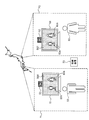
- FIG. 1 is a schematic diagram for explaining the outline of the exercise support system of the embodiment.
- users in each of a plurality of locations in the example of FIG. 1, two locations P1 and locations P2 in different regions in Japan
- remote locations By making it possible to obtain the feeling of exercising together, it is possible to strongly motivate each user to exercise.
- exercise in the present specification refers to a movement of the body which is moved by mainly the fingers while maintaining a specific posture (such as sitting or standing) as when operating a game controller. Rather, it refers to relatively large movements such as moving the upper body, moving the lower body, moving the arms, moving the legs, and jumping.
- the exercise support system shown in FIG. 1 includes a pair of a television 51 and an imaging unit 52 installed at a location P1, a pair of a television 61 and an imaging unit 62 installed at a location P2, and a control device 30 that controls the entire system.
- the image capturing unit 52 installed in the place P1 is installed in a state in which the user 50 observing the display surface of the television 51 can capture an image.
- the imaging unit 62 installed in the place P2 is installed in a state in which the user 60 who observes the display surface of the television 61 can capture an image.
- the control device 30 is configured to be able to acquire captured images captured by the image capturing units 52 and 62, and further to be able to control images to be displayed on the televisions 51 and 61.
- the control device 30 can communicate with a smartphone owned by the user 50, and the smartphone is communicatively connected to the television 51 and the imaging unit 52.
- the control device 30 can communicate with a smartphone owned by the user 60, and the smartphone is communicatively connected to the television 61 and the imaging unit 62.
- the control device 30 acquires an captured image obtained by imaging a range including the user 50 by the imaging unit 52, and trims the whole body image 50A which is an image of the entire body of the user 50 from the captured image. .. Further, the control device 30 acquires a captured image obtained by imaging a range including the user 60 by the imaging unit 62, and obtains a whole body image 60A which is an image of the entire body of the user 60 from the captured image. Trim. Then, the control device 30 generates a composite image in which the whole body images 50A and 60A are superimposed on the background image BG1. The processing up to this point is repeated. The control device 30 causes the television 51 and the television 61 to display the composite images sequentially generated by this processing.
- the control device 30 provides information for prompting the start of exercise from each of the television 51 and the television 61 as information output devices.
- the output is controlled at substantially the same timing.
- Outputting information from the information output device means that if the information output device is, for example, a speaker that outputs sound, a sound based on the information is output from the speaker. If the information output device is a display that outputs (displays) an image, for example, it means to display at least one of a character and an image based on the information on the display.
- the information for urging the start of exercise is specifically determined according to the information of the message urging the start of exercise (for example, a voice message such as "let's start exercising” or a text message), music or voice.
- Sound information such as music and voice used when performing an exercise that takes a fixed posture (for example, Tai chi, yoga, radio exercise, trendy dance, rehabilitation, etc., also referred to below as regular exercise), exercise It includes information on moving images including moving objects to form a trigger for the game, information on game screens of games that can be enjoyed by changing the screen linked to the movement of the body due to exercise, and the like.
- the control device 30 controls the state shown in FIG. From each speaker of the television 51 and the television 61, a voice message such as "Let's exercise with music" is output, and then the music starts to flow. Instead of this voice message, a text message may be displayed on the composite image being displayed on the television 51 and the television 61.
- the user 50 prepares for gymnastics with a voice message played from the speaker of the television 51 as a signal, and then starts moving his/her body according to the music played from the speaker of the television 51.
- the full-body image 50A which is a photographed image of the whole body of the user 50 in the combined image displayed on the television 51 and the television 61, also changes according to the movement of the user 50.
- the user 60 prepares for gymnastics by using the voice message flowing from the speaker of the television 61 as a signal, and then starts moving his / her body according to the music played from the speaker of the television 61.
- the whole body image 60A which is a live-action image of the whole body of the user 60 in the composite image displayed on the television 51 and the television 61, also changes according to the movement of the user 60.
- the information for prompting the start of exercise is a game screen of a game
- it is displayed on each of the television 51 and the television 61 in the state shown in FIG. 1 under the control of the control device 30.
- the background image BG1 inside is changed to the game screen and the game is started.
- the character on the game screen moves in synchronization with the jump.
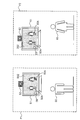
- FIGS. 2 to 6 show examples of changes in the display on the television when the information for prompting the start of exercise is a moving image including a moving body for forming the trigger of exercise.
- a moving image in which the obstacle OB moves from the left end to the right end on the screen is used.
- the moving images displayed on the television 51 and the television 61 are obtained by adding the moving obstacle OB to the background image BG2 on which the whole body image 50A and the whole body image 60A are superimposed. It has become.
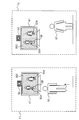
- the control device 30 detects that the user 50 has jumped by analyzing the captured image of the imaging unit 52, or acquires information such as an acceleration sensor attached to the user 50, and the user 50 uses this information to obtain information. Detects that you have jumped. Then, when it is detected that the user 50 has jumped, the superposition position of the user 50's whole body image 50A in the background image BG2 is controlled to be moved in the vertical direction and then returned to the original position. As a result, the full-body image 50A, which is a photographed image of the user 50, moves upward on the screens of the televisions 51 and 61, and the obstacle OB is avoided. After that, the screen transitions to the state shown in FIG.
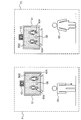
- the user 60 causes the obstacle OB displayed on the television 61 to approach the whole body image 60A of the user 60 at the timing shown in FIG. As shown in FIG. As a result, the full-body image 60A, which is a photographed image of the user 60, moves upward on the screens of the televisions 51 and 61, and thus the obstacle OB is avoided. After that, the screen transitions to the state shown in FIG. As described above, in the examples of FIGS. 2 to 6, the obstacle OB is a moving body for forming a trigger for the movement (jump) of the users 50 and 60.
- the control device 30 prompts the user 50 and the user 60 to start the exercise from the speakers or displays at the locations P1 and P2 at substantially the same timing. Information will be output.
- the user 50 and the user 60 who have started the exercise by checking the output information can perform the exercise while checking the facial expressions and the whole body of the partner displayed on the television 51 and the television 61, respectively. Therefore, each of the user 50 and the user 60 can obtain a feeling that they are exercising not by themselves but by two people. In this way, since a plurality of users work in cooperation, it is possible to increase the motivation for each user to continue the exercise. Further, according to this system, the user can enjoy exercising with other users while staying at home, which is a useful system for users who are not good at going out or who have difficulty going out.
- FIG. 7 is a diagram showing a detailed configuration example of the exercise support system shown in FIG. 7
- the exercise support system 100 shown in FIG. 7 includes a control device 30, a network 40 such as the Internet, and a client system 10 constructed at, for example, a home (corresponding to the above-mentioned location P1) of a user 50 who uses the system.
- the client system 20 is constructed, for example, at the home of the user 60 who uses it (corresponding to the above-mentioned place P2).
- the client system 10 includes a television 51, an image pickup unit 52, and a smartphone 53.
- the television 51 includes a speaker 51A and a display unit 51B capable of displaying information such as a liquid crystal display panel or an organic EL (electro-luminance) display panel.
- the television 51 can have a built-in or external communication interface for communicating with the smartphone 53.
- the image pickup unit 52 picks up a subject through an optical system and outputs a picked-up image, and is, for example, a digital camera.
- the imaging unit 52 has a built-in communication interface for communicating with the smartphone 53.
- the smartphone 53 communicates between the communication interface for communicating with the communication interface of the imaging unit 52, the communication interface for communicating with the communication interface of the television 51, and the network 40. And a communication interface for communication.
- the smartphone 53 is configured to be communicable with the imaging unit 52 and the television 51 via the communication unit 53B, and to be communicable with the control device 30 via the network 40.
- the control unit 53A of the smartphone 53 includes a CPU (Central Processing Unit), a RAM (Random Access Memory), a ROM (Read Only Memory), and the like.
- a dedicated application distributed by the administrator of the exercise support system 100 is installed in the ROM.
- the client system 20 includes a television 61, an image pickup unit 62, and a smartphone 63.
- the television 61 includes a speaker 61A and a display unit 61B capable of displaying information such as a liquid crystal display panel or an organic EL display panel. Although illustration is omitted, the television 61 can have a built-in or external communication interface for communicating with the smartphone 63.
- the image pickup unit 62 picks up a subject through an optical system and outputs a picked-up image, and is, for example, a digital camera.
- the imaging unit 62 has a built-in communication interface for communicating with the smartphone 63.
- the smartphone 63 communicates between the communication interface for communicating with the communication interface of the imaging unit 62, the communication interface for communicating with the communication interface of the television 61, and the network 40. And a communication interface for communication.
- the smartphone 63 is configured to be communicable with the imaging unit 62 and the television 61 via the communication unit 63B, and to be communicable with the control device 30 via the network 40.
- the control unit 63A of the smartphone 63 includes a CPU (Central Processing Unit), a RAM (Random Access Memory), a ROM (Read Only Memory), and the like.
- the dedicated application described above is installed in the ROM.
- the control device 30 is a computer such as a server, which includes a CPU, a RAM, a ROM, and the like, and performs overall control of the entire system according to a program. Programs including an exercise support program are stored in this ROM. Further, this ROM stores in advance various information to be displayed on the television 51 and the television 61.
- the control device 30 constitutes an exercise support device.
- FIG. 8 is a diagram showing functional blocks of the control device 30 of the exercise support system 100 shown in FIG. 7.
- the CPU of the control device 30 executes the above-mentioned exercise support program stored in the ROM and cooperates with the smartphones 53 and 63 that execute the above-mentioned dedicated application, so that the image acquisition unit 311, the display control unit 312, And functions as the output control unit 313.
- the image acquisition unit 311 sets a user existing in the place where the client system is constructed as a client. Processing is performed to acquire a full-body image that is an image of the whole body of the user in the captured image obtained by the imaging unit included in the system.
- the image acquisition unit 311 acquires, via the smartphone 53, a captured image obtained by capturing the user 50 by the image capturing unit 52, and trims the whole-body image of the user 50 from the captured image. Acquires a full-body image of the user 50.
- the image acquisition unit 311 acquires a captured image obtained by capturing the user 60 by the image capturing unit 62 via the smartphone 63, and trims a full-body image of the user 60 from the captured image, The whole body image of the user 60 is acquired.
- the whole-body image does not have to completely match the whole body of the person, and may be an image including the whole body of the person and having a wider range than the whole body.
- the display control unit 312 controls the display units of all client systems to display the full-body image of each user acquired by the above-described processing performed on each client system.
- the display control unit 312 displays the image including the whole body image of the user 50 and the whole body image of the user 60 acquired by the image acquisition unit 311 in the display unit 51B of the client system 10 and the display unit 61B of the client system 20. And, control to display in.
- the display control unit 312 transmits the image to be displayed to the smartphones 53 and 63, and instructs the smartphones 53 and 63 to output this image to the televisions 51 and 61.
- the smartphones 53 and 63 output an image to the television, and the image is displayed on the television.
- the output control unit 313 displays on the display unit 51B and the display unit 61B an image including the whole-body image of each user, and at least one of the speaker and the display unit of each client system. , Outputs information for prompting the start of exercise at substantially the same timing.
- the output control unit 313 transmits information for prompting the start of exercise to the smartphone 53 of the client system 10 to instruct the transfer of this information, and starts the exercise to the smartphone 63 of the client system 20. At the same time, the process of transmitting the information for prompting the request and instructing the transfer of this information is performed.
- Information for urging the start of exercise is transmitted from the smartphone 53 that receives this instruction to the television 51, and based on this information, a voice message, a text message, music, and a moving image are transmitted from at least one of the speaker 51A and the display unit 51B. Etc. will be output. Further, the smartphone 63 that receives this instruction transmits information for prompting the start of exercise to the television 61, and based on this information, a voice message, a text message, and music are transmitted from at least one of the speaker 61A and the display unit 61B. , A video, etc. will be output.
- FIG. 9 is a sequence chart for explaining an operation example of the exercise support system 100 shown in FIG. 7.
- the user 50 connects the smartphone 53 to the image capturing unit 52 and the television 51, and launches a dedicated application on the smartphone 53.
- the user 60 connects the smartphone 63 to the image capturing unit 62 and the television 61, and launches a dedicated application on the smartphone 63.
- the dedicated application is activated, the smartphone 53 and the smartphone 63 are connected to the control device 30.
- the smartphone 53 starts acquiring the captured image (referred to as the captured image Ga) from the imaging unit 52 (step S1). Then, the smartphone 53 transmits the acquired captured image Ga to the control device 30 (step S2).
- the smartphone 63 starts acquisition of a captured image (referred to as a captured image Gb) from the image capturing unit 62 (step S3). Then, the smartphone 63 transmits the acquired captured image Gb to the control device 30 (step S4).
- a captured image Gb a captured image from the image capturing unit 62
- the control device 30 When receiving the captured image Ga, the control device 30 detects the person (that is, the user 50) included in the captured image Ga and cuts out the whole body image Ga1 which is an image of the entire body of the detected person (step S5). ..
- the control device 30 receives the captured image Gb, the control device 30 detects the person (that is, the user 60) included in the captured image Gb, and cuts out the whole body image Gb1 which is an image of the entire body of the detected person (step). S6).
- the control device 30 reads the background image stored in the ROM and generates a composite image in which the whole body image Ga1 and the whole body image Gb1 are superimposed at different positions in this background image (step S5).
- This background image is an arbitrary image such as a landscape image.
- control device 30 transmits the composite image generated in step S7 to the smartphone 53 (step S8), and gives an instruction to display the composite image on the display unit 51B.
- the smartphone 53 that receives this instruction outputs the composite image to the television 51. Then, the composite image is displayed on the display unit 51B (step S9).
- control device 30 transmits the composite image generated in step S7 to the smartphone 63 (step S10) and gives an instruction to display the composite image on the display unit 61B.
- the smartphone 63 that receives this instruction outputs the composite image to the television 61. Then, the composite image is displayed on the display unit 61B (step S11).
- control device 30 transmits the above-described sound information to the smartphone 53 and the smartphone 63 as information for prompting the start of exercise (step S12), and the sound information is transmitted to the speaker 51A. An instruction is given to output from the speaker 51A.
- the smartphone 53 Upon receiving this instruction, the smartphone 53 outputs sound information to the speaker 51A, and the speaker 51A notifies the user 50 of the exercise start signal (step S13).
- the smartphone 63 that has received this instruction outputs sound information to the speaker 61A, whereby the speaker 61A notifies the user 60 of a signal to start exercise (step S14).
- the control device 30 changes the background image in the composite image from a still image to a moving image which is information for promoting the start of exercise, and changes this moving image to the television 51.
- the screens displayed on the television 51 and the television 61 change from the state illustrated in FIG. 1 to the state illustrated in FIGS. 2 to 6.
- the background image BG1 of the screen shown in FIG. 1 is a still image such as a landscape image
- the background image BG2 of the screen shown in FIGS. 2 to 6 is a moving image of an obstacle OB moving.
- a countdown character such as "how many seconds before the start” is also displayed so that the obstacle OB starts moving when the count reaches zero. By doing so, the user can be prompted to start exercise.
- the image of the user included in the composite image is the full-body image of the user, but the image is not limited to this.
- the image of at least the face portion of the body of the user is included in the composite image.
- the image of the face portion does not have to completely match the human face, and may be an image that includes the face and is wider than the face.
- the control device 30 has assumed that the composite image including the whole body image of all the users participating in the system is displayed on the display units 51B and 61B, but the present invention is not limited to this.
- the television 51 does not have to display the whole body image 50A of the user 50 existing in the place P1
- the television 61 does not display the whole body image 60A of the user 60 existing in the place P2. It may be (see FIG. 10).
- the user 50 can obtain the sensation of exercising with the user 60.
- the user 60 can obtain a feeling of exercising with the user 50.
- the display unit of each client system does not display the full-body image of the user existing at the place where the client system is constructed, and other than that user. It may be configured such that only whole body images of all other users are displayed.
- the control device 30 has information for prompting the start of exercise, but the information is not limited to this.
- This information may be data associated with a dedicated application installed in each smartphone and stored in each smartphone.
- each smartphone receives this instruction and receives the instruction for the exercise stored in the own machine.
- the information for prompting the start is transmitted to the television, and the time lag until this information is output can be made sufficiently small.
- the screens displayed on the television 51 and the television 61 are superposed images of the background image BG1 and the whole body images 50A and 60A.
- the background image BG1 may be set individually for each display unit on which the composite image is displayed.
- the control device 30 sets the background image according to the destination of the composite image. Which background image is set may be determined by acquiring the setting information set by the user from the smartphone of the transmission destination and according to the setting information.
- the speaker 51A (or 61A) is configured to be able to communicate with the smartphone 53 (or 63) instead of using the one built in the television 51 (or 61).
- a dedicated speaker may be used.
- the television 51 (or 61) is provided with a communication interface for performing communication with the image capturing unit 52 (or 62) and the network 40, and the function performed by the smartphone 53 (or 63) (of the captured image
- the processor of the television 51 (or 61) performs acquisition, transmission of the captured image to the control device 30, reception of the composite image, display control of the composite image, output control of information for prompting the start of exercise, and the like. You may.
- the speaker 51A (or 61A), the display unit 51B (or 61B), the control unit 53A (or 63A), the communication unit 53B (or 63B), and the imaging unit 52 (or 62) are all provided in the same electronic device. May be provided (for example, a laptop computer with a camera).
- the communication unit 53B (or 63B) of this electronic device is sufficient if it has a communication interface capable of communicating with the network 40.
Landscapes
- Engineering & Computer Science (AREA)
- Multimedia (AREA)
- Human Computer Interaction (AREA)
- Health & Medical Sciences (AREA)
- General Health & Medical Sciences (AREA)
- Physical Education & Sports Medicine (AREA)
- Rehabilitation Tools (AREA)
Abstract
運動を気軽に且つ継続的に行えるようにして、利用者の健康維持に寄与することのできる運動支援装置、運動支援方法、及び運動支援プログラムを提供する。 場所P1にいるユーザ(50)の全身画像(50A)と、場所P2にいるユーザ(60)の全身画像(60A)とが、制御装置(30)の制御によって、場所P1のテレビ(51)と、場所P2のテレビ(61)とに表示される。制御装置(30)は、テレビ(51)とテレビ(61)のスピーカから、同時に運動の開始を促す音情報を出力させる。スピーカから出力された音を確認して運動を開始したユーザ(50)とユーザ(60)は、それぞれ、テレビ(51)とテレビ(61)に表示される相手の表情や全身を確認しながら運動を行うことができる。したがって、ユーザ(50)とユーザ(60)は、それぞれ、単独ではなく、(2)人で運動を行っている感覚を得ることができる。
Description
本発明は、運動支援装置、運動支援方法、運動支援プログラムに関する。
近年、加速度センサ及び角速度センサ等の体の動きを検出する動き検出センサを用いることにより、人の行動(歩行、走行、階段昇降、睡眠等)を識別したり、活動量(歩数、歩行距離、消費カロリー等)を測定したりすることのできる動作情報測定装置の開発が盛んである。
動作情報測定装置は、利用者に動作情報を提示することで、利用者の健康管理意欲を増進するものであり、毎日継続的に使用することが望まれる。そこで、活動量の情報をゲームに利用することで、装置の利用促進を図る提案がなされている。
例えば、特許文献1-3には、歩数によって電子キャラクタを成長させる歩数計が開示されている。また、特許文献4,5には、機器で測定した活動量をゲーム機に転送可能とし、ゲーム機が、転送されてきた活動量に応じてゲームパラメータを設定したり、ゲームキャラクタ育成用のデータに変換したりするシステムが開示されている。
特許文献1~5のように、動作情報に応じて電子ゲームのパラメータを制御することにより、ゲーム攻略を目的として利用者が運動するようになるため、利用者に対して運動を促進することができる。しかし、利用者によっては、単独では運動を継続することができない(飽きやすい)、外出してまで運動はしたくない、ゲームは好きではない、等といった感情を持つ人も多く存在する。また、脳卒中患者等、運動療法が必要な人も存在し、そのような人は、外出はできないにしても、日常的に体を動かすようにしておくことが望ましい。
本発明の目的は、運動を気軽に且つ継続的に行えるようにして、利用者の健康維持に寄与することのできる運動支援装置、運動支援方法、及び運動支援プログラムを提供する。
(1)
複数の場所の各々に設置された撮像部及び表示部のペアを利用して、ユーザの運動継続の支援を行う運動支援装置であって、
前記ペアが設置された前記場所に存在するユーザを当該ペアの前記撮像部により撮像して得られた撮像画像における当該ユーザの身体の少なくとも顔を含む画像を取得する処理を、前記複数の前記ペア毎に行う画像取得部と、
前記各ペアに対して行われた前記処理によって取得された前記画像を、前記複数の前記ペアのうちの当該各ペアを除く全ての前記ペアの前記表示部に表示させる制御を行う表示制御部と、
前記画像が前記表示部に表示された状態にて、前記複数の場所の各々に設置されたスピーカ又は前記表示部の少なくとも一方に、実質的に同一のタイミングにて、運動の開始を促すための情報を出力させる出力制御部と、を備える運動支援装置。
(1)によれば、例えば、ユーザaの存在する場所Aと、ユーザbの存在する場所Bと、にそれぞれペアが設置されるケースを想定すると、画像取得部によって、ユーザaの少なくとも顔の画像が取得されて、この画像が場所Bに設置されている表示部に表示される。また、画像取得部によって、ユーザbの少なくとも顔の画像が取得されて、この画像が場所Aに設置されている表示部に表示される。そして、出力制御部の制御によって、場所Aと場所Bとにあるスピーカ又は表示部から、実質的に同一のタイミングにて、ユーザaとユーザbに運動の開始を促すための情報が出力されることになる。この出力された情報を受けて運動を開始したユーザaとユーザbは、それぞれ、表示部に表示される相手の表情を確認しながら運動を行うことができる。したがって、ユーザaとユーザbは、それぞれ、単独ではなく、2人で運動を行っている感覚を得ることができる。このように、複数ユーザが協働して運動するようになることで、各ユーザの運動継続のモチベーションを高めることが可能となる。
(2)
(1)記載の運動支援装置であって、
前記表示制御部は、前記各ペアに対して行われた前記処理によって取得された前記画像を、当該各ペアの前記表示部にも表示させる制御を行う運動支援装置。
(1)記載の運動支援装置であって、
前記表示制御部は、前記各ペアに対して行われた前記処理によって取得された前記画像を、当該各ペアの前記表示部にも表示させる制御を行う運動支援装置。
(2)によれば、上記ケースであれば、ユーザaとユーザbは、それぞれ、表示部にて、自身と相手の両方の画像を見ながら運動を行うことができる。例えば、運動を促す情報の出力に応答して、各ユーザが、振り付け又はポーズ等が予め決められた体操(例えば、太極拳、ヨガ、ラジオ体操、流行りのダンス等)を行う場合を想定する。この場合には、各ユーザは、表示部に表示される全ユーザの動きを確認することが可能になるため、参加するユーザ全員がシンクロする様子を楽しむことができる。換言すると、多くのユーザが実際に同一場所に集まって運動をしている感覚を得ることができる。また、自身と他の人との動きのずれを容易に確認できるため、動きの修正を行うことも容易となる。このように、複数のユーザがシンクロして運動する感覚を得られるようになることで、各ユーザの運動継続のモチベーションを高めることが可能となる。
(3)
(1)又は(2)記載の運動支援装置であって、
前記画像取得部は、前記処理において、前記撮像画像における前記ユーザの身体の全体の画像を取得する運動支援装置。
(1)又は(2)記載の運動支援装置であって、
前記画像取得部は、前記処理において、前記撮像画像における前記ユーザの身体の全体の画像を取得する運動支援装置。
(3)によれば、各ユーザは、他ユーザの全身を表示部にて確認できる。そのため、複数のユーザと運動している感覚をよりリアルに味わうことができ、運動のモチベーションをより高めることができる。
(4)
(1)から(3)のいずれか1つに記載の運動支援装置であって、
前記運動の開始を促すための情報は、運動を行う際に用いられる音情報であり、
前記出力制御部は、前記スピーカから前記音情報を出力させる運動支援装置。
(1)から(3)のいずれか1つに記載の運動支援装置であって、
前記運動の開始を促すための情報は、運動を行う際に用いられる音情報であり、
前記出力制御部は、前記スピーカから前記音情報を出力させる運動支援装置。
(5)
(1)から(4)のいずれか1つに記載の運動支援装置であって、
前記表示制御部は、前記各ペアの前記表示部において、前記画像の背景画像を更に表示させ、
前記背景画像は、前記表示部毎に個別に設定が可能である運動支援装置。
(1)から(4)のいずれか1つに記載の運動支援装置であって、
前記表示制御部は、前記各ペアの前記表示部において、前記画像の背景画像を更に表示させ、
前記背景画像は、前記表示部毎に個別に設定が可能である運動支援装置。
(5)によれば、各表示部には、背景画像とユーザの画像とが表示されることになる。例えば、スピーカから出力される音楽に合わせて複数のユーザにて同一の体操を行う場合には、各ユーザの好みの背景画像を設定できることで、飽きにくい運動体験をユーザに提供することが可能となる。
(6)
(1)から(3)のいずれか1つに記載の運動支援装置であって、
前記運動の開始を促すための情報は、運動のきっかけを形成するための動体を含む動画であり、
前記出力制御部は、前記表示部に前記動画を表示させる運動支援装置。
(1)から(3)のいずれか1つに記載の運動支援装置であって、
前記運動の開始を促すための情報は、運動のきっかけを形成するための動体を含む動画であり、
前記出力制御部は、前記表示部に前記動画を表示させる運動支援装置。
(6)によれば、表示部に表示される動体の動きによって、ユーザに運動を促すことができる。例えば、表示部に、端から端まで移動する物体を含む動画を表示させた場合には、この物体がユーザの画像の近くにきたときに、そのユーザがジャンプする動作を行うと、そのユーザの画像もその物体を避ける位置に移動する。このようにして、物体を避ける感覚を疑似的にユーザに与えることができる。このように、表示部に表示される動画に合わせた運動を複数人で協働して行えることで、より楽しい運動体験をユーザに提供可能になる。
(7)
複数の場所の各々に設置された撮像部及び表示部のペアを利用して、ユーザの運動継続の支援を行う運動支援方法であって、
前記ペアが設置された前記場所に存在するユーザを当該ペアの前記撮像部により撮像して得られた撮像画像における当該ユーザの身体の少なくとも顔を含む画像を取得する処理を、前記複数の前記ペア毎に行う画像取得ステップと、
前記各ペアに対して行われた前記処理によって取得された前記画像を、前記複数の前記ペアのうちの当該各ペアを除く全ての前記ペアの前記表示部に表示させる制御を行う表示制御ステップと、
前記画像が前記表示部に表示された状態にて、前記複数の場所の各々に設置されたスピーカ又は前記表示部の少なくとも一方に、実質的に同一のタイミングにて、運動の開始を促すための情報を出力させる出力制御ステップと、を備える運動支援方法。
(8)
複数の場所の各々に設置された撮像部及び表示部のペアを利用して、ユーザの運動継続の支援を行う運動支援プログラムであって、
前記ペアが設置された前記場所に存在するユーザを当該ペアの前記撮像部により撮像して得られた撮像画像における当該ユーザの身体の少なくとも顔を含む画像を取得する処理を、前記複数の前記ペア毎に行う画像取得ステップと、
前記各ペアに対して行われた前記処理によって取得された前記画像を、前記複数の前記ペアのうちの当該各ペアを除く全ての前記ペアの前記表示部に表示させる制御を行う表示制御ステップと、
前記画像が前記表示部に表示された状態にて、前記複数の場所の各々に設置されたスピーカ又は前記表示部の少なくとも一方に、実質的に同一のタイミングにて、運動の開始を促すための情報を出力させる出力制御ステップと、をコンピュータに実行させるための運動支援プログラム。
本発明によれば、運動を気軽に且つ継続的に行えるようにして、利用者の健康維持に寄与することのできる運動支援装置、運動支援方法、及び運動支援プログラムを提供することができる。
(実施形態の運動支援システムの概要)
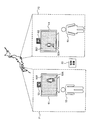
本発明の運動支援装置を含む運動支援システムの実施形態の概要について説明する。図1は、実施形態の運動支援システムの概要を説明するための模式図である。図1に示すように、運動支援システムは、複数の場所(図1の例では、日本国内において異なる地域にある2つの場所P1と場所P2)の各々にいるユーザが、遠隔地にいながらも、一緒に運動している感覚を得られるようにすることで、各ユーザに運動の動機づけを強く与えることを可能にするものである。
本発明の運動支援装置を含む運動支援システムの実施形態の概要について説明する。図1は、実施形態の運動支援システムの概要を説明するための模式図である。図1に示すように、運動支援システムは、複数の場所(図1の例では、日本国内において異なる地域にある2つの場所P1と場所P2)の各々にいるユーザが、遠隔地にいながらも、一緒に運動している感覚を得られるようにすることで、各ユーザに運動の動機づけを強く与えることを可能にするものである。
なお、本明細書における“運動”とは、ゲームコントローラを操作するときのように、特定の姿勢(座位や立位等)を維持した状態にて手指を主体として動かす程度の身体の動きを言うのではなく、上半身を動かす、下半身を動かす、腕を動かす、足を動かす、ジャンプする、等といった比較的大きな動きのことを言う。
図1に示す運動支援システムは、場所P1に設置されたテレビ51及び撮像部52のペアと、場所P2に設置されたテレビ61及び撮像部62のペアと、システム全体を統括制御する制御装置30と、を備える。場所P1に設置された撮像部52は、テレビ51の表示面を観察するユーザ50を撮像可能な状態にて設置されている。同様に、場所P2に設置された撮像部62は、テレビ61の表示面を観察するユーザ60を撮像可能な状態にて設置されている。
制御装置30は、撮像部52,62により撮像された撮像画像を取得可能に構成され、更に、テレビ51,61に表示させる画像を制御可能に構成されている。例えば、制御装置30は、ユーザ50の所持するスマートフォンと通信可能となっており、このスマートフォンが、テレビ51及び撮像部52と通信可能に接続されている。同様に、制御装置30は、ユーザ60の所持するスマートフォンと通信可能となっており、このスマートフォンが、テレビ61及び撮像部62と通信可能に接続されている。
制御装置30は、撮像部52によってユーザ50を含む範囲を撮像して得られた撮像画像を取得して、この撮像画像からユーザ50の身体の全体の部分の画像である全身画像50Aをトリミングする。また、制御装置30は、撮像部62によってユーザ60を含む範囲を撮像して得られた撮像画像を取得して、この撮像画像からユーザ60の身体の全体の部分の画像である全身画像60Aをトリミングする。そして、制御装置30は、これら全身画像50A,60Aを背景画像BG1に重畳した合成画像を生成する。ここまでの処理が繰り返し行われる。制御装置30は、この処理によって逐次生成される合成画像を、テレビ51とテレビ61にそれぞれ表示させる。
制御装置30は、テレビ51とテレビ61の各々に合成画像が表示された図1に示す状態において、運動の開始を促すための情報を、情報出力デバイスとしてのテレビ51及びテレビ61の各々から、実質的に同一のタイミングにて出力させる制御を行う。
情報出力デバイスから情報を出力させるとは、情報出力デバイスが例えば音を出力するスピーカであれば、その情報に基づく音をスピーカから出力させることを言う。また、情報出力デバイスが例えば画像を出力(表示)するディスプレイであれば、その情報に基づく文字又は画像の少なくとも一方をディスプレイに表示させることを言う。
運動の開始を促すための情報とは、具体的には、運動の開始を促すメッセージ(例えば、“運動を始めましょう”等の音声メッセージ又は文字メッセージ)の情報、音楽や声に合わせて決められた姿勢を取る運動(例えば、太極拳、ヨガ、ラジオ体操、流行りのダンス、リハビリ等であり、以下では、規則運動とも言う)を行う際に用いられるその音楽や声等の音情報、運動のきっかけを形成するための動体を含む動画の情報、運動による身体の動きにリンクして画面が変化することで楽しむことのできるゲームのゲーム画面の情報等を含む。
例えば、運動の開始を促すための情報が、規則運動を行う際に用いられる音楽及び声等の音情報である場合を例にすると、制御装置30の制御により、図1に示す状態にて、テレビ51とテレビ61の各々のスピーカからは、“さあ音楽に合わせて体操しましょう”といった音声メッセージが出力され、その後、音楽が流れ始める。なお、この音声メッセージの代わりに、テレビ51とテレビ61に表示中の合成画像上に、文字メッセージを表示させてもよい。
ユーザ50は、テレビ51のスピーカから流れる音声メッセージを合図として、体操の準備を行い、その後に、テレビ51のスピーカから流れる音楽にしたがって、自身の身体を動かし始める。ユーザ50が身体を動かすと、テレビ51とテレビ61に表示中の合成画像におけるユーザ50の全身の実写画像である全身画像50Aも、ユーザ50の動きに応じて変化することになる。
同様に、ユーザ60は、テレビ61のスピーカから流れる音声メッセージを合図として、体操の準備を行い、その後に、テレビ61のスピーカから流れる音楽にしたがって、自身の身体を動かし始める。ユーザ60が身体を動かすと、テレビ51とテレビ61に表示中の合成画像におけるユーザ60の全身の実写画像である全身画像60Aも、ユーザ60の動きに応じて変化することになる。
また、例えば、運動の開始を促すための情報が、ゲームのゲーム画面である場合を例にすると、制御装置30の制御により、図1に示す状態にて、テレビ51とテレビ61の各々に表示中の背景画像BG1がゲーム画面に変更されてゲームが開始される。このゲームは、例えば、ユーザ50とユーザ60がそれぞれトランポリンで飛び跳ねると、その飛び跳ねに同期して、ゲーム画面上のキャラクタが動くといった内容のゲームである。
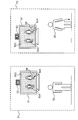
図2から図6は、運動の開始を促すための情報が、運動のきっかけを形成するための動体を含む動画である場合におけるテレビの表示の変化例を示している。図2から図6の例では、この動画として、障害物OBが画面上を左端から右端へと移動する動画が用いられている。図2から図6に示した例において、テレビ51とテレビ61に表示される動画は、全身画像50A及び全身画像60Aが重畳される背景画像BG2に、移動する障害物OBが追加されたものとなっている。
まず、制御装置30の制御により、図2に示す状態にて、テレビ51とテレビ61の各々のスピーカからは、“画面を見ながら、自身の位置に障害物がきたタイミングにて、この障害部を避けるべくジャンプを行いましょう”といった音声メッセージが出力され、その後、テレビ51とテレビ61にて動画が再生される。この音声メッセージの代わりに、動画の中に文字メッセージを含ませておいて、テレビ51とテレビ61にて表示させることで運動の説明を行ってもよい。
動画が再生されると、テレビ51とテレビ61に表示される障害物OBは、左から右へと移動していく。ユーザ50は、テレビ51に表示されている障害物OBが自身の全身画像50Aに近づいたタイミングにて、図3に示すように、ジャンプする動作を行う。制御装置30は、例えば、撮像部52の撮像画像の解析によってユーザ50がジャンプしたことを検出したり、ユーザ50に装着された加速度センサ等の情報を取得し、この情報に基づいてユーザ50がジャンプしたことを検出したりする。そして、ユーザ50がジャンプしたことを検出した場合には、ユーザ50の全身画像50Aの背景画像BG2における重畳位置を、垂直方向に移動させてから元に戻す制御を行う。これにより、ユーザ50の実写画像である全身画像50Aは、テレビ51,61の画面にて、上に移動することで、障害物OBを避けた状態になる。その後は、図4に示す状態に画面が遷移する。
図4に示す状態から障害物OBが更に移動して全身画像60Aに接近すると、ユーザ60は、テレビ61に表示されている障害物OBが自身の全身画像60Aに近づいたタイミングにて、図5に示すように、ジャンプする動作を行う。これにより、ユーザ60の実写画像である全身画像60Aは、テレビ51,61の画面にて上に移動することで、障害物OBを避けた状態になる。その後は、図6に示す状態に画面が遷移する。このように、図2から図6の例では、障害物OBが、ユーザ50,60の運動(ジャンプ)のきっかけを形成するための動体となっている。
以上の運動支援システムによれば、制御装置30の制御によって、場所P1と場所P2とにあるスピーカ又はディスプレイから、実質的に同一のタイミングにて、ユーザ50とユーザ60に運動の開始を促すための情報が出力されることになる。この出力された情報を確認して運動を開始したユーザ50とユーザ60は、それぞれ、テレビ51とテレビ61に表示される相手の表情や全身を確認しながら運動を行うことができる。したがって、ユーザ50とユーザ60は、それぞれ、単独ではなく、2人で運動を行っている感覚を得ることができる。このように、複数のユーザが協働して運動するようになることで、各ユーザの運動継続のモチベーションを高めることが可能となる。また、このシステムによれば、ユーザは自宅にいながら他のユーザとの運動を楽しむことができるため、外出が苦手なユーザや、外出が困難なユーザにとって有用なシステムとなる。
(実施形態の運動支援システムの具体的構成)
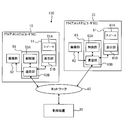
以下、図1に示した運動支援システムの詳細構成例について説明する。図7は、図1に示す運動支援システムの詳細構成例を示す図である。図7に示す運動支援システム100は、制御装置30と、インターネット等のネットワーク40と、システムを利用するユーザ50の例えば自宅(上述した場所P1に相当)に構築されたクライアントシステム10と、システムを利用するユーザ60の例えば自宅(上述した場所P2に相当)に構築されたクライアントシステム20と、を備える。
以下、図1に示した運動支援システムの詳細構成例について説明する。図7は、図1に示す運動支援システムの詳細構成例を示す図である。図7に示す運動支援システム100は、制御装置30と、インターネット等のネットワーク40と、システムを利用するユーザ50の例えば自宅(上述した場所P1に相当)に構築されたクライアントシステム10と、システムを利用するユーザ60の例えば自宅(上述した場所P2に相当)に構築されたクライアントシステム20と、を備える。
クライアントシステム10は、テレビ51と、撮像部52と、スマートフォン53と、を備える。
テレビ51は、スピーカ51Aと、液晶表示パネル又は有機EL(electro-luminescence)表示パネル等の情報を表示可能な表示部51Bと、を備える。テレビ51は、図示省略しているが、スマートフォン53と通信するための通信インタフェースを内蔵又は外付け可能となっている。
撮像部52は、光学系を通して被写体を撮像して撮像画像を出力するものであり、例えばデジタルカメラである。撮像部52は、スマートフォン53と通信するための通信インタフェースを内蔵している。
スマートフォン53は、撮像部52の通信インタフェースとの間で通信を行うための通信インタフェースと、テレビ51の通信インタフェースとの間で通信を行うための通信インタフェースと、ネットワーク40との間で通信を行うための通信インタフェースと、を含む通信部53Bを有する。スマートフォン53は、通信部53Bを介して、撮像部52及びテレビ51と通信可能に構成され、ネットワーク40を介して制御装置30と通信可能に構成されている。
スマートフォン53の制御部53Aは、CPU(Central Processing Unit)、RAM(Random Access Memory)、及びROM(Read Only Memory)等を含む。ROMには、運動支援システム100の管理者から配布された専用アプリがインストールされている。
クライアントシステム20は、テレビ61と、撮像部62と、スマートフォン63と、を備える。
テレビ61は、スピーカ61Aと、液晶表示パネル又は有機EL表示パネル等の情報を表示可能な表示部61Bと、を備える。テレビ61は、図示省略しているが、スマートフォン63と通信するための通信インタフェースを内蔵又は外付け可能となっている。
撮像部62は、光学系を通して被写体を撮像して撮像画像を出力するものであり、例えばデジタルカメラである。撮像部62は、スマートフォン63と通信するための通信インタフェースを内蔵している。
スマートフォン63は、撮像部62の通信インタフェースとの間で通信を行うための通信インタフェースと、テレビ61の通信インタフェースとの間で通信を行うための通信インタフェースと、ネットワーク40との間で通信を行うための通信インタフェースと、を含む通信部63Bを有する。スマートフォン63は、通信部63Bを介して、撮像部62及びテレビ61と通信可能に構成され、ネットワーク40を介して制御装置30と通信可能に構成されている。
スマートフォン63の制御部63Aは、CPU(Central Processing Unit)、RAM(Random Access Memory)、及びROM(Read Only Memory)等を含む。ROMには、上述した専用アプリがインストールされている。
制御装置30は、サーバ等のコンピュータであり、CPU、RAM、及びROM等を含み、プログラムにしたがってシステム全体の統括制御等を行う。このROMには、運動支援プログラムを含むプログラムが記憶されている。また、このROMには、テレビ51及びテレビ61に表示させるための各種の情報が予め記憶されている。制御装置30は、運動支援装置を構成している。
(制御装置30の機能)
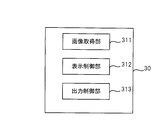
図8は、図7に示す運動支援システム100の制御装置30の機能ブロックを示す図である。制御装置30のCPUは、ROMに記憶された上記の運動支援プログラムを実行して、上述した専用アプリを実行したスマートフォン53,63と協働することにより、画像取得部311、表示制御部312、及び出力制御部313として機能する。
図8は、図7に示す運動支援システム100の制御装置30の機能ブロックを示す図である。制御装置30のCPUは、ROMに記憶された上記の運動支援プログラムを実行して、上述した専用アプリを実行したスマートフォン53,63と協働することにより、画像取得部311、表示制御部312、及び出力制御部313として機能する。
画像取得部311は、運動支援システム100に含まれるクライアントシステム(図7の例では、クライアントシステム10とクライアントシステム20の2つ)毎に、クライアントシステムが構築された場所に存在するユーザをそのクライアントシステムに含まれる撮像部により撮像して得られた撮像画像における当該ユーザの身体の全身の部分の画像である全身画像を取得する処理を行う。
具体的には、画像取得部311は、撮像部52によりユーザ50を撮像して得られた撮像画像を、スマートフォン53を介して取得し、この撮像画像から、ユーザ50の全身画像をトリミングすることによって、ユーザ50の全身画像の取得を行う。同様に、画像取得部311は、撮像部62によりユーザ60を撮像して得られた撮像画像を、スマートフォン63を介して取得し、この撮像画像から、ユーザ60の全身画像をトリミングすることによって、ユーザ60の全身画像の取得を行う。なお、全身画像は、人の全身と完全に一致していなくてもよく、人の全身を含み且つこの全身よりも広い範囲の画像であってもよい。
表示制御部312は、各クライアントシステムに対して行われる上記処理によって取得されたユーザ毎の全身画像を、全てのクライアントシステムにおける表示部に表示させる制御を行う。
具体的には、表示制御部312は、画像取得部311によって取得したユーザ50の全身画像及びユーザ60の全身画像を含む画像を、クライアントシステム10の表示部51Bと、クライアントシステム20の表示部61Bと、に表示させる制御を行う。表示制御部312は、表示させる対象となる画像をスマートフォン53,63に送信し、スマートフォン53,63に対してこの画像のテレビ51,61への出力を指示する。この指示に応じてスマートフォン53,63から画像がテレビに出力されて、この画像がテレビに表示されることになる。
出力制御部313は、表示制御部312の制御により、各ユーザの全身画像を含む画像が表示部51B及び表示部61Bに表示された状態にて、各クライアントシステムにおけるスピーカ又は表示部の少なくとも一方に、実質的に同一のタイミングにて、運動の開始を促すための情報を出力させる。
具体的には、出力制御部313は、クライアントシステム10のスマートフォン53に運動の開始を促すための情報を送信してこの情報の転送を指示する処理と、クライアントシステム20のスマートフォン63に運動の開始を促すための情報を送信してこの情報の転送を指示する処理とを、同時に行う。
この指示を受けたスマートフォン53から、運動の開始を促すための情報がテレビ51に送信され、この情報に基づいて、スピーカ51A又は表示部51Bの少なくとも一方から、音声メッセージ、文字メッセージ、音楽、動画等が出力されることになる。また、この指示を受けたスマートフォン63から、運動の開始を促すための情報がテレビ61に送信され、この情報に基づいて、スピーカ61A又は表示部61Bの少なくとも一方から、音声メッセージ、文字メッセージ、音楽、動画等が出力されることになる。
スマートフォン53,63における制御装置30からの情報の受信タイムラグと、スマートフォン53,63における演算処理能力やテレビとの通信速度の差とに起因する時間差は存在し得るものの、この時間差は無視できるほどに小さい。したがって、テレビ51にて運動の開始を促すための情報が出力されるタイミングと、テレビ61にて運動の開始を促すための情報が出力されるタイミングとは、これらの時間差を除けば同一(即ち、実質的に同一)となる。
(運動支援システムの動作例)
図9は、図7に示す運動支援システム100の動作例を説明するためのシーケンスチャートである。ユーザ50は、スマートフォン53と撮像部52及びテレビ51とを接続し、スマートフォン53にて専用アプリを立ち上げる。また、ユーザ60は、スマートフォン63と撮像部62及びテレビ61とを接続し、スマートフォン63にて専用アプリを立ち上げる。専用アプリが起動することで、スマートフォン53とスマートフォン63は制御装置30に接続される。
図9は、図7に示す運動支援システム100の動作例を説明するためのシーケンスチャートである。ユーザ50は、スマートフォン53と撮像部52及びテレビ51とを接続し、スマートフォン53にて専用アプリを立ち上げる。また、ユーザ60は、スマートフォン63と撮像部62及びテレビ61とを接続し、スマートフォン63にて専用アプリを立ち上げる。専用アプリが起動することで、スマートフォン53とスマートフォン63は制御装置30に接続される。
そして、ユーザ50が、専用アプリ上にて運動の準備開始操作を行うと、スマートフォン53は、撮像部52から撮像画像(撮像画像Gaとする)の取得を開始する(ステップS1)。そして、スマートフォン53は、取得した撮像画像Gaを制御装置30に送信する(ステップS2)。
同様にして、ユーザ60が、専用アプリ上にて運動の準備開始操作を行うと、スマートフォン63は、撮像部62から撮像画像(撮像画像Gbとする)の取得を開始する(ステップS3)。そして、スマートフォン63は、取得した撮像画像Gbを制御装置30に送信する(ステップS4)。
制御装置30は、撮像画像Gaを受信すると、撮像画像Gaに含まれる人(すなわちユーザ50)を検出し、検出した人の身体の全体部分の画像である全身画像Ga1を切出す(ステップS5)。また、制御装置30は、撮像画像Gbを受信すると、撮像画像Gbに含まれる人(すなわちユーザ60)を検出し、検出した人の身体の全体部分の画像である全身画像Gb1を切出す(ステップS6)。
ステップS5及びステップS6の後、制御装置30は、ROMに記憶されている背景画像を読み出し、この背景画像における異なる位置に、全身画像Ga1と全身画像Gb1を重畳させた合成画像を生成する(ステップS7)。この背景画像は、例えば風景画等の任意の画像である。
その後、制御装置30は、ステップS7にて生成した合成画像をスマートフォン53に送信し(ステップS8)、この合成画像を表示部51Bに表示させる指示を行う。この指示を受けたスマートフォン53は、テレビ51に合成画像を出力する。そして、表示部51Bにて合成画像が表示される(ステップS9)。
また、制御装置30は、ステップS7にて生成した合成画像をスマートフォン63に送信し(ステップS10)、この合成画像を表示部61Bに表示させる指示を行う。この指示を受けたスマートフォン63は、テレビ61に合成画像を出力する。そして、表示部61Bにて合成画像が表示される(ステップS11)。
ステップS9及びステップS11の後、制御装置30は、運動の開始を促すための情報として、上述した音情報を、スマートフォン53とスマートフォン63とに送信し(ステップS12)、この音情報をスピーカ51Aとスピーカ51Aから出力させる指示を行う。
この指示を受けたスマートフォン53は、音情報をスピーカ51Aに出力し、これによりスピーカ51Aから運動開始の合図がユーザ50に通知される(ステップS13)。また、この指示を受けたスマートフォン63は、音情報をスピーカ61Aに出力し、これによりスピーカ61Aから運動開始の合図がユーザ60に通知される(ステップS14)。
(運動支援システム100の効果)
以上のように、運動支援システム100によれば、制御装置30の制御によって、ユーザ50の自宅にあるテレビ51のスピーカ51Aと、ユーザ60の自宅にあるテレビ61のスピーカ61Aと、から、実質的に同一のタイミングにて、ユーザ50とユーザ60に運動を促すための音情報が出力されることになる。この出力された音情報を確認して運動を開始したユーザ50とユーザ60は、それぞれ、テレビ51とテレビ61に表示される相手の表情や全身を確認しながら運動を行うことができる。したがって、ユーザ50とユーザ60は、それぞれ、単独ではなく、2人で運動を行っている感覚をリアルに得ることができる。このように、複数のユーザが協働して運動するようになることで、各ユーザの運動継続のモチベーションを高めることが可能となる。
以上のように、運動支援システム100によれば、制御装置30の制御によって、ユーザ50の自宅にあるテレビ51のスピーカ51Aと、ユーザ60の自宅にあるテレビ61のスピーカ61Aと、から、実質的に同一のタイミングにて、ユーザ50とユーザ60に運動を促すための音情報が出力されることになる。この出力された音情報を確認して運動を開始したユーザ50とユーザ60は、それぞれ、テレビ51とテレビ61に表示される相手の表情や全身を確認しながら運動を行うことができる。したがって、ユーザ50とユーザ60は、それぞれ、単独ではなく、2人で運動を行っている感覚をリアルに得ることができる。このように、複数のユーザが協働して運動するようになることで、各ユーザの運動継続のモチベーションを高めることが可能となる。
(変形例)
図9において、ステップS9及びステップS11の後、制御装置30は、合成画像における背景画像を、静止画から、運動の開始を促すための情報である動画に変更して、この動画をテレビ51とテレビ61に表示させる制御を行ってもよい。これにより、テレビ51とテレビ61に表示される画面は、図1に例示した状態から、図2から図6に例示した状態へと変化する。図1に示す画面の背景画像BG1は風景画などの静止画となっており、図2から図6に示す画面の背景画像BG2は、障害物OBが動く動画となっている。この動画には、例えば、“スタートまで何秒前”といったカウントダウンの文字も併せて表示しておき、カウントがゼロになると障害物OBが移動を開始するようにする。こうすることで、ユーザに運動開始を促すことができる。
図9において、ステップS9及びステップS11の後、制御装置30は、合成画像における背景画像を、静止画から、運動の開始を促すための情報である動画に変更して、この動画をテレビ51とテレビ61に表示させる制御を行ってもよい。これにより、テレビ51とテレビ61に表示される画面は、図1に例示した状態から、図2から図6に例示した状態へと変化する。図1に示す画面の背景画像BG1は風景画などの静止画となっており、図2から図6に示す画面の背景画像BG2は、障害物OBが動く動画となっている。この動画には、例えば、“スタートまで何秒前”といったカウントダウンの文字も併せて表示しておき、カウントがゼロになると障害物OBが移動を開始するようにする。こうすることで、ユーザに運動開始を促すことができる。
ここまでの説明では、合成画像に含まれるユーザの画像を、そのユーザの全身画像としたが、これに限らない。複数人にて運動している感覚を得るという目的からすれば、ユーザの身体のうち少なくとも顔の部分の画像が合成画像に含まれていればよい。なお、この顔の部分の画像は、人の顔と完全に一致していなくてもよく、顔を含み且つ顔よりも広い範囲の画像であってもよい。
また、ここまでの説明では、制御装置30が、システムに参加している全ユーザの全身画像を含む合成画像を、各表示部51B,61Bに表示させるものとしたが、これに限らない。例えば、図1において、テレビ51には、場所P1に存在するユーザ50の全身画像50Aを表示させなくてもよく、テレビ61には、場所P2に存在するユーザ60の全身画像60Aを表示させなくてもよい(図10参照)。図10の例であっても、ユーザ50は、ユーザ60と一緒に運動する感覚は得ることができる。また、ユーザ60は、ユーザ50と一緒に運動する感覚は得ることができる。
クライアントシステムが3つ以上ある場合でも同様であり、この場合には、各クライアントシステムにおける表示部には、そのクライアントシステムが構築された場所に存在するユーザの全身画像は表示されず、そのユーザ以外の他の全ユーザの全身画像のみが表示される構成としてもよい。
また、ここまでの説明では、運動の開始を促すための情報を制御装置30が持つものとしたが、これに限らない。この情報を、各スマートフォンにインストールされる専用アプリに付随するデータとし、各スマートフォンに記憶されるようにしてもよい。この場合には、制御装置30から、運動の開始を促すための情報の出力指示が各スマートフォンに一斉送信されると、各スマートフォンが、この指示を受けて、自機に記憶されている運動の開始を促すための情報をテレビに送信することになり、この情報が出力されるまでのタイムラグを充分に小さくすることができる。
図1に示す例では、テレビ51とテレビ61に表示される画面が、背景画像BG1と全身画像50A,60Aとの重畳画像となっている。この背景画像BG1は、合成画像が表示される表示部毎に個別に設定できるようにしてもよい。例えば、制御装置30は、図9のステップS7にて合成画像を生成する際に、その合成画像の送信先に応じて、背景画像を設定する。どの背景画像を設定するかは、その送信先のスマートフォンから、ユーザによって設定された設定情報を取得し、その設定情報に従って判断すればよい。
図7に示したクライアントシステム10(又は20)において、スピーカ51A(又は61A)は、テレビ51(又は61)に内蔵されたものを用いるのではなく、スマートフォン53(又は63)と通信可能に構成された専用のスピーカを用いてもよい。
また、テレビ51(又は61)に、撮像部52(又は62)及びネットワーク40との間で通信を行うための通信インタフェースを持たせておき、スマートフォン53(又は63)が担う機能(撮像画像の取得、撮像画像の制御装置30への送信、合成画像の受信、合成画像の表示制御、運動の開始を促すための情報の出力制御等)を、テレビ51(又は61)のプロセッサが行うようにしてもよい。
また、スピーカ51A(又は61A)、表示部51B(又は61B)、制御部53A(又は63A)、通信部53B(又は63B)、及び撮像部52(又は62)が、全て同一の電子機器に設けられていてもよい(例えば、カメラ付きノートパソコン等)。この場合、この電子機器の通信部53B(又は63B)は、ネットワーク40との間で通信可能な通信インタフェースがあれば十分である。
以上、図面を参照しながら各種の実施の形態について説明したが、本発明はかかる例に限定されないことは言うまでもない。当業者であれば、特許請求の範囲に記載された範疇内において、各種の変更例又は修正例に想到し得ることは明らかであり、それらについても当然に本発明の技術的範囲に属するものと了解される。また、発明の趣旨を逸脱しない範囲において、上記実施の形態における各構成要素を任意に組み合わせてもよい。
なお、本出願は、2019年3月5日出願の日本特許出願(特願2019-039685)に基づくものであり、その内容は本出願の中に参照として援用される。
100 運動支援システム
P1、P2 場所
10、20 クライアントシステム
50、60 ユーザ
50A、60A 全身画像
51、61 テレビ
51A、61A スピーカ
51B、61B 表示部
52、62 撮像部
53、63 スマートフォン
53A、63A 制御部
53B、63B 通信部
30 制御装置
311 画像取得部
312 表示制御部
313 出力制御部
40 ネットワーク
BG1、BG2 背景画像
OB 障害物
P1、P2 場所
10、20 クライアントシステム
50、60 ユーザ
50A、60A 全身画像
51、61 テレビ
51A、61A スピーカ
51B、61B 表示部
52、62 撮像部
53、63 スマートフォン
53A、63A 制御部
53B、63B 通信部
30 制御装置
311 画像取得部
312 表示制御部
313 出力制御部
40 ネットワーク
BG1、BG2 背景画像
OB 障害物
Claims (8)
- 複数の場所の各々に設置された撮像部及び表示部のペアを利用して、ユーザの運動継続の支援を行う運動支援装置であって、
前記ペアが設置された前記場所に存在するユーザを当該ペアの前記撮像部により撮像して得られた撮像画像における当該ユーザの身体の少なくとも顔を含む画像を取得する処理を、前記複数の前記ペア毎に行う画像取得部と、
前記各ペアに対して行われた前記処理によって取得された前記画像を、前記複数の前記ペアのうちの当該各ペアを除く全ての前記ペアの前記表示部に表示させる制御を行う表示制御部と、
前記画像が前記表示部に表示された状態にて、前記複数の場所の各々に設置されたスピーカ又は前記表示部の少なくとも一方に、実質的に同一のタイミングにて、運動の開始を促すための情報を出力させる出力制御部と、を備える運動支援装置。 - 請求項1記載の運動支援装置であって、
前記表示制御部は、前記各ペアに対して行われた前記処理によって取得された前記画像を、当該各ペアの前記表示部にも表示させる制御を行う運動支援装置。 - 請求項1又は2記載の運動支援装置であって、
前記画像取得部は、前記処理において、前記撮像画像における前記ユーザの身体の全体の画像を取得する運動支援装置。 - 請求項1から3のいずれか1項記載の運動支援装置であって、
前記運動の開始を促すための情報は、運動を行う際に用いられる音情報であり、
前記出力制御部は、前記スピーカから前記音情報を出力させる運動支援装置。 - 請求項1から4のいずれか1項記載の運動支援装置であって、
前記表示制御部は、前記各ペアの前記表示部において、前記画像の背景画像を更に表示させ、
前記背景画像は、前記表示部毎に個別に設定が可能である運動支援装置。 - 請求項1から3のいずれか1項記載の運動支援装置であって、
前記運動の開始を促すための情報は、運動のきっかけを形成するための動体を含む動画であり、
前記出力制御部は、前記表示部に前記動画を表示させる運動支援装置。 - 複数の場所の各々に設置された撮像部及び表示部のペアを利用して、ユーザの運動継続の支援を行う運動支援方法であって、
前記ペアが設置された前記場所に存在するユーザを当該ペアの前記撮像部により撮像して得られた撮像画像における当該ユーザの身体の少なくとも顔を含む画像を取得する処理を、前記複数の前記ペア毎に行う画像取得ステップと、
前記各ペアに対して行われた前記処理によって取得された前記画像を、前記複数の前記ペアのうちの当該各ペアを除く全ての前記ペアの前記表示部に表示させる制御を行う表示制御ステップと、
前記画像が前記表示部に表示された状態にて、前記複数の場所の各々に設置されたスピーカ又は前記表示部の少なくとも一方に、実質的に同一のタイミングにて、運動の開始を促すための情報を出力させる出力制御ステップと、を備える運動支援方法。 - 複数の場所の各々に設置された撮像部及び表示部のペアを利用して、ユーザの運動継続の支援を行う運動支援プログラムであって、
前記ペアが設置された前記場所に存在するユーザを当該ペアの前記撮像部により撮像して得られた撮像画像における当該ユーザの身体の少なくとも顔を含む画像を取得する処理を、前記複数の前記ペア毎に行う画像取得ステップと、
前記各ペアに対して行われた前記処理によって取得された前記画像を、前記複数の前記ペアのうちの当該各ペアを除く全ての前記ペアの前記表示部に表示させる制御を行う表示制御ステップと、
前記画像が前記表示部に表示された状態にて、前記複数の場所の各々に設置されたスピーカ又は前記表示部の少なくとも一方に、実質的に同一のタイミングにて、運動の開始を促すための情報を出力させる出力制御ステップと、をコンピュータに実行させるための運動支援プログラム。
Applications Claiming Priority (2)
| Application Number | Priority Date | Filing Date | Title |
|---|---|---|---|
| JP2019039685A JP2020141802A (ja) | 2019-03-05 | 2019-03-05 | 運動支援装置、運動支援方法、運動支援プログラム |
| JP2019-039685 | 2019-03-05 |
Publications (1)
| Publication Number | Publication Date |
|---|---|
| WO2020179422A1 true WO2020179422A1 (ja) | 2020-09-10 |
Family
ID=72338535
Family Applications (1)
| Application Number | Title | Priority Date | Filing Date |
|---|---|---|---|
| PCT/JP2020/006083 Ceased WO2020179422A1 (ja) | 2019-03-05 | 2020-02-17 | 運動支援装置、運動支援方法、運動支援プログラム |
Country Status (2)
| Country | Link |
|---|---|
| JP (1) | JP2020141802A (ja) |
| WO (1) | WO2020179422A1 (ja) |
Citations (2)
| Publication number | Priority date | Publication date | Assignee | Title |
|---|---|---|---|---|
| JP2001299975A (ja) * | 2000-04-27 | 2001-10-30 | Hiromi Hamabe | 体感装置及び体感システム |
| JP2005168569A (ja) * | 2003-12-08 | 2005-06-30 | Sega Corp | 通信システム |
-
2019
- 2019-03-05 JP JP2019039685A patent/JP2020141802A/ja active Pending
-
2020
- 2020-02-17 WO PCT/JP2020/006083 patent/WO2020179422A1/ja not_active Ceased
Patent Citations (2)
| Publication number | Priority date | Publication date | Assignee | Title |
|---|---|---|---|---|
| JP2001299975A (ja) * | 2000-04-27 | 2001-10-30 | Hiromi Hamabe | 体感装置及び体感システム |
| JP2005168569A (ja) * | 2003-12-08 | 2005-06-30 | Sega Corp | 通信システム |
Non-Patent Citations (2)
| Title |
|---|
| "Toho keyboard game", APPLIV, 30 October 2018 (2018-10-30), XP055736476, Retrieved from the Internet <URL:https://android.app-liv.jp/005046362> [retrieved on 20200326] * |
| ANONYMOUS: "The dance game is finally a real dance that you can enjoy with your whole body!", GAME WATCH, 19 November 2010 (2010-11-19), pages 1 - 8, XP055736471, Retrieved from the Internet <URL:https://game.watch.impress.co.jp/docs/news/407780.html> [retrieved on 20200324] * |
Also Published As
| Publication number | Publication date |
|---|---|
| JP2020141802A (ja) | 2020-09-10 |
Similar Documents
| Publication | Publication Date | Title |
|---|---|---|
| US10792569B2 (en) | Motion sickness monitoring and application of supplemental sound to counteract sickness | |
| US20180130373A1 (en) | Exercise mangement system with body sensor | |
| CN111095150A (zh) | 机器人作为私人教练 | |
| US20150328082A1 (en) | Interactive Entertainment System Having Sensory Feedback | |
| JP5715282B1 (ja) | 運動支援システム、運動者側装置及びクラウドサーバ | |
| US9782670B2 (en) | Computer program, method, and system for enabling an interactive event among a plurality of persons | |
| CN107854806A (zh) | 一种vr万向跑步机及相关系统和应用方法 | |
| JP7809684B2 (ja) | 情報処理装置、情報処理端末、情報処理方法、およびプログラム | |
| US20180247453A1 (en) | Information processing method and apparatus, and program for executing the information processing method on computer | |
| JP2006320424A (ja) | 動作教示装置とその方法 | |
| US12260010B2 (en) | System and method for utilizing immersive virtual reality in physical therapy | |
| US12172067B2 (en) | System and method for providing a fitness experience to a user | |
| CN116490249A (zh) | 信息处理装置、信息处理系统、信息处理方法和信息处理终端 | |
| US20240114181A1 (en) | Information processing device, information processing method, and program | |
| JP2013066696A (ja) | 画像処理システム及び画像処理方法 | |
| Vogiatzaki et al. | Serious games for stroke rehabilitation employing immersive user interfaces in 3D virtual environment | |
| CN114415831A (zh) | 信息处理设备、信息处理方法和计算机可读记录介质 | |
| US20160179206A1 (en) | Wearable interactive display system | |
| JP5049819B2 (ja) | 運動支援装置及びコンピュータプログラム | |
| US20170246534A1 (en) | System and Method for Enhanced Immersion Gaming Room | |
| JP2020141802A (ja) | 運動支援装置、運動支援方法、運動支援プログラム | |
| JP7668459B2 (ja) | 運動支援システム及び運動支援方法 | |
| JP2014004079A (ja) | 運動支援装置 | |
| GB2518704A (en) | Apparatus for use in the performance of cognitive behaviour therapy and method of performance | |
| Vogiatzaki et al. | Rehabilitation after Stroke using Immersive User Interfaces in 3D Virtual and Augmented Gaming Environments. |
Legal Events
| Date | Code | Title | Description |
|---|---|---|---|
| 121 | Ep: the epo has been informed by wipo that ep was designated in this application |
Ref document number: 20764923 Country of ref document: EP Kind code of ref document: A1 |
|
| NENP | Non-entry into the national phase |
Ref country code: DE |
|
| 122 | Ep: pct application non-entry in european phase |
Ref document number: 20764923 Country of ref document: EP Kind code of ref document: A1 |