WO2020174963A1 - αシヌクレイン凝集体結合剤及びイメージング方法 - Google Patents
αシヌクレイン凝集体結合剤及びイメージング方法 Download PDFInfo
- Publication number
- WO2020174963A1 WO2020174963A1 PCT/JP2020/002607 JP2020002607W WO2020174963A1 WO 2020174963 A1 WO2020174963 A1 WO 2020174963A1 JP 2020002607 W JP2020002607 W JP 2020002607W WO 2020174963 A1 WO2020174963 A1 WO 2020174963A1
- Authority
- WO
- WIPO (PCT)
- Prior art keywords
- brain
- synuclein
- formula
- ring
- compound represented
- Prior art date
- Legal status (The legal status is an assumption and is not a legal conclusion. Google has not performed a legal analysis and makes no representation as to the accuracy of the status listed.)
- Ceased
Links
- 0 CC(C)(C)c1cc(*)c(*)cc1 Chemical compound CC(C)(C)c1cc(*)c(*)cc1 0.000 description 3
Classifications
-
- A—HUMAN NECESSITIES
- A61—MEDICAL OR VETERINARY SCIENCE; HYGIENE
- A61K—PREPARATIONS FOR MEDICAL, DENTAL OR TOILETRY PURPOSES
- A61K51/00—Preparations containing radioactive substances for use in therapy or testing in vivo
- A61K51/02—Preparations containing radioactive substances for use in therapy or testing in vivo characterised by the carrier, i.e. characterised by the agent or material covalently linked or complexing the radioactive nucleus
- A61K51/04—Organic compounds
- A61K51/041—Heterocyclic compounds
- A61K51/044—Heterocyclic compounds having nitrogen as a ring hetero atom, e.g. guanethidine, rifamycins
- A61K51/0455—Heterocyclic compounds having nitrogen as a ring hetero atom, e.g. guanethidine, rifamycins having six-membered rings with one nitrogen as the only ring hetero atom
-
- A—HUMAN NECESSITIES
- A61—MEDICAL OR VETERINARY SCIENCE; HYGIENE
- A61K—PREPARATIONS FOR MEDICAL, DENTAL OR TOILETRY PURPOSES
- A61K31/00—Medicinal preparations containing organic active ingredients
- A61K31/33—Heterocyclic compounds
- A61K31/395—Heterocyclic compounds having nitrogen as a ring hetero atom, e.g. guanethidine or rifamycins
- A61K31/41—Heterocyclic compounds having nitrogen as a ring hetero atom, e.g. guanethidine or rifamycins having five-membered rings with two or more ring hetero atoms, at least one of which being nitrogen, e.g. tetrazole
- A61K31/425—Thiazoles
- A61K31/426—1,3-Thiazoles
-
- A—HUMAN NECESSITIES
- A61—MEDICAL OR VETERINARY SCIENCE; HYGIENE
- A61K—PREPARATIONS FOR MEDICAL, DENTAL OR TOILETRY PURPOSES
- A61K31/00—Medicinal preparations containing organic active ingredients
- A61K31/33—Heterocyclic compounds
- A61K31/395—Heterocyclic compounds having nitrogen as a ring hetero atom, e.g. guanethidine or rifamycins
- A61K31/41—Heterocyclic compounds having nitrogen as a ring hetero atom, e.g. guanethidine or rifamycins having five-membered rings with two or more ring hetero atoms, at least one of which being nitrogen, e.g. tetrazole
- A61K31/425—Thiazoles
- A61K31/428—Thiazoles condensed with carbocyclic rings
-
- A—HUMAN NECESSITIES
- A61—MEDICAL OR VETERINARY SCIENCE; HYGIENE
- A61K—PREPARATIONS FOR MEDICAL, DENTAL OR TOILETRY PURPOSES
- A61K31/00—Medicinal preparations containing organic active ingredients
- A61K31/33—Heterocyclic compounds
- A61K31/395—Heterocyclic compounds having nitrogen as a ring hetero atom, e.g. guanethidine or rifamycins
- A61K31/435—Heterocyclic compounds having nitrogen as a ring hetero atom, e.g. guanethidine or rifamycins having six-membered rings with one nitrogen as the only ring hetero atom
- A61K31/44—Non condensed pyridines; Hydrogenated derivatives thereof
- A61K31/4427—Non condensed pyridines; Hydrogenated derivatives thereof containing further heterocyclic ring systems
- A61K31/443—Non condensed pyridines; Hydrogenated derivatives thereof containing further heterocyclic ring systems containing a five-membered ring with oxygen as a ring hetero atom
-
- A—HUMAN NECESSITIES
- A61—MEDICAL OR VETERINARY SCIENCE; HYGIENE
- A61K—PREPARATIONS FOR MEDICAL, DENTAL OR TOILETRY PURPOSES
- A61K31/00—Medicinal preparations containing organic active ingredients
- A61K31/33—Heterocyclic compounds
- A61K31/395—Heterocyclic compounds having nitrogen as a ring hetero atom, e.g. guanethidine or rifamycins
- A61K31/435—Heterocyclic compounds having nitrogen as a ring hetero atom, e.g. guanethidine or rifamycins having six-membered rings with one nitrogen as the only ring hetero atom
- A61K31/44—Non condensed pyridines; Hydrogenated derivatives thereof
- A61K31/4427—Non condensed pyridines; Hydrogenated derivatives thereof containing further heterocyclic ring systems
- A61K31/4436—Non condensed pyridines; Hydrogenated derivatives thereof containing further heterocyclic ring systems containing a heterocyclic ring having sulfur as a ring hetero atom
-
- A—HUMAN NECESSITIES
- A61—MEDICAL OR VETERINARY SCIENCE; HYGIENE
- A61K—PREPARATIONS FOR MEDICAL, DENTAL OR TOILETRY PURPOSES
- A61K31/00—Medicinal preparations containing organic active ingredients
- A61K31/33—Heterocyclic compounds
- A61K31/395—Heterocyclic compounds having nitrogen as a ring hetero atom, e.g. guanethidine or rifamycins
- A61K31/435—Heterocyclic compounds having nitrogen as a ring hetero atom, e.g. guanethidine or rifamycins having six-membered rings with one nitrogen as the only ring hetero atom
- A61K31/44—Non condensed pyridines; Hydrogenated derivatives thereof
- A61K31/4427—Non condensed pyridines; Hydrogenated derivatives thereof containing further heterocyclic ring systems
- A61K31/4439—Non condensed pyridines; Hydrogenated derivatives thereof containing further heterocyclic ring systems containing a five-membered ring with nitrogen as a ring hetero atom, e.g. omeprazole
-
- A—HUMAN NECESSITIES
- A61—MEDICAL OR VETERINARY SCIENCE; HYGIENE
- A61K—PREPARATIONS FOR MEDICAL, DENTAL OR TOILETRY PURPOSES
- A61K49/00—Preparations for testing in vivo
- A61K49/001—Preparation for luminescence or biological staining
- A61K49/0013—Luminescence
- A61K49/0017—Fluorescence in vivo
- A61K49/0019—Fluorescence in vivo characterised by the fluorescent group, e.g. oligomeric, polymeric or dendritic molecules
- A61K49/0021—Fluorescence in vivo characterised by the fluorescent group, e.g. oligomeric, polymeric or dendritic molecules the fluorescent group being a small organic molecule
-
- A—HUMAN NECESSITIES
- A61—MEDICAL OR VETERINARY SCIENCE; HYGIENE
- A61P—SPECIFIC THERAPEUTIC ACTIVITY OF CHEMICAL COMPOUNDS OR MEDICINAL PREPARATIONS
- A61P25/00—Drugs for disorders of the nervous system
-
- A—HUMAN NECESSITIES
- A61—MEDICAL OR VETERINARY SCIENCE; HYGIENE
- A61P—SPECIFIC THERAPEUTIC ACTIVITY OF CHEMICAL COMPOUNDS OR MEDICINAL PREPARATIONS
- A61P25/00—Drugs for disorders of the nervous system
- A61P25/14—Drugs for disorders of the nervous system for treating abnormal movements, e.g. chorea, dyskinesia
- A61P25/16—Anti-Parkinson drugs
-
- A—HUMAN NECESSITIES
- A61—MEDICAL OR VETERINARY SCIENCE; HYGIENE
- A61P—SPECIFIC THERAPEUTIC ACTIVITY OF CHEMICAL COMPOUNDS OR MEDICINAL PREPARATIONS
- A61P25/00—Drugs for disorders of the nervous system
- A61P25/28—Drugs for disorders of the nervous system for treating neurodegenerative disorders of the central nervous system, e.g. nootropic agents, cognition enhancers, drugs for treating Alzheimer's disease or other forms of dementia
-
- C—CHEMISTRY; METALLURGY
- C07—ORGANIC CHEMISTRY
- C07B—GENERAL METHODS OF ORGANIC CHEMISTRY; APPARATUS THEREFOR
- C07B59/00—Introduction of isotopes of elements into organic compounds ; Labelled organic compounds per se
- C07B59/002—Heterocyclic compounds
-
- C—CHEMISTRY; METALLURGY
- C07—ORGANIC CHEMISTRY
- C07D—HETEROCYCLIC COMPOUNDS
- C07D277/00—Heterocyclic compounds containing 1,3-thiazole or hydrogenated 1,3-thiazole rings
- C07D277/60—Heterocyclic compounds containing 1,3-thiazole or hydrogenated 1,3-thiazole rings condensed with carbocyclic rings or ring systems
- C07D277/62—Benzothiazoles
- C07D277/64—Benzothiazoles with only hydrocarbon or substituted hydrocarbon radicals attached in position 2
-
- C—CHEMISTRY; METALLURGY
- C07—ORGANIC CHEMISTRY
- C07D—HETEROCYCLIC COMPOUNDS
- C07D405/00—Heterocyclic compounds containing both one or more hetero rings having oxygen atoms as the only ring hetero atoms, and one or more rings having nitrogen as the only ring hetero atom
- C07D405/02—Heterocyclic compounds containing both one or more hetero rings having oxygen atoms as the only ring hetero atoms, and one or more rings having nitrogen as the only ring hetero atom containing two hetero rings
- C07D405/06—Heterocyclic compounds containing both one or more hetero rings having oxygen atoms as the only ring hetero atoms, and one or more rings having nitrogen as the only ring hetero atom containing two hetero rings linked by a carbon chain containing only aliphatic carbon atoms
-
- C—CHEMISTRY; METALLURGY
- C07—ORGANIC CHEMISTRY
- C07D—HETEROCYCLIC COMPOUNDS
- C07D417/00—Heterocyclic compounds containing two or more hetero rings, at least one ring having nitrogen and sulfur atoms as the only ring hetero atoms, not provided for by group C07D415/00
- C07D417/02—Heterocyclic compounds containing two or more hetero rings, at least one ring having nitrogen and sulfur atoms as the only ring hetero atoms, not provided for by group C07D415/00 containing two hetero rings
- C07D417/06—Heterocyclic compounds containing two or more hetero rings, at least one ring having nitrogen and sulfur atoms as the only ring hetero atoms, not provided for by group C07D415/00 containing two hetero rings linked by a carbon chain containing only aliphatic carbon atoms
-
- C—CHEMISTRY; METALLURGY
- C09—DYES; PAINTS; POLISHES; NATURAL RESINS; ADHESIVES; COMPOSITIONS NOT OTHERWISE PROVIDED FOR; APPLICATIONS OF MATERIALS NOT OTHERWISE PROVIDED FOR
- C09B—ORGANIC DYES OR CLOSELY-RELATED COMPOUNDS FOR PRODUCING DYES, e.g. PIGMENTS; MORDANTS; LAKES
- C09B23/00—Methine or polymethine dyes, e.g. cyanine dyes
- C09B23/10—The polymethine chain containing an even number of >CH- groups
- C09B23/107—The polymethine chain containing an even number of >CH- groups four >CH- groups
-
- C—CHEMISTRY; METALLURGY
- C09—DYES; PAINTS; POLISHES; NATURAL RESINS; ADHESIVES; COMPOSITIONS NOT OTHERWISE PROVIDED FOR; APPLICATIONS OF MATERIALS NOT OTHERWISE PROVIDED FOR
- C09B—ORGANIC DYES OR CLOSELY-RELATED COMPOUNDS FOR PRODUCING DYES, e.g. PIGMENTS; MORDANTS; LAKES
- C09B57/00—Other synthetic dyes of known constitution
-
- G—PHYSICS
- G01—MEASURING; TESTING
- G01N—INVESTIGATING OR ANALYSING MATERIALS BY DETERMINING THEIR CHEMICAL OR PHYSICAL PROPERTIES
- G01N33/00—Investigating or analysing materials by specific methods not covered by groups G01N1/00 - G01N31/00
- G01N33/48—Biological material, e.g. blood, urine; Haemocytometers
- G01N33/50—Chemical analysis of biological material, e.g. blood, urine; Testing involving biospecific ligand binding methods; Immunological testing
- G01N33/5005—Chemical analysis of biological material, e.g. blood, urine; Testing involving biospecific ligand binding methods; Immunological testing involving human or animal cells
- G01N33/5008—Chemical analysis of biological material, e.g. blood, urine; Testing involving biospecific ligand binding methods; Immunological testing involving human or animal cells for testing or evaluating the effect of chemical or biological compounds, e.g. drugs, cosmetics
- G01N33/5082—Supracellular entities, e.g. tissue, organisms
- G01N33/5088—Supracellular entities, e.g. tissue, organisms of vertebrates
-
- G—PHYSICS
- G01—MEASURING; TESTING
- G01N—INVESTIGATING OR ANALYSING MATERIALS BY DETERMINING THEIR CHEMICAL OR PHYSICAL PROPERTIES
- G01N33/00—Investigating or analysing materials by specific methods not covered by groups G01N1/00 - G01N31/00
- G01N33/48—Biological material, e.g. blood, urine; Haemocytometers
- G01N33/50—Chemical analysis of biological material, e.g. blood, urine; Testing involving biospecific ligand binding methods; Immunological testing
- G01N33/58—Chemical analysis of biological material, e.g. blood, urine; Testing involving biospecific ligand binding methods; Immunological testing involving labelled substances
- G01N33/582—Chemical analysis of biological material, e.g. blood, urine; Testing involving biospecific ligand binding methods; Immunological testing involving labelled substances with fluorescent label
-
- G—PHYSICS
- G01—MEASURING; TESTING
- G01N—INVESTIGATING OR ANALYSING MATERIALS BY DETERMINING THEIR CHEMICAL OR PHYSICAL PROPERTIES
- G01N33/00—Investigating or analysing materials by specific methods not covered by groups G01N1/00 - G01N31/00
- G01N33/48—Biological material, e.g. blood, urine; Haemocytometers
- G01N33/50—Chemical analysis of biological material, e.g. blood, urine; Testing involving biospecific ligand binding methods; Immunological testing
- G01N33/68—Chemical analysis of biological material, e.g. blood, urine; Testing involving biospecific ligand binding methods; Immunological testing involving proteins, peptides or amino acids
- G01N33/6893—Chemical analysis of biological material, e.g. blood, urine; Testing involving biospecific ligand binding methods; Immunological testing involving proteins, peptides or amino acids related to diseases not provided for elsewhere
- G01N33/6896—Neurological disorders, e.g. Alzheimer's disease
-
- C—CHEMISTRY; METALLURGY
- C07—ORGANIC CHEMISTRY
- C07B—GENERAL METHODS OF ORGANIC CHEMISTRY; APPARATUS THEREFOR
- C07B2200/00—Indexing scheme relating to specific properties of organic compounds
- C07B2200/05—Isotopically modified compounds, e.g. labelled
Definitions
- the present invention relates to a synuclein aggregate binder, a composition for optical imaging of synuclein aggregate, a composition for radiation imaging of synuclein aggregate,
- Diagnostic agent for diseases related to synuclein aggregates, or companion diagnostic agent for treatment or prevention of the above diseases diagnostic kit for diseases related to substances accumulated in the brain, optical imaging method, radiation imaging method, Brain ⁇ Screening method for therapeutic or preventive agents for diseases related to synuclein aggregates, Brain ⁇ Method for quantifying or determining accumulation of synuclein aggregates, Determining classification and accumulation of substances accumulated in brain Method, ⁇ Synuclein aggregation inhibitor, and novel compound
- synuclein aggregates forms the core pathology of multiple system atrophy (IV! 3) and is thought to have a close causal relationship with neurodegeneration.
- a definitive diagnosis of such a disease cannot be confirmed before birth because the existence of synuclein aggregates is used as an index in the analysis of disease in the autopsy brain.
- the synuclein aggregates can be visualized in the living brain, it will be possible to obtain near-conclusive information (confirmed diagnosis) on the diagnosis of these diseases from an early stage.
- it is possible to visualize synuclein aggregates in the living brain of a disease model animal it will be possible to perform time-based imaging, etc.
- «It can also be useful in evaluating the efficacy of candidate substances for therapeutic or prophylactic drugs that target synuclein aggregates.
- [ ⁇ ]Mi-227 has problems of non-specific accumulation in the brain and low binding selectivity to synuclein aggregates because it binds to amyloid/3 aggregates.
- Patent Document 1 a novel compound for imaging (imaging) tau protein accumulated in the brain (see Patent Document 1). Since the compound described in Patent Document 1 can image tau protein accumulated in the brain, the technique of Patent Document 1 can be used for treatment or prevention of diseases caused by accumulation of Tau protein, for example, Alzheimer's disease (80). Be useful. However, Patent Document 1 does not describe ⁇ binding to synuclein aggregates.
- Patent Document 1 International Publication No. 2 0 1 4/0 9 7 4 7 4 Pamphlet Outline of Invention
- Minami 3 has a low binding selectivity to synuclein aggregates as compared with the binding selectivity to tau aggregates, it is less suitable as a synuclein aggregate probe. Therefore, a synuclein aggregate binder having high binding selectivity for synuclein aggregates is desired.
- synuclein aggregation inhibitor capable of inhibiting synuclein aggregation is desired.
- a synuclein aggregate binder with high binding selectivity to the body an imaging method using this synuclein aggregate binder, a novel compound that can be used as a synuclein aggregate binder, and a synuclein aggregation inhibitor
- the purpose is to provide.
- the present inventors have found that a compound represented by the following formula () having a buteninyl structure and a benzothiazole structure or a benzofuran structure can be converted into a synuclein aggregate.
- the inventors have found that the bond selectivity is high, and have conducted further studies to complete the present invention. More specifically, the present invention provides the following.
- Ring-8 is a benzene ring or a pyridine ring; ⁇ 0 2020/174963 4 (: 17 2020/002607
- the ring shape is the following formula ( ⁇ ) or formula ( ⁇ ):
- a ⁇ synuclein aggregate binder A ⁇ synuclein aggregate binder.
- composition for optical imaging of a synuclein aggregate which comprises the binder according to any one of [1] to [4].
- composition for radiative imaging of synuclein aggregates which comprises the binder according to [5].
- [0018] [8] [1] to a binder containing the binder according to any one of [5], ⁇ diagnostic agent for diseases associated with synuclein aggregates, or a composition for treating or preventing the disease ⁇ 02020/174963 7 ⁇ (: 171? 2020/002607
- [0020] [1] Emitted from the brain after irradiating the living brain of the subject administered with the binder according to any one of [1] to [4] with the light of the first wavelength from outside the brain
- a method for optical imaging of brain ⁇ synuclein aggregates comprising the step of detecting light having a second wavelength different from the first wavelength.
- [1 1] [5] A method of radioimaging a brain ⁇ synuclein aggregate, comprising the step of detecting radiation emitted from the living brain of a subject administered with the binder according to [1 1] [5].
- a method for screening a therapeutic or prophylactic agent for a disease related to synuclein aggregates in the brain comprising:
- the candidate substance is selected based on the difference in the amount and/or distribution of light or radiation detected by the imaging method described in [1 0] or [1 1] before and after the administration of the candidate substance to the subject.
- a method having steps.
- [0023] A step of detecting radiation emitted from a living brain of a subject administered with the binder according to [5], wherein the brain is based on the amount and/or distribution of the detected radiation.
- At least one selected from 6-(methylamino)pyridin-3-yl)buta_1,3-jenyl)benz[ ⁇ 1]thiazol-6-yloxy)propane_2- A second step of detecting radiation emitted from the brain of the subject administered at different times,
- Classification of substances accumulated in the brain based on the radiation dose and/or distribution data detected in the first step and the radiation dose and/or distribution data detected in the second step And a method of determining accumulation.
- Ring-8 is a benzene ring or a pyridine ring
- the ring shape is the following formula ( ⁇ ) or formula ( ⁇ ):
- (1) and (1) are independently selected from the group consisting of hydrogen, hydroxy, alkoxy, haloalkoxy, halohydroxyalkoxy, and aminoalkyl.
- ⁇ synuclein aggregation can be inhibited.
- Fig. 18 is a diagram showing the results of fluorescence microscope measurement of 0!
- FIG. 2 A diagram showing quantitative results of fluorescence brightness in a lesion area and a lesion-free area.
- Fig. 3 is a view showing the results of fluorescence microscopy measurement of mice inoculated with synuclein fibers.
- FIG. 4 A diagram showing the results of two-photon laser-scanning fluorescence microscopy of model mice 6 weeks after injection of «synuclein fiber solution.
- Fig. 5 is a diagram showing the results of imaging with Mending.
- Fig. 6 is a diagram showing the results of imaging by Mending.
- Fig. 7 is a view showing the results of fluorescence microscopy of mice inoculated with synuclein fibers. ⁇ 02020/174963 15 15 (:171? 2020 /002607
- Fig. 8 is a diagram showing the results of imaging with Mending.
- Fig. 9 is a diagram showing the results of imaging with Mending.
- Fig. 10 is a diagram showing the results of imaging by Mending.
- Fig. 11 is a diagram showing the results of imaging with Mending.
- Fig. 12 is a diagram showing the results of imaging with Mending.
- FIG. 13 is a diagram showing the effect of inhibiting synuclein aggregation.
- FIG. 14 is a view showing the synuclein aggregation inhibitory effect.
- alkyl means a monovalent radical derived from the loss of one hydrogen atom of an aliphatic saturated hydrocarbon.
- Alkyl is, for example, 1 to 15 carbon atoms, typically 1 to 10, 1 to 8, 1 to 6, 1 to 5, 1 to 4, 1 to 3 carbon atoms. , 1 to 2, or 2 to 6 carbon atoms.
- Alkyl may be linear, branched, or cyclic. Examples of alkyl include, but are not limited to, methyl, ethyl, propyl, isopropyl, 2-methyl-1-propyl, 2-methyl-2-propyl, 2-methyl-1-butyl, 3-methyl-1-butyl, 2-.
- Methyl-3-butyl 2,2-dimethyl-1-propyl, 2-methyl-1-pentyl, 3-methyl-1-pentyl, 4-methyl-1-pentyl, 2-methyl-2-pentyl, 3-methyl-2-pentyl, 4-methyl-2-pentyl, 2,2-dimethyl-1-butyl, 3,3-dimethyl-1-butyl, 2-ethyl-1-butyl, butyl, isoptyl, 1: _butyl, pentyl, isopentyl, neopentyl, and hexyl and so on.
- the alkyl may be further substituted with suitable substituents.
- cycloalkyl means a monovalent group resulting from the loss of one hydrogen atom of an aliphatic saturated hydrocarbon forming a carbocycle. Cycloalkyl is, for example, from 3 to 10 carbon atoms, typically 3 to 8, 3 to 6, 3 to 5,
- cycloalkyl includes, but are not limited to, cyclopropane, cyclobutane, cyclopentane, cyclohexane, cycloheptane, and cyclooctane. Cycloalkyl may be further substituted with a suitable substituent.
- alkenyl means an aliphatic unsaturated hydrocarbon group having at least one double bond.
- Alkenyl is, for example, from 2 to 15 carbon atoms, typically from 2 to 10, 2 to 8, 2 to 6, 2 to 5, 2 to 4, 2 to 3 carbon atoms. , 3 to 6, 3 to 8, 4 to 6, 4 to 7, or 4 to 8 carbon atoms.
- the alkenyl may be straight or branched.
- the alkenyl may be further substituted with a suitable substituent.
- alkynyl means an aliphatically unsaturated hydrocarbon group having at least one triple bond.
- Alkynyl is, for example, from 2 to 15 carbon atoms, typically from 2 to 10, 2 to 8, 2 to 6, 2 to 5, 2 to 4, 2 to 3 carbon atoms. , 3 to 6, 4 to 6, 4 to 7, or 4 to 8 carbon atoms.
- Alkynyl may be linear or branched.
- Alkynyl is a further suitable substituent ⁇ 02020/174963 17 ⁇ (: 171? 2020/002607
- acyl means a group represented by 1001. here, Is, for example, alkyl, alkenyl, or alkynyl.
- examples of acyl include, but are not limited to, acetyl (1001 to 1 3 ), ethylcarbonyl, propylcarbonyl, pentylcarbonyl, cyclohexylcarbonyl, octylcarbonyl, 2-ethylhexylcarbonyl, dodecylcarbonyl, phenylcarbonyl, Examples include benzylcarbonyl, naphthylcarbonyl, and pyridylcarbonyl.
- the acyl may be further substituted with a suitable substituent.
- hydroxy or "hydroxyl” means 101 to 1.
- hydroxyalkyl means an alkyl group substituted with a hydroxy group (101 to 1).
- examples of hydroxyalkyl include, but are not limited to, hydroxymethyl (one Rei_1 ⁇ 1 2 ⁇ 1 to 1), 2-hydroxyethyl (one Rei_1 ⁇ 1 2 Rei_1 - 1 2
- Hydroxyalkyl may be further substituted with suitable substituents.
- halogen or halo refer to fluoro (-), chloro (10 I)
- alkoxy means alkyl (ie, 10-alkyl) linked to another group through an oxygen atom.
- alkoxy include, but are not limited to, methoxy (10-methyl), ethoxy (10-ethyl), propoxy (10-propyl), 10-isopropyl, 10-2-methyl-1-propyl, _ ⁇ _2—Methyl-2-propyl, _ ⁇ _2—Methyl-1-Butyl, _ ⁇ _3—Methyl-1-butyl, _ ⁇ _2—Methyl-3-butyl, 1 0-2,2-Dimethyl-1 — Propyl, _ ⁇ _2—Methyl-1-pentyl,
- haloalkyl means an alkyl substituted with at least one halogen.
- Haloalkyl includes fluoroalkyl, chloroalkyl, bromoalkyl, and iodoalkyl.
- haloalkyl examples include, but are not limited to, fluoromethyl, chloromethyl, bromomethyl, iodomethyl, fluoroethyl, chloroethyl, bromoethyl, iodoethyl, fluoropropyl, chloropropyl, bromopropyl, iodopropyl, fluorobutyl, chlorobutyl, bromobutyl, Iodopentyl, fluoropentyl, chloropentyl, bromopentyl, iodopentyl, fluorohexyl, chlorohexyl, bromohexyl, iodohexyl, fluoroheptyl, chloroheptyl, bromoheptyl, iodoheptyl, fluorooctyl, coutyloctyl, bromo Octyl, and iodine o
- haloalkoxy means an alkoxy (ie, 10-haloalkyl) substituted with at least one halogen.
- Haloalkoxy includes fluoroalkoxy, chloroalkoxy, bromoalkoxy, and iodoalkoxy.
- halohydroxyalkoxy means a haloalkoxy substituted with a hydroxy group.
- Halohydroxyalkoxy includes fluorohydroxyalkoxy, chlorohydroxyalkoxy, bromohydroxyalkoxy, and iodohydroxyalkoxy. Examples of halohydroxyalkoxy are: 101 0 1 to 1 () (0 1 to 1), 10 1 CH 2 CH () (0 1 to 1), — 0 _ 0! ⁇ 1 (0 !!) _ ⁇ 1 to 1 2 (), ten _ CH 2 _ CH () ( ⁇ !), _ ⁇ 02020/174963 19 ⁇ (: 171? 2020 /002607
- ⁇ _ ⁇ _1 ⁇ 1 ( ⁇ 1-1) _ ⁇ _1 - 1 2 _ ⁇ _1 - 1 2 (), ten _CH 2 _CH ( ⁇ 1-1) _ ⁇ _1 - 1
- nitro means one 1 ⁇ 1_Rei 2.
- amino means 1 1 1 1 1 to 1 2 .
- aminoalkyl means an alkyl group substituted with an amino group.
- aminoalkyl include, but are not limited to, aminomethyl, aminoethyl, aminopropyl, aminoisopropyl, aminobutyl, aminopentyl, aminohexyl, and aminooctyl.
- substituted means, in a chemical structural formula, one or more atoms or atomic groups to be introduced.
- pharmaceutically acceptable salt refers to a salt that is not harmful to mammals, particularly humans.
- Pharmaceutically acceptable salts can be formed with non-toxic acids or bases, including inorganic acids or bases, or organic acids or bases.
- examples of pharmaceutically acceptable salts include metal salts formed from aluminum, calcium, lithium, magnesium, potassium, sodium and zinc, or lysine, 1 ⁇ 1, 1 ⁇ 1'-dibenzylethylenediamine, There are organic salts formed from chloroprocaine, choline, diethanolamine, ethylenediamine, meglumine (1 ⁇ 1_methylglucamine) and procaine.
- the pharmaceutically acceptable salts include acid addition salts and base addition salts.
- pharmaceutically acceptable carrier refers to a pharmaceutically acceptable material, composition, or vehicle such as physiological saline solution, liquid or solid filler, diluent, solvent or encapsulating material. means.
- pharmaceutically acceptable carriers are water, saline, physiological saline or phosphate buffered saline (M3), sodium chloride injection, Ringer's injection, isotonic dextrose injection, Examples include sterile water injection, dextrose, and lactated Ringer's injection.
- an effective amount refers to the amount of a compound or composition capable of achieving the desired effect.
- an effective amount refers to an amount of a compound or composition capable of optical and radioimaging of substances that accumulate in the brain, such as synuclein aggregates.
- solvate means a solvated compound formed by the association of one or more solvent molecules with a compound.
- Solvates include, for example: _solvates, disolvates, trisolvates, and tetrasolvates.
- solvates include hydrates.
- hydrate means a compound or salt thereof that further comprises a stoichiometric or non-stoichiometric amount of water bound by non-covalent intermolecular forces. Hydrates include, for example, _ hydrates, dihydrates, trihydrates, tetrahydrates, and the like.
- treatment reduces the progression, severity and/or duration of a disease or condition. ⁇ 0 2020/174963 21 ⁇ (: 171? 2020 /002607
- prevention refers to a reduction in the risk of acquiring or developing a given disease or condition, or a reduction in the recurrence, initiation, or progression of one or more symptoms of a given disease or condition. Means suppression.
- the ⁇ synuclein aggregate binding agent (hereinafter, also referred to as a binding agent) of the present invention contains a compound represented by the following formula (), a pharmaceutically acceptable salt thereof, or a solvate thereof.
- a compound having a benzothiazole structure or a benzofuran structure has a higher binding selectivity to synuclein aggregates than tau protein or amyloid/3 aggregates. It was confirmed.
- a pharmaceutically acceptable salt of a compound represented by the following formula ( ⁇ ) or a solvate of the compound represented by the following formula ( ⁇ ) is also a tau protein or amyloid/3 coagulant. The binding selectivity to synuclein aggregates is higher than that of aggregates.
- the compound represented by the following formula ( ⁇ ) emits fluorescence.
- one or more atoms can be a radioactive isotope of the atoms.
- the binding agent of the present invention can be used as a molecular probe for optical imaging or radiation imaging of ⁇ synuclein aggregates accumulated in the brain.
- ⁇ synuclein is a protein that is localized in neurons such as synapses in normal brain.
- ⁇ Synuclein aggregates are synuclein aggregates ⁇ 02020/174963 22 2020/002607
- Ring-8 is a benzene ring or a pyridine ring
- the ring shape is the following formula ( ⁇ ) or formula ( ⁇ ):
- the ring ring is of the formula (). In yet another embodiment, the ring ring is of the formula ( ⁇ ). ⁇ 02020/174963 23 ⁇ (: 171? 2020 /002607
- the ring is of the formula (), can be present at the substitutable position of the benzothiazole ring of the formula of (). Preferably, And are respectively present at the 6- and 5-positions of the benzothiazole ring of the formula (). If the ring is a formula ( ⁇ ), It can exist at a substitutable position on the benzofuran ring of the formula ( ⁇ ). Preferably, Are respectively present at the 5th and 6th positions of the Benzofuran ring of the formula ( ⁇ ).
- the ring is a pyridine ring.
- Ring 8 is a benzene ring.
- the ring 8 is a pyridine ring represented by the following structural formula in the structural formula (4).
- Both are hydrogen.
- Each independently is hydrogen or alkyl, especially 0 1 _ 8 alkyl, preferably methyl. In another embodiment,
- alkenyl preferably both are 0 2 _ 8 alkenyl, both are allyl (10 ⁇ 02020/174963 24 ⁇ (: 171? 2020 /002607
- each independently hydrogen or acyl in particular, ⁇ 1 -8 acyl, preferably acetyl (one Rei_rei_rei_1 ⁇ 1 3).
- Is hydrogen It is acyl, in particular, ⁇ Bok 8 acyl, preferably acetyl (one Rei_rei_rei_1 ⁇ 1 3).
- Is hydrogen Is hydroxyalkyl, in particular hydroxyO 1 _ 8 alkyl, preferably hydroxypropyl, more preferably 3-hydroxypropyl (one CH 2 CH 2 CH 2 OH).
- Is halogen that is, ⁇ ⁇ , ⁇ “ or ⁇ .
- Is preferably present at the position shown below in the structural formula ().
- the relationship between ring 8 and [3 ⁇ 4 3 is as follows in the direction of the structural formula of formula (I): ⁇ 0 2020/174963 25 ⁇ (: 171? 2020 /002607
- Both are hydrogen.
- Each is independently hydrogen or hydroxy.
- Is hydroxy Is hydrogen.
- Is hydrogen Is a hydroxyl.
- Is alkoxy, especially methoxy Is hydrogen.
- haloalkoxy especially fluoroalkoxy, chloroalkoxy, bromoalkoxy, or iodoalkoxy.
- Is haloalkoxy, especially fluoroalkoxy, chloroalkoxy, bromoalkoxy, or iodoalkoxy Is hydrogen.
- haloalkoxy especially fluoroalkoxy, chloroalkoxy, bromoalkoxy, or iodoalkoxy.
- the fluoroalkoxy is ⁇ 02020/174963 26 ⁇ (: 171? 2020 /002607
- It is halo hydroxyalkoxy, particularly fluoroarsenate mud alkoxyalkoxy, preferably fluoro hydroxy ⁇ 1 _ 3 alkoxy, yo Ri preferably, ten _CH 2 _CH ( ⁇ 1-1) _ ⁇ _1 - 1 2 (), or one ⁇ _ ⁇ 1 ⁇ 1 ( ⁇ 1 ⁇ 1 2 -) (CH 2 ⁇ H), Is hydrogen.
- both halo hydroxyalkoxy preferably both are fluoroarsenate mud alkoxyalkoxy, more preferably both are fluoro hydroxy ⁇ 1 _ 3 alkoxy, either one ⁇ _ ⁇ 1-1 2 _ ⁇ 1 to 1 ( ⁇ 1-1) - ⁇ _1 - 1 2 (), or one hundred and one Rei_1 ⁇ 1 (Rei_1 ⁇ 1 2 -) is more preferably (CH 2 ⁇ _H).
- the fluorohydroxyalkoxy comprises a radioisotope.
- Is aminoalkyl, especially aminomethyl or aminoethyl and is hydrogen.
- And 8 5 are both aminoalkyl, it is preferable that both aminomethyl or aminoethyl. ⁇ 02020/174963 27 ⁇ (: 171? 2020 /002607
- the compound represented by the formula () is a compound represented by the following formula (II).
- the compound represented by the formula () is a compound represented by the following formula (III).
- the compound represented by the formula () is a compound represented by the following formula (IV). ⁇ 02020/174963 28 2020/002607
- the compound represented by the formula () is a compound represented by the following formula (V).
- one or more atoms are radioisotopes of the atoms.
- Radioisotopes, 15 ⁇ , 13 1 ⁇ 1, 1 1 ⁇ , and 18 is selected from the group consisting of a not particularly limited.
- the radioisotope is O or 19 . This house, Considering that the half-life of is about 20 minutes and the half-life of 18 is about 110 minutes, it is considered that the compound labeled with has a higher commercial value. Therefore, most preferably, the radioisotope is 18 .
- any one or more of is a group containing a radioisotope ⁇ 02020/174963 29 ⁇ (: 171? 2020 /002607
- Is a group containing a radioisotope, for example, [ 1 1 0] alkyl, etc.). More favorable Mashiku are but a group containing a radioactive isotope, for example, an 18. More preferably a group containing a radioisotope, eg Groups containing [ ⁇ ] alkoxy, etc.), or 18 groups (one hundred and one CH 2 -CH ( ⁇ 1-1) containing - ⁇ _1 ⁇ 1 2 () and one hundred and one Rei_1 ⁇ 1 (Rei_1 ⁇ 1 2 - 18 [ 18 ] Fluorohydroxyalkoxy including (CH 2 OH)).
- [ ⁇ ] alkyl is 1 or more carbon atoms of the carbon atoms constituting the alkyl is meant to be a 1 1 ⁇ .
- [ ⁇ ] alkoxy one or more carbon atoms of the carbon atoms constituting the an alkoxy is meant a 1 1 ⁇ Dearuko. 8 ]
- Fluorohydroxyalkoxy means a group in which 18 is bound to hydroxyalkoxy.
- one or more atoms are radioisotopes of the atoms.
- the carbon atom combined binding to the nitrogen atom of the amino group at the amino benzyl or Aminobirijiniru bonded to the benzene ring or a pyridine ring, a radioactive isotope 1 1 ⁇ .
- the radioactive isotope 18 is the radioactive isotope 18 .
- the atom marked with * in the structural formula of the above-mentioned specific compound (if there are two * marks in the structural formula, one or two of them is the radioactivity of that atom). same ⁇ 0 2020/174963 34 ⁇ (: 171? 2020 /002607
- the method for synthesizing the compound represented by the formula (I) is not particularly limited, but the compound can be produced by referring to the synthesis method described in Patent Document 1, for example.
- the compound represented by the following formula is a novel compound.
- the compound represented by the following formula is useful as the above-mentioned ⁇ synuclein aggregate binder, but can be used for applications other than the above ⁇ synuclein aggregate binder.
- the high synuclein aggregate binder may include a pharmaceutically acceptable carrier.
- the pharmaceutically acceptable carrier include water, saline, physiological saline or phosphate buffered saline (M3), sodium chloride injection, Ringer's injection, isotonic dextrose injection, sterile. Examples include water injection, dextrose, and lactated Ringer's injection.
- the content of the compound represented by the formula (I) contained in the synuclein aggregate binder, a pharmaceutically acceptable salt thereof, or a solvate thereof, and a pharmaceutically acceptable carrier is particularly limited. But these are the type of compound used; age, weight, health, sex and diet of the mammal to be administered; frequency of administration, and route of administration; duration of treatment; other drugs used at the same time. It is determined by various factors.
- the content of the pharmaceutically acceptable carrier may be 1 to 99% by weight of the synuclein aggregate binder.
- ⁇ Synuclein aggregate binder is a compound represented by the formula ( ⁇ ), for example, the amount of the compound represented by the formula (I) per body weight (1 ⁇ 9) of the subject is 5 ng/kg to 5 mg. /kg, preferably the lower limit is 5/9/9 or more, 0. Or more, 0.05 ⁇ 19/1 ⁇ 9 or more, 0.1019 / 9 or more, upper limit is 5019/9 or less,
- composition for optical imaging of a synuclein aggregate of the present invention contains the binder of the present invention.
- optical imaging includes in vitro, ex vivo, and in vivo imaging.
- optical imaging examples include fluorescence microscopy, multiphoton imaging, two-photon imaging, and near-infrared fluorescence imaging.
- the composition for optical imaging can include a pharmaceutically acceptable carrier.
- the pharmaceutically acceptable carrier are water, saline, physiological saline or phosphate buffered saline (M3), sodium chloride injection, Ringer's injection, isotonic dextrose injection, sterile water. Injection solutions, dextrose, and lactate Ringer's injection solution are included.
- the content of the compound represented by the formula () included in the composition for optical imaging, a pharmaceutically acceptable salt thereof, or a solvate thereof, and a pharmaceutically acceptable carrier is particularly limited. But these are the type of compound used; age, weight, health, sex and diet of the mammal to be administered; frequency of administration, and route of administration; duration of treatment; other drugs used at the same time. It is determined by various factors such as The content of the pharmaceutically acceptable carrier can be 1 to 99% by weight of the composition for optical imaging.
- the composition for optical imaging contains the compound represented by the formula (I), for example, the amount () of the compound represented by the formula (I) per body weight (1 ⁇ 9) of the subject. Preferably 0. 05 0 1 9/1 ⁇ 9 ⁇ 3
- composition for radiation imaging of synuclein aggregates of the present invention contains the binder of the present invention.
- the radioimaging includes in vitro, ex vivo, and in vivo imaging.
- positron tomography £ 11 ission Tomography, PET
- SPECT Single photon emission computed tomography
- Saiichi toradiography for example, positron tomography £ (11 ission Tomography, PET), Single photon emission computed tomography (SPECT), and Saiichi toradiography.
- the composition for radioimaging can include a pharmaceutically acceptable carrier.
- the pharmaceutically acceptable carrier include water, saline, physiological saline or phosphate buffered saline (PBS), sodium chloride injection, Ringer's injection, isotonic dextrose injection, sterile water injection. Solution, dextrose, and lactate Ringer's injection.
- the content of the compound represented by the formula (), the pharmaceutically acceptable salt thereof, or the solvate thereof contained in the composition for radioimaging, or the content of the pharmaceutically acceptable carrier is particularly limited. But these are the type of compound used; age, weight, health, sex and diet of the mammal to be administered; frequency of administration, and route of administration; duration of treatment; other drugs used at the same time. It is determined by various factors such as The content of the pharmaceutically acceptable carrier may be 1 to 99% by weight of the radiation imaging composition.
- the composition for radioimaging includes a compound represented by the formula (I), for example, an amount of the compound represented by the formula (I) per body weight (kg) of the subject is 5 ng/kg to 5 mg/kg, preferably Is prepared so that it can be administered in an amount of 5 ng to 20 lx g / kg.
- the diagnostic agent for a disease associated with a-synuclein aggregate of the present invention, or the companion diagnostic agent for treating or preventing the above-mentioned disease includes the binding agent of the present invention.
- the companion diagnostic agent for treatment is a diagnostic agent for determining whether or not treatment can be expected when the above-mentioned disease is found.
- a companion diagnostic agent for prevention is a diagnostic agent for predicting future onset when it is found to be a prodromal state of the above-mentioned disease, or for determining whether prophylaxis to suppress the onset can be expected. Is. ⁇ 0 2020/174963 39 ⁇ (: 171? 2020 /002607
- One embodiment of the present invention is a ⁇ medical for the treatment or prevention of a disease associated with synuclein aggregates, wherein data on the amount and/or distribution of synuclein aggregates in the brain obtained by the above companion diagnosis It also relates to the medicine to be administered on the basis of the administration schedule.
- the diagnostic kit for diseases associated with substances accumulated in the brain of the present invention comprises the above-mentioned binding agent of the present invention, 2 _ ((1 min, 3 o)-4- (6--(methylamino)pyridin-3-yl) buta _ 1,3-jenyl) benz[ ]thiazol-6-ol, 2-( 3o)-4-(6-((
- Examples of substances that accumulate in the brain include ⁇ synuclein aggregates, tau protein and amyloid/3 aggregates.
- Examples of diseases related to substances accumulated in the brain include "Parkinson's disease, which is a disease related to synuclein aggregates, dementia with Lewy bodies (0 1_M), and multiple system atrophy (IV! 3 8), and Alzheimer's disease ( ⁇ ), a disease associated with tau protein and amyloid/3 aggregates, and frontotemporal lobar degeneration.
- binding agent of the present invention has a higher binding selectivity to synuclein aggregates than tau protein or amyloid/3 aggregates, 2_((1min, 3min))_4_(6 -(Methylamino)pyridin-3-yl) buta _ 1, 3-jenyl) benzo [] thiazol-6-ol, 2-( 3 o) —4— (6— ((1
- the diagnostic kit of the present invention includes both the former, which has a high binding selectivity to synuclein aggregates, and the latter, which has a high binding selectivity to tau protein aggregates. (The amount and/or distribution of light and/or radiation that is generated) and the detection result of the latter, to determine which substance is present in each imaged region, specifically, ⁇ Synuclein aggregates and Tau Protein aggregates can be classified, and the abundance of each can be quantified. Therefore, ⁇ a disease associated with synuclein aggregates and/or a disease associated with tau protein aggregates can be diagnosed with high accuracy. For example, the ratio of the binding ability to synuclein aggregates and the binding ability to tau protein aggregates is ⁇ 0 2020/174963 41 ⁇ (: 171? 2020 /002607
- the binding agent of the invention 2— ((1 ⁇ , 3 ⁇ ) 1 4 — (6 — (Methylamino)pyridin-3-yl) buta _ 1, 3,-genyl) benzo [ ⁇ 1] thiazole-6- Le, 2-( 3 o)-4-(6-(( 1 1) ⁇ -methylamino)pyridin-3-yl) buta _ 1, 3,-genyl) benzo [] thiazol 6-ol, etc.
- the diagnostic kit of the present invention can be used as a diagnostic kit in combination with an imaging agent of amyloid/3.
- the diagnostic kit in which the diagnostic kit of the present invention and the amyloid/3 imaging agent are combined shows which substances are present in each imaged region, specifically, ⁇ synuclein aggregates and tau protein coagulation. Aggregates and amyloid/3 aggregates can be classified, and the abundance of each can be quantified. Therefore, ⁇ a disease associated with synuclein aggregates, a disease associated with tau protein aggregates, and/or a disease associated with amyloid/3 can be diagnosed with high accuracy.
- One embodiment of the present invention is a pharmaceutical agent for treating or preventing a disease associated with a substance accumulated in the brain, comprising the amount and/or the amount of the substance accumulated in the brain obtained by the above-mentioned diagnostic kit. It also relates to a medicament administered in a dosing regimen based on distribution data.
- the optical imaging method of the present invention comprises: irradiating the living brain of a subject, to which the binding agent of the present invention has been administered, with light of a first wavelength from outside the brain, and then emitting from the brain. Detecting light of a different second wavelength.
- the binding agent transferred to the living brain binds to ⁇ synuclein aggregates present in the living brain.
- the first wavelength of light that excites the binding agent is irradiated from outside the brain to the living brain of the subject to which the binding agent is administered, and the second wavelength of light (for example, fluorescence) emitted from the binding agent in the brain is emitted.
- the second wavelength of light for example, fluorescence
- the subject includes mammals. Mammals include, for example, humans, rats, mice, rabbits, guinea pigs, hamsters, monkeys, dogs, ferrets, or miniature pigs.
- the administration method is not particularly limited, and examples thereof include oral administration and parenteral administration such as intravenous administration and intraperitoneal administration. Preferred is intravenous administration or intraperitoneal administration. Most preferably, it is intravenous administration.
- the dose is preferably 0.01 mg/kg to 5 mg/kg, 0.05 mg/kg to 3 mg/kg, or 0.1 mg/kg to 1 mg/kg, and most preferably It is 0.1 mg/kg to 1 mg/kg.
- the radiation imaging method of the present invention comprises a compound represented by the formula (), in which one or more atoms are radioactive isotopes of the atom, a pharmaceutically acceptable salt thereof, or a solvate thereof. Detecting the radiation emitted from the living brain of the subject to which the above-mentioned binding agent is administered.
- the binding agent transferred to the living brain binds to the a-synuclein aggregate existing in the living brain.
- the radiation imaging of a synuclein aggregate By detecting the radiation emitted from the binding agent in the brain, it is possible to carry out radiation imaging of a synuclein aggregate.
- the subject includes mammals. Mammals include, for example, humans, rats, mice, rabbits, guinea pigs, hamsters, monkeys, dogs, ferrets, or miniature pigs. Preferably the mammal is a human.
- the administration method is not particularly limited, and examples thereof include oral administration and parenteral administration such as intravenous administration and intraperitoneal administration.
- Preferred is intravenous administration or intraperitoneal administration. Most preferably, it is intravenous administration.
- the dose is preferably 5 ng/kg to 5 mg/kg, more preferably 5 ng to 20 g/kg.
- the dose of radioactivity administered is preferably 37 MBq to 7.4 GBq per individual, more preferably 370 GBq to 3,700 GBq. ⁇ 0 2020/174963 43 ⁇ (: 171? 2020 /002607
- the method for screening a therapeutic or prophylactic agent for a disease related to synuclein aggregates in the brain of the present invention (hereinafter, also referred to as a screening method) is the same as the above ⁇ optical imaging method> before and after administration of a symptomatic substance to a subject.
- a screening method there is a step of selecting a candidate substance based on the difference in the amount and/or distribution of light or radiation detected by the imaging method of ⁇ Radiation imaging method> above.
- Intracranial diseases ⁇ Synuclein aggregate-related diseases are the same as those described in ⁇ Diagnostic kit for diseases related to substances accumulated in the brain>.
- the subject and administration method are the same as those described in the above ⁇ Optical imaging method> and ⁇ Radiation imaging method>.
- the candidate substance when the amount (intensity) of light or radiation such as fluorescence of the binding agent is decreased as compared with that before the administration of the candidate substance, the candidate substance is It may be useful as a compound for treating the disease or condition.
- the candidate compound may be useful as a compound for treating the disease or condition.
- the method of quantifying or determining the accumulation of synuclein aggregates in the brain of the present invention is the administration of the above-mentioned binder containing a compound represented by the formula (I), a pharmaceutically acceptable salt thereof, or a solvate thereof.
- a compound represented by the formula (I) After irradiating the living body brain of the subject with light of the first wavelength from outside the brain, detecting the light of the second wavelength emitted from the brain, which is different from the first wavelength, is detected. Accumulation of synuclein aggregates in the brain is quantified or determined based on the amount and/or distribution of light.
- This method is a method of quantifying or determining the accumulation of ⁇ synuclein aggregates in the brain by optical imaging. ⁇ 0 2020/174963 44 ⁇ (: 171? 2020 /002607
- the method of quantifying or determining the accumulation of synuclein aggregates in the brain of the present invention is a compound of formula (1) in which one or more atoms are radioactive isotopes of the atom.
- the amount of the detected radiation including the step of detecting the radiation emitted from the living brain of the subject to which the above-mentioned binding agent containing the compound represented by the formula (1), a pharmaceutically acceptable salt thereof, or a solvate thereof is administered. And/or the distribution is used to quantify or determine the accumulation of ⁇ synuclein aggregates in the brain.
- This method is a method of quantifying or determining the accumulation of synuclein aggregates in the brain by radiation imaging.
- the accumulation of ⁇ synuclein aggregates in the brain can be determined. It is possible to determine whether or not ⁇ synuclein aggregates are accumulated in the brain.
- the method for determining the classification and accumulation of substances that accumulate in the brain of the present invention is to administer the above-mentioned binding agent containing a compound represented by the formula (), a pharmaceutically acceptable salt thereof, or a solvate thereof.
- a first step of detecting light of a second wavelength emitted from the brain and different from the first wavelength and 2-((1 and 3)) 1-(6-(methylamino)pyridin-3-yl) buta _ 1,3 -genyl) benzo [] thiazole-6
- At least one selected from thiazol-6-yloxy)propan_2-ol was administered to the living brain of the subject, which was administered at a different time from the first step, from the outside of the brain by irradiation with light of the third wavelength.
- This method is a method of determining the classification and accumulation of substances that accumulate in the brain by optical imaging.
- the method of determining the classification and accumulation of substances that accumulate in the brain of the present invention is the method of formula (I) in which one or more atoms are radioisotopes of said atoms:
- the classification and accumulation of the substance accumulated in the brain can be performed. judge.
- This method is a method of determining the classification and accumulation of substances that accumulate in the brain by radiographic imaging.
- the first step of detecting radiation emitted from the brain of a subject administered with a binder having high binding selectivity to synuclein aggregates, and the above-mentioned substance having high binding selectivity to tau protein aggregates Since it includes both the second step of detecting radiation emitted from the brain of the subject to which is administered, the detection result of the first step (amount and/or distribution of detected radiation) and the second step By comparing with the detection result of 1., it is possible to determine the classification and accumulation of whether or not the substance accumulated in the brain is ⁇ synuclein aggregate and/or tau protein aggregate.
- the ⁇ synuclein aggregation inhibitor (hereinafter, also referred to as aggregation inhibitor) of the present invention contains a compound represented by the above formula (), a pharmaceutically acceptable salt thereof, or a solvate thereof.
- the compound represented by the formula ( ⁇ ) contained in the synuclein aggregation inhibitor of the present invention, a pharmaceutically acceptable salt thereof, or a solvate thereof is represented by the formula ( ⁇ ) in the above ⁇ synuclein aggregate binder>.
- a pharmaceutically acceptable salt thereof or a solvate thereof is represented by the formula ( ⁇ ) in the above ⁇ synuclein aggregate binder>.
- the ⁇ synuclein aggregation inhibitor of the present invention can suppress the formation of ⁇ synuclein aggregates, as shown in Examples described later. Therefore, when the ⁇ synuclein aggregation inhibitor of the present invention is administered to a mammal, the aggregation inhibitor that has migrated to the living brain inhibits the aggregation of synuclein present in the living brain and becomes a mammalian ⁇ synuclein aggregate.
- the compound represented by the formula (), its pharmaceutically acceptable salt, and its solvate have high binding selectivity to a-synuclein aggregates, and when a-synuclein aggregates, they form a-synuclein aggregates. It is speculated that the binding can suppress and inhibit the progression of a-synuclein aggregation.
- Examples of mammals to which the aggregation inhibitor is administered include humans, rats, mice, rabbits, guinea pigs, hamsters, monkeys, dogs, ferrets, and miniature pigs.
- the administration method of the aggregation inhibitor is not particularly limited, and examples thereof include oral administration and parenteral administration such as intravenous administration and intraperitoneal administration.
- a Direct local administration (brain) where synuclein aggregates are present may be used.
- Preferred is intravenous administration or intraperitoneal administration. Most preferably, it is intravenous administration.
- the dose is preferably 0.01 mg/kg to 5 mg/kg, 0.05 mg/kg to 3 mg/kg, or 0 1 mg/kg to 1 mg/kg, and most preferably 0 mg/kg to 3 mg/kg. Adjust from 1 mg/kg to 1 mg/kg.
- Min-227 (2-(2—[2-dimethylaminothiazol-5-yl]ethenyl)_6—(2-[fluoro]ethoxy)benzoxazole) is catalog number 039-0 manufactured by Nard Institute.
- Minami 3 ((2-(3 o) -4-(6-(methylamino) pyridinium Nyl_3-yl)buta_l,3-jenyl)benzo[Ol]thiazole-6-ol) was synthesized by the method described in Synthesis Example 3 of Patent Document 1. [0133] (Synthesis of 005-01)
- T EA triethylamine
- TH F tetrahydrofuran
- triphenylphosphine PP ⁇ 02020/174963 56 ⁇ (: 171? 2020 /002607
- H P LC Wa t e r s A t I a n t i s p r e p T 3 10 mmX l 50 mm, acetonitrile / 50 m
- the fraction corresponding to [ 18 F] C06-03 was collected in a flask containing 25% ascorbic acid (100 ML) and T ween 80 (75 ⁇ L) in ethanol (300 ML), and the solution was concentrated under reduced pressure. The solvent was distilled off.
- C06-03-2 was synthesized by a method similar to the synthesis of C06-03 (TM 1) above.
- Post-mortem human brains were obtained from necropsies performed on patients with dementia with Lewy bodies (D L B) and patients with Alzheimer's disease (AD).
- D L B dementia with Lewy bodies
- AD Alzheimer's disease
- Frozen D L B tissue was sliced to 20 Mm thickness in a cryostat (HM560, Car l Zei s s).
- AD brain tissue was fixed in 10% neutral buffered formalin and embedded in a paraffin block. Sliced thickly.
- these compounds represented by the above formula (I) are a synuclein coagulant as compared with C 06 _ 01, which is a compound having a butadiene bond, as compared with aggregates formed in the brain of AD patients. It was confirmed that the selectivity for collection was high.
- BF-227 which has been reported as a PET probe for synuclein lesions, mainly binds to AD amyloid/S aggregates, and a synuclein aggregate binds to the compound represented by the above formula ( ⁇ ). It was confirmed to be weaker than.
- mouse a synuclein was used as a recombinant protein in E. coli. Expressed, extracted and incubated in vitro to form insoluble a-synuclein aggregates.
- the inoculation of the a-synuclein aggregate into the striatum of mice was performed by the following method. First, the hair on the head of a 9-week-old C57BL/6 male mouse anesthetized with 1.5% (v/v) isoflurane was removed, the scalp was disinfected with isodine, and xylocaine was applied to the scalp to make a notch. The skull was exposed. Then, drill a hole in the skull at the position of B regma 0.05 mm, L ateral 2 mm and use a glass pipette to 2 A synuclein fiber solution (mouse a synuclein fiber 4 mg/ml Méline) at the depth of
- the brain of this a-synuclein fiber-inoculated mouse was removed, and a section was prepared and analyzed by fluorescence staining. Specifically, a synuclein fiber-inoculated mouse brain section and 30 MM of the compound were incubated in a 20% ethanol solution for 30 minutes at room temperature. The sections were then washed twice with 20% ethanol solution for 5 minutes and ultrapure water for 3 minutes. After mounting the section using a mounting medium (VECTAS HIELDH-1 000), an image of the a-synuclein aggregate accumulation area on the section was acquired using a fluorescence microscope (DM 4000). The same section was washed with a phosphate buffer and then treated with an autoclave for activation of an antigenicity.
- DM 4000 fluorescence microscope
- mice after 6 weeks were anesthetized with 1.5% (V/V) isoflurane, and the S ey I az — T om ita method (T om itaeta I. J Ce reb Blood Fl oow Me) tab 2 5, 858-67, 2005), and installed a cranial window. From skull window installation
- mice after 2 weeks were anesthetized with 1.5% (v/v) isoflurane, and contained C 05-05 or Mimi 3 at 0.05% 01/13 ⁇ /saline 1:1 solution 50 MI. Was administered to the tail vein. 90 minutes after C05- 05 administration or 30 minutes after PBB 3 administration, the mice were fixed under a two-photon laser fluorescence microscope and after intraperitoneal injection of 100 M saline containing 5 mM Sulforhodamine 101. Two-photon fluorescence imaging was performed at an excitation wavelength of 900 nm.
- the detection wavelength for C05-05 and PBB3 was set to 500 to 550 nm, and the detection wavelength to sulforhodamine 101 was set to 573 to 648 nm.
- the results are shown in Figure 4. From the results shown in Fig. 4, when C05-05, a compound represented by formula (I), was intravenously infused, the compound migrated into the brain of the living body and eventually into neurons, and bound to individual a-synuclein lesions. This was observed with a biological two-photon laser fluorescence microscope. Therefore, it can be said that biofluorescence imaging can detect lesions even when the density or total number of lesions is low and detection by PET is difficult. On the other hand, lesions were not detected even when PBB 3 was intravenously observed, and the contrast of C05-05, a compound represented by the formula (), was higher than that of PBB 3 in lesion detection. Was confirmed.
- the PET scan is a 0.85 1 mm thick (center-to-center) 95 slices, 19.0 cm axial view (F ⁇ V), and 7.6 cm in-section F0V, micro P It was performed using an ET Focus 220 animal scanner (Siemens Medical Systems).
- Sukiyan Previously, C57 BL/6 mice were anesthetized with 1.5% (v/v) isoflurane. Emissionsskiyan was tested for 90 minutes in 3D wrist mode immediately after intravenous injection of [ 18 F]C05-01 (compound labeled with positron emitting nuclide of C05-01) (24.3 ⁇ 0.7 MB q). , Energy window 350-750 ke V.
- the volume of interest (Vo lu me of interest (V ⁇ I)) was set in the striatum and midbrain using the P MOD image analysis software (P MOD T echn ⁇ I ⁇ gies) with reference to the MR I template. .. The results are shown in Figures 5 and 6.
- the compound C05-01 represented by the above formula () was labeled with a positron-emitting radionuclide, and a normal mouse was intravenously injected to perform a PET scan.
- a positron-emitting radionuclide As a result, as shown in Figs. 5 and 6, It was confirmed that the probe has appropriate brain translocation and clearance rate from the brain, and shows good characteristics as a probe for imaging a-synuclein aggregates in the living brain by PET.
- Figure 5 shows images of coronal section 2 and median sagittal section 1 of normal mouse brain 1-30 minutes after intravenous injection of [ 18 F] C0 5-01, which was overlaid on the standard brain MR image. it's shown.
- Figure 6 shows the time-activity curves in the striatum and midbrain after intravenous injection of [ i 8 F] C05-01.
- mice after 6 weeks were anesthetized with 1.5% (v/v) isoflurane, and C05-05 (1.66 mg/kg) or BF -227 (1.66 mg/kg). ) was administered intraperitoneally.
- C05- 05 was obtained in a synuclein fiber-inoculated mouse.
- was intravenously injected it was observed by ex vivo imaging that the compound migrated into the brain and then into neurons and bound to individual a-synuclein lesions.
- no lesion was detected even when BF-227 was intravenously injected and observed, and the compound of formula (I), C05-05, has a higher lesion detection contrast than BF-227. It was confirmed.
- the PET PET is a 0.85 1 mm thick (center to center) 95 slices, 19.0 cm axial field of view (F ⁇ V), and 7.6 cm in-section FOV, micro P This was performed using an ET Focus 220 animal scanner.
- a synuclein fiber inoculated mice and saline infused mice (control) were anesthetized with 1.5% (v/v) isoflurane.
- Emissions scans showed that [ i 8 F] C05-05 (a compound labeled with CO 5-05 with a positron-emitting radionuclide) (30.8 ⁇ 0.4 MB q) for 120 minutes immediately after 3D injection.
- the energy window was 350-750 keV.
- the volume of interest (Vo lu me of interest (V ⁇ l)) was set in the striatum and cerebellum using P MOD image analysis software (P MOD T echn ⁇ I ⁇ gies) with reference to the MR I template. ..
- Figure 8 (a) shows the results for the model mice injected with a synuclein fiber solution at 60 to 90 minutes after the intravenous injection of [ 18 F] C05-05
- Figure 8 (b) shows the results for the saline-injected mice.
- the results are the upper coronal section of the brain including the striatum and the lower coronal section of the brain including the cerebellum, respectively, which are superimposed and displayed on the standard MR image.
- Fig. 9 shows the time-radioactivity curve after [ 18 F] C05—05 IV injection in the striatum
- Fig. 10 shows the time-radioactivity curve after [ 18 F] C05-05 IV injection in the cerebellum. It is a Noh curve.
- FIG 11 shows the time course of the standardized uptake val eratio (S UVR) of the striatum in the cerebellum as a control after intravenous injection of [ 18 F] C 05-05.
- A53T mutant human a-synuclein was expressed as a recombinant protein in E. coli and extracted, and then incubated in vitro to form a-synuclein aggregate seeds.
- a Synuclein aggregate seed 0.02 M 9 with C 05-05 (DM SO solution) at a final concentration of 20 MM, or And then stirred. What added only DMSO was made into the control experiment. These were suspended in 50 L of A 53 T mutant human a-synuclein monomer solution at a concentration of 1 mg/m 2 and shaken at 37 °C for 1 day.
Landscapes
- Health & Medical Sciences (AREA)
- Chemical & Material Sciences (AREA)
- Life Sciences & Earth Sciences (AREA)
- Organic Chemistry (AREA)
- Engineering & Computer Science (AREA)
- Biomedical Technology (AREA)
- General Health & Medical Sciences (AREA)
- Medicinal Chemistry (AREA)
- Public Health (AREA)
- Animal Behavior & Ethology (AREA)
- Veterinary Medicine (AREA)
- Pharmacology & Pharmacy (AREA)
- Neurology (AREA)
- Neurosurgery (AREA)
- Bioinformatics & Cheminformatics (AREA)
- Epidemiology (AREA)
- General Chemical & Material Sciences (AREA)
- Chemical Kinetics & Catalysis (AREA)
- Nuclear Medicine, Radiotherapy & Molecular Imaging (AREA)
- Immunology (AREA)
- Physics & Mathematics (AREA)
- Molecular Biology (AREA)
- Hematology (AREA)
- Urology & Nephrology (AREA)
- Proteomics, Peptides & Aminoacids (AREA)
- Cell Biology (AREA)
- Psychology (AREA)
- Optics & Photonics (AREA)
- Psychiatry (AREA)
- Hospice & Palliative Care (AREA)
- Food Science & Technology (AREA)
- Microbiology (AREA)
- Biotechnology (AREA)
- Analytical Chemistry (AREA)
- Biochemistry (AREA)
- General Physics & Mathematics (AREA)
- Pathology (AREA)
- Toxicology (AREA)
- Tropical Medicine & Parasitology (AREA)
- Medicines Containing Antibodies Or Antigens For Use As Internal Diagnostic Agents (AREA)
Abstract
αシヌクレイン凝集体への結合選択性が高いαシヌクレイン凝集体結合剤を提供する。 式(I)で表される化合物、その医薬として許容し得る塩、又はその溶媒和物:(式(I)中、R1及びR2は、それぞれ独立に、水素、アルキル、アルケニル、アシル、及びヒドロキシアルキルからなる群から選択され;R3は、水素又はハロゲンであり;環Aは、ベンゼン環又はピリジン環であり;環Bは、下記式(i)又は式(ii)であり:R4及びR5は、それぞれ独立に、水素、ヒドロキシ、アルコキシ、ハロアルコキシ、ハロヒドロキシアルコキシ、及びアミノアルキルからなる群から選択される。) を含有する、αシヌクレイン凝集体結合剤。
Description
\¥0 2020/174963 1 卩(:17 2020 /002607 明 細 書
発明の名称 : 《シヌクレイン凝集体結合剤及びイメージング方法 技術分野
[0001] 本発明は、 《シヌクレイン凝集体結合剤、 《シヌクレイン凝集体の光学イ メージング用組成物、 《シヌクレイン凝集体の放射イメージング用組成物、
«シヌクレイン凝集体が関連する疾患の診断薬、 又は前記疾患の治療又は予 防のためのコンパニオン診断薬、 脳内に蓄積する物質が関連する疾患の診断 キッ ト、 光学イメージング方法、 放射イメージング方法、 脳内《シヌクレイ ン凝集体が関連する疾患の治療又は予防薬のスクリーニング方法、 脳内《シ ヌクレイン凝集体の蓄積を定量又は判定する方法、 脳内に蓄積する物質の分 類及び蓄積を判定する方法、 《シヌクレイン凝集阻害剤、 及び、 新規化合物 に関する。
背景技術
[0002] «シヌクレイン凝集体は、 パーキンソン病、 レビー小体型認知症 (口 !_巳
) 、 多系統萎縮症 (IV! 3 ) の中核病理を形成し、 神経変性と密接な因果関 係を有すると考えられている。 こうした疾患の確定診断は、 剖検脳の病理解 析で《シヌクレイン凝集体の存在を指標として行われるため、 生前に診断を 確定することはできない。 しかしながら、 生体脳で《シヌクレイン凝集体を 可視化できれば、 早期からこれら疾患の診断に関する確定的な情報 (確定診 断) に近い情報を得ることが可能になる。 また、 疾患モデル動物の生体脳で «シヌクレイン凝集体を可視化できれば、 経時的なイメージング等により、
«シヌクレイン凝集体を標的とする治療又は予防薬の候補物質の薬効評価に も役立ちうる。
[0003] 従来生体脳で《シヌクレインに結合することが示されている 巳丁 (ポジ トロン断層撮影法) プローブとして、 [ 〇] 巳 ー2 2 7がある。 しかし ながら [ 1 1〇] 巳 ー 2 2 7は、 《シヌクレイン凝集体への結合親和性が十 分ではなく、 これらの疾患のうち、 IV! 3八患者の一部で《シヌクレイン病変
\¥0 2020/174963 2 卩(:171? 2020 /002607
が検出できるにとどまっている。 また、 [ 〇] 巳 ー2 2 7は、 非特異的 な脳内集積という問題や、 アミロイ ド/ 3凝集体へ結合するため《シヌクレイ ン凝集体への結合選択性が低いという問題がある。
[0004] ところで、 発明者らは、 脳内に蓄積したタウタンパク質をイメージング ( 画像化) するための新規化合物を開発した (特許文献 1参照) 。 特許文献 1 に記載の化合物は、 脳内に蓄積したタウタンパク質をイメージングできるた め、 特許文献 1の技術は、 タウタンパク質の蓄積により生じる疾患、 例えば アルツハイマー病 (八〇) の治療や予防等に役立つ。 しかし、 特許文献 1 に は《シヌクレイン凝集体への結合について記載されていない。
先行技術文献
特許文献
[0005] 特許文献 1 :国際公開第 2 0 1 4 / 0 9 7 4 7 4号パンフレッ ト 発明の概要
発明が解決しようとする課題
[0006] 本発明者らは、 特許文献 1記載の化合物のうち、 (2 _ ( (1 巳, 3 º)
— 4— (6 - (メチルアミノ) ピリジンー 3—イル) ブター 1 , 3—ジェニ ル) ベンゾ [〇1] チアゾールー 6—オール ( 巳巳 3) が、 《シヌクレイン 凝集体にもある程度の親和性で結合しうることを見出した。
[0007] しかしながら、 巳巳3は、 タウ凝集体への結合選択性と比べて、 《シヌ クレイン凝集体への結合選択性が低いため、 《シヌクレイン凝集体プローブ としては適合性が低い。 そのため、 《シヌクレイン凝集体への結合選択性が 高い《シヌクレイン凝集体結合剤が望まれる。
[0008] また、 《シヌクレイン凝集体を検出して診断等するだけでなく、 《シヌク レインの凝集自体を阻害 (抑制) することができれば、 《シヌクレイン凝集 体に由来する疾患を予防又は治療することができる。 このため、 《シヌクレ インの凝集を阻害できる《シヌクレイン凝集阻害剤が望まれる。
[0009] 本発明は、 上記の状況に鑑みてなされたものであり、 《シヌクレイン凝集
\¥0 2020/174963 3 卩(:171? 2020 /002607
体への結合選択性が高い《シヌクレイン凝集体結合剤、 この《シヌクレイン 凝集体結合剤を用いたイメージング方法、 《シヌクレイン凝集体結合剤に用 いることができる新規化合物、 及び《シヌクレイン凝集阻害剤を提供するこ とを目的とする。
課題を解決するための手段
[0010] 本発明者らは、 特許文献 1 に記載された化合物のうち、 ブテニニル構造と ベンゾチアゾール構造又はべンゾフラン構造とを有する下記式 (丨) で表さ れる化合物が《シヌクレイン凝集体への結合選択性が高いことを見出し、 さ らに検討を重ねて、 本発明を完成するに至った。 より具体的には、 本発明は 以下のものを提供する。
[001 1 ] [ 1 ] 下記式 (丨) で表される化合物、 その医薬として許容し得る塩、 又はその溶媒和物:
[化 1 ]

(式 ( I) 中、
及び は、 それぞれ独立に、 水素、 アルキル、 アルケニル、 アシル、 及びヒドロキシアルキルからなる群から選択され;
8 3は、 水素又はハロゲンであり ;
環八は、 ベンゼン環又はピリジン環であり ;
\¥0 2020/174963 4 卩(:17 2020 /002607
環巳は、 下記式 (丨) 又は式 (丨 丨) であり :
[化 2]

(0 (;!) 及び は、 それぞれ独立に、 水素、 ヒドロキシ、 アルコキシ、 ハロア ルコキシ、 ハロヒドロキシアルコキシ、 及びアミノアルキルからなる群から 選択される。 )
を含有する、 《シヌクレイン凝集体結合剤。
[0012] [2] 環八が、 ピリジン環である、 [1] 記載の結合剤。
[0013] [3] 環巳が、 式 (丨) である、 [1] 又は [2] 記載の結合剤。
[0014] [4] 前記式 ( I) で表される化合物が下記の群から選択される、 [1
] 記載の結合剤:
Hb3]

[化 4]
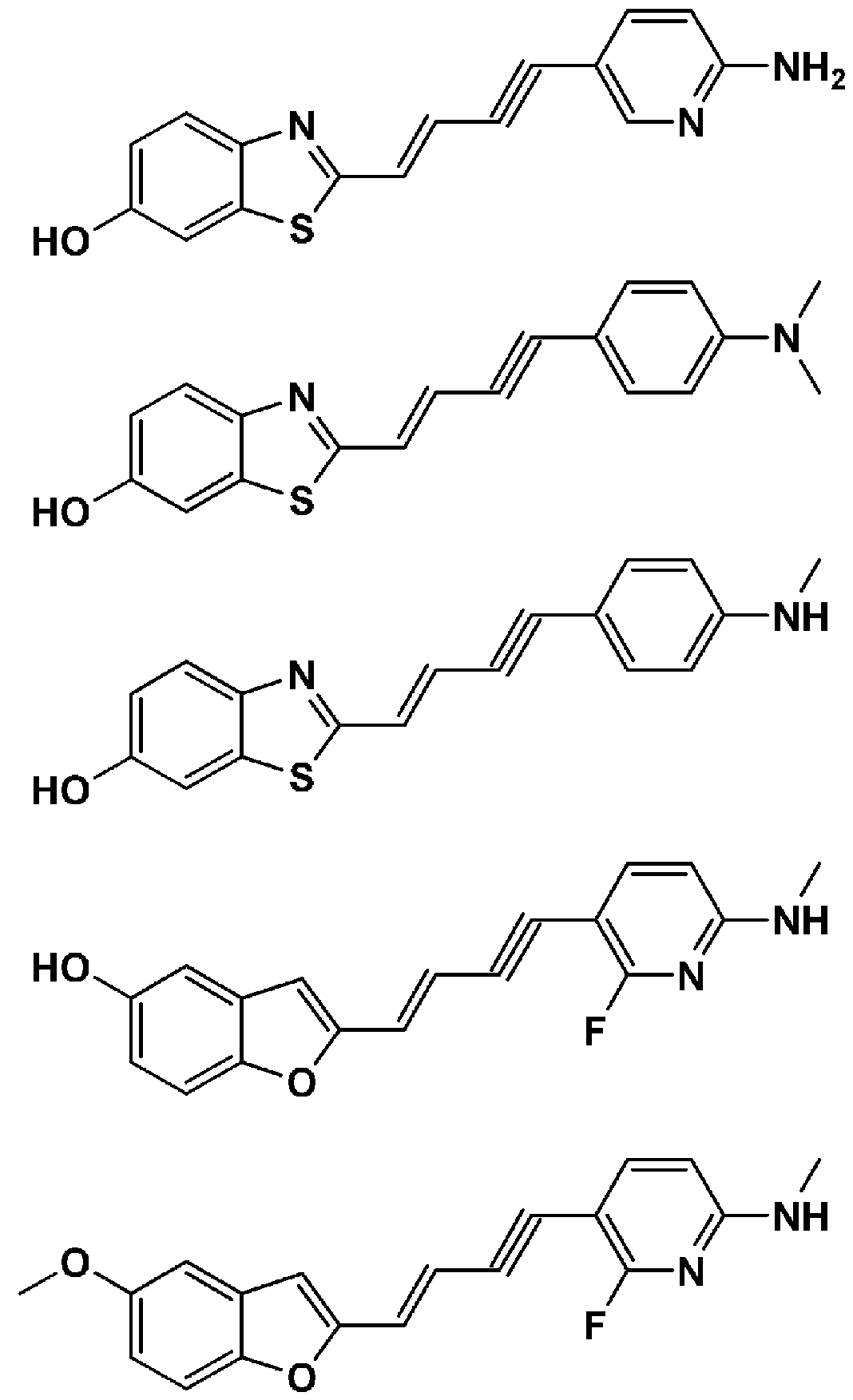
[0015] [5] 前記式 (丨) で表される化合物が 1個又はそれ以上の原子が該原 子の放射性同位体である、 [1 ] 〜 [4] のいずれか記載の結合剤。
[0016] [6] [ 1 ] 〜 [4] のいずれか記載の結合剤を含む、 《シヌクレイン 凝集体の光学イメージング用組成物。
[0017] [7] [5] 記載の結合剤を含む、 《シヌクレイン凝集体の放射イメー ジング用組成物。
[0018] [8] [ 1 ] 〜 [5] のいずれか記載の結合剤を含む、 《シヌクレイン 凝集体が関連する疾患の診断薬、 又は前記疾患の治療又は予防のためのコン
\¥02020/174963 7 卩(:171? 2020 /002607
パニオン診断薬。
[0019] [9] [1 ] 〜 [5] のいずれか記載の結合剤と、 2- ( (1 巳, 3巳
) —4— (6 - (メチルアミノ) ピリジンー 3—イル) ブター 1 , 3—ジェ ニル) ベンゾ [〇1] チアゾールー 6—オール、 2_ ( (1 巳, 3巳) _4— (6- ( (1 1) 〇ーメチルアミノ) ピリジンー 3 -イル) ブター 1 , 3 - ジェニル) ベンゾ [¢1] チアゾールー 6—オール、 1 —フルオロー 3 _ (2 - ( (^ E, 3 º) -4 - (6 - (メチルアミノ) ピリジンー 3—イル) ブ 夕 _ 1 , 3—ジェニル) ベンゾ [¢1] チアゾールー 6—イルオキシ) プロパ ン _ 2—才ール及び 1 — (1 8) _フルオロー 3— (2 - ( (1 巳, 3巳 ) —4— (6 - (メチルアミノ) ピリジンー 3—イル) ブター 1 , 3—ジェ ニル) ベンゾ [¢1] チアゾールー 6—イルオキシ) プロパン _ 2—才ールか ら選択される少なくとも一種と、 を含む、 脳内に蓄積する物質が関連する疾 患の診断キッ ト。
[0020] [1 0] [1 ] 〜 [4] のいずれか記載の結合剤を投与された被験体の 生体脳に脳外から第 1の波長の光を照射した後に、 前記脳から発せられる、 第 1の波長とは異なる第 2の波長の光を検出する工程を含む、 脳内《シヌク レイン凝集体の光学イメージング方法。
[0021] [1 1 ] [5] 記載の結合剤を投与された被験体の生体脳から発せられ る放射線を検出する工程を含む、 脳内《シヌクレイン凝集体の放射イメージ ング方法。
[0022] [1 2] 脳内《シヌクレイン凝集体が関連する疾患の治療又は予防薬の スクリーニング方法であって、
前記被験体への候補物質の投与前後における、 [1 0] 又は [1 1 ] 記載 のイメージング方法によって検出される光又は放射線の量及び/又は分布の 差異に基づいて、 前記候補物質を選抜する工程を有する方法。
[0023] [1 3] [5] 記載の結合剤を投与された被験体の生体脳から発せられ る放射線を検出する工程を含み、 前記検出した放射線の量及び/又は分布に 基づいて、 脳内《シヌクレイン凝集体の蓄積を定量又は判定する方法。
\¥02020/174963 8 卩(:171? 2020 /002607
[0024] [1 4] [5] 記載の結合剤を投与された被験体の生体脳から発せられ る放射線を検出する第 1の工程と、
2 - (
 3 º) - 4 - (6 - ( ( 1 1 ) 〇ーメチルアミノ) ピリジ ン _3—イル) ブタ _ 1 , 3—ジェニル) ベンゾ [〇1] チアゾールー 6—才 —ル及び 1 — (1 8) ーフルオロー 3— (2 - (
 3º) -4 - (
6 - (メチルアミノ) ピリジンー 3—イル) ブタ _ 1 , 3—ジェニル) ベン ゾ [¢1] チアゾールー 6—イルオキシ) プロパン _ 2—才ールから選択され る少なくとも一方を、 第 1の工程と異なる時期に投与された前記被験体の脳 から発せられる放射線を検出する第 2の工程と、 を含み、
前記第 1の工程において検出した放射線の量及び/又は分布データと、 前 記第 2の工程において検出した放射線の量及び/又は分布データと、 に基づ いて、 脳内に蓄積する物質の分類及び蓄積を判定する方法。
[0025] [1 5] 下記式 (丨 ) で表される化合物、 その医薬として許容し得る塩
、 又はその溶媒和物:
[化 5]

(式 ( I ) 中、
及び は、 それぞれ独立に、 水素、 アルキル、 アルケニル、 アシル、 及びヒドロキシアルキルからなる群から選択され;
\¥0 2020/174963 9 卩(:17 2020 /002607
水素又はハロゲンであり ;
環八は、 ベンゼン環又はピリジン環であり ;
環巳は、 下記式 (丨) 又は式 (丨 丨) であり :
[化 6]

⑴ ⑼ 及び は、 それぞれ独立に、 水素、 ヒドロキシ、 アルコキシ、 ハロア ルコキシ、 ハロヒドロキシアルコキシ、 及びアミノアルキルからなる群から 選択される。 )
を含有する、 《シヌクレイン凝集阻害剤。
[0026] [1 6] 環八が、 ピリジン環である、 [ 1 5] 記載の《シヌクレイン凝 集阻害剤。
[0027] [1 7] 環巳が、 式 (丨) である、 [ 1 5] 又は [ 1 6] 記載の《シヌ クレイン凝集阻害剤。
[0028] [1 8] 前記式 (丨) で表される化合物が下記の群から選択される、 [
1 5] 記載の《シヌクレイン凝集阻害剤:
[ib7]

[化 8]

[0029] [1 9] 下記式で表される化合物、 その医薬として許容し得る塩、 又は その溶媒和物。
\¥02020/174963 12 卩(:17 2020 /002607
[化 9]

[0030] [20] 下記式で表される化合物、 その医薬として許容し得る塩、 又は その溶媒和物。
[化 10]

(式中、 *印の原子の少なくとも一方はその原子の放射性同位体である。 ) [0031] [2 1 ] 下記式で表される、 [1 9] で表される化合物を合成するため の中間体。
\¥0 2020/174963 13 卩(:17 2020 /002607
[化 1 1 ]

[0032] [2 2] 下記式で表される、 [2 0] で表される化合物を合成するため の中間体。
[化 12]

\¥0 2020/174963 14 卩(:171? 2020 /002607
[化 13]

[0033] 本発明によれば、 《シヌクレイン凝集体への結合選択性が高い《シヌクレ イン凝集体結合剤を提供することができる。
そして、 この《シヌクレイン凝集体結合剤を用いた、 イメージング方法を 提供することができる。
また、 《シヌクレイン凝集体結合剤やその他の用途に用いることができる 新規化合物を提供することができる。
また、 《シヌクレインの凝集を阻害することができる。
図面の簡単な説明
[0034] [図 1八]0 !_巳患者脳及び 口患者脳の蛍光顕微鏡測定結果を示す図である。

[図 2]病変領域および病変非形成領域の蛍光輝度の定量結果を示す図である。 [図 3] «シヌクレイン線維接種マウスの蛍光顕微鏡測定結果を示す図である。 [図 4] «シヌクレイン線維溶液注入 6週間以降のモデルマウスの二光子レーザ —スキヤニング蛍光顕微鏡検査結果を示す図である。
[図 5] 巳丁イメージング結果を示す図である。
[図 6] 巳丁イメージング結果を示す図である。
[図 7] «シヌクレイン線維接種マウスの蛍光顕微鏡検査結果を示す図である。
\¥02020/174963 15 卩(:171? 2020 /002607
[図 8] 巳丁イメージング結果を示す図である。
[図 9] 巳丁イメージング結果を示す図である。
[図 10] 巳丁イメージング結果を示す図である。
[図 11] 巳丁イメージング結果を示す図である。
[図 12] 巳丁イメージング結果を示す図である。
[図 13] «シヌクレイン凝集阻害効果を示す図である。
[図 14] «シヌクレイン凝集阻害効果を示す図である。
発明を実施するための形態
[0035] <定義>
用語 「アルキル」 とは、 脂肪族飽和炭化水素の水素原子 1個が失われて生 じる 1価の基を意味する。 アルキルは、 例えば、 1〜 1 5個の炭素原子、 典 型的には、 1〜 1 0個、 1〜 8個、 1〜 6個、 1〜 5個、 1〜 4個、 1〜 3 個、 1〜 2個、 又は 2〜 6個の炭素原子を有する。 アルキルは、 直鎖、 分枝 状、 又は環状であってもよい。 アルキルの例を挙げると、 限定されないが、 メチル、 エチル、 プロピル、 イソプロピル、 2—メチルー 1 —プロピル、 2 —メチルー 2—プロピル、 2—メチルー 1 —ブチル、 3—メチルー 1 —プチ ル、 2—メチルー 3—ブチル、 2, 2—ジメチルー 1 —プロピル、 2—メチ ルー 1 —ペンチル、 3—メチルー 1 —ペンチル、 4—メチルー 1 —ペンチル 、 2—メチルー 2—ペンチル、 3—メチルー 2—ペンチル、 4—メチルー 2 —ペンチル、 2, 2—ジメチルー 1 —ブチル、 3, 3—ジメチルー 1 —プチ ル、 2—エチルー 1 —ブチル、 プチル、 イソプチル、 1: _プチル、 ペンチル 、 イソペンチル、 ネオペンチル、 及びヘキシルなどがある。 アルキルは、 さ らに適当な置換基によって置換されてもよい。
[0036] 本明細書において、 1〜 1 5個、 1〜 1 0個、 1〜 8個、 1〜 6個、 1〜
5個、 1〜 4個、 1〜 3個、 1〜 2個、 2〜 8個、 2〜 6個、 2〜 4個、 3 〜 8個、 3〜 6個、 4〜 8個、 4〜 6個等の炭素原子を、 それぞれ、 〇ぃ15
% 1 - 1 0' 1 - 8' 。 1 - 6' し 1 - 5' 1 -4' 。 1 -3' し 1 - 2' 2 - 8' し 2 - 6
、 0 2 -4' 〇 3 - 8、 し 3 - 6、 4 - 8、 及び〇 4 - 6等と ¾ す 0
\¥02020/174963 16 卩(:171? 2020 /002607
[0037] 用語 「シクロアルキル」 とは、 炭素環を形成する脂肪族飽和炭化水素の水 素原子 1個が失われて生じる 1価の基を意味する。 シクロアルキルは、 例え ば、 3〜 1 0個の炭素原子、 典型的には、 3〜 8個、 3〜 6個、 3〜 5個、
3〜 4個、 4〜 5個、 4〜 6個、 又は 4〜 8個の炭素原子を有する。 シクロ アルキルの例を挙げると、 限定されないが、 シクロプロパン、 シクロブタン 、 シクロペンタン、 シクロヘキサン、 シクロヘプタン、 及びシクロオクタン などがある。 シクロアルキルは、 さらに適当な置換基によって置換されても よい。
[0038] 用語 「アルケニル」 とは、 少なくとも 1つの二重結合を持つ脂肪族不飽和 炭化水素基を意味する。 アルケニルは、 例えば、 2〜 1 5個の炭素原子、 典 型的には、 2〜 1 0個、 2〜 8個、 2〜 6個、 2〜 5個、 2〜 4個、 2〜 3 個、 3〜 6個、 3〜 8個、 4〜 6個、 4〜 7個、 又は 4〜 8個の炭素原子を 有する。 アルケニルは、 直鎖若しくは分枝状であってもよい。 アルケニルの 例を挙げると、 限定されないが、 具体的には、 ビニル (一〇1~1 =〇1~12) 、 ア リル (一〇1~12〇1~1 =〇1~12) 、 一CH = CH (〇1~13) 、 一〇1~1 =〇 (〇1~13 ) 2、 -〇 (〇1~13) =〇1~12、 -〇 (〇1~13) =〇!! (〇1~13) 、 -〇 (〇!^ 〇1~13) =〇1~12、 1 , 3—ブタジェニル (一〇1~1 =〇1~1_〇1~1 =〇1~12) 、 及 びへプター 1 , 6—ジェンー 4 -イル
 (〇1_12〇1_1 =〇1_12) 2) などがある。 アルケニルは、 さらに適当な置換基によって置換されてもよい
[0039] 用語 「アルキニル」 とは、 少なくとも 1つの三重結合を持つ脂肪族不飽和 炭化水素基を意味する。 アルキニルは、 例えば、 2〜 1 5個の炭素原子、 典 型的には、 2〜 1 0個、 2〜 8個、 2〜 6個、 2〜 5個、 2〜 4個、 2〜 3 個、 3〜 6個、 4〜 6個、 4〜 7個、 又は 4〜 8個の炭素原子を有する。 ア ルキニルは、 直鎖若しくは分枝状であってもよい。 アルキニルの例を挙げる と、 限定されないが、 ェチニル (一〇º〇1~1) 、 — 0 = 01~1 (〇1~13) 、 — 0 º〇 (〇1~12〇1~13) 、 一CH2CºCH、 一〇1~12〇º〇 (〇1~13) 、 及び一〇 (〇1~12〇1~13) などがある。 アルキニルは、 さらに適当な置換基に
\¥02020/174963 17 卩(:171? 2020 /002607
よって置換されてもよい。
[0040] 用語 「アシル」 とは、 一〇〇一 で表される基を意味する。 ここで、
 は 、 例えば、 アルキル、 アルケニル、 又はアルキニルなどである。 アシルの例 を挙げると、 限定されないが、 アセチル (一〇〇〇1~13) 、 エチルカルボニル 、 プロピルカルボニル、 ペンチルカルボニル、 シクロヘキシルカルボニル、 オクチルカルボニル、 2—エチルヘキシルカルボニル、 ドデシルカルボニル 、 フエニルカルボニル、 ベンジルカルボニル、 ナフチルカルボニル、 及びピ リジルカルボニルなどがある。 アシルは、 さらに適当な置換基によって置換 されてもよい。
[0041] 用語 「ヒドロキシ」 又は 「ヒドロキシル」 は、 一〇 1~1を意味する。
[0042] 用語 「ヒドロキシアルキル」 は、 ヒドロキシ基 (一〇1~1) で置換されたア ルキル基を意味する。 ヒドロキシアルキルの例を挙げると、 限定されないが 、 ヒドロキシメチル (一〇1~12〇 1~1) 、 2—ヒドロキシエチル (一〇1~12〇1~12

ロピル (一CH2CH2CH2〇H) 、 2 -ヒドロキシプロピル (一 CH2CH (〇 〇1~13) 、 及び 1 -ヒドロキシプロピル
 (〇 〇1~12〇1~13 ) などがある。 ヒドロキシアルキルは、 さらに適当な置換基によって置換さ れてもよい。
[0043] 用語 「ハロゲン」 又は 「ハロ」 は、 フルオロ (ー ) 、 クロロ (一〇 I)
、 ブロモ (一巳 〇 、 及びヨード (一 丨) を意味する。
[0044] 用語 「アルコキシ」 は、 酸素原子を介して他の基に結合しているアルキル (すなわち、 一〇ーアルキル) を意味する。 アルコキシの例を挙げると、 限 定されないが、 メ トキシ (一〇ーメチル) 、 エトキシ (一〇ーエチル) 、 プ ロポキシ (一〇ープロピル) 、 一〇ーイソプロピル、 一0-2 -メチルー 1 —プロピル、 _〇_ 2—メチルー 2—プロピル、 _〇_2—メチルー 1 —ブ チル、 _〇_ 3—メチルー 1 —ブチル、 _〇_ 2—メチルー 3—ブチル、 一 0-2, 2—ジメチルー 1 —プロピル、 _〇_ 2—メチルー 1 —ペンチル、
3 _〇ーメチルー 1 —ペンチル、 _〇_4—メチルー 1 —ペンチル、 一〇一
\¥0 2020/174963 18 卩(:171? 2020 /002607
2—メチルー 2—ペンチル、 _〇_ 3—メチルー 2—ペンチル、 _〇_ 4— メチルー 2—ペンチル、 _〇_ 2 , 2—ジメチルー 1 —ブチル、 _〇_ 3 ,
3—ジメチルー 1 —ブチル、 _〇_ 2—エチルー 1 —ブチル、 _〇ーブチル 、 一〇ーイソプチル、 一〇 _ _プチル、 一〇ーペンチル、 一〇ーイソペン チル、 _〇ーネオペンチル、 及び一〇ーヘキシルがある。 アルコキシは、 さ らに適当な置換基によって置換されてもよい。
[0045] 用語 「ハロアルキル」 とは、 少なくとも 1 つのハロゲンで置換されたアル キルを意味する。 ハロアルキルには、 フルオロアルキル、 クロロアルキル、 ブロモアルキル、 及びヨードアルキルがある。 ハロアルキルの例を挙げると 、 限定されないが、 フルオロメチル、 クロロメチル、 ブロモメチル、 ヨード メチル、 フルオロエチル、 クロロエチル、 ブロモエチル、 ヨードエチル、 フ ルオロプロピル、 クロロプロピル、 ブロモプロピル、 ヨードプロピル、 フル オロブチル、 クロロブチル、 ブロモブチル、 ヨードプチル、 フルオロペンチ ル、 クロロペンチル、 ブロモペンチル、 ヨードペンチル、 フルオロヘキシル 、 クロロヘキシル、 ブロモヘキシル、 ヨードヘキシル、 フルオロヘプチル、 クロロへプチル、 ブロモヘプチル、 ヨードへプチル、 フルオロオクチル、 ク 口口オクチル、 ブロモオクチル、 及びヨードオクチルなどがある。 ハロアル キルは、 さらに適当な置換基によって置換されてもよい。
[0046] 用語 「ハロアルコキシ」 とは、 少なくとも 1 つのハロゲンで置換されたア ルコキシ (すなわち、 一〇ーハロアルキル) を意味する。 ハロアルコキシに は、 フルオロアルコキシ、 クロロアルコキシ、 ブロモアルコキシ、 及びヨー ドアルコキシがある。
[0047] 用語 「ハロヒ ドロキシアルコキシ」 とは、 ヒ ドロキシ基で置換されたハロ アルコキシを意味する。 ハロヒ ドロキシアルコキシには、 フルオロヒ ドロキ シアルコキシ、 クロロヒ ドロキシアルコキシ、 ブロモヒ ドロキシアルコキシ 、 及びヨードヒ ドロキシアルコキシがある。 ハロヒ ドロキシアルコキシの例 を挙げると、 一〇一〇 1~1 ( ) (〇 1~1) 、 一〇一C H 2 C H ( ) (〇 1~1) 、 —〇 _〇 !~1 (〇 ! !) _〇 1~1 2 ( ) 、 一〇 _ C H 2 _ C H ( ) (〇 ! !) 、 _
\¥02020/174963 19 卩(:171? 2020 /002607
〇 _〇1~1 (〇 1~1) _〇1~12_〇1~12 ( ) 、 一〇 _CH2_CH (〇 1~1) _〇1~1
2 ( ) 、 一〇一〇1~1 (〇1~12- ) (CH2〇H) 及び一〇一〇 1~12-〇 1~12- 〇1~1 ( ) (〇 1~1) などがある。
[0048] 用語 「ニトロ」 とは、 一1\1〇2を意味する。
[0049] 用語 「アミノ」 とは、 一1\11~12を意味する。
[0050] 用語 「アミノアルキル」 とは、 アミノ基で置換されたアルキル基を意味す る。 アミノアルキルの例を挙げると、 限定されないが、 アミノメチル、 アミ ノエチル、 アミノプロピル、 アミノイソプロピル、 アミノブチル、 アミノぺ ンチル、 アミノヘキシル、 及びアミノオクチルなどがある。
[0051] 用語 「置換基」 とは、 ある化学構造式において、 導入される 1以上の原子 又は原子団を意味する。 置換基の例を挙げると、 例えば、 〇1 -8アルキル (メ チル、 エチル、
 ピル、 丨 3〇 _プロピル、
 プチル、 3㊀〇—ブ チル、 丨 3〇—ブチル、 ㊀ I" 1: _ブチル、 又は —ヘキシル若しくはその 異性体など) 、 〇2-8アルケニル (ビニル、 アリル、 _CH = CH (〇1~13)
、 _〇1~1 =〇 (〇1~13) 2、 -〇 (〇1~13) =〇1~12、 -〇 (〇1~13) =〇1~1 (〇 1~13) 、 及び一〇 (〇1~12〇1~13) =〇1~12など) 、 〇2-8アルキニル (エチニ

〇1~12〇º〇 (〇1~13) 、 及び一〇1~12〇º〇 (〇1~12〇1~13) など) 、 アルコキ シ、 ヒドロキシ、 ハロゲン、 ハロアルキル、 シクロアルキル (シクロプロピ ル、 シクロブチル、 シクロペンチル、 又はシクロヘキシルなど) 、 アミノ、 ニトロ、 アシル (アセチルなど) (一〇〇〇1~13) 、 カルボキシル (一〇〇〇 は〇1 -6アルキルなどである) 、 ア
 は独立に 又は(^-6アルキルな どである) 、 チオール (一 31~1) 、 スルホン酸 (一 3〇31~1) 、 二トリル (一 〇1\1) 、 芳香族環 (アリール、 フエニル、 ベンゾイル、 又はナフタレニルな ど) 、 複素環 (ピロリジニル、 テトラヒドロフラニル、 ピロリル、 フラニル 、 チオフエニル、 ピベリジニル、 オキサニル、 又はピリジニルなど) などが ある。
\¥0 2020/174963 20 卩(:171? 2020 /002607
は独立に 又は(^-6アルキルな どである) 、 チオール (一 31~1) 、 スルホン酸 (一 3〇31~1) 、 二トリル (一 〇1\1) 、 芳香族環 (アリール、 フエニル、 ベンゾイル、 又はナフタレニルな ど) 、 複素環 (ピロリジニル、 テトラヒドロフラニル、 ピロリル、 フラニル 、 チオフエニル、 ピベリジニル、 オキサニル、 又はピリジニルなど) などが ある。
\¥0 2020/174963 20 卩(:171? 2020 /002607
[0052] 用語 「医薬として許容し得る塩」 とは、 哺乳動物、 特にヒトに対して有害 でない塩を指す。 医薬として許容し得る塩は、 無機酸若しくは無機塩基、 又 は有機酸若しくは有機塩基を含む、 無毒性の酸又は塩基を用いて形成するこ とができる。 医薬として許容し得る塩の例を挙げると、 アルミニウム、 カル シウム、 リチウム、 マグネシウム、 カリウム、 ナトリウム及び亜鉛などから 形成される金属塩、 又はリジン、 1\1 , 1\1’ ージベンジルエチレンジアミン、 クロロプロカイン、 コリン、 ジエタノールアミン、 エチレンジアミン、 メグ ルミン (1\1 _メチルグルカミン) 及びプロカインなどから形成される有機塩 などがある。 また、 医薬として許容し得る塩は、 酸付加塩及び塩基付加塩を 包含する。
[0053] 用語 「医薬として許容し得る担体」 とは、 生理食塩水溶液、 液体若しくは 固体の充填剤、 希釈剤、 溶媒、 又は封入材料などの医薬として許容し得る材 料、 組成物、 又はビヒクルを意味する。 医薬として許容し得る担体の例を挙 げると、 水、 食塩水、 生理食塩水又はリン酸緩衝食塩水 ( 巳3) 、 塩化ナ トリウム注射液、 リンゲル注射液、 等張性デキストロース注射液、 無菌水注 射液、 デキストロース、 及び乳酸リンゲル注射液などがある。
[0054] 用語 「有効量」 とは、 目的の効果を得ることができる、 化合物又は組成物 の量をいう。 例えば、 一部の実施態様において、 有効量は、 《シヌクレイン 凝集体等の脳内に蓄積する物質の光学イメージングや放射イメージングが可 能な、 化合物又は組成物の量をいう。
[0055] 用語 「溶媒和物」 とは、 化合物に対する 1つ又は複数の溶媒分子の会合に より形成される含溶媒化合物を意味する。 溶媒和物は、 例えば、 _溶媒和物 、 二溶媒和物、 三溶媒和物、 及び四溶媒和物を含む。 また、 溶媒和物は、 水 和物を含む。
[0056] 用語 「水和物」 とは、 非共有結合性分子間力によって拘束された化学量論 的又は非化学量論的量の水をさらに含む化合物又はその塩を意味する。 水和 物は、 例えば、 _水和物、 二水和物、 三水和物、 及び四水和物などを含む。
[0057] 用語 「治療」 とは、 疾患又は状態の進行、 重症度及び/又は持続期間を低
\¥0 2020/174963 21 卩(:171? 2020 /002607
減すること又は寛解することを意味する。
[0058] 用語 「予防」 とは、 所定の疾患又は状態を獲得する又は進行させる危険の 低減、 或いは、 所定の疾患又は条件の 1つ又は複数の症状の再発、 開始、 又 は進行の低減又は抑制を意味する。
[0059] < «シヌクレイン凝集体結合剤 >
本発明の《シヌクレイン凝集体結合剤 (以下、 結合剤とも記載する) は、 下記式 (丨) で表される化合物、 その医薬として許容し得る塩、 又はその溶 媒和物を含有する。
特許文献 1 に記載された化合物のうち、 ブタジエン結合ではなくブテニニ ル結合を有
し且つべンゾチアゾール構造又はべンゾフラン構造を有する化合物である、 下記式 (丨) で表される化合物は、 タウタンパク質やアミロイ ド/ 3の凝集体 よりも《シヌクレイン凝集体への結合選択性が高いことが確認された。 また 、 同様に、 下記式 (丨) で表される化合物の医薬として許容し得る塩や、 下 記式 (丨) で表される化合物の溶媒和物も、 タウタンパク質やアミロイ ド/ 3 の凝集体よりも《シヌクレイン凝集体への結合選択性が高い。
また、 下記式 (丨) で表される化合物は、 蛍光を発する。 また、 下記式 ( I) で表される化合物のうち、 1個又はそれ以上の原子を該原子の放射性同 位体とすることができる。
したがって、 本発明の結合剤は、 脳内に蓄積した《シヌクレイン凝集体の 光学イメージングや放射イメージングのための分子プローブとして用いるこ とができる。
また、 下記式 (丨) で表される化合物、 その医薬として許容し得る塩、 及 びその溶媒和物は、 上述のとおり《シヌクレイン凝集体への結合選択性が高 いため、 詳しくは後述するが、 《シヌクレインの凝集を阻害することができ る。
なお、 《シヌクレインは、 正常な脳でもニューロンのシナプス等に局在す るタンパク質であり、 《シヌクレインが凝集したものが《シヌクレイン凝集
\¥02020/174963 22 2020/002607
体である。
[0060] [化 14]

(式 ( I) 中、
及び は、 それぞれ独立に、 水素、 アルキル、 アルケニル、 アシル、 及びヒドロキシアルキルからなる群から選択され;
8 3は、 水素又はハロゲンであり ;
環八は、 ベンゼン環又はピリジン環であり ;
環巳は、 下記式 (丨) 又は式 (丨 丨) であり :
[化 1 5]

(0 ⑻ 及び は、 それぞれ独立に、 水素、 ヒドロキシ、 アルコキシ、 ハロア ルコキシ、 ハロヒドロキシアルコキシ、 及びアミノアルキルからなる群から 選択される。 )
[0061 ] —実施態様において、 環巳は、 式 (丨) である。 また他の実施態様におい て、 環巳は、 式 (丨 丨) である。
\¥02020/174963 23 卩(:171? 2020 /002607
[0062] 環巳が、 式 (丨) である場合、 は、 式 (丨) のべンゾチアゾー ル環の置換可能な位置に存在することができる。 好ましくは、
 及び は 、 それぞれ、 式 (丨) のべンゾチアゾール環の 6位及び 5位に存在する。 環 巳が、 式 (丨 丨) である場合、
 式 (丨 丨) のべンゾフラン環 の置換可能な位置に存在することができる。 好ましくは、
 は、 そ れそれ、 式 (丨 丨) のべンゾフラン環の 5位及び 6位に存在する。
[0063] —実施態様において、 環 は、 ピリジン環である。 他の実施態様において 、 環八は、 ベンゼン環である。 好ましくは、 環八は、 式 (丨) の構造式の向 きにおいて、 下記構造式で表されるピリジン環である。
[化 16]

[0064] —実施態様において、
 いずれも水素である。
—実施態様において、
 それぞれ独立に、 水素又はアルキル 、 特に〇1_8アルキル、 好ましくはメチルである。 他の実施態様において、
!は、 水素であり、
 アルキル、 特に〇卜^アルキル、 好ましくはメチル である。 さらに他の実施態様において、
 は、 いずれもアルキルで あり、 いずれも〇1_6アルキルであることが好ましく、 いずれもメチルである ことがより好ましい。
[0065] —実施態様において、
 は、 それぞれ独立に、 水素又はアルケニ ル、 特に、 〇2_8アルケニル、 好ましくは、 アリル (一〇1~12〇1~1 =〇1~12) 又 はへプタ _ 1 , 6—ジェンー 4—イル (一〇1~12— (〇1_12〇1_1 =〇1_12) 2) である。 他の実施態様において、
 は、 水素であり、 82は、 アルケニル、 特に、 〇2_8アルケニル、 好ましくは、 アリル (一〇1~12〇1~1 =〇1~12) 又はへ プタ _ 1 , 6—ジェンー 4—イル (一〇1~12— (〇1_12〇1_1 =〇1_12) 2) であ る。 さらに他の実施態様において、 及び は、 いずれもアルケニルであ り、 いずれも〇2_8アルケニルであることが好ましく、 いずれもアリル (一〇
\¥02020/174963 24 卩(:171? 2020 /002607
は、 水素であり、 82は、 アルケニル、 特に、 〇2_8アルケニル、 好ましくは、 アリル (一〇1~12〇1~1 =〇1~12) 又はへ プタ _ 1 , 6—ジェンー 4—イル (一〇1~12— (〇1_12〇1_1 =〇1_12) 2) であ る。 さらに他の実施態様において、 及び は、 いずれもアルケニルであ り、 いずれも〇2_8アルケニルであることが好ましく、 いずれもアリル (一〇
\¥02020/174963 24 卩(:171? 2020 /002607
1~12〇1~1 =〇1~12) 又はへプタ _ 1 , 6—ジェンー 4—イル (一〇1~12— (〇1~1 2〇1~1 =〇1~12) 2) であることがより好ましい。
[0066] —実施態様において、
 は、 それぞれ独立に、 水素又はアシル、 特に、 〇1 -8アシル、 好ましくは、 アセチル (一〇〇〇1~13) である。 他の実 施態様において、
 は、 水素であり、
 は、 アシル、 特に、 〇卜8アシル、 好ましくは、 アセチル (一〇〇〇1~13) である。 さらに他の実施態様において 、
 いずれもアシルであり、 いずれも〇1 -8アシルであることが 好ましく、 いずれもアセチル (一〇〇〇1~13) であることがより好ましい。
[0067] —実施態様において、
 は、 それぞれ独立に、 水素又はヒドロキ シアルキル、 特に、 ヒドロキシ〇 1 _8アルキル、 好ましくは、 ヒドロキシプロ ピル、 より好ましくは 3—ヒドロキシプロピル (一 CH2CH2CH2〇H) で ある。 他の実施態様において、
 は、 水素であり、
 は、 ヒドロキシアル キル、 特に、 ヒドロキシ〇 1 _8アルキル、 好ましくは、 ヒドロキシプロピル、 より好ましくは 3—ヒドロキシプロピル (一 CH2CH2CH2〇H) である。 さらに他の実施態様において、
 は、 いずれもヒドロキシアルキル であり、 いずれもヒドロキシ〇1 -8アルキルであることが好ましく、 いずれも ヒドロキシプロピルであることがより好ましく、 いずれも 3—ヒドロキシプ ロピル (一〇 1~12〇 1~12〇 1~12〇 1~1) であることがさらに好ましい。
[0068] —実施態様において、
 は、 水素である。 他の実施態様において、
 は 、 ハロゲン、 すなわち、 、 〇 丨、 巳 「又は丨である。 好ましくは、
 は、 である。 好ましくは、
 、 。 は、 式 (丨) の構造式の向 きにおいて、 下記に示す位置に存在することが好ましい。
[化 17]

[0069] 好ましくは、 環八と[¾3との関係は、 式 ( I) の構造式の向きにおいて、 以
\¥0 2020/174963 25 卩(:171? 2020 /002607
下である。
[化 18]

[0070] —実施態様において、
 いずれも水素である。
—実施態様において、
 それぞれ独立に、 水素又はヒドロキ シである。 他の実施態様において、
 は、 ヒドロキシであり、
 は、 水素 である。 また他の実施態様において、
 は、 水素であり、
 は、 ヒドロキ シである。 さらに他の実施態様において、
 は、 いずれもヒドロキ シである。
[0071 ] —実施態様において、
 は、 それぞれ独立に、 水素又はアルコキ シ、 特にメ トキシである。 他の実施態様において、
 は、 アルコキシ、 特に メ トキシであり、
 は水素である。 また他の実施態様において、
 は、 水 素であり、
 は、 アルコキシ、 特にメ トキシである。 さらに他の実施態様に おいて、
 及び は、 いずれもアルコキシであり、 いずれもメ トキシであ ることが好ましい。
[0072] —実施態様において、
 は、 それぞれ独立に、 水素又はハロアル コキシ、 特にフルオロアルコキシ、 クロロアルコキシ、 ブロモアルコキシ、 又はヨードアルコキシである。 他の実施態様において、
 は、 ハロアルコキ シ、 特に、 フルオロアルコキシ、 クロロアルコキシ、 ブロモアルコキシ、 又 はヨードアルコキシであり、
 は水素である。 また他の実施態様において、
 、 、 はハロアルコキシ、 特に、 フルオロアルコキシ、 ク ロロアルコキシ、 ブロモアルコキシ、 又はヨードアルコキシである。 さらに 他の実施態様において、 は、 いずれもハロアルコキシであり、 特 にいずれもフルオロアルコキシ、 クロロアルコキシ、 ブロモアルコキシ、 又 はヨードアルコキシである。 一実施態様において、 フルオロアルコキシは、
\¥02020/174963 26 卩(:171? 2020 /002607
、 、 はハロアルコキシ、 特に、 フルオロアルコキシ、 ク ロロアルコキシ、 ブロモアルコキシ、 又はヨードアルコキシである。 さらに 他の実施態様において、 は、 いずれもハロアルコキシであり、 特 にいずれもフルオロアルコキシ、 クロロアルコキシ、 ブロモアルコキシ、 又 はヨードアルコキシである。 一実施態様において、 フルオロアルコキシは、
\¥02020/174963 26 卩(:171? 2020 /002607
放射性同位体を含む。
[0073] —実施態様において、 は、 それぞれ独立に、 水素又はハロヒド ロキシアルコキシ、 特にフルオロヒドロキシアルコキシ、 好ましくは、 フル オロヒドロキシ〇ぃ3アルコキシ、 より好ましくは、 一〇一CH2-CH (〇 1~1) -〇1~12 ( ) 若しくは一〇一〇1~1 (〇1~12- ) (CH2〇H) である。 他の実施態様において、
 は、 ハロヒドロキシアルコキシ、 特にフルオロヒ ドロキシアルコキシ、 好ましくは、 フルオロヒドロキシ〇 1 _3アルコキシ、 よ り好ましくは、 一〇 _CH2_CH (〇 1~1) _〇1~12 ( ) 、 又は一〇 _〇1~1 (〇1~12- ) (CH2〇H) であり、
 は水素である。 また他の実施態様に おいて、
 は、 水素であり、
 5はハロヒドロキシアルコキシ、 特にフルオ ロヒドロキシアルコキシ、 好ましくは、 フルオロヒドロキシ〇 1 _3アルコキシ 、 より好ましくは、 一〇 _CH2_CH (〇 1~1) _〇1~12 ( ) 、 又は一〇一 〇1~1 (〇1~12— ) (CH2〇H) である。 さらに他の実施態様において、
 及び は、 いずれもハロヒドロキシアルコキシであり、 いずれもフルオロヒ ドロキシアルコキシであることが好ましく、 いずれもフルオロヒドロキシ〇 1 _3アルコキシであることがより好ましく、 いずれも一〇_〇 1~12_〇 1~1 (〇 1~1 ) -〇1~12 ( ) 、 又は一〇一〇1~1 (〇1~12— ) (CH2〇H) であることが さらに好ましい。 一実施態様において、 フルオロヒドロキシアルコキシは、 放射性同位体を含む。 好ましくは、 当該フルオロヒドロキシアルコキシは、 -〇一CH2-CH (〇 1~1) -〇1~12 (18 ) 、 又は一〇一〇1~1 (〇1~12-18 ) (CH2〇H) である。
[0074] —実施態様において、
 は、 それぞれ独立に、 水素又はアミノア ルキル、 特にアミノメチル若しくはアミノエチルである。 他の実施態様にお いて、
 は、 アミノアルキル、 特にアミノメチル又はアミノエチルであり、 は、 水素である。 また他の実施態様において、
 は、 水素であり、
 は 、 アミノアルキル、 特にアミノメチル又はアミノエチルである。 さらに他の 実施態様において、
 及び 85は、 いずれもアミノアルキルであり、 いずれ もアミノメチル又はアミノエチルであることが好ましい。
\¥02020/174963 27 卩(:171? 2020 /002607
及び 85は、 いずれもアミノアルキルであり、 いずれ もアミノメチル又はアミノエチルであることが好ましい。
\¥02020/174963 27 卩(:171? 2020 /002607
[0075] —実施態様において、 式 (丨) で表される化合物は、 下記式(II)により表 される化合物である。
[化 19]

(式中、 1、
 はそれぞれ式 (丨) における ?¾ 、 [¾3、 [¾4、
 と同様である。 )
[0076] —実施態様において、 式 (丨) で表される化合物は、 下記式(III)により表 される化合物である。
[化 20]

(式中、
 はそれぞれ式 (丨) における
 [¾2、 [¾3、 [¾4、
 と同様である。 )
[0077] —実施態様において、 式 (丨) で表される化合物は、 下記式(IV)により表 される化合物である。
\¥02020/174963 28 2020/002607
[化 21]

(式中、 1、
 はそれぞれ式 (丨) における [¾ 、 ^ 3、 ^? 4、 8 5と同様である。 )
[0078] —実施態様において、 式 (丨) で表される化合物は、 下記式(V)により表さ れる化合物である。
[化 22]

(式中、 、 、
 はそれぞれ式 (丨) における
 、 [¾3、 [¾4、
 と同様である。 )
[0079] —実施態様において、 式 (丨) 〜 (V) の化合物中、 1個又はそれ以上の 原子が該原子の放射性同位体である。 放射性同位体は、 15〇、 131\1、 1 1〇、 及び18 などからなる群から選択されるが、 特に限定されない。 好ましくは 、 放射性同位体は、 〇又は19 である。 このうち、
 の半減期が約 20 分であり、 18 の半減期が約 1 1 0分であることを考慮すれば、 で標識 した化合物の方が商業的利用価値が高いものと考えられる。 したがって、 最 も好ましくは、 放射性同位体は、 18 である。
[0080] 好ましくは、
 のいずれか 1つ以上が、 放射性同位体を含む基である
\¥02020/174963 29 卩(:171? 2020 /002607
のいずれか 1つ以上が、 放射性同位体を含む基である
\¥02020/174963 29 卩(:171? 2020 /002607
。 さらに好ましくは、
 が、 放射性同位体を含む基、 例えば 、
 を含めた [1 1〇] アルキルなど) である。 より好 ましくは、 が、 放射性同位体を含む基、 例えば、 一18 である。 より好ま し が放射性同位体を含む基、 例えば、
 を含む基
を含む基
 [ 〇] アルコキシなど) 、 又は18 を含む基 (一 〇一CH2-CH (〇 1~1) -〇1~12 ( ) 及び一〇一〇1~1 (〇1~12-18 ) (CH2〇H) を含めた [18 ] フルオロヒドロキシアルコキシなど) である 。 ここで、 [ 〇] アルキルは、 アルキルを構成する炭素原子のうちの 1つ 以上の炭素原子が、 1 1〇であることを意味する。 [ 〇] アルコキシは、 ア ルコキシを構成する炭素原子のうちの 1つ以上の炭素原子が、 1 1〇であるこ とを意味する。 8 ] フルオロヒドロキシアルコキシは、 ヒドロキシアル コキシに18 が結合した基を意味する。
[0081] 式 ( I) で表される化合物の具体的な例としては、 例えば以下の化合物が挙 げられる。
\¥0 2020/174963 30 卩(:17 2020 /002607
[化 23]


[fb25]

[化 26]

[0082] —実施態様において、 上記具体的化合物中、 1個又はそれ以上の原子が該 原子の放射性同位体である。 好ましくは、 ベンゼン環又はピリジン環に結合 したアミノベンジル又はアミノビリジニルにおけるアミノ基の窒素原子に結 合した炭素原子が、 放射性同位体1 1〇である。 好ましくは、 上記具体的化合 物中の が、 放射性同位体1 8 である。 好ましくは、 ベンゾチアゾール環に 結合したメ トキシ基の炭素原子が、 放射性同位体1 1 0である。 さらに好まし くは、 上記具体的化合物の構造式中に示す*印の原子 (構造式中に*印が 2 つある場合は、 そのうちのいずれか 1つ又は 2つ) が、 その原子の放射性同
\¥0 2020/174963 34 卩(:171? 2020 /002607
位体、 例えば、 〇又は 1 8 である。 本明細書中において、 [ 〇] 0 0 5 — 0 4等の名称は、 〇〇 5— 0 4等の構造式中の*印の原子上が
 である ことを意味する。
[0083] 式 ( I) で表される化合物の合成方法は特に限定されないが、 例えば、 特 許文献 1 に記載の合成方法を参照して製造することができる。
[0084] なお、 上記式 ( I) で表される化合物のうち、 下記式で表される化合物、 その医薬として許容し得る塩、 又はその溶媒和物は、 新規化合物である。 下 記式で表される化合物は、 上記《シヌクレイン凝集体結合剤として有用であ るが、 上記《シヌクレイン凝集体結合剤以外の用途に用いることもできる。 [化 27]

(式中、 *印の原子の少なくとも一方はその原子の放射性同位体である。 ) [0085] これら新規化合物は、 例えば、 それぞれ下記中間体から後述する実施例に 示す合成方法により合成することができる。
[化 29]

\¥02020/174963 36 卩(:171? 2020 /002607
[化 31]

[0086] «シヌクレイン凝集体結合剤は、 医薬として許容し得る担体を含むことが できる。 該医薬として許容し得る担体の例を挙げると、 水、 食塩水、 生理食 塩水又はリン酸緩衝食塩水 ( 巳 3) 、 塩化ナトリウム注射液、 リンゲル注 射液、 等張性デキストロース注射液、 無菌水注射液、 デキストロース、 及び 乳酸リンゲル注射液などがある。
[0087] «シヌクレイン凝集体結合剤が含む式 ( I) で表される化合物、 その医薬 として許容し得る塩、 又はその溶媒和物や、 医薬として許容し得る担体の含 有量は、 特に制限はなく、 これらは、 使用される化合物の種類;投与される 哺乳動物の年齢、 体重、 健康状態、 性別及び食事内容;投与の回数、 及び投 与経路;治療期間;同時に使用される他の薬剤など、 様々な要因により決定 される。 医薬として許容し得る担体の含有量は、 《シヌクレイン凝集体結合 剤の 1〜 99重量%の量とすることができる。 《シヌクレイン凝集体結合剤 は、 式 (丨) で表される化合物を、 例えば、 対象の体重 (1< 9) あたりの式 ( I) で表される化合物量が、 5 n g/k g~5 m g/k g、 好ましくは、 下限は 5门 9 / 9以上、 0.
 以上、 0. 05〇19/1< 9以 上や、 0. 1 019 / 9以上、 上限は 5019 / 9以下、

、
 以下や、 20 9/1< 9以下の量で投与できるように調製さ れる。
[0088] < «シヌクレイン凝集体の光学イメージング用組成物 >
\¥0 2020/174963 37 卩(:171? 2020 /002607
本発明の《シヌクレイン凝集体の光学イメージング用組成物 (以下、 光学 イメージング用組成物とも記載する) は、 上記本発明の結合剤を含む。 当該 光学イメージングは、 インビトロ、 エキソビボ、 及びインビボイメージング を含む。
[0089] 光学イメージングとしては、 例えば、 蛍光顕微鏡測定法、 多光子イメージ ング法、 二光子イメージング法、 近赤外蛍光イメージング法が挙げられる。
[0090] 光学イメージング用組成物は、 医薬として許容し得る担体を含むことがで きる。 該医薬として許容し得る担体の例を挙げると、 水、 食塩水、 生理食塩 水又はリン酸緩衝食塩水 ( 巳 3) 、 塩化ナトリウム注射液、 リンゲル注射 液、 等張性デキストロース注射液、 無菌水注射液、 デキストロース、 及び乳 酸リンゲル注射液などがある。
[0091 ] 光学イメージング用組成物が含む式 (丨) で表される化合物、 その医薬と して許容し得る塩、 又はその溶媒和物や、 医薬として許容し得る担体の含有 量は、 特に制限はなく、 これらは、 使用される化合物の種類;投与される晡 乳動物の年齢、 体重、 健康状態、 性別及び食事内容;投与の回数、 及び投与 経路;治療期間;同時に使用される他の薬剤など、 様々な要因により決定さ れる。 医薬として許容し得る担体の含有量は、 光学イメージング用組成物の 1〜 9 9重量%の量とすることができる。 光学イメージング用組成物は、 式 ( I) で表される化合物を、 例えば、 対象の体重 (1< 9) あたりの式 ( I) で表される化合物量 ( ) が〇.
 好まし くは〇. 0 5〇1 9 / 1< 9 ~ 3 |11 9 / 1< 9、 さらに好ましくは、 〇. 1 111 9 /
 の量で投与できるように調製される。
[0092] < «シヌクレイン凝集体の放射イメージング用組成物 >
本発明の《シヌクレイン凝集体の放射イメージング用組成物 (以下、 放射 イメージング用組成物とも記載する) は、 上記本発明の結合剤を含む。 当該 放射イメージングは、 インビトロ、 エキソビボ、 及びインビボイメージング を含む。
[0093] 放射イメージングとしては、 例えば、 ポジトロン断層撮影法 £(11
ission Tomography, P ET) 、 単一光子放射断層撮影法 (Single photon em ission computed tomography, S P ECT) 、 才一トラジオグラフィーが挙 げられる。
[0094] 放射イメージング用組成物は、 医薬として許容し得る担体を含むことがで きる。 該医薬として許容し得る担体の例を挙げると、 水、 食塩水、 生理食塩 水又はリン酸緩衝食塩水 ( P B S) 、 塩化ナトリウム注射液、 リンゲル注射 液、 等張性デキストロース注射液、 無菌水注射液、 デキストロース、 及び乳 酸リンゲル注射液などがある。
[0095] 放射イメージング用組成物が含む式 (丨) で表される化合物、 その医薬と して許容し得る塩、 又はその溶媒和物や、 医薬として許容し得る担体の含有 量は、 特に制限はなく、 これらは、 使用される化合物の種類;投与される晡 乳動物の年齢、 体重、 健康状態、 性別及び食事内容;投与の回数、 及び投与 経路;治療期間;同時に使用される他の薬剤など、 様々な要因により決定さ れる。 医薬として許容し得る担体の含有量は、 放射イメージング用組成物の 1〜 99重量%の量とすることができる。 放射イメージング用組成物は、 式 ( I) で表される化合物を、 例えば、 対象の体重 (k g) あたりの式 ( I) で表される化合物量が 5 n g/k g~5 m g/k g、 好ましくは 5 n g〜 2 0 lx g / k gの量で投与できるように調製される。
[0096] < aシヌクレイン凝集体が関連する疾患の診断薬、 又は前記疾患の治療又は 予防のためのコンパニオン診断薬 >
本発明の aシヌクレイン凝集体が関連する疾患の診断薬、 又は前記疾患の 治療又は予防のためのコンパニオン診断薬 (以下、 コンパニオン診断薬とも いう。 ) は、 上記本発明の結合剤を含む。 治療のためのコンパニオン診断薬 とは、 前記疾患であることが判明した場合に、 治療が見込めるかどうかを判 断するための診断薬である。 また、 予防のためのコンパニオン診断薬とは、 前記疾患の前駆状態であることが判明した場合に、 今後の発症を予測する、 もしくは発症を抑制する予防が見込めるかどうかを判断するための診断薬で ある。
\¥0 2020/174963 39 卩(:171? 2020 /002607
上記診断薬を用いて、 対象から得られる脳内《シヌクレイン凝集体の量及 び/又は分布量に関するデータを、 予め取得した上記疾患と《シヌクレイン 凝集体の量及び/又は分布量との相関性に照会することで、 対象の上記疾患 に関する診断 (具体的には、 上記疾患の罹患有無、 重篤性、 発作可能性等) が可能である。
また、 上記コンパニオン診断薬を用いて、 対象から得られる脳内《シヌク レイン凝集体の量及び/又は分布量に関するデータを、 予め取得した上記疾 患と脳内《シヌクレイン凝集体の量及び/又は分布量との相関性に照会する ことで、 対象の上記疾患状態が把握されるので、 これに基づき、 上記疾患の 予防/治療計画 (投与する予防/治療薬の種類や組合せ、 用量、 用法など) を策定することができる。
本発明の一実施形態は、 《シヌクレイン凝集体が関連する疾患の治療又は 予防のための医薬であって、 上記コンパニオン診断で得られる脳内《シヌク レイン凝集体の量及び/又は分布に関するデータに基づく投与計画で投与さ れる医薬にも関する。
[0097] <脳内に蓄積する物質が関連する疾患の診断キッ ト>
本発明の脳内に蓄積する物質が関連する疾患の診断キッ ト (以下、 診断キ ッ トともいう) は、 上記本発明の結合剤と、 2 _ ( (1 巳, 3 º) - 4 - ( 6 - (メチルアミノ) ピリジンー 3—イル) ブタ _ 1 , 3—ジェニル) ベン ゾ [ ] チアゾールー 6—オール、 2 - (
 3º) - 4 - (6 - ( (
1 1) 〇ーメチルアミノ) ピリジンー 3—イル) ブター 1 , 3—ジェニル) ベンゾ [¢1] チアゾールー 6—オール、 1 —フルオロー 3— (2 _ ( (1 巳 , 3 º) - 4 - (6 - (メチルアミノ) ピリジンー 3 -イル) ブター 1 , 3 —ジェニル) ベンゾ [¢1] チアゾールー 6—イルオキシ) プロパン _ 2—才 —ル及び 1 — (1 8) ーフルオロー 3— (2 - (
 3º) - 4 - (
6 - (メチルアミノ) ピリジンー 3—イル) ブタ _ 1 , 3—ジェニル) ベン ゾ [¢1] チアゾールー 6—イルオキシ) プロパン _ 2—才ールから選択され る少なくとも一種と、 を含む。
\¥0 2020/174963 40 卩(:171? 2020 /002607
[0098] 脳内に蓄積する物質としては、 《シヌクレイン凝集体、 タウタンパク質や アミロイ ド/ 3の凝集体が挙げられる。
[0099] 脳内に蓄積する物質が関連する疾患としては、 《シヌクレイン凝集体が関 連する疾患であるパーキンソン病、 レビー小体型認知症 (0 1_巳) 、 多系統 萎縮症 (IV! 3八) や、 タウタンパク質やアミロイ ド/ 3の凝集体が関連する疾 患であるアルツハイマー病 ( 〇) や前頭側頭葉変性症が挙げられる。
[0100] 本発明の結合剤はタウタンパク質やアミロイ ド/ 3の凝集体よりも《シヌク レイン凝集体への結合選択性が高い一方、 2 _ ( (1 巳, 3巳) _ 4 _ (6 - (メチルアミノ) ピリジンー 3—イル) ブタ _ 1 , 3—ジェニル) ベンゾ [ ] チアゾールー 6—オール、 2 - (
 3 º) —4— (6— ( (1
1) 〇_メチルアミノ) ピリジンー 3—イル) ブタ _ 1 , 3—ジェニル) ベ ンゾ [¢1] チアゾールー 6—オール、 1 —フルオロー 3— (2 - (
 3 º) - 4 - (6 - (メチルアミノ) ピリジンー 3 -イル) ブター 1 , 3 - ジェニル) ベンゾ [¢1] チアゾールー 6—イルオキシ) プロパン _ 2—才一 ル及び 1— (1 8) ーフルオロー 3— (2— ( (1 巳, 3巳) - 4 - (6 - (メチルアミノ) ピリジンー 3—イル) ブタ _ 1 , 3—ジェニル) ベンゾ [ ¢1] チアゾールー 6—イルオキシ) プロパン _ 2—才ールは、 《シヌクレイ ン凝集体よりもタウタンパク質の凝集体への結合選択性が高いことが分かつ た。
[0101] 本発明の診断キッ トは、 《シヌクレイン凝集体への結合選択性が高い前者 と、 タウタンパク質の凝集体への結合選択性が高い後者の両方を含むため、 前者の検出結果 (検出される光や放射線の量及び/又は分布) と後者の検出 結果とを比較することで、 イメージングされた各領域に存在する物質がどの 物質なのか、 具体的には《シヌクレイン凝集体と、 タウタンパク質凝集体と を分類することができ、 さらに各々の存在量を定量することもできる。 この ため、 《シヌクレイン凝集体が関連する疾患、 及び/又は、 タウタンパク質 凝集体が関連する疾患を高精度に診断することができる。 例えば、 《シヌク レイン凝集体への結合性と、 タウタンパク質凝集体への結合性との比を、 本
\¥0 2020/174963 41 卩(:171? 2020 /002607
発明の結合剤と、 2— ( (1 巳, 3巳) 一 4— (6— (メチルアミノ) ピリ ジンー 3—イル) ブタ _ 1 , 3—ジェニル) ベンゾ [〇1] チアゾールー 6— 才ール、 2 - (
 3 º) - 4 - (6 - ( ( 1 1) 〇ーメチルアミノ) ピリジンー 3—イル) ブタ _ 1 , 3—ジェニル) ベンゾ [ ] チアゾールー 6—オール等との各々について予め特定しておき、 被験体での前者及び後者 投与後の脳内各領域での光や放射線の量比を測定すれば、 予め特定した比と 測定した量比との関係から当該領域に《シヌクレイン凝集体、 タウタンパク 質凝集体のいずれが存在するのかを分類し、 各量の定量が可能である。
[0102] また、 本発明の診断キッ トを、 アミロイ ド/ 3のイメージング剤と組み合わ せた診断キッ トとすることもできる。 本発明の診断キッ トとアミロイ ド/ 3の イメージング剤と組み合わせた診断キッ トは、 イメージングされた各領域に 存在する物質がどの物質なのか、 具体的には《シヌクレイン凝集体と、 タウ タンパク質凝集体と、 アミロイ ド/ 3凝集体とを分類することができ、 さらに 各々の存在量を定量することもできる。 このため、 《シヌクレイン凝集体が 関連する疾患、 タウタンパク質凝集体が関連する疾患、 及び/又はアミロイ ド/ 3が関連する疾患を高精度に診断することができる。
[0103] 本発明の一実施形態は、 脳内蓄積物質が関連する疾患の治療又は予防のた めの医薬であって、 上記診断キッ トで得られる脳内蓄積物質体の量及び/又 は分布に関するデータに基づく投与計画で投与される医薬にも関する。
[0104] <光学イメージング方法>
本発明の光学イメージング方法は、 上記本発明の結合剤を投与された被験 体の生体脳に脳外から第 1の波長の光を照射した後に、 該脳から発せられる 、 第 1の波長とは異なる第 2の波長の光を検出する工程を含む。
被験体に有効量の結合剤を投与すると、 生体脳に移行した結合剤が、 生体 脳内に存在する《シヌクレイン凝集体に結合する。 結合剤を励起させる第 1 の波長の光を、 結合剤を投与された被験体の生体脳に脳外から照射し、 脳内 の結合剤から発せられる第 2の波長の光 (例えば蛍光) を検出することによ り、 《シヌクレイン凝集体の光学イメージング (画像化) をすることができ
\¥02020/174963 42 卩(:17 2020 /002607
る。
[0105] 被験体としては、 哺乳動物が挙げられる。 哺乳動物は、 例えば、 ヒト、 ラ ッ ト、 マウス、 ウサギ、 モルモッ ト、 ハムスター、 サル、 イヌ、 フエレッ ト 、 又はミニブタなどを含む。
[0106] 投与方法は、 特に制限されないが、 例えば、 経口投与や、 静脈内投与又は 腹腔内投与等の非経口投与がある。 好ましくは、 静脈内投与又は腹腔内投与 である。 最も好ましくは、 静脈内投与である。 投与量は、 〇. 01 m g/k g~5 m g/k g、 0. 05 m g/k g~3m g/k g、 又は 0. 1 m g/ k g〜 1 m g/k gであることが好ましく、 最も好ましくは、 0. 1 m g / k g〜 1 m g/k gである。
[0107] <放射イメージング方法>
本発明の放射イメージング方法は、 1個又はそれ以上の原子が該原子の放 射性同位体である式 (丨) で表される化合物、 その医薬として許容し得る塩 、 又はその溶媒和物を含む上記結合剤を投与された被験体の生体脳から発せ られる放射線を検出する工程を含む。
被験体に有効量の結合剤を投与すると、 生体脳に移行した結合剤が、 生体 脳内に存在する aシヌクレイン凝集体に結合する。 脳内の結合剤から発せら れる放射線を検出することにより、 aシヌクレイン凝集体の放射イメージン グ (画像化) をすることができる。
[0108] 被験体としては、 哺乳動物が挙げられる。 哺乳動物は、 例えば、 ヒト、 ラ ッ ト、 マウス、 ウサギ、 モルモッ ト、 ハムスター、 サル、 イヌ、 フエレッ ト 、 又はミニブタなどを含む。 好ましくは、 哺乳動物は、 ヒトである。
[0109] 投与方法は、 特に制限されないが、 例えば、 経口投与や、 静脈内投与又は 腹腔内投与等の非経口投与がある。 好ましくは、 静脈内投与又は腹腔内投与 である。 最も好ましくは、 静脈内投与である。 投与量は、 5 n g/k g〜 5 m g/k gであることが好ましく、 5 n g〜 20 g/k gであることがよ り好ましい。 投与放射能量は、 個体あたり 37MB q〜 7. 4GB qである ことが好ましく、 370 G B q〜 3 , 700 G B qであることがより好まし
\¥0 2020/174963 43 卩(:171? 2020 /002607
い。
[01 10] <脳内《シヌクレイン凝集体が関連する疾患の治療又は予防薬のスクリーニ ング方法>
本発明の脳内《シヌクレイン凝集体が関連する疾患の治療又は予防薬のス クリーニング方法 (以下、 スクリーニング方法ともいう) は、 被験体への候 補物質の投与前後における、 上記<光学イメージング方法>又は上記<放射 イメージング方法>のイメージング方法によつて検出される光又は放射線の 量及び/又は分布の差異に基づいて、 候補物質を選抜する工程を有する。
[01 1 1 ] 脳内《シヌクレイン凝集体が関連する疾患は、 上記<脳内に蓄積する物質 が関連する疾患の診断キッ ト>に記載されたものと同様である。
また、 被験体や投与方法は、 上記<光学イメージング方法>や<放射イメ —ジング方法>に記載されたものと同様である。
[01 12] 例えば、 候補物質の投与後、 結合剤の蛍光等の光や放射線の量 (強度) が 、 候補物質を投与する前のものと比較して減少している場合、 候補物質が、 該疾患又は症状の治療用化合物として有用であり得る。
また、 検出される被験体の光又は放射線の量及び/又は分布を、 他の正常 な哺乳動物のものと比較し、 候補化合物の投与後に投与前よりも正常な哺乳 動物のものに近づく場合、 該候補化合物が、 該疾患又は症状の治療用化合物 として有用であり得る。
[01 13] <脳内《シヌクレイン凝集体の蓄積を定量又は判定する方法>
本発明の脳内《シヌクレイン凝集体の蓄積を定量又は判定する方法は、 式 ( I) で表される化合物、 その医薬として許容し得る塩、 又はその溶媒和物 を含む上記結合剤を投与された被験体の生体脳に脳外から第 1の波長の光を 照射した後に、 該脳から発せられる、 第 1の波長とは異なる第 2の波長の光 を検出する工程を含み、 該検出した光の量及び/又は分布に基づいて、 脳内 «シヌクレイン凝集体の蓄積を定量又は判定する。 この方法は、 光学イメー ジングにより、 脳内《シヌクレイン凝集体の蓄積を定量又は判定する方法で ある。
\¥0 2020/174963 44 卩(:171? 2020 /002607
[01 14] 被験体や投与方法は、 上記<光学イメージング方法>に記載されたものと 同様である。
[01 15] 検出される被験体の光の量及び/又は分布と、 他の正常な哺乳動物のもの との差を求めることで、 脳内の《シヌクレイン凝集体の蓄積を定量すること や、 脳内の《シヌクレイン凝集体の蓄積の有無を判定することができる。
[01 16] 他の実施態様において、 本発明の脳内《シヌクレイン凝集体の蓄積を定量 又は判定する方法は、 1個又はそれ以上の原子が該原子の放射性同位体であ る式 (丨) で表される化合物、 その医薬として許容し得る塩、 又はその溶媒 和物を含む上記結合剤を投与された被験体の生体脳から発せられる放射線を 検出する工程を含み、 該検出した放射線の量及び/又は分布に基づいて、 脳 内《シヌクレイン凝集体の蓄積を定量又は判定する。 この方法は、 放射イメ —ジングにより、 脳内《シヌクレイン凝集体の蓄積を定量又は判定する方法 である。
[01 17] 被験体や投与方法は、 上記<放射イメージング方法>に記載されたものと 同様である。
[01 18] 検出される被験体の光又は放射線の量及び/又は分布と、 他の正常な哺乳 動物のものとの差を求めることで、 脳内の《シヌクレイン凝集体の蓄積を定 量することや、 脳内の《シヌクレイン凝集体の蓄積の有無を判定することが できる。
[01 19] <脳内に蓄積する物質の分類及び蓄積を判定する方法>
本発明の脳内に蓄積する物質の分類及び蓄積を判定する方法は、 式 (丨) で表される化合物、 その医薬として許容し得る塩、 又はその溶媒和物を含む 上記結合剤を投与された被験体の生体脳に脳外から第 1の波長の光を照射し た後に、 該脳から発せられる、 第 1の波長とは異なる第 2の波長の光を検出 する第 1の工程と、 2 - ( (1 巳, 3巳) 一4 - (6 - (メチルアミノ) ピ リジンー 3—イル) ブタ _ 1 , 3—ジェニル) ベンゾ [ ] チアゾールー 6

チルアミノ) ピリジンー 3—イル) ブタ _ 1 , 3—ジェニル) ベンゾ [〇! ]
\¥0 2020/174963 45 卩(:171? 2020 /002607
チアゾールー 6—イルオキシ) プロパン _ 2—オールから選択される少なく とも一方を、 第 1の工程と異なる時期に投与された該被験体の生体脳に脳外 から第 3の波長の光を照射した後に、 該脳から発せられる、 第 3の波長とは 異なる第 4の波長の光を検出する第 2の工程と、 を含み、 第 1の工程におい て検出した光の量及び/又は分布データと、 第 2の工程において検出した光 の量及び/又は分布データと、 に基づいて、 脳内に蓄積する物質の分類及び 蓄積を判定する。 この方法は、 光学イメージングにより、 脳内に蓄積する物 質の分類及び蓄積を判定する方法である。
[0120] 被験体や投与方法は、 上記<光学イメージング方法>に記載されたものと 同様である。
[0121 ] «シヌクレイン凝集体への結合選択性が高い結合剤が投与された被験体の 脳から発せられる光を検出する第 1の工程と、 タウタンパク質凝集体への結 合選択性が高い上記物質が投与された被験体の脳から発せられる光を検出す る第 2の工程との両方を含むため、 第 1の工程の検出結果 (検出される光の 量及び/又は分布) と第 2の工程の検出結果とを比較することで、 脳内に蓄 積する物質が《シヌクレイン凝集体及び/又はタウタンパク質凝集体である か否かの分類や蓄積を判定することができる。
[0122] 他の実施態様において、 本発明の脳内に蓄積する物質の分類及び蓄積を判 定する方法は、 1個又はそれ以上の原子が該原子の放射性同位体である式 ( I ) で表される化合物、 その医薬として許容し得る塩、 又はその溶媒和物を 含む上記結合剤を投与された被験体の生体脳から発せられる放射線を検出す る第 1の工程と、 2 - (
 3 º) - 4 - ( 6 - ( ( 1 1 ) 〇ーメチル アミノ) ピリジンー 3—イル) ブタ _ 1 , 3—ジェニル) ベンゾ [〇1 ] チア ゾールー 6—才ール及び 1 _ ( 1 8 ) _フルオロー 3— ( 2 - (
 3 º) - 4 - ( 6 - (メチルアミノ) ピリジンー 3 -イル) ブター 1 , 3 - ジェニル) ベンゾ [ ¢1 ] チアゾールー 6—イルオキシ) プロパン _ 2—才一 ルから選択される少なくとも一方を、 第 1の工程と異なる時期に投与された 該被験体の脳から発せられる放射線を検出する第 2の工程と、 を含み、 第 1
\¥0 2020/174963 46 卩(:171? 2020 /002607
3 º) - 4 - ( 6 - (メチルアミノ) ピリジンー 3 -イル) ブター 1 , 3 - ジェニル) ベンゾ [ ¢1 ] チアゾールー 6—イルオキシ) プロパン _ 2—才一 ルから選択される少なくとも一方を、 第 1の工程と異なる時期に投与された 該被験体の脳から発せられる放射線を検出する第 2の工程と、 を含み、 第 1
\¥0 2020/174963 46 卩(:171? 2020 /002607
の工程において検出した放射線の量及び/又は分布データと、 第 2の工程に おいて検出した放射線の量及び/又は分布データと、 に基づいて、 脳内に蓄 積する物質の分類及び蓄積を判定する。 この方法は、 放射イメージングによ り、 脳内に蓄積する物質の分類及び蓄積を判定する方法である。
[0123] 被験体や投与方法は、 上記<放射イメージング方法>に記載されたものと 同様である。
[0124] «シヌクレイン凝集体への結合選択性が高い結合剤が投与された被験体の 脳から発せられる放射線を検出する第 1の工程と、 タウタンパク質凝集体へ の結合選択性が高い上記物質が投与された被験体の脳から発せられる放射線 を検出する第 2の工程との両方を含むため、 第 1の工程の検出結果 (検出さ れる放射線の量及び/又は分布) と第 2の工程の検出結果とを比較すること で、 脳内に蓄積する物質が《シヌクレイン凝集体及び/又はタウタンパク質 凝集体であるか否かの分類や蓄積を判定することができる。
[0125] <«シヌクレイン凝集阻害剤>
本発明の《シヌクレイン凝集阻害剤 (以下、 凝集阻害剤とも記載する) は 、 上記式 (丨) で表される化合物、 その医薬として許容し得る塩、 又はその 溶媒和物を含有する。 本発明の《シヌクレイン凝集阻害剤が含有する式 (丨 ) で表される化合物、 その医薬として許容し得る塩や、 その溶媒和物は、 上 記<«シヌクレイン凝集体結合剤>における式 (丨) で表される化合物、 そ の医薬として許容し得る塩やその溶媒和物と同様である。
[0126] かかる本発明の《シヌクレイン凝集阻害剤は、 後述する実施例に示すよう に、 《シヌクレイン凝集体の形成を抑制することができる。 このため、 本発 明の《シヌクレイン凝集阻害剤を哺乳動物に投与すると、 生体脳に移行した 凝集阻害剤が生体脳内に存在する《シヌクレインの凝集を阻害し、 哺乳動物 の《シヌクレイン凝集体に由来する疾患、 例えば、 パーキンソン病、 レビー 小体型認知症 (0 !_巳) や、 多系統萎縮症 (IV! 3八) 等のうち《シヌクレイ ン凝集体に由来する各疾患を、 予防又は治療することができる。
[0127] 上記式 (丨) で表される化合物、 その医薬として許容し得る塩、 及びその
溶媒和物は、 上述のとおり、 aシヌクレイン凝集体への結合選択性が高い。 式 (丨) で表される化合物、 その医薬として許容し得る塩、 及びその溶媒 和物は、 aシヌクレイン凝集体への結合選択性が高く、 aシヌクレインが凝 集する際に aシヌクレイン凝集体に結合することにより、 aシヌクレインの 凝集の進行を抑制 ·阻害することができると推測される。
[0128] 凝集阻害剤の投与対象である哺乳動物としては、 例えば、 ヒト、 ラッ ト、 マウス、 ウサギ、 モルモッ ト、 ハムスター、 サル、 イヌ、 フエレッ ト、 又は ミニブタなどが挙げられる。
[0129] 凝集阻害剤の投与方法は、 特に制限されないが、 例えば、 経口投与や、 静 脈内投与又は腹腔内投与等の非経口投与がある。 aシヌクレイン凝集体が存 在する局所 (脳) への直接投与でもよい。 好ましくは、 静脈内投与又は腹腔 内投与である。 最も好ましくは、 静脈内投与である。 投与量は、 0. 01 m g/k g~5 m g/k g、 0. 05 m g/k g~3m g/k g、 又は 0 1 m g/k g〜 1 m g/k gであることが好ましく、 最も好ましくは、 0 1 m g/k g〜 1 m g/k gでめる。 実施例
[0130] 以下、 本発明を実施例によりさらに詳細に説明するが、 本発明はこれらの 実施例に限定されるものではない。
以下の化合物を用いた。
[fb32]

[化 33]

[0131] (巳 _227の準備)
巳 ー 227 (2— (2— [2—ジメチルアミノチアゾールー 5—イル] エテニル) _6— (2 - [フルオロ] エトキシ) ベンゾオキサゾール) は、 ナード研究所製のカタログ番号 039-0である。
[0132] ( 巳巳 3の合成)
巳巳3 ( (2 - ( 3 º) -4 - (6 - (メチルアミノ) ピリジ
ン _3—イル) ブタ _ 1 , 3—ジェニル) ベンゾ [〇1] チアゾールー 6—才 —ル) は、 特許文献 1の合成実施例 3に記載された方法により合成した。 [0133] (005-01の合成)
005-01 ( ( (巳) - 2 - (4 - (2 -フルオロー 6 - (メチルアミ ノ) ピリジンー 3—イル) ブタ _ 1 —エンー 3—イニル) ベンゾ [〇!] チア
 は、 特許文献 1の合成実施例 23に記載された方法に より合成した。
[0134] (C 05— 02の合成)
C 05 - 02 ( ( (E) - 5 - (4 - (6 - (アミノメチル) ベンゾ [d ] チアゾールー 2—イル) ブタ _ 3—エンー 1 _イニル) _N_メチルピリ ジンー 2—アミン) は、 特許文献 1の合成実施例 1 1 に記載された方法によ り合成した。
[0135] (C 05 -03の合成)
C 05 - 03 ( ( (E) - 2 - (4 - (6 - (メチルアミノ) ピリジンー 3—イル) ブタ _ 1 —エンー 3—イニル) ベンゾ [d] チアゾールー 6—才 —ル) は、 特許文献 1の合成実施例 1 〇に記載された方法により合成した。
[0136] (C 05 -05の合成)
C 05 - 05 ( ( (E) - 1 -フルオロー3 - (2 - (4 - (6 - (メチ ルアミノ) ピリジンー 3—イル) ブタ _ 1 _エンー 3—イニル) ベンゾ [d ] チアゾールー 6 -イルオキシ) プロパンー2 -才ール) 、 特許文献 1の合 成実施例 2 1 に記載された方法により合成した。
[0137] (<305 -08の合成)
005-08 ( ( (巳) - 2 - (4 - (4 - (ジメチルアミノ) フエニル ) ブタ _ 1 —エンー 3—イニル) ベンゾ [¢1] チアゾールー 6—オール) は 、 特許文献 1の合成実施例 6に記載された方法により合成した。
[0138] (<305 -09の合成)
005-09 ( ( (巳) 一2 - (4 - (4 - (メチルアミノ) フエニル) ブタ _ 1 —エンー 3—イニル) ベンゾ [¢1] チアゾールー 6—オール) は、
\¥02020/174963 51 卩(:171? 2020 /002607
特許文献 1の合成実施例 7に記載された方法により合成した。
[0139] (006-01の合成)
006-01 (2 - ( (1 巳, 3 º) -4 - (2 -フルオロー 6 - (メチ ルアミノ) ピリジンー 3—イル) ブタ _ 1 , 3—ジェニル) ベンゾフランー 5—オールは、 特許文献 1の合成実施例 24に記載された方法により合成し た。
[0140] (<305 -04の合成)
以下のスキームにより、 005-04 (丁!\/12) を合成した。
[fb34]


7
[<b35]

Mol Wt: 250.27
19
\¥02020/174963 54 卩(:17 2020 /002607
[化 36]

439.51
21

丁!«2
[0141 ] (S t e p 1)
アセトニトリル (Me CN) 中で、 化合物 1 (5. 01 g、 東京化成工業 製) を、 亜硝酸一 t e r t -プチル ( t - B u〇 N〇) 及び C u B r 2と反応 させて、 黄色油状物の化合物 2 (収量 5. 94 g、 収率 87. 5 %) を得た 。 なお、 得られた化合物 2は保管中に固化した。
[0142] (S t e p 2)
テトラヒドロフラン ( T H F) 中で、 化合物 2 ( 5. 93 g) を、 n -ブ チルリチウム (n _B u L i) 及び N, N_ジメチルホルムアミ ド (DMF
) とこの順に反応させて、 淡黄色固体の化合物 5 (収量 3. 78 g、 収率 8 0. 5%) を得た。
[0143] (S t e p 3)
ピリジン中で、 化合物 5 (3. 78 g) を、 マロン酸及びピベリジンと反 応させて、 黄土色固体の化合物 6 (収量 3. 7 1 g、 収率 80. 6%) を得 た。
[0144] (S t e p 4)
ジクロロメタン (DCM) 中で、 化合物 6 (4. 00 g) を、 D e s s - Ma r t i nペルヨージナン (DM P) 及び臭化テトラエチルアンモニウム (T EAB) と反応させて、 黄色固体の化合物 7 (収量 1. 85 g、 収率 4 0. 3%) を得た。
[0145] (S t e p 1 0)
アセトニトリル (M e C N) 中で、 化合物 1 4 (5. 00 g、 Com b i -B l o c k s製) を、 N-ブロモスクシンイミ ド (MBS) と反応させて 、 淡桃色固体の化合物 1 5 (収量 6. 80 g、 79. 8%) を得た。
[0146] (S t e p 1 1)
テトラヒドロフラン ( T H F) 中で、 化合物 1 5 ( 6. 80 g) を、 二炭 酸ジー t e r t -ブチル (D I B0C) 及びヘキサメチルジシラザンナトリ ウム (N a HMDS) と反応させて、 黄色油状物の化合物 1 6 (収量 2. 4 2 g、 収率 23. 3%) を得た。
[0147] (S t e p 1 2)
N, N-ジメチルホルムアミ ド (DMF) 中で、 化合物 1 6 (2. 75 g ) を、 ヨウ化メチル (Me l) 及び水素化ナトリウム (N a H) と反応させ て、 無色油状物の化合物 1 7 (収量 2. 82 g、 収率 97. 8%) を得た。
[0148] (S t e p 1 3)
トリエチルアミン (T EA) とテトラヒドロフラン (TH F) の混合液中 で、 ビス (トリフエニルホスフイン) パラジウム (丨 丨) ジクロリ ド (P d (P P h 3) 2C I 2) 、 ヨウ化銅 (C u I) 、 トリフエニルホスフイン (P P
\¥02020/174963 56 卩(:171? 2020 /002607
II 3) の存在下で、 化合物 1 7 (2. 81 9) を、 トリメチルシリルアセチレ ンと反応させて、 無色油状物の化合物 1 8 (収量 2. 509、 収率 84. 2 %) を得た。 なお、 得られた化合物 1 8は保管中に固化した。
[0149] ( 3 ㊀ 1 4)
テトラヒドロフラン (丁 1~1 ) 中で、 化合物 1 8 ( 2. 499) を、 フッ 化テトラー门ープチルアンモニウム (丁巳八 ) と反応させて、 微褐色油状 物の化合物 1 9 (収量 1. 859、 収率 95. 7%) を得た。
[0150] (3 6 1 7)
トリエチルアミン (丁巳八) とテトラヒドロフラン (丁 1~1 ) の混合液中 で、 ビス (トリフエニルホスフイン) パラジウム (丨 丨) ジクロリ ド ( ( 3) 2〇 I 2) 、 ヨウ化銅 (〇リ I) 、 トリフエニルホスフイン ( 3) の存在下で、 化合物 7 (2 1 3. 0 9) と化合物 1 9 (26 1. 8 9) を反応させて、 淡黄色固体の化合物 2 1 (収量 256.
 収率 7 4. 0%) を得た。
[0151 ] ( 3 ㊀ 1 8)
化合物 2 1 (245. 3 9) を、 トリフルオロ酢酸 (丁 八) と反応さ せて、 黄色固体の 005— 04 (丁 IV! 2) (収量 1 74. 2m gs 収率 92 . 0%) を得た。 なお、 卜ータル収率は 1 5%であった。 得られた〇〇 5—

[0152] (<306 -03の合成)
以下のスキームにより、 006-03 (丁1\/11) を合成した。
u

C11HgBr02 Mol Wt: 253.09
13
\¥02020/174963 58 卩(:17 2020 /002607
[化 38]

丁1\/11
[0153] (S t e p 5)
N, N-ジメチルホルムアミ ド (DMF) 中で、 化合物 8 (24. 95 g 、 東京化成工業製) を、 ブロモ酢酸エチル及び K2C〇3と反応させて、 白色 固体の化合物 9 (収量 26. 079、 収率72. 2%) を得た。
[0154] (S t e p 6)
テトラヒドロフラン (TH F) 中で、 化合物 9 (5. 72 g) を、 N-メ トキシーN-メチルアミン塩酸塩及びリチウムビス (トリメチルシリル) ア ミ ド (L HMDS) と反応させて、 褐色油状物の化合物 1 0 (収量 5. 68
9 収率 93. 0%) を得た。
[0155] (S t e p 7)
ジエチルエーテル (E t 2〇) 中で、 化合物 1 〇 (5. 68 g) を、 水素化 リチウムアルミニウム (LAH) と反応させて、 黄色固体の化合物 1 1 (収 量 3. 80 g、 収率 89. 3%) を得た。
[0156] (S t e p 8)
ピリジン中で、 化合物 1 1 (3. 69 g) を、 マロン酸及びピぺリジンと 反応させて、 淡黄色固体の化合物 1 2 (収量 4. 4 1 g、 収率 96. 5 %) を得た。
[0157] (S t e p 9)
ジクロロメタン (DCM) 中で、 化合物 1 2 (4. 40 g) を、 D e s s -Ma r t i nペルヨージナン (DM P) 及び臭化テトラエチルアンモニウ ム (T EAB) と反応させて、 淡黄色固体の化合物 1 3 (収量 4. 49 g、 収率 87. 9%) を得た。
[0158] (S t e p 1 5)
トリエチルアミン (T EA) とテトラヒドロフラン (TH F) の混合液中 で、 ビス (トリフエニルホスフイン) パラジウム (丨 丨) ジクロリ ド (P d (P P h3) 2C I 2) 、 ヨウ化銅 (C u I) 、 トリフエニルホスフインの存在 下で、 化合物 1 3 (596. 6 m g) と化合物 1 9 (765. 2m g) を反 応させて、 淡黄色固体の化合物 20 (収量 375. 5 m g、 収率 37. 7%
) を得た。
[0159] (S t e p 1 6)
化合物 20 (375. 5 m g) を、 トリフルオロ酢酸 (T F A) と反応さ せて、 黄色固体の C 06-03 (TM 1) (収量 1 49. 5 m g、 収率 52 . 2%) を得た。 なお、 卜ータル収率は 1 0%であった。 得られた C06— 03の1 H NMR及び ES 丨 MSを以下に示す。
'H NMR (DMS0-d6, 400 MHz) 8 : 2.78 (3H, brs), 3.78 (3H, s), 6.38 (1H, m), 6.51 (1H, d, J = 16.0 Hz), 6.91 (1H, m), 6.95 (1H, s), 6.98 (1H,
\¥02020/174963 60 卩(:17 2020 /002607
」 = 16.0 ), 7.14 (1 111), 7.44-7.49 (2^ 111), 7.59 (1^ 111)

[0160] ( [〗 8 ] 〇 05 - 01の合成)
以下のスキームにより、 8 ] 〇〇 5 -01 を合成した。
[化 39]

[18F] フッ化物イオンを、 K. 222 (Kryptofix 222) (7. 5 m g) と炭酸カリウム (2. 77 m g) を含む 50 %アセトニトリル溶液 ( 0. 4 m L) で溶出し、 反応容器に導入した後、 窒素ガス気流下で加熱し、 溶媒を 乾固させた。 その後、 無水ァセトニトリル (0. 1 mL) を加えて共沸留去 し、 充分に反応容器内を乾燥させた。 以下の反応は遮光下で行った。 特許文 献 1の合成実施例 38 (p r e 24) に記載された方法により合成した t e r t— b u t y l ( E; — (5— (4— (6— (e t h o x yme t h o x y ) b e n z o [ d ] t h i a z o l — 2— y l ) b u t—J— e n— 1 — y n— 1 — y I ) — 6— n i t r o p y r i d i n— 2— y I ) (me t h

30 (300^JiL) 溶液を反応容器に加えた。 反応混合液を、 1 1 0°〇にて 1 〇分間加熱した。 反応容器を冷却後、 41\1塩酸 (〇. 5 !_) を加え、 1 1 0°◦で 1 0分間加水分解を行った。 反応容器を冷却後、 1 !\1酢酸ナトリウ ム (2 !_) を加えて攪拌し、
 を加えた。 混合 液を、 1~1 ? 1_〇 (1~1 ? 1_〇 : 〇八?〇巳 1_ 1_ 9 A K 01 8 110 80
1 001111X250111111, アセトニトリル/ 50 IV!酢酸アンモニウム = 6 /4, 4 1_/分) にて精製した。 [1 8 ] 〇〇 5-01 に相当する画分を 、 エタノール (300 し) 中、 25%アスコルビン酸 (1 00 し) 及び Twe e n 80 (1 00 し) を含むフラスコに回収し、 減圧下で溶媒を留 去した。 残渣を、 生理食塩水 (2. 5 !_, !~17. 4) に溶解し、 注射溶 液として、 [1 8 ] 〇〇 5-01 を得た。
[0161] ( [】 1〇] 〇 05 - 04の合成)
以下のスキームにより、 :1 10] 〇〇 5 -04を合成した。
[化 40]

[0162] ( [〗 8 F] C 05 - 04の合成)
以下のスキームにより、 [18F] CO 5 -04を合成した。
[化 41]

[0163] [18 ] フッ化物イオンを、

と炭酸カリウム (2. 77〇19) を含む 50%アセトニトリル溶液 (0. 4 mL) で溶出し、 反応容器に導入した後、 窒素ガス気流下で加熱し、 溶媒を 乾固させた。 その後、 無水アセトニトリル (〇. 1 1_) を加えて共沸留去 し、 充分に反応容器内を乾燥させた。 以下の反応は遮光下で行った。 1 6 「
t— b u t y l (E) — (5— {4 (6— me t h o x y b e n z o [ d ] t h i a z o l — 2— y l ) b u t— 3— e n— 1 — y n— 1 — y l ) — 6— n i t r o p y r i d i n— 2— y l ) (me t h y l ) c a r b arn a t e (p r e C05-04-2) (1. 5 m g) を含む DMS〇 (30 O^L) 溶液を反応容器に加えた。 反応混合液を、 1 1 0°Cにて 1 0分間加 熱した。 反応容器を冷却後、 4 N塩酸 (0. 3 m L) を加え、 1 1 0°Cで 1 〇分間加水分解を行った。 反応容器を冷却後、 2 N酢酸ナトリウム (0. 6 mL) を加えて攪拌し、 H P LC溶媒 (500M L) を加えた。 混合液を、 H P LC (H P LC : Wa t e r s A t l a n t i s p r e p T 3 1 OmmX l 50mm, アセトニトリル/ 50m M酢酸アンモニウム = 4 /6, 5 mL/分) にて精製した。 [18F] C05 -04に相当する画分を 、 エタノール (30〇M L) 中、 25%アスコルビン酸 (1 00 ML) 及び Twe e n 80 (75 ^L) を含むフラスコに回収し、 減圧下で溶媒を留去 した。 残渣を、 生理食塩水 (3mL, p H 7. 4) に溶解し、 注射溶液とし て、 [18 ] 〇05-04を得た。 なお、 「 6 C05-04-2は、 上 記 C05— 04 (TM2) の合成と類似の方法により合成した。
[0164] ( [】 1 C] C 06 - 03の合成)
以下のスキームにより、 C1 1 C] C06-03を合成した。
[化 42]

[0165] 以下の合成は遮光下で行った。 ヨード [ 〇] メタンを、 室温で (巳) 一
 — 2— y I ) b u t— d— e n— 1 — y n— 1 — y I ) p y r i d i n e— 2— am i n e (p r e C06— 03— 1 ) (1. 5 m g ) を含むジメチ ルスルホキシド (DMSO) (30 O^L) 溶液に加えた。 反応混合液を、
1 20°Cにて 5分間加熱した。 反応容器を冷却後、 H P LC溶媒 (500M L) を加えた。 混合液を、 H P LC (H P LC : Wa t e r s A t I a n t i s p r e p T 3 1 0 mmX l 50mm, アセトニトリル/ 50m
M酢酸アンモニウム =4/6, 5 mL/分) にて精製した。 [i i〇] C06 -03に相当する画分を、 エタノール (30〇M L) 中、 25%アスコルビ ン酸 ( 1 00 L) 及び T w e e n 80 (75 yu, L ) を含むフラスコに回収 し、 減圧下で溶媒を留去した。 残渣を、 生理食塩水 (3mL, p H 7. 4) に溶解し、 注射溶液として、 [uC] C06— 03を得た。 なお、 p r e CO 6— 03— 1は、 上記 CO 6— 03 (TM 1 ) の合成と類似の方法によ り合成した。
[0166] ( [〗 8 F] C 06 - 03の合成)
以下のスキームにより、 [18F] CO 6-03を合成した。
[化 43]

[0167] [18 ] フッ化物イオンを、

と炭酸カリウム (2. 77〇19) を含む 50%アセトニトリル溶液 (0. 4
m L) で溶出し、 反応容器に導入した後、 窒素ガス気流下で加熱し、 溶媒を 乾固させた。 その後、 無水アセトニトリル (0. 1 mL) を加えて共沸留去 し、 充分に反応容器内を乾燥させた。 以下の反応は遮光下で行った。 t e r t— b u t y l (E) — (5— (4— (5— me t h o x y b e n z o f u r a n— 2— y I ) b u t— 3— e n— 1 — y n— 1 — y l ) — 6— n i t r o p y r i d i n— 2— y l ) (me t h y l ) c a r b am a t e ( p r e C06-03-2) (1. 5 m g) を含む DMS 0 (300 し) 溶 液を反応容器に加えた。 反応混合液を、 1 1 0°Cにて 1 0分間加熱した。 反 応容器を冷却後、 4 N塩酸 (0. 3 m L) を加え、 1 1 0°Cで 1 0分間加水 分解を行った。 反応容器を冷却後、 2 N酢酸ナトリウム (0. 6mL) を加 えて攪拌し、 H P LC溶媒 (500M L) を加えた。 混合液を、 H P LC ( H P LC : Wa t e r s A t l a n t i s p r e p T 3 1 0mm X 1 50mm, アセトニトリル/ 50 m M酢酸アンモニウム = 4 / 6 , 5 m L/分) にて精製した。 [18F] C06-03に相当する画分を、 エタノー ル (300 M L) 中、 25 %アスコルビン酸 ( 1 00 M L) 及び T w e e n 80 (75 ^L) を含むフラスコに回収し、 減圧下で溶媒を留去した。 残渣 を、 生理食塩水 (3mL, p H 7. 4) に溶解し、 注射溶液として、 [18F ] C06— 03を得た。 なお、 C06— 03— 2は、 上記 C06— 03 (T M 1 ) の合成と類似の方法により合成した。
[0168] <ヒト脳の光学イメージング>
(解剖脳組織)
死後ヒト脳を、 レビー小体型認知症 (D L B) 患者、 及び、 アルツハイマ —病 (AD) 患者に対して行われた剖検から得た。
凍結 D L B組織をクリオスタツ ト (HM560, C a r l Z e i s s) 内で 20 Mm厚にスライスした。
また、 A D脳組織を 1 0%中性緩衝ホルマリンに固定し、 パラフィンブロ ツクに埋め込み、
 厚にスライスした。
[0169] (インビトロ蛍光顕微鏡測定)
D L B患者脳偏桃体組織の後固定新鮮凍結切片、 及び、 脱パラフィンした A D患者脳中前頭回組織のホルマリン固定パラフィン包埋切片を使用した。
3 O MMの上記各化合物と脳切片を 50%エタノール溶液中にて 30分間室 温でインキユベートした。 その後切片を 50 %エタノール溶液で 5分間、 超 純水で 3分間、 2回洗浄した。 封入剤 (VECTAS H I E L D H- 1 0 00, Ve c t o r L a b o r a t o r i e s) を用いて切片を圭寸入後、 蛍光顕微鏡 (DM 4000, L e i c a) を用いて切片上の病変蓄積領域 の画像を取得した。 蛍光画像を図 1 (図 1 A及び図 1 B) に示す。 解析ソフ トウェア ( I m a g e J) を用いて病変領域および病変非形成領域 (バッ クグラウンド) の蛍光輝度を定量した。 結果を図 2に示す。
[0170] 図 1及び図 2に示すように、 上記式 (丨) で表される化合物である C 05—
01、 C05-02、 C05-03、 C05-04、 C05-05、 C 05 — 08、 C05— 09及び C06— 02は、 P B B 3以上の強度で D L Bの 患者脳で形成される aシヌクレイン凝集体に結合していることが確認された 。 また、 これら上記式 (丨) で表される化合物の aシヌクレイン凝集体への 結合性は、 A Dの患者脳で形成されるタウやアミロイ ド/ Sの凝集体への結合 よりも強いことが確認された。 なお、 MS A患者脳についても、 上記 D L B 患者脳と同様にしてインビトロ蛍光顕微鏡測定を行つたところ、 同様の結果 を得た。
[0171] また、 これら上記式 ( I) で表される化合物は、 ブタジエン結合を有する化 合物である C 06 _ 01 よりも、 A D患者脳で形成される凝集体に比して a シヌクレイン凝集体への選択性が高いことが確認された。 なお、 シヌクレイ ン病変の P E Tプローブとして報告されている B F - 227は、 主として A Dのアミロイ ド/ S凝集体に結合し、 aシヌクレイン凝集体への結合は、 上記 式 (丨) で表される化合物に比して弱いことが確認された。
[0172] <マウス脳の光学イメージング>
( aシヌクレイン線維接種マウスモデル作成)
まず、 マウス aシヌクレインをリコンビナントタンパク質として大腸菌で
発現させて抽出し、 試験管内でインキュベートして、 不溶性の aシヌクレイ ン凝集体を形成した。
そして、 この aシヌクレイン凝集体をマウスの線条体に接種したところ、 神経回路を経路として aシヌクレインの凝集体が周囲の領域に伝播し、 数か 月後には大脳新皮質で aシヌクレイン病変が観察された。
なお、 この aシヌクレイン凝集体のマウスの線条体への接種は、 以下の方 法で行った。 まず、 1. 5% (v/v) イソフルランで麻酔した 9週齢の C 57 B L/6オスマウスの頭部の毛を取り除き、 頭皮をイソジンで消毒後、 キシロカインを塗り、 頭皮に切れ込みを入れて頭蓋を露出させた。 そして、 B r e g m a 0. 05 mm, L a t e r a l 2mmの位置の頭蓋にドリ ルで穴を開け、 ガラスピぺッ トを用いて 2
 の深さ位置に aシヌクレイン 線維溶液 (マウス aシヌクレイン線維 4m g/m l i n s a l i n e)
3 M I を注入した後、 頭皮を戻して縫合した。
[0173] (インビトロ蛍光顕微鏡測定)
この aシヌクレイン線維接種マウスの脳を摘出し、 切片を作製して蛍光染 色で解析した。 具体的には、 aシヌクレイン線維接種マウス脳切片と 30 M Mの化合物を 20%エタノール溶液中にて 30分間室温でインキュベートし た。 その後切片を 20 %エタノール溶液で 5分間、 超純水で 3分間、 2回洗 浄した。 封入剤 (VECTAS H I E L D H— 1 000) を用いて切片を 封入後、 蛍光顕微鏡 (DM 4000) を用いて切片上の aシヌクレイン凝集 体蓄積領域の画像を取得した。 同一切片をリン酸緩衝液を用いて洗浄後、 抗 原性賦活化のために才ートクレーブで処理した。 抗リン酸化 aシヌクレイン モノクローナル抗体 (p S 1 29, a b e am, a b 59264) (1 : 1 000) による免疫組織化学染色を行い、 封入剤 (VECTAS H 丨 E L D H- 1 000) を用いて切片を封入後、 蛍光顕微鏡 (DM4000) を用 いて上記と同一領域の画像を取得した。 結果を図 3に示す。 図 3において、 右側が抗リン酸化《シヌクレイン抗体染色、 左側が 005-05蛍光染色で ある。
図 3の結果から、 リン酸化 aシヌクレインからなる病変に、 上記式 ( I) で表される化合物である C 05-05が結合することが分かる。
[0174] (インビボニ光子レーザースキャニング虽光顕微鏡検査)
aシヌクレイン線維溶液注入 6週間以降のモデルマウスを 1. 5 % ( V / V) イソフルランで麻酔し、 S e y I a z— T om i t a法 (T om i t a e t a I . J Ce r e b B l o o d F l ow Me t a b 2 5, 858-67, 2005) に従い頭蓋窓を設置した。 頭蓋窓設置から
2週間以降のマウスを 1. 5% (v/v) イソフルランで麻酔し、 C 05 - 05又は 巳巳3を0. 05%含む01\/13〇/生理食塩水= 1 : 1溶液 50 M I を尾静脈投与した。 C05— 05投与 90分後、 あるいは P B B 3投与 30分後にマウスを二光子レーザー虽光顕微鏡下に固定し、 スルホローダミ ン 1 01 を 5 m M含む生理食塩水溶液 1 00 M 丨 を腹腔内投与した後、 励起 波長 900 n mにて生体二光子蛍光イメージングを行った。 C05— 05お よび P B B 3に対する検出波長を 500〜 550 n m、 スルホローダミン 1 01 に対する検出波長を 573〜 648 n mとした。 結果を図 4に示す。 図 4の結果から、 式 ( I) で表される化合物である C05— 05を静注す ると、 該化合物が生体の脳内ひいてはニューロン内に移行して、 個々の aシ ヌクレイン病変に結合する様子が生体二光子レーザー蛍光顕微鏡で観察され た。 したがって、 病変の密度や総数が少なく、 P E Tで検出困難な場合でも 、 生体蛍光イメージングにより病変を検出可能であると言える。 一方、 P B B 3を静注して観察を行っても病変は検出されず、 式 (丨) で表される化合 物である C 05-05の方が P B B 3よりも病変検出のコントラストが高い ことが確認された。
[0175] <インビボ P ET (ポジトロン断層撮影法) イメージング>
P ETスキヤンは、 0. 85 1 mm厚で (中心間) 95枚のスライス、 1 9. 0 c m体軸方向視野 (F〇 V) 、 および 7. 6 c m断面内 F0Vを提供 する、 m i c r o P ET F o c u s 220動物スキャナー (S i e m e n s Me d i c a l S o I u t i o n s) を用いて行った。 スキヤン
前に、 C57 B L/6マウスを、 1. 5% (v/v) イソフルランで麻酔し た。 エミッションスキヤンは、 [18F] C05— 01 (C05— 01 をポジ トロン放出核種で標識した化合物) (24. 3±0. 7 MB q) の静脈内 注射直後に、 90分間、 3 Dリストモード、 エネルギーウィンドウ 350— 750 k e Vで行った。 放射性化合物の注射およびスキャンは、 該化合物 の光ラセミ化を避けるように薄暗下で行った。 全てのリストモードデータを 、 3 Dサイノグラムにソートし、 その後、 F〇 u r i e r— r e b i n i n gにより 2 Dサイノグラムに変換した (フレーム: 1 OX 1 , 6X5, 5 X 1 〇分) 。 放射性化合物の注射後、 30〜 60分、 および 60〜 90分間で の加算イメージを、 最大事後確率推定法による再構成 (m a x i m u m a p o s t e r i o r i r e c o n s t r u c t i o n) により得た。 ま た、 ダイナミックイメージを、 0. 5 _mmハニングフィルターを用いて、 フィルター補正逆投影法により再構成した。 関心体積 (Vo l u me o f i n t e r e s t (V〇 I) ) を MR Iテンプレートを参照して、 線条体 および中脳に、 P MODイメージ分析ソフトウェア (P MOD T e c h n 〇 I 〇 g i e s) を用いて設定した。 結果を図 5及び図 6に示す。
[0176] 上記式 (丨) で表される化合物である C05— 01 をポジトロン放出核種 で標識し、 正常マウスに静注して P ETスキャンを実施した結果、 図 5及び 図 6に示すように、 適切な脳移行性や脳からのクリアランス速度を有し、 P ETで生体脳中の aシヌクレイン凝集体をイメージング (画像化) するプロ —ブとして良好な特性を示すことが確認された。 なお、 図 5は [18F] C0 5-01静注後 1 —30分における、 正常マウス脳の冠状断 2断面および正 中矢状断 1断面の画像で、 標準脳 MR 丨画像に重ね合わせて表示している。 また、 図 6は線条体および中脳における、 [i 8F] C05-01静注後の時 間一放射能曲線である。
[0177] <マウス脳の光学イメージング>
(エキソビボイメージング)
上記 「 (aシヌクレイン線維接種マウスモデル作成) 」 と同様にした aシ
ヌクレイン線維溶液注入 6週間以降のモデルマウスを、 1. 5% (v/v) イソフルランで麻酔し、 C05-05 (1. 66m g/k g) 、 又は、 B F -227 (1. 66 m g/k g) を腹腔内投与した。
CO 5— 05投与 90分後、 および B F— 227投与 1 20分後に、 脳を 採取して凍結し、 クリオスタッ ト (HM560) 内で 20 Mm厚の凍結切片 を作成した。 封入剤 (VECTAS H I E L D H- 1 000) を用いて切 片を封入後、 蛍光顕微鏡 (DM 4000) を用いて切片上の aシヌクレイン 凝集体蓄積領域の画像を取得した。
また、 同一切片を、 4%パラホルムアルデヒドを含むリン酸緩衝液に一晚 浸潰し固定した。 固定後の脳を流水で洗浄後、 抗原性賦活化のためにオート クレーブで処理した。 抗リン酸化 aシヌクレインモノクローナル抗体 ( p S 1 29, a b e am, a b 59264) ( 1 : 1 000) による免疫組 織化学染色を行い、 封入剤 (VECTAS H I E L D H— 1 000) を用 いて切片を封入後、 蛍光顕微鏡 (DM 4000) を用いて上記と同一領域の 画像を取得した。 結果を図 7に示す。 図 7 (a) は C05— 05を投与した 場合の画像であり、 図 7 (b) は B F— 227を投与した場合の画像である 図 7の結果から、 aシヌクレイン線維接種マウスに C05— 05を静注す ると、 該化合物が脳内ひいてはニューロン内に移行して、 個々の aシヌクレ イン病変に結合する様子がエキソビボイメージングにより観察された。 一方 、 B F— 227を静注して観察を行っても病変は検出されず、 式 ( I ) で表 される化合物である C05-05の方が B F - 227よりも病変検出のコン トラストが高いことが確認された。
[0178] <インビボ P ET (ポジトロン断層撮影法) イメージング>
P ETスキヤンは、 0. 85 1 mm厚で (中心間) 95枚のスライス、 1 9. 0 c m体軸方向視野 (F〇 V) 、 および 7. 6 c m断面内 FOVを提供 する、 m i c r o P ET F o c u s 220動物スキヤナー (S i e m e n s Me d i c a l S o I u t i o n s) を用いて行った。 スキヤン
前に、 aシヌクレイン線維接種マウスおよび生理食塩水注入マウス (対照) を、 1. 5% (v/v) イソフルランで麻酔した。 エミッションスキヤンは 、 [i 8F] C05-05 (CO 5-05をポジトロン放出核種で標識した化 合物) (30. 8±0. 4MB q) の静脈内注射直後に 1 20分間、 3 Dリ ストモード、 エネルギーウィンドウ 350 - 750 k e Vで行った。 放射性 化合物の注射およびスキャンは、 該化合物の光ラセミ化を避けるように薄暗 下で行った。 全てのリストモードデータを、 3 Dサイノグラムにソートし、 その後、 F〇 u r i e r— r e b i n i n gにより 2 Dサイノグラムに変換 した (フレーム = 1 0X 1 , 6X5, 5 X 1 0分) 。 放射性化合物の注射後 、 〇〜 30分、 30〜 60分、 60〜 90分、 および 90〜 1 20分間での 加算イメージを、 最大事後確率推定法による再構成 (m a x i m u m a p o s t e r i o r i r e c o n s t r u c t i o n) により得た。 また 、 ダイナミックイメージを、 0. 5_mmハニングフィルターを用いて、 フ ィルター補正逆投影法により再構成した。 関心体積 (Vo l u me o f i n t e r e s t (V〇 l ) ) を、 MR Iテンプレートを参照して、 線条体 および小脳に、 P MODイメージ分析ソフトウェア (P MOD T e c h n 〇 I 〇 g i e s ) を用いて設定した。
結果を図 8〜 1 2に示す。 図 8 (a) は [18F] C05 -05静注後 60 〜 90分における、 aシヌクレイン線維溶液注入モデルマウスの場合の結果 であり、 図 8 (b) は生理食塩水注入マウスの場合の結果であり、 それぞれ 上段が線条体を含む脳の冠状断面、 下段が小脳を含む脳の冠状断面の画像で 、 標準脳 MR 丨画像に重ね合わせて表示している。 また、 図 9は線条体にお ける [18F] C05— 05静注後の時間一放射能曲線であり、 図 1 0は小脳 における [18F] C05-05静注後の時間一放射能曲線である。 図 1 1は [ 1 8 F ] C 05 - 05静注後の小脳を対照とした線条体の s t a n d a r d i z e d u p t a k e v a l u e r a t i o (S UVR) の時間推移 を示す図である。 図 1 2は 90〜 1 20分における S U V Rの平均の aシヌ クレイン線維溶液注入モデルマウスと生理食塩水注入マウスでの比較である
( n = 4 , * * p< 0. 005 b y S t u d e n t’ s t— t e s t , me a n土 S EMs) 〇
[0179] 上記式 ( I) で表される化合物である CO 5— 05をポジトロン放出核種 で標識し、 aシヌクレイン線維溶液注入モデルマウスおよび生理食塩水注入 マウス (対照) に静注して P ETスキヤンを実施したところ、 適切な脳移行 性や脳からのクリアランス速度を示した。 また、 aシヌクレイン線維溶液注 入モデルマウスでは、 aシヌクレイン病変を豊富に含む線条体への [18F] C05-05の明らかな集積が見られ、 [18F] C05-05は P ETで a シヌクレイン凝集体を画像化することが確認された。
[0180] <式 (丨) で表される化合物による aシヌクレイン凝集阻害効果>
A 53 T変異型ヒト aシヌクレインをリコンビナントタンパク質として大 腸菌で発現させて抽出し、 試験管内でインキユベートして、 aシヌクレイン 凝集体シードを作成した。 aシヌクレイン凝集体シード 0. 02 M 9に、 C 05-05 (DM SO溶解液) を終濃度 20 MM、 又は、
 で添加 し、 攪拌した。 DMSOのみを添加したものを対照実験とした。 これらを 1 m g /m 丨濃度の A 53 T変異型ヒト aシヌクレインモノマー液 50 Lと 懸濁後、 37 °Cで 1 日振とうした。 1 0 M Lの懸濁液を 90 M Lの 1 %サル コシルと混合し、 1 00 K r p mで 20分間超遠心し、 得られた沈殿を電気 泳動後、 ゲルの C B B染色を行った。 イメージヤーを用いてゲルの画像を取 得し、 解析ソフトウェア ( I m a g e J) を用いてバンドの定量を行った 。 結果を図 1 3及び 1 4に示す。 図 1 3は各条件でのサルコシル不溶性画分 に含まれる不溶性 aシヌクレイン凝集体 (矢印) の観察結果であり、 図 1 4 は対照実験 (DMSO) を 1 00 %とした場合の図である。
[0181] 図 1 4に示すように、 終濃度 2 O MMの C05-05を aシヌクレイン凝 集体シードに添加した場合は、 対照実験と比較して不溶性 aシヌクレイン凝 集体の形成が約 20 %減少し、 終濃度 200 MMの C05— 05を添加した 場合は、 対照実験と比較して約 60 %の不溶性 aシヌクレイン凝集体の形成 が減少したことから、 C05— 05は aシヌクレイン凝集阻害効果を有する
\¥02020/174963 73 卩(:17 2020 /002607 ことが示された。 (八1\1〇 八 (2, 3) =5 1. 57, =〇· 〇〇

门 1 〇 〇 〇 ㊀ ·!: , 111 6 8 门 ± 3 巳 1\/1 3) 0
Claims
\¥0 2020/174963 74 卩(:17 2020 /002607
請求の範囲
[請求項 1 ] 下記式 (丨) で表される化合物、 その医薬として許容し得る塩、 又 はその溶媒和物:
[化 1 ]

(式 ( I) 中、


環八は、 ベンゼン環又はピリジン環であり ;
環巳は、 下記式 (丨) 又は式 (丨 丨) であり :
[化 2]

を含有する、 《シヌクレイン凝集体結合剤。
[請求項 2] 環八が、 ピリジン環である、 請求項 1記載の結合剤。
[請求項 3] 環巳が、 式 (丨) である、 請求項 1又は 2記載の結合剤。
[請求項 4] 前記式 (丨) で表される化合物が下記の群から選択される、 請求項
1記載の結合剤。
[<b3]

[化 4]

[請求項 5] 前記式 (丨) で表される化合物が 1個又はそれ以上の原子が該原子 の放射性同位体である、 請求項 1〜 4のいずれか一項記載の結合剤。
[請求項 6] 請求項 1〜 4のいずれか一項記載の結合剤を含む、 《シヌクレイン 凝集体の光学イメージング用組成物。
[請求項 7] 請求項 5記載の結合剤を含む、 《シヌクレイン凝集体の放射イメー ジング用組成物。
[請求項 8] 請求項 1〜 5のいずれか一項記載の結合剤を含む、 《シヌクレイン 凝集体が関連する疾患の診断薬、 又は前記疾患の治療又は予防のため
\¥0 2020/174963 78 卩(:171? 2020 /002607
のコンパニオン診断薬。
[請求項 9] 請求項 1〜 5のいずれか一項記載の結合剤と、 2 _ ( (1 巳, 3巳 ) - 4 - (6 - (メチルアミノ) ピリジンー 3 -イル) ブター 1 , 3 —ジェニル) ベンゾ [¢1] チアゾールー 6—才ール、 2 _ ( (1 巳, 3巳) - 4 - (6 - ( (1 1) 〇ーメチルアミノ) ピリジンー 3 -イ ル) ブタ _ 1 , 3—ジェニル) ベンゾ [〇1] チアゾールー 6—才ール 、 1 -フルオロー 3 - (2 - (
 3 º) - 4 - (6 - (メチル アミノ) ピリジンー 3—イル) ブタ _ 1 , 3—ジェニル) ベンゾ [ ] チアゾールー 6—イルオキシ) プロパン _ 2—才ール及び 1 _ ( 1 8) ーフルオロー 3 - (2 - (
 3 º) - 4 - (6 - (メチ ルアミノ) ピリジンー 3—イル) ブタ _ 1 , 3—ジェニル) ベンゾ [ ¢1] チアゾールー 6—イルオキシ) プロパンー 2—才ールから選択さ れる少なくとも一種と、 を含む、 脳内に蓄積する物質が関連する疾患 の診断キッ ト。
[請求項 10] 請求項 1〜 4のいずれか一項記載の結合剤を投与された被験体の生 体脳に脳外から第 1の波長の光を照射した後に、 前記脳から発せられ る、 第 1の波長とは異なる第 2の波長の光を検出する工程を含む、 脳 内《シヌクレイン凝集体の光学イメージング方法。
[請求項 1 1] 請求項 5記載の結合剤を投与された被験体の生体脳から発せられる 放射線を検出する工程を含む、 脳内《シヌクレイン凝集体の放射イメ _ジング方法。
[請求項 12] 脳内《シヌクレイン凝集体が関連する疾患の治療又は予防薬のスク リーニング方法であって、
前記被験体への候補物質の投与前後における、 請求項 1 〇又は請求 項 1 1記載のイメージング方法によって検出される光又は放射線の量 及び/又は分布の差異に基づいて、 前記候補物質を選抜する工程を有 する方法。
[請求項 13] 請求項 5記載の結合剤を投与された被験体の生体脳から発せられる
\¥02020/174963 79 卩(:171? 2020 /002607
放射線を検出する工程を含み、 前記検出した放射線の量及び/又は分 布に基づいて、 脳内《シヌクレイン凝集体の蓄積を定量又は判定する 方法。
[請求項 14] 請求項 5記載の結合剤を投与された被験体の生体脳から発せられる 放射線を検出する第 1の工程と、
2 - (
 3º) -4 - (6 - ( (1 1 ) 〇ーメチルアミノ) ピリジンー 3—イル) ブタ _ 1 , 3—ジェニル) ベンゾ [ ] チアゾ —ルー 6—才ール及び 1 — ( 1 8) ーフルオロー 3— (2— ( (1
 3 º) —4— (6 - (メチルアミノ) ピリジンー 3—イル) ブタ - 1 , 3—ジェニル) ベンゾ [〇1] チアゾールー 6—イルオキシ) プ ロパンー 2—才ールから選択される少なくとも一方を、 第 1の工程と 異なる時期に投与された前記被験体の脳から発せられる放射線を検出 する第 2の工程と、 を含み、
前記第 1の工程において検出した放射線の量及び/又は分布データ と、 前記第 2の工程において検出した放射線の量及び/又は分布デー 夕と、 に基づいて、 脳内に蓄積する物質の分類及び蓄積を判定する方 法。
[請求項 15] 下記式 (丨 ) で表される化合物、 その医薬として許容し得る塩、 又 はその溶媒和物:
\¥02020/174963 80 2020/002607
[化 5]

(式 ( I) 中、


環八は、 ベンゼン環又はピリジン環であり ;
環巳は、 下記式 (丨) 又は式 (丨 丨) であり :
[化 6]

を含有する、 《シヌクレイン凝集阻害剤。
[請求項 16] 環 が、 ピリジン環である、 請求項 1 5記載の《シヌクレイン凝集 阻害剤。
\¥0 2020/174963 81 卩(:171? 2020 /002607
[請求項 17] 環巳が、 式 (丨) である、 請求項 1 5又は 1 6記載の《シヌクレイ ン凝集阻害剤。
[請求項 18] 前記式 (丨) で表される化合物が下記の群から選択される、 請求項
1 5記載の《シヌクレイン凝集阻害剤。
[化 7]

[化 8]

[請求項 19] 下記式で表される化合物、 その医薬として許容し得る塩、 又はその 溶媒和物。
\¥02020/174963 83 2020/002607
[化 9]

[請求項 20] 下記式で表される化合物、 その医薬として許容し得る塩、 又はその 溶媒和物。
[化 10]

(式中、 *印の原子の少なくとも一方はその原子の放射性同位体であ る。 )
[請求項 21 ] 下記式で表される、 請求項 1 9で表される化合物を合成するための 中間体。
\¥0 2020/174963 84 卩(:171? 2020 /002607
[化 1 1 ]

[請求項 22] 下記式で表される、 請求項 2 0で表される化合物を合成するための 中間体。
[化 12]

[<b13]

Priority Applications (6)
| Application Number | Priority Date | Filing Date | Title |
|---|---|---|---|
| CN202411556741.8A CN119409693A (zh) | 2019-02-27 | 2020-01-24 | α突触核蛋白聚集体结合剂及成像方法 |
| JP2021501753A JP7460176B2 (ja) | 2019-02-27 | 2020-01-24 | αシヌクレイン凝集体結合剤及びイメージング方法 |
| US17/432,776 US20220133698A1 (en) | 2019-02-27 | 2020-01-24 | a-SYNUCLEIN AGGREGATE BINDING AGENT AND IMAGING METHOD |
| CN202080017070.1A CN113490494B (zh) | 2019-02-27 | 2020-01-24 | α突触核蛋白聚集体结合剂及成像方法 |
| EP20762674.8A EP3932405A4 (en) | 2019-02-27 | 2020-01-24 | ALPHA-SYNUCLEIN AGGREGATE BINDING AGENT AND IMAGING METHOD |
| US19/214,657 US20250339405A1 (en) | 2019-02-27 | 2025-05-21 | a-SYNUCLEIN AGGREGATE BINDING AGENT AND IMAGING METHOD |
Applications Claiming Priority (2)
| Application Number | Priority Date | Filing Date | Title |
|---|---|---|---|
| JP2019-034997 | 2019-02-27 | ||
| JP2019034997 | 2019-02-27 |
Related Child Applications (2)
| Application Number | Title | Priority Date | Filing Date |
|---|---|---|---|
| US17/432,776 A-371-Of-International US20220133698A1 (en) | 2019-02-27 | 2020-01-24 | a-SYNUCLEIN AGGREGATE BINDING AGENT AND IMAGING METHOD |
| US19/214,657 Division US20250339405A1 (en) | 2019-02-27 | 2025-05-21 | a-SYNUCLEIN AGGREGATE BINDING AGENT AND IMAGING METHOD |
Publications (1)
| Publication Number | Publication Date |
|---|---|
| WO2020174963A1 true WO2020174963A1 (ja) | 2020-09-03 |
Family
ID=72239352
Family Applications (1)
| Application Number | Title | Priority Date | Filing Date |
|---|---|---|---|
| PCT/JP2020/002607 Ceased WO2020174963A1 (ja) | 2019-02-27 | 2020-01-24 | αシヌクレイン凝集体結合剤及びイメージング方法 |
Country Status (5)
| Country | Link |
|---|---|
| US (2) | US20220133698A1 (ja) |
| EP (1) | EP3932405A4 (ja) |
| JP (1) | JP7460176B2 (ja) |
| CN (2) | CN113490494B (ja) |
| WO (1) | WO2020174963A1 (ja) |
Cited By (3)
| Publication number | Priority date | Publication date | Assignee | Title |
|---|---|---|---|---|
| WO2022045093A1 (ja) * | 2020-08-25 | 2022-03-03 | 国立研究開発法人量子科学技術研究開発機構 | 新規化合物、αシヌクレイン凝集体結合剤及びその利用 |
| WO2023163033A1 (ja) | 2022-02-24 | 2023-08-31 | 国立研究開発法人量子科学技術研究開発機構 | 新規化合物、αシヌクレイン凝集体結合剤及びその利用 |
| CN117447463A (zh) * | 2021-08-25 | 2024-01-26 | 深圳鼎邦生物科技有限公司 | 稳定性同位素标记的pbb3类化合物的制备及应用 |
Families Citing this family (2)
| Publication number | Priority date | Publication date | Assignee | Title |
|---|---|---|---|---|
| CN116262744A (zh) * | 2021-12-13 | 2023-06-16 | 复旦大学 | 用于α-突触核蛋白聚集体成像的小分子探针 |
| WO2026037029A1 (zh) * | 2025-07-10 | 2026-02-19 | 上海健康医学院 | 一种光稳定Tau探针 |
Citations (1)
| Publication number | Priority date | Publication date | Assignee | Title |
|---|---|---|---|---|
| WO2014097474A1 (ja) | 2012-12-21 | 2014-06-26 | 独立行政法人放射線医学総合研究所 | 脳内に蓄積したタウタンパク質をイメージングするための新規化合物 |
Family Cites Families (1)
| Publication number | Priority date | Publication date | Assignee | Title |
|---|---|---|---|---|
| EP3164158B1 (en) * | 2014-07-04 | 2020-04-01 | Yousefi, Behrooz | Compounds binding to neuropathological aggregates |
-
2020
- 2020-01-24 CN CN202080017070.1A patent/CN113490494B/zh active Active
- 2020-01-24 JP JP2021501753A patent/JP7460176B2/ja active Active
- 2020-01-24 US US17/432,776 patent/US20220133698A1/en not_active Abandoned
- 2020-01-24 CN CN202411556741.8A patent/CN119409693A/zh active Pending
- 2020-01-24 EP EP20762674.8A patent/EP3932405A4/en active Pending
- 2020-01-24 WO PCT/JP2020/002607 patent/WO2020174963A1/ja not_active Ceased
-
2025
- 2025-05-21 US US19/214,657 patent/US20250339405A1/en active Pending
Patent Citations (1)
| Publication number | Priority date | Publication date | Assignee | Title |
|---|---|---|---|---|
| WO2014097474A1 (ja) | 2012-12-21 | 2014-06-26 | 独立行政法人放射線医学総合研究所 | 脳内に蓄積したタウタンパク質をイメージングするための新規化合物 |
Non-Patent Citations (3)
| Title |
|---|
| KOGA, S. ET AL.: "Fluorescence and autoradiographic evaluation of tau PET ligand PBB3 to α-synuclein pathology : PBB3 BINDING TO α-SYNUCLEIN PATHOLOGY", MOVEMENT DISORDERS, vol. 32, no. 6, 2017, pages 884 - 892, XP055734246 * |
| See also references of EP3932405A4 |
| TOMITA ET AL., J CEREB BLOOD FLOW METAB, vol. 25, 2005, pages 858 - 67 |
Cited By (3)
| Publication number | Priority date | Publication date | Assignee | Title |
|---|---|---|---|---|
| WO2022045093A1 (ja) * | 2020-08-25 | 2022-03-03 | 国立研究開発法人量子科学技術研究開発機構 | 新規化合物、αシヌクレイン凝集体結合剤及びその利用 |
| CN117447463A (zh) * | 2021-08-25 | 2024-01-26 | 深圳鼎邦生物科技有限公司 | 稳定性同位素标记的pbb3类化合物的制备及应用 |
| WO2023163033A1 (ja) | 2022-02-24 | 2023-08-31 | 国立研究開発法人量子科学技術研究開発機構 | 新規化合物、αシヌクレイン凝集体結合剤及びその利用 |
Also Published As
| Publication number | Publication date |
|---|---|
| CN119409693A (zh) | 2025-02-11 |
| EP3932405A4 (en) | 2022-11-30 |
| JP7460176B2 (ja) | 2024-04-02 |
| US20220133698A1 (en) | 2022-05-05 |
| US20250339405A1 (en) | 2025-11-06 |
| JPWO2020174963A1 (ja) | 2020-09-03 |
| CN113490494A (zh) | 2021-10-08 |
| EP3932405A1 (en) | 2022-01-05 |
| CN113490494B (zh) | 2025-12-02 |
Similar Documents
| Publication | Publication Date | Title |
|---|---|---|
| WO2020174963A1 (ja) | αシヌクレイン凝集体結合剤及びイメージング方法 | |
| AU2017204357B2 (en) | Novel compound for imaging tau protein accumulated in the brain | |
| Doorduin et al. | [11C]-DPA-713 and [18F]-DPA-714 as new PET tracers for TSPO: a comparison with [11C]-(R)-PK11195 in a rat model of herpes encephalitis | |
| KR102530129B1 (ko) | 중수소화된 헤테로사이클릭 화합물 및 이의 조영제로서의 용도 | |
| JP5022554B2 (ja) | アルツハイマー病の生前診断ならびにアミロイド沈着物のインビボ画像化および予防に用いるためのチオフラビン誘導体 | |
| Snellman et al. | Pharmacokinetics of [18F] flutemetamol in wild-type rodents and its binding to beta amyloid deposits in a mouse model of Alzheimer’s disease | |
| CN101506201A (zh) | 新的杂芳基取代的苯并唑类 | |
| JPS63290858A (ja) | アミロイド症及びアルツハイマー病の診断分析法及びそのための試薬 | |
| EP2198040B1 (en) | In vivo imaging of myelin | |
| CN115989029B (zh) | 化合物、α突触核蛋白凝集体结合剂及其利用 | |
| JP5954737B2 (ja) | 放射性フッ素標識キノキサリン化合物 | |
| US20050043523A1 (en) | Benzothiazole derivative compounds, compositions and uses | |
| WO2019245047A1 (ja) | 人工受容体に結合する新規化合物、人工受容体のイメージング方法、アゴニストまたはアンタゴニスト、治療薬、コンパニオン診断薬、神経細胞のイメージング方法 | |
| WO2023098622A1 (zh) | α-突触核蛋白聚集体的小分子结合配体、其制备方法及用途 | |
| AU4975600A (en) | 4-fluoroalkyl-3-halophenyl nortropanes | |
| EP4484425A1 (en) | Novel compound, alpha-synuclein aggregate binder, and use thereof | |
| CN101466711A (zh) | 对淀粉状蛋白具有亲和性的新化合物 | |
| CN119841813A (zh) | 靶向成纤维细胞活化蛋白的化合物及其用途 | |
| US20180064742A1 (en) | Pet imaging tracer for imaging prostate cancer | |
| HK40030316A (en) | Radionuclide-labeled compound and imaging agent containing same | |
| HK1110218B (en) | A method of diagnosing prodromal forms of diseases associated with amyloid deposition | |
| HK1110218A1 (en) | A method of diagnosing prodromal forms of diseases associated with amyloid deposition |
Legal Events
| Date | Code | Title | Description |
|---|---|---|---|
| 121 | Ep: the epo has been informed by wipo that ep was designated in this application |
Ref document number: 20762674 Country of ref document: EP Kind code of ref document: A1 |
|
| ENP | Entry into the national phase |
Ref document number: 2021501753 Country of ref document: JP Kind code of ref document: A |
|
| NENP | Non-entry into the national phase |
Ref country code: DE |
|
| ENP | Entry into the national phase |
Ref document number: 2020762674 Country of ref document: EP Effective date: 20210927 |