WO2020170827A1 - 粘着剤、および粘着シートとその使用方法 - Google Patents
粘着剤、および粘着シートとその使用方法 Download PDFInfo
- Publication number
- WO2020170827A1 WO2020170827A1 PCT/JP2020/004428 JP2020004428W WO2020170827A1 WO 2020170827 A1 WO2020170827 A1 WO 2020170827A1 JP 2020004428 W JP2020004428 W JP 2020004428W WO 2020170827 A1 WO2020170827 A1 WO 2020170827A1
- Authority
- WO
- WIPO (PCT)
- Prior art keywords
- pressure
- sensitive adhesive
- sheet
- meth
- irradiation
- Prior art date
- Legal status (The legal status is an assumption and is not a legal conclusion. Google has not performed a legal analysis and makes no representation as to the accuracy of the status listed.)
- Ceased
Links
Images


Classifications
-
- C—CHEMISTRY; METALLURGY
- C09—DYES; PAINTS; POLISHES; NATURAL RESINS; ADHESIVES; COMPOSITIONS NOT OTHERWISE PROVIDED FOR; APPLICATIONS OF MATERIALS NOT OTHERWISE PROVIDED FOR
- C09J—ADHESIVES; NON-MECHANICAL ASPECTS OF ADHESIVE PROCESSES IN GENERAL; ADHESIVE PROCESSES NOT PROVIDED FOR ELSEWHERE; USE OF MATERIALS AS ADHESIVES
- C09J11/00—Features of adhesives not provided for in group C09J9/00, e.g. additives
- C09J11/02—Non-macromolecular additives
- C09J11/06—Non-macromolecular additives organic
-
- C—CHEMISTRY; METALLURGY
- C09—DYES; PAINTS; POLISHES; NATURAL RESINS; ADHESIVES; COMPOSITIONS NOT OTHERWISE PROVIDED FOR; APPLICATIONS OF MATERIALS NOT OTHERWISE PROVIDED FOR
- C09J—ADHESIVES; NON-MECHANICAL ASPECTS OF ADHESIVE PROCESSES IN GENERAL; ADHESIVE PROCESSES NOT PROVIDED FOR ELSEWHERE; USE OF MATERIALS AS ADHESIVES
- C09J175/00—Adhesives based on polyureas or polyurethanes; Adhesives based on derivatives of such polymers
- C09J175/04—Polyurethanes
-
- C—CHEMISTRY; METALLURGY
- C09—DYES; PAINTS; POLISHES; NATURAL RESINS; ADHESIVES; COMPOSITIONS NOT OTHERWISE PROVIDED FOR; APPLICATIONS OF MATERIALS NOT OTHERWISE PROVIDED FOR
- C09J—ADHESIVES; NON-MECHANICAL ASPECTS OF ADHESIVE PROCESSES IN GENERAL; ADHESIVE PROCESSES NOT PROVIDED FOR ELSEWHERE; USE OF MATERIALS AS ADHESIVES
- C09J7/00—Adhesives in the form of films or foils
- C09J7/10—Adhesives in the form of films or foils without carriers
-
- C—CHEMISTRY; METALLURGY
- C09—DYES; PAINTS; POLISHES; NATURAL RESINS; ADHESIVES; COMPOSITIONS NOT OTHERWISE PROVIDED FOR; APPLICATIONS OF MATERIALS NOT OTHERWISE PROVIDED FOR
- C09J—ADHESIVES; NON-MECHANICAL ASPECTS OF ADHESIVE PROCESSES IN GENERAL; ADHESIVE PROCESSES NOT PROVIDED FOR ELSEWHERE; USE OF MATERIALS AS ADHESIVES
- C09J7/00—Adhesives in the form of films or foils
- C09J7/30—Adhesives in the form of films or foils characterised by the adhesive composition
- C09J7/38—Pressure-sensitive adhesives [PSA]
Definitions
- the present invention relates to an adhesive, an adhesive sheet and a method of using the same.
- an adhesive sheet having an adhesive layer formed on a base material sheet has been widely used as a surface protection sheet for various members.
- the pressure sensitive adhesive include acrylic pressure sensitive adhesive, silicone pressure sensitive adhesive, and urethane pressure sensitive adhesive.
- Acrylic pressure-sensitive adhesives have excellent adhesive strength, but due to their high adhesive strength, their removability after being adhered to an adherend is poor.
- the silicone-based pressure-sensitive adhesive tends to cause contamination of the adherend, and further, the silicone resin having a relatively low molecular weight may volatilize and be adsorbed on the surface of equipment such as an electronic device to cause a problem.
- the urethane-based pressure-sensitive adhesive has good adhesiveness to the adherend, is relatively excellent in removability, and is hard to volatilize.
- the “adhesive” is an adhesive having removability (removable adhesive)
- the “adhesive sheet” is an adhesive sheet having removability (removable adhesive sheet).
- a method for producing a urethane-based pressure-sensitive adhesive a method using a hydroxyl-terminated urethane prepolymer and a polyfunctional isocyanate compound which are reaction products of an active hydrogen group-containing compound such as polyol and polyisocyanate, and a hydroxyl-terminated urethane prepolymer are used.
- a method one-shot method in which a polyol and a polyfunctional isocyanate compound are reacted at once without the use.
- a general method for producing a pressure-sensitive adhesive sheet is a coating step of coating a pressure-sensitive adhesive on a substrate sheet, and heat-drying the formed coating layer to form a pressure-sensitive adhesive layer containing a cured product of the pressure-sensitive adhesive. It includes a heating step, a winding step of winding the obtained pressure-sensitive adhesive sheet around a winding core to form a pressure-sensitive adhesive sheet roll, and a curing step of curing the pressure-sensitive adhesive sheet roll.
- a flat panel display such as a liquid crystal display (LCD) and an organic electroluminescence display (OELD), and a touch panel display in which such a flat panel display and a touch panel are combined are used in a television (TV), a personal computer (PC), a mobile phone, and Widely used in electronic devices such as personal digital assistants.
- the urethane-based pressure-sensitive adhesive sheet is a flat panel display, a touch panel display, and a substrate (glass substrate, and an ITO/glass substrate having an ITO (indium tin oxide) film formed on the glass substrate, which are manufactured or used in the manufacturing process thereof. Etc.) and a surface protection sheet for optical members and the like.
- the adherend with an adhesive sheet can be transported at high speed to a processing section that performs the necessary steps in order to improve productivity.
- a processing section that performs the necessary steps in order to improve productivity.
- an automatic high-speed transfer has been studied in which an adherend with an adhesive sheet is adsorbed from the adhesive sheet side by using a vacuum adsorption member, lifted, and conveyed to a desired location.
- the adherend with an adhesive sheet preferably has a relatively high adhesive force so that the adhesive sheet does not peel off from the adherend while being adsorbed by the vacuum adsorbing member.
- the adhesive sheet in an adherend with an adhesive sheet that has undergone the necessary steps, the adhesive sheet preferably has a relatively low adhesive force so that the adhesive sheet can be peeled off at high speed.
- Patent Document 1 discloses a convertible pressure-sensitive composition containing a base adhesive polymer, a curable molecule curable by free radical polymerization, a photoinitiator, and an internal crosslinking agent curable by a mechanism other than free radical polymerization.
- An adhesive composition is disclosed (Claim 1).
- the peeling strength decreases due to the polymerization of the curable molecule by the light irradiation.
- the reduction rate of peeling strength after light irradiation is, for example, 30 to 98%, preferably 50 to 95% (claims 15 and 16).
- the composition described in Patent Document 1 is preferably for medical adhesive dressing (claim 25).
- the base adhesive polymer is preferably polyacrylate (claim 8).
- Patent Document 2 discloses a urethane resin (A) having a hydroxyl group and a (meth)acryloyl group, a polyisocyanate crosslinking agent (B), a (meth)acrylic compound (C) having two or more (meth)acryloyl groups, an organic compound.
- An ultraviolet-curable pressure-sensitive adhesive composition containing a solvent (D) and a photopolymerization initiator (E) is disclosed (Claim 1).
- Patent Document 2 discloses a method for producing an ultraviolet-curable pressure-sensitive adhesive sheet, which comprises coating the substrate with the ultraviolet-curable pressure-sensitive adhesive composition described above and then drying the organic solvent (D) (claim 9). ..
- a method for producing a laminate in which two or more adherends are bonded together using the ultraviolet-curable pressure-sensitive adhesive sheet and then irradiated with ultraviolet rays (claim 10).
- the pressure-sensitive adhesive described in Patent Document 2 is intended for OCA (Optical Clear Adhesive) applications (paragraph 0002) and is not intended for re-peeling applications.
- a pressure-sensitive adhesive sheet for OCA is required to have high step followability when attached to an adherend, but is required not to be peeled again after two or more adherends are attached.
- Patent Document 2 prior to the irradiation of ultraviolet rays, the cross-linking density is designed to be low with emphasis on the step followability, and the crosslinking density is increased by the irradiation of ultraviolet rays to reduce the removability.
- a bifunctional polyol is used as a raw material polyol of the urethane resin (A) in order to suppress the crosslink density before ultraviolet irradiation.
- the urethane resin (A) and the (meth)acrylic compound (C) which is a photopolymerizable monomer both have a (meth)acryloyl group, the crosslink density of the adhesive layer after ultraviolet irradiation is increased.
- Patent Document 3 30 to 80 parts by weight of a photopolymerizable monomer (B) having one (meth)acryloyl group, 100 parts by weight of a urethane resin (A), a photopolymerization initiator (C)
- An adhesive containing 0.05 to 3 parts by weight of silane coupling agent and 0.1 to 5 parts by weight of silane coupling agent (D) is disclosed (Claim 1).
- the number of functional groups of the photopolymerizable monomer (B) used is 1 to 2.
- the crosslinking of the adhesive layer due to light irradiation is insufficient, and the decrease in the adhesive force after light irradiation may be insufficient for high-speed peeling.
- the reference numerals of the components described in Patent Documents 1 to 3 are the reference numerals described in these references and have no relation to the reference numerals used for the components of the present invention.
- the present invention has been made in view of the above circumstances, and has good wettability and spreadability to an adherend before irradiation with active energy rays such as ultraviolet rays, and can be reattached to the adherend. It has removability and can be attached to the adherend with an adhesive force that does not easily peel off, and after irradiation with active energy rays, the adhesive force is effectively reduced and easily adhered from the adherend.
- An object is to provide an adhesive capable of forming an adhesive layer that can be peeled off.
- the present invention also has good wettability and spreadability to an adherend before irradiation with active energy rays such as ultraviolet rays, and has removability capable of being reattached to the adherend,
- a pressure-sensitive adhesive sheet that can be attached to an adherend with an adhesive force that does not easily peel off and that can be easily peeled off from an adherend by effectively reducing the adhesive force after irradiation with active energy rays. The purpose is to provide.
- the adhesive of the present invention is A hydroxyl group which is a reaction product of one or more active hydrogen group-containing compound (HX) having a plurality of active hydrogen groups in one molecule and one or more polyisocyanate (N), and does not contain a (meth)acryloyl group.
- HX active hydrogen group-containing compound
- N polyisocyanate
- UHP urethane prepolymer
- MX radical-polymerizable monomer containing three or more (meth)acryloyl groups in one molecule
- the pressure-sensitive adhesive layer made of a cured product of the pressure-sensitive adhesive has a pressure-sensitive adhesive force reduced by irradiation with active energy rays.
- the pressure-sensitive adhesive sheet of the present invention comprises a substrate sheet and a pressure-sensitive adhesive layer made of the cured product of the pressure-sensitive adhesive of the present invention.
- the pressure-sensitive adhesive sheet of the present invention is suitable for a surface protection sheet.
- the method of using the pressure-sensitive adhesive sheet of the present invention is A step of attaching the pressure-sensitive adhesive sheet to the surface of the adherend, Irradiating active energy rays to the pressure-sensitive adhesive sheet attached to the surface of the adherend, to reduce the adhesive force of the pressure-sensitive adhesive sheet, And a step of peeling the pressure-sensitive adhesive sheet having reduced adhesive strength from the adherend.
- the “adhesive strength” is obtained by the method described in the section “Example”.
- an adhesive layer that can be attached to an adherend with an adhesive force that does not easily peel off and that can be easily peeled off from an adherend after the irradiation of active energy rays effectively reduces the adhesive force.
- An adhesive that can be formed can be provided.
- Adhesion that can be attached to an adherend with an adhesive force that does not easily peel off, and that the adhesive force is effectively reduced after irradiation with active energy rays and can be easily peeled from the adherend. Sheets can be provided.
- the adhesive of the present invention is A hydroxyl group which is a reaction product of one or more active hydrogen group-containing compounds (HX) having a plurality of active hydrogen groups in one molecule and one or more polyisocyanate (N), and does not contain a (meth)acryloyl group.
- HX active hydrogen group-containing compounds
- N polyisocyanate
- a re-peelable urethane-based pressure-sensitive adhesive containing a radically polymerizable monomer (MX) containing three or more (meth)acryloyl groups in one molecule.
- the pressure-sensitive adhesive sheet of the present invention is a urethane-based pressure-sensitive adhesive sheet including a base sheet and a pressure-sensitive adhesive layer formed of a cured product of the pressure-sensitive adhesive of the present invention.
- the pressure-sensitive adhesive layer made of the cured product of the pressure-sensitive adhesive of the present invention can have reduced adhesive strength before and after irradiation with active energy rays.
- the hydroxyl group-terminated urethane prepolymer (UPH) is a reaction product obtained by copolymerizing one or more active hydrogen group-containing compounds (HX) and one or more polyisocyanates (N).
- the copolymerization reaction can be carried out in the presence of one or more catalysts, if necessary. If necessary, one or more solvents can be used in the copolymerization reaction.
- Hydroxyl terminated urethane prepolymer (UPH) does not contain (meth)acryloyl groups.
- the active hydrogen group-containing compound (HX) is a compound having a plurality of active hydrogen groups in one molecule.
- the active hydrogen group include a hydroxyl group, a mercapto group, and an amino group (in this specification, unless otherwise specified, the amino group includes an imino group) and the like.
- the active hydrogen group-containing compound (HX) a polyol having a plurality of hydroxyl groups in one molecule, a polyamine having a plurality of amino groups in one molecule, an amino alcohol having an amino group and a hydroxyl group in one molecule, and one molecule
- examples thereof include polythiols having a plurality of mercapto groups.
- the active hydrogen group-containing compound (HX) may be a non-polymer or a polymer. These may be used alone or in combination of two or more. Among them, polyol is preferable. Since polyamine and polythiol have high reactivity with polyisocyanate and short pot life, when they are used, it is preferable to use them in combination with a polyol.
- polyols that can be used as the active hydrogen group-containing compound (HX) include polyester polyols, polyether polyols, polyacryl polyols, polycaprolactone polyols, polycarbonate polyols, and castor oil-based polyols. Of these, polyester polyols, polyether polyols, and combinations thereof are preferable.
- the one or more active hydrogen group-containing compounds (HX) preferably include a polyether polyol.
- polyester polyols can be used as the active hydrogen group-containing compound (HX).
- the polyester polyol include a compound (esterified product) obtained by an esterification reaction of one or more kinds of polyol components and one or more kinds of acid components.
- polyol component of the raw material examples include ethylene glycol (EG), propylene glycol (PG), diethylene glycol, 1,3-butanediol, 1,4-butanediol, neopentyl glycol, 3-methyl-1,5-pentanediol, 2-butyl-2-ethyl-1,3-propanediol, 2,4-diethyl-1,5-pentanediol, 1,2-hexanediol, 1,6-hexanediol, 2-ethyl-1,3- Examples include hexanediol, 1,8-octanediol, 1,9-nonanediol, 2-methyl-1,8-octanediol, 1,8-decanediol, octadecanediol, glycerin, trimethylolpropane, and pentaerythritol.
- Examples of the acid component of the raw material include succinic acid, methylsuccinic acid, adipic acid, pimelic acid, azelaic acid, sebacic acid, 1,12-dodecanedioic acid, 1,14-tetradecanedioic acid, dimer acid, 2-methyl-1, 4-cyclohexanedicarboxylic acid, 2-ethyl-1,4-cyclohexanedicarboxylic acid, phthalic acid, isophthalic acid, terephthalic acid, 1,4-naphthalenedicarboxylic acid, 4,4'-biphenyldicarboxylic acid, and acid anhydrides thereof Etc.
- the polyether polyol that can be used as the active hydrogen group-containing compound (HX) known ones can be used.
- the polyether polyol include a compound (addition polymer) obtained by addition-polymerizing one or more oxirane compounds using an active hydrogen group-containing compound having a plurality of active hydrogen groups in one molecule as an initiator. ..
- the initiator examples include a hydroxyl group-containing compound and amines. Specifically, 2 such as ethylene glycol (EG), propylene glycol (PG), 1,4-butanediol, neopentyl glycol, butylethylpentanediol, N-aminoethylethanolamine, isophoronediamine, and xylylenediamine.
- Functional initiators trifunctional initiators such as glycerin, trimethylolpropane, and triethanolamine; tetrafunctional initiators such as pentaerythritol, ethylenediamine, and aromatic diamines.
- the oxirane compound examples include alkylene oxide (AO) such as ethylene oxide (EO), propylene oxide (PO), and butylene oxide (BO); tetrahydrofuran (THF) and the like.
- an alkylene oxide adduct of an active hydrogen-containing compound (also referred to as polyoxyalkylene polyol) is preferable.
- polyethylene glycol (PEG), polypropylene glycol (PPG), PPG (PPG-EO) having ethylene oxide (EO) added to the terminal and bifunctional polyether polyol such as polyalkylene glycol such as polytetramethylene glycol;
- a trifunctional polyether polyol such as an alkylene oxide adduct of glycerin is preferable.
- Polyamines usable as the active hydrogen group-containing compound (HX) include ethylenediamine, 1,2-propanediamine, 1,3-propanediamine, 1,4-butanediamine, 1,5-pentanediamine, 1,6. -Hexanediamine, 1,7-heptanediamine, 1,8-octanediamine, 1,9-nonanediamine, 1,10-decanediamine, 1,12-dodecanediamine, 1,14-tetradecanediamine, 1,16-hexadecane Diamine, hexamethylenediamine, trimethylhexamethylenediamine, iminobispropylamine, methyliminobispropylamine, 1,5-diamino-2-methylpentane, isophoronediamine, 1,3-bisaminomethylcyclohexane, 1-cyclohexylamino- 3-aminopropane, 3-aminomethyl-3,3,5-trimethyl-cyclohexylamine, dimethyleneamine with nor
- Amino alcohols that can be used as the active hydrogen group-containing compound (HX) include monoethanolamine, diethanolamine, 2-amino-2-methyl-1-propanol, tri(hydroxymethyl)aminomethane, and 2-amino-2. Examples thereof include monoamines having a hydroxyl group such as -ethyl-1,3-propanediol; diamines having a hydroxyl group such as N-(2-hydroxypropyl)ethanolamine.
- polythiol examples include methanedithiol, 1,3-butanedithiol, 1,4-butanedithiol, 2,3-butanedithiol, 1,2-benzenedithiol, 1, 3-benzenedithiol, 1,4-benzenedithiol, 1,10-decanedithiol, 1,2-ethanedithiol, 1,6-hexanedithiol, 1,9-nonanedithiol, 1,8-octanedithiol, 1,5 -Pentanedithiol, 1,2-propanedithiol, 1,3-propadithiol, toluene-3,4-dithiol, 3,6-dichloro-1,2-benzenedithiol, 1,5-naphthalenedithiol, 1,2- Benzenedimethanethiol, 1,3-benzenedimethanethiol, 1,4-benzened
- the one or more active hydrogen group-containing compounds (HX) may include a bifunctional active hydrogen group-containing compound and/or a trifunctional or higher functional hydrogen group-containing compound.
- the bifunctional active hydrogen group-containing compound has a two-dimensional crosslinkability and can impart appropriate flexibility to the adhesive layer.
- the trifunctional or higher functional hydrogen-containing compound has three-dimensional crosslinkability and can impart appropriate hardness to the adhesive layer.
- the number of functional groups of each material can be selected so that the properties such as adhesive strength, cohesive strength, and removability are in a preferable range depending on the application and the like. Since it is easy to make adhesive strength and removability compatible, the one or more active hydrogen group-containing compound (HX) contains a bifunctional active hydrogen group-containing compound and a trifunctional or more functional hydrogen group-containing compound. Is preferred.
- the number average molecular weight (Mn) of the active hydrogen group-containing compound (HX) is not particularly limited.
- the Mn of the active hydrogen group-containing compound (HX) is preferably 50 to 20,000, more preferably 100 to 7,000, and particularly preferably 400 to 5,000, since the adhesive force and wettability of the adhesive layer are suitable.
- Polyisocyanate (N) can be used, and examples thereof include aromatic polyisocyanates, aliphatic polyisocyanates, and alicyclic polyisocyanates.
- Aromatic polyisocyanates include 1,3-phenylene diisocyanate, 4,4'-diphenyl diisocyanate, 1,4-phenylene diisocyanate, 4,4'-diphenylmethane diisocyanate, 2,4-tolylene diisocyanate, 2,6-tridiene Diisocyanate, 4,4'-toluidine diisocyanate, 2,4,6-triisocyanate toluene, 1,3,5-triisocyanate benzene, dianisidine diisocyanate, 4,4'-diphenyl ether diisocyanate, and 4,4',4 “-Triphenylmethane triisocyanate, ⁇ , ⁇ ′-diisocyanate-1,3-dimethylbenzene, ⁇ , ⁇ ′-diisocyanate-1,4-dimethylbenzene, ⁇ , ⁇ ′-diisocyanate-1,4-diethylbenzene, 1 , 4-tetra
- aliphatic polyisocyanate examples include trimethylene diisocyanate, tetramethylene diisocyanate, hexamethylene diisocyanate (HDI), pentamethylene diisocyanate, 1,2-propylene diisocyanate, 2,3-butylene diisocyanate, 1,3-butylene diisocyanate, dodecamethylene diisocyanate. , And 2,4,4-trimethylhexamethylene diisocyanate.
- alicyclic polyisocyanate examples include isophorone diisocyanate (IPDI), 1,3-cyclopentane diisocyanate, 1,3-cyclohexane diisocyanate, 1,4-cyclohexane diisocyanate, methyl-2,4-cyclohexane diisocyanate, methyl-2,6.
- IPDI isophorone diisocyanate
- 1,3-cyclopentane diisocyanate 1,3-cyclohexane diisocyanate
- 1,4-cyclohexane diisocyanate methyl-2,4-cyclohexane diisocyanate
- methyl-2,6 methyl-2,6.
- -Cyclohexane diisocyanate 4,4'-methylenebis(cyclohexyl isocyanate), 1,4-bis(isocyanatomethyl)cyclohexane and the like can be mentioned.
- polyisocyanates include trimethylolpropane adducts, biurets, allophanates, and trimers of the above polyisocyanates (the trimers include an isocyanurate ring).
- the preferable raw material compounding ratio of the hydroxyl group-terminated urethane prepolymer (UPH) is as follows.
- the ratio (NCO/H ratio) of the number of moles of the isocyanate group (NCO) of the polyisocyanate (N) to the total number of moles of the active hydrogen group (H) of the plurality of active hydrogen group-containing compounds (HX) is 0.
- the raw material mixture ratio is preferably determined so as to be 20 to 0.95, and more preferably 0.40 to 0.80. As the NCO/H ratio approaches 1, the gelation tends to occur more easily during the synthesis of the hydroxyl group-terminated urethane prepolymer (UPH). When the NCO/H ratio is 0.95 or less, gelation during synthesis of the hydroxyl group-terminated urethane prepolymer (UPH) can be effectively suppressed.
- Catalyst> One or more kinds of catalysts can be used for the polymerization of the hydroxyl-terminated urethane prepolymer (UPH), if necessary.
- Known catalysts can be used, and examples thereof include tertiary amine compounds and organic metal compounds.
- the tertiary amine compound include triethylamine, triethylenediamine, 1,8-diazabicyclo(5,4,0)-undecene-7 (DBU) and the like.
- the organometallic compound include tin compounds and non-tin compounds.
- tin compounds include dibutyltin dichloride, dibutyltin oxide, dibutyltin dibromide, dibutyltin dimaleate, dibutyltin dilaurate (DBTDL), dibutyltin diacetate, dioctyltin dilaurate, dibutyltin sulfide, tributyltin sulfide, tributyltin oxide.
- DBTDL dibutyltin diacetate
- dioctyltin dilaurate dibutyltin sulfide
- tributyltin sulfide tributyltin oxide.
- Tributyltin acetate triethyltin ethoxide, tributyltin ethoxide, dioctyltin oxide, tributyltin chloride, tributyltin trichloroacetate, and tin 2-ethylhexanoate.
- Non-tin compounds include titanium compounds such as dibutyl titanium dichloride, tetrabutyl titanate, and butoxy titanium trichloride; lead compounds such as lead oleate, lead 2-ethylhexanoate, lead benzoate, and lead naphthenate; 2 -Iron-based iron such as iron ethylhexanoate and iron acetylacetonate; cobalt-based such as cobalt benzoate and cobalt 2-ethylhexanoate; zinc-based such as zinc naphthenate and zinc 2-ethylhexanoate; zirconium naphthenate and the like A zirconium type is mentioned. The type and amount of the catalyst can be appropriately designed within a range where the reaction proceeds well.
- the combination of two or more catalysts is not particularly limited, and examples thereof include tertiary amine/organometallic system, tin system/non-tin system, and tin system/tin system. Preferred are tin-based/tin-based, more preferably dioctyltin dilaurate and tin 2-ethylhexanoate.
- the mass ratio of tin 2-ethylhexanoate to dioctyltin dilaurate (tin 2-ethylhexanoate/dioctyltin dilaurate) is not particularly limited and is preferably more than 0 and less than 1, more preferably 0.2 to 0.8. is there. When the mass ratio is less than 1, the catalyst activity is well balanced, gelation and cloudiness of the reaction solution are effectively suppressed, and the polymerization stability is further improved.
- the amount of the one or more catalysts used is not particularly limited, and is preferably 0.01 to, based on the total amount of the one or more active hydrogen group-containing compounds (HX) and the one or more polyisocyanates (N). It is 1.0 mass %.
- one or more solvents can be used for the polymerization of the hydroxyl-terminated urethane prepolymer (UPH).
- solvents can be used, and examples thereof include methyl ethyl ketone, ethyl acetate, toluene, xylene, and acetone. Ethyl acetate, toluene and the like are particularly preferable in view of the solubility of the hydroxyl group-terminated urethane prepolymer (UPH) and the boiling point of the solvent.
- the polymerization method of the hydroxyl group-terminated urethane prepolymer (UPH) is not particularly limited, and known polymerization methods such as bulk polymerization method and solution polymerization method can be applied.
- the polymerization procedure of the hydroxyl-terminated urethane prepolymer (UPH) is as follows. Procedure 1) Collectively one or more active hydrogen group-containing compounds (HX), one or more polyisocyanates (N), one or more catalysts if necessary, and one or more solvents if necessary.
- Procedure for charging a flask Procedure 2) One or more active hydrogen group-containing compounds (HX), one or more catalysts, if necessary, and one or more solvents, if necessary, were charged to a flask, and one or more polyisocyanates ( N) may be added dropwise.
- HX active hydrogen group-containing compounds
- N polyisocyanates
- the reaction temperature is preferably less than 100°C, more preferably 50 to 95°C, and particularly preferably 60 to 85°C.
- the reaction temperature is 100° C. or higher, it becomes difficult to control the reaction rate, polymerization stability and the like, and it may be difficult to form a hydroxyl group-terminated urethane prepolymer (UPH) having a desired molecular weight.
- the reaction temperature when a catalyst is not used is preferably 100°C or higher, more preferably 110°C or higher.
- Polyfunctional isocyanate compound (I) Known compounds can be used as the polyfunctional isocyanate compound (I), and the compounds exemplified as the polyisocyanate (N) which is a raw material for the hydroxyl group-terminated urethane prepolymer (UPH) (specifically, aromatic polyisocyanate, aliphatic compound) Polyisocyanate, araliphatic polyisocyanate, alicyclic polyisocyanate, and trimethylolpropane adduct/biuret/allophanate/trimer) thereof can be used.
- UHP hydroxyl group-terminated urethane prepolymer
- the pressure-sensitive adhesive of the present invention contains a radical-polymerizable monomer (MX) containing three or more (meth)acryloyl groups in one molecule.
- the “(meth)acryloyl group” means an acryloyl group and a methacryloyl group.
- the radical-polymerizable monomer (MX) is a material that is polymerized and cured by irradiation with active energy rays such as ultraviolet rays and electron beams in the presence of a radical polymerization initiator (R) as necessary.
- the radical-polymerizable monomer (MX) is preferably UV-curable, which is cured by UV irradiation.
- the radical-polymerizable monomer (MX) By the polymerization of 1), the pressure-sensitive adhesive layer is cured and the pressure-sensitive adhesive force of the pressure-sensitive adhesive layer is reduced, and the pressure-sensitive adhesive sheet can be easily peeled from the adherend.
- MX radical-polymerizable monomer
- a crosslinking reaction proceeds during polymerization of the radical-polymerizable monomer (MX), resulting in adhesion.
- the number of (meth)acryloyl groups contained in the radical-polymerizable monomer (MX) is preferably 4 or more, and more preferably, because the curing of the adhesive layer and the resulting decrease in adhesive strength can be more effectively caused. It is preferably 5 or more.
- the amount of the radically polymerizable monomer (MX) containing 5 or more (meth)acryloyl groups is used because the amount of the radically polymerizable monomer (MX) to be used is more effective because the curing of the adhesive layer and the decrease in the adhesive force due to it can be caused more effectively. It is preferably 20% by mass or more, more preferably 40% by mass or more, particularly preferably 60% by mass or more, and most preferably 80% by mass or more based on the total amount of the monomer (MX).
- the radical polymerizable monomer (MX) containing three or more (meth)acryloyl groups in one molecule is not particularly limited, and known ones can be used. Specifically, trimethylolpropane tri(meth)acrylate, glycerin tri(meth)acrylate, pentaerythritol tri(meth)acrylate, ethylene oxide-modified trimethylolpropane tri(meth)acrylate, propylene oxide-modified trimethylolpropane tri(meth) ) Acrylate, tris(acryloxyethyl) isocyanurate, tris(2-hydroxyethyl) isocyanurate tri(meth)acrylate, caprolactone-modified tris(acryloxyethyl) isocyanurate, trimethylolethane tri(meth)acrylate, pentaerythritol tetra (Meth)acrylate, dipentaerythritol tetra(meth)acrylate, dipent
- the radical polymerizable monomer (MX) preferably contains a hydroxyl group and an active hydrogen group such as amino.
- an active hydrogen group such as amino.
- a part of the radical-polymerizable monomer (MX) can be bonded to the urethane resin via the polyfunctional isocyanate compound (I), and the adhesive layer It is possible to more effectively cause the curing of the resin and the decrease in the adhesive force thereof.
- the radical polymerizable monomer (MX) particularly preferably contains a hydroxyl group.
- radical polymerizable monomer (MX) containing three or more (meth)acryloyl groups and hydroxyl groups include tris(2-hydroxyethyl)isocyanurate tri(meth)acrylate, pentaerythritol tri(meth)acrylate, dipenta. Examples thereof include erythritol tetra(meth)acrylate and dipentaerythritol penta(meth)acrylate. These may be used alone or in combination of two or more.
- the urethane resin (A) and the (meth)acrylic compound (C), which is a photopolymerizable monomer have a (meth)acryloyl group
- the reactivity becomes too high and the light of a fluorescent lamp and the sun Irradiation with a small amount of ultraviolet rays contained in ambient light such as light may easily initiate and progress the reaction, resulting in a decrease in adhesive strength.
- the adhesive strength of the adhesive layer be reduced by irradiation with a small amount of ultraviolet rays contained in the ambient light during vacuum adsorption conveyance of the adherend.
- the hydroxyl group-terminated urethane prepolymer does not contain a (meth)acryloyl group, it is possible to suppress the crosslinking reaction due to the irradiation of a small amount of ultraviolet rays contained in ambient light, and to vacuum-adsorb and convey the adherend. It is possible to prevent the adherend from being peeled off from the pressure-sensitive adhesive sheet at the time.
- the pressure-sensitive adhesive of the present invention can optionally contain a radical polymerization initiator (R) that initiates the polymerization of the radically polymerizable monomer (MX) when irradiated with an active energy ray.
- a radical polymerization initiator (R) that initiates the polymerization of the radically polymerizable monomer (MX) when irradiated with an active energy ray.
- the pressure-sensitive adhesive of the present invention has a radical polymerization initiator (R) (in this case, the radical polymerization initiator (R) is also a photopolymerization initiator (RL)). It is preferable to include).
- the radical polymerization initiator (R) is not particularly limited, and known ones can be used.
- acetophenone-based polymerization initiators benzoin, benzoin methyl ether, benzoin ethyl ether, benzoin isopropyl ether, benzyl dimethyl ketal, and other benzoin polymerization initiators; benzophenone, benzoylbenzoic acid, methyl benzoylbenzoate, 4-methylbenzo
- the adhesive of the present invention may further contain one or more plasticizers (P), if necessary.
- the plasticizer (P) is not particularly limited, and an organic acid ester is preferable from the viewpoint of compatibility with other components.
- ester of a monobasic acid or polybasic acid and an alcohol examples include, for example, isostearyl laurate, isopropyl myristate, isocetyl myristate, octyldodecyl myristate, isostearyl palmitate, isocetyl stearate, octyldodecyl oleate, phthalate.
- esters of other acids and alcohols include unsaturated fatty acids or branched acids such as myristoleic acid, oleic acid, linoleic acid, linolenic acid, isopalmitic acid, and isostearic acid, and ethylene glycol, propylene glycol, and glycerin. , Trimethylolpropane, pentaerythritol, and esters with alcohols such as sorbitan.
- ester of monobasic acid or polybasic acid and polyalkylene glycol examples include, for example, polyethylene glycol dihexylate, polyethylene glycol di-2-ethylhexylate, polyethylene glycol dilaurate, polyethylene glycol dioleate, and dipolyethylene glycol methyl adipate.
- ester of monobasic acid or polybasic acid and polyalkylene glycol examples include, for example, polyethylene glycol dihexylate, polyethylene glycol di-2-ethylhexylate, polyethylene glycol dilaurate, polyethylene glycol dioleate, and dipolyethylene glycol methyl adipate.
- the molecular weight (formula weight or Mn) of the organic acid ester is preferably 250 to 1,000, more preferably 400 to 900, and particularly preferably 500 to 850.
- the molecular weight is 250 or more, the heat resistance of the adhesive layer is good, and when the molecular weight is 1,000 or less, the wettability of the adhesive is good.
- the pressure-sensitive adhesive of the present invention may contain one or more solvents, if necessary.
- solvents can be used, and examples thereof include methyl ethyl ketone, ethyl acetate, toluene, xylene, and acetone. From the viewpoint of the solubility of the hydroxyl group-terminated urethane prepolymer (UPH) and the boiling point of the solvent, ethyl acetate, toluene and the like are particularly preferable.
- the pressure-sensitive adhesive of the present invention may contain one or more alteration preventing agents, if necessary. As a result, it is possible to suppress deterioration of various characteristics due to long-term use of the adhesive layer.
- the deterioration preventing agent include a hydrolysis resistant agent, an antioxidant, an ultraviolet absorber, and a light stabilizer.
- a hydrolysis-resistant agent When a hydrolysis reaction occurs in the adhesive layer in a (wet) heat environment to generate a carboxy group, a hydrolysis-resistant agent can be used to block the carboxy group.
- the anti-hydrolysis agent include carbodiimide type, oxazoline type, and epoxy type. Among them, the carbodiimide type is preferable from the viewpoint of the effect of suppressing hydrolysis.
- the carbodiimide-based hydrolysis inhibitor is a compound having one or more carbodiimide groups in one molecule.
- the monocarbodiimide compound include dicyclohexylcarbodiimide, diisopropylcarbodiimide, dimethylcarbodiimide, diisobutylcarbodiimide, dioctylcarbodiimide, diphenylcarbodiimide, and naphthylcarbodiimide.
- the polycarbodiimide compound can be produced by decarboxylation condensation reaction of diisocyanate in the presence of a carbodiimidization catalyst.
- examples of the diisocyanate include 4,4′-diphenylmethane diisocyanate, 3,3′-dimethoxy-4,4′-diphenylmethane diisocyanate, 3,3′-dimethyl-4,4′-diphenylmethane diisocyanate, 4,4 '-Diphenyl ether diisocyanate, 3,3'-dimethyl-4,4'-diphenyl ether diisocyanate, 2,4-tolylene diisocyanate, 2,6-tolylene diisocyanate, 1-methoxyphenyl-2,4-diisocyanate, isophorone diisocyanate, 4,4′-dicyclohexylmethane diisocyanate, tetramethylxylylene diisocyanate and the like can be mentioned.
- Carbodiimidization catalysts include 1-phenyl-2-phosphorene-1-oxide, 3-methyl-2-phosphorene-1-oxide, 1-ethyl-3-methyl-2-phosphorene-1-oxide, 1-ethyl- Examples thereof include 2-phospholen-1-oxide and phospholene oxides such as 3-phospholene isomers thereof.
- oxazoline-based hydrolysis inhibitor examples include 2,2'-o-phenylenebis(2-oxazoline), 2,2'-m-phenylenebis(2-oxazoline), and 2,2'-p-phenylenebis.
- epoxy hydrolyzing agent examples include diglycidyl ethers of aliphatic diols such as 1,6-hexanediol, neopentyl glycol, and polyalkylene glycol; sorbitol, sorbitan, polyglycerol, pentaerythritol, diglycerol, glycerol, And polyglycidyl ethers of aliphatic polyols such as trimethylolpropane; polyglycidyl ethers of alicyclic polyols such as cyclohexanedimethanol; such as terephthalic acid, isophthalic acid, naphthalenedicarboxylic acid, trimellitic acid, adipic acid, and sebacic acid Diglycidyl or polyglycidyl esters of aliphatic or aromatic polycarboxylic acids; resorcinol, bis-(p-hydroxyphenyl)methane, 2,2-bis-(p-(
- the addition amount of the hydrolysis resistant agent is not particularly limited, and is preferably 0.1 to 5 parts by mass, more preferably 0.2 to 4.5 parts by mass with respect to 100 parts by mass of the hydroxyl group-terminated urethane prepolymer (UPH). And particularly preferably 0.5 to 3 parts by mass.
- antioxidants include radical scavengers and peroxide decomposers.
- radical scavenger include phenol compounds and amine compounds.
- peroxide decomposer include sulfur compounds and phosphorus compounds.
- phenol compound examples include 2,6-di-t-butyl-p-cresol, butylated hydroxyanisole, 2,6-di-t-butyl-4-ethylphenol, stearin- ⁇ -(3,5 -Di-t-butyl-4-hydroxyphenyl)propionate, 2,2'-methylenebis(4-methyl-6-t-butylphenol), 2,2'-methylenebis(4-ethyl-6-t-butylphenol), 4,4'-thiobis(3-methyl-6-t-butylphenol), 4,4'-butylidenebis(3-methyl-6-t-butylphenol), 3,9-bis[1,1-dimethyl-2- [ ⁇ -(3-t-Butyl-4-hydroxy-5-methylphenyl)propionyloxy]ethyl]2,4,8,10-tetraoxaspiro[5,5]undecane, benzenepropanoic acid,3,5- Bis(1,1-bis
- sulfur-based antioxidants examples include dilauryl 3,3'-thiodipropionate, dimyristyl 3,3'-thiodipropionate, and distearyl 3,3'-thiodipropionate.
- Examples of phosphorus compounds include triphenylphosphite, diphenylisodecylphosphite, 4,4′-butylidene-bis(3-methyl-6-tert-butylphenylditridecyl)phosphite, cyclic neopentanetetrayl Bis(octadecylphosphite), tris(nonylphenyl)phosphite, tris(monononylphenyl)phosphite, tris(dinonylphenyl)phosphite, diisodecylpentaerythritol diphosphite, 9,10-dihydro-9-oxa- 10-phosphaphenanthrene-10-oxide, 10-(3,5-di-tert-butyl-4-hydroxybenzyl)-9,10-dihydro-9-oxa-10-phosphaphenanthrene-10-oxide, 10 -
- the antioxidant it is possible to prevent thermal deterioration of the hydroxyl group-terminated urethane prepolymer (UPH).
- the addition amount of the antioxidant is not particularly limited, and is preferably 0.01 to 5 parts by mass, more preferably 0.1 to 3 parts by mass, particularly preferably 100 parts by mass of the hydroxyl group-terminated urethane prepolymer (UPH). Is 0.2 to 2 parts by mass.
- At least one phenolic compound that is a radical scavenger as the antioxidant, and at least one phenolic compound that is a radical scavenger and a peroxide decomposing agent are used. It is more preferable to use one or more phosphorus compounds in combination. In addition, it is particularly preferable to use a phenolic compound that is a radical scavenger and a phosphorus compound that is a peroxide decomposing agent as antioxidants in combination, and to use these antioxidants and the aforementioned hydrolysis resistant agent in combination. ..
- UV absorber examples include benzophenone compounds, benzotriazole compounds, salicylic acid compounds, oxalic acid anilide compounds, cyanoacrylate compounds, and triazine compounds.
- the amount of the ultraviolet absorber added is such that the initiation and progress of the polymerization of the radical-polymerizable monomer (MX) by irradiation with active energy rays is not hindered, and the radicals can be easily radicalized by the environmental light such as fluorescent light and sunlight. It can be appropriately designed within a range in which the reaction of the polymerizable monomer (MX) is not started.
- the amount of the UV absorber added is designed according to the type of the UV absorber, the wavelength range of UV rays irradiated on the adhesive layer, and the cumulative light amount. To be done.
- the addition amount of the ultraviolet absorber is preferably 0.01 to 3 parts by mass, more preferably 0.1 to 2.5 parts by mass, and particularly preferably 0 based on 100 parts by mass of the hydroxyl group-terminated urethane prepolymer (UPH). 0.2 to 2 parts by mass.
- Light stabilizer examples include hindered amine compounds and hindered piperidine compounds.
- the amount of the light stabilizer added is not particularly limited, and is preferably 0.01 to 2 parts by mass, more preferably 0.1 to 1.5 parts by mass, relative to 100 parts by mass of the hydroxyl group-terminated urethane prepolymer (UPH). It is particularly preferably 0.2 to 1 part by mass.
- the pressure-sensitive adhesive of the present invention can optionally contain one or more antistatic agents (AS).
- AS antistatic agent
- examples of the antistatic agent (AS) include inorganic salts, ionic liquids, ionic solids, and surfactants, and among them, ionic liquids and ionic solids are preferable.
- the "ionic liquid” is also called a room temperature molten salt, and is a salt that has fluidity at 25°C.
- inorganic salt examples include sodium chloride, potassium chloride, lithium chloride, lithium perchlorate, ammonium chloride, potassium chlorate, aluminum chloride, copper chloride, ferrous chloride, ferric chloride, ammonium sulfate, potassium nitrate, sodium nitrate. , Sodium carbonate, sodium thiocyanate and the like.
- Examples of the ionic liquid containing imidazolium ions include 1-ethyl-3-methylimidazolium bis(trifluoromethylsulfonyl)imide, 1,3-dimethylimidazolium bis(trifluoromethylsulfonyl)imide, and 1-butyl. -3-Methylimidazolium bis(trifluoromethylsulfonyl)imide and the like can be mentioned.
- Examples of the ionic liquid containing a pyridinium ion include 1-methylpyridinium bis(trifluoromethylsulfonyl)imide, 1-butylpyridinium bis(trifluoromethylsulfonyl)imide, 1-hexylpyridinium bis(trifluoromethylsulfonyl)imide, 1-octylpyridinium bis(trifluoromethylsulfonyl)imide, 1-hexyl-4-methylpyridinium bis(trifluoromethylsulfonyl)imide, 1-hexyl-4-methylpyridinium hexafluorophosphate, 1-octyl-4- Methylpyridinium bis(trifluoromethylsulfonyl)imide, 1-octyl-4-methylpyridinium bis(fluorosulfonyl)imide, 1-methylpyridinium bis(perfluoroethylsulfonyl
- Examples of the ionic liquid containing ammonium ions include 1-butyl-3-methylpyridinium bis(trifluoromethanesulfonyl)imide, trimethylheptyl ammonium bis(trifluoromethanesulfonyl)imide, N,N-diethyl-N-methyl-N- Propyl ammonium bis(trifluoromethanesulfonyl)imide, N,N-diethyl-N-methyl-N-pentyl ammonium bis(trifluoromethane sulfonyl)imide, N,N-diethyl-N-methyl-N-heptyl ammonium bis(trifluoromethane Sulfonyl)imide, tri-n-butylmethylammonium bistrifluoromethanesulfonimide, and the like.
- ionic liquids such as pyrrolidinium salts, phosphonium salts, and sulfonium salts can be appropriately used.
- ionic solids are salts of cations and anions, but they are solid substances at 25°C under normal pressure.
- cation for example, alkali metal ion, phosphonium ion, pyridinium ion, ammonium ion and the like are preferable.
- Examples of the ionic solid containing an alkali metal ion include lithium bisfluorosulfonylimide, lithium bistrifluoromethylsulfonylimide, lithium bispentafluoroethylsulfonylimide, lithium bisheptafluoropropylsulfonylimide, lithium bisnonanefluorobutylsulfonylimide, and sodium bis.
- Fluorosulfonylimide sodium bistrifluoromethylsulfonylimide, sodium bispentafluoroethylsulfonylimide, sodium bisheptafluoropropylsulfonylimide, sodium bisnonanefluorobutylsulfonylimide, potassium bisfluorosulfonylimide, potassium bistrifluoromethylsulfonylimide, potassium bis Pentafluoroethyl sulfonylimide, potassium bisheptafluoropropyl sulfonyl imide, potassium bisnonane fluorobutyl sulfonyl imide, etc. are mentioned.
- ionic solids containing phosphonium ions include tetrabutylphosphonium bisfluorosulfonylimide, tetrabutylphosphonium bistrifluoromethylsulfonylimide, tetrabutylphosphonium bispentafluoroethylsulfonylimide, tetrabutylphosphonium bisheptafluoropropylsulfonylimide, tetrabutylphosphonium.
- Examples of the ionic solid containing a pyridinium ion include 1-hexadecyl-4-methylpyridinium bisfluorosulfonylimide, 1-hexadecyl-4-methylpyridinium bistrifluoromethylsulfonylimide, 1-hexadecyl-4-methylpyridinium bispentafluoroethylsulfonyl. Examples thereof include imide, 1-hexadecyl-4-methylpyridinium bisheptafluoropropylsulfonylimide, and 1-hexadecyl-4-methylpyridinium bisnonanefluorobutylsulfonylimide.
- Examples of the ionic solid containing ammonium ions include lauryltrimethylammonium chloride, tributylmethylbistrifluoromethylsulfonylimide, tributylmethylbispentafluoroethylsulfonylimide, tributylmethylbisheptafluoropropylsulfonylimide, tributylmethylmubisnonanefluorobutylsulfonylimide.
- Octyltributylbistrifluoromethylsulfonylimide Octyltributylbispentafluoroethylsulfonylimide, Octyltributylbisheptafluoropropylsulfonylimide, Octyltributylmubisnonanefluorobutylsulfonylimide, Tetrabutylbisfluorosulfonylimide, Tetrabutylbistrifluoromethylsulfonyl
- imide tetrabutylbispentafluoroethylsulfonylimide, tetrabutylbisheptafluoropropylsulfonylimide, and tetrabutylmubisnonanefluorobutylsulfonylimide.
- ionic solids whose cations are pyrrolidinium ions, imidazolium ions, sulfonium ions, etc. can be used as appropriate.
- the surfactants include nonionic surfactants and anionic surfactants, and both types are classified into low molecular surfactants and high molecular surfactants.
- nonionic low molecular weight surfactant examples include glycerin fatty acid ester, polyoxyalkylene alkyl ether, polyoxyethylene alkylphenyl ether, polyoxyethylene alkylamine, polyoxyethylene alkylamine fatty acid ester, and fatty acid diethanolamide.
- anionic low molecular weight surfactant examples include alkyl sulfonates, alkylbenzene sulfonates, and alkyl phosphates.
- amphoteric low-molecular-weight surfactant examples include alkyl betaine and alkyl imidazolium betaine.
- nonionic polymer surfactant examples include polyether ester amide type, ethylene oxide-epichlorohydrin type, and polyether ester type.
- anionic polymer surfactant examples include polystyrene sulfonic acid type and the like.
- amphoteric polymer surfactant examples include amino acid type amphoteric surfactants such as higher alkylaminopropionate, higher alkyldimethylbetaine, and betaine type amphoteric surfactants such as higher alkyldihydroxyethylbetaine.
- the amount of the antistatic agent (AS) added is preferably 0.01 to 10 parts by mass, more preferably 0.03 to 5 parts by mass, relative to 100 parts by mass of the hydroxyl group-terminated urethane prepolymer (UPH).
- the pressure-sensitive adhesive of the present invention may contain a leveling agent, if necessary.
- the leveling property of the adhesive layer can be improved by adding the leveling agent.
- the leveling agent include acrylic leveling agents, fluorine leveling agents, and silicone leveling agents. From the viewpoint of suppressing contamination of the adherend after repeeling the pressure-sensitive adhesive sheet, acrylic leveling agents and the like are preferable.
- the amount of the leveling agent added is not particularly limited, and from the viewpoint of suppressing contamination of the adherend after re-peeling the pressure-sensitive adhesive sheet and improving the leveling property of the pressure-sensitive adhesive layer, preferably 100 parts by mass of the hydroxyl group-terminated urethane prepolymer (UPH), The amount is 0.001 to 2 parts by mass, more preferably 0.01 to 1.5 parts by mass, and particularly preferably 0.1 to 1 part by mass.
- UHP hydroxyl group-terminated urethane prepolymer
- the pressure-sensitive adhesive of the present invention may contain other optional components, if necessary, within a range that does not impair the effects of the present invention.
- Other optional components include catalysts, resins other than urethane resins, fillers (talc, calcium carbonate, titanium oxide, etc.), metal powders, colorants (pigments, etc.), foils, softeners, conductive materials.
- a catalyst inhibitor such as acetylacetone for the purpose of improving the pot life of the pressure-sensitive adhesive.
- the pressure-sensitive adhesive of the present invention includes one or more hydroxyl-terminated urethane prepolymers (UPH), one or more polyfunctional isocyanate compound (I), and one type containing three or more (meth)acryloyl groups in one molecule. It contains the above radical-polymerizable monomer (MX) as an essential component, and further contains one or more optional components as necessary.
- the compounding ratio of these is not particularly limited, but the preferable compounding ratio is as follows.
- the amount of the one or more polyfunctional isocyanate compound (I) is preferably 1 to 30 parts by mass, more preferably 3 to 20 parts by mass, particularly preferably 100 parts by mass of the one or more kinds of hydroxyl-terminated urethane prepolymers (UPH). Is 5 to 15 parts by mass. If the amount of the one or more polyfunctional isocyanate compound (I) is 1 part by mass or more, the cohesive force of the adhesive layer will be good, and if it is 30 parts by mass or less, the pot life will be good.
- the amount of the one or more radically polymerizable monomer (MX) is preferably 1 with respect to 100 parts by mass of the one or more hydroxyl group-terminated urethane prepolymer (UPH). To 100 parts by mass, more preferably 3 to 70 parts by mass, particularly preferably 5 to 50 parts by mass, most preferably 10 to 50 parts by mass.
- the method for producing the pressure-sensitive adhesive of the present invention is not particularly limited.
- UHP hydroxyl-terminated urethane prepolymers
- I polyfunctional isocyanate compound
- MX radically polymerizable monomers containing one or more (meth)acryloyl groups, and optionally one or more other optional components are added and mixed to give the pressure-sensitive adhesive of the present invention.
- MX radically polymerizable monomers
- the pressure-sensitive adhesive sheet of the present invention includes a substrate sheet and a pressure-sensitive adhesive layer made of a cured product of the pressure-sensitive adhesive of the present invention.
- the adhesive layer can be formed on one side or both sides of the base sheet. If necessary, the exposed surface of the adhesive layer can be covered with a release sheet. The release sheet is released before the adhesive sheet is attached to the adherend.
- FIG. 1 shows a schematic cross-sectional view of the adhesive sheet according to the first embodiment of the present invention.
- reference numeral 10 is an adhesive sheet
- reference numeral 11 is a base sheet
- reference numeral 12 is an adhesive layer
- reference numeral 13 is a release sheet.
- the adhesive sheet 10 is a single-sided adhesive sheet in which an adhesive layer is formed on one surface of a base material sheet.
- FIG. 2 shows a schematic cross-sectional view of the adhesive sheet according to the second embodiment of the present invention.
- reference numeral 20 is an adhesive sheet
- reference numeral 21 is a base material sheet
- reference numerals 22A and 22B are adhesive layers
- reference numerals 23A and 23B are release sheets.
- the pressure-sensitive adhesive sheet 20 is a double-sided pressure-sensitive adhesive sheet in which a pressure-sensitive adhesive layer is formed on both sides of a base material sheet.
- the base material sheet is not particularly limited, and examples include resin sheets, paper, metal foil, and the like.
- the base sheet may be a laminated sheet in which any one or more layers are laminated on at least one surface of these base sheets. If necessary, the surface of the base material sheet on which the adhesive layer is formed may be subjected to an easy adhesion treatment such as corona discharge treatment and application of an anchor coating agent.
- the constituent resin of the resin sheet is not particularly limited, and ester resins such as polyethylene terephthalate (PET); olefin resins such as polyethylene (PE) and polypropylene (PP); vinyl resins such as polyvinyl chloride; nylon 66, etc. Examples include amide-based resins; urethane-based resins (including foams); and combinations thereof.
- the thickness of the resin sheet excluding the polyurethane sheet is not particularly limited and is preferably 15 to 300 ⁇ m.
- the thickness of the polyurethane sheet (including the foam) is not particularly limited and is preferably 20 to 50,000 ⁇ m.
- the paper is not particularly limited, and examples thereof include plain paper, coated paper, and art paper.
- the constituent metal of the metal foil is not particularly limited, and examples thereof include aluminum, copper, and combinations thereof.
- the release sheet is not particularly limited, and a known release sheet in which a surface of a base material sheet such as a resin sheet or paper is subjected to a known release treatment such as application of a release agent can be used.
- the pressure-sensitive adhesive sheet can be manufactured by a known method.
- the pressure-sensitive adhesive of the present invention is applied to the surface of the substrate sheet to form a coating layer made of the pressure-sensitive adhesive of the present invention.
- a coating method a known method can be applied, and examples thereof include a roll coater method, a comma coater method, a die coater method, a reverse coater method, a silk screen method, and a gravure coater method.
- the coating layer is dried and cured to form an adhesive layer made of the cured product of the adhesive of the present invention.
- the heating and drying temperature is not particularly limited and is preferably about 60 to 150°C.
- the thickness of the adhesive layer (thickness after drying) varies depending on the application, but is preferably 0.1 to 200 ⁇ m.
- a release sheet is attached to the exposed surface of the adhesive layer by a known method.
- a single-sided pressure-sensitive adhesive sheet can be manufactured as described above.
- a double-sided pressure-sensitive adhesive sheet can be manufactured by performing the above operation on both sides.
- the pressure-sensitive adhesive of the present invention is applied to the surface of the release sheet to form a coating layer comprising the pressure-sensitive adhesive of the present invention, and then the coating layer is dried and cured to give the present invention.
- the method for producing the pressure-sensitive adhesive sheet is preferably a coating step of coating the pressure-sensitive adhesive on the base sheet, and a heating step of heating and drying the formed coating layer to form a pressure-sensitive adhesive layer containing a cured product of the pressure-sensitive adhesive. It includes a step, a winding step of winding the obtained pressure-sensitive adhesive sheet on a winding core to form a pressure-sensitive adhesive sheet roll, and a curing step of curing the pressure-sensitive adhesive sheet roll.
- the method of using the pressure-sensitive adhesive sheet of the present invention is A step of attaching the pressure-sensitive adhesive sheet of the present invention to the surface of an adherend, Irradiating active energy rays such as ultraviolet rays and electron beams to the pressure-sensitive adhesive sheet attached to the surface of the adherend, and reducing the pressure-sensitive adhesive strength of the pressure-sensitive adhesive sheet, And a step of peeling the pressure-sensitive adhesive sheet having reduced adhesive strength from the adherend.
- the pressure-sensitive adhesive of the present invention contains a radical polymerizable monomer (MX) and, if necessary, a radical polymerization initiator (R). Therefore, the pressure-sensitive adhesive layer made of the cured product of the pressure-sensitive adhesive of the present invention can be polymerized and cured by irradiation with active energy rays such as ultraviolet rays, and the adhesive force is effectively reduced after irradiation with respect to before irradiation with active energy rays. be able to.
- MX radical polymerizable monomer
- R radical polymerization initiator
- the pressure-sensitive adhesive layer made of the cured product of the pressure-sensitive adhesive of the present invention has a suitable pressure-sensitive adhesive force before irradiation with active energy rays such as ultraviolet rays, has good wettability and spreadability to an adherend, While it has removability that allows it to be reattached to the body, it can be attached to the adherend with an adhesive force that does not easily peel off during vacuum suction conveyance of the adherend.
- the adhesive layer made of the cured product of the adhesive of the present invention is easily peeled from the adherend after irradiation with active energy rays, because the adhesive force is effectively reduced by the polymerization of the radically polymerizable monomer (MX). can do.
- an adherend with an adhesive sheet can be transported at high speed to a processing section for performing necessary steps in order to improve productivity.
- a processing section for performing necessary steps in order to improve productivity.
- an automatic high-speed transfer has been studied in which an adherend with an adhesive sheet is adsorbed from the adhesive sheet side by using a vacuum adsorption member, lifted, and conveyed to a desired location.
- the adherend with an adhesive sheet preferably has a relatively high adhesive force so that the adhesive sheet does not peel off from the adherend while being adsorbed by the vacuum adsorbing member.
- the adhesive sheet in an adherend with an adhesive sheet that has undergone the necessary steps, the adhesive sheet preferably has a relatively low adhesive force so that the adhesive sheet can be peeled off at high speed.
- the "adhesive with an adhesive sheet” means an adhesive sheet for the surface of an adherend such as a glass substrate, an ITO/glass substrate having an ITO (indium tin oxide) film formed on the glass substrate, and optical members. It is a laminated body stuck.
- the active energy such as ultraviolet rays is applied to the pressure-sensitive adhesive sheet stuck to the surface of the adherend.
- the adhesive force of the pressure-sensitive adhesive sheet can be reduced by irradiating with a line, and the pressure-sensitive adhesive sheet having the reduced pressure-sensitive adhesive force can be easily peeled off from the adherend.
- the adhesive force of the adhesive layer before and after irradiation with active energy rays, and the decrease rate of the adhesive force after irradiation of the adhesive layer before and after irradiation with active energy rays may be appropriately designed according to the application and use conditions. it can.
- the rate of decrease in the adhesive strength of the adhesive layer after irradiation with the active energy ray is not particularly limited and is preferably 2/3 or less, more preferably 1/2 or less, and particularly preferably 1/3 or less.
- the adhesive strength of the adhesive layer before irradiation with active energy rays is preferably 100 gf/25 mm or less, more preferably 50 gf/25 mm or less, particularly preferably 26 gf/25 mm or less, and most preferably 20 gf/25 mm or less.
- the adhesive strength of the adhesive layer before irradiation with active energy rays is preferably 8 gf/25 mm or more, more preferably 10 gf/25 mm or more, and particularly preferably 15 gf/25 mm or more.
- the adhesive strength of the adhesive layer after irradiation with active energy rays is preferably 10 gf/25 mm or less, more preferably 8 gf/25 mm or less, further preferably 6 gf/25 mm or less, particularly preferably 5 gf/25 mm or less, most preferably 5 gf/ It is less than 25 mm.
- the present invention before the irradiation with the active energy ray such as ultraviolet rays, it has a good wettability and spreadability to the adherend, and can be re-separated so that it can be reattached to the adherend. It can be adhered to the adherend with good adhesiveness and does not easily peel off, and after irradiation with active energy rays, the adhesive force is effectively reduced and easily peels from the adherend. It is possible to provide a pressure-sensitive adhesive capable of forming a pressure-sensitive adhesive layer.
- Adhesion that can be attached to an adherend with an adhesive force that does not easily peel off, and that the adhesive force is effectively reduced after irradiation with active energy rays and can be easily peeled from the adherend. Sheets can be provided.
- the pressure-sensitive adhesive sheet of the present invention can be used in the form of a tape, a label, a seal, a double-sided tape or the like.
- the pressure-sensitive adhesive sheet of the present invention is suitably used as a surface protective sheet, a cosmetic sheet, a non-slip sheet, and the like.
- the "sheet” includes “film” and “tape” unless otherwise specified.
- a flat panel display such as a liquid crystal display (LCD) and an organic electroluminescence display (OELD), and a touch panel display in which the flat panel display and a touch panel are combined are used in a television (TV), a personal computer (PC), a mobile phone, It is also widely used in electronic devices such as portable information terminals.
- the pressure-sensitive adhesive sheet of the present invention includes a flat panel display and a touch panel display (collectively referred to simply as “display”), and a substrate (glass substrate and ITO on the glass substrate) manufactured or used in the manufacturing process thereof. It is preferably used as a surface protective sheet for (ITO/glass substrate etc. on which (indium tin oxide) film is formed) and optical members.
- Mw weight average molecular weight
- Mn number average molecular weight
- Device SHIMADZU Prominence (manufactured by Shimadzu Corporation), Column: 3 SHODEX LF-804 (Showa Denko KK) connected in series, Detector: differential refractive index detector, Solvent: tetrahydrofuran (THF), Flow rate: 1 mL/min, Solvent temperature: 40°C Sample concentration: 0.2%, Sample injection volume: 200 ⁇ L.
- HX-1 Kuraray polyol P-2010, polyester polyol, number average molecular weight Mn2000, hydroxyl group number 2, manufactured by Kuraray Co.
- HX-2) Sannix GP-3000
- polyether polyol number average molecular weight Mn3000, hydroxyl group number 3, manufactured by Sanyo Chemical Industries
- HX-3) Sannix GL-3000
- polyether polyol number average molecular weight Mn3000, hydroxyl group 3, Sanyo Chemical Industries, Ltd.
- HX-4 Exenol 851, polyether polyol, number average molecular weight Mn6700, hydroxyl group number 3, manufactured by AGC Co.
- HX-5 Sannix PP-1000
- polyether polyol number average molecular weight Mn1000, hydroxyl group number 2, manufactured by Sanyo Chemical Industries
- HX-6 1,4-hexol 851, polyether polyol, number average molecular weight Mn6700, hydroxyl group number 3, manufactured by A
- HY-1 2-hydroxyethyl acrylate (HEA).
- N Polyisocyanate
- N-1 Desmodur H, hexamethylene diisocyanate (HDI), manufactured by Sumika Covestro Urethane Co.
- N-2 Desmodur I, isophorone diisocyanate (IPDI), manufactured by Sumika Covestro Urethane Co.
- N-3 Desmodur T-80, tolylene diisocyanate (TDI), manufactured by Sumika Covestro Urethane Co.
- ⁇ Polyfunctional isocyanate compound (I)> (I-1): Sumidule HT, hexamethylenediisocyanate trimethylolpropane adduct, nonvolatile content 75%, manufactured by Sumika Covestrourethane Co., (I-2): Takenate D-110N, trimethylolpropane adduct of xylylene diisocyanate, nonvolatile content 75%, manufactured by Mitsui Chemicals, Inc.
- MX-1 MIRAMER M500, dipentaerythritol pentaacrylate, 5 acryloyl groups, 1 hydroxyl group, manufactured by MIWON (MX-2): MIRAMER M600, dipentaerythritol hexaacrylate, 6 acryloyl groups, 0 hydroxyl group, manufactured by MIWON, (MX-3): MIRAMER M300, trimethylolpropane triacrylate, 3 acryloyl groups, 0 hydroxyl group, manufactured by MIWON (MX-4): MIRAMER M340, pentaerythritol triacrylate, 3 acryloyl groups, 1 hydroxyl group, manufactured by MIWON, (MX-5): Sartomer CN925, aliphatic urethane tetraacrylate, 4 acryloyl groups, 0 hydroxyl group, manufactured by Arkema.
- RL-1 Irgacure TPO, diphenyl(2,4,6-trimethylbenzoyl)phosphine oxide, manufactured by BASF Corporation
- RL-2 SB-PI 712, 4-methylbenzophenone, manufactured by Sanyo Trading Co., Ltd.
- P ⁇ Plasticizer (P)>
- P-1 Acetyl citrate tributyl (ATBC), manufactured by Mitsubishi Chemical Corporation
- P-2) Monosizer W262, ether ester plasticizer, manufactured by DIC.
- O-1 Irganox 1010, hindered phenolic antioxidant, manufactured by BASF.
- AS-1 IL-P14, ionic liquid, manufactured by Koei Chemical Industry Co., Ltd.
- Synthetic Examples 2 to 7 were the same as Synthetic Example 1 except that the type of active hydrogen group-containing compound (HX), the type of polyisocyanate (N), and the mixing ratio thereof were changed, and a colorless and transparent hydroxyl group terminal was used.
- a solution of urethane prepolymers (UPH-2) to (UPH-7) was obtained.
- Table 1 shows the compounding composition and Mw of the obtained hydroxyl group-terminated urethane prepolymer in each synthesis example.
- Synthetic Example 11 was prepared in the same manner as in Synthetic Example 7 except that an active hydrogen group-containing compound (HY) having one active hydrogen group and one (meth)acryloyl group in one molecule was added to the charged composition. A transparent hydroxyl-terminated urethane prepolymer (UPA-1) solution was obtained. Table 1 shows the compounding composition and Mw of the obtained hydroxyl group-terminated urethane prepolymer.
- HY active hydrogen group-containing compound having one active hydrogen group and one (meth)acryloyl group in one molecule
- O-1) 0.1 part antioxidant
- AS-1) 0.1 part antistatic agent
- solvent solvent
- the compounding amount of each material other than the solvent is shown by the amount of non-volatile components (the same applies to other examples and comparative examples).
- the compounding composition is shown in Table 2.
- a 75 ⁇ m thick polyethylene terephthalate sheet (double-sided easy-adhesion PET sheet, Cosmoshine A-4300, manufactured by Toyobo Co., Ltd.) was prepared as a base sheet.
- the obtained pressure-sensitive adhesive was applied onto one surface of this substrate sheet so that the thickness after drying was 75 ⁇ m, and dried at 100° C. for 5 minutes to form a pressure-sensitive adhesive layer.
- a release sheet having a thickness of 38 ⁇ m Super Stick SP-PET38, manufactured by Lintec Co., Ltd. was attached to the adhesive layer to obtain an adhesive sheet. After curing for 1 week in an atmosphere of 23° C. and 50% RH, various evaluations were performed.
- Examples 2-35, Comparative Examples 1-3 In each of Examples 2 to 35 and Comparative Examples 1 to 3, a urethane type or acrylic type was prepared in the same manner as in Example 1 except that the composition of the adhesive was changed as shown in Tables 2 to 6. An adhesive and an adhesive sheet using the same were produced.
- the evaluation items and evaluation methods of the pressure-sensitive adhesive and the pressure-sensitive adhesive sheet are as follows. (Wet spreadability) A test piece having a width of 100 mm and a length of 200 mm was cut out from the obtained pressure-sensitive adhesive sheet, left for 30 minutes in an atmosphere of 23° C. and 50% RH, and then the release sheet was peeled from the test piece. While holding both ends of the test piece with both hands, the exposed central portion of the adhesive layer was brought into contact with the glass plate, and then both hands were released. The wettability and spreadability of the pressure-sensitive adhesive was evaluated by measuring the time taken for the entire pressure-sensitive adhesive layer to adhere to the glass plate due to the weight of the test piece.
- Adhesion is excellent in less than 6 seconds.
- Adhesion time is 6 seconds or more and less than 8 seconds, which is good.
- Adhesion time is 8 seconds or more and less than 10 seconds, which is practical.
- X The time until adhesion is 10 seconds or more, which is not practical.
- a test piece having a width of 25 mm and a length of 100 mm was cut out from the obtained pressure-sensitive adhesive sheet, left for 30 minutes in an atmosphere of 23° C. and 50% RH, and then the release sheet was peeled from the test piece. Under an atmosphere of 23° C. and 50% RH, the exposed adhesive layer side of the test piece was attached to a stainless (SUS) plate and pressure-bonded using a 2 kg roll. After standing for 24 hours, using a tensile tester (Tensilon: manufactured by Orientec Co., Ltd.) in accordance with JIS Z0237, the peeling speed was 0.3 m/min, and the peeling force was 180°.
- the evaluation criteria are as follows. A: Less than 20 gf/25 mm, excellent. Good: 20 gf/25 mm or more and less than 50 gf/25 mm, good. ⁇ : 50 gf/25 mm or more and 100 gf/25 mm or less, acceptable for practical use. X: Over 100 gf/25 mm, not practical.
- a test piece with a width of 70 mm and a length of 100 mm was cut out from the obtained adhesive sheet, and a general fluorescent lamp that emits light including ultraviolet rays was included, and the test piece was prepared in an atmosphere adjusted to 23° C. and 50% RH. After being left for a time, the release sheet was released from the test piece. Under an atmosphere of 23° C. and 50% RH, the exposed adhesive layer side of the test piece was attached to a caustic soda glass plate and pressure-bonded using a 2 kg roll. Then, after leaving it for 24 hours under the condition of 60° C.-90% RH, it was air-cooled in an atmosphere of 23° C.-50% RH for 1 hour.
- a weight of 0.5 kg was attached to the back surface of the glass plate (the surface on which the test piece was not attached).
- For the test piece/glass plate/weight stack from the top surface (base material sheet surface, PET sheet surface) side of the test piece, use a vacuum suction member to adsorb and hold it, lift for 1 minute, and place a 0.5 kg weight on the back surface. It was confirmed whether or not the glass plate to which was adhered was peeled off from the test piece and dropped. The test was conducted 20 times and the number of drops was examined. It should be noted that the smaller the number of drops, the higher the vacuum suction retention suitability, and the better, and it is most preferable that there is no drop.
- the evaluation criteria are as follows. ⁇ : Excellent, no fall. ⁇ : The number of drops is one, which is good. ⁇ : Practical acceptable, with 2 to 3 drops. ⁇ : The number of drops is four or more, which is not practical.
- a test piece with a width of 25 mm and a length of 100 mm was cut out from the obtained adhesive sheet, left for 30 minutes in an atmosphere of 23° C. and 50% RH, and then the release sheet was peeled off from the test piece to expose the test piece.
- the prepared adhesive layer side was adhered to a stainless (SUS) plate and pressure-bonded using a 2 kg roll. After leaving it in an atmosphere of 23° C. and 50% RH for 24 hours, a high pressure mercury lamp (peak wavelength: 254 nm, 365 nm, 405 nm, and 435 nm, output: 120 W) was used, and the accumulated light amount was 1000 mJ for the test piece.
- UV irradiation Ultraviolet (UV) irradiation was performed under the following conditions. After air-cooling for 1 hour in an atmosphere of 23° C.-50% RH, using a tensile tester (Tensilon: manufactured by Orientec Co., Ltd.), a peeling speed of 0.3 m/min, a peeling angle of 180°, and an adhesive strength ( The adhesive force after UV irradiation) was measured. Further, the rate of decrease in adhesive strength before UV irradiation was determined. It is preferable that the adhesive force after UV irradiation and the decrease rate of the adhesive force are low because high-speed peeling is possible.
- the evaluation criteria are as follows.
- ⁇ The adhesive strength is less than 5 gf/25 mm, and the decrease rate of the adhesive strength is 2/3 or less, which is excellent.
- Adhesive strength is 5 gf/25 mm or more and less than 8 gf/25 mm, and the decrease rate of adhesive strength is 2/3 or less, which is good.
- Adhesive force is 8 gf/25 mm or more and 10 gf/25 mm or less, and adhesive force reduction rate is 2/3 or less, which is acceptable for practical use.
- X Adhesive force is more than 10 gf/25 mm, or adhesive force reduction rate is more than 2/3, which is not practical.
- Examples 1 to 35 are reaction products of one or more active hydrogen group-containing compound (HX) having a plurality of active hydrogen groups in one molecule and one or more polyisocyanate (N), ) Hydroxyl-terminated urethane prepolymer (UPH) containing no acryloyl group, polyfunctional isocyanate compound (I), and radically polymerizable monomer (MX) containing three or more (meth)acryloyl groups in one molecule.
- HX active hydrogen group-containing compound
- N polyisocyanate
- UHP Hydroxyl-terminated urethane prepolymer
- I polyfunctional isocyanate compound
- MX radically polymerizable monomer
- the adhesive layers of the obtained adhesive sheets had good wettability and spreadability on the adherend.
- Each of the pressure-sensitive adhesive sheets obtained in these examples had an appropriate pressure-sensitive adhesive force before UV irradiation and had removability capable of being re-attached to an adherend while being adhered to the adherend. It was possible to attach with an adhesive force that does not easily peel off, and the vacuum adsorption retention suitability was good. All of the pressure-sensitive adhesive sheets obtained in these examples became effective in reducing the pressure-sensitive adhesive force after UV irradiation and could be easily peeled from the adherend, and were suitable for high-speed peeling. ..
- the pressure-sensitive adhesive sheet obtained in Comparative Example 1 using the acrylic resin (AR) instead of the hydroxyl group-terminated urethane prepolymer (UPH) has a very high adhesive force before UV irradiation and has a wettability and spreadability to an adherend. It was poor and the removability was poor.
- the pressure-sensitive adhesive sheet obtained in Comparative Example 1 had a high adhesive force even after UV irradiation, and was not suitable for high-speed peeling.
- one or more active hydrogen group-containing compound (HX) having a plurality of active hydrogen groups in one molecule, and one active hydrogen group and one ( Comparative Example 2 using a hydroxyl-terminated urethane prepolymer (UPA) which is a reaction product of one or more active hydrogen group-containing compounds (HY) having a (meth)acryloyl group and one or more polyisocyanates (N) Then, the obtained pressure-sensitive adhesive sheet had a poor vacuum adsorption retention suitability before UV irradiation.
- UPA hydroxyl-terminated urethane prepolymer
- the adhesive layer absorbs a small amount of UV emitted from the fluorescent lamp, the reaction of the radical-polymerizable monomer (MX) starts, and the adhesive strength decreases before UV irradiation, resulting in poor vacuum adsorption retention suitability. It is thought that it became.
- Comparative Example 3 a conventional urethane-based pressure-sensitive adhesive that was not designed for vacuum adsorption conveyance was manufactured.
- the pressure-sensitive adhesive sheet thus obtained had a low level of pressure-sensitive adhesive strength before irradiation with UV, and had poor vacuum adsorption retention suitability.
- Comparative Example 3 since the radical-polymerizable monomer (MX) was not used, the decrease in the adhesive force after UV irradiation was small and the result was poor.
- MX radical-polymerizable monomer
Landscapes
- Chemical & Material Sciences (AREA)
- Organic Chemistry (AREA)
- Adhesives Or Adhesive Processes (AREA)
- Adhesive Tapes (AREA)
Abstract
本発明は、活性エネルギー線の照射前は、被着体に対して良好な濡れ広がり性を有し、被着体に対して貼り直し可能な再剥離性を有しつつ、被着体に対して容易に剥がれない粘着力で貼着することができ、活性エネルギー線の照射後は粘着力が効果的に低下して被着体から容易に剥離することができる粘着層を形成することが可能な粘着剤を提供する。本発明の粘着剤は、1分子中に複数の活性水素基を有する1種以上の活性水素基含有化合物(HX)と1種以上のポリイソシアネート(N)との反応生成物であり、(メタ)アクリロイル基を含まない水酸基末端ウレタンプレポリマー(UPH)と、多官能イソシアネート化合物(I)と、1分子中に3つ以上の(メタ)アクリロイル基を含むラジカル重合性単量体(MX)とを含む。本発明の粘着剤の硬化物からなる粘着層(12)は、活性エネルギー線の照射により粘着力が低下する。
Description
本発明は、粘着剤、および粘着シートとその使用方法に関する。
従来より、各種部材の表面保護シートとして、基材シート上に粘着層が形成された粘着シートが広く用いられている。粘着剤としては、アクリル系粘着剤、シリコーン系粘着剤、およびウレタン系粘着剤等がある。アクリル系粘着剤は粘着力に優れるが、粘着力が高いために被着体に貼着した後の再剥離性が良くない。シリコーン系粘着剤は、被着体に汚染を生じやすく、さらに分子量の比較的低いシリコーン樹脂が揮発して電子デバイス等の機器の表面に吸着して不具合を起こす恐れもある。これに対して、ウレタン系粘着剤は、被着体に対して良好な密着性を有しつつ、再剥離性にも比較的優れ、揮発もし難い。
本明細書において、特に明記しない限り、「粘着剤」は再剥離性を有する粘着剤(再剥離型粘着剤)であり、「粘着シート」は再剥離性を有する粘着シート(再剥離型粘着シート)である。
本明細書において、特に明記しない限り、「粘着剤」は再剥離性を有する粘着剤(再剥離型粘着剤)であり、「粘着シート」は再剥離性を有する粘着シート(再剥離型粘着シート)である。
ウレタン系粘着剤の製造方法としては、ポリオール等の活性水素基含有化合物およびポリイソシアネートの反応生成物である水酸基末端ウレタンプレポリマーと多官能イソシアネート化合物とを用いる方法と、水酸基末端ウレタンプレポリマーを用いずにポリオールと多官能イソシアネート化合物とを一度で反応させる方法(ワンショット法)とがある。
一般的な粘着シートの製造方法は、基材シート上に粘着剤を塗工する塗工工程と、形成された塗工層を加熱乾燥処理して粘着剤の硬化物を含む粘着層を形成する加熱工程と、得られた粘着シートを巻芯に巻取って粘着シートロールの形態とする巻取工程と、粘着シートロールを養生する養生工程とを含む。
液晶ディスプレイ(LCD)および有機エレクトロルミネッセンスディスプレイ(OELD)等のフラットパネルディスプレイ、並びに、かかるフラットパネルディスプレイとタッチパネルとを組み合わせたタッチパネルディスプレイは、テレビ(TV)、パーソナルコンピュータ(PC)、携帯電話、および携帯情報端末等の電子機器に広く使用されている。
ウレタン系粘着シートは、フラットパネルディスプレイおよびタッチパネルディスプレイ、並びに、これらの製造工程で製造または使用される基板(ガラス基板、およびガラス基板上にITO(インジウム酸化錫)膜が形成されたITO/ガラス基板等)および光学部材等の表面保護シートとして好適に用いられる。
ウレタン系粘着シートは、フラットパネルディスプレイおよびタッチパネルディスプレイ、並びに、これらの製造工程で製造または使用される基板(ガラス基板、およびガラス基板上にITO(インジウム酸化錫)膜が形成されたITO/ガラス基板等)および光学部材等の表面保護シートとして好適に用いられる。
フラットパネルディスプレイおよびタッチパネルディスプレイ等の製造工程では、生産性向上のため、粘着シート付き被着体を必要な工程を行う処理部に高速搬送できることが好ましい。例えば、真空吸着部材を用いて、粘着シート付き被着体を粘着シート側から吸着し、持ち上げ、所望の場所まで搬送する自動高速搬送が検討されている。この自動高速搬送では、粘着シート付き被着体は、真空吸着部材に吸着されている間に被着体から粘着シートが剥離しない比較的高い粘着力を有することが好ましい。一方、必要な工程を終えた粘着シート付き被着体では、粘着シートを高速剥離できるよう、粘着シートは比較的低い粘着力を有することが好ましい。
特許文献1には、ベース接着剤ポリマーと、フリーラジカル重合により硬化可能である硬化性分子と、光開始剤と、フリーラジカル重合以外の機構により硬化可能な内部架橋剤とを含む転換可能感圧性接着剤組成物が開示されている(請求項1)。
光照射により硬化性分子が重合することで、引き剥がし強度は低下する。光照射後の引き剥がし強度の低下率は例えば30~98%、好ましくは50~95%である(請求項15、16)。
特許文献1に記載の組成物は、好ましくは医療用接着性ドレッシング材用である(請求項25)。
ベース接着剤ポリマーは好ましくは、ポリアクリレートである(請求項8)。[実施例]の項では、ベース接着剤ポリマーとしてポリアクリレートを含むアクリル系粘着剤のみが製造されている。アクリル系粘着剤は粘着力が高いため、被着体に対する濡れ広がり性が良くなく、気泡を巻き込まずにきれいに貼着することが難しい。アクリル系粘着剤はまた、粘着力が高いため、被着体に貼着した後の再剥離性が良くなく、貼り直しを行うことが難しい。
例えば、特許文献1の実施例8で製造されたアクリル系粘着シートでは、光照射前の粘着力は約1200~100gf/25mmであり、光照射後の粘着力は約100~30gf/25mmである(表11のデータより換算)。このアクリル系粘着シートは、光照射前の粘着力が非常に高いため、濡れ広がり性と再剥離性が良くない。このアクリル系粘着シートは、光照射により粘着力が低下するものの、光照射後の粘着力は依然として高く、高速剥離を行うことは難しい。
光照射により硬化性分子が重合することで、引き剥がし強度は低下する。光照射後の引き剥がし強度の低下率は例えば30~98%、好ましくは50~95%である(請求項15、16)。
特許文献1に記載の組成物は、好ましくは医療用接着性ドレッシング材用である(請求項25)。
ベース接着剤ポリマーは好ましくは、ポリアクリレートである(請求項8)。[実施例]の項では、ベース接着剤ポリマーとしてポリアクリレートを含むアクリル系粘着剤のみが製造されている。アクリル系粘着剤は粘着力が高いため、被着体に対する濡れ広がり性が良くなく、気泡を巻き込まずにきれいに貼着することが難しい。アクリル系粘着剤はまた、粘着力が高いため、被着体に貼着した後の再剥離性が良くなく、貼り直しを行うことが難しい。
例えば、特許文献1の実施例8で製造されたアクリル系粘着シートでは、光照射前の粘着力は約1200~100gf/25mmであり、光照射後の粘着力は約100~30gf/25mmである(表11のデータより換算)。このアクリル系粘着シートは、光照射前の粘着力が非常に高いため、濡れ広がり性と再剥離性が良くない。このアクリル系粘着シートは、光照射により粘着力が低下するものの、光照射後の粘着力は依然として高く、高速剥離を行うことは難しい。
特許文献2には、水酸基及び(メタ)アクリロイル基を有するウレタン樹脂(A)、ポリイソシアネート架橋剤(B)、2個以上の(メタ)アクリロイル基を有する(メタ)アクリル化合物(C)、有機溶剤(D)、及び、光重合開始剤(E)を含有する紫外線硬化型粘着剤組成物が開示されている(請求項1)。
特許文献2には、上記の紫外線硬化型粘着剤組成物を基材に塗工した後に、有機溶剤(D)を乾燥する紫外線硬化型粘着シートの製造方法が開示されている(請求項9)。また、2つ以上の被着体を上記紫外線硬化型粘着シートを用いて貼り合せ、次いで紫外線照射する積層体の製造方法が開示されている(請求項10)。
特許文献2に記載の粘着剤は、OCA(Optical Clear Adhesive)用途を対象としており(段落0002)、再剥離用途を対象としていない。OCA用の粘着シートには、被着体に貼着される際には高い段差追従性が求められる一方、2つ以上の被着体を貼り合わせた後は再剥離しないことが求められる。特許文献2では、紫外線照射前は段差追従性を重視して架橋密度を低めに設計し、紫外線照射により架橋密度を高め、再剥離性を低減させている。
特許文献2の[実施例]の項では、紫外線照射前の架橋密度を抑えるために、ウレタン樹脂(A)の原料ポリオールとして2官能ポリオールのみが用いられている。
特許文献2では、ウレタン樹脂(A)と光重合性単量体である(メタ)アクリル化合物(C)がいずれも(メタ)アクリロイル基を有することで、紫外線照射後の粘着層の架橋密度を効果的に高めている(段落0014)。しかしながら、ウレタン樹脂(A)と光重合性単量体である(メタ)アクリル化合物(C)がいずれも(メタ)アクリロイル基を有する場合、反応性が高くなりすぎて、蛍光灯の光および太陽光等の環境光に含まれる少量の紫外線の照射により容易に反応が開始および進行し、粘着力が低下してしまう恐れがある。被着体の真空吸着搬送時等に、環境光に含まれる少量の紫外線の照射で粘着層の粘着力が低下することは好ましくない。
特許文献2には、上記の紫外線硬化型粘着剤組成物を基材に塗工した後に、有機溶剤(D)を乾燥する紫外線硬化型粘着シートの製造方法が開示されている(請求項9)。また、2つ以上の被着体を上記紫外線硬化型粘着シートを用いて貼り合せ、次いで紫外線照射する積層体の製造方法が開示されている(請求項10)。
特許文献2に記載の粘着剤は、OCA(Optical Clear Adhesive)用途を対象としており(段落0002)、再剥離用途を対象としていない。OCA用の粘着シートには、被着体に貼着される際には高い段差追従性が求められる一方、2つ以上の被着体を貼り合わせた後は再剥離しないことが求められる。特許文献2では、紫外線照射前は段差追従性を重視して架橋密度を低めに設計し、紫外線照射により架橋密度を高め、再剥離性を低減させている。
特許文献2の[実施例]の項では、紫外線照射前の架橋密度を抑えるために、ウレタン樹脂(A)の原料ポリオールとして2官能ポリオールのみが用いられている。
特許文献2では、ウレタン樹脂(A)と光重合性単量体である(メタ)アクリル化合物(C)がいずれも(メタ)アクリロイル基を有することで、紫外線照射後の粘着層の架橋密度を効果的に高めている(段落0014)。しかしながら、ウレタン樹脂(A)と光重合性単量体である(メタ)アクリル化合物(C)がいずれも(メタ)アクリロイル基を有する場合、反応性が高くなりすぎて、蛍光灯の光および太陽光等の環境光に含まれる少量の紫外線の照射により容易に反応が開始および進行し、粘着力が低下してしまう恐れがある。被着体の真空吸着搬送時等に、環境光に含まれる少量の紫外線の照射で粘着層の粘着力が低下することは好ましくない。
特許文献3には、ウレタン樹脂(A)100重量部に対して、(メタ)アクリロイル基を1個有する光重合性単量体(B)を30~80重量部、光重合開始剤(C)を0.05~3重量部、シランカップリング剤(D)を0.1~5重量部を含有する粘着剤が開示されている(請求項1)。
特許文献3の[実施例]の項では、用いられている光重合性単量体(B)の官能基数は1~2である。この場合、光照射による粘着層の架橋が不充分で、光照射後の粘着力の低下が高速剥離を行うには不充分である恐れがある。
なお、特許文献1~3に記載の各成分の符号は、これら文献に記載の符号であり、本発明の各成分に使用する符号とは何ら関係がない。
特許文献3の[実施例]の項では、用いられている光重合性単量体(B)の官能基数は1~2である。この場合、光照射による粘着層の架橋が不充分で、光照射後の粘着力の低下が高速剥離を行うには不充分である恐れがある。
なお、特許文献1~3に記載の各成分の符号は、これら文献に記載の符号であり、本発明の各成分に使用する符号とは何ら関係がない。
本発明は上記事情に鑑みてなされたものであり、紫外線等の活性エネルギー線の照射前は、被着体に対して良好な濡れ広がり性を有し、被着体に対して貼り直し可能な再剥離性を有しつつ、被着体に対して容易に剥がれない粘着力で貼着することができ、活性エネルギー線の照射後は粘着力が効果的に低下して被着体から容易に剥離することができる粘着層を形成することが可能な粘着剤を提供することを目的とする。
本発明はまた、紫外線等の活性エネルギー線の照射前は、被着体に対して良好な濡れ広がり性を有し、被着体に対して貼り直し可能な再剥離性を有しつつ、被着体に対して容易に剥がれない粘着力で貼着することができ、活性エネルギー線の照射後は粘着力が効果的に低下して被着体から容易に剥離することが可能な粘着シートを提供することを目的とする。
本発明はまた、紫外線等の活性エネルギー線の照射前は、被着体に対して良好な濡れ広がり性を有し、被着体に対して貼り直し可能な再剥離性を有しつつ、被着体に対して容易に剥がれない粘着力で貼着することができ、活性エネルギー線の照射後は粘着力が効果的に低下して被着体から容易に剥離することが可能な粘着シートを提供することを目的とする。
本発明の粘着剤は、
1分子中に複数の活性水素基を有する1種以上の活性水素基含有化合物(HX)と1種以上のポリイソシアネート(N)との反応生成物であり、(メタ)アクリロイル基を含まない水酸基末端ウレタンプレポリマー(UPH)と、
多官能イソシアネート化合物(I)とを含む再剥離型の粘着剤であって、
さらに、1分子中に3つ以上の(メタ)アクリロイル基を含むラジカル重合性単量体(MX)を含み、
前記粘着剤の硬化物からなる粘着層は、活性エネルギー線の照射により粘着力が低下するものである。
1分子中に複数の活性水素基を有する1種以上の活性水素基含有化合物(HX)と1種以上のポリイソシアネート(N)との反応生成物であり、(メタ)アクリロイル基を含まない水酸基末端ウレタンプレポリマー(UPH)と、
多官能イソシアネート化合物(I)とを含む再剥離型の粘着剤であって、
さらに、1分子中に3つ以上の(メタ)アクリロイル基を含むラジカル重合性単量体(MX)を含み、
前記粘着剤の硬化物からなる粘着層は、活性エネルギー線の照射により粘着力が低下するものである。
本発明の粘着シートは、基材シートと、上記の本発明の粘着剤の硬化物からなる粘着層とを含むものである。
本発明の粘着シートは、表面保護シート用として好適である。
本発明の粘着シートは、表面保護シート用として好適である。
本発明の粘着シートの使用方法は、
被着体の表面に対して前記粘着シートを貼着する工程と、
前記被着体の表面に貼着された前記粘着シートに対して活性エネルギー線を照射して、前記粘着シートの粘着力を低下させる工程と、
粘着力の低下した前記粘着シートを前記被着体から剥離する工程とを含む。
被着体の表面に対して前記粘着シートを貼着する工程と、
前記被着体の表面に貼着された前記粘着シートに対して活性エネルギー線を照射して、前記粘着シートの粘着力を低下させる工程と、
粘着力の低下した前記粘着シートを前記被着体から剥離する工程とを含む。
本明細書において、特に明記しない限り、「粘着力」は、[実施例]の項に記載の方法にて求めるものとする。
本発明によれば、紫外線等の活性エネルギー線の照射前は、被着体に対して良好な濡れ広がり性を有し、被着体に対して貼り直し可能な再剥離性を有しつつ、被着体に対して容易に剥がれない粘着力で貼着することができ、活性エネルギー線の照射後は粘着力が効果的に低下して被着体から容易に剥離することができる粘着層を形成することが可能な粘着剤を提供することができる。
本発明によればまた、紫外線等の活性エネルギー線の照射前は、被着体に対して良好な濡れ広がり性を有し、被着体に対して貼り直し可能な再剥離性を有しつつ、被着体に対して容易に剥がれない粘着力で貼着することができ、活性エネルギー線の照射後は粘着力が効果的に低下して被着体から容易に剥離することが可能な粘着シートを提供することができる。
本発明によればまた、紫外線等の活性エネルギー線の照射前は、被着体に対して良好な濡れ広がり性を有し、被着体に対して貼り直し可能な再剥離性を有しつつ、被着体に対して容易に剥がれない粘着力で貼着することができ、活性エネルギー線の照射後は粘着力が効果的に低下して被着体から容易に剥離することが可能な粘着シートを提供することができる。
[粘着剤]
本発明の粘着剤は、
1分子中に複数の活性水素基を有する1種以上の活性水素基含有化合物(HX)と1種以上のポリイソシアネート(N)との反応生成物であり、(メタ)アクリロイル基を含まない水酸基末端ウレタンプレポリマー(UPH)と、
多官能イソシアネート化合物(I)と、
1分子中に3つ以上の(メタ)アクリロイル基を含むラジカル重合性単量体(MX)とを含む再剥離型のウレタン系粘着剤である。
本発明の粘着シートは、基材シートと、上記の本発明の粘着剤の硬化物からなる粘着層とを含むウレタン系粘着シートである。
本発明の粘着剤の硬化物からなる粘着層は、活性エネルギー線の照射前に対して照射後に、粘着力が低下することができる。
本発明の粘着剤は、
1分子中に複数の活性水素基を有する1種以上の活性水素基含有化合物(HX)と1種以上のポリイソシアネート(N)との反応生成物であり、(メタ)アクリロイル基を含まない水酸基末端ウレタンプレポリマー(UPH)と、
多官能イソシアネート化合物(I)と、
1分子中に3つ以上の(メタ)アクリロイル基を含むラジカル重合性単量体(MX)とを含む再剥離型のウレタン系粘着剤である。
本発明の粘着シートは、基材シートと、上記の本発明の粘着剤の硬化物からなる粘着層とを含むウレタン系粘着シートである。
本発明の粘着剤の硬化物からなる粘着層は、活性エネルギー線の照射前に対して照射後に、粘着力が低下することができる。
(水酸基末端ウレタンプレポリマー(UPH))
水酸基末端ウレタンプレポリマー(UPH)は、1種以上の活性水素基含有化合物(HX)と1種以上のポリイソシアネート(N)とを共重合反応させて得られる反応生成物である。共重合反応は必要に応じて、1種以上の触媒存在下で行うことができる。共重合反応には必要に応じて、1種以上の溶剤を用いることができる。水酸基末端ウレタンプレポリマー(UPH)は、(メタ)アクリロイル基を含まない。
水酸基末端ウレタンプレポリマー(UPH)は、1種以上の活性水素基含有化合物(HX)と1種以上のポリイソシアネート(N)とを共重合反応させて得られる反応生成物である。共重合反応は必要に応じて、1種以上の触媒存在下で行うことができる。共重合反応には必要に応じて、1種以上の溶剤を用いることができる。水酸基末端ウレタンプレポリマー(UPH)は、(メタ)アクリロイル基を含まない。
<活性水素基含有化合物(HX)>
活性水素基含有化合物(HX)は、1分子中に複数の活性水素基を有する化合物である。
活性水素基としては、水酸基(ヒドロキシ基)、メルカプト基、およびアミノ基(本明細書において、特に明記しない限り、アミノ基はイミノ基を含む)等が挙げられる。活性水素基含有化合物(HX)としては、1分子中に複数の水酸基を有するポリオール、1分子中に複数のアミノ基を有するポリアミン、1分子中にアミノ基と水酸基を有するアミノアルコール、および1分子中に複数のメルカプト基を有するポリチオール等が挙げられる。これら活性水素基含有化合物(HX)は、非重合体でもよいし、重合体でもよい。これらは、1種または2種以上用いることができる。
中でも、ポリオールが好ましい。ポリアミンおよびポリチオールはポリイソシアネートとの反応性が高くポットライフが短いため、これらを用いる場合にはポリオールと併用することが好ましい。
活性水素基含有化合物(HX)は、1分子中に複数の活性水素基を有する化合物である。
活性水素基としては、水酸基(ヒドロキシ基)、メルカプト基、およびアミノ基(本明細書において、特に明記しない限り、アミノ基はイミノ基を含む)等が挙げられる。活性水素基含有化合物(HX)としては、1分子中に複数の水酸基を有するポリオール、1分子中に複数のアミノ基を有するポリアミン、1分子中にアミノ基と水酸基を有するアミノアルコール、および1分子中に複数のメルカプト基を有するポリチオール等が挙げられる。これら活性水素基含有化合物(HX)は、非重合体でもよいし、重合体でもよい。これらは、1種または2種以上用いることができる。
中でも、ポリオールが好ましい。ポリアミンおよびポリチオールはポリイソシアネートとの反応性が高くポットライフが短いため、これらを用いる場合にはポリオールと併用することが好ましい。
活性水素基含有化合物(HX)として用いることができるポリオールとしては、ポリエステルポリオール、ポリエーテルポリオール、ポリアクリルポリオール、ポリカプロラクトンポリオール、ポリカーボネートポリオール、およびひまし油系ポリオール等が挙げられる。中でも、ポリエステルポリオール、ポリエーテルポリオール、およびこれらの組合せが好ましい。1種以上の活性水素基含有化合物(HX)は、ポリエーテルポリオールを含むことが好ましい。
活性水素基含有化合物(HX)として用いることができるポリエステルポリオールとしては、公知のものを用いることができる。ポリエステルポリオールとしては例えば、1種以上のポリオール成分と1種以上の酸成分とのエステル化反応によって得られる化合物(エステル化物)が挙げられる。
原料のポリオール成分としては、エチレングリコール(EG)、プロピレングリコール(PG)、ジエチレングリコール、1,3-ブタンジオール、1,4-ブタンジオール、ネオペンチルグリコール、3-メチル-1,5-ペンタンジオール、2-ブチル-2-エチル-1,3-プロパンジオール、2,4-ジエチル-1,5-ペンタンジオール、1,2-ヘキサンジオール、1,6-ヘキサンジオール、2-エチル-1,3-ヘキサンジオール、1,8-オクタンジオール、1,9-ノナンジオール、2-メチル-1,8-オクタンジオール、1,8-デカンジオール、オクタデカンジオール、グリセリン、トリメチロールプロパン、およびペンタエリスリトール等が挙げられる。
原料の酸成分としては、コハク酸、メチルコハク酸、アジピン酸、ピメリック酸、アゼライン酸、セバシン酸、1,12-ドデカン二酸、1,14-テトラデカン二酸、ダイマー酸、2-メチル-1,4-シクロヘキサンジカルボン酸、2-エチル-1,4-シクロヘキサンジカルボン酸、フタル酸、イソフタル酸、テレフタル酸、1,4-ナフタレンジカルボン酸、4,4’-ビフェニルジカルボン酸、およびこれらの酸無水物等が挙げられる。
活性水素基含有化合物(HX)として用いることができるポリエーテルポリオールとしては、公知のものを用いることができる。ポリエーテルポリオールとしては、1分子中に複数の活性水素基を有する活性水素基含有化合物を開始剤として用い、1種以上のオキシラン化合物を付加重合させて得られる化合物(付加重合物)が挙げられる。
開始剤としては、水酸基含有化合物およびアミン類等が挙げられる。具体的には、エチレングリコール(EG)、プロピレングリコール(PG)、1,4-ブタンジオール、ネオペンチルグリコール、ブチルエチルペンタンジオール、N-アミノエチルエタノールアミン、イソホロンジアミン、およびキシリレンジアミン等の2官能開始剤;グリセリン、トリメチロールプロパン、およびトリエタノールアミン等の3官能開始剤;ペンタエリスリトール、エチレンジアミン、および芳香族ジアミン等の4官能開始剤等が挙げられる。
オキシラン化合物としては、エチレンオキシド(EO)、プロピレンオキシド(PO)、およびブチレンオキシド(BO)等のアルキレンオキシド(AO);テトラヒドロフラン(THF)等が挙げられる。
オキシラン化合物としては、エチレンオキシド(EO)、プロピレンオキシド(PO)、およびブチレンオキシド(BO)等のアルキレンオキシド(AO);テトラヒドロフラン(THF)等が挙げられる。
ポリエーテルポリオールとしては、活性水素含有化合物のアルキレンオキシド付加物(ポリオキシアルキレンポリオールとも言う)が好ましい。中でも、ポリエチレングリコール(PEG)、ポリプロピレングリコール(PPG)、末端にエチレンオキサイド(EO)を付加させたPPG(PPG-EO)、およびポリテトラメチレングリコール等のポリアルキレングリコール等の2官能ポリエーテルポリオール;グリセリンのアルキレンオキシド付加物等の3官能ポリエーテルポリオール等が好ましい。
活性水素基含有化合物(HX)として用いることができるポリアミンとしては、エチレンジアミン、1,2-プロパンジアミン、1,3-プロパンジアミン、1,4-ブタンジアミン、1,5-ペンタンジアミン、1,6-ヘキサンジアミン、1,7-ヘプタンジアミン、1,8-オクタンジアミン、1,9-ノナンジアミン、1,10-デカンジアミン、1,12-ドデカンジアミン、1,14-テトラデカンジアミン、1,16-ヘキサデカンジアミン、ヘキサメチレンジアミン、トリメチルヘキサメチレンジアミン、イミノビスプロピルアミン、メチルイミノビスプロピルアミン、1,5-ジアミノ-2-メチルペンタン、イソホロンジアミン、1,3-ビスアミノメチルシクロヘキサン、1-シクロヘキシルアミノ-3-アミノプロパン、3-アミノメチル-3,3,5-トリメチル-シクロヘキシルアミン、ノルボルナン骨格のジメチレンアミン、メタキシリレンジアミン(MXDA)、ヘキサメチレンジアミンカルバメート、ジエチレントリアミン、トリエチレンテトラミン、テトラエチレンペンタミン、およびペンタエチレンヘキサミン等の脂肪族ポリアミン;3,3’-ジクロロ-4,4’-ジアミノジフェニルメタン(MOCA)、4,4’-ジアミノジフェニルメタン、2,4’-ジアミノジフェニルメタン、3,3’-ジアミノジフェニルメタン、3,4’-ジアミノジフェニルメタン、2,2’-ジアミノビフェニル、3,3’-ジアミノビフェニル、2,4-ジアミノフェノール、2,5-ジアミノフェノール、o-フェニレンジアミン、m-フェニレンジアミン、p-フェニレンジアミン、2,3-トリレンジアミン、2,4-トリレンジアミン、2,5-トリレンジアミン、2,6-トリレンジアミン、3,4-トリレンジアミン、およびジエチルトルエンジアミン等の芳香族ポリアミン;等が挙げられる。
活性水素基含有化合物(HX)として用いることができるアミノアルコールとしては、モノエタノールアミン、ジエタノールアミン、2-アミノ-2-メチル-1-プロパノール、トリ(ヒドロキシメチル)アミノメタン、および2-アミノ-2-エチル-1,3-プロパンジオール等の水酸基を有するモノアミン;N-(2-ヒドロキシプロピル)エタノールアミン等の水酸基を有するジアミン;等が挙げられる。
活性水素基含有化合物(HX)として用いることができるポリチオールとしては、メタンジチオール、1,3-ブタンジチオール、1,4-ブタンジチオール、2,3-ブタンジチオール、1,2-ベンゼンジチオール、1,3-ベンゼンジチオール、1,4-ベンゼンジチオール、1,10-デカンジチオール、1,2-エタンジチオール、1,6-ヘキサンジチオール、1,9-ノナンジチオール、1,8-オクタンジチオール、1,5-ペンタンジチオール、1,2-プロパンジチオール、1,3-プロパジチオール、トルエン-3,4-ジチオール、3,6-ジクロロ-1,2-ベンゼンジチオール、1,5-ナフタレンジチオール、1,2-ベンゼンジメタンチオール、1,3-ベンゼンジメタンチオール、1,4-ベンゼンジメタンチオール、4,4’-チオビスベンゼンチオール、2,5-ジメルカプト-1,3,4-チアジアゾール、1,8-ジメルカプト-3,6-ジオキサオクタン、1,5-ジメルカプト-3-チアペンタン、2-ジ-n-ブチルアミノ-4,6-ジメルカプト-s-トリアジン、およびチオール基末端ポリマー(ポリサルファイドポリマー等)等が挙げられる。
1種以上の活性水素基含有化合物(HX)は、2官能の活性水素基含有化合物および/または3官能以上の活性水素基含有化合物を含むことができる。一般的に、2官能の活性水素基含有化合物は2次元架橋性を有し、粘着層に適度な柔軟性を付与することができる。3官能以上の活性水素基含有化合物は3次元架橋性を有し、粘着層に適度な硬さを付与することができる。各活性水素基含有化合物(HX)の官能基数(活性水素基の数)の選択により、ウレタン系粘着剤の粘着力、凝集力、および再剥離性等の特性を調整することができる。用途等に応じて、粘着力、凝集力、および再剥離性等の特性が好ましい範囲となるように、個々の材料の官能基数を選択することができる。
粘着力と再剥離性とを両立させやすいことから、1種以上の活性水素基含有化合物(HX)は、2官能の活性水素基含有化合物と3官能以上の活性水素基含有化合物とを含むことが好ましい。
粘着力と再剥離性とを両立させやすいことから、1種以上の活性水素基含有化合物(HX)は、2官能の活性水素基含有化合物と3官能以上の活性水素基含有化合物とを含むことが好ましい。
活性水素基含有化合物(HX)の数平均分子量(Mn)は特に制限されない。粘着層の粘着力および濡れ性が好適となることから、活性水素基含有化合物(HX)のMnは、好ましくは50~20000、より好ましくは100~7000、特に好ましくは400~5000である。
<ポリイソシアネート(N)>
ポリイソシアネート(N)としては公知のものを使用でき、芳香族ポリイソシアネート、脂肪族ポリイソシアネート、および脂環族ポリイソシアネート等が挙げられる。
ポリイソシアネート(N)としては公知のものを使用でき、芳香族ポリイソシアネート、脂肪族ポリイソシアネート、および脂環族ポリイソシアネート等が挙げられる。
芳香族ポリイソシアネートとしては、1,3-フェニレンジイソシアネート、4,4’-ジフェニルジイソシアネート、1,4-フェニレンジイソシアネート、4,4’-ジフェニルメタンジイソシアネート、2,4-トリレンジイソシアネート、2,6-トリレンジイソシアネート、4,4’-トルイジンジイソシアネート、2,4,6-トリイソシアネートトルエン、1,3,5-トリイソシアネートベンゼン、ジアニシジンジイソシアネート、4,4’-ジフェニルエーテルジイソシアネート、および4,4’,4”-トリフェニルメタントリイソシアネート、ω,ω’-ジイソシアネート-1,3-ジメチルベンゼン、ω,ω’-ジイソシアネート-1,4-ジメチルベンゼン、ω,ω’-ジイソシアネート-1,4-ジエチルベンゼン、1,4-テトラメチルキシリレンジイソシアネート、および1,3-テトラメチルキシリレンジイソシアネート等が挙げられる。
脂肪族ポリイソシアネートとしては、トリメチレンジイソシアネート、テトラメチレンジイソシアネート、ヘキサメチレンジイソシアネート(HDI)、ペンタメチレンジイソシアネート、1,2-プロピレンジイソシアネート、2,3-ブチレンジイソシアネート、1,3-ブチレンジイソシアネート、ドデカメチレンジイソシアネート、および2,4,4-トリメチルヘキサメチレンジイソシアネート等が挙げられる。
脂環族ポリイソシアネートとしては、イソホロンジイソシアネート(IPDI)、1,3-シクロペンタンジイソシアネート、1,3-シクロヘキサンジイソシアネート、1,4-シクロヘキサンジイソシアネート、メチル-2,4-シクロヘキサンジイソシアネート、メチル-2,6-シクロヘキサンジイソシアネート、4,4’-メチレンビス(シクロヘキシルイソシアネート)、および1,4-ビス(イソシアネートメチル)シクロヘキサン等が挙げられる。
その他、ポリイソシアネートとしては、上記ポリイソシアネートのトリメチロールプロパンアダクト体、ビウレット体、アロファネート体、および3量体(この3量体はイソシアヌレート環を含む。)等が挙げられる。
水酸基末端ウレタンプレポリマー(UPH)の好ましい原料配合比は、以下の通りである。
複数種の活性水素基含有化合物(HX)の有する活性水素基(H)の総モル数に対するポリイソシアネート(N)の有するイソシアネート基(NCO)のモル数の比(NCO/H比)が0.20~0.95、より好ましくは0.40~0.80となるように、原料配合比を決定することが好ましい。NCO/H比が1に近くなる程、水酸基末端ウレタンプレポリマー(UPH)の合成時にゲル化しやすくなる傾向がある。NCO/H比が0.95以下であれば、水酸基末端ウレタンプレポリマー(UPH)合成時のゲル化を効果的に抑制することができる。
複数種の活性水素基含有化合物(HX)の有する活性水素基(H)の総モル数に対するポリイソシアネート(N)の有するイソシアネート基(NCO)のモル数の比(NCO/H比)が0.20~0.95、より好ましくは0.40~0.80となるように、原料配合比を決定することが好ましい。NCO/H比が1に近くなる程、水酸基末端ウレタンプレポリマー(UPH)の合成時にゲル化しやすくなる傾向がある。NCO/H比が0.95以下であれば、水酸基末端ウレタンプレポリマー(UPH)合成時のゲル化を効果的に抑制することができる。
<触媒>
水酸基末端ウレタンプレポリマー(UPH)の重合には必要に応じて、1種以上の触媒を用いることができる。触媒としては公知のものを使用でき、3級アミン系化合物および有機金属系化合物等が挙げられる。
3級アミン系化合物としては、トリエチルアミン、トリエチレンジアミン、および1,8-ジアザビシクロ(5,4,0)-ウンデセン-7(DBU)等が挙げられる。
有機金属系化合物としては、錫系化合物および非錫系化合物等が挙げられる。
錫系化合物としては、ジブチル錫ジクロライド、ジブチル錫オキシド、ジブチル錫ジブロマイド、ジブチル錫ジマレエート、ジブチル錫ジラウレート(DBTDL)、ジブチル錫ジアセテート、ジオクチル錫ジラウレート、ジブチル錫スルファイド、トリブチル錫スルファイド、トリブチル錫オキシド、トリブチル錫アセテート、トリエチル錫エトキサイド、トリブチル錫エトキサイド、ジオクチル錫オキシド、トリブチル錫クロライド、トリブチル錫トリクロロアセテート、および2-エチルヘキサン酸錫等が挙げられる。
非錫系化合物としては、ジブチルチタニウムジクロライド、テトラブチルチタネート、およびブトキシチタニウムトリクロライド等のチタン系;オレイン酸鉛、2-エチルヘキサン酸鉛、安息香酸鉛、およびナフテン酸鉛等の鉛系;2-エチルヘキサン酸鉄および鉄アセチルアセトネート等の鉄系;安息香酸コバルトおよび2-エチルヘキサン酸コバルト等のコバルト系;ナフテン酸亜鉛および2-エチルヘキサン酸亜鉛等の亜鉛系;ナフテン酸ジルコニウム等のジルコニウム系が挙げられる。
触媒の種類および添加量は、反応が良好に進む範囲で適宜設計することができる。
水酸基末端ウレタンプレポリマー(UPH)の重合には必要に応じて、1種以上の触媒を用いることができる。触媒としては公知のものを使用でき、3級アミン系化合物および有機金属系化合物等が挙げられる。
3級アミン系化合物としては、トリエチルアミン、トリエチレンジアミン、および1,8-ジアザビシクロ(5,4,0)-ウンデセン-7(DBU)等が挙げられる。
有機金属系化合物としては、錫系化合物および非錫系化合物等が挙げられる。
錫系化合物としては、ジブチル錫ジクロライド、ジブチル錫オキシド、ジブチル錫ジブロマイド、ジブチル錫ジマレエート、ジブチル錫ジラウレート(DBTDL)、ジブチル錫ジアセテート、ジオクチル錫ジラウレート、ジブチル錫スルファイド、トリブチル錫スルファイド、トリブチル錫オキシド、トリブチル錫アセテート、トリエチル錫エトキサイド、トリブチル錫エトキサイド、ジオクチル錫オキシド、トリブチル錫クロライド、トリブチル錫トリクロロアセテート、および2-エチルヘキサン酸錫等が挙げられる。
非錫系化合物としては、ジブチルチタニウムジクロライド、テトラブチルチタネート、およびブトキシチタニウムトリクロライド等のチタン系;オレイン酸鉛、2-エチルヘキサン酸鉛、安息香酸鉛、およびナフテン酸鉛等の鉛系;2-エチルヘキサン酸鉄および鉄アセチルアセトネート等の鉄系;安息香酸コバルトおよび2-エチルヘキサン酸コバルト等のコバルト系;ナフテン酸亜鉛および2-エチルヘキサン酸亜鉛等の亜鉛系;ナフテン酸ジルコニウム等のジルコニウム系が挙げられる。
触媒の種類および添加量は、反応が良好に進む範囲で適宜設計することができる。
反応性の異なる複数種の活性水素基含有化合物(HX)を併用する場合、これらの反応性の相違により、単一触媒の系では重合安定性の不良または反応溶液の白濁が生じやすくなる恐れがある。この場合、2種以上の触媒を用いることにより、反応(例えば反応速度等)を制御しやすく、上記問題を解決することができる。反応性の異なる複数種の活性水素基含有化合物(HX)を併用する系では、2種以上の触媒を用いることが好ましい。2種以上の触媒の組合せは特に制限されず、3級アミン/有機金属系、錫系/非錫系、および錫系/錫系等が挙げられる。好ましくは錫系/錫系、より好ましくはジオクチル錫ジラウレートと2-エチルヘキサン酸錫である。
2-エチルヘキサン酸錫とジオクチル錫ジラウレートとの質量比(2-エチルヘキサン酸錫/ジオクチル錫ジラウレート)は特に制限されず、好ましくは0超1未満、より好ましくは0.2~0.8である。当該質量比が1未満であれば、触媒活性のバランスが良く、反応溶液のゲル化および白濁を効果的に抑制し、重合安定性がより向上する。
2-エチルヘキサン酸錫とジオクチル錫ジラウレートとの質量比(2-エチルヘキサン酸錫/ジオクチル錫ジラウレート)は特に制限されず、好ましくは0超1未満、より好ましくは0.2~0.8である。当該質量比が1未満であれば、触媒活性のバランスが良く、反応溶液のゲル化および白濁を効果的に抑制し、重合安定性がより向上する。
1種以上の触媒の使用量は特に制限されず、1種以上の活性水素基含有化合物(HX)と1種以上のポリイソシアネート(N)との合計量に対して、好ましくは0.01~1.0質量%である。
<溶剤>
水酸基末端ウレタンプレポリマー(UPH)の重合には必要に応じて、1種以上の溶剤を用いることができる。溶剤としては公知のものを使用でき、メチルエチルケトン、酢酸エチル、トルエン、キシレン、およびアセトン等が挙げられる。水酸基末端ウレタンプレポリマー(UPH)の溶解性および溶剤の沸点等の点から、酢酸エチルおよびトルエン等が特に好ましい。
水酸基末端ウレタンプレポリマー(UPH)の重合には必要に応じて、1種以上の溶剤を用いることができる。溶剤としては公知のものを使用でき、メチルエチルケトン、酢酸エチル、トルエン、キシレン、およびアセトン等が挙げられる。水酸基末端ウレタンプレポリマー(UPH)の溶解性および溶剤の沸点等の点から、酢酸エチルおよびトルエン等が特に好ましい。
<水酸基末端ウレタンプレポリマー(UPH)の重合方法>
水酸基末端ウレタンプレポリマー(UPH)の重合方法としては特に制限されず、塊状重合法および溶液重合法等の公知重合方法を適用することができる。
水酸基末端ウレタンプレポリマー(UPH)の重合手順としては、
手順1)1種以上の活性水素基含有化合物(HX)、1種以上のポリイソシアネート(N)、必要に応じて1種以上の触媒、および必要に応じて1種以上の溶剤を一括してフラスコに仕込む手順;
手順2)1種以上の活性水素基含有化合物(HX)、必要に応じて1種以上の触媒、および必要に応じて1種以上の溶剤をフラスコに仕込み、これに1種以上のポリイソシアネート(N)を滴下添加する手順等が挙げられる。
活性水素基含有化合物(HX)および/またはポリイソシアネート(N)を複数種用いる場合には、複数段階で反応を行ってもよい。
水酸基末端ウレタンプレポリマー(UPH)の重合方法としては特に制限されず、塊状重合法および溶液重合法等の公知重合方法を適用することができる。
水酸基末端ウレタンプレポリマー(UPH)の重合手順としては、
手順1)1種以上の活性水素基含有化合物(HX)、1種以上のポリイソシアネート(N)、必要に応じて1種以上の触媒、および必要に応じて1種以上の溶剤を一括してフラスコに仕込む手順;
手順2)1種以上の活性水素基含有化合物(HX)、必要に応じて1種以上の触媒、および必要に応じて1種以上の溶剤をフラスコに仕込み、これに1種以上のポリイソシアネート(N)を滴下添加する手順等が挙げられる。
活性水素基含有化合物(HX)および/またはポリイソシアネート(N)を複数種用いる場合には、複数段階で反応を行ってもよい。
触媒を使用する場合の反応温度は、好ましくは100℃未満、より好ましくは50~95℃、特に好ましくは60~85℃である。反応温度が100℃以上では、反応速度および重合安定性等の制御が困難となり、所望の分子量を有する水酸基末端ウレタンプレポリマー(UPH)の生成が困難となる恐れがある。触媒を使用しない場合の反応温度は、好ましくは100℃以上、より好ましくは110℃以上である。
(多官能イソシアネート化合物(I))
多官能イソシアネート化合物(I)としては公知のものを使用でき、水酸基末端ウレタンプレポリマー(UPH)の原料であるポリイソシアネート(N)として例示した化合物(具体的には、芳香族ポリイソシアネート、脂肪族ポリイソシアネート、芳香脂肪族ポリイソシアネート、脂環族ポリイソシアネート、および、これらのトリメチロールプロパンアダクト体/ビウレット体/アロファネート体/3量体)を用いることができる。
多官能イソシアネート化合物(I)としては公知のものを使用でき、水酸基末端ウレタンプレポリマー(UPH)の原料であるポリイソシアネート(N)として例示した化合物(具体的には、芳香族ポリイソシアネート、脂肪族ポリイソシアネート、芳香脂肪族ポリイソシアネート、脂環族ポリイソシアネート、および、これらのトリメチロールプロパンアダクト体/ビウレット体/アロファネート体/3量体)を用いることができる。
(ラジカル重合性単量体(MX))
本発明の粘着剤は、1分子中に3つ以上の(メタ)アクリロイル基を含むラジカル重合性単量体(MX)を含む。本明細書において、「(メタ)アクリロイル基」は、アクリロイル基およびメタクリロイル基を意味する。
ラジカル重合性単量体(MX)は、必要に応じてラジカル重合開始剤(R)の存在下で、紫外線および電子線等の活性エネルギー線の照射によって重合硬化する材料である。ラジカル重合性単量体(MX)は、紫外線照射により硬化する紫外線硬化性であることが好ましい。
本発明の粘着剤は、1分子中に3つ以上の(メタ)アクリロイル基を含むラジカル重合性単量体(MX)を含む。本明細書において、「(メタ)アクリロイル基」は、アクリロイル基およびメタクリロイル基を意味する。
ラジカル重合性単量体(MX)は、必要に応じてラジカル重合開始剤(R)の存在下で、紫外線および電子線等の活性エネルギー線の照射によって重合硬化する材料である。ラジカル重合性単量体(MX)は、紫外線照射により硬化する紫外線硬化性であることが好ましい。
ラジカル重合性単量体(MX)を含む本発明の粘着剤を用いた粘着シートでは、被着体に貼着されて使用された後、活性エネルギー線の照射によるラジカル重合性単量体(MX)の重合により粘着層が硬化して粘着層の粘着力が低下し、被着体から粘着シートを容易に剥離することができる。
本発明では、3つ以上の(メタ)アクリロイル基を含む3官能以上のラジカル重合性単量体(MX)を用いるため、ラジカル重合性単量体(MX)の重合時に架橋反応が進み、粘着層の硬化とそれによる粘着力の低下を効果的に起こすことができる。粘着層の硬化とそれによる粘着力の低下をより効果的に起こすことができるから、ラジカル重合性単量体(MX)に含まれる(メタ)アクリロイル基の数は、好ましくは4つ以上、より好ましくは5つ以上である。粘着層の硬化とそれによる粘着力の低下をより効果的に起こすことができるから、(メタ)アクリロイル基を5つ以上含むラジカル重合性単量体(MX)の使用量は、ラジカル重合性単量体(MX)の全量に対して、好ましくは20質量%以上、より好ましくは40質量%以上、特に好ましくは60質量%以上、最も好ましくは80質量%以上である。
本発明では、3つ以上の(メタ)アクリロイル基を含む3官能以上のラジカル重合性単量体(MX)を用いるため、ラジカル重合性単量体(MX)の重合時に架橋反応が進み、粘着層の硬化とそれによる粘着力の低下を効果的に起こすことができる。粘着層の硬化とそれによる粘着力の低下をより効果的に起こすことができるから、ラジカル重合性単量体(MX)に含まれる(メタ)アクリロイル基の数は、好ましくは4つ以上、より好ましくは5つ以上である。粘着層の硬化とそれによる粘着力の低下をより効果的に起こすことができるから、(メタ)アクリロイル基を5つ以上含むラジカル重合性単量体(MX)の使用量は、ラジカル重合性単量体(MX)の全量に対して、好ましくは20質量%以上、より好ましくは40質量%以上、特に好ましくは60質量%以上、最も好ましくは80質量%以上である。
1分子中に3つ以上の(メタ)アクリロイル基を含むラジカル重合性単量体(MX)としては特に制限されず、公知のものを用いることができる。具体的には、トリメチロールプロパントリ(メタ)アクリレート、グリセリントリ(メタ)アクリレート、ペンタエリスリトールトリ(メタ)アクリレート、エチレンオキサイド変性トリメチロールプロパントリ(メタ)アクリレート、プロピレンオキサイド変性トリメチロールプロパントリ(メタ)アクリレート、トリス(アクリロキシエチル)イソシアヌレート、トリス(2-ヒドロキシエチル)イソシアヌレートトリ(メタ)アクリレート、カプロラクトン変性トリス(アクリロキシエチル)イソシアヌレート、トリメチロールエタントリ(メタ)アクリレート、ペンタエリスリトールテトラ(メタ)アクリレート、ジペンタエリスリトールテトラ(メタ)アクリレート、ジペンタエリスリトールペンタ(メタ)アクリレート、ジペンタエリスリトールヘキサ(メタ) アクリレート、アルキル変性ジペンタエリスリトールトリ(メタ)アクリレート、アルキル変性ジペンタエリスリトールテトラ(メタ)アクリレート、アルキル変性ジペンタエリスリトールペンタ(メタ)アクリレート、カプロラクトン変性ジペンタエリスリトールヘキサ(メタ)アクリレート、および1,2,3-シクロヘキサンテトラ(メタ)アクリレート等の、多価アルコールと(メタ)アクリル酸とのエステル化合物;ポリウレタンポリ(メタ)アクリレート、ポリエステルポリ(メタ)アクリレート、ポリエーテルポリ(メタ)アクリレート、ポリアクリルポリ(メタ)アクリレート、ポリアルキッドポリ(メタ)アクリレート、ポリエポキシポリ(メタ)アクリレート、ポリスピロアセタールポリ(メタ)アクリレート、ポリブタジエンポリ(メタ)アクリレート、ポリチオールポリエンポリ(メタ)アクリレート、およびポリシリコンポリ(メタ)アクリレート等の多官能のポリ(メタ)アクリレート化合物等が挙げられる。これらは1種または2種以上用いることができる。
ラジカル重合性単量体(MX)は、水酸基およびアミノ等の活性水素基を含むことが好ましい。この場合、ラジカル重合性単量体(MX)の重合時に、一部のラジカル重合性単量体(MX)は多官能イソシアネート化合物(I)を介してウレタン樹脂に結合することができ、粘着層の硬化とそれによる粘着力の低下をより効果的に起こすことができる。
ラジカル重合性単量体(MX)は、水酸基を含むことが特に好ましい。3つ以上の(メタ)アクリロイル基と水酸基を含むラジカル重合性単量体(MX)としては、トリス(2-ヒドロキシエチル)イソシアヌレートトリ(メタ)アクリレート、ペンタエリスリトールトリ(メタ)アクリレート、ジペンタエリスリトールテトラ(メタ)アクリレート、およびジペンタエリスリトールペンタ(メタ)アクリレート等が挙げられる。これらは1種または2種以上用いることができる。
ラジカル重合性単量体(MX)は、水酸基を含むことが特に好ましい。3つ以上の(メタ)アクリロイル基と水酸基を含むラジカル重合性単量体(MX)としては、トリス(2-ヒドロキシエチル)イソシアヌレートトリ(メタ)アクリレート、ペンタエリスリトールトリ(メタ)アクリレート、ジペンタエリスリトールテトラ(メタ)アクリレート、およびジペンタエリスリトールペンタ(メタ)アクリレート等が挙げられる。これらは1種または2種以上用いることができる。
[背景技術]の項で挙げた特許文献2では、ウレタン樹脂(A)と光重合性単量体である(メタ)アクリル化合物(C)がいずれも(メタ)アクリロイル基を有することで、紫外線照射後の粘着層の架橋密度を効果的に高めている(段落0014)。しかしながら、ウレタン樹脂(A)と光重合性単量体である(メタ)アクリル化合物(C)がいずれも(メタ)アクリロイル基を有する場合、反応性が高くなりすぎて、蛍光灯の光および太陽光等の環境光に含まれる少量の紫外線の照射により容易に反応が開始および進行し、粘着力が低下してしまう恐れがある。被着体の真空吸着搬送時等に、環境光に含まれる少量の紫外線の照射で粘着層の粘着力が低下することは好ましくない。
本発明では、水酸基末端ウレタンプレポリマー(UPH)が(メタ)アクリロイル基を含まないので、環境光に含まれる少量の紫外線の照射による架橋反応を抑制することができ、被着体の真空吸着搬送時等に、被着体が粘着シートから剥がれることを抑制することができる。
本発明では、水酸基末端ウレタンプレポリマー(UPH)が(メタ)アクリロイル基を含まないので、環境光に含まれる少量の紫外線の照射による架橋反応を抑制することができ、被着体の真空吸着搬送時等に、被着体が粘着シートから剥がれることを抑制することができる。
(ラジカル重合開始剤(R))
本発明の粘着剤は必要に応じて、活性エネルギー線の照射を受けたときにラジカル重合性単量体(MX)の重合を開始させるラジカル重合開始剤(R)を含むことができる。ラジカル重合性単量体(MX)が紫外線硬化性である場合、本発明の粘着剤はラジカル重合開始剤(R)(この場合のラジカル重合開始剤(R)は光重合開始剤(RL)とも言う。)を含むことが好ましい。
本発明の粘着剤は必要に応じて、活性エネルギー線の照射を受けたときにラジカル重合性単量体(MX)の重合を開始させるラジカル重合開始剤(R)を含むことができる。ラジカル重合性単量体(MX)が紫外線硬化性である場合、本発明の粘着剤はラジカル重合開始剤(R)(この場合のラジカル重合開始剤(R)は光重合開始剤(RL)とも言う。)を含むことが好ましい。
ラジカル重合開始剤(R)としては特に制限されず、公知のものを用いることができる。例えば、4-フェノキシジクロロアセトフェノン、4-t-ブチル-ジクロロアセトフェノン、ジエトキシアセトフェノン、1-(4-イソプロピルフェニル)-2-ヒドロキシ-2-メチルプロパン-1-オン、1-ヒドロキシシクロヘキシルフェニルケトン、2-ベンジル-2-ジメチルアミノ-1-(4-モルフォリノフェニル)-ブタン-1-オン、および2-メチル-1-[4-(メチルチオ)フェニル]-2-モルフォリノプロパン-1-オン等のアセトフェノン系重合開始剤;ベンゾイン、ベンゾインメチルエーテル、ベンゾインエチルエーテル、ベンゾインイソプロピルエーテル、およびベンジルジメチルケタール等のベンゾイン系重合開始剤;ベンゾフェノン、ベンゾイル安息香酸、ベンゾイル安息香酸メチル、4-メチルベンゾフェノン、4-フェニルベンゾフェノン、ヒドロキシベンゾフェノン、アクリル化ベンゾフェノン、および4-ベンゾイル-4’-メチルジフェニルサルファイド等のベンゾフェノン系重合開始剤;チオキサンソン、2-クロルチオキサンソン、2-メチルチオキサンソン、イソプロピルチオキサンソン、および2,4-ジイソプロピルオキサンソン等のチオキサンソン系重合開始剤;2,4,6-トリクロロ-s-トリアジン、2-フェニル-4,6-ビス(トリクロロメチル)-s-トリアジン、2-(p-メトキシフェニル)-4,6-ビス(トリクロロメチル)-s-トリアジン、2-(p-トリル)-4,6-ビス(トリクロロメチル)-s-トリアジン、2-ピペロニル-4,6-ビス(トリクロロメチル)-s-トリアジン、2,4-ビス(トリクロロメチル)-6-スチリル-s-トリアジン、2-(ナフト-1-イル)-4,6-ビス(トリクロロメチル)-s-トリアジン、2-(4-メトキシ-ナフト-1-イル)-4,6-ビス(トリクロロメチル)-s-トリアジン、2,4-トリクロロメチル-(ピペロニル)-6-トリアジン、および2,4-トリクロロメチル(4’-メトキシスチリル)-6-トリアジン等のトリアジン系重合開始剤;アシルフォスフィンオキサイド系重合開始剤;ボレート系重合開始剤;カルバゾール系重合開始剤;イミダゾール系重合開始剤等が挙げられる。これらは1種または2種以上用いることができる。
(可塑剤(P))
粘着層の粘着力の低下および濡れ性向上の観点から、本発明の粘着剤はさらに必要に応じて、1種以上の可塑剤(P)を含むことができる。可塑剤(P)としては特に制限されず、他の成分との相溶性等の観点から、有機酸エステルが好ましい。
粘着層の粘着力の低下および濡れ性向上の観点から、本発明の粘着剤はさらに必要に応じて、1種以上の可塑剤(P)を含むことができる。可塑剤(P)としては特に制限されず、他の成分との相溶性等の観点から、有機酸エステルが好ましい。
一塩基酸または多塩基酸とアルコールとのエステルとしては、例えば、ラウリン酸イソステアリル、ミリスチン酸イソプロピル、ミリスチン酸イソセチル、ミリスチン酸オクチルドデシル、パルミチン酸イソステアリル、ステアリン酸イソセチル、オレイン酸オクチルドデシル、フタル酸ジブチル、フタル酸ジオクチル、フタル酸ジヘプチル、フタル酸ジベンジル、フタル酸ブチルベンジル、アジピン酸ジイソデシル、アジピン酸ジイソステアリル、セバシン酸ジブチル、セバシン酸ジイソセチル、アセチルクエン酸トリブチル、トリメリット酸トリブチル、トリメリット酸トリオクチル、トリメリット酸トリヘキシル、トリメリット酸トリオレイル、およびトリメリット酸トリイソセチル等が挙げられる。
その他の酸とアルコールとのエステルとしては、例えば、ミリストレイン酸、オレイン酸、リノール酸、リノレン酸、イソパルミチン酸、およびイソステアリン酸等の不飽和脂肪酸または分岐酸と、エチレングリコール、プロピレングリコール、グリセリン、トリメチロールプロパン、ペンタエリスリトール、およびソルビタン等のアルコールとのエステルが挙げられる。
一塩基酸または多塩基酸とポリアルキレングリコールとのエステルとしては、例えば、ジヘキシル酸ポリエチレングリコール、ジ-2-エチルヘキシル酸ポリエチレングリコール、ジラウリル酸ポリエチレングリコール、ジオレイン酸ポリエチレングリコール、およびアジピン酸ジポリエチレングリコールメチルエーテル等が挙げられる。
濡れ性向上等の観点から、有機酸エステルの分子量(式量またはMn)は、好ましくは250~1,000、より好ましくは400~900、特に好ましくは500~850である。分子量が250以上であれば粘着層の耐熱性が良好となり、分子量が1,000以下であれば粘着剤の濡れ性が良好となる。
(溶剤)
本発明の粘着剤は必要に応じて、1種以上の溶剤を含むことができる。溶剤としては公知のものを使用でき、メチルエチルケトン、酢酸エチル、トルエン、キシレン、およびアセトン等が挙げられる。水酸基末端ウレタンプレポリマー(UPH)の溶解性および溶剤の沸点等の観点から、酢酸エチルおよびトルエン等が特に好ましい。
本発明の粘着剤は必要に応じて、1種以上の溶剤を含むことができる。溶剤としては公知のものを使用でき、メチルエチルケトン、酢酸エチル、トルエン、キシレン、およびアセトン等が挙げられる。水酸基末端ウレタンプレポリマー(UPH)の溶解性および溶剤の沸点等の観点から、酢酸エチルおよびトルエン等が特に好ましい。
(変質防止剤)
本発明の粘着剤は必要に応じて、1種以上の変質防止剤を含むことができる。これにより、粘着層の長期使用による各種特性の低下を抑制することができる。変質防止剤としては、耐加水分解剤、酸化防止剤、紫外線吸収剤、および光安定剤等が挙げられる。
本発明の粘着剤は必要に応じて、1種以上の変質防止剤を含むことができる。これにより、粘着層の長期使用による各種特性の低下を抑制することができる。変質防止剤としては、耐加水分解剤、酸化防止剤、紫外線吸収剤、および光安定剤等が挙げられる。
<耐加水分解剤>
(湿)熱環境下等において粘着層に加水分解反応が生じてカルボキシ基が生成した場合、このカルボキシ基を封鎖するために、耐加水分解剤を用いることができる。耐加水分解剤としては、カルボジイミド系、オキサゾリン系、およびエポキシ系等が挙げられる。中でも、加水分解抑制効果の観点から、カルボジイミド系が好ましい。
(湿)熱環境下等において粘着層に加水分解反応が生じてカルボキシ基が生成した場合、このカルボキシ基を封鎖するために、耐加水分解剤を用いることができる。耐加水分解剤としては、カルボジイミド系、オキサゾリン系、およびエポキシ系等が挙げられる。中でも、加水分解抑制効果の観点から、カルボジイミド系が好ましい。
カルボジイミド系加水分解抑制剤は、1分子中に1つ以上のカルボジイミド基を有する化合物である。
モノカルボジイミド化合物としては、例えば、ジシクロヘキシルカルボジイミド、ジイソプロピルカルボジイミド、ジメチルカルボジイミド、ジイソブチルカルボジイミド、ジオクチルカルボジイミド、ジフェニルカルボジイミド、およびナフチルカルボジイミド等が挙げられる。
ポリカルボジイミド化合物は、カルボジイミド化触媒の存在下でジイソシアネートを脱炭酸縮合反応させて生成することができる。ここで、ジイソシアネートとしては、例えば、4,4’-ジフェニルメタンジイソシアネート、3,3’-ジメトキシ-4,4’-ジフェニルメタンジイソシアネート、3,3’-ジメチル-4,4’-ジフェニルメタンジイソシアネート、4,4’-ジフェニルエーテルジイソシアネート、3,3’-ジメチル-4,4’-ジフェニルエーテルジイソシアネート、2,4-トリレンジイソシアネート、2,6-トリレンジイソシアネート、1-メトキシフェニル-2,4-ジイソシアネート、イソホロンジイソシアネート、4,4’-ジシクロヘキシルメタンジイソシアネート、およびテトラメチルキシリレンジイソシアネート等が挙げられる。カルボジイミド化触媒としては、1-フェニル-2-ホスホレン-1-オキシド、3-メチル-2-ホスホレン-1-オキシド、1-エチル-3-メチル-2-ホスホレン-1-オキシド、1-エチル-2-ホスホレン-1-オキシド、およびこれらの3-ホスホレン異性体等のホスホレンオキシド等が挙げられる。
モノカルボジイミド化合物としては、例えば、ジシクロヘキシルカルボジイミド、ジイソプロピルカルボジイミド、ジメチルカルボジイミド、ジイソブチルカルボジイミド、ジオクチルカルボジイミド、ジフェニルカルボジイミド、およびナフチルカルボジイミド等が挙げられる。
ポリカルボジイミド化合物は、カルボジイミド化触媒の存在下でジイソシアネートを脱炭酸縮合反応させて生成することができる。ここで、ジイソシアネートとしては、例えば、4,4’-ジフェニルメタンジイソシアネート、3,3’-ジメトキシ-4,4’-ジフェニルメタンジイソシアネート、3,3’-ジメチル-4,4’-ジフェニルメタンジイソシアネート、4,4’-ジフェニルエーテルジイソシアネート、3,3’-ジメチル-4,4’-ジフェニルエーテルジイソシアネート、2,4-トリレンジイソシアネート、2,6-トリレンジイソシアネート、1-メトキシフェニル-2,4-ジイソシアネート、イソホロンジイソシアネート、4,4’-ジシクロヘキシルメタンジイソシアネート、およびテトラメチルキシリレンジイソシアネート等が挙げられる。カルボジイミド化触媒としては、1-フェニル-2-ホスホレン-1-オキシド、3-メチル-2-ホスホレン-1-オキシド、1-エチル-3-メチル-2-ホスホレン-1-オキシド、1-エチル-2-ホスホレン-1-オキシド、およびこれらの3-ホスホレン異性体等のホスホレンオキシド等が挙げられる。
オキサゾリン系加水分解抑制剤としては、例えば、2,2’-o-フェニレンビス(2-オキサゾリン)、2,2’-m-フェニレンビス(2-オキサゾリン)、2,2’-p-フェニレンビス(2-オキサゾリン)、2,2’-p-フェニレンビス(4 -メチル-2-オキサゾリン)、2,2’-m-フェニレンビス(4-メチル-2-オキサゾリン)、2,2’-p-フェニレンビス(4,4’-ジメチル-2-オキサゾリン)、2,2’-m-フェニレンビス(4,4’-ジメチル-2-オキサゾリン)、2,2’-エチレンビス(2-オキサゾリン)、2,2’-テトラメチレンビス(2-オキサゾリン)、2,2’-ヘキサメチレンビス(2-オキサゾリン)、2,2’-オクタメチレンビス(2-オキサゾリン)、2,2’-エチレンビス(4-メチル-2-オキサゾリン)、および2,2’-ジフェニレンビス(2-オキサゾリン)等が挙げられる。
エポキシ系加水分解剤としては、例えば、1,6-ヘキサンジオール、ネオペンチルグリコール、およびポリアルキレングリコール等の脂肪族ジオールのジグリシジルエーテル;ソルビトール、ソルビタン、ポリグリセロール、ペンタエリスリトール、ジグリセロール、グリセロール、およびトリメチロールプロパン等の脂肪族ポリオールのポリグリシジルエーテル;シクロヘキサンジメタノール等の脂環式ポリオールのポリグリシジルエーテル;テレフタル酸、イソフタル酸、ナフタレンジカルボン酸、トリメリット酸、アジピン酸、およびセバシン酸等の脂肪族または芳香族の多価カルボン酸のジグリシジルエステルまたはポリグリシジルエステル;レゾルシノール、ビス-(p-ヒドロキシフェニル)メタン、2,2-ビス-(p-ヒドロキシフェニル)プロパン、トリス-(p-ヒドロキシフェニル)メタン、および1,1,2,2-テトラキス(p-ヒドロキシフェニル)エタン等の多価フェノールのジグリシジルエーテルまたはポリグリシジルエーテル;N,N-ジグリシジルアニリン、N,N-ジグリシジルトルイジン、およびN,N,N',N'-テトラグリシジル-ビス-(p-アミノフェニル)メタン等のアミンのN-グリシジル誘導体;アミノフェノールのトリグリシジル誘導体;トリグリシジルトリス(2-ヒドロキシエチル)イソシアヌレート、およびトリグリシジルイソシアヌレート;オルソクレゾール型エポキシ樹脂およびフェノールノボラック型エポキシ樹脂等のエポキシ樹脂等が挙げられる。
耐加水分解剤の添加量は特に制限されず、水酸基末端ウレタンプレポリマー(UPH)100質量部に対して、好ましくは0.1~5質量部、より好ましくは0.2~4.5質量部、特に好ましくは0.5~3質量部である。
<酸化防止剤>
酸化防止剤としては、ラジカル捕捉剤および過酸化物分解剤等が挙げられる。ラジカル捕捉剤としては、フェノール系化合物およびアミン系化合物等が挙げられる。過酸化物分解剤としては、硫黄系化合物およびリン系化合物等が挙げられる。
酸化防止剤としては、ラジカル捕捉剤および過酸化物分解剤等が挙げられる。ラジカル捕捉剤としては、フェノール系化合物およびアミン系化合物等が挙げられる。過酸化物分解剤としては、硫黄系化合物およびリン系化合物等が挙げられる。
フェノール系化合物としては、例えば、2,6-ジ-t-ブチル-p-クレゾール、ブチル化ヒドロキシアニソール、2,6-ジ-t-ブチル-4-エチルフェノール、ステアリン-β-(3,5-ジ-t-ブチル-4-ヒドロキシフェニル)プロピオネート、2,2’-メチレンビス(4-メチル-6-t-ブチルフェノール)、2,2’-メチレンビス(4-エチル-6-t-ブチルフェノール)、4,4’-チオビス(3-メチル-6-t-ブチルフェノール)、4,4’-ブチリデンビス(3-メチル-6-t-ブチルフェノール)、3,9-ビス[1,1-ジメチル-2-[β-(3-t-ブチル-4-ヒドロキシ-5-メチルフェニル)プロピオニルオキシ]エチル]2,4,8,10-テトラオキサスピロ[5,5]ウンデカン、ベンゼンプロパン酸,3,5-ビス(1,1-ジメチルエチル)-4-ヒドロキシ-,C7-C9側鎖アルキルエステル、1,1,3-トリス(2-メチル-4-ヒドロキシ-5-t-ブチルフェニル)ブタン、1,3,5-トリメチル-2,4,6-トリス(3,5-ジ-t-ブチル-4-ヒドロキシベンジル)ベンゼン、テトラキス-[メチレン-3-(3’,5’-ジ-t-ブチル-4’-ヒドロキシフェニル)プロピオネート]メタン、ビス[3,3’-ビス-(4’-ヒドロキシ-3’-t-ブチルフェニル)ブチリックアシッド]グリコールエステル、1,3,5-トリス(3’,5’-ジ-t-ブチル-4’-ヒドロキシベンジル)-S-トリアジン-2,4,6-(1H,3H,5H)トリオン、およびトコフェロール等が挙げられる。
硫黄系酸化防止剤としては、ジラウリル3,3’-チオジプロピオネート、ジミリスチル3,3’-チオジプロピオネート、およびジステアリル3,3’-チオジプロピオネート等が挙げられる。
リン系化合物としては、例えば、トリフェニルホスファイト、ジフェニルイソデシルホスファイト、4,4’-ブチリデン-ビス(3-メチル-6-tert-ブチルフェニルジトリデシル)ホスファイト、サイクリックネオペンタンテトライルビス(オクタデシルホスファイト)、トリス(ノニルフェニル)ホスファイト、トリス(モノノニルフェニル)ホスファイト、トリス(ジノニルフェニル)ホスファイト、ジイソデシルペンタエリスリトールジフォスファイト、9,10-ジヒドロ-9-オキサ-10-ホスファフェナントレン-10-オキサイド、10-(3,5-ジ-tert-ブチル-4-ヒドロキシベンジル)-9,10-ジヒドロ-9-オキサ-10-ホスファフェナントレン-10-オキサイド、10-デシロキシ-9,10-ジヒドロ-9-オキサ-10-ホスファフェナントレン、トリス(2,4-ジ-tert-ブチルフェニル)ホスファイト、サイクリックネオペンタンテトライルビス(2,4-ジ-tert-ブチルフェニル)ホスファイト、サイクリックネオペンタンテトライルビス(2,6-ジ-tert-ブチル-4-メチルフェニル)ホスファイト、および2,2-メチレンビス(4,6-ジ-tert-ブチルフェニル)オクチルホスファイト等が挙げられる。
酸化防止剤を用いることで、水酸基末端ウレタンプレポリマー(UPH)の熱劣化を防ぐことができる。
酸化防止剤の添加量は特に制限されず、水酸基末端ウレタンプレポリマー(UPH)100質量部に対して、好ましくは0.01~5質量部、より好ましくは0.1~3質量部、特に好ましくは0.2~2質量部である。
酸化防止剤の添加量は特に制限されず、水酸基末端ウレタンプレポリマー(UPH)100質量部に対して、好ましくは0.01~5質量部、より好ましくは0.1~3質量部、特に好ましくは0.2~2質量部である。
酸化防止剤としては、安定性と酸化防止効果の観点から、ラジカル捕捉剤であるフェノール系化合物を1種以上用いること好ましく、ラジカル捕捉剤である1種以上フェノール系化合物と過酸化物分解剤である1種以上リン系化合物とを併用することがより好ましい。また、酸化防止剤として、ラジカル捕捉剤であるフェノール系化合物と過酸化物分解剤であるリン系化合物とを併用し、これら酸化防止剤と前述の耐加水分解剤とを併用することが特に好ましい。
<紫外線吸収剤>
紫外線吸収剤としては、例えば、ベンゾフェノン系化合物、ベンゾトリアゾール系化合物、サリチル酸系化合物、シュウ酸アニリド系化合物、シアノアクリレート系化合物、およびトリアジン系化合物等が挙げられる。
紫外線吸収剤の添加量は、活性エネルギー線照射によるラジカル重合性単量体(MX)の重合の開始および進行が阻害されず、かつ、蛍光灯の光および太陽光等の環境光により容易にラジカル重合性単量体(MX)の反応が開始されない範囲内で、適宜設計することができる。ラジカル重合性単量体(MX)が紫外線硬化性である場合、紫外線吸収剤の添加量は、紫外線吸収剤の種類、および、粘着層に照射される紫外線の波長域と積算光量に応じて設計される。紫外線吸収剤の添加量は、水酸基末端ウレタンプレポリマー(UPH)100質量部に対して、好ましくは0.01~3質量部、より好ましくは0.1~2.5質量部、特に好ましくは0.2~2質量部である。
紫外線吸収剤としては、例えば、ベンゾフェノン系化合物、ベンゾトリアゾール系化合物、サリチル酸系化合物、シュウ酸アニリド系化合物、シアノアクリレート系化合物、およびトリアジン系化合物等が挙げられる。
紫外線吸収剤の添加量は、活性エネルギー線照射によるラジカル重合性単量体(MX)の重合の開始および進行が阻害されず、かつ、蛍光灯の光および太陽光等の環境光により容易にラジカル重合性単量体(MX)の反応が開始されない範囲内で、適宜設計することができる。ラジカル重合性単量体(MX)が紫外線硬化性である場合、紫外線吸収剤の添加量は、紫外線吸収剤の種類、および、粘着層に照射される紫外線の波長域と積算光量に応じて設計される。紫外線吸収剤の添加量は、水酸基末端ウレタンプレポリマー(UPH)100質量部に対して、好ましくは0.01~3質量部、より好ましくは0.1~2.5質量部、特に好ましくは0.2~2質量部である。
<光安定剤>
光安定剤としては、ヒンダードアミン系化合物およびヒンダードピペリジン系化合物等が挙げられる。光安定剤の添加量は特に制限されず、水酸基末端ウレタンプレポリマー(UPH)100質量部に対して、好ましくは0.01~2質量部、より好ましくは0.1~1.5質量部、特に好ましくは0.2~1質量部である。
光安定剤としては、ヒンダードアミン系化合物およびヒンダードピペリジン系化合物等が挙げられる。光安定剤の添加量は特に制限されず、水酸基末端ウレタンプレポリマー(UPH)100質量部に対して、好ましくは0.01~2質量部、より好ましくは0.1~1.5質量部、特に好ましくは0.2~1質量部である。
(帯電防止剤(AS))
本発明の粘着剤は必要に応じて、1種以上の帯電防止剤(AS)を含むことができる。帯電防止剤(AS)としては、無機塩、イオン性液体、イオン固体、および界面活性剤等が挙げられ、中でもイオン性液体およびイオン固体が好ましい。なお、「イオン性液体」は常温溶融塩ともいい、25℃で流動性がある塩である。
本発明の粘着剤は必要に応じて、1種以上の帯電防止剤(AS)を含むことができる。帯電防止剤(AS)としては、無機塩、イオン性液体、イオン固体、および界面活性剤等が挙げられ、中でもイオン性液体およびイオン固体が好ましい。なお、「イオン性液体」は常温溶融塩ともいい、25℃で流動性がある塩である。
無機塩としては、例えば、塩化ナトリウム、塩化カリウム、塩化リチウム、過塩素酸リチウム、塩化アンモニウム、塩素酸カリウム、塩化アルミニウム、塩化銅、塩化第一鉄、塩化第二鉄、硫酸アンモニウム、硝酸カリウム、硝酸ナトリウム、炭酸ナトリウム、およびチオシアン酸ナトリウム等が挙げられる。
イミダゾリウムイオンを含むイオン液体としては、例えば、1-エチル-3-メチルイミダゾリウムビス(トリフルオロメチルスルホニル)イミド、1,3-ジメチルイミダゾリウムビス(トリフルオロメチルスルホニル)イミド、および1-ブチル-3-メチルイミダゾリウムビス(トリフルオロメチルスルホニル)イミド等が挙げられる。
ピリジニウムイオンを含むイオン液体としては、例えば、1-メチルピリジニウムビス(トリフルオロメチルスルホニル)イミド、1-ブチルピリジニウムビス(トリフルオロメチルスルホニル)イミド、1-ヘキシルピリジニウムビス(トリフルオロメチルスルホニル)イミド、1-オクチルピリジニウムビス(トリフルオロメチルスルホニル)イミド、1-ヘキシル-4-メチルピリジニウムビス(トリフルオロメチルスルホニル)イミド、1-ヘキシル-4-メチルピリジニウムヘキサフルオロリン酸塩、1-オクチル-4-メチルピリジニウムビス(トリフルオロメチルスルホニル)イミド、1-オクチル-4-メチルピリジニウムビス(フルオロスルホニル)イミド、1-メチルピリジニウムビス(パーフルオロエチルスルホニル)イミド、および1-メチルピリジニウムビス(パーフルオロブチルスルホニル)イミド等が挙げられる。
アンモニウムイオンを含むイオン液体としては、例えば、1-ブチル-3-メチルピリジニウムビス(トリフルオロメタンスルホニル)イミド、トリメチルヘプチルアンモニウムビス(トリフルオロメタンスルホニル)イミド、N,N-ジエチル-N-メチル-N-プロピルアンモニウムビス(トリフルオロメタンスルホニル)イミド、N,N-ジエチル-N-メチル-N-ペンチルアンモニウムビス(トリフルオロメタンスルホニル)イミド、N,N-ジエチル-N-メチル-N-ヘプチルアンモニウムビス(トリフルオロメタンスルホニル)イミド、およびトリ-n-ブチルメチルアンモニウムビストリフルオロメタンスルホンイミド等が挙げられる。
その他、ピロリジニウム塩、ホスホニウム塩、およびスルホニウム塩等の市販のイオン液体を適宜使用できる。
イオン固体は、イオン液体同様、カチオンとアニオンの塩であるが、常圧下25℃において固体の性状を示す物質である。カチオンとしては例えば、アルカリ金属イオン、ホスホニウムイオン、ピリジニウムイオン、およびアンモニウムイオン等が好ましい。
アルカリ金属イオンを含むイオン固体としては例えば、リチウムビスフルオロスルホニルイミド、リチウムビストリフルオロメチルスルホニルイミド、リチウムビスペンタフルオロエチルスルホニルイミド、リチウムビスヘプタフルオロプロピルスルホニルイミド、リチウムビスノナンフルオロブチルスルホニルイミド、ナトリウムビスフルオロスルホニルイミド、ナトリウムビストリフルオロメチルスルホニルイミド、ナトリウムビスペンタフルオロエチルスルホニルイミド、ナトリウムビスヘプタフルオロプロピルスルホニルイミド、ナトリウムビスノナンフルオロブチルスルホニルイミド、カリウムビスフルオロスルホニルイミド、カリウムビストリフルオロメチルスルホニルイミド、カリウムビスペンタフルオロエチルスルホニルイミド、カリウムビスヘプタフルオロプロピルスルホニルイミド、およびカリウムビスノナンフルオロブチルスルホニルイミド等が挙げられる。
ホスホニウムイオンを含むイオン固体としては例えば、テトラブチルホスホニウムビスフルオロスルホニルイミド、テトラブチルホスホニウムビストリフルオロメチルスルホニルイミド、テトラブチルホスホニウムビスペンタフルオロエチルスルホニルイミド、テトラブチルホスホニウムビスヘプタフルオロプロピルスルホニルイミド、テトラブチルホスホニウムビスノナンフルオロブチルスルホニルイミド、トリブチルヘキサデシルホスホニウムビスフルオロスルホニルイミド、トリブチルヘキサデシルホスホニウムビストリフルオロメチルスルホニルイミド、トリブチルヘキサデシルホスホニウムビスペンタフルオロエチルスルホニルイミド、トリブチルヘキサデシルホスホニウムビスヘプタフルオロプロピルスルホニルイミド、トリブチルヘキサデシルホスホニウムビスノナンフルオロブチルスルホニルイミド、テトラオクチルホスホニウムビスフルオロスルホニルイミド、テトラオクチルホスホニウムビストリフルオロメチルスルホニルイミド、テトラオクチルホスホニウムビスペンタフルオロエチルスルホニルイミド、テトラオクチルホスホニウムビスヘプタフルオロプロピルスルホニルイミド、およびテトラオクチルホスホニウムビスノナンフルオロブチルスルホニルイミド等が挙げられる。
ピリジニウムイオンを含むイオン固体としては例えば、1-ヘキサデシル-4-メチルピリジニウムビスフルオロスルホニルイミド、1-ヘキサデシル-4-メチルピリジニウムビストリフルオロメチルスルホニルイミド、1-ヘキサデシル-4-メチルピリジニウムビスペンタフルオロエチルスルホニルイミド、1-ヘキサデシル-4-メチルピリジニウムビスヘプタフルオロプロピルスルホニルイミド、および1-ヘキサデシル-4-メチルピリジニウムビスノナンフルオロブチルスルホニルイミド等が挙げられる。
アンモニウムイオンを含むイオン固体としては例えば、ラウリルトリメチルアンモニウムクロライド、トリブチルメチルビストリフルオロメチルスルホニルイミド、トリブチルメチルビスペンタフルオロエチルスルホニルイミド、トリブチルメチルビスヘプタフルオロプロピルスルホニルイミド、トリブチルメチルムビスノナンフルオロブチルスルホニルイミド、オクチルトリブチルビストリフルオロメチルスルホニルイミド、オクチルトリブチルビスペンタフルオロエチルスルホニルイミド、オクチルトリブチルビスヘプタフルオロプロピルスルホニルイミド、オクチルトリブチルムビスノナンフルオロブチルスルホニルイミド、テトラブチルビスフルオロスルホニルイミド、テトラブチルビストリフルオロメチルスルホニルイミド、テトラブチルビスペンタフルオロエチルスルホニルイミド、テトラブチルビスヘプタフルオロプロピルスルホニルイミド、およびテトラブチルムビスノナンフルオロブチルスルホニルイミド等が挙げられる。
その他、カチオンがピロリジニウムイオン、イミダゾリウムイオン、およびスルホニウムイオン等である公知のイオン固体を適宜使用できる。
界面活性剤としては、非イオン性界面活性剤およびアニオン性界面活性剤が挙げられ、いずれのタイプも低分子界面活性剤と高分子界面活性剤とに分類される。
非イオン性の低分子界面活性剤としては、グリセリン脂肪酸エステル、ポリオキシアルキレンアルキルエーテル、ポリオキシエチレンアルキルフェニルエーテル、ポリオキシエチレンアルキルアミン、ポリオキシエチレンアルキルアミン脂肪酸エステル、および脂肪酸ジエタノールアミド等が挙げられる。
アニオン性の低分子界面活性剤としては、アルキルスルホン酸塩、アルキルベンゼンスルホン酸塩、およびアルキルホスフェート等が挙げられる。
両性の低分子界面活性剤としては、アルキルベタインおよびアルキルイミダゾリウムベタイン等が挙げられる。
アニオン性の低分子界面活性剤としては、アルキルスルホン酸塩、アルキルベンゼンスルホン酸塩、およびアルキルホスフェート等が挙げられる。
両性の低分子界面活性剤としては、アルキルベタインおよびアルキルイミダゾリウムベタイン等が挙げられる。
非イオン性の高分子界面活性剤としては、ポリエーテルエステルアミド型、エチレンオキシド-エピクロルヒドリン型、およびポリエーテルエステル型等が挙げられる。
アニオン性の高分子界面活性剤としては、ポリスチレンスルホン酸型等が挙げられる。
両性の高分子界面活性剤としては、高級アルキルアミノプロピオン酸塩等のアミノ酸型両性界面活性剤、高級アルキルジメチルベタイン、および高級アルキルジヒドロキシエチルベタイン等のベタイン型両性界面活性剤等が挙げられる。
アニオン性の高分子界面活性剤としては、ポリスチレンスルホン酸型等が挙げられる。
両性の高分子界面活性剤としては、高級アルキルアミノプロピオン酸塩等のアミノ酸型両性界面活性剤、高級アルキルジメチルベタイン、および高級アルキルジヒドロキシエチルベタイン等のベタイン型両性界面活性剤等が挙げられる。
帯電防止剤(AS)の添加量は、水酸基末端ウレタンプレポリマー(UPH)100質量部に対して、好ましくは0.01~10質量部、より好ましくは0.03~5質量部である。
(レベリング剤)
本発明の粘着剤は必要に応じて、レベリング剤を含むことができる。レベリング剤を添加することで、粘着層のレベリング性を向上させることができる。レベリング剤としては、アクリル系レベリング剤、フッ素系レベリング剤、およびシリコーン系レベリング剤等が挙げられる、粘着シート再剥離後の被着体汚染抑制の観点から、アクリル系レベリング剤等が好ましい。
本発明の粘着剤は必要に応じて、レベリング剤を含むことができる。レベリング剤を添加することで、粘着層のレベリング性を向上させることができる。レベリング剤としては、アクリル系レベリング剤、フッ素系レベリング剤、およびシリコーン系レベリング剤等が挙げられる、粘着シート再剥離後の被着体汚染抑制の観点から、アクリル系レベリング剤等が好ましい。
レベリング剤の添加量は特に制限されず、粘着シート再剥離後の被着体汚染抑制と粘着層のレベリング性向上の観点から、水酸基末端ウレタンプレポリマー(UPH)100質量部に対して、好ましくは0.001~2質量部、より好ましくは0.01~1.5質量部、特に好ましくは0.1~1質量部である。
(他の任意成分)
本発明の粘着剤は、本発明の効果を損なわない範囲で、必要に応じて、他の任意成分を含むことができる。他の任意成分としては、触媒、ウレタン系樹脂以外の他の樹脂、充填剤(タルク、炭酸カルシウム、および酸化チタン等)、金属粉、着色剤(顔料等)、箔状物、軟化剤、導電剤、シランカップリング剤、潤滑剤、腐食防止剤、耐熱安定剤、耐候安定剤、重合禁止剤、および消泡剤等が挙げられる。
本発明の粘着剤が触媒を含む場合、粘着剤のポットライフを向上させる目的で、アセチルアセトン等の公知の触媒作用抑制剤を添加することが好ましい。
本発明の粘着剤は、本発明の効果を損なわない範囲で、必要に応じて、他の任意成分を含むことができる。他の任意成分としては、触媒、ウレタン系樹脂以外の他の樹脂、充填剤(タルク、炭酸カルシウム、および酸化チタン等)、金属粉、着色剤(顔料等)、箔状物、軟化剤、導電剤、シランカップリング剤、潤滑剤、腐食防止剤、耐熱安定剤、耐候安定剤、重合禁止剤、および消泡剤等が挙げられる。
本発明の粘着剤が触媒を含む場合、粘着剤のポットライフを向上させる目的で、アセチルアセトン等の公知の触媒作用抑制剤を添加することが好ましい。
(配合比)
本発明の粘着剤は、1種以上の水酸基末端ウレタンプレポリマー(UPH)、1種以上の多官能イソシアネート化合物(I)、および1分子中に3つ以上の(メタ)アクリロイル基を含む1種以上のラジカル重合性単量体(MX)を必須成分として含み、さらに必要に応じて1種以上の任意成分を含む。これらの配合比は特に制限されないが、好ましい配合比は以下の通りである。
本発明の粘着剤は、1種以上の水酸基末端ウレタンプレポリマー(UPH)、1種以上の多官能イソシアネート化合物(I)、および1分子中に3つ以上の(メタ)アクリロイル基を含む1種以上のラジカル重合性単量体(MX)を必須成分として含み、さらに必要に応じて1種以上の任意成分を含む。これらの配合比は特に制限されないが、好ましい配合比は以下の通りである。
1種以上の水酸基末端ウレタンプレポリマー(UPH)100質量部に対する1種以上の多官能イソシアネート化合物(I)の量は、好ましくは1~30質量部、より好ましくは3~20質量部、特に好ましくは5~15質量部である。1種以上の多官能イソシアネート化合物(I)の量は、1質量部以上であれば粘着層の凝集力が良好となり、30質量部以下であればポットライフが良好となる。
活性エネルギー線照射による粘着力の低減効果の観点から、1種以上の水酸基末端ウレタンプレポリマー(UPH)100質量部に対する1種以上のラジカル重合性単量体(MX)の量は、好ましくは1~100質量部、より好ましくは3~70質量部、特に好ましくは5~50質量部、最も好ましくは10~50質量部である。
(粘着剤の製造方法)
本発明の粘着剤の製造方法は、特に制限されない。
上記方法にて合成された1種以上の水酸基末端ウレタンプレポリマー(UPH)(溶剤を含む溶液の形態でもよい)に対して、1種以上の多官能イソシアネート化合物(I)、1分子中に3つ以上の(メタ)アクリロイル基を含む1種以上のラジカル重合性単量体(MX)、および必要に応じて1種以上の他の任意成分を添加し混合することで、本発明の粘着剤を製造することができる。
本発明の粘着剤の製造方法は、特に制限されない。
上記方法にて合成された1種以上の水酸基末端ウレタンプレポリマー(UPH)(溶剤を含む溶液の形態でもよい)に対して、1種以上の多官能イソシアネート化合物(I)、1分子中に3つ以上の(メタ)アクリロイル基を含む1種以上のラジカル重合性単量体(MX)、および必要に応じて1種以上の他の任意成分を添加し混合することで、本発明の粘着剤を製造することができる。
[粘着シート]
本発明の粘着シートは、基材シートと、上記の本発明の粘着剤の硬化物からなる粘着層とを含む。粘着層は、基材シートの片面または両面に形成することができる。必要に応じて、粘着層の露出面は、剥離シートで被覆することができる。なお、剥離シートは、粘着シートを被着体に貼着する前に剥離される。
本発明の粘着シートは、基材シートと、上記の本発明の粘着剤の硬化物からなる粘着層とを含む。粘着層は、基材シートの片面または両面に形成することができる。必要に応じて、粘着層の露出面は、剥離シートで被覆することができる。なお、剥離シートは、粘着シートを被着体に貼着する前に剥離される。
図1に、本発明に係る第1実施形態の粘着シートの模式断面図を示す。図1中、符号10は粘着シート、符号11は基材シート、符号12は粘着層、符号13は剥離シートである。粘着シート10は、基材シートの片面に粘着層が形成された片面粘着シートである。
図2に、本発明に係る第2実施形態の粘着シートの模式断面図を示す。図2中、符号20は粘着シート、符号21は基材シート、符号22A、22Bは粘着層、符号23A、23Bは剥離シートである。粘着シート20は、基材シートの両面に粘着層が形成された両面粘着シートである。
図2に、本発明に係る第2実施形態の粘着シートの模式断面図を示す。図2中、符号20は粘着シート、符号21は基材シート、符号22A、22Bは粘着層、符号23A、23Bは剥離シートである。粘着シート20は、基材シートの両面に粘着層が形成された両面粘着シートである。
基材シートとしては特に制限されず、樹脂シート、紙、および金属箔等が挙げられる。基材シートは、これら基材シートの少なくとも一方の面に任意の1つ以上の層が積層された積層シートであってもよい。基材シートの粘着層を形成する側の面には、必要に応じて、コロナ放電処理およびアンカーコート剤塗布等の易接着処理が施されていてもよい。
樹脂シートの構成樹脂としては特に制限されず、ポリエチレンテレフタレート(PET)等エステル系樹脂;ポリエチレン(PE)およびポリプロピレン(PP)等のオレフィン系樹脂;ポリ塩化ビニル等のビニル系樹脂;ナイロン66等のアミド系樹脂;ウレタン系樹脂(発泡体を含む);これらの組合せ等が挙げられる。
ポリウレタンシートを除く樹脂シートの厚みは特に制限されず、好ましくは15~300μmである。ポリウレタンシート(発泡体を含む)の厚みは特に制限されず、好ましくは20~50,000μmである。
ポリウレタンシートを除く樹脂シートの厚みは特に制限されず、好ましくは15~300μmである。ポリウレタンシート(発泡体を含む)の厚みは特に制限されず、好ましくは20~50,000μmである。
紙としては特に制限されず、普通紙、コート紙、およびアート紙等が挙げられる。
金属箔の構成金属としては特に制限されず、アルミニウム、銅、およびこれらの組合せ等が挙げられる。
金属箔の構成金属としては特に制限されず、アルミニウム、銅、およびこれらの組合せ等が挙げられる。
剥離シートとしては特に制限されず、樹脂シートまたは紙等の基材シートの表面に剥離剤塗布等の公知の剥離処理が施された公知の剥離シートを用いることができる。
[粘着シートの製造方法]
粘着シートは、公知方法にて製造することができる。
はじめに、基材シートの表面に本発明の粘着剤を塗工して、本発明の粘着剤からなる塗工層を形成する。塗布方法は公知方法を適用でき、ロールコーター法、コンマコーター法、ダイコーター法、リバースコーター法、シルクスクリーン法、およびグラビアコーター法等が挙げられる。
次に、塗工層を乾燥および硬化して、本発明の粘着剤の硬化物からなる粘着層を形成する。加熱乾燥温度は特に制限されず、60~150℃程度が好ましい。粘着層の厚み(乾燥後の厚み)は用途によって異なるが、好ましくは0.1~200μmである。
次に必要に応じて、公知方法により粘着層の露出面に剥離シートを貼着する。
以上のようにして、片面粘着シートを製造することができる。
上記操作を両面に行うことで、両面粘着シートを製造することができる。
粘着シートは、公知方法にて製造することができる。
はじめに、基材シートの表面に本発明の粘着剤を塗工して、本発明の粘着剤からなる塗工層を形成する。塗布方法は公知方法を適用でき、ロールコーター法、コンマコーター法、ダイコーター法、リバースコーター法、シルクスクリーン法、およびグラビアコーター法等が挙げられる。
次に、塗工層を乾燥および硬化して、本発明の粘着剤の硬化物からなる粘着層を形成する。加熱乾燥温度は特に制限されず、60~150℃程度が好ましい。粘着層の厚み(乾燥後の厚み)は用途によって異なるが、好ましくは0.1~200μmである。
次に必要に応じて、公知方法により粘着層の露出面に剥離シートを貼着する。
以上のようにして、片面粘着シートを製造することができる。
上記操作を両面に行うことで、両面粘着シートを製造することができる。
上記方法とは逆に、剥離シートの表面に本発明の粘着剤を塗工して、本発明の粘着剤からなる塗工層を形成し、次いで塗工層を乾燥および硬化して、本発明の粘着剤の硬化物からなる粘着層を形成し、粘着層の露出面に基材シートを積層してもよい。
粘着シートの製造方法は好ましくは、基材シート上に粘着剤を塗工する塗工工程と、形成された塗工層を加熱乾燥処理して粘着剤の硬化物を含む粘着層を形成する加熱工程と、得られた粘着シートを巻芯に巻取って粘着シートロールの形態とする巻取工程と、粘着シートロールを養生する養生工程とを含む。
[粘着シートの使用方法]
本発明の粘着シートの使用方法は、
被着体の表面に対して本発明の粘着シートを貼着する工程と、
被着体の表面に貼着された粘着シートに対して紫外線および電子線等の活性エネルギー線を照射して、粘着シートの粘着力を低下させる工程と、
粘着力の低下した粘着シートを被着体から剥離する工程とを含む。
本発明の粘着シートの使用方法は、
被着体の表面に対して本発明の粘着シートを貼着する工程と、
被着体の表面に貼着された粘着シートに対して紫外線および電子線等の活性エネルギー線を照射して、粘着シートの粘着力を低下させる工程と、
粘着力の低下した粘着シートを被着体から剥離する工程とを含む。
本発明の粘着剤は、ラジカル重合性単量体(MX)および必要に応じてラジカル重合開始剤(R)を含む。そのため、本発明の粘着剤の硬化物からなる粘着層は、紫外線等の活性エネルギー線照射により重合硬化することができ、活性エネルギー線の照射前に対して照射後に粘着力が効果的に低下することができる。
本発明の粘着剤の硬化物からなる粘着層は、紫外線等の活性エネルギー線の照射前は、適度な粘着力を有し、被着体に対して良好な濡れ広がり性を有し、被着体に対して貼り直し可能な再剥離性を有しつつ、被着体の真空吸着搬送時等には被着体に対して容易に剥がれない粘着力で貼着することができる。本発明の粘着剤の硬化物からなる粘着層は、活性エネルギー線の照射後は、ラジカル重合性単量体(MX)の重合により粘着力が効果的に低下して被着体から容易に剥離することができる。
フラットパネルディスプレイおよびタッチパネルディスプレイ等の製造工程では、生産性向上のため、粘着シート付き被着体を必要な工程を行う処理部に高速搬送できることが好ましい。例えば、真空吸着部材を用いて、粘着シート付き被着体を粘着シート側から吸着し、持ち上げ、所望の場所まで搬送する自動高速搬送が検討されている。この自動高速搬送では、粘着シート付き被着体は、真空吸着部材に吸着されている間に被着体から粘着シートが剥離しない比較的高い粘着力を有することが好ましい。一方、必要な工程を終えた粘着シート付き被着体では、粘着シートを高速剥離できるよう、粘着シートは比較的低い粘着力を有することが好ましい。
「粘着シート付き被着体」とは、ガラス基板、ガラス基板上にITO(インジウム酸化錫)膜が形成されたITO/ガラス基板、および光学部材等の被着体の表面に対して粘着シートを貼着した積層体である。
上記のような用途では、被着体の表面に対して粘着シートを貼着して必要な工程を終えた後、被着体の表面に貼着された粘着シートに対して紫外線等の活性エネルギー線を照射して粘着シートの粘着力を低下させ、粘着力の低下した粘着シートを被着体から容易に剥離することができる。
「粘着シート付き被着体」とは、ガラス基板、ガラス基板上にITO(インジウム酸化錫)膜が形成されたITO/ガラス基板、および光学部材等の被着体の表面に対して粘着シートを貼着した積層体である。
上記のような用途では、被着体の表面に対して粘着シートを貼着して必要な工程を終えた後、被着体の表面に貼着された粘着シートに対して紫外線等の活性エネルギー線を照射して粘着シートの粘着力を低下させ、粘着力の低下した粘着シートを被着体から容易に剥離することができる。
粘着層の活性エネルギー線の照射前および照射後の粘着力、並びに、粘着層の活性エネルギー線の照射前に対する照射後の粘着力の低下率は、用途および使用条件に応じて適宜設計することができる。上記したような真空吸着部材を用いて粘着シート付き被着体を高速搬送する用途等では、以下のように、設計することが好ましい。
粘着層の活性エネルギー線の照射前に対する照射後の粘着力の低下率は特に制限されず、好ましくは2/3以下、より好ましくは1/2以下、特に好ましくは1/3以下である。
粘着層の活性エネルギー線の照射前の粘着力は、好ましくは100gf/25mm以下、より好ましくは50gf/25mm以下、特に好ましくは26gf/25mm以下、最も好ましくは20gf/25mm以下である。
粘着層の活性エネルギー線の照射前の粘着力は、好ましくは8gf/25mm以上、より好ましくは10gf/25mm以上、特に好ましくは15gf/25mm以上である。
粘着層の活性エネルギー線の照射後の粘着力は、好ましくは10gf/25mm以下、より好ましくは8gf/25mm未満、さらに好ましくは6gf/25mm以下、特に好ましくは5gf/25mm以下、最も好ましくは5gf/25mm未満である。
粘着層の活性エネルギー線の照射前の粘着力は、好ましくは100gf/25mm以下、より好ましくは50gf/25mm以下、特に好ましくは26gf/25mm以下、最も好ましくは20gf/25mm以下である。
粘着層の活性エネルギー線の照射前の粘着力は、好ましくは8gf/25mm以上、より好ましくは10gf/25mm以上、特に好ましくは15gf/25mm以上である。
粘着層の活性エネルギー線の照射後の粘着力は、好ましくは10gf/25mm以下、より好ましくは8gf/25mm未満、さらに好ましくは6gf/25mm以下、特に好ましくは5gf/25mm以下、最も好ましくは5gf/25mm未満である。
以上説明したように、本発明によれば、紫外線等の活性エネルギー線の照射前は、被着体に対して良好な濡れ広がり性を有し、被着体に対して貼り直し可能な再剥離性を有しつつ、被着体に対して容易に剥がれない粘着力で貼着することができ、活性エネルギー線の照射後は粘着力が効果的に低下して被着体から容易に剥離することができる粘着層を形成することが可能な粘着剤を提供することができる。
本発明によればまた、紫外線等の活性エネルギー線の照射前は、被着体に対して良好な濡れ広がり性を有し、被着体に対して貼り直し可能な再剥離性を有しつつ、被着体に対して容易に剥がれない粘着力で貼着することができ、活性エネルギー線の照射後は粘着力が効果的に低下して被着体から容易に剥離することが可能な粘着シートを提供することができる。
本発明によればまた、紫外線等の活性エネルギー線の照射前は、被着体に対して良好な濡れ広がり性を有し、被着体に対して貼り直し可能な再剥離性を有しつつ、被着体に対して容易に剥がれない粘着力で貼着することができ、活性エネルギー線の照射後は粘着力が効果的に低下して被着体から容易に剥離することが可能な粘着シートを提供することができる。
[用途]
本発明の粘着シートは、テープ、ラベル、シール、および両面テープ等の形態で、使用することができる。本発明の粘着シートは、表面保護シート、化粧用シート、および滑り止めシート等として好適に使用される。
なお、本明細書において、特に明記しない限り、「シート」は「フィルム」および「テープ」を含むものとする。
液晶ディスプレイ(LCD)および有機エレクトロルミネセンスディスプレイ(OELD)等のフラットパネルディスプレイ、並びに、かかるフラットパネルディスプレイとタッチパネルとを組み合わせたタッチパネルディスプレイは、テレビ(TV)、パーソナルコンピュータ(PC)、携帯電話、および携帯情報端末等の電子機器に広く使用されている。
本発明の粘着シートは、フラットパネルディスプレイおよびタッチパネルディスプレイ(これらを総称して単に「ディスプレイ」とも言う)、並びに、これらの製造工程で製造または使用される基板(ガラス基板、およびガラス基板上にITO(インジウム酸化錫)膜が形成されたITO/ガラス基板等)および光学部材等の表面保護シートとして好適に用いられる。
本発明の粘着シートは、テープ、ラベル、シール、および両面テープ等の形態で、使用することができる。本発明の粘着シートは、表面保護シート、化粧用シート、および滑り止めシート等として好適に使用される。
なお、本明細書において、特に明記しない限り、「シート」は「フィルム」および「テープ」を含むものとする。
液晶ディスプレイ(LCD)および有機エレクトロルミネセンスディスプレイ(OELD)等のフラットパネルディスプレイ、並びに、かかるフラットパネルディスプレイとタッチパネルとを組み合わせたタッチパネルディスプレイは、テレビ(TV)、パーソナルコンピュータ(PC)、携帯電話、および携帯情報端末等の電子機器に広く使用されている。
本発明の粘着シートは、フラットパネルディスプレイおよびタッチパネルディスプレイ(これらを総称して単に「ディスプレイ」とも言う)、並びに、これらの製造工程で製造または使用される基板(ガラス基板、およびガラス基板上にITO(インジウム酸化錫)膜が形成されたITO/ガラス基板等)および光学部材等の表面保護シートとして好適に用いられる。
以下、合成例、本発明に係る実施例、および比較例について説明する。なお、以下の記載において、特に明記しない限り、「部」は質量部を意味し、「%」は質量%を意味し、「RH」は相対湿度を意味するものとする。特に明記しない限り、表中の配合量の単位は「質量部」である。特に明記しない限り、溶剤以外の成分の配合量は、不揮発分換算値である。
[分子量の測定]
重量平均分子量(Mw)および数平均分子量(Mn)は、ゲルパーミエーションクロマトグラフィ(GPC)法により測定した。測定条件は以下の通りである。なお、MwおよびMnはいずれも、ポリスチレン換算値である。
装置:SHIMADZU Prominence(株式会社島津製作所製)、
カラム:SHODEX LF-804(昭和電工株式会社製)を3本直列に接続、
検出器:示差屈折率検出器、
溶媒:テトラヒドロフラン(THF)、
流速:1mL/分、
溶媒温度:40℃、
試料濃度:0.2%、
試料注入量:200μL。
重量平均分子量(Mw)および数平均分子量(Mn)は、ゲルパーミエーションクロマトグラフィ(GPC)法により測定した。測定条件は以下の通りである。なお、MwおよびMnはいずれも、ポリスチレン換算値である。
装置:SHIMADZU Prominence(株式会社島津製作所製)、
カラム:SHODEX LF-804(昭和電工株式会社製)を3本直列に接続、
検出器:示差屈折率検出器、
溶媒:テトラヒドロフラン(THF)、
流速:1mL/分、
溶媒温度:40℃、
試料濃度:0.2%、
試料注入量:200μL。
[材料]
使用した材料は、以下の通りである。
<活性水素基含有化合物(HX)>
(HX-1):クラレポリオール P-2010、ポリエステルポリオール、数平均分子量Mn2000、水酸基数2、クラレ社製、
(HX-2):サンニックス GP-3000、ポリエーテルポリオール、数平均分子量Mn3000、水酸基数3、三洋化成工業社製、
(HX-3):サンニックス GL-3000、ポリエーテルポリオール、数平均分子量Mn3000、水酸基数3、三洋化成工業社製、
(HX-4):エクセノール 851、ポリエーテルポリオール、数平均分子量Mn6700、水酸基数3、AGC社製、
(HX-5):サンニックス PP-1000、ポリエーテルポリオール、数平均分子量Mn1000、水酸基数2、三洋化成工業社製、
(HX-6):1,4-ヘキサンジメタノール(CHDM)。
使用した材料は、以下の通りである。
<活性水素基含有化合物(HX)>
(HX-1):クラレポリオール P-2010、ポリエステルポリオール、数平均分子量Mn2000、水酸基数2、クラレ社製、
(HX-2):サンニックス GP-3000、ポリエーテルポリオール、数平均分子量Mn3000、水酸基数3、三洋化成工業社製、
(HX-3):サンニックス GL-3000、ポリエーテルポリオール、数平均分子量Mn3000、水酸基数3、三洋化成工業社製、
(HX-4):エクセノール 851、ポリエーテルポリオール、数平均分子量Mn6700、水酸基数3、AGC社製、
(HX-5):サンニックス PP-1000、ポリエーテルポリオール、数平均分子量Mn1000、水酸基数2、三洋化成工業社製、
(HX-6):1,4-ヘキサンジメタノール(CHDM)。
<活性水素基含有化合物(HY)>
(HY-1):2-ヒドロキシエチルアクリレート(HEA)。
(HY-1):2-ヒドロキシエチルアクリレート(HEA)。
<ポリイソシアネート(N)>
(N-1):デスモジュールH、ヘキサメチレンジイソシアネート(HDI)、住化コベストロウレタン社製、
(N-2):デスモジュールI、イソホロンジイソシアネート(IPDI)、住化コベストロウレタン社製、
(N-3):デスモジュールT-80、トリレンジイソシアネート(TDI)、住化コベストロウレタン社製。
(N-1):デスモジュールH、ヘキサメチレンジイソシアネート(HDI)、住化コベストロウレタン社製、
(N-2):デスモジュールI、イソホロンジイソシアネート(IPDI)、住化コベストロウレタン社製、
(N-3):デスモジュールT-80、トリレンジイソシアネート(TDI)、住化コベストロウレタン社製。
<多官能イソシアネート化合物(I)>
(I-1):スミジュール HT、ヘキサメチレンジイソシアネートのトリメチロールプロパンアダクト体、不揮発分75%、住化コベストロウレタン社製、
(I-2):タケネート D-110N、キシリレンジイソシアネートのトリメチロールプロパンアダクト体、不揮発分75%、三井化学社製。
(I-1):スミジュール HT、ヘキサメチレンジイソシアネートのトリメチロールプロパンアダクト体、不揮発分75%、住化コベストロウレタン社製、
(I-2):タケネート D-110N、キシリレンジイソシアネートのトリメチロールプロパンアダクト体、不揮発分75%、三井化学社製。
<ラジカル重合性単量体(MX)>
(MX-1):MIRAMER M500、ジペンタエリスリトールペンタアクリレート、アクリロイル基5個、水酸基1個、MIWON社製、
(MX-2):MIRAMER M600、ジペンタエリスリトールヘキサアクリレート、アクリロイル基6個、水酸基0個、MIWON社製、
(MX-3):MIRAMER M300、トリメチロールプロパントリアクリレート、アクリロイル基3個、水酸基0個、MIWON社製、
(MX-4):MIRAMER M340、ペンタエリスリトールトリアクリレート、アクリロイル基3個、水酸基1個、MIWON社製、
(MX-5):サートマー CN925、脂肪族ウレタンテトラアクリレート、アクリロイル基4個、水酸基0個、アルケマ社製。
(MX-1):MIRAMER M500、ジペンタエリスリトールペンタアクリレート、アクリロイル基5個、水酸基1個、MIWON社製、
(MX-2):MIRAMER M600、ジペンタエリスリトールヘキサアクリレート、アクリロイル基6個、水酸基0個、MIWON社製、
(MX-3):MIRAMER M300、トリメチロールプロパントリアクリレート、アクリロイル基3個、水酸基0個、MIWON社製、
(MX-4):MIRAMER M340、ペンタエリスリトールトリアクリレート、アクリロイル基3個、水酸基1個、MIWON社製、
(MX-5):サートマー CN925、脂肪族ウレタンテトラアクリレート、アクリロイル基4個、水酸基0個、アルケマ社製。
<光重合開始剤(RL)>
(RL-1):イルガキュアTPO、ジフェニル(2,4,6-トリメチルベンゾイル)ホスフィンオキシド、BASF社製、
(RL-2):SB-PI 712、4-メチルベンゾフェノン、三洋貿易社製。
(RL-1):イルガキュアTPO、ジフェニル(2,4,6-トリメチルベンゾイル)ホスフィンオキシド、BASF社製、
(RL-2):SB-PI 712、4-メチルベンゾフェノン、三洋貿易社製。
<可塑剤(P)>
(P-1):アセチルクエン酸トリブチル(ATBC)、三菱ケミカル社製、
(P-2):モノサイザーW262、エーテルエステル系可塑剤、DIC社製。
(P-1):アセチルクエン酸トリブチル(ATBC)、三菱ケミカル社製、
(P-2):モノサイザーW262、エーテルエステル系可塑剤、DIC社製。
<酸化防止剤(O)>
(O-1):イルガノックス1010、ヒンダードフェノール系酸化防止剤、BASF社製。
(O-1):イルガノックス1010、ヒンダードフェノール系酸化防止剤、BASF社製。
<帯電防止剤(AS)>
(AS-1):IL-P14、イオン性液体、広栄化学工業社製。
(AS-1):IL-P14、イオン性液体、広栄化学工業社製。
[水酸基末端ウレタンプレポリマー(UPH)の溶液の合成例]
(合成例1)
撹拌機、還流冷却管、窒素導入管、温度計、および滴下漏斗を備えた4口フラスコに、活性水素基含有化合物(HX-1)400部、活性水素基含有化合物(HX-2)600部、およびポリイソシアネート(N-1)57部を仕込んだ。これに、トルエン705部と、触媒としてのジブチル錫ジラウレート0.1部および2-エチルヘキサン酸錫0.04とを加え、混合した。内容液を90℃まで徐々に昇温し、90℃で2時間反応を行った。
随時サンプリングを行い、赤外吸収(IR)スペクトルで残存イソシアネート基の消滅を確認した上で、反応溶液を30℃まで冷却し反応を終了した。以上のようにして、水酸基末端ウレタンプレポリマー(UPH1)の溶液(不揮発分:60%)を得た。得られた水酸基末端ウレタンプレポリマー(UPH1)の重量平均分子量Mwは、83,000であった。配合組成および得られた水酸基末端ウレタンプレポリマーのMwを表1に示す。
(合成例1)
撹拌機、還流冷却管、窒素導入管、温度計、および滴下漏斗を備えた4口フラスコに、活性水素基含有化合物(HX-1)400部、活性水素基含有化合物(HX-2)600部、およびポリイソシアネート(N-1)57部を仕込んだ。これに、トルエン705部と、触媒としてのジブチル錫ジラウレート0.1部および2-エチルヘキサン酸錫0.04とを加え、混合した。内容液を90℃まで徐々に昇温し、90℃で2時間反応を行った。
随時サンプリングを行い、赤外吸収(IR)スペクトルで残存イソシアネート基の消滅を確認した上で、反応溶液を30℃まで冷却し反応を終了した。以上のようにして、水酸基末端ウレタンプレポリマー(UPH1)の溶液(不揮発分:60%)を得た。得られた水酸基末端ウレタンプレポリマー(UPH1)の重量平均分子量Mwは、83,000であった。配合組成および得られた水酸基末端ウレタンプレポリマーのMwを表1に示す。
(合成例2~7)
合成例2~7においては、活性水素基含有化合物(HX)の種類、ポリイソシアネート(N)の種類、およびこれらの配合比を変更した以外は合成例1と同様にして、無色透明の水酸基末端ウレタンプレポリマー(UPH-2)~(UPH-7)の溶液を得た。各合成例において、配合組成および得られた水酸基末端ウレタンプレポリマーのMwを表1に示す。
合成例2~7においては、活性水素基含有化合物(HX)の種類、ポリイソシアネート(N)の種類、およびこれらの配合比を変更した以外は合成例1と同様にして、無色透明の水酸基末端ウレタンプレポリマー(UPH-2)~(UPH-7)の溶液を得た。各合成例において、配合組成および得られた水酸基末端ウレタンプレポリマーのMwを表1に示す。
(合成例11)
合成例11においては、仕込み組成に1分子中に1つの活性水素基および1つの(メタ)アクリロイル基を有する活性水素基含有化合物(HY)を追加した以外は合成例7と同様にして、無色透明の水酸基末端ウレタンプレポリマー(UPA-1)の溶液を得た。配合組成および得られた水酸基末端ウレタンプレポリマーのMwを表1に示す。
合成例11においては、仕込み組成に1分子中に1つの活性水素基および1つの(メタ)アクリロイル基を有する活性水素基含有化合物(HY)を追加した以外は合成例7と同様にして、無色透明の水酸基末端ウレタンプレポリマー(UPA-1)の溶液を得た。配合組成および得られた水酸基末端ウレタンプレポリマーのMwを表1に示す。

[アクリル樹脂(AR)の合成例]
(合成例21)
撹拌機、還流冷却管、窒素導入管、温度計、および滴下漏斗を備えた4口フラスコに、n-ブチルアクリレート990部、4-ヒドロキシブチルアクリレート10部、および酢酸エチル1000部を仕込み、混合した。内容液を90℃まで徐々に昇温し、溶剤還流を確認した後、アゾビスイソブチロニトリル2部を加え、混合した。8時間経過後、反応溶液を冷却し反応を終了した。以上のようにして、アクリル樹脂(AR1)の溶液(不揮発分:50%)を得た。得られたアクリル樹脂の重量平均分子量Mwは、890,000であった。
(合成例21)
撹拌機、還流冷却管、窒素導入管、温度計、および滴下漏斗を備えた4口フラスコに、n-ブチルアクリレート990部、4-ヒドロキシブチルアクリレート10部、および酢酸エチル1000部を仕込み、混合した。内容液を90℃まで徐々に昇温し、溶剤還流を確認した後、アゾビスイソブチロニトリル2部を加え、混合した。8時間経過後、反応溶液を冷却し反応を終了した。以上のようにして、アクリル樹脂(AR1)の溶液(不揮発分:50%)を得た。得られたアクリル樹脂の重量平均分子量Mwは、890,000であった。
[粘着剤と粘着シートの製造]
(実施例1)
合成例1で得られた水酸基末端ウレタンプレポリマー(UPH1)の溶液100部に対して、多官能イソシアネート化合物(I-1)を1部、ラジカル重合性単量体(MX-1)を5部、ラジカル重合性単量体(MX-2)を10部、ラジカル重合性単量体(MX-3)を3部、光重合開始剤(RL-1)を1部、光重合開始剤(RL-2)を1部、可塑剤(P-1)を30部、酸化防止剤(O-1)を0.1部、帯電防止剤(AS-1)を0.1部配合し、さらに溶剤として酢酸エチルを80部配合し、ディスパーで攪拌することで、ウレタン系粘着剤を得た。なお、溶剤以外の各材料の配合量は、不揮発分の量で示してある(他の実施例および比較例においても、同様)。配合組成を表2に示す。
基材シートとして、75μm厚のポリエチレンテレフタレートシート(両面易接着PETシート、コスモシャインA-4300、東洋紡社製)を用意した。この基材シートの片面に、得られた粘着剤を乾燥後の厚みが75μmになるように塗工し、100℃で5分間乾燥して、粘着層を形成した。この粘着層上に、厚さ38μmの剥離シート(スーパーステックSP-PET38、リンテック社製)を貼着して、粘着シートを得た。23℃-50%RHの雰囲気下で1週間養生した後、各種評価に供した。
(実施例1)
合成例1で得られた水酸基末端ウレタンプレポリマー(UPH1)の溶液100部に対して、多官能イソシアネート化合物(I-1)を1部、ラジカル重合性単量体(MX-1)を5部、ラジカル重合性単量体(MX-2)を10部、ラジカル重合性単量体(MX-3)を3部、光重合開始剤(RL-1)を1部、光重合開始剤(RL-2)を1部、可塑剤(P-1)を30部、酸化防止剤(O-1)を0.1部、帯電防止剤(AS-1)を0.1部配合し、さらに溶剤として酢酸エチルを80部配合し、ディスパーで攪拌することで、ウレタン系粘着剤を得た。なお、溶剤以外の各材料の配合量は、不揮発分の量で示してある(他の実施例および比較例においても、同様)。配合組成を表2に示す。
基材シートとして、75μm厚のポリエチレンテレフタレートシート(両面易接着PETシート、コスモシャインA-4300、東洋紡社製)を用意した。この基材シートの片面に、得られた粘着剤を乾燥後の厚みが75μmになるように塗工し、100℃で5分間乾燥して、粘着層を形成した。この粘着層上に、厚さ38μmの剥離シート(スーパーステックSP-PET38、リンテック社製)を貼着して、粘着シートを得た。23℃-50%RHの雰囲気下で1週間養生した後、各種評価に供した。
(実施例2~35、比較例1~3)
実施例2~35、比較例1~3の各例においては、粘着剤の配合組成を表2~表6に示すように変更した以外は実施例1と同様にして、ウレタン系またはアクリル系の粘着剤およびこれを用いた粘着シートを製造した。
実施例2~35、比較例1~3の各例においては、粘着剤の配合組成を表2~表6に示すように変更した以外は実施例1と同様にして、ウレタン系またはアクリル系の粘着剤およびこれを用いた粘着シートを製造した。
[評価項目および評価方法]
粘着剤および粘着シートの評価項目および評価方法は、以下の通りである。
(濡れ広がり性)
得られた粘着シートから幅100mm・長さ200mmの大きさの試験片を切り出し、23℃-50%RHの雰囲気下で30分間放置した後、試験片から剥離シートを剥離した。試験片の両端を両手で持ちながら露出した粘着層の中心部をガラス板に接触させた後、両手を離した。試験片の自重で粘着層全体がガラス板に密着するまでの時間を測定することで、粘着剤の濡れ広がり性を評価した。ガラス板と密着するまでの時間が短いほど、濡れ広がり性(被着体に対する親和性)が良好である。評価基準は以下の通りである。
◎:密着までの時間が6秒未満、優良。
○:密着までの時間が6秒以上8秒未満、良好。
△:密着までの時間が8秒以上10秒未満、実用可。
×:密着までの時間が10秒以上、実用不可。
粘着剤および粘着シートの評価項目および評価方法は、以下の通りである。
(濡れ広がり性)
得られた粘着シートから幅100mm・長さ200mmの大きさの試験片を切り出し、23℃-50%RHの雰囲気下で30分間放置した後、試験片から剥離シートを剥離した。試験片の両端を両手で持ちながら露出した粘着層の中心部をガラス板に接触させた後、両手を離した。試験片の自重で粘着層全体がガラス板に密着するまでの時間を測定することで、粘着剤の濡れ広がり性を評価した。ガラス板と密着するまでの時間が短いほど、濡れ広がり性(被着体に対する親和性)が良好である。評価基準は以下の通りである。
◎:密着までの時間が6秒未満、優良。
○:密着までの時間が6秒以上8秒未満、良好。
△:密着までの時間が8秒以上10秒未満、実用可。
×:密着までの時間が10秒以上、実用不可。
(紫外線(UV)照射前の粘着力と再剥離性)
得られた粘着シートから幅25mm・長さ100mmの大きさの試験片を切り出し、23℃-50%RHの雰囲気下で30分間放置した後、試験片から剥離シートを剥離した。23℃-50%RHの雰囲気下で、試験片の露出した粘着層側をステンレス(SUS)板に貼着し、2kgロールを用いて圧着した。24時間放置した後、JIS Z0237に準拠し、引張試験機(テンシロン:オリエンテック社製)を用いて、剥離速度0.3m/分、剥離角度180°の条件で粘着力(UV照射前の粘着力)を測定した。なお、UV照射前の粘着力が低い方が、再剥離性が高く、貼り直しが容易である。評価基準は以下の通りである。
◎:20gf/25mm未満、優良。
○:20gf/25mm以上50gf/25mm未満、良好。
△:50gf/25mm以上100gf/25mm以下、実用可。
×:100gf/25mm超、実用不可。
得られた粘着シートから幅25mm・長さ100mmの大きさの試験片を切り出し、23℃-50%RHの雰囲気下で30分間放置した後、試験片から剥離シートを剥離した。23℃-50%RHの雰囲気下で、試験片の露出した粘着層側をステンレス(SUS)板に貼着し、2kgロールを用いて圧着した。24時間放置した後、JIS Z0237に準拠し、引張試験機(テンシロン:オリエンテック社製)を用いて、剥離速度0.3m/分、剥離角度180°の条件で粘着力(UV照射前の粘着力)を測定した。なお、UV照射前の粘着力が低い方が、再剥離性が高く、貼り直しが容易である。評価基準は以下の通りである。
◎:20gf/25mm未満、優良。
○:20gf/25mm以上50gf/25mm未満、良好。
△:50gf/25mm以上100gf/25mm以下、実用可。
×:100gf/25mm超、実用不可。
(真空吸着保持適性)
得られた粘着シートから幅70mm・長さ100mmの大きさの試験片を切り出し、紫外線を含む光を出射する一般的な蛍光灯を含み、23℃-50%RHに調整された雰囲気下で3時間放置した後、試験片から剥離シートを剥離した。23℃-50%RHの雰囲気下で、試験片の露出した粘着層側を苛性ソーダガラス板に貼着し、2kgロールを用いて圧着した。次いで、60℃-90%RH条件下で24時間放置した後、23℃-50%RHの雰囲気にて1時間空冷した。ガラス板の裏面(試験片を貼着していない側の面)に0.5kgの重りを貼り付けた。試験片/ガラス板/重りの積層体について、試験片の上面(基材シート面、PETシート面)側から、真空吸着部材を用いて吸着保持し、1分間持ち上げ、裏面に0.5kgの重りを貼り付けたガラス板が試験片から剥がれて落下するかどうかを確認した。20回試験を実施し、落下の回数を調べた。なお、落下の回数が少ないほど、真空吸着保持適性が高くより良好であり、落下が全くないことが最も好ましい。評価基準は以下の通りである。
◎:落下が全くない、優良。
○:落下の回数が1回である、良好。
△:落下の回数が2~3回である、実用可。
×:落下の回数が4回以上である、実用不可。
得られた粘着シートから幅70mm・長さ100mmの大きさの試験片を切り出し、紫外線を含む光を出射する一般的な蛍光灯を含み、23℃-50%RHに調整された雰囲気下で3時間放置した後、試験片から剥離シートを剥離した。23℃-50%RHの雰囲気下で、試験片の露出した粘着層側を苛性ソーダガラス板に貼着し、2kgロールを用いて圧着した。次いで、60℃-90%RH条件下で24時間放置した後、23℃-50%RHの雰囲気にて1時間空冷した。ガラス板の裏面(試験片を貼着していない側の面)に0.5kgの重りを貼り付けた。試験片/ガラス板/重りの積層体について、試験片の上面(基材シート面、PETシート面)側から、真空吸着部材を用いて吸着保持し、1分間持ち上げ、裏面に0.5kgの重りを貼り付けたガラス板が試験片から剥がれて落下するかどうかを確認した。20回試験を実施し、落下の回数を調べた。なお、落下の回数が少ないほど、真空吸着保持適性が高くより良好であり、落下が全くないことが最も好ましい。評価基準は以下の通りである。
◎:落下が全くない、優良。
○:落下の回数が1回である、良好。
△:落下の回数が2~3回である、実用可。
×:落下の回数が4回以上である、実用不可。
(紫外線(UV)照射後の粘着力と再剥離性)
得られた粘着シートから幅25mm・長さ100mmの大きさの試験片を切り出し、23℃-50%RHの雰囲気下で30分間放置した後、試験片から剥離シートを剥離し、試験片の露出した粘着層側をステンレス(SUS)板に貼着し、2kgロールを用いて圧着した。23℃-50%RHの雰囲気下で24時間放置した後、高圧水銀ランプ(ピーク波長:254nm、365nm、405nm、および435nm、出力:120W)を用いて、試験片に対して、積算光量が1000mJとなる条件で、紫外線(UV)照射を行った。23℃-50%RHの雰囲気下で1時間空冷した後、引張試験機(テンシロン:オリエンテック社製)を用いて、剥離速度0.3m/分、剥離角度180°の条件で、粘着力(UV照射後の粘着力)を測定した。また、UV照射前に対する粘着力の低下率を求めた。なお、UV照射後の粘着力および粘着力の低下率が低い方が、高速剥離が可能であり好ましい。評価基準は以下の通りである。
◎:粘着力が5gf/25mm未満、かつ粘着力の低下率が2/3以下、優良。
○:粘着力が5gf/25mm以上8gf/25mm未満、かつ粘着力の低下率が2/3以下、良好。
△:粘着力が8gf/25mm以上10gf/25mm以下、かつ粘着力の低下率が2/3以下、実用可。
×:粘着力が10gf/25mm超、または粘着力の低下率が2/3超、実用不可。
得られた粘着シートから幅25mm・長さ100mmの大きさの試験片を切り出し、23℃-50%RHの雰囲気下で30分間放置した後、試験片から剥離シートを剥離し、試験片の露出した粘着層側をステンレス(SUS)板に貼着し、2kgロールを用いて圧着した。23℃-50%RHの雰囲気下で24時間放置した後、高圧水銀ランプ(ピーク波長:254nm、365nm、405nm、および435nm、出力:120W)を用いて、試験片に対して、積算光量が1000mJとなる条件で、紫外線(UV)照射を行った。23℃-50%RHの雰囲気下で1時間空冷した後、引張試験機(テンシロン:オリエンテック社製)を用いて、剥離速度0.3m/分、剥離角度180°の条件で、粘着力(UV照射後の粘着力)を測定した。また、UV照射前に対する粘着力の低下率を求めた。なお、UV照射後の粘着力および粘着力の低下率が低い方が、高速剥離が可能であり好ましい。評価基準は以下の通りである。
◎:粘着力が5gf/25mm未満、かつ粘着力の低下率が2/3以下、優良。
○:粘着力が5gf/25mm以上8gf/25mm未満、かつ粘着力の低下率が2/3以下、良好。
△:粘着力が8gf/25mm以上10gf/25mm以下、かつ粘着力の低下率が2/3以下、実用可。
×:粘着力が10gf/25mm超、または粘着力の低下率が2/3超、実用不可。
[評価結果]
評価結果を表2~表6に示す。
実施例1~35では、1分子中に複数の活性水素基を有する1種以上の活性水素基含有化合物(HX)と1種以上のポリイソシアネート(N)との反応生成物であり、(メタ)アクリロイル基を含まない水酸基末端ウレタンプレポリマー(UPH)と、多官能イソシアネート化合物(I)と、1分子中に3つ以上の(メタ)アクリロイル基を含むラジカル重合性単量体(MX)とを含むウレタン系粘着剤を製造した。これら実施例では、得られた粘着剤を用いて粘着シートを製造した。
評価結果を表2~表6に示す。
実施例1~35では、1分子中に複数の活性水素基を有する1種以上の活性水素基含有化合物(HX)と1種以上のポリイソシアネート(N)との反応生成物であり、(メタ)アクリロイル基を含まない水酸基末端ウレタンプレポリマー(UPH)と、多官能イソシアネート化合物(I)と、1分子中に3つ以上の(メタ)アクリロイル基を含むラジカル重合性単量体(MX)とを含むウレタン系粘着剤を製造した。これら実施例では、得られた粘着剤を用いて粘着シートを製造した。
実施例1~35ではいずれも、得られた粘着シートの粘着層は被着体に対する濡れ広がり性が良好であった。これら実施例で得られた粘着シートはいずれも、UV照射前においては、適度な粘着力を有し、被着体に対して貼り直し可能な再剥離性を有しつつ、被着体に対して容易に剥がれない粘着力で貼着することができ、真空吸着保持適性が良好であった。これら実施例で得られた粘着シートはいずれも、UV照射後には粘着力が効果的に低下して被着体から容易に剥離することができるようになり、高速剥離に適したものとなった。
水酸基末端ウレタンプレポリマー(UPH)の代わりにアクリル樹脂(AR)を用いた比較例1で得られた粘着シートは、UV照射前において、粘着力が非常に高く、被着体に対する濡れ広がり性が不良で、再剥離性が不良であった。比較例1で得られた粘着シートは、UV照射後においても粘着力が依然として高く、高速剥離に適さないものであった。
水酸基末端ウレタンプレポリマー(UPH)の代わりに、1分子中に複数の活性水素基を有する1種以上の活性水素基含有化合物(HX)と、1分子中に1つの活性水素基および1つの(メタ)アクリロイル基を有する1種以上の活性水素基含有化合物(HY)と、1種以上のポリイソシアネート(N)との反応生成物である水酸基末端ウレタンプレポリマー(UPA)を用いた比較例2では、得られた粘着シートは、UV照射前において、真空吸着保持適性が不良であった。粘着層が蛍光灯から出射された少量のUVを吸収したことでラジカル重合性単量体(MX)の反応が開始され、UV照射前に粘着力が低下してしまい、真空吸着保持適性が不良となったと考えられる。
比較例3では、真空吸着搬送用に設計されていない従来のウレタン系粘着剤を製造した。得られた粘着シートは、UV照射前において、粘着力は従来レベルであり、低く、真空吸着保持適性が不良であった。比較例3では、ラジカル重合性単量体(MX)を用いなかったため、UV照射後の粘着力の低下も小さく、不良であった。
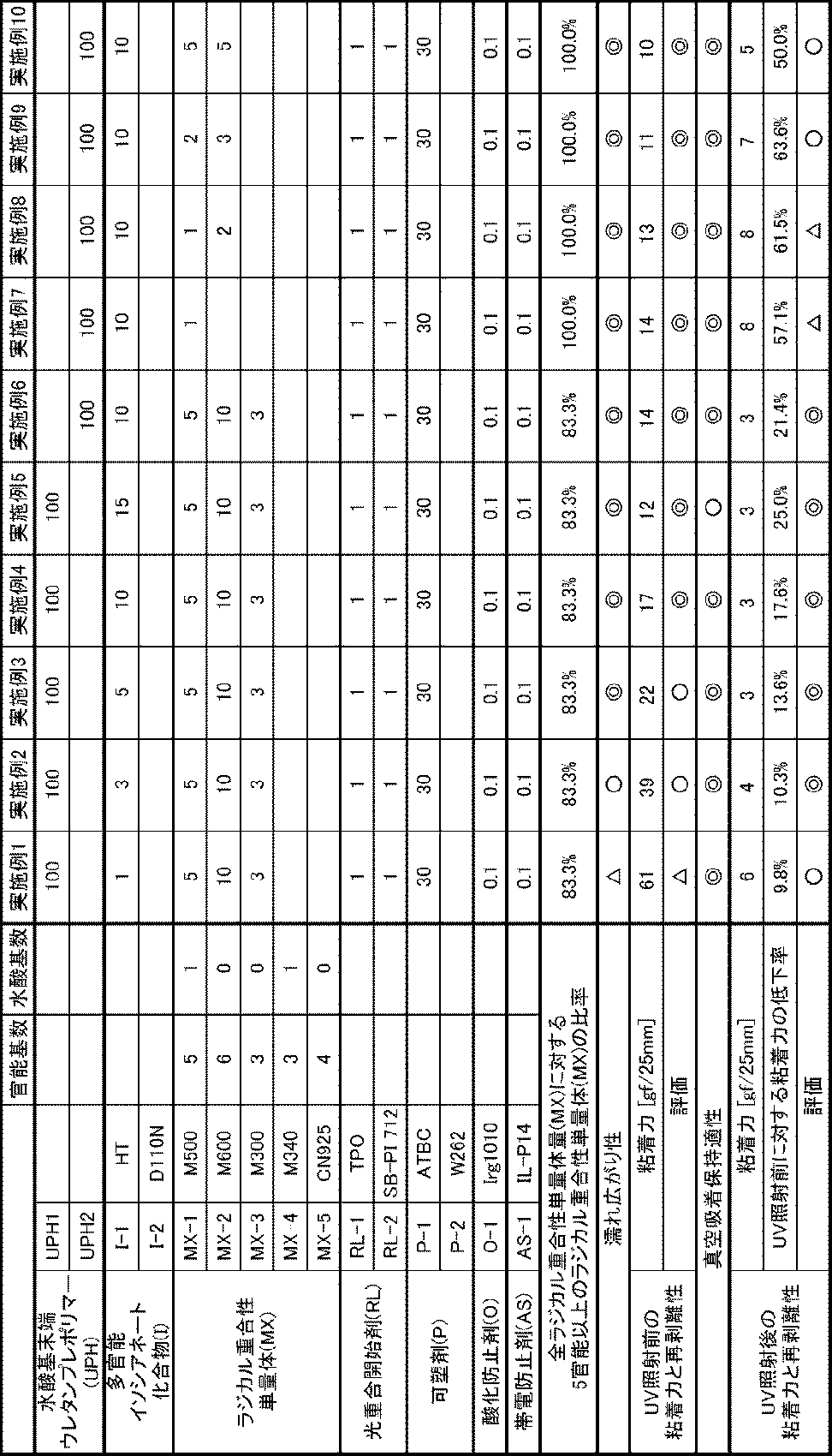

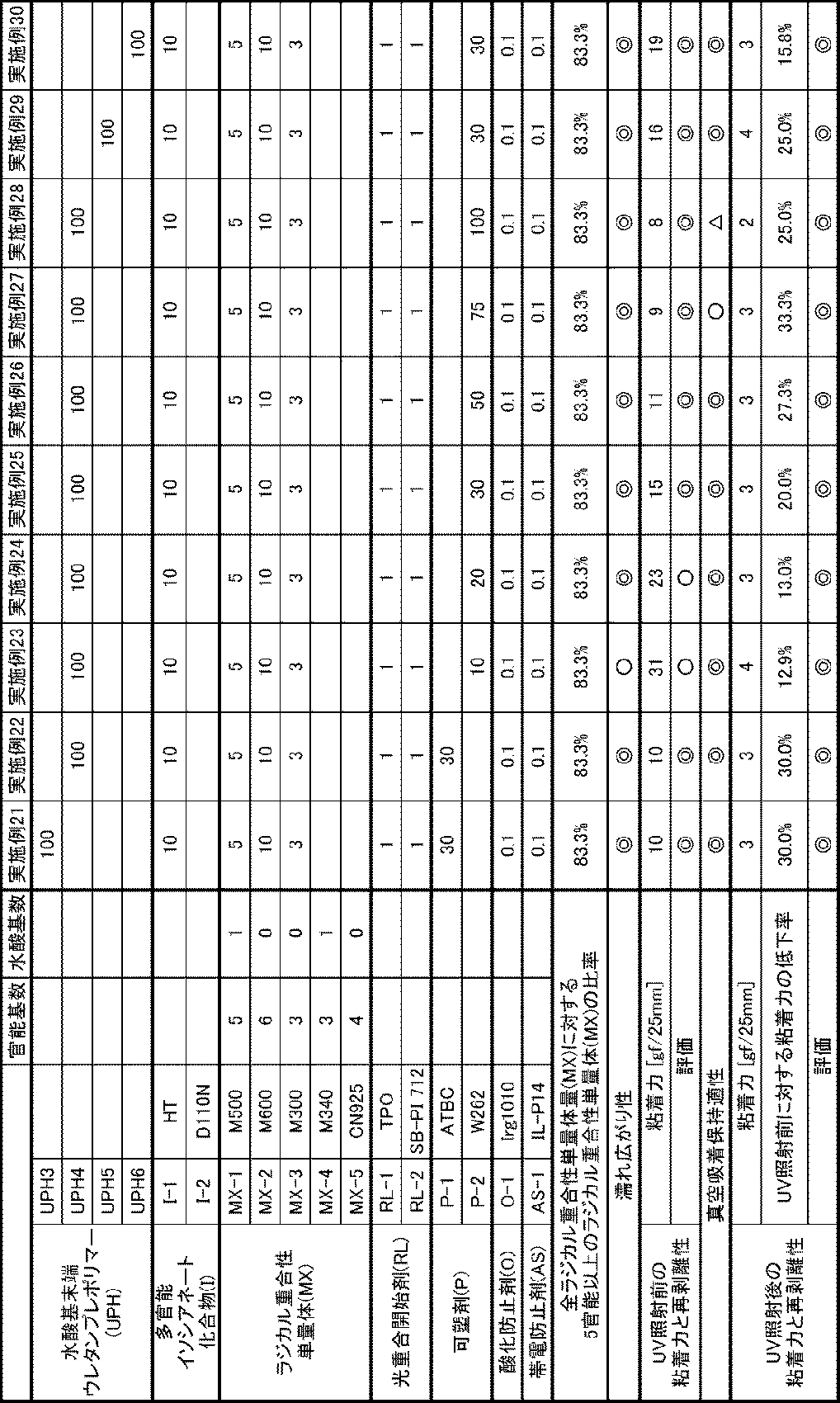

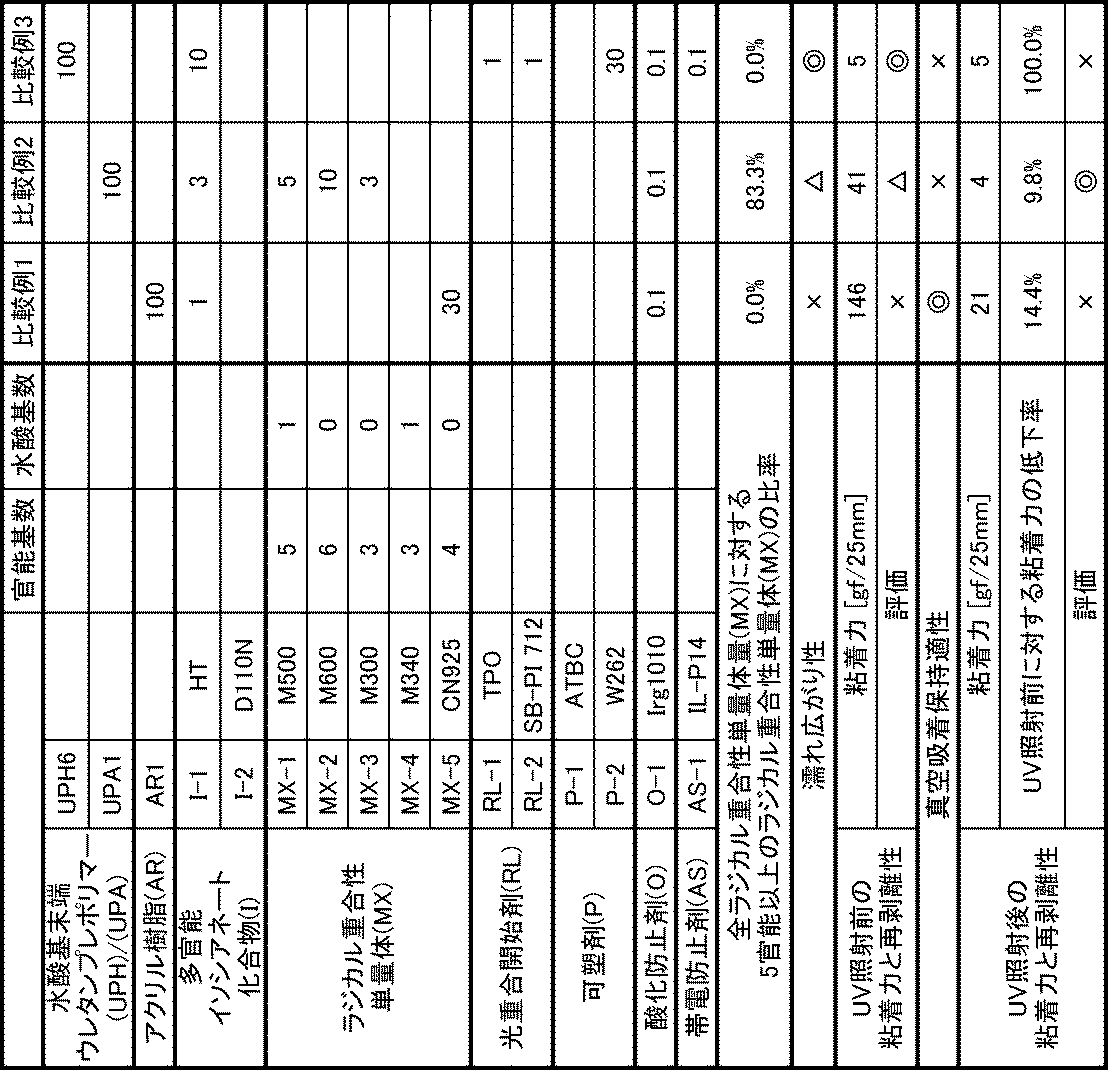
本発明は上記実施形態および実施例に限定されるものではなく、本発明の趣旨を逸脱しない限りにおいて、適宜設計変更が可能である。
この出願は、2019年2月22日に出願された日本出願特願2019-030666号を基礎とする優先権を主張し、その開示の全てをここに取り込む。
10、20 粘着シート
11、21 基材シート
12、22A、22B 粘着層
13、23A、23B 剥離シート
11、21 基材シート
12、22A、22B 粘着層
13、23A、23B 剥離シート
Claims (12)
- 1分子中に複数の活性水素基を有する1種以上の活性水素基含有化合物(HX)と1種以上のポリイソシアネート(N)との反応生成物であり、(メタ)アクリロイル基を含まない水酸基末端ウレタンプレポリマー(UPH)と、
多官能イソシアネート化合物(I)とを含む再剥離型の粘着剤であって、
さらに、1分子中に3つ以上の(メタ)アクリロイル基を含むラジカル重合性単量体(MX)を含み、
前記粘着剤の硬化物からなる粘着層は、活性エネルギー線の照射により粘着力が低下する、粘着剤。 - 前記粘着層は、活性エネルギー線の照射前に対する照射後の、JIS Z0237に準拠し、引張試験機を用いて、剥離速度0.3m/分、剥離角度180°の条件で測定される粘着力の低下率が2/3以下である、請求項1に記載の粘着剤。
- 前記粘着層は、活性エネルギー線の照射前の、JIS Z0237に準拠し、引張試験機を用いて、剥離速度0.3m/分、剥離角度180°の条件で測定される粘着力が100gf/25mm以下である、請求項1または2に記載の粘着剤。
- 前記粘着層は、活性エネルギー線の照射後の、JIS Z0237に準拠し、引張試験機を用いて、剥離速度0.3m/分、剥離角度180°の条件で測定される粘着力が10gf/25mm以下である、請求項1~3のいずれか1項に記載の粘着剤。
- 1種以上の活性水素基含有化合物(HX)は、1分子中に3つ以上の水酸基を有する3官能以上のポリオールを含む、請求項1~4のいずれか1項に記載の粘着剤。
- ラジカル重合性単量体(MX)は、1分子中に5つ以上の(メタ)アクリロイル基を含む、請求項1~5のいずれか1項に記載の粘着剤。
- さらに可塑剤を含む、請求項1~6のいずれか1項に記載の粘着剤。
- さらに帯電防止剤を含む、請求項1~7のいずれか1項に記載の粘着剤。
- さらに、酸化防止剤、耐加水分解剤、紫外線吸収剤、および光安定剤からなる群より選ばれた1種以上の変質防止剤を含む、請求項1~8のいずれか1項に記載の粘着剤。
- 基材シートと、請求項1~9のいずれか1項に記載の粘着剤の硬化物からなる粘着層とを含む、粘着シート。
- 表面保護シート用である、請求項10に記載の粘着シート。
- 被着体の表面に対して前記粘着シートを貼着する工程と、
前記被着体の表面に貼着された前記粘着シートに対して活性エネルギー線を照射して、前記粘着シートの粘着力を低下させる工程と、
粘着力の低下した前記粘着シートを前記被着体から剥離する工程とを含む、請求項10または11に記載の粘着シートの使用方法。
Priority Applications (1)
| Application Number | Priority Date | Filing Date | Title |
|---|---|---|---|
| CN202080015700.1A CN113474428B (zh) | 2019-02-22 | 2020-02-05 | 粘合剂和粘合片及其使用方法 |
Applications Claiming Priority (2)
| Application Number | Priority Date | Filing Date | Title |
|---|---|---|---|
| JP2019-030666 | 2019-02-22 | ||
| JP2019030666A JP6769503B2 (ja) | 2019-02-22 | 2019-02-22 | 粘着剤、および粘着シートとその使用方法 |
Publications (1)
| Publication Number | Publication Date |
|---|---|
| WO2020170827A1 true WO2020170827A1 (ja) | 2020-08-27 |
Family
ID=72144482
Family Applications (1)
| Application Number | Title | Priority Date | Filing Date |
|---|---|---|---|
| PCT/JP2020/004428 Ceased WO2020170827A1 (ja) | 2019-02-22 | 2020-02-05 | 粘着剤、および粘着シートとその使用方法 |
Country Status (3)
| Country | Link |
|---|---|
| JP (1) | JP6769503B2 (ja) |
| CN (1) | CN113474428B (ja) |
| WO (1) | WO2020170827A1 (ja) |
Families Citing this family (1)
| Publication number | Priority date | Publication date | Assignee | Title |
|---|---|---|---|---|
| JP2022055658A (ja) * | 2020-09-29 | 2022-04-08 | Dic株式会社 | 反応性接着剤、積層フィルム、及び包装材 |
Citations (6)
| Publication number | Priority date | Publication date | Assignee | Title |
|---|---|---|---|---|
| JP2006022313A (ja) * | 2004-06-11 | 2006-01-26 | Toyo Ink Mfg Co Ltd | 粘着剤組成物及びこれを用いた粘着シート |
| JP2008024848A (ja) * | 2006-07-21 | 2008-02-07 | Toyo Ink Mfg Co Ltd | 活性エネルギー線粘着力消失型感圧接着剤、それを塗布した活性エネルギー線粘着力消失型粘着シート |
| JP2016108487A (ja) * | 2014-12-09 | 2016-06-20 | Dic株式会社 | 紫外線硬化型粘着剤組成物、紫外線硬化型粘着シート、及び、積層体 |
| JP2016186064A (ja) * | 2015-11-12 | 2016-10-27 | 東洋インキScホールディングス株式会社 | 再剥離型粘着剤 |
| WO2016175112A1 (ja) * | 2015-04-30 | 2016-11-03 | リンテック株式会社 | ワーク加工用粘着テープ |
| WO2019130741A1 (ja) * | 2017-12-26 | 2019-07-04 | 日東電工株式会社 | 光学部材用表面保護シート |
Family Cites Families (2)
| Publication number | Priority date | Publication date | Assignee | Title |
|---|---|---|---|---|
| JP6323580B1 (ja) * | 2017-02-14 | 2018-05-16 | 東洋インキScホールディングス株式会社 | 粘着剤および粘着シート |
| JP6256648B1 (ja) * | 2017-06-12 | 2018-01-10 | 東洋インキScホールディングス株式会社 | 粘着剤およびそれを用いた粘着シート、積層体、表示装置 |
-
2019
- 2019-02-22 JP JP2019030666A patent/JP6769503B2/ja active Active
-
2020
- 2020-02-05 WO PCT/JP2020/004428 patent/WO2020170827A1/ja not_active Ceased
- 2020-02-05 CN CN202080015700.1A patent/CN113474428B/zh active Active
Patent Citations (6)
| Publication number | Priority date | Publication date | Assignee | Title |
|---|---|---|---|---|
| JP2006022313A (ja) * | 2004-06-11 | 2006-01-26 | Toyo Ink Mfg Co Ltd | 粘着剤組成物及びこれを用いた粘着シート |
| JP2008024848A (ja) * | 2006-07-21 | 2008-02-07 | Toyo Ink Mfg Co Ltd | 活性エネルギー線粘着力消失型感圧接着剤、それを塗布した活性エネルギー線粘着力消失型粘着シート |
| JP2016108487A (ja) * | 2014-12-09 | 2016-06-20 | Dic株式会社 | 紫外線硬化型粘着剤組成物、紫外線硬化型粘着シート、及び、積層体 |
| WO2016175112A1 (ja) * | 2015-04-30 | 2016-11-03 | リンテック株式会社 | ワーク加工用粘着テープ |
| JP2016186064A (ja) * | 2015-11-12 | 2016-10-27 | 東洋インキScホールディングス株式会社 | 再剥離型粘着剤 |
| WO2019130741A1 (ja) * | 2017-12-26 | 2019-07-04 | 日東電工株式会社 | 光学部材用表面保護シート |
Also Published As
| Publication number | Publication date |
|---|---|
| JP6769503B2 (ja) | 2020-10-14 |
| CN113474428B (zh) | 2023-03-28 |
| JP2020132799A (ja) | 2020-08-31 |
| CN113474428A (zh) | 2021-10-01 |
Similar Documents
| Publication | Publication Date | Title |
|---|---|---|
| CN110494527B (zh) | 粘着剂、粘着片以及羟基末端氨基甲酸酯预聚物的制造方法 | |
| JP6705530B1 (ja) | 水酸基末端ウレタンプレポリマー含有溶液とその製造方法、粘着剤、および粘着シートとその製造方法 | |
| CN113755112B (zh) | 粘着片、带粘着片的被粘物以及粘着片的使用方法 | |
| CN111032813B (zh) | 氨基甲酸酯系粘着剂及粘着片 | |
| CN108424728B (zh) | 粘着剂及粘着片 | |
| JP7127596B2 (ja) | 粘着剤、粘着シート、および水酸基末端ウレタンプレポリマーの製造方法 | |
| JP6769503B2 (ja) | 粘着剤、および粘着シートとその使用方法 | |
| JP2021006632A (ja) | 粘着剤、および粘着シートとその使用方法 | |
| JP2020147739A (ja) | 粘着シートおよびその製造方法、ならびに画像表示装置 | |
| JP7533119B2 (ja) | 粘着フィルム、および積層体 | |
| JP7142821B2 (ja) | 粘着剤、および粘着シート | |
| JP6879414B1 (ja) | 粘着剤、および粘着シート | |
| JP2020033536A (ja) | ウレタン系粘着剤および粘着シート |
Legal Events
| Date | Code | Title | Description |
|---|---|---|---|
| 121 | Ep: the epo has been informed by wipo that ep was designated in this application |
Ref document number: 20758920 Country of ref document: EP Kind code of ref document: A1 |
|
| NENP | Non-entry into the national phase |
Ref country code: DE |
|
| 122 | Ep: pct application non-entry in european phase |
Ref document number: 20758920 Country of ref document: EP Kind code of ref document: A1 |