WO2020170697A1 - 積層体、及び画像表示装置 - Google Patents
積層体、及び画像表示装置 Download PDFInfo
- Publication number
- WO2020170697A1 WO2020170697A1 PCT/JP2020/002091 JP2020002091W WO2020170697A1 WO 2020170697 A1 WO2020170697 A1 WO 2020170697A1 JP 2020002091 W JP2020002091 W JP 2020002091W WO 2020170697 A1 WO2020170697 A1 WO 2020170697A1
- Authority
- WO
- WIPO (PCT)
- Prior art keywords
- group
- layer
- liquid crystal
- laminate
- polymer
- Prior art date
- Legal status (The legal status is an assumption and is not a legal conclusion. Google has not performed a legal analysis and makes no representation as to the accuracy of the status listed.)
- Ceased
Links
Images


Classifications
-
- B—PERFORMING OPERATIONS; TRANSPORTING
- B32—LAYERED PRODUCTS
- B32B—LAYERED PRODUCTS, i.e. PRODUCTS BUILT-UP OF STRATA OF FLAT OR NON-FLAT, e.g. CELLULAR OR HONEYCOMB, FORM
- B32B7/00—Layered products characterised by the relation between layers; Layered products characterised by the relative orientation of features between layers, or by the relative values of a measurable parameter between layers, i.e. products comprising layers having different physical, chemical or physicochemical properties; Layered products characterised by the interconnection of layers
- B32B7/02—Physical, chemical or physicochemical properties
- B32B7/023—Optical properties
-
- G—PHYSICS
- G02—OPTICS
- G02B—OPTICAL ELEMENTS, SYSTEMS OR APPARATUS
- G02B5/00—Optical elements other than lenses
- G02B5/30—Polarising elements
-
- G—PHYSICS
- G02—OPTICS
- G02F—OPTICAL DEVICES OR ARRANGEMENTS FOR THE CONTROL OF LIGHT BY MODIFICATION OF THE OPTICAL PROPERTIES OF THE MEDIA OF THE ELEMENTS INVOLVED THEREIN; NON-LINEAR OPTICS; FREQUENCY-CHANGING OF LIGHT; OPTICAL LOGIC ELEMENTS; OPTICAL ANALOGUE/DIGITAL CONVERTERS
- G02F1/00—Devices or arrangements for the control of the intensity, colour, phase, polarisation or direction of light arriving from an independent light source, e.g. switching, gating or modulating; Non-linear optics
- G02F1/01—Devices or arrangements for the control of the intensity, colour, phase, polarisation or direction of light arriving from an independent light source, e.g. switching, gating or modulating; Non-linear optics for the control of the intensity, phase, polarisation or colour
- G02F1/13—Devices or arrangements for the control of the intensity, colour, phase, polarisation or direction of light arriving from an independent light source, e.g. switching, gating or modulating; Non-linear optics for the control of the intensity, phase, polarisation or colour based on liquid crystals, e.g. single liquid crystal display cells
-
- G—PHYSICS
- G02—OPTICS
- G02F—OPTICAL DEVICES OR ARRANGEMENTS FOR THE CONTROL OF LIGHT BY MODIFICATION OF THE OPTICAL PROPERTIES OF THE MEDIA OF THE ELEMENTS INVOLVED THEREIN; NON-LINEAR OPTICS; FREQUENCY-CHANGING OF LIGHT; OPTICAL LOGIC ELEMENTS; OPTICAL ANALOGUE/DIGITAL CONVERTERS
- G02F1/00—Devices or arrangements for the control of the intensity, colour, phase, polarisation or direction of light arriving from an independent light source, e.g. switching, gating or modulating; Non-linear optics
- G02F1/01—Devices or arrangements for the control of the intensity, colour, phase, polarisation or direction of light arriving from an independent light source, e.g. switching, gating or modulating; Non-linear optics for the control of the intensity, phase, polarisation or colour
- G02F1/13—Devices or arrangements for the control of the intensity, colour, phase, polarisation or direction of light arriving from an independent light source, e.g. switching, gating or modulating; Non-linear optics for the control of the intensity, phase, polarisation or colour based on liquid crystals, e.g. single liquid crystal display cells
- G02F1/133—Constructional arrangements; Operation of liquid crystal cells; Circuit arrangements
- G02F1/1333—Constructional arrangements; Manufacturing methods
- G02F1/1335—Structural association of cells with optical devices, e.g. polarisers or reflectors
-
- G—PHYSICS
- G02—OPTICS
- G02F—OPTICAL DEVICES OR ARRANGEMENTS FOR THE CONTROL OF LIGHT BY MODIFICATION OF THE OPTICAL PROPERTIES OF THE MEDIA OF THE ELEMENTS INVOLVED THEREIN; NON-LINEAR OPTICS; FREQUENCY-CHANGING OF LIGHT; OPTICAL LOGIC ELEMENTS; OPTICAL ANALOGUE/DIGITAL CONVERTERS
- G02F1/00—Devices or arrangements for the control of the intensity, colour, phase, polarisation or direction of light arriving from an independent light source, e.g. switching, gating or modulating; Non-linear optics
- G02F1/01—Devices or arrangements for the control of the intensity, colour, phase, polarisation or direction of light arriving from an independent light source, e.g. switching, gating or modulating; Non-linear optics for the control of the intensity, phase, polarisation or colour
- G02F1/13—Devices or arrangements for the control of the intensity, colour, phase, polarisation or direction of light arriving from an independent light source, e.g. switching, gating or modulating; Non-linear optics for the control of the intensity, phase, polarisation or colour based on liquid crystals, e.g. single liquid crystal display cells
- G02F1/133—Constructional arrangements; Operation of liquid crystal cells; Circuit arrangements
- G02F1/1333—Constructional arrangements; Manufacturing methods
- G02F1/1335—Structural association of cells with optical devices, e.g. polarisers or reflectors
- G02F1/13363—Birefringent elements, e.g. for optical compensation
Definitions
- the present invention relates to a laminate, and also to an image display device including the laminate.
- Patent Document 1 proposes to use a polyimide film having an ultraviolet transmittance of 10% or less for an image display device in order to suppress the influence of ultraviolet rays on the polarizing layer.
- An object of the present invention is to improve light resistance in a laminate having a retardation layer containing a polymer of a polymerizable liquid crystal compound and an image display device including the same.
- the present invention provides the following laminated body and image display device.
- a laminate having a front plate, a polarizing layer, and a retardation layer in this order,
- the retardation layer contains a polymer of a polymerizable liquid crystal compound
- T Transmittance correction single transmittance
- T Transmittance correction single transmittance
- the laminate according to claim 1 wherein the polarizing layer contains a polymer of a polymerizable liquid crystal compound.
- light resistance can be improved in a laminate having a retardation layer containing a polymer of a polymerizable liquid crystal compound and an image display device including the same.
- FIG. 1 is a schematic cross-sectional view showing a laminated body according to one embodiment of the present invention.
- FIG. 2 is a schematic cross-sectional view showing a laminated body according to one embodiment of the present invention.
- FIG. 1 is a schematic sectional view of a laminate according to an embodiment of the present invention.
- the laminated body 100 shown in FIG. 1 is a bendable laminated body including a front plate 11, a polarizing layer 12, and a retardation layer 13 in this order.
- the term “bendable” means that the laminate 100 can be bent without causing cracks and breaks when bent in the absorption axis direction and the transmission axis direction of the polarizing layer 12.
- the term “bendable” means that the inner surface of the laminate can be bent at a bending radius of 2.5 mm, and more preferably the inner surface of the laminate has a bending radius of 2.5 mm. This means that no cracks or breaks occur even after ten thousand times.
- the absorption axis direction means a case where the polymerizable liquid crystal compound is cured in a state in which the dichroic dye and the polymerizable liquid crystal compound, which will be described later, which form the polarizing layer 12 are horizontally aligned with respect to the substrate surface, or which exhibits liquid crystallinity.
- the chromatic dye is horizontally aligned with respect to the surface of the substrate, it means the orientation direction of the dichroic dye and the polymerizable liquid crystal compound.
- the transmission axis direction indicates the liquid crystallinity when the polymerizable liquid crystal compound is cured in a state where the dichroic dye and the polymerizable liquid crystal compound, which will be described later, that form the polarizing layer 12 are horizontally aligned with respect to the substrate surface.
- the dichroic dye When the dichroic dye is horizontally aligned with respect to the substrate surface, it means a direction that is horizontal with respect to the substrate surface and perpendicular to the alignment direction.
- the alignment state of the polarizing layer 12 can be confirmed by observing with a polarizing microscope.
- the orientation direction of the polarizing plate is in the laminate 100. It is in the absorption axis direction of the polarizing layer 12.
- the alignment direction of the polarizing plate is the transmission axis direction of the polarizing layer 12 of the laminate 100.
- bending includes a form of bending in which a curved surface is formed in the bent portion.
- the bending radius of the bent inner surface is not particularly limited.
- the bending includes a refraction mode in which the inner surface has a refraction angle of more than 0 degree and less than 180 degrees, and a folding mode in which the inner surface has a bending radius close to zero or an inner surface refraction angle of 0 degree. ..
- the image display device to which the laminate 100 having good flexibility is applied can be used as a flexible display that can be bent.
- the retardation layer 13 contains a polymer of a polymerizable liquid crystal compound.
- the polarizing layer 12 preferably contains a polymer of a polymerizable liquid crystal compound.
- the polarizing layer 12 and the retardation layer 13 are preferably formed from a polymer polymerized in a state in which the polymerizable liquid crystal compound is aligned. The polymerizable liquid crystal compound will be described in detail later.
- the laminated body 100 satisfies the following formula (1).
- 0.8 ⁇ yellowness of front plate (YI) ⁇ 3.5 (1)
- the yellowness (YI) of the front plate 11 is more than 3.5, the hue of the obtained laminated body becomes yellowish, the neutral hue is difficult to obtain, and the visible light transmittance of the laminated body is difficult to increase. There is a tendency.
- the yellowness index (YI) of the front plate 11 is less than 0.8, it is easy for ultraviolet rays to pass therethrough, and it becomes difficult to obtain the light resistance of the laminate 100.
- the yellowness (YI) of the front plate 11 is preferably 3.2 or less, and more preferably 3.0 or less from the viewpoint of the neutral hue and the visible light transmittance of the laminate.
- the yellowness (YI) of the front plate 11 is preferably 1 or more, and more preferably 1.3 or more from the viewpoint of light resistance.
- the yellowness (YI) of the front plate 11 can be measured according to the method described in the section of Examples below.
- the laminated body 100 satisfies the following formula (2).
- Transmittance correction single layer transmittance (T) of laminated body ⁇ 50%
- the transmittance of the laminated body is greatly affected by the transmittance of the polarizing layer 12. Therefore, when the visibility-corrected single transmittance (T) of the polarizing layer 12 exceeds 50%, ultraviolet rays tend to easily pass through the polarizing layer 12, and the light resistance of the laminate 100 tends to be difficult to obtain.
- the visibility-corrected single transmittance (T) of the laminate 100 is preferably 48% or less, more preferably 47% or less.
- the visibility-corrected single transmittance (T) of the laminate 100 is usually 40% or more, and may be 42% or more.
- the luminosity-corrected single transmittance (T) can be measured according to the method described in the section of Examples below.
- the laminate 100 has a desired neutral hue and excellent light resistance in a laminate having a retardation layer containing a polymer of a polymerizable liquid crystal compound. It has been found that can be achieved simultaneously.
- the front plate has the yellowness (YI) as low as possible from the viewpoint of visible light transmittance
- the polarizing layer has the anti-reflective function of the laminate and the visible light transmittance single transmittance from the viewpoint of visible light transmittance.
- the rate (T) could be higher than 50%, which was unexpected.
- the laminate 100 preferably satisfies the following formula (3) from the viewpoint of improving the light resistance of the laminate 100.
- the absorbance of the laminate 100 (A 388 ) is more preferably 2.0 or more.
- the laminate 100 usually has an absorbance of 4.0 or less at a wavelength of 388 nm.
- the absorbance (A 388 ) of the laminate at a wavelength of 388 nm can be measured according to the method described in the section of Examples below.
- the laminated body 100 preferably further satisfies the following formula (4).
- the absorbance (A 405 ) at a wavelength of 405 nm is 0.8 or less, the visible light transmittance increases, and the brightness of the image display device tends to increase.
- the layered product 100 preferably has an absorbance at a wavelength of 405 nm of 0.6 or less.
- the absorbance (A 405 ) of the laminate 100 at a wavelength of 405 nm can be measured by the method described in the section of Examples below.
- the laminate 100 may have a difference in reflectance before and after the light resistance test (hereinafter, also referred to as ⁇ reflectance) of, for example, 1.5% or less, preferably 1.0% or less, and more preferably 0.5%. % Or less. Further, the laminate 100 may have a difference in reflection hue before and after the light resistance test (hereinafter, also referred to as ⁇ reflection hue ( ⁇ a * b * )) of, for example, 10 or less, preferably 6 or less, and more preferably 5 or less. It is the following. Further laminate 100, neutral hue before the light resistance test (a * b *) and neutral hue after the light resistance test (a * b *) is, for example, may be 15 or less. The light resistance test can be performed according to the method described in the section of Examples described later. Further, the ⁇ reflectance (%), the ⁇ reflection hue (%) and the neutral hue (a * b * ) can be measured by the methods described in the section of Examples below.
- the laminate 100 is not particularly limited as it differs depending on the function required for the laminate 100 and the application of the laminate 100, but may be, for example, 50 ⁇ m or more and 1000 ⁇ m or less, preferably 100 ⁇ m or more and 500 ⁇ m or less, and more preferably Is 100 ⁇ m or more and 300 ⁇ m or less.
- the laminated body 100 may further include a bonding layer between the front plate 11 and the polarizing layer 12 and between the polarizing layer 12 and the retardation layer 13.
- the laminated body 100 can be used as a polarizing plate for an image display device.
- the laminated body 100 can be a circularly polarizing plate.
- each layer constituting the laminated body 100 will be described.
- the front plate 11 is preferably a plate-shaped body that can transmit light. Front plate 11 may be composed of only one layer or may be composed of two or more layers. When the laminated body 100 is used for an image display device, the front plate 11 can form the outermost surface of the image display device.
- the front plate 11 examples include a glass plate-shaped body (for example, a glass plate, a glass film, etc.) and a resin-made plate-shaped body (for example, a resin plate, a resin sheet, a resin film, etc.).
- the front plate 11 is preferably a resin plate such as a resin film because the flexibility of the laminate 100 and the image display device including the same can be easily increased.
- thermoplastic resin that constitutes the resin plate such as a resin film
- examples of the thermoplastic resin that constitutes the resin plate include chain polyolefin resins (polyethylene resin, polypropylene resin, polymethylpentene resin, etc.), cyclic polyolefin resins (norbornene resins).
- Polyolefin resin such as resin); Cellulose resin such as triacetyl cellulose; Polyester resin such as polyethylene terephthalate, polyethylene naphthalate, polybutylene terephthalate; Polycarbonate resin; Ethylene-vinyl acetate resin; Polystyrene resin; Polyamide -Based resin; polyetherimide-based resin; (meth)acrylic resin such as polymethyl (meth)acrylate resin; polyimide-based resin; polyethersulfone-based resin; polysulfone-based resin; polyvinyl chloride-based resin; polyvinylidene chloride-based resin; Polyvinyl alcohol-based resins; polyvinyl acetal-based resins; polyetherketone-based resins; polyetheretherketone-based resins; polyethersulfone-based resins; polyamide-imide-based resins and the like.
- thermoplastic resins may be used alone or in combination of two or more. Among them, from the viewpoints of flexibility, strength and transparency, polyimide-based resin, polyamide-based resin and polyamide-imide-based resin are preferably used as the thermoplastic resin forming the front plate.
- the polyimide resin can be formed by polycondensation of a diamine and a tetracarboxylic acid compound (including an acid chloride compound, a tetracarboxylic acid compound derivative such as tetracarboxylic acid dianhydride).
- a tetracarboxylic acid compound including an acid chloride compound, a tetracarboxylic acid compound derivative such as tetracarboxylic acid dianhydride.
- tricarboxylic acid compounds including tricarboxylic acid compound derivatives such as acid chloride compounds and tricarboxylic acid anhydrides
- dicarboxylic acid compounds including derivatives such as acid chloride compounds
- the polyamide resin can be formed by polycondensation of a diamine and a dicarboxylic acid compound (including a derivative such as an acid chloride compound).
- the ratio of amino groups occupying the polymer ends obtained is low.
- the amount of the carboxylic acid compound such as the tetracarboxylic acid compound is preferably 1.00 mol or more, and more preferably more than 1.00 mol, based on 1.00 mol of the diamine.
- the polymer chain may contain a halogen atom such as a fluorine atom and a chlorine atom. The halogen atom can contribute to improving the elastic modulus of the resin and reducing the yellowness.
- the front plate 11 may be a film in which a hard coat layer is provided on at least one surface of the base film to further improve the hardness.
- the above-mentioned resin film can be used as the base film.
- the hard coat layer may be formed on one surface of the base film, or may be formed on both surfaces. By providing the hard coat layer, hardness and scratch resistance can be improved.
- the thickness of the hard coat layer may be, for example, 0.1 ⁇ m or more and 30 ⁇ m or less, preferably 1 ⁇ m or more and 20 ⁇ m or less, and more preferably 5 ⁇ m or more and 15 ⁇ m or less.
- the hard coat layer is, for example, a cured layer of an ultraviolet curable resin.
- the ultraviolet curable resin include (meth)acrylic resin, silicone resin, polyester resin, urethane resin, amide resin, and epoxy resin.
- the hard coat layer may contain an additive in order to improve the strength.
- the additive is not limited and includes inorganic fine particles, organic fine particles, or a mixture thereof.
- the front plate 11 has not only a function of protecting the front surface (screen) of the image display device (function as a window film), but also a function as a touch sensor, a blue light cut function, a viewing angle adjustment function, and the like. It may be.
- the thickness of the front plate 11 may be, for example, 20 ⁇ m or more and 2000 ⁇ m or less, preferably 25 ⁇ m or more and 1000 ⁇ m or less, more preferably 30 ⁇ m or more and 500 ⁇ m or less, and further preferably 30 ⁇ m or more and 200 ⁇ m or less.
- the polarizing layer 12 preferably contains a polymer of a polymerizable liquid crystal compound (hereinafter, also referred to as a polymerizable liquid crystal (a)).
- the polarizing layer 12 is a layer composed of a cured product of a composition containing one or more polymerizable liquid crystals (a) and a dichroic dye, or a composition containing a dichroic dye showing one or more liquid crystallinity. It is preferably a layer composed of a material.
- the dichroic dye and the polymerizable liquid crystal (a) cure the polymerizable liquid crystal (a) in a state of being horizontally aligned with respect to the plane of the laminate 100.
- the dichroic dye exhibiting liquid crystallinity may be horizontally aligned with respect to the plane of the laminate 100.
- the polarizing layer 12 has a polarizing property in the thickness direction of the laminate 100, the dichroic dye and the polymerizable liquid crystal (a) are aligned in the vertical direction with respect to the plane of the laminate 100 to form the polymerizable liquid crystal (a).
- the polarizing layer 12 is preferably a coating layer, for example, of a composition for forming a polarizing layer containing one or more polymerizable liquid crystal (a) and a dichroic dye (hereinafter, also referred to as composition (A)). It may be a cured product of the coating layer.
- the visibility-corrected transmittance of the laminate and the absorbance of the laminate can be controlled by changing the amount of the dye contained in the composition (A) or changing the thickness of the polarizing layer.
- the polarizing layer 12 may have a thickness of, for example, 0.5 ⁇ m or more and 10 ⁇ m or less, preferably 0.7 ⁇ m or more and 8 ⁇ m or less, and more preferably 1.0 ⁇ m or more and 5 ⁇ m or less.
- the composition (A) is applied on the front plate 11 or a base material layer described later, or on the alignment layer, and the polymerizable liquid crystal (a) in the obtained coating film is polymerized.
- the composition (A) is applied on the front plate 11 or a base material layer described later, or on the alignment layer, and the polymerizable liquid crystal (a) in the obtained coating film is polymerized.
- the polymerizable liquid crystal (a) is a compound having a polymerizable group and having liquid crystallinity.
- the polymerizable group means a group involved in the polymerization reaction, and is preferably a photopolymerizable group.
- the photopolymerizable group refers to a group that can participate in the polymerization reaction by an active radical or an acid generated from a photopolymerization initiator described later.
- Examples of the polymerizable group include vinyl group, vinyloxy group, 1-chlorovinyl group, isopropenyl group, 4-vinylphenyl group, acryloyloxy group, methacryloyloxy group, oxiranyl group and oxetanyl group.
- an acryloyloxy group, a methacryloyloxy group, a vinyloxy group, an oxiranyl group and an oxetanyl group are preferable, and an acryloyloxy group is more preferable.
- the liquid crystallinity may be thermotropic liquid crystal or lyotropic liquid crystal, but when mixed with the dichroic dye described later, thermotropic liquid crystal is preferred.
- the polymerizable liquid crystal (a) when it is a thermotropic liquid crystal, it may be a thermotropic liquid crystal compound exhibiting a nematic liquid crystal phase or a thermotropic liquid crystal compound exhibiting a smectic liquid crystal phase.
- the liquid crystal state of the polymerizable liquid crystal (a) is preferably a smectic phase, and a higher order smectic phase is more preferable from the viewpoint of high performance. ..
- a higher-order smectic liquid crystal compound forming a smectic B phase, a smectic D phase, a smectic E phase, a smectic F phase, a smectic G phase, a smectic H phase, a smectic I phase, a smectic J phase, a smectic K phase or a smectic L phase.
- Higher order smectic liquid crystal compounds which form a smectic B phase, a smectic F phase or a smectic I phase are more preferred.
- a polarizing layer having higher polarization performance can be produced.
- a Bragg peak derived from a higher-order structure such as a hexatic phase or a crystal phase is obtained in X-ray diffraction measurement.
- the Bragg peak is a peak derived from the periodic structure of molecular orientation, and a film having a periodic interval of 3 to 6 ⁇ can be obtained.
- the polarizing layer of the present invention preferably contains a polymer of the polymerizable liquid crystal (a) obtained by polymerizing the polymerizable liquid crystal (a) in a smectic phase state, from the viewpoint of obtaining higher polarization characteristics.
- Such a compound include a compound represented by the following formula (I) [hereinafter, also referred to as compound (I)].
- the polymerizable liquid crystal (a) may be used alone or in combination of two or more kinds.
- X 1 , X 2 and X 3 each independently represent a divalent aromatic group or a divalent alicyclic hydrocarbon group, wherein the divalent aromatic group or the divalent alicyclic group is used.
- the hydrogen atom contained in the hydrocarbon group is substituted with a halogen atom, an alkyl group having 1 to 4 carbon atoms, a fluoroalkyl group having 1 to 4 carbon atoms, an alkoxy group having 1 to 4 carbon atoms, a cyano group or a nitro group.
- the carbon atom constituting the divalent aromatic group or the divalent alicyclic hydrocarbon group may be substituted with an oxygen atom, a sulfur atom or a nitrogen atom.
- at least one of X 1 , X 2 and X 3 is a 1,4-phenylene group which may have a substituent or a cyclohexane-1,4-diyl group which may have a substituent.
- Y 1 , Y 2 , W 1 and W 2 are, independently of each other, a single bond or a divalent linking group.
- V 1 and V 2 each independently represent an alkanediyl group having 1 to 20 carbon atoms which may have a substituent, and —CH 2 — constituting the alkanediyl group is —O—, — It may be replaced with S- or NH-.
- U 1 and U 2 each independently represent a polymerizable group or a hydrogen atom, and at least one is a polymerizable group.
- X 1 , X 2 and X 3 is a 1,4-phenylene group which may have a substituent, or a cyclohexane-1 which may have a substituent. , 4-diyl group.
- X 1 and X 3 are preferably a cyclohexane-1,4-diyl group which may have a substituent, and the cyclohexane-1,4-diyl group is trans-cyclohexane- It is more preferably a 1,4-diyl group.
- the optionally substituted 1,4-phenylene group or the optionally substituted cyclohexane-1,4-diyl group has a methyl group
- examples thereof include an alkyl group having 1 to 4 carbon atoms such as an ethyl group and a butyl group, a cyano group, and a halogen atom such as a chlorine atom and a fluorine atom. It is preferably unsubstituted.
- Y 1 and Y 2 independently of each other are a single bond, —CH 2 CH 2 —, —CH 2 O—, —COO—, —OCO—, —N ⁇ N—, —CR a ⁇ CR b —, — C ⁇ C— or CR a ⁇ N— is preferable, and R a and R b each independently represent a hydrogen atom or an alkyl group having 1 to 4 carbon atoms.
- Y 1 and Y 2 are more preferably —CH 2 CH 2 —, —COO—, —OCO— or a single bond
- X 1 , X 2 and X 3 are all cyclohexane-1,4-diyl groups.
- it is more preferable that Y 1 and Y 2 are different coupling methods from each other. When Y 1 and Y 2 are bonding methods different from each other, smectic liquid crystallinity tends to be exhibited.
- W 1 and W 2 independently of each other are preferably a single bond, —O—, —S—, —COO— or OCO—, and more preferably independently of each other a single bond or O—.
- alkanediyl group having 1 to 20 carbon atoms represented by V 1 and V 2 examples include methylene group, ethylene group, propane-1,3-diyl group, butane-1,3-diyl group, butane-1,4 -Diyl group, pentane-1,5-diyl group, hexane-1,6-diyl group, heptane-1,7-diyl group, octane-1,8-diyl group, decane-1,10-diyl group, tetradecane Examples thereof include -1,14-diyl group and icosane-1,20-diyl group.
- V 1 and V 2 are preferably an alkanediyl group having 2 to 12 carbon atoms, and more preferably a linear alkanediyl group having 6 to 12 carbon atoms.
- a straight-chain alkanediyl group having 6 to 12 carbon atoms the crystallinity is improved, and smectic liquid crystallinity tends to be exhibited.
- Examples of the substituent optionally contained in the optionally substituted alkanediyl group having 1 to 20 carbon atoms include a cyano group, a halogen atom such as a chlorine atom and a fluorine atom, and the like. It is preferably unsubstituted, and more preferably an unsubstituted and linear alkanediyl group.
- Both U 1 and U 2 are preferably a polymerizable group, and more preferably both are a photopolymerizable group.
- the polymerizable liquid crystal compound having a photopolymerizable group is advantageous in that it can form a polymer in a state where the liquid crystal has a higher degree of order because it can be polymerized under a lower temperature condition than the thermally polymerizable group.
- the polymerizable groups represented by U 1 and U 2 may be different from each other, but are preferably the same.
- the polymerizable group include vinyl group, vinyloxy group, 1-chlorovinyl group, isopropenyl group, 4-vinylphenyl group, acryloyloxy group, methacryloyloxy group, oxiranyl group and oxetanyl group.
- an acryloyloxy group, a methacryloyloxy group, a vinyloxy group, an oxiranyl group and an oxetanyl group are preferable, and a methacryloyloxy group or an acryloyloxy group is more preferable.
- Examples of such a polymerizable liquid crystal compound include the following.
- the dichroic dye means a dye having a property that the absorbance in the long axis direction of the molecule and the absorbance in the short axis direction are different.
- the dichroic dye preferably has a property of absorbing visible light, and more preferably has a maximum absorption wavelength ( ⁇ MAX) in the range of 380 to 680 nm.
- ⁇ MAX maximum absorption wavelength
- Examples of such a dichroic dye include an acridine dye, an oxazine dye, a cyanine dye, a naphthalene dye, an azo dye and an anthraquinone dye, and among them, an azo dye is preferable.
- the azo dyes include monoazo dyes, bisazo dyes, trisazo dyes, tetrakisazo dyes and stilbeneazo dyes, and the bisazo dyes and trisazo dyes are preferable.
- the dichroic dyes may be used alone or in combination, but in order to obtain absorption in the entire visible light range, it is preferable to combine three or more kinds of dichroic dyes, and it is more preferable to combine three or more kinds of azo dyes. preferable.
- Examples of the azo dye include a compound represented by the formula (II) (hereinafter, also referred to as “compound (II)”).
- T 1 ⁇ A 1 ( ⁇ N NA 2 )
- T 1 and T 2 are electron withdrawing groups or electron emitting groups, and are located at substantially 180° with respect to the azo bond plane.
- p represents an integer of 0 to 4.
- each A 2 may be the same or different.
- Substituents optionally possessed by the 1,4-phenylene group, naphthalene-1,4-diyl group and divalent heterocyclic group in A 1 and A 2 and A 3 include a methyl group, an ethyl group and a butyl group.
- Alkyl group having 1 to 4 carbon atoms Alkoxy group having 1 to 4 carbon atoms such as methoxy group, ethoxy group and butoxy group; Fluoroalkyl group having 1 to 4 carbon atoms such as trifluoromethyl group; cyano group; nitro group A halogen atom such as a chlorine atom or a fluorine atom; a substituted or unsubstituted amino group such as an amino group, a diethylamino group and a pyrrolidino group (a substituted amino group is an amino having one or two alkyl groups having 1 to 6 carbon atoms) Group or an amino group in which two substituted alkyl groups are bonded to each other to form an alkanediyl group having 2 to 8 carbon atoms.
- a substituted amino group is an amino having one or two alkyl groups having 1 to 6 carbon atoms
- the unsubstituted amino group is —NH 2 .
- the alkyl group having 1 to 6 carbon atoms include methyl group, ethyl group and hexyl group.
- Examples of the alkanediyl group having 2 to 8 carbon atoms include ethylene group, propane-1,3-diyl group, butane-1,3-diyl group, butane-1,4-diyl group, pentane-1,5-diyl group. , Hexane-1,6-diyl group, heptane-1,7-diyl group, octane-1,8-diyl group and the like.
- a 1 and A 2 and A 3 are unsubstituted or a 1,4-phenylene group in which hydrogen is substituted with a methyl group or a methoxy group, or a divalent group.
- p is preferably 0 or 1.
- p is 1 and at least two of the three structures of A 1, A 2 and A 3 are 1,4-phenylene groups because both of the ease of molecular synthesis and high performance are obtained. More preferable.
- divalent heterocyclic group examples include groups in which two hydrogen atoms have been removed from quinoline, thiazole, benzothiazole, thienothiazole, imidazole, benzimidazole, oxazole and benzoxazole.
- a 2 is a divalent heterocyclic group, a structure having a molecular bond angle of substantially 180° is preferable, and specifically, benzothiazole, benzimidazole, and benzoxazole in which two 5-membered rings are condensed. The structure is more preferred.
- T 1 and T 2 are electron withdrawing groups or electron emitting groups and preferably have different structures.
- T 1 is an electron withdrawing group and a T 2 electron emitting group, or T 1 is an electron emitting group and a T 2 electron withdrawing group. Is more preferable.
- T 1 and T 2 are each independently an alkyl group having 1 to 4 carbon atoms, an alkoxy group having 1 to 4 carbon atoms, a cyano group, a nitro group, an alkyl group having 1 to 6 carbon atoms, or An amino group having two amino groups or an amino group in which two substituted alkyl groups are bonded to each other to form an alkanediyl group having 2 to 8 carbon atoms, or a trifluoromethyl group is preferable, and among them, a highly ordered structure such as smectic liquid crystal.
- an alkyl group having 1 to 6 carbon atoms, an alkoxy group having 1 to 6 carbon atoms, a cyano group, and a carbon number 1 An amino group having one or two alkyl groups having 6 to 6 or an amino group having two substituted alkyl groups bonded to each other to form an alkanediyl group having 2 to 8 carbon atoms is preferable.
- azo dyes examples include the following.
- B 1 to B 20 are each independently a hydrogen atom, an alkyl group having 1 to 6 carbon atoms, an alkoxy group having 1 to 6 carbon atoms, a cyano group, a nitro group, a substituted or unsubstituted amino group (a substituted amino group and a The definition of the unsubstituted amino group is as described above), and represents a chlorine atom or a trifluoromethyl group.
- B 2 , B 6 , B 9 , B 14 , B 18 , and B 19 are preferably hydrogen atoms or methyl groups, and more preferably hydrogen atoms.
- n1 to n4 each independently represent an integer of 0 to 3.
- a plurality of B 2 may be the same or different
- a plurality of B 6 may be the same or different
- a plurality of B 9 may be the same or different
- the plurality of B 14 may be the same or different.
- anthraquinone dye a compound represented by the formula (2-7) is preferable.
- R 1 to R 8 each independently represent a hydrogen atom, —R x , —NH 2 , —NHR x , —NR x 2 , —SR x, or a halogen atom.
- R x represents an alkyl group having 1 to 4 carbon atoms or an aryl group having 6 to 12 carbon atoms.
- oxazine dye a compound represented by the formula (2-8) is preferable.
- R 9 to R 15 each independently represent a hydrogen atom, —R x , —NH 2 , —NHR x , —NR x 2 , —SR x, or a halogen atom.
- R x represents an alkyl group having 1 to 4 carbon atoms or an aryl group having 6 to 12 carbon atoms.
- acridine dye a compound represented by the formula (2-9) is preferable.
- R 16 to R 23 each independently represent a hydrogen atom, —R x , —NH 2 , —NHR x , —NR x 2 , —SR x, or a halogen atom.
- R x represents an alkyl group having 1 to 4 carbon atoms or an aryl group having 6 to 12 carbon atoms.
- Examples of the alkyl group having 1 to 4 carbon atoms represented by R x in the formula (2-7), the formula (2-8) and the formula (2-9) include a methyl group, an ethyl group, a propyl group and a butyl group.
- a pentyl group and a hexyl group, and the aryl group having 6 to 12 carbon atoms includes a phenyl group, a toluyl group, a xylyl group, a naphthyl group and the like.
- cyanine dye a compound represented by the formula (2-10) and a compound represented by the formula (2-11) are preferable.
- D 1 and D 2 each independently represent a group represented by any one of formulas (2-10a) to (2-10d).
- n5 represents an integer of 1 to 3.
- D 3 and D 4 each independently represent a group represented by any one of formulas (2-11a) to (2-11h).
- n6 represents an integer of 1 to 3.
- the content of the dichroic dye (when a plurality of kinds are contained, the total amount thereof) is usually 0.1 to 30 parts by mass with respect to 100 parts by mass of the polymerizable liquid crystal (a) from the viewpoint of obtaining good light absorption characteristics. Parts, preferably 1 to 20 parts by mass, more preferably 2 to 15 parts by mass. When the content of the dichroic dye is less than this range, light absorption becomes insufficient and sufficient polarization performance cannot be obtained, and when it is more than this range, the alignment of liquid crystal molecules may be hindered.
- the base material layer may be composed of, for example, a resin film, and preferably a transparent resin film.
- the resin film may be a long resin film or a sheet-shaped resin film. A long resin film is preferable because it can be continuously produced.
- the resin forming the resin film examples include polyolefins such as polyethylene, polypropylene, norbornene-based polymers, and cyclic olefin-based resins; polyvinyl alcohol; polyethylene terephthalate; polymethacrylic acid ester; polyacrylic acid ester; triacetyl cellulose, diacetyl cellulose, and the like.
- Cellulose ester such as cellulose acetate propionate; polyethylene naphthalate; polycarbonate; polysulfone; polyether sulfone; polyether ketone; polyphenylene sulfide; polyphenylene oxide; polyamide; polyimide; polyamideimide and other plastics.
- cyclic olefin resin, cellulose ester and polyimide are preferable.
- cyclic olefin resins examples include "Topas” (registered trademark) (manufactured by Ticona (Germany)), “Arton” (registered trademark) (manufactured by JSR Corporation), and “ZEONOR”. (Registered trademark), “ZEONEX” (registered trademark) (above, manufactured by Nippon Zeon Co., Ltd.), “Apel” (registered trademark) (manufactured by Mitsui Chemicals, Inc.) and the like.
- Such a cyclic olefin resin can be formed into a resin film by a known means such as a solvent casting method or a melt extrusion method.
- cyclic olefin resin film It is also possible to use a commercially available cyclic olefin resin film.
- typical commercial products of the cyclic olefin resin film include "ESCINA” (registered trademark), “SCA40” (registered trademark) (above, Sekisui Chemical Co., Ltd.), “Zeonor film” (registered trademark) ( Optes Co., Ltd.) and “Arton Film” (registered trademark) (manufactured by JSR Corporation).
- Examples of typical commercially available resin films composed of cellulose ester include “Fujitack Film” (manufactured by Fuji Photo Film Co., Ltd.); “KC8UX2M”, “KC8UY” and “KC4UY” (above, Konica Minolta Opto Co., Ltd.) Company made) etc.
- the thickness of the resin film is preferably thin from the viewpoint of thinning the laminate 100, but if it is too thin, impact resistance tends to be difficult to secure.
- the thickness of the resin film may be, for example, 10 ⁇ m or more and 200 ⁇ m or less, preferably 15 ⁇ m or more and 150 ⁇ m or less, and more preferably 20 ⁇ m or more and 100 ⁇ m or less.
- the base material layer may have a hard coat layer, an antireflection layer, or an antistatic layer on at least one surface.
- the base layer may have a hard coat layer, an antireflection layer, an antistatic layer, or the like formed only on the surface on which the polarizing layer 12 is not formed.
- the base layer may have a hard coat layer, an antireflection layer, an antistatic layer, or the like formed only on the surface on the side where the polarizing layer 12 is formed.
- the laminate 100 may have an alignment layer between the base material layer and the polarizing layer 12 or between the front plate 11 and the polarizing layer 12.
- the alignment layer has an alignment regulating force for aligning the polymerizable liquid crystal forming the polarizing layer 12 formed on the base layer or the front plate 11 in a desired direction.
- Alignment layer facilitates alignment of the polymerizable liquid crystal.
- the alignment states such as horizontal alignment, vertical alignment, hybrid alignment, and tilt alignment change depending on the properties of the alignment layer and the polymerizable liquid crystal, and the combination thereof can be arbitrarily selected.
- the alignment layer is a material that develops horizontal alignment as an alignment regulating force
- the polymerizable liquid crystal can form horizontal alignment or hybrid alignment
- the polymerizable liquid crystal is vertical.
- Oriented or tilted orientations can be formed.
- the expressions such as horizontal and vertical represent the direction of the long axis of the aligned polymerizable liquid crystal with reference to the plane of the polarizing layer 12.
- vertical alignment means having the major axis of the aligned polymerizable liquid crystal in a direction perpendicular to the plane of the polarizing layer 12.
- Vertical as used herein means 90° ⁇ 20° with respect to the plane of the polarizing layer 12.
- the alignment regulating force can be arbitrarily adjusted depending on the surface condition and the rubbing condition when the alignment layer is formed of the alignment polymer, and the polarization irradiation condition can be adjusted when the alignment layer is formed of the photoalignment polymer. It is possible to adjust it arbitrarily according to the above. Further, the orientation can be controlled by selecting physical properties such as surface tension and liquid crystallinity of the polymerizable liquid crystal.
- the alignment layer formed between the base material layer and the polarizing layer 12 is insoluble in the solvent used when the polarizing layer 12 is formed on the alignment layer, and is effective for removing the solvent and aligning the liquid crystal. It is preferable that the heat treatment has heat resistance.
- the alignment layer may be an alignment layer made of an alignment polymer, a photo alignment layer, a groove alignment layer, or the like. Among them, the photo-alignment layer is preferable because the alignment direction can be easily controlled when applied to a long resin film.
- the thickness of the alignment layer may be, for example, 10 nm or more and 5000 nm or less, preferably 10 nm or more and 1000 nm or less, and more preferably 30 nm or more and 300 nm or less.
- the oriented polymer used in the orientation layer composed of an oriented polymer, polyamides and gelatins having an amide bond in the molecule, polyimide having an imide bond in the molecule and polyamic acid which is a hydrolyzate thereof, polyvinyl alcohol, alkyl Examples thereof include modified polyvinyl alcohol, polyacrylamide, polyoxazole, polyethyleneimine, polystyrene, polyvinylpyrrolidone, polyacrylic acid and polyacrylic acid esters. Of these, polyvinyl alcohol is preferable. These oriented polymers may be used alone or in combination of two or more.
- the alignment layer made of the oriented polymer is usually a composition in which the oriented polymer is dissolved in a solvent (hereinafter, referred to as “alignment property”).
- Alignment property a composition in which the oriented polymer is dissolved in a solvent
- polymer composition is applied to a resin film to remove the solvent, or the oriented polymer composition is applied to the resin film, the solvent is removed, and rubbing (rubbing method) is performed.
- the solvent examples include water; alcohol solvents such as methanol, ethanol, ethylene glycol, isopropyl alcohol, propylene glycol, methyl cellosolve, butyl cellosolve and propylene glycol monomethyl ether; ethyl acetate, butyl acetate, ethylene glycol methyl ether acetate, ⁇ -butyrolactone, Ester solvents such as propylene glycol methyl ether acetate and ethyl lactate; ketone solvents such as acetone, methyl ethyl ketone, cyclopentanone, cyclohexanone, methyl amyl ketone and methyl isobutyl ketone; aliphatic hydrocarbon solvents such as pentane, hexane and heptane; toluene and Aromatic hydrocarbon solvents such as xylene, nitrile solvents such as acetonitrile; ether solvents such as tetrahydr
- the concentration of the orienting polymer in the orienting polymer composition may be in a range such that the orienting polymer can be completely dissolved in the solvent, but is 0.1% by mass or more and 20% by mass or less in terms of solid content with respect to the solution. It is preferably 0.1% by mass or more and 10% by mass or less.
- a commercially available material for forming an orientation layer may be used as it is as the orientation polymer composition.
- Examples of commercially available materials for forming an alignment layer include Sanever (registered trademark) (manufactured by Nissan Chemical Industries, Ltd.) and Optomer (registered trademark) (manufactured by JSR Corporation).
- a coating method such as a spin coating method, an extrusion method, a gravure coating method, a die coating method, a bar coating method and an applicator method, or a printing method such as a flexo method.
- a printing method such as a gravure coating method, a die coating method or a flexo method is usually used as the coating method.
- a dry film of the oriented polymer is formed.
- the method for removing the solvent include a natural drying method, a ventilation drying method, a heat drying method and a reduced pressure drying method.
- a rubbing cloth is wrapped around a rotating rubbing roll, and a film of the oriented polymer formed on the resin film surface by applying the oriented polymer composition to the resin film and annealing it, The method of contacting is mentioned.
- the photo-alignment layer is usually obtained by applying a composition containing a polymer or monomer having a photoreactive group and a solvent (hereinafter, also referred to as "composition for forming photo-alignment layer") to a resin film, and polarizing (preferably polarizing) It is obtained by irradiating with (UV).
- composition for forming photo-alignment layer a composition containing a polymer or monomer having a photoreactive group and a solvent
- polarizing preferably polarizing
- Photoreactive group refers to a group that produces the ability to orient liquid crystals when irradiated with light. Specifically, it causes a photoreaction that is the origin of the ability to align liquid crystals, such as an orientation induction or isomerization reaction of molecules generated by irradiation with light, a dimerization reaction, a photocrosslinking reaction, or a photolysis reaction. It is a thing.
- the photoreactive groups those that cause a dimerization reaction or a photocrosslinking reaction are preferable because of excellent orientation.
- a group having at least one selected from the group is more preferred.
- a chalcone group and a cinnamoyl group are preferable from the viewpoint of easy control of reactivity and expression of alignment regulating force during photoalignment.
- These groups may have a substituent such as an alkyl group, an alkoxy group, an aryl group, an allyloxy group, a cyano group, an alkoxycarbonyl group, a hydroxyl group, a sulfonic acid group and a halogenated alkyl group.
- a photoreactive group capable of causing a photodimerization reaction is preferable
- a cinnamoyl group and a chalcone group have a relatively small amount of polarized light irradiation required for photoalignment, and a photoalignment layer having excellent thermal stability and stability over time. It is preferable because it is easily obtained.
- a polymer having a photoreactive group a polymer having a cinnamoyl group such that the terminal portion of the side chain of the polymer has a cinnamic acid structure is particularly preferable.
- a polymer having a photoreactive group that is particularly preferable is, for example, a compound of formula (A′) A polymer having a group represented by in the side chain (hereinafter, also referred to as “polymer (A′)” in some cases).
- n 0 or 1.
- X 1 represents a single bond, —O—, —COO—, —OCO—, —N ⁇ N—, —CH ⁇ CH— or CH 2 —.
- Y 1 represents a single bond or O—.
- R 1 and R 2 each independently represent a hydrogen atom, an alkyl group having 1 to 4 carbon atoms or an alkoxy group having 1 to 4 carbon atoms. * Represents a bond to the polymer main chain.
- X 1 is a single bond, —O—, —COO—, —OCO—, —N ⁇ N—, —C ⁇ C— or CH 2 — and the polymer ( It is particularly preferable because it facilitates the production of A′) itself.
- R 1 and R 2 are each independently a hydrogen atom, a halogen atom, a halogenated alkyl group, a halogenated alkoxy group, a cyano group, a nitro group, an alkyl group, an alkoxy group, an aryl group, an allyloxy group.
- R 1 and R 2 are each independently a hydrogen atom, an alkyl group having 1 to 4 carbon atoms or an alkoxy group having 1 to 4 carbon atoms.
- the alkyl group include methyl group, ethyl group and butyl group
- examples of the alkoxy group include methoxy group, ethoxy group and butoxy group.
- the main chain of the polymer (A′) is not particularly limited, but a (meth)acrylic acid ester unit represented by the formula (M-1) or the formula (M-2); the formula (M-3) or the formula (M- (Meth)acrylamide unit represented by 4); vinyl ether unit represented by formula (M-5) or formula (M-6); represented by formula (M-7) or formula (M-8) (
- the polymer (A) has a main chain composed of a methyl)styrene unit and a vinyl ester unit represented by the formula (M-9) or the formula (M-10).
- the polymer (A′) has a main chain composed of a unit selected from the group consisting of (meth)acrylic acid ester units and (meth)acrylamide units.
- the “main chain of the polymer (A′)” here means the longest molecular chain of the molecular chains of the polymer (A′).
- the unit represented by any of the formulas (M-1) to (M-10) and the group represented by the formula (A′) may be directly bonded, or may be bonded via an appropriate linking group.
- the linking group has a carbonyloxy group (ester bond), an oxygen atom (ether bond), an imide group, a carbonylimino group (amide bond), an iminocarbonylimino group (urethane bond), and a substituent.
- a divalent aromatic hydrocarbon group which may have a substituent a divalent aromatic hydrocarbon group which may have a substituent, a divalent aromatic hydrocarbon group which may have a substituent, and a divalent group formed by combining these.
- the divalent aromatic hydrocarbon group which may have a substituent examples include phenylene group, 2-methoxy-1,4-phenylene group, 3-methoxy-1,4-phenylene group, 2-ethoxy. Examples thereof include a 1,4-phenylene group, a 3-ethoxy-1,4-phenylene group, and a 2,3,5-trimethoxy-1,4-phenylene group.
- the linking group is preferably an aliphatic hydrocarbon group, and more preferably an alkanediyl group having 1 to 11 carbon atoms which may have a substituent.
- alkanediyl group examples include methylene group, ethylene group, trimethylene group, tetramethylene group, pentamethylene group, hexamethylene group, heptamethylene group, octamethylene group, nonamethylene group, decamethylene group and undecamethylene group. These may be linear or branched. Further, such alkanediyl group may have a substituent. This substituent is, for example, an alkoxy group having 1 to 4 carbon atoms.
- the structural unit having a group represented by the formula (A′) is a unit represented by the formula (A) (hereinafter, also referred to as “structural unit (A)” in some cases.
- the polymer containing is also referred to as “polymer (A)”).
- the structure represented by is a structure represented by any of the formulas (M-1) to (M-10). ]
- the molecular weight of the polymer (A′) or the polymer (A) is preferably in the range of 1 ⁇ 10 3 to 1 ⁇ 10 7 , which is represented by a polystyrene-equivalent weight average molecular weight obtained by a gel permeation method (GPC method). .
- GPC method gel permeation method
- the polymer (A) may have a structural unit represented by the formula (B) (hereinafter, also referred to as “structural unit (B)” in some cases) in addition to the structural unit (A).
- m 0 or 1.
- S 2 represents an alkanediyl group having 1 to 11 carbon atoms.
- the structure represented by is a structure represented by any of the formulas (M-1) to (M-10).
- X 2 represents a single bond, —O—, —COO—, —OCO—, —N ⁇ N—, —CH ⁇ CH— or CH 2 —.
- Y 2 represents a single bond or O—.
- R 3 and R 4 each independently represent a hydrogen atom, an alkyl group having 1 to 4 carbon atoms or an alkoxy group having 1 to 4 carbon atoms. ]
- the polymer (A) has the structural unit (A) and p is 1 means that the polymer (A) has the structural unit (A). It means that it is a polymer consisting of.
- the polymer composed of the structural unit (A) may have one type or two or more types of the structural unit (A). ].
- the polymer (A) has a structural unit other than the structural unit (A) and the structural unit (B) (hereinafter, also referred to as “other structural unit” in some cases) as long as it does not significantly impair the alignment ability by light irradiation. You may have.
- the polymer (A) can be produced by (co)polymerizing a monomer that induces the structural unit (A) and, if necessary, a monomer that induces the structural unit (B) or another structural unit.
- An addition polymerization method is usually adopted for the (co)polymerization, and examples of such addition polymerization include chain polymerization such as radical polymerization, anionic polymerization and cationic polymerization, and coordination polymerization.
- the polymerization conditions are set so that the above-mentioned preferable molecular weight of the polymer (A) is satisfied depending on the kind and the amount of the monomer used.
- the polymer (A) has been described above as a preferable polymer having a photoreactive group.
- the composition for forming an alignment layer has a polymer (preferably, the polymer (A)) having the photoreactive group. ) Is dissolved in a suitable solvent.
- a suitable solvent can be appropriately selected within a range in which the polymer having the photoreactive group can be dissolved and an alignment layer-forming composition having an appropriate viscosity can be obtained.
- Alcohol solvents such as propylene glycol, ethylene glycol methyl ether, ethylene glycol butyl ether and propylene glycol monomethyl ether; ester solvents such as ethyl acetate, butyl acetate, ethylene glycol methyl ether acetate, ⁇ -butyrolactone or propylene glycol methyl ether acetate and ethyl lactate Ketone solvents such as acetone, methyl ethyl ketone, cyclopentanone, cyclohexanone, 2-heptanone and methyl isobutyl ketone; aliphatic hydrocarbon solvents such as pentane, hexane and heptane; aromatic hydrocarbon solvents such as toluene and xylene, acetonitrile, etc.
- Alcohol solvents such as propylene glycol, ethylene glycol methyl ether, ethylene glycol butyl ether and propylene glycol monomethyl ether
- Nitrile solvents such as ether solvents such as tetrahydrofuran and dimethoxyethane; chlorine-containing solvents such as chloroform and chlorobenzene; amide solvents such as N-methylpyrrolidone, N,N-dimethylformamide, ⁇ -butyrolactone and dimethylacetamide. These solvents may be used alone or in combination of two or more.
- the content of the polymer or monomer having a photoreactive group in the composition for forming a photoalignment layer can be appropriately adjusted depending on the kind of the polymer or monomer having the photoreactive group and the thickness of the photoalignment layer to be produced. Is preferably 0.2 mass% or more, and particularly preferably 0.3 mass% or more and 10 mass% or less. Further, a polymer material such as polyvinyl alcohol or polyimide, or a photosensitizer may be contained within a range in which the characteristics of the photo-alignment layer are not significantly impaired.
- the same method as the method of applying the above-mentioned alignment polymer composition to the resin film can be mentioned.
- Examples of the method for removing the solvent from the applied composition for forming a photo-alignment layer include the same method as the method for removing the solvent from the oriented polymer composition.
- the composition for forming a photo-alignment layer applied on a resin film or the like may be directly irradiated with polarized light even after removing the solvent. It is also possible to use a format in which the light is transmitted through and irradiated. Further, it is particularly preferable that the polarized light is substantially parallel light.
- the wavelength of the polarized light to be irradiated is preferably in the wavelength range in which the photoreactive group of the polymer or monomer having a photoreactive group can absorb light energy. Specifically, UV (ultraviolet light) in the wavelength range of 250 nm to 400 nm is particularly preferable.
- Examples of the light source used for the irradiation of polarized light include xenon lamps, high-pressure mercury lamps, ultra-high-pressure mercury lamps, metal halide lamps, and ultraviolet light lasers such as KrF and ArF.
- High-pressure mercury lamps, ultra-high-pressure mercury lamps and metal halide lamps are more preferable. preferable. These lamps are preferable because they have high emission intensity of ultraviolet light having a wavelength of 313 nm.
- Polarized light can be irradiated by irradiating the light from the light source through a suitable polarizer.
- a polarizing filter, a polarizing prism such as Glan-Thompson or Glan-Taylor, or a wire grid type polarizer can be used.
- the groove alignment layer is a film having an uneven pattern or a plurality of grooves (grooves) on the film surface.
- the liquid crystal molecules are placed on a film having a plurality of linear globbs arranged at equal intervals, the liquid crystal molecules are aligned in the direction along the groove.
- a method for obtaining the glube alignment layer after exposure through an exposure mask having a patterned slit on the surface of the photosensitive polyimide film, a method of forming an uneven pattern by developing and rinsing, a plate having a groove on the surface
- a method of forming a layer of UV-curable resin before curing on a disk-shaped master, transferring the resin layer to a resin film and then curing it, and a plurality of UV-curable resin films before curing formed on the resin film There is a method in which a roll-shaped master having grooves is pressed to form irregularities and then cured. Specifically, the methods described in JP-A-6-34976 and JP-A-2011-242743 may be mentioned.
- the width of the convex portion of the glub alignment layer is preferably 0.05 ⁇ m or more and 5 ⁇ m or less, and the width of the concave portion is preferably 0.1 ⁇ m or more and 5 ⁇ m or less.
- the depth of the step is preferably 2 ⁇ m or less, and more preferably 0.01 ⁇ m or more and 1 ⁇ m or less.
- the polarizing layer 12 may be formed on one side of the base material layer, or may be formed on both sides of the base material layer.
- the polarizing layer 12 may have a protective layer on the surface facing the retardation layer 13.
- the protective layer may be formed of the resin film exemplified as the material of the base material layer, or may be a coating type protective layer.
- the coating type protective layer may be formed by applying a cationically curable composition such as an epoxy resin or a radical curable composition such as (meth)acrylate and curing the composition, and an aqueous solution of a polyvinyl alcohol resin or the like. May be applied and dried.
- the thickness of the protective layer may be, for example, 200 ⁇ m or less, preferably 0.1 ⁇ m or more and 100 ⁇ m or less.
- the retardation layer 13 contains a polymer of a polymerizable liquid crystal compound.
- the retardation layer 13 can be formed by polymerizing one or more polymerizable liquid crystal compounds (hereinafter, also referred to as polymerizable liquid crystal (b)).
- the retardation layer 13 is preferably a coating layer and may be, for example, a cured product of the composition (B) described below.
- the retardation layer 13 may be one layer or two or more layers.
- the retardation layer 13 may include, for example, at least one selected from the group consisting of a ⁇ /4 layer, a ⁇ /2 layer, a positive A layer and a positive C layer, and preferably includes a ⁇ /4 layer.
- the retardation layer 13 includes a ⁇ /4 layer
- a ⁇ /2 layer and a ⁇ /4 layer may be sequentially stacked from the polarizing layer 12 side
- a ⁇ /4 layer and a positive C layer may be sequentially stacked from the polarizing layer 12 side.
- the positive C layer and the ⁇ /4 layer may be sequentially stacked from the polarizing layer 12 side.
- the retardation layer 13 may further include an overcoat layer that protects the surface of the retardation layer 13, a resin film or an alignment film exemplified as the material of the above-mentioned base layer, and the ⁇ /4 layer and the ⁇ / You may have the below-mentioned bonding layer for bonding 2 layers or a positive C layer.
- a composition containing one or more polymerizable liquid crystals (b) (hereinafter, also referred to as the composition (B)) is applied onto the base material layer, and the polymerization in the obtained coating film is performed. It can be obtained by polymerizing the liquid crystal (b).
- the laminate including the retardation layer 13 and the base material layer can be attached to the polarizing layer 12 via an attachment layer. After laminating, the base material layer can be peeled off.
- the base material layer to which the composition (B) is applied can have an alignment film.
- the alignment film the alignment film described above as the alignment film of the polarizing layer 12 is applied.
- the angle formed between the absorption axis of the polarizing layer 12 and the slow axis of the ⁇ /4 layer is 45°.
- the laminate 100 is a circularly polarizing plate and the retardation layer 13 includes a ⁇ /4 layer and a ⁇ /2 layer
- the angle formed between the absorption axis of the polarizing layer 12 and the slow axis of the ⁇ /4 layer is “ ⁇ ”.
- the layers can be laminated so as to satisfy the following relational expression.
- Examples of the polymerizable group contained in the polymerizable liquid crystal (b) include vinyl group, vinyloxy group, 1-chlorovinyl group, isopropenyl group, 4-vinylphenyl group, acryloyloxy group, methacryloyloxy group, oxiranyl group, oxetanyl group and the like. Is mentioned. Among them, an acryloyloxy group, a methacryloyloxy group, a vinyloxy group, an oxiranyl group and an oxetanyl group are preferable, and an acryloyloxy group is more preferable.
- the liquid crystallinity of the polymerizable liquid crystal (b) may be a thermotropic liquid crystal or a lyotropic liquid crystal, and if the thermotropic liquid crystal is classified according to the degree of order, it may be a nematic liquid crystal or a smectic liquid crystal.
- thermotropic nematic liquid crystal is preferable from the viewpoint of easy film formation, and a compound represented by the following formula (III) (hereinafter, also referred to as compound (III)) is more preferable.
- the polymerizable liquid crystal may be used alone or in combination.
- X 1 represents an oxygen atom, a sulfur atom or NR 1 ⁇ .
- R 1 represents a hydrogen atom or an alkyl group having 1 to 4 carbon atoms.
- Y 1 is a monovalent aromatic hydrocarbon group having 6 to 12 carbon atoms which may have a substituent or a monovalent aromatic heterocycle having 3 to 12 carbon atoms which may have a substituent.
- Q 3 and Q 4 are each independently a hydrogen atom, a monovalent aliphatic hydrocarbon group having 1 to 20 carbon atoms which may have a substituent, or a monovalent alicyclic group having 3 to 20 carbon atoms.
- R 2 and R 3 each independently represent a hydrogen atom or an alkyl group having 1 to 6 carbon atoms.
- R 4 , R 5 , R 6 and R 7 each independently represent a hydrogen atom, a fluorine atom or an alkyl group having 1 to 4 carbon atoms.
- G 1 and G 2 each independently represent a divalent alicyclic hydrocarbon group having 5 to 8 carbon atoms, and the methylene group constituting the alicyclic hydrocarbon group is an oxygen atom, a sulfur atom or NH. It may be replaced with-and the methine group constituting the alicyclic hydrocarbon group may be replaced with a tertiary nitrogen atom.
- L 1 and L 2 each independently represent a monovalent organic group, and at least one of L 1 and L 2 has a polymerizable group. ]
- L 1 in the compound (III) is preferably a group represented by the following formula (III-1), and L 2 is preferably a group represented by the formula (III-2).
- P 1 -F 1 -(B 1 -A 1 ) k -E 1 -(III-1)
- P 2 -F 2 - (B 2 -A 2) l -E 2 - (III-2)
- B 1, B 2, E 1 and E 2 are, each independently, -CR 4 R 5 -, - CH 2 -CH 2 -, - O -, - S -, - CO-O -, - O-CO Represents —O—, —CS—O—, —O—CS—O—, —CO—NR 1 —, —O—CH 2 —, —S—CH 2 — or a single bond.
- a 1 and A 2 each independently represent a divalent alicyclic hydrocarbon group having 5 to 8 carbon atoms or a divalent aromatic hydrocarbon group having 6 to 18 carbon atoms, wherein the alicyclic hydrocarbon is The methylene group constituting the group may be replaced by an oxygen atom, a sulfur atom or NH-, and the methine group constituting the alicyclic hydrocarbon group may be replaced by a tertiary nitrogen atom.
- Good. k and l each independently represent an integer of 0 to 3.
- F 1 and F 2 represent a divalent aliphatic hydrocarbon group having 1 to 12 carbon atoms.
- P 1 represents a polymerizable group.
- P 2 represents a hydrogen atom or a polymerizable group.
- R 4 and R 5 each independently represent a hydrogen atom, a fluorine atom or an alkyl group having 1 to 4 carbon atoms. ]
- Preferred compounds (III) include the compounds described in JP2011-207765A.
- polymerizable liquid crystal (b) examples include the polymerizable liquid crystal compounds exemplified in the description of the polarizing layer, and the liquid crystal handbook (edited by the liquid crystal handbook editorial committee, published by Maruzen Co., Ltd. on October 30, 2000).
- the liquid crystal handbook edited by the liquid crystal handbook editorial committee, published by Maruzen Co., Ltd. on October 30, 2000.
- Polymerizable nematic liquid crystal material compounds having a polymerizable group can be mentioned.
- the thickness of the retardation layer 13 may be, for example, 0.1 ⁇ m or more and 50 ⁇ m or less, preferably 1 ⁇ m or more and 10 ⁇ m or less, more preferably 0.5 ⁇ m or more and 8 ⁇ m or less, and further preferably 1 ⁇ m or more and 6 ⁇ m or less. ..
- the laminating layer included in the laminate 100 is a pressure-sensitive adhesive layer or an adhesive layer, and can be formed using the pressure-sensitive adhesive composition or the adhesive composition.
- the bonding layer may have a single-layer structure or a multi-layer structure, but preferably has a single-layer structure.
- the bonding layer may have a single-layer structure or a multi-layer structure, but it is preferably a single-layer structure.
- the adhesive composition may be a known adhesive composition, examples of which include a water-based adhesive composition such as a polyvinyl alcohol-based resin aqueous solution and a water-based two-component urethane-based emulsion adhesive; active energy such as ultraviolet rays. Examples thereof include an active energy ray-curable adhesive composition that is cured by irradiation with rays.
- a water-based adhesive composition such as a polyvinyl alcohol-based resin aqueous solution and a water-based two-component urethane-based emulsion adhesive
- active energy such as ultraviolet rays.
- Examples thereof include an active energy ray-curable adhesive composition that is cured by irradiation with rays.
- the pressure-sensitive adhesive composition may be a pressure-sensitive adhesive composition containing a resin such as a (meth)acrylic type, a rubber type, a urethane type, an ester type, a silicone type, or a polyvinyl ether type as a main component. Above all, a pressure-sensitive adhesive composition containing a (meth)acrylic resin as a base polymer, which is excellent in transparency, weather resistance, heat resistance, etc., is preferable.
- the pressure-sensitive adhesive composition may be an active energy ray curable type or a thermosetting type.
- Examples of the (meth)acrylic resin (base polymer) used in the pressure-sensitive adhesive composition include butyl (meth)acrylate, methyl (meth)acrylate, ethyl (meth)acrylate, hexyl (meth)acrylate, ( (Meth)acrylic acid such as octyl (meth)acrylate, lauryl (meth)acrylate, isooctyl (meth)acrylate, isodecyl (meth)acrylate, 2-ethylhexyl (meth)acrylate, isobornyl (meth)acrylate Polymers or copolymers having one or more of esters as monomers are preferably used.
- a polar monomer for example, (meth)acrylic acid, 2-hydroxypropyl (meth)acrylate, hydroxyethyl (meth)acrylate, (meth)acrylamide, N,N-dimethylaminoethyl (meth)acrylate, glycidyl ( Examples thereof include monomers having a carboxyl group, a hydroxyl group, an amide group, an amino group, an epoxy group and the like such as (meth)acrylate.
- the pressure-sensitive adhesive composition may contain only the above-mentioned base polymer, but usually further contains a crosslinking agent.
- a cross-linking agent a metal ion having a valence of 2 or more and forming a carboxylic acid metal salt with a carboxyl group; a polyamine compound forming an amide bond with a carboxyl group; Examples thereof include epoxy compounds and polyols that form an ester bond with a carboxyl group; and polyisocyanate compounds that form an amide bond with a carboxyl group. Of these, polyisocyanate compounds are preferable.
- the active energy ray-curable pressure-sensitive adhesive composition has a property of being cured by being irradiated with an active energy ray such as an ultraviolet ray or an electron beam, and has adhesiveness even before irradiation with the active energy ray. It is a pressure-sensitive adhesive composition having a property of being capable of being brought into close contact with an adherend such as, and being cured by irradiation with an active energy ray so as to adjust the adhesive force and the like.
- the active energy ray-curable pressure-sensitive adhesive composition is preferably UV-curable.
- the active energy ray-curable pressure-sensitive adhesive composition further contains an active energy ray-polymerizable compound in addition to the base polymer and the crosslinking agent. Further, if necessary, a photopolymerization initiator, a photosensitizer or the like may be contained.
- the active energy ray-polymerizable compound examples include a (meth)acrylate monomer having at least one (meth)acryloyloxy group in the molecule; a compound obtained by reacting two or more functional group-containing compounds, and at least one compound in the molecule.
- examples thereof include (meth)acryl-based compounds such as (meth)acryloyloxy group-containing compounds such as (meth)acrylate oligomers having two (meth)acryloyloxy groups.
- the pressure-sensitive adhesive composition includes fine particles for imparting light-scattering properties, beads (resin beads, glass beads, etc.), glass fibers, resins other than base polymers, tackifiers, fillers (metal powder and other inorganic powders). Etc.), antioxidants, ultraviolet absorbers, antistatic agents, dyes, pigments, colorants, defoamers, corrosion inhibitors, photopolymerization initiators, and other additives.
- the pressure-sensitive adhesive layer can be formed by applying, for example, an organic solvent diluted solution of the above pressure-sensitive adhesive composition onto a substrate and drying.
- the formed pressure-sensitive adhesive layer can be irradiated with an active energy ray to obtain a cured product having a desired degree of curing.
- the thickness of the bonding layer is, for example, 0.5 ⁇ m or more and 100 ⁇ m or less, preferably 0.7 ⁇ m or more and 50 ⁇ m or less, and more preferably 1 ⁇ m or more and 30 ⁇ m or less.
- the laminated body 100 may further include a supporting base material on the retardation layer side.
- the supporting substrate is a plate-shaped body that can transmit light.
- the supporting substrate 50 may be composed of only one layer, or may be composed of two or more layers.
- As the supporting substrate similar to the front plate 11, for example, a plate-shaped body made of glass (for example, glass plate, glass film, etc.), a plate-shaped body made of resin (for example, resin plate, resin sheet, resin film, etc.) ) Is mentioned.
- the supporting base material can be arranged on the surface opposite to the viewing side of the image display device.
- thermoplastic resin is preferably a cellulose resin, a (meth)acrylic resin, a cyclic polyolefin resin, a polyester resin, a polycarbonate resin, or the like.
- the supporting base material may be a touch sensor panel, a display element such as an organic EL display element, or a combination thereof.
- the thickness of the supporting base material is preferably 15 ⁇ m or more and 200 ⁇ m or less, more preferably 20 ⁇ m or more and 150 ⁇ m or less, and further preferably 50 ⁇ m or more and 130 ⁇ m or less, from the viewpoint of making the laminate 100 thinner.
- FIG. 2 shows a schematic cross-sectional view of a laminated body 200 according to another aspect.
- the laminate 200 includes a front plate 11, an adhesive layer 21, a base material layer 22, an alignment film 23, a polarizing layer 12, a protective layer 24, an adhesive layer 25, a ⁇ /4 layer 26, an adhesive layer 27, and a positive C layer 28. Are stacked in this order.
- the laminated body 200 can be a circularly polarizing plate.
- the laminate can be produced by a method including a step of laminating the layers constituting the laminate with an adhesive layer or an adhesive layer.
- a step of laminating the layers constituting the laminate with an adhesive layer or an adhesive layer.
- one or both of the laminating surfaces should be subjected to surface activation treatment such as corona treatment in order to enhance adhesion. Is preferred.
- the polarizer layer and the retardation layer can be formed directly on the front plate or the base material layer or via the alignment film, and the base material layer may be incorporated in the laminate, or It may not be peeled from the child layer or the retardation layer and become a constituent element of the laminate.
- the laminate can be produced, for example, by the method described in the section of Examples described later.
- the polarizing layer 12 can be formed by applying the composition (A) on the base material layer 11 and, if present, the alignment layer.
- the composition (A) preferably further contains a polymerization initiator, a leveling agent and a solvent, and may further contain a photosensitizer, a polymerization inhibitor and the like.
- the polymerization initiator is a compound capable of initiating a polymerization reaction such as a polymerizable liquid crystal.
- a photopolymerization initiator that generates an active radical by the action of light is preferable from the viewpoint that it does not depend on the phase state of the thermotropic liquid crystal.
- polymerization initiator examples include benzoin compounds, benzophenone compounds, alkylphenone compounds, acylphosphine oxide compounds, triazine compounds, iodonium salts and sulfonium salts.
- benzoin compound examples include benzoin, benzoin methyl ether, benzoin ethyl ether, benzoin isopropyl ether and benzoin isobutyl ether.
- benzophenone compound examples include benzophenone, methyl o-benzoylbenzoate, 4-phenylbenzophenone, 4-benzoyl-4′-methyldiphenyl sulfide, 3,3′,4,4′-tetra(tert-butylperoxycarbonyl). ) Benzophenone and 2,4,6-trimethylbenzophenone.
- alkylphenone compound examples include diethoxyacetophenone, 2-methyl-2-morpholino-1-(4-methylthiophenyl)propan-1-one, 2-benzyl-2-dimethylamino-1-(4-morpholinophenyl ) Butan-1-one, 2-hydroxy-2-methyl-1-phenylpropan-1-one, 1,2-diphenyl-2,2-dimethoxyethane-1-one, 2-hydroxy-2-methyl-1 -[4-(2-Hydroxyethoxy)phenyl]propan-1-one, 1-hydroxycyclohexyl phenyl ketone and 2-hydroxy-2-methyl-1-[4-(1-methylvinyl)phenyl]propan-1- Examples thereof include ON oligomers.
- acylphosphine oxide compound examples include 2,4,6-trimethylbenzoyldiphenylphosphine oxide and bis(2,4,6-trimethylbenzoyl)phenylphosphine oxide.
- triazine compound examples include 2,4-bis(trichloromethyl)-6-(4-methoxyphenyl)-1,3,5-triazine and 2,4-bis(trichloromethyl)-6-(4-methoxy Naphthyl)-1,3,5-triazine, 2,4-bis(trichloromethyl)-6-(4-methoxystyryl)-1,3,5-triazine, 2,4-bis(trichloromethyl)-6- [2-(5-Methylfuran-2-yl)ethenyl]-1,3,5-triazine, 2,4-bis(trichloromethyl)-6-[2-(furan-2-yl)ethenyl]-1 ,3,5-Triazine, 2,4-bis(trichloromethyl)-6-[2-(4-diethylamino-2-methylphenyl)ethenyl]-1,3,5-triazine and 2,4-bis(trichloro And
- a commercially available polymerization initiator can be used.
- Commercially available polymerization initiators include Irgacure (registered trademark) 907, 184, 651, 819, 250, and 369, 379, 127, 754, OXE01, OXE02, OXE03 (manufactured by Ciba Specialty Chemicals Co., Ltd.).
- the polymerization initiator in the composition (A) may be one kind, or may be a mixture of two or more kinds of polymerization initiators depending on the light source of light.
- the content of the polymerization initiator in the composition (A) can be appropriately adjusted according to the type and amount of the polymerizable liquid crystal, but is usually 0.1 part by mass with respect to 100 parts by mass of the polymerizable liquid crystal content. Or more and 30 parts by mass or less, preferably 0.5 parts by mass or more and 10 parts by mass or less, more preferably 0.5 parts by mass or more and 8 parts by mass or less.
- the content of the polymerization initiator is within the above range, the polymerization can be performed without disturbing the alignment of the polymerizable liquid crystal.
- the composition (A) may contain a sensitizer.
- a photosensitizer is preferable.
- the sensitizer include xanthone compounds such as xanthone and thioxanthone (eg, 2,4-diethylthioxanthone, 2-isopropylthioxanthone); anthracenes such as anthracene and alkoxy group-containing anthracenes (eg, dibutoxyanthracene).
- xanthone compounds such as xanthone and thioxanthone (eg, 2,4-diethylthioxanthone, 2-isopropylthioxanthone)
- anthracenes such as anthracene and alkoxy group-containing anthracenes (eg, dibutoxyanthracene).
- Compounds: phenothiazine, rubrene and the like can be mentioned.
- the polymerization reaction of the polymerizable liquid crystal contained in the composition (A) can be further promoted.
- the amount of the sensitizer used is preferably 0.1 parts by mass or more and 10 parts by mass or less, more preferably 0.5 parts by mass or more and 5 parts by mass or less, and more preferably 0 part by mass with respect to 100 parts by mass of the polymerizable liquid crystal content. More preferably, it is 0.5 parts by mass or more and 3 parts by mass or less.
- the composition (A) may contain a polymerization inhibitor.
- the degree of progress of the polymerization reaction of the polymerizable liquid crystal can be controlled by the polymerization inhibitor.
- polymerization inhibitor examples include radicals such as hydroquinone, hydroquinone containing an alkoxy group, catechol containing an alkoxy group (eg, butylcatechol), pyrogallol, 2,2,6,6-tetramethyl-1-piperidinyloxy radical, and the like.
- radicals such as hydroquinone, hydroquinone containing an alkoxy group, catechol containing an alkoxy group (eg, butylcatechol), pyrogallol, 2,2,6,6-tetramethyl-1-piperidinyloxy radical, and the like.
- the content of the polymerization inhibitor is preferably 0.1 parts by mass or more and 10 parts by mass or less, more preferably 100 parts by mass of the polymerizable liquid crystal content. Is 0.5 parts by mass or more and 5 parts by mass or less, more preferably 0.5 parts by mass or more and 3 parts by mass or less.
- the content of the polymerization inhibitor is within the above range, the polymerization can be performed without disturbing the alignment of the polymerizable liquid crystal.
- the composition (A) may contain a leveling agent.
- the leveling agent is an additive having a function of adjusting the fluidity of the composition and making the film obtained by applying the composition more flat, for example, organic modified silicone oil type, polyacrylate type and perfluoro type.
- Alkyl leveling agents may be mentioned. Specifically, DC3PA, SH7PA, DC11PA, SH28PA, SH29PA, SH30PA, ST80PA, ST86PA, SH8400, SH8700, FZ2123 (all manufactured by Toray Dow Corning Co., Ltd.), KP321, KP323, KP324, KP326, KP340.
- KP341, X22-161A, KF6001 (all manufactured by Shin-Etsu Chemical Co., Ltd.), TSF400, TSF401, TSF410, TSF4300, TSF4440, TSF4445, TSF-4446, TSF4452, TSF4460 (all above, Momentive Performance Materials Japan LLC) Fluorinert (registered trademark) FC-72, FC-40, FC-43, FC-3283 (all manufactured by Sumitomo 3M Limited), Megafac (registered trademark) R-08 , R-30, R-90, F-410, F-411, F-443, F-445, F-470, F-477, F-479, F-482.
- composition (A) contains a leveling agent, preferably 0.01 parts by mass or more and 5 parts by mass or less, more preferably 0.1 parts by mass or more and 5 parts by mass with respect to 100 parts by mass of the content of the polymerizable liquid crystal. Parts or less, more preferably 0.1 parts by mass or more and 3 parts by mass or less.
- a leveling agent preferably 0.01 parts by mass or more and 5 parts by mass or less, more preferably 0.1 parts by mass or more and 5 parts by mass with respect to 100 parts by mass of the content of the polymerizable liquid crystal. Parts or less, more preferably 0.1 parts by mass or more and 3 parts by mass or less.
- the composition (A) may contain two or more kinds of leveling agents.
- the composition (A) may contain a solvent.
- a solvent capable of completely dissolving the polymerizable liquid crystal compound is preferable, and a solvent inert to the polymerization reaction of the polymerizable liquid crystal compound is preferable.
- the solvent examples include alcohol solvents such as methanol, ethanol, ethylene glycol, isopropyl alcohol, propylene glycol, ethylene glycol methyl ether, ethylene glycol butyl ether and propylene glycol monomethyl ether; ethyl acetate, butyl acetate, ethylene glycol methyl ether acetate, ⁇ -butyrolactone.
- alcohol solvents such as methanol, ethanol, ethylene glycol, isopropyl alcohol, propylene glycol, ethylene glycol methyl ether, ethylene glycol butyl ether and propylene glycol monomethyl ether
- ethyl acetate, butyl acetate, ethylene glycol methyl ether acetate, ⁇ -butyrolactone examples of the solvent.
- ester solvents such as propylene glycol methyl ether acetate and ethyl lactate
- ketone solvents such as acetone, methyl ethyl ketone, cyclopentanone, cyclohexanone, 2-heptanone and methyl isobutyl ketone
- aliphatic hydrocarbon solvents such as pentane, hexane and heptane; toluene.
- aromatic hydrocarbon solvents such as xylene, nitrile solvents such as acetonitrile; ether solvents such as tetrahydrofuran and dimethoxyethane; chlorine-containing solvents such as chloroform and chlorobenzene; dimethylacetamide, dimethylformamide, N-methyl-2-pyrrolidone, Examples thereof include amide solvents such as 1,3-dimethyl-2-imidazolidinone. These solvents may be used alone or in combination of two or more.
- the content of the solvent is preferably 50% by mass or more and 98% by mass or less with respect to the total amount of the composition (A).
- the content of the solid content in the composition (A) is preferably 2% by mass or more and 50% by mass or more.
- the viscosity of the composition (A) becomes low, so that the thickness of the polarizing film becomes substantially uniform, so that unevenness hardly occurs in the polarizing film.
- the content of the solid content can be determined in consideration of the thickness of the polarizing film to be manufactured.
- the composition (A) may contain a reactive additive.
- a reactive additive those having a carbon-carbon unsaturated bond and an active hydrogen reactive group in the molecule are preferable.
- the “active hydrogen-reactive group” referred to here is a group reactive with a group having active hydrogen such as a carboxyl group (—COOH), a hydroxyl group (—OH), and an amino group (—NH 2 ).
- a typical example thereof is a glycidyl group, an oxazoline group, a carbodiimide group, an aziridine group, an imide group, an isocyanate group, a thioisocyanate group, a maleic anhydride group and the like.
- the number of carbon-carbon unsaturated bonds and active hydrogen-reactive groups contained in the reactive additive is usually 1 to 20 and preferably 1 to 10, respectively.
- the reactive additive preferably has at least two active hydrogen-reactive groups, and in this case, the active hydrogen-reactive groups present in plural may be the same or different.
- the carbon-carbon unsaturated bond contained in the reactive additive may be a carbon-carbon double bond, a carbon-carbon triple bond, or a combination thereof, but a carbon-carbon double bond is preferable.
- the reactive additive preferably contains a carbon-carbon unsaturated bond as a vinyl group and/or a (meth)acrylic group.
- a reactive additive having an active hydrogen reactive group which is at least one selected from the group consisting of an epoxy group, a glycidyl group and an isocyanate group is preferable, and a reactive additive having an acryl group and an isocyanate group is more preferable. ..
- the reactive additive include compounds having a (meth)acryl group and an epoxy group such as methacryloxyglycidyl ether and acryloxyglycidyl ether; (meth)acryl group and oxetane such as oxetane acrylate and oxetane methacrylate.
- a compound having a group a compound having a (meth)acrylic group and a lactone group such as lactone acrylate and lactone methacrylate; a compound having a vinyl group and an oxazoline group such as vinyloxazoline and isopropenyloxazoline; isocyanatomethyl acrylate Oligomers of compounds having a (meth)acryl group and an isocyanate group, such as isocyanatomethyl methacrylate, 2-isocyanatoethyl acrylate and 2-isocyanatoethyl methacrylate.
- compounds having a vinyl group or a vinylene group and an acid anhydride such as methacrylic acid anhydride, acrylic acid anhydride, maleic acid anhydride and vinyl maleic acid anhydride, may be mentioned.
- methacryloxyglycidyl ether, acryloxyglycidyl ether, isocyanatomethyl acrylate, isocyanatomethyl methacrylate, vinyloxazoline, 2-isocyanatoethyl acrylate, 2-isocyanatoethyl methacrylate and the above oligomers are preferable, and isocyanatomethyl acrylate, 2-Isocyanatoethyl acrylate and the abovementioned oligomers are particularly preferred.
- a compound represented by the following formula (Y) is preferable.
- n represents an integer of 1 to 10
- R 1′ represents a divalent aliphatic or alicyclic hydrocarbon group having 2 to 20 carbon atoms, or a divalent aromatic hydrocarbon group having 5 to 20 carbon atoms.
- R 2 ′ represents a group represented by —NH— and the other is >N—C( ⁇ O)—R 3 ′ .
- R 3′ represents a hydroxyl group or a group having a carbon-carbon unsaturated bond.
- 'Of at least one R 3' formula (Y) in R 3 is a carbon - is a group having a carbon unsaturated bond.
- a compound represented by the following formula (YY) (hereinafter sometimes referred to as compound (YY)) is particularly preferable (where n is the same as the above). Meaning).
- YY a commercially available product can be used as it is or after purification if necessary.
- examples of commercially available products include Laromer (registered trademark) LR-9000 (manufactured by BASF).
- the content of the reactive additive is usually 0.01 parts by mass or more and 10 parts by mass or less, and preferably 100 parts by mass of the polymerizable liquid crystal. It is 0.1 part by mass or more and 5 parts by mass or less.
- an extrusion coating method As a method for applying the composition (A) onto the base material layer 11 or the orientation layer, an extrusion coating method, a direct gravure coating method, a reverse gravure coating method, a CAP coating method, a slit coating method, a micro gravure method, a die coating method. , An inkjet method, and the like. Further, a method of applying using a coater such as a dip coater, a bar coater, a spin coater and the like can also be mentioned. Among them, when continuously applying the roll to roll method, microgravure method, ink jet method, slit coating method, and die coating method are preferable, and when it is applied to a sheet such as glass, it is uniform.
- a spin coating method having high property is preferable.
- an alignment polymer composition or a composition for forming a photo-alignment layer is applied to the base material layer 11 to form an alignment layer, and the composition (A ) Can also be applied continuously.
- drying method examples of the drying method for removing the solvent contained in the coating layer of the composition (A) include natural drying, ventilation drying, heat drying, reduced pressure drying, and a combination thereof. Of these, natural drying or heat drying is preferable.
- the drying temperature is preferably in the range of 0 to 200°C, more preferably in the range of 20 to 150°C, and even more preferably in the range of 50 to 130°C.
- the drying time is preferably 10 seconds to 10 minutes, more preferably 30 seconds to 5 minutes.
- the composition for forming a photo-alignment layer and the alignment polymer composition can be similarly dried.
- Photopolymerization is preferable as a method for polymerizing the polymerizable liquid crystal compound. Photopolymerization is performed by irradiating the composition (A) containing the polymerizable liquid crystal compound applied on the base material layer 11 or the alignment layer with an active energy ray. As the active energy ray to be irradiated, the type of the polymerizable liquid crystal compound contained in the dry film (particularly, the type of the photopolymerizable functional group contained in the polymerizable liquid crystal compound), and the photopolymerization initiator in the case of containing the photopolymerization initiator Are appropriately selected according to the type and the amount thereof.
- one or more kinds of light selected from the group consisting of visible light, ultraviolet light, infrared light, X-rays, ⁇ rays, ⁇ rays, and ⁇ rays can be mentioned.
- ultraviolet light is preferable in that it is easy to control the progress of the polymerization reaction, and that those widely used in the art as a photopolymerization device can be used, and the polymerization can be performed by photopolymerization by ultraviolet light. It is preferable to select the type of the liquid crystalline compound.
- the light source of the active energy rays for example, low-pressure mercury lamp, medium-pressure mercury lamp, high-pressure mercury lamp, ultra-high pressure mercury lamp, xenon lamp, halogen lamp, carbon arc lamp, tungsten lamp, gallium lamp, excimer laser, wavelength range
- Examples thereof include an LED light source emitting 380 to 440 nm, a chemical lamp, a black light lamp, a microwave excited mercury lamp, and a metal halide lamp.
- Ultraviolet irradiation intensity is usually, 10mW / cm 2 ⁇ 3,000mW / cm 2.
- the ultraviolet irradiation intensity is preferably an intensity in a wavelength region effective for activating the cationic polymerization initiator or the radical polymerization initiator.
- the light irradiation time is usually 0.1 seconds to 10 minutes, preferably 0.1 seconds to 5 minutes, more preferably 0.1 seconds to 3 minutes, and further preferably 0.1 seconds. ⁇ 1 minute.
- the integrated light amount thereof is 10 mJ/cm 2 to 3,000 mJ/cm 2 , preferably 50 mJ/cm 2 to 2,000 mJ/cm 2 , and more preferably 100 mJ. /Cm 2 to 1,000 mJ/cm 2 . If the integrated light quantity is less than this range, the polymerizable liquid crystal compound may be insufficiently cured and good transferability may not be obtained. On the contrary, when the integrated light quantity is more than this range, the optical film including the optically anisotropic layer may be colored.
- the retardation layer 13 is produced by coating the composition (B) on the base material layer or, when the base material layer has an alignment film, by polymerizing the polymerizable liquid crystal (b). can do.
- the composition (B) further contains a solvent and a polymerization initiator, and may further contain a photosensitizer, a polymerization inhibitor, a leveling agent and the like.
- composition (B) drying and polymerization of the polymerizable liquid crystal (b) are carried out by applying the composition (A) and the polymerization of the polymerizable liquid crystal (a) exemplified in the method for forming the polarizing layer 12 described above. You can do the same.
- the adhesive layer can be prepared as an adhesive sheet.
- the pressure-sensitive adhesive sheet is prepared by, for example, dissolving or dispersing the pressure-sensitive adhesive composition in an organic solvent such as toluene or ethyl acetate to prepare a pressure-sensitive adhesive liquid, which is coated with a layer of the pressure-sensitive adhesive on the release film. It can be formed by a method of forming it in a sheet shape and further laminating another release film on the pressure-sensitive adhesive layer.
- Each layer can be bonded by a method in which the pressure-sensitive adhesive sheet from which one release film is peeled off is laminated to one layer, then the other release film is peeled off, and the other layer is laminated.
- the image display device is not particularly limited, and examples thereof include an organic electroluminescence (organic EL) display device, an inorganic electroluminescence (inorganic EL) display device, a liquid crystal display device, a touch panel display device, and an electroluminescent display device. .. Since the image display device of the present embodiment has the bendable laminated body 100, it can be suitably used for a flexible display, and particularly preferably for an organic EL display device.
- UV irradiation conditions The laminate was placed in an ultraviolet ray fade meter (U48AU, manufactured by Suga Test Instruments Co., Ltd.) with the front plate side facing upward, and the front plate side was irradiated with ultraviolet rays for 120 hours.
- U48AU ultraviolet ray fade meter
- the ⁇ reflectance (%) can be calculated by the following formula.
- ⁇ Reflectance (%)
- the ⁇ reflection hue ( ⁇ a * b * ) can be calculated by the following formula.
- ⁇ a * and ⁇ b * are coordinates a * (after ultraviolet irradiation) and b * (after ultraviolet irradiation) after ultraviolet irradiation in the L * a * b * color space (CIE 1976) and coordinates a * before ultraviolet irradiation . It is the absolute value of the difference between (before ultraviolet irradiation) and b * (before ultraviolet irradiation), and can be calculated by the following formula.
- ⁇ a *
- ⁇ b *
- Neutral hue A neutral hue (a * b * ) was measured before irradiation with ultraviolet rays using a spectrophotometer (CM-2600d, manufactured by Konica Minolta Co., Ltd.), and the ultraviolet rays were irradiated under the above-mentioned ultraviolet irradiation conditions.
- the neutral hue (a * b * ) was measured later. When the neutral hue (a * b * ) was 15 or less, it was marked with ⁇ , and when it was larger than 15, it was marked with x.
- the neutral hue (a * b * ) can be calculated by the following formula.
- CM-3500d manufactured by Konica Minolta Co., Ltd.
- JIS K7105 JIS K7105
- the absorbance (A 388 , A 405 ) of the laminate at wavelengths of 388 nm and 405 nm was calculated from the measurement data of a colorimeter (OSP-SP-200; manufactured by OLYMPUS).
- Front plate 1 Resin film made of polyimide polymer (thickness: 50 ⁇ m, yellowness (YI): 1.5)
- Front plate 2 Resin film made of polyimide-based polymer (thickness: 50 ⁇ m, yellowness (YI): 3.1)
- Front plate 3 Resin film made of polyimide polymer (thickness: 50 ⁇ m, yellowness (YI): 4.5)
- Front plate 4 Polyethylene terephthalate resin film (thickness: 40 ⁇ m, yellowness (YI): 0.7)
- Phase difference layer 1 A composition for forming a horizontal alignment film was prepared by mixing 5 parts (weight average molecular weight: 30,000) of a photo-alignment material having the following structure and 95 parts of cyclopentanone, and stirring the resulting mixture at 80° C. for 1 hour. I got a thing.
- NMP N-methyl-2-pyrrolidone
- the polymerizable liquid crystal compound A was produced by the method described in JP 2010-31223A. Further, the polymerizable liquid crystal compound B was produced according to the method described in JP-A-2009-173893. The respective molecular structures are shown below.
- a substrate film made of a cycloolefin polymer (COP) film (Zeon Corporation, ZF-14, thickness: 23 ⁇ m) was used to output 0.3 kW using a corona treatment device (AGF-B10, manufactured by Kasuga Electric Co., Ltd.). Corona treatment was performed once at a treatment speed of 3 m/min.
- the composition for forming a horizontal alignment film was applied to the surface of the base material subjected to corona treatment by a bar coater.
- the coating film was dried at 80° C. for 1 minute, and polarized UV exposure was performed using a polarized UV irradiation device (SPOT CURE SP-7; manufactured by Ushio Inc.) with an integrated light amount of 100 mJ/cm 2 .
- SPOT CURE SP-7 manufactured by Ushio Inc.
- the retardation layer-forming composition (1) was passed through a PTFE membrane filter (Advantech Toyo Corp., product number; T300A025A) having a pore size of 0.2 ⁇ m, It was applied using a bar coater on a substrate film with an alignment film which was kept warm at 25°C. After the coating film was dried at 120° C. for 1 minute, it was irradiated with ultraviolet rays (in a nitrogen atmosphere, wavelength: 365 nm, wavelength 365 nm, wavelength 365 nm) using a high pressure mercury lamp (Unicure VB-15201BY-A, manufactured by Ushio Inc.). : 1000 mJ/cm 2 ) to produce an optical film. When the thickness of the obtained coating film was measured with a laser microscope (LEXT, manufactured by Olympus Corporation), it was 2 ⁇ m.
- retardation layer 1 in which the layer in which the polymerizable liquid crystal compound was cured ( ⁇ /4 layer), the horizontal alignment film and the base film were laminated in this order was obtained.
- the retardation layer 1 exhibited reverse wavelength dispersion.
- Phase difference layer 2 As a composition for forming a vertical alignment film, 2-phenoxyethyl acrylate, tetrahydrofurfuryl acrylate, dipentaerythritol triacrylate and bis(2-vinyloxyethyl) ether are mixed at a ratio of 1:1:4:5. A mixture was prepared by mixing and adding LUCIRIN TPO as a polymerization initiator at a ratio of 4%.
- the retardation layer forming composition (2) was prepared by preparing a photopolymerizable nematic liquid crystal compound (RMM28B, manufactured by Merck & Co., Inc.) and a solvent so that the solid content was 1 to 1.5 g.
- the solvent used was a mixed solvent in which methyl ethyl ketone (MEK), methyl isobutyl ketone (MIBK), and cyclohexanone (CHN) were mixed at a mass ratio (MEK:MIBK:CHN) of 35:30:35. ..
- a polyethylene terephthalate (PET) film having a thickness of 38 ⁇ m was prepared as a base film.
- the composition for forming a vertical alignment film was applied to one surface of a substrate film so as to have a film thickness of 3 ⁇ m, and ultraviolet rays of 200 mJ/cm 2 were irradiated to prepare a vertical alignment film.
- the retardation layer forming composition (2) was applied onto the vertical alignment layer by die coating.
- the coating amount was 4 to 5 g (wet).
- the coating film was dried at a drying temperature of 75° C. and a drying time of 120 seconds. Then, the coating film was irradiated with ultraviolet rays (UV) to polymerize the polymerizable liquid crystal compound.
- UV ultraviolet rays
- the polymerizable liquid crystal compound includes a polymerizable liquid crystal compound represented by the formula (1-6) (hereinafter also referred to as compound (1-6)) and a polymerizable liquid crystal compound represented by the formula (1-7) (hereinafter, Compound (1-7) is also used.
- the dichroic dye As the dichroic dye, the azo dye described in Examples of JP-A-2013-101328 represented by the following formulas (2-1a), (2-1b) and (2-3a) was used.
- the composition for forming a polarizing layer comprises 75 parts of the compound (1-6), 25 parts of the compound (1-7), and the above formulas (2-1a), (2-1b) and (2-3a) as dichroic dyes.
- 1.2 parts of a polyacrylate compound (BYK-361N, manufactured by BYK-Chemie) as a leveling agent are mixed with 400 parts of toluene as a solvent, and the resulting mixture is stirred at 80° C. for 1 hour to obtain polarized light.
- a layer-forming composition 1 was prepared.
- Preparation Example 2 Composition 2 for forming a polarizing layer in the same manner as in Preparation Example 1 except that the amount of the azo dye added in Preparation Example 1 was reduced so that the transmittance (T) of the polarization layer for luminosity correction was 48%. was prepared.
- Preparation Example 3 Composition 3 for forming a polarizing layer was prepared in the same manner as in Preparation Example 1 except that the amount of the azo dye added in Preparation Example 1 was reduced so that the single layer transmittance (T) of the polarizing layer was 55%. was prepared.
- Example 1 The composition for forming an alignment film was applied onto the base material layer (TAC) by a bar coating method.
- the coating film was dried at 80° C. for 1 minute. Then, the coating film was irradiated with polarized UV using the UV irradiation device and the wire grid to give the coating film an alignment property.
- the exposure amount was 100 mJ/cm 2 (365 nm standard).
- As the wire grid UIS-27132## (manufactured by USHIO INC.) was used. In this way, the alignment film was formed.
- the thickness of the alignment film was 100 nm.
- the composition 1 for forming a polarizing layer was applied onto the formed alignment film by a bar coating method.
- the coating film was dried by heating at 100° C. for 2 minutes and then cooled to room temperature.
- a polarizing layer was formed by irradiating the coating film with ultraviolet rays at an integrated light amount of 1200 mJ/cm 2 (365 nm standard) using the UV irradiation device.
- the thickness of the obtained polarizing layer was 3 ⁇ m.
- a composition containing polyvinyl alcohol and water was applied on the polarizing layer so that the thickness after drying was 0.5 ⁇ m, and dried at a temperature of 80° C. for 3 minutes to form a protective layer. In this way, a polarizing plate having a substrate layer/alignment film/polarizing layer/protective layer in this order was produced.
- a laminate including the retardation layer 1 and a laminate including the retardation layer 2 are bonded together via an acrylic pressure-sensitive adhesive layer so that the surface on the side opposite to the surface on the base film side is a bonding surface. It was In this way, a laminate of retardation layers including the two retardation layers of retardation layer 1 and retardation layer 2 was produced. Next, an acrylic pressure-sensitive adhesive layer was laminated on the protective layer surface of the polarizing plate. The base film used for forming the retardation layer 1 was peeled from the laminated body of the retardation layer. The ⁇ /4 layer side of the exposed retardation layer 1 and the acrylic pressure-sensitive adhesive layer were bonded together.
- the angle formed by the absorption axis of the polarizer and the slow axis of the retardation layer 1 was 45°.
- the front plate 1 and the base material layer of the polarizing plate were attached via an acrylic pressure-sensitive adhesive layer. In this way, a laminated body was prepared including the laminated body of front plate 1/acrylic adhesive layer/polarizing plate/acrylic adhesive layer/retardation layer in this order.
- Example 2 A laminated body was produced in the same manner as in Example 1 except that the front plate 2 was used instead of the front plate 1. The results are shown in Table 1.
- Example 3 A laminate was prepared in the same manner as in Example 1 except that the composition 2 for forming a polarizing layer was used in place of the composition 1 for forming a polarizing layer. The results are shown in Table 1.
- Example 3 A laminate was prepared in the same manner as in Example 1 except that the composition 3 for forming a polarizing layer was used in place of the composition 1 for forming a polarizing layer. The results are shown in Table 1.
Landscapes
- Physics & Mathematics (AREA)
- Nonlinear Science (AREA)
- General Physics & Mathematics (AREA)
- Optics & Photonics (AREA)
- Chemical & Material Sciences (AREA)
- Crystallography & Structural Chemistry (AREA)
- Mathematical Physics (AREA)
- Polarising Elements (AREA)
- Liquid Crystal (AREA)
Abstract
本発明の目的は、耐光性に優れた積層体を提供することである。本発明は、前面板と、偏光層と、位相差層とをこの順に有する積層体であって、位相差層は重合性液晶化合物の重合体を含み、0.8≦前面板の黄色度(YI)≦3.5、及び積層体の視感度補正単体透過率(T)≦50%を満たす積層体を提供する。
Description
本発明は、積層体に関し、さらには積層体を含む画像表示装置にも関する。
特許文献1には、紫外線による偏光層への影響を抑制するために10%以下の紫外線透過率を有するポリイミドフィルムを画像表示装置に用いることが提案されている。
本発明の目的は、重合性液晶化合物の重合体を含む位相差層を有する積層体及びそれを含む画像表示装置において、耐光性を向上させることである。
本発明は、以下の積層体及び画像表示装置を提供するものである。
[1] 前面板と、偏光層と、位相差層とをこの順に有する積層体であって、
前記位相差層は重合性液晶化合物の重合体を含み、
下記式(1)及び(2)を満たす、積層体。
0.8≦前記前面板の黄色度(YI)≦3.5 (1)
前記積層体の視感度補正単体透過率(T)≦50% (2)
[2] 前記偏光層は重合性液晶化合物の重合体を含む、請求項1に記載の積層体。
[3] 下記式(3)をさらに満たす、[1]又は[2]に記載の積層体。
388nmの波長における吸光度(A388)≧1.5 (3)
[4] 下記式(4)をさらに満たす、[1]~[3]のいずれかに記載の積層体。
405nmの波長における吸光度(A405)≦0.8 (4)
[5] 前記前面板はハードコート層を有する、[1]~[4]のいずれかに記載の積層体。
[6] 円偏光板である、[1]~[5]のいずれかに記載の積層体。
[7」 [1]~[5]のいずれかに記載の積層体又は[6]に記載の円偏光板を含む、画像表示装置。
[1] 前面板と、偏光層と、位相差層とをこの順に有する積層体であって、
前記位相差層は重合性液晶化合物の重合体を含み、
下記式(1)及び(2)を満たす、積層体。
0.8≦前記前面板の黄色度(YI)≦3.5 (1)
前記積層体の視感度補正単体透過率(T)≦50% (2)
[2] 前記偏光層は重合性液晶化合物の重合体を含む、請求項1に記載の積層体。
[3] 下記式(3)をさらに満たす、[1]又は[2]に記載の積層体。
388nmの波長における吸光度(A388)≧1.5 (3)
[4] 下記式(4)をさらに満たす、[1]~[3]のいずれかに記載の積層体。
405nmの波長における吸光度(A405)≦0.8 (4)
[5] 前記前面板はハードコート層を有する、[1]~[4]のいずれかに記載の積層体。
[6] 円偏光板である、[1]~[5]のいずれかに記載の積層体。
[7」 [1]~[5]のいずれかに記載の積層体又は[6]に記載の円偏光板を含む、画像表示装置。
本発明によれば、重合性液晶化合物の重合体を含む位相差層を有する積層体及びそれを含む画像表示装置において、耐光性を向上させることができる。
以下、図面を参照しつつ本発明の実施形態を説明するが、本発明は以下の実施形態に限定されるものではない。以下の全ての図面においては、各構成要素を理解し易くするために縮尺を適宜調整して示しており、図面に示される各構成要素の縮尺と実際の構成要素の縮尺とは必ずしも一致しない。
<積層体>
図1は、本発明の一実施形態による積層体の概略断面図である。図1に示す積層体100は、前面板11、偏光層12、位相差層13をこの順に備える屈曲可能な積層体である。
図1は、本発明の一実施形態による積層体の概略断面図である。図1に示す積層体100は、前面板11、偏光層12、位相差層13をこの順に備える屈曲可能な積層体である。
屈曲可能とは、積層体100を、偏光層12の吸収軸方向及び透過軸方向に屈曲させたときに、クラック及び破断を生じさせずに曲げることができることを意味する。屈曲可能とは、好ましくは積層体の内面の屈曲半径が2.5mmでの屈曲が可能であることを意味し、より好ましくは積層体の内面の屈曲半径が2.5mmでの屈曲回数が1万回であってもクラック及び破断が生じないことを意味する。
吸収軸方向とは、偏光層12を構成する後述の二色性色素及び重合性液晶化合物が基材面に対して水平配向した状態で重合性液晶化合物が硬化された場合や液晶性を示す二色性色素が基材面に対して水平配向した場合において、二色性色素及び重合性液晶化合物の配向方向をいう。透過軸方向とは、偏光層12を構成する後述の二色性色素と重合性液晶化合物とが基材面に対して水平配向した状態で重合性液晶化合物が硬化された場合や液晶性を示す二色性色素が基材面に対して水平配向した場合において、基材面に対して水平な方向であって、かつ配向方向に対して垂直な方向をいう。偏光層12の配向状態は偏光顕微鏡観察によって確認することができる。偏光顕微鏡に偏光層12を設置し、偏光顕微鏡の偏光板を回転させていったときに光抜けが発生して最も明るい明視野で観察される時、その偏光板の配向方向が積層体100の偏光層12の吸収軸方向となる。光抜けが発生せずに最も暗い暗視野で観察される時、その偏光板の配向方向が積層体100の偏光層12の透過軸方向となる。
本明細書において、屈曲には、曲げ部分に曲面が形成される折り曲げの形態が含まれる。折り曲げの形態において、折り曲げた内面の屈曲半径は特に限定されない。また、屈曲には、内面の屈折角が0度より大きく180度未満である屈折の形態、及び内面の屈曲半径がゼロに近似、又は内面の屈折角が0度である折り畳みの形態が含まれる。
屈曲性が良好な積層体100を適用した画像表示装置は、屈曲可能なフレキシブルディスプレイとして用いることができる。
位相差層13は、重合性液晶化合物の重合体を含む。偏光層12は、重合性液晶化合物の重合体を含むことが好ましい。これにより、積層体100の薄膜化、低収縮化及び屈曲性において有利になり易い傾向にある。偏光層12及び位相差層13は、好ましくは重合性液晶化合物が配向した状態で重合した重合体から形成される。重合性液晶化合物については後に詳細に説明する。
積層体100は、下記式(1)を満たす。
0.8≦前面板の黄色度(YI)≦3.5 (1)
前面板11の黄色度(YI)が3.5を超える場合、得られる積層体の色相の黄色みが強くなり、ニュートラルな色相が得られにくくなり、積層体の可視光線透過率が上がりにくくなる傾向にある。一方、前面板11の黄色度(YI)が0.8未満である場合、紫外線が透過し易くなり、積層体100の耐光性が得られにくくなる傾向にある。前面板11の黄色度(YI)は、ニュートラル色相及び積層体の可視光線透過率の観点から好ましくは3.2以下であり、より好ましくは3.0以下である。一方、前面板11の黄色度(YI)は、耐光性の観点から好ましくは1以上であり、より好ましくは1.3以上である。前面板11の黄色度(YI)は、後述の実施例の欄において説明する方法に従って測定することができる。
0.8≦前面板の黄色度(YI)≦3.5 (1)
前面板11の黄色度(YI)が3.5を超える場合、得られる積層体の色相の黄色みが強くなり、ニュートラルな色相が得られにくくなり、積層体の可視光線透過率が上がりにくくなる傾向にある。一方、前面板11の黄色度(YI)が0.8未満である場合、紫外線が透過し易くなり、積層体100の耐光性が得られにくくなる傾向にある。前面板11の黄色度(YI)は、ニュートラル色相及び積層体の可視光線透過率の観点から好ましくは3.2以下であり、より好ましくは3.0以下である。一方、前面板11の黄色度(YI)は、耐光性の観点から好ましくは1以上であり、より好ましくは1.3以上である。前面板11の黄色度(YI)は、後述の実施例の欄において説明する方法に従って測定することができる。
積層体100は、下記式(2)を満たす。
積層体の視感度補正単体透過率(T)≦50% (2)
積層体の透過率は、偏光層12の透過率に大きく影響を受ける。そのため、偏光層12の視感度補正単体透過率(T)が50%を超える場合、紫外線が偏光層12を透過し易くなり、積層体100の耐光性が得られにくくなる傾向にある。積層体100の視感度補正単体透過率(T)は、好ましくは48%以下、より好ましくは47%以下である。積層体100の視感度補正単体透過率(T)は通常、40%以上であり、42%以上であってもよい。視感度補正単体透過率(T)は、後述の実施例の欄において説明する方法に従って測定することができる。
積層体の視感度補正単体透過率(T)≦50% (2)
積層体の透過率は、偏光層12の透過率に大きく影響を受ける。そのため、偏光層12の視感度補正単体透過率(T)が50%を超える場合、紫外線が偏光層12を透過し易くなり、積層体100の耐光性が得られにくくなる傾向にある。積層体100の視感度補正単体透過率(T)は、好ましくは48%以下、より好ましくは47%以下である。積層体100の視感度補正単体透過率(T)は通常、40%以上であり、42%以上であってもよい。視感度補正単体透過率(T)は、後述の実施例の欄において説明する方法に従って測定することができる。
黄色度(YI)の低い前面板や視感度補正単体透過率(T)の高い偏光層を積層体に用いる場合、所望のニュートラル色相や高い可視光線透過率が得られ易くなる一方、紫外線耐性が比較的低い重合性液晶化合物を用いた積層体において耐光性が得られにくくなるという課題が生じることが、本発明者の検討により分かった。このような課題は、高い耐光性が要求されることのなかった従来の積層体では生じることのない新規な課題である。本発明者により、積層体100が式(1)及び(2)を同時に満たすことにより、重合性液晶化合物の重合体を含む位相差層を有する積層体において所望のニュートラル色相と優れた耐光性とを同時に達成できることが見出された。このことは、従来、前面板は、可視光線透過率の観点から黄色度(YI)を極力低くし、偏光層は、積層体の反射防止機能及び可視光線透過率の観点から視感度補正単体透過率(T)を50%より高くすることがあったことからすると予期し得ないことであった。
積層体100は、積層体100の耐光性を向上させる観点から好ましくは下記式(3)を満たす。
388nmの波長における吸光度(A388)≧1.5 (3)
388nmの波長における吸光度(A388)が1.5未満である場合、紫外線が積層体100を透過し易くなり、積層体100の耐光性が低下し易くなる傾向にある。積層体100は、吸光度(A388)がより好ましくは2.0以上である。一方、積層体100は、388nmの波長における吸光度が通常、4.0以下である。積層体の388nmの波長における吸光度(A388)は、後述の実施例の欄において説明する方法に従って測定することができる。
388nmの波長における吸光度(A388)≧1.5 (3)
388nmの波長における吸光度(A388)が1.5未満である場合、紫外線が積層体100を透過し易くなり、積層体100の耐光性が低下し易くなる傾向にある。積層体100は、吸光度(A388)がより好ましくは2.0以上である。一方、積層体100は、388nmの波長における吸光度が通常、4.0以下である。積層体の388nmの波長における吸光度(A388)は、後述の実施例の欄において説明する方法に従って測定することができる。
積層体100は、可視光線の透過率を高める観点から好ましくは下記式(4)をさらに満たす。
405nmの波長における吸光度(A405)≦0.8 (4)
405nmの波長における吸光度(A405)が0.8以下である場合、可視光線の透過率が高くなり、画像表示装置の輝度が高まり易い傾向にある。積層体100は、405nmの波長における吸光度が好ましくは0.6以下である。積層体100の405nmの波長における吸光度(A405)は、後述する実施例の欄において説明する方法により測定することができる。
405nmの波長における吸光度(A405)≦0.8 (4)
405nmの波長における吸光度(A405)が0.8以下である場合、可視光線の透過率が高くなり、画像表示装置の輝度が高まり易い傾向にある。積層体100は、405nmの波長における吸光度が好ましくは0.6以下である。積層体100の405nmの波長における吸光度(A405)は、後述する実施例の欄において説明する方法により測定することができる。
積層体100は、耐光性試験前後での反射率の差(以下、Δ反射率ともいう)が例えば1.5%以下であってよく、好ましくは1.0%以下、より好ましくは0.5%以下である。また、積層体100は、耐光性試験前後での反射色相の差(以下、Δ反射色相(Δa*b*)ともいう)が例えば10以下であってよく、好ましくは6以下、より好ましくは5以下である。さらに積層体100は、耐光性試験前のニュートラル色相(a*b*)及び耐光性試験後のニュートラル色相(a*b*)が、例えば15以下であってよい。耐光性試験は、後述する実施例の欄において説明する方法に従って行うことができる。また、Δ反射率(%)、Δ反射色相(%)及びニュートラル色相(a*b*)は、後述する実施例の欄において説明する方法により測定することができる。
積層体100は、積層体100に求められる機能及び積層体100の用途等に応じて異なるため特に限定されないが、例えば50μm以上1000μm以下であってよく、好ましくは100μm以上500μm以下であり、より好ましくは100μm以上300μm以下である。
積層体100は、前面板11と偏光層12との間に、及び偏光層12と位相差層13との間に貼合層をさらに有していてよい。
積層体100は、画像表示装置用の偏光板として用いることができる。位相差層13がλ/4層である場合、積層体100は円偏光板であることができる。以下、積層体100を構成する各層について説明する。
[前面板]
前面板11は、好ましくは、光を透過可能な板状体である。前面板11は、1層のみから構成されてもよく、2層以上から構成されてもよい。積層体100が画像表示装置に用いられる場合、前面板11は、画像表示装置の最表面を構成するものであることができる。
前面板11は、好ましくは、光を透過可能な板状体である。前面板11は、1層のみから構成されてもよく、2層以上から構成されてもよい。積層体100が画像表示装置に用いられる場合、前面板11は、画像表示装置の最表面を構成するものであることができる。
前面板11としては、例えば、ガラス製の板状体(例えば、ガラス板、ガラスフィルム等)、樹脂製の板状体(例えば、樹脂板、樹脂シート、樹脂フィルム等)が挙げられる。
上記の中でも、積層体100及びこれを含む画像表示装置のフレキシブル性を高めやすいので、前面板11は樹脂フィルム等の樹脂製の板状体であることが好ましい。
上記の中でも、積層体100及びこれを含む画像表示装置のフレキシブル性を高めやすいので、前面板11は樹脂フィルム等の樹脂製の板状体であることが好ましい。
樹脂フィルム等の樹脂製の板状体を構成する熱可塑性樹脂としては、例えば、鎖状ポリオレフィン系樹脂(ポリエチレン系樹脂、ポリプロピレン系樹脂、ポリメチルペンテン系樹脂等)、環状ポリオレフィン系樹脂(ノルボルネン系樹脂等)等のポリオレフィン系樹脂;トリアセチルセルロース等のセルロース系樹脂;ポリエチレンテレフタレート、ポリエチレンナフタレート、ポリブチレンテレフタレート等のポリエステル系樹脂;ポリカーボネート系樹脂;エチレン-酢酸ビニル系樹脂;ポリスチレン系樹脂;ポリアミド系樹脂;ポリエーテルイミド系樹脂;ポリメチル(メタ)アクリレート樹脂等の(メタ)アクリル系樹脂;ポリイミド系樹脂;ポリエーテルスルホン系樹脂;ポリスルホン系樹脂;ポリ塩化ビニル系樹脂;ポリ塩化ビニリデン系樹脂;ポリビニルアルコール系樹脂;ポリビニルアセタール系樹脂;ポリエーテルケトン系樹脂;ポリエーテルエーテルケトン系樹脂;ポリエーテルスルホン系樹脂;ポリアミドイミド系樹脂等が挙げられる。熱可塑性樹脂は、単独で又は2種以上混合して用いることができる。中でも、可撓性、強度及び透明性の観点から、前面板を構成する熱可塑性樹脂としては、ポリイミド系樹脂、ポリアミド系樹脂、ポリアミドイミド系樹脂が好適に用いられる。
ポリイミド系樹脂は、ジアミンと、テトラカルボン酸化合物(酸クロリド化合物、テトラカルボン酸二無水物等のテトラカルボン酸化合物誘導体を含む)との重縮合で形成されることができる。これらに加えて、さらにトリカルボン酸化合物(酸クロリド化合物、トリカルボン酸無水物等のトリカルボン酸化合物誘導体を含む)およびジカルボン酸化合物(酸クロリド化合物等の誘導体を含む)を用いることもできる。また、ポリアミド系樹脂は、ジアミンと、ジカルボン酸化合物(酸クロリド化合物等の誘導体を含む)との重縮合で形成されることができる。
前面板の黄色度を低減する観点から、得られる高分子末端に占めるアミノ基の割合が低いことが好ましい。ジアミン1.00molに対してテトラカルボン酸化合物等のカルボン酸化合物は1.00mol以上であることが好ましく、1.00mol超であることが好ましい。高分子鎖はフッ素原子、塩素原子等のハロゲン原子を含むことができる。ハロゲン原子は、樹脂の弾性率を向上させ、黄色度を低減することに寄与し得る。
前面板11は、基材フィルムの少なくとも一方の面にハードコート層を設けて硬度をより向上させたフィルムであってもよい。基材フィルムとしては、上述の樹脂フィルムを用いることができる。
ハードコート層は、基材フィルムの一方の面に形成されていてもよいし、両方の面に形成されていてもよい。ハードコート層を設けることにより、硬度及びスクラッチ性を向上させることができる。ハードコート層の厚みは、例えば0.1μm以上30μm以下であってよく、好ましくは1μm以上20μm以下、より好ましくは5μm以上15μm以下である。
ハードコート層は、例えば、紫外線硬化型樹脂の硬化層である。紫外線硬化型樹脂としては、例えば、(メタ)アクリル系樹脂、シリコーン系樹脂、ポリエステル系樹脂、ウレタン系樹脂、アミド系樹脂、エポキシ系樹脂等が挙げられる。ハードコート層は、強度を向上させるために、添加剤を含んでいてもよい。添加剤は限定されることはなく、無機系微粒子、有機系微粒子、又はこれらの混合物が挙げられる。
前面板11は、画像表示装置の前面(画面)を保護する機能(ウィンドウフィルムとしての機能)を有するのみではなく、タッチセンサとしての機能、ブルーライトカット機能、視野角調整機能等を有するものであってもよい。
前面板11の厚みは、例えば20μm以上2000μm以下であってよく、好ましくは25μm以上1000μm以下、より好ましくは30μm以上500μm以下、さらに好ましくは30μm以上200μm以下である。
[偏光層]
偏光層12は、重合性液晶化合物(以下、重合性液晶(a)ともいう)の重合体を含むことが好ましい。偏光層12は、1以上の重合性液晶(a)及び二色性色素を含む組成物の硬化物から構成される層、又は1以上の液晶性を示す二色性色素を含む組成物の硬化物から構成される層であることが好ましい。偏光層12が積層体平面方向での偏光特性を有する場合、二色性色素と重合性液晶(a)とが、積層体100平面に対して水平配向した状態で重合性液晶(a)を硬化するか、積層体100平面に対して液晶性を示す二色性色素が水平配向すればよい。偏光層12が積層体100の厚み方向での偏光特性を有する場合、二色性色素と重合性液晶(a)とが、積層体100平面に対して垂直配向した状態で重合性液晶(a)を硬化するか、積層体100平面に対して液晶性を示す二色性色素が垂直配向すればよい。偏光層12は、コーティング層であることが好ましく、例えば1以上の重合性液晶(a)と二色性色素とを含有する偏光層形成用組成物(以下、組成物(A)ともいう)の塗布層の硬化物であってよい。
偏光層12は、重合性液晶化合物(以下、重合性液晶(a)ともいう)の重合体を含むことが好ましい。偏光層12は、1以上の重合性液晶(a)及び二色性色素を含む組成物の硬化物から構成される層、又は1以上の液晶性を示す二色性色素を含む組成物の硬化物から構成される層であることが好ましい。偏光層12が積層体平面方向での偏光特性を有する場合、二色性色素と重合性液晶(a)とが、積層体100平面に対して水平配向した状態で重合性液晶(a)を硬化するか、積層体100平面に対して液晶性を示す二色性色素が水平配向すればよい。偏光層12が積層体100の厚み方向での偏光特性を有する場合、二色性色素と重合性液晶(a)とが、積層体100平面に対して垂直配向した状態で重合性液晶(a)を硬化するか、積層体100平面に対して液晶性を示す二色性色素が垂直配向すればよい。偏光層12は、コーティング層であることが好ましく、例えば1以上の重合性液晶(a)と二色性色素とを含有する偏光層形成用組成物(以下、組成物(A)ともいう)の塗布層の硬化物であってよい。
積層体の視感度補正透過率、および積層体の吸光度は、組成物(A)が含む色素の量を変えたり、偏光層の厚みを変えたりすることにより制御され得る。
偏光層12は、厚みが例えば0.5μm以上10μm以下であってよく、好ましくは0.7μm以上8μm以下であり、より好ましくは1.0μm以上5μm以下である。
偏光層12は、例えば組成物(A)を、前面板11又は後述する基材層上に、又は配向層上に塗布し、得られた塗膜中の重合性液晶(a)を重合させることにより形成することができる。
(重合性液晶)
重合性液晶(a)は、重合性基を有し、かつ液晶性を有する化合物である。重合性基は、重合反応に関与する基を意味し、光重合性基であることが好ましい。ここで、光重合性基とは、後述する光重合開始剤から発生した活性ラジカルや酸等によって重合反応に関与し得る基のことをいう。重合性基としては、ビニル基、ビニルオキシ基、1-クロロビニル基、イソプロペニル基、4-ビニルフェニル基、アクリロイルオキシ基、メタクリロイルオキシ基、オキシラニル基、オキセタニル基等が挙げられる。中でも、アクリロイルオキシ基、メタクリロイルオキシ基、ビニルオキシ基、オキシラニル基及びオキセタニル基が好ましく、アクリロイルオキシ基がより好ましい。液晶性はサーモトロピック液晶でもリオトロピック液晶でもよいが、後述する二色性色素と混合する場合には、サーモトロピック液晶が好ましい。
重合性液晶(a)は、重合性基を有し、かつ液晶性を有する化合物である。重合性基は、重合反応に関与する基を意味し、光重合性基であることが好ましい。ここで、光重合性基とは、後述する光重合開始剤から発生した活性ラジカルや酸等によって重合反応に関与し得る基のことをいう。重合性基としては、ビニル基、ビニルオキシ基、1-クロロビニル基、イソプロペニル基、4-ビニルフェニル基、アクリロイルオキシ基、メタクリロイルオキシ基、オキシラニル基、オキセタニル基等が挙げられる。中でも、アクリロイルオキシ基、メタクリロイルオキシ基、ビニルオキシ基、オキシラニル基及びオキセタニル基が好ましく、アクリロイルオキシ基がより好ましい。液晶性はサーモトロピック液晶でもリオトロピック液晶でもよいが、後述する二色性色素と混合する場合には、サーモトロピック液晶が好ましい。
重合性液晶(a)がサーモトロピック液晶である場合は、ネマチック液晶相を示すサーモトロピック性液晶化合物であってもよいし、スメクチック液晶相を示すサーモトロピック性液晶化合物であってもよい。重合反応により硬化膜として偏光機能を発現する際には、重合性液晶(a)が示す液晶状態は、スメクチック相であることが好ましく、高次スメクチック相であれば高性能化の観点からより好ましい。中でも、スメクチックB相、スメクチックD相、スメクチックE相、スメクチックF相、スメクチックG相、スメクチックH相、スメクチックI相、スメクチックJ相、スメクチックK相又はスメクチックL相を形成する高次スメクチック液晶化合物がより好ましく、スメクチックB相、スメクチックF相又はスメクチックI相を形成する高次スメクチック液晶化合物がさらに好ましい。重合性液晶(a)が形成する液晶相がこれらの高次スメクチック相であると、偏光性能のより高い偏光層を製造することができる。また、このように偏光性能の高い偏光層はX線回折測定においてヘキサチック相やクリスタル相といった高次構造由来のブラッグピークが得られるものである。当該ブラッグピークは分子配向の周期構造に由来するピークであり、その周期間隔が3~6Åである膜を得ることができる。本発明の偏光層は、この重合性液晶(a)がスメクチック相の状態で重合された重合性液晶(a)の重合体を含むことが、より高い偏光特性が得られるという観点から好ましい。
このような化合物としては、具体的には、下記式(I)で表される化合物〔以下、化合物(I)ともいう〕等が挙げられる。当該重合性液晶(a)は、単独で用いてもよいし、2種以上を組み合わせて用いてもよい。
U1-V1-W1-X1-Y1-X2-Y2-X3-W2-V2-U2 (I)
[式(I)中、
X1、X2及びX3は、それぞれ独立に、2価の芳香族基又は2価の脂環式炭化水素基を表し、ここで、該2価の芳香族基又は2価の脂環式炭化水素基に含まれる水素原子は、ハロゲン原子、炭素数1~4のアルキル基、炭素数1~4のフルオロアルキル基、炭素数1~4のアルコキシ基、シアノ基又はニトロ基に置換されていてもよく、該2価の芳香族基又は2価の脂環式炭化水素基を構成する炭素原子が、酸素原子又は硫黄原子又は窒素原子に置換されていてもよい。ただし、X1、X2及びX3のうち少なくとも1つは、置換基を有していてもよい1,4-フェニレン基又は置換基を有していてもよいシクロヘキサン-1,4-ジイル基である。
Y1、Y2、W1及びW2は、互いに独立に、単結合又は二価の連結基である。
V1及びV2は、互いに独立に、置換基を有していてもよい炭素数1~20のアルカンジイル基を表し、該アルカンジイル基を構成する-CH2-は、-O-、-S-又はNH-に置き換わっていてもよい。
U1及びU2は、互いに独立に、重合性基又は水素原子を表し、少なくとも1つは重合性基である。]
[式(I)中、
X1、X2及びX3は、それぞれ独立に、2価の芳香族基又は2価の脂環式炭化水素基を表し、ここで、該2価の芳香族基又は2価の脂環式炭化水素基に含まれる水素原子は、ハロゲン原子、炭素数1~4のアルキル基、炭素数1~4のフルオロアルキル基、炭素数1~4のアルコキシ基、シアノ基又はニトロ基に置換されていてもよく、該2価の芳香族基又は2価の脂環式炭化水素基を構成する炭素原子が、酸素原子又は硫黄原子又は窒素原子に置換されていてもよい。ただし、X1、X2及びX3のうち少なくとも1つは、置換基を有していてもよい1,4-フェニレン基又は置換基を有していてもよいシクロヘキサン-1,4-ジイル基である。
Y1、Y2、W1及びW2は、互いに独立に、単結合又は二価の連結基である。
V1及びV2は、互いに独立に、置換基を有していてもよい炭素数1~20のアルカンジイル基を表し、該アルカンジイル基を構成する-CH2-は、-O-、-S-又はNH-に置き換わっていてもよい。
U1及びU2は、互いに独立に、重合性基又は水素原子を表し、少なくとも1つは重合性基である。]
化合物(I)において、X1、X2及びX3のうち少なくとも1つは、置換基を有していてもよい1,4-フェニレン基、又は置換基を有していてもよいシクロヘキサン-1,4-ジイル基である。特に、X1及びX3は置換基を有していてもよいシクロヘキサン-1,4-ジイル基であることが好ましく、該シクロへキサン-1,4-ジイル基は、トランス-シクロへキサン-1,4-ジイル基であることがさらに好ましい。トランス-シクロへキサン-1,4-ジイル基の構造を含む場合、スメクチック液晶性が発現しやすい傾向にある。また、置換基を有していてもよい1,4-フェニレン基、又は置換基を有していてもよいシクロへキサン-1,4-ジイル基が任意に有する置換基としては、メチル基、エチル基及びブチル基などの炭素数1~4のアルキル基、シアノ基及び塩素原子、フッ素原子などのハロゲン原子が挙げられる。好ましくは無置換である。
Y1及びY2は、互いに独立に、単結合、-CH2CH2-、-CH2O-、-COO-、-OCO-、-N=N-、-CRa=CRb-、-C≡C-又はCRa=N-が好ましく、Ra及びRbは、互いに独立に、水素原子又は炭素数1~4のアルキル基を表す。Y1及びY2は、-CH2CH2-、-COO-、-OCO-又は単結合であることがより好ましく、X1、X2及びX3が全てシクロヘキサン-1,4-ジイル基を含まない場合、Y1及びY2が互いに異なる結合方式であることがより好ましい。Y1及びY2が互いに異なる結合方式である場合には、スメクチック液晶性が発現しやすい傾向にある。
W1及びW2は、互いに独立に、単結合、-O-、-S-、-COO-又はOCO-が好ましく、互いに独立に単結合又はO-であることがより好ましい。
V1及びV2で表される炭素数1~20のアルカンジイル基としては、メチレン基、エチレン基、プロパン-1,3-ジイル基、ブタン-1,3-ジイル基、ブタン-1,4-ジイル基、ペンタン-1,5-ジイル基、ヘキサン-1,6-ジイル基、ヘプタン-1,7-ジイル基、オクタン-1,8-ジイル基、デカン-1,10-ジイル基、テトラデカン-1,14-ジイル基及びイコサン-1,20-ジイル基などが挙げられる。V1及びV2は、好ましくは炭素数2~12のアルカンジイル基であり、より好ましくは直鎖状の炭素数6~12のアルカンジイル基である。直鎖状の炭素数6~12のアルカンジイル基とすることで結晶性が向上し、スメクチック液晶性を発現しやすい傾向にある。
置換基を有していてもよい炭素数1~20のアルカンジイル基が任意に有する置換基としては、シアノ基及び塩素原子、フッ素原子などのハロゲン原子などが挙げられるが、該アルカンジイル基は、無置換であることが好ましく、無置換かつ直鎖状のアルカンジイル基であることがより好ましい。
U1及びU2は、ともに重合性基であると好ましく、ともに光重合性基であるとより好ましい。光重合性基を有する重合性液晶化合物は、熱重合性基よりも低温条件下で重合できるため、液晶がより秩序度の高い状態で重合体を形成できる点で有利である。
U1及びU2で表される重合性基は互いに異なっていてもよいが、同一であると好ましい。重合性基としては、ビニル基、ビニルオキシ基、1-クロロビニル基、イソプロペニル基、4-ビニルフェニル基、アクリロイルオキシ基、メタクリロイルオキシ基、オキシラニル基、オキセタニル基等が挙げられる。中でも、アクリロイルオキシ基、メタクリロイルオキシ基、ビニルオキシ基、オキシラニル基及びオキセタニル基が好ましく、メタクリロイルオキシ基、あるいは、アクリロイルオキシ基がより好ましい。
このような重合性液晶化合物としては、例えば、以下のようなものが挙げられる。


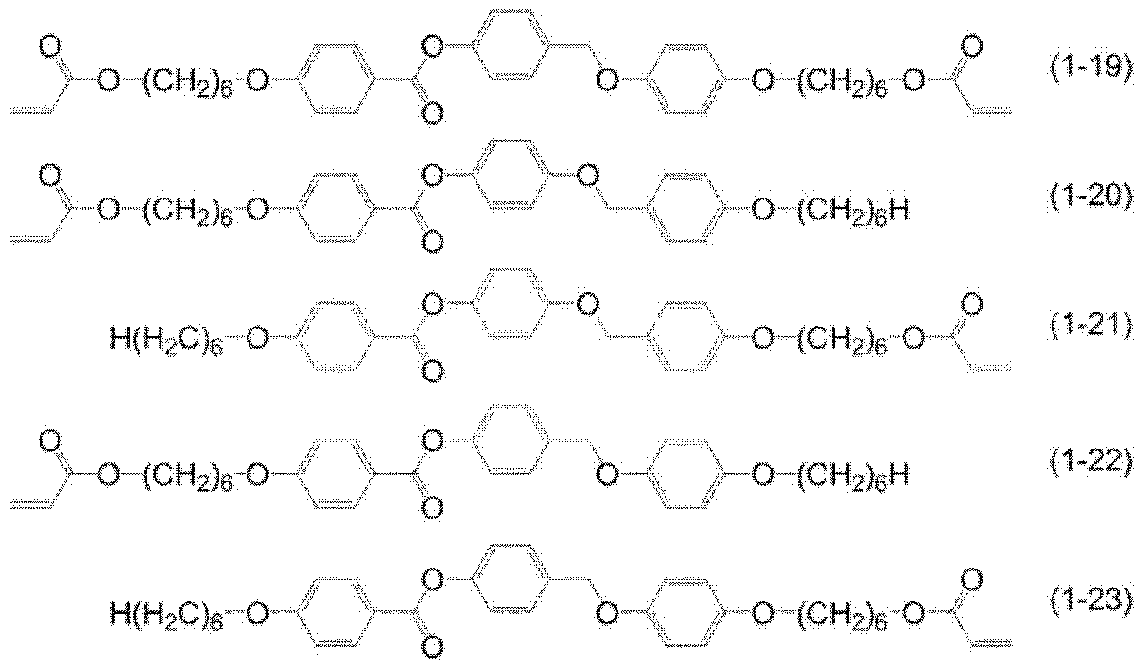
例示した前記化合物の中でも、式(1-2)、式(1-3)、式(1-4)、式(1-6)、式(1-7)、式(1-8)、式(1-13)、式(1-14)及び式(1-15)で表される化合物からなる群より選ばれる少なくとも1種が好ましい。
(二色性色素)
二色性色素とは、分子の長軸方向における吸光度と、短軸方向における吸光度とが異なる性質を有する色素をいう。二色性色素としては、可視光を吸収する特性を有する特性を有する事が好ましく、380~680nmの範囲に吸収極大波長(λMAX)を有するものがより好ましい。このような二色性色素としては、例えば、アクリジン色素、オキサジン色素、シアニン色素、ナフタレン色素、アゾ色素及びアントラキノン色素などが挙げられるが、中でもアゾ色素が好ましい。アゾ色素としては、モノアゾ色素、ビスアゾ色素、トリスアゾ色素、テトラキスアゾ色素及びスチルベンアゾ色素などが挙げられ、好ましくはビスアゾ色素及びトリスアゾ色素である。二色性色素は単独でも、組み合わせてもよいが、可視光全域で吸収を得るためには、3種類以上の二色性色素を組み合わせるのが好ましく、3種類以上のアゾ色素を組み合わせるのがより好ましい。
二色性色素とは、分子の長軸方向における吸光度と、短軸方向における吸光度とが異なる性質を有する色素をいう。二色性色素としては、可視光を吸収する特性を有する特性を有する事が好ましく、380~680nmの範囲に吸収極大波長(λMAX)を有するものがより好ましい。このような二色性色素としては、例えば、アクリジン色素、オキサジン色素、シアニン色素、ナフタレン色素、アゾ色素及びアントラキノン色素などが挙げられるが、中でもアゾ色素が好ましい。アゾ色素としては、モノアゾ色素、ビスアゾ色素、トリスアゾ色素、テトラキスアゾ色素及びスチルベンアゾ色素などが挙げられ、好ましくはビスアゾ色素及びトリスアゾ色素である。二色性色素は単独でも、組み合わせてもよいが、可視光全域で吸収を得るためには、3種類以上の二色性色素を組み合わせるのが好ましく、3種類以上のアゾ色素を組み合わせるのがより好ましい。
アゾ色素としては、例えば、式(II)で表される化合物(以下、「化合物(II)」ということもある)が挙げられる。
T1-A1(-N=N-A2)p-N=N-A3-T2 (II)
[式(II)中、
A1及びA2及びA3は、互いに独立に、置換基を有していてもよい1,4-フェニレン基、ナフタレン-1,4-ジイル基又は置換基を有していてもよい2価の複素環基を表し、T1及びT2は電子吸引基あるいは電子放出基であり、アゾ結合面内に対して実質的に180°の位置に有する。pは0~4の整数を表す。pが2以上である場合、各々のA2は互いに同一でも異なっていてもよい。可視域に吸収を示す範囲で-N=N-結合が-C=C-、-COO-、-NHCO-、-N=CH-結合に置き換わっていてもよい。]
T1-A1(-N=N-A2)p-N=N-A3-T2 (II)
[式(II)中、
A1及びA2及びA3は、互いに独立に、置換基を有していてもよい1,4-フェニレン基、ナフタレン-1,4-ジイル基又は置換基を有していてもよい2価の複素環基を表し、T1及びT2は電子吸引基あるいは電子放出基であり、アゾ結合面内に対して実質的に180°の位置に有する。pは0~4の整数を表す。pが2以上である場合、各々のA2は互いに同一でも異なっていてもよい。可視域に吸収を示す範囲で-N=N-結合が-C=C-、-COO-、-NHCO-、-N=CH-結合に置き換わっていてもよい。]
A1及びA2及びA3における1,4-フェニレン基、ナフタレン-1,4-ジイル基及び2価の複素環基が任意に有する置換基としては、メチル基、エチル基及びブチル基などの炭素数1~4のアルキル基;メトキシ基、エトキシ基及びブトキシ基などの炭素数1~4のアルコキシ基;トリフルオロメチル基などの炭素数1~4のフッ化アルキル基;シアノ基;ニトロ基;塩素原子、フッ素原子などのハロゲン原子;アミノ基、ジエチルアミノ基及びピロリジノ基などの置換又は無置換アミノ基(置換アミノ基とは、炭素数1~6のアルキル基を1つ又は2つ有するアミノ基、あるいは2つの置換アルキル基が互いに結合して炭素数2~8のアルカンジイル基を形成しているアミノ基を意味する。無置換アミノ基は、-NH2である。)が挙げられる。なお、炭素数1~6のアルキル基としては、メチル基、エチル基及びヘキシル基などが挙げられる。炭素数2~8のアルカンジイル基としては、エチレン基、プロパン-1,3-ジイル基、ブタン-1,3-ジイル基、ブタン-1,4-ジイル基、ペンタン-1,5-ジイル基、ヘキサン-1,6-ジイル基、ヘプタン-1,7-ジイル基、オクタン-1,8-ジイル基などが挙げられる。スメクチック液晶のような高秩序液晶構造中に包摂するためには、A1及びA2及びA3は無置換又は水素がメチル基又はメトキシ基で置換された1,4-フェニレン基、又は2価の複素環基が好ましく、pは0又は1である事が好ましい。中でもpが1であり、かつ、A1及びA2及びA3の3つの構造のうち少なくとも2つが1,4-フェニレン基である事が分子合成の簡便さと高い性能の両方を有するという点でより好ましい。
2価の複素環基としては、キノリン、チアゾール、ベンゾチアゾール、チエノチアゾール、イミダゾール、ベンゾイミダゾール、オキサゾール及びベンゾオキサゾールから2個の水素原子を除いた基が挙げられる。A2が2価の複素環基の場合には、分子結合角度が実質的に180°となる構造が好ましく、具体的には、二つの5員環が縮合したベンゾチアゾール、ベンゾイミダゾール、ベンゾオキサゾール構造がより好ましい。
T1及びT2は電子吸引基あるいは電子放出基であり、異なる構造である事が好ましく、T1が電子吸引基及びT2電子放出基、あるいはT1が電子放出基及びT2電子吸引基の関係である事がさらに好ましい。具体的には、T1及びT2は互いに独立に炭素数1~4のアルキル基、炭素数1~4のアルコキシ基、シアノ基、ニトロ基、炭素数1~6のアルキル基を1つ又は2つ有するアミノ基、あるいは2つの置換アルキル基が互いに結合して炭素数2~8のアルカンジイル基を形成しているアミノ基、又はトリフルオロメチル基が好ましく、中でもスメクチック液晶のような高秩序液晶構造中に包摂するためには、分子の排除体積がより小さい構造体である必要があるため、炭素数1~6のアルキル基、炭素数1~6のアルコキシ基、シアノ基、炭素数1~6のアルキル基を1つ又は2つ有するアミノ基、あるいは2つの置換アルキル基が互いに結合して炭素数2~8のアルカンジイル基を形成しているアミノ基が好ましい。
このようなアゾ色素としては、例えば、以下のようなものが挙げられる。
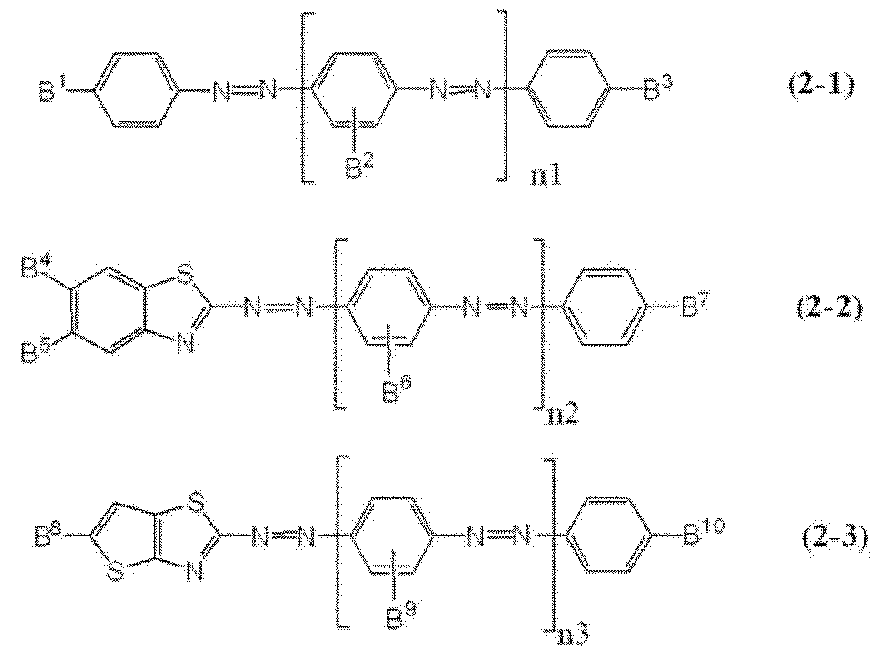

式(2-1)~(2-6)中、
B1~B20は、互いに独立に、水素原子、炭素数1~6のアルキル基、炭素数1~6のアルコキシ基、シアノ基、ニトロ基、置換又は無置換のアミノ基(置換アミノ基及び無置換アミノ基の定義は前記のとおり)、塩素原子又はトリフルオロメチル基を表す。高い偏光性能が得られる観点から、B2、B6、B9、B14、B18、B19は水素原子又はメチル基が好ましく、水素原子がより好ましい。
n1~n4は、それぞれ独立に0~3の整数を表す。
n1が2以上である場合、複数のB2はそれぞれ同一であってもよいし、異なっていてもよく、
n2が2以上である場合、複数のB6はそれぞれ同一であってもよいし、異なっていてもよく、
n3が2以上である場合、複数のB9はそれぞれ同一であってもよいし、異なっていてもよく、
n4が2以上である場合、複数のB14はそれぞれ同一であってもよいし、異なっていてもよい。
B1~B20は、互いに独立に、水素原子、炭素数1~6のアルキル基、炭素数1~6のアルコキシ基、シアノ基、ニトロ基、置換又は無置換のアミノ基(置換アミノ基及び無置換アミノ基の定義は前記のとおり)、塩素原子又はトリフルオロメチル基を表す。高い偏光性能が得られる観点から、B2、B6、B9、B14、B18、B19は水素原子又はメチル基が好ましく、水素原子がより好ましい。
n1~n4は、それぞれ独立に0~3の整数を表す。
n1が2以上である場合、複数のB2はそれぞれ同一であってもよいし、異なっていてもよく、
n2が2以上である場合、複数のB6はそれぞれ同一であってもよいし、異なっていてもよく、
n3が2以上である場合、複数のB9はそれぞれ同一であってもよいし、異なっていてもよく、
n4が2以上である場合、複数のB14はそれぞれ同一であってもよいし、異なっていてもよい。
前記アントラキノン色素としては、式(2-7)で表される化合物が好ましい。

[式(2-7)中、
R1~R8は、互いに独立に、水素原子、-Rx、-NH2、-NHRx、-NRx 2、-SRx又はハロゲン原子を表す。
Rxは、炭素数1~4のアルキル基又は炭素数6~12のアリール基を表す。]
R1~R8は、互いに独立に、水素原子、-Rx、-NH2、-NHRx、-NRx 2、-SRx又はハロゲン原子を表す。
Rxは、炭素数1~4のアルキル基又は炭素数6~12のアリール基を表す。]
前記オキサジン色素としては、式(2-8)で表される化合物が好ましい。

[式(2-8)中、
R9~R15は、互いに独立に、水素原子、-Rx、-NH2、-NHRx、-NRx 2、-SRx又はハロゲン原子を表す。
Rxは、炭素数1~4のアルキル基又は炭素数6~12のアリール基を表す。]
R9~R15は、互いに独立に、水素原子、-Rx、-NH2、-NHRx、-NRx 2、-SRx又はハロゲン原子を表す。
Rxは、炭素数1~4のアルキル基又は炭素数6~12のアリール基を表す。]
前記アクリジン色素としては、式(2-9)で表される化合物が好ましい。

[式(2-9)中、
R16~R23は、互いに独立に、水素原子、-Rx、-NH2、-NHRx、-NRx 2、-SRx又はハロゲン原子を表す。
Rxは、炭素数1~4のアルキル基又は炭素数6~12のアリール基を表す。]
R16~R23は、互いに独立に、水素原子、-Rx、-NH2、-NHRx、-NRx 2、-SRx又はハロゲン原子を表す。
Rxは、炭素数1~4のアルキル基又は炭素数6~12のアリール基を表す。]
式(2-7)、式(2-8)及び式(2-9)における、Rxで表される炭素数1~4のアルキル基としては、メチル基、エチル基、プロピル基、ブチル基、ペンチル基及びヘキシル基等が挙げられ、炭素数6~12のアリール基としては、フェニル基、トルイル基、キシリル基及びナフチル基等が挙げられる。
前記シアニン色素としては、式(2-10)で表される化合物及び式(2-11)で表される化合物が好ましい。
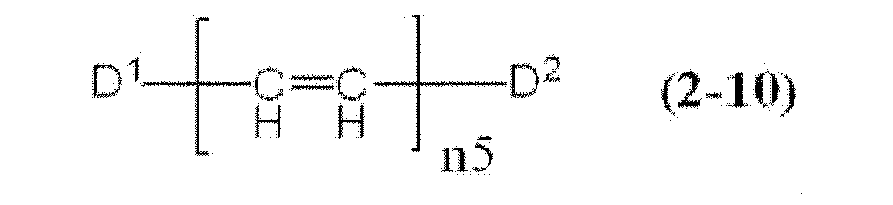
[式(2-10)中、
D1及びD2は、互いに独立に、式(2-10a)~式(2-10d)のいずれかで表される基を表す。
D1及びD2は、互いに独立に、式(2-10a)~式(2-10d)のいずれかで表される基を表す。
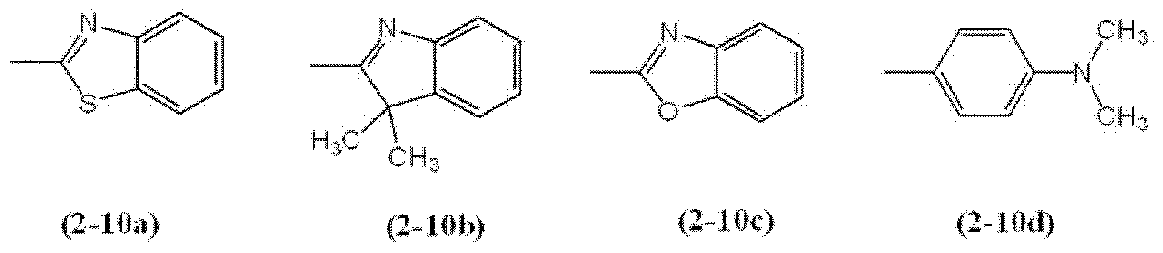
n5は1~3の整数を表す。]
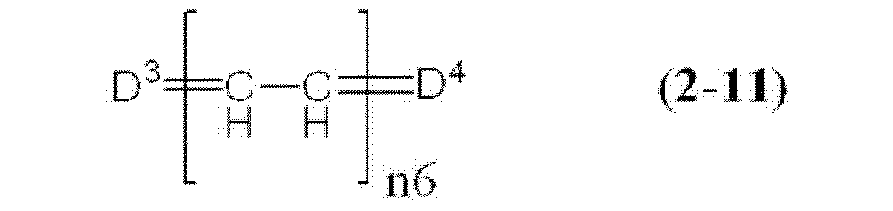
[式(2-11)中、
D3及びD4は、互いに独立に、式(2-11a)~式(2-11h)のいずれかで表される基を表す。
D3及びD4は、互いに独立に、式(2-11a)~式(2-11h)のいずれかで表される基を表す。

n6は1~3の整数を表す。]
二色性色素の含有量(複数種含む場合にはその合計量)は、良好な光吸収特性を得る観点から、重合性液晶(a)100質量部に対して、通常0.1~30質量部であり、好ましくは1~20質量部であり、より好ましくは2~15質量部である。二色性色素の含有量がこの範囲より少ないと光吸収が不十分となり、十分な偏光性能が得られず、この範囲よりも多いと液晶分子の配向を阻害する場合がある。
(基材層)
基材層は、例えば樹脂フィルムから構成されてよく、好ましくは透明樹脂フィルムから構成されてよい。樹脂フィルムは、長尺の樹脂フィルムであってよく、枚葉状樹脂フィルムであってよい。連続的に製造できる点で長尺の樹脂フィルムが好ましい。
基材層は、例えば樹脂フィルムから構成されてよく、好ましくは透明樹脂フィルムから構成されてよい。樹脂フィルムは、長尺の樹脂フィルムであってよく、枚葉状樹脂フィルムであってよい。連続的に製造できる点で長尺の樹脂フィルムが好ましい。
樹脂フィルムを構成する樹脂としては、例えば、ポリエチレン、ポリプロピレン、ノルボルネン系ポリマー、環状オレフィン系樹脂等のポリオレフィン;ポリビニルアルコール;ポリエチレンテレフタレート;ポリメタクリル酸エステル;ポリアクリル酸エステル;トリアセチルセルロース、ジアセチルセルロース及びセルロースアセテートプロピオネート等のセルロースエステル;ポリエチレンナフタレート;ポリカーボネート;ポリスルホン;ポリエーテルスルホン;ポリエーテルケトン;ポリフェニレンスルフィド;ポリフェニレンオキシド;ポリアミド;ポリイミド;ポリアミドイミド等のプラスチックが挙げられる。中でも環状オレフィン系樹脂、セルロースエステル及びポリイミドが好ましい。
環状オレフィン系樹脂の代表的市販品の例としては、“Topas”(登録商標)(Ticona社(独)製)、“アートン”(登録商標)(JSR株式会社製)、“ゼオノア(ZEONOR)”(登録商標)、“ゼオネックス(ZEONEX)”(登録商標)(以上、日本ゼオン株式会社製)及び“アペル”(登録商標)(三井化学株式会社製)等が挙げられる。このような環状オレフィン系樹脂を、溶剤キャスト法、溶融押出法等の公知の手段により製膜して、樹脂フィルムとすることができる。市販されている環状オレフィン系樹脂フィルムを用いることもできる。環状オレフィン系樹脂フィルムの代表的市販品の例としては、“エスシーナ”(登録商標)、“SCA40”(登録商標)(以上、積水化学工業株式会社製)、“ゼオノアフィルム”(登録商標)(オプテス株式会社製)及び“アートンフィルム”(登録商標)(JSR株式会社製)等が挙げられる。
セルロースエステルから構成される樹脂フィルムの代表的市販品の例としては、“フジタックフィルム”(富士写真フイルム株式会社製);“KC8UX2M”、“KC8UY”及び“KC4UY”(以上、コニカミノルタオプト株式会社製)等が挙げられる。
樹脂フィルムの厚みは、積層体100の薄膜化の観点からは薄い方が好ましいが、あまりに薄いと耐衝撃性が確保しにくくなる傾向がある。樹脂フィルムの厚みは、例えば10μm以上200μm以下であってよく、好ましくは15μm以上150μm以下、より好ましくは20μm以上100μm以下である。
基材層は、少なくとも一方の表面にハードコート層、反射防止層、又は帯電防止層を有していてもよい。基材層は、偏光層12が形成されない側の表面のみに、ハードコート層、反射防止層、帯電防止層等が形成されていてもよい。基材層は、偏光層12が形成されている側の表面のみに、ハードコート層、反射防止層、帯電防止層等が形成されていてもよい。
(配向層)
積層体100は、基材層と偏光層12との間に、又は前面板11と偏光層12との間に、配向層を有していてよい。配向層は、基材層又は前面板11上に形成される偏光層12を構成する重合性液晶を所望の方向に配向させる、配向規制力を有するものである。
積層体100は、基材層と偏光層12との間に、又は前面板11と偏光層12との間に、配向層を有していてよい。配向層は、基材層又は前面板11上に形成される偏光層12を構成する重合性液晶を所望の方向に配向させる、配向規制力を有するものである。
配向層は、重合性液晶の配向を容易にする。水平配向、垂直配向、ハイブリッド配向、傾斜配向等の配向の状態は、配向層及び重合性液晶の性質によって変化し、その組み合わせは任意に選択することができる。例えば、配向層が配向規制力として水平配向を発現させる材料であれば、重合性液晶は水平配向又はハイブリッド配向を形成することができ、垂直配向を発現させる材料であれば、重合性液晶は垂直配向又は傾斜配向を形成することができる。水平、垂直等の表現は、偏光層12平面を基準とした場合の、配向した重合性液晶の長軸の方向を表す。例えば、垂直配向とは偏光層12平面に対して垂直な方向に、配向した重合性液晶の長軸を有することである。ここでいう垂直とは、偏光層12平面に対して90°±20°のことを意味する。
配向規制力は、配向層が配向性ポリマーから形成されている場合は、表面状態やラビング条件によって任意に調整することが可能であり、光配向性ポリマーから形成されている場合は、偏光照射条件等によって任意に調整することが可能である。また、重合性液晶の、表面張力や液晶性等の物性を選択することにより、配向を制御することもできる。
基材層と偏光層12との間に形成される配向層としては、配向層上に偏光層12を形成する際に使用される溶剤に不溶であり、また、溶剤の除去や液晶の配向のための加熱処理における耐熱性を有するものが好ましい。配向層は、配向性ポリマーからなる配向層、光配向層及びグルブ(groove)配向層等であってよい。中でも、長尺の樹脂フィルムに適用する場合に配向方向を容易に制御できる点で、光配向層が好ましい。
配向層の厚みは、例えば10nm以上5000nm以下の範囲であってよく、好ましくは10nm以上1000nm以下の範囲であり、より好ましくは30nm以上300nm以下である。
配向性ポリマーからなる配向層に用いられる配向性ポリマーとしては、分子内にアミド結合を有するポリアミドやゼラチン類、分子内にイミド結合を有するポリイミド及びその加水分解物であるポリアミック酸、ポリビニルアルコール、アルキル変性ポリビニルアルコール、ポリアクリルアミド、ポリオキサゾール、ポリエチレンイミン、ポリスチレン、ポリビニルピロリドン、ポリアクリル酸及びポリアクリル酸エステル類等が挙げられる。
中でも、ポリビニルアルコールが好ましい。これらの配向性ポリマーは、単独で用いてもよいし、2種以上を組み合わせて用いてもよい。
中でも、ポリビニルアルコールが好ましい。これらの配向性ポリマーは、単独で用いてもよいし、2種以上を組み合わせて用いてもよい。
樹脂フィルムから構成される基材層上に配向性ポリマーからなる配向層を形成する場合、配向性ポリマーからなる配向層は、通常、配向性ポリマーが溶剤に溶解した組成物(以下、「配向性ポリマー組成物」ともいう。)を樹脂フィルムに塗布し、溶剤を除去するか、又は配向性ポリマー組成物を樹脂フィルムに塗布し、溶剤を除去し、ラビングすること(ラビング法)により得られる。
前記溶剤としては、水;メタノール、エタノール、エチレングリコール、イソプロピルアルコール、プロピレングリコール、メチルセロソルブ、ブチルセロソルブ及びプロピレングリコールモノメチルエーテル等のアルコール溶剤;酢酸エチル、酢酸ブチル、エチレングリコールメチルエーテルアセテート、γ-ブチロラクトン、プロピレングリコールメチルエーテルアセテート及び乳酸エチル等のエステル溶剤;アセトン、メチルエチルケトン、シクロペンタノン、シクロヘキサノン、メチルアミルケトン及びメチルイソブチルケトン等のケトン溶剤;ペンタン、ヘキサン及びヘプタン等の脂肪族炭化水素溶剤;トルエン及びキシレン等の芳香族炭化水素溶剤、アセトニトリル等のニトリル溶剤;テトラヒドロフラン及びジメトキシエタン等のエーテル溶剤;クロロホルム及びクロロベンゼン等の塩素置換炭化水素溶剤;等が挙げられる。これら溶剤は、単独でもよいし、2種以上を組み合わせて用いてもよい。
配向性ポリマー組成物中の配向性ポリマーの濃度は、配向性ポリマーが、溶剤に完溶できる範囲であればよいが、溶液に対して固形分換算で0.1質量%以上20質量%以下が好ましく、0.1質量%以上10質量%以下がより好ましい。
配向性ポリマー組成物として、市販の配向層形成用材料をそのまま使用してもよい。市販の配向層形成用材料の例としては、サンエバー(登録商標)(日産化学工業株式会社製)又はオプトマー(登録商標)(JSR株式会社製)等が挙げられる。
配向性ポリマー組成物を樹脂フィルムに塗布する方法としては、スピンコーティング法、エクストルージョン法、グラビアコーティング法、ダイコーティング法、バーコーティング法及びアプリケータ法等の塗布方法や、フレキソ法等の印刷法等の公知の方法が挙げられる。偏光層12を、Roll-to-Roll形式の連続的製造方法により製造する場合、当該塗布方法には通常、グラビアコーティング法、ダイコーティング法又はフレキソ法等の印刷法が採用される。
配向性ポリマー組成物に含まれる溶剤を除去することにより、配向性ポリマーの乾燥被膜が形成される。溶剤の除去方法としては、自然乾燥法、通風乾燥法、加熱乾燥法及び減圧乾燥法等が挙げられる。
ラビングする方法としては、ラビング布が巻きつけられ、回転しているラビングロールに、配向性ポリマー組成物を樹脂フィルムに塗布しアニールすることにより樹脂フィルム表面に形成された配向性ポリマーの膜を、接触させる方法が挙げられる。
光配向層は、通常、光反応性基を有するポリマー又はモノマー及び溶剤を含む組成物(以下、「光配向層形成用組成物」ともいう)を樹脂フィルムに塗布し、偏光(好ましくは、偏光UV)を照射することで得られる。光配向層は、照射する偏光の偏光方向を選択することにより、配向規制力の方向を任意に制御できる点でより好ましい。
光反応性基とは、光を照射することにより液晶を配向させる能力を生じる基をいう。具体的には、光を照射することで生じる分子の配向誘起又は異性化反応、二量化反応、光架橋反応、又は光分解反応のような、液晶を配向させる能力の起源となる光反応を生じるものである。当該光反応性基の中でも、二量化反応又は光架橋反応を起こすものが、配向性に優れる点で好ましい。以上のような反応を生じうる光反応性基としては、不飽和結合、特に二重結合を有するものが好ましく、炭素-炭素二重結合(C=C結合)、炭素-窒素二重結合(C=N結合)、窒素-窒素二重結合(N=N結合)、及び炭素-酸素二重結合(C=O結合)からなる群より選ばれる少なくとも一つを有する基がより好ましい。
C=C結合を有する光反応性基としては例えば、ビニル基、ポリエン基、スチルベン基、スチルバゾ-ル基、スチルバゾリウム基、カルコン基及びシンナモイル基等が挙げられる。反応性の制御が容易であるという点や光配向時の配向規制力発現の観点から、カルコン基及びシンナモイル基が好ましい。C=N結合を有する光反応性基としては、芳香族シッフ塩基及び芳香族ヒドラゾン等の構造を有する基が挙げられる。N=N結合を有する光反応性基としては、アゾベンゼン基、アゾナフタレン基、芳香族複素環アゾ基、ビスアゾ基及びホルマザン基等や、アゾキシベンゼンを基本構造とするものが挙げられる。C=O結合を有する光反応性基としては、ベンゾフェノン基、クマリン基、アントラキノン基及びマレイミド基等が挙げられる。これらの基は、アルキル基、アルコキシ基、アリール基、アリルオキシ基、シアノ基、アルコキシカルボニル基、ヒドロキシル基、スルホン酸基及びハロゲン化アルキル基等の置換基を有していてもよい。中でも、光二量化反応を生じうる光反応性基が好ましく、シンナモイル基及びカルコン基が、光配向に必要な偏光照射量が比較的少なく、かつ、熱安定性や経時安定性に優れる光配向層が得られやすいため好ましい。さらにいえば、光反応性基を有するポリマーとしては、当該ポリマー側鎖の末端部が桂皮酸構造となるようなシンナモイル基を有するものが特に好ましい。
前記光配向層形成用組成物の取り扱いの容易さと、高耐久性の配向性を実現した配向層が得られやすいこととから、特に好ましい光反応性基を有するポリマーは例えば、式(A’)で表される基を側鎖に有するポリマー(以下、場合により「ポリマー(A’)」ともいう。)である。

[式(A’)中、
nは、0又は1を表す。
X1は、単結合、-O-、-COO-、-OCO-、-N=N-、-CH=CH-又はCH2-を表す。
Y1は、単結合又はO-を表す。
R1及びR2はそれぞれ独立に、水素原子、炭素数1~4のアルキル基又は炭素数1~4のアルコキシ基を表す。
*は、ポリマー主鎖に対する結合手を表す。]
式(A’)において、X1は、単結合、-O-、-COO-、-OCO-、-N=N-、-C=C-及びCH2-のいずれかであると、ポリマー(A’)自体の製造が容易となるため、特に好ましい。
式(A’)において、R1及びR2はそれぞれ独立に、水素原子、ハロゲン原子、ハロゲン化アルキル基、ハロゲン化アルコキシ基、シアノ基、ニトロ基、アルキル基、アルコキシ基、アリール基、アリルオキシ基、アルコキシカルボニル基、カルボキシル基、スルホン酸基、アミノ基又はヒドロキシ基を表し、該カルボキシル基及び該スルホン酸基はアルカリ金属イオンと塩を形成していてもよい。これらの中でも、R1及びR2はそれぞれ独立に、水素原子、炭素数1~4のアルキル基又は炭素数1~4のアルコキシ基であるとさらに好ましい。該アルキル基としては、メチル基、エチル基及びブチル基などが挙げられ、該アルコキシ基としては、メトキシ基、エトキシ基及びブトキシ基などが挙げられる。
ポリマー(A’)の主鎖は特に限定されないが、式(M-1)又は式(M-2)で表される(メタ)アクリル酸エステル単位;式(M-3)又は式(M-4)で表される(メタ)アクリルアミド単位;式(M-5)又は式(M-6)で表されるビニルエーテル単位;式(M-7)又は式(M-8)で表される(メチル)スチレン単位、及び式(M-9)又は式(M-10)で表されるビニルエステル単位からなる群より選ばれるものから構成される主鎖をポリマー(A)は有していると好ましく、中でも、(メタ)アクリル酸エステル単位及び(メタ)アクリルアミド単位からなる群より選ばれる単位から構成される主鎖をポリマー(A’)が有しているとさらに好ましい。なお、ここでいう「ポリマー(A’)の主鎖」とは、ポリマー(A’)が有する分子鎖のうち、最も長い分子鎖をいう。
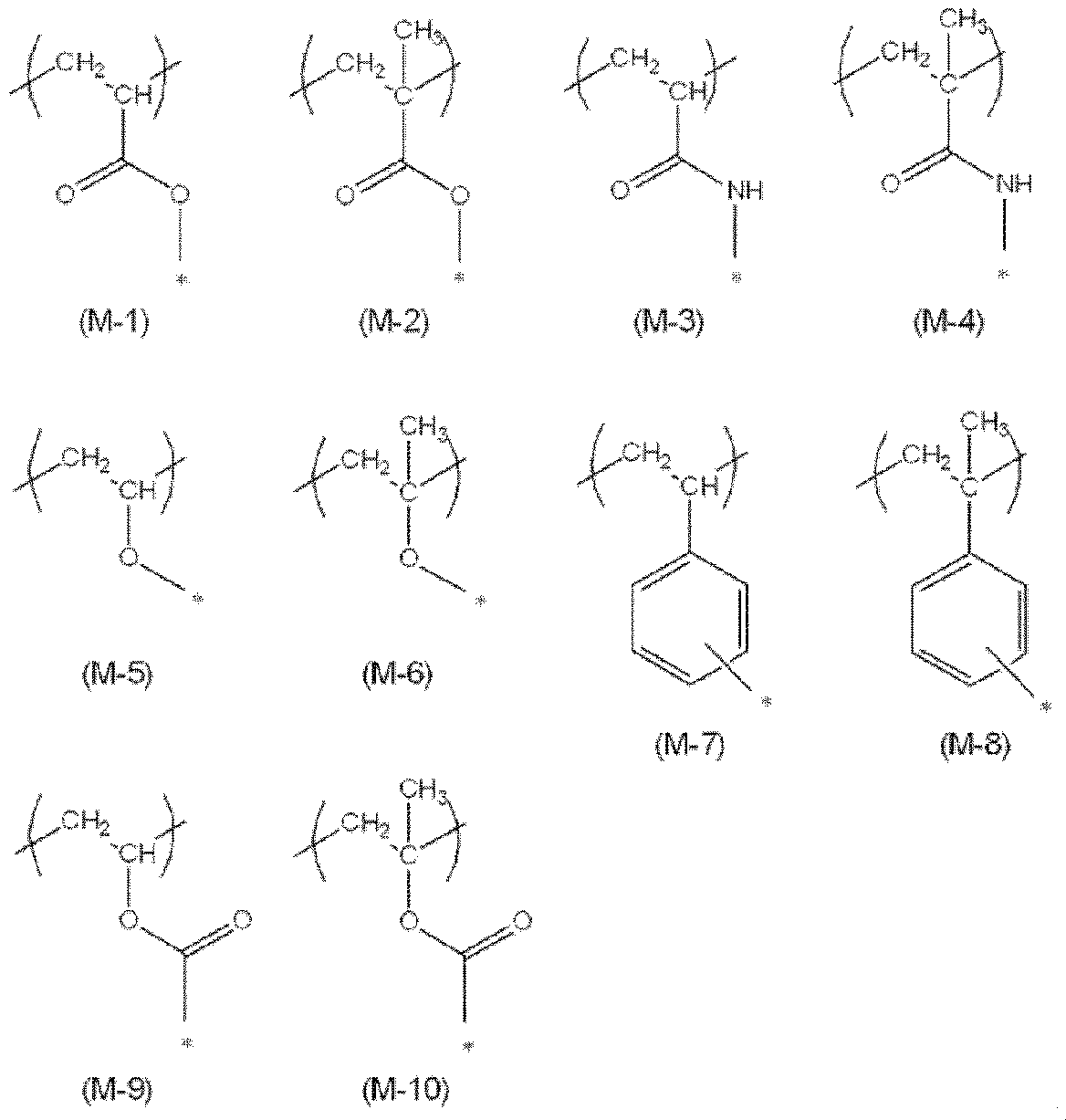
式(M-1)~式(M-10)のいずれかで表される単位と、式(A’)で表される基は、直接結合していても、適当な連結基を介して結合していてもよい。この連結基としては、カルボニルオキシ基(エステル結合)、酸素原子(エ-テル結合)、イミド基、カルボニルイミノ基(アミド結合)、イミノカルボニルイミノ基(ウレタン結合)、置換基を有していてもよい2価の脂肪族炭化水素基及び置換基を有していてもよい2価の芳香族炭化水素基、並びにこれらを組み合わせてなる2価の基などを挙げることができる。置換基を有していてもよい2価の芳香族炭化水素基の具体例は、フェニレン基、2-メトキシ-1,4-フェニレン基、3-メトキシ-1,4-フェニレン基、2-エトキシ-1,4-フェニレン基、3-エトキシ-1,4-フェニレン基、2,3,5-トリメトキシ-1,4-フェニレン基などが挙げられる。これらの中でも、該連結基は、脂肪族炭化水素基が好ましく、置換基を有していてもよい炭素数1~11のアルカンジイル基がさらに好ましい。なお、かかるアルカンジイル基としては、メチレン基、エチレン基、トリメチレン基、テトラメチレン基、ペンタメチレン基、ヘキサメチレン基、ヘプタメチレン基、オクタメチレン基、ノナメチレン基、デカメチレン基及びウンデカメチレン基などが挙げられ、これらは直鎖状であっても、分岐鎖状であってもよい。また、かかるアルカンジイル基は置換基を有していてもよい。この置換基は例えば、炭素数1~4のアルコキシ基などである。
換言すると、式(A’)で表される基を有する構造単位としては、式(A)で表されるもの(以下、場合により「構造単位(A)」ともいい、当該構造単位(A)を含むポリマーを「ポリマー(A)」ともいう。)が好ましい。
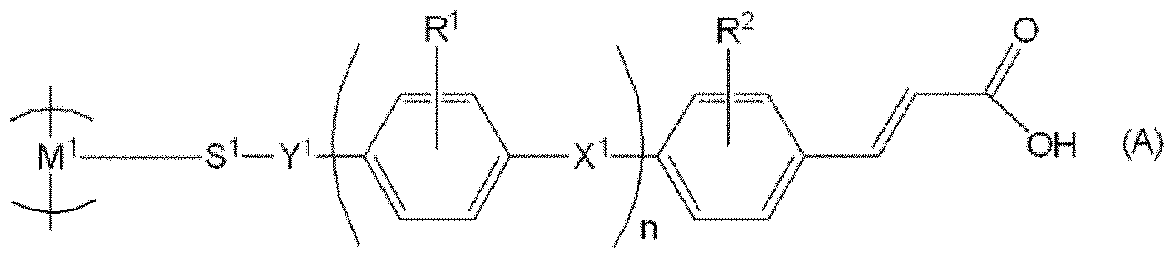
[式(A)中、
X1、Y1、R1、R2及びnは式(A’)と同義であり、
S1は、炭素数1~11のアルカンジイル基であり、
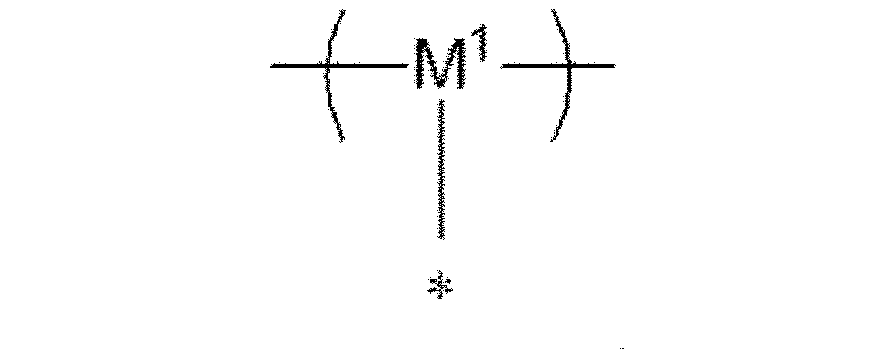
で表される構造は、式(M-1)~式(M-10)のいずれかで表される構造である。]
ポリマー(A’)又はポリマー(A)の分子量は、例えばゲルパーミエイション法(GPC法)で求められるポリスチレン換算の重量平均分子量で表して、1×10³~1×10⁷の範囲が好ましい。ただし、あまり分子量が高くなると、溶媒への溶解性が低下して配向層形成用組成物の調製が困難になることや、光照射に対する感度が下がる傾向があるので、1×10⁴~1×10⁶の範囲が好ましい。
ポリマー(A)は、構造単位(A)に加え、式(B)で表される構造単位(以下、場合により「構造単位(B)」ともいう。)を有していてもよい。
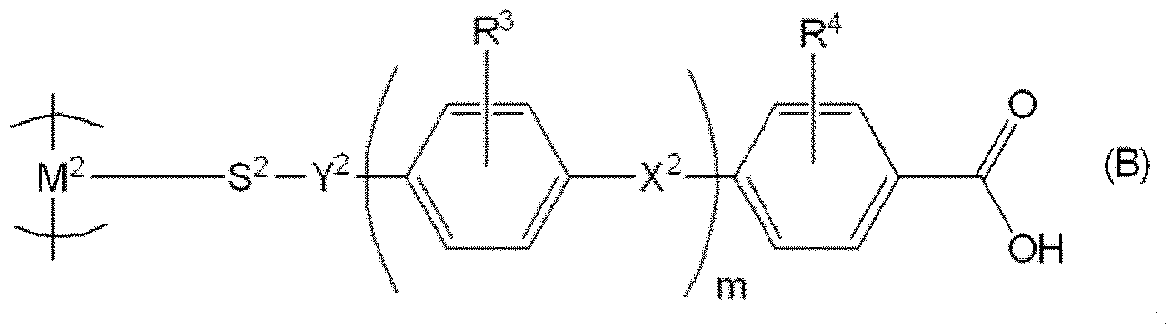
[式(B)中、
mは、0又は1を表す。
S2は、炭素数1~11のアルカンジイル基を表す。

で表される構造は、式(M-1)~式(M-10)のいずれかで表される構造である。
X2は、単結合、-O-、-COO-、-OCO-、-N=N-、-CH=CH-又はCH2-を表す。
Y2は、単結合又はO-を表す。
R3及びR4はそれぞれ独立に、水素原子、炭素数1~4のアルキル基又は炭素数1~4のアルコキシ基を表す。]
式(B)において、S2の具体例は、式(A)のS1の具体例と同じであり、R3及びR4のアルキル基及びアルコキシ基の具体例についてはそれぞれ、式(A)のR1及びR2の具体例と同じである。
ポリマー(A)の全構造単位に対する構造単位(A)及び構造単位(B)のモル分率をそれぞれ、p及びqとした(p+qは1である。)場合、0.25<p≦1及び0≦q<0.75の関係を満たすことが好ましい〔ここで、ポリマー(A)が構造単位(A)を有し、pが1である場合とは、ポリマー(A)が構造単位(A)からなるポリマーであることを意味する。構造単位(A)からなるポリマーには、該構造単位(A)が1種であっても、2種以上であってもよい。〕。ただし、ポリマー(A)は光照射による配向能を著しく損なわない限り、構造単位(A)及び構造単位(B)以外の構造単位(以下、場合により「他の構造単位」ともいう。)を有していてもよい。
ポリマー(A)は、構造単位(A)を誘導するモノマーと、必要に応じて構造単位(B)や他の構造単位を誘導するモノマーとを(共)重合することで製造できる。当該(共)重合には通常、付加重合法が採用され、かかる付加重合としては、ラジカル重合、アニオン重合及びカチオン重合などの連鎖重合、並びに配位重合などが挙げられる。重合条件は使用するモノマーの種類及びその量に応じて、上述の好ましいポリマー(A)の分子量が満たされるようにして設定される。
以上、光反応性基を有するポリマーの中で好ましいものとして、ポリマー(A)について詳述したが、配向層形成用組成物は、当該光反応性基を有するポリマー(好ましくは、ポリマー(A))を適当な溶剤に溶解することで調製される。かかる溶剤は、当該光反応性基を有するポリマーが溶解することができ、適正な粘度の配向層形成用組成物が得られる範囲で適宜選択できるが、例えば、メタノール、エタノール、エチレングリコール、イソプロピルアルコール、プロピレングリコール、エチレングリコールメチルエーテル、エチレングリコールブチルエーテル及びプロピレングリコールモノメチルエーテルなどのアルコール溶剤;酢酸エチル、酢酸ブチル、エチレングリコールメチルエーテルアセテート、γ-ブチロラクトン又はプロピレングリコールメチルエーテルアセテート及び乳酸エチルなどのエステル溶剤;アセトン、メチルエチルケトン、シクロペンタノン、シクロヘキサノン、2-ヘプタノン及びメチルイソブチルケトンなどのケトン溶剤;ペンタン、ヘキサン及びヘプタンなどの脂肪族炭化水素溶剤;トルエン及びキシレンなどの芳香族炭化水素溶剤、アセトニトリルなどのニトリル溶剤;テトラヒドロフラン及びジメトキシエタンなどのエーテル溶剤;クロロホルム及びクロロベンゼンなどの塩素含有溶剤;N-メチルピロリドン、N,N-ジメチルホルムアミド、γ-ブチロラクトン及びジメチルアセトアミドなどのアミド系溶剤などが挙げられる。これら溶剤は、単独種で用いてもよいし、複数種を組み合わせて用いてもよい。
光配向層形成用組成物に対する、光反応性基を有するポリマー又はモノマーの含有量は、当該光反応性基を有するポリマー又はモノマーの種類や製造しようとする光配向層の厚さによって適宜調節できるが、0.2質量%以上とすることが好ましく、0.3質量%以上10質量%以下の範囲が特に好ましい。また、光配向層の特性が著しく損なわれない範囲で、ポリビニルアルコールやポリイミド等の高分子材料や光増感剤が含まれていてもよい。
光配向層形成用組成物を樹脂フィルムに塗布する方法としては、前述した配向性ポリマー組成物を樹脂フィルムに塗布する方法と同様の方法が挙げられる。塗布された光配向層形成用組成物から、溶剤を除去する方法としては、例えば、配向性ポリマー組成物から溶剤を除去する方法と同じ方法が挙げられる。
偏光を照射するには、樹脂フィルム等の上に塗布された光配向層形成用組成物から、溶剤を除去したものに直接、偏光を照射する形式でも、樹脂フィルム側から偏光を照射し、偏光を透過させて照射する形式でもよい。また、当該偏光は、実質的に平行光であることが特に好ましい。照射する偏光の波長は、光反応性基を有するポリマー又はモノマーの光反応性基が、光エネルギーを吸収し得る波長領域のものがよい。具体的には、波長250nm以上400nm以下の範囲のUV(紫外光)が特に好ましい。当該偏光照射に用いる光源としては、キセノンランプ、高圧水銀ランプ、超高圧水銀ランプ、メタルハライドランプ、KrF、ArF等の紫外光レーザー等が挙げられ、高圧水銀ランプ、超高圧水銀ランプ及びメタルハライドランプがより好ましい。これらのランプは、波長313nmの紫外光の発光強度が大きいため好ましい。前記光源からの光を、適当な偏光子を通過して照射することにより、偏光を照射することができる。かかる偏光子としては、偏光フィルターやグラントムソン、グランテーラー等の偏光プリズムやワイヤーグリッドタイプの偏光子を用いることができる。
なお、ラビング又は偏光照射を行う時に、マスキングを行えば、配向の方向が異なる複数の領域(パターン)を形成することもできる。
グルブ(groove)配向層は、膜表面に凹凸パターン又は複数のグルブ(溝)を有する膜である。等間隔に並んだ複数の直線状のグルブを有する膜に液晶分子を置いた場合、その溝に沿った方向に液晶分子が配向する。
グルブ配向層を得る方法としては、感光性ポリイミド膜表面にパターン形状のスリットを有する露光用マスクを介して露光後、現像及びリンス処理を行って凹凸パターンを形成する方法、表面に溝を有する板状の原盤に、硬化前のUV硬化性樹脂の層を形成し、樹脂層を樹脂フィルムへ移してから硬化する方法、及び樹脂フィルム上に形成した硬化前のUV硬化性樹脂の膜に、複数の溝を有するロール状の原盤を押し当てて凹凸を形成し、その後硬化する方法等が挙げられる。具体的には、特開平6-34976号公報、及び特開2011-242743号公報記載の方法等が挙げられる。
配向乱れの小さな配向を得るためには、グルブ配向層の凸部の幅は0.05μm以上5μm以下であることが好ましく、凹部の幅は0.1μm以上5μm以下であることが好ましく、凹凸の段差の深さは2μm以下であることが好ましく、0.01μm以上1μm以下であることが好ましい。
偏光層12は、基材層の片側に形成されていてもよいし、基材層の両側に形成されていてもよい。
(保護層)
偏光層12は、位相差層13側となる面に保護層を有していてもよい。保護層としては、上記の基材層の材料として例示をした樹脂フィルムから形成されてもよいし、コーティング型の保護層であってもよい。コーティング型の保護層は、例えばエポキシ樹脂等のカチオン硬化性組成物や(メタ)アクリレート等のラジカル硬化性組成物を塗布し、硬化してなるものであってよく、ポリビニルアルコール系樹脂等の水溶液を塗布し、乾燥してなるものであってよく、必要により可塑剤、紫外線吸収剤、赤外線吸収剤、顔料や染料のような着色剤、蛍光増白剤、分散剤、熱安定剤、光安定剤、帯電防止剤、酸化防止剤、滑剤等を含んでいてもよい。
偏光層12は、位相差層13側となる面に保護層を有していてもよい。保護層としては、上記の基材層の材料として例示をした樹脂フィルムから形成されてもよいし、コーティング型の保護層であってもよい。コーティング型の保護層は、例えばエポキシ樹脂等のカチオン硬化性組成物や(メタ)アクリレート等のラジカル硬化性組成物を塗布し、硬化してなるものであってよく、ポリビニルアルコール系樹脂等の水溶液を塗布し、乾燥してなるものであってよく、必要により可塑剤、紫外線吸収剤、赤外線吸収剤、顔料や染料のような着色剤、蛍光増白剤、分散剤、熱安定剤、光安定剤、帯電防止剤、酸化防止剤、滑剤等を含んでいてもよい。
保護層の厚みは、例えば200μm以下であってよく、好ましくは、0.1μm以上100μm以下である。
(位相差層)
位相差層13は、重合性液晶化合物の重合体を含む。位相差層13は、1以上の重合性液晶化合物(以下、重合性液晶(b)ともいう)を重合することにより形成することができる。位相差層13は、コーティング層であることが好ましく、例えば後述する組成物(B)の硬化物であってよい。位相差層13は、1層であってもよく2層以上であってもよい。位相差層13は、例えばλ/4層、λ/2層、ポジティブA層及びポジティブC層からなる群から選択される少なくとも1種を含んでいてよく、好ましくはλ/4層を含む。
位相差層13がλ/4層を含む場合、偏光層12側から順にλ/2層及びλ/4層を積層してもよく、偏光層12側から順にλ/4層及びポジティブC層、又は偏光層12側から順にポジティブC層及びλ/4層を積層してもよい。
位相差層13は、重合性液晶化合物の重合体を含む。位相差層13は、1以上の重合性液晶化合物(以下、重合性液晶(b)ともいう)を重合することにより形成することができる。位相差層13は、コーティング層であることが好ましく、例えば後述する組成物(B)の硬化物であってよい。位相差層13は、1層であってもよく2層以上であってもよい。位相差層13は、例えばλ/4層、λ/2層、ポジティブA層及びポジティブC層からなる群から選択される少なくとも1種を含んでいてよく、好ましくはλ/4層を含む。
位相差層13がλ/4層を含む場合、偏光層12側から順にλ/2層及びλ/4層を積層してもよく、偏光層12側から順にλ/4層及びポジティブC層、又は偏光層12側から順にポジティブC層及びλ/4層を積層してもよい。
位相差層13は、位相差層13表面を保護するオーバーコート層や、上述の基材層の材料として例示をした樹脂フィルムや配向膜をさらに含んでいてもよく、λ/4層とλ/2層やポジティブC層とを貼合するための後述の貼合層を有していてもよい。
位相差層13は、例えば1以上の重合性液晶(b)を含有する組成物(以下、組成物(B)ともいう)を、基材層上に塗布し、得られた塗膜中の重合性液晶(b)を重合して得ることができる。位相差層13および基材層からなる積層体は、偏光層12へ貼合層を介して貼合されることができる。貼合後、基材層は剥離することができる。組成物(B)を塗布する基材層は、配向膜を有することができる。配向膜の例としては、上述の偏光層12の配向膜について例示した配向膜が適用される。
積層体100が円偏光板であり、位相差層13がλ/4層及びポジティブC層を含む場合、偏光層12の吸収軸とλ/4層の遅相軸とのなす角は、45°とすることができる。
積層体100が円偏光板であり、位相差層13がλ/4層及びλ/2層を含む場合、偏光層12の吸収軸とλ/4層の遅相軸とのなす角を「α」、偏光層12の吸収軸とλ/2層の遅相軸とのなす角を「β」とする場合、下記の関係式になるように積層することができる。

重合性液晶(b)が有する重合性基としては、ビニル基、ビニルオキシ基、1-クロロビニル基、イソプロペニル基、4-ビニルフェニル基、アクリロイルオキシ基、メタクリロイルオキシ基、オキシラニル基、オキセタニル基等が挙げられる。中でも、アクリロイルオキシ基、メタクリロイルオキシ基、ビニルオキシ基、オキシラニル基およびオキセタニル基が好ましく、アクリロイルオキシ基がより好ましい。重合性液晶(b)の液晶性はサーモトロピック性液晶でもリオトロピック液晶でもよく、サーモトロピック液晶を秩序度で分類すると、ネマチック液晶でもスメクチック液晶でもよい。
中でも、製膜の容易さという観点からサーモトロピック性のネマチック液晶が好ましく、下記式(III)で表される化合物(以下、化合物(III)ともいう)がより好ましい。当該重合性液晶は、単独で用いてもよいし、組み合わせてもよい。
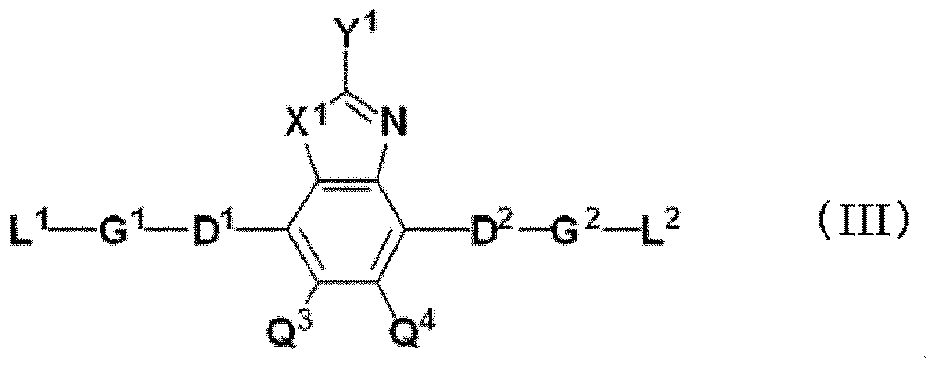
[式(III)中、
X1は、酸素原子、硫黄原子またはNR1-を表わす。R1は、水素原子または炭素数1~4のアルキル基を表わす。
Y1は、置換基を有していてもよい炭素数6~12の1価の芳香族炭化水素基または置換基を有していてもよい炭素数3~12の1価の芳香族複素環式基を表わす。
Q3およびQ4は、それぞれ独立に、水素原子、置換基を有していてもよい炭素数1~20の1価の脂肪族炭化水素基、炭素数3~20の1価の脂環式炭化水素基、置換基を有していてもよい炭素数6~20の1価の芳香族炭化水素基、ハロゲン原子、シアノ基、ニトロ基、-NR2R3または-SR2を表わすか、または、Q3とQ4とが互いに結合して、これらが結合する炭素原子とともに芳香環または芳香族複素環を形成する。R2およびR3は、それぞれ独立に、水素原子または炭素数1~6のアルキル基を表わす。
D1およびD2は、それぞれ独立に、単結合、-C(=O)-O-、-C(=S)-O-、-CR4R5-、-CR4R5-CR6R7-、-O-CR4R5-、-CR4R5-O-CR6R7-、-CO-O-CR4R5-、-O-CO-CR4R5-、-CR4R5-O-CO-CR6R7-、-CR4R5-CO-O-CR6R7-またはNR4-CR5R6-またはCO-NR4-を表わす。
R4、R5、R6およびR7は、それぞれ独立に、水素原子、フッ素原子または炭素数1~4のアルキル基を表わす。
G1およびG2は、それぞれ独立に、炭素数5~8の2価の脂環式炭化水素基を表わし、該脂環式炭化水素基を構成するメチレン基は、酸素原子、硫黄原子またはNH-に置き換っていてもよく、該脂環式炭化水素基を構成するメチン基は、第三級窒素原子に置き換っていてもよい。
L1およびL2は、それぞれ独立に、1価の有機基を表わし、L1およびL2のうちの少なくとも一つは、重合性基を有する。]
化合物(III)におけるL1は、下記式(III-1)で表される基であると好ましく、また、L2は式(III-2)で表される基であると好ましい。
P1-F1-(B1-A1)k-E1- (III-1)
P2-F2-(B2-A2)l-E2- (III-2)
[式(III-1)および式(III-2)中、
B1、B2、E1およびE2は、それぞれ独立に、-CR4R5-、-CH2-CH2-、-O-、-S-、-CO-O-、-O-CO-O-、-CS-O-、-O-CS-O-、-CO-NR1-、-O-CH2-、-S-CH2-または単結合を表わす。
A1およびA2は、それぞれ独立に、炭素数5~8の2価の脂環式炭化水素基または炭素数6~18の2価の芳香族炭化水素基を表わし、該脂環式炭化水素基を構成するメチレン基は、酸素原子、硫黄原子またはNH-に置き換っていてもよく、該脂環式炭化水素基を構成するメチン基は、第三級窒素原子に置き換っていてもよい。
kおよびlは、それぞれ独立に、0~3の整数を表わす。
F1およびF2は、炭素数1~12の2価の脂肪族炭化水素基を表わす。
P1は、重合性基を表わす。
P2は、水素原子または重合性基を表わす。
R4およびR5は、それぞれ独立に、水素原子、フッ素原子または炭素数1~4のアルキル基を表わす。]
P1-F1-(B1-A1)k-E1- (III-1)
P2-F2-(B2-A2)l-E2- (III-2)
[式(III-1)および式(III-2)中、
B1、B2、E1およびE2は、それぞれ独立に、-CR4R5-、-CH2-CH2-、-O-、-S-、-CO-O-、-O-CO-O-、-CS-O-、-O-CS-O-、-CO-NR1-、-O-CH2-、-S-CH2-または単結合を表わす。
A1およびA2は、それぞれ独立に、炭素数5~8の2価の脂環式炭化水素基または炭素数6~18の2価の芳香族炭化水素基を表わし、該脂環式炭化水素基を構成するメチレン基は、酸素原子、硫黄原子またはNH-に置き換っていてもよく、該脂環式炭化水素基を構成するメチン基は、第三級窒素原子に置き換っていてもよい。
kおよびlは、それぞれ独立に、0~3の整数を表わす。
F1およびF2は、炭素数1~12の2価の脂肪族炭化水素基を表わす。
P1は、重合性基を表わす。
P2は、水素原子または重合性基を表わす。
R4およびR5は、それぞれ独立に、水素原子、フッ素原子または炭素数1~4のアルキル基を表わす。]
好ましい化合物(III)としては、特開2011-207765号公報に記載の化合物が挙げられる。
重合性液晶(b)の具体例としては、上述の偏光層の説明において例示した重合性液晶化合物や、液晶便覧(液晶便覧編集委員会編、丸善(株)平成12年10月30日発行)の「3.8.6 ネットワーク(完全架橋型)」、「6.5.1 液晶材料 b.重合性ネマチック液晶材料」に記載された化合物の中で重合性基を有する化合物が挙げられる。
位相差層13の厚みは、例えば0.1μm以上50μm以下であってよく、好ましくは1μm以上10μm以下であり、より好ましくは0.5μm以上8μm以下であり、さらに好ましくは1μm以上6μm以下である。
(貼合層)
積層体100に含まれる貼合層は粘着剤層又は接着剤層であり、粘着剤組成物や接着剤組成物を用いて形成することができる。貼合層は、単層構造であっても多層構造であってもよいが、好ましくは単層構造である。
積層体100に含まれる貼合層は粘着剤層又は接着剤層であり、粘着剤組成物や接着剤組成物を用いて形成することができる。貼合層は、単層構造であっても多層構造であってもよいが、好ましくは単層構造である。
貼合層は、単層構造であっても多層構造であってもよいが、好ましくは単層構造である。
接着剤組成物としては、公知の接着剤組成物であってよく、その例としてはポリビニルアルコール系樹脂水溶液、水系二液型ウレタン系エマルジョン接着剤等の水系接着剤組成物;紫外線等の活性エネルギー線を照射することによって硬化する活性エネルギー線硬化型接着剤組成物等を挙げることができる。
粘着剤組成物は、(メタ)アクリル系、ゴム系、ウレタン系、エステル系、シリコーン系、ポリビニルエーテル系のような樹脂を主成分とする粘着剤組成物であってよい。中でも、透明性、耐候性、耐熱性等に優れる(メタ)アクリル系樹脂をベースポリマーとする粘着剤組成物が好適である。粘着剤組成物は、活性エネルギー線硬化型、熱硬化型であってもよい。
粘着剤組成物に用いられる(メタ)アクリル系樹脂(ベースポリマー)としては、例えば(メタ)アクリル酸ブチル、(メタ)アクリル酸メチル、(メタ)アクリル酸エチル、(メタ)アクリル酸ヘキシル、(メタ)アクリル酸オクチル、(メタ)アクリル酸ラウリル、(メタ)アクリル酸イソオクチル、(メタ)アクリル酸イソデシル、(メタ)アクリル酸2-エチルヘキシル、(メタ)アクリル酸イソボルニルのような(メタ)アクリル酸エステルの1種又は2種以上をモノマーとする重合体又は共重合体が好適に用いられる。
ベースポリマーには、極性モノマーを共重合させることが好ましい。極性モノマーとしては、例えば、(メタ)アクリル酸、(メタ)アクリル酸2-ヒドロキシプロピル、(メタ)アクリル酸ヒドロキシエチル、(メタ)アクリルアミド、N,N-ジメチルアミノエチル(メタ)アクリレート、グリシジル(メタ)アクリレートのような、カルボキシル基、水酸基、アミド基、アミノ基、エポキシ基等を有するモノマーを挙げることができる。
粘着剤組成物は、上記ベースポリマーのみを含むものであってもよいが、通常は架橋剤をさらに含有する。架橋剤としては、2価以上の金属イオンであって、カルボキシル基との間でカルボン酸金属塩を形成するもの;ポリアミン化合物であって、カルボキシル基との間でアミド結合を形成するもの;ポリエポキシ化合物やポリオールであって、カルボキシル基との間でエステル結合を形成するもの;ポリイソシアネート化合物であって、カルボキシル基との間でアミド結合を形成するものが例示される。中でも、ポリイソシアネート化合物が好ましい。
活性エネルギー線硬化型粘着剤組成物とは、紫外線や電子線のような活性エネルギー線の照射を受けて硬化する性質を有しており、活性エネルギー線照射前においても粘着性を有してフィルム等の被着体に密着させることができ、活性エネルギー線の照射によって硬化して密着力等の調整ができる性質を有する粘着剤組成物である。
活性エネルギー線硬化型粘着剤組成物は、紫外線硬化型であることが好ましい。活性エネルギー線硬化型粘着剤組成物は、ベースポリマー、架橋剤に加えて、活性エネルギー線重合性化合物をさらに含有する。さらに必要に応じて、光重合開始剤や光増感剤等を含有させてもよい。
活性エネルギー線重合性化合物としては、例えば、分子内に少なくとも1個の(メタ)アクリロイルオキシ基を有する(メタ)アクリレートモノマー;官能基含有化合物を2種以上反応させて得られ、分子内に少なくとも2個の(メタ)アクリロイルオキシ基を有する(メタ)アクリレートオリゴマー等の(メタ)アクリロイルオキシ基含有化合物等の(メタ)アクリル系化合物が挙げられる。
粘着剤組成物は、光散乱性を付与するための微粒子、ビーズ(樹脂ビーズ、ガラスビーズ等)、ガラス繊維、ベースポリマー以外の樹脂、粘着性付与剤、充填剤(金属粉やその他の無機粉末等)、酸化防止剤、紫外線吸収剤、帯電防止剤、染料、顔料、着色剤、消泡剤、腐食防止剤、光重合開始剤等の添加剤を含むことができる。
粘着剤層は、上記粘着剤組成物の例えば有機溶剤希釈液を基材上に塗布し、乾燥させることにより形成することができる。活性エネルギー線硬化型粘着剤組成物を用いた場合は、形成された粘着剤層に、活性エネルギー線を照射することにより所望の硬化度を有する硬化物とすることができる。
貼合層の厚みは、例えば0.5μm以上100μm以下であり、好ましくは0.7μm以上50μm以下であり、より好ましくは1μm以上30μm以下である。
(その他の層)
積層体100は、位相差層側に支持基材をさらに含んでいてもよい。支持基材は、光を透過可能な板状体である。支持基材50は、1層のみから構成されてもよく、2層以上から構成されてもよい。支持基材としては、前面板11と同様に、例えば、ガラス製の板状体(例えば、ガラス板、ガラスフィルム等)、樹脂製の板状体(例えば、樹脂板、樹脂シート、樹脂フィルム等)が挙げられる。積層体100が画像表示装置に用いられる場合、支持基材は画像表示装置の視認側とは反対側となる面に配置されることができる。
積層体100は、位相差層側に支持基材をさらに含んでいてもよい。支持基材は、光を透過可能な板状体である。支持基材50は、1層のみから構成されてもよく、2層以上から構成されてもよい。支持基材としては、前面板11と同様に、例えば、ガラス製の板状体(例えば、ガラス板、ガラスフィルム等)、樹脂製の板状体(例えば、樹脂板、樹脂シート、樹脂フィルム等)が挙げられる。積層体100が画像表示装置に用いられる場合、支持基材は画像表示装置の視認側とは反対側となる面に配置されることができる。
上記の中でも、積層体100及びこれを含む画像表示装置の屈曲性の観点から、樹脂フィルム等の樹脂製の板状体であることが好ましい。樹脂フィルム等の樹脂製の板状体を構成する熱可塑性樹脂の具体例については、前面板11についての記述が引用される。熱可塑性樹脂は、好ましくは、セルロース系樹脂、(メタ)アクリル系樹脂、環状ポリオレフィン系樹脂、ポリエステル系樹脂、ポリカーボネート系樹脂等である。
支持基材は、タッチセンサパネル、有機EL表示素子等の表示素子又はこれらの組合せであることもできる。
支持基材の厚みは、積層体100の薄型化の観点から、好ましくは15μm以上200μm以下であり、より好ましくは20μm以上150μm以下であり、さらに好ましくは50μm以上130μm以下である。
図2は、別の一態様に係る積層体200の概略断面図を示す。積層体200は前面板11、粘着剤層21、基材層22、配向膜23、偏光層12、保護層24、粘着剤層25、λ/4層26、粘着剤層27、ポジティブC層28がこの順に積層されている。積層体200は、円偏光板であることができる。
<積層体の製造方法>
積層体は、粘着剤層、あるいは接着剤層を介して積層体を構成する層同士を貼合する工程を含む方法によって製造することができる。粘着剤層や接着剤層を介して層同士を貼合する場合には、密着性を高めるために、貼合面の一方又は両方に対して、例えばコロナ処理等の表面活性化処理を施すことが好ましい。
積層体は、粘着剤層、あるいは接着剤層を介して積層体を構成する層同士を貼合する工程を含む方法によって製造することができる。粘着剤層や接着剤層を介して層同士を貼合する場合には、密着性を高めるために、貼合面の一方又は両方に対して、例えばコロナ処理等の表面活性化処理を施すことが好ましい。
偏光子層や位相差層は、前面板や基材層上に直接、又は配向膜を介して形成することが可能であり、基材層は積層体に組み込まれてもよいし、あるいは、偏光子層や位相差層から剥離されて積層体の構成要素とはならなくてもよい。積層体は、例えば後述する実施例の欄に記載の方法により製造することができる。
偏光層12は、基材層11及び存在する場合には配向層上に組成物(A)を塗布することで形成することができる。組成物(A)は、上述の二色性色素及び重合性液晶化合物に加え、好ましくは重合開始剤、レベリング剤、溶剤をさらに含み、光増感剤、重合禁止剤等をさらに含み得る。
(重合開始剤)
重合開始剤は、重合性液晶等の重合反応を開始し得る化合物である。重合開始剤としては、サーモトロピック液晶の相状態に依存しないという観点から、光の作用により活性ラジカルを発生する光重合開始剤が好ましい。
重合開始剤は、重合性液晶等の重合反応を開始し得る化合物である。重合開始剤としては、サーモトロピック液晶の相状態に依存しないという観点から、光の作用により活性ラジカルを発生する光重合開始剤が好ましい。
重合開始剤としては、例えばベンゾイン化合物、ベンゾフェノン化合物、アルキルフェノン化合物、アシルホスフィンオキサイド化合物、トリアジン化合物、ヨードニウム塩及びスルホニウム塩等が挙げられる。
ベンゾイン化合物としては、例えば、ベンゾイン、ベンゾインメチルエーテル、ベンゾインエチルエーテル、ベンゾインイソプロピルエーテル及びベンゾインイソブチルエーテル等が挙げられる。
ベンゾフェノン化合物としては、例えば、ベンゾフェノン、o-ベンゾイル安息香酸メチル、4-フェニルベンゾフェノン、4-ベンゾイル-4’-メチルジフェニルサルファイド、3,3’,4,4’-テトラ(tert-ブチルパーオキシカルボニル)ベンゾフェノン及び2,4,6-トリメチルベンゾフェノン等が挙げられる。
アルキルフェノン化合物としては、例えば、ジエトキシアセトフェノン、2-メチル-2-モルホリノ-1-(4-メチルチオフェニル)プロパン-1-オン、2-ベンジル-2-ジメチルアミノ-1-(4-モルホリノフェニル)ブタン-1-オン、2-ヒドロキシ-2-メチル-1-フェニルプロパン-1-オン、1,2-ジフェニル-2,2-ジメトキシエタン-1-オン、2-ヒドロキシ-2-メチル-1-〔4-(2-ヒドロキシエトキシ)フェニル〕プロパン-1-オン、1-ヒドロキシシクロヘキシルフェニルケトン及び2-ヒドロキシ-2-メチル-1-〔4-(1-メチルビニル)フェニル〕プロパン-1-オンのオリゴマー等が挙げられる。
アシルホスフィンオキサイド化合物としては、2,4,6-トリメチルベンゾイルジフェニルホスフィンオキサイド及びビス(2,4,6-トリメチルベンゾイル)フェニルホスフィンオキサイド等が挙げられる。
トリアジン化合物としては、例えば、2,4-ビス(トリクロロメチル)-6-(4-メトキシフェニル)-1,3,5-トリアジン、2,4-ビス(トリクロロメチル)-6-(4-メトキシナフチル)-1,3,5-トリアジン、2,4-ビス(トリクロロメチル)-6-(4-メトキシスチリル)-1,3,5-トリアジン、2,4-ビス(トリクロロメチル)-6-〔2-(5-メチルフラン-2-イル)エテニル〕-1,3,5-トリアジン、2,4-ビス(トリクロロメチル)-6-〔2-(フラン-2-イル)エテニル〕-1,3,5-トリアジン、2,4-ビス(トリクロロメチル)-6-〔2-(4-ジエチルアミノ-2-メチルフェニル)エテニル〕-1,3,5-トリアジン及び2,4-ビス(トリクロロメチル)-6-〔2-(3,4-ジメトキシフェニル)エテニル〕-1,3,5-トリアジン等が挙げられる。
重合開始剤として市販のものを用いることができる。市販の重合開始剤としては、イルガキュア(Irgacure)(登録商標)907、184、651、819、250、及び369、379、127、754、OXE01、OXE02、OXE03(チバ・スペシャルティ・ケミカルズ株式会社製);セイクオール(登録商標)BZ、Z、及びBEE(精工化学株式会社製);カヤキュアー(kayacure)(登録商標)BP100、及びUVI-6992(ダウ・ケミカル株式会社製);アデカオプトマーSP-152、N-1717、N-1919、SP-170、アデカアークルズNCI-831、アデカアークルズNCI-930(株式会社ADEKA製);TAZ-A、及びTAZ-PP(日本シイベルヘグナー株式会社製);並びに、TAZ-104(株式会社三和ケミカル製);等が挙げられる。組成物(A)中の重合開始剤は、1種類でもよいし、光の光源に合わせて2種類以上の複数の重合開始剤を混合してもよい。
組成物(A)中の重合開始剤の含有量は、重合性液晶の種類及びその量に応じて適宜調節できるが、重合性液晶の含有量100質量部に対して通常、0.1質量部以上30質量部以下、好ましくは0.5質量部以上10質量部以下、より好ましくは0.5質量部以上8質量部以下である。重合開始剤の含有量が上記範囲内であると、重合性液晶の配向を乱すことなく重合を行うことができる。
(増感剤)
組成物(A)は増感剤を含有してもよい。増感剤としては、光増感剤が好ましい。該増感剤としては、例えば、キサントン及びチオキサントン等のキサントン化合物(例えば、2,4-ジエチルチオキサントン、2-イソプロピルチオキサントン等);アントラセン及びアルコキシ基含有アントラセン(例えば、ジブトキシアントラセン等)等のアントラセン化合物;フェノチアジン及びルブレン等が挙げられる。
組成物(A)は増感剤を含有してもよい。増感剤としては、光増感剤が好ましい。該増感剤としては、例えば、キサントン及びチオキサントン等のキサントン化合物(例えば、2,4-ジエチルチオキサントン、2-イソプロピルチオキサントン等);アントラセン及びアルコキシ基含有アントラセン(例えば、ジブトキシアントラセン等)等のアントラセン化合物;フェノチアジン及びルブレン等が挙げられる。
組成物(A)が増感剤を含有する場合、組成物(A)に含有される重合性液晶の重合反応をより促進することができる。かかる増感剤の使用量は、重合性液晶の含有量100質量部に対して、0.1質量部以上10質量部以下が好ましく、0.5質量部以上5質量部以下がより好ましく、0.5質量部以上3質量部以下がさらに好ましい。
(重合禁止剤)
重合反応を安定的に進行させる観点から、組成物(A)は重合禁止剤を含有してもよい。重合禁止剤により、重合性液晶の重合反応の進行度合いをコントロールすることができる。
重合反応を安定的に進行させる観点から、組成物(A)は重合禁止剤を含有してもよい。重合禁止剤により、重合性液晶の重合反応の進行度合いをコントロールすることができる。
前記重合禁止剤としては、例えばハイドロキノン、アルコキシ基含有ハイドロキノン、アルコキシ基含有カテコール(例えば、ブチルカテコール等)、ピロガロール、2,2,6,6-テトラメチル-1-ピペリジニルオキシラジカル等のラジカル捕捉剤;チオフェノール類;β-ナフチルアミン類及びβ-ナフトール類等が挙げられる。
組成物(A)が重合禁止剤を含有する場合、重合禁止剤の含有量は、重合性液晶の含有量100質量部に対して、好ましくは0.1質量部以上10質量部以下、より好ましくは0.5質量部以上5質量部以下、さらに好ましくは0.5質量部以上3質量部以下である。重合禁止剤の含有量が、上記範囲内であると、重合性液晶の配向を乱すことなく重合を行うことができる。
(レベリング剤)
組成物(A)には、レベリング剤を含有させてもよい。レベリング剤とは、組成物の流動性を調整し、組成物を塗布して得られる膜をより平坦にする機能を有する添加剤であり、例えば、有機変性シリコーンオイル系、ポリアクリレート系及びパーフルオロアルキル系のレベリング剤が挙げられる。具体的には、DC3PA、SH7PA、DC11PA、SH28PA、SH29PA、SH30PA、ST80PA、ST86PA、SH8400、SH8700、FZ2123(以上、全て東レ・ダウコーニング(株)製)、KP321、KP323、KP324、KP326、KP340、KP341、X22-161A、KF6001(以上、全て信越化学工業(株)製)、TSF400、TSF401、TSF410、TSF4300、TSF4440、TSF4445、TSF-4446、TSF4452、TSF4460(以上、全てモメンティブ パフォーマンス マテリアルズ ジャパン合同会社製)、フロリナート(fluorinert)(登録商標)FC-72、同FC-40、同FC-43、同FC-3283(以上、全て住友スリーエム(株)製)、メガファック(登録商標)R-08、同R-30、同R-90、同F-410、同F-411、同F-443、同F-445、同F-470、同F-477、同F-479、同F-482、同F-483(以上、いずれもDIC(株)製)、エフトップ(商品名)EF301、同EF303、同EF351、同EF352(以上、全て三菱マテリアル電子化成(株)製)、サーフロン(登録商標)S-381、同S-382、同S-383、同S-393、同SC-101、同SC-105、KH-40、SA-100(以上、全てAGCセイミケミカル(株)製)、商品名E1830、同E5844((株)ダイキンファインケミカル研究所製)、BM-1000、BM-1100、BYK-352、BYK-353及びBYK-361N(いずれも商品名:BM Chemie社製)等が挙げられる。中でも、ポリアクリレート系レベリング剤及びパーフルオロアルキル系レベリング剤が好ましい。
組成物(A)には、レベリング剤を含有させてもよい。レベリング剤とは、組成物の流動性を調整し、組成物を塗布して得られる膜をより平坦にする機能を有する添加剤であり、例えば、有機変性シリコーンオイル系、ポリアクリレート系及びパーフルオロアルキル系のレベリング剤が挙げられる。具体的には、DC3PA、SH7PA、DC11PA、SH28PA、SH29PA、SH30PA、ST80PA、ST86PA、SH8400、SH8700、FZ2123(以上、全て東レ・ダウコーニング(株)製)、KP321、KP323、KP324、KP326、KP340、KP341、X22-161A、KF6001(以上、全て信越化学工業(株)製)、TSF400、TSF401、TSF410、TSF4300、TSF4440、TSF4445、TSF-4446、TSF4452、TSF4460(以上、全てモメンティブ パフォーマンス マテリアルズ ジャパン合同会社製)、フロリナート(fluorinert)(登録商標)FC-72、同FC-40、同FC-43、同FC-3283(以上、全て住友スリーエム(株)製)、メガファック(登録商標)R-08、同R-30、同R-90、同F-410、同F-411、同F-443、同F-445、同F-470、同F-477、同F-479、同F-482、同F-483(以上、いずれもDIC(株)製)、エフトップ(商品名)EF301、同EF303、同EF351、同EF352(以上、全て三菱マテリアル電子化成(株)製)、サーフロン(登録商標)S-381、同S-382、同S-383、同S-393、同SC-101、同SC-105、KH-40、SA-100(以上、全てAGCセイミケミカル(株)製)、商品名E1830、同E5844((株)ダイキンファインケミカル研究所製)、BM-1000、BM-1100、BYK-352、BYK-353及びBYK-361N(いずれも商品名:BM Chemie社製)等が挙げられる。中でも、ポリアクリレート系レベリング剤及びパーフルオロアルキル系レベリング剤が好ましい。
組成物(A)がレベリング剤を含有する場合、重合性液晶の含有量100質量部に対して、好ましくは0.01質量部以上5質量部以下、より好ましくは0.1質量部以上5質量部以下、さらに好ましくは0.1質量部以上3質量部以下である。レベリング剤の含有量が上記範囲内であると、重合性液晶を水平配向させることが容易であり、かつ得られる偏光膜がより平滑となる傾向がある。重合性液晶に対するレベリング剤の含有量が上記範囲を超えると、得られる偏光膜にムラが生じやすい傾向がある。なお、組成物(A)は、レベリング剤を2種以上含有していてもよい。
(溶剤)
組成物(A)は溶剤を含有してよい。一般に重合性液晶化合物は粘度が高いため、溶剤に溶解させた組成物(A)とすることで塗布が容易になり、結果として偏光膜の形成がし易くなる場合が多い。溶剤としては、重合性液晶化合物を完全に溶解し得るものが好ましく、また、重合性液晶化合物の重合反応に不活性な溶剤であることが好ましい。
組成物(A)は溶剤を含有してよい。一般に重合性液晶化合物は粘度が高いため、溶剤に溶解させた組成物(A)とすることで塗布が容易になり、結果として偏光膜の形成がし易くなる場合が多い。溶剤としては、重合性液晶化合物を完全に溶解し得るものが好ましく、また、重合性液晶化合物の重合反応に不活性な溶剤であることが好ましい。
溶剤としては、メタノール、エタノール、エチレングリコール、イソプロピルアルコール、プロピレングリコール、エチレングリコールメチルエーテル、エチレングリコールブチルエーテル及びプロピレングリコールモノメチルエーテル等のアルコール溶剤;酢酸エチル、酢酸ブチル、エチレングリコールメチルエーテルアセテート、γ-ブチロラクトン又はプロピレングリコールメチルエーテルアセテート及び乳酸エチル等のエステル溶剤;アセトン、メチルエチルケトン、シクロペンタノン、シクロヘキサノン、2-ヘプタノン及びメチルイソブチルケトン等のケトン溶剤;ペンタン、ヘキサン及びヘプタン等の脂肪族炭化水素溶剤;トルエン及びキシレン等の芳香族炭化水素溶剤、アセトニトリル等のニトリル溶剤;テトラヒドロフラン及びジメトキシエタン等のエーテル溶剤;クロロホルム及びクロロベンゼン等の塩素含有溶剤;ジメチルアセトアミド、ジメチルホルミアミド、N-メチル-2-ピロリドン、1,3-ジメチル-2-イミダゾリジノン等のアミド系溶剤等が挙げられる。これら溶剤は、単独で用いてもよいし、2種以上を組み合わせて用いてもよい。
溶剤の含有量は、前記組成物(A)の総量に対して50質量%以上98質量%以下が好ましい。換言すると、組成物(A)における固形分の含有量は、2質量%以上50質量%が好ましい。該固形分の含有量が50質量%以下であると、組成物(A)の粘度が低くなることから、偏光膜の厚さが略均一になることで、当該偏光膜にムラが生じにくくなる傾向がある。また、かかる固形分の含有量は、製造しようとする偏光膜の厚さを考慮して定めることができる。
(反応性添加剤)
組成物(A)は、反応性添加剤を含んでもよい。反応性添加剤としては、その分子内に炭素-炭素不飽和結合と活性水素反応性基とを有するものが好ましい。なお、ここでいう「活性水素反応性基」とは、カルボキシル基(-COOH)、水酸基(-OH)、アミノ基(-NH2)等の活性水素を有する基に対して反応性を有する基を意味し、グリシジル基、オキサゾリン基、カルボジイミド基、アジリジン基、イミド基、イソシアネート基、チオイソシアネート基、無水マレイン酸基等がその代表例である。反応性添加剤が有する、炭素-炭素不飽和結合及び活性水素反応性基の個数は、通常、それぞれ1~20個であり、好ましくはそれぞれ1~10個である。
組成物(A)は、反応性添加剤を含んでもよい。反応性添加剤としては、その分子内に炭素-炭素不飽和結合と活性水素反応性基とを有するものが好ましい。なお、ここでいう「活性水素反応性基」とは、カルボキシル基(-COOH)、水酸基(-OH)、アミノ基(-NH2)等の活性水素を有する基に対して反応性を有する基を意味し、グリシジル基、オキサゾリン基、カルボジイミド基、アジリジン基、イミド基、イソシアネート基、チオイソシアネート基、無水マレイン酸基等がその代表例である。反応性添加剤が有する、炭素-炭素不飽和結合及び活性水素反応性基の個数は、通常、それぞれ1~20個であり、好ましくはそれぞれ1~10個である。
反応性添加剤において、活性水素反応性基が少なくとも2つ存在することが好ましく、この場合、複数存在する活性水素反応性基は同一でも、異なるものであってもよい。
反応性添加剤が有する炭素-炭素不飽和結合とは、炭素-炭素二重結合又は炭素-炭素三重結合、又はそれらの組み合わせであってよいが、炭素-炭素二重結合であることが好ましい。中でも、反応性添加剤としては、ビニル基及び/又は(メタ)アクリル基として炭素-炭素不飽和結合を含むことが好ましい。さらに、活性水素反応性基が、エポキシ基、グリシジル基及びイソシアネート基からなる群から選ばれる少なくとも1種である反応性添加剤が好ましく、アクリル基とイソシアネート基とを有する反応性添加剤がより好ましい。
反応性添加剤の具体例としては、メタクリロキシグリシジルエーテルやアクリロキシグリシジルエーテル等の、(メタ)アクリル基とエポキシ基とを有する化合物;オキセタンアクリレートやオキセタンメタクリレート等の、(メタ)アクリル基とオキセタン基とを有する化合物;ラクトンアクリレートやラクトンメタクリレート等の、(メタ)アクリル基とラクトン基とを有する化合物;ビニルオキサゾリンやイソプロペニルオキサゾリン等の、ビニル基とオキサゾリン基とを有する化合物;イソシアナトメチルアクリレート、イソシアナトメチルメタクリレート、2-イソシアナトエチルアクリレート及び2-イソシアナトエチルメタクリレート等の、(メタ)アクリル基とイソシアネート基とを有する化合物のオリゴマー等が挙げられる。また、メタクリル酸無水物、アクリル酸無水物、無水マレイン酸及びビニル無水マレイン酸等の、ビニル基やビニレン基と酸無水物とを有する化合物等が挙げられる。中でも、メタクリロキシグリシジルエーテル、アクリロキシグリシジルエーテル、イソシアナトメチルアクリレート、イソシアナトメチルメタクリレート、ビニルオキサゾリン、2-イソシアナトエチルアクリレート、2-イソシアナトエチルメタクリレート及び前記のオリゴマーが好ましく、イソシアナトメチルアクリレート、2-イソシアナトエチルアクリレート及び前記のオリゴマーが特に好ましい。
具体的には、下記式(Y)で表される化合物が好ましい。

[式(Y)中、
nは1~10までの整数を表わし、R1’は、炭素数2~20の2価の脂肪族又は脂環式炭化水素基、或いは炭素数5~20の2価の芳香族炭化水素基を表わす。各繰返し単位にある2つのR2’は、一方が-NH-であり、他方が>N-C(=O)-R3’で示される基である。R3’は、水酸基又は炭素-炭素不飽和結合を有する基を表す。
式(Y)中のR3’のうち、少なくとも1つのR3’は炭素-炭素不飽和結合を有する基である。]
nは1~10までの整数を表わし、R1’は、炭素数2~20の2価の脂肪族又は脂環式炭化水素基、或いは炭素数5~20の2価の芳香族炭化水素基を表わす。各繰返し単位にある2つのR2’は、一方が-NH-であり、他方が>N-C(=O)-R3’で示される基である。R3’は、水酸基又は炭素-炭素不飽和結合を有する基を表す。
式(Y)中のR3’のうち、少なくとも1つのR3’は炭素-炭素不飽和結合を有する基である。]
前記式(Y)で表される反応性添加剤の中でも、下記式(YY)で表される化合物(以下、化合物(YY)という場合がある。)が特に好ましい(なお、nは前記と同じ意味である)。
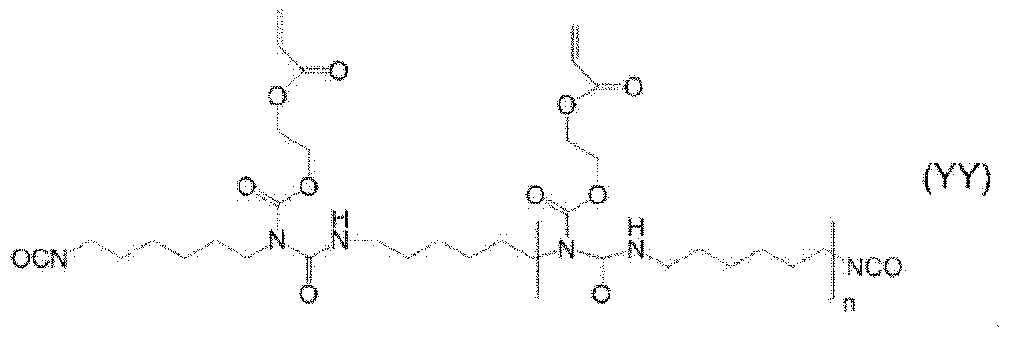
化合物(YY)には、市販品をそのまま又は必要に応じて精製して用いることができる。市販品としては、例えば、Laromer(登録商標)LR-9000(BASF社製)が挙げられる。
組成物(A)が反応性添加剤を含有する場合、反応性添加剤の含有量は、重合性液晶100質量部に対して通常、0.01質量部以上10質量部以下であり、好ましくは0.1質量部以上5質量部以下である。
(塗布方法)
組成物(A)を基材層11又は配向層上に塗布する方法としては、押し出しコーティング法、ダイレクトグラビアコーティング法、リバースグラビアコーティング法、CAPコーティング法、スリットコーティング法、マイクログラビア法、ダイコーティング法、インクジェット法等が挙げられる。また、ディップコーター、バーコーター、スピンコーター等のコーターを用いて塗布する方法等も挙げられる。中でも、Roll to Roll形式で連続的に塗布する場合には、マイクログラビア法、インクジェット法、スリットコーティング法、ダイコーティング法による塗布方法が好ましく、ガラス等の枚葉体に塗布する場合には、均一性の高いスピンコーティング法が好ましい。Roll to Roll形式で塗布する場合、基材層11に配向性ポリマー組成物又は光配向層形成用組成物等を塗布して配向層を形成し、さらに得られた配向層上に組成物(A)を連続的に塗布することもできる。
組成物(A)を基材層11又は配向層上に塗布する方法としては、押し出しコーティング法、ダイレクトグラビアコーティング法、リバースグラビアコーティング法、CAPコーティング法、スリットコーティング法、マイクログラビア法、ダイコーティング法、インクジェット法等が挙げられる。また、ディップコーター、バーコーター、スピンコーター等のコーターを用いて塗布する方法等も挙げられる。中でも、Roll to Roll形式で連続的に塗布する場合には、マイクログラビア法、インクジェット法、スリットコーティング法、ダイコーティング法による塗布方法が好ましく、ガラス等の枚葉体に塗布する場合には、均一性の高いスピンコーティング法が好ましい。Roll to Roll形式で塗布する場合、基材層11に配向性ポリマー組成物又は光配向層形成用組成物等を塗布して配向層を形成し、さらに得られた配向層上に組成物(A)を連続的に塗布することもできる。
(乾燥方法)
組成物(A)の塗布層に含まれる溶剤を除去する乾燥方法としては、例えば、自然乾燥、通風乾燥、加熱乾燥、減圧乾燥及びこれらを組み合わせた方法が挙げられる。中でも、自然乾燥又は加熱乾燥が好ましい。乾燥温度は、0~200℃の範囲が好ましく、20~150℃の範囲がより好ましく、50~130℃の範囲がさらに好ましい。乾燥時間は、10秒間~10分間が好ましく、より好ましくは30秒間~5分間である。光配向層形成用組成物及び配向性ポリマー組成物も同様に乾燥することができる。
組成物(A)の塗布層に含まれる溶剤を除去する乾燥方法としては、例えば、自然乾燥、通風乾燥、加熱乾燥、減圧乾燥及びこれらを組み合わせた方法が挙げられる。中でも、自然乾燥又は加熱乾燥が好ましい。乾燥温度は、0~200℃の範囲が好ましく、20~150℃の範囲がより好ましく、50~130℃の範囲がさらに好ましい。乾燥時間は、10秒間~10分間が好ましく、より好ましくは30秒間~5分間である。光配向層形成用組成物及び配向性ポリマー組成物も同様に乾燥することができる。
(重合方法)
重合性液晶化合物を重合させる方法としては、光重合が好ましい。光重合は、基材層11上又は配向層上に塗布された重合性液晶化合物を含む組成物(A)に活性エネルギー線を照射することにより実施される。照射する活性エネルギー線としては、乾燥被膜に含まれる重合性液晶化合物の種類(特に、重合性液晶化合物が有する光重合性官能基の種類)、光重合開始剤を含む場合には光重合開始剤の種類、及びそれらの量に応じて適宜選択される。具体的には、可視光、紫外光、赤外光、X線、α線、β線、及びγ線からなる群より選択される一種以上の光が挙げられる。中でも、重合反応の進行を制御し易い点、及び光重合装置として当分野で広範に用いられているものが使用できるという点で、紫外光が好ましく、紫外光によって光重合可能なように、重合性液晶化合物の種類を選択することが好ましい。
重合性液晶化合物を重合させる方法としては、光重合が好ましい。光重合は、基材層11上又は配向層上に塗布された重合性液晶化合物を含む組成物(A)に活性エネルギー線を照射することにより実施される。照射する活性エネルギー線としては、乾燥被膜に含まれる重合性液晶化合物の種類(特に、重合性液晶化合物が有する光重合性官能基の種類)、光重合開始剤を含む場合には光重合開始剤の種類、及びそれらの量に応じて適宜選択される。具体的には、可視光、紫外光、赤外光、X線、α線、β線、及びγ線からなる群より選択される一種以上の光が挙げられる。中でも、重合反応の進行を制御し易い点、及び光重合装置として当分野で広範に用いられているものが使用できるという点で、紫外光が好ましく、紫外光によって光重合可能なように、重合性液晶化合物の種類を選択することが好ましい。
前記活性エネルギー線の光源としては、例えば、低圧水銀ランプ、中圧水銀ランプ、高圧水銀ランプ、超高圧水銀ランプ、キセノンランプ、ハロゲンランプ、カーボンアーク灯、タングステンランプ、ガリウムランプ、エキシマレーザー、波長範囲380~440nmを発光するLED光源、ケミカルランプ、ブラックライトランプ、マイクロウェーブ励起水銀灯、メタルハライドランプ等が挙げられる。
紫外線照射強度は、通常、10mW/cm2~3,000mW/cm2である。紫外線照射強度は、好ましくはカチオン重合開始剤又はラジカル重合開始剤の活性化に有効な波長領域における強度である。光を照射する時間は、通常0.1秒~10分であり、好ましくは0.1秒~5分であり、より好ましくは0.1秒~3分であり、さらに好ましくは0.1秒~1分である。このような紫外線照射強度で1回又は複数回照射すると、その積算光量は、10mJ/cm2~3,000mJ/cm2、好ましくは50mJ/cm2~2,000mJ/cm2、より好ましくは100mJ/cm2~1,000mJ/cm2である。積算光量がこの範囲以下である場合には、重合性液晶化合物の硬化が不十分となり、良好な転写性が得られない場合がある。逆に、積算光量がこの範囲以上である場合には、光学異方層を含む光学フィルムが着色する場合がある。
位相差層13は、基材層上に、または基材層が配向膜を有する場合には配向膜上に、組成物(B)を塗布し、重合性液晶(b)を重合することで製造することができる。組成物(B)は、溶剤、重合開始剤をさらに含み、光増感剤、重合禁止剤、レベリング剤等をさらに含み得る。
組成物(B)の塗布、乾燥および重合性液晶(b)の重合は、上述の偏光層12の形成方法において例示した組成物(A)の塗布、乾燥および重合性液晶(a)の重合と同様に行うことができる。
粘着剤層は粘着シートとして準備することができる。粘着シートは、例えばトルエンや酢酸エチル等の有機溶剤に粘着剤組成物を溶解または分散させて粘着剤液を調製し、これを離型処理が施された剥離フィルム上に粘着剤からなる層をシート状に形成しておき、その粘着剤層上にさらに別の剥離フィルムを貼合する方式等により作製することができる。
一方の剥離フィルムを剥離した粘着シートを一方の層に貼合し、次いで他方の剥離フィルムを剥離し、他方の層を貼合する方法により各層を貼合することができる。
一方の剥離フィルムを剥離した粘着シートを一方の層に貼合し、次いで他方の剥離フィルムを剥離し、他方の層を貼合する方法により各層を貼合することができる。
<画像表示装置>
画像表示装置としては特に限定されず、例えば、有機エレクトロルミネッセンス(有機EL)表示装置、無機エレクトロルミネッセンス(無機EL)表示装置、液晶表示装置、タッチパネル表示装置、電界発光表示装置等を挙げることができる。本実施の形態の画像表示装置は、屈曲可能な積層体100を有するため、フレキシブルディスプレイに好適に用いることができ、特に有機EL表示装置に好適に用いることができる。
画像表示装置としては特に限定されず、例えば、有機エレクトロルミネッセンス(有機EL)表示装置、無機エレクトロルミネッセンス(無機EL)表示装置、液晶表示装置、タッチパネル表示装置、電界発光表示装置等を挙げることができる。本実施の形態の画像表示装置は、屈曲可能な積層体100を有するため、フレキシブルディスプレイに好適に用いることができ、特に有機EL表示装置に好適に用いることができる。
以下、実施例により本発明をさらに詳細に説明する。例中の「%」及び「部」は、特記のない限り、質量%及び質量部である。
[耐光性試験]
1)Δ反射率及びΔ反射色相
粘着剤を介して積層体をガラス板に貼合し、測定用サンプルを作製した。分光測色計(CM-2600d、コニカミノルタ株式会社製、SCIモード)に反射板(アルミ板、反射率97%)を設置した。反射板上に、測定用サンプルをガラス板の積層体側とは反対面を下向きにして水の膜を介して設置し、反射率及び反射色相を測定した。次いで測定を行ったサンプルについて、以下の条件にて紫外線照射を行った。
紫外線照射条件:
紫外線フェードメーター(U48AU、スガ試験機株式会社製)に、積層体を前面板側を上にして設置し、前面板側から120時間紫外線照射を行った。
光源 :紫外線カーボンアーク
放電電圧 :135V
放電電流 :16A
放射照度 :500±100W/cm2(波長300-700nm)
ブラックパネル温度:63℃
湿度 :50%RH
雰囲気 :大気下
紫外線照射後の測定用サンプルについて反射率及び反射色相を測定し、紫外線照射前後の反射率の差の絶対値[Δ反射率(%)]及び反射色相の差の絶対値[Δ反射色相(Δa*b*)]をそれぞれ求めた。
Δ反射率(%)は以下の式により求めることができる。
Δ反射率(%)=|Y(紫外線照射後)-Y(紫外線照射前)|
Y(紫外線照射後):紫外線照射後の反射率(%)
Y(紫外線照射前):紫外線照射前の反射率(%)
Δ反射色相(Δa*b*)は以下の式により求めることができる。
1)Δ反射率及びΔ反射色相
粘着剤を介して積層体をガラス板に貼合し、測定用サンプルを作製した。分光測色計(CM-2600d、コニカミノルタ株式会社製、SCIモード)に反射板(アルミ板、反射率97%)を設置した。反射板上に、測定用サンプルをガラス板の積層体側とは反対面を下向きにして水の膜を介して設置し、反射率及び反射色相を測定した。次いで測定を行ったサンプルについて、以下の条件にて紫外線照射を行った。
紫外線照射条件:
紫外線フェードメーター(U48AU、スガ試験機株式会社製)に、積層体を前面板側を上にして設置し、前面板側から120時間紫外線照射を行った。
光源 :紫外線カーボンアーク
放電電圧 :135V
放電電流 :16A
放射照度 :500±100W/cm2(波長300-700nm)
ブラックパネル温度:63℃
湿度 :50%RH
雰囲気 :大気下
紫外線照射後の測定用サンプルについて反射率及び反射色相を測定し、紫外線照射前後の反射率の差の絶対値[Δ反射率(%)]及び反射色相の差の絶対値[Δ反射色相(Δa*b*)]をそれぞれ求めた。
Δ反射率(%)は以下の式により求めることができる。
Δ反射率(%)=|Y(紫外線照射後)-Y(紫外線照射前)|
Y(紫外線照射後):紫外線照射後の反射率(%)
Y(紫外線照射前):紫外線照射前の反射率(%)
Δ反射色相(Δa*b*)は以下の式により求めることができる。

ここでΔa*及びΔb*は、L*a*b*色空間(CIE 1976)における紫外線照射後の座標a*(紫外線照射後)及びb*(紫外線照射後)と紫外線照射前の座標a*(紫外線照射前)及びb*(紫外線照射前)との差の絶対値であり、以下の式で求めることができる。
Δa*=|a*(紫外線照射後)-a*(紫外線照射前)|
Δb*=|b*(紫外線照射後)-b*(紫外線照射前)|
2)ニュートラル色相
分光測色計(CM-2600d、コニカミノルタ株式会社製)を用いて、紫外線照射前にニュートラル色相(a*b*)を測定し、上述の紫外線照射条件にて紫外線を照射した後にニュートラル色相(a*b*)を測定した。ニュートラル色相(a*b*)が15以下である場合を○、15より大きい場合を×とした。
なおニュートラル色相(a*b*)は以下の式により求めることができる。
分光測色計(CM-2600d、コニカミノルタ株式会社製)を用いて、紫外線照射前にニュートラル色相(a*b*)を測定し、上述の紫外線照射条件にて紫外線を照射した後にニュートラル色相(a*b*)を測定した。ニュートラル色相(a*b*)が15以下である場合を○、15より大きい場合を×とした。
なおニュートラル色相(a*b*)は以下の式により求めることができる。

[黄色度(YI)]
前面板の黄色度YIは、JISK7105に準拠して、測色計(CM-3500d、コニカミノルタ株式会社製)を用いて測定した。
前面板の黄色度YIは、JISK7105に準拠して、測色計(CM-3500d、コニカミノルタ株式会社製)を用いて測定した。
[視感度補正単体透過率(T)]
各実施例及び比較例で作製した積層体の視感度補正単体透過率(T)は、JISZ 8701に準拠して、紫外可視分光光度計(V7100、日本分光株式会社)を用いて測定した。
各実施例及び比較例で作製した積層体の視感度補正単体透過率(T)は、JISZ 8701に準拠して、紫外可視分光光度計(V7100、日本分光株式会社)を用いて測定した。
[吸光度]
積層体の388nm及び405nmの波長での吸光度(A388,A405)は、測色機(OSP-SP-200;OLYMPUS社製)の測定データから算出した。
積層体の388nm及び405nmの波長での吸光度(A388,A405)は、測色機(OSP-SP-200;OLYMPUS社製)の測定データから算出した。
[前面板]
前面板1: ポリイミド系高分子からなる樹脂フィルム(厚み:50μm、黄色度(YI):1.5)
前面板2: ポリイミド系高分子からなる樹脂フィルム(厚み:50μm、黄色度(YI):3.1)
前面板3: ポリイミド系高分子からなる樹脂フィルム(厚み:50μm、黄色度(YI):4.5)
前面板4: ポリエチレンテレフタレートからなる樹脂フィルム(厚み:40μm、黄色度(YI):0.7)
前面板1: ポリイミド系高分子からなる樹脂フィルム(厚み:50μm、黄色度(YI):1.5)
前面板2: ポリイミド系高分子からなる樹脂フィルム(厚み:50μm、黄色度(YI):3.1)
前面板3: ポリイミド系高分子からなる樹脂フィルム(厚み:50μm、黄色度(YI):4.5)
前面板4: ポリエチレンテレフタレートからなる樹脂フィルム(厚み:40μm、黄色度(YI):0.7)
[位相差層1]
下記構造の光配向性材料5部(重量平均分子量:30,000)とシクロペンタノン95部とを混合し、得られた混合物を80℃で1時間攪拌することにより、水平配向膜形成用組成物を得た。
下記構造の光配向性材料5部(重量平均分子量:30,000)とシクロペンタノン95部とを混合し、得られた混合物を80℃で1時間攪拌することにより、水平配向膜形成用組成物を得た。

以下に示す重合性液晶化合物A、及び重合性液晶化合物Bを90:10の質量比で混合した混合物100部に対して、レベリング剤(F-556;DIC株式会社製)を1.0部、及び重合開始剤である2-ジメチルアミノ-2-ベンジル-1-(4-モルホリノフェニル)ブタン-1-オン(「イルガキュア369(Irg369)」、BASFジャパン株式会社製)を6部添加した。
さらに、固形分濃度が13%となるようにN-メチル-2-ピロリドン(NMP)を添加し、80℃で1時間攪拌することにより、位相差層形成用組成物(1)を得た。
重合性液晶化合物Aは、特開2010-31223号公報に記載された方法で製造した。また、重合性液晶化合物Bは、特開2009-173893号公報に記載された方法に準じて製造した。以下にそれぞれの分子構造を示す。
(重合性液晶化合物A)
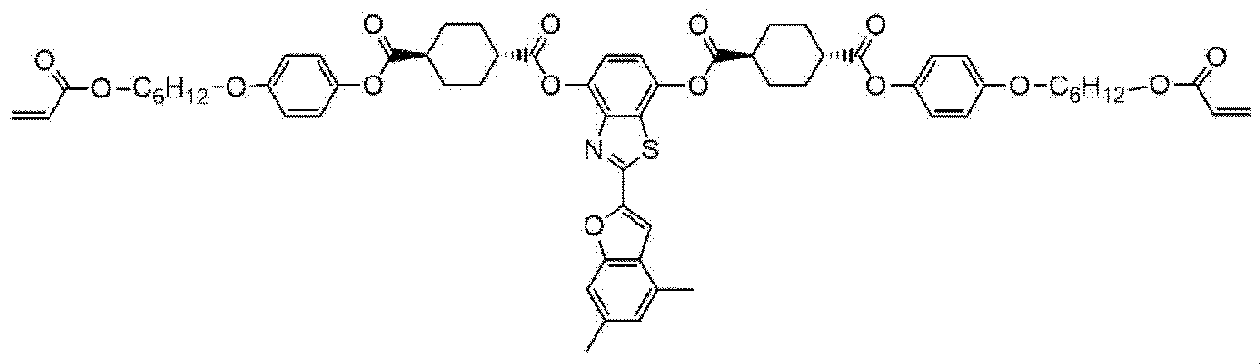
(重合性液晶化合物B)

シクロオレフィンポリマー(COP)フィルム(日本ゼオン株式会社製、ZF-14、厚み23μm)からなる基材フィルムを、コロナ処理装置(AGF-B10、春日電機株式会社製)を用いて出力0.3kW、処理速度3m/分の条件で1回コロナ処理した。コロナ処理を施した基材の表面に、水平配向膜形成用組成物をバーコーターにより塗布した。塗布膜を80℃で1分間乾燥し、偏光UV照射装置(SPOT CURE SP-7;ウシオ電機株式会社製)を用いて、100mJ/cm2の積算光量で偏光UV露光を実施した。得られた水平配向膜の厚みをレーザー顕微鏡(LEXT、オリンパス株式会社製)で測定したところ、100nmであった。
続いて、室温25℃、湿度30%RH環境下において、位相差層形成用組成物(1)を孔径0.2μmのPTFE製メンブレンフィルタ(アドバンテック東洋(株)製、品番;T300A025A)に通し、25℃に保温した配向膜付き基材フィルム上にバーコーターを用いて塗布した。塗膜を120℃で1分間乾燥した後、高圧水銀ランプ(ユニキュアVB―15201BY-A、ウシオ電機株式会社製)を用いて、紫外線を照射(窒素雰囲気下、波長:365nm、波長365nmにおける積算光量:1000mJ/cm2)することにより光学フィルムを作製した。得られた塗膜の厚みをレーザー顕微鏡(LEXT、オリンパス株式会社製)で測定したところ2μmであった。
このようにして、重合性液晶化合物が硬化した層(λ/4層)、水平配向膜及び基材フィルムがこの順に積層された積層体(位相差層1)を得た。位相差層1は、逆波長分散性を示した。
[位相差層2]
垂直配向膜形成用組成物として、2-フェノキシエチルアクリレートと、テトラヒドロフルフリルアクリレートと、ジペンタエリスリトールトリアクリレートと、ビス(2-ビニルオキシエチル)エーテルとを1:1:4:5の割合で混合し、重合開始剤としてLUCIRIN TPOを4%の割合で添加した混合物を用いた。
垂直配向膜形成用組成物として、2-フェノキシエチルアクリレートと、テトラヒドロフルフリルアクリレートと、ジペンタエリスリトールトリアクリレートと、ビス(2-ビニルオキシエチル)エーテルとを1:1:4:5の割合で混合し、重合開始剤としてLUCIRIN TPOを4%の割合で添加した混合物を用いた。
位相差層形成用組成物(2)は、光重合性ネマチック液晶化合物(メルク社製,RMM28B)と溶媒とを、固形分が1~1.5gとなるように調製して作製した。溶媒は、メチルエチルケトン(MEK)と、メチルイソブチルケトン(MIBK)と、シクロヘキサノン(CHN)とを、質量比(MEK:MIBK:CHN)で35:30:35の割合で混合させた混合溶媒を用いた。
厚み38μmのポリエチレンテレフタレート(PET)フィルムを基材フィルムとして準備した。基材フィルムの片面に垂直配向膜形成用組成物を膜厚3μmになるように塗布し、200mJ/cm2の紫外線を照射して、垂直配向膜を作製した。
垂直配向層上に、位相差層形成用組成物(2)を、ダイコーティングにより塗工した。
塗工量は4~5g(wet)であった。乾燥温度を75℃、乾燥時間を120秒間として、塗膜を乾燥させた。その後、塗膜に紫外線(UV)照射して、重合性液晶化合物を重合させた。
塗工量は4~5g(wet)であった。乾燥温度を75℃、乾燥時間を120秒間として、塗膜を乾燥させた。その後、塗膜に紫外線(UV)照射して、重合性液晶化合物を重合させた。
このようにして、重合性液晶化合物が硬化した層(ポジティブC層)、垂直配向膜、及び基材フィルムがこの順に積層された積層体(位相差層2)を得た。重合性液晶化合物が硬化した層と配向膜との合計の厚みは4μmであった。
[調製例1]
重合性液晶化合物は、式(1-6)で表される重合性液晶化合物(以下、化合物(1-6)ともいう)と式(1-7)で表される重合性液晶化合物(以下、化合物(1-7)ともいう)とを用いた。
重合性液晶化合物は、式(1-6)で表される重合性液晶化合物(以下、化合物(1-6)ともいう)と式(1-7)で表される重合性液晶化合物(以下、化合物(1-7)ともいう)とを用いた。


化合物(1-6)及び化合物(1-7)は、Lub et al.Recl.Trav.Chim.Pays-Bas、115、321-328(1996)記載の方法により合成した。
二色性色素には、下記式(2-1a)、(2-1b)、(2-3a)で示される特開2013-101328号公報の実施例に記載のアゾ色素を用いた。



偏光層形成用組成物は、化合物(1-6)75部、化合物(1-7)25部、二色性染料としての上記式(2-1a)、(2-1b)、(2-3a)で示されるアゾ色素各2.5部、重合開始剤としての2-ジメチルアミノ-2-ベンジル-1-(4-モルホリノフェニル)ブタン-1-オン(Irgacure369、BASFジャパン社製)6質量部、及びレベリング剤としてのポリアクリレート化合物(BYK-361N、BYK-Chemie社製)1.2部を、溶剤のトルエン400部に混合し、得られた混合物を80℃で1時間攪拌することにより偏光層形成用組成物1を調製した。
[調製例2]
偏光層の視感度補正単体透過率(T)が48%となるように、調製例1において添加するアゾ色素の量を減らしたこと以外は調製例1と同様にして偏光層形成用組成物2を調製した。
偏光層の視感度補正単体透過率(T)が48%となるように、調製例1において添加するアゾ色素の量を減らしたこと以外は調製例1と同様にして偏光層形成用組成物2を調製した。
[調製例3]
偏光層の視感度補正単体透過率(T)が55%となるように、調製例1において添加するアゾ色素の量を減らしたこと以外は調製例1と同様にして偏光層形成用組成物3を調製した。
偏光層の視感度補正単体透過率(T)が55%となるように、調製例1において添加するアゾ色素の量を減らしたこと以外は調製例1と同様にして偏光層形成用組成物3を調製した。
[実施例1]
基材層(TAC)の上に、配向膜形成用組成物をバーコート法により塗布した。塗膜を80℃で1分間乾燥した。次いで上記UV照射装置及びワイヤーグリッドを用いて、塗膜に偏光UVを照射し、塗膜に配向性能を付与した。露光量は100mJ/cm2(365nm基準)であった。ワイヤーグリッドは、UIS-27132##(ウシオ電機株式会社製)を用いた。このようにして、配向膜を形成した。配向膜の厚みは100nmであった。
基材層(TAC)の上に、配向膜形成用組成物をバーコート法により塗布した。塗膜を80℃で1分間乾燥した。次いで上記UV照射装置及びワイヤーグリッドを用いて、塗膜に偏光UVを照射し、塗膜に配向性能を付与した。露光量は100mJ/cm2(365nm基準)であった。ワイヤーグリッドは、UIS-27132##(ウシオ電機株式会社製)を用いた。このようにして、配向膜を形成した。配向膜の厚みは100nmであった。
形成した配向膜上に、偏光層形成用組成物1をバーコート法により塗布した。塗膜を100℃で2分間加熱乾燥した後、室温まで冷却した。上記UV照射装置を用いて、積算光量1200mJ/cm2(365nm基準)で紫外線を、塗膜に照射することにより、偏光層を形成した。得られた偏光層の厚みは3μmであった。偏光層上に、ポリビニルアルコールと水とを含む組成物を、乾燥後の厚みが0.5μmとなるように塗工し、温度80℃で3分間乾燥して保護層を形成した。このようにして、基材層/配向膜/偏光層/保護層をこの順に備える偏光板を作製した。
位相差層1を含む積層体と位相差層2を含む積層体とを、基材フィルム側の表面とは反対側の表面が貼合面となるようにアクリル系粘着剤層を介して貼り合わせた。このようにして、位相差層1及び位相差層2の2層の位相差層を含む位相差層の積層体を作製した。
次に、偏光板の保護層面に、アクリル系粘着剤層を積層した。位相差層の積層体から、位相差層1の形成に用いた基材フィルムを剥離した。露出した位相差層1のλ/4層側と前記アクリル系粘着剤層とを貼り合わせた。偏光子の吸収軸と、位相差層1の遅相軸とのなす角度は45°であった。次に、位相差層2の形成に用いた基材フィルムを剥離した後、前面板1と、偏光板の基材層とをアクリル系粘着剤層を介して貼合した。このようにして、前面板1/アクリル系粘着剤層/偏光板/アクリル系粘着剤層/位相差層の積層体をこの順に備える積層体を作製した。
次に、偏光板の保護層面に、アクリル系粘着剤層を積層した。位相差層の積層体から、位相差層1の形成に用いた基材フィルムを剥離した。露出した位相差層1のλ/4層側と前記アクリル系粘着剤層とを貼り合わせた。偏光子の吸収軸と、位相差層1の遅相軸とのなす角度は45°であった。次に、位相差層2の形成に用いた基材フィルムを剥離した後、前面板1と、偏光板の基材層とをアクリル系粘着剤層を介して貼合した。このようにして、前面板1/アクリル系粘着剤層/偏光板/アクリル系粘着剤層/位相差層の積層体をこの順に備える積層体を作製した。
得られた積層体について、388nm及び405nmの波長における吸光度(A388、A405)、及び耐光性試験前後でのΔ反射率及びΔ反射色相を測定した。結果を表1に示す。
[実施例2]
前面板1に代えて前面板2を用いたこと以外は実施例1と同様にして積層体を作製した。結果を表1に示す。
前面板1に代えて前面板2を用いたこと以外は実施例1と同様にして積層体を作製した。結果を表1に示す。
[実施例3]
偏光層形成用組成物1に代えて偏光層形成用組成物2を用いたこと以外は実施例1と同様にして積層体を作製した。結果を表1に示す。
偏光層形成用組成物1に代えて偏光層形成用組成物2を用いたこと以外は実施例1と同様にして積層体を作製した。結果を表1に示す。
[比較例1]
前面板1に代えて前面板3を用いたこと以外は実施例1と同様にして積層体を作製した。結果を表1に示す。
前面板1に代えて前面板3を用いたこと以外は実施例1と同様にして積層体を作製した。結果を表1に示す。
[比較例2]
前面板1に代えて前面板4を用いたこと以外は実施例1と同様にして積層体を作製した。結果を表1に示す。
前面板1に代えて前面板4を用いたこと以外は実施例1と同様にして積層体を作製した。結果を表1に示す。
[比較例3]
偏光層形成用組成物1に代えて偏光層形成用組成物3を用いたこと以外は実施例1と同様にして積層体を作製した。結果を表1に示す。
偏光層形成用組成物1に代えて偏光層形成用組成物3を用いたこと以外は実施例1と同様にして積層体を作製した。結果を表1に示す。
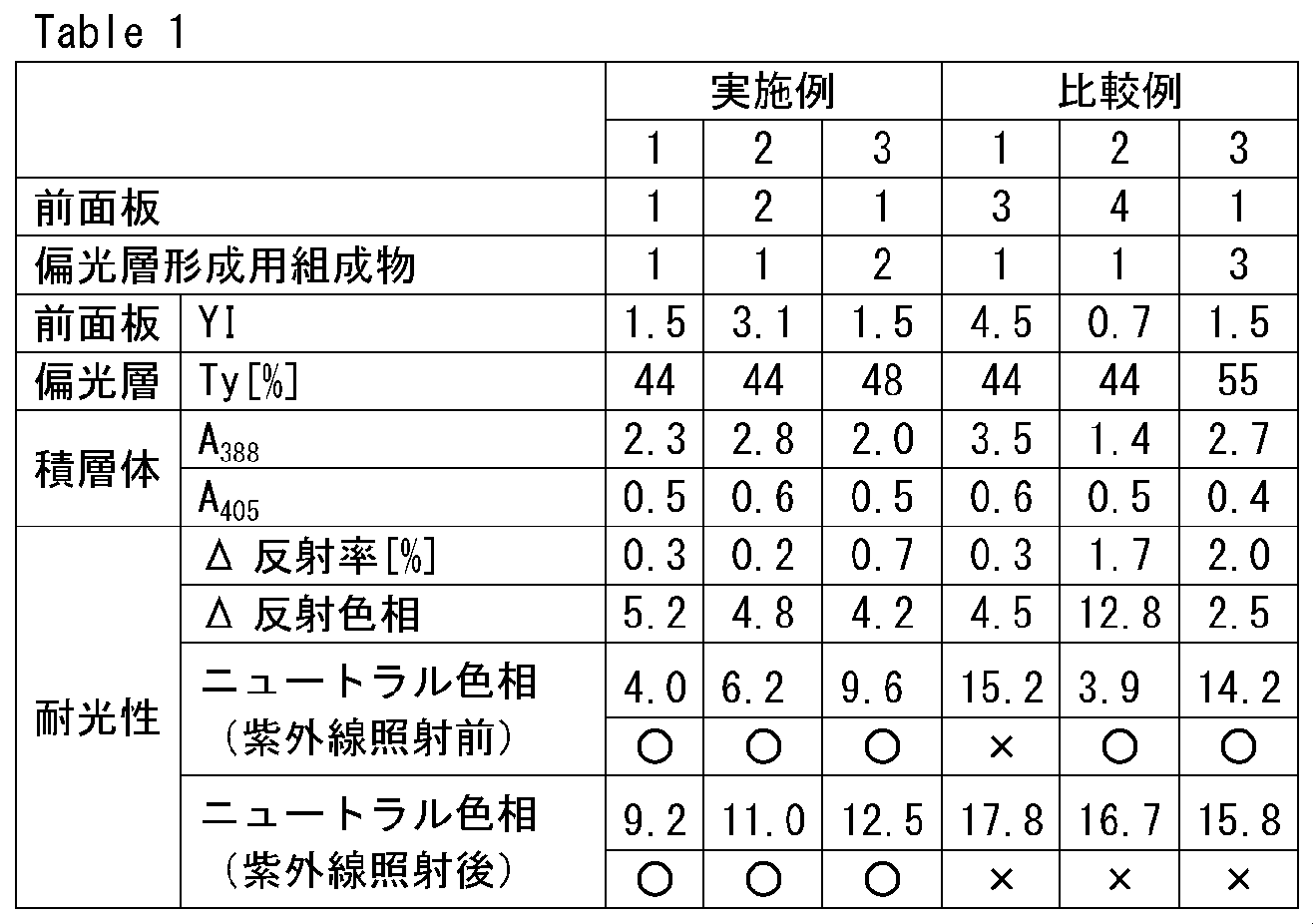
11 前面板、12 偏光層、13 位相差層、21,25,27 粘着剤層、22 基材層、23 配向膜、24 保護層、26 λ/4層、28 ポジティブC層。
Claims (7)
- 前面板と、偏光層と、位相差層とをこの順に有する積層体であって、
前記位相差層は重合性液晶化合物の重合体を含み、
下記式(1)及び(2)を満たす、積層体。
0.8≦前記前面板の黄色度(YI)≦3.5 (1)
前記積層体の視感度補正単体透過率(T)≦50% (2) - 前記偏光層は重合性液晶化合物の重合体を含む、請求項1に記載の積層体。
- 下記式(3)をさらに満たす、請求項1又は2に記載の積層体。
388nmの波長における吸光度(A388)≧1.5 (3) - 下記式(4)をさらに満たす、請求項1~3のいずれかに記載の積層体。
405nmの波長における吸光度(A405)≦0.8 (4) - 前記前面板はハードコート層を有する、請求項1~4のいずれか一項に記載の積層体。
- 円偏光板である、請求項1~5のいずれか一項に記載の積層体。
- 請求項1~5のいずれか一項に記載の積層体又は請求項6に記載の円偏光板を含む、画像表示装置。
Priority Applications (2)
| Application Number | Priority Date | Filing Date | Title |
|---|---|---|---|
| KR1020217026044A KR20210127941A (ko) | 2019-02-22 | 2020-01-22 | 적층체, 및 화상 표시 장치 |
| CN202080015487.4A CN113474692A (zh) | 2019-02-22 | 2020-01-22 | 层叠体和图像显示装置 |
Applications Claiming Priority (4)
| Application Number | Priority Date | Filing Date | Title |
|---|---|---|---|
| JP2019-030189 | 2019-02-22 | ||
| JP2019030189 | 2019-02-22 | ||
| JP2019-141476 | 2019-07-31 | ||
| JP2019141476A JP2020140190A (ja) | 2019-02-22 | 2019-07-31 | 積層体、及び画像表示装置 |
Publications (1)
| Publication Number | Publication Date |
|---|---|
| WO2020170697A1 true WO2020170697A1 (ja) | 2020-08-27 |
Family
ID=72144211
Family Applications (1)
| Application Number | Title | Priority Date | Filing Date |
|---|---|---|---|
| PCT/JP2020/002091 Ceased WO2020170697A1 (ja) | 2019-02-22 | 2020-01-22 | 積層体、及び画像表示装置 |
Country Status (1)
| Country | Link |
|---|---|
| WO (1) | WO2020170697A1 (ja) |
Cited By (1)
| Publication number | Priority date | Publication date | Assignee | Title |
|---|---|---|---|---|
| WO2024024119A1 (ja) * | 2022-07-29 | 2024-02-01 | 住友化学株式会社 | 光学積層体 |
Citations (5)
| Publication number | Priority date | Publication date | Assignee | Title |
|---|---|---|---|---|
| JP2008197310A (ja) * | 2007-02-13 | 2008-08-28 | Sumitomo Chemical Co Ltd | 薄型偏光板、複合偏光板、画像表示装置、及び複合偏光板の製造方法 |
| KR20160082639A (ko) * | 2014-12-26 | 2016-07-08 | 엘지디스플레이 주식회사 | 폴리이미드 필름, 이를 포함하는 커버 윈도우 및 표시장치 |
| JP2017083843A (ja) * | 2015-10-30 | 2017-05-18 | 住友化学株式会社 | 偏光板 |
| JP2018193538A (ja) * | 2017-04-28 | 2018-12-06 | 川崎化成工業株式会社 | 短波長領域の可視光線及び紫外線吸収剤 |
| WO2019022212A1 (ja) * | 2017-07-28 | 2019-01-31 | 日本化薬株式会社 | 偏光発光素子、偏光発光板、表示装置及び偏光発光素子の製造方法 |
-
2020
- 2020-01-22 WO PCT/JP2020/002091 patent/WO2020170697A1/ja not_active Ceased
Patent Citations (5)
| Publication number | Priority date | Publication date | Assignee | Title |
|---|---|---|---|---|
| JP2008197310A (ja) * | 2007-02-13 | 2008-08-28 | Sumitomo Chemical Co Ltd | 薄型偏光板、複合偏光板、画像表示装置、及び複合偏光板の製造方法 |
| KR20160082639A (ko) * | 2014-12-26 | 2016-07-08 | 엘지디스플레이 주식회사 | 폴리이미드 필름, 이를 포함하는 커버 윈도우 및 표시장치 |
| JP2017083843A (ja) * | 2015-10-30 | 2017-05-18 | 住友化学株式会社 | 偏光板 |
| JP2018193538A (ja) * | 2017-04-28 | 2018-12-06 | 川崎化成工業株式会社 | 短波長領域の可視光線及び紫外線吸収剤 |
| WO2019022212A1 (ja) * | 2017-07-28 | 2019-01-31 | 日本化薬株式会社 | 偏光発光素子、偏光発光板、表示装置及び偏光発光素子の製造方法 |
Cited By (1)
| Publication number | Priority date | Publication date | Assignee | Title |
|---|---|---|---|---|
| WO2024024119A1 (ja) * | 2022-07-29 | 2024-02-01 | 住友化学株式会社 | 光学積層体 |
Similar Documents
| Publication | Publication Date | Title |
|---|---|---|
| JP2023009102A (ja) | 長尺偏光フィルムの製造方法 | |
| JP6299367B2 (ja) | パターン偏光フィルムの製造方法 | |
| JP2017083843A (ja) | 偏光板 | |
| JP2022008866A (ja) | パターン偏光フィルム | |
| JP7198683B2 (ja) | 積層体 | |
| CN111279231A (zh) | 偏光膜及其制造方法 | |
| KR102724035B1 (ko) | 적층체 | |
| JP7272957B2 (ja) | 偏光フィルムの製造方法及び偏光フィルム | |
| CN113474692A (zh) | 层叠体和图像显示装置 | |
| JP2015057643A (ja) | 配向膜形成用組成物 | |
| JP6010910B2 (ja) | 組成物及び光学フィルム | |
| WO2020170697A1 (ja) | 積層体、及び画像表示装置 | |
| JP7576408B2 (ja) | 偏光膜、偏光板、光学積層体、楕円偏光板、有機el表示装置およびフレキシブル画像表示装置 | |
| JP2015129920A (ja) | 光学異方性膜の製造方法 | |
| JP7575275B2 (ja) | 偏光フィルム及びその製造方法 | |
| JP6497457B2 (ja) | パターン偏光フィルムの製造方法 | |
| WO2020022009A1 (ja) | 積層体 | |
| WO2020022010A1 (ja) | 積層体 |
Legal Events
| Date | Code | Title | Description |
|---|---|---|---|
| 121 | Ep: the epo has been informed by wipo that ep was designated in this application |
Ref document number: 20759434 Country of ref document: EP Kind code of ref document: A1 |
|
| NENP | Non-entry into the national phase |
Ref country code: DE |
|
| 122 | Ep: pct application non-entry in european phase |
Ref document number: 20759434 Country of ref document: EP Kind code of ref document: A1 |