WO2020153426A1 - 回転電機用絶縁材及び回転電機 - Google Patents
回転電機用絶縁材及び回転電機 Download PDFInfo
- Publication number
- WO2020153426A1 WO2020153426A1 PCT/JP2020/002325 JP2020002325W WO2020153426A1 WO 2020153426 A1 WO2020153426 A1 WO 2020153426A1 JP 2020002325 W JP2020002325 W JP 2020002325W WO 2020153426 A1 WO2020153426 A1 WO 2020153426A1
- Authority
- WO
- WIPO (PCT)
- Prior art keywords
- ether ketone
- resin sheet
- polyarylene ether
- ketone resin
- resin
- Prior art date
- Legal status (The legal status is an assumption and is not a legal conclusion. Google has not performed a legal analysis and makes no representation as to the accuracy of the status listed.)
- Ceased
Links
Images


Classifications
-
- H—ELECTRICITY
- H01—ELECTRIC ELEMENTS
- H01B—CABLES; CONDUCTORS; INSULATORS; SELECTION OF MATERIALS FOR THEIR CONDUCTIVE, INSULATING OR DIELECTRIC PROPERTIES
- H01B17/00—Insulators or insulating bodies characterised by their form
- H01B17/56—Insulating bodies
-
- H—ELECTRICITY
- H02—GENERATION; CONVERSION OR DISTRIBUTION OF ELECTRIC POWER
- H02K—DYNAMO-ELECTRIC MACHINES
- H02K3/00—Details of windings
- H02K3/30—Windings characterised by the insulating material
-
- H—ELECTRICITY
- H02—GENERATION; CONVERSION OR DISTRIBUTION OF ELECTRIC POWER
- H02K—DYNAMO-ELECTRIC MACHINES
- H02K3/00—Details of windings
- H02K3/32—Windings characterised by the shape, form or construction of the insulation
- H02K3/34—Windings characterised by the shape, form or construction of the insulation between conductors or between conductor and core, e.g. slot insulation
Definitions
- the present invention relates to an insulating material for a rotating electric machine and a rotating electric machine, which can maintain the insulation of a motor (electric motor) or a generator and prevent a short circuit or the like.
- electric vehicles such as electric vehicles (EV), hybrid vehicles (HV), hybrid electric vehicles (HEV), plug-in hybrid vehicles (PHV), fuel cell vehicles (FCV), electric vehicles, or
- a transportation system that uses a motor such as an electric locomotive as a power source is in the limelight.
- Motors which are rotating electrical machines used in these transportation systems, are being made smaller, more powerful, and more efficient, but along with this, the trend toward higher voltage and higher current is rapidly increasing. There is. Therefore, the insulating sheet used for such a motor is required to have higher electrical characteristics and mechanical characteristics, lower water absorption, and superior heat resistance than ever before.
- the insulating sheet used for the motor includes, for example, (1) an inner wall surface of a slot of the stator and a conductive winding housed in the slot in order to ensure insulation between the conductive winding and the core of the stator. Slot material that is manually inserted and interposed between the two (see Patent Document 1), and (2) a wedge that is attached so as to block the inlet of the core of the stator to prevent the conductive winding from falling off (see Patent Document 2). (3) In a three-phase AC motor or the like, there is an interphase insulating sheet (see Patent Document 3) interposed between conductive windings having different phases.
- a wholly aromatic aramid resin fiber sheet manufactured by DuPont Teijin Advanced Paper Co.: product name: Nomex paper
- insulating paper made of polyetheretherketone fiber see Patent Document 4
- Resin fiber sheet made of polyester resin fiber sheet such as polyethylene terephthalate resin fiber or polybutylene naphthalate resin fiber, polyester film made of polyethylene terephthalate resin film or polyethylene naphthalate resin film, biaxially oriented polyphenylene
- a polyphenylene sulfide resin film composed of a sulfide resin film see Patent Document 5
- a non-oriented polyphenylene sulfide resin sheet see Patent Document 6
- the insulating sheet used in the conventional motor is a sheet made of a wholly aromatic aramid resin fiber sheet, a polyether ether ketone fiber, and a polyester resin fiber sheet, which has high impregnation and slipperiness of motor oil, It can be expected to improve workability when inserting into the slot.
- the resin fiber sheet has a high water absorption rate, electrical characteristics such as dielectric characteristics and dielectric strength are easily affected by environmental changes in temperature and humidity, and frequency dependency becomes large, which is not preferable.
- the resin fiber sheet has through holes such as pinholes, the electrical characteristics (dielectric strength) at the locations where the through holes are formed are reduced.
- the resin fiber sheet has pores (air bubbles) inside, a partial discharge may occur at a low voltage at the air bubble existing location.
- polyester-based insulating sheets such as polyethylene terephthalate resin and polyethylene naphthalate resin are inferior in heat resistance and are Class E (allowable maximum temperature: 120°C) in the heat resistance category of IEC Publication 85 (1984). In the heat resistant category, it cannot be used for motors of electric vehicles, hybrid vehicles, plug-in hybrid vehicles, fuel cell vehicles, etc. that require Class F (allowable maximum temperature: 155°C).
- biaxially oriented polyphenylene sulfide resin film and non-oriented polyphenylene sulfide resin film are classified into Class F (maximum allowable temperature: 155°C) and Class H (maximum allowable temperature: 180) in the heat resistance category of IEC Publication 85 (1984).
- Class F maximum allowable temperature: 155°C
- Class H maximum allowable temperature: 180
- aramid fibrid and aramid short fibers are mainly heat-bonded to a aramid paper and a polyester resin film formed in a paper shape.
- An aramid-polyester laminate (see Japanese Patent No. 46077826) obtained by the above, a laminate obtained by adhering an aramid fiber sheet or aramid fiber paper and a polyphenylenephenylene sulfide resin film without using an adhesive have been developed and proposed. (See Japanese Patent No. 4402734 and Japanese Patent Laid-Open No. 2011-140151).
- the aramid-polyester film laminate can improve the insulating property of the aramid paper, it is difficult to use the F type because the polyester film is inferior in heat resistance. Further, since it has poor hydrolysis resistance, it cannot be said that it is suitable for use in an environment of high temperature and high humidity. Further, the polyester film also has a problem in chemical resistance.
- a laminate composed of an aramid fiber sheet or an aramid fiber paper and a polyphenylene sulfide resin film is a non-oriented polyphenylene sulfide resin sheet, or it is possible to improve the toughness of the polyphenylene sulfide resin film, the aramid fiber sheet or Since the adhesiveness between the aramid fiber paper and the polyphenylene sulfide resin film is insufficient, delamination occurs, causing a problem in adhesiveness.
- the present invention has been made in view of the above, it is possible to increase the occupancy rate of the conductive winding, moreover, excellent electrical insulation, low dielectric properties, high rigidity, high toughness, low water absorption, high heat resistance,
- An object of the present invention is to provide an insulating material for a rotating electric machine and a rotating electric machine that can obtain chemical resistance and the like.
- Polyarylene ether ketone resin also known as aromatic polyether ketone, PAEK
- PAEK resin is a heat that has excellent electrical properties, mechanical properties, heat resistance, chemical resistance, radiation resistance, hydrolysis resistance, low water absorption, recyclability, etc. It is a plastic crystalline resin.
- the polyarylene ether ketone resin has been proposed and used in a wide range of fields such as the automobile field, energy field, semiconductor field, medical field, and aerospace field.
- the present invention in order to solve the above problems, it is composed of a polyarylene ether ketone resin sheet,
- the electrical properties of the polyarylene ether ketone resin sheet are that the dielectric breakdown strength per unit thickness in silicone oil is 40 kV/mm or more, the relative dielectric constant at a frequency of 1 GHz is 3.1 or less, and the dielectric loss tangent is 0.01 or less. It is characterized by being.
- the polyarylene ether ketone resin sheet is preferably a polyether ether ketone resin sheet.
- the tensile elastic modulus is preferably 3000 N/mm 2 or more.
- the maximum tensile strength is preferably 80 N/mm 2 or more, and the elongation at tensile break is preferably 80% or more.
- the water absorption of the polyarylene ether ketone resin sheet is preferably 1.0% or less at 23°C.
- a substantially U-shaped polyarylene ether ketone resin sheet for accommodating a conductive winding is inserted into a slot formed in at least one of a stator and a rotor of a rotating electric machine to have a thickness of 50 ⁇ m or more and 1000 ⁇ m or less.
- the polyarylene ether ketone resin sheet may be used as an insulating wall member interposed between the slot and the conductive winding.
- a polyarylene ether ketone resin sheet having a thickness of 50 ⁇ m or more and 1000 ⁇ m or less can be used as a partition member that partitions the inside of the wall member into a plurality of parts. Further, a polyarylene ether ketone resin sheet having a thickness of 50 ⁇ m or more and 1000 ⁇ m or less can be used as a covering member that covers the opening of the wall member.
- the present invention is characterized in that the rotating electric machine includes the insulating material for a rotating electric machine according to any one of claims 1 to 6.
- the polyarylene ether ketone resin sheet in the claims does not particularly need to be transparent, opaque, semi-transparent, non-stretched sheet, uniaxially stretched sheet, or biaxially stretched sheet.
- the polyarylene ether ketone resin sheet includes both the polyarylene ether ketone resin sheet and the polyarylene ether ketone resin film.
- the number of sheets of polyarylene ether ketone resin may be one or may be two or more.
- a molding material containing a polyarylene ether ketone resin is melt-kneaded, and this molding material is extruded into a polyarylene ether ketone resin sheet with a die of a molding machine, and this polyarylene ether ketone resin is extruded.
- the sheet may be cooled by contacting it with a cooling roll.
- the rotating electric machine includes at least various motors (electric motors) and generators.
- the slots may be recessed in the stator or rotor of the rotating electric machine, or may be recessed in the stator and the rotor, respectively.
- the thickness of the insulating material when a polyarylene ether ketone resin sheet having excellent electric characteristics is selected and the thickness thereof is 50 ⁇ m or more and 1000 ⁇ m or less, it is possible to reduce the thickness of the insulating material and reduce the occupation ratio of the conductive winding. Can be increased.
- the polyarylene ether ketone resin sheet as an insulating material has a low water absorption rate, electrical characteristics such as dielectric characteristics and dielectric strength are less susceptible to environmental changes such as temperature and humidity, and prevent frequency dependence from increasing. be able to.
- the polyarylene ether ketone resin sheet which is an insulating material, has excellent electrical insulation properties, it is possible to suppress deterioration of electrical characteristics and reduce the risk of partial discharge at a low voltage.
- the polyarylene ether ketone resin sheet is excellent in heat resistance and recyclability, it can be used for rotating electric machines such as electric vehicles, hybrid vehicles, plug-in hybrid vehicles, and fuel cell vehicles. Further, since the polyarylene ether ketone resin sheet is also excellent in mechanical properties, even if it is inserted into the slot of the rotating electric machine as a wall member, breakage, cracking, tearing of the wall member can be suppressed.
- a polyarylene ether ketone resin sheet is adopted as an insulating material for a rotating electric machine, it has excellent electrical properties, mechanical properties, heat resistance, chemical resistance, radiation resistance, hydrolysis resistance, and low water absorption. There is an effect that recyclability and the like can be obtained.
- the electrical properties of the polyarylene ether ketone resin sheet are such that the dielectric breakdown strength, which is the dielectric breakdown voltage per unit thickness in silicone oil, is 40 kV/mm or more, the relative dielectric constant at a frequency of 1 GHz is 3.1 or less, and the dielectric Since the tangent is 0.01 or less, dielectric breakdown due to surge voltage and thermal decomposition of the polyarylene ether ketone resin sheet due to self-heating are prevented, and high current and high voltage of the rotating electric machine can be easily realized.
- the dielectric breakdown strength which is the dielectric breakdown voltage per unit thickness in silicone oil
- the relative dielectric constant at a frequency of 1 GHz is 3.1 or less
- the dielectric Since the tangent is 0.01 or less, dielectric breakdown due to surge voltage and thermal decomposition of the polyarylene ether ketone resin sheet due to self-heating are prevented, and high current and high voltage of the rotating electric machine can be easily realized.
- the polyarylene ether ketone resin sheet is a polyether ether ketone resin sheet
- the moldability and availability of the resin sheet can be improved, and the manufacturing cost can be reduced.
- the tensile elastic modulus of the polyarylene ether ketone resin sheet is 3000 N/mm 2 or more, excellent rigidity can be obtained. Therefore, when the polyarylene ether ketone resin sheet is inserted into the slot of the rotating electric machine as an insulating material, it is possible to prevent the polyarylene ether ketone resin sheet from buckling and improve the maintainability of the rotating electric machine.
- the maximum tensile strength of the polyarylene ether ketone resin sheet is 80 N/mm 2 or more and the elongation at tensile break is 80% or more, excellent toughness can be obtained. Therefore, when the polyarylene ether ketone resin sheet is inserted into the slot of the rotating electric machine as an insulating material, the polyarylene ether ketone resin sheet can be expected to prevent breakage, cracking, tearing, etc., and the maintainability of the rotating electric machine can be improved. It will be possible.
- the water absorption of the polyarylene ether ketone resin sheet at 23° C. is 1.0% or less, excellent electrical characteristics can be obtained even when the rotating electric machine is used in a high humidity environment. It is possible to maintain.
- the polyarylene ether ketone resin sheet having a thickness of 50 ⁇ m or more and 1000 ⁇ m or less is formed into at least a substantially U-shape to form a wall member interposed between the slot and the conductive winding,
- the effect that the occupancy rate of the conductive winding can be increased and excellent electrical insulation, low dielectric properties, high rigidity, high toughness, low water absorption, high heat resistance, chemical resistance, etc. can be obtained There is.
- the insulating material for a rotary electric machine has a plurality of slots 5 in a stator 3 of the rotary electric machine 1.
- 11 is a wall member 14 interposed between the slot 5 and the plurality of conductive windings 7.
- the rotating electric machine 1 is composed of, for example, a motor 2 for an electric vehicle or a hybrid vehicle, and a stator 3 that surrounds and rotates a rotor is installed on the inner periphery of a housing.
- the stator 3 includes a cylindrical core 4 fitted into a rotatable rotor and a plurality of conductive windings 7 housed in the core 4, and has an inner peripheral surface of the core 4 facing the rotor.
- a plurality of slots 5 are lined up in a line in the circumferential direction to form a recess, and a plurality of conductive windings 7 for generating a magnetic field are respectively wound in the plurality of slots 5 and indirectly accommodated therein.
- the core 4 of the stator 3 is formed by laminating iron cores made of a plurality of silicon steel plates or the like or integrally formed from the viewpoint of reducing the effect of eddy current.
- each slot 5 is formed in a recess so as to draw a substantially U-shape, the opening 6 thereof is directed toward the center of the core 4, and the bottom is formed into a flat surface or a curved surface.
- the opening 6 of the slot 5 is formed to have a width narrower than that of the bottom, if necessary, to prevent the polyarylene ether ketone resin sheet 11 as the insulating material 10 from popping out or falling off.
- a round copper wire wound in distributed winding is mainly used for each conductive winding 7, but a rectangular copper wire having a rectangular cross section (square shape) is used in order to improve winding density.
- the polyarylene ether ketone resin sheet 11 which is the insulating material 10 is bent and formed into a substantially flat U-shape having flexibility and is detachably inserted into the slot 5.
- the opening 12 is directed toward the center of the core 4 and directly accommodates the plurality of conductive windings 7.
- a polyarylene ether ketone resin sheet 11 is used as the insulating material 10. This is because the adoption of the polyarylene ether ketone resin sheet 11 makes it possible to obtain electrical characteristics, mechanical characteristics, heat resistance, chemical resistance, radiation resistance, and resistance to radiation. This is because it is possible to improve the hydrolyzability, low water absorption, recyclability and the like.
- the upper and lower end portions 13 of the polyarylene ether ketone resin sheet 11 in FIG. 2 are folded back to the outside, respectively, and engage with the peripheral portions of the slots 5 on the front and back surfaces of the core 4 to prevent displacement and dropout.
- Such a polyarylene ether ketone resin sheet 11 is fitted and positioned in the slot 5 of the core 4 and accommodates a plurality of conductive windings 7.
- the inner surface of the slot 5 and a plurality of conductive windings 7 are accommodated. It intervenes as a wall member 14 between the winding 7 and the winding 7, and functions to separate the slot 5 and the plurality of conductive windings 7 from each other to ensure insulation therebetween.
- polyarylene ether ketone resin sheet 11 examples include polyetherketone (PEK) resin sheet, polyetheretherketone (PEEK) resin sheet, polyetherketoneketone (PEKK) resin sheet, and polyetheretherketoneketone (PEEKK). Examples thereof include a resin sheet and a polyetherketone etherketoneketone (PEKEKK) resin sheet. Any of these resin sheets can be used as the insulating material 10, but the polyether ether ketone resin sheet is most suitable from the viewpoints of easy availability, easy molding, manufacturing cost, and the like.
- the electrical characteristics (electrical insulation) of the polyarylene ether ketone resin sheet 11 are such that the dielectric breakdown voltage in the silicone oil is 7 kV or more per unit thickness of the silicone oil in order to realize high current and high voltage of the rotating electric machine 1. It is preferable that the dielectric breakdown strength, which is the dielectric breakdown voltage, is 40 kV/mm or more, the relative dielectric constant at a frequency of 1 GHz is 3.1 or less, and the dielectric loss tangent is 0.01 or less.
- the mechanical properties of the polyarylene ether ketone resin sheet 11 are 3000 N/mm 2 or more in tensile elastic modulus, 80 N/mm 2 or more in tensile maximum strength, and 80% or more in elongation at break in order to improve rigidity and toughness. Is preferred.
- the water absorption rate at 23° C. is preferably 1.0% or less from the viewpoint of maintaining excellent electrical characteristics even in a high humidity environment.
- the thickness is preferably 50 ⁇ m or more and 1000 ⁇ m or less from the viewpoint of increasing the occupancy rate of the conductive winding 7 while preventing the electrical insulation of the polyarylene ether ketone resin sheet 11 from being lowered.
- the relative crystallinity of the polyarylene ether ketone resin sheet 11 is 80% or more, preferably 90% or more, more preferably 95% or more, and further preferably 100%. This is because when the relative crystallinity of the polyarylene ether ketone resin sheet 11 is less than 80%, the heat resistance is insufficient, so that the wall member 14 is deformed or cracked by the heat generated by the motor 2. Or, it causes a change in dimensions. Further, the tensile modulus of elasticity of the polyarylene ether ketone resin sheet 11 is low and the rigidity thereof is insufficient, so that when the wall member 14 is inserted into the slot 5 of the core 4, there is a risk of buckling.
- Crystallization of the polyarylene ether ketone resin sheet 11 can be represented by relative crystallinity.
- the glass transition point of the polyarylene ether ketone resin sheet 11 is 140° C. or higher, preferably 145° C. or higher, more preferably 150° C. or higher, still more preferably 155° C. or higher, from the viewpoint of maintaining heat resistance.
- the upper limit of the glass transition point of the polyarylene ether ketone resin sheet 11 is not particularly limited, but is practically 180° C. or lower. This is because when the glass transition temperature exceeds 180° C., when extrusion molding the polyarylene ether ketone resin sheet 11, the extrusion molding temperature exceeds 450° C., so special equipment is required for the extrusion molding equipment, resulting in high cost. Because it invites. Moreover, the usable extruder is limited.
- the glass transition point of the polyarylene ether ketone resin sheet 11 is the peak temperature of the loss elastic modulus (E′′) curve in the temperature change of the dynamic viscoelasticity measurement.
- the peak temperature of the loss elastic modulus (E′′) of the polyarylene ether ketone resin sheet 11 is in the above range in the extrusion direction and the width direction (direction perpendicular to the extrusion direction).
- the polyarylene ether ketone resin which is the molding material M for the polyarylene ether ketone resin sheet 11, is a crystalline resin composed of an arylene group, an ether group, and a carbonyl group.
- a polyether ether ketone resin having a chemical structural formula represented by the chemical formula (1) and a polyether having a chemical structure represented by the chemical formula (2).
- Ketone (PEK) resin polyetherketoneketone (PEKK) resin having the chemical structure represented by the chemical formula (3), polyetheretherketoneketone (PEEKK) resin having the chemical structure represented by the chemical formula (4), or Examples thereof include polyetherketoneetherketoneketone (PEKEKK) resin having a chemical structure represented by the chemical formula (5).
- the polyarylene ether ketone resin may be used alone or in combination of two or more. Further, the polyarylene ether ketone resin may be a copolymer having two or more chemical structures represented by the chemical formulas (1) to (5).
- the polyarylene ether ketone resin is usually used in a form suitable for molding such as powder, granules and pellets. Among these polyarylene ether ketone resins, polyether ether ketone resin and polyether ketone ketone resin are preferable from the viewpoint of moldability of the resin sheet. More preferably, a polyether ether ketone resin is most suitable from the viewpoint of easy availability and cost.
- polyetheretherketone resin examples include the Victrex Powder series, the Victrex Granules series (manufactured by Victor Trek: product name), the Vestakeep series [manufactured by Daicel-Evonik: product name], the KetaSpire PEEK series [Solvay Specialty Polymers, Inc.] Made: product name].
- polyetherketoneketone resin examples include KEPSTAN series [manufactured by Arkema: product name].
- the molding material M contains at least a polyarylene ether ketone resin.
- a polyimide (PI) resin a polyamide imide (PAI) resin
- Polyimide resin such as polyetherimide (PEI) resin, polyamide 4T (PA4T) resin, polyamide 6T (PA6T) resin, modified polyamide 6T (modified PA6T) resin, polyamide 9T (PA9T) resin, polyamide 10T (PA10T) resin, polyamide Polyamide resins such as 11T (PA11T) resin, polyamide 6 (PA6) resin, polyamide 66 (PA66) resin, polyamide 46 (PA46) resin, polysulfone (PSU) resin, polyether sulfone (PES) resin, polyphenylene sulfone (Polsulfone resin such as PPSU resin, polyphenylene sulfide (PPS) resin, polyphenylene sulfone
- the molding material M includes, in addition to the above-mentioned resins, an antioxidant, a light stabilizer, an ultraviolet absorber, a plasticizer, a lubricant, a flame retardant, an antistatic agent, a heat resistance improver, as long as the characteristics of the present invention are not impaired. , Inorganic compounds, organic compounds, etc. are selectively added.
- the polyarylene ether ketone resin sheet 11 is manufactured into a resin sheet having a thickness of 50 ⁇ m or more and 1000 ⁇ m or less.
- the polyarylene ether ketone resin sheet 11 can be manufactured by a known manufacturing method such as a melt extrusion molding method, a calender molding method, or a casting method, but from the viewpoint of handleability and simplification of equipment, the melt extrusion molding method is used. It is preferable that extrusion molding is performed continuously.
- melt extrusion molding method is, as shown in FIG. 5, melt-kneading the molding material M using the melt extrusion molding machine 20 of the manufacturing apparatus, and from the T die 23 of the melt extrusion molding machine 20 to the polyarylene ether.
- This is a method of continuously extruding the ketone resin sheet 11.
- the apparatus for producing the polyarylene ether ketone resin sheet 11 is not particularly limited, but is an apparatus for producing the polyarylene ether ketone resin sheet 11 using the molding material M containing the polyarylene ether ketone resin, A melt extrusion molding machine 20 for melting and kneading the molding material M, a T die 23 mounted on the melt extrusion molding machine 20 for extruding the polyarylene ether ketone resin sheet 11, and a polyarylene ether ketone extruded from the T die 23.
- a cooling roll 26 that cools the resin sheet 11, a pair of pressure-bonding rolls 27 that comes into contact with the polyarylene ether ketone resin sheet 11 extruded from the T die 23 and presses against the cooling roll 26, and a poly roll that is cooled by the cooling roll 26.
- a winding machine 28 for winding the arylene ether ketone resin sheet 11 is provided.
- the melt extrusion molding machine 20 is composed of, for example, a single-screw extrusion molding machine or a twin-screw extrusion molding machine, and functions to melt-knead the input molding material M.
- a raw material inlet 21 for the molding material M is installed in the upper rear of the melt extruder 20.
- the raw material inlet 21 has helium gas, neon gas, argon gas, krypton gas, nitrogen gas, carbon dioxide gas.
- An inert gas supply pipe 22 for supplying such an inert gas (see the arrow in FIG. 5) as necessary is connected, and the flow of the inert gas through the inert gas supply pipe 22 causes the molding material M Oxidative deterioration and oxygen crosslinking are effectively prevented.
- the temperature of the polyarylene ether ketone resin during the melt-kneading of the melt extruder 20 is not particularly limited as long as it is a temperature at which the polyarylene ether ketone resin can be melted and the polyarylene ether ketone resin does not decompose. It is preferable that the temperature is not lower than the melting point of the polyarylene ether ketone resin and lower than the thermal decomposition temperature of the polyarylene ether ketone resin.
- the range of 320°C or higher and 450°C or lower, preferably 360°C or higher and 420°C or lower, and more preferably 380°C or higher and 400°C or lower is good. This is because when the melting point of the poly(arylene ether ketone) resin is lower than that, the molding material M containing the poly(arylene ether ketone) resin cannot be melt-extruded. This is based on the reason that the ketone resin may be decomposed violently.
- the T-die 23 is attached to the front end of the melt extrusion molding machine 20 via a connecting pipe 24, and the molten molding material M is molded into a strip-shaped polyarylene ether ketone resin sheet 11 and continuously extruded downward. Function.
- a gear pump 25 mounted on the connecting pipe 24 is located upstream of the T die 23, and the gear pump 25 transfers the molding material M to the T die 23 at a constant speed and with high accuracy.
- a filter (not shown) is selectively installed between the T-die 23 and the gear pump 25 for the purpose of separating the gel or foreign matter of the molten molding material M.
- the temperature at the time of extruding the T-die 23 is not less than the melting point of the polyarylene ether ketone resin and less than the thermal decomposition temperature of the polyarylene ether ketone resin, specifically 320°C or more and 450°C or less, preferably 360°C or more and 420°C or less, More preferably, it is adjusted in the range of 380° C. or higher and 400° C. or lower. This is because when the melting point of the polyarylene ether ketone resin is lower than that of the polyarylene ether ketone resin, melt extrusion molding of the molding material M containing the polyarylene ether ketone resin becomes difficult. On the basis that there is a risk of severe decomposition.
- the cooling roll 26 is made of, for example, a metal roll having a diameter larger than that of the pair of pressure bonding rolls 27, and the polyarylene ether ketone resin sheet 11 rotatably supported below the T die 23 and extruded is used as the pressure bonding roll 27.
- the polyarylene ether ketone resin sheet 11 is sandwiched between them and the thickness thereof is controlled within a predetermined range while cooling the polyarylene ether ketone resin sheet 11 together with the pressure bonding roll 27 in a short time.
- the cooling roll 26, like the pair of pressure-bonding rolls 27, has a glass transition point of +20° C. or higher of the polyarylene ether ketone resin sheet 11 and is lower than the melting point of the polyarylene ether ketone resin sheet 11, preferably the polyarylene ether ketone resin sheet 11.
- the temperature of the cooling roll 26 is adjusted to a temperature range of [glass transition point+20° C.] or higher of the polyarylene ether ketone resin sheet 11 and lower than the melting point of the polyarylene ether ketone resin sheet 11 in the polyarylene ether ketone resin sheet 11. This is because the relative crystallinity is adjusted to 80% or more.
- the relative crystallinity of the polyarylene ether ketone resin sheet 11 is less than 80%.
- the heat generated by the motor 2 may cause the wall member 14 to be deformed, cracked, or change in dimension.
- the tensile modulus of elasticity of the polyarylene ether ketone resin sheet 11 is small and the rigidity is insufficient, when the wall member 14 is inserted into the slot 5 of the stator 3, there is a risk of buckling.
- the polyarylene ether ketone resin sheet 11 adheres to the cooling roll 26 during the production of the polyarylene ether ketone resin sheet 11. There is a risk of breakage.
- the method for adjusting the temperature of the cooling roll 26 and the cooling method are not particularly limited, but for example, a method using a heat medium such as air, water, oil, or a method such as an electric heater or dielectric heating is applicable.
- the pair of pressure bonding rolls 27 are rotatably supported below the T die 23 so as to sandwich the cooling roll 26. Between the pair of pressure-bonding rolls 27 and the winding tube 29 of the winder 28 located downstream thereof, at least the slit blade 30 forming a slit on the side of the polyarylene ether ketone resin sheet 11 can be moved up and down. Between the slit blade 30 and the winder 28, tension rolls 31 for applying tension to the polyarylene ether ketone resin sheet 11 to smoothly wind it are rotatably supported by a required number of shafts. ..
- the pressure-bonding roll 27 a metal elastic roll having a metal surface is used as necessary.
- the polyarylene ether ketone resin sheet 11 having an excellent surface smoothness can be formed.
- Specific examples of the metal elastic roll include a metal sleeve roll, an air roll [manufactured by Dimco: product name], and a UF roll [manufactured by Hitachi Zosen: product name].
- the pair of pressure-bonding rolls 27 have a glass transition point of +20° C. or higher of the polyarylene ether ketone resin sheet 11 and a melting point lower than that of the polyarylene ether ketone resin sheet 11, preferably a polyarylene ether ketone resin.
- the reason why the temperature of the pressure bonding roll 27 is adjusted to the temperature range concerned is that the relative crystallization of the polyarylene ether ketone resin sheet 11 is adjusted to 80% or more. That is, when the temperature of the pressure bonding roll 27 is less than [glass transition point+20° C.] of the polyarylene ether ketone resin sheet 11, the relative crystallinity of the polyarylene ether ketone resin sheet 11 becomes less than 80%, The generated heat causes the wall member 14 to deform, crack, or change in size. Further, the rigidity of the polyarylene ether ketone resin sheet 11 becomes insufficient, and when it is inserted into the slot 5 of the core 4, there is a risk of buckling.
- the temperature adjustment and cooling method of the pressure bonding roll 27 are not limited, and examples thereof include a method using a heat medium such as air, water, oil, or an electric heater or dielectric heating.
- the molding material M is charged into the raw material charging port 21 of the melt extrusion molding machine 20 and the molding material M is melt-kneaded. Then, the polyarylene ether ketone resin sheet 11 is continuously extruded into a strip shape from the T die 23. At this time, the water content of the polyarylene ether ketone resin before melt-kneading is adjusted to 2000 ppm or less, preferably 1000 ppm or less, more preferably 500 ppm or less, and further preferably 300 ppm or less.
- the polyarylene ether ketone resin before melt-kneading exceeds 2000 ppm, the polyarylene ether ketone resin may foam.
- the lower limit of the water content of the polyarylene ether ketone resin before melt-kneading is not particularly limited, but 100 ppm or more is preferable.
- the polyarylene ether ketone resin sheet 11 After the polyarylene ether ketone resin sheet 11 is extruded, the polyarylene ether ketone resin sheet 11 is sequentially wound around the cooling roll 26, the pair of pressure bonding rolls 27, the tension roll 31, and the winding pipe 29 of the winder 28, and the polyarylene ether ketone resin sheet 11 is cooled.
- both sides of the polyarylene ether ketone resin sheet 11 are cut with slit blades 30 to form a proper appearance, and the polyarylene ether ketone resin sheet 11 is sequentially wound around a winding tube 29 of a winding machine 28.
- the polyarylene ether resin sheet for the rotary electric machine 1 can be manufactured.
- the relative crystallinity and the storage elastic modulus (E′) of the polyarylene ether ketone resin sheet 11 can be adjusted by immediately cooling the polyarylene ether ketone resin sheet 11 extruded from the T die 23. it can. Further, as a method of closely contacting the polyarylene ether ketone resin sheet 11 with the cooling roll 26, from the viewpoint of handling property and simplification of equipment, the polyarylene ether ketone resin sheet 11 is pressed against the cooling roll 26 by the pressure bonding roll 27. It is preferable to adopt a touch roll method of bringing them into close contact.
- the adhesion time between the polyarylene ether ketone resin sheet 11 and the cooling roll 26 is not particularly limited, but from the viewpoint of instantaneously cooling the polyarylene ether ketone resin sheet 11, 0.1 seconds or more and 120 seconds or less. Optimally, 0.5 second or more and 60 seconds or less, more preferably 1 second or more and 30 seconds or less.
- the surface of the polyarylene ether ketone resin sheet 11 may be left as it is, but fine irregularities can be formed within the range where the effect of the present invention is not lost, and the friction coefficient of the surface can be reduced.
- a polyarylene ether ketone resin is melt-kneaded by a melt extrusion molding machine 20, and the melt-kneaded polyarylene ether ketone resin is finely irregularized from the T die 23 on the peripheral surface.
- a method in which the polyarylene ether ketone resin sheet 11 is discharged and closely adhered onto the cooling roll 26 provided, and the polyarylene ether ketone resin sheet 11 is sandwiched between it and the pressure roll 27 to form fine irregularities.
- an inorganic compound such as zirconia, glass, stainless steel, etc.
- a polycarbonate resin such as polyethylene glycol dimethacrylate resin
- a polyamide resin such as a plant seed
- organic compound such as a plant seed
- the method (1) is most suitable from the viewpoints of simplification of equipment, accuracy of unevenness size, uniformization of unevenness, facilitation of unevenness formation, and continuous formation of unevenness. ..
- the method of forming (1) will be described in more detail.
- (1-1) The polyarylene ether ketone resin is discharged from the T-die 23 of the melt extrusion molding machine 20 onto a cooling roll 26 having fine irregularities on its peripheral surface.
- a method in which this discharge is sandwiched between a cooling roll 26 and a pressure-bonding roll 27 having fine irregularities on its peripheral surface, and is simultaneously molded with the melt extrusion molding of the polyarylene ether ketone resin sheet 11, (1-2) Molded poly
- the method of forming (1-1) is most suitable from the viewpoint of simplification of equipment.
- the dielectric breakdown voltage of the produced polyarylene ether ketone resin sheet in silicone oil is 7 kV or more, preferably 9 kV or more, and more preferably 10 kV or more.
- the produced polyarylene ether ketone resin sheet 11 has a dielectric breakdown strength, which is a dielectric breakdown voltage per unit thickness in silicone oil, of 40 kV/mm or more, preferably 50 kV/mm or more, and more preferably Is preferably 60 kV/mm or more and 400 kV/mm or less.
- the relative permittivity of the polyarylene ether ketone resin sheet 11 at a frequency of 1 GHz at 23° C. is 3.1 or less, preferably 3.05 or less, but practically 1.5 or more and 3.1 or less. This is because when the relative permittivity of the polyarylene ether ketone resin sheet 11 at a frequency of 1 GHz exceeds 3.1, the partial discharge inception voltage, which is an initial phenomenon of dielectric breakdown, cannot be sufficiently increased. This is because it becomes difficult to prevent dielectric breakdown.
- the dielectric loss tangent of the polyarylene ether ketone resin sheet 11 at a frequency of 1 GHz at 23° C. is 0.01 or less, preferably 0.007 or less, more preferably 0.005 or less, and further preferably 0.003 or less. .. This is because if the dielectric loss tangent at 1 GHz is 0.01 or less, it is possible to prevent the polyarylene ether ketone resin sheet 11 from melting and thermally decomposing due to self-heating. .. Although the lower limit of this dielectric loss tangent is not limited, it is practically 0.0001 or more.
- the maximum tensile strength of the polyarylene ether ketone resin sheet 11 is 80 N/mm 2 or more, preferably 90 N/mm 2 or more, more preferably 100 N/mm 2 or more.
- the elongation at tensile break is 80% or more, preferably 100% or more, more preferably 200% or more. This is because when the maximum tensile strength is less than 80 N/mm 2 and the elongation at break is less than 80%, the polyetheretherketone resin sheet does not have sufficient toughness, so that it is inserted into the slot 5 as the wall member 14. When doing so, problems such as breakage, cracking, and tearing may occur.
- the water absorption rate of the polyarylene ether ketone resin sheet 11 is 1.0% or less at a temperature of 23° C., preferably 0.7% or less, more preferably 0.5% or less. This is because when the water absorption rate at 23° C. is 1.0% or less, high electrical insulation can be maintained even in a high temperature and humidity environment.
- the water absorption at 23° C. of the polyarylene ether ketone resin sheet 11 is preferably as low as possible, but is practically 0% or more.
- the thickness of the polyarylene ether ketone resin sheet 11 is changed depending on the size of the core 4, the shape of the slot 5, and the like, but is 50 ⁇ m or more and 1000 ⁇ m or less, preferably 100 ⁇ m or more and 750 ⁇ m or less, more preferably 125 ⁇ m or more and 500 ⁇ m or less, and further preferably Is preferably 150 ⁇ m or more and 300 ⁇ m or less. This is because when the thickness of the polyarylene ether ketone resin sheet 11 is less than 50 ⁇ m, sufficient electric insulation cannot be obtained, and conversely, when the thickness of the polyarylene ether ketone resin sheet 11 exceeds 1000 ⁇ m. This is because the occupancy of the conductive winding 7 in the slot 5 is reduced, which causes a problem in downsizing and high output of the motor 2.
- the insulating material 10 is not the resin fiber sheet but the polyarylene ether ketone resin sheet 11 having excellent electric characteristics, and the thickness thereof is 50 ⁇ m or more and 1000 ⁇ m or less, so that the thickness can be reduced, and the conductivity can be reduced.
- the occupancy of the winding 7 can be increased.
- the polyarylene ether ketone resin sheet 11 has a low water absorption rate, the electrical insulation properties such as dielectric characteristics and dielectric strength are not easily affected by environmental changes such as temperature and humidity, and the frequency dependence is effectively increased. Can be prevented.
- the polyarylene ether ketone resin sheet 11 is excellent in electric insulation, it is possible to suppress deterioration of electric characteristics and effectively eliminate the possibility of partial discharge at low voltage. Further, since the polyarylene ether ketone resin sheet 11 has excellent heat resistance and chemical resistance, it can be used for insulating the motor 2 of electric vehicles, hybrid vehicles, plug-in hybrid vehicles, fuel cell vehicles and the like. ..
- the polyarylene ether ketone resin sheet 11 has excellent mechanical properties, even if the polyarylene ether ketone resin sheet 11 is inserted into the slot 5 of the core 4 as the wall member 14, prevention of breakage, cracking, tearing, etc. of the wall member 14 can be greatly expected. Furthermore, since the polyarylene ether ketone resin sheet 11 has excellent slidability, it can contribute to the automation of the work of inserting the wall member 14 into the slot 5 of the core 4, and in this case, compared with the manual work. You can expect a great reduction in time.
- FIG. 6 shows a second embodiment of the present invention.
- the insulating material 10 is a polyarylene ether ketone resin sheet 11 having a thickness of 50 ⁇ m or more and 1000 ⁇ m or less.
- the resin sheet 11 is used not only as the wall member 14 but also as a partition member 15 that partitions the inside of the wall member 14 into a plurality of parts, and as a covering member 16 that fits and covers the opening 12 of the wall member 14. .
- the partition member 15 is formed in a dish shape in cross section and is attached to the inside of the wall member 14 in a required number to provide insulation between the phases of the conductive winding 7 as interphase insulating paper. Function to secure.
- the covering member 16 is formed, for example, in a dish shape in cross section, and prevents the conductive winding 7 from jumping out from the inside of the wall member 14.
- the same effect as the above embodiment can be expected, and moreover, the conductive winding 7 projects from the inside of the wall member 14 while ensuring the insulation between the phases of the polyphase coil and maintaining the electrical insulation. It is clear that this can be prevented.
- the plurality of slots 5 are formed in the stator 3 of the rotating electric machine 1 in the above embodiment, the plurality of slots 5 are formed in the rotor of the rotating electric machine 1 and the polyarylene ether of the insulating material 10 is formed in each slot 5.
- the ketone resin sheet 11 may be inserted.
- the polyarylene ether ketone resin sheet 11 is merely shown in the above-mentioned embodiment, the present invention is not limited thereto.
- a resin fiber sheet may be laminated and adhered to one side or both sides of the polyarylene ether ketone resin sheet 11. good.
- a pair of upper and lower resin fiber sheets can be provided in a multilayer structure on both front and back surfaces of the polyarylene ether ketone resin sheet 11.
- the resin fiber sheet in this case include a crystalline thermoplastic resin having a melting point of 250° C. or higher, and an amorphous thermoplastic resin or a thermosetting resin sheet having a glass transition point of 200° C. or higher.
- the crystalline thermoplastic resin having a melting point of 250° C. are preferably polyimide (PI) resin, polyamide 4T (PA4T) resin, polyamide 6T (PA6T) resin, modified polyamide 6T (modified PA6T) resin, polyamide 9T( PA9T) resin, semi-aromatic polyamide resin such as polyamide 10T (PA10T) resin, polyphenylene sulfide (PPS) resin, polyphenylene sulfide ketone resin, polyphenylene sulfide sulfone resin, polyphenylene sulfide ketone sulfone resin and other polyarylene sulfide resin, polyether ketone Polyarylene ether such as (PEK) resin, polyether ether ketone (PEEK) resin, polyether ketone ketone (PEKK) resin, polyether ether ketone ketone (PEEKK) resin, or polyether ketone ether ketone ketone (PEKEKK)
- amorphous thermoplastic resin having a glass transition point of 200° C. or higher include polyimide resins such as polyetherimide (PEI) resin, polysulfone (PSU) resin, polyethersulfone (PES) resin, and polyphenylenesulfone.
- polyimide resins such as polyetherimide (PEI) resin, polysulfone (PSU) resin, polyethersulfone (PES) resin, and polyphenylenesulfone.
- PSU polysulfone
- PES polyethersulfone
- PAR polyarylate
- thermosetting resin examples include polyimide resin, polyimide resin such as polyamide-imide (PI) resin, epoxy resin, phenol resin, silicone resin, wholly aromatic aramid resin, and the like.
- PI polyamide-imide
- a crystalline thermoplastic resin or a thermosetting resin is preferable from the viewpoint of chemical resistance. More preferably, a polyarylene ether ketone resin is preferable in order to improve adhesion with the polyarylene ether ketone resin, and further preferably, a polyether ether ketone resin is most preferable in terms of easy availability and cost.
- Example 1 In order to manufacture an insulating material for a motor, as a polyarylene ether ketone resin, a commercially available polyether ether ketone resin [Product name: Keta Spire PEEK KT-851NL SP (hereinafter, referred to as "KT-851NL SP was abbreviated as "]. This polyether ether ketone resin was dried for 12 hours or more by a dehumidifying hot air dryer heated to 160°C.
- the polyetheretherketone resin After drying the polyetheretherketone resin, confirm that the water content of the dried polyetheretherketone resin is 300 ppm or less, and uniaxially melt the polyetheretherketone resin with a T die with a width of 900 mm to a diameter of 40 mm. It is set in an extruder and melt-kneaded, and the melt-kneaded polyether ether ketone resin is continuously extruded from the T-die of the single-screw melt extruder to obtain a resin sheet made of polyether ether ketone resin as an insulating material. It was formed into a strip shape.
- the water content of the polyether ether ketone resin was measured by the Karl Fischer titration method using a trace moisture analyzer [Product name: CA-100 type manufactured by Mitsubishi Chemical Corporation].
- the temperature of the single-screw melt extruder was adjusted to 380-400°C
- the temperature of the T-die was 400°C
- the temperature of the connecting pipe connecting these single-screw extruder and the T-die was adjusted to 400°C.
- the resin temperature at the inlet of the T die was measured, and it was 397° C. when measured.
- nitrogen gas was supplied at 18 L/min through the inert gas supply pipe.
- both ends of the continuous resin sheet made of polyetheretherketone resin are cut by slit blades and sequentially wound on the winding tube of the winder, A resin sheet having a width of 100 m and a width of 650 mm was manufactured.
- the resin sheet was sequentially wound around a 210° C. cooling roll having irregularities on its peripheral surface, a pair of silicone rubber pressure bonding rolls, and a 6-inch winding tube located downstream of these, to form a cooling roll. And sandwiched it between the pressure rolls.
- the surface temperature of the pressure-bonding roll was measured by a non-contact type thermometer and found to be 216° C.
- the long-term heat resistance of the resin sheet was evaluated by placing the resin sheet in a hot air oven heated to 200° C. and leaving it to stand for 1000 hours, and then measuring the mechanical and electrical properties before and after standing.
- Mechanical properties were evaluated by tensile maximum strength, tensile elongation at break, and tensile elastic modulus.
- the electrical characteristics were evaluated by the dielectric breakdown voltage, the dielectric breakdown strength, the relative dielectric constant, and the dielectric loss tangent.
- the sheet thickness of the resin sheet was measured using a micrometer [Product name: coolant proof micrometer, MDC-25PJ manufactured by Mitutoyo Corporation].
- the polyarylene ether ketone resin sheet was measured at 10 arbitrary points in the width direction (direction perpendicular to the extrusion direction), and the average value thereof was taken as the sheet thickness.
- the water absorption of the resin sheet was measured according to JIS K 7209 A method.
- the immersion time was 24 hours.
- the measurement used three test pieces, and made the average value of the measured value the water absorption.
- Relative crystallinity (%) ⁇ 1-( ⁇ Hc/ ⁇ Hm) ⁇ 100
- ⁇ Hc represents the amount of heat (J/g) of the recrystallization peak of the resin sheet under the temperature rising condition of 10° C./min
- ⁇ Hm represents the crystal of the resin sheet under the temperature rising condition of 10° C./min. Represents the calorific value (J/g) of the melting peak.
- the mechanical properties of the resin sheet were evaluated by the maximum tensile strength at 23°C, the elongation at tensile break, and the tensile elastic modulus. The mechanical properties were measured in the extrusion direction and the width direction (direction perpendicular to the extrusion direction). The measurement was based on JISK 7127, and was performed under the conditions of a tensile speed of 50 mm/min, a temperature of 23° C. ⁇ 2° C., and a relative humidity of 50 RH ⁇ 5% RH.
- the maximum tensile strength, the elongation at break, and the tensile elastic modulus were measured 5 times, and the average values were taken as the maximum tensile strength, the elongation at break, and the tensile elastic modulus.
- the dielectric breakdown voltage and the dielectric breakdown strength of the resin sheet in silicone oil at a temperature of 23°C and 200°C were measured in accordance with IEC 60243-1. Specifically, in a silicone oil by a temperature raising method (short-time method), an alternating current (50 Hz), a temperature of 23° C. ⁇ 2° C. and 200° C., an electrode shape is an upper electrode ⁇ 25 mm, a height 25 mm columnar shape, and a base. The lower electrode ⁇ 25 mm and the height 25 mm were measured in a cylindrical shape. The breakdown voltage was measured 5 times, and the average value was used as the breakdown voltage. Further, the pressurizing rate is shown in Table 2.
- ⁇ Dielectric breakdown strength is the value obtained by measuring the sheet thickness at the point where the dielectric breakdown voltage is measured in advance before measuring the dielectric breakdown voltage, measuring the dielectric breakdown voltage, and then dividing the dielectric breakdown voltage by the sheet thickness.
- the relative dielectric constant and dielectric loss tangent of the resin sheet at a frequency of 1 GHz and a temperature of 23°C were measured by the cavity resonator perturbation method with reference to ASTM D2520.
- a PNA-L network analyzer N5230A [manufactured by Agilent Technologie: product name] was used as a network analyzer, and a cavity resonator for 1 GHz; CP431 [manufactured by Kanto Electronics Application Development Co., Ltd.] was used as a cavity resonator.
- the measurement of the relative permittivity and the dielectric loss tangent was performed in an environment of a temperature of 23° C. ⁇ 1° C. and a humidity of 50% RH ⁇ 5% RH.
- the relative permittivity and the dielectric loss tangent were measured twice, and the average value was used as the relative permittivity and the dielectric loss tangent.
- ⁇ Long-term heat resistance of resin sheet The long-term heat resistance of the resin sheet is determined by placing the resin sheet in a hot air oven at a temperature of 200° C. and leaving it to stand for 1000 hours. It was judged.
- Mechanical properties were evaluated by tensile maximum strength, tensile elongation at break, and tensile elastic modulus. The mechanical properties were measured in the extrusion direction and the width direction (direction perpendicular to the extrusion direction). The measurement was based on JISK 7127, and was performed under the conditions of a tensile speed of 50 mm/min, a temperature of 23° C. ⁇ 2° C., and a relative humidity of 50% RH ⁇ 5% RH. The maximum tensile strength, the elongation at break, and the tensile elastic modulus were measured 5 times, and the average values were taken as the maximum tensile strength, the elongation at break, and the tensile elastic modulus.
- an electrode shape is an upper electrode ⁇ 25 mm, a column shape with a height of 25 mm, and a lower electrode serving as a pedestal. It was measured in a cylindrical shape having a diameter of 25 mm and a height of 25 mm.
- the breakdown voltage was measured 5 times, and the average value was taken as the breakdown voltage.
- the pressurizing rate is shown in Table 2.
- the dielectric breakdown strength is the value obtained by measuring the sheet thickness at the location where the dielectric breakdown voltage is measured in advance before measuring the dielectric breakdown voltage, measuring the dielectric breakdown voltage, and then dividing the dielectric breakdown voltage by the sheet thickness. did.
- Dielectric breakdown strength and rate of change of dielectric breakdown strength
- a PNA-L network analyzer N5230A [manufactured by Agilent Technologie: product name] was used as a network analyzer, and a cavity resonator for 1 GHz; CP431 [manufactured by Kanto Electronics Application Development Co., Ltd.] was used as a cavity resonator.
- the measurement of the relative permittivity and the dielectric loss tangent was performed in an environment of temperature: 23°C ⁇ 1°C and humidity of 50%RH ⁇ 5%RH.
- the relative permittivity and the dielectric loss tangent were measured 5 times, and the average value was used as the relative permittivity and the dielectric loss tangent.
- Example 2 In order to manufacture an insulating material for a motor, a commercially available polyether ether ketone resin used in Example 1 was prepared as a polyarylene ether ketone resin, and a polyether ether ketone resin made of polyether ether ketone resin was prepared in the same manner as in Example 1. The resin sheet was formed into a strip shape. After the resin sheet was formed into a strip shape, the sheet thickness, water absorption rate, relative crystallinity, mechanical characteristics, and electrical characteristics of the resin sheet were measured, and the measurement results are shown in Table 1. Regarding the temperature of the melted polyether ether ketone resin, the resin temperature at the inlet of the T die was measured, and it was 397° C. when measured. The surface temperature of the pressure-bonding roll was measured by a non-contact type thermometer and found to be 213°C.
- Example 3 As the polyarylene ether ketone resin, the commercially available polyether ether ketone resin used in Example 1 was prepared, and a resin sheet made of the polyether ether ketone resin was formed into a strip shape by the same method as in Example 1. After the resin sheet was formed into a strip shape, the sheet thickness, water absorption rate, relative crystallinity, mechanical characteristics, and electrical characteristics of the extruded resin sheet were measured, and the measurement results are shown in Table 1.
- the resin temperature at the inlet of the T-die was measured, and it was 398° C. when measured.
- the cooling roll was changed to 230°C.
- the temperature of the pressure bonding roll was measured with a non-contact type thermometer, it was 235°C.
- a wholly aromatic polyaramid fiber sheet for motor insulation As a wholly aromatic polyaramid fiber sheet for motor insulation, a commercially available wholly aromatic polyaramid fiber sheet [Dupont Teijin Advanced Paper Co. product name: Nomex paper type 410 nominal thickness: 013 mm] is prepared. The sheet thickness, water absorption rate, mechanical properties, electrical insulation, and long-term heat resistance of the polyaramid fiber sheet were measured by the same method as in Example 1, and the measurement results are shown in Table 3. In the wholly aromatic polyaramid fiber sheet, the longitudinal direction was the extrusion direction and the short direction was the width direction (the direction perpendicular to the extrusion direction).
- the wholly aromatic polyamide resin sheet was measured with a differential scanning calorimeter at a temperature rising rate of 10°C/min and a measurement temperature range of 20°C to 380°C. I didn't ask for a degree.
- a wholly aromatic polyaramid fiber sheet for insulating material As a wholly aromatic polyaramid fiber sheet for insulating material, a wholly aromatic polyaramid fiber sheet commercially available [Product name: Nomex paper type 410 nominal thickness: 025 mm manufactured by DuPont Teijin Advanced Paper Co., Ltd.] is prepared. The sheet thickness, water absorption rate, mechanical properties, electrical insulation properties, and long-term heat resistance were measured in the same manner as in Example 1, and the measurement results are shown in Table 3. In the wholly aromatic polyaramid fiber sheet, the longitudinal direction was the extrusion direction and the short direction was the width direction (the direction perpendicular to the extrusion direction).
- the wholly aromatic polyamide resin sheet was measured with a differential scanning calorimeter at a temperature rising rate of 10°C/min and a measurement temperature range of 20°C to 380°C. I didn't ask for a degree.
- the mechanical properties of the resin sheet which is the insulating material of each example, have a high tensile modulus of elasticity of 3500 N/mm 2 or more, so the resin sheet is processed into a wall member, a partitioning member, and a covering member, and the inside of the slot of the core of the stator is processed. If you insert it in, you can expect to prevent buckling. Further, the resin sheets of the respective examples have extremely high toughness with a maximum tensile strength of 100 N/mm 2 or more and an elongation at break of 200% or more, and thus are processed into wall members, partitioning members, and covering members. Then, when it is inserted into the slot of the core of the stator, troubles such as breakage, cracking, and tearing can be prevented in advance.
- the water absorption of the resin sheet which is the insulating material in each example, was 1.0% or less at a temperature of 23° C., specifically 0.7% or less. Therefore, even if the motor is used in a high temperature and humidity environment, electrical characteristics such as dielectric breakdown strength, dielectric breakdown strength, relative permittivity, and dielectric loss tangent can be maintained.
- the electrical insulation properties of the resin sheets of each example in silicone oil at 23° C. and 200° C. are 9 kV or more for the breakdown voltage and 50 kV/mm or more for the breakdown strength which is the breakdown voltage per unit thickness.
- the relative dielectric constant at 23° C. is 3.0 or less, it is presumed that the dielectric breakdown resistance due to surge voltage is excellent.
- the dielectric loss tangent is 0.003 or less, it can be expected to eliminate melting and thermal decomposition due to self-heating.
- the rate of change in mechanical properties was 20% or less and the rate of change in electrical insulation was 10% or less before and after standing in a hot air oven at 200°C. Therefore, if the resin sheet of the embodiment is used for the motor, excellent long-term heat resistance can be expected.
- the elongation at tensile breaking is less than 80% and the toughness is problematic, and the tensile elastic modulus in the width direction is less than 3500 N/mm 2 Was insufficient. Therefore, when the wholly aromatic polyaramid fiber sheet is processed into the wall member, the partition member, and the covering member and inserted into the slot of the core of the stator, it is presumed that there is a considerable risk of buckling. Further, since the water absorption rate of the wholly aromatic polyaramid fiber sheet of each comparative example is as high as 10% or more, it is presumed that the electric insulation may be greatly affected by the use environment.
- the electrical insulation of the wholly aromatic polyaramid fiber sheet of each comparative example is 40 kV/mm or less with respect to the dielectric breakdown strength which is the dielectric breakdown voltage per unit thickness, it is presumed that the problem of dielectric breakdown due to surge voltage occurs. To be done. Further, since the wholly aromatic polyaramid fiber sheet of each comparative example has a dielectric loss tangent of 0.019 or more, it is presumed that melting or thermal decomposition may occur due to self-heating.
- the insulating material for a rotating electric machine and the rotating electric machine according to the present invention are used in the manufacturing fields of electric, electronic, automobile, railway vehicles and the like.
Landscapes
- Engineering & Computer Science (AREA)
- Power Engineering (AREA)
- Insulation, Fastening Of Motor, Generator Windings (AREA)
- Organic Insulating Materials (AREA)
- Manufacture Of Macromolecular Shaped Articles (AREA)
Abstract
導電巻線の占有率を増大させることができ、しかも、優れた電気絶縁性、低誘電性、高剛性、高靭性、低吸水性、高耐熱性、耐薬品性等を得ることのできる回転電機用絶縁材及び回転電機を提供する。 ポリアリーレンエーテルケトン樹脂シート11からなる回転電機用絶縁材であり、ポリアリーレンエーテルケトン樹脂シート11の電気特性は、シリコーン油中の単位厚さ当たりの絶縁破壊強さが40kV/mm以上、周波数1GHzにおける比誘電率が3.1以下、誘電正接が0.01以下である。電気特性等に優れるポリアリーレンエーテルケトン樹脂シート11を選択してその厚さを50μm以上1000μm以下とすれば、薄肉化や回転電機1の導電巻線7の占有率の増大が期待できる。
Description
本発明は、モータ(電動機)や発電機の絶縁性を維持して短絡等を防止することのできる回転電機用絶縁材及び回転電機に関するものである。
近年、環境問題意識の高まりから電気自動車(EV)、ハイブリッド車(HV)、ハイブリッド電気自動車(HEV)、プラグインハイブリッド車(PHV)、燃料電池自動車(FCV)等の電動車、電気車、あるいは電気機関車等のモータを動力として走行する交通機関の開発が脚光をあびている。これらの交通機関で使用される回転電機であるモータは、小型化、高出力化、高効率化が図られているが、これらに伴い、高電圧・高電流化の動きが急速に高まってきている。したがって、係るモータに使用される絶縁シートは、これまで以上に高い電気特性や機械特性、低い吸水性、優れた耐熱性が要求される。
モータに使用される絶縁シートとしては、例えば(1)導電巻線とステータのコアとの間の絶縁性を確保するため、ステータのスロットの内壁面と、スロット内に収容される導電巻線との間に手作業で挿入して介在されるスロット材(特許文献1参照)、(2)ステータのコアの入口を塞ぐよう取り付けられて導電巻線の脱落を防止するウェッジ(特許文献2参照)、(3)三相交流モータ等において、相の異なる導電巻線間に介装される相間絶縁シート(特許文献3参照)等があげられる。
モータに使用される具体的な絶縁シートとしては、全芳香族アラミド樹脂繊維シート〔デュポン 帝人 アドバンスト ペーパー社製:製品名:ノーメックス紙〕、ポリエーテルエーテルケトン繊維からなる絶縁紙(特許文献4参照)、ポリエチレンテレフタレート樹脂繊維やポリブチレンナフタレート樹脂繊維等のポリエステル樹脂製の繊維シート等からなる樹脂繊維シート、ポリエチレンテレフタレート樹脂フィルムやポリエチレンナフタレート樹脂フィルム等からなるポリエステル系フィルム、二軸配向されたポリフェニレンスルフィド樹脂フィルム(特許文献5参照)や無配向のポリフェニレンスルフィド樹脂シート(特許文献6参照)等からなるポリフェニレンスルフィド樹脂フィルム、あるいは樹脂シートが提案され、実施されている。
従来のモータに使用される絶縁シートは、全芳香族アラミド樹脂繊維シート、ポリエーテルエーテルケトン繊維、ポリエステル樹脂製の繊維シートからなるシートの場合には、モータ油の含浸性や滑り性が高く、スロット内に挿入する際の作業性の向上が期待できる。
しかしながら、近年、モータは、小型で高出力・高効率化が要求されている関係上、導電巻線の占有率の増大が求められている。この点、樹脂繊維シートは、樹脂シートに比較して電気特性が低い関係上、樹脂シートよりも薄肉化が困難なので、樹脂シートより占有率を増大させることが困難である。
また、樹脂繊維シートは、吸水率が高いので、誘電特性や絶縁耐力等の電気特性が温湿度の環境変化の影響を受けやすく、周波数依存性が大きくなり、好ましくない。また、樹脂繊維シートは、ピンホール等の貫通孔を有する場合、この貫通孔の形成個所の電気特性(絶縁耐力)が低下することとなる。さらに、樹脂繊維シートは、内部に空孔(気泡)が存在すると、気泡存在個所において、低い電圧で部分放電の発生するおそれがある。
一方、ポリエチレンテレフタレート樹脂やポリエチレンナフタレート樹脂等のポリエステル系の絶縁シートは、耐熱性に劣り、IEC Publication 85(1984)の耐熱区分において、E種(許容最高温度:120℃)であるため、同耐熱区分において、F種(許容最高温度:155℃)を必要とする電気自動車、ハイブリッド車、プラグインハイブリッド車、燃料電池自動車等のモータ用に使用することができない。
また、二軸配向のポリフェニレンスルフィド樹脂フィルムや無配向のポリフェニレンスルフィド樹脂フィルムは、IEC Publication 85(1984)の耐熱区分において、F種(許容最高温度:155℃)やH種(許容最高温度:180℃)を満足するものの、引張破断時伸びが小さく、靱性に劣るため、スロット材やウェッジに加工してスロット内に挿入する場合、破断したり、割れたり、裂けてしまうという問題が発生する。
また、従来においては、全芳香族アラミド繊維シートの電気絶縁性を向上させるため、アラミドフィブリッド及びアラミド短繊維を主体として紙状に形成されたアラミド紙とポリエステル系樹脂フィルムとを直接熱接合して得られるアラミド-ポリエステル積層体(特許第4607826号公報参照)、アラミド繊維シート又はアラミド繊維紙とポリフェニレンフェニレンサルファイド樹脂フィルムとを接着剤を用いることなく接着して得られる積層体が開発され、提案されている(特許第4402734号公報参照、特開2011‐140151号公報参照)。
しかしながら、アラミド-ポリエステル系フィルム積層体は、アラミド紙の絶縁性を向上させることができるものの、ポリエステル系フィルムの耐熱性が劣るので、F種で使用することは困難である。また、耐加水分解性も劣るので、高温高湿度の環境下での使用に適しているとは言い難い。さらに、ポリエステル系フィルムは、耐薬品性にも問題がある。
また、アラミド繊維シート又はアラミド繊維紙とポリフェニレンサルファイド樹脂フィルムとからなる積層体は、無配向のポリフェニレンサルファイド樹脂シート、あるいはポリフェニレンサルファイド樹脂フィルムの靱性を向上させることが可能ではあるが、アラミド繊維シート又はアラミド繊維紙とポリフェニレンサルファイド樹脂フィルムとの接着性が不十分なため、層間剥離が発生し、接着性に問題が生じる。
本発明は上記に鑑みなされたもので、導電巻線の占有率を増大させることができ、しかも、優れた電気絶縁性、低誘電性、高剛性、高靭性、低吸水性、高耐熱性、耐薬品性等を得ることのできる回転電機用絶縁材及び回転電機を提供することを目的としている。
本発明者等は、鋭意検討の上、ポリアリーレンエーテルケトン樹脂の優れた性質に着目し、本発明を完成させた。ポリアリーレンエーテルケトン(芳香族ポリエーテルケトンともいう、PAEK)樹脂は、電気特性、機械特性、耐熱性、耐薬品性、耐放射線性、耐加水分解性、低吸水性、リサイクル性等に優れる熱可塑性の結晶性樹脂である。この優れた性質に鑑み、ポリアリーレンエーテルケトン樹脂は、自動車分野、エネルギー分野、半導体分野、医療分野、航空・宇宙分等の広範囲な分野で使用が提案され、利用されている。
本発明においては上記課題を解決するため、ポリアリーレンエーテルケトン樹脂シートからなるものであり、
ポリアリーレンエーテルケトン樹脂シートの電気特性は、シリコーン油中の単位厚さ当たりの絶縁破壊強さが40kV/mm以上、周波数1GHzにおける比誘電率が3.1以下、誘電正接が0.01以下であることを特徴としている。
ポリアリーレンエーテルケトン樹脂シートの電気特性は、シリコーン油中の単位厚さ当たりの絶縁破壊強さが40kV/mm以上、周波数1GHzにおける比誘電率が3.1以下、誘電正接が0.01以下であることを特徴としている。
なお、ポリアリーレンエーテルケトン樹脂シートは、ポリエーテルエーテルケトン樹脂シートであることが好ましい。
また、ポリアリーレンエーテルケトン樹脂シートの機械特性は、引張弾性率が3000N/mm2以上であることが好ましい。
また、ポリアリーレンエーテルケトン樹脂シートの機械特性は、引張弾性率が3000N/mm2以上であることが好ましい。
また、ポリアリーレンエーテルケトン樹脂シートの機械特性は、引張最大強度が80N/mm2以上、かつ引張破断時伸びが80%以上であることが好ましい。
また、ポリアリーレンエーテルケトン樹脂シートの吸水率は、23℃で1.0%以下であると良い。
また、ポリアリーレンエーテルケトン樹脂シートの吸水率は、23℃で1.0%以下であると良い。
また、回転電機のステータとロータの少なくともいずれか一方に凹み形成されたスロットに、導電巻線を収納する略U字形のポリアリーレンエーテルケトン樹脂シートを挿入してその厚さを50μm以上1000μm以下とし、このポリアリーレンエーテルケトン樹脂シートを、スロットと導電巻線との間に介在する絶縁性の壁部材としても良い。
また、厚さ50μm以上1000μm以下のポリアリーレンエーテルケトン樹脂シートを、壁部材の内部を複数に区画する区画部材とすることができる。
また、厚さ50μm以上1000μm以下のポリアリーレンエーテルケトン樹脂シートを、壁部材の開口部を覆う被覆部材とすることもできる。
また、厚さ50μm以上1000μm以下のポリアリーレンエーテルケトン樹脂シートを、壁部材の開口部を覆う被覆部材とすることもできる。
また、本発明においては上記課題を解決するため、回転電機に請求項1ないし6のいずれかに記載の回転電機用絶縁材を有することを特徴としている。
ここで、特許請求の範囲におけるポリアリーレンエーテルケトン樹脂シートは、透明、不透明、半透明、無延伸シート、一軸延伸シート、二軸延伸シートを特に問うものではない。このポリアリーレンエーテルケトン樹脂シートには、ポリアリーレンエーテルケトン樹脂シートとポリアリーレンエーテルケトン樹脂フィルムのいずれもが含まれる。また、ポリアリーレンエーテルケトン樹脂シートは、一枚でも良いし、複数枚でも良い。
回転電機用絶縁材を製造する場合、ポリアリーレンエーテルケトン樹脂含有の成形材料を溶融混練し、この成形材料を成形機のダイスによりポリアリーレンエーテルケトン樹脂シートに押出成形し、このポリアリーレンエーテルケトン樹脂シートを冷却ロールに接触させて冷却すれば良い。また、回転電機には、少なくとも各種のモータ(電動機)と発電機とが含まれる。スロットは、回転電機のステータあるいはロータに凹み形成されても良いし、ステータとロータとにそれぞれ凹み形成されても良い。
本発明によれば、電気特性に優れるポリアリーレンエーテルケトン樹脂シートを選択してその厚さを50μm以上1000μm以下とすれば、絶縁材の薄肉化を図ることができ、導電巻線の占有率を増大させることができる。また、絶縁材のポリアリーレンエーテルケトン樹脂シートは、吸水率が低いので、誘電特性や絶縁耐力等の電気特性が温湿度等の環境変化の影響を受けにくく、周波数依存性が大きくなるのを防ぐことができる。
また、絶縁材のポリアリーレンエーテルケトン樹脂シートは、電気絶縁性に優れるので、電気特性の低下を抑制し、低い電圧で部分放電の発生するおそれを低減することができる。また、ポリアリーレンエーテルケトン樹脂シートは、耐熱性やリサイクル性等に優れるので、電気自動車、ハイブリッド車、プラグインハイブリッド車、燃料電池自動車等の回転電機用に使用することが可能となる。さらに、ポリアリーレンエーテルケトン樹脂シートは、機械特性にも優れるので、回転電機のスロットに壁部材として挿入しても、壁部材の破断、割れ、裂け等を抑制することができる。
本発明によれば、回転電機用絶縁材としてポリアリーレンエーテルケトン樹脂シートを採用するので、優れた電気特性、機械特性、耐熱性、耐薬品性、耐放射線性、耐加水分解性、低吸水性、リサイクル性等を得ることができるという効果がある。また、ポリアリーレンエーテルケトン樹脂シートの電気特性が、シリコーン油中の単位厚さ当たりの絶縁破壊電圧である絶縁破壊強さが40kV/mm以上、周波数1GHzにおける比誘電率が3.1以下、誘電正接が0.01以下なので、サージ電圧による絶縁破壊やポリアリーレンエーテルケトン樹脂シートの自己発熱による熱分解を防ぎ、回転電機の高電流・高電圧化の実現が容易になる。
また、駆動電圧の高電圧化が求められる電気自動車、ハイブリッド車、プラグインハイブリッド車等では、サージ電圧による絶縁破壊や部分放電に伴う導電巻線の絶縁劣化が回転電機の耐電圧寿命の低下を招き、大きな問題となるが、上記電気特性を有するポリアリーレンエーテルケトン樹脂シートの選択により、電気自動車、ハイブリッド車、プラグインハイブリッド車、燃料電池自動車等のモータの絶縁性をハイレベルに確保することが容易となる。
請求項2記載の発明によれば、ポリアリーレンエーテルケトン樹脂シートがポリエーテルエーテルケトン樹脂シートなので、樹脂シートの成形性や入手性を向上させ、製造コストの低減を図ることができる。
請求項3記載の発明によれば、ポリアリーレンエーテルケトン樹脂シートの引張弾性率が3000N/mm2以上なので、優れた剛性を得ることができる。したがって、回転電機のスロットにポリアリーレンエーテルケトン樹脂シートを絶縁材として挿入する場合、ポリアリーレンエーテルケトン樹脂シートの座屈等を防止することができ、回転電機の整備性の向上が期待できる。
請求項3記載の発明によれば、ポリアリーレンエーテルケトン樹脂シートの引張弾性率が3000N/mm2以上なので、優れた剛性を得ることができる。したがって、回転電機のスロットにポリアリーレンエーテルケトン樹脂シートを絶縁材として挿入する場合、ポリアリーレンエーテルケトン樹脂シートの座屈等を防止することができ、回転電機の整備性の向上が期待できる。
請求項4記載の発明によれば、ポリアリーレンエーテルケトン樹脂シートの引張最大強度が80N/mm2以上、かつ引張破断時伸びが80%以上なので、優れた靱性を得ることが可能となる。したがって、回転電機のスロットにポリアリーレンエーテルケトン樹脂シートを絶縁材として挿入する場合、ポリアリーレンエーテルケトン樹脂シートの破断、割れ、裂け等の防止が期待でき、回転電機の整備性を向上させることが可能となる。
請求項5記載の発明によれば、ポリアリーレンエーテルケトン樹脂シートの23℃における吸水率が1.0%以下であるので、例え回転電機の使用環境が高湿度環境下でも、優れた電気特性を維持することが可能となる。
請求項6記載の発明によれば、厚さ50μm以上1000μm以下のポリアリーレンエーテルケトン樹脂シートを、少なくとも略U字形に形成してスロットと導電巻線との間に介在する壁部材とするので、導電巻線の占有率を増大させることができ、しかも、優れた電気絶縁性、低誘電性、高剛性、高靭性、低吸水性、高耐熱性、耐薬品性等を得ることができるという効果がある。
請求項7記載の発明によれば、回転電機のステータ及びロータ、ステータ、又はロータの絶縁劣化を防ぎ、回転電機の突発的な停止等の故障を有効に防止することが可能となる。
請求項7記載の発明によれば、回転電機のステータ及びロータ、ステータ、又はロータの絶縁劣化を防ぎ、回転電機の突発的な停止等の故障を有効に防止することが可能となる。
以下、図面を参照して本発明の好ましい実施の形態を説明すると、本実施形態における回転電機用絶縁材は、図1ないし図5に示すように、回転電機1のステータ3に複数のスロット5を凹み形成し、各スロット5に、導電巻線7用の絶縁材10を挿入した絶縁材であり、絶縁材10を熱可塑性のポリアリーレンエーテルケトン樹脂シート11とし、このポリアリーレンエーテルケトン樹脂シート11を、スロット5と複数本の導電巻線7との間に介在する壁部材14とするようにしている。
回転電機1は、図1ないし図3に部分的に示すように、例えば電気自動車やハイブリッド車用のモータ2等からなり、ハウジングの内部外周に、ロータを包囲して回転させるステータ3が設置される。このステータ3は、回転可能なロータに嵌合される円筒形のコア4と、このコア4に収納される複数本の導電巻線7とを備え、コア4のロータに対向する内周面の周方向に、複数のスロット5が一列に並べて凹み形成されており、この複数のスロット5内に、磁界を発生させる複数本の導電巻線7がそれぞれ巻かれて間接的に収納される。
ステータ3のコア4は、図1ないし図3に示すように、渦電流の影響を低減する観点から、複数枚のケイ素鋼板等からなる鉄芯の積層により構成されたり、あるいは一体成形される。また、各スロット5は、略U字を描くよう凹み形成されてその開口部6がコア4の中心部方向に指向し、底部が平坦面あるいは湾曲面に形成される。このスロット5の開口部6は、必要に応じ、底部よりも幅狭に形成され、絶縁材10であるポリアリーレンエーテルケトン樹脂シート11の飛び出しや脱落を防止する。各導電巻線7は、分布巻きされる丸い銅線が主に使用されるが、巻線密度を向上させたい場合には、断面矩形(方形)の平角銅線が使用される。
絶縁材10であるポリアリーレンエーテルケトン樹脂シート11は、図1、図2、図4に示すように、可撓性を有する平面略U字形に屈曲形成され、スロット5に着脱自在に嵌挿されてその開口部12がコア4の中心部方向に指向し、複数本の導電巻線7を直接収納する。絶縁材10として、ポリアリーレンエーテルケトン樹脂シート11が使用されるが、これは、ポリアリーレンエーテルケトン樹脂シート11の採用により、電気特性、機械特性、耐熱性、耐薬品性、耐放射線性、耐加水分解性、低吸水性、リサイクル性等の向上を図ることができるからである。ポリアリーレンエーテルケトン樹脂シート11の図2における上下両端部13は、それぞれ外側に折り返され、コア4の表裏面のスロット5周縁部にそれぞれ係合して位置ずれや脱落を防止する。
このようなポリアリーレンエーテルケトン樹脂シート11は、コア4のスロット5に嵌挿されて位置決めされ、複数本の導電巻線7を収納するが、この収納により、スロット5の内面と複数本の導電巻線7との間に壁部材14として介在し、スロット5と複数本の導電巻線7とを離隔してこれらの間に絶縁性を確保するよう機能する。
ポリアリーレンエーテルケトン樹脂シート11の具体例としては、ポリエーテルケトン(PEK)樹脂シート、ポリエーテルエーテルケトン(PEEK)樹脂シート、ポリエーテルケトンケトン(PEKK)樹脂シート、ポリエーテルエーテルケトンケトン(PEEKK)樹脂シート、及びポリエーテルケトンエーテルケトンケトン(PEKEKK)樹脂シートがあげられる。これらの樹脂シートは、いずれも絶縁材10として採用することが可能ではあるが、易入手性、成形の容易化、製造コスト等の観点からすると、ポリエーテルエーテルケトン樹脂シートが最適である。
ポリアリーレンエーテルケトン樹脂シート11の電気特性(電気絶縁性)は、回転電機1の高電流・高電圧化の実現のため、シリコーン油中の絶縁破壊電圧が7kV以上、シリコーン油の単位厚さ当たりの絶縁破壊電圧である絶縁破壊強さが40kV/mm以上、周波数1GHzにおける比誘電率で3.1以下、誘電正接で0.01以下が好ましい。
ポリアリーレンエーテルケトン樹脂シート11の機械特性は、剛性や靭性の向上を期すため、引張弾性率で3000N/mm2以上、引張最大強度で80N/mm2以上、かつ引張破断時伸びで80%以上が好ましい。また、23℃における吸水率は、高湿度環境下でも優れた電気特性を維持する観点から、1.0%以下が良い。さらに、厚さは、ポリアリーレンエーテルケトン樹脂シート11の電気絶縁性の低下を防止しながら導電巻線7の占有率を増大させる観点から、50μm以上1000μm以下の薄肉が良い。
ポリアリーレンエーテルケトン樹脂シート11の相対結晶化度は、80%以上、好ましくは90%以上、より好ましくは95%以上、さらに好ましくは100%が良い。これは、ポリアリーレンエーテルケトン樹脂シート11の相対結晶化度が80%未満の場合には、耐熱性が不十分であるため、モータ2より発生する熱で壁部材14が変形したり、割れたり、あるいは寸法の変化を招くからである。また、ポリアリーレンエーテルケトン樹脂シート11の引張弾性率が低く、剛性も不十分となるため、コア4のスロット5に壁部材14を挿入する場合、座屈するおそれがあるからである。
ポリアリーレンエーテルケトン樹脂シート11の結晶化は、相対結晶化度により表すことができる。このポリアリーレンエーテルケトン樹脂シート11の相対結晶化度は、示差走査熱量計を用いて10℃/分の昇温速度で測定した熱分析結果に基づき、以下の式により算出される。
相対結晶化度(%)={1-(ΔHc/ΔHm)}×100
ΔHc:再結晶化ピークの熱量(J/g)
ΔHm:結晶融解ピークの熱量(J/g)
相対結晶化度(%)={1-(ΔHc/ΔHm)}×100
ΔHc:再結晶化ピークの熱量(J/g)
ΔHm:結晶融解ピークの熱量(J/g)
ポリアリーレンエーテルケトン樹脂シート11のガラス転移点は、耐熱性を維持する観点から、140℃以上、好ましくは145℃以上、より好ましくは150℃以上、さらに好ましくは155℃以上である。このポリアリーレンエーテルケトン樹脂シート11のガラス転移点の上限は、特に限定されるものでないが、実用上は180℃以下である。これは、ガラス転移点温度が180℃を越えると、ポリアリーレンエーテルケトン樹脂シート11を押出成形する場合、押出成形温度が450℃を越えるため、押出成形設備に特殊な設備を必要とし、コスト高を招くからである。また、使用可能な押出成形機が制限されてしまうからである。
ポリアリーレンエーテルケトン樹脂シート11のガラス転移点は、動的粘弾性測定の温度変化における損失弾性率(E’’)曲線のピーク温度である。ポリアリーレンエーテルケトン樹脂シート11の損失弾性率(E’’)のピーク温度は、押出方向と幅方向(押出方向の直角方向)において上記範囲である。
さて、ポリアリーレンエーテルケトン樹脂シート11の成形材料Mであるポリアリーレンエーテルケトン樹脂は、アリーレン基、エーテル基、及びカルボニル基からなる結晶性樹脂であり、例えば特許5709878号公報や特許第5847522号公報に記載された樹脂があげられる。このポリアリーレンエーテルケトン樹脂の具体例としては、例えば、化学式(1)で表される化学構造式を有するポリエーテルエーテルケトン(PEEK)樹脂、化学式(2)で表される化学構造を有するポリエーテルケトン(PEK)樹脂、化学式(3)で表される化学構造を有するポリエーテルケトンケトン(PEKK)樹脂、化学式(4)で表される化学構造を有するポリエーテルエーテルケトンケトン(PEEKK)樹脂、あるいは化学式(5)で表される化学構造を有するポリエーテルケトンエーテルケトンケトン(PEKEKK)樹脂等があげられる。

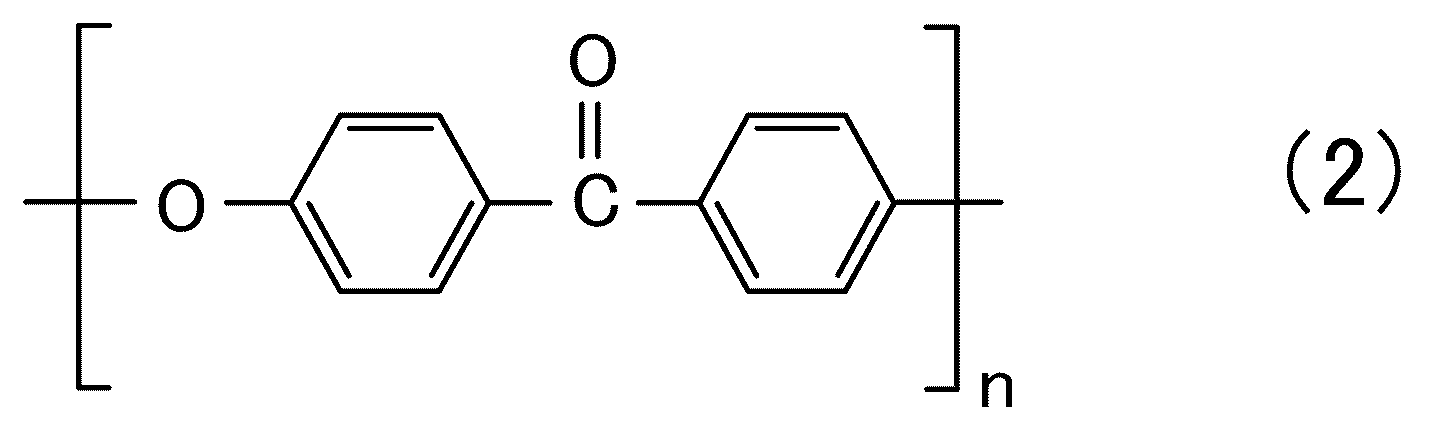
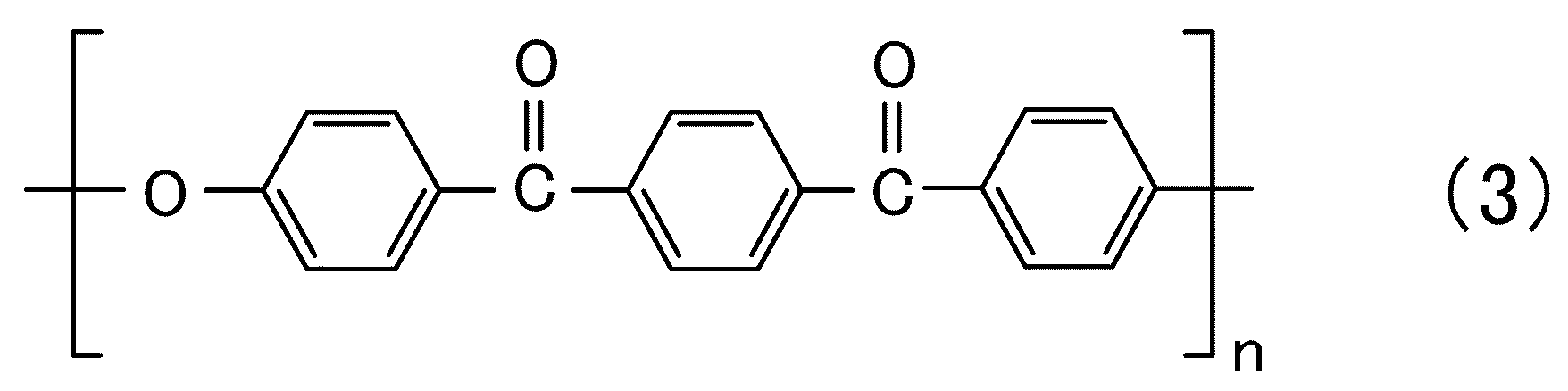
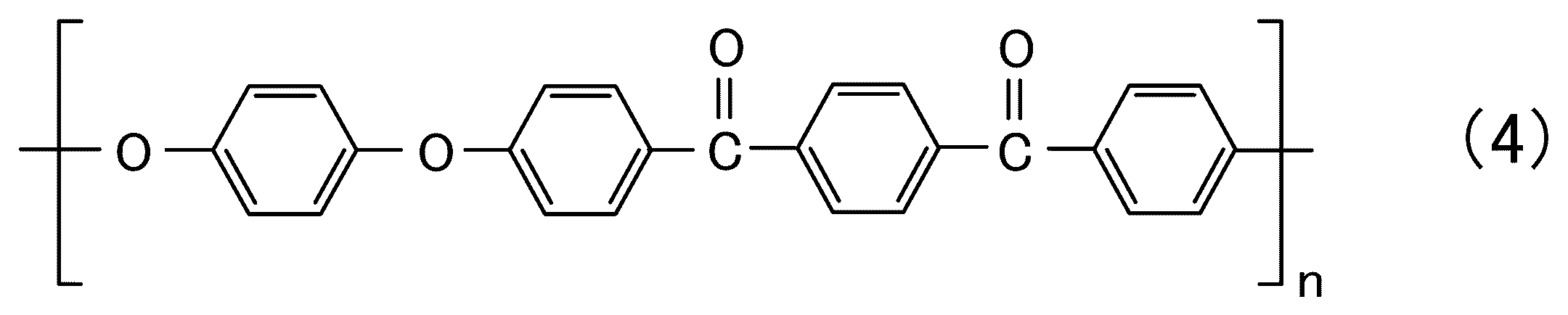

ポリアリーレンエーテルケトン樹脂は、1種単独でも良いし、2種以上を混合して使用しても良い。また、ポリアリーレンエーテルケトン樹脂は、化学式(1)~(5)で表される化学構造を2つ以上有する共重合体であっても良い。ポリアリーレンエーテルケトン樹脂は、通常、粉状、顆粒状、ペレット状等の成形加工に適した形態で使用される。これらポリアリーレンエーテルケトン樹脂の中では、樹脂シートの成形性の点でポリエーテルエーテルケトン樹脂とポリエーテルケトンケトン樹脂とが好ましい。さらに好ましくは、ポリエーテルエーテルケトン樹脂が易入手性とコスト面の観点から最適である。
ポリエーテルエーテルケトン樹脂の具体例としては、Victrex Powderシリーズ、Victrex Granulesシリーズ〔ビクトレック社製:製品名〕、ベスタキープシリーズ〔ダイセル・エボニック社製:製品名〕、キータスパイア PEEKシリーズ〔ソルベイスペシャルティポリマーズ社製:製品名〕があげられる。また、ポリエーテルケトンケトン樹脂の具体例としては、KEPSTANシリーズ〔アルケマ社製:製品名〕があげられる。
成形材料Mには、少なくともポリアリーレンエーテルケトン樹脂が含有されるが、このポリアリーレンエーテルケトン樹脂の他、本発明の特性を損なわない範囲において、ポリイミド(PI)樹脂、ポリアミドイミド(PAI)樹脂、ポリエーテルイミド(PEI)樹脂等のポリイミド樹脂、ポリアミド4T(PA4T)樹脂、ポリアミド6T(PA6T)樹脂、変性ポリアミド6T(変性PA6T)樹脂、ポリアミド9T(PA9T)樹脂、ポリアミド10T(PA10T)樹脂、ポリアミド11T(PA11T)樹脂、ポリアミド6(PA6)樹脂、ポリアミド66(PA66)樹脂、ポリアミド46(PA46)樹脂等のポリアミド樹脂、ポリサルホン(PSU)樹脂、ポリエーテルサルホン(PES)樹脂、ポリフェニレンサルホン(PPSU)樹脂等のポリサルホン樹脂、ポリフェニレンスルフィド(PPS)樹脂、ポリフェニレンスルフィドケトン樹脂、ポリフェニレンスルフィドスルホン樹脂、ポリフェニレンスルフィドケトンスルホン樹脂等のポリアリーレンサルファイド樹脂、ポリエチレンテレフタレート(PET)樹脂、ポリブチレンテレフタレート(PBT)樹脂、ポリエチレンナフタレート(PEN)樹脂等のポリエステル樹脂、ポリテトラフルオロエチレン(PTFE)樹脂、ポリテトラフルオロエチレン-パーフルオロアルキルビニルエーテル共重合体(PFA)樹脂、テトラフルオロエチレン-ヘキサフルオロプロピル共重合体(FEP)樹脂、テトラフルオロエチレン-エチレン共重合体(ETFE)樹脂、ポリクロロトリフルオロエチレン(PCTFE)樹脂、ポリビニリデンフルオライド(PVdF)樹脂、フッ化ビニリデン・テトラフルオロエチレン・ヘキサフルオロプロピレン共重合体樹脂等のフッ素樹脂、ポリカーボネート(PC)樹脂、ポリアリレート(PAR)樹脂、液晶ポリマー(LCP)等が必要に応じ、添加される。
また、成形材料Mには、本発明の特性を損なわない範囲において、上記樹脂の他、酸化防止剤、光安定剤、紫外線吸収剤、可塑剤、滑剤、難燃剤、帯電防止剤、耐熱向上剤、無機化合物、有機化合物等が選択的に添加される。
成形材料Mのポリアリーレンエーテルケトン樹脂が使用されることにより、ポリアリーレンエーテルケトン樹脂シート11は、厚さ50μm以上1000μm以下の樹脂シートに製造される。ポリアリーレンエーテルケトン樹脂シート11は、溶融押出成形法、カレンダー成形法、あるいはキャスティング法等の公知の製造法により製造可能であるが、ハンドリング性や設備の簡略化の観点からすると、溶融押出成形法により連続的に押出成形されることが好ましい。
ここで、溶融押出成形法とは、図5に示すように、製造装置の溶融押出成形機20を使用して成形材料Mを溶融混練し、溶融押出成形機20のTダイス23からポリアリーレンエーテルケトン樹脂シート11を連続的に押し出して製造する方法である。
ポリアリーレンエーテルケトン樹脂シート11の製造装置としては、特に限定されるものではないが、ポリアリーレンエーテルケトン樹脂含有の成形材料Mを使用してポリアリーレンエーテルケトン樹脂シート11を製造する装置であり、成形材料Mを溶融混練する溶融押出成形機20と、この溶融押出成形機20に装着されてポリアリーレンエーテルケトン樹脂シート11を押し出すTダイス23と、このTダイス23から押し出されたポリアリーレンエーテルケトン樹脂シート11を冷却する冷却ロール26と、Tダイス23から押し出されたポリアリーレンエーテルケトン樹脂シート11に接触して冷却ロール26に圧接する一対の圧着ロール27と、冷却ロール26により冷却されたポリアリーレンエーテルケトン樹脂シート11を巻き取る巻取機28とを備えて構成される。
溶融押出成形機20は、例えば単軸押出成形機や二軸押出成形機等からなり、投入された成形材料Mを溶融混練するよう機能する。この溶融押出成形機20の上部後方には、成形材料M用の原料投入口21が設置され、この原料投入口21には、ヘリウムガス、ネオンガス、アルゴンガス、クリプトンガス、窒素ガス、二酸化炭素ガス等の不活性ガス(図5の矢印参照)を必要に応じて供給する不活性ガス供給管22が接続されており、この不活性ガス供給管22による不活性ガスの流入により、成形材料Mの酸化劣化や酸素架橋が有効に防止される。
溶融押出成形機20の溶融混練時におけるポリアリーレンエーテルケトン樹脂の温度は、溶融可能で、ポリアリーレンエーテルケトン樹脂が分解しない温度であれば、特に制限されるものではないが、ポリアリーレンエーテルケトン樹脂の融点以上ポリアリーレンエーテルケトン樹脂の熱分解温度未満の範囲が良い。
具体的には、320℃以上450℃以下、好ましくは360℃以上420℃以下、さらに好ましくは380℃以上400℃以下の範囲が良い。これは、ポリアリーレンエーテルケトン樹脂の融点未満の場合には、ポリアリーレンエーテルケトン樹脂含有の成形材料Mを溶融押出成形することができず、逆に熱分解温度を越える場合には、ポリアリーレンエーテルケトン樹脂が激しく分解するおそれがあるという理由に基づく。
Tダイス23は、溶融押出成形機20の先端部に連結管24を介して装着され、溶融した成形材料Mを帯形のポリアリーレンエーテルケトン樹脂シート11に成形して連続的に下方に押し出すよう機能する。このTダイス23の上流には、連結管24に装着されたギアポンプ25が位置し、このギアポンプ25が成形材料Mを一定速度で、かつ高精度にTダイス23に移送する。Tダイス23とギアポンプ25との間には、溶融した成形材料Mのゲルあるいは異物等を分離する目的で図示しないフィルタが選択的に設置される。
Tダイス23の押し出し時の温度は、ポリアリーレンエーテルケトン樹脂の融点以上ポリアリーレンエーテルケトン樹脂の熱分解温度未満、具体的には、320℃以上450℃以下、好ましくは360℃以上420℃以下、さらに好ましくは380℃以上400℃以下の範囲に調整される。これは、ポリアリーレンエーテルケトン樹脂の融点未満の場合には、ポリアリーレンエーテルケトン樹脂含有の成形材料Mの溶融押出成形が困難化し、逆に熱分解温度を越える場合には、ポリアリーレンエーテルケトン樹脂が激しく分解するおそれがあるという理由に基づく。
冷却ロール26は、例えば一対の圧着ロール27よりも拡径の金属ロールからなり、Tダイス23の下方に回転可能に軸支されて押し出されたポリアリーレンエーテルケトン樹脂シート11を圧着ロール27との間に挟持し、圧着ロール27と共にポリアリーレンエーテルケトン樹脂シート11を短時間で冷却しながらその厚さを所定の範囲内に制御する。
冷却ロール26は、一対の圧着ロール27と同様、ポリアリーレンエーテルケトン樹脂シート11の〔ガラス転移点+20℃〕以上ポリアリーレンエーテルケトン樹脂シート11の融点未満、好ましくはポリアリーレンエーテルケトン樹脂シート11の〔ガラス転移点+30℃〕以上ポリアリーレンエーテルケトン樹脂シート11の〔ガラス転移点+150℃〕以下、より好ましくはポリアリーレンエーテルケトン樹脂シート11の〔ガラス転移点+50℃〕以上ポリアリーレンエーテルケトン樹脂シート11の〔ガラス転移点+100℃〕以下、さらに好ましくはポリアリーレンエーテルケトン樹脂シート11の〔ガラス転移点+60℃〕以上ポリアリーレンエーテルケトン樹脂シート11の〔ガラス転移点+90℃〕の温度範囲に調整され、ポリアリーレンエーテルケトン樹脂シート11に摺接する。
冷却ロール26の温度がポリアリーレンエーテルケトン樹脂シート11の〔ガラス転移点+20℃〕以上ポリアリーレンエーテルケトン樹脂シート11の融点未満の温度範囲に調整されるのは、ポリアリーレンエーテルケトン樹脂シート11の相対結晶化度が80%以上に調整されるためである。
この点について説明すると、冷却ロール26の温度がポリアリーレンエーテルケトン樹脂シート11の〔ガラス転移点+20℃〕未満の場合には、ポリアリーレンエーテルケトン樹脂シート11の相対結晶化度が80%未満となり、モータ2より発生する熱で壁部材14が変形したり、割れたり、あるいは寸法変化を招くおそれがある。また、ポリアリーレンエーテルケトン樹脂シート11の引張弾性率も小さく、剛性も不十分となるため、壁部材14をステータ3のスロット5内に挿入する場合、座屈するおそれもある。これに対し、冷却ロール26の温度がポリアリーレンエーテルケトン樹脂シート11の融点以上の場合には、ポリアリーレンエーテルケトン樹脂シート11の製造中にポリアリーレンエーテルケトン樹脂シート11が冷却ロール26に貼り付き、破断するおそれがある。
冷却ロール26の温度調整や冷却方法としては、特に限定されるものではないが、例えば空気、水、オイル等の熱媒体による方法、あるいは電気ヒータや誘電加熱等の方法が該当する。
一対の圧着ロール27は、冷却ロール26を挟持するようTダイス23の下方に回転可能に軸支される。この一対の圧着ロール27とその下流に位置する巻取機28の巻取管29との間には、ポリアリーレンエーテルケトン樹脂シート11の側部にスリットを形成するスリット刃30が少なくとも昇降可能に配置され、このスリット刃30と巻取機28との間には、ポリアリーレンエーテルケトン樹脂シート11にテンションを作用させて円滑に巻き取るためのテンションロール31が回転可能に必要数軸支される。
各圧着ロール27の周面には、ポリアリーレンエーテルケトン樹脂シート11と冷却ロール26との密着性を向上させるため、少なくとも天然ゴム、イソプレンゴム、ブタジエンゴム、ノルボルネンゴム、アクリロニトリルブタジエンゴム、ニトリルゴム、ウレタンゴム、シリコーンゴム、フッ素ゴム等のゴム層が必要に応じて被覆形成され、このゴム層には、シリカやアルミナ等の無機化合物が選択的に添加される。これらの中では、耐熱性に優れるシリコーンゴムやフッ素ゴムの採用が好ましい。
圧着ロール27は、表面が金属の金属弾性ロールが必要に応じて使用され、この金属弾性ロールが使用される場合には、表面が平滑性に優れるポリアリーレンエーテルケトン樹脂シート11の成形が可能となる。この金属弾性ロールの具体例としては、金属スリーブロール、エアーロール〔ディムコ社製:製品名〕、UFロール〔日立造船社製:製品名〕が該当する。
このような一対の圧着ロール27は、冷却ロール26と同様、ポリアリーレンエーテルケトン樹脂シート11の〔ガラス転移点+20℃〕以上ポリアリーレンエーテルケトン樹脂シート11の融点未満、好ましくはポリアリーレンエーテルケトン樹脂シート11の〔ガラス転移点+30℃〕以上ポリアリーレンエーテルケトン樹脂シート11の〔ガラス転移点+150℃〕以下、より好ましくはポリアリーレンエーテルケトン樹脂シート11の〔ガラス転移点+50℃〕以上ポリアリーレンエーテルケトン樹脂シート11の〔ガラス転移点+100℃〕以下、さらに好ましくはポリアリーレンエーテルケトン樹脂シート11の〔ガラス転移点+60℃〕以上ポリアリーレンエーテルケトン樹脂シート11の〔ガラス転移点+90℃〕の温度範囲に調整され、ポリアリーレンエーテルケトン樹脂シート11に圧接する。
圧着ロール27の温度が係る温度範囲に調整されるのは、ポリアリーレンエーテルケトン樹脂シート11の相対結晶化が80%以上に調整されるためである。すなわち、圧着ロール27の温度がポリアリーレンエーテルケトン樹脂シート11の〔ガラス転移点+20℃〕未満の場合には、ポリアリーレンエーテルケトン樹脂シート11の相対結晶化度が80%未満となり、モータ2より発生する熱で壁部材14が変形したり、割れたり、あるいは寸法が変化することとなる。また、ポリアリーレンエーテルケトン樹脂シート11の剛性も不十分となり、コア4のスロット5内に挿入する場合、座屈のおそれもある。これに対し、圧着ロール27の温度がポリアリーレンエーテルケトン樹脂シート11の融点以上の場合には、ポリアリーレンエーテルケトン樹脂シート11の製造中にポリアリーレンエーテルケトン樹脂シート11が冷却ロール26に貼り付き、破断のおそれがある。
圧着ロール27の温度調整や冷却方法としては、冷却ロール26と同様、限定されるものではなく、例えば空気、水、オイル等の熱媒体による方法、あるいは電気ヒータや誘電加熱等があげられる。
上記構成において、回転電機1用のポリアリーレンエーテルケトン樹脂シート11を製造する場合には、先ず、溶融押出成形機20の原料投入口21に成形材料Mを投入してこの成形材料Mを溶融混練し、Tダイス23からポリアリーレンエーテルケトン樹脂シート11を連続的に帯形に押し出す。この際、ポリアリーレンエーテルケトン樹脂の溶融混練前における含水率は、2000ppm以下、好ましくは1000ppm以下、より好ましくは500ppm以下、さらに好ましくは300ppm以下に調整される。
これは、ポリアリーレンエーテルケトン樹脂の溶融混練前における含水率が2000ppmを越える場合には、ポリアリーレンエーテルケトン樹脂が発泡するおそれがあるという理由に基づく。ポリアリーレンエーテルケトン樹脂の溶融混練前の含水率の下限は、特に限定されるものでないが、100ppm以上が好適である。
ポリアリーレンエーテルケトン樹脂シート11を押し出したら、冷却ロール26、一対の圧着ロール27、テンションロール31、巻取機28の巻取管29に順次巻架するとともに、ポリアリーレンエーテルケトン樹脂シート11を冷却ロール26に摺接させて短時間で冷却し、ポリアリーレンエーテルケトン樹脂シート11の両側部をスリット刃30でそれぞれカットして体裁を整え、巻取機28の巻取管29に順次巻き取れば、回転電機1用のポリアリーレンエーテル樹脂シートを製造することができる。
この際、ポリアリーレンエーテルケトン樹脂シート11の相対結晶化度と貯蔵弾性率(E’)とは、Tダイス23より押し出されたポリアリーレンエーテルケトン樹脂シート11を直ちに冷却することで調整することができる。また、ポリアリーレンエーテルケトン樹脂シート11を冷却ロール26に密着させる方法としては、ハンドリング性や設備の簡略化の観点から、圧着ロール27により、冷却ロール26にポリアリーレンエーテルケトン樹脂シート11を押し付けて密着させるタッチロール法の採用が好ましい。
ポリアリーレンエーテルケトン樹脂シート11と冷却ロール26との密着時間は、特に限定されるものではないが、ポリアリーレンエーテルケトン樹脂シート11を瞬時に冷却する観点からすると、0.1秒以上120秒以下、好ましくは0.5秒以上60秒以下、より好ましくは1秒以上30秒以下が最適である。
ポリアリーレンエーテルケトン樹脂シート11の表面は、そのままでも良いが、本発明の効果を失わない範囲で微細な凹凸を形成し、表面の摩擦係数を低下させることができる。この微細な凹凸の形成方法としては、(1)ポリアリーレンエーテルケトン樹脂を溶融押出成形機20により溶融混練し、この溶融混練したポリアリーレンエーテルケトン樹脂をTダイス23から微細な凹凸を周面に備えた冷却ロール26上に吐き出して密着させ、圧着ロール27との間にポリアリーレンエーテルケトン樹脂シート11を挟み、微細な凹凸を形成する方法、(2)ポリアリーレンエーテルケトン樹脂シート11に微小なジルコニア、ガラス、ステンレス等の無機化合物、ポリカーボネート樹脂、ポリアミド樹脂、あるいは植物の種等の有機化合物を吹き付けて微細な凹凸を形成する方法、(3)ポリアリーレンエーテルケトン樹脂シート11を微細な凹凸を備えた金型でプレス成形し、微細な凹凸を形成する方法があげられる。
これらの形成方法の中では、設備の簡略化、凹凸サイズの精度、凹凸形成の均一化、あるいは凹凸形成の容易化、凹凸を連続的に形成する観点から、(1)の方法が最適である。
(1)の形成方法をさらに詳細に説明すると、(1-1)ポリアリーレンエーテルケトン樹脂を溶融押出成形機20のTダイス23から微細な凹凸を周面に備えた冷却ロール26上に吐き出すとともに、この吐出物を冷却ロール26と微細な凹凸を周面に備えた圧着ロール27とで挟み、ポリアリーレンエーテルケトン樹脂シート11の溶融押出成形と同時に成形する方法、(1-2)成形したポリアリーレンエーテルケトン樹脂シート11を微細な凹凸を周面に備えた冷却ロール26と微細な凹凸を周面に備えた圧着ロール27とで挟み、凹凸を形成する方法があげられる。これらの中では、設備の簡略化の観点から、(1-1)の形成方法が最適である。
製造されたポリアリーレンエーテルケトン樹脂シートのシリコーン油中の絶縁破壊電圧は、7kV以上であるが、好ましくは9kV以上、より好ましくは10kV以上が良い。また、製造されたポリアリーレンエーテルケトン樹脂シート11のシリコーン油中の単位厚さ当たりの絶縁破壊電圧である絶縁破壊強さは、40kV/mm以上であるが、好ましくは50kV/mm以上、より好ましくは60kV/mm以上400kV/mm以下が良い。これは、ポリアリーレンエーテルケトン樹脂シート11のシリコーン油中の単位厚さ当たりの絶縁破壊強さが40kV/mm未満の場合には、ポリアリーレンエーテルケトン樹脂シート11を絶縁材10として使用するとき、サージ電圧による絶縁破壊が発生してしまうおそれがあるからである。
ポリアリーレンエーテルケトン樹脂シート11の23℃の周波数1GHzにおける比誘電率は、3.1以下、好ましくは3.05以下であるが、実用上は1.5以上3.1以下である。これは、ポリアリーレンエーテルケトン樹脂シート11の周波数1GHzにおける比誘電率が3.1を越える場合には、絶縁破壊の初期現象である部分放電開始電圧を充分に上げることができないので、サージ電圧による絶縁破壊を防止するのが困難になるからである。
ポリアリーレンエーテルケトン樹脂シート11の23℃の周波数1GHzにおける誘電正接は、0.01以下であるが、好ましくは0.007以下、より好ましくは0.005以下、さらに好ましくは0.003以下が良い。これは、1GHzにおける誘電正接が0.01以下であれば、自己発熱してポリアリーレンエーテルケトン樹脂シート11が溶融したり、熱分解したりすることを防止することが可能になるという理由に基づく。この誘電正接の下限は、限定されるものではないが、実用上0.0001以上である。
ポリアリーレンエーテルケトン樹脂シート11の引張弾性率は、3000N/mm2以上であるが、好ましくは3300N/mm2以上5000N/mm2以下、より好ましくは3500N/mm2以上4700N/mm2以下、さらに好ましくは4000N/mm2以上4500N/mm2以下の範囲が良い。これは、ポリアリーレンエーテルケトン樹脂シート11の引張弾性率が3000N/mm2未満の場合には、剛性が不十分となり、ポリアリーレンエーテルケトン樹脂シート11を壁部材14に加工し、スロット5内に挿入するとき、座屈するおそれがあるからである。また、ポリアリーレンエーテルケトン樹脂シート11の引張弾性率が5000N/mm2を越える場合には、ポリアリーレンエーテルケトン樹脂シート11の成形に長時間を要し、コストの削減が期待できなくなるからである。
ポリアリーレンエーテルケトン樹脂シート11の引張最大強度は、80N/mm2以上であるが、好ましくは90N/mm2以上、より好ましくは100N/mm2以上が良い。また、引張破断時伸びは、80%以上であるが、好ましくは100%以上、より好ましくは200%以上が良い。これは、引張最大強度が80N/mm2未満で破断時伸びが80%未満の場合には、ポリエーテルエーテルケトン樹脂シートが充分な靭性を有していないので、スロット5に壁部材14として挿入するとき、破断、割れ、裂け等のトラブルが生じてしまうおそれがあるからである。
ポリアリーレンエーテルケトン樹脂シート11の吸水率は、温度23℃で1.0%以下であるが、好ましくは0.7%以下、より好ましくは0.5%以下が良い。これは、23℃における吸水率が1.0%以下の場合には、高温湿度環境下でも高い電気絶縁性を維持することができるからである。このポリアリーレンエーテルケトン樹脂シート11の23℃における吸水率は、低い程好ましいが、実用上は0%以上である。
ポリアリーレンエーテルケトン樹脂シート11の厚さは、コア4の大きさやスロット5の形状等により変更されるが、50μm以上1000μm以下、好ましくは100μm以上750μm以下、より好ましくは125μm以上500μm以下、さらに好ましくは150μm以上300μm以下が良い。これは、ポリアリーレンエーテルケトン樹脂シート11の厚さが50μm未満の場合には、充分な電気絶縁性を得ることができず、逆にポリアリーレンエーテルケトン樹脂シート11の厚さが1000μmを越える場合には、スロット5内の導電巻線7の占有率が低下し、モータ2の小型化や高出力化に問題が生じるからである。
上記構成によれば、絶縁材10を、樹脂繊維シートではなく、電気特性に優れるポリアリーレンエーテルケトン樹脂シート11としてその厚さを50μm以上1000μm以下とするので、薄肉化を図ることができ、導電巻線7の占有率を増大させることができる。また、ポリアリーレンエーテルケトン樹脂シート11は、吸水率が低いので、誘電特性や絶縁耐力等の電気絶縁性質が温湿度等の環境変化の影響を受けにくく、周波数依存性が大きくなるのを有効に防止することができる。
また、ポリアリーレンエーテルケトン樹脂シート11は、電気絶縁性に優れるので、電気特性の低下を抑制し、低電圧で部分放電の発生するおそれを有効に排除することができる。また、ポリアリーレンエーテルケトン樹脂シート11は、耐熱性や耐薬品性に優れるので、電気自動車、ハイブリッド車、プラグインハイブリッド車、燃料電池自動車等のモータ2の絶縁用に使用することが可能となる。
また、ポリアリーレンエーテルケトン樹脂シート11は、機械特性にも優れるので、コア4のスロット5に壁部材14として挿入しても、壁部材14の破断、割れ、裂け等の防止が大いに期待できる。さらに、ポリアリーレンエーテルケトン樹脂シート11は、摺動性に優れるので、コア4のスロット5に壁部材14を挿入する作業の自動化に資することができ、この場合には、手作業に比べ、作業時間の短縮が大いに期待できる。
次に、図6は本発明の第2の実施形態を示すもので、この場合には、絶縁材10を、厚さ50μm以上1000μm以下のポリアリーレンエーテルケトン樹脂シート11とし、このポリアリーレンエーテルケトン樹脂シート11を、壁部材14とする他、壁部材14の内部を複数に区画する区画部材15とするとともに、壁部材14の開口部12を嵌合被覆する被覆部材16とするようにしている。
区画部材15は、例えばモータ2が多相交流モータ等の場合、断面皿形等に形成されて壁部材14の内部に必要数取り付けられ、相間絶縁紙として導電巻線7の各相間の絶縁を確保するよう機能する。また、被覆部材16は、例えば断面皿形等に形成され、壁部材14の内部から導電巻線7が外部に飛び出すのを防止する。その他の部分については、上記実施形態と同様であるので説明を省略する。
本実施形態においても上記実施形態と同様の作用効果が期待でき、しかも、多相コイルの各相間の絶縁を確保したり、電気絶縁性を維持しながら壁部材14内から導電巻線7が飛び出すのを防止することができるのは明らかである。
なお、上記実施形態では回転電機1のステータ3に複数のスロット5を凹み形成したが、回転電機1のロータに複数のスロット5を凹み形成し、各スロット5に、絶縁材10のポリアリーレンエーテルケトン樹脂シート11を挿入しても良い。また、上記実施形態ではポリアリーレンエーテルケトン樹脂シート11を単に示したが、何ら限定されるものではなく、例えばポリアリーレンエーテルケトン樹脂シート11の片面あるいは両面に、樹脂繊維シートを積層接着しても良い。
また、優れたオイル含浸性と滑り性を獲得したい場合には、ポリアリーレンエーテルケトン樹脂シート11の表裏両面に上下一対の樹脂繊維シートを多層構造に備えることもできる。この場合の樹脂繊維シートとしては、融点が250℃以上の結晶性熱可塑性樹脂、ガラス転移点が200℃以上の非晶性熱可塑性樹脂あるいは熱硬化性樹脂の樹脂シートがあげられる。
融点が250℃の結晶性熱可塑性樹脂の具体例としては、好ましくはポリイミド(PI)樹脂、ポリアミド4T(PA4T)樹脂、ポリアミド6T(PA6T)樹脂、変性ポリアミド6T(変性PA6T)樹脂、ポリアミド9T(PA9T)樹脂、ポリアミド10T(PA10T)樹脂等の半芳香族ポリアミド樹脂、ポリフェニレンスルフィド(PPS)樹脂、ポリフェニレンスルフィドケトン樹脂、ポリフェニレンスルフィドスルホン樹脂、ポリフェニレンスルフィドケトンスルホン樹脂等のポリアリーレンサルファイド樹脂、ポリエーテルケトン(PEK)樹脂、ポリエーテルエーテルケトン(PEEK)樹脂、ポリエーテルケトンンケトン(PEKK)樹脂、ポリエーテルエーテルケトンケトン(PEEKK)樹脂、あるいはポリエーテルケトンエーテルケトンケトン(PEKEKK)樹脂等のポリアリーレンエーテルケトン樹脂、ポリエステル樹脂、ポリテトラフルオロエチレン(PTFE)樹脂、ポリテトラフルオロエチレン-パーフルオロアルキルビニルエーテル共重合体(PFA)樹脂、テトラフルオロエチレン-ヘキサフルオロプロピル共重合体(FEP)樹脂等のフッ素樹脂、液晶ポリマー(LCP)等があげられる。ガラス転移点が200℃以上の非晶性熱可塑性樹の具体例としては、ポリエーテルイミド(PEI)樹脂等のポリイミド樹脂、ポリサルホン(PSU)樹脂、ポリエーテルサルホン(PES)樹脂、ポリフェニレンサルホン(PPSU)樹脂等のポリサルホン樹脂、ポリアリレート(PAR)樹脂等があげられる。
熱硬化性樹脂の具体例としては、ポリイミド樹脂、ポリアミドイミド(PI)樹脂等のポリイミド樹脂、エポキシ樹脂、フェノール樹脂、シリコーン樹脂、全芳香族アラミド樹脂等があげられる。これらの樹脂の中では、耐薬品性の観点から、結晶性熱可塑性樹脂、あるいは熱硬化性樹脂が好ましい。より好ましくは、ポリアリーレンエーテルケトン樹脂との接着性を向上させるため、ポリアリーレンエーテルケトン樹脂が好適であり、さらに好ましくは、易入手性及びコストの点でポリエーテルエーテルケトン樹脂が最適である。
以下、本発明に係る回転電機用絶縁材の実施例を比較例と共に説明する。
〔実施例1〕
先ず、モータ用の絶縁材を製造するため、ポリアリーレンエーテルケトン樹脂として、市販のポリエーテルエーテルケトン樹脂〔ソルベイスペシャルティポリマーズ社製 製品名:キータスパイアPEEK KT-851NL SP(以下、「KT-851NL SP」と略す〕を用意し、このポリエーテルエーテルケトン樹脂を160℃に加熱した除湿熱風乾燥機で12時間以上乾燥させた。
〔実施例1〕
先ず、モータ用の絶縁材を製造するため、ポリアリーレンエーテルケトン樹脂として、市販のポリエーテルエーテルケトン樹脂〔ソルベイスペシャルティポリマーズ社製 製品名:キータスパイアPEEK KT-851NL SP(以下、「KT-851NL SP」と略す〕を用意し、このポリエーテルエーテルケトン樹脂を160℃に加熱した除湿熱風乾燥機で12時間以上乾燥させた。
ポリエーテルエーテルケトン樹脂を乾燥させたら、乾燥させたポリエーテルエーテルケトン樹脂の含水率が300ppm以下であることを確認し、ポリエーテルエーテルケトン樹脂を幅900mmのTダイスを備えたφ40mmの単軸溶融押出成形機にセットして溶融混練し、この溶融混練したポリエーテルエーテルケトン樹脂を単軸溶融押出成形機のTダイスから連続的に押し出し、絶縁材であるポリエーテルエーテルケトン樹脂製の樹脂シートを帯形に成形した。
この際、ポリエーテルエーテルケトン樹脂の含水率は、微量水分測定装置〔三菱化学社製 製品名:CA‐100型〕を用い、カールフィッシャー滴定法により測定した。また、単軸溶融押出成形機は、L/D=32、圧縮比:2.5、スクリュー:フルフライトスクリュータイプとした。
単軸溶融押出成形機の温度は380~400℃、Tダイスの温度は400℃、これら単軸溶融押出成形機とTダイスとを連結する連結管の温度は400℃に調整した。また、溶融したポリエーテルエーテルケトン樹脂の温度については、Tダイス入口の樹脂温度を測定することとし、測定したところ、397℃であった。単軸押出成形機にポリエーテルエーテルケトン樹脂を投入する際、不活性ガス供給管により、窒素ガスを18L/分で供給した。
こうしてポリエーテルエーテルケトン樹脂製の樹脂シートを押出成形したら、連続したポリエーテルエーテルケトン樹脂製の樹脂シートの両端部をスリット刃で裁断して巻取機の巻取管に順次巻き取り、長さ100m、幅650mmの樹脂シートを製造した。この際、樹脂シートは、周面に凹凸を備えた210℃の冷却ロール、シリコーンゴム製の一対の圧着ロール、及びこれらの下流に位置する6インチの巻取管に順次巻架し、冷却ロールと圧着ロールとに狭持させた。この際、圧着ロールの表面温度を非接触式の温度計で測定したところ、216℃であった。
モータ用の絶縁材である樹脂シートが得られたら、この樹脂シートのシート厚、吸水率、相対結晶化度、機械特性、電気特性、長期耐熱性を測定し、その結果を表1に記載した。機械特性は、引張最大強度、引張破断時伸び、及び引張弾性率で評価した。また、電気特性は、絶縁破壊電圧、絶縁破壊強さ、比誘電率、及び誘電正接で評価した。絶縁破壊電圧と絶縁破壊強さは、シリコーン油中、温度23℃と200℃の場合について評価した。
樹脂シートの長期耐熱性は、樹脂シートを200℃に加熱した熱風オーブン中に入れ1000時間静置し、静置前後の機械特性と電気特性とで評価した。機械特性は、引張最大強度、引張破断時伸び、及び引張弾性率で評価した。また、電気特性は、絶縁破壊電圧、絶縁破壊強さ、比誘電率、及び誘電正接で評価した。
・樹脂シートのシート厚
樹脂シートのシート厚さについては、マイクロメータ〔ミツトヨ社製 製品名:クーラントプルーフマイクロメータ 符号MDC-25PJ〕を使用して測定した。測定に際しては、ポリアリーレンエーテルケトン樹脂シートの幅方向(押出方向の直角方向)任意の10箇所測定し、その平均値をシート厚とした。
樹脂シートのシート厚さについては、マイクロメータ〔ミツトヨ社製 製品名:クーラントプルーフマイクロメータ 符号MDC-25PJ〕を使用して測定した。測定に際しては、ポリアリーレンエーテルケトン樹脂シートの幅方向(押出方向の直角方向)任意の10箇所測定し、その平均値をシート厚とした。
・樹脂シートの吸水率
樹脂シート吸水率は、JIS K 7209 A法に準拠して測定した。浸漬時間は、24時間とした。また、測定は、3枚の試験片を使用し、測定値の平均値を吸水率とした。
樹脂シート吸水率は、JIS K 7209 A法に準拠して測定した。浸漬時間は、24時間とした。また、測定は、3枚の試験片を使用し、測定値の平均値を吸水率とした。
・樹脂シートの相対結晶化度
樹脂シートの相対結晶化度については、樹脂シートから測定試料約8mgを秤量し、示差走査熱量計〔エスアイアイ・ナノテクノロジーズ社製 製品名:EXSTAR7000シリーズ X-DSC7000〕を使用して昇温速度10℃/分、測定温度範囲20℃から380℃まで測定した。このときに得られる結晶融解ピークの熱量(J/g)、再結晶化ピークの熱量(J/g)から以下の式を用いて算出した。
樹脂シートの相対結晶化度については、樹脂シートから測定試料約8mgを秤量し、示差走査熱量計〔エスアイアイ・ナノテクノロジーズ社製 製品名:EXSTAR7000シリーズ X-DSC7000〕を使用して昇温速度10℃/分、測定温度範囲20℃から380℃まで測定した。このときに得られる結晶融解ピークの熱量(J/g)、再結晶化ピークの熱量(J/g)から以下の式を用いて算出した。
相対結晶化度(%)={1-(ΔHc/ΔHm)}×100
ここで、ΔHcは樹脂シートの10℃/分の昇温条件下での再結晶化ピークの熱量(J/g)を表し、ΔHmは樹脂シートの10℃/分の昇温条件下での結晶融解ピークの熱量(J/g)を表す。
ここで、ΔHcは樹脂シートの10℃/分の昇温条件下での再結晶化ピークの熱量(J/g)を表し、ΔHmは樹脂シートの10℃/分の昇温条件下での結晶融解ピークの熱量(J/g)を表す。
・樹脂シートの機械特性
樹脂シートの機械特性は、23℃における引張最大強度、引張破断時伸び、及び引張弾性率で評価した。機械特性は、押出方向と幅方向(押出方向の直角方向)について測定した。測定は、JISK 7127に準拠し、引張速度50mm/分、温度23℃±2℃、相対湿度50RH±5%RHの条件で測定した。また、引張最大強度、引張破断時伸び、引張弾性率については、5回測定し、その平均値を引張最大強度、引張破断時伸び、引張弾性率とした。
樹脂シートの機械特性は、23℃における引張最大強度、引張破断時伸び、及び引張弾性率で評価した。機械特性は、押出方向と幅方向(押出方向の直角方向)について測定した。測定は、JISK 7127に準拠し、引張速度50mm/分、温度23℃±2℃、相対湿度50RH±5%RHの条件で測定した。また、引張最大強度、引張破断時伸び、引張弾性率については、5回測定し、その平均値を引張最大強度、引張破断時伸び、引張弾性率とした。
・樹脂シートの絶縁破壊電圧と絶縁破壊強さ
温度23℃と200℃におけるシリコーン油中における樹脂シートの絶縁破壊電圧と絶縁破壊強さについては、IEC 60243-1に準拠して測定した。具体的には、シリコーン油中で昇温方式(短時間法)により、交流(50Hz)、温度23℃±2℃と200℃、電極形状は上電極φ25mm、高さ25mmの円柱形、台座となる下電極φ25mm、高さ25mmの円柱形で測定した。絶縁破壊電圧については、5回測定し、その平均値を絶縁破壊電圧とした。また、昇圧速度は、表2に記載した。
温度23℃と200℃におけるシリコーン油中における樹脂シートの絶縁破壊電圧と絶縁破壊強さについては、IEC 60243-1に準拠して測定した。具体的には、シリコーン油中で昇温方式(短時間法)により、交流(50Hz)、温度23℃±2℃と200℃、電極形状は上電極φ25mm、高さ25mmの円柱形、台座となる下電極φ25mm、高さ25mmの円柱形で測定した。絶縁破壊電圧については、5回測定し、その平均値を絶縁破壊電圧とした。また、昇圧速度は、表2に記載した。
絶縁破壊強さは、絶縁破壊電圧を測定する個所のシート厚を絶縁破壊電圧を測定する前に予め測定し、絶縁破壊電圧を測定後、絶縁破壊電圧をそのシート厚で割った値とした。
・樹脂シートの比誘電率と誘電正接
周波数:1GHz、温度23℃における樹脂シートの比誘電率と誘電正接は、ASTM D2520を参考とした、空洞共振器摂動法により測定した。ネットワーク・アナライザーはPNA-Lネットワーク・アナライザー N5230A〔アジレント・テクノロージ社製:製品名〕を用い、空洞共振器は空洞共振器 1GHz用;CP431〔関東電子応用開発社製:製品名〕を用いた。比誘電率と誘電正接の測定は、温度23℃±1℃、湿度50%RH±5%RHの環境下で実施した。比誘電率と誘電正接については、2回測定し、その平均値を比誘電率と誘電正接とした。
周波数:1GHz、温度23℃における樹脂シートの比誘電率と誘電正接は、ASTM D2520を参考とした、空洞共振器摂動法により測定した。ネットワーク・アナライザーはPNA-Lネットワーク・アナライザー N5230A〔アジレント・テクノロージ社製:製品名〕を用い、空洞共振器は空洞共振器 1GHz用;CP431〔関東電子応用開発社製:製品名〕を用いた。比誘電率と誘電正接の測定は、温度23℃±1℃、湿度50%RH±5%RHの環境下で実施した。比誘電率と誘電正接については、2回測定し、その平均値を比誘電率と誘電正接とした。
・樹脂シートの長期耐熱性(機械特性)
樹脂シートの長期耐熱性における機械特性は、樹脂シートを温度200℃の熱風オーブン中に入れて1000時間静置し、静置前後の機械的特性を評価し、下記の判定基準で長期耐熱性を判定した。機械特性は、引張最大強度、引張破断時伸び、及び引張弾性率で評価した。また、機械特性は、押出方向と幅方向(押出方向の直角方向)について測定した。測定は、JISK 7127に準拠し、引張速度50mm/分、温度23℃±2℃、相対湿度50%RH±5%RHの条件で測定した。引張最大強度、引張破断時伸び、及び引張弾性率については、5回測定し、その平均値を引張最大強度、引張破断時伸び、引張弾性率とした。
樹脂シートの長期耐熱性における機械特性は、樹脂シートを温度200℃の熱風オーブン中に入れて1000時間静置し、静置前後の機械的特性を評価し、下記の判定基準で長期耐熱性を判定した。機械特性は、引張最大強度、引張破断時伸び、及び引張弾性率で評価した。また、機械特性は、押出方向と幅方向(押出方向の直角方向)について測定した。測定は、JISK 7127に準拠し、引張速度50mm/分、温度23℃±2℃、相対湿度50%RH±5%RHの条件で測定した。引張最大強度、引張破断時伸び、及び引張弾性率については、5回測定し、その平均値を引張最大強度、引張破断時伸び、引張弾性率とした。
機械特性の長期耐熱性=|(X1-X0)/X0×100|
X1:静置後の測定値
X0:静置前の測定値
〔判定基準〕
◎:変化率が10%以下
○:変化率が10%を越え20%以下
X1:静置後の測定値
X0:静置前の測定値
〔判定基準〕
◎:変化率が10%以下
○:変化率が10%を越え20%以下
・樹脂シートの長期耐熱性(電気特性)
樹脂シートの長期耐熱性における絶縁破壊電圧と絶縁破壊強さは、樹脂シートを温度200℃の熱風オーブン中に入れて1000時間静置し、静置前後の絶縁破壊電圧と絶縁破壊強さを評価し、下記の判定基準で長期耐熱性を判定した。温度23℃における、シリコーン油中における樹脂シートの絶縁破壊電圧と絶縁破壊強さは、IEC 60243-1に準拠して測定した。具体的には、シリコーン油中で昇温方式(短時間法)により、交流(50Hz)、温度23℃±2℃、電極形状は上電極φ25mm、高さ25mmの円柱形、台座となる下電極φ25mm、高さ25mmの円柱形で測定した。
樹脂シートの長期耐熱性における絶縁破壊電圧と絶縁破壊強さは、樹脂シートを温度200℃の熱風オーブン中に入れて1000時間静置し、静置前後の絶縁破壊電圧と絶縁破壊強さを評価し、下記の判定基準で長期耐熱性を判定した。温度23℃における、シリコーン油中における樹脂シートの絶縁破壊電圧と絶縁破壊強さは、IEC 60243-1に準拠して測定した。具体的には、シリコーン油中で昇温方式(短時間法)により、交流(50Hz)、温度23℃±2℃、電極形状は上電極φ25mm、高さ25mmの円柱形、台座となる下電極φ25mm、高さ25mmの円柱形で測定した。
絶縁破壊電圧は、5回測定し、その平均値を絶縁破壊電圧とした。昇圧速度は、表2に記載した。また、絶縁破壊強さは、絶縁破壊電圧を測定する個所のシート厚を絶縁破壊電圧を測定する前に予め測定し、絶縁破壊電圧を測定後、絶縁破壊電圧をそのシート厚で割った値とした。
絶縁破壊強度と絶縁破壊強さの変化率=|(X1-X0)/X0×100|
X1:静置後の測定値
X0:静置前の測定値
〔判定基準〕
◎:変化率が10%以下
○:変化率が10%を越え20%以下
X1:静置後の測定値
X0:静置前の測定値
〔判定基準〕
◎:変化率が10%以下
○:変化率が10%を越え20%以下
・樹脂シートの長期耐熱性(比誘電率と誘電正接)
樹脂シートの長期耐熱性における比誘電率と誘電正接は、樹脂シートを温度200℃の熱風オーブン中に入れて1000時間静置し、静置前後の比誘電率と誘電正接を評価し、下記の判定基準で長期耐熱性を判定した。周波数:1GHz、温度23℃における樹脂シートの比誘電率と誘電正接は、ASTM D2520を参考とした、空洞共振器摂動法により測定した。ネットワーク・アナライザーはPNA-Lネットワーク・アナライザー N5230A〔アジレント・テクノロージ社製:製品名〕を用い、空洞共振器は空洞共振器 1GHz用;CP431〔関東電子応用開発社製:製品名〕を用いた。
樹脂シートの長期耐熱性における比誘電率と誘電正接は、樹脂シートを温度200℃の熱風オーブン中に入れて1000時間静置し、静置前後の比誘電率と誘電正接を評価し、下記の判定基準で長期耐熱性を判定した。周波数:1GHz、温度23℃における樹脂シートの比誘電率と誘電正接は、ASTM D2520を参考とした、空洞共振器摂動法により測定した。ネットワーク・アナライザーはPNA-Lネットワーク・アナライザー N5230A〔アジレント・テクノロージ社製:製品名〕を用い、空洞共振器は空洞共振器 1GHz用;CP431〔関東電子応用開発社製:製品名〕を用いた。
比誘電率と誘電正接の測定は、温度:23℃±1℃、湿度50%RH±5%RH環境下で実施した。比誘電率と誘電正接については、5回測定し、その平均値を比誘電率と誘電正接とした。
比誘電率と誘電正接の変化率=|(X1-X0)/X0×100|
X1:静置後の測定値
X0:静置前の測定値
〔判定基準〕
◎:変化率が10%以下
○:変化率が10%を越え20%以下
X1:静置後の測定値
X0:静置前の測定値
〔判定基準〕
◎:変化率が10%以下
○:変化率が10%を越え20%以下
〔実施例2〕
モータ用の絶縁材を製造するため、ポリアリーレンエーテルケトン樹脂として、実施例1で用いた市販のポリエーテルエーテルケトン樹脂を用意し、実施例1と同様の方法により、ポリエーテルエーテルケトン樹脂製の樹脂シートを帯形に成形した。樹脂シートを帯形に成形したら、樹脂シートのシート厚、吸水率、相対結晶化度、機械特性、電気特性を測定し、その測定結果を表1に記載した。溶融したポリエーテルエーテルケトン樹脂の温度については、Tダイス入口の樹脂温度を測定することとし、測定したところ、397℃であった。また、圧着ロールの表面温度を非接触式の温度計で測定したところ、213℃であった。
モータ用の絶縁材を製造するため、ポリアリーレンエーテルケトン樹脂として、実施例1で用いた市販のポリエーテルエーテルケトン樹脂を用意し、実施例1と同様の方法により、ポリエーテルエーテルケトン樹脂製の樹脂シートを帯形に成形した。樹脂シートを帯形に成形したら、樹脂シートのシート厚、吸水率、相対結晶化度、機械特性、電気特性を測定し、その測定結果を表1に記載した。溶融したポリエーテルエーテルケトン樹脂の温度については、Tダイス入口の樹脂温度を測定することとし、測定したところ、397℃であった。また、圧着ロールの表面温度を非接触式の温度計で測定したところ、213℃であった。
〔実施例3〕
ポリアリーレンエーテルケトン樹脂として、実施例1で用いた市販のポリエーテルエーテルケトン樹脂を用意し、実施例1と同様の方法により、ポリエーテルエーテルケトン樹脂製の樹脂シートを帯形に成形した。樹脂シートを帯形に成形したら、押出成形した樹脂シートのシート厚、吸水率、相対性結晶化度、機械特性、電気特性を測定し、その測定結果を表1に記載した。
ポリアリーレンエーテルケトン樹脂として、実施例1で用いた市販のポリエーテルエーテルケトン樹脂を用意し、実施例1と同様の方法により、ポリエーテルエーテルケトン樹脂製の樹脂シートを帯形に成形した。樹脂シートを帯形に成形したら、押出成形した樹脂シートのシート厚、吸水率、相対性結晶化度、機械特性、電気特性を測定し、その測定結果を表1に記載した。
溶融したポリエーテルエーテルケトン樹脂の温度については、Tダイス入口の樹脂温度を測定することとし、測定したところ、398℃であった。また、冷却ロールは230℃に変更した。圧着ロールの温度を非接触式の温度計で測定したところ、235℃であった。

〔比較例1〕
モータ用の絶縁材用の全芳香族ポリアラミド繊維シートとして、市販の全芳香族ポリアラミド繊維シート〔デュポン 帝人 アドバンスト ペーパー社製 製品名:ノーメックス紙 タイプ410 公称厚み:013mm〕を用意し、この全芳香族ポリアラミド繊維シートのシート厚、吸水率、機械的性質、電気絶縁性、長期耐熱性を実施例1と同様の方法により測定し、測定結果を表3に示した。全芳香族ポリアラミド繊維シートは、長手方向を押出方向、短方向を幅方向(押出方向の直角方向)とした。
モータ用の絶縁材用の全芳香族ポリアラミド繊維シートとして、市販の全芳香族ポリアラミド繊維シート〔デュポン 帝人 アドバンスト ペーパー社製 製品名:ノーメックス紙 タイプ410 公称厚み:013mm〕を用意し、この全芳香族ポリアラミド繊維シートのシート厚、吸水率、機械的性質、電気絶縁性、長期耐熱性を実施例1と同様の方法により測定し、測定結果を表3に示した。全芳香族ポリアラミド繊維シートは、長手方向を押出方向、短方向を幅方向(押出方向の直角方向)とした。
なお、全芳香族ポリアミド樹脂シートを示差走査熱量計を使用して昇温速度10℃/分、測定温度範囲20℃から380℃で測定した結果、結晶融解ピークが認められなかったため、相対結晶化度を求めなった。
〔比較例2〕
絶縁材用の全芳香族ポリアラミド繊維シートとして、市販の全芳香族ポリアラミド繊維シート〔デュポン 帝人 アドバンスト ペーパー社製 製品名:ノーメックス紙 タイプ410 公称厚み:025mm〕を用意し、この全芳香族ポリアラミド繊維シートのシート厚、吸水率、機械的性質、電気的絶縁性質、長期耐熱性を実施例1と同様の方法により測定し、測定結果を表3に示した。全芳香族ポリアラミド繊維シートは、長手方向を押出方向、短方向を幅方向(押出方向の直角方向)とした。
絶縁材用の全芳香族ポリアラミド繊維シートとして、市販の全芳香族ポリアラミド繊維シート〔デュポン 帝人 アドバンスト ペーパー社製 製品名:ノーメックス紙 タイプ410 公称厚み:025mm〕を用意し、この全芳香族ポリアラミド繊維シートのシート厚、吸水率、機械的性質、電気的絶縁性質、長期耐熱性を実施例1と同様の方法により測定し、測定結果を表3に示した。全芳香族ポリアラミド繊維シートは、長手方向を押出方向、短方向を幅方向(押出方向の直角方向)とした。
なお、全芳香族ポリアミド樹脂シートを示差走査熱量計を使用して昇温速度10℃/分、測定温度範囲20℃から380℃で測定した結果、結晶融解ピークが認められなかったため、相対結晶化度を求めなった。

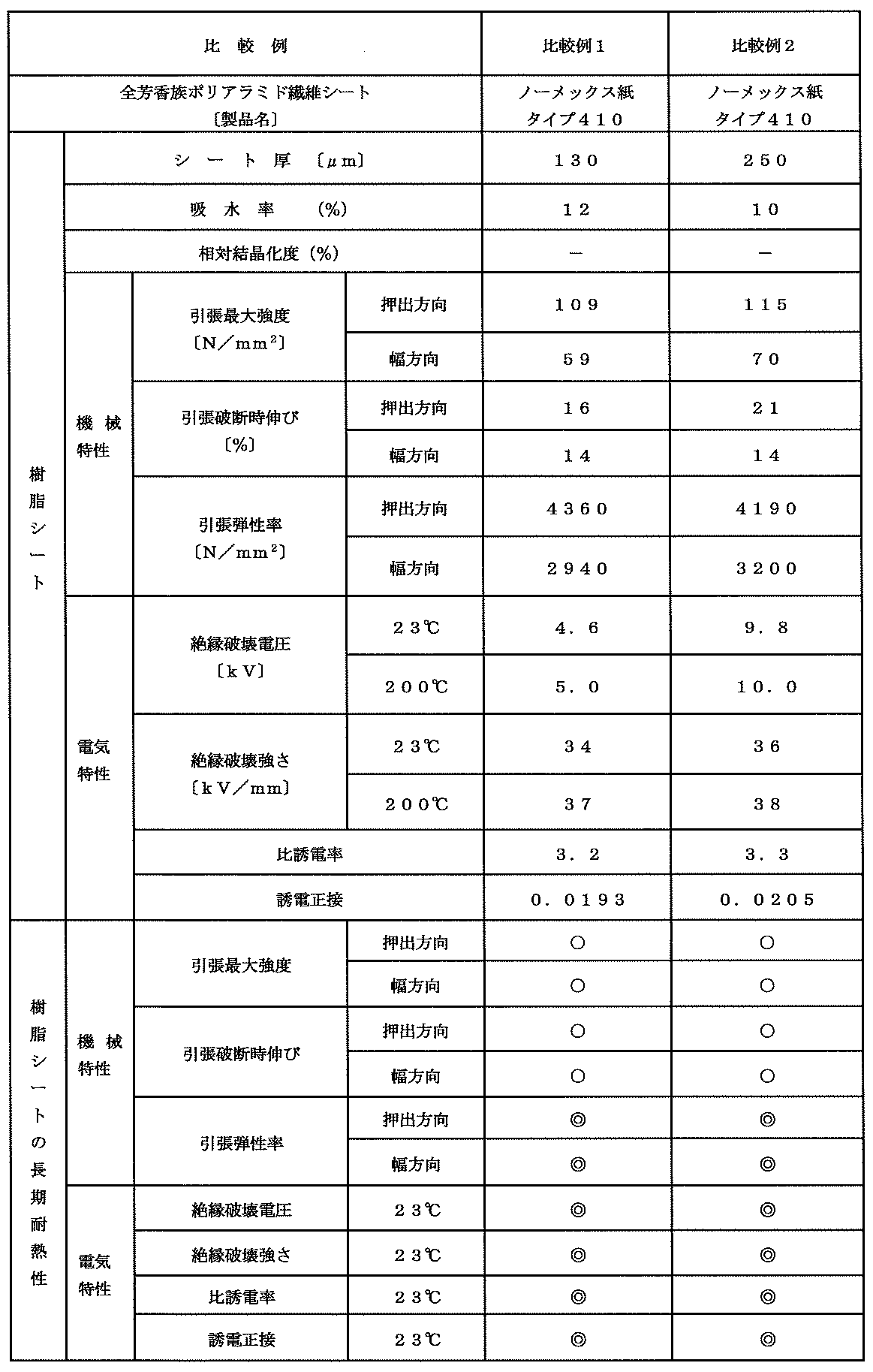
〔結 果〕
各実施例の絶縁材である樹脂シートの機械特性は、引張弾性率が3500N/mm2以上と高い剛性なので、樹脂シートを壁部材、区画部材、被覆部材に加工し、ステータのコアのスロット内に挿入すれば、座屈防止が期待できる。また、各実施例の樹脂シートは、引張最大強度が100N/mm2以上、かつ引張破断時伸びが200%以上ときわめて高い靱性を有しているので、壁部材、区画部材、被覆部材に加工してステータのコアのスロット内に挿入する場合、破断したり、割れたり、裂けてしまう等のトラブルを未然に防止することができる。
各実施例の絶縁材である樹脂シートの機械特性は、引張弾性率が3500N/mm2以上と高い剛性なので、樹脂シートを壁部材、区画部材、被覆部材に加工し、ステータのコアのスロット内に挿入すれば、座屈防止が期待できる。また、各実施例の樹脂シートは、引張最大強度が100N/mm2以上、かつ引張破断時伸びが200%以上ときわめて高い靱性を有しているので、壁部材、区画部材、被覆部材に加工してステータのコアのスロット内に挿入する場合、破断したり、割れたり、裂けてしまう等のトラブルを未然に防止することができる。
各実施例の絶縁材である樹脂シートの吸水率は、温度23℃おいて1.0%以下、具体的には0.7%以下であった。したがって、例えモータの使用環境が高温湿度環境下でも、絶縁破壊強度、絶縁破壊強さ、比誘電率、及び誘電正接等の電気特性を維持することができる。
各実施例の樹脂シートの23℃及び200℃のシリコーン油中の電気絶縁性質は、絶縁破壊電圧に関しては9kV以上、単位厚さ当たりの絶縁破壊電圧である絶縁破壊強さに関しては50kV/mm以上、しかも、23℃における比誘電率に関しては3.0以下であるので、サージ電圧による絶縁破壊の防止性能に優れていると推測される。また、誘電正接が0.003以下なので、自己発熱による溶融や熱分解の排除が期待できる。
各実施例の樹脂シートの長期耐熱性は、200℃の熱風オーブン中に静置前後で機械特性の変化率が20%以下、電気絶縁性の変化率が10%以下であった。したがって、モータに実施例の樹脂シートを使用すれば、優れた長期耐熱性が期待できる。
これに対し、各比較例の全芳香族ポリアラミド繊維シートの機械特性は、引張破断時伸びが80%未満で靱性に問題があり、しかも、引張弾性率の幅方向が3500N/mm2未満で剛性が不十分であった。したがって、全芳香族ポリアラミド繊維シートを壁部材、区画部材、被覆部材に加工してステータのコアのスロットに内に挿入する場合、座屈のおそれが少なくないと推測される。また、各比較例の全芳香族ポリアラミド繊維シートの吸水率は、10%以上ときわめて高いので、電気絶縁性が使用環境の影響を大きく受けるおそれがあると推測される。
また、各比較例の全芳香族ポリアラミド繊維シートの電気絶縁性は、単位厚さ当たりの絶縁破壊電圧である絶縁破壊強さに関して40kV/mm以下なので、サージ電圧による絶縁破壊の問題が発生すると推測される。さらに、各比較例の全芳香族ポリアラミド繊維シートは、誘電正接が0.019以上なので、自己発熱による溶融や熱分解のおそれが推測される。
本発明に係る回転電機用絶縁材及び回転電機は、電気、電子、自動車、鉄道車両等の製造分野で利用される。
1 回転電機
2 モータ
3 ステータ
4 コア
5 スロット
7 導電巻線
10 絶縁材
11 ポリアリーレンエーテルケトン樹脂シート
14 壁部材
15 区画部材
16 被覆部材
20 溶融押出成形機
23 Tダイス(ダイス)
26 冷却ロール
27 圧着ロール
28 巻取機
M 成形材料
2 モータ
3 ステータ
4 コア
5 スロット
7 導電巻線
10 絶縁材
11 ポリアリーレンエーテルケトン樹脂シート
14 壁部材
15 区画部材
16 被覆部材
20 溶融押出成形機
23 Tダイス(ダイス)
26 冷却ロール
27 圧着ロール
28 巻取機
M 成形材料
Claims (7)
- ポリアリーレンエーテルケトン樹脂シートからなる回転電機用絶縁材であり、ポリアリーレンエーテルケトン樹脂シートの電気特性は、シリコーン油中の単位厚さ当たりの絶縁破壊強さが40kV/mm以上、周波数1GHzにおける比誘電率が3.1以下、誘電正接が0.01以下であることを特徴とする回転電機用絶縁材。
- ポリアリーレンエーテルケトン樹脂シートは、ポリエーテルエーテルケトン樹脂シートである請求項1記載の回転電機用絶縁材。
- ポリアリーレンエーテルケトン樹脂シートの機械特性は、引張弾性率が3000N/mm2以上である請求項1又は2記載の回転電機用絶縁材。
- ポリアリーレンエーテルケトン樹脂シートの機械特性は、引張最大強度が80N/mm2以上、かつ引張破断時伸びが80%以上である請求項1、2、又は3記載の回転電機用絶縁材。
- ポリアリーレンエーテルケトン樹脂シートの吸水率は、23℃で1.0%以下である請求項1ないし4のいずれかに記載の回転電機用絶縁材。
- 回転電機のステータとロータの少なくともいずれか一方に凹み形成されたスロットに、導電巻線を収納する略U字形のポリアリーレンエーテルケトン樹脂シートを挿入してその厚さを50μm以上1000μm以下とし、このポリアリーレンエーテルケトン樹脂シートを、スロットと導電巻線との間に介在する絶縁性の壁部材とした請求項1ないし5のいずれかに記載の回転電機用絶縁材。
- 請求項1ないし6のいずれかに記載の回転電機用絶縁材を有することを特徴とする回転電機。
Priority Applications (1)
| Application Number | Priority Date | Filing Date | Title |
|---|---|---|---|
| JP2020568196A JP7466465B2 (ja) | 2019-01-24 | 2020-01-23 | 回転電機用絶縁材及び回転電機 |
Applications Claiming Priority (2)
| Application Number | Priority Date | Filing Date | Title |
|---|---|---|---|
| JP2019-010084 | 2019-01-24 | ||
| JP2019010084 | 2019-01-24 |
Publications (1)
| Publication Number | Publication Date |
|---|---|
| WO2020153426A1 true WO2020153426A1 (ja) | 2020-07-30 |
Family
ID=71736290
Family Applications (1)
| Application Number | Title | Priority Date | Filing Date |
|---|---|---|---|
| PCT/JP2020/002325 Ceased WO2020153426A1 (ja) | 2019-01-24 | 2020-01-23 | 回転電機用絶縁材及び回転電機 |
Country Status (2)
| Country | Link |
|---|---|
| JP (1) | JP7466465B2 (ja) |
| WO (1) | WO2020153426A1 (ja) |
Cited By (2)
| Publication number | Priority date | Publication date | Assignee | Title |
|---|---|---|---|---|
| JP2022157894A (ja) * | 2021-03-31 | 2022-10-14 | 三菱ケミカル株式会社 | 積層フィルム、基板用積層体、回路基板、及び電子機器 |
| WO2025191965A1 (ja) * | 2024-03-14 | 2025-09-18 | サンデン株式会社 | 電動圧縮機用モータ及びそれを備えた電動圧縮機 |
Citations (4)
| Publication number | Priority date | Publication date | Assignee | Title |
|---|---|---|---|---|
| JP2013508491A (ja) * | 2009-10-21 | 2013-03-07 | エボニック デグサ ゲーエムベーハー | ポリアリーレンエーテルケトンより成るフィルム |
| JP2017050964A (ja) * | 2015-09-01 | 2017-03-09 | ジョンソンコントロールズ ヒタチ エア コンディショニング テクノロジー(ホンコン)リミテッド | 電動機の固定子、電動機および空調機器 |
| JP2018068104A (ja) * | 2017-11-02 | 2018-04-26 | デュポン帝人アドバンスドペーパー株式会社 | モータ用ボビン及びその製造方法 |
| JP2018203979A (ja) * | 2017-01-30 | 2018-12-27 | Agc株式会社 | 組成物から作られる物品 |
Family Cites Families (3)
| Publication number | Priority date | Publication date | Assignee | Title |
|---|---|---|---|---|
| JP2005151684A (ja) * | 2003-11-14 | 2005-06-09 | Matsushita Electric Ind Co Ltd | 回転電機固定子、及びそれを用いた密閉型圧縮機 |
| JPWO2015105095A1 (ja) * | 2014-01-10 | 2017-03-23 | 古河電気工業株式会社 | 絶縁電線、コイルおよび電気・電子機器ならびに絶縁電線の割れ防止方法 |
| JP6135541B2 (ja) * | 2014-02-17 | 2017-05-31 | 旭硝子株式会社 | フッ素樹脂組成物の製造方法、成形品の製造方法及び電線の製造方法 |
-
2020
- 2020-01-23 WO PCT/JP2020/002325 patent/WO2020153426A1/ja not_active Ceased
- 2020-01-23 JP JP2020568196A patent/JP7466465B2/ja active Active
Patent Citations (4)
| Publication number | Priority date | Publication date | Assignee | Title |
|---|---|---|---|---|
| JP2013508491A (ja) * | 2009-10-21 | 2013-03-07 | エボニック デグサ ゲーエムベーハー | ポリアリーレンエーテルケトンより成るフィルム |
| JP2017050964A (ja) * | 2015-09-01 | 2017-03-09 | ジョンソンコントロールズ ヒタチ エア コンディショニング テクノロジー(ホンコン)リミテッド | 電動機の固定子、電動機および空調機器 |
| JP2018203979A (ja) * | 2017-01-30 | 2018-12-27 | Agc株式会社 | 組成物から作られる物品 |
| JP2018068104A (ja) * | 2017-11-02 | 2018-04-26 | デュポン帝人アドバンスドペーパー株式会社 | モータ用ボビン及びその製造方法 |
Cited By (3)
| Publication number | Priority date | Publication date | Assignee | Title |
|---|---|---|---|---|
| JP2022157894A (ja) * | 2021-03-31 | 2022-10-14 | 三菱ケミカル株式会社 | 積層フィルム、基板用積層体、回路基板、及び電子機器 |
| JP7775575B2 (ja) | 2021-03-31 | 2025-11-26 | 三菱ケミカル株式会社 | 積層フィルム、基板用積層体、回路基板、及び電子機器 |
| WO2025191965A1 (ja) * | 2024-03-14 | 2025-09-18 | サンデン株式会社 | 電動圧縮機用モータ及びそれを備えた電動圧縮機 |
Also Published As
| Publication number | Publication date |
|---|---|
| JPWO2020153426A1 (ja) | 2021-12-02 |
| JP7466465B2 (ja) | 2024-04-12 |
Similar Documents
| Publication | Publication Date | Title |
|---|---|---|
| CN107112081B (zh) | 耐弯曲加工性优异的绝缘电线、使用其的线圈和电子/电气设备 | |
| EP3089167B1 (en) | Insulating wire and method for manufacturing insulating wire | |
| EP2843669B1 (en) | Invertor-surge resistant insulated wire | |
| US11217364B2 (en) | Insulated wire, coil, and electric/electronic equipments | |
| CN109074909B (zh) | 绝缘电线、线圈和电气/电子设备 | |
| CN107004466B (zh) | 绝缘电线、线圈和电气/电子设备以及绝缘电线的制造方法 | |
| CN104321833B (zh) | 磁漆树脂绝缘层积体和使用该磁漆树脂绝缘层积体的绝缘线及电气/电子设备 | |
| CN107077922B (zh) | 绝缘电线和旋转电机 | |
| EP3089168A1 (en) | Insulated wire, coil, electrical/electronic apparatus, and method for manufacturing insulated wire in which coating film separation is prevented | |
| CN107004465B (zh) | 绝缘电线、线圈和电气/电子设备以及绝缘电线的制造方法 | |
| US11708491B2 (en) | Polymeric insulating films | |
| JP5931097B2 (ja) | 絶縁電線およびその製造方法、ならびに回転電機およびその製造方法 | |
| KR20160133518A (ko) | 절연전선, 절연전선의 제조방법, 회전 전기기기용 스테이터의 제조방법 및 회전 전기기기 | |
| EP3089170B1 (en) | Multilayer insulated wire, coil and electrical/electronic equipment | |
| EP3389060A1 (en) | Insulated wire, coil and electrical/electronic device | |
| EP4576125A1 (en) | Insulated electric wire, manufacturing method therefor, and coil, rotary electric machine, and electrical and electronic equipment using said insulated electric wire | |
| WO2020153426A1 (ja) | 回転電機用絶縁材及び回転電機 | |
| JP2020098717A (ja) | 導電素線用樹脂フィルム及びその製造方法並びに平角電線 | |
| JP2025095427A (ja) | 絶縁電線、コイル、回転電機及び電気・電子機器 | |
| JP7743383B2 (ja) | 絶縁電線、コイル、電気・電子機器、及び電気・電子機器の製造方法 | |
| JP7737888B2 (ja) | 導電素線用樹脂フィルム及びその製造方法並びに絶縁電線 | |
| JP2025017767A (ja) | 回転電機用絶縁材及び回転電機 | |
| JP2024170130A (ja) | 回転電機用絶縁材及び回転電機 | |
| JP2022029225A (ja) | 導電素線用樹脂フィルム及びその製造方法並びに平角電線 | |
| JP7257558B1 (ja) | 絶縁電線、コイル、回転電機および電気・電子機器 |
Legal Events
| Date | Code | Title | Description |
|---|---|---|---|
| 121 | Ep: the epo has been informed by wipo that ep was designated in this application |
Ref document number: 20744518 Country of ref document: EP Kind code of ref document: A1 |
|
| ENP | Entry into the national phase |
Ref document number: 2020568196 Country of ref document: JP Kind code of ref document: A |
|
| NENP | Non-entry into the national phase |
Ref country code: DE |
|
| 122 | Ep: pct application non-entry in european phase |
Ref document number: 20744518 Country of ref document: EP Kind code of ref document: A1 |