WO2020137429A1 - 吸収性物品 - Google Patents
吸収性物品 Download PDFInfo
- Publication number
- WO2020137429A1 WO2020137429A1 PCT/JP2019/047702 JP2019047702W WO2020137429A1 WO 2020137429 A1 WO2020137429 A1 WO 2020137429A1 JP 2019047702 W JP2019047702 W JP 2019047702W WO 2020137429 A1 WO2020137429 A1 WO 2020137429A1
- Authority
- WO
- WIPO (PCT)
- Prior art keywords
- absorbent
- sheet
- layer
- absorbent article
- pair
- Prior art date
- Legal status (The legal status is an assumption and is not a legal conclusion. Google has not performed a legal analysis and makes no representation as to the accuracy of the status listed.)
- Ceased
Links
Images




Classifications
-
- A—HUMAN NECESSITIES
- A61—MEDICAL OR VETERINARY SCIENCE; HYGIENE
- A61F—FILTERS IMPLANTABLE INTO BLOOD VESSELS; PROSTHESES; DEVICES PROVIDING PATENCY TO, OR PREVENTING COLLAPSING OF, TUBULAR STRUCTURES OF THE BODY, e.g. STENTS; ORTHOPAEDIC, NURSING OR CONTRACEPTIVE DEVICES; FOMENTATION; TREATMENT OR PROTECTION OF EYES OR EARS; BANDAGES, DRESSINGS OR ABSORBENT PADS; FIRST-AID KITS
- A61F13/00—Bandages or dressings; Absorbent pads
- A61F13/15—Absorbent pads, e.g. sanitary towels, swabs or tampons for external or internal application to the body; Supporting or fastening means therefor; Tampon applicators
- A61F13/53—Absorbent pads, e.g. sanitary towels, swabs or tampons for external or internal application to the body; Supporting or fastening means therefor; Tampon applicators characterised by the absorbing medium
- A61F13/534—Absorbent pads, e.g. sanitary towels, swabs or tampons for external or internal application to the body; Supporting or fastening means therefor; Tampon applicators characterised by the absorbing medium having an inhomogeneous composition through the thickness of the pad
-
- A—HUMAN NECESSITIES
- A61—MEDICAL OR VETERINARY SCIENCE; HYGIENE
- A61F—FILTERS IMPLANTABLE INTO BLOOD VESSELS; PROSTHESES; DEVICES PROVIDING PATENCY TO, OR PREVENTING COLLAPSING OF, TUBULAR STRUCTURES OF THE BODY, e.g. STENTS; ORTHOPAEDIC, NURSING OR CONTRACEPTIVE DEVICES; FOMENTATION; TREATMENT OR PROTECTION OF EYES OR EARS; BANDAGES, DRESSINGS OR ABSORBENT PADS; FIRST-AID KITS
- A61F13/00—Bandages or dressings; Absorbent pads
- A61F13/15—Absorbent pads, e.g. sanitary towels, swabs or tampons for external or internal application to the body; Supporting or fastening means therefor; Tampon applicators
-
- A—HUMAN NECESSITIES
- A61—MEDICAL OR VETERINARY SCIENCE; HYGIENE
- A61F—FILTERS IMPLANTABLE INTO BLOOD VESSELS; PROSTHESES; DEVICES PROVIDING PATENCY TO, OR PREVENTING COLLAPSING OF, TUBULAR STRUCTURES OF THE BODY, e.g. STENTS; ORTHOPAEDIC, NURSING OR CONTRACEPTIVE DEVICES; FOMENTATION; TREATMENT OR PROTECTION OF EYES OR EARS; BANDAGES, DRESSINGS OR ABSORBENT PADS; FIRST-AID KITS
- A61F13/00—Bandages or dressings; Absorbent pads
- A61F13/15—Absorbent pads, e.g. sanitary towels, swabs or tampons for external or internal application to the body; Supporting or fastening means therefor; Tampon applicators
- A61F13/15577—Apparatus or processes for manufacturing
-
- A—HUMAN NECESSITIES
- A61—MEDICAL OR VETERINARY SCIENCE; HYGIENE
- A61F—FILTERS IMPLANTABLE INTO BLOOD VESSELS; PROSTHESES; DEVICES PROVIDING PATENCY TO, OR PREVENTING COLLAPSING OF, TUBULAR STRUCTURES OF THE BODY, e.g. STENTS; ORTHOPAEDIC, NURSING OR CONTRACEPTIVE DEVICES; FOMENTATION; TREATMENT OR PROTECTION OF EYES OR EARS; BANDAGES, DRESSINGS OR ABSORBENT PADS; FIRST-AID KITS
- A61F13/00—Bandages or dressings; Absorbent pads
- A61F13/15—Absorbent pads, e.g. sanitary towels, swabs or tampons for external or internal application to the body; Supporting or fastening means therefor; Tampon applicators
- A61F13/45—Absorbent pads, e.g. sanitary towels, swabs or tampons for external or internal application to the body; Supporting or fastening means therefor; Tampon applicators characterised by the shape
- A61F13/49—Absorbent pads, e.g. sanitary towels, swabs or tampons for external or internal application to the body; Supporting or fastening means therefor; Tampon applicators characterised by the shape specially adapted to be worn around the waist, e.g. diapers, nappies
- A61F13/494—Absorbent pads, e.g. sanitary towels, swabs or tampons for external or internal application to the body; Supporting or fastening means therefor; Tampon applicators characterised by the shape specially adapted to be worn around the waist, e.g. diapers, nappies characterised by edge leakage prevention means
-
- A—HUMAN NECESSITIES
- A61—MEDICAL OR VETERINARY SCIENCE; HYGIENE
- A61F—FILTERS IMPLANTABLE INTO BLOOD VESSELS; PROSTHESES; DEVICES PROVIDING PATENCY TO, OR PREVENTING COLLAPSING OF, TUBULAR STRUCTURES OF THE BODY, e.g. STENTS; ORTHOPAEDIC, NURSING OR CONTRACEPTIVE DEVICES; FOMENTATION; TREATMENT OR PROTECTION OF EYES OR EARS; BANDAGES, DRESSINGS OR ABSORBENT PADS; FIRST-AID KITS
- A61F13/00—Bandages or dressings; Absorbent pads
- A61F13/15—Absorbent pads, e.g. sanitary towels, swabs or tampons for external or internal application to the body; Supporting or fastening means therefor; Tampon applicators
- A61F13/45—Absorbent pads, e.g. sanitary towels, swabs or tampons for external or internal application to the body; Supporting or fastening means therefor; Tampon applicators characterised by the shape
- A61F13/49—Absorbent pads, e.g. sanitary towels, swabs or tampons for external or internal application to the body; Supporting or fastening means therefor; Tampon applicators characterised by the shape specially adapted to be worn around the waist, e.g. diapers, nappies
- A61F13/494—Absorbent pads, e.g. sanitary towels, swabs or tampons for external or internal application to the body; Supporting or fastening means therefor; Tampon applicators characterised by the shape specially adapted to be worn around the waist, e.g. diapers, nappies characterised by edge leakage prevention means
- A61F13/49406—Absorbent pads, e.g. sanitary towels, swabs or tampons for external or internal application to the body; Supporting or fastening means therefor; Tampon applicators characterised by the shape specially adapted to be worn around the waist, e.g. diapers, nappies characterised by edge leakage prevention means the edge leakage prevention means being at the crotch region
-
- A—HUMAN NECESSITIES
- A61—MEDICAL OR VETERINARY SCIENCE; HYGIENE
- A61F—FILTERS IMPLANTABLE INTO BLOOD VESSELS; PROSTHESES; DEVICES PROVIDING PATENCY TO, OR PREVENTING COLLAPSING OF, TUBULAR STRUCTURES OF THE BODY, e.g. STENTS; ORTHOPAEDIC, NURSING OR CONTRACEPTIVE DEVICES; FOMENTATION; TREATMENT OR PROTECTION OF EYES OR EARS; BANDAGES, DRESSINGS OR ABSORBENT PADS; FIRST-AID KITS
- A61F13/00—Bandages or dressings; Absorbent pads
- A61F13/15—Absorbent pads, e.g. sanitary towels, swabs or tampons for external or internal application to the body; Supporting or fastening means therefor; Tampon applicators
- A61F13/45—Absorbent pads, e.g. sanitary towels, swabs or tampons for external or internal application to the body; Supporting or fastening means therefor; Tampon applicators characterised by the shape
- A61F13/49—Absorbent pads, e.g. sanitary towels, swabs or tampons for external or internal application to the body; Supporting or fastening means therefor; Tampon applicators characterised by the shape specially adapted to be worn around the waist, e.g. diapers, nappies
- A61F13/496—Absorbent pads, e.g. sanitary towels, swabs or tampons for external or internal application to the body; Supporting or fastening means therefor; Tampon applicators characterised by the shape specially adapted to be worn around the waist, e.g. diapers, nappies in the form of pants or briefs
-
- A—HUMAN NECESSITIES
- A61—MEDICAL OR VETERINARY SCIENCE; HYGIENE
- A61F—FILTERS IMPLANTABLE INTO BLOOD VESSELS; PROSTHESES; DEVICES PROVIDING PATENCY TO, OR PREVENTING COLLAPSING OF, TUBULAR STRUCTURES OF THE BODY, e.g. STENTS; ORTHOPAEDIC, NURSING OR CONTRACEPTIVE DEVICES; FOMENTATION; TREATMENT OR PROTECTION OF EYES OR EARS; BANDAGES, DRESSINGS OR ABSORBENT PADS; FIRST-AID KITS
- A61F13/00—Bandages or dressings; Absorbent pads
- A61F13/15—Absorbent pads, e.g. sanitary towels, swabs or tampons for external or internal application to the body; Supporting or fastening means therefor; Tampon applicators
- A61F13/51—Absorbent pads, e.g. sanitary towels, swabs or tampons for external or internal application to the body; Supporting or fastening means therefor; Tampon applicators characterised by the outer layers of the pads
- A61F13/511—Topsheet, i.e. the permeable cover or layer facing the skin
-
- A—HUMAN NECESSITIES
- A61—MEDICAL OR VETERINARY SCIENCE; HYGIENE
- A61F—FILTERS IMPLANTABLE INTO BLOOD VESSELS; PROSTHESES; DEVICES PROVIDING PATENCY TO, OR PREVENTING COLLAPSING OF, TUBULAR STRUCTURES OF THE BODY, e.g. STENTS; ORTHOPAEDIC, NURSING OR CONTRACEPTIVE DEVICES; FOMENTATION; TREATMENT OR PROTECTION OF EYES OR EARS; BANDAGES, DRESSINGS OR ABSORBENT PADS; FIRST-AID KITS
- A61F13/00—Bandages or dressings; Absorbent pads
- A61F13/15—Absorbent pads, e.g. sanitary towels, swabs or tampons for external or internal application to the body; Supporting or fastening means therefor; Tampon applicators
- A61F13/53—Absorbent pads, e.g. sanitary towels, swabs or tampons for external or internal application to the body; Supporting or fastening means therefor; Tampon applicators characterised by the absorbing medium
-
- A—HUMAN NECESSITIES
- A61—MEDICAL OR VETERINARY SCIENCE; HYGIENE
- A61F—FILTERS IMPLANTABLE INTO BLOOD VESSELS; PROSTHESES; DEVICES PROVIDING PATENCY TO, OR PREVENTING COLLAPSING OF, TUBULAR STRUCTURES OF THE BODY, e.g. STENTS; ORTHOPAEDIC, NURSING OR CONTRACEPTIVE DEVICES; FOMENTATION; TREATMENT OR PROTECTION OF EYES OR EARS; BANDAGES, DRESSINGS OR ABSORBENT PADS; FIRST-AID KITS
- A61F13/00—Bandages or dressings; Absorbent pads
- A61F13/15—Absorbent pads, e.g. sanitary towels, swabs or tampons for external or internal application to the body; Supporting or fastening means therefor; Tampon applicators
- A61F13/53—Absorbent pads, e.g. sanitary towels, swabs or tampons for external or internal application to the body; Supporting or fastening means therefor; Tampon applicators characterised by the absorbing medium
- A61F13/534—Absorbent pads, e.g. sanitary towels, swabs or tampons for external or internal application to the body; Supporting or fastening means therefor; Tampon applicators characterised by the absorbing medium having an inhomogeneous composition through the thickness of the pad
- A61F13/535—Absorbent pads, e.g. sanitary towels, swabs or tampons for external or internal application to the body; Supporting or fastening means therefor; Tampon applicators characterised by the absorbing medium having an inhomogeneous composition through the thickness of the pad inhomogeneous in the plane of the pad, e.g. core absorbent layers being of different sizes
-
- A—HUMAN NECESSITIES
- A61—MEDICAL OR VETERINARY SCIENCE; HYGIENE
- A61F—FILTERS IMPLANTABLE INTO BLOOD VESSELS; PROSTHESES; DEVICES PROVIDING PATENCY TO, OR PREVENTING COLLAPSING OF, TUBULAR STRUCTURES OF THE BODY, e.g. STENTS; ORTHOPAEDIC, NURSING OR CONTRACEPTIVE DEVICES; FOMENTATION; TREATMENT OR PROTECTION OF EYES OR EARS; BANDAGES, DRESSINGS OR ABSORBENT PADS; FIRST-AID KITS
- A61F13/00—Bandages or dressings; Absorbent pads
- A61F13/15—Absorbent pads, e.g. sanitary towels, swabs or tampons for external or internal application to the body; Supporting or fastening means therefor; Tampon applicators
- A61F13/53—Absorbent pads, e.g. sanitary towels, swabs or tampons for external or internal application to the body; Supporting or fastening means therefor; Tampon applicators characterised by the absorbing medium
- A61F13/534—Absorbent pads, e.g. sanitary towels, swabs or tampons for external or internal application to the body; Supporting or fastening means therefor; Tampon applicators characterised by the absorbing medium having an inhomogeneous composition through the thickness of the pad
- A61F13/537—Absorbent pads, e.g. sanitary towels, swabs or tampons for external or internal application to the body; Supporting or fastening means therefor; Tampon applicators characterised by the absorbing medium having an inhomogeneous composition through the thickness of the pad characterised by a layer facilitating or inhibiting flow in one direction or plane, e.g. a wicking layer
-
- A—HUMAN NECESSITIES
- A61—MEDICAL OR VETERINARY SCIENCE; HYGIENE
- A61F—FILTERS IMPLANTABLE INTO BLOOD VESSELS; PROSTHESES; DEVICES PROVIDING PATENCY TO, OR PREVENTING COLLAPSING OF, TUBULAR STRUCTURES OF THE BODY, e.g. STENTS; ORTHOPAEDIC, NURSING OR CONTRACEPTIVE DEVICES; FOMENTATION; TREATMENT OR PROTECTION OF EYES OR EARS; BANDAGES, DRESSINGS OR ABSORBENT PADS; FIRST-AID KITS
- A61F13/00—Bandages or dressings; Absorbent pads
- A61F13/15—Absorbent pads, e.g. sanitary towels, swabs or tampons for external or internal application to the body; Supporting or fastening means therefor; Tampon applicators
- A61F13/53—Absorbent pads, e.g. sanitary towels, swabs or tampons for external or internal application to the body; Supporting or fastening means therefor; Tampon applicators characterised by the absorbing medium
- A61F13/539—Absorbent pads, e.g. sanitary towels, swabs or tampons for external or internal application to the body; Supporting or fastening means therefor; Tampon applicators characterised by the absorbing medium characterised by the connection of the absorbent layers with each other or with the outer layers
-
- A—HUMAN NECESSITIES
- A61—MEDICAL OR VETERINARY SCIENCE; HYGIENE
- A61F—FILTERS IMPLANTABLE INTO BLOOD VESSELS; PROSTHESES; DEVICES PROVIDING PATENCY TO, OR PREVENTING COLLAPSING OF, TUBULAR STRUCTURES OF THE BODY, e.g. STENTS; ORTHOPAEDIC, NURSING OR CONTRACEPTIVE DEVICES; FOMENTATION; TREATMENT OR PROTECTION OF EYES OR EARS; BANDAGES, DRESSINGS OR ABSORBENT PADS; FIRST-AID KITS
- A61F13/00—Bandages or dressings; Absorbent pads
- A61F13/15—Absorbent pads, e.g. sanitary towels, swabs or tampons for external or internal application to the body; Supporting or fastening means therefor; Tampon applicators
- A61F13/53—Absorbent pads, e.g. sanitary towels, swabs or tampons for external or internal application to the body; Supporting or fastening means therefor; Tampon applicators characterised by the absorbing medium
- A61F2013/530481—Absorbent pads, e.g. sanitary towels, swabs or tampons for external or internal application to the body; Supporting or fastening means therefor; Tampon applicators characterised by the absorbing medium having superabsorbent materials, i.e. highly absorbent polymer gel materials
Definitions
- the present disclosure relates to absorbent articles.
- Patent Document 1 discloses a water-absorbent sheet having a structure in which an absorbent layer containing a water-absorbent resin and an adhesive is sandwiched between hydrophilic nonwoven fabrics, and satisfies the following requirements (1) and (2): A structure in which the absorbent layer is divided into a primary absorbent layer and a secondary absorbent layer by a base material layer in which two or more layers of a breathable base material are adhered and laminated with an adhesive, Water-absorbent sheet: (1) The basis weight of the base material layer is 25 g/m 2 or more, and (2) the amount of the adhesive between the air-permeable base materials is 0.1 to 50 g/m 2. It is described that they are bonded.
- the base layer is (i) a water-absorbent resin (superabsorbent polymer) due to a poor liquid absorption rate, Due to the function of temporarily storing the reached liquid and (ii) the ease of blocking by the water absorbent resin (super absorbent polymer), the absorbency of the water absorbent sheet (absorbent body) and eventually the absorbent article containing it is reduced. It has the function of suppressing this.
- the water-absorbent sheet (absorbent body) described in Patent Document 1 tends to have difficulty in securing a space in which the water-absorbent resin (superabsorbent polymer) expands when the liquid is repeatedly absorbed, and thus has a repeated absorbability. It tended to be inferior. Therefore, an object of the present disclosure is to provide an absorbent article having excellent repeated absorbability.
- the present disclosure is an absorbent article having a liquid-permeable sheet, a liquid-impermeable sheet, and an absorber between them, which is an absorbent article having a longitudinal direction, a width direction, and a thickness direction,
- the absorbent body, in the thickness direction comprises an intermediate layer and an absorbent layer containing a superabsorbent polymer, the absorbent body, in the width direction, a width including a longitudinal centerline of the absorbent article.
- the intermediate layer is a first sheet portion far from the absorbent layer, and a second sheet portion close to the absorbent layer And the first sheet portion is in contact with the absorbent layer in the widthwise central region, and in the pair of widthwise adjacent regions, on the liquid impermeable sheet side of the first sheet portion.
- the present inventors have found an absorbent article characterized in that the second sheet portion is not connected to existing members and is in contact with the absorbent layer in the pair of widthwise adjacent regions.
- the absorbent article of the present disclosure has excellent repeated absorbability.
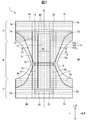
- FIG. 1 is a front view of a pants-type diaper 1 according to the first embodiment in a developed state.
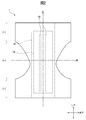
- FIG. 2 is a rear view of the pants-type diaper 1 in the unfolded state.
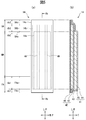
- FIG. 3 is a sectional view of the pants-type diaper 1 taken along the line III-III in FIG.
- FIG. 4 is a cross-sectional view of the absorber 14 taken along the line III-III in FIG.
- FIG. 5 is a diagram for explaining the absorber 14.
- FIG. 6 is a diagram for explaining the absorber 14.
- FIG. 7 is a diagram for explaining the absorber 14.
- FIG. 8 is a diagram for explaining the pants-type diaper according to the second embodiment.
- the absorbent body, in the thickness direction comprises an intermediate layer and an absorbent layer containing a superabsorbent polymer,
- the absorbent body, in the widthwise direction is divided into a widthwise central region including a longitudinal centerline of the absorbent article and a pair of widthwise adjacent regions adjacent to the widthwise central region.
- the intermediate layer comprises a first sheet portion far from the absorbent layer and a second sheet portion near the absorbent layer,
- the first sheet portion is in contact with the absorbent layer in the widthwise central region, and is connected to a member existing on the liquid impermeable sheet side of the first sheet portion in the pair of widthwise adjacent regions.
- Not The second sheet portion is in contact with the absorbent layer in the pair of widthwise adjacent regions, The absorbent article described above.
- the first sheet portion is in contact with the absorbent layer in the widthwise central region, and in the pair of widthwise adjacent regions, a member existing on the liquid impermeable sheet side of the first sheet portion. Since the second sheet portions are not connected to each other and are in contact with the absorbent layer in the pair of widthwise adjacent regions, a portion corresponding to the widthwise central region of the absorbent layer (hereinafter, referred to as "widthwise central portion"). ) Absorbs the liquid, and the central portion in the width direction of the absorbent layer bulges in the thickness direction, the first sheet portion rises accordingly, and the first sheet portion and the second sheet portion are separated from each other. Voids can be formed between them.
- the absorbent article repeatedly absorbs the liquid, the intermediate layer, while temporarily storing the liquid, the liquid is diffused from the widthwise central region to the pair of widthwise adjacent regions, and in the absorbing layer, on demand.
- the portions corresponding to the pair of width-direction adjacent regions of the absorption layer (hereinafter, referred to as “width-direction adjacent portions”) absorb the liquid and expand, and thus may expand toward the voids. Therefore, the absorbent article is less likely to hinder the liquid absorbency. As described above, the absorbent article has excellent repeated absorbability.
- the absorbent article since the first sheet portion and the second sheet portion are formed of a predetermined integral intermediate sheet, the voids are easily formed by the restoring force of the integral intermediate sheet at the folding shaft. Therefore, the absorbent article is excellent in repeated absorbability.
- the intermediate layer is formed of an integral intermediate sheet that extends in the longitudinal direction and is folded in the thickness direction at two folding axes that are separated from each other, and the first sheet portion is Aspect 1 or 2, wherein the second intermediate portion is disposed inside the two folding shafts of the integral intermediate sheet, and the second sheet portion is disposed outside of the two folding axes of the integral intermediate sheet. Absorbent article.
- the first sheet portion and the second sheet portion are formed of a predetermined integral intermediate sheet, so that the voids are easily formed by the restoring force of the integral intermediate sheets at the two folding axes. Become. Further, when the absorbent article is worn by the thighs of the wearer when the absorbent article is applied with a force to narrow the absorbent article in the width direction, the two folding axes are also applied with a force to reduce the absorbent article in the width direction, and thus the gap is formed. It is easily formed. Therefore, the absorbent article is excellent in repeated absorbability.
- Each of the intermediate layer and the adjacent sheet adjacent to the liquid permeable sheet side of the first sheet portion includes a fiber, and the fiber diameter of the fibers forming the first sheet portion forms the adjacent sheet.
- the absorbent article since the fiber diameter of the fiber forming the first sheet portion is larger than the fiber diameter of the fiber forming the adjacent sheet, the restoring force of the integral intermediate sheet at the folding axis (two folding axes) is increased. It becomes larger, the voids are easily formed, and the absorbent article is excellent in repeated absorbability.
- the intermediate layer is disposed on the liquid permeable sheet side of the absorbent layer, the absorber, the intermediate layer, the liquid permeable sheet side, an additional absorbent layer containing a super absorbent polymer.
- the absorbent body has two absorbent layers (an absorbent layer and an additional absorbent layer) with the intermediate layer sandwiched therebetween, so that when the liquid is repeatedly absorbed, the two absorbent layers have an intermediate thickness. Since it is possible to expand toward the voids formed in the layer, the absorbent article is unlikely to impair the liquid absorbency. As described above, the absorbent article has excellent repeated absorbability.
- the absorbent article since the absorbent layer has a predetermined channel in the widthwise central portion, the liquid reaching the absorbent layer is likely to stay between the pair of channels, and the widthwise central portion of the absorbent layer is It easily rises and the above voids are easily generated. Therefore, the absorbent article is excellent in repeated absorbability.
- the end portion of the second sheet portion overlaps the pair of channels in the thickness direction. Since the pair of channels has a relatively smaller basis weight of the absorbent layer than the portions other than the pair of channels, when the absorbent layer absorbs liquid and rises in the thickness direction, the pair of channels themselves are It is less likely to bulge relatively in the thickness direction than the portion other than the channel. Therefore, in the absorbent article, when the absorbent layer absorbs the liquid and rises (swells) in the thickness direction together with the first sheet portion, the second sheet portion causes the absorbent sheet to swell in the thickness direction. It is hard to bulge, and a void is more likely to be formed between the first sheet portion and the second sheet portion. Therefore, the absorbent article is excellent in repeated absorbability.
- the absorbent article since the first sheet portion is in contact with the absorbent layer only between the pair of channels, the first sheet portion is appropriately raised when the widthwise central portion of the absorbent layer is raised. A void is more likely to occur between the first sheet portion and the second sheet portion. Therefore, the absorbent article is excellent in repeated absorbability.
- the absorbent body since the intermediate layer has the predetermined joint portion, the absorbent body does not easily twist even after the absorbent article repeatedly absorbs the liquid.
- the absorbent body since the joint is the embossed section, the absorbent body does not easily twist even after the absorbent article repeatedly absorbs the liquid.
- FIG. 1 to 7 are diagrams for explaining an absorbent article according to one of the embodiments of the present disclosure (hereinafter, referred to as a first embodiment), specifically, a pants-type diaper 1.
- FIG. 1 and FIG. 2 are a front view and a rear view of the pants-type diaper 1 in a developed state, respectively.
- FIG. 3 is a sectional view of the pants-type diaper 1 taken along the line III-III in FIG.
- FIG. 4 is a cross-sectional view of the absorber 14 taken along the line III-III in FIG. 5A and 5B are views for explaining the absorber 14,
- FIG. 5A is a plan view, and FIG.
- FIG. 5B is a cross-sectional view taken along the line Vb-Vb in FIG. 5A.
- Is. 6 and 7 are diagrams for explaining the mechanism by which the absorber 14 absorbs liquid. It should be noted that the drawings are schematic views, and in particular, in FIGS. 3 to 7, for understanding, the thickness in the thickness direction T is depicted to be thicker than the actual thickness.
- the pants-type diaper 1 has a longitudinal direction L, a width direction W, and a thickness direction T that are orthogonal to each other, and a longitudinal center line CL that passes through the center of the width direction W and extends in the longitudinal direction L.
- a width direction center line CW extending in the width direction W through the center of the longitudinal direction L.
- the direction and the side approaching the longitudinal centerline CL are defined as the inward direction and the inner side in the width direction W
- the direction and the side away from the longitudinal centerline CL are defined as the outward direction and the outer side in the width direction W, respectively.
- the direction and the side approaching the width-direction centerline CW are defined as the inward direction and the inner side in the longitudinal direction L
- the direction and the side moving away are the outward direction and the outer side in the longitudinal direction L, respectively.
- the side of the pants-type diaper 1 corresponding to the abdomen of the wearer in the longitudinal direction L is referred to as the front side in the longitudinal direction L, which is the front side in the longitudinal direction L, and the pants-type diaper corresponding to the back of the wearer.
- the side toward the edge 1 (the edge on the back side) is also referred to as the rear side of the longitudinal direction L.
- the “plan view” means that the pants-type diaper 1 in a state of being developed on a plane including the longitudinal direction L and the width direction W is viewed from above in the thickness direction T, and the “planar shape” is grasped in the plan view. Shape.
- the “planar direction” is an arbitrary direction parallel to the plane including the width direction W and the longitudinal direction L.
- “Skin side” and “non-skin side” respectively mean a side that is relatively closer to the wearer's skin surface and a side that is farther away in the thickness direction T when the pants-type diaper 1 is worn by the wearer. To do. These definitions are commonly used not only for the pants-type diaper 1 but also for the absorber of the pants-type diaper 1 and each material arranged on them.
- a member, a structure, a shape, etc. (hereinafter, referred to as “member or the like") is along the longitudinal direction L is not limited to the case where the member or the like is parallel to the longitudinal direction L, but also the component Dx of the member or the like in the longitudinal direction L. , Which is larger than the component Dy of the member or the like in the width direction W (Dx>Dy).
- the member and the like extending in the width direction W are not limited to the case where the member and the like are parallel to the width direction W, and the component Dy of the member and the like in the width direction W is greater than the component Dx of the member and the like in the longitudinal direction L. It also includes a large value (Dy>Dx).
- curve or the like For a member or the like having a shape of a curve, a curved surface or the like (hereinafter, referred to as “curve or the like”), the member or the like is evaluated as described above with respect to the tangent line of each point on the curve or the like.
- the pants-type diaper 1 has a plane direction P and a thickness direction T orthogonal to each other, and the plane direction P is the longitudinal direction L and the width direction W of the pants-type diaper 1.
- the pants-type diaper 1 is located between the abdominal part (abdominal waist belt) 2, the dorsal part (dorsal waist belt) 3, and the abdominal part 2 and the dorsal part 3 in the longitudinal direction L.
- an absorbent body 10 In the first embodiment, the pants-type diaper 1 further includes a crotch portion 4 located between the abdominal side portion 2 and the back side portion 3.
- the abdominal part 2 is a part that comes into contact with the abdomen of the wearer.
- the back side portion 3 is a portion that contacts the wearer's hip or back.
- the absorbent main body 10 is a portion that comes into contact with the wearer's crotch, and one end portion in the longitudinal direction L is laminated on the abdominal side portion 2 and the other end portion is laminated on the back side portion 3.
- the crotch portion 4 is a portion that supports the absorbent main body 10 from the non-skin side.
- Both ends 2a, 2a of the abdominal part 2 in the width direction W and both ends 3a, 3a of the back part 3 in the width direction W are joined along the longitudinal direction L, respectively, so that a pants-type diaper 1 is formed.
- a waist opening through which the wearer's waist passes is defined by the outer end 2e of the abdomen 2 in the longitudinal direction L and the outer end 3e of the back 3 in the longitudinal direction L. ..
- the pair of leg openings through which the wearer's legs pass is defined by the side portions 5e and 5e on both sides of the crotch portion 4 in the width direction W.
- abdominal part (abdominal waist belt) 2 and the dorsal part (dorsal waist belt) 3 are defined in the range of the longitudinal direction L where both ends 2a, 2a and both ends 3a, 3a are joined. Can be said.
- each of the abdominal side portion 2 and the dorsal side portion 3 has a rectangular shape that generally extends in the width direction W and is separated from each other in the longitudinal direction L. ..
- the crotch portion 4 is located between the ventral side portion 2 and the back side portion 3, and both side edges in the width direction W are recessed inward in the width direction W.
- the abdominal part 2, the crotch part 4, and the back part 3 are integrally formed with each other.
- the ventral portion 2, the crotch portion 4 and the back portion 3 are formed separately from each other.
- the pants-type diaper 1 includes the abdomen 2 and the back 3 and does not include the crotch 4.
- the abdominal part 2, the dorsal part 3 and the crotch part 4 are provided with a liquid-impermeable cover sheet (sheet member) 5.
- the cover sheet 5 includes a cover sheet 5a located on the skin side and a cover sheet 5b located on the non-skin side.
- the cover sheet 5a and the cover sheet 5b are laminated in the thickness direction T and are joined to each other with an adhesive or the like. Both ends in the longitudinal direction L of the cover sheet 5b are folded back to the skin side so as to cover both ends in the longitudinal direction L of the cover sheet 5a.
- the cover sheets 5b at the folded-back positions on the abdominal portion 2 and the back portion 3 respectively constitute the end portion 2e of the abdominal portion 2 and the end portion 3e of the back portion 3.
- the abdomen 2 and the back 3 have a plurality of waist gather elastic members 6a and 6b and a plurality of elastic members 7a and 7b between the cover sheet 5a and the cover sheet 5b, respectively.
- Prepare The plurality of elastic members 6a and 6b are arranged on the outer side and the inner side of the abdominal portion 2 in the longitudinal direction L, respectively.
- the plurality of elastic members 6a are arranged along the width direction W at intervals in the longitudinal direction L in the respective predetermined regions on both sides of the longitudinal center line CL.
- the predetermined region is a region from the end portion 2a to a portion inside the opposite end edges in the width direction W of the absorbent main body 10.
- the plurality of elastic members 6b extend from one end 2a to the other end 2a along the width direction W, and are arranged at intervals in the longitudinal direction L.
- the plurality of elastic members 7 a and 7 b are arranged on the outer side and the inner side of the back side portion 3 in the longitudinal direction L, respectively.
- the plurality of elastic members 7a are arranged at intervals in the longitudinal direction L along the width direction W in each predetermined region on both sides of the longitudinal center line CL.
- the predetermined region is a region from the end portion 3a to a portion inside the opposite end edges in the width direction W of the absorbent main body 10.
- the plurality of elastic members 7b extend from one end 3a to the other end 3a along the width direction W and are arranged at intervals in the longitudinal direction L.
- the plurality of elastic members 6a, 6b, 7a, 7b expand and contract the waist opening, and are exemplified by rubber thread.
- the abdominal part (abdominal waist belt) 2 and the dorsal part (dorsal waist belt) 3 are defined in the range of the longitudinal direction L in which the plurality of elastic members 6a, 6b, 7a, 7b are arranged. ..
- the pants-type diaper 1 is provided with a plurality of elastic members 8 for leg gathers from the crotch portion 4 to the back side portion 3 and the abdominal side portion 2.
- the plurality of elastic members 8 mainly extend along both ends of the crotch portion 4 in the width direction W along the longitudinal direction L.
- the plurality of elastic members 8 respectively expand and contract the pair of leg openings, and are exemplified by a rubber thread.
- the absorbent main body 10 has a substantially rectangular shape and is provided between the liquid permeable sheet 12, the liquid impermeable sheet 13, and the liquid permeable sheet 12 and the liquid impermeable sheet 13. And an absorbent body 14 that absorbs and holds liquid such as urine.
- the liquid-permeable sheet 12 include liquid-permeable nonwoven fabrics, woven fabrics, synthetic resin films having liquid-permeable holes formed therein, and composite sheets thereof.
- the liquid impermeable sheet 13 include liquid impermeable nonwoven fabrics, synthetic resin films, and composite sheets thereof, such as SMS nonwoven fabrics.
- the absorbent body 14 includes an absorbent core that absorbs and holds a liquid, and a core wrap that contains the absorbent core. Details of the absorber 14 will be described later.
- the absorbent body 14, the liquid-permeable sheet 12 and the liquid-impermeable sheet 13 are bonded to each other with an adhesive, and the liquid-permeable sheet 12 and the liquid-impermeable sheet 13 are bonded with an adhesive at their peripheral portions. It is joined.
- the adhesive include known materials for pants-type diapers, for example, hot melt adhesive.
- the shape of the absorbent main body 10 is not limited to the above example as long as it is a shape that is long in the longitudinal direction L, and examples thereof include a rectangular shape with rounded corners, a rectangular shape in which the short sides are convex curves outward, and an hourglass shape.
- the liquid-impermeable sheet 13 is omitted, and the non-skin side surface of the absorber 14 and the non-skin side surface of the peripheral portion of the liquid permeable sheet 12 are bonded to the cover sheet 5. There is.
- the absorbent main body 10 includes a pair of side sheets 17, 17 located on both sides in the width direction W on the skin side surface and extending in the longitudinal direction L.
- Each side sheet 17 has a leak preventive wall 16 and fixing regions 15 and 15.
- the fixing regions 15 and 15 are located at the front and rear ends of the side seat 17 in the longitudinal direction L, and are fixed to the skin-side surface of the absorbent main body 10.
- the leak preventive wall 16 is located between and adjacent to the front and rear fixing regions 15 in the longitudinal direction L of the side sheet 17, is adjacent to the fixing regions 15, and is provided on the skin side surface of the absorbent main body 10 in the width direction W.
- the outer edge is fixed, and the inner edge in the width direction W is not fixed.
- the leak-proof wall 16 and the fixing regions 15 and 15 are formed, for example, at the inner side portion of the side seat 17 in the width direction W, and the outer side portion of the side seat 17 in the width direction W is fixed to the absorbent main body 10. ..
- the pair of leak preventive walls 16 and 16 are arranged at both ends in the width direction W on the skin side of the absorbent main body 10 so as to face each other, and continuously extend along the longitudinal direction L.
- Each leak preventive wall 16 includes two elastic members 61 extending in the longitudinal direction L at the inner end in the width direction W.
- the elastic member 61 is exemplified by a rubber thread.
- Each of the pair of leak preventive walls 16 and 16 is formed of a hydrophobic sheet, for example, a hydrophobic nonwoven fabric.
- each of the pair of leakproof walls 16, 16 is formed of a hydrophilic sheet, for example, a hydrophilic non-woven fabric.
- the absorber 14 has a first absorption layer 41 arranged on the skin side, a second absorption layer 42 arranged on the non-skin side, and an intermediate part arranged between the first absorption layer 41 and the second absorption layer 42. And layer 43.
- the absorber 14 has a substantially rectangular planar shape extending in the longitudinal direction L.
- the absorbent body 14 has, in the width direction W, a width direction central region W C including the longitudinal center line CL of the pants-type diaper 1 and a pair of width direction adjacent regions W A adjacent to the width direction central region W C. Partitioned. It should be noted that, in the second absorbent layer 42, regions overlapping the widthwise central region W C and the pair of widthwise adjacent regions W A in the thickness direction T are respectively the second absorbent layer central portion 42 a and the second absorbent layer central region 42 a. It may be referred to as a 2-absorption layer adjacent portion 42b.
- the first absorbent layer 41 is arranged on the intermediate layer 43 side of the first base material 44 and the first base material 44, and includes a water-absorbent polymer. And a first water absorbent material 45 having a water absorbent material.
- the first absorbent layer 41 can be regarded as having the first water absorbent material 45 as the absorbent core portion and the first base material 44 (and the intermediate layer 43) as the core wrap.
- the first water absorbing material 45 is formed by applying an adhesive agent to at least one of the surface of the first base material 44 on the side of the intermediate layer 43 and the surface of the intermediate layer 43 on the side of the first base material 44. And is fixed to at least one of the intermediate layers 43.
- the water absorbent material of the first water absorbent material 45 is arranged in the first absorbent layer 41 with a substantially uniform basis weight.
- the first water absorbent material 45 has a substantially rectangular planar shape.
- the first base material 44 has a substantially rectangular planar shape and covers the first water absorbent material 45 from the skin side in a plan view, and the peripheral portion of the first base material 44 is slightly around the first water absorbent material 45. Extend outwards.
- the second absorbent layer 42 is disposed on the second base material 46 formed of a sheet having water retention and liquid diffusibility and on the intermediate layer 43 side with respect to the second base material 46, and absorbs water.
- the second absorbent layer 42 can be regarded as having the second water absorbent material 47 as the absorbent core portion and the second base material 46 (and the intermediate layer 43) as the core wrap.
- the second water absorbing material 47 is formed by applying an adhesive agent to at least one of the surface of the second base material 46 on the side of the intermediate layer 43 and the surface of the intermediate layer 43 on the side of the second base material 46. And is fixed to at least one of the intermediate layers 43.
- the water absorbent material of the second water absorbent material 47 is arranged in the second absorbent layer 42 with a substantially uniform basis weight except for the pair of channels 48, 48 (described later).
- the second water absorbent material 47 has a substantially rectangular planar shape that is slightly larger than the first water absorbent material 45 in the width direction W and the longitudinal direction L.
- the second base material 46 has a substantially rectangular planar shape and covers the second water absorbent material 47 from the non-skin side in a plan view, and the peripheral edge portion of the second base material 46 is surrounded by the second water absorbent material 47. It extends slightly outside. Both ends of the second base material 46 in the width direction W cover both side surfaces of the second water absorbent material 47, and also cover the skin-side surface of both ends of the first base material 44 in the width direction W. That is, on the skin-side surface of the end portion of the first absorbent layer 41 in the width direction W, the end portion of the second base material 46 in the width direction W and the end portion of the first base material 44 in the width direction W overlap each other. Have been joined.
- Both ends of the second base material 46 in the width direction W cover the side surfaces of the second water absorbent material 47 in the width direction W and further cover the side surfaces of the first base material 44 in the width direction W, whereby the second water absorbent material 47 is formed. Is sealed in the second absorbent layer 42 in the width direction W, and the first water absorbent material 45 is sealed in the first absorbent layer 41 in the width direction W.
- the first base material 44, the intermediate layer 43, and the second base material 46 are stacked and joined in the thickness direction T.
- the first water absorbent material 45 is enclosed in the first absorbent layer 41 by the first base material 44 and the intermediate layer 43 in the longitudinal direction L
- the second water absorbent material 47 is intermediate with the second base material 46 in the longitudinal direction L. It is enclosed in the second absorption layer 42 by the layer 43.
- the intermediate layer 43 has a substantially rectangular planar shape in a plan view, and has a low basis weight region LB having a relatively low basis weight and a pair of high basis weights having a relatively high basis weight. And a quantity region HB.
- the intermediate layer 43 includes a pair of high basis weight regions HB arranged at both ends in the width direction W and a low basis weight region LB arranged at the center in the width direction W.
- the intermediate layer 43 is composed of a single intermediate sheet 43S having liquid permeability (specifically, an air-through nonwoven fabric containing a core-sheath type composite fiber).
- the intermediate sheet 43S includes two folding shafts 103 and 104, and the two folding shafts 103 and the first sheet portion 43a disposed inside the folding shafts 104 and the two folding shafts 103 in the expanded state. And a pair of second sheet portions 43b, 43b arranged outside the folding shaft 104.
- the intermediate layer 43 is formed by folding a single intermediate sheet 43S by the two folding shafts 103 and 104 extending in the longitudinal direction L in the thickness direction T, specifically, the second absorbing layer 42 side. Has been done.
- the single intermediate sheet 43S is folded by the two folding shafts 103 and 104, and in the plane direction P, the pair of second sheet portions 43b and 43b is the first sheet portion 43a.
- the pair of second sheet portions 43b, 43b are arranged on both sides in the width direction W, and in the thickness direction T, are arranged on the second absorbent layer 42 side.
- the first sheet portion 43a is arranged at a position relatively far from the second absorbent layer 42
- each of the pair of second sheet portions 43b, 43b is relatively far from the second absorbent layer 42. It is located in a position.
- the first sheet portion 43a is in contact with the second absorbent layer 42 (second absorbent layer central portion 42a) in the widthwise central region W C , and is hot melt adhesive (not shown) to the second absorbent layer 42. It is connected to the (second absorption layer central portion 42a). Further, the first sheet portion 43a is a member existing on the liquid impermeable sheet side of the first sheet portion 43a in the pair of widthwise adjacent regions W A , specifically, the pair of second sheet portions 43b and 43b. Each of them is not connected with a hot melt adhesive. Each of the pair of second sheet portions 43b, 43b is in contact with the second absorbent layer 42 (second absorbent layer adjacent portion 42b) in the pair of widthwise adjacent regions W A , and the hot melt adhesive (not shown). Is connected to the second absorption layer 42 (second absorption layer adjacent portion 42b).
- a portion where the first sheet portion 43a and each of the pair of second sheet portions 43b and 43b overlap in the thickness direction T constitutes a pair of overlapping portions OP of the intermediate layer 43, and A portion of the sheet portion 43a that does not overlap the pair of second sheet portions 43b and 43b in the thickness direction T constitutes a non-overlapping portion NP.
- Each of the pair of overlapping parts OP corresponds to each of the pair of high basis weight regions HB, and the non-overlapping part NP corresponds to the low basis weight region LB.
- the intermediate sheet 43S has a net surface (not shown) in contact with the net (placement surface) when forming the air-through nonwoven fabric, and a non-net surface (not shown) opposite to the net. Is equipped with.
- the net surface has a relatively higher fiber density than the non-net surface. Since the intermediate sheet 43S is folded with the net surface inside, the intermediate layer 43 is configured such that the fiber density inside the intermediate layer 43 is higher than the fiber density on the skin side surface.
- the liquid drawn by the intermediate layer 43 can be easily transferred from the skin side surface to the inside and then to the clothing surface (not shown) by the capillary phenomenon, and thus the liquid transferred to the clothing surface of the intermediate layer 43. Can be easily transferred to the second absorption layer 42.
- the skin side surface (non-net surface) of the intermediate layer 43 having a relatively low fiber density can hold the first water absorbent material 45 contained in the first absorbent layer 41, and the holding property of the super absorbent polymer. Excellent in
- both end edges in the width direction W are sandwiched between and joined to both end portions in the width direction W of the first base material 44 and the second base material 46, and both ends in the longitudinal direction L.
- the edges are sandwiched between and joined to both ends of the first base material 44 and the second base material 46 in the longitudinal direction L.
- the absorber 14 has a pair of channels 48, 48 extending along the longitudinal direction L.
- the pair of channels 48, 48 are arranged in the second absorption layer 42, extend in the longitudinal direction L, and are strip-shaped regions arranged at predetermined intervals on both sides in the width direction W with the longitudinal centerline CL interposed therebetween. Is.
- the channel 48 is arranged at least at the center of the second absorption layer 42 in the longitudinal direction L so as to straddle the width-direction center line CW.
- Each of the pair of channels 48, 48 is arranged in the second absorption layer 42 (second absorption layer central portion 42a) in the widthwise central region W C.
- Each of the pair of channels 48, 48 is an area in which the basis weight of the second water-absorbent material 47 is smaller than the area around each of the pair of channels 48, 48 (the peripheral area in the second absorbent layer central portion 42a). Is.
- Each of the pair of channels 48, 48 is formed such that the second base material 46 is recessed toward the intermediate layer 43 side, that is, the second water absorbing material 47 is recessed toward the intermediate layer 43 side.
- Each of the pair of channels 48, 48 is arranged so as to overlap the pair of high basis weight regions HB (the pair of overlapping portions OP) of the intermediate layer 43 in the thickness direction T.
- the first water-absorbing material 45 and the second water-absorbing material 47 include super absorbent polymer (Super Absorber Polymer; SAP).
- SAP Super Absorber Polymer
- the basis weight of the superabsorbent polymer of each of the first water absorbent material 45 and the second water absorbent material 47 can be appropriately adjusted according to the absorption performance required for the pants-type diaper 1, but for example, each is 10 to 500 g/m 2. 2 , and preferably 100 to 400 g/m 2 .
- the first water absorbent material 45 and the second water absorbent material 47 may be larger than the other, or may be the same. However, “equal” means a range where one is within ⁇ 30% of the other.
- the first water absorbent material 45 and the second water absorbent material 47 may further include hydrophilic fibers such as water absorbent fibers (for example, pulp fibers).
- the ratio of the super absorbent polymer in the first water absorbent material 45 and the second water absorbent material 47 is, for example, 80 to 100% by mass, preferably 90 to 100% by mass, and more preferably 95 to 100% by mass. is there. Therefore, it can be said that the first water absorbent material 45 and the second water absorbent material 47 contain the super absorbent polymer as a main component, and the absorber 14 can be called a so-called SAP sheet.
- a ratio of the super absorbent polymer in the absorber 14 (including not only the first water absorbing material 45 and the second water absorbing material 47, but also the adhesive, the first base material 44, the intermediate layer 43, and the second base material 46). Is, for example, 40 to 80% by mass, preferably 50 to 80% by mass, and more preferably 60 to 80% by mass.
- each of the first water-absorbing material 45 and the second water-absorbing material 47 is composed only of a super absorbent polymer and does not contain hydrophilic fibers.
- the superabsorbent polymer preferably has 90 to 100% by mass of superabsorbent polymer particles having a particle diameter of 150 to 500 ⁇ m.
- the superabsorbent polymer particles having the above particle size have a small particle size and are uniform, so that they are easily held by the adhesive.
- the particle size of the superabsorbent polymer particles is measured according to the sieving test method described in JIS R 6002:1998.
- the adhesive is not particularly limited as long as it is an adhesive that can fix the superabsorbent polymer, and examples thereof include hot melt adhesives.
- the application pattern of the adhesive is not particularly limited, and examples thereof include a continuous or intermittent omega pattern, a spiral pattern, and a line pattern.
- the basis weight of the adhesive may be appropriately adjusted so that the liquid absorbency of the absorbent body 14 is not significantly reduced, and examples thereof include 3 to 50 g/m 2 for each layer.
- each layer is an adhesive layer between the first water absorbing material 45 and the first base material 44, an adhesive layer between the first water absorbing material 45 and the intermediate layer 43, and a second water absorbing material 47 and the second water absorbing material 47. It means an adhesive layer between the second base material 46 and the adhesive layer between the second water absorbing material 47 and the intermediate layer 43.
- the first base material 44 is not particularly limited as long as it is a sheet having liquid permeability.
- the first base material 44 include a liquid-permeable non-woven fabric containing synthetic fibers, a hydrophilic non-woven fabric, and a laminated non-woven fabric thereof, among which a non-woven fabric having high water permeability is preferable.
- the first base material 44 include polyolefin fibers such as polyethylene (PE) and polypropylene (PP), polyester fibers such as polyethylene terephthalate (PET), polytrimethylene terephthalate (PTT), and polyethylene naphthalate (PEN). , Or a spunbonded non-woven fabric, an air-through non-woven fabric and the like formed from a combination thereof.
- the synthetic fibers are preferably hydrophilized by a known method.
- the sheet having liquid permeability is, for example, pulp fiber, hydrophilic fiber such as rayon fiber, an air-laid nonwoven fabric coated with a hydrophilic binder, the hydrophilic fiber, a nonwoven fabric in which the synthetic fiber is combined, for example, a spun. It can be a lace nonwoven.
- an air-laid non-woven fabric in which pulp fibers having liquid permeability and liquid holding property are coated with a hydrophilic binder is used.
- the first base material 44 may be formed by laminating a plurality of non-woven fabrics of one or more types among the above-mentioned non-woven fabrics.
- the basis weight of the first base material 44 is, for example, 10 to 100 g/m 2 , and preferably 20 to 80 g/m 2 .
- the thickness of the first base material 44 is, for example, 0.1 to 5 mm, and preferably 0.15 to 3 mm.
- the second base material 46 is not particularly limited as long as it is a sheet having water retention and liquid diffusion properties.
- the second base material 46 is formed of, for example, synthetic fiber such as polyamide fiber, regenerated fiber such as rayon fiber, acetate fiber, natural fiber such as cotton, silk, hemp, pulp (cellulose) fiber, or a combination thereof.
- the non-woven fabric is used.
- examples of the second base material 46 include spunbonded nonwoven fabric containing nylon, spunlace nonwoven fabric containing rayon fibers and/or pulp fibers, and the like.
- the spunlaced nonwoven fabric containing rayon fibers and/or pulp fibers may contain polyolefin fibers and/or polyester fibers.
- a spunlace nonwoven fabric containing rayon fibers and pulp fibers which has liquid retaining properties and liquid diffusing properties, is used.
- the second base material 46 may be composed of one of the above-mentioned nonwoven fabrics, and may be a laminate of a plurality of the above-mentioned nonwoven fabrics.
- the basis weight of the second base material 46 is, for example, 10 to 200 g/m 2 , and preferably 35 to 150 g/m 2 .
- the thickness of the second base material 46 is, for example, 0.1 to 5 mm, and preferably 0.15 to 3 mm.
- Examples of the intermediate layer 43 include a sheet similar to the first base material 44.
- the basis weight of the intermediate layer 43 is, for example, 10 to 100 g/m 2 , and preferably 15 to 80 g/m 2 .
- the thickness of the intermediate layer 43 is, for example, 0.1 to 5 mm, and preferably 0.15 to 3 mm.
- the absorbent body 14 includes a back side area BA, a ventral side area FA, and a crotch area MA that are arranged along the longitudinal direction L.
- the back side region BA is a region overlapping the back side portion 3 of the absorber 14 in the thickness direction T.
- the abdominal area FA is an area that overlaps the abdominal portion 2 of the absorber 14 in the thickness direction T.
- the crotch region MA is a region located between the back region BA and the abdominal region FA of the absorber 14, that is, a region overlapping the crotch portion 4 in the thickness direction T.
- the absorbent body 14 is divided along the longitudinal direction L into a dorsal region BA overlapping with the dorsal part 3, an abdominal region FA overlapping with the abdominal part 2, and a crotch region MA overlapping with the crotch part 4.
- the absorber 14 includes the SAP high basis weight region 14a, the SAP low basis weight region 14b, and the SAP non-arrangement region 14c.
- the SAP high basis weight region 14a is a region in which the basis weight of the super absorbent polymer is relatively high, and is a region in which the first absorbent layer 41 and the second absorbent layer 42 overlap in the thickness direction T.
- the SAP low basis weight region 14b is a region in which the basis weight of the super absorbent polymer is relatively low, and the first absorbent layer 41 does not exist in the thickness direction T, and only the second absorbent layer 42 exists. ..
- the SAP non-arrangement region 14c is a region that does not contain a super absorbent polymer, and is a region in which the first absorption layer 41 and the second absorption layer 42 do not exist in the thickness direction T. However, not including the super absorbent polymer includes a case where the super absorbent polymer exists but its basis weight is very small. "Very low” means that the basis weight of the superabsorbent polymer is 5% or less of the basis weight of the superabsorbent polymer in the SAP high basis weight region 14a.
- the back side area BA includes the back side SAP high basis weight area BAa as the SAP high basis weight area 14a, the back side SAP low basis weight area BAb as the SAP low basis weight area 14b, and the SAP.
- the back side SAP non-arrangement area BAc is provided as the non-arrangement area 14c.
- the abdominal area FA includes an abdominal SAP high basis weight area FAa as the SAP high basis weight area 14a and an abdominal SAP non-arrangement area FAc as the SAP non-arrangement area 14c.
- the ventral SAP low basis weight area FAb is not provided.
- the crotch region MA has only the SAP high basis weight region 14a.
- the basis weight of the super absorbent polymer in the back SAP high basis weight region BAa and the abdominal SAP high basis weight region FAa is equivalent to the basis weight of the super absorbent polymer in the crotch region MA.
- Equivalent means that one is in the range of 0.7 to 1.3 times ( ⁇ 30%) that of the other.
- the second absorbent layer 42 includes, at a rear end in the longitudinal direction L, a projecting portion projecting outward from the end edge of the first absorbent layer 41 in a plan view.
- the protrusion includes the back SAP low basis weight region BAb, and the protrusion is the same as the back SAP low basis weight region BAb.
- the second absorbent layer 42 is covered with the intermediate layer 43, and thus the protruding portion, that is, the back SAP low basis weight region BAb is covered with the intermediate layer 43 and the first base material 44 on the skin side.
- the length of the back SAP high basis weight area BAa is da2
- the length of the back SAP low basis weight area BAb is db2
- the length of the back SAP non-arrangement area BAc is dc2, db2>dc2>da2. That is, in the back side area BA, the length of the back side SAP low grammage area BAb is relatively lengthened to keep the grammage of the superabsorbent polymer low as a whole, and to the rear side of the longitudinal direction L.
- a super absorbent polymer is arranged. Although the amount is small, it is possible to easily prevent the leakage of the liquid flowing to the back side.
- the length of the abdominal SAP high basis weight area FAa is da1 and the length of the abdominal SAP non-arrangement area FAc is dc1, da1>dc1. That is, in the abdominal area FA, the length of the abdominal SAP high basis weight area FAa is relatively increased to increase the basis weight of the superabsorbent polymer as a whole to the end portion on the front side in the longitudinal direction L. A super absorbent polymer is arranged. As a result, it is possible to make it easier to properly absorb the liquid on the abdominal side, which has a large excretion amount.
- the length of the ventral SAP non-placement area FAc is made relatively long by suppressing the use amount of the super absorbent polymer in the back area BA with a small excretion amount by making the length of the back SAP non-placement area BAc relatively long. Can be made relatively short to facilitate accurate absorption of the liquid in the abdominal region FA, which has a large excretion amount.
- the liquid passes through the first absorbent layer 41 and the intermediate layer 43 mainly in the widthwise central region W C.
- the second absorbent layer 42 second absorbent layer central portion 42a
- the void 101 is formed between the first sheet portion 43a and the pair of second sheet portions 43b and 43b.
- the liquid mainly passes through the first water absorbent material 45 in the widthwise central region W C and moves to the intermediate layer 43.
- the first water absorbing material 45 absorbs the remaining liquid and expands mainly in the thickness direction T.
- the intermediate layer 43 has a function of temporarily storing the liquid, but in the intermediate layer 43, a low basis weight region LB (non-overlapping part) is provided in a central portion (a portion including the longitudinal centerline CL) of the widthwise central region W C. Since (NP) is arranged, the amount of liquid temporarily stored in the intermediate layer 43 is small (compared to the high basis weight region HB), and the liquid can be transferred to the second absorption layer 42.
- the second absorbent layer 42 since the pair of channels 48, 48 extending in the longitudinal direction L are arranged in the widthwise central region W C (second absorbent layer central portion 42a), the second absorbent layer 42 is disposed.
- the liquid which has reached the position tends to stay between the pair of channels 48, 48 in the width direction and tends to diffuse in the longitudinal direction L between the pair of channels 48, 48.
- the second water absorbing material 47 mainly absorbs the liquid between the pair of channels 48, 48, and the second water absorbing material 47 mainly in the thickness direction T between the pair of channels 48, 48. Raise.
- the first absorbent layer 41 (first water absorbent material 45) and the second absorbent layer 42 (second water absorbent material 47) are raised in the thickness direction T, so that the first water absorbent material 45 and the second water absorbent material
- the space 101 is formed between the first sheet portion 43a and the first sheet portion 43a and the pair of second sheet portions 43b and 43b.
- the first sheet portion 43a and the pair of second sheet portions 43b, 43b are formed of an integral intermediate sheet 43S that is folded in the thickness direction T on the two folding shafts 103 and the folding shaft 10. Therefore, the void 101 is easily formed by the restoring force of the intermediate sheet 43S that is integral with the two folding shafts 103 and 104.
- the first sheet portion 43a is arranged inside the two folding shafts 103 and 104 of the intermediate sheet 43S, and the pair of second sheet portions 43b and 43b includes the intermediate sheet 43S.
- the two folding shafts 103 and 104 are arranged at both end edges of the intermediate layer 43 in the width direction W, so that the pants type When the diaper 1 is worn by the thighs of the wearer, a force for narrowing the pants-type diaper 1 in the width direction W is applied to the two folding shafts 103 and 104. Therefore, the void 101 is easily formed.
- the fiber diameter of the composite fiber forming the first sheet portion 43a (intermediate sheet 43S) of the intermediate layer 43 is larger than the fiber diameter of the fiber forming the liquid-permeable sheet 12.
- the intermediate layer 43 temporarily stores the liquid in the void 101 while the liquid is stored in the pair of widths from the widthwise central region W C.
- the liquid is supplied to the first water-absorbing material 45 and the second water-absorbing material 47 as required by diffusing into the direction adjacent area W A.
- the first water-absorbing material 45 and the second water-absorbing material 47 supplied with the liquid can absorb the liquid and expand toward the void 101.
- the first water absorbent material 45 and the second water absorbent material 47, and thus the absorber 14 can absorb a large amount of liquid, for example, a plurality of times of urine and expand, as shown in FIG. 7.
- the ends of the pair of second sheet portions 43b and 43b overlap with the pair of channels 48 and 48, respectively. ing.
- the second absorbent layer 42 swells in the thickness direction T, the end portions of the pair of second sheet portions 43b, 43b are less likely to move in the thickness direction T, and the first sheet portion 43a, A void is more likely to be formed between the pair of second sheet portions 43b and 43b.
- the first sheet portion 43a is connected to the second absorbent layer 42, specifically, the second base material 46, only between the pair of channels 48, 48 in the width direction W, specifically, the hot melt adhesion. It is glued together. As a result, when the central portion in the width direction of the second absorbent layer 42 is raised, the first sheet portion 43a is appropriately raised, and between the first sheet portion 43a and the pair of second sheet portions 43b, 43b. The void 101 becomes more likely to occur.
- the hot-melt adhesive is applied onto the sheet for the second base material 46 while moving the sheet for the second base material 46 in the longitudinal direction L.
- the super absorbent polymer is supplied from the super absorbent polymer supply device along the longitudinal direction L on both end portions and the central portion in the width direction W of the sheet for the second base material 46 coated with the hot melt adhesive. And spray. At that time, a small amount of the superabsorbent polymer migrates to a region (corresponding to a channel) between both end portions and the central portion.
- the sheet for the intermediate layer 43, the hot melt adhesive of which is applied on both sides is laminated on the super absorbent polymer on the sheet for the second base material 46.
- a superabsorbent polymer is supplied from another superabsorbent polymer supply device to the central portion in the width direction W of the intermediate layer 43 sheet coated with the hot melt adhesive. Spray along the longitudinal direction L.
- the sheet for the first base material 44 in which the hot melt adhesive is applied is laminated on the super absorbent polymer on the sheet for the intermediate layer 43, with the hot melt adhesive being on the super absorbent polymer side.
- both sides of the sheet for the second base material 46 in the width direction W are folded back to both sides of the sheet for the first base material 44 in the width direction W to obtain a laminate.
- the thickness of the laminate is adjusted by passing the laminate through a pair of press rolls, that is, by pressing, and the absorber 14 is obtained.
- the liquid permeable sheet 12 is attached to the upper surface (the surface of the first base material 44) of the absorber 14 manufactured as described above, and the liquid impermeable to the lower surface (the surface of the second base material 46) of the absorbent body 14.
- the sheet 13 is attached to obtain a laminated body.
- the side sheets 17 with the leak preventive wall 16 are attached to both sides of the laminate in the width direction W to obtain the absorbent main body 10.
- the absorptive main body 10 is pasted on the cover sheet 5 (including the elastic members 6, 7, and 8), and the abdominal portion 2 in the width direction W at both ends 2a, 2a and the back side portion 3 in the width direction W is attached.
- the both ends 3a, 3a are joined.
- the pants-type diaper 1 is manufactured.
- FIG. 8 is a diagram for explaining a pants-type diaper (not shown) according to another embodiment of the present disclosure (hereinafter, sometimes referred to as “second embodiment”), and is a diagram in the first embodiment. It is a figure corresponded to FIG.
- the end portions of the pair of second sheet portions 43b, 43b are the same as those of the first embodiment. Is closer to the longitudinal centerline (see FIG. 1 etc.) than the pants-type diaper 1 according to FIG.
- a pants-type diaper (not shown) absorbs liquid, and a gap (see FIG. 6) is formed between the first sheet portion 43a and the pair of second sheet portions 43b, 43b. When formed, it functions to prevent the absorber 14 from twisting.
- Absorbent article of the present disclosure is not particularly limited, for example, disposable diapers, incontinence pads, disposable shorts, sanitary napkins, shorts type sanitary napkins, panty liners, puerperium pads, breast pads, hemorrhoid pads, sweat removal pads, Examples include pressure ulcer sheets (dressing sheets), diapers for pets, and sheets for pets.
- the absorbent body includes an intermediate layer and an absorbent layer containing a superabsorbent polymer in the thickness direction of the absorbent article, and the intermediate layer is more liquid permeable than the absorbent body. It may be arranged on the sheet side or the liquid impermeable sheet side. Since the absorbent layer tends to bulge on both the liquid-permeable sheet side and the liquid-impermeable sheet side in the thickness direction of the absorbent article, this is the case when the intermediate layer is on either side of the absorbent body. However, the intermediate layer can form a predetermined void.
- the intermediate layer is arranged on the liquid permeable sheet side with respect to the absorbent layer, and the absorber is the intermediate layer, on the liquid permeable sheet side, and the super absorbent polymer is added. It may further comprise an additional absorbent layer comprising, ie the absorber may comprise two absorbent layers (an absorbent layer and an additional absorbent layer) with an intermediate layer sandwiched therebetween. This allows the two absorbent layers to expand towards the voids formed in the intermediate layer.
- the absorption layer and the additional absorption layer are referred to as a second absorption layer and a first absorption layer, respectively.
- the absorber has a widthwise central region including the longitudinal centerline of the absorbent article and a pair of widthwise adjacent regions adjacent to the widthwise central region in the widthwise direction of the absorbent article. It is divided into and.
- the width center region means a region of 30% from the longitudinal centerline toward both end edges in the width direction, and each of the pair of width direction adjacent regions is from the width direction end edge of the absorber, It means an area of 20% toward the center line in the width direction.
- the central region in the width direction occupies 60% of the region in the width direction of the absorber, and each of the pair of adjacent regions in the width direction has a region of 20% in the width direction of the absorber (total as the adjacent region in the width direction). 40%).
- the intermediate layer includes a first sheet portion that is far from the absorbent layer and a second sheet portion that is close to the absorbent layer. This is from the viewpoint of forming a gap between the first sheet portion and the second sheet portion.
- the first sheet portion and the second sheet portion may be formed of separate intermediate sheets or an integrated intermediate sheet, and the first sheet portion and the first sheet portion
- the two-sheet portion is preferably composed of an integral intermediate sheet that is folded in the thickness direction of the absorbent article at a predetermined folding axis. Thereby, the voids are easily formed by the restoring force of the integral sheet on the folding shaft.
- the intermediate layer extends in the longitudinal direction of the absorbent article, and the two folding axes that are spaced apart from each other are folded in the thickness direction of the absorbent article.
- the first sheet portion is arranged inside the two folding axes of the integral intermediate sheet, and the second sheet portion is arranged outside the two folding axes of the integral intermediate sheet.
- the voids are easily formed by the restoring force of the integral intermediate sheet on the two folding shafts.
- the two folding axes are also applied with a force to reduce the absorbent article in the width direction, and thus the gap is formed. It is easily formed.
- the first sheet portion is arranged at least in the widthwise central region, and is also preferably arranged in the pair of widthwise adjacent regions, and the second sheet portion is at least It is arranged in at least one of the pair of widthwise adjacent regions, and preferably in both. This is from the viewpoint of forming voids.
- the second sheet portion may be arranged in the widthwise central region as long as it does not reach the longitudinal centerline.
- the first sheet portion is in contact with the absorbent layer (for example, the water absorbing material) in the widthwise central region, and the first sheet portion does not go through the second sheet portion and the absorbent layer (For example, a water absorbing material). Further, it is preferable that the first sheet portion is connected to the absorbent layer (for example, the water absorbing material) in the widthwise central region by, for example, a hot melt adhesive, embossing, or the like. This is for forming an appropriate gap between the first sheet portion and the second sheet portion.
- the absorbent layer for example, the water absorbing material
- the first sheet portion is a member existing on the liquid impermeable sheet side of the first sheet portion in the pair of widthwise adjacent regions, for example, the second sheet portion, as a whole, For example, they are not connected by a hot melt adhesive, embossing, or the like. This is from the viewpoint of forming voids.
- the first sheet portion is partially connected to the member existing on the liquid impermeable sheet side of the first sheet portion, for example, the second sheet portion in the pair of widthwise adjacent regions, at the joint portion.
- Good This is from the viewpoint of suppressing twist of the absorber when the absorber forms voids.
- the joint portion is not particularly limited, and examples thereof include a hot melt adhesive and an embossed portion, and the embossed portion is preferable. This is because it is unlikely to be affected by the liquid.
- the embossed portion it is preferable that the intermediate layer contains the heat-fusible fiber, and the heat-fusible fiber is fused in the embossed portion.
- the second sheet portion is in contact with the absorbent layer (for example, the water absorbent material) in the pair of widthwise adjacent regions, and the absorbent layer (for example, the water absorbent material), for example, the hot melt adhesive, It is preferable that they are connected by embossing or the like. This is for forming an appropriate gap between the first sheet portion and the second sheet portion.
- the absorbent layer for example, the water absorbent material
- the absorbent layer for example, the hot melt adhesive
- each of the intermediate layer and the adjacent sheet (for example, the liquid permeable sheet, the second sheet) adjacent to the liquid permeable sheet side of the first sheet portion may include fibers, and
- the fiber diameter of the fibers forming the first sheet portion may have an arbitrary relationship with the fiber diameter of the fibers forming the adjacent sheet, but the fiber diameters of the fibers forming the first sheet portion are adjacent to each other. It is preferably larger than the fiber diameter of the fibers forming the sheet.
- the absorbent layer and the optional additional absorbent layer each include a super absorbent polymer.
- the superabsorbent polymer is not particularly limited and includes those known in the art, and examples thereof include starch-based, cellulose-based and synthetic polymer-based superabsorbent polymers.
- examples of the starch-based or cellulose-based superabsorbent polymer include starch-acrylic acid (salt) graft copolymer, saponified starch-acrylonitrile copolymer, and sodium carboxymethylcellulose crosslinked product.
- Examples of the highly water-absorbing polymer of the system include, for example, polyacrylate, polysulfonate, maleic anhydride, polyacrylamide, polyvinyl alcohol, polyethylene oxide, polyaspartate, polyglutamate. , Polyalginate-based, starch-based, cellulose-based superabsorbent polymers (SAP, Superabsorbent Polymer), and the like, and polyacrylate-based (particularly sodium polyacrylate-based) superabsorbent polymers are preferred. ..
- each of the absorbent layer and the optional additional absorbent layer is not particularly limited as long as it is mainly composed of a superabsorbent polymer, and hydrophilic fiber, for example, pulp fiber is further added. May be included.
- the shape of the absorber is not particularly limited in plan view, and examples thereof include a rectangle with short sides protruding in an arc shape, a rounded rectangle, an ellipse, and an hourglass.
- the thickness of the absorbent body is, for example, 0.5 to 20 mm, preferably 1 to 10 mm.
- the absorber may include channels.
- the channels can be arranged in an absorbent layer and/or additional absorbent layers as desired. Thereby, when the absorbent article is worn, it becomes easy to induce deformation of the absorber, and thus the absorbent article.
- the channels extend along the longitudinal direction, and it is more preferable that the pair of channels extend along the longitudinal direction with the longitudinal centerline interposed therebetween. Further, it is preferable that the pair of channels be arranged in the absorption layer. This is because it is easy to induce deformation of the absorbent article.
- the pair of channels may be arranged such that, in a plan view, the distance between the pair of channels is constant along the longitudinal direction of the absorber, and the distance between the pair of channels is, for example, absorption. It may be arranged so as to be narrow in the vicinity of the center in the longitudinal direction of the sexual article and to expand toward both outer sides in the longitudinal direction.
- the pair of channels may be arranged in the absorption layer, and the pair of channels may be arranged in a portion corresponding to the widthwise central region of the absorption layer, that is, in the widthwise central portion.
- the pair of channels preferably overlaps the end portion of the second sheet portion in the thickness direction of the absorbent article.
- Pants-type diaper Ventral region (ventral waist belt) 3 Dorsal part (dorsal waist belt) 4 Crotch parts 5, 5a, 5b Cover sheet 10
- Absorbent body 12 Liquid permeable sheet 13 Liquid impermeable sheet 14
- Absorber 41 First absorbent layer 42
- Second absorbent layer 42a Second absorbent layer central portion
- Second absorbent layer Adjacent portion
- Intermediate layer 43S Intermediate sheet
- 43c Embossed portion 44
- First base material 45
- First water absorbent material 46
- Second base material 47
- Second water absorbent material 48
- Elastic member 101 Void 103, 104 Orijiku L longitudinal direction W transverse direction T thickness direction
- CL longitudinal centerline CW widthwise center line
- LB low basis weight regions HB high basis weight region
- OP overlapping portion NP non-overlapped portion
- W widthwise central region
Landscapes
- Health & Medical Sciences (AREA)
- Engineering & Computer Science (AREA)
- Life Sciences & Earth Sciences (AREA)
- Biomedical Technology (AREA)
- Heart & Thoracic Surgery (AREA)
- Vascular Medicine (AREA)
- Epidemiology (AREA)
- Animal Behavior & Ethology (AREA)
- General Health & Medical Sciences (AREA)
- Public Health (AREA)
- Veterinary Medicine (AREA)
- Manufacturing & Machinery (AREA)
- Absorbent Articles And Supports Therefor (AREA)
Applications Claiming Priority (2)
| Application Number | Priority Date | Filing Date | Title |
|---|---|---|---|
| CN201811653899.1 | 2018-12-29 | ||
| CN201811653899.1A CN111374832B (zh) | 2018-12-29 | 2018-12-29 | 吸收性物品 |
Publications (1)
| Publication Number | Publication Date |
|---|---|
| WO2020137429A1 true WO2020137429A1 (ja) | 2020-07-02 |
Family
ID=71127636
Family Applications (1)
| Application Number | Title | Priority Date | Filing Date |
|---|---|---|---|
| PCT/JP2019/047702 Ceased WO2020137429A1 (ja) | 2018-12-29 | 2019-12-05 | 吸収性物品 |
Country Status (3)
| Country | Link |
|---|---|
| JP (1) | JP6847188B2 (https=) |
| CN (1) | CN111374832B (https=) |
| WO (1) | WO2020137429A1 (https=) |
Families Citing this family (1)
| Publication number | Priority date | Publication date | Assignee | Title |
|---|---|---|---|---|
| CN116546950A (zh) * | 2020-12-04 | 2023-08-04 | 住友精化株式会社 | 层叠体 |
Citations (4)
| Publication number | Priority date | Publication date | Assignee | Title |
|---|---|---|---|---|
| JP2001008967A (ja) * | 1999-06-29 | 2001-01-16 | Toyo Eizai Corp | 使い捨ておむつ |
| WO2010107096A1 (ja) * | 2009-03-19 | 2010-09-23 | ユニ・チャーム株式会社 | 吸収性物品 |
| JP2016010472A (ja) * | 2014-06-27 | 2016-01-21 | ユニ・チャーム株式会社 | 吸収性物品 |
| JP2016010471A (ja) * | 2014-06-27 | 2016-01-21 | ユニ・チャーム株式会社 | 吸収性物品 |
Family Cites Families (6)
| Publication number | Priority date | Publication date | Assignee | Title |
|---|---|---|---|---|
| US6231556B1 (en) * | 1990-10-29 | 2001-05-15 | The Procter & Gamble Company | Generally thin, flexible sanitary napkin with stiffened center |
| US6042575A (en) * | 1990-10-29 | 2000-03-28 | The Procter & Gamble Company | Generally thin, flexible, sanitary napkin with central absorbent hump |
| CN101242795B (zh) * | 2005-08-19 | 2012-06-20 | 宝洁公司 | 吸收制品 |
| KR101672568B1 (ko) * | 2009-03-31 | 2016-11-03 | 다이오 페이퍼 코퍼레이션 | 흡수성 물품 |
| JP6185106B1 (ja) * | 2016-03-17 | 2017-08-23 | ユニ・チャーム株式会社 | 吸収性物品 |
| CN105919733B (zh) * | 2016-06-23 | 2018-10-02 | 湖南康程护理用品有限公司 | 一种具备高效导流性与透气性的吸收芯体及其制造方法 |
-
2018
- 2018-12-29 CN CN201811653899.1A patent/CN111374832B/zh active Active
-
2019
- 2019-12-05 WO PCT/JP2019/047702 patent/WO2020137429A1/ja not_active Ceased
- 2019-12-10 JP JP2019223237A patent/JP6847188B2/ja active Active
Patent Citations (4)
| Publication number | Priority date | Publication date | Assignee | Title |
|---|---|---|---|---|
| JP2001008967A (ja) * | 1999-06-29 | 2001-01-16 | Toyo Eizai Corp | 使い捨ておむつ |
| WO2010107096A1 (ja) * | 2009-03-19 | 2010-09-23 | ユニ・チャーム株式会社 | 吸収性物品 |
| JP2016010472A (ja) * | 2014-06-27 | 2016-01-21 | ユニ・チャーム株式会社 | 吸収性物品 |
| JP2016010471A (ja) * | 2014-06-27 | 2016-01-21 | ユニ・チャーム株式会社 | 吸収性物品 |
Also Published As
| Publication number | Publication date |
|---|---|
| CN111374832B (zh) | 2022-12-30 |
| CN111374832A (zh) | 2020-07-07 |
| JP6847188B2 (ja) | 2021-03-24 |
| JP2020108745A (ja) | 2020-07-16 |
Similar Documents
| Publication | Publication Date | Title |
|---|---|---|
| JP5478388B2 (ja) | 吸収性物品 | |
| JP7170622B2 (ja) | 吸収性物品 | |
| JP2013042882A (ja) | 吸収性物品 | |
| WO2020137424A1 (ja) | パンツ型おむつ | |
| JP2020108751A (ja) | テープ型おむつ | |
| JP7213789B2 (ja) | 吸収性物品用の吸収体、及び吸収性物品 | |
| JP7304800B2 (ja) | 吸収性物品 | |
| CN212166012U (zh) | 一次性尿布 | |
| CN212166011U (zh) | 短裤型尿布 | |
| JP6847188B2 (ja) | 吸収性物品 | |
| CN111374835B (zh) | 吸收性物品用的吸收体以及吸收性物品 | |
| JP2020108748A (ja) | 吸収性物品 | |
| JP7733972B2 (ja) | パンツ型おむつ | |
| JP2017217257A (ja) | 吸収性物品 | |
| JP7580192B2 (ja) | 吸収体と吸収性物品 | |
| JP7199339B2 (ja) | 吸収性物品 |
Legal Events
| Date | Code | Title | Description |
|---|---|---|---|
| 121 | Ep: the epo has been informed by wipo that ep was designated in this application |
Ref document number: 19902952 Country of ref document: EP Kind code of ref document: A1 |
|
| NENP | Non-entry into the national phase |
Ref country code: DE |
|
| 122 | Ep: pct application non-entry in european phase |
Ref document number: 19902952 Country of ref document: EP Kind code of ref document: A1 |
|
| NENP | Non-entry into the national phase |
Ref country code: JP |