WO2020124472A1 - Pcr引物及pcr扩增方法和用途 - Google Patents
Pcr引物及pcr扩增方法和用途 Download PDFInfo
- Publication number
- WO2020124472A1 WO2020124472A1 PCT/CN2018/122275 CN2018122275W WO2020124472A1 WO 2020124472 A1 WO2020124472 A1 WO 2020124472A1 CN 2018122275 W CN2018122275 W CN 2018122275W WO 2020124472 A1 WO2020124472 A1 WO 2020124472A1
- Authority
- WO
- WIPO (PCT)
- Prior art keywords
- primer
- sequence
- primers
- pcr
- fixed sequence
- Prior art date
- Legal status (The legal status is an assumption and is not a legal conclusion. Google has not performed a legal analysis and makes no representation as to the accuracy of the status listed.)
- Ceased
Links
Images


Classifications
-
- C—CHEMISTRY; METALLURGY
- C12—BIOCHEMISTRY; BEER; SPIRITS; WINE; VINEGAR; MICROBIOLOGY; ENZYMOLOGY; MUTATION OR GENETIC ENGINEERING
- C12Q—MEASURING OR TESTING PROCESSES INVOLVING ENZYMES, NUCLEIC ACIDS OR MICROORGANISMS; COMPOSITIONS OR TEST PAPERS THEREFOR; PROCESSES OF PREPARING SUCH COMPOSITIONS; CONDITION-RESPONSIVE CONTROL IN MICROBIOLOGICAL OR ENZYMOLOGICAL PROCESSES
- C12Q1/00—Measuring or testing processes involving enzymes, nucleic acids or microorganisms; Compositions therefor; Processes of preparing such compositions
- C12Q1/68—Measuring or testing processes involving enzymes, nucleic acids or microorganisms; Compositions therefor; Processes of preparing such compositions involving nucleic acids
- C12Q1/6844—Nucleic acid amplification reactions
- C12Q1/686—Polymerase chain reaction [PCR]
-
- C—CHEMISTRY; METALLURGY
- C40—COMBINATORIAL TECHNOLOGY
- C40B—COMBINATORIAL CHEMISTRY; LIBRARIES, e.g. CHEMICAL LIBRARIES
- C40B50/00—Methods of creating libraries, e.g. combinatorial synthesis
- C40B50/06—Biochemical methods, e.g. using enzymes or whole viable microorganisms
Definitions
- the invention relates to the technical field of PCR amplification, in particular to a PCR primer, a PCR amplification method and use.
- target area capture technology can be roughly divided into two types: a capture sequencing technology based on hybridization, and another capture technology based on multiplex PCR. Both of them capture the gene region of interest at one time through multiple probes or primers. Combined with high-throughput sequencing technology, multiple samples are sequenced simultaneously to obtain sequence information of the target region. Compared with whole-genome sequencing, target capture sequencing technology greatly reduces costs while screening large sample sizes.
- the former has a cumbersome experimental process and high probe cost, which limits its clinical application.
- the latter has simple experimental operation and strong flexibility, and is suitable for the screening and diagnosis of Mendelian inherited diseases, GWAS candidate segment weight Sequencing, QTL positioning segment resequencing, precision medical research and application.
- the high-throughput SNP detection service combines multiple PCR and high-throughput sequencing technologies to design specific primers for the sites to be detected and perform multiple PCR amplification in a single tube. Different samples are distinguished by different barcode primers. After mixing the samples, the amplicons are sequenced on the sequencing platform. The sequencing results use bioinformatics methods to distinguish different samples, and finally obtain the SNP information of each site.
- This method is suitable for genetic research for different purposes, such as disease genome research, tumor genome research, disease and gene association research, clinical molecular diagnosis, etc. In plant genome research, it can be used for QTL mapping and molecular breeding, which is very suitable for large-scale samples SNP analysis.
- primer dimer determines the quality of multiplex PCR target capture sequencing.
- Paragon's Clean Plex dimer elimination technology uses specific enzymes to eliminate primer dimers during multiplex PCR. This method cannot reduce the primer dimer itself. The method is to digest the primer dimer with enzyme after it is produced. First, the method uses the method of removing the primer dimer afterwards. The primer dimer generated during the multiple PCR process will greatly affect the efficiency and uniformity of PCR amplification. Secondly, this method requires an additional digestion step. Cumbersome.
- the invention provides a PCR primer, a PCR amplification method and application.
- the self-neck ring structure of the primer dimer is used as a template to inhibit subsequent PCR amplification, which greatly reduces the primer dimer in the multiple PCR process.
- an embodiment provides a PCR primer pair, the forward primer and the reverse primer in the primer pair both include a same fixed sequence, and the forward primer and the reverse primer each include a different segment from each other Specific primer sequences.
- the aforementioned fixed sequence is located at the 5'end of the specific primer sequence.
- the forward primer and the reverse primer each further include a linker sequence.
- each of the primers includes, from the 5'end to the 3'end, the linker sequence, the fixed sequence, and the specific primer sequence; or the fixed sequence, the linker sequence, and the specific primer sequence.
- the length of the above fixed sequence is 15-40 nt, more preferably 18-26 nt.
- the Tm value of the above fixed sequence is 55-65°C.
- a primer combination for multiplex PCR includes multiple pairs of primers. At least a portion of the primer pairs of the primer pairs and the reverse primers of the multiple pairs of primers include the same segment. And the different primers each include a specific primer sequence different from each other.
- the above-mentioned pairs of primers all include a same fixed sequence.
- the fixed sequence is located at the 5'end of the specific primer sequence.
- the above primers also each include a linker sequence.
- the above-mentioned linker sequences of the forward primers in all pairs of primers are the same, and the above-mentioned linker sequences of the reverse primers in all pairs of primers are the same.
- each of the primers includes, from the 5'end to the 3'end, the linker sequence, the fixed sequence, and the specific primer sequence; or the fixed sequence, the linker sequence, and the specific primer sequence.
- the length of the above fixed sequence is 15-40 nt.
- the length of the above fixed sequence is 18-26 nt.
- the Tm value of the above fixed sequence is 55-65°C.
- the Tm value of the above fixed sequence is 60°C.
- the above primer combination includes the sequence shown in SEQ ID NO: 1-34.
- a PCR amplification method includes performing PCR amplification using the primer pair of the first aspect or the primer combination of the second aspect.
- the above method further includes using a universal primer to further amplify the PCR amplified product.
- an embodiment provides a use of the primer pair of the first aspect or the primer combination of the second aspect for target area capture by PCR amplification.
- an embodiment provides a method of reducing primer dimers in PCR amplification, the method comprising: performing PCR amplification using the primer pair of the first aspect or the primer combination of the second aspect, to In the subsequent denaturation annealing process of the generated primer dimer, the above-mentioned fixed sequences in each primer dimer are combined with each other to form a neck loop structure, so as to prevent it from performing subsequent PCR reactions.
- an embodiment provides a method for capturing a target region, the method comprising: performing PCR amplification using the primer pair of the first aspect or the primer combination of the second aspect.
- an embodiment provides a library construction method, the method comprising: performing PCR amplification using the primer pair of the first aspect or the primer combination of the second aspect.
- the primers in the primer pair or primer combination of the present invention include an identical fixed sequence.
- a dimer is generated between primers, there will be a complementary sequence in the dimer product of the primer.
- the length is generally very short.
- the sequence itself will quickly combine to form a neck loop structure, which will prevent it from performing subsequent PCR reactions.
- the structure will also have a complementary sequence
- the distance between the complementary sequences is long enough to make it difficult to form a neck loop structure. The difference between the two annealings can achieve the suppression of primer dimer. Therefore, PCR amplification using the primer combination of the present invention greatly reduces primer dimer during PCR.
- 1 is a schematic diagram of the primer dimer suppression structure in the embodiment of the present invention.
- FIG. 2 is a schematic diagram of the primer-dimer inhibition of the second-generation sequencing library preparation in the embodiment of the present invention
- FIG. 3 is a schematic diagram of a specific primer structure of a sequencing library in an embodiment of the present invention.
- Figure 4 is a graph of the detection results of the Agilent 2100 sequencing library by conventional methods
- 5 is a graph of the detection result of the sequencing library Agilent 2100 in the embodiment of the present invention.
- Fig. 6 shows the ratio of the primer dimer filtered by the method of the present invention and the conventional method.
- the primer pairs used in the ordinary PCR that is, the PCR performed by a pair of primers
- the forward primer and the reverse primer used in the multiple PCR paired primers of the embodiment of the present invention include a fixed sequence ( That is the same sequence), in the process of ordinary PCR or multiplex PCR, if a dimer is generated between primers, there will be a complementary sequence in the dimer product.
- the length of the dimer is generally shorter, in the subsequent During the denaturation annealing (ie after the second amplification cycle), the complementary sequences will quickly combine themselves to form a neck loop structure, preventing it from performing subsequent PCR reactions, while for normal specific products, although the structure will also exist There is a complementary sequence, but the distance between the complementary sequences is long enough, it is difficult to form a neck loop structure, and the primer dimer can be inhibited by the difference in annealing of the two products.
- the forward primer and the reverse primer form primer dimers through primer complementation and amplification in the first cycle of PCR, while specific primers bind to the target region and amplify the normal Specific products.
- the primer dimer denatures and anneals. Because the two complementary fixed sequences are close to each other, a primer dimer neck loop structure is formed, which inhibits the further generation of primer dimer.
- a PCR primer pair is provided.
- the forward primer and the reverse primer in the primer pair include a same fixed sequence, and the forward primer and the reverse primer each include a different specificity from each other. Primer sequence.
- the fixed sequence and the specific primer sequence may be interconnected in a suitable manner to form a primer sequence, for example, the primer sequence may be formed by directly connecting or by connecting several base sequences between the two.
- the fixed sequence is located 5'to the specific primer sequence.
- the forward primer and the reverse primer of the above primer pair each further include a linker sequence.
- Each primer includes, from the 5'end to the 3'end, a linker sequence, a fixed sequence and a specific primer sequence; or a fixed sequence, a linker sequence and a specific primer sequence.
- the length of the fixed sequence in the forward and reverse primers of the above primer pair is 15-40 nt, and the Tm value of the fixed sequence is preferably 55-65°C.
- a primer combination for multiple PCR includes multiple pairs of primers. At least part of the primers in the multiple pairs of primers all include a same fixed sequence, and different primers each include a segment. Specific primer sequences different from each other.
- the primer combination of the embodiment of the present invention includes multiple pairs of primers, each pair of primers includes a forward primer and a reverse primer, and is used to amplify a target fragment (target region), and different primer pairs amplify different target fragments (target region) , So-called "multiple PCR" amplification.
- the different primers each include a specific primer sequence different from each other. The specific primer sequence can specifically bind to different target fragments (target regions) to achieve specific amplification.
- primers in the multiple pairs of primers all include a same fixed sequence.
- the so-called “partial primer” refers to a primer that has formed a primer dimer. These “partial primers” may be, for example, 1 pair, 2 pairs, 3 pairs, 5 pairs, 8 pairs, 20 pairs, or 100 pairs of primers.
- multiple pairs of primers all include a same fixed sequence, so that the primer dimer of each pair of primers can suppress the further generation of the primer dimer by forming a dimer neck ring structure.
- the fixed sequence and the specific primer sequence may be interconnected in a suitable manner to form a primer sequence, for example, the primer sequence may be formed by directly connecting or by connecting several base sequences between the two.
- the fixed sequence is located 5'to the specific primer sequence.
- each primer also includes a linker sequence.
- the linker sequence may be, for example, a sequencing linker sequence suitable for various sequencing platforms.
- the linker sequence of the forward primer and the reverse primer of each pair of primers may be the same or different, preferably different.
- the linker sequences of the forward primers between different primer pairs may be the same or different, preferably the same.
- the linker sequences of the reverse primers between different primer pairs may be the same or different, preferably the same.
- each primer from the 5′ end to the 3′ end includes: a linker sequence, a fixed sequence and a specific primer sequence; or a fixed sequence, a linker sequence and a specific primer sequence.
- the length of the fixed sequence on the primer may not be particularly limited.
- the length of the fixed sequence is 15-40 nt (bases), and the Tm value is preferably 55-65°C.
- the length of the fixed sequence is 18-26 nt, more preferably 18 nt, and the Tm value is 60°C.
- the Tm value of the fixed sequence is substantially the same as the Tm value of the primer.
- the GC content is relatively high and the sequence length is as short as possible.
- a fixed sequence is added to the 5'end of one or more pairs of specific primers, the fixed sequence is 15-40 nt long, and the Tm value is 55-65°C.
- the fixed sequence The length is 18 nt, and the Tm value is 60°C.
- a fixed sequence is added to the 5'end of all specific primers in multiplex PCR. Since the lengths of the target amplicon and primer dimer are inconsistent, the distance between the primer dimer and PCR primer is sufficiently short. During the process, a neck loop structure is formed and the subsequent PCR reaction cannot be performed, which inhibits the further generation of primer dimers.
- a PCR amplification method includes performing ordinary PCR or multiplex PCR amplification using the primer pair or primer combination of the present invention.
- the PCR amplification method of the present invention may be or may be used for the construction of a target sequencing library, in particular, a method of constructing a target sequencing library using a two-step multiplex PCR.
- the method of the present invention is used The specific primer sequences of the fixed sequence are amplified, and in the second step of PCR amplification, general primers are used for amplification.
- the fixed sequence and the adapter sequence on the primers in the primer pair or primer combination of the present invention may be a part of a common or overlapping sequence, for example, a part of the sequence on the sequencing adapter sequence as a fixed sequence or a part of a fixed sequence.
- a use of the primer pair or primer combination of the present invention in target area capture by PCR amplification is especially for the construction of the target area capture library.
- the primer of the present invention can reduce the primer dimer in PCR amplification. Therefore, in one embodiment of the present invention, a method for reducing the primer dimer in PCR amplification is provided, which includes: using the primer pair or primer of the present invention The PCR amplification is performed in combination, so that the primer sequences of the primer dimers generated in the subsequent denaturation annealing are combined with each other to form a neck loop structure to prevent it from performing subsequent PCR reactions.
- a method for capturing a target area includes: performing PCR amplification using the primer pair or primer combination of the present invention.
- the target region may be any nucleic acid sequence region of interest.
- a typical but non-limiting example is a target gene on genomic DNA from any species.
- the product obtained by PCR amplification using the primer pair or primer combination of the present invention is the captured target area, and in some application scenarios, these captured target areas can be further amplified.
- An embodiment of the present invention provides a library construction method.
- the method includes: performing PCR amplification using the primer pair or primer combination of the invention.
- the library may be any suitable nucleic acid library, including but not limited to a sequencing library.
- the product obtained by PCR amplification using the primer pair or primer combination of the present invention can be used as a final library.
- the primer combination of the present invention includes a sequencing adapter sequence
- the PCR amplification product will be accompanied by a sequencing adapter sequence.
- This amplified product can be sequenced by computer.
- these PCR amplification products may further perform other operations, such as general amplification, circularization and other steps, to obtain a sequencing library suitable for computer-based sequencing.
- Primer design Design 17 pairs of primers for hot spots related to ATM gene tumors.
- the conventional primer design a pair of specific primers at the 5'end plus different sequencing adapter sequences;
- the optimized primer design add a pair of specific primers at the 5'end
- the previous fixed sequence, followed by a different sequencing linker sequence form two tumor-related gene hotspot mutation detection "panels" (panels), that is, specific primer pools behind.
- Experimental procedure use the above “panel” to prepare the library of Yanhuang gDNA standard (10-20ng), repeat 4 times each, and perform high-throughput sequencing after the library preparation is completed, and compare the obtained sequencing data, mainly comparing primer dimerization body.
- the specific primer pool used in the method of the present invention is obtained by mixing 10 ⁇ M of the primers shown in Table 2 in an equimolar manner, wherein the underlined sequence represents a fixed sequence, the sequence before the fixed sequence represents a linker sequence, and a fixed sequence (the same sequence of linkers can be used as a fixed Part of the sequence)
- the following sequence represents the specific primer sequence.
- the specific primer pool used in the conventional method is obtained by mixing 10 ⁇ M of the primers shown in Table 3 in an equimolar manner.
- the sequence includes two parts: a linker sequence and a specific primer sequence, and there is no fixed sequence.
- the analysis step includes the basic steps of filtering adapter primer sequences and alignment.
- the ratio of primer dimers obtained by the method of the present invention (0.9 ⁇ 0.5%) was significantly less than the ratio of primer dimers obtained by the conventional method (49 ⁇ 1%).
- the primer dimer consumes the primers in the system, resulting in a decrease in the amplification efficiency of the target area, which in turn affects the ratio of the amplification area.
Landscapes
- Chemical & Material Sciences (AREA)
- Life Sciences & Earth Sciences (AREA)
- Organic Chemistry (AREA)
- Biochemistry (AREA)
- Health & Medical Sciences (AREA)
- Chemical Kinetics & Catalysis (AREA)
- Proteomics, Peptides & Aminoacids (AREA)
- Microbiology (AREA)
- Zoology (AREA)
- Molecular Biology (AREA)
- Wood Science & Technology (AREA)
- Engineering & Computer Science (AREA)
- General Chemical & Material Sciences (AREA)
- Biophysics (AREA)
- Analytical Chemistry (AREA)
- Biotechnology (AREA)
- Immunology (AREA)
- Physics & Mathematics (AREA)
- Medicinal Chemistry (AREA)
- Bioinformatics & Cheminformatics (AREA)
- General Engineering & Computer Science (AREA)
- General Health & Medical Sciences (AREA)
- Genetics & Genomics (AREA)
- Measuring Or Testing Involving Enzymes Or Micro-Organisms (AREA)
Abstract
一种PCR引物及PCR扩增方法和用途,引物中正向引物和反向引物都包括一段相同的固定序列,并且正向引物和反向引物各自包括一段彼此不同的特异性引物序列。本发明的引物通过固定序列使引物二聚体的自身形成颈环结构抑制其作为模板进行后续的PCR扩增,大大降低了PCR过程中的引物二聚体。
Description
本发明涉及PCR扩增技术领域,具体涉及一种PCR引物及PCR扩增方法和用途。
后基因组时代,对基因组候选区段的重测序需求日益增加,人们对序列的关注超过了少数的SNP,候选区段的范围可能在5Kb-10M之间。使用传统sanger法或全基因组测序价格昂贵,使用目标区域捕获测序很好地解决了这一难题。目标区域捕获技术可大致分为两种:一种基于杂交的捕获测序技术,另外一种基于多重PCR的捕获技术。两者通过多重探针或者引物对感兴趣的基因区域一次性捕获,结合高通量测序技术,多样本同时测序,得到目标区域的序列信息。相对于全基因组测序,目标捕获测序技术在大样本量筛查的同时极大地降低成本。但前者的实验流程繁琐,探针成本较高,限制了其在临床上的应用,后者实验操作简单,灵活性强,适用于孟德尔遗传性疾病的筛查和诊断、GWAS候选区段重测序、QTL定位区段重测序、精准医疗研究与应用。
高通量SNP检测服务结合多重PCR和高通量测序技术,对需要检测的位点设计特异性引物,在单管内进行多重PCR扩增,不同的样本以不同的标签(barcode)引物区分。混合样本后,在测序平台上,对扩增子进行测序,测序结果使用生物信息学方法,区分不同样本,最终获得每个位点的SNP信息。本方法适用于不同目的遗传学研究,例如疾病基因组研究、肿瘤基因组研究、疾病与基因的关联研究、临床分子诊断等,在植物基因组研究中,可用于QTL定位及分子育种,非常适合大规模样本的SNP分析。虽然其实验操作简单、单个检测成本很低,但其在实验前期需要对多对引物进行反复测试优化,费时费力。特别是在超高重的PCR中,引物序列的复杂性使得引物很容易形成引物二聚体。引物二聚体的形成会急剧消耗PCR反应体系中的原料,导致PCR很快达到平台期;形成的引物二聚体在后续的测序中也会被测序,形成无效数据,影响数据的利用效率。最严重的是那些容易形成引物二聚体的引物,会严重影响该引物对应的目标扩增区域的扩增效率,导致该目标测序深度低,最终影响整个扩增体系的均一性。可以毫不夸张地说,引物二聚体决定了多重PCR靶向捕获测序好坏。
Paragon公司的Clean Plex二聚体消除技术,采用特定的酶消除多重PCR过程中的引物二聚体。该方法本身无法减少引物二聚体,其方法是在引物二聚体产生之后采用酶的方式进行消化。首先该方法采用事后去除引物二聚体的方式,其多重PCR过程中产生的引物二聚体是会极大地影响PCR扩增的效率和均一性,其次该方法需额外采用一步消化步骤,操作比较繁琐。
发明内容
本发明提供一种PCR引物及PCR扩增方法和用途,通过引物二聚体的自身颈环结构抑制其作为模板进行后续的PCR扩增,大大降低了多重PCR过程中的引物二聚体。
根据第一方面,一种实施例中提供一种PCR的引物对,该引物对中正向引物和反向引物都包括一段相同的固定序列,并且正向引物和反向引物各自包括一段彼此不同的特异性引物序列。
在优选实施例中,上述述固定序列位于所述特异性引物序列的5’端。
在优选实施例中,上述正向引物和反向引物还各自包括一段接头序列。
在优选实施例中,上述每条引物从5’端至3’端依次包括:上述接头序列、上述固定序列和上述特异性引物序列;或上述固定序列、上述接头序列和上述特异性引物序列。
在优选实施例中,上述固定序列的长度是15-40nt,更优选18-26nt。
在优选实施例中,上述固定序列的Tm值为55-65℃。
根据第二方面,一种实施例中提供一种用于多重PCR的引物组合,该引物组合包括多对引物,上述多对引物中至少部分引物对的正向引物和反向引物都包括一段相同的固定序列,并且不同的引物各自包括一段彼此不同的特异性引物序列。
在优选实施例中,上述多对引物全部都包括一段相同的固定序列。
在优选实施例中,上述固定序列位于上述特异性引物序列的5’端。
在优选实施例中,上述引物还各自包括一段接头序列。
在优选实施例中,所有成对引物中的正向引物的上述接头序列相同,且所有成对引物中的反向引物的上述接头序列相同。
在优选实施例中,每条上述引物从5’端至3’端依次包括:上述接头序列、上述固定序列和上述特异性引物序列;或上述固定序列、上述接头序列和上述特异性引物序列。
在优选实施例中,上述固定序列的长度是15-40nt。
在优选实施例中,上述固定序列的长度是18-26nt。
在优选实施例中,上述固定序列的Tm值为55-65℃。
在优选实施例中,上述固定序列的Tm值为60℃。
在优选实施例中,上述引物组合包括SEQ ID NO:1-34所示的序列。
根据第三方面,一种实施例中提供一种PCR扩增方法,该方法包括使用第一方面的引物对或第二方面的引物组合进行PCR扩增。
在优选实施例中,上述方法还包括使用通用引物对上述PCR扩增的产物进一步扩增。
根据第四方面,一种实施例中提供一种第一方面的引物对或第二方面的引物组合在通过PCR扩增进行目标区域捕获中的用途。
根据第五方面,一种实施例中提供一种降低PCR扩增中的引物二聚体的方法,该方法包括:使用第一方面的引物对或第二方面的引物组合进行PCR扩增,以使产生的引物二聚体在后续变性退火过程中每个引物二聚体中的上述固定序列彼此结合形成颈环结构,以阻止其进行后续的PCR反应。
根据第六方面,一种实施例中提供一种目标区域捕获方法,该方法包括:使用第一方面的引物对或第二方面的引物组合进行PCR扩增。
根据第七方面,一种实施例中提供一种文库构建方法,该方法包括:使用第一方面的引物对或第二方面的引物组合进行PCR扩增。
本发明的引物对或引物组合中的引物包括一段相同的固定序列,在PCR的过程中,如果引物之间产生二聚体,其二聚体产物会存在一段互补的序列,由于二聚体的长度一般很短,在后续的变性退火中该序列自身会迅速结合,形成颈环结构,会阻止其进行后续的PCR反应,而对于正常的特异性产物,虽然其结构也会存在一段互补的序列,但是这段互补的序列相距足够长,很难形成颈环结构,通过两种退火的差异来达到对引物二聚体的抑制。因此,使用 本发明的引物组合进行PCR扩增大大降低了PCR过程中的引物二聚体。
图1为本发明实施例中引物二聚体抑制结构示意图;
图2为本发明实施例中二代测序文库制备引物二聚体抑制示意图;
图3为本发明实施例中测序文库特异性引物结构示意图;
图4为常规方法测序文库Agilent 2100检测结果图;
图5为本发明实施例中测序文库Agilent 2100检测结果图;
图6为本发明方法和常规方法过滤掉引物二聚体的比例。
下面通过具体实施方式结合附图对本发明作进一步详细说明。在以下的实施方式中,很多细节描述是为了使得本发明能被更好的理解。然而,本领域技术人员可以毫不费力的认识到,其中部分特征在不同情况下是可以省略的,或者可以由其他材料、方法所替代。
另外,说明书中所描述的特点、操作或者特征可以以任意适当的方式结合形成各种实施方式。同时,方法描述中的各步骤或者动作也可以按照本领域技术人员所能显而易见的方式进行顺序调换或调整。因此,说明书和附图中的各种顺序只是为了清楚描述某一个实施例,并不意味着是必须的顺序,除非另有说明其中某个顺序是必须遵循的。
如图1所示,本发明实施例的用于普通PCR(即一对引物进行的PCR)的引物对、或用于多重PCR成对引物的正向引物和反向引物均包括一段固定序列(即相同的序列),在普通PCR、或多重PCR的过程中,如果引物之间产生二聚体,其二聚体产物会存在一段互补的序列,由于二聚体的长度一般比较短,在后续的变性退火(即第二个扩增循环以后)过程中互补的序列自身会迅速结合,形成颈环结构,阻止其进行后续的PCR反应,而对于正常的特异性产物,虽然其结构也会存在一段互补的序列,但是这段互补的序列相距足够长,很难形成颈环结构,通过两种产物退火的差异达到对引物二聚体的抑制。
具体而言,如图2所示,正向引物和反向引物在PCR的第一个循环中通过引物互补和扩增作用形成引物二聚体,同时特异性引物结合目标区域扩增出正常的特异性产物。在PCR的第二个循环及其后续循环中,引物二聚体变性退火,由于两段互补的固定序列相距较近,形成引物二聚体颈环结构,抑制引物二聚体的进一步产生。
在本发明的一种实施例中提供一种PCR的引物对,引物对中正向引物和反向引物都包括一段相同的固定序列,并且正向引物和反向引物各自包括一段彼此不同的特异性引物序列。
本发明实施例中,固定序列和特异性引物序列可以按照合适的方式互连形成引物序列,例如可以直接连接也可以通过介于二者之间的若干碱基序列连接形成引物序列。在优选实施例中,固定序列位于特异性引物序列的5’端。
在其它实施例中,上述引物对的正向引物和反向引物还各自包括一段接头序列。每条引物从5’端至3’端依次包括:接头序列、固定序列和特异性引物序列;或固定序列、接头序列和特异性引物序列。在一些实施例中,上述引物对的正向引物和反向引物中固定序列的长度是15-40nt,固定序列的Tm值优选为55-65℃。
在本发明的一种实施例中提供一种用于多重PCR的引物组合,该引物组合包括多对引物, 多对引物中至少部分引物都包括一段相同的固定序列,并且不同的引物各自包括一段彼此不同的特异性引物序列。
本发明实施例的引物组合包括多对引物,每对引物包括正向引物和反向引物,用于扩增一个目的片段(目标区域),不同的引物对扩增不同的目的片段(目标区域),即所谓“多重PCR”扩增。不同的引物各自包括一段彼此不同的特异性引物序列,该特异性引物序列能够特异性结合不同的目的片段(目标区域),实现特异性扩增。
需要说明的是,不同的引物对形成引物二聚体的倾向不同,有些易于形成引物二聚体,而有些不易形成引物二聚体。因此,多对引物中至少部分引物都包括一段相同的固定序列,所谓“部分引物”是指已与形成引物二聚体的引物。这些“部分引物”例如可以是1对、2对、3对、5对、8对、20对或100对引物等。当然,在优选实施例中,多对引物全部都包括一段相同的固定序列,使得每对引物的引物二聚体都能通过形成二聚体颈环结构的方式抑制引物二聚体的进一步产生。
本发明实施例中,固定序列和特异性引物序列可以按照合适的方式互连形成引物序列,例如可以直接连接也可以通过介于二者之间的若干碱基序列连接形成引物序列。在优选实施例中,固定序列位于特异性引物序列的5’端。
在优选实施例中,每条引物还各自包括一段接头序列。该接头序列例如可以是适用于各种测序平台的测序接头序列。每对引物的正向引物和反向引物的接头序列可以相同或不同,优选不同。不同引物对之间的正向引物的接头序列可以相同或不同,优选相同。类似地,不同引物对之间的反向引物的接头序列可以相同或不同,优选相同。
在一个较为优选的实施例中,如图3所示,每条引物从5’端至3’端依次包括:接头序列、固定序列和特异性引物序列;或固定序列、接头序列和特异性引物序列。
一般而言,本发明实施例中,引物上的固定序列的长度可以没有特别限制。但是在本发明一个优选实施例中,固定序列的长度是15-40nt(个碱基),Tm值优选为55-65℃。在更优选的实施例中,固定序列的长度是18-26nt,更优选18nt,Tm值为60℃。在优选实施例中,固定序列的Tm值与引物的Tm值基本相同。GC含量相对较高,序列长度尽量短。
在本发明一个优选实施例中,在一对或多对特异性引物的5’端均加上一段固定序列,该固定序列长15-40nt,Tm值为55-65℃,优选地,固定序列长度为18nt,Tm值为60℃。对于采用两步法的多重PCR构建目标测序文库的方法,优选加入18nt的固定序列,其第一轮的多重特异性引物结构如图3所示。
在优选实施例中,在多重PCR的所有特异性引物的5’端都加上一段固定序列,由于目标扩增子和引物二聚体的长度不一致,引物二聚体由于相距足够短,在PCR的过程中会形成颈环结构而不能进行后续的PCR反应,抑制了引物二聚体进一步产生。
本发明一种实施例中提供一种PCR扩增方法,该方法包括使用本发明的引物对或引物组合进行普通PCR、或多重PCR扩增。
本发明的PCR扩增方法可以是或者可用于目标测序文库构建的方法,特别是采用两步法的多重PCR构建目标测序文库的方法,在第一步PCR扩增中,使用本发明的带有固定序列的特异性引物序列进行扩增,在第二步PCR扩增中,使用通用引物进行扩增。
在目标测序文库构建中,本发明的引物对或引物组合中的引物上固定序列和接头序列可以是一部分共用或重叠的序列,例如测序接头序列上的一部分序列作为固定序列或固定序列 的一部分。
本发明一种实施例中提供一种本发明的引物对或引物组合在通过PCR扩增进行目标区域捕获中的用途。该种用途特别是目标区域捕获文库构建的用途。
本发明的引物能够降低PCR扩增中的引物二聚体,因此本发明一种实施例中提供一种降低PCR扩增中的引物二聚体的方法,包括:使用本发明的引物对或引物组合进行PCR扩增,以使产生的引物二聚体在后续变性退火过程中每个引物二聚体中的上述固定序列彼此结合形成颈环结构,以阻止其进行后续的PCR反应。
本发明一种实施例中提供一种目标区域捕获方法,该方法包括:使用本发明的引物对或引物组合进行PCR扩增。本发明中,目标区域可以是任何感兴趣的核酸序列区域,典型但非限定性的例子是任何物种来源的基因组DNA上的目标基因。使用本发明的引物对或引物组合进行PCR扩增得到的产物即是所捕获的目标区域,在一些应用场景下,这些捕获的目标区域还可以进一步扩增。
本发明一种实施例中提供一种文库构建方法,该方法包括:使用本发明的引物对或引物组合进行PCR扩增。本发明中,文库可以是任何合适的用途的核酸文库,包括但不限于测序文库。使用本发明的引物对或引物组合进行PCR扩增得到的产物可以作为最终的文库,例如在本发明的引物组合包含一段测序接头序列的情况下,PCR扩增产物会带上一段测序接头序列,这种扩增产物可上机测序。然而,在一些应用场景下,这些PCR扩增产物还可能进一步进行其他操作,例如通用扩增、环化等步骤,以得到适合上机测序的测序文库。
以下通过实施例详细说明本发明的技术方案,应当理解,实施例仅是示例性的,不能理解为对本发明保护范围的限制。
实施例1
引物设计:针对ATM基因肿瘤相关的热点区域设计17对引物。对于常规方法,按照常规的引物设计:一对特异性引物的5’端加上不同的测序接头序列;对于本发明的方法,按照优化的引物设计:在一对特异性引物的5’端加上一段固定序列,然后再加上一段不同的测序接头序列,形成两个肿瘤相关基因热点突变检测“面板”(panel),即后面的特异性引物池。
实验流程:用上述“面板”对炎黄gDNA标准品(10-20ng)进行文库制备,每个重复4次,文库制备完成后进行高通量测序,得到的测序数据进行对比,主要比较引物二聚体。
1、第一轮PCR,采用QIAGEN Multiplex PCR Kit(货号Cat No./ID:206143),进行PCR。
在200μL PCR管子配置如下表1所示的反应体系:
表1
| 组分 | 用量 |
| 炎黄gDNA | 20μL |
| 2×PCR反应酶 | 25μL |
| 特异性引物池 | 5μL |
| 总量 | 50μL |
其中,本发明方法中使用的特异性引物池由表2所示的引物10μM等摩尔混合得到,其中下划线序列表示固定序列,固定序列前面的序列表示接头序列、固定序列(接头相同序列可作为固定序列的一部分)后面的序列表示特异性引物序列。 表2发明方法的引物


常规方法中使用的特异性引物池由表3所示的引物10μM等摩尔混合得到,序列包括接头序列和特异性引物序列两部分,无固定序列。
表3常规方法的引物


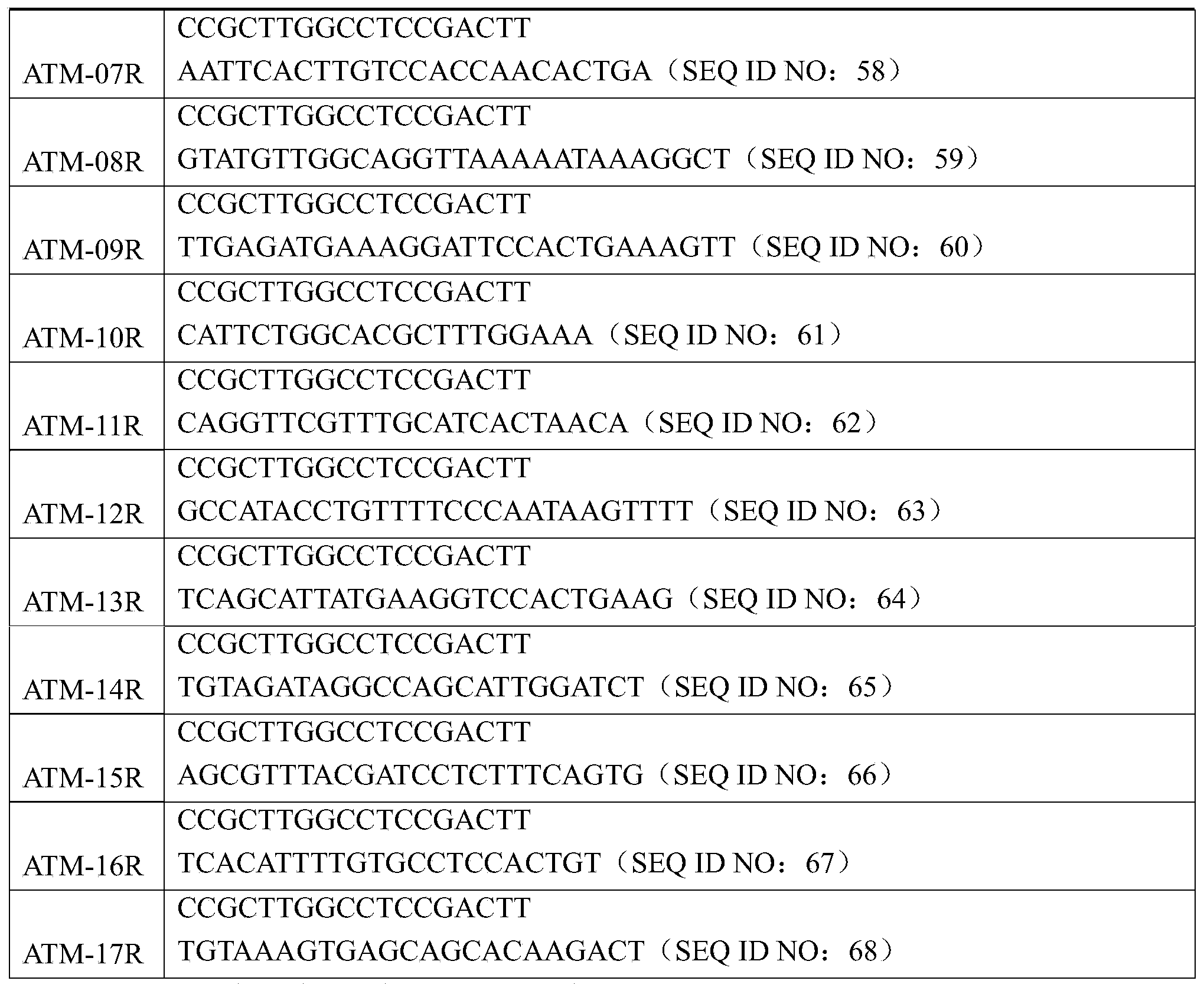
按照以下表4的程序进行第一轮PCR扩增:
表4

得到的PCR产物中加入20μL的磁珠(Beckman公司Agencourt AMPure XP磁珠,货号A63881)进行纯化,得到的产物溶解于20μL TE溶液中。
第二轮PCR,采用QIAGEN Multiplex PCR Kit(货号Cat No./ID:206143),进行PCR。
在200μL PCR管子中配置如下表5所示的反应体系:
表5
| 组分 | 用量 |
| 上一步反应物 | 20μL |
| 2×PCR反应酶 | 25μL |
| 通用引物1 | 2.5μL |
| 通用引物2 | 2.5μL |
| 总量 | 50μL |
其中,通用引物1和通用引物2如下表6所示:
表6通用引物序列

*通用引物1,5’端磷酸化,用于后续BGISEQ-500文库环化。
#通用引物2,10bp N碱基为文库标签序列。
按照以下表7的程序进行第二轮PCR扩增:
表7

得到的PCR产物中加入20μL的磁珠(Beckman公司Agencourt AMPure XP磁珠,货号A63881)进行纯化,得到的产物溶解于20μL TE溶液中。
采用Agilent 2100对产物的大小进行检测,结果如图4和图5所示,采用Qubit 2.0对溶度进行文库质检。
2、上机测序
得到的所有产物进行标准化,进行等量混合,混合得到的文库进行平行测序,测序平台BGISEQ-500,测序类型PE100。
3、数据分析
分析步骤包括过滤接头引物序列、比对等基本的步骤。
结果:如表8和图6所示,本发明方法得到的引物二聚体的比例(0.9±0.5%)明显少于常规方法得到的引物二聚体的比例(49±1%)。常规方法中引物二聚体消耗体系中的引物,导致目标区域的扩增效率下降,进而影响该扩增区域的比例。
表8


以上应用了具体个例对本发明进行阐述,只是用于帮助理解本发明,并不用以限制本发明。对于本发明所属技术领域的技术人员,依据本发明的思想,还可以做出若干简单推演、变形或替换。
Claims (22)
- 一种PCR的引物对,其特征在于,所述引物对中正向引物和反向引物都包括一段相同的固定序列,并且所述正向引物和反向引物各自包括一段彼此不同的特异性引物序列。
- 根据权利要求1所述的引物对,其特征在于,所述固定序列位于所述特异性引物序列的5’端。
- 根据权利要求1所述的引物对,其特征在于,所述正向引物和反向引物还各自包括一段接头序列。
- 根据权利要求1所述的引物对,其特征在于,每条所述引物从5’端至3’端依次包括:所述接头序列、所述固定序列和所述特异性引物序列;或所述固定序列、所述接头序列和所述特异性引物序列。
- 根据权利要求1所述的引物对,其特征在于,所述固定序列的长度是15-40nt。
- 根据权利要求5所述的引物对,其特征在于,所述固定序列的长度是18-26nt。
- 根据权利要求1所述的引物对,其特征在于,所述固定序列的Tm值为55-65℃。
- 一种用于多重PCR的引物组合,其特征在于,所述引物组合包括多对引物,所述多对引物中至少部分引物对的正向引物和反向引物都包括一段相同的固定序列,并且不同的引物各自包括一段彼此不同的特异性引物序列。
- 根据权利要求8所述的引物组合,其特征在于,所述多对引物全部都包括一段相同的固定序列。
- 根据权利要求8所述的引物组合,其特征在于,所述固定序列位于所述特异性引物序列的5’端。
- 根据权利要求8所述的引物组合,其特征在于,所述引物还各自包括一段接头序列。
- 根据权利要求11所述的引物组合,其特征在于,所有成对引物中的正向引物的所述接头序列相同,且所有成对引物中的反向引物的所述接头序列相同。
- 根据权利要求12所述的引物组合,其特征在于,每条所述引物从5’端至3’端依次包括:所述接头序列、所述固定序列和所述特异性引物序列;或所述固定序列、所述接头序列和所述特异性引物序列。
- 根据权利要求8所述的引物组合,其特征在于,所述固定序列的长度是15-40nt。
- 根据权利要求8所述的引物组合,其特征在于,所述固定序列的Tm值为55-65℃。
- 根据权利要求8所述的引物组合,其特征在于,所述引物组合包括SEQ ID NO:1-34所示的序列。
- 一种PCR扩增方法,其特征在于,所述方法包括使用权利要求1至7中任一项所述的引物对或权利要求8至16任一项所述的引物组合进行PCR扩增。
- 根据权利要求17所述的PCR扩增方法,其特征在于,所述方法还包括使用通用引物对所述PCR扩增的产物进一步扩增。
- 权利要求1至7中任一项所述的引物对或权利要求8至16任一项所述的引物组合在通过PCR扩增进行目标区域捕获中的用途。
- 一种降低PCR扩增中的引物二聚体的方法,其特征在于,所述方法包括:使用权利要求1至7中任一项所述的引物对或权利要求8至16任一项所述的引物组合进行PCR扩增,以使产生的引物二聚体在后续变性退火过程中每个引物二聚体中的所述固定序列彼此结合形成颈环结构,以阻止其进行后续的PCR反应。
- 一种目标区域捕获方法,其特征在于,所述方法包括:使用权利要求1至7中任一项所述的引物对或权利要求8至16任一项所述的引物组合进行PCR扩增。
- 一种文库构建方法,其特征在于,所述方法包括:使用权利要求1至7中任一项所述的引物对或权利要求8至16任一项所述的引物组合进行PCR扩增。
Priority Applications (2)
| Application Number | Priority Date | Filing Date | Title |
|---|---|---|---|
| CN201880099626.9A CN113166801A (zh) | 2018-12-20 | 2018-12-20 | Pcr引物及pcr扩增方法和用途 |
| PCT/CN2018/122275 WO2020124472A1 (zh) | 2018-12-20 | 2018-12-20 | Pcr引物及pcr扩增方法和用途 |
Applications Claiming Priority (1)
| Application Number | Priority Date | Filing Date | Title |
|---|---|---|---|
| PCT/CN2018/122275 WO2020124472A1 (zh) | 2018-12-20 | 2018-12-20 | Pcr引物及pcr扩增方法和用途 |
Publications (1)
| Publication Number | Publication Date |
|---|---|
| WO2020124472A1 true WO2020124472A1 (zh) | 2020-06-25 |
Family
ID=71100992
Family Applications (1)
| Application Number | Title | Priority Date | Filing Date |
|---|---|---|---|
| PCT/CN2018/122275 Ceased WO2020124472A1 (zh) | 2018-12-20 | 2018-12-20 | Pcr引物及pcr扩增方法和用途 |
Country Status (2)
| Country | Link |
|---|---|
| CN (1) | CN113166801A (zh) |
| WO (1) | WO2020124472A1 (zh) |
Citations (6)
| Publication number | Priority date | Publication date | Assignee | Title |
|---|---|---|---|---|
| CN1597976A (zh) * | 2004-07-20 | 2005-03-23 | 四川大学 | 复合扩增引物设计方法 |
| CN105256048A (zh) * | 2015-11-06 | 2016-01-20 | 厦门基科生物科技有限公司 | 一种基于熔解曲线分析的口腔致病菌多重pcr检测方法 |
| CN106282353A (zh) * | 2016-08-26 | 2017-01-04 | 上海翼和应用生物技术有限公司 | 一种利用发夹引物进行多重pcr的方法 |
| CN106319639A (zh) * | 2015-06-17 | 2017-01-11 | 深圳华大基因科技有限公司 | 构建测序文库的方法及设备 |
| CN107119331A (zh) * | 2017-05-15 | 2017-09-01 | 重庆市肿瘤研究所 | 肿瘤放射治疗毒性基因突变文库的构建方法 |
| CN107447258A (zh) * | 2016-06-01 | 2017-12-08 | 大连医科大学 | 循环肿瘤dna靶向基因高通量检测文库及其检测方法和应用 |
Family Cites Families (1)
| Publication number | Priority date | Publication date | Assignee | Title |
|---|---|---|---|---|
| CN106636063A (zh) * | 2016-09-27 | 2017-05-10 | 广州精科医学检验所有限公司 | 引物组合物、其用途、构建文库和确定核酸序列的方法 |
-
2018
- 2018-12-20 CN CN201880099626.9A patent/CN113166801A/zh active Pending
- 2018-12-20 WO PCT/CN2018/122275 patent/WO2020124472A1/zh not_active Ceased
Patent Citations (6)
| Publication number | Priority date | Publication date | Assignee | Title |
|---|---|---|---|---|
| CN1597976A (zh) * | 2004-07-20 | 2005-03-23 | 四川大学 | 复合扩增引物设计方法 |
| CN106319639A (zh) * | 2015-06-17 | 2017-01-11 | 深圳华大基因科技有限公司 | 构建测序文库的方法及设备 |
| CN105256048A (zh) * | 2015-11-06 | 2016-01-20 | 厦门基科生物科技有限公司 | 一种基于熔解曲线分析的口腔致病菌多重pcr检测方法 |
| CN107447258A (zh) * | 2016-06-01 | 2017-12-08 | 大连医科大学 | 循环肿瘤dna靶向基因高通量检测文库及其检测方法和应用 |
| CN106282353A (zh) * | 2016-08-26 | 2017-01-04 | 上海翼和应用生物技术有限公司 | 一种利用发夹引物进行多重pcr的方法 |
| CN107119331A (zh) * | 2017-05-15 | 2017-09-01 | 重庆市肿瘤研究所 | 肿瘤放射治疗毒性基因突变文库的构建方法 |
Non-Patent Citations (1)
| Title |
|---|
| BROWNIE, J. ET AL.: "The Elimination of Primer-dimer Accumulation in PCR", NUCLEIC ACIDS RESEARCH, vol. 25, no. 16, 31 December 1997 (1997-12-31), XP002930982, ISSN: 0305-1048, DOI: 10.1093/nar/25.16.3235 * |
Also Published As
| Publication number | Publication date |
|---|---|
| CN113166801A (zh) | 2021-07-23 |
Similar Documents
| Publication | Publication Date | Title |
|---|---|---|
| JP7343563B2 (ja) | 高度多重pcr法および組成物 | |
| US11795501B2 (en) | Methods for next generation genome walking and related compositions and kits | |
| CN113614246B (zh) | 用于鉴别肿瘤模型的方法和组合物 | |
| JP6435334B2 (ja) | 稀な配列変異体を検出するための組成物および方法 | |
| EP3329010B1 (en) | Nucleic acids and methods for detecting chromosomal abnormalities | |
| JP6410726B2 (ja) | 標的化ゲノム解析のための方法 | |
| KR102906088B1 (ko) | ctDNA에서 종양 특이적 유전자의 돌연변이 및 메틸화를 검출하는 방법 | |
| EP3607065B1 (en) | Method and kit for constructing nucleic acid library | |
| KR102872602B1 (ko) | 네스티드 다중 pcr 고처리량 시퀀싱 라이브러리의 제조 방법 및 키트 | |
| CN110643680B (zh) | 适用于超微量dna测序的接头及其应用 | |
| WO2017185766A1 (zh) | 一种用于扩增低浓度突变靶序列的引物和探针的设计方法 | |
| WO2018121468A1 (zh) | 检测胎儿基因突变的方法、装置和试剂盒 | |
| CN112301430B (zh) | 一种建库方法及应用 | |
| CN112195238A (zh) | 一种扩增pkd1基因的引物组及试剂盒 | |
| CN110846408A (zh) | 用于检测ttn基因突变的引物组合及其应用 | |
| US20180291369A1 (en) | Error-proof nucleic acid library construction method and kit | |
| CN113718343A (zh) | 极速rna建库方法及试剂盒 | |
| WO2020124472A1 (zh) | Pcr引物及pcr扩增方法和用途 | |
| US20210115435A1 (en) | Error-proof nucleic acid library construction method | |
| WO2020145351A1 (ja) | 薬物動態関連遺伝子の網羅的配列解析法とそれに使用されるプライマーセット | |
| CN107267645A (zh) | 用于检测mthfr基因多态性的引物对、探针及试剂盒 | |
| EP3924511B1 (en) | Methods for noninvasive prenatal testing of fetal abnormalities | |
| WO2018232597A1 (zh) | 用于定量pcr扩增的组合物及其应用 | |
| CN108699594A (zh) | 靶标序列中所需核酸区的选择性扩增 | |
| HK40064415A (zh) | 巢式多重pcr高通量测序文库制备方法及试剂盒 |
Legal Events
| Date | Code | Title | Description |
|---|---|---|---|
| 121 | Ep: the epo has been informed by wipo that ep was designated in this application |
Ref document number: 18943860 Country of ref document: EP Kind code of ref document: A1 |
|
| NENP | Non-entry into the national phase |
Ref country code: DE |
|
| 122 | Ep: pct application non-entry in european phase |
Ref document number: 18943860 Country of ref document: EP Kind code of ref document: A1 |