WO2020122090A1 - 解毒剤 - Google Patents
解毒剤 Download PDFInfo
- Publication number
- WO2020122090A1 WO2020122090A1 PCT/JP2019/048382 JP2019048382W WO2020122090A1 WO 2020122090 A1 WO2020122090 A1 WO 2020122090A1 JP 2019048382 W JP2019048382 W JP 2019048382W WO 2020122090 A1 WO2020122090 A1 WO 2020122090A1
- Authority
- WO
- WIPO (PCT)
- Prior art keywords
- nucleic acid
- sequence
- toehold
- antidote
- aptamer
- Prior art date
- Legal status (The legal status is an assumption and is not a legal conclusion. Google has not performed a legal analysis and makes no representation as to the accuracy of the status listed.)
- Ceased
Links
Images





Classifications
-
- A—HUMAN NECESSITIES
- A61—MEDICAL OR VETERINARY SCIENCE; HYGIENE
- A61K—PREPARATIONS FOR MEDICAL, DENTAL OR TOILETRY PURPOSES
- A61K31/00—Medicinal preparations containing organic active ingredients
- A61K31/70—Carbohydrates; Sugars; Derivatives thereof
- A61K31/7088—Compounds having three or more nucleosides or nucleotides
-
- A—HUMAN NECESSITIES
- A61—MEDICAL OR VETERINARY SCIENCE; HYGIENE
- A61K—PREPARATIONS FOR MEDICAL, DENTAL OR TOILETRY PURPOSES
- A61K48/00—Medicinal preparations containing genetic material which is inserted into cells of the living body to treat genetic diseases; Gene therapy
-
- A—HUMAN NECESSITIES
- A61—MEDICAL OR VETERINARY SCIENCE; HYGIENE
- A61P—SPECIFIC THERAPEUTIC ACTIVITY OF CHEMICAL COMPOUNDS OR MEDICINAL PREPARATIONS
- A61P39/00—General protective or antinoxious agents
- A61P39/02—Antidotes
-
- C—CHEMISTRY; METALLURGY
- C12—BIOCHEMISTRY; BEER; SPIRITS; WINE; VINEGAR; MICROBIOLOGY; ENZYMOLOGY; MUTATION OR GENETIC ENGINEERING
- C12N—MICROORGANISMS OR ENZYMES; COMPOSITIONS THEREOF; PROPAGATING, PRESERVING, OR MAINTAINING MICROORGANISMS; MUTATION OR GENETIC ENGINEERING; CULTURE MEDIA
- C12N15/00—Mutation or genetic engineering; DNA or RNA concerning genetic engineering, vectors, e.g. plasmids, or their isolation, preparation or purification; Use of hosts therefor
- C12N15/09—Recombinant DNA-technology
- C12N15/11—DNA or RNA fragments; Modified forms thereof; Non-coding nucleic acids having a biological activity
- C12N15/115—Aptamers, i.e. nucleic acids binding a target molecule specifically and with high affinity without hybridising therewith ; Nucleic acids binding to non-nucleic acids, e.g. aptamers
Definitions
- the present invention relates to a toehold-binding nucleic acid aptamer and its antidote.
- Thrombin is a multifunctional serine protease and an important enzyme in the hemostatic network. It plays a role in coagulating blood through activation of platelets and induction of fibrin formation by proteolysis of fibrinogen. Inhibition of thrombin enzymatic activity is caused by blocking anion-bound exosites I and II involved in substrate recognition and binding. Exosite I is bound by fibrinogen, factor XI, factor XIII and the like.
- Fibrinogen is a protein that is present in plasma at high concentrations (2-4 mg/mL, 6-12 ⁇ M), and is converted to fibrin by thrombin, which plays a role in hemostasis.
- Blood coagulation is a chain reaction consisting of multiple factors. When one coagulation factor is activated, the activated coagulation factor activates another coagulation factor. The initiation of the reaction is roughly divided into an intrinsic system and an extrinsic system, and both activate factor X, which is a common system. The activated factor Xa decomposes and activates prothrombin together with factor Va to generate thrombin. Eventually, thrombin turns fibrinogen into fibrin, creating a blood clot, which causes blood to clot.
- Non-Patent Document 1 Since thromboembolism is a disease with high morbidity and mortality, it is important to develop a treatable anticoagulant for the disease. Heparin, which is an existing drug, has been regarded as a side effect, and in recent years, a new anticoagulant that replaces heparin has been rapidly developed (Non-Patent Document 1). Many anticoagulants having a protein or low molecular weight compound as a skeleton have been developed and are effective in clinical practice. However, a strong anticoagulant drug is adjacent to the side effect of bleeding risk, and a drug capable of specifically neutralizing the drug effect is required.
- Nucleic acid aptamers are single-stranded functional oligonucleotides that function as molecules that specifically recognize various molecules (metal ions, small molecules, proteins, cells, etc.). Compared with antibodies, nucleic acid aptamers can be screened without using animals, can be artificially synthesized and modified inexpensively and easily, have high thermal stability and are excellent in storage, and immunogens. It has advantages such as low property (Non-patent Documents 2 and 3). Furthermore, it is difficult to develop an antidote for an antibody or a small molecule to be administered when side effects occur, but an aptamer can be controlled relatively easily by adding a complementary chain or a small molecule.
- TBA15 (also known as HD1:5'-GGTTGGGTGTGGTTGG-3') is a 15-mer thrombin aptamer, which has a guanine quadruplex structure sandwiching two TT loops and a TGT motif (Non-Patent Document 4).
- TBA15 has been shown to bind to and inactivate thrombin exosite I and has been clinically tested as an anticoagulant (ARC183) during coronary artery bypass surgery.
- ARC183 anticoagulant
- administration of TBA15 resulted in anticoagulant activity, the clinical trial was discontinued after the end of Phase I because the amount of drug required to obtain the desired anticoagulant activity was not adequate (Non-Patent Document 5). ..
- NU172 (5'-CGCCTAGGTGTGGGTAGGGTGGTGGCG-3') is a 26-mer thrombin aptamer that binds to exosite I (Non-Patent Document 6). The same aptamer was developed as an aptamer to replace TBA15 for the purpose of developing an anticoagulant. Similar to TBA15, NU172 is known to inhibit blood coagulation, has been clinically tested as an anticoagulant (ARC2172) during coronary artery bypass surgery, and is currently in Phase II trials (Non-Patent Document 7). ).
- TBA29 (also known as HD22:5'-AGTCCGGTGGTAGGGCAGGTTGGGGGTGACT-3') is a 29-mer thrombin aptamer and has a structure in which a double chain and a guanine quadruplex are mixed (Non-Patent Document 8). Although it is involved in inhibition of coagulation reaction by binding to exosite II, its inhibitory effect is relatively mild because it is not a domain directly involved in metabolism of fibrinogen as in exosite I.
- -Nucleic acid aptamers can control detoxification by adding complementary strands.
- a quicker and more reliable detoxification means is desired.
- the present invention provides a nucleic acid aptamer that easily detoxifies and an antidote for this nucleic acid aptamer.
- a nucleic acid aptamer composed of a single-stranded loop portion and a double-stranded stem portion has a nucleic acid sequence (toehold sequence) that is not complementary to the sequence of the nucleic acid aptamer, which is one of the double strands of the stem portion.
- a nucleic acid aptamer with a toehold sequence linked to the end of [2] A nucleic acid having a nucleic acid sequence complementary to the nucleic acid aptamer consisting of the single-stranded loop portion and the double-stranded stem portion described in [1], and complementary to the toehold sequence described in [1]
- a nucleic acid aptamer refers to a nucleic acid molecule having a high affinity for a predetermined target molecule and capable of specifically binding.
- a nucleic acid molecule having such properties is called a nucleic acid aptamer, and is not limited by the nucleotide sequence, the size of the molecule, the three-dimensional structure of the molecule, etc., unless otherwise specified.
- the nucleic acid aptamer is single-stranded RNA or DNA.
- the nucleic acid aptamer with a toehold sequence of the present invention has a nucleic acid aptamer comprising a single-stranded loop portion and a double-stranded stem portion, and has a nucleic acid sequence that is not complementary to the nucleic acid aptamer (toehold sequence), It is attached to either end (5' end or 3'end) of the double-stranded portion.
- the length of the toehold sequence is 5 to 20 bases, preferably 5 to 10 bases, and more preferably 5 bases. More specifically, the toehold array is ACTGC.
- the antidote of the present invention is a nucleic acid aptamer of the present invention, a nucleic acid sequence complementary to the nucleic acid aptamer consisting of a single-stranded loop portion and a double-stranded stem portion, complementary to the nucleic acid aptamer toehold sequence of the present invention
- the length of the nucleic acid sequence complementary to the toehold sequence of the antidote of the present invention is 5 to 15 bases, preferably 5 bases. More specifically, the nucleic acid sequence complementary to the toehold sequence is GCAGT.
- the nucleic acid aptamer antidote of the present invention has 1 to several, for example, 1, 2 or 3 bases substituted, deleted, inserted, etc. in these sequences. May be done.
- the detoxification target is an aptamer that binds to thrombin
- an arbitrary sequence of arbitrary length is added to the 5′ side and/or the 3′ side as long as the ability to bind exosite I or II of thrombin is maintained. You may.
- nucleic acid aptamer and/or antidote of the present invention may be further modified.
- phosphorothioates or phosphorodithioates, PEG-modified, cyclized can be used to increase the stability of nucleic acid aptamers.
- it may be labeled with a fluorescent substance or the like.
- the nucleic acid aptamer and/or antidote of the present invention can be formulated as a pharmaceutical composition or therapeutic kit containing a therapeutically effective amount thereof and a pharmaceutically acceptable carrier.
- Pharmaceutically acceptable carriers include binders (eg hydroxypropyl cellulose, polyvinyl alcohol, polyvinylpyrrolidone, polyethylene glycol), excipients (eg lactose, sucrose, mannitol, sorbitol, corn starch, potato starch, crystalline cellulose).
- the therapeutic kit can further include instructions for use.
- lubricants eg magnesium stearate, calcium stearate, talc
- disintegrating agents eg low-substituted hydroxypropyl cellulose, crosslinked carboxymethyl cellulose
- wetting agents eg sodium lauryl sulfate.
- the pharmaceutical composition or therapeutic kit of the present invention can be administered orally or parenterally, and can be used as an appropriate pharmaceutical preparation.
- suitable pharmaceutical preparations for oral administration include solid preparations such as tablets, granules, capsules and powders, or solution preparations, suspension preparations or emulsion preparations.
- suitable pharmaceutical preparations for parenteral administration include suppositories, injectable or drip preparations using distilled water for injection, physiological saline or aqueous glucose solution, or inhalants.
- the dose of the pharmaceutical composition or therapeutic kit of the present invention can be varied depending on the administration method, age, weight and condition of the patient, but 0.001 to 100 mg/kg per day, preferably 0.1 to The dose is 30 mg/kg, more preferably 0.1 to 10 mg/kg, which can be administered once or in 2 to 4 divided doses.
- the pharmaceutical composition or therapeutic kit containing the toehold sequence-added aptamer of the present invention is an aptamer that binds to thrombin, a disease associated with blood coagulation, for example, chronic arterial occlusion or congenital antithrombin III deficiency, etc. Can be expected to be used. It can also be used during coronary artery bypass surgery and extracorporeal blood circulation. In addition to the perioperative period, bleeding tendency caused by excessive intake of antithrombotic nucleic acid aptamer preparations necessary for postoperative operation of bypass, stent, artificial valve, renal failure, drug interaction, and increase in blood concentration due to dehydration, etc. Can be a first-line drug or an adjunct drug that corrects
- the pharmaceutical composition or therapeutic kit containing the antidote of the present invention can be used for detoxification of an aptamer to which a toehold sequence is added.
- a condition called a blood clot that is called a blood clot in a blood vessel is called a thrombosis in a broad sense (hereinafter simply referred to as "thrombosis” means a thrombosis in a broad sense), and is caused by a thrombus.
- the condition is divided into narrowly defined thrombosis and embolism.
- thrombosis in a narrow sense is a symptom caused by partial or complete obstruction of blood flow at a formation site of thrombus
- embolism is a condition in which a blood clot is detached from a formation site and moved by blood flow, and blood flow is partially blocked at another site. It refers to the pathological condition caused by temporary or complete occlusion.
- Such thrombosis causes various diseases depending on the site of the blood vessel where the thrombus occurs. Among them, especially when it occurs in cerebral blood vessels and heart blood vessels, serious symptoms such as stroke, cerebral hemorrhage, cerebral infarction, heart failure, myocardial infarction, heart palsy occur, causing hemiplegia, and in severe cases, death is there.
- thrombosis research and development are mainly conducted on antithrombotic agents and thrombosis-preventing agents that suppress thrombus formation, and thrombolytic agents that dissolve the generated thrombus.
- the monovalent or divalent nucleic acid aptamer of the present invention can bind to thrombin and inhibit blood coagulation, and the antidote of the present invention can rapidly detoxify the nucleic acid aptamer of the present invention. ..
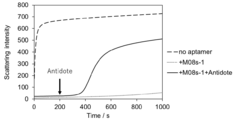
- FIG. 1 is the reversible anticoagulant activity with the addition of detoxification oligonucleotides.
- Dashed line fibrinogen was added to thrombin at 0 seconds in the absence of inhibitor.
- Solid line Antidote (complementary oligonucleotide of M08s-1) was added to the mixture of fibrinogen, thrombin and M08s-1 in 200 seconds.
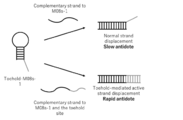
- FIG. 2 is a schematic diagram of detoxification by normal or toehold mediated strand exchange having a complementary sequence to an aptamer.
- the toehold array is the gray part.
- Toehold-M08s-1 is a nucleic acid aptamer in which a toehold sequence is added to M08s-1
- Complementary strand toto M08s-1 is a nucleic acid having a sequence complementary to M08s-1
- Complementary strand toto M08s-1 is a nucleic acid having a sequence complementary to M08s-1
- Complementary strand toto M08s-1 The and toehold site is a nucleic acid having a sequence complementary to M08s-1 with a toehold sequence added.
- FIG. 3 shows the sequences of Tohold M08s-1 aptamer and detoxification oligonucleotides (Antidote-1 to 4).
- the underlined parts indicate the toehold sequence region (aptamer) and the toehold complementary sequence region (antidote).
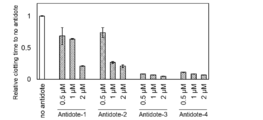
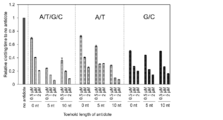
- Figure 4 shows the relative clotting time for no antidote.
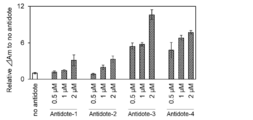
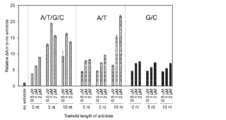
- FIG. 5 shows the relative ⁇ Am for no antidote.
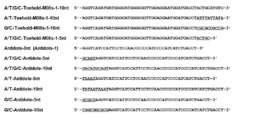
- FIG. 6 shows the sequences of the toehold M08s-1 aptamer and the detoxification oligonucleotide used for the examination of the optimal toehold sequence.
- the underlined parts indicate the toehold sequence portion (aptamer) and the toehold complementary sequence portion (antidote).
- FIG. 7 is a comparison of reversible anticoagulant activity upon addition of detoxified oligonucleotides to aptamers with various toehold sequences added.
- FIG. 10 shows the reversible anti-reversal effect of detoxified oligonucleotides added to an aptamer (A/T/G/C-Toehold-M08s-1-5nt) to which a short 5-base A/T/G/C toehold sequence was added. It is active in coagulation. Dashed line: Fibrinogen was added to thrombin in the presence of inhibitor at 0 seconds. Dotted line: Antidote without Tohold complementary sequence (Antidete-0nt) and fibrinogen were added to thrombin in the presence of inhibitor at 0 seconds.
- Antidete-0nt Antidote without Tohold complementary sequence
- fibrinogen were added to thrombin in the presence of inhibitor at 0 seconds.
- FIG. 11 shows the relative coagulation time and the relative ⁇ Am without the antidote.
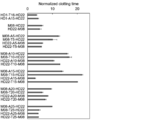
- FIG. 12 shows the anticoagulant activity of an aptamer in which M08 and HD22 are linked to form a bivalent aptamer.
- FIG. 13 is a shortened antidote to M08-T15-HD22.
- Antidote-1 is a complementary sequence having only an aptamer domain.
- Antidotes-2-4 are complementary sequences that have both aptamer and toehold sequence domains.
- the antidote with the lowest and highest efficacy were Antidote-1 and Antidote-3, respectively.
- Treatment with Antidote-1 and Antidote-3 reduced coagulation time by 32-79% and 79-91%, respectively, while ⁇ Am was approximately 1.3-3.1 fold, and 5. Am, respectively. There was a 4- to 11-fold increase (Figs. 4, 5). From these results, it became clear that toehold activated strand displacement strongly increases the detoxification efficacy of aptamers.
- FIGS. 12 and 13 shows the nucleotide sequences of the DNAs shown in FIGS. 12 and 13.
- the nucleic acid aptamer with a toehold sequence of the present invention can be rapidly detoxified by the antidote of the present invention.
Landscapes
- Health & Medical Sciences (AREA)
- Life Sciences & Earth Sciences (AREA)
- Chemical & Material Sciences (AREA)
- Engineering & Computer Science (AREA)
- Genetics & Genomics (AREA)
- Molecular Biology (AREA)
- General Health & Medical Sciences (AREA)
- Biomedical Technology (AREA)
- Animal Behavior & Ethology (AREA)
- Medicinal Chemistry (AREA)
- Public Health (AREA)
- Veterinary Medicine (AREA)
- Biotechnology (AREA)
- Organic Chemistry (AREA)
- Pharmacology & Pharmacy (AREA)
- Wood Science & Technology (AREA)
- Epidemiology (AREA)
- Zoology (AREA)
- General Engineering & Computer Science (AREA)
- Bioinformatics & Cheminformatics (AREA)
- Plant Pathology (AREA)
- Microbiology (AREA)
- Biophysics (AREA)
- Biochemistry (AREA)
- Physics & Mathematics (AREA)
- Toxicology (AREA)
- Chemical Kinetics & Catalysis (AREA)
- General Chemical & Material Sciences (AREA)
- Nuclear Medicine, Radiotherapy & Molecular Imaging (AREA)
- Pharmaceuticals Containing Other Organic And Inorganic Compounds (AREA)
- Medicines That Contain Protein Lipid Enzymes And Other Medicines (AREA)
Abstract
本発明は、一本鎖のループ部分及び二本鎖のステム部分からなる核酸アプタマーに、前記核酸アプタマーの配列に相補的ではない核酸配列(トーホールド配列)が、ステム部分の二本鎖のいずれかの末端に結合している、トーホールド配列付加核酸アプタマー、又は前記一本鎖のループ部分及び二本鎖のステム部分からなる核酸アプタマーに相補的な核酸配列を有する核酸に、前記トーホールドに相補的な核酸配列を有する核酸が、前記の末端とは異なる末端に結合している、解毒剤に関する。
Description
本発明は、トーホールド結合核酸アプタマー及びその解毒剤に関する。
トロンビンは、多機能セリンプロテアーゼであり、止血ネットワークに重要な酵素である。血小板の活性化やフィブリノーゲンのタンパク質分解によるフィブリン形成の誘導を介して血液を凝固させる役割を担っている。トロンビンの酵素活性の阻害は、基質の認識および結合に関与するアニオン結合エキソサイトIやIIをブロックすることによって引き起こされる。エキソサイトIは、フィブリノーゲン、第XI因子、第XIII因子などが結合する。
フィブリノーゲンは、血漿中に高濃度(2~4mg/mL、6~12μM)で存在するタンパク質であり、トロンビンによってフィブリンに転化し、止血を行う役割を担っている。
血液凝固は複数の因子からなる連鎖反応で、ある凝固因子が活性化されると、活性化された凝固因子がまた別の凝固因子を活性化する。同反応の開始は、内因系と外因系に大別され、共に共通系の第X因子を活性化する。活性化された第Xa因子は第Va因子と共にプロトロンビンを分解・活性化してトロンビンを生成する。最終的に、トロンビンがフィブリノーゲンをフィブリンに変え、血餅をつくることにより、血液が凝固するという仕組みになっている。
血栓塞栓症は罹患率および死亡率の高い疾患であるため、同疾病の治療可能な抗凝固剤の開発は重要である。既存の薬剤であるヘパリンは副作用が問題視されており、近年、ヘパリンに代わる新たな抗凝固剤が急速に開発されている(非特許文献1)。タンパク質や低分子化合物を骨格とした抗凝固剤が多く開発され、臨床において効果を発揮している。しかし、強力な抗凝固薬は出血リスクという副作用と隣り合わせであり、薬効を特異的に中和することができるような薬剤が求められている。
核酸アプタマーは、様々な分子(金属イオン、小分子、タンパク質、細胞など)を特異的に認識するための分子として機能する一本鎖の機能的オリゴヌクレオチドである。また、核酸アプタマーは抗体に比べ、動物を利用せずにスクリーニングが可能であること、安価かつ容易に人工合成・修飾が可能であること、熱安定性が高く保存に優れていること、免疫原性が低いことなどの利点がある(非特許文献2、3)。さらに、抗体や小分子は、副作用が生じたときに投与する解毒剤の開発が困難であるが、アプタマーは相補鎖や小分子の添加によって比較的容易に制御できる。
従来知られている代表的なトロンビン核酸アプタマーを以下に示す。
TBA15(別名HD1:5’―GGTTGGTGTGGTTGG―3’)は、15マーのトロンビンアプタマーであり、2つのTTループとTGTモチーフを挟んでグアニン四重鎖構造を有している(非特許文献4)。TBA15は、トロンビンのエキソサイトIに結合して不活性化させることが分かっており、冠動脈バイパス手術中の抗凝固剤(ARC183)として臨床試験が行われた。しかし、TBA15の投与は抗凝固活性をもたらしたが、望ましい抗凝固活性を得るために必要な薬物量が適切ではなかったことから、臨床試験はフェーズI終了後に中止された(非特許文献5)。
NU172(5’―CGCCTAGGTTGGGTAGGGTGGTGGCG―3’)は、エキソサイトIに結合する26マーのトロンビンアプタマーである(非特許文献6)。 同アプタマーは、抗凝固剤の開発を目的とし、TBA15に代わるアプタマーとして開発された。NU172はTBA15と同様に、血液凝固を阻害することが分かっており、冠動脈バイパス手術中の抗凝固剤(ARC2172)として臨床試験が行われ、現在はフェーズIIの試験中である(非特許文献7)。
TBA29(別名HD22:5’―AGTCCGTGGTAGGGCAGGTTGGGGTGACT―3’)は、29マーのトロンビンアプタマーであり、二重鎖とグアニン四重鎖が混合した構造を有している(非特許文献8)。エキソサイトIIに結合して凝固反応阻害に関わるが、エキソサイトIのように直接フィブリノーゲンの代謝に関わるドメインではないため阻害効果は比較的緩やかである。
核酸アプタマーは、相補鎖を加えることによって、解毒をコントロールすることができる。しかしながら、抗凝固薬のような技術分野においては、より迅速かつ確実な解毒手段が望まれている。
Kong、 Y.; Chen、 H.; Wang、Y. Q.; Meng、 L.; Wei、 J. F. Direct thrombin inhibitors: Patents 2002-2012 (Review); D.A. Spandidos、 2014; Vol. 9.
Banerjee、 J.; Nilsen-Hamilton、 M. J. Mol. Med. 2013、 91 (12)、 1333.
Lee、 J. O.; So、 H. M.; Jeon、 E. K.; Chang、 H.; Won、 K.; Kim、 Y. H. Anal. Bioanal. Chem. 2008、 390(4)、 1023.
Bock、 L. C.; Griffin、 L. C.; Latham、 J. a; Vermaas、 E. H.; Toole、 J. J. Nature 1992、 355 (6360)、 564.
Schwienhorst、 A. Cellular and Molecular Life Sciences. 2006、 pp 2773-2791.
Waters、 E.; Richardson、 J.; Schaub、 R.; Kurz、 J. Effect of NU172 and bivalirudin on ecarin clotting time in human plasma and whole blood-Posters; 2009; Vol. 7.
Zhou、 J.; Rossi、 J. Nat. Rev. Drug Discov. 2016、 16(3)、 181.
Tasset、 D. M.; Kubik、 M. F.; Steiner、 W. J. Mol. Biol. 1997、 272 (5)、 688.
本発明は、解毒容易な核酸アプタマー及びこの核酸アプタマーの解毒剤を提供する。
上記課題を解決するための手段は、下記のとおりである:
[1]一本鎖のループ部分及び二本鎖のステム部分からなる核酸アプタマーに、前記核酸アプタマーの配列に相補的ではない核酸配列(トーホールド配列)が、ステム部分の二本鎖のいずれかの末端に連結している、トーホールド配列付加核酸アプタマー。
[2] [1]に記載の一本鎖のループ部分及び二本鎖のステム部分からなる核酸アプタマーに相補的な核酸配列を有する核酸に、[1]に記載のトーホールド配列に相補的な核酸配列を有する核酸が、[1]に記載の末端とは異なる末端に結合している、解毒剤。
[3]トーホールド配列の長さが、5~15塩基である、[1]に記載のトーホールド配列付加核酸アプタマー、
[4]トーホールド配列に相補的な核酸配列を有する核酸の長さが、5~15塩基である、[2]に記載の解毒剤、
[5]トーホールド配列が、ACTGCである、[1]に記載のトーホールド配列付加核酸アプタマー、
[6]トーホールド配列に相補的な核酸配列が、GCAGTである、[2]に記載の解毒剤、
[7] [1]、[3]及び[5]のいずれかに記載のトーホールド配列付加核酸アプタマー又は[2]、[4]及び[6]のいずれかに記載の解毒剤を含む、医薬組成物、
[8] [1]、[3]及び[5]のいずれかに記載のトーホールド配列付加核酸アプタマー及び[2]、[4]及び[6]のいずれかに記載の解毒剤を含む、治療用キット。
[1]一本鎖のループ部分及び二本鎖のステム部分からなる核酸アプタマーに、前記核酸アプタマーの配列に相補的ではない核酸配列(トーホールド配列)が、ステム部分の二本鎖のいずれかの末端に連結している、トーホールド配列付加核酸アプタマー。
[2] [1]に記載の一本鎖のループ部分及び二本鎖のステム部分からなる核酸アプタマーに相補的な核酸配列を有する核酸に、[1]に記載のトーホールド配列に相補的な核酸配列を有する核酸が、[1]に記載の末端とは異なる末端に結合している、解毒剤。
[3]トーホールド配列の長さが、5~15塩基である、[1]に記載のトーホールド配列付加核酸アプタマー、
[4]トーホールド配列に相補的な核酸配列を有する核酸の長さが、5~15塩基である、[2]に記載の解毒剤、
[5]トーホールド配列が、ACTGCである、[1]に記載のトーホールド配列付加核酸アプタマー、
[6]トーホールド配列に相補的な核酸配列が、GCAGTである、[2]に記載の解毒剤、
[7] [1]、[3]及び[5]のいずれかに記載のトーホールド配列付加核酸アプタマー又は[2]、[4]及び[6]のいずれかに記載の解毒剤を含む、医薬組成物、
[8] [1]、[3]及び[5]のいずれかに記載のトーホールド配列付加核酸アプタマー及び[2]、[4]及び[6]のいずれかに記載の解毒剤を含む、治療用キット。
本発明において核酸アプタマーとは、核酸分子であって、所定の標的分子に対する親和性が高く、特異的に結合し得る分子のことをいう。このような性質を有する核酸分子を核酸アプタマーといい、特に断らない限り、塩基配列、分子の大きさ、分子の立体構造などによって限定されるものではない。好ましくは、核酸アプタマーは、一本鎖のRNA又はDNAである。
本発明のトーホールド配列付加核酸アプタマーは、一本鎖のループ部分及び二本鎖のステム部分からなる核酸アプタマーに、前記核酸アプタマーに相補的ではない核酸配列を有する(トーホールド配列)が、ステム部分の二本鎖のいずれかの末端(5’末端又は3’末端)に結合している。トーホールド配列の長さは、5~20塩基であり、好ましくは、5~10塩基であり、より好ましくは、5塩基である。より具体的には、トーホールド配列は、ACTGCである。
本発明の解毒剤は、本発明の核酸アプタマーの、一本鎖のループ部分及び二本鎖のステム部分からなる核酸アプタマーに相補的な核酸配列に、本発明の核酸アプタマーのトーホールド配列に相補的な核酸配列が、本発明の核酸アプタマーとは異なる末端(3’末端又は5’末端)に結合している、解毒剤である。
本発明の解毒剤の、トーホールド配列に相補的な核酸配列の長さは、5~15塩基であり、好ましくは、5塩基である。より具体的には、トーホールド配列に相補的な核酸配列は、GCAGTである。
本発明の核酸アプタマーの解毒剤は、核酸アプタマーを解毒する能力が維持されている限り、これらの配列において1~数個、例えば、1、2または3個の塩基が置換、欠失、挿入等されてよい。また、解毒対象がトロンビンに結合するアプタマーである場合、トロンビンのエキソサイトI又はII結合能が維持される限り、5’側および/または3’側に任意の長さの任意の配列が付加されてよい。
本発明の核酸アプタマー及び/又は解毒剤は、さらに修飾されたものであってもよい。例えば、核酸アプタマーの安定性を増加させるために、ホスホロチオエートまたはホスホロジチオエート、PEG修飾、環状化することも可能である。また、蛍光物質等で標識されたものでもよい。
本発明の核酸アプタマー及び/又は解毒剤は、その治療上有効量及び製薬上許容される担体を含む医薬組成物又は治療用キットとして製剤化することができる。製薬上許容される担体としては、結合剤(例えば、ヒドロキシプロピルセルロース、ポリビニルアルコール、ポリビニルピロリドン、ポリエチレングリコール)、賦形剤(例えば、乳糖、ショ糖、マンニトール、ソルビトール、コーンスターチ、ポテトスターチ、結晶セルロース、炭酸カルシウム)、滑沢剤(例えば、ステアリン酸マグネシウム、ステアリン酸カルシウム、タルク)、崩壊剤(例えば、低置換度ヒドロキシプロピルセルロース、架橋カルボキシメチルセルロース)及び湿潤剤(例えば、ラウリル硫酸ナトリウム)等を挙げることができる。治療用キットは、さらに取扱説明書を含むことができる。
本発明の医薬組成物又は治療用キットは、経口的又は非経口的に投与することができ、適当な医薬製剤として用いることができる。経口投与用の適当な医薬製剤としては、例えば、錠剤、顆粒剤、カプセル剤、散剤等の固体製剤、あるいは溶液製剤、懸濁製剤又は乳化製剤等が挙げられる。非経口投与用の適当な医薬製剤としては、坐剤、注射用蒸留水、生理食塩水又はブドウ糖水溶液等を用いた注射剤又は点滴製剤、あるいは吸入剤等を挙げることができる。
本発明の医薬組成物又は治療用キットの投与量は、投与方法、患者の年令、体重、状態によって変動させることができるが、1日当り0.001~100mg/kg、好ましくは0.1~30mg/kg、さらに好ましくは0.1~10mg/kgであり、これを1回或いは2回~4回に分けて投与することができる。
本発明のトーホールド配列付加アプタマーを含有する医薬組成物又は治療用キットは、トロンビンに結合するアプタマーである場合、血液凝固に関連する疾患、たとえば、慢性動脈閉塞症や先天性アンチトロンビンIII欠乏症などに使用することが期待できる。また、冠動脈バイパス手術時や血液体外循環時に使用することができる。さらに、周術期もさることながら、バイパスやステント、人工弁の術後に必要な抗血栓核酸アプタマー製剤の過剰摂取や腎不全、薬剤相互作用ならびに脱水などによる血中濃度上昇によって引き起こされる出血傾向を是正する第一選択薬もしくは補助薬剤になりうる。
本発明の解毒剤を含有する医薬組成物又は治療用キットは、トーホールド配列付加アプタマーの解毒に使用することができる。
本発明の解毒剤を含有する医薬組成物又は治療用キットは、トーホールド配列付加アプタマーの解毒に使用することができる。
血管の中で、血栓といわれる血液の固まりが引き起こす症状を広義の血栓症(以下、単に「血栓症」と記載した場合は、広義の血栓症をいう)と呼び、血栓が原因になって起こる病態は狭義の血栓症と塞栓症に分けられる。狭義の血栓症は血栓が形成個所で血流を部分的にあるいは完全に閉塞することによる症状で、塞栓症は血栓が形成個所から剥がれて血流によって移動し、他の個所で血流を部分的にあるいは完全に閉塞することによって起こる病態のことを指す。 このような血栓症は血栓が生じた血管の部位によって多様な疾病を誘発するようになる。その中でも特に脳血管や心臓血管に生じた場合には脳卒中、脳出血、脳梗塞、心不全症、心筋梗塞、心臓麻痺等深刻な症状が発生し、半身不随を引き起こし、ひどい場合には死亡することもある。 現在、血栓症を解決するために、血栓の生成を抑制する抗血栓剤及び血栓形成予防剤と、生成された血栓を溶解させる血栓溶解剤の研究開発が主に行われている。
本発明の1価又は2価の核酸アプタマーは、トロンビンに結合し、血液凝固を阻害することができるとともに、本発明の解毒剤は、本発明の核酸アプタマーを迅速に解毒することが可能である。
トーホールド鎖置換の解毒有効性
直接の抗凝固薬は、患者の罹患率及び死亡率を増加させる顕著な出血のような急性の合併症を引き起こす。したがって、回復剤の有効性は、副作用を抑えるために重要である。他の種類の抗凝固剤と比べて、アプタマー薬は、リバースの相補鎖を加えることによって解毒をコントロールすることができることが大きな利点である。M08s-1(aggtcagatgatggggatggggggttggaggaatggatgacct)についてこれを立証するために、このアプタマーに対する全相補鎖配列の解毒効果を検討した。トロンビンとM08s-1及びフィブリノーゲンとからなる凝固混合物を解毒剤で処理し、散乱によってモニターした(図1)。
直接の抗凝固薬は、患者の罹患率及び死亡率を増加させる顕著な出血のような急性の合併症を引き起こす。したがって、回復剤の有効性は、副作用を抑えるために重要である。他の種類の抗凝固剤と比べて、アプタマー薬は、リバースの相補鎖を加えることによって解毒をコントロールすることができることが大きな利点である。M08s-1(aggtcagatgatggggatggggggttggaggaatggatgacct)についてこれを立証するために、このアプタマーに対する全相補鎖配列の解毒効果を検討した。トロンビンとM08s-1及びフィブリノーゲンとからなる凝固混合物を解毒剤で処理し、散乱によってモニターした(図1)。
過剰量の解毒剤にもかかわらず、緩やかな散乱の増加が見られ、約200秒で凝固曲線の最大勾配に達した(ΔAm)。この結果は、強固なアプタマー/トロンビン複合体とアプタマーの安定な二重鎖との間の平衡に由来する動的バリアーが原因であると考えられる。解毒剤の抑制効率を増加させるためにトーホールド介在鎖交換をこの解毒システムに導入した。「トーホールド(toehold)」と呼ばれる短いぶら下がり末端は、鎖交換を劇的に増加させることが知られており、アプタマーの機能を急速に解毒するために有効であると仮定した。この仮定を検証するために、追加の15塩基のオーバーハングセクションを有するM08s-1(トーホールドM08s-1)といくつかの長さの解毒剤を示した(図2及び3)。Antidote-1は、アプタマードメインのみを有する相補配列である。Antidote-2~4は、アプタマー及びトーホールド配列ドメインの両方を有する相補配列である。驚くべきことに、最低及び最高の有効性を有する解毒剤は、それぞれ、Antidote-1及びAntidote-3であった。Antidote-1及びAntidote-3の処理によって、凝固時間は、それぞれ、32~79%、及び79~91%だけ減少したが、ΔAmは、それぞれ、約1.3~3.1倍、及び5.4~11倍増加した(図4、5)。これらの結果から、トーホールド活性化鎖置換は、アプタマーの解毒効力を強く増加することが明らかとなった。
最適トーホールド配列の検討
より短くかつ活性の優れたトーホールド配列の同定により、生産コスト,投与量,元のアプタマーの活性への影響の最小化が期待できる。図3に示したポリAトーホールド配列アプタマーを用いた結果では、10塩基のトーホールド相補配列を含む解毒剤が最も優れた中和効率を示した。ここでは、A/T/G/CまたはA/TまたはG/Cからなる10塩基のトーホールド配列を付加したアプタマーを用いて検討をおこない、ポリAを上回る中和促進作用を有するトーホールド配列の検討をおこなった。仮説では、熱力学的に安定な二本鎖を形成するG/Cトーホールド配列が、最も効率が良いと推測された。しかしながら、結果としてG/Cトーホールドアプタマーでは、解毒剤の濃度依存的な中和反応の促進が観測されるのみで、トーホールド相補配列の有無とは無関係であった(図7,8,9)。これは、アプタマーの配列内にグアニンが多いため,トーホールド配列や解毒剤のトーホールド相補配列が、目的外のアプタマー配列部位(あるいはその相補配列部位)と相互作用し、トーホールド配列が機能していなかった可能性がある。A/Tトーホールドアプタマーでは、ポリAトーホールド配列の時と同様に、10塩基のトーホールド相補配列を含む解毒剤の効果が最も高く、5塩基という短いトーホールド相補配列では中和反応の促進が観測されなかった(図7,8,9)。一方,A/T/G/Cトーホールド配列では、5塩基という短いトーホールド相補配列にも関わらず、アプタマーと等量(0.5μM)の解毒剤の添加で76%の凝固時間の短縮と、13倍のΔAmの増加が観測された。これは、A/T/G/C配列が、ポリAまたはA/T配列よりも二本鎖形成時の安定性が高く、かつG/C配列の時のような目的配列以外との相互作用が少なかったためであると考えられる。
より短くかつ活性の優れたトーホールド配列の同定により、生産コスト,投与量,元のアプタマーの活性への影響の最小化が期待できる。図3に示したポリAトーホールド配列アプタマーを用いた結果では、10塩基のトーホールド相補配列を含む解毒剤が最も優れた中和効率を示した。ここでは、A/T/G/CまたはA/TまたはG/Cからなる10塩基のトーホールド配列を付加したアプタマーを用いて検討をおこない、ポリAを上回る中和促進作用を有するトーホールド配列の検討をおこなった。仮説では、熱力学的に安定な二本鎖を形成するG/Cトーホールド配列が、最も効率が良いと推測された。しかしながら、結果としてG/Cトーホールドアプタマーでは、解毒剤の濃度依存的な中和反応の促進が観測されるのみで、トーホールド相補配列の有無とは無関係であった(図7,8,9)。これは、アプタマーの配列内にグアニンが多いため,トーホールド配列や解毒剤のトーホールド相補配列が、目的外のアプタマー配列部位(あるいはその相補配列部位)と相互作用し、トーホールド配列が機能していなかった可能性がある。A/Tトーホールドアプタマーでは、ポリAトーホールド配列の時と同様に、10塩基のトーホールド相補配列を含む解毒剤の効果が最も高く、5塩基という短いトーホールド相補配列では中和反応の促進が観測されなかった(図7,8,9)。一方,A/T/G/Cトーホールド配列では、5塩基という短いトーホールド相補配列にも関わらず、アプタマーと等量(0.5μM)の解毒剤の添加で76%の凝固時間の短縮と、13倍のΔAmの増加が観測された。これは、A/T/G/C配列が、ポリAまたはA/T配列よりも二本鎖形成時の安定性が高く、かつG/C配列の時のような目的配列以外との相互作用が少なかったためであると考えられる。
最も活性が高かったA/T/G/Cトーホールド配列を5 塩基にまで短縮したアプタマーを用いて(A/T/G/C-Toehold-M08s-1-5nt, 図6)同様の中和反応実験をおこなった。結果として、アプタマーと等量(0.5μM)の解毒剤の添加で83%の凝固時間の短縮と、12倍のΔAmの増加が観測された(図10,11)。本研究で得られた知見や短いA/T/G/Cトーホールド配列は、他のアプタマーへの適用も可能であると考えられ、他の分子種(低分子,抗体)の薬剤にはない「迅速な解毒」という特長を核酸アプタマー薬剤に与えるとこできる。
獲得したアプタマー群の中から優れた抗凝固活性を有するアプタマーを選抜あるいは設計することを試みた。これまでに異なる部位を認識するHD1とHD22を連結して二価化することで,親和性と抗凝固活性を向上することが報告されている(HD1-T16-HD22とHD1-A15-HD22)。そこで、トロンビンの異なる部位に結合するM08とHD22を連結して二価化した。またM08とHD22の間には、チミンが連続したリンカーを導入し、リンカー長の最適化を行ったところ、15個のチミンが連続したリンカーを導入したM08-T15-HD22が、HD1-A15-HD22に比べて5倍の抗凝固活性を示した(図12)。
図12で最も抗凝固活性が高かったM08-T15-HD22に対する解毒剤の開発を行った。はじめに、M08の相補鎖配列[M08]cとHD22の相補鎖配列[HD22]cを比較したところ、[M08]cのほうが解毒剤として高い活性を示した。次に、リンカーに対する相補鎖配列をトーホールド配列として導入した。トーホールド配列長を5,10,15merとした中和剤を[M08-T5]c、[M08-T10]c、[M08-T15]cとし、添加したところ、トーホールド配列が最も長い[M08-T15]cが高い解毒効果を示した。さらに、中和剤の効果を高めるため、M08の相補鎖配列がステムループ構造を形成することに着目し、配列の短縮を行った。[M08s-T15]cの結果が示すように、短縮化により、全長の相補鎖配列[M08-T15-HD22]cよりも活性が高い解毒剤の開発に成功した(図13)。
図12及び図13に示されたDNAの塩基配列を示す。

本発明のトーホールド配列付加核酸アプタマーは、本発明の解毒剤により、迅速に解毒されることができる。
Claims (8)
- 一本鎖のループ部分及び二本鎖のステム部分からなる核酸アプタマーに、前記核酸アプタマーの配列に相補的ではない核酸配列(トーホールド配列)が、ステム部分の二本鎖のいずれかの末端に結合している、トーホールド配列付加核酸アプタマー。
- 請求項1に記載の一本鎖のループ部分及び二本鎖のステム部分からなる核酸アプタマーに相補的な核酸配列を有する核酸に、請求項1に記載のトーホールド配列に相補的な核酸配列を有する核酸が、請求項1に記載の末端とは異なる末端に結合している、解毒剤。
- トーホールド配列の長さが、5~15塩基である、請求項1に記載のトーホールド配列付加核酸アプタマー。
- トーホールド配列に相補的な核酸の長さが、5~15塩基である、請求項2に記載の解毒剤。
- トーホールド配列が、ACTGCである、請求項1に記載のトーホールド配列付加核酸アプタマー。
- トーホールド配列に相補的な核酸配列が、GCAGTである、請求項2に記載の解毒剤。
- 請求項1、3及び5のいずれか一項に記載のトーホールド配列付加核酸アプタマー又は請求項2、4及び6のいずれか一項に記載の解毒剤を含む、医薬組成物。
- 請求項1、3及び5のいずれか一項に記載のトーホールド配列付加核酸アプタマー及び請求項2、4及び6のいずれか一項に記載の解毒剤を組み合わせて含む、治療用キット。
Applications Claiming Priority (2)
| Application Number | Priority Date | Filing Date | Title |
|---|---|---|---|
| JP2018231878A JP2022044843A (ja) | 2018-12-11 | 2018-12-11 | 解毒剤 |
| JP2018-231878 | 2018-12-11 |
Publications (1)
| Publication Number | Publication Date |
|---|---|
| WO2020122090A1 true WO2020122090A1 (ja) | 2020-06-18 |
Family
ID=71077305
Family Applications (1)
| Application Number | Title | Priority Date | Filing Date |
|---|---|---|---|
| PCT/JP2019/048382 Ceased WO2020122090A1 (ja) | 2018-12-11 | 2019-12-11 | 解毒剤 |
Country Status (2)
| Country | Link |
|---|---|
| JP (1) | JP2022044843A (ja) |
| WO (1) | WO2020122090A1 (ja) |
Cited By (2)
| Publication number | Priority date | Publication date | Assignee | Title |
|---|---|---|---|---|
| CN114350668A (zh) * | 2021-10-14 | 2022-04-15 | 吉林大学 | 一种pH响应的智能抗凝血核酸适配体及其应用和药物 |
| WO2024143560A1 (ja) * | 2022-12-28 | 2024-07-04 | 国立大学法人 東京大学 | 中和可能な血液凝固阻害剤 |
Citations (5)
| Publication number | Priority date | Publication date | Assignee | Title |
|---|---|---|---|---|
| US20110172292A1 (en) * | 2008-06-30 | 2011-07-14 | Hansen Jens Bo Rode | Antidote oligomers |
| US20110275701A1 (en) * | 2008-09-18 | 2011-11-10 | Archemix Corp. | Anti-thrombin aptamer formulations and methods for use |
| WO2016016259A1 (en) * | 2014-07-30 | 2016-02-04 | Rheinische Friedrich-Wilhelms Universität Bonn | Aptamer thrombin complex for use as an antidote to direct acting thrombin inhibitors |
| WO2018053427A1 (en) * | 2016-09-16 | 2018-03-22 | Duke University | Von willebrand factor (vwf)-targeting agents and methods of using the same |
| WO2019146676A1 (ja) * | 2018-01-25 | 2019-08-01 | 国立大学法人 東京大学 | 核酸アプタマー |
-
2018
- 2018-12-11 JP JP2018231878A patent/JP2022044843A/ja active Pending
-
2019
- 2019-12-11 WO PCT/JP2019/048382 patent/WO2020122090A1/ja not_active Ceased
Patent Citations (5)
| Publication number | Priority date | Publication date | Assignee | Title |
|---|---|---|---|---|
| US20110172292A1 (en) * | 2008-06-30 | 2011-07-14 | Hansen Jens Bo Rode | Antidote oligomers |
| US20110275701A1 (en) * | 2008-09-18 | 2011-11-10 | Archemix Corp. | Anti-thrombin aptamer formulations and methods for use |
| WO2016016259A1 (en) * | 2014-07-30 | 2016-02-04 | Rheinische Friedrich-Wilhelms Universität Bonn | Aptamer thrombin complex for use as an antidote to direct acting thrombin inhibitors |
| WO2018053427A1 (en) * | 2016-09-16 | 2018-03-22 | Duke University | Von willebrand factor (vwf)-targeting agents and methods of using the same |
| WO2019146676A1 (ja) * | 2018-01-25 | 2019-08-01 | 国立大学法人 東京大学 | 核酸アプタマー |
Non-Patent Citations (4)
| Title |
|---|
| LI, J. ET AL.: "Aptamer proximity recognition- dependent strand translocation for enzyme-free anc amplified fluorescent detection of thrombin via catalytic hairpin assembly", ANALYTICA CHIMICA ACTA, vol. 1038, 6 July 2018 (2018-07-06), pages 126 - 131 * |
| TASSET, D. M. ET AL.: "Oligonucleotide Inhibitors of Human Thrombin that Bind Distinct Epitopes", J. MOL. BIOL., vol. 272, 1997, pages 688 - 698, XP004453692, DOI: 10.1006/jmbi.1997.1275 * |
| WAKUI, K. ET AL.: "Rapidly Neutralizable and Highly Anticoagulant Thrombin-Binding DNA Aptamer Discovered by MACE SELEX", MOLECULAR THERAPY: NUCLEIC ACIDS, vol. 16, June 2019 (2019-06-01), pages 348 - 359, XP055604239, DOI: 10.1016/j.omtn.2019.03.002 * |
| ZHQU, J. ET AL.: "Aptamers as targeted therapeutics: current potential and challenges", NATURE REVIEWS DRUG DISCOVERY, vol. 16, 2017, pages 181 - 202, XP055649283, DOI: 10.1038/nrd.2016.199 * |
Cited By (3)
| Publication number | Priority date | Publication date | Assignee | Title |
|---|---|---|---|---|
| CN114350668A (zh) * | 2021-10-14 | 2022-04-15 | 吉林大学 | 一种pH响应的智能抗凝血核酸适配体及其应用和药物 |
| CN114350668B (zh) * | 2021-10-14 | 2023-07-18 | 吉林大学 | 一种pH响应的智能抗凝血核酸适配体及其应用和药物 |
| WO2024143560A1 (ja) * | 2022-12-28 | 2024-07-04 | 国立大学法人 東京大学 | 中和可能な血液凝固阻害剤 |
Also Published As
| Publication number | Publication date |
|---|---|
| JP2022044843A (ja) | 2022-03-18 |
Similar Documents
| Publication | Publication Date | Title |
|---|---|---|
| JP4718541B2 (ja) | 改良された凝固因子調節剤 | |
| JP4773684B2 (ja) | 薬物のモジュレータ | |
| JP4177455B2 (ja) | 逆キメラおよびハイブリッドオリゴヌクレオチド | |
| Keefe et al. | Aptamers as candidate therapeutics for cardiovascular indications | |
| CA2860806C (en) | New c5a binding nucleic acids | |
| JP2007527714A (ja) | 補体関連障害の治療に有用なアプタマー治療法 | |
| AU2001296305A1 (en) | RNA aptamers and methods for identifying the same | |
| JP2009538325A (ja) | Reg1抗凝固系の投与 | |
| AU2006292524A1 (en) | Focused libraries, functional profiling, laser selex and deselex | |
| RU2410432C1 (ru) | Модифицированные днк аптамеры, ингибирующие активность тромбина | |
| JP2010184930A (ja) | 血栓溶解および抗凝固両方の機能を有する融合タンパク質、ならびにその使用 | |
| TW201103983A (en) | Aptamer against chymase and use thereof | |
| JP6721189B2 (ja) | vWFに結合するDNAアプタマー | |
| Spiridonova et al. | Complex formation with protamine prolongs the thrombin-inhibiting effect of DNA aptamer in vivo | |
| RS20080075A (sr) | Aptameri koji vezuju trombin sa visokim afinitetom | |
| JP2022044843A (ja) | 解毒剤 | |
| WO2019146676A1 (ja) | 核酸アプタマー | |
| WO2003013423A2 (en) | Antithrombotic agent | |
| Potti et al. | Regulatable aptamers in medicine: focus on antithrombotic strategies | |
| EP4678749A1 (en) | Neutralizable blood coagulation inhibitor | |
| Spiridonova | Molecular recognition elements: DNA/RNA-aptamers to proteins | |
| JP5873027B2 (ja) | Age特異的アプタマーの腎疾患治療用途 | |
| JP7858227B2 (ja) | Dkk1に対するアプタマー及びその使用 | |
| Li et al. | Aptamers for Thrombotic Diseases | |
| DE102007011702A1 (de) | Aptamer-basierte Reagenzien |
Legal Events
| Date | Code | Title | Description |
|---|---|---|---|
| 121 | Ep: the epo has been informed by wipo that ep was designated in this application |
Ref document number: 19896704 Country of ref document: EP Kind code of ref document: A1 |
|
| NENP | Non-entry into the national phase |
Ref country code: DE |
|
| 122 | Ep: pct application non-entry in european phase |
Ref document number: 19896704 Country of ref document: EP Kind code of ref document: A1 |
|
| NENP | Non-entry into the national phase |
Ref country code: JP |