WO2020121873A1 - イオン液体を含むレジスト下層膜形成組成物 - Google Patents
イオン液体を含むレジスト下層膜形成組成物 Download PDFInfo
- Publication number
- WO2020121873A1 WO2020121873A1 PCT/JP2019/047054 JP2019047054W WO2020121873A1 WO 2020121873 A1 WO2020121873 A1 WO 2020121873A1 JP 2019047054 W JP2019047054 W JP 2019047054W WO 2020121873 A1 WO2020121873 A1 WO 2020121873A1
- Authority
- WO
- WIPO (PCT)
- Prior art keywords
- group
- carbon atoms
- underlayer film
- resist underlayer
- forming composition
- Prior art date
- Legal status (The legal status is an assumption and is not a legal conclusion. Google has not performed a legal analysis and makes no representation as to the accuracy of the status listed.)
- Ceased
Links
- 0 CC1=*CCC1 Chemical compound CC1=*CCC1 0.000 description 7
- RZODLGDPSIQALN-UHFFFAOYSA-N CC(C)(C)[N]=1(C)#CC=CC(C)=CC=1 Chemical compound CC(C)(C)[N]=1(C)#CC=CC(C)=CC=1 RZODLGDPSIQALN-UHFFFAOYSA-N 0.000 description 1
- LUTVFLFQOJVCTL-UHFFFAOYSA-N CC=[N](C)(=C)(=C)=C Chemical compound CC=[N](C)(=C)(=C)=C LUTVFLFQOJVCTL-UHFFFAOYSA-N 0.000 description 1
- YXJSMCZTRWECJF-UHFFFAOYSA-N CCCC[N+]1(CC)CCCC1 Chemical compound CCCC[N+]1(CC)CCCC1 YXJSMCZTRWECJF-UHFFFAOYSA-N 0.000 description 1
- HODMCOIBCPNLAO-UHFFFAOYSA-N CCCC[N+]1(CCC)CCCC1 Chemical compound CCCC[N+]1(CCC)CCCC1 HODMCOIBCPNLAO-UHFFFAOYSA-N 0.000 description 1
Classifications
-
- C—CHEMISTRY; METALLURGY
- C08—ORGANIC MACROMOLECULAR COMPOUNDS; THEIR PREPARATION OR CHEMICAL WORKING-UP; COMPOSITIONS BASED THEREON
- C08G—MACROMOLECULAR COMPOUNDS OBTAINED OTHERWISE THAN BY REACTIONS ONLY INVOLVING UNSATURATED CARBON-TO-CARBON BONDS
- C08G10/00—Condensation polymers of aldehydes or ketones with aromatic hydrocarbons or halogenated aromatic hydrocarbons only
- C08G10/02—Condensation polymers of aldehydes or ketones with aromatic hydrocarbons or halogenated aromatic hydrocarbons only of aldehydes
-
- G—PHYSICS
- G03—PHOTOGRAPHY; CINEMATOGRAPHY; ANALOGOUS TECHNIQUES USING WAVES OTHER THAN OPTICAL WAVES; ELECTROGRAPHY; HOLOGRAPHY
- G03F—PHOTOMECHANICAL PRODUCTION OF TEXTURED OR PATTERNED SURFACES, e.g. FOR PRINTING, FOR PROCESSING OF SEMICONDUCTOR DEVICES; MATERIALS THEREFOR; ORIGINALS THEREFOR; APPARATUS SPECIALLY ADAPTED THEREFOR
- G03F7/00—Photomechanical, e.g. photolithographic, production of textured or patterned surfaces, e.g. printing surfaces; Materials therefor, e.g. comprising photoresists; Apparatus specially adapted therefor
- G03F7/004—Photosensitive materials
- G03F7/09—Photosensitive materials characterised by structural details, e.g. supports, auxiliary layers
- G03F7/11—Photosensitive materials characterised by structural details, e.g. supports, auxiliary layers having cover layers or intermediate layers, e.g. subbing layers
-
- G—PHYSICS
- G03—PHOTOGRAPHY; CINEMATOGRAPHY; ANALOGOUS TECHNIQUES USING WAVES OTHER THAN OPTICAL WAVES; ELECTROGRAPHY; HOLOGRAPHY
- G03F—PHOTOMECHANICAL PRODUCTION OF TEXTURED OR PATTERNED SURFACES, e.g. FOR PRINTING, FOR PROCESSING OF SEMICONDUCTOR DEVICES; MATERIALS THEREFOR; ORIGINALS THEREFOR; APPARATUS SPECIALLY ADAPTED THEREFOR
- G03F7/00—Photomechanical, e.g. photolithographic, production of textured or patterned surfaces, e.g. printing surfaces; Materials therefor, e.g. comprising photoresists; Apparatus specially adapted therefor
- G03F7/26—Processing photosensitive materials; Apparatus therefor
-
- H—ELECTRICITY
- H10—SEMICONDUCTOR DEVICES; ELECTRIC SOLID-STATE DEVICES NOT OTHERWISE PROVIDED FOR
- H10P—GENERIC PROCESSES OR APPARATUS FOR THE MANUFACTURE OR TREATMENT OF DEVICES COVERED BY CLASS H10
- H10P76/00—Manufacture or treatment of masks on semiconductor bodies, e.g. by lithography or photolithography
-
- Y—GENERAL TAGGING OF NEW TECHNOLOGICAL DEVELOPMENTS; GENERAL TAGGING OF CROSS-SECTIONAL TECHNOLOGIES SPANNING OVER SEVERAL SECTIONS OF THE IPC; TECHNICAL SUBJECTS COVERED BY FORMER USPC CROSS-REFERENCE ART COLLECTIONS [XRACs] AND DIGESTS
- Y02—TECHNOLOGIES OR APPLICATIONS FOR MITIGATION OR ADAPTATION AGAINST CLIMATE CHANGE
- Y02P—CLIMATE CHANGE MITIGATION TECHNOLOGIES IN THE PRODUCTION OR PROCESSING OF GOODS
- Y02P20/00—Technologies relating to chemical industry
- Y02P20/50—Improvements relating to the production of bulk chemicals
- Y02P20/54—Improvements relating to the production of bulk chemicals using solvents, e.g. supercritical solvents or ionic liquids
Definitions
- the present invention relates to a resist underlayer film forming composition for forming a flattening film on a substrate having a step and a method for producing a flattened laminated substrate using the resist underlayer film.
- a thin film of a photoresist composition is formed on a substrate to be processed such as a silicon wafer, and an actinic ray such as an ultraviolet ray is radiated through a mask pattern on which a semiconductor device pattern is drawn and developed.
- a resist underlayer film forming composition containing a crosslinkable compound having an alkoxymethyl group having 2 to 10 carbon atoms and an alkyl group having 1 to 10 carbon atoms is disclosed (see Patent Document 1). It is shown that the embedding property is good when it is applied to a substrate having a hole pattern.
- thermosetting resist underlayer film forming composition in order to prevent mixing when laminating a photoresist composition or a different resist underlayer film, a self-crosslinking site is introduced into the polymer resin as a main component, or a crosslinking agent.
- the coating film is thermally cured by appropriately adding a crosslinking catalyst and baking (baking) at a high temperature. Thereby, it becomes possible to stack the photoresist composition and different resist underlayer films without mixing.
- a thermosetting resist underlayer film forming composition contains a polymer having a thermal crosslinking functional group such as a hydroxy group, a crosslinking agent and an acid catalyst (acid generator), it is formed on a substrate.
- a pattern for example, hole or trench structure
- the viscosity increases due to the progress of the crosslinking reaction due to firing, and the filling property into the pattern deteriorates, and the flatness after film formation decreases. Easier to do.
- An object of the present invention is to improve the filling property in a pattern at the time of baking by enhancing the thermal reflow property of the thermosetting resist underlayer film forming composition. That is, in order to improve the thermal reflow property of the thermosetting resist underlayer film forming composition, by adding an ionic liquid to the composition, the coating film maintains a low viscosity even at high temperatures, and a crosslinking reaction during baking occurs.
- a resist underlayer film forming composition for forming a coating film having high flattening property on a substrate before the start of. And the resist underlayer film forming composition for forming a resist underlayer film which also has heat resistance is provided.
- the first aspect of the present invention relates to a resist underlayer film forming composition containing at least one ionic liquid, a polymer, a crosslinking agent, a compound that promotes a crosslinking reaction, and an organic solvent.
- a second aspect relates to the resist underlayer film forming composition according to the first aspect, wherein the ionic liquid has a crosslinking site.
- a third aspect relates to the resist underlayer film forming composition according to the first aspect, wherein the ionic liquid is contained in an amount of 1.0% by mass to 90% by mass with respect to the mass of the polymer.
- the ionic liquid has the following formula (6): [In the formula (6), R 21 represents a hydrogen atom or a methyl group, and R 11 and R 12 are each independently a hydrogen atom, an alkyl group having 1 to 20 carbon atoms, or a haloalkyl having 1 to 20 carbon atoms.
- Y represents an oxygen atom, a sulfur atom, a carbonyl group, or an ester group
- Z represents an alkyl group having 1 to 20 carbon atoms.
- the polymer comprises an aromatic ring of an aromatic compound (A) containing at least two amino groups and three aromatic rings of 6 to 40 carbon atoms, and a vinyl of an aromatic vinyl compound (B).
- the resist underlayer film forming composition according to the first aspect or the second aspect which comprises a novolak resin containing a structure (C) obtained by reaction with a group.
- the structure (C) has the following formula (1): [In the formula (1), R 1 is an organic group containing at least two amino groups and at least three aromatic rings having 6 to 40 carbon atoms, R 2 and R 3 are each a hydrogen atom, an alkyl group having 1 to 10 carbon atoms, an aryl group having 6 to 40 carbon atoms, a heterocyclic group, or a combination thereof, and the alkyl group and the aryl.
- the group, the heterocyclic group is a halogen atom, a nitro group, an amino group, a formyl group, an alkoxy group, or an organic group which may be substituted with a hydroxy group, and R 2 and R 3 form a ring with each other.
- T 1 is an arylene group having 6 to 40 carbon atoms.
- T 3 is an alkyl group having 1 to 10 carbon atoms, an alkenyl group having 2 to 10 carbon atoms, an alkynyl group having 2 to 10 carbon atoms, an aryl group having 6 to 40 carbon atoms, a hydroxy group, a cyano group, nitro.
- Y represents an oxygen atom, a sulfur atom, a carbonyl group, or an ester group
- Z represents an alkyl group having 1 to 10 carbon atoms.
- T 2 represents a hydrogen atom, a methyl group or a phenyl group.
- m is an integer of 0 to (5+2n), and n represents the degree of condensation of the benzene ring of the aryl group derived from T 1 .
- R 1 is represented by formula (2): [In the formula (2), Ar 1 , Ar 2 , and Ar 3 each represent a benzene ring or a naphthalene ring, and R 6 , R 7 , and R 8 are each a substituent, and are a halogen atom, a nitro group, and an amino group. And a hydroxy group, an alkyl group having 1 to 10 carbon atoms, an alkenyl group having 2 to 10 carbon atoms, an aryl group having 6 to 40 carbon atoms, and a combination thereof, and the alkyl group.
- the alkenyl group or the aryl group represents an organic group which may have an ether bond, a ketone bond, or an ester bond
- R 4 and R 5 are each selected from the group consisting of a hydrogen atom, an alkyl group having 1 to 10 carbon atoms, an alkenyl group having 2 to 10 carbon atoms, an aryl group having 6 to 40 carbon atoms, and a combination thereof.
- the resist underlayer film forming composition according to the sixth aspect which is a divalent organic group derived from the compound represented by An eighth aspect relates to the resist underlayer film forming composition according to the sixth aspect, wherein R 1 is a divalent organic group derived from N,N′-diphenyl-1,4-phenylenediamine.
- R 3 is a hydrogen atom
- R 2 is an aryl group selected from a phenyl group, a naphthyl group, an anthryl group, and a pyrenyl group
- the aryl group is a halogen atom, a nitro group, an amino group, or a carbon atom.
- a sixth group which may be substituted with an alkyl group having 1 to 10 atoms, an alkoxy group having 1 to 10 carbon atoms, an aryl group having 6 to 40 carbon atoms, a formyl group, a carboxy group, or a hydroxy group.
- the present invention relates to the resist underlayer film forming composition described in the aspect.
- R 3 is a hydrogen atom
- R 2 is a phenyl group
- the phenyl group is a halogen atom, a nitro group, an amino group, an alkyl group having 1 to 10 carbon atoms, or an alkyl group having 1 to 10 carbon atoms.
- the composition for forming a resist underlayer film according to the sixth aspect which is a group that may be substituted with an alkoxy group, an aryl group having 6 to 40 carbon atoms, a formyl group, a carboxy group, or a hydroxy group.
- An eleventh aspect relates to the resist underlayer film forming composition according to the sixth aspect, wherein T 1 is a phenylene group.
- the structure (C) has the following formula (1-1):
- R 2 and R 3 are each a hydrogen atom, an alkyl group having 1 to 10 carbon atoms, an aryl group having 6 to 40 carbon atoms, a heterocyclic group, or a combination thereof.
- the alkyl group, the aryl group, and the heterocyclic group are halogen atom, nitro group, amino group, formyl group, alkoxy group, or organic group which may be substituted with a hydroxy group, and R 2 And R 3 may form a ring with each other.
- T 2 represents a hydrogen atom, a methyl group, or a phenyl group.
- the resist underlayer film forming composition according to the fifth aspect which is a unit structure of
- a thirteenth aspect relates to the resist underlayer film forming composition according to any one of the first to twelfth aspects, which further contains an acid and/or an acid generator.
- a fourteenth aspect relates to a resist underlayer film obtained by applying the resist underlayer film forming composition according to any one of the first to thirteenth aspects onto a semiconductor substrate and baking the composition.
- a step of forming an underlayer film on the semiconductor substrate with the resist underlayer film forming composition according to any one of the first to thirteenth aspects a step of forming a resist film thereon, light or electron
- the present invention relates to a method for manufacturing a semiconductor device, which includes a step of forming a resist pattern by irradiating and developing a line, a step of etching the lower layer film with the resist pattern, and a step of processing a semiconductor substrate with the patterned lower layer film.
- a step of forming an underlayer film on the semiconductor substrate with the resist underlayer film forming composition according to any one of the first aspect to the thirteenth aspect, a step of forming a hard mask thereon, and further thereon.
- the present invention relates to a method for manufacturing a semiconductor device, which includes a step of processing a semiconductor substrate with a patterned lower layer film.
- the composition for forming a resist underlayer film of the present invention is applied onto a substrate and filled in a pattern formed on the substrate by thermal reflow when baking, but by adding an ionic liquid, low viscosity at high temperature can be obtained. By imparting it, the thermal reflow property can be enhanced and the filling property in the pattern can be improved. Further, a silicon hard mask layer may be formed on the upper layer of the resist lower layer film by a vapor deposition method, and thus heat resistance which can withstand heat during vapor deposition is also required. The resist underlayer film is also required to have etching resistance because it processes the lower substrate according to the transferred pattern.
- the resist underlayer film of the present invention can provide a material having a well-balanced property in terms of heat resistance, flattening property, and etching resistance.
- the present invention is a resist underlayer film forming composition containing at least one ionic liquid, a polymer, a crosslinking agent, a compound that promotes a crosslinking reaction, and an organic solvent.
- the above resist underlayer film forming composition for lithography contains the above resin and a solvent. Then, it may contain a cross-linking agent and an acid, and may contain an acid generator, a surfactant, etc., if necessary.
- the solid content of this composition is 0.1% by mass to 70% by mass, or 0.1% by mass to 60% by mass.
- the solid content is the content ratio of all components excluding the solvent from the resist underlayer film forming composition. 1% by mass to 100% by mass, or 1% by mass to 99.9% by mass, or 50% by mass to 99.9% by mass, or 50% by mass to 95% by mass, or 50% by mass in the solid content. Can be contained at a rate of 90 to 90% by mass.
- the cations constituting the ionic liquid contained in the resist underlayer film forming composition of the present invention are exemplified below.
- Examples thereof include an imidazolium cation, an ammonium cation, a pyrrolidinium cation, a pyridinium cation, a piperidinium cation, a guanidinium cation, a phosphonium cation, a sulfonium cation and an oxonium cation, and an imidazolium cation is preferable.
- R 21 represents a hydrogen atom or a methyl group
- R 11 and R 12 are each independently a hydrogen atom, an alkyl group having 1 to 20 carbon atoms, or a haloalkyl having 1 to 20 carbon atoms.
- Y represents an oxygen atom, a sulfur atom, a carbonyl group, or an ester group
- Z represents an alkyl group having 1 to 20 carbon atoms.
- alkyl group having 1 to 20 carbon atoms examples include methyl group, ethyl group, n-propyl group, i-propyl group, cyclopropyl group, n-butyl group, i-butyl group, s-butyl group, t-butyl group.
- cyclobutyl group 1-methyl-cyclopropyl group, 2-methyl-cyclopropyl group, n-pentyl group, 1-methyl-n-butyl group, 2-methyl-n-butyl group, 3-methyl-n- Butyl group, 1,1-dimethyl-n-propyl group, 1,2-dimethyl-n-propyl group, 2,2-dimethyl-n-propyl group, 1-ethyl-n-propyl group, cyclopentyl group, 1- Methyl-cyclobutyl group, 2-methyl-cyclobutyl group, 3-methyl-cyclobutyl group, 1,2-dimethyl-cyclopropyl group, 2,3-dimethyl-cyclopropyl group, 1-ethyl-cyclopropyl group, 2-ethyl -Cyclopropyl group, n-hexyl group, 1-methyl-n-pentyl group, 2-methyl-n-pentyl group, 3-methyl-n-p
- the haloalkyl group having 1 to 20 carbon atoms has 1 carbon atom in which at least one hydrogen atom of the alkyl group is substituted with a halogen atom (chlorine atom, bromine atom, fluorine atom, iodine atom), particularly fluorine atom.
- a halogen atom chlorine atom, bromine atom, fluorine atom, iodine atom
- alkenyl group having 2 to 10 carbon atoms examples include ethenyl group, 1-propenyl group, 2-propenyl group, 1-methyl-1-ethenyl group, 1-butenyl group, 2-butenyl group, 3-butenyl group, 2 -Methyl-1-propenyl group, 2-methyl-2-propenyl group, 1-ethylethenyl group, 1-methyl-1-propenyl group, 1-methyl-2-propenyl group, 1-pentenyl group, 2-pentenyl group, 3-pentenyl group, 4-pentenyl group, 1-n-propylethenyl group, 1-methyl-1-butenyl group, 1-methyl-2-butenyl group, 1-methyl-3-butenyl group, 2-ethyl- 2-propenyl group, 2-methyl-1-butenyl group, 2-methyl-2-butenyl group, 2-methyl-3-butenyl group, 3-methyl-1-butenyl group, 3-methyl-2-butenyl
- the aryl group having 6 to 40 carbon atoms is phenyl group, o-methylphenyl group, m-methylphenyl group, p-methylphenyl group, o-chlorophenyl group, m-chlorophenyl group, p-chlorophenyl group.
- Examples of the aralkyl group having 7 to 15 carbon atoms include benzyl group, phenethyl group and naphthylmethyl group.
- the alkoxy group having 1 to 20 carbon atoms is, for example, methoxy group, ethoxy group, n-propoxy group, i-propoxy group, n-butoxy group, i-butoxy group, s-butoxy group, t-butoxy group, n.
- -Pentoxy group 1-methyl-n-butoxy group, 2-methyl-n-butoxy group, 3-methyl-n-butoxy group, 1,1-dimethyl-n-propoxy group, 1,2-dimethyl-n- Propoxy group, 2,2-dimethyl-n-propoxy group, 1-ethyl-n-propoxy group, n-hexyloxy group, 1-methyl-n-pentyloxy group, 2-methyl-n-pentyloxy group, 3 -Methyl-n-pentyloxy group, 4-methyl-n-pentyloxy group, 1,1-dimethyl-n-butoxy group, 1,2-dimethyl-n-butoxy group, 1,3-dimethyl-n-butoxy group Group, 2,2-dimethyl-n-butoxy group, 2,3-dimethyl-n-butoxy group, 3,3-dimethyl-n-butoxy group, 1-ethyl-n-butoxy group, 2-ethyl-n-butoxy group, 1,1,2-trimethyl-n-
- the alkoxy group and the alkyl group of the above alkoxyalkyl group are the same as the above, and a straight chain or branched alkyl group having 1 to 20 carbon atoms substituted with a straight chain or branched alkoxy group having 1 to 20 carbon atoms.
- Examples thereof include a methoxymethyl group, a methoxyethyl group, an ethoxymethyl group and an ethoxyethyl group.
- the heterocyclic group is preferably an organic group consisting of a 5- to 6-membered heterocyclic ring containing a nitrogen atom, a sulfur atom and an oxygen atom, and examples thereof include a pyrrole group, a furan group, a thiophene group, an imidazole group, an oxazole group and a thiazole group. Examples thereof include a pyrazole group, an isoxazole group, an isothiazole group and a pyridine group.
- Examples of the polyether group - (CH 2) n11- O- (CH 2 CH 2 O) n12- (C 1 -C 4 alkyl), or - (CH 2) n11 -O- ( CH 2 CH (CH 3 ) O) n12- (C 1 -C 4 alkyl) is included, n11 is an integer of 1 to 4, n12 is an integer of 1 to 4, and C 1 -C 4 alkyl is methyl. Examples are ethyl, isopropyl, n-butyl, isobutyl, sec-butyl and tert-butyl.
- the halogen atom includes a fluorine atom, a chlorine atom, a bromine atom and an iodine atom.
- an alkyl group having 1 to 20 carbon atoms, an alkenyl group having 2 to 10 carbon atoms, and a carbon atom number 1 to 20 alkoxy groups, alkoxyalkyl groups, polyether groups, hydroxy groups, cyano groups, nitro groups, sulfo groups, amino groups, carbonyl groups, carboxy groups, ester groups, acetyl groups, halogen atoms and other reactive groups.
- an alkyl group having 1 to 20 carbon atoms, an alkenyl group having 2 to 10 carbon atoms, an alkoxy group having 1 to 20 carbon atoms, a carboxy group, an ester group, a hydroxy group and an alkoxyalkyl group are more preferable. Further, an alkyl group having 1 to 20 carbon atoms and an alkenyl group having 2 to 10 carbon atoms are more preferable, and an allyl group is most preferable.
- imidazolium cations examples include imidazolium cations represented by the following formulas (22-1) to (22-32). Further, symmetrical imidazolium cations such as 1,3-diethylimidazolium cation; asymmetric imidazolium cations such as 1-isopropyl-3-propylimidazolium cation cation and 1-tert-butyl-3-propylimidazolium cation cation Is mentioned.
- the ammonium cation is represented by the following formula (7):
- R 11 and R 12 are the same as the definitions in the formula (6)
- R 13 is the same as the definition of R 11 and R 12 described above, but R 11 and R 12 are nitrogen. Together with the atom, it may form a 5- to 8-membered optionally substituted nitrogen-containing heterocyclic group.
- R 14 represents an alkyl group having 1 to 20 carbon atoms, a haloalkyl group having 1 to 20 carbon atoms, an aryl group having 6 to 40 carbon atoms, an aralkyl group having 7 to 15 carbon atoms, and 1 to 1 carbon atoms.
- 20 represents an alkoxy group, an alkoxyalkyl group, a polyether group; a functional organic functional group having redox properties; or a group derived from a volatile organic solvent.
- ionic liquid of the formula (7) in which R 14 is a functional organic functional group having a redox property include the compounds of the following formulas (II) to (VIII).
- n30 represents 0 or 1.
- M represents a transition metal atom.
- R 31 , R 32 and R 33 are the same or different and represent an alkyl group, a haloalkyl group, an alkoxy group, an optionally substituted aryl group, an optionally substituted aralkyl group or an alkoxyalkyl group, and R 31 R 32 and R 32 together with the nitrogen atom may form a 5- to 8-membered nitrogen-containing cyclic group.
- R is the same or different and is a halogen atom, an alkyl group, an alkoxy group, an alkanoyl group, a hydroxy group, a carboxy group, an alkoxycarbonyl group, a nitro group, a cyano group, an acetylamino group, a phenyl group, a benzyl group or a perfluoro group.
- Two R's, which represent or are adjacent to an alkyl group, may be taken together with the carbon atom to which they are attached to form a benzene ring.
- One of the plurality of R 1A 's represents NR 1b R 2b R 3b , and the others represent the same or different R's.
- R 1b , R 2b and R 3b are the same or different and represent an alkyl group, a haloalkyl group, an alkoxy group, an optionally substituted aryl group, an optionally substituted aralkyl group or an alkoxyalkyl group, and R 1b And R 2b may combine with a nitrogen atom to form a 5- to 8-membered nitrogen-containing cyclic group.
- One of Z 1 and Z 2 represents CH and the other represents N + -R 13 (R 13 is as defined above).
- M is a transition metal atom such as Fe, Co, Ni, Zn, Cu, Cr, V, Cd, As, Mn, Ti, Zr, Sn, Ag, In, Hg, W, Pt, Au, Ga, Ge, It shows Ru, and preferably Fe.
- the alkanoyl group is a direct group having 2 to 21 carbon atoms represented by the formula: —CO—(alkyl) (alkyl is as defined in paragraph [0019]) such as acetyl, propionyl, butyryl and the like. Mention may be made of alkanoyl groups having a chain or a branch.
- the alkoxycarbonyl group has 2 to 2 carbon atoms represented by the formula: —CO—O(alkyl) (where alkyl is as defined in paragraph [0019]) such as methoxycarbonyl, ethoxycarbonyl, butoxycarbonyl and the like. There are 21 straight-chain or branched alkoxycarbonyl groups.
- Examples of the perfluoroalkyl group include groups in which all the hydrogen atoms of the alkyl group are substituted with fluorine atoms, and examples thereof include a group represented by C q F 2q+1 (q represents an integer of 1 to 20). It is illustrated.
- R 14 is a group derived from a volatile organic solvent
- the cationic group is introduced into the organic solvent through the alkylene group, if necessary, into the organic solvent.
- the boiling point at atmospheric pressure is -1.
- the compounds which are solid or liquid at room temperature and are 00° C. to 300° C., preferably 30° C. to 300° C.
- Ethers diethyl ether, tetrahydrofuran, tetrahydropyran, diisopropyl ether, diphenyl ether, anisole, phenetole, guaiacol, etc.
- alkylene glycols ethylene glycol, propylene glycol, butylene glycol, diethylene glycol, triethylene glycol, etc.
- Alkylene glycol monoalkyl ethers ethylene glycol monomethyl ether, ethylene glycol monoethyl ether, propylene glycol monomethyl ether, propylene glycol monoethyl ether, butylene glycol monomethyl ether, butylene glycol monoethyl ether, diethylene glycol monomethyl ether, diethylene glycol monoethyl ether, etc.
- Alkylene glycol dialkyl ethers ethylene glycol dimethyl ether (DME), ethylene glycol dieth
- Organic Solvent represents the above organic solvent
- R a represents an alkyl group which may have a substituent.
- R represents a hydrogen atom or an alkyl group which may have a substituent.
- X represents a leaving group.
- Examples of the alkyl group which may have a substituent represented by R and R a include alkyl groups having 1 to 3 carbon atoms such as methyl group, ethyl group, n-propyl group and isopropyl group.
- the alkyl group may be substituted with a group such as a fluorine atom, a methoxy group or a cyano group.
- X represents a leaving group, and specific examples thereof include a chlorine atom, a bromine atom, an iodine atom, a methanesulfonyl group and a p-toluenesulfonyl group.
- a quaternary ammonium group into a solvent having a low boiling point and a high volatility to lead it to an ionic liquid, and the quaternary ammonium is formed by reacting a leaving group with a tertiary amine as described above.
- the amino group of the solvent containing the amino group may be quaternized.
- ammonium cation examples include ammonium cations represented by the following formulas (23-1) to (23-16).
- symmetrical ammonium cations such as tetramethylammonium cation and tetrapropylammonium cation; ethyltrimethylammonium cation, vinyltrimethylammonium cation, triethylpropylammonium cation, tributylethylammonium cation, triethylisopropylammonium cation, butyldiethylmethylammonium cation, triethyl
- the carbon number of the shortest substituent such as methoxymethylammonium cation, dimethylethylmethoxyethylammonium, dimethylethylmethoxymethylammonium, diethylmethylmethoxymethylammonium is 50% or more and less than 100% of the carbon number of the longest substituent (hereinafter Ammonium cations; trimethylpropylammonium cation, trimethylisopropylammonium cation, allyltrimethyl
- Examples of the pyrrolidinium cation include pyrrolidinium cations represented by the following formulas (24-1) to (24-7).
- Examples of the pyridinium cation include pyridinium cations represented by the following formulas (25-1) to (25-9).
- piperidinium cation examples include piperidinium cations represented by the following formulas (26-1) to (26-4).
- the guanidinium cation has the following formula (8): [In the formula (8), R 11 and R 12 are the same as the definitions in the formula (6). ] Is represented.
- the phosphonium cation has the following formula (9): [In formula (9), R 11 and R 12 have the same definitions as in formula (6), and R 13 and R 14 have the same definitions as in formula (7). However, R 11 and R 12 may form a 5- to 8-membered optionally substituted phosphorus-containing heterocyclic group together with the phosphorus atom. ] Is represented.
- Examples of the phosphonium cation include phosphonium cations represented by the following formulas (27-1) to (27-8).
- symmetrical phosphonium cations such as tetramethylphosphonium cation, tetrapropylphosphonium cation, tetraoctylphosphonium cation, and tetraphenylphosphonium cation; pseudosymmetric phosphonium cations such as trimethylethylphosphonium cation; hexyltrimethylphosphonium cation, trimethyloctylphosphonium cation, etc.
- Asymmetric phosphonium cations and the like are examples of phosphonium cations and the like.
- the sulfonium cation has the following formula (10): [In formula (10), R 11 and R 12 have the same definitions as in formula (6), and R 14 has the same definitions as in formula (7). However, R 11 and R 12 may form a 5- to 8-membered optionally substituted sulfur-containing heterocyclic group together with a sulfur atom. ] Is represented.
- sulfonium cation examples include sulfonium cations represented by the following formulas (28-1) to (28-4).
- symmetrical sulfonium cations such as trimethylsulfonium cation and tributylsulfonium cation; pseudosymmetric sulfonium cations such as diethylmethylsulfonium cation; asymmetric sulfonium cations such as dimethylpropylsulfonium and dimethylhexylsulfonium.
- the oxonium cation has the following formula (11): [In formula (11), R 11 and R 12 have the same definitions as in formula (6), and R 14 has the same definitions as in formula (7). However, R 11 and R 12 may form an optionally substituted 5- or 8-membered oxygen-containing heterocyclic group together with an oxygen atom. ] Is represented.
- the anions constituting the ionic liquid contained in the resist underlayer film forming composition of the present invention are exemplified below.
- Examples thereof include imide, halogen, carboxylate, sulfate, sulfonate, thiocyanate, aluminate, borate, phosphate, phosphinate, amide, antimonate and methide, and more specifically (CF 3 SO 2 ) 2 N ⁇ , (CF 3 SO 2 )(FSO) 2 N ⁇ , (FSO 2 ) 2 N ⁇ , (CF 3 CF 2 SO 2 ) 2 N ⁇ , (CN) 2 N ⁇ , OH ⁇ , Cl ⁇ , Br ⁇ , I ⁇ , NO 3 ⁇ , CH 3 COO ⁇ , CF 3 COO ⁇ , CF 3 CF 2 CF 2 COO ⁇ , CF 3 SO 3 ⁇ , CF 3 CF 2 SO 3 ⁇ , CF 3 CF 2 SO
- the ionic liquid contained in the resist underlayer film forming composition of the present invention comprises a combination of the above-mentioned cation and anion.
- a combination of an imidazolium cation and (CF 3 SO 2 ) 2 N ⁇ is preferable, and a combination of 1-allyl-3-methylimidazolium cation and (CF 3 SO 2 ) 2 N ⁇ is particularly preferable. ..
- the above ionic liquid is contained in an amount of 1.0% by mass to 90% by mass, preferably 5.0% by mass to 70% by mass, more preferably 5.0% by mass to 50% by mass, based on the mass of the polymer.
- ionic liquids may be used alone or in combination of two or more.
- the novolak resin has a repeating unit structure represented by the following formula (1) at the terminal.
- the polymer containing the unit structure represented by the formula (1) includes a reaction product of an organic compound containing at least two amino groups and at least three aromatic rings having 6 to 40 carbon atoms with an aldehyde or a ketone.
- a polymer containing a novolac resin containing a structure (C) obtained by reacting the aromatic ring of the aromatic compound (A) with the vinyl group of the aromatic vinyl compound (B) as the aromatic compound (A). is there.
- R 1 is an organic group containing at least two amino groups and at least three aromatic rings having 6 to 40 carbon atoms
- R 2 and R 3 are each a hydrogen atom, an alkyl group having 1 to 10 carbon atoms, an aryl group having 6 to 40 carbon atoms, a heterocyclic group, or a combination thereof, and the alkyl group and the aryl.
- the group, the heterocyclic group is a halogen atom, a nitro group, an amino group, a formyl group, an alkoxy group, or an organic group which may be substituted with a hydroxy group, and R 2 and R 3 form a ring with each other.
- T 1 is an arylene group having 6 to 40 carbon atoms.
- T 3 is an alkyl group having 1 to 10 carbon atoms, an alkenyl group having 2 to 10 carbon atoms, an alkynyl group having 2 to 10 carbon atoms, an aryl group having 6 to 40 carbon atoms, a hydroxy group, a cyano group, nitro.
- Y represents an oxygen atom, a sulfur atom, a carbonyl group, or an ester group
- Z represents an alkyl group having 1 to 10 carbon atoms.
- T 2 represents a hydrogen atom, a methyl group or a phenyl group.
- m is an integer of 0 to (5+2n), and n represents the degree of condensation of the benzene ring of the aryl group derived from T 1 .
- T 2 is preferably a methyl group.
- Examples of the amine contained in R 1 include a primary amine structure, a secondary amine structure, and a tertiary amine structure.
- examples of the aromatic ring include a benzene ring structure, a naphthalene ring structure, an anthracene ring structure, and a pyrene ring structure.
- R 1 is an organic group containing at least two amino groups and at least three aromatic rings having 6 to 40 carbon atoms, and forms the main chain of the novolak resin, and contains the above amine structure and aromatic ring structure. It can be used as a divalent organic group. Particularly, R 1 is preferably a divalent organic group containing two amino groups and three aromatic rings having 6 to 40 carbon atoms.
- R 1 can be a divalent organic group derived from a compound represented by the following formula (2).
- the aromatic ring in the formula (2) forms a novolac resin with an aldehyde or a ketone.
- a bond for forming a novolak resin is formed with an aldehyde or a ketone at any two positions of the aromatic ring in the formula (2).
- Etc. can form a bond with an aldehyde or a ketone.
- a bond can be formed between the aromatic ring and the aldehyde or ketone.
- Ar 1 , Ar 2 and Ar 3 each represent a benzene ring or a naphthalene ring
- R 6 , R 7 and R 8 each represent a substituent, and a halogen atom, a nitro group, an amino group, a hydroxy group
- the aryl group represents an organic group which may include an ether bond, a ketone bond, or an ester bond
- R 4 and R 5 are each selected from the group consisting of a hydrogen atom, an alkyl group having 1 to 10 carbon atoms, an alkenyl group having 2 to 10 carbon atoms, an aryl group having 6 to 40 carbon atoms, and a combination thereof.
- n1, n2, and n3 are a number of 0 or more, and is an integer up to the maximum number with which R 6 , R 7, and R 8 can be replaced.
- n1, n2, and n3 are each an integer of 0 to 4, or 0 to 3, or 0 to 2, or 0 to 1.
- the aromatic vinyl compound (B) can be exemplified by a compound containing a vinyl group having the structure of formula (B-1).
- T 1 is an arylene group having 6 to 40 carbon atoms
- T 3 is an alkyl group having 1 to 10 carbon atoms, an alkenyl group having 2 to 10 carbon atoms, and 2 to 10 carbon atoms.
- Y represents an oxygen atom, a sulfur atom, a carbonyl group or an ester group
- Z represents an alkyl group having 1 to 10 carbon atoms.
- T 2 represents a hydrogen atom, a methyl group or a phenyl group.
- T 2 is a hydrogen atom.
- m is an integer of 0 to (5+2n), and n represents the degree of condensation of the benzene ring of the aryl group derived from T 1 .
- a specific example of the arylene group having 6 to 40 carbon atoms is a divalent group obtained by further extracting one arbitrary hydrogen atom from the aryl group described in the above paragraph [0022].
- alkyl group having 1 to 10 carbon atoms methyl group, ethyl group, n-propyl group, i-propyl group, cyclopropyl group, n-butyl group, i-butyl group, s-butyl group, t-butyl group , Cyclobutyl group, 1-methyl-cyclopropyl group, 2-methyl-cyclopropyl group, n-pentyl group, 1-methyl-n-butyl group, 2-methyl-n-butyl group, 3-methyl-n-butyl group Group, 1,1-dimethyl-n-propyl group, 1,2-dimethyl-n-propyl group, 2,2-dimethyl-n-propyl group, 1-ethyl-n-propyl group, cyclopentyl group, 1-methyl -Cyclobutyl group, 2-methyl-cyclobutyl group, 3-methyl-cyclobutyl group, 1,2-dimethyl-cyclopropyl group, 1-
- alkenyl group having 2 to 10 carbon atoms are as described in the above paragraph [0021].
- alkoxy group having 1 to 20 carbon atoms or 1 to 10 carbon atoms are as described in the above paragraph [0024].
- heterocyclic group is as described in the above paragraph [0026].
- a heterocyclic group containing a sulfur atom is preferable for use in a high refractive index material.
- R 3 is a hydrogen atom
- R 2 is an aryl group selected from a phenyl group, a naphthyl group, an anthryl group, and a pyrenyl group
- the aryl group is a halogen atom, a nitro group, an amino group
- It may be substituted with an alkyl group having 1 to 10 carbon atoms, an alkoxy group having 1 to 10 carbon atoms, an aryl group having 6 to 40 carbon atoms, a formyl group, a carboxy group, or a hydroxy group.
- R 3 is a hydrogen atom
- R 2 is a phenyl group
- the phenyl group is a halogen atom, a nitro group, an amino group, an alkyl group having 1 to 10 carbon atoms, an alkoxy group having 1 to 10 carbon atoms.
- Aldehydes used for producing the polymer of the present invention include formaldehyde, paraformaldehyde, acetaldehyde, propylaldehyde, butyraldehyde, isobutyraldehyde, valeraldehyde, capronaldehyde, 2-methylbutyraldehyde, hexylaldehyde, undecane aldehyde, 7-methoxy.
- Saturated aliphatic aldehydes such as -3,7-dimethyloctylaldehyde, cyclohexanaldehyde, 3-methyl-2-butyraldehyde, glyoxal, malonaldehyde, succinaldehyde, glutaraldehyde, glutaraldehyde, adipine aldehyde, acrolein, methacrolein
- unsaturated aliphatic aldehydes furfural, pyridine aldehyde, heterocyclic aldehydes such as thiophene aldehyde, benzaldehyde, naphthaldehyde, anthracene carboxaldehyde, phenylbenzaldehyde, anisaldehyde, ethoxybenzaldehyde, n-pentyloxybenzaldehyde, n- Octyloxybenzaldehyde, trim
- the ketones used for producing the polymer of the present invention are diaryl ketones, and examples thereof include diphenyl ketone, phenyl naphthyl ketone, dinaphthyl ketone, phenyl tolyl ketone, ditolyl ketone, 9-fluorenone and the like.
- the novolak reaction of an organic compound containing at least two amino groups and at least three aryl groups having 6 to 40 carbon atoms, preferably an aromatic compound represented by the compound of formula (2), with an aldehyde or ketone is It is preferred to react the aromatic compound: aldehyde or ketone in a molar ratio of 1:0.1 to 10, 1:0.5 to 2.0, or 1:1.
- Examples of the acid catalyst used in the above condensation reaction include mineral acids such as sulfuric acid, phosphoric acid and perchloric acid, p-toluenesulfonic acid, p-toluenesulfonic acid monohydrate, methanesulfonic acid, trifluoromethanesulfonic acid and the like. Organic sulfonic acids, carboxylic acids such as formic acid and oxalic acid are used.
- the amount of the acid catalyst used is variously selected according to the type of acid used. Usually, it is 0.001 part by mass to 10000 parts by mass, preferably 0.01 part by mass to 1000 parts by mass, and more preferably 0.1 part by mass to 100 parts by mass with respect to 100 parts by mass of the aromatic compound. ..
- the above condensation reaction can be performed without solvent, but is usually performed using a solvent. Any solvent can be used as long as it does not inhibit the reaction. Examples thereof include ethers such as 1,2-dimethoxyethane, diethylene glycol dimethyl ether, propylene glycol monomethyl ether, propylene glycol monomethyl ether acetate, butyl cellosolve, tetrahydrofuran and dioxane. Further, if the acid catalyst used is a liquid one such as formic acid, it can also serve as a solvent.
- the reaction temperature during condensation is usually 40°C to 200°C. Although the reaction time is variously selected depending on the reaction temperature, it is usually about 30 minutes to 50 hours.
- the weight average molecular weight Mw of the polymer obtained as described above is usually 500 to 1,000,000, or 600 to 200,000.
- Examples of the novolak resin obtained by the reaction of an aromatic compound and an aldehyde or ketone include novolak resins containing the following unit structures.
- R 1 in the formula (1) can be a divalent organic group derived from N,N′-diphenyl-1,4-phenylenediamine.
- This compound may have three benzene rings, and further has a benzene ring as a substituent, but similarly to the above, an aldehyde or a ketone and a bond for forming a novolak resin are formed at any two positions of these benzene rings.
- the structure (C) is added to the end of the novolak resin.
- a novolak having a unit structure represented by the following formulas (3-1) to (3-22) is a polymer having a structure represented by the formulas (C-1) to (C-22) at its terminal.
- the polymer containing the unit structure of the formula (1) is typically preferably a polymer containing the unit structure of the following formula (1-1).
- the hydroxy group in the formula (1-1) is a compound obtained by converting the alkoxy group by hydrolysis when T 3 is an alkoxy group such as a t-butoxy group in the formula (1).
- T 1 is a phenylene group and T 2 is a methyl group.
- R 2 and R 3 are each a hydrogen atom, an alkyl group having 1 to 10 carbon atoms, an aryl group having 6 to 40 carbon atoms, a heterocyclic group, or a combination thereof.
- the alkyl group, the aryl group, and the heterocyclic group are halogen atom, nitro group, amino group, formyl group, alkoxy group, or an organic group which may be substituted with a hydroxy group, and R 2 and R 3 s may form a ring with each other.
- T 2 represents a hydrogen atom, a methyl group or a phenyl group.
- R 2 may be a hydrogen atom
- R 3 may be a phenyl group substituted with an alkoxy group having 1 to 10 carbon atoms.
- the novolak resin used in the present invention can have the following unit structure.
- the structure (C) existing at the end of the novolac resin can be exemplified below.
- the polymer used in the present invention has a weight average molecular weight of 600 to 1,000,000, or 600 to 200,000.
- the resist underlayer film forming composition of the present invention may contain a crosslinking agent component.
- the cross-linking agent include melamine-based, substituted urea-based or polymer-based materials thereof.
- a cross-linking agent having at least two cross-linking substituents, methoxymethylated glycoluril, butoxymethylated glycoluril, methoxymethylated melamine, butoxymethylated melamine, methoxymethylated benzogwanamine, butoxymethylated benzogwanamine, It is a compound such as methoxymethylated urea, butoxymethylated urea, methoxymethylated thiourea or methoxymethylated thiourea.
- the condensate of these compounds can also be used.
- cross-linking agent a cross-linking agent having high heat resistance can be used.
- heat-resistant cross-linking agent a compound containing a cross-linking substituent having an aromatic ring (for example, a benzene ring or a naphthalene ring) in the molecule can be preferably used.
- Examples of this compound include a compound having a partial structure of the following formula (4) and a polymer or oligomer having a repeating unit of the following formula (5).
- the above R 15 , R 16 , R 17 and R 18 are a hydrogen atom or an alkyl group having 1 to 10 carbon atoms, and the alkyl group may be the one exemplified in paragraph [0067].
- the above compounds can be obtained as products of Asahi Organic Materials Co., Ltd. and Honshu Chemical Industry Co., Ltd.
- the compound represented by the formula (4-24) among the above-mentioned cross-linking agents can be obtained under the trade name TM-BIP-A, manufactured by Asahi Organic Materials Co., Ltd.
- the amount of the crosslinking agent added varies depending on the coating solvent used, the underlying substrate used, the required solution viscosity, the required film shape, etc., but 0.001% by mass to 80% by mass based on the total solid content, It is preferably 0.01% by mass to 50% by mass, and more preferably 0.05% by mass to 40% by mass.
- These cross-linking agents may cause a cross-linking reaction by self-condensation, but when a cross-linking substituent is present in the above-mentioned polymer of the present invention, it can cause a cross-linking reaction with the cross-linking substituent.
- ⁇ Compound that accelerates the crosslinking reaction> As the compound that accelerates the crosslinking reaction (catalyst for promoting the crosslinking reaction), p-toluenesulfonic acid, trifluoromethanesulfonic acid, pyridinium-p-toluenesulfonate, salicylic acid, 5-sulfosalicylic acid, 4-phenol Acidic compounds such as sulfonic acid, pyridinium-p-phenol sulfonate, camphorsulfonic acid, 4-chlorobenzenesulfonic acid, benzenedisulfonic acid, 1-naphthalenesulfonic acid, citric acid, benzoic acid, hydroxybenzoic acid, naphthalenecarboxylic acid and/or A thermal acid generator such as 2,4,4,6-tetrabromocyclohexadienone, benzoin tosylate, 2-nitrobenzyl tosylate, or an organic solvent
- a photo-acid generator can be added to the resist underlayer film forming composition for lithography of the present invention in order to match the acidity with the photoresist coated on the upper layer in the lithography process.
- Preferred photoacid generators include, for example, onium salt photoacid generators such as bis(4-t-butylphenyl)iodonium trifluoromethanesulfonate, triphenylsulfonium trifluoromethanesulfonate, and phenyl-bis(trichloromethyl)-s.
- -Halogen-containing compound-based photoacid generators such as triazine and sulfonic acid-based photoacid generators such as benzoin tosylate and N-hydroxysuccinimide trifluoromethanesulfonate.
- the photo-acid generator is 0.2% by mass to 10% by mass, preferably 0.4% by mass to 5% by mass, based on the total solid content.
- a light absorbing agent a rheology adjusting agent, an adhesion auxiliary agent, a surfactant, and the like can be added to the resist underlayer film material for lithography of the present invention, if necessary.
- the light absorber examples include commercially available light absorbers described in “Technology and Market of Industrial Dyes” (CMC Publishing) and “Handbook of Dyes” (edited by Synthetic Organic Chemistry), such as C.I. I. Disperse Yellow 1,3,4,5,7,8,13,23,31,49,50,51,54,60,64,66,68,79,82,88,90,93,102,114 and 124 C.; I. D isperse Orange 1, 5, 13, 25, 29, 30, 31, 44, 57, 72 and 73; C.I. I. Disperse Red 1, 5, 7, 13, 17, 19, 43, 50, 54, 58, 65, 72, 73, 88, 117, 137, 143, 199 and 210; I.
- Disperse Violet 43; C.I. I. Disperse Blue 96; C.I. I. Fluorescent Brightening Agents 112, 135 and 163; C.I. I. Solvent Orange 2 and 45; C.I. I. Solvent Red 1, 3, 8, 23, 24, 25, 27 and 49; C.I. I. Pigment Green 10; C.I. I. Pigment Brown 2 and the like can be preferably used.
- the light absorbing agent is usually added in a proportion of 10% by mass or less, preferably 5% by mass or less, based on the total solid content of the resist underlayer film material for lithography.
- the rheology modifier mainly improves the fluidity of the resist underlayer film forming composition, and particularly in the baking step, improves the film thickness uniformity of the resist underlayer film and the filling property of the resist underlayer film forming composition inside the holes. It is added for the purpose of increasing.
- phthalic acid derivatives such as dimethyl phthalate, diethyl phthalate, diisobutyl phthalate, dihexyl phthalate, and butyl isodecyl phthalate, dinormal butyl adipate, diisobutyl adipate, diisooctyl adipate, adipic acid derivatives such as octyl decyl adipate, and diphenyl phthalate.
- maleic acid derivatives such as normal butyl maleate, diethyl maleate and dinonyl maleate
- oleic acid derivatives such as methyl oleate, butyl oleate and tetrahydrofurfuryl oleate
- stearic acid derivatives such as normal butyl stearate and glyceryl stearate. ..
- These rheology modifiers are usually added in a proportion of less than 30% by mass based on the total solid content of the resist underlayer film material for lithography.
- Adhesion aids are added mainly for the purpose of improving the adhesion between the substrate or the resist and the resist underlayer film forming composition, and in particular, preventing the resist from peeling during development.
- Specific examples include chlorosilanes such as trimethylchlorosilane, dimethylvinylchlorosilane, methyldiphenylchlorosilane, chloromethyldimethylchlorosilane, trimethylmethoxysilane, dimethyldiethoxysilane, methyldimethoxysilane, dimethylvinylethoxysilane, diphenyldimethoxysilane, and phenyltriethoxy.
- Alkoxysilanes such as silane, hexamethyldisilazane, N,N'-bis(trimethylsilyl)urea, dimethyltrimethylsilylamine, silazanes such as trimethylsilylimidazole, vinyltrichlorosilane, ⁇ -chloropropyltrimethoxysilane, ⁇ -aminopropyl Silanes such as triethoxysilane, ⁇ -glycidoxypropyltrimethoxysilane, benzotriazole, benzimidazole, indazole, imidazole, 2-mercaptobenzimidazole, 2-mercaptobenzothiazole, 2-mercaptobenzoxazole, urazole, thiouracil, Examples thereof include heterocyclic compounds such as mercaptoimidazole and mercaptopyrimidine, and urea or thiourea compounds such as 1,1-dimethylurea and 1,3-dimethylurea.
- the resist underlayer film material for lithography of the present invention can be mixed with a surfactant in order to further improve the coating property with respect to surface unevenness without generating pinholes or installations.
- a surfactant include polyoxyethylene lauryl ether, polyoxyethylene stearyl ether, polyoxyethylene cetyl ether, polyoxyethylene oleyl ether, and other polyoxyethylene alkyl ethers, polyoxyethylene octylphenol ether, polyoxyethylene nonylphenol ether.
- Polyoxyethylene alkyl allyl ethers Polyoxyethylene/polyoxypropylene block copolymers, sorbitan monolaurate, sorbitan monopalmitate, sorbitan monostearate, sorbitan monooleate, sorbitan trioleate, sorbitan tristearate, etc.
- Polyoxyethylene sorbitan such as sorbitan fatty acid esters, polyoxyethylene sorbitan monolaurate, polyoxyethylene sorbitan monopalmitate, polyoxyethylene sorbitan monostearate, polyoxyethylene sorbitan trioleate, polyoxyethylene sorbitan tristearate
- Nonionic surfactants such as fatty acid esters, F-top (registered trademark) EF301, EF303, EF352 (above, manufactured by Mitsubishi Materials Electronic Chemicals Co., Ltd.), Megafac (registered trademark) F171, F173, R- 30, the same R-30N (above, manufactured by DIC Corporation), Florard FC430, the same FC431 (above, manufactured by 3M Japan Co., Ltd.), Asahi Guard (registered trademark) AG710, Surflon (registered trademark) S-382, the same.
- the blending amount of these surfactants is usually 2.0% by mass or less, preferably 1.0% by mass or less, based on the total solid content of the resist underlayer film material for lithography of the present invention.
- These surfactants may be added alone or in combination of two or more.
- organic solvent for dissolving the above-mentioned polymer, crosslinking agent component, crosslinking catalyst and the like, ethylene glycol monomethyl ether, ethylene glycol monoethyl ether, methyl cellosolve acetate, ethyl cellosolve acetate, diethylene glycol monomethyl ether, diethylene glycol Monoethyl ether, propylene glycol, propylene glycol monomethyl ether, propylene glycol monomethyl ether acetate, propylene glycol monoethyl ether, propylene glycol monoethyl ether acetate, propylene glycol propyl ether acetate, toluene, xylene, methyl ethyl ketone, cyclopentanone, cyclohexanone, 2 -Ethyl hydroxypropionate, ethyl 2-hydroxy-2-methylpropionate, ethyl
- a high boiling point solvent such as propylene glycol monobutyl ether or propylene glycol monobutyl ether acetate.
- a high boiling point solvent such as propylene glycol monobutyl ether or propylene glycol monobutyl ether acetate.
- propylene glycol monomethyl ether, propylene glycol monomethyl ether acetate, ethyl lactate, butyl lactate, and cyclohexanone are preferable for improving the leveling property.
- the resist used in the present invention is a photoresist or an electron beam resist.
- the photoresist applied to the upper portion of the resist underlayer film for lithography in the present invention either a negative type or a positive type can be used, and a positive type photoresist composed of a novolak resin and 1,2-naphthoquinonediazide sulfonic acid ester can be used.
- a chemically amplified photoresist consisting of a binder having a group that decomposes to increase the alkali dissolution rate and a photoacid generator, a low-molecular compound and a photoacid that decompose with an alkali-soluble binder and an acid to increase the alkali dissolution rate of the photoresist
- a resin containing a Si—Si bond in the main chain and an aromatic ring at the end and an acid are generated by irradiation with an electron beam.
- a composition comprising an acid generator, or a composition comprising a poly(p-hydroxystyrene) having a hydroxy group substituted with an organic group containing N-carboxyamine and an acid generator capable of generating an acid upon irradiation with an electron beam, etc. Can be mentioned.
- the acid generated from the acid generator by electron beam irradiation reacts with the N-carboxyaminoxy group of the side chain of the polymer, the side chain of the polymer decomposes into a hydroxy group and shows alkali solubility, and alkali development occurs. It dissolves in a liquid to form a resist pattern.
- Acid generators that generate an acid upon irradiation with this electron beam are 1,1-bis[p-chlorophenyl]-2,2,2-trichloroethane and 1,1-bis[p-methoxyphenyl]-2,2,2.
- -Halogenated organic compounds such as trichloroethane, 1,1-bis[p-chlorophenyl]-2,2-dichloroethane, 2-chloro-6-(trichloromethyl)pyridine, triphenylsulfonium salts, diphenyliodonium salts, etc.
- sulfonates such as onium salts, nitrobenzyl tosylate, and dinitrobenzyl tosylate.
- Examples of the developing solution for a resist having a resist underlayer film formed by using the resist underlayer film material for lithography of the present invention include sodium hydroxide, potassium hydroxide, sodium carbonate, sodium silicate, sodium metasilicate, and aqueous ammonia.
- Inorganic alkalis primary amines such as ethylamine and n-propylamine, secondary amines such as diethylamine and di-n-butylamine, tertiary amines such as triethylamine and methyldiethylamine, dimethylethanolamine and triethanolamine
- alkali amines such as alcohol amines, tetramethylammonium hydroxide, tetraethylammonium hydroxide, quaternary ammonium salts such as choline, cyclic amines such as pyrrole and piperidine, and the like can be used.
- an appropriate amount of alcohol such as isopropyl alcohol or a surfactant such as nonionic surfactant may be added to the aqueous solution of the above alkalis for use.
- preferred developers are quaternary ammonium salts, more preferably tetramethylammonium hydroxide and choline.
- a spinner, coater or the like is appropriately formed on a substrate (eg, a silicon/silicon dioxide coating, a glass substrate, a transparent substrate such as an ITO substrate) used for manufacturing precision integrated circuit devices.
- a substrate eg, a silicon/silicon dioxide coating, a glass substrate, a transparent substrate such as an ITO substrate
- the composition is baked and cured to form a coating type underlayer film.
- the film thickness of the resist underlayer film is preferably 0.01 ⁇ m to 3.0 ⁇ m.
- the condition for baking after coating is 80 to 400° C. for 0.5 to 120 minutes.
- resist underlayer film After that, directly on the resist underlayer film, or after forming one or several layers of coating material on the coating type underlayer film as necessary, apply resist and irradiate light or electron beam through a predetermined mask.
- a good resist pattern can be obtained by performing development, rinsing and drying. If necessary, post-irradiation heating with light or an electron beam (PEB: Post Exposure Bake) can be performed. Then, the resist underlayer film in the portion where the resist is developed and removed in the above step is removed by dry etching to form a desired pattern on the substrate.
- PEB Post Exposure Bake
- the exposure light from the photoresist is actinic rays such as near-ultraviolet rays, far-ultraviolet rays, or extreme ultraviolet rays (for example, EUV, wavelength 13.5 nm), such as 248 nm (KrF laser light), 193 nm (ArF laser light), Light having a wavelength such as 157 nm (F 2 laser light) is used.
- Light irradiation can be used without particular limitation as long as it is a method capable of generating an acid from a photo-acid generator, and the exposure amount is 1 mJ/cm 2 to 2000 mJ/cm 2 , or 10 mJ/cm 2 to 1500 mJ. / cm 2, or by 50 mJ / cm 2 to 1000 mJ / cm 2.
- the electron beam irradiation of the electron beam resist can be performed using, for example, an electron beam irradiation device.
- a step of forming a resist underlayer film on a semiconductor substrate with a resist underlayer film forming composition a step of forming a resist film thereon, a step of forming a resist pattern by light or electron beam irradiation and development, a resist pattern
- the semiconductor device can be manufactured through the step of etching the resist underlayer film and the step of processing the semiconductor substrate with the patterned resist underlayer film.
- resist underlayer film for lithography having a low dry etching rate selection ratio as compared with a resist underlayer film for lithography or a semiconductor substrate.
- a resist underlayer film can be provided with an antireflection function, and can also have the function of a conventional antireflection film.
- a process of making the resist pattern and the resist underlayer film thinner than the pattern width during resist development during the dry etching of the resist underlayer film is also beginning to be used.
- a resist underlayer film having a dry etching rate selection ratio close to that of a resist has been required.
- such a resist underlayer film can be provided with an antireflection function, and can also have the function of a conventional antireflection film.
- the substrate after forming the resist underlayer film of the present invention on the substrate, directly on the resist underlayer film, or after forming one to several layers of coating material on the resist underlayer film, if necessary, A resist can be applied. As a result, the pattern width of the resist becomes narrow, and even when the resist is thinly coated to prevent pattern collapse, the substrate can be processed by selecting an appropriate etching gas.
- a hard mask made of a coating material containing a silicon component or the like or a hard mask by vapor deposition for example, silicon nitride oxide
- Step further forming a resist film thereon, forming a resist pattern by irradiation with light or an electron beam and developing, etching the hard mask with a halogen-based gas by the resist pattern, patterned hard mask
- a semiconductor device can be manufactured through a step of etching the resist underlayer film with an oxygen-based gas or a hydrogen-based gas, and a step of processing a semiconductor substrate with a halogen-based gas with a patterned resist underlayer film.
- the resist underlayer film forming composition for lithography of the present invention when considering the effect as an antireflection film, since the light absorption site is incorporated into the skeleton, there is no diffused substance in the photoresist during heating and drying, Further, since the light absorption portion has a sufficiently large light absorption performance, the reflected light prevention effect is high.
- the resist underlayer film forming composition for lithography of the present invention has high thermal stability, can prevent the upper layer film from being contaminated by decomposition products at the time of firing, and can provide a margin in the temperature margin of the firing step. is there.
- the resist underlayer film material for lithography of the present invention has a function of preventing reflection of light depending on process conditions, and further, prevention of interaction between a substrate and a photoresist or a material used for a photoresist or a photoresist.
- the weight average molecular weight and polydispersity shown in Synthesis Example 1 below are based on the results of measurement by gel permeation chromatography (hereinafter abbreviated as GPC in the present specification).
- GPC gel permeation chromatography
- a GPC device manufactured by Tosoh Corporation was used for the measurement, and the measurement conditions are as follows.
- Example 1 1.00 g of the polymer obtained in Synthesis Example 1 and 4,4′-(1-methylethylidine)bis[2,6-bis[(2-methoxy-1-methylethoxy)methyl]-phenol as a cross-linking agent.
- Example 2 1.00 g of the polymer obtained in Synthesis Example 1 and 4,4′-(1-methylethylidine)bis[2,6-bis[(2-methoxy-1-methylethoxy)methyl]-phenol as a cross-linking agent.
- Example 3 1.00 g of the polymer obtained in Synthesis Example 1 and 4,4′-(1-methylethylidine)bis[2,6-bis[(2-methoxy-1-methylethoxy)methyl]-phenol as a cross-linking agent.
- Example 4 1.00 g of the polymer obtained in Synthesis Example 1 and 4,4′-(1-methylethylidine)bis[2,6-bis[(2-methoxy-1-methylethoxy)methyl]-phenol as a cross-linking agent.
- Example 5 1.00 g of the polymer obtained in Synthesis Example 1 and 4,4′-(1-methylethylidine)bis[2,6-bis[(2-methoxy-1-methylethoxy)methyl]-phenol as a cross-linking agent.
- Example 6 1.00 g of the polymer obtained in Synthesis Example 1 and 4,4′-(1-methylethylidine)bis[2,6-bis[(2-methoxy-1-methylethoxy)methyl]-phenol as a cross-linking agent.
- Example 7 1.00 g of the polymer obtained in Synthesis Example 1 and 4,4′-(1-methylethylidine)bis[2,6-bis[(2-methoxy-1-methylethoxy)methyl]-phenol as a cross-linking agent.
- surfactant manufactured by DIC Corporation, product name: Megafac [trade name] R-30N, fluorine-based surfactant
- ionic liquid manufactured by Tokyo Chemical Industry Co., Ltd., 1-ethyl-3-methylimidazolium trifluoromethanesulfonate 0.40 g, propylene glycol monomethyl ether 1.38 g, and propylene glycol monomethyl ether acetate 3.22 g
- the composition was dissolved to prepare a resist underlayer film forming composition.
- (Comparative Example 1) 1.00 g of the polymer obtained in Synthesis Example 1 and 4,4'-(1-methylethylidine)bis[2,6-bis[(2-methoxy-1-methylethoxy)methyl]-phenol as a cross-linking agent. 20 g, 0.020 g of pyridinium-p-phenol sulfonate as an acid catalyst, 0.001 g of surfactant (manufactured by DIC Corporation, product name: Megafac [trade name] R-30N, fluorine-based surfactant), and propylene glycol monomethyl It was dissolved in 1.31 g of ether and 3.07 g of propylene glycol monomethyl ether acetate to prepare a resist underlayer film forming composition.
- surfactant manufactured by DIC Corporation, product name: Megafac [trade name] R-30N, fluorine-based surfactant
- the resist underlayer film forming compositions prepared in Examples 1 to 7 and Comparative Example 1 were each applied on a silicon wafer using a spin coater.
- the resist underlayer film (film thickness 0.8 ⁇ m) was formed by baking on a hot plate at 240° C. for 1 minute and further at 400° C. for 1 minute.
- This resist underlayer film was immersed in propylene glycol monomethyl ether and propylene glycol monomethyl ether acetate, which are solvents used for the resist, and it was confirmed that the resist underlayer film was insoluble in those solvents.
- a SiO 2 substrate having a trench pattern with a width of 100 nm, a pitch width of 175 nm, and a depth of 800 nm was used.
- the coating film thicknesses of a dense pattern area (DENSE) in which patterns having a trench width of 100 nm and a pitch of 175 nm were densely compared with an open area (OPEN) in which a pattern 1400 ⁇ m away from the dense area was not formed were compared.
- the resist underlayer film forming compositions of Examples 1 to 7 and Comparative Example 1 were applied on the above substrate to a thickness of 800 nm, and then baked at 240° C. for 60 seconds and further at 400° C. for 60 seconds.
- the step coverage of this substrate was observed using a scanning electron microscope (S-4800) manufactured by Hitachi High-Technologies Corporation, and the film thickness between the dense area (patterned portion) and the open area (non-patterned portion) of the stepped substrate
- the flatness was evaluated by measuring the difference (which is the coating step between the dense area and the open area and is called Bias).
- Table 1 shows the values of the film thickness and the coating step in each area. In the flatness evaluation, the smaller the value of Bias, the higher the flatness. Comparing the coverage of the stepped substrate, the results of Examples 1 to 7 show that the applied step difference between the pattern area and the open area is smaller than that of Comparative Example 1. Therefore, the results of Examples 1 to 7 are shown. It can be said that the resist underlayer film obtained from the resist underlayer film forming composition has good flatness.
- a composition when a photoresist composition or a different resist underlayer film is laminated, mixing does not occur, and the thermal reflow property of the polymer is enhanced to form a resist underlayer film with improved filling property in a pattern at the time of baking.
- a composition can be provided.
Landscapes
- Physics & Mathematics (AREA)
- Chemical & Material Sciences (AREA)
- General Physics & Mathematics (AREA)
- Engineering & Computer Science (AREA)
- Polymers & Plastics (AREA)
- Organic Chemistry (AREA)
- Medicinal Chemistry (AREA)
- Chemical Kinetics & Catalysis (AREA)
- Health & Medical Sciences (AREA)
- Architecture (AREA)
- Structural Engineering (AREA)
- Materials For Photolithography (AREA)
- Phenolic Resins Or Amino Resins (AREA)
- Exposure Of Semiconductors, Excluding Electron Or Ion Beam Exposure (AREA)
- Photosensitive Polymer And Photoresist Processing (AREA)
- Organic Low-Molecular-Weight Compounds And Preparation Thereof (AREA)
Abstract
【課題】 高温時における低粘度性を付与させることで、熱リフロー性を高め、パターンへの充填性を向上させることができるレジスト下層膜形成組成物を提供する。 【解決手段】 少なくとも一種のイオン液体、ポリマー、架橋剤、架橋反応を促進させる化合物及び有機溶媒を含む、レジスト下層膜形成組成物。上記イオン液体が架橋部位を有する。上記イオン液体がポリマーの質量に対し1.0質量%乃至90質量%の量含まれる。上記イオン液体が下記式(6)で表されるカチオン構造を有する。 [式(6)中R21は、水素原子又はメチル基を示し、R11及びR12は、それぞれ独立して水素原子、炭素原子数1乃至20のアルキル基、炭素原子数1乃至20のハロアルキル基、炭素原子数2乃至10のアルケニル基、炭素原子数6乃至40のアリール基、炭素原子数7乃至15のアラルキル基、炭素原子数1乃至20のアルコキシ基、アルコキシアルキル基、複素環基、ポリエーテル基、ヒドロキシ基、シアノ基、ニトロ基、スルホ基、アミノ基、カルボキシ基、アセチル基、-Y-Z基、ハロゲン原子、又はそれらの組み合わせを示す。Yは酸素原子、硫黄原子、カルボニル基、又はエステル基を示し、Zは炭素原子数1乃至20のアルキル基を示す。]
Description
本発明は、段差を有する基板に平坦化膜を形成するためのレジスト下層膜形成組成物とそのレジスト下層膜を用いた平坦化された積層基板の製造方法に関する。
従来から半導体デバイスの製造において、フォトレジスト組成物を用いたリソグラフィーによる微細加工が行われている。上記微細加工はシリコンウェハー等の被加工基板上にフォトレジスト組成物の薄膜を形成し、その上に半導体デバイスのパターンが描かれたマスクパターンを介して紫外線などの活性光線を照射し、現像し、得られたフォトレジストパターンを保護膜としてシリコンウェハー等の被加工基板をエッチング処理する加工法である。ところが、近年、半導体デバイスの高集積度化が進み、使用される活性光線もKrFエキシマレーザ(248nm)からArFエキシマレーザ(193nm)へと短波長化されてきている。これに伴い、活性光線の基板からの乱反射や定在波の影響が大きな問題となり、フォトレジストと被加工基板の間に反射防止膜を設ける方法が広く適用されるようになってきた。また、更なる微細加工を目的として、活性光線に極端紫外線(EUV、13.5nm)や電子線(EB)を用いたリソグラフィー技術の開発も行われている。EUVリソグラフィーやEBリソグラフィーでは一般的に基板からの乱反射や定在波が発生しないために特定の反射防止膜を必要としないが、レジストパターンの解像性や密着性の改善を目的とした補助膜として、レジスト下層膜は広く検討され始めている。
ところが、露光波長の短波長化に伴って焦点深度が低下することで、精度よく所望のレジストパターンを形成するためには、基板上に形成された被膜の平坦化性を向上させることが重要となっている。すなわち、微細なデザインルールを持つ半導体装置を製造するためには、基板上に段差なく平坦に塗膜することが可能なレジスト下層膜が必要不可欠となる。
例えば、炭素原子数2乃至10のアルコキシメチル基、炭素原子数1乃至10のアルキル基を有する架橋性化合物を含むレジスト下層膜形成組成物が開示されている(特許文献1参照。)その組成物の使用によりホールパターンを有する基板に塗布した時に埋め込み性が良好であることが示されている。
また、フェニルナフチルアミンを用いたノボラック樹脂を含むレジスト下層膜形成組成物が開示されている。(特許文献2参照。)
そして、フェニルナフチルアミンを用いたノボラック樹脂とt-ブトキシスチレンとを反応させたポリマーを含むレジスト下層膜形成組成物が開示されている。(特許文献3参照)
レジスト下層膜形成組成物では、フォトレジスト組成物や異なるレジスト下層膜を積層する際にミキシングが生じないようにするため、主要成分であるポリマー樹脂に自己架橋性部位を導入すること、あるいは架橋剤、架橋触媒等を適当に添加し、高温で焼成(ベーク)することによって、塗布膜を熱硬化させる。それによって、フォトレジスト組成物や異なるレジスト下層膜をミキシングすることなく、積層することが可能となる。しかしながら、このような熱硬化性レジスト下層膜形成組成物は、ヒドロキシ基等の熱架橋形成官能基を有するポリマーと架橋剤と酸触媒(酸発生剤)とを含むため、基板上に形成されたパターン(例えば、ホールやトレンチ構造)に充填される際に、焼成による架橋反応が進行することによって粘度上昇が生じ、パターンへの充填性が悪化することで、成膜後の平坦化性が低下しやすくなる。
本発明では、熱硬化性レジスト下層膜形成組成物の熱リフロー性を高めることで焼成時のパターンへの充填性を改善することを目的とする。すなわち、熱硬化性レジスト下層膜形成組成物の熱リフロー性を向上させるために、該組成物中にイオン液体を添加することで高温時も塗布膜が低粘度を維持し、焼成時の架橋反応が開始する以前に基板上に平坦化性の高い塗膜を形成するためのレジスト下層膜形成組成物を提供する。
そして、耐熱性も兼ね備えたレジスト下層膜を形成するためのレジスト下層膜形成組成物を提供する。
そして、耐熱性も兼ね備えたレジスト下層膜を形成するためのレジスト下層膜形成組成物を提供する。
すなわち、本発明は第1観点として、少なくとも一種のイオン液体、ポリマー、架橋剤、架橋反応を促進させる化合物及び有機溶媒を含む、レジスト下層膜形成組成物に関する。
第2観点として、上記イオン液体が架橋部位を有する第1観点に記載のレジスト下層膜形成組成物に関する。
第3観点として、上記イオン液体が上記ポリマーの質量に対し1.0質量%乃至90質量%の量含まれる、第1観点に記載のレジスト下層膜形成組成物に関する。
第4観点として、上記イオン液体が下記式(6):
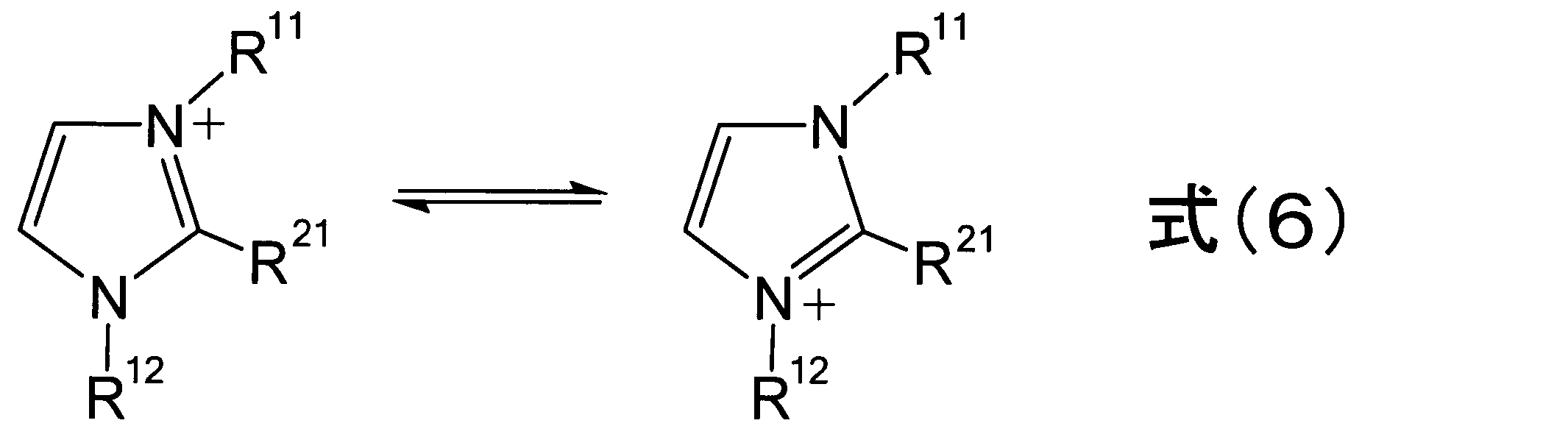
[式(6)中R21は、水素原子又はメチル基を示し、R11及びR12は、それぞれ独立して水素原子、炭素原子数1乃至20のアルキル基、炭素原子数1乃至20のハロアルキル基、炭素原子数2乃至10のアルケニル基、炭素原子数6乃至40のアリール基、炭素原子数7乃至15のアラルキル基、炭素原子数1乃至20のアルコキシ基、アルコキシアルキル基、複素環基、ポリエーテル基、ヒドロキシ基、シアノ基、ニトロ基、スルホ基、アミノ基、カルボキシ基、アセチル基、-Y-Z基、ハロゲン原子、又はそれらの組み合わせを示す。Yは酸素原子、硫黄原子、カルボニル基、又はエステル基を示し、Zは炭素原子数1乃至20のアルキル基を示す。]で表されるカチオン構造を有する第1観点に記載のレジスト下層膜形成組成物に関する。
第2観点として、上記イオン液体が架橋部位を有する第1観点に記載のレジスト下層膜形成組成物に関する。
第3観点として、上記イオン液体が上記ポリマーの質量に対し1.0質量%乃至90質量%の量含まれる、第1観点に記載のレジスト下層膜形成組成物に関する。
第4観点として、上記イオン液体が下記式(6):
第5観点として、上記ポリマーが少なくとも2つのアミノ基と3つの炭素原子数6乃至40の芳香族環とを含む芳香族化合物(A)の芳香族環と、芳香族ビニル化合物(B)のビニル基との反応により得られる構造体(C)を含むノボラック樹脂を含む第1観点又は第2観点に記載のレジスト下層膜形成組成物に関する。
第6観点として、構造体(C)が下記式(1):

[式(1)中、R1は少なくとも2つのアミノ基と少なくとも3つの炭素原子数6乃至40の芳香族環とを含む有機基であり、
R2及びR3はそれぞれ、水素原子、炭素原子数1乃至10のアルキル基、炭素原子数6乃至40のアリール基、複素環基、又はそれらの組み合わせであり、かつ、該アルキル基、該アリール基、該複素環基は、ハロゲン原子、ニトロ基、アミノ基、ホルミル基、アルコキシ基、又はヒドロキシ基で置換されていても良い有機基であり、そしてR2とR3は互いに環を形成していても良く、T1は炭素原子数6乃至40のアリーレン基である。T3は炭素原子数1乃至10のアルキル基、炭素原子数2乃至10のアルケニル基、炭素原子数2乃至10のアルキニル基、炭素原子数6乃至40のアリール基、ヒドロキシ基、シアノ基、ニトロ基、アミノ基、カルボキシ基、アセチル基、ヒドロキシメチル基、ハロゲノメチル基、-Y-Z基、ハロゲン原子、又はそれらの組み合わせを示す。Yは酸素原子、硫黄原子、カルボニル基、又はエステル基を示し、Zは炭素原子数1乃至10のアルキル基を示す。T2は水素原子、メチル基、又はフェニル基を示す。mは0乃至(5+2n)の整数であり、nはT1に由来するアリール基のベンゼン環の縮合度を示す。]である第5観点に記載のレジスト下層膜形成組成物に関する。
第7観点として、R1が式(2):
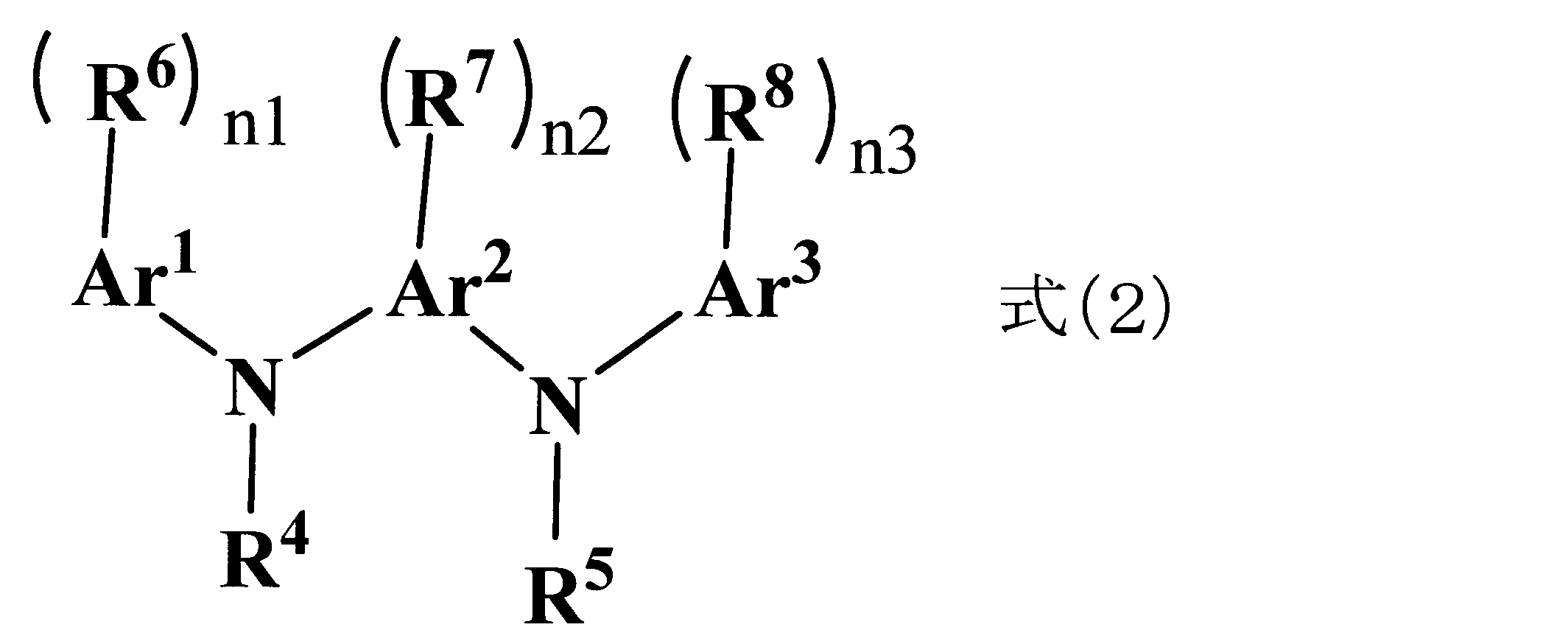
[式(2)中、Ar1、Ar2、及びAr3はそれぞれベンゼン環、又はナフタレン環を示し、R6、R7、及びR8はそれぞれ置換基でありハロゲン原子、ニトロ基、アミノ基、ヒドロキシ基、炭素原子数1乃至10のアルキル基、炭素原子数2乃至10のアルケニル基、炭素原子数6乃至40のアリール基、及びそれらの組み合わせからなる群より選択され、かつ、該アルキル基、該アルケニル基又は該アリール基は、エーテル結合、ケトン結合、若しくはエステル結合を含んでいても良い有機基を表し、
R4及びR5はそれぞれ水素原子、炭素原子数1乃至10のアルキル基、炭素原子数2乃至10のアルケニル基、炭素原子数6乃至40のアリール基、及びそれらの組み合わせからなる群より選択され、かつ、該アルキル基、該アルケニル基又はアリール基は、エーテル結合、ケトン結合、若しくはエステル結合を含んでいても良い有機基を表し、
n1、n2、n3はそれぞれ0以上であり、R6、R7、及びR8が置換可能な最大数までの整数である。]で示される化合物から誘導される2価の有機基である第6観点に記載のレジスト下層膜形成組成物に関する。
第8観点として、R1がN,N'-ジフェニル-1,4-フェニレンジアミンから誘導される2価の有機基である第6観点に記載のレジスト下層膜形成組成物に関する。
第9観点として、R3が水素原子であり、R2がフェニル基、ナフチル基、アントリル基、及びピレニル基から選ばれるアリール基であり、該アリール基はハロゲン原子、ニトロ基、アミノ基、炭素原子数1乃至10のアルキル基、炭素原子数1乃至10のアルコキシ基、炭素原子数6乃至40のアリール基、ホルミル基、カルボキシ基、又はヒドロキシ基で置換されていても良い基である第6観点に記載のレジスト下層膜形成組成物に関する。
第10観点として、R3が水素原子であり、R2がフェニル基であり、該フェニル基はハロゲン原子、ニトロ基、アミノ基、炭素数1乃至10のアルキル基、炭素原子数1乃至10のアルコキシ基、炭素原子数6乃至40のアリール基、ホルミル基、カルボキシ基、又はヒドロキシ基で置換されていても良い基である第6観点に記載のレジスト下層膜形成組成物に関する。
第11観点として、T1がフェニレン基である第6観点に記載のレジスト下層膜形成組成物に関する。
第12観点として、構造体(C)が下記式(1-1):

[式(1-1)中、R2及びR3はそれぞれ、水素原子、炭素原子数1乃至10のアルキル基、炭素原子数6乃至40のアリール基、複素環基、又はそれらの組み合わせであり、かつ、該アルキル基、該アリール基、該複素環基は、ハロゲン原子、ニトロ基、アミノ基、ホルミル基、アルコキシ基、又はヒドロキシ基で置換されていても良い有機基であり、そしてR2とR3は互いに環を形成していても良い。T2は水素原子、メチル基、又はフェニル基を示す。]の単位構造である第5観点に記載のレジスト下層膜形成組成物に関する。
第6観点として、構造体(C)が下記式(1):
R2及びR3はそれぞれ、水素原子、炭素原子数1乃至10のアルキル基、炭素原子数6乃至40のアリール基、複素環基、又はそれらの組み合わせであり、かつ、該アルキル基、該アリール基、該複素環基は、ハロゲン原子、ニトロ基、アミノ基、ホルミル基、アルコキシ基、又はヒドロキシ基で置換されていても良い有機基であり、そしてR2とR3は互いに環を形成していても良く、T1は炭素原子数6乃至40のアリーレン基である。T3は炭素原子数1乃至10のアルキル基、炭素原子数2乃至10のアルケニル基、炭素原子数2乃至10のアルキニル基、炭素原子数6乃至40のアリール基、ヒドロキシ基、シアノ基、ニトロ基、アミノ基、カルボキシ基、アセチル基、ヒドロキシメチル基、ハロゲノメチル基、-Y-Z基、ハロゲン原子、又はそれらの組み合わせを示す。Yは酸素原子、硫黄原子、カルボニル基、又はエステル基を示し、Zは炭素原子数1乃至10のアルキル基を示す。T2は水素原子、メチル基、又はフェニル基を示す。mは0乃至(5+2n)の整数であり、nはT1に由来するアリール基のベンゼン環の縮合度を示す。]である第5観点に記載のレジスト下層膜形成組成物に関する。
第7観点として、R1が式(2):
R4及びR5はそれぞれ水素原子、炭素原子数1乃至10のアルキル基、炭素原子数2乃至10のアルケニル基、炭素原子数6乃至40のアリール基、及びそれらの組み合わせからなる群より選択され、かつ、該アルキル基、該アルケニル基又はアリール基は、エーテル結合、ケトン結合、若しくはエステル結合を含んでいても良い有機基を表し、
n1、n2、n3はそれぞれ0以上であり、R6、R7、及びR8が置換可能な最大数までの整数である。]で示される化合物から誘導される2価の有機基である第6観点に記載のレジスト下層膜形成組成物に関する。
第8観点として、R1がN,N'-ジフェニル-1,4-フェニレンジアミンから誘導される2価の有機基である第6観点に記載のレジスト下層膜形成組成物に関する。
第9観点として、R3が水素原子であり、R2がフェニル基、ナフチル基、アントリル基、及びピレニル基から選ばれるアリール基であり、該アリール基はハロゲン原子、ニトロ基、アミノ基、炭素原子数1乃至10のアルキル基、炭素原子数1乃至10のアルコキシ基、炭素原子数6乃至40のアリール基、ホルミル基、カルボキシ基、又はヒドロキシ基で置換されていても良い基である第6観点に記載のレジスト下層膜形成組成物に関する。
第10観点として、R3が水素原子であり、R2がフェニル基であり、該フェニル基はハロゲン原子、ニトロ基、アミノ基、炭素数1乃至10のアルキル基、炭素原子数1乃至10のアルコキシ基、炭素原子数6乃至40のアリール基、ホルミル基、カルボキシ基、又はヒドロキシ基で置換されていても良い基である第6観点に記載のレジスト下層膜形成組成物に関する。
第11観点として、T1がフェニレン基である第6観点に記載のレジスト下層膜形成組成物に関する。
第12観点として、構造体(C)が下記式(1-1):
第13観点として、酸及び/又は酸発生剤を更に含む第1観点乃至第12観点のいずれか一に記載のレジスト下層膜形成組成物に関する。
第14観点として、第1観点乃至第13観点のいずれか一に記載のレジスト下層膜形成組成物を半導体基板上に塗布し焼成することによって得られるレジスト下層膜に関する。
第15観点として、半導体基板上に第1観点乃至第13観点のいずれか一に記載のレジスト下層膜形成組成物により下層膜を形成する工程、その上にレジスト膜を形成する工程、光又は電子線の照射と現像によりレジストパターンを形成する工程、レジストパターンにより該下層膜をエッチングする工程、及びパターン化された下層膜により半導体基板を加工する工程を含む半導体装置の製造方法に関する。
第16観点として、半導体基板に第1観点乃至第13観点のいずれか一に記載のレジスト下層膜形成組成物により下層膜を形成する工程、その上にハードマスクを形成する工程、更にその上にレジスト膜を形成する工程、光又は電子線の照射と現像によりレジストパターンを形成する工程、レジストパターンによりハードマスクをエッチングする工程、パターン化されたハードマスクにより該下層膜をエッチングする工程、及びパターン化された下層膜により半導体基板を加工する工程を含む半導体装置の製造方法に関する。
第15観点として、半導体基板上に第1観点乃至第13観点のいずれか一に記載のレジスト下層膜形成組成物により下層膜を形成する工程、その上にレジスト膜を形成する工程、光又は電子線の照射と現像によりレジストパターンを形成する工程、レジストパターンにより該下層膜をエッチングする工程、及びパターン化された下層膜により半導体基板を加工する工程を含む半導体装置の製造方法に関する。
第16観点として、半導体基板に第1観点乃至第13観点のいずれか一に記載のレジスト下層膜形成組成物により下層膜を形成する工程、その上にハードマスクを形成する工程、更にその上にレジスト膜を形成する工程、光又は電子線の照射と現像によりレジストパターンを形成する工程、レジストパターンによりハードマスクをエッチングする工程、パターン化されたハードマスクにより該下層膜をエッチングする工程、及びパターン化された下層膜により半導体基板を加工する工程を含む半導体装置の製造方法に関する。
本発明のレジスト下層膜形成組成物は基板上に塗布し、焼成する場合に熱リフローにより基板上に形成されたパターンに充填されるが、イオン液体を添加することで高温時における低粘度性を付与させることで、熱リフロー性を高め、パターンへの充填性を向上させることができる。
また、レジスト下層膜は上層に蒸着法でシリコンハードマスク層が形成されることがあり、蒸着時の熱に対応できる耐熱性も求められる。そして、レジスト下層膜は転写されたパターンにより下方の基板を加工するものであるため耐エッチング性も求められる。
本発明のレジスト下層膜は、耐熱性、平坦化性、及び耐エッチング性の点においてバランス良く兼ね備えた特性を有する材料を提供することができる。
また、レジスト下層膜は上層に蒸着法でシリコンハードマスク層が形成されることがあり、蒸着時の熱に対応できる耐熱性も求められる。そして、レジスト下層膜は転写されたパターンにより下方の基板を加工するものであるため耐エッチング性も求められる。
本発明のレジスト下層膜は、耐熱性、平坦化性、及び耐エッチング性の点においてバランス良く兼ね備えた特性を有する材料を提供することができる。
本発明は少なくとも一種のイオン液体、ポリマー、架橋剤、架橋反応を促進させる化合物及び有機溶媒を含む、レジスト下層膜形成組成物である。
本発明において上記のリソグラフィー用レジスト下層膜形成組成物は上記樹脂と溶剤を含む。そして、架橋剤と酸を含むことができ、必要に応じて酸発生剤、界面活性剤等を含むことができる。この組成物の固形分は0.1質量%乃至70質量%、又は0.1質量%乃至60質量%である。固形分はレジスト下層膜形成組成物から溶剤を除いた全成分の含有割合である。固形分中に上記ポリマーを1質量%乃至100質量%、又は1質量%乃至99.9質量%、又は50質量%乃至99.9質量%、又は50質量%乃至95質量%、又は質量%50乃至90質量%の割合で含有することができる。
以下、本発明のレジスト下層膜形成組成物について詳細に説明する。
<イオン液体>
本発明のレジスト下層膜形成組成物に含まれるイオン液体を構成するカチオンを以下に例示する。例えば、イミダゾリウムカチオン、アンモニウムカチオン、ピロリジニウムカチオン、ピリジニウムカチオン、ピペリジニウムカチオン、グアニジニウムカチオン、ホスホニウムカチオン、スルホニウムカチオン及びオキソニウムカチオン等が挙げられ、好ましくは、イミダゾリウムカチオンである。
<イオン液体>
本発明のレジスト下層膜形成組成物に含まれるイオン液体を構成するカチオンを以下に例示する。例えば、イミダゾリウムカチオン、アンモニウムカチオン、ピロリジニウムカチオン、ピリジニウムカチオン、ピペリジニウムカチオン、グアニジニウムカチオン、ホスホニウムカチオン、スルホニウムカチオン及びオキソニウムカチオン等が挙げられ、好ましくは、イミダゾリウムカチオンである。
上記イミダゾリウムカチオンは、下記式(6):

[式(6)中R21は、水素原子又はメチル基を示し、R11及びR12は、それぞれ独立して水素原子、炭素原子数1乃至20のアルキル基、炭素原子数1乃至20のハロアルキル基、炭素原子数2乃至10のアルケニル基、炭素原子数6乃至40のアリール基、炭素原子数7乃至15のアラルキル基、炭素原子数1乃至20のアルコキシ基、アルコキシアルキル基、複素環基、ポリエーテル基、ヒドロキシ基、シアノ基、ニトロ基、スルホ基、アミノ基、カルボキシ基、アセチル基、-Y-Z基、ハロゲン原子、又はそれらの組み合わせを示す。Yは酸素原子、硫黄原子、カルボニル基、又はエステル基を示し、Zは炭素原子数1乃至20のアルキル基を示す。]で表される構造を有する。
上記炭素原子数1乃至20のアルキル基としてはメチル基、エチル基、n-プロピル基、i-プロピル基、シクロプロピル基、n-ブチル基、i-ブチル基、s-ブチル基、t-ブチル基、シクロブチル基、1-メチル-シクロプロピル基、2-メチル-シクロプロピル基、n-ペンチル基、1-メチル-n-ブチル基、2-メチル-n-ブチル基、3-メチル-n-ブチル基、1,1-ジメチル-n-プロピル基、1,2-ジメチル-n-プロピル基、2,2-ジメチル-n-プロピル基、1-エチル-n-プロピル基、シクロペンチル基、1-メチル-シクロブチル基、2-メチル-シクロブチル基、3-メチル-シクロブチル基、1,2-ジメチル-シクロプロピル基、2,3-ジメチル-シクロプロピル基、1-エチル-シクロプロピル基、2-エチル-シクロプロピル基、n-ヘキシル基、1-メチル-n-ペンチル基、2-メチル-n-ペンチル基、3-メチル-n-ペンチル基、4-メチル-n-ペンチル基、1,1-ジメチル-n-ブチル基、1,2-ジメチル-n-ブチル基、1,3-ジメチル-n-ブチル基、2,2-ジメチル-n-ブチル基、2,3-ジメチル-n-ブチル基、3,3-ジメチル-n-ブチル基、1-エチル-n-ブチル基、2-エチル-n-ブチル基、1,1,2-トリメチル-n-プロピル基、1,2,2-トリメチル-n-プロピル基、1-エチル-1-メチル-n-プロピル基、1-エチル-2-メチル-n-プロピル基、シクロヘキシル基、1-メチル-シクロペンチル基、2-メチル-シクロペンチル基、3-メチル-シクロペンチル基、1-エチル-シクロブチル基、2-エチル-シクロブチル基、3-エチル-シクロブチル基、1,2-ジメチル-シクロブチル基、1,3-ジメチル-シクロブチル基、2,2-ジメチル-シクロブチル基、2,3-ジメチル-シクロブチル基、2,4-ジメチル-シクロブチル基、3,3-ジメチル-シクロブチル基、1-n-プロピル-シクロプロピル基、2-n-プロピル-シクロプロピル基、1-i-プロピル-シクロプロピル基、2-i-プロピル-シクロプロピル基、1,2,2-トリメチル-シクロプロピル基、1,2,3-トリメチル-シクロプロピル基、2,2,3-トリメチル-シクロプロピル基、1-エチル-2-メチル-シクロプロピル基、2-エチル-1-メチル-シクロプロピル基、2-エチル-2-メチル-シクロプロピル基及び2-エチル-3-メチル-シクロプロピル基等が挙げられる。
上記炭素原子数1乃至20のハロアルキル基としては、上記アルキル基の水素原子の少なくとも一つがハロゲン原子(塩素原子、臭素原子、フッ素原子、ヨウ素原子)、特にフッ素原子で置換された炭素原子数1乃至20のハロアルキル基が挙げられる。
上記炭素原子数2乃至10のアルケニル基としてはエテニル基、1-プロペニル基、2-プロペニル基、1-メチル-1-エテニル基、1-ブテニル基、2-ブテニル基、3-ブテニル基、2-メチル-1-プロペニル基、2-メチル-2-プロペニル基、1-エチルエテニル基、1-メチル-1-プロペニル基、1-メチル-2-プロペニル基、1-ペンテニル基、2-ペンテニル基、3-ペンテニル基、4-ペンテニル基、1-n-プロピルエテニル基、1-メチル-1-ブテニル基、1-メチル-2-ブテニル基、1-メチル-3-ブテニル基、2-エチル-2-プロペニル基、2-メチル-1-ブテニル基、2-メチル-2-ブテニル基、2-メチル-3-ブテニル基、3-メチル-1-ブテニル基、3-メチル-2-ブテニル基、3-メチル-3-ブテニル基、1,1-ジメチル-2-プロペニル基、1-i-プロピルエテニル基、1,2-ジメチル-1-プロペニル基、1,2-ジメチル-2-プロペニル基、1-シクロペンテニル基、2-シクロペンテニル基、3-シクロペンテニル基、1-ヘキセニル基、2-ヘキセニル基、3-ヘキセニル基、4-ヘキセニル基、5-ヘキセニル基、1-メチル-1-ペンテニル基、1-メチル-2-ペンテニル基、1-メチル-3-ペンテニル基、1-メチル-4-ペンテニル基、1-n-ブチルエテニル基、2-メチル-1-ペンテニル基、2-メチル-2-ペンテニル基、2-メチル-3-ペンテニル基、2-メチル-4-ペンテニル基、2-n-プロピル-2-プロペニル基、3-メチル-1-ペンテニル基、3-メチル-2-ペンテニル基、3-メチル-3-ペンテニル基、3-メチル-4-ペンテニル基、3-エチル-3-ブテニル基、4-メチル-1-ペンテニル基、4-メチル-2-ペンテニル基、4-メチル-3-ペンテニル基、4-メチル-4-ペンテニル基、1,1-ジメチル-2-ブテニル基、1,1-ジメチル-3-ブテニル基、1,2-ジメチル-1-ブテニル基、1,2-ジメチル-2-ブテニル基、1,2-ジメチル-3-ブテニル基、1-メチル-2-エチル-2-プロペニル基、1-s-ブチルエテニル基、1,3-ジメチル-1-ブテニル基、1,3-ジメチル-2-ブテニル基、1,3-ジメチル-3-ブテニル基、1-i-ブチルエテニル基、2,2-ジメチル-3-ブテニル基、2,3-ジメチル-1-ブテニル基、2,3-ジメチル-2-ブテニル基、2,3-ジメチル-3-ブテニル基、2-i-プロピル-2-プロペニル基、3,3-ジメチル-1-ブテニル基、1-エチル-1-ブテニル基、1-エチル-2-ブテニル基、1-エチル-3-ブテニル基、1-n-プロピル-1-プロペニル基、1-n-プロピル-2-プロペニル基、2-エチル-1-ブテニル基、2-エチル-2-ブテニル基、2-エチル-3-ブテニル基、1,1,2-トリメチル-2-プロペニル基、1-t-ブチルエテニル基、1-メチル-1-エチル-2-プロペニル基、1-エチル-2-メチル-1-プロペニル基、1-エチル-2-メチル-2-プロペニル基、1-i-プロピル-1-プロペニル基、1-i-プロピル-2-プロペニル基、1-メチル-2-シクロペンテニル基、1-メチル-3-シクロペンテニル基、2-メチル-1-シクロペンテニル基、2-メチル-2-シクロペンテニル基、2-メチル-3-シクロペンテニル基、2-メチル-4-シクロペンテニル基、2-メチル-5-シクロペンテニル基、2-メチレン-シクロペンチル基、3-メチル-1-シクロペンテニル基、3-メチル-2-シクロペンテニル基、3-メチル-3-シクロペンテニル基、3-メチル-4-シクロペンテニル基、3-メチル-5-シクロペンテニル基、3-メチレン-シクロペンチル基、1-シクロヘキセニル基、2-シクロヘキセニル基及び3-シクロヘキセニル基等が挙げられる。
上記炭素原子数6乃至40のアリール基としてはフェニル基、o-メチルフェニル基、m-メチルフェニル基、p-メチルフェニル基、o-クロルフェニル基、m-クロルフェニル基、p-クロルフェニル基、o-フルオロフェニル基、p-フルオロフェニル基、o-メトキシフェニル基、p-メトキシフェニル基、p-ニトロフェニル基、p-シアノフェニル基、α-ナフチル基、β-ナフチル基、o-ビフェニル基、m-ビフェニル基、p-ビフェニル基、1-アントリル基、2-アントリル基、9-アントリル基、1-フェナントリル基、2-フェナントリル基、3-フェナントリル基、4-フェナントリル基及び9-フェナントリル基、ピレニル基等が挙げられる。
上記炭素原子数7乃至15のアラルキル基としては、ベンジル基、フェネチル基、ナフチルメチル基等が挙げられる。
上記炭素原子数1乃至20のアルコキシ基は、例えばメトキシ基、エトキシ基、n-プロポキシ基、i-プロポキシ基、n-ブトキシ基、i-ブトキシ基、s-ブトキシ基、t-ブトキシ基、n-ペントキシ基、1-メチル-n-ブトキシ基、2-メチル-n-ブトキシ基、3-メチル-n-ブトキシ基、1,1-ジメチル-n-プロポキシ基、1,2-ジメチル-n-プロポキシ基、2,2-ジメチル-n-プロポキシ基、1-エチル-n-プロポキシ基、n-ヘキシルオキシ基、1-メチル-n-ペンチルオキシ基、2-メチル-n-ペンチルオキシ基、3-メチル-n-ペンチルオキシ基、4-メチル-n-ペンチルオキシ基、1,1-ジメチル-n-ブトキシ基、1,2-ジメチル-n-ブトキシ基、1,3-ジメチル-n-ブトキシ基、2,2-ジメチル-n-ブトキシ基、2,3-ジメチル-n-ブトキシ基、3,3-ジメチル-n-ブトキシ基、1-エチル-n-ブトキシ基、2-エチル-n-ブトキシ基、1,1,2-トリメチル-n-プロポキシ基、1,2,2-トリメチル-n-プロポキシ基、1-エチル-1-メチル-n-プロポキシ基、及び1-エチル-2-メチル-n-プロポキシ基等が挙げられる。
上記アルコキシアルキル基のアルコキシ基及びアルキル基は上記と同様であり、直鎖又は分岐を有する炭素原子数1乃至20のアルコキシ基で置換された直鎖又は分岐を有する炭素原子数1乃至20のアルキル基が挙げられ、特にメトキシメチル基、メトキシエチル基、エトキシメチル基及びエトキシエチル基が例示される。
上記複素環基としては窒素原子、硫黄原子、酸素原子を含む5乃至6員環の複素環からなる有機基が好ましく、例えばピロール基、フラン基、チオフェン基、イミダゾール基、オキサゾール基、チアゾール基、ピラゾール基、イソオキサゾール基、イソチアゾール基及びピリジン基等が挙げられる。
上記ポリエーテル基としては、-(CH2)n11-O-(CH2CH2O)n12-(C1-C4アルキル)、又は-(CH2)n11-O-(CH2CH(CH3)O)n12-(C1-C4アルキル)で表される基が挙げられ、n11は1乃至4の整数、n12は1乃至4の整数、C1-C4アルキルとしては、メチル、エチル、イソプロピル、n-ブチル、イソブチル、sec-ブチル及びtert-ブチルが例示される。
上記ハロゲン原子としてはフッ素原子、塩素原子、臭素原子、ヨウ素原子が挙げられる。
上記R11及びR12の中でも成膜中の焼成時におけるレジスト下層膜形成組成物の昇華を抑える観点から炭素原子数1乃至20のアルキル基、炭素原子数2乃至10のアルケニル基、炭素原子数1乃至20のアルコキシ基、アルコキシアルキル基、ポリエーテル基、ヒドロキシ基、シアノ基、ニトロ基、スルホ基、アミノ基、カルボニル基、カルボキシ基、エステル基、アセチル基、ハロゲン原子等の反応性基であることが好ましく、炭素原子数1乃至20のアルキル基、炭素原子数2乃至10のアルケニル基、炭素原子数1乃至20のアルコキシ基、カルボキシ基、エステル基、ヒドロキシ基、アルコキシアルキル基がより好ましく、炭素原子数1乃至20のアルキル基、炭素原子数2乃至10のアルケニル基が更に好ましく、アリル基が最も好ましい。
上記イミダゾリウムカチオンとしては、例えば下記式(22-1)乃至(22-32)で表されるイミダゾリウムカチオンが挙げられる。


さらに、1,3-ジエチルイミダゾリウムカチオン等の対称イミダゾリウムカチオン類;1-イソプロピル-3-プロピルイミダゾリウムカチオンカチオン及び1-tert-ブチル-3-プロピルイミダゾリウムカチオンカチオン等の非対称イミダゾリウムカチオン類が挙げられる。
上記アンモニウムカチオン、は、下記式(7):

[式(7)中、R11及びR12は式(6)における定義と同じであり、R13は、上記したR11及びR12の定義と同じであるが、R11及びR12は窒素原子と一緒になって5乃至8員環の置換されてもよい含窒素複素環基を形成してもよい。R14は炭素原子数1乃至20のアルキル基、炭素原子数1乃至20のハロアルキル基、炭素原子炭素原子数6乃至40のアリール基、炭素原子数7乃至15のアラルキル基、炭素原子数1乃至20のアルコキシ基、アルコキシアルキル基、ポリエーテル基;酸化還元性を有する機能性有機官能基;又は揮発性有機溶媒に由来する基を示す。]で表される。
R14が酸化還元性を有する機能性有機官能基である式(7)のイオン液体としては、具体的には以下の式(II)乃至(VIII)の化合物が例示される。

[式(II)及び(III)中、n30は0又は1を示す。Mは、遷移金属原子を示す。R31、R32及びR33は、同一又は異なって、アルキル基、ハロアルキル基、アルコキシ基、置換されていてもよいアリール基、置換されていてもよいアラルキル基又はアルコキシアルキル基を示し、R31及びR32は窒素原子と一緒になって、5乃至8員環の含窒素環式基を形成してもよい。]
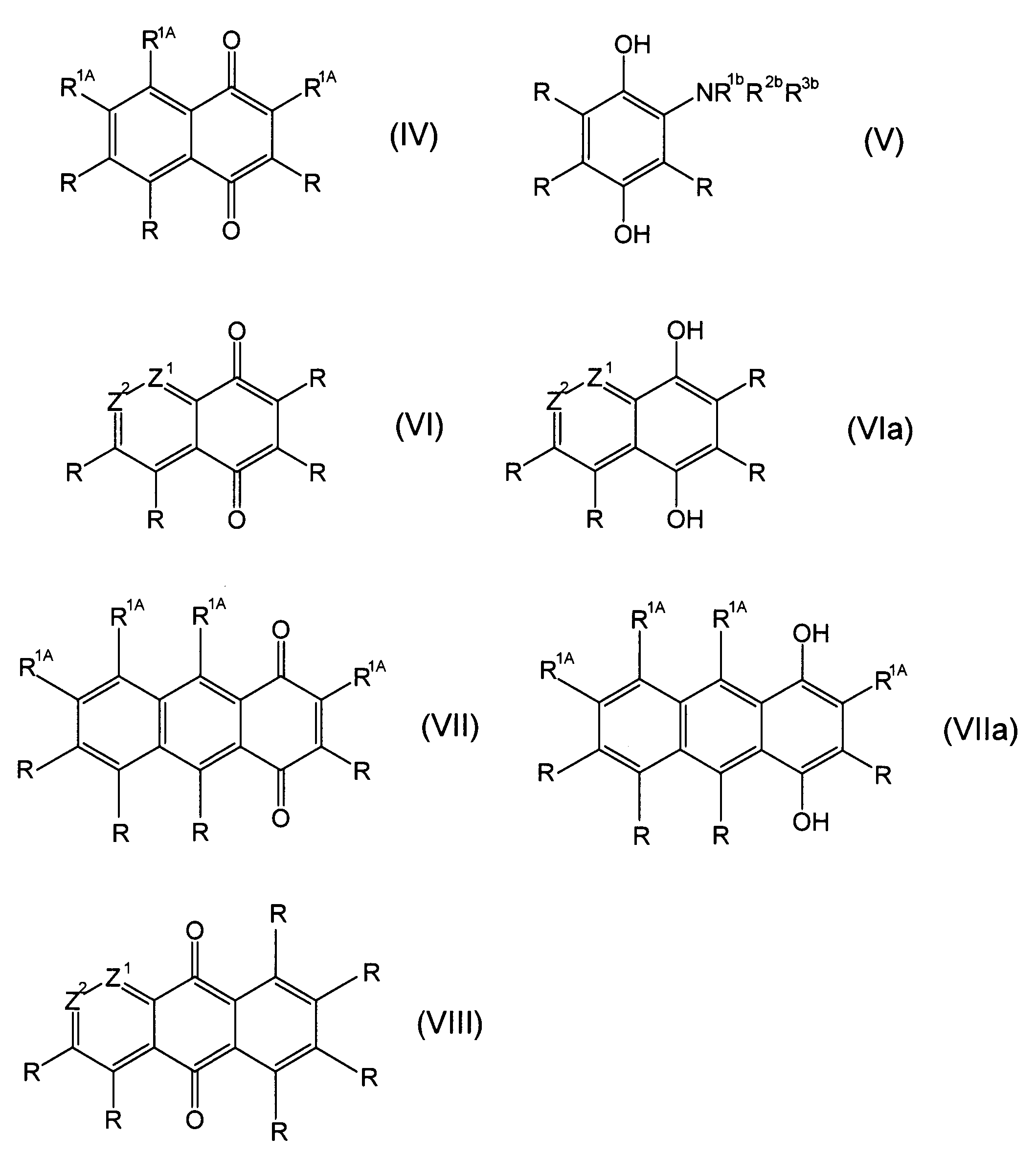
〔式中、Rは同一又は異なって、ハロゲン原子、アルキル基、アルコキシ基、アルカノイル基、ヒドロキシ基、カルボキシ基、アルコキシカルボニル基、ニトロ基、シアノ基、アセチルアミノ基、フェニル基、ベンジル基又はペルフルオロアルキル基を示すか、あるいは隣接する2つのRはそれらが結合する炭素原子と一緒になって、ベンゼン環を形成してもよい。
複数のR1Aの1つは、NR1bR2bR3bを示し、その他は同一又は異なってRを示す。R1b,R2b,R3bは、同一又は異なって、アルキル基、ハロアルキル基、アルコキシ基、置換されていてもよいアリール基、置換されていてもよいアラルキル基又はアルコキシアルキル基を示し、R1b及びR2bは窒素原子と一緒になって、5乃至8員環の含窒素環式基を形成してもよい。
Z1及びZ2は、一方がCHを示し、他方がN+-R13(R13は上記に定義されるとおりである)を示す。〕
複数のR1Aの1つは、NR1bR2bR3bを示し、その他は同一又は異なってRを示す。R1b,R2b,R3bは、同一又は異なって、アルキル基、ハロアルキル基、アルコキシ基、置換されていてもよいアリール基、置換されていてもよいアラルキル基又はアルコキシアルキル基を示し、R1b及びR2bは窒素原子と一緒になって、5乃至8員環の含窒素環式基を形成してもよい。
Z1及びZ2は、一方がCHを示し、他方がN+-R13(R13は上記に定義されるとおりである)を示す。〕
Mは、遷移金属原子、例えばFe,Co,Ni,Zn,Cu,Cr,V,Cd,As,Mn,Ti,Zr,Sn,Ag,In,Hg,W,Pt,Au,Ga,Ge,Ruを示し、好ましくはFeである。
上記アルカノイル基としては、アセチル、プロピオニル、ブチリル等の、式:-CO-(アルキル)(アルキルは段落[0019]に定義されるとおりである。)で表される炭素原子数2乃至21の直鎖又は分枝を有するアルカノイル基が挙げられる。
上記アルコキシカルボニル基としては、メトキシカルボニル、エトキシカルボニル、ブトキシカルボニルなどの式:-CO-O(アルキル)(アルキルは段落[0019]に定義されるとおりである。)で表される炭素数2乃至21の直鎖又は分枝を有するアルコキシカルボニル基が挙げられる。
上記ペルフルオロアルキル基としては、前記アルキル基の水素原子が全てフッ素原子で置換された基が例示され、たとえばCqF2q+1(qは1乃至20の整数を示す)で表される基が例示される。
R14が揮発性有機溶媒に由来する基である場合のカチオン性基は有機溶媒に必要に応じ
てアルキレン基を介して有機溶媒に導入される。有機溶媒としては、常圧での沸点が-1
00℃乃至300℃、好ましくは30℃乃至300℃であって、常温で固体又は液体の化合物が例示され、具体的には以下の化合物が例示される:
エーテル類:ジエチルエーテル、テトラヒドロフラン、テトラヒドロピラン、ジイソプロピルエーテル、ジフェニルエーテル、アニソール、フェネトール、グアイアコールなど;アルキレングリコール類:エチレングリコール、プロピレングリコール、ブチレングリコール、ジエチレングリコール、トリエチレングリコールなど;
アルキレングリコールモノアルキルエーテル類:エチレングリコールモノメチルエーテル、エチレングリコールモノエチルエーテル、プロピレングリコールモノメチルエーテル、プロピレングリコールモノエチルエーテル、ブチレングリコールモノメチルエーテル、ブチレングリコールモノエチルエーテル、ジエチレングリコールモノメチルエーテル、ジエチレングリコールモノエチルエーテルなど;
アルキレングリコールジアルキルエーテル類:エチレングリコールジメチルエーテル(DME)、エチレングリコールジエチルエーテル、プロピレングリコールジメチルエーテル、プロピレングリコールジエチルエーテル、ブチレングリコールジメチルエーテル、ブチレングリコールジエチルエーテル、ジエチレングリコールジメチルエーテル、ジエチレングリコールジエチルエーテルなど;
エステル類:酢酸メチル、酢酸エチル、酢酸プロピル、酢酸ブチル、プロピオン酸メチル、プロピオン酸エチル、プロピオン酸プロピル、プロピオン酸ブチル、ギ酸メチル、ギ酸エチル、ギ酸プロピル、ギ酸ブチル、安息香酸メチル、安息香酸エチル、安息香酸プロピル、安息香酸ブチルなど;
ラクトン類:γ-ブチロラクトン(GBL)など;
ケトン類:アセトン(ATN)、アセチルアセトン、メチルエチルケトン、シクロヘキサノン、シクロペンタノンなど;
ヘテロ芳香族炭化水素:ピリジンなど;
脂環式炭化水素:シクロペンタン、シクロヘキサン、メチルシクロヘキサンなど;
ヘテロ脂環式化合物:ジオキサン、モルホリン、ピロリジンなど;
スルフィド類:ジメチルスルフィド、ジエチルスルフィド、ジ-n-プロピルスルフィド、ジイソプロピルスルフィドなど;
炭酸エステル類:エチレンカーボネート(EC)、プロピレンカーボネート(PC)、ブチレンカーボネート、ジエチルカーボネート(DEC)、ジメチルカーボネートなど;
アルコール類:エタノール、n-プロパノール、イソプロパノール、n-ブタノール、イソブタノール、sec-ブタノール、tert-ブタノールなど;
このような有機溶媒にカチオン性基を導入する方法としては、以下の方法が挙げられる。

(式中、Organic Solventは、上記の有機溶媒を示し、Raは、置換基を有していてもよいアルキル基を示す。Rは、水素原子又は置換基を有していてもよいアルキル基を示す。Xは脱離基を示す。)
R,Raで表される置換基を有していてもよいアルキル基としては、メチル基、エチル基、n-プロピル基、イソプロピル基などの炭素数1乃至3のアルキル基が例示され、該アルキル基は、フッ素原子、メトキシ基、シアノ基などの基で置換されていてもよい。
Xは脱離基を表し、具体的には、塩素原子、臭素原子、ヨウ素原子、メタンスルホニル基、p-トルエンスルホニル基などが挙げられる。
低沸点、高揮発性の溶媒に4級アンモニウム基を導入して、イオン液体に導く方法があり、4級アンモニウム化は、上記のように、脱離基と第三級アミンを反応させて行っても良く、アミノ基を含む溶媒のアミノ基を四級化してもよい。
てアルキレン基を介して有機溶媒に導入される。有機溶媒としては、常圧での沸点が-1
00℃乃至300℃、好ましくは30℃乃至300℃であって、常温で固体又は液体の化合物が例示され、具体的には以下の化合物が例示される:
エーテル類:ジエチルエーテル、テトラヒドロフラン、テトラヒドロピラン、ジイソプロピルエーテル、ジフェニルエーテル、アニソール、フェネトール、グアイアコールなど;アルキレングリコール類:エチレングリコール、プロピレングリコール、ブチレングリコール、ジエチレングリコール、トリエチレングリコールなど;
アルキレングリコールモノアルキルエーテル類:エチレングリコールモノメチルエーテル、エチレングリコールモノエチルエーテル、プロピレングリコールモノメチルエーテル、プロピレングリコールモノエチルエーテル、ブチレングリコールモノメチルエーテル、ブチレングリコールモノエチルエーテル、ジエチレングリコールモノメチルエーテル、ジエチレングリコールモノエチルエーテルなど;
アルキレングリコールジアルキルエーテル類:エチレングリコールジメチルエーテル(DME)、エチレングリコールジエチルエーテル、プロピレングリコールジメチルエーテル、プロピレングリコールジエチルエーテル、ブチレングリコールジメチルエーテル、ブチレングリコールジエチルエーテル、ジエチレングリコールジメチルエーテル、ジエチレングリコールジエチルエーテルなど;
エステル類:酢酸メチル、酢酸エチル、酢酸プロピル、酢酸ブチル、プロピオン酸メチル、プロピオン酸エチル、プロピオン酸プロピル、プロピオン酸ブチル、ギ酸メチル、ギ酸エチル、ギ酸プロピル、ギ酸ブチル、安息香酸メチル、安息香酸エチル、安息香酸プロピル、安息香酸ブチルなど;
ラクトン類:γ-ブチロラクトン(GBL)など;
ケトン類:アセトン(ATN)、アセチルアセトン、メチルエチルケトン、シクロヘキサノン、シクロペンタノンなど;
ヘテロ芳香族炭化水素:ピリジンなど;
脂環式炭化水素:シクロペンタン、シクロヘキサン、メチルシクロヘキサンなど;
ヘテロ脂環式化合物:ジオキサン、モルホリン、ピロリジンなど;
スルフィド類:ジメチルスルフィド、ジエチルスルフィド、ジ-n-プロピルスルフィド、ジイソプロピルスルフィドなど;
炭酸エステル類:エチレンカーボネート(EC)、プロピレンカーボネート(PC)、ブチレンカーボネート、ジエチルカーボネート(DEC)、ジメチルカーボネートなど;
アルコール類:エタノール、n-プロパノール、イソプロパノール、n-ブタノール、イソブタノール、sec-ブタノール、tert-ブタノールなど;
このような有機溶媒にカチオン性基を導入する方法としては、以下の方法が挙げられる。
R,Raで表される置換基を有していてもよいアルキル基としては、メチル基、エチル基、n-プロピル基、イソプロピル基などの炭素数1乃至3のアルキル基が例示され、該アルキル基は、フッ素原子、メトキシ基、シアノ基などの基で置換されていてもよい。
Xは脱離基を表し、具体的には、塩素原子、臭素原子、ヨウ素原子、メタンスルホニル基、p-トルエンスルホニル基などが挙げられる。
低沸点、高揮発性の溶媒に4級アンモニウム基を導入して、イオン液体に導く方法があり、4級アンモニウム化は、上記のように、脱離基と第三級アミンを反応させて行っても良く、アミノ基を含む溶媒のアミノ基を四級化してもよい。
上記アンモニウムカチオンとしては、例えば下記式(23-1)乃至(23-16)で表されるアンモニウムカチオンが挙げられる。
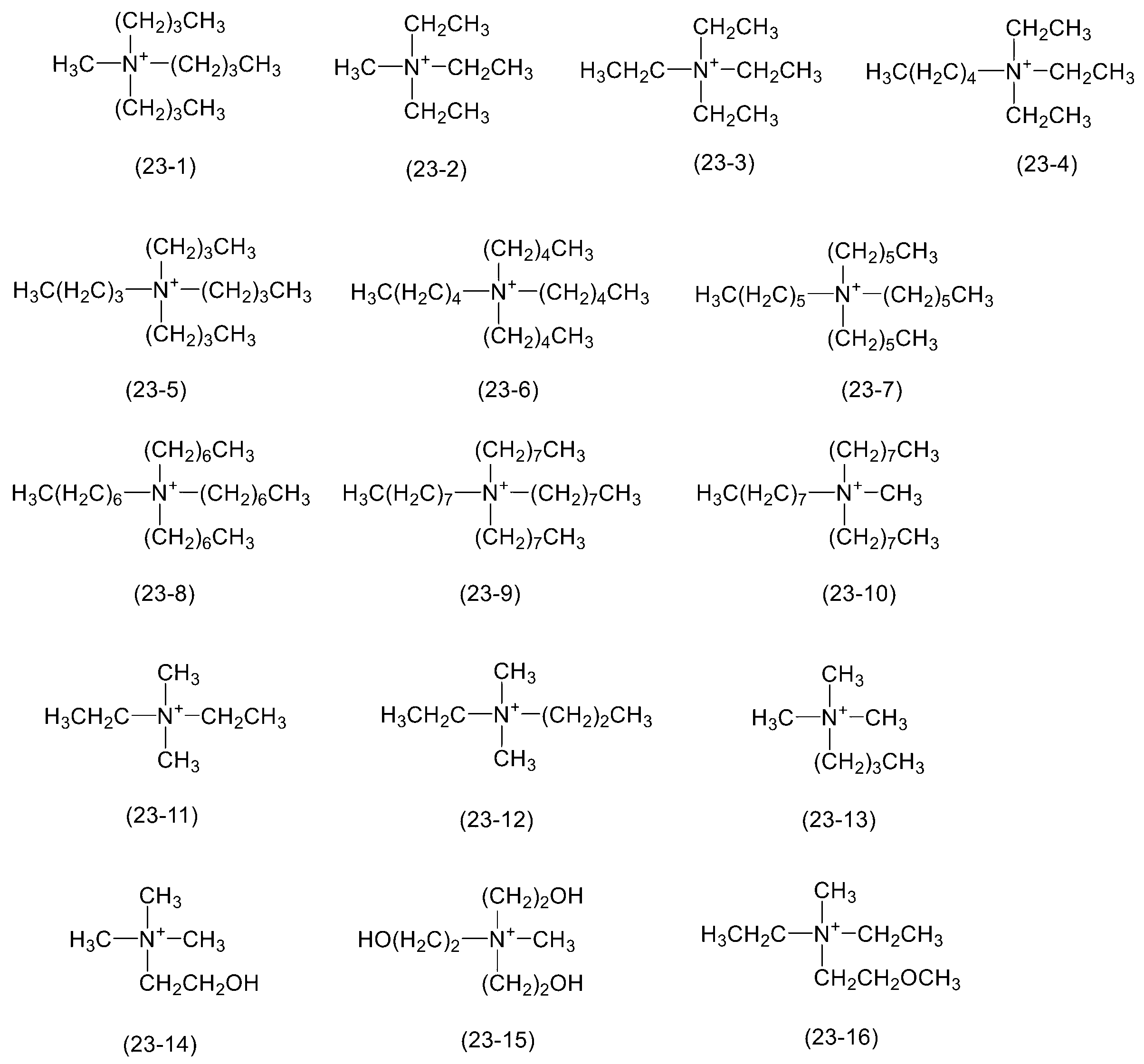
さらに、テトラメチルアンモニウムカチオン、テトラプロピルアンモニウムカチオン等の対称アンモニウムカチオン類;エチルトリメチルアンモニウムカチオン、ビニルトリメチルアンモニウムカチオン、トリエチルプロピルアンモニウムカチオン、トリブチルエチルアンモニウムカチオン、トリエチルイソプロピルアンモニウムカチオン、ブチルジエチルメチルアンモニウムカチオン、トリエチルメトキシメチルアンモニウムカチオン、ジメチルエチルメトキシエチルアンモニウム、ジメチルエチルメトキシメチルアンモニウム、ジエチルメチルメトキシメチルアンモニウム等の最短の置換基の炭素数が最長の置換基の炭素数の50%以上100%未満である(以下擬対称ともいう。)アンモニウムカチオン類;トリメチルプロピルアンモニウムカチオン、トリメチルイソプロピルアンモニウムカチオン、アリルトリメチルアンモニウムカチオン、ヘキシルトリメチルアンモニウムカチオン、オクチルトリメチルアンモニウムカチオン、ドデシルトリメチルアンモニウムカチオン、トリエチルメトキシエトキシメチルアンモニウムカチオン、ジメチルジプロピルアンモニウムカチオン等の非対称アンモニウムカチオン類;ヘキサメトニウムカチオン等の2価アンモニウムカチオン類が挙げられる。
上記ピロリジニウムカチオンとしては、例えば下記式(24-1)乃至(24-7)で表されるピロリジニウムカチオンが挙げられる。

上記ピリジニウムカチオンとしては、例えば下記式(25-1)乃至(25-9)で表されるピリジニウムカチオンが挙げられる。

上記ピペリジニウムカチオンとしては、例えば下記式(26-1)乃至(26-4)で表されるピペリジニウムカチオンが挙げられる。
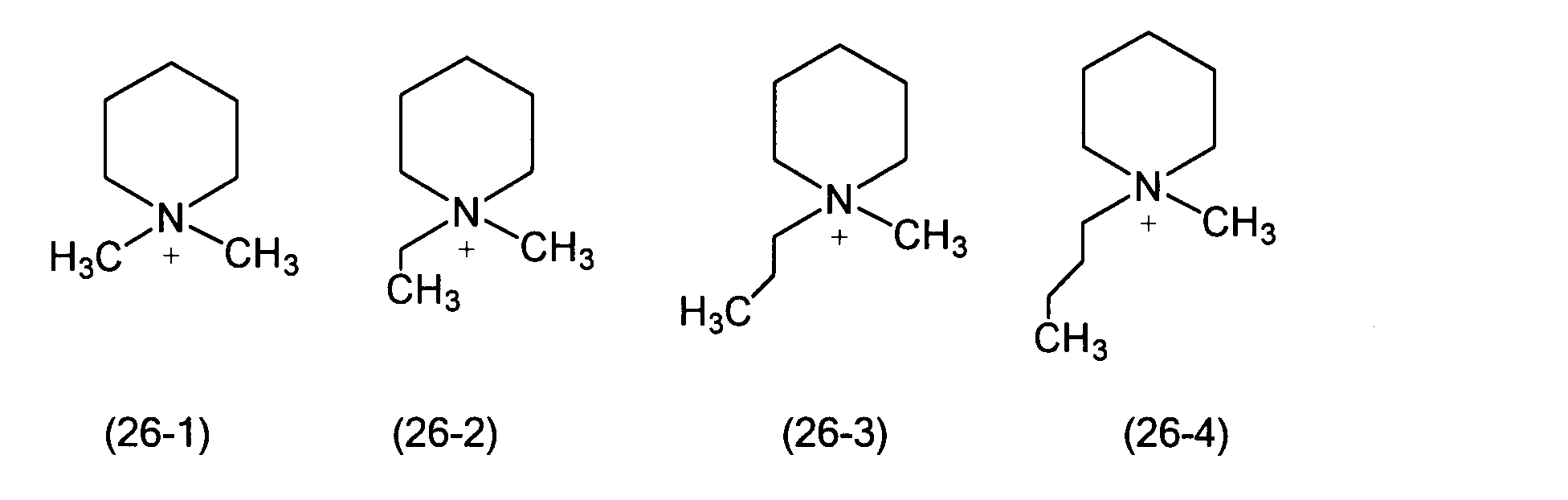
上記グアニジニウムカチオンは、下記式(8):
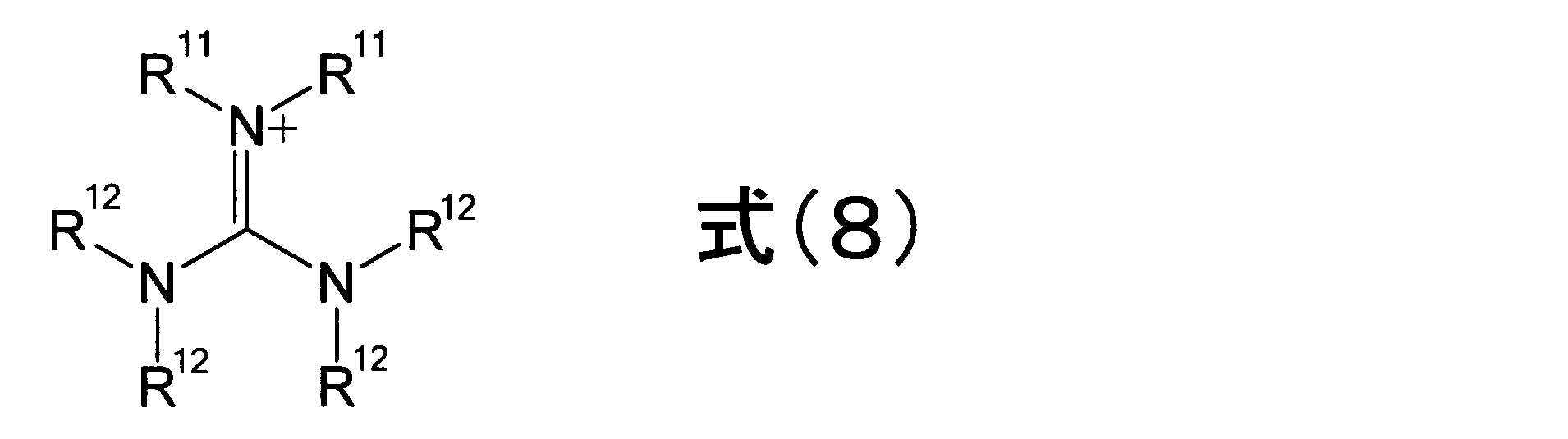
[式(8)中、R11及びR12は式(6)における定義と同じである。]で表される。
上記ホスホニウムカチオンは、下記式(9):

〔式(9)中、R11及びR12は式(6)における定義と同じであり、R13及びR14は、式(7)における定義と同じである。但し、R11及びR12はリン原子と一緒になって5乃至8員環の置換されていてもよい含リン複素環基を形成してもよい。〕で表される。
上記ホスホニウムカチオンとしては、例えば下記式(27-1)乃至(27-8)で表されるホスホニウムカチオンが挙げられる。
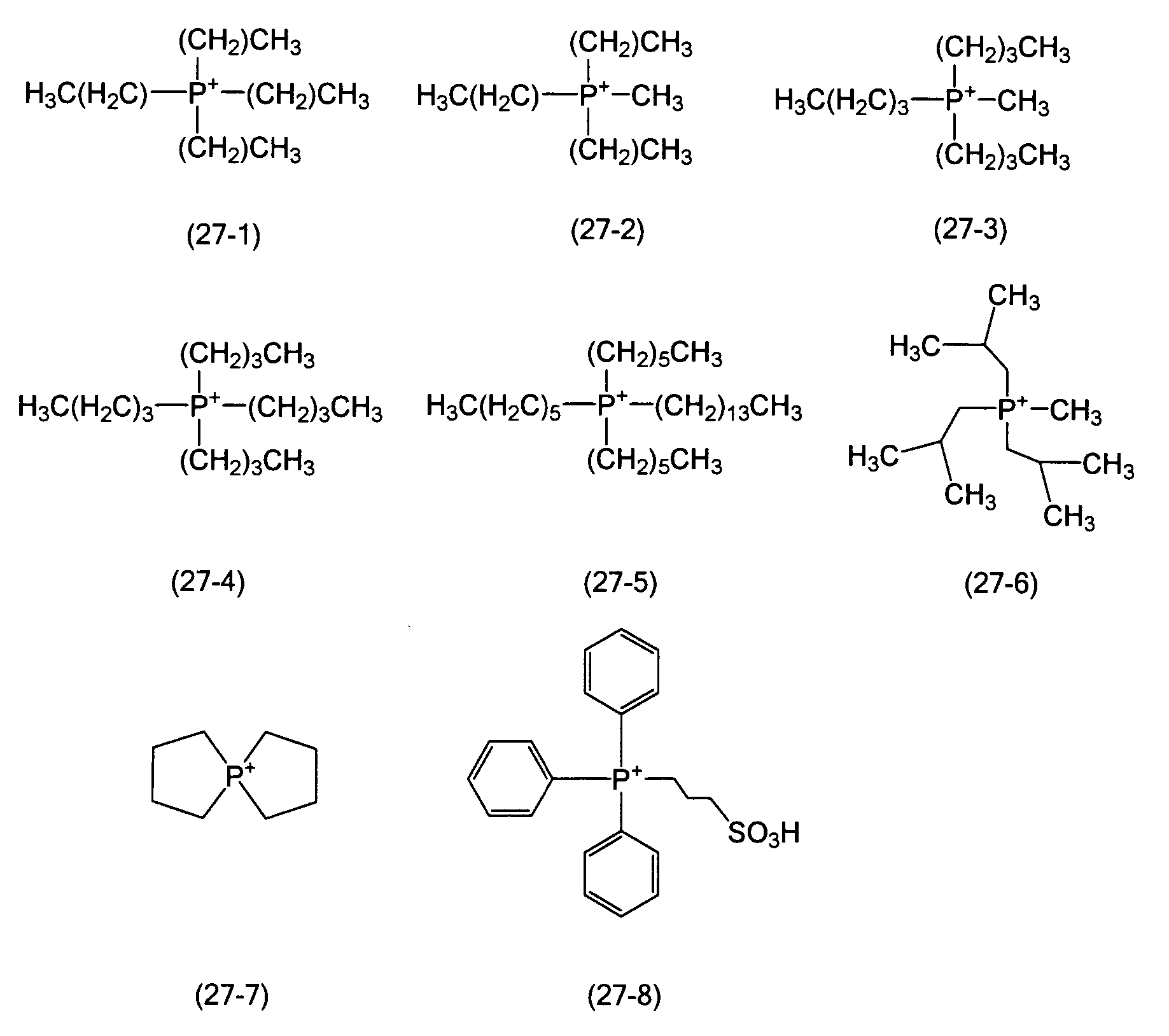
さらに、テトラメチルホスホニウムカチオン、テトラプロピルホスホニウムカチオン、テトラオクチルホスホニウムカチオン、テトラフェニルホスホニウムカチオン等の対称ホスホニウムカチオン類;トリメチルエチルホスホニウムカチオン等の擬対称ホスホニウムカチオン類;ヘキシルトリメチルホスホニウムカチオン、トリメチルオクチルホスホニウムカチオン等の非対称ホスホニウムカチオン類等を挙げることができる。
上記スルホニウムカチオンは、下記式(10):

〔式(10)中、R11及びR12は式(6)における定義と同じであり、R14は、式(7)における定義と同じである。但し、R11及びR12は硫黄原子と一緒になって5乃至8員環の置換されていてもよい含硫黄複素環基を形成してもよい。〕で表される。
上記スルホニウムカチオンとしては、例えば下記式(28-1)乃至(28-4)で表されるスルホニウムカチオンが挙げられる。

さらに、トリメチルスルホニウムカチオン、トリブチルスルホニウムカチオン等の対称スルホニウムカチオン類;ジエチルメチルスルホニウムカチオン等の擬対称スルホニウムカチオン類;ジメチルプロピルスルホニウム、ジメチルヘキシルスルホニウム等の非対称スルホニウムカチオン類等を挙げることができる。
上記オキソニウムカチオンは、下記式(11):

〔式(11)中、R11及びR12は式(6)における定義と同じであり、R14は、式(7)における定義と同じである。但し、R11及びR12は酸素原子と一緒になって5乃至8員環の置換されていてもよい含酸素複素環基を形成してもよい。〕で表される。
本発明のレジスト下層膜形成組成物に含まれるイオン液体を構成するアニオンを以下に例示する。たとえば、イミド、ハロゲン、カルボキシラート、スルファート、スルホナート、チオシアナート、アルミナート、ボラート、ホスファート、ホスフィナート、アミド、アンチモナート及びメチドが挙げられ、より具体的には、(CF3SO2)2N-、(CF3SO2)(FSO)2N-、(FSO2)2N-、(CF3CF2SO2)2N-、(CN)2N-、OH-、Cl-、Br-、I-、NO3
-、CH3COO-、CF3COO-、CF3CF2CF2COO-、CF3SO3
-、CF3CF2SO3
-、CF3CF2CF2CF2SO3
-、SbF6-、AlCl4
-、SCN-、PF6
-、BF4
-、[CF3OCF2CF2BF3
-]、[(pCpF2p+1)BF3]―(pは1、2、3、又は4の整数を表す)等が挙げられ、好ましくは(CF3SO2)2N-{ビス(トリフルオロメタンスルホニル)イミドアニオン}である。
さらに例えば、下記式(31-1)乃至(31-16)で表されるアニオンが挙げられる。

(式中R40は、炭素原子数1乃至10のアルキル基を表す。)
さらに例えば、下記式(31-1)乃至(31-16)で表されるアニオンが挙げられる。
本発明のレジスト下層膜形成組成物に含まれるイオン液体は、上記したカチオン及びアニオンの組み合わせからなる。好ましくは、イミダゾリウムカチオンと(CF3SO2)2N-の組み合わせであって、特に好ましくは、1-アリル-3-メチルイミダゾリウムカチオンと(CF3SO2)2N-の組み合わせである。
上記イオン液体はポリマーの質量に対し1.0質量%乃至90質量%、好ましくは5.0質量%乃至70質量%、より好ましくは5.0質量%乃至50質量%の量含まれる。
これらのイオン液体は1種のみを使用してもよいが、2種以上を組み合わせて使用することもできる。
<ポリマー>
本発明に用いられるポリマーは限定されるものではないがノボラック樹脂の末端に下記式(1)で示される繰り返し単位構造を含むことが好ましい。
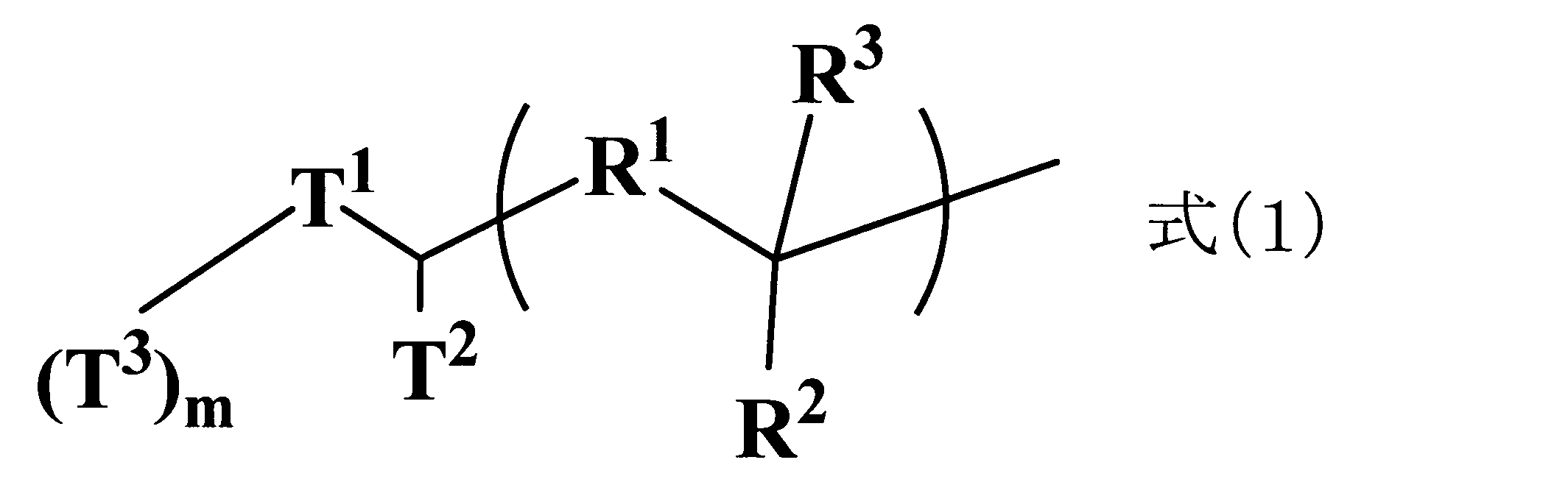
本発明に用いられるポリマーは限定されるものではないがノボラック樹脂の末端に下記式(1)で示される繰り返し単位構造を含むことが好ましい。
式(1)で表される単位構造を含むポリマーは、少なくとも2つのアミノ基と少なくとも3つの炭素原子数6乃至40の芳香族環とを含む有機化合物と、アルデヒド又はケトンとの反応生成物を芳香族化合物(A)として、その芳香族化合物(A)の芳香族環と芳香族ビニル化合物(B)のビニル基とを反応させて得られる構造体(C)を含むノボラック樹脂を含むポリマーである。
式(1)中、R1は少なくとも2つのアミノ基と少なくとも3つの炭素原子数6乃至40の芳香族環とを含む有機基であり、
R2及びR3はそれぞれ、水素原子、炭素原子数1乃至10のアルキル基、炭素原子数6乃至40のアリール基、複素環基、又はそれらの組み合わせであり、かつ、該アルキル基、該アリール基、該複素環基は、ハロゲン原子、ニトロ基、アミノ基、ホルミル基、アルコキシ基、又はヒドロキシ基で置換されていても良い有機基であり、そしてR2とR3は互いに環を形成していても良く、T1は炭素原子数6乃至40のアリーレン基である。T3は炭素原子数1乃至10のアルキル基、炭素原子数2乃至10のアルケニル基、炭素原子数2乃至10のアルキニル基、炭素原子数6乃至40のアリール基、ヒドロキシ基、シアノ基、ニトロ基、アミノ基、カルボキシ基、アセチル基、ヒドロキシメチル基、ハロゲノメチル基、-Y-Z基、ハロゲン原子、又はそれらの組み合わせを示す。Yは酸素原子、硫黄原子、カルボニル基、又はエステル基を示し、Zは炭素原子数1乃至10のアルキル基を示す。T2は水素原子、メチル基、又はフェニル基を示す。mは0乃至(5+2n)の整数であり、nはT1に由来するアリール基のベンゼン環の縮合度を示す。T2はメチル基である事が好ましい。
R2及びR3はそれぞれ、水素原子、炭素原子数1乃至10のアルキル基、炭素原子数6乃至40のアリール基、複素環基、又はそれらの組み合わせであり、かつ、該アルキル基、該アリール基、該複素環基は、ハロゲン原子、ニトロ基、アミノ基、ホルミル基、アルコキシ基、又はヒドロキシ基で置換されていても良い有機基であり、そしてR2とR3は互いに環を形成していても良く、T1は炭素原子数6乃至40のアリーレン基である。T3は炭素原子数1乃至10のアルキル基、炭素原子数2乃至10のアルケニル基、炭素原子数2乃至10のアルキニル基、炭素原子数6乃至40のアリール基、ヒドロキシ基、シアノ基、ニトロ基、アミノ基、カルボキシ基、アセチル基、ヒドロキシメチル基、ハロゲノメチル基、-Y-Z基、ハロゲン原子、又はそれらの組み合わせを示す。Yは酸素原子、硫黄原子、カルボニル基、又はエステル基を示し、Zは炭素原子数1乃至10のアルキル基を示す。T2は水素原子、メチル基、又はフェニル基を示す。mは0乃至(5+2n)の整数であり、nはT1に由来するアリール基のベンゼン環の縮合度を示す。T2はメチル基である事が好ましい。
R1に含まれるアミンは第一級アミン構造、第二級アミン構造、第三級アミン構造が挙げられる。また、芳香族環は、ベンゼン環構造、ナフタレン環構造、アントラセン環構造、ピレン環構造等が挙げられる。
R1は少なくとも2つのアミノ基と少なくとも3つの炭素原子数6乃至40の芳香族環を含む有機基であり、ノボラック樹脂の主鎖を形成するものであり、上記アミン構造と芳香環構造を含む2価の有機基として用いることができる。特に、R1は2つのアミノ基と3つの炭素原子数6乃至40の芳香族環を含む2価の有機基が好ましい。
式(1)中でR1が下記式(2)で示される化合物から誘導される2価の有機基とすることができる。

式(2)中の芳香族環はアルデヒドやケトンとの間でノボラック樹脂を形成する。
式(2)は2価の有機基であることから、式(2)中の芳香族環のいずれか2箇所でアルデヒドやケトンとノボラック樹脂を構成するための結合を生じる。例えば、Ar1とAr3、Ar1とAr2、Ar1とAr1、Ar2とAr2、R4乃至R8のアリール基、又はAr1乃至Ar3とR4乃至R8のアリール基等がアルデヒドやケトンとの間で結合を形成することができる。また、置換基に芳香族環を有する場合にはそれら芳香族環と、アルデヒドやケトンとの間で結合を形成することができる。
式(2)中、Ar1、Ar2及びAr3はそれぞれベンゼン環又はナフタレン環を示し、R6、R7及びR8はそれぞれ置換基でありハロゲン原子、ニトロ基、アミノ基、ヒドロキシ基、炭素原子数1乃至10のアルキル基、炭素原子数2乃至10のアルケニル基、炭素原子数6乃至40のアリール基、及びそれらの組み合わせからなる群より選択され、かつ、該アルキル基、該アルケニル基又は該アリール基は、エーテル結合、ケトン結合、若しくはエステル結合を含んでいても良い有機基を表し、
R4及びR5はそれぞれ水素原子、炭素原子数1乃至10のアルキル基、炭素原子数2乃至10のアルケニル基、炭素原子数6乃至40のアリール基、及びそれらの組み合わせからなる群より選択され、かつ、該アルキル基、該アルケニル基又はアリール基は、エーテル結合、ケトン結合、若しくはエステル結合を含んでいても良い有機基を表し、
n1、n2、n3はそれぞれ0以上の数であり、R6、R7及びR8が置換可能な最大数までの整数である。n1、n2、n3は通常はそれぞれ0乃至4、又は0乃至3、又は0乃至2、又は0乃至1の整数である。
R4及びR5はそれぞれ水素原子、炭素原子数1乃至10のアルキル基、炭素原子数2乃至10のアルケニル基、炭素原子数6乃至40のアリール基、及びそれらの組み合わせからなる群より選択され、かつ、該アルキル基、該アルケニル基又はアリール基は、エーテル結合、ケトン結合、若しくはエステル結合を含んでいても良い有機基を表し、
n1、n2、n3はそれぞれ0以上の数であり、R6、R7及びR8が置換可能な最大数までの整数である。n1、n2、n3は通常はそれぞれ0乃至4、又は0乃至3、又は0乃至2、又は0乃至1の整数である。
芳香族ビニル化合物(B)は式(B-1)の構造を有するビニル基を含有する化合物を例示することができる。

式(B-1)中、T1は炭素原子数6乃至40のアリーレン基、T3は炭素原子数1乃至10のアルキル基、炭素原子数2乃至10のアルケニル基、炭素原子数2乃至10のアルキニル基、炭素原子数6乃至40のアリール基、ヒドロキシ基、シアノ基、ニトロ基、アミノ基、カルボキシ基、アセチル基、ヒドロキシメチル基、ハロゲノメチル基、-Y-Z基、ハロゲン原子、又はそれらの組み合わせを示す。Yは酸素原子、硫黄原子、カルボニル基、エステル基を示し、Zは炭素原子数1乃至10のアルキル基を示す。T2は水素原子、メチル基、又はフェニル基を示す。好ましくはT2は水素原子である。mは0乃至(5+2n)の整数であり、nはT1に由来するアリール基のベンゼン環の縮合度を示す。
上記炭素原子数6乃至40のアリーレン基の具体例としては、上記の段落[0022]で記載したアリール基から更に任意の水素原子を一つ引き抜いた2価の基である。
上記ハロゲン原子の具体例としては、上記の段落[0028]で記載したとおりである。
炭素原子数1乃至10のアルキル基としてはメチル基、エチル基、n-プロピル基、i-プロピル基、シクロプロピル基、n-ブチル基、i-ブチル基、s-ブチル基、t-ブチル基、シクロブチル基、1-メチル-シクロプロピル基、2-メチル-シクロプロピル基、n-ペンチル基、1-メチル-n-ブチル基、2-メチル-n-ブチル基、3-メチル-n-ブチル基、1,1-ジメチル-n-プロピル基、1,2-ジメチル-n-プロピル基、2,2-ジメチル-n-プロピル基、1-エチル-n-プロピル基、シクロペンチル基、1-メチル-シクロブチル基、2-メチル-シクロブチル基、3-メチル-シクロブチル基、1,2-ジメチル-シクロプロピル基、2,3-ジメチル-シクロプロピル基、1-エチル-シクロプロピル基、2-エチル-シクロプロピル基、n-ヘキシル基、1-メチル-n-ペンチル基、2-メチル-n-ペンチル基、3-メチル-n-ペンチル基、4-メチル-n-ペンチル基、1,1-ジメチル-n-ブチル基、1,2-ジメチル-n-ブチル基、1,3-ジメチル-n-ブチル基、2,2-ジメチル-n-ブチル基、2,3-ジメチル-n-ブチル基、3,3-ジメチル-n-ブチル基、1-エチル-n-ブチル基、2-エチル-n-ブチル基、1,1,2-トリメチル-n-プロピル基、1,2,2-トリメチル-n-プロピル基、1-エチル-1-メチル-n-プロピル基、1-エチル-2-メチル-n-プロピル基、シクロヘキシル基、1-メチル-シクロペンチル基、2-メチル-シクロペンチル基、3-メチル-シクロペンチル基、1-エチル-シクロブチル基、2-エチル-シクロブチル基、3-エチル-シクロブチル基、1,2-ジメチル-シクロブチル基、1,3-ジメチル-シクロブチル基、2,2-ジメチル-シクロブチル基、2,3-ジメチル-シクロブチル基、2,4-ジメチル-シクロブチル基、3,3-ジメチル-シクロブチル基、1-n-プロピル-シクロプロピル基、2-n-プロピル-シクロプロピル基、1-i-プロピル-シクロプロピル基、2-i-プロピル-シクロプロピル基、1,2,2-トリメチル-シクロプロピル基、1,2,3-トリメチル-シクロプロピル基、2,2,3-トリメチル-シクロプロピル基、1-エチル-2-メチル-シクロプロピル基、2-エチル-1-メチル-シクロプロピル基、2-エチル-2-メチル-シクロプロピル基及び2-エチル-3-メチル-シクロプロピル基等が挙げられる。
炭素原子数2乃至10のアルケニル基の具体例としては、上記の段落[0021]で記載したとおりである。
上記炭素原子数1乃至20、又は炭素原子数1乃至10のアルコキシ基の具体例としては、上記の段落[0024]で記載したとおりである。
上記炭素原子数6乃至40のアリール基の具体例としては、上記の段落[0022]で記載したとおりである。
上記複素環基の具体例としては、上記の段落[0026]で記載したとおりである。
なかでも高屈折率材料に用いるためには硫黄原子を含む複素環基が好ましい。
上記式(1)はR3が水素原子であり、R2がフェニル基、ナフチル基、アントリル基、及びピレニル基から選ばれるアリール基であり、該アリール基はハロゲン原子、ニトロ基、アミノ基、炭素原子数1乃至10のアルキル基、炭素原子数1乃至10のアルコキシ基、炭素原子数6乃至40のアリール基、ホルミル基、カルボキシ基、又はヒドロキシ基で置換されていても良いものとすることができる。
そして、R3が水素原子であり、R2がフェニル基であり、該フェニル基はハロゲン原子、ニトロ基、アミノ基、炭素原子数1乃至10のアルキル基、炭素原子数1乃至10のアルコキシ基、炭素原子数6乃至40のアリール基、ホルミル基、カルボキシ基、又はヒドロキシ基で置換されていても良い基とすることができる。
そして、R3が水素原子であり、R2がフェニル基であり、該フェニル基はハロゲン原子、ニトロ基、アミノ基、炭素原子数1乃至10のアルキル基、炭素原子数1乃至10のアルコキシ基、炭素原子数6乃至40のアリール基、ホルミル基、カルボキシ基、又はヒドロキシ基で置換されていても良い基とすることができる。
本発明のポリマーの製造に用いられるアルデヒド類としてはホルムアルデヒド、パラホルムアルデヒド、アセトアルデヒド、プロピルアルデヒド、ブチルアルデヒド、イソブチルアルデヒド、バレルアルデヒド、カプロンアルデヒド、2-メチルブチルアルデヒド、ヘキシルアルデヒド、ウンデカンアルデヒド、7-メトキシ-3、7-ジメチルオクチルアルデヒド、シクロヘキサンアルデヒド、3-メチル-2-ブチルアルデヒド、グリオキザール、マロンアルデヒド、スクシンアルデヒド、グルタルアルデヒド、グルタルアルデヒド、アジピンアルデヒド等の飽和脂肪族アルデヒド類、アクロレイン、メタクロレイン等の不飽和脂肪族アルデヒド類、フルフラール、ピリジンアルデヒド、チオフェンアルデヒド等のヘテロ環式アルデヒド類、ベンズアルデヒド、ナフトアルデヒド、アントラセンカルボキシアルデヒド、フェニルベンズアルデヒド、アニスアルデヒド、エトキシベンズアルデヒド、n-ペンチルオキシベンズアルデヒド、n-オクチルオキシベンズアルデヒド、トリメトキシベンズアルデヒド、エチルベンズアルデヒド、n-ブチルベンズアルデヒド、t-ブチルベンズアルデヒド、イソプロピルベンズアルデヒド、イソブチルベンズアルデヒド、テレフタルアルデヒド、ピレンカルボキシアルデヒド、フェナントリルアルデヒド、サリチルアルデヒド、フェニルアセトアルデヒド、3-フェニルプロピオンアルデヒド、トリルアルデヒド、(N,N-ジメチルアミノ)ベンズアルデヒド、アセトキシベンズアルデヒド等の芳香族アルデヒド類等が挙げられる。特に芳香族アルデヒドを好ましく用いることができる。
また、本発明のポリマーの製造に用いられるケトン類としてはジアリールケトン類であり、例えばジフェニルケトン、フェニルナフチルケトン、ジナフチルケトン、フェニルトリルケトン、ジトリルケトン、9-フルオレノン等が挙げられる。
少なくとも2つのアミノ基と少なくとも3つの炭素原子数6乃至40のアリール基を含む有機化合物、好適には式(2)の化合物で示される芳香族化合物と、アルデヒド又はケトンとのノボラック化反応は、芳香族化合物:アルデヒド又はケトンを、1:0.1乃至10、1:0.5乃至2.0、又は1:1のモル比で反応させることが好ましい。
上記縮合反応で用いられる酸触媒としては、例えば硫酸、リン酸、過塩素酸等の鉱酸類、p-トルエンスルホン酸、p-トルエンスルホン酸一水和物、メタンスルホン酸、トリフルオロメタンスルホン酸等の有機スルホン酸類、蟻酸、シュウ酸等のカルボン酸類が使用される。酸触媒の使用量は、使用する酸類の種類によって種々選択される。通常、芳香族化合物の100質量部に対して、0.001質量部乃至10000質量部、好ましくは、0.01質量部乃至1000質量部、より好ましくは0.1質量部乃至100質量部である。
上記の縮合反応は無溶剤でも行われるが、通常溶剤を用いて行われる。溶剤としては反応を阻害しないものであれば全て使用することができる。例えば1,2-ジメトキシエタン、ジエチレングリコールジメチルエーテル、プロピレングリコールモノメチルエーテル、プロピレングリコールモノメチルエーテルアセテート、ブチルセロソルブ、テトラヒドロフラン、ジオキサン等のエーテル類が挙げられる。また、使用する酸触媒が例えば蟻酸のような液状のものであるならば溶剤としての役割を兼ねさせることもできる。
縮合時の反応温度は通常40℃乃至200℃である。反応時間は反応温度によって種々選択されるが、通常30分乃至50時間程度である。
以上のようにして得られる重合体の重量平均分子量Mwは、通常500乃至1000000、又は600乃至200000である。
芳香族化合物とアルデヒド又はケトンとの反応により得られるノボラック樹脂は、以下の単位構造を含むノボラック樹脂が挙げられる。
そして、式(1)中のR1がN,N'-ジフェニル-1,4-フェニレンジアミンから誘導される2価の有機基とすることができる。この化合物は3つのベンゼン環、更には置換基にベンゼン環を有する場合があるが、上記同様にこれらのベンゼン環のいずれか2箇所でアルデヒドやケトンとノボラック樹脂を構成するための結合を生じる。
本発明ではノボラック樹脂の末端に構造体(C)が付加したポリマーである。例えば、下記式(3-1)乃至式(3-22)で示される単位構造を有するノボラックが、その末端に式(C-1)乃至式(C-22)で示される構造体を有するポリマーを用いるものである。
式(1)の単位構造を含むポリマーは、典型的には下記式(1-1)の単位構造を含むポリマーが好ましい。

式(1-1)中のヒドロキシ基は、式(1)中で、T3がt-ブトキシ基等のアルコキシ基である場合において、アルコキシ基が加水分解により変換されたものである。
式(1)の単位構造を含むポリマーは、典型的には下記式(1-1)の単位構造を含むポリマーが好ましい。
T1がフェニレン基であり、T2はメチル基である事が好ましい。
式(1-1)中、R2及びR3はそれぞれ、水素原子、炭素原子数1乃至10のアルキル基、炭素数原子6乃至40のアリール基、複素環基、又はそれらの組み合わせであり、かつ、該アルキル基、該アリール基、該複素環基は、ハロゲン原子、ニトロ基、アミノ基、ホルミル基、アルコキシ基、又はヒドロキシ基で置換されていても良い有機基であり、そしてR2とR3は互いに環を形成していても良い。T2は水素原子、メチル基、又はフェニル基を示す。
R2は水素原子で、R3は炭素原子数1乃至10のアルコキシ基で置換されたフェニル基を例示することができる。
本発明に用いられるノボラック樹脂は以下の単位構造を有する事ができる。
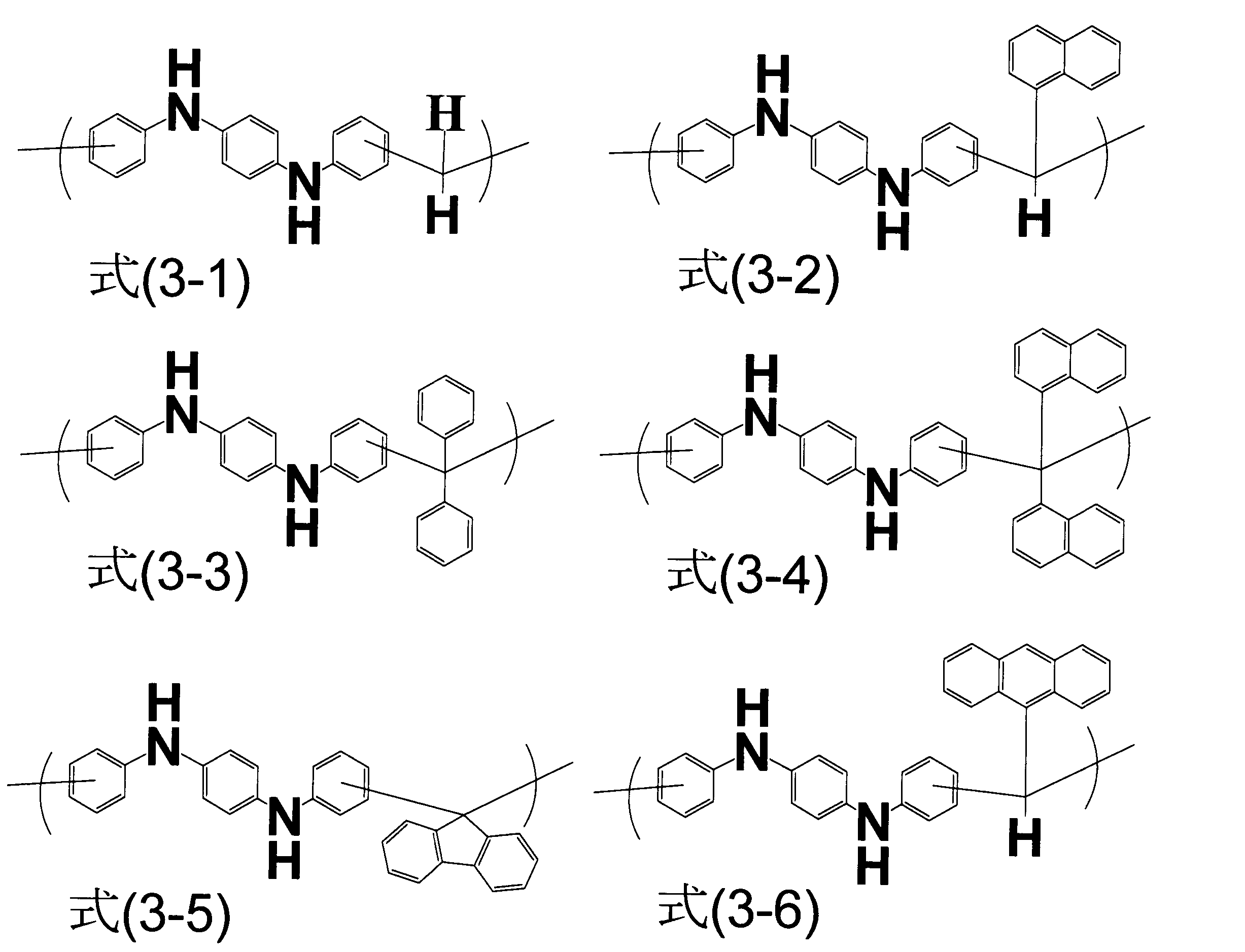
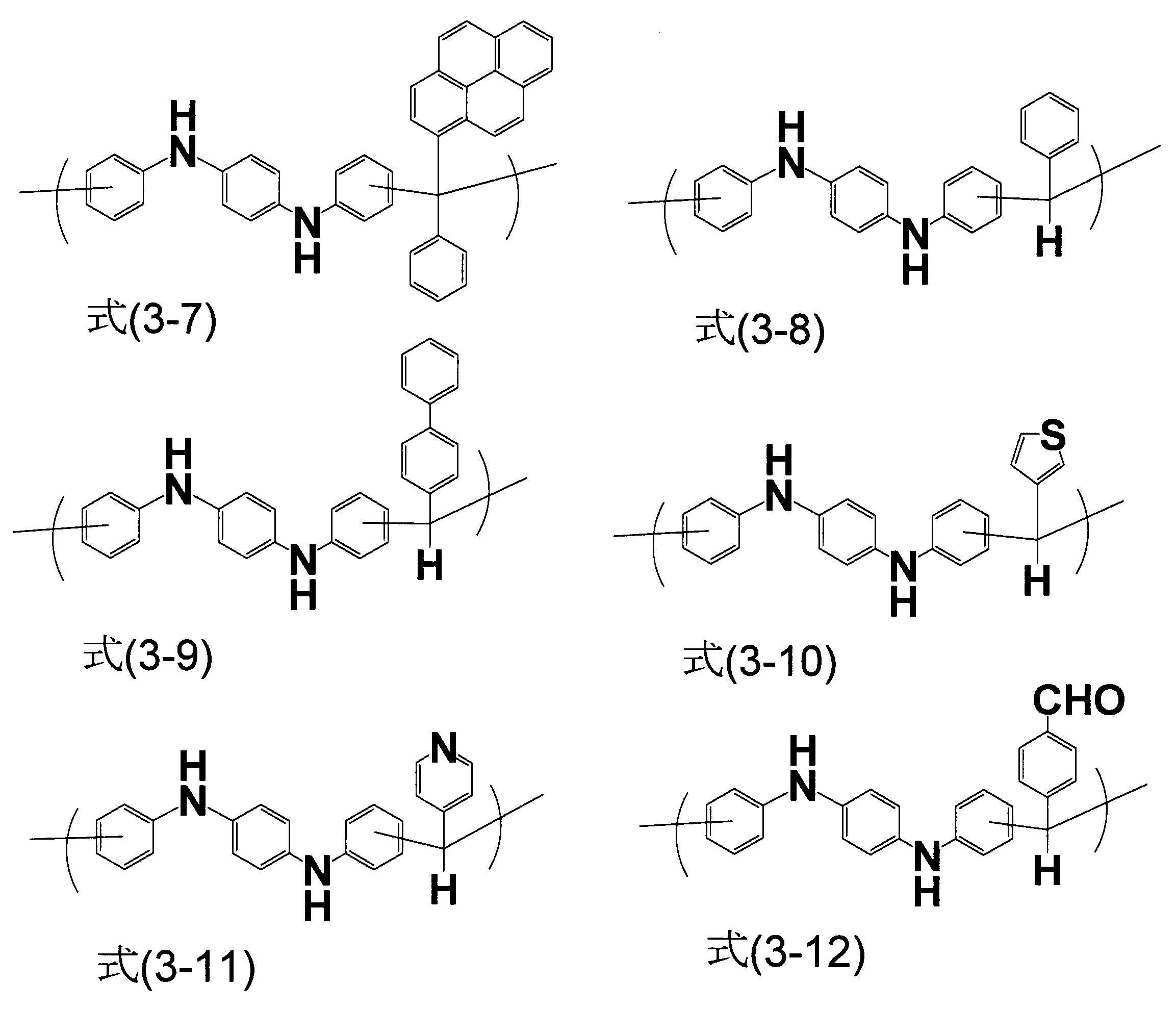

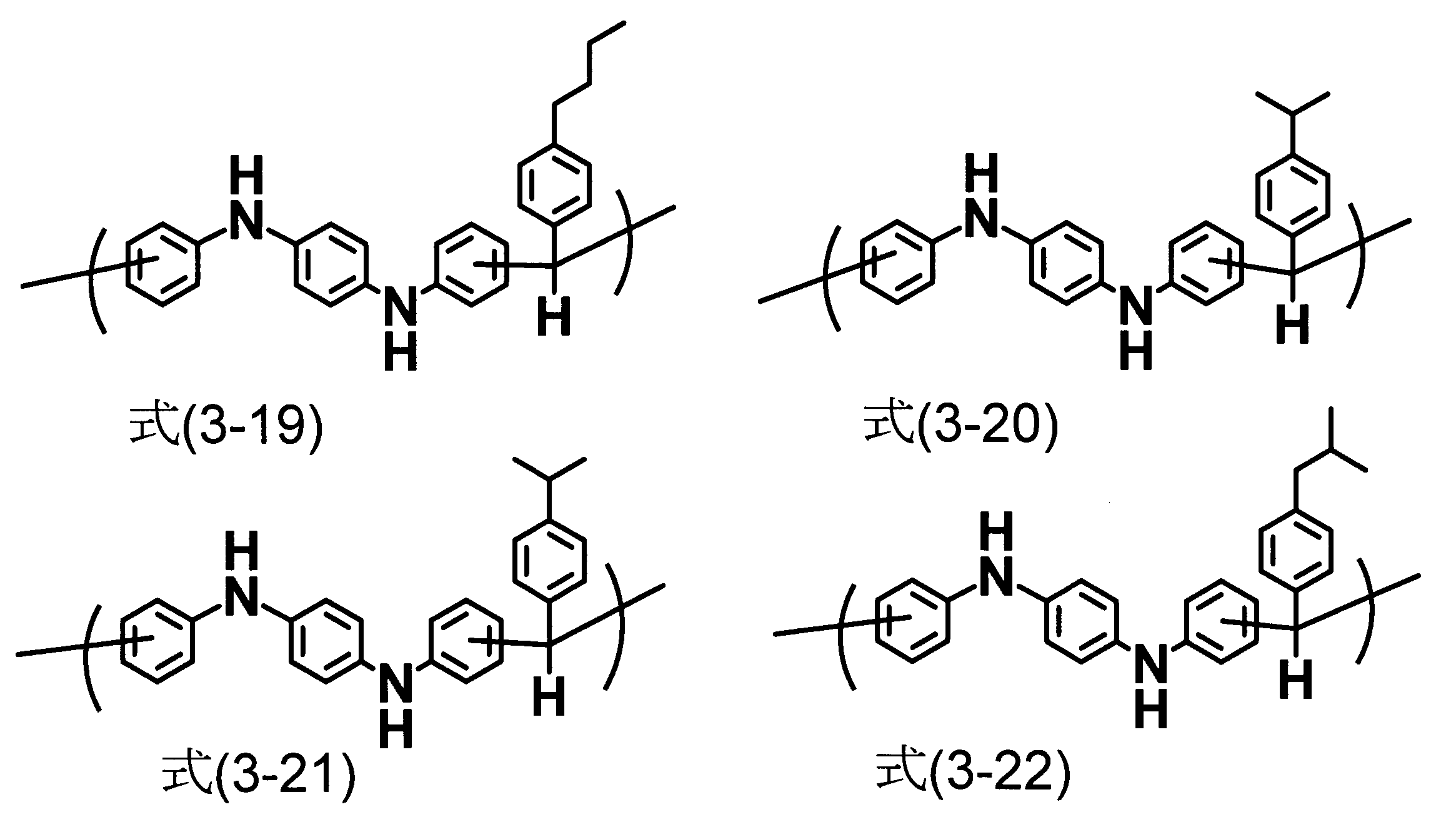
上記ノボラック樹脂の末端に存在する構造体(C)は以下に例示することができる。
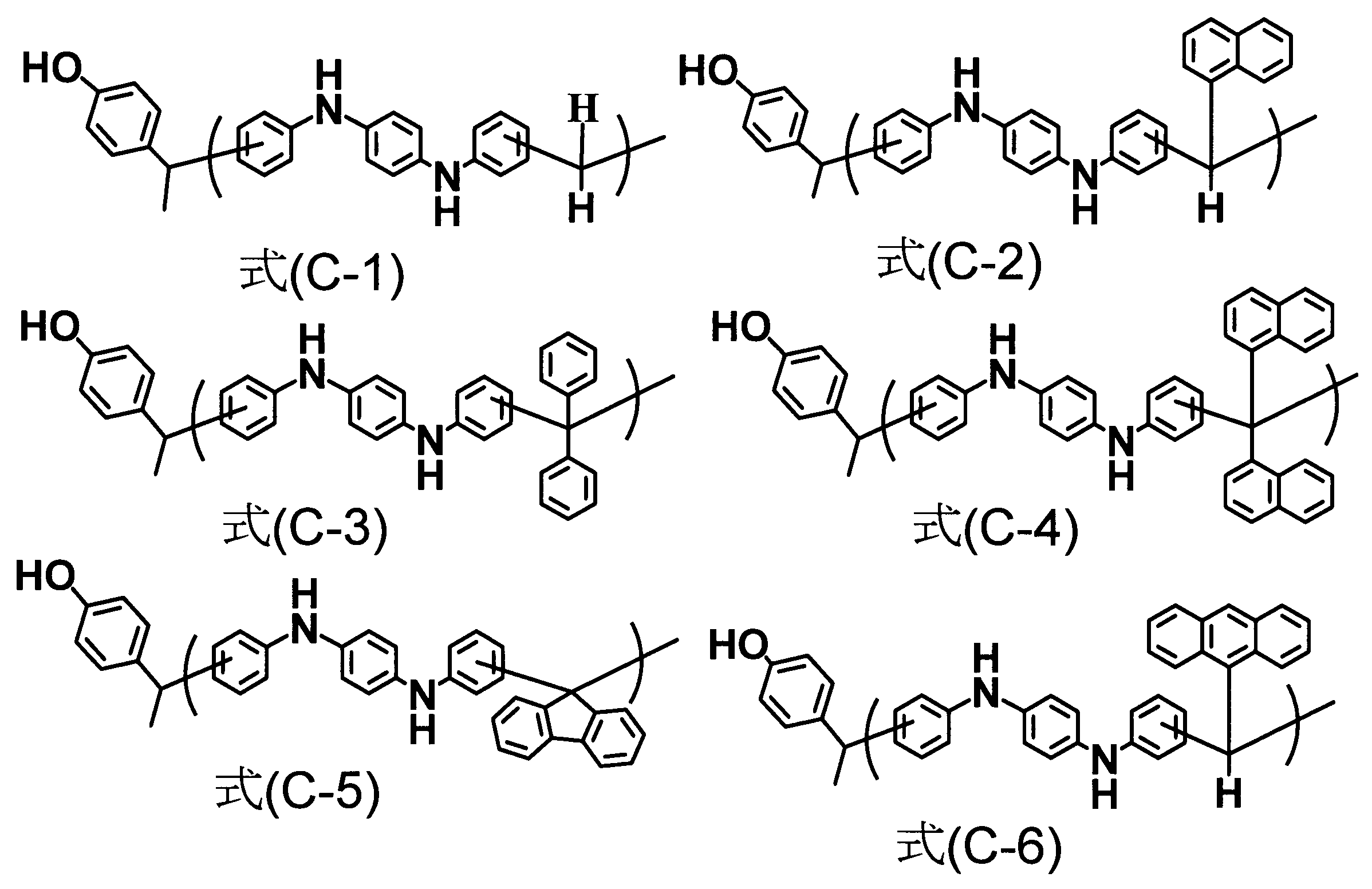
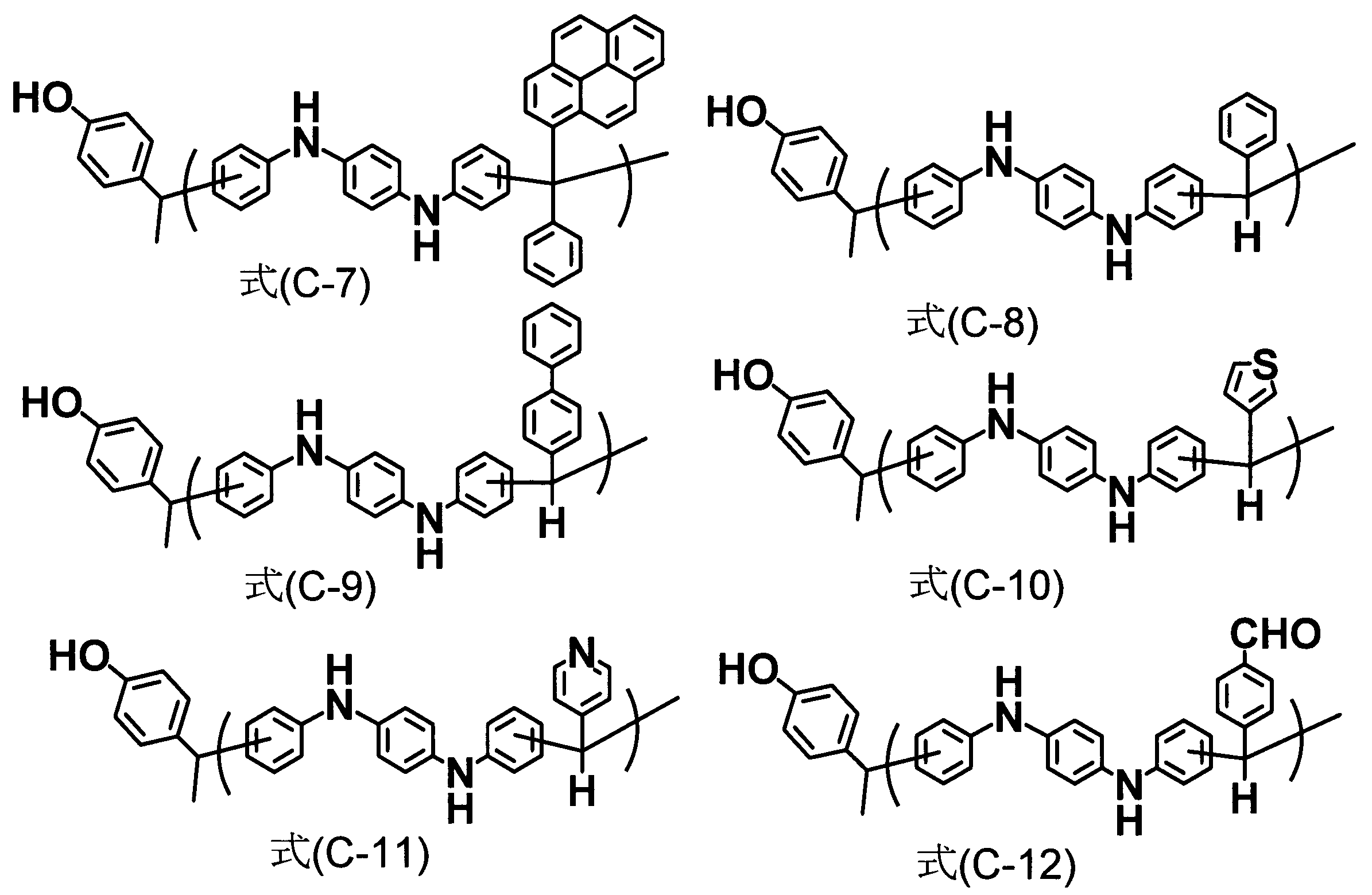

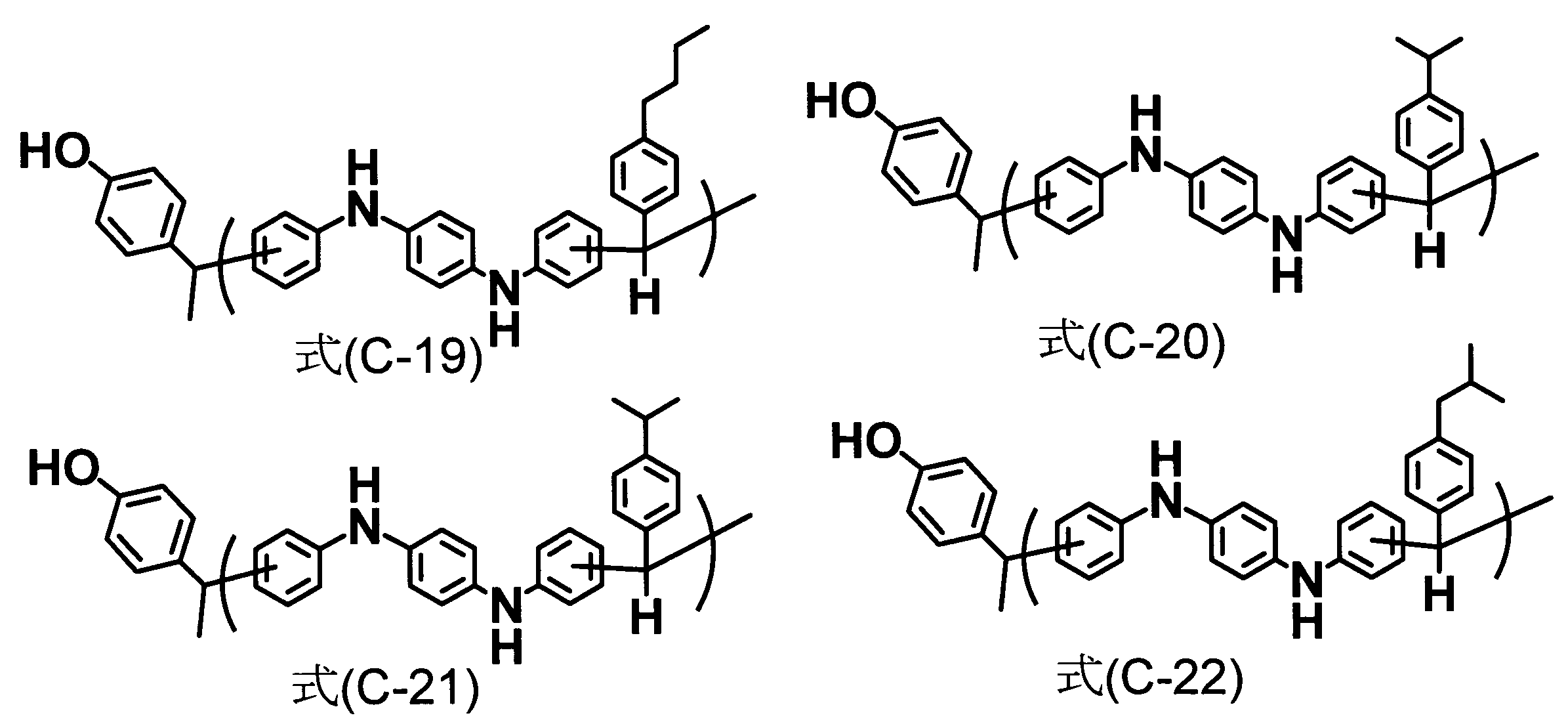
本発明に用いられるポリマーは、重量平均分子量が600乃至1000000、又は600乃至200000である。
<架橋剤>
本発明のレジスト下層膜形成組成物は架橋剤成分を含むことができる。その架橋剤としては、メラミン系、置換尿素系又はそれらのポリマー系等が挙げられる。好ましくは、少なくとも2個の架橋形成置換基を有する架橋剤であり、メトキシメチル化グリコールウリル、ブトキシメチル化グリコールウリル、メトキシメチル化メラミン、ブトキシメチル化メラミン、メトキシメチル化ベンゾグワナミン、ブトキシメチル化ベンゾグワナミン、メトキシメチル化尿素、ブトキシメチル化尿素、メトキシメチル化チオ尿素又はメトキシメチル化チオ尿素等の化合物である。また、これらの化合物の縮合体も使用することができる。
本発明のレジスト下層膜形成組成物は架橋剤成分を含むことができる。その架橋剤としては、メラミン系、置換尿素系又はそれらのポリマー系等が挙げられる。好ましくは、少なくとも2個の架橋形成置換基を有する架橋剤であり、メトキシメチル化グリコールウリル、ブトキシメチル化グリコールウリル、メトキシメチル化メラミン、ブトキシメチル化メラミン、メトキシメチル化ベンゾグワナミン、ブトキシメチル化ベンゾグワナミン、メトキシメチル化尿素、ブトキシメチル化尿素、メトキシメチル化チオ尿素又はメトキシメチル化チオ尿素等の化合物である。また、これらの化合物の縮合体も使用することができる。
また、上記架橋剤としては耐熱性の高い架橋剤を用いることができる。耐熱性の高い架橋剤としては分子内に芳香族環(例えば、ベンゼン環、ナフタレン環)を有する架橋形成置換基を含有する化合物を好ましく用いることができる。
この化合物は下記式(4)の部分構造を有する化合物や、下記式(5)の繰り返し単位を有するポリマー又はオリゴマーが挙げられる。
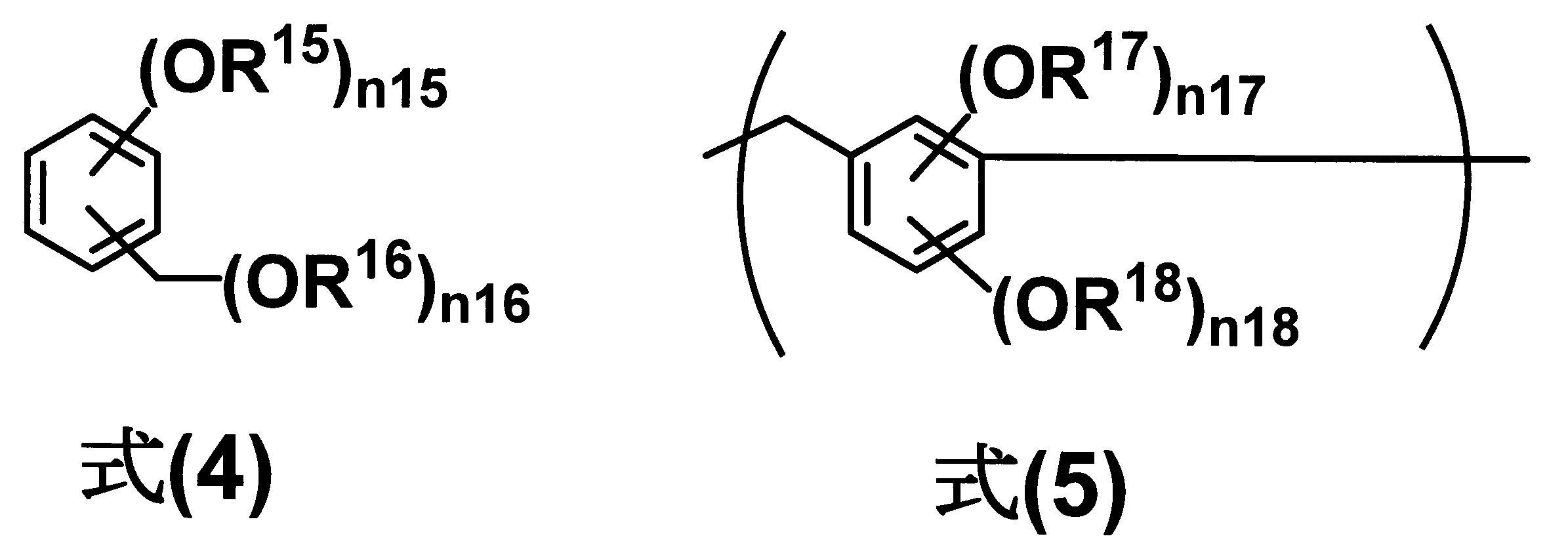
上記R15、R16、R17及びR18は水素原子又は炭素原子数1乃至10のアルキル基であり、これらのアルキル基は段落[0067]の例示を用いることができる。
式(4)及び式(5)で表される化合物、ポリマー、オリゴマーは以下の式(4-1)乃至(4-27)として例示される。
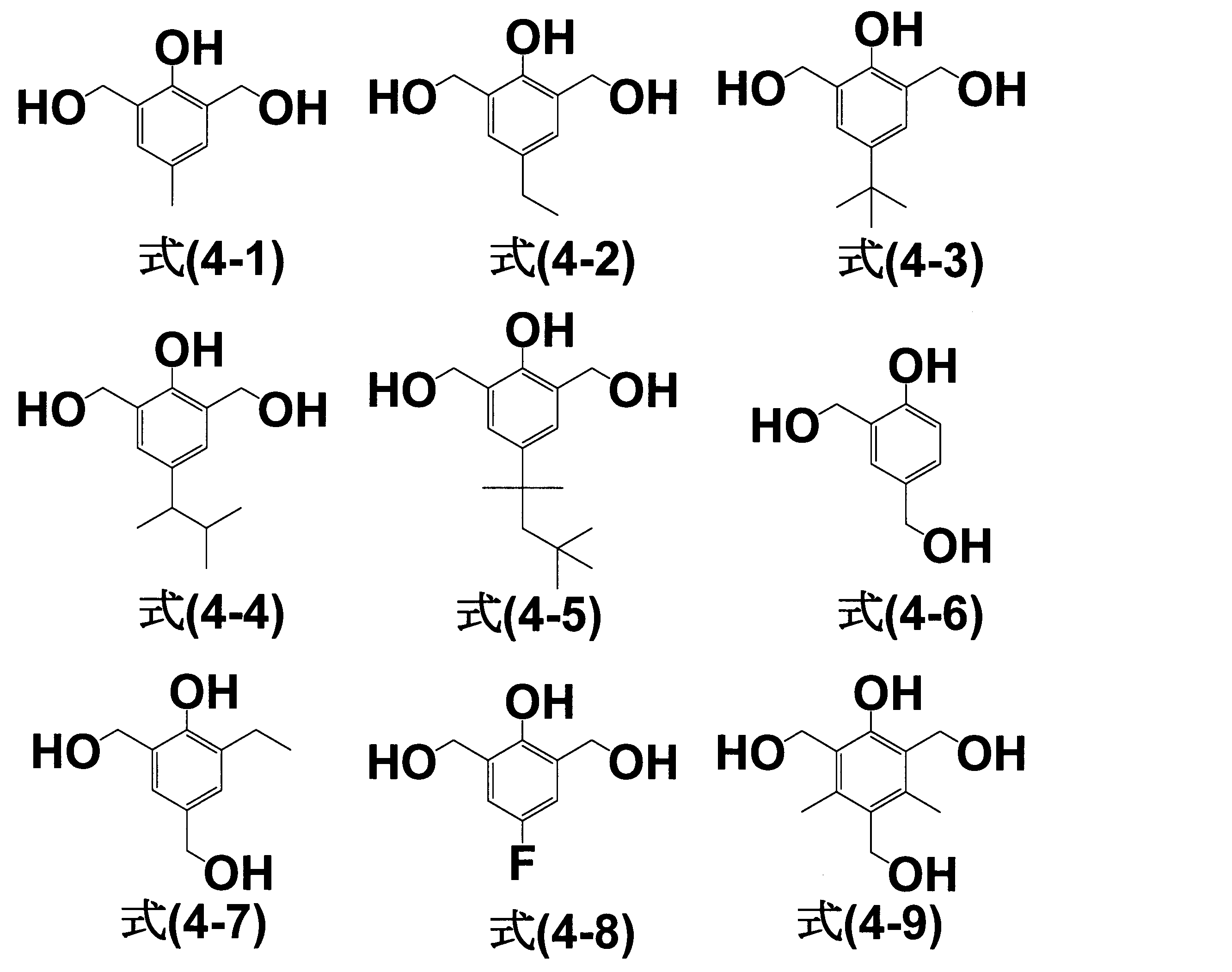

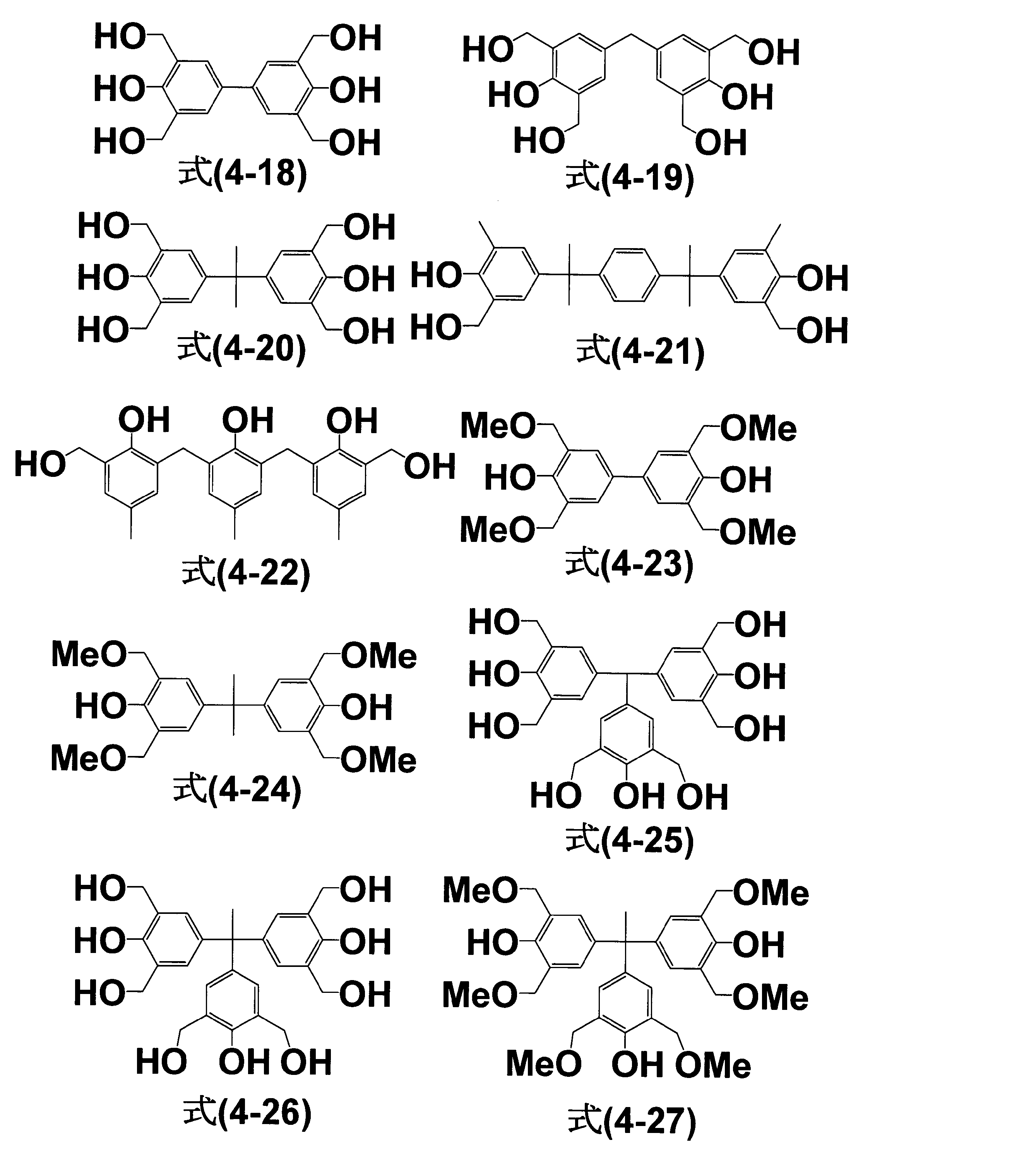
上記化合物は旭有機材工業(株)、本州化学工業(株)の製品として入手することができる。例えば上記架橋剤の中で式(4-24)で表される化合物は旭有機材工業(株)、商品名TM-BIP-Aとして入手することができる。
架橋剤の添加量は、使用する塗布溶剤、使用する下地基板、要求される溶液粘度、要求される膜形状などにより変動するが、全固形分に対して0.001質量%乃至80質量%、好ましくは0.01質量%乃至50質量%、さらに好ましくは0.05質量%乃至40質量%である。これら架橋剤は自己縮合による架橋反応を起こすこともあるが、本発明の上記のポリマー中に架橋性置換基が存在する場合は、それらの架橋性置換基と架橋反応を起こすことができる。
<架橋反応を促進させる化合物>
本発明では上記架橋反応を促進させる化合物(架橋反応を促進するための触媒)として、p-トルエンスルホン酸、トリフルオロメタンスルホン酸、ピリジニウム-p-トルエンスルホネート、サリチル酸、5-スルホサリチル酸、4-フェノールスルホン酸、ピリジニウム-p-フェノールスルホネート、カンファースルホン酸、4-クロロベンゼンスルホン酸、ベンゼンジスルホン酸、1-ナフタレンスルホン酸、クエン酸、安息香酸、ヒドロキシ安息香酸、ナフタレンカルボン酸等の酸性化合物及び/又は2,4,4,6-テトラブロモシクロヘキサジエノン、ベンゾイントシレート、2-ニトロベンジルトシレート、その他有機スルホン酸アルキルエステル等の熱酸発生剤を配合する事が出来る。配合量は全固形分に対して、0.0001質量%乃至20質量%、好ましくは0.0005質量%乃至10質量%、さらに好ましくは0.01質量%乃至3質量%である。
本発明では上記架橋反応を促進させる化合物(架橋反応を促進するための触媒)として、p-トルエンスルホン酸、トリフルオロメタンスルホン酸、ピリジニウム-p-トルエンスルホネート、サリチル酸、5-スルホサリチル酸、4-フェノールスルホン酸、ピリジニウム-p-フェノールスルホネート、カンファースルホン酸、4-クロロベンゼンスルホン酸、ベンゼンジスルホン酸、1-ナフタレンスルホン酸、クエン酸、安息香酸、ヒドロキシ安息香酸、ナフタレンカルボン酸等の酸性化合物及び/又は2,4,4,6-テトラブロモシクロヘキサジエノン、ベンゾイントシレート、2-ニトロベンジルトシレート、その他有機スルホン酸アルキルエステル等の熱酸発生剤を配合する事が出来る。配合量は全固形分に対して、0.0001質量%乃至20質量%、好ましくは0.0005質量%乃至10質量%、さらに好ましくは0.01質量%乃至3質量%である。
本発明のリソグラフィー用レジスト下層膜形成組成物は、リソグラフィー工程で上層に被覆されるフォトレジストとの酸性度を一致させる為に、光酸発生剤を添加する事が出来る。好ましい光酸発生剤としては、例えば、ビス(4-t-ブチルフェニル)ヨードニウムトリフルオロメタンスルホネート、トリフェニルスルホニウムトリフルオロメタンスルホネート等のオニウム塩系光酸発生剤類、フェニル-ビス(トリクロロメチル)-s-トリアジン等のハロゲン含有化合物系光酸発生剤類、ベンゾイントシレート、N-ヒドロキシスクシンイミドトリフルオロメタンスルホネート等のスルホン酸系光酸発生剤類等が挙げられる。上記光酸発生剤は全固形分に対して、0.2質量%乃至10質量%、好ましくは0.4質量%乃至5質量%である。
本発明のリソグラフィー用レジスト下層膜材料には、上記以外に必要に応じて更なる吸光剤、レオロジー調整剤、接着補助剤、界面活性剤等を添加することができる。
更なる吸光剤としては例えば、「工業用色素の技術と市場」(CMC出版)や「染料便覧」(有機合成化学協会編)に記載の市販の吸光剤、例えば、C.I.DisperseYellow 1,3,4,5,7,8,13,23,31,49,50,51,54,60,64,66,68,79,82,88,90,93,102,114及び124;C.I.D isperseOrange1,5,13,25,29,30,31,44,57,72及び73;C.I.DisperseRed 1,5,7,13,17,19,43,50,54,58,65,72,73,88,117,137,143,199及び210;C.I.DisperseViolet 43;C.I.DisperseBlue 96;C.I.FluorescentBrightening Agent112,135及び163;C.I.Solvent Orange2及び45;C.I.SolventRed 1,3,8,23,24,25,27及び49;C.I.PigmentGreen 10;C.I.PigmentBrown 2等を好適に用いることができる。上記吸光剤は通常、リソグラフィー用レジスト下層膜材料の全固形分に対して10質量%以下、好ましくは5質量%以下の割合で配合される。
レオロジー調整剤は、主にレジスト下層膜形成組成物の流動性を向上させ、特にベーキング工程において、レジスト下層膜の膜厚均一性の向上やホール内部へのレジスト下層膜形成組成物の充填性を高める目的で添加される。具体例としては、ジメチルフタレート、ジエチルフタレート、ジイソブチルフタレート、ジヘキシルフタレート、ブチルイソデシルフタレート等のフタル酸誘導体、ジノルマルブチルアジペート、ジイソブチルアジペート、ジイソオクチルアジペート、オクチルデシルアジペート等のアジピン酸誘導体、ジノルマルブチルマレート、ジエチルマレート、ジノニルマレート等のマレイン酸誘導体、メチルオレート、ブチルオレート、テトラヒドロフルフリルオレート等のオレイン酸誘導体又はノルマルブチルステアレート、グリセリルステアレート等のステアリン酸誘導体を挙げることができる。これらのレオロジー調整剤は、リソグラフィー用レジスト下層膜材料の全固形分に対して通常30質量%未満の割合で配合される。
接着補助剤は、主に基板あるいはレジストとレジスト下層膜形成組成物の密着性を向上させ、特に現像においてレジストが剥離しないようにするための目的で添加される。具体例としては、トリメチルクロロシラン、ジメチルビニルクロロシラン、メチルジフェニルクロロシラン、クロロメチルジメチルクロロシラン等のクロロシラン類、トリメチルメトキシシラン、ジメチルジエトキシシラン、メチルジメトキシシラン、ジメチルビニルエトキシシラン、ジフェニルジメトキシシラン、フェニルトリエトキシシラン等のアルコキシシラン類、ヘキサメチルジシラザン、N,N’-ビス(トリメチルシリル)ウレア、ジメチルトリメチルシリルアミン、トリメチルシリルイミダゾール等のシラザン類、ビニルトリクロロシラン、γ-クロロプロピルトリメトキシシラン、γ-アミノプロピルトリエトキシシラン、γ-グリシドキシプロピルトリメトキシシラン等のシラン類、ベンゾトリアゾール、ベンズイミダゾール、インダゾール、イミダゾール、2-メルカプトベンズイミダゾール、2-メルカプトベンゾチアゾール、2-メルカプトベンゾオキサゾール、ウラゾール、チオウラシル、メルカプトイミダゾール、メルカプトピリミジン等の複素環式化合物や、1,1-ジメチルウレア、1,3-ジメチルウレア等の尿素又はチオ尿素化合物を挙げることができる。これらの接着補助剤は、リソグラフィー用レジスト下層膜材料の全固形分に対して通常5質量%未満、好ましくは2質量%未満の割合で配合される。
本発明のリソグラフィー用レジスト下層膜材料には、ピンホールやストレーション等の発生がなく、表面むらに対する塗布性をさらに向上させるために、界面活性剤を配合することができる。界面活性剤としては、例えばポリオキシエチレンラウリルエーテル、ポリオキシエチレンステアリルエーテル、ポリオキシエチレンセチルエーテル、ポリオキシエチレンオレイルエーテル等のポリオキシエチレンアルキルエーテル類、ポリオキシエチレンオクチルフェノールエーテル、ポリオキシエチレンノニルフェノールエーテル等のポリオキシエチレンアルキルアリルエーテル類、ポリオキシエチレン・ポリオキシプロピレンブロックコポリマー類、ソルビタンモノラウレート、ソルビタンモノパルミテート、ソルビタンモノステアレート、ソルビタンモノオレエート、ソルビタントリオレエート、ソルビタントリステアレート等のソルビタン脂肪酸エステル類、ポリオキシエチレンソルビタンモノラウレート、ポリオキシエチレンソルビタンモノパルミテート、ポリオキシエチレンソルビタンモノステアレート、ポリオキシエチレンソルビタントリオレエート、ポリオキシエチレンソルビタントリステアレート等のポリオキシエチレンソルビタン脂肪酸エステル類等のノニオン系界面活性剤、エフトップ(登録商標)EF301、同EF303、同EF352(以上、三菱マテリアル電子化成株式会社製)、メガファック(登録商標)F171、同F173、同R-30、同R-30N(以上、DIC(株)製)、フロラードFC430、同FC431(以上、スリーエムジャパン(株)製)、アサヒガード(登録商標)AG710、サーフロン(登録商標)Sー382、同SC101、同SC102、同SC103、同SC104、同SC105、同SC106(以上、旭硝子(株)製)等のフッ素系界面活性剤、オルガノシロキサンポリマーKP341(信越化学工業(株)製)等を挙げることができる。
これらの界面活性剤の配合量は、本発明のリソグラフィー用レジスト下層膜材料の全固形分に対して通常2.0質量%以下、好ましくは1.0質量%以下である。これらの界面活性剤は単独で添加してもよいし、又は2種以上の組合せで添加することもできる。
<有機溶媒>
本発明で、上記のポリマー及び架橋剤成分、架橋触媒等を溶解させる有機溶媒(溶剤)としては、エチレングリコールモノメチルエーテル、エチレングリコールモノエチルエーテル、メチルセロソルブアセテート、エチルセロソルブアセテート、ジエチレングリコールモノメチルエーテル、ジエチレングリコールモノエチルエーテル、プロピレングリコール、プロピレングリコールモノメチルエーテル、プロピレングリコールモノメチルエーテルアセテート、プロピレングリコールモノエチルエーテル、プロピレングリコールモノエチルエーテルアセテート、プロピレングリコールプロピルエーテルアセテート、トルエン、キシレン、メチルエチルケトン、シクロペンタノン、シクロヘキサノン、2-ヒドロキシプロピオン酸エチル、2-ヒドロキシ-2-メチルプロピオン酸エチル、エトシキ酢酸エチル、ヒドロキシ酢酸エチル、2-ヒドロキシ-3-メチルブタン酸メチル、3-メトキシプロピオン酸メチル、3-メトキシプロピオン酸エチル、3-エトキシプロピオン酸エチル、3-エトキシプロピオン酸メチル、ピルビン酸メチル、ピルビン酸エチル、酢酸エチル、酢酸ブチル、乳酸エチル、乳酸ブチル等を用いることができる。これらの有機溶媒は単独で、又は2種以上の組合せで使用される。
本発明で、上記のポリマー及び架橋剤成分、架橋触媒等を溶解させる有機溶媒(溶剤)としては、エチレングリコールモノメチルエーテル、エチレングリコールモノエチルエーテル、メチルセロソルブアセテート、エチルセロソルブアセテート、ジエチレングリコールモノメチルエーテル、ジエチレングリコールモノエチルエーテル、プロピレングリコール、プロピレングリコールモノメチルエーテル、プロピレングリコールモノメチルエーテルアセテート、プロピレングリコールモノエチルエーテル、プロピレングリコールモノエチルエーテルアセテート、プロピレングリコールプロピルエーテルアセテート、トルエン、キシレン、メチルエチルケトン、シクロペンタノン、シクロヘキサノン、2-ヒドロキシプロピオン酸エチル、2-ヒドロキシ-2-メチルプロピオン酸エチル、エトシキ酢酸エチル、ヒドロキシ酢酸エチル、2-ヒドロキシ-3-メチルブタン酸メチル、3-メトキシプロピオン酸メチル、3-メトキシプロピオン酸エチル、3-エトキシプロピオン酸エチル、3-エトキシプロピオン酸メチル、ピルビン酸メチル、ピルビン酸エチル、酢酸エチル、酢酸ブチル、乳酸エチル、乳酸ブチル等を用いることができる。これらの有機溶媒は単独で、又は2種以上の組合せで使用される。
さらに、プロピレングリコールモノブチルエーテル、プロピレングリコールモノブチルエーテルアセテート等の高沸点溶剤を混合して使用することができる。これらの溶剤の中でプロピレングリコールモノメチルエーテル、プロピレングリコールモノメチルエーテルアセテート、乳酸エチル、乳酸ブチル、及びシクロヘキサノン等がレベリング性の向上に対して好ましい。
本発明に用いられるレジストとはフォトレジストや電子線レジストである。
本発明におけるリソグラフィー用レジスト下層膜の上部に塗布されるフォトレジストとしてはネガ型、ポジ型いずれも使用でき、ノボラック樹脂と1,2-ナフトキノンジアジドスルホン酸エステルとからなるポジ型フォトレジスト、酸により分解してアルカリ溶解速度を上昇させる基を有するバインダーと光酸発生剤からなる化学増幅型フォトレジスト、アルカリ可溶性バインダーと酸により分解してフォトレジストのアルカリ溶解速度を上昇させる低分子化合物と光酸発生剤からなる化学増幅型フォトレジスト、酸により分解してアルカリ溶解速度を上昇させる基を有するバインダーと酸により分解してフォトレジストのアルカリ溶解速度を上昇させる低分子化合物と光酸発生剤からなる化学増幅型フォトレジスト、骨格にSi原子を有するフォトレジスト等があり、例えば、ロームアンドハース社製、商品名APEX-Eが挙げられる。
また本発明におけるリソグラフィー用レジスト下層膜の上部に塗布される電子線レジストとしては、例えば主鎖にSi-Si結合を含み末端に芳香族環を含んだ樹脂と電子線の照射により酸を発生する酸発生剤から成る組成物、又はヒドロキシ基がN-カルボキシアミンを含む有機基で置換されたポリ(p-ヒドロキシスチレン)と電子線の照射により酸を発生する酸発生剤から成る組成物等が挙げられる。後者の電子線レジスト組成物では、電子線照射によって酸発生剤から生じた酸がポリマー側鎖のN-カルボキシアミノキシ基と反応し、ポリマー側鎖がヒドロキシ基に分解しアルカリ可溶性を示しアルカリ現像液に溶解し、レジストパターンを形成するものである。この電子線の照射により酸を発生する酸発生剤は1,1-ビス[p-クロロフェニル]-2,2,2-トリクロロエタン、1,1-ビス[p-メトキシフェニル]-2,2,2-トリクロロエタン、1,1-ビス[p-クロロフェニル]-2,2-ジクロロエタン、2-クロロ-6-(トリクロロメチル)ピリジン等のハロゲン化有機化合物、トリフェニルスルフォニウム塩、ジフェニルヨウドニウム塩等のオニウム塩、ニトロベンジルトシレート、ジニトロベンジルトシレート等のスルホン酸エステルが挙げられる。
本発明のリソグラフィー用レジスト下層膜材料を使用して形成したレジスト下層膜を有するレジストの現像液としては、水酸化ナトリウム、水酸化カリウム、炭酸ナトリウム、ケイ酸ナトリウム、メタケイ酸ナトリウム、アンモニア水等の無機アルカリ類、エチルアミン、n-プロピルアミン等の第一アミン類、ジエチルアミン、ジ-n-ブチルアミン等の第二アミン類、トリエチルアミン、メチルジエチルアミン等の第三アミン類、ジメチルエタノールアミン、トリエタノールアミン等のアルコールアミン類、テトラメチルアンモニウムヒドロキシド、テトラエチルアンモニウムヒドロキシド、コリン等の第4級アンモニウム塩、ピロール、ピペリジン等の環状アミン類、等のアルカリ類の水溶液を使用することができる。さらに、上記アルカリ類の水溶液にイソプロピルアルコール等のアルコール類、ノニオン系等の界面活性剤を適当量添加して使用することもできる。これらの中で好ましい現像液は第四級アンモニウム塩、さらに好ましくはテトラメチルアンモニウムヒドロキシド及びコリンである。
次に本発明のレジストパターン形成法について説明すると、精密集積回路素子の製造に使用される基板(例えばシリコン/二酸化シリコン被覆、ガラス基板、ITO基板などの透明基板)上にスピナー、コーター等の適当な塗布方法によりレジスト下層膜形成組成物を塗布後、ベークして硬化させ塗布型下層膜を作成する。ここで、レジスト下層膜の膜厚としては0.01μm乃至3.0μmが好ましい。また塗布後ベーキングする条件としては80℃乃至400℃で0.5分間乃至120分間である。その後レジスト下層膜上に直接、又は必要に応じて1層乃至数層の塗膜材料を塗布型下層膜上に成膜した後、レジストを塗布し、所定のマスクを通して光又は電子線の照射を行い、現像、リンス、乾燥することにより良好なレジストパターンを得ることができる。必要に応じて光又は電子線の照射後加熱(PEB:Post Exposure Bake)を行うこともできる。そして、レジストが前記工程により現像除去された部分のレジスト下層膜をドライエッチングにより除去し、所望のパターンを基板上に形成することができる。
上記フォトレジストでの露光光は、近紫外線、遠紫外線、又は極端紫外線(例えば、EUV、波長13.5nm)等の化学線であり、例えば248nm(KrFレーザー光)、193nm(ArFレーザー光)、157nm(F2レーザー光)等の波長の光が用いられる。光照射には、光酸発生剤から酸を発生させることができる方法であれば、特に制限なく使用することができ、露光量1mJ/cm2乃至2000mJ/cm2、又は10mJ/cm2乃至1500mJ/cm2、又は50mJ/cm2乃至1000mJ/cm2による。
また電子線レジストの電子線照射は、例えば電子線照射装置を用い照射することができる。
また電子線レジストの電子線照射は、例えば電子線照射装置を用い照射することができる。
本発明では、半導体基板にレジスト下層膜形成組成物により該レジスト下層膜を形成する工程、その上にレジスト膜を形成する工程、光又は電子線照射と現像によりレジストパターンを形成する工程、レジストパターンにより該レジスト下層膜をエッチングする工程、及びパターン化されたレジスト下層膜により半導体基板を加工する工程を経て半導体装置を製造することができる。
今後、レジストパターンの微細化が進行すると、解像度の問題やレジストパターンが現像後に倒れるという問題が生じ、レジストの薄膜化が望まれてくる。そのため、基板加工に充分なレジストパターン膜厚を得ることが難しく、レジストパターンだけではなく、レジストと加工する半導体基板との間に作成されるレジスト下層膜にも基板加工時のマスクとしての機能を持たせるプロセスが必要になってきた。このようなプロセス用のレジスト下層膜として従来の高エッチレート性レジスト下層膜とは異なり、レジストに近いドライエッチング速度の選択比を持つリソグラフィー用レジスト下層膜、レジストに比べて小さいドライエッチング速度の選択比を持つリソグラフィー用レジスト下層膜や半導体基板に比べて小さいドライエッチング速度の選択比を持つリソグラフィー用レジスト下層膜が要求されるようになってきている。また、このようなレジスト下層膜には反射防止能を付与することも可能であり、従来の反射防止膜の機能を併せ持つことができる。
一方、微細なレジストパターンを得るために、レジスト下層膜ドライエッチング時にレジストパターンとレジスト下層膜をレジスト現像時のパターン幅より細くするプロセスも使用され始めている。このようなプロセス用のレジスト下層膜として従来の高エッチレート性反射防止膜とは異なり、レジストに近いドライエッチング速度の選択比を持つレジスト下層膜が要求されるようになってきている。また、このようなレジスト下層膜には反射防止能を付与することも可能であり、従来の反射防止膜の機能を併せ持つことができる。
本発明では基板上に本発明のレジスト下層膜を成膜した後、レジスト下層膜上に直接、又は必要に応じて1層乃至数層の塗膜材料をレジスト下層膜上に成膜した後、レジストを塗布することができる。これによりレジストのパターン幅が狭くなり、パターン倒れを防ぐ為にレジストを薄く被覆した場合でも、適切なエッチングガスを選択することにより基板の加工が可能になる。
即ち、半導体基板にレジスト下層膜形成組成物により該レジスト下層膜を形成する工程、その上にケイ素成分等を含有する塗膜材料によるハードマスク又は蒸着によるハードマスク(例えば、窒化酸化ケイ素)を形成する工程、更にその上にレジスト膜を形成する工程、光又は電子線の照射と現像によりレジストパターンを形成する工程、レジストパターンによりハードマスクをハロゲン系ガスでエッチングする工程、パターン化されたハードマスクにより該レジスト下層膜を酸素系ガス又は水素系ガスでエッチングする工程、及びパターン化されたレジスト下層膜によりハロゲン系ガスで半導体基板を加工する工程を経て半導体装置を製造することができる。
本発明のリソグラフィー用レジスト下層膜形成組成物は、反射防止膜としての効果を考慮した場合、光吸収部位が骨格に取りこまれているため、加熱乾燥時にフォトレジスト中への拡散物がなく、また、光吸収部位は十分に大きな吸光性能を有しているため反射光防止効果が高い。
本発明のリソグラフィー用レジスト下層膜形成組成物では、熱安定性が高く、焼成時の分解物による上層膜への汚染が防げ、また、焼成工程の温度マージンに余裕を持たせることができるものである。
さらに、本発明のリソグラフィー用レジスト下層膜材料は、プロセス条件によっては、光の反射を防止する機能と、更には基板とフォトレジストとの相互作用の防止或いはフォトレジストに用いられる材料又はフォトレジストへの露光時に生成する物質の基板への悪作用を防ぐ機能とを有する膜としての使用が可能である。
下記合成例1に示す重量平均分子量及び多分散度は、ゲルパーミエーションクロマトグラフィー(以下、本明細書ではGPCと略称する。)による測定結果に基づく。測定には、東ソー(株)製GPC装置を用い、測定条件は下記のとおりである。
GPCカラム:TSKgel SuperMultipore〔登録商標〕Hz-N(東ソー(株))
カラム温度:40℃
溶媒:テトラヒドロフラン(THF)
流量:0.35mL/分
標準試料:ポリスチレン(東ソー(株))
GPCカラム:TSKgel SuperMultipore〔登録商標〕Hz-N(東ソー(株))
カラム温度:40℃
溶媒:テトラヒドロフラン(THF)
流量:0.35mL/分
標準試料:ポリスチレン(東ソー(株))
(合成例1)
300mL四口フラスコにN,N'-ジフェニル-1,4-フェニレンジアミン(41.98g、0.161mol、東京化成工業(株)製)、4-アミルオキシベンズアルデヒド(31.02g、0.161mol、東京化成工業(株)製)、4-(tert-ブトキシ)スチレン(94.75g、0.537mol、和光純薬工業(株)製)、プロピレングリコールモノメチルエーテル(172.37g、関東化学(株)製)を仕込みメタンスルホン酸(4.65g、0.048mol、東京化成工業(株)製)を加えて撹拌し、135℃まで昇温し溶解させ重合を開始した。18時間後室温まで放冷後、メタノール(1000g、関東化学(株)製)、超純水1000g及び30%アンモニア水(100g、関東化学(株)製)の混合溶媒を用いて再沈殿させた。得られた沈殿物をろ過し、減圧乾燥機で80℃、24時間乾燥し、目的とするポリマー(式(X-1)に相当する。)、以下pDPPDA-AOBA-TBOSと略す)136.68gを得た。pDPPDA-AOBA-TBOSのGPCによるポリスチレン換算で測定される重量平均分子量Mwは1400、多分散度Mw/Mn(Mnは数平均分子量を表す)は1.29であった。
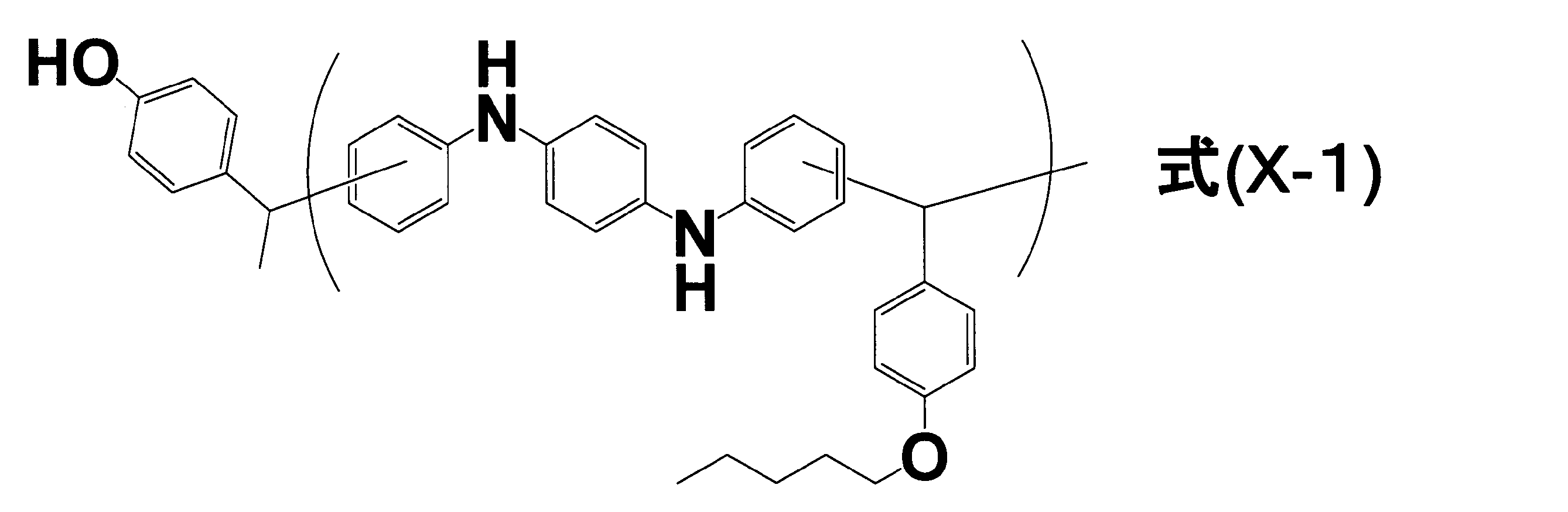
300mL四口フラスコにN,N'-ジフェニル-1,4-フェニレンジアミン(41.98g、0.161mol、東京化成工業(株)製)、4-アミルオキシベンズアルデヒド(31.02g、0.161mol、東京化成工業(株)製)、4-(tert-ブトキシ)スチレン(94.75g、0.537mol、和光純薬工業(株)製)、プロピレングリコールモノメチルエーテル(172.37g、関東化学(株)製)を仕込みメタンスルホン酸(4.65g、0.048mol、東京化成工業(株)製)を加えて撹拌し、135℃まで昇温し溶解させ重合を開始した。18時間後室温まで放冷後、メタノール(1000g、関東化学(株)製)、超純水1000g及び30%アンモニア水(100g、関東化学(株)製)の混合溶媒を用いて再沈殿させた。得られた沈殿物をろ過し、減圧乾燥機で80℃、24時間乾燥し、目的とするポリマー(式(X-1)に相当する。)、以下pDPPDA-AOBA-TBOSと略す)136.68gを得た。pDPPDA-AOBA-TBOSのGPCによるポリスチレン換算で測定される重量平均分子量Mwは1400、多分散度Mw/Mn(Mnは数平均分子量を表す)は1.29であった。
(実施例1)
合成例1で得たポリマー1.00g、架橋剤として4,4’-(1-メチルエチリジン)ビス[2,6-ビス[(2-メトキシ-1-メチルエトキシ)メチル]-フェノール0.20g、架橋反応を促進させる化合物としてピリジニウム-p-フェノールスルホネート0.020g、界面活性剤(DIC(株)製、品名:メガファック〔商品名〕R-30N、フッ素系界面活性剤)0.001g、添加剤としてイオン液体(東京化成工業(株)製、1-アリル-3-メチルイミダゾリウムビス(トリフルオロメタンスルホニル)イミド)0.20gにプロピレングリコールモノメチルエーテル1.70g、プロピレングリコールモノメチルエーテルアセテート3.98gに溶解させ、レジスト下層膜形成組成物を調製した。
合成例1で得たポリマー1.00g、架橋剤として4,4’-(1-メチルエチリジン)ビス[2,6-ビス[(2-メトキシ-1-メチルエトキシ)メチル]-フェノール0.20g、架橋反応を促進させる化合物としてピリジニウム-p-フェノールスルホネート0.020g、界面活性剤(DIC(株)製、品名:メガファック〔商品名〕R-30N、フッ素系界面活性剤)0.001g、添加剤としてイオン液体(東京化成工業(株)製、1-アリル-3-メチルイミダゾリウムビス(トリフルオロメタンスルホニル)イミド)0.20gにプロピレングリコールモノメチルエーテル1.70g、プロピレングリコールモノメチルエーテルアセテート3.98gに溶解させ、レジスト下層膜形成組成物を調製した。
(実施例2)
合成例1で得たポリマー1.00g、架橋剤として4,4’-(1-メチルエチリジン)ビス[2,6-ビス[(2-メトキシ-1-メチルエトキシ)メチル]-フェノール0.20g、架橋反応を促進させる化合物としてピリジニウム-p-フェノールスルホネート0.020g、界面活性剤(DIC(株)製、品名:メガファック〔商品名〕R-30N、フッ素系界面活性剤)0.001g、添加剤としてイオン液体(東京化成工業(株)製、1-アリル-3-メチルイミダゾリウムビス(トリフルオロメタンスルホニル)イミド)0.40gにプロピレングリコールモノメチルエーテル1.38g、プロピレングリコールモノメチルエーテルアセテート3.22gに溶解させ、レジスト下層膜形成組成物を調製した。
合成例1で得たポリマー1.00g、架橋剤として4,4’-(1-メチルエチリジン)ビス[2,6-ビス[(2-メトキシ-1-メチルエトキシ)メチル]-フェノール0.20g、架橋反応を促進させる化合物としてピリジニウム-p-フェノールスルホネート0.020g、界面活性剤(DIC(株)製、品名:メガファック〔商品名〕R-30N、フッ素系界面活性剤)0.001g、添加剤としてイオン液体(東京化成工業(株)製、1-アリル-3-メチルイミダゾリウムビス(トリフルオロメタンスルホニル)イミド)0.40gにプロピレングリコールモノメチルエーテル1.38g、プロピレングリコールモノメチルエーテルアセテート3.22gに溶解させ、レジスト下層膜形成組成物を調製した。
(実施例3)
合成例1で得たポリマー1.00g、架橋剤として4,4’-(1-メチルエチリジン)ビス[2,6-ビス[(2-メトキシ-1-メチルエトキシ)メチル]-フェノール0.20g、架橋反応を促進させる化合物としてピリジニウム-p-フェノールスルホネート0.020g、界面活性剤(DIC(株)製、品名:メガファック〔商品名〕R-30N、フッ素系界面活性剤)0.001g、添加剤としてイオン液体(関東化学(株)製、1-エチル-3-メチルイミダゾリウムビス(トリフルオロメタンスルホニル)イミド)0.20gにプロピレングリコールモノメチルエーテル1.38g、プロピレングリコールモノメチルエーテルアセテート3.22gに溶解させ、レジスト下層膜形成組成物を調製した。
合成例1で得たポリマー1.00g、架橋剤として4,4’-(1-メチルエチリジン)ビス[2,6-ビス[(2-メトキシ-1-メチルエトキシ)メチル]-フェノール0.20g、架橋反応を促進させる化合物としてピリジニウム-p-フェノールスルホネート0.020g、界面活性剤(DIC(株)製、品名:メガファック〔商品名〕R-30N、フッ素系界面活性剤)0.001g、添加剤としてイオン液体(関東化学(株)製、1-エチル-3-メチルイミダゾリウムビス(トリフルオロメタンスルホニル)イミド)0.20gにプロピレングリコールモノメチルエーテル1.38g、プロピレングリコールモノメチルエーテルアセテート3.22gに溶解させ、レジスト下層膜形成組成物を調製した。
(実施例4)
合成例1で得たポリマー1.00g、架橋剤として4,4’-(1-メチルエチリジン)ビス[2,6-ビス[(2-メトキシ-1-メチルエトキシ)メチル]-フェノール0.20g、架橋反応を促進させる化合物としてピリジニウム-p-フェノールスルホネート0.020g、界面活性剤(DIC(株)製、品名:メガファック〔商品名〕R-30N、フッ素系界面活性剤)0.001g、添加剤としてイオン液体(関東化学(株)製、1-エチル-3-メチルイミダゾリウムビス(トリフルオロメタンスルホニル)イミド)0.40gにプロピレングリコールモノメチルエーテル1.38g、プロピレングリコールモノメチルエーテルアセテート3.22gに溶解させ、レジスト下層膜形成組成物を調製した。
合成例1で得たポリマー1.00g、架橋剤として4,4’-(1-メチルエチリジン)ビス[2,6-ビス[(2-メトキシ-1-メチルエトキシ)メチル]-フェノール0.20g、架橋反応を促進させる化合物としてピリジニウム-p-フェノールスルホネート0.020g、界面活性剤(DIC(株)製、品名:メガファック〔商品名〕R-30N、フッ素系界面活性剤)0.001g、添加剤としてイオン液体(関東化学(株)製、1-エチル-3-メチルイミダゾリウムビス(トリフルオロメタンスルホニル)イミド)0.40gにプロピレングリコールモノメチルエーテル1.38g、プロピレングリコールモノメチルエーテルアセテート3.22gに溶解させ、レジスト下層膜形成組成物を調製した。
(実施例5)
合成例1で得たポリマー1.00g、架橋剤として4,4’-(1-メチルエチリジン)ビス[2,6-ビス[(2-メトキシ-1-メチルエトキシ)メチル]-フェノール0.20g、架橋反応を促進させる化合物としてピリジニウム-p-フェノールスルホネート0.020g、界面活性剤(DIC(株)製、品名:メガファック〔商品名〕R-30N、フッ素系界面活性剤)0.001g、添加剤としてイオン液体(関東化学(株)製、1-エチル-3-メチルピリジニウムビス(トリフルオロメタンスルホニル)イミド)0.40gにプロピレングリコールモノメチルエーテル1.38g、プロピレングリコールモノメチルエーテルアセテート3.22gに溶解させ、レジスト下層膜形成組成物を調製した。
合成例1で得たポリマー1.00g、架橋剤として4,4’-(1-メチルエチリジン)ビス[2,6-ビス[(2-メトキシ-1-メチルエトキシ)メチル]-フェノール0.20g、架橋反応を促進させる化合物としてピリジニウム-p-フェノールスルホネート0.020g、界面活性剤(DIC(株)製、品名:メガファック〔商品名〕R-30N、フッ素系界面活性剤)0.001g、添加剤としてイオン液体(関東化学(株)製、1-エチル-3-メチルピリジニウムビス(トリフルオロメタンスルホニル)イミド)0.40gにプロピレングリコールモノメチルエーテル1.38g、プロピレングリコールモノメチルエーテルアセテート3.22gに溶解させ、レジスト下層膜形成組成物を調製した。
(実施例6)
合成例1で得たポリマー1.00g、架橋剤として4,4’-(1-メチルエチリジン)ビス[2,6-ビス[(2-メトキシ-1-メチルエトキシ)メチル]-フェノール0.20g、架橋反応を促進させる化合物としてピリジニウム-p-フェノールスルホネート0.020g、界面活性剤(DIC(株)製、品名:メガファック〔商品名〕R-30N、フッ素系界面活性剤)0.001g、添加剤としてイオン液体(関東化学(株)製、アミルトリエチルアンモニウムビス(トリフルオロメタンスルホニル)イミド)0.40gにプロピレングリコールモノメチルエーテル1.38g、プロピレングリコールモノメチルエーテルアセテート3.22gに溶解させ、レジスト下層膜形成組成物を調製した。
合成例1で得たポリマー1.00g、架橋剤として4,4’-(1-メチルエチリジン)ビス[2,6-ビス[(2-メトキシ-1-メチルエトキシ)メチル]-フェノール0.20g、架橋反応を促進させる化合物としてピリジニウム-p-フェノールスルホネート0.020g、界面活性剤(DIC(株)製、品名:メガファック〔商品名〕R-30N、フッ素系界面活性剤)0.001g、添加剤としてイオン液体(関東化学(株)製、アミルトリエチルアンモニウムビス(トリフルオロメタンスルホニル)イミド)0.40gにプロピレングリコールモノメチルエーテル1.38g、プロピレングリコールモノメチルエーテルアセテート3.22gに溶解させ、レジスト下層膜形成組成物を調製した。
(実施例7)
合成例1で得たポリマー1.00g、架橋剤として4,4’-(1-メチルエチリジン)ビス[2,6-ビス[(2-メトキシ-1-メチルエトキシ)メチル]-フェノール0.20g、架橋反応を促進させる化合物としてピリジニウム-p-フェノールスルホネート0.020g、界面活性剤(DIC(株)製、品名:メガファック〔商品名〕R-30N、フッ素系界面活性剤)0.001g、添加剤としてイオン液体(東京化成工業(株)製、1-エチル-3-メチルイミダゾリウムトリフルオロメタンスルホナート)0.40gにプロピレングリコールモノメチルエーテル1.38g、プロピレングリコールモノメチルエーテルアセテート3.22gに溶解させ、レジスト下層膜形成組成物を調製した。
合成例1で得たポリマー1.00g、架橋剤として4,4’-(1-メチルエチリジン)ビス[2,6-ビス[(2-メトキシ-1-メチルエトキシ)メチル]-フェノール0.20g、架橋反応を促進させる化合物としてピリジニウム-p-フェノールスルホネート0.020g、界面活性剤(DIC(株)製、品名:メガファック〔商品名〕R-30N、フッ素系界面活性剤)0.001g、添加剤としてイオン液体(東京化成工業(株)製、1-エチル-3-メチルイミダゾリウムトリフルオロメタンスルホナート)0.40gにプロピレングリコールモノメチルエーテル1.38g、プロピレングリコールモノメチルエーテルアセテート3.22gに溶解させ、レジスト下層膜形成組成物を調製した。
(比較例1)
合成例1で得たポリマー1.00g、架橋剤として4,4’-(1-メチルエチリジン)ビス[2,6-ビス[(2-メトキシ-1-メチルエトキシ)メチル] -フェノール0.20g、酸触媒としてピリジニウム-p-フェノールスルホネート0.020g、界面活性剤(DIC(株)製、品名:メガファック〔商品名〕R-30N、フッ素系界面活性剤)0.001gにプロピレングリコールモノメチルエーテル1.31g、プロピレングリコールモノメチルエーテルアセテート3.07gに溶解させ、レジスト下層膜形成組成物を調製した。
合成例1で得たポリマー1.00g、架橋剤として4,4’-(1-メチルエチリジン)ビス[2,6-ビス[(2-メトキシ-1-メチルエトキシ)メチル] -フェノール0.20g、酸触媒としてピリジニウム-p-フェノールスルホネート0.020g、界面活性剤(DIC(株)製、品名:メガファック〔商品名〕R-30N、フッ素系界面活性剤)0.001gにプロピレングリコールモノメチルエーテル1.31g、プロピレングリコールモノメチルエーテルアセテート3.07gに溶解させ、レジスト下層膜形成組成物を調製した。
(フォトレジスト溶剤への溶出試験)
実施例1乃至実施例7及び比較例1で調製したレジスト下層膜形成組成物を、それぞれスピンコーターを用いてシリコンウェハー上に塗布した。ホットプレート上で240℃,1分間、さらに400℃,1分間ベークし、レジスト下層膜(膜厚0.8μm)を形成した。このレジスト下層膜を、レジストに使用する溶剤であるプロピレングリコールモノメチルエーテル及びプロピレングリコールモノメチルエーテルアセテートに浸漬し、それらの溶剤に不溶であることを確認した。
実施例1乃至実施例7及び比較例1で調製したレジスト下層膜形成組成物を、それぞれスピンコーターを用いてシリコンウェハー上に塗布した。ホットプレート上で240℃,1分間、さらに400℃,1分間ベークし、レジスト下層膜(膜厚0.8μm)を形成した。このレジスト下層膜を、レジストに使用する溶剤であるプロピレングリコールモノメチルエーテル及びプロピレングリコールモノメチルエーテルアセテートに浸漬し、それらの溶剤に不溶であることを確認した。
(段差基板への被覆試験)
段差被覆性の評価として、幅100nm、ピッチ幅175nm、深さ800nmのトレンチパターンが形成されたSiO2基板を用いた。トレンチ幅100nm、ピッチ175nmのパターンが密集したデンスパターンエリア(DENSE)とそこから1400μm離れたパターンが形成されていないオープンエリア(OPEN)の被覆膜厚の比較を行った。実施例1乃至実施例7及び比較例1のレジスト下層膜形成組成物を上記基板上に800nmの膜厚で塗布後、240℃で60秒間、さらに400℃で60秒間焼成した。この基板の段差被覆性を日立ハイテクノロジーズ(株)製走査型電子顕微鏡(S-4800)を用いて観察し、段差基板のデンスエリア(パターン部)とオープンエリア(パターンなし部)との膜厚差(デンスエリアとオープンエリアとの塗布段差でありBiasと呼ぶ)を測定することで平坦化性を評価した。各エリアでの膜厚と塗布段差の値を表1に示した。平坦化性評価はBiasの値が小さいほど、平坦化性が高い。

段差基板への被覆性を比較すると、実施例1乃至実施例7の結果はパターンエリアとオープンエリアとの塗布段差が、比較例1の結果よりも小さいことから、実施例1乃至実施例7のレジスト下層膜形成組成物から得られたレジスト下層膜は平坦化性が良好と言える。
段差被覆性の評価として、幅100nm、ピッチ幅175nm、深さ800nmのトレンチパターンが形成されたSiO2基板を用いた。トレンチ幅100nm、ピッチ175nmのパターンが密集したデンスパターンエリア(DENSE)とそこから1400μm離れたパターンが形成されていないオープンエリア(OPEN)の被覆膜厚の比較を行った。実施例1乃至実施例7及び比較例1のレジスト下層膜形成組成物を上記基板上に800nmの膜厚で塗布後、240℃で60秒間、さらに400℃で60秒間焼成した。この基板の段差被覆性を日立ハイテクノロジーズ(株)製走査型電子顕微鏡(S-4800)を用いて観察し、段差基板のデンスエリア(パターン部)とオープンエリア(パターンなし部)との膜厚差(デンスエリアとオープンエリアとの塗布段差でありBiasと呼ぶ)を測定することで平坦化性を評価した。各エリアでの膜厚と塗布段差の値を表1に示した。平坦化性評価はBiasの値が小さいほど、平坦化性が高い。
本発明では、フォトレジスト組成物や異なるレジスト下層膜を積層する際にミキシングが生じない事と、ポリマーの熱リフロー性を高めることで焼成時のパターンへの充填性を改善したレジスト下層膜を形成する組成物を提供する事ができる。
Claims (16)
- 少なくとも一種のイオン液体、ポリマー、架橋剤、架橋反応を促進させる化合物及び有機溶媒を含む、レジスト下層膜形成組成物。
- 前記イオン液体が架橋部位を有する請求項1に記載のレジスト下層膜形成組成物。
- 前記イオン液体が前記ポリマーの質量に対し1.0質量%乃至90質量%の量含まれる、請求項1に記載のレジスト下層膜形成組成物。
- 前記イオン液体が下記式(6):
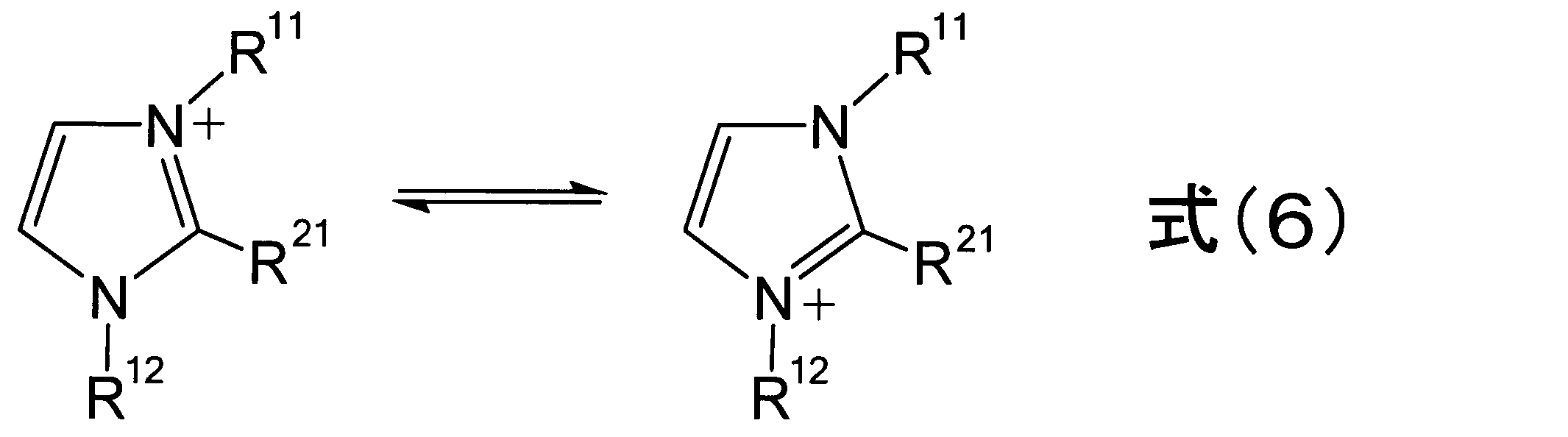
- 前記ポリマーが少なくとも2つのアミノ基と3つの炭素原子数6乃至40の芳香族環とを含む芳香族化合物(A)の芳香族環と、芳香族ビニル化合物(B)のビニル基との反応により得られる構造体(C)を含むノボラック樹脂を含む請求項1又は請求項2に記載のレジスト下層膜形成組成物。
- 構造体(C)が下記式(1):
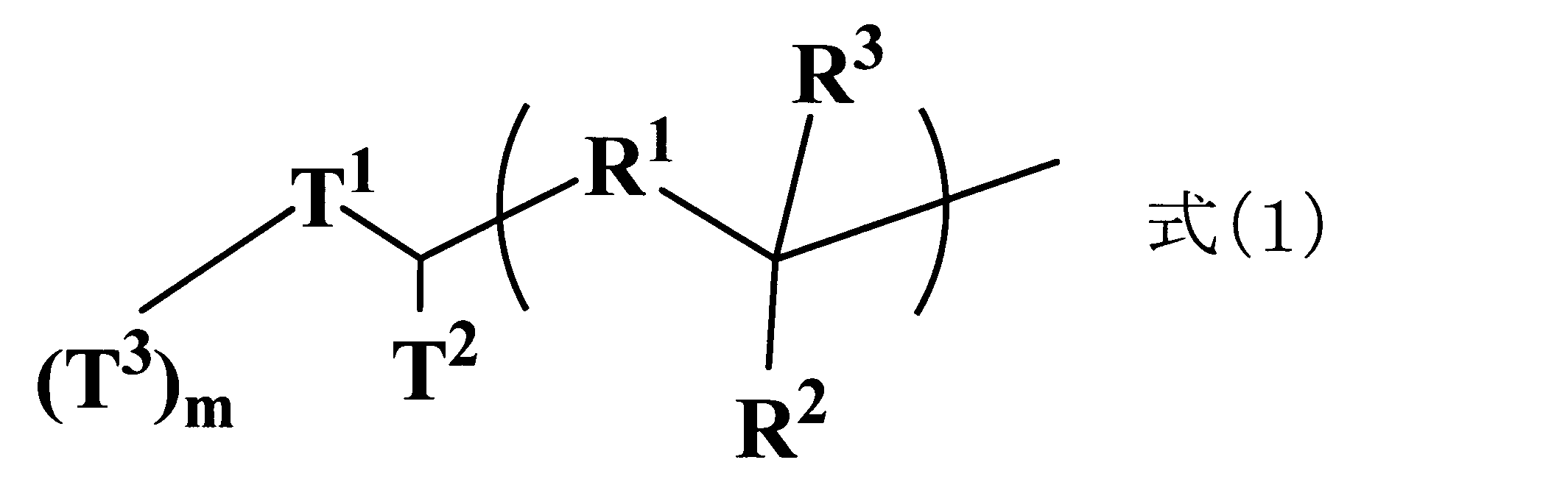
R2及びR3はそれぞれ、水素原子、炭素原子数1乃至10のアルキル基、炭素原子数6乃至40のアリール基、複素環基、又はそれらの組み合わせであり、かつ、該アルキル基、該アリール基、該複素環基は、ハロゲン原子、ニトロ基、アミノ基、ホルミル基、アルコキシ基、又はヒドロキシ基で置換されていても良い有機基であり、そしてR2とR3は互いに環を形成していても良く、T1は炭素原子数6乃至40のアリーレン基である。T3は炭素原子数1乃至10のアルキル基、炭素原子数2乃至10のアルケニル基、炭素原子数2乃至10のアルキニル基、炭素原子数6乃至40のアリール基、ヒドロキシ基、シアノ基、ニトロ基、アミノ基、カルボキシ基、アセチル基、ヒドロキシメチル基、ハロゲノメチル基、-Y-Z基、ハロゲン原子、又はそれらの組み合わせを示す。Yは酸素原子、硫黄原子、カルボニル基、又はエステル基を示し、Zは炭素原子数1乃至10のアルキル基を示す。T2は水素原子、メチル基、又はフェニル基を示す。mは0乃至(5+2n)の整数であり、nはT1に由来するアリール基のベンゼン環の縮合度を示す。]である請求項5に記載のレジスト下層膜形成組成物。 - R1が式(2):
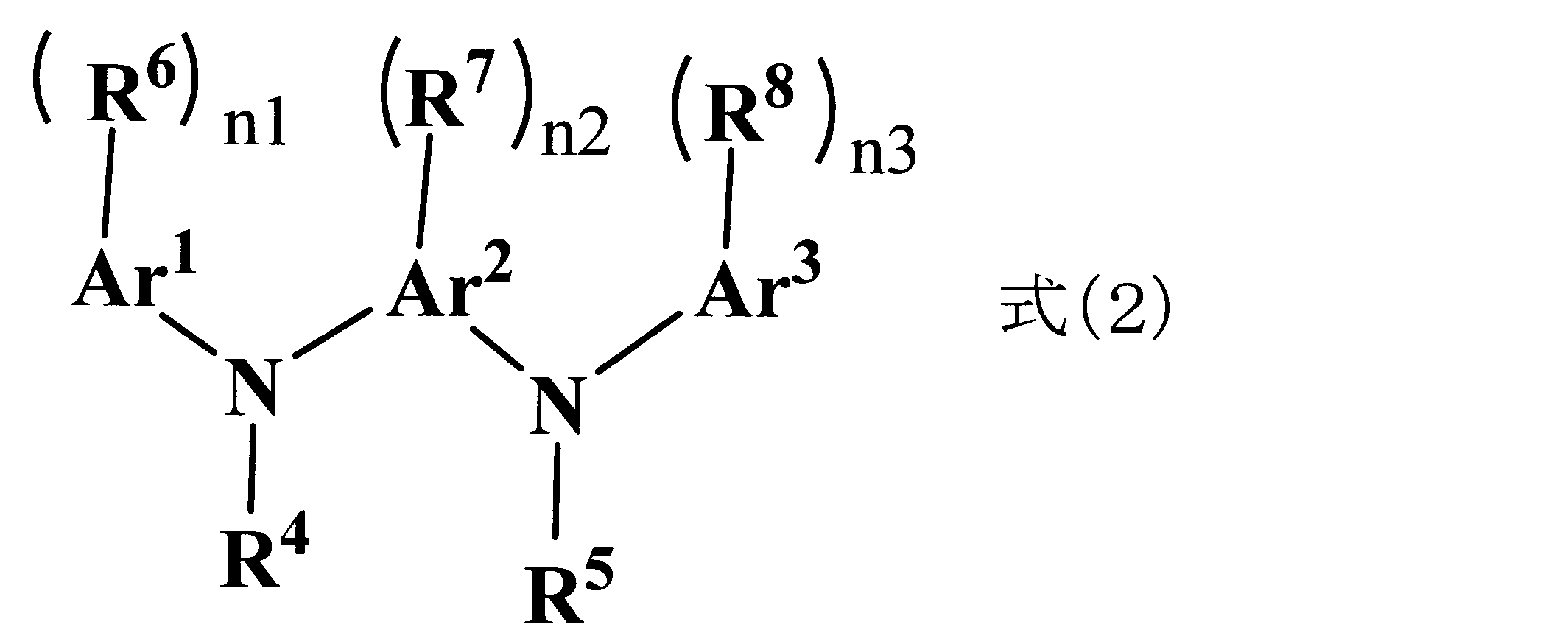
R4及びR5はそれぞれ水素原子、炭素原子数1乃至10のアルキル基、炭素原子数2乃至10のアルケニル基、炭素原子数6乃至40のアリール基、及びそれらの組み合わせからなる群より選択され、かつ、該アルキル基、該アルケニル基又はアリール基は、エーテル結合、ケトン結合、若しくはエステル結合を含んでいても良い有機基を表し、
n1、n2、n3はそれぞれ0以上であり、R6、R7、及びR8が置換可能な最大数までの整数である。]で示される化合物から誘導される2価の有機基である請求項6に記載のレジスト下層膜形成組成物。 - R1がN,N'-ジフェニル-1,4-フェニレンジアミンから誘導される2価の有機基である請求項6に記載のレジスト下層膜形成組成物。
- R3が水素原子であり、R2がフェニル基、ナフチル基、アントリル基、及びピレニル基から選ばれるアリール基であり、該アリール基はハロゲン原子、ニトロ基、アミノ基、炭素原子数1乃至10のアルキル基、炭素原子数1乃至10のアルコキシ基、炭素原子数6乃至40のアリール基、ホルミル基、カルボキシ基、又はヒドロキシ基で置換されていても良い基である請求項6に記載のレジスト下層膜形成組成物。
- R3が水素原子であり、R2がフェニル基であり、該フェニル基はハロゲン原子、ニトロ基、アミノ基、炭素原子数1乃至10のアルキル基、炭素原子数1乃至10のアルコキシ基、炭素原子数6乃至40のアリール基、ホルミル基、カルボキシ基、又はヒドロキシ基で置換されていても良い基である請求項6に記載のレジスト下層膜形成組成物。
- T1がフェニレン基である請求項6に記載のレジスト下層膜形成組成物。
- 構造体(C)が下記式(1-1):
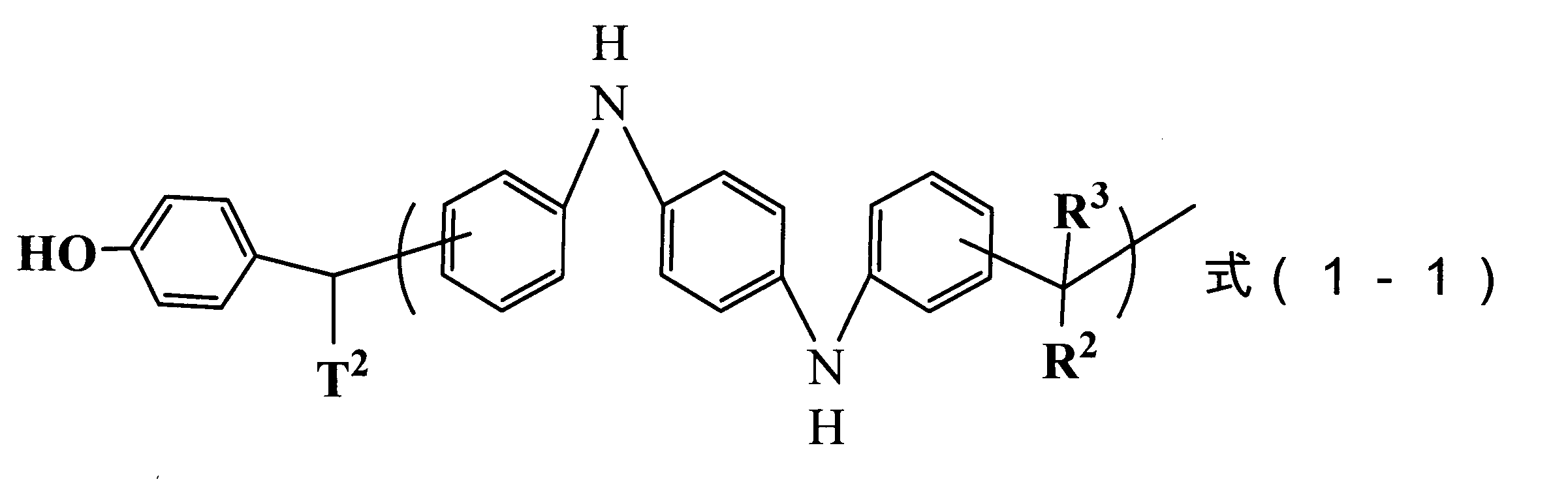
- 酸及び/又は酸発生剤を更に含む請求項1乃至請求項12のいずれか1項に記載のレジスト下層膜形成組成物。
- 請求項1乃至請求項13のいずれか1項に記載のレジスト下層膜形成組成物を半導体基板上に塗布し焼成することによって得られるレジスト下層膜。
- 半導体基板上に請求項1乃至請求項13のいずれか1項に記載のレジスト下層膜形成組成物により下層膜を形成する工程、その上にレジスト膜を形成する工程、光又は電子線の照射と現像によりレジストパターンを形成する工程、レジストパターンにより該下層膜をエッチングする工程、及びパターン化された下層膜により半導体基板を加工する工程を含む半導体装置の製造方法。
- 半導体基板に請求項1乃至請求項13のいずれか1項に記載のレジスト下層膜形成組成物により下層膜を形成する工程、その上にハードマスクを形成する工程、更にその上にレジスト膜を形成する工程、光又は電子線の照射と現像によりレジストパターンを形成する工程、レジストパターンによりハードマスクをエッチングする工程、パターン化されたハードマスクにより該下層膜をエッチングする工程、及びパターン化された下層膜により半導体基板を加工する工程を含む半導体装置の製造方法。
Applications Claiming Priority (2)
| Application Number | Priority Date | Filing Date | Title |
|---|---|---|---|
| JP2018-231690 | 2018-12-11 | ||
| JP2018231690A JP2022025161A (ja) | 2018-12-11 | 2018-12-11 | イオン液体を含むレジスト下層膜形成組成物 |
Publications (1)
| Publication Number | Publication Date |
|---|---|
| WO2020121873A1 true WO2020121873A1 (ja) | 2020-06-18 |
Family
ID=71075691
Family Applications (1)
| Application Number | Title | Priority Date | Filing Date |
|---|---|---|---|
| PCT/JP2019/047054 Ceased WO2020121873A1 (ja) | 2018-12-11 | 2019-12-02 | イオン液体を含むレジスト下層膜形成組成物 |
Country Status (3)
| Country | Link |
|---|---|
| JP (1) | JP2022025161A (ja) |
| TW (1) | TW202036163A (ja) |
| WO (1) | WO2020121873A1 (ja) |
Citations (5)
| Publication number | Priority date | Publication date | Assignee | Title |
|---|---|---|---|---|
| JP2012013872A (ja) * | 2010-06-30 | 2012-01-19 | Nissan Chem Ind Ltd | イオン液体を含むレジスト下層膜形成組成物及びそれを用いたレジストパターンの形成方法 |
| JP2012022191A (ja) * | 2010-07-15 | 2012-02-02 | Nissan Chem Ind Ltd | イオン性重合体を含むレジスト下層膜形成組成物及びそれを用いたレジストパターンの形成方法 |
| WO2016072316A1 (ja) * | 2014-11-04 | 2016-05-12 | 日産化学工業株式会社 | アリーレン基を有するポリマーを含むレジスト下層膜形成組成物 |
| WO2017069063A1 (ja) * | 2015-10-19 | 2017-04-27 | 日産化学工業株式会社 | 長鎖アルキル基含有ノボラックを含むレジスト下層膜形成組成物 |
| WO2018043410A1 (ja) * | 2016-09-01 | 2018-03-08 | 日産化学工業株式会社 | トリアリールジアミン含有ノボラック樹脂を含むレジスト下層膜形成組成物 |
-
2018
- 2018-12-11 JP JP2018231690A patent/JP2022025161A/ja active Pending
-
2019
- 2019-12-02 WO PCT/JP2019/047054 patent/WO2020121873A1/ja not_active Ceased
- 2019-12-09 TW TW108144857A patent/TW202036163A/zh unknown
Patent Citations (5)
| Publication number | Priority date | Publication date | Assignee | Title |
|---|---|---|---|---|
| JP2012013872A (ja) * | 2010-06-30 | 2012-01-19 | Nissan Chem Ind Ltd | イオン液体を含むレジスト下層膜形成組成物及びそれを用いたレジストパターンの形成方法 |
| JP2012022191A (ja) * | 2010-07-15 | 2012-02-02 | Nissan Chem Ind Ltd | イオン性重合体を含むレジスト下層膜形成組成物及びそれを用いたレジストパターンの形成方法 |
| WO2016072316A1 (ja) * | 2014-11-04 | 2016-05-12 | 日産化学工業株式会社 | アリーレン基を有するポリマーを含むレジスト下層膜形成組成物 |
| WO2017069063A1 (ja) * | 2015-10-19 | 2017-04-27 | 日産化学工業株式会社 | 長鎖アルキル基含有ノボラックを含むレジスト下層膜形成組成物 |
| WO2018043410A1 (ja) * | 2016-09-01 | 2018-03-08 | 日産化学工業株式会社 | トリアリールジアミン含有ノボラック樹脂を含むレジスト下層膜形成組成物 |
Also Published As
| Publication number | Publication date |
|---|---|
| JP2022025161A (ja) | 2022-02-10 |
| TW202036163A (zh) | 2020-10-01 |
Similar Documents
| Publication | Publication Date | Title |
|---|---|---|
| JP6094767B2 (ja) | フェニルインドール含有ノボラック樹脂を含むレジスト下層膜形成組成物 | |
| JP6734569B2 (ja) | ピノールノボラック樹脂を含むレジスト下層膜形成組成物 | |
| JP6004172B2 (ja) | カルボニル基含有カルバゾールノボラックを含むリソグラフィー用レジスト下層膜形成組成物 | |
| JP6137486B2 (ja) | 複素環を含む共重合樹脂を含むレジスト下層膜形成組成物 | |
| JP6583630B2 (ja) | 第二アミノ基を有するノボラックポリマーを含むレジスト下層膜形成組成物 | |
| JP7021636B2 (ja) | トリアリールジアミン含有ノボラック樹脂を含むレジスト下層膜形成組成物 | |
| JP6703308B2 (ja) | 芳香族メチロール化合物が反応したノボラック樹脂を含むレジスト下層膜形成組成物 | |
| KR102206511B1 (ko) | 수산기를 갖는 아릴설폰산염 함유 레지스트 하층막 형성 조성물 | |
| KR102759780B1 (ko) | 방향족 비닐 화합물이 부가된 트리아릴디아민함유노볼락 수지를 포함하는 레지스트 하층막 형성 조성물 | |
| JP2021105703A (ja) | イオン液体を含むレジスト下層膜形成組成物 | |
| CN116235112A (zh) | 包含具有氟烷基的有机酸或其盐的抗蚀剂下层膜形成用组合物 | |
| KR20220161272A (ko) | 가교제의 변성이 억제된 레지스트 하층막 형성 조성물 | |
| JP2022025161A (ja) | イオン液体を含むレジスト下層膜形成組成物 |
Legal Events
| Date | Code | Title | Description |
|---|---|---|---|
| 121 | Ep: the epo has been informed by wipo that ep was designated in this application |
Ref document number: 19895710 Country of ref document: EP Kind code of ref document: A1 |
|
| NENP | Non-entry into the national phase |
Ref country code: DE |
|
| 122 | Ep: pct application non-entry in european phase |
Ref document number: 19895710 Country of ref document: EP Kind code of ref document: A1 |
|
| NENP | Non-entry into the national phase |
Ref country code: JP |