WO2020116552A1 - ポリアミノ酸、ブロックコポリマー及びポリマー粒子組成物 - Google Patents
ポリアミノ酸、ブロックコポリマー及びポリマー粒子組成物 Download PDFInfo
- Publication number
- WO2020116552A1 WO2020116552A1 PCT/JP2019/047567 JP2019047567W WO2020116552A1 WO 2020116552 A1 WO2020116552 A1 WO 2020116552A1 JP 2019047567 W JP2019047567 W JP 2019047567W WO 2020116552 A1 WO2020116552 A1 WO 2020116552A1
- Authority
- WO
- WIPO (PCT)
- Prior art keywords
- group
- methyl
- polyamino acid
- tryptophan
- polymer
- Prior art date
- Legal status (The legal status is an assumption and is not a legal conclusion. Google has not performed a legal analysis and makes no representation as to the accuracy of the status listed.)
- Ceased
Links
Images

Classifications
-
- A—HUMAN NECESSITIES
- A61—MEDICAL OR VETERINARY SCIENCE; HYGIENE
- A61K—PREPARATIONS FOR MEDICAL, DENTAL OR TOILETRY PURPOSES
- A61K31/00—Medicinal preparations containing organic active ingredients
- A61K31/33—Heterocyclic compounds
- A61K31/395—Heterocyclic compounds having nitrogen as a ring hetero atom, e.g. guanethidine or rifamycins
- A61K31/40—Heterocyclic compounds having nitrogen as a ring hetero atom, e.g. guanethidine or rifamycins having five-membered rings with one nitrogen as the only ring hetero atom, e.g. sulpiride, succinimide, tolmetin, buflomedil
- A61K31/403—Heterocyclic compounds having nitrogen as a ring hetero atom, e.g. guanethidine or rifamycins having five-membered rings with one nitrogen as the only ring hetero atom, e.g. sulpiride, succinimide, tolmetin, buflomedil condensed with carbocyclic rings, e.g. carbazole
- A61K31/404—Indoles, e.g. pindolol
- A61K31/405—Indole-alkanecarboxylic acids; Derivatives thereof, e.g. tryptophan, indomethacin
-
- A—HUMAN NECESSITIES
- A61—MEDICAL OR VETERINARY SCIENCE; HYGIENE
- A61K—PREPARATIONS FOR MEDICAL, DENTAL OR TOILETRY PURPOSES
- A61K45/00—Medicinal preparations containing active ingredients not provided for in groups A61K31/00 - A61K41/00
-
- A—HUMAN NECESSITIES
- A61—MEDICAL OR VETERINARY SCIENCE; HYGIENE
- A61K—PREPARATIONS FOR MEDICAL, DENTAL OR TOILETRY PURPOSES
- A61K47/00—Medicinal preparations characterised by the non-active ingredients used, e.g. carriers or inert additives; Targeting or modifying agents chemically bound to the active ingredient
- A61K47/50—Medicinal preparations characterised by the non-active ingredients used, e.g. carriers or inert additives; Targeting or modifying agents chemically bound to the active ingredient the non-active ingredient being chemically bound to the active ingredient, e.g. polymer-drug conjugates
- A61K47/51—Medicinal preparations characterised by the non-active ingredients used, e.g. carriers or inert additives; Targeting or modifying agents chemically bound to the active ingredient the non-active ingredient being chemically bound to the active ingredient, e.g. polymer-drug conjugates the non-active ingredient being a modifying agent
- A61K47/54—Medicinal preparations characterised by the non-active ingredients used, e.g. carriers or inert additives; Targeting or modifying agents chemically bound to the active ingredient the non-active ingredient being chemically bound to the active ingredient, e.g. polymer-drug conjugates the non-active ingredient being a modifying agent the modifying agent being an organic compound
- A61K47/55—Medicinal preparations characterised by the non-active ingredients used, e.g. carriers or inert additives; Targeting or modifying agents chemically bound to the active ingredient the non-active ingredient being chemically bound to the active ingredient, e.g. polymer-drug conjugates the non-active ingredient being a modifying agent the modifying agent being an organic compound the modifying agent being also a pharmacologically or therapeutically active agent, i.e. the entire conjugate being a codrug
-
- A—HUMAN NECESSITIES
- A61—MEDICAL OR VETERINARY SCIENCE; HYGIENE
- A61K—PREPARATIONS FOR MEDICAL, DENTAL OR TOILETRY PURPOSES
- A61K47/00—Medicinal preparations characterised by the non-active ingredients used, e.g. carriers or inert additives; Targeting or modifying agents chemically bound to the active ingredient
- A61K47/50—Medicinal preparations characterised by the non-active ingredients used, e.g. carriers or inert additives; Targeting or modifying agents chemically bound to the active ingredient the non-active ingredient being chemically bound to the active ingredient, e.g. polymer-drug conjugates
- A61K47/51—Medicinal preparations characterised by the non-active ingredients used, e.g. carriers or inert additives; Targeting or modifying agents chemically bound to the active ingredient the non-active ingredient being chemically bound to the active ingredient, e.g. polymer-drug conjugates the non-active ingredient being a modifying agent
- A61K47/56—Medicinal preparations characterised by the non-active ingredients used, e.g. carriers or inert additives; Targeting or modifying agents chemically bound to the active ingredient the non-active ingredient being chemically bound to the active ingredient, e.g. polymer-drug conjugates the non-active ingredient being a modifying agent the modifying agent being an organic macromolecular compound, e.g. an oligomeric, polymeric or dendrimeric molecule
- A61K47/59—Medicinal preparations characterised by the non-active ingredients used, e.g. carriers or inert additives; Targeting or modifying agents chemically bound to the active ingredient the non-active ingredient being chemically bound to the active ingredient, e.g. polymer-drug conjugates the non-active ingredient being a modifying agent the modifying agent being an organic macromolecular compound, e.g. an oligomeric, polymeric or dendrimeric molecule obtained otherwise than by reactions only involving carbon-to-carbon unsaturated bonds, e.g. polyureas or polyurethanes
- A61K47/60—Medicinal preparations characterised by the non-active ingredients used, e.g. carriers or inert additives; Targeting or modifying agents chemically bound to the active ingredient the non-active ingredient being chemically bound to the active ingredient, e.g. polymer-drug conjugates the non-active ingredient being a modifying agent the modifying agent being an organic macromolecular compound, e.g. an oligomeric, polymeric or dendrimeric molecule obtained otherwise than by reactions only involving carbon-to-carbon unsaturated bonds, e.g. polyureas or polyurethanes the organic macromolecular compound being a polyoxyalkylene oligomer, polymer or dendrimer, e.g. PEG, PPG, PEO or polyglycerol
-
- A—HUMAN NECESSITIES
- A61—MEDICAL OR VETERINARY SCIENCE; HYGIENE
- A61K—PREPARATIONS FOR MEDICAL, DENTAL OR TOILETRY PURPOSES
- A61K47/00—Medicinal preparations characterised by the non-active ingredients used, e.g. carriers or inert additives; Targeting or modifying agents chemically bound to the active ingredient
- A61K47/50—Medicinal preparations characterised by the non-active ingredients used, e.g. carriers or inert additives; Targeting or modifying agents chemically bound to the active ingredient the non-active ingredient being chemically bound to the active ingredient, e.g. polymer-drug conjugates
- A61K47/51—Medicinal preparations characterised by the non-active ingredients used, e.g. carriers or inert additives; Targeting or modifying agents chemically bound to the active ingredient the non-active ingredient being chemically bound to the active ingredient, e.g. polymer-drug conjugates the non-active ingredient being a modifying agent
- A61K47/62—Medicinal preparations characterised by the non-active ingredients used, e.g. carriers or inert additives; Targeting or modifying agents chemically bound to the active ingredient the non-active ingredient being chemically bound to the active ingredient, e.g. polymer-drug conjugates the non-active ingredient being a modifying agent the modifying agent being a protein, peptide or polyamino acid
- A61K47/64—Drug-peptide, drug-protein or drug-polyamino acid conjugates, i.e. the modifying agent being a peptide, protein or polyamino acid which is covalently bonded or complexed to a therapeutically active agent
-
- A—HUMAN NECESSITIES
- A61—MEDICAL OR VETERINARY SCIENCE; HYGIENE
- A61K—PREPARATIONS FOR MEDICAL, DENTAL OR TOILETRY PURPOSES
- A61K9/00—Medicinal preparations characterised by special physical form
- A61K9/14—Particulate form, e.g. powders, Processes for size reducing of pure drugs or the resulting products, Pure drug nanoparticles
-
- A—HUMAN NECESSITIES
- A61—MEDICAL OR VETERINARY SCIENCE; HYGIENE
- A61P—SPECIFIC THERAPEUTIC ACTIVITY OF CHEMICAL COMPOUNDS OR MEDICINAL PREPARATIONS
- A61P35/00—Antineoplastic agents
-
- A—HUMAN NECESSITIES
- A61—MEDICAL OR VETERINARY SCIENCE; HYGIENE
- A61P—SPECIFIC THERAPEUTIC ACTIVITY OF CHEMICAL COMPOUNDS OR MEDICINAL PREPARATIONS
- A61P37/00—Drugs for immunological or allergic disorders
- A61P37/02—Immunomodulators
- A61P37/04—Immunostimulants
-
- A—HUMAN NECESSITIES
- A61—MEDICAL OR VETERINARY SCIENCE; HYGIENE
- A61P—SPECIFIC THERAPEUTIC ACTIVITY OF CHEMICAL COMPOUNDS OR MEDICINAL PREPARATIONS
- A61P43/00—Drugs for specific purposes, not provided for in groups A61P1/00-A61P41/00
-
- C—CHEMISTRY; METALLURGY
- C07—ORGANIC CHEMISTRY
- C07K—PEPTIDES
- C07K14/00—Peptides having more than 20 amino acids; Gastrins; Somatostatins; Melanotropins; Derivatives thereof
-
- C—CHEMISTRY; METALLURGY
- C08—ORGANIC MACROMOLECULAR COMPOUNDS; THEIR PREPARATION OR CHEMICAL WORKING-UP; COMPOSITIONS BASED THEREON
- C08G—MACROMOLECULAR COMPOUNDS OBTAINED OTHERWISE THAN BY REACTIONS ONLY INVOLVING UNSATURATED CARBON-TO-CARBON BONDS
- C08G69/00—Macromolecular compounds obtained by reactions forming a carboxylic amide link in the main chain of the macromolecule
- C08G69/02—Polyamides derived from amino-carboxylic acids or from polyamines and polycarboxylic acids
- C08G69/08—Polyamides derived from amino-carboxylic acids or from polyamines and polycarboxylic acids derived from amino-carboxylic acids
- C08G69/10—Alpha-amino-carboxylic acids
-
- C—CHEMISTRY; METALLURGY
- C08—ORGANIC MACROMOLECULAR COMPOUNDS; THEIR PREPARATION OR CHEMICAL WORKING-UP; COMPOSITIONS BASED THEREON
- C08G—MACROMOLECULAR COMPOUNDS OBTAINED OTHERWISE THAN BY REACTIONS ONLY INVOLVING UNSATURATED CARBON-TO-CARBON BONDS
- C08G69/00—Macromolecular compounds obtained by reactions forming a carboxylic amide link in the main chain of the macromolecule
- C08G69/40—Polyamides containing oxygen in the form of ether groups
Definitions
- the present invention relates to a polyamino acid and a block copolymer containing a repeating unit derived from 1-methyl-tryptophan, and a polymer particle composition containing the polyamino acid or the block copolymer.
- the present invention has been made to solve the problem, and a main object thereof is to provide a technique capable of improving the blood retention of 1-methyl-tryptophan and efficiently delivering it to a tumor. .
- a polyamino acid containing at least one repeating unit derived from 1-methyl-tryptophan represented by the following formula (I).
- the 1-methyl-tryptophan comprises 1-methyl-L-tryptophan.
- the polyamino acid further comprises repeating units derived from other amino acids.
- a block copolymer having a hydrophilic polymer segment and a hydrophobic polymer segment, the hydrophobic polymer segment containing the polyamino acid.
- a polymer particle composition comprising the polyamino acid or the block copolymer.
- the polymer particle composition further comprises a drug.
- a polyamino acid containing 1-methyl-tryptophan as a repeating unit since a polyamino acid containing 1-methyl-tryptophan as a repeating unit is used, renal excretion is suppressed more than when administered as a low molecular weight compound, while 1-methyl is utilized by utilizing enzymatic degradation. -It becomes possible to release tryptophan gradually.
- a block copolymer in which the polyamino acid and a hydrophilic polymer are linked it is possible to form a polymeric micelle with the polyamino acid segment facing inward and the hydrophilic polymer segment facing outward, and thus foreign cell recognition by immune cells.
- an amino acid means an organic compound having both amino group and carboxyl group functional groups. Therefore, the amino acids include ⁇ -amino acids, ⁇ -amino acids, ⁇ -amino acids and ⁇ -amino acids, and the ⁇ -amino acids may be L-form or D-form.
- the amino acid is not limited to the natural amino acid, and may be an amino acid derivative in which various groups are introduced into the side chain of the natural amino acid.
- a polyamino acid means a compound in which two or more amino acids are linked via a peptide bond.
- the polyamino acid in one embodiment of the present invention may be referred to as a repeating unit derived from 1-methyl-tryptophan represented by the following formula (I) (hereinafter, referred to as “1-methyl-tryptophan residue”). The same applies to other amino acids).
- the drug is supported by covalently or noncovalently bonding the DDS carrier and the drug, or by encapsulating or dispersing the drug in the DDS carrier.
- the drug itself a polymer of 1-methyl-tryptophan
- the dose can be easily increased or decreased by adjusting the degree of polymerization.
- the number of 1-methyl-tryptophan residues contained in the polyamino acid is 1 or more, typically 2 or more, for example, 5 to 300, preferably 10 to 200, more preferably 15 to 150, and further It is preferably 20 to 100.
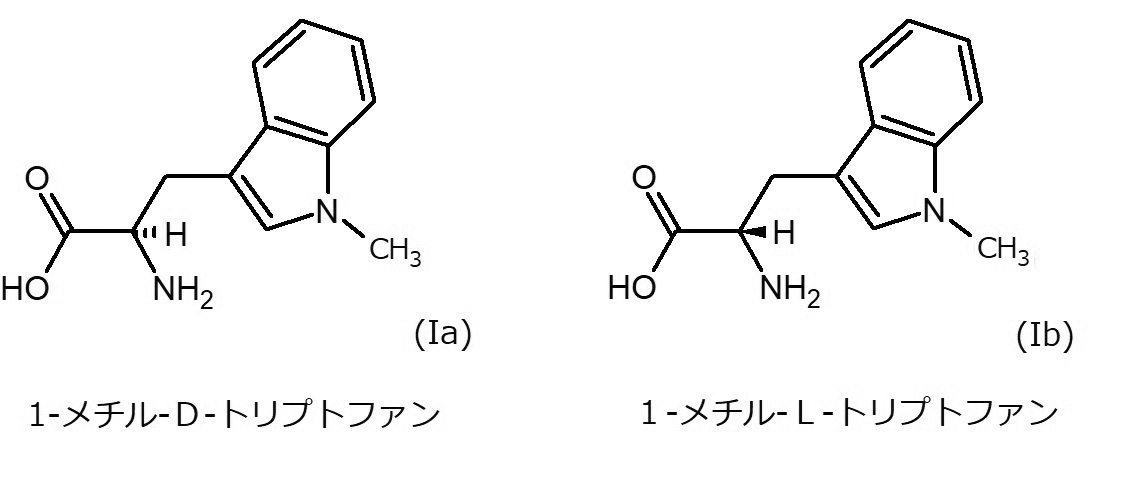
- the 1-methyl-tryptophan represented by the above formula (I) includes 1-methyl-D-tryptophan represented by the following formula (Ia), 1-methyl-L-tryptophan represented by the following formula (Ib), or a compound thereof. Both can be included. From the viewpoint of suitably releasing a drug by proteolysis by a protease or proteasome, the 1-methyl-tryptophan represented by the above formula (I) preferably contains 1-methyl-L-tryptophan, and 1-methyl- More preferably, it is L-tryptophan.
- the above polyamino acid may further contain other amino acid residues other than 1-methyl-tryptophan depending on the purpose.
- the other amino acid is not limited as long as the effect of the present invention can be obtained, and any natural or unnatural suitable amino acid, for example, an amino acid used in a DDS carrier containing a conventional polyamino acid is used. be able to. Specific examples include amino acids having a hydrophilic group in the side chain, amino acids having a hydrophobic group in the side chain, and amino acids having a functional group in the side chain. Further, other amino acids are not limited to the natural or unnatural amino acids used as DDS carriers within the range in which 1-methyl-tryptophan can be released from polyamino acids.
- amino acids having a hydrophilic group or a functional group in its side chain include amino acids having a hydroxyl group, a carboxyl group, an amino group, an amide group, a maleimide group, a hydrazide group, a thiol group, etc. in its side chain. These hydrophilic groups or functional groups may be unique to amino acids or may be introduced additionally. Examples of amino acids having an inherent hydrophilic group or functional group include serine, threonine, tyrosine, aspartic acid, glutamic acid, lysine, ornithine, arginine, histidine, asparagine, glutamine, cysteine and the like.
- amino acid into which a functional group is additionally introduced examples include a derivative in which aminopentane (AP) is introduced into a side chain carboxylic acid of aspartic acid or glutamic acid, and diethylenetriamine (DET:H 2 NCH 2 CH 2 NH-CH 2 CH 2 NH 2 ) introduced derivatives and the like.
- AP aminopentane
- DET diethylenetriamine
- a polyamino acid having increased solubility in an aqueous medium can be obtained.
- a drug drug other than 1-methyl-tryptophan
- a cross-linking agent or the like can be bound to the side chain of the polyamino acid.
- amino acids having a hydrophobic group in the side chain examples include amino acids having a solubility of 5 g or less in 100 g of water at 25° C., more preferably 4 g or less.
- amino acids having a solubility examples include non-polar natural amino acids such as leucine, isoleucine, phenylalanine, methionine, and tryptophan, and derivatives in which a hydrophobic group is introduced into the side chain of the natural amino acid.
- the derivative is preferably a derivative in which a hydrophobic group is introduced into the side chain of an acidic amino acid such as aspartic acid or glutamic acid.
- the above-mentioned hydrophobic group is preferably a saturated or unsaturated linear or branched aliphatic hydrocarbon group having 6 to 27 carbon atoms, an aryl group or aralkyl group having 6 to 27 carbon atoms, or a cholesterol residue. It can be illustrated.
- the use of an amino acid having a hydrophobic group in the side chain increases the hydrophobicity of the polyamino acid, and as a result, the block copolymer containing the polyamino acid described in the item B as one block component more preferably forms a polymer micelle. be able to.
- the total number of amino acid residues contained in the polyamino acid is, for example, 2 to 400, preferably 5 to 300, more preferably 10 It is preferably from 250 to 250, more preferably from 15 to 200, even more preferably from 20 to 150.
- the content ratio of 1-methyl-tryptophan residues in the above polyamino acid ⁇ the number of 1-methyl-tryptophan residues/(the number of 1-methyl-tryptophan residues + the number of other amino acid residues) ⁇ 100 ⁇ is, for example, 10% or more. , Preferably 20% or more, more preferably 30% or more. The upper limit of the content ratio may be 100%.
- the polyamino acid can be represented by formula (II) below.
- R 1 represents a hydroxyl group, an oxybenzyl group, a —O—R 1a or a —NH—R 1b group, wherein each R 1a or R 1b independently represents an unsubstituted or substituted straight chain or branched chain.
- R 2 represents a hydrogen atom, an unsubstituted or substituted straight-chain or branched alkyl group having 1 to 12 carbon atoms, or an unsubstituted or substituted straight-chain or branched alkyl carbonyl group having 1 to 24 carbon atoms.
- R 3a , R 3b , R 4a and R 4b each independently represent a methylene group or an ethylene group
- R 5a and R 5b each independently represent —O— or NH—
- R 6a and R 6b independently of each other represent a hydrogen atom or a hydrophobic organic group
- R 7a and R 7b independently of each other, are the following groups: -NH-(CH 2 ) p1 -[NH-(CH 2 ) q1 -] r1 NH 2 (i); -NH- (CH 2) p2 -N [- (CH 2) q2 -NH 2] 2 (ii); -NH-(CH 2 ) p3 -N ⁇ [-(CH 2 ) q3 -NH 2 ][-(CH 2 ) q4 -NH-] r2 H ⁇ (iii); -NH-(CH 2 ) p4 -N ⁇ -(CH 2 ) q5 -N[-(
- the straight-chain or branched alkyl group having 1 to 12 carbon atoms which is defined by the groups of R 1a , R 1b and R 2 , includes, for example, methyl group, ethyl group and n-propyl group.
- the straight-chain or branched alkyl moiety having 1 to 12 carbon atoms in the straight-chain or branched alkylcarbonyl group having 1 to 24 carbon atoms defined by the group of R 2 can be referred to the above-mentioned examples.
- Examples of the alkyl moiety having 13 or more carbon atoms include a tridecyl group, a tetradecyl group, a pentadecyl group, a nonadecyl group, a docosanyl group, and a tetracosyl group.
- the substituent in the case of “substituted” is not limited, but is a C 1-6 alkoxy group, an aryloxy group, an aryl C 1-3 oxy group, a cyano group, a carboxyl group.
- Group, amino group, C 1-6 alkoxycarbonyl group, C 2-7 acylamido group, tri-C 1-6 alkylsiloxy group, siloxy group, silylamino group, or an acetalized formyl group, formyl group, chlorine or Halogen atoms such as fluorine can be mentioned.
- a display such as C 1-6 means that the carbon number is 1 to 6.
- the former represents, for example, poly- ⁇ -glutamic acid obtained by polymerization of N-carboxylic acid anhydride of glutamic acid ⁇ -benzyl ester, and the latter represents, for example, a strain of the genus Bacillus such as Bacillus natto. Represents the poly- ⁇ -glutamic acid produced.
- both R 3a and R 3b represent a methylene group, it is understood that the respective repeating units having these groups can coexist. The same applies to R 4a and R 4b .
- the hydrophobic organic group defined by the groups of R 6a and R 6b is, for example, a saturated or unsaturated linear or branched aliphatic hydrocarbon group having 6 to 27 carbon atoms, or an aryl group having 6 to 27 carbon atoms.
- R 6a and R 6b hydrogen atoms, the hydrophilicity of the polyamino acid can be increased.
- R 5a and R 5b are preferably oxygen atoms.
- R 7a and R 7b groups are preferably, independently of one another, a group of formula (i) or (v).
- formula (i) it is preferable that p1 and q1 are each independently 2 or 3, and more preferably 2.
- r1 is preferably an integer of 1 to 3.
- the above R 8 group is preferably a side chain of lysine or ornithine.
- F representing the number of repeating 1-methyl-tryptophan residues is typically an integer of 2 or more, for example, an integer of 5 to 300, preferably an integer of 10 to 200, more preferably an integer of 15 to 150, More preferably, it is an integer of 20-100.
- the 1-methyl-tryptophan residue is preferably 1-methyl-L-tryptophan residue.
- A”, “b”, “c”, “d”, and “e” representing the number of repetitions of other amino acid residues are each independently an integer of preferably 0 to 150, more preferably an integer of 0 to 100.
- the degree of polymerization (a+b+c+d+e+f) of the polyamino acid is, for example, an integer of 5 to 300, preferably an integer of 10 to 250, and more preferably an integer of 15 to 200.
- the polyamino acid represented by the formula (II) includes, for example, n-butylamine and the like as an initiator, N-carboxylic acid anhydride (NCA) of 1-methyl-tryptophan, and optionally NCA of another amino acid (eg ⁇ -Benzyl-L-aspartate, ⁇ -benzyl-L-glutamate, N ⁇ -ZL-lysine, or other protected amino acid N-carboxylic acid anhydride) is polymerized to synthesize a polyamino acid, and if necessary, Then, the resulting polyamino acid can be produced by deprotecting the side chain and optionally introducing the groups (i) to (v).
- NCA N-carboxylic acid anhydride
- another amino acid eg ⁇ -Benzyl-L-aspartate, ⁇ -benzyl-L-glutamate, N ⁇ -ZL-lysine, or other protected amino acid N-carboxylic acid anhydride
- a structural change for example, formation of an imide ring by dealcoholization of an amino acid ester residue
- polyamino acids that further include residues that have undergone such structural changes are also included in the above formula (II).
- residues that have undergone the above structural change are not included in the number of amino acid residues.
- some NH groups and NH 2 groups in the cationic amino acid residue may be converted to salts (mainly hydrochloric acid salts) due to the use of acids (mainly hydrochloric acid) in the synthetic process.
- polyamino acids having such a structure are also included in the above formula (II). That is, some NH groups and NH 2 groups in the groups of R 7a , R 7b , and R 8 may be salts (for example, hydrochloride).
- Block Copolymer The block copolymer according to one embodiment of the present invention has a hydrophilic polymer segment and a hydrophobic polymer segment, and the hydrophobic polymer segment comprises the polyamino acid described in the above section A.
- the block copolymer is typically a block copolymer in which a hydrophilic polymer segment and the polyamino acid described in the above section A are linked in series.
- polymer constituting the hydrophilic polymer segment examples include polyethylene glycol, polypropylene glycol, poly(2-oxazoline), polysaccharides, polyvinyl alcohol, polyvinylpyrrolidone, polyacrylamide, polymethacrylamide, polyacrylic acid ester, polymethacrylic acid ester. Etc., and polyethylene glycol can be preferably used.
- the hydrophilic polymer segment may be linear or branched.
- the repeating number of polyethylene glycol is, for example, 20 to 2,000, preferably 200 to 1,500. possible.
- the block copolymer may be represented by formula (III) or (IV):
- R 1 to R 8 , a, b, c, d, e and f have the same meaning as defined in the above formula (II)
- L 1 and L 3 represent a linking group
- R 9 and R 10 independently of each other represent a hydrogen atom or an unsubstituted or substituted linear or branched alkyl group having 1 to 12 carbon atoms
- k represents an integer of 20 to 2,000.
- L 1 and L 3 are linking moieties between the hydrophilic polymer segment and the polyamino acid segment, and may be any appropriate linking group.
- Linking group represented by L 1, for example, -NH -, - O -, - O-L 2 -NH -, - CO -, - CH 2 -, and O-L 2 -S-L 2 -NH —(Wherein L 2 is independently an alkylene group having 1 to 6 carbon atoms) may be a linking group.
- L 3 may be, for example, a linking group selected from —OCO—L 4 —CO— and NHCO—L 4 —CO— (wherein L 4 is an alkylene group having 1 to 6 carbon atoms).
- Examples of the linear or branched alkyl group having 1 to 12 carbon atoms defined by the groups of R 9 and R 10 include, for example, methyl group, ethyl group, n-propyl group, isopropyl group, n-butyl group, sec Examples thereof include -butyl group, tert-butyl group, n-hexyl group, decyl group, and undecyl group.
- the substituent in the case of “substituted” may be the same as the substituent exemplified for the group of R 1 and R 2 in the above formula (II).
- the R 9 and R 10 groups may be substituted by a group containing the target binding site.
- the group containing the target binding site may be any appropriate group as long as it has directivity or functionality to the target tissue, for example, an antibody or fragment thereof, or other functional or targeting It may be a group derived from a protein, a peptide, an aptamer, a sugar such as lactose, a physiologically active substance such as folic acid, or a derivative thereof.
- K which represents the repeating number of ethylene glycol, may preferably be an integer of 200 to 1,500.
- the block copolymer can be formed by, for example, purifying the polyamino acid and the hydrophilic polymer as they are, or purifying them so as to narrow the molecular weight distribution as necessary, and then coupling them by a known method.
- a polyethylene glycol chain is formed, and then an amino group is introduced on the growth terminal side, From the amino terminus 1-methyl-tryptophan N-carboxylic acid anhydride (NCA) and optionally other amino acids NCA (eg ⁇ -benzyl-L-aspartate, ⁇ -benzyl-L-glutamate, N ⁇ -Z- (N-carboxylic acid anhydride of protected amino acid such as L-lysine) is polymerized, if necessary, deprotected, and optionally the introduction of groups (i) to (v). You can The introduction of the groups (i) to
- the polymer particle composition according to one embodiment of the present invention comprises the polyamino acid described in section A above or the block copolymer described in section B above.
- the polyamino acid and block copolymer may be associated in an aqueous medium to suitably form polymer particles.
- the block copolymer can form a polymeric micelle with the polyamino acid segment facing inward and the hydrophilic polymer segment facing outward.
- an aggregate in which a plurality of molecules are aggregated into particles is also included in the particles, and such an aggregate is also called a polymer particle.
- the average particle diameter of the polymer particles is, for example, 1000 nm or less, preferably 400 nm or less, 200 nm or less, 150 nm or less, 100 nm or less, or 80 nm or less, and for example, 20 nm or more or 30 nm or more.
- the average particle diameter of the particles can be measured using a commercially available dynamic light scattering (DLS) measuring device.
- DLS dynamic light scattering
- the polymer particle composition may contain a polymer other than the polyamino acid described in the section A and the block copolymer described in the section B within a range in which the effect of the present invention can be obtained.
- examples of such other polymer include a block copolymer having a hydrophilic polymer segment and a hydrophobic polymer segment. Since such a block copolymer can be suitably associated with each other in an aqueous medium to form stable polymer particles (for example, polymer micelles), by coexisting these, a polymer particle composition having excellent stability can be obtained. Can be done. Such an effect can be particularly suitably exerted in a polymer particle composition containing a polyamino acid having no hydrophilic polymer chain segment.
- Examples of the other block copolymers include polymers described in WO2007/099660, WO2007/099661, WO2010/093036, WO2012/096399, WO2014/133172, WO2015/170757 and the like.
- the polymer particle composition for example, by adding an aqueous medium such as water or a buffer solution to the target polymer and agitating it, applying ultrasonic waves, pressure, shearing force or physical energy combining them, the target polymer is obtained.
- an aqueous medium such as water or a buffer solution
- It can be prepared by dissolving in a volatile organic solvent, volatilizing the organic solvent to dryness, adding the above aqueous medium thereto, and applying the above physical energy.
- it can also be prepared by adding a water-soluble organic solvent capable of dissolving the polymer to the target polymer, dissolving the polymer, and dialysis against the aqueous medium.
- examples of the volatile organic solvent include methanol, ethanol, acetone, chloroform, acetonitrile, tetrahydrofuran, dichloromethane and the like.
- examples of the water-soluble organic solvent include methanol, ethanol, acetonitrile, dimethyl sulfoxide, N,N-dimethylformamide, N,N-dimethylacetamide and the like.
- the polymer particle composition may further include a drug other than 1-methyl-tryptophan.
- the drug is preferably loaded (eg, encapsulated) on the polymer particles.
- the anticancer agent may be a cytotoxic compound used in chemotherapy, a low molecular weight compound, a molecular targeting agent such as an antibody, or a nucleic acid drug such as siRNA or antisense nucleic acid. Further, the anticancer agent may be an antibody or the like that can activate immunity to cancer due to inhibition of immune checkpoint. In one embodiment, an anticancer agent that induces immunogenicity, such as paclitaxel, doxorubicin, etc., is used. In another embodiment, an anticancer agent that activates an immune response such as imiquimod is used.
- Examples of the method for supporting the drug on the polymer particles include a method of preparing a polymer particle composition in the presence of the drug, a method of preparing a polymer particle composition, adding the drug to the polymer particle composition and mixing them. Can be mentioned. For example, by forming a polymeric micelle using a block copolymer in the presence of a drug, a polymeric micelle containing a drug can be obtained.
- the polyamino acid described in the above section A, the block copolymer described in the section B or the polymer particle composition described in the section C requires, for example, suppression of indoleamine 2.3-dioxygenase (IDO) activity. It can be administered to an individual. In one embodiment, the individual in need of suppressing IDO activity is an individual suffering from cancer.
- IDO indoleamine 2.3-dioxygenase
- the individual to be administered includes, for example, humans or non-human mammals.
- the administration method is preferably parenteral administration, and examples thereof include subcutaneous administration, intramuscular administration, intravenous administration, intraperitoneal administration, and intrathecal administration. In addition, it may be locally administered to a tumor or a tissue surrounding the tumor.
- MLT-NCA 80 mg was dissolved in DMF (10 mL) and added to n-butylamine (8 ⁇ L) dissolved in DMF (1 mL). After reacting at 35° C. for 48 hours, the reaction solution was added to pure water to obtain Homo-PMLT. The degree of polymerization of the PMLT chain was 5, calculated from the absorbance of UV at 220 nm.
- IDO inhibition test >> Macrophage-like cells (RAW264.7) were seeded on culture plates. After 24 hours, lipopolysaccharide (LPS, 1 ⁇ g/mL) and chymotrypsin-treated Homo-PMLT (70 ⁇ g/mL) that had been treated (the same treatment as the above enzymatic degradation test) were added, and 24 hours later, the amount of kynurenine in the supernatant was adjusted. It was measured by the HPLC method. The control to which nothing was added was used.
- LPS lipopolysaccharide
- Homo-PMLT 70 ⁇ g/mL
- MLT-NCA 200 mg was dissolved in DMF (2 mL) and added to PEG-NH 2 (100 mg, PEG molecular weight: 12 kDa) dissolved in DMF (1 mL). After reacting at 35° C. for 48 hours, the reaction solution was added to diethyl ether (150 mL) to obtain PEG-PMLT.
- the degree of polymerization of PMLT chains was calculated from the absorbance of UV at 220 nm, and the degree of polymerization was 55.
- the 1-methyl-L-tryptophan alone administration group and the polymeric micelle administration group inhibited the release of kynurenine from monocytes, as compared with the control (drug-untreated group).
- 1-methyl-L-tryptophan in the polymer which is a building block of polymeric micelles, is cleaved and released by the enzyme in monocytes, and inhibits the production of kynurenine in monocytes, thereby It is suggested that one type of monocyte was activated.
- the high-molecular micelle-administered group showed similar activity to the micelle degradation product metabolized by chymotrypsin, the amide bond in the polymer constituting the high-molecular micelle was efficiently cleaved by the enzyme in the monocyte. It was suggested that the active substance, 1-methyl-L-tryptophan, was released.
- mice Female nude mice (BALB/c-nu) were purchased from Japan Charles River Co., Ltd. and used for the experiment.
- the above-mentioned Alexa647-labeled polymer micelle solution was administered into the tail vein at a dose of 10,000 (RFU) in terms of fluorescence intensity of Alexa647, and the time-dependent change in luminescence intensity in mouse earlobe was measured by an in vivo confocal microscope (IV-CLSM, Nikon). ) was measured.
- the luminescence derived from Alexa647 reached the half-life at 80 minutes after administration, but the luminescence was still confirmed at 12 hours and 30 minutes after administration. From this, it is understood that by incorporating 1-methyl-tryptophan into the carrier (polyamino acid), excellent blood retention properties can be obtained.
- the present invention can be preferably used in the DDS field, for example.
Landscapes
- Health & Medical Sciences (AREA)
- Chemical & Material Sciences (AREA)
- Medicinal Chemistry (AREA)
- Life Sciences & Earth Sciences (AREA)
- General Health & Medical Sciences (AREA)
- Veterinary Medicine (AREA)
- Pharmacology & Pharmacy (AREA)
- Animal Behavior & Ethology (AREA)
- Public Health (AREA)
- Bioinformatics & Cheminformatics (AREA)
- Engineering & Computer Science (AREA)
- Organic Chemistry (AREA)
- Epidemiology (AREA)
- Chemical Kinetics & Catalysis (AREA)
- Nuclear Medicine, Radiotherapy & Molecular Imaging (AREA)
- General Chemical & Material Sciences (AREA)
- Proteomics, Peptides & Aminoacids (AREA)
- Immunology (AREA)
- Molecular Biology (AREA)
- Polymers & Plastics (AREA)
- Biochemistry (AREA)
- Gastroenterology & Hepatology (AREA)
- Biophysics (AREA)
- Genetics & Genomics (AREA)
- Medicinal Preparation (AREA)
- Pharmaceuticals Containing Other Organic And Inorganic Compounds (AREA)
- Peptides Or Proteins (AREA)
- Polyamides (AREA)
- Medicines That Contain Protein Lipid Enzymes And Other Medicines (AREA)
Abstract
本発明は、1-メチル-トリプトファンの血中滞留性を向上し、効率的に腫瘍へ送達できる送達技術を提供する。本発明のポリマー粒子組成物は、下記式(I)に示される1-メチル-トリプトファンに由来する繰り返し単位を少なくとも1つ含む、ポリアミノ酸;親水性ポリマーセグメントと疎水性ポリマーセグメントとを有し、該疎水性ポリマーセグメントが上記ポリアミノ酸を含む、ブロックコポリマー;及び、上記ポリアミノ酸又は上記ブロックコポリマーを含む。
Description
本発明は、1-メチル-トリプトファンに由来する繰り返し単位を含むポリアミノ酸及びブロックコポリマー並びに該ポリアミノ酸又はブロックコポリマーを含むポリマー粒子組成物に関する。
近年、癌免疫療法が注目され、抗体や低分子化合物の投与による免疫細胞の活性化及び抗腫瘍効果の増大が期待されている。このような低分子化合物の1つとして、免疫を抑制するインドールアミン-2,3-ジオキシゲナーゼ(IDO)を阻害することによって免疫細胞を活性化する1-メチル-D-トリプトファン(MDT)が検討されている(例えば、非特許文献1)。しかしながら、MDTの生体投与においては、これまでに十分な抗腫瘍効果が得られていない。
Nature Biotechnology,volume 33,pages 321-322(2015)
上記生体投与においてMDTの抗腫瘍効果が十分に得られない理由の1つとしては、MDTの血中滞留性が低く、結果として、MDTの腫瘍集積性が低いことが挙げられる。本発明は、当該課題を解決するためになされたものであり、その主たる目的は、1-メチル-トリプトファンの血中滞留性を向上し、効率的に腫瘍へ送達できる技術を提供することにある。
本発明の1つの局面によれば、下記式(I)に示される1-メチル-トリプトファンに由来する繰り返し単位を少なくとも1つ含む、ポリアミノ酸が提供される。
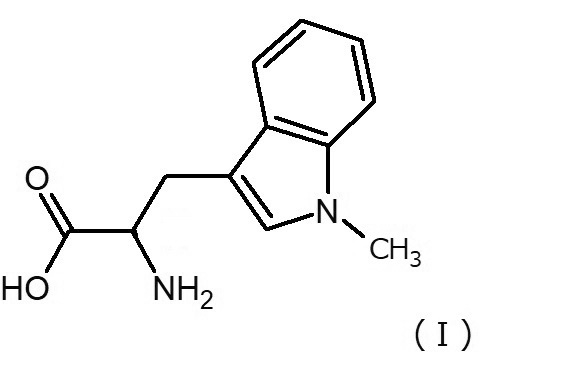
1つの実施形態において、上記1-メチル-トリプトファンが、1-メチル-L-トリプトファンを含む。
1つの実施形態において、上記ポリアミノ酸は、他のアミノ酸に由来する繰り返し単位をさらに含む。
本発明の別の局面によれば、親水性ポリマーセグメントと疎水性ポリマーセグメントとを有し、該疎水性ポリマーセグメントが上記ポリアミノ酸を含む、ブロックコポリマーが提供される。
本発明のさらに別の局面によれば、上記ポリアミノ酸又は上記ブロックコポリマーを含む、ポリマー粒子組成物が提供される。
1つの実施形態において、上記ポリマー粒子組成物は、薬物をさらに含む。
1つの実施形態において、上記ポリアミノ酸は、他のアミノ酸に由来する繰り返し単位をさらに含む。
本発明の別の局面によれば、親水性ポリマーセグメントと疎水性ポリマーセグメントとを有し、該疎水性ポリマーセグメントが上記ポリアミノ酸を含む、ブロックコポリマーが提供される。
本発明のさらに別の局面によれば、上記ポリアミノ酸又は上記ブロックコポリマーを含む、ポリマー粒子組成物が提供される。
1つの実施形態において、上記ポリマー粒子組成物は、薬物をさらに含む。
本発明においては、1-メチル-トリプトファンを繰り返し単位として含むポリアミノ酸を用いることから、低分子化合物として投与された場合よりも腎排出が抑制される一方で、酵素分解を利用して1-メチル-トリプトファンを徐放することが可能となる。また、当該ポリアミノ酸と親水性ポリマーとが連結したブロックコポリマーを用いることにより、ポリアミノ酸セグメントを内側に向け、親水性ポリマーセグメントを外側に向けた高分子ミセルを形成できることから、免疫細胞による異物認識を回避して、血中滞留性の向上、さらには腫瘍への集積が期待できる。
以下、本発明の好ましい実施形態について説明するが、本発明はこれらの実施形態には限定されない。また、各実施形態は、適宜組み合わせることができる。
本明細書において、アミノ酸とは、アミノ基とカルボキシル基の両方の官能基を持つ有機化合物を意味する。よって、アミノ酸は、α-アミノ酸、β-アミノ酸、γ-アミノ酸及びδ-アミノ酸を含み、α‐アミノ酸は、L体及びD体のいずれであってもよい。また、アミノ酸は、天然アミノ酸に限定されず、天然アミノ酸の側鎖に種々の基が導入されたアミノ酸誘導体であってもよい。
本明細書において、ポリアミノ酸とは、2個以上のアミノ酸がペプチド結合を介して連結された化合物を意味する。
A.ポリアミノ酸
本発明の1つの実施形態におけるポリアミノ酸は、下記式(I)に示される1-メチル-トリプトファンに由来する繰り返し単位(以下、「1-メチル-トリプトファン残基」と称する場合がある。他のアミノ酸についても同様である)を含む。従来の薬物送達システム(DDS)においては、DDSキャリアと薬物とを共有結合又は非共有結合させること、あるいは、DDSキャリア内に薬物を内包又は分散させること等によって薬物を担持させているが、本発明の上記実施形態においては、薬物である1-メチル-トリプトファンの重合体そのものをキャリアとして用いることができる。その結果、別途のキャリアを用意する必要なく、1-メチル-トリプトファンを徐放して血中滞留性を向上することができる。また、重合度を調整することにより、容易に投与量を増減することができる。
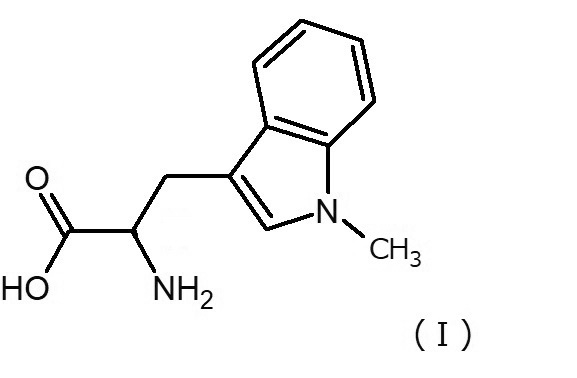
本発明の1つの実施形態におけるポリアミノ酸は、下記式(I)に示される1-メチル-トリプトファンに由来する繰り返し単位(以下、「1-メチル-トリプトファン残基」と称する場合がある。他のアミノ酸についても同様である)を含む。従来の薬物送達システム(DDS)においては、DDSキャリアと薬物とを共有結合又は非共有結合させること、あるいは、DDSキャリア内に薬物を内包又は分散させること等によって薬物を担持させているが、本発明の上記実施形態においては、薬物である1-メチル-トリプトファンの重合体そのものをキャリアとして用いることができる。その結果、別途のキャリアを用意する必要なく、1-メチル-トリプトファンを徐放して血中滞留性を向上することができる。また、重合度を調整することにより、容易に投与量を増減することができる。
上記ポリアミノ酸に含まれる1-メチル-トリプトファン残基の数は、1以上であり、代表的には2以上であり、例えば5~300、好ましくは10~200、より好ましくは15~150、さらに好ましくは20~100とすることができる。
上記式(I)に示される1-メチル-トリプトファンは、下記式(Ia)に示される1-メチル-D-トリプトファン、下記式(Ib)に示される1-メチル-L-トリプトファン、又はこれらの双方を含み得る。プロテアーゼやプロテアソームによるタンパク質分解を受けて薬物を好適に放出する観点から、上記式(I)に示される1-メチル-トリプトファンは、1-メチル-L-トリプトファンを含むことが好ましく、1-メチル-L-トリプトファンであることがより好ましい。
上記ポリアミノ酸は、目的に応じて、1-メチル-トリプトファン以外の他のアミノ酸残基をさらに含むことができる。当該他のアミノ酸としては、本発明の効果が得られる限りにおいて制限されず、任意の天然または非天然型の適切なアミノ酸、例えば、従来のポリアミノ酸を含むDDSキャリアに用いられているアミノ酸を用いることができる。具体例としては、側鎖に親水基を有するアミノ酸、側鎖に疎水基を有するアミノ酸及び側鎖に官能基を有するアミノ酸が挙げられる。また、他のアミノ酸として、ポリアミノ酸から1-メチル-トリプトファンを放出することができる範囲でDDSキャリアとして用いられている天然または非天然型のアミノ酸に限定されるものではない。
上記側鎖に親水基又は官能基を有するアミノ酸としては、側鎖にヒドロキシル基、カルボキシル基、アミノ基、アミド基、マレイミド基、ヒドラジド基、チオール基等を有するアミノ酸が挙げられる。これらの親水基又は官能基は、アミノ酸に固有であってもよく、付加的に導入されたものであってもよい。固有の親水基又は官能基を有するアミノ酸としては、セリン、トレオニン、チロシン、アスパラギン酸、グルタミン酸、リシン、オルニチン、アルギニン、ヒスチジン、アスパラギン、グルタミン、システイン等が挙げられる。なかでも、アスパラギン酸、グルタミン酸、リシン、オルニチン及びアルギニンが好ましい。官能基が付加的に導入されたアミノ酸としては、アスパラギン酸又はグルタミン酸の側鎖カルボン酸にアミノペンタン(AP)が導入された誘導体、アスパラギン酸又はグルタミン酸の側鎖カルボン酸にジエチレントリアミン(DET:H2NCH2CH2NH‐CH2CH2NH2)が導入された誘導体等が挙げられる。側鎖に親水基を有するアミノ酸を用いることによって、水性媒体への溶解度が増大したポリアミノ酸を得ることができる。また、側鎖に官能基を有するアミノ酸を用いることによって、ポリアミノ酸の側鎖に薬物(1-メチル-トリプトファン以外の薬物)や架橋剤等を結合させることができる。
上記側鎖に疎水基を有するアミノ酸としては、例えば25℃の水100gに対する溶解度が5g以下、さらに好ましくは4g以下であるアミノ酸が挙げられる。このようなアミノ酸としては、例えば、ロイシン、イソロイシン、フェニルアラニン、メチオニン、トリプトファン等の無極性天然アミノ酸や、天然アミノ酸の側鎖に疎水基が導入された誘導体が挙げられる。当該誘導体としては、好ましくはアスパラギン酸、グルタミン酸等の酸性アミノ酸の側鎖に疎水基が導入された誘導体が挙げられる。上記導入される疎水基としては、炭素数6~27の飽和もしくは不飽和の直鎖又は分枝状の脂肪族炭化水素基、炭素数6~27のアリール基またはアラルキル基あるいはコレステロール残基が好ましく例示され得る。側鎖に疎水基を有するアミノ酸を用いることによって、ポリアミノ酸の疎水性度が増大する結果、B項に記載の当該ポリアミノ酸を一ブロック成分として含むブロックコポリマーがより好適に高分子ミセルを形成することができる。
上記ポリアミノ酸に含まれる合計アミノ酸残基数(1-メチル-トリプトファン残基数と他のアミノ酸残基数との合計)は、例えば2~400であり、好ましくは5~300、より好ましくは10~250、さらに好ましくは15~200、さらにより好ましくは20~150である。
上記ポリアミノ酸における1-メチル-トリプトファン残基の含有割合{1-メチル-トリプトファン残基数/(1-メチル-トリプトファン残基数+他のアミノ酸残基数)×100}は、例えば10%以上、好ましくは20%以上、より好ましくは30%以上である。該含有割合の上限は、100%であってよい。
1つの実施形態において、上記ポリアミノ酸は、以下の式(II)で表され得る。
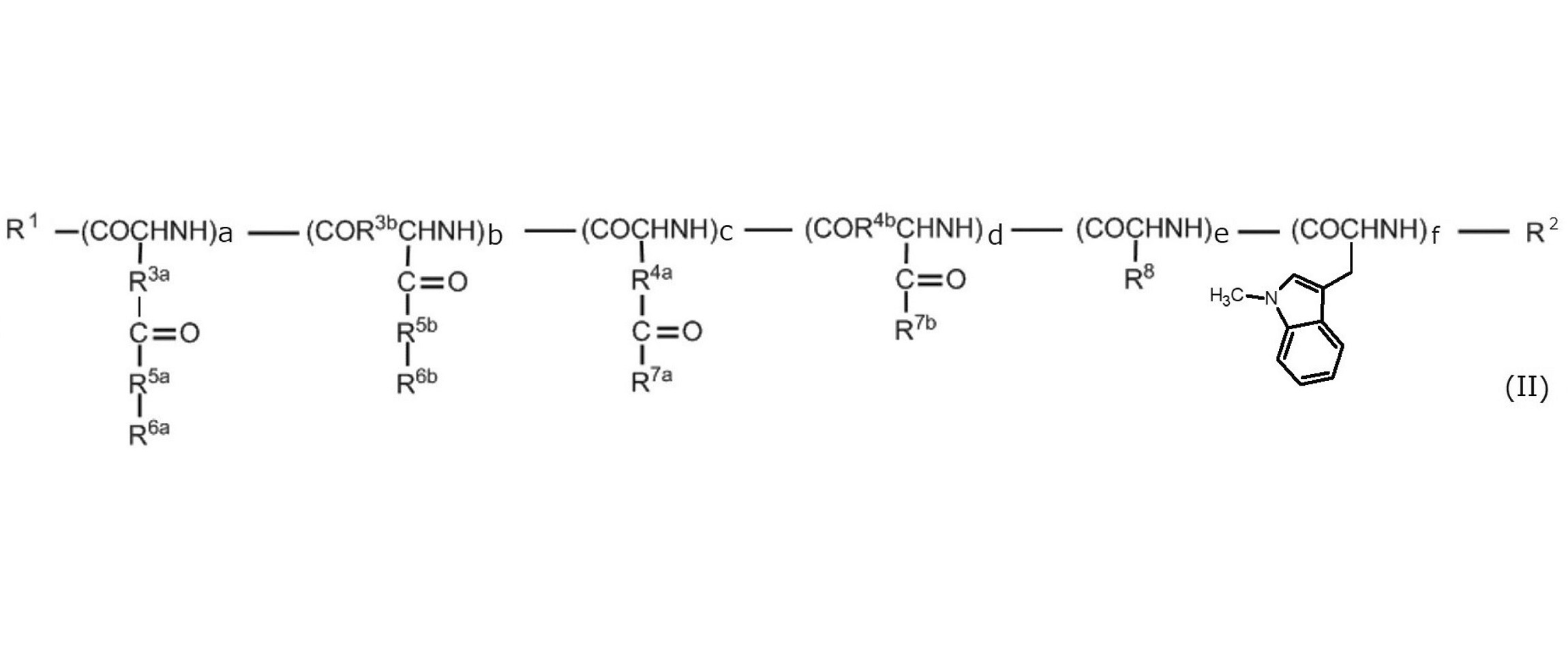
(式中、
R1は、水酸基、オキシベンジル基、-O-R1a又は‐NH-R1b基を表し、ここでR1a又はR1bはそれぞれ独立して、未置換又は置換された直鎖もしくは分枝の炭素数1~12アルキル基を表し、
R2は、水素原子、未置換又は置換された直鎖もしくは分枝の炭素数1~12のアルキル基あるいは未置換又は置換された直鎖もしくは分枝の炭素数1~24のアルキルカルボニル基を表し、
R3a、R3b、R4a及びR4bは、相互に独立して、メチレン基又はエチレン基を表し、
R5a及びR5bは、相互に独立して、-O-又はNH-を表し、
R6a及びR6bは、相互に独立して、水素原子又は疎水性有機基を表し;
R7a及びR7bは、相互に独立して、下記の基:
-NH-(CH2)p1-〔NH-(CH2)q1-〕r1NH2 (i);
-NH-(CH2)p2-N〔-(CH2)q2-NH2〕2 (ii);
-NH-(CH2)p3-N{〔-(CH2)q3-NH2〕〔-(CH2)q4-NH-〕r2H} (iii);
-NH-(CH2)p4-N{-(CH2)q5-N〔-(CH2)q6-NH2〕2}2 (iv);及び
-NH-(CH2)p5-NH2 (v)
からなる群の同一もしくは異なる基から選ばれ、
ここで、p1~p5、q1~6、及びr1~r2は、それぞれ相互に独立して、1~5の整数であり、
R8は、リシン、オルニチン、アルギニン、ホモアルギニン、及びヒスチジンからなる群より選択されるアミノ酸の側鎖を表し、
a、b、c、d、及びeは、それぞれ独立して、0~200の整数であり;
fは、1~300の整数を表し;
ただし、2≦a+b+c+d+e+f≦400の関係を満たし;
上記各アミノ酸残基の結合順は任意であり;
R6a、R6b、R7a、R7b及びR8は、ポリマー分子内のアミノ酸残基毎に任意に選択可能である。)
R1は、水酸基、オキシベンジル基、-O-R1a又は‐NH-R1b基を表し、ここでR1a又はR1bはそれぞれ独立して、未置換又は置換された直鎖もしくは分枝の炭素数1~12アルキル基を表し、
R2は、水素原子、未置換又は置換された直鎖もしくは分枝の炭素数1~12のアルキル基あるいは未置換又は置換された直鎖もしくは分枝の炭素数1~24のアルキルカルボニル基を表し、
R3a、R3b、R4a及びR4bは、相互に独立して、メチレン基又はエチレン基を表し、
R5a及びR5bは、相互に独立して、-O-又はNH-を表し、
R6a及びR6bは、相互に独立して、水素原子又は疎水性有機基を表し;
R7a及びR7bは、相互に独立して、下記の基:
-NH-(CH2)p1-〔NH-(CH2)q1-〕r1NH2 (i);
-NH-(CH2)p2-N〔-(CH2)q2-NH2〕2 (ii);
-NH-(CH2)p3-N{〔-(CH2)q3-NH2〕〔-(CH2)q4-NH-〕r2H} (iii);
-NH-(CH2)p4-N{-(CH2)q5-N〔-(CH2)q6-NH2〕2}2 (iv);及び
-NH-(CH2)p5-NH2 (v)
からなる群の同一もしくは異なる基から選ばれ、
ここで、p1~p5、q1~6、及びr1~r2は、それぞれ相互に独立して、1~5の整数であり、
R8は、リシン、オルニチン、アルギニン、ホモアルギニン、及びヒスチジンからなる群より選択されるアミノ酸の側鎖を表し、
a、b、c、d、及びeは、それぞれ独立して、0~200の整数であり;
fは、1~300の整数を表し;
ただし、2≦a+b+c+d+e+f≦400の関係を満たし;
上記各アミノ酸残基の結合順は任意であり;
R6a、R6b、R7a、R7b及びR8は、ポリマー分子内のアミノ酸残基毎に任意に選択可能である。)
上記式(II)において、R1a、R1b及びR2の基で定義する、炭素数1~12の直鎖又は分枝状のアルキル基としては、例えば、メチル基、エチル基、n-プロピル基、イソプロピル基、n-ブチル基、sec-ブチル基、tert-ブチル基、n-ヘキシル基、デシル基、及びウンデシル基等を挙げることができる。
R2の基で定義する、炭素数1~24の直鎖又は分枝状のアルキルカルボニル基の内の炭素数1~12の直鎖又は分枝状のアルキル部分は上述した例示を参考にでき、炭素数13以上のアルキル部分は、例えば、トリデシル基、テトラデシル基、ペンタデシル基、ノナデシル基、ドコサニル基及びテトラコシル基等を挙げることができる。
上記アルキル基又はアルキル部分について、「置換された」場合の置換基としては、限定されるものでないが、C1-6アルコキシ基、アリールオキシ基、アリールC1-3オキシ基、シアノ基、カルボキシル基、アミノ基、C1-6アルコキシカルボニル基、C2-7アシルアミド基、トリ-C1-6アルキルシロキシ基、シロキシ基、シリルアミノ基を示すか、又はアセタール化ホルミル基、ホルミル基、塩素又はフッ素等のハロゲン原子を挙げることができる。ここで、例えば、C1-6のごとき表示は、炭素数1~6を意味する。
上記R3a及びR3bの両者がエチレン基を表す場合には、代表的には、b=0であるか、又はa=0であるポリアミノ酸を表すことになる。前者は、例えば、グルタミン酸γ-ベンジルエステルのN-カルボン酸無水物の重合により得られるポリ-α-グルタミン酸を表し、後者は、例えば、納豆菌をはじめとする細菌バチルス(Bacillus)属の菌株が生産するポリ-γ-グルタミン酸を表す。一方、R3a及びR3bの両者ともメチレン基を表す場合には、これらの基を有するそれぞれの繰り返し単位は共存し得るものと理解されている。R4a及びR4bについても同様である。
上記R6a及びR6bの基で定義する疎水性有機基は、例えば、炭素数6~27の飽和もしくは不飽和の直鎖又は分枝状の脂肪族炭化水素基、炭素数6~27のアリール基又はアラルキル基、あるいはステロールに由来する残基である。具体例としては、フェニル基、ナフチル基、トリル基、キシリル基、ベンジル基、フェネチル基等が挙げられる。また、R6a及びR6bの基を水素原子とすることにより、ポリアミノ酸の親水性度を増大することができる。この場合、R5a及びR5bは、好ましくは酸素原子である。
上記R7a及びR7bの基は、相互に独立して、式(i)又は(v)の基であることが好ましい。式(i)において、p1及びq1は、それぞれ相互に独立して2又は3であることが好ましく、より好ましくは2である。一方、r1は、1~3の整数であることが好ましい。
上記R8の基は、好ましくはリシン又はオルニチンの側鎖である。
1-メチル-トリプトファン残基の繰り返し数を表すfは、代表的には2以上の整数であり、例えば5~300の整数、好ましくは10~200の整数、より好ましくは15~150の整数、さらに好ましくは20~100の整数である。また、1-メチル-トリプトファン残基は、好ましくは1-メチル-L-トリプトファン残基である。
他のアミノ酸残基の繰り返し数を表すa、b、c、d、及びeは、それぞれ独立して好ましくは0~150の整数、より好ましくは0~100の整数である。また、ポリアミノ酸の重合度(a+b+c+d+e+f)は、例えば5~300の整数、好ましくは10~250の整数、より好ましくは15~200の整数である。
式(II)で表されるポリアミノ酸は、例えば、n-ブチルアミン等を開始剤として、1-メチル-トリプトファンのN-カルボン酸無水物(NCA)及び任意に他のアミノ酸のNCA(例えば、β-ベンジル-L-アスパルテート、γ-ベンジル-L-グルタメート、Nε-Z-L-リシン等の保護されたアミノ酸のN-カルボン酸無水物)を重合させてポリアミノ酸を合成し、必要に応じて、得られたポリアミノ酸の側鎖を脱保護し、任意に(i)~(v)の基の導入を行うことによって製造することができる。
なお、上記合成の過程でアミノ酸エステル残基の一部にアミンの求核攻撃に起因した構造変化(例えば、アミノ酸エステル残基の脱アルコールによるイミド環の形成)が生じる場合があるが、本明細書ではこのような構造変化を経た残基をさらに含むポリアミノ酸についても、上記式(II)に含めて取り扱うこととする。この場合、上記構造変化を経た残基は、アミノ酸残基の数には含めないものとする。また、カチオン性アミノ酸残基における一部のNH基及びNH2基が合成過程での酸(主に塩酸)の使用に起因して塩(主に塩酸塩)になる場合があるが、本明細書ではこうした構造を含むポリアミノ酸についても、上記式(II)に含めて取り扱うこととする。すなわち、R7a、R7b、及びのR8の基における一部のNH基及びNH2基は塩(例えば、塩酸塩)となっていてもよい。
B.ブロックコポリマー
本発明の1つの実施形態によるブロックコポリマーは、親水性ポリマーセグメントと疎水性ポリマーセグメントとを有し、該疎水性ポリマーセグメントが上記A項に記載のポリアミノ酸を含む。当該ブロックコポリマーは、代表的には、親水性ポリマーセグメントと上記A項に記載のポリアミノ酸とが直列に結合されたブロックコポリマーである。
本発明の1つの実施形態によるブロックコポリマーは、親水性ポリマーセグメントと疎水性ポリマーセグメントとを有し、該疎水性ポリマーセグメントが上記A項に記載のポリアミノ酸を含む。当該ブロックコポリマーは、代表的には、親水性ポリマーセグメントと上記A項に記載のポリアミノ酸とが直列に結合されたブロックコポリマーである。
上記親水性ポリマーセグメントを構成するポリマーとしては、ポリエチレングリコール、ポリプロピレングリコール、ポリ(2-オキサゾリン)、ポリサッカライド、ポリビニルアルコール、ポリビニルピロリドン、ポリアクリルアミド、ポリメタクリルアミド、ポリアクリル酸エステル、ポリメタクリル酸エステル等が挙げられ、ポリエチレングリコールが好ましく用いられ得る。親水性ポリマーセグメントは、直鎖状であってもよく、分岐鎖状であってもよい。
親水性ポリマーセグメントを構成するポリマーがポリエチレングリコールである場合、ポリエチレングリコールの繰り返し数(分岐鎖の場合は、各鎖における繰り返し数)は、例えば20~2,000、好ましくは200~1,500であり得る。
1つの実施形態において、上記ブロックコポリマーは、式(III)又は(IV)で表され得る:
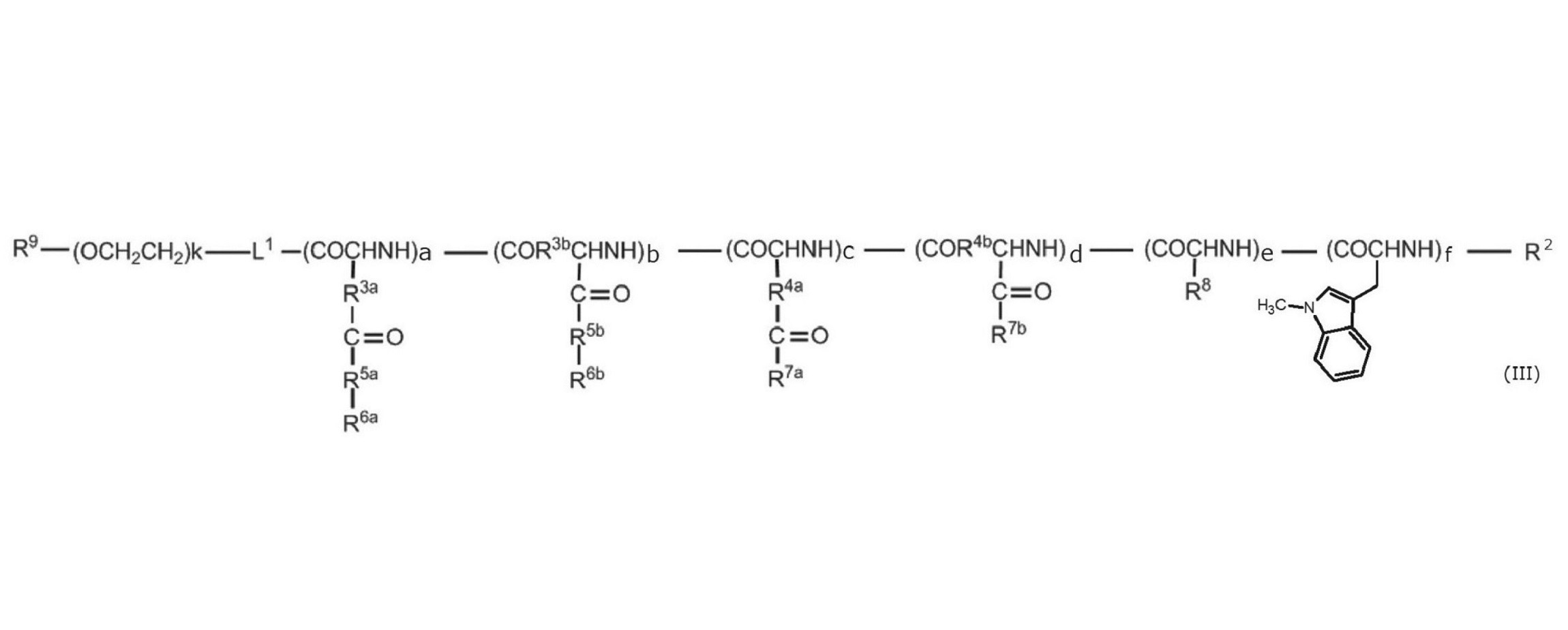

(上記式(III)又は(IV)において、
R1~R8、a、b、c、d、e及びfについては、上記式(II)について定義したのと同義であり、
L1及びL3は、連結基を表し、
R9及びR10は、相互に独立して、水素原子あるいは未置換もしくは置換された炭素数1~12の直鎖又は分枝状のアルキル基を表し、
kは、20~2,000の整数を表す。)
R1~R8、a、b、c、d、e及びfについては、上記式(II)について定義したのと同義であり、
L1及びL3は、連結基を表し、
R9及びR10は、相互に独立して、水素原子あるいは未置換もしくは置換された炭素数1~12の直鎖又は分枝状のアルキル基を表し、
kは、20~2,000の整数を表す。)
L1及びL3は、親水性ポリマーセグメントとポリアミノ酸セグメントとの連結部分であり、任意な適切な連結基であってよい。L1で表される連結基は、例えば、-NH-、-O-、-O-L2-NH-、-CO-、-CH2-、及びO-L2-S-L2-NH-(ここで、L2は独立して炭素数1~6のアルキレン基である)から選ばれる連結基であり得る。L3は、例えば、-OCO-L4-CO-、及びNHCO-L4-CO-(ただし、L4は炭素数1~6のアルキレン基である)から選ばれる連結基であり得る。
R9及びR10の基で定義する炭素数1~12の直鎖又は分枝状のアルキル基としては、例えば、メチル基、エチル基、n-プロピル基、イソプロピル基、n-ブチル基、sec-ブチル基、tert-ブチル基、n-ヘキシル基、デシル基、及びウンデシル基等を挙げることができる。また、「置換された」場合の置換基としては、上記式(II)においてR1及びR2の基に関して例示した置換基と同様であり得る。あるいは、R9及びR10の基は、標的結合部位を含む基によって置換されていてもよい。標的結合部位を親水性ポリマーセグメントの末端に導入することにより、標的となる所望の部位への到達性を向上できる。
上記標的結合部位を含む基としては、標的となる組織に対する指向性又は機能性を有する限りにおいて任意の適切な基であり得、例えば、抗体もしくはその断片、又はその他の機能性もしくは標的指向性を有するタンパク質、ペプチド、アプタマー、ラクトース等の糖、葉酸といった生理活性物質及びその誘導体に由来する基であり得る。
エチレングリコールの繰り返し数を表すkは、好ましくは200~1,500の整数であり得る。
上記ブロックコポリマーは、例えば、上記ポリアミノ酸と親水性ポリマーとをそのまま、又は必要により分子量分布を狭くするように精製した後、公知の方法によりカップリングすることによって形成できる。また、例えば、一般式(III)のブロックコポリマーは、R9を付与できる開始剤を用いてアニオンリビング重合を行うことによりポリエチレングリコール鎖を形成した後、成長末端側にアミノ基を導入し、そのアミノ末端から1-メチル-トリプトファンのN-カルボン酸無水物(NCA)及び任意に他のアミノ酸のNCA(例えば、β-ベンジル-L-アスパルテート、γ-ベンジル-L-グルタメート、Nε-Z-L-リシン等の保護されたアミノ酸のN-カルボン酸無水物)を重合させ、必要に応じて、脱保護し、任意に(i)~(v)の基の導入を行うことによって製造することができる。(i)~(v)の基の導入は、例えばアミノリシス又はエステル交換によって行うことができる。
C.ポリマー粒子組成物
本発明の1つの実施形態によるポリマー粒子組成物は、上記A項に記載のポリアミノ酸又はB項に記載のブロックコポリマーを含む。上記ポリアミノ酸及びブロックコポリマーは、水性媒体中で会合して好適にポリマー粒子を形成し得る。例えば、上記ブロックコポリマーは、ポリアミノ酸セグメントを内側に向け、親水性ポリマーセグメントを外側に向けた高分子ミセルを形成し得る。なお、本発明においては、複数の分子が粒子状に集合した集合体も粒子に含めるものとし、このような集合体もポリマー粒子と称する。
本発明の1つの実施形態によるポリマー粒子組成物は、上記A項に記載のポリアミノ酸又はB項に記載のブロックコポリマーを含む。上記ポリアミノ酸及びブロックコポリマーは、水性媒体中で会合して好適にポリマー粒子を形成し得る。例えば、上記ブロックコポリマーは、ポリアミノ酸セグメントを内側に向け、親水性ポリマーセグメントを外側に向けた高分子ミセルを形成し得る。なお、本発明においては、複数の分子が粒子状に集合した集合体も粒子に含めるものとし、このような集合体もポリマー粒子と称する。
上記ポリマー粒子の平均粒子径は、例えば1000nm以下、好ましくは400nm以下、200nm以下、150nm以下、100nm以下又は80nm以下であり、例えば20nm以上又は30nm以上である。当該粒子の平均粒子径は、市販の動的光散乱(DLS)測定装置を用いて測定することができる。
上記ポリマー粒子組成物は、本発明の効果が得られる範囲において、A項に記載のポリアミノ酸及びB項に記載のブロックコポリマー以外の他のポリマーを含み得る。このような他のポリマーとしては、例えば、親水性ポリマーセグメントと疎水性ポリマーセグメントとを有するブロックコポリマーが挙げられる。このようなブロックコポリマーは、水性媒体中で好適に会合して安定なポリマー粒子(例えば、高分子ミセル)を形成し得るので、これらを共存させることにより安定性に優れたポリマー粒子組成物が得られ得る。このような効果は親水性ポリマー鎖セグメントを有さないポリアミノ酸を含むポリマー粒子組成物において、特に好適に奏され得る。上記他のブロックコポリマーとしては、例えばWO2007/099660、WO2007/099661、WO2010/093036、WO2012/096399、WO2014/133172、WO2015/170757等に記載のポリマーが挙げられる。
上記ポリマー粒子組成物は、例えば、目的のポリマーに水又は緩衝液等の水性媒体を加えて攪拌し、超音波、圧力、剪断力又はそれらを組み合わせた物理的エネルギーを与えること、目的のポリマーを揮発性の有機溶媒に溶解後、有機溶媒を揮発させて乾固し、そこに上記水性媒体を加えて、上記のような物理的エネルギーを与えること等によって調製することができる。あるいは、目的のポリマーに該ポリマーを溶解可能な水溶性有機溶媒を加えて溶解し、上記水性媒体に対して透析することによっても調製することができる。ここで、上記揮発性有機溶媒としては、メタノール、エタノール、アセトン、クロロホルム、アセトニトリル、テトラヒドロフラン、ジクロロメタン等を挙げることができる。また、水溶性有機溶媒としては、メタノール、エタノール、アセトニトリル、ジメチルスルホキシド、N,N-ジメチルホルムアミド、N,N-ジメチルアセトアミド等が挙げられる。
上記ポリマー粒子組成物は、1-メチル-トリプトファン以外の薬物をさらに含み得る。薬物は、好ましくはポリマー粒子に担持(例えば、内包)される。ポリマー粒子に1-メチル-トリプトファン以外の薬物を担持させることによって、2種以上の薬物を用いた併用療法を好適に行うことができる。
上記薬物としては、目的に応じて、任意の適切な薬物を用いることができ、好ましくは抗がん剤が用いられる。抗がん剤は、化学療法に用いられる細胞障害性の化合物であってもよく、低分子化合物、抗体等による分子標的薬又はsiRNA、アンチセンス核酸等の核酸医薬であってもよい。また、抗がん剤としては、免疫チェックポイント阻害による癌に対する免疫を活性化し得る抗体等であってもよい。1つの実施形態において、パクリタキセル、ドキソルビシン等の免疫原性を誘導する抗がん剤が用いられる。別の実施形態においては、イミキモド等の免疫応答を賦活化する抗がん剤が用いられる。
ポリマー粒子に薬物を担持させる方法としては、当該薬物の存在下でポリマー粒子組成物を調製する方法、ポリマー粒子組成物を調製し、当該ポリマー粒子組成物に薬物を添加して混合する方法等が挙げられる。例えば、薬物の存在下でブロックコポリマーを用いて高分子ミセルを形成することにより、薬物が内包された高分子ミセルが得られ得る。
D.使用方法
上記A項に記載のポリアミノ酸、B項に記載のブロックコポリマー又はC項に記載のポリマー粒子組成物は、例えば、インドールアミン2.3-ジオキシゲナーゼ(IDO)活性の抑制を必要とする個体に対して投与され得る。1つの実施形態において、IDO活性の抑制を必要とする個体は、癌を罹患している個体である。
上記A項に記載のポリアミノ酸、B項に記載のブロックコポリマー又はC項に記載のポリマー粒子組成物は、例えば、インドールアミン2.3-ジオキシゲナーゼ(IDO)活性の抑制を必要とする個体に対して投与され得る。1つの実施形態において、IDO活性の抑制を必要とする個体は、癌を罹患している個体である。
投与対象の個体としては、例えばヒト又はヒト以外の哺乳動物が挙げられる。投与方法は、好ましくは非経口投与であり、皮下投与、筋肉内投与、静脈内投与、腹腔内投与、髄腔内投与等が例示できる。また、腫瘍内又は腫瘍周辺組織に局所投与されてもよい。
以下、実施例によって本発明を具体的に説明するが、本発明はこれら実施例によって限定されるものではない。
[製造例1]1-メチル-L-トリプトファン-N-カルボン酸無水物(MLT-NCA)の合成
1-メチル-L-トリプトファン(5g)を減圧乾燥により24時間乾燥し、トリホスゲン(3.5g)を添加し、テトラヒドロフラン(THF,100mL)中で、0℃で30分間撹拌した。40℃で30分間加熱して粉末を完全に溶解し、1時間の撹拌後に反応溶液をヘキサン(200mL)に添加し、MLT-NCAを得た。得られた粉末を-20℃で1晩結晶化し、THFとヘキサンを用いて再結晶した。13C-NMR及びFT-IR法によって得られた化合物の化学構造を解析し、目的の化合物が得られたことを確認した。
1-メチル-L-トリプトファン(5g)を減圧乾燥により24時間乾燥し、トリホスゲン(3.5g)を添加し、テトラヒドロフラン(THF,100mL)中で、0℃で30分間撹拌した。40℃で30分間加熱して粉末を完全に溶解し、1時間の撹拌後に反応溶液をヘキサン(200mL)に添加し、MLT-NCAを得た。得られた粉末を-20℃で1晩結晶化し、THFとヘキサンを用いて再結晶した。13C-NMR及びFT-IR法によって得られた化合物の化学構造を解析し、目的の化合物が得られたことを確認した。
[製造例2]1-メチル-D-トリプトファン-N-カルボン酸無水物(MDT-NCA)の合成
1-メチル-L-トリプトファン(5g)の代わりに1-メチル-D-トリプトファン(5g)を用いたこと以外は製造例1と同様にして、MDT-NCAを得た。得られた粉末を-20℃で1晩結晶化し、THFとヘキサンを用いて再結晶した。13C-NMR及びFT-IR法によって得られた化合物の化学構造を解析し、目的の化合物が得られたことを確認した。
1-メチル-L-トリプトファン(5g)の代わりに1-メチル-D-トリプトファン(5g)を用いたこと以外は製造例1と同様にして、MDT-NCAを得た。得られた粉末を-20℃で1晩結晶化し、THFとヘキサンを用いて再結晶した。13C-NMR及びFT-IR法によって得られた化合物の化学構造を解析し、目的の化合物が得られたことを確認した。
[製造例3]Homo-PMLTの合成
以下に示す反応スキームで、Homo-PMLTを合成した。
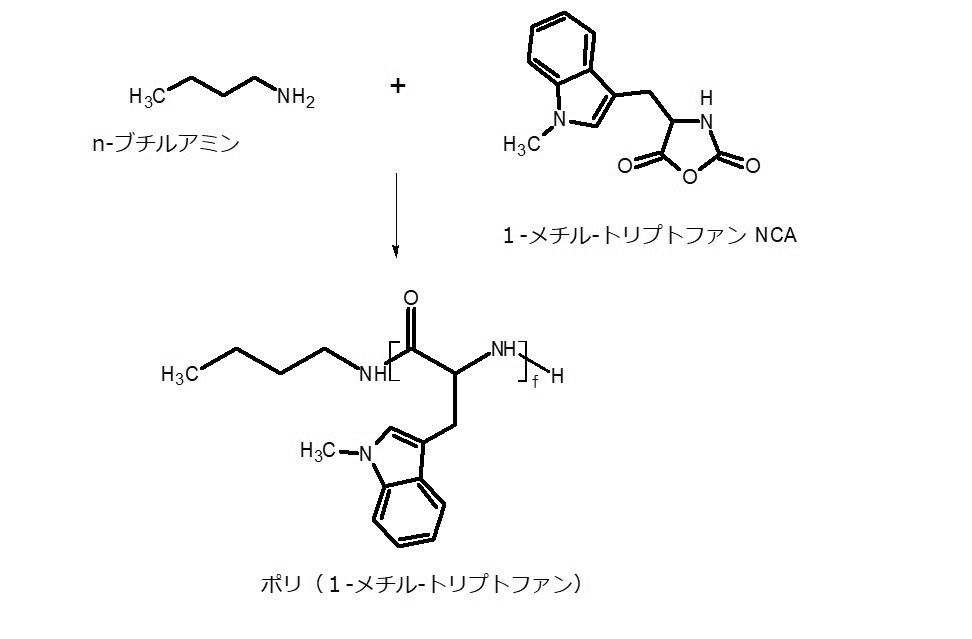
以下に示す反応スキームで、Homo-PMLTを合成した。
具体的には、MLT-NCA(80mg)をDMF(10mL)に溶解し、DMF(1mL)に溶解したn-ブチルアミン(8μL)に添加した。35℃で48時間反応後、反応溶液を純水に添加しHomo-PMLTを得た。PMLT鎖の重合度を220nmにおけるUVの吸光度から算出したところ、重合度は5であった。
[製造例4]Homo-PMDTの合成
MLT-NCA(80mg)の代わりにMDT-NCA(80mg)を用いたこと以外は製造例3と同様にして、Homo-PMDTを得た。PMDT鎖の重合度を220nmにおけるUVの吸光度から算出したところ、重合度は5であった。
MLT-NCA(80mg)の代わりにMDT-NCA(80mg)を用いたこと以外は製造例3と同様にして、Homo-PMDTを得た。PMDT鎖の重合度を220nmにおけるUVの吸光度から算出したところ、重合度は5であった。
≪酵素分解試験≫
Homo-PMLT又はHomo-PMDT(2mg)をN-メチル-2-ピロリドン(NMP,200μL)に溶解し、10mM CaCl2を含む20mM Hepesバッファー(20mL)を添加した。溶液にキモトリプシン(1mg/mL,0.5mL)を添加し、37℃で48時間インキュベートした。キモトリプシンにより分解されたポリマー量をHPLC法により測定した。結果を図1に示す。
Homo-PMLT又はHomo-PMDT(2mg)をN-メチル-2-ピロリドン(NMP,200μL)に溶解し、10mM CaCl2を含む20mM Hepesバッファー(20mL)を添加した。溶液にキモトリプシン(1mg/mL,0.5mL)を添加し、37℃で48時間インキュベートした。キモトリプシンにより分解されたポリマー量をHPLC法により測定した。結果を図1に示す。
図1に示されるとおり、Homo-PMLTの48時間後の放出率が25%を超えるのに対し、Homo-PMDTの48時間後の放出率は2%未満であった。このことから、Homo-PMLTはキモトリプシンによって分解され易く、Homo-PMDTはキモトリプシンによって分解され難いことがわかる。キモトリプシンは、主に芳香族アミノ酸のカルボキシル末端側を加水分解することが知られているが、1-メチル-トリプトファンの分解に関する報告はこれまでなされておらず、PMLTに高い選択性を有することは今回初めて得られた知見である。
≪インドールアミン-2,3-ジオキシゲナーゼ(IDO)の阻害試験≫
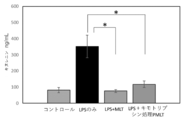
マクロファージ様細胞(RAW264.7)を培養プレートに播種した。24時間後にリポ多糖(LPS,1μg/mL)とキモトリプシン処理(上記酵素分解試験と同様の処理)をしたHomo-PMLT(70μg/mL)とを添加し、24時間後に上清中のキヌレニン量をHPLC法により測定した。なお、何も添加しなかったものをコントロールとした。また、ネガティブコントロールとして、リポ多糖(LPS,1μg/mL)のみを添加したものを用い、ポジティブコントロールとして、リポ多糖(LPS,1μg/mL)とMLT(70μg/mL)とを添加したものを用いた。結果を図2に示す。
マクロファージ様細胞(RAW264.7)を培養プレートに播種した。24時間後にリポ多糖(LPS,1μg/mL)とキモトリプシン処理(上記酵素分解試験と同様の処理)をしたHomo-PMLT(70μg/mL)とを添加し、24時間後に上清中のキヌレニン量をHPLC法により測定した。なお、何も添加しなかったものをコントロールとした。また、ネガティブコントロールとして、リポ多糖(LPS,1μg/mL)のみを添加したものを用い、ポジティブコントロールとして、リポ多糖(LPS,1μg/mL)とMLT(70μg/mL)とを添加したものを用いた。結果を図2に示す。
図2に示されるとおり、リポ多糖の刺激によってIDOが誘導されてキヌレニンが生成されるところ、キモトリプシン処理をしたHomo-PMLTによれば、MLTとほぼ同等のレベルでキヌレニンの生成が抑制された。
[製造例5]ポリエチレングリコール-ポリ(1-メチル-L-トリプトファン) (PEG-PMLT)の合成
以下に示す反応スキームで、PEG-PMLTを合成した。
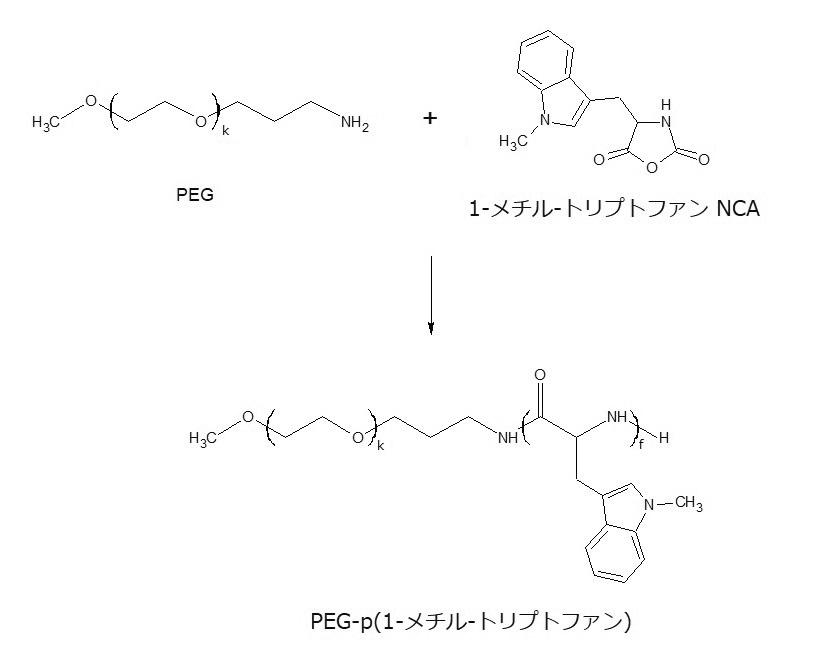
以下に示す反応スキームで、PEG-PMLTを合成した。
具体的には、MLT-NCA(200mg)をDMF(2mL)に溶解し、DMF(1mL)に溶解したPEG-NH2(100mg、PEG分子量:12kDa)に添加した。35℃で48時間反応後、反応溶液をジエチルエーテル(150mL)に添加しPEG-PMLTを得た。PMLT鎖の重合度を220nmにおけるUVの吸光度から算出したところ、重合度は55であった。
[製造例6]ポリエチレングリコール-ポリ(1-メチル-D-トリプトファン) (PEG-PMDT)の合成
MLT-NCA(200mg)の代わりにMDT-NCA(200mg)を用いたこと以外は製造例5と同様にして、PEG-PMDTを得た。PMDT鎖の重合度を220nmにおけるUVの吸光度から算出したところ、重合度は61であった。
MLT-NCA(200mg)の代わりにMDT-NCA(200mg)を用いたこと以外は製造例5と同様にして、PEG-PMDTを得た。PMDT鎖の重合度を220nmにおけるUVの吸光度から算出したところ、重合度は61であった。
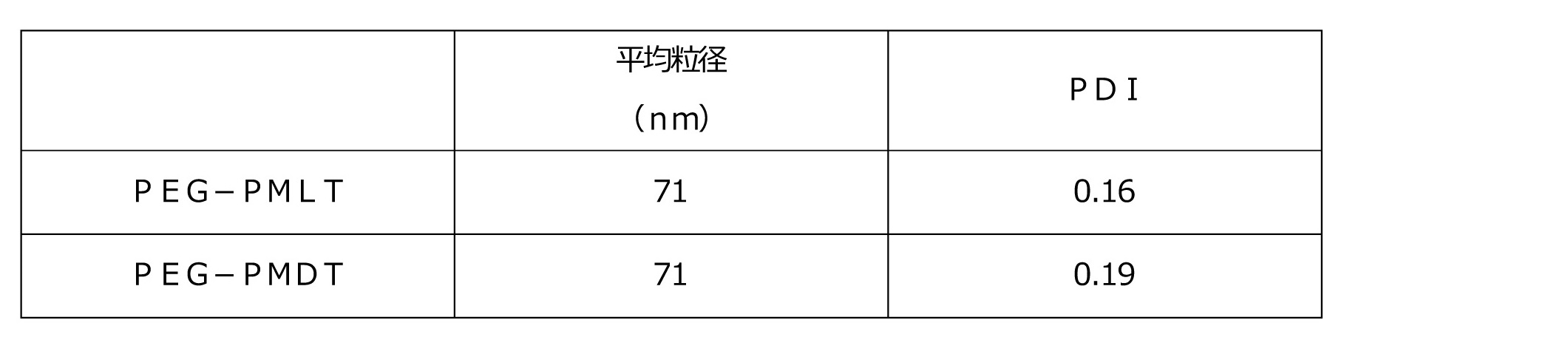
[製造例7]高分子ミセルの調製
PEG-PMLT又はPEG-PMDTをN,N-ジメチルアセトアミド(DMAc,1mg/mL)に溶解し、室温で1時間撹拌した。その後、ポリマー溶液を純水に対して24時間透析し、調製したミセル溶液をフィルター(0.22μm)により精製した。調製したミセルの平均粒径及び多分散度(PDI)を動的光散乱(DLS)法により測定した。結果を表1に示す。
PEG-PMLT又はPEG-PMDTをN,N-ジメチルアセトアミド(DMAc,1mg/mL)に溶解し、室温で1時間撹拌した。その後、ポリマー溶液を純水に対して24時間透析し、調製したミセル溶液をフィルター(0.22μm)により精製した。調製したミセルの平均粒径及び多分散度(PDI)を動的光散乱(DLS)法により測定した。結果を表1に示す。
≪インドールアミン-2,3-ジオキシゲナーゼ(IDO)の阻害試験≫
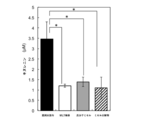
単球細胞(THP-1)を培養プレートに播種した。24時間後にリポ多糖(LPS,1μg/mL)と、遊離の(free)1-メチル-L-トリプトファン(5μg/mL)、製造例7で調製した高分子ミセル(1-メチル-L-トリプトファン濃度:5μg/mL)、又は、製造例7で調製した高分子ミセルをキモトリプシンにより遊離の1-メチル-L-トリプトファンに分解したミセル分解物(1-メチル-L-トリプトファン濃度:5μg/mL)を添加し、24時間後の上清中のキヌレニン量をHPLC法により測定した。結果を図3に示す。
単球細胞(THP-1)を培養プレートに播種した。24時間後にリポ多糖(LPS,1μg/mL)と、遊離の(free)1-メチル-L-トリプトファン(5μg/mL)、製造例7で調製した高分子ミセル(1-メチル-L-トリプトファン濃度:5μg/mL)、又は、製造例7で調製した高分子ミセルをキモトリプシンにより遊離の1-メチル-L-トリプトファンに分解したミセル分解物(1-メチル-L-トリプトファン濃度:5μg/mL)を添加し、24時間後の上清中のキヌレニン量をHPLC法により測定した。結果を図3に示す。
図3に示されるとおり、コントロール(薬剤未投与群)に比べて、1-メチル-L-トリプトファン単体投与群および高分子ミセル投与群は、単球からのキヌレニンの放出を阻害した。このことから、高分子ミセルのビルディングブロックであるポリマー中の1-メチル-L-トリプトファンが単球中の酵素により切断・放出され、単球中のキヌレニンの生成を阻害することにより、免疫細胞の1種である単球が活性化されたことが示唆される。また、高分子ミセル投与群がキモトリプシンにより代謝したミセル分解物投与群と同程度の活性を示したことから、高分子ミセルを構成するポリマー中のアミド結合が効率的に単球中の酵素により切断され、活性体である1-メチル-L-トリプトファンが放出されることが示唆された。
[製造例8]イミキモド内包高分子ミセルの調製
PEG-PMLTをN,N-ジメチルアセトアミド(DMAc,1mg/mL)に溶解し、DMAc(0.5mg/mL)中に溶解したイミキモド(imiquimod)を添加した。40℃で1晩撹拌後、溶液を純水に対して24時間透析し、調製したミセル溶液をフィルター(0.22μm)により精製した。動的光散乱(DLS)法による測定の結果、得られたミセルの平均粒径及び多分散度(PDI)はそれぞれ、70nm及び0.13であった。
PEG-PMLTをN,N-ジメチルアセトアミド(DMAc,1mg/mL)に溶解し、DMAc(0.5mg/mL)中に溶解したイミキモド(imiquimod)を添加した。40℃で1晩撹拌後、溶液を純水に対して24時間透析し、調製したミセル溶液をフィルター(0.22μm)により精製した。動的光散乱(DLS)法による測定の結果、得られたミセルの平均粒径及び多分散度(PDI)はそれぞれ、70nm及び0.13であった。
[試験例1]高分子ミセルの血中滞留性
製造例5と同様の反応スキームでPEG-PMLT(PEG:12kDa,MLT重合度:20)を合成し、Alexa647-NHSを加えて反応させることによって標識した。反応液をゲルろ過クロマトグラフィー(担体:Sephadex LH-20、溶媒:ジメチルホルムアミド、カラム長:30cm)に供して未反応のAlexa647-NHSを除去した後、純水に対して透析することによって高分子ミセルを形成させた。なお、得られた高分子ミセル溶液をTEM観察したところ、直径20nm~30nmの粒子が観察された。これは、ミセルの形成を支持する結果である。
製造例5と同様の反応スキームでPEG-PMLT(PEG:12kDa,MLT重合度:20)を合成し、Alexa647-NHSを加えて反応させることによって標識した。反応液をゲルろ過クロマトグラフィー(担体:Sephadex LH-20、溶媒:ジメチルホルムアミド、カラム長:30cm)に供して未反応のAlexa647-NHSを除去した後、純水に対して透析することによって高分子ミセルを形成させた。なお、得られた高分子ミセル溶液をTEM観察したところ、直径20nm~30nmの粒子が観察された。これは、ミセルの形成を支持する結果である。
日本チャールス・リバー株式会社から雌性ヌードマウス(BALB/c-nu)を購入し、実験に供した。上記Alexa647標識高分子ミセル溶液を、Alexa647の蛍光強度換算で10,000(RFU)の用量で尾静脈内投与し、マウス耳朶における発光強度の経時変化をin vivo共焦点顕微鏡(IV-CLSM、Nicon)により測定した。
その結果、Alexa647由来の発光は、投与後80分で半減期を迎えたが、投与後12時間30分の時点においても引き続き発光が確認された。このことから、1-メチル-トリプトファンをキャリア(ポリアミノ酸)中に組み込むことにより、優れた血中滞留性が得られることがわかる。
本発明は、例えば、DDS分野において好適に用いられ得る。
Claims (6)
- 下記式(I)に示される1-メチル-トリプトファンに由来する繰り返し単位を少なくとも1つ含む、ポリアミノ酸。

- 前記1-メチル-トリプトファンが、1-メチル-L-トリプトファンを含む、請求項1に記載のポリアミノ酸。
- 他のアミノ酸に由来する繰り返し単位をさらに含む、請求項1又は2に記載のポリアミノ酸。
- 親水性ポリマーセグメントと疎水性ポリマーセグメントとを有し、該疎水性ポリマーセグメントが請求項1から3のいずれかに記載のポリアミノ酸を含む、ブロックコポリマー。
- 請求項1から3のいずれかに記載のポリアミノ酸又は請求項4に記載のブロックコポリマーを含む、ポリマー粒子組成物。
- 薬物をさらに含む、請求項5に記載のポリマー粒子組成物。
Applications Claiming Priority (2)
| Application Number | Priority Date | Filing Date | Title |
|---|---|---|---|
| JP2018229602A JP2022024207A (ja) | 2018-12-07 | 2018-12-07 | ポリアミノ酸、ブロックコポリマー及びポリマー粒子組成物 |
| JP2018-229602 | 2018-12-07 |
Publications (1)
| Publication Number | Publication Date |
|---|---|
| WO2020116552A1 true WO2020116552A1 (ja) | 2020-06-11 |
Family
ID=70973649
Family Applications (1)
| Application Number | Title | Priority Date | Filing Date |
|---|---|---|---|
| PCT/JP2019/047567 Ceased WO2020116552A1 (ja) | 2018-12-07 | 2019-12-05 | ポリアミノ酸、ブロックコポリマー及びポリマー粒子組成物 |
Country Status (2)
| Country | Link |
|---|---|
| JP (1) | JP2022024207A (ja) |
| WO (1) | WO2020116552A1 (ja) |
Cited By (2)
| Publication number | Priority date | Publication date | Assignee | Title |
|---|---|---|---|---|
| CN116262115A (zh) * | 2021-12-15 | 2023-06-16 | 深圳先进技术研究院 | 释放氨基酸及其衍生物类药物的医用材料及其应用方法 |
| WO2026011709A1 (zh) * | 2024-07-10 | 2026-01-15 | 吉林大学 | 一种聚氨基酸及其制备方法和水凝胶、慢性创面敷料 |
Citations (3)
| Publication number | Priority date | Publication date | Assignee | Title |
|---|---|---|---|---|
| US20040234623A1 (en) * | 2003-04-01 | 2004-11-25 | Medical College Of Georgia Research Institute, Inc. | Use of inhibitors of indoleamine-2,3-dioxygenase in combination with other therapeutic modalities |
| WO2010143646A1 (ja) * | 2009-06-09 | 2010-12-16 | 味の素株式会社 | 繊維構造体 |
| CN110066395A (zh) * | 2019-04-26 | 2019-07-30 | 山东大学 | 基于免疫检查点抑制剂的纳米组装体及其制备方法与应用 |
-
2018
- 2018-12-07 JP JP2018229602A patent/JP2022024207A/ja active Pending
-
2019
- 2019-12-05 WO PCT/JP2019/047567 patent/WO2020116552A1/ja not_active Ceased
Patent Citations (3)
| Publication number | Priority date | Publication date | Assignee | Title |
|---|---|---|---|---|
| US20040234623A1 (en) * | 2003-04-01 | 2004-11-25 | Medical College Of Georgia Research Institute, Inc. | Use of inhibitors of indoleamine-2,3-dioxygenase in combination with other therapeutic modalities |
| WO2010143646A1 (ja) * | 2009-06-09 | 2010-12-16 | 味の素株式会社 | 繊維構造体 |
| CN110066395A (zh) * | 2019-04-26 | 2019-07-30 | 山东大学 | 基于免疫检查点抑制剂的纳米组装体及其制备方法与应用 |
Non-Patent Citations (2)
| Title |
|---|
| HUANG GEORGE LO ET AL.: "PEG-Poly(1-Methyl-L-Tryptophan)-Based Polymeric Micelles as Enzymatically Activated Inhibitors of Indoleamine 2,3- Dioxygenase", NANOMATERIALS, vol. 9, no. 5, 9 May 2019 (2019-05-09), pages 719, XP055715107 * |
| YU SHUANGJIANG ET AL.: "Injectable Bioresponsive Gel Depot for Enhanced Immune Checkpoint Blockade", ADVANCED MATERIALS, vol. 30, no. 28, 12 July 2018 (2018-07-12), pages 1801527, XP055715103 * |
Cited By (4)
| Publication number | Priority date | Publication date | Assignee | Title |
|---|---|---|---|---|
| CN116262115A (zh) * | 2021-12-15 | 2023-06-16 | 深圳先进技术研究院 | 释放氨基酸及其衍生物类药物的医用材料及其应用方法 |
| WO2023109599A1 (zh) * | 2021-12-15 | 2023-06-22 | 深圳先进技术研究院 | 释放氨基酸及其衍生物类药物的医用材料及其应用方法 |
| CN116262115B (zh) * | 2021-12-15 | 2026-02-24 | 深圳先进技术研究院 | 释放氨基酸及其衍生物类药物的医用材料及其应用方法 |
| WO2026011709A1 (zh) * | 2024-07-10 | 2026-01-15 | 吉林大学 | 一种聚氨基酸及其制备方法和水凝胶、慢性创面敷料 |
Also Published As
| Publication number | Publication date |
|---|---|
| JP2022024207A (ja) | 2022-02-09 |
Similar Documents
| Publication | Publication Date | Title |
|---|---|---|
| CN104093768B (zh) | 导入有苯基硼酸基的嵌段共聚物及其使用 | |
| US8853167B2 (en) | Short-chain cationic polyamino acid and use thereof | |
| CA2885223C (en) | Carboxylated polyamine derivatives as transfection reagents | |
| CN114585388A (zh) | 用于配体展示和/或药物递送的星形聚合物的组合物和制造方法 | |
| JPWO2007111211A1 (ja) | タキサン類の高分子結合体 | |
| JP5692887B1 (ja) | ポリマーミセル医薬組成物 | |
| US20230390406A1 (en) | Star Polymer Drug Conjugates | |
| JP6566936B2 (ja) | 医薬組成物 | |
| CN103221054A (zh) | 新的胞苷类代谢拮抗剂的高分子衍生物 | |
| Haladjova et al. | DNA delivery systems based on copolymers of poly (2‐methyl‐2‐oxazoline) and polyethyleneimine: Effect of polyoxazoline moieties on the endo‐lysosomal escape | |
| Luten et al. | Degradable PEG-folate coated poly (DMAEA-co-BA) phosphazene-based polyplexes exhibit receptor-specific gene expression | |
| JP2022502384A (ja) | 両親媒性ポリアミノ酸、該両親媒性ポリアミノ酸を用いたブロックコポリマー、および該両親媒性ポリアミノ酸または該ブロックコポリマーと核酸とを含む複合体 | |
| JP2022024207A (ja) | ポリアミノ酸、ブロックコポリマー及びポリマー粒子組成物 | |
| JP2025518406A (ja) | 核酸内包高分子ミセル | |
| WO2025238236A1 (en) | Polyplexes of nucleic acids and targeted conjugates comprising polyethyleneimine and polyethylene glycol | |
| WO2026023606A1 (ja) | 心臓および/または横隔膜への薬物送達用粒子および医薬組成物 | |
| HK1220904B (en) | Polymeric micelle pharmaceutical composition | |
| Si et al. | Thiourea Functionalization Enhances Transfection of Bioreducible Poly (amido amine) s as Gene Vectors under Serum Conditions |
Legal Events
| Date | Code | Title | Description |
|---|---|---|---|
| 121 | Ep: the epo has been informed by wipo that ep was designated in this application |
Ref document number: 19893915 Country of ref document: EP Kind code of ref document: A1 |
|
| NENP | Non-entry into the national phase |
Ref country code: DE |
|
| 122 | Ep: pct application non-entry in european phase |
Ref document number: 19893915 Country of ref document: EP Kind code of ref document: A1 |
|
| NENP | Non-entry into the national phase |
Ref country code: JP |