WO2020103171A1 - 用于图像去模糊的Bi-Level优化方法 - Google Patents
用于图像去模糊的Bi-Level优化方法Info
- Publication number
- WO2020103171A1 WO2020103171A1 PCT/CN2018/117635 CN2018117635W WO2020103171A1 WO 2020103171 A1 WO2020103171 A1 WO 2020103171A1 CN 2018117635 W CN2018117635 W CN 2018117635W WO 2020103171 A1 WO2020103171 A1 WO 2020103171A1
- Authority
- WO
- WIPO (PCT)
- Prior art keywords
- image
- loss
- level
- model
- conv
- Prior art date
- Legal status (The legal status is an assumption and is not a legal conclusion. Google has not performed a legal analysis and makes no representation as to the accuracy of the status listed.)
- Ceased
Links
Images




Classifications
-
- G—PHYSICS
- G06—COMPUTING OR CALCULATING; COUNTING
- G06T—IMAGE DATA PROCESSING OR GENERATION, IN GENERAL
- G06T5/00—Image enhancement or restoration
- G06T5/73—Deblurring; Sharpening
-
- G—PHYSICS
- G06—COMPUTING OR CALCULATING; COUNTING
- G06T—IMAGE DATA PROCESSING OR GENERATION, IN GENERAL
- G06T5/00—Image enhancement or restoration
- G06T5/70—Denoising; Smoothing
-
- G—PHYSICS
- G06—COMPUTING OR CALCULATING; COUNTING
- G06T—IMAGE DATA PROCESSING OR GENERATION, IN GENERAL
- G06T5/00—Image enhancement or restoration
- G06T5/77—Retouching; Inpainting; Scratch removal
Definitions
- the invention relates to the field of digital image processing, in particular to a Bi-Level optimization method for image deblurring.
- This method proposes a Bi-Level optimization method during the restoration of a blurred image.
- Deblurring technology is the subject of extensive research in the field of image and video processing. To a certain extent, blurring caused by camera shake seriously affects the imaging quality and visual perception of images. As an important branch of image preprocessing, the improvement of deblurring technology directly affects the performance of other computer vision algorithms, such as foreground segmentation, object detection, behavior analysis, etc. At the same time, it also affects the image coding performance. Therefore, it is imperative to study a high-performance deblurring algorithm.
- Documents 1-3 are the background information of the deep learning deblurring algorithm compared in the present invention: Document 1: Kupyn O, Budzan V, Mykhailych M, et al. DeblurGAN: Blind Motion Deblurring Using Conditional Adversarial Networks [J]. 1711.07064, 2017. Reference 2: Nah S, Kim T, H, Lee K, M. Deep multi-scale convolutional neural network for dynamic scene deblurring [C] // CVPR.2017, 1 (2): 3. Reference 3: Sun J, Cao W, Xu Z, et al. Learning. A convolutional neural network for non-uniform motion blur removal [C] // Proceedings of the IEEE conference Computer on Vision Vision and Pattern Recognition. 2015: 769-777.
- image deblurring algorithms can be divided into traditional algorithms based on probability models and deblurring algorithms based on deep learning.
- the traditional algorithm uses a convolution model to explain the cause of blur.
- the process of camera shake can be mapped to a blur kernel trajectory PSF (Point Spread Function).
- PSF Point Spread Function
- the problem of restoring a clear image when the blur kernel is unknown is an ill-posed problem, so it is usually necessary to estimate the blur kernel first, and then use the evaluated blur kernel to perform the deconvolution operation to obtain the restored image.
- the deep learning-based deblurring algorithm uses the deep network structure to obtain the latent information of the image, and then realize the blurred image restoration.
- the purpose of the present invention is to propose a Bi-Level optimization method for image deblurring.
- the Bi-Level optimization method is to optimize GAN (Generative Adversarial Network), aiming to solve the shortcomings of existing deep learning deblurring algorithms .
- GAN Geneative Adversarial Network
- the present invention proposes a Bi-Level optimization method.
- the design allows two levels of loss functions to alternate with each other for model optimization. Considering that the L 1 loss and the MSE loss satisfy the same relationship, L1 will introduce more noise but can retain more texture than MSE, and the perceived loss has an excessive smoothing effect.
- three kinds of losses are optimized. Introduced at the same time. At the same time, in order to balance the role of various condition losses in the optimization process, the present invention normalizes these losses to the same magnitude according to (Equation 4).
- the Bi-Level optimization method is divided into two steps. In the first step, a basic model is trained with MSE loss conditions, and in the second step, a two-level loss interactive iteration is used to fine-tune the model.
- the texture restoration is accurate.
- the similarity of image pixel values can ensure the similarity of depth features, but the contrary is not true; that is, the use of feature-level perceptual loss function may cause image detail information repair failure.
- the depth feature matches the pixel value. Considering that the pixel level MSE and L1 often cause noise amplification, and the perceived loss can effectively suppress the noise. By combining the above loss functions, the invention patent can guarantee to a certain extent. Pixel texture recovery is accurate, and it can ensure that the depth feature matches the pixel value.
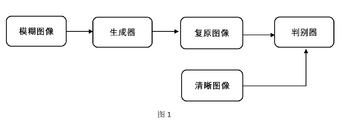
- Figure 1 the process of generating an adversarial network
- Figure 5a is a comparison diagram of blurred images
- Figure 5b is a comparison diagram of the recovery effects of Nah et al.
- Figure 5c is a comparison diagram of the recovery effects of Kupyn et al.
- Figure 5d is a comparison graph of the restoration effect of the Bi-Level optimization method.
- Figure 1 generates the adversarial network process
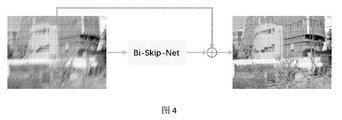
- Figure 4 generator design Bi-Skip-Net + residual
- Table 1 is the discriminator parameter table, as shown in the figure
- the blurred image is input to the generator to obtain the restored image; after that, the restored image and the clear image are input to the discriminator to distinguish the clear image.
- the present invention uses Bi-Skip-Net to train the image residuals, and uses the blurred image + image residuals mode to restore the image.
- ⁇ is the weight of the conditional loss function.
- L and S respectively represent the output and true value of the model at different levels, and the value of ⁇ is 1 or 2, the entire conditional loss function is regulated by the number of channels c, width w and height h.
- the Li-Level optimization method of the present invention includes two steps (the number of epochs in the training process is N).
- Step1 When the number of iterations is less than 1 / 3N, the present invention adopts pixel level mean square error (MSE) as the loss function to train the model;
- MSE mean square error
- Step2 When the number of iterations is greater than or equal to 1 / 3N, the present invention uses a pixel-level L1 loss function and a feature-level perceptual loss function to alternately train the model. The present invention performs loss function replacement every two iterations during the experiment.
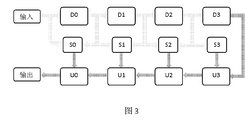
- FIG 3 is the structure diagram of Bi-Skip-Net.
- Bi-Skip-Net consists of a compression path (D *), a double-span connection path (S *) and an expansion path (U *) 3 parts.
- the compression path extracts the depth and shallow features of the image;
- the double-span connection path connects the image features with the upsampling features in the expansion path;
- the expansion path implements feature upsampling.
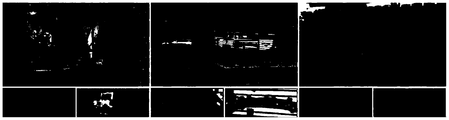
- Fig. 5 is a subjective comparison between the present invention and other algorithms.
- Fig. 5a is a comparison of blurred images
- Fig. 5b is a comparison of restoration effects of Nah et al .
- Fig. 5c is a comparison of restoration effects of Kupyn et al .
- Fig. 5d is Bi -A comparison diagram of the restoration effect of the Level optimization method, that is, a comparison diagram of the restoration effect of the present invention.
- Figure 5a, Figure 5b, Figure 5c, and Figure 5d are three identical photos, and two points are specifically selected with two boxes in each picture. The enlarged views of these two boxes are correspondingly placed in this Below the picture, you can see the restoration effect clearly.
- the comparison results are shown in Table 2.
- the de-blurring algorithm based on deep learning of the present invention utilizes the deep network structure to obtain the latent information of the image, and then realizes the restoration of the blurred image.
- the deep learning deblurring algorithm can realize two operations of fuzzy kernel estimation and non-blind deconvolution to restore the image, and it can also use the generational confrontation method to restore the image.
Landscapes
- Physics & Mathematics (AREA)
- General Physics & Mathematics (AREA)
- Engineering & Computer Science (AREA)
- Theoretical Computer Science (AREA)
- Image Processing (AREA)
- Image Analysis (AREA)
Abstract
用于图像去模糊的Bi-Level优化方法,设计让两种层级损失函数相互交替进行模型优化,Bi-Level优化机制分为两个步骤,第一步用MSE损失条件训练出一个基本模型,第二步采用双层级损失交互迭代进行模型微调操作。这是因为在训练初期,复原效果与清晰图像之间的散度比较大,噪声的作用可以忽略不计,而在训练后期噪声被不断放大使其负面作用愈加明显,因此引入感知损失进行噪声抑制同时将MSE损失改为L 1损失以足够保证结构连续性。该方法具有纹理恢复准确、深度特征与像素值匹配的优点。
Description
本发明涉及数字图像处理领域,具体为用于图像去模糊的Bi-Level优化方法,该方法在模糊图像复原过程中提出了一种Bi-Level优化方法。
去模糊技术是图像和视频处理领域被广泛研究的主题。基于相机抖动造成的模糊在一定意义上严重影响图像的成像质量,视觉观感。作为图像预处理领域一个及其重要的分支,去模糊技术的提升直接影响其他计算机视觉算法的性能,如前景分割,物体检测,行为分析等;同时它也影响着图像的编码性能。因此,研究一种高性能的去模糊算法势在必行。
文献1-3是本发明对比的深度学习去模糊算法的背景资料:文献1:Kupyn O,Budzan V,Mykhailych M,et al.DeblurGAN:Blind Motion Deblurring Using Conditional Adversarial Networks[J].arXiv preprint arXiv:1711.07064,2017。文献2:Nah S,Kim T H,Lee K M.Deep multi-scale convolutional neural network for dynamic scene deblurring[C]//CVPR.2017,1(2):3。文献3:Sun J,Cao W,Xu Z,et al.Learning a convolutional neural network for non-uniform motion blur removal[C]//Proceedings of the IEEE Conference on Computer Vision and Pattern Recognition.2015:769-777。
一般来说,图像去模糊算法可以分为基于概率模型的传统算法和基于深度学习的去模糊算法。传统算法采用卷积模型来解释模糊成因,相机抖动的过程可以映射为模糊核轨迹PSF(Point Spread Function)。在模糊核未知的情况下还原清晰图像,这一问题属于不适定(ill-posed)问题,所以通常意义上需要先估计模糊核,再利用评估的模糊核进行返卷积操作得到复原图像。基于深度学习的去模糊算法则利用深层网络结构获取图像的潜在信息,进而实现模糊图像复原。深度学习的去模糊算法可以实现模糊核估计和非盲反卷积两个操作来进行图像复原,同时也可以采用生 成对抗方法来复原图像。本专利旨在解决深度学习去模糊算法存在的缺点:
1)纹理恢复不准确,
2)深度特征与像素值不匹配问题。
发明的公开
本发明的目的在于:提出了用于图像去模糊的Bi-Level优化方法,该Bi-Level优化方法来对GAN(Generative Adversarial Network)进行优化,旨在解决现有深度学习去模糊算法存在的缺点。通过对比现有最优算法,本发明在图像复图像原性能上平均提升了1.3dB。
本发明提供的技术方案如下:
MSE损失可以保证优化过程在像素层级和特征层级上的同一性,但带来的问题是引入了大量的噪声;而感知损失在一定程度上是一种不错的替代方案,但却无法保证优化的同一性。为了解决这个条件损失不同一(non-identical)问题,同时降低优化的复杂度,本发明提出了一种Bi-Level优化方法。
具体来说,设计让两种层级损失函数相互交替进行模型优化。考虑到L
1损失与MSE损失满足同一关系,L1相比MSE会引入更多的噪声但可以保留更多的纹理,而感知损失又有过度的平滑作用,本发明在优化过程中将三种损失同时引入。同时为了平衡各条件损失在优化过程中的作用,本发明将这些损失按照(式4)归一到同一量级。如图2所示,Bi-Level优化方法分为两个步骤,第一步用MSE损失条件训练出一个基本模型,第二步采用双层级损失交互迭代进行模型微调操作。这是因为在训练初期,复原效果与清晰图像之间的散度比较大,噪声的作用可以忽略不计,而在训练后期噪声被不断放大使其负面作用愈加明显,因此引入感知损失进行噪声抑制同时将MSE损失改为L
1损失以足够保证结构连续性。
本发明具有如下技术效果:
1、纹理恢复准确,在图像复原过程中,图像像素值的相似性可以保证深度特征的相似,反之却并不成立;即采用特征级的感知损失函数可能造成图像细节信息修 复失败。
2、深度特征与像素值匹配,考虑到像素级的MSE、L1经常会造成噪声放大,而感知损失又可以有效抑制噪声,通过将以上损失函数进行结合,本发明专利在一定程度上既可以保证像素纹理回复准确,又可以保证深度特征与像素值匹配。
附图的简要说明
图1生成对抗网络流程;
图2 Bi-Level优化流程;
图3 Bi-Skip-Net结构图;
图4生成器设计:Bi-Skip-Net+残差;
图5本发明与其它算法的主观对比,其中:
图5a为模糊图像对比图;
图5b为Nah等人的复原效果对比图;
图5c为Kupyn等人的复原效果对比图;
图5d为Bi-Level优化方法的复原效果对比图。
实现本发明的最佳方式
下面结合附图和实施例,对本发明进行详细的描述,但不以任何方式限制本发明的范围。
图1生成对抗网络流程,图4生成器设计:Bi-Skip-Net+残差,表1为判别器参数表,如图所示,
表1.判别器参数表


本发明用于图像去模糊的Bi-Level优化方法的具体步骤如下:
(1)采用生成对抗网络流程来进行模糊图像复原,采用图4和表1来设计生成器和判别器;
(2)如图1所示,将模糊图像输入到生成器得到复原图像;之后,将复原图像和清晰图像输入到判别器进行区分得到清晰图像。如图4所示,本发明用Bi-Skip-Net来训练图像残差,采用模糊图像+图像残差的模式来复原图像。
(3)采用如下的损失函数来训练网络;

其中
 为对抗损失函数,
 为条件损失函数,λ为条件损失函数的权重。

通过最大化
 来优化判别器D;

通过最小化式3来优化生成器G;
其中
 设计如下:
设计如下:

其中,L,S分别表示模型在不同层级的输出和真值,α取值为1或2,整个条件损失函数被通道数c,宽度w和高度h所规范。
(4)采用图2所示的Li-Level优化方法来对网络进行优化;
本发明的Li-Level优化方法包括两个步骤(设训练过程中epoch次数为N)。
Step1:当迭代次数小于1/3N,本发明采用像素级均方误差(MSE)作为损失函数训练模型;
Step2:当迭代次数大于等于1/3N,本发明采用像素级的L1损失函数和特征级的感知损失函数来交替训练模型,本发明在实验过程中每隔2此迭代进行一次损失函数替换。
(5)将训练好的网络作为最终的复原模型。
图3为Bi-Skip-Net结构图,如图3所示,如图所示,Bi-Skip-Net由压缩路径(D*)、双跨连接路径(S*)和扩张路径(U*)3部分组成。压缩路径提取图像的深度特征和浅层特征;双跨连接路径连接图像特征与扩张路径中的上采样特征;扩张路径实现特征上采样。
图5为本发明与其它算法的主观对比,其中,图5a为模糊图像对比图;图5b为Nah等人的复原效果对比图;图5c为Kupyn等人的复原效果对比图;图5d为Bi-Level优化方法的复原效果对比图,即本发明的复原效果对比图。其中,图5a、图5b、图5c和图5d都是三张相同的照片,每张图片中用两个方框特别选取了两个点,这两个方框的放大图对应地放在该图片的下方,可以看清复原效果。其对比结果见表2本发明与其它算法在GoPro数据集上的测试对比。
表2.本发明与其它算法在GoPro数据集上的测试对比

需要注意的是,公布实施例的目的在于帮助进一步理解本发明,但是本领域的技术人员可以理解:在不脱离本发明及所附权利要求的精神和范围内,各种替换和 修改都是可能的。因此,本发明不应局限于实施例所公开的内容,本发明要求保护的范围以权利要求书界定的范围为准。
本发明基于深度学习的去模糊算法则利用深层网络结构获取图像的潜在信息,进而实现模糊图像复原。深度学习的去模糊算法可以实现模糊核估计和非盲反卷积两个操作来进行图像复原,同时也可以采用生成对抗方法来复原图像。
Claims (4)
- 用于图像去模糊的Bi-Level优化方法,具体步骤是:第一步,用MSE损失条件训练出一个基本模型;第二步,采用双层级损失交互迭代进行模型微调操作。
- 根据权利要求1所述的用于图像去模糊的Bi-Level优化方法,其特征在于:(1)所述的生成器按以下方式设计:Bi-Skip-Net+残差,判别器参数依据表1:表1.判别器参数表
# 层 参数维度 步长 1 conv 32x3x5x5 2 2 conv 64x32x5x5 1 3 conv 64x64x5x5 2 4 conv 128x64x5x5 1 5 conv 128x128x5x5 4 6 conv 256x128x5x5 1 7 conv 256x256x5x5 4 8 conv 512x256x5x5 1 9 conv 512x512x4x4 4 10 fc 512x1x1x1 - (2)用Bi-Skip-Net来训练图像残差,采用模糊图像+图像残差的模式来复原图像;(3)用MSE损失条件训练出一个基本模型,采用如下的损失函数来训练网络; 其中为对抗损失函数,
 为条件损失函数,λ为条件损失函数的权重。
 通过最大化来优化判别器D;
 通过最小化式3来优化生成器G;其中设计如下:
 其中,L,S分别表示模型在不同层级的输出和真值,α取值为1或2,整个条件损失函数被通道数c,宽度w和高度h所规范;(4)采用双层级损失交互迭代进行模型微调操作,具体是采用Li-Level优化机制来对网络进行优化;(5)将训练好的网络作为最终的复原模型。
 - 根据权利要求2所述的用于图像去模糊的Bi-Level优化方法,其特征在于:所述的Bi-Skip-Net是由压缩路径(D*)、双跨连接路径(S*)和扩张路径(U*)3部分组成;压缩路径提取图像的深度特征和浅层特征;双跨连接路径连接图像特征与扩张路径中的上采样特征;扩张路径实现特征上采样。
- 根据权利要求2所述的用于图像去模糊的Bi-Level优化方法,其特征在于:步骤(4)所述的Li-Level优化机制包括两个步骤(设训练过程中epoch次数为N),Step1:当迭代次数小于1/3N,本发明采用像素级均方误差(MSE)作为损失函数训练模型;Step2:当迭代次数大于等于1/3N,本发明采用像素级的L1损失函数和特征级的感知损失函数来交替训练模型,本发明在实验过程中每隔2此迭代进行一次损失函数替换。
Applications Claiming Priority (2)
| Application Number | Priority Date | Filing Date | Title |
|---|---|---|---|
| CN201811389239.7A CN109544475A (zh) | 2018-11-21 | 2018-11-21 | 用于图像去模糊的Bi-Level优化方法 |
| CN201811389239.7 | 2018-11-21 |
Publications (1)
| Publication Number | Publication Date |
|---|---|
| WO2020103171A1 true WO2020103171A1 (zh) | 2020-05-28 |
Family
ID=65848630
Family Applications (1)
| Application Number | Title | Priority Date | Filing Date |
|---|---|---|---|
| PCT/CN2018/117635 Ceased WO2020103171A1 (zh) | 2018-11-21 | 2018-11-27 | 用于图像去模糊的Bi-Level优化方法 |
Country Status (2)
| Country | Link |
|---|---|
| CN (1) | CN109544475A (zh) |
| WO (1) | WO2020103171A1 (zh) |
Cited By (17)
| Publication number | Priority date | Publication date | Assignee | Title |
|---|---|---|---|---|
| CN111783545A (zh) * | 2020-06-02 | 2020-10-16 | 山西潞安环保能源开发股份有限公司五阳煤矿 | 一种基于生成对抗网络的煤矿无人机图像增强方法 |
| CN112634163A (zh) * | 2020-12-29 | 2021-04-09 | 南京大学 | 基于改进型循环生成对抗网络去图像运动模糊方法 |
| CN112785527A (zh) * | 2021-01-28 | 2021-05-11 | 太原巍昂科电子科技有限责任公司 | 基于ResNet网络的图像去模糊方法 |
| CN112837245A (zh) * | 2021-03-16 | 2021-05-25 | 西北工业大学 | 一种基于多模态融合的动态场景去模糊方法 |
| CN113947589A (zh) * | 2021-10-26 | 2022-01-18 | 北京理工大学 | 一种基于对抗生成网络的弹载图像去模糊方法 |
| CN113971644A (zh) * | 2021-10-29 | 2022-01-25 | 际络科技(上海)有限公司 | 基于数据增强策略选择的图像识别方法及装置 |
| CN114049497A (zh) * | 2021-11-07 | 2022-02-15 | 西北工业大学 | 基于自适应对比学习的图像深度表征方法 |
| CN114066750A (zh) * | 2021-10-22 | 2022-02-18 | 西北工业大学 | 一种基于域变换的自编码器去模糊方法 |
| CN114331913A (zh) * | 2022-01-06 | 2022-04-12 | 福州大学 | 基于残差注意力块的运动模糊图像复原方法 |
| CN114331859A (zh) * | 2021-07-15 | 2022-04-12 | 西安科技大学 | 基于改进的生成对抗网络的图像去模糊方法 |
| CN114494065A (zh) * | 2022-01-26 | 2022-05-13 | 武汉大学 | 图像去模糊方法、装置、设备及可读存储介质 |
| CN114511466A (zh) * | 2022-02-21 | 2022-05-17 | 北京大学深圳研究生院 | 一种基于生成对抗网络先验的盲人脸图像复原方法 |
| CN114529775A (zh) * | 2020-11-04 | 2022-05-24 | 武汉Tcl集团工业研究院有限公司 | 模型训练方法、装置、计算机设备和存储介质 |
| CN114783020A (zh) * | 2022-04-03 | 2022-07-22 | 南京邮电大学 | 基于新型对抗学习去模糊理论的动态人脸识别方法 |
| CN116309123A (zh) * | 2023-02-14 | 2023-06-23 | 昆明理工大学 | 一种图像去模糊网络模型、旋转体振动位移视觉测量方法 |
| CN116523795A (zh) * | 2023-05-16 | 2023-08-01 | 华南农业大学 | 一种基于对抗网络和迭代滤波器的显微镜图像去模糊方法 |
| CN117152010A (zh) * | 2023-09-02 | 2023-12-01 | 杭州电子科技大学 | 基于多个稀疏先验的可学习双层优化实现图像去模糊方法 |
Families Citing this family (4)
| Publication number | Priority date | Publication date | Assignee | Title |
|---|---|---|---|---|
| CN110175961B (zh) * | 2019-05-22 | 2021-07-27 | 艾特城信息科技有限公司 | 一种基于人脸图像分割对抗思想的去网纹方法 |
| US11544558B2 (en) * | 2019-08-30 | 2023-01-03 | Nec Corporation | Continual learning of artificial intelligence systems based on bi-level optimization |
| CN114612319B (zh) * | 2022-03-03 | 2024-11-19 | 北京航空航天大学 | 一种基于双层优化权重重分配的图像复原监督学习方法 |
| CN117197002B (zh) * | 2023-11-07 | 2024-02-02 | 松立控股集团股份有限公司 | 一种基于感知扩散的图像复原方法 |
Citations (5)
| Publication number | Priority date | Publication date | Assignee | Title |
|---|---|---|---|---|
| US20080253678A1 (en) * | 2007-04-10 | 2008-10-16 | Arcsoft, Inc. | Denoise method on image pyramid |
| US20100020208A1 (en) * | 2008-07-24 | 2010-01-28 | Florida State University Research Foundation | Systems and methods for training an active random field for real-time image denoising |
| CN106157268A (zh) * | 2016-07-28 | 2016-11-23 | 浙江工业大学 | 一种基于l0凸近似的退化图像复原方法 |
| CN106709875A (zh) * | 2016-12-30 | 2017-05-24 | 北京工业大学 | 一种基于联合深度网络的压缩低分辨率图像复原方法 |
| CN107507141A (zh) * | 2017-08-07 | 2017-12-22 | 清华大学深圳研究生院 | 一种基于自适应残差神经网络的图像复原方法 |
Family Cites Families (3)
| Publication number | Priority date | Publication date | Assignee | Title |
|---|---|---|---|---|
| CN106548159A (zh) * | 2016-11-08 | 2017-03-29 | 中国科学院自动化研究所 | 基于全卷积神经网络的网纹人脸图像识别方法与装置 |
| CN108665058B (zh) * | 2018-04-11 | 2021-01-05 | 徐州工程学院 | 一种基于分段损失的生成对抗网络方法 |
| CN108550125B (zh) * | 2018-04-17 | 2021-07-30 | 南京大学 | 一种基于深度学习的光学畸变修正方法 |
-
2018
- 2018-11-21 CN CN201811389239.7A patent/CN109544475A/zh active Pending
- 2018-11-27 WO PCT/CN2018/117635 patent/WO2020103171A1/zh not_active Ceased
Patent Citations (5)
| Publication number | Priority date | Publication date | Assignee | Title |
|---|---|---|---|---|
| US20080253678A1 (en) * | 2007-04-10 | 2008-10-16 | Arcsoft, Inc. | Denoise method on image pyramid |
| US20100020208A1 (en) * | 2008-07-24 | 2010-01-28 | Florida State University Research Foundation | Systems and methods for training an active random field for real-time image denoising |
| CN106157268A (zh) * | 2016-07-28 | 2016-11-23 | 浙江工业大学 | 一种基于l0凸近似的退化图像复原方法 |
| CN106709875A (zh) * | 2016-12-30 | 2017-05-24 | 北京工业大学 | 一种基于联合深度网络的压缩低分辨率图像复原方法 |
| CN107507141A (zh) * | 2017-08-07 | 2017-12-22 | 清华大学深圳研究生院 | 一种基于自适应残差神经网络的图像复原方法 |
Cited By (22)
| Publication number | Priority date | Publication date | Assignee | Title |
|---|---|---|---|---|
| CN111783545A (zh) * | 2020-06-02 | 2020-10-16 | 山西潞安环保能源开发股份有限公司五阳煤矿 | 一种基于生成对抗网络的煤矿无人机图像增强方法 |
| CN114529775A (zh) * | 2020-11-04 | 2022-05-24 | 武汉Tcl集团工业研究院有限公司 | 模型训练方法、装置、计算机设备和存储介质 |
| CN112634163A (zh) * | 2020-12-29 | 2021-04-09 | 南京大学 | 基于改进型循环生成对抗网络去图像运动模糊方法 |
| CN112785527A (zh) * | 2021-01-28 | 2021-05-11 | 太原巍昂科电子科技有限责任公司 | 基于ResNet网络的图像去模糊方法 |
| CN112837245A (zh) * | 2021-03-16 | 2021-05-25 | 西北工业大学 | 一种基于多模态融合的动态场景去模糊方法 |
| CN112837245B (zh) * | 2021-03-16 | 2024-05-31 | 西北工业大学 | 一种基于多模态融合的动态场景去模糊方法 |
| CN114331859A (zh) * | 2021-07-15 | 2022-04-12 | 西安科技大学 | 基于改进的生成对抗网络的图像去模糊方法 |
| CN114066750A (zh) * | 2021-10-22 | 2022-02-18 | 西北工业大学 | 一种基于域变换的自编码器去模糊方法 |
| CN114066750B (zh) * | 2021-10-22 | 2024-03-05 | 西北工业大学 | 一种基于域变换的自编码器去模糊方法 |
| CN113947589A (zh) * | 2021-10-26 | 2022-01-18 | 北京理工大学 | 一种基于对抗生成网络的弹载图像去模糊方法 |
| CN113971644B (zh) * | 2021-10-29 | 2025-06-24 | 际络科技(上海)有限公司 | 基于数据增强策略选择的图像识别方法及装置 |
| CN113971644A (zh) * | 2021-10-29 | 2022-01-25 | 际络科技(上海)有限公司 | 基于数据增强策略选择的图像识别方法及装置 |
| CN114049497A (zh) * | 2021-11-07 | 2022-02-15 | 西北工业大学 | 基于自适应对比学习的图像深度表征方法 |
| CN114049497B (zh) * | 2021-11-07 | 2024-03-05 | 西北工业大学 | 基于自适应对比学习的图像深度表征方法 |
| CN114331913A (zh) * | 2022-01-06 | 2022-04-12 | 福州大学 | 基于残差注意力块的运动模糊图像复原方法 |
| CN114494065A (zh) * | 2022-01-26 | 2022-05-13 | 武汉大学 | 图像去模糊方法、装置、设备及可读存储介质 |
| CN114511466B (zh) * | 2022-02-21 | 2024-04-26 | 北京大学深圳研究生院 | 一种基于生成对抗网络先验的盲人脸图像复原方法 |
| CN114511466A (zh) * | 2022-02-21 | 2022-05-17 | 北京大学深圳研究生院 | 一种基于生成对抗网络先验的盲人脸图像复原方法 |
| CN114783020A (zh) * | 2022-04-03 | 2022-07-22 | 南京邮电大学 | 基于新型对抗学习去模糊理论的动态人脸识别方法 |
| CN116309123A (zh) * | 2023-02-14 | 2023-06-23 | 昆明理工大学 | 一种图像去模糊网络模型、旋转体振动位移视觉测量方法 |
| CN116523795A (zh) * | 2023-05-16 | 2023-08-01 | 华南农业大学 | 一种基于对抗网络和迭代滤波器的显微镜图像去模糊方法 |
| CN117152010A (zh) * | 2023-09-02 | 2023-12-01 | 杭州电子科技大学 | 基于多个稀疏先验的可学习双层优化实现图像去模糊方法 |
Also Published As
| Publication number | Publication date |
|---|---|
| CN109544475A (zh) | 2019-03-29 |
Similar Documents
| Publication | Publication Date | Title |
|---|---|---|
| WO2020103171A1 (zh) | 用于图像去模糊的Bi-Level优化方法 | |
| Ju et al. | Single image dehazing via an improved atmospheric scattering model | |
| CN110782399B (zh) | 一种基于多任务cnn的图像去模糊方法 | |
| KR101328741B1 (ko) | 색상 채널을 이용한 영상 개선 장치 및 방법 | |
| WO2021208122A1 (zh) | 基于深度学习的视频盲去噪方法及装置 | |
| CN107945125B (zh) | 一种融合频谱估计法和卷积神经网络的模糊图像处理方法 | |
| CN112509001A (zh) | 一种多尺度和多特征融合的特征金字塔网络盲复原方法 | |
| CN109410146A (zh) | 一种基于Bi-Skip-Net的图像去模糊算法 | |
| CN111047543B (zh) | 图像增强方法、装置和存储介质 | |
| CN111861896A (zh) | 一种面向uuv的水下图像色彩补偿与恢复方法 | |
| TW201610913A (zh) | 影像能見度修復的方法及其影像處理裝置 | |
| CN108564549A (zh) | 一种基于多尺度稠密连接网络的图像去雾方法 | |
| CN112272832A (zh) | 用于基于dnn的成像的方法和系统 | |
| CN105205794A (zh) | 一种低照度图像的同步增强去噪方法 | |
| TW201830330A (zh) | 一種圖像處理方法及圖像處理系統 | |
| Zhao et al. | Legacy photo editing with learned noise prior | |
| Malik et al. | Llrnet: A multiscale subband learning approach for low light image restoration | |
| CN106296591A (zh) | 基于马氏距离的非局部均匀数字图像去噪方法 | |
| Arora et al. | Low light image enhancement via global and local context modeling | |
| CN114783020A (zh) | 基于新型对抗学习去模糊理论的动态人脸识别方法 | |
| CN113487501A (zh) | 基于暗通道先验和bm3d算法的新型水下图像复原方法 | |
| CN110852947B (zh) | 一种基于边缘锐化的红外图像超分辨方法 | |
| CN107451971A (zh) | 基于暗通道和高斯组合先验的低照度盲卷积图像复原法 | |
| CN117314770B (zh) | 一种图像去模糊系统及其方法 | |
| CN107730470A (zh) | 一种显式表达多尺度和直方图截断的改进Retinex图像增强方法 |
Legal Events
| Date | Code | Title | Description |
|---|---|---|---|
| 121 | Ep: the epo has been informed by wipo that ep was designated in this application |
Ref document number: 18941012 Country of ref document: EP Kind code of ref document: A1 |
|
| NENP | Non-entry into the national phase |
Ref country code: DE |
|
| 122 | Ep: pct application non-entry in european phase |
Ref document number: 18941012 Country of ref document: EP Kind code of ref document: A1 |