WO2020101039A1 - 血中ケモカインを用いた免疫チェックポイント阻害薬の治療効果判定 - Google Patents
血中ケモカインを用いた免疫チェックポイント阻害薬の治療効果判定 Download PDFInfo
- Publication number
- WO2020101039A1 WO2020101039A1 PCT/JP2019/045124 JP2019045124W WO2020101039A1 WO 2020101039 A1 WO2020101039 A1 WO 2020101039A1 JP 2019045124 W JP2019045124 W JP 2019045124W WO 2020101039 A1 WO2020101039 A1 WO 2020101039A1
- Authority
- WO
- WIPO (PCT)
- Prior art keywords
- scd163
- antibody
- immune checkpoint
- checkpoint inhibitor
- subject
- Prior art date
- Legal status (The legal status is an assumption and is not a legal conclusion. Google has not performed a legal analysis and makes no representation as to the accuracy of the status listed.)
- Ceased
Links
Images

Classifications
-
- C—CHEMISTRY; METALLURGY
- C07—ORGANIC CHEMISTRY
- C07K—PEPTIDES
- C07K14/00—Peptides having more than 20 amino acids; Gastrins; Somatostatins; Melanotropins; Derivatives thereof
- C07K14/435—Peptides having more than 20 amino acids; Gastrins; Somatostatins; Melanotropins; Derivatives thereof from animals; from humans
- C07K14/705—Receptors; Cell surface antigens; Cell surface determinants
-
- C—CHEMISTRY; METALLURGY
- C07—ORGANIC CHEMISTRY
- C07K—PEPTIDES
- C07K16/00—Immunoglobulins [IG], e.g. monoclonal or polyclonal antibodies
- C07K16/18—Immunoglobulins [IG], e.g. monoclonal or polyclonal antibodies against material from animals or humans
- C07K16/28—Immunoglobulins [IG], e.g. monoclonal or polyclonal antibodies against material from animals or humans against receptors, cell surface antigens or cell surface determinants
-
- G—PHYSICS
- G01—MEASURING; TESTING
- G01N—INVESTIGATING OR ANALYSING MATERIALS BY DETERMINING THEIR CHEMICAL OR PHYSICAL PROPERTIES
- G01N33/00—Investigating or analysing materials by specific methods not covered by groups G01N1/00 - G01N31/00
- G01N33/48—Biological material, e.g. blood, urine; Haemocytometers
- G01N33/50—Chemical analysis of biological material, e.g. blood, urine; Testing involving biospecific ligand binding methods; Immunological testing
- G01N33/68—Chemical analysis of biological material, e.g. blood, urine; Testing involving biospecific ligand binding methods; Immunological testing involving proteins, peptides or amino acids
Definitions
- An immune checkpoint inhibitor is a drug that activates immune cells whose activity has been reduced by cancer cells and attacks the cancer cells.
- the immune checkpoint inhibitor include anti-PD-1 antibody and anti-CTLA4 antibody.
- the anti-PD-1 antibodies nivolumab and pembrolizumab are known to be useful for the treatment of malignant melanoma, and their therapeutic effects on non-small cell lung cancer and renal cell carcinoma have also been reported (Patent Document 1). , Non-Patent Document 1).
- nivolumab and pembrolizumab are very expensive, biomarkers are needed to evaluate the efficacy of immune checkpoint inhibitor therapy.
- the efficacy of nivolumab and pembrolizumab in Japan is reported to be 34.1% and 24.1%, respectively (Non-patent Documents 2 and 3), and another drug that enhances the antitumor immune response in malignant melanoma is required. It has been suggested.
- ipilimumab is a fully human IgG1 monoclonal antibody that blocks the cellular T lymphocyte antigen (CTLA4), and is a promising drug that enhances the antitumor immune response in patients with advanced stage melanoma in combination with nivolumab.
- CTLA4 cellular T lymphocyte antigen
- the efficacy of combination therapy with nivolumab and ipilimumab in advanced malignant melanoma was reported to be 57.8%, and simultaneous administration of nivolumab and ipilimumab as well as continuous administration by switching nivolumab and ipilimumab at appropriate time points was reported.
- Is also highly effective in treating advanced malignant melanoma. Therefore, in order to determine the appropriate time, it is important to evaluate the efficacy of an immune checkpoint inhibitor such as nivolumab after administration.
- Patent Document 2 addresses the above-mentioned problems and is collected from a subject administered with at least one antibody drug selected from anti-PD-1 antibody, anti-PD-L1 antibody, anti-CTLA4 antibody and antigen-binding fragments thereof. Disclosed is a method for predicting the onset of side effects due to the administration of the antibody drug by measuring the level of at least one marker selected from CD163 and CXCL5. However, Patent Document 2 does not disclose evaluating the antitumor effect itself of the antibody drug using these markers.
- the present invention aims to provide a method capable of accurately determining the therapeutic effect of an immune checkpoint inhibitor in a subject after administration of the immune checkpoint inhibitor.
- the present inventors have diligently studied the relationship between various chemokines in a biological sample of a subject and the therapeutic effect of an immune checkpoint inhibitor, and as a result, in a subject having a high level of sCD163, the therapeutic effect of the immune checkpoint inhibitor was found to be high. It was found to be expensive, and the present invention was completed.
- the present invention includes the following embodiments, for example.
- Item 1 A method of determining the therapeutic effect of an immune checkpoint inhibitor in a subject, comprising: A method comprising measuring the level of sCD163 in a biological sample taken from a subject.
- Item 2 Comprising determining that an immune checkpoint inhibitor is likely to be effective in treating the disease in the subject if the level of sCD163 in the biological sample taken from the subject is higher than a preset cut-off value The method according to Item 1.
- Biomarkers for determining the therapeutic effect of immune checkpoint inhibitors including sCD163.
- Item 4 A diagnostic agent for determining the therapeutic effect of an immune checkpoint inhibitor, which comprises an anti-sCD163 antibody or an antibody-binding fragment thereof.
- Item 5 A kit for determining the therapeutic effect of an immune checkpoint inhibitor, which comprises an anti-sCD163 antibody or an antigen-binding fragment thereof.
- a new method for determining the therapeutic effect of an immune checkpoint inhibitor on a subject is provided. That is, the determination method of the present invention can determine a cancer patient who is significantly sensitive to an immune checkpoint inhibitor based on the level of sCD163. This makes it possible to select an appropriate drug for a subject in the treatment of a disease, avoid unnecessary medication, and make an appropriate dosing schedule and change to an appropriate dosing schedule.
- determining the therapeutic effect means evaluating the presence or absence of the therapeutic effect and / or the degree of effectiveness.
- ROC curves were applied to calculate cutoffs for sCD163 serum levels and AUC (B). The cutoff was determined using Youden's index to distinguish between responders and non-responders.
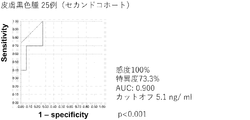
- ROC curve of sCD163 in cutaneous melanoma (2nd cohort) The cutoff confirmed in Fig. 1 was reconfirmed in a new case (n 25).
- ROC curves were applied to calculate cutoffs for sCD163 serum levels and AUC.
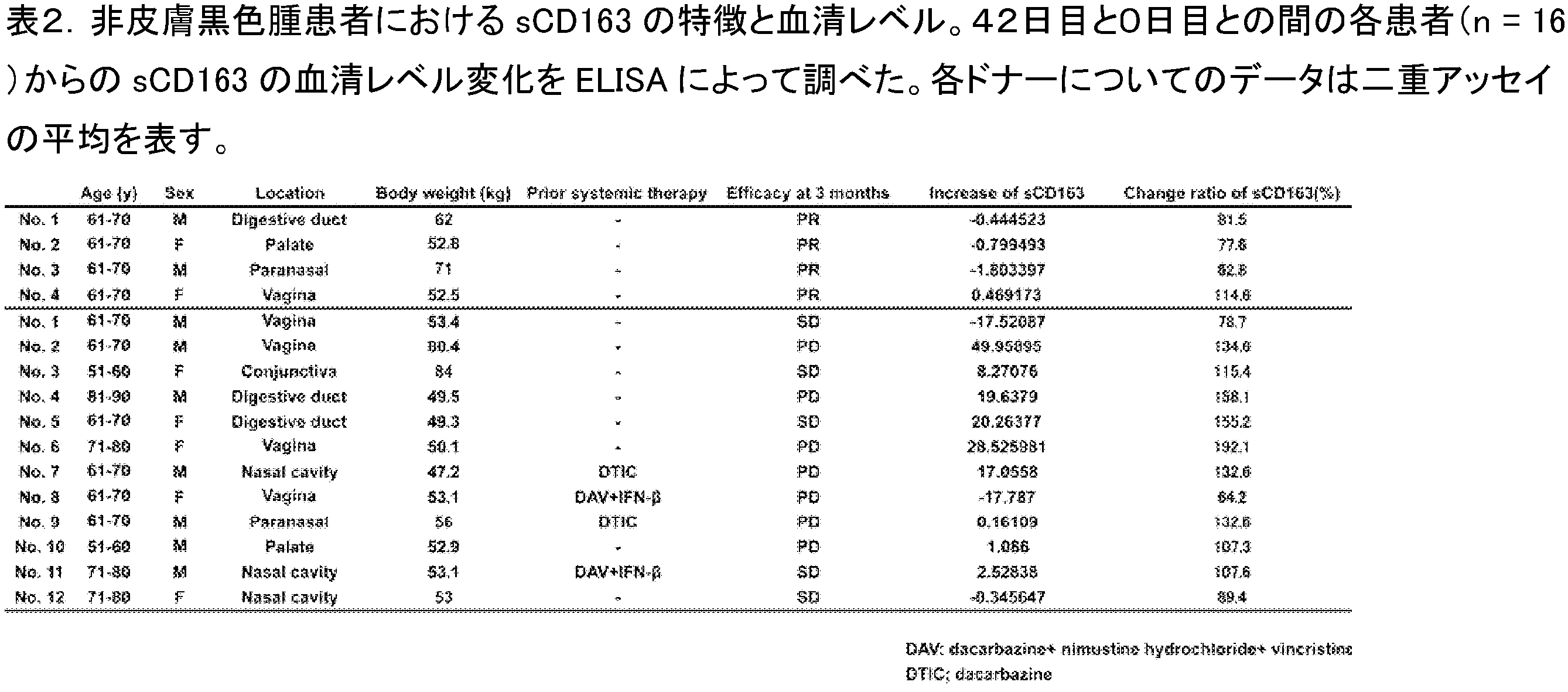
- Serum level of sCD163 and ROC curve in non-cutaneous melanoma Change in serum level of sCD163 in each patient on day 42 (n 29) (A).
- ROC curves were applied to calculate sCD163 serum levels and AUC cutoff (B). The cutoff was determined using Youden's index to distinguish between responders and non-responders.
- a method of determining the therapeutic effect of an immune checkpoint inhibitor in a subject comprising measuring the level of sCD163 in a biological sample taken from the subject. ..
- the therapeutic effect of the immune checkpoint inhibitor in the subject can be determined based on the level of sCD163.
- CD163 is a single-chain transmembrane protein that is a member of the scavenger receptor cysteine-rich family and is used interchangeably with “M130”. Further, “sCD163 (soluble CD163)” is a soluble version of CD163 cleaved. “SCD163” in the present invention may include variants, isoforms, and species homologues of sCD163.
- the level of sCD163 is, for example, the concentration or amount of sCD163 in the biological sample, and preferably the concentration of sCD163 in the biological sample.
- concentration of sCD163 to be measured include concentrations in the range of 10 pg / mL to 50,000 pg / mL, 10 pg / mL to 100,000 pg / mL.
- the immune checkpoint inhibitor in the present invention include anti-PD-1 antibody and anti-CTLA4 antibody, with anti-PD-1 antibody being preferred.
- anti-PD-1 antibody nivolumab, pembrolizumab, etc. are known to be useful for the treatment of malignant melanoma, and are preferable.
- treatment with an anti-PD-1 antibody is first performed, and its therapeutic effect is judged using sCD163 as an index. As a result, if it is determined that the treatment with the anti-PD-1 antibody is effective, the treatment is continued, and if it is determined that the treatment with the anti-PD-1 antibody is not effective, the anti-PD-1 is treated. Treatment can be with an anti-PD-1 antibody that is separate from the antibody or with an anti-CTLA4 antibody.
- an “antibody” is a full-length antibody and includes a glycoprotein containing at least two heavy chains (H) and two light chains (L) linked by disulfide bonds.
- Each heavy chain is composed of a heavy chain variable region (hereinafter sometimes abbreviated as V H ) and a heavy chain constant region.
- the heavy chain constant region is comprised of three domains, C H1 , C H2 and C H3 .
- Each light chain is composed of a light chain variable region (hereinafter sometimes abbreviated as V L ) and a light chain constant region.
- the light chain constant region is comprised of one domain, C L.
- VH and VL regions are further subdivided into highly variable regions called complementarity determining regions (CDRs), which are called framework regions (FR) and are more conserved. Are scattered.
- CDRs complementarity determining regions
- FR framework regions
- the variable regions of the heavy and light chains contain a binding domain that interacts with an antigen.
- antibodies include monoclonal antibodies, polyclonal antibodies, bispecific antibodies, minibodies, domain antibodies, synthetic antibodies, chimeric antibodies, humanized antibodies, human antibodies, antibody complexes, single chain antibodies. , Antibody derivatives, antibody analogs, and their respective antigen-binding fragments.
- an “antigen-binding fragment” of an antibody refers to one or more antibodies that retain the ability to specifically bind to an antigen (eg, PD-1). It shows a fragment.
- an antigen eg, PD-1
- Examples of the binding fragment contained in the “antigen-binding fragment” of the antibody include (i) a Fab fragment which is a monovalent fragment composed of V L , V H , C L and C H1 domains, and (ii) a hinge region.
- F (ab ′) 2 fragment which is a divalent fragment containing two Fab fragments linked by a disulfide bridge, (iii) an Fd fragment composed of V H and C H1 domains, (iv) a single arm of the antibody Fv fragments composed of V L and V H domains, (v) dAb fragments composed of V H domains, or (vi) isolated complementarity determining regions (CDRs).
- the two domains of the Fv fragment, VL and VH are encoded by separate genes, they can be linked by a synthetic linker that can be made using recombinant techniques to produce them as a single protein chain, Within this chain, the V L and V H regions can pair to form a monovalent molecule (single chain Fv (scFv)).
- scFv single chain Fv
- Such a single chain antibody is also included in the "antigen-binding fragment" of the antibody.
- PD-1 is an immune receptor that mediates signals for immune response regulation, and is a type I membrane protein belonging to the CD28 / CTLA-4 family.
- PD-1 is used interchangeably with "ProgrammedDeath1”, “ProgrammedCellDeath1”, “protein PD-1”, “PD1”, “PDCD1”, and “hPD-1” to modify PD-1.
- the body, isoforms, species homologs, and analogs having at least one common epitope with PD-1 may be included.
- the “anti-PD-1 antibody” is not particularly limited as long as it does not impair the effects of the present invention, and may be any antibody that specifically binds to PD-1.
- Such an antibody may be an antibody that specifically recognizes a part of the structure of the amino acid sequence or an antibody that specifically recognizes the entire structure.
- the above-mentioned antibody is not particularly limited, but includes nivolumab, pembrolizumab, or rumbrolizumab, preferably nivolumab or pembrolizumab.
- the antibody drug that is an anti-PD-1 antibody or an antigen-binding fragment thereof may be simply referred to as an antibody drug hereinafter.
- the subject also referred to as a test subject
- a mammal for example, a rodent, a dog, a cat, a cow, a primate, etc., preferably a human, and more preferably an immune checkpoint inhibitor.
- treatment includes not only treating an established pathological condition, but also preventing a pathological condition that may be established in the future.
- the subject is preferably one who has never been administered an immune checkpoint inhibitor.
- malignant mesothelioma examples include malignant melanoma (melanoma) (eg, metastatic malignant melanoma, unresectable malignant melanoma), squamous cell carcinoma of the skin, and extramammary Paget's disease.
- melanoma eg, metastatic malignant melanoma, unresectable malignant melanoma
- squamous cell carcinoma of the skin eg, metastatic malignant melanoma, unresectable malignant melanoma
- extramammary Paget's disease extramammary Paget's disease.
- skin cancer such as Merkel cell carcinoma; renal cancer (eg, renal cell carcinoma, clear cell carcinoma); prostate cancer (eg, hormone refractory prostate adenocarcinoma); breast cancer; colon cancer; lung cancer (eg, non-small cell) Lung cancer); Bone cancer; Pancreatic cancer; Head and neck cancer; Skin or orbital malignant melanoma; Uterine cancer; Ovarian cancer; Rectal cancer; Anal cancer; Gastric cancer; Testicular cancer; Uterine cancer; Fallopian tube carcinoma; Endometrial carcinoma; Cervical Carcinoma; Vaginal Carcinoma; Vulvar Carcinoma; Esophageal Cancer; Small Bowel Cancer; Colorectal Cancer; Endocrine System Cancer; Thyroid Cancer; Parathyroid Cancer; Adrenal Cancer; Parenchymatous Sarcoma; Multiple Myeloma; Urethral Cancer; Penile Cancer; Chronic Or acute leukemia (eg, acute myelogenous leukemia, chronic myelogenous leukemia,
- lymphoma eg, lymphocytic lymphoma, primary CNS lymphoma, non-Hodgkin's lymphoma, Hodgkin's lymphoma (Hodgkin's disease), T-cell lymphoma
- lymphoma eg, lymphocytic lymphoma, primary CNS lymphoma, non-Hodgkin's lymphoma, Hodgkin's lymphoma (Hodgkin's disease), T-cell lymphoma
- pleural malignant mesothelioma Pericardial malignant mesothelioma; peritoneal malignant mesothelioma; tumor angiogenesis; spinal tumor; brain stem glioma; pituitary adenoma; Kaposi's sarcoma; squamous cell carcinoma; squamous cell carcinoma; environment-induced cancer including asbestos-induced cancer; Or a combination thereof, preferably skin cancer, more preferably mal
- biological sample examples include all body fluids such as serum, plasma, blood, lymph, interstitial fluid, body cavity fluid, digestive fluid, urine and the like, preferably serum.
- the administration method of the immune checkpoint inhibitor is not particularly limited, but intravenous administration is preferable.
- the collection period of the biological sample is preferably after administration of the immune checkpoint inhibitor to the subject.
- the measurement of the sCD163 level there is no particular limitation on the measurement of the sCD163 level as long as it can quantitatively or semi-quantitatively measure the sCD163 level, and any known method can be adopted.
- any known method can be adopted.
- an immunoassay method, an electrophoresis method, a Western blotting method, a mass spectrometry method and the like can be mentioned, and an immunoassay method is preferable.
- immunoassays include immunoturbidimetric assay and enzyme immunoassay.
- the immunoassay is an immunoassay in which a protein or the like is used as an antigen, and an anti-sCD163 antibody or an antigen-binding fragment thereof can be used, and preferably a polyclonal antibody or a monoclonal antibody thereof can be used.
- the anti-sCD163 antibody or the antigen-binding fragment thereof can be a commercially available antibody or can be produced by a well-known method.
- the immunoturbidimetric assay is a method in which sCD163 in a biological sample is reacted with an anti-sCD163 antibody or an antigen-binding fragment thereof to cause an antigen-antibody reaction, and as a result, the level of sCD163 is measured from the degree of turbidity generated. So long as it is not limited. Examples of such a method include TIA method, latex immunoturbidimetric method, and nephelometry method.
- the TIA method is a method of measuring the degree of turbidity at a specific absorbance in the immunoturbidimetric assay.
- the latex immunoturbidimetric method is a method in which an anti-sCD163 antibody or an antigen-binding fragment thereof is bound to latex particles as an antibody in the immunoturbidimetric assay.
- the nephelometry method is a method in which the degree of turbidity in the immunoturbidimetric assay method is measured as scattered light by collecting light scattered at a certain angle or more.
- an EIA method such as an ELISA method using a plate as a support can be mentioned.
- the anti-sCD163 antibody or an antigen-binding fragment thereof is directly or indirectly bound to the solid phase as a primary antibody.
- an enzyme immunoassay for example, a biological sample for measuring sCD163 is added to a primary antibody bound to a solid phase and reacted. After reacting for a certain period of time, the solid phase is washed and a secondary labeled antibody is added to carry out a secondary reaction. The solid phase is washed again and the labeled portion bound to the solid phase is measured.
- an enzyme such as horseradish peroxidase (HRP) alkaline phosphatase can be used as the labeling substance.
- HRP horseradish peroxidase
- the labeling substance is not limited to an enzyme such as HRP, but a labeling metal such as gold colloid and europium, various chemical and biological fluorescent substances such as FITC, rhodamine, Texas Red, Alexa and GFP, 32 P, 51 Examples include all substances that can be labeled such as radioactive substances such as Cr.
- an avidin-biotin system or a streptavidin-biotin system can also be used.
- streptavidin or avidin labeled with an enzyme such as HRP can be used together with a secondary labeled antibody labeled with biotin.
- a chemiluminescence immunoassay using a luciferase-labeled antibody, a fluorescence immunoassay using a fluorescent dye-labeled antibody, a flow cytometry method and the like can be mentioned.
- the SDS-PAGE method can be generally mentioned. In addition to these, there are those having cellulose acetate as a support.
- For protein staining there are Coomassie Brilliant Blue, Ponceau S staining, Amido black staining, direct enzyme activity method and the like.
- the electrophoresed gel is transferred to a nitrocellulose membrane, a PVDF membrane or the like, and then reacted with an anti-sCD163 antibody or an antigen-binding fragment thereof which is a primary antibody and an HRP-labeled anti-IgG which is a secondary labeled antibody. Then, color is developed with the HRP color reagent, and sCD163 can be measured by the degree of color development of the band corresponding to sCD163.
- mass spectrometry examples include analysis methods using a mass spectrometer.
- a mass spectrometer For example, surface enhanced laser desorption / ionization time-of-flight mass spectrometer (SELDI-TOF MS method), matrix-assisted laser ionization (matrix-assisted laser desorption / ionization mass spectrometry time-of-flight mass spectrometry).
- Examples include methods using the MALDI-TOF MS method) and the ESI method (Electrospray Ionization).
- the SELDI-TOF MS method is preferable because it is possible to obtain a reproducible ion spectrum with a high S / N ratio because impurities are removed while the target substance is evenly trapped in the functional groups on the chip surface and ionized with laser light. ..
- Data of the level of sCD163 obtained by the above-mentioned measurement can be used to determine the therapeutic effect of an immune checkpoint inhibitor in a subject.
- the immune checkpoint inhibitor when the level of sCD163 in the biological sample collected from the subject is higher than the preset cutoff value, the immune checkpoint inhibitor may be effective (probability) in treating the disease in the subject. It can be mentioned that it is high. Alternatively, if the level of sCD163 in the biological sample collected from the subject is less than or equal to a preset cutoff value, it may be determined that the immune checkpoint inhibitor is unlikely to be effective in treating the disease in the subject. Can be mentioned.
- the cut-off value is a value that distinguishes responders and non-responders to the drug, but it varies depending on various conditions such as the measurement target and the type of measurement method, so it is preset according to the conditions. There is a need to.
- the cutoff value varies depending on the measurement target (number of patients, age, sex, weight, health condition, disease state), measurement conditions (for example, type and sensitivity of antibody to be measured), statistical method, and the like. Covers a wide range of inventions using an arbitrary cutoff value that can be varied depending on these conditions, and is not limited to a specific value.
- the level of sCD163 in a biological sample taken from a subject after administration of an immune checkpoint inhibitor is the same as the level of sCD163 in a biological sample taken from the subject prior to administration.
- the sCD163 concentration in the biological sample collected from the subject after administration of the immune checkpoint inhibitor is higher than the sCD163 concentration in the biological sample of the subject before administration, for example.
- a cutoff value different from the above is optionally set from the viewpoint of side effects, and a side effect may occur when the level of sCD163 in the biological sample of interest is equal to or higher than the other cutoff value. It may be determined that the property is high.
- the cutoff value is not limited, for example, the level of sCD163 in the biological sample collected from the subject after the antibody drug administration is higher than the level of sCD163 in the biological sample collected from the subject before administration.
- the sCD163 concentration in the biological sample collected from the subject after the administration of the antibody drug is preferably 10 ng / mL, more preferably 15 ng / mL, as compared with the sCD163 concentration in the target biological sample before administration. More preferably, 20 ng / mL, and even more preferably 40 ng / mL or higher, it can be determined that side effects are likely to occur.
- the cutoff value from various levels of sCD163 measured in advance by various statistical analysis methods. For example, as the cut-off value, the average value or the median value of the levels of sCD163 in the subject administered with the immune checkpoint inhibitor; the level of sCD163 in the subject administered with the immune checkpoint inhibitor, and the immune checkpoint inhibitor Value determined based on ROC (Receiver Operating Characteristic) analysis to maximize the sum of sensitivity and specificity in relation to the therapeutic effect (tumor reduction effect, survival time extension effect, etc.); immune checkpoint inhibitor is administered The value obtained based on the chi-square test from the relationship between the level of sCD163 in the subject and the therapeutic effect of the immune checkpoint inhibitor (tumor reduction effect, survival time extension effect, etc.) A minimum value, a P value below a certain level (for example, a P value below 0.05, a P value below 0.01), etc.).
- ROC Receiveiver Operating Characteristic
- the cutoff value may be one, or multiple cutoff values may be set according to the type of therapeutic effect, the type of antibody drug to be administered, the condition of the subject to which the antibody drug is administered, or a combination thereof.
- the level of sCD163 in the biological sample collected from the subject is higher than the preset cutoff value, and the immune checkpoint inhibitor is likely to be effective in treating the disease in the subject. If so, it may be decided to administer an immune checkpoint inhibitor to such a subject.
- the effective amount of the immune checkpoint inhibitor is not particularly limited, and may be determined depending on the type of drug, the purity, the degree of side effects, the type, nature, sex, age, symptoms of concomitant drugs, the presence or absence of concomitant drugs, previous treatment history, etc. It is appropriately determined by the trader.
- the effective amount may be 0.1 to 20 mg / kg body weight / day, preferably 1.0 to 20 mg / kg body weight / day once or several times.
- the treatment with the above antibody drug may be performed with or without surgery to remove the tumor during the period before or after the period.
- Treatment that does not involve removal of the tumor mainly for the purpose of prolonging life, tumors that have become smaller may be removed after treatment with the antibody drug described above, and tumors for the purpose of suppressing recurrence / metastasis
- Treatment with the antibody drug may be prophylactically performed after the removal of
- therapeutic effect can be used interchangeably with “efficacy”, and can be evaluated by the tumor reducing effect, recurrence / metastasis suppressing effect, life prolonging effect, and the like.
- “Immune checkpoint inhibitor is effective in treating a disease in a subject” means that a therapeutic effect in a patient whose sCD163 level exceeds a cutoff value and a therapeutic effect in a patient whose sCD163 level is below the cutoff value. By comparison, it is markedly superior with a statistically significant difference.
- the level of sCD163 in the biological sample collected from the subject is equal to or lower than the preset cutoff value, it may be decided not to administer the immune checkpoint inhibitor to such subject.
- the level of sCD163 in a patient is measured after administration of an immune checkpoint inhibitor, and it is determined that the immune checkpoint inhibitor is likely to be effective.
- an immune checkpoint inhibitor for example, nivolumab or pembrolizumab
- patients with negative judgments patients who have a negative judgment after the first administration, and effective judgments after the first administration, but multiple times (Including patients who are judged negative after administration) can be treated more effectively by administering another immune checkpoint inhibitor such as ipilimumab.
- the therapeutic effect of an immune checkpoint inhibitor in a subject can be determined based on the level of sCD163. It is possible to select an appropriate drug for each subject in the treatment of diseases, and avoid occurrence of side effects due to useless medication. Therefore, it becomes possible to formulate an appropriate dosing schedule and change to an appropriate dosing schedule.
- the subject of the first aspect of the present invention can also be viewed as an adjunct method for the selection of therapeutic agents in the treatment of diseases.
- a biomarker for determining the therapeutic effect of an immune checkpoint inhibitor which comprises sCD163.
- a diagnostic agent for determining the therapeutic effect of an immune checkpoint inhibitor which comprises an anti-sCD163 antibody or an antibody-binding fragment thereof.
- the above diagnostic agent can be used for measuring the level of sCD163, various measuring methods described above can be performed.
- the above-mentioned measuring method include immunoassay method, electrophoresis method, western blotting method, mass spectrometry method and the like, and immunoassay method is preferable.
- Such a diagnostic agent can be carried out according to the description regarding the method for determining the therapeutic effect of the first aspect.
- kits for determining the therapeutic effect of an immune checkpoint inhibitor which comprises an anti-sCD163 antibody or an antigen-binding fragment thereof.
- Such a kit is preferably used to carry out the determination method of the first aspect of the present invention.
- the anti-sCD163 antibody or its antigen-binding fragment can measure the level of sCD163 protein in a biological sample collected from a subject.
- the kit may further include a secondary antibody against the primary antibody, in addition to the primary antibody consisting of the anti-sCD163 antibody or the antigen-binding fragment thereof.
- the secondary antibody is preferably labeled with a luciferase label, a radioactive label, a fluorescent label, an enzyme label, or the like.
- kit may further include an instruction manual in which procedures for carrying out the determination method of the first embodiment of the present invention are described.
- the anti-PD-1 antibody or the antigen-binding fragment thereof is determined to have a high possibility of being effective by the determination method of the first aspect, and the anti-PD-1 antibody or There is provided a method of treating a subject comprising administering an antigen binding fragment thereof.
- the subject is a mammal, such as a rodent, dog, cat, cow, primate, etc., preferably a human, and more preferably, can be treated by administration of an anti-PD-1 antibody or an antigen-binding fragment thereof.
- a human suffering from or at risk of suffering from a disease even more preferably a human suffering from cancer, sarcoma or malignant mesothelioma. Examples of the disease, dose and dosage form of the anti-PD-1 antibody or antigen-binding fragment thereof are as described in the first embodiment.
- nivolumab significantly improves survival in patients with metastatic melanoma and also improves the efficacy of co-administration with ipilimumab.
- Ipilimumab is a fully humanized immunoglobulin (Ig) G1 monoclonal antibody that blocks the cytotoxic T lymphocyte antigen (CTLA-4), activates and increases T cells, and suppresses the function of regulatory T cells (Treg). Is.
- ipilimumab would be useful in the treatment of advanced melanoma, especially in combination with other anti-melanoma reagents.
- the combination therapy with nivolumab and ipilimumab increased the response rate for untreated brain metastases of melanoma.
- the efficacy of ipilimumab in patients with nivolumab-resistant melanoma is very low after the tumor of interest has progressed.
- nivolumab and ipilimumab coadministration and sequential nivolumab and ipilimumab with planned switching frequently cause immune-related adverse events (irAEs), resulting in planned switching from nivolumab to ipilimumab Prior to this, it is important to determine the efficacy of nivolumab monotherapy.
- irAEs immune-related adverse events
- Tumor-associated macrophages are characterized by their heterogeneity and plasticity and are functionally reprogrammed into a polarized phenotype upon exposure to cancer-associated factors, interstitial factors, or infections, and the tumor microenvironment.
- TAMs Tumor-associated macrophages
- serum sCD163 is a disease-causing marker because the major population of TAM in skin cancer is CD163 + M2 macrophages, and soluble differentiation cluster 163 (sCD163) is a TAM marker that appears in serum as a result of proteolytic release. It was hypothesized that it could serve as a decision marker for the efficacy of nivolumab at an early stage.
- serum levels of sCD163 were analyzed in 59 advanced cutaneous melanoma and 16 advanced mucosal melanoma treated with nivolumab.
- ⁇ Patient> Data for patients treated with nivolumab were collected from eight clinical sites in Japan. Patients included unresectable stage III melanoma, patients who were resectable but declined resectable, or stage IV melanoma with accessible skin, subcutaneous and / or nodular lesions (stage Was done according to the AJCC Staging Manual, 7th Edition, 2011). All patients received 2 mg / kg nivolumab followed by a 3-week washout period, or 3 mg / kg nivolumab followed by a 2-week washout period. Both are dosing schedules approved in Japan. Patient sera were collected on days 0 and 42. The response of nivolumab was evaluated according to the response evaluation criteria (RECIST) in solid tumors.
- RECIST response evaluation criteria
- ELISA enzyme-linked immunoassay
- Receiver operating characteristic (ROC) curves were used to calculate the serum levels of sCD163 and the cutoff value at the area under the curve (AUC). The cut-off was determined using Youden's index (sensitivity + specificity -1) to determine the point of maximum index value.
- ROC curves were established to assess serum levels of sCD163 in patients receiving nivolumab. The Mann-Whitney U test was used to make a single comparison between the two groups. The significance level was set to p ⁇ 0.01. All statistical analyzes were performed using JMP version 14.1 software (SAS Institute, Tokyo, Japan).
- ⁇ Patient> Data from 75 nivolumab-treated melanoma patients, including 59 cutaneous melanoma patients (Table 1) and 16 non-cutaneous (eg, gastrointestinal, vaginal, nasal) melanoma patients (Table 2). Collected. The average patient age was 68.0 years for cutaneous melanoma (range 31-93 years) and 66.0 years for non-cutaneous melanoma (range 54-82 years). The proportion of male patients with cutaneous and non-cutaneous melanoma was 57.6% and 56.3%, respectively. The most common primary tumor site was the extremities (55.9%), followed by head and neck (15.3%), trunk (11.9%), mucosal origin (8.5%), and unknown origin (8.5%).
- ⁇ Serum level of sCD163> To determine whether serum concentrations of sCD163 could be used to determine early response in patients with melanoma treated with nivolumab, levels were evaluated in 75 patients with advanced melanoma treated with nivolumab. Compared to baseline (day 0), serum levels of sCD163 on day 42 were significantly increased in the responding group of patients with advanced cutaneous melanoma (p ⁇ 0.0001; Figure 1a), but progressed. Serum sCD163 levels were not significantly different in patients with mucosal melanoma. (Fig. 3a).
- Nivolumab shows higher efficacy than other anti-melanoma drugs (eg ipilimumab and dacarbazine) and induces longer-term anti-tumor responses than BRAF / MEK inhibitors (eg Vemurafenib, Dabrafenib, Trametinib).
- Oncologists were particularly interested in combining nivolumab with agents that enhance the antitumor immune response in patients with metastatic melanoma.
- the efficacy of nivolumab appears to be significantly increased when combined with ipilimumab (57.7%), but unfortunately this particular combination (59.0%) also significantly increases the incidence of severe treatment-related AEs.
- CD163 is a member of the cysteine-rich family of scavenger receptors and is only expressed on cells of the monocyte / macrophage lineage.
- a significant number of CD163 + TAMs were present in metastatic melanoma and were activated by interstitial factors, resulting in elevated serum levels of sCD163 as a result of proteolytic release. Be done.
- Jensen et al. Previously reported sCD163 and CD163 + TAM as prognostic markers of early cutaneous melanoma.
- TAMs of melanoma make up a heterogeneous, predominantly immunosuppressive population, and lipolarization to activated subtypes of TAMs by immunomodulators induces melanoma growth in a naturally occurring mouse melanoma model. Since it was reported to be significantly suppressed, we hypothesized that one of the targets of nivolumab in melanoma is activating CD163 + TAM.
- nivolumab and pembrolizumab are widely used for the treatment of various cancers including advanced melanoma.
- Nivolumab significantly improves survival in patients with metastatic melanoma, and continuous administration of ripilimumab can improve efficacy when switched at appropriate times. Therefore, biomarkers are needed to assess the efficacy of nivolumab shortly after the first dose.
- serum levels of soluble differentiation cluster 163 sCD163
- sCD163 may be useful as a biomarker for selecting patients with advanced cutaneous melanoma who are most likely to benefit from anti-melanoma immunotherapy.
Landscapes
- Health & Medical Sciences (AREA)
- Life Sciences & Earth Sciences (AREA)
- Chemical & Material Sciences (AREA)
- Immunology (AREA)
- Organic Chemistry (AREA)
- Molecular Biology (AREA)
- Proteomics, Peptides & Aminoacids (AREA)
- Engineering & Computer Science (AREA)
- General Health & Medical Sciences (AREA)
- Biochemistry (AREA)
- Medicinal Chemistry (AREA)
- Hematology (AREA)
- Cell Biology (AREA)
- Biomedical Technology (AREA)
- Genetics & Genomics (AREA)
- Biophysics (AREA)
- Urology & Nephrology (AREA)
- Pathology (AREA)
- Biotechnology (AREA)
- General Physics & Mathematics (AREA)
- Analytical Chemistry (AREA)
- Physics & Mathematics (AREA)
- Microbiology (AREA)
- Food Science & Technology (AREA)
- Toxicology (AREA)
- Zoology (AREA)
- Gastroenterology & Hepatology (AREA)
- Peptides Or Proteins (AREA)
- Medicines Containing Antibodies Or Antigens For Use As Internal Diagnostic Agents (AREA)
- Investigating Or Analysing Biological Materials (AREA)
Abstract
対象における免疫チェックポイント阻害薬の治療効果を判定する方法は、対象から採取された生体試料におけるsCD163のレベルを判定することを含む。
Description
[関連出願の相互参照]
本出願は、2018年11月16日に出願された、日本国特許出願第2018-215880号明細書(その開示全体が参照により本明細書中に援用される)に基づく優先権を主張する。本発明は、免疫チェックポイント阻害薬又はその抗原結合断片の治療効果を判定する方法、バイオマーカー、診断薬、及びキットに関する。
本出願は、2018年11月16日に出願された、日本国特許出願第2018-215880号明細書(その開示全体が参照により本明細書中に援用される)に基づく優先権を主張する。本発明は、免疫チェックポイント阻害薬又はその抗原結合断片の治療効果を判定する方法、バイオマーカー、診断薬、及びキットに関する。
がん細胞は、がん細胞を攻撃する免疫細胞の活性を下げることにより、免疫細胞の攻撃を阻止している。この仕組みは「免疫チェックポイント」と呼ばれている。したがって、この「免疫チェックポイント」を阻害することにより、免疫細胞の働きを再び活発にしてがん細胞を攻撃することができる。免疫チェックポイント阻害薬は、がん細胞により活性の下げられた免疫細胞を活性化させ、がん細胞を攻撃させる薬である。
免疫チェックポイント阻害薬として具体的には、抗PD-1抗体、抗CTLA4抗体等が挙げられる。抗PD-1抗体であるニボルマブ及びペムブロリズマブは、悪性黒色腫の治療に有用であることが知られており、また、非小細胞肺癌及び腎細胞癌に対する治療効果も報告されている(特許文献1、非特許文献1)。
ニボルマブ、ペムブロリズマブ等の免疫チェックポイント阻害薬は非常に高額であるため、免疫チェックポイント阻害薬療法の有効性を評価するためのバイオマーカーが必要とされている。日本におけるニボルマブ及びペムブロリズマブの有効性はそれぞれ34.1%及び24.1%と報告されており(非特許文献2,3)、悪性黒色腫における抗腫瘍免疫応答を高める別の薬剤が必要であることが示唆されている。
そこで、免疫チェックポイント阻害薬の治療効果の高い患者を事前に選別して、該抗体を投与できれば有益である。
また、イピリムマブは、細胞性Tリンパ球抗原(CTLA4)をブロックする完全ヒト型IgG1モノクローナル抗体であり、ニボルマブと併用される進行期悪性黒色腫の患者の抗腫瘍免疫応答を高める有望な薬剤の一つである。進行期悪性黒色腫におけるニボルマブとイピリムマブの併用療法の有効性は57.8%と報告されており、ニボルマブとイピリムマブの同時投与に加えて、ニボルマブとイピリムマブとの適切な時期での切り替えによる連続投与も、進行期悪性黒色腫の治療における有効性が高いとされている。従って、当該適切な時期を決めるために、ニボルマブ等の免疫チェックポイント阻害薬を投与後に、その有効性を評価することが重要である。
特許文献2は上記課題に取り組んだものであり、抗PD-1抗体、抗PD-L1抗体、抗CTLA4抗体及びそれらの抗原結合断片から選択される少なくとも一つの抗体医薬を投与した対象から採取されたCD163及びCXCL5から選択される少なくとも一つのマーカーのレベルを測定することにより、該抗体医薬の投与に起因する副作用の発症を予測する方法を開示している。しかし、特許文献2には、これらのマーカーを用いて該抗体医薬の抗腫瘍効果自体を評価することは開示されていない。
N Engl J Med (2015)373: 23-34
Cancer Sci. (2017)108:1223-1230
Cancer Chemother Pharmacol. (2017) 79:651-660
N Engl J Med. (2015) 373:23-34
本発明は、免疫チェックポイント阻害薬の投与後に、対象における当該免疫チェックポイント阻害薬の治療効果を精度よく判定できる方法を提供することを目的とする。
本発明者らは、対象の生体試料中の種々のケモカインと免疫チェックポイント阻害薬の治療効果との関係を鋭意研究したところ、sCD163のレベルが高い対象において、免疫チェックポイント阻害薬の治療効果が高いことを見いだし、本発明を完成するに至った。
すなわち本発明は、例えば以下の実施形態を包含する。
項1.対象における免疫チェックポイント阻害薬の治療効果を判定する方法であって、
対象から採取された生体試料におけるsCD163のレベルを測定することを含む方法。
対象から採取された生体試料におけるsCD163のレベルを測定することを含む方法。
項2.対象から採取された生体試料におけるsCD163のレベルが予め設定されたカットオフ値よりも高い場合、前記対象における疾患の治療に免疫チェックポイント阻害薬が有効である可能性が高いと判定すること
を含む項1に記載の方法。
を含む項1に記載の方法。
項3.sCD163を含む、免疫チェックポイント阻害薬の治療効果を判定するためのバイオマーカー。
項4.抗sCD163抗体又はその抗体結合断片を含む、免疫チェックポイント阻害薬の治療効果を判定するための診断薬。
項5.抗sCD163抗体又はその抗原結合断片を含む、免疫チェックポイント阻害薬の治療効果の判定用キット。
本発明によれば、対象における免疫チェックポイント阻害薬の治療効果の新たな判定方法が提供される。すなわち、本発明の判定方法は、sCD163のレベルに基づいて、免疫チェックポイント阻害薬に対して顕著に感受性を示すがん患者を判定することができる。これにより、疾患治療における対象への適切な薬剤の選択ができ、又は無用な投薬を回避することができ、適切な投与計画の立案及び適切な投与計画への変更が可能となる。本発明において、治療効果の判定とは、治療効果の有無及び/又は有効性の程度を評価することを意味する。
本発明の第一態様によれば、対象における免疫チェックポイント阻害薬の治療効果を判定する方法であって、対象から採取された生体試料におけるsCD163のレベルを測定することを含む方法が提供される。
かかる方法によれば、sCD163のレベルに基づいて、対象における免疫チェックポイント阻害薬の治療効果を判定することができる。
本明細書において、「CD163」は、1本鎖の膜貫通型タンパク質で、スカベンジャーレセプターシステイン-リッチファミリーのメンバーであり、「M130」と相互に使用される。また、「sCD163(可溶型CD163)」は、CD163が切断されて可溶型となったものである。本発明における「sCD163」は、sCD163の改変体、アイソフォーム、および種ホモログを含んでよい。
sCD163のレベルとは、例えば、生体試料におけるsCD163の濃度又は量であり、好ましくは、生体試料におけるsCD163の濃度である。測定するsCD163の濃度としては、例えば、10pg/mL~50000pg/mL、10pg/mL~100000pg/mLの範囲の濃度が挙げられる。
本発明において免疫チェックポイント阻害薬として、具体的には、抗PD-1抗体、抗CTLA4抗体等が挙げられ、抗PD-1抗体が好ましい。抗PD-1抗体としては、ニボルマブ、ペムブロリズマブ等が、悪性黒色腫の治療に有用であることが知られており、好ましい。本発明の好ましい実施形態においては、最初にある抗PD-1抗体による治療を行い、sCD163を指標にその治療効果を判定する。その結果、当該抗PD-1抗体による治療が有効であると判定された場合は当該治療を継続し、当該抗PD-1抗体による治療が有効でないと判定された場合に、当該抗PD-1抗体とは別の抗PD-1抗体による治療を行うか、又は抗CTLA4抗体による治療を行うことができる。
本明細書において、「抗体」は、全長抗体であって、ジスルフィド結合で連結された少なくとも2個の重鎖(H)と2個の軽鎖(L)を含む糖タンパク質を含む。各重鎖は、重鎖可変領域(以下、VHと略すこともある。)と重鎖定常領域とから構成されている。重鎖定常領域は、3個のドメインCH1、C H2及びCH3から構成されている。各軽鎖は、軽鎖可変領域(以下、VLと略すこともある。)と軽鎖定常領域から構成されている。軽鎖定常領域は、1個のドメインCLで構成されている。VH及びVL領域はさらに、相補性決定領域(CDR)と称される変異性の高い領域に小分割され、それらには、フレームワーク領域(FR)と称され、より保存性の高い領域が散在している。上記重鎖及び軽鎖の可変領域は、抗原と相互作用する結合ドメインを含んでいる。
かかる「抗体」としては、例えば、モノクローナル抗体、ポリクローナル抗体、二重特異性抗体、低分子化抗体、ドメイン抗体、合成抗体、キメラ抗体、ヒト化抗体、ヒト抗体、抗体複合体、一本鎖抗体、抗体誘導体、抗体類似体、及びそのそれぞれの抗原結合断片が挙げられる。
本明細書において、抗体の「抗原結合断片」(又は、単に「抗体断片」ともいう)とは、特異的に抗原(例えば、PD-1)に結合する能力を保持する抗体の1個以上の断片を示すものである。抗体の「抗原結合断片」に含まれる結合断片の例として、(i)VL、VH、CL及びCH1ドメインから構成される1価の断片であるFab断片、(ii)ヒンジ領域中ジスルフィド架橋で結合した2個のFab断片を含む2価の断片であるF(ab´)2断片、(iii)VH及びCH1ドメインから構成されるFd断片、(iv)抗体のシングルアームのVL及びVHドメインで構成されるFv断片、(v)VHドメインから構成されるdAb断片、又は(vi)単離相補性決定領域(CDR)が挙げられる。さらに、Fv断片の2個のドメインであるVL及びVHは別々の遺伝子によりコードされているが、それらは、組み換え技術を用いてそれらを単一タンパク質鎖として作製できる合成リンカーにより連結でき、この鎖中では、VL及びVH領域が対となって1価の分子を形成できる(単一鎖のFv(scFv))。このような単一鎖の抗体も、抗体の「抗原結合断片」に含まれる。
本明細書において、「PD-1」は、免疫応答調節のシグナルを介する免疫レセプターであって、CD28/CTLA-4ファミリーに属するI型膜タンパク質である。本発明における「PD-1」は、「ProgrammedDeath1」、「ProgrammedCellDeath1」、「タンパク質PD-1」、「PD1」、「PDCD1」、及び「hPD-1」と相互に使用され、PD-1の改変体、アイソフォーム、種ホモログ、及びPD-1と少なくとも1個の共通エピトープを有するアナログを含んでよい。
本明細書において、「抗PD-1抗体」は、本発明の効果を妨げない限り、特に限定されず、PD-1に特異的に結合する任意の抗体であってよい。かかる抗体は、アミノ酸配列の構造の一部を特異的に認識する抗体でもあってもよく、全体構造を特異的に認識する抗体でもよい。また、上記抗体としては、特に限定されるものではないが、ニボルマブ、ペムブロリズマブ、又はラムブロリズマブが挙げられ、好ましくはニボルマブ又はペムブロリズマブである。なお、抗PD-1抗体又はその抗原結合断片である抗体医薬を、以下、単に抗体医薬と称する場合がある。
本明細書において、対象(被験対象とも称する)は、哺乳動物、例えば、げっ歯類、イヌ、ネコ、ウシ、霊長類等であり、好ましくはヒトであり、より好ましくは、免疫チェックポイント阻害薬の投与により治療されうる疾患に罹患しているか、又は該疾患に罹患する可能性のあるヒトであり、さらにより好ましくは、癌、肉腫、又は悪性中皮腫に罹患したヒトである。ここで「治療」には、確立された病態を治療することだけでなく、将来確立される可能性のある病態を予防することをも含む。対象は、好ましくは、免疫チェックポイント阻害薬の投与経験がない対象である。
癌、肉腫、又は悪性中皮腫としては、具体的には、悪性黒色腫(メラノーマ)(例えば、転移性悪性黒色腫、根治切除不能悪性黒色腫)、皮膚有棘細胞癌、乳房外パジェット病、又はメルケル細胞癌等の皮膚癌;腎癌(例えば、腎細胞癌、透明細胞カルシノーマ);前立腺癌(例えば、ホルモン難治性前立腺アデノカルシノーマ);乳癌;結腸癌;肺癌(例えば、非小細胞肺癌);骨癌;膵癌;頭頚部癌;皮膚若しくは眼窩内悪性メラノーマ;子宮癌;卵巣癌;直腸癌;肛門部癌;胃癌;精巣癌;子宮癌;卵管のカルシノーマ;子宮内膜カルシノーマ;子宮頚部カルシノーマ;膣カルシノーマ;外陰部カルシノーマ;食道癌;小腸癌;大腸癌;内分泌系癌;甲状腺癌;副甲状腺癌;副腎癌;柔組織肉腫;多発性骨髄腫;尿道癌;陰茎癌;慢性若しくは急性白血病(例えば、急性骨髄性白血病、慢性骨髄性白血病、急性リンパ芽球性白血病、慢性リンパ球性白血病);小児固形癌;進行性固形癌;膀胱癌;腎臓若しくは尿管の癌;腎盂カルシノーマ;尿路上皮癌;中枢神経系(CNS)腫瘍;リンパ腫(例えば、リンパ球性リンパ腫、原発性CNSリンパ腫、非ホジキンリンパ腫、ホジキンリンパ腫(ホジキン病)、T細胞リンパ腫);胸膜悪性中皮腫;心膜悪性中皮腫;腹膜悪性中皮腫;腫瘍新脈管形成;脊椎腫瘍;脳幹グリオーム;下垂体アデノーマ;カポシ肉腫;扁平上皮癌;扁平細胞癌;アスベスト誘発癌を含む環境誘発癌;又はそれらの組み合わせが挙げられ、好ましくは、皮膚癌、より好ましくは、悪性黒色腫、皮膚有棘細胞癌、乳房外パジェット病、又はメルケル細胞癌である。
生体試料としては、あらゆる体液、例えば、血清、血漿、血液、リンパ液、組織液、体腔液、消化液又は尿等が挙げられ、好ましくは血清である。
免疫チェックポイント阻害薬の投与方法としては、特に限定されるものではないが、静脈投与が好ましい。
免疫チェックポイント阻害薬の投与方法としては、特に限定されるものではないが、静脈投与が好ましい。
生体試料の採取時期は、好ましくは、対象への免疫チェックポイント阻害薬の投与後が挙げられる。
sCD163のレベルの測定は、sCD163レベルを定量的又は半定量的に測定できるものであれば特に制限はなく、公知のあらゆる方法を採用することができる。例えば、免疫測定法、電気泳動法、ウエスタンブロッティング法、質量分析法等が挙げられ、好ましくは免疫測定法である。
免疫測定法としては、例えば、免疫比濁測定法、酵素免疫測定法等が挙げられる。免疫測定法は、タンパク質等を抗原として測定する免疫測定法であって、抗sCD163抗体又はその抗原結合断片を用いることができ、好ましくはそのポリクローナル抗体又はモノクローナル抗体を用いることができる。抗sCD163抗体又はその抗原結合断片は、市販品の抗体であることもできるし、また、周知の方法により製造することもできる。
免疫比濁測定法としては、生物学的試料におけるsCD163と、抗sCD163抗体又はその抗原結合断片とを反応させて抗原抗体反応させ、その結果、発生する濁りの度合いからsCD163のレベルを測定するものであれば、とくに限定されない。そのような方法として、TIA法、ラテックス免疫比濁法、ネフェロメトリー法を例示することができる。TIA法は、免疫比濁測定法において濁りの度合いを特定の吸光度において測定する方法である。また、ラテックス免疫比濁法は、免疫比濁測定法において、抗体として抗sCD163抗体又はその抗原結合断片をラテックス粒子に結合させたものを用いて測定する方法である。さらに、ネフェロメトリー法は、免疫比濁測定法において濁りの度合いを、一定角度以上の大きさに散乱した光を集めて散乱光として測定する方法である。
酵素免疫測定法としては、プレートを支持体とした、ELISA法等のEIA法を挙げることが出来る。はじめに固相に直接又は間接的に抗sCD163抗体又はその抗原結合断片を一次抗体として結合させる。sCD163を酵素免疫測定法で測定する場合には、例えば、固相に結合した一次抗体に、sCD163を測定するための生物学的試料を加えて反応させる。一定時間反応させた後、固相を洗浄し二次標識抗体を加えて二次反応させる。固相を再度洗浄し、固相に結合した標識部分を測定する。
上記二次標識抗体を用いる免疫測定法において、標識物質としては西洋ワサビペルオキシダーゼ(HRP)アルカリホスファターゼ等の酵素を用いることができる。例えば、HRP標識抗体を利用した場合には基質に既知のDAB、TMB、OPD等を用いることができる。また、標識物質には、HRPのような酵素だけではなく、金コロイド、ユーロピウム等の標識金属、FITC、ローダミン、Texas Red、Alexa、GFP等の化学的、生物的各種蛍光物質、 32P、 51Cr等の放射性物質等標識可能なあらゆる物質が挙げられる。また、本発明で標識物質を用いる場合、アビジン-ビオチン系又はストレプトアビジン-ビオチン系を用いることもできる。その場合には、例えば、ビオチンで標識された二次標識抗体とともに、HRP等の酵素で標識されたストレプトアビジン又はアビジンを用いることができる。また、ルシフェラーゼ標識抗体による化学発光イムノアッセイ、蛍光色素標識抗体による蛍光イムノアッセイ、フローサイトメトリー法等を挙げることができる。
電気泳動法としては、一般的にはSDS-PAGE法を挙げることができる。そのほかにもセルロース・アセテートを支持体としたもの等がある。タンパク質の染色にはクマシー・ブリリアント・ブルー、ポンソーS染色、アミドブラック染色、直接酵素活性を利用する方法等がある。
また、ウエスタンブロッティング法による検出も有効である。すなわち、電気泳動をしたゲルをニトロセルロース膜、PVDF膜等に転写し、次いで、一次抗体である抗sCD163抗体又はその抗原結合断片、さらに、二次標識抗体であるHRP標識抗IgG等を反応させ、次いで、HRP発色試薬で発色させ、sCD163に相当するバンドの発色度合いによりsCD163を測定することができる。
質量分析法としては、例えば、質量分析器を使用した分析方法を挙げることができる。例えば、表面増強レーザー脱離イオン化(Surface Enhanced Laser Desorption/Ionization)飛行時間型質量分析計(SELDI-TOF MS法)、マトリックス支援レーザーイオン化(Matrix-Assisted Laser Desorption/Ionization)飛行時間型質量分析計(MALDI-TOF MS法)、ESI法(Electrospray Ionization)を用いる方法を例示できる。SELDI-TOF MS法は、チップ表面の官能基に目的物質を均一に捕捉したまま不純物を除去し、レーザー光でイオン化するため、再現性のあるS/N比の高いイオンスペクトルが得られるので好ましい。
上述の測定により得られたsCD163のレベルのデータを用いて、対象における免疫チェックポイント阻害薬の治療効果を判定することができる。
かかる判定としては、対象から採取された生体試料におけるsCD163のレベルが予め設定されたカットオフ値よりも高い場合、対象における疾患の治療に免疫チェックポイント阻害薬が有効である可能性(蓋然性)が高いと判定することが挙げられる。或いは、対象から採取された生体試料におけるsCD163のレベルが予め設定されたカットオフ値以下である場合、対象における疾患の治療に免疫チェックポイント阻害薬が有効である可能性が低いと判定することが挙げられる。
カットオフ値(閾値)は、薬物に対する奏功者と非奏功者とを区別する値であるが、測定対象、測定方法の種類等の諸条件により変動するものであるため、条件に合わせて予め設定する必要がある。カットオフ値は、測定対象(患者の数、年齢、性別、体重、健康状態、疾患の状態)、測定条件(例えば測定する抗体の種類及び感度)、統計的手法等により変動するため、本発明は、これらの諸条件により変動し得る任意のカットオフ値を用いた発明を広く包含し、特定の値に限定されない。本発明の一実施形態において、例えば、免疫チェックポイント阻害薬投与後の対象から採取された生物学的試料におけるsCD163のレベルが、投与前の対象から採取された生物学的試料におけるsCD163のレベルに比べて好ましくは1.0倍を超え、より好ましくは1.1倍以上高い場合、当該免疫チェックポイント阻害薬が当該対照の治療に有効である可能性が高いと判定することができる。また、本発明の一実施形態においては、免疫チェックポイント阻害薬投与後の対象から採取された生物学的試料におけるsCD163濃度が、例えば、投与前の対象の生物学的試料におけるsCD163濃度に比べて3ng/mL以上高い場合、当該免疫チェックポイント阻害薬が当該対照の治療に有効である可能性が高いと判定することができる。また、任意選択で副作用の観点から上記とは別のカットオフ値を設け、対象の生物学的試料におけるsCD163のレベルが、当該別のカットオフ値以上の場合に、副作用が発生している可能性が高いと判定をしてもよい。当該カットオフ値も限定されないが、例えば、上記抗体医薬投与後の対象から採取された生物学的試料におけるsCD163のレベルが、投与前の対象から採取された生物学的試料におけるsCD163のレベルに比べて好ましくは1.2倍以上、より好ましくは1.5倍以上、さらに好ましくは1.6倍以上、さらにより好ましくは1.8倍以上、さらにより一層好ましくは2倍以上高い場合、副作用を発症する可能性が高いと判定することができる。また、上記抗体医薬投与後の対象から採取された生物学的試料におけるsCD163濃度が、投与前の対象の生物学的試料におけるsCD163濃度に比べて好ましくは10ng/mL、より好ましくは15ng/mL、さらに好ましくは20ng/mL、さらにより好ましくは40ng/mL以上高い場合、副作用を発症する可能性が高いと判定することができる。
当業者はカットオフ値を、予め測定しておいたsCD163のレベルから種々の統計解析手法により求めることができる。例えば、カットオフ値としては、免疫チェックポイント阻害薬を投与された対象におけるsCD163のレベルの平均値又は中央値;免疫チェックポイント阻害薬を投与された対象のsCD163のレベルと、免疫チェックポイント阻害薬の治療効果(腫瘍縮小効果、生存期間延長効果等)との関係から感度と特異度の和が最大となるようROC(Receiver Operating Characteristic)分析に基づき求められる値;免疫チェックポイント阻害薬を投与された対象におけるsCD163のレベルと、免疫チェックポイント阻害薬の治療効果(腫瘍縮小効果、生存期間延長効果等)との関係から、カイ二乗検定に基づき求められる値(このうちログランク検定でP値が最小となる値、P値がある水準以下になる値(例えばP値が0.05以下になる値、P値が0.01以下になる値)等));が挙げられる。
カットオフ値は1つであってもよいし、治療効果の種類、投与する抗体医薬の種類、抗体医薬を投与する対象の状態、又はそれらの組合せに応じて複数設定することもできる。
上記判定工程により、対象から採取された生体試料におけるsCD163のレベルが予め設定されたカットオフ値よりも高く、対象における疾患の治療に免疫チェックポイント阻害薬が有効である可能性が高いと判定された場合、かかる対象には免疫チェックポイント阻害薬を投与するよう決定し得る。
免疫チェックポイント阻害薬の有効量は、特に限定されず、薬剤の種類、純度、副作用の程度、対象の種類、性質、性別、年齢、症状、併用薬剤の有無、前治療歴等に応じて当業者によって、適宜決定される。例えば、かかる有効量としては、0.1~20mg/体重kg/日、好ましくは1.0~20mg/体重kg/日を1回又は数回等が挙げられる。
なお、上記抗体医薬による治療は、その実施期間中、又は実施期間の前後に腫瘍を切除する手術の有無を問わない。主に延命効果を目的とした腫瘍の摘出を伴わない治療であっても、上記抗体医薬による治療の後に小さくなった腫瘍の摘出を行ってもよいし、再発・転移抑制効果を目的とした腫瘍の摘出の後に予防的に上記抗体医薬による治療を行ってもよい。
本明細書において「治療効果」は「有効性」と互換的に使用することができ、腫瘍縮小効果、再発・転移抑制効果、延命効果等により評価することができる。「対象における疾患の治療に免疫チェックポイント阻害薬が有効である」とは、sCD163のレベルがカットオフ値を超える患者における治療効果が、sCD163のレベルがカットオフ値以下である患者における治療効果と比較して統計上有意な程度の差をもって顕著に優れていることをいう。
上記判定工程により、対象から採取された生体試料におけるsCD163のレベルが予め設定されたカットオフ値以下である場合、かかる対象へは免疫チェックポイント阻害薬を投与しないよう決定し得る。
例えば、進行性黒色腫の患者の治療の場合、ある免疫チェックポイント阻害薬を投与した後に、患者のsCD163のレベルを測定し、当該免疫チェックポイント阻害薬が有効である可能性が高いと判定されている間は当該免疫チェックポイント阻害薬(例えば、ニボルマブ、又はペムブロリズマブ)を投与し、否定判定の患者(初回投与後から否定判定である患者、及び初回投与後は有効判定であったが複数回投与後に否定判定となった患者を含む)には別のイピリムマブ等の免疫チェックポイント阻害薬を投与すれば、より効果的な治療を行うことができる。
このように、本発明の第一態様の対象における免疫チェックポイント阻害薬の治療効果を判定する方法によれば、sCD163のレベルに基づいて対象における免疫チェックポイント阻害薬の治療効果を判定することができ、疾患治療における対象ごとの適切な薬剤の選択ができ、無用な投薬による副作用の発生等を未然に回避することができる。このため、適切な投与計画の立案及び適切な投与計画への変更が可能となる。
本発明の第一態様の対象は、疾患の治療における治療薬選択のための補助方法と見ることもできる。
本発明の第二態様によれば、sCD163を含む、免疫チェックポイント阻害薬の治療効果を判定するためのバイオマーカーが提供される。
本発明の第三態様によれば、抗sCD163抗体又はその抗体結合断片を含む、免疫チェックポイント阻害薬の治療効果を判定するための診断薬が提供される。
上記診断薬はsCD163のレベルの測定に使用することができるため、上記に説明した各種の測定方法を行うことができる。上記測定方法としては、例えば、免疫測定法、電気泳動法、ウエスタンブロッティング法、質量分析法等が挙げられ、好ましくは免疫測定法である。
かかる診断薬の態様は、第一態様の治療効果を判定する方法に関する記載に準じて実施することができる。
本発明の第四態様によれば、抗sCD163抗体又はその抗原結合断片を含む、免疫チェックポイント阻害薬の治療効果の判定用キットが提供される。
かかるキットは、本発明の第一態様の判定方法を実施するために好適に用いられる。
抗sCD163抗体又はその抗原結合断片は、対象から採取された生体試料におけるsCD163タンパク質のレベルを測定することができる。
上記キットは、上記抗sCD163抗体又はその抗原結合断片からなる一次抗体以外に、当該一次抗体に対する二次抗体をさらに含んでもよい。二次抗体は、ルシフェラーゼ標識、放射性標識、蛍光標識、酵素標識等によって標識されていることが好ましい。
上記キットは、本発明の第一実施形態の判定方法を実施するための手順等を記載した取扱説明書をさらに含んでよい。
本発明の第五態様によれば、上記第一態様の判定方法により抗PD-1抗体又はその抗原結合断片が有効である可能性が高いと判定された対象に、該抗PD-1抗体又はその抗原結合断片を投与することを含む対象の治療方法が提供される。
対象は、哺乳動物、例えば、げっ歯類、イヌ、ネコ、ウシ、霊長類等であり、好ましくはヒトであり、より好ましくは、抗PD-1抗体又はその抗原結合断片の投与により治療されうる疾患に罹患しているか、又は該疾患に罹患する可能性のあるヒトであり、さらにより好ましくは、癌、肉腫、又は悪性中皮腫に罹患したヒトである。疾患の例、抗PD-1抗体又はその抗原結合断片の投与量及び投薬形式については第一実施形態について説明した通りである。
以下、本発明を実施例に基づきより詳細に説明するが、本発明がこれら実施例に限定されないことはいうまでもない。
<イントロダクション>
PD-1/PD-L1経路は、腫瘍免疫応答において重要な役割を果たす。したがって、ニボルマブ、ペンブロリズマブ等の抗PD-1抗体は、進行した黒色腫を含むさまざまな癌の治療に広く使用されている。ニボルマブは転移性メラノーマの患者の生存期間を有意に長くし、イピリムマブとの併用投与の効果も改善させる。イピリムマブは、細胞傷害性Tリンパ球抗原(CTLA-4)をブロックしてT細胞を活性化し増加させ、制御性T細胞(Treg)の機能を抑制する完全ヒト化免疫グロブリン(Ig)G1モノクローナル抗体である。以前の報告では、イピリムマブが、特に他の抗メラノーマ試薬と併用すると、進行性メラノーマの治療に有用であることを示唆した。さらに、ニボルマブとイピリムマブを用いた併用療法は、メラノーマの脳への未治療の転移に対する奏功率が増加したとしている。しかし、ニボルマブ耐性黒色腫患者におけるイピリムマブの有効性は、目的の腫瘍が進行した後では非常に低い。進行性メラノーマの患者では、ニボルマブとイピリムマブの同時投与と計画的切り替えによるニボルマブとイピリムマブの連続投与のいずれも、免疫関連有害事象(irAE)が高頻度に生ずるため、ニボルマブからイピリムマブへ計画的に切り替える前に、ニボルマブ単剤療法の有効性を決めることが重要である。
PD-1/PD-L1経路は、腫瘍免疫応答において重要な役割を果たす。したがって、ニボルマブ、ペンブロリズマブ等の抗PD-1抗体は、進行した黒色腫を含むさまざまな癌の治療に広く使用されている。ニボルマブは転移性メラノーマの患者の生存期間を有意に長くし、イピリムマブとの併用投与の効果も改善させる。イピリムマブは、細胞傷害性Tリンパ球抗原(CTLA-4)をブロックしてT細胞を活性化し増加させ、制御性T細胞(Treg)の機能を抑制する完全ヒト化免疫グロブリン(Ig)G1モノクローナル抗体である。以前の報告では、イピリムマブが、特に他の抗メラノーマ試薬と併用すると、進行性メラノーマの治療に有用であることを示唆した。さらに、ニボルマブとイピリムマブを用いた併用療法は、メラノーマの脳への未治療の転移に対する奏功率が増加したとしている。しかし、ニボルマブ耐性黒色腫患者におけるイピリムマブの有効性は、目的の腫瘍が進行した後では非常に低い。進行性メラノーマの患者では、ニボルマブとイピリムマブの同時投与と計画的切り替えによるニボルマブとイピリムマブの連続投与のいずれも、免疫関連有害事象(irAE)が高頻度に生ずるため、ニボルマブからイピリムマブへ計画的に切り替える前に、ニボルマブ単剤療法の有効性を決めることが重要である。
腫瘍関連マクロファージ(TAM)は、その不均一性と可塑性が特徴であり、癌関連因子、間質性因子、または感染への曝露により分極化した表現型に機能的リプログラムされ、腫瘍の微小環境を維持するのに重要な役割を果たす様々なケモカインを産生させる。TAMにおけるPD-1の発現は、M2マクロファージの分極化における重要な因子の1つであるので、抗PD1抗体を投与するとTAMを再び分極化させ、メラノーマ患者のTAMを活性化させ得る。皮膚癌におけるTAMの主要集団はCD163 + M2マクロファージであり、かつ、可溶性分化クラスター163(sCD163)はタンパク質分解による放出の結果として血清中に現れるTAMマーカーなので、本発明者らは血清sCD163が疾患の初期段階でのニボルマブの有効性のための判定マーカーとなり得ると仮定した。本研究では、ニボルマブで治療した、進行皮膚黒色腫59例および進行粘膜黒色腫16例についてsCD163の血清レベルを分析した。
<患者および方法>
<ヒト実験におけるエシクスステートメント>
このヒトにおける研究のプロトコルは、日本の仙台市にある東北大学大学院医学研究科倫理委員会によって承認された(許可番号:2017-1-064)。すべての方法は関連する指針および規制に従って行われた。全患者が書面によるインフォームドコンセントを提供した。
<ヒト実験におけるエシクスステートメント>
このヒトにおける研究のプロトコルは、日本の仙台市にある東北大学大学院医学研究科倫理委員会によって承認された(許可番号:2017-1-064)。すべての方法は関連する指針および規制に従って行われた。全患者が書面によるインフォームドコンセントを提供した。
<患者>
ニボルマブで治療した患者のデータは日本の8つの臨床現場から集めた。対象となる患者は、切除不能なステージIIIの黒色腫、切除可能であったが切除可能を辞退した患者、またはアクセシブルな皮膚、皮下および/または結節病変を伴うステージIVの黒色腫とした(ステージはAJCCステージングマニュアル、第7版、2011に従って行った)。全患者は、2 mg / kgのニボルマブとそれに続く3週間の休薬期間、または3 mg / kgのニボルマブとそれに続く2週間の休薬期間を受けた。どちらも日本で承認された投与スケジュールである。患者の血清は、0日目および42日目に採取した。ニボルマブの奏功は、固形腫瘍における反応評価基準(RECIST)に従って評価した。
ニボルマブで治療した患者のデータは日本の8つの臨床現場から集めた。対象となる患者は、切除不能なステージIIIの黒色腫、切除可能であったが切除可能を辞退した患者、またはアクセシブルな皮膚、皮下および/または結節病変を伴うステージIVの黒色腫とした(ステージはAJCCステージングマニュアル、第7版、2011に従って行った)。全患者は、2 mg / kgのニボルマブとそれに続く3週間の休薬期間、または3 mg / kgのニボルマブとそれに続く2週間の休薬期間を受けた。どちらも日本で承認された投与スケジュールである。患者の血清は、0日目および42日目に採取した。ニボルマブの奏功は、固形腫瘍における反応評価基準(RECIST)に従って評価した。
<sCD163の血清レベル>
ニボルマブ投与後0日目および42日目に、血清を保存し、製造者(カタログ番号DY1607; R&D Systems、ミネソタ州、ミネアポリス)により提供されたプロトコルに従って酵素結合イムノアッセイ(ELISA)により可溶性sCD163の血清レベルを分析した。各ドナーからのデータは、デュプリケートのアッセイの平均とした。42日目の血清レベルをベースライン(0日目)と比較し、統計的に分析した。
ニボルマブ投与後0日目および42日目に、血清を保存し、製造者(カタログ番号DY1607; R&D Systems、ミネソタ州、ミネアポリス)により提供されたプロトコルに従って酵素結合イムノアッセイ(ELISA)により可溶性sCD163の血清レベルを分析した。各ドナーからのデータは、デュプリケートのアッセイの平均とした。42日目の血清レベルをベースライン(0日目)と比較し、統計的に分析した。
<統計学的方法>
受信者動作特性(ROC)曲線を用いて、sCD163の血清レベルおよび曲線下面積(AUC)でのカットオフ値を計算した。最大インデックス値のポイントを決定するために、Youdenのインデックス(感度+特異度-1)を使用してカットオフを決定した。ROC曲線を確立し、ニボルマブを投与された患者のsCD163の血清レベルを評価した。2群を単一比較するために、マン-ホイットニーU検定を使用した。有意水準はp <0.01に設定した。全ての統計分析は、JMPバージョン14.1ソフトウェア(SAS Institute、Tokyo、Japan)を用いて行った。
受信者動作特性(ROC)曲線を用いて、sCD163の血清レベルおよび曲線下面積(AUC)でのカットオフ値を計算した。最大インデックス値のポイントを決定するために、Youdenのインデックス(感度+特異度-1)を使用してカットオフを決定した。ROC曲線を確立し、ニボルマブを投与された患者のsCD163の血清レベルを評価した。2群を単一比較するために、マン-ホイットニーU検定を使用した。有意水準はp <0.01に設定した。全ての統計分析は、JMPバージョン14.1ソフトウェア(SAS Institute、Tokyo、Japan)を用いて行った。
<結果>
<患者>
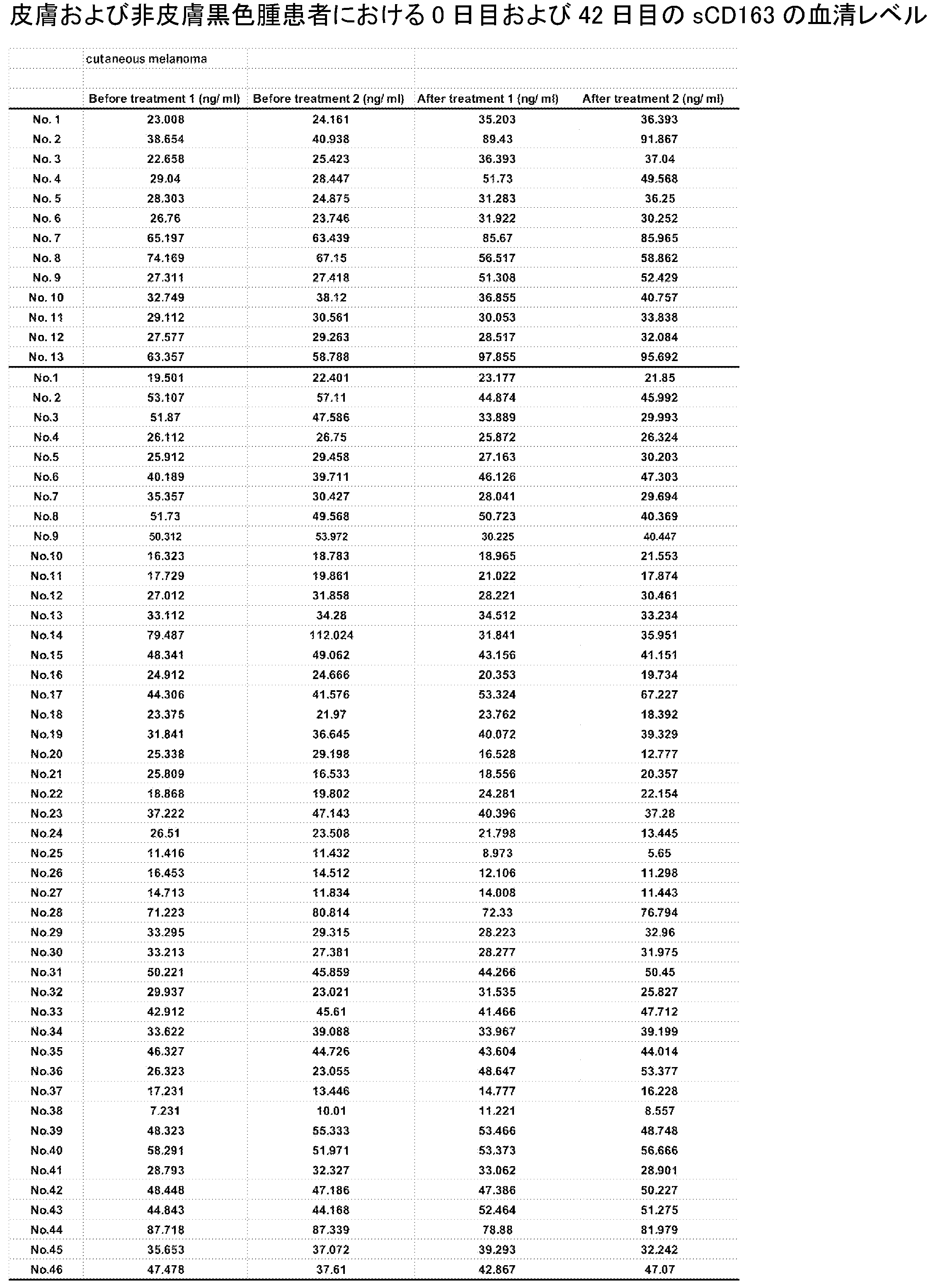
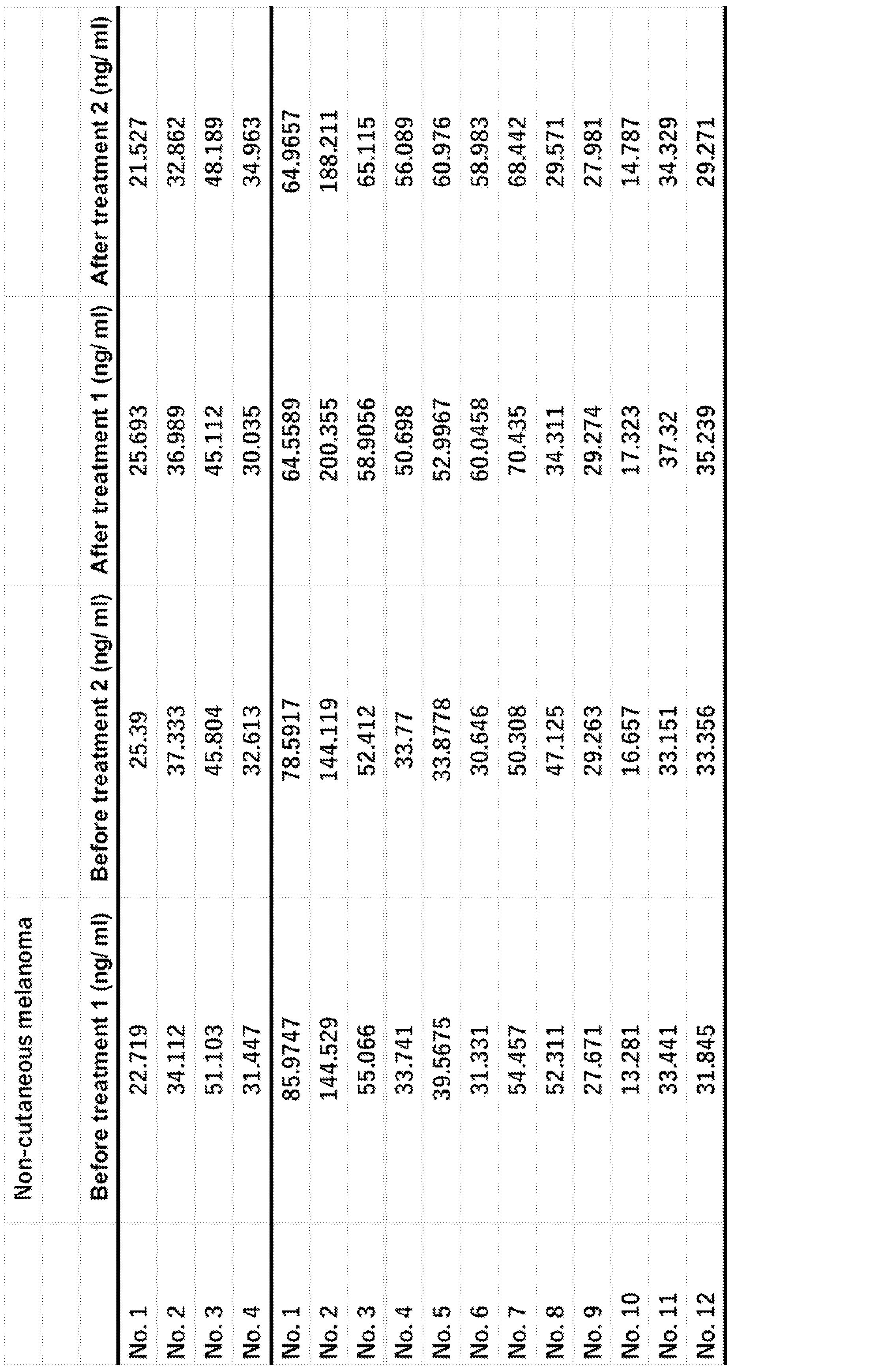
59人の皮膚黒色腫患者(表1)および16人の非皮膚(例えば、消化管、膣、鼻腔)黒色腫患者(表2)を含む、75人のニボルマブ治療を受けた黒色腫患者からデータを収集した。平均患者年齢は、皮膚黒色腫で68.0歳(31~93歳の範囲)、非皮膚黒色腫で66.0歳(54~82歳の範囲)であった。皮膚黒色腫および非皮膚黒色腫の男性患者の割合は、それぞれ57.6%および56.3%であった。最も一般的な原発腫瘍部位は四肢(55.9%)であり、続いて頭頸部(15.3%)、体幹(11.9%)、粘膜起源(8.5%)、および起源不明(8.5%)であった。
<患者>
59人の皮膚黒色腫患者(表1)および16人の非皮膚(例えば、消化管、膣、鼻腔)黒色腫患者(表2)を含む、75人のニボルマブ治療を受けた黒色腫患者からデータを収集した。平均患者年齢は、皮膚黒色腫で68.0歳(31~93歳の範囲)、非皮膚黒色腫で66.0歳(54~82歳の範囲)であった。皮膚黒色腫および非皮膚黒色腫の男性患者の割合は、それぞれ57.6%および56.3%であった。最も一般的な原発腫瘍部位は四肢(55.9%)であり、続いて頭頸部(15.3%)、体幹(11.9%)、粘膜起源(8.5%)、および起源不明(8.5%)であった。

<初回投与後3ヶ月間のニボルマブの有効性>
皮膚黒色腫患者では、完全奏功(CR)が患者1人(1.7%; 95%信頼区間[CI]、0-3.4%)に見られ、部分奏功(PR)が患者12人(20.3%; 95%CI, 0~40.6%)、安定(SD)が患者16人(27.1%; 95%CI、0~54.2%)、進行性疾患(PD)が患者29人(49.2%; 95%CI、0~98.4%)に見られた。よって、初回投与後3ヶ月の奏効率(ORR)は22.0%(95%CI、0~44.0%)であった。個々の患者の腫瘍奏功を表1に示す。粘膜黒色腫を有する患者において、PRは患者4人(25.0%、95%CI、0~50.0%)に見られ、SDは患者5人(31.3%; 95%CI、0-62.6%)、PDは患者7人(43.8%; 95%CI、0-87.6%)に見られた。よって、初回投与後3ヶ月目のORRは25.0%(95%CI、0~50.0%)であった。個々の患者の腫瘍奏功を表2に示す。
皮膚黒色腫患者では、完全奏功(CR)が患者1人(1.7%; 95%信頼区間[CI]、0-3.4%)に見られ、部分奏功(PR)が患者12人(20.3%; 95%CI, 0~40.6%)、安定(SD)が患者16人(27.1%; 95%CI、0~54.2%)、進行性疾患(PD)が患者29人(49.2%; 95%CI、0~98.4%)に見られた。よって、初回投与後3ヶ月の奏効率(ORR)は22.0%(95%CI、0~44.0%)であった。個々の患者の腫瘍奏功を表1に示す。粘膜黒色腫を有する患者において、PRは患者4人(25.0%、95%CI、0~50.0%)に見られ、SDは患者5人(31.3%; 95%CI、0-62.6%)、PDは患者7人(43.8%; 95%CI、0-87.6%)に見られた。よって、初回投与後3ヶ月目のORRは25.0%(95%CI、0~50.0%)であった。個々の患者の腫瘍奏功を表2に示す。
<sCD163の血清レベル>
sCD163の血清中濃度を用いて、ニボルマブを使って治療したメラノーマ患者の早期奏功を判定できるかどうかを決定するために、ニボルマブで治療された進行性メラノーマ患者75人のレベルを評価した。ベースライン(0日目)と比較して、42日目のsCD163の血清レベルは、進行性皮膚黒色腫患者のうち奏功を示す群において有意に増加した(p <0.0001;図1a)が、進行粘膜黒色腫患者では、血清sCD163レベルの有意差は見られなかった。(図3a)。各患者におけるニボルマブの初回投与後3ヶ月における血清sCD163の増加および有効性を前記表1および2に示す。非奏功者と奏功者を区別するため、42日目と0日目との間のsCD163の閾値変化をみたところ、皮膚黒色腫および非皮膚黒色腫において、それぞれ3.07±0.07ng/mLおよび0.47±0.05 ng / mLであった。皮膚メラノーマコホートにおいて、sCD163血清レベルの平均変化率は、無奏功者の101.0%に対し、奏功を示した患者は144.6%であった(表1)。粘膜黒色腫コホートでは、sCD163血清レベルの平均変化率は、奏功を示した患者で84.1%、無奏功者で122.3%であった(表2)。皮膚黒色腫における増加した血清sCD163の閾値は3.07±0.07ng / mLであったが、非皮膚黒色腫における血清sCD163の閾値は0.47±0.05ng / mLであった。皮膚黒色腫における血清sCD163の感度および特異性はそれぞれ84.6%および87.0%であり(p = 0.0030;図1b)、一方、非皮膚黒色腫における血清sCD163の感度および特異性はそれぞれ100%および78.4%であった(p = 0.0507;図3b)。
sCD163の血清中濃度を用いて、ニボルマブを使って治療したメラノーマ患者の早期奏功を判定できるかどうかを決定するために、ニボルマブで治療された進行性メラノーマ患者75人のレベルを評価した。ベースライン(0日目)と比較して、42日目のsCD163の血清レベルは、進行性皮膚黒色腫患者のうち奏功を示す群において有意に増加した(p <0.0001;図1a)が、進行粘膜黒色腫患者では、血清sCD163レベルの有意差は見られなかった。(図3a)。各患者におけるニボルマブの初回投与後3ヶ月における血清sCD163の増加および有効性を前記表1および2に示す。非奏功者と奏功者を区別するため、42日目と0日目との間のsCD163の閾値変化をみたところ、皮膚黒色腫および非皮膚黒色腫において、それぞれ3.07±0.07ng/mLおよび0.47±0.05 ng / mLであった。皮膚メラノーマコホートにおいて、sCD163血清レベルの平均変化率は、無奏功者の101.0%に対し、奏功を示した患者は144.6%であった(表1)。粘膜黒色腫コホートでは、sCD163血清レベルの平均変化率は、奏功を示した患者で84.1%、無奏功者で122.3%であった(表2)。皮膚黒色腫における増加した血清sCD163の閾値は3.07±0.07ng / mLであったが、非皮膚黒色腫における血清sCD163の閾値は0.47±0.05ng / mLであった。皮膚黒色腫における血清sCD163の感度および特異性はそれぞれ84.6%および87.0%であり(p = 0.0030;図1b)、一方、非皮膚黒色腫における血清sCD163の感度および特異性はそれぞれ100%および78.4%であった(p = 0.0507;図3b)。
<考察>
ニボルマブは、他の抗メラノーマ薬(例えばイピリムマブおよびダカルバジン)よりも高い有効性を示し、BRAF / MEK阻害薬(例えばベムラフェニブ、ダブラフェニブ、トラメチニブ)よりも抗腫瘍反応を長期間誘導する。腫瘍専門医は、転移性黒色腫患者の抗腫瘍免疫反応を増強する薬剤とニボルマブの併用に特に興味を持っていた。ニボルマブの有効性は、イピリムマブ(57.7%)と組み合わせると有意に増加するように見えるが、残念ながら、この特定の組み合わせ(59.0%)では、重度の治療関連AEの発生率も有意に増加する。イピリムマブによる重篤な有害事象を回避し、ニボルマブからイピリムマブへの計画的切り替えを準備するためには、判定バイオマーカーを用いて、初回投与後2~3ヵ月後にニボルマブ単独療法の有効性を評価する必要がある。
ニボルマブは、他の抗メラノーマ薬(例えばイピリムマブおよびダカルバジン)よりも高い有効性を示し、BRAF / MEK阻害薬(例えばベムラフェニブ、ダブラフェニブ、トラメチニブ)よりも抗腫瘍反応を長期間誘導する。腫瘍専門医は、転移性黒色腫患者の抗腫瘍免疫反応を増強する薬剤とニボルマブの併用に特に興味を持っていた。ニボルマブの有効性は、イピリムマブ(57.7%)と組み合わせると有意に増加するように見えるが、残念ながら、この特定の組み合わせ(59.0%)では、重度の治療関連AEの発生率も有意に増加する。イピリムマブによる重篤な有害事象を回避し、ニボルマブからイピリムマブへの計画的切り替えを準備するためには、判定バイオマーカーを用いて、初回投与後2~3ヵ月後にニボルマブ単独療法の有効性を評価する必要がある。
CD163は、スカベンジャー受容体のシステインリッチファミリーの一員であり、単球/マクロファージ系譜の細胞でのみ発現する。以前報告されたように、転移性メラノーマでは、かなりの数のCD163 + TAMが転移性メラノーマに存在し、間質性因子により活性化され、タンパク質分解放出の結果としてsCD163の血清レベルの上昇が引き起こされる。さらに、Jensen et al.は、以前に、sCD163およびCD163 + TAMを早期の皮膚黒色腫の予後マーカーとして報告している。特に、Gordonらが報告したように、PD-1発現はM2-分極化としてのTAMを維持する重要な因子であり、PD-1 / PD-L1の遮断はTAMのM1-分極化活性化マクロファージへの変換をもたらす。メラノーマのTAMは、不均一な、主に免疫抑制性の集団を構成するため、また、免疫調節薬によるTAMの活性化サブタイプへのリポラリゼーションは、自然発生のマウスメラノーマモデルにおいてメラノーマ増殖を有意に抑制すると報告されているため、本発明者らは黒色腫におけるニボルマブの標的のひとつがCD163 + TAMを活性化しているという仮説を立てた。
本発明者らの仮説を証明するために、ニボルマブで治療した進行皮膚黒色腫59例および進行粘膜黒色腫16例におけるsCD163の血清レベルを分析した。sCD163の血清レベルは、皮膚メラノーマの非奏功群と比較して、奏功群のニボルマブ初回投与後6週間で有意に増加した。対照的に、非皮膚黒色腫については、ニボルマブ奏功者と非奏功者との間に有意差は見られなかった。興味深いことに、非皮膚黒色腫では、非奏功者におけるsCD163の血清レベルは奏功者における血清レベルよりもさらに高い傾向があった。この矛盾は、各臓器の腫瘍微小環境においてTAMを刺激する可能性がある癌間質の違いによって説明されるかもしれず、そのような研究が今後期待される。
本結果によって、進行性皮膚黒色腫において最初の投与後3ヶ月でニボルマブの有効性を評価するための判定バイオマーカーsCD163が示された。メラノーマがニボルマブに対する耐性を発現する前であれば、イピリムマブとその後のニボルマブの連続投与は進行したメラノーマに対してのみ有効であり、かつ、イピリムマブの投与はニボルマブよりも頻繁にirAEの発症をもたらすので、最初の腫瘍評価前のニボルマブの有効性の判定をすれば、患者がニボルマブからイピリムマブ療法への計画的切り替えにうまく適応するかどうかを決定することができる。本研究は、sCD163が、ニボルマブおよびイピリムマブを使用する抗黒色腫免疫療法から効果が得られる可能性が最も高いこれらの皮膚黒色腫患者の選択のための有用なバイオマーカーであり得ることを示唆した。
[まとめ]
ニボルマブ、ペムブロリズマブ等のPD-1に対する抗体は、進行性黒色腫を含むさまざまな癌の治療に広く使用されている。ニボルマブは転移性黒色腫患者の生存期間を有意に長くし、リピリムマブの連続投与は適切な時期に切り替えると効果を改善できる。したがって、初回投与後すぐにニボルマブの有効性を評価するためにバイオマーカーが必要である。本研究では、ニボルマブを用いて治療した、59例の進行性皮膚黒色腫および16例の進行性粘膜黒色腫における可溶性分化クラスター163(sCD163)の血清レベルを分析した。皮膚メラノーマにニボルマブを初回投与した後の非奏功者と奏功者を比較すると、奏功者では6週間後にsCD163の血清レベルが有意に増加した。これに対し、非皮膚メラノーマ患者では、奏功者と非奏功者との間に有意差は見られなかった。これらの結果は、sCD163が、抗黒色腫免疫療法の効果が表れる可能性が最も高い進行性皮膚黒色腫を有する患者を選別するためのバイオマーカーとして有用であろうことを示唆している。
ニボルマブ、ペムブロリズマブ等のPD-1に対する抗体は、進行性黒色腫を含むさまざまな癌の治療に広く使用されている。ニボルマブは転移性黒色腫患者の生存期間を有意に長くし、リピリムマブの連続投与は適切な時期に切り替えると効果を改善できる。したがって、初回投与後すぐにニボルマブの有効性を評価するためにバイオマーカーが必要である。本研究では、ニボルマブを用いて治療した、59例の進行性皮膚黒色腫および16例の進行性粘膜黒色腫における可溶性分化クラスター163(sCD163)の血清レベルを分析した。皮膚メラノーマにニボルマブを初回投与した後の非奏功者と奏功者を比較すると、奏功者では6週間後にsCD163の血清レベルが有意に増加した。これに対し、非皮膚メラノーマ患者では、奏功者と非奏功者との間に有意差は見られなかった。これらの結果は、sCD163が、抗黒色腫免疫療法の効果が表れる可能性が最も高い進行性皮膚黒色腫を有する患者を選別するためのバイオマーカーとして有用であろうことを示唆している。
Claims (5)
- 対象における免疫チェックポイント阻害薬の治療効果を判定する方法であって、
対象から採取された生体試料におけるsCD163のレベルを測定することを含む方法。 - 対象から採取された生体試料におけるsCD163のレベルが予め設定されたカットオフ値よりも高い場合、前記対象における疾患の治療に当該免疫チェックポイント阻害薬が有効である可能性が高いと判定すること
を含む請求項1に記載の方法。 - sCD163を含む、免疫チェックポイント阻害薬の治療効果を判定するためのバイオマーカー。
- 抗sCD163抗体又はその抗体結合断片を含む、免疫チェックポイント阻害薬の治療効果を判定するための診断薬。
- 抗sCD163抗体又はその抗原結合断片を含む、免疫チェックポイント阻害薬の治療効果の判定用キット。
Priority Applications (1)
| Application Number | Priority Date | Filing Date | Title |
|---|---|---|---|
| JP2020556208A JPWO2020101039A1 (ja) | 2018-11-16 | 2019-11-18 | 血中ケモカインを用いた免疫チェックポイント阻害薬の治療効果判定 |
Applications Claiming Priority (2)
| Application Number | Priority Date | Filing Date | Title |
|---|---|---|---|
| JP2018-215880 | 2018-11-16 | ||
| JP2018215880 | 2018-11-16 |
Publications (1)
| Publication Number | Publication Date |
|---|---|
| WO2020101039A1 true WO2020101039A1 (ja) | 2020-05-22 |
Family
ID=70731448
Family Applications (1)
| Application Number | Title | Priority Date | Filing Date |
|---|---|---|---|
| PCT/JP2019/045124 Ceased WO2020101039A1 (ja) | 2018-11-16 | 2019-11-18 | 血中ケモカインを用いた免疫チェックポイント阻害薬の治療効果判定 |
Country Status (2)
| Country | Link |
|---|---|
| JP (1) | JPWO2020101039A1 (ja) |
| WO (1) | WO2020101039A1 (ja) |
Citations (2)
| Publication number | Priority date | Publication date | Assignee | Title |
|---|---|---|---|---|
| JPH11318448A (ja) * | 1998-05-11 | 1999-11-24 | Amano Pharmaceut Co Ltd | 抗原、抗体およびそれを用いる免疫学的測定方法 |
| WO2018003995A1 (ja) * | 2016-07-01 | 2018-01-04 | 国立大学法人東北大学 | 免疫チェックポイント阻害薬使用における免疫関連副作用の予測方法 |
-
2019
- 2019-11-18 JP JP2020556208A patent/JPWO2020101039A1/ja active Pending
- 2019-11-18 WO PCT/JP2019/045124 patent/WO2020101039A1/ja not_active Ceased
Patent Citations (2)
| Publication number | Priority date | Publication date | Assignee | Title |
|---|---|---|---|---|
| JPH11318448A (ja) * | 1998-05-11 | 1999-11-24 | Amano Pharmaceut Co Ltd | 抗原、抗体およびそれを用いる免疫学的測定方法 |
| WO2018003995A1 (ja) * | 2016-07-01 | 2018-01-04 | 国立大学法人東北大学 | 免疫チェックポイント阻害薬使用における免疫関連副作用の予測方法 |
Non-Patent Citations (2)
| Title |
|---|
| FUJIMURA,TAKU: "19 Serum levels of soluble CD 163 and CXCL5 may be predictive markers for immune-related adverse events in patients with advanced melanoma treated with nivolumab: a pilot study", ONCOTARGET, vol. 9, no. 21, 15 February 2018 (2018-02-15), pages 15542 - 15551, XP055708289 * |
| FUJIMURA,TAKU: "Serum Level of Soluble CD 163 May Be a Predictive Marker of the Effectiveness of Nivolumab in Patients With Advanced Cutaneous Melanoma", FRONT ONCOL, vol. 8, 19 November 2018 (2018-11-19), XP055708290 * |
Also Published As
| Publication number | Publication date |
|---|---|
| JPWO2020101039A1 (ja) | 2021-12-09 |
Similar Documents
| Publication | Publication Date | Title |
|---|---|---|
| US12233077B2 (en) | Therapeutic treatment of breast cancer based on c-MAF status | |
| WO2021164713A1 (zh) | 与肿瘤免疫治疗效果相关的生物标志物及其应用 | |
| Schinagl et al. | Oxidized macrophage migration inhibitory factor is a potential new tissue marker and drug target in cancer | |
| JP7279026B2 (ja) | Napi2b標的化療法に対する応答を予測するための組成物および方法 | |
| ES3043607T3 (en) | Therapeutic treatment of breast cancer based on c-maf status | |
| US20130183303A1 (en) | Blood plasma biomarkers for bevacizumab combination therapies for treatment of breast cancer | |
| JP6910653B2 (ja) | 免疫チェックポイント阻害薬使用における免疫関連副作用の予測方法 | |
| US20130195857A1 (en) | Blood plasma biomarkers for bevacizumab combination therapies for treatment of pancreatic cancer | |
| JP2023527937A5 (ja) | ||
| KR102395580B1 (ko) | 동반진단용 바이오마커 조성물 및 이를 포함하는 동반진단용 키트 | |
| CN110687282A (zh) | PD-1和/或p53自身抗体作为肿瘤疗效预测或预后评估的标志物 | |
| CN101379400A (zh) | 可溶性人m-csf受体及其应用 | |
| WO2020101039A1 (ja) | 血中ケモカインを用いた免疫チェックポイント阻害薬の治療効果判定 | |
| JP7593669B2 (ja) | コンパニオン診断用バイオマーカー組成物およびこれを含むコンパニオン診断用キット | |
| US20230310499A1 (en) | Plasma exchange removal of spd-l1 | |
| WO2020218322A1 (ja) | 血中ケモカインを用いた免疫チェックポイント阻害薬の治療効果予測 | |
| Peng et al. | WNT6 promotes choriocarcinoma progression by driving proliferation, invasion, and metastasis | |
| WO2023190820A1 (ja) | 抗CK2α抗体又はその断片 | |
| WO2023196882A1 (en) | Claudin 18.2 immunohistochemistry assay and use thereof | |
| JP2025537826A (ja) | 抗sirpa抗体についての効力予測バイオマーカー | |
| KR20260019418A (ko) | 암 치료 반응성의 지표 바이오마커로서의 혈장 tctp | |
| CN116940844A (zh) | 新颖生物标志物及其用途 | |
| JP2021056045A (ja) | 新規大腸がんマーカー及び可溶型ox40を標的とする新規大腸がん治療薬 | |
| AU2018200938A1 (en) | Use Of Human Papillomavirus Status In Establishing Use Of An Agent That Binds EGFR In The Treatment Of Cancer | |
| CN103558391A (zh) | 可溶性人m-csf受体及其应用 |
Legal Events
| Date | Code | Title | Description |
|---|---|---|---|
| 121 | Ep: the epo has been informed by wipo that ep was designated in this application |
Ref document number: 19886006 Country of ref document: EP Kind code of ref document: A1 |
|
| DPE1 | Request for preliminary examination filed after expiration of 19th month from priority date (pct application filed from 20040101) | ||
| ENP | Entry into the national phase |
Ref document number: 2020556208 Country of ref document: JP Kind code of ref document: A |
|
| NENP | Non-entry into the national phase |
Ref country code: DE |
|
| 122 | Ep: pct application non-entry in european phase |
Ref document number: 19886006 Country of ref document: EP Kind code of ref document: A1 |