WO2020045581A1 - 表面麻酔剤 - Google Patents
表面麻酔剤 Download PDFInfo
- Publication number
- WO2020045581A1 WO2020045581A1 PCT/JP2019/033959 JP2019033959W WO2020045581A1 WO 2020045581 A1 WO2020045581 A1 WO 2020045581A1 JP 2019033959 W JP2019033959 W JP 2019033959W WO 2020045581 A1 WO2020045581 A1 WO 2020045581A1
- Authority
- WO
- WIPO (PCT)
- Prior art keywords
- anesthetic
- surface anesthetic
- pain
- minutes
- lidocaine
- Prior art date
- Legal status (The legal status is an assumption and is not a legal conclusion. Google has not performed a legal analysis and makes no representation as to the accuracy of the status listed.)
- Ceased
Links
Images




Classifications
-
- A—HUMAN NECESSITIES
- A61—MEDICAL OR VETERINARY SCIENCE; HYGIENE
- A61K—PREPARATIONS FOR MEDICAL, DENTAL OR TOILETRY PURPOSES
- A61K31/00—Medicinal preparations containing organic active ingredients
- A61K31/045—Hydroxy compounds, e.g. alcohols; Salts thereof, e.g. alcoholates
-
- A—HUMAN NECESSITIES
- A61—MEDICAL OR VETERINARY SCIENCE; HYGIENE
- A61K—PREPARATIONS FOR MEDICAL, DENTAL OR TOILETRY PURPOSES
- A61K31/00—Medicinal preparations containing organic active ingredients
- A61K31/16—Amides, e.g. hydroxamic acids
- A61K31/165—Amides, e.g. hydroxamic acids having aromatic rings, e.g. colchicine, atenolol, progabide
- A61K31/167—Amides, e.g. hydroxamic acids having aromatic rings, e.g. colchicine, atenolol, progabide having the nitrogen of a carboxamide group directly attached to the aromatic ring, e.g. lidocaine, paracetamol
-
- A—HUMAN NECESSITIES
- A61—MEDICAL OR VETERINARY SCIENCE; HYGIENE
- A61K—PREPARATIONS FOR MEDICAL, DENTAL OR TOILETRY PURPOSES
- A61K47/00—Medicinal preparations characterised by the non-active ingredients used, e.g. carriers or inert additives; Targeting or modifying agents chemically bound to the active ingredient
- A61K47/06—Organic compounds, e.g. natural or synthetic hydrocarbons, polyolefins, mineral oil, petrolatum or ozokerite
- A61K47/08—Organic compounds, e.g. natural or synthetic hydrocarbons, polyolefins, mineral oil, petrolatum or ozokerite containing oxygen, e.g. ethers, acetals, ketones, quinones, aldehydes, peroxides
- A61K47/10—Alcohols; Phenols; Salts thereof, e.g. glycerol; Polyethylene glycols [PEG]; Poloxamers; PEG/POE alkyl ethers
-
- A—HUMAN NECESSITIES
- A61—MEDICAL OR VETERINARY SCIENCE; HYGIENE
- A61P—SPECIFIC THERAPEUTIC ACTIVITY OF CHEMICAL COMPOUNDS OR MEDICINAL PREPARATIONS
- A61P23/00—Anaesthetics
-
- A—HUMAN NECESSITIES
- A61—MEDICAL OR VETERINARY SCIENCE; HYGIENE
- A61P—SPECIFIC THERAPEUTIC ACTIVITY OF CHEMICAL COMPOUNDS OR MEDICINAL PREPARATIONS
- A61P23/00—Anaesthetics
- A61P23/02—Local anaesthetics
-
- A—HUMAN NECESSITIES
- A61—MEDICAL OR VETERINARY SCIENCE; HYGIENE
- A61P—SPECIFIC THERAPEUTIC ACTIVITY OF CHEMICAL COMPOUNDS OR MEDICINAL PREPARATIONS
- A61P43/00—Drugs for specific purposes, not provided for in groups A61P1/00-A61P41/00
Definitions
- the present invention relates to a surface anesthetic used for a surgical treatment in, for example, dental treatment or surgical treatment.
- Anesthesia injections are performed almost every day in dental treatment and surgical treatment. Similarly, the number of injections to the skin for blood collection and the like is extremely large, and although there are individual differences, injection pain is painful. Injections given to patients who are sensitive to pain (dental phobias, infants, etc.) are often difficult, so local surface anesthesia may be given before injection.
- Prones Pasta is commercially available.
- This pronespasta contains three types of anesthetic components, ethyl aminobenzoate, tetracaine hydrochloride and dibucaine hydrochloride, and is one of the local surface anesthetics with strong action and long duration, and its pain suppression. It has been reported that the duration of the effect (pain-relieving effect) is 9 minutes and 49 seconds on average (for example, see Non-Patent Document 1).
- analgesic effect is higher than the duration of the analgesic effect.
- topical anesthetics for application such as penless tape and lidocaine tape are frequently used on the skin during dialysis, it takes about 1 to 2 hours to reduce the pain of the needle. It is poor in immediate effect, such as need, and its pain relieving effect is not at a level that does not cause pain at the time of puncture, and is not satisfactory. Furthermore, there is a drawback that the skin is soaked due to frequent use and it is difficult to see blood vessels when a needle is inserted, but in reality it is used because there is no other excellent option.
- An object of the present invention is to provide a surface anesthetic which has a high analgesic effect.
- the present inventors have conducted intensive studies to obtain a high analgesic effect of a surface anesthetic required in the field, and obtained a high analgesic effect by applying an anesthetic component to a skin or the like together with a terpenoid such as geraniol. And found that the present invention was completed.
- an anesthetic component to the skin or the like together with a terpenoid such as geraniol, it is possible to obtain excellent immediate action and / or excellent persistence in addition to a high analgesic effect.
- the present invention is as follows.
- [4] The surface anesthetic according to any one of [1] to [3], wherein the terpenoid is geraniol.
- the surface anesthetic of the present invention has a high analgesic effect.
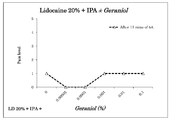
- FIG. 1 It is a figure which shows the degree of the pain of the blunt needle with respect to time progress after surface anesthetic application, and compared the surface anesthetic (LD20% + IPA / GL) which concerns on an Example with the surface anesthetic (LD20%) which concerns on a comparative example.
- FIG. 1 LD represents lidocaine
- IPA represents isopropyl alcohol
- GL represents geraniol.
- FIG. 1 shows the degree of pain of the blunt needle with respect to time progress after application of a surface anesthetic, and compares the surface anesthetic (LD20% + IPA / GL) according to an example with the surface anesthetic (LD20% + IPA) according to a comparative example.
- the surface anesthetic of the present invention is characterized by containing an anesthetic component and a terpenoid.
- the surface anesthetic of the present invention has a high analgesic effect. For example, by applying before the insertion of a needle, it can make the blunt needle painless. Therefore, it is particularly effective for patients who are sensitive to pain.
- the surface anesthetic of the present invention is excellent in immediate effect, and can be painless for a blunt needle within, for example, 10 minutes (8 minutes in Example 1). Therefore, chair time can be reduced (treatment time can be reduced). Furthermore, the duration of the effect is long, for example, the painless time lasts 2 minutes or more, preferably 5 minutes or more (5 minutes in Example 1). Therefore, the present invention is effective in a case where a plurality of patients are examined in parallel at a dental clinic or the like, or where it is not possible to immediately start treatment of a patient who has been subjected to surface anesthesia.
- the surface anesthetic of the present invention can be used, for example, in dental, ophthalmic, otolaryngology, internal medicine, surgery, urology, dermatology, anesthesiology, pediatrics, obstetrics and gynecology, orthopedic surgery, and other surgical procedures such as during examinations.
- the surgical treatment refers to, for example, a treatment such as incision, resection, cutting, suturing, piercing, injection, introduction of an instrument, or the like on skin, oral tissue, nasal tissue, dental hard tissue, and the like.
- injection refers to the entire process using an injection needle (including a drip needle, an indwelling needle, a dialysis needle, and the like). Specifically, it can be used for the purpose of reducing the pain at the time of needle insertion prior to infiltration anesthesia or injection anesthesia by injection when performing surgery or the like. In addition, it can be used for the purpose of reducing pain at the time of needle insertion in blood collection, infusion, vaccination, and dialysis.
- the contact site skin, mucous membrane
- an endoscopic device such as an endoscope, a colon fiber, a nasal tube, etc.
- Examples of the application method (application method) of the surface anesthetic of the present invention include application, sticking, and spraying.
- the anesthetic component is not particularly limited as long as it can be used as an anesthetic component of a surface anesthetic applied to skin and mucous membranes.
- any local anesthetic such as an amide type or an ester type (surface anesthetic) Can also be used, and two or more kinds may be used.
- Examples of the amide-type local anesthetic include lidocaine, mepivacaine, and dibucaine.
- Examples of the ester-type local anesthetic include tetracaine, benzocaine, ethyl aminobenzoate, and cocaine. These may be salts such as hydrochloride, and in the present specification, for example, lidocaine includes lidocaine hydrochloride.
- These local anesthetics are commercially available, and commercially available products can be used. Among them, lidocaine, which is a typical anesthetic component of a surface anesthetic, is preferable.
- the ⁇ terpenoid is known as a fragrance component or a refreshing component, but in the present invention, it is a component that enhances the analgesic effect of the anesthetic component, and further improves the immediate effect and / or sustainability of the effect.
- the terpenoids are preferably oily at normal temperature, and include, for example, geraniol, menthone, limonene, anethole, nerol, myrcenol, linalool, lavandulol, cineole, pinene, terpinolene, among which geraniol is preferred. . Two or more of these terpenoids may be used.
- the surface anesthetic of the present invention preferably contains one or more solvents.
- the solvent include alcohols such as ethanol and isopropyl alcohol, and isopropyl alcohol is preferable.
- isopropyl alcohol By containing isopropyl alcohol, the compatibility between the anesthetic component and the terpenoid is further increased, and the effects of the present invention can be more effectively exerted.
- Isopropyl alcohol is a substance used as a disinfectant as a drug, and a commercially available product may be used.
- the content of the anesthetic component in the surface anesthetic of the present invention is not particularly limited as long as the effect as a surface anesthetic can be exerted.
- the content is preferably 0.5 to 70% by mass, more preferably 1 to 60% by mass, and particularly preferably 5 to 50% by mass.
- the content of the terpenoid in the surface anesthetic of the present invention is not particularly limited as long as it can enhance the analgesic effect of the local anesthetic.
- 0.000001 to 2 in the surface anesthetic % Preferably 0.000005 to 1% by mass, more preferably 0.000008 to 0.5% by mass, and particularly preferably 0.00001 to 0.2% by mass. .
- the surface anesthetic of the present invention may contain a conventionally known additive.
- additives include, for example, antioxidants, storage stabilizers, thickeners, fragrances and the like.
- Example 1 Lidocaine previously dissolved in a very small amount of ethanol, isopropyl alcohol, and geraniol were mixed by vortexing at room temperature to obtain a surface anesthetic (LD20% + IPA / GL) according to the example having a lidocaine concentration of 20% by mass. .
- the content of geraniol in the surface anesthetic was 0.0001% by mass.
- lidocaine was dissolved in ethanol by vortexing at room temperature to obtain a surface anesthetic (LD 20%) according to a comparative example having a lidocaine concentration of 20% by mass.
- LD 20% surface anesthetic
- IPA surface anesthetic
- FIG. 1 is a diagram comparing the surface anesthetic (LD20% + IPA / GL) according to the example and the surface anesthetic (LD20%) according to the comparative example
- FIG. 2 is a diagram illustrating the surface anesthetic (LD20) according to the example. % + IPA / GL) and a surface anesthetic (LD 20% + IPA) according to a comparative example.
- the horizontal axis in the figure is the elapsed time (minutes) after application, and the vertical axis is the pain level (Pain level). It should be noted that the pain level 5 on the vertical axis represents moderate pain, and the pain level 0 represents no pain.
- the surface anesthetic (LD20% + IPA / GL) according to the example reached a pain level of 3 or less, which is considered to be a general effect of lidocaine, 2 minutes after application, and furthermore, Painless 8 minutes after application, painless state continued for 5 minutes.
- the surface anesthetic (LD 20%) according to the comparative example required 3 minutes after application to reach a pain level of 3 or less. Pain level 0 painlessness did not occur, and pain level 3 or lower pain relief effect lasted only for 16 minutes after application.
- the surface anesthetic (LD 20% + IPA) according to the comparative example reached Pain level 3 or less 2 minutes after application, and became painless 9 minutes after application, but was in a painless state. Did not last. Further, the pain relieving effect at a pain level of 3 or less was 29 minutes after application.
- the surface anesthetics according to the examples had a higher analgesic effect and were superior in terms of immediate action and sustainability as compared with the surface anesthetics according to the comparative examples.
- Example 2 A surface anesthetic (LD20% + IPA / GL) according to the example was prepared in the same manner as in Example 1, except that the content of geraniol (0.00001 to 0.1% by mass) was changed. In addition, a surface anesthetic (LD20% + IPA) according to a comparative example not containing geraniol was also prepared.
- Example 3 The degree of pain of the blunt needle 13 minutes after the application of the surface anesthetic was evaluated in the same manner as in Example 2, except that the anesthetic component lidocaine was changed to tetracaine.
- Example 4 A surface anesthetic (LD + IPA / GL) according to the example was prepared in the same manner as in Example 1, except that the content (1 to 30% by mass) of lidocaine as an anesthetic component was changed. Further, in the same manner as in Example 1, a surface anesthetic (LD) according to a comparative example in which lidocaine was dissolved in ethanol was prepared.
- LD surface anesthetic
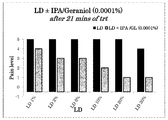
- FIGS. 6 shows the result after a lapse of 8 minutes
- FIG. 7 shows the result after a lapse of 13 minutes
- FIG. 8 shows the result after a lapse of 21 minutes.
- the surface anesthetic LD + IPA / GL
- the pain level of the surface anesthetic according to the example was significantly lower than that of the comparative example in which isopropyl alcohol and geraniol were not used at all concentrations and elapsed times.
- the surface anesthetic of the present invention has a high analgesic effect and is industrially useful.
Landscapes
- Health & Medical Sciences (AREA)
- Chemical & Material Sciences (AREA)
- Pharmacology & Pharmacy (AREA)
- Veterinary Medicine (AREA)
- Public Health (AREA)
- General Health & Medical Sciences (AREA)
- Medicinal Chemistry (AREA)
- Animal Behavior & Ethology (AREA)
- Life Sciences & Earth Sciences (AREA)
- General Chemical & Material Sciences (AREA)
- Chemical Kinetics & Catalysis (AREA)
- Organic Chemistry (AREA)
- Nuclear Medicine, Radiotherapy & Molecular Imaging (AREA)
- Anesthesiology (AREA)
- Epidemiology (AREA)
- Engineering & Computer Science (AREA)
- Bioinformatics & Cheminformatics (AREA)
- Pain & Pain Management (AREA)
- Oil, Petroleum & Natural Gas (AREA)
- Medicinal Preparation (AREA)
- Acyclic And Carbocyclic Compounds In Medicinal Compositions (AREA)
Abstract
【課題】除痛効果の高い表面麻酔剤を提供すること。 【解決手段】リドカインと、イソプロピルアルコールと、ゲラニオールとを含む表面麻酔剤であり、ゲラニオールが、表面麻酔剤中、0.000001~2質量%含まれる。
Description
本発明は、例えば、歯科治療や外科治療等における外科的処置に用いられる表面麻酔剤に関する。
歯科治療や外科治療ではほぼ毎日麻酔注射が行われているが、これと同様に、採血等で皮膚へ注射を行う回数も非常に多く、個人差はあれ、注射の痛みは辛いものである。痛みに感受性の高い患者(歯科恐怖症や幼児など)に対して行う注射は、困難を来すことが多いことから、注射前に、局所的な表面麻酔が行われることがある。
歯科用局所表面麻酔剤としては、例えば、プロネスパスタが市販されている。このプロネスパスタは、アミノ安息香酸エチル、塩酸テトラカイン及び塩酸ジブカインの3種類の麻酔成分が配合されており、作用が強く持続時間が長い局所表面麻酔剤の一つであって、その疼痛抑制効果(除痛効果)の持続時間は平均9分49秒と報告されている(例えば、非特許文献1参照)。
しかしながら、臨床上は、除痛効果の持続時間が長いことよりも、除痛効果が高いことが重要である。
一方、皮膚に対しては、ペンレステープやリドカインテープ等の貼付用局所表面麻酔剤が、透析時に頻用されているものの、針の痛みを軽減させるためには1時間から2時間程度の貼付時間を要するなど即効性に乏しく、また、その除痛効果も刺入時の痛みを感じさせないレベルではなく、満足できるものではない。さらに、頻回使用により皮膚がただれ、針の刺入時に血管が見えづらいという欠点もあるが、他の優れた選択肢がないために使用されているというのが実状である。
前田勝正,濱地貴文,赤峰昭文,原宜興,岩本恭行,北村哲朗,戸田佳子,米田雅裕,大石正道,笹栗正明,青野正男.プロネスパスタの局所塗布に関する麻酔効果と抗菌作用について,刃薬療法7(1),45-49,1988
本発明の課題は、除痛効果の高い表面麻酔剤を提供することにある。
本発明者らは、現場において求められる表面麻酔剤の高い除痛効果を得るべく鋭意研究した結果、麻酔成分を、ゲラニオール等のテルペノイドと共に皮膚等に適用することにより、高い除痛効果を得ることができることを見出し、本発明を完成するに至った。
また、本発明者らは、麻酔成分をゲラニオール等のテルペノイドと共に皮膚等に適用することにより、高い除痛効果に加えて、優れた即効性及び/又は優れた持続性を得ることができることを見いだした。
すなわち、本発明は、以下のとおりのものである。
[1]麻酔成分とテルペノイドとを含むことを特徴とする表面麻酔剤。
[2]さらに、イソプロピルアルコールを含むことを特徴とする上記[1]記載の表面麻酔剤。
[3]テルペノイドが、表面麻酔剤中、0.000001~2質量%含まれることを特徴とする上記[1]又は[2]記載の表面麻酔剤。
[4]テルペノイドが、ゲラニオールであることを特徴とする上記[1]~[3]のいずれか記載の表面麻酔剤。
[5]皮膚又は粘膜に適用されることを特徴とする上記[1]~[4]のいずれか記載の表面麻酔剤。
[6]口腔内組織への外科的処置に用いられることを特徴とする上記[1]~[5]のいずれか記載の表面麻酔剤。
[7]皮膚への外科的処置に用いられることを特徴とする上記[1]~[5]のいずれか記載の表面麻酔剤。
[8]口腔内組織への注射前に用いられることを特徴とする上記[6]記載の表面麻酔剤。
[9]皮膚への注射前に用いられることを特徴とする上記[7]記載の表面麻酔剤。
[1]麻酔成分とテルペノイドとを含むことを特徴とする表面麻酔剤。
[2]さらに、イソプロピルアルコールを含むことを特徴とする上記[1]記載の表面麻酔剤。
[3]テルペノイドが、表面麻酔剤中、0.000001~2質量%含まれることを特徴とする上記[1]又は[2]記載の表面麻酔剤。
[4]テルペノイドが、ゲラニオールであることを特徴とする上記[1]~[3]のいずれか記載の表面麻酔剤。
[5]皮膚又は粘膜に適用されることを特徴とする上記[1]~[4]のいずれか記載の表面麻酔剤。
[6]口腔内組織への外科的処置に用いられることを特徴とする上記[1]~[5]のいずれか記載の表面麻酔剤。
[7]皮膚への外科的処置に用いられることを特徴とする上記[1]~[5]のいずれか記載の表面麻酔剤。
[8]口腔内組織への注射前に用いられることを特徴とする上記[6]記載の表面麻酔剤。
[9]皮膚への注射前に用いられることを特徴とする上記[7]記載の表面麻酔剤。
本発明の表面麻酔剤は、高い除痛効果を有する。
本発明の表面麻酔剤としては、麻酔成分とテルペノイドとを含むことを特徴とする。
本発明の表面麻酔剤は、除痛効果が高く、例えば、針の刺入前に適用することにより、鈍針に対して無痛状態とすることができる。したがって、痛みに感受性の高い患者に対して特に有効である。
本発明の表面麻酔剤は、除痛効果が高く、例えば、針の刺入前に適用することにより、鈍針に対して無痛状態とすることができる。したがって、痛みに感受性の高い患者に対して特に有効である。
また、本発明の表面麻酔剤は、即効性に優れており、例えば、10分以内(実施例1では8分)で鈍針に対して無痛状態とすることができる。したがって、チェアータイムの短縮(治療時間の短縮)を図ることができる。さらに、その効果の持続時間も長く、例えば、無痛時間が2分以上、好ましくは5分以上持続する(実施例1では5分)。したがって、歯科医院等において、複数の患者を並行して診ている場合など、すぐに表面麻酔を施した患者の治療に取り掛かれない場合などに有効である。
本発明の表面麻酔剤は、例えば、歯科、眼科、耳鼻科、内科、外科、泌尿器科、皮膚科、麻酔科、小児科、産婦人科、整形外科等における治療、検査時などの外科的処置に用いることができる。外科的処置とは、例えば、皮膚、口腔内組織、鼻腔内組織、歯牙硬組織等に対する、切開、切除、切削、縫合、刺入、注射、器具の導入などの処置をいう。
好ましくは、注射前に、注射部位(皮膚、粘膜)に適用することができる。なお、注射とは、注射針(点滴針、留置針、透析用針等を含む)を用いた処理全般をいう。具体的には、手術等を行う場合の注射による浸潤麻酔や伝達麻酔に先立って針挿入時の痛みを軽減させる目的で用いることができる。その他、採血、点滴、予防接種、透析を行う場合の針挿入時の痛みを軽減する目的で用いることができる。
また、内視鏡、大腸ファイバー、経鼻チューブ等の体内導入器具の使用前に、使用時の痛みを軽減する目的で、接触部位(皮膚、粘膜)に適用することができる。
本発明の表面麻酔剤の適用方法(付与用法)としては、例えば、塗布、貼付、スプレー(噴霧)等を挙げることができる。
麻酔成分としては、皮膚や粘膜に適用する表面麻酔剤の麻酔成分として使用できるものであれば特に制限されるものではなく、例えば、アミド型、エステル型などいずれの局所麻酔薬(表面麻酔薬)も使用することができ、2種以上を用いてもよい。
アミド型の局所麻酔薬としては、例えば、リドカイン、メピバカイン,ジブカインを挙げることができる。エステル型の局所麻酔薬としては、例えば、テトラカイン、ベンゾカイン、アミノ安息香酸エチル、コカインを挙げることができる。これらは、塩酸塩等の塩であってもよく、本明細書において、例えばリドカインと称した場合は、リドカイン塩酸塩等を含む。これらの局所麻酔薬は市販されており、市販品を用いることができる。これらの中でも、表面麻酔剤の麻酔成分として代表的なリドカインが好適である。
テルペノイドは、香料成分や清涼成分として知られているが、本発明においては、麻酔成分の除痛効果を高め、さらにその効果の即効性及び/又は持続性を向上させる成分である。
テルペノイドとしては、常温で油状のものが好ましく、例えば、ゲラニオール、メントン、リモネン、アネトール、ネロール、ミルセノール、リナロール、ラバンジュロール、シネオール、ピネン、テルピノレンを挙げることができ、これらの中でも、ゲラニオールが好ましい。これらのテルペノイドは、2種以上用いてもよい。
本発明の表面麻酔剤は、1種又は2種以上の溶剤を含むことが好ましい。溶剤としては、例えば、エタノール、イソプロピルアルコール等のアルコールを挙げることができ、イソプロピルアルコールが好ましい。イソプロピルアルコールを含むことにより、麻酔成分及びテルペノイドの相溶性がより高くなり、本発明の効果をより有効に発揮することができる。イソプロピルアルコールは、医薬品としては消毒剤として使用されている物質であり、市販品を用いてもよい。
本発明の表面麻酔剤における麻酔成分の含有量としては、表面麻酔剤としての効果を発揮できる量であれば特に制限されるものではなく、例えば、表面麻酔剤中、0.1質量%以上であり、0.5~70質量%であることが好ましく、1~60質量%であることがさらに好ましく、5~50質量%であることが特に好ましい。
本発明の表面麻酔剤におけるテルペノイドの含有量としては、局所麻酔剤の除痛効果を高めることができる量であれば特に制限されるものではなく、例えば、表面麻酔剤中、0.000001~2質量%程度であり、0.000005~1質量%であることが好ましく、0.000008~0.5質量%であることがさらに好ましく、0.00001~0.2質量%であることが特に好ましい。
本発明の表面麻酔剤は、従来公知の添加剤を含んでいてもよい。かかる添加剤としては、例えば、酸化防止剤、保存安定剤、増粘剤、香料等を挙げることができる。
以下、本発明を実施例に基づき詳細に説明する。
[実施例1]
室温にてボルテックスにより、予めごく少量のエタノールに溶解したリドカインと、イソプロピルアルコールと、ゲラニオールとを混合し、リドカイン濃度20質量%の実施例に係る表面麻酔剤(LD20%+IPA/GL)を得た。なお、表面麻酔剤中のゲラニオールの含有量は0.0001質量%とした。
[実施例1]
室温にてボルテックスにより、予めごく少量のエタノールに溶解したリドカインと、イソプロピルアルコールと、ゲラニオールとを混合し、リドカイン濃度20質量%の実施例に係る表面麻酔剤(LD20%+IPA/GL)を得た。なお、表面麻酔剤中のゲラニオールの含有量は0.0001質量%とした。
比較として、室温にてボルテックスにより、リドカインをエタノールに溶解させ、リドカイン濃度20質量%の比較例に係る表面麻酔剤(LD20%)を得た。また、同様に、予めごく少量のエタノールに溶解したリドカインとイソプロピルアルコールとを混合し、リドカイン濃度20質量%の比較例に係る表面麻酔剤(LD20%+IPA)を得た。
調製した各表面麻酔剤を前腕部皮膚へ塗布し、所定時間経過後に、鈍針の痛みの程度について評価した。
その結果を図1及び図2に示す。図1は、実施例に係る表面麻酔剤(LD20%+IPA/GL)及び比較例に係る表面麻酔剤(LD20%)を比較した図であり、図2は、実施例に係る表面麻酔剤(LD20%+IPA/GL)及び比較例に係る表面麻酔剤(LD20%+IPA)を比較した図である。図の横軸は塗布後の経過時間(分)であり、縦軸は痛みのレベル(ペインレベル)を表す。なお、縦軸のペインレベル5は中等度の痛みを表し、ペインレベル0は痛みなしを表す。
図1及び図2に示すように、実施例に係る表面麻酔剤(LD20%+IPA/GL)では、リドカインの一般的な効果と考えられるペインレベル3以下に塗布後2分で到達し、さらに、塗布後8分で無痛となり、5分間の無痛状態が継続した。また、リドカインの一般的な効果と考えられるペインレベル3以下の除痛効果は、塗布後30分間持続した。
他方、図1に示すように、比較例に係る表面麻酔剤(LD20%)では、ペインレベル3以下に到達するのに塗布後3分を要した。また、ペインレベル0の無痛には至らず、ペインレベル3以下の除痛効果は、塗布後16分間しか持続しなかった。
また、図2に示すように、比較例に係る表面麻酔剤(LD20%+IPA)では、ペインレベル3以下に塗布後2分で到達し、さらに塗布後9分で無痛になったものの、無痛状態は持続しなかった。さらに、ペインレベル3以下の除痛効果は、塗布後29分であった。
以上のとおり、実施例に係る表面麻酔剤は、比較例に係る表面麻酔剤と比較して、除痛効果が高く、即効性、持続性の点でも優れていた。
[実施例2]
ゲラニオールの含有量(0.00001~0.1質量%)を変化させる以外は実施例1と同様にして、実施例に係る表面麻酔剤(LD20%+IPA/GL)を調製した。なお、ゲラニオールを配合しない比較例に係る表面麻酔剤(LD20%+IPA)も調製した。
ゲラニオールの含有量(0.00001~0.1質量%)を変化させる以外は実施例1と同様にして、実施例に係る表面麻酔剤(LD20%+IPA/GL)を調製した。なお、ゲラニオールを配合しない比較例に係る表面麻酔剤(LD20%+IPA)も調製した。
調製した各表面麻酔剤を前腕部皮膚へ塗布し、8分又は13分経過後に、実施例1と同様に、鈍針の痛みの程度について評価した。
その結果を図3及び図4に示す。図3及び図4に示すように、ゲラニオールを所定量配合することにより、ペインレベルの低下がみられた。
[実施例3]
実施例2において、麻酔成分であるリドカインをテトラカインに変更した以外は、同様にして、表面麻酔剤塗布後13分経過後の鈍針の痛みの程度について評価した。
実施例2において、麻酔成分であるリドカインをテトラカインに変更した以外は、同様にして、表面麻酔剤塗布後13分経過後の鈍針の痛みの程度について評価した。
その結果を図5に示す。図5に示すように、ゲラニオールを所定量配合することにより、テトラカインにおいても、ペインレベルの低下がみられた。
[実施例4]
麻酔成分であるリドカインの含有量(1~30質量%)を変化させる以外は実施例1と同様にして、実施例に係る表面麻酔剤(LD+IPA/GL)を調製した。また、実施例1と同様にして、リドカインをエタノールに溶解した比較例に係る表面麻酔剤(LD)を調製した。
麻酔成分であるリドカインの含有量(1~30質量%)を変化させる以外は実施例1と同様にして、実施例に係る表面麻酔剤(LD+IPA/GL)を調製した。また、実施例1と同様にして、リドカインをエタノールに溶解した比較例に係る表面麻酔剤(LD)を調製した。
調製した各表面麻酔剤を前腕部皮膚へ塗布し、8分、13分、21分経過後に、実施例1と同様に、鈍針の痛みの程度について評価した。
その結果を図6~図8に示す。図6は8分経過後の結果を表し、図7は13分経過後の結果を表し、図8は21分経過後の結果を表す。実施例に係る表面麻酔剤(LD+IPA/GL)は、麻酔成分であるリドカインの量を増加するにしたがって、ペインレベルが低下する傾向がみられた。また、実施例に係る表面麻酔剤は、いずれの濃度及び経過時間においても、イソプロピルアルコール及びゲラニオールを用いない比較例の表面麻酔剤と比べて、ペインレベルが顕著に低下していた。
本発明の表面麻酔剤は、除痛効果が高く、産業上有用である。
Claims (7)
- 麻酔成分とテルペノイドとを含むことを特徴とする表面麻酔剤。
- さらに、イソプロピルアルコールを含むことを特徴とする請求項1記載の表面麻酔剤。
- テルペノイドが、0.000001~2質量%含まれることを特徴とする請求項1又は2記載の表面麻酔剤。
- テルペノイドが、ゲラニオールであることを特徴とする請求項1~3のいずれか記載の表面麻酔剤。
- 皮膚又は粘膜に適用されることを特徴とする請求項1~4のいずれか記載の表面麻酔剤。
- 口腔内組織への外科的処置に用いられることを特徴とする請求項1~5のいずれか記載の表面麻酔剤。
- 皮膚への外科的処置に用いられることを特徴とする請求項1~5のいずれか記載の表面麻酔剤。
Applications Claiming Priority (2)
| Application Number | Priority Date | Filing Date | Title |
|---|---|---|---|
| JP2018-162980 | 2018-08-31 | ||
| JP2018162980A JP7169633B2 (ja) | 2018-08-31 | 2018-08-31 | 表面麻酔剤 |
Publications (1)
| Publication Number | Publication Date |
|---|---|
| WO2020045581A1 true WO2020045581A1 (ja) | 2020-03-05 |
Family
ID=69643604
Family Applications (1)
| Application Number | Title | Priority Date | Filing Date |
|---|---|---|---|
| PCT/JP2019/033959 Ceased WO2020045581A1 (ja) | 2018-08-31 | 2019-08-29 | 表面麻酔剤 |
Country Status (2)
| Country | Link |
|---|---|
| JP (1) | JP7169633B2 (ja) |
| WO (1) | WO2020045581A1 (ja) |
Citations (1)
| Publication number | Priority date | Publication date | Assignee | Title |
|---|---|---|---|---|
| JP2001512415A (ja) * | 1997-05-20 | 2001-08-21 | ジェイ. カルドウェル,ラリー | 局所的局所麻酔薬組成物を用いる頭痛の痛みを処置するための方法 |
-
2018
- 2018-08-31 JP JP2018162980A patent/JP7169633B2/ja active Active
-
2019
- 2019-08-29 WO PCT/JP2019/033959 patent/WO2020045581A1/ja not_active Ceased
Patent Citations (1)
| Publication number | Priority date | Publication date | Assignee | Title |
|---|---|---|---|---|
| JP2001512415A (ja) * | 1997-05-20 | 2001-08-21 | ジェイ. カルドウェル,ラリー | 局所的局所麻酔薬組成物を用いる頭痛の痛みを処置するための方法 |
Non-Patent Citations (5)
| Title |
|---|
| CASTRO, E. ET AL.: "A comparison of transdermal over-the-counter lidocaine 3.6% menthol 1.25%, Rx lidocaine 5% and placebo for back pain and arthritis", PAIN MANAGEMENT, vol. 7, no. 6, 14 August 2017 (2017-08-14) - November 2017 (2017-11-01), pages 489 - 498, ISSN: 1758-1869 * |
| GODWIN, D. A. ET AL.: "Influence of Drug Lipophilicity on Terpenes as Transdermal Penetration Enhancers", DRUG DEVELOPMENT AND INDUSTRIAL PHARMACY, vol. 25, no. 8, 26 July 1999 (1999-07-26), pages 905 - 915, XP055697204, ISSN: 0363-9045 * |
| LIU, Y. ET AL.: "Menthol facilitates the skin analgesic effect of tetracaine gel", INTERNATIONAL JOURNAL OF PHARMACEUTICS, vol. 305, 2005, pages 31 - 36, XP005135512, ISSN: 0378-5173, DOI: 10.1016/j.ijpharm.2005.08.005 * |
| NORTIER, Y. L. M. ET AL.: "Preparation and stability testing of a hydrogel for topical analgesia", PHARMACY WORLD & SCIENCE, vol. 17, no. 6, 1995, pages 214 - 217, XP000951695, ISSN: 0928-1231, DOI: 10.1007/BF01870614 * |
| SONG, Y.H. ET AL.: "The effects of terpenes on the permeation of lidocaine and ofloxacin from moisture-activated patches", DRUG DELIVERY, vol. 16, no. 2, 2009, pages 75 - 81, XP055697201, ISSN: 1071-7544 * |
Also Published As
| Publication number | Publication date |
|---|---|
| JP2020033321A (ja) | 2020-03-05 |
| JP7169633B2 (ja) | 2022-11-11 |
Similar Documents
| Publication | Publication Date | Title |
|---|---|---|
| Ring | The history of local anesthesia | |
| US11116789B2 (en) | Compositions and methods for pain relief without numbness | |
| Yousef et al. | A clinical comparison of ketofol (ketamine and propofol admixture) versus propofol as an induction agent on quality of laryngeal mask airway insertion and hemodynamic stability in children | |
| Gupta et al. | Comparison of analgesic efficacy of dexmedetomidine and midazolam as adjuncts to lignocaine for intravenous regional anesthesia | |
| US20220193014A1 (en) | Lipid pharmaceutical preparation and application thereof | |
| Chapman et al. | Use of hypochlorous acid as a preoperative antiseptic before placement of dermal fillers: an alternative to the standard options | |
| Altinyazar et al. | Digital block with and without epinephrine during chemical matricectomy with phenol | |
| Ruku et al. | Randomized open-labelled comparative evaluation of the efficacy of nitroglycerine, esmolol and dexmedetomidine in producing controlled hypotension in spine surgeries | |
| JP7169633B2 (ja) | 表面麻酔剤 | |
| CA2939916A1 (en) | Compositions and methods for pain relief without numbness | |
| JP7450916B2 (ja) | 表面麻酔剤 | |
| RU2400261C1 (ru) | Способ катетерной склерооблитерации магистральных подкожных вен нижних конечностей | |
| Christiansen et al. | A guide to safety in dermatologic cosmetic procedures: avoidance and management of common pitfalls and perils | |
| Borer | Local analgesic techniques in small animals | |
| Jooma | Liposuction and anaesthesia. | |
| Lillis | Tumescent anesthesia | |
| EP2450036B1 (en) | Surface anesthetic agent | |
| Thune et al. | The analgesic effect of EMLA cream for skin biopsies | |
| Sahin et al. | Comparison of infracondylar versus subsartorial approach to saphenous nerve block: a randomized controlled study | |
| Flarity et al. | Wound care and laceration repair for nurse practitioners in emergency care: part I | |
| AU2019100577A4 (en) | Topical Dermal Anesthetic Anti-Scabies Lice Cream | |
| TW201116274A (en) | Pharmaceutical composition | |
| Reis Jr | Intravenous regional anesthesia first century (1908-2008): Beggining, development, and current status | |
| RU2689300C1 (ru) | Раствор для тумесцентной паравазальной анестезии при радиочастотной облитерации вен нижних конечностей | |
| CN107252490B (zh) | 一种局麻药物及其制备方法 |
Legal Events
| Date | Code | Title | Description |
|---|---|---|---|
| 121 | Ep: the epo has been informed by wipo that ep was designated in this application |
Ref document number: 19855801 Country of ref document: EP Kind code of ref document: A1 |
|
| NENP | Non-entry into the national phase |
Ref country code: DE |
|
| 122 | Ep: pct application non-entry in european phase |
Ref document number: 19855801 Country of ref document: EP Kind code of ref document: A1 |