WO2020042789A1 - 一种基于数字信息素的智能交通信号灯实时调控方法 - Google Patents
一种基于数字信息素的智能交通信号灯实时调控方法 Download PDFInfo
- Publication number
- WO2020042789A1 WO2020042789A1 PCT/CN2019/096138 CN2019096138W WO2020042789A1 WO 2020042789 A1 WO2020042789 A1 WO 2020042789A1 CN 2019096138 W CN2019096138 W CN 2019096138W WO 2020042789 A1 WO2020042789 A1 WO 2020042789A1
- Authority
- WO
- WIPO (PCT)
- Prior art keywords
- pheromone
- digital
- time
- cell
- pheromones
- Prior art date
- Legal status (The legal status is an assumption and is not a legal conclusion. Google has not performed a legal analysis and makes no representation as to the accuracy of the status listed.)
- Ceased
Links
Images


Classifications
-
- G—PHYSICS
- G08—SIGNALLING
- G08G—TRAFFIC CONTROL SYSTEMS
- G08G1/00—Traffic control systems for road vehicles
- G08G1/07—Controlling traffic signals
- G08G1/08—Controlling traffic signals according to detected number or speed of vehicles
-
- G—PHYSICS
- G08—SIGNALLING
- G08G—TRAFFIC CONTROL SYSTEMS
- G08G1/00—Traffic control systems for road vehicles
- G08G1/07—Controlling traffic signals
-
- G—PHYSICS
- G06—COMPUTING OR CALCULATING; COUNTING
- G06Q—INFORMATION AND COMMUNICATION TECHNOLOGY [ICT] SPECIALLY ADAPTED FOR ADMINISTRATIVE, COMMERCIAL, FINANCIAL, MANAGERIAL OR SUPERVISORY PURPOSES; SYSTEMS OR METHODS SPECIALLY ADAPTED FOR ADMINISTRATIVE, COMMERCIAL, FINANCIAL, MANAGERIAL OR SUPERVISORY PURPOSES, NOT OTHERWISE PROVIDED FOR
- G06Q10/00—Administration; Management
- G06Q10/04—Forecasting or optimisation specially adapted for administrative or management purposes, e.g. linear programming or "cutting stock problem"
-
- G—PHYSICS
- G06—COMPUTING OR CALCULATING; COUNTING
- G06Q—INFORMATION AND COMMUNICATION TECHNOLOGY [ICT] SPECIALLY ADAPTED FOR ADMINISTRATIVE, COMMERCIAL, FINANCIAL, MANAGERIAL OR SUPERVISORY PURPOSES; SYSTEMS OR METHODS SPECIALLY ADAPTED FOR ADMINISTRATIVE, COMMERCIAL, FINANCIAL, MANAGERIAL OR SUPERVISORY PURPOSES, NOT OTHERWISE PROVIDED FOR
- G06Q10/00—Administration; Management
- G06Q10/06—Resources, workflows, human or project management; Enterprise or organisation planning; Enterprise or organisation modelling
- G06Q10/063—Operations research, analysis or management
- G06Q10/0631—Resource planning, allocation, distributing or scheduling for enterprises or organisations
-
- G—PHYSICS
- G06—COMPUTING OR CALCULATING; COUNTING
- G06Q—INFORMATION AND COMMUNICATION TECHNOLOGY [ICT] SPECIALLY ADAPTED FOR ADMINISTRATIVE, COMMERCIAL, FINANCIAL, MANAGERIAL OR SUPERVISORY PURPOSES; SYSTEMS OR METHODS SPECIALLY ADAPTED FOR ADMINISTRATIVE, COMMERCIAL, FINANCIAL, MANAGERIAL OR SUPERVISORY PURPOSES, NOT OTHERWISE PROVIDED FOR
- G06Q50/00—Information and communication technology [ICT] specially adapted for implementation of business processes of specific business sectors, e.g. utilities or tourism
- G06Q50/10—Services
- G06Q50/26—Government or public services
-
- G—PHYSICS
- G08—SIGNALLING
- G08G—TRAFFIC CONTROL SYSTEMS
- G08G1/00—Traffic control systems for road vehicles
- G08G1/01—Detecting movement of traffic to be counted or controlled
- G08G1/0104—Measuring and analyzing of parameters relative to traffic conditions
- G08G1/0137—Measuring and analyzing of parameters relative to traffic conditions for specific applications
- G08G1/0145—Measuring and analyzing of parameters relative to traffic conditions for specific applications for active traffic flow control
-
- G—PHYSICS
- G08—SIGNALLING
- G08G—TRAFFIC CONTROL SYSTEMS
- G08G1/00—Traffic control systems for road vehicles
- G08G1/07—Controlling traffic signals
- G08G1/081—Plural intersections under common control
- G08G1/083—Controlling the allocation of time between phases of a cycle
Definitions
- the invention belongs to the field of computer application technology, and relates to a real-time regulating method for intelligent traffic signals based on self-organizing theory.
- a basic principle of the existing intelligent traffic signal systems is to dynamically change the green signal ratio of the signal lights in different directions according to the real-time traffic flow, that is, the length of the green light in a direction is directly proportional to the traffic flow in this direction.
- the unpredictability and suddenness of the actual traffic flow changes how to predict the traffic flow and avoid the dramatic fluctuation of the green signal-to-signal ratio of the traffic lights is a major challenge that restricts the widespread application of traffic lights in intelligent traffic systems.
- Digital pheromone can be regarded as a biochemical substance (Kasinger H, Bauer B, and Denzinger J. Design pattern for self-organizing emergent systems based on digital information infochemicals.In:Proceedings Sixth IEEE conference and workshops on engineering of autonomic and autonomous systems, 2009.). When this pheromone is received, it will trigger the corresponding behavior of the receiver. Pheromone can be divided into two kinds of transmission among homogeneous individuals and between different types of individuals. The ant colony algorithm (Colorni A. and Dorigo M. Distributed optimization optimization by colonies. In: Proceedings of actes de la Premiere Conventions Paris France France, 1991.) is a good example of digital pheromone.
- Ants in nature will leave pheromones on the path they travel during. At the same time, pheromones begin to evaporate. When the ant chooses the path, he will choose the direction where the pheromone is thicker. Over time, more pheromones accumulate on the shortest path than on longer paths. The reason is that the time for ants to travel on the shortest path is shorter, so in the same time interval, the ants traveled more times on the shortest path, which led to more pheromone accumulation. On the other hand, more pheromones will attract more ants, which will further strengthen the pheromone content on the shortest path. In the end, almost all ants walk on the shortest path between the nest and the food.
- digital pheromone Similar to the pheromone in nature, digital pheromone has been used as a mechanism for coordination between individuals and applied to complex adaptive systems with emergent characteristics distributed, so that the same or different individuals in a multi-agent model can interact with each other. Intercommunication.
- the invention uses digital pheromone as a medium to control the traffic signal lights, so as to achieve the purposes of predicting the traffic flow and preventing the sharp fluctuation of the green signal ratio.
- the present invention uses digital pheromone as a medium to realize a real-time control method of intelligent traffic lights that can both predict traffic flow and smooth the green signal ratio.
- the traditional method of real-time control of traffic lights is to dynamically adjust the green signal ratio based on real-time traffic flow data.
- the problem is that the unpredictability and turbulence of traffic flow can cause dramatic changes in the length of the traffic lights.
- the present invention adds a layer of digital pheromone between the traffic flow and the signal light control system, as shown in FIG. 1.
- the digital pheromone originates from the traffic flow but is different from the traffic flow. Due to the evaporation and diffusion mechanism of the digital pheromone, the functions of smoothing the green signal ratio and predicting the traffic flow can be realized.
- Step 1 Collect digital pheromones
- Digital pheromones originate from traffic. Vehicles leave digital pheromones on the road they pass. In order to simplify the calculation complexity, the road is divided into several cells according to the target requirements, as shown in Figure 3. At time t, the system automatically collects the digital pheromone in the cell according to the real-time traffic flow, and sequentially performs three actions of accumulation, evaporation, and diffusion to update the digital pheromone;
- the accumulation behavior means that pheromones left by different vehicles are accumulated in the same cell
- ⁇ i, t ⁇ i, t-1 + n i, t (1)
- ⁇ i, t-1 is the total number of digital pheromones at time t-1 in the i-th cell
- n i, t is the number of vehicles at time t in the i-th cell
- ⁇ i, t is the i-th cell The total number of digital pheromones accumulated in the cell at time t;
- the evaporation behavior means that the pheromone gradually decreases over time:
- ⁇ i, t is the total amount of digital pheromones at time t in the i-th cell;
- ⁇ v is the evaporation rate;
- ⁇ ′ i, t is the total amount of pheromone left after evaporation in a unit time;
- the diffusion behavior refers to the pheromone diffusion to the surrounding area along the direction of the vehicle:
- ⁇ ′ i, t is the total amount of pheromone left after evaporation in a unit time;
- ⁇ p is the diffusivity, that is, the percentage of pheromone that can diffuse into the surrounding area;
- ⁇ ′′ i, t is the first the amount of pheromone left by i cells;
- While the pheromone in one cell is spreading, it is also receiving the pheromone spread from other cells.
- synchronous update is adopted, that is, all cells diffuse at the same time, and then receive pheromone from other cells at the same time:
- ⁇ is the set of all upstream cells that can spread to cell i in unit time; Is a digital pheromone that is diffused out of cell j and uniformly sprayed to the routed cell;
- ⁇ ′ j, t is the pheromone left after evaporation; ⁇ p ⁇ ′ j, t is the total amount of pheromone that can be diffused out; v is the speed of pheromone diffusion, ⁇ is the length of a unit time period, v ⁇ is the distance that the digital pheromone can travel in unit time; C s is the length of the cell; v ⁇ / C s is the number of cells that the pheromone has diffused in per unit time;
- Step 2 Control the green signal ratio of the traffic lights
- the traffic signal adjusts the signal of the next cycle according to the total amount of digital pheromone in each direction of the intersection in the previous control cycle.
- D i is the total amount of digital pheromone on the lane where the i-th phase is the green light
- ⁇ j D j is the total amount of digital pheromone on the lane corresponding to all phases of the light
- T C is the signal cycle
- step 1 If the time t is not the start time of a control cycle of the traffic signal light, the digital pheromone collection of step 1 at time t + 1 is performed. This process is repeated and updated continuously.
- the above method adopts a discretization time strategy.
- the time interval is 1 second and the cell length is 1 meter.
- Formula (5) is simplified as:
- the beneficial effect of the present invention is that the diffusion of the digital pheromone allows the pheromone to reach the traffic signal light earlier than the traffic flow, thereby having a predictive effect.
- the evaporation of digital pheromones has the information of previous traffic and thus has a memory function.
- the prediction and memory characteristics of digital pheromone are the key to the superiority of digital pheromone to pure traffic information.
- the intelligent signal light system based on digital pheromone has the incomparable advantages of the intelligent signal light based on traffic flow in the past.
- Figure 2 Flow chart of real-time traffic signal control based on digital pheromone
- Figure 3 is a schematic diagram of digital pheromones on the road.
- Figure 4 Schematic diagram of digital pheromone at a traffic intersection.
- Figure 5 Changes in traffic flow on a main road in a day.
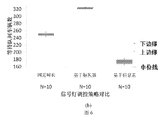
- Figure 6 compares three semaphore scheduling strategies; (a) a box plot of average waiting time, and (b) a box plot of average waiting queue length.
- the diffusion distance per second is 28 meters, which is equivalent to 3 cells.
- the diffused pheromone is evenly sprayed into the three cells immediately downstream, namely C 4,1 , C 3,1 , C 2,1 .
- the digital pheromone on the road follows the above rules, and iteratively performs the three processes of accumulation, evaporation, and diffusion, and its value is dynamically updated as the traffic flow changes.
- the intelligent traffic signal system proposed by the present invention is based on dynamically updated pheromone to dynamically change the length of the signal light to achieve the purpose of reducing congestion.
- Equation 7 we can conclude that the length of the green light in the east-west direction is Here, with The green light duration in the east-west direction and the red light duration in the north-south direction. T C is a signal control period. The north-south green light duration is
- the fixed-length scheduling strategy sets the length of the traffic light in advance through the past traffic flow, once it is set, it will not change.
- the trigger-based scheduling strategy means that the green light on the main road stays on until there are cars on the branch road, and then the signal light on the branch road turns green and stays for a relatively short fixed time.
- the trigger-based scheduling strategy is to ensure smooth traffic on the main road.
Landscapes
- Business, Economics & Management (AREA)
- General Physics & Mathematics (AREA)
- Physics & Mathematics (AREA)
- Engineering & Computer Science (AREA)
- Human Resources & Organizations (AREA)
- Strategic Management (AREA)
- Economics (AREA)
- Tourism & Hospitality (AREA)
- Theoretical Computer Science (AREA)
- Entrepreneurship & Innovation (AREA)
- Marketing (AREA)
- General Business, Economics & Management (AREA)
- Development Economics (AREA)
- Quality & Reliability (AREA)
- Operations Research (AREA)
- Game Theory and Decision Science (AREA)
- Educational Administration (AREA)
- Chemical & Material Sciences (AREA)
- Analytical Chemistry (AREA)
- Health & Medical Sciences (AREA)
- General Health & Medical Sciences (AREA)
- Primary Health Care (AREA)
- Traffic Control Systems (AREA)
- Catching Or Destruction (AREA)
Abstract
一种基于数字信息素的智能交通信号灯实时调控方法。该方法利用数字信息素作为媒介实现既能预测车流也可以平滑绿信比的智能交通信号灯实时调控。首先采集数字信息素,依次进行累积、蒸发和扩散三个行为,更新数字信息素;而后,调控交通信号灯绿信比。数字信息素的扩散使得信息素可以早于车流到达交通信号灯,从而具有预测的作用。另一方面,数字信息素的蒸发具有之前车流的信息,从而具有记忆功能。数字信息素的预测与记忆特性,是数字信息素优于单纯车流信息的关键所在。使得基于数字信息素的智能信号灯系统具有以往单纯基于车流的智能信号灯无法比拟的优势。
Description
本发明属于计算机应用技术领域,涉及一种基于自组织理论的智能交通信号灯实时调控方法。
近年来,随着互联网和嵌入式技术的飞速发展,越来越多的智能交通信号系统被应用到城市交通系统中,以期减轻不断加剧的道路拥堵。已有的智能交通信号系统的一个基本原则是根据实时车流动态地改变不同方向上信号灯的绿信比,即,某方向上的绿灯时长与此方向上的车流成正比。然后由于实际车流变化的不可预见性和突然性,如何预测车流和避免信号灯绿信比的剧烈波动是制约智能交通系统信号灯广泛应用的一大挑战。
数字信息素可以被看作是在自然界中相互联系的个体间传递信息的生物化学物质(Kasinger H,Bauer B and Denzinger J.Design pattern for self-organizing emergent systems based on digital infochemicals.In:Proceedings of the sixth IEEE conference and workshops on engineering of autonomic and autonomous systems,2009.)。当接收到这种信息素,会触发接收者相应的行为。信息素可以分为在同类个体间传播以及在不同类个体间传播两种。蚁群算法(Colorni A.and Dorigo M.Distributed optimization by ant colonies.In:Proceedings of actes de la premiere conference europeenne sur la vie artificielle,Paris,France,1991.)是数字信息素一个很好的例子。自然界中的蚂蚁在运动过程中会在经过的路径上留下信息素。同时,信息素开始挥发。蚂蚁在选择路径时会选择信息素更浓的那个方向。随着时间的推移,最短路径上的信息素堆积的要比更长路径上的多。其原因是最短路径上蚂蚁来往的时间要短,所以相同时间区间内,最短路径上蚂蚁走过的次数更多,也就导致了更多的信息素的堆积。另一方面,更多的信息素也会吸引更多的蚂蚁, 这样进一步强化最短路径上的信息素含量。最终,几乎所有的蚂蚁都走在蚁巢和食物间的最短路径上。
与自然界中的信息素类似,数字信息素已经被作为一种个体间协调配合的机制而应用于具有涌现特性分布式的复杂自适应系统中,使得多智能体模型中同种或异种个体可以相互间通信。本发明利用数字信息素作为媒介来控制交通信号灯,以期实现预测车流和预防绿信比剧烈抖动的目的。
发明内容
为了解决现有智能交通信号灯存在的问题,本发明利用数字信息素作为媒介实现一个既能预测车流也可以平滑绿信比的智能交通信号灯实时调控方法。传统交通信号灯实时调控方法是直接根据实时车流数据动态调整绿信比,其问题是车流的不可预测性和震荡性会导致信号灯时长的剧烈变化。本发明在车流和信号灯控制系统之间加入了一层数字信息素,如图1所示。数字信息素源于车流但不同于车流,由于数字信息素的蒸发和扩散机制,可以实现平滑绿信比和预测车流的功能。
本发明的技术方案如图2所示。在t时刻,首先采集由实时车流生成的数字信息素。之后判断t时刻是否是一个信号灯控制周期的开始,即mod(t,T
c)=0。如果是一个控制周期的开始时刻,则根据上一周期的信息素调整下一周期的绿信比;如果不是,则进行t+1时刻的数字信息素采集工作。此过程循环往复,不断迭代更新。
具体技术方案为:
步骤一,采集数字信息素;
数字信息素源于车流。车辆在所经过的道路上留下数字信息素。为了简化计算复杂度,根据目标要求,将道路划分成若干个单元格,如图3所示。在时刻t, 系统根据实时车流自动采集单元格内的数字信息素,依次进行累积、蒸发和扩散三个行为,更新数字信息素;
所述累积行为指不同车辆所遗留的信息素在同一个单元格内累加;
ρ
i,t=ρ
i,t-1+n
i,t (1)
其中,ρ
i,t-1是第i个单元格内t-1时刻数字信息素的总量;n
i,t是第i个单元格内t时刻车辆数;ρ
i,t是第i个单元格内t时刻累积后的数字信息素的总量;
所述蒸发行为指信息素随着时间的推移而慢慢减少:
ρ′
i,t=(1-ρ
v)ρ
i,t (2)
其中,ρ
i,t是第i个单元格内t时刻数字信息素的总量;ρ
v是蒸发率;ρ′
i,t是单位时间内经过蒸发之后所留下的信息素总量;
所述扩散行为指沿着车辆行驶的方向,信息素扩散到周围区域:
ρ″
i,t=(1-ρ
p)ρ′
i,t (3)
其中,ρ′
i,t是单位时间内经过蒸发之后所留下的信息素总量;ρ
p是扩散率,即可以扩散到周围区域的信息素的百分比;ρ″
i,t是扩散之后第i个单元格所留下的信息素的量;
一个单元格中的信息素在扩散的同时,也在接收其他单元格所扩散过来的信息素。这里,采用同步更新,即所有单元格同时扩散,而后再同时接收来自其他单元格扩散过来的信息素:

其中,Φ是在单位时间内可以扩散到单元格i的所有上游单元格集合;
 是从单元格j扩散出去的均匀喷洒到所途径单元格的数字信息素;

其中,ρ′
j,t是蒸发之后所留下的信息素;ρ
pρ′
j,t是可以扩散出去的信息素的总量;v是信息素扩散的速度,τ是单位时间段长度,vτ是单位时间内数字信息素可以传播的距离;C
s是单元格的长度;vτ/C
s是单位时间内信息素扩散所进过的单元格个数;
步骤二,调控交通信号灯绿信比;
当时刻t为交通信号灯一个控制周期的开始时刻,即mod(t,T
c)=0,则交通信号灯根据上个控制周期内的路口各个方向上的数字信息素总量调整下一周期信号灯的绿信比:

其中,
 是第i个相位的绿灯时长,D
i是第i个相位是绿灯的车道上的数字信息素总量;∑
jD
j是信号灯所有相位对应车道上的数字信息素总量;T
C是信号灯周期;
是第i个相位的绿灯时长,D
i是第i个相位是绿灯的车道上的数字信息素总量;∑
jD
j是信号灯所有相位对应车道上的数字信息素总量;T
C是信号灯周期;
若时刻t不是交通信号灯一个控制周期的开始时刻,则进行t+1时刻的步骤一的数字信息素采集工作,此过程循环往复,不断迭代更新。
进一步地,上述方法作为交通仿真模型,采用离散化时间策略,选用时间间隔是1秒,单元格的长度是1米;公式(5)简化为:

本发明的有益效果为,数字信息素的扩散使得信息素可以早于车流到达交通信号灯,从而具有预测的作用。另一方面,数字信息素的蒸发具有之前车流的信息,从而具有记忆功能。数字信息素的预测与记忆特性,是数字信息素优于单纯车流信息的关键所在。使得基于数字信息素的智能信号灯系统具有以往单纯基于车流的智能信号灯无法比拟的优势。
图1基于数字信息素的交通信号灯架构图
图2基于数字信息素的交通信号灯实时调控流程图
图3道路上的数字信息素示意图。
图4交通路口的数字信息素示意图。
图5主干道一天交通流量变化图。
图6三种信号灯调度策略比较;(a)平均等待时长箱线图,(b)平均等待队列长度箱线图。
以双向三车道为例描述数字信息素,如图3所示。数字信息素由车辆在运行过程中所留下。为了准确掌握车辆的运行轨迹,采用离散时间仿真策略,即间隔固定时间更新车辆位置状态信息。不失一般性,时间间隔定为1秒,即每秒刷新车辆的位置信息。考虑到彼此相隔很近的数字信息素对于信号灯的影响差别不大,把每条车道等分成固定长度的单元格,一个单元格中的车辆所产生的信息素累积到一起作为一个整体。这种离散化的方式也可以极大地减少计算工作量。下面的算例中单元格的长度设为10m。
假设在时间0,单元格C
5,1中有2辆车,则其中的信息素ρ
5,1为2。
首先考虑蒸发。假设蒸发率ρ
v为0.2/s,即每秒钟20%的数字信息素蒸发掉。则ρ
5,1变为1.6。
再考虑扩散。假设扩散率ρ
p为0.3/s,即每秒钟30%的数字信息素向下游扩散。则ρ
5,1变为1.12。
假设扩散速度与车辆行驶速度一致,100km/hr=28m/s,则每秒钟的扩散距离为28米,相当于3个单元格。扩散出去的信息素均匀地喷洒到下游紧挨着的3个单元格中,即C
4,1,C
3,1,C
2,1,每个单元格的信息素增加1.6*0.3/3=0.16。
单元格C
5,1也接受来自于上游3个单元格扩散过来的信息素。假设C
6,1,C
7,1,C
8,1分别扩散过来的信息素为0.1,0.21,0.08,则ρ
5,1在0时刻最后变为1.12+0.1+0.21+0.08=1.51。
假设在下一时刻,即时间1,单元格C
5,1中有3辆车,则其中的信息素ρ
5,1在上一时刻1.51的基础上增加3,变为4.51。
首先考虑蒸发。假设蒸发率ρ
v为0.2/s,即每秒钟20%的数字信息素蒸发掉。则ρ
5,1变为3.608。
再考虑扩散。假设扩散率ρ
p为0.3/s,即每秒钟30%的数字信息素向下游扩散。则ρ
5,1变为2.5256。扩散出去的信息素均匀地喷洒到下游紧挨着的3个单元格中,即C
4,1,C
3,1,C
2,1,每个单元格的信息素增加3.608*0.3/3=0.3608。
综上,道路上的数字信息素遵循着上述规则,循环往复地进行累积、蒸发、和扩散三个过程,其数值也随着车流的变化而动态更新。本发明所提出的智能交通信号系统就是基于动态更新的信息素而动态改变信号灯时长,以达到减轻拥堵的目的。
考虑如图4所示的路口,ρ
1,ρ
2,ρ
3,ρ
4分别为交叉路口四个方向的数字信息素。为简化计算,这里只考虑直行车辆。根据公式7,我们可以得出,东西方向上的绿灯时长为
 这里,
这里,
 和
和
 分别为东西方向上绿灯时长以及南北方向上的红灯时长。T
C为一个信号灯控制周期。南北方向上的绿灯时长为
分别为东西方向上绿灯时长以及南北方向上的红灯时长。T
C为一个信号灯控制周期。南北方向上的绿灯时长为

为检验基于数字信息素的交通信号系统的效率,将其与固定时长调度策略和基于触发器的调度策略进行对比。固定时长调度策略通过过往交通流量预先设定交通灯的时长,一经设定不再改变。基于触发器的调度策略意味着主干道路上的 绿灯保持常亮直到支路上有车要通过,则支路上的信号灯变绿并保持一个相对短的固定时间。基于触发器的调度策略是为保障主干道路上的车流畅通。
为比较这三种信号灯调度策略,采用具有早晚高峰的真实的车流数据进行测试,如图5所示。每一种调度策略运行10次,而后比较在其控制下所产生的平均等待时长和平均队列长度。其比较结果如图6所示。从图中不难看出,相比于其他两种调度策略,基于数字信息素的交通灯控制策略具有更短的排队长度和更短的等待时长。
Claims (2)
- 一种基于数字信息素的智能交通信号灯实时调控方法,其特征在于,包括如下步骤:步骤一,采集数字信息素;根据目标要求,将道路划分成若干个单元格,在时刻t,系统根据实时车流自动采集单元格内的数字信息素,依次进行累积、蒸发和扩散三个行为,更新数字信息素;所述累积行为指不同车辆所遗留的信息素在同一个单元格内累加;ρ i,t=ρ i,t-1+n i,t (1)其中,ρ i,t-1是第i个单元格内t-1时刻数字信息素的总量;n i,t是第i个单元格内t时刻车辆数;ρ i,t是第i个单元格内t时刻累积后的数字信息素的总量;所述蒸发行为指信息素随着时间的推移而慢慢减少:ρ′ i,t=(1-ρ v)ρ i,t (2)其中,ρ i,t是第i个单元格内t时刻数字信息素的总量;ρ v是蒸发率;ρ′ i,t是单位时间内经过蒸发之后所留下的信息素总量;所述扩散行为指沿着车辆行驶的方向,信息素扩散到周围区域:ρ″ i,t=(1-ρ p)ρ′ i,t (3)其中,ρ′ i,t是单位时间内经过蒸发之后所留下的信息素总量;ρ p是扩散率,即可以扩散到周围区域的信息素的百分比;ρ″ i,t是扩散之后第i个单元格所留下的信息素的量;采用同步更新,即所有单元格同时扩散,而后再同时接收来自其他单元格扩散过来的信息素:
 其中,Φ是在单位时间内可以扩散到单元格i的所有上游单元格集合;是从单元格j扩散出去的均匀喷洒到所途径单元格的数字信息素;
 其中,ρ′ j,t是蒸发之后所留下的信息素;ρ pρ′ j,t是可以扩散出去的信息素的总量;v是信息素扩散的速度,τ是单位时间段长度,vτ是单位时间内数字信息素可以传播的距离;C s是单元格的长度;vτ/C s是单位时间内信息素扩散所进过的单元格个数;步骤二,调控交通信号灯绿信比;当时刻t为交通信号灯一个控制周期的开始时刻,即mod(t,T c)=0,则交通信号灯根据上个控制周期内的路口各个方向上的数字信息素总量调整下一周期信号灯的绿信比:
 其中,T i G是第i个相位的绿灯时长,D i是第i个相位是绿灯的车道上的数字信息素总量;∑ jD j是信号灯所有相位对应车道上的数字信息素总量;T C是信号灯周期;若时刻t不是交通信号灯一个控制周期的开始时刻,则进行t+1时刻的步骤一的数字信息素采集工作,此过程循环往复,不断迭代更新。
 - 根据权利要求1所述的一种基于数字信息素的智能交通信号灯实时调控方法,其特征在于,作为交通仿真模型,采用离散化时间策略,选用时间间隔是1秒,单元格的长度是1米;公式(5)简化为:

Priority Applications (1)
| Application Number | Priority Date | Filing Date | Title |
|---|---|---|---|
| US16/753,455 US10891855B2 (en) | 2018-08-28 | 2019-07-16 | Method to schedule intelligent traffic lights in real time based on digital infochemicals |
Applications Claiming Priority (2)
| Application Number | Priority Date | Filing Date | Title |
|---|---|---|---|
| CN201810984108.7A CN109035811B (zh) | 2018-08-28 | 2018-08-28 | 一种基于数字信息素的智能交通信号灯实时调控方法 |
| CN201810984108.7 | 2018-08-28 |
Publications (1)
| Publication Number | Publication Date |
|---|---|
| WO2020042789A1 true WO2020042789A1 (zh) | 2020-03-05 |
Family
ID=64624746
Family Applications (1)
| Application Number | Title | Priority Date | Filing Date |
|---|---|---|---|
| PCT/CN2019/096138 Ceased WO2020042789A1 (zh) | 2018-08-28 | 2019-07-16 | 一种基于数字信息素的智能交通信号灯实时调控方法 |
Country Status (3)
| Country | Link |
|---|---|
| US (1) | US10891855B2 (zh) |
| CN (1) | CN109035811B (zh) |
| WO (1) | WO2020042789A1 (zh) |
Families Citing this family (5)
| Publication number | Priority date | Publication date | Assignee | Title |
|---|---|---|---|---|
| CN109035811B (zh) * | 2018-08-28 | 2019-08-20 | 大连理工大学 | 一种基于数字信息素的智能交通信号灯实时调控方法 |
| CN112614341B (zh) * | 2020-12-09 | 2022-02-22 | 复旦大学 | 基于群智进化蚁群算法的交通规划系统 |
| CN113012449B (zh) * | 2021-03-11 | 2022-03-29 | 华南理工大学 | 基于多榜样学习粒子群的智慧城市信号灯配时优化方法 |
| CN114548746B (zh) * | 2022-02-18 | 2022-09-06 | 深圳市格衡土地房地产资产评估咨询有限公司 | 基于信息素的拆迁全流程监控系统及方法 |
| CN116758763B (zh) * | 2023-05-06 | 2024-02-20 | 西藏金采科技股份有限公司 | 一种基于车联网的交通数据处理系统及方法 |
Citations (5)
| Publication number | Priority date | Publication date | Assignee | Title |
|---|---|---|---|---|
| US20040054513A1 (en) * | 1998-11-23 | 2004-03-18 | Nestor, Inc. | Traffic violation detection at an intersection employing a virtual violation line |
| CN104766484A (zh) * | 2015-03-23 | 2015-07-08 | 南京邮电大学 | 基于进化多目标优化和蚁群算法的交通控制与诱导系统和方法 |
| CN107730922A (zh) * | 2017-09-11 | 2018-02-23 | 北方工业大学 | 一种单向干线绿波协调控制自适应调整方法 |
| CN108399740A (zh) * | 2018-01-22 | 2018-08-14 | 华南理工大学 | 一种信号控制交叉口机动车冲突概率预测方法 |
| CN109035811A (zh) * | 2018-08-28 | 2018-12-18 | 大连理工大学 | 一种基于数字信息素的智能交通信号灯实时调控方法 |
Family Cites Families (1)
| Publication number | Priority date | Publication date | Assignee | Title |
|---|---|---|---|---|
| JP5803624B2 (ja) * | 2011-11-30 | 2015-11-04 | アイシン・エィ・ダブリュ株式会社 | 車両制御システム、車両制御装置、車両制御方法及びコンピュータプログラム |
-
2018
- 2018-08-28 CN CN201810984108.7A patent/CN109035811B/zh not_active Expired - Fee Related
-
2019
- 2019-07-16 WO PCT/CN2019/096138 patent/WO2020042789A1/zh not_active Ceased
- 2019-07-16 US US16/753,455 patent/US10891855B2/en active Active
Patent Citations (5)
| Publication number | Priority date | Publication date | Assignee | Title |
|---|---|---|---|---|
| US20040054513A1 (en) * | 1998-11-23 | 2004-03-18 | Nestor, Inc. | Traffic violation detection at an intersection employing a virtual violation line |
| CN104766484A (zh) * | 2015-03-23 | 2015-07-08 | 南京邮电大学 | 基于进化多目标优化和蚁群算法的交通控制与诱导系统和方法 |
| CN107730922A (zh) * | 2017-09-11 | 2018-02-23 | 北方工业大学 | 一种单向干线绿波协调控制自适应调整方法 |
| CN108399740A (zh) * | 2018-01-22 | 2018-08-14 | 华南理工大学 | 一种信号控制交叉口机动车冲突概率预测方法 |
| CN109035811A (zh) * | 2018-08-28 | 2018-12-18 | 大连理工大学 | 一种基于数字信息素的智能交通信号灯实时调控方法 |
Also Published As
| Publication number | Publication date |
|---|---|
| CN109035811A (zh) | 2018-12-18 |
| CN109035811B (zh) | 2019-08-20 |
| US20200320872A1 (en) | 2020-10-08 |
| US10891855B2 (en) | 2021-01-12 |
Similar Documents
| Publication | Publication Date | Title |
|---|---|---|
| WO2020042789A1 (zh) | 一种基于数字信息素的智能交通信号灯实时调控方法 | |
| CN113643553B (zh) | 基于联邦强化学习的多路口智能交通信号灯控制方法及系统 | |
| CN106875710B (zh) | 一种面向网联自动驾驶车辆的交叉口自组织控制方法 | |
| CN114495547B (zh) | 一种面向自动驾驶汽车的信号交叉口协同通行方法 | |
| CN111091722B (zh) | 人机混合驾驶环境下交叉口信号控制参数的优化方法 | |
| WO2017166474A1 (zh) | 一种基于交叉口群的交通控制方法及系统 | |
| CN115063988B (zh) | 一种应急车辆优先的跨交通子区信号协同控制方法 | |
| CN104200680A (zh) | 过饱和交通状态下城市干道的交通信号协调控制方法 | |
| CN118609391B (zh) | 基于cps的多交叉口信号配时与车辆速度协同控制方法 | |
| CN107591011A (zh) | 考虑供给侧约束的交叉口交通信号自适应控制方法 | |
| CN118280099A (zh) | 融合信号配时与编队轨迹控制的交通管理方法和装置 | |
| CN110288844A (zh) | 一种基于车路通信的连续交叉口协同优化方法 | |
| Yu et al. | Minimize pressure difference traffic signal control based on deep reinforcement learning | |
| CN117133119B (zh) | 基于时间预测的无专用道公交车辆优先行驶控制方法 | |
| Yi-Fei et al. | Research on polling based traffic signal control strategy with fuzzy control | |
| CN118470993A (zh) | 网联交通环境下车辆编队控制及信号优化方法及系统 | |
| Li et al. | A hierarchical spatio-temporal cooperative reinforcement learning approach for traffic signal control | |
| CN116153065A (zh) | 车路协同环境下交叉口交通信号精细化优化方法及装置 | |
| Yin | Multi-junction traffic light optimization during holiday based on improved green wave band control | |
| Guo et al. | A novel virtual traffic light algorithm based on V2V for single intersection in vehicular networks | |
| CN117334061B (zh) | 车路协同环境下错位交叉口的信号周期动态调控方法 | |
| CN121459586B (zh) | 智能网联混合交通流环境下交通信号与车辆轨迹协同控制方法 | |
| CN114708743B (zh) | 基于尾车驶离模型的干线周期分配方法及系统 | |
| Yue et al. | Speed optimization for single connected vehicle at congested signalized intersection using C-V2X | |
| Wang | Simulation Research on Automatic Control System of Urban Light Rail Traffic Signal Based on Ant Colony Algorithm |
Legal Events
| Date | Code | Title | Description |
|---|---|---|---|
| 121 | Ep: the epo has been informed by wipo that ep was designated in this application |
Ref document number: 19854831 Country of ref document: EP Kind code of ref document: A1 |
|
| NENP | Non-entry into the national phase |
Ref country code: DE |
|
| 122 | Ep: pct application non-entry in european phase |
Ref document number: 19854831 Country of ref document: EP Kind code of ref document: A1 |