WO2019225742A1 - 有機化合物のカップリング方法 - Google Patents
有機化合物のカップリング方法 Download PDFInfo
- Publication number
- WO2019225742A1 WO2019225742A1 PCT/JP2019/020669 JP2019020669W WO2019225742A1 WO 2019225742 A1 WO2019225742 A1 WO 2019225742A1 JP 2019020669 W JP2019020669 W JP 2019020669W WO 2019225742 A1 WO2019225742 A1 WO 2019225742A1
- Authority
- WO
- WIPO (PCT)
- Prior art keywords
- group
- organic
- sodium
- reaction
- coupling
- Prior art date
- Legal status (The legal status is an assumption and is not a legal conclusion. Google has not performed a legal analysis and makes no representation as to the accuracy of the status listed.)
- Ceased
Links
Images


Classifications
-
- C—CHEMISTRY; METALLURGY
- C07—ORGANIC CHEMISTRY
- C07B—GENERAL METHODS OF ORGANIC CHEMISTRY; APPARATUS THEREFOR
- C07B37/00—Reactions without formation or introduction of functional groups containing hetero atoms, involving either the formation of a carbon-to-carbon bond between two carbon atoms not directly linked already or the disconnection of two directly linked carbon atoms
- C07B37/04—Substitution
-
- C—CHEMISTRY; METALLURGY
- C07—ORGANIC CHEMISTRY
- C07C—ACYCLIC OR CARBOCYCLIC COMPOUNDS
- C07C1/00—Preparation of hydrocarbons from one or more compounds, none of them being a hydrocarbon
- C07C1/32—Preparation of hydrocarbons from one or more compounds, none of them being a hydrocarbon starting from compounds containing hetero-atoms other than or in addition to oxygen or halogen
-
- C—CHEMISTRY; METALLURGY
- C07—ORGANIC CHEMISTRY
- C07C—ACYCLIC OR CARBOCYCLIC COMPOUNDS
- C07C15/00—Cyclic hydrocarbons containing only six-membered aromatic rings as cyclic parts
- C07C15/20—Polycyclic condensed hydrocarbons
- C07C15/24—Polycyclic condensed hydrocarbons containing two rings
-
- C—CHEMISTRY; METALLURGY
- C07—ORGANIC CHEMISTRY
- C07C—ACYCLIC OR CARBOCYCLIC COMPOUNDS
- C07C209/00—Preparation of compounds containing amino groups bound to a carbon skeleton
- C07C209/68—Preparation of compounds containing amino groups bound to a carbon skeleton from amines, by reactions not involving amino groups, e.g. reduction of unsaturated amines, aromatisation, or substitution of the carbon skeleton
-
- C—CHEMISTRY; METALLURGY
- C07—ORGANIC CHEMISTRY
- C07C—ACYCLIC OR CARBOCYCLIC COMPOUNDS
- C07C211/00—Compounds containing amino groups bound to a carbon skeleton
- C07C211/43—Compounds containing amino groups bound to a carbon skeleton having amino groups bound to carbon atoms of six-membered aromatic rings of the carbon skeleton
- C07C211/44—Compounds containing amino groups bound to a carbon skeleton having amino groups bound to carbon atoms of six-membered aromatic rings of the carbon skeleton having amino groups bound to only one six-membered aromatic ring
- C07C211/45—Monoamines
- C07C211/48—N-alkylated amines
-
- C—CHEMISTRY; METALLURGY
- C07—ORGANIC CHEMISTRY
- C07C—ACYCLIC OR CARBOCYCLIC COMPOUNDS
- C07C41/00—Preparation of ethers; Preparation of compounds having groups, groups or groups
- C07C41/01—Preparation of ethers
- C07C41/18—Preparation of ethers by reactions not forming ether-oxygen bonds
- C07C41/30—Preparation of ethers by reactions not forming ether-oxygen bonds by increasing the number of carbon atoms, e.g. by oligomerisation
-
- C—CHEMISTRY; METALLURGY
- C07—ORGANIC CHEMISTRY
- C07C—ACYCLIC OR CARBOCYCLIC COMPOUNDS
- C07C43/00—Ethers; Compounds having groups, groups or groups
- C07C43/02—Ethers
- C07C43/20—Ethers having an ether-oxygen atom bound to a carbon atom of a six-membered aromatic ring
- C07C43/205—Ethers having an ether-oxygen atom bound to a carbon atom of a six-membered aromatic ring the aromatic ring being a non-condensed ring
-
- C—CHEMISTRY; METALLURGY
- C07—ORGANIC CHEMISTRY
- C07D—HETEROCYCLIC COMPOUNDS
- C07D217/00—Heterocyclic compounds containing isoquinoline or hydrogenated isoquinoline ring systems
- C07D217/12—Heterocyclic compounds containing isoquinoline or hydrogenated isoquinoline ring systems with radicals, substituted by hetero atoms, attached to carbon atoms of the nitrogen-containing ring
- C07D217/14—Heterocyclic compounds containing isoquinoline or hydrogenated isoquinoline ring systems with radicals, substituted by hetero atoms, attached to carbon atoms of the nitrogen-containing ring other than aralkyl radicals
-
- C—CHEMISTRY; METALLURGY
- C07—ORGANIC CHEMISTRY
- C07D—HETEROCYCLIC COMPOUNDS
- C07D307/00—Heterocyclic compounds containing five-membered rings having one oxygen atom as the only ring hetero atom
- C07D307/77—Heterocyclic compounds containing five-membered rings having one oxygen atom as the only ring hetero atom ortho- or peri-condensed with carbocyclic rings or ring systems
- C07D307/78—Benzo [b] furans; Hydrogenated benzo [b] furans
- C07D307/79—Benzo [b] furans; Hydrogenated benzo [b] furans with only hydrogen atoms, hydrocarbon or substituted hydrocarbon radicals, directly attached to carbon atoms of the hetero ring
-
- C—CHEMISTRY; METALLURGY
- C07—ORGANIC CHEMISTRY
- C07B—GENERAL METHODS OF ORGANIC CHEMISTRY; APPARATUS THEREFOR
- C07B61/00—Other general methods
Definitions
- the present invention relates to a method for coupling organic compounds.
- the organic compound coupling method is a method of synthesizing a new organic compound by bonding two or more organic compounds to each other through a carbon atom-carbon atom bond (hereinafter abbreviated as “CC bond”). It has become a general-purpose technology in total synthesis and organic synthesis of functional materials such as medicines and agricultural chemicals, electronic materials, and intermediates thereof.
- Non-patent Document 1 Non-patent Document 2, etc.
- organic electrophile such as an organic halide
- organoboron compound using palladium or nickel as a catalyst
- Negishi coupling by reaction with an organic zinc compound see Non-Patent Document 3, Non-Patent Document 4, etc.
- a Grignard reagent that is an organic magnesium compound.
- the organoboric acid compound used for the Suzuki-Miyaura coupling is generally obtained by preparing a corresponding organolithium reagent or Grignard reagent from an organic halide and reacting these with a borate ester compound. It can be obtained (see Non-Patent Document 7 etc.), and an organozinc compound used for Negishi coupling can also be obtained by reacting an organolithium reagent or Grignard reagent with zinc halide (ZnX 2 ) such as zinc chloride. Yes (see Non-Patent Document 8 etc.).
- n BuLi n-butyllithium
- t BuLi organic halide
- the organozinc compound is prepared by the following two-stage reaction (first stage: RI + n BuLi or t BuLi ⁇ R-Li, second stage: R-Li + ZnCl 2 ⁇ R-ZnCl). is there.
- n BuLi and t BuLi are expensive reagents, there are problems such as an increase in cost. Furthermore, n BuLi and t BuLi are designated as Class 3 dangerous goods by the Fire Service Law, and there is a problem that equipment and facilities suitable for handling are required.
- the Grignard reagent is obtained by reacting an organic halide and metal magnesium in an anhydrous solvent such as tetrahydrofuran (hereinafter referred to as “THF”) or ether.
- anhydrous solvent such as tetrahydrofuran (hereinafter referred to as “THF”) or ether.
- THF tetrahydrofuran
- the conventional method using the Grignard reagent has a long reaction time, which increases the cost.
- the reactivity during synthesis of Grignard reagents is generally higher for organic bromides (R-Br) and organic iodides (RI) than for organic chlorides (R-Cl).
- organic bromides or iodides have been widely used, but organic bromides and iodides are expensive.
- organomagnesium bromide which is widely used as a Grignard reagent from the viewpoint of reactivity and the like, is a bromine-containing compound, but bromine is limited in the area where it is mined, and is highly toxic and has human residual properties. Use is decreasing. Therefore, there is also a problem that the circulation amount is reduced and it is difficult to obtain the target organic bromide. Therefore, there is a problem that the method using the Grignard reagent cannot sufficiently satisfy the market demand from an industrial and economical viewpoint.
- boron and zinc which are constituent elements of organic boric acid compounds and organic zinc compounds, have a minable life of about 20 to 40 years and have a small amount of recognizable reserves, and lithium, which is a constituent element of organic lithium.
- boron is an essential trace element of plants and animals, but overdose causes gastrointestinal tract disorders, central nervous system disorders, etc. to the human body. In particular, insects are known to exhibit strong toxicity and have a problem of high environmental burden.
- the present inventors reacted an organic halide and a dispersion in which sodium was dispersed in a dispersion solvent in a reaction solvent to obtain an organic sodium compound, It was found that an organic compound can be efficiently coupled by reacting the obtained organic sodium compound with an organic chloride. Such a method for coupling organic compounds is difficult to handle and does not require toxic reagents, and the coupling reaction of organic compounds proceeds under mild conditions. Further, it is possible to couple an organic compound at a low cost with a small number of steps without requiring a complicated and expensive synthesis processing step or a disposal processing step. Based on these findings, the present inventors have completed the present invention.
- the present invention relates to a coupling method, which is characterized by a general formula I (R 1 -X 1 ) [wherein R 1 is a substituent that does not react with sodium in a reaction solvent.
- An aromatic hydrocarbon group which may have a group, or an aromatic heterocyclic group, and X 1 is a halogen atom] and a dispersion in which sodium is dispersed in a dispersion solvent; is reacted of general formula II (R 1 -Na) [wherein, in the formula, R 1 is the same as R 1 in formula I] to obtain an organic sodium compound shown,
- the following general formula IV [Wherein, R a , R b , R
- reaction catalyst comprising, in the general formula V (R 1 -R 2) [wherein, in the formula, R 1 is the same as R 1 of the general formula I and general formula II, R 2 is And the same as R 2 in the general formula III].
- an organic sodium compound is synthesized from an organic halide, and then a palladium catalyst having a nitrogen-containing heterocyclic carbene (hereinafter abbreviated as “NHC”) ligand containing the sodium compound and the organic chloride.
- NEC nitrogen-containing heterocyclic carbene
- this configuration by using a dispersion in which sodium that is easy to handle is dispersed in a dispersion solvent, it is easy and quick in a small number of steps without requiring a complicated chemical method under mild conditions. Since an organic sodium compound can be synthesized at low cost from an organic halide and the subsequent coupling reaction can proceed smoothly, it is very advantageous economically and industrially.
- reaction catalyst contains a metal chloride as a promoter.
- the reaction catalyst contains a metal chloride as a co-catalyst, the coupling reaction can proceed more smoothly, which is very advantageous economically and industrially.
- the palladium catalyst in the general formula IV is such that R a , R b , R c , and R d are all isopropyl groups.
- a compound having a bulky NHC ligand 1,3-bis (2,6-diisopropylphenyl) imidazol-2-ylidene group is used as a palladium catalyst. Since the palladium catalyst has high catalytic activity and is extremely stable, the coupling reaction can proceed more smoothly. Thereby, it becomes further economically and industrially advantageous.
- the molar ratio of the organic halide: the dispersion in which the sodium is dispersed in the dispersion solvent is 1: 2 or more.
- the organic sodium compound can be synthesized with higher efficiency and purity by optimizing the amount of the organic halide and the dispersion in which sodium is dispersed in the dispersion solvent, and the organic The coupling reaction with chloride can proceed more smoothly.
- Example 1 BRIEF DESCRIPTION OF THE DRAWINGS It is a figure which summarizes the synthesis conditions and result of Example 1 which examined the synthesis
- the organic compound coupling method comprises reacting an organic halide represented by the general formula I (R 1 -X 1 ) with a dispersion in which sodium is dispersed in a dispersion solvent in a reaction solvent.
- a step of obtaining a coupling product represented by the general formula V (R 1 -R 2 ) step 2.
- the coupling is a reaction of two or more types of molecules to synthesize one compound by CC bonding at a specific location. Coupling is classified into cross-coupling by molecules having different structures and homo-coupling by molecules having the same structure, but is preferably cross-coupling.
- Step 1 in the method for coupling an organic compound according to the present embodiment comprises reacting a dispersion in which an organic halide represented by the general formula I (R 1 -X 1 ) and sodium are dispersed in a dispersion solvent in a reaction solvent.
- an organic sodium compound represented by the general formula II (R 1 -Na) is obtained.
- the organic halide represented by the general formula I (R 1 -X 1 ) is an organic compound containing a covalently bonded halogen atom, and is one of the objects to be coupled in the organic compound coupling method according to the present embodiment. .
- R 1 is an aromatic hydrocarbon group or an aromatic heterocyclic group which may have a substituent that does not react with sodium. It is not preferable to have a substituent reactive with sodium because a dispersion in which the substituent and sodium are dispersed in a dispersion solvent reacts to induce a side reaction. Therefore, when using a compound having a substituent reactive with sodium as R 1 , it is necessary to protect the substituent with an appropriate protecting group or the like.
- the aromatic hydrocarbon group is not particularly limited as long as it has an aromatic ring. Not only a single ring but also those having a ring assembly such as a condensed ring or a spiro ring are included. There is no particular limitation on the number of members. For example, an aromatic hydrocarbon group having preferably 6 to 22 carbon atoms, particularly preferably 6 to 14 carbon atoms.
- aromatic hydrocarbon group examples include a monocyclic six-membered phenyl group, a bicyclic naphthyl group, a pentarenyl group, an indenyl group, an azulenyl group, a tricyclic biphenylenyl group, an indacenyl group, an acenaphthylenyl group, and a fluorenyl group.
- Examples include, but are not limited to, a pentacenyl group of the formula, a heptacyclic rubicenyl group, a coronenyl group, a heptacenyl group, and the like. Particularly preferred is a phenyl group.
- An aromatic heterocyclic group is an aromatic heterocyclic group having one or more heteroatoms as ring-constituting atoms. Not only a single ring but also those having a ring assembly such as a condensed ring or a spiro ring are included. There is no particular limitation on the number of members.
- the hetero atom is not particularly limited as long as it does not react with sodium as a ring atom.
- the number of heteroatoms is not particularly limited, and the position of the heteroatoms is not limited.
- the hetero atom is preferably exemplified by an oxygen atom, a nitrogen atom, a sulfur atom and the like.
- an aromatic heterocyclic group having preferably 1 to 5 carbon atoms, particularly preferably 3 to 5 carbon atoms, and preferably 1 to 4 carbon atoms, particularly preferably 1 to 3 carbon atoms.
- it may be the same kind of atom or a different kind of atom.
- the monocyclic aromatic heterocyclic group may be a nitrogen-containing aromatic group such as a 5-membered pyrrolyl group, pyrazolyl group, pyridyl group, imidazolyl group, 6-membered cyclic pyrazinyl group, pyrimidinyl group, pyridazinyl group, etc.
- An oxygen-containing aromatic heterocyclic group such as an aromatic group, a five-membered furyl group, an oxygen-containing aromatic heterocyclic group such as a five-membered thienyl group, a five-membered oxazolyl group, an isoxazolyl group
- examples thereof include, but are not limited to, nitrogen-containing oxygen aromatic heterocyclic groups such as furazanyl groups, nitrogen-containing sulfur aromatic heterocyclic groups such as five-membered cyclic thiazolyl groups and isothiazolyl groups.
- polycyclic aromatic heterocyclic group examples include bicyclic indolizinyl group, isoindolyl group, indolyl group, indazolyl group, purinyl group, isoquinolyl group, quinolyl group, phthalazinyl group, naphthyridinyl group, quinoxalinyl group, quinazolinyl group, and cinnolinyl.
- the aromatic hydrocarbon group and the aromatic heterocyclic group may have a substituent.
- One or a plurality of substituents may be present, and when a plurality of substituents are present, they may be the same or different from each other.
- substituents include an optionally substituted aliphatic hydrocarbon group, alicyclic hydrocarbon group, alicyclic heterocyclic group, aromatic hydrocarbon group, aromatic heterocyclic group, alkoxy group, cycloalkoxy Group, aryloxy group, aralkyloxy group, alicyclic heterocyclic oxy group, aromatic heterocyclic oxy group, alkylthio group, cycloalkylthio group, arylthio group, aralkylthio group, alicyclic heterocyclic thio group, aromatic Examples include, but are not limited to, heterocyclic thio groups, alkylamino groups, cycloalkylamino groups, arylamino groups, aralkylamino groups, alicyclic heterocyclic amino groups, aromatic heterocyclic amino groups, and acyl groups. It is not a thing.
- the aliphatic hydrocarbon group that may be present as a substituent is not limited to whether it is linear or branched, and may be saturated or unsaturated. Moreover, there is no restriction
- Examples of the aliphatic hydrocarbon group include, but are not limited to, an alkyl group, an alkenyl group, and an alkynyl group, preferably having 1 to 20 carbon atoms, particularly preferably 3 to 20 carbon atoms. .
- alkyl group methyl group, ethyl group, propyl group, butyl group, isopropyl group, n-butyl group, isobutyl group, s-butyl group, t-butyl group, n-pentyl group, isopentyl group , Neopentyl group, t-pentyl group, s-pentyl group, 2-methylbutyl group, 1-ethylpropyl group, 2-ethylpropyl group, n-hexyl group, isohexyl group, neohexyl group, t-hexyl group, 2,2 -Dimethylbutyl, 2-methylpentyl, 3-methylpentyl, 1-ethylbutyl, 2-ethylbutyl, 1-propylpropyl, n-heptyl, isoheptyl, s-heptyl, t-heptyl
- alkenyl group examples include, but are not limited to, an ethenyl group, a propenyl group, a butenyl group, a pentenyl group, a hexenyl group, a heptenyl group, and an octenyl group.
- alkynyl group examples include, but are not limited to, ethynyl group, propynyl group, butynyl group, pentynyl group, heptynyl group, octynyl group and the like.
- alicyclic hydrocarbon group which may be present as a substituent, there is no particular limitation on the number of ring members, regardless of whether the bond between ring constituent atoms is saturated or unsaturated. In addition, not only a single ring but also those having a ring assembly such as a condensed ring or a spiro ring are included.
- the alicyclic hydrocarbon group is not limited to these, but is preferably a cycloalkyl group having 3 to 10 carbon atoms, particularly preferably 3 to 7 carbon atoms, and a cycloalkenyl group, preferably carbon atoms. Examples thereof include several to 10 and particularly preferably 4 to 7 cycloalkenyl groups.
- cycloalkyl group examples include, but are not limited to, a cyclopropyl group, a cyclobutyl group, a cyclopentyl group, a cyclohexyl group, a cycloheptyl group, and a cyclooctyl group.
- cycloalkenyl group examples include, but are not limited to, a cyclopropenyl group, a cyclobutenyl group, a cyclopentenyl group, a cyclohexenyl group, a cycloheptenyl group, and a cyclooctenyl group.
- the alicyclic heterocyclic group that may be present as a substituent is a non-aromatic heterocyclic group having one or more heteroatoms as ring-constituting atoms. Not only a single ring but also those having a ring assembly such as a condensed ring or a spiro ring are included. There is no particular limitation on the number of ring members, regardless of whether the bonds between ring atoms are saturated or unsaturated.
- the hetero atom is not particularly limited as long as it does not react with sodium as a ring atom.
- the number of heteroatoms is not particularly limited, and the position of the heteroatoms is not limited.
- the hetero atom is preferably exemplified by an oxygen atom, a nitrogen atom, a sulfur atom and the like.
- an alicyclic heterocyclic group having preferably 2 to 7 carbon atoms, particularly preferably 2 to 5 carbon atoms, and preferably 1 to 5 carbon atoms, particularly preferably 1 to 3 carbon atoms. Is mentioned.
- it when it has a some hetero atom, it may be the same kind of atom or a different kind of atom.
- alicyclic heterocyclic group examples include a monocyclic four-membered azetidinyl group, a five-membered pyrrolidinyl group, a six-membered piperidyl group, a nitrogen-containing alicyclic heterocyclic group such as a piperazinyl group, Oxygen-containing cycloaliphatic heterocyclic groups such as 3-membered oxiranyl group, 4-membered oxetanyl group, 5-membered tetrahydrofuryl group, 6-membered tetrahydropyranyl group, monocyclic ring Sulfur-containing alicyclic heterocyclic groups such as five-membered tetrahydrothiophenyl groups, nitrogen-containing oxygen alicyclic heterocyclic groups such as monocyclic six-membered morpholinyl groups, monocyclic six-membered cyclic groups Examples thereof include, but are not limited to, nitrogen-containing sulfur alicyclic heterocyclic group
- aromatic hydrocarbon group and aromatic heterocyclic group that may be present as a substituent include the same as those described above.
- the alkoxy group which may be substituted is preferably an alkoxy group having 1 to 10 carbon atoms, specifically, methoxy group, ethoxy group, propoxy group, butoxy group, pentyloxy group, hexyl. Examples include, but are not limited to, oxy groups.
- the cycloalkoxy group which may be substituted is preferably a cyclopropoxy group having 3 to 10 carbon atoms, and examples thereof include a cyclobutoxy group, a cyclopentyloxy group and a cyclohexyloxy group.
- the aryloxy group which may be substituted as a substituent is preferably an aryloxy group having 6 to 20 carbon atoms, and specific examples include a phenyloxy group and a naphthyloxy group. It is not limited.
- the aralkyloxy group that may be substituted is preferably an aralkyloxy group having 7 to 11 carbon atoms, and specific examples include a benzyloxy group and a phenethyloxy group.
- the alicyclic heterocyclic oxy group and aromatic heterocyclic oxy group that may be present as a substituent are those having the alicyclic heterocyclic group and aromatic heterocyclic group shown above as the heterocyclic portion. Can be mentioned.
- alkylthio group examples include an alkylthio group having 1 to 20 carbon atoms, and examples include a methylthio group, an ethylthio group, a propylthio group, a butylthio group, a pentylthio group, and a hexylthio group.
- the present invention is not limited to these.
- Examples of the cycloalkylthio group that may be substituted include a cycloalkylthio group having 3 to 10 carbon atoms, and specifically include a cyclopropylthio group, a cyclobutylthio group, a cyclopentylthio group, and a cyclohexylthio group.
- the arylthio group which may have a substituent is preferably an arylthio group having 6 to 20 carbon atoms, and specific examples thereof include a phenylthio group and a naphthylthio group, but are not limited thereto. Absent.
- the aralkylthio group is preferably an aralkylthio group having 7 to 11 carbon atoms, and specific examples thereof include, but are not limited to, a benzylthio group and a phenethylthio group.
- the alicyclic heterocyclic thio group and aromatic heterocyclic thio group which may have as a substituent are those having the alicyclic heterocyclic group and aromatic heterocyclic group shown above as the heterocyclic portion. Can be mentioned.
- the various groups that may be present as the substituent may further have a substituent.
- One or a plurality of substituents may be present, and when a plurality of substituents are present, they may be the same or different from each other.
- X 1 is a halogen atom, specifically a chlorine atom, a bromine atom, an iodine atom or a fluorine atom, preferably a chlorine atom.
- the use of inexpensive organic chloride is economically more advantageous.
- there is no problem such as uneven distribution and difficulty in obtaining bromine which is a problem in organic bromides widely used in the preparation of Grignard reagents, and the need for a high-load disposal facility for industrialization. There is no problem such as.
- the organic halide represented by the general formula I (R 1 -X 1 ) to be coupled may be a commercially available product or a product produced by a method known in the art. You can do it.
- a dispersion in which sodium is dispersed in a dispersion solvent is a dispersion in which sodium is dispersed in an insoluble solvent as fine particles, or sodium is a liquid. In this state, it is dispersed in an insoluble solvent.
- examples of sodium include metal sodium and alloys containing metal sodium.
- the average particle diameter of the fine particles is preferably less than 10 ⁇ m, and particularly preferably less than 5 ⁇ m. The average particle diameter was represented by the diameter of a sphere having a projected area equivalent to the projected area obtained by image analysis of micrographs.
- the dispersion solvent a solvent known in the art should be used as long as sodium can be dispersed as fine particles, or sodium can be dispersed in an insoluble solvent in a liquid state, and the reaction between the organic halide and SD is not inhibited.
- Examples thereof include aromatic solvents such as xylene and toluene, normal paraffin solvents such as normal decane, heterocyclic compound solvents such as tetrahydrothiophene, or mixed solvents thereof.
- SD preferably has an activity such that the yield of phenyl sodium with respect to the added chlorobenzene is 99.0% or more when reacted in a reaction solvent at 2.1 molar equivalents or more with respect to chlorobenzene.
- an organic sodium compound can be synthesized more efficiently from an organic halide at a low cost, and the subsequent coupling reaction can proceed smoothly.
- it is preferable to store in a container having a high gas barrier property such as a glass vial.
- a container having a low gas barrier property in which case it is used immediately after the production of SD, for example, within a few weeks, preferably within 3 weeks.
- a solvent known in the technical field can be used as long as the reaction between the organic halide and SD is not inhibited.
- an ether solvent a paraffin solvent such as normal paraffin or cycloparaffin, an aromatic solvent, an amine solvent, or a heterocyclic compound solvent can be used.
- a cyclic ether solvent is preferable, and tetrahydrofuran (hereinafter sometimes abbreviated as “THF”) and the like can be preferably used.
- THF tetrahydrofuran
- the paraffinic solvent cyclohexane, normal hexane, normal decane and the like are particularly preferable.
- aromatic solvent xylene, toluene, benzene and the like are preferable, and halogenated aromatic solvents such as chlorobenzene and fluorobenzene can be used.
- amine solvent ethylenediamine or the like can be preferably used. Tetrahydrothiophene or the like can be used as the heterocyclic compound solvent. These may be used alone or in combination of two or more as a mixed solvent.
- the dispersion solvent and the reaction solvent described above may be the same type or different types.
- the reaction temperature in step 1 is not particularly limited when a paraffin solvent is used as the solvent, and can be appropriately set depending on the type and amount of the organic halide, SD and reaction solvent, the reaction pressure, and the like. Specifically, the reaction temperature is preferably set to a temperature that does not exceed the boiling point of the reaction solvent. Since the boiling point under atmospheric pressure is higher than the boiling point, the reaction temperature can be set at a high temperature. The reaction can also be carried out at room temperature, preferably 0 to 100 ° C., particularly preferably 20 to 80 ° C., more preferably room temperature to 50 ° C. It is not necessary to provide a temperature control means for special heating or cooling, but a temperature control means may be provided if necessary.
- the reaction time in step 1 is not particularly limited, and may be set as appropriate according to the type and amount of organic halide, SD, and reaction solvent, reaction pressure, reaction temperature, and the like.
- the reaction is usually performed for 15 minutes to 24 hours, preferably 20 minutes to 6 hours.
- Step 1 is suitable for carrying out under normal pressure conditions in the atmosphere because reagents such as SD and reaction solvent can be stably handled in the atmosphere.
- phenyl sodium which is a preferred example of the organic sodium compound represented by the general formula II (R 1 -Na) obtained, is highly active and is protonated by moisture when air is mixed in, even if necessary.
- it may be performed in an inert gas atmosphere filled with argon gas, nitrogen gas or the like.
- the organic sodium compound represented by the general formula II (R 1 -Na) obtained by the step 1 is obtained by replacing the halogen atom of the organic halide represented by the general formula I (R 1 -X 1 ) with sodium. Accordingly, in the organic sodium compound represented by the general formula II (R 1 -Na), R 1 is the same as R 1 of the general formula I as described above, Na is sodium atom.
- the obtained organic sodium compound may be purified by purification means known in the art, such as column chromatography, distillation, recrystallization and the like. Further, the organic halide remaining unreacted may be collected and used again for the reaction in Step 1. Moreover, you may carry out in inert gas atmosphere filled with argon gas, nitrogen gas, etc. similarly to the time of production
- Step 2 in the organic compound coupling method according to the present embodiment includes an organic sodium compound represented by the general formula II (R 1 -Na) obtained by Step 1 and an organic chloride represented by the general formula III (R 2 -Cl).
- an organic chloride represented by the general formula III (R 2 —Cl) is an organic compound containing a covalently bonded chlorine atom, and is another compound to be coupled in the organic compound coupling method according to the present embodiment. is there.
- step 2 the organic sodium compound and organic chloride obtained in step 1 are coupled in the presence of a reaction catalyst containing a palladium catalyst, and the organic chloride is coupled as an object to be coupled to the organic sodium compound. By using it, the coupling reaction proceeds smoothly.
- other organic halides such as organic bromides other than organic chlorides are used as coupling targets, a transmetal reaction occurs between the organic sodium compound and the organic bromide, and the coupling reaction is There is a problem that it does not proceed smoothly.
- R 2 is an aliphatic hydrocarbon group, alicyclic hydrocarbon group, or alicyclic heterocyclic ring which may have a substituent that does not react with sodium.
- the aliphatic hydrocarbon group may be linear or branched, and may be saturated or unsaturated. Moreover, there is no restriction
- Examples of the aliphatic hydrocarbon group include, but are not limited to, an alkyl group, an alkenyl group, and an alkynyl group, preferably having 1 to 20 carbon atoms, particularly preferably 3 to 20 carbon atoms. .
- alkyl group methyl group, ethyl group, propyl group, butyl group, isopropyl group, n-butyl group, isobutyl group, s-butyl group, t-butyl group, n-pentyl group, isopentyl group , Neopentyl group, t-pentyl group, s-pentyl group, 2-methylbutyl group, 1-ethylpropyl group, 2-ethylpropyl group, n-hexyl group, isohexyl group, neohexyl group, t-hexyl group, 2,2 -Dimethylbutyl, 2-methylpentyl, 3-methylpentyl, 1-ethylbutyl, 2-ethylbutyl, 1-propylpropyl, n-heptyl, isoheptyl, s-heptyl, t-heptyl
- alkenyl group examples include, but are not limited to, an ethenyl group, a propenyl group, a butenyl group, a pentenyl group, a hexenyl group, a heptenyl group, and an octenyl group.
- alkynyl group examples include, but are not limited to, ethynyl group, propynyl group, butynyl group, pentynyl group, heptynyl group, octynyl group and the like.
- alicyclic hydrocarbon group there is no particular limitation on the number of ring members, regardless of whether the bonds between ring constituent atoms are saturated or unsaturated. In addition, not only a single ring but also those having a ring assembly such as a condensed ring or a spiro ring are included.
- the alicyclic hydrocarbon group is not limited to these, but is preferably a cycloalkyl group having 3 to 10 carbon atoms, particularly preferably 3 to 7 carbon atoms, and a cycloalkenyl group, preferably carbon atoms. Examples thereof include several to 10 and particularly preferably 4 to 7 cycloalkenyl groups.
- cycloalkyl group examples include, but are not limited to, a cyclopropyl group, a cyclobutyl group, a cyclopentyl group, a cyclohexyl group, a cycloheptyl group, and a cyclooctyl group.
- cycloalkenyl group examples include, but are not limited to, a cyclopropenyl group, a cyclobutenyl group, a cyclopentenyl group, a cyclohexenyl group, a cycloheptenyl group, and a cyclooctenyl group.
- An alicyclic heterocyclic group is a non-aromatic heterocyclic group having one or more heteroatoms as ring-constituting atoms. Not only a single ring but also those having a ring assembly such as a condensed ring or a spiro ring are included. There is no particular limitation on the number of ring members, regardless of whether the bonds between ring atoms are saturated or unsaturated.
- the hetero atom is not particularly limited as long as it does not react with sodium as a ring atom.
- the number of heteroatoms is not particularly limited, and the position of the heteroatoms is not limited.
- the hetero atom is preferably exemplified by an oxygen atom, a nitrogen atom, a sulfur atom and the like.
- an alicyclic heterocyclic group having preferably 2 to 7 carbon atoms, particularly preferably 2 to 5 carbon atoms, and preferably 1 to 5 carbon atoms, particularly preferably 1 to 3 carbon atoms. Is mentioned.
- it when it has a some hetero atom, it may be the same kind of atom or a different kind of atom.
- alicyclic heterocyclic group examples include a monocyclic four-membered azetidinyl group, a five-membered pyrrolidinyl group, a six-membered piperidyl group, a nitrogen-containing alicyclic heterocyclic group such as a piperazinyl group, Oxygen-containing cycloaliphatic heterocyclic groups such as 3-membered oxiranyl group, 4-membered oxetanyl group, 5-membered tetrahydrofuryl group, 6-membered tetrahydropyranyl group, monocyclic ring Sulfur-containing alicyclic heterocyclic groups such as five-membered tetrahydrothiophenyl groups, nitrogen-containing oxygen alicyclic heterocyclic groups such as monocyclic six-membered morpholinyl groups, monocyclic six-membered cyclic groups Examples thereof include, but are not limited to, nitrogen-containing sulfur alicyclic heterocyclic group
- the aromatic hydrocarbon group is not particularly limited as long as it has an aromatic ring. Not only a single ring but also those having a ring assembly such as a condensed ring or a spiro ring are included. There is no particular limitation on the number of members. For example, an aromatic hydrocarbon group having preferably 6 to 22 carbon atoms, particularly preferably 6 to 14 carbon atoms.
- aromatic hydrocarbon group examples include a monocyclic six-membered phenyl group, a bicyclic naphthyl group, a pentarenyl group, an indenyl group, an azulenyl group, a tricyclic biphenylenyl group, an indacenyl group, an acenaphthylenyl group, and a fluorenyl group.
- phenalenyl group, phenanthryl group, anthryl group, etc. tetracyclic fluoranthenyl, aceantrirenyl group, triphenylenyl group, pyrenyl group, naphthacenyl group, etc., pentacyclic perylenyl group, tetraphenylenyl, etc., hexacyclic Examples include, but are not limited to, a pentacenyl group of the formula, a heptacyclic rubicenyl group, a coronenyl group, a heptacenyl group, and the like. Particularly preferred is a phenyl group.
- An aromatic heterocyclic group is an aromatic heterocyclic group having one or more heteroatoms as ring-constituting atoms. Not only a single ring but also those having a ring assembly such as a condensed ring or a spiro ring are included. There is no particular limitation on the number of members.
- the hetero atom is not particularly limited as long as it does not react with sodium as a ring atom.
- the number of heteroatoms is not particularly limited, and the position of the heteroatoms is not limited.
- the hetero atom is preferably exemplified by an oxygen atom, a nitrogen atom, a sulfur atom and the like.
- an aromatic heterocyclic group having 1 to 5 carbon atoms, particularly preferably 3 to 5 carbon atoms, and preferably 1 to 4 carbon atoms, particularly preferably 1 to 3 carbon atoms.
- it may be the same kind of atom or a different kind of atom.
- monocyclic aromatic heterocyclic groups include nitrogen-containing aromatics such as five-membered cyclic pyrrolyl, pyrazolyl, pyridyl, imidazolyl, six-membered cyclic pyrazinyl, pyrimidinyl, pyridazinyl, etc.
- An oxygen-containing aromatic heterocyclic group such as an aromatic group, a five-membered furyl group, an oxygen-containing aromatic heterocyclic group such as a five-membered thienyl group, a five-membered oxazolyl group, an isoxazolyl group
- examples thereof include, but are not limited to, nitrogen-containing oxygen aromatic heterocyclic groups such as furazanyl groups, nitrogen-containing sulfur aromatic heterocyclic groups such as five-membered cyclic thiazolyl groups and isothiazolyl groups.
- polycyclic aromatic heterocyclic group examples include bicyclic indolizinyl group, isoindolyl group, indolyl group, indazolyl group, purinyl group, isoquinolyl group, quinolyl group, phthalazinyl group, naphthyridinyl group, quinoxalinyl group, quinazolinyl group, and cinnolinyl.
- the aliphatic hydrocarbon group, alicyclic hydrocarbon group, alicyclic heterocyclic group, aromatic hydrocarbon group, and aromatic heterocyclic group may have a substituent.
- One or a plurality of substituents may be present, and when a plurality of substituents are present, they may be the same or different from each other.
- substituents include an optionally substituted aliphatic hydrocarbon group, alicyclic hydrocarbon group, alicyclic heterocyclic group, aromatic hydrocarbon group, aromatic heterocyclic group, alkoxy group, cycloalkoxy Group, aryloxy group, aralkyloxy group, alicyclic heterocyclic oxy group, aromatic heterocyclic oxy group, alkylthio group, cycloalkylthio group, arylthio group, aralkylthio group, alicyclic heterocyclic thio group, aromatic Examples include, but are not limited to, heterocyclic thio groups, alkylamino groups, cycloalkylamino groups, arylamino groups, aralkylamino groups, alicyclic heterocyclic amino groups, aromatic heterocyclic amino groups, and acyl groups.
- substituents examples include the same ones as shown in the above R 1 section.
- the various groups that may be present as the substituent may further have a substituent.
- One or a plurality of substituents may be present, and when a plurality of substituents are present, they may be the same or different from each other.
- substituent examples include the same as those described above.
- the organic chloride represented by the general formula III (R 2 -Cl) to be coupled may be a commercially available product or a product produced by a method known in the art. It's okay.
- the reaction of step 2 proceeds in the presence of a reaction catalyst.
- the reaction catalyst includes a palladium catalyst, and includes those represented by the following general formula IV.
- R a , R b , R c and R d are each independently hydrogen, methyl group, ethyl group, propyl group (2-propyl (isopropyl) group), pentyl group (3- A pentyl group), a heptyl group (4-heptyl group), a methoxy group, a trifluoromethyl group, a trifluoromethoxy group, or a fluoro group.
- R a , R b , R c , and R d may be all or part of the same, or all may be different from each other.
- a broken line is a double bond or a single bond.
- the palladium catalyst represented by the general formula IV is a nitrogen-containing heterocyclic carbene (NHC) palladium complex, and includes a catalyst called Pyridine-Enhanced Precatalyst Preparation Stabilization and Initiation (PEPPSI (trademark)).
- the reaction catalyst can contain an auxiliary component having a function of increasing the catalytic activity of the palladium catalyst, for example, a cocatalyst.
- a cocatalyst examples include boron halide, borate ester, and metal halide.
- Specific examples of the boron halide include boron trichloride, boron trifluoride, boron tribromide, boron triiodide, and the like.
- B (OR e 2 ) 3 As the borate ester, specifically, B (OR e 2 ) 3 [where R e is an aliphatic hydrocarbon group such as an alkyl group having 1 to 20 carbon atoms, an alicyclic hydrocarbon group, Compounds such as trimethyl borate, triethyl borate, tri-n-propyl borate, triisopropyl borate, tri-n-butyl borate, triisobutyl borate, and the like.
- R e is an aliphatic hydrocarbon group such as an alkyl group having 1 to 20 carbon atoms, an alicyclic hydrocarbon group, Compounds such as trimethyl borate, triethyl borate, tri-n-propyl borate, triisopropyl borate, tri-n-butyl borate, triisobutyl borate, and the like.
- metal halides include zinc chloride, zinc bromide, zinc iodide, zinc fluoride, magnesium chloride, magnesium bromide, magnesium iodide, magnesium fluoride, aluminum chloride, aluminum bromide, and indium chloride. Can be mentioned. However, it is not limited to these, and any known compound can be included as long as it has a function of increasing the catalytic activity of the palladium catalyst.
- a ligand such as tetramethylethylenediamine (hereinafter abbreviated as “TMEDA”) can be used.
- Step 2 may be performed by adding an organic chloride and a reaction catalyst to the reaction product obtained in Step 1, or after purifying the reaction product obtained in Step 1 by a purification means known in the art.
- the reaction may be performed by adding an organic chloride and a reaction catalyst in the presence of a reaction solvent.
- the reaction solvent the same solvent as in Step 1 can be used.
- the reaction temperature in step 2 is not particularly limited when a paraffinic solvent is used as the solvent, and the type and amount of the organic sodium compound obtained in the reaction in step 1, the organic chloride added in this step, SD, and the reaction solvent. Further, it can be set as appropriate depending on the reaction pressure and the like. Specifically, the reaction temperature is preferably set to a temperature that does not exceed the boiling point of the reaction solvent. Since the boiling point under atmospheric pressure is higher than the boiling point, the reaction temperature can be set at a high temperature. The reaction can also be carried out at room temperature, preferably 0 to 100 ° C., particularly preferably 20 to 80 ° C., more preferably room temperature to 50 ° C.
- a temperature control means for special heating or cooling, but a temperature control means may be provided if necessary.
- a temperature control means may be provided if necessary.
- the reaction is performed at a low temperature, preferably 0 to 20 ° C. It is good to do.
- the reaction time in step 2 is not particularly limited, and the type and amount of the organic sodium compound obtained in the reaction in step 1, the organic chloride added in this step, SD, and the reaction solvent, the reaction pressure, the reaction temperature, etc. What is necessary is just to set suitably according to.
- the reaction is performed for 5 minutes to 2 hours, preferably 10 minutes to 1 hour.
- the step 2 is suitable to be performed under atmospheric pressure conditions. ing. However, you may carry out in inert gas atmosphere filled with argon gas, nitrogen gas, etc. as needed, such as the kind of organic sodium compound obtained by reaction of the process 1.
- Step 2 a coupling reaction of R 1 -Na + R 2 -Cl ⁇ R 1 -R 2 + NaCl occurs, and the compound represented by the general formula V (R 1 -R 2 ) as a coupling product is obtained.
- the compound represented by the general formula V (R 1 -R 2 ) which is a coupling product is represented by R 1 of the organic sodium compound represented by the general formula II (R 1 -Na) and the general formula III (R 2 -Cl).
- the organic chloride R 2 shown is a CC-bonded compound.
- R 1 is same as R 1 in general the above formula I (R 1 -X 1) and the general formula II (R 1 -Na) in and, R 2 is the same as R 2 of the general above formula III (R 2 -Cl).
- the amount of SD used can be appropriately set according to the type and amount of the organic halogen compound to be reacted with SD in Step 1 and the reaction solvent.
- the reaction is carried out in such an amount that the molar ratio of organic halide: SD is 1: 2 or more, particularly preferably 1: 2 or more and 3 or less.
- the organozinc compound can be synthesized with high efficiency and high purity.
- the amount of substance of SD means the amount of substance in terms of alkali metal contained in SD.
- the coupling product represented by the general formula V (R 1 -R 2 ) finally synthesized in the coupling method according to this embodiment may be purified by a purification means known in the art such as recrystallization. Good. Moreover, you may comprise so that the organic halide, organic sodium compound, organic chloride, etc. which remain
- the organic compound coupling method according to this embodiment can obtain an organic sodium compound stably and efficiently by using SD, and can smoothly proceed with the subsequent coupling reaction.
- SD which is easy to handle, it is economical because it does not require complicated chemical methods under mild conditions, and the coupling reaction can be performed easily and in a short time with a small number of steps.
- Sodium is a technology with excellent sustainability because it is very widely distributed on the earth.
- solid metallic sodium when solid metallic sodium is used, the efficiency is low at a reaction temperature of room temperature, and it is necessary to perform the reaction at a high temperature such as a melting point (98 ° C.) or higher of metallic sodium.
- the coupling method of the organic compound of the present embodiment can smoothly proceed with the coupling reaction of the organic compound having various molecular structures, various technical fields such as synthesis of functional materials such as medical and agricultural chemicals and electronic materials. Can be used.
- Example 1 Examination of synthesis conditions of organic sodium compounds using SD-1
- reaction conditions such as the addition amount of SD, were examined about the synthesis
- the yield of phenyl sodium was determined by the Na-TMP (sodium 2,2,6,6-tetramethylpiperidine) obtained by reacting the synthesized phenyl sodium with TMP (2,2,6,6-tetramethylpiperidine). Perigide) yield was calculated. Specifically, synthesized phenyl sodium and 1.0 molar equivalent of TMP were reacted at room temperature for 30 minutes, the resulting Na-TMP was reacted with fluorene, quenched with heavy water, and the quenched product was subjected to 1 H NMR. Measured with Subsequently, the ratio (%) of actually obtained Na-TMP to Na-TMP theoretically generated from the halogenated benzene added to the reaction system was calculated.
- Na-TMP sodium 2,2,6,6-tetramethylpiperidine
- FIG. 1 summarizes the reaction scheme, reaction conditions, and yield.
- Na-TMP can be synthesized in a high yield of 99% or more by reacting SD with 2.2 molar equivalents or more, and organic sodium compounds can be synthesized in high yield. it can.
- chlorobenzene it is understood that Na-TMP can be synthesized at a high yield of 99% or more by reacting SD with 2.1 molar equivalents or more, and the organic sodium compound can be synthesized in a high yield.
- the SD was less than 2.0 molar equivalents, it was found that the wurtz reaction, which is a side reaction, was induced and the yield of the organic sodium compound was lowered.
- Example 2 Study on synthesis conditions of organic sodium compounds using SD-2
- the synthesis of 4- n nonylphenyl sodium 2 as an organic sodium compound was examined under the synthesis conditions summarized in FIG. 2 and the obtained 4- n nonylphenyl sodium 2 was used to obtain an organic zinc compound.
- Synthesis of 4-normal ( n ) nonylphenylzinc chloride 4 was investigated.
- the synthesized 4- n nonylphenyl sodium 2 is evaluated by quenching 4- n nonylphenyl sodium 2 with heavy water and measuring the quenched product 3 by gas chromatography (hereinafter abbreviated as “GC”). It went by. This utilizes the fact that sodium of 4- n nonylphenyl sodium 2 is replaced by deuterium. As a yield, a ratio (%) of the actually obtained product 3 to the product 3 that can theoretically be produced from 1-chloro-4- n nonylbenzene 1 added to the reaction system was calculated. However, the product 3 measured by GC includes not only deuterated but also hydrogenated products.
- the obtained product 3 was measured by 1 H NMR, and the deuterium ratio (D ratio (%)) relative to the product 3 was calculated. Moreover, 1-chloro-4- n nonylbenzene 1 remaining unreacted is measured by GC to calculate the unreacted rate (%), and 1-chloro-4- n nonylbenzene 1 is coupled to each other. In order to evaluate whether or not the reaction was induced, the production of the coupling product (Ar—Ar) was measured by 1 H NMR, and the Ar—Ar production rate (%) was calculated.
- the synthesized 4- n nonylphenyl zinc chloride 4 was evaluated by quenching with heavy water and measuring the quenched product 5 by GC and 1HNMR, as described above.
- organic sodium compounds such as aryl sodium can be synthesized in high yield and high purity, and the Wurtz reaction, which is a side reaction. It can be understood that the induction of can also be effectively suppressed.
- Example 3 Synthesis of organic sodium compound using SD and examination of reaction conditions for coupling reaction with organic chloride
- synthesis of organic sodium compound using SD and organic sodium compound synthesized using SD The reaction conditions were examined for the coupling reaction between chlorobenzene and organic chloride (see FIG. 3).
- Experiment numbers 2-5) Experiment Nos. 2 to 5 examine the reaction conditions for the synthesis of an organic sodium compound using SD as in Experiment No. 1 and the coupling reaction between the organic sodium compound synthesized using SD and the organic chloride. In these experiments, however, the influence of the cocatalyst on the coupling reaction was also examined.
- Example 4 Examination of reaction conditions for coupling reaction between organic sodium compound synthesized using SD and organic halide
- coupling reaction between organic sodium compound synthesized using SD and organic bromide or organic chloride The reaction conditions were examined for (see FIG. 4).
- 2,6-dimethoxyphenyl sodium which is an organic sodium compound synthesized according to the above example using SD, was 1.5 molar equivalent, 1 molar equivalent (0.25 mmol) of 1-bromonaphthalene, an organic bromide, and a palladium catalyst. 5 mol% of a certain Pd-PEPPSI (trademark) -IPent Cl was added and reacted at 30 ° C. for 1 hour. By this reaction, an organic sodium compound and an organic bromide were coupled to obtain 1- (2,6-dimethoxyphenyl) naphthalene as a coupling product (1a).
- Example number 2 In Experiment number 2, a coupling reaction between an organic sodium compound and an organic bromide was examined in the same manner as in Example 1a except that 2-bromonaphthalene was used as the organic bromide (Experiment No. 2a). Further, a coupling reaction between an organic sodium compound and an organic chloride was examined in the same manner as in Example 1b except that 2-chloronaphthalene was used as the organic chloride (Experiment No. 2b). The results are shown in FIG. As shown in FIG. 4, in both Experiment No. 2a and Experiment No. 2b, 2- (2,6-dimethoxyphenyl) naphthalene was obtained as a coupling product, and Experiment No.
- Experiment No. 3 examines the coupling reaction between an organic sodium compound and an organic chloride in the same manner as in Example 1b except that 2-methoxyphenyl sodium is used as the organic sodium compound and 2-chloronaphthalene is used as the organic chloride. went. The results are shown in FIG. As shown in FIG. 4, 2- (2-methoxyphenyl) naphthalene was obtained as a coupling product, and the yield was 81%. Accordingly, it can be understood that the coupling reaction can proceed smoothly as in the case of the experiment numbers 1-2.
- Experiment No. 4 is similar to Example 1b except that 2-benzofuranyl sodium was used as the organic sodium compound and 1-chloro-4- (trifluoromethyl) benzene was used as the organic chloride. A chloride coupling reaction was examined. The results are shown in FIG. As shown in FIG. 4, 2- (4- (trifluoromethyl) phenyl) benzofuran was obtained as a coupling product, and the yield was 78%. Thus, it can be understood that the coupling reaction can proceed smoothly as in Experiment Nos. 1 to 3.
- Example No. 5 In Experiment No. 5, a coupling reaction between an organic sodium compound and an organic chloride was examined in the same manner as in Example 1b except that 3-dimethylaminophenyl sodium was used as the organic sodium compound. The results are shown in FIG. As shown in FIG. 4, 1- (3-dimethylaminophenyl) naphthalene was obtained as a coupling product, and the yield was 73%. Thus, it can be understood that the coupling reaction can proceed smoothly as in Experiment Nos. 1 to 4.
- Experiment No. 6 is the same as in Example 1b except that 3-dimethylaminophenyl sodium was used as the organic sodium compound and 1-chloroisoquinoline was used as the organic chloride. (6a).
- the case where the coupling reaction of Experiment No. 6a was performed in the presence of the cocatalyst ZnCl 2 ⁇ TMEDA (10 mmol%) was also examined (6b). The results are shown in FIG.
- 1- (3-dimethylaminophenyl) isoquinoline is obtained as a coupling product in both Experiment No. 6a and Experiment No. 6b, and is a coupling reaction in the absence of ZnCl 2 ⁇ TMEDA.
- Example number 7 In Experiment number 7, a coupling reaction between an organic sodium compound and an organic chloride was examined in the same manner as in Example 1b except that 4-methylphenyl sodium was used as the organic sodium compound (7a). It was also examined having been subjected to the coupling reaction of Experiment No. 7a in the presence of a co-catalyst ZnCl 2 ⁇ TMEDA (10 mmol% ) (7b). Furthermore, what performed the coupling reaction of experiment number 7b on the 2.5 mmol scale was also examined (7c). The results are shown in FIG. As shown in FIG. 4, all of Experiment No. 7a, Experiment No. 7b, and Experiment No.
- Experiment No. 8 is a coupling reaction between an organic sodium compound and an organic chloride in the same manner as in Example 1b except that 4-methylphenyl sodium was used as the organic sodium compound and 1-chloro-4-methoxybenzene was used as the organic chloride. (8a). It was also examined having been subjected to the coupling reaction of Experiment No. 8a in the presence of a co-catalyst ZnCl 2 ⁇ TMEDA (10 mmol% ) (8b). The results are shown in FIG. As shown in FIG.
- the present invention is particularly useful in all technical fields using organic compound coupling methods and coupling products obtained by such coupling methods, particularly in the fields of medical and agricultural chemicals and electronic materials.
Landscapes
- Chemical & Material Sciences (AREA)
- Organic Chemistry (AREA)
- Chemical Kinetics & Catalysis (AREA)
- Organic Low-Molecular-Weight Compounds And Preparation Thereof (AREA)
- Furan Compounds (AREA)
- Catalysts (AREA)
- Low-Molecular Organic Synthesis Reactions Using Catalysts (AREA)
Abstract
少ない工程数で簡便かつ短時間に、効率高く安価に、有機化合物をカップリングできる技術を構築する。有機化合物のカップリング方法であって、反応溶媒中で、有機ハロゲン化物とナトリウムを分散溶媒に分散させた分散体とを反応させて、有機ナトリウム化合物を得て、得られた有機ナトリウム化合物と有機塩化物とを、含窒素ヘテロ環カルベン(NHC)配位子を有するパラジウム触媒を含む反応触媒の存在下で反応させて、カップリング生成物を得る工程、を有する、有機化合物のカップリング方法。
Description
本発明は、有機化合物のカップリング方法に関する。
有機化合物のカップリング方法は、2以上の有機化合物同士を炭素原子-炭素原子結合(以下、「C-C結合」と略する)により結合させて新たな有機化合物を合成する方法であり、天然物の全合成や、医農薬、電子材料、及び、それらの中間体等の機能性材料の有機合成において汎用技術となってきている。
従来において、パラジウム等の遷移金属を触媒とする種々のカップリング方法が報告されている。例えば、パラジウムやニッケル等を触媒として、有機ハロゲン化物等の有機求電子剤と、有機ホウ素化合物との反応によりC-C結合を形成させる鈴木・宮浦カップリング(非特許文献1、非特許文献2等を参照のこと)、有機亜鉛化合物との反応による根岸カップリング(非特許文献3、非特許文献4等を参照のこと)、及び、有機マグネシウム化合物であるグリニャール試薬との反応による熊田・玉尾・コリューカップリング(非特許文献5、非特許文献6等を参照のこと)が報告されている。
ここで、鈴木-宮浦カップリングに用いられる有機ホウ酸化合物は、一般的には有機ハロゲン化物から対応する有機リチウム試薬又はグリニャール試薬を調製し、これらをホウ酸エステル化合物と反応させて得ることができ(非特許文献7等を参照のこと)、根岸カップリングに用いられる有機亜鉛化合物についても、有機リチウム試薬又はグリニャール試薬に塩化亜鉛等のハロゲン化亜鉛(ZnX2)に反応させて得ることができる(非特許文献8等を参照のこと)。
N. Miyaura、A. Suzuki著、Journal of the Chemical Society, Chemical Communications、1979年、Issue 19、p 866-867
N. Miyaura、K. Yamada、A. Suzuki他著、Tetrahedron Letters、1979年、Volume 20、Issue 36、p 3437-3440
A. O. King、N. Okukado、E. Negishi著、Journal of the Chemical Society, Chemical Communications、1977年、Issue 19、683-684
E. Negishi、A. O. King、N. Okukado著、Journal of the OrganicChemistry、1977年、Volume 42、Issue 10、p 1821-1823
K. Tamao, K. Sumitani、及び、M. Kumada著、Journal of the American Chemical Society、1972年、Volume 94、Issue 12、p 4374-4376
R. J. P. Corriu他著、Journal of the Chemical Society, Chemical Communications、1972年、Issue 3、p 144a-144a
Miyaura, N. et al, Chemical Reviews、1995年、Volume 95、Issue 17、p 2457-2483
中村正治、中村栄一著、総説 有機亜鉛試薬の調製法、有機合成化学協会誌、1998年、第56巻、第8号、第16~28頁
しかしながら、有機ホウ酸化合物や有機亜鉛化合物の調製に有機リチウム試薬を用いる場合には、有機ヨウ化物等の有機ハロゲン化物にn-ブチルリチウム(以下、「nBuLi」と略する)やt-ブチルリチウム(以下、「tBuLi」と略する)を作用させてリチウム-ハロゲン交換反応により予め有機リチウム化合物を調製することが必要となる。つまり、有機亜鉛化合物の調製は、次の二段階反応(1段階目:R-I + nBuLi又はtBuLi→R-Li、2段階目:R-Li + ZnCl2→R-ZnCl)により行うものである。しかしながら、nBuLiやtBuLiは高価な試薬であることからコストが増加する等の問題がある。更に、nBuLiやtBuLiは消防法で第3類危険物に指定されていることから、取り扱いに適した装置や設備等が必要となるとの問題もある。
また、グリニャール試薬は、テトラヒドロフラン(以下「THF」と称する)やエーテル等の無水溶媒中で有機ハロゲン化物と金属マグネシウムを反応させることで得られるものである。しかしながら、グリニャール試薬を使用する従来の方法は反応時間が長く、コストを押し上げる要因となる。また、グリニャール試薬の合成の際の反応性は、一般的に、有機塩化物(R-Cl)に比べて、有機臭化物(R-Br)及び有機ヨウ化物(R-I)の方が高いこと等から、通常、有機臭化物又は有機ヨウ化物が汎用されてきたが、有機臭化物及び有機ヨウ化物は高価である。一方、有機塩化物は他の有機ハロゲン化物に比べて安価であるものの合成の際の反応性が低いことから、目的とするグリニャール試薬の収率が低下する傾向がある。特に、芳香族グリニャール試薬やアルケニルグリニャール試薬等の合成に際しては、目的のグリニャール試薬を収率よく合成することができず、また、収率は、芳香環上の置換基等の影響を受けることも知られている。また、芳香族グリニャール試薬等のホモカップリングしやすいグリニャール試薬の調製に際しては、収率低下の要因となるホモカップリングの誘発を抑制するため、厳密な温度制御等が必要となる、という問題もある。また、反応性等の観点からグリニャール試薬として汎用される有機マグネシウムブロミドは臭素含有化合物であるが、臭素は採掘される地域が限定されるうえ、毒性が高く、人体残留性等を有するため、その使用が減少している。そのため、流通量が減少し、目的とする有機臭化物の入手が困難となる傾向にある、という問題もある。よって、グリニャール試薬を使用する方法は、工業的及び経済的観点から市場の要求を十分満足し得るものではない、という問題がある。
更に、有機ホウ酸化合物や有機亜鉛化合物の構成元素であるホウ素や亜鉛は、可採掘年数が20~40年程度と残存の確認可採埋蔵量が少なく、また、有機リチウムの構成元素であるリチウムも、ホウ素や亜鉛程ではないが可採埋蔵量に限りがあるのでサステナビリティの観点から問題がある。更に、ホウ素は、植物及び動物の必須の微量元素であるが、過剰摂取により人体に対して消化管障害や中枢神経障害等を引き起こす。特に昆虫に対しては、強い毒性を示すことが知られており、環境負荷が高いという問題もある。
そこで、少ない工程数で簡便かつ短時間に、効率高く安価に、有機化合物をカップリングできる技術の構築が求められている。特に、取扱いが困難で毒性のある試薬類を用いることなく環境への負荷が小さく、かつ、サステナビリティの観点からも入手容易な試薬類を用いる有機化合物のカップリング技術の構築が求められている。
本発明者らは、上記課題を解決すべく研究を重ねた結果、反応溶媒中で有機ハロゲン化物とナトリウムを分散溶媒に分散させた分散体とを反応させて有機ナトリウム化合物を得、続いて、得られた有機ナトリウム化合物と有機塩化物とを反応させることにより、有機化合物を効率よくカップリングできることを見出した。かかる有機化合物のカップリング方法は、取扱いが困難で毒性のある試薬類を必要とせず、温和な条件下で有機化合物のカップリング反応が進行する。また、煩雑で高価な合成処理工程や廃棄処理工程等を必要とせず、少ない工程数で有機化合物を安価にカップリングすることができる。本発明者らは、これらの知見に基づき本発明を完成するに至った。
すなわち、本発明は、カップリング方法に関するものであり、その特徴構成は、反応溶媒中で、一般式I(R1-X1)〔ここで、式中、R1は、ナトリウムと反応しない置換基を有していてもよい芳香族炭化水素基、又は、芳香族複素環基であり、X1は、ハロゲン原子である〕に示す有機ハロゲン化物とナトリウムを分散溶媒に分散させた分散体とを反応させて、一般式II(R1-Na)〔ここで、式中、R1は、一般式IのR1と同様である〕に示す有機ナトリウム化合物を得て、
得られた前記有機ナトリウム化合物と一般式III(R2-Cl)〔ここで、式中、R2は、ナトリウムと反応しない置換基を有していてもよい脂肪族炭化水素基、脂環式炭化水素基、脂環式複素環基、芳香族炭化水素基、又は、芳香族複素環基であり〕に示す有機塩化物とを、
下記一般式IV
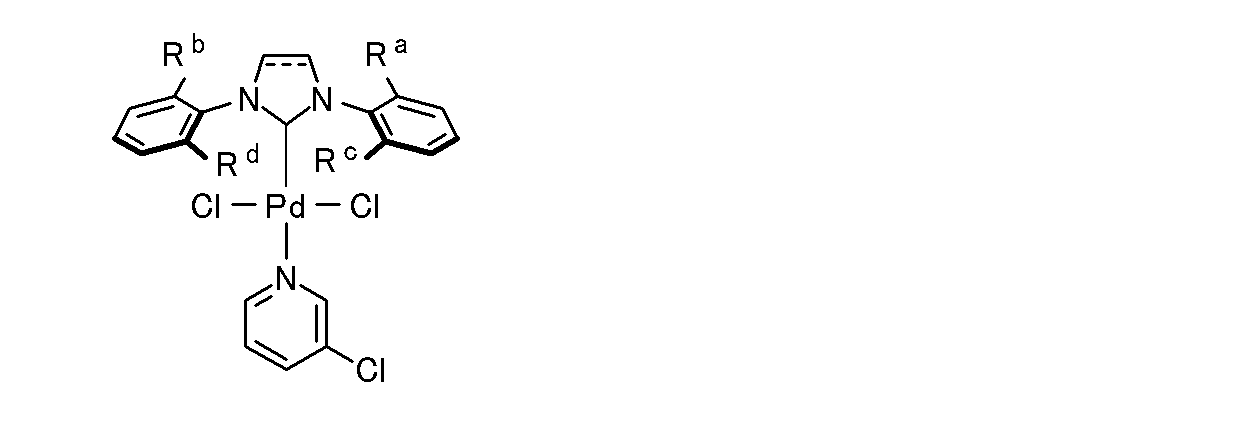
〔ここで、式中、Ra、Rb、Rc、及び、Rdは、それぞれ独立的に、水素、メチル基、エチル基、プロピル基(2-プロピル(イソプロピル)基)、ペンチル基(3-ペンチル基)、ヘプチル基(4-ヘプチル)、メトキシ基、トリフルオロメチル基、トリフルオロメトキシ基、又は、フルオロ基であり、破線は二重結合又は単結合である〕に示すパラジウム触媒を含む反応触媒の存在下で反応させて、一般式V(R1-R2)〔ここで、式中、R1は、一般式I及び一般式IIのR1と同様であり、R2は、一般式IIIのR2と同様である〕に示すカップリング生成物を得る工程、を有する点にある。
得られた前記有機ナトリウム化合物と一般式III(R2-Cl)〔ここで、式中、R2は、ナトリウムと反応しない置換基を有していてもよい脂肪族炭化水素基、脂環式炭化水素基、脂環式複素環基、芳香族炭化水素基、又は、芳香族複素環基であり〕に示す有機塩化物とを、
下記一般式IV
本構成によれば、有機ハロゲン化物から有機ナトリウム化合物を合成し、続いて、ナトリウム化合物と有機塩化物を含窒素ヘテロ環カルベン(以下、「NHC」と略する)配位子を有するパラジウム触媒の存在下で安定的かつ効率的にカップリングさせる有機化合物のカップリング方法を提供することができる。本構成によれば、取り扱いが容易なナトリウムを分散溶媒に分散させた分散体を使用することにより、温和な条件下で、煩雑な化学的手法を必要とせず少ない工程数で簡便かつ短時間に有機ハロゲン化物から有機ナトリウム化合物を安価に合成することができ、続くカップリング反応をも円滑に進行させ得ることから、経済的かつ工業的にも非常に有利である。また、温和な条件下で反応が進行するため、有機ハロゲン化物同士がカップリングする等の望ましくない副反応を誘発することなく、効率的に有機ナトリウム化合物を得ることができ、続く有機塩化物とのカップリング反応を円滑に進行させることができる。また、ナトリウムは、地球上に極めて広く分布していることから、サステナビリティにも優れた技術であり、その上、本構成で生じる主な副産物は塩化ナトリウムであるため、環境への負荷も低減できる。更に、本構成の有機化合物のカップリング方法は、種々の分子構造を有する有機化合物のカップリング反応を円滑に進め得ることから、医農薬及び電子材料等の機能性材料の合成等、様々な技術分野において利用することができる。
他の特徴構成は、前記反応触媒は、助触媒として金属塩化物を含む、点にある。
本構成によれば、前記反応触媒は、助触媒として金属塩化物を含むことにより、カップリング反応を更に円滑に進行させ得ることから、経済的かつ工業的にも非常に有利である。
他の特徴構成は、前記パラジウム触媒は、一般式IVにおいて、Ra、Rb、Rc、及び、Rdは、何れもイソプロピル基である、点にある。
本構成によれば、パラジウム触媒として嵩高いNHC配位子1,3-ビス(2,6-ジイソプロピルフェニル)イミダゾール-2-イリデン基を有する化合物を使用するものである。当該パラジウム触媒は高い触媒活性を有すると共に極めて安定であることから、カップリング反応を更に円滑に進行させることができる。これにより、更に、経済的かつ工業的に有利となる。
他の特徴構成は、前記有機ハロゲン化物:前記ナトリウムを分散溶媒に分散させた分散体のモル比は、1:2以上である、点にある。
本構成によれば、有機ハロゲン化物、ナトリウムを分散溶媒に分散させた分散体の使用量の最適化を図ることにより、有機ナトリウム化合物を更に高効率かつ高純度に合成することができ、続く有機塩化物とのカップリング反応を更に円滑に進行させることができる。
以下、本発明の実施形態に係る有機化合物のカップリング方法について詳細に説明する。ただし、本発明は、後述する実施形態に限定されるものではない。
本実施形態に係る有機化合物のカップリング方法は、反応溶媒中で、一般式I(R1-X1)に示す有機ハロゲン化物とナトリウムを分散溶媒に分散させた分散体を反応させて、一般式II(R1-Na)に示す有機ナトリウム化合物を得る工程(工程1)を有し、続いて、得られた有機ナトリウム化合物と一般式III(R2-Cl)に示す有機塩化物を反応させて、一般式V(R1-R2)に示すカップリング生成物を得る工程(工程2)を有するものである。ここで、カップリングは、2種類以上の分子を反応させ、特定の個所でのC-C結合により1つの化合物を合成するものである。カップリングは異なる構造を有する分子によるクロスカップリング及び同一構造を有する分子によるホモカップリングに区別されるが、好ましくは、クロスカップリングである。
(工程1)
本実施形態に係る有機化合物のカップリング方法における工程1は、反応溶媒中で、一般式I(R1-X1)に示す有機ハロゲン化物とナトリウムを分散溶媒に分散させた分散体を反応させて、一般式II(R1-Na)に示す有機ナトリウム化合物を得る工程である。一般式I(R1-X1)に示す有機ハロゲン化物は、共有結合したハロゲン原子を含む有機化合物であり、本実施形態に係る有機化合物のカップリング方法におけるカップリング対象物の1つである。
本実施形態に係る有機化合物のカップリング方法における工程1は、反応溶媒中で、一般式I(R1-X1)に示す有機ハロゲン化物とナトリウムを分散溶媒に分散させた分散体を反応させて、一般式II(R1-Na)に示す有機ナトリウム化合物を得る工程である。一般式I(R1-X1)に示す有機ハロゲン化物は、共有結合したハロゲン原子を含む有機化合物であり、本実施形態に係る有機化合物のカップリング方法におけるカップリング対象物の1つである。
一般式I(R1-X1)において、R1は、ナトリウムと反応しない置換基を有していてもよい芳香族炭化水素基、又は、芳香族複素環基である。ナトリウムと反応性を有する置換基を有すると、当該置換基とナトリウムを分散溶媒に分散させた分散体が反応し、副反応を誘発するため好ましくない。したがって、R1としてナトリウムと反応性を有する置換基を有する化合物を用いる場合には、当該置換基を適切な保護基等で保護することが必要となる。
芳香族炭化水素基は、芳香環を有する限り特に制限はない。単環だけでなく、縮合環やスピロ環等の環集合を持つものも含まれる。環員数についても特に制限はない。例えば、炭素原子数が、好ましくは6~22個、特に好ましくは、6~14個である芳香族炭化水素基が挙げられる。芳香族炭化水素基としては、単環式の六員環フェニル基等、二環式のナフチル基、ペンタレニル基、インデニル基、アズレニル基等、三環式のビフェニレニル基、インダセニル基、アセナフチレニル基、フルオレニル基、フェナレニル基、フェナントリル基、アントリル基等、四環式のフルオランテニル、アセアントリレニル基、トリフェニレニル基、ピレニル基、ナフタセニル基等、五環式のペリレニル基、テトラフェニレニル等、六環式のペンタセニル基等、七環式のルビセニル基、コロネニル基、ヘプタセニル基等が挙げられるが、これらに限定するものではない。特に好ましくは、フェニル基である。
芳香族複素環基は、環構成原子として1個又は複数個のヘテロ原子を有する芳香族複素環基である。単環だけでなく、縮合環やスピロ環等の環集合を持つものも含まれる。環員数についても特に制限はない。ヘテロ原子は、環構成原子としてナトリウムと反応しないものである限り特に制限はない。ヘテロ原子の数は特に制限はなく、ヘテロ原子の位置についても制限はない。ヘテロ原子としては、好ましくは、酸素原子、窒素原子、硫黄原子等が例示される。例えば、炭素原子数が、好ましくは1~5個、特に好ましくは、3~5個、ヘテロ原子数が、好ましくは1~4個、特に好ましくは1~3個である芳香族複素環基が挙げられる。なお、複数個のヘテロ原子を有する場合には、同一種類の原子であっても異なる種類の原子であってもよい。
例えば、単環式の芳香族複素環基としては、五員環式のピロリル基、ピラゾリル基、ピリジル基、イミダゾリル基等、六員環式のピラジニル基、ピリミジニル基、ピリダジニル基等の含窒素芳香族複素環基、五員環式のフリル基等の含酸素芳香族複素環基、五員環式のチエニル基等の含酸素芳香族複素環基、五員環式のオキサゾリル基、イソオキサゾリル基、フラザニル基等の含窒素酸素芳香族複素環基、五員環式のチアゾリル基、イソチアゾリル基等の含窒素硫黄芳香族複素環基等が挙げられるが、これらに限定するものではない。
多環式の芳香族複素環基としては、二環式のインドリジニル基、イソインドリル基、インドリル基、インダゾリル基、プリニル基、イソキノリル基、キノリル基、フタラジニル基、ナフチリジニル基、キノキサリニル基、キナゾリニル基、シンノリニル基等、三環式のカルバゾリル基、カルボリニル基、フェナトリジニル基、アクリジニル基、ペリミジニル基、フェナントロリニル基、フェナジニル基等の含窒素芳香族複素環基、二環式のベンゾフラニル基、イソベンゾフラニル基、ベンゾピラニル基等の含酸素芳香族複素環基、二環式のベンゾチエニル基等、三環式のチアントレニル基等の含硫黄芳香族複素環基、二環式のベンゾオキサゾリル基、ベンゾイソオキサゾリル基等の含窒素酸素芳香族複素環基、二環式のベンゾチアゾリル基、ベンゾイソチアゾリル基、三環式のフェノチアジニル基等の含窒素硫黄芳香族複素環基、三環式のフェノキサチイニル基等の含酸素硫黄芳香族複素環基等が挙げられるが、これらに限定するものではない。
芳香族炭化水素基及び芳香族複素環基は、置換基を有していてもよい。置換基は、1個又は複数個を有していてよく、複数個の置換基を有する場合には、互いに同一又は異なっていてもよい。また、置換基の位置についても特に制限はない。置換基としては、置換基を有してもよい脂肪族炭化水素基、脂環式炭化水素基、脂環式複素環基、芳香族炭化水素基、芳香族複素環基、アルコキシ基、シクロアルコキシ基、アリールオキシ基、アラルキルオキシ基、脂環式複素環オキシ基、芳香族複素環オキシ基、アルキルチオ基、シクロアルキルチオ基、アリールチオ基、アラルキルチオ基は、脂環式複素環チオ基、芳香族複素環チオ基、アルキルアミノ基、シクロアルキルアミノ基、アリールアミノ基、アラルキルアミノ基、脂環式複素環アミノ基、芳香族複素環アミノ基、アシル基等が例示されるが、これらに限定するものではない。
置換基として有してもよい脂肪族炭化水素基は、直鎖及び分枝の別を問わず、飽和及び不飽和の別も問わない。また、その鎖長についても特に制限はない。脂肪族炭化水素基としては、これらに限定するものではないが、好ましくは炭素原子数1~20個、特に好ましくは炭素原子数3~20個のアルキル基、アルケニル基、アルキニル基が例示される。具体的には、アルキル基としては、メチル基、エチル基、プロピル基、ブチル基、イソプロピル基、n-ブチル基、イソブチル基、s-ブチル基、t-ブチル基、n-ペンチル基、イソペンチル基、ネオペンチル基、t-ペンチル基、s-ペンチル基、2-メチルブチル基、1-エチルプロピル基、2-エチルプロピル基、n-ヘキシル基、イソヘキシル基、ネオヘキシル基、t-ヘキシル基、2,2-ジメチルブチル基、2-メチルペンチル基、3-メチルペンチル基、1-エチルブチル基、2-エチルブチル基、1-プロピルプロピル基、n-ヘプチル基、イソヘプチル基、s-ヘプチル基、t-ヘプチル基、2,2-ジメチルペンチル基、3,3-ジメチルペンチル基、1-メチルヘキシル基、2-メチルヘキシル基、3-メチルヘキシル基、4-メチルヘキシル基、1-エチルペンチル基、2-エチルペンチル基、3-エチルペンチル基、1-プロピルブチル基、2-プロピルブチル基、n-オクチル基、イソオクチル基、t-オクチル基、ネオオクチル基、2,2-ジメチルヘキシル基、3,3-ジメチルヘキシル基、4,4-ジメチルヘキシル基、1-メチルヘプチル基、2-メチルヘプチル基、3-メチルヘプチル基、4-メチルヘプチル基、5-メチルヘプチル基、1-エチルヘキシル基、2-エチルヘキシル基、3-エチルヘキシル基、4-エチルヘキシル基、1-プロピルペンチル基、2-プロピルペンチル基、3-プロピルペンチル基、n-ノニル基、イソノニル基、t-ノニル基、1-メチルオクチル基、2-メチルオクチル基、3-メチルオクチル基、4-メチルオクチル基、5-メチルオクチル基、6-メチルオクチル基、n-デシル基、イソデシル基、t-デシル基、1-メチルノニル基、2-メチルノニル基、3-メチルノニル基、4-メチルノニル基、5-メチルノニル基、6-メチルノニル基、7-メチルノニル基等が挙げられるが、これらに限定するものではない。アルケニル基としては、エテニル基、プロペニル基、ブテニル基、ペンテニル基、ヘキセニル基、ヘプテニル基、オクテニル基等が挙げられるが、これらに限定するものではない。アルキニル基としては、エチニル基、プロピニル基、ブチニル基、ペンチニル基、ヘプチニル基、オクチニル基等が挙げられるが、これらに限定するものではない。
置換基として有してもよい脂環式炭化水素基は、環構成原子間の結合は飽和及び不飽和の別は問わず、環員数についても特に制限はない。また、単環だけでなく、縮合環やスピロ環等の環集合を持つものも含まれる。脂環式炭化水素基としては、これらに制限するものではないが、好ましくは炭素原子数3~10個、特に好ましくは3~7個のシクロアルキル基、及び、シクロアルケニル基、好ましくは炭素原子数4~10個、特に好ましくは4~7個のシクロアルケニル基等が例示される。具体的には、シクロアルキル基として、シクロプロピル基、シクロブチル基、シクロペンチル基、シクロヘキシル基、シクロヘプチル基、シクロオクチル基等が挙げられるが、これらに限定するものではない。シクロアルケニル基としては、シクロプロペニル基、シクロブテニル基、シクロペンテニル基、シクロヘキセニル基、シクロヘプテニル基、シクロオクテニル基等が挙げられるが、これらに限定するものではない。
置換基として有してもよい脂環式複素環基は、環構成原子として1個又は複数個のヘテロ原子を有する非芳香族複素環基である。単環だけでなく、縮合環やスピロ環等の環集合を持つものも含まれる。環構成原子間の結合は飽和及び不飽和の別は問わず、環員数についても特に制限はない。ヘテロ原子は、環構成原子としてナトリウムと反応しないものである限り特に制限はない。ヘテロ原子の数は特に制限はなく、ヘテロ原子の位置についても制限はない。ヘテロ原子としては、好ましくは、酸素原子、窒素原子、硫黄原子等が例示される。例えば、炭素原子数が、好ましくは2~7個、特に好ましくは、2~5個、ヘテロ原子数が、好ましくは1~5個、特に好ましくは1~3個である脂環式複素環基が挙げられる。なお、複数個のヘテロ原子を有する場合には、同一種類の原子であっても異なる種類の原子であってもよい。脂環式複素環基としては、単環の四員環式のアゼチジニル基、五員環式のピロリジニル基、六員環式のピペリジル基、ピペラジニル基等の含窒素脂環式複素環基、単環の三員環式のオキシラニル基、四員環式のオキセタニル基、五員環式のテトラヒドロフリル基、六員環式のテトラヒドロピラニル基等の含酸素脂環式複素環基、単環の五員環式のテトラヒドロチオフェニル基等の含硫黄脂環式複素環基、単環の六員環式のモルホリニル基等の含窒素酸素脂環式複素環基、単環の六員環式のチオモルホリニル基等の含窒素硫黄脂環式複素環基等が挙げられるが、これらに限定するものではない。
置換基として有してもよい芳香族炭化水素基、及び、芳香族複素環基としては、上記で示されるものと同様なものが挙げられる。
置換基として有してもよいアルコキシ基は、好ましくは炭素原子数1~10個のアルコキシ基が例示され、具体的には、メトキシ基、エトキシ基、プロポキシ基、ブトキシ基、ペンチルオキシ基、ヘキシルオキシ基等が挙げられるが、これらに限定するものではない。置換基として有してもよいシクロアルコキシ基は、好ましくは炭素原子数3~10個のシクロプロポキシ基が例示され、シクロブトキシ基、シクロペンチルオキシ基、シクロヘキシルオキシ基が挙げられる。置換基として有してもよいアリールオキシ基は、好ましくは炭素原子数6~20個のアリールオキシ基が例示され、具体的には、フェニルオキシ基、ナフチルオキシ基等が挙げられるが、これらに限定するものではない。置換基として有してもよいアラルキルオキシ基は、好ましくは炭素原子数7~11個のアラルキルオキシ基が例示され、具体的には、ベンジルオキシ基、及び、フェネチルオキシ基が挙げられる。置換基として有してもよい脂環式複素環オキシ基、及び、芳香族複素環オキシ基は、複素環部として上記で示される脂環式複素環基及び芳香族複素環基を有するものが挙げられる。
置換基として有してもよいアルキルチオ基は、好ましくは炭素原子数1~20個のアルキルチオ基が例示され、メチルチオ基、エチルチオ基、プロピルチオ基、ブチルチオ基、ペンチルチオ基、ヘキシルチオ基等が挙げられるが、これらに限定するものではない。置換基として有してもよいシクロアルキルチオ基は、炭素原子数3~10個のシクロアルキルチオ基が例示され、具体的には、シクロプロピルチオ基、シクロブチルチオ基、シクロペンチルチオ基、シクロヘキシルチオ基等が挙げられるが、これらに限定するものではない。
置換基として有してもよいアリールチオ基は、好ましくは炭素原子数6~20個のアリールチオ基が例示され、具体的には、フェニルチオ基、ナフチルチオ基等が挙げられるが、これらに限定するものではない。アラルキルチオ基は、好ましくは炭素原子数7~11個のアラルキルチオ基が例示され、具体的には、ベンジルチオ基、フェネチルチオ基等が挙げられるが、これらに限定するものではない。置換基として有してもよい脂環式複素環チオ基、及び、芳香族複素環チオ基は、複素環部として上記で示される脂環式複素環基及び芳香族複素環基を有するものが挙げられる。
置換基として有してもよいアリールチオ基は、好ましくは炭素原子数6~20個のアリールチオ基が例示され、具体的には、フェニルチオ基、ナフチルチオ基等が挙げられるが、これらに限定するものではない。アラルキルチオ基は、好ましくは炭素原子数7~11個のアラルキルチオ基が例示され、具体的には、ベンジルチオ基、フェネチルチオ基等が挙げられるが、これらに限定するものではない。置換基として有してもよい脂環式複素環チオ基、及び、芳香族複素環チオ基は、複素環部として上記で示される脂環式複素環基及び芳香族複素環基を有するものが挙げられる。
上記置換基として有してもよい各種基は、更に、置換基を有するものであってもよい。置換基は、1個又は複数個を有していてよく、複数個の置換基を有する場合には、互いに同一又は異なっていてもよい。また、置換基の位置についても特に制限はない。置換基は、上記で示されるものと同様のものが挙げられる。
X1は、ハロゲン原子であり、具体的には、塩素原子、臭素原子、ヨウ素原子、又は、フッ素原子であるが、好ましくは、塩素原子である。安価な有機塩化物を用いることにより経済的に更に有利となる。また、グリニャール試薬の調製に際して汎用される有機臭化物において問題となるような、原料である臭素の産地の偏在や入手の困難性等の問題もなく、工業化に際しての高負荷な廃棄処理施設の必要性等の問題もない。
カップリング対象物となる一般式I(R1-X1)に示す有機ハロゲン化物は、市販されているものを使用してもよいし、当該技術分野で公知の方法により製造されたものを使用してよい。
ナトリウムを分散溶媒に分散させた分散体(以下、Sodium Dispersionの略号である「SD」と略する場合がある。)は、ナトリウムを微粒子として不溶性溶媒に分散させたもの、又は、ナトリウムを液体の状態で不溶性溶媒に分散させたものである。ナトリウムとしては、金属ナトリウムのほか、金属ナトリウムを含む合金などが挙げられる。微粒子の平均粒子径として、好ましくは、10μm未満であり、特に好ましくは、5μm未満のものを使用することができる。平均粒子径は、顕微鏡写真の画像解析によって得られた投影面積と同等の投影面積を有する球の径で表した。
分散溶媒としては、ナトリウムを微粒子として分散、又はナトリウムを液体の状態で不溶性溶媒に分散でき、かつ、有機ハロゲン化物とSDとの反応を阻害しない限り、当該技術分野で公知の溶媒を使用することができる。例えば、例えば、キシレン、トルエン等の芳香族系溶媒や、ノルマルデカン等のノルマルパラフィン系溶媒、テトラヒドロチオフェン等の複素環化合物溶媒、又はそれらの混合溶媒等が挙げられる。
SDは、クロロベンゼンに対して2.1モル当量以上で反応溶媒中で反応させた場合に、添加したクロロベンゼンに対するフェニルナトリウムの収率が99.0%以上となる活性を有するものを使用することが好ましい。このような高活性なSDを使用することにより、更に効率的に有機ハロゲン化物から有機ナトリウム化合物を安価に合成することができ、続くカップリング反応をも円滑に進行させることができる。ここで、SDの活性を高く維持するためには、好ましくは、ガラスバイアル等のガスバリア性の高い容器に保管することが好ましい。しかしながら、ガスバリア性の低い容器に保管することを排除するものではなく、その場合には、SDの製造後、速やかに、例えば数週間内、好ましくは3週間内に使用する。
工程1の反応溶媒としては、有機ハロゲン化物とSDとの反応を阻害しない限り、当該技術分野で公知の溶媒を使用することができる。例えば、エーテル系溶媒、ノルマルパラフィン系やシクロパラフィン系等のパラフィン系溶媒、芳香族系溶媒、アミン系溶媒、複素環化合物溶媒を使用することができる。エーテル系溶媒としては、環状エーテル溶媒が好ましく、テトラヒドロフラン(以下、「THF」と略する場合がある)等を好ましく使用することができる。パラフィン系溶媒としては、シクロヘキサン、ノルマルヘキサン、及び、ノルマルデカン等が特に好ましい。芳香族系溶媒としては、キシレン、トルエン及びベンゼン等が好ましく、クロロベンゼンやフルオロベンゼン等のハロゲン化芳香族系溶媒を利用することができる。アミン系溶媒としては、エチレンジアミン等を好ましく使用することができる。複素環化合物溶媒としては、テトラヒドロチオフェン等を利用することができる。また、これらは1種類のみを使用してもよいし、2種以上を併用し混合溶媒として使用することもできる。ここで、前述の分散溶媒と反応溶媒とは同一の種類のものを使用してもよいし、異なる種類のものを使用してもよい。
工程1の反応温度は、溶媒としてパラフィン系溶媒を使用する場合は特に限定されず、有機ハロゲン化物、SD及び反応溶媒の種類や量、並びに反応圧力等により適宜設定することができる。具体的には、反応温度は、反応溶媒の沸点を越えない温度に設定することが好ましい。加圧下では大気圧下での沸点よりも高くなるため反応温度を高い温度で設定することができる。反応は、室温で行うこともでき、好ましくは0~100℃であり、特に好ましくは20~80℃、更に好ましくは室温~50℃である。特段の加熱や冷却等のための温度制御手段を設ける必要はないが、必要に応じて、温度制御手段を設けても良い。一方、パラフィン系以外の溶媒を使用する場合は、工程1の反応で得られる一般式II(R1-Na)に示す有機ナトリウム化合物の好適例であるフェニルナトリウム等と溶媒との反応を防止するため、低温、好ましくは0℃付近で行うとよい。ここで、有機ハロゲン化物と等モル当量のTHFを添加することで、ビフェニルの生成を効果的に抑制できると共に、良好な反応速度を維持することができる。したがって、反応溶媒の種類及び添加量を適切に制御することで、更に効率的に目的化合物を合成することができる。
工程1の反応時間についても、特に限定されず、有機ハロゲン化物、SD、及び反応溶媒の種類や量、並びに反応圧力や反応温度等に応じて適宜設定すればよい。通常は、15分間~24時間、好ましくは20分間~6時間で行われる。
工程1は、SD、及び、反応溶媒等の試薬類は大気下で安定して扱え得ることから、大気下の常圧条件下で行うことに適している。しかしながら、得られる一般式II(R1-Na)に示す有機ナトリウム化合物の好適例であるフェニルナトリウム等は高活性であり少しでも空気が混入すると水分によりプロトン化されることから、必要に応じて、アルゴンガスや窒素ガス等を充填した不活性ガス雰囲気下で行ってもよい。
工程1によって得られる一般式II(R1-Na)に示す有機ナトリウム化合物は、一般式I(R1-X1)に示す有機ハロゲン化物のハロゲン原子がナトリウムに置換されたものである。
したがって、一般式II(R1-Na)に示す有機ナトリウム化合物において、R1は、上記した一般式IのR1と同様であり、Naは、ナトリウム原子である。得られた有機ナトリウム化合物は、カラムクロマトグラフィー、蒸留、再結晶等、当該技術分野で公知の精製手段により精製してもよい。また、未反応で残存した有機ハロゲン化物を回収し、再度、工程1の反応に供するように構成してもよい。また、生成時と同様にアルゴンガスや窒素ガスなどを充填した不活性ガス雰囲気下で行ってもよい。
したがって、一般式II(R1-Na)に示す有機ナトリウム化合物において、R1は、上記した一般式IのR1と同様であり、Naは、ナトリウム原子である。得られた有機ナトリウム化合物は、カラムクロマトグラフィー、蒸留、再結晶等、当該技術分野で公知の精製手段により精製してもよい。また、未反応で残存した有機ハロゲン化物を回収し、再度、工程1の反応に供するように構成してもよい。また、生成時と同様にアルゴンガスや窒素ガスなどを充填した不活性ガス雰囲気下で行ってもよい。
(工程2)
本実施形態に係る有機化合物のカップリング方法における工程2は、工程1によって得られる一般式II(R1-Na)に示す有機ナトリウム化合物と一般式III(R2-Cl)に示す有機塩化物とを反応させて、一般式V(R1-R2)に示すカップリング生成物を得る工程であり、工程2の反応は、下記で示す特定のパラジウム触媒を含む反応触媒の存在下で行う。一般式III(R2-Cl)に示す有機塩化物は、共有結合した塩素原子を含む有機化合物であり、本実施形態に係る有機化合物のカップリング方法におけるカップリング対象物のもう1つの化合物である。
本実施形態に係る有機化合物のカップリング方法における工程2は、工程1によって得られる一般式II(R1-Na)に示す有機ナトリウム化合物と一般式III(R2-Cl)に示す有機塩化物とを反応させて、一般式V(R1-R2)に示すカップリング生成物を得る工程であり、工程2の反応は、下記で示す特定のパラジウム触媒を含む反応触媒の存在下で行う。一般式III(R2-Cl)に示す有機塩化物は、共有結合した塩素原子を含む有機化合物であり、本実施形態に係る有機化合物のカップリング方法におけるカップリング対象物のもう1つの化合物である。
工程2は、工程1により得られた有機ナトリウム化合物と有機塩化物とを、パラジウム触媒を含む反応触媒の存在下でカップリングするものであり、有機ナトリウム化合物に対するカップリング対象物として有機塩化物を用いることによりカップリング反応が円滑に進行する。これに対して、有機塩化物以外の有機臭化物等の他の有機ハロゲン化物をカップリング対象物とした場合には、有機ナトリウム化合物と有機臭化物との間でトランスメタル反応が生じ、カップリング反応が円滑に進行しないという問題がある。
一般式III(R2-Cl)に示す有機塩化物において、R2は、ナトリウムと反応しない置換基を有してもよい脂肪族炭化水素基、脂環式炭化水素基、脂環式複素環基、芳香族炭化水素基、又は、芳香族複素環基である。ナトリウムと反応性を有する置換基を有すると、当該置換基とSDが反応し、副反応を誘発するため好ましくない。したがって、R2としてナトリウムと反応性を有する置換基を有する化合物をカップリング対象物とする場合には、当該置換基を適切な保護基等で保護することが必要となる。
脂肪族炭化水素基は、直鎖及び分枝の別を問わず、飽和及び不飽和の別も問わない。また、その鎖長についても特に制限はない。脂肪族炭化水素基としては、これらに限定するものではないが、好ましくは炭素原子数1~20個、特に好ましくは炭素原子数3~20個のアルキル基、アルケニル基、アルキニル基が例示される。具体的には、アルキル基としては、メチル基、エチル基、プロピル基、ブチル基、イソプロピル基、n-ブチル基、イソブチル基、s-ブチル基、t-ブチル基、n-ペンチル基、イソペンチル基、ネオペンチル基、t-ペンチル基、s-ペンチル基、2-メチルブチル基、1-エチルプロピル基、2-エチルプロピル基、n-ヘキシル基、イソヘキシル基、ネオヘキシル基、t-ヘキシル基、2,2-ジメチルブチル基、2-メチルペンチル基、3-メチルペンチル基、1-エチルブチル基、2-エチルブチル基、1-プロピルプロピル基、n-ヘプチル基、イソヘプチル基、s-ヘプチル基、t-ヘプチル基、2,2-ジメチルペンチル基、3,3-ジメチルペンチル基、1-メチルヘキシル基、2-メチルヘキシル基、3-メチルヘキシル基、4-メチルヘキシル基、1-エチルペンチル基、2-エチルペンチル基、3-エチルペンチル基、1-プロピルブチル基、2-プロピルブチル基、n-オクチル基、イソオクチル基、t-オクチル基、ネオオクチル基、2,2-ジメチルヘキシル基、3,3-ジメチルヘキシル基、4,4-ジメチルヘキシル基、1-メチルヘプチル基、2-メチルヘプチル基、3-メチルヘプチル基、4-メチルヘプチル基、5-メチルヘプチル基、1-エチルヘキシル基、2-エチルヘキシル基、3-エチルヘキシル基、4-エチルヘキシル基、1-プロピルペンチル基、2-プロピルペンチル基、3-プロピルペンチル基、n-ノニル基、イソノニル基、t-ノニル基、1-メチルオクチル基、2-メチルオクチル基、3-メチルオクチル基、4-メチルオクチル基、5-メチルオクチル基、6-メチルオクチル基、n-デシル基、イソデシル基、t-デシル基、1-メチルノニル基、2-メチルノニル基、3-メチルノニル基、4-メチルノニル基、5-メチルノニル基、6-メチルノニル基、7-メチルノニル基等が挙げられるが、これらに限定するものではない。アルケニル基としては、エテニル基、プロペニル基、ブテニル基、ペンテニル基、ヘキセニル基、ヘプテニル基、オクテニル基等が挙げられるが、これらに限定するものではない。アルキニル基としては、エチニル基、プロピニル基、ブチニル基、ペンチニル基、ヘプチニル基、オクチニル基等が挙げられるが、これらに限定するものではない。
脂環式炭化水素基は、環構成原子間の結合は飽和及び不飽和の別は問わず、環員数についても特に制限はない。また、単環だけでなく、縮合環やスピロ環等の環集合を持つものも含まれる。脂環式炭化水素基としては、これらに制限するものではないが、好ましくは炭素原子数3~10個、特に好ましくは3~7個のシクロアルキル基、及び、シクロアルケニル基、好ましくは炭素原子数4~10個、特に好ましくは4~7個のシクロアルケニル基等が例示される。具体的には、シクロアルキル基として、シクロプロピル基、シクロブチル基、シクロペンチル基、シクロヘキシル基、シクロヘプチル基、シクロオクチル基等が挙げられるが、これらに限定するものではない。シクロアルケニル基としては、シクロプロペニル基、シクロブテニル基、シクロペンテニル基、シクロヘキセニル基、シクロヘプテニル基、シクロオクテニル基等が挙げられるが、これらに限定するものではない。
脂環式複素環基は、環構成原子として1個又は複数個のヘテロ原子を有する非芳香族複素環基である。単環だけでなく、縮合環やスピロ環等の環集合を持つものも含まれる。環構成原子間の結合は飽和及び不飽和の別は問わず、環員数についても特に制限はない。ヘテロ原子は、環構成原子としてナトリウムと反応しないものである限り特に制限はない。ヘテロ原子の数は特に制限はなく、ヘテロ原子の位置についても制限はない。ヘテロ原子としては、好ましくは、酸素原子、窒素原子、硫黄原子等が例示される。例えば、炭素原子数が、好ましくは2~7個、特に好ましくは、2~5個、ヘテロ原子数が、好ましくは1~5個、特に好ましくは1~3個である脂環式複素環基が挙げられる。なお、複数個のヘテロ原子を有する場合には、同一種類の原子であっても異なる種類の原子であってもよい。脂環式複素環基としては、単環の四員環式のアゼチジニル基、五員環式のピロリジニル基、六員環式のピペリジル基、ピペラジニル基等の含窒素脂環式複素環基、単環の三員環式のオキシラニル基、四員環式のオキセタニル基、五員環式のテトラヒドロフリル基、六員環式のテトラヒドロピラニル基等の含酸素脂環式複素環基、単環の五員環式のテトラヒドロチオフェニル基等の含硫黄脂環式複素環基、単環の六員環式のモルホリニル基等の含窒素酸素脂環式複素環基、単環の六員環式のチオモルホリニル基等の含窒素硫黄脂環式複素環基等が挙げられるが、これらに限定するものではない。
芳香族炭化水素基は、芳香環を有する限り特に制限はない。単環だけでなく、縮合環やスピロ環等の環集合を持つものも含まれる。環員数についても特に制限はない。例えば、炭素原子数が、好ましくは6~22個、特に好ましくは、6~14個である芳香族炭化水素基が挙げられる。芳香族炭化水素基としては、単環式の六員環フェニル基等、二環式のナフチル基、ペンタレニル基、インデニル基、アズレニル基等、三環式のビフェニレニル基、インダセニル基、アセナフチレニル基、フルオレニル基、フェナレニル基、フェナントリル基、アントリル基等、四環式のフルオランテニル、アセアントリレニル基、トリフェニレニル基、ピレニル基、ナフタセニル基等、五環式のペリレニル基、テトラフェニレニル等、六環式のペンタセニル基等、七環式のルビセニル基、コロネニル基、ヘプタセニル基等が挙げられるが、これらに限定するものではない。特に好ましくは、フェニル基である。
芳香族複素環基は、環構成原子として1個又は複数個のヘテロ原子を有する芳香族複素環基である。単環だけでなく、縮合環やスピロ環等の環集合を持つものも含まれる。環員数についても特に制限はない。ヘテロ原子は、環構成原子としてナトリウムと反応しないものである限り特に制限はない。ヘテロ原子の数は特に制限はなく、ヘテロ原子の位置についても制限はない。ヘテロ原子としては、好ましくは、酸素原子、窒素原子、硫黄原子等が例示される。例えば、炭素原子数が、好ましくは1~5個、特に好ましくは、3~5個、ヘテロ原子数が、好ましくは1~4個、特に好ましくは1~3個である芳香族複素環基が挙げられる。なお、複数個のヘテロ原子を有する場合には、同一種類の原子であっても異なる種類の原子であってもよい。
例えば、単環式の芳香族複素環基としては、五員環式のピロリル基、ピラゾリル基、ピリジル基、イミダゾリル基等、六員環式のピラジニル基、ピリミジニル基、ピリダジニル基等の含窒素芳香族複素環基、五員環式のフリル基等の含酸素芳香族複素環基、五員環式のチエニル基等の含酸素芳香族複素環基、五員環式のオキサゾリル基、イソオキサゾリル基、フラザニル基等の含窒素酸素芳香族複素環基、五員環式のチアゾリル基、イソチアゾリル基等の含窒素硫黄芳香族複素環基等が挙げられるが、これらに限定するものではない。
多環式の芳香族複素環基としては、二環式のインドリジニル基、イソインドリル基、インドリル基、インダゾリル基、プリニル基、イソキノリル基、キノリル基、フタラジニル基、ナフチリジニル基、キノキサリニル基、キナゾリニル基、シンノリニル基等、三環式のカルバゾリル基、カルボリニル基、フェナトリジニル基、アクリジニル基、ペリミジニル基、フェナントロリニル基、フェナジニル基等の含窒素芳香族複素環基、二環式のベンゾフラニル基、イソベンゾフラニル基、ベンゾピラニル基等の含酸素芳香族複素環基、二環式のベンゾチエニル基等、三環式のチアントレニル基等の含硫黄芳香族複素環基、二環式のベンゾオキサゾリル基、ベンゾイソオキサゾリル基等の含窒素酸素芳香族複素環基、二環式のベンゾチアゾリル基、ベンゾイソチアゾリル基、三環式のフェノチアジニル基等の含窒素硫黄芳香族複素環基、三環式のフェノキサチイニル基等の含酸素硫黄芳香族複素環基等が挙げられるが、これらに限定するものではない。
脂肪族炭化水素基、脂環式炭化水素基、脂環式複素環基、芳香族炭化水素基、及び、芳香族複素環基は、置換基を有していてもよい。置換基は、1個又は複数個を有していてよく、複数個の置換基を有する場合には、互いに同一又は異なっていてもよい。また、置換基の位置についても特に制限はない。置換基としては、置換基を有してもよい脂肪族炭化水素基、脂環式炭化水素基、脂環式複素環基、芳香族炭化水素基、芳香族複素環基、アルコキシ基、シクロアルコキシ基、アリールオキシ基、アラルキルオキシ基、脂環式複素環オキシ基、芳香族複素環オキシ基、アルキルチオ基、シクロアルキルチオ基、アリールチオ基、アラルキルチオ基は、脂環式複素環チオ基、芳香族複素環チオ基、アルキルアミノ基、シクロアルキルアミノ基、アリールアミノ基、アラルキルアミノ基、脂環式複素環アミノ基、芳香族複素環アミノ基、アシル基等が例示されるが、これらに限定するものではない。置換基としては、上記R1の項で示されるものと同様のものが挙げられる。また、上記置換基として有してもよい各種基は、更に、置換基を有するものであってもよい。置換基は、1個又は複数個を有していてよく、複数個の置換基を有する場合には、互いに同一又は異なっていてもよい。また、置換基の位置についても特に制限はない。置換基は、上記で示されるものと同様のものが挙げられる。
カップリング対象物となる一般式III(R2-Cl)に示す有機塩化物は、市販されているものを使用してもよいし、当該技術分野で公知の方法により製造されたものを使用してよい。
工程2の反応は、反応触媒の存在下で進行する。反応触媒は、パラジウム触媒を含むものであり、下記一般式IVに示すものを含む。
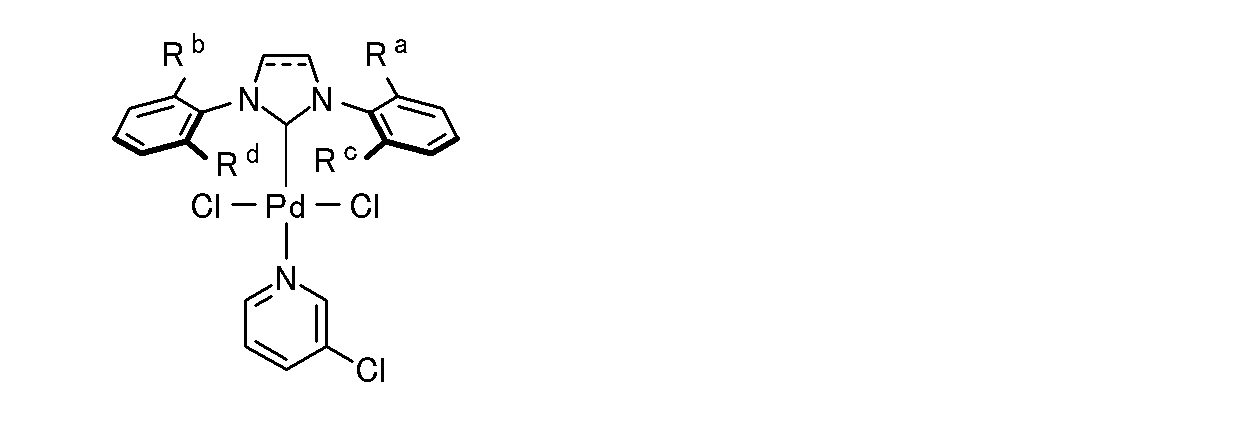
ここで、一般式IV中、Ra、Rb、Rc、Rdは、それぞれ独立的に水素、メチル基、エチル基、プロピル基(2-プロピル(イソプロピル)基)、ペンチル基(3-ペンチル基)、ヘプチル基(4-ヘプチル基)、メトキシ基、トリフルオロメチル基、トリフルオロメトキシ基、又は、フルオロ基である。Ra、Rb、Rc、Rdは、全て若しくは一部が同一、又は、全てが互いに異なっていてもよい。破線は二重結合又は単結合である。
上記一般式IVに示すパラジウム触媒は、含窒素ヘテロ環カルベン(NHC)パラジウム錯体であり、Pyridine-Enhanced Precatalyst Preparation Stabilization and Initiation(PEPPSI(商標))と称される触媒が含まれる。好ましくは、[1,3-ビス(2,6-ジイソプロピルフェニル)イミダゾール-2-イリデン](3-クロロピリジル)パラジウム(II)ジクロリド([1,3-Bis(2,6-Diisopropylphenyl)imidazol-2-ylidene](3-chloropyridyl)palladium(II)dichloride:Pd-PEPPSI(商標)-IPrCl)、1,3-ビス(2,6-ジ-3-ペンチルフェニル)イミダゾール-2-イリデン](3-クロロピリジル)パラジウム(II)ジクロリド([1,3-Bis(2,6-Di-3-pentylphenyl)imidazol-2-ylidene](3-chloropyridyl)palladium(II)dichloride:Pd-PEPPSI(商標)-IPentCl)、[1,3-ビス(2,6-ジエチルフェニル)イミダゾール-2-イリデン](3-クロロピリジル)パラジウム(II)ジクロリド([1,3-Bis(2,6-Diethylphenyl)imidazol-2-ylidene](3-chloropyridyl)palladium(II)dichloride:Pd-PEPPSI(商標)-IETCl)、[1,3-ビス(2,6-ジ-4-ヘプチルフェニル)イミダゾール-2-イリデン](3-クロロピリジル)パラジウム(II)ジクロリド([1,3-Bis(2,6-Di-4-heptylphenyl)imidazol-2-ylidene](3-chloropyridyl)palladium(II)dichloride:Pd-PEPPSI(商標)-IHeptCl)、[1,3-ビス(2,6-ジイソプロピルフェニル)イミダゾリデン)(3-クロロピリジル)パラジウム(II)ジクロリド([1,3- bis (2,6-diisopropylphenyl) imidazolidene] (3 chloropyridyl) palladium (II) dichloride:Pd-PEPPSI(商標)-SIPrCl)を挙げることができる。
反応触媒には、上記パラジウム触媒の触媒活性を増大させる機能を有する補助成分を含めることができ、例えば、助触媒を含めることができる。助触媒としては、ハロゲン化ホウ素、ホウ酸エステル、及び、金属ハロゲン化物等を挙げることができる。ハロゲン化ホウ素としては、具体的に、三塩化ホウ素、三フッ化ホウ素、三臭化ホウ素、三ヨウ化ホウ素等を挙げることができる。ホウ酸エステルとしては、具体的には、B(ORe
2)3〔ここで、Reは炭素原子数1~20個のアルキル基等の脂肪族炭化水素基、脂環式炭化水素基、芳香族炭化水素基等である〕で示す化合物が例示され、ホウ酸トリメチル、ホウ酸トリエチル、ホウ酸トリ-n-プロピル、ホウ酸トリイソプロピル、ホウ酸トリ-n-ブチル、ホウ酸トリイソブチル、2-メトキシ-4,4,5,5-テトラメチル-1,3,2-ジオキサボロラン(メトキシボロン酸ピナコール)、-エトキシ-4,4,5,5-テトラメチル-1,3,2-ジオキサボロラン(エトキシボロン酸ピナコール)、2-イソプロポシキ-4,4,5,5-テトラメチル-1,3,2-ジオキサボロラン(イソプロポキシボロン酸ピナコール)、2-イソプロポキシ-4,4,6-トリメチル-1,3,2-ジオキサボリナン、及びホウ酸トリエタノールアミン等を挙げることができる。金属ハロゲン化物としては、具体的に、塩化亜鉛、臭化亜鉛、ヨウ化亜鉛、フッ化亜鉛、塩化マグネシウム、臭化マグネシウム、ヨウ化マグネシウム、フッ化マグネシウム、塩化アルミニウム、臭化アルミニウム、塩化インジウム等を挙げることができる。しかしながら、これらに限定するものではなく、パラジウム触媒の触媒活性を増大させる機能を有する限り、公知の何れの化合物をも含めることができる。また、金属ハロゲン化物は、テトラメチルエチレンジアミン(以下、「TMEDA」と略する)等の配位子に配位したものを用いることができる。
工程2は、工程1によって得られる反応物に有機塩化物と反応触媒を添加することにより行ってもよいし、工程1によって得られる反応物を当該技術分野で公知の精製手段により精製した後、反応溶媒の存在下で有機塩化物と反応触媒を添加することによって行ってもよい。反応溶媒としては、工程1と同様のものを使用することができる。
工程2の反応温度は、溶媒としてパラフィン系溶媒を使用する場合は特に限定されず、工程1の反応で得られる有機ナトリウム化合物、本工程で添加する有機塩化物、SD及び反応溶媒の種類や量、並びに反応圧力等により適宜設定することができる。具体的には、反応温度は、反応溶媒の沸点を越えない温度に設定することが好ましい。加圧下では大気圧下での沸点よりも高くなるため反応温度を高い温度で設定することができる。反応は、室温で行うこともでき、好ましくは0~100℃であり、特に好ましくは20~80℃、更に好ましくは室温~50℃である。特段の加熱や冷却等のための温度制御手段を設ける必要はないが、必要に応じて、温度制御手段を設けても良い。一方、パラフィン系以外の溶媒を使用する場合は、工程1の反応で得られる有機ナトリウム化合物の好適例であるフェニルナトリウム等と溶媒との反応を防止するため、低温、好ましくは0~20℃で行うとよい。
工程2の反応時間についても、特に限定されず、工程1の反応で得られる有機ナトリウム化合物、本工程で添加する有機塩化物、SD、及び反応溶媒の種類や量、並びに反応圧力や反応温度等に応じて適宜設定すればよい。通常は、5分~2時間、好ましくは10分~1時間で行われる。
また、工程2は、本工程で添加する有機塩化物、及び、反応触媒、反応溶媒等の試薬類は大気下で安定して扱え得ることから、大気下の常圧条件下で行うことに適している。しかしながら、工程1の反応で得られる有機ナトリウム化合物の種類等の必要に応じて、アルゴンガスや窒素ガス等を充填した不活性ガス雰囲気下で行ってもよい。
工程2の反応によって、R1-Na + R2-Cl → R1-R2+ NaClのカップリング反応が起こり、カップリング生成物である一般式V(R1-R2)に示す化合物を得ることができる。カップリング生成物である一般式V(R1-R2)に示す化合物は、一般式II(R1-Na)に示す有機ナトリウム化合物のR1と、一般式III(R2-Cl)に示す有機塩化物のR2とが、C-C結合した化合物である。したがって、一般式V(R1-R2)に示すカップリング生成物において、R1は上記した一般式I(R1-X1)及び一般式II(R1-Na)のR1と同様であり、R2は上記した一般式III(R2-Cl)のR2と同様である。
本実施形態に係る有機化合物のカップリング方法においてSDの使用量は、工程1でSDと反応させる有機ハロゲン化合物、及び、反応溶媒の種類や量に応じて適宜設定することができる。好ましくは、有機ハロゲン化物:SDのモル比は、1:2以上、特に好ましくは1:2以上3以下となる量で反応させることが好ましい。この比率で反応させることにより、有機亜鉛化合物を高効率かつ高純度に合成することができる。ここで、SDの物質量は、SD中に含まれるアルカリ金属換算での物質量を意味する。
本実施形態に係るカップリング方法において最終的に合成される一般式V(R1-R2)に示すカップリング生成物は、再結晶等の当該技術分野で公知の精製手段により精製してもよい。また、未反応で残存した有機ハロゲン化物及び有機ナトリウム化合物、有機塩化物等を回収し、再度、当該カップリング方法に利用するように構成してもよい。
本実施形態に係る有機化合物のカップリング方法は、SDを利用することにより安定的かつ効率的に有機ナトリウム化合物を得ることができ、続くカップリング反応をも円滑に進めることができる。取り扱いが容易なSDを使用することにより、温和な条件下で、煩雑な化学的手法を必要とせず、少ない工程数で簡便かつ短時間にカップリング反応を安価に行うことができるので、経済的かつ工業的にも非常に有利である。ナトリウムは、地球上に極めて広く分布していることから、サステナビリティにも優れた技術である。一方、固体の金属ナトリウムを使用した場合には、反応温度が室温では効率が悪く、金属ナトリウムの融点(98℃)以上等の高温で反応を行うことが必要となる。このような高温で反応を行うことで、有機ハロゲン化物同士がカップリングするウルツ反応が誘発され、有機ナトリウム化合物を効率よく合成することができず、それに続いて合成されるカップリング生成物の収率が低下する。これに対して、SDを使用することにより、温和な条件下で反応を進行させることができるので、ウルツ反応等の副反応を誘発することなく、効率的に有機ナトリウム化合物を得ることができ、ひいては、カップリング生成物を高収率かつ高純度に合成することができる。
本実施形態の有機化合物のカップリング方法は、種々の分子構造を有する有機化合物のカップリング反応を円滑に進め得ることから、医農薬及び電子材料等の機能性材料の合成等、様々な技術分野において利用することができる。
以下、実施例により本発明を具体的に説明するが、本発明は、これらの実施例に限定されるものではない。なお、以下の実施例におけるSDとしては、金属ナトリウムを微粒子としてノルマルパラフィン油に分散させた分散体を使用し、SDの物質量は、SDに含まれる金属ナトリウム換算での数値である。
実施例1.SDを用いる有機ナトリウム化合物の合成条件の検討-1
本実施例では、SDを用いる有機ナトリウム化合物の合成について、SDの添加量等の反応条件の検討を行った(図1を参照こと)。
本実施例では、SDを用いる有機ナトリウム化合物の合成について、SDの添加量等の反応条件の検討を行った(図1を参照こと)。
(実験番号1~9)
ヘキサン0.5 ml中に、有機ハロゲン化物である0.5 mmolのハロゲン化ベンゼンとYモル当量のSDを添加して室温で30分間反応させ、有機ナトリウム化合物であるフェニルナトリウムを合成した。SDの添加量は、ブロモベンゼンに対してそれぞれ2.0、2.1、2.2、2.3モル当量であり(実験番号1~4)クロロベンゼンに対して1.95、2.0、2.1、2.2、2.3モル当量であった(実験番号5~9)。
ヘキサン0.5 ml中に、有機ハロゲン化物である0.5 mmolのハロゲン化ベンゼンとYモル当量のSDを添加して室温で30分間反応させ、有機ナトリウム化合物であるフェニルナトリウムを合成した。SDの添加量は、ブロモベンゼンに対してそれぞれ2.0、2.1、2.2、2.3モル当量であり(実験番号1~4)クロロベンゼンに対して1.95、2.0、2.1、2.2、2.3モル当量であった(実験番号5~9)。
フェニルナトリウムの収率は、合成されたフェニルナトリウムにTMP(2,2,6,6-テトラメチルピペリジン)を反応させて得られたNa-TMP(ナトリウム2,2,6,6-テトラメチルピペリジド)の収率により算出した。詳細には、合成されたフェニルナトリウムと1.0モル当量のTMPとを室温で30分間反応させ、得られたNa-TMPをフルオレンと反応させ、重水でクエンチし、クエンチ後の生成物を1H NMRで測定した。続いて、反応系に添加したハロゲン化ベンゼンから理論的に生成することができるNa-TMPに対する、実際に取得できたNa-TMPの割合(%)を算出した。また、有機ハロゲン1化物であるハロゲン化ベンゼン同士がカップリングするウルツ反応が誘発されているか否かを評価するため、カップリング生成物(Ph-Ph)の生成を1H NMRで測定し、Ph-Ph生成率(%)をも算出した。
図1に、反応スキーム、反応条件、及び、収率を要約する。その結果、ブロモベンゼンを用いた場合にはSDを2.2モル当量以上で反応させると99%以上の高収率でNa-TMPを合成でき、有機ナトリウム化合物が収率よく合成できていることが理解できる。また、クロロベンゼンを用いた場合にはSDを2.1モル当量以上で反応させると99%以上の高収率でNa-TMPを合成でき、有機ナトリウム化合物が収率よく合成できていることが理解できる。一方、SDが2.0モル当量未満となると、副反応であるウルツ反応を誘発し、有機ナトリウム化合物の収率が低下することが判明した。
実施例2.SDを用いる有機ナトリウム化合物の合成条件の検討-2
本実施例では、図2に要約する合成条件により、有機ナトリウム化合物として4- nノニルフェニルナトリウム2の合成を検討すると共に、得られた4-nノニルフェニルナトリウム2を利用して、有機亜鉛化合物である4-ノルマル(n)ノニルフェニル亜鉛クロリド4の合成を検討した。
本実施例では、図2に要約する合成条件により、有機ナトリウム化合物として4- nノニルフェニルナトリウム2の合成を検討すると共に、得られた4-nノニルフェニルナトリウム2を利用して、有機亜鉛化合物である4-ノルマル(n)ノニルフェニル亜鉛クロリド4の合成を検討した。
(実験番号1)
シクロヘキサン0.5ml中に、出発化合物である0.25mmolの1-クロロ-4-nノニルベンゼン1と2.5モル当量のSDを添加し、室温で20分間反応させ、4- nノニルフェニルナトリウム2を合成した。なお、モル当量は、出発物質である化合物である4- nノニル-クロロベンゼン1に対するモル当量である。
シクロヘキサン0.5ml中に、出発化合物である0.25mmolの1-クロロ-4-nノニルベンゼン1と2.5モル当量のSDを添加し、室温で20分間反応させ、4- nノニルフェニルナトリウム2を合成した。なお、モル当量は、出発物質である化合物である4- nノニル-クロロベンゼン1に対するモル当量である。
(実験番号2)
ヘキサン1ml中に、出発化合物である0.5mmolの4-nノニル-クロロベンゼン1と2.5モル当量のSDを添加し、25℃で20分間反応させ、4-nノニルフェニルナトリウム2を合成した。
ヘキサン1ml中に、出発化合物である0.5mmolの4-nノニル-クロロベンゼン1と2.5モル当量のSDを添加し、25℃で20分間反応させ、4-nノニルフェニルナトリウム2を合成した。
(実験番号3)
ヘキサン0.5ml中に、出発化合物である0.25mmolの4-nノニル-クロロベンゼン1と2.5モル当量のSDを添加し、25℃で20分間反応させ、4-nノニルフェニルナトリウム2を合成した。4- nノニルフェニルナトリウム2に1.0モル当量の塩化亜鉛,TMEDAを添加し、25℃で15分間反応させ、4-nノニルフェニル亜鉛クロリド4を得た。
ヘキサン0.5ml中に、出発化合物である0.25mmolの4-nノニル-クロロベンゼン1と2.5モル当量のSDを添加し、25℃で20分間反応させ、4-nノニルフェニルナトリウム2を合成した。4- nノニルフェニルナトリウム2に1.0モル当量の塩化亜鉛,TMEDAを添加し、25℃で15分間反応させ、4-nノニルフェニル亜鉛クロリド4を得た。
合成された4- nノニルフェニルナトリウム2の評価は、4- nノニルフェニルナトリウム2を重水でクエンチし、クエンチ後の生成物3をガスクロマトグラフィー(以下「GC」と略する)により測定することにより行った。これは、4- nノニルフェニルナトリウム2のナトリウムが重水素により置換されることを利用するものである。収率として、反応系に添加した1-クロロ-4- nノニルベンゼン1から理論的に生成することができる生成物3に対する、実際に取得できた生成物3の割合(%)を算出した。しかしながら、GCにより測定した生成物3には、重水素化されたものだけなく、水素化されたものも含まれる。そのため、得られた生成物3を1H NMRにより測定し、生成物3に対する重水素率(D比(%))を算出した。また、未反応で残存した1-クロロ-4- nノニルベンゼン1をGCで測定し、未反応率(%)を算出すると共に、1-クロロ-4- nノニルベンゼン1同士がカップリングするウルツ反応が誘発されている否かを評価するため、カップリング生成物(Ar-Ar)の生成を1H NMRで測定し、Ar-Ar生成率(%)を算出した。
合成された4- nノニルフェニル亜鉛クロリド4の評価は、上記と同様に、重水でクエンチし、クエンチ後の生成物5をGC及び1HNMRにより測定することにより行った。
結果を図2に示す。図2に示す通り、実験番号1では、水素化されたものも含む生成物3(有機ナトリウム化合物)の収率は98%であり、重水素化率は93%であった。したがって、生成物3の実際の収率は91%であった。一方、未反応で残存した1-クロロ-4-nノニルベンゼン1は極微量であり、また、ウルツ反応に伴うカップリング生成物の生成率は1%であった。実験番号2では、水素化されたものも含む生成物3の収率は93%であり、重水素化率は96%であった。したがって、生成物3の実際の収率は89%であった。これにより、実施例1で確認された結果と同様にSDを2モル当量以上で使用することにより、アリールナトリウム等の有機ナトリウム化合物を高収率及び高純度に合成でき、副反応であるウルツ反応の誘発をも効果的に抑制できることが理解できる。
また、実験番号3では、水素化されたものも含む生成物5(有機亜鉛化合物)の収率は90%であり、重水素化率は94%であった。したがって、生成物5の実際の収率は85%であった。これにより、4- nノニル-クロロベンゼン1から4- nノニルフェニルナトリウム2を経て、高収率に4- nノニルフェニル亜鉛クロリド4の合成を行うことができることが確認できた。これにより、SDを2モル当量以上で使用することにより有機ナトリウム化合物を高収率及び高純度に合成でき、その後の化学反応を円滑に進行させることができることが理解できる。
実施例3.SDを用いる有機ナトリウム化合物の合成、及び、有機塩化物とのカップリング反応の反応条件の検討
本実施例では、SDを用いる有機ナトリウム化合物の合成、及び、SDを用いて合成された有機ナトリウム化合物と有機塩化物のカップリング反応について、反応条件の検討を行った(図3を参照こと)。
本実施例では、SDを用いる有機ナトリウム化合物の合成、及び、SDを用いて合成された有機ナトリウム化合物と有機塩化物のカップリング反応について、反応条件の検討を行った(図3を参照こと)。
(実験番号1)
ヘキサン1.2 ml中に、有機ハロゲン化物である4-クロロトルエンを1.2モル当量と2.5モル当量のSDを添加して25℃で1時間反応させ、有機ナトリウム化合物である4-メチルフェニルナトリウムを合成した。続いて、有機塩化物である2-クロロナフタレンを1モル当量(0.5 mmol)及びパラジウム触媒であるPd-PEPPSI(商標)-IPrClを5 mol%を添加し、70℃で3時間反応させた。かかる反応により、有機ナトリウム化合物と有機塩化物とをカップリングさせてカップリング生成物である2-(4-メチルフェニル)ナフタレンを得た。得られたカップリング生成物は1H NMRで測定した。
ヘキサン1.2 ml中に、有機ハロゲン化物である4-クロロトルエンを1.2モル当量と2.5モル当量のSDを添加して25℃で1時間反応させ、有機ナトリウム化合物である4-メチルフェニルナトリウムを合成した。続いて、有機塩化物である2-クロロナフタレンを1モル当量(0.5 mmol)及びパラジウム触媒であるPd-PEPPSI(商標)-IPrClを5 mol%を添加し、70℃で3時間反応させた。かかる反応により、有機ナトリウム化合物と有機塩化物とをカップリングさせてカップリング生成物である2-(4-メチルフェニル)ナフタレンを得た。得られたカップリング生成物は1H NMRで測定した。
カップリング生成物である2-(4-メチルフェニル)ナフタレンの収率は、反応系に添加した2-クロロナフタレンから理論的に生成することができる2-(4-メチルフェニル)ナフタレンに対する、実際に取得できた2-(4-メチルフェニル)ナフタレンの割合(%)により算出した。
結果を図3に示す。図3に示す通り、カップリング生成物である2-(4-メチルフェニル)ナフタレンの収率は34%であった。これにより、SDを用いることにより、有機ハロゲン化物から有機ナトリウム化合物を経て、有機化合物のカップリング反応を円滑に進行させ得ることが理解できる。
(実験番号2~5)
実験番号2~5は、実験番号1と同様にSDを用いる有機ナトリウム化合物の合成、及び、SDを用いて合成された有機ナトリウム化合物と有機塩化物のカップリング反応について反応条件を検討するものであるが、これらの実験では助触媒のカップリング反応に与える影響についての検討をも行った。
実験番号2~5は、実験番号1と同様にSDを用いる有機ナトリウム化合物の合成、及び、SDを用いて合成された有機ナトリウム化合物と有機塩化物のカップリング反応について反応条件を検討するものであるが、これらの実験では助触媒のカップリング反応に与える影響についての検討をも行った。
実験番号2では、実験番号1と同様にして4-メチルフェニルナトリウムを合成した後、有機塩化物である2-クロロナフタレンを1モル当量(0.5 mmol)、パラジウム触媒であるPd-PEPPSI(商標)-IPrClを3 mol%、及び、助触媒としてZnCl2・TMEDAを20 mol%添加し、70℃で3時間反応させた。実験番号3では助触媒としてZnCl2・TMEDAを24 mol%、実験番号4では助触媒としてZnCl2を20 mol%添加し、実験番号5では助触媒を添加せず、実験番号2と同様に反応させた。
結果を図3に示す。図3に示す通り、カップリング生成物である2-(4-メチルフェニル)ナフタレンの収率は、実験番号2で61%、実験番号3で76%、実験番号4で65%、実験番号5で35%であった。これにより、助触媒と添加することにより、有機ハロゲン化物から有機ナトリウム化合物を経て、有機化合物のカップリング反応を更に円滑に進行させ得ることが理解できる。
実施例4.SDを用いて合成された有機ナトリウム化合物と有機ハロゲン化物とのカップリング反応の反応条件の検討
本実施例では、SDを用いて合成された有機ナトリウム化合物と有機臭化物又は有機塩化物のカップリング反応について、反応条件の検討を行った(図4参照)。
本実施例では、SDを用いて合成された有機ナトリウム化合物と有機臭化物又は有機塩化物のカップリング反応について、反応条件の検討を行った(図4参照)。
(実験番号1)
ヘキサン1.5 ml中にSD3.2モル当量( 0.81mmol)を加え、ここに1-クロロペンタン1.5モル当量(0.37mmol)を加え、0℃で20分間反応させた。ここに1,3-ジメトキシベンゼンを1.5モル当量(0.37mmol)を加え、30℃で30分間反応させて有機ナトリウム化合物である2,6-ジメトキシフェニルナトリウムを得た。SDを用いて上記実施例に準じて合成した有機ナトリウム化合物である2,6-ジメトシキフェニルナトリウムを1.5モル当量、有機臭化物である1-ブロモナフタレンを1モル当量(0.25 mmol)及びパラジウム触媒であるPd-PEPPSI(商標)-IPentClを5 mol%を添加し、30℃で1時間反応させた。かかる反応により、有機ナトリウム化合物と有機臭化物とをカップリングさせてカップリング生成物である1-(2,6-ジメトキシフェニル)ナフタレンを得た(1a)。また、有機臭化物に代え、有機塩化物である1-クロロナフタレンとを70℃で1時間反応によりカップリング反応させたことを除いては、実施例1aと同様にしてカップリング反応の検討を行った(1b)。得られたカップリング生成物は1H NMRで測定し、単離収率(%)を算出した。
ヘキサン1.5 ml中にSD3.2モル当量( 0.81mmol)を加え、ここに1-クロロペンタン1.5モル当量(0.37mmol)を加え、0℃で20分間反応させた。ここに1,3-ジメトキシベンゼンを1.5モル当量(0.37mmol)を加え、30℃で30分間反応させて有機ナトリウム化合物である2,6-ジメトキシフェニルナトリウムを得た。SDを用いて上記実施例に準じて合成した有機ナトリウム化合物である2,6-ジメトシキフェニルナトリウムを1.5モル当量、有機臭化物である1-ブロモナフタレンを1モル当量(0.25 mmol)及びパラジウム触媒であるPd-PEPPSI(商標)-IPentClを5 mol%を添加し、30℃で1時間反応させた。かかる反応により、有機ナトリウム化合物と有機臭化物とをカップリングさせてカップリング生成物である1-(2,6-ジメトキシフェニル)ナフタレンを得た(1a)。また、有機臭化物に代え、有機塩化物である1-クロロナフタレンとを70℃で1時間反応によりカップリング反応させたことを除いては、実施例1aと同様にしてカップリング反応の検討を行った(1b)。得られたカップリング生成物は1H NMRで測定し、単離収率(%)を算出した。
結果を図4に示す。図4に示す通り、実験番号1a及び実験番号1bの何れもカップリング生成物として1-(2,6-ジメトキシフェニル)ナフタレンが得られ、有機臭化物とのカップリング反応である実験番号1aは収率92%であり、有機塩化物とのカップリング反応である実験番号1bは収率94%であった。これにより、有機ナトリウム化合物である2,6-ジメトシキフェニルナトリウムと有機臭化物である1-ブロモナフタレンとのカップリング反応を円滑に進行させ得ることが理解でき、また、同様に、有機塩化物である1-クロロナフタレンとのカップリング反応をも円滑に進行させ得ることが理解できる。
(実験番号2)
実験番号2は、有機臭化物として2-ブロモナフタレンを用いた以外は実施例1aと同様に、有機ナトリウム化合物と有機臭化物のカップリング反応の検討を行った(実験番号2a)。また、有機塩化物として2-クロロナフタレンを用いた以外は実施例1bと同様に、有機ナトリウム化合物と有機塩化物のカップリング反応の検討を行った(実験番号2b)。結果を図4に示す。図4に示す通り、実験番号2a及び実験番号2bの何れもカップリング生成物として2-(2,6-ジメトキシフェニル)ナフタレンが得られ、有機臭化物とのカップリング反応である実験番号2aは収率94%であり、有機塩化物とのカップリング反応である実験番号2bは収率95%であった。これにより、実験番号1と同様に、有機ナトリウム化合物である2,6-ジメトシキフェニルナトリウムと有機臭化物である1-ブロモナフタレンとのカップリング反応を円滑に進行させ得ることが理解でき、また、同様に有機塩化物である1-クロロナフタレンとのカップリング反応をも円滑に進行させ得ることが理解できる。
実験番号2は、有機臭化物として2-ブロモナフタレンを用いた以外は実施例1aと同様に、有機ナトリウム化合物と有機臭化物のカップリング反応の検討を行った(実験番号2a)。また、有機塩化物として2-クロロナフタレンを用いた以外は実施例1bと同様に、有機ナトリウム化合物と有機塩化物のカップリング反応の検討を行った(実験番号2b)。結果を図4に示す。図4に示す通り、実験番号2a及び実験番号2bの何れもカップリング生成物として2-(2,6-ジメトキシフェニル)ナフタレンが得られ、有機臭化物とのカップリング反応である実験番号2aは収率94%であり、有機塩化物とのカップリング反応である実験番号2bは収率95%であった。これにより、実験番号1と同様に、有機ナトリウム化合物である2,6-ジメトシキフェニルナトリウムと有機臭化物である1-ブロモナフタレンとのカップリング反応を円滑に進行させ得ることが理解でき、また、同様に有機塩化物である1-クロロナフタレンとのカップリング反応をも円滑に進行させ得ることが理解できる。
(実験番号3)
実験番号3は、有機ナトリウム化合物として2-メトキシフェニルナトリウムを、有機塩化物として2-クロロナフタレンを用いた以外は実施例1bと同様に、有機ナトリウム化合物と有機塩化物のカップリング反応の検討を行った。結果を図4に示す。図4に示す通り、カップリング生成物として2-(2-メトキシフェニル)ナフタレンが得られ、収率は81%であった。これにより、上記実験番号1~2と同様に、カップリング反応を円滑に進行させ得ることが理解できる。
実験番号3は、有機ナトリウム化合物として2-メトキシフェニルナトリウムを、有機塩化物として2-クロロナフタレンを用いた以外は実施例1bと同様に、有機ナトリウム化合物と有機塩化物のカップリング反応の検討を行った。結果を図4に示す。図4に示す通り、カップリング生成物として2-(2-メトキシフェニル)ナフタレンが得られ、収率は81%であった。これにより、上記実験番号1~2と同様に、カップリング反応を円滑に進行させ得ることが理解できる。
(実験番号4)
実験番号4は、有機ナトリウム化合物として2-ベンゾフラニルナトリウムを、有機塩化物として1-クロロ-4-(トリフルオロメチル)ベンゼンを用いた以外は実施例1bと同様に、有機ナトリウム化合物と有機塩化物のカップリング反応の検討を行った。結果を図4に示す。図4に示す通り、カップリング生成物として2-(4-(トリフルオロメチル)フェニル)ベンゾフランが得られ、収率は78%であった。これにより、上記実験番号1~3と同様に、カップリング反応を円滑に進行させ得ることが理解できる。
実験番号4は、有機ナトリウム化合物として2-ベンゾフラニルナトリウムを、有機塩化物として1-クロロ-4-(トリフルオロメチル)ベンゼンを用いた以外は実施例1bと同様に、有機ナトリウム化合物と有機塩化物のカップリング反応の検討を行った。結果を図4に示す。図4に示す通り、カップリング生成物として2-(4-(トリフルオロメチル)フェニル)ベンゾフランが得られ、収率は78%であった。これにより、上記実験番号1~3と同様に、カップリング反応を円滑に進行させ得ることが理解できる。
(実験番号5)
実験番号5は、有機ナトリウム化合物として3-ジメチルアミノフェニルナトリウムを用いた以外は実施例1bと同様に、有機ナトリウム化合物と有機塩化物のカップリング反応の検討を行った。結果を図4に示す。図4に示す通り、カップリング生成物として1-(3-ジメチルアミノフェニル)ナフタレンが得られ、収率は73%であった。これにより、上記実験番号1~4と同様に、カップリング反応を円滑に進行させ得ることが理解できる。
実験番号5は、有機ナトリウム化合物として3-ジメチルアミノフェニルナトリウムを用いた以外は実施例1bと同様に、有機ナトリウム化合物と有機塩化物のカップリング反応の検討を行った。結果を図4に示す。図4に示す通り、カップリング生成物として1-(3-ジメチルアミノフェニル)ナフタレンが得られ、収率は73%であった。これにより、上記実験番号1~4と同様に、カップリング反応を円滑に進行させ得ることが理解できる。
(実験番号6)
実験番号6は、有機ナトリウム化合物として3-ジメチルアミノフェニルナトリウムを、有機塩化物として1-クロロイソキノリンを用いた以外は実施例1bと同様に、有機ナトリウム化合物と有機塩化物のカップリング反応の検討を行った(6a)。また、実験番号6aのカップリング反応を助触媒ZnCl2・TMEDA(10 mmol%)の存在下で行ったものについても検討した(6b)。結果を図4に示す。図4に示す通り、実験番号6a及び実験番号6bの何れもカップリング生成物として1-(3-ジメチルアミノフェニル)イソキノリンが得られ、ZnCl2・TMEDAの非存在下でのカップリング反応である実験番号6aの収率は65%であったのに対して、ZnCl2・TMEDAの存在下でのカップリング反応である実験番号6bの収率は76%であった。これにより、上記実験番号1~5と同様に、カップリング反応を円滑に進行させ得ることが理解できると共に、ZnCl2・TMEDAをカップリング反応系に添加することで、カップリング反応をより効率的に進行させ得ることが理解できる。
実験番号6は、有機ナトリウム化合物として3-ジメチルアミノフェニルナトリウムを、有機塩化物として1-クロロイソキノリンを用いた以外は実施例1bと同様に、有機ナトリウム化合物と有機塩化物のカップリング反応の検討を行った(6a)。また、実験番号6aのカップリング反応を助触媒ZnCl2・TMEDA(10 mmol%)の存在下で行ったものについても検討した(6b)。結果を図4に示す。図4に示す通り、実験番号6a及び実験番号6bの何れもカップリング生成物として1-(3-ジメチルアミノフェニル)イソキノリンが得られ、ZnCl2・TMEDAの非存在下でのカップリング反応である実験番号6aの収率は65%であったのに対して、ZnCl2・TMEDAの存在下でのカップリング反応である実験番号6bの収率は76%であった。これにより、上記実験番号1~5と同様に、カップリング反応を円滑に進行させ得ることが理解できると共に、ZnCl2・TMEDAをカップリング反応系に添加することで、カップリング反応をより効率的に進行させ得ることが理解できる。
(実験番号7)
実験番号7は、有機ナトリウム化合物として4-メチルフェニルナトリウムを用いた以外は実施例1bと同様に、有機ナトリウム化合物と有機塩化物のカップリング反応の検討を行った(7a)。また、実験番号7aのカップリング反応を助触媒ZnCl2・TMEDA(10 mmol%)の存在下で行ったものについても検討した(7b)。更に、実験番号7bのカップリング反応を2.5 mmolスケールで行ったものについても検討した(7c)。結果を図4に示す。図4に示す通り、実験番号7a、実験番号7b、実験番号7cの何れもカップリング生成物として1-(4-メチルフェニル)ナフタレンが得られ、ZnCl2・TMEDAの非存在下でのカップリング反応である実験番号7aの収率は60%であったのに対して、ZnCl2・TMEDAの存在下でのカップリング反応である実験番号7bの収率は96%であり、また、ZnCl2・TMEDAの存在下でスケールアップを行った実験番号7cの収率は92%であった。これにより、上記実験番号1~6と同様に、カップリング反応を円滑に進行させ得ることが理解できると共に、実験番号6と同様にZnCl2・TMEDAをカップリング反応系に添加することで、カップリング反応をより効率的に進行させ得ることが理解できる。
実験番号7は、有機ナトリウム化合物として4-メチルフェニルナトリウムを用いた以外は実施例1bと同様に、有機ナトリウム化合物と有機塩化物のカップリング反応の検討を行った(7a)。また、実験番号7aのカップリング反応を助触媒ZnCl2・TMEDA(10 mmol%)の存在下で行ったものについても検討した(7b)。更に、実験番号7bのカップリング反応を2.5 mmolスケールで行ったものについても検討した(7c)。結果を図4に示す。図4に示す通り、実験番号7a、実験番号7b、実験番号7cの何れもカップリング生成物として1-(4-メチルフェニル)ナフタレンが得られ、ZnCl2・TMEDAの非存在下でのカップリング反応である実験番号7aの収率は60%であったのに対して、ZnCl2・TMEDAの存在下でのカップリング反応である実験番号7bの収率は96%であり、また、ZnCl2・TMEDAの存在下でスケールアップを行った実験番号7cの収率は92%であった。これにより、上記実験番号1~6と同様に、カップリング反応を円滑に進行させ得ることが理解できると共に、実験番号6と同様にZnCl2・TMEDAをカップリング反応系に添加することで、カップリング反応をより効率的に進行させ得ることが理解できる。
(実験番号8)
実験番号8は、有機ナトリウム化合物として4-メチルフェニルナトリウムを、有機塩化物として1-クロロ-4-メトキシベンゼン用いた以外は実施例1bと同様に、有機ナトリウム化合物と有機塩化物のカップリング反応の検討を行った(8a)。また、実験番号8aのカップリング反応を助触媒ZnCl2・TMEDA(10 mmol%)の存在下で行ったものについても検討した(8b)。結果を図4に示す。図4に示す通り、実験番号8a及び実験番号8bの何れもカップリング生成物として1-(4-メチルフェニル)-4メトキシベンゼンが得られ、ZnCl2・TMEDAの非存在下でのカップリング反応である実験番号8aの収率は35%であったのに対して、ZnCl2・TMEDAの存在下でのカップリング反応である実験番号8bの収率は87%であった。これにより、上記実験番号1~7と同様に、カップリング反応を円滑に進行させ得ることが理解できると共に、実験番号6及び7と同様にZnCl2・TMEDAをカップリング反応系に添加することで、カップリング反応をより効率的に進行させ得ることが理解できる。
実験番号8は、有機ナトリウム化合物として4-メチルフェニルナトリウムを、有機塩化物として1-クロロ-4-メトキシベンゼン用いた以外は実施例1bと同様に、有機ナトリウム化合物と有機塩化物のカップリング反応の検討を行った(8a)。また、実験番号8aのカップリング反応を助触媒ZnCl2・TMEDA(10 mmol%)の存在下で行ったものについても検討した(8b)。結果を図4に示す。図4に示す通り、実験番号8a及び実験番号8bの何れもカップリング生成物として1-(4-メチルフェニル)-4メトキシベンゼンが得られ、ZnCl2・TMEDAの非存在下でのカップリング反応である実験番号8aの収率は35%であったのに対して、ZnCl2・TMEDAの存在下でのカップリング反応である実験番号8bの収率は87%であった。これにより、上記実験番号1~7と同様に、カップリング反応を円滑に進行させ得ることが理解できると共に、実験番号6及び7と同様にZnCl2・TMEDAをカップリング反応系に添加することで、カップリング反応をより効率的に進行させ得ることが理解できる。
本発明は、有機化合物のカップリング方法、及び、かかるカップリング方法により得られるカップリング生成物を利用する全ての技術分野、特には、医農薬や電子材料の製造分野において特に有用である。
Claims (4)
- 有機化合物のカップリング方法であって、
反応溶媒中で、一般式I(R1-X1)〔ここで、式中、R1は、ナトリウムと反応しない置換基を有していてもよい芳香族炭化水素基、又は、芳香族複素環基であり、X1は、ハロゲン原子である〕に示す有機ハロゲン化物とナトリウムを分散溶媒に分散させた分散体とを反応させて、一般式II(R1-Na)〔ここで、式中、R1は、一般式IのR1と同様である〕に示す有機ナトリウム化合物を得て、
得られた前記有機ナトリウム化合物と一般式III(R2-Cl)〔ここで、式中、R2は、ナトリウムと反応しない置換基を有していてもよい脂肪族炭化水素基、脂環式炭化水素基、脂環式複素環基、芳香族炭化水素基、又は、芳香族複素環基であり〕に示す有機塩化物とを、
下記一般式IV

- 前記反応触媒は、助触媒として金属塩化物を含む請求項1に記載の有機化合物のカップリング方法。
- 前記パラジウム触媒は、一般式IVにおいて、Ra、Rb、Rc、及び、Rdは、何れもイソプロピル基である請求項1又は2に記載の有機化合物のカップリング方法。
- 前記有機ハロゲン化物:前記ナトリウムを分散溶媒に分散させた分散体のモル比は、1:2以上である請求項1~3の何れか一項に記載の有機化合物のカップリング方法。
Priority Applications (1)
| Application Number | Priority Date | Filing Date | Title |
|---|---|---|---|
| JP2020520395A JPWO2019225742A1 (ja) | 2018-05-24 | 2019-05-24 | 有機化合物のカップリング方法 |
Applications Claiming Priority (2)
| Application Number | Priority Date | Filing Date | Title |
|---|---|---|---|
| JP2018-099899 | 2018-05-24 | ||
| JP2018099899 | 2018-05-24 |
Publications (1)
| Publication Number | Publication Date |
|---|---|
| WO2019225742A1 true WO2019225742A1 (ja) | 2019-11-28 |
Family
ID=68616787
Family Applications (1)
| Application Number | Title | Priority Date | Filing Date |
|---|---|---|---|
| PCT/JP2019/020669 Ceased WO2019225742A1 (ja) | 2018-05-24 | 2019-05-24 | 有機化合物のカップリング方法 |
Country Status (2)
| Country | Link |
|---|---|
| JP (1) | JPWO2019225742A1 (ja) |
| WO (1) | WO2019225742A1 (ja) |
Cited By (1)
| Publication number | Priority date | Publication date | Assignee | Title |
|---|---|---|---|---|
| WO2020246545A1 (ja) * | 2019-06-04 | 2020-12-10 | 株式会社神鋼環境ソリューション | 有機ナトリウム化合物と有機塩化物とのカップリング方法 |
Citations (2)
| Publication number | Priority date | Publication date | Assignee | Title |
|---|---|---|---|---|
| US20070073055A1 (en) * | 2005-08-24 | 2007-03-29 | Total Synthesis, Ltd. | Transition metal complexes of N-heterocyclic carbenes, method of preparation and use in transition metal catalyzed organic transformations |
| WO2017208970A1 (ja) * | 2016-05-30 | 2017-12-07 | 株式会社神鋼環境ソリューション | ハロゲン化ピリジン化合物とハロゲン化芳香族化合物のカップリング方法 |
-
2019
- 2019-05-24 JP JP2020520395A patent/JPWO2019225742A1/ja not_active Ceased
- 2019-05-24 WO PCT/JP2019/020669 patent/WO2019225742A1/ja not_active Ceased
Patent Citations (2)
| Publication number | Priority date | Publication date | Assignee | Title |
|---|---|---|---|---|
| US20070073055A1 (en) * | 2005-08-24 | 2007-03-29 | Total Synthesis, Ltd. | Transition metal complexes of N-heterocyclic carbenes, method of preparation and use in transition metal catalyzed organic transformations |
| WO2017208970A1 (ja) * | 2016-05-30 | 2017-12-07 | 株式会社神鋼環境ソリューション | ハロゲン化ピリジン化合物とハロゲン化芳香族化合物のカップリング方法 |
Non-Patent Citations (3)
| Title |
|---|
| ASAKO, SOBI ET AL.: "Organosodium compounds for catalytic cross-coupling", NATURE CATALYSIS, vol. 2, no. 4, 18 March 2019 (2019-03-18), pages 297 - 303, XP055655796, DOI: 10.1038/s41929-019-0250-6 * |
| BIELINSKI, ELIZABETH A. ET AL.: "Synthesis, properties, and reactivity of palladium and nickel NHC complexes supported by combinations of allyl, cyclopentadienyl, and indenyl ligands", ORGANOMETALLICS, vol. 32, no. 15, 10 May 2013 (2013-05-10), pages 4025 - 4037, XP055655803, ISSN: 0276-7333, DOI: 10.1021/om4002632 * |
| NAKASHIMA , HIROKI ET AL: "Preparation of aryl sodium compounds from aryl chlorides having sodium dispersion and application to cross-coupling reactions(non official translation)", LECTURE PREPRINTS OF THE 98TH SPRING ANNUAL MEETING, 6 March 2018 (2018-03-06) * |
Cited By (1)
| Publication number | Priority date | Publication date | Assignee | Title |
|---|---|---|---|---|
| WO2020246545A1 (ja) * | 2019-06-04 | 2020-12-10 | 株式会社神鋼環境ソリューション | 有機ナトリウム化合物と有機塩化物とのカップリング方法 |
Also Published As
| Publication number | Publication date |
|---|---|
| JPWO2019225742A1 (ja) | 2021-06-24 |
Similar Documents
| Publication | Publication Date | Title |
|---|---|---|
| Fujiwara et al. | Vinylic C F bond activation with low-valent zirconocene: the generation and cross-coupling reactions of 1-fluorovinylzirconocene | |
| Allen Jr et al. | Synthesis of functional bisphosphonates via new palladium-catalyzed bis-hydrophosphorylation reactions | |
| JP2002505675A (ja) | アルケンボレート類および有機化合物を共有結合的にカップリングする方法 | |
| Beletskaya et al. | New B-substituted derivatives of m-carborane, p-carborane, and cobalt bis (1, 2-dicarbollide) anion | |
| JP7039624B2 (ja) | ボロン酸エステル化合物の合成方法、ボロン酸エステル化合物のナトリウム塩及びその合成方法 | |
| WO2019225742A1 (ja) | 有機化合物のカップリング方法 | |
| Geri et al. | Difluoromethane as a precursor to difluoromethyl borates | |
| JP6449527B1 (ja) | 有機亜鉛化合物の合成方法 | |
| Valášek et al. | Microwave-assisted alkylation of [CB11H12]− and related anions | |
| Gill et al. | Preparation of C-2-pyridyl derivatives of icosahedral carboranes via copper (I) intermediates | |
| US5211889A (en) | Soluble highly reactive form of calcium and reagents thereof | |
| WO2020246545A1 (ja) | 有機ナトリウム化合物と有機塩化物とのカップリング方法 | |
| EP3862357A1 (en) | Method for synthesizing aromatic sodium compound | |
| JP2019119693A (ja) | 有機ホウ素化合物の合成方法 | |
| Hafner et al. | Selective chlorination of germanium hydrides | |
| Gómez‐Lor et al. | Ruthenium‐Capping of Di‐and Tetraethynylbiphenyls | |
| Luo et al. | Formation of α‐Lithio Siloles from Silylated 1, 4‐Dilithio‐1, 3‐Butadienes: Mechanism and Applications | |
| Jayasundara et al. | Merging iridium-catalyzed C–H borylations with palladium-catalyzed cross-couplings using triorganoindium reagents | |
| US20210070777A1 (en) | Method for synthesizing organic magnesium compound, method for synthesizing organic boronic acid compound, and coupling method | |
| CN104395326B (zh) | 二取代硼酸衍生物的制造方法和新型二取代硼酸衍生物 | |
| Zhou et al. | Synthesis and reactivity of bimetallic bridging haloalkyl complexes of the formula [(. eta. 5-C5H5) Re (NO)(PPh3) X (CH2) xM (CO) 5]+ BF4-(X= iodo, bromo, chloro; M= rhenium, manganese; x= 1, 4) | |
| US20200317614A1 (en) | Method for coupling halogenated pyridine compound with halogenated aromatic compound | |
| JP2021120361A (ja) | カルボン酸化合物の合成方法 | |
| WO2018139470A1 (ja) | ナトリウム2,2,6,6-テトラメチルピペリジド類の合成方法 | |
| JP6403083B2 (ja) | ナトリウム2,2,6,6−テトラメチルピペリジド類の合成方法 |
Legal Events
| Date | Code | Title | Description |
|---|---|---|---|
| 121 | Ep: the epo has been informed by wipo that ep was designated in this application |
Ref document number: 19808290 Country of ref document: EP Kind code of ref document: A1 |
|
| ENP | Entry into the national phase |
Ref document number: 2020520395 Country of ref document: JP Kind code of ref document: A |
|
| NENP | Non-entry into the national phase |
Ref country code: DE |
|
| 122 | Ep: pct application non-entry in european phase |
Ref document number: 19808290 Country of ref document: EP Kind code of ref document: A1 |