WO2019220512A1 - アザ二環式化合物による悪性腫瘍の治療法 - Google Patents
アザ二環式化合物による悪性腫瘍の治療法 Download PDFInfo
- Publication number
- WO2019220512A1 WO2019220512A1 PCT/JP2018/018593 JP2018018593W WO2019220512A1 WO 2019220512 A1 WO2019220512 A1 WO 2019220512A1 JP 2018018593 W JP2018018593 W JP 2018018593W WO 2019220512 A1 WO2019220512 A1 WO 2019220512A1
- Authority
- WO
- WIPO (PCT)
- Prior art keywords
- day
- compound
- salt
- days
- cancer
- Prior art date
- Legal status (The legal status is an assumption and is not a legal conclusion. Google has not performed a legal analysis and makes no representation as to the accuracy of the status listed.)
- Ceased
Links
Images

Classifications
-
- A—HUMAN NECESSITIES
- A61—MEDICAL OR VETERINARY SCIENCE; HYGIENE
- A61K—PREPARATIONS FOR MEDICAL, DENTAL OR TOILETRY PURPOSES
- A61K31/00—Medicinal preparations containing organic active ingredients
- A61K31/33—Heterocyclic compounds
- A61K31/395—Heterocyclic compounds having nitrogen as a ring hetero atom, e.g. guanethidine or rifamycins
- A61K31/435—Heterocyclic compounds having nitrogen as a ring hetero atom, e.g. guanethidine or rifamycins having six-membered rings with one nitrogen as the only ring hetero atom
- A61K31/4353—Heterocyclic compounds having nitrogen as a ring hetero atom, e.g. guanethidine or rifamycins having six-membered rings with one nitrogen as the only ring hetero atom ortho- or peri-condensed with heterocyclic ring systems
- A61K31/437—Heterocyclic compounds having nitrogen as a ring hetero atom, e.g. guanethidine or rifamycins having six-membered rings with one nitrogen as the only ring hetero atom ortho- or peri-condensed with heterocyclic ring systems the heterocyclic ring system containing a five-membered ring having nitrogen as a ring hetero atom, e.g. indolizine, beta-carboline
-
- A—HUMAN NECESSITIES
- A61—MEDICAL OR VETERINARY SCIENCE; HYGIENE
- A61K—PREPARATIONS FOR MEDICAL, DENTAL OR TOILETRY PURPOSES
- A61K9/00—Medicinal preparations characterised by special physical form
- A61K9/0012—Galenical forms characterised by the site of application
- A61K9/0053—Mouth and digestive tract, i.e. intraoral and peroral administration
-
- A—HUMAN NECESSITIES
- A61—MEDICAL OR VETERINARY SCIENCE; HYGIENE
- A61P—SPECIFIC THERAPEUTIC ACTIVITY OF CHEMICAL COMPOUNDS OR MEDICINAL PREPARATIONS
- A61P35/00—Antineoplastic agents
-
- A—HUMAN NECESSITIES
- A61—MEDICAL OR VETERINARY SCIENCE; HYGIENE
- A61P—SPECIFIC THERAPEUTIC ACTIVITY OF CHEMICAL COMPOUNDS OR MEDICINAL PREPARATIONS
- A61P35/00—Antineoplastic agents
- A61P35/02—Antineoplastic agents specific for leukemia
Definitions
- the present invention relates to a method for treating malignant tumors with an azabicyclic compound having an HSP90 inhibitory action and exhibiting antitumor activity.
- HSP90 is a molecular chaperone that is abundant in about 1-2% of the total intracellular soluble protein, but unlike other chaperone proteins, it is not required for biosynthesis of most polypeptides (Non-patent Document 1).
- the main client proteins that interact with HSP90 and whose structure formation and stability are controlled include signal transduction-related factors (for example, ERBB1 / EGFR, ERBB2 / HER2, MET, IGF1R, KDR / VEGFR, FLT3, ZAP70, KIT, CHUK / IKK, BRAF, RAF1, SRC, AKT), cell cycle regulators (eg CDK4, CDK6, Cyclin D, PLK1, BIRC5), transcription regulators (eg HIF-1 ⁇ , p53, androgen receptor, estrogen receptor, promoter) ) Is known (Non-Patent Documents 2 and 3). HSP90 is deeply involved in cell growth and survival by maintaining the normal function of these proteins.
- signal transduction-related factors for example, ERBB1 / EGFR, ERBB2 / HER2, MET, IGF1R, KDR / VEGFR, FLT3, ZAP70, KIT, CHUK / IKK, BRAF, RAF1, SRC
- Non-patent Document 2 mutant or chimeric factors (eg, BCR-ABL, NPM-ALK) that cause canceration or cancer progression require HSP90 for their normal functioning.
- HSP90 The importance of HSP90 in the process of proliferation / exacerbation / metastasis has been shown (Non-patent Document 2).
- HSP90 inhibitor When the chaperone function of HSP90 is suppressed with a specific inhibitor such as geldanamycin, inactivation, destabilization and degradation of the client protein occur, and as a result, cell growth arrest and apoptosis are induced (non-patented) Reference 4). Because of the physiological function of HSP90, the HSP90 inhibitor has the feature that it can simultaneously inhibit a plurality of signal transduction pathways related to cancer survival / proliferation. Therefore, the HSP90 inhibitor has a broad and effective anticancer activity. Can be. Moreover, HSP90 inhibitor is expected to be a cancer-selective drug from the knowledge that HSP90 derived from cancer cells has higher activity and higher affinity for ATP and inhibitors than HSP90 derived from normal cells ( Non-patent document 5). The present applicant reports in Patent Document 1 that an azabicyclic compound described later has high HSP90 inhibitory activity and a growth inhibitory effect on cancer cell lines, and is useful as an HSP90 inhibitor.
- a specific inhibitor such as
- Non-Patent Document 6 Toxicity to the eye caused by HSP90 inhibitors is also observed in non-clinical models, and it has been reported that the distribution of HSP90 inhibitors to the retina correlates with ocular toxicity (Non-patent Document 7). Therefore, there is a strong demand for a method for treating malignant tumors using an HSP90 inhibitor that exhibits excellent antitumor effects but does not exhibit ocular toxicity.
- An object of the present invention is to provide a method for treating malignant tumors with an azabicyclic compound, particularly with reduced eye damage.
- Non-Patent Document 6 it was planned to treat a malignant tumor by daily administration of azabicyclic compounds to humans. In practice, however, the compound caused side effects of visual impairment in Phase 1 clinical trials. Therefore, as a result of further research, according to the specific administration method of the azabicyclic compound represented by the following general formula (I) or a salt thereof, a highly effective malignancy is caused without causing serious eye damage. It was found that the tumor can be treated.
- the present invention provides the following inventions [1] to [39].
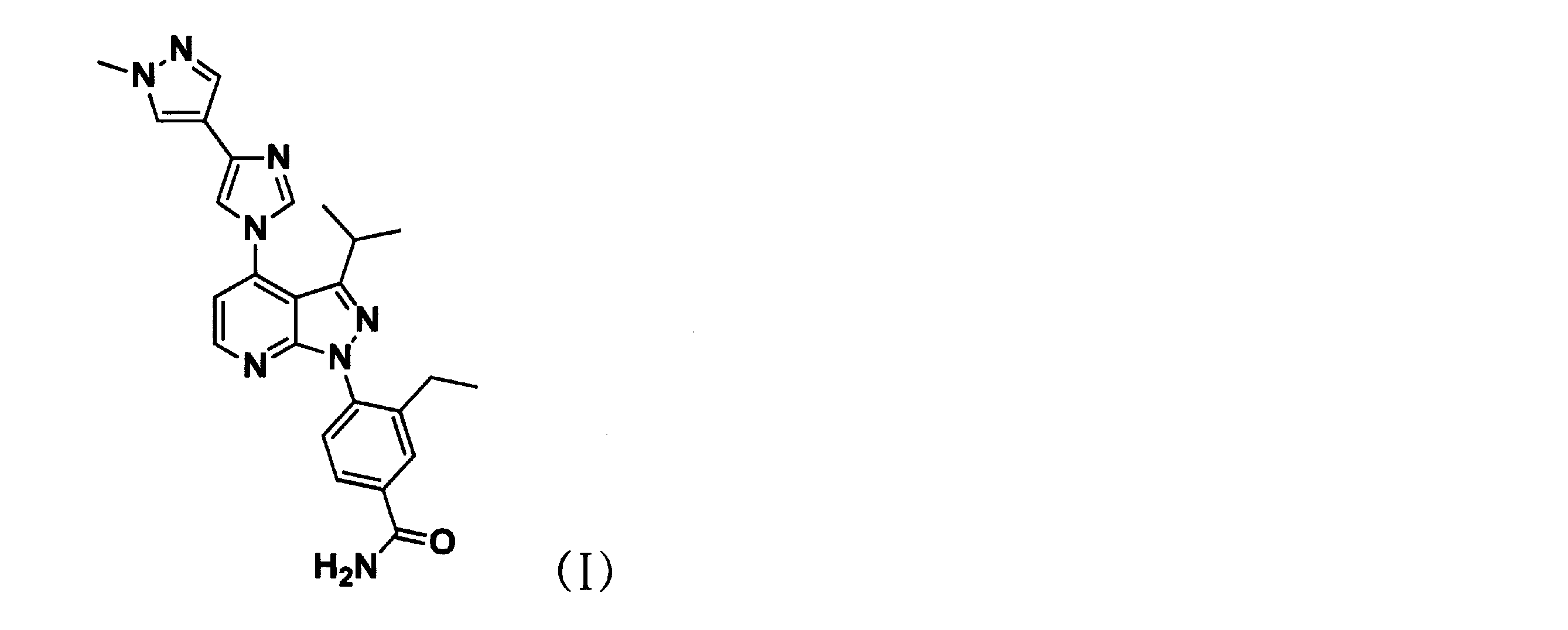
- [1] A method for treating a malignant tumor, wherein 3-ethyl-4- [3- (1-methylethyl) -4- [4- (1- Methyl-1H-pyrazol-4-yl) -1H-imidazol-1-yl] -1H-pyrazolo [3,4-b] pyridin-1-yl] benzamide (Compound 1) or a salt thereof
- Administration according to The dosing regimen comprises providing the compound 1 or a salt thereof as a quantity of compound 1 at a dose of 40 mg / body / day to 240 mg / body / day, followed by a drug withdrawal period of at least 2 days.
- a therapeutic agent for malignant tumors comprising 3-ethyl-4- [3- (1-methylethyl) -4- [4- (1-methyl-1H-pyrazol-4-yl) -1H-imidazole -1-yl] -1H-pyrazolo [3,4-b] pyridin-1-yl] benzamide (Compound 1) or a salt thereof, Compound 1 or a salt thereof is administered according to a dosing schedule comprising administering a daily dose of 40 mg / body / day to 240 mg / body / day as an amount of Compound 1 followed by a drug holiday of at least 2 days , Therapeutic agent.
- a dosing schedule comprising administering a daily dose of 40 mg / body / day to 240 mg / body / day as an amount of Compound 1 followed by a drug holiday of at least 2 days , Therapeutic agent.
- the therapeutic agent according to [14], wherein the withdrawal period is 2 to 3 days.
- the method of the present invention it is possible to treat a malignant tumor exhibiting an excellent antitumor effect while reducing eye damage.
- Compound 1 or a salt thereof is a known compound and can be synthesized, for example, according to the method described in Patent Document 1 (International Publication No. 2011/004610).
- the salt of Compound 1 is not particularly limited as long as it is a pharmaceutically acceptable salt, and includes inorganic acids such as hydrochloric acid, hydrobromic acid, hydroiodic acid, sulfuric acid, nitric acid, phosphoric acid, formic acid, acetic acid, propion.
- Acid addition with organic acids such as acid, oxalic acid, malonic acid, succinic acid, fumaric acid, maleic acid, lactic acid, malic acid, citric acid, tartaric acid, carbonic acid, picric acid, methanesulfonic acid, paratoluenesulfonic acid, glutamic acid
- organic acids such as acid, oxalic acid, malonic acid, succinic acid, fumaric acid, maleic acid, lactic acid, malic acid, citric acid, tartaric acid, carbonic acid, picric acid, methanesulfonic acid, paratoluenesulfonic acid, glutamic acid
- examples include salts, ammonium salts with inorganic bases such as salts, sodium, potassium, magnesium, calcium and aluminum, organic bases such as methylamine, ethylamine, meglumine and ethanolamine, or basic amino acids such as lysine, arginine and ornithine. It is done.
- Compound 1 also
- Compound 1 or a salt thereof is administered in an effective amount to a patient in need of treatment for a malignant tumor according to a dosing schedule.
- the “effective amount” refers to a dose that shows an effective effect of the administered compound 1 or a salt thereof.
- the dose per person per day on the day of administration of Compound 1 or a salt thereof is 40 mg / body / day to 240 mg / body / day as the amount of Compound 1, and such dose is 80 mg / day.
- body / day to 200 mg / body / day is more preferred, 120 mg / body / day to 160 mg / body / day is more preferred, and 160 mg / body / day is most preferred.
- Such doses may be divided and administered daily.
- administration of Compound 1 or a salt thereof includes providing a drug holiday in which Compound 1 or a salt thereof is not administered to a patient for at least 2 days after the administration of Compound 1 or a salt thereof at the above dose every day. Dosage according to schedule. Since the plasma concentration and the retinal concentration of the compound 1 in rats are in equilibrium, as shown in the examples described later, the period during which the plasma concentration of the compound 1 significantly decreases during each daily administration, That is, it is expected that Compound 1 will be removed from the retina during the drug holiday if a drug holiday of at least 2 days is provided (the plasma concentration drops to 5% or less of the maximum plasma concentration during the administration period).
- the drug holiday is preferably 2 to 3 days, particularly preferably 2 days.
- Compound 1 or a salt thereof is preferably administered every day for 3 to 8 days, more preferably administered every day for 4 to 7 days, particularly preferably administered every day for 5 days.
- the administration schedule preferably includes providing a drug withdrawal period of 2 to 3 days after administration for 3 to 8 days, more preferably 2 to 3 days after administration of 4 to 7 days.
- Such a dosing schedule cycle is preferably repeated as many times as possible.
- Compound 1 or a salt thereof is administered daily for 5 days at a dose of 160 mg / body / day per person on the day of administration of Compound 1 or a salt thereof, followed by a 2-day drug holiday. Most preferably, it is administered according to a dosage regime comprising:
- malignant tumors to be treated in the present invention include epithelial cancer (respiratory cancer, digestive organ cancer, urogenital cancer, secretory cancer, skin cancer, etc.), mesothelioma, breast cancer, sarcoma. , Hematopoietic tumors, central nervous system tumors, peripheral nervous system tumors and the like. Of these, sarcoma is preferable.
- respiratory cancer include lung cancer (non-small cell lung cancer, small cell lung cancer, etc.) and the like.
- Examples of digestive organ cancer include esophageal cancer, stomach cancer, duodenal cancer, liver cancer, biliary tract cancer (gallbladder / bile duct cancer, etc.), pancreatic cancer, colon cancer, colorectal cancer (colon cancer, rectal cancer, etc.) and the like.
- Examples of urogenital cancer include ovarian cancer, uterine cancer (cervical cancer, endometrial cancer, etc.), renal cancer, bladder cancer, prostate cancer, testicular tumor and the like.
- Examples of secretory cancers include neuroendocrine tumors.
- mesothelioma examples include pleural mesothelioma, peritoneal mesothelioma, pericardial mesothelioma, testicular mesothelioma and the like.
- sarcomas examples include gastrointestinal stromal tumors, bone / soft tissue tumors, and the like.
- hematopoietic tumors include leukemia, malignant lymphoma, multiple myeloma and the like.
- central nervous system tumors examples include brain tumors.
- peripheral nervous system tumors include malignant schwannomas.
- gastrointestinal stromal tumor, breast cancer, lung cancer, gastric cancer, prostate cancer, ovarian cancer and colon cancer are preferred, and non-small cell lung cancer is preferred among lung cancers.
- particularly preferred are gastrointestinal stromal tumors, breast cancer and lung cancer, and most preferred are gastrointestinal stromal tumors.
- the “treatment” of the malignant tumor of the present invention includes postoperative adjuvant chemotherapy performed for preventing recurrence after surgical removal of the tumor, and preoperative adjuvant chemotherapy performed prior to surgically removing the tumor. Is included.
- Compound 1 or a salt thereof in using Compound 1 or a salt thereof as a medicine, various administration forms can be adopted depending on the purpose of treatment.
- the form include oral preparations (tablets, coated tablets, powders, granules, capsules, liquids, etc.), injections, suppositories, patches, ointments and the like.
- an oral preparation is preferable.
- These preparations can be formulated by a conventional formulation method generally known in this field using a pharmaceutically acceptable carrier or the like.
- the pharmaceutically acceptable carrier include various types commonly used for ordinary drugs, such as excipients, binders, disintegrants, lubricants, diluents, solubilizers, suspending agents, etc. Examples include tonicity agents, pH adjusters, buffers, stabilizers, colorants, flavoring agents, and flavoring agents.
- the preparation of the present invention containing Compound 1 or a salt thereof is provided with a drug withdrawal period of at least 2 days after Compound 1 or a salt thereof is administered every day at a dose of 40 mg / body / day to 240 mg / body / day.
- It may also be a kit formulation that includes instructions that indicate that it will be administered according to the dosing regime that it contains. Specific examples of the “instruction manual” include a package insert, a pamphlet, and the like.
- kit preparations containing instructions for use are enclosed in a package of kit preparations together with compound 1 or a salt thereof, even if the instructions for use are printed and attached to the package of kit preparations. It may be.
- Example 1 Objective: This study was intended to determine the maximum tolerated dose (MTD), recommended dose (RD) and recommended method of administration of Compound 1 for patients with solid cancer on 21 days in one cycle. It was carried out for the purpose of estimation and evaluation of safety and observation of antitumor effect when Compound 1 was administered to the above patient as 21 days.
- Method Compound 1 was repeatedly administered between meals once a day in Step 1, and Compound 1 was orally administered between alternate meals in Step 2.
- the initial dose was 4.8 mg / m 2 (level 1), and the dose of compound 1 at each level was determined according to the body surface area.
- the initial dose of Step 2 (Step 1 level 1) was Step 1 MTD (mg / m 2 / day). The study continued until disease progression and the occurrence of unacceptable adverse events.
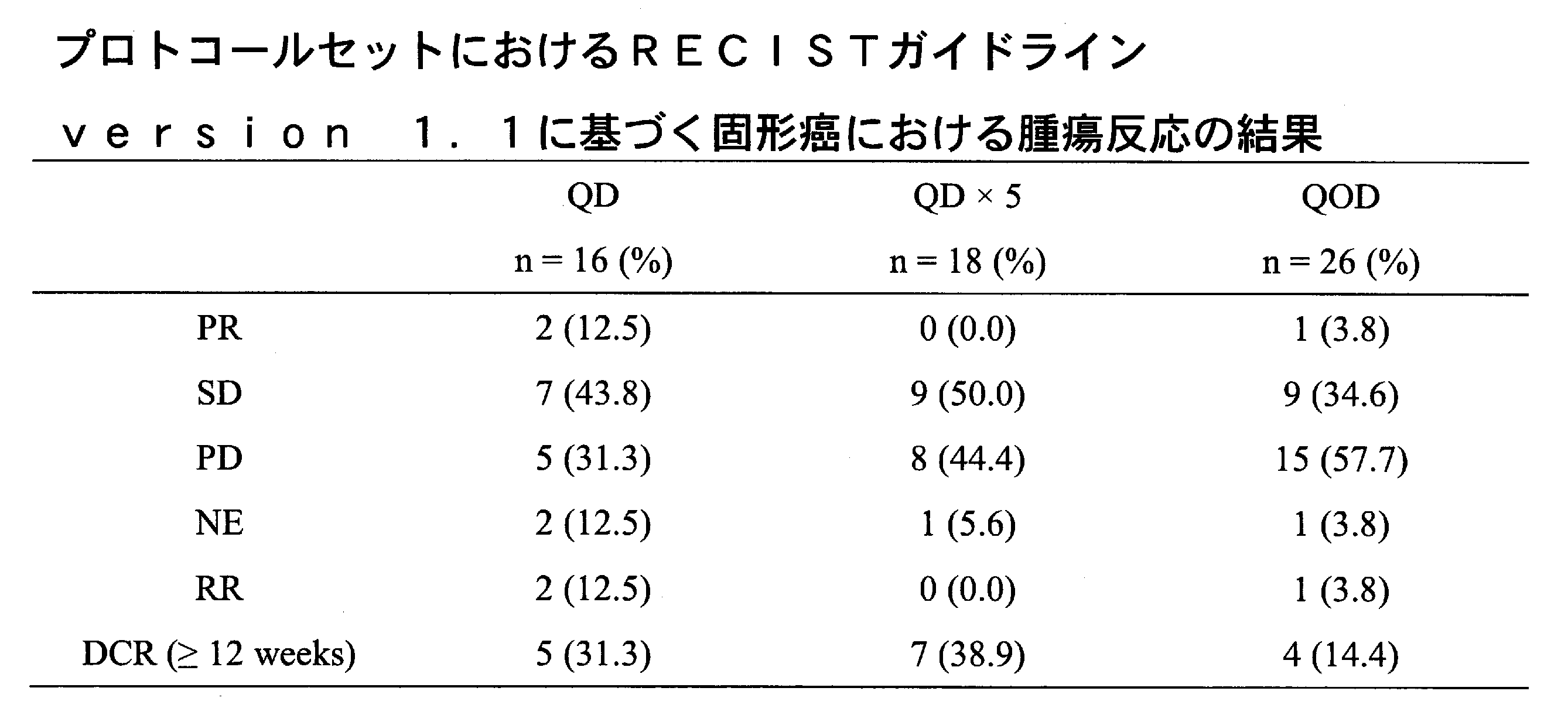
- Anti-tumor effects on tumors are determined by slicing the target lesion (diagnostic method (MRI, CT, X-ray, etc.) measured at the time of registration) in accordance with RECIST Guidelines Version 1.1 (European Journal of Cancer 45 (2009) 228-247) Evaluation of reduction to tumor was made by comprehensive evaluation of non-target lesions (all lesions other than target lesions) and lesions of a measurable size according to width.
- the target lesion was determined in the following five stages.
- CR Complete response
- Partial response When the diameter of the target lesion is reduced by 30% or more compared to the sum before treatment.
- Stable stable disease
- Progression When the diameter of the target lesion is increased by 20% or more compared to the smallest diameter sum (including the sum before treatment) and increased by 5 mm or more in absolute value.
- Not Evaluable When inspection cannot be performed for some reason, and all or some of the lesions cannot be evaluated, or CR, PR, SD, or PD cannot be determined.
- the measured value was recorded as much as possible. However, when it was determined that no lesion remained, the diameter was recorded as 0 mm, and when it was determined that the lesion remained, the diameter was 5 mm.
- Determination of non -target lesions Determination of non-target lesions was performed in the following four stages.
- Non-CR / non-PD Incomplete response / non-progression
- Not Evaluable When inspection cannot be performed for some reason, and all or some of the lesions cannot be evaluated, or CR, Non-CR / non-PD, or PD cannot be determined. However, this is not the case when it is logically clear that the determined effect does not change even when a lesion that has not been evaluated is considered.
- CR The CR state is maintained by an examination conducted at least 4 weeks after the first arrival of CR.
- PR The PR state is maintained in an examination conducted at least 4 weeks after first reaching PR.
- SD An examination conducted at least 6 weeks after the start of administration confirmed that CR or PR was not reached and PD was not obtained.
- PD Target lesion or non-target lesion PD was confirmed without satisfying the criteria of CR, PR and SD, or the appearance of a new lesion was confirmed.
- NE is determined.
- RR Response rate
- DCR Disease state control rate
- Ophthalmic examinations were conducted before registration, during the administration period, and during the post-observation period.
- Ophthalmic examinations visual acuity examination (correction), intraocular pressure examination, fundus examination, slit lamp microscopic examination, optical coherence tomography (OCT), color vision on the first day of administration ⁇ 1 day Inspection was conducted.
- OCT optical coherence tomography
- observations and inspections before registration were conducted immediately before registration as much as possible.
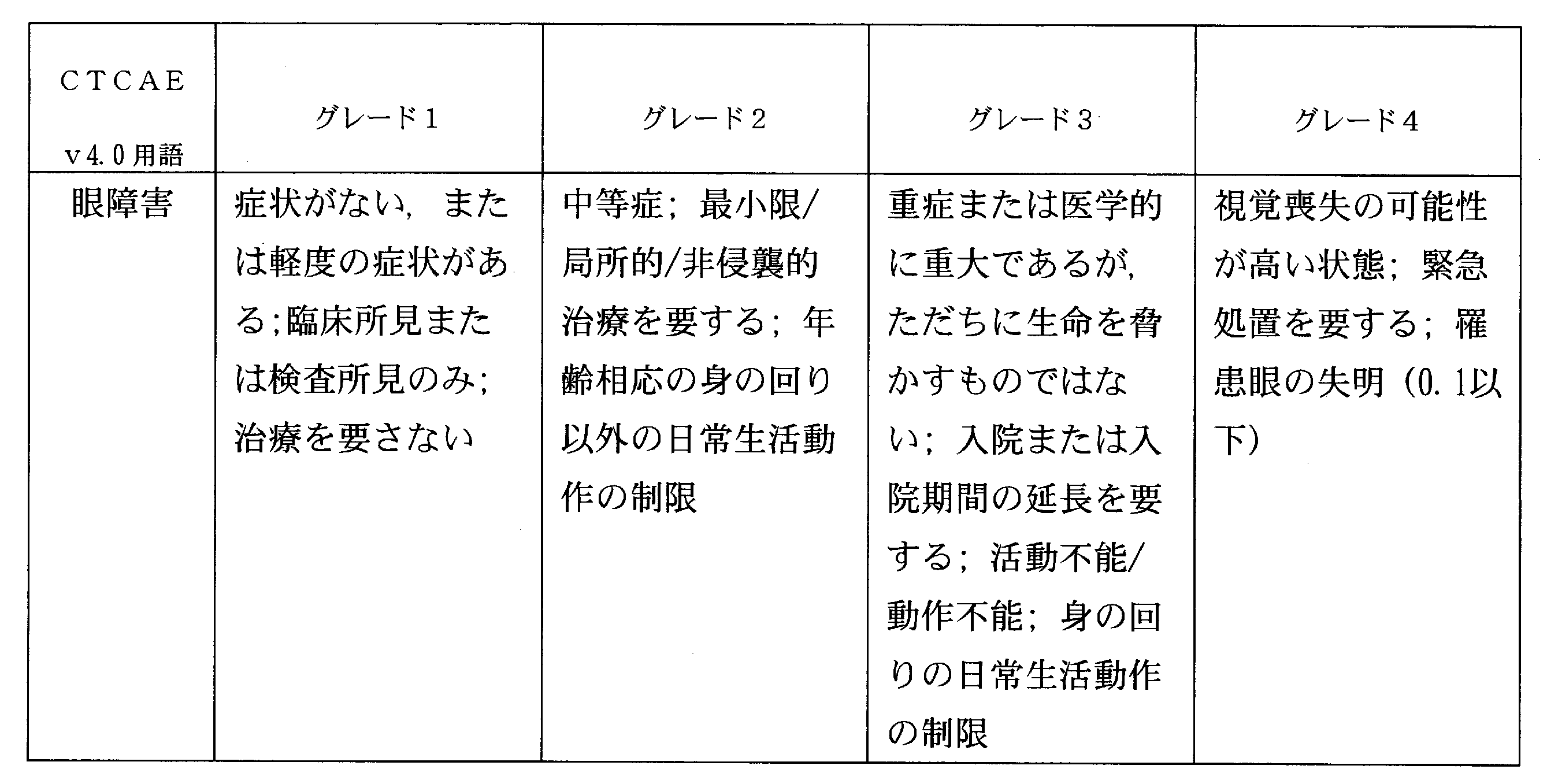
- ophthalmic examinations were carried out as appropriate when eye abnormalities were found through regular interviews with the investigator and the patient's declaration. Grade evaluation of the severity of adverse events occurring in the eye was evaluated using the criteria of the common term for adverse events (CTCAE Ver. 4.03) (Table 2).
- Table 3 shows the results of the determination of the antitumor effect on the tumor.
- MTD was 210mg / m 2 / day daily administration 107.5mg / m 2 / day, every other day dosing.
- a comparison between the dose based on body surface area and the actual dose shows that there is little effect on the correlation between the dose and the area under the plasma concentration-time curve (AUC) even if the dose conversion method is different. Therefore, the MTD was converted to a fixed dose (160 mg / body / day for daily administration and 340 mg / body / day for every other day administration) for further examination.
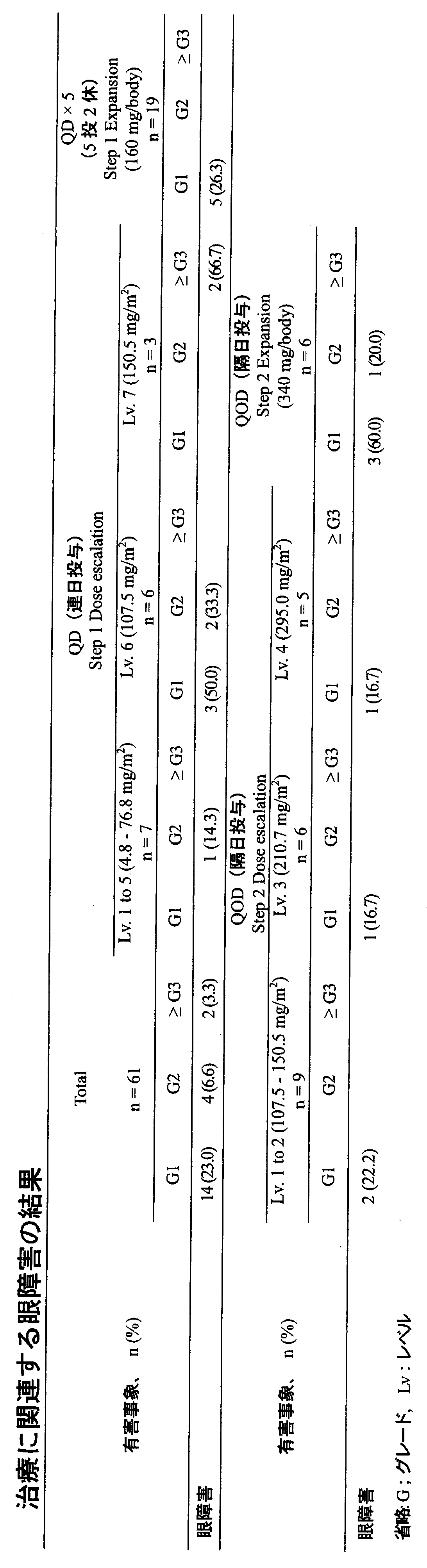
- Table 4 shows the evaluation results of the eye damage in the daily administration group, every other day administration group, and the 5-day administration 2-day rest group.
- the degree of eye damage in the MTD of the 5-day daily administration 2-day rest group and the bi-day administration group was limited to Grade 1, unlike the daily administration group.
- test was conducted at ClinicalTrials. It was registered and implemented as NCT0296585 in gov and as Japan CTI-142444 in Japan Pharmaceutical Information Center. *
- Example 2 Objective: To evaluate the efficacy and safety of Compound 1, for patients with locally advanced unresectable or metastatic GIST who have received imatinib, sunitinib and regorafenib in the past. It was carried out for the purpose of evaluating effectiveness and safety.
- Example 1 From the test results of Example 1, the test was carried out on a 5-day continuous 2-day drug holiday schedule.
- the daily dose of Compound 1 is set to be 160 mg / body / day for oral administration, 21 days for one cycle, and to receive Compound 1 until it meets the trial end date or any preset discontinuation criteria It was done.
- CT scans were performed before the start of administration, every 3 weeks for the next 6 weeks, every 6 weeks for the next 3 months, and then every 8 weeks until the end of the study.
- the progression-free survival (PFS) defined in RECIST guideline version 1.1 was evaluated.
- the median PFS with Compound 1 was 4.4 months. This result is compared to the median 4.8 months PFS in the regorafenib administration group or 0.9 months PFS in the placebo administration group, which is a third-line treatment for advanced or unresectable GIST. Was also preferable. Compound 1 was well tolerated. Gastrointestinal disorders and elevated plasma creatinine levels were seen as treatment-related adverse events, but all of these treatment-related adverse events were found to be reversible with dose discontinuation or dose reduction and are therefore manageable. It was thought that there was.
- the test was registered as Japan CTI-163182 at the Japan Medicine Information Center and conducted.
- the eyes were collected 24 hours after the final administration, fixed with a Davidson solution for 48 hours, and stored in a 10% (v / v) buffered formalin solution before embedding and slicing the prescribed paraffin.
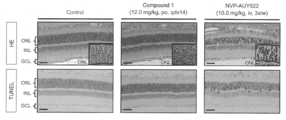
- the eye slices were stained with hematoxylin and eosin, followed by terminal deoxynucleotidyl dUTP nick end labeling (TUNEL: ApopTag Plus Peroxidase In Situ Aptosis Detection Kit, Merck Millipore). Results: The results are shown in FIG.
- NVP-AUY922 another HSP90 inhibitor, caused significant degeneration and misalignment in the outer granular layer of the retina, and increased the number of TUNEL positive apoptotic cells due to the retinal distribution of NVP-AUY922. I found out. On the other hand, Compound 1 did not cause any histopathological changes in the outer granular layer of the retina, and no increase in the apoptotic cells was observed.
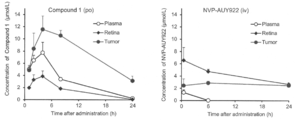
- Results The results are shown in FIG. From the results, it was found that Compound 1 is distributed more in the tumor in the tumor-bearing rat than in the retina and plasma. In tumor-bearing rats, it was confirmed that Compound 1 was removed from the retina within 24 hours. On the other hand, NVP-AUY922 was distributed more in the retina than plasma, and was detected in the retina even 24 hours after administration.
Landscapes
- Health & Medical Sciences (AREA)
- Pharmacology & Pharmacy (AREA)
- Veterinary Medicine (AREA)
- Public Health (AREA)
- Chemical & Material Sciences (AREA)
- General Health & Medical Sciences (AREA)
- Medicinal Chemistry (AREA)
- Animal Behavior & Ethology (AREA)
- Life Sciences & Earth Sciences (AREA)
- Chemical Kinetics & Catalysis (AREA)
- Organic Chemistry (AREA)
- Nuclear Medicine, Radiotherapy & Molecular Imaging (AREA)
- General Chemical & Material Sciences (AREA)
- Epidemiology (AREA)
- Oncology (AREA)
- Hematology (AREA)
- Nutrition Science (AREA)
- Physiology (AREA)
- Pharmaceuticals Containing Other Organic And Inorganic Compounds (AREA)
Abstract
Description
本出願人は、特許文献1において、後述するアザ二環式化合物が高いHSP90阻害活性及び癌細胞株に対する増殖抑制効果を有し、HSP90阻害剤として有用であることを報告している。
従って、優れた抗腫瘍効果を示しながらも眼毒性を呈さない、HSP90阻害剤を用いた悪性腫瘍の治療法が強く望まれている。
〔1〕悪性腫瘍を治療するための方法であって、その治療を必要とする患者に対して、3-エチル-4-[3-(1-メチルエチル)-4-[4-(1-メチル-1H-ピラゾール-4-イル)-1H-イミダゾール-1-イル]-1H-ピラゾロ[3,4-b]ピリジン-1-イル]ベンズアミド(化合物1)又はその塩の有効量を投与計画に従って投与することを含み、
前記投与計画は前記化合物1又はその塩を、化合物1の量として40mg/body/日~240mg/body/日の用量で連日投与した後に少なくとも2日間の休薬期間を設けることを含む、方法。
〔2〕前記休薬期間が2~3日間である、〔1〕に記載の方法。
〔3〕前記休薬期間が2日間である、〔1〕に記載の方法。
〔4〕前記化合物1又はその塩が3~8日間連日投与される、〔1〕~〔3〕のいずれか1に記載の方法。
〔5〕前記化合物1又はその塩が4~7日間連日投与される、〔1〕~〔3〕のいずれか1に記載の方法。
〔6〕前記化合物1又はその塩が5日間連日投与される、〔1〕~〔3〕のいずれか1に記載の方法。
〔7〕前記化合物1又はその塩の用量が80mg/body/日~200mg/body/日である、〔1〕~〔6〕のいずれか1に記載の方法。
〔8〕前記化合物1又はその塩の用量が120mg/body/日~160mg/body/日である、〔1〕~〔6〕のいずれか1に記載の方法。
〔9〕前記化合物1又はその塩の用量が160mg/body/日である、〔1〕~〔6〕のいずれか1に記載の方法。
〔10〕前記悪性腫瘍が消化管間質腫瘍、乳癌、肺癌、胃癌、前立腺癌、卵巣癌及び/又は大腸癌である、〔1〕~〔9〕のいずれか1に記載の方法。
〔11〕前記悪性腫瘍が消化管間質腫瘍、乳癌及び/又は肺癌である、〔1〕~〔9〕のいずれか1に記載の方法。
〔12〕前記悪性腫瘍が消化管間質腫瘍である、〔1〕~〔9〕のいずれか1に記載の方法。
〔13〕眼障害が低減される、〔1〕~〔11〕のいずれか1に記載の方法。
〔14〕悪性腫瘍の治療剤であって、3-エチル-4-[3-(1-メチルエチル)-4-[4-(1-メチル-1H-ピラゾール-4-イル)-1H-イミダゾール-1-イル]-1H-ピラゾロ[3,4-b]ピリジン-1-イル]ベンズアミド(化合物1)又はその塩を含み、
前記化合物1又はその塩が、化合物1の量として40mg/body/日~240mg/body/日の用量で連日投与された後に少なくとも2日間の休薬期間を設けることを含む投与計画に従って投与される、治療剤。
〔15〕前記休薬期間が2~3日間である、〔14〕に記載の治療剤。
〔16〕前記休薬期間が2日間である、〔14〕に記載の治療剤。
〔17〕前記化合物1又はその塩が3~8日間連日投与される、〔14〕~〔16〕のいずれか1に記載の治療剤。
〔18〕前記化合物1又はその塩が4~7日間連日投与される、〔14〕~〔16〕のいずれか1に記載の治療剤。
〔19〕前記化合物1又はその塩が5日間連日投与される、〔14〕~〔16〕のいずれか1に記載の治療剤。
〔20〕前記化合物1又はその塩の用量が80mg/body/日~200mg/body/日である、〔14〕~〔19〕のいずれか1に記載の治療剤。
〔21〕前記化合物1又はその塩の用量が120mg/body/日~160mg/body/日である、〔14〕~〔19〕のいずれか1に記載の治療剤。
〔22〕前記化合物1又はその塩の用量が160mg/body/日である、〔14〕~〔19〕のいずれか1に記載の治療剤。
〔23〕前記悪性腫瘍が消化管間質腫瘍、乳癌、肺癌、胃癌、前立腺癌、卵巣癌及び/又は大腸癌である、〔14〕~〔22〕のいずれか1に記載の治療剤。
〔24〕前記悪性腫瘍が消化管間質腫瘍、乳癌及び/又は肺癌である、〔14〕~〔22〕のいずれか1に記載の治療剤。
〔25〕前記悪性腫瘍が消化管間質腫瘍である、〔14〕~〔22〕のいずれか1に記載の治療剤。
〔26〕眼障害が低減される、〔14〕~〔25〕のいずれか1に記載の治療剤。
〔27〕悪性腫瘍の治療剤を製造するための3-エチル-4-[3-(1-メチルエチル)-4-[4-(1-メチル-1H-ピラゾール-4-イル)-1H-イミダゾール-1-イル]-1H-ピラゾロ[3,4-b]ピリジン-1-イル]ベンズアミド(化合物1)又はその塩の使用であって、
前記化合物1又はその塩が、化合物1の量として40mg/body/日~240mg/body/日の用量で連日投与された後に少なくとも2日間の休薬期間を設けることを含む投与計画に従って投与される、使用。
〔28〕前記休薬期間が2~3日間である、〔27〕に記載の使用。
〔29〕前記休薬期間が2日間である、〔27〕に記載の使用。
〔30〕前記化合物1又はその塩が3~8日間連日投与される、〔27〕~〔29〕のいずれか1に記載の使用。
〔31〕前記化合物1又はその塩が4~7日間連日投与される、〔27〕~〔29〕のいずれか1に記載の使用。
〔32〕前記化合物1又はその塩が5日間連日投与される、〔27〕~〔29〕のいずれか1に記載の使用。
〔33〕前記化合物1又はその塩の用量が80mg/body/日~200mg/body/日である、〔27〕~〔32〕のいずれか1に記載の使用。
〔34〕前記化合物1又はその塩の用量が120mg/body/日~160mg/body/日である、〔27〕~〔32〕のいずれか1に記載の使用。
〔35〕前記化合物1又はその塩の用量が160mg/body/日である、〔27〕~〔32〕のいずれか1に記載の使用。
〔36〕前記悪性腫瘍が消化管間質腫瘍、乳癌、肺癌、胃癌、前立腺癌、卵巣癌及び/又は大腸癌である、〔27〕~〔35〕のいずれか1に記載の使用。
〔37〕前記悪性腫瘍が消化管間質腫瘍、乳癌及び/又は肺癌である〔27〕~〔35〕のいずれか1に記載の使用。
〔38〕前記悪性腫瘍が消化管間質腫瘍である、〔27〕~〔35〕のいずれか1に記載の使用。
〔39〕眼障害が低減される、〔27〕~〔38〕のいずれか1に記載の使用。
化合物1の塩としては、薬学的に許容できる塩であれば特に制限はなく、塩酸、臭化水素酸、ヨウ化水素酸、硫酸、硝酸、リン酸等の無機酸や、ギ酸、酢酸、プロピオン酸、シュウ酸、マロン酸、コハク酸、フマル酸、マレイン酸、乳酸、リンゴ酸、クエン酸、酒石酸、炭酸、ピクリン酸、メタンスルホン酸、パラトルエンスルホン酸、グルタミン酸等の有機酸との酸付加塩、ナトリウム、カリウム、マグネシウム、カルシウム、アルミニウム等の無機塩基や、メチルアミン、エチルアミン、メグルミン、エタノールアミンなどの有機塩基、又はリジン、アルギニン、オルニチン等の塩基性アミノ酸との塩やアンモニウム塩が挙げられる。
化合物1には、水和物、各種溶媒和物及び結晶多形も包含される。
本発明において「有効量」とは、投与される化合物1又はその塩の有効な効果を示す用量のことを示す。
本発明において、化合物1又はその塩の投与日における1日あたりのヒト一人における用量は、化合物1の量として40mg/body/日~240mg/body/日であるが、斯かる用量は、80mg/body/日~200mg/body/日がより好ましく、120mg/body/日~160mg/body/日がさらに好ましく、160mg/body/日が最も好ましい。斯かる用量を1日に分割して投与してもよい。
休薬期間は、2~3日間が好ましく、2日間が特に好ましい。
また、化合物1又はその塩は、3~8日間連日投与されることが好ましく、4~7日間連日投与されることが更に好ましく、5日間連日投与されることが特に好ましい。
本発明において投与計画は、好ましくは、3~8日間連日投与した後に2~3日間の休薬期間を設けることを含み、より好ましくは、4~7日間連日投与した後に2~3日間の休薬期間を設けることを含み、さらに好ましくは、4日間連日投与した後に3日間の休薬期間を設けること、又は5日間連日投与した後に2日間の休薬期間を設けることを含み、よりさらに好ましくは、5日間連日投与した後に2日間の休薬期間を設けることを含む。斯かる投与計画のサイクルはできるだけ多くの回数繰り返すのが好ましい。
本発明において、化合物1又はその塩は、化合物1又はその塩の投与日における1日あたりのヒト一人における用量を160mg/body/日として5日間連日投与した後に2日間の休薬期間を設けることを含む投与計画に従って投与されるのが最も好ましい。
呼吸器癌としては、例えば、肺癌(非小細胞肺癌、小細胞肺癌等)等が挙げられる。消化器癌としては、例えば、食道癌、胃癌、十二指腸癌、肝臓癌、胆道癌(胆嚢・胆管癌等)、膵臓癌、大腸癌、結腸直腸癌(結腸癌、直腸癌等)等が挙げられる。泌尿生殖器癌としては、例えば、卵巣癌、子宮癌(子宮頚癌、子宮体癌等)、腎癌、膀胱癌、前立腺癌、精巣腫瘍等が挙げられる。分泌系癌としては、神経内分泌腫瘍等が挙げられる。中皮腫としては、例えば、胸膜中皮腫、腹膜中皮腫、心膜中皮腫、精巣中皮腫等が挙げられる。肉腫としては、例えば、消化管間質腫瘍、骨・軟部腫瘍等が挙げられる。造血器腫瘍としては、例えば、白血病、悪性リンパ腫、多発性骨髄腫等が挙げられる。中枢神経系腫瘍としては、例えば、脳腫瘍等が挙げられる。末梢神経系腫瘍としては、例えば、悪性神経鞘腫等が挙げられる。これらのうち、好ましくは、消化管間質腫瘍、乳癌、肺癌、胃癌、前立腺癌、卵巣癌及び大腸癌であり、肺癌のうち、非小細胞肺癌が好ましい。このうち、特に好ましくは、消化管間質腫瘍、乳癌及び肺癌であり、最も好ましくは、消化管間質腫瘍である。
本発明の悪性腫瘍の「治療」には、腫瘍を外科的に摘出した後に再発防止のために行われる術後補助化学療法、腫瘍を外科的に摘出するために事前行われる術前補助化学療法が包含される。
薬学的に許容される担体としては、通常の薬剤に汎用される各種のもの、例えば、賦形剤、結合剤、崩壊剤、滑沢剤、希釈剤、溶解補助剤、懸濁化剤、等張化剤、pH調整剤、緩衝剤、安定化剤、着色剤、矯味剤、矯臭剤等を例示できる。
目的:本試験は、固形癌患者を対象に、1サイクルを21日として化合物1を投与したときの最大耐量(MTD:Maximum Tolerated Dose)の決定、推奨用量(RD:Recommended Dose)及び投与方法の推定、並びに上記患者を対象に、1サイクルを21日として化合物1を投与したときの安全性の評価及び抗腫瘍効果観察を行うこと等を目的として実施した。
方法:化合物1を、Step1では1日1回食間反復投与し、Step2では化合物1を隔日食間に経口投与した。Step1では4.8mg/m2(レベル1)を初回投与量とし、各レベルにおける化合物1の投与量は体表面積に応じて決定した。Step2の初回投与量(Step2のレベル1)はStep1のMTD(mg/m2/日)とした。当該試験は、疾病の進行、許容されない有害事象の発生まで続けられた。
投与量(mg/body)=投与量(mg/m2)×体表面積(m2)
体表面積(BSA)は以下のDuBoisの公式を用いて小数第三位を四捨五入し、小数第二位まで計算した。投与量(mg/body)は小数第一位を四捨五入し、整数まで求め、本試験における最小の錠剤用量は2mgであることから、2mg未満は切り捨てることとした。
BSA=([体重(kg)]0.425×[身長(cm)]0.725)×0.007184
1日1回投与におけるMTD決定後、1日1回投与、隔日投与(1日投与し、その次の日に1日休薬するサイクルを繰り返す投与)、又は5日間連日投与2日間休薬のスケジュールで投与を行い、評価を行った。
標的病変の判定は、以下の5段階で行った。
すべての非リンパ節の標的病変が消失し、かつ、すべてのリンパ節の標的病変の短径が10mm未満となった場合(治療前にリンパ節の標的病変が選択された場合、径和が0mmにならない場合でも標的病変の判定がCRとなることもある)。
標的病変の径和が治療前の和に比して30%以上減少した場合。
CR、PRに該当する腫瘍縮小も、PDに該当する増大も認めない場合。
標的病変の径和が、それまでの最も小さい径和(治療前の和を含む)に比して20%以上増加し、かつ、絶対値で5mm以上増加した場合。
なんらかの理由で検査が行えず,全ての病変又は一部の病変の評価が出来なかった場合、又はCR、PR、SD、PDのいずれとも判定できない場合。
非標的病変の判定は、以下の4段階で行った。
すべての非リンパ節の非標的病変が消失し、すべてのリンパ節病変の非標的病変の短径が10mm未満となり、腫瘍マーカーがすべて施設基準値上限以下となった場合。
1つ以上の非リンパ節の非標的病変が消失しない、又は1つ以上のリンパ節の非標的病変の短径が10mm以上、又は腫瘍マーカーのいずれかが施設基準値上限を超える場合。
既存の非標的病変の明らかな増悪
「明らかな増悪」とは、標的病変がある場合は、標的病変の効果がSDやPRであったとしても、総合的な腫瘍量が増加し、治療を中止したほうがよいと判断された場合。腫瘍量がやや「増悪」した場合は、「明らかな増悪」に該当しない。標的病変がない場合は、例えば、腫瘍体積の73%の増大に相当する腫瘍量が増加した(測定可能病変としての径の20%の増大に等しい)場合。
なんらかの理由で検査が行えず、全ての病変又は一部の病変の評価が出来なかった場合、又はCR、Non-CR/non-PD、PDのいずれとも判定できない場合。ただし、評価されなかった病変を考慮しても、その時点の判定された効果が変わらないことが、論理的に明らかな場合にはこの限りではない。
各症例の総合効果を下記の基準に従って評価し、効果持続期間を確認した上で最良総合効果の判定を行った。
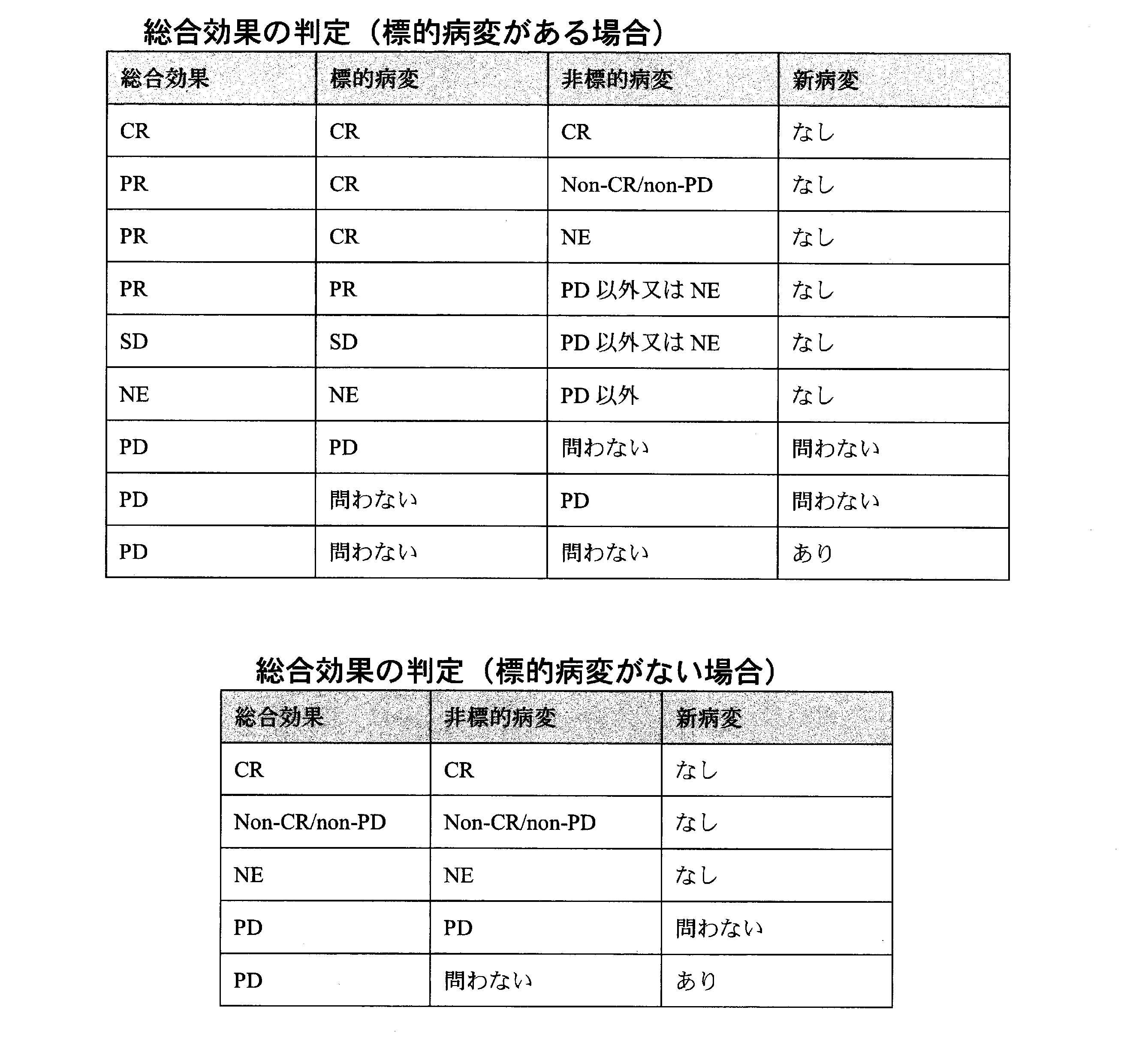
PR:PRに最初に到達した後、少なくとも4週間以上を経て行う検査でPR状態が維持されている。
SD:投与開始から少なくとも6週間以上を経て行う検査でCR又はPRに至っておらず、かつPDになっていないことが確認された。
PD:CR、PR及びSDの基準を満たさずに標的病変又は非標的病変のPDが確認された、あるいは新病変の出現が確認された。
解析対象集団における最良総合効果がCR及びPRの症例の割合とする。
解析対象集団における最良総合効果がCR,PR,Non-CR/non-PD、又は12週以上継続したSDの症例の割合とする。
眼科診察は、登録前、投与期間中、後観察期間に実施した。投与期間中においては、投与開始21日±1日に眼科問診、視力検査(矯正)、眼圧検査、眼底検査、細隙灯顕微鏡検査、光干渉断層撮影(Optical Coherence Tomography(OCT))、色覚検査を実施した。また、登録前の観察・検査は可能な限り登録の直前に実施した。上記決められた眼科診察の他、治験医の定期的な問診と患者本人の申告により、眼の不調が見られた場合には、適宜眼科診察を実施した。
眼に発生した有害事象の重症度のグレード判定は、有害事象共通用語規準(CTCAE Ver. 4.03)の基準を用いて評価した(表2)。
また、体表面積に基づく投与量と実投与量との比較において、用量の換算方法が違っても投与量と血漿中濃度-時間曲線下面積(AUC)との相関にほとんど影響がないことが示されたため、MTDを固定用量(連日投与では160mg/body/日、隔日投与では340mg/body/日)に変換し追加検討を行った。
目的:化合物1の有効性及び安全性等を評価するため、過去にイマチニブ,スニチニブ及びレゴラフェニブの投与を受けたことがある局所進行性切除不能又は転移性GISTを有する患者を対象とし、化合物1の有効性及び安全性等を評価することを目的として実施した。
更に、問診、視力検査(矯正視力)、眼圧測定、眼底検査及び光干渉断層撮影(OCT)、細隙灯顕微鏡検査、色覚検査を可能な限り、治験薬投与開始後12週ごと、48週以降は24週ごと:±7日以内に実施した。
上記決められた眼科診察の他、治験医の定期的な問診と患者本人の申告により、眼の不調が見られた場合には、適宜眼科診察を実施した。
方法:6週齢雄のスプラークドーリ-(SD)ラット(日本チャースルリバー株式会社,日本)に、2週間、毎日経口で化合物1を12mg/kg/日で投与した。また、生理食塩水中の5%(v/v)ジメチルスルホキシド及び5%(v/v)Tween20に調整されたNVP-AUY922(フナコシ、日本から入手可能)を10.0mg/kg/日で、SDラットに2週間、週3回静脈内投与した。眼は最終投与24時間後に採取し、48時間かけてデビットソン溶液にて固定し、所定のパラフィン包埋及び薄片化前に10%(v/v)緩衝化ホルマリン溶液にて保存した。眼薄片は、ヘマトキシリン及びエオシン染色され、その後、ターミナルデオキシヌクレオチヂルdUTPニックエンドラベリング(TUNEL:ApopTagPlus Peroxidase In Situ Apoptosis Detection Kit,メルク ミリポア)を行った。
結果:結果を図1に示す。当該結果から明らかなとおり、他のHSP90阻害剤であるNVP-AUY922は、網膜の外顆粒層に著しい変性及び不配列を引き起こし、NVP-AUY922の網膜分布による、多くのTUNEL陽性のアポトーシス細胞が増加していることがわかった。一方、化合物1は、網膜の外顆粒層にいかなる病理組織学的変化も引き起こしておらず、上記アポトーシス細胞の上昇も観察されなかった。
方法:化合物1及びNVP-AUY922を、経口又は静脈内投与によって、腫瘍を担持したF344ヌードラットに投与した。投与後、サンプリングスケジュールに従って、血漿、網膜、及び腫瘍を回収した。網膜又は腫瘍サンプルは、リン酸緩衝生理食塩水中にホモジナイズされた。血漿及びホモジナイズされたサンプルは、タンデムマススペクトロメトリーを備えた液体クロマトグラフィー又はハイパフォーマンス液体クロマトグラフィーによって分析した。化合物1の薬物動態は、ノンコンパートメンタル分析法(Methods Mol Biol 2012; 929: 377-89)を用いて計算された。
結果:結果を図2に示す。当該結果より、化合物1は、腫瘍担持ラットにおいて、網膜及び血漿と比較して、腫瘍により多く分布することがわかった。そして、腫瘍担持ラットでは、24時間以内に網膜から化合物1が除去されたことが確認された。一方、NVP-AUY922は、血漿と比較して、網膜に多く分布し、投与の24時間後であっても網膜から検出された。
(3)化合物1を静脈内投与で暴露した、血漿及び網膜組織の定量
方法:化合物1を、静脈内投与によって、腫瘍を担持したF344ヌードラットに投与した。投与後、30分と6時間に、血漿及び網膜を回収した。網膜サンプルは、リン酸緩衝生理食塩水中にホモジナイズされた。血漿及びホモジナイズされたサンプルは、タンデムマススペクトロメトリーを備えた液体クロマトグラフィー又はハイパフォーマンス液体クロマトグラフィーによって分析した。化合物1の薬物動態は、ノンコンパートメンタル分析法(Methods Mol Biol 2012; 929: 377-89)を用いて計算された。
結果:結果を図3に示す。当該結果より、化合物1は、血漿と比較して網膜への分布は低く、両者への分布は平衡に推移する関係にあることがわかった。
Claims (39)
- 悪性腫瘍を治療するための方法であって、その治療を必要とする患者に対して、3-エチル-4-[3-(1-メチルエチル)-4-[4-(1-メチル-1H-ピラゾール-4-イル)-1H-イミダゾール-1-イル]-1H-ピラゾロ[3,4-b]ピリジン-1-イル]ベンズアミド(化合物1)又はその塩の有効量を投与計画に従って投与することを含み、
前記投与計画は前記化合物1又はその塩を、化合物1の量として40mg/body/日~240mg/body/日の用量で連日投与した後に少なくとも2日間の休薬期間を設けることを含む、方法。 - 前記休薬期間が2~3日間である、請求項1に記載の方法。
- 前記休薬期間が2日間である、請求項1に記載の方法。
- 前記化合物1又はその塩が3~8日間連日投与される、請求項1~3のいずれか1項に記載の方法。
- 前記化合物1又はその塩が4~7日間連日投与される、請求項1~3のいずれか1項に記載の方法。
- 前記化合物1又はその塩が5日間連日投与される、請求項1~3のいずれか1項に記載の方法。
- 前記化合物1又はその塩の用量が80mg/body/日~200mg/body/日である、請求項1~6のいずれか1項に記載の方法。
- 前記化合物1又はその塩の用量が120mg/body/日~160mg/body/日である、請求項1~6のいずれか1項に記載の方法。
- 前記化合物1又はその塩の用量が160mg/body/日である、請求項1~6のいずれか1項に記載の方法。
- 前記悪性腫瘍が消化管間質腫瘍、乳癌、肺癌、胃癌、前立腺癌、卵巣癌及び/又は大腸癌である、請求項1~9のいずれか1項に記載の方法。
- 前記悪性腫瘍が消化管間質腫瘍、乳癌及び/又は肺癌である、請求項1~9のいずれか1項に記載の方法。
- 前記悪性腫瘍が消化管間質腫瘍である、請求項1~9のいずれか1項に記載の方法。
- 眼障害が低減される、請求項1~11のいずれか1項に記載の方法。
- 悪性腫瘍の治療剤であって、3-エチル-4-[3-(1-メチルエチル)-4-[4-(1-メチル-1H-ピラゾール-4-イル)-1H-イミダゾール-1-イル]-1H-ピラゾロ[3,4-b]ピリジン-1-イル]ベンズアミド(化合物1)又はその塩を含み、
前記化合物1又はその塩が、化合物1の量として40mg/body/日~240mg/body/日の用量で連日投与された後に少なくとも2日間の休薬期間を設けることを含む投与計画に従って投与される、治療剤。 - 前記休薬期間が2~3日間である、請求項14に記載の治療剤。
- 前記休薬期間が2日間である、請求項14に記載の治療剤。
- 前記化合物1又はその塩が3~8日間連日投与される、請求項14~16のいずれか1項に記載の治療剤。
- 前記化合物1又はその塩が4~7日間連日投与される、請求項14~16のいずれか1項に記載の治療剤。
- 前記化合物1又はその塩が5日間連日投与される、請求項14~16のいずれか1項に記載の治療剤。
- 前記化合物1又はその塩の用量が80mg/body/日~200mg/body/日である、請求項14~19のいずれか1項に記載の治療剤。
- 前記化合物1又はその塩の用量が120mg/body/日~160mg/body/日である、請求項14~19のいずれか1項に記載の治療剤。
- 前記化合物1又はその塩の用量が160mg/body/日である、請求項14~19のいずれか1項に記載の治療剤。
- 前記悪性腫瘍が消化管間質腫瘍、乳癌、肺癌、胃癌、前立腺癌、卵巣癌及び/又は大腸癌である、請求項14~22のいずれか1項に記載の治療剤。
- 前記悪性腫瘍が消化管間質腫瘍、乳癌及び/又は肺癌である、請求項14~22のいずれか1項に記載の治療剤。
- 前記悪性腫瘍が消化管間質腫瘍である、請求項14~22のいずれか1項に記載の治療剤。
- 眼障害が低減される、請求項14~25のいずれか1項に記載の治療剤。
- 悪性腫瘍の治療剤を製造するための3-エチル-4-[3-(1-メチルエチル)-4-[4-(1-メチル-1H-ピラゾール-4-イル)-1H-イミダゾール-1-イル]-1H-ピラゾロ[3,4-b]ピリジン-1-イル]ベンズアミド(化合物1)又はその塩の使用であって、
前記化合物1又はその塩が、化合物1の量として40mg/body/日~240mg/body/日の用量で連日投与された後に少なくとも2日間の休薬期間を設けることを含む投与計画に従って投与される、使用。 - 前記休薬期間が2~3日間である、請求項27に記載の使用。
- 前記休薬期間が2日間である、請求項27に記載の使用。
- 前記化合物1又はその塩が3~8日間連日投与される、請求項27~29のいずれか1項に記載の使用。
- 前記化合物1又はその塩が4~7日間連日投与される、請求項27~29のいずれか1項に記載の使用。
- 前記化合物1又はその塩が5日間連日投与される、請求項27~29のいずれか1項に記載の使用。
- 前記化合物1又はその塩の用量が80mg/body/日~200mg/body/日である、請求項27~32のいずれか1項に記載の使用。
- 前記化合物1又はその塩の用量が120mg/body/日~160mg/body/日である、請求項27~32のいずれか1項に記載の使用。
- 前記化合物1又はその塩の用量が160mg/body/日である、請求項27~32のいずれか1項に記載の使用。
- 前記悪性腫瘍が消化管間質腫瘍、乳癌、肺癌、胃癌、前立腺癌、卵巣癌及び/又は大腸癌である、請求項27~35のいずれか1項に記載の使用。
- 前記悪性腫瘍が消化管間質腫瘍、乳癌及び/又は肺癌である、請求項27~35のいずれか1項に記載の使用。
- 前記悪性腫瘍が消化管間質腫瘍である、請求項27~35のいずれか1項に記載の使用。
- 眼障害が低減される、請求項27~38のいずれか1項に記載の使用。
Priority Applications (8)
| Application Number | Priority Date | Filing Date | Title |
|---|---|---|---|
| AU2018423606A AU2018423606B2 (en) | 2018-05-14 | 2018-05-14 | Method of treating malignant tumor by azabicyclic compound |
| PCT/JP2018/018593 WO2019220512A1 (ja) | 2018-05-14 | 2018-05-14 | アザ二環式化合物による悪性腫瘍の治療法 |
| KR1020190056545A KR20190130519A (ko) | 2018-05-14 | 2019-05-14 | 아자 2 고리형 화합물에 의한 악성 종양의 치료법 |
| PCT/JP2019/019010 WO2019221086A1 (ja) | 2018-05-14 | 2019-05-14 | アザ二環式化合物による悪性腫瘍の治療法 |
| US17/055,446 US12414940B2 (en) | 2018-05-14 | 2019-05-14 | Method of treating malignant tumor by azabicyclic compound |
| AU2024278491A AU2024278491A1 (en) | 2018-05-14 | 2024-12-17 | Method of treating malignant tumor by azabicyclic compound |
| US19/031,773 US20250170109A1 (en) | 2018-05-14 | 2025-01-18 | Method of treating malignant tumor by azabicyclic compound |
| KR1020250101137A KR20250117617A (ko) | 2018-05-14 | 2025-07-25 | 아자 2 고리형 화합물에 의한 악성 종양의 치료법 |
Applications Claiming Priority (1)
| Application Number | Priority Date | Filing Date | Title |
|---|---|---|---|
| PCT/JP2018/018593 WO2019220512A1 (ja) | 2018-05-14 | 2018-05-14 | アザ二環式化合物による悪性腫瘍の治療法 |
Publications (1)
| Publication Number | Publication Date |
|---|---|
| WO2019220512A1 true WO2019220512A1 (ja) | 2019-11-21 |
Family
ID=68539682
Family Applications (2)
| Application Number | Title | Priority Date | Filing Date |
|---|---|---|---|
| PCT/JP2018/018593 Ceased WO2019220512A1 (ja) | 2018-05-14 | 2018-05-14 | アザ二環式化合物による悪性腫瘍の治療法 |
| PCT/JP2019/019010 Ceased WO2019221086A1 (ja) | 2018-05-14 | 2019-05-14 | アザ二環式化合物による悪性腫瘍の治療法 |
Family Applications After (1)
| Application Number | Title | Priority Date | Filing Date |
|---|---|---|---|
| PCT/JP2019/019010 Ceased WO2019221086A1 (ja) | 2018-05-14 | 2019-05-14 | アザ二環式化合物による悪性腫瘍の治療法 |
Country Status (4)
| Country | Link |
|---|---|
| US (2) | US12414940B2 (ja) |
| KR (2) | KR20190130519A (ja) |
| AU (2) | AU2018423606B2 (ja) |
| WO (2) | WO2019220512A1 (ja) |
Cited By (1)
| Publication number | Priority date | Publication date | Assignee | Title |
|---|---|---|---|---|
| WO2023238929A1 (ja) | 2022-06-10 | 2023-12-14 | 大鵬薬品工業株式会社 | ピミテスピブを含有する医薬組成物 |
Families Citing this family (2)
| Publication number | Priority date | Publication date | Assignee | Title |
|---|---|---|---|---|
| JP7518080B2 (ja) * | 2019-08-06 | 2024-07-17 | 大鵬薬品工業株式会社 | アザ二環式化合物とポリアデノシン5’二リン酸リボースポリメラーゼ阻害剤を用いたがん併用療法 |
| KR20260049608A (ko) | 2023-08-24 | 2026-04-14 | 다이호야쿠힌고교 가부시키가이샤 | 아자 2 고리형 화합물과 항안드로겐제를 사용한 암 병용 요법 |
Citations (1)
| Publication number | Priority date | Publication date | Assignee | Title |
|---|---|---|---|---|
| JP2006306775A (ja) * | 2005-04-28 | 2006-11-09 | Taiho Yakuhin Kogyo Kk | 胃癌の治療方法 |
Family Cites Families (1)
| Publication number | Priority date | Publication date | Assignee | Title |
|---|---|---|---|---|
| PT2452940E (pt) | 2009-07-10 | 2015-02-27 | Taiho Pharmaceutical Co Ltd | Composto azabiciclo e seu sal |
-
2018
- 2018-05-14 AU AU2018423606A patent/AU2018423606B2/en active Active
- 2018-05-14 WO PCT/JP2018/018593 patent/WO2019220512A1/ja not_active Ceased
-
2019
- 2019-05-14 WO PCT/JP2019/019010 patent/WO2019221086A1/ja not_active Ceased
- 2019-05-14 KR KR1020190056545A patent/KR20190130519A/ko not_active Ceased
- 2019-05-14 US US17/055,446 patent/US12414940B2/en active Active
-
2024
- 2024-12-17 AU AU2024278491A patent/AU2024278491A1/en active Pending
-
2025
- 2025-01-18 US US19/031,773 patent/US20250170109A1/en active Pending
- 2025-07-25 KR KR1020250101137A patent/KR20250117617A/ko active Pending
Patent Citations (1)
| Publication number | Priority date | Publication date | Assignee | Title |
|---|---|---|---|---|
| JP2006306775A (ja) * | 2005-04-28 | 2006-11-09 | Taiho Yakuhin Kogyo Kk | 胃癌の治療方法 |
Non-Patent Citations (7)
| Title |
|---|
| ANONYMOUS: "Archive History for NCT02965885", CLINICALTRIALS. GOV ARCHIVE, U. S. NATIONAL LIBRARY OF MEDICINE, 14 November 2016 (2016-11-14), Retrieved from the Internet <URL:https://clinicaltrials.gov/ct2/history/NCT02965885?A=1&B=1&C=merged> [retrieved on 20180710] * |
| JAPICCTI-163182, 3 August 2017 (2017-08-03), Retrieved from the Internet <URL:http://www.clinicaltrials.jp/user/cteSearch.jsp> [retrieved on 20180718] * |
| KUROKAWA, Y. ET AL.: "Phase II study of TAS-116, an oral inhibitor of heat shock protein 90 (HSP90), in metastatic or unresectable gastrointestinal stromal tumor refractory to imatinib, sunitinib and regorafenib", ANNALS OF ONCOLOGY, vol. 28, no. 5, 1479PD, 2017, pages 522 - 523, XP055653877 * |
| SHIMOMURA, A. ET AL.: "First-in-human phase I dose escalation study of TAS-116, a novel, orally active HSP90alpha and HSP90beta selective inhibitor, in patients with advanced solid tumors", MOL. CANCER THER., vol. 14, no. 12, 2015 * |
| SUZUKI, R. ET AL.: "TAS-116. Second-generation HSP90-alpha/beta inhibitor, Cancer therapy", DRUGS OF THE FUTURE, vol. 43, no. 1, 1 January 2018 (2018-01-01), pages 13 - 21, XP055653852 * |
| YANAGITANI, N. ET AL.: "ABSTRACT :First-in-human phase I study of an oral HSP90 inhibitor, TAS-116, in advanced solid tumors.", ASCO MEETING LIBRARY, 5 June 2017 (2017-06-05), pages 1 - 2, XP055654233, Retrieved from the Internet <URL:https://meetinglibrary.asco.org/record/149483/abstract> [retrieved on 20180710] * |
| YONG, K. ET AL.: "Phase I study of KW-2478, a novel Hsp90 inhibitor, in patients with B- cell malignancies", BR. J. CANCER, vol. 114, no. 1, 12 January 2016 (2016-01-12), pages 7 - 13, XP055653526 * |
Cited By (2)
| Publication number | Priority date | Publication date | Assignee | Title |
|---|---|---|---|---|
| WO2023238929A1 (ja) | 2022-06-10 | 2023-12-14 | 大鵬薬品工業株式会社 | ピミテスピブを含有する医薬組成物 |
| KR20250022143A (ko) | 2022-06-10 | 2025-02-14 | 다이호야쿠힌고교 가부시키가이샤 | 피미테스핍을 함유하는 의약 조성물 |
Also Published As
| Publication number | Publication date |
|---|---|
| US20210177813A1 (en) | 2021-06-17 |
| WO2019221086A1 (ja) | 2019-11-21 |
| AU2018423606A1 (en) | 2021-01-07 |
| KR20190130519A (ko) | 2019-11-22 |
| US12414940B2 (en) | 2025-09-16 |
| AU2018423606B2 (en) | 2024-10-10 |
| US20250170109A1 (en) | 2025-05-29 |
| AU2024278491A1 (en) | 2025-01-09 |
| KR20250117617A (ko) | 2025-08-05 |
Similar Documents
| Publication | Publication Date | Title |
|---|---|---|
| US20250170109A1 (en) | Method of treating malignant tumor by azabicyclic compound | |
| EP3750530B1 (en) | Combinations of irs/stat3 dual modulators and anti-cancer agents for treating cancer | |
| KR101475167B1 (ko) | 복합 항암 요법 | |
| JP6911048B2 (ja) | がんの処置において使用するための、Notch阻害剤およびPI3K/mTOR阻害剤を用いた併用療法 | |
| JP2016522247A (ja) | 組合せ医薬 | |
| US20120045433A1 (en) | Combination therapy | |
| JP2023529812A (ja) | 非小細胞肺癌の治療に使用するためのegfr tki | |
| US20230056604A1 (en) | Epidermal growth factor receptor tyrosine kinase inhibitors for the treatment of cancer | |
| TW202302084A (zh) | 以安森司坦和帕博西尼治療乳癌 | |
| TW202131922A (zh) | 用於治療癌症的表皮生長因子受體酪胺酸激酶抑制劑 | |
| WO2025127108A1 (ja) | N-(4-(4-アミノ-6-エチニル-5-(キノリン-3-イル)-7H-ピロロ[2,3-d]ピリミジン-7-イル)ビシクロ[2.2.1]ヘプタン-1-イル)-5-メチルピラジン-2-カルボキサミド又はその塩を有効成分とする脳移行性腫瘍治療剤 | |
| CN114787151A (zh) | 喹唑啉衍生物或其盐、或其药物组合物的用途 | |
| HK1181321A (en) | Composition for combination anti-cancer therapy | |
| HK1181321B (en) | Composition for combination anti-cancer therapy |
Legal Events
| Date | Code | Title | Description |
|---|---|---|---|
| 121 | Ep: the epo has been informed by wipo that ep was designated in this application |
Ref document number: 18919036 Country of ref document: EP Kind code of ref document: A1 |
|
| NENP | Non-entry into the national phase |
Ref country code: DE |
|
| ENP | Entry into the national phase |
Ref document number: 2018423606 Country of ref document: AU Date of ref document: 20180514 Kind code of ref document: A |
|
| 122 | Ep: pct application non-entry in european phase |
Ref document number: 18919036 Country of ref document: EP Kind code of ref document: A1 |
|
| NENP | Non-entry into the national phase |
Ref country code: JP |