WO2019214534A1 - 基于认知量表的ad患者自动测试系统及方法 - Google Patents
基于认知量表的ad患者自动测试系统及方法 Download PDFInfo
- Publication number
- WO2019214534A1 WO2019214534A1 PCT/CN2019/085444 CN2019085444W WO2019214534A1 WO 2019214534 A1 WO2019214534 A1 WO 2019214534A1 CN 2019085444 W CN2019085444 W CN 2019085444W WO 2019214534 A1 WO2019214534 A1 WO 2019214534A1
- Authority
- WO
- WIPO (PCT)
- Prior art keywords
- patient
- test information
- picture
- test
- answer
- Prior art date
- Legal status (The legal status is an assumption and is not a legal conclusion. Google has not performed a legal analysis and makes no representation as to the accuracy of the status listed.)
- Ceased
Links
Classifications
-
- A—HUMAN NECESSITIES
- A61—MEDICAL OR VETERINARY SCIENCE; HYGIENE
- A61B—DIAGNOSIS; SURGERY; IDENTIFICATION
- A61B5/00—Measuring for diagnostic purposes; Identification of persons
-
- A—HUMAN NECESSITIES
- A61—MEDICAL OR VETERINARY SCIENCE; HYGIENE
- A61B—DIAGNOSIS; SURGERY; IDENTIFICATION
- A61B5/00—Measuring for diagnostic purposes; Identification of persons
- A61B5/40—Detecting, measuring or recording for evaluating the nervous system
- A61B5/4076—Diagnosing or monitoring particular conditions of the nervous system
- A61B5/4088—Diagnosing of monitoring cognitive diseases, e.g. Alzheimer, prion diseases or dementia
-
- A—HUMAN NECESSITIES
- A61—MEDICAL OR VETERINARY SCIENCE; HYGIENE
- A61B—DIAGNOSIS; SURGERY; IDENTIFICATION
- A61B5/00—Measuring for diagnostic purposes; Identification of persons
- A61B5/68—Arrangements of detecting, measuring or recording means, e.g. sensors, in relation to patient
- A61B5/6801—Arrangements of detecting, measuring or recording means, e.g. sensors, in relation to patient specially adapted to be attached to or worn on the body surface
- A61B5/6802—Sensor mounted on worn items
- A61B5/6803—Head-worn items, e.g. helmets, masks, headphones or goggles
-
- A—HUMAN NECESSITIES
- A61—MEDICAL OR VETERINARY SCIENCE; HYGIENE
- A61B—DIAGNOSIS; SURGERY; IDENTIFICATION
- A61B5/00—Measuring for diagnostic purposes; Identification of persons
- A61B5/74—Details of notification to user or communication with user or patient; User input means
- A61B5/7475—User input or interface means, e.g. keyboard, pointing device, joystick
- A61B5/749—Voice-controlled interfaces
Definitions
- the invention relates to the field of elderly health care, in particular to an automatic test system and method for AD patients based on a cognitive scale.
- Alzheimer disease is a brain cognitive dysfunction that leads to memory, execution, visual space, language communication, abstract thinking, learning and computing.
- Neurodegenerative disease Alzheimer's disease often occurs in old age or early age, and the risk of disease increases with age.
- the treatment of Alzheimer's disease is generally drug treatment, anti-anxiety drugs, antidepressants, antipsychotics, nootropics, and drugs for improving cognitive function, but because of the various factors involved in the disease, it must not be a simple drug. treatment.
- Existing drugs in the early stages of the disease, drugs can improve symptoms, can only slightly improve the quality of life of patients, and can not prevent the development of senile dementia. As the disease progresses, the patient will feel that the effective time of the drug is shortened after long-term use. Once the drug is discontinued, the patient's body will also have side effects.
- VR Virtual Reality
- the main object of the present invention is to provide an automatic test system and method for AD patients based on a cognitive scale, which aims to solve the technical problem that the prior art cannot automatically test the cognitive ability of Alzheimer's patients through the technical means of VR.
- the present invention provides an AD patient automatic test system based on a cognitive scale, which is run in a wearable device, and the cognitive patient-based AD patient automatic test system includes a plurality of computer program instructions.
- the wearable device includes a virtual reality device, a microprocessor adapted to implement computer program instructions, and a memory adapted to store computer program instructions and a test database, the test database storing first test information and second test information,
- the computer program instructions are loaded by the microprocessor and perform the following steps:
- the patient's cognitive score is calculated based on the patient's response to the first test information and the patient's response to the second test information.
- the presenting the picture in the first test information, prompting the patient to answer according to the picture in the first test information presented, and counting the number of times the patient answers the wrong number of the first test information according to the answer of the patient includes:
- the number of incorrect answers of the item to the item name in the first test information is counted according to the correct number of the patient's answers.
- the first test information includes 12 item names, item pictures, and feature information of the items.
- the step of presenting the picture in the second test information, prompting the patient to answer according to the picture in the second test information, and counting the number of times the patient answers the wrong number of the second test information according to the answer of the patient includes:
- the patient answers the number of errors in the second test information according to the correct number of patient responses.
- the second test information includes each finger picture of the person and an identifier corresponding to the finger picture.
- the present invention also provides an automatic test method for AD patients based on a cognitive scale, which is applied to a wearable device, the wearable device comprising a virtual reality device, a microprocessor and a memory, wherein the memory stores a test database.
- the test database stores first test information and second test information, and the method includes the steps of:
- the patient's cognitive score is calculated based on the patient's response to the first test information and the patient's response to the second test information.
- the presenting the picture in the first test information, prompting the patient to answer according to the picture in the first test information presented, and counting the number of times the patient answers the wrong number of the first test information according to the answer of the patient includes:
- the number of incorrect answers of the item to the item name in the first test information is counted according to the correct number of the patient's answers.
- the first test information includes 12 item names, item pictures, and feature information of the items.
- the step of presenting the picture in the second test information, prompting the patient to answer according to the picture in the second test information, and counting the number of times the patient answers the wrong number of the second test information according to the answer of the patient includes:
- the patient answers the number of errors in the second test information according to the correct number of patient responses.
- the second test information includes each finger picture of the person and an identifier corresponding to the finger picture. .
- the cognitive test-based AD patient automatic test system and method of the present invention adopts the above technical solution, and achieves the following technical effects: the embodiment of the present invention is based on the cognitive scale, and the virtual reality device is adopted.
- Presenting a picture in the first test information prompting the patient to answer according to the picture in the first test information presented, counting the number of errors answered by the patient to the first test information according to the answer of the patient, and presenting the second test information on the virtual reality device
- the patient's cognitive score is calculated by answering the wrong number, so that the automatic test of cognitive ability of AD patients is realized by VR technology, which further saves labor cost and improves the interaction and entertainment of the test.
- FIG. 1 is a schematic diagram of an application environment of a preferred embodiment of an AD patient automatic test system based on a cognitive scale of the present invention
- FIG. 2 is a flow chart of a preferred embodiment of a flow chart of a preferred embodiment of an automatic patient testing method for AD patients based on the cognitive scale of the present invention
- FIG. 3 is a schematic diagram showing the refinement of the preferred embodiment of step S21 of Figure 2;
- FIG. 4 is a schematic diagram showing the refinement of the preferred embodiment of step S22 of FIG.
- FIG. 1 is a schematic diagram of an application environment of a preferred embodiment of an AD patient automatic test system based on a cognitive scale of the present invention.
- the cognitive patient-based AD patient automatic test system 10 is installed and operates in the wearable device 1, and the wearable device 1 includes, but is not limited to, a virtual reality device 11 and virtual reality glasses. 12.
- the virtual reality device 11, the virtual reality glasses 12, the voice broadcaster 13, the voice input device 14, and the memory 15 are all electrically connected to the microprocessor 16 via a data bus, and can pass the microprocessor 16 and the cognitive based amount.
- the AD patient automatic test system 10 of the table performs information interaction.
- the wearable device 1 may further include a wearing body (not shown in FIG. 1 ), which may be a hat or a helmet, and the wearable device 1 may also be independently fabricated into a helmet style. Independent product.
- the virtual reality device 11 , the memory 15 and the microprocessor 16 are both disposed inside the wearing body, the virtual reality glasses 12 are disposed on the front side of the wearing body near the position of the human eye glasses, and the voice broadcaster 13 is disposed on the The two sides of the wearing body are close to the position of the human ear, and the voice input device 14 is disposed at a position where the wearing body is close to the mouth of the human body.
- the virtual reality device 11 is configured to play virtual scene information to perform memory training for a patient, and the virtual reality device 11 includes, but is not limited to, a micro image source for providing a virtual scene, a display screen for displaying a virtual scene information, and The optical module transmits the virtual scene information to the display screen, and the screen of the virtual scene information displayed on the display screen is projected onto the virtual reality glasses 12 via the optical module, and the virtual scene information is broadcasted through the voice broadcaster 13 the sound of.
- the memory 15 may be a storage unit such as a read only memory unit ROM, an electrically erasable memory unit EEPROM or a flash memory unit FLASH.
- the test database 150 is stored in the memory 15, and the test database 150 is used to store the first Test information and second test information.
- the microprocessor 16 may be a central processing unit (CPU), a processor, a microcontroller (MCU), a data processing chip, or an information processing unit having a data processing function for executing the cognitive meter based
- the AD patient automatically tests the system 10 to assist the AD patient in performing a cognitive ability test.
- the cognitive patient-based AD patient automatic test system 10 includes, but is not limited to, a first test module 101, a second test module 102, and a calculation module 103.
- module refers to a series of computer program instructions that can be executed by the microprocessor 16 of the wearable device 1 and that are capable of performing a fixed function, stored in the memory 15 of the wearable device 1. . The specific functions of each module will be specifically described below with reference to FIG.
- the invention also provides an automatic test method for an AD patient based on a cognitive scale, which is applied to the wearable device 1 worn on the head of an AD patient, and plays the patient by playing the first test information and the second test information. Cognitive testing.
- FIG. 2 is a flow diagram of a preferred embodiment of an automated patient testing method for AD patients based on the cognitive scale of the present invention.
- the various method steps of the cognitive patient-based AD patient automatic test method are implemented by a computer software program stored in a computer readable storage medium in the form of computer program instructions.
- the cognitive patient-based AD patient automatic test method includes the steps of:
- Step S21 presenting a picture in the first test information, prompting the patient to answer according to the picture in the first test information presented, and counting the number of errors answered by the patient to the first test information according to the answer of the patient.
- FIG. 3 is a schematic flowchart of the refinement of the preferred embodiment of step S21 in FIG. 2.
- step S21 is specifically implemented by the first testing module 101, and includes the following steps:
- the pictures in the first test information are sequentially presented on the virtual reality device 11 according to a preset time period.
- the first test information includes, but is not limited to, 12 item names, item pictures, and feature information of the items.
- pictures of the following 12 items are sequentially presented on the virtual reality device 11, one at a time, each of which is presented for 2 seconds. At this time, the AD patient can see the article picture presented on the virtual reality device 11 through the virtual reality glasses 12.
- the patient is prompted by the voice announcer 13 to answer the item name of the picture presented on the virtual reality device.
- the name of the item that is answered by the patient sequentially acquired by the voice input device 14 is subjected to voice recognition processing, and the name of the item answered by the patient is converted into the name of the answer item that the microprocessor 16 can recognize to form an answer item name group.
- This step is accomplished using existing speech recognition techniques by converting the speech information processing into textual information that the microprocessor 16 can recognize.
- step S214 determining whether the item name that the patient answers in the preset time is the item name in the currently presented picture, and when the item name that the patient answers in the preset time is not the item name in the currently presented picture, step S215 is performed; When the item name answered by the patient within the preset time is the item name in the currently presented picture, step S216 is performed; when the item information of the item in the picture currently presented by the patient has been prompted and the item answered by the patient within the preset time When the name is not the item name in the currently rendered picture, step S217 is performed.
- step S215 is performed to further prompt the feature information of the item in the currently presented picture of the patient; when the answer item name is included in the first test information, performing steps S216, that is, recording the correct number of the patient's answers, and further determining whether the picture in the first test information is completed, as described in detail in step S216.
- step S215 prompting the feature information of the item in the picture currently presented by the patient; performing step S212; prompting the patient to answer the item name of the picture presented on the virtual reality device after prompting the feature information of the item in the picture currently presented by the patient; .
- step S215 is only performed once, that is, only the feature information of the item in the picture currently presented by the patient is prompted once. That is, in step S214, if the item name answered by the patient within the preset time is not the item name in the currently presented picture, it is further determined whether step S215 has been performed, that is, whether it has been prompted once in the picture currently presented by the patient. The feature information of the item, if yes, proceed to step S217;
- step S217 Determine whether the picture in the first test information is completed. If the picture in the first test information is completed, step S218 is performed. If the picture in the first test information is not completed, step S211 is performed.
- Step S22 presenting a picture in the second test information, prompting the patient to answer according to the picture in the presented second test information, and counting the number of errors answered by the patient to the second test information according to the answer of the patient.
- the second test information includes each finger picture of the person and an identifier corresponding to the finger picture. That is, five finger pictures and an identifier corresponding to each finger picture.
- the five finger names specifically include the thumb, forefinger, middle finger, ring finger, and little finger.
- FIG. 4 is a schematic flowchart of the refinement of the preferred embodiment of step S22 of FIG. 2.
- the step S22 is implemented by the second testing module 102, and specifically includes the following steps:
- S225 The patient answers the wrong number of the second test information according to the correct number of the patient's answers.
- step S23 the patient's cognitive score is calculated according to the patient's answer to the first test information error number and the patient's second test information answer error number.
- step S23 is implemented by the calculation module 103, and the specific calculation method for calculating the cognitive score of the patient according to the number of answers to the first test information by the patient and the number of incorrect answers of the second test information by the patient is as shown in Table 2. Show:
- the patient's cognitive score is 0, that is, there is substantially no cognitive impairment
- the patient's cognitive score is 1;
- the patient's cognitive score is 2;
- the patient's cognitive score is 3;
- the patient's cognitive score is 4;
- the patient's cognitive score is 5.
- the embodiment of the present invention based on the cognitive scale, presents a picture in the first test information on the virtual reality device, prompting the patient to respond to the picture in the first test information presented, and counting the patient's first test information according to the patient's answer. Answering the number of errors, and presenting the picture in the second test information on the virtual reality device, prompting the patient to answer according to the picture in the presented second test information, and counting the number of errors answered by the patient to the second test information according to the patient's answer, according to the patient Calculate the patient's cognitive score by answering the number of errors in the first test information and the number of incorrect answers to the second test information, thereby realizing automatic testing of cognitive ability of AD patients through VR technology, further saving labor costs and improving testing Interactivity and entertainment.
- the cognitive test-based AD patient automatic test system and method of the present invention adopts the above technical solution, and achieves the following technical effects: the embodiment of the present invention is based on the cognitive scale, and the virtual reality device is adopted.
- Presenting a picture in the first test information prompting the patient to answer according to the picture in the first test information presented, counting the number of errors answered by the patient to the first test information according to the answer of the patient, and presenting the second test information on the virtual reality device
- the patient's cognitive score is calculated by answering the wrong number, so that the automatic test of cognitive ability of AD patients is realized by VR technology, which further saves labor cost and improves the interaction and entertainment of the test.
Landscapes
- Health & Medical Sciences (AREA)
- Life Sciences & Earth Sciences (AREA)
- General Health & Medical Sciences (AREA)
- Public Health (AREA)
- Pathology (AREA)
- Engineering & Computer Science (AREA)
- Biomedical Technology (AREA)
- Heart & Thoracic Surgery (AREA)
- Medical Informatics (AREA)
- Molecular Biology (AREA)
- Surgery (AREA)
- Veterinary Medicine (AREA)
- Biophysics (AREA)
- Physics & Mathematics (AREA)
- Animal Behavior & Ethology (AREA)
- Neurology (AREA)
- Child & Adolescent Psychology (AREA)
- Developmental Disabilities (AREA)
- Hospice & Palliative Care (AREA)
- Psychiatry (AREA)
- Psychology (AREA)
- Neurosurgery (AREA)
- Physiology (AREA)
- Measurement Of The Respiration, Hearing Ability, Form, And Blood Characteristics Of Living Organisms (AREA)
Abstract
一种基于认知量表的AD患者自动测试系统(10)及测试方法,应用在可穿戴设备(1)中,测试方法包括步骤:在虚拟现实装置(11)上呈现第一测试信息中的图片,提示患者根据呈现的第一测试信息中的图片回答,根据患者的回答统计患者对第一测试信息回答错误数量(S21),以及在虚拟现实装置(11)上呈现第二测试信息中的图片,提示患者根据呈现的第二测试信息中的图片回答,根据患者的回答统计患者对第二测试信息回答错误数量(S22),根据患者对第一测试信息回答错误数量和患者对第二测试信息回答错误数量计算患者的认知得分(S23)。基于认知量表的AD患者自动测试系统(10)及测试方法通过VR技术实现AD患者认知能力的自动测试,节省了人力成本,提高了测试的互动性和娱乐性。
Description
本发明涉及老年健康护理领域,尤其涉及一种基于认知量表的AD患者自动测试系统及方法。
阿尔茨海默症(Alzheimer disease,AD,又称“老年痴呆症”)是一种会导致记忆力、执行力、视觉空间、语言交流、抽象思维、学习和计算等多方面大脑认知功能障碍的神经退行性疾病。老年痴呆症常发生在老年期或者老年前期,患病风险随着年龄增长而增加。目前老年痴呆症的治疗一般都是药物治疗,抗焦虑药、抗抑郁药、抗精神药、益智药以及改善认知功能的药等,但由于发病因素的涉及多方面,绝不能单纯的药物治疗。现有的药物,病情初期,药物可以改善症状,只能略微改善患者生活质量,无法阻止老年痴呆的发展。随病情发展,长期服用后患者就会感到药物有效时间缩短,一旦停药病情会加重,对患者的身体也会产生副作用。
近年来,虚拟现实(Virtual Reality,VR)技术的快速发展,使得将VR技术应用于辅助阿尔茨海默症患者进行认知能力测试成为一种可能。因此,有必要提供一种用于阿尔茨海默症患者认知能力测试系统及方法,来帮助患者进行认知能力自动测试,从而了解AD患者的认知能力。
本发明的主要目的在于提供一种基于认知量表的AD患者自动测试系统及方法,旨在解决现有技术不能通过VR的技术手段自动测试阿尔茨海默症患者认知能力的技术问题。
为实现上述目的,本发明提供了一种基于认知量表的AD患者自动测试系统,运行于可穿戴设备中,所述基于认知量表的AD患者自动测试系统包括多条计算机程序指令,所述可穿戴设备包括虚拟现实装置、适于实现计算机程序指令的微处理器以及适于存储计算机程序指令和测试数据库的存储器,所述测试数据库中存储有第一测试信息和第二测试信息,所述计算机程序指令由微处理器加载并执行如下步骤:
呈现第一测试信息中的图片,提示患者根据呈现的第一测试信息中的图片回答,根据患者的回答统计患者对第一测试信息回答错误数量;
呈现第二测试信息中的图片,提示患者根据呈现的第二测试信息中的图片回答,根据患者的回答统计患者对第二测试信息回答错误数量;
根据患者对第一测试信息回答错误数量和患者对第二测试信息回答错误数量计算患者的认知得分。
进一步地,所述呈现第一测试信息中的图片,提示患者根据呈现的第一测试信息中的图片回答,根据患者的回答统计患者对第一测试信息回答错误数量的步骤包括:
按照预设的时间周期在虚拟现实装置上依次呈现第一测试信息中的图片;
提示患者回答在虚拟现实装置上呈现的图片的物品名称;
采集患者回答的物品名称并进行语音识别处理;
当患者在预设时间内回答的物品名称不是当前呈现的图片中的物品名称时,提示患者当前呈现的图片中的物品的特征信息;
当患者在预设时间内回答的物品名称是当前呈现的图片中的物品名称时,记录患者回答正确数量;
当已经提示患者当前呈现的图片中的物品的特征信息且患者在预设时间内回答的物品名称不是当前呈现的图片中的物品名称时,判断第一测试信息中的图片是否呈现完毕;
当第一测试信息中的图片呈现完毕时,根据患者回答正确数量统计患者对第一测试信息中物品名称的回答错误数量。
进一步地,所述第一测试信息包括12件物品名称、物品图片以及物品的特征信息。
进一步地,所述呈现第二测试信息中的图片,提示患者根据呈现的第二测试信息中的图片回答,根据患者的回答统计患者对第二测试信息回答错误数量的步骤具体包括:
在虚拟现实装置上依次呈现第二测试信息中每一个手指图片;
提示患者回答在虚拟现实装置上呈现的手指图片中的手指名称;
采集患者回答的手指名称并进行语音识别处理;
当患者在预设时间内回答的手指名称是当前呈现的手指图片中的手指名称时,记录患者回答正确数量;
根据患者回答正确数量统计患者对第二测试信息回答错误数量。
进一步地,所述第二测试信息包括人的每一个手指图片以及该手指图片对应的标识。
本发明还提供一种基于认知量表的AD患者自动测试方法,应用于可穿戴设备中,所述可穿戴设备包括虚拟现实装置、微处理器以及存储器,所述存储器中存储有测试数据库,所述测试数据库中存储有第一测试信息和第二测试信息,该方法包括步骤:
呈现第一测试信息中的图片,提示患者根据呈现的第一测试信息中的图片回答,根据患者的回答统计患者对第一测试信息回答错误数量;
呈现第二测试信息中的图片,提示患者根据呈现的第二测试信息中的图片回答,根据患者的回答统计患者对第二测试信息回答错误数量;
根据患者对第一测试信息回答错误数量和患者对第二测试信息回答错误数量计算患者的认知得分。
进一步地,所述呈现第一测试信息中的图片,提示患者根据呈现的第一测试信息中的图片回答,根据患者的回答统计患者对第一测试信息回答错误数量的步骤包括:
按照预设的时间周期在虚拟现实装置上依次呈现第一测试信息中的图片;
提示患者回答在虚拟现实装置上呈现的图片的物品名称;
采集患者回答的物品名称并进行语音识别处理;
当患者在预设时间内回答的物品名称不是当前呈现的图片中的物品名称时,提示患者当前呈现的图片中的物品的特征信息;
当患者在预设时间内回答的物品名称是当前呈现的图片中的物品名称时,记录患者回答正确数量;
当已经提示患者当前呈现的图片中的物品的特征信息且患者在预设时间内回答的物品名称不是当前呈现的图片中的物品名称时,判断第一测试信息中的图片是否呈现完毕;
当第一测试信息中的图片呈现完毕时,根据患者回答正确数量统计患者对第一测试信息中物品名称的回答错误数量。
进一步地,所述第一测试信息包括12件物品名称、物品图片以及物品的特征信息。
进一步地,所述呈现第二测试信息中的图片,提示患者根据呈现的第二测试信息中的图片回答,根据患者的回答统计患者对第二测试信息回答错误数量的步骤具体包括:
在虚拟现实装置上依次呈现第二测试信息中每一个手指图片;
提示患者回答在虚拟现实装置上呈现的手指图片中的手指名称;
采集患者回答的手指名称并进行语音识别处理;
当患者在预设时间内回答的手指名称是当前呈现的手指图片中的手指名称时,记录患者回答正确数量;
根据患者回答正确数量统计患者对第二测试信息回答错误数量。
进一步地,所述第二测试信息包括人的每一个手指图片以及该手指图片对应的标识。。
相较于现有技术,本发明所述基于认知量表的AD患者自动测试系统及方法采用上述技术方案,达到了如下技术效果:本发明实施例基于认知量表,通过在虚拟现实装置上呈现第一测试信息中的图片,提示患者根据呈现的第一测试信息中的图片回答,根据患者的回答统计患者对第一测试信息回答错误数量,以及在虚拟现实装置上呈现第二测试信息中的图片,提示患者根据呈现的第二测试信息中的图片回答,根据患者的回答统计患者对第二测试信息回答错误数量,根据患者对第一测试信息回答错误数量和患者对第二测试信息回答错误数量计算患者的认知得分,从而通过VR技术实现AD患者认知能力的自动测试,进一步地,节省了人力成本,提高了测试的互动性和娱乐性。
图1是本发明基于认知量表的AD患者自动测试系统优选实施例的应用环境示意图;
图2是本发明基于认知量表的AD患者自动测试方法优选实施例的流程图优选实施例的流程图;
图3是图2中步骤S21优选实施例的细化流程示意图;
图4是图2中步骤S22优选实施例的细化流程示意图。
本发明目的实现、功能特点及优点将结合实施例,参照附图做进一步说明。
为更进一步阐述本发明为达成上述目的所采取的技术手段及功效,以下结合附图及较佳实施例,对本发明的具体实施方式、结构、特征及其功效进行详细说明。应当理解,此处所描述的具体实施例仅仅用以解释本发明,并不用于限定本发明。
参照图1所示,图1是本发明基于认知量表的AD患者自动测试系统优选实施例的应用环境示意图。在本实施例中,所述基于认知量表的AD患者自动测试系统10安装并运行于可穿戴设备1中,所述可穿戴设备1包括,但不仅限于,虚拟现实装置11、虚拟现实眼镜12、语音播报器13、语音输入装置14、存储器15以及微处理器16。虚拟现实装置11、虚拟现实眼镜12、语音播报器13、语音输入装置14、存储器15均通过数据总线与所述微处理器16电连接,并能通过微处理器16与所述基于认知量表的AD患者自动测试系统10进行信息交互。
在本实施例中,所述可穿戴设备1还可以包括穿戴本体(图1中未示出),该穿戴本体可以为帽子或头盔,所述可穿戴设备1也可以独立制作成一个头盔样式的独立产品。所述虚拟现实装置11、存储器15和微处理器16均设置于所述穿戴本体的内部,所述虚拟现实眼镜12设置于所述穿戴本体前侧靠近人体眼镜位置处,语音播报器13设置于所述穿戴本体两侧靠近人体耳朵位置处,语音输入装置14设置于所述穿戴本体靠近人体嘴巴位置处。
所述虚拟现实装置11用于播放虚拟场景信息以对患者进行记忆训练,所述虚拟现实装置11包括但不仅限于,用于提供虚拟场景的微图像源、显示虚拟场景信息的画面的显示屏和光学模块;所述微图像源将虚拟场景信息传输到显示屏上,显示屏显示的虚拟场景信息的画面经光学模块后投射到虚拟现实眼镜12上,并通过语音播报器13播报出虚拟场景信息的声音。
所述存储器15可以为一种只读存储单元ROM,电可擦写存储单元EEPROM或快闪存储单元FLASH等存储单元,测试数据库150存储于存储器15中,所述测试数据库150用于存储第一测试信息和第二测试信息。
所述微处理器16可以为中央处理器(CPU)、处理器、微控制器(MCU)、数据处理芯片、或者具有数据处理功能的信息处理单元,用于执行所述基于认知量表的AD患者自动测试系统10以便辅助AD患者进行认知能力测试。
所述基于认知量表的AD患者自动测试系统10包括,但不仅局限于,第一测试模块101、第二测试模块102以及计算模块103。本发明所称的模块是指一种能够被所述可穿戴设备1的微处理器16执行并且能够完成固定功能的一系列计算机程序指令段,其存储在所述可穿戴设备1的存储器15中。以下结合图1具体说明每一个模块的具体功能。
本发明还提供了一种基于认知量表的AD患者自动测试方法,应用于佩戴在AD患者头上的可穿戴设备1中,通过播放第一测试信息和第二次测试信息来对患者进行认知测试。
参照图2所示,图2是本发明基于认知量表的AD患者自动测试方法优选实施例的流程图。在本实施例中,所述基于认知量表的AD患者自动测试方法的各种方法步骤通过计算机软件程序来实现,该计算机软件程序以计算机程序指令的形式存储于计算机可读存储介质在本实施例中(例如存储在可穿戴设备1的存储器15中),参考图1所示,所述基于认知量表的AD患者自动测试方法包括步骤:
步骤S21,呈现第一测试信息中的图片,提示患者根据呈现的第一测试信息中的图片回答,根据患者的回答统计患者对第一测试信息回答错误数量。
具体地,参照图3所示,图3是图2中步骤S21优选实施例的细化流程示意图。在本实施例中,步骤S21具体通过第一测试模块101实现,包括如下步骤:
S211,按照预设的时间周期在虚拟现实装置11上依次呈现第一测试信息中的图片。
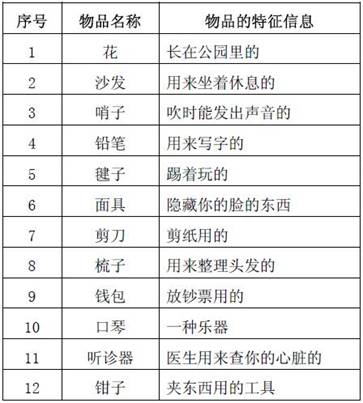
具体地,在其中一个具体实施例中,所述第一测试信息包括但不限于12件物品名称、物品图片以及物品的特征信息。在本实施例中,在虚拟现实装置11上依次呈现下列12件物品的图片,每次呈现一张,每张呈现2秒。此时,AD患者通过虚拟现实眼镜12能够看见虚拟现实装置11上呈现的物品图片。
表1 第一测试信息具体实施例内容:
S212,提示患者回答在虚拟现实装置上呈现的图片的物品名称;
通过语音播报器13提示患者回答在虚拟现实装置上呈现的图片的物品名称。
S213,采集患者回答的物品名称并进行语音识别处理;
具体地,通过语音输入装置14依次采集的患者每次回答的物品名称并进行语音识别处理,将患者回答的物品名称转化为微处理器16能够识别的回答物品名称,形成回答物品名称组。该步骤采用现有的语音识别技术完成,即将语音信息处理转换为微处理器16能够识别的文字信息。
S214,判断患者在预设时间内回答的物品名称是否为当前呈现的图片中的物品名称,当患者在预设时间内回答的物品名称不是当前呈现的图片中的物品名称时,执行步骤S215;当患者在预设时间内回答的物品名称是当前呈现的图片中的物品名称时,执行步骤S216;当已经提示患者当前呈现的图片中的物品的特征信息且患者在预设时间内回答的物品名称不是当前呈现的图片中的物品名称时,执行步骤S217。
具体地,依次以所述回答物品名称组中的回答物品名称在第一测试信息中查找匹配,并判断该回答物品名称是否包含于第一测试信息中。当该回答物品名称不包含于第一测试信息中时,执行步骤S215,即进一步提示患者当前呈现的图片中的物品的特征信息;当该回答物品名称包含于第一测试信息中时,执行步骤S216,即记录患者回答正确数量,并进一步判断第一测试信息中的图片是否呈现完毕,具体详见步骤S216的描述。
S215,提示患者当前呈现的图片中的物品的特征信息;执行步骤S212;即提示患者当前呈现的图片中的物品的特征信息后,再一次提示患者回答在虚拟现实装置上呈现的图片的物品名称。需要说明的是,步骤S215只执行一次,即只提示一次患者当前呈现的图片中的物品的特征信息。即在步骤S214中,若患者在预设时间内回答的物品名称不是当前呈现的图片中的物品名称,进一步判断步骤S215是否已经执行过,即判断是否已经提示过一次患者当前呈现的图片中的物品的特征信息,若是,则执行步骤S217;
S216,记录患者回答正确数量;
S217,判断第一测试信息中的图片是否呈现完毕,如果第一测试信息中的图片呈现完毕,执行步骤S218;如果第一测试信息中的图片未呈现完毕,执行步骤S211。
S218,根据患者回答正确数量统计患者对第一测试信息中物品名称的回答错误数量。
步骤S22,呈现第二测试信息中的图片,提示患者根据呈现的第二测试信息中的图片回答,根据患者的回答统计患者对第二测试信息回答错误数量。
在其中一个具体实施例中,所述第二测试信息包括人的每一个手指图片以及该手指图片对应的标识。即5个手指图片及每一个手指图片对应的标识。5个手指名称具体包括大拇指、食指、中指、无名指和小拇指。
具体地,参照图4所示,图4是图2中步骤S22优选实施例的细化流程示意图。在本实施例中,步骤S22通过第二测试模块102实现,具体包括如下步骤:
S221,在虚拟现实装置11上依次呈现第二测试信息中每一个手指图片;
S222,提示患者回答在虚拟现实装置11上呈现的手指图片中的手指名称;
S223,采集患者回答的手指名称并进行语音识别处理;
S224,当患者在预设时间内回答的手指名称是当前呈现的手指图片中的手指名称时,记录患者回答正确数量。
S225,根据患者回答正确数量统计患者对第二测试信息回答错误数量。
步骤S23,根据患者对第一测试信息回答错误数量和患者对第二测试信息回答错误数量计算患者的认知得分。
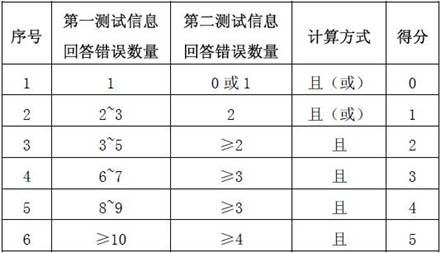
具体地,在本实施例中,步骤S23通过计算模块103实现,根据患者对第一测试信息回答错误数量和患者对第二测试信息回答错误数量计算患者的认知得分具体计算方法如表2所示:
当患者对第一测试信息回答错误数量为1,且/或患者对第二测试信息回答错误数量为1或1时,患者的认知得分为0,即基本无认知障碍;
当患者对第一测试信息回答错误数量为2或3,且/或患者对第二测试信息回答错误数量为2时,患者的认知得分为1;
当患者对第一测试信息回答错误数量为3至5之间,且患者对第二测试信息回答错误数量≥2时,患者的认知得分为2;
当患者对第一测试信息回答错误数量为6至7之间,且患者对第二测试信息回答错误数量≥3时,患者的认知得分为3;
当患者对第一测试信息回答错误数量为8至9之间,且患者对第二测试信息回答错误数量≥3时,患者的认知得分为4;
当患者对第一测试信息回答错误数量为≥10,且患者对第二测试信息回答错误数量≥4时,患者的认知得分为5。
表2 患者认知分数计算具体实施例:
本发明实施例基于认知量表,通过在虚拟现实装置上呈现第一测试信息中的图片,提示患者根据呈现的第一测试信息中的图片回答,根据患者的回答统计患者对第一测试信息回答错误数量,以及在虚拟现实装置上呈现第二测试信息中的图片,提示患者根据呈现的第二测试信息中的图片回答,根据患者的回答统计患者对第二测试信息回答错误数量,根据患者对第一测试信息回答错误数量和患者对第二测试信息回答错误数量计算患者的认知得分,从而通过VR技术实现AD患者认知能力的自动测试,进一步地,节省了人力成本,提高了测试的互动性和娱乐性。
以上仅为本发明的优选实施例,并非因此限制本发明的专利范围,凡是利用本发明说明书及附图内容所作的等效结构或等效功能变换,或直接或间接运用在其他相关的技术领域,均同理包括在本发明的专利保护范围内。
相较于现有技术,本发明所述基于认知量表的AD患者自动测试系统及方法采用上述技术方案,达到了如下技术效果:本发明实施例基于认知量表,通过在虚拟现实装置上呈现第一测试信息中的图片,提示患者根据呈现的第一测试信息中的图片回答,根据患者的回答统计患者对第一测试信息回答错误数量,以及在虚拟现实装置上呈现第二测试信息中的图片,提示患者根据呈现的第二测试信息中的图片回答,根据患者的回答统计患者对第二测试信息回答错误数量,根据患者对第一测试信息回答错误数量和患者对第二测试信息回答错误数量计算患者的认知得分,从而通过VR技术实现AD患者认知能力的自动测试,进一步地,节省了人力成本,提高了测试的互动性和娱乐性。
Claims (10)
- 一种基于认知量表的AD患者自动测试系统,运行于可穿戴设备中,其特征在于,所述基于认知量表的AD患者自动测试系统包括多条计算机程序指令,所述可穿戴设备包括虚拟现实装置、适于实现计算机程序指令的微处理器以及适于存储计算机程序指令和测试数据库的存储器,所述测试数据库中存储有第一测试信息和第二测试信息,所述计算机程序指令由微处理器加载并执行如下步骤:呈现第一测试信息中的图片,提示患者根据呈现的第一测试信息中的图片回答,根据患者的回答统计患者对第一测试信息回答错误数量;呈现第二测试信息中的图片,提示患者根据呈现的第二测试信息中的图片回答,根据患者的回答统计患者对第二测试信息回答错误数量;根据患者对第一测试信息回答错误数量和患者对第二测试信息回答错误数量计算患者的认知得分。
- 如权利要求1所述的基于认知量表的AD患者自动测试系统,其特征在于,所述呈现第一测试信息中的图片,提示患者根据呈现的第一测试信息中的图片回答,根据患者的回答统计患者对第一测试信息回答错误数量的步骤包括:按照预设的时间周期在虚拟现实装置上依次呈现第一测试信息中的图片;提示患者回答在虚拟现实装置上呈现的图片的物品名称;采集患者回答的物品名称并进行语音识别处理;当患者在预设时间内回答的物品名称不是当前呈现的图片中的物品名称时,提示患者当前呈现的图片中的物品的特征信息;当患者在预设时间内回答的物品名称是当前呈现的图片中的物品名称时,记录患者回答正确数量;当已经提示患者当前呈现的图片中的物品的特征信息且患者在预设时间内回答的物品名称不是当前呈现的图片中的物品名称时,判断第一测试信息中的图片是否呈现完毕;当第一测试信息中的图片呈现完毕时,根据患者回答正确数量统计患者对第一测试信息中物品名称的回答错误数量。
- 如权利要求1所述的基于认知量表的AD患者自动测试系统,其特征在于,所述第一测试信息包括12件物品名称、物品图片以及物品的特征信息。
- 如权利要求1所述的基于认知量表的AD患者自动测试系统,其特征在于,所述呈现第二测试信息中的图片,提示患者根据呈现的第二测试信息中的图片回答,根据患者的回答统计患者对第二测试信息回答错误数量的步骤具体包括:在虚拟现实装置上依次呈现第二测试信息中每一个手指图片;提示患者回答在虚拟现实装置上呈现的手指图片中的手指名称;采集患者回答的手指名称并进行语音识别处理;当患者在预设时间内回答的手指名称是当前呈现的手指图片中的手指名称时,记录患者回答正确数量;根据患者回答正确数量统计患者对第二测试信息回答错误数量。
- 如权利要求1所述的基于认知量表的AD患者自动测试系统,其特征在于,所述第二测试信息包括人的每一个手指图片以及该手指图片对应的标识。
- 一种基于认知量表的AD患者自动测试方法,应用于可穿戴设备中,其特征在于,所述可穿戴设备包括虚拟现实装置、微处理器以及存储器,所述存储器中存储有测试数据库,所述测试数据库中存储有第一测试信息和第二测试信息,该方法包括步骤:呈现第一测试信息中的图片,提示患者根据呈现的第一测试信息中的图片回答,根据患者的回答统计患者对第一测试信息回答错误数量;呈现第二测试信息中的图片,提示患者根据呈现的第二测试信息中的图片回答,根据患者的回答统计患者对第二测试信息回答错误数量;根据患者对第一测试信息回答错误数量和患者对第二测试信息回答错误数量计算患者的认知得分。
- 如权利要求6所述的基于认知量表的AD患者自动测试方法,其特征在于,所述呈现第一测试信息中的图片,提示患者根据呈现的第一测试信息中的图片回答,根据患者的回答统计患者对第一测试信息回答错误数量的步骤包括:按照预设的时间周期在虚拟现实装置上依次呈现第一测试信息中的图片;提示患者回答在虚拟现实装置上呈现的图片的物品名称;采集患者回答的物品名称并进行语音识别处理;当患者在预设时间内回答的物品名称不是当前呈现的图片中的物品名称时,提示患者当前呈现的图片中的物品的特征信息;当患者在预设时间内回答的物品名称是当前呈现的图片中的物品名称时,记录患者回答正确数量;当已经提示患者当前呈现的图片中的物品的特征信息且患者在预设时间内回答的物品名称不是当前呈现的图片中的物品名称时,判断第一测试信息中的图片是否呈现完毕;当第一测试信息中的图片呈现完毕时,根据患者回答正确数量统计患者对第一测试信息中物品名称的回答错误数量。
- 如权利要求6所述的基于认知量表的AD患者自动测试方法,其特征在于,所述第一测试信息包括12件物品名称、物品图片以及物品的特征信息。
- 如权利要求6所述的基于认知量表的AD患者自动测试方法,其特征在于,所述呈现第二测试信息中的图片,提示患者根据呈现的第二测试信息中的图片回答,根据患者的回答统计患者对第二测试信息回答错误数量的步骤具体包括:在虚拟现实装置上依次呈现第二测试信息中每一个手指图片;提示患者回答在虚拟现实装置上呈现的手指图片中的手指名称;采集患者回答的手指名称并进行语音识别处理;当患者在预设时间内回答的手指名称是当前呈现的手指图片中的手指名称时,记录患者回答正确数量;根据患者回答正确数量统计患者对第二测试信息回答错误数量。
- 如权利要求6所述的基于认知量表的AD患者自动测试方法,其特征在于,所述第二测试信息包括人的每一个手指图片以及该手指图片对应的标识。
Applications Claiming Priority (2)
| Application Number | Priority Date | Filing Date | Title |
|---|---|---|---|
| CN201810434292.8 | 2018-05-08 | ||
| CN201810434292.8A CN110448269A (zh) | 2018-05-08 | 2018-05-08 | 基于认知量表的ad患者自动测试系统及方法 |
Publications (1)
| Publication Number | Publication Date |
|---|---|
| WO2019214534A1 true WO2019214534A1 (zh) | 2019-11-14 |
Family
ID=68467725
Family Applications (1)
| Application Number | Title | Priority Date | Filing Date |
|---|---|---|---|
| PCT/CN2019/085444 Ceased WO2019214534A1 (zh) | 2018-05-08 | 2019-05-05 | 基于认知量表的ad患者自动测试系统及方法 |
Country Status (2)
| Country | Link |
|---|---|
| CN (1) | CN110448269A (zh) |
| WO (1) | WO2019214534A1 (zh) |
Citations (6)
| Publication number | Priority date | Publication date | Assignee | Title |
|---|---|---|---|---|
| US20080280276A1 (en) * | 2007-05-09 | 2008-11-13 | Oregon Health & Science University And Oregon Research Institute | Virtual reality tools and techniques for measuring cognitive ability and cognitive impairment |
| CN106327049A (zh) * | 2015-07-08 | 2017-01-11 | 广州市第人民医院 | 一种认知评估系统及其应用 |
| CN106388793A (zh) * | 2016-09-06 | 2017-02-15 | 华南理工大学 | 基于vr技术与生理体征监测的老年痴呆症辅助治疗系统 |
| CN106580263A (zh) * | 2017-01-13 | 2017-04-26 | 杭州师范大学 | 一种头戴式老年痴呆症诊疗仪及其控制方法 |
| CN106599558A (zh) * | 2016-12-05 | 2017-04-26 | 武汉智普天创科技有限公司 | 一种基于虚拟现实的认知评估方法及系统 |
| CN107088051A (zh) * | 2017-04-12 | 2017-08-25 | 潘晓东 | 一种用于脑健康认知障碍诊断及风险评估方法及系统 |
-
2018
- 2018-05-08 CN CN201810434292.8A patent/CN110448269A/zh active Pending
-
2019
- 2019-05-05 WO PCT/CN2019/085444 patent/WO2019214534A1/zh not_active Ceased
Patent Citations (6)
| Publication number | Priority date | Publication date | Assignee | Title |
|---|---|---|---|---|
| US20080280276A1 (en) * | 2007-05-09 | 2008-11-13 | Oregon Health & Science University And Oregon Research Institute | Virtual reality tools and techniques for measuring cognitive ability and cognitive impairment |
| CN106327049A (zh) * | 2015-07-08 | 2017-01-11 | 广州市第人民医院 | 一种认知评估系统及其应用 |
| CN106388793A (zh) * | 2016-09-06 | 2017-02-15 | 华南理工大学 | 基于vr技术与生理体征监测的老年痴呆症辅助治疗系统 |
| CN106599558A (zh) * | 2016-12-05 | 2017-04-26 | 武汉智普天创科技有限公司 | 一种基于虚拟现实的认知评估方法及系统 |
| CN106580263A (zh) * | 2017-01-13 | 2017-04-26 | 杭州师范大学 | 一种头戴式老年痴呆症诊疗仪及其控制方法 |
| CN107088051A (zh) * | 2017-04-12 | 2017-08-25 | 潘晓东 | 一种用于脑健康认知障碍诊断及风险评估方法及系统 |
Non-Patent Citations (1)
| Title |
|---|
| FENG, RONGFANG ET AL., DIAGNOSTICS OF SENILE DEMENTIA, 31 August 2010 (2010-08-31), pages 147 - 148 * |
Also Published As
| Publication number | Publication date |
|---|---|
| CN110448269A (zh) | 2019-11-15 |
Similar Documents
| Publication | Publication Date | Title |
|---|---|---|
| JP7591635B2 (ja) | 医師による遠隔評価のためのデジタル眼検査方法 | |
| CN102387740B (zh) | 诊断和治疗已定义的病症的系统 | |
| JP2022527946A5 (zh) | ||
| WO2019206173A1 (zh) | 基于vr技术辅助阿尔茨海默症患者记忆训练的系统及方法 | |
| US20180060757A1 (en) | Data annotation method and apparatus for enhanced machine learning | |
| US20200320770A1 (en) | Dialog-based testing using avatar virtual assistant | |
| US10939821B2 (en) | Systems and methods for diagnosing and analyzing concussions | |
| WO2019214536A1 (zh) | 阿尔茨海默症患者图形认知能力评估系统及方法 | |
| Van Stan et al. | Ambulatory voice biofeedback: Acquisition and retention of modified daily voice use in patients with phonotraumatic vocal hyperfunction | |
| US20240342042A1 (en) | Digital apparatus and application for improving eyesight | |
| EP4325517B1 (en) | Methods and devices in performing a vision testing procedure on a person | |
| KR20210028199A (ko) | 아동의 신경발달 장애 위험을 평가하는 방법 | |
| WO2020082088A1 (en) | Systems and methods for automated passive assessment of visuospatial memory and/or salience | |
| CN107924229A (zh) | 一种虚拟现实设备中的图像处理方法和装置 | |
| US20210259603A1 (en) | Method for evaluating a risk of neurodevelopmental disorder with a child | |
| WO2019206174A1 (zh) | 用于辅助阿尔茨海默症患者记忆训练的可穿戴设备 | |
| WO2019214535A1 (zh) | Ad患者认知和记忆能力自动测试系统及方法 | |
| KR102122021B1 (ko) | 가상현실을 이용한 인지 개선 장치 및 방법 | |
| TWM640769U (zh) | 防護衣穿脫人工智慧引導系統 | |
| WO2019214533A1 (zh) | 基于vr的ad患者认知能力测试系统及方法 | |
| CN110448269A (zh) | 基于认知量表的ad患者自动测试系统及方法 | |
| CN119028526A (zh) | 失语症康复训练的数据处理方法及装置 | |
| Dev et al. | Current Cognitive Medical Tests and Available Therapies | |
| Kamaruddin et al. | Early detection of dysphoria using electroencephalogram affective modelling. | |
| TW202409992A (zh) | 防護衣穿脫人工智慧引導系統 |
Legal Events
| Date | Code | Title | Description |
|---|---|---|---|
| 121 | Ep: the epo has been informed by wipo that ep was designated in this application |
Ref document number: 19800422 Country of ref document: EP Kind code of ref document: A1 |
|
| NENP | Non-entry into the national phase |
Ref country code: DE |
|
| 122 | Ep: pct application non-entry in european phase |
Ref document number: 19800422 Country of ref document: EP Kind code of ref document: A1 |