WO2019167356A1 - 吸収性物品 - Google Patents
吸収性物品 Download PDFInfo
- Publication number
- WO2019167356A1 WO2019167356A1 PCT/JP2018/042732 JP2018042732W WO2019167356A1 WO 2019167356 A1 WO2019167356 A1 WO 2019167356A1 JP 2018042732 W JP2018042732 W JP 2018042732W WO 2019167356 A1 WO2019167356 A1 WO 2019167356A1
- Authority
- WO
- WIPO (PCT)
- Prior art keywords
- adjuster
- absorbent article
- core
- absorbent
- sheet
- Prior art date
- Legal status (The legal status is an assumption and is not a legal conclusion. Google has not performed a legal analysis and makes no representation as to the accuracy of the status listed.)
- Ceased
Links
Images


Classifications
-
- A—HUMAN NECESSITIES
- A61—MEDICAL OR VETERINARY SCIENCE; HYGIENE
- A61F—FILTERS IMPLANTABLE INTO BLOOD VESSELS; PROSTHESES; DEVICES PROVIDING PATENCY TO, OR PREVENTING COLLAPSING OF, TUBULAR STRUCTURES OF THE BODY, e.g. STENTS; ORTHOPAEDIC, NURSING OR CONTRACEPTIVE DEVICES; FOMENTATION; TREATMENT OR PROTECTION OF EYES OR EARS; BANDAGES, DRESSINGS OR ABSORBENT PADS; FIRST-AID KITS
- A61F13/00—Bandages or dressings; Absorbent pads
- A61F13/15—Absorbent pads, e.g. sanitary towels, swabs or tampons for external or internal application to the body; Supporting or fastening means therefor; Tampon applicators
-
- A—HUMAN NECESSITIES
- A61—MEDICAL OR VETERINARY SCIENCE; HYGIENE
- A61F—FILTERS IMPLANTABLE INTO BLOOD VESSELS; PROSTHESES; DEVICES PROVIDING PATENCY TO, OR PREVENTING COLLAPSING OF, TUBULAR STRUCTURES OF THE BODY, e.g. STENTS; ORTHOPAEDIC, NURSING OR CONTRACEPTIVE DEVICES; FOMENTATION; TREATMENT OR PROTECTION OF EYES OR EARS; BANDAGES, DRESSINGS OR ABSORBENT PADS; FIRST-AID KITS
- A61F13/00—Bandages or dressings; Absorbent pads
- A61F13/15—Absorbent pads, e.g. sanitary towels, swabs or tampons for external or internal application to the body; Supporting or fastening means therefor; Tampon applicators
- A61F13/53—Absorbent pads, e.g. sanitary towels, swabs or tampons for external or internal application to the body; Supporting or fastening means therefor; Tampon applicators characterised by the absorbing medium
-
- A—HUMAN NECESSITIES
- A61—MEDICAL OR VETERINARY SCIENCE; HYGIENE
- A61F—FILTERS IMPLANTABLE INTO BLOOD VESSELS; PROSTHESES; DEVICES PROVIDING PATENCY TO, OR PREVENTING COLLAPSING OF, TUBULAR STRUCTURES OF THE BODY, e.g. STENTS; ORTHOPAEDIC, NURSING OR CONTRACEPTIVE DEVICES; FOMENTATION; TREATMENT OR PROTECTION OF EYES OR EARS; BANDAGES, DRESSINGS OR ABSORBENT PADS; FIRST-AID KITS
- A61F13/00—Bandages or dressings; Absorbent pads
- A61F13/15—Absorbent pads, e.g. sanitary towels, swabs or tampons for external or internal application to the body; Supporting or fastening means therefor; Tampon applicators
- A61F13/53—Absorbent pads, e.g. sanitary towels, swabs or tampons for external or internal application to the body; Supporting or fastening means therefor; Tampon applicators characterised by the absorbing medium
- A61F13/534—Absorbent pads, e.g. sanitary towels, swabs or tampons for external or internal application to the body; Supporting or fastening means therefor; Tampon applicators characterised by the absorbing medium having an inhomogeneous composition through the thickness of the pad
-
- A—HUMAN NECESSITIES
- A61—MEDICAL OR VETERINARY SCIENCE; HYGIENE
- A61F—FILTERS IMPLANTABLE INTO BLOOD VESSELS; PROSTHESES; DEVICES PROVIDING PATENCY TO, OR PREVENTING COLLAPSING OF, TUBULAR STRUCTURES OF THE BODY, e.g. STENTS; ORTHOPAEDIC, NURSING OR CONTRACEPTIVE DEVICES; FOMENTATION; TREATMENT OR PROTECTION OF EYES OR EARS; BANDAGES, DRESSINGS OR ABSORBENT PADS; FIRST-AID KITS
- A61F13/00—Bandages or dressings; Absorbent pads
- A61F13/15—Absorbent pads, e.g. sanitary towels, swabs or tampons for external or internal application to the body; Supporting or fastening means therefor; Tampon applicators
- A61F13/53—Absorbent pads, e.g. sanitary towels, swabs or tampons for external or internal application to the body; Supporting or fastening means therefor; Tampon applicators characterised by the absorbing medium
- A61F13/534—Absorbent pads, e.g. sanitary towels, swabs or tampons for external or internal application to the body; Supporting or fastening means therefor; Tampon applicators characterised by the absorbing medium having an inhomogeneous composition through the thickness of the pad
- A61F13/537—Absorbent pads, e.g. sanitary towels, swabs or tampons for external or internal application to the body; Supporting or fastening means therefor; Tampon applicators characterised by the absorbing medium having an inhomogeneous composition through the thickness of the pad characterised by a layer facilitating or inhibiting flow in one direction or plane, e.g. a wicking layer
Definitions
- the present invention relates to an absorbent article such as a urine-absorbing pad and a disposable diaper, and more particularly to an absorbent article that can reduce malodor caused by a wearer's body fluid.
- Absorbent articles such as urine pads and disposable diapers are usually used for a long time while being in contact with the skin of the wearer, so there are various situations day and night so that the wearer does not feel uncomfortable or uncomfortable. Various improvements are being considered.
- Patent Document 1 discloses (A) a liquid-impermeable backing sheet, (B) a relatively hydrophobic liquid-permeable top sheet, as an absorbent article for reducing or preventing wearer's skin irritation.
- Non-uniformly distributed, disposable absorbent articles Shown and, furthermore, citric acid, and organic acids such as adipic acid are exemplified as the above-described pH adjusting agent.
- the pH adjusting agent such as citric acid exemplified here neutralizes ammonia components generated from body fluids such as urine, and therefore is expected to suppress not only skin irritation but also malodor.
- pH adjusters such as citric acid are water-soluble and are easily dissolved and diffused in body fluids such as urine discharged from the wearer, the pH adjustor can be held in place. However, when body fluid is repeatedly supplied, the function may not be sufficiently exhibited.
- the present invention can continuously exert the deodorizing function of the pH adjusting agent even for body fluids that are repeatedly supplied, and it is difficult to cause restrictions on the structure and arrangement position of the pH adjusting agent. It aims at providing the absorbent article which can fully exhibit the deodorizing function of an agent efficiently and fully.
- One aspect (aspect 1) of the present invention is an absorbent article including a pH adjuster at a position in contact with a body fluid, the pH adjuster being dissolved in water and exhibiting acidity; and Covering the core part, and having a coating part made of solid oil at room temperature, and the covering part has a communication part that allows the outside of the pH adjuster and the surface of the core part to communicate with each other. It has the absorptive article.
- the absorbent article of this embodiment is a solid core portion that is acidic when dissolved in water by a pH adjuster disposed at a position in contact with a body fluid, and covers the core portion.
- the covering portion has a communication portion that allows the outside of the pH adjuster and the surface of the core portion to communicate with each other, such as urine discharged from the wearer.
- the body fluid comes into contact with the pH adjuster, the body fluid reaches the core through the communicating portion of the covering portion and partially dissolves the core, and the acidic component of the core is gradually removed from the pH adjuster. Can be eluted.
- the absorbent article of this aspect maintains the deodorizing function for a long period of time because the pH adjuster gradually releases acidic components each time body fluid such as urine is supplied from the wearer. Can be demonstrated. Further, in the absorbent article according to this aspect, since the release of the acidic component of the pH adjuster is controlled by the covering portion that covers the core portion, there are structural restrictions such as particle diameter and restrictions on the arrangement position. It is difficult, and the deodorizing function of such a pH adjuster can be efficiently and sufficiently exhibited.
- the core portion dissolves in the body fluid and exhibits a pH within a range of 3 to 5.
- the absorbent article of this embodiment has a core part that dissolves in body fluid and exhibits a pH in the range of 3 to 5, so that the body fluid after contacting the pH adjuster while exhibiting a predetermined deodorizing function
- the skin comes into contact with the wearer's skin (that is, when a weakly acidic acidic component eluted from the core comes into contact with the wearer's skin)
- the skin pH is weakly acidified, causing dermatitis such as a rash. It can be difficult.
- the absorbent article in the absorbent article according to Aspect 1 or 2, has an absorbent body containing a superabsorbent polymer, and the pH adjuster is At least 30 seconds after contact with the body fluid, a part of the core part elutes into the body fluid.
- the absorbent article of this embodiment has a time (usually about 30 seconds) required for the superabsorbent polymer (SAP) to absorb a body fluid and swell more than a certain amount (swells about 70 to 80% of full swelling). Since a part of the core of the pH adjuster elutes into the body fluid as an acidic component after the lapse of time, the predetermined deodorizing function is sufficiently achieved while preventing the acidic component from inhibiting the absorption and swelling (retention) of SAP. Can be demonstrated.
- SAP superabsorbent polymer
- the pH adjusting agent in the absorbent article according to any one of Aspects 1 to 3, has a pH of the bodily fluid until 60 seconds have elapsed after contacting the bodily fluid. It has an acidic sustained release function with a change amount of 0.5 or less.
- the pH adjuster has a predetermined acidic sustained release function, and since the acidic component is gradually released after contacting the body fluid, the deodorizing function by the acidic component is further sustained. Can be demonstrated.
- the covering part is formed by stacking a plurality of oil particles on the surface of the core part.
- the communication part is formed by gaps between the plurality of oil particles.
- the coating portion of the pH adjuster is formed by stacking a plurality of fat particles on the surface of the core portion, and the communication portion is formed by a gap between the particles of the plurality of fat particles.
- the absorbent article in the absorbent article according to any one of the above aspects 1 to 5, includes a liquid-permeable top sheet, a liquid-impermeable back sheet, An absorber disposed between the two sheets, and the pH adjuster is at least one of the topsheet, the topsheet and the absorber, and the absorber. Is arranged.
- the pH adjuster is disposed between the topsheet, the topsheet and the absorbent body, and at least one of the absorbent bodies, that is, at a position where there is a high possibility of contact with the body fluid.
- a pH adjuster can be efficiently brought into contact with a body fluid, and the deodorizing function can be exhibited more accurately.
- the pH adjuster is disposed on the skin-facing surface side of the absorber (that is, when the pH adjuster is disposed on at least one of the topsheet and the topsheet and the absorber). Can bring the pH adjuster into contact with the body fluid more efficiently.
- the absorbent article in the absorbent article according to Aspect 6, further includes a diffusive sheet between the top sheet and the absorbent, The pH adjuster is disposed at least on the diffusive sheet.
- the absorbent article of this aspect further includes a diffusible sheet between the topsheet and the absorber, and the pH adjuster is disposed at least on the diffusible sheet. Can be brought into contact with the pH adjusting agent while being diffused, and the deodorizing function of the pH adjusting agent can be exhibited more efficiently.
- the absorbent article of this aspect has a surface sheet interposed between the wearer's skin and the pH adjuster, and the pH adjuster is less likely to directly contact the wearer's skin. There is also an advantage that it is possible to make it difficult to cause discomfort or discomfort due to the pH adjusting agent adhering to the skin.
- the absorbent body in the absorbent article according to aspect 6 or 7, includes an absorbent core containing a superabsorbent polymer, a core wrap sheet covering the absorbent core, The pH adjuster is disposed at least between the absorbent core and the core wrap sheet.
- the deodorizing function can be efficiently exhibited while suppressing the dropping of the pH adjusting agent.
- the present invention it is possible to continuously exert the deodorizing function of the pH adjusting agent even for repeatedly supplied body fluids, and it is difficult to cause restrictions on the structure and arrangement position of the pH adjusting agent.
- the absorbent article which can fully exhibit the deodorizing function of an agent efficiently can be provided.
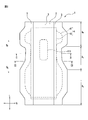
- FIG. 1 is a plan view of a urine absorbing pad 1 according to an embodiment of the present invention as viewed in the thickness direction T from the topsheet 2 side in a developed state.
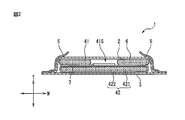
- FIG. 2 is an end view of a cross section taken along line II-II of the urine collecting pad 1 in FIG.
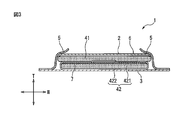
- FIG. 3 is an end view of a cross section taken along line III-III of the urine absorbing pad 1 in FIG.
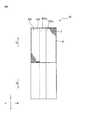
- FIG. 4 is a plan view of the second absorbent layer 42 used in the urine absorbing pad 1.
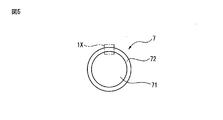
- FIG. 5 is a schematic cross-sectional view of the pH adjusting agent 7 used in the urine absorbing pad 1.
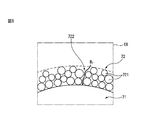
- 6 is an enlarged schematic cross-sectional view of the main part surrounded by a surrounding line IX of the pH adjusting agent 7 in FIG.
- FIG. 7 is an enlarged schematic cross-sectional view of the main part corresponding to FIG. 6 of the pH adjuster according to another embodiment of the present invention in which the form of the covering portion of the pH adjuster is different.
- FIGS. 8A to 8C are plan views of the second absorbent layer in still another embodiment of the present invention in which the arrangement of pH adjusting agents is different.
- longitudinal direction refers to “a direction in which the length of a vertically long object (for example, absorbent article, absorbent body, etc.) in plan view is long”
- width direction refers to “in plan view”
- Thickness direction means “perpendicular direction to the object placed on the horizontal surface in the unfolded state” The direction, the width direction, and the thickness direction are orthogonal to each other.
- an axial line positioned in the center of the longitudinal object in the width direction and extending in the longitudinal direction is referred to as a “longitudinal central axis” or “a central axis extending in the longitudinal direction”.
- the “axis line positioned in the center of the object in the longitudinal direction and extending in the width direction” is referred to as “width-direction center axis” or “width-direction center axis”.
- “relatively proximal to the central axis in the width direction in the longitudinal direction of the longitudinal object” is referred to as “inward side in the longitudinal direction”
- “the longitudinal direction of the longitudinal object is In the direction, “distal side relative to the central axis in the width direction” is referred to as “outward side in the longitudinal direction”.
- the “relatively proximal side with respect to the central axis in the longitudinal direction” is referred to as “inward side in the width direction”
- “A distal side relative to the central axis in the longitudinal direction” is referred to as an “outward side in the width direction”.
- the front side of the absorbent article In the longitudinal direction of the absorbent article, one side that is relatively proximal to the wearer's abdomen when wearing the absorbent article” is referred to as “the front side of the absorbent article”. "In the longitudinal direction of the absorbent article, when the absorbent article is worn, it is relatively distal to the wearer's abdomen (ie, relatively proximal to the wearer's back). The “other side” is referred to as “the rear side of the absorbent article”. In this specification, unless otherwise specified, in the thickness direction of the absorbent article, “relatively proximal to the wearer's skin surface when the absorbent article is worn” is defined as “skin facing surface”.
- “Side”, and “the distal side relative to the skin surface of the wearer when the absorbent article is worn” is referred to as “the non-skin facing surface side”.
- “when wearing” means from the time when the wearer wears the absorbent article (that is, when the wearable state is formed) to the time that the state is maintained (while being worn) means.
- FIG. 1 is a plan view of a urine collecting pad 1 according to an embodiment of the present invention as viewed in the thickness direction T from the surface sheet 2 side in a deployed state, and FIGS. 2 and 3 are respectively in FIG. 3 is an end view of a cross section of the urine absorbing pad 1 taken along lines II-II and III-III.
- FIG. 4 is a plan view of the second absorbent layer 42 used for the urine absorbing pad 1.
- 5 is a schematic cross-sectional view of the pH adjusting agent 7 used in the urine removing pad 1
- FIG. 6 is an enlarged schematic cross-sectional view of the main part surrounded by a surrounding line IX of the pH adjusting agent 7 in FIG. It is.
- the urine absorbing pad 1 has a vertically long outer shape having a longitudinal direction L and a width direction W in plan view, and more specifically, , substantially central portion in the longitudinal direction L (i.e., the portion corresponding to the central region a C to be described later) has a substantially hourglass-shaped outer shape having a constricted thin toward the inner side of the width direction W.
- the outer shape of the absorbent article is not limited to the above, and various uses can be used as long as the length dimension in the longitudinal direction L is longer than the width dimension in the width direction W.
- Arbitrary external shapes for example, a rectangle, an ellipse, a bowl shape, etc.
- the urine absorbing pad 1 of this embodiment has a front region AF corresponding to the abdomen of the wearer when worn in the longitudinal direction L, and a rear corresponding to the back or buttocks of the wearer when worn. and the area a B, located between these two regions, and a, a central region a C corresponding to the crotch portion of the wearer when worn.
- the proximal side relative to the wearer's abdomen at the time of wearing is referred to as the front side DF.
- the relatively proximal of the rear side D B relative's back or buttocks.
- the urine absorbing pad 1 includes a liquid-permeable surface sheet 2 positioned on the skin-facing surface side of the urine removing pad 1 in the thickness direction T, and a non-skin of the urine removing pad 1.
- the back sheet 3 located on the facing surface side, the absorbent body 4 having liquid absorbency disposed between these two sheets, and the skin facing surface side of the top sheet 2 at both ends in the width direction W of the urine absorbing pad 1
- a pair of side seats 5 and 5 located at the center are provided as main constituent members.
- the pair of side sheets 5 and 5 described above are elastic members such as rubber thread or the like in which the respective end portions on the inner side in the width direction W are provided in the vicinity of the end portions when the urine absorbing pad 1 is worn. It is possible to form a leak-proof wall portion for standing up by contraction (not shown) and preventing leakage of body fluid such as urine.
- the absorbent body 4 is positioned relatively to the first absorbent layer 41 located on the skin facing surface side and relatively to the non-skin facing surface side in the thickness direction T.
- the second absorption layer 42 and the two absorption layers are configured.
- the first absorbent layer 41 is made of an absorbent material containing a superabsorbent polymer (SAP) and hydrophilic fibers, and is further disposed at a position on the skin facing surface side. 6 and an arbitrary joining means (not shown) such as a hot-melt adhesive, the shape of the second absorbent layer 42 is maintained while SAP and hydrophilic fibers are used as an absorbent material.
- SAP superabsorbent polymer
- hydrophilic fibers are used as an absorbent material.
- the shape of the absorbent core 421 is maintained by being covered with the hydrophilic core wrap sheet 422.
- the urine collecting pad 1 of the present embodiment is in contact with a body fluid such as urine discharged from the wearer (in this embodiment, the absorption of the second absorbent layer 42).
- the pH adjuster 7 is included in the position between the core 421 and the core wrap sheet 422, and the pH adjuster 7 is dissolved in water to form an acidic state as shown in FIGS. Core portion 71 and a coating portion 72 that coats the core portion 71 and is made of solid oil at room temperature.
- the coating portion 72 has an outside of the pH adjusting agent 7 and the surface of the core portion 71. It has the communication part 722 connected so that liquid passage is possible.
- the urine absorbing pad 1 includes the solid core portion 71 in which the pH adjusting agent 7 disposed at the position in contact with the body fluid dissolves in water and exhibits acidity, and the core portion 71. And a coating portion 72 made of solid oil at room temperature.
- the coating portion 72 further has a communication portion 722 that allows the outside of the pH adjuster 7 and the surface of the core portion 71 to communicate with each other. Therefore, when the body fluid BF such as urine discharged from the wearer comes into contact with the pH adjusting agent 7, the body fluid BF passes through the communicating portion 722 of the covering portion 72 as shown in FIG.
- the core 71 is partially dissolved by reaching 71, and the acidic component of the core 71 can be gradually eluted from the pH adjuster 7.
- the urine removing pad 1 gradually releases the acidic component every time the body fluid BF such as urine is supplied from the wearer. Can be sustained.
- the urine removing pad 1 controls the release of the acidic component of the pH adjusting agent 7 by the covering portion 72 that covers the core portion 71, there are structural restrictions such as particle diameter and restrictions on the arrangement position. It is difficult to occur and the deodorizing function of the pH adjuster 7 can be efficiently and sufficiently exhibited.
- the pH adjuster 7 is disposed between the absorbent core 421 and the core wrap sheet 422 of the second absorbent layer 42, so that the pH adjuster 7 is prevented from falling off.
- the position of the pH adjuster is not limited to the position as in the above-described embodiment as long as the position is in contact with the body fluid, as described later. It can be placed at any position in consideration of the deodorizing function and absorption performance.
- the topsheet 2 is, as shown in FIGS. 1 to 3, viewed from above in a plan view from the front end in the longitudinal direction L of the urine collection pad 1.
- the urine removing pad 1 has a vertically long, substantially rectangular outer shape extending in the longitudinal direction L extending from the vicinity of one end in the width direction W to the vicinity of the other end.
- the topsheet 2 is disposed at a relatively skin-facing surface side in the thickness direction T of the urine absorbing pad 1 and can contact the wearer's skin surface.
- the absorbent article of the present invention While forming a surface, it is comprised by the liquid-permeable sheet-like member which functions so that bodily fluids, such as urine discharged
- the outer shape of the topsheet is not limited to that of such an embodiment, and the surface on the skin facing surface side of the absorbent body can be covered so as not to be exposed at least in the central region. If it is a thing, the thing of arbitrary external shapes and sizes according to various uses etc. is employable.
- the liquid-permeable sheet-like member that can be used as a surface sheet has various properties that can be used as a surface sheet for absorbent articles (for example, liquid permeability (drainage), touch, flexibility, strength, etc.).
- a nonwoven fabric such as a spunbond nonwoven fabric, an air-through nonwoven fabric, a spunlace nonwoven fabric, or a point bond nonwoven fabric formed by hydrophilic fibers; a surface of a nonwoven fabric formed by hydrophobic fibers such as thermoplastic resin fibers
- Any sheet-like member such as a resin film having a plurality of openings can be used.
- the kind in particular of the constituent fiber is not restrict
- the structure of the sheet-like member that can be used as the surface sheet is not particularly limited, and includes, for example, a porous sheet structure having a plurality of openings or a plurality of protrusions and recesses in addition to a flat sheet-like structure having no openings or irregularities. Adopting any structure such as a concavo-convex structure (for example, a concavo-convex structure having a plurality of hollow protrusions and recesses and a corrugated cross-sectional shape or a groove structure having a plurality of solid protrusions and recesses) can do.
- a concavo-convex structure for example, a concavo-convex structure having a plurality of hollow protrusions and recesses and a corrugated cross-sectional shape or a groove structure having a plurality of solid protrusions and recesses
- the basis weight, thickness, etc. of the sheet-like member (nonwoven fabric, etc.) that can be used as the surface sheet are not particularly limited as long as they do not impair the effects of the present invention, and depending on the desired liquid permeability, touch, flexibility, strength, etc. Any basis weight, thickness, etc. can be employed, but the top sheet is a relatively thick liquid-permeable sheet-like member from the standpoint that it is difficult for liquid such as urine to return. It is preferable.
- the top sheet is a part of the surface on the non-skin facing side of the pair of side sheets located on the skin facing side, the skin facing side or the non-skin facing surface of the absorber. It may be joined to at least part of the surface on the side and / or part of the surface on the skin facing surface side of the back sheet.
- the joining means is not particularly limited, and any means such as a hot melt adhesive or heat fusion can be employed.
- the back sheet 3 is, as seen in a plan view, from the front side end in the longitudinal direction L of the urine collection pad 1 to the rear side end as shown in FIGS. And extending from one end in the width direction W of the urine collection pad 1 to the other end thereof, and a substantially central portion in the longitudinal direction L is similar to the outer shape of the urine collection pad 1. It has a substantially hourglass-shaped outer shape that is constricted toward the inner side in the width direction W. As shown in FIGS. 2 and 3, the back sheet 3 is disposed at a relatively non-skin facing surface side position in the thickness direction T of the urine removing pad 1, such as urine discharged from the wearer.
- the outer shape of the back sheet is not limited to that of such an embodiment, and various forms can be used as long as the entire surface of the absorbent body on the non-skin facing surface side can be covered. Arbitrary external shapes and sizes according to the application can be adopted.
- the liquid-impermeable sheet-like member that can be used as the back sheet is particularly limited as long as it has various properties that can be used as the back sheet of the absorbent article (for example, liquid-impermeable (leak-proof) and strength).
- non-woven fabrics such as spunbond nonwoven fabrics, point bond nonwoven fabrics, meltblown nonwoven fabrics, SMS nonwoven fabrics, and air-through nonwoven fabrics formed by hydrophobic fibers such as thermoplastic resin fibers; and hydrophobic thermoplastic resins such as polyethylene and polypropylene
- the kind of constituent fiber is not particularly limited.
- polyolefin resin fibers such as polyethylene and polypropylene
- polyester resin fibers such as polyethylene terephthalate
- Arbitrary hydrophobic fibers such as composite fibers such as fibers and side-by-side fibers can be used, and these fibers may be used alone or in combination of two or more kinds.
- the structure of the sheet-like member that can be used as the back sheet is not particularly limited, and in addition to a flat sheet-like structure having no openings or irregularities, for example, a porous structure having a plurality of openings or a plurality of convex portions and concave portions.
- Arbitrary structures such as a concavo-convex structure (for example, a concavo-convex structure having a plurality of hollow convex portions and concave portions and having a corrugated cross section), can be employed.
- the basis weight, thickness, etc. of the sheet-like member that can be used as the back sheet are not particularly limited as long as the effects of the present invention are not impaired, and any basis weight according to desired liquid impermeability, strength, air permeability, etc. Or thickness can be employed.
- the absorbent article of this invention may further provide the liquid impervious leak-proof sheet in the position between a back surface sheet and an absorber.
- a leak-proof sheet is not particularly limited as long as it has a predetermined liquid impermeability (leak-proof property).
- a resin film made of any thermoplastic resin such as polyethylene or polypropylene is adopted. Can do.
- the back sheet is a part of the surface on the non-skin facing side of the pair of side sheets, a part of the surface on the non-skin facing side of the top sheet, and / or an absorber. It may be joined to at least a part of the surface on the non-skin facing surface side.
- the joining means is not particularly limited, and any means such as a hot melt adhesive or heat fusion can be employed.
- the pair of side sheets 5 and 5 are respectively urine at both ends in the width direction W of the urine collection pad 1 in a plan view as shown in FIGS. It is comprised by a pair of strip
- the outer side end in the direction W is joined to the skin facing surface side surface of the back sheet 3 to form a fixed end, while the inner side end in the width direction W is any of the top sheet 2 and the like. It is not joined to the constituent members and forms a free end.
- each of the pair of side sheets 5, 5 contracts the pair of side sheets 5, 5 in the longitudinal direction L in the vicinity of the inner side end in the width direction W, thereby causing the inner side end in the width direction W to shrink.
- An elastic member (not shown) such as a thread rubber for erecting the (free end) is provided along the longitudinal direction L. Due to the contraction of the elastic member, the pair of side sheets 5 and 5 have their inner end portions (free end portions) in the width direction W standing up to prevent leakage of body fluid such as urine. Can be formed.
- the belt-like sheet-like member that can be used as the side sheet has various characteristics that can be used as the side sheet of the absorbent article (for example, liquid impermeability (leakproofness), touch, flexibility, strength, etc.). Not particularly limited, for example, the same nonwoven fabric formed of hydrophobic fibers as the above-mentioned back sheet; a resin film formed of a hydrophobic thermoplastic resin; a laminated sheet in which a nonwoven fabric is bonded to a resin film, etc.
- the sheet-like member can be used.
- the outer shape and size, basis weight, thickness, etc. of the belt-like sheet-like member that can be used as the side sheet are not particularly limited as long as they can form a predetermined leak-proof wall, and the desired leak-proof property or Arbitrary external shapes and sizes, basis weights, thicknesses, etc. according to the touch, flexibility, strength, etc. can be adopted.
- the absorbent body 4 has a front area A F (more specifically, a longitudinal direction) of the urine collection pad 1 in plan view as shown in FIGS. 1 to 3.
- L extends in the longitudinal direction L from the vicinity of the front end of L) to the rear region A B (more specifically, in the vicinity of the rear end of the longitudinal direction L), and one side in the width direction W of the urine collecting pad 1 from the vicinity side end portion extends over the other side end portion, as a whole, narrower portions corresponding to the central region a C of the long and the longitudinal direction L in the longitudinal direction L is toward the inner side in the width direction W It has a generally hourglass-shaped outer shape.
- the outer shape of the absorbent body is not limited to the aspect of the present embodiment, and at least the length in the longitudinal direction is long enough to be at least the longitudinal length of the central region of the absorbent article. As long as it has a long shape, any outer shape (for example, a rectangle, an ellipse, a bowl, etc.) according to various uses can be adopted.
- the absorbent body 4 is disposed at a position between the top sheet 2 and the back sheet 3 in the thickness direction T as shown in FIGS.
- the first absorbent layer 41 has an outer shape substantially the same as that of the absorbent body 4 in a plan view, as shown in FIG. Extending in the longitudinal direction L from the vicinity of the front end in the longitudinal direction L to the vicinity of the rear end, and extending from the vicinity of one end in the width direction W of the urine collecting pad 1 to the vicinity of the other end. and which, as a whole, while the portion corresponding to the central region a C of the long and the longitudinal direction L in the longitudinal direction L has a generally hourglass-shaped outer shape having a constricted thin toward the inner side in the width direction W As shown in FIGS.
- the second absorbent layer 42 is near the front end in the longitudinal direction L of the urine collecting pad 1 (more specifically, the first absorbent layer 41
- the portion located on the front side of the front side end) to the vicinity of the rear side end (more specifically, the first 1 portion of the first absorbent layer 41 extending in the longitudinal direction L, and both end portions in the width direction W are more than both end portions of the first absorbent layer 41 in the width direction W, respectively. So as to be positioned on the inner side in the width direction (more specifically, both end portions in the width direction W are substantially overlapped with both end portions in the width direction W of the narrow portion of the first absorbent layer 41 in the thickness direction T.
- the first absorption layer 41 forms the outer shape of both end portions in the width direction W in the plan view of the absorber 4, and the second absorption layer 42 absorbs the absorption.
- the outer shape of both ends in the longitudinal direction L in plan view of the body 4 is formed.
- the absorbent body does not have to be constituted by such two absorbent layers, and the absorbent body has a single-layer structure composed of one absorbent layer. Or you may have a multilayer structure which consists of three or more absorption layers.
- the outer shape of one or a plurality of absorption layers constituting the absorbent body has various characteristics (for example, liquid absorption, liquid retention, flexibility, etc.) that can function as an absorbent body of the absorbent article.
- any external shape for example, an ellipse, a bowl, a square, a circle, etc.
- the first absorbent layer 41 is composed of an absorbent material containing a superabsorbent polymer (SAP) and hydrophilic fibers.
- the second absorbent layer 42 is made of SAP and hydrophilic fibers, while the shape thereof is maintained by being partially covered with the hydrophilic sheet 6 bonded to the surface on the skin facing surface side.
- the shape of the absorbent core 421 included as the absorbent material is maintained by being covered with the hydrophilic core wrap sheet 422. 2 to 4, the second absorbent layer 42 is disposed so that the core wrap sheet 422 covers the absorbent core 421 from the non-skin facing surface side, and further, the skin facing surface side of the absorbent core 421.
- the core wrap sheets 422 covers the entire absorbent core 421.
- the second absorbent layer is configured in this way, when the second absorbent layer is configured in this way, the absorbent material included in the absorbent core and the later-described components are used. There is an advantage that it is possible to make it more difficult for the pH adjusting agent to fall off.
- the hydrophilic sheet 6 and the core wrap sheet 422 are both made of a hydrophilic sheet-like member such as a tissue.
- the absorbent material of the absorbent layer constituting the absorbent body is not particularly limited as long as it can absorb and retain body fluid such as urine, and any known material in the art.
- Absorbent materials can be used. Examples of such absorbent materials include hydrophilic fibers and superabsorbent polymers, and more specifically, cellulose fibers such as pulverized pulp, cotton, rayon, and acetate; sodium acrylate copolymers, and the like. Examples thereof include a granular material composed of a superabsorbent polymer (SAP); a mixture of these arbitrarily combined.
- SAP superabsorbent polymer
- an absorber when an absorber is comprised by a some absorption layer like the above-mentioned embodiment, you may use the same absorptive material or its combination for all the absorptive layers, and a different absorptive material or its combination for every absorptive layer May be used. Therefore, when the absorber is constituted by two absorption layers of the first absorption layer and the second absorption layer as in the above-described embodiment, only SAP is adopted as the absorbent material of the first absorption layer, You may employ
- the absorbent layer constituting the absorbent body retains its shape by means other than the hydrophilic sheet and the core wrap sheet as in the above-described embodiment or only by the absorbent material.
- seat like the above-mentioned embodiment do not need to be provided.
- the first absorbent layer 41 penetrates the first absorbent layer 41 in the thickness direction T and is seen in a plan view.
- a F of the central portion located in and the urine absorbing pad 1 in the width direction W over the front portion of the central region a C 41S is provided at the through hole formed so as to extend in the longitudinal direction L from the rear side portion of the front region a F of the central portion located in and the urine absorbing pad 1 in the width direction W over the front portion of the central region a C 41S is provided.
- the through hole 41S is provided so as to correspond to the position of the excretion opening of the wearer that discharges body fluid such as urine, and absorbs body fluid such as urine immediately after discharge in the thickness direction T of the absorber 4. Since it can promote, it can exhibit more excellent absorption performance (especially absorption speed, liquid transferability, etc.), and can also suppress the generation of malodor.
- the through hole is formed only in the first absorbent layer 41 and not in the second absorbent layer 42, but in the absorbent article of the present invention.
- a similar through hole may be formed in the second absorption layer.
- a through hole is formed in the second absorbent layer, a size (plan view area) smaller than the through hole of the first absorbent layer in a plan view at a position overlapping with the through hole of the first absorbent layer in the thickness direction. ) Is preferably formed.
- the through hole of the second absorbent layer is formed in this way, the through hole of the first absorbent layer and the through hole of the second absorbent layer communicate with each other in the thickness direction, and as a whole, the open hole is opened in the thickness direction of the absorber. Since a through-hole whose area is gradually reduced can be formed, body fluid such as urine immediately after discharge can be more efficiently absorbed by the absorber.
- such a through hole may not be formed in the absorbent body.
- the basis weight, thickness, etc. of the absorbent layer constituting the absorber are not particularly limited as long as the effects of the present invention are not hindered, and are arbitrary according to the desired absorption performance, flexibility, etc.
- the basis weight, thickness, etc. of can be adopted.
- the second urine absorption pad 1 is second in plan view between the absorbent core 421 and the core wrap sheet 422 of the second absorbent layer 42.
- a substance that causes malodor such as ammonia or amines contained in body fluids such as urine or generated from components contained in body fluids is contained.
- a pH adjuster 7 that can be adjusted or can suppress the growth of bacteria that cause generation of the malodor causing substance (that is, has a deodorizing function) is disposed.
- the pH adjuster 7 is coated with a solid core 71 that dissolves in water and exhibits acidity, as shown in FIGS. 5 and 6. And a coating portion 72 made of solid oil at normal temperature.
- the coating portion 72 has a communication portion 722 that allows the outside of the pH adjuster 7 and the surface of the core portion 71 to communicate with each other. Have.
- room temperature means 20 ° C.
- the pH adjuster 7 disposed at a position in contact with the body fluid of the wearer is configured in this way, when the body fluid BF such as urine discharged from the wearer contacts the pH adjuster 7, As shown in FIG. 6, the body fluid BF reaches the core portion 71 through the communication portion 722 of the covering portion 72 to partially dissolve the core portion 71, and the acidic component of the core portion 71 is converted into a pH adjuster. 7 can be gradually eluted. As a result, the urine absorbing pad 1 gradually releases the acidic component whenever the body fluid BF such as urine is supplied from the wearer, so that the deodorizing function (i.e., urine) by the acidic component is released.
- the deodorizing function i.e., urine
- Neutralizing odor-causing substances such as ammonia and amines that are contained in body fluids or produced from components contained in body fluids, or suppress the growth of bacteria that cause these odor-causing substances Can be continuously exerted over a long period of time.
- the urine absorbing pad 1 releases acidic components from the core portion 71 by the coating portion 72 made of oil and fat that does not elute into the body fluid BF (specifically, contact opportunities between the body fluid BF and the core portion 71 and the core portion 71).
- the amount of acidic component elution from the liquid is controlled, so that structural restrictions such as particle size and restrictions on the arrangement position are less likely to occur, and the deodorizing function of the pH adjuster 7 can be efficiently and sufficiently achieved. It can be demonstrated.
- the covering portion 72 of the pH adjusting agent 7 is formed by stacking a plurality of oil and fat particles 721 on the surface of the core portion 71 as shown in FIG.
- the communication portion 722 described above is formed by the gaps between the plurality of fat particles 721.
- the form of the covering portion (including the communicating portion) of the pH adjuster is not particularly limited as long as the effect of the present invention is not impaired, and the covering portion is, for example, the surface of the core portion.
- FIG. 7 is an enlarged schematic cross-sectional view of the main part corresponding to FIG. 6 of the pH adjusting agent in another embodiment of the present invention in which the form of the covering portion of the pH adjusting agent is different.
- the configuration other than the configuration different from the above-described embodiment is basically the same as the above-described embodiment, and thus the description thereof is omitted.
- the pH adjuster covering portion 73 covers the entire surface of the core portion 71 and comprises an oil-and-fat coating layer 731 made of solid oil at normal temperature, and the oil-and-fat coating.
- the layer 731 includes a plurality of cracks 732 and a communication portion.
- any acidic compound can be used as long as it is solid when dissolved in water and exhibits acidity.
- the neutralization action that neutralizes the odor-causing substances such as ammonia and amines contained in body fluids such as urine or generated from the components of body fluids, and the growth of bacteria that cause the generation of odor-causing substances.
- an organic acid such as citric acid and adipic acid because it has both antibacterial and inhibitory effects. Furthermore, it makes the wearer's skin weakly acidic and makes it less likely to cause dermatitis such as rash. It is particularly preferable to use citric acid.
- dissolved in water and exhibiting acidity means water-soluble at room temperature (20 ° C.) and standard atmospheric pressure (1 atm), and the aqueous solution is within the range of 1 to 5. Indicates the pH of Here, the pH of the aqueous solution can be measured by bringing a pH test paper into contact with the aqueous solution to be measured. Further, in this specification, “solid” means a solid state at normal temperature and standard atmospheric pressure.
- the mass ratio of the core in the pH adjuster is not particularly limited as long as the effect of the present invention is not impaired, but is usually 20% by mass to 99% by mass when the particle mass of the pH adjuster is 100% by mass. It is within the range, preferably within the range of 50% by mass to 99% by mass, and more preferably within the range of 75% by mass to 95% by mass.
- the body fluid after contacting the pH adjuster does not contact the wearer's skin due to the position of the pH adjuster.
- the core of the pH adjuster those having a pH of less than 3 when dissolved in the body fluid (that is, those exhibiting strong acidity) can be used. Those that dissolve and exhibit a pH in the range of 3 to 5 (that is, those that exhibit weak acidity) are preferred.
- the core of the pH adjuster dissolves in the body fluid and exhibits a pH within the range of 3 to 5
- the body fluid after contacting the pH adjuster is not worn by the wearer while exhibiting a predetermined deodorizing function.
- the skin pH may be made weakly acidic to make it difficult to cause dermatitis such as rash. it can.
- the pH when dissolved in a body fluid refers to the pH of the solution when dissolved in the physiological saline using physiological saline as a simulated body fluid.
- the absorbent article of the present invention absorbs various body fluids such as urine, sweat, blood, saliva and the like, and physiological saline is a saline concentration (sodium chloride 0) that is almost isotonic with such human body fluids. .9 w / v%), and is used for research, analysis, testing, etc. in various fields, not limited to this field, as an alternative to actual body fluids.
- the pH of the body fluid can be measured by bringing a pH test paper into contact with the physiological saline as in the measurement of the pH of the aqueous solution described above.
- the coating part of the pH adjuster can use any oil or fat as long as it is capable of coating the core part and is solid at room temperature.
- fats and oils including hardened oil, higher alcohol, higher fatty acid, vegetable or animal fat, wax, polyethylene glycol and the like can be used.
- the hardened oil for example, hardened rapeseed oil, hardened castor oil, hardened soybean oil and the like can be mentioned, and as the higher alcohol, for example, stearyl alcohol, cetanol and the like can be mentioned, and further, as vegetable or animal fat Is, for example, pork fat, beef tallow, chicken fat, whale fat, coconut oil, cocoon oil, coconut oil, saury oil, bonito oil, milk fat, butter, palm oil, perilla fat, egoma oil, cacao oil, peanut oil, Examples thereof include coconut oil, evening primrose oil, borage oil, jojoba oil and the like. Also suitable as the pH adjuster coating is an extremely hardened oil having a melting point of 50 ° C.
- rapeseed oil containing erucic acid in the range of 20% to 60% in the constituent fatty acid can be particularly preferably used.
- the coating amount of the coating part (that is, the mass ratio of the coating part in the pH adjuster) is not particularly limited as long as the effect of the present invention is not impaired, but is usually 1 mass when the particle mass of the pH adjuster is 100% by mass. % To 80% by mass, preferably 1% to 50% by mass, and more preferably 5% to 25% by mass.
- the means for forming the covering portion that is, the means for coating the surface of the core portion with oil or fat is not particularly limited, and for example, a plurality of oil particles for forming the covering portion are used by any spraying means or mixing means.
- a solid (for example, granular, powdery, etc.) core surface under heating or non-heating hereinafter, such a method may be referred to as “particle adhering method”.
- a coating part made of the above oil and fat may be formed, or the oil for forming the coating part is heated to a melting point or higher to form a melt, and the melt is adhered to the solid core by spraying or dropping.
- the coating portion made of the above-described oil or fat may be formed by cooling and drying (hereinafter, such a method may be referred to as a “liquid adhesion method”).
- the communicating portion formed in the coating portion of the pH adjusting agent allows communication between the outside of the pH adjusting agent and the surface of the above-described core portion (that is, body fluid can pass). If it does, it will not restrict
- the number, size, area, etc. of such gaps, cracks, openings, etc. are not particularly limited as long as they do not impair the effects of the present invention. Can be formed in any manner according to the desired deodorizing function (more specifically, sustained release of the core, etc.).
- the means for forming the communication part is not particularly limited.
- the communication part can be formed by gaps between a plurality of oil particles.
- the liquid adhesion method is used as a means for forming the above-described covering portion, the fat-and-oil coating layer produced by adjusting the cooling / drying conditions after the molten oil is adhered to the solid core portion.
- the above-mentioned communicating portion by cracking or by opening or cutting formed by using mechanical means such as drilling or cutting after forming a coating portion (oil coating layer) made of fat on the surface of the solid core portion Can be formed.
- the particle diameter (average particle diameter) of the pH adjuster is not particularly limited as long as the effect of the present invention is not impaired, and is, for example, in the range of 50 ⁇ m to 1500 ⁇ m, preferably 100 ⁇ m. It is in the range of ⁇ 1200 ⁇ m, more preferably in the range of 300 ⁇ m to 1000 ⁇ m.
- the pH adjuster disposed in the absorbent article is difficult to drop off, and when the particle size of the pH adjuster is 1500 ⁇ m or less, the acidic component from the core
- the pH adjuster is arranged at a position where it comes into contact with the skin of the wearer, the wearer feels the particles of the pH adjuster.
- the particle diameter (average particle diameter) of the pH adjuster can be measured by a sieving method.
- the pH adjuster is at least 30 seconds after contact with the body fluid, What a part of core part elutes into a bodily fluid is preferable.
- a pH adjuster is a pH adjuster after a time (usually about 30 seconds) required for SAP to absorb a body fluid and swell more than a certain amount (swells about 70 to 80% of full swelling). Since a part of the core part of the aqueous solution elutes into the body fluid as an acidic component, the predetermined deodorizing function can be sufficiently exhibited while preventing the acidic component from inhibiting the absorption and swelling (retention) of SAP.
- the pH adjusting agent having a late elution start timing of the core portion is an aspect of the communication portion formed in the coating portion, that is, one or a plurality of the gaps formed between the particles of the plurality of fat particles and the fat coating layer. Easy by adjusting the number, size, area, etc. of cracks, openings, etc. so that the core is difficult to elute, or using an acidic compound that forms a core with low solubility in water Can get to.
- the elution start timing of the core can be obtained by measuring the pH of a solution obtained by dissolving the pH adjuster to be measured in a simulated body fluid (physiological saline). Specifically, first, 50 g of physiological saline is measured as a simulated body fluid in a 100 ml beaker, and the pH of physiological saline in the beaker is measured using a pH meter (for example, pH meter manufactured by Toa DKK Corporation). Furthermore, while continuing the measurement of pH, 0.25 g of the pH adjuster to be measured is added into the beaker, and the pH measured by the pH meter is recorded at regular intervals (for example, every 10 seconds). Note that the pH measurement is terminated when there is no change in pH. And the time when measured pH falls 0.1 or more is made into the elution start time of a core part.
- a pH meter for example, pH meter manufactured by Toa DKK Corporation
- the pH adjuster has an acidic sustained release function in which the amount of change in pH of the body fluid from the contact with the body fluid until 60 seconds elapses is 0.5 or less. If the pH adjuster has such a predetermined acidic sustained release function, the acidic component is gradually released after contacting the body fluid, so that the deodorizing function of the acidic component is exerted more continuously. be able to.
- the pH adjusting agent having such an acidic sustained release function is an aspect of the communicating portion formed in the coating portion, that is, one or a plurality of cracks formed in the gap between the particles of the plurality of oil particles or the oil coating layer. easily obtain the number, size, area, etc. of the openings, etc. by adjusting the core part so that it gradually elutes, or by using an acidic compound that forms the core part that has low solubility in water be able to.
- the amount of change in the pH of the body fluid after contact with the pH adjuster is the same as the above-described elution start timing of the core, but is a solution in which the pH adjuster to be measured is dissolved in the simulated body fluid (saline). Can be obtained by measuring the pH.
- the pH adjuster 7 is disposed between the absorbent core 421 and the core wrap sheet 422 of the second absorbent layer 42 described above. It is easy to suppress omission and can effectively exhibit a deodorizing function.
- the arrangement position of the pH adjusting agent is not limited to the position as in the above embodiment as long as the pH adjusting agent is in contact with the body fluid. It can be placed at any position in consideration of the deodorizing function and absorption performance.
- the pH adjuster is arrange
- the pH adjuster can be efficiently contacted with the body fluid, so that the deodorizing function can be exhibited more accurately. it can.
- the pH adjuster when the pH adjuster is disposed on the skin-facing surface side of the absorber (that is, when the pH adjuster is disposed on at least one of the topsheet and the topsheet and the absorber). Can bring the pH adjuster into contact with the body fluid more efficiently.
- the pH adjuster is disposed on the surface sheet means that the surface sheet is disposed on at least one of the surface on the skin facing surface side, the surface on the non-skin facing surface side, and the inside of the surface sheet. To be done. Moreover, it is the same also that a pH adjuster is arrange
- the absorbent article of the present invention may further include a diffusive sheet between the surface sheet and the absorber, and the pH adjuster may be disposed at least on the diffusible sheet.
- the pH adjuster When the pH adjuster is arranged in such a diffusive sheet, the body fluid can be brought into contact with the pH adjuster while diffusing in the surface direction by the diffusible sheet, so that the deodorizing function by the pH adjuster is further improved. It can be exhibited efficiently.
- the surface sheet is interposed between the skin of the wearer and the pH adjuster, and the pH adjuster is difficult to directly contact the wearer's skin, the pH adjuster adheres to the skin of the wearer. There is also an advantage that it is possible to make it difficult to cause a sense of incongruity or discomfort.
- a pH adjuster when a pH adjuster is arrange
- the pH adjuster 7 is, as shown in FIG. 4, a region in the front half of the second absorbent layer 42 (ie, the pH adjuster) in a plan view. are disposed in the arrangement region a 7), the absorbent article of the present invention, the arrangement region in a plan view of the pH adjusting agent is limited to such a mode as long as the position pH adjusting agent is in contact with body fluids
- the pH adjuster can be arranged in an arbitrary arrangement region in plan view.
- FIGS. 8A to 8C are plan views of the second absorbent layer in yet another embodiment of the present invention in which the arrangement form of the pH adjusting agent is different.
- the pH adjusting agent arrangement region A 7a is a part of the front half of the second absorbent layer 42a in plan view. Further, the pH adjusting agent arrangement region A 7a is formed at a position overlapping with the through hole 41S of the first absorption layer 41 in the thickness direction T (that is, at the position of the wearer's excretion opening). (Corresponding position).
- the pH adjusting agent arrangement region A 7a is arranged in such a manner, all the pH adjusting agents 7a are easily brought into contact with body fluids discharged from the wearer, and therefore the deodorizing function by the pH adjusting agent 7a is provided. Furthermore, it can be exhibited efficiently.
- the pH adjusting agent extends in the width direction in the vicinity of the front end and / or the rear end in the longitudinal direction. It may be partially arranged in the region.
- the pH adjuster is arranged like the former, the possibility of the pH adjuster coming into contact with the body fluid discharged from the wearer is higher, so that the deodorizing function by the pH adjuster is more reliably exhibited.
- the pH adjuster when the pH adjuster is arranged as in the latter, it takes a long time to keep in contact with the skin of the wearer, and the vicinity of the front side end in the longitudinal direction where the sweat of the wearer is likely to cause stuffiness and In the vicinity of the rear end, the core of the pH adjuster elutes in the sweat discharged from the wearer, and the above deodorizing function can be exhibited more effectively.
- the number and area of the pH adjusting agent arrangement regions are not particularly limited as long as the effects and absorption performance of the present invention are not impaired, and the pH adjusting agent arrangement regions can be arranged in an arbitrary number or area.
- the plan view shape of the pH adjusting agent arrangement region is not limited to the rectangular shape shown in FIGS. 4 and 8A, and the planar shape of the pH adjusting agent arrangement region is, for example, circular or elliptical. Other geometric shapes may be used.
- the pH adjusting agent arrangement region A 7b has a central portion in the width direction W and both end portions in the width direction W in plan view. Are formed by three strip-shaped regions extending from the front side end portion in the longitudinal direction L to the rear side end portion.
- region A 7b is formed in such a mode, in the area
- the body fluid can be absorbed from a wide area in the longitudinal direction L of the second absorbent layer 42b, and the pH adjusting agent 7b can be absorbed in a wide area in the longitudinal direction L.
- the absorption performance by an absorber and the deodorizing function by a pH adjuster can be exhibited more efficiently.
- the pH adjusting agent arrangement region A 7b is formed in such a manner, the pH adjusting agent 7b can be contacted stepwise with the body fluid repeatedly supplied and diffused in the width direction W.
- the deodorizing function of the pH adjuster 7b can be continuously exhibited over a longer period.
- a band-shaped pH adjusting agent arrangement region is, for example, a band-shaped region extending in the width direction at the central portion in the longitudinal direction even if it is disposed only in the belt-shaped region extending in the longitudinal direction at the central portion in the width direction. It may be arranged only.
- the pH adjusting agent arrangement region A 7c is a region on the front half of the second absorbent layer 42c in a plan view. It is formed as a double elliptical region having a major axis in the longitudinal direction L. Furthermore, the center of the elliptical region inside the double elliptical pH adjusting agent arrangement region A 7c (that is, the elliptical region) The center of the long diameter and the short diameter) is disposed at a position overlapping the through hole 41S of the first absorption layer 41 in the thickness direction T (that is, a position corresponding to the position of the wearer's excretion opening).
- the body fluid that has reached the center of the elliptical region inside the pH adjusting agent arrangement region A 7c is repeatedly supplied to the longitudinal direction L and the width direction W. Since it can contact in steps with the pH adjuster 7c when diffusing, the deodorizing function of the pH adjuster 7c can be exhibited continuously and efficiently over a longer period of time.
- region is not limited to the above-mentioned double (2), For example, single (1) or triple ( 3) or more.
- the planar view shape of the annular region is not limited to the above-described elliptical shape, and may be an arbitrary annular shape such as a circular shape or a rectangular shape.
- means for controlling the flow of body fluids such as an opening, a low basis weight portion, and a pressing portion is used.
- body fluids for example, diffusion flow in the surface direction and permeation flow in the thickness direction
- the present invention provides various absorbent articles such as disposable diapers for adults and infants, light incontinence pads, panty liners, sanitary napkins, sweat pads, breast milk pads, and the like. Can be applied to.
- the absorbent article of the present invention is not limited to the above-described embodiments or examples to be described later, and can be appropriately combined, substituted, changed, and the like without departing from the purpose and spirit of the present invention. It is.
- ordinal numbers such as “first” and “second” are used to distinguish items with the ordinal numbers, and mean the order, priority, importance, etc. of each item. Not what you want.
- Example 1 A surface sheet made of spunbonded nonwoven fabric with a basis weight of 22 g / m 2, a hydrophilic sheet made of tissue with a basis weight of 14 g / m 2, a superabsorbent polymer (abbreviation: SAP, “Aquakeep” manufactured by Sumitomo Seika Co., Ltd.) ”) and 100 g / m 2 and a first absorbent layer comprising a mixture of pulp 200 g / m 2, consisting of SAP (manufactured by Sumitomo Seika Chemicals" AQUA kEEP manufactured by Ltd.
- SAP superabsorbent polymer
- Comparative Example 1 A urine absorption pad of Comparative Example 1 was produced in the same manner as in Example 1 except that no pH adjusting agent was disposed.
- Comparative Example 2 A urine absorption pad of Comparative Example 2 was produced in the same manner as in Example 1 except that 0.15 g of citric acid particles (average particle size: 350 ⁇ m) having no coating part was used as a pH adjuster.
- Example 1 For each of the prepared urine absorption pads of Example 1 and Comparative Examples 1 and 2, according to the following ⁇ Absorptive evaluation method> and ⁇ Odor sensory evaluation and odor component concentration measurement method> Evaluation and sensory evaluation of odor were performed, and the odor component concentration was further measured. These evaluation results (including the pH of the rewetting liquid) and measurement results are shown in Table 1 below.
- ⁇ Absorptive evaluation method (1) While the produced urine absorbing pad is stretched to be in a flat state, the urine collecting pad is fixed on the horizontal measurement surface of the test table so that the surface sheet faces upward. This evaluation method is performed at room temperature of 20 ° C. (2) Cylindrical (inner diameter 60 mm, weight) on the top sheet of the urine collection pad so that the center in the width direction of the urine collection pad is 150 mm rearward from the front end of the absorber. 200 g). (3) A dropping funnel containing 150 ml of artificial urine is prepared, and the dropping funnel is installed in the cylinder so that the tip of the dropping funnel is located at a height of 10 mm from the surface sheet.
- the artificial urine is prepared by dissolving 200 g of urea, 80 g of sodium chloride, 8 g of magnesium sulfate, 3 g of calcium chloride, and about 1 g of pigment: Blue No. 1 in 10 L of ion-exchanged water. (4) All the artificial urine is dropped from the dropping funnel at a dropping rate of 10 ml / second. (5) The time (seconds) from the start of dropping of artificial urine to the disappearance of artificial urine on the surface sheet in the cylinder is measured, and this is taken as the absorption time (seconds).
- the weight (g) of the rewetting liquid is calculated by subtracting the initial weight (g) of the filter paper from the weight (g) of the filter paper that has absorbed the rewetting liquid, and this is defined as the rewetting amount (g).
- the above operations (2) to (9) are repeated twice, and each operation (a total of three operations including the first operation) is obtained. Recorded absorption time (seconds), rewetting amount (g) and pH for each drop of artificial urine (150 ml, 300 ml and 450 ml).
- ⁇ Odor sensory evaluation and odor component concentration measurement method (1) While the produced urine absorbing pad is stretched to be in a flat state, the urine collecting pad is fixed on the horizontal measurement surface of the test table so that the surface sheet faces upward. This evaluation method is performed at room temperature of 20 ° C. (2) 150 g of actual urine collected from an elderly person 65 years or older is dropped into the center of the urine absorption pad in the width direction and 150 mm behind the front end of the absorber, and absorbed by the absorber. Let (3) The urine absorbing pad that has absorbed the actual urine is folded in half in the longitudinal direction so that the top sheet is on the inside, and is put in an aluminum bag with a chuck, and the chuck is closed.
- the aluminum bag containing the urine absorbing pad is placed in an oven set at 40 ° C. (5) The aluminum bag is taken out of the oven every predetermined time (0 hours, 3 hours, 6 hours and 24 hours), the odor in the aluminum bag is evaluated based on the following odor evaluation criteria, and the detection tube type
- the concentration of odor components (ammonia and amines) is measured using a gas meter (manufactured by Gastec Co., Ltd.). (Odor evaluation criteria) 0 points: No odor 1 point: Slightly foul odor 2 points: Slight odor 3 points: Foul odor 4 points: Strong odor
- Example 1 using a pH adjuster in which a core (citric acid: 80% by mass) and a plurality of fat particles (rapeseed oil: 20% by mass) are stacked on the surface of the core. It has been found that the urine removing pad can continuously and sufficiently exhibit the deodorizing function of the pH adjuster without reducing the absorption performance even for urine that is repeatedly supplied. On the other hand, the urine removing pad of Comparative Example 1 that does not use a pH adjuster cannot suppress odor, and the urine removing pad of Comparative Example 2 that uses citric acid particles having no covering as a pH adjuster.
- Urine pad (example of “absorbent article”) 2 Surface Sheet 3 Back Sheet 4 Absorbent Body 41 First Absorbing Layer 42 Second Absorbing Layer 421 Absorbing Core 422 Core Wrap Sheet 5 Side Sheet 6 Hydrophilic Sheet 7 pH Adjusting Agent 71 Core Portion 72 Covering Portion 721 Oil Fat Particle 722 Communication Portion
Landscapes
- Health & Medical Sciences (AREA)
- Epidemiology (AREA)
- Engineering & Computer Science (AREA)
- Biomedical Technology (AREA)
- Heart & Thoracic Surgery (AREA)
- Vascular Medicine (AREA)
- Life Sciences & Earth Sciences (AREA)
- Animal Behavior & Ethology (AREA)
- General Health & Medical Sciences (AREA)
- Public Health (AREA)
- Veterinary Medicine (AREA)
- Absorbent Articles And Supports Therefor (AREA)
Abstract
本発明は、繰り返し供給される体液に対してもpH調整剤の消臭機能を持続的に発揮することができるとともに、pH調整剤の構造や配置位置の制約が生じ難く、かかるpH調整剤の消臭機能を効率よく、十分に発揮させることのできる吸収性物品を提供するものである。 本発明の吸収性物品は、体液と接触する位置にpH調整剤(7)を含む吸収性物品であって、前記pH調整剤(7)は、水に溶解して酸性を呈する固体状の芯部(71)と、該芯部(71)を被覆し、常温で固体の油脂からなる被覆部(72)と、を有し、前記被覆部(72)は、前記pH調整剤(7)の外部と前記芯部(71)の表面とを通液可能に連通する連通部(722)を有する。
Description
本発明は、尿取りパッドや使い捨ておむつ等の吸収性物品に関し、特に、着用者の体液に起因する悪臭を低減し得る吸収性物品に関する。
尿取りパッドや使い捨ておむつ等の吸収性物品は、通常、着用者の肌に接触しながら長時間にわたって使用されるものであるため、着用者に違和感や不快感などを生じさせないように、日夜様々な改良が検討されている。
例えば、特許文献1には、着用者の皮膚のかぶれを減少又は防止する吸収性物品として、(A)液体不透過性裏張りシート、(B)比較的疎水性の液体透過性トップシート、(C)前記裏張りシートと前記トップシートとの間に位置決めされた可撓性吸収芯(前記可撓性吸収芯は親水性繊維材料およびその酸性官能基の少なくとも50%が塩生成陽イオンで中和されている実質上水不溶性の高度に中和されたヒドロゲル物質の粒子からなる)、および(D)糞尿の存在下に皮膚pHを約3.0~5.5の範囲内に維持するのに好適な1又はそれ以上のpH調整剤を具備し、前記の実質上水不溶性の高度に中和されたヒドロゲル粒子と前記pH調整剤とは前記吸収性物品内の別個のばらばらの帯域中に不均一に分布された、使い捨て吸収物品が開示されており、さらに、上記のpH調整剤としてクエン酸、アジピン酸等の有機酸が例示されている。ここで例示されているクエン酸等のpH調整剤は、尿などの体液から生じるアンモニア成分を中和するため、皮膚のかぶれのみならず、悪臭の発生を抑制することも期待される。
しかしながら、クエン酸等のpH調整剤は、水溶性であり、着用者から排出される尿などの体液に溶解して拡散し易いため、当該pH調整剤を所定位置に保持させておくことができず、体液が繰り返し供給される場合には、その機能を十分に発揮することができない虞があった。
しかしながら、クエン酸等のpH調整剤は、水溶性であり、着用者から排出される尿などの体液に溶解して拡散し易いため、当該pH調整剤を所定位置に保持させておくことができず、体液が繰り返し供給される場合には、その機能を十分に発揮することができない虞があった。
そして、このような問題に対処した吸収性物品として、特許文献2には、吸収体と、該吸収体の肌面側に配置されたフマル酸担持シートとを備え、前記フマル酸担持シートが、平均粒子径が30μm以下のフマル酸粒子を担持したシートおよび/または少なくとも一部の構成繊維がフマル酸で被覆されたシートである吸収性物品が開示されている。
この特許文献2に開示された吸収性物品は、水難溶性であるフマル酸が体液等に接触しても直ちに溶解せず、徐々に体液等に溶解するため、吸収性物品の体液等と接触し得る部分にフマル酸担持シートを配置することで、長期間にわたりかぶれや悪臭の発生を抑制することができるとされている。
この特許文献2に開示された吸収性物品は、水難溶性であるフマル酸が体液等に接触しても直ちに溶解せず、徐々に体液等に溶解するため、吸収性物品の体液等と接触し得る部分にフマル酸担持シートを配置することで、長期間にわたりかぶれや悪臭の発生を抑制することができるとされている。
しかしながら、特許文献2の吸収性物品のように、pH調整剤としてフマル酸等の水難溶性成分を用いる場合は、その機能を十分に発揮させるために所定サイズ以下の形態(例えば、30μm以下の平均粒子径等)で用いるなどの構造上の制約があり、さらに、それに付随して、pH調整剤の配置位置にも制約が生じるため、その配置位置によってはpH調整剤の機能(少なくとも消臭機能)を効率よく、十分に発揮させることができない虞があった。
そこで、本発明は、繰り返し供給される体液に対してもpH調整剤の消臭機能を持続的に発揮することができるとともに、pH調整剤の構造や配置位置の制約が生じ難く、かかるpH調整剤の消臭機能を効率よく、十分に発揮させることのできる吸収性物品を提供することを目的とする。
本発明の一態様(態様1)は、体液と接触する位置にpH調整剤を含む吸収性物品であって、前記pH調整剤は、水に溶解して酸性を呈する固体状の芯部と、該芯部を被覆し、常温で固体の油脂からなる被覆部と、を有し、前記被覆部は、前記pH調整剤の外部と前記芯部の表面とを通液可能に連通する連通部を有する、前記吸収性物品である。
本態様の吸収性物品は、体液と接触する位置に配置されるpH調整剤が、水に溶解して酸性を呈する固体状の芯部と、該芯部を被覆し、常温で固体の油脂からなる被覆部と、を有し、さらに、被覆部がpH調整剤の外部と芯部の表面とを通液可能に連通する連通部を有しているため、着用者から排出された尿などの体液がpH調整剤に接触したときに、体液が被覆部の連通部を通って芯部に到達して当該芯部を部分的に溶解し、当該芯部の酸性成分をpH調整剤から徐々に溶出させることができる。これにより、本態様の吸収性物品は、着用者から尿などの体液が供給されるたびに、pH調整剤が酸性成分を徐々に放出するため、かかる酸性成分による消臭機能を長期間にわたって持続的に発揮させることができる。
また、本態様の吸収性物品は、芯部を被覆する被覆部によってpH調整剤の酸性成分の放出を制御しているため、粒子径等の構造上の制約やそれによる配置位置の制約が生じ難く、かかるpH調整剤の消臭機能を効率よく、十分に発揮させることができる。
また、本態様の吸収性物品は、芯部を被覆する被覆部によってpH調整剤の酸性成分の放出を制御しているため、粒子径等の構造上の制約やそれによる配置位置の制約が生じ難く、かかるpH調整剤の消臭機能を効率よく、十分に発揮させることができる。
また、本発明の別の態様(態様2)では、上記態様1の吸収性物品において、前記芯部は、前記体液に溶解して3~5の範囲内のpHを呈する。
本態様の吸収性物品は、芯部が体液に溶解して3~5の範囲内のpHを呈するものであるため、所定の消臭機能を発揮させつつ、pH調整剤に接触した後の体液が着用者の肌に接触した場合(すなわち、芯部から溶出した弱酸性の酸性成分が着用者の肌に接触した場合)には、肌のpHを弱酸性にしてかぶれ等の皮膚炎を生じ難くすることもできる。
本発明の更に別の態様(態様3)では、上記態様1又は2の吸収性物品において、前記吸収性物品は、高吸水性ポリマーを含む吸収体を有しており、前記pH調整剤は、前記体液と接触してから少なくとも30秒経過後に、前記芯部の一部が前記体液に溶出する。
本態様の吸収性物品は、高吸水性ポリマー(SAP)が体液を吸収して一定以上膨潤する(完全膨潤の7割~8割程度膨潤する)のに要する時間(通常、30秒程度)を経過してから、pH調整剤の芯部の一部が酸性成分として体液に溶出するため、当該酸性成分がSAPの吸収及び膨潤(保持)を阻害しないようにしつつ、所定の消臭機能を十分に発揮させることができる。
本発明の更に別の態様(態様4)では、上記態様1~3のいずれかの吸収性物品において、前記pH調整剤は、前記体液と接触してから60秒経過するまでの前記体液のpH変化量が0.5以下となる酸性徐放機能を有する。
本態様の吸収性物品は、pH調整剤が所定の酸性徐放機能を有しており、体液に接触してから徐々に酸性成分が放出されるため、当該酸性成分による消臭機能をより持続的に発揮させることができる。
本発明の更に別の態様(態様5)では、上記態様1~4いずれかの吸収性物品において、前記被覆部は、前記芯部の表面上において複数の油脂粒子が積み重なることによって形成されており、前記連通部は、前記複数の油脂粒子の粒子間の間隙によって形成されている。
本態様の吸収性物品は、pH調整剤の被覆部が、芯部の表面上において複数の油脂粒子が積み重なることによって形成され、さらに、連通部が、複数の油脂粒子の粒子間の間隙によって形成されているため、芯部の表面を外部に露出させないように被覆しつつ、通液可能な連通部を確保することができ、上述のpH調整剤における酸性成分の徐放性をより確実に実現することができる。
本発明の更に別の態様(態様6)では、上記態様1~5のいずれかの吸収性物品において、前記吸収性物品は、液透過性の表面シートと、液不透過性の裏面シートと、これら両シートの間に配置された吸収体と、を有しており、前記pH調整剤は、前記表面シート、前記表面シートと前記吸収体との間、及び前記吸収体のうちの少なくとも1つに配置されている。
本態様の吸収性物品は、pH調整剤が表面シート、表面シートと吸収体との間、及び吸収体のうちの少なくとも1つ、すなわち体液と接触する可能性の高い位置に配置されているため、かかるpH調整剤を効率よく体液と接触させることができ、消臭機能をより的確に発揮させることができる。特に、pH調整剤が吸収体の肌対向面側に配置されている場合(すなわち、pH調整剤が表面シート、及び表面シートと吸収体との間のうちの少なくとも一方に配置されている場合)は、pH調整剤をより一層効率よく体液と接触させることができる。
本発明の更に別の態様(態様7)では、上記態様6の吸収性物品において、前記吸収性物品は、前記表面シートと前記吸収体との間に拡散性シートを更に有しており、前記pH調整剤は、少なくとも前記拡散性シートに配置されている。
本態様の吸収性物品は、表面シートと吸収体との間に拡散性シートを更に有しており、pH調整剤が少なくとも拡散性シートに配置されているため、体液を拡散性シートによって面方向に拡散させながらpH調整剤に接触させることができ、かかるpH調整剤による消臭機能をより効率よく発揮させることができる。
また、本態様の吸収性物品は、着用者の肌とpH調整剤との間に表面シートが介在し、pH調整剤が着用者の肌に直に接触し難くなっているため、着用者にpH調整剤が肌に付着することによる違和感や不快感などを生じさせ難くすることができるという利点もある。
また、本態様の吸収性物品は、着用者の肌とpH調整剤との間に表面シートが介在し、pH調整剤が着用者の肌に直に接触し難くなっているため、着用者にpH調整剤が肌に付着することによる違和感や不快感などを生じさせ難くすることができるという利点もある。
本発明の更に別の態様(態様8)では、上記態様6又は7の吸収性物品において、前記吸収体は、高吸水性ポリマーを含む吸収コアと、該吸収コアを被覆するコアラップシートと、を有しており、前記pH調整剤は、少なくとも前記吸収コアと前記コアラップシートとの間に配置されている。
本態様の吸収性物品は、pH調整剤が少なくとも吸収コアとコアラップシートとの間に配置されているため、pH調整剤の脱落を抑制しつつ、効率よく消臭機能を発揮させることができる。
本発明によれば、繰り返し供給される体液に対してもpH調整剤の消臭機能を持続的に発揮することができるとともに、pH調整剤の構造や配置位置の制約が生じ難く、かかるpH調整剤の消臭機能を効率よく、十分に発揮させることのできる吸収性物品を提供することができる。
以下、本発明の吸収性物品の好適な実施形態について、図面を参照しながら詳細に説明する。なお、本明細書においては、特に断りのない限り、「展開した状態で水平面上に置いた対象物(例えば、尿取りパッド(吸収性物品)、吸収体等)を、垂直方向の上方側から対象物の厚さ方向に見ること」を、単に「平面視」という。特に、対象物が吸収性物品の場合は、「吸収性物品を着用者の肌面側(すなわち、表面シート側)から厚さ方向に見ること」を単に「平面視」という。
本明細書において用いられる各種方向等については、特に断りのない限り、以下のとおりである。
本明細書において、「長手方向」は、「平面視における縦長の対象物(例えば、吸収性物品、吸収体等)の長さの長い方向」を指し、「幅方向」は、「平面視における縦長の対象物の長さの短い方向(短手方向)」を指し、「厚さ方向」は、「展開した状態で水平面上に置いた対象物に対して垂直方向」を指し、これらの長手方向、幅方向及び厚さ方向は、それぞれ互いに直交する関係にある。
さらに、本明細書では、「縦長の対象物の幅方向の中央部に位置し且つ長手方向に延びる軸線」を「長手方向の中央軸線」又は「長手方向に延びる中央軸線」といい、「縦長の対象物の長手方向の中央部に位置し且つ幅方向に延びる軸線」を「幅方向の中央軸線」又は「幅方向に延びる中央軸線」という。これに関連して、「縦長の対象物の長手方向において、幅方向の中央軸線に対して相対的に近位側」を「長手方向の内方側」といい、「縦長の対象物の長手方向において、幅方向の中央軸線に対して相対的に遠位側」を「長手方向の外方側」という。同様に、「縦長の対象物の幅方向において、長手方向の中央軸線に対して相対的に近位側」を「幅方向の内方側」といい、「縦長の対象物の幅方向において、長手方向の中央軸線に対して相対的に遠位側」を「幅方向の外方側」という。
また、本明細書では、「吸収性物品の長手方向において、吸収性物品の着用時に着用者の腹部に対して相対的に近位側となる一方側」を、「吸収性物品の前方側」といい、「吸収性物品の長手方向において、吸収性物品の着用時に着用者の腹部に対して相対的に遠位側(すなわち、着用者の背部に対して相対的に近位側)となる他方側」を、「吸収性物品の後方側」という。
そして、本明細書では、特に断りのない限り、吸収性物品の厚さ方向において、「吸収性物品の着用時に、着用者の肌面に対して相対的に近位側」を「肌対向面側」といい、「吸収性物品の着用時に、着用者の肌面に対して相対的に遠位側」を「非肌対向面側」という。ここで、「着用時」とは、着用者が吸収性物品を着用した時点(すなわち、使用可能な状態を形成した時点)から、その状態を維持している間(着用している間)を意味する。
本明細書において、「長手方向」は、「平面視における縦長の対象物(例えば、吸収性物品、吸収体等)の長さの長い方向」を指し、「幅方向」は、「平面視における縦長の対象物の長さの短い方向(短手方向)」を指し、「厚さ方向」は、「展開した状態で水平面上に置いた対象物に対して垂直方向」を指し、これらの長手方向、幅方向及び厚さ方向は、それぞれ互いに直交する関係にある。
さらに、本明細書では、「縦長の対象物の幅方向の中央部に位置し且つ長手方向に延びる軸線」を「長手方向の中央軸線」又は「長手方向に延びる中央軸線」といい、「縦長の対象物の長手方向の中央部に位置し且つ幅方向に延びる軸線」を「幅方向の中央軸線」又は「幅方向に延びる中央軸線」という。これに関連して、「縦長の対象物の長手方向において、幅方向の中央軸線に対して相対的に近位側」を「長手方向の内方側」といい、「縦長の対象物の長手方向において、幅方向の中央軸線に対して相対的に遠位側」を「長手方向の外方側」という。同様に、「縦長の対象物の幅方向において、長手方向の中央軸線に対して相対的に近位側」を「幅方向の内方側」といい、「縦長の対象物の幅方向において、長手方向の中央軸線に対して相対的に遠位側」を「幅方向の外方側」という。
また、本明細書では、「吸収性物品の長手方向において、吸収性物品の着用時に着用者の腹部に対して相対的に近位側となる一方側」を、「吸収性物品の前方側」といい、「吸収性物品の長手方向において、吸収性物品の着用時に着用者の腹部に対して相対的に遠位側(すなわち、着用者の背部に対して相対的に近位側)となる他方側」を、「吸収性物品の後方側」という。
そして、本明細書では、特に断りのない限り、吸収性物品の厚さ方向において、「吸収性物品の着用時に、着用者の肌面に対して相対的に近位側」を「肌対向面側」といい、「吸収性物品の着用時に、着用者の肌面に対して相対的に遠位側」を「非肌対向面側」という。ここで、「着用時」とは、着用者が吸収性物品を着用した時点(すなわち、使用可能な状態を形成した時点)から、その状態を維持している間(着用している間)を意味する。
図1は、本発明の一実施形態に係る尿取りパッド1を、展開した状態で表面シート2側から厚さ方向Tに見た平面図であり、図2及び図3は、それぞれ図1における尿取りパッド1のII-II線及びIII-III線に沿った断面の端面図である。また、図4は、尿取りパッド1に用いられる第2吸収層42の平面図である。さらに、図5は、尿取りパッド1に用いられるpH調整剤7の断面模式図であり、図6は、図5におけるpH調整剤7の囲み線IXで囲まれた要部の拡大断面模式図である。
図1に示すように、本発明の一実施形態に係る尿取りパッド1は、平面視にて、長手方向L及び幅方向Wを有する縦長の外形形状を有しており、更に具体的には、長手方向Lの略中央部分(すなわち、後述する中央領域ACに対応する部分)が幅方向Wの内方側に向かって細く括れた略砂時計形の外形形状を有している。
なお、本発明において、吸収性物品の外形形状は、このようなものに限定されず、長手方向Lの長さ寸法が幅方向Wの幅寸法よりも長い長形状のものであれば、各種用途等に応じた任意の外形形状(例えば、長方形、楕円形、瓢箪形など)を採用することができる。
なお、本発明において、吸収性物品の外形形状は、このようなものに限定されず、長手方向Lの長さ寸法が幅方向Wの幅寸法よりも長い長形状のものであれば、各種用途等に応じた任意の外形形状(例えば、長方形、楕円形、瓢箪形など)を採用することができる。
また、本実施形態の尿取りパッド1は、図1に示すように長手方向Lにおいて、着用時に着用者の腹部に対応する前方領域AFと、着用時に着用者の背部又は臀部に対応する後方領域ABと、これら両領域の間に位置し、着用時に着用者の股間部に対応する中央領域ACと、を有している。なお、本明細書では、図1に示すように、尿取りパッド1の長手方向Lにおいて、着用時に着用者の腹部に対して相対的に近位側を前方側DFといい、着用時に着用者の背部又は臀部に対して相対的に近位側を後方側DBという。
尿取りパッド1は、図2及び図3に示すように、厚さ方向Tにおいて、尿取りパッド1の肌対向面側に位置する液透過性の表面シート2と、尿取りパッド1の非肌対向面側に位置する裏面シート3と、これら両シートの間に配置された吸液性を有する吸収体4と、尿取りパッド1の幅方向Wの両端部において表面シート2の肌対向面側に位置する一対のサイドシート5、5と、を主な構成部材として備えている。
なお、上述の一対のサイドシート5、5は、尿取りパッド1の着用時に、幅方向Wの内方側のそれぞれの端部が該端部近傍に設けられた糸ゴム等の弾性部材(不図示)の収縮によって起立し、尿などの体液の漏洩を防止するための防漏壁部を形成することができる。
なお、上述の一対のサイドシート5、5は、尿取りパッド1の着用時に、幅方向Wの内方側のそれぞれの端部が該端部近傍に設けられた糸ゴム等の弾性部材(不図示)の収縮によって起立し、尿などの体液の漏洩を防止するための防漏壁部を形成することができる。
さらに、吸収体4は、図2及び図3に示すように、厚さ方向Tにおいて、相対的に肌対向面側に位置する第1吸収層41と、相対的に非肌対向面側に位置する第2吸収層42との2層の吸収層によって構成されている。なお、本実施形態においては、第1吸収層41は、高吸水性ポリマー(SAP)及び親水性繊維を含む吸収性材料によって構成され、さらにその肌対向面側の位置に配置された親水性シート6とホットメルト型接着剤等の任意の接合手段(不図示)で接合されることによって、その形状が保持されている一方、第2吸収層42は、SAP及び親水性繊維を吸収性材料として含む吸収コア421が親水性のコアラップシート422で被覆されることによって、その形状が保持されている。
そして、本実施形態の尿取りパッド1は、図2乃至図4に示すように、着用者から排出される尿などの体液と接触する位置(本実施形態においては、第2吸収層42の吸収コア421とコアラップシート422との間の位置)にpH調整剤7を含み、さらに、このpH調整剤7は、図5及び図6に示すように、水に溶解して酸性を呈する固体状の芯部71と、該芯部71を被覆し、常温で固体の油脂からなる被覆部72と、を有し、当該被覆部72は、pH調整剤7の外部と芯部71の表面とを通液可能に連通する連通部722を有している。
このように、本実施形態の尿取りパッド1は、体液と接触する位置に配置されたpH調整剤7が、水に溶解して酸性を呈する固体状の芯部71と、該芯部71を被覆し、常温で固体の油脂からなる被覆部72と、を有し、さらに、被覆部72がpH調整剤7の外部と芯部71の表面とを通液可能に連通する連通部722を有しているため、着用者から排出された尿などの体液BFがpH調整剤7に接触したときに、体液BFが図6に示すように被覆部72の連通部722を通って芯部71に到達して当該芯部71を部分的に溶解し、当該芯部71の酸性成分をpH調整剤7から徐々に溶出させることができる。これにより、尿取りパッド1は、着用者から尿などの体液BFが供給されるたびに、pH調整剤7が酸性成分を徐々に放出するため、かかる酸性成分による消臭機能を長期間にわたって持続的に発揮させることができる。
また、尿取りパッド1は、芯部71を被覆する被覆部72によってpH調整剤7の酸性成分の放出を制御しているため、粒子径等の構造上の制約やそれによる配置位置の制約が生じ難く、かかるpH調整剤7の消臭機能を効率よく、十分に発揮させることができる。
また、尿取りパッド1は、芯部71を被覆する被覆部72によってpH調整剤7の酸性成分の放出を制御しているため、粒子径等の構造上の制約やそれによる配置位置の制約が生じ難く、かかるpH調整剤7の消臭機能を効率よく、十分に発揮させることができる。
さらに、本実施形態の尿取りパッド1においては、pH調整剤7が第2吸収層42の吸収コア421とコアラップシート422との間に配置されているため、pH調整剤7の脱落を抑制しつつ、効率よく消臭機能を発揮させることができるという利点もある。
なお、本発明の吸収性物品において、pH調整剤の配置位置は、後述するように、体液と接触する位置であれば上述の実施形態のような位置に限定されず、pH調整剤は、所望の消臭機能や吸収性能等を考慮した任意の位置に配置することができる。
なお、本発明の吸収性物品において、pH調整剤の配置位置は、後述するように、体液と接触する位置であれば上述の実施形態のような位置に限定されず、pH調整剤は、所望の消臭機能や吸収性能等を考慮した任意の位置に配置することができる。
以下、本発明の吸収性物品を構成する各種部材について、上述の実施形態に係る尿取りパッド1を用いて更に詳細に説明する。
[表面シート]
上述の実施形態に係る尿取りパッド1において、表面シート2は、図1乃至図3に示すように、平面視にて、尿取りパッド1の長手方向Lの前方側端部から後方側端部にわたって延在するとともに、尿取りパッド1の幅方向Wの一方側端部近傍から他方側端部近傍にわたって延在する、長手方向Lに長い縦長の略矩形状の外形形状を有している。かかる表面シート2は、図1乃至図3に示すように、尿取りパッド1の厚さ方向Tにおいて、相対的に肌対向面側の位置に配置され、着用者の肌面に当接し得る接触面を形成するとともに、着用者から排出される尿などの体液を非肌対向面側に透過させるように機能する、液透過性のシート状部材によって構成されている。
なお、本発明の吸収性物品において、表面シートの外形形状は、このような態様のものに限定されず、吸収体の肌対向面側の表面を少なくとも中央領域において露出しないように覆うことができるものであれば、各種用途等に応じた任意の外形形状及びサイズのものを採用することができる。
上述の実施形態に係る尿取りパッド1において、表面シート2は、図1乃至図3に示すように、平面視にて、尿取りパッド1の長手方向Lの前方側端部から後方側端部にわたって延在するとともに、尿取りパッド1の幅方向Wの一方側端部近傍から他方側端部近傍にわたって延在する、長手方向Lに長い縦長の略矩形状の外形形状を有している。かかる表面シート2は、図1乃至図3に示すように、尿取りパッド1の厚さ方向Tにおいて、相対的に肌対向面側の位置に配置され、着用者の肌面に当接し得る接触面を形成するとともに、着用者から排出される尿などの体液を非肌対向面側に透過させるように機能する、液透過性のシート状部材によって構成されている。
なお、本発明の吸収性物品において、表面シートの外形形状は、このような態様のものに限定されず、吸収体の肌対向面側の表面を少なくとも中央領域において露出しないように覆うことができるものであれば、各種用途等に応じた任意の外形形状及びサイズのものを採用することができる。
表面シートとして用い得る液透過性のシート状部材は、吸収性物品の表面シートとして用い得る諸特性(例えば、液透過性(液はけ性)や肌触り、柔軟性、強度等)を有するものであれば特に制限されず、例えば、親水性繊維によって形成されたスパンボンド不織布、エアスルー不織布、スパンレース不織布、ポイントボンド不織布等の不織布;熱可塑性樹脂繊維等の疎水性繊維によって形成された不織布の表面に親水化処理が施された不織布;複数の開口を有する樹脂フィルムなどの任意のシート状部材を用いることができる。また、表面シートとして不織布を用いる場合、その構成繊維の種類は特に制限されず、例えば、セルロース系繊維;親水化処理を施した熱可塑性樹脂繊維(例えば、オレフィン系樹脂繊維やポリエステル系樹脂繊維等)などの任意の親水性繊維を用いることができ、これらの繊維は単独で用いても、二種類以上の繊維を併用してもよい。
さらに、表面シートとして用い得るシート状部材の構造も特に制限されず、開口や凹凸等を有しない平坦なシート状構造のほか、例えば、複数の開口を有する多孔構造や複数の凸部と凹部を有する凹凸構造(例えば、複数の中空の凸部と凹部を有し、断面形状が波形となる凹凸構造や複数の中実の凸部と凹部を有する畝溝構造等)などの任意の構造を採用することができる。
なお、表面シートとして用い得るシート状部材(不織布等)の坪量や厚み等は、本発明の効果を阻害しない限り特に制限されず、所望の液透過性や肌触り、柔軟性、強度等に応じた任意の坪量や厚み等を採用することができるが、尿などの体液の液戻りが生じ難くなる等の点から、表面シートは、比較的厚みの厚い液透過性のシート状部材を用いることが好ましい。
また、本発明の吸収性物品においては、表面シートは、肌対向面側に位置する一対のサイドシートの非肌対向面側の表面の一部、吸収体の肌対向面側若しくは非肌対向面側の表面の少なくとも一部、及び/又は裏面シートの肌対向面側の表面の一部と接合されていてもよい。かかる接合の手段は、特に制限されず、ホットメルト型接着剤や加熱融着等の任意の手段を採用することができる。
[裏面シート]
上述の実施形態に係る尿取りパッド1において、裏面シート3は、図1乃至図3に示すように、平面視にて、尿取りパッド1の長手方向Lの前方側端部から後方側端部にわたって延在するとともに、尿取りパッド1の幅方向Wの一方側端部から他方側端部にわたって延在しており、尿取りパッド1の外形形状と同様の、長手方向Lの略中央部分が幅方向Wの内方側に向かって括れた略砂時計形の外形形状を有している。かかる裏面シート3は、図2及び図3に示すように、尿取りパッド1の厚さ方向Tにおいて、相対的に非肌対向面側の位置に配置され、着用者から排出される尿などの体液の透過を防止して、体液が尿取りパッド1の外部へ漏れ出ないように機能する、液不透過性のシート状部材によって構成されている。
なお、本発明の吸収性物品において、裏面シートの外形形状は、このような態様のものに限定されず、吸収体の非肌対向面側の表面全体を覆うことができるものであれば、各種用途等に応じた任意の外形形状及びサイズのものを採用することができる。
上述の実施形態に係る尿取りパッド1において、裏面シート3は、図1乃至図3に示すように、平面視にて、尿取りパッド1の長手方向Lの前方側端部から後方側端部にわたって延在するとともに、尿取りパッド1の幅方向Wの一方側端部から他方側端部にわたって延在しており、尿取りパッド1の外形形状と同様の、長手方向Lの略中央部分が幅方向Wの内方側に向かって括れた略砂時計形の外形形状を有している。かかる裏面シート3は、図2及び図3に示すように、尿取りパッド1の厚さ方向Tにおいて、相対的に非肌対向面側の位置に配置され、着用者から排出される尿などの体液の透過を防止して、体液が尿取りパッド1の外部へ漏れ出ないように機能する、液不透過性のシート状部材によって構成されている。
なお、本発明の吸収性物品において、裏面シートの外形形状は、このような態様のものに限定されず、吸収体の非肌対向面側の表面全体を覆うことができるものであれば、各種用途等に応じた任意の外形形状及びサイズのものを採用することができる。
裏面シートとして用い得る液不透過性のシート状部材は、吸収性物品の裏面シートとして用い得る諸特性(例えば、液不透過性(防漏性)や強度等)を有するものであれば特に制限されず、例えば、熱可塑性樹脂繊維等の疎水性繊維によって形成されたスパンボンド不織布、ポイントボンド不織布、メルトブローン不織布、SMS不織布、エアスルー不織布等の不織布;ポリエチレンやポリプロピレン等の疎水性の熱可塑性樹脂によって形成された、複数の開口を有する又は有しない樹脂フィルム;樹脂フィルムに不織布を貼り合わせた積層シートなどの任意のシート状部材を用いることができる。また、裏面シートとして不織布を用いる場合、その構成繊維(疎水性繊維)の種類は特に制限されず、例えば、ポリエチレン、ポリプロピレン等のポリオレフィン系樹脂繊維;ポリエチレンテレフタレート等のポリエステル系樹脂繊維;芯鞘型繊維、サイドバイサイド型繊維等の複合繊維などの任意の疎水性繊維を用いることができ、これらの繊維は単独で用いても、二種類以上の繊維を併用してもよい。
さらに、裏面シートとして用い得るシート状部材の構造も特に制限されず、開口や凹凸等を有しない平坦なシート状構造のほか、例えば、複数の開口を有する多孔構造や複数の凸部と凹部を有する凹凸構造(例えば、複数の中空の凸部と凹部を有し、断面形状が波形となる凹凸構造等)などの任意の構造を採用することができる。
なお、裏面シートとして用い得るシート状部材の坪量や厚み等は、本発明の効果を阻害しない限り特に制限されず、所望の液不透過性や強度、通気性等に応じた任意の坪量や厚み等を採用することができる。
また、本発明の吸収性物品においては、裏面シートと吸収体との間の位置に、液不透過性の防漏シートを更に備えていてもよい。かかる防漏シートとしては、所定の液不透過性(防漏性)を有するものであれば特に制限されず、例えば、ポリエチレン、ポリプロピレン等の任意の熱可塑性樹脂からなる樹脂フィルムなどを採用することができる。
なお、このような防漏シートを備えることは、本発明の吸収性物品においては必須の構成要件ではないものの、吸収性物品がこのような防漏シートを備えていると、尿などの体液の漏出をより効果的に抑制することができる。
なお、このような防漏シートを備えることは、本発明の吸収性物品においては必須の構成要件ではないものの、吸収性物品がこのような防漏シートを備えていると、尿などの体液の漏出をより効果的に抑制することができる。
また、本発明の吸収性物品においては、裏面シートは、一対のサイドシートの非肌対向面側の表面の一部、表面シートの非肌対向面側の表面の一部、及び/又は吸収体の非肌対向面側の表面の少なくとも一部と接合されていてもよい。かかる接合の手段は、特に制限されず、ホットメルト型接着剤や加熱融着等の任意の手段を採用することができる。
[サイドシート]
上述の実施形態に係る尿取りパッド1において、一対のサイドシート5、5は、図1乃至図3に示すように、平面視にて、尿取りパッド1の幅方向Wの両端部においてそれぞれ尿取りパッド1の長手方向Lの前方側端部から後方側端部にわたって延在する、一対の帯状のシート状部材によって構成されている。かかる一対のサイドシート5、5の各々は、図1乃至図3に示すように、尿取りパッド1の厚さ方向Tにおいて、表面シート2の肌対向面側の位置に配置されるとともに、幅方向Wの外方側端部が裏面シート3の肌対向面側の表面に接合されて固定端部を形成している一方、幅方向Wの内方側端部が表面シート2等のいずれの構成部材とも接合されておらず、自由端部を形成している。
上述の実施形態に係る尿取りパッド1において、一対のサイドシート5、5は、図1乃至図3に示すように、平面視にて、尿取りパッド1の幅方向Wの両端部においてそれぞれ尿取りパッド1の長手方向Lの前方側端部から後方側端部にわたって延在する、一対の帯状のシート状部材によって構成されている。かかる一対のサイドシート5、5の各々は、図1乃至図3に示すように、尿取りパッド1の厚さ方向Tにおいて、表面シート2の肌対向面側の位置に配置されるとともに、幅方向Wの外方側端部が裏面シート3の肌対向面側の表面に接合されて固定端部を形成している一方、幅方向Wの内方側端部が表面シート2等のいずれの構成部材とも接合されておらず、自由端部を形成している。
さらに、一対のサイドシート5、5の各々は、幅方向Wの内方側端部近傍において、当該一対のサイドシート5、5を長手方向Lに収縮させて幅方向Wの内方側端部(自由端部)を起立させるための糸ゴム等の弾性部材(不図示)が長手方向Lに沿って設けられている。この弾性部材の収縮によって、一対のサイドシート5、5は、幅方向Wの内方側端部(自由端部)が起立して、尿などの体液の漏洩を防止するための防漏壁部を形成することができる。
サイドシートとして用い得る帯状のシート状部材は、吸収性物品のサイドシートとして用い得る諸特性(例えば、液不透過性(防漏性)や肌触り、柔軟性、強度等)を有するものであれば特に制限されず、例えば、上述の裏面シートと同様の、疎水性繊維によって形成された不織布;疎水性の熱可塑性樹脂によって形成された樹脂フィルム;樹脂フィルムに不織布を貼り合わせた積層シートなどの任意のシート状部材を用いることができる。
また、サイドシートとして用い得る帯状のシート状部材の外形形状やサイズ、坪量、厚み等は、所定の防漏壁部を形成し得るものであれば特に制限されず、所望の防漏性や肌触り、柔軟性、強度等に応じた任意の外形形状やサイズ、坪量、厚み等を採用することができる。
なお、このようなサイドシートを備えることは、本発明の吸収性物品においては必須の構成要件ではないものの、吸収性物品がこのようなサイドシートを備えていると、尿などの体液の漏出(特に、吸収性物品の幅方向への漏出)をより効果的に抑制することができる。
[吸収体]
上述の実施形態に係る尿取りパッド1において、吸収体4は、図1乃至図3に示すように、平面視にて、尿取りパッド1の前方領域AF(より具体的には、長手方向Lの前方側端部近傍)から後方領域AB(より具体的には、長手方向Lの後方側端部近傍)にわたって長手方向Lに延在するとともに、尿取りパッド1の幅方向Wの一方側端部近傍から他方側端部近傍にわたって延在しており、全体として、長手方向Lに長く且つ長手方向Lの中央領域ACに対応する部分が幅方向Wの内方側に向かって細く括れた略砂時計形の外形形状を有している。
なお、本発明の吸収性物品において、吸収体の外形形状は、本実施形態の態様に限定されず、少なくとも長手方向長さが吸収性物品の中央領域の長手方向長さ以上となる程度に長い長形状のものであれば、各種用途等に応じた任意の外形形状(例えば、長方形、楕円形、瓢箪形など)を採用することができる。
上述の実施形態に係る尿取りパッド1において、吸収体4は、図1乃至図3に示すように、平面視にて、尿取りパッド1の前方領域AF(より具体的には、長手方向Lの前方側端部近傍)から後方領域AB(より具体的には、長手方向Lの後方側端部近傍)にわたって長手方向Lに延在するとともに、尿取りパッド1の幅方向Wの一方側端部近傍から他方側端部近傍にわたって延在しており、全体として、長手方向Lに長く且つ長手方向Lの中央領域ACに対応する部分が幅方向Wの内方側に向かって細く括れた略砂時計形の外形形状を有している。
なお、本発明の吸収性物品において、吸収体の外形形状は、本実施形態の態様に限定されず、少なくとも長手方向長さが吸収性物品の中央領域の長手方向長さ以上となる程度に長い長形状のものであれば、各種用途等に応じた任意の外形形状(例えば、長方形、楕円形、瓢箪形など)を採用することができる。
本実施形態の尿取りパッド1においては、吸収体4は、図2及び図3に示すように、厚さ方向Tにおいて表面シート2と裏面シート3の間の位置に配置され、表面シート2を透過してきた着用者の尿などの体液を吸収して保持するように機能する2層の吸収層、すなわち、相対的に肌対向面側に位置する第1吸収層41と、相対的に非肌対向面側に位置する第2吸収層42とによって構成されている。
かかる吸収体4を構成する2層の吸収層のうち、第1吸収層41は、図1に示すように、平面視にて、吸収体4と略同様の外形形状、すなわち、尿取りパッド1の長手方向Lの前方側端部近傍から後方側端部近傍にわたって長手方向Lに延在するとともに、尿取りパッド1の幅方向Wの一方側端部近傍から他方側端部近傍にわたって延在しており、全体として、長手方向Lに長く且つ長手方向Lの中央領域ACに対応する部分が幅方向Wの内方側に向かって細く括れた略砂時計形の外形形状を有している一方、第2吸収層42は、図1及び図4に示すように、平面視にて、尿取りパッド1の長手方向Lの前方側端部近傍(より具体的には、第1吸収層41の前方側端部よりも前方側に位置する部分)から後方側端部近傍(より具体的には、第1吸収層41の後方側端部よりも後方側に位置する部分)にわたって長手方向Lに延在するとともに、幅方向Wの両端部がそれぞれ第1吸収層41の幅方向Wの両端部よりも幅方向内方側に位置するように(より具体的には、幅方向Wの両端部がそれぞれ第1吸収層41の細く括れた部分の幅方向Wの両端部と厚さ方向Tに略重複するように)幅方向Wに延在しており、全体として、長手方向Lに長い略長方形の外形形状を有している。相対的に非肌対向面側の位置に配置される第2吸収層42がこのような外形形状を有していると、第1吸収層41及び第2吸収層42の幅方向Wの端部における段差が着用者に感取され難くすることができる。
したがって、本実施形態においては、図1に示すように、第1吸収層41が、吸収体4の平面視における幅方向Wの両端部の外形形状を形成し、第2吸収層42が、吸収体4の平面視における長手方向Lの両端部の外形形状を形成している。
したがって、本実施形態においては、図1に示すように、第1吸収層41が、吸収体4の平面視における幅方向Wの両端部の外形形状を形成し、第2吸収層42が、吸収体4の平面視における長手方向Lの両端部の外形形状を形成している。
なお、本発明の吸収性物品においては、吸収体は、このような2層の吸収層によって構成されている必要はなく、吸収体は、1層の吸収層からなる単層構造を有していても、3層以上の吸収層からなる複層構造を有していてもよい。また、吸収体を構成する一又は複数の吸収層の外形形状は、吸収性物品の吸収体として機能し得る諸特性(例えば、吸液性、液保持性、柔軟性等)を有するものであれば特に制限されず、上述の実施形態の略砂時計形や長方形の形状のほか、各種用途等に応じた任意の外形形状(例えば、楕円形、瓢箪形、正方形、円形など)を採用することができる。
また、上述の実施形態に係る尿取りパッド1においては、図2及び図3に示すように、第1吸収層41は、高吸水性ポリマー(SAP)及び親水性繊維を含む吸収性材料によって構成され、さらにその肌対向面側の表面に接合された親水性シート6で部分的に被覆されることによって、その形状が保持されている一方、第2吸収層42は、SAP及び親水性繊維を吸収性材料として含む吸収コア421が親水性のコアラップシート422で被覆されることによって、その形状が保持されている。なお、第2吸収層42は、図2乃至図4に示すように、コアラップシート422が吸収コア421を非肌対向面側から覆うように配置され、さらに、吸収コア421の肌対向面側において、コアラップシート422の幅方向Wの一方側端部422E1近傍部分と他方側端部422E2近傍部分が重なり合うように、コアラップシート422が吸収コア421の全体を被覆している。第2吸収層をこのように構成することは、本発明の吸収性物品においては必須の構成要件ではないものの、第2吸収層をこのように構成すると、吸収コアに含まれる吸収性材料や後述するpH調整剤の脱落をより生じ難くすることができるという利点がある。
なお、親水性シート6及びコアラップシート422は、いずれもティッシュ等の親水性のシート状部材によって構成されている。
なお、親水性シート6及びコアラップシート422は、いずれもティッシュ等の親水性のシート状部材によって構成されている。
本発明の吸収性物品において、吸収体を構成する吸収層の吸収性材料は、尿などの体液を吸収して保持することができるものであれば特に制限されず、当分野において公知の任意の吸収性材料を用いることができる。そのような吸収性材料としては、例えば、親水性繊維や高吸水性ポリマーなどが挙げられ、更に具体的には、粉砕パルプ、コットン、レーヨン、アセテート等のセルロース系繊維;アクリル酸ナトリウムコポリマー等の高吸水性ポリマー(SAP)からなる粒状物;これらを任意に組み合わせた混合物などが挙げられる。
なお、吸収体を上述の実施形態のように複数の吸収層によって構成する場合、すべての吸収層に同じ吸収性材料又はその組み合わせを用いてもよく、吸収層ごとに異なる吸収性材料又はその組み合わせを用いてもよい。したがって、吸収体が上述の実施形態のように第1吸収層及び第2吸収層の2層の吸収層によって構成されている場合、第1吸収層の吸収性材料としてSAPのみを採用し、第2吸収層の吸収性材料としてSAP及び親水性繊維の組み合わせを採用してもよい。
なお、吸収体を上述の実施形態のように複数の吸収層によって構成する場合、すべての吸収層に同じ吸収性材料又はその組み合わせを用いてもよく、吸収層ごとに異なる吸収性材料又はその組み合わせを用いてもよい。したがって、吸収体が上述の実施形態のように第1吸収層及び第2吸収層の2層の吸収層によって構成されている場合、第1吸収層の吸収性材料としてSAPのみを採用し、第2吸収層の吸収性材料としてSAP及び親水性繊維の組み合わせを採用してもよい。
また、本発明の吸収性物品においては、吸収体を構成する吸収層が、上述の実施形態のような親水性シートやコアラップシート以外の手段によって又は吸収性材料のみによって、その形状を保持し得る場合は、上述の実施形態のような親水性シートやコアラップシートを備えていなくてもよい。
さらに、上述の実施形態に係る尿取りパッド1においては、図1及び図2に示すように、第1吸収層41は、当該第1吸収層41を厚さ方向Tに貫通するとともに、平面視にて、幅方向Wの中央部に位置し且つ尿取りパッド1の前方領域AFの後方側部分から中央領域ACの前方側部分にわたって長手方向Lに延在するように形成された貫通孔41Sを備えている。かかる貫通孔41Sは、尿などの体液を排出する着用者の排泄口の位置に対応するように設けられており、排出直後の尿などの体液の吸収を、吸収体4の厚さ方向Tにおいて促進することができるため、より優れた吸収性能(特に、吸収速度や液移行性等)を発揮することができ、結果的に悪臭の発生も抑制することができる。
なお、本実施形態の尿取りパッド1においては、貫通孔は、第1吸収層41のみに形成されていて、第2吸収層42には形成されていないが、本発明の吸収性物品においては、第2吸収層にも同様の貫通孔が形成されていてもよい。第2吸収層に貫通孔を形成する場合は、第1吸収層の貫通孔と厚さ方向に重複する位置において、平面視にて第1吸収層の貫通孔よりも小さい寸法形状(平面視面積)を有するように形成することが好ましい。第2吸収層の貫通孔をこのように形成すると、第1吸収層の貫通孔と第2吸収層の貫通孔とが厚さ方向に連通し、全体として、吸収体の厚さ方向において開孔面積が段階的に狭くなる貫通孔を形成することができるため、排出直後の尿などの体液をより効率よく吸収体に吸収させることができる。
なお、吸収体にこのような貫通孔を形成することは、本発明の吸収性物品においては必須の構成要件ではないため、吸収体にはこのような貫通孔が形成されていなくてもよい。
また、本発明の吸収性物品において、吸収体を構成する吸収層の坪量や厚み等は、本発明の効果を阻害しない限り特に制限されず、所望の吸収性能や柔軟性等に応じた任意の坪量や厚み等を採用することができる。
そして、上述の実施形態に係る尿取りパッド1においては、図2乃至図4に示すように、第2吸収層42の吸収コア421とコアラップシート422との間における、平面視にて第2吸収層42の前方側半分の領域(すなわち、pH調整剤配置領域A7)に、尿などの体液に含まれる又は体液の含有成分から生成されるアンモニアやアミン類等の悪臭の原因物質を中和したり、当該悪臭の原因物質の発生原因となる細菌の繁殖を抑制したりすることのできる(すなわち、消臭機能を有する)、pH調整剤7が配置されている。
以下、本発明の吸収性物品に用いられるpH調整剤について、上述の実施形態に係る尿取りパッド1を用いて更に詳細に説明する。
[pH調整剤]
上述の実施形態に係る尿取りパッド1において、pH調整剤7は、図5及び図6に示すように、水に溶解して酸性を呈する固体状の芯部71と、該芯部71を被覆し、常温で固体の油脂からなる被覆部72と、を有していて、当該被覆部72は、pH調整剤7の外部と芯部71の表面とを通液可能に連通する連通部722を有している。
なお、本明細書において、「常温」とは、20℃をいう。
上述の実施形態に係る尿取りパッド1において、pH調整剤7は、図5及び図6に示すように、水に溶解して酸性を呈する固体状の芯部71と、該芯部71を被覆し、常温で固体の油脂からなる被覆部72と、を有していて、当該被覆部72は、pH調整剤7の外部と芯部71の表面とを通液可能に連通する連通部722を有している。
なお、本明細書において、「常温」とは、20℃をいう。
着用者の体液と接触する位置に配置されたpH調整剤7が、このように構成されていると、着用者から排出された尿などの体液BFがpH調整剤7に接触したときに、体液BFが、図6に示すように被覆部72の連通部722を通って芯部71に到達して当該芯部71を部分的に溶解し、当該芯部71の酸性成分をpH調整剤7から徐々に溶出させることができる。これにより、尿取りパッド1は、着用者から尿などの体液BFが供給されるたびに、pH調整剤7が酸性成分を徐々に放出するため、かかる酸性成分による消臭機能(すなわち、尿などの体液に含まれる又は体液の含有成分から生成されるアンモニアやアミン類等の悪臭の原因物質を中和したり、当該悪臭の原因物質の発生原因となる細菌の繁殖を抑制したりすることのできる機能)を、長期間にわたって持続的に発揮させることができる。
また、尿取りパッド1は、体液BFに溶出しない油脂からなる被覆部72によって芯部71からの酸性成分の放出(具体的には、体液BFと芯部71の接触機会や芯部71からの酸性成分の溶出量等)を制御しているため、粒子径等の構造上の制約やそれによる配置位置の制約が生じ難く、かかるpH調整剤7の消臭機能を効率よく、十分に発揮させることができる。
また、尿取りパッド1は、体液BFに溶出しない油脂からなる被覆部72によって芯部71からの酸性成分の放出(具体的には、体液BFと芯部71の接触機会や芯部71からの酸性成分の溶出量等)を制御しているため、粒子径等の構造上の制約やそれによる配置位置の制約が生じ難く、かかるpH調整剤7の消臭機能を効率よく、十分に発揮させることができる。
さらに、本実施形態の尿取りパッド1においては、pH調整剤7の被覆部72は、図6に示すように、芯部71の表面上において複数の油脂粒子721が積み重なることによって形成されており、上述の連通部722は、かかる複数の油脂粒子721の粒子間の間隙によって形成されている。pH調整剤7の被覆部72及び連通部722がこのように形成されていると、芯部71の表面を外部に露出させないように被覆しつつ、通液可能な連通部722を確保することができ、上述のpH調整剤7における酸性成分の徐放性をより確実に実現することができる。
なお、本発明の吸収性物品において、pH調整剤の被覆部(連通部を含む。)の形態は、本願発明の効果を阻害しない限り特に制限されず、被覆部は、例えば、芯部の表面全体を被覆する油脂からなる被覆層と、当該被覆層に形成された一又は複数の亀裂乃至開口(連通部)とによって構成されていてもよい。
ここで、図7は、pH調整剤の被覆部の形態が異なる本発明の別の実施形態におけるpH調整剤の、図6に対応する要部の拡大断面模式図である。なお、この別の実施形態においては、上述の実施形態と異なる構成以外の構成は基本的に上述の実施形態と同様であるため、説明を省略する。
ここで、図7は、pH調整剤の被覆部の形態が異なる本発明の別の実施形態におけるpH調整剤の、図6に対応する要部の拡大断面模式図である。なお、この別の実施形態においては、上述の実施形態と異なる構成以外の構成は基本的に上述の実施形態と同様であるため、説明を省略する。
この別の実施形態においては、図7に示すように、pH調整剤の被覆部73は、芯部71の表面全体を被覆し且つ常温で固体の油脂からなる油脂被覆層731と、当該油脂被覆層731に形成された複数の亀裂732からなる連通部とによって構成されている。pH調整剤の被覆部73がこのように構成されていても、着用者から排出された尿などの体液BFがpH調整剤に接触したときに、体液BFが、図7に示すように油脂被覆層731に形成された亀裂732(連通部)を通って芯部71に到達して当該芯部71を部分的に溶解し、当該芯部71の酸性成分をpH調整剤から徐々に溶出させることができるため、かかるpH調整剤を備えた尿取りパッドは、着用者から尿などの体液BFが供給されるたびに、pH調整剤が酸性成分を徐々に放出することができ、かかる酸性成分による消臭機能を、長期間にわたって持続的に発揮させることができる。
(芯部)
本発明の吸収性物品において、pH調整剤の芯部は、水に溶解して酸性を呈する固体状のものであれば任意の酸性化合物を用いることができ、そのような酸性化合物としては、例えば、クエン酸、アジピン酸、アゼライン酸、リンゴ酸、酒石酸、グルコン酸、グルタン酸、レブリン酸、グリコール酸、コハク酸、フマル酸、ピメリン酸、スベリン酸、セバシン酸、乳酸、2-ヒドロキシブタン酸、マンデル酸、アスコルビン酸、α-ヒドロキシオクタン酸、ヒドロキシカプリル酸、サリチル酸、β-ヒドロキシブタン酸、トロパ酸、トレトカン酸、ソルビン酸、安息香酸、ベンジル酸、ノニル安息香酸、などの有機酸;リン酸、ホウ酸等の無機酸などが挙げられる。中でも、尿などの体液に含まれる又は体液の含有成分から生成されるアンモニアやアミン類等の悪臭の原因物質を中和する中和作用と、悪臭の原因物質の発生原因となる細菌の繁殖を抑制する抗菌作用の両方の作用を有する点で、クエン酸、アジピン酸等の有機酸を用いることが好ましく、さらに、着用者の肌を弱酸性にしてかぶれ等の皮膚炎を生じ難くする点で、クエン酸を用いることが特に好ましい。
本発明の吸収性物品において、pH調整剤の芯部は、水に溶解して酸性を呈する固体状のものであれば任意の酸性化合物を用いることができ、そのような酸性化合物としては、例えば、クエン酸、アジピン酸、アゼライン酸、リンゴ酸、酒石酸、グルコン酸、グルタン酸、レブリン酸、グリコール酸、コハク酸、フマル酸、ピメリン酸、スベリン酸、セバシン酸、乳酸、2-ヒドロキシブタン酸、マンデル酸、アスコルビン酸、α-ヒドロキシオクタン酸、ヒドロキシカプリル酸、サリチル酸、β-ヒドロキシブタン酸、トロパ酸、トレトカン酸、ソルビン酸、安息香酸、ベンジル酸、ノニル安息香酸、などの有機酸;リン酸、ホウ酸等の無機酸などが挙げられる。中でも、尿などの体液に含まれる又は体液の含有成分から生成されるアンモニアやアミン類等の悪臭の原因物質を中和する中和作用と、悪臭の原因物質の発生原因となる細菌の繁殖を抑制する抗菌作用の両方の作用を有する点で、クエン酸、アジピン酸等の有機酸を用いることが好ましく、さらに、着用者の肌を弱酸性にしてかぶれ等の皮膚炎を生じ難くする点で、クエン酸を用いることが特に好ましい。
なお、本明細書において、「水に溶解して酸性を呈する」とは、常温(20℃)、標準大気圧(1atm)下において、水溶性を有し且つその水溶液が1~5の範囲内のpHを示すことをいう。ここで、水溶液のpHは、pH試験紙を測定対象の水溶液に接触させることにより測定することができる。
さらに、本明細書において、「固体状」とは、常温、標準大気圧下において固体状態であることをいう。
さらに、本明細書において、「固体状」とは、常温、標準大気圧下において固体状態であることをいう。
また、pH調整剤における芯部の質量割合は、本発明の効果を阻害しない限り特に制限されないが、pH調整剤の粒子質量を100質量%としたときに、通常20質量%~99質量%の範囲内であり、好ましくは50質量%~99質量%の範囲内、更に好ましくは75質量%~95質量%の範囲内である。
また、本発明の吸収性物品においては、pH調整剤の配置位置等により、pH調整剤に接触した後の体液(すなわち、芯部が溶解した体液)が着用者の肌に接触しないような場合には、pH調整剤の芯部として、体液に溶解したときのpHが3未満を呈するもの(すなわち、強酸性を呈するもの)も用いることができるが、pH調整剤の芯部は、体液に溶解して3~5の範囲内のpHを呈するもの(すなわち、弱酸性を呈するもの)が好ましい。pH調整剤の芯部が体液に溶解して3~5の範囲内のpHを呈するものであると、所定の消臭機能を発揮させつつ、pH調整剤に接触した後の体液が着用者の肌に接触した場合(すなわち、芯部から溶出した弱酸性の酸性成分が着用者の肌に接触した場合)には、肌のpHを弱酸性にしてかぶれ等の皮膚炎を生じ難くすることもできる。
ここで、本明細書において、体液に溶解したときのpHは、疑似体液として生理食塩水を用い、当該生理食塩水に溶解したときの溶液のpHをいう。本発明の吸収性物品は、尿や汗、血液、唾液等の様々な体液を吸収対象としており、生理食塩水は、このような人間の体液とほぼ等張となる食塩水濃度(塩化ナトリウム0.9w/v%)を有しており、実際の体液を代替するものとして、当分野に限らず様々な分野の研究や分析、試験等に用いられている。なお、本明細書において、かかる体液(生理食塩水)のpHの測定は、上述の水溶液のpHの測定と同様に、pH試験紙を生理食塩水に接触させることにより測定することができる。
(被覆部)
本発明の吸収性物品において、pH調整剤の被覆部は、上述の芯部を被覆することができ且つ常温で固体の油脂であれば任意の油脂を用いることができ、そのような油脂としては、例えば、硬化油、高級アルコール、高級脂肪酸、植物性又は動物性脂肪、ロウ、ポリエチレングリコールなどを含む油脂を用いることができる。ここで、硬化油としては、例えば、硬化菜種油、硬化ヒマシ油、硬化大豆油等が挙げられ、高級アルコールとしては、例えば、ステアリルアルコール、セタノール等が挙げられ、さらに、植物性又は動物性脂肪としては、例えば、豚脂、牛脂、鶏脂、鯨脂、鮪油、鰯油、鯖油、サンマ油、カツオ油、乳脂肪、バター、パーム油、シソ脂、エゴマ油、カカオ油、落花生油、ヤシ油、月見草油、ボラージ油、ホホバ油等が挙げられる。また、pH調整剤の被覆部として、50℃以上の融点を有する極度硬化油(すなわち、菜種油、大豆油、コーン油、パーム油等を沃素価が10以下になるまで水素添加したもの)も好適に用いることができ、中でも、構成脂肪酸中にエルシン酸を20%~60%の範囲内で含む菜種油の極度硬化油を、特に好適に用いることができる。
本発明の吸収性物品において、pH調整剤の被覆部は、上述の芯部を被覆することができ且つ常温で固体の油脂であれば任意の油脂を用いることができ、そのような油脂としては、例えば、硬化油、高級アルコール、高級脂肪酸、植物性又は動物性脂肪、ロウ、ポリエチレングリコールなどを含む油脂を用いることができる。ここで、硬化油としては、例えば、硬化菜種油、硬化ヒマシ油、硬化大豆油等が挙げられ、高級アルコールとしては、例えば、ステアリルアルコール、セタノール等が挙げられ、さらに、植物性又は動物性脂肪としては、例えば、豚脂、牛脂、鶏脂、鯨脂、鮪油、鰯油、鯖油、サンマ油、カツオ油、乳脂肪、バター、パーム油、シソ脂、エゴマ油、カカオ油、落花生油、ヤシ油、月見草油、ボラージ油、ホホバ油等が挙げられる。また、pH調整剤の被覆部として、50℃以上の融点を有する極度硬化油(すなわち、菜種油、大豆油、コーン油、パーム油等を沃素価が10以下になるまで水素添加したもの)も好適に用いることができ、中でも、構成脂肪酸中にエルシン酸を20%~60%の範囲内で含む菜種油の極度硬化油を、特に好適に用いることができる。
被覆部の被覆量(すなわち、pH調整剤における被覆部の質量割合)は、本発明の効果を阻害しない限り特に制限されないが、pH調整剤の粒子質量を100質量%としたとき、通常1質量%~80質量%の範囲内であり、好ましくは1質量%~50質量%の範囲内、更に好ましくは5質量%~25質量%の範囲内である。
また、被覆部の形成手段、すなわち、芯部の表面に油脂を被覆させる手段は、特に制限されず、例えば、被覆部形成用の複数の油脂粒子を、任意の吹付手段又は混合手段を用いて固体状(例えば、顆粒状、粉末状等)の芯部表面に加熱又は非加熱下で付着させることにより(以下、このような方法を「粒体付着法」と称することがある。)、上述の油脂からなる被覆部を形成してもよいし、また、被覆部形成用の油脂を融点以上に加熱して融解液とし、該融解液を固体状の芯部に噴霧又は滴下により付着させた後、冷却・乾燥することにより(以下、このような方法を「液体付着法」と称することがある。)、上述の油脂からなる被覆部を形成してもよい。
(連通部)
本発明の吸収性物品において、pH調整剤の被覆部に形成される連通部は、pH調整剤の外部と上述の芯部の表面とを通液可能に(すなわち、体液が通過可能に)連通するものであれば特に制限されず、例えば、上述の実施形態のような複数の油脂粒子の粒子間の間隙;油脂被覆層に形成される一又は複数の亀裂や開口などによって構成することができる。このような間隙や亀裂、開口等(以下、「間隙等」と称することがある。)の数やサイズ、面積等の態様は、本発明の効果を阻害しない限り特に制限されず、かかる間隙等は、所望の消臭機能(より具体的には、芯部の徐放性等)に応じた任意の態様で形成することができる。
本発明の吸収性物品において、pH調整剤の被覆部に形成される連通部は、pH調整剤の外部と上述の芯部の表面とを通液可能に(すなわち、体液が通過可能に)連通するものであれば特に制限されず、例えば、上述の実施形態のような複数の油脂粒子の粒子間の間隙;油脂被覆層に形成される一又は複数の亀裂や開口などによって構成することができる。このような間隙や亀裂、開口等(以下、「間隙等」と称することがある。)の数やサイズ、面積等の態様は、本発明の効果を阻害しない限り特に制限されず、かかる間隙等は、所望の消臭機能(より具体的には、芯部の徐放性等)に応じた任意の態様で形成することができる。
連通部の形成手段は、特に制限されず、例えば、上述の被覆部の形成手段として粒体付着法を用いた場合は、複数の油脂粒子の粒子間の間隙によって連通部を形成することができ、また、上述の被覆部の形成手段として液体付着法を用いた場合は、油脂の融解液を固体状の芯部に付着させた後の冷却・乾燥条件を調節することで生じる油脂被覆層の亀裂によって、或いは、固体状の芯部の表面に油脂からなる被覆部(油脂被覆層)を形成した後に穿孔や切削等の機械的手段を用いて形成した開口や切込み等によって、上述の連通部を形成することができる。
また、本発明の吸収性物品において、pH調整剤の粒子径(平均粒子径)は、本発明の効果を阻害しない限り特に制限されず、例えば、50μm~1500μmの範囲内であり、好ましくは100μm~1200μmの範囲内、更に好ましくは300μm~1000μmの範囲内である。pH調整剤の粒子径が50μm以上であると、吸収性物品内に配置したpH調整剤が脱落し難くなり、また、pH調整剤の粒子径が1500μm以下であると、芯部からの酸性成分の溶出量を適度な程度に制御し易くなり、さらに、pH調整剤が着用者の肌に接触するような位置に配置されるような場合には、着用者にpH調整剤の粒子の感触が感取され難く、良好な着用感を維持し易いという利点がある。なお、pH調整剤の粒子径(平均粒子径)は、篩分け法によって測定することができる。
さらに、本発明の吸収性物品においては、吸収性物品が高吸水性ポリマー(SAP)を含む吸収体を有している場合、pH調整剤は、体液と接触してから少なくとも30秒経過後に、芯部の一部が体液に溶出するものが好ましい。かかるpH調整剤は、SAPが体液を吸収して一定以上膨潤する(完全膨潤の7割~8割程度膨潤する)のに要する時間(通常、30秒程度)を経過してから、pH調整剤の芯部の一部が酸性成分として体液に溶出するため、当該酸性成分がSAPの吸収及び膨潤(保持)を阻害しないようにしつつ、所定の消臭機能を十分に発揮させることができる。
このように芯部の溶出開始時期の遅いpH調整剤は、被覆部に形成される連通部の態様、すなわち、複数の油脂粒子の粒子間の間隙や油脂被覆層に形成される一又は複数の亀裂や開口等の数やサイズ、面積等の態様を、芯部が溶出し難くなるように調節したり、芯部を形成する酸性化合物として水に対する溶解度が低いものを用いたりすることによって、容易に得ることができる。
なお、芯部の溶出開始時期は、測定対象のpH調整剤を模擬体液(生理食塩水)に溶解した溶液のpHを測定することで得ることができる。具体的には、まず、100mlのビーカーに模擬体液として生理食塩水50gを測り取り、pHメータ(例えば、東亜ディーケーケー株式会社製pH計)を用いてビーカー内の生理食塩水のpHを測定する。さらに、pHの測定を継続しながら、測定対象のpH調整剤0.25gをビーカー内に添加し、一定時間ごと(例えば、10秒ごと)にpHメータで測定されるpHを記録する。なお、pHの変化がなくなった時点でpHの測定を終了する。そして、測定されるpHが0.1以上低下した時点を芯部の溶出開始時期とする。
また、本発明の吸収性物品においては、pH調整剤は、体液と接触してから60秒経過するまでの体液のpH変化量が0.5以下となる酸性徐放機能を有するものが好ましい。pH調整剤がこのような所定の酸性徐放機能を有していると、体液に接触してから徐々に酸性成分が放出されるため、当該酸性成分による消臭機能をより持続的に発揮させることができる。
このような酸性徐放機能を有するpH調整剤は、被覆部に形成される連通部の態様、すなわち、複数の油脂粒子の粒子間の間隙や油脂被覆層に形成される一又は複数の亀裂や開口等の数やサイズ、面積等の態様を、芯部が徐々に溶出するように調節したり、芯部を形成する酸性化合物として水に対する溶解度が低いものを用いたりすることによって、容易に得ることができる。
なお、pH調整剤と接触してからの体液のpH変化量は、上述の芯部の溶出開始時期の場合と同様に、測定対象のpH調整剤を模擬体液(生理食塩水)に溶解した溶液のpHを測定することで得ることができる。
(pH調整剤の配置位置)
また、上述の実施形態に係る尿取りパッド1においては、pH調整剤7が上述の第2吸収層42の吸収コア421とコアラップシート422との間に配置されているため、pH調整剤7の脱落を抑制し易く、効率よく消臭機能を発揮させることができる。
しかしながら、本発明の吸収性物品においては、pH調整剤の配置位置は、pH調整剤が体液と接触する位置であれば上述の実施形態のような位置に限定されず、pH調整剤は、所望の消臭機能や吸収性能等を考慮した任意の位置に配置することができる。中でも、pH調整剤は、表面シート、表面シートと吸収体との間、及び吸収体のうちの少なくとも1つに配置されていることが好ましい。pH調整剤がこのような体液と接触する可能性の高い位置に配置されていると、かかるpH調整剤を効率よく体液と接触させることができるため、消臭機能をより的確に発揮させることができる。特に、pH調整剤が吸収体の肌対向面側に配置されている場合(すなわち、pH調整剤が表面シート、及び表面シートと吸収体との間のうちの少なくとも一方に配置されている場合)は、pH調整剤をより一層効率よく体液と接触させることができる。
また、上述の実施形態に係る尿取りパッド1においては、pH調整剤7が上述の第2吸収層42の吸収コア421とコアラップシート422との間に配置されているため、pH調整剤7の脱落を抑制し易く、効率よく消臭機能を発揮させることができる。
しかしながら、本発明の吸収性物品においては、pH調整剤の配置位置は、pH調整剤が体液と接触する位置であれば上述の実施形態のような位置に限定されず、pH調整剤は、所望の消臭機能や吸収性能等を考慮した任意の位置に配置することができる。中でも、pH調整剤は、表面シート、表面シートと吸収体との間、及び吸収体のうちの少なくとも1つに配置されていることが好ましい。pH調整剤がこのような体液と接触する可能性の高い位置に配置されていると、かかるpH調整剤を効率よく体液と接触させることができるため、消臭機能をより的確に発揮させることができる。特に、pH調整剤が吸収体の肌対向面側に配置されている場合(すなわち、pH調整剤が表面シート、及び表面シートと吸収体との間のうちの少なくとも一方に配置されている場合)は、pH調整剤をより一層効率よく体液と接触させることができる。
なお、本明細書において、pH調整剤が表面シートに配置されるとは、表面シートの肌対向面側の表面、非肌対向面側の表面及び表面シートの内部のうちの少なくとも1つに配置されることをいう。また、pH調整剤が吸収体や後述する拡散性シートに配置されることも同様である。
また、本発明の吸収性物品においては、表面シートと吸収体との間に拡散性シートを更に有していて、pH調整剤は、少なくともその拡散性シートに配置されていてもよい。pH調整剤がこのような拡散性シートに配置されていると、体液を拡散性シートによって面方向に拡散させながらpH調整剤に接触させることができるため、かかるpH調整剤による消臭機能をより効率よく発揮させることができる。さらに、着用者の肌とpH調整剤との間に表面シートが介在し、pH調整剤が着用者の肌に直に接触し難くなっているため、着用者にpH調整剤が肌に付着することによる違和感や不快感などを生じさせ難くすることができるという利点もある。
なお、pH調整剤が繊維密度の小さい不織布等のシート状部材に配置される場合は、脱落防止の観点から、pH調整剤をバインダー等の固定手段によって固定してもよい。
さらに、上述の実施形態に係る尿取りパッド1においては、pH調整剤7は、図4に示すように、平面視にて、第2吸収層42の前方側半分の領域(すなわち、pH調整剤配置領域A7)に配置されているが、本発明の吸収性物品において、pH調整剤の平面視における配置領域は、pH調整剤が体液と接触する位置であればこのような態様に限定されず、pH調整剤は、平面視にて任意の配置領域に配置することができる。
ここで、図8(a)~(c)は、それぞれpH調整剤の配置形態が異なる本発明の更に別の実施形態における第2吸収層の平面図である。
ここで、図8(a)~(c)は、それぞれpH調整剤の配置形態が異なる本発明の更に別の実施形態における第2吸収層の平面図である。
図8(a)に示す本発明の更に別の実施形態における第2吸収層42aは、pH調整剤配置領域A7aが平面視にて第2吸収層42aの前方側半分の領域の一部の領域として形成されており、さらに、このpH調整剤配置領域A7aは、上述の第1吸収層41の貫通孔41Sと厚さ方向Tに重複する位置(すなわち、着用者の排泄口の位置に対応する位置)に配置されている。pH調整剤配置領域A7aがこのような態様で配置されていると、すべてのpH調整剤7aが着用者から排出される体液に接触し易くなるため、かかるpH調整剤7aによる消臭機能を更に効率よく発揮させることができる。
なお、pH調整剤は、平面視にて、吸収体を構成する吸収層の全面に配置されていても、長手方向の前方側端部近傍及び/又は後方側端部近傍において幅方向に延びる帯状の領域に部分的に配置されていてもよい。pH調整剤が前者のように配置されていると、pH調整剤が着用者から排出される体液に接触する可能性がより高くなるため、かかるpH調整剤による消臭機能をより確実に発揮させることができ、また、pH調整剤が後者のように配置されていると、着用者の肌と接触し続ける時間が多く、着用者の汗により蒸れが生じ易い長手方向の前方側端部近傍及び/又は後方側端部近傍において、pH調整剤の芯部が着用者から排出される汗に溶出し、上述の消臭機能をより効果的に発揮させることができる。
なお、pH調整剤配置領域の数や面積は、本発明の効果や吸収性能を阻害しない限り特に制限されず、pH調整剤配置領域は、任意の数や面積で配置することができる。また、pH調整剤配置領域の平面視形状も、図4及び図8(a)に示す矩形状のものに限定されず、かかるpH調整剤配置領域の平面形状は、例えば、円形状、楕円形状、その他の幾何学的形状であってもよい。
なお、pH調整剤は、平面視にて、吸収体を構成する吸収層の全面に配置されていても、長手方向の前方側端部近傍及び/又は後方側端部近傍において幅方向に延びる帯状の領域に部分的に配置されていてもよい。pH調整剤が前者のように配置されていると、pH調整剤が着用者から排出される体液に接触する可能性がより高くなるため、かかるpH調整剤による消臭機能をより確実に発揮させることができ、また、pH調整剤が後者のように配置されていると、着用者の肌と接触し続ける時間が多く、着用者の汗により蒸れが生じ易い長手方向の前方側端部近傍及び/又は後方側端部近傍において、pH調整剤の芯部が着用者から排出される汗に溶出し、上述の消臭機能をより効果的に発揮させることができる。
なお、pH調整剤配置領域の数や面積は、本発明の効果や吸収性能を阻害しない限り特に制限されず、pH調整剤配置領域は、任意の数や面積で配置することができる。また、pH調整剤配置領域の平面視形状も、図4及び図8(a)に示す矩形状のものに限定されず、かかるpH調整剤配置領域の平面形状は、例えば、円形状、楕円形状、その他の幾何学的形状であってもよい。
また、図8(b)に示す本発明の更に別の実施形態における第2吸収層42bは、pH調整剤配置領域A7bが平面視にて幅方向Wの中央部及び幅方向Wの両端部の各々において、長手方向Lの前方側端部から後方側端部まで延びる3本の帯状の領域によって形成されている。pH調整剤配置領域A7bがこのような態様で形成されていると、幅方向Wに隣り合うpH調整剤配置領域A7bの間の領域において、着用者から排出される尿などの体液を吸収しつつ、長手方向Lへの拡散を促すことができるため、体液を第2吸収層42bの長手方向Lの広範囲の領域から吸収させることができる上、pH調整剤7bを長手方向Lの広範囲の領域で体液と接触させることができる。これにより、吸収体による吸収性能及びpH調整剤による消臭機能を、より効率よく発揮させることができる。
さらに、pH調整剤配置領域A7bがこのような態様で形成されていると、pH調整剤7bが、繰り返し供給されて幅方向Wに拡散する体液に対して段階的に接触することができ、かかるpH調整剤7bによる消臭機能をより長期間にわたって持続的に発揮させることができるという利点もある。
なお、pH調整剤配置領域をこのような帯状の領域で形成する場合、かかる帯状の領域の数は、上述の3本に限定されず、例えば、1本や2本、4本以上であってもよい。また、このような帯状のpH調整剤配置領域は、例えば、幅方向の中央部において長手方向に延びる帯状の領域のみに配置されていても、長手方向の中央部において幅方向に延びる帯状の領域のみに配置されていてもよい。
さらに、pH調整剤配置領域A7bがこのような態様で形成されていると、pH調整剤7bが、繰り返し供給されて幅方向Wに拡散する体液に対して段階的に接触することができ、かかるpH調整剤7bによる消臭機能をより長期間にわたって持続的に発揮させることができるという利点もある。
なお、pH調整剤配置領域をこのような帯状の領域で形成する場合、かかる帯状の領域の数は、上述の3本に限定されず、例えば、1本や2本、4本以上であってもよい。また、このような帯状のpH調整剤配置領域は、例えば、幅方向の中央部において長手方向に延びる帯状の領域のみに配置されていても、長手方向の中央部において幅方向に延びる帯状の領域のみに配置されていてもよい。
さらに、図8(c)に示す本発明の更に別の実施形態における第2吸収層42cは、pH調整剤配置領域A7cが平面視にて第2吸収層42cの前方側半分の領域において、長手方向Lに長径を有する二重の楕円形状の領域として形成されており、さらに、この二重の楕円形状のpH調整剤配置領域A7cの内側の楕円形状領域の中心(すなわち、楕円形の長径及び短径の中心)は、上述の第1吸収層41の貫通孔41Sと厚さ方向Tに重複する位置(すなわち、着用者の排泄口の位置に対応する位置)に配置されている。pH調整剤配置領域A7cがこのような態様で形成されていると、pH調整剤配置領域A7cの内側の楕円形状領域の中心に到達した体液が繰り返し供給されて長手方向L及び幅方向Wに拡散する際に、pH調整剤7cと段階的に接触することができるため、かかるpH調整剤7cによる消臭機能をより長期間にわたって持続的且つ効率的に発揮させることができる。
なお、pH調整剤配置領域をこのような環状の領域で形成する場合、かかる環状の領域の数は、上述の二重(2本)に限定されず、例えば、一重(1本)や三重(3本)以上であってもよい。また、環状の領域の平面視形状も上述の楕円形状に限定されず、例えば、円形状、矩形状等の任意の環状形状であってもよい。
なお、pH調整剤配置領域をこのような環状の領域で形成する場合、かかる環状の領域の数は、上述の二重(2本)に限定されず、例えば、一重(1本)や三重(3本)以上であってもよい。また、環状の領域の平面視形状も上述の楕円形状に限定されず、例えば、円形状、矩形状等の任意の環状形状であってもよい。
また、本発明の吸収性物品においては、開口部や低坪量部、圧搾部等の体液の流動(例えば、面方向への拡散流動や厚さ方向の透過流動等)を制御する手段を用いて、pH調整剤と体液との接触効率を高めてもよい。
本発明は、上述した実施形態の尿取りパッドのほかに、例えば、大人用又は乳幼児用の使い捨ておむつ、軽失禁パッド、パンティライナー、生理用ナプキン、汗取りパッド、母乳パッド等の様々な吸収性物品に適用することができる。また、本発明の吸収性物品は、上述した各実施形態や後述する実施例等に制限されることなく、本発明の目的、趣旨を逸脱しない範囲内において、適宜組み合わせや代替、変更等が可能である。なお、本明細書において、「第1」、「第2」等の序数は、当該序数が付された事項を区別するためのものであり、各事項の順序や優先度、重要度等を意味するものではない。
以下、実施例及び比較例を例示して本発明を更に具体的に説明するが、本発明はこれらの実施例のみに限定されるものではない。
実施例1
坪量22g/m2のスパンボンド不織布からなる表面シートと、坪量14g/m2のティッシュからなる親水性シートと、高吸水性ポリマー(略称:SAP、住友精化株式会社製の「アクアキープ」)100g/m2及びパルプ200g/m2の混合物からなる第1吸収層と、SAP(住友精化株式会社製の「アクアキープ」)100g/m2及びパルプ200g/m2の混合物からなる吸収コアの肌対向面側の表面に、芯部(クエン酸:80質量%)及び該芯部の表面に複数の油脂粒子(菜種硬化油:20質量%)が積み重なってなるpH調整剤(平均粒子径:940μm)0.18gが配置された複合体を、14g/m2のティッシュで非肌対向面側から被覆してなる第2吸収層と、ポリエチレン製の樹脂フィルムからなる裏面シートと、を構成部材として用意し、これらの構成部材をホットメルト型接着剤で厚さ方向に接合することにより、図1乃至図3に示す実施形態の尿取りパッド1と同様の構造を有する、実施例1の尿取りパッドを作製した。
坪量22g/m2のスパンボンド不織布からなる表面シートと、坪量14g/m2のティッシュからなる親水性シートと、高吸水性ポリマー(略称:SAP、住友精化株式会社製の「アクアキープ」)100g/m2及びパルプ200g/m2の混合物からなる第1吸収層と、SAP(住友精化株式会社製の「アクアキープ」)100g/m2及びパルプ200g/m2の混合物からなる吸収コアの肌対向面側の表面に、芯部(クエン酸:80質量%)及び該芯部の表面に複数の油脂粒子(菜種硬化油:20質量%)が積み重なってなるpH調整剤(平均粒子径:940μm)0.18gが配置された複合体を、14g/m2のティッシュで非肌対向面側から被覆してなる第2吸収層と、ポリエチレン製の樹脂フィルムからなる裏面シートと、を構成部材として用意し、これらの構成部材をホットメルト型接着剤で厚さ方向に接合することにより、図1乃至図3に示す実施形態の尿取りパッド1と同様の構造を有する、実施例1の尿取りパッドを作製した。
比較例1
pH調整剤を配置しなかったこと以外は、実施例1と同様にして、比較例1の尿取りパッドを作製した。
pH調整剤を配置しなかったこと以外は、実施例1と同様にして、比較例1の尿取りパッドを作製した。
比較例2
pH調整剤として被覆部のないクエン酸粒子(平均粒子径:350μm)0.15gを用いたこと以外は、実施例1と同様にして、比較例2の尿取りパッドを作製した。
pH調整剤として被覆部のないクエン酸粒子(平均粒子径:350μm)0.15gを用いたこと以外は、実施例1と同様にして、比較例2の尿取りパッドを作製した。
作製した実施例1、比較例1及び2の各尿取りパッドについて、下記の<吸収性評価方法>及び<臭気の官能評価及び臭気成分濃度の測定方法>に従って、それぞれの尿取りパッドの吸収性評価及び臭気の官能評価を行い、さらに、臭気成分濃度を測定した。
これらの評価結果(リウェット液のpHを含む。)及び測定結果は、下記の表1に示す。
これらの評価結果(リウェット液のpHを含む。)及び測定結果は、下記の表1に示す。
<吸収性評価方法>
(1)作製した尿取りパッドを伸張させて平坦な状態としながら、表面シートが上方に向くようにして試験台の水平な測定面上に固定する。なお、本評価方法は、20℃の室温下で行う。
(2)尿取りパッドの幅方向の中央であって、吸収体の前方側端部から150mm後方側の位置が中心となるように、尿取りパッドの表面シート上に円筒(内径60mm、重さ200g)を設置する。
(3)人工尿150mlを入れた滴下漏斗を用意し、滴下漏斗の先端が表面シートから10mmの高さに位置するように、滴下漏斗を円筒内に設置する。
なお、人工尿は、イオン交換水10Lに、尿素200g、塩化ナトリウム80g、硫酸マグネシウム8g、塩化カルシウム3g及び色素:青色1号約1gを溶解させることにより調製する。
(4)滴下漏斗より人工尿を10ml/秒の滴下速度ですべて滴下する。
(5)人工尿の滴下を開始してから円筒内の表面シート上の人工尿がなくなるまでの時間(秒)を測定し、これを吸収時間(秒)とする。
(6)人工尿の滴下を開始してから5分経過後に、円筒及び滴下漏斗を取り除き、人工尿を滴下した位置の中心に、pH試験紙(pH2-9、Johnson Test Papers)と予め重量(g)を測定した約50gの濾紙(アドバンテックNo.2,100mm×100mm)を設置し、さらに、その濾紙の上に100mm角の錘(3.5kg)を設置する。
(7)pH試験紙の変色状態から、リウェット液のpHを求める。
(8)人工尿の滴下を開始してから8分経過後に、表面シート上の錘と濾紙を取り除き、リウェット液を吸収した濾紙の重量(g)を測定する。
(9)リウェット液を吸収した濾紙の重量(g)から濾紙の初期重量(g)を差し引くことにより、リウェット液の重量(g)を算出し、これをリウェット量(g)とする。
(10)人工尿の滴下を開始してから10分経過後に、上記(2)から(9)までの操作を2回繰り返し、それぞれの操作(最初の操作を含む合計3回の操作)で得られた吸収時間(秒)、リウェット量(g)及びpHを、人工尿の滴下量(150ml、300ml及び450ml)ごとに記録する。
(1)作製した尿取りパッドを伸張させて平坦な状態としながら、表面シートが上方に向くようにして試験台の水平な測定面上に固定する。なお、本評価方法は、20℃の室温下で行う。
(2)尿取りパッドの幅方向の中央であって、吸収体の前方側端部から150mm後方側の位置が中心となるように、尿取りパッドの表面シート上に円筒(内径60mm、重さ200g)を設置する。
(3)人工尿150mlを入れた滴下漏斗を用意し、滴下漏斗の先端が表面シートから10mmの高さに位置するように、滴下漏斗を円筒内に設置する。
なお、人工尿は、イオン交換水10Lに、尿素200g、塩化ナトリウム80g、硫酸マグネシウム8g、塩化カルシウム3g及び色素:青色1号約1gを溶解させることにより調製する。
(4)滴下漏斗より人工尿を10ml/秒の滴下速度ですべて滴下する。
(5)人工尿の滴下を開始してから円筒内の表面シート上の人工尿がなくなるまでの時間(秒)を測定し、これを吸収時間(秒)とする。
(6)人工尿の滴下を開始してから5分経過後に、円筒及び滴下漏斗を取り除き、人工尿を滴下した位置の中心に、pH試験紙(pH2-9、Johnson Test Papers)と予め重量(g)を測定した約50gの濾紙(アドバンテックNo.2,100mm×100mm)を設置し、さらに、その濾紙の上に100mm角の錘(3.5kg)を設置する。
(7)pH試験紙の変色状態から、リウェット液のpHを求める。
(8)人工尿の滴下を開始してから8分経過後に、表面シート上の錘と濾紙を取り除き、リウェット液を吸収した濾紙の重量(g)を測定する。
(9)リウェット液を吸収した濾紙の重量(g)から濾紙の初期重量(g)を差し引くことにより、リウェット液の重量(g)を算出し、これをリウェット量(g)とする。
(10)人工尿の滴下を開始してから10分経過後に、上記(2)から(9)までの操作を2回繰り返し、それぞれの操作(最初の操作を含む合計3回の操作)で得られた吸収時間(秒)、リウェット量(g)及びpHを、人工尿の滴下量(150ml、300ml及び450ml)ごとに記録する。
<臭気の官能評価及び臭気成分濃度の測定方法>
(1)作製した尿取りパッドを伸張させて平坦な状態としながら、表面シートが上方に向くようにして試験台の水平な測定面上に固定する。なお、本評価方法は、20℃の室温下で行う。
(2)尿取りパッドの幅方向の中央であって、吸収体の前方側端部から150mm後方側の位置に、65歳以上の高齢者から採取した実尿150gを滴下し、吸収体に吸収させる。
(3)実尿を吸収した尿取りパッドを、表面シートが内側となるように長手方向に2つ折りにし、チャック付きアルミ袋に入れてチャックを閉じる。
(4)尿取りパッドを入れたアルミ袋を40℃に設定されたオーブン内に載置する。
(5)所定時間(0時間、3時間、6時間及び24時間)経過ごとに、アルミ袋をオーブンから取り出し、アルミ袋内の臭気を以下の臭気評価基準に基づいて評価するとともに、検知管式気体測定器(株式会社ガステック製)を用いて臭気成分(アンモニア及びアミン類)の濃度を測定する。
(臭気評価基準)
0点:無臭
1点:微かに悪臭を感じる
2点:少し悪臭を感じる
3点:悪臭を感じる
4点:悪臭を強く感じる
(1)作製した尿取りパッドを伸張させて平坦な状態としながら、表面シートが上方に向くようにして試験台の水平な測定面上に固定する。なお、本評価方法は、20℃の室温下で行う。
(2)尿取りパッドの幅方向の中央であって、吸収体の前方側端部から150mm後方側の位置に、65歳以上の高齢者から採取した実尿150gを滴下し、吸収体に吸収させる。
(3)実尿を吸収した尿取りパッドを、表面シートが内側となるように長手方向に2つ折りにし、チャック付きアルミ袋に入れてチャックを閉じる。
(4)尿取りパッドを入れたアルミ袋を40℃に設定されたオーブン内に載置する。
(5)所定時間(0時間、3時間、6時間及び24時間)経過ごとに、アルミ袋をオーブンから取り出し、アルミ袋内の臭気を以下の臭気評価基準に基づいて評価するとともに、検知管式気体測定器(株式会社ガステック製)を用いて臭気成分(アンモニア及びアミン類)の濃度を測定する。
(臭気評価基準)
0点:無臭
1点:微かに悪臭を感じる
2点:少し悪臭を感じる
3点:悪臭を感じる
4点:悪臭を強く感じる
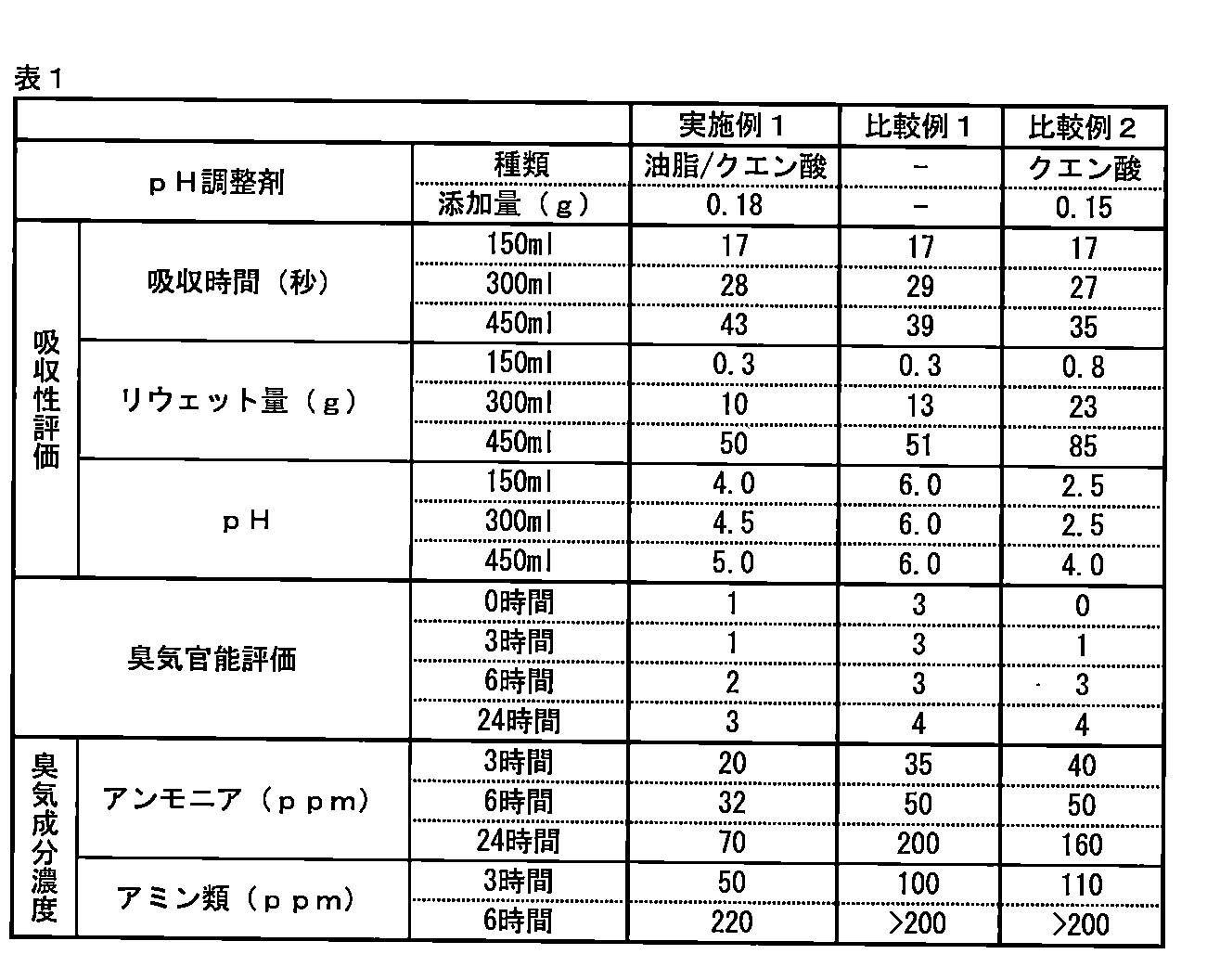
表1に示すように、芯部(クエン酸:80質量%)及び該芯部の表面に複数の油脂粒子(菜種硬化油:20質量%)が積み重なってなるpH調整剤を用いた実施例1の尿取りパッドは、繰り返し供給される尿に対しても、吸収性能が低下することなく、pH調整剤の消臭機能を持続的且つ十分に発揮できることが分かった。一方、pH調整剤を用いていない比較例1の尿取りパッドは、臭気を抑制することができず、また、pH調整剤として被覆部のないクエン酸粒子を用いた比較例2の尿取りパッドは、臭気をある程度抑制できるものの、リウェット量が大きくなり(人工尿に接触してすぐに溶出するクエン酸により、SAPの吸収及び膨潤が阻害されていることに起因するものと推認される。)吸収性能が低下していることが分かった。さらに、比較例2の尿取りパッドは、時間の経過に伴い臭気の抑制効果が弱まり、pH調整剤による消臭機能が持続的に発揮できていないことが分かった。
1 尿取りパッド(「吸収性物品」の一例)
2 表面シート
3 裏面シート
4 吸収体
41 第1吸収層
42 第2吸収層
421 吸収コア
422 コアラップシート
5 サイドシート
6 親水性シート
7 pH調整剤
71 芯部
72 被覆部
721 油脂粒子
722 連通部
2 表面シート
3 裏面シート
4 吸収体
41 第1吸収層
42 第2吸収層
421 吸収コア
422 コアラップシート
5 サイドシート
6 親水性シート
7 pH調整剤
71 芯部
72 被覆部
721 油脂粒子
722 連通部
Claims (8)
- 体液と接触する位置にpH調整剤を含む吸収性物品であって、
前記pH調整剤は、水に溶解して酸性を呈する固体状の芯部と、該芯部を被覆し、常温で固体の油脂からなる被覆部と、を有し、
前記被覆部は、前記pH調整剤の外部と前記芯部の表面とを通液可能に連通する連通部を有する、
前記吸収性物品。 - 前記芯部は、前記体液に溶解して3~5の範囲内のpHを呈する、請求項1に記載の吸収性物品。
- 前記吸収性物品は、高吸水性ポリマーを含む吸収体を有しており、
前記pH調整剤は、前記体液と接触してから少なくとも30秒経過後に、前記芯部の一部が前記体液に溶出する、請求項1又は2に記載の吸収性物品。 - 前記pH調整剤は、前記体液と接触してから60秒経過するまでの前記体液のpH変化量が0.5以下となる酸性徐放機能を有する、請求項1~3のいずれか一項に記載の吸収性物品。
- 前記被覆部は、前記芯部の表面上において複数の油脂粒子が積み重なることによって形成されており、
前記連通部は、前記複数の油脂粒子の粒子間の間隙によって形成されている、請求項1~4のいずれか一項に記載の吸収性物品。 - 前記吸収性物品は、液透過性の表面シートと、液不透過性の裏面シートと、これら両シートの間に配置された吸収体と、を有しており、
前記pH調整剤は、前記表面シート、前記表面シートと前記吸収体との間、及び前記吸収体のうちの少なくとも1つに配置されている、請求項1~5のいずれか一項に記載の吸収性物品。 - 前記吸収性物品は、前記表面シートと前記吸収体との間に拡散性シートを更に有しており、
前記pH調整剤は、少なくとも前記拡散性シートに配置されている、請求項6に記載の吸収性物品。 - 前記吸収体は、高吸水性ポリマーを含む吸収コアと、該吸収コアを被覆するコアラップシートと、を有しており、
前記pH調整剤は、少なくとも前記吸収コアと前記コアラップシートとの間に配置されている、請求項6又は7に記載の吸収性物品。
Priority Applications (1)
| Application Number | Priority Date | Filing Date | Title |
|---|---|---|---|
| CN201880087288.7A CN111629701B (zh) | 2018-02-27 | 2018-11-19 | 吸收性物品 |
Applications Claiming Priority (2)
| Application Number | Priority Date | Filing Date | Title |
|---|---|---|---|
| JP2018033235A JP6644099B2 (ja) | 2018-02-27 | 2018-02-27 | 吸収性物品 |
| JP2018-033235 | 2018-02-27 |
Publications (1)
| Publication Number | Publication Date |
|---|---|
| WO2019167356A1 true WO2019167356A1 (ja) | 2019-09-06 |
Family
ID=67804864
Family Applications (1)
| Application Number | Title | Priority Date | Filing Date |
|---|---|---|---|
| PCT/JP2018/042732 Ceased WO2019167356A1 (ja) | 2018-02-27 | 2018-11-19 | 吸収性物品 |
Country Status (3)
| Country | Link |
|---|---|
| JP (1) | JP6644099B2 (ja) |
| CN (1) | CN111629701B (ja) |
| WO (1) | WO2019167356A1 (ja) |
Cited By (3)
| Publication number | Priority date | Publication date | Assignee | Title |
|---|---|---|---|---|
| WO2022136358A1 (de) * | 2020-12-23 | 2022-06-30 | Paul Hartmann Ag | Inkontinenzartikel mit ph-regulationsmittel |
| WO2022136363A1 (de) * | 2020-12-23 | 2022-06-30 | Paul Hartmann Ag | Inkontinenzartikel mit kanal und ph-regulationsmittel |
| WO2022167406A1 (de) * | 2021-02-05 | 2022-08-11 | Paul Hartmann Ag | Inkontinenzartikel mit transferkomponente |
Families Citing this family (5)
| Publication number | Priority date | Publication date | Assignee | Title |
|---|---|---|---|---|
| WO2021075508A1 (ja) * | 2019-10-18 | 2021-04-22 | 住友精化株式会社 | 吸収性物品及び補助シート |
| JP7558048B2 (ja) * | 2020-12-08 | 2024-09-30 | 株式会社リブドゥコーポレーション | 吸収性物品 |
| JP7558789B2 (ja) * | 2020-12-16 | 2024-10-01 | ユニ・チャーム株式会社 | 吸収性物品 |
| JP7600761B2 (ja) * | 2021-02-26 | 2024-12-17 | 王子ホールディングス株式会社 | 吸収性物品 |
| JP2022131320A (ja) * | 2021-02-26 | 2022-09-07 | 王子ホールディングス株式会社 | 吸収性物品 |
Citations (2)
| Publication number | Priority date | Publication date | Assignee | Title |
|---|---|---|---|---|
| JP2000254218A (ja) * | 1999-03-09 | 2000-09-19 | Kao Corp | 消臭剤 |
| JP2014204799A (ja) * | 2013-04-11 | 2014-10-30 | 株式会社リブドゥコーポレーション | 吸収性物品 |
Family Cites Families (7)
| Publication number | Priority date | Publication date | Assignee | Title |
|---|---|---|---|---|
| US6013063A (en) * | 1997-11-14 | 2000-01-11 | The Procter & Gamble Company | Viscous fluid bodily waste management article |
| EP1149594A1 (en) * | 2000-04-25 | 2001-10-31 | The Procter & Gamble Company | Articles comprising chitosan material and an anionic absorbent gelling material |
| WO2007064264A1 (en) * | 2005-12-01 | 2007-06-07 | Sca Hygiene Products Ab | New absorbent article |
| US7883495B2 (en) * | 2007-05-24 | 2011-02-08 | First Quality Retail Services, Llc | Disposable absorbent article and polymer film having odor control and/or skin health agents |
| EP2263703B1 (en) * | 2009-06-18 | 2013-12-25 | The Procter and Gamble Company | Absorbent articles comprising an odour control system |
| US10660984B2 (en) * | 2009-12-17 | 2020-05-26 | The Procter & Gamble Company | Absorbent article comprising a malodor control composition having an acid catalyst |
| US9757285B2 (en) * | 2011-03-07 | 2017-09-12 | Edgewell Personal Care Brands, Llc | Absorbent article including a buffer composition |
-
2018
- 2018-02-27 JP JP2018033235A patent/JP6644099B2/ja active Active
- 2018-11-19 CN CN201880087288.7A patent/CN111629701B/zh active Active
- 2018-11-19 WO PCT/JP2018/042732 patent/WO2019167356A1/ja not_active Ceased
Patent Citations (2)
| Publication number | Priority date | Publication date | Assignee | Title |
|---|---|---|---|---|
| JP2000254218A (ja) * | 1999-03-09 | 2000-09-19 | Kao Corp | 消臭剤 |
| JP2014204799A (ja) * | 2013-04-11 | 2014-10-30 | 株式会社リブドゥコーポレーション | 吸収性物品 |
Cited By (3)
| Publication number | Priority date | Publication date | Assignee | Title |
|---|---|---|---|---|
| WO2022136358A1 (de) * | 2020-12-23 | 2022-06-30 | Paul Hartmann Ag | Inkontinenzartikel mit ph-regulationsmittel |
| WO2022136363A1 (de) * | 2020-12-23 | 2022-06-30 | Paul Hartmann Ag | Inkontinenzartikel mit kanal und ph-regulationsmittel |
| WO2022167406A1 (de) * | 2021-02-05 | 2022-08-11 | Paul Hartmann Ag | Inkontinenzartikel mit transferkomponente |
Also Published As
| Publication number | Publication date |
|---|---|
| JP2019146753A (ja) | 2019-09-05 |
| CN111629701B (zh) | 2022-04-19 |
| CN111629701A (zh) | 2020-09-04 |
| JP6644099B2 (ja) | 2020-02-12 |
Similar Documents
| Publication | Publication Date | Title |
|---|---|---|
| JP6644099B2 (ja) | 吸収性物品 | |
| JP4273179B2 (ja) | 複数層吸収性物品 | |
| EP2640331B1 (en) | Absorbent article | |
| CN109152679B (zh) | 吸收性物品 | |
| JP6987767B2 (ja) | 失禁用吸収性物品 | |
| JP2005527298A (ja) | 複数のコアを有する吸収性物品 | |
| JP2009061230A (ja) | 吸収性物品 | |
| TWI791516B (zh) | 吸收性物品 | |
| US6436418B1 (en) | Absorbent article with skin treatment means | |
| JP2011240050A (ja) | 吸収性物品 | |
| JP2017503624A (ja) | 異なる吸収性性能の領域を備える吸収性パッド | |
| JP2017506991A (ja) | 異なる吸収性性能の領域を備える吸収性パッド | |
| JP5529688B2 (ja) | 吸収性物品 | |
| TW201235020A (en) | Absorbent article | |
| JP4557905B2 (ja) | 使い捨ておむつ | |
| JP7298967B2 (ja) | 吸収性物品 | |
| CA2395818C (en) | Incontinent pad | |
| JP6278774B2 (ja) | フマル酸含有不織布およびこれを用いた吸収性物品 | |
| JP6245916B2 (ja) | 吸収性物品 | |
| JP2017217325A (ja) | 吸収性物品 | |
| JP2020108748A (ja) | 吸収性物品 | |
| JP6941007B2 (ja) | 吸収体および吸収性物品 | |
| JP2022131164A (ja) | 吸収性物品 | |
| JP2020195419A (ja) | 吸収性物品 | |
| JP7514647B2 (ja) | 吸収体及び吸収性物品 |
Legal Events
| Date | Code | Title | Description |
|---|---|---|---|
| 121 | Ep: the epo has been informed by wipo that ep was designated in this application |
Ref document number: 18908249 Country of ref document: EP Kind code of ref document: A1 |
|
| NENP | Non-entry into the national phase |
Ref country code: DE |
|
| 122 | Ep: pct application non-entry in european phase |
Ref document number: 18908249 Country of ref document: EP Kind code of ref document: A1 |