WO2019130907A1 - 自動分析装置および分析方法 - Google Patents
自動分析装置および分析方法 Download PDFInfo
- Publication number
- WO2019130907A1 WO2019130907A1 PCT/JP2018/042666 JP2018042666W WO2019130907A1 WO 2019130907 A1 WO2019130907 A1 WO 2019130907A1 JP 2018042666 W JP2018042666 W JP 2018042666W WO 2019130907 A1 WO2019130907 A1 WO 2019130907A1
- Authority
- WO
- WIPO (PCT)
- Prior art keywords
- sample
- functional group
- reaction vessel
- carrier
- elution
- Prior art date
- Legal status (The legal status is an assumption and is not a legal conclusion. Google has not performed a legal analysis and makes no representation as to the accuracy of the status listed.)
- Ceased
Links
Images






Classifications
-
- G—PHYSICS
- G01—MEASURING; TESTING
- G01N—INVESTIGATING OR ANALYSING MATERIALS BY DETERMINING THEIR CHEMICAL OR PHYSICAL PROPERTIES
- G01N27/00—Investigating or analysing materials by the use of electric, electrochemical, or magnetic means
- G01N27/62—Investigating or analysing materials by the use of electric, electrochemical, or magnetic means by investigating the ionisation of gases, e.g. aerosols; by investigating electric discharges, e.g. emission of cathode
- G01N27/622—Ion mobility spectrometry
- G01N27/623—Ion mobility spectrometry combined with mass spectrometry
-
- B—PERFORMING OPERATIONS; TRANSPORTING
- B01—PHYSICAL OR CHEMICAL PROCESSES OR APPARATUS IN GENERAL
- B01J—CHEMICAL OR PHYSICAL PROCESSES, e.g. CATALYSIS OR COLLOID CHEMISTRY; THEIR RELEVANT APPARATUS
- B01J20/00—Solid sorbent compositions or filter aid compositions; Sorbents for chromatography; Processes for preparing, regenerating or reactivating thereof
- B01J20/281—Sorbents specially adapted for preparative, analytical or investigative chromatography
-
- B—PERFORMING OPERATIONS; TRANSPORTING
- B01—PHYSICAL OR CHEMICAL PROCESSES OR APPARATUS IN GENERAL
- B01J—CHEMICAL OR PHYSICAL PROCESSES, e.g. CATALYSIS OR COLLOID CHEMISTRY; THEIR RELEVANT APPARATUS
- B01J20/00—Solid sorbent compositions or filter aid compositions; Sorbents for chromatography; Processes for preparing, regenerating or reactivating thereof
- B01J20/281—Sorbents specially adapted for preparative, analytical or investigative chromatography
- B01J20/282—Porous sorbents
- B01J20/283—Porous sorbents based on silica
-
- B—PERFORMING OPERATIONS; TRANSPORTING
- B01—PHYSICAL OR CHEMICAL PROCESSES OR APPARATUS IN GENERAL
- B01J—CHEMICAL OR PHYSICAL PROCESSES, e.g. CATALYSIS OR COLLOID CHEMISTRY; THEIR RELEVANT APPARATUS
- B01J20/00—Solid sorbent compositions or filter aid compositions; Sorbents for chromatography; Processes for preparing, regenerating or reactivating thereof
- B01J20/281—Sorbents specially adapted for preparative, analytical or investigative chromatography
- B01J20/282—Porous sorbents
- B01J20/285—Porous sorbents based on polymers
-
- G—PHYSICS
- G01—MEASURING; TESTING
- G01N—INVESTIGATING OR ANALYSING MATERIALS BY DETERMINING THEIR CHEMICAL OR PHYSICAL PROPERTIES
- G01N30/00—Investigating or analysing materials by separation into components using adsorption, absorption or similar phenomena or using ion-exchange, e.g. chromatography or field flow fractionation
- G01N30/02—Column chromatography
-
- G—PHYSICS
- G01—MEASURING; TESTING
- G01N—INVESTIGATING OR ANALYSING MATERIALS BY DETERMINING THEIR CHEMICAL OR PHYSICAL PROPERTIES
- G01N30/00—Investigating or analysing materials by separation into components using adsorption, absorption or similar phenomena or using ion-exchange, e.g. chromatography or field flow fractionation
- G01N30/02—Column chromatography
- G01N30/50—Conditioning of the sorbent material or stationary liquid
-
- G—PHYSICS
- G01—MEASURING; TESTING
- G01N—INVESTIGATING OR ANALYSING MATERIALS BY DETERMINING THEIR CHEMICAL OR PHYSICAL PROPERTIES
- G01N30/00—Investigating or analysing materials by separation into components using adsorption, absorption or similar phenomena or using ion-exchange, e.g. chromatography or field flow fractionation
- G01N30/02—Column chromatography
- G01N30/62—Detectors specially adapted therefor
- G01N30/72—Mass spectrometers
-
- G—PHYSICS
- G01—MEASURING; TESTING
- G01N—INVESTIGATING OR ANALYSING MATERIALS BY DETERMINING THEIR CHEMICAL OR PHYSICAL PROPERTIES
- G01N30/00—Investigating or analysing materials by separation into components using adsorption, absorption or similar phenomena or using ion-exchange, e.g. chromatography or field flow fractionation
- G01N30/02—Column chromatography
- G01N30/88—Integrated analysis systems specially adapted therefor, not covered by a single one of the groups G01N30/04 - G01N30/86
Definitions
- the present invention relates to an automatic analyzer and an analysis method for analyzing a biological sample.
- Patent Document 1 describes that a sample is introduced from an autosampler to a solid phase extraction column, and a target component in the sample is adsorbed, and solid phase extraction is performed.
- a separation eluent or sample dissolving solvent capable of dissolving the target component adsorbed on the solid phase extraction column is introduced into the column from the direction opposite to the direction in which the sample is introduced into the column to dissolve it. It is stated that the separation analysis is carried out.
- Patent Document 2 as an example of a method for quantifying organic components contained in a solution of high concentration salt with high sensitivity, high concentration salt solution having an inorganic salt concentration of 50 g or more per liter of water is used as activated carbon.
- a step of passing the solution to cause the organic component in the high concentration salt solution to be adsorbed onto the activated carbon, a step of passing the solvent through the activated carbon after the adsorption step to elute the adsorbed organic component, and a step of eluting the organic component It has been described to carry out the steps of concentration-drying the solvent and the step of analyzing chromatographically using the organic component after concentration-drying as a sample.
- Automated analyzers contribute to rapid and efficient clinical testing by automating part of the sample testing procedure.
- a general immunizing device includes a dispensing mechanism for dispensing a solution such as a sample, a reagent and magnetic beads into a predetermined amount in a reaction vessel, a stirring mechanism for stirring samples, reagents, magnetic beads and the like in the reaction vessel, magnetic beads And a mechanism equipped with a magnet for moving the object, and an optical measurement mechanism.
- An antibody is bound to the surface of the magnetic beads, and an antigen-antibody reaction is performed on the bead surface to purify the sample.
- the method includes the steps of eluting the substance to be measured, and 4) measuring using an optical measurement mechanism.
- a pretreatment unit that performs sample pretreatment
- a separation unit that performs LC (Liquid Chromatography) separation
- a detection unit that detects the LC separated measurement target substance
- a control unit that controls each mechanism.
- the pretreatment unit has a mechanism for purifying a substance to be measured using magnetic beads as in a general immune device.
- the separation unit includes an LC column for separating a substance to be measured, a pump for feeding the substance to be measured to the LC column, and a valve for changing a flow path.
- a functional group composed of a temperature responsive polymer (poly-N-isopropylacrylamide and a hydrophobic copolymer such as butyl methacrylate) is bonded.
- Temperature-responsive polymers extend and hydrate at temperatures lower than the phase transition temperature of the polymer on magnetic beads, but shrink and dehydrate at higher temperatures, which is sensitive and reversible in response to external temperatures It shows a reaction. That is, by controlling the temperature in the reaction container, hydrophobic interaction can be controlled, and adsorption / release to the substance to be measured and the magnetic beads can be controlled.
- the measurement target substance dissolved in a solution with high water concentration is adsorbed to the magnetic beads by utilizing the hydrophilic / hydrophobic physical properties of the measurement target substance, and after the washing solution is sent and washed, the concentration of the organic solvent is A high solution is fed, and the substance to be measured is eluted from the magnetic beads to purify the substance to be measured.
- a normal phase mode can be mentioned. This utilizes the hydrophilic / hydrophobic physical properties of the substance to be measured, but is the adsorption mechanism opposite to the reverse phase mode.
- a substance to be measured dissolved in a solution with a high concentration of organic solvent is adsorbed onto magnetic beads, a washing solution is sent and washed, then a solution with a high water concentration is sent, and a substance to be measured is eluted from the magnetic beads. Then, the substance to be measured is purified.
- Another mode is an antigen-antibody reaction. This is similar to an immune device, in which an antibody is bound to the surface of a magnetic bead, and an antigen-antibody reaction is performed on the surface of the bead to purify the sample.
- the solution purified by the pretreatment unit When the solution purified by the pretreatment unit is introduced into the separation unit, it is necessary to prepare a purified solution composition in order to enable the substance to be measured to be efficiently adsorbed to the LC column by the LC column. Generally, the solution composition will be matched to the solution composition of the initial delivered to the pump.
- the solution composition of the initials is mainly selected by the separation mode of the LC column.
- a temperature responsive polymer, reverse phase mode, normal phase mode, ion exchange mode and affinity chromatography (antigen-antibody) mode can be considered as in the above-mentioned magnetic beads.
- the solution composition is not prepared, if the solution purified by the pretreatment unit is introduced into the LC column, there is a possibility that the substance to be measured can not be adsorbed to the column in a sufficient amount. That is, a sufficient amount of the substance to be measured introduced to the detection unit in the subsequent stage can not be secured, and the detection accuracy is degraded. That is, in order to adsorb a sufficient amount to the LC column, it is necessary to prepare the solution composition purified by the pretreatment unit.
- Patent Document 1 a solid phase extraction column for adsorbing a measurement target substance in a sample, a separation column for introducing a measurement target substance of a sample adsorbed to the solid phase extraction column and separating the measurement target substance, and a separation column
- Patent Document 2 discloses an invention in which an organic component is adsorbed on activated carbon, a material is passed through activated carbon to elute the adsorbed component, and the eluate is concentrated and dried to analyze the organic component by liquid chromatography. There is.
- the solution used in the pretreatment unit is a serum sample (a solution with a high water concentration), which adsorbs the sample in a state where the reaction container is higher than the phase transition temperature (hydrophobic), and the washing solution (a solution with a high water concentration) After washing, an elution solution (a solution with a high concentration of organic solvent) is introduced, and elution of the substance to be measured into the reaction vessel is carried out using the change in hydrophilicity / hydrophobicity on the bead surface.
- this solution a solution with a high concentration of organic solvent
- the target substance to be measured passes, and the recovery rate is significantly reduced.
- the present invention provides an automatic analyzer and an analysis method capable of achieving both the improvement of the recovery rate of the substance to be measured, the improvement of the operation efficiency of the device, and the miniaturization of the device.
- the present invention includes a plurality of means for solving the above-mentioned problems, and one example thereof is a pretreatment unit for pretreatment of a sample and LC separation of the specimen pretreated in the pretreatment unit.
- An automatic analyzer comprising: a separation unit; a detection unit that analyzes a sample subjected to LC separation in the separation unit; and a control unit that controls the pretreatment unit, the separation unit, and the detection unit.
- the elution process of eluting the measurement target component of the sample attached to the functional group of the carrier used when purifying the sample with a solvent, and the deactivation process of deactivating the functional group of the carrier after the elution process Is performed in one reaction vessel for one sample.
- a pretreatment step of pretreatment of the sample a separation step of performing LC separation of the sample pretreated in the pretreatment step, and a sample of the LC separated in the separation step
- FIGS. An embodiment of the automatic analyzer and analysis method of the present invention will be described with reference to FIGS. Although the embodiment mainly targets an automatic analyzer, the present disclosure is applicable to all analyzers. The present disclosure can also be applied to, for example, genetic analyzers, mass spectrometers, and bacteria testing devices.
- FIG. 1 is a schematic view of an automatic analyzer according to the present embodiment.
- FIG. 2 and FIG. 3 are diagrams schematically showing magnetic beads according to an example.
- FIG. 4 is a schematic view of the separating unit 111.
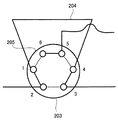
- FIG. 5 and 6 are schematic diagrams according to the position of the injection valve 203 of the separation unit 111.
- FIG. 5 and 6 are schematic diagrams according to the position of the injection valve 203 of the separation unit 111.
- the automatic analyzer 10 includes a pre-processing unit 101, a separation unit 111, a detection unit 112, and a control unit 113.
- the pretreatment unit 101 includes an apparatus for pretreatment of a sample, and a reagent vessel 102 for holding a reagent container 103, a dispensing nozzle 104 for dispensing / discharging a reagent from the reagent container 103, and a reaction for holding a reaction container 106.
- a container tank 105 a stirring tank 107 for stirring the solution in the reaction container 106, a magnet tank 108 for collecting magnetic beads (carriers) in the reaction container 106, a gripper for moving the reaction container 106 to the stirring tank 107 or the magnet tank 108 109, and a sample introduction nozzle 110 for transferring the reaction container 106 after purification in the pretreatment unit 101 to the separation unit 111.
- the reagent tank 102 holds five types of reagent containers 103.
- the reagent container 103 holds a sample, a reagent, a magnetic bead solution and the like. Each solution is described below.
- the sample is a biological sample including serum, plasma, blood, cells, DNA, RNA, tissue and the like to be tested by an automatic analyzer.
- Reagents are diluted solution for diluting the sample to an appropriate concentration, internal standard substance solution for correction of sample concentration, washing solution for washing in the reaction vessel 106, elution solution for elution in the reaction vessel 106, and elution solution It is an additive solution to prepare.
- a magnetic bead solution is a solution in which magnetic beads are suspended in a solution.
- the functional group bound to the surface of the magnetic bead 401 is a temperature responsive polymer 402.
- the LC column 208 described later is in the reverse phase mode.
- the temperature responsive polymer 402 bonded to the surface of the magnetic bead 401 becomes hydrophilic and adsorbs testosterone.
- the thermoresponsive polymer 402 becomes hydrophobic and keeps the adsorbed testosterone from being separated.
- the functional group bound to the surface of the magnetic beads is not limited to the temperature responsive polymer, and in the automatic analyzer 10 of the present invention, in addition to the temperature responsive polymer, antibody, reverse phase mode, normal phase mode And one or more of ion exchange mode and HILIC (Hydrophilic Interaction Chromatography) mode can be used.
- ion exchange mode Hydrophilic Interaction Chromatography
- the dispensing nozzle 104 is a mechanism that dispenses the solution from the reaction container 106 and discards it, in addition to the function of sucking the reagent from the reagent container 103 and dispensing it to the reaction container 106.
- the automatic analyzer 10 of the present embodiment is provided with a total of eight units, each of which can move independently in the X and Z directions.
- the reaction vessel tank 105 is configured to be able to control the temperature of each reaction vessel 106 in the range of 5 ° C. to 50 ° C.
- the stirring tank 107 is a mechanism for stirring the solution in the reaction vessel 106.
- the magnet tank 108 is a mechanism for moving the magnetic beads in the reaction vessel 106 to the inner wall surface of the reaction vessel 106.
- the gripper 109 is a mechanism for moving the reaction container 106 to the stirring tank 107 or the magnet tank 108.
- the sample introduction nozzle 110 is a mechanism that can move in the X, Y, and Z directions, sucks the solution for which the pretreatment has been completed, and discharges the solution after moving to the separation unit 111.
- the separation unit 111 is a unit for performing LC separation of the sample pretreated in the pretreatment unit 101, and as shown in FIG. 4, a liquid sending solvent 201 and a liquid sending pump 202 for sending the liquid sending solvent 201
- test substance is testosterone
- a 0.1% formic acid aqueous solution as solution A an acetonitrile solution containing 0.1% formic acid as solution B is used as the solution sending solvent 201, and the solution sending pump 202 has 0.45 mL Send a solution at a flow rate of / min.
- the inner diameter of the sample loop 204 is 0.5 ⁇ m and the volume is 20 ⁇ L.
- the injection valve 203 is a six-way valve, and two patterns of flow paths can be configured by switching the flow paths.
- the detection unit 112 is a unit that analyzes the sample subjected to LC separation in the separation unit 111, and in the present embodiment, is configured of an ion source and a mass spectrometer.
- examples of the ionization method using an ion source include electrospray ionization (ESI; ElectroSpray Ionization).
- APCI atmospheric pressure chemical ionization
- the mass spectrometer analyzes the measurement target component in a selected reaction monitoring (SRM) mode using a triple quadrupole mass spectrometer.
- the ratio of the area values is acquired, and the sample concentration is calculated using a calibration curve prepared from the sample of known concentration.
- mass spectrometer other types of mass spectrometers such as a quadrupole mass spectrometer and an ion trap mass spectrometer can also be used.
- the detection unit 112 may use HPLC (High Performance Liquid Chromatography), gas chromatography, NMR (Nuclear Magnetic Resonance), or the like.
- control unit 113 controls the operation of various devices (for example, valves, pumps, etc.) that constitute the above-described preprocessing unit 101, separation unit 111, and detection unit 112, and detection results of the detection unit 112. And a computer or the like for calculating the concentration of a predetermined component in the sample.
- various devices for example, valves, pumps, etc.
- control unit 113 of the present embodiment elutes, with a solvent, the component to be measured of the sample attached to the functional group of the magnetic beads used when purifying the sample in the device in the pretreatment unit 101. Control is performed such that one sample is subjected to inactivation in one reaction vessel 106 for inactivation of functional groups of the magnetic beads after treatment and elution.
- the test target substance 501 is testosterone
- the functional group bound to the magnetic bead surface is a temperature responsive polymer
- the LC column is a reverse phase mode case as an example. 7 to 14 will be described.
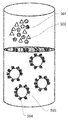
- FIG. 7 to FIG. 14 are diagrams showing an outline of the pretreatment process in the analysis process.
- the pre-processing unit 101 executes the following steps.
- Adsorption process The sample (100 ⁇ L of serum) held in the reagent tank 102 is dispensed into the reaction container 106 using the dispensing nozzle 104. Next, using the dispensing nozzle 104, the internal standard substance solution (100 ⁇ L of 100 pg / mL testosterone-d3) held in the reagent tank 102 is dispensed into the reaction container 106. Then, using the dispensing nozzle 104, the solution (100 ⁇ L of magnetic bead solution) containing the magnetic beads 503 held in the reagent tank 102 is dispensed into the reaction container 106. A state in the reaction container 106 at this timing is a state shown in FIG.
- reaction vessel 106 is transferred to the stirring vessel 107 using the gripper 109, and the solution in the reaction vessel 106 is agitated.
- the temperature of the pretreatment unit 101 is set to 45 ° C. which is higher (hydrophobic) than the phase transition temperature. As a result, as shown in FIG. 8, the substance to be measured 501 is adsorbed to the magnetic beads 503.
- the concentration of the measurement target substance 501 in the sample is as low as pg / mL level, dilution of the sample is not performed, but the concentration of the measurement target substance such as an antiepileptic drug is as high as ⁇ g / mL level, for example
- the diluted solution may be dispensed. Dispensing of the diluted solution may be performed multiple times depending on the concentration to be diluted.
- step 1 Next, the reaction vessel 106 is transferred to the magnet tank 108 using the gripper 109. Thereby, as shown in FIG. 9, the magnetic beads 503 to which the substance to be measured 501 and the internal standard substance are adsorbed move to the inner wall surface of the reaction vessel 106. At this position, the solution in the reaction vessel 106 is aspirated by the dispensing nozzle 104 and discarded.
- the reaction vessel 106 is transferred to the reaction vessel tank 105 using the gripper 109, and the washing solution (100 ⁇ L of 5% aqueous solution of acetonitrile) is dispensed into the reaction vessel 106 using the dispensing nozzle 104. Thereafter, the reaction vessel 106 is transferred to the stirring vessel 107 using the gripper 109, and the solution in the reaction vessel 106 is agitated. As a result, as shown in FIG. 10, the substance to be measured 501 adsorbed to the magnetic beads 503 and the contaminants 502 other than the internal standard substance are removed from the adsorption and washed.
- the washing solution 100 ⁇ L of 5% aqueous solution of acetonitrile
- Disposal process 2 Next, the reaction vessel 106 is transferred to the magnet tank 108 using the gripper 109. Thereby, as shown in FIG. 11, the magnetic beads 503 to which the substance to be measured 501 and the internal standard substance are adsorbed move to the inner wall surface of the reaction vessel 106. At this position, the solution in the reaction vessel 106 is aspirated by the dispensing nozzle 104 and discarded.
- the reaction vessel 106 is transferred to the reaction vessel tank 105 using the gripper 109, and the elution solution (100 ⁇ L of acetonitrile solution) is dispensed into the reaction vessel 106 using the dispensing nozzle 104. Thereafter, the reaction vessel 106 is transferred to the stirring vessel 107 using the gripper 109, and the solution in the reaction vessel 106 is agitated. As a result, as shown in FIG. 12, the measurement target substance 501 and internal standard substance adsorbed to the temperature responsive polymer 504 of the magnetic beads 503 are eluted.
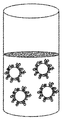
- Deactivation step Next, the temperature of the pretreatment unit 101 is adjusted to set the temperature in the reaction vessel 106 to 5 ° C., which is lower (hydrophilic) than the phase transition temperature. Thereby, as shown in FIG. 13, the conformation of the temperature responsive polymer 504 on the surface of the magnetic bead 503 is changed, and the functional group of the magnetic bead 503 is deactivated.
- the functional group of the magnetic bead 503 is in the reverse phase mode, the normal phase mode including the HILIC mode, or the ion In the exchange mode, a high acidic solution having no functional group resistance is added to make the pH of the liquid in the reaction vessel 106 higher than that during elution, or a high alkaline solution having no functional group resistance is added. In this step, the pH of the liquid in the reaction vessel 106 is made lower than that during the elution process.
- the functional group of the magnetic beads 503 is an antibody
- a process of raising the temperature in the reaction vessel 106 to a temperature at which the protein of the antibody is altered or a high acidic solution having no functional group resistance is added. Making the pH of the liquid in the reaction vessel 106 higher than that during elution, or adding a high alkaline solution having no functional group resistance to make the pH of the liquid in the reaction vessel 106 lower than that during elution I assume.
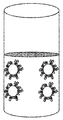
- reaction vessel 106 is transferred to the reaction vessel tank 105 using the gripper 109, and the addition solution (200 ⁇ L of distilled water) is dispensed into the reaction vessel 106 using the dispensing nozzle 104. Thereafter, the reaction vessel 106 is transferred to the stirring vessel 107 using the gripper 109, and the solution in the reaction vessel 106 is agitated. Thus, as shown in FIG. 14, the solution composition in the reaction vessel 106 is adjusted to a high water concentration of 66.6%. Thereafter, the reaction vessel 106 is transferred to the magnet tank 108 using the gripper 109, and the magnetic beads 503 move to the inner wall surface of the reaction vessel 106.
- the sample, the diluted solution, the internal standard substance solution, the washing solution, the elution solution and the additive solution held in the reagent container 103 described in this example are an example, and the substance to be measured 501, the functional group of the magnetic beads 503 and the LC column According to the separation mode, it is possible to select a solution suitable for analysis.
- the adsorption step, the discarding step 1, the washing step, the discarding step 2, the elution step, the inactivation step, and the addition step correspond to the pretreatment step for pretreatment of the sample, and in the present invention, all of these steps are one.
- the sample is run in one reaction vessel 106.
- Sample introduction process (separation process): First, the injection valve 203 is set to position 1, the tip of the sample introduction nozzle 110 is connected to the port 6, and the prepared solution after elution is discharged. At position 1, the sample loop 204 is filled with the solution because the port 6-port 1-sample loop 204-port 4-port 5 are connected.
- Detection process After the substance to be measured 501 is introduced into the detection unit 112, mass spectrometry of the substance to be measured 501 is performed by a mass spectrometer.
- the automatic analyzer 10 includes the pretreatment unit 101 that performs pretreatment on a sample, the separation unit 111 that performs LC separation on the sample that has been subjected to pretreatment in the pretreatment unit 101, and LC separation in the separation unit 111. And a control unit 113 configured to control the pretreatment unit 101, the separation unit 111, and the detection unit 112.
- the control unit 113 is a magnetic bead used when purifying the sample. Elution treatment of eluting the measurement target component of the sample attached to the functional group of 503 with a solvent, and deactivation treatment of deactivating the functional group of the magnetic beads 503 after elution treatment, one reaction container 106 for one sample Control to be executed inside.
- the carrier (magnetic beads) is prepared in the reaction container 106 before preparing the elution solution in which the target component adsorbed to the carrier (magnetic beads) is eluted with the solvent so that it can be adsorbed by the LC column.
- automatic preparation can be performed in the reaction container 106 without using a dedicated container.
- the functional group of the magnetic bead 503 is a temperature responsive polymer, and the deactivation treatment makes the temperature in the reaction vessel 106 lower than that during the elution treatment, or the functional group of the magnetic bead 503 is in the reverse phase mode,
- the inactivation treatment makes the pH of the liquid in the reaction vessel 106 lower or higher than that in the elution treatment, or the functional group of the magnetic beads 503 is an antibody, and the inactivation treatment takes the temperature in the reaction vessel 106 The temperature is raised above the temperature at which the protein is degraded, or the functional group of the magnetic beads 503 is in the normal phase mode, and the inactivation treatment makes the pH of the liquid in the reaction vessel 106 lower or higher than at the elution treatment.
- the functional group of the magnetic beads 503 is in the ion exchange mode, and the deactivation treatment makes the pH of the liquid in the reaction vessel 106 lower or higher than that during elution, so the deactivation treatment according to the functional group is performed. You can row, it is possible to increase the recovery of analyte 501.
- control unit and the like can be realized in hardware by designing part or all of them, for example, with an integrated circuit.
- each configuration, function, etc. described above can be realized by software by a processor interpreting and executing a program that realizes each function.
- Information such as programs, tables, and files for realizing each function can be placed in a memory, a hard disk, a storage device such as an SSD (Solid State Drive), or a storage medium such as an IC card, an SD card, or a DVD.
- SSD Solid State Drive
- control lines and the like indicate those which are considered to be necessary for the description, and not all the control lines and information lines in the product are necessarily shown. In practice, almost all configurations may be considered to be mutually connected.
Landscapes
- Chemical & Material Sciences (AREA)
- Analytical Chemistry (AREA)
- Physics & Mathematics (AREA)
- Health & Medical Sciences (AREA)
- Life Sciences & Earth Sciences (AREA)
- Immunology (AREA)
- Biochemistry (AREA)
- General Health & Medical Sciences (AREA)
- General Physics & Mathematics (AREA)
- Pathology (AREA)
- Chemical Kinetics & Catalysis (AREA)
- Spectroscopy & Molecular Physics (AREA)
- Organic Chemistry (AREA)
- Electrochemistry (AREA)
- Molecular Biology (AREA)
- Automatic Analysis And Handling Materials Therefor (AREA)
Abstract
試料の前処理を行う前処理部101と、前処理部101において前処理された試料のLC分離を行う分離部111と、分離部111でLC分離された試料の分析を行う検出部112と、前処理部101、分離部111、検出部112を制御する制御部113と、を備え、制御部113は、試料の精製を行う際に用いる磁性ビーズ503の官能基に付着させた試料の測定対象成分を溶媒で溶出する溶出処理、および溶出処理後に磁性ビーズ503の官能基を失活させる失活処理を一つの試料に対して一つの反応容器106内で実行する制御を行う。これにより、測定対象物質の回収率の向上と、装置の運転効率の向上や装置の小型化とを両立することが可能となる。
Description
本発明は、生体試料を分析する自動分析装置および分析方法に関する。
分解能の向上した固相抽出装置を用いる液体クロマトグラフの一例として、特許文献1には、固相抽出カラムには、オートサンプラーから試料が導入され、試料中の目的成分が吸着され、固相抽出カラムに試料を導入する時の方向と逆方向から、固相抽出カラムに吸着された目的成分を溶解し得る分離溶離液若しくは試料溶解溶媒を流入させて溶解した後、溶解した目的成分を分離カラムに導入して分離分析を行うことが記載されている。
また、特許文献2には、高濃度塩の溶液に含まれる有機成分を高感度に定量する方法の一例として、無機塩濃度が水1リットルに対して50g以上である高濃度塩溶液を活性炭に通液して高濃度塩溶液中の有機成分を活性炭に吸着させる工程と、吸着工程後の活性炭に溶剤を通液して、吸着された有機成分を溶出する工程と、有機成分の溶出された溶剤を濃縮乾燥する工程と、濃縮乾燥後の有機成分を試料に用いてクロマトグラフにより分析する工程とを実行することが記載されている。
自動分析装置は、試料検査の手順の一部を自動化することにより、迅速で効率的な臨床検査業務に貢献している。
一般的な自動分析装置のひとつとして、磁性ビーズを担体とした免疫法を用いて試料の精製を行う免疫装置がある。一般的な免疫装置は、試料や試薬および磁性ビーズ等の溶液を所定量反応容器に分注するための分注機構、反応容器内の試料や試薬および磁性ビーズ等を撹拌する撹拌機構、磁性ビーズを移動させるための磁石が備わった機構、および光学測定機構を備えている。
磁性ビーズの表面には抗体が結合されており、抗原-抗体反応がビーズ表面上で行われることで試料が精製される。
具体的には、1)磁性ビーズ表面に測定対象物質を吸着する工程、2)洗浄溶液を反応容器に吐出し、洗浄を行う工程、3)溶出溶液を反応容器に吐出し、磁性ビーズ表面から測定対象物質を溶出する工程、4)光学測定機構を用いて測定する工程、を有している。
このほかに、試料の前処理を行う前処理部と、LC(Liquid Chromatography)分離を行う分離部と、LC分離された測定対象物質を検出する検出部および各機構を制御する制御部を備えている自動分析装置がある。
この自動分析装置では、前処理部は、一般的な免疫装置と同様に磁性ビーズを用いて測定対象物質を精製する機構を有する。分離部は、測定対象物質を分離するLCカラム、LCカラムに測定対象物質を送液するポンプおよび流路を変更するバルブを備えている。
磁性ビーズの表面には、例えば、温度応答性高分子(ポリ-N-イソプロピルアクリルアミドに疎水性共重合体である例えばメタクリル酸ブチル)からなる官能基が結合している。温度応答性高分子は、磁性ビーズ上の高分子の相転移温度より低温側では伸展して水和するが、高温側では収縮して脱水するという、外部温度に応答して鋭敏で可逆的な反応を示す。つまり、反応容器内の温度を制御することにより、疎水性相互作用を制御可能であり、測定対象物質と磁性ビーズへの吸着/遊離が制御可能である。
また、他のモードとして、逆相モードがあげられる。これは、測定対象物質の親水性/疎水性の物性を利用し、水濃度の高い溶液に溶解した測定対象物質を磁性ビーズに吸着させ、洗浄溶液を送液し洗浄した後に、有機溶媒濃度の高い溶液を送液し、測定対象物質を磁性ビーズから溶離することで、測定対象物質の精製を行う。
さらに、他のモードとして、順相モードがあげられる。これは、測定対象物質の親水性/疎水性の物性を利用しているが、逆相モードの反対の吸着機構である。有機溶媒濃度の高い溶液に溶解した測定対象物質を磁性ビーズに吸着させ、洗浄溶液を送液して洗浄した後に、水濃度の高い溶液を送液し、測定対象物質を磁性ビーズから溶離することで、測定対象物質の精製を行う。
さらに、他のモードとして、抗原-抗体反応があげられる。これは免疫装置と同様に、磁性ビーズ表面に抗体が結合されており、抗原-抗体反応がビーズ表面上で行われることで、試料が精製される。
前処理部で精製した溶液を分離部へ導入する場合、LCカラムに測定対象物質が効率的にLCカラムに吸着できるようにするため、精製した溶液組成を調製することが必要となる。一般的には、溶液組成はポンプに送液されるイニシャルの溶液組成に合わせることになる。
イニシャルの溶液組成は、主にLCカラムの分離モードにより選択される。分離モードは前述の磁性ビーズと同様に、温度応答性高分子、逆相モード、順相モード、イオン交換モードおよびアフィニティークロマト(抗原-抗体)モードが考えられる。
溶液組成を調製しない場合、前処理部で精製した溶液がLCカラムに導入されると、測定対象物質がカラムに充分量吸着できない可能性がある。つまり、後段の検出部に導入される測定対象物質の量が充分量確保できず、検出精度が劣化することになる。すなわち、LCカラムに充分量吸着させるためには、前処理部で精製した溶液組成の調製が必要になる。
特許文献1には、試料中の測定対象物質を吸着する固相抽出カラムと、固相抽出カラムに吸着された試料の測定対象物質が導入され、測定対象物質を分離する分離カラムと、分離カラムによって分離された測定対象物質を検出する発明が開示されている。特許文献2には、有機成分を活性炭に吸着させ、活性炭に用材を通液して吸着成分を溶出させ、溶出物を濃縮乾燥させた後に、有機成分を液体クロマトグラフィで分析する発明が開示されている。
以下、一例として、磁性ビーズの表面上に温度応答性高分子を、LCカラムに逆相モードを用いた場合について説明する。
前処理部で用いる溶液は血清試料(水濃度が高い溶液)であり、反応容器内を相転移温度より高い(疎水性)状態で試料の吸着を行い、洗浄溶液(水濃度が高い溶液)により洗浄した後、溶出溶液(有機溶媒濃度の高い溶液)を導入し、ビーズ表面上の親水性/疎水性の変化を利用し、反応容器中への測定対象物質の溶離を実施する。この溶液(有機溶媒濃度の高い溶液)をLCカラムに導入すると、測定対象物質が素通りするため、回収率が著しく低下する。
この課題を解決するため、反応容器内に溶出した溶出液に水濃度の高い溶媒を添加した場合、反応容器内の親水性/疎水性の変化により、磁性ビーズに再び測定対象物質が吸着することになる。そこで、前処理部で精製した溶液を一旦別の専用容器(添加容器)に分注した後、水濃度の高い溶液を添加する方法が考えられる。しかし、この場合は、添加容器の消耗品が増加するのに加えて、装置面積が増大するという課題が新たに発生する。
このように、測定対象物質の回収率の向上と、装置の運転効率の向上や装置の小型化とを両立することが困難であった。
本発明は、測定対象物質の回収率の向上と、装置の運転効率の向上や装置の小型化とを両立することが可能な自動分析装置および分析方法を提供する。
本発明は、上記課題を解決する手段を複数含んでいるが、その一例を挙げるならば、試料の前処理を行う前処理部と、前記前処理部において前処理された試料のLC分離を行う分離部と、前記分離部でLC分離された試料の分析を行う検出部と、前記前処理部、前記分離部、前記検出部を制御する制御部と、を備えた自動分析装置において、前記制御部は、前記試料の精製を行う際に用いる担体の官能基に付着させた試料の測定対象成分を溶媒で溶出する溶出処理、および前記溶出処理後に前記担体の官能基を失活させる失活処理を一つの試料に対して一つの反応容器内で実行することを特徴とする。
また、他の一例をあげるならば、試料の前処理を行う前処理工程と、前記前処理工程において前処理された試料のLC分離を行う分離工程と、前記分離工程でLC分離された試料の分析を行う検出工程と、を有する前記試料の分析方法において、前記前処理工程では、前記試料の精製を行う際に用いる担体の官能基に付着させた試料の測定対象成分を溶媒で溶出する溶出処理、および前記溶出処理後に前記担体の官能基を失活させる失活処理を一つの試料に対して一つの反応容器内で実行することを特徴とする。
本発明によれば、測定対象物質の回収率の向上と、装置の運転効率の向上や装置の小型化とを両立することができる。上記した以外の課題、構成および効果は、以下の実施例の説明により明らかにされる。
本発明の自動分析装置および分析方法の実施例について図1乃至図14を用いて説明する。なお、実施例は自動分析装置を主な対象としているが、本開示は分析装置全般に適用可能なものである。本開示は、例えば、遺伝子分析装置、質量分析装置、細菌検査装置にも適用できる。
最初に、本実施例にかかる自動分析装置の概略について図1乃至図6を用いて説明する。図1は、本実施例に係る自動分析装置の概略図である。図2および図3は、実施例に係る磁性ビーズの概略を示す図である。図4は分離部111に係る概略図である。図5および図6は分離部111のインジェクションバルブ203のポジションに係る概略図である。
図1において、自動分析装置10は、前処理部101、分離部111、検出部112および制御部113から構成される。
前処理部101は、試料の前処理を行う機器から構成され、試薬容器103を保持する試薬槽102、試薬容器103から試薬を分注/吐出する分注ノズル104、反応容器106を保持する反応容器槽105、反応容器106内の溶液を撹拌する撹拌槽107、反応容器106内の磁性ビーズ(担体)の収集を行う磁石槽108、反応容器106を撹拌槽107または磁石槽108に移動するグリッパ109、および前処理部101で精製後の反応容器106を分離部111に移送する試料導入ノズル110から構成される。
試薬槽102は、5種類の試薬容器103を保持している。
試薬容器103には試料、試薬および磁性ビーズ溶液等が保持される。各溶液について下記に説明する。試料は、自動分析装置で検査される血清、血漿、血液、細胞、DNA、RNA、組織等を含む生体試料のことである。試薬は、試料を適用な濃度に希釈する希釈溶液、試料濃度の補正を行う内部標準物質溶液、反応容器106内で洗浄を行う洗浄溶液、反応容器106内で溶出を行う溶出溶液および溶出溶液の調製を行う添加溶液のことである。磁性ビーズ溶液は、磁性ビーズが溶液に懸濁されたスラリー状になっている溶液のことである。
次に、図2および図3を用いて本実施例において用いる磁性ビーズの概要について説明する。
図2に示すように、測定対象物質403をテストステロンとする場合、磁性ビーズ401の表面に結合している官能基は温度応答性高分子402とする。また後述するLCカラム208は逆相モードとする。相転移温度より低温側である場合、図2に示すように、磁性ビーズ401の表面に結合している温度応答性高分子402は親水性となり、テストステロンを吸着する。これに対し、相転移温度より高温側にすると、図3に示すように温度応答性高分子402は疎水性となり、吸着しているテストステロンが離れないように保持する。
なお、磁性ビーズ表面に結合している官能基は温度応答性高分子以外にもあり、本発明の自動分析装置10では、温度応答性高分子に加えて、抗体、逆相モード、順相モード、イオン交換モード、およびHILIC(親水クロマトグラフィ、Hydrophilic Interaction Chromatography)モードのいずれか一つ以上を用いることができる。
分注ノズル104は、試薬容器103から試薬を吸引し、反応容器106に分注する機能に加えて、反応容器106から溶液を分注し、廃棄する機構である。本実施例の自動分析装置10では合計で8つ備わっており、各々独立してX,Z方向に移動することが可能である。
反応容器槽105は、各々の反応容器106の温度を5℃から50℃までの範囲で温調制御が可能に構成されている。
撹拌槽107は、反応容器106内の溶液を撹拌する機構である。
磁石槽108は、反応容器106内の磁性ビーズを反応容器106内側壁面に移動させるための機構である。
グリッパ109は合計で8つ備わっており、各々独立してX,Z方向に移動することが可能である。グリッパ109は反応容器106を撹拌槽107または磁石槽108に移動する機構である。
試料導入ノズル110は、X,Y,Z方向に移動可能であり、前処理が終了した溶液を吸引し、分離部111まで移動後に吐出する機構である。
次に、分離部111について図4乃至図6を用いて説明する。
分離部111は、前処理部101において前処理された試料のLC分離を行うユニットであり、図4に示すように、送液溶媒201と、送液溶媒201を送液する送液ポンプ202と、インジェクションバルブ203と、サンプルループ204と、インジェクションポート205と、洗浄ポンプ206、洗浄溶媒207、およびLCカラム208から構成される。
測定対象物質をテストステロンとする場合、送液溶媒201には、A液として0.1%ギ酸水溶液、B液として0.1%ギ酸を含むアセトニトリル溶液が用いられ、送液ポンプ202は0.45mL/minの流量で送液する。
サンプルループ204の内径は0.5μmであり、容量は20μLである。
インジェクションバルブ203は6方バルブであり、流路を切替えることにより2パターンの流路を構成することができる。
図5に示すように、ポジション1では、ポート1とポート6、ポート2とポート3、ポート4とポート5の流路が繋がる。ポジションポ2では、図6に示すように、ポート1とポート2、ポート2とポート3、ポート4とポート5の流路が繋がる。
検出部112は、分離部111でLC分離された試料の分析を行うユニットであり、本実施例においては、イオン源および質量分析計で構成される。イオン源でのイオン化方法は、本実施例であれば、エレクトロスプレーイオン化法(ESI;ElectroSpray Ionization)が挙げられる。
他のイオン化法としては、大気圧化学イオン化法(APCI;Atomospheric Pressure Chemical Ionization)等がある。
質量分析計は、本実施例であれば、三連四重極型質量分析計を用いて、SRM(Selected Reaction Monitoring)モードにより測定対象成分の解析を行う。測定対象物質であるテストステロンの質量数はQ1/Q3=m/z:289.1/97.1、内部標準物質の質量数はQ1/Q3=m/z:292.1/97.1に設定する。面積値の比率を取得し、濃度既知の試料から作成した検量線を用いて、試料濃度を算出する。
なお、質量分析計は、四重極型質量分析計、イオントラップ型質量分析計等、他の種類の質量分析計を用いることもできる。
また、検出部112は、質量分析計以外にも、HPLC(高速液体クロマトグラフィ,High Performance Liquid Chromatography)、ガスクロマトグラフィおよびNMR(Nuclear Magnetic Resonance)等を用いることができる。
図1に戻り、制御部113は、上述した前処理部101、分離部111、検出部112を構成する各種機器(例えばバルブ、ポンプ等)の動作を制御するとともに、検出部112での検出結果から試料中の所定成分の濃度を演算するためのコンピュータ等から構成される。
本実施例の制御部113は、特に、前処理部101内の機器に対して、試料の精製を行う際に用いる磁性ビーズの官能基に付着させた試料の測定対象成分を溶媒で溶出する溶出処理、および溶出処理後に磁性ビーズの官能基を失活させる失活処理を一つの試料に対して一つの反応容器106内で実行させる制御を行う。
次に、本実施例に係る試料の分析方法について、測定対象物質501がテストステロン、磁性ビーズ表面に結合している官能基が温度応答性高分子、LCカラムが逆相モードのケースを例にして、図7乃至図14を参照して説明する。
まず、分析工程のうち、前処理部101内での工程について図7乃至図14を用いて説明する。図7乃至図14は、分析工程のうち、前処理工程の概略を示す図である。
分析工程のうち、前処理部101では下記工程が実行される。
1)吸着工程:
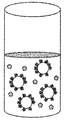
分注ノズル104を用いて、試薬槽102に保持した試料(100μLの血清)を反応容器106内に分注する。次に、分注ノズル104を用いて、試薬槽102に保持した内部標準物質溶液(100μLの100pg/mLのテストステロン-d3)を反応容器106内に分注する。そして、分注ノズル104を用いて、試薬槽102に保持した磁性ビーズ503を含む溶液(100μLの磁性ビーズ溶液)を反応容器106内に分注する。このタイミングでの反応容器106内の様子が図7に示す状態である。
分注ノズル104を用いて、試薬槽102に保持した試料(100μLの血清)を反応容器106内に分注する。次に、分注ノズル104を用いて、試薬槽102に保持した内部標準物質溶液(100μLの100pg/mLのテストステロン-d3)を反応容器106内に分注する。そして、分注ノズル104を用いて、試薬槽102に保持した磁性ビーズ503を含む溶液(100μLの磁性ビーズ溶液)を反応容器106内に分注する。このタイミングでの反応容器106内の様子が図7に示す状態である。
その後、グリッパ109を用いて反応容器106を撹拌槽107に移送し、反応容器106内の溶液を撹拌する。前処理部101の温度は、相転移温度より高い(疎水性)状態である45℃に設定されている。これにより、図8に示すように、磁性ビーズ503に測定対象物質501が吸着することになる。
本実施例では、試料中の測定対象物質501の濃度がpg/mLレベルと低いため、試料の希釈は実施しないが、例えば抗てんかん剤のような測定対処物質の濃度がμg/mLレベルと高い場合は、内部標準物質溶液を反応容器106に分注した後に、希釈溶液を分注することもある。希釈溶液の分注は希釈したい濃度により複数回行うこともある。
2)廃棄工程1:
次いで、グリッパ109を用いて反応容器106を磁石槽108に移送する。これにより、図9に示すように、測定対象物質501および内部標準物質が吸着した磁性ビーズ503が反応容器106内側壁面に移動する。この位置で分注ノズル104により反応容器106内の溶液を吸引し、廃棄する。
次いで、グリッパ109を用いて反応容器106を磁石槽108に移送する。これにより、図9に示すように、測定対象物質501および内部標準物質が吸着した磁性ビーズ503が反応容器106内側壁面に移動する。この位置で分注ノズル104により反応容器106内の溶液を吸引し、廃棄する。
3)洗浄工程:
次いで、グリッパ109を用いて反応容器106を反応容器槽105に移送し、分注ノズル104を用いて、洗浄溶液(100μLの5%アセトニトリル水溶液)を反応容器106内に分注する。その後、グリッパ109を用いて反応容器106を撹拌槽107に移送し、反応容器106内の溶液を撹拌する。これにより、図10に示すように、磁性ビーズ503に吸着されていた測定対象物質501や内部標準物質以外の夾雑物502が吸着から外され、洗浄されることになる。
次いで、グリッパ109を用いて反応容器106を反応容器槽105に移送し、分注ノズル104を用いて、洗浄溶液(100μLの5%アセトニトリル水溶液)を反応容器106内に分注する。その後、グリッパ109を用いて反応容器106を撹拌槽107に移送し、反応容器106内の溶液を撹拌する。これにより、図10に示すように、磁性ビーズ503に吸着されていた測定対象物質501や内部標準物質以外の夾雑物502が吸着から外され、洗浄されることになる。
4)廃棄工程2:
次いで、グリッパ109を用いて反応容器106を磁石槽108に移送する。これにより、図11に示すように、測定対象物質501および内部標準物質が吸着した磁性ビーズ503が反応容器106内側壁面に移動する。この位置で分注ノズル104により反応容器106内の溶液を吸引し、廃棄する。
次いで、グリッパ109を用いて反応容器106を磁石槽108に移送する。これにより、図11に示すように、測定対象物質501および内部標準物質が吸着した磁性ビーズ503が反応容器106内側壁面に移動する。この位置で分注ノズル104により反応容器106内の溶液を吸引し、廃棄する。
5) 溶出工程:
次いで、グリッパ109を用いて反応容器106を反応容器槽105に移送し、分注ノズル104を用いて、溶出溶液(100μLのアセトニトリル溶液)を反応容器106内に分注する。その後、グリッパ109を用いて反応容器106を撹拌槽107に移送し、反応容器106内の溶液を撹拌する。これにより、図12に示すように、磁性ビーズ503の温度応答性高分子504に吸着した測定対象物質501および内部標準物質が溶出されることになる。
次いで、グリッパ109を用いて反応容器106を反応容器槽105に移送し、分注ノズル104を用いて、溶出溶液(100μLのアセトニトリル溶液)を反応容器106内に分注する。その後、グリッパ109を用いて反応容器106を撹拌槽107に移送し、反応容器106内の溶液を撹拌する。これにより、図12に示すように、磁性ビーズ503の温度応答性高分子504に吸着した測定対象物質501および内部標準物質が溶出されることになる。
6) 失活工程:
次いで、前処理部101の温度を調整して、反応容器106内の温度を、相転移温度より低い(親水性)状態である5℃に設定する。これにより、図13に示すように、磁性ビーズ503表面上の温度応答性高分子504のコンフォメーションが変化し、磁性ビーズ503の官能基が失活する。
次いで、前処理部101の温度を調整して、反応容器106内の温度を、相転移温度より低い(親水性)状態である5℃に設定する。これにより、図13に示すように、磁性ビーズ503表面上の温度応答性高分子504のコンフォメーションが変化し、磁性ビーズ503の官能基が失活する。
なお、磁性ビーズ503の官能基が温度応答性高分子504であるときについて説明したが、本失活工程は、磁性ビーズ503の官能基が逆相モード,HILICモードを含む順相モード,あるいはイオン交換モードのときは、官能基の耐性がない高い酸性溶液を添加して反応容器106内の液体のpHを溶出処理時より高pHにする、あるいは官能基の耐性がない高いアルカリ性溶液を添加して反応容器106内の液体のpHを溶出処理時より低pHにする工程とする。
また、磁性ビーズ503の官能基が抗体であるときは、反応容器106内の温度を抗体のたんぱく質が変質する温度以上に昇温する工程や、官能基の耐性がない高い酸性溶液を添加して反応容器106内の液体のpHを溶出処理時より高pHにする、あるいは官能基の耐性がない高いアルカリ性溶液を添加して反応容器106内の液体のpHを溶出処理時より低pHにする工程とする。
7) 添加工程:
次いで、グリッパ109を用いて反応容器106を反応容器槽105に移送し、分注ノズル104を用いて、添加溶液(200μLの蒸留水)を反応容器106内に分注する。その後、グリッパ109を用いて反応容器106を撹拌槽107に移送し、反応容器106内の溶液を撹拌する。これにより、図14に示すように、反応容器106内の溶液組成が66.6%の水濃度が高い濃度に調製される。その後、グリッパ109を用いて反応容器106を磁石槽108に移送し、磁性ビーズ503が反応容器106内側壁面に移動する。
次いで、グリッパ109を用いて反応容器106を反応容器槽105に移送し、分注ノズル104を用いて、添加溶液(200μLの蒸留水)を反応容器106内に分注する。その後、グリッパ109を用いて反応容器106を撹拌槽107に移送し、反応容器106内の溶液を撹拌する。これにより、図14に示すように、反応容器106内の溶液組成が66.6%の水濃度が高い濃度に調製される。その後、グリッパ109を用いて反応容器106を磁石槽108に移送し、磁性ビーズ503が反応容器106内側壁面に移動する。
次に、試料導入ノズル110により溶出後の調製した溶液を80μL吸引し、分離部111に移動後の溶液を吸引し、分離部111に移動後、全量の80μLを吐出する。同時に、使用済みの反応容器106はグリッパ109を用いて、廃棄場所(図示省略)に廃棄する。
本実施例で記載した試薬容器103に保持される試料、希釈溶液、内部標準物質溶液、洗浄溶液、溶出溶液および添加溶液は一例であり、測定対象物質501、磁性ビーズ503の官能基およびLCカラムの分離モードにより分析に適した溶液を選択することができる。
上記吸着工程、廃棄工程1、洗浄工程、廃棄工程2、溶出工程、失活工程、添加工程が試料の前処理を行う前処理工程に相当し、本発明では、これらの工程の全てを一つの試料に対して一つの反応容器106内で実行する。
次に、分離部111における分離工程と検出部112における検出工程について説明する。
8) 試料導入工程(分離工程):
最初に、インジェクションバルブ203はポジション1に設定されており、試料導入ノズル110の先端が、ポート6に接続し溶出後の調製した溶液が吐出される。ポジション1では、ポート6-ポート1-サンプルループ204-ポート4-ポート5が繋がっていることから、サンプルループ204に溶液が満たされる。
最初に、インジェクションバルブ203はポジション1に設定されており、試料導入ノズル110の先端が、ポート6に接続し溶出後の調製した溶液が吐出される。ポジション1では、ポート6-ポート1-サンプルループ204-ポート4-ポート5が繋がっていることから、サンプルループ204に溶液が満たされる。
その後、インジェクションバルブ203をポジション2に切換えることによって、ポート2-ポート1-サンプルループ204-ポート4-ポート3が繋がる。そのことで送液ポンプ202からの送液される送液溶媒201にサンプルループ204に満たされた溶液が、後段のLCカラム208に導入される。
インジェクションバルブ203がポジション2に切り換わると送液ポンプ202のグラジエントが開始され、B液:0%(0-30s)-100%(90-120s)-0%(120.1-180s)の定圧グラジエント分析を実施することで、LCカラムでの測定対象物質501および内部標準物質の分離が行われ、検出部112に導入される。
9) 検出工程:
測定対象物質501が検出部112に導入された後、質量分析計により測定対象物質501の質量分析を行う。
測定対象物質501が検出部112に導入された後、質量分析計により測定対象物質501の質量分析を行う。
次に、本実施例の効果について説明する。
上述した本実施例の自動分析装置10は、試料の前処理を行う前処理部101と、前処理部101において前処理された試料のLC分離を行う分離部111と、分離部111でLC分離された試料の分析を行う検出部112と、前処理部101、分離部111、検出部112を制御する制御部113と、を備え、制御部113は、試料の精製を行う際に用いる磁性ビーズ503の官能基に付着させた試料の測定対象成分を溶媒で溶出する溶出処理、および溶出処理後に磁性ビーズ503の官能基を失活させる失活処理を一つの試料に対して一つの反応容器106内で実行する制御を行う。
このように、担体(磁性ビーズ)に吸着させた測定対象成分を溶媒で溶出した溶出溶液をLCカラムで吸着可能な組成になるように調製する前に、反応容器106内で担体(磁性ビーズ)表面に結合した官能基を失活させる処理を行うため、専用容器を用いずに反応容器106内で自動調製を行うことが可能となる。そのことにより、測定対象物質501の回収率の向上を達成した上で容器等の消耗品を削減することができ、装置面積の増大を防ぐとともに装置の運転効率の向上や装置の小型化を両立することができる。
また、磁性ビーズ503の官能基が温度応答性高分子であり、失活処理は反応容器106内の温度を溶出処理時より低温にする、または磁性ビーズ503の官能基が逆相モードであり、失活処理は反応容器106内の液体のpHを溶出処理時より低pHまたは高pHにする、または磁性ビーズ503の官能基が抗体であり、失活処理は反応容器106内の温度を抗体のたんぱく質が変質する温度以上に昇温する、または磁性ビーズ503の官能基が順相モードであり、失活処理は反応容器106内の液体のpHを溶出処理時より低pHまたは高pHにする、または磁性ビーズ503の官能基がイオン交換モードであり、失活処理は反応容器106内の液体のpHを溶出処理時より低pHまたは高pHにするため、官能基に応じた失活処理を実行することができ、測定対象物質501の回収率を高めることができる。
<その他>
なお、本発明は上記の実施例に限られず、種々の変形、応用が可能なものである。上述した実施例は本発明を分かりやすく説明するために詳細に説明したものであり、必ずしも説明した全ての構成を備えるものに限定されない。
なお、本発明は上記の実施例に限られず、種々の変形、応用が可能なものである。上述した実施例は本発明を分かりやすく説明するために詳細に説明したものであり、必ずしも説明した全ての構成を備えるものに限定されない。
例えば、上記の制御部等は、それらの一部又は全部を、例えば集積回路で設計する等によりハードウェアで実現することができる。また、上記の各構成、機能等は、プロセッサがそれぞれの機能を実現するプログラムを解釈し、実行することによりソフトウェアで実現することができる。各機能を実現するプログラム、テーブル、ファイル等の情報は、メモリや、ハードディスク、SSD(Solid State Drive)等の記憶装置、または、ICカード、SDカード、DVD等の記憶媒体に置くことができる。
また、制御線等は説明上必要と考えられるものを示しており、製品上必ずしも全ての制御線や情報線を示しているとは限らない。実際には殆ど全ての構成が相互に接続されていると考えてもよい。
10:自動分析装置
101:前処理部
102:試薬槽
103:試薬容器
104:分注ノズル
105:反応容器槽
106:反応容器
107:撹拌槽
108:磁石槽
109:グリッパ
110:試料導入ノズル
111:分離部
112:検出部
113:制御部
201:送液溶媒
202:送液ポンプ
203:インジェクションバルブ
204:サンプルループ
205:インジェクションポート
206:洗浄ポンプ
207:洗浄溶媒
208:LCカラム
401:磁性ビーズ
402:温度応答性高分子
403:測定対象物質
501:測定対象物質
502:夾雑物
503:磁性ビーズ(担体)
504:温度応答性高分子
101:前処理部
102:試薬槽
103:試薬容器
104:分注ノズル
105:反応容器槽
106:反応容器
107:撹拌槽
108:磁石槽
109:グリッパ
110:試料導入ノズル
111:分離部
112:検出部
113:制御部
201:送液溶媒
202:送液ポンプ
203:インジェクションバルブ
204:サンプルループ
205:インジェクションポート
206:洗浄ポンプ
207:洗浄溶媒
208:LCカラム
401:磁性ビーズ
402:温度応答性高分子
403:測定対象物質
501:測定対象物質
502:夾雑物
503:磁性ビーズ(担体)
504:温度応答性高分子
Claims (15)
- 試料の前処理を行う前処理部と、
前記前処理部において前処理された試料のLC分離を行う分離部と、
前記分離部でLC分離された試料の分析を行う検出部と、
前記前処理部、前記分離部、前記検出部を制御する制御部と、を備えた自動分析装置において、
前記制御部は、前記試料の精製を行う際に用いる担体の官能基に付着させた試料の測定対象成分を溶媒で溶出する溶出処理、および前記溶出処理後に前記担体の官能基を失活させる失活処理を一つの試料に対して一つの反応容器内で実行する
ことを特徴とする自動分析装置。 - 請求項1に記載の自動分析装置において、
前記担体の官能基が温度応答性高分子であり、
前記失活処理は、前記反応容器内の温度を前記溶出処理時より低温にする
ことを特徴とする自動分析装置。 - 請求項1に記載の自動分析装置において、
前記担体の官能基が逆相モードであり、
前記失活処理は、前記反応容器内の液体のpHを前記溶出処理時より低pHにする
ことを特徴とする自動分析装置。 - 請求項1に記載の自動分析装置において、
前記担体の官能基が逆相モードであり、
前記失活処理は、前記反応容器内の液体のpHを前記溶出処理時より高pHにする
ことを特徴とする自動分析装置。 - 請求項1に記載の自動分析装置において、
前記担体の官能基が抗体であり、
前記失活処理は、前記反応容器内の温度を前記抗体のたんぱく質が変質する温度以上に昇温する
ことを特徴とする自動分析装置。 - 請求項1に記載の自動分析装置において、
前記担体の官能基が順相モードであり、
前記失活処理は、前記反応容器内の液体のpHを前記溶出処理時より低pH、または高pHにする
ことを特徴とする自動分析装置。 - 請求項1に記載の自動分析装置において、
前記担体の官能基がイオン交換モードであり、
前記失活処理は、前記反応容器内の液体のpHを前記溶出処理時より低pH、または高pHにする
ことを特徴とする自動分析装置。 - 請求項1に記載の自動分析装置において、
前記検出部は、前記LC分離された試料の検出を行う質量分析計である
ことを特徴とする自動分析装置。 - 試料の前処理を行う前処理工程と、
前記前処理工程において前処理された試料のLC分離を行う分離工程と、
前記分離工程でLC分離された試料の分析を行う検出工程と、を有する前記試料の分析方法において、
前記前処理工程では、前記試料の精製を行う際に用いる担体の官能基に付着させた試料の測定対象成分を溶媒で溶出する溶出処理、および前記溶出処理後に前記担体の官能基を失活させる失活処理を一つの試料に対して一つの反応容器内で実行する
ことを特徴とする分析方法。 - 請求項9に記載の分析方法において、
前記担体の官能基が温度応答性高分子であり、
前記失活処理は、前記反応容器内の温度を前記溶出処理時より低温にする
ことを特徴とする分析方法。 - 請求項9に記載の分析方法において、
前記担体の官能基が逆相モードであり、
前記失活処理は、前記反応容器内の液体のpHを前記溶出処理時より低pH、または高pHにする
ことを特徴とする分析方法。 - 請求項9に記載の分析方法において、
前記担体の官能基が抗体であり、
前記失活処理は、前記反応容器内の温度を前記抗体のたんぱく質が変質する温度以上に昇温する
ことを特徴とする分析方法。 - 請求項9に記載の分析方法において、
前記担体の官能基が順相モードであり、
前記失活処理は、前記反応容器内の液体のpHを前記溶出処理時より低pH、または高pHにする
ことを特徴とする分析方法。 - 請求項9に記載の分析方法において、
前記担体の官能基がイオン交換モードであり、
前記失活処理は、前記反応容器内の液体のpHを前記溶出処理時より低pH、または高pHにする
ことを特徴とする分析方法。 - 請求項9に記載の分析方法において、
前記検出工程は、前記LC分離された試料の検出を行う質量分析計により検出を行う
ことを特徴とする分析方法。
Priority Applications (1)
| Application Number | Priority Date | Filing Date | Title |
|---|---|---|---|
| JP2019562849A JP7026138B2 (ja) | 2017-12-26 | 2018-11-19 | 自動分析装置および分析方法 |
Applications Claiming Priority (2)
| Application Number | Priority Date | Filing Date | Title |
|---|---|---|---|
| JP2017-249493 | 2017-12-26 | ||
| JP2017249493 | 2017-12-26 |
Publications (1)
| Publication Number | Publication Date |
|---|---|
| WO2019130907A1 true WO2019130907A1 (ja) | 2019-07-04 |
Family
ID=67067012
Family Applications (1)
| Application Number | Title | Priority Date | Filing Date |
|---|---|---|---|
| PCT/JP2018/042666 Ceased WO2019130907A1 (ja) | 2017-12-26 | 2018-11-19 | 自動分析装置および分析方法 |
Country Status (2)
| Country | Link |
|---|---|
| JP (1) | JP7026138B2 (ja) |
| WO (1) | WO2019130907A1 (ja) |
Citations (4)
| Publication number | Priority date | Publication date | Assignee | Title |
|---|---|---|---|---|
| US4000062A (en) * | 1975-04-21 | 1976-12-28 | Minnesota Mining And Manufacturing Company | Magnetic particle separator |
| JP2007516425A (ja) * | 2003-05-13 | 2007-06-21 | アイシス ファーマシューティカルズ インコーポレイティッド | 後の質量分析法を用いた分析のために、溶液捕獲によって核酸を迅速に精製する方法 |
| JP2010060474A (ja) * | 2008-09-05 | 2010-03-18 | Hitachi High-Technologies Corp | 前処理装置及びそれを備えた質量分析装置 |
| WO2015136689A1 (ja) * | 2014-03-14 | 2015-09-17 | 株式会社島津製作所 | 磁性体粒子の操作方法および磁性体粒子操作用デバイス |
-
2018
- 2018-11-19 JP JP2019562849A patent/JP7026138B2/ja active Active
- 2018-11-19 WO PCT/JP2018/042666 patent/WO2019130907A1/ja not_active Ceased
Patent Citations (4)
| Publication number | Priority date | Publication date | Assignee | Title |
|---|---|---|---|---|
| US4000062A (en) * | 1975-04-21 | 1976-12-28 | Minnesota Mining And Manufacturing Company | Magnetic particle separator |
| JP2007516425A (ja) * | 2003-05-13 | 2007-06-21 | アイシス ファーマシューティカルズ インコーポレイティッド | 後の質量分析法を用いた分析のために、溶液捕獲によって核酸を迅速に精製する方法 |
| JP2010060474A (ja) * | 2008-09-05 | 2010-03-18 | Hitachi High-Technologies Corp | 前処理装置及びそれを備えた質量分析装置 |
| WO2015136689A1 (ja) * | 2014-03-14 | 2015-09-17 | 株式会社島津製作所 | 磁性体粒子の操作方法および磁性体粒子操作用デバイス |
Also Published As
| Publication number | Publication date |
|---|---|
| JPWO2019130907A1 (ja) | 2020-12-10 |
| JP7026138B2 (ja) | 2022-02-25 |
Similar Documents
| Publication | Publication Date | Title |
|---|---|---|
| Vogeser et al. | Progress in automation of LC-MS in laboratory medicine | |
| US8926903B2 (en) | Pretreatment apparatus and mass spectrometer equipped with the same apparatus | |
| JP6694509B2 (ja) | 自動化された臨床診断システムおよび方法 | |
| JP5433580B2 (ja) | 試料注入システム | |
| US8143071B2 (en) | Method and device for extracting an analyte | |
| EP2490019B1 (en) | Examination device and examination method | |
| CN104903721B (zh) | I相和ii相代谢物以及母体化合物的分析 | |
| EP2190548A1 (en) | Methods for isolating functionalized macromolecules | |
| JP2020521958A5 (ja) | ||
| EP2068145B1 (en) | Manipulation of magnetic microparticles in a high pressure liquid system and extraction process | |
| WO2011108177A1 (ja) | 分析装置 | |
| US11385208B2 (en) | Analysis device | |
| JP7046070B2 (ja) | 分析系におけるプロセス中に試薬を同定するための方法 | |
| US8337705B2 (en) | Manipulation of magnetic microparticles in a high pressure liquid system and extraction process | |
| JP2021009144A (ja) | 液体クロマトグラフィーシステム | |
| JP7520824B2 (ja) | 自動分析装置の前処理方法 | |
| CN115298547A (zh) | 用于霉菌毒素分析的高通量亲和样品制备 | |
| JP5119053B2 (ja) | 生体試料分離方法,生体試料検出方法,生体試料分離システム及び生体試料分離・検出システム | |
| JP7026138B2 (ja) | 自動分析装置および分析方法 | |
| JP7051871B2 (ja) | 分析系におけるプロセス中に試薬を同定するための方法 | |
| US12422413B2 (en) | Automated sample handling system for liquid chromatography-mass spectrometry | |
| Vas et al. | Biomedical sampling | |
| CN114814012B (zh) | 饲料中林可胺类抗生素的测定方法 | |
| US20230273217A1 (en) | Derivatization of at least one analyte of interest for mass spec measurements in patient samples | |
| US20080145950A1 (en) | Method for extracting an analyte |
Legal Events
| Date | Code | Title | Description |
|---|---|---|---|
| 121 | Ep: the epo has been informed by wipo that ep was designated in this application |
Ref document number: 18897279 Country of ref document: EP Kind code of ref document: A1 |
|
| ENP | Entry into the national phase |
Ref document number: 2019562849 Country of ref document: JP Kind code of ref document: A |
|
| NENP | Non-entry into the national phase |
Ref country code: DE |
|
| 122 | Ep: pct application non-entry in european phase |
Ref document number: 18897279 Country of ref document: EP Kind code of ref document: A1 |