WO2019107554A1 - 生体信号が表す情報を識別するためのシステム - Google Patents
生体信号が表す情報を識別するためのシステム Download PDFInfo
- Publication number
- WO2019107554A1 WO2019107554A1 PCT/JP2018/044242 JP2018044242W WO2019107554A1 WO 2019107554 A1 WO2019107554 A1 WO 2019107554A1 JP 2018044242 W JP2018044242 W JP 2018044242W WO 2019107554 A1 WO2019107554 A1 WO 2019107554A1
- Authority
- WO
- WIPO (PCT)
- Prior art keywords
- biological signal
- teaching data
- similarity
- time
- unit
- Prior art date
- Legal status (The legal status is an assumption and is not a legal conclusion. Google has not performed a legal analysis and makes no representation as to the accuracy of the status listed.)
- Ceased
Links
Images









Classifications
-
- G—PHYSICS
- G16—INFORMATION AND COMMUNICATION TECHNOLOGY [ICT] SPECIALLY ADAPTED FOR SPECIFIC APPLICATION FIELDS
- G16H—HEALTHCARE INFORMATICS, i.e. INFORMATION AND COMMUNICATION TECHNOLOGY [ICT] SPECIALLY ADAPTED FOR THE HANDLING OR PROCESSING OF MEDICAL OR HEALTHCARE DATA
- G16H20/00—ICT specially adapted for therapies or health-improving plans, e.g. for handling prescriptions, for steering therapy or for monitoring patient compliance
- G16H20/30—ICT specially adapted for therapies or health-improving plans, e.g. for handling prescriptions, for steering therapy or for monitoring patient compliance relating to physical therapies or activities, e.g. physiotherapy, acupressure or exercising
-
- A—HUMAN NECESSITIES
- A61—MEDICAL OR VETERINARY SCIENCE; HYGIENE
- A61B—DIAGNOSIS; SURGERY; IDENTIFICATION
- A61B5/00—Measuring for diagnostic purposes; Identification of persons
- A61B5/24—Detecting, measuring or recording bioelectric or biomagnetic signals of the body or parts thereof
- A61B5/316—Modalities, i.e. specific diagnostic methods
- A61B5/389—Electromyography [EMG]
-
- A—HUMAN NECESSITIES
- A61—MEDICAL OR VETERINARY SCIENCE; HYGIENE
- A61B—DIAGNOSIS; SURGERY; IDENTIFICATION
- A61B5/00—Measuring for diagnostic purposes; Identification of persons
- A61B5/42—Detecting, measuring or recording for evaluating the gastrointestinal, the endocrine or the exocrine systems
- A61B5/4205—Evaluating swallowing
-
- A—HUMAN NECESSITIES
- A61—MEDICAL OR VETERINARY SCIENCE; HYGIENE
- A61B—DIAGNOSIS; SURGERY; IDENTIFICATION
- A61B5/00—Measuring for diagnostic purposes; Identification of persons
- A61B5/48—Other medical applications
- A61B5/4836—Diagnosis combined with treatment in closed-loop systems or methods
-
- A—HUMAN NECESSITIES
- A61—MEDICAL OR VETERINARY SCIENCE; HYGIENE
- A61B—DIAGNOSIS; SURGERY; IDENTIFICATION
- A61B5/00—Measuring for diagnostic purposes; Identification of persons
- A61B5/68—Arrangements of detecting, measuring or recording means, e.g. sensors, in relation to patient
- A61B5/6801—Arrangements of detecting, measuring or recording means, e.g. sensors, in relation to patient specially adapted to be attached to or worn on the body surface
- A61B5/6813—Specially adapted to be attached to a specific body part
- A61B5/6822—Neck
-
- A—HUMAN NECESSITIES
- A61—MEDICAL OR VETERINARY SCIENCE; HYGIENE
- A61B—DIAGNOSIS; SURGERY; IDENTIFICATION
- A61B5/00—Measuring for diagnostic purposes; Identification of persons
- A61B5/68—Arrangements of detecting, measuring or recording means, e.g. sensors, in relation to patient
- A61B5/6801—Arrangements of detecting, measuring or recording means, e.g. sensors, in relation to patient specially adapted to be attached to or worn on the body surface
- A61B5/6813—Specially adapted to be attached to a specific body part
- A61B5/6823—Trunk, e.g., chest, back, abdomen, hip
-
- A—HUMAN NECESSITIES
- A61—MEDICAL OR VETERINARY SCIENCE; HYGIENE
- A61B—DIAGNOSIS; SURGERY; IDENTIFICATION
- A61B5/00—Measuring for diagnostic purposes; Identification of persons
- A61B5/68—Arrangements of detecting, measuring or recording means, e.g. sensors, in relation to patient
- A61B5/6801—Arrangements of detecting, measuring or recording means, e.g. sensors, in relation to patient specially adapted to be attached to or worn on the body surface
- A61B5/6813—Specially adapted to be attached to a specific body part
- A61B5/6824—Arm or wrist
-
- A—HUMAN NECESSITIES
- A61—MEDICAL OR VETERINARY SCIENCE; HYGIENE
- A61B—DIAGNOSIS; SURGERY; IDENTIFICATION
- A61B5/00—Measuring for diagnostic purposes; Identification of persons
- A61B5/68—Arrangements of detecting, measuring or recording means, e.g. sensors, in relation to patient
- A61B5/6801—Arrangements of detecting, measuring or recording means, e.g. sensors, in relation to patient specially adapted to be attached to or worn on the body surface
- A61B5/6813—Specially adapted to be attached to a specific body part
- A61B5/6828—Leg
-
- A—HUMAN NECESSITIES
- A61—MEDICAL OR VETERINARY SCIENCE; HYGIENE
- A61B—DIAGNOSIS; SURGERY; IDENTIFICATION
- A61B5/00—Measuring for diagnostic purposes; Identification of persons
- A61B5/72—Signal processing specially adapted for physiological signals or for diagnostic purposes
- A61B5/7235—Details of waveform analysis
- A61B5/7264—Classification of physiological signals or data, e.g. using neural networks, statistical classifiers, expert systems or fuzzy systems
- A61B5/7267—Classification of physiological signals or data, e.g. using neural networks, statistical classifiers, expert systems or fuzzy systems involving training the classification device
-
- A—HUMAN NECESSITIES
- A61—MEDICAL OR VETERINARY SCIENCE; HYGIENE
- A61F—FILTERS IMPLANTABLE INTO BLOOD VESSELS; PROSTHESES; DEVICES PROVIDING PATENCY TO, OR PREVENTING COLLAPSING OF, TUBULAR STRUCTURES OF THE BODY, e.g. STENTS; ORTHOPAEDIC, NURSING OR CONTRACEPTIVE DEVICES; FOMENTATION; TREATMENT OR PROTECTION OF EYES OR EARS; BANDAGES, DRESSINGS OR ABSORBENT PADS; FIRST-AID KITS
- A61F2/00—Filters implantable into blood vessels; Prostheses, i.e. artificial substitutes or replacements for parts of the body; Appliances for connecting them with the body; Devices providing patency to, or preventing collapsing of, tubular structures of the body, e.g. stents
- A61F2/50—Prostheses not implantable in the body
- A61F2/54—Artificial arms or hands or parts thereof
- A61F2/58—Elbows; Wrists ; Other joints; Hands
- A61F2/583—Hands; Wrist joints
-
- A—HUMAN NECESSITIES
- A61—MEDICAL OR VETERINARY SCIENCE; HYGIENE
- A61F—FILTERS IMPLANTABLE INTO BLOOD VESSELS; PROSTHESES; DEVICES PROVIDING PATENCY TO, OR PREVENTING COLLAPSING OF, TUBULAR STRUCTURES OF THE BODY, e.g. STENTS; ORTHOPAEDIC, NURSING OR CONTRACEPTIVE DEVICES; FOMENTATION; TREATMENT OR PROTECTION OF EYES OR EARS; BANDAGES, DRESSINGS OR ABSORBENT PADS; FIRST-AID KITS
- A61F2/00—Filters implantable into blood vessels; Prostheses, i.e. artificial substitutes or replacements for parts of the body; Appliances for connecting them with the body; Devices providing patency to, or preventing collapsing of, tubular structures of the body, e.g. stents
- A61F2/50—Prostheses not implantable in the body
- A61F2/68—Operating or control means
- A61F2/70—Operating or control means electrical
- A61F2/72—Bioelectric control, e.g. myoelectric
-
- A—HUMAN NECESSITIES
- A61—MEDICAL OR VETERINARY SCIENCE; HYGIENE
- A61G—TRANSPORT, PERSONAL CONVEYANCES, OR ACCOMMODATION SPECIALLY ADAPTED FOR PATIENTS OR DISABLED PERSONS; OPERATING TABLES OR CHAIRS; CHAIRS FOR DENTISTRY; FUNERAL DEVICES
- A61G5/00—Chairs or personal conveyances specially adapted for patients or disabled persons, e.g. wheelchairs
-
- A—HUMAN NECESSITIES
- A61—MEDICAL OR VETERINARY SCIENCE; HYGIENE
- A61H—PHYSICAL THERAPY APPARATUS, e.g. DEVICES FOR LOCATING OR STIMULATING REFLEX POINTS IN THE BODY; ARTIFICIAL RESPIRATION; MASSAGE; BATHING DEVICES FOR SPECIAL THERAPEUTIC OR HYGIENIC PURPOSES OR SPECIFIC PARTS OF THE BODY
- A61H1/00—Apparatus for passive exercising; Vibrating apparatus; Chiropractic devices, e.g. body impacting devices, external devices for briefly extending or aligning unbroken bones
- A61H1/02—Stretching or bending or torsioning apparatus for exercising
-
- A—HUMAN NECESSITIES
- A61—MEDICAL OR VETERINARY SCIENCE; HYGIENE
- A61H—PHYSICAL THERAPY APPARATUS, e.g. DEVICES FOR LOCATING OR STIMULATING REFLEX POINTS IN THE BODY; ARTIFICIAL RESPIRATION; MASSAGE; BATHING DEVICES FOR SPECIAL THERAPEUTIC OR HYGIENIC PURPOSES OR SPECIFIC PARTS OF THE BODY
- A61H1/00—Apparatus for passive exercising; Vibrating apparatus; Chiropractic devices, e.g. body impacting devices, external devices for briefly extending or aligning unbroken bones
- A61H1/02—Stretching or bending or torsioning apparatus for exercising
- A61H1/0237—Stretching or bending or torsioning apparatus for exercising for the lower limbs
-
- A—HUMAN NECESSITIES
- A61—MEDICAL OR VETERINARY SCIENCE; HYGIENE
- A61H—PHYSICAL THERAPY APPARATUS, e.g. DEVICES FOR LOCATING OR STIMULATING REFLEX POINTS IN THE BODY; ARTIFICIAL RESPIRATION; MASSAGE; BATHING DEVICES FOR SPECIAL THERAPEUTIC OR HYGIENIC PURPOSES OR SPECIFIC PARTS OF THE BODY
- A61H1/00—Apparatus for passive exercising; Vibrating apparatus; Chiropractic devices, e.g. body impacting devices, external devices for briefly extending or aligning unbroken bones
- A61H1/02—Stretching or bending or torsioning apparatus for exercising
- A61H1/0274—Stretching or bending or torsioning apparatus for exercising for the upper limbs
-
- A—HUMAN NECESSITIES
- A61—MEDICAL OR VETERINARY SCIENCE; HYGIENE
- A61H—PHYSICAL THERAPY APPARATUS, e.g. DEVICES FOR LOCATING OR STIMULATING REFLEX POINTS IN THE BODY; ARTIFICIAL RESPIRATION; MASSAGE; BATHING DEVICES FOR SPECIAL THERAPEUTIC OR HYGIENIC PURPOSES OR SPECIFIC PARTS OF THE BODY
- A61H1/00—Apparatus for passive exercising; Vibrating apparatus; Chiropractic devices, e.g. body impacting devices, external devices for briefly extending or aligning unbroken bones
- A61H1/02—Stretching or bending or torsioning apparatus for exercising
- A61H1/0292—Stretching or bending or torsioning apparatus for exercising for the spinal column
-
- A—HUMAN NECESSITIES
- A63—SPORTS; GAMES; AMUSEMENTS
- A63B—APPARATUS FOR PHYSICAL TRAINING, GYMNASTICS, SWIMMING, CLIMBING, OR FENCING; BALL GAMES; TRAINING EQUIPMENT
- A63B23/00—Exercising apparatus specially adapted for particular parts of the body
- A63B23/035—Exercising apparatus specially adapted for particular parts of the body for limbs, i.e. upper or lower limbs, e.g. simultaneously
- A63B23/12—Exercising apparatus specially adapted for particular parts of the body for limbs, i.e. upper or lower limbs, e.g. simultaneously for upper limbs or related muscles, e.g. chest, upper back or shoulder muscles
- A63B23/16—Exercising apparatus specially adapted for particular parts of the body for limbs, i.e. upper or lower limbs, e.g. simultaneously for upper limbs or related muscles, e.g. chest, upper back or shoulder muscles for hands or fingers
-
- G—PHYSICS
- G06—COMPUTING OR CALCULATING; COUNTING
- G06F—ELECTRIC DIGITAL DATA PROCESSING
- G06F3/00—Input arrangements for transferring data to be processed into a form capable of being handled by the computer; Output arrangements for transferring data from processing unit to output unit, e.g. interface arrangements
- G06F3/01—Input arrangements or combined input and output arrangements for interaction between user and computer
- G06F3/011—Arrangements for interaction with the human body, e.g. for user immersion in virtual reality
- G06F3/015—Input arrangements based on nervous system activity detection, e.g. brain waves [EEG] detection, electromyograms [EMG] detection, electrodermal response detection
-
- G—PHYSICS
- G16—INFORMATION AND COMMUNICATION TECHNOLOGY [ICT] SPECIALLY ADAPTED FOR SPECIFIC APPLICATION FIELDS
- G16H—HEALTHCARE INFORMATICS, i.e. INFORMATION AND COMMUNICATION TECHNOLOGY [ICT] SPECIALLY ADAPTED FOR THE HANDLING OR PROCESSING OF MEDICAL OR HEALTHCARE DATA
- G16H40/00—ICT specially adapted for the management or administration of healthcare resources or facilities; ICT specially adapted for the management or operation of medical equipment or devices
- G16H40/60—ICT specially adapted for the management or administration of healthcare resources or facilities; ICT specially adapted for the management or operation of medical equipment or devices for the operation of medical equipment or devices
- G16H40/67—ICT specially adapted for the management or administration of healthcare resources or facilities; ICT specially adapted for the management or operation of medical equipment or devices for the operation of medical equipment or devices for remote operation
-
- G—PHYSICS
- G16—INFORMATION AND COMMUNICATION TECHNOLOGY [ICT] SPECIALLY ADAPTED FOR SPECIFIC APPLICATION FIELDS
- G16H—HEALTHCARE INFORMATICS, i.e. INFORMATION AND COMMUNICATION TECHNOLOGY [ICT] SPECIALLY ADAPTED FOR THE HANDLING OR PROCESSING OF MEDICAL OR HEALTHCARE DATA
- G16H50/00—ICT specially adapted for medical diagnosis, medical simulation or medical data mining; ICT specially adapted for detecting, monitoring or modelling epidemics or pandemics
- G16H50/20—ICT specially adapted for medical diagnosis, medical simulation or medical data mining; ICT specially adapted for detecting, monitoring or modelling epidemics or pandemics for computer-aided diagnosis, e.g. based on medical expert systems
-
- A—HUMAN NECESSITIES
- A61—MEDICAL OR VETERINARY SCIENCE; HYGIENE
- A61B—DIAGNOSIS; SURGERY; IDENTIFICATION
- A61B18/00—Surgical instruments, devices or methods for transferring non-mechanical forms of energy to or from the body
- A61B2018/00636—Sensing and controlling the application of energy
- A61B2018/00773—Sensed parameters
- A61B2018/00839—Bioelectrical parameters, e.g. ECG, EEG
-
- A—HUMAN NECESSITIES
- A61—MEDICAL OR VETERINARY SCIENCE; HYGIENE
- A61F—FILTERS IMPLANTABLE INTO BLOOD VESSELS; PROSTHESES; DEVICES PROVIDING PATENCY TO, OR PREVENTING COLLAPSING OF, TUBULAR STRUCTURES OF THE BODY, e.g. STENTS; ORTHOPAEDIC, NURSING OR CONTRACEPTIVE DEVICES; FOMENTATION; TREATMENT OR PROTECTION OF EYES OR EARS; BANDAGES, DRESSINGS OR ABSORBENT PADS; FIRST-AID KITS
- A61F2/00—Filters implantable into blood vessels; Prostheses, i.e. artificial substitutes or replacements for parts of the body; Appliances for connecting them with the body; Devices providing patency to, or preventing collapsing of, tubular structures of the body, e.g. stents
- A61F2/50—Prostheses not implantable in the body
- A61F2/60—Artificial legs or feet or parts thereof
- A61F2/66—Feet; Ankle joints
- A61F2002/6614—Feet
-
- A—HUMAN NECESSITIES
- A61—MEDICAL OR VETERINARY SCIENCE; HYGIENE
- A61F—FILTERS IMPLANTABLE INTO BLOOD VESSELS; PROSTHESES; DEVICES PROVIDING PATENCY TO, OR PREVENTING COLLAPSING OF, TUBULAR STRUCTURES OF THE BODY, e.g. STENTS; ORTHOPAEDIC, NURSING OR CONTRACEPTIVE DEVICES; FOMENTATION; TREATMENT OR PROTECTION OF EYES OR EARS; BANDAGES, DRESSINGS OR ABSORBENT PADS; FIRST-AID KITS
- A61F2/00—Filters implantable into blood vessels; Prostheses, i.e. artificial substitutes or replacements for parts of the body; Appliances for connecting them with the body; Devices providing patency to, or preventing collapsing of, tubular structures of the body, e.g. stents
- A61F2/50—Prostheses not implantable in the body
- A61F2/68—Operating or control means
- A61F2/70—Operating or control means electrical
- A61F2002/704—Operating or control means electrical computer-controlled, e.g. robotic control
-
- A—HUMAN NECESSITIES
- A61—MEDICAL OR VETERINARY SCIENCE; HYGIENE
- A61H—PHYSICAL THERAPY APPARATUS, e.g. DEVICES FOR LOCATING OR STIMULATING REFLEX POINTS IN THE BODY; ARTIFICIAL RESPIRATION; MASSAGE; BATHING DEVICES FOR SPECIAL THERAPEUTIC OR HYGIENIC PURPOSES OR SPECIFIC PARTS OF THE BODY
- A61H2230/00—Measuring physical parameters of the user
- A61H2230/08—Other bio-electrical signals
-
- A—HUMAN NECESSITIES
- A61—MEDICAL OR VETERINARY SCIENCE; HYGIENE
- A61M—DEVICES FOR INTRODUCING MEDIA INTO, OR ONTO, THE BODY; DEVICES FOR TRANSDUCING BODY MEDIA OR FOR TAKING MEDIA FROM THE BODY; DEVICES FOR PRODUCING OR ENDING SLEEP OR STUPOR
- A61M2230/00—Measuring parameters of the user
- A61M2230/08—Other bio-electrical signals
-
- A—HUMAN NECESSITIES
- A63—SPORTS; GAMES; AMUSEMENTS
- A63B—APPARATUS FOR PHYSICAL TRAINING, GYMNASTICS, SWIMMING, CLIMBING, OR FENCING; BALL GAMES; TRAINING EQUIPMENT
- A63B2230/00—Measuring physiological parameters of the user
- A63B2230/08—Measuring physiological parameters of the user other bio-electrical signals
-
- G—PHYSICS
- G16—INFORMATION AND COMMUNICATION TECHNOLOGY [ICT] SPECIALLY ADAPTED FOR SPECIFIC APPLICATION FIELDS
- G16H—HEALTHCARE INFORMATICS, i.e. INFORMATION AND COMMUNICATION TECHNOLOGY [ICT] SPECIALLY ADAPTED FOR THE HANDLING OR PROCESSING OF MEDICAL OR HEALTHCARE DATA
- G16H50/00—ICT specially adapted for medical diagnosis, medical simulation or medical data mining; ICT specially adapted for detecting, monitoring or modelling epidemics or pandemics
- G16H50/50—ICT specially adapted for medical diagnosis, medical simulation or medical data mining; ICT specially adapted for detecting, monitoring or modelling epidemics or pandemics for simulation or modelling of medical disorders
Definitions
- the present invention relates to a system for identifying information represented by a biological signal.
- Patent Document 1 attempts have been made to use biological signals such as myoelectric signals for controlling devices such as wheelchairs, artificial hands, artificial legs and the like.
- the accuracy for identifying what operation the biological signal such as the myoelectric signal represents is still insufficient.
- the identification accuracy is low when the level of the biological signal is low or when the biological signals of a plurality of operations are mixed.
- the present invention aims to solve the above-mentioned problems by providing a system for identifying information represented by a biological signal, which makes it possible to improve the identification accuracy of the biological signal.
- Another object of the present invention is to provide a hand rehabilitation apparatus and a swallowing diagnosis apparatus in which a system for identifying information represented by a biological signal is applied to the field of rehabilitation or the field of diagnosis.
- the present invention provides, for example, the following items.
- a system for identifying information represented by a biological signal comprising Detection means for detecting a biological signal; Analysis means for analyzing the detected biological signal and outputting feature data; First determining means for determining the degree of similarity between the feature data and each of a plurality of teaching data; Storage means for storing the similarity in time series for each time; A second determination unit configured to determine information represented by the biological signal based on a plurality of similarities within a predetermined period of time-series similarities stored in the storage unit.
- the second determining means is Calculating an operation value for each of the plurality of teaching data based on the plurality of similarities within the predetermined period;
- the system according to Item 1 wherein teaching data corresponding to the highest computing value among the computing values is extracted, and information indicated by the extracted teaching data is determined as information represented by the biological signal.
- the second determining means is Calculating an operation value for each of the plurality of teaching data based on the plurality of similarities within the predetermined period;
- the item according to Item 1 wherein at least one teaching data corresponding to a computing value exceeding a predetermined threshold value is extracted from the computing values, and information indicated by the extracted teaching data is determined as information represented by the biological signal. system.
- the second determination means extracts a plurality of teaching data corresponding to operation values exceeding a predetermined threshold value among the operation values, and the biological signal indicates information indicated by each of the plurality of teaching data extracted.
- (Item 7) The system according to any one of items 1 to 6, wherein the storage means is a buffer for temporarily storing information, and the similarity is temporarily stored in the buffer.
- a finger rehabilitation device comprising a finger movement assist device.
- a swallowing diagnosis apparatus comprising the system according to any one of items 1 to 11.
- the present invention it is possible to provide a system for identifying information represented by a biological signal, which makes it possible to improve the identification accuracy of the biological signal.
- a hand rehabilitation apparatus and a swallowing diagnosis apparatus in which a system for identifying information represented by a biological signal is applied to the field of rehabilitation or the field of diagnosis.
- FIG. 1 shows an example of the configuration of a system 10 for identifying information represented by a biological signal according to the present invention.
- FIG. 2 shows an example of the configuration of a computer apparatus 200.
- FIG. 6 shows an example of the structure of a neural network 300 used by the first determination means 222.
- FIG. The flowchart which shows an example of the process for identifying the information which the biosignal of this invention represents.
- FIG. 9 is a diagram illustrating that a second determination unit 223 obtains a total value by summing up, for each teaching data, a plurality of similarities within a predetermined period in the time-series similarities stored in the buffer.
- FIG. 9 is a diagram illustrating that a second determination unit 223 obtains a total value by summing up, for each teaching data, a plurality of similarities within a predetermined period in the time-series similarities stored in the buffer.
- FIG. 7 is a diagram showing another example of the similarity stored in the buffer of the memory unit 230.
- FIG. 9 is a diagram illustrating that a second determination unit 223 obtains a total value by summing up, for each teaching data, a plurality of similarities within a predetermined period in the time-series similarities stored in the buffer.
- FIG. 9 is a diagram illustrating that a second determination unit 223 obtains a total value by summing up, for each teaching data, a plurality of similarities within a predetermined period in the time-series similarities stored in the buffer.
- FIG. 6 is a view showing the appearance of a finger movement assist device 700. The figure which shows the state which mounted
- the graph which shows the result of the experiment which identifies the operation which the myoelectric signal detected from the myoelectric sensor with which the subject's upper limbs skin was equipped shows.
- the graph which expanded the broken-line part of the graph of FIG. The graph which shows the result of the test which identifies the operation which the myoelectric signal detected from the myoelectric sensor attached to the skin of the upper limb of a subject with a low level of myoelectric signal represents.
- biological signal refers to a signal emitted by a living body.
- the biosignals include, for example, an electromyography signal indicating the activity of a muscle of the living body, an electrocardiogram signal indicating the activity of the heart of the living body, an electroencephalogram indicating the activity of the brain of the living body, a neural signal transmitted in nerve cells, etc. It is not limited to.
- the biological signal dealt with herein refers to a scalar quantity extracted from the measured broad biological signal. By dealing with scalar quantities of biological signals, coordinate dependency is eliminated, and extremely high versatility and convenience can be realized.
- specific values of the biological signal may be specific information (eg, a specific action of the living body (eg, an action of holding a hand, an action of opening a hand, a laughing action, etc.), a specific state of the living body (eg, a muscle). Degree of fatigue, type etc)).
- feature data refers to multidimensional data obtained by analyzing a scalar quantity of biological signal.
- the teaching signal refers to a signal for teaching that a specific value of a biological signal represents specific information.
- the teaching signal can teach that a specific value of the biological signal represents a specific movement of the living body.
- the teaching signal can teach that a specific value of the biological signal represents a specific state of the living body.
- “teaching data” refers to multidimensional data corresponding to a teaching signal.
- the number of dimensions of the teaching data corresponds to the number of information to be identified. For example, when teaching five pieces of information, at least the number of dimensions of the teaching data is 5, and the teaching data is represented by (a, b, c, d, e) (0 ⁇ a, b, c, d , E 1 1).
- the teaching data “4” corresponding to the teaching signal “4” becomes (0.0, 0.0, 0.0, 1.0, 0.0), and the teaching signal “5” teaching that it is the fifth information.
- FIG. 1 shows an example of the configuration of a system 10 for identifying the information represented by the biological signal of the present invention.
- the system 10 comprises a biosignal detection means 100 and a computer device 200.
- the biosignal detection means 100 may be any means configured to detect a biosignal and output the detected biosignal.
- the biological signal detection unit 100 may be an electromyographic device provided with an electromyographic sensor capable of detecting an electromyographic signal of a living body, an electrocardiograph provided with an electrocardiographic sensor capable of detecting an electrocardiographic signal of a living body, It may be an electroencephalograph etc. equipped with a possible electroencephalogram sensor.
- the computer unit 200 is connected to a database unit 250.
- the biological signal detection means 100 and the computer device 200 are connected in an optional manner.
- the biological signal detection means 100 and the computer device 200 may be connected by wire or may be connected wirelessly.
- the biological signal detection unit 100 and the computer device 200 may be connected via a network (for example, the Internet, a LAN, etc.).
- the computer device 200 may be, for example, a computer device used together with the biological signal detection means 100, or may be, for example, a remote server device located at a distance from the biological signal detection means 100.
- the biological signal detection unit 100 includes a detection unit 110 and a transmission unit 120.
- the detection unit 110 may be any means configured to detect a biological signal.
- the detection unit 110 may be an electromyographic sensor capable of detecting a myoelectric signal of a living body, an electrocardiographic sensor capable of detecting an electrocardiographic signal of a living body, an electroencephalogram sensor capable of detecting an electroencephalogram of a living body, or the like.
- a primary amplifier, a high pass filter, a low pass filter, a notch filter, and a secondary amplifier may be provided to detect a myoelectric signal. Primary and secondary amplifiers are used to amplify the signal.
- the high pass filter is used to attenuate a signal of lower frequency than a predetermined frequency, for example, a signal of frequency lower than 10 Hz.
- the low pass filter is used to attenuate a signal of a frequency higher than a predetermined frequency, for example, a signal of a frequency higher than 500 Hz.
- the notch filter is used to attenuate signals of a predetermined range of frequencies, for example, AC noise of 50 to 60 Hz, which is a typical electrical noise. It is also possible to use a band elimination filter instead of the notch filter.
- the transmission unit 120 is configured to be able to transmit a signal to the outside of the biological signal detection means 100.
- the transmission unit 120 transmits a signal to the outside of the biological signal detection unit 100 wirelessly or by wire.
- the transmission unit 120 may transmit a signal using a wireless LAN such as Wi-fi.
- the transmission unit 120 may transmit a signal using near field communication such as Bluetooth (registered trademark).
- the transmitting unit 120 for example, transmits the biological signal detected by the detecting unit 110 to the computer device 200.
- teaching data corresponding to a teaching signal input in the learning phase may be stored in association with the input feature data. Further, in the database unit 250, for example, when a teaching signal is input from the user at the use stage, teaching data corresponding to the input teaching signal and feature data at that time may be stored in association with each other. .
- FIG. 2 shows an example of the configuration of the computer apparatus 200.
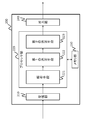
- the computer device 200 includes a receiving unit 210, a processor unit 220, a memory unit 230, and an output unit 240.
- the receiving unit 210 is configured to be able to receive a signal from the outside of the computer device 200.
- the receiver 210 receives a signal from outside the computer device 200 wirelessly or by wire.
- the receiving unit 210 may receive a signal using a wireless LAN such as Wi-fi.
- the receiving unit 210 may receive a signal using near field communication such as Bluetooth (registered trademark).
- the receiving unit 210 receives, for example, the biological signal detected by the biological signal detecting unit 100 from the biological signal detecting unit 100.
- the receiving unit 210 receives, for example, information stored in the database unit 250 from the database unit 250.
- the receiving unit 210 receives, for example, a teaching signal of various information.
- the processor unit 220 controls the overall operation of the computer device 200.
- the processor unit 220 reads a program stored in the memory unit 230 and executes the program.
- the computer device 200 can function as a device that performs a desired step.
- the memory unit 230 stores a program required to execute a process, data required to execute the program, and the like.
- the memory unit 230 may store a program for realizing a process (for example, a process described later with reference to FIG. 5) for identifying information represented by a biological signal.
- the program may be pre-installed in the memory unit 230.
- the program may be installed in the memory unit 230 by being downloaded via the network, or may be installed in the memory unit 230 via a storage medium such as an optical disk or USB. Good.
- the output unit 240 is configured to be able to output a signal to the outside of the computer device 200. It does not matter where the output unit 240 outputs a signal.
- the output unit 240 can output a signal to any hardware or software. Also, it does not matter how the output unit 240 outputs a signal.
- the output unit 240 may transmit a signal by wire to the outside of the computer device 200 or may transmit wirelessly.
- the output unit 240 converts the signal into a format that can be handled by the hardware or software to which the signal is output, or transmits the signal by adjusting the response speed that can be handled by the hardware or software to which the signal is output. You may do it.
- the processor unit 220 includes an analysis unit 221, a first determination unit 222, and a second determination unit 222.
- the analysis unit 221 is configured to analyze the biological signal received by the receiving unit 210 and output feature data. Since the biological signal is a scalar quantity such as a potential, the absolute amount of information is scarce. A large amount of information can be identified by analyzing the biological signal by the analysis means 221 and setting it as feature data which is multidimensional data.
- the analysis unit 221 can perform, for example, mathematical analysis processing such as smoothing processing and frequency analysis processing, or analysis processing including parameter setting processing on a biological signal.
- the first determination means 222 is configured to determine the degree of similarity between the feature data output by the analysis means 221 and each of the plurality of teaching data.
- the plurality of teaching data are stored in the database unit 250.
- the first determination means 222 determines the degree of similarity between the feature data and each of the plurality of teaching data, for example, from the output of the neural network.
- the neural network may, for example, be feed forward as shown in FIG.
- FIG. 3 shows an example of the structure of the neural network 300 used by the first determination means 222.
- the neural network 300 has an input layer, a hidden layer, and an output layer.
- the neural network 300 is shown as a three-layer feedforward type having one hidden layer, but the number of hidden layers is not limited thereto.
- the neural network 300 can comprise one or more hidden layers.
- the number of nodes in the input layer of the neural network 300 corresponds to the number of dimensions of feature data.
- the number of nodes in the output layer of the neural network 300 corresponds to the number of dimensions of teaching data, that is, the number of information to be identified.
- the hidden layer of neural network 300 can include any number of nodes.
- the weighting factor of each node of the hidden layer of neural network 300 may be calculated based on the combination of teaching data and feature data stored in database unit 250. For example, the weighting factor of each node may be calculated such that the value of the output layer when the feature data is input to the input layer becomes the value of teaching data associated with the feature data. This may be done, for example, by back propagation (error back propagation).
- each node of the output layer of the neural network 300 for which the weighting factor of each node has been calculated is associated with the information corresponding to each teaching data.
- the information to be identified is a motion of a living body, it corresponds to feature data obtained from the biomedical signal at the time of performing the first motion and a teaching signal "1" teaching that the motion is the first motion.
- a combination of the teaching data 1 (1.0, 0.0, 0.0, 0.0, 0.0) and feature data obtained from the biological signal when the second operation is performed Performs the third operation in combination with the teaching data 2 (0.0, 1.0, 0.0, 0.0, 0.0) corresponding to the teaching signal “2” that teaches that the operation is Teaching data 3 (0.0, 0.0, 1.0, 0.0, etc.) corresponding to the teaching data “3” which teaches the feature data obtained from the biological signal at the same time and the third operation. And the feature data obtained from the biosignal at the time of performing the fourth operation and the fourth operation.
- a combination of the teaching data 4 (0.0, 0.0, 0.0, 1.0, 0.0) corresponding to the teaching signal “4” teaching the subject, and the living body when the fifth operation is performed Teach data 5 (0.0, 0.0, 0.0, 0.0, 1.0) corresponding to the feature data obtained from the signal and the teaching signal "5" for teaching that the fifth operation is performed
- the first node of the output layer of the neural network 300 is associated with the first operation, and the second node is associated with the second operation.
- the third node is associated with the third operation
- the fourth node is associated with the fourth operation
- the fifth node is associated with the fifth operation.
- the ideal output of the neural network 300 for which the weighting factor of each node is calculated in this way is, for example, the first of the output layers when the feature data obtained from the biological signal when the first operation is performed is input. Node outputs 1 and the other nodes output 0. However, in reality, an ideal output is rarely obtained due to the influence of noise and the like mixed in the biological signal. In practice, one or more nodes of the output layer will output a value in the range of 0-1.
- the value of each node of the output layer corresponds to the degree of similarity between the input feature data and the respective teaching data corresponding to the operation associated with each node. For example, if the output is (0.0, 0.2, 0.0, 0.8, 0.0), the input feature data is the second operation associated with the second node.
- the input feature data is the third operation associated with the third node Similar to both the corresponding teaching data and the teaching data corresponding to the fifth operation associated with the fifth node, and not similar to the teaching data corresponding to the operations associated with the other nodes Indicates
- the second determining unit 223 determines the information represented by the biological signal based on the plurality of similarities in the predetermined period in the similarities stored in the buffer of the memory unit 230. It is configured. The second determination unit 223 determines, for example, as the “preferable output” from among a plurality of similarities within a predetermined period in the similarities stored in time series in the buffer of the memory unit 230. The information indicated by the teaching data corresponding to the similarity is determined as the information represented by the biological signal from which the feature data is derived.
- the memory unit 230 includes a buffer for temporarily storing information.
- the degree of similarity determined by the first determination means 222 may be temporarily stored in time series for each time. For example, when a fixed amount of data is stored, the buffer may delete old data, or may delete data for which a fixed time has elapsed since it was stored.
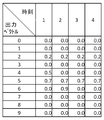
- FIG. 4 shows an example of the data configuration of an output vector indicating the degree of similarity with each teaching data stored in the buffer of the memory unit 230.
- the value of each component of the output vector indicates the degree of similarity with the corresponding teaching data.
- the buffer of the memory 230 stores output vectors in time series at each time. For example, at time 1, the first determination unit 222 determines that the degree of similarity with each teaching data 0 to 9 is (0.0, 0.0, 0.2, 0.0, 0.5, 0.7, If it is determined to be 0.0, 0.0, 0.0, 0.0), the result is stored as an output vector indicating the degree of similarity with each teaching data at time 1, and at time 2, The similarity to each teaching data 0 to 9 is (0.0, 0.0, 0.2, 0.0, 0.0, 0.7, 0.9, 0.0, 0.0, 0, 0,. If it is determined that it is 0), the result is stored as an output vector indicating the degree of similarity with each teaching data at time 2,... Every time the degree of similarity is determined by the first determination means 222 Store the time of day and the output vector (see, for example, FIG. 4).
- the biological signal detection means 100 and the computer device 200 are shown as separate components, but the present invention is not limited thereto. It is also possible to configure the biological signal detection means 100 and the computer device 200 as one component.
- the database unit 250 is provided outside the computer device 200, but the present invention is not limited to this. It is also possible to provide the database unit 250 inside the computer device 200. At this time, the database unit 250 may be implemented by the same storage unit as the storage unit for implementing the memory unit 230 or may be implemented by a storage unit different from the storage unit for implementing the memory unit 230. In any case, the database unit 250 is configured as a storage unit for the computer device 200.
- the configuration of the database unit 250 is not limited to a specific hardware configuration.
- the database unit 250 may be configured by a single hardware component or may be configured by a plurality of hardware components.
- the database unit 250 may be configured as an external hard disk drive of the computer device 200, or may be configured as storage on a cloud connected via a network.
- each component of the computer apparatus 200 is provided in the computer apparatus 200, but the present invention is not limited to this. It is also possible that any of the components of the computer device 200 is provided outside the computer device 200.
- each hardware component may be connected via an arbitrary network. At this time, the type of network does not matter.
- Each hardware component may be connected via, for example, a LAN, may be wirelessly connected, or may be wired.
- the biological signal detection means 100 extracts and outputs a scalar quantity from the detected biological signal when the detected biological signal is a biological signal having coordinate dependency. It is also within the scope of the present invention for the computing device 200 to extract scalar quantities from the biological signal received from the biological signal detection means 100.
- FIG. 5 shows an example of a process for identifying the information represented by the biological signal of the present invention. This process is performed in the system 10.
- the teaching data corresponding to the teaching signal input in the learning stage and the input feature data are associated with each other and stored, and each of the hidden layers of the neural network 300 shown in FIG. It is assumed that the weighting factor of the node is calculated based on the combination of the teaching data and the feature data stored in the database unit 250.
- the detection unit 110 of the biological signal detection unit 100 detects a biological signal.
- the detection unit 110 detects, for example, a myoelectric signal of a living body, an electrocardiogram signal of a living body, or an electroencephalogram of a living body.
- the transmission unit 120 of the biological signal detection unit 100 transmits the detected biological signal to the computer device 200.
- the receiving unit 210 of the computer device 200 receives the biological signal from the biological signal detecting unit 100, the receiving unit 210 provides the received biological signal to the processor unit 220.
- the reception unit 210 may sequentially provide the processor unit 220 each time a biological signal is received, or the received biological signal may be temporarily stored in the memory unit 230, and may be constant. The amount data may be accumulated and provided to the processor unit 220 collectively.
- the process proceeds to step S502.
- step S502 the analysis unit 221 of the processor unit 220 of the computer device 200 analyzes the detected biological signal and outputs feature data.
- the analysis unit 221 outputs feature data by performing mathematical analysis processing such as smoothing processing and frequency analysis processing, or analysis processing including parameter setting processing.
- the analysis unit 221 may process the feature data by, for example, applying a weighting factor to the time series or frequency band of the output feature data.
- step S503 the first determination unit 222 of the processor unit 220 of the computer apparatus 200 determines the similarity between the feature data output in step S502 and each of the plurality of pieces of teaching data.
- the first determination means 222 inputs, for example, the feature data output in step S502 into the neural network 300 shown in FIG. 3, and from the output of the neural network 300, each of the feature data and the plurality of teaching data Determine the degree of similarity with
- the first determination means 222 extracts and extracts part of the feature data output in step S502 instead of inputting all of the feature data output in step S502 to the neural network 300, for example. Only the feature data that has been input may be input to the neural network 300. As a result, the amount of computation in the latter processing can be reduced, and a drop in the operating speed in the latter processing can be prevented.
- the first determination means 222 may extract feature data uniformly or may extract feature data non-uniformly. In the case of extracting feature data nonuniformly, it is preferable to extract feature data by slope distribution so as to extract a portion of feature data to be focused on. As a result, it is possible to prevent the reduction in the accuracy of the processing in the latter stage due to the extraction. Extraction of such feature data enables coexistence of the operation speed and accuracy of the treatment in the subsequent stage.
- step S504 the buffer of the memory unit 230 of the computer device 200 stores the degree of similarity determined in step S503 in chronological order for each time.
- the buffer of the memory unit 230 stores, in time series, output vectors indicating the degree of similarity.
- the processor unit 220 preferably repeats steps S501 to S504 until a predetermined amount of data is stored in the buffer. As a result, it is possible to use a sufficient degree of data amount similarity in the subsequent processing, and improve the accuracy of the subsequent processing.
- the process proceeds to step S505.
- the second determination unit 223 of the processor unit 220 of the computer device 200 determines the information represented by the biological signal based on the plurality of similarities within the predetermined period in the time series similarity stored in the buffer.
- the predetermined period is an arbitrary period ending at the last time when the similarity is stored in the buffer.
- the predetermined period is, for example, any time within the range of about 10 ms to about 220 ms, and the predetermined period is, for example, about 80 ms to about 220 ms. This is because it is difficult to change the operation being performed to another operation if the simple reaction time of the human being is about 220 ms or less.
- the predetermined period may be, for example, about 80 ms, about 200 ms or the like.
- the predetermined period can be appropriately determined by those skilled in the art according to, for example, the application, the application program to be used, the user needs, etc., in consideration of the trade-off between the stability of the output and the human reaction time.
- the predetermined period may be made longer than 220 ms (eg, about 220 to about 400 ms, eg, about 300 ms, about 350 ms, about 400 ms, etc.). This is because, in a paralyzed patient, it takes longer to change an ongoing motion to another motion as compared to a healthy person.
- the second determination means 223 calculates an operation value for each of a plurality of teaching data based on, for example, a plurality of similarities within a predetermined period, and determines the information represented by the biological signal based on the operation value. You may do so. For example, the second determination unit 223 extracts teaching data corresponding to the highest operation value from the obtained operation values, and determines information indicated by the extracted teaching data as information represented by the biological signal. You may The operation value may be a value calculated by a known operation method or an operation method that can be assumed by those skilled in the art, and the operation value may be, for example, a total value.
- the “total value” in the determination of the information represented by the biological signal is, of course, a concept that also includes the “average value”. That is, calculating the total value for each of the plurality of teaching data and extracting the teaching data corresponding to the highest total value among them calculates the average value for each of the plurality of teaching data, and the highest average among them It also includes extracting teaching data corresponding to the value.
- the operation value may be, for example, the occurrence probability or the occurrence frequency of a specific similarity.
- the occurrence probability of a specific similarity is a value indicating how often a specific similarity occurs in a predetermined period
- the occurrence frequency of a specific similarity is the specific similarity within a predetermined period It may be a value indicating whether it has occurred.
- the specific degree of similarity may be, for example, the highest degree of similarity in the output vector or may be the degree of similarity equal to or higher than a certain threshold in the output vector. For example, when five output vectors are output within a predetermined period, the occurrence frequency is highest if three out of five output vectors have the highest similarity for a given teaching data.
- the occurrence probability is 3/5.
- a calculation value for example, total value (average value)
- the second determination means 223 may determine the information indicated by the teaching data corresponding to the operation value exceeding the predetermined threshold as the information represented by the biological signal. At this time, if there is no calculated value exceeding the predetermined threshold value, the identification becomes impossible. Even when there are a plurality of operation values exceeding a predetermined threshold, they may be unidentifiable. Alternatively, when there are a plurality of operation values exceeding a predetermined threshold, each piece of information indicated by each teaching data corresponding to a plurality of operation values exceeding the predetermined threshold may be determined as the information represented by the biological signal. . This is, for example, when multiple actions to be identified are being performed simultaneously, when multiple states to be identified occur simultaneously, and so on.
- the wrist is bent while holding the hand. It may be considered that the combined motion is performed, and the “wrist bending motion” and the “hand gripping motion” may be determined as the motion represented by the biological signal. For example, if the respective motions indicated by the respective teaching data corresponding to the two total values exceeding the predetermined threshold are the “hand gripping motion” and the “wrist turning motion”, the wrist is gripped while holding the hand.
- a combined action of turning for example, an action of holding and turning the doorknob
- the action of holding the hand and the action of turning the wrist may be determined as the action represented by the biological signal.
- the second determining means 223 can identify any combined movement in motion throughout the body, depending on the biosignal to be detected. In the case where at least two of the plurality of motions conflict with each other (for example, “motion to open a hand” and “motion to grasp a hand”), they may be indistinguishable, or muscles may antagonize each other Control may be performed as if the rigidity of the
- the predetermined threshold can be set to any value. The higher the predetermined threshold value, the higher the accuracy and stability, but the higher the incoincidence rate and the worse the responsiveness.
- the predetermined threshold may be, for example, a fixed value or a variable value. When the predetermined threshold is a variation value, the predetermined threshold is, for example, a predetermined ratio to the maximum value of the total value (for example, 90% to 60%, 80% to 60%, 70 to 60%, for example, 65% etc.).
- the predetermined threshold may be determined, for example, according to the number of data of a plurality of similarities within a predetermined period to be summed.
- the predetermined threshold may be lowered or raised until there is at least one total value exceeding the predetermined threshold, for example, the predetermined threshold If there are a plurality of total values exceeding, the predetermined threshold may be increased until one total value exceeds the predetermined threshold.
- the predetermined threshold may be determined, for example, according to the biological signal to be detected.
- the predetermined threshold may be determined, for example, in accordance with the site where the biological signal is to be detected. For example, a predetermined threshold used when detecting a biological signal from an arm to identify hand movement and a predetermined threshold used when detecting a biological signal from a leg to identify a walking movement are the same. It may be a value or a different value.
- the accuracy of the information represented by the biological signal identified by the above-described process is significantly improved over the accuracy obtained when the information represented by the biological signal is directly identified from the similarity output in step S503.
- the accuracy in the case of directly identifying the information represented by the biological signal from the similarity output in step S503 was about 80%, but the accuracy of the information represented by the biological signal identified by the above-described process is 90%. It was extremely expensive to reach in the second half.
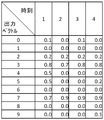
- FIGS. 6A to 6C the processing of the system 10 when the user performs the operation corresponding to the teaching data 5 among the operations corresponding to the teaching data 0 to 9 will be described with reference to FIGS. 6A to 6C. Do. It is assumed that the user performs an operation corresponding to the teaching data 5 from time 1 to time 5. Here, the process at time 5 will be described. The interval of each time is 20 ms, and the predetermined period is 100 ms. As shown in FIG. 6A, it is assumed that output vectors of time 1 to time 4 have already been stored in the buffer of the memory unit 230.
- step S501 the detection unit 110 of the biological signal detection unit 100 detects a biological signal derived from an operation performed by the user.
- step S502 the analysis unit 221 of the processor unit 220 of the computer device 200 analyzes the detected biological signal and outputs feature data.
- step S503 the first determination unit 222 of the processor unit 220 of the computer device 200 determines the similarity between the feature data output in step S502 and each of the teaching data 0 to 9.
- the degree of similarity (0.0, 0.9, 0.2, 0.0, 0) with each of the teaching data 0 to 9 is output as an output. .0, 0.7, 0.0, 0.0, 0.0, 0.0) were obtained.
- step S504 the buffer of the memory unit 230 of the computer device 200 stores the degree of similarity determined in step S503 in chronological order. As shown in FIG. 6B, the buffer of the memory unit 230 stores the output vectors of time 1 to time 5 in time series for each time.
- step S505 the second determination unit 223 of the processor unit 220 of the computer device 200 performs the operation performed by the user based on the plurality of similarities within the predetermined period in the time series similarity stored in the buffer.
- the action represented by the derived biological signal is determined.
- the second determination unit 223 obtains a total value by summing up the degree of similarity of time 1 to time 5 corresponding to a predetermined period for each teaching data.
- the second determination unit 223 determines the operation indicated by the teaching data of “5” corresponding to the highest total value as the operation represented by the biological signal detected at time 5.
- the second determining means 223 detects the operation indicated by the teaching data of “5” corresponding to the total value exceeding the predetermined threshold value at time 5 Determined as the action that the signal represents. In this way, the system 10 of the present invention can properly identify the action taken by the user.
- the teaching data corresponding to the highest similarity is teaching data “1”, so teaching data “1” It erroneously identifies it as the corresponding operation.
- the system 10 of the present invention determines the operation represented by the biological signal based on the plurality of similarities within the predetermined period in the time series similarity stored in the buffer, the biological signal with extremely high accuracy It is possible to identify the action that is represented.
- step S501 the detection unit 110 of the biological signal detection unit 100 detects a biological signal derived from the operation performed by the user, and in step S502, the analysis unit 221 of the processor unit 220 of the computer device 200 detects The biological signal is analyzed to output feature data, and in step S503, the first determination unit 222 of the processor unit 220 of the computer device 200 outputs the feature data output in step S502 and one of the teaching data 0 to 9. Determine the degree of similarity with each other.
- the degree of similarity (0.0, 0.0, 0.2, 0.0, 0) with each of the teaching data 0 to 9 is output as an output. .0, 0.7, 0.9, 0.0, 0.0, 0.0) were obtained.
- step S504 the buffer of the memory unit 230 of the computer device 200 stores the degree of similarity determined in step S503 in chronological order. As shown in FIG. 6C, the buffer of the memory unit 230 stores the output vectors of time 1 to time 6 in time series for each time.
- step S505 the second determination unit 223 of the processor unit 220 of the computer device 200 performs the operation performed by the user based on the plurality of similarities within the predetermined period in the time series similarity stored in the buffer.
- the action represented by the derived biological signal is determined.
- the second determination unit 223 obtains a total value by summing up the degree of similarity of time 2 to time 6 corresponding to a predetermined period for each teaching data.
- the second determination means 223 extracts the teaching data of “5” corresponding to the highest total value, and the biological signal detected at time 5 indicates the operation indicated by the extracted teaching data of “5”. Determined as the action to represent.
- the second determining means 223 detects the operation indicated by the teaching data of “5” corresponding to the total value exceeding the predetermined threshold value at time 5 Determined as the action that the signal represents. In this way, the system 10 of the present invention can properly identify the action taken by the user.
- the teaching data corresponding to the highest similarity is the teaching data 6, so the operation corresponding to the teaching data 6 Misidentify that there is.
- the system 10 of the present invention determines the operation represented by the biological signal based on a plurality of similarities within a predetermined period in the time-series similarities stored in the buffer, the process is similarly performed at time 6 as well. It is possible to identify the motion represented by the biosignal with very high accuracy.
- processing of system 10 when the user performs combined operation of the operation corresponding to teaching data 3 among the operations corresponding to teaching data 0 to 9 and the operation corresponding to teaching data 7 Will be described with reference to FIGS. 6D to 6F. It is assumed that the user is performing an operation corresponding to teaching data 3 and an operation corresponding to teaching data 7 from time 1 to time 5. Here, the process at time 5 will be described. The interval of each time is 20 ms, and the predetermined period is 100 ms. It is assumed that output vectors of time 1 to time 4 have already been stored in the buffer of the memory unit 230 as shown in FIG. 6D.
- step S501 the detection unit 110 of the biological signal detection unit 100 detects a biological signal derived from an operation performed by the user.
- step S502 the analysis unit 221 of the processor unit 220 of the computer device 200 analyzes the detected biological signal and outputs feature data.
- step S503 the first determination unit 222 of the processor unit 220 of the computer device 200 determines the similarity between the feature data output in step S502 and each of the teaching data 0 to 9.
- the degree of similarity (0.0, 0.0, 0.2, 0.9, 0) with each of the teaching data 0 to 9 is output as an output. .2, 0.1, 0.0, 0.8, 0.0, 0.9) were obtained.
- step S504 the buffer of the memory unit 230 of the computer device 200 stores the degree of similarity determined in step S503 in chronological order. As shown in FIG. 6E, the buffer of the memory unit 230 stores the output vectors of time 1 to time 5 in time series for each time.
- step S505 the second determination unit 223 of the processor unit 220 of the computer device 200 performs the operation performed by the user based on the plurality of similarities within the predetermined period in the time series similarity stored in the buffer.
- the action represented by the derived biological signal is determined.
- the second determination means 223 obtains a total value by summing up the degree of similarity of time 1 to time 5 corresponding to a predetermined period for each teaching data.
- the second determination unit 223 determines the operation indicated by the teaching data exceeding the predetermined threshold as the operation represented by the biological signal detected at time 5.
- the second determination unit 223 performs an operation indicated by the teaching data “3” corresponding to the total value exceeding the predetermined threshold and an operation indicated by the teaching data “7”. Is determined as an operation represented by the biological signal detected at time 5. In this way, the system 10 of the present invention is able to properly and simultaneously identify complex operations performed by the user.
- the system 10 determines the operation represented by the biological signal based on a plurality of similarities within a predetermined period of time-series similarities stored in the buffer, so even if it is a complex operation It is possible to identify the motion represented by the biosignal with very high accuracy.
- step S501 the detection unit 110 of the biological signal detection unit 100 detects a biological signal derived from the operation performed by the user, and in step S502, the analysis unit 221 of the processor unit 220 of the computer device 200 detects The biological signal is analyzed to output feature data, and in step S503, the first determination unit 222 of the processor unit 220 of the computer device 200 outputs the feature data output in step S502 and one of the teaching data 0 to 9. Determine the degree of similarity with each other.
- the degree of similarity (0.2, 0.9, 0.2, 0.7, 0) with each of the teaching data 0 to 9 is output as an output. .3, 0.1, 0.0, 0.7, 0.0, 0.1) were obtained.
- step S504 the buffer of the memory unit 230 of the computer device 200 stores the degree of similarity determined in step S503 in chronological order. As shown in FIG. 6F, the buffer of the memory unit 230 stores the output vectors of time 1 to time 6 in time series for each time.
- step S505 the second determination unit 223 of the processor unit 220 of the computer device 200 performs the operation performed by the user based on the plurality of similarities within the predetermined period in the time series similarity stored in the buffer.
- the action represented by the derived biological signal is determined.
- the second determination unit 223 obtains a total value by summing up the degree of similarity of time 2 to time 6 corresponding to a predetermined period for each teaching data.
- the second determination unit 223 determines the operation indicated by the teaching data exceeding the predetermined threshold as the operation represented by the biological signal detected at time 5.
- the second determination unit 223 performs an operation indicated by the teaching data “3” corresponding to the total value exceeding the predetermined threshold and an operation indicated by the teaching data “7”. Is determined as an operation represented by the biological signal detected at time 5. In this way, the system 10 of the present invention is able to properly and simultaneously identify complex operations performed by the user.
- the teaching data corresponding to the highest similarity is teaching data “1”, so teaching data “1” It erroneously identifies it as the corresponding operation.
- the system 10 of the present invention determines the operation represented by the biological signal based on a plurality of similarities within a predetermined period in the time-series similarities stored in the buffer, the process is similarly performed at time 6 as well. Even in the combined operation, it is possible to identify the operation represented by the biological signal with extremely high accuracy.
- the system 10 of the present invention may be used in any application where it is useful to detect biosignals and thereby produce some output, but is preferably for hand rehabilitation, for swallowing diagnosis, for wheelchairs, for prostheses For prosthetic arms, prosthetic legs, or robots, for upper limb assistance devices, for lower limb assistance devices, for trunk assistance devices, but not limited thereto.
- a robot for example, it may be applied to the entire robot, or may be applied to a part of a robot such as a robot arm or a robot hand.
- the system 10 of the present invention may, depending on the application, comprise mounting means for mounting on the part of the body to be analyzed of the biological signal.
- Such parts of the body may be, but are not limited to, the upper limbs, the abdomen, the neck, the lower limbs, the back of the biosignal target.
- the body part may be any part of the body.
- the attachment means may be, for example, any attachment means such as a belt, a seal or the like for attachment to a part of the subject's body.
- the system 10 of the present invention is for a robot arm
- the myoelectric signal of the muscle of the upper limb may be detected, and the robot arm may be moved based on the information represented by the detected myoelectric signal.
- the user can use the system 10 of the present invention to imitate the intended motion on the robot arm. Since the system 10 of the present invention can identify not only simple motions but also complex motions, even complex motions can be made to imitate a robot arm with high accuracy.
- an EMG signal of a muscle other than the forearm for example, expression muscle
- the robot arm is moved based on information represented by the detected EMG signal. May be
- the user can operate the robot arm using the system 10 of the present invention as a command of his / her predetermined operation. Thereby, for example, even a patient with upper limb paralysis can operate the robot arm. Since the system 10 of the present invention can identify not only simple operations but also complex operations, the number of commands for operations can be increased as compared to operations using simple operations as commands. That is, using compound actions for commands allows the robot arm to have more actions with fewer types of user actions.
- system 10 of the present invention can be applied to, for example, a hand rehabilitation apparatus.
- the identification accuracy of the motion represented by the biosignal is lower than in the case of a healthy person.
- the system 10 of the present invention it is possible to identify the motion represented by the biological signal with extremely high accuracy, so that even if the level of the biological signal is low, the identification accuracy to a level usable for rehabilitation It is possible to improve Moreover, according to the system 10 of the present invention, not only simple finger movements but also complex finger movements can be identified accurately and simultaneously. Thereby, the efficiency and effect of the hand rehabilitation can be remarkably improved by accurately and quickly identifying the intended movement of the patient and accurately and immediately assisting the intended movement. For example, it is known that achieving the action intended by the patient and repeating it promotes brain plasticity and promotes recovery of paralyzed function.
- the finger rehabilitation apparatus comprising the system 10 of the present invention comprises attachment means that allow the biosignal detection means 100 to be attached to the skin of the upper limb of the user.
- the attachment means may be, for example, any means such as a belt or a seal for attaching the detection unit 111 of the biological signal detection means 100 to the skin of the upper limb (for example, the upper arm or forearm) of the user.
- the output from the hand rehabilitation apparatus can be displayed on display means such as a display and presented to the rehabilitation trainer.
- the rehabilitation trainer can provide appropriate rehabilitation instruction based on the output from the hand rehabilitation equipment, leading to efficient and effective rehabilitation.
- a finger rehabilitation device comprising the system 10 of the present invention may comprise a finger movement assist device worn on the finger of the user.
- the finger movement assist device is configured to act on the user's finger so as to assist the user's finger movement.
- the finger movement assist device may be configured to drive a finger joint by, for example, a pneumatic actuator, or may be configured to drive a finger joint by, for example, a torque of a motor.
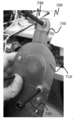
- the finger movement assist device may be, for example, the finger movement assist device 700 shown in FIGS. 7A and 7B.
- FIG. 7A shows an appearance of the finger movement assist device 700
- FIG. 7B shows a state in which the finger movement assist device 700 is attached to the finger of the user.
- the finger motion assist device 700 includes a main body 710, a palm bolt 720 extending from the main body 710, an arm 730, and a finger bolt 740 extending from the arm 730.
- the arm 730 is configured to be pivotable relative to the main body 710.
- the arm 730 may, for example, be configured to be pivoted by a motor, may be configured to be pivoted by a pneumatic actuator, or may be pivoted by a wire.
- the output from the system 10 of the present invention may be provided to a finger motion assist apparatus.
- the finger movement assist device acts to assist the patient's intended motion based on the output from the finger rehabilitation device.
- the output from system 10 of the present invention may be provided to finger motion assist device 700.
- the pivoting of the arm 730 assists the finger movement by the finger bolt 740.
- the pivoting of the arm 730 causes the finger bolt 740 to push up the finger, thereby assisting in the operation of opening the user's hand. In this way, patients can perform rehabilitation on their own initiative, leading to efficient and effective rehabilitation.
- system 10 of the present invention can be applied to, for example, a swallow diagnosis apparatus.
- the swallowing diagnostic apparatus comprising the system 10 of the present invention comprises mounting means which allow the biological signal detection means 100 to be worn on the skin of the user's neck.
- the mounting means may be, for example, any means such as a belt or a seal for mounting the detection unit 111 of the biological signal detection means 100 on the skin of the user's neck.
- the swallowing diagnostic apparatus provided with the system 10 of the present invention is a means that enables the biological signal detection means 100 to be brought into contact with the skin of the user's neck without fixing in addition to or instead of the wearing means. May be provided. Such means can, for example, be pressed against the patient like a stethoscope to detect the patient's vital signs.
- the output from the swallowing diagnostic apparatus can be displayed on a display means such as a display and presented to a doctor.
- the doctor can make an accurate diagnosis based on the output from the swallowing diagnosis apparatus.
- the output from the swallowing diagnostic device may be displayed on a display or the like and presented to the user himself. As a result, the user can properly perform a self-diagnosis of dysphagia based on the output from the swallowing diagnosis apparatus.
- Example 1 Discrimination of EMG signals in the skin of upper limbs Attach an EMG sensor to the upper extremity of a subject (a healthy male in his twenties), exerting force on the subject to cause motion, and correspondence between EMG discrimination and motion The relationship was tested.
- the myoelectric sensor was provided with an amplifier unit, a 500 Hz low pass filter, a 10 Hz high pass filter, and a 50 Hz notch filter, and experiments were performed for 80 ms as a predetermined time.
- FIGS. 8 (a) and 9 (a) are graphs of the results of processing by the system 10 of the present invention
- FIGS. 8 (b) and 9 (b) are the similarities obtained in step S503, ie, , And a graph of the result of direct identification from the output of the neural network 300.
- FIGS. 9 (a) to 9 (b) are enlarged views of broken line parts shown in FIGS. 8 (a) to 8 (b).
- the vertical axis of the graph represents the action ID, 0 is "do nothing", 1 is “wrist wrist action”, 3 is “wrist bending action”, 4 is “wrist stretching action” 5 is a “goo operation”, 7 is a “thumb bending operation”, and 9 is a "ring finger, little finger bending operation”.
- the weighting factor of each node is calculated such that each node of the output layer is associated with the operation corresponding to the operation ID.
- the horizontal axis of the graph is the number of execution steps. 50 steps were performed per second. That is, the step interval is 20 ms.
- the subject has "wrist provocation” (motion ID: 1), "ring finger, little finger bending” (motion ID: 9), “thumb bending” (motion ID: 7), “wrist stretching” (motion ID) : 4), “wrist bending operation” (operation ID: 3), and “goo operation” (operation ID: 5).
- the dotted lines in each graph indicate the ideal state with a discrimination rate of 100%.
- FIG. 8 (a) is a graph generally following the dotted line, and it can be seen that a good discrimination rate was obtained by the processing by the system 10 of the present invention.
- FIG. 9 (a) is a graph along a dotted line more than FIG. 9 (b). It can be seen that the system 10 of the present invention correctly identifies the motion represented by the myoelectric signal.
- Example 2 Discrimination of EMG signals in the skin of upper limbs of subjects with low levels of EMG signals Aside from attaching an electromyographic sensor to the upper limbs of a subject (a healthy male in his twenties) and having the subject operate with minimal force In the same manner as in Example 1, the correspondence between the identification of the myoelectric signal and the operation was tested.
- FIG. 10 and FIG. FIGS. 10 (a) and 11 (a) are graphs of the results of processing by the system 10 of the present invention
- FIGS. 10 (b) and 11 (b) are results of processing using an algorithm to be described later
- 10 (c) and 11 (c) are graphs of the similarity obtained in step S503, that is, the results of direct identification from the output of the neural network 300.
- FIG. FIGS. 11 (a) to 11 (c) are enlarged views of broken line parts shown in FIGS. 10 (a) to 10 (c).
- the algorithm used in FIGS. 10 (b) and 11 (b) stores the similarity obtained in step S503, that is, the result of direct identification from the output of the neural network 300 in a buffer in time series for each time, It is an algorithm which determines the identification result whose occupancy in a buffer is more than a threshold value as operation
- the vertical axis of the graph represents the action ID, 0 is "do nothing", 1 is “wrist wrist action”, 3 is “wrist bending action”, 4 is “wrist stretching action” 5 is a “goo operation”, 7 is a “thumb bending operation”, and 9 is a "ring finger, little finger bending operation”.
- the weighting factor of each node is calculated such that each node of the output layer is associated with the operation corresponding to the operation ID.
- the horizontal axis of the graph is the number of execution steps. 50 steps were performed per second. That is, the step interval is 20 ms.
- the subject has "Goo motion” (motion ID: 5), “wrist bending motion” (motion ID: 3), “wrist stretching motion” (motion ID: 4), “thumb bending motion” (motion ID: 7), The motions were performed in the order of “ring finger, little finger bending motion” (motion ID: 9) and “wrist wrist motion” (motion ID: 1).
- the dotted lines in each graph indicate the ideal state with a discrimination rate of 100%.
- FIG. 11 even in the “thumb bending operation” (operation ID: 7) which is easy to be confused when the myoelectric signal level is low, FIG.
- the graph is also along the dotted line, and it can be seen that the system 10 of the present invention correctly identifies the motion represented by the myoelectric signal.
- the present invention is useful as a system for identifying information represented by a biological signal, and a finger rehabilitation apparatus and a swallowing diagnostic apparatus including the same, which can improve identification accuracy of the biological signal.
Landscapes
- Health & Medical Sciences (AREA)
- Life Sciences & Earth Sciences (AREA)
- Engineering & Computer Science (AREA)
- General Health & Medical Sciences (AREA)
- Public Health (AREA)
- Biomedical Technology (AREA)
- Veterinary Medicine (AREA)
- Animal Behavior & Ethology (AREA)
- Medical Informatics (AREA)
- Heart & Thoracic Surgery (AREA)
- Physics & Mathematics (AREA)
- Pathology (AREA)
- Biophysics (AREA)
- Surgery (AREA)
- Molecular Biology (AREA)
- Epidemiology (AREA)
- Physical Education & Sports Medicine (AREA)
- Orthopedic Medicine & Surgery (AREA)
- Rehabilitation Therapy (AREA)
- Pain & Pain Management (AREA)
- Transplantation (AREA)
- Primary Health Care (AREA)
- Artificial Intelligence (AREA)
- Vascular Medicine (AREA)
- Oral & Maxillofacial Surgery (AREA)
- Cardiology (AREA)
- Physiology (AREA)
- Neurology (AREA)
- General Engineering & Computer Science (AREA)
- Theoretical Computer Science (AREA)
- Data Mining & Analysis (AREA)
- Databases & Information Systems (AREA)
- Mathematical Physics (AREA)
- Gastroenterology & Hepatology (AREA)
- General Business, Economics & Management (AREA)
- Business, Economics & Management (AREA)
- Endocrinology (AREA)
- Evolutionary Computation (AREA)
- Fuzzy Systems (AREA)
- Signal Processing (AREA)
Priority Applications (5)
| Application Number | Priority Date | Filing Date | Title |
|---|---|---|---|
| JP2019523894A JP6656633B2 (ja) | 2017-11-30 | 2018-11-30 | 生体信号が表す情報を識別するためのシステム |
| CN201880085716.2A CN111565680B (zh) | 2017-11-30 | 2018-11-30 | 用于识别生物体信号所表示的信息的系统 |
| EP18882992.3A EP3718515B1 (en) | 2017-11-30 | 2018-11-30 | System for identifying information represented by biological signals |
| US16/767,710 US11166667B2 (en) | 2017-11-30 | 2018-11-30 | System for identifying information represented by biological signals |
| US17/487,286 US12329538B2 (en) | 2017-11-30 | 2021-09-28 | System for identifying information represented by biological signals |
Applications Claiming Priority (2)
| Application Number | Priority Date | Filing Date | Title |
|---|---|---|---|
| JP2017-231054 | 2017-11-30 | ||
| JP2017231054 | 2017-11-30 |
Related Child Applications (2)
| Application Number | Title | Priority Date | Filing Date |
|---|---|---|---|
| US16/767,710 A-371-Of-International US11166667B2 (en) | 2017-11-30 | 2018-11-30 | System for identifying information represented by biological signals |
| US17/487,286 Continuation US12329538B2 (en) | 2017-11-30 | 2021-09-28 | System for identifying information represented by biological signals |
Publications (1)
| Publication Number | Publication Date |
|---|---|
| WO2019107554A1 true WO2019107554A1 (ja) | 2019-06-06 |
Family
ID=66665034
Family Applications (1)
| Application Number | Title | Priority Date | Filing Date |
|---|---|---|---|
| PCT/JP2018/044242 Ceased WO2019107554A1 (ja) | 2017-11-30 | 2018-11-30 | 生体信号が表す情報を識別するためのシステム |
Country Status (5)
| Country | Link |
|---|---|
| US (2) | US11166667B2 (https=) |
| EP (1) | EP3718515B1 (https=) |
| JP (3) | JP6656633B2 (https=) |
| CN (2) | CN111565680B (https=) |
| WO (1) | WO2019107554A1 (https=) |
Cited By (2)
| Publication number | Priority date | Publication date | Assignee | Title |
|---|---|---|---|---|
| CN111714120A (zh) * | 2020-05-08 | 2020-09-29 | 广东食品药品职业学院 | 能进行视觉定位能力评估的脑机接口系统及其应用 |
| JPWO2022114116A1 (https=) * | 2020-11-27 | 2022-06-02 |
Families Citing this family (3)
| Publication number | Priority date | Publication date | Assignee | Title |
|---|---|---|---|---|
| CN111565680B (zh) * | 2017-11-30 | 2021-11-02 | 梅尔廷Mmi株式会社 | 用于识别生物体信号所表示的信息的系统 |
| US12053674B1 (en) * | 2018-04-12 | 2024-08-06 | AI Incorporated | Smart gym equipment |
| CN114053007B (zh) * | 2021-10-29 | 2022-06-21 | 哈尔滨工业大学 | 一种面向健康受试者的多自由度假肢实验装置 |
Citations (5)
| Publication number | Priority date | Publication date | Assignee | Title |
|---|---|---|---|---|
| JP2001331250A (ja) | 2000-03-13 | 2001-11-30 | Hokkaido Technology Licence Office Co Ltd | 個人適応型生体信号被動機器制御システムおよび制御方法 |
| JP2004180817A (ja) * | 2002-12-02 | 2004-07-02 | National Institute Of Advanced Industrial & Technology | 生体信号を利用した作業支援マニピュレータシステム |
| JP2015146908A (ja) * | 2014-02-06 | 2015-08-20 | 国立研究開発法人理化学研究所 | リハビリ装置 |
| JP2016052474A (ja) * | 2014-09-04 | 2016-04-14 | exiii株式会社 | プログラム及び情報処理装置 |
| WO2017073770A1 (ja) * | 2015-10-29 | 2017-05-04 | 国立大学法人電気通信大学 | 時系列情報を用いた筋電パターン識別方法及び筋電義手 |
Family Cites Families (12)
| Publication number | Priority date | Publication date | Assignee | Title |
|---|---|---|---|---|
| US5336269A (en) | 1992-06-09 | 1994-08-09 | Liberty Mutual Insurance Co. | Method and apparatus for switching degrees of freedom in a prosthetic limb |
| JP2000148985A (ja) * | 1998-11-17 | 2000-05-30 | Hitachi Ltd | 個人認証システム |
| JP5118620B2 (ja) | 2008-12-24 | 2013-01-16 | 日立Geニュークリア・エナジー株式会社 | 動態認識装置、動態認識システムおよび動態認識方法 |
| US8744588B2 (en) * | 2009-05-07 | 2014-06-03 | Hani Midani | Method and system for connecting an impaired nervous system to a muscle or a group of muscles based on template matching and intelligent end points |
| WO2011135789A1 (ja) * | 2010-04-28 | 2011-11-03 | パナソニック株式会社 | 脳波計測装置、電気的ノイズの推定方法、および、電気的ノイズの推定方法を実行するコンピュータプログラム |
| JP5742441B2 (ja) * | 2011-05-06 | 2015-07-01 | セイコーエプソン株式会社 | 生体情報処理装置 |
| TWI457152B (zh) | 2011-08-25 | 2014-10-21 | Univ Nat Yunlin Sci & Tech | 回饋控制之穿戴式上肢電刺激裝置 |
| JP2016047093A (ja) * | 2014-08-27 | 2016-04-07 | セイコーエプソン株式会社 | 生体情報解析システム、生体情報処理システム及び生体情報解析装置 |
| EP3188656B1 (en) | 2014-09-04 | 2021-12-15 | University Health Network | Method and system for brain activity signal-based treatment and/or control of user devices |
| US10314725B2 (en) | 2014-11-13 | 2019-06-11 | The Regents Of The University Of Michigan | Method for amplifying signals from individual nerve fascicles |
| JP6580497B2 (ja) * | 2016-02-09 | 2019-09-25 | Kddi株式会社 | 筋電信号を用いて顔表情を高い精度で識別する装置、デバイス、プログラム及び方法 |
| CN111565680B (zh) * | 2017-11-30 | 2021-11-02 | 梅尔廷Mmi株式会社 | 用于识别生物体信号所表示的信息的系统 |
-
2018
- 2018-11-30 CN CN201880085716.2A patent/CN111565680B/zh not_active Expired - Fee Related
- 2018-11-30 JP JP2019523894A patent/JP6656633B2/ja active Active
- 2018-11-30 US US16/767,710 patent/US11166667B2/en active Active
- 2018-11-30 EP EP18882992.3A patent/EP3718515B1/en active Active
- 2018-11-30 CN CN202111183430.8A patent/CN113907714A/zh active Pending
- 2018-11-30 WO PCT/JP2018/044242 patent/WO2019107554A1/ja not_active Ceased
-
2020
- 2020-01-22 JP JP2020008620A patent/JP7477309B2/ja active Active
-
2021
- 2021-09-28 US US17/487,286 patent/US12329538B2/en active Active
-
2024
- 2024-04-18 JP JP2024067601A patent/JP2024096167A/ja active Pending
Patent Citations (5)
| Publication number | Priority date | Publication date | Assignee | Title |
|---|---|---|---|---|
| JP2001331250A (ja) | 2000-03-13 | 2001-11-30 | Hokkaido Technology Licence Office Co Ltd | 個人適応型生体信号被動機器制御システムおよび制御方法 |
| JP2004180817A (ja) * | 2002-12-02 | 2004-07-02 | National Institute Of Advanced Industrial & Technology | 生体信号を利用した作業支援マニピュレータシステム |
| JP2015146908A (ja) * | 2014-02-06 | 2015-08-20 | 国立研究開発法人理化学研究所 | リハビリ装置 |
| JP2016052474A (ja) * | 2014-09-04 | 2016-04-14 | exiii株式会社 | プログラム及び情報処理装置 |
| WO2017073770A1 (ja) * | 2015-10-29 | 2017-05-04 | 国立大学法人電気通信大学 | 時系列情報を用いた筋電パターン識別方法及び筋電義手 |
Non-Patent Citations (1)
| Title |
|---|
| See also references of EP3718515A4 |
Cited By (4)
| Publication number | Priority date | Publication date | Assignee | Title |
|---|---|---|---|---|
| CN111714120A (zh) * | 2020-05-08 | 2020-09-29 | 广东食品药品职业学院 | 能进行视觉定位能力评估的脑机接口系统及其应用 |
| JPWO2022114116A1 (https=) * | 2020-11-27 | 2022-06-02 | ||
| WO2022114116A1 (ja) * | 2020-11-27 | 2022-06-02 | 株式会社メルティンMmi | 被験者の対象部位の動きを支援するための装置を制御するためのプログラム、システムおよび被験者の対象部位の動きを支援するための装置の構成方法 |
| JP7765406B2 (ja) | 2020-11-27 | 2025-11-06 | FrontAct株式会社 | 被験者の対象部位の動きを支援するための装置を制御するためのプログラム、システムおよび被験者の対象部位の動きを支援するための装置の構成方法 |
Also Published As
| Publication number | Publication date |
|---|---|
| CN111565680B (zh) | 2021-11-02 |
| JP6656633B2 (ja) | 2020-03-04 |
| EP3718515A4 (en) | 2021-08-18 |
| EP3718515A1 (en) | 2020-10-07 |
| US11166667B2 (en) | 2021-11-09 |
| EP3718515B1 (en) | 2026-04-22 |
| JPWO2019107554A1 (ja) | 2019-12-12 |
| JP2024096167A (ja) | 2024-07-12 |
| JP2020096851A (ja) | 2020-06-25 |
| JP7477309B2 (ja) | 2024-05-01 |
| US20200375529A1 (en) | 2020-12-03 |
| CN113907714A (zh) | 2022-01-11 |
| US12329538B2 (en) | 2025-06-17 |
| US20220008003A1 (en) | 2022-01-13 |
| CN111565680A (zh) | 2020-08-21 |
Similar Documents
| Publication | Publication Date | Title |
|---|---|---|
| JP7477309B2 (ja) | 生体信号が表す情報を識別するためのシステム | |
| US10959863B2 (en) | Multi-dimensional surface electromyogram signal prosthetic hand control method based on principal component analysis | |
| Akhtar et al. | Prediction of distal arm joint angles from EMG and shoulder orientation for prosthesis control | |
| Li et al. | Wireless sEMG-based identification in a virtual reality environment | |
| KR101492480B1 (ko) | 보행 단계에 기반한 표면 근전도 분석 시스템 | |
| Dwivedi et al. | A shared control framework for robotic telemanipulation combining electromyography based motion estimation and compliance control | |
| Triwiyanto et al. | Single lead EMG signal to control an upper limb exoskeleton using embedded machine learning on raspberry Pi | |
| CN111436942A (zh) | 一种用于手外科康复训练的辅助康复装置、系统及方法 | |
| Liao et al. | Human–robot interface based on sEMG envelope signal for the collaborative wearable robot | |
| KR101492478B1 (ko) | 퓨전 센서를 이용한 보행 패턴 인식 시스템 | |
| Fara et al. | Prediction of arm end-point force using multi-channel MMG | |
| Becker et al. | Comparison of muscular activity and movement performance in robot-assisted and freely performed exercises | |
| Hameed et al. | Soft robotic glove system controlled with amplitude independent muscle activity detection algorithm by using single sEMG channel | |
| Rosli et al. | Electrocardiographic (ECG) and Electromyographic (EMG) signals fusion for physiological device in rehab application | |
| Khan et al. | Electromyography and inertial motion sensors based wearable data acquisition system for stroke patients: a pilot study | |
| Díaz-Amador et al. | Towards the reduction of the effects of muscle fatigue on myoelectric control of upper limb prostheses | |
| Mamikoglu et al. | Elbow joint angle estimation by using integrated surface electromyography | |
| US20240252329A1 (en) | Method and system for controlling prosthetic device | |
| KR20050081994A (ko) | 근전도를 이용한 사용자 의도 인식 방법 및 그 시스템 | |
| JP7688419B2 (ja) | 運動解析装置、システム及びプログラム、並びにリハビリテーションシステム | |
| HK40028816A (en) | System for identifying information represented by biological signals | |
| HK40028816B (en) | System for identifying information represented by biological signals | |
| WO2017187658A1 (ja) | 動作補助装置 | |
| Ramírez-Pérez et al. | On the detection of activity patterns in electromyographic signals via decision trees | |
| Devi et al. | Development of EEG-Based Prosthetic Limb for Paraplegic and Quadriplegic Patients |
Legal Events
| Date | Code | Title | Description |
|---|---|---|---|
| ENP | Entry into the national phase |
Ref document number: 2019523894 Country of ref document: JP Kind code of ref document: A |
|
| 121 | Ep: the epo has been informed by wipo that ep was designated in this application |
Ref document number: 18882992 Country of ref document: EP Kind code of ref document: A1 |
|
| NENP | Non-entry into the national phase |
Ref country code: DE |
|
| ENP | Entry into the national phase |
Ref document number: 2018882992 Country of ref document: EP Effective date: 20200630 |
|
| WWG | Wipo information: grant in national office |
Ref document number: 2018882992 Country of ref document: EP |