WO2019102703A1 - 冷却水用金属防食剤及び冷却水系の処理方法 - Google Patents
冷却水用金属防食剤及び冷却水系の処理方法 Download PDFInfo
- Publication number
- WO2019102703A1 WO2019102703A1 PCT/JP2018/034825 JP2018034825W WO2019102703A1 WO 2019102703 A1 WO2019102703 A1 WO 2019102703A1 JP 2018034825 W JP2018034825 W JP 2018034825W WO 2019102703 A1 WO2019102703 A1 WO 2019102703A1
- Authority
- WO
- WIPO (PCT)
- Prior art keywords
- cooling water
- acid
- zinc
- water system
- compound
- Prior art date
- Legal status (The legal status is an assumption and is not a legal conclusion. Google has not performed a legal analysis and makes no representation as to the accuracy of the status listed.)
- Ceased
Links
Images

Classifications
-
- C—CHEMISTRY; METALLURGY
- C23—COATING METALLIC MATERIAL; COATING MATERIAL WITH METALLIC MATERIAL; CHEMICAL SURFACE TREATMENT; DIFFUSION TREATMENT OF METALLIC MATERIAL; COATING BY VACUUM EVAPORATION, BY SPUTTERING, BY ION IMPLANTATION OR BY CHEMICAL VAPOUR DEPOSITION, IN GENERAL; INHIBITING CORROSION OF METALLIC MATERIAL OR INCRUSTATION IN GENERAL
- C23F—NON-MECHANICAL REMOVAL OF METALLIC MATERIAL FROM SURFACE; INHIBITING CORROSION OF METALLIC MATERIAL OR INCRUSTATION IN GENERAL; MULTI-STEP PROCESSES FOR SURFACE TREATMENT OF METALLIC MATERIAL INVOLVING AT LEAST ONE PROCESS PROVIDED FOR IN CLASS C23 AND AT LEAST ONE PROCESS COVERED BY SUBCLASS C21D OR C22F OR CLASS C25
- C23F11/00—Inhibiting corrosion of metallic material by applying inhibitors to the surface in danger of corrosion or adding them to the corrosive agent
- C23F11/08—Inhibiting corrosion of metallic material by applying inhibitors to the surface in danger of corrosion or adding them to the corrosive agent in other liquids
-
- C—CHEMISTRY; METALLURGY
- C02—TREATMENT OF WATER, WASTE WATER, SEWAGE, OR SLUDGE
- C02F—TREATMENT OF WATER, WASTE WATER, SEWAGE, OR SLUDGE
- C02F5/00—Softening water; Preventing scale; Adding scale preventatives or scale removers to water, e.g. adding sequestering agents
- C02F5/08—Treatment of water with complexing chemicals or other solubilising agents for softening, scale prevention or scale removal, e.g. adding sequestering agents
- C02F5/10—Treatment of water with complexing chemicals or other solubilising agents for softening, scale prevention or scale removal, e.g. adding sequestering agents using organic substances
- C02F5/14—Treatment of water with complexing chemicals or other solubilising agents for softening, scale prevention or scale removal, e.g. adding sequestering agents using organic substances containing phosphorus
- C02F5/145—Treatment of water with complexing chemicals or other solubilising agents for softening, scale prevention or scale removal, e.g. adding sequestering agents using organic substances containing phosphorus combined with inorganic substances
-
- C—CHEMISTRY; METALLURGY
- C23—COATING METALLIC MATERIAL; COATING MATERIAL WITH METALLIC MATERIAL; CHEMICAL SURFACE TREATMENT; DIFFUSION TREATMENT OF METALLIC MATERIAL; COATING BY VACUUM EVAPORATION, BY SPUTTERING, BY ION IMPLANTATION OR BY CHEMICAL VAPOUR DEPOSITION, IN GENERAL; INHIBITING CORROSION OF METALLIC MATERIAL OR INCRUSTATION IN GENERAL
- C23F—NON-MECHANICAL REMOVAL OF METALLIC MATERIAL FROM SURFACE; INHIBITING CORROSION OF METALLIC MATERIAL OR INCRUSTATION IN GENERAL; MULTI-STEP PROCESSES FOR SURFACE TREATMENT OF METALLIC MATERIAL INVOLVING AT LEAST ONE PROCESS PROVIDED FOR IN CLASS C23 AND AT LEAST ONE PROCESS COVERED BY SUBCLASS C21D OR C22F OR CLASS C25
- C23F11/00—Inhibiting corrosion of metallic material by applying inhibitors to the surface in danger of corrosion or adding them to the corrosive agent
- C23F11/08—Inhibiting corrosion of metallic material by applying inhibitors to the surface in danger of corrosion or adding them to the corrosive agent in other liquids
- C23F11/10—Inhibiting corrosion of metallic material by applying inhibitors to the surface in danger of corrosion or adding them to the corrosive agent in other liquids using organic inhibitors
- C23F11/167—Phosphorus-containing compounds
- C23F11/1676—Phosphonic acids
-
- C—CHEMISTRY; METALLURGY
- C23—COATING METALLIC MATERIAL; COATING MATERIAL WITH METALLIC MATERIAL; CHEMICAL SURFACE TREATMENT; DIFFUSION TREATMENT OF METALLIC MATERIAL; COATING BY VACUUM EVAPORATION, BY SPUTTERING, BY ION IMPLANTATION OR BY CHEMICAL VAPOUR DEPOSITION, IN GENERAL; INHIBITING CORROSION OF METALLIC MATERIAL OR INCRUSTATION IN GENERAL
- C23F—NON-MECHANICAL REMOVAL OF METALLIC MATERIAL FROM SURFACE; INHIBITING CORROSION OF METALLIC MATERIAL OR INCRUSTATION IN GENERAL; MULTI-STEP PROCESSES FOR SURFACE TREATMENT OF METALLIC MATERIAL INVOLVING AT LEAST ONE PROCESS PROVIDED FOR IN CLASS C23 AND AT LEAST ONE PROCESS COVERED BY SUBCLASS C21D OR C22F OR CLASS C25
- C23F11/00—Inhibiting corrosion of metallic material by applying inhibitors to the surface in danger of corrosion or adding them to the corrosive agent
- C23F11/08—Inhibiting corrosion of metallic material by applying inhibitors to the surface in danger of corrosion or adding them to the corrosive agent in other liquids
- C23F11/10—Inhibiting corrosion of metallic material by applying inhibitors to the surface in danger of corrosion or adding them to the corrosive agent in other liquids using organic inhibitors
- C23F11/173—Macromolecular compounds
-
- C—CHEMISTRY; METALLURGY
- C23—COATING METALLIC MATERIAL; COATING MATERIAL WITH METALLIC MATERIAL; CHEMICAL SURFACE TREATMENT; DIFFUSION TREATMENT OF METALLIC MATERIAL; COATING BY VACUUM EVAPORATION, BY SPUTTERING, BY ION IMPLANTATION OR BY CHEMICAL VAPOUR DEPOSITION, IN GENERAL; INHIBITING CORROSION OF METALLIC MATERIAL OR INCRUSTATION IN GENERAL
- C23F—NON-MECHANICAL REMOVAL OF METALLIC MATERIAL FROM SURFACE; INHIBITING CORROSION OF METALLIC MATERIAL OR INCRUSTATION IN GENERAL; MULTI-STEP PROCESSES FOR SURFACE TREATMENT OF METALLIC MATERIAL INVOLVING AT LEAST ONE PROCESS PROVIDED FOR IN CLASS C23 AND AT LEAST ONE PROCESS COVERED BY SUBCLASS C21D OR C22F OR CLASS C25
- C23F11/00—Inhibiting corrosion of metallic material by applying inhibitors to the surface in danger of corrosion or adding them to the corrosive agent
- C23F11/08—Inhibiting corrosion of metallic material by applying inhibitors to the surface in danger of corrosion or adding them to the corrosive agent in other liquids
- C23F11/18—Inhibiting corrosion of metallic material by applying inhibitors to the surface in danger of corrosion or adding them to the corrosive agent in other liquids using inorganic inhibitors
- C23F11/187—Mixtures of inorganic inhibitors
- C23F11/188—Mixtures of inorganic inhibitors containing phosphates
-
- C—CHEMISTRY; METALLURGY
- C02—TREATMENT OF WATER, WASTE WATER, SEWAGE, OR SLUDGE
- C02F—TREATMENT OF WATER, WASTE WATER, SEWAGE, OR SLUDGE
- C02F2103/00—Nature of the water, waste water, sewage or sludge to be treated
- C02F2103/02—Non-contaminated water, e.g. for industrial water supply
- C02F2103/023—Water in cooling circuits
-
- C—CHEMISTRY; METALLURGY
- C02—TREATMENT OF WATER, WASTE WATER, SEWAGE, OR SLUDGE
- C02F—TREATMENT OF WATER, WASTE WATER, SEWAGE, OR SLUDGE
- C02F2303/00—Specific treatment goals
- C02F2303/08—Corrosion inhibition
Definitions
- the present invention relates to a metal corrosion inhibitor for cooling water which suppresses corrosion of metal such as piping and heat exchanger through which cooling water flows, and a method of treating a cooling water system using the metal corrosion inhibitor for cooling water.
- metal members provided in the open circulation cooling water system for example, heat exchangers, reaction kettles, and pipes made of carbon steel, copper or copper alloy
- chemical addition is generally performed.
- Anticorrosion treatment is applied.
- Phosphorus compounds such as orthophosphates, hexametaphosphates, hydroxyethylidene phosphonates, phosphonobutane tricarboxylates are added to the cooling water to inhibit corrosion of carbon steel heat exchangers and reactors and piping. ing.
- heavy metal salts such as zinc salt and dichromate may be added alone or in combination.
- Non-Patent Document 1 the method of improving the anti-corrosion effect by the method of adjusting the component of a water quality as a processing method which reduced the environmental impact is proposed (for example, refer patent document 1).
- phosphoric acid, a zinc salt and an acid consumption component are added, and the total phosphoric acid concentration and the zinc concentration are each 1 mg / L or less, and the Langeria index at 30 ° C. is 1.2 or more. It is stated that the anticorrosion effect is exhibited by
- the present invention is a metal corrosion inhibitor for cooling water which can suppress metal corrosion of heat exchangers, reaction pots, pipes and the like by addition of a low concentration chemical in a low hardness cooling water system, and metal for cooling water thereof.
- An object of the present invention is to provide a method of treating a cooling water system using an anticorrosive.
- Phosphono-tartaric acid which suppresses an anodic reaction that causes metal corrosion, includes a phosphoric acid compound other than the phosphono-tartaric acid and a zinc compound, and which suppresses the anodic reaction that causes the phosphono-tartaric acid and the metal corrosion.
- the phosphoric acid compound other than phosphonotartaric acid which suppresses the anodic reaction causing metal corrosion is selected from the group consisting of orthophosphoric acid and 1-hydroxyethylidene-1,1-diphosphonic acid (HEDP)
- HEDP 1-hydroxyethylidene-1,1-diphosphonic acid
- the metal anticorrosive agent for cooling water as described in said [1] which is an at least 1 sort (s) of phosphoric acid compound.
- the composition further includes at least one AA / sulfone group-containing copolymer selected from the group consisting of the following AA / AMPS copolymer, AA / HAPS copolymer, and AA / AMPS / HAPS copolymer
- AA / AMPS copolymer copolymer of at least one of acrylic acid (AA) and a salt thereof and acrylamidomethylpropanesulfonic acid (AMPS) and at least one of a salt thereof AA / HAPS copolymer: acrylic acid ( AA) Copolymer of at least one of its salts with at least one of hydroxyaryloxypropane sulfonic acid (HAPS) and its salts AA / AMPS / HAPS copolymers: at least at least acrylic acid (AA) and its salts [5] A copolymer of at least one of acrylamidomethylpropane sulfonic acid (AMPS) and at least one of its salts, and hydroxyaryloxypropane sulfonic acid (HAPS) and at least one of its salts [5]
- the weight average molecular weight of the AA / sulfone group-containing copolymer is 500 to 50,000, The at least one AA /
- metal corrosion for a cooling water which can suppress metal corrosion of heat exchangers, reaction pots and pipes, etc., by addition of a low concentration of chemicals and metal thereof for cooling water It is possible to provide a method of treating a cooling water system using an anticorrosive.
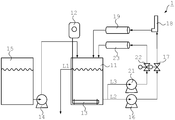
- FIG. 1 is a schematic view showing the configuration of a water flow test device.
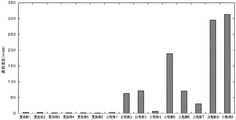
- FIG. 2 is a graph showing the results of the corrosion rate test of the example.
- FIG. 3 is a graph showing the results of the corrosion loss test of the example.
- the metal anticorrosive for cooling water according to the present invention includes phosphonotartaric acid, a phosphate compound other than phosphonotartaric acid which suppresses an anodic reaction causing metal corrosion, and a zinc compound, and is an anodic reaction causing phosphonotartaric acid and metal corrosion.
- the content of phosphonotartaric acid is 35% by mass or more in terms of PO 4 with respect to the total of the above-mentioned phosphate compounds other than phosphonotartaric acid.
- the phosphono tartaric acid contained in the metal anticorrosive for cooling water of the present invention is a compound which can be represented by the following formula (I).
- the anodic reaction-inhibiting phosphoric acid compound is a phosphoric acid capable of suppressing an anodic reaction causing metal corrosion as compared to 2-phosphonobutane-1,2,3-tricarboxylic acid (PBTC) and hexametaphosphoric acid.
- PBTC 2-phosphonobutane-1,2,3-tricarboxylic acid
- the compound means a phosphate compound other than phosphonotartaric acid.
- the anodic reaction-inhibiting phosphoric acid compound is preferably at least one phosphoric acid compound selected from the group consisting of orthophosphoric acid and 1-hydroxyethylidene-1,1-diphosphonic acid (HEDP).
- HEDP 1-hydroxyethylidene-1,1-diphosphonic acid
- phosphoric acid compounds other than phosphonotartaric acid and the anodic reaction-inhibiting phosphoric acid compound 2-phosphonobutane-1,2,3-tricarboxylic acid (PBTC), hexametaphosphoric acid and the like can be mentioned as phosphoric acid compounds other than phosphonotartaric acid and the anodic reaction-inhibiting phosphoric acid compound.
- phosphoric acid compounds other than these phosphono tartaric acid and anodic reaction inhibiting phosphoric acid compounds metal corrosion in heat exchangers, reaction kettles, pipes, etc. is suppressed by the addition of a low concentration of drug in a low hardness cooling water system From the viewpoint of the above, it is preferable that the metal corrosion inhibitor for cooling water of the present invention is not contained.
- zinc compound examples include zinc metaborate, zinc tetraborate, zinc fluoride, zinc bromide, zinc chloride, zinc iodide, zinc chlorite, Zinc chlorate, zinc perchlorate, zinc periodate, zinc carbonate, zinc carbonate hydroxide, zinc oxalate, zinc carbide, zinc formate, zinc acetate, zinc propionate, zinc butyrate, zinc valerate, zinc nitrate, zinc subate Zinc nitrate, zinc oxide, zinc peroxide, zinc phosphide, zinc phosphinate, zinc diphosphate, zinc sulfide, zinc dithioate, zinc sulfite, zinc sulfate, zinc tetrathionate, zinc pentathionate and the like can be mentioned.
- Preferred zinc compounds are at least one member selected from the group consisting of zinc chloride and zinc sulfate from the viewpoint that metal corrosion in heat exchangers, reaction kettles and pipes can be suppressed by the addition of a low concentration of a drug. It is a zinc salt, more preferably zinc chloride.
- the metal anticorrosive for cooling water of the present invention comprises at least one AA / sulfone group-containing agent selected from the group consisting of AA / AMPS copolymer, AA / HAPS copolymer, and AA / AMPS / HAPS copolymer. It may further contain a copolymer. Thereby, the metal corrosion inhibitory effect in the metal anticorrosive for cooling water of this invention can further be improved.
- the AA / AMPS copolymer is a copolymer of at least one of acrylic acid (AA) and its salt and at least one of acrylamidomethylpropane sulfonic acid (AMPS) and its salt.
- the AA / HAPS copolymer is a copolymer of at least one of acrylic acid (AA) and its salt and at least one of hydroxyaryloxypropane sulfonic acid (HAPS) and its salt.
- the AA / AMPS / HAPS copolymer includes at least one of acrylic acid (AA) and its salt, at least one of acrylamidomethylpropane sulfonic acid (AMPS) and its salt, and hydroxyallyloxypropane sulfonic acid. (HAPS) and copolymers with at least one of its salts.
- the weight average molecular weight of the at least one AA / sulfone group-containing copolymer is preferably 500 to 50,000, from the viewpoint of further improving the metal corrosion suppressing effect of the metal anticorrosive for cooling water of the present invention. More preferably, it is 1,000 to 20,000, and still more preferably 2,000 to 10,000.
- the said weight average molecular weight is a value of standard polyacrylic acid conversion by gel permeation chromatography (GPC method).
- the ratio of the structural unit derived from AA to the structural unit derived from AMPS, HAPS and their salts is preferably molar It is 70:30 to 95: 5 in ratio, more preferably 80:20 to 90:10 in molar ratio.
- the metal anticorrosive for cooling water of the present invention may contain components other than the above as long as the effects of the present invention are not impaired.
- a solvent such as water, other additives, etc. may be included.
- the content of the phosphono tartrate to the total of phosphono tartaric acid and the anode reaction inhibitor phosphoric acid compound is a PO 4 terms, not less than 35 wt%, preferably 45-90 wt% More preferably, it is 50 to 75% by mass.
- the metal corrosion of heat exchangers, reaction kettles, pipes, etc. should be suppressed if the content of phosphonotartaric acid is less than 35% by mass with respect to the total of phosphonotartaric acid and the anodic reaction inhibiting phosphoric acid compound. I can not
- the total amount of phosphoric acid compounds in the metal corrosion inhibitor for cooling water of the present invention is 60% by mass or more, preferably 80% by mass or more, more preferably 90% by mass or more, in PO 4 conversion. It is 100% by mass.
- the Zn equivalent of the zinc compound is preferably 10 to 500 parts by mass, more preferably 50 to 200 parts by mass, still more preferably 70 to 140 parts by mass, and still more preferably 80 to 140 parts by mass. is there.
- the ratio of the AA / sulfone group-containing copolymer is preferably 10 to 1000 parts by mass, more preferably 80 to 500 parts by mass, and still more preferably 100 to 300 parts by mass.
- the total amount of the reaction suppressing phosphoric acid compound, the zinc compound, and the AA / sulfone group-containing copolymer is preferably 60% by mass or more, preferably 80% by mass or more, and more preferably 90% by mass or more. More preferably, it is 100 mass%.
- the method of treating a cooling water system comprises a cooling water system having a calcium hardness of 30 to 150 mg / L as CaCO 3 , phosphonotartaric acid, an anodic reaction suppressing phosphoric acid compound and a zinc compound; the content of the phosphono tartaric to the total of the acid compound is added in an amount of 35 mass% or more PO 4 terms.
- metal corrosion of a heat exchanger, a reaction kettle, piping, etc. can be suppressed by chemical
- an AA / sulfone group-containing copolymer may be further added.
- the AA / sulfone group-containing copolymer is as described above.
- the above phosphonotartaric acid, the anodic reaction inhibiting phosphoric acid compound, the zinc compound, and the AA / sulfone group-containing copolymer may be separately added to the cooling water system.
- the necessary components can be added at the necessary timing, so the amount of drug can be further suppressed.
- a threshold for example, the lower limit value of a suitable concentration range described later
- the zinc compound concentration (Zn equivalent) in the cooling water system is measured continuously, periodically, or irregularly, and the measured value falls to a threshold (for example, the lower limit value of a suitable concentration range described later)
- zinc compounds may be added.
- the concentration of the AA / sulfone group-containing copolymer in the cooling water system is measured continuously, periodically, or irregularly, and the measured value falls to a threshold (for example, the lower limit value of a suitable concentration range described later) If it is the case, an AA / sulfone group-containing copolymer may be added.
- the above-mentioned metal corrosion inhibitor for cooling water may be added to the cooling water system.
- the respective threshold for example, the lower limit of the preferred concentration range described later
- the low hardness cooling water system is a cooling water system having a calcium hardness of 30 to 150 mg / L as CaCO 3 .
- metal corrosion inhibitor for cooling water From the viewpoint of the effect of suppressing metal corrosion in heat exchangers, reaction kettles, pipes, etc. by the above phosphoric acid compounds in the metal corrosion inhibitor for cooling water, PO 4 of phosphonotartaric acid and the above anodic reaction suppressing phosphoric acid compounds in the cooling water system To a concentration of 0.05 to 5 mg / L, more preferably 0.1 to 3.0 mg / L, and still more preferably 0.5 to 2 mg / L.
- the metal corrosion inhibitor for cooling water of the present invention may be added to the above cooling water system so as to be even more preferably 0.8 to 1.8 mg / L.
- the zinc element converted concentration of the zinc compound in the cooling water system is preferably from the viewpoint of the effect of suppressing metal corrosion of the heat exchanger, reaction kettle, piping, etc. by the zinc compound in the metal corrosion inhibitor for cooling water. More preferably, it will be 0.05 to 5 mg / L, more preferably 0.1 to 3.0 mg / L, even more preferably 0.5 to 2.0 mg / L.
- the metal anticorrosive for cooling water of the present invention may be added to the above cooling water system so as to be 1.0 to 2.0 mg / L. Further, instead of the metal anticorrosive for cooling water of the present invention, a zinc compound may be added to the above cooling water system so as to be within the above concentration range.
- the at least one in the cooling water system The concentration in terms of solid content of the species AA / sulfone group-containing copolymer is preferably 1 to 10 mg / L, more preferably 2 to 10 mg / L, and still more preferably 2 to 7 mg / L You may add the metal anticorrosive agent for cooling water of this invention to the said cooling water system so that it may become L. Further, instead of the metal anticorrosive for cooling water of the present invention, the at least one AA / sulfone group-containing copolymer may be added to the cooling water system so as to be within the above concentration range.
- Example 1 (Corrosion test for sound surface) A low carbon steel (JIS G3141 SPSS-SB) having dimensions of 50 mm ⁇ 30 mm ⁇ 1 mm and a surface area of 0.31 dm 2 was polished with # 400, and a specimen subjected to toluene degreasing was used as a sample. The weight of the sample was measured and taken as the weight before the test. A small amount of water is added to an aqueous solution of sodium hydrogencarbonate, an aqueous solution of magnesium sulfate, an aqueous solution of sodium chloride, an aqueous solution of calcium chloride and an anticorrosive 1 after adding pure water to 1000 ml in an amount of 1000 ml. The pH was adjusted with an aqueous solution of sodium oxide and an aqueous solution of sulfuric acid to prepare test water. Table 3 shows the water quality of the test water of Example 1.
- Examples 2 to 6 and Comparative Examples 1 to 9 (Corrosion test for sound surface) Test water was prepared in the same manner as in Example 1 except that the anticorrosive agent 2 to 15 was used instead of the anticorrosive agent 1.
- the water quality of the test water of Examples 2 to 6 and Comparative Examples 1 to 9 is shown in Table 3.
- the corrosion resistance was evaluated in the same manner as in Example 1 except that the test waters of Examples 2 to 6 and Comparative Examples 1 to 9 were used instead of the test water of Example 1. The evaluation results are shown in FIG. 2 and Table 3.
- Example 7 (Corrosion weight loss test for corroded surface) First, two short tubes made of carbon steel (STB-340) with a length of 10 cm and an inner diameter of 15 mm are prepared in 2 tubes / 1 condition, subjected to toluene degreasing, and then subjected to edging treatment with 5 mass% HCl. And The weight of the short tube was measured by a balance to obtain the weight before the test.
- the test water was transferred to the water test apparatus (FIG. 1), and continuous feeding was performed so that the residence time was 120 hours.
- a test water tank 11 (volume: 50 L) containing test water is provided.
- the test water in the test water tank is heated by the heater 13 whose exothermic temperature is controlled by the heater controller 12, and the water temperature of the test water is maintained at 30 ° C.
- the test water is supplied to the test water tank 11 from the makeup water tank (volume: 50 L) 15 using the water supply pump 14.
- the test water is discharged from the test water tank 11 through the line L1 as an overflow. Thereby, the water volume of the test water tank 11 is maintained constant.
- the test water discharged from the test tank 11 is divided into two lines L2 and L3.
- the test water that has passed through the circulating water pump 16 and the flow rate adjustment valve 17 is supplied to the air inlet 18. Air is mixed into the test water at the air inlet 18.
- the test water mixed with air passes through the short tube 19 of carbon steel and returns to the test water tank 11.
- the flow velocity of the test water which passes the inside of the short tube 19 of carbon steel is 0.3 m / s.
- the test water having passed through the circulating water pump 21 and the flow rate adjustment valve 22 passes through the short pipe 23 of carbon steel and returns to the test water tank 11.
- the flow velocity of the test water which passes through the inside of the short tube 23 of carbon steel is 0.3 m / s.
- the above-described short pipe was attached to the water flow test apparatus (FIG. 1) to start the test.
- the short tubes were pulled up 20 hours and 68 hours after the start of the test.
- the pulled up short tube was internally cleaned with acid to remove corrosion products, and then the weight was measured and the corresponding amount was taken as the weight after the test.
- Example 8 to 10 and Comparative Examples 10 to 13 (Corrosion weight loss test for corroded surface) Test water was prepared in the same manner as in Example 7 except that the anticorrosive 2, 4, 5, 7 to 10 was used instead of the anticorrosive 1.
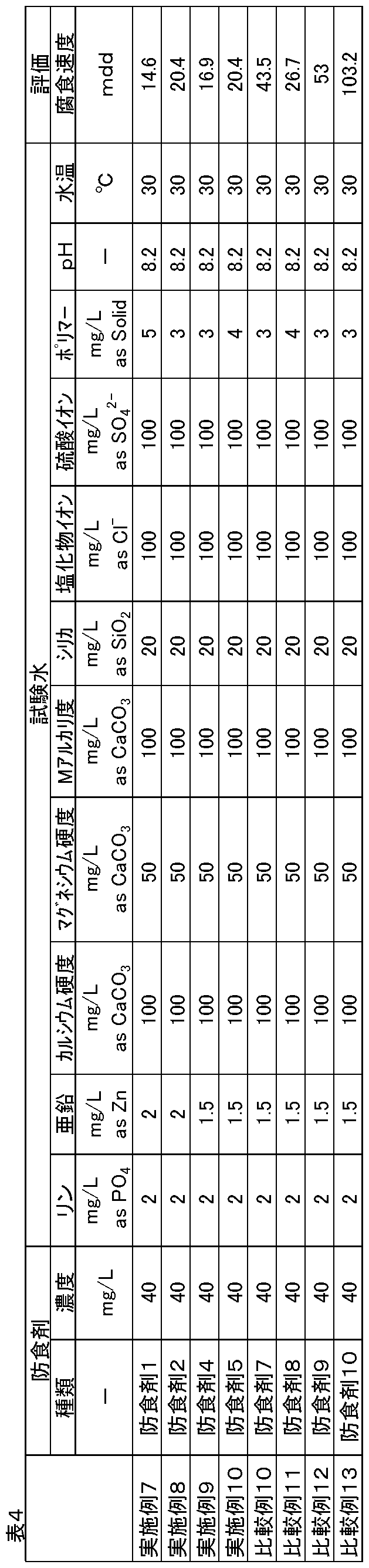
- the water quality of the test water of Examples 8 to 10 and Comparative Examples 10 to 13 is shown in Table 4.
- the anticorrosive performance was evaluated in the same manner as in Example 7 except that the test waters of Examples 8 to 10 and Comparative Examples 10 to 13 were used instead of the test water of Example 7. The evaluation results are shown in FIG. 3 and Table 4.
- the metal anticorrosive for cooling water contains phosphonotartaric acid, an anodic reaction suppressing phosphoric acid compound and a zinc compound, and the above phosphono tartaric acid and the above anodic reaction suppressing phosphoric acid compound It was found that by setting the content of the above phosphonotartaric acid to 35% by mass or more with respect to the total, the metal corrosion rate can be reduced by the addition of a low concentration of drug, and further the corrosion loss of the metal can be reduced by the addition of a low concentration of drug .
Landscapes
- Chemical & Material Sciences (AREA)
- Engineering & Computer Science (AREA)
- Organic Chemistry (AREA)
- Materials Engineering (AREA)
- Mechanical Engineering (AREA)
- Metallurgy (AREA)
- Inorganic Chemistry (AREA)
- Chemical Kinetics & Catalysis (AREA)
- General Chemical & Material Sciences (AREA)
- Life Sciences & Earth Sciences (AREA)
- Hydrology & Water Resources (AREA)
- Environmental & Geological Engineering (AREA)
- Water Supply & Treatment (AREA)
- Preventing Corrosion Or Incrustation Of Metals (AREA)
Abstract
ホスホノ酒石酸、金属腐食の原因となるアノード反応を抑制する、前記ホスホノ酒石酸以外のリン酸化合物及び亜鉛化合物を含み、前記ホスホノ酒石酸と金属腐食の原因となるアノード反応を抑制する、前記ホスホノ酒石酸以外のリン酸化合物との合計に対する前記ホスホノ酒石酸の含有量が、PO4換算で35質量%以上である、冷却水用金属防食剤。
Description
本発明は、冷却水が流通する配管及び熱交換器等の金属の腐食を抑制する冷却水用金属防食剤及びその冷却水用金属防食剤を使用した冷却水系の処理方法に関する。
開放循環冷却水系に設けられた金属部材、例えば、炭素鋼、銅、又は銅合金製の熱交換器や反応釜、配管は、冷却水と接触することにより腐食を受けることから、一般に、薬剤添加による防食処理が施されている。
炭素鋼製の熱交換器及び反応釜並びに配管の腐食を抑制するために、オルソリン酸塩、ヘキサメタリン酸塩、ヒドロキシエチリデンホスホン酸塩、ホスホノブタントリカルボン酸塩等のリン化合物が冷却水に添加されている。亜鉛塩や重クロム酸塩のような重金属塩を単独あるいは併用して添加する場合もある。
特に、低硬度水質においては、硬度成分による防食効果が期待できないため、硬度の高い水質に比較して腐食が起こりやすく、十分な防食効果を得るためには、一定量以上のリン酸塩等を添加する必要がある(例えば、非特許文献1参照)。これは、近年の環境負荷低減の流れに反するものである。また、環境負荷を低減した処理方法として、水質の成分を調整する方法により、防食効果を改善する方法が提案されている(例えば、特許文献1参照)。特許文献1には、リン酸と亜鉛塩と酸消費量成分とが添加され、全リン酸濃度及び亜鉛濃度がそれぞれ1mg/L以下、かつ、30℃におけるランゲリア指数を1.2以上とすることにより防食効果が発揮されることが述べられている。
炭素鋼製の熱交換器及び反応釜並びに配管の腐食を抑制するために、オルソリン酸塩、ヘキサメタリン酸塩、ヒドロキシエチリデンホスホン酸塩、ホスホノブタントリカルボン酸塩等のリン化合物が冷却水に添加されている。亜鉛塩や重クロム酸塩のような重金属塩を単独あるいは併用して添加する場合もある。
特に、低硬度水質においては、硬度成分による防食効果が期待できないため、硬度の高い水質に比較して腐食が起こりやすく、十分な防食効果を得るためには、一定量以上のリン酸塩等を添加する必要がある(例えば、非特許文献1参照)。これは、近年の環境負荷低減の流れに反するものである。また、環境負荷を低減した処理方法として、水質の成分を調整する方法により、防食効果を改善する方法が提案されている(例えば、特許文献1参照)。特許文献1には、リン酸と亜鉛塩と酸消費量成分とが添加され、全リン酸濃度及び亜鉛濃度がそれぞれ1mg/L以下、かつ、30℃におけるランゲリア指数を1.2以上とすることにより防食効果が発揮されることが述べられている。
栗田工業水処理薬品ハンドブック編集委員会編,「薬品ハンドブック第3版」,183頁(1995年)
しかしながら、特許文献1に記載の防食効果を改善する方法では、カルシウム硬度、シリカ濃度及びランゲリア指数を一定値以上にするために、膨大な薬剤を添加する必要がある。また、特許文献1には低硬度水質における防食効果及びスケール防止効果は開示されていない。
したがって、低硬度の冷却水系処理において、より低い防食剤濃度で高い防食効果を示すような防食剤が望まれている。
そこで、本発明は、低硬度の冷却水系において、熱交換器、反応釜及び配管等の金属腐食を、低濃度の薬剤添加で抑制することができる冷却水用金属防食剤及びその冷却水用金属防食剤を使用した冷却水系の処理方法を提供することを目的とする。
したがって、低硬度の冷却水系処理において、より低い防食剤濃度で高い防食効果を示すような防食剤が望まれている。
そこで、本発明は、低硬度の冷却水系において、熱交換器、反応釜及び配管等の金属腐食を、低濃度の薬剤添加で抑制することができる冷却水用金属防食剤及びその冷却水用金属防食剤を使用した冷却水系の処理方法を提供することを目的とする。
本発明者等は、鋭意研究を行った結果、ホスホノ酒石酸、金属腐食の原因となるアノード反応を抑制する、ホスホノ酒石酸以外のリン酸化合物及び亜鉛化合物を含む冷却水用金属防食剤によって、上記課題を解決できることを見出し、本発明を完成させるに至った。すなわち、本発明は以下のとおりである。
[1]ホスホノ酒石酸、金属腐食の原因となるアノード反応を抑制する、前記ホスホノ酒石酸以外のリン酸化合物及び亜鉛化合物を含み、前記ホスホノ酒石酸と前記金属腐食の原因となるアノード反応を抑制する、前記ホスホノ酒石酸以外のリン酸化合物との合計に対する前記ホスホノ酒石酸の含有量が、PO4換算で35質量%以上である冷却水用金属防食剤。
[2]前記金属腐食の原因となるアノード反応を抑制する、前記ホスホノ酒石酸以外のリン酸化合物が、オルソリン酸及び1-ヒドロキシエチリデン-1,1-ジホスホン酸(HEDP)からなる群から選択される少なくとも1種のリン酸化合物である上記[1]に記載の冷却水用金属防食剤。
[3]前記亜鉛化合物が、塩化亜鉛及び硫酸亜鉛からなる群から選択される少なくとも1種の亜鉛塩である上記[1]又は[2]に記載の冷却水用金属防食剤。
[4]下記のAA/AMPS共重合体、AA/HAPS共重合体、及びAA/AMPS/HAPS共重合体からなる群から選択される少なくとも1種のAA/スルホン基含有共重合体をさらに含む上記[1]~[3]のいずれか1つに記載の冷却水用金属防食剤。
AA/AMPS共重合体:アクリル酸(AA)及びその塩の少なくとも1種とアクリルアミドメチルプロパンスルホン酸(AMPS)及びその塩の少なくとも1種との共重合体
AA/HAPS共重合体:アクリル酸(AA)及びその塩の少なくとも1種とヒドロキシアリロキシプロパンスルホン酸(HAPS)及びその塩の少なくとも1種との共重合体
AA/AMPS/HAPS共重合体:アクリル酸(AA)及びその塩の少なくとも1種と、アクリルアミドメチルプロパンスルホン酸(AMPS)及びその塩の少なくとも1種と、ヒドロキシアリロキシプロパンスルホン酸(HAPS)及びその塩の少なくとも1種との共重合体
[5]前記少なくとも1種のAA/スルホン基含有共重合体の重量平均分子量が500~50,000であり、前記少なくとも1種のAA/スルホン基含有共重合体が、AA及びその塩に由来する構成単位と、AMPS、HAPS及びそれらの塩に由来する構成単位とを、モル比で70:30~95:5の割合で含む上記[4]に記載の冷却水用金属防食剤。
[6]カルシウム硬度がCaCO3として、30~150mg/Lである冷却水系に、ホスホノ酒石酸、金属腐食の原因となるアノード反応を抑制する、前記ホスホノ酒石酸以外のリン酸化合物及び亜鉛化合物を、前記ホスホノ酒石酸と前記ホスホノ酒石酸以外のリン酸化合物との合計に対する前記ホスホノ酒石酸の含有量が、PO4換算で35質量%以上となるように添加する冷却水系の処理方法。
[7]カルシウム硬度がCaCO3として、30~150mg/Lである冷却水系に、上記[1]~[5]のいずれか1つに記載の冷却水用金属防食剤を添加する冷却水系の処理方法。
[8]前記冷却水系内における前記ホスホノ酒石酸と、前記金属腐食の原因となるアノード反応を抑制する、前記ホスホノ酒石酸以外のリン酸化合物及び亜鉛化合物とをPO4で換算した合計の濃度が0.05~5mg/Lになるように、前記冷却水用金属防食剤を前記冷却水系に添加する上記[7]に記載の冷却水系の処理方法。
[9]前記冷却水系内における前記亜鉛化合物の亜鉛元素換算した濃度が0.05~5mg/Lになるように、前記冷却水用金属防食剤を前記冷却水系に添加する上記[7]又は[8]に記載の冷却水系の処理方法。
[10]冷却水系内における前記少なくとも1種のAA/スルホン基含有共重合体の固形分換算の濃度が1~10mg/Lになるように、上記[4]又は[5]に記載の冷却水用金属防食剤を、カルシウム硬度がCaCO3として、30~150mg/Lである冷却水系に添加する冷却水系の処理方法。
[1]ホスホノ酒石酸、金属腐食の原因となるアノード反応を抑制する、前記ホスホノ酒石酸以外のリン酸化合物及び亜鉛化合物を含み、前記ホスホノ酒石酸と前記金属腐食の原因となるアノード反応を抑制する、前記ホスホノ酒石酸以外のリン酸化合物との合計に対する前記ホスホノ酒石酸の含有量が、PO4換算で35質量%以上である冷却水用金属防食剤。
[2]前記金属腐食の原因となるアノード反応を抑制する、前記ホスホノ酒石酸以外のリン酸化合物が、オルソリン酸及び1-ヒドロキシエチリデン-1,1-ジホスホン酸(HEDP)からなる群から選択される少なくとも1種のリン酸化合物である上記[1]に記載の冷却水用金属防食剤。
[3]前記亜鉛化合物が、塩化亜鉛及び硫酸亜鉛からなる群から選択される少なくとも1種の亜鉛塩である上記[1]又は[2]に記載の冷却水用金属防食剤。
[4]下記のAA/AMPS共重合体、AA/HAPS共重合体、及びAA/AMPS/HAPS共重合体からなる群から選択される少なくとも1種のAA/スルホン基含有共重合体をさらに含む上記[1]~[3]のいずれか1つに記載の冷却水用金属防食剤。
AA/AMPS共重合体:アクリル酸(AA)及びその塩の少なくとも1種とアクリルアミドメチルプロパンスルホン酸(AMPS)及びその塩の少なくとも1種との共重合体
AA/HAPS共重合体:アクリル酸(AA)及びその塩の少なくとも1種とヒドロキシアリロキシプロパンスルホン酸(HAPS)及びその塩の少なくとも1種との共重合体
AA/AMPS/HAPS共重合体:アクリル酸(AA)及びその塩の少なくとも1種と、アクリルアミドメチルプロパンスルホン酸(AMPS)及びその塩の少なくとも1種と、ヒドロキシアリロキシプロパンスルホン酸(HAPS)及びその塩の少なくとも1種との共重合体
[5]前記少なくとも1種のAA/スルホン基含有共重合体の重量平均分子量が500~50,000であり、前記少なくとも1種のAA/スルホン基含有共重合体が、AA及びその塩に由来する構成単位と、AMPS、HAPS及びそれらの塩に由来する構成単位とを、モル比で70:30~95:5の割合で含む上記[4]に記載の冷却水用金属防食剤。
[6]カルシウム硬度がCaCO3として、30~150mg/Lである冷却水系に、ホスホノ酒石酸、金属腐食の原因となるアノード反応を抑制する、前記ホスホノ酒石酸以外のリン酸化合物及び亜鉛化合物を、前記ホスホノ酒石酸と前記ホスホノ酒石酸以外のリン酸化合物との合計に対する前記ホスホノ酒石酸の含有量が、PO4換算で35質量%以上となるように添加する冷却水系の処理方法。
[7]カルシウム硬度がCaCO3として、30~150mg/Lである冷却水系に、上記[1]~[5]のいずれか1つに記載の冷却水用金属防食剤を添加する冷却水系の処理方法。
[8]前記冷却水系内における前記ホスホノ酒石酸と、前記金属腐食の原因となるアノード反応を抑制する、前記ホスホノ酒石酸以外のリン酸化合物及び亜鉛化合物とをPO4で換算した合計の濃度が0.05~5mg/Lになるように、前記冷却水用金属防食剤を前記冷却水系に添加する上記[7]に記載の冷却水系の処理方法。
[9]前記冷却水系内における前記亜鉛化合物の亜鉛元素換算した濃度が0.05~5mg/Lになるように、前記冷却水用金属防食剤を前記冷却水系に添加する上記[7]又は[8]に記載の冷却水系の処理方法。
[10]冷却水系内における前記少なくとも1種のAA/スルホン基含有共重合体の固形分換算の濃度が1~10mg/Lになるように、上記[4]又は[5]に記載の冷却水用金属防食剤を、カルシウム硬度がCaCO3として、30~150mg/Lである冷却水系に添加する冷却水系の処理方法。
本発明によれば、低硬度の冷却水系において、熱交換器、反応釜及び配管等の金属腐食を、低濃度の薬剤添加で抑制することができる冷却水用金属防食剤及びその冷却水用金属防食剤を使用した冷却水系の処理方法を提供することができる。
[冷却水用金属防食剤]
本発明の冷却水用金属防食剤は、ホスホノ酒石酸、金属腐食の原因となるアノード反応を抑制する、ホスホノ酒石酸以外のリン酸化合物及び亜鉛化合物を含み、ホスホノ酒石酸と金属腐食の原因となるアノード反応を抑制する、前記ホスホノ酒石酸以外のリン酸化合物との合計に対するホスホノ酒石酸の含有量が、PO4換算で35質量%以上である。これにより、熱交換器、反応釜及び配管等の金属腐食を、低濃度の薬剤添加で抑制することができる。以下、本発明の冷却水用金属防食剤を詳細に説明する。
本発明の冷却水用金属防食剤は、ホスホノ酒石酸、金属腐食の原因となるアノード反応を抑制する、ホスホノ酒石酸以外のリン酸化合物及び亜鉛化合物を含み、ホスホノ酒石酸と金属腐食の原因となるアノード反応を抑制する、前記ホスホノ酒石酸以外のリン酸化合物との合計に対するホスホノ酒石酸の含有量が、PO4換算で35質量%以上である。これにより、熱交換器、反応釜及び配管等の金属腐食を、低濃度の薬剤添加で抑制することができる。以下、本発明の冷却水用金属防食剤を詳細に説明する。
(ホスホノ酒石酸)
本発明の冷却水用金属防食剤に含まれているホスホノ酒石酸は下記の式(I)で表すことができる化合物である。
本発明の冷却水用金属防食剤に含まれているホスホノ酒石酸は下記の式(I)で表すことができる化合物である。

(金属腐食の原因となるアノード反応を抑制する、ホスホノ酒石酸以外のリン酸化合物)
熱交換器、反応釜及び配管等の金属が電子を放出しイオン化すると、すなわち、上記金属にアノード反応が起こると、金属腐食が発生し進行する。「金属腐食の原因となるアノード反応を抑制する、ホスホノ酒石酸以外のリン酸化合物」(以下、「アノード反応抑制リン酸化合物」ということがある)とは、上記アノード反応の発生及び進行を抑制する、ホスホノ酒石酸以外のリン酸化合物である。
詳しくは、アノード反応抑制リン酸化合物とは、2-ホスホノブタン-1,2,3-トリカルボン酸(PBTC)及びヘキサメタリン酸に比べて、金属腐食の原因となるアノード反応を抑制することができるリン酸化合物であって、ホスホノ酒石酸以外のリン酸化合物を意味する。
熱交換器、反応釜及び配管等の金属が電子を放出しイオン化すると、すなわち、上記金属にアノード反応が起こると、金属腐食が発生し進行する。「金属腐食の原因となるアノード反応を抑制する、ホスホノ酒石酸以外のリン酸化合物」(以下、「アノード反応抑制リン酸化合物」ということがある)とは、上記アノード反応の発生及び進行を抑制する、ホスホノ酒石酸以外のリン酸化合物である。
詳しくは、アノード反応抑制リン酸化合物とは、2-ホスホノブタン-1,2,3-トリカルボン酸(PBTC)及びヘキサメタリン酸に比べて、金属腐食の原因となるアノード反応を抑制することができるリン酸化合物であって、ホスホノ酒石酸以外のリン酸化合物を意味する。
当該アノード反応抑制リン酸化合物は、好ましくはオルソリン酸及び1-ヒドロキシエチリデン-1,1-ジホスホン酸(HEDP)からなる群から選択される少なくとも1種のリン酸化合物である。
なお、ホスホノ酒石酸及びアノード反応抑制リン酸化合物に対してそれ以外のリン酸化合物としては、2-ホスホノブタン-1,2,3-トリカルボン酸(PBTC)、ヘキサメタリン酸等が挙げられる。
これらホスホノ酒石酸及びアノード反応抑制リン酸化合物に対してそれ以外のリン酸化合物については、低硬度の冷却水系において、熱交換器、反応釜及び配管等の金属腐食を、低濃度の薬剤添加で抑制する観点から、本発明の冷却水用金属防食剤中に含まれないことが好ましい。
これらホスホノ酒石酸及びアノード反応抑制リン酸化合物に対してそれ以外のリン酸化合物については、低硬度の冷却水系において、熱交換器、反応釜及び配管等の金属腐食を、低濃度の薬剤添加で抑制する観点から、本発明の冷却水用金属防食剤中に含まれないことが好ましい。
(亜鉛化合物)
本発明の冷却水用金属防食剤に含まれている亜鉛化合物には、例えば、メタホウ酸亜鉛、四ホウ酸亜鉛、フッ化亜鉛、臭化亜鉛、塩化亜鉛、ヨウ化亜鉛、亜塩素酸亜鉛、塩素酸亜鉛、過塩素酸亜鉛、過ヨウ素酸亜鉛、炭酸亜鉛、炭酸水酸化亜鉛、シュウ酸亜鉛、炭化亜鉛、ギ酸亜鉛、酢酸亜鉛、プロピオン酸亜鉛、酪酸亜鉛、吉草酸亜鉛、硝酸亜鉛、亜硝酸亜鉛、酸化亜鉛、過酸化亜鉛、リン化亜鉛、ホスフィン酸亜鉛、二リン酸亜鉛、硫化亜鉛、ジチオ酸亜鉛、亜硫酸亜鉛、硫酸亜鉛、テトラチオン酸亜鉛及びペンタチオン酸亜鉛等が挙げられる。これらの一種を単独で、またはこれらの二種以上を組み合わせて使用することができる。熱交換器、反応釜及び配管等の金属腐食を、低濃度の薬剤添加で抑制することができるという観点から、好ましい亜鉛化合物は、塩化亜鉛及び硫酸亜鉛からなる群から選択される少なくとも1種の亜鉛塩であり、より好ましくは塩化亜鉛である。
本発明の冷却水用金属防食剤に含まれている亜鉛化合物には、例えば、メタホウ酸亜鉛、四ホウ酸亜鉛、フッ化亜鉛、臭化亜鉛、塩化亜鉛、ヨウ化亜鉛、亜塩素酸亜鉛、塩素酸亜鉛、過塩素酸亜鉛、過ヨウ素酸亜鉛、炭酸亜鉛、炭酸水酸化亜鉛、シュウ酸亜鉛、炭化亜鉛、ギ酸亜鉛、酢酸亜鉛、プロピオン酸亜鉛、酪酸亜鉛、吉草酸亜鉛、硝酸亜鉛、亜硝酸亜鉛、酸化亜鉛、過酸化亜鉛、リン化亜鉛、ホスフィン酸亜鉛、二リン酸亜鉛、硫化亜鉛、ジチオ酸亜鉛、亜硫酸亜鉛、硫酸亜鉛、テトラチオン酸亜鉛及びペンタチオン酸亜鉛等が挙げられる。これらの一種を単独で、またはこれらの二種以上を組み合わせて使用することができる。熱交換器、反応釜及び配管等の金属腐食を、低濃度の薬剤添加で抑制することができるという観点から、好ましい亜鉛化合物は、塩化亜鉛及び硫酸亜鉛からなる群から選択される少なくとも1種の亜鉛塩であり、より好ましくは塩化亜鉛である。
(AA/スルホン基含有共重合体)
本発明の冷却水用金属防食剤は、AA/AMPS共重合体、AA/HAPS共重合体、及びAA/AMPS/HAPS共重合体からなる群から選択される少なくとも1種のAA/スルホン基含有共重合体をさらに含んでもよい。これにより、本発明の冷却水用金属防食剤における金属腐食抑制効果をさらに向上させることができる。
ここで、AA/AMPS共重合体とは、アクリル酸(AA)及びその塩の少なくとも1種とアクリルアミドメチルプロパンスルホン酸(AMPS)及びその塩の少なくとも1種との共重合体である。また、AA/HAPS共重合体とは、アクリル酸(AA)及びその塩の少なくとも1種とヒドロキシアリロキシプロパンスルホン酸(HAPS)及びその塩の少なくとも1種との共重合体である。さらに、AA/AMPS/HAPS共重合体とは、アクリル酸(AA)及びその塩の少なくとも1種と、アクリルアミドメチルプロパンスルホン酸(AMPS)及びその塩の少なくとも1種と、ヒドロキシアリロキシプロパンスルホン酸(HAPS)及びその塩の少なくとも1種との共重合体である。
本発明の冷却水用金属防食剤は、AA/AMPS共重合体、AA/HAPS共重合体、及びAA/AMPS/HAPS共重合体からなる群から選択される少なくとも1種のAA/スルホン基含有共重合体をさらに含んでもよい。これにより、本発明の冷却水用金属防食剤における金属腐食抑制効果をさらに向上させることができる。
ここで、AA/AMPS共重合体とは、アクリル酸(AA)及びその塩の少なくとも1種とアクリルアミドメチルプロパンスルホン酸(AMPS)及びその塩の少なくとも1種との共重合体である。また、AA/HAPS共重合体とは、アクリル酸(AA)及びその塩の少なくとも1種とヒドロキシアリロキシプロパンスルホン酸(HAPS)及びその塩の少なくとも1種との共重合体である。さらに、AA/AMPS/HAPS共重合体とは、アクリル酸(AA)及びその塩の少なくとも1種と、アクリルアミドメチルプロパンスルホン酸(AMPS)及びその塩の少なくとも1種と、ヒドロキシアリロキシプロパンスルホン酸(HAPS)及びその塩の少なくとも1種との共重合体である。
本発明の冷却水用金属防食剤における金属腐食抑制効果をさらに向上させるという観点から、上記少なくとも1種のAA/スルホン基含有共重合体の重量平均分子量は、好ましくは500~50,000であり、より好ましくは1,000~20,000であり、さらに好ましくは2,000~10,000である。なお、上記重量平均分子量は、ゲルパーミエイションクロマトグラフィー(GPC法)による標準ポリアクリル酸換算の値である。
本発明の冷却水用金属防食剤における金属腐食抑制効果をさらに向上させるという観点から、AAに由来する構成単位と、AMPS、HAPS及びそれらの塩に由来する構成単位との割合は、好ましくはモル比で70:30~95:5であり、より好ましくはモル比で80:20~90:10である。
(その他の成分)
本発明の冷却水用金属防食剤は、本発明の効果を阻害しない限り、上記以外の成分を含んでもよい。例えば、水等の溶媒、他の添加剤等を含んでもよい。
本発明の冷却水用金属防食剤は、本発明の効果を阻害しない限り、上記以外の成分を含んでもよい。例えば、水等の溶媒、他の添加剤等を含んでもよい。
(各成分の含有量)
本発明の冷却水用金属防食剤における、ホスホノ酒石酸とアノード反応抑制リン酸化合物との合計に対するホスホノ酒石酸の含有量は、PO4換算で、35質量%以上であり、好ましくは45~90質量%であり、より好ましくは50~75質量%である。ホスホノ酒石酸とアノード反応抑制リン酸化合物との合計に対するホスホノ酒石酸の含有量が35質量%未満であると、低濃度の薬剤添加では、熱交換器、反応釜及び配管等の金属腐食を抑制することができない。
本発明の冷却水用金属防食剤における、ホスホノ酒石酸とアノード反応抑制リン酸化合物との合計に対するホスホノ酒石酸の含有量は、PO4換算で、35質量%以上であり、好ましくは45~90質量%であり、より好ましくは50~75質量%である。ホスホノ酒石酸とアノード反応抑制リン酸化合物との合計に対するホスホノ酒石酸の含有量が35質量%未満であると、低濃度の薬剤添加では、熱交換器、反応釜及び配管等の金属腐食を抑制することができない。
また、低硬度の冷却水系において、熱交換器、反応釜及び配管等の金属腐食を、低濃度の薬剤添加で抑制する観点から、本発明の冷却水用金属防食剤におけるリン酸化合物の総量に対する、ホスホノ酒石酸とアノード反応抑制リン酸化合物の合計含有量は、PO4換算で、60質量%以上であり、好ましくは80質量%以上であり、より好ましくは90質量%以上であり、さらに好ましくは100質量%である。
熱交換器、反応釜及び配管等の金属腐食を、低濃度の薬剤添加で抑制することができるという観点から、ホスホノ酒石酸及びアノード反応抑制リン酸化合物の合計のPO4換算量100質量部に対する、亜鉛化合物のZn換算量は、好ましくは10~500質量部であり、より好ましくは50~200質量部であり、さらに好ましくは70~140質量部であり、よりさらに好ましくは80~140質量部である。
熱交換器、反応釜及び配管等の金属腐食を、低濃度の薬剤添加で抑制することができるという観点から、ホスホノ酒石酸及びアノード反応抑制リン酸化合物の合計のPO4換算量100質量部に対する、AA/スルホン基含有共重合体の割合は、好ましくは10~1000質量部であり、より好ましくは80~500質量部であり、さらに好ましくは100~300質量部である。
熱交換器、反応釜及び配管等の金属腐食を、低濃度の薬剤添加で抑制することができるという観点から、本発明の冷却水用金属防食剤の固形分の総量中における、ホスホノ酒石酸、アノード反応抑制リン酸化合物、亜鉛化合物、及びAA/スルホン基含有共重合体の合計量は、好ましくは60質量%以上であり、好ましくは80質量%以上であり、より好ましくは90質量%以上であり、さらに好ましくは100質量%である。
[冷却水系の処理方法]
本発明の冷却水系の処理方法は、カルシウム硬度がCaCO3として、30~150mg/Lである冷却水系に、ホスホノ酒石酸、アノード反応抑制リン酸化合物及び亜鉛化合物を、前記ホスホノ酒石酸とアノード反応抑制リン酸化合物との合計に対する前記ホスホノ酒石酸の含有量が、PO4換算で35質量%以上となるように添加する。これにより、熱交換器、反応釜及び配管等の金属腐食を、低濃度の薬剤添加で抑制することができる。以下、本発明の冷却水系の処理方法を詳細に説明する。
本発明の冷却水系の処理方法において、AA/スルホン基含有共重合体をさらに添加してもよい。ここで、AA/スルホン基含有共重合体については、前述のとおりである。
本発明の冷却水系の処理方法は、カルシウム硬度がCaCO3として、30~150mg/Lである冷却水系に、ホスホノ酒石酸、アノード反応抑制リン酸化合物及び亜鉛化合物を、前記ホスホノ酒石酸とアノード反応抑制リン酸化合物との合計に対する前記ホスホノ酒石酸の含有量が、PO4換算で35質量%以上となるように添加する。これにより、熱交換器、反応釜及び配管等の金属腐食を、低濃度の薬剤添加で抑制することができる。以下、本発明の冷却水系の処理方法を詳細に説明する。
本発明の冷却水系の処理方法において、AA/スルホン基含有共重合体をさらに添加してもよい。ここで、AA/スルホン基含有共重合体については、前述のとおりである。
本発明の冷却水系の処理方法において、上記のホスホノ酒石酸、アノード反応抑制リン酸化合物、亜鉛化合物、及びAA/スルホン基含有共重合体は、別々に冷却水系に添加してもよい。これにより、必要な成分のみを必要なタイミングで添加することができるため、薬剤の添加量をより抑制することができる。
例えば、冷却水系中におけるリン濃度(PO4換算量)を連続的、定期的、又は不定期に測定し、当該測定値が閾値(例えば、後述する好適濃度範囲の下限値)にまで低下した場合に、ホスホノ酒石酸及びアノード反応抑制リン酸化合物を添加してもよい。
また、冷却水系中における亜鉛化合物濃度(Zn換算量)を連続的、定期的、又は不定期に測定し、当該測定値が閾値(例えば、後述する好適濃度範囲の下限値)にまで低下した場合に、亜鉛化合物を添加してもよい。
また、冷却水系中におけるAA/スルホン基含有共重合体の濃度を連続的、定期的、又は不定期に測定し、当該測定値が閾値(例えば、後述する好適濃度範囲の下限値)にまで低下した場合に、AA/スルホン基含有共重合体を添加してもよい。
例えば、冷却水系中におけるリン濃度(PO4換算量)を連続的、定期的、又は不定期に測定し、当該測定値が閾値(例えば、後述する好適濃度範囲の下限値)にまで低下した場合に、ホスホノ酒石酸及びアノード反応抑制リン酸化合物を添加してもよい。
また、冷却水系中における亜鉛化合物濃度(Zn換算量)を連続的、定期的、又は不定期に測定し、当該測定値が閾値(例えば、後述する好適濃度範囲の下限値)にまで低下した場合に、亜鉛化合物を添加してもよい。
また、冷却水系中におけるAA/スルホン基含有共重合体の濃度を連続的、定期的、又は不定期に測定し、当該測定値が閾値(例えば、後述する好適濃度範囲の下限値)にまで低下した場合に、AA/スルホン基含有共重合体を添加してもよい。
また、本発明の冷却水系の処理方法において、前述の冷却水用金属防食剤を冷却水系に添加してもよい。これにより、薬剤添加装置の設置数を少なくすることができる。
例えば、冷却水系中におけるリン濃度(PO4換算量)、亜鉛化合物濃度(Zn換算量)、及び必要に応じてAA/スルホン基含有共重合体の濃度の少なくとも1種又は全部を、連続的、定期的、又は不定期に測定し、当該測定値の少なくとも1種がそれぞれの閾値(例えば、後述する好適濃度範囲の下限値)にまで低下した場合に、冷却水用金属防食剤を添加してもよい。
例えば、冷却水系中におけるリン濃度(PO4換算量)、亜鉛化合物濃度(Zn換算量)、及び必要に応じてAA/スルホン基含有共重合体の濃度の少なくとも1種又は全部を、連続的、定期的、又は不定期に測定し、当該測定値の少なくとも1種がそれぞれの閾値(例えば、後述する好適濃度範囲の下限値)にまで低下した場合に、冷却水用金属防食剤を添加してもよい。
(カルシウム硬度)
上述したように、本発明の冷却水系の処理方法によれば、低硬度の冷却水系において、熱交換器、反応釜及び配管等の金属腐食を、低濃度の薬剤添加で抑制することができる。低硬度の冷却水系とは、具体的には、カルシウム硬度がCaCO3として、30~150mg/Lである冷却水系である。
上述したように、本発明の冷却水系の処理方法によれば、低硬度の冷却水系において、熱交換器、反応釜及び配管等の金属腐食を、低濃度の薬剤添加で抑制することができる。低硬度の冷却水系とは、具体的には、カルシウム硬度がCaCO3として、30~150mg/Lである冷却水系である。
(冷却水用金属防食剤の添加量)
冷却水用金属防食剤中の上記リン酸化合物による熱交換器、反応釜及び配管等の金属腐食抑制の効果という観点から、冷却水系内におけるホスホノ酒石酸と上記アノード反応抑制リン酸化合物とのPO4で換算した合計の濃度が、好ましくは0.05~5mg/Lになるように、より好ましくは0.1~3.0mg/Lになるように、さらに好ましくは0.5~2mg/Lになるように、よりさらに好ましくは0.8~1.8mg/Lになるように、本発明の冷却水用金属防食剤を上記冷却水系に添加するにしてもよい。また、本発明の冷却水用金属防食剤に代えて、ホスホノ酒石酸、アノード反応抑制リン酸化合物、またはその双方を、上記濃度範囲内になるように上記冷却水系に添加してもよい。
冷却水用金属防食剤中の上記リン酸化合物による熱交換器、反応釜及び配管等の金属腐食抑制の効果という観点から、冷却水系内におけるホスホノ酒石酸と上記アノード反応抑制リン酸化合物とのPO4で換算した合計の濃度が、好ましくは0.05~5mg/Lになるように、より好ましくは0.1~3.0mg/Lになるように、さらに好ましくは0.5~2mg/Lになるように、よりさらに好ましくは0.8~1.8mg/Lになるように、本発明の冷却水用金属防食剤を上記冷却水系に添加するにしてもよい。また、本発明の冷却水用金属防食剤に代えて、ホスホノ酒石酸、アノード反応抑制リン酸化合物、またはその双方を、上記濃度範囲内になるように上記冷却水系に添加してもよい。
また、冷却水用金属防食剤中の上記亜鉛化合物による熱交換器、反応釜及び配管等の金属腐食抑制の効果という観点から、冷却水系内における上記亜鉛化合物の亜鉛元素換算した濃度が、好ましくは0.05~5mg/Lになるように、より好ましくは0.1~3.0mg/Lになるように、さらに好ましくは0.5~2.0mg/Lになるように、よりさらに好ましくは1.0~2.0mg/Lになるように本発明の冷却水用金属防食剤を上記冷却水系に添加するにしてもよい。また、本発明の冷却水用金属防食剤に代えて亜鉛化合物を、上記濃度範囲内になるように上記冷却水系に添加してもよい。
さらに、冷却水用金属防食剤中の上記少なくとも1種のAA/スルホン基含有共重合体による熱交換器、反応釜及び配管等の金属腐食抑制の効果という観点から、冷却水系内における上記少なくとも1種のAA/スルホン基含有共重合体の固形分換算の濃度が、好ましくは1~10mg/Lになるように、より好ましくは2~10mg/Lになるように、さらに好ましくは2~7mg/Lになるように本発明の冷却水用金属防食剤を上記冷却水系に添加してもよい。また、本発明の冷却水用金属防食剤に代えて上記少なくとも1種のAA/スルホン基含有共重合体を、上記濃度範囲内になるように上記冷却水系に添加してもよい。
以下、実施例により本発明をさらに詳細に説明する。なお、実施例は、本発明を限定するものではない。
[原料等]
本実施例において、次の原料等を用いた。
ホスホノ酒石酸水溶液(濃度:14質量% as PO4)
HEDP水溶液(濃度:55質量% as PO4)
オルソリン酸水溶液(濃度:73質量% as PO4)
PBTC(2-ホスホノブタン-1,2,3-トリカルボン酸)水溶液(濃度:18質量% as PO4)
ヘキサメタリン酸(濃度:93質量% as PO4)
塩化亜鉛水溶液(濃度:20質量% as Solid)
ポリマー溶液(AAとAMPSとの共重合体、モル比(AA/AMPS):89/11、重量平均分子量:6400、溶媒:水、固形分濃度:40質量%)
本実施例において、次の原料等を用いた。
ホスホノ酒石酸水溶液(濃度:14質量% as PO4)
HEDP水溶液(濃度:55質量% as PO4)
オルソリン酸水溶液(濃度:73質量% as PO4)
PBTC(2-ホスホノブタン-1,2,3-トリカルボン酸)水溶液(濃度:18質量% as PO4)
ヘキサメタリン酸(濃度:93質量% as PO4)
塩化亜鉛水溶液(濃度:20質量% as Solid)
ポリマー溶液(AAとAMPSとの共重合体、モル比(AA/AMPS):89/11、重量平均分子量:6400、溶媒:水、固形分濃度:40質量%)
[製造例1]
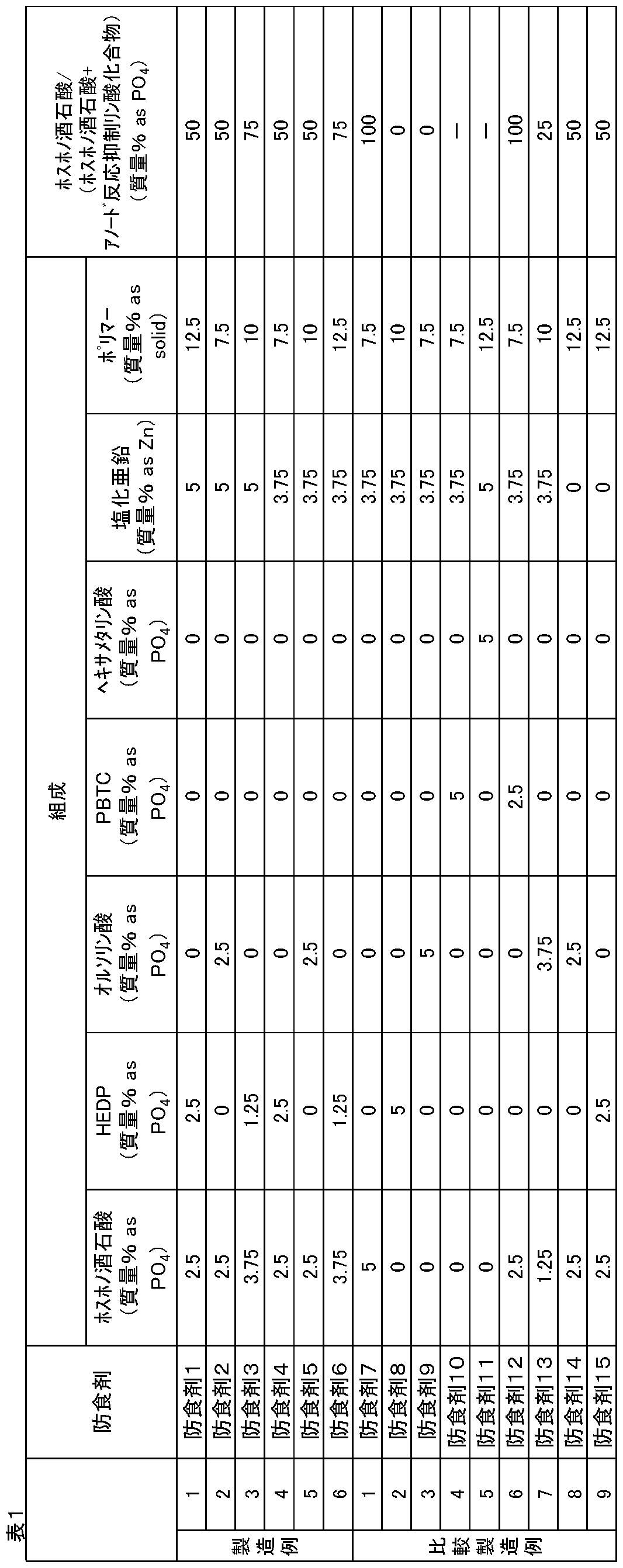
ホスホノ酒石酸水溶液、HEDP水溶液、塩化亜鉛水溶液、ポリマー溶液、及び水を添加して、表1に示す組成の防食剤1を得た。
なお、後述する実施例1のように、水中におけるリン化合物(すなわち、ホスホノ酒石酸、HEDP、オルソリン酸、PBTC、及びヘキサメタリン酸の合計)の濃度がPO4換算で2mg/Lとなるように、防食剤1を水に添加した場合における、防食剤1を構成する各成分の濃度は、表2に示すとおりである。
ホスホノ酒石酸水溶液、HEDP水溶液、塩化亜鉛水溶液、ポリマー溶液、及び水を添加して、表1に示す組成の防食剤1を得た。
なお、後述する実施例1のように、水中におけるリン化合物(すなわち、ホスホノ酒石酸、HEDP、オルソリン酸、PBTC、及びヘキサメタリン酸の合計)の濃度がPO4換算で2mg/Lとなるように、防食剤1を水に添加した場合における、防食剤1を構成する各成分の濃度は、表2に示すとおりである。
[製造例2~6及び比較製造例1~9]
リン酸化合物水溶液の種類及び添加量、塩化亜鉛の添加量、並びにポリマーの添加量を変更して、表1に示す組成の防食剤2~15を得た。
なお、水中におけるリン化合物(すなわち、ホスホノ酒石酸、HEDP、オルソリン酸、PBTC、及びヘキサメタリン酸の合計)の濃度がPO4換算で2mg/Lとなるように、防食剤2~15を水に添加した場合における、防食剤2~15を構成する各成分の濃度は、表2に示すとおりである。
リン酸化合物水溶液の種類及び添加量、塩化亜鉛の添加量、並びにポリマーの添加量を変更して、表1に示す組成の防食剤2~15を得た。
なお、水中におけるリン化合物(すなわち、ホスホノ酒石酸、HEDP、オルソリン酸、PBTC、及びヘキサメタリン酸の合計)の濃度がPO4換算で2mg/Lとなるように、防食剤2~15を水に添加した場合における、防食剤2~15を構成する各成分の濃度は、表2に示すとおりである。

[実施例1]
(健全面に対する防食試験)
寸法が50mm×30mm×1mm、表面積が0.31dm2の低炭素鋼(JIS G3141SPSS-SB)を#400研磨し、トルエン脱脂した試験片を試料とした。当該試料の重量を測定し、試験前重量とした。
1000mlガラス容器に、純水を1000mlから後述の各試薬添加量を差引いた量だけ入れ、炭酸水素ナトリウム水溶液、硫酸マグネシウム水溶液、塩化ナトリウム水溶液、塩化カルシウム水溶液及び防食剤1を添加後、少量の水酸化ナトリウム水溶液と硫酸水溶液でpHを調整し、試験水とした。表3に、実施例1の試験水の水質を示す。
(健全面に対する防食試験)
寸法が50mm×30mm×1mm、表面積が0.31dm2の低炭素鋼(JIS G3141SPSS-SB)を#400研磨し、トルエン脱脂した試験片を試料とした。当該試料の重量を測定し、試験前重量とした。
1000mlガラス容器に、純水を1000mlから後述の各試薬添加量を差引いた量だけ入れ、炭酸水素ナトリウム水溶液、硫酸マグネシウム水溶液、塩化ナトリウム水溶液、塩化カルシウム水溶液及び防食剤1を添加後、少量の水酸化ナトリウム水溶液と硫酸水溶液でpHを調整し、試験水とした。表3に、実施例1の試験水の水質を示す。
試験水が入っている1000mlガラス容器を30℃に保たれた腐食試験装置の恒温槽中にセットし、上記試験片を回転軸にネジ止めして浸漬し、150rpmで回転した。試験開始後3日目に新たな試験水に入替え、その後4日間経過した後、試験片を取り出した。取り出した試験片の表面を酸で洗浄し、付着した腐食生成物を除去して乾燥した後の重量を測定し、当該量を試験後重量とした。その後、試験片の重量変化から次式(1)により、腐食速度(mdd)を計算し、防食性能を評価した。評価結果を、図2及び表3に示す。
腐食速度(mdd)=[試験前重量(mg)-試験後重量(mg)]/[試験片の表面積(dm2)×試験日数(日)] (1)
腐食速度(mdd)=[試験前重量(mg)-試験後重量(mg)]/[試験片の表面積(dm2)×試験日数(日)] (1)
[実施例2~6及び比較例1~9]
(健全面に対する防食試験)
防食剤1に代えて防食剤2~15を用いたこと以外は実施例1と同様にして、試験水とした。実施例2~6及び比較例1~9の試験水の水質を表3に示す。
また、実施例1の試験水に代えて、実施例2~6及び比較例1~9の試験水を用いたこと以外は実施例1と同様にして、防食性能を評価した。評価結果を、図2及び表3に示す。
(健全面に対する防食試験)
防食剤1に代えて防食剤2~15を用いたこと以外は実施例1と同様にして、試験水とした。実施例2~6及び比較例1~9の試験水の水質を表3に示す。
また、実施例1の試験水に代えて、実施例2~6及び比較例1~9の試験水を用いたこと以外は実施例1と同様にして、防食性能を評価した。評価結果を、図2及び表3に示す。

[実施例7]
(腐食面に対する腐食減量試験)
初めに、長さ10cm、内径15mmの炭素鋼(STB-340)の短管を2本/1条件準備し、トルエン脱脂を行った後、5質量%HClにてエッジング処理を行い、これを試料とした。天秤にて短管の重量を測定し、試験前重量とした。
続いて、100Lのダイライトタンクに、各試薬添加量を差し引いた量の純水を投入し、炭酸水素ナトリウム水溶液、ケイ酸ナトリウム水溶液、硫酸マグネシウム溶液、塩化ナトリウム溶液、塩化カルシウム水溶液、硫酸ナトリウム水溶液及び防食剤1をそれぞれ添加後、少量の水酸化ナトリウム、炭酸ガスにてpHを調整し、試験水とした。表4に、試験水の水質を示す。
(腐食面に対する腐食減量試験)
初めに、長さ10cm、内径15mmの炭素鋼(STB-340)の短管を2本/1条件準備し、トルエン脱脂を行った後、5質量%HClにてエッジング処理を行い、これを試料とした。天秤にて短管の重量を測定し、試験前重量とした。
続いて、100Lのダイライトタンクに、各試薬添加量を差し引いた量の純水を投入し、炭酸水素ナトリウム水溶液、ケイ酸ナトリウム水溶液、硫酸マグネシウム溶液、塩化ナトリウム溶液、塩化カルシウム水溶液、硫酸ナトリウム水溶液及び防食剤1をそれぞれ添加後、少量の水酸化ナトリウム、炭酸ガスにてpHを調整し、試験水とした。表4に、試験水の水質を示す。
試験水を通水試験装置(図1)に移し替え、滞留時間が120時間となるように連続供給を実施した。
図1の通水試験装置1では、試験水が入っている試験水タンク11(容量:50L)が設けられている。試験水タンク内の試験水は、ヒーターコントローラー12により発熱温度が制御されたヒーター13によって加熱され、試験水の水温は30℃に維持される。また、試験水タンク11の水量が低くなると、給水ポンプ14を用いて補給水タンク(容量:50L)15から試験水が試験水タンク11に供給される。また、試験水タンク11の水量が高くなると、オーバーフローとして試験水が試験水タンク11からラインL1を経て排出される。これにより、試験水タンク11の水量は一定に維持される。
試験タンク11から排出された試験水は2つのラインL2,L3に分かれる。ラインL2では、循環水ポンプ16及び流量調整バルブ17を通過した試験水はエア吸入口18に供給される。エア吸入口18で試験水に空気が混入される。空気が混入された試験水は炭素鋼の短管19内を通過して、試験水タンク11に戻る。なお、炭素鋼の短管19内を通過する試験水の流速は0.3m/sである。一方、ラインL3では、循環水ポンプ21及び流量調整バルブ22を通過した試験水は炭素鋼の短管23内を通過して、試験水タンク11に戻る。なお、炭素鋼の短管23内を通過する試験水の流速は0.3m/sである。
先述の短管を通水試験装置(図1)に装着し、試験を開始した。試験開始から20時間後、68時間後にそれぞれ短管を引き上げた。引き上げた短管は、酸にて内部を洗浄し、腐食生成物を除去した後、重量を測定し該当量を試験後重量とした。重量変化を次式により計算し、防食性能を比較した。
腐食減量(mg)=[試験前重量(mg)-68時間後試験重量(mg)]-[試験前重量(mg)-20時間後試験重量(mg)] (2)
腐食減量(mg)=[試験前重量(mg)-68時間後試験重量(mg)]-[試験前重量(mg)-20時間後試験重量(mg)] (2)
[実施例8~10及び比較例10~13]
(腐食面に対する腐食減量試験)
防食剤1に代えて防食剤2、4、5、7~10を用いたこと以外は実施例7と同様にして、試験水とした。実施例8~10及び比較例10~13の試験水の水質を表4に示す。
また、実施例7の試験水に代えて、実施例8~10及び比較例10~13の試験水を用いたこと以外は実施例7と同様にして、防食性能を評価した。評価結果を、図3及び表4に示す。
(腐食面に対する腐食減量試験)
防食剤1に代えて防食剤2、4、5、7~10を用いたこと以外は実施例7と同様にして、試験水とした。実施例8~10及び比較例10~13の試験水の水質を表4に示す。
また、実施例7の試験水に代えて、実施例8~10及び比較例10~13の試験水を用いたこと以外は実施例7と同様にして、防食性能を評価した。評価結果を、図3及び表4に示す。
[評価結果]
腐食速度試験及び腐食減量試験の評価結果を図2及び図3に示す。
表3、表4、図2及び図3より、冷却水用金属防食剤に、ホスホノ酒石酸、アノード反応抑制リン酸化合物及び亜鉛化合物を含有させ、上記ホスホノ酒石酸と上記アノード反応抑制リン酸化合物との合計に対する上記ホスホノ酒石酸の含有量が35質量%以上とすることにより、低濃度の薬剤添加で金属の腐食速度を低減でき、さらに、低濃度の薬剤添加で金属の腐食減量を低減できることがわかった。
腐食速度試験及び腐食減量試験の評価結果を図2及び図3に示す。
表3、表4、図2及び図3より、冷却水用金属防食剤に、ホスホノ酒石酸、アノード反応抑制リン酸化合物及び亜鉛化合物を含有させ、上記ホスホノ酒石酸と上記アノード反応抑制リン酸化合物との合計に対する上記ホスホノ酒石酸の含有量が35質量%以上とすることにより、低濃度の薬剤添加で金属の腐食速度を低減でき、さらに、低濃度の薬剤添加で金属の腐食減量を低減できることがわかった。
1 通水試験装置
11 試験水タンク
12 ヒーターコントローラー
13 ヒーター
14 給水ポンプ
15 補給水タンク
16,21 循環水ポンプ
17,22 流量調整バルブ
18 エア吸入口
19,23 炭素鋼の短管
L1~L3 ライン
11 試験水タンク
12 ヒーターコントローラー
13 ヒーター
14 給水ポンプ
15 補給水タンク
16,21 循環水ポンプ
17,22 流量調整バルブ
18 エア吸入口
19,23 炭素鋼の短管
L1~L3 ライン
Claims (10)
- ホスホノ酒石酸、
金属腐食の原因となるアノード反応を抑制する、前記ホスホノ酒石酸以外のリン酸化合物及び
亜鉛化合物
を含み、前記ホスホノ酒石酸と前記金属腐食の原因となるアノード反応を抑制する、前記ホスホノ酒石酸以外のリン酸化合物との合計に対する前記ホスホノ酒石酸の含有量が、PO4換算で35質量%以上である冷却水用金属防食剤。 - 前記金属腐食の原因となるアノード反応を抑制する、前記ホスホノ酒石酸以外のリン酸化合物が、オルソリン酸及び1-ヒドロキシエチリデン-1,1-ジホスホン酸(HEDP)からなる群から選択される少なくとも1種のリン酸化合物である請求項1に記載の冷却水用金属防食剤。
- 前記亜鉛化合物が、塩化亜鉛及び硫酸亜鉛からなる群から選択される少なくとも1種の亜鉛塩である請求項1又は2に記載の冷却水用金属防食剤。
- 下記のAA/AMPS共重合体、AA/HAPS共重合体、及びAA/AMPS/HAPS共重合体からなる群から選択される少なくとも1種のAA/スルホン基含有共重合体をさらに含む請求項1~3のいずれか1項に記載の冷却水用金属防食剤。
AA/AMPS共重合体:アクリル酸(AA)及びその塩の少なくとも1種とアクリルアミドメチルプロパンスルホン酸(AMPS)及びその塩の少なくとも1種との共重合体
AA/HAPS共重合体:アクリル酸(AA)及びその塩の少なくとも1種とヒドロキシアリロキシプロパンスルホン酸(HAPS)及びその塩の少なくとも1種との共重合体
AA/AMPS/HAPS共重合体:アクリル酸(AA)及びその塩の少なくとも1種と、アクリルアミドメチルプロパンスルホン酸(AMPS)及びその塩の少なくとも1種と、ヒドロキシアリロキシプロパンスルホン酸(HAPS)及びその塩の少なくとも1種との共重合体 - 前記少なくとも1種のAA/スルホン基含有共重合体の重量平均分子量が500~50,000であり、前記少なくとも1種のAA/スルホン基含有共重合体が、AA及びその塩に由来する構成単位と、AMPS、HAPS及びそれらの塩に由来する構成単位とを、モル比で70:30~95:5の割合で含む請求項4に記載の冷却水用金属防食剤。
- カルシウム硬度がCaCO3として、30~150mg/Lである冷却水系に、ホスホノ酒石酸、金属腐食の原因となるアノード反応を抑制する、前記ホスホノ酒石酸以外のリン酸化合物及び亜鉛化合物を、前記ホスホノ酒石酸と前記ホスホノ酒石酸以外のリン酸化合物との合計に対する前記ホスホノ酒石酸の含有量が、PO4換算で35質量%以上となるように添加する冷却水系の処理方法。
- カルシウム硬度がCaCO3として、30~150mg/Lである冷却水系に、請求項1~5のいずれか1項に記載の冷却水用金属防食剤を添加する冷却水系の処理方法。
- 前記冷却水系内における前記ホスホノ酒石酸と、前記金属腐食の原因となるアノード反応を抑制する、前記ホスホノ酒石酸以外のリン酸化合物及び亜鉛化合物とをPO4で換算した合計の濃度が0.05~5mg/Lになるように、前記冷却水用金属防食剤を前記冷却水系に添加する請求項7に記載の冷却水系の処理方法。
- 前記冷却水系内における前記亜鉛化合物の亜鉛元素換算した濃度が0.05~5mg/Lになるように、前記冷却水用金属防食剤を前記冷却水系に添加する請求項7又は8に記載の冷却水系の処理方法。
- 冷却水系内における前記少なくとも1種のAA/スルホン基含有共重合体の固形分換算の濃度が1~10mg/Lになるように、請求項4又は5に記載の冷却水用金属防食剤を、カルシウム硬度がCaCO3として、30~150mg/Lである冷却水系に添加する冷却水系の処理方法。
Applications Claiming Priority (2)
| Application Number | Priority Date | Filing Date | Title |
|---|---|---|---|
| JP2017226025A JP6566010B2 (ja) | 2017-11-24 | 2017-11-24 | 冷却水用金属防食剤及び冷却水系の処理方法 |
| JP2017-226025 | 2017-11-24 |
Publications (1)
| Publication Number | Publication Date |
|---|---|
| WO2019102703A1 true WO2019102703A1 (ja) | 2019-05-31 |
Family
ID=66630612
Family Applications (1)
| Application Number | Title | Priority Date | Filing Date |
|---|---|---|---|
| PCT/JP2018/034825 Ceased WO2019102703A1 (ja) | 2017-11-24 | 2018-09-20 | 冷却水用金属防食剤及び冷却水系の処理方法 |
Country Status (3)
| Country | Link |
|---|---|
| JP (1) | JP6566010B2 (ja) |
| TW (1) | TW201925102A (ja) |
| WO (1) | WO2019102703A1 (ja) |
Citations (7)
| Publication number | Priority date | Publication date | Assignee | Title |
|---|---|---|---|---|
| JPS6295200A (ja) * | 1985-10-22 | 1987-05-01 | Hakutou Kagaku Kk | 水系における金属類の腐食及びスケ−ル防止剤 |
| JPS63258697A (ja) * | 1987-04-16 | 1988-10-26 | Hakutou Kagaku Kk | 水系における金属類のスケ−ル抑制を兼ねた腐食防止剤 |
| JP2003082479A (ja) * | 2001-09-13 | 2003-03-19 | Japan Organo Co Ltd | 防食剤及び方法 |
| JP2010202893A (ja) * | 2009-02-27 | 2010-09-16 | Hakuto Co Ltd | 腐食及びスケール防止用液体組成物ならびに腐食及びスケールの防止方法 |
| JP2012031448A (ja) * | 2010-07-29 | 2012-02-16 | Japan Organo Co Ltd | 水系金属防食剤および水系金属防食方法 |
| JP2017507243A (ja) * | 2014-02-12 | 2017-03-16 | 栗田工業株式会社 | 導水システムにおける水処理へのホスホ酒石酸及びその塩類の使用 |
| EP3216895A1 (en) * | 2016-03-11 | 2017-09-13 | Kurita Water Industries Ltd. | Process for preparing phosphotartaric acid and salts thereof |
-
2017
- 2017-11-24 JP JP2017226025A patent/JP6566010B2/ja active Active
-
2018
- 2018-09-20 WO PCT/JP2018/034825 patent/WO2019102703A1/ja not_active Ceased
- 2018-09-26 TW TW107133891A patent/TW201925102A/zh unknown
Patent Citations (7)
| Publication number | Priority date | Publication date | Assignee | Title |
|---|---|---|---|---|
| JPS6295200A (ja) * | 1985-10-22 | 1987-05-01 | Hakutou Kagaku Kk | 水系における金属類の腐食及びスケ−ル防止剤 |
| JPS63258697A (ja) * | 1987-04-16 | 1988-10-26 | Hakutou Kagaku Kk | 水系における金属類のスケ−ル抑制を兼ねた腐食防止剤 |
| JP2003082479A (ja) * | 2001-09-13 | 2003-03-19 | Japan Organo Co Ltd | 防食剤及び方法 |
| JP2010202893A (ja) * | 2009-02-27 | 2010-09-16 | Hakuto Co Ltd | 腐食及びスケール防止用液体組成物ならびに腐食及びスケールの防止方法 |
| JP2012031448A (ja) * | 2010-07-29 | 2012-02-16 | Japan Organo Co Ltd | 水系金属防食剤および水系金属防食方法 |
| JP2017507243A (ja) * | 2014-02-12 | 2017-03-16 | 栗田工業株式会社 | 導水システムにおける水処理へのホスホ酒石酸及びその塩類の使用 |
| EP3216895A1 (en) * | 2016-03-11 | 2017-09-13 | Kurita Water Industries Ltd. | Process for preparing phosphotartaric acid and salts thereof |
Also Published As
| Publication number | Publication date |
|---|---|
| TW201925102A (zh) | 2019-07-01 |
| JP2019094542A (ja) | 2019-06-20 |
| JP6566010B2 (ja) | 2019-08-28 |
Similar Documents
| Publication | Publication Date | Title |
|---|---|---|
| US7122148B2 (en) | Cooling water scale and corrosion inhibition | |
| TWI527933B (zh) | 用於控制產業系統中銅排放及銅合金腐蝕之組合物及方法 | |
| CN102782190A (zh) | 冷却水系统的处理方法 | |
| JP6589286B2 (ja) | 循環冷却水用初期処理剤及び循環冷却水系の初期処理方法 | |
| JP5099884B2 (ja) | 腐食抑制剤 | |
| JP5803207B2 (ja) | 冷却水系の金属防食処理方法 | |
| WO2019102703A1 (ja) | 冷却水用金属防食剤及び冷却水系の処理方法 | |
| WO2015119528A1 (ru) | Ингибитор коррозии металлов и солеотложения | |
| JP2005200721A (ja) | 開放循環冷却水系の処理方法 | |
| KR100315438B1 (ko) | 밀폐순환냉각시스템의부식및스케일억제수처리제조성물및그방법 | |
| JP6635173B1 (ja) | 冷却水系の金属部材の防食方法 | |
| JP5559629B2 (ja) | 水系金属防食方法 | |
| JP5978711B2 (ja) | 鉄の腐食抑制方法 | |
| JP4923664B2 (ja) | スケール付着防止剤及び冷却水系の処理方法 | |
| JP6504748B2 (ja) | 金属の腐食抑制方法 | |
| JP7247794B2 (ja) | 循環冷却水系の処理方法 | |
| JP2009299161A (ja) | 水系の金属腐食抑制方法 | |
| JP4218673B2 (ja) | スケール付着防止剤及び冷却水系の処理方法 | |
| JP4195262B2 (ja) | 開放式循環冷却水系における金属の腐食抑制方法 | |
| JP6806186B2 (ja) | 循環冷却水用初期処理剤及び循環冷却水系の初期処理方法 | |
| JP4467046B2 (ja) | 金属腐食抑制剤 | |
| JP5824841B2 (ja) | 銅系部材の腐食抑制方法 | |
| JP2008248303A (ja) | 銅基材を含む循環冷却水系の孔食抑制剤および孔食抑制方法 | |
| JP4244983B2 (ja) | 金属の腐食抑制方法 | |
| JP2004315914A (ja) | 腐食抑制剤及び腐食抑制方法 |
Legal Events
| Date | Code | Title | Description |
|---|---|---|---|
| 121 | Ep: the epo has been informed by wipo that ep was designated in this application |
Ref document number: 18881050 Country of ref document: EP Kind code of ref document: A1 |
|
| NENP | Non-entry into the national phase |
Ref country code: DE |
|
| 122 | Ep: pct application non-entry in european phase |
Ref document number: 18881050 Country of ref document: EP Kind code of ref document: A1 |