WO2018167607A1 - システム、及びシステムの動作方法 - Google Patents
システム、及びシステムの動作方法 Download PDFInfo
- Publication number
- WO2018167607A1 WO2018167607A1 PCT/IB2018/051458 IB2018051458W WO2018167607A1 WO 2018167607 A1 WO2018167607 A1 WO 2018167607A1 IB 2018051458 W IB2018051458 W IB 2018051458W WO 2018167607 A1 WO2018167607 A1 WO 2018167607A1
- Authority
- WO
- WIPO (PCT)
- Prior art keywords
- data
- information
- attribute information
- database
- function
- Prior art date
- Legal status (The legal status is an assumption and is not a legal conclusion. Google has not performed a legal analysis and makes no representation as to the accuracy of the status listed.)
- Ceased
Links
Images


Classifications
-
- G—PHYSICS
- G06—COMPUTING OR CALCULATING; COUNTING
- G06F—ELECTRIC DIGITAL DATA PROCESSING
- G06F16/00—Information retrieval; Database structures therefor; File system structures therefor
-
- G—PHYSICS
- G06—COMPUTING OR CALCULATING; COUNTING
- G06Q—INFORMATION AND COMMUNICATION TECHNOLOGY [ICT] SPECIALLY ADAPTED FOR ADMINISTRATIVE, COMMERCIAL, FINANCIAL, MANAGERIAL OR SUPERVISORY PURPOSES; SYSTEMS OR METHODS SPECIALLY ADAPTED FOR ADMINISTRATIVE, COMMERCIAL, FINANCIAL, MANAGERIAL OR SUPERVISORY PURPOSES, NOT OTHERWISE PROVIDED FOR
- G06Q50/00—Information and communication technology [ICT] specially adapted for implementation of business processes of specific business sectors, e.g. utilities or tourism
- G06Q50/10—Services
Definitions
- One embodiment of the present invention relates to a system and a method for operating the system.
- one embodiment of the present invention is not limited to the above technical field.
- the technical field of the invention disclosed in this specification and the like relates to an object, a method, or a manufacturing method.
- one embodiment of the present invention relates to a process, a machine, a manufacture, or a composition (composition of matter). Therefore, the technical field of one embodiment of the present invention disclosed in this specification more specifically includes a semiconductor device, a display device, a liquid crystal display device, a light-emitting device, a power storage device, an imaging device, a memory device, a processor, an electronic device, A system, a driving method thereof, a manufacturing method thereof, or an inspection method thereof can be given as an example.
- An artificial neural network (hereinafter referred to as a neural network) is an information processing system using a neural network as a model.
- a neural network By using a neural network, it is expected that a computer with higher performance than a conventional Neumann computer can be realized.
- various studies for constructing a neural network on an electronic circuit have been advanced.
- AI Artificial Intelligence
- Patent Document 1 discloses a system that collects big data from a plurality of websites and distributes information requested by the user terminals to a plurality of user terminals. Yes.
- Supervised learning is learning performed using learning data handled as input data and teacher data serving as an answer, and unsupervised learning is learning performed only on learning data treated as input data.
- An object of one embodiment of the present invention is to provide a novel device. Another object of one embodiment of the present invention is to provide a novel system including the device. Another object of one embodiment of the present invention is to provide a method for operating the system. Another object of one embodiment of the present invention is to provide a method of collecting big data in a timely manner.
- problems of one embodiment of the present invention are not limited to the problems listed above.
- the problems listed above do not disturb the existence of other problems.
- Other issues are issues not mentioned in this section, which are described in the following description. Problems not mentioned in this item can be derived from descriptions of the specification or drawings by those skilled in the art, and can be appropriately extracted from these descriptions.
- one embodiment of the present invention solves at least one of the above-described problems and other problems. Note that one embodiment of the present invention does not have to solve all of the problems listed above and other problems.
- One embodiment of the present invention is a system for collecting data, which includes a processing unit, a storage unit, a database, and an attribute information search unit, and the processing unit is electrically connected to the storage unit, The processing unit is electrically connected to the attribute information search unit, the attribute information search unit is electrically connected to the database, and the processing unit transmits the first user's first request desired by the first user.
- Generates first information including a function for receiving attribute information, a function for transmitting and storing first attribute information to the storage unit, and recruitment information for collecting first data corresponding to the first attribute information
- a function of searching for the first data corresponding to the first attribute information, If the over data is found is a system which is characterized by having a function of transmitting the first data from the database to the first user, the.
- the data conversion unit includes a data conversion unit, and the data conversion unit converts the data format and / or serializes the first data read from the database. It is the system characterized by having the function to perform.
- the processing unit in the configuration of the above (1) or (2), the processing unit generates second information including billing information when the first user receives the first data from the database. And a function of transmitting and storing the second information to the storage unit and a function of transmitting the second information to the first user.
- the database corresponds to the second attribute information and the second attribute information transmitted by the second user.
- the processing unit has a function of storing the second attribute information in the storage unit, and third information including fee payment information to the second user who has provided the second data. And a function of transmitting the third information to the storage unit and storing it, and a function of transmitting the third information to the second user.
- one embodiment of the present invention is an operation method for collecting data in a system, which includes first to eighth steps.
- the system includes a processing unit, a storage unit, a database, and an attribute information search unit.
- the first step includes a step in which the first user transmits the first attribute information to the attribute information search unit, and the second step corresponds to the first attribute information corresponding to the first attribute information.
- a step of searching the data in the database, the third step is a step of moving to the fourth step when the first data is found in the database in the search, and the first data is not found in the database in the search
- there is a step of shifting to the seventh step and the fourth step includes a step of transmitting the first data searched in the database to the first user, and the fifth step.
- the processing unit is a processing unit for generating first information including billing information for the first user, storing the first information in the storage unit, and transmitting the first information to the first user.
- the sixth step includes a step in which the first user makes a settlement based on the first information, and the seventh step is a processing unit that performs second information (based on the first attribute information). Request information), and an eighth step is for the administrator to confirm the second information and for the processor to generate third information (recruitment information) based on the second information; And storing the information in the storage unit.
- the apparatus in the configuration of (5), includes a data conversion unit, and the fourth step is a data format for the first data read from the database by the data conversion unit. It is the operation
- one aspect of the present invention includes the ninth to fifteenth steps in the configuration of (5) or (6) above, wherein the second user confirms the third information, And a second attribute information corresponding to the second data is transmitted to the database, and the tenth step is processed from the database by storing the second data and the second attribute information in the database.
- the second data identifier and the second attribute information are transmitted to the storage unit, and the eleventh step includes a step in which the processing unit stores the identifier and the second attribute information in the storage unit.
- the twelfth step includes a step in which the administrator reads out the second attribute information from the storage unit, and a step in which the administrator reads out the second data from the database by using the identifier stored in the storage unit.
- the 13th step Are a step in which the administrator confirms the second data and the second attribute information, and a fourteenth step is the step in which the administrator confirms the second data and the second attribute information.
- the processing unit includes a step of creating fourth information including fee payment information for the second user who has provided the second data, and a step of storing the fourth information in the storage unit.
- the step is an operation method characterized by paying a fee from the administrator to the second user based on the fourth information.
- a novel device can be provided.
- a novel system including the device can be provided.
- a method for operating the system can be provided.
- a method for efficiently collecting big data in time can be provided.
- the effects of one embodiment of the present invention are not limited to the effects listed above.
- the effects listed above do not preclude the existence of other effects.
- the other effects are effects not mentioned in this item described in the following description. Effects not mentioned in this item can be derived from the description of the specification or drawings by those skilled in the art, and can be appropriately extracted from these descriptions.
- one embodiment of the present invention has at least one of the effects listed above and other effects. Accordingly, one embodiment of the present invention may not have the above-described effects depending on circumstances.
- the block diagram which shows an example of a system The block diagram which shows an example of an apparatus.
- the flowchart which shows the operation example of a system The flowchart which shows the operation example of a system.
- the perspective view which shows an example of the electronic device which comprises a system.
- the figure which shows an example of a hierarchical neural network The figure which shows an example of a hierarchical neural network.
- 10A and 10B each illustrate a configuration example of a circuit.
- the administrator specified in this specification and the like indicates an administrator of an apparatus or system that is one embodiment of the present invention.
- the developer specified in this specification and the like indicates a developer who develops AI.
- the provider specified in this specification and the like indicates a person who provides data to the apparatus or system. In this specification and the like, a developer may be described as a first user and a provider may be described as a second user.
- the administrator recruits data owned by the provider to the provider, and the developer provides the data so that the developer can develop the AI. It is an apparatus, a system, or an operation method thereof that can build big data necessary for performing the above.
- the provider when the provider provides the data, it is assumed that the data is a creation or a work of the provider. Therefore, it is assumed that the provider agrees with the rules established by the administrator regarding the use of data that is the creation or work of the provider by the developer. At the same time, it is assumed that a contract has been made between the provider and the administrator not to provide data that is not the creation or work of the provider.
- data refers to image data, video data, audio data, music data, document data, text data, program data, design data, and the like.
- FIG. 1 shows a system and a plurality of terminals for collecting learning data in AI using a neural network.
- FIG. 1 illustrates a system 100, an administrator-side terminal 110, a developer-side terminal 120, and a provider-side terminal 130.
- the administrator side terminal 110 is a terminal operated by an administrator of the system 100.
- the developer-side terminal 120 is a terminal operated by an AI developer, and the provider-side terminal 130 is a terminal operated by a learning data provider.
- the system 100 includes an interface unit 150, an attribute information search unit 154, a database 155, a data conversion unit 156, a processing unit 157, and a storage unit 158.
- the interface unit 150 includes an administrator-side interface 151, a developer-side interface 152, and a provider-side interface 153.
- the interface unit 150 does not include the administrator side interface 151, the developer side interface 152, and the provider side interface 153, and may function as one interface.
- the administrator side terminal 110 is electrically connected to the administrator side interface 151
- the developer side terminal 120 is electrically connected to the developer side interface 152
- the provider side terminal 130 is connected to the provider side interface 153. And are electrically connected.
- the administrator side interface 151 is electrically connected to the attribute information search unit 154 and the processing unit 157, and the developer side interface 152 includes the attribute information search unit 154, the processing unit 157, and the data conversion unit 156.
- the provider-side interface 153 is electrically connected to the database 155 and the processing unit 157.
- the processing unit 157 is electrically connected to the attribute information search unit 154 and the storage unit 158, and the database 155 is electrically connected to the attribute information search unit 154 and the data conversion unit 156.
- the administrator-side interface 151 has a function of communicating with the administrator-side terminal 110
- the developer-side interface 152 has a function of communicating with the developer-side terminal 120
- the provider-side interface 153 And a function of performing communication with the provider side terminal 130.
- the database 155 has a function of storing learning data (including learning data, teacher data, attribute information, etc., sometimes referred to as big data) for developing the AI.
- learning data including learning data, teacher data, attribute information, etc., sometimes referred to as big data
- an HDD Hard Disk Drive
- SSD Solid State Drive
- an optical disk a magnetic tape, or the like
- a device capable of reading and writing and the optical disk, the magnetic tape, and the like are collectively referred to as a database 155.
- the attribute information search unit 154 has a function of searching for specific attribute information with respect to big data stored in the database 155.
- attribute information is information added to data, and is an index used when fine data is classified.
- the big data when the big data includes a plurality of image data of animals, the big data can be classified according to the attribute information by applying mammals, reptiles, birds, amphibians, fish, and the like as the attribute information.
- the data since a plurality of pieces of attribute information can be given to the data, the data can be further classified from the above classification.
- the types of mammals include humans, dogs, cats, cows, horses, mice, etc.
- the first attribute information is mammals
- the second attribute information is humans, dogs, cats, cows, horses, mice.
- big data can be classified more finely.
- the attribute information is not limited to an object but may be a specific action.
- the attribute information can be baseball, soccer, volleyball, basketball, swimming, etc., for classifying sports as specific actions.
- the attribute information search unit 154 can search the database 155 for learning data by using one or more attribute information. Further, the attribute information search unit 154 may have a function of assigning an identifier for identifying learning data stored in the database 155. Therefore, the attribute information search unit 154 may have an MCU (memory control unit) function.
- MCU memory control unit
- the data conversion unit 156 has a function of converting learning data read from the database 155 into appropriate data. For example, when image data is read from the database 155, the data conversion unit 156 can resize the image data to a desired image size, convert the data format, serialize, and the like.
- the processing unit 157 has a function of transmitting a command signal to each component based on a signal transmitted from the administrator, developer, or provider. On the contrary, based on the signal sent from each component, it has a function of transmitting a signal including information output from each component to an administrator, developer, or provider. In addition, the processing unit 157 has a function of generating information related to a charge generated between the administrator and the developer and a charge generated between the administrator and the provider.
- the storage unit 158 has a function of storing information processed by the processing unit 157. Specifically, the information includes request information of data desired by the developer, recruitment information for the administrator to collect data, an identifier of data provided by the provider, and the like. This information will be described in detail in Embodiment 2. As the storage unit 158, the same storage device as that described in the database 155 can be used.
- a new system can be realized by configuring the system 100. Further, the system 100 can collect big data for performing AI development.
- the configuration of the system 100 in FIG. 1 described in this embodiment is not limited to one embodiment of the present invention.
- the components of the system 100 and the connection configuration thereof can be changed according to the situation or as necessary.
- the processing unit 157 and the attribute information search unit 154 of the system 100 illustrated in FIG. 1 may be combined as one component.
- the database 155 and the storage unit 158 may be combined as one component.
- the system 100 of FIG. 1 described in the present embodiment includes an administrator-side interface 151, a developer-side interface 152, a provider-side interface 153, an attribute information search unit 154, a database 155, Although the data conversion unit 156, the processing unit 157, and the storage unit 158 are included, all of these components included in the system 100 may be configured as a single device. That is, one embodiment of the present invention can be the device 140 illustrated in FIG.
- the device 140 includes an interface unit 159, an attribute information search unit 154, a database 155, a data conversion unit 156, a processing unit 157, and a storage unit 158.
- the interface unit 159 includes an administrator side interface 151, a developer side interface 152, and a provider side interface 153. That is, the device 140 has a configuration in which the administrator side interface 151, the developer side interface 152, and the provider side interface 153 are combined into one interface unit 159.
- the interface unit 159 preferably has a function of performing authentication for each of the administrator, the developer, and the provider.
- Embodiment 2 In this embodiment, an operation method of the system 100 described in Embodiment 1 will be described.
- FIG. 3A is a flowchart illustrating an operation example of the system 100 when the developer acquires data for the AI to learn from the system 100.
- the operation example includes steps ST11 to ST18.
- the data for the AI to learn includes learning data, teacher data, attribute information, and the like, and is referred to as first data in the present embodiment.
- Step ST11 includes a step in which the developer uses the developer-side terminal 120 to transmit a request for requesting the first data to the system 100 as information.
- the developer includes a signal (hereinafter referred to as the first signal) including the content for which the developer desires the first data from the developer side terminal 120 to the developer side interface 152. It can be a step of transmitting.
- the contents include the attribute information of the first data desired by the developer, the data format of the first data desired by the developer, and the like.
- Step ST12 includes a step of searching the database 155 for the first data.
- the developer-side interface 152 transmits the first signal received in step ST11 to the attribute information search unit 154, and the attribute information search unit 154 receives the first signal.
- the attribute information of the first data desired by the developer included in the first signal is read, and the attribute information search unit 154 can search the database 155 for data corresponding to the attribute information.
- this operation example moves to step ST13.
- Step ST13 includes a step of determining whether or not the first data is found in the database 155. In the determination, if the first data is found (Yes), the attribute information search unit 154 sends a signal including the requested developer information, searched data information, etc. to the processing unit 157 (hereinafter referred to as the second signal). The operation example moves to step ST14. If the first data is not found in this determination (No), the attribute information search unit 154 includes a signal indicating that the first data is not present in the database 155 in the processing unit 157 (hereinafter referred to as a third signal). In this operation example, the process proceeds to step ST18.
- Step ST14 includes a step in which the first data searched in the database 155 is transmitted to the data conversion unit 156, a step in which the attribute information search unit 154 transmits and reads the first signal to the data conversion unit 156, and a data conversion unit. 156 converting the first data into a data format desired by the developer included in the received first signal.
- this operation example moves to step ST15.
- Step ST15 includes a step in which the developer acquires the first data. Specifically, for example, step ST15 is a step of transmitting the first data converted by the data conversion unit 156 into a data format desired by the developer to the developer side terminal 120 via the developer side interface 152; can do. When step ST15 is completed, this operation example moves to step ST16.
- Step ST16 has a step of generating billing information from the administrator to the developer. Specifically, for example, in step ST16, when the processing unit 157 receives the second signal transmitted by the attribute information search unit 154 in step ST13, the developer information and the data information searched for from the second signal , And billing information based on the information of the data can be generated for the developer. When step ST16 is completed, this operation example moves to step ST17.
- the generated billing information can be stored in the storage unit 158.
- Step ST17 includes a step of charging a fee from the administrator to the developer. Specifically, for example, in step ST17, a signal including the billing information generated by the processing unit 157 in step ST16 is transmitted to the developer side terminal 120 via the developer side interface 152. It can be set as the step which performs payment based on charge billing information. When step ST17 is completed, this operation example ends.
- the system 100 may be configured such that the developer automatically stores payment information in the storage unit 158 of the system 100 in advance, so that payment is automatically performed at the moment when billing information is generated in step ST16. .
- step ST17 is unnecessary in this operation example.
- Examples of the payment method here include payment by credit card, payment by prepaid, automatic withdrawal from a bank account on the developer side, and the like.
- Step ST18 includes a step of holding the request information of the first data desired by the developer in the storage unit 158. Specifically, for example, in step ST18, when the processing unit 157 receives the third signal transmitted by the attribute information search unit 154 in step ST13, the developer information and the developer's desired first signal are obtained from the third signal. The attribute information of one data can be read out and stored in the storage unit 158 as the request information. When step ST18 is completed, this operation example moves to A shown in FIG. In addition, when it transfers to A shown in FIG. 3 (A), it transfers to A shown in FIG. 3 (B).
- step ST18 the system 100 may be able to collect the first data desired by the developer from the provider.
- An example of operation for collecting is described below.
- FIG. 3B is a flowchart illustrating an operation example of the system 100 when the administrator uses the system 100 to collect the first data desired by the developer.
- the operation example includes steps ST21 to ST24. Note that this operation example is performed following A shown in FIG. That is, in this operation example, it is assumed that step ST18 is performed in advance in the operation example of steps ST11 to ST18 described above.
- Step ST21 includes a step in which the administrator uses the administrator-side terminal 110 to access the processing unit 157 of the system 100. Specifically, for example, in step ST21, the administrator reads request information of the first data desired by the developer from the administrator side terminal 110 to the processing unit 157 via the administrator side interface 151.
- the command signal (hereinafter referred to as the fourth signal) is transmitted.
- step ST21 this operation example moves to step ST22.
- Step ST22 has a step of reading out the request information of the first data desired by the developer from the storage unit 158. Specifically, for example, in step ST22, when the processing unit 157 receives the fourth signal, the processing unit 157 reads the request information of the first data desired by the developer from the storage unit 158, and the request information Can be sent to the manager side terminal 110 via the manager side interface 151. Thereafter, the administrator can check the request information on the administrator side terminal 110.
- step ST21 and step ST22 the administrator can confirm the content of the first data desired by the developer.
- step ST22 When step ST22 is completed, this operation example moves to step ST23.
- Step ST23 includes a step in which the administrator confirms the request information and selects whether or not to recruit the data corresponding to the attribute information included in the request information from the provider.
- the operation example moves to step ST24.
- the administrator when the administrator does not recruit the data (Don't), the administrator sends the data from the administrator side terminal 110 to the processing unit 157 via the administrator side interface 151.
- the processing unit 157 notifies the developer-side terminal 120 that the data is not recruited, and the operation ends.
- Step ST24 includes a step in which the administrator discloses the recruitment information to the provider.
- an instruction signal (hereinafter referred to as a fifth instruction signal) instructing the administrator to recruit the data from the administrator side terminal 110 to the processing unit 157 via the administrator side interface 151.
- the processing unit 157 receives the fifth signal so that the request information is disclosed to the provider side (hereinafter, the request information disclosed to the provider side is referred to as recruitment information). And can be stored in the storage unit 158.
- this operation example shifts to B shown in FIG.
- it transfers to B shown to FIG. 3 (B) it transfers to B shown to FIG. 4 (A).
- step ST23 the administrator can select whether or not to give permission for the developer to collect the first data desired by the developer using the system 100.
- the processing unit 157 in step ST23 does not confirm the request information of the first data desired by the developer, An operation of automatically disclosing the request information to the provider side may be performed.
- the processing unit 157 deletes the request information stored in the storage unit 158 after notifying the developer side terminal 120 that the recruitment of the data is not performed. With this configuration, the storage capacity for storing information in the storage unit 158 can be saved.
- step ST24 when the processing unit 157 receives the fifth signal, the system 100 enables the provider to provide the system 100 with the first data desired by the developer.
- An operation example in which the provider provides the first data to the system 100 will be described below.
- FIG. 4A is a flowchart illustrating an operation example of the system 100 when the provider provides learning data to the system 100.
- the operation example includes steps ST31 to ST35. Note that this operation example is performed following B shown in FIG. That is, in this operation example, it is assumed that the fifth signal is transmitted in advance from the administrator side terminal 110 to the processing unit 157 in step ST24 in the operation example of steps ST21 to ST24 described above.
- Step ST31 includes a step in which the provider accesses the processing unit 157 of the system 100 using the provider-side terminal 130.
- step ST31 is a command signal for the provider to read the recruitment information generated in step ST23 from the provider side terminal 130 to the processing unit 157 via the provider side interface 153. (Hereinafter referred to as the sixth signal).
- this operation example moves to step ST32.
- Step ST32 includes a step of reading the recruitment information from the storage unit 158. Specifically, for example, in step ST32, when the processing unit 157 receives the sixth signal, the processing unit 157 reads the recruitment information from the storage unit 158, and sends a signal including the recruitment information to the provider side. The step of transmitting to the provider side terminal 130 via the interface 153 can be used. Thereafter, the provider can confirm the recruitment information on the provider side terminal 130. When step ST32 is completed, this operation example moves to step ST33.
- step ST33 the provider confirms the developer request information included in the recruitment information, and selects whether to provide the system 100 with the second data and attribute information corresponding to the second data. Steps to perform. In the selection, when the provider provides the second data to the system 100 (Do), the operation example moves to step ST34. In this selection, when the provider does not provide the second data to the system 100 (Don't), this operation example ends.
- Step ST34 includes a step in which the provider provides the second data and attribute information of the second data to the system 100. Specifically, for example, in step ST34, the provider transmits the second data and the attribute information of the second data from the provider side terminal 130 to the database 155 via the provider side interface 153. Thus, the database 155 can store the second data and the attribute information of the second data. When step ST34 is completed, this operation example moves to step ST35.
- step ST35 when the second data and the attribute information of the second data are stored in the database 155, the database 155 transmits the second data identifier to the processing unit 157, and the storage unit 158 stores the second data identifier. Linking the identifier to the stored request information. Specifically, for example, in step ST35, the database 155 stores the second data and the attribute information of the second data, so that the database 155 generates the identifier of the second data, and the database 155 You may have the step which transmits the said identifier to the process part 157 via the information search part 154.
- step ST35 when the processing unit 157 receives the identifier, the processing unit 157 transmits the identifier to the storage unit 158, and the storage unit 158 converts the identifier into the request information stored in advance. You may have the step to store so that it may link.
- step ST35 the process proceeds to C shown in FIG.
- this operation example transfers to C shown to FIG. 4 (B).
- a memory address can be applied as the identifier generated in step ST35.
- the attribute information search unit 154 may generate a unique character string as an identifier of the second data instead of a memory address.
- the provider transmits the second data in accordance with the recruitment information.
- the provider transmits the second data having arbitrary attribute information at an arbitrary timing. be able to.
- the second data and the attribute information of the second data are stored in the database 155 as described above.
- FIG. 4B is a flowchart illustrating an operation example of the system 100 when the administrator uses the system 100 to check the collected data.
- the operation example includes steps ST41 to ST46. Note that this operation example is performed following C shown in FIG. That is, in this operation example, step ST34 and step ST35 are performed in advance in the operation example of the above-described steps ST31 to ST35.
- Step ST41 includes a step in which the administrator uses the administrator-side terminal 110 to access the processing unit 157 of the system 100. Specifically, for example, in step ST41, a command signal for the administrator to read second data provided by the provider from the administrator side terminal 110 to the processing unit 157 via the administrator side interface 151. (Hereinafter referred to as the seventh signal). When step ST41 is completed, this operation example moves to step ST42.
- Step ST42 includes a step of reading out the request information of the first data desired by the developer from the storage unit 158. Specifically, for example, in step ST42, when the processing unit 157 receives the seventh signal, the processing unit 157 receives the request information from the storage unit 158 and the identifier of the second data associated with the request information. And a step of transmitting a signal including the request information to the administrator-side terminal 110 via the administrator-side interface 151. When step ST42 is completed, this operation example moves to step ST43.
- Step ST43 includes a step of reading the second data provided by the provider from the database 155.
- the identifier of the second data read by the processing unit 157 in step ST42 is transmitted to the database 155 via the attribute information search unit 154, and the database 155 receives a signal including the identifier.
- the second data corresponding to the identifier may be read out, and the second data may be transmitted to the administrator side terminal 110 via the administrator side interface 151.
- this operation example moves to step ST44.
- the administrator can confirm the second data and request information provided by the provider.
- step ST44 the administrator confirms the request information read in step ST42 and the second data provided by the provider read in step ST43, and the second data provided by the provider is included in the request information. It has a step of determining whether or not it corresponds to the included attribute information. In the determination, when the second data provided by the provider corresponds to the attribute information (YES), the operation example moves to step ST45. In the determination, if the second data provided by the provider does not correspond to the attribute information (NO), the process proceeds to step ST47.
- Step ST45 includes a step in which the administrator pays a reward to the provider.
- step ST ⁇ b> 45 the administrator pays a reward as compensation for the provider providing the second data and the developer using the second data for the purpose of developing the AI.
- step ST45 proceeds to step ST46.
- a payment method of remuneration the transfer to the bank account of the provider side, the payment to the electronic money of the provider side, etc. are mentioned.
- a reward other than a gold item may be used, and in that case, a privilege such as a discount at the time of purchasing an article or using a service or a privilege such as a point may be received at a specific site.
- step ST46 the administrator uses the administrator side terminal 110 to notify the developer that the first data desired by the developer has been provided.
- a command signal hereinafter referred to as a first command signal
- the processing unit 157 receives the eighth signal, whereby the first data desired by the developer is sent to the developer side terminal 120 via the developer side interface 152.
- Step ST47 includes a step of deleting the data provided by the provider from the database 155, and a step of deleting the identifier of the second data from the storage unit 158.
- an instruction signal for the administrator to delete the second data provided by the provider from the administrator side terminal 110 to the processing unit 157 via the administrator side interface 151. (Hereinafter referred to as the ninth signal) and the processing unit 157 receives the ninth signal, thereby deleting the command signal (hereinafter referred to as the tenth signal) for deleting the data provided by the provider in the database 155.
- a command signal for deleting the identifier to the storage unit 158 (hereinafter referred to as the eleventh signal), and the database 155 receives the tenth signal
- the step of deleting the second data provided by the provider stored in the database 155 and the storage unit 158 receiving the eleventh signal are stored in the storage unit 158. It can have a step of deleting the identifier has.
- step ST47 the storage capacity for storing information in each of the database 155 and the storage unit 158 can be saved.
- the system 100 can be operated by performing steps ST11 to ST18, steps ST21 to ST23, steps ST31 to ST35, and steps ST41 to ST47. As a result, the system 100 can collect big data for AI development, and can provide big data to the AI developer.
- the operation method of one embodiment of the present invention is not limited to the above-described steps ST11 to ST18, steps ST21 to ST23, steps ST31 to ST35, and steps ST41 to ST47.
- the processes shown in the flowchart are classified by function and shown as steps independent of each other.
- it is difficult to separate the processing shown in the flowchart for each function and a single step may involve a plurality of steps, or a single step may involve a plurality of steps. Therefore, the process shown in the flowchart is not limited to each step described in the specification, and can be appropriately replaced depending on the situation.
- step ST11 and step ST12 the first signal transmitted from the developer side interface 152 is transmitted to the attribute information search unit 154 and processed, but the first signal transmitted from the developer side interface 152 is The operation may be performed once through the processing unit 157 and then transmitted to the attribute information search unit 154.
- Embodiment 3 In this embodiment, the case where the system 100 described in Embodiments 1 and 2 is configured using an electronic device will be described.
- FIG. 5 shows an example in which the system 100 is configured with electronic devices.
- a system 100 illustrated in FIG. 5 includes a plurality of servers 240.
- FIG. 5 illustrates a notebook PC 210 as an example of the administrator-side terminal 110, a desktop PC 220 as an example of the developer-side terminal 120, and a mobile phone 230 having an information terminal function as an example of the provider-side terminal 130. , Shows.
- Each of system 100, administrator side terminal 110, developer side terminal 120, and provider side terminal 130 shown in FIG. 5 is preferably connected via an Internet line or the like.
- a plurality of provider-side terminals (mobile phones 230) are illustrated.
- a plurality of developer-side terminals (desktop PCs 220) are shown.
- FIG. 5 is an example, and an example of each electronic device illustrated in FIG. 5 is not limited to one embodiment of the present invention.
- the desktop PC 220 is illustrated as the developer-side terminal 120, but a device that functions as an information terminal such as a notebook PC, a tablet PC, or a smartphone may be applied as the developer-side terminal 120.
- the mobile phone 230 is illustrated as the provider side terminal 130, but similarly, a device that functions as an information terminal such as a notebook PC or a tablet PC is applied as the provider side terminal 130. May be.
- the mobile phone 230 that functions as the provider terminal 130 preferably has a camera function. Since the mobile phone 230 has a camera function, image data captured by the mobile phone 230 can be immediately transmitted to the server 240.
- the system 100 preferably has an SNS (social networking service) function.
- SNS social networking service
- a plurality of examples will be described with respect to a mode in which the SNS function is provided in the system 100 illustrated in FIG. 5 and data desired by the developer is collected using the SNS.
- the data collected by the system 100 is image data
- the image data captured by the SNS user with the mobile phone 230 can be transmitted to the SNS, so that the image data can be disclosed on the SNS, and at the same time Image data can be stored on the server 240 of the system 100. That is, when the provider uses SNS, the administrator side can simultaneously collect image data. Since SNS can be used by people all over the world, it is suitable for collecting a large amount of image data.
- the system 100 when transmitting image data to the SNS, by adding tag information to the image data and transmitting the image data, the system 100 operates as the attribute information described in the first and second embodiments. can do.
- the system 100 can effectively provide image data to an AI developer who performs image recognition or the like.
- the audio data is published on the SNS, and the audio data can be stored in the server 240 of the system 100 at the same time as the image data described above.
- teacher data attribute information
- learning data voice data
- tag information attribute information
- the system 100 can effectively provide the voice data to an AI developer who performs voice recognition or the like.
- FIG. 6 is a diagram showing an example of a hierarchical neural network.
- the (k ⁇ 1) th layer (where k is an integer of 2 or more) has P neurons (where P is an integer of 1 or more), and the kth layer is a neuron.
- Q (here, Q is an integer of 1 or more)
- the (k + 1) -th layer has R neurons (where R is an integer of 1 or more).
- the product of the output signal z p (k ⁇ 1) and the weighting factor w qp (k) of the p-th neuron in the (k ⁇ 1) -th layer (where p is an integer of 1 or more and P or less) is It is assumed that the input signal is input to the q-th neuron in the k-th layer (where q is an integer of 1 to Q), and the output signal z q (k) of the q-th neuron in the k-th layer and the weight coefficient w rq.
- the output signal z q (k) from the q-th neuron in the k-th layer is defined by the following equation.
- the function f (u q (k) ) is an activation function, and a step function, a linear ramp function, a sigmoid function, or the like can be used.
- the product-sum operation of Expression (D1) can be realized by a product-sum operation circuit (a multiplication circuit and an addition circuit).
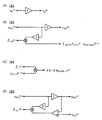
- the calculation of Expression (D2) can be realized by, for example, the circuit 161 illustrated in FIG.
- the activation function may be the same or different in all neurons. In addition, the activation function may be the same or different for each layer.
- L is an integer of 3 or more
- k is an integer of 2 or more and (L ⁇ 1) or less.
- the first layer is an input layer of the hierarchical neural network
- the L layer is an output layer of the hierarchical neural network
- the second to (L-1) layers are hidden by the hierarchical neural network.
- k is an integer of 3 or more
- L is an integer of 2 or more and (L ⁇ 1) or less.
- the first layer has P neurons
- the kth layer has Q [k] neurons (Q [k] is an integer equal to or greater than 1).
- the L layer has R neurons.
- the first layer when input data is input to the first layer, the first layer can output the input data as it is. That is, the first layer may function as a buffer circuit.
- the input data can be data desired by the developer described in the first to third embodiments.
- the output signal of the s [1] neuron in the first layer (s [1] is an integer between 1 and P) is z s [1] (1), and the s [k] neuron in the kth layer.
- the output signal (s [k] is an integer between 1 and Q [k]) is z s [k] (k), and the s [L] neuron (s [L] is 1 in the Lth layer.
- the output signal is an integer less than or equal to R.) z s [L] (L) .
- the output signal z s [k ⁇ 1 ] of the s [k ⁇ 1] th neuron (s [k ⁇ 1] is an integer of 1 to Q [k ⁇ 1]) in the (k ⁇ 1) th layer.
- Product k s [k] (k ) and weight coefficient w s [k] s [k ⁇ 1] (k) are input to the s [k] neuron in the k-th layer.
- the output signal z s [L ⁇ ] of the s [L ⁇ 1] neuron (s [L ⁇ 1] is an integer of 1 to Q [L ⁇ 1]) in the (L ⁇ 1) th layer.
- 1] (L ⁇ 1) and the weighting factor WS [L] s [L ⁇ 1] (L) and the product u s [L] (L) are input to the s [L] neuron in the Lth layer.
- Supervised learning is a function of the hierarchical neural network when the output result differs from a desired result (sometimes referred to as teacher data or a teacher signal) in the function of the hierarchical neural network. This is an operation for updating all the weight coefficients based on the output result and the desired result.
- FIG. 8 is a diagram for explaining a learning method based on the error back propagation method.
- the error back-propagation method is a method of changing the weighting coefficient so that the error between the output of the hierarchical neural network and the teacher data becomes small.
- the teacher data can be the data desired by the developer described in the first to third embodiments or the attribute information of the data.
- the update amount of the weight coefficient w s [k] s [k ⁇ 1] (k) of the s [k] neuron in the k-th layer is expressed as ⁇ E / ⁇ w s [k] s [k ⁇ 1]
- the weighting factor can be newly changed.
- f ′ (u s [k] (k) ) is a derivative of the activation function.
- the calculation of the equation (D3) can be realized by, for example, the circuit 163 illustrated in FIG.
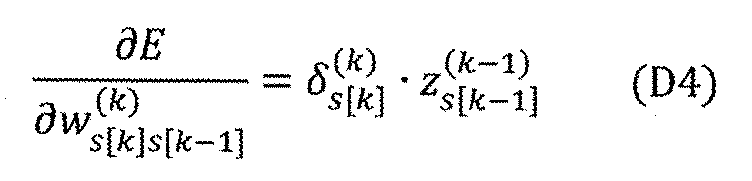
- the calculation of Formula (D4) is realizable by the circuit 164 shown in FIG.9 (C), for example.
- the derivative of the activation function can be realized, for example, by connecting an arithmetic circuit corresponding to a desired derivative to the output terminal of the operational amplifier.
- the calculation of the part of ⁇ s [k + 1] (k + 1) ⁇ w s [k + 1] ⁇ s [k] (k + 1) in the formula (D3) is realized by a product-sum operation circuit (multiplication circuit and addition circuit). it can.
- ⁇ s [L] (L) and ⁇ E / ⁇ w s [L] s [L -1] (L) can be represented by the following formulas.
- the calculation of Expression (D5) can be realized by a circuit 165 shown in FIG. Further, the calculation of Expression (D6) can be realized by the circuit 164 illustrated in FIG.
- the errors ⁇ s [k] (k) and ⁇ s [L] (L) of all the neuron circuits can be obtained from the equations (D1) to (D6).
- the weight coefficient update amount is set based on the errors ⁇ s [k] (k) , ⁇ s [L] (L), desired parameters, and the like.
- the content described in one embodiment (may be a part of content) is different from the other content described in the embodiment (may be a part of content) and one or more other implementations.
- Application, combination, replacement, or the like can be performed on at least one of the contents described in the form (may be part of the contents).
- a drawing (or a part thereof) described in one embodiment may be different from another part of the drawing, another drawing (may be a part) described in the embodiment, or one or more different drawings.
- more drawings can be formed.
- ordinal numbers “first”, “second”, and “third” are given to avoid confusion between components. Therefore, the ordinal numbers described in this specification and the like do not limit the number of components and do not limit the order of the components. Further, for example, a component referred to as “first” in one embodiment of the present specification or the like is a component referred to as “second” in another embodiment or in the claims. It is also possible. In addition, for example, the constituent elements referred to as “first” in one embodiment of the present specification and the like may be omitted in other embodiments or in the claims.
- the constituent elements are classified by function and shown as independent blocks.
- it is difficult to separate the components for each function and there may be a case where a plurality of functions are involved in one circuit or a case where one function is involved over a plurality of circuits. Therefore, the blocks illustrated in the block diagrams are not limited to the components described in the specification, and can be appropriately rephrased depending on the situation.
- the size, the layer thickness, or the region is shown in an arbitrary size for convenience of explanation. Therefore, it is not necessarily limited to the scale. Note that the drawings are schematically shown for the sake of clarity, and are not limited to the shapes or values shown in the drawings. For example, variation in signal, voltage, or current due to noise, variation in signal, voltage, or current due to timing shift can be included.
Landscapes
- Engineering & Computer Science (AREA)
- Theoretical Computer Science (AREA)
- Business, Economics & Management (AREA)
- Tourism & Hospitality (AREA)
- Physics & Mathematics (AREA)
- General Physics & Mathematics (AREA)
- General Engineering & Computer Science (AREA)
- Databases & Information Systems (AREA)
- Data Mining & Analysis (AREA)
- Health & Medical Sciences (AREA)
- Economics (AREA)
- General Health & Medical Sciences (AREA)
- Human Resources & Organizations (AREA)
- Marketing (AREA)
- Primary Health Care (AREA)
- Strategic Management (AREA)
- General Business, Economics & Management (AREA)
- Information Retrieval, Db Structures And Fs Structures Therefor (AREA)
- Management, Administration, Business Operations System, And Electronic Commerce (AREA)
Abstract
要約書 AIの開発に必要なビッグデータを収集するシステムを提供する。 開発者、提供者と、管理者と、の間で取引を行うシステムとして、処理部と、記憶部と、データベー スと、 属性情報検索部と、 を有するシステムを構成する。 開発者は、 所望するデータの属性情報を属 性情報検索部に送信することで、データベースに対して当該属性情報に対応するデータを検索するこ とができる。 当該属性情報に対応するデータが見つかった場合、 開発者に当該データが送信され、 当 該データの対価として、 開発者から管理者に料金の支払いが行われる。 提供者は、 データベースにデ ータと当該データの属性情報を格納することができる。管理者は、当該データを提供した対価として、 提供者に対して料金の支払いを行う。
Description
本発明の一態様は、システム、及びシステムの動作方法に関する。
なお本発明の一態様は、上記の技術分野に限定されない。本明細書等で開示する発明の技術分野は、物、方法、または、製造方法に関するものである。または、本発明の一態様は、プロセス、マシン、マニュファクチャ、または、組成物(コンポジション・オブ・マター)に関するものである。そのため、より具体的に本明細書で開示する本発明の一態様の技術分野としては、半導体装置、表示装置、液晶表示装置、発光装置、蓄電装置、撮像装置、記憶装置、プロセッサ、電子機器、システム、それらの駆動方法、それらの製造方法、又はそれらの検査方法を一例として挙げることができる。
人工ニューラルネットワーク(以下、ニューラルネットワークと呼称する。)は、神経回路網をモデルにした情報処理システムである。ニューラルネットワークを利用することで、従来のノイマン型コンピュータよりも高性能なコンピュータが実現できると期待されており、近年、電子回路上でニューラルネットワークを構築する種々の研究が進められている。
ニューラルネットワークをAI(Artificial Intelligence)に利用する場合、ビッグデータとして、数万、又はそれ以上の数の学習用のデータが必要となる場合がある。
ところで、ビッグデータの収集方法の1つとして、特許文献1に、複数のウェブサイトからビッグデータを収集し、複数のユーザ端末に対して、ユーザ端末が要求する情報を配信するシステムが開示されている。
ニューラルネットワークを利用したAIを学習させる手段として、教師有り学習、教師無し学習が挙げられる。教師有り学習は、入力データとして扱われる学習データと、答えとなる教師データと、を用いて行われる学習であり、教師無し学習は、入力データとして扱われる学習データのみで行われる学習である。
特に、AIに対して、教師有り学習をさせる場合、上述の通り、数万、又はそれ以上の数の学習データが必要となり、また同時に、学習させる内容に応じて教師データも収集する必要がある。つまり、ニューラルネットワークを利用したAIを開発するには、ビッグデータが必要となり、当該ビッグデータの収集には膨大な時間を要する場合がある。そのため、ビッグデータを時間的に効率良く収集する方法が求められている。
本発明の一態様は、新規な装置を提供することを課題の一つとする。又は、本発明の一態様は、当該装置を有する新規なシステムを提供することを課題の一つとする。又は、本発明の一態様は、当該システムの動作方法を提供することを課題の一とする。又は、本発明の一態様は、ビッグデータを時間的に効率良く収集する方法を提供することを課題の一つとする。
なお本発明の一態様の課題は、上記列挙した課題に限定されない。上記列挙した課題は、他の課題の存在を妨げるものではない。なお他の課題は、以下の記載で述べる、本項目で言及していない課題である。本項目で言及していない課題は、当業者であれば明細書又は図面等の記載から導き出せるものであり、これらの記載から適宜抽出することができる。なお、本発明の一態様は、上記列挙した課題、及び他の課題のうち、少なくとも一つの課題を解決するものである。なお、本発明の一態様は、上記列挙した課題、及び他の課題の全てを解決する必要はない。
(1)
本発明の一態様は、データの収集を行うシステムであり、処理部と、記憶部と、データベースと、属性情報検索部と、を有し、処理部は、記憶部と電気的に接続され、処理部は、属性情報検索部と電気的に接続され、属性情報検索部は、データベースと電気的に接続され、処理部は、第1利用者が送信する、第1利用者の所望する第1属性情報を受信する機能と、第1属性情報を、記憶部に送信して、格納する機能と、第1属性情報に対応する第1データを収集するための募集情報を含む第1情報を生成する機能と、第1情報を、記憶部に送信して、格納する機能と、第1情報を、第2利用者に送信する機能と、を有し、属性情報検索部は、データベースに対して、第1属性情報に対応する第1データを検索する機能と、検索において、第1データが見つかった場合に、第1データをデータベースから第1利用者に送信する機能と、を有することを特徴とするシステムである。
本発明の一態様は、データの収集を行うシステムであり、処理部と、記憶部と、データベースと、属性情報検索部と、を有し、処理部は、記憶部と電気的に接続され、処理部は、属性情報検索部と電気的に接続され、属性情報検索部は、データベースと電気的に接続され、処理部は、第1利用者が送信する、第1利用者の所望する第1属性情報を受信する機能と、第1属性情報を、記憶部に送信して、格納する機能と、第1属性情報に対応する第1データを収集するための募集情報を含む第1情報を生成する機能と、第1情報を、記憶部に送信して、格納する機能と、第1情報を、第2利用者に送信する機能と、を有し、属性情報検索部は、データベースに対して、第1属性情報に対応する第1データを検索する機能と、検索において、第1データが見つかった場合に、第1データをデータベースから第1利用者に送信する機能と、を有することを特徴とするシステムである。
(2)
又は、本発明の一態様は、上記(1)の構成において、データ変換部を有し、データ変換部は、データベースから読み出した第1データに対して、データ形式の変換、及び/又はシリアル化を行う機能を有することを特徴とするシステムである。
又は、本発明の一態様は、上記(1)の構成において、データ変換部を有し、データ変換部は、データベースから読み出した第1データに対して、データ形式の変換、及び/又はシリアル化を行う機能を有することを特徴とするシステムである。
(3)
又は、本発明の一態様は、上記(1)、又は(2)の構成において、処理部は、第1利用者がデータベースから第1データを受信したことによる請求情報を含む第2情報を生成する機能と、第2情報を、記憶部に送信して、格納する機能と、第2情報を、第1利用者に送信する機能と、を有することを特徴とするシステムである。
又は、本発明の一態様は、上記(1)、又は(2)の構成において、処理部は、第1利用者がデータベースから第1データを受信したことによる請求情報を含む第2情報を生成する機能と、第2情報を、記憶部に送信して、格納する機能と、第2情報を、第1利用者に送信する機能と、を有することを特徴とするシステムである。
(4)
又は、本発明の一態様は、上記(1)乃至(3)のいずれか一の構成において、データベースは、第2利用者が送信する、第2属性情報と、第2属性情報に対応する第2データと、を格納する機能を有し、処理部は、第2属性情報を、記憶部に格納する機能と、第2データを提供した第2利用者への料金支払い情報を含む第3情報を生成する機能と、第3情報を、記憶部に送信して、格納する機能と、第3情報を、第2利用者に送信する機能と、を有することを特徴とするシステムである。
又は、本発明の一態様は、上記(1)乃至(3)のいずれか一の構成において、データベースは、第2利用者が送信する、第2属性情報と、第2属性情報に対応する第2データと、を格納する機能を有し、処理部は、第2属性情報を、記憶部に格納する機能と、第2データを提供した第2利用者への料金支払い情報を含む第3情報を生成する機能と、第3情報を、記憶部に送信して、格納する機能と、第3情報を、第2利用者に送信する機能と、を有することを特徴とするシステムである。
(5)
又は、本発明の一態様は、システムにおいて、データの収集を行う動作方法であり、第1乃至第8ステップを有し、システムは、処理部と、記憶部と、データベースと、属性情報検索部と、を有し、第1ステップは、第1利用者が属性情報検索部に対して、第1属性情報を送信するステップを有し、第2ステップは、第1属性情報に対応した第1データをデータベースで検索を行うステップを有し、第3ステップは、検索においてデータベースから第1データが見つかった場合に、第4ステップに移行するステップと、検索においてデータベースから第1データが見つからなかった場合に、第7ステップに移行するステップと、を有し、第4ステップは、データベースで検索した第1データを第1利用者に送信するステップを有し、第5ステップは、処理部で、第1利用者への料金請求情報を含む第1情報を生成するステップと、第1情報を記憶部に格納するステップと、第1情報を第1利用者に送信するステップを有し、第6ステップは、第1情報に基づいて、第1利用者が決済を行うステップを有し、第7ステップは、処理部で、第1属性情報に基づいて第2情報(要求情報)を生成するステップを有し、第8ステップは、管理者が第2情報を確認して、処理部において第2情報に基づいた第3情報(募集情報)を生成するステップと、第3情報を記憶部に格納するステップと、を有することを特徴とする動作方法である。
又は、本発明の一態様は、システムにおいて、データの収集を行う動作方法であり、第1乃至第8ステップを有し、システムは、処理部と、記憶部と、データベースと、属性情報検索部と、を有し、第1ステップは、第1利用者が属性情報検索部に対して、第1属性情報を送信するステップを有し、第2ステップは、第1属性情報に対応した第1データをデータベースで検索を行うステップを有し、第3ステップは、検索においてデータベースから第1データが見つかった場合に、第4ステップに移行するステップと、検索においてデータベースから第1データが見つからなかった場合に、第7ステップに移行するステップと、を有し、第4ステップは、データベースで検索した第1データを第1利用者に送信するステップを有し、第5ステップは、処理部で、第1利用者への料金請求情報を含む第1情報を生成するステップと、第1情報を記憶部に格納するステップと、第1情報を第1利用者に送信するステップを有し、第6ステップは、第1情報に基づいて、第1利用者が決済を行うステップを有し、第7ステップは、処理部で、第1属性情報に基づいて第2情報(要求情報)を生成するステップを有し、第8ステップは、管理者が第2情報を確認して、処理部において第2情報に基づいた第3情報(募集情報)を生成するステップと、第3情報を記憶部に格納するステップと、を有することを特徴とする動作方法である。
(6)
又は、本発明の一態様は、上記(5)の構成において、装置は、データ変換部を有し、第4ステップは、データ変換部が、データベースから読み出した第1データに対して、データ形式の変換、及び/又はシリアル化を行うステップを有することを特徴とする動作方法である。
又は、本発明の一態様は、上記(5)の構成において、装置は、データ変換部を有し、第4ステップは、データ変換部が、データベースから読み出した第1データに対して、データ形式の変換、及び/又はシリアル化を行うステップを有することを特徴とする動作方法である。
(7)
又は、本発明の一態様は、上記(5)、又は(6)の構成において、第9乃至第15ステップを有し、第9ステップは、第2利用者が第3情報を確認して、第2データと第2データに対応する第2属性情報をデータベースに送信するステップを有し、第10ステップは、第2データと第2属性情報とがデータベースに格納されることで、データベースから処理部に、第2データの識別子と、第2属性情報と、が送信されるステップを有し、第11ステップは、処理部が、識別子と第2属性情報とを記憶部に格納するステップを有し、第12ステップは、管理者が記憶部から第2属性情報を読み出すステップと、管理者が、記憶部に格納された識別子を用いることで、データベースから第2データを読み出すステップと、を有し、第13ステップは、管理者が、第2データと、第2属性情報と、を確認するステップと、を有するステップと、第14ステップは、管理者が第2データと、第2属性情報と、を確認して、処理部で、第2データを提供した第2利用者への料金支払い情報を含む第4情報を作成するステップと、第4情報を記憶部に格納するステップと、を有し、第15ステップは、第4情報に基づいて、管理者から第2利用者に料金を支払うことを特徴とする動作方法である。
又は、本発明の一態様は、上記(5)、又は(6)の構成において、第9乃至第15ステップを有し、第9ステップは、第2利用者が第3情報を確認して、第2データと第2データに対応する第2属性情報をデータベースに送信するステップを有し、第10ステップは、第2データと第2属性情報とがデータベースに格納されることで、データベースから処理部に、第2データの識別子と、第2属性情報と、が送信されるステップを有し、第11ステップは、処理部が、識別子と第2属性情報とを記憶部に格納するステップを有し、第12ステップは、管理者が記憶部から第2属性情報を読み出すステップと、管理者が、記憶部に格納された識別子を用いることで、データベースから第2データを読み出すステップと、を有し、第13ステップは、管理者が、第2データと、第2属性情報と、を確認するステップと、を有するステップと、第14ステップは、管理者が第2データと、第2属性情報と、を確認して、処理部で、第2データを提供した第2利用者への料金支払い情報を含む第4情報を作成するステップと、第4情報を記憶部に格納するステップと、を有し、第15ステップは、第4情報に基づいて、管理者から第2利用者に料金を支払うことを特徴とする動作方法である。
本発明の一態様によって、新規な装置を提供することができる。又は、本発明の一態様によって、当該装置を有する新規なシステムを提供することができる。又は、本発明の一態様によって、当該システムの動作方法を提供することができる。又は、本発明の一態様によって、ビッグデータを時間的に効率良く収集する方法を提供することができる。
なお本発明の一態様の効果は、上記列挙した効果に限定されない。上記列挙した効果は、他の効果の存在を妨げるものではない。なお他の効果は、以下の記載で述べる、本項目で言及していない効果である。本項目で言及していない効果は、当業者であれば明細書又は図面等の記載から導き出せるものであり、これらの記載から適宜抽出することができる。なお、本発明の一態様は、上記列挙した効果、及び他の効果のうち、少なくとも一つの効果を有するものである。従って本発明の一態様は、場合によっては、上記列挙した効果を有さない場合もある。
本明細書等で明示する管理者とは、本発明の一態様である装置又はシステムの管理者を示す。また、本明細書等で明示する開発者とは、AIの開発を行う開発者を示す。また、本明細書等で明示する提供者とは、当該装置又はシステムにデータの提供を行う者を示す。また、本明細書などにおいて、開発者を第1利用者と記載し、提供者を第2利用者と記載する場合がある。
本明細書等で開示する発明は、管理者が、提供者に対して、当該提供者の所有するデータの募集を行い、当該提供者が当該データを提供することによって、開発者がAIの開発を行うのに必要なビッグデータを構築することができる装置、システム、又はそれらの動作方法である。
本明細書等の説明において、当該提供者が当該データの提供を行う場合、当該データは当該提供者の創作物又は著作物であるとする。そのため、当該提供者は、当該提供者の創作物又は著作物であるデータを開発者が利用することに関して管理者が定めた規定に同意しているものとする。また、同時に、当該提供者と管理者間で当該提供者の創作物又は著作物でないデータを提供しないと、誓約を交わしているものとする。
また、本明細書等の説明において、データとは、特に断らない限り、画像データ、映像データ、音声データ、音楽データ、文書データ、テキストデータ、プログラムデータ、設計データなどを示すものとする。
(実施の形態1)
本実施の形態では、本発明の一態様のシステムについて、説明する。
本実施の形態では、本発明の一態様のシステムについて、説明する。
図1は、ニューラルネットワークを利用したAIにおける、学習用のデータを収集するためのシステムと複数の端末を示している。具体的には、図1では、システム100と、管理者側端末110と開発者側端末120と、提供者側端末130と、を示している。
管理者側端末110は、システム100の管理者が操作する端末である。開発者側端末120は、AIの開発者が操作する端末であり、提供者側端末130は、学習用のデータの提供者が操作する端末である。
システム100は、インターフェース部150と、属性情報検索部154と、データベース155と、データ変換部156と、処理部157と、記憶部158と、を有する。
インターフェース部150は、管理者側インターフェース151と、開発者側インターフェース152と、提供者側インターフェース153と、を有する。なお、インターフェース部150は、管理者側インターフェース151と、開発者側インターフェース152と、提供者側インターフェース153と、を有さず、1つのインターフェースとして機能してもよい。
管理者側端末110は、管理者側インターフェース151と電気的に接続され、開発者側端末120は、開発者側インターフェース152と電気的に接続され、提供者側端末130は、提供者側インターフェース153と電気的に接続されている。
管理者側インターフェース151は、属性情報検索部154と、処理部157と、に電気的に接続され、開発者側インターフェース152は、属性情報検索部154と、処理部157と、データ変換部156と、に電気的に接続され、提供者側インターフェース153は、データベース155と、処理部157と、に電気的に接続されている。
処理部157は、属性情報検索部154と、記憶部158と、に電気的に接続され、データベース155は、属性情報検索部154と、データ変換部156と、に電気的に接続されている。
管理者側インターフェース151は、管理者側端末110との通信を行う機能を有し、開発者側インターフェース152は、開発者側端末120との通信を行う機能を有し、提供者側インターフェース153は、提供者側端末130との通信を行う機能を有する。
データベース155は、AIを開発するための学習用のデータ(学習データ、教師データ、属性情報などを含む。ビッグデータと呼ぶ場合がある。)を保存する機能を有する。なお、データベース155としては、HDD(Hard Disk Drive)、SSD(Solid State Drive)、光学ディスク、磁気テープなどを用いることができる。なお、本明細書において、光学ディスク、磁気テープなどを用いる場合、読み出し及び書き込みが可能な装置と、光学ディスク、磁気テープなどと、をまとめてデータベース155と呼称する。
属性情報検索部154は、データベース155に格納されているビッグデータに対して、特定の属性情報を検索する機能を有する。
なお、属性情報とは、データに対して付与される情報であり、ビッグデータを細かく分類するときに使われる指標である。例えば、ビッグデータが動物の画像データを複数有する場合、属性情報として、哺乳類、爬虫類、鳥類、両生類、魚類などを適用することで、ビッグデータを当該属性情報に従って分類することができる。また、データには複数の属性情報を付与することができるため、上述の分類からさらに細かく分類することができる。例えば、哺乳類の種類としては、ヒト、犬、猫、牛、馬、ネズミなどが挙げられ、第1の属性情報を哺乳類とし、第2の属性情報をヒト、犬、猫、牛、馬、ネズミなどのいずれかとすることで、ビッグデータを更に細かく分類することができる。また、属性情報とは、物体に限らず、特定の行動などとしてもよい。例えば、特定の行動としてスポーツを分類するものとして、属性情報を野球、サッカー、バレーボール、バスケットボール、水泳などとすることができる。
上述の通り、一乃至複数の属性情報を用いることで、属性情報検索部154は、データベース155に対して、学習用のデータを検索することができる。更に、属性情報検索部154は、データベース155に格納された学習用のデータを識別するための識別子を付与する機能を有してもよい。そのため、属性情報検索部154は、MCU(メモリコントロールユニット)の機能を有してもよい。
データ変換部156は、データベース155から読み出された学習用のデータを、適切なデータに変換する機能を有する。例えば、データベース155から画像データを読み出した場合、データ変換部156は、当該画像データに対して、所望する画像サイズへのリサイズ、データ形式の変換、シリアル化などを行うことができる。
処理部157は、管理者、開発者、又は提供者から送信される信号に基づいて、各構成要素に対して命令信号を送信する機能を有する。また、逆に、各構成要素から送られる信号に基づいて、管理者、開発者、又は提供者に対して、各構成要素から出力された情報を含む信号などを送信する機能を有する。加えて、処理部157は、管理者と開発者との間で発生した料金の請求、及び管理者と提供者との間で発生した料金の請求に関する情報を生成する機能を有する。
記憶部158は、処理部157で処理された情報を保存する機能を有する。当該情報は、具体的には、開発者の所望するデータの要求情報、管理者がデータを収集するための募集情報、提供者が提供したデータの識別子などが挙げられる。当該情報については、実施の形態2で詳述する。なお、記憶部158としては、データベース155で説明したものと同じ記憶装置を用いることができる。
上記の通り、システム100を構成することによって、新規なシステムを実現することができる。また、システム100によって、AIの開発を行うためのビッグデータを収集することができる。
なお、本実施の形態で説明した図1のシステム100の構成は、本発明の一態様に限定されない。場合によって、状況に応じて、又は必要に応じて、システム100の構成要素、及びその接続構成を変更することができる。例えば、図1に示すシステム100の、処理部157と、属性情報検索部154と、を一つの構成要素としてまとめてもよい。また、データベース155と、記憶部158と、を一つの構成要素としてまとめてもよい。
また、例えば、本実施の形態で説明する図1のシステム100は、管理者側インターフェース151と、開発者側インターフェース152と、提供者側インターフェース153と、属性情報検索部154と、データベース155と、データ変換部156と、処理部157と、記憶部158と、を有しているが、システム100が有するこれらの構成要素の全てを、一つの装置としてまとめて構成してもよい。つまり、本発明の一態様は、図2に示す装置140とすることができる。
図2において、装置140は、インターフェース部159と、属性情報検索部154と、データベース155と、データ変換部156と、処理部157と、記憶部158と、を有する。なお、インターフェース部159は、管理者側インターフェース151と、開発者側インターフェース152と、提供者側インターフェース153と、を有している。つまり、装置140は、管理者側インターフェース151、開発者側インターフェース152、提供者側インターフェース153を、インターフェース部159として一つにまとめた構成となっている。なお、この場合、インターフェース部159は、管理者、開発者、提供者のそれぞれに対して認証を行う機能を有するのが好適である。
なお、本実施の形態は、本明細書で示す他の実施の形態と適宜組み合わせることができる。
(実施の形態2)
本実施の形態では、実施の形態1で示したシステム100の動作方法について説明する。
本実施の形態では、実施の形態1で示したシステム100の動作方法について説明する。
<開発者側の動作例>
図3(A)は、開発者がシステム100からAIに学習させるためのデータを取得する場合における、システム100の動作例を示すフローチャートである。当該動作例は、ステップST11乃至ステップST18を有する。なお、AIに学習させるためのデータとしては、学習データ、教師データ、属性情報などを含むものとし、本実施の形態では、第1データと呼称する。
図3(A)は、開発者がシステム100からAIに学習させるためのデータを取得する場合における、システム100の動作例を示すフローチャートである。当該動作例は、ステップST11乃至ステップST18を有する。なお、AIに学習させるためのデータとしては、学習データ、教師データ、属性情報などを含むものとし、本実施の形態では、第1データと呼称する。
ステップST11は、開発者が開発者側端末120を用いて、第1データを要求する依頼を情報としてシステム100に送信するステップを有する。具体的には、例えば、ステップST11は、開発者が、開発者側端末120から開発者側インターフェース152に、第1データを所望する内容を含む信号(以後、第1信号と呼称する。)を送信するステップとすることができる。なお、当該内容としては、開発者の所望する第1データの属性情報、開発者の所望する第1データのデータ形式などを含むものとする。ステップST11が完了した場合、本動作例はステップST12に移行する。
ステップST12は、データベース155に対して第1データの検索を行うステップを有する。具体的には、例えば、ステップST12は、開発者側インターフェース152が属性情報検索部154に、ステップST11で受信した第1信号を送信し、属性情報検索部154が第1信号を受信することで、第1信号に含まれる開発者の所望する第1データの属性情報を読み出し、属性情報検索部154が、データベース155に対して当該属性情報に対応するデータの検索を行うステップとすることができる。ステップST12が完了した場合、本動作例はステップST13に移行する。
ステップST13は、データベース155において、第1データが見つかったか否かの判定を行うステップを有する。当該判定において、第1データが見つかった場合(Yes)は、属性情報検索部154が処理部157に、要求した開発者の情報、検索したデータの情報などを含む信号(以後、第2信号と呼称する。)を送信して、本動作例がステップST14に移行する。また、当該判定において、第1データが見つからなかった場合(No)は、属性情報検索部154が処理部157にデータベース155に第1データが存在しない旨を含む信号(以後、第3信号と呼称する。)を送信して、本動作例がステップST18に移行する。
ステップST14は、データベース155で検索された第1データがデータ変換部156に送信されるステップと、属性情報検索部154から第1信号をデータ変換部156に送信して読み出すステップと、データ変換部156が第1データを、受信した第1信号に含まれる開発者が所望するデータ形式に変換するステップと、を有する。ステップST14が完了した場合、本動作例はステップST15に移行する。
ステップST15は、開発者が第1データを取得するステップを有する。具体的には、例えば、ステップST15は、データ変換部156で開発者が所望するデータ形式に変換した第1データを、開発者側インターフェース152を介して、開発者側端末120に送信するステップとすることができる。ステップST15が完了した場合、本動作例はステップST16に移行する。
ステップST16は、管理者から開発者への料金請求情報を生成するステップを有する。具体的には、例えば、ステップST16は、ステップST13において属性情報検索部154が送信した第2信号を処理部157が受信することで、第2信号から開発者の情報と検索したデータの情報とを読み出して、当該開発者に対して、当該データの情報に基づく料金請求情報を生成するステップとすることができる。ステップST16が完了した場合、本動作例はステップST17に移行する。
なお、生成した料金請求情報は、記憶部158に格納することができる。
ステップST17は、管理者から開発者へ料金の請求を行うステップを有する。具体的には、例えば、ステップST17は、ステップST16において処理部157で生成した料金請求情報を含む信号を、開発者側インターフェース152を介して、開発者側端末120に送信して、開発者が料金請求情報に基づいて決済を行うステップとすることができる。ステップST17が完了した場合、本動作例は終了する。
なお、システム100は、開発者があらかじめ支払い方法に関する情報をシステム100の記憶部158に格納することで、ステップST16において料金請求情報が発生した瞬間に、自動的に決済が行われる構成としてもよい。この場合、本動作例において、ステップST17は不要となる。ここでいう支払い方法とは、例えば、クレジットカードによる支払い、プリペイドによる支払い、開発者側の銀行口座からの自動引き落とし、などが挙げられる。
ステップST18は、開発者の所望する第1データの要求情報を記憶部158に保持するステップを有する。具体的には、例えば、ステップST18は、ステップST13において属性情報検索部154が送信した第3信号を処理部157が受信することで、第3信号から開発者の情報と開発者の所望する第1データの属性情報とを読み出して、それらを当該要求情報として記憶部158に格納するステップとすることができる。ステップST18が完了した場合、本動作例は図3(A)に示すAに移行する。なお、図3(A)に示すAに移行した場合、図3(B)に示すAに移行する。
ステップST18が行われることにより、システム100は、提供者から、開発者の所望する第1データを収集することができる場合がある。なお、収集するための動作例については、以下に記載する。
<管理者側の動作例1>
図3(B)は、管理者がシステム100を用いて、開発者の所望する第1データを収集する場合における、システム100の動作例を示すフローチャートである。なお、当該動作例は、ステップST21乃至ステップST24を有する。なお、本動作例は、図3(A)に示すAから続いて行われるものとする。つまり、本動作例は、前述のステップST11乃至ステップST18の動作例において、ステップST18が事前に行われているものとする。
図3(B)は、管理者がシステム100を用いて、開発者の所望する第1データを収集する場合における、システム100の動作例を示すフローチャートである。なお、当該動作例は、ステップST21乃至ステップST24を有する。なお、本動作例は、図3(A)に示すAから続いて行われるものとする。つまり、本動作例は、前述のステップST11乃至ステップST18の動作例において、ステップST18が事前に行われているものとする。
ステップST21は、管理者が管理者側端末110を用いて、システム100の処理部157にアクセスするステップを有する。具体的には、例えば、ステップST21は、管理者が、管理者側端末110から、管理者側インターフェース151を介して、処理部157に、開発者の所望する第1データの要求情報を読み出すための命令信号(以後、第4信号と呼称する。)を送信するステップとすることができる。ステップST21が完了した場合、本動作例はステップST22に移行する。
ステップST22は、記憶部158から、開発者の所望する第1データの要求情報を読み出すステップを有する。具体的には、例えば、ステップST22は、処理部157が第4信号を受信することで、処理部157は記憶部158から開発者の所望する第1データの要求情報を読み出して、当該要求情報を含む信号を、管理者側インターフェース151を介して、管理者側端末110に送信するステップとすることができる。その後、管理者は、当該要求情報を管理者側端末110で確認することができる。
ステップST21及びステップST22によって、管理者は、開発者の所望する第1データの内容を確認することができる。
ステップST22が完了した場合、本動作例はステップST23に移行する。
ステップST23は、管理者が当該要求情報を確認して、提供者に対して、当該要求情報に含まれる属性情報に対応するデータの募集を行うか否かの選択を行うステップを有する。当該選択において、管理者が当該データの募集を行う場合(Do)、本動作例がステップST24に移行する。また、当該選択において、管理者が当該データの募集を行わない場合(Don’t)、管理者は、管理者側端末110から、管理者側インターフェース151を介して、処理部157に当該データの募集を行わない旨を含む信号として送信し、処理部157は、開発者側端末120に対して、当該データの募集を行わない旨を連絡して、本動作は終了する。
ステップST24は、管理者が提供者に対して募集情報を公開するステップを有する。具体的には、例えば、ステップST24は、管理者が、管理者側端末110から、管理者側インターフェース151を介して処理部157に当該データの募集を行うよう指示する命令信号(以後、第5信号と呼称する。)として送信して、処理部157が第5信号を受信することで、当該要求情報を提供者側に公開する形式(以後、提供者側に公開する要求情報を募集情報と呼称する。)として記憶部158に格納するステップとすることができる。なお、ステップST24が完了した場合、本動作例は図3(B)に示すBに移行する。なお、図3(B)に示すBに移行した場合、図4(A)に示すBに移行する。
ステップST23によって、管理者は、開発者がシステム100を利用して開発者の所望する第1データを収集することに関して、許可を与えるか否かを選択することができる。
なお、管理者側において、迅速に開発者の所望する第1データの収集を行いたい場合、ステップST23における処理部157は、逐一、開発者の所望する第1データの要求情報を確認せず、自動的に、当該要求情報を提供者側に公開する動作を行ってもよい。
なお、開発者側端末120への当該データの募集を行わない旨の連絡後、処理部157は、記憶部158に格納している当該要求情報の消去を行う構成であることが好ましい。この構成にすることで、記憶部158に情報を格納するための記憶容量を節約することができる。
ステップST24において、処理部157が第5信号を受信することによって、システム100は、提供者が、開発者の所望する第1データをシステム100に提供することが可能になる。なお、提供者が第1データをシステム100に提供する動作例については、以下に記載する。
<提供者側の動作例>
図4(A)は、提供者がシステム100に学習用のデータを提供する場合における、システム100の動作例を示すフローチャートである。なお、当該動作例は、ステップST31乃至ステップST35を有する。なお、本動作例は、図3(B)に示すBから続いて行われるものとする。つまり、本動作例は、前述のステップST21乃至ステップST24の動作例において、ステップST24で、管理者側端末110から処理部157への第5信号の送信が事前に行われているものとする。
図4(A)は、提供者がシステム100に学習用のデータを提供する場合における、システム100の動作例を示すフローチャートである。なお、当該動作例は、ステップST31乃至ステップST35を有する。なお、本動作例は、図3(B)に示すBから続いて行われるものとする。つまり、本動作例は、前述のステップST21乃至ステップST24の動作例において、ステップST24で、管理者側端末110から処理部157への第5信号の送信が事前に行われているものとする。
ステップST31は、提供者が提供者側端末130を用いて、システム100の処理部157にアクセスするステップを有する。具体的には、例えば、ステップST31は、提供者が、提供者側端末130から、提供者側インターフェース153を介して、処理部157に、ステップST23で生成された募集情報を読み出すための命令信号(以後、第6信号と呼称する)を送信するステップとすることができる。ステップST31が完了した場合、本動作例はステップST32に移行する。
ステップST32は、記憶部158から、当該募集情報を読み出すステップを有する。具体的には、例えば、ステップST32は、処理部157が第6信号を受信することで、処理部157は記憶部158から当該募集情報を読み出して、当該募集情報を含む信号を、提供者側インターフェース153を介して、提供者側端末130に送信するステップとすることができる。その後、提供者は、当該募集情報を提供者側端末130で確認することができる。ステップST32が完了した場合、本動作例はステップST33に移行する。
ステップST33は、提供者が、当該募集情報に含まれる、開発者の要求情報を確認するステップと、第2データと第2データに対応する属性情報をシステム100に提供するか否かの選択を行うステップを有する。当該選択において、提供者が第2データをシステム100に提供する場合(Do)、本動作例はステップST34に移行する。また、当該選択において、提供者が第2データをシステム100に提供しない場合(Don’t)、本動作例は終了する。
ステップST34は、提供者が、第2データと、第2データの属性情報と、をシステム100に提供するステップを有する。具体的には、例えば、ステップST34は、提供者が、提供者側端末130から、提供者側インターフェース153を介して、データベース155に、第2データと、第2データの属性情報と、を送信して、データベース155が、第2データと、第2データの属性情報と、を格納するステップとすることができる。ステップST34が完了した場合、本動作例はステップST35に移行する。
ステップST35は、データベース155に第2データと、第2データの属性情報と、が格納されたことによって、データベース155が処理部157に、第2データの識別子を送信するステップと、記憶部158に格納されていた当該要求情報に当該識別子を紐付けするステップと、を有する。具体的には、例えば、ステップST35は、データベース155が、第2データと、第2データの属性情報を格納することで、データベース155が第2データの識別子を生成して、データベース155が、属性情報検索部154を介して、処理部157に当該識別子を送信するステップを有してもよい。そして、ステップST35は、処理部157が当該識別子を受信することで、処理部157は記憶部158に当該識別子を送信して、記憶部158が当該識別子を、あらかじめ格納されている当該要求情報に紐付けするように格納する、するステップを有してもよい。ステップST35が完了した場合、図4(A)に示すCに移行する。なお、図4(A)に示すCに移行した場合、本動作例は図4(B)に示すCに移行する。
なお、ステップST35で生成する識別子としては、例えば、メモリアドレスなどを適用することができる。また、例えば、メモリアドレスではなく、第2データの識別子として、属性情報検索部154で固有の文字列を生成する構成としてもよい。
また、図4(A)では、提供者が募集情報に応じて、第2データを送信する例を示したが、提供者は、任意のタイミングに任意の属性情報を有する第2データを送信することができる。この場合も、上記と同様に第2データと、第2データの属性情報はデータベース155に格納される。
<管理者側の動作例2>
図4(B)は、管理者がシステム100を用いて、収集されたデータを確認する場合における、システム100の動作例を示すフローチャートである。なお、当該動作例は、ステップST41乃至ステップST46を有する。なお、本動作例は、図4(A)に示すCから続いて行われるものとする。つまり、本動作例は、前述のステップST31乃至ステップST35の動作例において、ステップST34及びステップST35が事前に行われているものとする。
図4(B)は、管理者がシステム100を用いて、収集されたデータを確認する場合における、システム100の動作例を示すフローチャートである。なお、当該動作例は、ステップST41乃至ステップST46を有する。なお、本動作例は、図4(A)に示すCから続いて行われるものとする。つまり、本動作例は、前述のステップST31乃至ステップST35の動作例において、ステップST34及びステップST35が事前に行われているものとする。
ステップST41は、管理者が管理者側端末110を用いて、システム100の処理部157にアクセスするステップを有する。具体的には、例えば、ステップST41は、管理者が、管理者側端末110から、管理者側インターフェース151を介して、処理部157に、提供者が提供した第2データを読み出すための命令信号(以後、第7信号と呼称する。)を送信するステップとすることができる。ステップST41が完了した場合、本動作例はステップST42に移行する。
ステップST42は、記憶部158から、開発者の所望する第1データの要求情報を読み出すステップを有する。具体的には、例えば、ステップST42は、処理部157が第7信号を受信することで、処理部157は記憶部158から要求情報と、当該要求情報に紐付けされている第2データの識別子と、を読み出すステップと、当該要求情報を含む信号を、管理者側インターフェース151を介して、管理者側端末110に送信するステップと、を有することができる。ステップST42が完了した場合、本動作例はステップST43に移行する。
ステップST43は、データベース155から、提供者が提供した第2データを読み出すステップを有する。具体的には、例えば、ステップST43は、処理部157がステップST42で読み出した第2データの識別子を、属性情報検索部154を介して、データベース155に送信し、データベース155が識別子を含む信号を受信することで、当該識別子に対応する第2データを読み出して、管理者側インターフェース151を介して、管理者側端末110に第2データを送信するステップとしてもよい。ステップST43が完了した場合、本動作例はステップST44に移行する。
ステップST41乃至ステップST43によって、管理者は、提供者が提供した第2データと要求情報と、を確認することができる。
ステップST44は、管理者が、ステップST42で読み出した要求情報と、ステップST43で読み出した提供者が提供した第2データと、を確認して、提供者が提供した第2データが、要求情報に含まれる属性情報に対応しているか否かを判定するステップを有する。当該判定において、提供者が提供した第2データが当該属性情報に対応する場合(YES)、本動作例はステップST45に移行する。また、当該判定において、提供者が提供した第2データが当該属性情報に対応しない場合(NO)、ステップST47に移行する。
ステップST45は、管理者が提供者に対して、報酬を支払うステップを有する。ステップST45では、管理者が、提供者が第2データを提供したことと、第2データを開発者がAIの開発目的として使用することと、の対価として報酬の支払いを行う。ステップST45が完了した場合、ステップST46に移行する。
なお、報酬の支払い方法としては、提供者側の銀行口座への振込み、提供者側の電子マネーへの入金、などが挙げられる。また、報酬として、金品以外とすることもでき、その場合、特定のサイトにて物品の購入時やサービスの利用時における割引の特典や、ポイント付与などの特典が受けられるとしてもよい。
ステップST46は、管理者が管理者側端末110を用いて、開発者に対して、開発者の所望する第1データの提供があったことを連絡するステップを有する。具体的には、例えば、ステップST46は、管理者が、管理者側端末110から、管理者側インターフェース151を介して、処理部157に、開発者に連絡をするための命令信号(以後、第8信号と呼称する。)を送信するステップと、処理部157は第8信号を受信することで、開発者側インターフェース152を介して、開発者側端末120に、開発者の所望する第1データの提供があった旨を信号として、送信するステップと、を有することができる。ステップST46が完了した場合、本動作例は終了する。
ステップST47は、データベース155から提供者が提供したデータを削除するステップと、記憶部158から第2データの識別子を削除するステップと、を有する。具体的には、例えば、ステップST47は、管理者が、管理者側端末110から、管理者側インターフェース151を介して、処理部157に、提供者が提供した第2データの削除を行う命令信号(以後、第9信号と呼称する。)を送信するステップと、処理部157は第9信号を受信することで、データベース155に提供者が提供したデータを削除する命令信号(以後、第10信号と呼称する。)を送信し、かつ記憶部158に当該識別子を削除する命令信号(以後、第11信号と呼称する。)を送信するステップと、データベース155が第10信号を受信することで、データベース155に格納されている、提供者が提供した第2データの削除を行うステップと、記憶部158が第11信号を受信することで、記憶部158に格納されている当該識別子の削除を行うステップを有することができる。ステップST47が完了した場合、本動作例は終了する。
ステップST47を行うことにより、データベース155及び記憶部158のそれぞれに情報を格納するための記憶容量を節約することができる。
ステップST11乃至ステップST18、ステップST21乃至ステップST23、ステップST31乃至ステップST35、ステップST41乃至ステップST47を行うことによって、システム100を動作することができる。これによって、システム100は、AIの開発を行うためのビッグデータを収集することができ、かつAIの開発者にビッグデータを提供することができる。
なお、本発明の一態様の動作方法は、上述のステップST11乃至ステップST18、ステップST21乃至ステップST23、ステップST31乃至ステップST35、ステップST41乃至ステップST47に限定されない。本明細書等において、フローチャートに示す処理は、機能毎に分類し、互いに独立したステップとして示している。しかしながら実際の処理等においては、フローチャートに示す処理を機能毎に切り分けることが難しく、一つのステップに複数のステップが係わる場合や、複数のステップにわたって一つのステップが関わる場合があり得る。そのため、フローチャートに示す処理は、明細書で説明したステップ毎に限定されず、状況に応じて適切に入れ替えることができる。具体的には、状況に応じて、場合によって、又は、必要に応じて、ステップの順序の入れ替え、ステップの追加、及び削除などを行うことができる。例えば、ステップST11及びステップST12では、開発者側インターフェース152から送信される第1信号は、属性情報検索部154に送信されて処理されたが、開発者側インターフェース152から送信される第1信号は、処理部157を一度介して処理され、その後に属性情報検索部154に送信される動作としてもよい。
なお、本実施の形態は、本明細書で示す他の実施の形態と適宜組み合わせることができる。
(実施の形態3)
本実施の形態では、実施の形態1及び実施の形態2で説明したシステム100を電子機器で構成する場合について、説明する。
本実施の形態では、実施の形態1及び実施の形態2で説明したシステム100を電子機器で構成する場合について、説明する。
図5は、システム100を電子機器で構成した一例を示している。図5に示すシステム100は、複数のサーバ240で構成されている。また、図5は、管理者側端末110の一例としてノート型PC210と、開発者側端末120の一例としてデスクトップ型PC220と、提供者側端末130の一例として情報端末の機能を有する携帯電話230と、を示している。図5に示すシステム100、管理者側端末110、開発者側端末120、提供者側端末130のそれぞれはインターネット回線等で接続されていることが好ましい。
また、図5に示す一例では、提供者は複数いるものとするため、提供者側端末(携帯電話230)を複数図示している。加えて、図5に示す一例では、開発者は複数いるものとするため、開発者側端末(デスクトップ型PC220)を複数図示している。
なお、図5は一例であり、図5に示しているそれぞれの電子機器の一例は、本発明の一態様に限定されない。例えば、図5では、開発者側端末120としてデスクトップ型PC220を図示しているが、ノート型PC、タブレット型PC、スマートフォンなど情報端末として機能するものを開発者側端末120として適用してもよい。また、例えば、図5では、提供者側端末130として携帯電話230を図示しているが、同様に、ノート型PC、タブレット型PCなど情報端末として機能するものを提供者側端末130として適用してもよい。
ところで、システム100が収集するデータが画像データの場合、提供者側端末130として機能する携帯電話230は、カメラ機能を有することが好ましい。携帯電話230がカメラ機能を有することで、携帯電話230で撮影した画像データをすぐにサーバ240に送信することができる。
<SNSとの組み合わせ例>
図5に示す構成例を適用する場合、システム100はSNS(ソーシャル・ネットワーキング・サービス)の機能を有するのが好ましい。ここでは、図5に示すシステム100にSNSの機能を設けて、SNSを利用して開発者の所望するデータの収集する形態について、複数の例を説明する。
図5に示す構成例を適用する場合、システム100はSNS(ソーシャル・ネットワーキング・サービス)の機能を有するのが好ましい。ここでは、図5に示すシステム100にSNSの機能を設けて、SNSを利用して開発者の所望するデータの収集する形態について、複数の例を説明する。
例えば、システム100が収集するデータが画像データの場合、SNSのユーザが携帯電話230で撮影した画像データを、SNSに送信することで、画像データを当該SNS上で公開することができ、同時に当該画像データをシステム100のサーバ240に格納することができる。つまり、提供者がSNSを利用することで、管理者側は同時に画像データの収集を行うことができる。SNSは世界中の人間が利用することができるので、大量の画像データを収集するのに好適である。また、画像データをSNSに送信する際、当該画像データにタグ情報を付加して送信することで、当該タグ情報を実施の形態1及び実施の形態2で説明した属性情報として、システム100を動作することができる。
このように、システム100が画像データを収集する場合、システム100は、画像認識など行うAIの開発者に対して、効果的に画像データを提供することができる。
また、例えば、システム100が収集するデータが音声データの場合、上述の画像データと同様に、SNS上に音声データが公開され、同時に当該音声データをシステム100のサーバ240に格納することができる。特に、音声データに付加するタグ情報(属性情報)として、音声データから起こした文字とすることで、学習データ(音声データ)と同時に教師データ(属性情報)を取得することができる。
このように、システム100が音声データを収集する場合、システム100は、音声認識など行うAIの開発者に対して、効果的に音声データを提供することができる。
上述の通り、システム100にSNSの機能を設けることによって、SNSのユーザから多くのデータを収集することができ、かつ開発者に当該データを提供することができる。
なお、本実施の形態は、本明細書で示す他の実施の形態と適宜組み合わせることができる。
(実施の形態4)
本実施の形態では、AIに適用することができるニューラルネットワークについて説明する。ここでは、ニューラルネットワークの種類の一として、階層型のニューラルネットワークについて説明する。
本実施の形態では、AIに適用することができるニューラルネットワークについて説明する。ここでは、ニューラルネットワークの種類の一として、階層型のニューラルネットワークについて説明する。
図6は、階層型のニューラルネットワークの一例を示した図である。第(k−1)層(ここでのkは2以上の整数である。)は、ニューロンをP個(ここでのPは1以上の整数である。)有し、第k層は、ニューロンをQ個(ここでのQは1以上の整数である。)有し、第(k+1)層は、ニューロンをR個(ここでのRは1以上の整数である。)有する。
第(k−1)層の第pニューロン(ここでのpは1以上P以下の整数である。)の出力信号zp
(k−1)と重み係数wqp
(k)と、の積が第k層の第qニューロン(ここでのqは1以上Q以下の整数である。)に入力されるものとし、第k層の第qニューロンの出力信号zq
(k)と重み係数wrq
(k+1)と、の積が第(k+1)層の第rニューロン(ここでのrは1以上R以下の整数である。)に入力されるものとし、第(k+1)層の第rニューロンの出力信号をzr
(k+1)とする。
このとき、第k層の第qニューロンへ入力される信号の総和uq(k)は、次の式で表される。

また、第k層の第qニューロンからの出力信号zq
(k)を次の式で定義する。

関数f(uq
(k))は、活性化関数であり、ステップ関数、線形ランプ関数、又はシグモイド関数などを用いることができる。なお、式(D1)の積和演算は、積和演算回路(乗算回路及び加算回路)によって実現できる。なお、式(D2)の演算は、例えば、図9(A)に示す回路161によって実現できる。
なお、活性化関数は、全てのニューロンにおいて同一でもよいし、又は異なっていてもよい。加えて、活性化関数は、層毎において、同一でもよいし、異なっていてもよい。
ここで、図7に示す、全L層(Lは3以上の整数である。)からなる階層型のニューラルネットワークを考える(つまり、ここでのkは2以上(L−1)以下の整数とする。)。第1層は、階層型のニューラルネットワークの入力層となり、第L層は、階層型のニューラルネットワークの出力層となり、第2層乃至第(L−1)層は、階層型のニューラルネットワークの隠れ層となる。
第1層(入力層)は、ニューロンをP個有し、第k層(隠れ層)は、ニューロンをQ[k]個(Q[k]は1以上の整数である。)有し、第L層(出力層)は、ニューロンをR個有する。
ところで、第1層に入力データが入力されることにより、第1層は当該入力データをそのまま出力することができる。つまり、第1層はバッファ回路として機能してもよい。
なお、当該入力データは、実施の形態1乃至実施の形態3で説明した、開発者の所望するデータとすることができる。
第1層の第s[1]ニューロン(s[1]は1以上P以下の整数である。)の出力信号をzs[1]
(1)とし、第k層の第s[k]ニューロン(s[k]は1以上Q[k]以下の整数である。)の出力信号をzs[k]
(k)とし、第L層の第s[L]ニューロン(s[L]は1以上R以下の整数である。)の出力信号をzs[L]
(L)とする。
また、第(k−1)層の第s[k−1]ニューロン(s[k−1]は1以上Q[k−1]以下の整数である。)の出力信号zs[k−1]
(k−1)と重み係数ws[k]s[k−1]
(k)と、の積us[k]
(k)が第k層の第s[k]ニューロンに入力されるものとし、第(L−1)層の第s[L−1]ニューロン(s[L−1]は1以上Q[L−1]以下の整数である。)の出力信号zs[L−1]
(L−1)と重み係数WS[L]s[L−1]
(L)と、の積us[L]
(L)が第L層の第s[L]ニューロンに入力されるものとする。
次に、教師有り学習について説明する。教師有り学習とは、上述の階層型のニューラルネットワークの機能において、出力した結果と、所望の結果(教師データ、又は教師信号という場合がある。)と異なったときに、階層型のニューラルネットワークの全ての重み係数を、出力した結果と所望の結果とに基づいて、更新する動作をいう。
教師有り学習の具体例として、誤差逆伝播方式による学習方法について説明する。図8は、誤差逆伝播方式による学習方法を説明する図である。誤差逆伝播方式は、階層型のニューラルネットワークの出力と教師データとの誤差が小さくなるように、重み係数を変更する方式である。
ここでいう教師データとは、実施の形態1乃至実施の形態3で説明した開発者の所望するデータ又は当該データの属性情報とすることができる。
例えば、第1層の第s[1]ニューロンに入力データを入力し、第L層の第s[L]ニューロンから出力データzs[L]
(L)を出力されたとする。ここで、出力データzs[L]
(L)に対する教師信号をts[L]
(L)としたとき、誤差エネルギーEは、出力データzs[L]
(L)及び教師信号ts[L]
(L)によって表すことができる。
誤差エネルギーEに対して、第k層の第s[k]ニューロンの重み係数ws[k]s[k−1]
(k)の更新量を∂E/∂ws[k]s[k−1]
(k)とすることで、新たに重み係数を変更することができる。ここで、第k層の第s[k]ニューロンの出力値zs[k]
(k)の誤差δs[k]
(k)を∂E/∂us[k]
(k)と定義すると、δs[k]
(k)及び∂E/∂ws[k]s[k−1]
(k)は、それぞれ次の式で表すことができる。

f’(us[k]
(k))は、活性化関数の導関数である。なお、式(D3)の演算は、例えば、図9(B)に示す回路163によって実現できる。また、式(D4)の演算は、例えば、図9(C)に示す回路164によって実現できる。活性化関数の導関数は、例えば、オペアンプの出力端子に所望の導関数に対応した演算回路を接続することによって実現できる。
また、例えば、式(D3)のΣδs[k+1]
(k+1)・ws[k+1]・s[k]
(k+1)の部分の演算は、積和演算回路(乗算回路及び加算回路)によって実現できる。
ここで、第(k+1)層が出力層のとき、すなわち、第(k+1)層が第L層であるとき、δs[L]
(L)及び∂E/∂ws[L]s[L−1]
(L)は、それぞれ次の式で表すことができる。

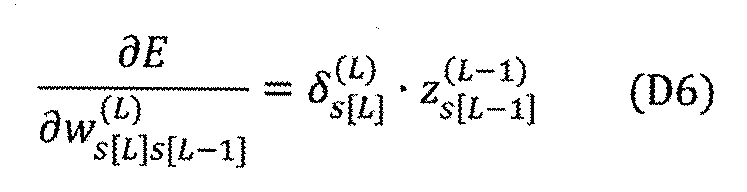
式(D5)の演算は、図9(D)に示す回路165によって実現できる。また、式(D6)の演算は、図9(C)に示す回路164によって実現できる。
つまり、式(D1)乃至式(D6)により、全てのニューロン回路の誤差δs[k]
(k)及びδs[L]
(L)を求めることができる。なお、重み係数の更新量は、誤差δs[k]
(k)、δs[L]
(L)及び所望のパラメータなどに基づいて、設定される。
以上のように、図9(A)乃至図9(D)に示す回路を用いることによって、教師有り学習を適用した階層型のニューラルネットワークの計算を行うことができる。
なお、本実施の形態は、本明細書で示す他の実施の形態と適宜組み合わせることができる。
(本明細書等の記載に関する付記)
以上の実施の形態における各構成の説明について、以下に付記する。
以上の実施の形態における各構成の説明について、以下に付記する。
<実施の形態で述べた本発明の一態様に関する付記>
各実施の形態に示す構成は、他の実施の形態に示す構成と適宜組み合わせて、本発明の一態様とすることができる。また、1つの実施の形態の中に、複数の構成例が示される場合は、互いに構成例を適宜組み合わせることが可能である。
各実施の形態に示す構成は、他の実施の形態に示す構成と適宜組み合わせて、本発明の一態様とすることができる。また、1つの実施の形態の中に、複数の構成例が示される場合は、互いに構成例を適宜組み合わせることが可能である。
なお、ある一つの実施の形態の中で述べる内容(一部の内容でもよい)は、その実施の形態で述べる別の内容(一部の内容でもよい)と、一つ若しくは複数の別の実施の形態で述べる内容(一部の内容でもよい)との少なくとも一つの内容に対して、適用、組み合わせ、又は置き換えなどを行うことができる。
なお、実施の形態の中で述べる内容とは、各々の実施の形態において、様々な図を用いて述べる内容、又は明細書に記載される文章を用いて述べる内容のことである。
なお、ある一つの実施の形態において述べる図(一部でもよい)は、その図の別の部分、その実施の形態において述べる別の図(一部でもよい)と、一つ若しくは複数の別の実施の形態において述べる図(一部でもよい)との少なくとも一つの図に対して、組み合わせることにより、さらに多くの図を構成させることができる。
<序数詞に関する付記>
本明細書等において、「第1」、「第2」、「第3」という序数詞は、構成要素の混同を避けるために付したものである。従って、本明細書等に記載する序数詞は、構成要素の数を限定するものではなく、また、構成要素の順序を限定するものではない。また例えば、本明細書等の実施の形態の一において「第1」に言及された構成要素が、他の実施の形態、あるいは特許請求の範囲において「第2」に言及された構成要素とすることもありうる。また例えば、本明細書等の実施の形態の一において「第1」に言及された構成要素を、他の実施の形態、あるいは特許請求の範囲において省略することもありうる。
本明細書等において、「第1」、「第2」、「第3」という序数詞は、構成要素の混同を避けるために付したものである。従って、本明細書等に記載する序数詞は、構成要素の数を限定するものではなく、また、構成要素の順序を限定するものではない。また例えば、本明細書等の実施の形態の一において「第1」に言及された構成要素が、他の実施の形態、あるいは特許請求の範囲において「第2」に言及された構成要素とすることもありうる。また例えば、本明細書等の実施の形態の一において「第1」に言及された構成要素を、他の実施の形態、あるいは特許請求の範囲において省略することもありうる。
<図面を説明する記載に関する付記>
実施の形態について図面を参照しながら説明している。但し、実施の形態は多くの異なる態様で実施することが可能であり、趣旨及びその範囲から逸脱することなく、その形態及び詳細を様々に変更し得ることは当業者であれば容易に理解される。従って、本発明は、実施の形態の記載内容に限定して解釈されるものではない。なお、実施の形態の発明の構成において、同一部分又は同様な機能を有する部分には同一の符号を異なる図面間で共通して用い、その繰り返しの説明は省略する。
実施の形態について図面を参照しながら説明している。但し、実施の形態は多くの異なる態様で実施することが可能であり、趣旨及びその範囲から逸脱することなく、その形態及び詳細を様々に変更し得ることは当業者であれば容易に理解される。従って、本発明は、実施の形態の記載内容に限定して解釈されるものではない。なお、実施の形態の発明の構成において、同一部分又は同様な機能を有する部分には同一の符号を異なる図面間で共通して用い、その繰り返しの説明は省略する。
また、本明細書等において、ブロック図では、構成要素を機能毎に分類し、互いに独立したブロックとして示している。しかしながら実際の回路等においては、構成要素を機能毎に切り分けることが難しく、一つの回路に複数の機能が係わる場合や、複数の回路にわたって一つの機能が関わる場合があり得る。そのため、ブロック図に示すブロックは、明細書で説明した構成要素に限定されず、状況に応じて適切に言い換えることができる。
また、図面において、大きさ、層の厚さ、又は領域は、説明の便宜上任意の大きさに示したものである。よって、必ずしもそのスケールに限定されない。なお図面は明確性を期すために模式的に示したものであり、図面に示す形状又は値などに限定されない。例えば、ノイズによる信号、電圧、若しくは電流のばらつき、又は、タイミングのずれによる信号、電圧、若しくは電流のばらつきなどを含むことが可能である。
また、図面において、斜視図などにおいて、図面の明確性を期すために、一部の構成要素の記載を省略している場合がある。
また、図面において、同一の要素又は同様な機能を有する要素、同一の材質の要素、あるいは同時に形成される要素等には同一の符号を付す場合があり、その繰り返しの説明は省略する場合がある。
ST11 ステップ
ST12 ステップ
ST13 ステップ
ST14 ステップ
ST15 ステップ
ST16 ステップ
ST17 ステップ
ST18 ステップ
ST21 ステップ
ST22 ステップ
ST23 ステップ
ST24 ステップ
ST31 ステップ
ST32 ステップ
ST33 ステップ
ST34 ステップ
ST35 ステップ
ST41 ステップ
ST42 ステップ
ST43 ステップ
ST44 ステップ
ST45 ステップ
ST46 ステップ
ST47 ステップ
100 システム
110 管理者側端末
120 開発者側端末
130 提供者側端末
140 装置
150 インターフェース部
151 管理者側インターフェース
152 開発者側インターフェース
153 提供者側インターフェース
154 属性情報検索部
155 データベース
156 データ変換部
157 処理部
159 インターフェース部
161 回路
163 回路
164 回路
165 回路
210 ノート型PC
220 デスクトップ型PC
230 携帯電話
240 サーバ
ST12 ステップ
ST13 ステップ
ST14 ステップ
ST15 ステップ
ST16 ステップ
ST17 ステップ
ST18 ステップ
ST21 ステップ
ST22 ステップ
ST23 ステップ
ST24 ステップ
ST31 ステップ
ST32 ステップ
ST33 ステップ
ST34 ステップ
ST35 ステップ
ST41 ステップ
ST42 ステップ
ST43 ステップ
ST44 ステップ
ST45 ステップ
ST46 ステップ
ST47 ステップ
100 システム
110 管理者側端末
120 開発者側端末
130 提供者側端末
140 装置
150 インターフェース部
151 管理者側インターフェース
152 開発者側インターフェース
153 提供者側インターフェース
154 属性情報検索部
155 データベース
156 データ変換部
157 処理部
159 インターフェース部
161 回路
163 回路
164 回路
165 回路
210 ノート型PC
220 デスクトップ型PC
230 携帯電話
240 サーバ
Claims (7)
- データの収集を行うシステムであり、
処理部と、記憶部と、データベースと、属性情報検索部と、を有し、
前記処理部は、前記記憶部と電気的に接続され、
前記処理部は、前記属性情報検索部と電気的に接続され、
前記属性情報検索部は、前記データベースと電気的に接続され、
前記処理部は、
第1利用者が送信する、前記第1利用者の所望する第1属性情報を受信する機能と、
前記第1属性情報を、前記記憶部に送信して、格納する機能と、
前記第1属性情報に対応する第1データを収集するための募集情報を含む第1情報を生成する機能と、
前記第1情報を、前記記憶部に送信して、格納する機能と、
前記第1情報を、第2利用者に送信する機能と、
を有し、
前記属性情報検索部は、
前記データベースに対して、前記第1属性情報に対応する第1データを検索する機能と、
前記検索において、前記第1データが見つかった場合に、前記第1データを前記データベースから前記第1利用者に送信する機能と、
を有することを特徴とするシステム。 - 請求項1において、
データ変換部を有し、
前記データ変換部は、前記データベースから読み出した前記第1データに対して、データ形式の変換、及び/又はシリアル化を行う機能を有することを特徴とするシステム。 - 請求項1、又は請求項2において、
前記処理部は、
前記第1利用者が前記データベースから前記第1データを受信したことによる請求情報を含む第2情報を生成する機能と、
前記第2情報を、前記記憶部に送信して、格納する機能と、
前記第2情報を、前記第1利用者に送信する機能と、
を有することを特徴とするシステム。 - 請求項1、又は請求項2において、
前記データベースは、
前記第2利用者が送信する、第2属性情報と、前記第2属性情報に対応する第2データと、を格納する機能を有し、
前記処理部は、
前記第2属性情報を、前記記憶部に格納する機能と、
前記第2データを提供した前記第2利用者への料金支払い情報を含む第3情報を生成する機能と、
前記第3情報を、前記記憶部に送信して、格納する機能と、
前記第3情報を、前記第2利用者に送信する機能と、
を有することを特徴とするシステム。 - システムにおいて、データの収集を行う動作方法であり、
第1乃至第8ステップを有し、
前記システムは、処理部と、記憶部と、データベースと、属性情報検索部と、を有し、
前記第1ステップは、第1利用者が前記属性情報検索部に対して、第1属性情報を送信するステップを有し、
前記第2ステップは、前記第1属性情報に対応した第1データを前記データベースで検索を行うステップを有し、
前記第3ステップは、前記検索において前記データベースから前記第1データが見つかった場合に、前記第4ステップに移行するステップと、前記検索において前記データベースから前記第1データが見つからなかった場合に、前記第7ステップに移行するステップと、を有し、
前記第4ステップは、前記データベースで検索した前記第1データを前記第1利用者に送信するステップを有し、
前記第5ステップは、前記処理部で、前記第1利用者への料金請求情報を含む第1情報を生成するステップと、前記第1情報を前記記憶部に格納するステップと、前記第1情報を前記第1利用者に送信するステップを有し、
前記第6ステップは、前記第1情報に基づいて、前記第1利用者が決済を行うステップを有し、
前記第7ステップは、前記処理部で、前記第1属性情報に基づく第2情報を生成するステップと、前記第2情報を前記記憶部に格納するステップと、を有し、
前記第8ステップは、前記管理者が前記第2情報を確認して、前記処理部において前記第2情報に基づいた第3情報を生成するステップと、前記第3情報を前記記憶部に格納するステップと、を有することを特徴とする動作方法。 - 請求項5において、
前記装置は、データ変換部を有し、
前記第4ステップは、前記データ変換部が、前記データベースから読み出した前記第1データに対して、データ形式の変換、及び/又はシリアル化を行うステップを有することを特徴とする動作方法。 - 請求項5、又は請求項6において、
第9乃至第15ステップを有し、
前記第9ステップは、前記第2利用者が前記第3情報を確認して、第2データと前記第2データに対応する第2属性情報を前記データベースに送信するステップを有し、
前記第10ステップは、前記第2データと前記第2属性情報とが前記データベースに格納されることで、前記データベースから前記処理部に、前記第2データの識別子と、前記第2属性情報と、が送信されるステップを有し、
前記第11ステップは、前記処理部が、前記識別子と前記第2属性情報とを前記記憶部に格納するステップを有し、
前記第12ステップは、前記管理者が前記記憶部から前記第2属性情報を読み出すステップと、前記管理者が、前記記憶部に格納された前記識別子を用いることで、前記データベースから前記第2データを読み出すステップと、を有し、
前記第13ステップは、前記管理者が、前記第2データと、前記第2属性情報と、を確認するステップと、を有するステップと、
前記第14ステップは、前記管理者が前記第2データと、前記第2属性情報と、を確認して、前記処理部で、前記第2データを提供した前記第2利用者への料金支払い情報を含む第4情報を作成するステップと、前記第4情報を前記記憶部に格納するステップと、を有し、
前記第15ステップは、前記第4情報に基づいて、前記管理者から前記第2利用者に料金を支払うことを特徴とする動作方法。
Priority Applications (1)
| Application Number | Priority Date | Filing Date | Title |
|---|---|---|---|
| JP2019505306A JPWO2018167607A1 (ja) | 2017-03-15 | 2018-03-07 | システム、及びシステムの動作方法 |
Applications Claiming Priority (2)
| Application Number | Priority Date | Filing Date | Title |
|---|---|---|---|
| JP2017-049956 | 2017-03-15 | ||
| JP2017049956 | 2017-03-15 |
Publications (1)
| Publication Number | Publication Date |
|---|---|
| WO2018167607A1 true WO2018167607A1 (ja) | 2018-09-20 |
Family
ID=63522824
Family Applications (1)
| Application Number | Title | Priority Date | Filing Date |
|---|---|---|---|
| PCT/IB2018/051458 Ceased WO2018167607A1 (ja) | 2017-03-15 | 2018-03-07 | システム、及びシステムの動作方法 |
Country Status (2)
| Country | Link |
|---|---|
| JP (1) | JPWO2018167607A1 (ja) |
| WO (1) | WO2018167607A1 (ja) |
Cited By (2)
| Publication number | Priority date | Publication date | Assignee | Title |
|---|---|---|---|---|
| JPWO2021186692A1 (ja) * | 2020-03-19 | 2021-09-23 | ||
| JP2021195933A (ja) * | 2020-06-18 | 2021-12-27 | トヨタ自動車株式会社 | 機械学習用データ収集装置 |
Citations (3)
| Publication number | Priority date | Publication date | Assignee | Title |
|---|---|---|---|---|
| JP2001297261A (ja) * | 2000-04-14 | 2001-10-26 | Misawa Homes Co Ltd | 質問回答方法、質問回答システムおよび質問回答プログラムを記録した記録媒体 |
| JP2004220550A (ja) * | 2002-11-18 | 2004-08-05 | Metallic House Inc | 営業活動支援システム及び情報処理装置 |
| JP2005250797A (ja) * | 2004-03-03 | 2005-09-15 | Ricoh Co Ltd | 画像売買システム |
-
2018
- 2018-03-07 JP JP2019505306A patent/JPWO2018167607A1/ja not_active Withdrawn
- 2018-03-07 WO PCT/IB2018/051458 patent/WO2018167607A1/ja not_active Ceased
Patent Citations (3)
| Publication number | Priority date | Publication date | Assignee | Title |
|---|---|---|---|---|
| JP2001297261A (ja) * | 2000-04-14 | 2001-10-26 | Misawa Homes Co Ltd | 質問回答方法、質問回答システムおよび質問回答プログラムを記録した記録媒体 |
| JP2004220550A (ja) * | 2002-11-18 | 2004-08-05 | Metallic House Inc | 営業活動支援システム及び情報処理装置 |
| JP2005250797A (ja) * | 2004-03-03 | 2005-09-15 | Ricoh Co Ltd | 画像売買システム |
Cited By (6)
| Publication number | Priority date | Publication date | Assignee | Title |
|---|---|---|---|---|
| JPWO2021186692A1 (ja) * | 2020-03-19 | 2021-09-23 | ||
| WO2021186692A1 (ja) * | 2020-03-19 | 2021-09-23 | Toa株式会社 | Ai制御装置、ai制御装置に接続されるサーバー装置、及びai制御方法 |
| JP7407271B2 (ja) | 2020-03-19 | 2023-12-28 | Toa株式会社 | Ai制御装置、ai制御装置に接続されるサーバー装置、及びai制御方法 |
| US12266369B2 (en) | 2020-03-19 | 2025-04-01 | Toa Corporation | AI control device, server device connected to AI control device, and AI control method |
| JP2021195933A (ja) * | 2020-06-18 | 2021-12-27 | トヨタ自動車株式会社 | 機械学習用データ収集装置 |
| JP7151743B2 (ja) | 2020-06-18 | 2022-10-12 | トヨタ自動車株式会社 | 車両用機械学習システム |
Also Published As
| Publication number | Publication date |
|---|---|
| JPWO2018167607A1 (ja) | 2020-01-16 |
Similar Documents
| Publication | Publication Date | Title |
|---|---|---|
| KR102644865B1 (ko) | 기업 홍보용 기사 생성을 위한 인공지능 모델 서비스 제공 방법, 장치 및 시스템 | |
| CN115221846B (zh) | 一种数据处理方法及相关设备 | |
| Bhardwaj et al. | Deep Learning Essentials: Your hands-on guide to the fundamentals of deep learning and neural network modeling | |
| WO2023065211A1 (zh) | 一种信息获取方法以及装置 | |
| US20110082825A1 (en) | Method and apparatus for providing a co-creation platform | |
| CN112633690B (zh) | 服务人员信息分配方法、装置、计算机设备和存储介质 | |
| El Mohadab et al. | Predicting rank for scientific research papers using supervised learning | |
| KR102695370B1 (ko) | 기업용 기사의 게재를 위한 매체 분류 및 정렬 방법, 장치 및 시스템 | |
| Liu et al. | Learning socially embedded visual representation from scratch | |
| Lu et al. | A modified whale optimization algorithm for parameter estimation of software reliability growth models | |
| Ma et al. | Knowledge-based functional conceptual design: Model, representation, and implementation | |
| JP2023532960A (ja) | 交差接続を使用する継続学習 | |
| CN116862001A (zh) | 数据标注的方法、ai开发平台、计算设备集群和存储介质 | |
| Xie et al. | Label graph learning for multi-label image recognition with cross-modal fusion | |
| Wen et al. | Integrated neural network model with pre-RBF kernels | |
| CN119622047A (zh) | 基于知识图谱的数据挖掘方法、查询方法和问答方法 | |
| JPWO2018167607A1 (ja) | システム、及びシステムの動作方法 | |
| CN116186388A (zh) | 用户的兴趣推荐方法、电子设备及存储介质 | |
| Yang et al. | Hyperbolic multichannel graph convolutional network for social recommendation | |
| CN114579757B (zh) | 一种基于知识图谱辅助的文本处理方法和装置 | |
| Villalobos Alva | Neural Networks Framework | |
| Sarraf | An End-To-End Cloud-Based Solution for Optimal Attention Network Topology in Real-Time Applications | |
| Cao et al. | ARIR: an intent recognition-based approach for API recommendation | |
| Qiao et al. | Multi-scale fusion for few-shot remote sensing image classification | |
| Yan et al. | Design and implementation of interactive platform for operation and maintenance of multimedia information system based on artificial intelligence and big data |
Legal Events
| Date | Code | Title | Description |
|---|---|---|---|
| 121 | Ep: the epo has been informed by wipo that ep was designated in this application |
Ref document number: 18766797 Country of ref document: EP Kind code of ref document: A1 |
|
| ENP | Entry into the national phase |
Ref document number: 2019505306 Country of ref document: JP Kind code of ref document: A |
|
| NENP | Non-entry into the national phase |
Ref country code: DE |
|
| 122 | Ep: pct application non-entry in european phase |
Ref document number: 18766797 Country of ref document: EP Kind code of ref document: A1 |