WO2018123409A1 - 手袋 - Google Patents
手袋 Download PDFInfo
- Publication number
- WO2018123409A1 WO2018123409A1 PCT/JP2017/042810 JP2017042810W WO2018123409A1 WO 2018123409 A1 WO2018123409 A1 WO 2018123409A1 JP 2017042810 W JP2017042810 W JP 2017042810W WO 2018123409 A1 WO2018123409 A1 WO 2018123409A1
- Authority
- WO
- WIPO (PCT)
- Prior art keywords
- layer
- glove
- touch screen
- finger
- glove according
- Prior art date
- Legal status (The legal status is an assumption and is not a legal conclusion. Google has not performed a legal analysis and makes no representation as to the accuracy of the status listed.)
- Ceased
Links
Images




Classifications
-
- A—HUMAN NECESSITIES
- A41—WEARING APPAREL
- A41D—OUTERWEAR; PROTECTIVE GARMENTS; ACCESSORIES
- A41D19/00—Gloves
-
- A—HUMAN NECESSITIES
- A41—WEARING APPAREL
- A41D—OUTERWEAR; PROTECTIVE GARMENTS; ACCESSORIES
- A41D19/00—Gloves
- A41D19/015—Protective gloves
-
- C—CHEMISTRY; METALLURGY
- C08—ORGANIC MACROMOLECULAR COMPOUNDS; THEIR PREPARATION OR CHEMICAL WORKING-UP; COMPOSITIONS BASED THEREON
- C08L—COMPOSITIONS OF MACROMOLECULAR COMPOUNDS
- C08L101/00—Compositions of unspecified macromolecular compounds
- C08L101/12—Compositions of unspecified macromolecular compounds characterised by physical features, e.g. anisotropy, viscosity or electrical conductivity
Definitions
- the present invention discloses a glove capable of operating a touch screen that performs an electronic reaction while wearing the glove.
- gloves for work.
- a worker in a factory wears gloves to cope with the work. This may be the case when handling objects that are dangerous with bare hands or prohibited to touch with bare hands. That is, there are cases where gloves are worn in order to increase the safety and accuracy of workers and work. Of course, gloves are also worn in terms of maintaining safety (operators and objects) while improving workability.
- gloves are worn for various purposes and scenes, such as sports, horticultural work, luggage transport work (for example, moving), light work, etc. All of them are for facilitating operation and work and maintaining safety such as hand protection.
- (Scene 1) A scene corresponding to the climate.
- (Scene 2) A scene used as one of fashion and fashion.
- (Scene 3) A scene where work is performed inside or outside the factory, construction, moving, or gardening.
- (Scene 4) A scene such as a sport.
- ⁇ Gloves are used in such various situations. Of course, it is not restricted to these.
- a factory operating panel may be in the form of a touch screen that may need to be operated.
- a tablet terminal may be used in a work manual or work report.
- tablet terminals may be used in various analyzes and examinations corresponding to such situations as in sports.
- the touch screen may or may not be operated in various scenes including the scenes 1 to 4 described above.
- gloves are worn in the scenes 1 to 4 described above. That is, it is necessary to remove the gloves and operate the touch screen with bare hands, or operate the touch screen while wearing the gloves.
- the touch screen is a device for operating electronic processing with a fingertip such as a touch panel.
- a first conductive portion 20 and a second conductive portion 22 are provided at the distal end portions of the thumb insertion portion 14a and the index finger insertion portion 14b forming the finger insertion portion 14, and the first conductive portion 20 and the second conductive portion 22 are provided.
- the 1st electroconductive part 20 and the 2nd electroconductive part 22 are the gloves currently formed in the area
- Patent Document 1 aims to operate a touch screen (reacts by conduction) while wearing a glove by providing a conductive part on the fingertip.
- Patent Document 1 only describes a conductive part, and providing such a conductive part on the fingertip of the glove deteriorates the workability of the fingertip. Or the fitting property at the time of wear will be worsened. For this reason, there exists a problem which reduces workability
- the main task is wearing gloves, and the time for operating the touch screen is small as a whole. There is a problem that it is not preferable to give priority to the operation of the touch screen in a short time and to reduce the wearability and workability in other time such as work.
- Patent Document 2 since the outer surface of the abdomen of the finger pouch 12 is covered with the external conductive layer 22 for conduction with a conduction object such as the touch panel 30, the tip abdomen of the finger pouch for conduction as in the prior art.
- the conductive thread is not sewed to form irregularities or sewing needle through holes.
- the conductive yarn 23 and the inner conductive layer 24 are arranged on the proximal side of the tip abdomen of the finger bag 12, even if the fingertip does not reach the tip abdomen of the finger bag 12, 12 discloses a glove capable of bringing a finger into contact with the conductive yarn 23 and the inner conductive layer 24 within the interior 12.
- Patent Document 2 proposes a glove that can operate a touch screen that reacts electronically even when the glove is worn by using a part of the fiber of the fiber glove as a conductive fiber.
- a glove sewn with conductive fibers has a problem that the conductivity is lowered due to the poor balance between the conductive fibers and the other non-conductive fibers, and the reaction of the touch screen is deteriorated.
- the conductivity is high, there is a problem that the conductive fibers are mainly used and the wearability and workability are deteriorated.
- the surface of the fiber glove may be coated for the purpose of protection or anti-skid, but the coating makes the conductivity between the conductive fiber and the touch screen worse, and the reaction is poor. There is also a problem.
- Patent Document 3 includes metal powder and / or conductive powder other than metal powder in the vicinity of palm-side tips of finger bags 2 and 3 that house at least the thumb and the index finger among the finger bags in golf glove body 1.
- a golf glove having a polyurethane resin elastic member 4 attached thereto is disclosed.
- Patent Document 3 discloses a glove that realizes an electronic reaction on a touch screen by mixing a conductive powder into a film to be a so-called coating.
- the conductive powder assumed in Patent Document 3 is a carbon powder or a metal oxide powder similar to this, and the film in which this is mixed inevitably becomes black.
- these conductive powders are mixed with the resin of a resin glove instead of the coating, it becomes black.
- Patent Document 3 has a problem that the color of the glove becomes black and color variations cannot be developed.
- the amount of conductive powder mixed is increased in order to increase the conductivity, there is a problem that the strength decreases.
- Patent Document 4 discloses an improved material for capacitive touch screens.
- the improved material includes a material impregnated with a composition comprising a non-metallic and / or metallic conductive agent and a binder.
- Various materials can be considered, including but not limited to leather.
- materials for use with capacitive touch screens that also disclose an apparatus and method for providing conductive gloves.
- Patent Document 4 is also intended to be able to operate a touch screen that reacts electronically by mixing conductive powder.
- Patent Document 4 has the same problem as Patent Document 3.
- Patent Document 4 enables the operation of the touch screen by generating a conductive bond with the touch screen by the layer using the conductive powder. .
- the hand inside the glove is electrically connected to the outside due to the conductive powder, and depending on the object touched by the glove, an electric current may reach the hand and cause an electric shock.
- Patent Documents 1 to 4 can operate a touch screen that performs an electronic reaction while wearing gloves, but have the following problems.
- the present invention has been made in view of such problems, and an object thereof is to provide a glove that can be operated while wearing an electronically responsive touch screen while ensuring safety and workability.
- the glove of the present invention includes an insulating first layer, A second layer outside the first layer and corresponding to at least the finger,
- the first layer has insulation from the outside to the hand
- the second layer is PEDOT / PSS (polyethylenedioxythiophene / polystyrene sulfonic acid), polyphenylene, polyacene, polydiacetylene, polyphenylene, polyanthracene, polyfuran, polyselenophene, polyaniline, polythienylene vinylene, polyphenanthrene, polyperiphthalene. Containing at least one of the following.
- the glove of the present invention can be operated with the touch screen while wearing the glove by applying a coating containing a conductive material to the fingertip. For this reason, even when normal work and operation using a touch screen are mixed, work efficiency is high. Or, even when wearing gloves for protection against the cold or fashion, it is very easy because the smartphone or tablet terminal can be operated at any time without removing the gloves.
- an electronic reaction of the touch screen can be generated, and since it does not conduct with the hand itself, it is possible to ensure electric resistance. For this reason, work safety can be ensured and it can be applied to work in a factory or outdoors.
- Embodiment 1 of the present invention It is a perspective view of the glove in Embodiment 1 of the present invention. It is a front view of the glove in Embodiment 1 of the present invention. It is explanatory drawing which shows the aspect which measures the electricity supply state of the glove and touch screen in Embodiment 2 of this invention. It is explanatory drawing which shows the aspect which measures the electricity supply state of the glove and touch screen in Embodiment 2 of this invention. It is explanatory drawing which shows the aspect which measures the electricity supply state of the glove and touch screen in Embodiment 2 of this invention. It is the experimental result which confirmed whether the touch screen responded in the state which mounted
- the glove according to the first invention of the present invention comprises an insulating first layer, A second layer outside the first layer and corresponding to at least the finger,
- the first layer has an insulating property from the outside to the hand
- the second layer includes PEDOT / PSS (polyethylenedioxythiophene / polystyrene sulfonic acid), polyphenylene, polyacene, polydiacetylene, polyphenylene, polyanthracene, polyfuran, polyselenophene, polyaniline, polythienylene vinylene, polyphenanthrene, polyperylene. Contains at least one of naphthalene.
- This configuration makes it possible to realize work requiring electrical resistance and the case where touch screen operation is required, while wearing gloves.
- the second layer is provided in the outermost layer.
- This configuration allows the second layer capable of generating capacitance to react directly with the touch screen.
- the second layer can contact a touch screen that reacts electronically.
- the second layer containing PEDOT / PSS capable of generating capacitance can reliably generate capacitance between the touch screen and the second layer. As a result, the touch screen can be operated.
- the second layer is provided on the distal end side from the first joint in the finger portion.
- This configuration can reduce the cost for forming the second layer while enabling the operation of the touch screen. Furthermore, the electric resistance during normal work can be improved.
- the second layer is formed only on the ventral side of the finger portion.
- This configuration can reduce the cost for forming the second layer while enabling the operation of the touch screen. Furthermore, the electric resistance during normal work can be improved. In particular, the cost for forming the second layer can be further reduced.
- the second layer is formed only on the finger portions of the thumb and the index finger.
- This configuration can reduce the cost for forming the second layer while enabling the operation of the touch screen. Furthermore, the electric resistance during normal work can be improved. In particular, the cost for forming the second layer can be further reduced.
- the second layer is formed only on the thumb, index finger and middle finger.
- This configuration can reduce the cost for forming the second layer while enabling the operation of the touch screen. Furthermore, the electric resistance during normal work can be improved. In particular, the cost for forming the second layer can be further reduced.
- the second layer has a non-slip function and is formed only in a region where the anti-slip is required in the glove.
- This configuration can reduce the cost for forming the second layer while enabling the operation of the touch screen. Furthermore, the electric resistance during normal work can be improved. In particular, the cost for forming the second layer can be further reduced.
- the second layer comprises NR (natural rubber), NBR (acrylonitrile butadiene rubber), PU (polyurethane), At least one of CR (chloroprene rubber), CSM (chlorosulfonated polyethylene), PVC (vinyl chloride), EVA (ethylene vinyl acetate), SBR (styrene butadiene rubber) and PEDOT / PSS (polyethylenedioxythiophene / polystyrene sulfonic acid) ), Polyphenylene, polyacene, polydiacetylene, polyphenylene, polyanthracene, polyfuran, polyselenophene, polyaniline, polythienylene vinylene, polyphenanthrene, and polyperiphthalene.
- NR natural rubber
- NBR acrylonitrile butadiene rubber
- PU polyurethane
- At least one of CR chloroprene rubber
- CSM chlorosulfonated polyethylene
- a second layer containing PEDOT / PSS can be formed.
- the wearability and gripping ability can be improved.
- PEDOT / PSS has a content rate of 1.6 wt% or more with respect to the entire second layer.
- This configuration can generate a sufficient capacitance for reacting the touch screen.
- the capacitance generated between the second layer and the finger surface is 2.0 pF / ⁇ 8 mm or more. is there.
- This configuration enables touch screen operation.
- the insulation resistance value of the second layer is 1 M ⁇ or less.
- This configuration enables touch screen operation.
- a stretchable fiber substrate is further provided inside the first layer.
- This configuration can further improve the wearability.
- the first layer and the second layer have different colors.
- This configuration allows the user to easily grasp the part of the glove that can operate the touch screen.
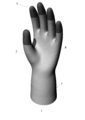
- FIG. 1 is a perspective view of a glove according to Embodiment 1 of the present invention.
- the glove 1 has a plurality of layer structures including a first layer 2 and a second layer 3.
- a second layer 3 is provided outside the first layer 2.
- the first layer 2 has an insulating property.
- the second layer 3 is provided outside the first layer 2 and at least at a site corresponding to the finger portion 6. In FIG. 1, the second layer 3 is provided on the palm 4 other than the wrist portion 7.
- the first layer 2 has an insulating property, and when the glove 1 is worn on the hand, the first layer 2 realizes an insulating property from the outside to the hand. For this reason, when a user works in a factory etc. using the glove 1, required insulation can be obtained.
- human bodies and members can be protected by static electricity, and human bodies can be protected by various energizations.
- the second layer 3 is provided outside the first layer 2.
- the second layer 3 is made of PEDOT / PSS (polyethylenedioxythiophene / polystyrenesulfonic acid), polyphenylene, polyacene, polydiacetylene, polyphenylene, polyanthracene, polyfuran, polyselenophene, polyaniline, polythienylene vinylene, polyphenanthrene. , Containing at least one of polyperinaphthalene.
- the second layer 3 Capacitance can be generated between the touch screen and the direct or indirect contact. Due to the generation of this capacitance, the second layer 3 can operate a touch screen that reacts when current is applied.
- the touch screen can react. This is because the touch screen generates a capacitance between the touch screen and the operated side, and reacts with the current by the capacitance.
- At least one of PEDOT / PSS, polyphenylene, polyacene, polydiacetylene, polyphenylene, polyanthracene, polyfuran, polyselenophene, polyaniline, polythienylene vinylene, polyphenanthrene, and polyperiphthalene produces this capacitance.
- the second layer 3 containing at least one of PEDOT / PSS, polyphenylene, polyacene, polydiacetylene, polyphenylene, polyanthracene, polyfuran, polyselenophene, polyaniline, polythienylene vinylene, polyphenanthrene, and polyperinaphthalene is formed from the PEDOT / PSS.
- the touch screen that operates can be operated.
- PEDOT / PSS polyphenylene, polyacene, polydiacetylene, polyphenylene, polyanthracene, polyfuran, polyselenophene, polyaniline, polythienylene vinylene, polyphenanthrene, and polyperiphthalene is used as necessary. It is written as “PEDOT / PSS etc.”.
- the first layer 2 has an insulating property and is inside the second layer 3. For this reason, even if the electrostatic capacity of the second layer 3 and the touch screen is generated, the energization of the hand worn by the first layer 2 can be shielded. That is, while the touch screen is operated using the glove 1, the hand is prevented from being energized by the capacitance, and the hand itself is not adversely affected by the energization.
- the glove 1 is provided with a second layer 3 containing PEDOT / PSS etc. outside the first layer 2 on the inner side of the first insulating layer 2, so that the touch reacts electrically with the maintenance of the insulating property. It is possible to achieve both screen operation. Since the inner side is insulative and the outer side is configured to generate capacitance, both of these can be realized. In particular, the glove 1 is optimal when it is necessary to operate the touch screen from time to time, while maintaining the general insulation is a priority.
- the glove 1 is a multi-layer structure of the insulating first layer 2 and the second layer 3 including PEDOT / PSS, etc., so that the operation of the touch screen that reacts electrically with the maintenance of the insulating property is performed. Can be realized.
- PEDOT / PSS etc. can realize the generation of capacitance with a small content.
- PEDOT / PSS etc. are light colors. Accordingly, the color of the second layer 3 is different from that of carbon powder, and the second layer 3 is not biased to a dark color such as black.
- the color of the second layer 3 can realize various variations. Due to the wide range of variations in color, the glove 1 can cope with everyday fashion and the color specified in factories.
- Gloves 1 can be applied to a wide range of uses, not just for specific purposes, due to wide variations in color.
- the glove 1 can also be applied for fashion use. Even when gloves are used in winter, it is easy to use as a fashion considering the balance with clothes. This is because color variations spread. Even when wearing gloves as a cold protection or fashion, it is required to achieve both electric resistance and touch panel operation, and the glove 1 can realize this without impairing the appearance as fashion.
- PEDOT / PSS polyphenylene, polyacene, polydiacetylene, polyphenylene, polyanthracene, polyfuran, polyselenophene, polyaniline, It may be grasped as explanation about any of polythienylene vinylene, polyphenanthrene, and polyperiphthalene.
- the second layer 3 is formed outside the first layer 2. Another layer may be provided on the outer layer of the second layer 3. In this case, it is necessary that the second layer 3 is a layer having a thickness, a material, and a structure that can generate a sufficient capacitance for the reaction of the touch screen between the second layer 3 and the touch screen. For example, a very thin layer is provided outside the second layer 3.
- the second layer 3 can generate a capacitance between the second layer 3 and the touch screen via the outer layer.
- the second layer 3 may be provided on the outermost layer.
- the second layer 3 can come into contact with a touch screen that reacts electrically (electronically). By this contact, the second layer 3 can generate a capacitance directly with the touch screen.
- the glove 1 can operate the touch screen due to the generation of these capacitances.
- the second layer 3 contains at least one of PEDOT / PSS, polyphenylene, polyacene, polydiacetylene, polyphenylene, polyanthracene, polyfuran, polyselenophene, polyaniline, polythienylene vinylene, polyphenanthrene, and polyperiphthalene. , Create a capacitance between the touch screen. This capacitance activates an electronically responsive touch screen. For this reason, the range in which the second layer 3 is formed is a range in which the touch screen can be operated.
- FIG. 2 is a front view of the glove according to Embodiment 1 of the present invention.
- the second layer 3 is formed on the first layer 2.
- the second layer 3 is formed on the distal end side of the first joint of the finger portion 6.
- the second layer 3 is provided on the distal end side of the first joint of the finger portion 6 corresponding to the fingertip. As shown in FIG. 2, the second layer 3 is formed on the distal end side from the first joint, so that the operation is not easily hindered.
- the formation range of the second layer 3 is small, there is an advantage that the cost required for PEDOT / PSS or the like can be reduced.
- the insulating property of the glove 1 whole can be improved because the 1st layer 2 of insulation is a main body in another range. High insulation improves safety in factory work.
- the second layer 3 is formed on the distal end side of the first joint of the finger 6, if the colors of the first layer 2 and the second layer 3 are different, the user can touch the touch screen at the fingertip. You will be able to easily understand what you can do.
- the second layer 3 is also preferably formed only on the ventral side of the finger part 6.
- the user who wears the glove 1 often operates by touching the ventral side (palm side) of the finger portion 6 to the touch screen. This is because it is easy to operate.
- the second layer 3 contains PEDOT / PSS or the like, thereby generating a capacitance between the second layer 3 and the electrodes provided in the touch screen. For this reason, the second layer 3 is formed in a portion that comes into contact with the touch screen, so that sufficient operation can be ensured.
- the second layer 3 is formed only on the ventral side of the finger 6, there is an advantage that the cost required for PEDOT / PSS or the like can be reduced. Moreover, shortening of the time etc. which are immersed in the raw material liquid at the time of forming the 2nd layer 3 is also obtained. Moreover, since the 2nd layer 3 is not formed in the back side of the finger part 6, the insulation capability of the back side of the finger part 6 increases more. The back side of the finger part 6 may touch an electrically conductive object during work or may cause electrostatic contact. Even in such a case, it is preferable that the second layer 3 is formed only on the ventral side of the finger 6.
- the second layer 3 is formed only on the finger portions 6 of the thumb and forefinger.
- a smartphone or a tablet terminal has a portion to be operated with a touch screen, and can often be operated only with a thumb and an index finger.
- the second layer 3 is formed only on the thumb and index finger. While the practicality in the operation of the touch screen is sufficient, the formation area of the second layer 3 can be reduced. By making it small, the cost required for PEDOT / PSS or the like can be reduced. Moreover, the process of forming the second layer 3 can be reduced.
- the second layer 3 may be formed only on the thumb, index finger, and middle finger.
- a smartphone or a tablet terminal has a portion and an operation method to be operated on a touch screen, and most operations can be performed with a thumb, an index finger, and a middle finger in many cases.
- the second layer 3 is formed only on the thumb, forefinger and middle finger. While the practicality in the operation of the touch screen is sufficient, the area of the second layer 3 can be reduced. By making it small, the cost required for PEDOT / PSS or the like can be reduced. Moreover, the process of forming the second layer 3 can be reduced.
- the second layer 3 is formed only on the palm 4 including the finger portion 6. Even if it is formed only on the palm 4 side, if it is formed on the finger part 6, it is sufficient for the operation of the touch screen. When the touch screen is large, the operation can be performed sufficiently if the second layer 3 is formed on the palm 4 side.
- the second layer 3 in various ranges, usability can be ensured while suppressing costs.
- the formation of the first joint above the first joint and the formation of the two to the four specific fingers may be combined. That is, the second layer 3 is formed only on the thumb and forefinger on the tip side from the first joint.
- the second layer 3 is composed of NR (natural rubber), NBR (acrylonitrile butadiene rubber), PU (polyurethane), CR (chloroprene rubber), CSM (chlorosulfonated polyethylene), PVC (vinyl chloride), EVA (ethylene vinyl acetate).
- SBR styrene butadiene rubber
- PEDOT / PSS polyphenylene, polyacene, polydiacetylene, polyphenylene, polyanthracene, polyfuran, polyselenophene, polyaniline, polythienylene vinylene, polyphenanthrene, polyperiphthalene. It is suitable to be formed of a material including one. By including PEDOT / PSS or the like in any of these materials, it is possible to expand the color variation while realizing the operation of the touch screen described above.
- the second layer 3 is formed reliably.
- the second layer 3 is formed by being immersed in the raw material liquid. Also in this respect, these materials are advantageous in that they can be easily immersed as a material liquid.
- the second layer 3 is formed of these materials. Of course, it is not intended to be limited to these.
- PEDOT / PSS may be contained at a content rate of 1.6 wt% or more with respect to the entire second layer. This is because, when the content is 1.6 wt% or more, the PEDOT / PSS can generate a sufficient capacitance for operation between the second layer 3 and the touch screen.
- the second layer 3 is formed by being immersed in a material liquid that forms the second layer.
- the outer shape of the glove 1 is configured by forming the first layer 2.
- the second layer 3 can be formed in a portion that has been immersed and dried.
- a material solution corresponding to the composition of the second layer is prepared, and when the first layer 2 is immersed in this material solution and dried, the portion is formed as the second layer 3. That is, the above-mentioned NR (natural rubber), NBR (acrylonitrile butadiene rubber), PU (polyurethane), CR (chloroprene rubber), CSM (chlorosulfonated polyethylene), PVC (vinyl chloride), EVA (ethylene vinyl acetate), SBR It is preferable that a material liquid containing PEDOT / PSS or the like is prepared in at least one of (styrene butadiene rubber). The 2nd layer 3 can be formed by being immersed in the raw material liquid which has this composition.
- the raw material liquid may be adjusted so that the content of PEDOT / PSS or the like is 1.6 wt% or more after drying.
- a raw material liquid having such a composition is prepared, and a necessary portion of the outer shape of the glove 1 formed by the first layer 2 is dipped. As described above, this is a range where the second layer 3 is to be formed. For example, only the finger part, only the ventral side of the finger part, above the first joint of the finger part, and only the thumb and index finger are immersed in the material liquid. By drying after this immersion, the second layer 3 can be formed in a desired range.
- the second layer 3 thus formed contains PEDOT / PSS or the like that sufficiently reacts with the touch screen, and a capacitance is generated between the second layer 3 and the touch screen. As a result, the glove 1 can operate the touch screen.
- the first layer 2 may be formed of a material having insulating properties. An insulating material solution may be prepared, and thereby the first layer may be formed.
- Embodiment 2 will be described.
- various additional devices and experimental results will be described.
- the second layer 3 may be formed on the palm 4 as shown in FIG. Even if it is not the whole palm 4, the 2nd layer 3 is formed in the ventral side of the finger
- the second layer 3 has a slip prevention function. Since the second layer 3 has the function of generating capacitance and the anti-slip function, it is possible to achieve both the operation of the touch screen and the improvement of the gripping force by the anti-slip.
- the second layer 3 may be formed in an area in the glove 1 that requires slip prevention. By doing so, the second layer 3 can realize both the slip prevention and the operation of the touch screen.
- first layer 2 (Inside the first layer) It is also preferable to further provide a stretchable fiber substrate inside the first layer 2. This is because a feeling of wearing is improved by providing a so-called work gloves-like fiber base on the inside. In this case, there is a fiber base on the inside, then the first layer 2 and the second layer 3 on the outside. With such a multilayer structure, it is possible to realize high wearability, electric resistance (insulation), and operation of the touch screen.
- the first layer 2 and the second layer 3 have different colors. This is because the user can grasp at a glance that the first layer 2 and the second layer 3 are provided because the colors are different.
- the second layer 3 is formed only on a part of the glove 1, the part on which the second layer 3 is formed can be grasped at a glance, and the user can grasp the part for operating the touch screen. it can. By this grasping, the touch screen can be operated while wearing the gloves 1 without any problem.
- the first layer 2 and the second layer 3 have different colors.
- FIGS. 3 to 5 are explanatory diagrams showing a mode of measuring the energization state between the glove and the touch screen according to the second embodiment of the present invention.
- an electronic panel corresponding to a touch screen and an electrode connected to the back surface of the electronic panel are prepared.
- the surface of the electronic panel (on the side opposite to the electrode) was checked by touching it with the hand of a person wearing or not wearing gloves. Through this confirmation, the necessary insulation resistance value of the second layer of the glove was measured.
- FIG. 3 shows a state in which the electronic panel is being touched with a hand that is not wearing gloves. At this time, a pseudo capacitor A is generated between the surface of the hand and the electrode of the electronic panel. The capacitance of the pseudo capacitor A indicates the capacitance generated between the surface of the hand and the electrode of the electronic panel.
- FIG. 4 shows a state in which the electronic panel is touched with a hand wearing normal gloves. At this time, a pseudo capacitor B is generated between the hand in the glove and the electrode of the electronic panel. The capacitance of the pseudo capacitor B indicates the capacitance generated between the hand in the glove and the electrode of the electronic panel.
- FIG. 5 shows a state in which the electronic panel is touched with a hand wearing a glove having the second layer of the present invention.
- a pseudo capacitor C is generated between the hand in the glove and the conductive second layer.
- a pseudo capacitor A (same as FIG. 3) is generated between the second layer and the electrode of the electronic panel so as to be connected to the pseudo capacitor C. In this way, a capacitance is generated between the second layer and the electronic panel, and the boundary of whether or not the electronic panel can be operated is determined.
- the glove of the present invention is divided into two places, that is, between the hand and the second layer and between the second layer and the electronic panel, due to the presence of the second layer, and the capacitance is generated. . If the total of these two capacitances is sufficient to operate the electronic panel, the touch screen can be operated with the gloves on, otherwise the touch screen cannot be operated.
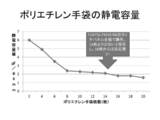
- FIG. 6 is a result of an experiment for confirming whether or not the touch screen reacts in a state where the polyethylene glove according to Embodiment 2 of the present invention is worn.
- FIG. 6 shows the number of polyethylene gloves worn on the hand on the horizontal axis.
- the vertical axis represents the capacitance between the hand and the touch screen.
- the capacitance on the vertical axis is the same as that of the pseudo capacitor C shown in FIG.
- FIG. 6 also reflects the result of searching for the number of touch screens that worsen by increasing the number of polyethylene gloves to be worn.
- “Fujitsu notebook PC FMVS76E” was used as a touch screen.
- the touch screen becomes difficult to react.
- the capacitance between the hand and the touch screen at this time is about 2 pF.
- the capacitance between the second layer and the touch screen was 2 pF / ⁇ 8 mm or more. ⁇ 8 mm indicates that the size of the fingertip portion in contact with the touch panel is a circle having an approximate diameter of 8 mm, and thus this size is regarded as the contact portion.
- the glove of the present invention can operate the touch screen while wearing the glove.
- FIG. 7 is a table showing experimental results for confirming the reaction between the glove and the touch screen according to the second embodiment of the present invention.
- FIG. 7 shows an experimental result in which a glove containing the second layer containing the PEDOT / PSS content is manufactured and the reaction state of the touch screen is verified.
- the glove and the touch screen react when the insulation resistance value of the second layer is 1 M ⁇ or less. That is, it was confirmed that the insulation resistance value of the second layer of the glove is 1 M ⁇ or less is a boundary at which the touch screen can be operated while wearing the glove.
- the content of PEDOT / PSS in the second layer is preferably 1.6 wt% or more. This is because, when the content ratio of PEDOT / PSS in the second layer is 1.6 wt% or more, the touch screen reacts while wearing gloves as shown in FIG. 7.
- the content rate of PEDOT / PSS in a dry state of a 2nd layer is 1.6 wt% or more.
- the second layer is often formed by immersing gloves in a liquid material, but not the content of PEDOT / PSS contained in this liquid material state, but after the second layer is formed and dried The content rate at is 1.6 wt% or more.
- the second layer contains PEDOT / PSS as an example, but other than PEDOT / PSS, polyphenylene, polyacene, polydiacetylene, polyphenylene, polyanthracene, polyfuran, polyselenophene, polyaniline, polythienylene.
- PEDOT / PSS polyphenylene, polyacene, polydiacetylene, polyphenylene, polyanthracene, polyfuran, polyselenophene, polyaniline, polythienylene.
- vinylene, polyphenanthrene, and polyperiphthalene are examples of the same.
- the second layer preferably has the following specifications.
- the capacitance between the second layer and the finger surface is 2 pF / ⁇ 8 mm or more.
- the insulation resistance value of the second layer is 1 M ⁇ or less.
- the content of PEDOT / PSS or the like in the second layer is 1.6 wt% or more in a state after being dried and formed as the second layer.
- the glove of the present invention can operate the touch screen while maintaining the necessary insulation while wearing the glove.
- the glove described in the first and second embodiments is an example for explaining the gist of the present invention, and includes modifications and alterations without departing from the gist of the present invention.
Landscapes
- Engineering & Computer Science (AREA)
- Textile Engineering (AREA)
- Chemical & Material Sciences (AREA)
- Health & Medical Sciences (AREA)
- Chemical Kinetics & Catalysis (AREA)
- Medicinal Chemistry (AREA)
- Polymers & Plastics (AREA)
- Organic Chemistry (AREA)
- Gloves (AREA)
- Compositions Of Macromolecular Compounds (AREA)
Abstract
【課題】安全性や作業性を確保しつつ、電子的に反応するタッチスクリーンを着用したまま操作可能な手袋を提供する。 【解決手段】本発明の手袋は、絶縁性の第1層と、前記第1層の外側であって少なくとも指部に対応する第2層と、を備え、前記第1層は、外部から手への絶縁性を有し、前記第2層は、PEDOT/PSS、ポリフェニレン、ポリアセン、ポリジアセチレン、ポリフェニレン、ポリアントラセン、ポリフラン、ポリセレノフェン、ポリアニリン、ポリチエニレンビニレン、ポリフェナントレン、ポリペリナフタレンの少なくとも一つを含有する。
Description
本発明は、手袋をはめたままで電子反応を行うタッチスクリーンを操作できる、手袋を開示する。
手袋を装着したい場面や装着しなければならない場面は、様々にある。例えば、外気温が低い場合には、戸外にいる間に、手袋をはめたい状態である。このような場合には、人は、寒さから身体を守るために手袋を装着する。もちろん、寒いだけでなく、ファッションの一つとしてであったり好みの一つとしてであったりにより、手袋を装着する場合がある。
あるいは、作業の必要上、手袋を装着しなければならないこともある。例えば、工場での作業者は、その作業に対応するために、手袋を装着する。素手では危険であったり、素手で触ることが禁止されている対象物を取り扱ったりする場合などである。すなわち、作業者および作業の安全性や正確性を高めるために、手袋を装着する場合がある。もちろん、作業性を向上させつつ安全性(作業者および対象物)を維持する点でも手袋を装着する。
あるいは、スポーツ、園芸作業、荷物の運搬作業(例えば、引っ越しなど)、軽作業など、様々な用途と場面で手袋が装着される。いずれも、動作や作業を容易にしたり、手の保護などの安全性を維持したりするためである。
すなわち、手袋を装着する場面としては、大きく次のようなものがある。
(場面1)気候に対応する場面。
(場面2)おしゃれやファッションの一つとして活用する場面。
(場面3)工場、工事、引っ越し、園芸などの内部や外部での作業を行う場面。
(場面4)スポーツなどの場面。
(場面2)おしゃれやファッションの一つとして活用する場面。
(場面3)工場、工事、引っ越し、園芸などの内部や外部での作業を行う場面。
(場面4)スポーツなどの場面。
このような様々な場面で、手袋が使用される。もちろん、これらに限られるものではない。
近年、スマートフォンやタブレット端末など、いわゆる指で触って操作するタッチスクリーンを備えた機器が普及している。これらを所有している人は、タッチスクリーンを操作して、スマートフォンやタブレット端末を使用する。
個人で所有しているスマートフォンやタブレット端末だけでなく、作業において必要となる操作機器が、このタッチスクリーンを備えていることも多い。例えば、工場の操作盤は、タッチスクリーン形態であって、これを操作することが必要となっていることがある。あるいは、引っ越しや工事などの屋外作業において、作業マニュアルや作業報告においてタブレット端末を使用されることがある。
また、スポーツなどの場面でも、種々の解析やこれに対応する検討において、タブレット端末が使用されることがある。すなわち、上述した場面1~場面4を始めとした様々な場面で、タッチスクリーンを操作したいあるいは操作しなければならないことがある。
あるいは、駅の券売機、街中の自動販売機、銀行のATMなども、機械的なボタン操作ではなく、タッチスクリーンを使用するものが増えている。これらを使用する際にも、タッチスクリーンを操作しなければならない。
一方で、上述した場面1~場面4などの場面では、手袋を着用している。すなわち、手袋を脱いで素手でタッチスクリーンを操作するか、手袋を着用したままタッチスクリーンを操作しなければならない。
しかしながら、場面1、場面2の状況で手袋を着用している人は、手袋を脱がずにタッチスクリーンを操作したいとの欲求を持っている。寒さが嫌であったり、おしゃれを損なったりするという意図もあり、スマートフォンなどは、頻繁に操作するので、その都度、手袋を脱ぐのは不便で面倒だとの意識もあるからである。
すなわち、場面1、場面2の場合においては、手袋を着用したまま、タッチスクリーンを操作したいとの要望がある。
場面3、場面4の状況で手袋を着用している人は、作業での必要上、手袋を脱ぐことが難しい。作業においては、手袋を着用している必要があり、タッチスクリーンを操作する際だけ手袋を外すことは、非常に不便で面倒である。また、手袋を脱いで再び着用することが、衛生面などから好まれない場合もある。
このような状況で、タッチスクリーンを操作するたびに手袋を脱ぐことは、作業全体の効率を下げてしまう。衛生面を維持するために、手袋を脱いだ後で再度消毒を行ってから手袋を着用することも不便であり、作業全体の効率を下げてしまう。もちろん、手袋を着用して作業する作業者と、手袋をはめずにタッチスクリーンを操作する操作者とを配置することは、作業コストを増加させる問題がある。
すなわち、場面3、場面4の場合においては、手袋を着用したまま、タッチスクリーンを操作したいとの要望がある。
このように、様々な場面で必要性や欲求によって、手袋を着用したままタッチスクリーンを操作したいとの要望がある。これらに対応するために、手袋を着用したままタッチスクリーンを操作できる技術が提案されている(例えば、特許文献1、特許文献2、特許文献3、特許文献4参照)。なお、ここでタッチスクリーンとは、タッチパネルなどの指先で電子的な処理を操作するためのデバイスである。
特許文献1は、指挿入部14をなす親指挿入部14a及び人差指挿入部14bの先端部には、第一導電部20及び第二導電部22が設けられており、第一導電部20及び第二導電部22を除く部分については導電性を有さない素材によって形成されている。第一導電部20及び第二導電部22は、少なくとも指挿入部14に指を挿入した状態において手の平側に向く面の指先側の領域に形成されている手袋、を開示する。
特許文献1は、導電性のある導電部を指先に備えることで、手袋をしたままタッチスクリーン(導通によって反応する)を操作することを目的としている。
しかしながら、特許文献1は、導電性の導電部を備えるとしているだけであり、手袋の指先にこのような導電部を設けることは、指先の作業性を悪くする。あるいは、着用時のフィット性を悪くしてしまう。このため、タッチスクリーンを操作しない作業での作業性を低下させる問題がある。もちろん、作業用ではない用途であっても、着用性が悪いことは好ましくない。
上述したように、手袋を着用した作業を行っていることが中心であり、タッチスクリーンを操作する時間は、全体としては少ない。この少ない時間でのタッチスクリーンの操作を優先して、それ以外の作業等の時間での着用性や作業性を低下させることは好ましくない問題がある。
特許文献2は、タッチパネル30等の導通対象物との導通のために指袋12の腹部の外面を外部導電層22にて被覆したので、従来のように導通のために指袋の先端腹部に導電糸を縫い付けて凹凸や縫製針の通し孔が形成されるようなことはない。また、指袋12のうち先端腹部より基端側に導電糸23及び内部導電層24が配置されているので、指先が指袋12の先端腹部に届かないような場合であっても、指袋12の内部で導電糸23及び内部導電層24に指を接触させることができる手袋を開示する。
特許文献2は、繊維製の手袋の繊維の一部を導電性繊維とすることで、手袋を着用したままでも電子的に反応するタッチスクリーンを操作できる手袋を提案する。
しかしながら、導電性繊維を縫い付けた手袋では、この導電性繊維とそれ以外の非導電性繊維とのバランスが悪いことで、導電性が下がり、タッチスクリーンの反応が悪くなる問題がある。逆に、導電性は高いが、導電性繊維が主となってしまい、着用性や作業性が悪くなる問題もある。更に、繊維製の手袋の表面には、保護やすべり止めなどを目的として、被膜が施されることがあるが、被膜によって、導電性繊維とタッチスクリーンとの導電性が悪くなり、反応が悪くなる問題もある。
特許文献3は、ゴルフ用手袋本体1における指袋のうち、少なくとも親指および人差し指を収納する指袋2,3の掌側先端付近に、金属粉末および/または金属粉末以外の導電性粉末を含有させたポリウレタン樹脂製の弾性部材4を取り付けたゴルフ用手袋を開示する。
特許文献3は、いわゆるコーティングとなる被膜に導電性粉末を混合して、タッチスクリーンでの電子的反応を実現する手袋を開示する。
しかしながら、特許文献3で想定されている導電性粉末は、カーボン粉末やこれに類する酸化金属粉末であり、どうしてもこれを混合した被膜は黒くなる。もちろん、被膜ではなく樹脂製の手袋の樹脂にこれらの導電性粉末が混合される場合でも黒くなってしまう。
すなわち、特許文献3の技術では、手袋の色味が黒色系になってしまい、カラーバリエーションを展開できない問題もある。また、導電性を上げるために導電性粉末の混合量を増やしてしまうと、強度が下がってしまう問題もある。
特許文献4は、容量性タッチスクリーン用の改良材料を開示する。当該改良材料は、非金属および/または金属の伝導剤とバインダとを含む組成物を含侵させた材料を含む。材料としてはさまざまなものが考えられ、これに限定されないが、革が含まれる。また、伝導性の手袋を提供する装置および方法も開示する容量性タッチスクリーンと共に利用される材料を開示する。
特許文献3と同じく、特許文献4も導電性粉末を混合して電子的に反応するタッチスクリーンを操作できることを目的としている。
しかしながら、特許文献4も特許文献3と同じ問題を有している。また、特許文献4の(0009)段に記載のように、特許文献4は、導電性粉末を用いた層によって、タッチスクリーンとの間に導電結合を生じさせてタッチスクリーンの操作を可能としている。このため、導電性粉末により、手袋内部の手と外部とが導通してしまい、手袋で触る対象物によっては手に電流が到達して感電してしまう可能性がある。
上述したように、タッチスクリーンを操作するだけでなく、工場などの作業においては、様々な部材を触る。このとき、人体の保護と作業対象の部材の保護のために、耐電性が重要であり(外部から手に来る電流の防止と、手の静電気が手袋の外の部材に到達する電流の防止の両方が必要)、耐電性が求められつつタッチスクリーンの操作が求められる。このような場合には、特許文献4の技術では、対応が困難である問題がある。
上述したように、手袋は、工場での作業や屋外での作業などに用いられる。このとき、電気との接触による感電を防止するために、耐電性があること(非導通であること)が必要である。しかしながら、特許文献4の技術では、この耐電性を実現できない問題がある。耐電性を維持することは、作業性や作業の安全性において、非常に重要である。
すなわち、特許文献1~4の技術は、電子的反応を行うタッチスクリーンを、手袋を着用したまま操作できるが、次のような問題を有している。
(問題1)導電糸の場合には、タッチスクリーンの反応が悪くなりえる。また着用性や作業性が悪くなる。
(問題2)カラーバリエーションが劣る。
(問題3)強度が低下する。
(問題4)手と手袋外部との間の耐電性が不十分となる。
特に、工場や様々な作業において、通常の作業における耐電性とタッチスクリーンの操作を可能とすることとの両立が図れないことの問題があった。
特に、工場や様々な作業において、通常の作業における耐電性とタッチスクリーンの操作を可能とすることとの両立が図れないことの問題があった。
本発明は、このような課題に鑑み、安全性や作業性を確保しつつ、電子的に反応するタッチスクリーンを着用したまま操作可能な手袋を提供することを目的とする。
上記課題に鑑み、本発明の手袋は、絶縁性の第1層と、
第1層の外側であって少なくとも指部に対応する第2層と、を備え、
第1層は、外部から手への絶縁性を有し、
第2層は、PEDOT/PSS(ポリエチレンジオキシチオフェン/ポリスチレンスルホン酸)、ポリフェニレン、ポリアセン、ポリジアセチレン、ポリフェニレン、ポリアントラセン、ポリフラン、ポリセレノフェン、ポリアニリン、ポリチエニレンビニレン、ポリフェナントレン、ポリペリナフタレンの少なくとも一つを含有する。
第1層の外側であって少なくとも指部に対応する第2層と、を備え、
第1層は、外部から手への絶縁性を有し、
第2層は、PEDOT/PSS(ポリエチレンジオキシチオフェン/ポリスチレンスルホン酸)、ポリフェニレン、ポリアセン、ポリジアセチレン、ポリフェニレン、ポリアントラセン、ポリフラン、ポリセレノフェン、ポリアニリン、ポリチエニレンビニレン、ポリフェナントレン、ポリペリナフタレンの少なくとも一つを含有する。
本発明の手袋は、導電性素材を含んだ被膜が指先に施されることで、手袋を着用したままタッチスクリーンを操作できる。このため、通常の作業とタッチスクリーンを使用した操作とが混在する場合でも、作業効率が高い。あるいは、防寒やおしゃれとしての手袋の着用をしている場合でも、スマートフォンやタブレット端末を好きな時に手袋を外すことなく操作できるので、非常に楽である。
特に、工場などでの作業において耐電性を必要とする通常の作業とタッチスクリーンを操作しなければならない場合とを両立させて、手袋を外すことなくいずれも満足した使用ができる。
また、タッチスクリーンの電子反応を生じさせることができると共に、手そのものとは導通しないので、耐電性も確保できる。このため、作業安全性も確保できて、工場や屋外での作業においても適用できる。
また、色味も黒色系に依存しないので、カラーバリエーションも確保できる。
本発明の第1の発明に係る手袋は、絶縁性の第1層と、
前記第1層の外側であって少なくとも指部に対応する第2層と、を備え、
前記第1層は、外部から手への絶縁性を有し、
前記第2層は、PEDOT/PSS(ポリエチレンジオキシチオフェン/ポリスチレンスルホン酸)、ポリフェニレン、ポリアセン、ポリジアセチレン、ポリフェニレン、ポリアントラセン、ポリフラン、ポリセレノフェン、ポリアニリン、ポリチエニレンビニレン、ポリフェナントレン、ポリペリナフタレンの少なくとも一つを含有する。
前記第1層の外側であって少なくとも指部に対応する第2層と、を備え、
前記第1層は、外部から手への絶縁性を有し、
前記第2層は、PEDOT/PSS(ポリエチレンジオキシチオフェン/ポリスチレンスルホン酸)、ポリフェニレン、ポリアセン、ポリジアセチレン、ポリフェニレン、ポリアントラセン、ポリフラン、ポリセレノフェン、ポリアニリン、ポリチエニレンビニレン、ポリフェナントレン、ポリペリナフタレンの少なくとも一つを含有する。
この構成により、耐電性が必要な作業とタッチスクリーンの操作が必要な場合とを、手袋をしたままで実現することができる。
本発明の第2の発明に係る手袋では、第1の発明に加えて、第2層は、最外層に設けられる。
この構成により、静電容量を生じさせることのできる第2層が、直接タッチスクリーンを反応させることができる。
本発明の第3の発明に係る手袋では、第2の発明に加えて、第2層は、電子的に反応するタッチスクリーンに接触可能である。
この構成により、静電容量を発生させることのできるPEDOT/PSSを含む第2層が、タッチスクリーンとの間に、確実に静電容量を生じさせることができる。この結果、タッチスクリーンを操作することができる。
本発明の第4の発明に係る手袋では、第1から第3のいずれかの発明に加えて、第2層は、指部において第1関節より先端側に設けられる。
この構成により、タッチスクリーンの操作を可能としつつも、第2層の形成に係るコストを低減できる。更に、通常作業時の耐電性も向上させることができる。
本発明の第5の発明に係る手袋では、第1から第4のいずれかの発明に加えて、第2層は、指部の腹側のみに形成される。
この構成により、タッチスクリーンの操作を可能としつつも、第2層の形成に係るコストを低減できる。更に、通常作業時の耐電性も向上させることができる。特に、第2層の形成に係るコストをより小さくできる。
本発明の第6の発明に係る手袋では、第1から第4のいずれかの発明に加えて、第2層は、親指および人差し指の指部のみに形成される。
この構成により、タッチスクリーンの操作を可能としつつも、第2層の形成に係るコストを低減できる。更に、通常作業時の耐電性も向上させることができる。特に、第2層の形成に係るコストをより小さくできる。
本発明の第7の発明に係る手袋では、第1から第4のいずれかの発明に加えて、第2層は、親指、人差し指および中指の指部のみに形成される。
この構成により、タッチスクリーンの操作を可能としつつも、第2層の形成に係るコストを低減できる。更に、通常作業時の耐電性も向上させることができる。特に、第2層の形成に係るコストをより小さくできる。
本発明の第8の発明に係る手袋では、第1から第4のいずれかの発明に加えて、第2層はすべり止め機能を有し、手袋においてすべり止めを必要とする領域のみに形成される。
この構成により、タッチスクリーンの操作を可能としつつも、第2層の形成に係るコストを低減できる。更に、通常作業時の耐電性も向上させることができる。特に、第2層の形成に係るコストをより小さくできる。
本発明の第9の発明に係る手袋では、第1から第7のいずれかの発明に加えて、前記第2層は、NR(天然ゴム)、NBR(アクリロニトリルブタジエンゴム)、PU(ポリウレタン)、CR(クロロプレンゴム)、CSM(クロロスルホン化ポリエチレン)、PVC(塩化ビニル)、EVA(エチレン酢酸ビニル)、SBR(スチレンブタジエンゴム)の少なくとも一つにPEDOT/PSS(ポリエチレンジオキシチオフェン/ポリスチレンスルホン酸)、ポリフェニレン、ポリアセン、ポリジアセチレン、ポリフェニレン、ポリアントラセン、ポリフラン、ポリセレノフェン、ポリアニリン、ポリチエニレンビニレン、ポリフェナントレン、ポリペリナフタレンの少なくとも一つを含む素材で形成される。
この構成により、PEDOT/PSSを含有した第2層が形成できる。また、装着性や把持性も向上できる。
本発明の第10の発明に係る手袋では、第1から第9のいずれかの発明に加えて、PEDOT/PSSは、第2層全体に対して、1.6wt%以上の含有率を有する。
この構成により、タッチスクリーンを反応させるのに十分な静電容量を発生させることができる。
本発明の第11の発明に係る手袋では、第1から第10のいずれかの発明に加えて、第2層と指表面との間に発生する静電容量は、2.0pF/φ8mm以上である。
この構成により、タッチスクリーンの操作を可能とできる。
本発明の第12の発明に係る手袋では、第1から第11のいずれかの発明に加えて、第2層の絶縁抵抗値は、1MΩ以下である。
この構成により、タッチスクリーンの操作を可能とできる。
本発明の第13の発明に係る手袋では、第1から第12のいずれかの発明に加えて、第1層の内側に、伸縮性のある繊維製基体を更に備える。
この構成により、装着性を更に高めることができる。
本発明の第14の発明に係る手袋では、第1から第13のいずれかの発明に加えて、第1層と第2層の色味が異なる。
この構成により、タッチスクリーンを操作できる手袋の部位を、使用者が容易に把握できる。
以下、本発明の実施の形態を説明する。
(実施の形態1)
(全体概要)
まず、実施の形態1における手袋の全体概要を説明する。図1は、本発明の実施の形態1における手袋の斜視図である。
まず、実施の形態1における手袋の全体概要を説明する。図1は、本発明の実施の形態1における手袋の斜視図である。
手袋1は、第1層2と第2層3とを備える複数の層構造を有する。第1層2の外側に第2層3が設けられる。第1層2は、絶縁性を有する。第2層3は、第1層2の外側であって、少なくとも指部6に対応した部位に設けられる。図1では、第2層3は、掌4であって手首部分7以外に設けられている。
第1層2は、絶縁性を有することで、手袋1が手に着用されると第1層2は、外部から手への絶縁性を実現する。このため、使用者が手袋1を使用して工場などで作業をする場合において、必要な絶縁性を得ることができる。工場などでの作業では、静電気による人体や部材の保護や、種々の通電による人体の保護が実現できる。
第2層3は、第1層2の外側に設けられる。ここで、第2層3は、PEDOT/PSS(ポリエチレンジオキシチオフェン/ポリスチレンスルホン酸)、ポリフェニレン、ポリアセン、ポリジアセチレン、ポリフェニレン、ポリアントラセン、ポリフラン、ポリセレノフェン、ポリアニリン、ポリチエニレンビニレン、ポリフェナントレン、ポリペリナフタレンの少なくとも一つを含有する。PEDOT/PSS、ポリフェニレン、ポリアセン、ポリジアセチレン、ポリフェニレン、ポリアントラセン、ポリフラン、ポリセレノフェン、ポリアニリン、ポリチエニレンビニレン、ポリフェナントレン、ポリペリナフタレンの少なくとも一つを含有することで、第2層3は、直接もしくは間接的に接触するタッチスクリーンとの間に静電容量を生じさせることができる。この静電容量の発生によって、第2層3は、電流の通電によって反応するタッチスクリーンを動作させることができる。
第2層3とタッチスクリーンとの間に、静電容量が発生すると、タッチスクリーンは反応できる。タッチスクリーンは、操作する側との間に静電容量を生じさせて、この静電容量によって、電流反応するからである。PEDOT/PSS、ポリフェニレン、ポリアセン、ポリジアセチレン、ポリフェニレン、ポリアントラセン、ポリフラン、ポリセレノフェン、ポリアニリン、ポリチエニレンビニレン、ポリフェナントレン、ポリペリナフタレンの少なくとも一つは、この静電容量を生じさせる。PEDOT/PSS、ポリフェニレン、ポリアセン、ポリジアセチレン、ポリフェニレン、ポリアントラセン、ポリフラン、ポリセレノフェン、ポリアニリン、ポリチエニレンビニレン、ポリフェナントレン、ポリペリナフタレンの少なくとも一つを含む第2層3は、このPEDOT/PSS、ポリフェニレン、ポリアセン、ポリジアセチレン、ポリフェニレン、ポリアントラセン、ポリフラン、ポリセレノフェン、ポリアニリン、ポリチエニレンビニレン、ポリフェナントレン、ポリペリナフタレンの少なくとも一つによる静電容量の発生によって、手による電子的操作で動作するタッチスクリーンを動作させることができる。
なお、以下において、PEDOT/PSS、ポリフェニレン、ポリアセン、ポリジアセチレン、ポリフェニレン、ポリアントラセン、ポリフラン、ポリセレノフェン、ポリアニリン、ポリチエニレンビニレン、ポリフェナントレン、ポリペリナフタレンの少なくとも一つを、必要に応じて「PEDOT/PSS等」と表記する。
一方で、上述の通り、第1層2は、絶縁性を有し、第2層3の内側にある。このため、第2層3とタッチスクリーンとの静電容量の発生があっても、第1層2が着用している手への通電を遮蔽できる。すなわち、手袋1を用いてタッチスクリーンを操作しつつも、静電容量による手への通電を防止して、手そのものには通電による悪影響を生じさせない。
日常の衣服の一つとして手袋を着用する場合や、工場などでの作業用として手袋を着用する場合には、ほとんどの状態では絶縁性があることが好ましい。静電気による通電や作業時の部材からの通電などから、人体(手)を守ることが必要だからである。一方で、時折、必要に応じて携帯端末のタッチスクリーンを操作することが必要になる。この時には、電気的に反応するタッチスクリーンを、手袋をしたまま操作できることが好ましい。
このように、手袋をしたままで、「絶縁性を維持」することと「電気的に反応するタッチスクリーンを操作する」ことを、両立させることが必要である。
手袋1は、絶縁性の第1層2を内側に、第1層2の外側にPEDOT/PSS等を含有する第2層3を備えることで、この絶縁性の維持と電気的に反応するタッチスクリーンの操作とを両立させることができる。内側が絶縁性であり、その外側が静電容量を発生させる構成であることで、これらの両立が実現できる。特に、おおむね絶縁性の維持が優先されつつ、時折タッチスクリーンを操作する必要がある場合に、手袋1は、最適である。
このように、手袋1は、絶縁性の第1層2とPEDOT/PSS等を含む第2層3との複数層構造であることで、絶縁性の維持と電気的に反応するタッチスクリーンの操作との両立が実現できる。
また、PEDOT/PSS等(特に、PEDOT/PSS)は、少ない含有率で静電容量の発生を実現できる。また、PEDOT/PSS等は、淡色である。これらによって、第2層3の色味はカーボン粉末などと異なり第2層3は、黒色などの濃色に偏らない。PEDOT/PSS等以外に色素系の素材を含有させることで、第2層3の色味は、様々なバリエーションを実現できる。この色味のバリエーションの広さにより、手袋1は、日常のファッションや工場で規定されている色味などにも対応できる。
色味のバリエーションが広くなることで、特定用途だけでない幅広い用途に手袋1が適用できる。
例えば、ファッションとしての用途においても、手袋1が適用できる。冬場の防寒において手袋を使用する場合でも、衣服とのバランスを考慮したファッションとしての使用が容易となる。カラーバリエーションが広がるからである。防寒やファッションとして手袋を着用しているばあいでも、耐電とタッチパネルの操作との両立が要望され、ファッションとしての見た目を損なわずに、手袋1がこれを実現できる。
あるいは、工場での作業においては、作業対象や作業内容によって、特定の色味の手袋を使用しなければならない場合がある。このような場合においても、カラーバリエーションが多様であることで、色味の様々な必要性に対応できる。
など、ここで、PEDOT/PSS等として説明しているが、PEDOT/PSSとしての説明として把握されてもよいし、ポリフェニレン、ポリアセン、ポリジアセチレン、ポリフェニレン、ポリアントラセン、ポリフラン、ポリセレノフェン、ポリアニリン、ポリチエニレンビニレン、ポリフェナントレン、ポリペリナフタレンのいずれかについての説明として把握されてもよい。
など、ここで、PEDOT/PSS等として説明しているが、PEDOT/PSSとしての説明として把握されてもよいし、ポリフェニレン、ポリアセン、ポリジアセチレン、ポリフェニレン、ポリアントラセン、ポリフラン、ポリセレノフェン、ポリアニリン、ポリチエニレンビニレン、ポリフェナントレン、ポリペリナフタレンのいずれかについての説明として把握されてもよい。
次に、種々のバリエーションについて説明する。
(第2層3の位置関係)
第2層3は、第1層2の外側に形成される。この第2層3の外層に更に別の層が設けられてもよい。この場合には、第2層3がタッチスクリーンとの間に、タッチスクリーンの反応に十分な静電容量を発生させることのできる厚み、素材、構造の層であることが必要である。例えば、非常に薄い層が、第2層3の外側に設けられる。
第2層3は、第1層2の外側に形成される。この第2層3の外層に更に別の層が設けられてもよい。この場合には、第2層3がタッチスクリーンとの間に、タッチスクリーンの反応に十分な静電容量を発生させることのできる厚み、素材、構造の層であることが必要である。例えば、非常に薄い層が、第2層3の外側に設けられる。
この場合には、第2層3は、この外層を介して、タッチスクリーンとの間に静電容量を発生させることができる。
あるいは、第2層3が最外層に設けられることでもよい。この場合には、第2層3は、電気的(電子的)に反応するタッチスクリーンに接触可能となる。この接触によって、第2層3は、タッチスクリーンとの間に直接的に静電容量を発生させることができる。
これらの静電容量の発生によって、手袋1は、タッチスクリーンを操作することができる。
第2層3が最外層となる場合でも、その外側に別の層が形成される場合でも、タッチスクリーンと第2層3との間に静電容量が発生し、タッチスクリーンを反応させることができる。
(第2層の形成範囲)
第2層3は、PEDOT/PSS、ポリフェニレン、ポリアセン、ポリジアセチレン、ポリフェニレン、ポリアントラセン、ポリフラン、ポリセレノフェン、ポリアニリン、ポリチエニレンビニレン、ポリフェナントレン、ポリペリナフタレンの少なくとも一つを含有することで、タッチスクリーンとの間に静電容量を生じさせる。この静電容量が、電子的に反応するタッチスクリーンを動作させる。このため、第2層3が形成されている範囲が、タッチスクリーンを操作することのできる範囲となる。
第2層3は、PEDOT/PSS、ポリフェニレン、ポリアセン、ポリジアセチレン、ポリフェニレン、ポリアントラセン、ポリフラン、ポリセレノフェン、ポリアニリン、ポリチエニレンビニレン、ポリフェナントレン、ポリペリナフタレンの少なくとも一つを含有することで、タッチスクリーンとの間に静電容量を生じさせる。この静電容量が、電子的に反応するタッチスクリーンを動作させる。このため、第2層3が形成されている範囲が、タッチスクリーンを操作することのできる範囲となる。
(その1:第1関節より先端側)
第2層3は、指部6の第1関節より先端側に設けられることも好適である。図2は、本発明の実施の形態1における手袋の正面図である。図2の手袋1では、第1層2の上に第2層3が形成されている。ここで、第2層3は、指部6の第1関節より先端側に形成されている。
第2層3は、指部6の第1関節より先端側に設けられることも好適である。図2は、本発明の実施の形態1における手袋の正面図である。図2の手袋1では、第1層2の上に第2層3が形成されている。ここで、第2層3は、指部6の第1関節より先端側に形成されている。
手袋1を着用した使用者は、主に指先を用いてタッチスクリーンを操作することが多い。このため、指先に該当する指部6の第1関節より先端側に、第2層3が設けられることは、操作において好適である。図2のように、第1関節より先端側に第2層3が形成されることで、操作に支障が生じにくい。
また、第2層3の形成範囲が少ないことで、PEDOT/PSS等に必要となるコストを低減できるメリットもある。また、他の範囲は絶縁性の第1層2が主体となることで、手袋1全体の絶縁性を高めることができる。絶縁性が高いことで、工場などでの作業においての安全性が高まる。
また、指部6の第1関節より先端側に第2層3が形成される際に、第1層2と第2層3との色味が相違すれば、使用者は指先でのタッチスクリーンの操作ができるものと、容易に理解できるようになる。
(その2:指部の腹側のみ)
第2層3は、指部6の腹側のみに形成されることも好適である。手袋1を着用した使用者は、指部6の腹側(掌側)をタッチスクリーンに接触させて操作することが多い。操作しやすいからである。
第2層3は、指部6の腹側のみに形成されることも好適である。手袋1を着用した使用者は、指部6の腹側(掌側)をタッチスクリーンに接触させて操作することが多い。操作しやすいからである。
第2層3は、PEDOT/PSS等を含有することで、タッチスクリーンが備える電極との間に静電容量を生じさせる。このため、第2層3がタッチスクリーンと接触する部分に形成されていることで、操作としての十分性は確保できる。
第2層3が指部6の腹側のみに形成されることで、PEDOT/PSS等に必要となるコストを低減できるメリットがある。また、第2層3を形成する際の素材液に浸漬させる時間の短縮なども得られる。また、指部6の背側に第2層3が形成されないことで、指部6の背側の絶縁能力がより高まる。指部6の背側は、作業などにおいて通電性の物に触れてしまったり、静電気接触を発生させてしまったりすることがある。このような場合に対しても、指部6の腹側のみに第2層3が形成されていることは好適である。
(その3:親指および人差し指のみ)
第2層3は、親指および人差し指の指部6のみに形成されることも好適である。例えば、スマートフォンやタブレット端末などは、タッチスクリーンで操作する部分が決まっており、親指と人差し指のみでその操作する部分の操作が可能であることが多い。
第2層3は、親指および人差し指の指部6のみに形成されることも好適である。例えば、スマートフォンやタブレット端末などは、タッチスクリーンで操作する部分が決まっており、親指と人差し指のみでその操作する部分の操作が可能であることが多い。
このため、第2層3は、親指と人差し指のみに形成されることも好適である。タッチスクリーンの操作における実用性は十分でありながら、第2層3の形成面積を小さくできる。小さくできることで、PEDOT/PSS等に必要となるコストを低減できる。また、第2層3を形成する工程を削減できる。
(その4:親指、人差し指および中指のみ)
あるいは、第2層3は、親指、人差し指および中指のみに形成されてもよい。上述のように、スマートフォンやタブレット端末などは、タッチスクリーンで操作する部分や操作方法が決まっており、親指、人差し指および中指でほとんどの操作が可能であることが多い。
あるいは、第2層3は、親指、人差し指および中指のみに形成されてもよい。上述のように、スマートフォンやタブレット端末などは、タッチスクリーンで操作する部分や操作方法が決まっており、親指、人差し指および中指でほとんどの操作が可能であることが多い。
このため、第2層3は、親指、人差し指および中指のみに形成されることも好適である。タッチスクリーンの操作における実用性は十分でありながら、第2層3の面積を小さくできる。小さくできることで、PEDOT/PSS等に必要となるコストを低減できる。また、第2層3を形成する工程を削減できる。
(その5:掌のみに形成)
指部6を含めて掌4のみに第2層3が形成されることも好適である。掌4側のみに形成されても、指部6に形成されていれば、タッチスクリーンの操作には十分である。タッチスクリーンが大型であるなどの場合には、掌4側に第2層3が形成されていれば、操作が十分に行える。
指部6を含めて掌4のみに第2層3が形成されることも好適である。掌4側のみに形成されても、指部6に形成されていれば、タッチスクリーンの操作には十分である。タッチスクリーンが大型であるなどの場合には、掌4側に第2層3が形成されていれば、操作が十分に行える。
以上のように、種々の範囲に第2層3が形成されることで、コストを抑えつつも使用性を確保できる。また、その1での第1関節より上に形成されることとその2~その4の特定の指への形成などとは、組み合わされてもよい。すなわち、第1関節より先端側であって親指と人差し指のみに第2層3が形成されるなどである。
(第2層の素材)
第2層3は、NR(天然ゴム)、NBR(アクリロニトリルブタジエンゴム)、PU(ポリウレタン)、CR(クロロプレンゴム)、CSM(クロロスルホン化ポリエチレン)、PVC(塩化ビニル)、EVA(エチレン酢酸ビニル)、SBR(スチレンブタジエンゴム)の少なくとも一つに、PEDOT/PSS、ポリフェニレン、ポリアセン、ポリジアセチレン、ポリフェニレン、ポリアントラセン、ポリフラン、ポリセレノフェン、ポリアニリン、ポリチエニレンビニレン、ポリフェナントレン、ポリペリナフタレンの少なくとも一つを含む素材で形成されることが好適である。これらのいずれかの素材にPEDOT/PSS等が含有されることで、上述したタッチスクリーンの動作を実現しつつ、カラーバリエーションを広げることができる。
第2層3は、NR(天然ゴム)、NBR(アクリロニトリルブタジエンゴム)、PU(ポリウレタン)、CR(クロロプレンゴム)、CSM(クロロスルホン化ポリエチレン)、PVC(塩化ビニル)、EVA(エチレン酢酸ビニル)、SBR(スチレンブタジエンゴム)の少なくとも一つに、PEDOT/PSS、ポリフェニレン、ポリアセン、ポリジアセチレン、ポリフェニレン、ポリアントラセン、ポリフラン、ポリセレノフェン、ポリアニリン、ポリチエニレンビニレン、ポリフェナントレン、ポリペリナフタレンの少なくとも一つを含む素材で形成されることが好適である。これらのいずれかの素材にPEDOT/PSS等が含有されることで、上述したタッチスクリーンの動作を実現しつつ、カラーバリエーションを広げることができる。
また、これらの素材であれば、PEDOT/PSS等を含有させることが容易であり、第2層3を確実に形成することができる。第2層3は、素材液に浸漬されて形成される。この点でも、これらの素材であれば、素材液としての浸漬を行いやすく、メリットがある。
第2層3は、これらの素材で形成される。もちろん、これらに限定されるとの意図ではない。
また、第2層3において、PEDOT/PSSは、第2層全体に対して、1.6wt%以上の含有率で含有されればよい。1.6wt%以上の含有率であることで、PEDOT/PSSによって、第2層3がタッチスクリーンとの間に操作に十分な静電容量を発生させることができるからである。
例えば、第2層3は、第1層2が形成された後で(第1層は、手袋1の全体の外形を形成する)、第2層を形成する素材液に浸漬されて形成される。第1層2が形成されていることで手袋1の外形は構成されており、これが素材液に浸漬されると、浸漬されて乾燥された部分に、第2層3が形成できる。
第2層の組成に対応する素材液が用意されており、この素材液に第1層2が浸漬されて乾燥されると、その部分が第2層3として形成される。すなわち、上述したNR(天然ゴム)、NBR(アクリロニトリルブタジエンゴム)、PU(ポリウレタン)、CR(クロロプレンゴム)、CSM(クロロスルホン化ポリエチレン)、PVC(塩化ビニル)、EVA(エチレン酢酸ビニル)、SBR(スチレンブタジエンゴム)の少なくとも一つにPEDOT/PSS等を含む素材液が用意されていることが好適である。この組成を有する素材液に浸漬されることで、第2層3が形成できる。
ここで、乾燥後にPEDOT/PSS等の含有率が1.6wt%以上となるように、素材液が調整されればよい。
このような組成の素材液が用意され、第1層2により形成されている手袋1の外形の必要な部分が浸漬される。上述したように、第2層3を形成したい範囲である。例えば、指部のみ、指部の腹側のみ、指部の第1関節より上、親指と人差し指のみ、などが、素材液に浸漬される。この浸漬後に乾燥されることで、所望の範囲に第2層3を形成することができる。
このようにして形成された第2層3は、タッチスクリーンとの反応が十分なPEDOT/PSS等を含んでおり、第2層3とタッチスクリーンとの間には静電容量が発生する。この結果、手袋1は、タッチスクリーンを操作できる。
(第1層2)
第1層2は、絶縁性を有する素材で形成されればよい。絶縁性を有する素材液が用意されて、これによって、第1層が形成されてもよい。
第1層2は、絶縁性を有する素材で形成されればよい。絶縁性を有する素材液が用意されて、これによって、第1層が形成されてもよい。
(実施の形態2)
次に、実施の形態2について説明する。実施の形態2では、種々の追加的工夫や、実験結果について説明する。
(第2層のすべり止め機能)
第2層3は、図1のように、掌4に形成されることもある。掌4全体ではなくても、指部6の腹側などに第2層3は形成される。すなわち、第2層3は、モノを把持する部分に形成されることになる。例えば、手袋1を着用した人は、物をつかんだり、指先で物をつまんだりする。このような場合には、把持対象物には、第2層3が接触していることが多い。
第2層3は、図1のように、掌4に形成されることもある。掌4全体ではなくても、指部6の腹側などに第2層3は形成される。すなわち、第2層3は、モノを把持する部分に形成されることになる。例えば、手袋1を着用した人は、物をつかんだり、指先で物をつまんだりする。このような場合には、把持対象物には、第2層3が接触していることが多い。
このため、第2層3は、すべり止め機能を有していることも好適である。第2層3は、静電容量を発生させる機能とすべり止め機能とを有していることで、タッチスクリーンの操作およびすべり止めによる把持力向上を両立させることができる。
逆に言えば、手袋1においてすべり止めを必要とする領域に、第2層3が形成されることでもよい。こうすることで、第2層3は、すべり止めとタッチスクリーンの操作との両立が実現できる。
(第1層の内側)
第1層2の内側に、伸縮性のある繊維製基体を更に備えることも好適である。いわゆる軍手態様の繊維製基体を内側に備えることで、装着感が向上するからである。この場合には、内側に繊維製の基体があり、次いで第1層2があり、外側に第2層3が存在する。このような多層構造によって、装着性の高さ、耐電性(絶縁性)、タッチスクリーンの操作、をそれぞれ実現できる。
第1層2の内側に、伸縮性のある繊維製基体を更に備えることも好適である。いわゆる軍手態様の繊維製基体を内側に備えることで、装着感が向上するからである。この場合には、内側に繊維製の基体があり、次いで第1層2があり、外側に第2層3が存在する。このような多層構造によって、装着性の高さ、耐電性(絶縁性)、タッチスクリーンの操作、をそれぞれ実現できる。
(色味の違い)
第1層2と第2層3とは、色味が異なることも好適である。色味が異なることで、第1層2と第2層3のそれぞれが備わっていることを使用者が一目で把握できるからである。また、第2層3が手袋1の一部のみに形成されている場合には、第2層3が形成されている部分を一目で把握でき、使用者は、タッチスクリーンを操作する部位を把握できる。この把握によって、問題なく手袋1を着用したままでタッチスクリーンを操作できるようになる。
第1層2と第2層3とは、色味が異なることも好適である。色味が異なることで、第1層2と第2層3のそれぞれが備わっていることを使用者が一目で把握できるからである。また、第2層3が手袋1の一部のみに形成されている場合には、第2層3が形成されている部分を一目で把握でき、使用者は、タッチスクリーンを操作する部位を把握できる。この把握によって、問題なく手袋1を着用したままでタッチスクリーンを操作できるようになる。
以上のように、第1層2と第2層3とで色味が異なることも好適である。
(実験結果についての説明)
次に、発明者による実験結果について説明する。発明者は、実施の形態1で説明された手袋が、タッチスクリーンを操作できる(通電状態とできる静電容量を発生できる)かどうかを、実験した。このとき、発明者は、第2層が含有するPEDOT/PSSなどの含有率、第2層と指部表面との静電容量、第2層の絶縁抵抗値のそれぞれの観点から、定量的な評価を行った。
次に、発明者による実験結果について説明する。発明者は、実施の形態1で説明された手袋が、タッチスクリーンを操作できる(通電状態とできる静電容量を発生できる)かどうかを、実験した。このとき、発明者は、第2層が含有するPEDOT/PSSなどの含有率、第2層と指部表面との静電容量、第2層の絶縁抵抗値のそれぞれの観点から、定量的な評価を行った。
図3~図5は、本発明の実施の形態2における手袋とタッチスクリーンとの通電状態を測定する態様を示す説明図である。
図3~図5における実験では、タッチスクリーンに相当する電子パネルと、この電子パネルの裏面に接続される電極と、が用意されている。この電子パネルの表面(電極と逆側)を手袋を装着、非装着の状態の人の手で触ることで、電子パネルが動作するかどうかを確認した。この確認を通じて、手袋の第2層の必要となる絶縁抵抗値などを測定した。
図3では、手袋を非装着状態である手で、電子パネルを触っている状態が示されている。このとき、手の表面と電子パネルの電極との間に、疑似コンデンサAが発生する。この疑似コンデンサAの容量が、手の表面と電子パネルの電極との間に発生する静電容量を示している。
図4では、通常の手袋を装着した手で、電子パネルを触っている状態が示されている。このとき、手袋の中にある手と電子パネルの電極との間に、疑似コンデンサBが発生する。この疑似コンデンサBの容量が、手袋の中の手と電子パネルの電極との間に発生する静電容量を示している。
図5では、本発明の第2層を備えた手袋を装着した手で、電子パネルを触っている状態が示されている。このとき、手袋の中の手と導電性を有する第2層との間に、疑似コンデンサCが発生する。加えて、この疑似コンデンサCと接続するように、第2層と電子パネルの電極との間に、疑似コンデンサA(図3と同じ)が発生する。このようにして、第2層と電子パネルとの間の静電容量が発生し、電子パネルの動作ができるかできないかの、境界が判明する。
このように、本発明の手袋は、第2層が存在することで、手と第2層との間、第2層と電子パネルとの間、の2カ所に分かれて静電容量が発生する。この2カ所の静電容量の全体が電子パネルを動作させるに十分であれば、手袋を装着したままでタッチスクリーンを動作させることができ、そうでなければ、タッチスクリーンを動作させることはできない。
すなわち、手と電子パネルとの間の静電容量と電子パネルとの動作の限界を探ることで、本発明の手袋、特に第2層に求められるスペックを見出すことができる。
ここで、第2層のスペックを探るために、手にポリエチレン製の薄い手袋を装着して、タッチスクリーンである電子パネルが動作するかどうかを、ポリエチレンの枚数を増やしながら確認する作業を行った。すなわち、手に装着するポリエチレン手袋の枚数を増やしながら、図3~5で示したような実験を行い、タッチスクリーンが反応するかどうかを確認する作業を繰り返した。
図6は、本発明の実施の形態2におけるポリエチレン手袋を装着した状態で、タッチスクリーンが反応するかどうかを確認した実験結果である。図6は、横軸に、手に装着したポリエチレン手袋の枚数を示している。縦軸は、手とタッチスクリーンとの間の静電容量を示している。縦軸の静電容量は、図5で示した疑似コンデンサCと同じものである。
また、図6では、装着するポリエチレン手袋の枚数を増やしていくことで、タッチスクリーンの反応が悪くなる枚数を探った結果も反映している。なお、図6の実験では、タッチスクリーンとして「富士通製 ノートパソコン FMVS76E」を用いた。
図6に示される通り、ポリエチレン手袋の枚数が16枚以上となると、タッチスクリーンが反応しにくくなることが確認された。このときの手とタッチスクリーンとの静電容量は、2pF程度である。本発明の手袋に適用すると、第2層とタッチスクリーンとの間の静電容量は、2pF/φ8mm以上であることが、確認された。φ8mmとは、タッチパネルに接触する指先部の形状が概略直径8mmの円であることから、この大きさを接触部とみなしたことを示している。
第2層とタッチスクリーンとの間の静電容量が、2pF/φ8mm以上であれば、本発明の手袋は、手袋を装着したままで、タッチスクリーンを操作することができる。
また、第2層の絶縁抵抗値も測定した。図7は、本発明の実施の形態2における手袋とタッチスクリーンとの反応を確認する実験結果を示す表である。図7では、第2層にPEDOT/PSSの含有率を変化させながら含有させた手袋を製作し、タッチスクリーンの反応状態を検証した実験結果である。
ここで、第2層の絶縁抵抗値が1MΩ以下となるところから、手袋とタッチスクリーンとが反応することが確認された。すなわち、手袋の第2層の絶縁抵抗値が、1MΩ以下であることが、手袋を装着したままでタッチスクリーンを操作することのできる境界であることが確認された。
また、このとき第2層におけるPEDOT/PSSの含有率は、1.6wt%以上であることが好適であることが確認された。第2層におけるPEDOT/PSSの含有率が、1.6wt%以上となると、図7に示される通り、手袋を装着したままで、タッチスクリーンが反応するからである。
なお、第2層が乾燥状態においてのPEDOT/PSSの含有率が、1.6wt%以上ということである。第2層は、液状素材に手袋が浸漬されて形成されることが多いが、この液状素材の状態で含有されるPEDOT/PSSの含有率ではなく、第2層が形成された乾燥された後での含有率が、1.6wt%以上である。
ここでは、第2層にPEDOT/PSSが含有されることを例として示したが、PEDOT/PSS以外のポリフェニレン、ポリアセン、ポリジアセチレン、ポリフェニレン、ポリアントラセン、ポリフラン、ポリセレノフェン、ポリアニリン、ポリチエニレンビニレン、ポリフェナントレン、ポリペリナフタレンであっても同様である。
以上の実験結果より、第2層においては、次のスペックを有していることが好ましい。
(1)第2層と指部表面との間の静電容量が、2pF/φ8mm以上であること。
(2)第2層の絶縁抵抗値が、1MΩ以下であること。
(3)第2層におけるPEDOT/PSS等の含有率が、第2層として乾燥されて形成された後の状態で、1.6wt%以上であること。
(2)第2層の絶縁抵抗値が、1MΩ以下であること。
(3)第2層におけるPEDOT/PSS等の含有率が、第2層として乾燥されて形成された後の状態で、1.6wt%以上であること。
このように、実験結果から、第2層に求められるスペックが確認された。このようなスペックの第2層であることで、本発明の手袋は、手袋を装着したままで、必要な絶縁性を維持しつつも、タッチスクリーンを操作することができる。
以上、実施の形態1~2で説明された手袋は、本発明の趣旨を説明する一例であり、本発明の趣旨を逸脱しない範囲での変形や改造を含む。
1 手袋
2 第1層
3 第2層
4 掌
6 指部
2 第1層
3 第2層
4 掌
6 指部
Claims (14)
- 絶縁性の第1層と、
前記第1層の外側であって少なくとも指部に対応する第2層と、を備え、
前記第1層は、外部から手への絶縁性を有し、
前記第2層は、PEDOT/PSS(ポリエチレンジオキシチオフェン/ポリスチレンスルホン酸)、ポリフェニレン、ポリアセン、ポリジアセチレン、ポリフェニレン、ポリアントラセン、ポリフラン、ポリセレノフェン、ポリアニリン、ポリチエニレンビニレン、ポリフェナントレン、ポリペリナフタレンの少なくとも一つを含有する、手袋。 - 前記第2層は、最外層に設けられる、請求の範囲第1項記載の手袋。
- 前記第2層は、電子的に反応するタッチスクリーンに接触可能である、請求の範囲第2項記載の手袋。
- 前記第2層は、前記指部において第1関節より先端側に設けられる、請求の範囲第1項から第3項のいずれか記載の手袋。
- 前記第2層は、指部の腹側のみに形成される、請求の範囲第1項から第4項のいずれか記載の手袋。
- 前記第2層は、親指および人差し指の指部のみに形成される、請求の範囲第1項から第4項のいずれか記載の手袋。
- 前記第2層は、親指、人差し指および中指の指部のみに形成される、請求の範囲第1項から第4項のいずれか記載の手袋。
- 前記第2層はすべり止め機能を有し、前記手袋においてすべり止めを必要とする領域のみに形成される、請求の範囲第1項から第4項のいずれか記載の手袋。
- 前記第2層は、NR(天然ゴム)、NBR(アクリロニトリルブタジエンゴム)、PU(ポリウレタン)、CR(クロロプレンゴム)、CSM(クロロスルホン化ポリエチレン)、PVC(塩化ビニル)、EVA(エチレン酢酸ビニル)、SBR(スチレンブタジエンゴム)の少なくとも一つにPEDOT/PSS、ポリフェニレン、ポリアセン、ポリジアセチレン、ポリフェニレン、ポリアントラセン、ポリフラン、ポリセレノフェン、ポリアニリン、ポリチエニレンビニレン、ポリフェナントレン、ポリペリナフタレンの少なくとも一つを含む素材で形成される、請求の範囲第1項から第8項のいずれか記載の手袋。
- 前記PEDOT/PSSは、前記第2層全体に対して、1.6wt%以上の含有率を有する、請求の範囲第1項から第9項のいずれか記載の手袋。
- 前記第2層と指部表面との間に発生する静電容量は、2.0pF/φ8mm以上である、請求の範囲第1項から第10項のいずれか記載の手袋。
- 前記第2層の絶縁抵抗値は、1MΩ以下である、請求の範囲第1項から第11項のいずれか記載の手袋。
- 前記第1層の内側に、伸縮性のある繊維製基体を更に備える、請求の範囲第1項から第12項のいずれか記載の手袋。
- 前記第1層と前記第2層の色味が異なる、請求の範囲第1項から第13項のいずれか記載の手袋。
Applications Claiming Priority (2)
| Application Number | Priority Date | Filing Date | Title |
|---|---|---|---|
| JP2016252154A JP2018104843A (ja) | 2016-12-27 | 2016-12-27 | 手袋 |
| JP2016-252154 | 2016-12-27 |
Publications (1)
| Publication Number | Publication Date |
|---|---|
| WO2018123409A1 true WO2018123409A1 (ja) | 2018-07-05 |
Family
ID=62707302
Family Applications (1)
| Application Number | Title | Priority Date | Filing Date |
|---|---|---|---|
| PCT/JP2017/042810 Ceased WO2018123409A1 (ja) | 2016-12-27 | 2017-11-29 | 手袋 |
Country Status (2)
| Country | Link |
|---|---|
| JP (1) | JP2018104843A (ja) |
| WO (1) | WO2018123409A1 (ja) |
Citations (5)
| Publication number | Priority date | Publication date | Assignee | Title |
|---|---|---|---|---|
| JPS4895772U (ja) * | 1972-02-14 | 1973-11-14 | ||
| JPH0322014U (ja) * | 1989-07-10 | 1991-03-06 | ||
| JP2012529127A (ja) * | 2009-06-03 | 2012-11-15 | ジーエルティー テクノヴェーションズ、エルエルシー | 容量性タッチスクリーンと共に利用される材料 |
| JP2014099570A (ja) * | 2012-11-16 | 2014-05-29 | Nippon Mektron Ltd | 配線基板およびその製造方法、タッチパネルセンサシートならびにスクリーン印刷版 |
| JP2014230672A (ja) * | 2013-05-30 | 2014-12-11 | 株式会社レガン | ゴルフ用手袋 |
-
2016
- 2016-12-27 JP JP2016252154A patent/JP2018104843A/ja active Pending
-
2017
- 2017-11-29 WO PCT/JP2017/042810 patent/WO2018123409A1/ja not_active Ceased
Patent Citations (5)
| Publication number | Priority date | Publication date | Assignee | Title |
|---|---|---|---|---|
| JPS4895772U (ja) * | 1972-02-14 | 1973-11-14 | ||
| JPH0322014U (ja) * | 1989-07-10 | 1991-03-06 | ||
| JP2012529127A (ja) * | 2009-06-03 | 2012-11-15 | ジーエルティー テクノヴェーションズ、エルエルシー | 容量性タッチスクリーンと共に利用される材料 |
| JP2014099570A (ja) * | 2012-11-16 | 2014-05-29 | Nippon Mektron Ltd | 配線基板およびその製造方法、タッチパネルセンサシートならびにスクリーン印刷版 |
| JP2014230672A (ja) * | 2013-05-30 | 2014-12-11 | 株式会社レガン | ゴルフ用手袋 |
Also Published As
| Publication number | Publication date |
|---|---|
| JP2018104843A (ja) | 2018-07-05 |
Similar Documents
| Publication | Publication Date | Title |
|---|---|---|
| US20120324620A1 (en) | Device, System And Method For Multi-Layered Weatherproof Touchscreen Glove | |
| US20050231471A1 (en) | Hand covering features for the manipulation of small devices | |
| US10433984B2 (en) | Add-on capacitive touchscreen aid | |
| US8875315B2 (en) | Garment with exterior touch-sensitive features | |
| US8400256B2 (en) | Glove with a particularized electro-conductivity feature | |
| US9480291B2 (en) | Glove accessory | |
| US20130104278A1 (en) | Finger cover for operating capacitive touchscreen devices | |
| US20160124508A1 (en) | Waterproof touchscreen glove | |
| US20130291280A1 (en) | Finger glove for electronics device | |
| CN204483154U (zh) | 一种手套 | |
| CN202680583U (zh) | 触摸屏手套 | |
| WO2012134154A2 (ko) | 장갑, 터치 부재 및 도전 물질 스프레이 | |
| CN203483563U (zh) | 治疗腕部关节和肌肉劳损的电子腕套 | |
| WO2018123409A1 (ja) | 手袋 | |
| US20120098785A1 (en) | Garment with Touch-Sensitive Features | |
| JP2014230672A (ja) | ゴルフ用手袋 | |
| KR101181973B1 (ko) | 정전식 감응기구 조작이 가능한 장갑 | |
| US20150013044A1 (en) | Garment With Exterior Touch-Sensitive Features | |
| KR20120044676A (ko) | 정전용량식 터치스크린 조작용 장갑 | |
| KR101468988B1 (ko) | 터치패널용 장갑 및 그 제조방법 | |
| KR101138035B1 (ko) | 정전 방식 터치 패널 입력용 장갑 | |
| JP2015032285A (ja) | タッチパネルに用いられるスタイラスペン | |
| JP2013019086A (ja) | 手袋 | |
| KR200474208Y1 (ko) | 스마트 터치 장갑 | |
| CN203152579U (zh) | 一种防水保暖的触屏手套 |
Legal Events
| Date | Code | Title | Description |
|---|---|---|---|
| 121 | Ep: the epo has been informed by wipo that ep was designated in this application |
Ref document number: 17887462 Country of ref document: EP Kind code of ref document: A1 |
|
| NENP | Non-entry into the national phase |
Ref country code: DE |
|
| 122 | Ep: pct application non-entry in european phase |
Ref document number: 17887462 Country of ref document: EP Kind code of ref document: A1 |