WO2018080273A1 - 고밀도의 작용기를 갖는 dna-펩타이드 복합체, dna-펩타이드-나노재료 복합체 및 이의 제조 방법, dna-금속 나노와이어 및 이의 제조 방법 - Google Patents
고밀도의 작용기를 갖는 dna-펩타이드 복합체, dna-펩타이드-나노재료 복합체 및 이의 제조 방법, dna-금속 나노와이어 및 이의 제조 방법 Download PDFInfo
- Publication number
- WO2018080273A1 WO2018080273A1 PCT/KR2017/012117 KR2017012117W WO2018080273A1 WO 2018080273 A1 WO2018080273 A1 WO 2018080273A1 KR 2017012117 W KR2017012117 W KR 2017012117W WO 2018080273 A1 WO2018080273 A1 WO 2018080273A1
- Authority
- WO
- WIPO (PCT)
- Prior art keywords
- dna
- peptide
- complex
- metal
- functional group
- Prior art date
- Legal status (The legal status is an assumption and is not a legal conclusion. Google has not performed a legal analysis and makes no representation as to the accuracy of the status listed.)
- Ceased
Links
Images

Classifications
-
- C—CHEMISTRY; METALLURGY
- C12—BIOCHEMISTRY; BEER; SPIRITS; WINE; VINEGAR; MICROBIOLOGY; ENZYMOLOGY; MUTATION OR GENETIC ENGINEERING
- C12Q—MEASURING OR TESTING PROCESSES INVOLVING ENZYMES, NUCLEIC ACIDS OR MICROORGANISMS; COMPOSITIONS OR TEST PAPERS THEREFOR; PROCESSES OF PREPARING SUCH COMPOSITIONS; CONDITION-RESPONSIVE CONTROL IN MICROBIOLOGICAL OR ENZYMOLOGICAL PROCESSES
- C12Q1/00—Measuring or testing processes involving enzymes, nucleic acids or microorganisms; Compositions therefor; Processes of preparing such compositions
- C12Q1/68—Measuring or testing processes involving enzymes, nucleic acids or microorganisms; Compositions therefor; Processes of preparing such compositions involving nucleic acids
-
- C—CHEMISTRY; METALLURGY
- C07—ORGANIC CHEMISTRY
- C07H—SUGARS; DERIVATIVES THEREOF; NUCLEOSIDES; NUCLEOTIDES; NUCLEIC ACIDS
- C07H21/00—Compounds containing two or more mononucleotide units having separate phosphate or polyphosphate groups linked by saccharide radicals of nucleoside groups, e.g. nucleic acids
- C07H21/04—Compounds containing two or more mononucleotide units having separate phosphate or polyphosphate groups linked by saccharide radicals of nucleoside groups, e.g. nucleic acids with deoxyribosyl as saccharide radical
-
- C—CHEMISTRY; METALLURGY
- C07—ORGANIC CHEMISTRY
- C07K—PEPTIDES
- C07K2/00—Peptides of undefined number of amino acids; Derivatives thereof
-
- C—CHEMISTRY; METALLURGY
- C12—BIOCHEMISTRY; BEER; SPIRITS; WINE; VINEGAR; MICROBIOLOGY; ENZYMOLOGY; MUTATION OR GENETIC ENGINEERING
- C12N—MICROORGANISMS OR ENZYMES; COMPOSITIONS THEREOF; PROPAGATING, PRESERVING, OR MAINTAINING MICROORGANISMS; MUTATION OR GENETIC ENGINEERING; CULTURE MEDIA
- C12N15/00—Mutation or genetic engineering; DNA or RNA concerning genetic engineering, vectors, e.g. plasmids, or their isolation, preparation or purification; Use of hosts therefor
- C12N15/09—Recombinant DNA-technology
- C12N15/11—DNA or RNA fragments; Modified forms thereof; Non-coding nucleic acids having a biological activity
-
- C—CHEMISTRY; METALLURGY
- C12—BIOCHEMISTRY; BEER; SPIRITS; WINE; VINEGAR; MICROBIOLOGY; ENZYMOLOGY; MUTATION OR GENETIC ENGINEERING
- C12Q—MEASURING OR TESTING PROCESSES INVOLVING ENZYMES, NUCLEIC ACIDS OR MICROORGANISMS; COMPOSITIONS OR TEST PAPERS THEREFOR; PROCESSES OF PREPARING SUCH COMPOSITIONS; CONDITION-RESPONSIVE CONTROL IN MICROBIOLOGICAL OR ENZYMOLOGICAL PROCESSES
- C12Q1/00—Measuring or testing processes involving enzymes, nucleic acids or microorganisms; Compositions therefor; Processes of preparing such compositions
- C12Q1/68—Measuring or testing processes involving enzymes, nucleic acids or microorganisms; Compositions therefor; Processes of preparing such compositions involving nucleic acids
- C12Q1/6804—Nucleic acid analysis using immunogens
-
- C—CHEMISTRY; METALLURGY
- C12—BIOCHEMISTRY; BEER; SPIRITS; WINE; VINEGAR; MICROBIOLOGY; ENZYMOLOGY; MUTATION OR GENETIC ENGINEERING
- C12Q—MEASURING OR TESTING PROCESSES INVOLVING ENZYMES, NUCLEIC ACIDS OR MICROORGANISMS; COMPOSITIONS OR TEST PAPERS THEREFOR; PROCESSES OF PREPARING SUCH COMPOSITIONS; CONDITION-RESPONSIVE CONTROL IN MICROBIOLOGICAL OR ENZYMOLOGICAL PROCESSES
- C12Q1/00—Measuring or testing processes involving enzymes, nucleic acids or microorganisms; Compositions therefor; Processes of preparing such compositions
- C12Q1/68—Measuring or testing processes involving enzymes, nucleic acids or microorganisms; Compositions therefor; Processes of preparing such compositions involving nucleic acids
- C12Q1/6813—Hybridisation assays
- C12Q1/6834—Enzymatic or biochemical coupling of nucleic acids to a solid phase
-
- B—PERFORMING OPERATIONS; TRANSPORTING
- B82—NANOTECHNOLOGY
- B82Y—SPECIFIC USES OR APPLICATIONS OF NANOSTRUCTURES; MEASUREMENT OR ANALYSIS OF NANOSTRUCTURES; MANUFACTURE OR TREATMENT OF NANOSTRUCTURES
- B82Y10/00—Nanotechnology for information processing, storage or transmission, e.g. quantum computing or single electron logic
-
- B—PERFORMING OPERATIONS; TRANSPORTING
- B82—NANOTECHNOLOGY
- B82Y—SPECIFIC USES OR APPLICATIONS OF NANOSTRUCTURES; MEASUREMENT OR ANALYSIS OF NANOSTRUCTURES; MANUFACTURE OR TREATMENT OF NANOSTRUCTURES
- B82Y30/00—Nanotechnology for materials or surface science, e.g. nanocomposites
-
- B—PERFORMING OPERATIONS; TRANSPORTING
- B82—NANOTECHNOLOGY
- B82Y—SPECIFIC USES OR APPLICATIONS OF NANOSTRUCTURES; MEASUREMENT OR ANALYSIS OF NANOSTRUCTURES; MANUFACTURE OR TREATMENT OF NANOSTRUCTURES
- B82Y5/00—Nanobiotechnology or nanomedicine, e.g. protein engineering or drug delivery
-
- C—CHEMISTRY; METALLURGY
- C12—BIOCHEMISTRY; BEER; SPIRITS; WINE; VINEGAR; MICROBIOLOGY; ENZYMOLOGY; MUTATION OR GENETIC ENGINEERING
- C12N—MICROORGANISMS OR ENZYMES; COMPOSITIONS THEREOF; PROPAGATING, PRESERVING, OR MAINTAINING MICROORGANISMS; MUTATION OR GENETIC ENGINEERING; CULTURE MEDIA
- C12N2310/00—Structure or type of the nucleic acid
- C12N2310/30—Chemical structure
- C12N2310/35—Nature of the modification
- C12N2310/351—Conjugate
-
- C—CHEMISTRY; METALLURGY
- C12—BIOCHEMISTRY; BEER; SPIRITS; WINE; VINEGAR; MICROBIOLOGY; ENZYMOLOGY; MUTATION OR GENETIC ENGINEERING
- C12N—MICROORGANISMS OR ENZYMES; COMPOSITIONS THEREOF; PROPAGATING, PRESERVING, OR MAINTAINING MICROORGANISMS; MUTATION OR GENETIC ENGINEERING; CULTURE MEDIA
- C12N2310/00—Structure or type of the nucleic acid
- C12N2310/30—Chemical structure
- C12N2310/35—Nature of the modification
- C12N2310/351—Conjugate
- C12N2310/3513—Protein; Peptide
-
- C—CHEMISTRY; METALLURGY
- C12—BIOCHEMISTRY; BEER; SPIRITS; WINE; VINEGAR; MICROBIOLOGY; ENZYMOLOGY; MUTATION OR GENETIC ENGINEERING
- C12Q—MEASURING OR TESTING PROCESSES INVOLVING ENZYMES, NUCLEIC ACIDS OR MICROORGANISMS; COMPOSITIONS OR TEST PAPERS THEREFOR; PROCESSES OF PREPARING SUCH COMPOSITIONS; CONDITION-RESPONSIVE CONTROL IN MICROBIOLOGICAL OR ENZYMOLOGICAL PROCESSES
- C12Q2563/00—Nucleic acid detection characterized by the use of physical, structural and functional properties
- C12Q2563/137—Metal/ion, e.g. metal label
-
- C—CHEMISTRY; METALLURGY
- C12—BIOCHEMISTRY; BEER; SPIRITS; WINE; VINEGAR; MICROBIOLOGY; ENZYMOLOGY; MUTATION OR GENETIC ENGINEERING
- C12Q—MEASURING OR TESTING PROCESSES INVOLVING ENZYMES, NUCLEIC ACIDS OR MICROORGANISMS; COMPOSITIONS OR TEST PAPERS THEREFOR; PROCESSES OF PREPARING SUCH COMPOSITIONS; CONDITION-RESPONSIVE CONTROL IN MICROBIOLOGICAL OR ENZYMOLOGICAL PROCESSES
- C12Q2563/00—Nucleic acid detection characterized by the use of physical, structural and functional properties
- C12Q2563/155—Particles of a defined size, e.g. nanoparticles
-
- C—CHEMISTRY; METALLURGY
- C12—BIOCHEMISTRY; BEER; SPIRITS; WINE; VINEGAR; MICROBIOLOGY; ENZYMOLOGY; MUTATION OR GENETIC ENGINEERING
- C12Q—MEASURING OR TESTING PROCESSES INVOLVING ENZYMES, NUCLEIC ACIDS OR MICROORGANISMS; COMPOSITIONS OR TEST PAPERS THEREFOR; PROCESSES OF PREPARING SUCH COMPOSITIONS; CONDITION-RESPONSIVE CONTROL IN MICROBIOLOGICAL OR ENZYMOLOGICAL PROCESSES
- C12Q2565/00—Nucleic acid analysis characterised by mode or means of detection
- C12Q2565/60—Detection means characterised by use of a special device
- C12Q2565/601—Detection means characterised by use of a special device being a microscope, e.g. atomic force microscopy [AFM]
Definitions
- the present invention relates to a DNA-peptide-nanomaterial complex comprising a DNA-peptide complex having a high-density functional group and a method of manufacturing the same, and a DNA-metal nanowire generated from a DNA-peptide-metal particle complex and a method of manufacturing the same.
- DNA is a nucleic acid with deoxyribose and forms the body of a gene. Observing DNA molecules is a very important process for obtaining biological information from DNA molecules. It is very important to visualize DNA molecules for analysis of DNA molecules.
- the human genome consists of 46 chromosomes (6.4 ⁇ 10 9 base pairs (bps)) corresponding to 2.2 m of DNA.
- Chromosome 1 the longest human chromosome, is a single DNA molecule with a length of 85 mm (2.5 ⁇ 10 8 bps), while only 2 nm in diameter. That is, chromosome 1 has a width in nanometers and a length in millimeters. The structure of such DNA molecules requires the ability to visualize DNA with nanometer-wide widths and millimeter-scale lengths for comprehensive analysis of genomic DNA.
- a method using a microscope such as a transmission electron microscopy, a fluorescence microscopy, and a scanning electron microscopy is used.
- transmission electron microscopy has the advantage that the detailed structure of DNA can be observed in detail, it is difficult to obtain a wide range of high resolution images
- fluorescence microscopy is the Observation has the advantage that it is easy to observe the specificity of the molecular unit, such as damage in the DNA, but there is a limitation that it is difficult to accurately observe the nanometer DNA molecules due to the limitation of the resolution.
- Scanning electron microscopy can satisfy both nanometer resolution and millimeter measurement range at the same time, and is considered as a method to overcome both disadvantages of transmission electron microscope and fluorescence microscope. Scanning electron microscopy, however, also has a limitation that it is difficult to observe light elements of DNA with electron microscopy.
- One object of the present invention is to provide a DNA-peptide complex having a high density of functional groups.
- Another object of the present invention is to provide a DNA-peptide-nanomaterial complex.
- Still another object of the present invention is to provide a method for preparing the DNA-peptide-nanomaterial complex.
- Another object of the present invention is to provide a method for preparing DNA-metal nanowires from the DNA-peptide-nanomaterial complex.
- Still another object of the present invention is to provide the DNA-metal nanowire.
- DNA-peptide complex having a high-density functional group for one purpose of the present invention comprises a DNA molecule and a peptide comprising at least one functional group at the terminal and amino acid sequence capable of binding to the DNA molecule, the peptide and the DNA molecule Binding through at least one of electrostatic interaction, intercalation, and groove binding.
- the functional group is a thiol group (-SH), amine (amine, -NH 2 ), carboxyl (-COOH), cysteine, Azide, Alkyne It may include at least one of, glutaraldehyde, maleimide.
- the peptide may comprise a functional group in at least one of the N-terminal and C-terminal.
- DNA-peptide-nanomaterial complex for another object of the present invention is any one of the DNA-peptide complexes having a high-density functional group and the nanomaterial coupled to the peptide terminal functional group of the DNA-peptide complex having a high-density functional group Include.
- the nanomaterial is metal nanoparticles, oxide nanoparticles, sulfide nanoparticles, nanoclusters, quantum dots, graphene quantum dots, perovskite, carbon dots (carbon dots), polymer particles, hydroxyapatite ) And magnetic nanoparticles.
- the metal nanoparticles are gold (Au), silver (Ag), titanium (Ti), copper (Cu), platinum (Pt), palladium (Pd), iron (Fe), zinc (Zn), lead (Pb) ), Tin (Sn), cobalt (Co), nickel (Ni), manganese (Mn), cesium (Cs), indium (In), bismuth (Bi), cadmium (Cd), gallium (Ga), iridium (Ir) ), Aluminum (Al), tantalum (Ta), tungsten (W), vanadium (V), lanthanum (La), manganese (Mn), neodymium (Nd), strontium (Sr), zirconium (Zr), gadolinium ( Gd), molybdenum (Mo), ruthenium (Ru), and may be nanoparticles of a metal including at least one of rhenium (Re).
- a method for producing a DNA-peptide-nanomaterial for another object of the present invention binds a DNA molecule with a peptide comprising at least one functional group at an amino acid sequence and a terminal capable of binding to the DNA molecule, thereby having a high density functional group.
- the step of contacting the DNA-peptide complex having a high-density functional group with a substrate it may further comprise fixing to the substrate.
- the substrate may be a substrate including at least one of metal, glass, and silicon.
- the method may further include washing the DNA-peptide complexes in contact with the nanomaterials to remove unbound nanomaterials and physically bound nanomaterials. have.
- the nanomaterial is at least one of metal nanoparticles, oxide nanoparticles, sulfide nanoparticles, nanoclusters, quantum dots, graphene quantum dots, perovskite, carbon dots, polymer particles, hydroxyapatite and magnetic nanoparticles It may include any one.
- the metal nanoparticles are gold (Au), silver (Ag), titanium (Ti), copper (Cu), platinum (Pt), palladium (Pd), iron (Fe), zinc (Zn), lead (Pb) ), Tin (Sn), cobalt (Co), nickel (Ni), manganese (Mn), cesium (Cs), indium (In), bismuth (Bi), cadmium (Cd), gallium (Ga), iridium (Ir) ), Aluminum (Al), tantalum (Ta), tungsten (W), vanadium (V), lanthanum (La), manganese (Mn), neodymium (Nd), strontium (Sr), zirconium (Zr), gadolinium ( Gd), molybdenum (Mo), ruthenium (Ru), and may be nanoparticles of a metal including at least one of rhenium (Re).
- the functional group is a thiol group (-SH), amine (amine, -NH 2 ), carboxyl (-COOH), cysteine, Azide, Alkyne It may include at least one of, glutaraldehyde, maleimide.
- a method for producing a DNA-metal nanowire for another object of the present invention is a DNA- having a high-density functional group by binding a DNA molecule and a peptide comprising at least one functional group at an end and an amino acid sequence capable of binding to the DNA molecule.
- Forming a peptide complex chemically bonding the DNA-peptide complex with metal nanoparticles to prepare a DNA-peptide-metal nanoparticle complex, and growing the metal containing the DNA-peptide-metal nanoparticle complex with a reducing agent Immersing in a solution, and removing the metal growth solution.
- the method may further include a washing step of removing the unbound metal nanoparticles and the physically bonded metal nanoparticles.
- the metal is gold (Au), silver (Ag), titanium (Ti), copper (Cu), platinum (Pt), palladium (Pd), iron (Fe), zinc (Zn), lead (Pb) ), Tin (Sn), cobalt (Co), nickel (Ni), manganese (Mn), cesium (Cs), indium (In), bismuth (Bi), cadmium (Cd), gallium (Ga), iridium (Ir) ), Aluminum (Al), tantalum (Ta), tungsten (W), vanadium (V), lanthanum (La), manganese (Mn), neodymium (Nd), strontium (Sr), zirconium (Zr), gadolinium ( Gd), molybdenum (Mo), ruthenium (Ru), and rhenium (Re) may include at least one.
- the functional group is a thiol group (-SH), amine (amine, -NH 2 ), carboxyl (-COOH), cysteine, Azide, Alkyne It may include at least one of, glutaraldehyde, maleimide.
- DNA-metal nanowire for another object of the present invention is prepared by any one of the methods for producing the DNA-metal nanowire, a peptide having at least one functional group at the DNA molecule, the DNA bondable amino acid sequence and the terminal And metal nanoparticles, wherein the peptide is bound to the DNA molecule through at least one of electrostatic interaction, intercalation, and groove binding.
- the present invention can easily introduce a functional group into a DNA molecule difficult to introduce a functional group using a DNA-binding peptide, and can provide a DNA-peptide complex having a high-density functional group.
- DNA-peptide-nanomaterial complexes can be easily formed through the combination of functional groups and nanomaterials, and DNA is chemically bound to nanomaterials through the functional groups of peptides and peptides, thereby physically binding substances. It can be easily removed by washing.
- DNA-peptide-metal nanoparticle complexes can be formed to metallize DNA, and the smooth and uniform width and length of the DNA structure based on the metal nanoparticles bound to the DNA molecules are mediated. It is possible to form a metal nanowire (nanowire), the thickness of the nanowire can be controlled by adjusting the metallization time.
- DNA Through the easy metallization of DNA according to the present invention it is possible to image the DNA more clearly and clearly using a scanning electron microscope (SEM), through which, not only a single molecule of DNA, but also a dimer, DNA
- SEM scanning electron microscope
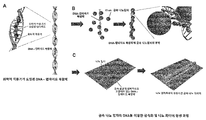
- 1 is a view for explaining the DNA-peptide complex and DNA-peptide-metal nanoparticle complex of the present invention.
- FIG. 2 is a view for explaining composites according to embodiments of the present invention.
- 3 is a view for explaining the DNA-peptide-nanomaterial complex according to an embodiment of the present invention.
- FIG. 4 is a view for explaining the substrate immobilization of the DNA-peptide complex having a high-density functional group according to an embodiment of the present invention.
- 5 is a view for explaining the DNA-peptide-nanomaterial complexes according to one embodiment of the present invention.
- FIG. 6 is a view for explaining a DNA-metal nanowire according to another embodiment of the present invention.
- FIG. 7 is a view for explaining a DNA-metal nanowire according to another embodiment of the present invention.
- the DNA-peptide complex having a high-density functional group of the present invention includes a DNA molecule and an amino acid sequence capable of binding to the DNA molecule, and includes a peptide including at least one functional group at an end thereof, and the peptide is electrostatic with the DNA molecule. Bound through at least one of miracle interaction, intercalation, and groove binding.
- DNA molecules are deoxyribose-containing nucleic acids that form the body of a gene.
- the DNA molecule may use any DNA regardless of the structure and length, for example, the DNA may be ⁇ DNA.
- ⁇ DNA is double stranded DNA with a length of 48,502 bp and is representative of natural DNA having a nano scale width and a micron scale length.
- the peptide is a compound in which two or more ⁇ -amino acids are linked by peptide bonds, and the peptide of the present invention may be a peptide capable of binding to DNA.
- the peptide may include an amino acid sequence capable of binding to DNA by interacting with the DNA.
- the amino acid sequence capable of binding to the DNA may include lysine, Lys, tryptophan (Trp), and arginine (Arginine). , Arg), histidine (Histidine, His), phenylalanine (Phenylalanine, Phe), and tyrosine (Tyrosine, Tyr).
- the peptide is bound to the DNA molecule through at least one of electrostatic interaction, intercalation, and groove binding.
- Peptides of the invention contain residues of positively charged amino acids and are generally capable of electrostatic interaction with negatively charged DNA molecules.
- the peptide that is bound by the electrostatic interaction with the DNA may include an amino acid sequence including at least one of arginine, histidine, and lysine.
- the peptides of the present invention may be grooved or intercalated with DNA in addition to electrostatic interactions, or alternatively, both groove binding and intercalation may be performed in addition to electrostatic interactions. Groove binding is the binding of the peptide to the exposed base of DNA, and the peptide may bind to DNA through groove binding.
- Intercalation is a phenomenon in which molecules, atoms, and ions are inserted between layers of a layered material, and the peptide may be inserted into a DNA double strand.
- the peptides that are bound by intercalation with the DNA may include an amino acid sequence including at least one of phenylalanine, tyrosine, and tryptophan, which are amino acids having an aromatic ring.
- the peptide of the present invention includes at least one amino acid capable of binding to DNA, and the DNA molecule may react with the DNA molecule through at least one of electrostatic interaction, intercalation, and groove binding. Can be combined.
- the present invention is not limited thereto.
- the peptide of the present invention may include one or more functional groups at both ends of the peptide, that is, at least one of the N-terminus and the C-terminus.
- the functional group may be a functional group capable of bonding with the nanomaterial, for example, a thiol group (-SH), an amine (amine, -NH 2 ), carboxyl (-COOH), cysteine, It may be at least one of Azide, Alkyne, Glutaraldehyde, and maleimide.
- the peptide may bind to the DNA to provide a functional group to the DNA molecule, and by adjusting the density and type of the functional group introduced to the peptide terminal, the functional group may be controlled to the DNA-peptide complex.
- a plurality of peptides having at least one functional group are bound to the DNA molecule, and the DNA molecule bound to the peptide may include a high density functional group.
- the DNA-peptide complex may be attached to the substrate by binding to the substrate.
- the substrate may be a substrate of various compositions, shapes, and sizes, such as metal, glass, silicon, and the like.
- the metal substrate may be a thin film formed of metal or a substrate including a metal thin film on its surface. That is, the metal substrate of the present invention may be not only the metal substrate itself, but also a substrate including a metal thin film formed by coating or stacking metal.
- the DNA-peptide complex may be immobilized by binding to a surface of the substrate and a functional group of the DNA-peptide complex. That is, the DNA-peptide complex immobilized on the substrate may have a structure of a DNA-peptide-substrate.
- the DNA-peptide-nanomaterial complex of the present invention includes a DNA-peptide complex having a high-density functional group of the present invention described above and a nanomaterial bonded to a functional group introduced at the peptide end of the DNA-peptide complex.
- the nanomaterial may be bonded to the DNA molecule through the peptide by binding to the peptide terminal functional group. That is, the DNA-peptide-nanomaterial complex of the present invention may exhibit a structure in which the DNA-peptide complex is bonded to the nanomaterial through the functional group of the peptide terminal bound to the DNA molecule, wherein the peptide is a nanomaterial and a DNA molecule. By binding to each, it can act as a linker for connecting the nanomaterial and the DNA molecule.
- the nanomaterials are metal nanoparticles, oxide nanoparticles, sulfide nanoparticles, nanoclusters, quantum dots, graphene quantum dots, perovskite, carbon dots, polymer particles, hydroxyapatite and magnetic nanoparticles. It may include at least one of.
- the metal nanoparticles are gold (Au), silver (Ag), titanium (Ti), copper (Cu), platinum (Pt), palladium (Pd), iron (Fe), zinc (Zn), lead ( Pb), tin (Sn), cobalt (Co), nickel (Ni), manganese (Mn), cesium (Cs), indium (In), bismuth (Bi), cadmium (Cd), gallium (Ga), iridium ( Ir), aluminum (Al), tantalum (Ta), tungsten (W), vanadium (V), lanthanum (La), manganese (Mn), neodymium (Nd), strontium (Sr), zirconium (Zr), gadolinium Metal nanoparticles of (Gd), molybdenum (Mo), ruthenium (Ru), and rhenium (Re) alone or in combination thereof. That is, the metal nanoparticles of the present invention may be the metals alone or alloys thereof.
- the DNA-peptide-nanomaterial complex of the present invention may be immobilized on a substrate, as described in the DNA-peptide complex.
- a DNA-peptide-nanomaterial complex may be fixed to the substrate by combining a substrate with a functional group which does not bind to the nanomaterial among the peptide functional groups in the complex.
- DNA-peptide-metal nanoparticle complex of the present invention for a specific embodiment using a double-stranded DNA (dsDNA) as a DNA molecule, a metal nanoparticle as a nanomaterial, a metal thin film Let's explain.
- dsDNA double-stranded DNA
- 1 is a view for explaining the DNA-peptide complex and DNA-peptide-metal nanoparticle complex of the present invention.
- FIG. 1A is a diagram for explaining a DNA-peptide complex having a high-density functional group in which a peptide containing a functional group and a DNA molecule are bound
- B is a diagram for explaining a case where the nanomaterial is a metal nanoparticle
- C Is a view for explaining the case where the DNA-peptide-metal particle complex having a high density functional group is attached to the metal thin film substrate.
- the DNA-peptide complex may form a DNA-peptide complex having a high-density functional group by binding a DNA molecule to a peptide tagged with a functional group at its end. That is, it may represent a structure in which a plurality of peptides are inserted into the DNA molecule (A of FIG. 1).
- the nanomaterial is a metal nanoparticle
- the DNA molecule coupled to the peptide, that is, the DNA-peptide complex is a DNA-peptide-metal through a bond between the functional group tagged at the end of the peptide and the metal nanoparticle.
- the nanoparticle composite structure can be shown (B of FIG. 1).
- the DNA molecules associated with the peptide may be immobilized on the metal thin film through the binding of the functional group of the peptide to the metal thin film surface (not shown).
- the DNA molecule coupled to the peptide is a part of the functional groups of the peptides are combined with the metal thin film to fix the DNA-peptide complex on the surface of the metal thin film, a part of the functional group may be combined with the metal nanoparticles (FIG. 1). C).
- the metal nanoparticle of the DNA-peptide-metal nanoparticle complex of the present invention may act as seed particles.
- the DNA-peptide-metal nanoparticle complex of the present invention may exhibit a form such as a metal nanowire (DNA-based metal nanowire) indicating the structure of DNA (FIG. 1, C). A more detailed description thereof will be described later.
- Method for producing a DNA-peptide-nanomaterial complex of the present invention is a DNA- having a high-density functional group by binding a DNA molecule and a peptide comprising at least one functional group at the terminal and the amino acid sequence capable of binding to the DNA molecule Forming a peptide complex and contacting the DNA-peptide complex with a nanomaterial to chemically bond the DNA-peptide complex with the nanomaterial.
- DNA molecules, peptides, DNA-peptide complexes having various functional groups, nanomaterials are substantially the same as described above, so the detailed description thereof will be omitted and the following description will be mainly focused on the differences.
- the binding reaction of the DNA molecule and the peptide may be performed by mixing a solution containing each.
- the DNA molecule is contacted with the peptide, and as described above, the DNA molecule is bound through a reaction of at least one of electrostatic interaction, intercalation, and groove binding between the DNA molecule and the peptide. Can form peptide complexes.
- the DNA molecule may be bound to a plurality of peptides, and due to the number of functional groups introduced to the peptides, the DNA-peptide complex may comprise a plurality of functional groups. Therefore, due to the complexity of functional group introduction, functional groups can be easily introduced by using peptides to DNA molecules that are difficult to introduce functional groups into the molecule itself. Accordingly, the DNA-peptide complex of the present invention may contain a high density of functional groups.
- the step of contacting the DNA-peptide complex having a high-density functional group with a substrate it may further comprise the step of fixing to the substrate.
- the substrate is substantially the same as described above, a detailed description thereof will be omitted and the following description will focus on differences.
- the substrate is a metal thin film
- the DNA-peptide and the metal thin film may be reacted to form a DNA-peptide-metal thin film complex fixed on the metal thin film surface.
- the reaction between the DNA-peptide complex and the metal thin film may be performed by contacting the metal thin film solution containing the DNA-peptide complex.
- the DNA-peptide complex reacts with the nanomaterial to form a DNA-peptide-nanomaterial complex having a structure in which DNA molecules and nanomaterials are connected to each other through a peptide through chemical bonding of the functional group of the DNA-peptide complex and the surface of the nanomaterial. do.
- a DNA-peptide-metal nanoparticle complex may be formed, and the reaction of the DNA-peptide complex and the metal nanoparticles may include a mixed solution. Can be done.
- the DNA-peptide complex when the DNA-peptide complex is reacted with both the metal nanoparticle and the metal thin film (substrate), a part of the functional group of the DNA-peptide complex is combined with the metal thin film so that the DNA-peptide complex is fixed to the metal thin film ( Forming a complex having a structure of a DNA-peptide-metal thin film), and the functional group of the DNA-peptide complex not bonded to the metal thin film may combine with a metal nanoparticle to form a DNA-peptide-metal nanoparticle complex, As a result, the DNA-peptide complex can form a DNA-peptide-metal complex in which both the metal particles and the metal thin film are bound.
- the DNA-peptide complex may be preferably reacted with the metal thin film to fix the DNA-peptide complex to the metal thin film and then react with the metal particles again.
- the method may further include removing the unbound nanomaterial and the physically bonded nanomaterial.
- the DNA-peptide complexes combined with the substrate and the nanomaterial are chemically bonded to the functional groups of the substrate and the nanomaterial and the complexes, respectively. Unreacted materials such as nanomaterials or foreign materials and non-specifically bound materials can be easily removed.
- the present invention uses a peptide as a linker to easily bind DNA of various lengths and structures to various substrates and nanomaterials without difficulty in introducing functional groups. Can be.
- various DNA can be easily metallized.
- metallized DNA ie, DNA-peptide-metal particle complex, can maintain the shape of DNA.
- the DNA-peptide-metal nanoparticle complex may be further metallized.
- the metallized DNA-peptide-metal nanoparticle complex may be in the form of DNA-based metal nanowires. More details on this will be described in detail below.
- the method for producing a DNA-metal nanowire of the present invention is a DNA-peptide complex having a high-density functional group by binding a DNA molecule and a peptide comprising at least one functional group at an amino acid sequence and a terminal capable of binding to the DNA molecule And chemically bonding the DNA-peptide complex with metal nanoparticles.
- the DNA-peptide complex may be a DNA-peptide complex immobilized on a substrate.
- DNA molecules, peptides, DNA-peptide complexes, metal nanoparticles, and DNA-peptide-metal nanoparticle complexes having high-density functional groups are substantially the same as those described above, and thus, detailed descriptions thereof will be omitted and the following description will be mainly focused on differences. Shall be.
- DNA-peptide complexes combined with the metal nanoparticles may be further metallized by growing metal using the metal particles of the complex as seeds, and further metallized DNA-peptides.
- the metal nanoparticle composite may have a form such as metal nanowires. That is, according to the present invention, through additional metallization of the DNA-peptide-metal particle complex, DNA-based smooth metal nanowires (DNA-metal nanowires) that maintain the original structure of DNA of various lengths and structures are formed. can do.
- the DNA-metal nanowires adjust the reaction time between the DNA-peptide-metal nanoparticle complex and the metal growth solution, that is, the time to immerse the DNA-peptide-metal nanoparticle complex in the metal growth solution,
- the degree of metallization can be controlled. Accordingly, the width thickness of the DNA-metal nanowire can be adjusted.
- the reducing agent may be ascorbic acid.
- the method may further include a washing step for removing the unbound material and the physically bound material.
- the DNA-metal nanowire of the present invention is combined with the DNA-peptide-metal nanoparticle complex and the-peptide-metal nanoparticle complex and includes a metal coating layer covering the DNA-peptide-metal nanoparticle complex.
- the DNA-metal nanowires are grown with metal seeded from the metal particles of the DNA-peptide-metal nanoparticle complex, and can maintain the original structure of DNA, and are smooth and uniform. Shape and width.
- the metallized DNA according to the present invention ie, DNA-peptide-metal nanoparticle complexes and DNA-metal nanowires, can represent the original structure of the DNA, which can be used to comprehensively analyze DNA. Can be.
- the metallized DNA according to the present invention can be observed and analyzed at high resolution in more detail and in detail than conventional DNA analysis methods, such as by scanning electron microscopy (SEM), DNA sequence, DNA-protein complex It may be usefully applied in the research field such as formation.
- SEM scanning electron microscopy
- DNA sequence DNA sequence
- DNA-protein complex It may be usefully applied in the research field such as formation.
- DNA-peptide DNA-peptide-nanomaterial complex and preparation method thereof
- DNA-metal nanowires and preparation method thereof of the present invention will be described in detail.
- C-terminus thiol tagged DNA Bing Peptide (DBP-SH, KWKWKKA-) having an amino acid sequence comprising lysine and tryptophan, in ⁇ DNA SH) was mixed at a molar ratio of 1: 100, 1: 500, and 1: 1000, and incubated at room temperature for 1 hour to prepare DNA- (DBP-SH) complexes 1-3.
- DBP-SH C-terminal thiol tagged DNA binding peptides It was purchased from Peptron (Daejeon, Korea).
- a solution containing 13 nm of gold nanoparticles (AuNPs) was added to each of the solutions containing the DNA- (DBP-SH) complexes 1 to 3, and then incubated for 1 hour, followed by DNA- (DBP- SH) -AuNP complexes 1 to 3 were prepared. At this time, the concentrations of DBP-SH and gold nanoparticles were the same in each sample.
- the 13 nm gold nanoparticle solution was added 2 mL of HAuCl 4 solution (50 mM) to 98 mL of deionized water and trisodium citrate dihydrate solution (38.8 mM, 10 mL) under reflux. After addition, it was prepared by cooling to room temperature with constant stirring.
- the gold nanoparticles were also passivated with polyvinylpyrrolidone (PVP) to preserve their reactivity with their thiolate moieties but minimize aggregation between the gold nanoparticles.
- PVP polyvinylpyrrolidone
- To the gold nanoparticle solution was added polyvinylpyrrolidone (PVP) (10 ⁇ , MW: 10,000) equal to the volume of the gold nanoparticle suspension and the mixture was incubated overnight.
- AuNP-PVP gold nanoparticle-PVP
- HAuCl 4 trisodium citrate
- PVP polyvinylpyrrolidone
- C-terminus thiol tagged Non-Binding Peptide (NBP-SH, EWEWEEA-SH) was mixed with ⁇ DNA at a molar ratio of 1: 1000, which was allowed to stand at room temperature for 1 hour. Incubated at. C-terminal thiol tagged unbound peptide It was purchased from Peptron (Daejeon, Korea).
- a 1 kb DNA ladder DNA ladder was used by diluting with deionized water at a concentration of 250 ng / ⁇ l. Each sample was loaded with 1.3% agarose gel and then electrophoresed at 130 V for 30 minutes. The gel was then stained with SYBR Gold for 30 minutes. The result is shown in FIG.
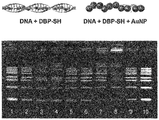
- FIG. 2 is a view for explaining composites according to embodiments of the present invention.
- lanes 1 and 10 represent l kb DNA ladders as controls, lanes 2 to 4 were treated with DBP-SH at 1: 100, 1: 500, and 1: 1000 molar ratios, respectively.
- DNA, ie, DNA- (DBP-SH) complexes 1 to 3 lane 5 shows NBP-SH treated DNA at a 1: 1000 molar ratio.
- Lanes 6 to 8 show DNA- (DBP-SH) complexes 1 to 3
- ie DNA- (DBP-SH) -AuNP complexes 1 to 3 treated with 13 nm AuNP
- lane 9 treated with NBP-SH DNA treated with 13 nm of AuNP is shown.
- NBP-SH DNA- (DBP-SH) complexes (lanes 2 to 4) with lane 5
- DNA treated with NBP-SH as a control NBP-SH treated DNA showed widening and smearing. You can see that does not appear.
- DBP-SH exhibits affinity for double-stranded DNA molecules and can bind to DNA molecules, but identically contains thiol groups but is positively charged
- NBP-SH which is a peptide in which substituted lysine (K) residues are substituted with negatively charged glutamate (E) residues, does not bind DNA.
- a peptide having an amino acid sequence comprising lysine and tryptophan in double-stranded DNA molecules binds to DNA, which is responsible for electrostatic interactions related to tryptophan intercalation and positively charged lysine residues. It can be combined uniformly through.
- DNA- (DBP-SH) complexes treated with gold nanoparticles and DNA- (DBP-SH) -AuNP complexes 1 to 3 DNA according to the concentration of gold nanoparticles
- the-(DBP-SH) -AuNP complexes show a similar tendency with the concentration of DBP-SH.
- the DNA- (DBP-SH) -AuNP complexes show bright bands near the wells. This means that the DNA- (DBP-SH) -AuNP complexes did not freely move through the sample introduction during gel electrophoresis. That means that the DNA- (DBP-SH) complexes bind to the gold nanoparticles.
- DNA treated with NBP-SH and gold nanoparticles did not show band extension and staining as described for DNA treated with NBP-SH (lane 5), indicating that the DNA was present with gold nanoparticles. Regardless, it means that both NBP-SH and AuNP have very little interaction with DNA.
- DNA- (DBP-SH) -AuNP complexes were photographed under a microscope (TEM) to confirm the binding of DBP-SH to DNA, ie, gold nanoparticles as nanomaterials of DNA-peptide complexes. was imaged. The result is shown in FIG.
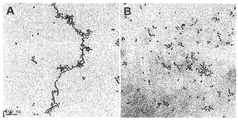
- 3 is a view for explaining the DNA-peptide-nanomaterial complex according to an embodiment of the present invention.
- A shows TEM images of gold nanoparticles assembled on DNA backbones
- B shows the DNA- (DBP-SH) -AuNP complex, except that NBP-SH was used instead of DBP-SH.
- NBP-SH was used instead of DBP-SH.
- a peptide comprising a thiol group and comprising an amino acid sequence comprising lysine and tryptophan reacts with double-stranded DNA to form a DNA-peptide complex, and the DNA-peptide complex
- the metal nanoparticles can be fixed to the DNA backbone through a thiol group of a peptide bound to DNA without directly depositing metal ions on the DNA backbone (phosphate backbone and base sequence). That is, according to the present invention, it can be seen that the DNA-peptide-metal nanoparticle complex can be prepared.
- the DNA- (DBP-SH) complex 3 prepared above was used to determine whether the DNA- (DBP-SH) complex 3 was immobilized on a gold-coded substrate.
- Au / Ti thin film coated Si wafers were prepared using an E-beam evaporator. The thickness of Ti / Au was 5 nm / 20 nm and the evaporation rates of the two metals were 5 ⁇ s / s. Droplets of DNA- (DBP-SH) complex 3 were then dropped onto the washed slide glass. In order to spread and stretch the DNA molecules onto the Au / Ti thin film coated Si wafer, the Au / Ti thin film coated Si wafer was placed on the droplets and dried at 65 ° C. for 15 minutes.
- the Si wafer was carefully removed from the slide glass.
- it was prepared in the same manner as above using T4GT7 DNA mixed with DBP-SH at a molar ratio of 1: 4000.
- YOYO-1 solution (1 ⁇ M 8% ⁇ -mercaptoethanol) was placed on the cleaned cover glass to confirm that the DNA-peptide complex was fixed on the Au / Ti thin-coated Si wafer.
- the Au / Ti thin film coated Si wafer was placed and dyed.
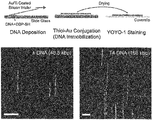
- FIG. 4 is a view for explaining the substrate immobilization of the DNA-peptide complex having a high-density functional group according to an embodiment of the present invention.
- FIG. 4 is a diagram illustrating the immobilization of DBP-SH treated DNA (DNA- (DBP-SH)) on an Au / Ti coated silicon wafer, and immobilized on an Au / Ti coated surface. Fluorescence images for ⁇ DNA (48.5 kb) and T4 DNA (166 kb). Scale bars are 10 ⁇ m.
- the fluorescence images can be confirmed that the DNA- (DBP-SH) complex is fixed on the Au / Ti coated silicon wafer surface. That is, it can be confirmed that the Au / Ti coating layer and the DNA- (DBP-SH) complex react to form a DNA- (DBP-SH) -metal substrate complex, which is immobilized on the Au / Ti coated silicon wafer substrate. have. In addition, it can be seen that the DNA- (DBP-SH) complex is immobilized on the Au / Ti coating layer in both ⁇ DNA and T4 DNA, which means that various DNAs can be metallized and immobilized according to the present invention.
- the DNA-peptide complex can be immobilized and metallized by metal-thiol chemistry with the metal thin film through the functional group of the peptide.
- 5 is a view for explaining the DNA-peptide-nanomaterial complexes according to one embodiment of the present invention.
- a and B in FIG. 5 are images showing gold nanoparticles (AuNP) in DNA- (DBP-SH) bound (immobilized) to Au / Ti coated silicon wafers.
- DNA-based gold nanowires were prepared using DNA- (DBP-SH) complexes immobilized on the gold-coated silicon wafers.
- the DNA- (DBP-SH) -metal (gold coating and gold nanoparticle) complexes were prepared by reacting 4.5 nm of gold nanoparticles with DNA- (DBP-SH) complexes immobilized on the gold coating surface.
- the 4.5 nm gold nanoparticles were prepared with 20 mL of a solution of HAuCl 4 / trisodium citrate (250 ⁇ M) and stirred with a magnet, followed by ice-cold sodium borohydride solution (0.1 M). Was prepared by incubating at room temperature for 2 hours.
- the nonspecific bound and unreacted gold nanoparticles were then washed three times with SDS solution (0.5% w / w) and deionized water to remove from the gold coated surface.
- the DNA- (DBP-SH) -AuNP complex was then added to 375 ⁇ L of gold growth solution (HAuCl 4 (250 ⁇ M) / cetyltrimethylammonium bromide (80 mM) was immersed in magnetic stirring and heating) and ascorbic acid was added (100 mM, 2.5 ⁇ L).
- DNA-gold nanowires gold nanowires based on DNA-peptide-metal nanoparticle complexes. It was. This was taken by SEM and the results are shown in FIG. 6.
- FIG. 6 is a view for explaining a DNA-metal nanowire according to another embodiment of the present invention.
- FIG. 6 shows SEM images of gold-grown DNA-gold nanowires seeded with AuNPs of the DNA- (DBP-SH) -metal complex of the present invention
- FIG. 6 (A) shows the length of the observed ⁇ -DNA molecules. Represents a length distribution histogram.
- (B) represents ⁇ DNA
- (C) represents a dimer of ⁇ DNA
- (D) represents a trimer of ⁇ DNA
- E shows images of entangled molecules.
- FIG. 6F shows a comparison of fluorescence micrographs and SEM images. Scale bars are 1 ⁇ m.
- DNA-gold nanowires derived from ⁇ DNA molecules bound to gold-coated surfaces and gold nanoparticles through functional groups of bound peptides show the structure of ⁇ DNA using DNA length distribution. It can be seen that the peaks correspond to 3.37 ⁇ m and 6.54 ⁇ m, respectively, representing the dimers of ⁇ DNA and ⁇ DNA. In addition, ⁇ DNA trimer molecules can be observed at a length of 9.62 ⁇ m.
- E and F of FIG. 6 represent elongated but distinguishable DNA strands, and in particular, a tangled form of DNA that is difficult to identify in conventional DNA metallization methods or assays. It can be seen that the clear distinction is possible depending on the language (Fig. 6E). In addition, it can be seen that the resolution of the SEM image (F lower image of FIG. 6) of the metallized DNA according to the present invention is significantly higher than that of the conventional fluorescence microscope image (the upper image of F of FIG. 6), This indicates that it is not readily observable in fluorescence microscopy.
- the widths of the DNA-gold nanowires are only 20-30 nm in the SEM images, while the width of the DNA in the optical microscope images is greater than 0.5 ⁇ m as shown in F of FIG. 3.
- This comparison shows that SEM analysis can provide more detailed nanometer-scale information about DNA molecules, which can yield images at resolutions that cannot be observed with other imaging techniques such as TEM, AFM, and fluorescence microscopy. it means.
- DNA-gold nanowires formed from the DNA- (DBP-SH) complex of the present invention can be formed clearly and uniformly (smoothly) similarly to the linear structure of the original DNA, which is used by scanning electron microscopy (SEM). It can be seen that it can be imaged at a high resolution.
- FIG. 7 is a view for explaining a DNA-metal nanowire according to another embodiment of the present invention.
- the thickness of the DNA-gold nanowires grown by treating the gold-coated surface and the DNA-peptide-metal complexes combined with the gold nanoparticles with the gold growth solution is proportional to the time of treatment with the gold growth solution. You can check it.
- the thickness of the DNA-metal nanowire can be controlled.
- the DNA structures can be imaged by scanning electron microscopy by combining large DNA molecules with nanomaterials using thiol-tagged DNA binding peptides on the DNA backbone (phosphate backbone and nucleotide sequences). It can be confirmed. Specifically, since the peptide can bind to the double stranded DNA through the electrostatic charge of lysine of the peptide and the intercalation of tryptophan, the peptide of the present invention can immobilize DNA on the metal thin film surface, Metal nanoparticles can be attached to the DNA template at high density with a minimum background binding of the metal nanoparticles to the metal thin film surface. DNA-metal nanowires can preserve the original structure of DNA and can be easily visualized under conventional SEM.
Landscapes
- Chemical & Material Sciences (AREA)
- Life Sciences & Earth Sciences (AREA)
- Health & Medical Sciences (AREA)
- Organic Chemistry (AREA)
- Engineering & Computer Science (AREA)
- Genetics & Genomics (AREA)
- Molecular Biology (AREA)
- Zoology (AREA)
- Wood Science & Technology (AREA)
- Biochemistry (AREA)
- Biotechnology (AREA)
- General Health & Medical Sciences (AREA)
- General Engineering & Computer Science (AREA)
- Bioinformatics & Cheminformatics (AREA)
- Proteomics, Peptides & Aminoacids (AREA)
- Biomedical Technology (AREA)
- Biophysics (AREA)
- Physics & Mathematics (AREA)
- Microbiology (AREA)
- Analytical Chemistry (AREA)
- Immunology (AREA)
- Plant Pathology (AREA)
- Medicinal Chemistry (AREA)
- Pathology (AREA)
- Peptides Or Proteins (AREA)
Abstract
고밀도의 작용기를 갖는 DNA-펩타이드 복합체, DNA-펩타이드-나노재료 복합체 및 이의 제조 방법, DNA-금속 나노와이어 및 이의 제조 방법에서, 본 발명의 DNA-펩타이드 복합체는 DNA 분자 및 상기 DNA 분자와 결합가능한 아미노산 서열 및 말단에 적어도 하나의 작용기를 포함하는 펩타이드를 포함하되, 상기 펩타이드가 상기 DNA 분자와 정전기적 상호작용, 인터칼레이션(intercalation), 및 그루브 바인딩(groove binding) 중 적어도 어느 하나를 통해 결합된다.
Description
본 발명은 고밀도의 작용기를 갖는 DNA-펩타이드 복합체를 포함하는 DNA-펩타이드-나노재료 복합체와 이를 제조하는 방법, DNA-펩타이드-금속입자 복합체로부터 생성된 DNA-금속 나노와이어와 이를 제조하는 방법에 관한 것이다.
DNA는 디옥시리보오스를 가지고 있는 핵산으로, 유전자의 본체를 이룬다. DNA 분자를 관찰하는 것은 DNA 분자로부터 생물학적 정보를 얻기 위한 매우 중요한 과정이다. DNA 분자의 분석을 위해 DNA 분자를 시각화하는 것은 매우 중요하다. 인간 유전체는 2.2 m의 DNA에 해당하는 46개의 염색체들(chromosomes) (6.4 × 10⁹ 염기쌍들(bps))로 구성된다. 가장 긴 인간 염색체인 1번 염색체는 85 mm (2.5 × 10⁸ bps)의 길이를 갖는 단일 DNA 분자인 반면, 직경은 2 nm밖에 되지 않는다. 즉, 1번 염색체는 나노미터 단위의 폭과 밀리미터 단위의 길이를 갖는다. 이와 같은 DNA 분자의 구조로 인해 유전체 DNA를 포괄적으로 분석하기 위해서는 나노미터 규모의 폭 및 밀리미터 규모의 길이를 갖는 DNA를 시각화할 수 있어야 한다.
기존의 DNA 분석 및 관찰을 위해 사용되는 방법들로는, 투과전자현미경 (Transmission electron microscopy), 형광현미경 (fluorescence microscopy), 주사전자현미경 (Scanning electron microscopy)과 같은 현미경을 이용하는 방법이 사용되고 있다. 그러나, 투과전자현미경 (transmission electron microscopy)은 DNA의 세부 구조를 세밀하게 관찰할 수 있다는 장점이 있으나, 넓은 범위의 고해상도 이미지를 얻는 데에 어려움이 있고, 형광현미경 (fluorescence microscopy)은 DNA 전체 분자의 관찰은 물론 DNA 내의 손상 등과 같은 분자 단위의 특이점 관찰이 용이하다는 장점이 있지만, 분해능의 한계로 인해 나노미터 단위의 DNA 분자를 정확하게 관찰하기 어렵다는 한계점이 있다. 주사전자현미경 (Scanning electron microscopy)은 나노미터 단위의 분해능과 밀리미터 단위의 관측 범위를 동시에 만족시킬 수 있어, 투과전자현미경과 형광현미경의 단점을 모두 극복할 수 있는 방법으로서 고려되고 있다. 하지만 주사전자현미경 또한 DNA이 갖는 경원소들(light elements)을 전자현미경으로 관찰하기가 어렵다는 한계점을 가진다.
이러한 한계점을 극복하기 위해, DNA를 금속화하는 방법에 대한 관심이 높아지고 있다. 기존의 DNA를 금속화하기 위해 금속 이온이나 양이온으로 기능화된 금속 나노입자를 사용하고 있으나, 이러한 방법은 표면에 DNA 고정을 위해 DNA 말단에 특수한 작용기를 도입하거나 선택적 부착이 가능한 생체분자를 사용하는 경우가 많으며, 이에 따라, 특정 서열이나 모양을 가지는 DNA만을 이용해야 한다는 것과 복잡한 준비 과정이 필요하다는 단점이 있다. 뿐만 아니라, DNA 금속화는 주로 DNA 분석 분야가 아닌 전자소자의 개발을 위해 수행되어 왔으며, 기존의 방법은 DNA의 금속화 후의 형태가 불규칙적이고 예상치 못한 분지형 형태(branched form)를 내기도 한다. 때문에, 기존의 DNA 금속화 방법은 금속화 후 DNA의 형태가 본래의 DNA가 가지는 고유의 형태를 잃을 수 있어, DNA를 분석하기 위한 방법으로서는 치명적인 단점을 갖는다.
때문에, 이러한 문제점들을 해결하고, DNA 분석에 이용될 수 있는 새로운 DNA의 금속화 방법에 대한 연구 개발이 필요한 실정이다.
본 발명의 일 목적은 고밀도의 작용기를 갖는 DNA-펩타이드 복합체를 제공하는 것이다.
본 발명의 다른 목적은 DNA-펩타이드-나노재료 복합체를 제공하는 것이다.
본 발명의 또 다른 목적은 상기 DNA-펩타이드-나노재료 복합체의 제조 방법을 제공하는 것이다.
본 발명의 다른 목적은 상기 DNA-펩타이드-나노재료 복합체로부터 DNA-금속 나노와이어의 제조 방법을 제공하는 것이다.
본 발명의 또 다른 목적은 상기 DNA-금속 나노와이어를 제공하는 것이다.
본 발명의 일 목적을 위한 고밀도의 작용기를 갖는 DNA-펩타이드 복합체는 DNA 분자 및 상기 DNA 분자와 결합가능한 아미노산 서열 및 말단에 적어도 하나의 작용기를 포함하는 펩타이드를 포함하되, 상기 펩타이드가 상기 DNA 분자와 정전기적 상호작용, 인터칼레이션(intercalation), 및 그루브 바인딩(groove binding) 중 적어도 어느 하나를 통해 결합된다.
일 실시예에서, 상기 작용기는 티올기(thiol group, -SH), 아민(amine, -NH2), 카복실(carboxyl, -COOH), 시스테인(cysteine), 아자이드(Azide), 알킨(Alkyne), 글루타르알데히드(glutaraldehyde), 및 말레이미드(maleimide) 중 적어도 어느 하나를 포함할 수 있다.
일 실시예에서, 상기 펩타이드는 N-말단 및 C-말단 중 적어도 어느 하나에 작용기를 포함할 수 있다.
본 발명의 다른 목적을 위한 DNA-펩타이드-나노재료 복합체는 상기 고밀도의 작용기를 갖는 DNA-펩타이드 복합체들 중 어느 하나 및 상기 고밀도의 작용기를 갖는 DNA-펩타이드 복합체의 펩타이드 말단 작용기와 결합된 나노재료를 포함한다.
일 실시예에서, 상기 나노재료는 금속 나노입자, 산화물 나노입자, 황화물 나노입자, 나노클러스터, 양자점, 그래핀 양자점, 페로브스카이트, 탄소점(carbon dot), 폴리머 입자, 하이드록시아파타이트(hydroxyapatite) 및 자성 나노입자 중 적어도 어느 하나를 포함할 수 있다.
이때, 상기 금속 나노입자는 금(Au), 은(Ag), 티타늄(Ti), 구리(Cu), 백금(Pt), 팔라듐(Pd), 철(Fe), 아연(Zn), 납(Pb), 주석(Sn), 코발트(Co), 니켈(Ni), 망간(Mn), 세슘(Cs), 인듐(In), 비스무트(Bi), 카드뮴(Cd), 갈륨(Ga), 이리듐(Ir), 알루미늄(Al), 탄탈럼(Ta), 텅스텐(W), 바나듐(V), 란타늄(La), 망간(Mn), 네오디뮴(Nd), 스트론튬(Sr), 지르코늄(Zr), 가돌리늄(Gd), 몰리브데넘(Mo), 루테늄(Ru), 및 레늄(Re) 중 적어도 어느 하나를 포함하는 금속의 나노입자일 수 있다.
본 발명의 또 다른 목적을 위한 DNA-펩타이드-나노재료의 제조 방법은 DNA 분자와, 상기 DNA 분자와 결합 가능한 아미노산 서열 및 말단에 적어도 하나의 작용기를 포함하는 펩타이드를 결합시켜, 고밀도의 작용기를 갖는 DNA-펩타이드 복합체를 형성하는 단계, 및 상기 DNA-펩타이드 복합체를 나노재료와 접촉시켜, 상기 DNA-펩타이드 복합체를 나노재료와 화학 결합시키는 단계를 포함한다.
일 실시예에서, 상기 고밀도의 작용기를 갖는 DNA-펩타이드 복합체를 형성하는 단계 이후에, 상기 고밀도의 작용기를 갖는 DNA-펩타이드 복합체를 기판과 접촉시켜, 상기 기판에 고정하는 단계를 더 포함할 수 있다.
이때, 상기 기판은 금속, 유리, 및 실리콘 중 적어도 어느 하나를 포함하는 기판일 수 있다.
이때, 상기 DNA-펩타이드 복합체를 나노재료와 화학 결합시키는 단계 이후에, 상기 나노재료와 접촉된 DNA-펩타이드 복합체를 세척하여, 비결합 나노재료 및 물리 결합 나노재료를 제거하는 단계를 더 포함할 수 있다.
일 실시예에서, 상기 나노재료는 금속 나노입자, 산화물 나노입자, 황화물 나노입자, 나노클러스터, 양자점, 그래핀 양자점, 페로브스카이트, 탄소점, 폴리머 입자, 하이드록시아파타이트 및 자성 나노입자 중 적어도 어느 하나를 포함할 수 있다.
이때, 상기 금속 나노입자는 금(Au), 은(Ag), 티타늄(Ti), 구리(Cu), 백금(Pt), 팔라듐(Pd), 철(Fe), 아연(Zn), 납(Pb), 주석(Sn), 코발트(Co), 니켈(Ni), 망간(Mn), 세슘(Cs), 인듐(In), 비스무트(Bi), 카드뮴(Cd), 갈륨(Ga), 이리듐(Ir), 알루미늄(Al), 탄탈럼(Ta), 텅스텐(W), 바나듐(V), 란타늄(La), 망간(Mn), 네오디뮴(Nd), 스트론튬(Sr), 지르코늄(Zr), 가돌리늄(Gd), 몰리브데넘(Mo), 루테늄(Ru), 및 레늄(Re) 중 적어도 어느 하나를 포함하는 금속의 나노입자일 수 있다.
일 실시예에서, 상기 작용기는 티올기(thiol group, -SH), 아민(amine, -NH2), 카복실(carboxyl, -COOH), 시스테인(cysteine), 아자이드(Azide), 알킨(Alkyne), 글루타르알데히드(glutaraldehyde), 및 말레이미드(maleimide) 중 적어도 어느 하나를 포함할 수 있다.
본 발명의 다른 목적을 위한 DNA-금속 나노와이어의 제조 방법은 DNA 분자와, 상기 DNA 분자와 결합 가능한 아미노산 서열 및 말단에 적어도 하나의 작용기를 포함하는 펩타이드를 결합시켜, 고밀도의 작용기를 갖는 DNA-펩타이드 복합체를 형성하는 단계, 상기 DNA-펩타이드 복합체를 금속 나노입자와 화학 결합시켜, DNA-펩타이드-금속 나노입자 복합체를 제조하는 단계, 상기 DNA-펩타이드-금속 나노입자 복합체를 환원제를 포함하는 금속 성장 용액에 침지시키는 단계, 및 상기 금속 성장 용액을 제거하는 단계를 포함한다.
일 실시예에서, 상기 금속 성장 용액을 제거하는 단계 이후에, 비결합 금속 나노입자 및 물리 결합 금속 나노입자를 제거하는 세척 단계를 더 포함할 수 있다.
일 실시예에서, 금속은 금(Au), 은(Ag), 티타늄(Ti), 구리(Cu), 백금(Pt), 팔라듐(Pd), 철(Fe), 아연(Zn), 납(Pb), 주석(Sn), 코발트(Co), 니켈(Ni), 망간(Mn), 세슘(Cs), 인듐(In), 비스무트(Bi), 카드뮴(Cd), 갈륨(Ga), 이리듐(Ir), 알루미늄(Al), 탄탈럼(Ta), 텅스텐(W), 바나듐(V), 란타늄(La), 망간(Mn), 네오디뮴(Nd), 스트론튬(Sr), 지르코늄(Zr), 가돌리늄(Gd), 몰리브데넘(Mo), 루테늄(Ru), 및 레늄(Re) 중 적어도 어느 하나를 포함할 수 있다.
일 실시예에서, 상기 작용기는 티올기(thiol group, -SH), 아민(amine, -NH2), 카복실(carboxyl, -COOH), 시스테인(cysteine), 아자이드(Azide), 알킨(Alkyne), 글루타르알데히드(glutaraldehyde), 및 말레이미드(maleimide) 중 적어도 어느 하나를 포함할 수 있다.
본 발명의 또 다른 목적을 위한 DNA-금속 나노와이어는 상기 DNA-금속 나노와이어의 제조 방법들 중 어느 하나로 제조되고, DNA 분자, 상기 DNA 결합가능한 아미노산 서열 및 말단에 적어도 어느 하나의 작용기를 갖는 펩타이드, 및 금속 나노입자를 포함하되, 상기 펩타이드는 상기 DNA 분자와 정전기적 상호작용, 인터칼레이션(intercalation), 및 그루브 바인딩(groove binding) 중 적어도 어느 하나를 통해 결합되고, 상기 금속 나노입자는 상기 펩타이드 말단의 작용기와 결합된, DNA-펩타이드-금속 나노입자 복합체, 및 상기 DNA-펩타이드-금속 나노입자와 결합되고, 상기 DNA-펩타이드-금속 나노입자를 커버하는 금속 코팅층을 포함한다.
본 발명에 따르면, 본 발명은 DNA 결합 가능한 펩타이드를 이용하여 작용기 도입이 어려운 DNA 분자로 작용기를 용이하게 도입할 수 있고, 고밀도의 작용기를 갖는 DNA-펩타이드 복합체를 제공할 수 있다. 또한, 작용기와 나노재료와의 결합을 통해 용이하게 DNA-펩타이드-나노재료 복합체를 형성할 수 있고, DNA가 펩타이드 및 펩타이드의 작용기를 통해 나노재료와 화학적으로 결합되어 있어, 물리적으로 결합된 물질들을 세척을 통해 용이하게 제거 가능하다. 뿐만 아니라, DNA에 직접적으로 나노재료를 도입하는 것이 아닌, 펩타이드의 작용기를 통해 나노재료와 결합하여 복합체를 이루는 것으로, 기존의 DNA와 복합체 형성이 어려운 나노재료들과도 복합체를 형성할 수 있고, 이에 따라, 다양한 종류의 DNA 및 나노재료를 이용할 수 있다. 나노재료로서 금속 나노입자를 이용하는 경우, DNA-펩타이드-금속 나노입자 복합체를 형성하여 DNA를 금속화할 수 있고, DNA 분자에 결합된 금속 나노입자를 매개체로 하여 DNA 구조 기반의 매끄럽고 균일한 폭 및 길이의 금속 나노와이어(nanowire)를 형성할 수 있으며, 나노와이어의 두께는 금속화 시간을 조절하여 제어할 수 있다. 본 발명에 따른 DNA의 용이한 금속화를 통해 주사전자현미경(SEM)을 이용하여 보다 선명하고 명확하게 DNA를 이미지화 할 수 있으며, 이를 통해, 단일 분자의 DNA 뿐만 아니라, DNA 이합체(dimer), 삼합체(trimer), DNA 3차원 구조 등과 같은 DNA의 다양한 구조를 보다 정확하고 상세하게 분석하는데 이용할 수 있다.
도 1은 본 발명의 DNA-펩타이드 복합체 및 DNA-펩타이드-금속 나노입자 복합체를 설명하기 위한 도면이다.
도 2는 본 발명의 실시예들에 따른 복합체들을 설명하기 위한 도면이다.
도 3은 본 발명의 일 실시예에 따른 DNA-펩타이드-나노재료 복합체를 설명하기 위한 도면이다.
도 4는 본 발명의 일 실시예에 따른 고밀도의 작용기를 갖는 DNA-펩타이드 복합체의 기판 고정화를 설명하기 위한 도면이다.
도 5는 본 발명의 일 실시예들에 따른 DNA-펩타이드-나노재료 복합체들을 설명하기 위한 도면이다.
도 6은 본 발명의 다른 실시예에 따른 DNA-금속 나노와이어를 설명하기 위한 도면이다.
도 7은 본 발명의 또 다른 실시예에 따른 DNA-금속 나노와이어를 설명하기 위한 도면이다.
이하, 첨부한 도면을 참조하여 본 발명의 실시예에 대해 상세히 설명한다. 본 발명은 다양한 변경을 가할 수 있고 여러 가지 형태를 가질 수 있는 바, 특정 실시예들을 도면에 예시하고 본문에 상세하게 설명하고자 한다. 그러나 이는 본 발명을 특정한 개시 형태에 대해 한정하려는 것이 아니며, 본 발명의 사상 및 기술 범위에 포함되는 모든 변경, 균등물 내지 대체물을 포함하는 것으로 이해되어야 한다.
본 출원에서 사용한 용어는 단지 특정한 실시 예를 설명하기 위해 사용된 것으로서 본 발명을 한정하려는 의도가 아니다. 단수의 표현은 문맥상 명백하게 다르게 뜻하지 않는 한, 복수의 표현을 포함한다. 본 출원에서, "포함하다" 또는 "가지다" 등의 용어는 명세서 상에 기재된 특징, 단계, 동작, 구성요소, 부분품 또는 이들을 조합한 것이 존재함을 지정하려는 것이지, 하나 또는 그 이상의 다른 특징들이나 단계, 동작, 구성요소, 부분품 또는 이들을 조합한 것들의 존재 또는 부가 가능성을 미리 배제하지 않는 것으로 이해되어야 한다.
다르게 정의되지 않는 한, 기술적이거나 과학적인 용어를 포함해서 여기서 사용되는 모든 용어들은 본 발명이 속하는 기술 분야에서 통상의 지식을 가진 자에 의해 일반적으로 이해되는 것과 동일한 의미를 가지고 있다. 일반적으로 사용되는 사전에 정의되어 있는 것과 같은 용어들은 관련 기술의 문맥 상 가지는 의미와 일치하는 의미를 가지는 것으로 해석되어야 하며, 본 출원에서 명백하게 정의하지 않는 한, 이상적이거나 과도하게 형식적인 의미로 해석되지 않는다.
본 발명의 고밀도의 작용기를 갖는 DNA-펩타이드 복합체는 DNA 분자 및 상기 DNA 분자와 결합가능한 아미노산 서열을 포함하고, 말단에 적어도 하나의 작용기를 포함하는 펩타이드를 포함하고, 상기 펩타이드는 상기 DNA 분자와 정전기적 상호작용, 인터칼레이션(intercalation), 및 그루브 바인딩(groove binding) 중 적어도 어느 하나를 통해 결합된다.
DNA(deoxyribonucleic acid) 분자는 디옥시리보오스를 가지고 있는 핵산으로, 유전자의 본체를 이룬다. 본 발명에서, DNA 분자는 구조 및 길이에 관계없이 모든 DNA를 이용할 수 있으며, 일례로, DNA는 λDNA일 수 있다. λDNA는 48,502 bp의 길이를 갖는 이중가닥 DNA로, 나노 규모의 폭과 미크론(micron) 규모의 길이를 갖는 대표적인 자연적인 DNA이다.
펩타이드는 2개 이상의 α-아미노산이 펩티드 결합으로 연결된 형태의 화합물로, 본 발명의 펩타이드는 DNA와 결합 가능한 펩타이드일 수 있다. 이때, 상기 펩타이드는 DNA 와 상호작용하여 DNA와 결합 가능한 아미노산 서열을 포함할 수 있고, 일례로, 상기 DNA와 결합 가능한 아미노산 서열은 리신(lysine, Lys), 트립토판(tryptophan, Trp), 아르기닌(Arginine, Arg), 히스티딘(Histidine, His), 페닐알라닌(Phenylalanine, Phe), 및 티로신(Tyrosine, Tyr) 중 적어도 어느 하나를 포함할 수 있다.
상기 펩타이드는 상기 DNA 분자와 정전기적 상호작용, 인터칼레이션(intercalation), 및 그루브 바인딩(groove binding) 중 적어도 어느 하나를 통해 결합된다.
본 발명의 펩타이드는 양성적으로 전하된 아미노산의 잔기들을 포함하고 있어 일반적으로 음성적으로 전하된 DNA 분자와 정전기적 상호작용할 수 있다. 이때, 상기 DNA와 정전기적 상호작용에 의해 결합하는 펩타이드는 아르기닌, 히스티딘, 및 리신 중 적어도 어느 하나를 포함하는 아미노산 서열을 포함할 수 있다. 또한, 본 발명의 펩타이드는 정전기적 상호작용과 더불어 DNA와 그루브 바인딩이나 인터칼레이션할 수 있고, 또는 이와 달리, 정전기적 상호작용과 더불어 그루브 바인딩 및 인터칼레이션을 모두 할 수 있다. 그루브 바인딩은 DNA의 노출된 염기와 상기 펩타이드가 결합하는 것으로, 상기 펩타이드는 DNA와 그루브 바인딩을 통해 결합할 수 있다. 인터칼레이션은 층상구조가 있는 물질의 층간에 분자, 원자와 이온이 삽입되는 현상으로, 상기 펩타이드는 DNA 이중가닥 내로 삽입될 수 있다. 이때, 상기 DNA와 인터칼레이션에 의해 결합되는 펩타이드는 방향족 고리를 가진 아미노산인 페닐알라닌, 티로신, 및 트립토판 중 적어도 어느 하나를 포함하는 아미노산 서열을 포함할 수 있다.
본 발명의 펩타이드는 상기에서 설명한 바와 같이, DNA와 결합 가능한 아미노산들을 적어도 하나를 포함하고 있어, DNA 분자와 정전기적 상호작용, 인터칼레이션, 및 그루브 바인딩 중 적어도 어느 하나의 반응을 통해 DNA 분자와 결합할 수 있다. 상기에서 DNA와 결합 가능한 펩타이드를 예시적으로 설명하였으나, 본 발명이 이에 제한되는 것은 아니다.
또한, 본 발명의 펩타이드는 펩타이드의 양쪽 말단, 즉, N-말단 및 C-말단 중 적어도 어느 하나에 작용기를 하나 이상 포함할 수 있다. 이때, 상기 작용기는 나노재료와 결합 가능한 작용기일 수 있고, 일례로, 티올기(thiol group, -SH), 아민(amine, -NH2), 카복실(carboxyl, -COOH), 시스테인(cysteine), 아자이드(Azide), 알킨(Alkyne), 글루타르알데히드(glutaraldehyde), 및 말레이미드(maleimide) 중 적어도 하나일 수 있다. 상기 펩타이드는 상기 DNA와 결합하여 상기 DNA 분자에 작용기를 제공할 수 있고, 상기 펩타이드 말단에 도입된 작용기의 밀집도 및 종류를 조절함으로서, 상기 DNA-펩타이드 복합체에 작용기를 조절 할 수 있다. 이때, 상기 DNA 분자에 적어도 하나의 작용기를 갖는 펩타이드 다수개가 결합하여, 상기 펩타이드와 결합한 DNA 분자는 고밀도의 작용기를 포함할 수 있다.
상기 DNA-펩타이드 복합체는 기판과 결합하여 기판에 부착된 것일 수 있다. 상기 기판은 금속, 유리, 실리콘 등으로 다양한 조성, 모양, 및 크기의 기판일 수 있다. 일례로, 상기 기판이 금속 기판인 경우, 상기 금속 기판은 금속으로 형성된 박막 그 자체 또는 표면에 금속 박막을 포함하는 기판일 수 있다. 즉, 본 발명의 금속 기판은 금속 기판 자체일 수 있을 뿐만 아니라, 금속이 코팅되거나 적층되어 형성된 금속 박막을 포함하는 기판일 수 있다. 상기 DNA-펩타이드 복합체는 상기 기판의 표면과 상기 DNA-펩타이드 복합체의 작용기를 통해 결합하여 고정화될 수 있다. 즉, 상기 기판에 고정된 DNA-펩타이드 복합체는 DNA-펩타이드-기판의 구조를 가질 수 있다.
본 발명의 DNA-펩타이드-나노재료 복합체는 상기에서 설명한 본 발명의 고밀도의 작용기를 갖는 DNA-펩타이드 복합체 및 상기 DNA-펩타이드 복합체의 펩타이드 말단에 도입된 작용기와 결합된 나노재료를 포함한다.
상기 나노재료는 상기 펩타이드 말단 작용기와 결합함으로서, 상기 펩타이드를 통해 DNA 분자와 결합될 수 있다. 즉, 본 발명의 DNA-펩타이드-나노재료 복합체는 상기 DNA-펩타이드 복합체가 DNA 분자와 결합한 펩타이드 말단의 작용기를 통해 나노재료와 결합된 구조를 나타낼 수 있고, 이때, 상기 펩타이드는 나노재료와 DNA 분자에 각각 결합함으로서, 상기 나노재료와 DNA 분자를 연결하는 링커와 같은 역할을 할 수 있다.
상기 나노재료는 금속 나노입자, 산화물 나노입자, 황화물 나노입자, 나노클러스터, 양자점, 그래핀 양자점, 페로브스카이트, 탄소점(carbon dot), 폴리머 입자, 하이드록시아파타이트(hydroxyapatite) 및 자성 나노입자 중 적어도 어느 하나를 포함할 수 있다. 일례로, 상기 금속 나노입자는 금(Au), 은(Ag), 티타늄(Ti), 구리(Cu), 백금(Pt), 팔라듐(Pd), 철(Fe), 아연(Zn), 납(Pb), 주석(Sn), 코발트(Co), 니켈(Ni), 망간(Mn), 세슘(Cs), 인듐(In), 비스무트(Bi), 카드뮴(Cd), 갈륨(Ga), 이리듐(Ir), 알루미늄(Al), 탄탈럼(Ta), 텅스텐(W), 바나듐(V), 란타늄(La), 망간(Mn), 네오디뮴(Nd), 스트론튬(Sr), 지르코늄(Zr), 가돌리늄(Gd), 몰리브데넘(Mo), 루테늄(Ru), 및 레늄(Re) 단독 또는 이들이 조합된 합금으로 된 금속 나노입자일 수 있다. 즉, 본 발명의 금속 나노입자는 상기 금속들 단독 또는 이들의 합금일 수 있다.
본 발명의 DNA-펩타이드-나노재료 복합체는 상기 DNA-펩타이드 복합체에서 설명한 바와 같이, 기판에 고정화될 수 있다. 이때, DNA-펩타이드-나노재료 복합체는 상기 복합체에서 펩타이드 작용기들 중 상기 나노재료와 결합하지 않는 작용기가 기판과 결합하여 상기 기판에 DNA-펩타이드-나노재료 복합체가 고정될 수 있다.
이하에서 보다 구체적으로, 도 1을 참조하여, DNA 분자로서 이중가닥 DNA(dsDNA), 나노재료로서 금속 나노입자, 금속 박막을 이용하는 구체적인 실시예들을 들어 본 발명의 DNA-펩타이드-금속 나노입자 복합체를 설명하기로 한다.
도 1은 본 발명의 DNA-펩타이드 복합체 및 DNA-펩타이드-금속 나노입자 복합체를 설명하기 위한 도면이다.
도 1의 A는 작용기를 포함하는 펩타이드와 DNA 분자가 결합된 고밀도의 작용기를 갖는 DNA-펩타이드 복합체를 설명하기 위한 도면이고, B는 나노재료가 금속 나노입자인 경우를 설명하기 위한 도면이며, C는 고밀도의 작용기를 갖는 DNA-펩타이드-금속입자 복합체가 금속 박막 기판에 부착된 경우를 설명하기 위한 도면이다.
도 1을 참조하면, DNA-펩타이드 복합체는 DNA 분자가 말단에 작용기가 태그된 펩타이드와 결합하여 고밀도의 작용기를 갖는 DNA-펩타이드 복합체를 형성할 수 있다. 즉, 상기 DNA 분자 내에 다수의 펩타이드들이 삽입된 구조를 나타낼 수 있다(도 1의 A). 이때, 상기 나노재료가 금속 나노입자인 경우, 상기 펩타이드와 결합된 DNA 분자, 즉, DNA-펩타이드 복합체는 상기 펩타이드 말단에 태그된 작용기와 상기 금속 나노입자 사이의 결합을 통해, DNA-펩타이드-금속 나노입자 복합체 구조를 나타낼 수 있다(도 1의 B).
또한, 상기 펩타이드와 결합된 DNA 분자, 즉, DNA-펩타이드 복합체는 상기 펩타이드의 작용기와 금속 박막 표면의 결합을 통해 금속 박막에 고정될 수 있다(도면 미도시). 이때, 상기 펩타이드와 결합된 DNA 분자는 상기 펩타이드들의 작용기들의 일부는 금속 박막과 결합하여 상기 금속 박막 표면에 DNA-펩타이드 복합체가 고정되고, 작용기의 일부는 금속 나노입자와 결합될 수 있다(도 1의 C). 이때, 본 발명의 DNA-펩타이드-금속 나노입자 복합체의 상기 금속 나노입자는 시드(seeds) 입자로서 작용할 수 있다. 상기 금속 나노입자를 시드로서 금속을 성장시킨 경우, 본 발명의 DNA-펩타이드-금속 나노입자 복합체는 DNA의 구조를 나타내는 금속 나노와이어와 같은 형태(DNA 기반의 금속 나노와이어)를 나타낼 수 있다(도 1의 C). 이에 대한 보다 구체적인 설명은 하기에서 후술하도록 한다.
본 발명의 DNA-펩타이드-나노재료 복합체를 제조하기 위한 방법은 DNA 분자와, 상기 DNA 분자와 결합 가능한 아미노산 서열 및 말단에 적어도 하나의 작용기를 포함하는 펩타이드를 결합시켜, 고밀도의 작용기를 갖는 DNA-펩타이드 복합체를 형성하는 단계 및 상기 DNA-펩타이드 복합체를 나노재료와 접촉시켜, 상기 DNA-펩타이드 복합체를 나노재료와 화학 결합시키는 단계를 포함한다.
DNA 분자, 펩타이드, 다양한 작용기를 갖는 DNA-펩타이드 복합체, 나노재료는 상기에서 설명한 것과 실질적으로 동일하므로, 이에 중복되는 상세한 설명은 생략하고 차이점을 위주로 후술하기로 한다.
일례로, 상기 DNA 분자와 상기 펩타이드의 결합 반응은 각각을 포함하는 용액을 혼합하여 수행할 수 있다. 이때, 상기 DNA 분자는 상기 펩타이드와 접촉하여, 상기에서 설명한 바와 같이, 상기 DNA 분자와 상기 펩타이드 사이의 정전기적 상호작용, 인터칼레이션, 및 그루브 바인딩 중 적어도 어느 하나의 반응을 통해 결합되어, DNA-펩타이드 복합체를 형성할 수 있다.
상기 DNA 분자는 다수의 펩타이드들과 결합될 수 있고, 상기 펩타이드들에 도입된 다수의 작용기들에 기인하여, DNA-펩타이드 복합체는 다수의 작용기들을 포함할 수 있다. 때문에, 작용기 도입의 복잡성(complexity)에 의해 분자 자체에 작용기를 도입하기 어려운 DNA 분자에 펩타이드를 이용하여 용이하게 작용기들 도입할 수 있다. 이에 따라, 본 발명의 DNA-펩타이드 복합체는 고밀도의 작용기를 포함할 수 있다.
이때, 상기 고밀도의 작용기를 갖는 DNA-펩타이드 복합체를 형성하는 단계 이후에, 상기 고밀도의 작용기를 갖는 DNA-펩타이드 복합체를 기판과 접촉시켜, 상기 기판에 고정하는 단계를 더 포함할 수 있다. 이때, 상기 기판은 상기에서 설명한 것과 실질적으로 동일하므로, 이에 중복되는 상세한 설명은 생략하고 차이점을 위주로 후술하기로 한다. 일례로, 상기 기판이 금속 박막인 경우, 상기 DNA-펩타이드와 금속 박막과 반응시켜, 금속 박막 표면에 고정된 DNA-펩타이드-금속 박막 복합체를 형성할 수 있다. 이때, 상기 DNA-펩타이드 복합체와 금속 박막의 반응은 상기 금속 박막에 상기 DNA-펩타이드 복합체를 포함하는 용액을 접촉시켜 수행할 수 있다.
상기 DNA-펩타이드 복합체는 나노재료와 반응시켜, 상기 DNA-펩타이드 복합체의 작용기와 나노재료 표면의 화학적 결합을 통해 DNA 분자와 나노재료가 펩타이드를 통해 서로 연결된 구조의 DNA-펩타이드-나노재료 복합체를 형성한다.
이때, 상기 DNA-펩타이드 복합체와 금속 나노입자를 반응시키는 경우에는, DNA-펩타이드-금속 나노입자 복합체를 형성할 수 있고, DNA-펩타이드 복합체와 금속 나노입자와의 반응은 각각을 포함하는 용액을 혼합하여 수행할 수 있다.
일례로, 상기 DNA-펩타이드 복합체를 금속 나노입자 및 금속 박막(기판) 모두와 반응시키는 경우, 상기 DNA-펩타이드 복합체의 작용기의 일부는 금속 박막과 결합하여 DNA-펩타이드 복합체는 금속 박막에 고정되고(DNA-펩타이드-금속 박막의 구조를 갖는 복합체를 형성), 상기 금속 박막과 결합하지 않은 상기 DNA-펩타이드 복합체의 작용기는 금속 나노입자와 결합하여 DNA-펩타이드-금속 나노입자 복합체를 형성할 수 있으며, 이에 따라, 결과적으로 DNA-펩타이드 복합체가 금속 입자 및 금속 박막과 모두 결합된 DNA-펩타이드-금속 복합체를 형성할 수 있다. 이때, 상기 DNA-펩타이드 복합체는 금속 박막과 먼저 반응시켜 상기 금속 박막에 DNA-펩타이드 복합체를 고정한 후, 금속 입자와 다시 반응시키는 것이 바람직할 수 있다.
또한, 상기 DNA-펩타이드 복합체를 기판에 고정시킨 후, 상기 기판에 고정된 DNA-펩타이드 복합체를 나노재료와 화학 결합시키는 단계 이후에, 상기 기판 및 나노재료와 접촉된 DNA-펩타이드 복합체를 세척하여, 비결합 나노재료 및 물리 결합 나노재료를 제거하는 단계를 더 포함할 수 있다. 이때, 상기 기판 및 나노재료와 결합한 DNA-펩타이드 복합체는 기판 및 나노재료와 각각 상기 복합체의 작용기가 화학적 결합하고 있어, 세척을 통해 기판에 고정된 DNA-펩타이드 복합체로부터 비결합 나노재료, 물리적 결합된 나노재료 또는 이물질 등의 미반응 물질들 및 비특이 결합된 물질들을 용이하게 제거할 수 있다.
본 발명의 DNA-펩타이드-나노재료 복합체의 제조 방법에 따르면, 본 발명은 펩타이드를 링커와 같이 이용함으로서, 다양한 길이 및 구조의 DNA를 작용기 도입의 어려움 없이, 다양한 기판 및 나노재료와 용이하게 결합시킬 수 있다. 또한, 나노재료로서, 금속 기재를 이용하는 경우, 다양한 DNA를 용이하게 금속화할 수 있다. 또한, 금속화된 DNA, 즉, DNA-펩타이드-금속입자 복합체는 DNA의 형상을 그대로 유지할 수 있다.
일례로, 상기 나노재료가 금속 나노입자를 포함하는 경우, 상기 DNA-펩타이드-금속 나노입자 복합체는 더 금속화될 수 있다. 이때, 추가적으로 금속화된 DNA-펩타이드-금속 나노입자 복합체는 DNA-기반의 금속 나노와이어의 형태일 수 있다. 이에 대한 보다 자세한 내용은 하기에서 구체적으로 설명하기로 한다.
본 발명의 DNA-금속 나노와이어를 제조하기 위한 방법은 DNA 분자와, 상기 DNA 분자와 결합 가능한 아미노산 서열 및 말단에 적어도 하나의 작용기를 포함하는 펩타이드를 결합시켜, 고밀도의 작용기를 갖는 DNA-펩타이드 복합체를 형성하는 단계와 상기 DNA-펩타이드 복합체를 금속 나노입자와 화학 결합시키는 단계를 포함한다.
이때, 상기 DNA-펩타이드 복합체는 기판에 고정된 DNA-펩타이드 복합체일 수 있다.
그 다음, 상기 DNA-펩타이드-금속 나노입자 복합체를 환원제를 포함하는 금속 성장 용액에 침지시키는 단계 및 상기 금속 성장 용액을 제거하는 단계를 포함한다.
DNA 분자, 펩타이드, 고밀도의 작용기를 갖는 DNA-펩타이드 복합체, 금속 나노입자, DNA-펩타이드-금속 나노입자 복합체는 상기에서 설명한 것과 실질적으로 동일하므로, 이에 중복되는 상세한 설명은 생략하고 차이점을 위주로 후술하기로 한다.
상기 금속 나노입자와 결합한 DNA-펩타이드 복합체(DNA-펩타이드-금속 나노입자 복합체)는 상기 복합체의 금속 입자를 시드(seed)로서 금속이 성장되어 더 금속화될 수 있고, 추가적으로 금속화된 DNA-펩타이드-금속 나노입자 복합체는 금속 나노와이어와 같은 형태를 나타낼 수 있다. 즉, 본 발명에 따라, DNA-펩타이드-금속 입자 복합체의 추가적인 금속화를 통해, 다양한 길이 및 구조의 DNA의 본래의 구조를 유지하는 DNA 기반의 매끄러운 금속 나노와이어(DNA-금속 나노와이어)를 형성할 수 있다.
이때, 상기 DNA-금속 나노와이어는 상기 DNA-펩타이드-금속 나노입자 복합체와 금속 성장 용액과의 반응시간, 즉, 상기 DNA-펩타이드-금속 나노입자 복합체를 금속 성장 용액에 침지시키는 시간을 조절하여, 금속화 정도를 제어할 수 있다. 이에 따라, 상기 DNA-금속 나노와이어의 폭 두께를 조절할 수 있다. 일례로, 상기 환원제는 아르코르브산(ascorbic acid)일 수 있다.
또한, 상기 금속 성장 용액을 제거하는 단계 이후에, 비결합 물질 및 물리 결합 물질을 제거하기 위한 세척 단계를 더 포함할 수 있다.
본 발명의 DNA-금속 나노와이어는 상기 DNA-펩타이드-금속 나노입자 복합체 및 상기-펩타이드-금속 나노입자 복합체와 결합되고, 상기 DNA-펩타이드-금속 나노입자 복합체를 커버하는 금속 코팅층을 포함한다.
상기 DNA-금속 나노와이어는 상기에서 설명한 바와 같이, 상기 DNA-펩타이드-금속 나노입자 복합체의 금속 입자를 시드(seed)로서 금속이 성장하며, DNA의 본래의 구조를 유지할 수 있고, 매끈하고 균일한 형태 및 폭을 나타낼 수 있다.
상기에서 설명한 바와 같이, 본 발명에 따른 금속화된 DNA, 즉, DNA-펩타이드-금속 나노입자 복합체 및 DNA-금속 나노와이어는 DNA의 본래의 구조를 나타낼 수 있어, DNA를 포괄적으로 분석하는데 이용될 수 있다. 일례로, 본 발명에 따른 금속화된 DNA는 주사전자현미경(SEM) 등을 통해 기존의 DNA 분석 방법 보다 자세하고 상세하게, 고해상도로 관찰 및 분석할 수 있고, DNA의 염기 서열, DNA-단백질 복합체 형성 등과 같은 연구 분야에서 유용하게 적용 가능할 수 있다. 뿐만 아니라, 본 발명에 따르면, 동일한 종류의 DNA가 갖는 다양한 길이, 즉, DNA의 이합체(dimer), 삼합체(trimer) 등을 금속화할 수 있고, 이를 통해, 이들의 구조를 확인할 수도 있으며, 폴리머로서의 성질을 갖는 DNA의 3차원 엉킴구조(entangle form)를 확인할 수도 있다.
이하에서는, 구체적인 실시예를 들어, 본 발명의 DNA-펩타이드, DNA-펩타이드-나노재료 복합체 및 이의 제조 방법, DNA-금속 나노와이어 및 이의 제조방법을 보다 상세히 설명하기로 한다.
먼저, DNA-펩타이드 복합체를 제조하기 위해, λDNA에, 리신 및 트립토판을 포함하는 아미노산 서열을 가지고 C-말단 티올 태그된 DNA 결합 펩타이드(C-terminus thiol tagged DNA Bing Peptide) (DBP-SH, KWKWKKA-SH)를 몰랄비(molar ratio) 1:100, 1:500, 및 1:1000로 혼합하고, 이를 1시간 동안 실온에서 배양하여, DNA-(DBP-SH) 복합체 1 내지 3을 제조하였다. C-말단 티올 태그된 DNA 결합 펩타이드는 Peptron (대전, 한국)에서 구매하였다.
그 다음, 13 nm의 금 나노입자(AuNP)들을 포함하는 용액을 상기 DNA-(DBP-SH) 복합체 1 내지 3를 포함하는 용액에 각각 첨가한 후, 1시간 동안 배양하여, DNA-(DBP-SH)-AuNP 복합체 1 내지 3을 제조하였다. 이때, DBP-SH 및 금 나노입자의 농도는 각각의 샘플에서 동일했다.
상기 13 nm 금 나노입자 용액은 2 mL의 HAuCl4 용액 (50 mM)을 탈이온수 98 mL에 첨가하고, 트리소듐시트레이트 다이하이드레이트 용액(trisodium citrate dihydrate solution) (38.8 mM, 10 mL)를 환류 하에 첨가한 후, 지속적인 교반과 함께 실온으로 냉각하여 제조하였다. 또한 상기 금 나노입자들은 그들의 티올레이트 모이어티들과 반응성은 보존하지만 금 나노입자들 사이의 응집을 최소화하기 위해, 폴리비닐피롤리돈 (PVP)로 부동화 하였다(pasivated). 상기 금 나노입자 용액에 폴리비닐피롤리돈(polyvinylpyrrolidone) (PVP) (10 μM, MW: 10,000)을 금 나노입자 현탁액의 부피와 동일하게 첨가하였고 혼합물은 밤새 배양하였다. 그 후, 금 나노입자-PVP(AuNP-PVP) 용액을 16,700 rpm으로 15분 동안 원심분리한 후 상등액을 디캔테이션(decantation)하고 이를 3회 반복하여 자유 PVP 분자들을 제거하였다. HAuCl4, 트리소듐 시트레이트, 및 폴리비닐피롤리돈(PVP, MW: 10,000)은 Sigma-Aldrich (USA)로부터 구매하였다.
샘플들은 표면에 금 나노입자들의 비특이 결합을 최소화하기 위한 각 단계 이후에 소듐 도데실 설페이트(sodium dodecyl sulfate) (SDS) 계면활성제 용액 및 탈이온수로 완전히 세척하였다.
비교예로서, λDNA에 C-말단 티올 태그된 비결합 펩타이드(C-terminus thiol tagged Non-Binding Peptide) (NBP-SH, EWEWEEA-SH)를 몰랄비 1:1000로 혼합하고, 이를 1시간 동안 실온에서 배양하였다. C-말단 티올 태그된 비결합 펩타이드는 Peptron (대전, 한국)에서 구매하였다.
또한, 상기 NBP-SH 처리된 DNA에 13 nm의 금 나노입자를 포함하는 용액을 첨가한 후, 1시간 동안 배양하였다. 이때, NBP-SH 및 금 나노입자의 농도는 동일하다.
이어서, 본 발명의 실시예들에 따른 DNA-(DBP-SH) 복합체 1 내지 3 및 DNA-(DBP-SH)-AuNP 복합체 1 내지 3와 비교예에 따른 NBP-SH 처리된 DNA 및 NBP-SH 및 금 나노입자로 처리된 DNA를 겔 전기영동 하였다. 이때, 대조군으로서, 1 kb DNA 래더(DNA ladder)를 탈이온수로 250 ng/μl의 농도로 희석하여 이용하였다. 각각의 샘플들은 1.3% 아가로스 겔로 로드한 후, 130 V에서 30분 동안 전기영동 시켰다. 그 다음, 겔을 SYBR Gold로 30분 동안 염색하였다. 그 결과를 도 2에 나타낸다.
도 2는 본 발명의 실시예들에 따른 복합체들을 설명하기 위한 도면이다.
도 2에서, 레인 1(lane 1) 및 10은 대조군인 l kb DNA 래더(DNA ladder)을 나타내고, 레인 2 내지 4는 각각 1:100, 1:500, 및 1: 1000 몰랄비로 DBP-SH 처리된 DNA, 즉 DNA-(DBP-SH) 복합체 1 내지 3을 나타내며, 레인 5는 1:1000 몰랄비로 NBP-SH 처리된 DNA를 나타낸다. 레인 6 내지 8은 13 nm의 AuNP로 처리된 DNA-(DBP-SH) 복합체 1 내지 3, 즉, DNA-(DBP-SH)-AuNP 복합체 1 내지 3을 나타내고, 레인 9는 NBP-SH 처리된 DNA를 13 nm의 AuNP로 처리한 DNA를 나타낸다.
도 2를 참조하면, 레인 2 내지 4를 비교하면, 전기영동 겔에서 더 높은 DBP-SH 농도들로 처리된 DNA-(DBP-SH) 복합체가 더 넓고 얼룩진 밴드 패턴을 나타내는 것을 확인할 수 있다. 이것은 DNA가 DBP-SH와 상호작용함을 의미하고, 즉, 상기 펩타이드가 DNA로 도입됨을 의미한다. 또한, DN DBP-SH의 상호작용은 DBP-SH의 농도가 증가함에 따라 증가함을 확인할 수 있다.
DNA-(DBP-SH) 복합체들(레인 2 내지 4)을 대조군으로서 NBP-SH로 처리된 DNA인 레인 5와 비교하면, NBP-SH로 처리된 DNA는 밴드 확장(widening) 및 얼룩(smearing)이 나타나지 않음을 확인할 수 있다. 이것은 티올기를 포함하고, 리신 및 트립토판을 포함하는 아미노산 서열을 갖는 펩타이드인, DBP-SH는 이중가닥 DNA 분자에 대한 친화력을 나타내고 DNA 분자와 결합할 수 있으나, 동일하게 티올기를 포함하지만 양성적으로 전하된 리신 (K) 잔기들이 음성적으로 전하된 글루타메이트(glutamate) (E) 잔기들로 치환된 펩타이드인 NBP-SH는 DNA와 결합하지 않음을 확인할 수 있다. 즉, 이중가닥 DNA 분자들에 리신 및 트립토판을 포함하는 아미노산 서열을 갖는 펩타이드가 DNA와 결합함을 확인할 수 있고, 이것은 트립토판 인터칼레이션 및 양성적으로 전하된 리신 잔기들에 관련된 정전기적 상호작용들을 통해 균일하게 결합될 수 있음을 나타낸다.
또한, 금 나노입자들로 처리된 DNA-(DBP-SH) 복합체들, DNA-(DBP-SH)-AuNP 복합체 1 내지 3(레인 6 내지 8)을 비교하면, 금 나노입자들의 농도에 따라 DNA-(DBP-SH)-AuNP 복합체들이 상기 DBP-SH의 농도에 따른 것과 유사한 경향을 나타냄을 확인할 수 있다. 특히, DNA-(DBP-SH)-AuNP 복합체들은 웰 가까운 위치에서 밝은 밴드를 나타냄을 확인할 수 있다. 이것은 DNA-(DBP-SH)-AuNP 복합체들이 겔 전기영동 동안 시료 도입부에 걸려 자유롭게 이동하지 못했음을 의미한다. 즉, DNA-(DBP-SH) 복합체들이 금 나노입자들과 결합함을 의미한다.
또한, NBP-SH 및 금 나노입자로 처리된 DNA(레인 9)은 상기 NBP-SH로 처리된 DNA(레인 5)에서 설명한 바와 같이 밴드 확장 및 얼룩이 나타나지 않았으며, 이것은 DNA가 금 나노입자의 존재와 상관없이, NBP-SH 및 AuNP 둘 모두가 DNA와 아주 적은 상호작용을 가짐을 의미한다.
보다 구체적으로 DBP-SH와 결합된 DNA, 즉, DNA-펩타이드 복합체의 나노재료인 금 나노입자들과의 결합을 확인하기 위해, DNA-(DBP-SH)-AuNP 복합체를 현미경(TEM)으로 촬영하여 이미지화 하였다. 그 결과를 도 3에 나타낸다.
도 3은 본 발명의 일 실시예에 따른 DNA-펩타이드-나노재료 복합체를 설명하기 위한 도면이다.
도 3에서 A는 DNA 백본들에 조립된 금 나노입자들의 TEM 이미지를 나타내고, B는 대조 실험으로 DBP-SH가 아닌 NBP-SH를 이용한 것을 제외하고 상기 DNA-(DBP-SH)-AuNP 복합체와 동일하게 수행한 TEM 이미지를 나타낸다.
먼저, 도 3의 A를 참조하면, 13 nm 금 나노입자들이 선형 구조로 서로 연결된 것을 확인할 수 있다.
도 3의 B를 참조하면, DBP-SH를 NBP-SH로 교체하여 수행하였을 때, 상기 도 3의 A에서 확인한 바와 달리, 금 나노입자들이 선형 구조가 아닌 무작위적으로 분포된 것을 확인할 수 있다.
이것은 상기 DBP-SH로 처리된 DNA와 금 나노입자들을 반응시킨 경우, 금 나노입자들이 DNA와 결합하여 선형 구조를 나타내는 반면, NBP-SH로 처리된 DNA는 금 나노입자들과 결합하지 못하고, 금 나노입자들이 무작위적으로 분포함을 의미한다. 즉, 금 나노입자들은 펩타이드(DBP-SH)와 결합한 DNA와 성공적으로 결합함을 확인할 수 있다.
따라서, 종합적으로, 티올기를 포함하고, 리신 및 트립토판을 포함하는 아미노산 서열을 포함하는 펩타이드(DBP-SH)가 이중가닥 DNA와 반응하여 결합함으로서, DNA-펩타이드 복합체를 형성하고, 상기 DNA-펩타이드 복합체는 DNA 백본(인산 골격 및 염기 서열)에 금속 이온들을 직접적으로 증착하지 않고도 금속 나노입자들을 DNA에 결합된 펩타이드의 티올기를 통해 DNA 백본에 고정할 수 있음을 확인할 수 있다. 즉, 본 발명에 따라, DNA-펩타이드-금속 나노입자 복합체를 제조할 수 있음을 확인할 수 있다.
상기에서 제조한 DNA-(DBP-SH) 복합체 3를 이용하여, 상기 DNA-(DBP-SH) 복합체 3의 금 코딩된 기판으로의 고정화 여부를 확인하였다. Au/Ti 박막 필름 코팅된 Si 웨이퍼를 E-빔 증발기를 이용하여 준비하였다. Ti/Au의 두께는 5 nm/20 nm이고, 두 금속들의 증발 속도는 5Å/s였다. 그 다음 DNA-(DBP-SH) 복합체 3의 액적들(droplets)을 세척된 슬라이드 글라스 위에 떨어트렸다. 액적들을 Au/Ti 박막 코팅된 Si 웨이퍼로 DNA 분자들의 확산 및 신장(stretch)하기 위해, 액적들 위에 Au/Ti 박막 코팅된 Si 웨이퍼를 올렸고, 65 ℃에서 15분 동안 건조하였다. 그 후, Si 웨이퍼를 슬라이드 글라스로부터 조심스럽게 떼어냈다. 또한, 1:4000의 몰랄비로 DBP-SH와 혼합된 T4GT7 DNA를 이용하여, 상기와 동일하게 제조하였다. 그 다음, DNA-펩타이드 복합체의 Au/Ti 박막 코팅된 Si 웨이퍼에 고정 여부를 확인하기 위해, 세척된 커버 글라스 위에 YOYO-1 용액 (1 μM 8 % β-메르캅토에탄올(β-mercaptoethanol))을 떨어트린 후, Au/Ti 박막 코팅된 Si 웨이퍼를 올려 염색하였다. 이어서, 63× Zeiss Plan-Neofluar 오일 이멀전(oil immersion) 대물렌즈(objective lens), 고상 레이저 (Coherent Sapphire 488, Santa Clara, CA), 및 대응하는 필터 세트를 갖는 도립 현미경(inverted microscope) (Zeiss Observer A1, AG, Germany)을 전자증배형 CCD 디지털 카메라 (electron multiplying charge coupled device digital camera) (Evolve EMCCD, Roper Scientific, Tucson, AZ)와 함께 샘플들의 형광 이미지들을 보기 위해 사용하였다. 샘플들의 형광 이미지들은 소프트웨어 Image Pro Plus (Media Cybernetics, Rockville, MD)에 의해 생성되었고 ImageJ 소프트웨어로 조정하였다. 그 결과를 도 4에 나타낸다.
도 4는 본 발명의 일 실시예에 따른 고밀도의 작용기를 갖는 DNA-펩타이드 복합체의 기판 고정화를 설명하기 위한 도면이다.
도 4은 금/티타늄 코팅된 실리콘 웨이퍼(Au/Ti coated silicon wafer)에서 DBP-SH 처리된 DNA(DNA-(DBP-SH))의 고정화를 설명하기 위한 도면으로, Au/Ti 코팅 표면에서 고정화된 λDNA (48.5kb) 및 T4 DNA(166 kb)에 대한 형광 이미지들이다. 스케일 바(scale bar)들은 10 μm이다.
도 4를 참조하면, 형광 이미지들은 Au/Ti 코팅된 실리콘 웨이퍼 표면에 DNA-(DBP-SH) 복합체가 고정됨을 확인할 수 있다. 즉, Au/Ti 코팅층과 DNA-(DBP-SH) 복합체가 반응하여, DNA-(DBP-SH)-금속 기판 복합체를 형성하고 이에 기인하여 상기 Au/Ti 코팅된 실리콘 웨이퍼 기판에 고정화됨을 확인할 수 있다. 또한, λDNA 및 T4 DNA 모두에서 DNA-(DBP-SH) 복합체가 Au/Ti 코팅층에 고정화되었음을 확인할 수 있고, 이것은 본 발명에 따라 다양한 DNA를 금속화 및 고정화할 수 있음을 의미한다.
대조 실험으로서, DBP-SH의 부재에서 또는 NBP-SH의 존재에서 동일한 방법을 수행했을 때, Au/Ti 코팅된 실리콘 웨이퍼 표면에서 DNA의 결합은 무시해도 될 정도로 나타났다. 이것은 DNA의 DBP-SH 처리를 통해 금 코팅층(박막)에 상기 DNA를 고정화할 수 있음을 의미한다.
즉, 본 발명에 따라, 다양한 종류의 DNA에 펩타이드를 도입함으로서, 상기 DNA-펩타이드 복합체가 상기 펩타이드의 작용기를 통해 금속 박막과 금속-티올 화학 작용하여 고정화 및 금속화될 수 있음을 확인할 수 있다.
이어서, SEM에서의 DNA-펩타이드-금속 복합체를 시각화 가능 여부를 확인하였다. 상기 Au/Ti 코팅된 실리콘 웨이퍼 표면에 고정화된 DNA-(DBP-SH)에 PVP로 부동화된 13 nm 금 나노입자들을 반응시킨 후 이를 세척한 결과를 SEM으로 촬영하였다. 그 결과를 도 5에 나타낸다.
도 5는 본 발명의 일 실시예들에 따른 DNA-펩타이드-나노재료 복합체들을 설명하기 위한 도면이다.
도 5에서 A 및 B는 Au/Ti 코팅된 실리콘 웨이퍼에 결합한(고정화) DNA-(DBP-SH)에서 금 나노입자(AuNP)를 나타낸 이미지들이다.
도 5를 참조하면, DBP-SH로 처리된 DNA, 즉 DNA-(DBP-SH)가 고정화된 Au/Ti 코팅 웨이퍼에서는 금 나노입자들이 상기 도 3의 A 및 상기 도 4에서 확인한 바와 유사하게 선형 구조를 나타내는 것을 확인할 수 있다. 이것은 금 나노입자들 및 금/티타늄 코팅층 표면에 고정화된 DNA-펩타이드 복합체들을 SEM을 이용하여 이미지화(시각화)하는 것이 가능함을 나타내고, SEM을 이용하여 확인한 상기 DNA-(DBP-SH)-금속 복합체의 이미지가 상기 TEM 샘플들에서 확인한 것과 같이, 금 나노입자들이 선형 구조를 나타내는 것을 확인할 수 있다.
또한, 도 5를 계속 참조하면, Au/Ti 코팅 웨이퍼 상에서 금 나노입자들의 선형 구조를 외의 금 나노입자들의 다른 비특이 결합(DNA-펩타이드 복합체 외의 결합)이 거의 없는 것을 확인할 수 있다. 이것은 (1) DNA-(DBP-SH) 복합체의 금속 박막(Au/Ti 코팅) 고정화에서, DBP-SH로부터 유도된 금속-티올 공유결합에 의한 DNA-(DBP-SH) 복합체의 금속 박막(Au/Ti 코팅)으로의 고정화 과정을 통해, 금속 나노입자들의 비특이 결합을 증진시키는 전하된 표면과 금속 나노입자들의 상호작용을 방지할 수 있게 하고, (2) 금(속) 나노입자들의 PVP 부동화가 높은 콜로이드성 안정성과 함께 효과적으로 금 나노입자들을 전하적 중성으로 만들 수 있으며, (3) 금속 표면에서 안정한 DNA-펩타이드 복합체의 결합(고정화)은 미반응된 금속 나노입자들을 표면으로부터 제거하기 위한 다중 세척 단계를 가능하게 함을 나타낼 수 있다.
또한, 상기 금 코팅된 실리콘 웨이퍼에 고정화된 DNA-(DBP-SH) 복합체를 이용하여, DNA 기반의 금 나노와이어를 제조하였다. 금 코팅 표면에 고정화된 DNA-(DBP-SH) 복합체에 4.5 nm의 금 나노입자들을 반응시켜, DNA-(DBP-SH)-금속(금 코팅 및 금 나노입자) 복합체를 제조하였다. 상기 4.5 nm 금 나노입자들은 HAuCl4/트리소듐 시트레이트 (250 μM) 용액 20 mL를 준비하고 자석으로 교반한 다음, 얼음처럼 차가운(Ice-cold) 소듐 보로하이드라이드 용액 (0.1 M)을 상기 용액에 주입하고, 혼합된 용액을 2시간 동안 실온에서 배양하여 제조하였다. 이어서, 비특이 결합 및 미반응 금 나노입자들을 금 코팅 표면으로부터 제거하기 위해 SDS 용액 (0.5% w/w) 및 탈이온수로 3회 세척하였다. 그 다음, 상기 DNA-(DBP-SH)-AuNP 복합체를 375 μL의 금 성장 용액(HAuCl4
(250 μM)/세틸트리메틸암모늄 브로마이드 (80 mM)를 자석 교반 및 가열하여 제조)에 담궜고 아스코르브산을 첨가하였다 (100 mM, 2.5 μL). 반응 완료 후, 표면을 0.5% SDS (0.5% w/w) 용액 및 탈이온수로 3회 세척하여, DNA-펩타이드-금속 나노입자 복합체 기반의 금 나노와이어(이하, DNA-금 나노와이어)를 제조하였다. 이를 SEM으로 촬영하였고, 그 결과를 도 6에 나타낸다.
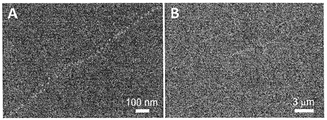
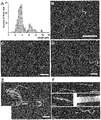
도 6은 본 발명의 다른 실시예에 따른 DNA-금속 나노와이어를 설명하기 위한 도면이다.
도 6은 본 발명의 DNA-(DBP-SH)-금속 복합체의 AuNP를 시드로서 금 성장된 DNA-금 나노와이어들의 SEM 이미지들을 나타내고, 도 6의 (A)는 관찰된 λ-DNA 분자들의 길이 분포(length distribution) 히스토그램을 나타낸다. 도 6에서 (B)는 λDNA, (C)는 λDNA의 이합체, (D)는 λDNA의 삼합체 및 (E)는 엉킨(entangled) 분자들의 이미지들을 나타낸다. 도 6의 (F)는 형광 현미경사진(micrograph) 및 SEM 이미지의 비교를 나타낸다. 스케일 바들은 1 μm이다.
도 6의 A 내지 D를 참조하면, 결합된 펩타이드의 작용기를 통해 금 코팅된 표면 및 금 나노입자들과 결합한 λDNA 분자들로부터 유래된 DNA-금 나노와이어들은 이용한 λDNA의 구조를 나타내고, DNA 길이 분포에 대한 피크들이 λDNA 및 λDNA의 이합체를 각각 대표하는 3.37 μm 및 6.54 μm에 해당하는 것을 확인할 수 있다. 또한, λDNA 삼합체 분자를 9.62 μm의 길이로 관찰할 수 있다.
도 6의 E 및 F를 참조하면, 도 6의 E 및 F는 신장되었으나 구별 가능한 DNA 가닥들을 나타내고, 특히, 기존의 DNA 금속화 방법이나 분석에서 확인하기 어려운 DNA의 엉킨 형태를 본 발명의 DNA 금속화에 따라 명확한 구별이 가능한 것을 확인할 수 있다(도 6의 E). 또한, 본 발명에 따라 금속화가 진행된 DNA의 SEM 이미지(도 6의 F 하단 이미지)의 해상도가 기존의 형광현미경을 통한 이미지(도 6의 F의 상단 이미지)와 비교하여 월등히 높은 것을 확인할 수 있고, 이것은 형광 현미경에서 쉽게 관찰가능하지 않음을 나타낸다. 특히, DNA-금 나노와이어들의 폭들은 SEM 이미지들에서 단지 20 내지 30 nm인 반면, 광학 현미경 이미지들에서 DNA의 폭은 도 3의 F에 도시된 것과 같은 0.5 μm 보다 더 큰 것을 확인할 수 있다. 이 비교는 SEM 분석이 DNA 분자들에 대한 더 상세한 나노미터 규모의 정보를 제공할 수 있고, 이것은 TEM, AFM, 및 형광 현미경과 같은 다른 이미징 기술들로는 관찰할 수 없는 해상도의 이미지들을 얻을 수 있음을 의미한다.
따라서, 본 발명의 DNA-(DBP-SH) 복합체로부터 형성된 DNA-금 나노와이어가 본래 DNA의 선형 구조와 유사하게 또렷하고 균일하게(매끄럽게) 형성될 수 있으며, 이를 주사전자현미경(SEM)을 사용하여 높은 해상도로 이미지화할 수 있음을 확인할 수 있다.
또한, 금 성장 용액에서의 DNA-펩타이드 복합체의 처리 시간에 따른 DNA-금속 나노와이어의 두께를 측정하였고, 그 결과를 도 7에 나타낸다.
도 7은 본 발명의 또 다른 실시예에 따른 DNA-금속 나노와이어를 설명하기 위한 도면이다.
도 7을 참조하면, 금 코팅 표면 및 금 나노입자와 결합된 DNA-펩타이드-금속 복합체를 금 성장 용액으로 처리하여 성장된 DNA-금 나노와이어의 두께는 금 성장 용액으로 처리하는 시간과 비례하는 것을 확인할 수 있다.
따라서, 금속 성장 용액에서의 처리 시간을 조절하여, DNA-금속 나노와이어의 두께를 조절할 수 있음을 확인할 수 있다.
종합적으로, 상기에서 확인한 바와 같이, DNA 백본(인산 골격 및 염기 서열)에 티올-태그된 DNA 결합 펩타이드를 사용하여 큰 DNA 분자들과 나노재료를 결합함으로서, 주사전자현미경으로 DNA 구조를 이미징할 수 있음을 확인할 수 있다. 구체적으로, 상기 펩타이드가 펩타이드의 리신의 정전하(electrostatic charge) 및 트립토판의 인터칼레이션을 통해 이중 가닥 DNA에 결합할 수 있기 때문에, 본 발명의 펩타이드는 금속 박막 표면에 DNA를 고정화할 수 있고, 금속 박막 표면에 대한 금속 나노입자들의 최소 배경 결합(background binding)과 함께 금속 나노입자들을 DNA 주형에 금속 나노입자들을 높은 밀도로 부착할 수 있다. DNA-금속 나노와이어들은 DNA의 본래의 구조를 보존할 수 있고, 용이하게 기존의 SEM 하에서 시각화될 수 있다. 이에 따라, 긴 DNA 분자들에 대한 정보를 SEM 분석을 통해 보다 상세하고 정확하게 제공할 수 있다. 이에 기인하여, DNA의 생화학적 중요성 및 대규모 기능의 높은 해상도 이미징을 위한 주사전자현미경의 힘을 고려하면, 본 발명에 따라 DNA의 다중규모(multi-scale) 수준에서 다양한 생물리적 및 생화학적 분자 이벤트들을 확인할 수 있다.
상기에서는 본 발명의 바람직한 실시예를 참조하여 설명하였지만, 해당 기술 분야의 숙련된 당업자는 하기의 특허 청구 범위에 기재된 본 발명의 사상 및 영역으로부터 벗어나지 않는 범위 내에서 본 발명을 다양하게 수정 및 변경시킬 수 있음을 이해할 수 있을 것이다.
Claims (18)
- DNA 분자; 및상기 DNA 분자와 결합가능한 아미노산 서열 및 말단에 적어도 하나의 작용기를 포함하는 펩타이드를 포함하되,상기 펩타이드가 상기 DNA 분자와 정전기적 상호작용, 인터칼레이션(intercalation), 및 그루브 바인딩(groove binding) 중 적어도 어느 하나를 통해 결합된,고밀도의 작용기를 갖는, DNA-펩타이드 복합체.
- 제1항에 있어서,상기 작용기는 티올기(thiol group, -SH), 아민(amine, -NH2), 카복실(carboxyl, -COOH), 시스테인(cysteine), 아자이드(Azide), 알킨(Alkyne), 글루타르알데히드(glutaraldehyde), 및 말레이미드(maleimide) 중 적어도 어느 하나를 포함하는 것을 특징으로 하는,DNA-펩타이드 복합체.
- 제1항에 있어서,상기 펩타이드는 N-말단 및 C-말단 중 적어도 어느 하나에 작용기를 포함하는 것을 특징으로 하는,DNA-펩타이드 복합체.
- 제1항 내지 제3항 중 어느 하나의 DNA-펩타이드 복합체 및 상기 DNA-펩타이드 복합체의 펩타이드 말단 작용기와 결합된 나노재료를 포함하는,DNA-펩타이드-나노재료 복합체.
- 제4항에 있어서,상기 나노재료는 금속 나노입자, 산화물 나노입자, 황화물 나노입자, 나노클러스터, 양자점, 그래핀 양자점, 페로브스카이트, 탄소점(carbon dot), 폴리머 입자, 하이드록시아파타이트(hydroxyapatite) 및 자성 나노입자 중 적어도 어느 하나를 포함하는 것을 특징으로 하는,DNA-펩타이드-나노재료 복합체.
- 제5항에 있어서,상기 금속 나노입자는 금(Au), 은(Ag), 티타늄(Ti), 구리(Cu), 백금(Pt), 팔라듐(Pd), 철(Fe), 아연(Zn), 납(Pb), 주석(Sn), 코발트(Co), 니켈(Ni), 망간(Mn), 세슘(Cs), 인듐(In), 비스무트(Bi), 카드뮴(Cd), 갈륨(Ga), 이리듐(Ir), 알루미늄(Al), 탄탈럼(Ta), 텅스텐(W), 바나듐(V), 란타늄(La), 망간(Mn), 네오디뮴(Nd), 스트론튬(Sr), 지르코늄(Zr), 가돌리늄(Gd), 몰리브데넘(Mo), 루테늄(Ru), 및 레늄(Re) 중 적어도 어느 하나를 포함하는 금속의 나노입자인 것을 특징으로 하는,DNA-펩타이드-나노재료 복합체.
- DNA 분자와, 상기 DNA 분자와 결합 가능한 아미노산 서열 및 말단에 적어도 하나의 작용기를 포함하는 펩타이드를 결합시켜, 고밀도의 작용기를 갖는 DNA-펩타이드 복합체를 형성하는 단계; 및상기 DNA-펩타이드 복합체를 나노재료와 접촉시켜, 상기 DNA-펩타이드 복합체를 나노재료와 화학 결합시키는 단계를 포함하는,DNA-펩타이드-나노재료 복합체의 제조 방법.
- 제7항에 있어서,상기 고밀도의 작용기를 갖는 DNA-펩타이드 복합체를 형성하는 단계 이후에,상기 고밀도의 작용기를 갖는 DNA-펩타이드 복합체를 기판과 접촉시켜, 상기 기판에 고정하는 단계를 더 포함하는 것을 특징으로 하는,DNA-펩타이드-나노재료 복합체의 제조 방법.
- 제8항에 있어서,상기 기판은 금속, 유리, 및 실리콘 중 적어도 어느 하나를 포함하는 기판인 것을 특징으로 하는,DNA-펩타이드-나노재료 복합체의 제조 방법.
- 제8항에 있어서,상기 DNA-펩타이드 복합체를 나노재료와 화학 결합시키는 단계 이후에,상기 나노재료와 접촉된 DNA-펩타이드 복합체를 세척하여, 비결합 나노재료 및 물리 결합 나노재료를 제거하는 단계를 더 포함하는 것을 특징으로 하는,DNA-펩타이드-나노재료 복합체의 제조 방법.
- 제7항에 있어서,상기 나노재료는 금속 나노입자, 산화물 나노입자, 황화물 나노입자, 나노클러스터, 양자점, 그래핀 양자점, 페로브스카이트, 탄소점, 폴리머 입자, 하이드록시아파타이트 및 자성 나노입자 중 적어도 어느 하나를 포함하는 것을 특징으로 하는,DNA-펩타이드-나노재료 복합체의 제조 방법.
- 제11항에 있어서,상기 금속 나노입자는 금(Au), 은(Ag), 티타늄(Ti), 구리(Cu), 백금(Pt), 팔라듐(Pd), 철(Fe), 아연(Zn), 납(Pb), 주석(Sn), 코발트(Co), 니켈(Ni), 망간(Mn), 세슘(Cs), 인듐(In), 비스무트(Bi), 카드뮴(Cd), 갈륨(Ga), 이리듐(Ir), 알루미늄(Al), 탄탈럼(Ta), 텅스텐(W), 바나듐(V), 란타늄(La), 망간(Mn), 네오디뮴(Nd), 스트론튬(Sr), 지르코늄(Zr), 가돌리늄(Gd), 몰리브데넘(Mo), 루테늄(Ru), 및 레늄(Re) 중 적어도 어느 하나를 포함하는 금속의 나노입자인 것을 특징으로 하는,DNA-펩타이드-나노재료 복합체의 제조 방법.
- 제7항에 있어서,상기 작용기는 티올기(thiol group, -SH), 아민(amine, -NH2), 카복실(carboxyl, -COOH), 시스테인(cysteine), 아자이드(Azide), 알킨(Alkyne), 글루타르알데히드(glutaraldehyde), 및 말레이미드(maleimide) 중 적어도 어느 하나를 포함하는 것을 특징으로 하는,DNA-펩타이드-나노재료 복합체의 제조 방법.
- DNA 분자와, 상기 DNA 분자와 결합 가능한 아미노산 서열 및 말단에 적어도 하나의 작용기를 포함하는 펩타이드를 결합시켜, DNA-펩타이드 복합체를 형성하는 단계;상기 DNA-펩타이드 복합체를 금속 나노입자와 화학 결합시켜, DNA-펩타이드-금속 나노입자 복합체를 제조하는 단계;상기 DNA-펩타이드-금속 나노입자 복합체를 환원제를 포함하는 금속 성장 용액에 침지시키는 단계; 및상기 금속 성장 용액을 제거하는 단계를 포함하는,DNA-금속 나노와이어의 제조 방법.
- 제14항에 있어서,상기 금속 성장 용액을 제거하는 단계 이후에,비결합 금속 나노입자 및 물리 결합 금속 나노입자를 제거하는 세척 단계를 더 포함하는 것을 특징으로 하는,DNA-금속 나노와이어의 제조 방법.
- 제14항에 있어서,금속은 금(Au), 은(Ag), 티타늄(Ti), 구리(Cu), 백금(Pt), 팔라듐(Pd), 철(Fe), 아연(Zn), 납(Pb), 주석(Sn), 코발트(Co), 니켈(Ni), 망간(Mn), 세슘(Cs), 인듐(In), 비스무트(Bi), 카드뮴(Cd), 갈륨(Ga), 이리듐(Ir), 알루미늄(Al), 탄탈럼(Ta), 텅스텐(W), 바나듐(V), 란타늄(La), 망간(Mn), 네오디뮴(Nd), 스트론튬(Sr), 지르코늄(Zr), 가돌리늄(Gd), 몰리브데넘(Mo), 루테늄(Ru), 및 레늄(Re) 중 적어도 어느 하나를 포함하는 것을 특징으로 하는,DNA-금속 나노와이어의 제조 방법.
- 제14항에 있어서,상기 작용기는 티올기(thiol group, -SH), 아민(amine, -NH2), 카복실(carboxyl, -COOH), 시스테인(cysteine), 아자이드(Azide), 알킨(Alkyne), 글루타르알데히드(glutaraldehyde), 및 말레이미드(maleimide) 중 적어도 어느 하나를 포함하는 것을 특징으로 하는,DNA-금속 나노와이어의 제조 방법.
- 제14항 내지 제17항 중 어느 하나로 제조되고,DNA 분자, 상기 DNA 결합가능한 아미노산 서열 및 말단에 적어도 어느 하나의 작용기를 갖는 펩타이드, 및 금속 나노입자를 포함하되, 상기 펩타이드는 상기 DNA 분자와 정전기적 상호작용, 인터칼레이션(intercalation), 및 그루브 바인딩(groove binding) 중 적어도 어느 하나를 통해 결합되고, 상기 금속 나노입자는 상기 펩타이드 말단의 작용기와 결합된, DNA-펩타이드-금속 나노입자 복합체; 및상기 DNA-펩타이드-금속 나노입자 복합체와 결합되고, 상기 DNA-펩타이드-금속 나노입자 복합체를 커버하는 금속 코팅층을 포함하는,DNA-금속 나노와이어.
Priority Applications (1)
| Application Number | Priority Date | Filing Date | Title |
|---|---|---|---|
| US16/346,187 US12037580B2 (en) | 2016-10-31 | 2017-10-31 | DNA-peptide composite comprising high-density functional group, DNA-peptide-nanomaterial composite and preparation method therefor, and DNA-metal nanowire and manufacturing method therefor |
Applications Claiming Priority (2)
| Application Number | Priority Date | Filing Date | Title |
|---|---|---|---|
| KR1020160142832A KR101847294B1 (ko) | 2016-10-31 | 2016-10-31 | 고밀도의 작용기를 갖는 dna-펩타이드 복합체, dna-펩타이드-나노재료 복합체 및 이의 제조 방법, dna-금속 나노와이어 및 이의 제조 방법 |
| KR10-2016-0142832 | 2016-10-31 |
Publications (1)
| Publication Number | Publication Date |
|---|---|
| WO2018080273A1 true WO2018080273A1 (ko) | 2018-05-03 |
Family
ID=61974970
Family Applications (1)
| Application Number | Title | Priority Date | Filing Date |
|---|---|---|---|
| PCT/KR2017/012117 Ceased WO2018080273A1 (ko) | 2016-10-31 | 2017-10-31 | 고밀도의 작용기를 갖는 dna-펩타이드 복합체, dna-펩타이드-나노재료 복합체 및 이의 제조 방법, dna-금속 나노와이어 및 이의 제조 방법 |
Country Status (3)
| Country | Link |
|---|---|
| US (1) | US12037580B2 (ko) |
| KR (1) | KR101847294B1 (ko) |
| WO (1) | WO2018080273A1 (ko) |
Cited By (4)
| Publication number | Priority date | Publication date | Assignee | Title |
|---|---|---|---|---|
| CN111494649A (zh) * | 2019-01-31 | 2020-08-07 | 安徽大学 | 石墨烯量子点与钆离子螯合物磁共振造影剂及其制备方法 |
| CN112986361A (zh) * | 2021-04-27 | 2021-06-18 | 上海执诚生物科技有限公司 | 基于金-石墨烯量子点的电化学生物传感器在检测细胞中ctDNA中的应用 |
| US11051654B2 (en) | 2019-02-25 | 2021-07-06 | Sharkninja Operating Llc | Cooking device and components thereof |
| USD982375S1 (en) | 2019-06-06 | 2023-04-04 | Sharkninja Operating Llc | Food preparation device |
Families Citing this family (1)
| Publication number | Priority date | Publication date | Assignee | Title |
|---|---|---|---|---|
| KR102086282B1 (ko) * | 2019-01-02 | 2020-03-06 | 서강대학교산학협력단 | 금속 나노입자-핵산-펩타이드 복합체를 이용한 단백질 분해 효소 검출용 센서 |
Citations (1)
| Publication number | Priority date | Publication date | Assignee | Title |
|---|---|---|---|---|
| US20160137687A1 (en) * | 2013-08-13 | 2016-05-19 | Korea University Research And Business Foundation | Method for preparing metal nanostructure based on biomolecules |
-
2016
- 2016-10-31 KR KR1020160142832A patent/KR101847294B1/ko not_active Expired - Fee Related
-
2017
- 2017-10-31 US US16/346,187 patent/US12037580B2/en active Active
- 2017-10-31 WO PCT/KR2017/012117 patent/WO2018080273A1/ko not_active Ceased
Patent Citations (1)
| Publication number | Priority date | Publication date | Assignee | Title |
|---|---|---|---|---|
| US20160137687A1 (en) * | 2013-08-13 | 2016-05-19 | Korea University Research And Business Foundation | Method for preparing metal nanostructure based on biomolecules |
Non-Patent Citations (5)
| Title |
|---|
| FENG, J.-A.: "Hin recombinase bound to DNA: the origin of specificity in major and minor groove interactions", SCIENCE, 21 January 1994 (1994-01-21), pages 348 - 355, XP002067378, DOI: doi:10.1126/science.8278807 * |
| KIM, K.-I.: "DNA binding peptide directed synthesis of continuous DNA nanowires for analysis of large DNA molecules by scanning electron microscope", SMALL, vol. 13, 1601926, 3 November 2016 (2016-11-03), pages 1 - 7, XP055605516 * |
| LUSCOMBE, N. M.: "An overview of the structures of protein-DNA complexes", GENOME BIOLOGY, 9 June 2000 (2000-06-09), pages 1 - 37, XP055605501 * |
| MUKHORTAVA, A.: "Efficient formation of site-specific protein-DNA hybrids using copper-free click chemistry", BIOCONJUGATE CHEMISTRY, 20 June 2016 (2016-06-20), pages 1559 - 1563, XP055605507 * |
| SCHUMACHER, M. A.: "Crystal structure of LacI member, PurR, bound to DNA: minor groove binding by alpha helices", SCIENCE, 4 November 1994 (1994-11-04), pages 763 - 770, XP055605511 * |
Cited By (6)
| Publication number | Priority date | Publication date | Assignee | Title |
|---|---|---|---|---|
| CN111494649A (zh) * | 2019-01-31 | 2020-08-07 | 安徽大学 | 石墨烯量子点与钆离子螯合物磁共振造影剂及其制备方法 |
| US11051654B2 (en) | 2019-02-25 | 2021-07-06 | Sharkninja Operating Llc | Cooking device and components thereof |
| US11147415B2 (en) | 2019-02-25 | 2021-10-19 | Sharkninja Operating Llc | Cooking device and components thereof |
| USD982375S1 (en) | 2019-06-06 | 2023-04-04 | Sharkninja Operating Llc | Food preparation device |
| CN112986361A (zh) * | 2021-04-27 | 2021-06-18 | 上海执诚生物科技有限公司 | 基于金-石墨烯量子点的电化学生物传感器在检测细胞中ctDNA中的应用 |
| CN112986361B (zh) * | 2021-04-27 | 2022-02-01 | 上海执诚生物科技有限公司 | 基于金-石墨烯量子点的电化学生物传感器在检测细胞中ctDNA中的应用 |
Also Published As
| Publication number | Publication date |
|---|---|
| KR101847294B1 (ko) | 2018-04-10 |
| US20200056172A1 (en) | 2020-02-20 |
| US12037580B2 (en) | 2024-07-16 |
Similar Documents
| Publication | Publication Date | Title |
|---|---|---|
| WO2018080273A1 (ko) | 고밀도의 작용기를 갖는 dna-펩타이드 복합체, dna-펩타이드-나노재료 복합체 및 이의 제조 방법, dna-금속 나노와이어 및 이의 제조 방법 | |
| US11448639B2 (en) | Massively parallel DNA sequencing apparatus | |
| Banholzer et al. | On-wire lithography: synthesis, encoding and biological applications | |
| US7785901B2 (en) | Method of attaching hydrophilic species to hydrophilic macromolecules and immobilizing the hydrophilic macromolecules on a hydrophobic surface | |
| Becerril et al. | DNA-templated nanofabrication | |
| WO2015023059A1 (ko) | 생체분자를 기반으로 하는 금속 나노구조물의 제조방법 | |
| DE69737598T2 (de) | Nanopartikel mit daran angehefteten oligonukleotiden sowie deren verwendungen | |
| US20020150905A1 (en) | Nanocrystals having polynucleotide strands and their use to form dendrimers in a signal amplification system | |
| US20090258355A1 (en) | Nanoscale Clusters and Methods of Making Same | |
| JP2003503699A (ja) | オリゴヌクレオチドが付着しているナノ粒子およびその利用法 | |
| WO2010074369A1 (en) | Bioprobe, method of preparing the bioprobe, and analysis apparatus and method using the bioprobe | |
| Qiu et al. | Monolayer‐barcoded nanoparticles for on‐chip DNA hybridization assay | |
| Timper et al. | Surface “click” reaction of DNA followed by directed metalization for the construction of contactable conducting nanostructures | |
| Liu et al. | Apoferritin-templated synthesis of encoded metallic phosphate nanoparticle tags | |
| EP3607646B1 (en) | Molecular machine | |
| EP1663473A2 (de) | Molekül-arrays und verfahren zu deren herstellung | |
| DE102004027865B4 (de) | Leitende Kohlenstoff-Nanotubes, dotiert mit einem Metall, und Verfahren zur Herstellung eines Biosensors, der diese benutzt | |
| JP2015103609A (ja) | 基板上へのナノ粒子の配列方法 | |
| EP1552017A4 (en) | APPARATUS AND METHODS FOR DETECTION OF DNA IN BIOLOGICAL SAMPLES | |
| Maubach et al. | Controlled positioning of a DNA molecule in an electrode setup based on self-assembly and microstructuring | |
| WO2025014212A1 (ko) | 형광이 표지된 유전자 프로브의 형광 신호를 증폭하는 은나노 산화아연 복합 나노구조체, 이의 제조방법 및 형광신호 검출방법 | |
| Razumovitch et al. | A microcontact printing approach to the immobilization of oligonucleotide brushes | |
| Park et al. | Bifunctional nanostructures composed of fluorescent core and metal shell subdomains with controllable geometry | |
| Szymonik et al. | DNA self-assembly-driven positioning of molecular components on nanopatterned surfaces | |
| Nakao | Facile Method for Constructing Metallic Nanoarrays on a Solid Surface |
Legal Events
| Date | Code | Title | Description |
|---|---|---|---|
| 121 | Ep: the epo has been informed by wipo that ep was designated in this application |
Ref document number: 17863404 Country of ref document: EP Kind code of ref document: A1 |
|
| NENP | Non-entry into the national phase |
Ref country code: DE |
|
| 122 | Ep: pct application non-entry in european phase |
Ref document number: 17863404 Country of ref document: EP Kind code of ref document: A1 |