WO2018077967A1 - Fluoropolymer laminate for thermoforming into vehicles body panels - Google Patents
Fluoropolymer laminate for thermoforming into vehicles body panels Download PDFInfo
- Publication number
- WO2018077967A1 WO2018077967A1 PCT/EP2017/077342 EP2017077342W WO2018077967A1 WO 2018077967 A1 WO2018077967 A1 WO 2018077967A1 EP 2017077342 W EP2017077342 W EP 2017077342W WO 2018077967 A1 WO2018077967 A1 WO 2018077967A1
- Authority
- WO
- WIPO (PCT)
- Prior art keywords
- group
- polymer
- layer
- ether
- alkyl
- Prior art date
- Legal status (The legal status is an assumption and is not a legal conclusion. Google has not performed a legal analysis and makes no representation as to the accuracy of the status listed.)
- Ceased
Links
- 0 ***c1ccccc1 Chemical compound ***c1ccccc1 0.000 description 2
- UHOVQNZJYSORNB-UHFFFAOYSA-N c1ccccc1 Chemical compound c1ccccc1 UHOVQNZJYSORNB-UHFFFAOYSA-N 0.000 description 1
Classifications
-
- C—CHEMISTRY; METALLURGY
- C08—ORGANIC MACROMOLECULAR COMPOUNDS; THEIR PREPARATION OR CHEMICAL WORKING-UP; COMPOSITIONS BASED THEREON
- C08L—COMPOSITIONS OF MACROMOLECULAR COMPOUNDS
- C08L81/00—Compositions of macromolecular compounds obtained by reactions forming in the main chain of the macromolecule a linkage containing sulfur with or without nitrogen, oxygen or carbon only; Compositions of polysulfones; Compositions of derivatives of such polymers
- C08L81/06—Polysulfones; Polyethersulfones
-
- C—CHEMISTRY; METALLURGY
- C08—ORGANIC MACROMOLECULAR COMPOUNDS; THEIR PREPARATION OR CHEMICAL WORKING-UP; COMPOSITIONS BASED THEREON
- C08G—MACROMOLECULAR COMPOUNDS OBTAINED OTHERWISE THAN BY REACTIONS ONLY INVOLVING UNSATURATED CARBON-TO-CARBON BONDS
- C08G65/00—Macromolecular compounds obtained by reactions forming an ether link in the main chain of the macromolecule
- C08G65/34—Macromolecular compounds obtained by reactions forming an ether link in the main chain of the macromolecule from hydroxy compounds or their metallic derivatives
- C08G65/38—Macromolecular compounds obtained by reactions forming an ether link in the main chain of the macromolecule from hydroxy compounds or their metallic derivatives derived from phenols
- C08G65/40—Macromolecular compounds obtained by reactions forming an ether link in the main chain of the macromolecule from hydroxy compounds or their metallic derivatives derived from phenols from phenols (I) and other compounds (II), e.g. OH-Ar-OH + X-Ar-X, where X is halogen atom, i.e. leaving group
-
- C—CHEMISTRY; METALLURGY
- C08—ORGANIC MACROMOLECULAR COMPOUNDS; THEIR PREPARATION OR CHEMICAL WORKING-UP; COMPOSITIONS BASED THEREON
- C08G—MACROMOLECULAR COMPOUNDS OBTAINED OTHERWISE THAN BY REACTIONS ONLY INVOLVING UNSATURATED CARBON-TO-CARBON BONDS
- C08G65/00—Macromolecular compounds obtained by reactions forming an ether link in the main chain of the macromolecule
- C08G65/34—Macromolecular compounds obtained by reactions forming an ether link in the main chain of the macromolecule from hydroxy compounds or their metallic derivatives
- C08G65/38—Macromolecular compounds obtained by reactions forming an ether link in the main chain of the macromolecule from hydroxy compounds or their metallic derivatives derived from phenols
- C08G65/40—Macromolecular compounds obtained by reactions forming an ether link in the main chain of the macromolecule from hydroxy compounds or their metallic derivatives derived from phenols from phenols (I) and other compounds (II), e.g. OH-Ar-OH + X-Ar-X, where X is halogen atom, i.e. leaving group
- C08G65/4012—Other compound (II) containing a ketone group, e.g. X-Ar-C(=O)-Ar-X for polyetherketones
- C08G65/4056—(I) or (II) containing sulfur
-
- C—CHEMISTRY; METALLURGY
- C08—ORGANIC MACROMOLECULAR COMPOUNDS; THEIR PREPARATION OR CHEMICAL WORKING-UP; COMPOSITIONS BASED THEREON
- C08G—MACROMOLECULAR COMPOUNDS OBTAINED OTHERWISE THAN BY REACTIONS ONLY INVOLVING UNSATURATED CARBON-TO-CARBON BONDS
- C08G75/00—Macromolecular compounds obtained by reactions forming a linkage containing sulfur with or without nitrogen, oxygen, or carbon in the main chain of the macromolecule
-
- C—CHEMISTRY; METALLURGY
- C08—ORGANIC MACROMOLECULAR COMPOUNDS; THEIR PREPARATION OR CHEMICAL WORKING-UP; COMPOSITIONS BASED THEREON
- C08G—MACROMOLECULAR COMPOUNDS OBTAINED OTHERWISE THAN BY REACTIONS ONLY INVOLVING UNSATURATED CARBON-TO-CARBON BONDS
- C08G75/00—Macromolecular compounds obtained by reactions forming a linkage containing sulfur with or without nitrogen, oxygen, or carbon in the main chain of the macromolecule
- C08G75/20—Polysulfones
-
- C—CHEMISTRY; METALLURGY
- C08—ORGANIC MACROMOLECULAR COMPOUNDS; THEIR PREPARATION OR CHEMICAL WORKING-UP; COMPOSITIONS BASED THEREON
- C08K—Use of inorganic or non-macromolecular organic substances as compounding ingredients
- C08K3/00—Use of inorganic substances as compounding ingredients
-
- C—CHEMISTRY; METALLURGY
- C08—ORGANIC MACROMOLECULAR COMPOUNDS; THEIR PREPARATION OR CHEMICAL WORKING-UP; COMPOSITIONS BASED THEREON
- C08K—Use of inorganic or non-macromolecular organic substances as compounding ingredients
- C08K3/00—Use of inorganic substances as compounding ingredients
- C08K3/40—Glass
-
- C—CHEMISTRY; METALLURGY
- C08—ORGANIC MACROMOLECULAR COMPOUNDS; THEIR PREPARATION OR CHEMICAL WORKING-UP; COMPOSITIONS BASED THEREON
- C08K—Use of inorganic or non-macromolecular organic substances as compounding ingredients
- C08K5/00—Use of organic ingredients
-
- C—CHEMISTRY; METALLURGY
- C08—ORGANIC MACROMOLECULAR COMPOUNDS; THEIR PREPARATION OR CHEMICAL WORKING-UP; COMPOSITIONS BASED THEREON
- C08K—Use of inorganic or non-macromolecular organic substances as compounding ingredients
- C08K7/00—Use of ingredients characterised by shape
-
- C—CHEMISTRY; METALLURGY
- C08—ORGANIC MACROMOLECULAR COMPOUNDS; THEIR PREPARATION OR CHEMICAL WORKING-UP; COMPOSITIONS BASED THEREON
- C08K—Use of inorganic or non-macromolecular organic substances as compounding ingredients
- C08K7/00—Use of ingredients characterised by shape
- C08K7/02—Fibres or whiskers
- C08K7/04—Fibres or whiskers inorganic
- C08K7/14—Glass
-
- C—CHEMISTRY; METALLURGY
- C08—ORGANIC MACROMOLECULAR COMPOUNDS; THEIR PREPARATION OR CHEMICAL WORKING-UP; COMPOSITIONS BASED THEREON
- C08L—COMPOSITIONS OF MACROMOLECULAR COMPOUNDS
- C08L71/00—Compositions of polyethers obtained by reactions forming an ether link in the main chain; Compositions of derivatives of such polymers
-
- C—CHEMISTRY; METALLURGY
- C08—ORGANIC MACROMOLECULAR COMPOUNDS; THEIR PREPARATION OR CHEMICAL WORKING-UP; COMPOSITIONS BASED THEREON
- C08L—COMPOSITIONS OF MACROMOLECULAR COMPOUNDS
- C08L81/00—Compositions of macromolecular compounds obtained by reactions forming in the main chain of the macromolecule a linkage containing sulfur with or without nitrogen, oxygen or carbon only; Compositions of polysulfones; Compositions of derivatives of such polymers
-
- C—CHEMISTRY; METALLURGY
- C08—ORGANIC MACROMOLECULAR COMPOUNDS; THEIR PREPARATION OR CHEMICAL WORKING-UP; COMPOSITIONS BASED THEREON
- C08G—MACROMOLECULAR COMPOUNDS OBTAINED OTHERWISE THAN BY REACTIONS ONLY INVOLVING UNSATURATED CARBON-TO-CARBON BONDS
- C08G2650/00—Macromolecular compounds obtained by reactions forming an ether link in the main chain of the macromolecule
- C08G2650/28—Macromolecular compounds obtained by reactions forming an ether link in the main chain of the macromolecule characterised by the polymer type
- C08G2650/38—Macromolecular compounds obtained by reactions forming an ether link in the main chain of the macromolecule characterised by the polymer type containing oxygen in addition to the ether group
- C08G2650/40—Macromolecular compounds obtained by reactions forming an ether link in the main chain of the macromolecule characterised by the polymer type containing oxygen in addition to the ether group containing ketone groups, e.g. polyarylethylketones, PEEK or PEK
Definitions
- PEKK poly(ether ketone ketone)
- the PAEK is a poly(ether ketone) (PEK).
- PEK poly(ether ketone)
- RPAEK recurring units of formula (J"-C)
- plasticizer according to the general meaning of this term.
- A* is not included, n is 1 and m is 0 in formula (I), and the low molecular weight aromatic compound is selected from compounds of formula (II)
- A2 in formula (I) is a group:
- Polymer (F) may comprise additional optional ingredients, such as
- composition (C2) comprising:
- thermoforming method These articles advantageously exhibit good mechanical properties, while ensuring opacity, color, superior thermal stability and reduced smoke toxicity.
Landscapes
- Chemical & Material Sciences (AREA)
- Health & Medical Sciences (AREA)
- Chemical Kinetics & Catalysis (AREA)
- Medicinal Chemistry (AREA)
- Polymers & Plastics (AREA)
- Organic Chemistry (AREA)
- Laminated Bodies (AREA)
Abstract
The present invention pertains to a multi-layer laminate assembly composition and to the use thereof for the preparation of window shades and other body panels for use in vehicles, e.g., airplanes, trains, buses or the like.
Description
Description
Fluoropolymer laminate for thermoforming into vehicles body panels Related applications
[0001] This application claims priority to U.S. provisional application
No. 62/413,329 - filed October 26, 2016, to European application
No. 17153294.8 - filed January 26, 2017 and to U.S. provisional application No. 62/476,289 - filed March 24, 2017, the whole content of each of these applications being incorporated herein by reference for all purposes.
Technical Field
[0002] The present invention pertains to a multi-layer laminate assembly
composition and to the use thereof for the preparation of window shades and other body panels for use in vehicles, e.g., airplanes, trains, buses or the like.
Background Art
[0003] Current window shades in commercial passenger vehicles, aircrafts in particular, are extremely complex thermoformed laminates of
polyvinylfluoride (PVF) and poly(ether ketone ketone) (PEKK).
[0004] US 5,304,413 (DU PONT DE NEMOURS) discloses laminar structures of PVF/PEKK which can be shaped into their final desired configuration, such as structures for aircraft interiors, and backfilled with a molding resin.
[0005] However, such laminates suffer from high manufacturing costs, multiple process steps, low yields due to the temperature sensitivity of the PVF film and color shifts in processing due to exposing PVF to the high
temperatures needed for the extrusion of PEKK.
[0006] The materials to be used in vehicle interiors have to fulfil certain specific requirements in terms of flammability and smoke emissions when exposed to a flame.
[0007] There accordingly remains a continuing need for materials useful in the manufacture of articles that have a low release of gases upon combustion
and that have combustion products with low toxicity. In addition, it is advantageous if thermoformable articles are made efficiently and economically.
Summary of invention
[0008] Disclosed herein are multi-layer laminate assemblies, methods for making the same and thermoformed articles prepared therefrom.
[0009] In a first instance, the present invention pertains to a multi-layer laminate assembly comprising at least two polymer layers (L1 , L2), wherein at least one polymer layer (L2) is made of a polymer composition (C2) comprising:
- component (a): at least one polyphenylsulfone polymer (PPSU), and
- component (b):
- from 1 to 30 wt.% of at least one poly(aryl ether ketone) polymer (PAEK) , and/or
- from 0.5 to 5 wt.% of at least one low molecular weight aromatic compound of formula (I):

- Ai, A3 and A* are independently selected at each occasion from the group consisting of a bond, a sulfone group [-S(=O)2-], a ketone group [-C(=O)-], an ether [-O-], and a group -C(Rj)(Rk)-, provided that A4 is optional,
- A2 is independently selected at each occasion from the group consisting of a bond, a sulfone group [-S(=O)2-], a ketone group [-C(=O)-], an ether [- O-], a group:

- n is an integer selected from 0 and 1 ;
- m is an integer ranging from 0 to 32;
- each R is independently selected at each occasion from the group consisting of a halogen, an alkyl, an alkenyl, an alkynyl, an aryl, an ether, a thioether, a carboxylic acid, an ester, an amide, an imide, an alkali or alkaline earth metal sulfonate, an alkyl sulfonate, an alkali or alkaline earth metal phosphonate, an alkyl phosphonate, an amine, and a quaternary ammonium; and
- each i, equal to or different from each other, is an integer ranging from 0 to 5;
wherein the two polymer layers (L1 , L2) are at least partially adhered to each other.
[0010] The multi-layer laminate assembly of the invention can further comprise an adhesive layer (L3), wherein the adhesive layer is disposed between the inner surface of layer (L1 ) and the inner surface of layer (L2).
[001 1] It has been now surprisingly found that the multi-layer laminate assembly of the invention is advantageously easier to manufacture than the
PVF/PEKK laminate of the prior art. It is less expensive and provides superior performance in the end products.
[0012] In a second instance, the present invention pertains to a process for the manufacture of a multi-layer laminate assembly, said process comprising:
(i) providing a layer (L1 );
(ii) providing a layer (L2);
(ili) optionally applying an adhesive layer (L3) onto the inner surface of layer (L1 ) or onto the inner surface of the layer (L2); and
(iv) laminating layer (L1 ) onto the inner surface of layer (L2).
[0013] The present invention further pertains to a method for making shaped articles including thermoforming the multi-layer laminate assembly as above detailed, as well as to the shaped articles obtained therefrom.
Description of embodiments
[0014] The present invention relates to a multi-layer laminate assembly
comprising at least two polymer layers (L1 , L2), wherein the two polymer layers (L1 , L2) are at least partially adhered to each other.
[0015] Polymer layer (L2)
[0016] This multi-layer laminate assembly is such that at least one polymer layer (L2) is made of a polymer composition (C2) comprising:
- component (a): at least one polyphenylsulfone polymer (PPSU), and
- component (b):
- from 1 to 30 wt.% of at least one poly(aryl ether ketone) polymer (PAEK) , and/or
- from 0.5 to 5 wt.% of at least one low molecular weight aromatic compound of formula (I):

- Ai , A3 and A* are independently selected at each occasion from the group consisting of a bond, a sulfone group [-S(=O)2-], a ketone group [-C(=O)-], an ether [-O-], and a group -C(Rj)(Rk)-, provided that A4 is optional,
- A2 is independently selected at each occasion from the group consisting of a bond, a sulfone group [-S(=O)2-], a ketone group [-C(=O)-], an ether [- O-], a group:

- n is an integer selected from 0 and 1 ;
- m is an integer ranging from 0 to 32;
- each R is independently selected at each occasion from the group consisting of a halogen, an alkyl, an alkenyl, an alkynyl, an aryl, an ether, a thioether, a carboxylic acid, an ester, an amide, an imide, an alkali or alkaline earth metal sulfonate, an alkyl sulfonate, an alkali or alkaline earth metal phosphonate, an alkyl phosphonate, an amine, and a quaternary ammonium; and
- each i, equal to or different from each other, is an integer ranging from 0 to 5.
[0017] Component (a): Poly(biphenyl ether sulfone) (PPSU)
[0018] A poly(biphenyl ether sulfone) polymer is a polyarylene ether sulfone
which comprises a biphenyl moiety. Poly(biphenyl ether sulfone) is also known as polyphenyl sulfone (PPSU) and for example results from the condensation of 4,4'-dihydroxybiphenyl (biphenol) and 4,4'- dichlorodiphenyl sulfone.
[0019] For the purpose of the present invention, a poly(biphenyl ether sulfone) (PPSU) denotes any polymer of which more than 50 mol.% of the recurring units are recurring units (Rppsu) of formula (L):
(L)
(the mol. % being based on the total number of moles in the polymer).
[0020] The PPSU polymer of the present invention can therefore be a
homopolymer or a copolymer. If it is an homopolymer, it is made of about
100 mol.% of recurring units (Rppsu) of formula (L). If it is a copolymer, it can be a random, alternate or block copolymer.
[0021 ] According to an embodiment of the present invention, at least 60 mol. %, at least 70 mol. %, at least 80 mol. %, at least 90 mol. %, at least
95 mol. %, at least 99 mol. % or all of the recurring units in the PPSU are recurring units (Rppsu) of formula (L).
[0022] When the poly(biphenyl ether sulfone) (PPSU) is a copolymer, it can be made of recurring units (R*PPSU), different from recurring units (Rppsu), such as recurring units of formula (M), (N) and/or (O):

[0023] The poly(biphenyl ether sulfone) (PPSU) can also be a blend of a PPSU homopolymer and at least one PPSU copolymer as described above.
[0024] The poly(biphenyl ether sulfone) (PPSU) can be prepared by any method known in the art. It can for example result from the condensation of 4,4'- dihydroxybiphenyl (biphenol) and 4,4'-dichlorodiphenyl sulfone. The reaction of monomer units takes place through nucleophilic aromatic substitution with the elimination of one unit of hydrogen halide as leaving group. It is to be noted however that the structure of the resulting poly(biphenyl ether sulfone) does not depend on the nature of the leaving group.
[0025] PPSU is commercially available as Radel® PPSU from Solvay Specialty Polymers USA, L.L.C.
[0026] According to the present invention, the weight average molecular weight Mw of the PPSU may be from 30,000 to 80,000 g/mol, for example from 35,000 to 75,000 g/mol or from 40,000 to 70,000 g/mol.
[0027] The weight average molecular weight (Mw) of PPSU can be determined by gel permeation chromatography (GPC) using methylene chloride as a mobile phase, with polystyrene standards.
[0028] More precisely, the weight average molecular weight (Mw) of the PPSU can be measured by gel permeation chromatography (GPC), using methylene chloride as the mobile phase and following the thereafter detailed method : two 5μ mixed D columns with guard column from Agilent Technologies are used for separation. An ultraviolet detector of 254nm is used to obtain the chromatogram. A flow rate of 1.5ml/min and injection volume of 20 μΙ_ of a 0.2w/v% solution in mobile phase is selected.
Calibration is performed with 12 narrow molecular weight polystyrene standards (Peak molecular weight range: 371 ,000 to 580 g/mol). The weight average molecular weight (Mw) is reported.
[0029] Component (b): Poly(aryl ether ketone) (PAEK)
[0030] As used herein, a "poly(aryl ether ketone) (PAEK)" denotes any polymer comprising more than 50 mol.% of recurring units (RPAEK) comprising a Ar'-C(=O)-Ar* group, where Ar' and Ar*, equal to or different from each other, are aromatic groups, the mol.% being based on the total number of moles in the polymer. The recurring units (RPAEK) are selected from the group consisting of units of formulae (J-A) to (J-D) below:


where
- R', at each location, is independently selected from the group
consisting of halogen, alkyl, alkenyl, alkynyl, aryl, ether, thioether, carboxylic acid, ester, amide, imide, alkali or alkaline earth metal sulfonate, alkyl sulfonate, alkali or alkaline earth metal phosphonate, alkyl phosphonate, amine and quaternary ammonium; and
- j', for each R', is independently zero or an integer ranging from 1 to 4.
[0031] Each phenylene moiety of the recurring unit (RPAEK) may, independently from one another, have a 1 ,2-, a 1 ,3- or a 1 ,4-linkage to the other phenylene moieties. According to an embodiment, each phenylene moiety of the recurring unit (RPAEK), independently from one another, has a 1 ,3- or a 1 ,4-linkage to the other phenylene moieties. According to another embodiment yet, each phenylene moiety of the recurring unit (RPAEK) has a 1 ,4-linkage to the other phenylene moieties.
[0032] The PAEK polymer of the present invention can therefore be a
homopolymer or a copolymer. If it is an homopolymer, it is made of about
100 mol.% of recurring units (RPAEK) chosen among formulae (J-A) to (J- D). If it is a copolymer, it can be a random, alternate or block copolymer.
[0033] According to an embodiment, j' is zero for each R'. In other words,
according to this embodiment, the recurring units (RPAEK) are selected from the group consisting of units of formulae (J'-A) to (J'-D):

[0034] According to an embodiment of the present invention, at least 60 mol. %, at least 70 mol. %, at least 80 mol. %, at least 90 mol. %, at least
95 mol. %, at least 99 mol. % or all of the recurring units in the PAEK are recurring units (RPAEK) selected from the group consisting of units of formulae (J-A) to (J-D) or selected from the group consisting of units of formulae (J'-A) to (J'-D).
[0035] In some embodiments, the PAEK is a poly(ether ether ketone) (PEEK). As used herein, a "poly(ether ether ketone) (PEEK)" denotes any polymer of
which more than 50 mol.% of the recurring units (RPAEK) are recurring units of formula (J"-A), the mol.% being based on the total number of moles in the polymer:

[0036] According to an embodiment, at least 60 mol.%, at least 70 mol.%, at least 80 mol.%, at least 90 mol.%, at least 95 mol.%, at least 99 mol.%, or 100 mol.% of the recurring units (RPAEK) are recurring units (J"-A).
[0037] In another embodiment, the PAEK is a poly(ether ketone ketone) (PEKK).
As used herein, a "poly(ether ketone ketone) (PEKK)" denotes any polymer of which more than 50 mol.% of the recurring units (RPAEK) are a combination of recurring units of formula (J"-B) and formula
(J"'-B), the mol.% being based on the total number of moles in the polymer:


[0038] According to an embodiment, at least 60 mol.%, at least 70 mol.%, at least 80 mol.%, at least 90 mol.%, at least 95 mol.%, at least 99 mol.%, or 100 mol.% of the recurring units (RPAEK) are a combination of recurring units (J"-B) and (J"'-B).
[0039] In yet another embodiment, the PAEK is a poly(ether ketone) (PEK). As used herein, a "poly(ether ketone) (PEK)" denotes any polymer of which more than 50 mol.% of the recurring units (RPAEK) are recurring units of
formula (J"-C), the mol.% being based on the total number of moles in the polymer:

[0040] According to an embodiment, at least 60 mol.%, at least 70 mol.%, at least 80 mol.%, at least 90 mol.%, at least 95 mol.%, at least 99 mol.%, or 100 mol.% of the recurring units (RPAEK) are recurring units (J"-C).
[0041 ] According to an embodiment of the present invention, component (b) in polymer composition (C2) of layer (L2) comprises from 1 to 15 wt.% of poly(ether ether ketone) (PEEK), for example from 2 to 14 wt.% or from 3 to 12 wt.% of PEEK.
[0042] PEEK can be prepared by any method known in the art. It can for
example result from the condensation of 4,4'-difluorobenzophenone and hydroquinone in presence of a base. The reactor of monomer units takes place through a nucleophilic aromatic substitution. The molecular weight (for example the weight average molecular weight Mw) can be adjusting the monomers molar ratio and measuring the yield of polymerisation (e.g. measure of the torque of the impeller that stirs the reaction mixture).
[0043] PEEK is commercially available as KetaSpire® PEEK from Solvay
Specialty Polymers USA, LLC.
[0044] According to another embodiment of the present invention, component (b) in polymer composition (C2) of layer (L2) comprises from 1 to 30 wt.% of poly(ether ketone ketone) (PEKK), for example from 2 to 26 wt.% or from 3 to 22 wt.% of PEKK.
[0045] According to another embodiment of the present invention, component (b) in polymer composition (C2) of layer (L2) comprises from 1 to 30 wt.% of poly(ether ketone ketone) (PEKK), for example from 2 to 26 wt.% or from 3 to 22 wt.% of PEKK, having a weight average molecular weight (Mw) ranging from 40,000 to 140,000 g/mol, for example from 50,000 to
130,000 g/mol, or from 60,000 to 120,000 g/mol (as determined by gel
permeation chromatography (GPC) using phenol and trichlorobenzene (1 : 1 ) at 160°C, with polystyrene standards).
[0046] According to another embodiment of the present invention, component (b) in polymer composition (C2) of layer (L2) comprises from 1 to 30 wt.% of poly(ether ketone ketone) (PEKK), for example from 5 to 28 wt.% or from 10 to 26 wt.% of PEKK, having a weight average molecular weight (Mw) ranging from 80,000 to 120,000 g/mol, for example from 85,000 to
1 15,000 g/mol, or from 90,000 to 1 10,000 g/mol (as determined by gel permeation chromatography (GPC) using phenol and trichlorobenzene (1 : 1 ) at 160°C, with polystyrene standards).
[0047] According to an embodiment, the PAEK is PEKK. PEKK is commercially available as CYPEK® DS-M or CYPEK® DS-E from Solvay SA.
[0048] The weight average molecular weight (Mw) of PAEK, for example PEEK, can be determined by gel permeation chromatography (GPC) using phenol and trichlorobenzene (1 :1 ) at 160°C (2x PL Gel mixed B, 10m, 300 x 7.5 mm using a Polymer Laboratories PL-220 unit; flow rate: 1.0 mL/min;
injection volume: 200 μί of a 0.2w/v% sample solution), with polystyrene standards.
[0049] More precisely, the weight average molecular weight (Mw) can be
measured by gel permeation chromatography (GPC), according to the following method: samples are dissolved in a 1 :1 mixture of phenol and 1 ,2,4-trichlorobenzene at 190°C temperature. Samples are then passed through 2x PL Gel mixed B, 10m, 300 x 7.5 mm using a Polymer
Laboratories PL-220 unit maintained at 160°C equipped with a differential refractive index detector and calibrated with 12 narrow molecular weight polystyrene standards (Peak molecular weight range: 1 ,000 - 1 ,000,000). A flow rate of 1.0 mL/min and injection volume of 200 μί of a 0.2w/v% sample solution is selected. The weight average molecular weight (Mw) is reported.
[0050] Component (b): low molecular weight aromatic compound
[0051] According to an embodiment of the invention, component (b) of
composition (C2) comprises from 0.5 to 5 wt.%, based on the total weight
of the composition (C2), of at least one low molecular weight aromatic compound of formula (I):

- Ai , A3 and A4 are independently selected at each occasion from the group consisting of a bond, a sulfone group [-S(=O)2-], a ketone group [-C(=O)-], an ether [-O-], and a group -C(Rj)(Rk)-, provided that A4 is optional,
- A2 is independently selected at each occasion from the group consisting of a bond, a sulfone group [-S(=O)2-], a ketone group [-C(=O)-], an ether [- O-], a group:

or a group -C(Rj)(Rk)- wherein Rj and Rk, equal to or different from each other, are selected from a hydrogen, a halogen, an optionally-halogenated alkyl, an alkenyl, an alkynyl, a phenyl, an ether, a thioether, a carboxylic acid, an ester, an amide, an imide, an alkali or alkaline earth metal sulfonate, an alkyl sulfonate, an alkali or alkaline earth metal phosphonate, an alkyl phosphonate, an amine, and a quaternary ammonium;
- n is an integer selected from 0 and 1 ;
- m is an integer ranging from 0 to 32;
- each R is independently selected at each occasion from the group consisting of a halogen, an alkyl, an alkenyl, an alkynyl, an aryl, an ether, a thioether, a carboxylic acid, an ester, an amide, an imide, an alkali or alkaline earth metal sulfonate, an alkyl sulfonate, an alkali or alkaline earth metal phosphonate, an alkyl phosphonate, an amine, and a quaternary ammonium; and
- each i, equal to or different from each other, is an integer ranging from 0 to 5.
[0052] According to another embodiment, component (b) of composition (C2) comprises from 1 to 4 wt.%, based on the total weight of the composition (C2), of at least said compound, or from 1.2 to 3.5 wt.%.
[0053] The low molecular weight aromatic compound is sometimes called
plasticizer according to the general meaning of this term.
[0054] Suitable compounds can for example be diphenylsulfone (DPE),
polyphenyl ether (PPE), 1 ,4-bis(4-phenoxybenzoyl)benzene (DTD) and mixture thereof. The PPE can have a degree of polymerization that is less than 32, less than 25, less than 15 and less than 10.
[0055] In the above formula (I), the linkages between the phenylene units and Ai- A^ may independently have 1 ,2-, 1 ,3- or 1 ,4- linkages. Preferably, the linkages are 1 ,3- or 1 ,4-.
[0056] The low molecular weight aromatic compound has a weight average
molecular weight (Mw) ranging from 154 g/mol to 3,000 g/mol, from 154 g/mol to 2,000 g/mol, from 154 g/mol to 1 ,000 g/mol, or from 154 g/mol to 500 g/mol.
[0057] In some aspects, A* is not included, n is 1 and m is 0 in formula (I), and the low molecular weight aromatic compound is selected from compounds of formula (II)

where Ai, A3, R, and i are as described above.
[0058] Suitable examples of low molecular weight aromatic compounds of
formula (III) are 1 ,3-diphenoxybenzene, 1 ,4-diphenoxybenzene, m- terphenyl, and p-terphenyl.
[0059] In some aspects, A* is not included, n is 3 and m is 0 in formula (I), and the low molecular weight aromatic compound is selected from compounds of formula (III):

where Αι, A2, A3, R and i are as described above.
[0060] Suitable examples of low molecular weight aromatic compounds of
formula (IV) are polyphenylether compounds sold under the trade name
Santovac® from SantoLubes LLC, South Carolina, USA.
[0061] In some aspects, A* is not included, n and m in formula (I) are 0, and the low molecular weight aromatic compound is selected from compounds of formula (IV):

where A3, R, and i are as described above.
[0062] In preferred embodiments, the low molecular weight aromatic compound is diphenyl sulfone (DPS), polyphenylether (PPE), alkali metal diphenyl sulfone sulfonate, benzophenone, 1 ,4-bis(4-phenoxybenzoyl)benzene
(DTD) or a combination thereof.
[0063] According to alternative embodiments, A2 in formula (I) is a group:

and the low molecular weight aromatic compound is an imide preferably selected from compounds of formulae (V) and (VI):


(VI)
[0064] The applicant has surprisingly found that the addition to composition (C2) of at least one PAEK polymer and/or a low molecular weight aromatic compound, as defined above, for example PDS and/or PPE,
advantageously reduces the heat deflection temperature (HDT) or the glass transition temperature (Tg in °C) of composition (C2) of from 5 to 25 °C.
[0065] The heat deflection temperature (HDT) is measured according to ASTM D648 at stress level of 0.45 MPa.
[0066] The glass transition temperature (Tg in °C) of the composition (C2) is
measured according to ASTM D3418 using a TA Instruments Model Q20/Q1000 Differential Scanning calorimeter and Liquid Nitrogen Cooling System operated with TA Thermal Advantage and Universal Analysis software.
[0067] The reduction of the HDT and/or the Tg of composition (C2) has the
beneficial effect of lowering the temperature needed for thermoforming a multi-layer laminate assembly comprising a layer (L1 ) and a layer (L2) of up to 25 °C. This is an advantageous effect in view of thermoforming laminates with heat sensitive films. In addition, a wide class of commercial adhesives can be used to prepare the multi-layer laminate assembly of the invention, without the risk of degrading said adhesives. The color and texture of layer (L1 ) can be kept unchanged during the process for preparing thermoformed articles.
[0068] Composition (C2) can further include a colorant (COL2), which can be a white pigment, for example T1O2.
[0069] The amount of colorant (COL2) in the polyphenylsulfone polymer composition (C2), based on the total weight of composition (C2), may range from 2 to 20 wt.%, or from 3 to 10 wt.%.
[0070] Colorant (COL2) may be mixed with any conventional colorant such as a pigment, dye or a dispersed dye to impart the required color to the composition (C2).
[0071] Composition (C2) may further include other additional components, such as processing aids and fire retardants.
[0072] According to an embodiment of the present invention, composition (C2) consists essentially of component (a) and component (b).
[0073] According to an embodiment of the present invention, composition (C2) consists essentially of component (a) and component (b), wherein component (b) is a PEEK or a PEKK, as above described, optionally with
0.5 to 5wt% of a low molecular weight aromatic compound as above described, for example DPS and/or PPE.
[0074] Composition (C2) is conveniently converted to a sheet by extrusion to
provide a layer (L2).
[0075] Said layer (L2) is characterized by having an outer surface and an inner surface.
[0076] Layer (L2) can have a thickness comprised between 200 and 1500 μηη, or between 300 and 1200 μηη.
[0077] The polymer composition (C2) can have one or several distinct glass
transition temperatures.
[0078] Polymer layer (L1 )
[0079] The multi-layer assembly of the present invention also comprise a polymer layer (L1 ), which is distinct from the polymer layer (L2).
[0080] According to an embodiment, the polymer layer (L1 ) is made of a
composition (C1 ) which comprises at least one fluoropolymer (F) comprising:
- recurring units derived from ethylene (E) and
- recurring units derived from at least one of chlorotrifluoroethylene (CTFE) and tetrafluoroethylene (TFE).
[0081] According to an embodiment of the invention, the fluoropolymer (F) comprises:
(a) from 45 to 55 mol.% of recurring units derived from of ethylene (E), for example from 47 to 53 mol.% ;
(b) from 45 to 55 mol.% of recurring units derived from at least one of chlorotrifluoroethylene (CTFE), tetrafluoroethylene (TFE) or mixture thereof, for example from 53 to 47% mol.% ;
(c) from 0 to 3 mol.% of recurring units derived from one or more fluorinated and/or hydrogenated comonomer(s), for example from 0 to 2 mol.% ,
wherein the mol.% is based on the total number of moles in the
fluoropolymer (F) and the total mol.% of recurring units (a), (b) and (c) equals 100%.
[0082] Embodiments wherein polymer (F) consists essentially of recurring units (a), (b) and optionally (c), and preferably of recurring units (a) and (b), as above detailed, are generally preferred. According to these embodiments, end chain, defects and minor amounts of monomer impurities leading to recurring units different from those above mentioned, for example in an amount of less than 0.1 mol.%, with respect to the total amount of recurring units, are acceptable, as long as the properties of the
fluoropolymer (F) are not impaired.
[0083] In embodiments in which the fluoropolymer (F) comprises recurring units (c), the comonomer can be a hydrogenated comonomer consisting of (meth)acrylic monomers. The hydrogenated comonomer can for example be selected from the group consisting of hydroxyalkylacrylate comonomers (such as hydroxyethylacrylate, hydroxypropylacrylate and
(hydroxy)ethylhexylacrylate) and alkylacrylate comonomers (such as n- butyl acrylate).
[0084] According to an embodiment, the fluoropolymer (F) suitable in the
composition (C1 ) possesses a melting temperature above 220°C, above 225°C, above 230°C, or above 235°C. The melting temperature is determined by Differential Scanning Calorimetry (DSC) at a heating rate of 20°C/min, according to ASTM D 3418.
[0085] According to another embodiment, the fluoropolymer (F) suitable in the composition (C1 ) possesses a heat of fusion of at least 35 J/g, at least 37 J/g, or at least 40 J/g, determined by Differential Scanning Calorimetry (DSC) at a heating rate of 20°C/min, according to ASTM D 3418. While the upper limit for heat of fusion is not critical, the fluoropolymer (F) generally possesses, according to this embodiment a heat of fusion of at most 55 J/g, at most 53 J/g, or at most 50 J/g.
[0086] According to an embodiment, the fluoropolymer (F) suitable in the
composition (C1 ) has a melt flow rate ranging between 0.1 to 35 g/10 min, as measured following the procedure of ASTM D 3275-08 at 275°C and 2.16 Kg. In a preferred embodiment, the melt flow rate of the polymer (A), measured following the procedure of ASTM D 3275-08 at 275°C and 2.16 Kg, ranges from 15 to 27 g/10 min. In another preferred embodiment, the melt flow rate of the polymer (A), measured following the procedure of ASTM D 3275-08 at 275°C and 2.16 Kg, ranges from 0.2 to 2 g/10 min.
[0087] According to an embodiment, the fluoropolymer (F) is a ECTFE
copolymer, i.e. a copolymer of ethylene and CTFE and optionally a third monomer (c).
[0088] ECTFE copolymers which have been found to give particularly good
results are those consisting essentially of:
(a) from 47 to 53 mol.% of recurring units derived from ethylene (E);
(b) from 47 to 53 mol.% of recurring units derived from
chlorotrifluoroethylene (CTFE);
wherein the mol.% is based on the total number of moles in the
fluoropolymer (F) and the total mol.% of recurring units (a) abd (b) equals 100%.
[0089] Polymer (F) may comprise additional optional ingredients, such as
ionomers, polyelectrolytes and antioxidants (as described in WO
2014/187758 and US 5,328,948, incorporated by reference).
[0090] According to an embodiment, the composition (C1) of the invention can further comprise at least one filler, which can for example be one mineral filler. When the composition (C1 ) comprises a mineral filler, it can be selected from the group consisting of talc, mica, kaolin, calcium carbonate,
calcium silicate, magnesium carbonate, zinc oxide and calcium oxide. When present, the filler, for example the mineral filler, is present in the fluoropolymer composition (C1 ) in an amount of from 1 to 40 wt.%, from 5 to 30 wt.%, or from 10 to 25 wt.%, based on the weight of polymer (F) (wt% being based on the weight of polymer (F)).
[0091] Composition (C1 ) may further comprise at least one colorant (COL1 ). The colorant (COL1 ) can for example be a white pigment, for example T1O2. The amount of colorant (COL1 ) in the fluoropolymer composition (C1 ), based on the total weight of composition (C1 ), may range from 2 to 20 wt.%, or from 10 to 16 wt.% (wt% being based on the weight of polymer (F)). Colorant (COL1 ) may be mixed with any conventional colorant such as a pigment, dye or a dispersed dye to impart the required color to the fluoropolymer composition (C1 ).
[0092] Composition (C1) is conveniently converted to a film by extrusion to
provide a layer (L1 ).
[0093] The polymer layer (L1) is characterized by having an outer surface and an inner surface.
[0094] In an embodiment of the invention, the polymer layer (L1 ) is plasma
treated at least on its inner surface to enhance the adhesion to layer (L2) or to the optional adhesive layer (L3).
[0095] Plasma treatment is a known method for treating surfaces to increase
surface energy and improve wettability, printability and adhesion. Plasma produces uniform surface treatment without causing backside treatment of the film. As reported by A. Yializis et al. (Atmospheric Plasma— The New Functional Treatment for Film, 2000 TAPPI Polymers, Laminations, & Coatings Conference pp. 1343-1352), atmospheric plasma treatment processes have been developed for treating continuous webs and films. Irradiation can be carried out at an irradiation dose of from 0.2 MRad to 50 MRad, preferably from 3 MRad to 40 MRad. Irradiation can be carried out under air atmosphere or under vacuum. Alternatively, irradiation may be performed under modified atmosphere, e.g. under gases such as nitrogen, argon, oxygen, hydrogen, helium.
[0096] In an embodiment of the present invention, the polymer layer (L1) comprises a composition (C1 ) comprising at least one polymer (F) as above detailed and from 10 to 40 wt.% of at least one acid scavenger (AS) selected from the group consisting of calcium carbonate and calcium oxide, the wt.% being based on the weight of polymer (F), and at least the inner surface of the layer (L1) is a plasma-treated surface.
[0097] In an embodiment of the present invention, the polymer layer (L1)
comprises a composition (C1 ) comprising at least one polymer (F) as above detailed, from 2 to 20 wt.% of at least one colorant (COL1 ), and from 10 to 40 wt.% of at least one acid scavenger (AS) selected from the group consisting of calcium carbonate and calcium oxide, the wt.% being based on the weight of polymer (F), and at least the inner surface of the layer (L1 ) is a plasma-treated surface.
[0098] The layer (L1) can have a thickness comprised between 10 and 300 μηη, between 20 and 260 μηη, or between 30 and 60 μηη. The thickness of the layer can be measured according to any suitable procedures.
[0099] The layer (L1) made from the fluoropolymer composition (C1) of the
present invention is characterized by improved thermal stability and reduced production of gases generated by combustion, as measured according to Boing method BSS7239 (test method for toxic gas generation by materials on combustion).
[00100] Adhesive layer (L3)
[00101] The multi-layer laminate assembly of the invention can further comprise an adhesive layer (L3) positioned between the two polymer layers.
[00102] A wide variety of adhesives can be used, such as acrylics, polyesters, polyamides, epoxies, urethanes, silicones and rubbers. According to an embodiment, the adhesive is an acrylic adhesive.
[00103] According to an embodiment, the thickness of the adhesive layer (L3) is less than 100 μηη, for example from 1 to 20 μηη or from 1 to 40 μηη.
[00104] The adhesive layer (L3) can be in the form of a film.
[00105] Process for manufacturing the assembly
[00106] The present invention also pertains to a process for manufacturing the multi-layer laminate assembly as above defined, said process comprising:
(i) providing a polymer layer (L1 ) as defined above,
(ii) providing a polymer layer (L2) as defined above,
(iii) optionally applying an adhesive layer (L3) onto the inner surface of layer (L1 ) and/or onto the surface layer (L2), so that the adhesive layer (L3) is at least partially secured to the inner surface of layer (L1 ) or layer (L2);
(iv) laminating layer (L1 ) onto the inner surface of layer (L2).
[00107] The multi-layer laminate assembly of the invention is obtainable by the process of the invention.
[00108] Under step (i), the layer (L1) can be in the form of a film, for example a film which has been plasma treated onto at least its inner surface. Plasma treatment can be carried out at an irradiation dose of from 0.2 MRad to 50 MRad, for example from 3 MRad to 40 MRad. Irradiation can be carried out under air atmosphere or under vacuum. Alternatively, irradiation may be performed under modified atmosphere, e.g. under gases such as nitrogen, argon, oxygen, hydrogen, helium.
[00109] Under optional step (iii), the adhesive layer (L3) which can be applied onto the inner surface of layer (L1 ) and/or onto the inner surface of layer (L2) can be in the form of a liquid or in the form of a film.
[001 10] Under step (iv) of the process of the invention, the lamination of layer (L1 ) onto layer (L2) is performed. Lamination can be achieved by an in-line or by an off-line procedure, preferably by an in-line procedure. In-line lamination of layer (L1) onto layer (L2) can be achieved by applying the film of layer (L1 ), optionally having an adhesive layer (L3) at least partially secured to its inner surface, to a sheet of layer (L2) while the sheet of layer (L2) is being extruded. Off-line lamination of layer (L1 ) onto layer (L2) can be achieved by applying the film of layer (L1 ), optionally having an adhesive layer (L3) at least partially secured to its inner surface, onto a sheet of layer (L2) obtained by extrusion.
[001 1 1] In one embodiment of the present invention, layer (L1 ) is subjected to a plasma treatment onto its inner surface. After plasma treatment, an adhesive layer (L3) can then be applied to the plasma treated inner surface of layer (L1 ). Layer (L1 ), having layer (L3) at least partially
secured onto its inner surface, is then in-line laminated onto layer (L2) while it is being extruded, by feeding into the nip rolls of the extruder, to form the multi-layer laminate assembly of the invention.
[001 12] The applicant has surprisingly found that when the polymer layer (L1) is made of the composition (C1 ) which comprises at least one fluoropolymer (F) comprising:
- recurring units derived from ethylene (E) and
- recurring units derived from at least one of chlorotrifluoroethylene (CTFE) and tetrafluoroethylene (TFE)
and the polymer layer (L2) is made of a composition (C2) comprising:
- component (a): at least one polyphenylsulfone polymer (PPSU), and
- component (b):
- from 1 to 15 wt.% of at least one poly(aryl ether ketone) polymer (PAEK) , and/or
- from 0.5 to 5 wt.% of at least one low molecular weight aromatic compound of formula (I), as defined above (for example DPE and/or DPS), wherein the two polymer layers (L1 , L2) are at least partially adhered to each other, a less expensive multi-layer laminate assembly can be prepared, due to the improved yields and manufacturing costs for preparing the layers.
[001 13] Polymer composition (C2)
[001 14] The present invention also relates to the polymer composition (C2),
comprising:
- component (a): at least one polyphenylsulfone polymer (PPSU), and
- component (b):
- from 1 to 30 wt.% of at least one poly(aryl ether ketone) polymer (PAEK) , and/or
- from 0.5 to 5 wt.% of at least one low molecular weight aromatic compound of formula (I):

- Ai , A3 and A* are independently selected at each occasion from the group consisting of a bond, a sulfone group [-S(=O)2-], a ketone group [-C(=O)-], an ether [-O-], and a group -C(Rj)(Rk)-, provided that A4 is optional,
- A2 is independently selected at each occasion from the group consisting of a bond, a sulfone group [-S(=O)2-], a ketone group [-C(=O)-], an ether [- O-], a group:

or a group -C(Rj)(Rk)- wherein Rj and Rk, equal to or different from each other, are selected from a hydrogen, a halogen, an optionally-halogenated alkyl, an alkenyl, an alkynyl, a phenyl, an ether, a thioether, a carboxylic acid, an ester, an amide, an imide, an alkali or alkaline earth metal sulfonate, an alkyl sulfonate, an alkali or alkaline earth metal phosphonate, an alkyl phosphonate, an amine, and a quaternary ammonium;
- n is an integer selected from 0 and 1 ;
- m is an integer ranging from 0 to 32;
- each R is independently selected at each occasion from the group consisting of a halogen, an alkyl, an alkenyl, an alkynyl, an aryl, an ether, a thioether, a carboxylic acid, an ester, an amide, an imide, an alkali or alkaline earth metal sulfonate, an alkyl sulfonate, an alkali or alkaline earth metal phosphonate, an alkyl phosphonate, an amine, and a quaternary ammonium; and
- each i, equal to or different from each other, is an integer ranging from 0 to 5.
According to an embodiment of the invention, the composition (C2) has at least one glass transition temperature (Tg) less than 210°C, less than 205° C or less than 200°C, as measured according to ASTM D3418.
[001 16] The present invention also relates to the use of the polymer composition (C2) to prepare multi-layer laminate assembly or shaped article, for example aircraft or automobile window shades.
[001 17] Articles, thermoforming process and applications
[001 18] In a further object, the present invention provides a multi-layer laminate assembly for use in the preparation of shaped articles, for example aircraft or automobile window shades, the multi-layer laminate assembly comprising at least two polymer layers (L1 , L2), wherein at least one polymer layer (L2) is made of a polymer composition (C2) comprising:
- component (a): at least one polyphenylsulfone polymer (PPSU), and
- component (b):
- from 1 to 15 wt.% of at least one poly(aryl ether ketone) polymer (PAEK) , and/or
- from 0.5 to 5 wt.% of at least one low molecular weight aromatic compound of formula (I), as defined above (for example PPE and/or DPS and/or DTD),
wherein the two polymer layers (L1 , L2) are at least partially adhered to each other.
[001 19] According to another embodiment, the present invention provides a multilayer laminate assembly for use in the preparation of shaped articles, for example aircraft or automobile window shades, the multi-layer laminate assembly comprising at least two polymer layers (L1 , L2),
wherein the polymer layer (L1) is made of the composition (C1 ) which comprises at least one fluoropolymer (F) comprising:
- recurring units derived from ethylene (E) and
- recurring units derived from at least one of chlorotrifluoroethylene (CTFE) and tetrafluoroethylene (TFE)
and wherein the polymer layer (L2) is made of a composition (C2) comprising:
- component (a): at least one polyphenylsulfone polymer (PPSU), and
- component (b):
- from 1 to 15 wt.% of at least one poly(aryl ether ketone) polymer (PAEK) , and/or
- from 0.5 to 5 wt.% of at least one low molecular weight aromatic compound of formula (I), as defined above (for example PPE and/or DPS and/or DTD),
wherein the two polymer layers (L1 , L2) are at least partially adhered to each other.
[00120] The present invention further pertains to a method for manufacturing a thermoformed multi-layer laminate assembly as described above, comprising molding the multi-layer assembly under the effect of heat and pressure to provide a thermoformed multi-layer laminate assembly.
[00121] The thermoforming method generally comprises the sequential or
simultaneous heating and forming of a material onto a mould, wherein the material is originally in the form of a sheet (e.g., film, layer, and the like) and is formed into a desired shape. Once the desired shape has been obtained, the formed article (e.g., window shade) is cooled below its glass transition temperature.
[00122] The present invention also relates to shaped articles comprising the
thermoformed multi-layer laminate assembly obtainable by the
thermoforming method. These articles advantageously exhibit good mechanical properties, while ensuring opacity, color, superior thermal stability and reduced smoke toxicity.
[00123] The articles of the invention are particularly suitable for use in various applications such as in window shades and other body panels for use in vehicles, e.g., aircrafts/airplanes, automobiles, trains, buses or the like.
[00124] The present invention also relates to vehicles comprising a shaped article as described above, for example an automobile, an aircraft/airplane, a train, a bus or the like.
[00125] Should the disclosure of any patents, patent applications, and publications which are incorporated herein by reference conflict with the description of the present application to the extent that it may render a term unclear, the present description shall take precedence.
[00126] The invention will be now described with reference to the following
examples, whose purpose is merely illustrative and not intended to limit scope of the invention.
[00127] EXAMPLES
[00128] Raw Materials
Fluoropolymer: HALAR® 500 LC: ECTFE polymer, 50/50 molar ratio E/CTFE with melting point of 242 °C and heat of fusion of 42 J/g, available from Solvay Specialty Polymers
CaCO3: Calcium carbonate Hubercarb® W3N available from J. M. Huber Corp.
CaO: Calcium oxide, pulverized (BET surface area of 2.0 m2/g) available from Mississippi Lime Company.
T1O2: Ti-Pure R-350, titanium dioxide available from Chemours.
PPSU: RADEL® R 5100 NT PPSU: polyphenylsulfone (PPSU)
homopolymers having MFR 365°C/5.0 kg = 14 g/10 min measured according to a modified ASTM D1238-52T method; from Solvay Specialty Polymers USA, L.L.C.
PTFE : Polymist® F5-A is a polytetrafluoroethylene powdered resin, obtained from Solvay Specialty Polymers Italy S.p.A. having a D50 particle size of 4 μηη, a melting point Tm(n) of 326°C. The melt viscosity (MV) is equal to or lower than 1x 10⁵ Pa.s at 372°C measured according to a modified ASTM D1238-52T method.
Zinc Borate: FireBrake 500 available from Borax.
PEEK: KETASPIRE® KT-890 PEEK (MFR 385 °C/2.16 kg is 85 g/IOmin, measured according to a modified ASTM D1238-52T method),
polyetheretherketone polymer available from Solvay Specialty Polymers
USA, LLC.
PEKK-1 : Cypek® DS-E having a Mw of 80,000 g/mol
PEKK-2: Cypek® DS-M having a Mw of 100,000 g/mol
DPS: Diphenylsulfone available from Proviron
PPE: polyphenyl ether available as Santovac ® OS-124 from SantoLubes LLC.
Adhesive A: DuPont 68080: polymethylmethacrylate liquid adhesive
Adhesive B: Bostik F10-651 -B: epoxy based film adhesive
[00129] General procedure for preparing the layer L1
Compositions 1 and 2 were prepared by melt blending the ingredients
listed in Table 1 below in a twin screw extruder. The barrel temperatures were about 250 °C and screw speed was 250 rpm. Upon exiting the extruder, the molten compound was quenched in a water bath and pelletized.
Table 1
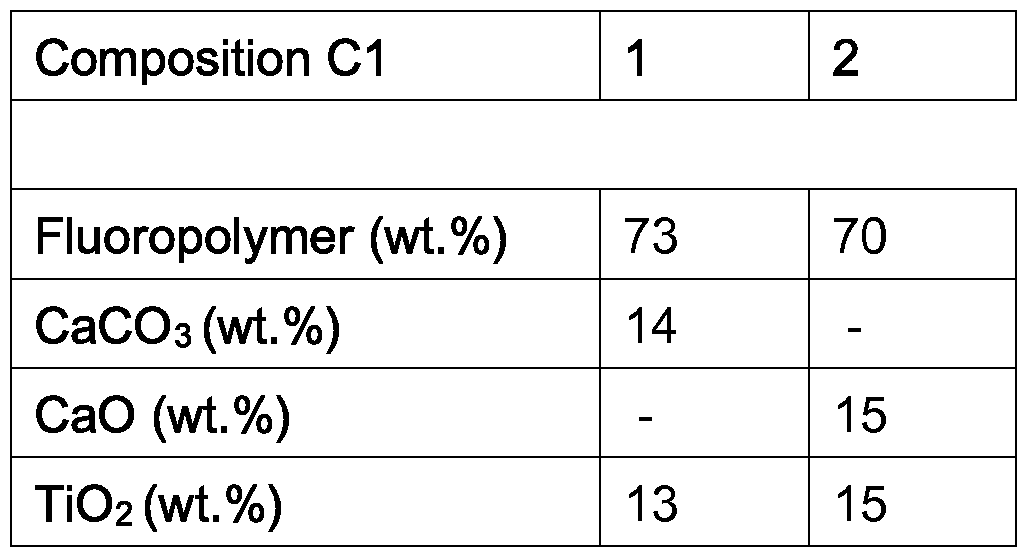
Films from compositions 1 and 2 were prepared on a Brabender Intelli- torque 19 mm single screw extruder with a 100 mm ribbon die for appearance evaluations. Melt temperatures were in the range of 240 to 260 °C, screw speed was set at 50 rpm and puller roll speed adjusted from 40 to 60% in order to obtain a 50 micron thick film.
General procedure for preparing the layer L2
Several compositions comprising PPSU, as above detailed, in combination with variable amounts of PEEK, DPS and PPE were prepared. A comparative composition (1 C) was prepared which do not comprise any of PEEK, DPS or PPE. See Table 2.
Also, several compositions comprising PPSU, as above detailed, in combination with variable amounts of two distinct PEKK were prepared. A comparative composition (2C) was prepared which do not comprise PEKK. See Table 3.
The compositions have been prepared as detailed in the following Tables 2 and 3. The ingredients listed in Table 2 and Table 3 were melt blended in a ZSK 26 twin screw extruder. The barrel temperatures were ranged from 350° C to 360 °C and screw speed was 200 rpm. Upon exiting the extruder, the molten compound was quenched in a water bath and pelletized
Table 2
Composition 1C 3 4 5 6 7 8 9
C2
PPSU 91.4 86.6 84.2 81.9 89.5 79.5 89.5 79.5
PTFE 1.9 1.9 1.9 1.9 2 2 2 2
Zinc Borate 1.9 1.9 1.9 1.9 2 2 2 2
PEEK - 4.8 7.2 9.5 - 10 - 10
DPS - - - - - - 1.5 1.5
PPE - - - - 1.5 1.5
Ti02 4.8 4.8 4.8 4.8 5 5 5 5
Values are reported in wt.%.
Table 3

Values are reported in wt.%.
Heat deflection temperature of composition C2
Comparative composition 1 C and compositions 3 to 9 were injection molded into 125 mm x 12.5 mm x 3.3 mm (5 inch x 0.5 inch x 0.125 inch) bars. Cylinder temperatures were from 360 °C to 380 °C and mold temperature was about 170° C.
Heat deflection temperature (HDT) of unannealed bars was measured according to ASTM D648 under at a stress level of 0.45 MPa.
The results are summarized in the following table 4:
Table 4

The data show that the addition to the PPSU polymer of at least one additional component selected from PEEK, DPS and PPE lower the HDT
of the composition resulting therefrom.
[00132] DSC of compositions C2
[00133] The glass transition temperatures of comparative composition 2C and compositions 10 to 15 were measured according to ASTM D3418 using a TA Instruments Model Q20/Q1000 Differential Scanning calorimeter and Liquid Nitrogen Cooling System operated with TA Thermal Advantage and Universal Analysis software. The instrument was calibrated using a heating and cooling rate of 20 °C/min in nitrogen atmosphere. The measurements were also carried out using a heating and cooling rate of 20 °C/min in nitrogen atmosphere. Then, the polymer composition (C2) is submitted to the following cooling/heating cycle: 1st heating up to 300°C at a rate of 20°C /min, followed by 1st cooling from 300 °C down to 30°C at a rate of 20 °C/min, followed by 2nd heating from 30°C up to 300 °C at a rate of 20 °C/min. The glass transition temperature is measured during the 2nd heating. The glass transition temperature is advantageously determined by a construction procedure on the heat flow curve: a first tangent line to the curve above the transition region is constructed; a second tangent line to the curve below the transition region is also constructed; the
temperature on the curve halfway between the two tangent lines, or ½ delta Cp, is the glass transition temperature.
The results are summarized in the following table 5:
Table 5

The data show that the addition to the PPSU polymer of at least one PEKK lower the Tg of the composition resulting therefrom.
[00134] Melt viscosities of compositions C2
Melt viscosities of comparative composition 1C and of compositions 3 to 9 according to the present invention were measured at shear rates ranging from 25 to 3,500 reciprocal seconds at a temperature of 380 °C on
a Dynisco LCR7000 Capillary Rheometer. Melt viscosity
expressed in Pa s are provided in Table 6.
Table 6

The data show that the addition to PPSU of at least one additional component selected from PEEK, DPS and PPE lower the melt viscosity of the composition resulting therefrom.
Compositions 1 C and 3 through 9 were then extruded into 1.0 mm sheet on a Sterling extruder with a 38 mm single screw and a 350 mm wide sheet die.
General procedure for preparing the laminate structure
Layer L1 : Films obtained from composition C1 (films L1 ) were plasma treated in a PE-50XL plasma unit by Plasma Etch. Treatment was for 5 minutes at full power in an argon atmosphere.
Adhesive A was applied to the plasma treated side of eight films L1 and then dried at 90°C to give films L1-A.
Adhesive B was applied to the plasma treated side of other eight films L1 to give to give films L1-B.
Layer L2: Sheets of comparative composition 1 C and of compositions 3 to 9 were cut into 150 mm x 150 mm plaques.
Laminate structures were assembled combining either Film L1 -A or Film L1 -B with sheets of comparative composition 1 C and of compositions 3 to 9 and then placed in a compression molder at 145 °C or 200 °C with 0.6 Mpa clamp force to form the laminate.
Adhesion of laminate test plaques was evaluated by a pull test. Both the Adhesive A and Adhesive B provided excellent adhesion between layers
L1 and L2.
The laminates were dried for 4 hours at 170 C before determining the thermoforming temperature of the laminates as the temperature at which they become pliable. Samples were then evaluated for appearance.
Laminates comprising Film L1 -A and sheets of compositions 3 to 9 were pliable at 230 °C and had excellent appearance.
The laminates comprising Film L1 -A and sheet of comparative composition 1 C was not pliable until 250 °C, while a slight bubbling was noted on the surface.
Laminates comprising Film L1 -B and sheets of comparative composition 1 C and of compositions 3 to 9 showed the bubbling of the adhesive at 160 °C, a temperature at which Layer 2 (PPSU) was not yet pliable.
Claims
Claim 1. A multi-layer laminate assembly comprising at least two polymer layers (L1 , L2), wherein at least one polymer layer (L2) is made of a polymer composition (C2) comprising:
- component (a): at least one polyphenylsulfone polymer (PPSU), and
- component (b):
- from 1 to 30 wt.% of at least one poly(aryl ether ketone) polymer (PAEK) , and/or
- from 0.5 to 5 wt.% of at least one low molecular weight aromatic compound of formula (I):

- Ai , A3 and A* are independently selected at each occasion from the group consisting of a bond, a sulfone group [-S(=O)2-], a ketone group
[-C(=O)-], an ether [-O-], and a group -C(Rj)(Rk)-, provided that A4 is optional,
- A2 is independently selected at each occasion from the group consisting of a bond, a sulfone group [-S(=O)2-], a ketone group [-C(=O)-], an ether [-O-], a group:

or a group -C(Rj)(Rk)- wherein Rj and Rk, equal to or different from each other, are selected from a hydrogen, a halogen, an optionally-halogenated alkyl, an alkenyl, an alkynyl, a phenyl, an ether, a thioether, a carboxylic acid, an ester, an amide, an imide, an alkali or alkaline earth metal sulfonate, an alkyl sulfonate, an alkali or alkaline earth metal phosphonate, an alkyl phosphonate, an amine, and a quaternary ammonium;
- n is an integer selected from 0 and 1 ;
- m is an integer ranging from 0 to 32;
- each R is independently selected at each occasion from the group consisting of a halogen, an alkyl, an alkenyl, an alkynyl, an aryl, an ether, a thioether, a carboxylic acid, an ester, an amide, an imide, an alkali or alkaline earth metal sulfonate, an alkyl sulfonate, an alkali or alkaline earth metal phosphonate, an alkyl phosphonate, an amine, and a quaternary ammonium; and
- each i, equal to or different from each other, is an integer ranging from 0 to 5;
wherein the two polymer layers (L1 , L2) are at least partially adhered to each other.
Claim 2. The assembly of claim 1 , wherein component (b) comprises from 1 to 15 wt.% of poly(ether ether ketone) (PEEK).
Claim 3. The assembly of claim 1 , wherein component (b) comprises from 1 to 30 wt.% of poly(ether ketone ketone) (PEKK).
Claim 4. The assembly of any one of claims 1 -3, wherein component (b) is selected from the group consisting of diphenylsulfone (DPE), polyphenyl ether (PPE), 1 ,4-bis(4-phenoxybenzoyl)benzene (DTD) and mixture thereof.
Claim 5. The assembly of any one of claims 1 -4, wherein the polymer layer (L1 ) is made of a composition (C1) comprising at least one fluoropolymer (F) comprising recurring units derived from ethylene (E) and recurring units derived from at least one of chlorotrifluoroethylene (CTFE) and
tetrafluoroethylene (TFE).
Claim 6. The assembly of any one of claim 5, wherein the inner surface of layer (L1 ) is a plasma-treated surface.
Claim 7. The assembly of any one of claims 5-6, wherein the fluoropolymer
(F) comprises:
(a) from 45 to 55 mol.% of recurring units derived from of ethylene (E),
(b) from 45 to 55 mol.% of recurring units derived from at least one of chlorotrifluoroethylene (CTFE), tetrafluoroethylene (TFE) or mixture thereof,
(c) from 0 to 3 mol.% of recurring units derived from one or more fluorinated and/or hydrogenated comonomer(s)
wherein the mol.% is based on the total number of moles in the
fluoropolymer (F) and the total mol.% of recurring units (a), (b) and (c) equals 100%.
Claim 8. The assembly of claim 5, wherein the hydrogenated comonomer of recurring units (c) consists of (meth)acrylic monomers.
Claim 9. The assembly of any one of claims 5-7, wherein the fluoropolymer
(F) is an ECTFE copolymer.
Claim 10. The assembly of any one of claims 1 -9, further comprising an
adhesive layer (L3) positioned between the two polymer layers.
Claim
1 1. A polymer composition (C2), comprising:
- component (a): at least one polyphenylsulfone polymer (PPSU), and
- component (b):
- from 1 to 30 wt.% of at least one poly(aryl ether ketone) polymer (PAEK) , and/or
- from 0.5 to 5 wt.% of at least one low molecular weight aromatic compound of formula (I):

- Ai , A3 and A* are independently selected at each occasion from the group consisting of a bond, a sulfone group [-S(=O)2-], a ketone group
[-C(=O)-], an ether [-O-], and a group -C(Rj)(Rk)-, provided that A4 is optional,
- A2 is independently selected at each occasion from the group consisting of a bond, a sulfone group [-S(=O)2-], a ketone group [-C(=O)-], an ether [-O-], a group:

- n is an integer selected from 0 and 1 ;
- m is an integer ranging from 0 to 32;
- each R is independently selected at each occasion from the group consisting of a halogen, an alkyl, an alkenyl, an alkynyl, an aryl, an ether, a thioether, a carboxylic acid, an ester, an amide, an imide, an alkali or alkaline earth metal sulfonate, an alkyl sulfonate, an alkali or alkaline earth metal phosphonate, an alkyl phosphonate, an amine, and a quaternary ammonium; and
- each i, equal to or different from each other, is an integer ranging from 0 to 5.
Claim 12. A process for manufacturing a multi-layer laminate assembly,
comprising:
(i) providing a polymer layer (L1 ), the polymer layer (L1 ) having an inner surface and an outer surface,
(ii) providing a polymer layer (L2) made of a polymer composition (C2) comprising:
- component (a): at least one polyphenylsulfone polymer (PPSU), and
- component (b):
- from 1 to 15 wt.% of at least one poly(aryl ether ketone) polymer (PAEK) , and/or
- from 0.5 to 5 wt.% of at least one low molecular weight aromatic compound of formula (I):

[-C(=O)-], an ether [-O-], and a group -C(Rj)(Rk)-, provided that A4 is optional,
- A2 is independently selected at each occasion from the group consisting of a bond, a sulfone group [-S(=O)2-], a ketone group [-C(=O)-], an ether [-O-], a group:

or a group -C(Rj)(Rk)- wherein Rj and Rk, equal to or different from each other, are selected from a hydrogen, a halogen, an optionally-halogenated alkyl, an alkenyl, an alkynyl, a phenyl, an ether, a thioether, a carboxylic acid, an ester, an amide, an imide, an alkali or alkaline earth metal sulfonate, an alkyl sulfonate, an alkali or alkaline earth metal phosphonate, an alkyl phosphonate, an amine, and a quaternary ammonium;
- n is an integer selected from 0 and 1 ;
- m is an integer ranging from 0 to 32;
- each R is independently selected at each occasion from the group consisting of a halogen, an alkyl, an alkenyl, an alkynyl, an aryl, an ether, a thioether, a carboxylic acid, an ester, an amide, an imide, an alkali or alkaline earth metal sulfonate, an alkyl sulfonate, an alkali or alkaline earth metal phosphonate, an alkyl phosphonate, an amine, and a quaternary ammonium; and
- each i, equal to or different from each other, is an integer ranging from 0 to 5, the polymer layer (L2) having an inner surface and an outer surface,
(iii) optionally applying an adhesive layer (L3) onto the inner surface of the layer (L1 ) and/or onto the inner surface of the layer (L2) ; and
(iv) laminating the polymer layer (L1 ) onto the inner surface of the polymer layer (L2).
Claim 13. The process of claim 12, in which the polymer layer (L1 ) is made of a composition (C1 ) comprising at least one fluoropolymer (F) comprising recurring units derived from ethylene (E) and recurring units derived from at least one of chlorotrifluoroethylene (CTFE) and tetrafluoroethylene (TFE).
Claim 14. A method for manufacturing a thermoformed multi-layer laminate assembly of any one of claims 1 -10, comprising molding the multi-layer assembly under the effect of heat and pressure to provide a thermoformed multi-layer laminate assembly.
Claim 15. A shaped article comprising a thermoformed multi-layer laminate assembly obtainable by the process of claim 14.
Applications Claiming Priority (6)
| Application Number | Priority Date | Filing Date | Title |
|---|---|---|---|
| US201662413329P | 2016-10-26 | 2016-10-26 | |
| US62/413,329 | 2016-10-26 | ||
| EP17153290 | 2017-01-26 | ||
| EP17153290.6 | 2017-01-26 | ||
| US201762476289P | 2017-03-24 | 2017-03-24 | |
| US62/476,289 | 2017-03-24 |
Publications (1)
| Publication Number | Publication Date |
|---|---|
| WO2018077967A1 true WO2018077967A1 (en) | 2018-05-03 |
Family
ID=58016532
Family Applications (1)
| Application Number | Title | Priority Date | Filing Date |
|---|---|---|---|
| PCT/EP2017/077342 Ceased WO2018077967A1 (en) | 2016-10-26 | 2017-10-25 | Fluoropolymer laminate for thermoforming into vehicles body panels |
Country Status (1)
| Country | Link |
|---|---|
| WO (1) | WO2018077967A1 (en) |
Cited By (2)
| Publication number | Priority date | Publication date | Assignee | Title |
|---|---|---|---|---|
| WO2019243217A1 (en) * | 2018-06-18 | 2019-12-26 | Solvay Specialty Polymers Usa, Llc | Method of making a three-dimensional object using a poly(aryl ether sulfone) (paes) polymer |
| WO2026073364A1 (en) * | 2024-10-01 | 2026-04-09 | Syensqo Specialty Polymers Italy S.p.A. | Fluoropolymer coating on aromatic polymer |
Citations (10)
| Publication number | Priority date | Publication date | Assignee | Title |
|---|---|---|---|---|
| US5304413A (en) | 1992-04-29 | 1994-04-19 | E. I. Du Pont De Nemours And Company | Molded PVF laminar structures |
| US5328948A (en) | 1992-09-23 | 1994-07-12 | Ausimont, U.S.A., Inc. | Stabilization of halopolymers with ionomers |
| WO2000060009A1 (en) * | 1999-04-07 | 2000-10-12 | Bp Corporation North America Inc. | Poly(biphenyl ether sulfone) resins having improved uv yellowing resistance |
| WO2007107519A1 (en) * | 2006-03-17 | 2007-09-27 | Solvay Advanced Polymers, L.L.C. | New polymer composition |
| WO2013092628A1 (en) * | 2011-12-21 | 2013-06-27 | Solvay Specialty Polymers Usa, Llc | High performance sulfone polymer composition |
| EP2738219A1 (en) * | 2012-11-28 | 2014-06-04 | Solvay Specialty Polymers USA, LLC. | PAEK/PAES compositions |
| US20140272237A1 (en) * | 2013-03-15 | 2014-09-18 | Prc-Desoto International, Inc. | Strippable film assembly and coating for drag reduction |
| WO2014187758A1 (en) | 2013-05-21 | 2014-11-27 | Solvay Specialty Polymers Italy S.P.A. | Fluoropolymer composition |
| WO2015097206A1 (en) * | 2013-12-23 | 2015-07-02 | Solvay Specialty Polymers Italy S.P.A. | Thermal acoustic insulation blankets |
| US20160069503A1 (en) * | 2013-04-29 | 2016-03-10 | Solvay Specialty Polymers Italy S.P.A. | Process for lining metal pipelines |
-
2017
- 2017-10-25 WO PCT/EP2017/077342 patent/WO2018077967A1/en not_active Ceased
Patent Citations (10)
| Publication number | Priority date | Publication date | Assignee | Title |
|---|---|---|---|---|
| US5304413A (en) | 1992-04-29 | 1994-04-19 | E. I. Du Pont De Nemours And Company | Molded PVF laminar structures |
| US5328948A (en) | 1992-09-23 | 1994-07-12 | Ausimont, U.S.A., Inc. | Stabilization of halopolymers with ionomers |
| WO2000060009A1 (en) * | 1999-04-07 | 2000-10-12 | Bp Corporation North America Inc. | Poly(biphenyl ether sulfone) resins having improved uv yellowing resistance |
| WO2007107519A1 (en) * | 2006-03-17 | 2007-09-27 | Solvay Advanced Polymers, L.L.C. | New polymer composition |
| WO2013092628A1 (en) * | 2011-12-21 | 2013-06-27 | Solvay Specialty Polymers Usa, Llc | High performance sulfone polymer composition |
| EP2738219A1 (en) * | 2012-11-28 | 2014-06-04 | Solvay Specialty Polymers USA, LLC. | PAEK/PAES compositions |
| US20140272237A1 (en) * | 2013-03-15 | 2014-09-18 | Prc-Desoto International, Inc. | Strippable film assembly and coating for drag reduction |
| US20160069503A1 (en) * | 2013-04-29 | 2016-03-10 | Solvay Specialty Polymers Italy S.P.A. | Process for lining metal pipelines |
| WO2014187758A1 (en) | 2013-05-21 | 2014-11-27 | Solvay Specialty Polymers Italy S.P.A. | Fluoropolymer composition |
| WO2015097206A1 (en) * | 2013-12-23 | 2015-07-02 | Solvay Specialty Polymers Italy S.P.A. | Thermal acoustic insulation blankets |
Non-Patent Citations (1)
| Title |
|---|
| A. YIALIZIS ET AL.: "Atmospheric Plasma-The New Functional Treatment for Film", TAPPI POLYMERS, LAMINATIONS, & COATINGS CONFERENCE, 2000, pages 1343 - 1352 |
Cited By (5)
| Publication number | Priority date | Publication date | Assignee | Title |
|---|---|---|---|---|
| WO2019243217A1 (en) * | 2018-06-18 | 2019-12-26 | Solvay Specialty Polymers Usa, Llc | Method of making a three-dimensional object using a poly(aryl ether sulfone) (paes) polymer |
| CN113099720A (en) * | 2018-06-18 | 2021-07-09 | 索尔维特殊聚合物美国有限责任公司 | Method for making three-dimensional objects using poly (aryl ether sulfone) (PAES) polymers |
| JP2021528276A (en) * | 2018-06-18 | 2021-10-21 | ソルベイ スペシャルティ ポリマーズ ユーエスエー, エルエルシー | A method for producing a three-dimensional object using a poly (aryl ether sulfone) (PAES) polymer. |
| JP7328999B2 (en) | 2018-06-18 | 2023-08-17 | ソルベイ スペシャルティ ポリマーズ ユーエスエー, エルエルシー | Method for manufacturing three-dimensional objects using poly(arylethersulfone) (PAES) polymers |
| WO2026073364A1 (en) * | 2024-10-01 | 2026-04-09 | Syensqo Specialty Polymers Italy S.p.A. | Fluoropolymer coating on aromatic polymer |
Similar Documents
| Publication | Publication Date | Title |
|---|---|---|
| CA1296499C (en) | Laminates containing coextruded scrap | |
| JP2024041794A (en) | Biaxially oriented laminated polypropylene film | |
| EP2376558B1 (en) | Moisture resistant polyimide compositions | |
| TWI228528B (en) | Poly (biphenyl ether sulfone) resins having improved UV yellowing resistance | |
| US20220297370A1 (en) | Production of semicrystalline parts from pseudo-amorphous polymers | |
| CN117801711A (en) | Hot melt adhesive film for water boiling resistant ASA/metal composite, and preparation method and application thereof | |
| WO2018077967A1 (en) | Fluoropolymer laminate for thermoforming into vehicles body panels | |
| JP2026063459A (en) | Stretched film and method for manufacturing the same | |
| CN114181481A (en) | Screening method and application for preparing multilayer PTFE composite expanded sheet material, expanded sheet and preparation method thereof | |
| US20230257583A1 (en) | Resin composition and resin film, prepreg, laminated board, copper-clad board and printed circuit board comprising same | |
| WO2023191011A1 (en) | Film and laminate | |
| EP1853645B1 (en) | Poly(aryl ether sulfone) material and use thereof | |
| KR20140001835A (en) | Multilayer sheet and method for producing same | |
| WO2012070373A1 (en) | Biaxially oriented ethylene-polymer multi-layer film | |
| KR20010072727A (en) | Blends containing linear low density polyethylene, high density polyethylene, and low density polyethylene particularly suitable for extrusion coating and films | |
| JP5050911B2 (en) | Laminated body for foaming and foam | |
| JP6947052B2 (en) | Polyester multilayer film | |
| EP3421543B1 (en) | Film | |
| CN120981510A (en) | Stretch film and its manufacturing method | |
| JP4175710B2 (en) | Multilayer laminate | |
| KR101091085B1 (en) | Laminating co-extrusion dispersion-proof film | |
| KR102194517B1 (en) | Multi-layer film comprising polycarbonate and preparation method thereof | |
| JP4651993B2 (en) | Easy-cut laminated film | |
| KR101970636B1 (en) | High tensile modulus and heat resistant resin composition and multilayer film for vacuum skin packaging comprising the same | |
| EP4039747B1 (en) | Resin composition, film, composite material, movable body, and material for three-dimensional shaping use |
Legal Events
| Date | Code | Title | Description |
|---|---|---|---|
| 121 | Ep: the epo has been informed by wipo that ep was designated in this application |
Ref document number: 17791060 Country of ref document: EP Kind code of ref document: A1 |
|
| NENP | Non-entry into the national phase |
Ref country code: DE |
|
| 122 | Ep: pct application non-entry in european phase |
Ref document number: 17791060 Country of ref document: EP Kind code of ref document: A1 |