WO2018061069A1 - 無線通信装置、プログラム、および無線通信方法 - Google Patents
無線通信装置、プログラム、および無線通信方法 Download PDFInfo
- Publication number
- WO2018061069A1 WO2018061069A1 PCT/JP2016/078338 JP2016078338W WO2018061069A1 WO 2018061069 A1 WO2018061069 A1 WO 2018061069A1 JP 2016078338 W JP2016078338 W JP 2016078338W WO 2018061069 A1 WO2018061069 A1 WO 2018061069A1
- Authority
- WO
- WIPO (PCT)
- Prior art keywords
- wireless communication
- communication unit
- wireless
- identification information
- unit
- Prior art date
- Legal status (The legal status is an assumption and is not a legal conclusion. Google has not performed a legal analysis and makes no representation as to the accuracy of the status listed.)
- Ceased
Links
Images




Classifications
-
- H—ELECTRICITY
- H04—ELECTRIC COMMUNICATION TECHNIQUE
- H04W—WIRELESS COMMUNICATION NETWORKS
- H04W12/00—Security arrangements; Authentication; Protecting privacy or anonymity
- H04W12/08—Access security
- H04W12/088—Access security using filters or firewalls
-
- H—ELECTRICITY
- H04—ELECTRIC COMMUNICATION TECHNIQUE
- H04W—WIRELESS COMMUNICATION NETWORKS
- H04W48/00—Access restriction; Network selection; Access point selection
- H04W48/08—Access restriction or access information delivery, e.g. discovery data delivery
Definitions
- Embodiments described herein relate generally to a wireless communication apparatus, a program, and a wireless communication method for performing wireless communication.
- the wireless access point performs communication restriction using an SSID and an access key as setting information for establishing wireless communication. Also, the wireless access point registers device identification information such as a MAC address, and performs MAC address filtering for communicating only with the registered device.
- device identification information such as a MAC address
- the identification information such as the MAC address needs to be registered in advance in the wireless access point by the user.
- proposals for new security measures have also been desired.
- an object of an embodiment of the present invention is to provide a wireless communication measure, a program, and a wireless communication method for performing wireless communication security measures by a new technique without performing complicated work.
- the wireless communication device includes a first wireless communication unit, a second wireless communication unit, and a control unit.
- the control unit acquires device identification information by the first wireless communication unit, and restricts communication with a device other than the device corresponding to the acquired identification information to the second wireless communication unit.
- security measures for wireless communication can be taken by a new technique without performing complicated work.
- FIG. 7A is a block diagram showing the main configuration of the wireless AP 10 according to the first modification
- FIG. 7B is a block diagram showing the main configuration of the terminal 20 according to the first modification.
- FIG. 8A is a diagram showing the relationship between the MAC address of each device and the MAC address list registered in the wireless AP 10 according to Modification 2
- FIG. 8B is an operation of the terminal 20 and the wireless AP 10.
- FIGS. 9A and 9B are diagrams illustrating the relationship between the MAC address of each device and the MAC address list registered in the wireless AP 10.
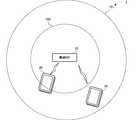
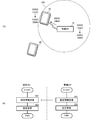
- FIG. 1 is a diagram showing a configuration of the wireless communication system 1.
- the wireless communication system 1 includes a wireless access point (hereinafter referred to as wireless AP) 10, a terminal 20, and a terminal 30.
- wireless AP wireless access point
- terminal 20 a terminal 22
- terminal 30 a terminal 30
- the wireless AP 10 is an example of a wireless communication apparatus according to the present invention.
- the wireless AP 10 is connected to a router (not shown) via a wired LAN, and mediates communication between the router and devices such as the terminal 20 and the terminal 30.
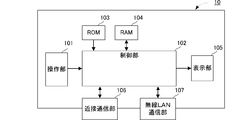
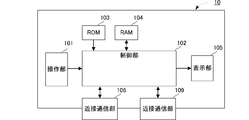
- FIG. 2 is a block diagram showing the main configuration of the wireless AP 10.
- the wireless AP 10 includes an operation unit 101, a control unit 102, a ROM (Read Only Memory) 103, a RAM (Random Access Memory) 104, a display unit 105, a proximity communication unit 106, and a wireless LAN (Local Area Network) communication unit 107. ing.
- the operation unit 101 includes a touch panel, a switch, or a button that receives an operation from the user.
- the display unit 105 includes an LED (Light Emitting Diode), an LCD (Liquid Crystal Display), or the like, and displays the status of the device itself, for example.
- LED Light Emitting Diode
- LCD Liquid Crystal Display
- the control unit 102 performs various operations by reading the firmware stored in the ROM 103, which is a storage medium, into the RAM 104.
- the control unit 102 controls the proximity communication unit 106 and the wireless LAN communication unit 107.
- the proximity communication unit 106 is an example of a first wireless communication unit of the present invention.
- the near field communication unit 106 performs wireless communication according to a 5G wireless communication standard such as Bluetooth (registered trademark).
- the proximity communication unit 106 functions as a receiving device in Bluetooth (registered trademark) Low Energy (hereinafter simply referred to as BLE).
- BLE Bluetooth Low Energy
- the near field communication unit 106 receives various types of information transmitted from other devices. The received various information is input to the control unit 102.
- the wireless LAN communication unit 107 is an example of a second wireless communication unit of the present invention.
- the wireless LAN communication unit 107 performs wireless communication conforming to a wireless LAN standard such as IEEE802.11b, IEEE802.11a, IEEE802.11g, IEEE802.11n, IEEE802.11ac, or IEEE802.11ad.
- a unique network name (SSID) and an encryption key such as a WPA key are set.
- a device such as the terminal 20 or the terminal 30 registers the setting information such as the SSID and the encryption key set in the wireless LAN communication unit 107 in its own device, so that the connection with the wireless LAN communication unit 107 is established.
- the proximity communication unit 106 and the wireless LAN communication unit 107 have different communicable distances.
- a first communication area 100 illustrated in FIG. 1 corresponds to an area where the proximity communication unit 106 can communicate, and a second communication area 151 corresponds to an area where the wireless LAN communication unit 107 can communicate.
- the communication range of the proximity communication unit 106 is, for example, about 10 m in radius in BLE.
- the communicable range of the wireless LAN communication unit 107 is, for example, about a radius of about 100 m in an environment free from obstacles. That is, the proximity communication unit 106 has a shorter radio wave reach than the wireless LAN communication unit 107.
- the terminal 20 exists within the communicable range of the proximity communication unit 106, and the terminal 30 exists outside the communicable range of the proximity communication unit 106. Therefore, the terminal 20 can communicate with the wireless AP 10 via BLE.
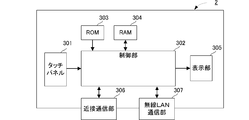
- FIG. 3 is a block diagram showing the configuration of the terminal 20. Since the terminal 30 also has the same configuration and the same function as the terminal 20, the terminal 20 will be described as a representative in FIG.
- the terminal 20 includes a touch panel 301, a control unit 302, a ROM 303, a RAM 304, a display unit 305, a proximity communication unit 306, and a wireless LAN communication unit 307.
- the terminal 20 is an information processing apparatus such as a smartphone or a personal computer.
- a smartphone is shown as an example of a terminal (device), but the “device” in the present invention is not limited to a smartphone, and includes all devices that can be connected to a wireless AP via wireless communication.
- the touch panel 301 is an interface that receives an operation from a user.
- the display unit 305 presents various information to the user.
- the terminal 20 implements GUI (Graphical User Interface) by the touch panel 301 and the display unit 305.
- GUI Graphic User Interface
- the control unit 302 performs various operations by reading out the OS and application programs stored in the ROM 303, which is a storage medium, to the RAM 304. For example, when the activation of the application program is instructed by the user via the touch panel 301, the control unit 302 activates the instructed application program.
- the control unit 302 activates an application program (hereinafter referred to as a communication program) for communicating with the proximity communication unit 106 of the wireless AP 10.
- FIG. 4 is a flowchart showing the operation of the control unit 302 and the operation of the wireless AP 10 according to the communication program.
- the control unit 302 When starting the communication program, the control unit 302 first transmits a MAC address, which is an example of identification information of the own device, via the proximity communication unit 306 (S11). This process is performed periodically every predetermined time. That is, the proximity communication unit 306 functions as a BLE beacon and periodically transmits a MAC address by broadcast.
- a MAC address which is an example of identification information of the own device
- the wireless AP 10 receives the MAC address transmitted by the terminal 20 (S21).
- the wireless AP 10 registers the received MAC address in the MAC address list stored in the ROM 303 or RAM 304 (S22).
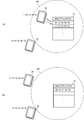
- FIG. 5A shows the relationship between the MAC address of each device and the MAC address list registered in the wireless AP 10.
- the terminal 20 existing in the first communication area 100 transmits a MAC address to the wireless AP by BLE. Therefore, the MAC address of the terminal 20 is registered in the wireless AP 10.
- the wireless AP 10 performs MAC address filtering using the registered MAC address. That is, the control unit 302 restricts the wireless LAN communication unit 107 from communicating with devices other than the registered MAC address. Since the MAC address is registered in the wireless AP 10, the terminal 20 can communicate with the wireless AP 10 through the wireless LAN. Since the MAC address is not registered in the wireless AP 10, the terminal 30 cannot communicate with the wireless AP 10 through the wireless LAN.
- the communicable range of the wireless LAN is limited to the communicable range of the proximity communication unit 106.
- radio LAN radio waves have a reach of a radius of about 100 m.
- the MAC address filtering limits the range that can be communicated by the wireless LAN to a radius of about 10 m, which is a BLE communicable range.
- the wireless LAN communication may be restricted by setting information such as an SSID and an encryption key as in the conventional case, but the communication restriction by the setting information is not essential.
- the range in which wireless LAN communication is possible is limited to a radius of about 10 m, which is the BLE communication range, so that unauthorized access can be prevented. it can.
- the control unit 302 presents a connection confirmation screen on the display unit 305 when the beacon signal of the wireless AP 10 is received via the proximity communication unit 306 by the application program of the terminal 20 (or the terminal 30).
- the user issues a connection instruction via the touch panel 301.
- the control unit 302 transmits the MAC address of the own device to the wireless AP 10 via the proximity communication unit 306.
- the MAC address is shown as the device identification information, but various other information such as the device name, serial number, or IP address can also be used as the identification information.
- FIG. 6 is a flowchart showing the operation of the wireless AP.
- the control unit 302 of the wireless AP 10 checks the MAC address stored in the storage unit (ROM 303 or RAM 304) every predetermined time (S31).
- the control unit 302 confirms whether or not the identification information has been received from the device corresponding to the MAC address stored in the ROM 303 or the RAM 304 via the proximity communication unit 306, so that the corresponding device has the first communication area 100. It is confirmed whether or not it exists within the range (S32). If the identification information is not received from the corresponding device, it is determined that the corresponding device exists outside the range of the first communication area 100, and the MAC address is deleted (S33).
- the terminal 20 when the terminal 20 moves out of the first communication area 100, the MAC address of the terminal 20 is deleted from the wireless AP 10. Therefore, the terminal 20 is in a state where it cannot communicate with the wireless AP by MAC address filtering.
- the wireless AP 10 performs the operation illustrated in FIG. 6, so that the user moves out of the first communication area 100 and then moves out of the first communication area 100. Even if it comes out, since communication is restricted, the communicable range by the wireless LAN can always be limited to a radius of about 10 m which is the communicable range of BLE.
- FIG. 7A is a block diagram illustrating a main configuration of the wireless AP 10 according to the first modification.
- FIG. 7B is a block diagram illustrating a main configuration of the terminal 20 according to the first modification. 2 and FIG. 3 are assigned the same reference numerals, and descriptions thereof are omitted.
- the wireless AP 10 according to the first modification includes a wireless LAN communication unit 108 instead of the proximity communication unit 106.
- the terminal 20 according to Modification 2 includes a wireless LAN communication unit 308 instead of the proximity communication unit 306.
- the BLE and the wireless LAN are used.
- both the first wireless communication unit and the second wireless communication unit communicate using the wireless LAN.
- the wireless LAN communication unit 108 as the first wireless communication unit has a narrower communication range than the wireless LAN communication unit 107 as the second wireless communication unit.
- the following examples can be considered in order to realize modes having different communication ranges.
- the wireless LAN communication unit 108 performs communication according to the IEEE 802.11ad standard.
- the wireless LAN communication unit 107 performs communication conforming to the IEEE 802.11ac standard.
- the wireless LAN communication unit 108 receives identification information such as a MAC address from each device.
- the reach distance of radio waves is about 10 m in radius. Therefore, similarly to the above-described embodiment, the communicable range of the wireless LAN communication unit 107 can be limited to a range of about 10 m radius.
- the wireless LAN communication unit 108 performs communication according to IEEE 802.11n (5 GHz).
- the wireless LAN communication unit 107 performs communication according to IEEE 802.11n (2.4 GHz).
- the wireless LAN communication unit 108 receives identification information such as a MAC address from each device.
- a radio wave having a frequency of 5 GHz has a shorter reach than a radio wave having a frequency of 2.4 GHz. Accordingly, in this case as well, as in the above-described embodiment, the communicable range of the wireless LAN communication unit 107 can be limited to the reach range of 5 GHz radio waves.
- Z-WAVE registered trademark
- Wi-Fi registered trademark
- the wireless LAN communication unit 107 and the wireless LAN communication unit 108 both use radio waves of the same standard and the same frequency, but the radio field strength of the wireless LAN communication unit 108 is weaker than the radio field strength of the wireless LAN communication unit 107. Is set. Accordingly, in this case as well, as in the above-described embodiment, the communicable range of the wireless LAN communication unit 107 can be limited to the communicable range of the wireless LAN communication unit 108 with low radio field strength.
- the first wireless communication unit (wireless LAN communication unit 108) and the second wireless communication unit (wireless LAN communication unit 107) communicate using the same frequency there is one piece of hardware (one It is also possible to adopt a mode in which the antenna is shared.
- FIG. 8A is a diagram illustrating a relationship between the MAC address of each device according to the second modification and the MAC address list registered in the wireless AP 10.
- FIG. 8B is a flowchart showing operations of the terminal 20 and the wireless AP 10.
- the wireless AP 10 periodically changes setting information such as an SSID or an encryption key in the second wireless communication unit (wireless LAN communication unit 307).
- the wireless AP 10 transmits the changed setting information via the first wireless communication unit before the setting is changed (S51).
- the terminal 20 changes the SSID or the encryption key with the received setting information (S62).
- the wireless AP 10 changes the SSID or the encryption key based on the setting information (S52).
- the setting change timing can also be synchronized by including time information indicating the timing of changing the setting in the setting information transmitted from the wireless AP 10.
- the terminal 20 existing within the range of the first communication area 100 is in a state where communication is possible via the second wireless communication unit (wireless LAN communication unit 307).
- the terminal 30 existing outside the range is in a state where it cannot communicate via the second wireless communication unit (wireless LAN communication unit 307). Therefore, also in the wireless communication system according to Modification 3, the communication range of the second wireless communication unit (wireless LAN communication unit 307) is about 10 m in radius, which is the communication range of the first wireless communication unit (for example, BLE). Therefore, unauthorized access can be prevented.
- the communication range of the first wireless communication unit is narrow and the communication range of the second wireless communication unit is wide.
- the communication range is This is a mode in which identification information is transmitted / received via a wide first wireless communication unit and main communication is performed via a second wireless communication unit having a narrow communication range.
- terminal identification information is registered in the wireless AP 10 when the user enters the first area (for example, a building). Furthermore, when the user enters a second region (for example, a specific room in the building) that is narrower than the first region, the terminal can communicate via the second wireless communication unit. Therefore, the user can enter a specific building such as a museum and receive specific information (for example, information on exhibits) in the specific display area using the user terminal.
- the communication range of the first wireless communication unit and the second wireless communication unit is different, but as illustrated in FIGS. 9A and 9B.
- the communicable range (first region 100) of the first wireless communication unit and the communicable range (second region 151) of the second wireless communication unit may be the same.
- the wireless AP 10 has the configuration shown in FIG. The wireless AP 10 performs communication by the wireless LAN in the same communicable range in both the first wireless communication unit and the second wireless communication unit.
- the identification information of the device is acquired by the first wireless communication unit, and the communication with the device other than the acquired identification information is restricted to the second wireless communication unit.
- FIG. 9A and FIG. 9B when the terminal moves into the first communication area 100, the MAC address is registered in the wireless AP 10, and when the terminal moves out of the first communication area 100, the wireless The MAC address is deleted from the AP 10. Therefore, in the wireless AP 10 according to the present embodiment, the pre-registration work of the identification information such as the MAC address in the MAC address filtering can be omitted, so that a security measure different from the conventional one can be realized.
- the wireless AP 10 may register a list of identification information such as a MAC address or an IP address in the storage unit (ROM 303 or RAM 304) in advance as a list of devices that are allowed to communicate.
- the wireless AP 10 is a device that has acquired identification information via the first wireless communication unit, and permits communication by the second wireless communication unit only with devices that are listed, and is not listed. You may make it restrict
- the wireless AP 10 may include a proximity communication unit 109 instead of the wireless communication unit 107.
- both the first wireless communication unit and the second wireless communication unit perform short-range wireless communication.
- the near field communication unit 106 and the near field communication unit 109 may perform near field communication of different standards.
- a mode in which the proximity communication unit 106 is Bluetooth (registered trademark) and the proximity communication unit 109 is ZigBee (registered trademark) is conceivable.
- BLE (Bluetooth 4.0) and classic Bluetooth (before Bluetooth 3.0) may be used as the first wireless communication unit and the second wireless communication unit, respectively. It is done.
- BLE Bluetooth 4.0
- classic Bluetooth before Bluetooth 3.0
- Wireless communication system 10 ... Wireless AP 20, 30 ... terminal 100 ... first communication area 151 ... second communication area 101 ... operation unit 102 ... control unit 103 ... ROM 104 ... RAM 105 ... Display unit 106 ... Proximity communication unit 107 ... Wireless LAN communication unit 108 ... Wireless LAN communication unit 301 ... Touch panel 302 ... Control unit 303 ... ROM 304 ... RAM 305 ... Display unit 306 ... Proximity communication unit 307 ... Wireless LAN communication unit 308 ... Wireless LAN communication unit
Landscapes
- Engineering & Computer Science (AREA)
- Computer Security & Cryptography (AREA)
- Computer Networks & Wireless Communication (AREA)
- Signal Processing (AREA)
- Mobile Radio Communication Systems (AREA)
Abstract
無線通信装置は、第1無線通信部と、第2無線通信部と、制御部と、を備えている。制御部は、前記第1無線通信部で機器の識別情報を取得し、前記第2無線通信部に対して、取得した前記識別情報に対応する機器以外の機器との通信を制限する。
Description
本発明の一実施形態は、無線通信を行なう無線通信装置、プログラム、および無線通信方法に関する。
特許文献1および特許文献2に示すように、無線通信においては、様々な手法により、セキュリティ対策が施されている。
例えば、無線アクセスポイントは、無線通信を確立するための設定情報として、SSIDおよびアクセスキーによる通信制限を行なう。また、無線アクセスポイントは、MACアドレス等の機器の識別情報を登録し、登録した機器とだけ通信を行なうMACアドレスフィルタリングを行なう。
MACアドレス等の識別情報は、利用者が事前に無線アクセスポイントに登録する必要がある。また、近年は、新たなセキュリティ対策の提案も望まれている。
そこで、本発明の一実施形態の目的は、煩雑な作業を行なうことなく新たな手法で無線通信のセキュリティ対策を施す無線通信措置、プログラム、および無線通信方法を提供する。
無線通信装置は、第1無線通信部と、第2無線通信部と、制御部と、を備えている。制御部は、前記第1無線通信部で機器の識別情報を取得し、前記第2無線通信部に対して、取得した前記識別情報に対応する機器以外の機器との通信を制限する。
本発明の一実施形態によれば、煩雑な作業を行なうことなく新たな手法で無線通信のセキュリティ対策を施すことができる。
図1は、無線通信システム1の構成を示す図である。無線通信システム1は、無線アクセスポイント(以下、無線APという)10、端末20、および端末30を備えている。
無線AP10は、本発明の無線通信装置の一例である。無線AP10は、ルータ(不図示)に有線LANを介して接続され、該ルータと、端末20および端末30等の機器との通信を仲介する。
図2は、無線AP10の主要構成を示すブロック図である。無線AP10は、操作部101、制御部102、ROM(Read Only Memory)103、RAM(Random Access Memory)104、表示部105、近接通信部106、および無線LAN(Local Area Network)通信部107を備えている。
操作部101は、利用者からの操作を受け付けるタッチパネル、スイッチ、またはボタン等からなる。
表示部105は、LED(Light Emitting Diode)またはLCD(Liquid Crystal Display)等からなり、例えば自装置の状態を表示する。
制御部102は、記憶媒体であるROM103に記憶されているファームウェアをRAM104に読み出すことで、各種の動作を行なう。例えば、制御部102は、近接通信部106および無線LAN通信部107を制御する。
近接通信部106は、本発明の第1無線通信部の一例である。近接通信部106は、Bluetooth(登録商標)等の5G無線通信規格に準じた無線通信を行なう。本実施形態では、近接通信部106は、Bluetooth(登録商標)LowEnergy(以下、単にBLEと言う。)における受信デバイスとして機能する。近接通信部106は、他の機器から送信される各種情報を受信する。受信された各種情報は、制御部102に入力される。
無線LAN通信部107は、本発明の第2無線通信部の一例である。無線LAN通信部107は、IEEE802.11b、IEEE802.11a、IEEE802.11g、IEEE802.11n、IEEE802.11ac、またはIEEE802.11ad等の無線LAN規格に準じた無線通信を行なう。
無線LAN通信部107は、固有のネットワーク名(SSID)、およびWPAキー等の暗号化キー等が設定されている。端末20または端末30等の機器は、無線LAN通信部107に設定されたSSIDおよび暗号化キー等の設定情報を自装置に登録することで、無線LAN通信部107との接続が確立される。
近接通信部106および無線LAN通信部107は、それぞれ通信可能な距離が異なる。図1に示す第1通信領域100は、近接通信部106の通信可能な領域に対応し、第2通信領域151は、無線LAN通信部107の通信可能な領域に対応する。
近接通信部106の通信可能な範囲は、例えばBLEにおいては、半径約10m程度である。無線LAN通信部107の通信可能な範囲は、障害物のない環境下では、例えば半径約100m程度である。すなわち、近接通信部106は、無線LAN通信部107よりも電波の到達距離が短い。
図1の状態では、端末20は、近接通信部106の通信可能な範囲内に存在し、端末30は、近接通信部106の通信可能な範囲外に存在する。したがって、端末20は、BLEを介して、無線AP10と通信可能な状態となっている。
図3は、端末20の構成を示すブロック図である。なお、端末30も、端末20と同じ構成および同じ機能を有するため、図3においては代表して端末20について説明する。
端末20は、タッチパネル301、制御部302、ROM303、RAM304、表示部305、近接通信部306、および無線LAN通信部307を備えている。端末20は、例えばスマートフォンまたはパーソナルコンピュータ等の情報処理装置である。この例では、端末(機器)の例としてスマートフォンを示しているが、本発明における「機器」は、スマートフォンに限らず、無線通信を介して無線APに接続可能な機器は、全て含まれる。
タッチパネル301は、利用者からの操作を受け付けるインタフェースである。表示部305は、利用者に各種情報を提示する。端末20は、タッチパネル301および表示部305により、GUI(Graphical User Interface)を実現する。
制御部302は、記憶媒体であるROM303に記憶されているOSおよびアプリケーションプログラムをRAM304に読み出すことで、各種の動作を行なう。例えば、制御部302は、ユーザからタッチパネル301を介してアプリケーションプログラムの起動が指示されると、指示されたアプリケーションプログラムを起動する。
制御部302は、無線AP10の近接通信部106と通信するためのアプリケーションプログラム(以下、通信プログラムと言う。)を起動する。図4は、当該通信プログラムによる制御部302の動作、および無線AP10の動作を示すフローチャートである。
制御部302は、通信プログラムを起動すると、まず近接通信部306を介して自装置の識別情報の一例であるMACアドレスを送信する(S11)。この処理は、所定時間経過毎に定期的に行なわれる。すなわち、近接通信部306は、BLEビーコンとして機能し、定期的にMACアドレスをブロードキャストで送信する。
端末20が無線AP10における近接通信部106の通信可能な範囲内に存在する場合、無線AP10は、端末20の送信したMACアドレスを受信する(S21)。無線AP10は、受信したMACアドレスを、ROM303またはRAM304に記憶されているMACアドレスリストに登録する(S22)。
図5(A)は、各機器のMACアドレスと無線AP10に登録されるMACアドレスリストとの関係を示す図である。図5(A)に示すように、第1通信領域100内に存在する端末20は、BLEにより無線APにMACアドレスを送信する。したがって、当該端末20のMACアドレスが、無線AP10に登録される。しかし、端末30は、第1通信領域100の外に存在する。したがって、端末30のMACアドレスは、無線AP10に登録されない。
そして、無線AP10は、登録したMACアドレスを用いて、MACアドレスフィルタリングを行なう。すなわち、制御部302は、無線LAN通信部107に対して、登録したMACアドレス以外の機器との通信を制限する。端末20は、MACアドレスが無線AP10に登録されているため、無線LANにより無線AP10と通信を行なうことができる。端末30は、MACアドレスが無線AP10に登録されていないため、無線LANにより無線AP10と通信を行うことができない。
このようにして、本実施形態の無線通信システムでは、無線LANの通信可能な範囲を、近接通信部106の通信可能な範囲内に制限する。無線LANの電波は、上述の様に半径100m程度の到達距離があるが、MACアドレスフィルタリングにより、無線LANによる通信可能な範囲は、BLEの通信可能範囲である半径10m程度に制限される。なお、無線LANの通信は、従来の様にSSIDおよび暗号化キー等の設定情報による通信制限を行なってもよいが、設定情報による通信制限は必須ではない。本実施形態の無線通信システムは、設定情報による通信制限がなくとも、無線LANによる通信可能な範囲は、BLEの通信可能範囲である半径10m程度に制限されるため、不正アクセスを防止することができる。
なお、上述の実施形態では、端末20(または端末30)のアプリケーションプログラムにより、端末20(または端末30)がBLEビーコンとして機能する例を示したが、無線AP10がBLEビーコンとして機能してもよい。この場合、制御部302は、端末20(または端末30)のアプリケーションプログラムにより、近接通信部306を介して無線AP10のビーコン信号を受信した時、表示部305に接続確認の画面を提示する。ユーザは、タッチパネル301を介して、接続指示を行なう。制御部302は、接続指示を受け付けると、近接通信部306を介して、自装置のMACアドレスを無線AP10に送信する。
なお、この例では、機器の識別情報としてMACアドレスを示したが、識別情報は、他にも機器の名称、製造番号、またはIPアドレス、等の各種情報を用いることもできる。
次に、図6は、無線APの動作を示すフローチャートである。この例では、無線AP10の制御部302は、所定時間経過毎に、記憶部(ROM303またはRAM304)に記憶されているMACアドレスを確認する(S31)。制御部302は、ROM303またはRAM304に記憶されているMACアドレスに対応する機器から近接通信部306を介して識別情報を受信したか否かを確認することで、対応機器が第1通信領域100の範囲内に存在するか否かを確認する(S32)。対応する機器から識別情報を受信しない場合には、対応機器が第1通信領域100の範囲外に存在すると判断して、MACアドレスを消去する(S33)。
例えば図5(B)に示すように、端末20が第1通信領域100の範囲外に移動すると、無線AP10から端末20のMACアドレスが消去される。したがって、端末20は、MACアドレスフィルタリングにより無線APと通信できない状態となる。
したがって、本実施形態の無線通信システムでは、無線AP10が図6に示す動作を行なうことにより、ユーザが、一旦第1通信領域100の範囲内に移動した後に、第1通信領域100の範囲外に出たとしても、通信が制限されるため、無線LANによる通信可能な範囲を、常にBLEの通信可能範囲である半径10m程度に制限することができる。
(変形例1)
図7(A)は、変形例1に係る無線AP10の主要構成を示すブロック図である。図7(B)は、変形例1に係る端末20の主要構成を示すブロック図である。それぞれ、図2および図3と共通する構成については同一の符号を付し、説明を省略する。
図7(A)は、変形例1に係る無線AP10の主要構成を示すブロック図である。図7(B)は、変形例1に係る端末20の主要構成を示すブロック図である。それぞれ、図2および図3と共通する構成については同一の符号を付し、説明を省略する。
変形例1に係る無線AP10は、近接通信部106に変えて、無線LAN通信部108を備えている。変形例2に係る端末20は、近接通信部306に変えて、無線LAN通信部308を備えている。
上述の実施形態の無線通信システムでは、BLEと無線LANとを用いる態様であったが、変形例1に係る無線通信システムでは、第1無線通信部および第2無線通信部ともに、無線LANによる通信を行なう。ただし、第1無線通信部である無線LAN通信部108は、第2無線通信部である無線LAN通信部107よりも、通信可能な範囲が狭くなっている。通信可能範囲が異なる態様を実現するためには、以下の例が考えられる。
1.電波の到達距離の異なる規格を用いる。
例えば、第1無線通信部として、無線LAN通信部108は、IEEE802.11ad規格に準じた通信を行なう。第2無線通信部として、無線LAN通信部107は、IEEE802.11ac規格に準じた通信を行なう。無線LAN通信部108は、各機器からMACアドレス等の識別情報を受信する。IEEE802.11ad規格では、電波の到達距離が半径約10m程度である。したがって、上述の実施形態と同様に、無線LAN通信部107の通信可能な範囲を、半径約10m程度の範囲に制限することができる。
例えば、第1無線通信部として、無線LAN通信部108は、IEEE802.11ad規格に準じた通信を行なう。第2無線通信部として、無線LAN通信部107は、IEEE802.11ac規格に準じた通信を行なう。無線LAN通信部108は、各機器からMACアドレス等の識別情報を受信する。IEEE802.11ad規格では、電波の到達距離が半径約10m程度である。したがって、上述の実施形態と同様に、無線LAN通信部107の通信可能な範囲を、半径約10m程度の範囲に制限することができる。
2.周波数の異なる電波を用いる。
例えば、第1無線通信部として、無線LAN通信部108は、IEEE802.11n(5GHz)に準じた通信を行なう。第2無線通信部として、無線LAN通信部107は、IEEE802.11n(2.4GHz)に準じた通信を行なう。無線LAN通信部108は、各機器からMACアドレス等の識別情報を受信する。5GHzの周波数の電波は、2.4GHzの周波数の電波よりも相対的に到達距離が短くなる。したがって、この場合も、上述の実施形態と同様に、無線LAN通信部107の通信可能な範囲を、5GHzの電波の到達範囲に制限することができる。なお、周波数が異なる態様としては、他にも、2.4GHまたは5GHz等の周波数を用いるWi-Fi(登録商標)を第1無線通信部とし、920MHzの周波数を用いるZ-WAVE(登録商標)を第2無線通信部として用いることも可能である。
例えば、第1無線通信部として、無線LAN通信部108は、IEEE802.11n(5GHz)に準じた通信を行なう。第2無線通信部として、無線LAN通信部107は、IEEE802.11n(2.4GHz)に準じた通信を行なう。無線LAN通信部108は、各機器からMACアドレス等の識別情報を受信する。5GHzの周波数の電波は、2.4GHzの周波数の電波よりも相対的に到達距離が短くなる。したがって、この場合も、上述の実施形態と同様に、無線LAN通信部107の通信可能な範囲を、5GHzの電波の到達範囲に制限することができる。なお、周波数が異なる態様としては、他にも、2.4GHまたは5GHz等の周波数を用いるWi-Fi(登録商標)を第1無線通信部とし、920MHzの周波数を用いるZ-WAVE(登録商標)を第2無線通信部として用いることも可能である。
3.電波強度を変更する。
この場合、無線LAN通信部107および無線LAN通信部108は、いずれも同じ規格および同じ周波数の電波を用いるが、無線LAN通信部108の電波強度は、無線LAN通信部107の電波強度よりも弱く設定されている。したがって、この場合も、上述の実施形態と同様に、無線LAN通信部107の通信可能な範囲を、電波強度の弱い無線LAN通信部108の通信可能な範囲内に制限することができる。
この場合、無線LAN通信部107および無線LAN通信部108は、いずれも同じ規格および同じ周波数の電波を用いるが、無線LAN通信部108の電波強度は、無線LAN通信部107の電波強度よりも弱く設定されている。したがって、この場合も、上述の実施形態と同様に、無線LAN通信部107の通信可能な範囲を、電波強度の弱い無線LAN通信部108の通信可能な範囲内に制限することができる。
なお、第1無線通信部(無線LAN通信部108)および第2無線通信部(無線LAN通信部107)が同じ周波数を用いて通信を行なう場合には、ハードウェアが1つである(1つのアンテナを共有する)態様とすることも可能である。
なお、一般的には、電波強度を弱くすると、通信エラーの発生頻度が上昇し、データの再送等を行なう必要が生じるため、通信品質が低下する。しかし、上述の実施形態および変形例1では、いずれも、主たる通信を行なう無線LAN通信部107の電波強度は弱くしていないため、通信品質が低下することはない。
(変形例2)
図8(A)は、変形例2に係る各機器のMACアドレスと無線AP10に登録されるMACアドレスリストとの関係を示す図である。図8(B)は、端末20と無線AP10の動作を示すフローチャートである。
図8(A)は、変形例2に係る各機器のMACアドレスと無線AP10に登録されるMACアドレスリストとの関係を示す図である。図8(B)は、端末20と無線AP10の動作を示すフローチャートである。
変形例2の無線通信システムでは、無線AP10は、第2無線通信部(無線LAN通信部307)におけるSSIDまたは暗号化キー等の設定情報を定期的に変更する。無線AP10は、設定の変更前に、第1無線通信部を介して、変更後の設定情報を送信する(S51)。端末20は、設定情報を受信すると(S61)、受信した設定情報で、SSIDまたは暗号化キーを変更する(S62)。無線AP10は、設定情報を送信した後に、該設定情報に基づいて、SSIDまたは暗号化キーを変更する(S52)。なお、無線AP10から送信する設定情報に、設定変更を行なうタイミングを示す時刻情報等を含めることで、設定変更のタイミングを同期させることもできる。
変形例2の場合も、第1通信領域100の範囲内に存在する端末20は、第2無線通信部(無線LAN通信部307)を介して通信可能な状態となるが、第1通信領域100の範囲外に存在する端末30は、第2無線通信部(無線LAN通信部307)を介して通信できない状態となる。したがって、変形例3の無線通信システムも、第2無線通信部(無線LAN通信部307)による通信可能な範囲は、第1無線通信部(例えばBLE)の通信可能範囲である半径約10m程度に制限されるため、不正アクセスを防止することができる。
(変形例3)
上述の実施形態の無線通信システムでは、第1無線通信部の通信範囲が狭く、第2無線通信部の通信範囲が広い態様であったが、変形例3に係る無線通信システムでは、通信範囲の広い第1無線通信部を介して識別情報を送受信し、通信範囲の狭い第2無線通信部を介して主たる通信を行なう態様である。
上述の実施形態の無線通信システムでは、第1無線通信部の通信範囲が狭く、第2無線通信部の通信範囲が広い態様であったが、変形例3に係る無線通信システムでは、通信範囲の広い第1無線通信部を介して識別情報を送受信し、通信範囲の狭い第2無線通信部を介して主たる通信を行なう態様である。
この場合、ユーザが第1領域(例えば建物)に入った時点で無線AP10に端末の識別情報が登録される。さらに、ユーザが第1領域よりも狭い第2領域(例えば上記建物内の特定の部屋)に入った時点で、端末は、第2無線通信部を介して通信を行なうことができる。したがって、ユーザは、例えば博物館等の特定の建物に入り、特定の展示エリアにおいて、ユーザの端末を用いて、該展示エリアにおける特有の情報(例えば展示物の案内等)を受信することができる。
なお、上述の実施形態および全ての変形例においては、第1無線通信部および第2無線通信部の通信可能範囲が異なる態様を示したが、図9(A)および図9(B)に示すように、第1無線通信部の通信可能範囲(第1領域100)および第2無線通信部の通信可能範囲(第2領域151)は、同じであってもよい。この場合、無線AP10は、図7(A)で示した構成を有する。無線AP10は、第1無線通信部および第2無線通信部ともに、同じ通信可能範囲で、無線LANによる通信を行なう。
同じ通信可能範囲であっても、第1無線通信部で機器の識別情報を取得し、第2無線通信部に対して、取得した前記識別情報以外の機器との通信を制限することで、図9(A)および図9(B)に示すように、端末が第1通信領域100内に移動すると無線AP10にMACアドレスが登録され、端末が第1通信領域100の範囲外に移動すると、無線AP10からMACアドレスが消去される。したがって、本実施形態の無線AP10では、MACアドレスフィルタリングにおけるMACアドレス等の識別情報の事前登録作業を省略することができるため、従来とは異なるセキュリティ対策を実現することができる。
また、無線AP10は、通信を許可する機器のリストとして、MACアドレスまたはIPアドレス等の識別情報のリストを、予め記憶部(ROM303またはRAM304)に登録しておいてもよい。この場合、無線AP10は、第1無線通信部を介して識別情報を取得した機器で、かつリストに記載されている機器とだけ第2無線通信部による通信を許可し、リストに記載されていない機器との通信を制限するようにしてもよい。この場合、無線AP10は、より強固なセキュリティ対策を施すことができる。
また、図10に示すように、無線AP10は、無線通信部107に変えて、近接通信部109を備えていてもよい。この場合、第1無線通信部および第2無線通信部が、ともに近距離無線通信を行う。なお、近接通信部106および近接通信部109は、異なる規格の近距離無線通信を行なってもよい。例えば近接通信部106がBluetooth(登録商標)であり、近接通信部109がZigBee(登録商標)である態様が考えられる。また、Bluetooth(登録商標)においても、互換性を持たない、BLE(Bluetooth4.0)およびクラシックBluetooth(Bluetooth3.0以前)を、それぞれ第1無線通信部および第2無線通信部として用いることも考えられる。このように、第1無線通信部および第2無線通信部がともに近距離無線通信を行なう場合においても、従来とは異なるセキュリティ対策を実現することができる。
上述の実施形態の説明は、すべての点で例示であって、制限的なものではないと考えられるべきである。本発明の範囲は、上述の実施形態ではなく、請求の範囲によって示される。更に、本発明の範囲には、請求の範囲と均等の意味及び範囲内での全ての変更が含まれることが意図される。
1…無線通信システム
10…無線AP
20,30…端末
100…第1通信領域
151…第2通信領域
101…操作部
102…制御部
103…ROM
104…RAM
105…表示部
106…近接通信部
107…無線LAN通信部
108…無線LAN通信部
301…タッチパネル
302…制御部
303…ROM
304…RAM
305…表示部
306…近接通信部
307…無線LAN通信部
308…無線LAN通信部
10…無線AP
20,30…端末
100…第1通信領域
151…第2通信領域
101…操作部
102…制御部
103…ROM
104…RAM
105…表示部
106…近接通信部
107…無線LAN通信部
108…無線LAN通信部
301…タッチパネル
302…制御部
303…ROM
304…RAM
305…表示部
306…近接通信部
307…無線LAN通信部
308…無線LAN通信部
Claims (12)
- 第1無線通信部と、
第2無線通信部と、
前記第1無線通信部で機器の識別情報を取得し、前記第2無線通信部に対して、取得した前記識別情報に対応する機器以外の機器との通信を制限する制御部と、
を備えた無線通信装置。 - 前記第1無線通信部と前記第2無線通信部とは、電波の到達距離が異なる、
請求項1に記載の無線通信装置。 - 前記第1無線通信部は、前記第2無線通信部よりも前記到達距離が短い、
請求項2に記載の無線通信装置。 - 前記第1無線通信部と前記第2無線通信部とは、通信規格が異なる、
請求項2または請求項3に記載の無線通信装置。 - 前記第1無線通信部は、近距離無線通信規格であり、
前記第2無線通信部は、無線LAN規格である、
請求項4に記載の無線通信装置。 - 前記第1無線通信部と前記第2無線通信部とは、同一の通信規格で、電波強度が異なる、
請求項2または請求項3に記載の無線通信装置。 - 前記識別情報を記憶する記憶部を備え、
前記制御部は、前記第2無線通信部に対して、前記記憶部に記憶されている識別情報の機器以外の機器との通信を制限し、
所定時間経過毎に、前記記憶部に記憶されている前記識別情報の機器から、前記第1無線通信部を介して前記識別情報を受信するか否かを確認し、
前記識別情報を受信できない場合には、前記記憶部からこの識別情報を消去する、
請求項1乃至請求項6に記載の無線通信装置。 - 通信を許可する機器のリストを記憶する記憶部を備え、
前記制御部は、前記第2無線通信部に対して、前記識別情報を取得した機器で、かつ前記リストに記載されている機器との通信を許可し、前記リストに記載されていない機器との通信を制限する、
請求項1乃至請求項7のいずれかに記載の無線通信装置。 - 前記識別情報は、MACアドレスを含み、
前記制御部は、MACアドレスフィルタリングを用いて前記制限を行なう、
請求項1乃至請求項8のいずれか1項に記載の無線通信装置。 - 前記制御部は、前記第2無線通信部における、無線通信を確立するための設定情報を、時間経過とともに変化させ、
前記識別情報を取得した機器に対して、前記第1無線通信部を介して、前記設定情報を送信することで、前記制限を行なう、
請求項1乃至請求項9のいずれかに記載の無線通信装置。 - 第1無線通信部と、
第2無線通信部と、
を備えた無線通信装置に、
前記第1無線通信部で機器の識別情報を取得し、前記第2無線通信部に対して、取得した前記識別情報に対応する機器以外の機器との通信を制限する処理を行なわせる、
プログラム。 - 第1無線通信部で機器の識別情報を取得し、第2無線通信部に対して、取得した前記識別情報に対応する機器以外の機器との通信を制限する、
無線通信方法。
Priority Applications (1)
| Application Number | Priority Date | Filing Date | Title |
|---|---|---|---|
| PCT/JP2016/078338 WO2018061069A1 (ja) | 2016-09-27 | 2016-09-27 | 無線通信装置、プログラム、および無線通信方法 |
Applications Claiming Priority (1)
| Application Number | Priority Date | Filing Date | Title |
|---|---|---|---|
| PCT/JP2016/078338 WO2018061069A1 (ja) | 2016-09-27 | 2016-09-27 | 無線通信装置、プログラム、および無線通信方法 |
Publications (1)
| Publication Number | Publication Date |
|---|---|
| WO2018061069A1 true WO2018061069A1 (ja) | 2018-04-05 |
Family
ID=61763343
Family Applications (1)
| Application Number | Title | Priority Date | Filing Date |
|---|---|---|---|
| PCT/JP2016/078338 Ceased WO2018061069A1 (ja) | 2016-09-27 | 2016-09-27 | 無線通信装置、プログラム、および無線通信方法 |
Country Status (1)
| Country | Link |
|---|---|
| WO (1) | WO2018061069A1 (ja) |
Cited By (1)
| Publication number | Priority date | Publication date | Assignee | Title |
|---|---|---|---|---|
| JP2020195045A (ja) * | 2019-05-28 | 2020-12-03 | Necプラットフォームズ株式会社 | 通信装置、通信システム、通信方法及びプログラム |
Citations (4)
| Publication number | Priority date | Publication date | Assignee | Title |
|---|---|---|---|---|
| JP2005079975A (ja) * | 2003-09-01 | 2005-03-24 | Hitachi Ltd | 暗号鍵の配信方法及び無線ネットワークシステム |
| JP2005175524A (ja) * | 2003-12-05 | 2005-06-30 | Buffalo Inc | 暗号鍵設定システム、アクセスポイント、無線lan端末、および、暗号鍵設定方法 |
| JP2011070678A (ja) * | 2004-06-10 | 2011-04-07 | Nec Corp | 情報端末、ネットワーク接続設定方法、プログラム及びネットワークシステム |
| JP2014175989A (ja) * | 2013-03-12 | 2014-09-22 | Nec Access Technica Ltd | 無線アクセスポイント装置、無線アクセスポイント装置の制御方法、無線通信システム、及びプログラム |
-
2016
- 2016-09-27 WO PCT/JP2016/078338 patent/WO2018061069A1/ja not_active Ceased
Patent Citations (4)
| Publication number | Priority date | Publication date | Assignee | Title |
|---|---|---|---|---|
| JP2005079975A (ja) * | 2003-09-01 | 2005-03-24 | Hitachi Ltd | 暗号鍵の配信方法及び無線ネットワークシステム |
| JP2005175524A (ja) * | 2003-12-05 | 2005-06-30 | Buffalo Inc | 暗号鍵設定システム、アクセスポイント、無線lan端末、および、暗号鍵設定方法 |
| JP2011070678A (ja) * | 2004-06-10 | 2011-04-07 | Nec Corp | 情報端末、ネットワーク接続設定方法、プログラム及びネットワークシステム |
| JP2014175989A (ja) * | 2013-03-12 | 2014-09-22 | Nec Access Technica Ltd | 無線アクセスポイント装置、無線アクセスポイント装置の制御方法、無線通信システム、及びプログラム |
Cited By (2)
| Publication number | Priority date | Publication date | Assignee | Title |
|---|---|---|---|---|
| JP2020195045A (ja) * | 2019-05-28 | 2020-12-03 | Necプラットフォームズ株式会社 | 通信装置、通信システム、通信方法及びプログラム |
| JP7036440B2 (ja) | 2019-05-28 | 2022-03-15 | Necプラットフォームズ株式会社 | 通信装置、通信システム、通信方法及びプログラム |
Similar Documents
| Publication | Publication Date | Title |
|---|---|---|
| US10033580B2 (en) | Method, related device, and system for configuring wireless local area network device | |
| US20180249313A1 (en) | Smart device, electronic apparatus, and nfc-based network connection method | |
| CN115134881B (zh) | 一种Wi-Fi热点的连接方法及终端 | |
| ES2685792T3 (es) | Método, aparato y producto de programa informático para controlar el ahorro de energía para conexiones de anclaje | |
| US10425889B2 (en) | Communication device | |
| JP7438676B2 (ja) | 無線通信装置およびその制御方法 | |
| US20130272164A1 (en) | Systems and methods of wi-fi enabled device configuration | |
| US9456294B2 (en) | Communication device | |
| US9888339B2 (en) | User terminal apparatus, electronic apparatus, system and controlling method thereof | |
| US8744354B2 (en) | Wireless communication terminal, wireless communication method, and wireless communication system | |
| US20180248697A1 (en) | Communication Device | |
| KR20130128347A (ko) | 호스팅 장치의 존재에 기초하여 게스트 장치에 대한 네트워크 액세스를 제어하는 방법, 장치 및 컴퓨터 프로그램 제품 | |
| JP6537903B2 (ja) | 通信装置及び通信装置における識別情報生成方法 | |
| US20190104422A1 (en) | System and Method for Easy Configuration and Authentication of Network Devices | |
| GB2542688A (en) | Communication apparatus and control method thereof | |
| JP7387275B2 (ja) | 通信装置、通信方法及びプログラム | |
| KR20130054398A (ko) | 무선 장치 인증 및 연관을 위한 방법 및 장치 | |
| JP6578913B2 (ja) | 電子機器、端末、無線通信方法、及びプログラム | |
| US20150257183A1 (en) | Apparatus, system and method of identifying a wireless docking station | |
| JP2012227563A (ja) | 通信装置、その処理方法、プログラム、及び通信システム | |
| KR101762411B1 (ko) | 신속한 블루투스 통신 연결 방법 | |
| JP4705652B2 (ja) | 無線端末及び無線通信方法 | |
| JP2009200593A (ja) | 通信装置、通信装置の通信方法、及びコンピュータプログラム | |
| JP2003018234A (ja) | 無線システム | |
| KR102285222B1 (ko) | 메시 Wi-Fi AP 연결 방법 |
Legal Events
| Date | Code | Title | Description |
|---|---|---|---|
| 121 | Ep: the epo has been informed by wipo that ep was designated in this application |
Ref document number: 16917623 Country of ref document: EP Kind code of ref document: A1 |
|
| NENP | Non-entry into the national phase |
Ref country code: DE |
|
| 122 | Ep: pct application non-entry in european phase |
Ref document number: 16917623 Country of ref document: EP Kind code of ref document: A1 |
|
| NENP | Non-entry into the national phase |
Ref country code: JP |