WO2018026248A1 - 프로그램화된 세포 사멸 단백질(pd-1)에 대한 신규 항체 및 이의 용도 - Google Patents
프로그램화된 세포 사멸 단백질(pd-1)에 대한 신규 항체 및 이의 용도 Download PDFInfo
- Publication number
- WO2018026248A1 WO2018026248A1 PCT/KR2017/008494 KR2017008494W WO2018026248A1 WO 2018026248 A1 WO2018026248 A1 WO 2018026248A1 KR 2017008494 W KR2017008494 W KR 2017008494W WO 2018026248 A1 WO2018026248 A1 WO 2018026248A1
- Authority
- WO
- WIPO (PCT)
- Prior art keywords
- seq
- heavy chain
- light chain
- variable region
- chain variable
- Prior art date
- Legal status (The legal status is an assumption and is not a legal conclusion. Google has not performed a legal analysis and makes no representation as to the accuracy of the status listed.)
- Ceased
Links
Images



Classifications
-
- A—HUMAN NECESSITIES
- A61—MEDICAL OR VETERINARY SCIENCE; HYGIENE
- A61K—PREPARATIONS FOR MEDICAL, DENTAL OR TOILETRY PURPOSES
- A61K39/00—Medicinal preparations containing antigens or antibodies
- A61K39/395—Antibodies; Immunoglobulins; Immune serum, e.g. antilymphocytic serum
-
- C—CHEMISTRY; METALLURGY
- C07—ORGANIC CHEMISTRY
- C07K—PEPTIDES
- C07K16/00—Immunoglobulins [IG], e.g. monoclonal or polyclonal antibodies
- C07K16/18—Immunoglobulins [IG], e.g. monoclonal or polyclonal antibodies against material from animals or humans
- C07K16/28—Immunoglobulins [IG], e.g. monoclonal or polyclonal antibodies against material from animals or humans against receptors, cell surface antigens or cell surface determinants
Definitions
- the present invention provides an antibody or antigen-binding fragment thereof for human programmed cell death protein (PD-1), a nucleic acid encoding the same, a vector comprising the nucleic acid, a recombinant microorganism transformed with the vector. It relates to a method for producing the antibody or antigen-binding fragment thereof, and to a composition for preventing or treating cancer comprising the same.
- PD-1 programmed cell death protein
- Immune anticancer agents called third-generation anticancer agents that overcome these problems, act on the signaling pathways of immune cells to activate immune cells to attack cancer cells to produce therapeutic effects.
- the body's immune system can be used to treat various diseases including cancer, and side effects are also reported to be lower than conventional anticancer drugs.
- PD-1 (also named CD279) is a 55 KD receptor protein associated with the CD28 / CTLA4 co-stimulatory / inhibitory receptor family (Blank et al., 2005 Cancer Immunol Immunother 54: 307- 314).
- PD-1 Cloning genes and cDNAs encoding PD-1 have been characterized in mice and humans (Ishida et al., 1992 EMBO J 11: 3887-3395; Shinohara et al., 1994 Genomics 23: 704-706) .
- Full length PD-1 contains 288 amino acid residues (NCBI accession number: NP_005009).
- the extracellular domain consists of 1-167 amino acid residues and the cytoplasmic C-terminal tail comprises 191-288 residues, which are two hypothetical immune-modulating motifs, an immunoreceptor tyrosine based inhibitory motif (ITIM; Vivier et al. , 1997 Immunol Today 18: 286-291) and immunoreceptor tyrosine switch motifs (ITSM; Chemnitz et al., 2004 J Immunol 173: 945-954).
- ITIM immunoreceptor tyrosine based inhibitory motif
- ITMS immunoreceptor tyrosine switch
- PD-1 PD-1 protein-binding protein-1
- T-cells T-cells
- B-cells B-cells
- monocytes NK cells
- PD-1 expression is often associated with the activity of immune cells.
- PHA phytohaemagglutinin
- phorbol ester (12-O-tetradecanoylphorbol-13-acetate or TPA)
- TILs tumor-infiltrating lymphocytes
- PD-1 ligand expression of tumor cells have been reported, and other types of tissues and organs such as lung, liver, stomach, kidney, Breast, ovary, pancreas, melanocytes and esophagus. More frequently, the expression of PD-1 and PD-L1 in these cancers is associated with poor prognosis for patient survival outcomes.
- Transgenic mice that knocked out PD-1 genes to inhibit Xenograft cancer cell growth further explained the importance of PD-1 signaling in immune system regulation for cancer removal or tolerance.
- Upregulation of PD-1 signaling leads to cancer proliferation of immune tolerance, as well as to viral infection and expansion in humans.
- Pandemic liver infection viruses HBV and HCV induce overexpression of PD-1 ligand in hepatocytes and activate PD-1 signaling in effect T cells, resulting in T-cell depletion and tolerance to viral infection.
- HIV infection frequently evades the human immune system with similar mechanisms.
- Therapeutic regulation of PD-1 signaling by antagonist molecules can restore immune cells from tolerance and can be reactivated to eliminate cancer and chronic viral infections.
- Drugs that target PD-1 include the monoclonal antibodies nivolumab and pembrolizumab, which are used as treatments for malignant melanoma and non-small cell lung cancer. It is reported that the largeness and the precise verification of the efficacy of treatment is required. Therefore, there is an urgent need for a new concept of PD-1 target therapy that overcomes the limitations of existing drugs.
- Another object of the present invention is to provide a nucleic acid encoding the antibody or antigen-binding fragment thereof.
- Another object of the present invention to provide a composition for preventing or treating cancer comprising the antibody or antigen-binding fragment thereof.
- the present invention is a group consisting of a heavy chain CDR1, SEQ ID NO: 31 to SEQ ID NO: 56 comprising a sequence having a sequence homology of 90% or more with a sequence selected from the group consisting of SEQ ID NO: 1 to SEQ ID NO: 30
- a heavy chain CDR2 comprising a sequence having at least 90% sequence homology with a sequence selected from among and a heavy chain CDR3 comprising a sequence having at least 90% sequence homology with a sequence selected from the group consisting of SEQ ID NOs: 57-SEQ ID NO: 79
- a heavy chain variable region comprising a light chain and a light chain CDR1 comprising a sequence having at least 90% sequence homology with a sequence selected from the group consisting of SEQ ID NOs: 198 to 222, SEQ ID NO: 223 to SEQ ID NO: 241
- a light chain CDR2 comprising a sequence having 90% or more sequence homology with a sequence to be sequenced, and SEQ ID NO: 242 to SEQ
- the present invention also provides a nucleic acid encoding the antibody or antigen-binding fragment thereof.
- the present invention also provides an expression vector comprising the nucleic acid.
- the present invention also provides a cell transformed with the expression vector.
- the present invention also provides a method for producing the antibody or antigen-binding fragment thereof comprising the following steps: (a) culturing the cells; And (b) recovering the antibody or antigen-binding fragment thereof from the cultured cells.
- the present invention also provides a composition for preventing or treating cancer, containing the antibody or antigen-binding fragment thereof as an active ingredient.
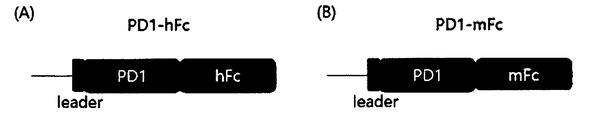
- FIG. 1 is a schematic diagram of a PD-1 expression vector fused with a human Fc or a mouse Fc at the carboxy-terminus.
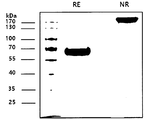
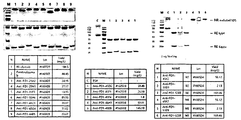
- 2A is a 10% SDS-PAGE gel of PD1-hFc. Results of protein identification under RE (reducing) and NR (non-reducing) conditions;
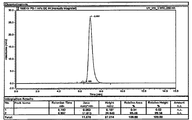
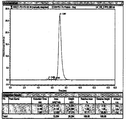
- Figure 2b shows the G-3000 SWXL SEC-HPLC results. Flow rate is 1 ml / min and developing solvent is PBS;
- 2C is a 10% SDS-PAGE gel of PD1-mFc. Results of protein identification under RE (reducing) and NR (non-reducing) conditions;
- Figure 2d shows the G-3000 SWXL SEC-HPLC results.
- the flow rate is 1 ml / min and the developing solvent is PBS.
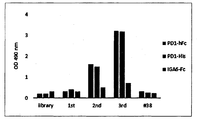
- Figure 3 shows the binding force of the antibody to PD-1 according to the number of panning.
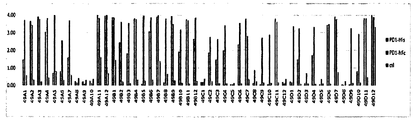
- Figure 4 shows the ELSIA results for measuring the binding capacity of mono phage to PD1-His.
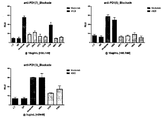
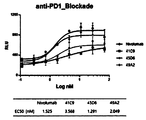
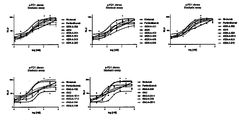
- Figure 6 shows the results of in vitro efficacy evaluation of PD-1 antibody.
- Figure 7 shows the results of the concentration-dependent in vitro efficacy evaluation of the PD-1 antibody.
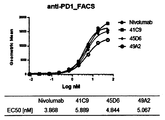
- Figure 8 shows the binding capacity of the antibody bound concentration-dependently to the overexpressed human PD-1 using MFI (mean fluorescence intensity).
- Figure 11 shows the results of a comparative analysis of the expression rate with the parent antibody.
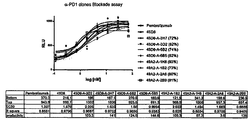
- Figure 12 shows the results of evaluating the in vitro efficacy of the PD1 antibody according to the present invention.
- Figure 13 shows the results of evaluating the concentration-dependent in vitro efficacy of the PD1 antibody according to the present invention.
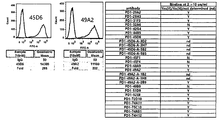
- Figure 14 shows the results confirming the binding to PD-1 expressed on the cell surface of the monoclonal antibody to the selected PD1 antibody variants.
- Figure 16 shows the results confirming the inhibitory effect of the antibody to block the formation of PD-1 / PD-L1 or PD-1 / PD-L2 complex using enzyme immunosorbent in the selected antibody.
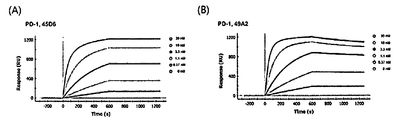
- Figure 17 shows the kinetics measurement results between PD1-hFc protein and PD1-45D6, 49A2 and 49A2 (2B9).
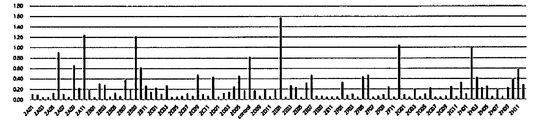
- Figure 19 shows the results of confirming the binding force to the PD-1 variants through the enzyme immunosorbent of the selected phage (phage), the lower the binding force indicates a lower value.
- Figure 20 shows the results confirming the binding capacity to the PD-1 variants through the enzyme immunosorbent of the selected antibody.
- Figure 21 shows the results confirming the binding specificity through enzyme immunosorbent.
- Figure 22 shows the result of comparing the transient expression productivity in HEK-293 cells.
- Figure 23 shows the results confirmed that the increased activity in heterologous MLR (Mixed Lymphocyte Reaction) by PD1 monoclonal antibody.
- the present invention is selected from the group consisting of heavy chain CDR1, SEQ ID NO: 31 to SEQ ID NO: 56 comprising a sequence having 90% or more sequence homology with the sequence selected from the group consisting of SEQ ID NO: 1 to SEQ ID NO: 30
- a heavy chain CDR2 comprising a sequence having at least 90% sequence homology with the sequence
- a heavy chain CDR3 comprising a sequence having at least 90% sequence homology with a sequence selected from the group consisting of SEQ ID NOs: 57-SEQ ID NO: 79
- a light chain CDR1 comprising a heavy chain variable region and a sequence having at least 90% sequence homology with a sequence selected from the group consisting of SEQ ID NOs: 198 to 222, and a sequence selected from the group consisting of SEQ ID NOs: 223 to SEQ ID NO: 241;
- a light chain CDR2 comprising a sequence having at least 90% sequence homology, and a sequence selected from the group consisting of SEQ ID NOs: 242 to
- the present inventors have tried to develop an anti-cancer therapeutic antibody that binds to PD-1, which is known to be expressed in various cancers.
- phage display technology was used to prepare an anti-PD-1 antibody that binds to PD-1 with high affinity, and confirmed that such anti-PD-1 antibody can inhibit the activity of PD-1.
- PD-1 programmed cell death protein 1
- antibody refers to an anti-PD-1 antibody that specifically binds to PD-1.
- the scope of the present invention includes not only complete antibody forms that specifically bind PD-1, but also antigen binding fragments of such antibody molecules.
- a complete antibody is a structure having two full length light chains and two full length heavy chains, each of which is linked by heavy and disulfide bonds.
- the heavy chain constant region has gamma ( ⁇ ), mu ( ⁇ ), alpha ( ⁇ ), delta ( ⁇ ) and epsilon ( ⁇ ) types and subclasses gamma 1 ( ⁇ 1), gamma 2 ( ⁇ 2), and gamma 3 ( ⁇ 3). ), Gamma 4 ( ⁇ 4), alpha 1 ( ⁇ 1) and alpha 2 ( ⁇ 2).
- the constant regions of the light chains have kappa ( ⁇ ) and lambda ( ⁇ ) types.
- An antigen binding fragment or antibody fragment of an antibody means a fragment having an antigen binding function and includes Fab, F (ab '), F (ab') 2, Fv and the like.
- Fab in the antibody fragment has a structure having a variable region of the light and heavy chains, a constant region of the light chain and the first constant region (CH1) of the heavy chain has one antigen binding site.
- F (ab ') 2 antibodies are produced by disulfide bonds of cysteine residues in the hinge region of Fab'.
- Double-chain Fv is a non-covalent bond in which a heavy chain variable region and a light chain variable region are linked, and a single chain Fv (single-chain Fv, scFv) is generally a variable region of the heavy chain and the light chain through a peptide linker.
- This covalent linkage or the C-terminus is directly linked to form a dimer-like structure such as a double-chain Fv.
- Such antibody fragments can be obtained using proteolytic enzymes (e.g., restriction digestion of the entire antibody with papain yields Fab and cleavage with pepsin yields F (ab ') 2 fragments). It can also be produced by recombinant technology.
- the antibody according to the invention is in Fv form (eg scFv), Fab or fully antibody form.
- the heavy chain constant region may be selected from any one isotype of gamma ( ⁇ ), mu ( ⁇ ), alpha ( ⁇ ), delta ( ⁇ ) or epsilon ( ⁇ ).
- the constant region is gamma 1 (IgG1), gamma 3 (IgG3) or gamma 4 (IgG4).
- the light chain constant region may be of kappa or lambda type.
- the term “heavy chain” refers to a variable region domain VH comprising an amino acid sequence having sufficient variable region sequence to confer specificity to an antigen and a full length heavy chain comprising three constant region domains CH1, CH2 and CH3 And fragments thereof.
- the term “light chain” as used herein refers to a full-length light chain and fragment thereof comprising a variable region domain VL and a constant region domain CL comprising an amino acid sequence having sufficient variable region sequence to confer specificity to the antigen. All means.
- Antibodies of the invention include monoclonal antibodies, multispecific antibodies, human antibodies, humanized antibodies, chimeric antibodies, single chain Fvs (scFV), single chain antibodies, Fab fragments, F (ab ') fragments, disulfide-binding Fvs (sdFV) And anti-idiotype (anti-Id) antibodies, or epitope-binding fragments of the antibodies, and the like.
- Said monoclonal antibody refers to the same except for possible naturally occurring mutations in which antibodies obtained from substantially homogeneous antibody populations, ie, individual antibodies in the population, may be present in trace amounts. Monoclonal antibodies are highly specific and are directed against a single antigenic site.
- Non-human (eg murine) antibodies of the “humanized” form are chimeric antibodies that contain minimal sequences derived from non-human immunoglobulins.
- humanized antibodies are non-human species (donor antibodies) that retain the desired specificity, affinity, and capacity for residues from the hypervariable region of the recipient, for example mice, rats, rabbits, or non-humans.
- donor antibodies non-human species
- Human immunoglobulins (receptor antibodies) replaced with residues from the hypervariable regions of primates.
- human antibody refers to a molecule derived from human immunoglobulin, in which all amino acid sequences constituting the antibody including complementarity determining regions and structural regions are composed of human immunoglobulins.
- While the heavy and / or light chain portions are the same or homologous to the corresponding sequences in an antibody derived from a particular species or belonging to a particular antibody class or subclass, the remaining chain (s) are derived from another species or another antibody class or Included are "chimeric" antibodies (immunoglobulins) that are identical or homologous to the corresponding sequences in antibodies belonging to the subclass, as well as fragments of such antibodies that exhibit the desired biological activity.
- antibody variable domain refers to the light and heavy chain portions of an antibody molecule comprising the amino acid sequences of complementarity determining regions (CDRs; ie CDR1, CDR2, and CDR3), and framework regions (FR). .
- CDRs complementarity determining regions
- FR framework regions
- VH refers to the variable domain of the heavy chain.
- VL refers to the variable domain of the light chain.
- CDRs Complementarity Determining Regions
- ie CDR1, CDR2, and CDR3 refer to amino acid residues of antibody variable domains that are required for antigen binding, each variable domain typically identified as CDR1, CDR2 and CDR3. Three CDR regions.
- the antibody or antigen-binding fragment thereof that binds to PD-1 is heavy chain CDR1 selected from the group consisting of SEQ ID NO: 1 to SEQ ID NO: 30,
- a heavy chain CDR2 selected from the group consisting of SEQ ID Nos: 31 to 56, and
- a heavy chain variable region comprising a heavy chain CDR3 selected from the group consisting of SEQ ID NOs: 57 to 79, and
- Light chain CDR1 selected from the group consisting of SEQ ID NOs: 198 to 222,
- a light chain CDR2 selected from the group consisting of SEQ ID Nos: 223 to 241, and
- It may include a light chain variable region comprising a light chain CDR3 selected from the group consisting of SEQ ID NO: 242 to SEQ ID NO: 269.
- the antibody or antigen-binding fragment thereof that binds to PD-1 is a heavy chain variable region comprising a heavy chain CDR1 of SEQ ID NO: 1, a heavy chain CDR2 of SEQ ID NO: 31, and a heavy chain CDR3 of SEQ ID NO: 57,
- a heavy chain variable region comprising a heavy chain CDR1 of SEQ ID NO: 1, a heavy chain CDR2 of SEQ ID NO: 32, and a heavy chain CDR3 of SEQ ID NO: 58,
- a heavy chain variable region comprising a heavy chain CDR1 of SEQ ID NO: 2, a heavy chain CDR2 of SEQ ID NO: 33, and a heavy chain CDR3 of SEQ ID NO: 59,
- a heavy chain variable region comprising a heavy chain CDR1 of SEQ ID NO: 2, a heavy chain CDR2 of SEQ ID NO: 33, and a heavy chain CDR3 of SEQ ID NO: 60,
- a heavy chain variable region comprising a heavy chain CDR1 of SEQ ID NO: 2, a heavy chain CDR2 of SEQ ID NO: 33, and a heavy chain CDR3 of SEQ ID NO: 61,
- a heavy chain variable region comprising a heavy chain CDR1 of SEQ ID NO: 2, a heavy chain CDR2 of SEQ ID NO: 33, and a heavy chain CDR3 of SEQ ID NO: 62,
- a heavy chain variable region comprising a heavy chain CDR1 of SEQ ID NO: 3, a heavy chain CDR2 of SEQ ID NO: 34, and a heavy chain CDR3 of SEQ ID NO: 63,
- a heavy chain variable region comprising a heavy chain CDR1 of SEQ ID NO: 4, a heavy chain CDR2 of SEQ ID NO: 35, and a heavy chain CDR3 of SEQ ID NO: 64,
- a heavy chain variable region comprising a heavy chain CDR1 of SEQ ID NO: 5, a heavy chain CDR2 of SEQ ID NO: 36, and a heavy chain CDR3 of SEQ ID NO: 65,
- a heavy chain variable region comprising a heavy chain CDR1 of SEQ ID NO: 6, a heavy chain CDR2 of SEQ ID NO: 37, and a heavy chain CDR3 of SEQ ID NO: 66,
- a heavy chain variable region comprising a heavy chain CDR1 of SEQ ID NO: 1, a heavy chain CDR2 of SEQ ID NO: 32, and a heavy chain CDR3 of SEQ ID NO: 67,
- a heavy chain variable region comprising a heavy chain CDR1 of SEQ ID NO: 7, a heavy chain CDR2 of SEQ ID NO: 38, and a heavy chain CDR3 of SEQ ID NO: 68,
- a heavy chain variable region comprising a heavy chain CDR1 of SEQ ID NO: 8, a heavy chain CDR2 of SEQ ID NO: 39, and a heavy chain CDR3 of SEQ ID NO: 69,
- a heavy chain variable region comprising a heavy chain CDR1 of SEQ ID NO: 9, a heavy chain CDR2 of SEQ ID NO: 40, and a heavy chain CDR3 of SEQ ID NO: 70,
- a heavy chain variable region comprising a heavy chain CDR1 of SEQ ID NO: 10, a heavy chain CDR2 of SEQ ID NO: 41, and a heavy chain CDR3 of SEQ ID NO: 71,
- a heavy chain variable region comprising a heavy chain CDR1 of SEQ ID NO: 11, a heavy chain CDR2 of SEQ ID NO: 42, and a heavy chain CDR3 of SEQ ID NO: 72,
- a heavy chain variable region comprising a heavy chain CDR1 of SEQ ID NO: 12, a heavy chain CDR2 of SEQ ID NO: 43, and a heavy chain CDR3 of SEQ ID NO: 73,
- a heavy chain variable region comprising a heavy chain CDR1 of SEQ ID NO: 13, a heavy chain CDR2 of SEQ ID NO: 44, and a heavy chain CDR3 of SEQ ID NO: 74,
- a heavy chain variable region comprising a heavy chain CDR1 of SEQ ID NO: 14, a heavy chain CDR2 of SEQ ID NO: 45, and a heavy chain CDR3 of SEQ ID NO: 75,
- a heavy chain variable region comprising a heavy chain CDR1 of SEQ ID NO: 15, a heavy chain CDR2 of SEQ ID NO: 46, and a heavy chain CDR3 of SEQ ID NO: 76,
- a heavy chain variable region comprising a heavy chain CDR1 of SEQ ID NO: 8, a heavy chain CDR2 of SEQ ID NO: 47, and a heavy chain CDR3 of SEQ ID NO: 77,
- a heavy chain variable region comprising a heavy chain CDR1 of SEQ ID NO: 16, a heavy chain CDR2 of SEQ ID NO: 48, and a heavy chain CDR3 of SEQ ID NO: 78,
- a heavy chain variable region comprising a heavy chain CDR1 of SEQ ID NO: 17, a heavy chain CDR2 of SEQ ID NO: 49, and a heavy chain CDR3 of SEQ ID NO: 58,
- a heavy chain variable region comprising a heavy chain CDR1 of SEQ ID NO: 18, a heavy chain CDR2 of SEQ ID NO: 50, and a heavy chain CDR3 of SEQ ID NO: 58,
- a heavy chain variable region comprising a heavy chain CDR1 of SEQ ID NO: 19, a heavy chain CDR2 of SEQ ID NO: 51, and a heavy chain CDR3 of SEQ ID NO: 58,
- a heavy chain variable region comprising a heavy chain CDR1 of SEQ ID NO: 20, a heavy chain CDR2 of SEQ ID NO: 52, and a heavy chain CDR3 of SEQ ID NO: 58,
- a heavy chain variable region comprising a heavy chain CDR1 of SEQ ID NO: 21, a heavy chain CDR2 of SEQ ID NO: 51, and a heavy chain CDR3 of SEQ ID NO: 58,
- a heavy chain variable region comprising a heavy chain CDR1 of SEQ ID NO: 22, a heavy chain CDR2 of SEQ ID NO: 53, and a heavy chain CDR3 of SEQ ID NO: 58,
- a heavy chain variable region comprising a heavy chain CDR1 of SEQ ID NO: 23, a heavy chain CDR2 of SEQ ID NO: 49, and a heavy chain CDR3 of SEQ ID NO: 58,
- a heavy chain variable region comprising a heavy chain CDR1 of SEQ ID NO: 17, a heavy chain CDR2 of SEQ ID NO: 54, and a heavy chain CDR3 of SEQ ID NO: 58,
- a heavy chain variable region comprising a heavy chain CDR1 of SEQ ID NO: 24, a heavy chain CDR2 of SEQ ID NO: 55, and a heavy chain CDR3 of SEQ ID NO: 58,
- a heavy chain variable region comprising a heavy chain CDR1 of SEQ ID NO: 21, a heavy chain CDR2 of SEQ ID NO: 51, and a heavy chain CDR3 of SEQ ID NO: 58,
- a heavy chain variable region comprising a heavy chain CDR1 of SEQ ID NO: 25, a heavy chain CDR2 of SEQ ID NO: 56, and a heavy chain CDR3 of SEQ ID NO: 57,
- a heavy chain variable region comprising a heavy chain CDR1 of SEQ ID NO: 26, a heavy chain CDR2 of SEQ ID NO: 31, and a heavy chain CDR3 of SEQ ID NO: 57,
- a heavy chain variable region comprising a heavy chain CDR1 of SEQ ID NO: 27, a heavy chain CDR2 of SEQ ID NO: 31, and a heavy chain CDR3 of SEQ ID NO: 57,
- a heavy chain variable region comprising a heavy chain CDR1 of SEQ ID NO: 28, a heavy chain CDR2 of SEQ ID NO: 31, and a heavy chain CDR3 of SEQ ID NO: 57,
- a heavy chain variable region comprising a heavy chain CDR1 of SEQ ID NO: 29, a heavy chain CDR2 of SEQ ID NO: 31, and a heavy chain CDR3 of SEQ ID NO: 57,
- a heavy chain variable region comprising a heavy chain CDR1 of SEQ ID NO: 30, a heavy chain CDR2 of SEQ ID NO: 31, and a heavy chain CDR3 of SEQ ID NO: 57,
- a heavy chain variable region comprising the heavy chain CDR1 of SEQ ID NO: 1, the heavy chain CDR2 of SEQ ID NO: 32, and the heavy chain CDR3 of SEQ ID NO: 79, or
- a heavy chain variable region comprising the heavy chain CDR1 of SEQ ID NO: 1, the heavy chain CDR2 of SEQ ID NO: 32, and the heavy chain CDR3 of SEQ ID NO: 57 may be included.
- the antibody or antigen-binding fragment thereof that binds to PD-1 includes a light chain variable region comprising a light chain CDR1 of SEQ ID NO: 198, a light chain CDR2 of SEQ ID NO: 223, and a light chain CDR3 of SEQ ID NO: 242,
- a light chain variable region comprising a light chain CDR1 of SEQ ID NO: 199, a light chain CDR2 of SEQ ID NO: 224, and a light chain CDR3 of SEQ ID NO: 243,
- a light chain variable region comprising a light chain CDR1 of SEQ ID NO: 200, a light chain CDR2 of SEQ ID NO: 225, and a light chain CDR3 of SEQ ID NO: 244,
- a light chain variable region comprising a light chain CDR1 of SEQ ID NO: 201, a light chain CDR2 of SEQ ID NO: 226, and a light chain CDR3 of SEQ ID NO: 245,
- a light chain variable region comprising a light chain CDR1 of SEQ ID NO: 202, a light chain CDR2 of SEQ ID NO: 227, and a light chain CDR3 of SEQ ID NO: 246,
- a light chain variable region comprising a light chain CDR1 of SEQ ID NO: 203, a light chain CDR2 of SEQ ID NO: 228, and a light chain CDR3 of SEQ ID NO: 247,
- a light chain variable region comprising a light chain CDR1 of SEQ ID NO: 204, a light chain CDR2 of SEQ ID NO: 229, and a light chain CDR3 of SEQ ID NO: 248,
- a light chain variable region comprising a light chain CDR1 of SEQ ID NO: 205, a light chain CDR2 of SEQ ID NO: 230, and a light chain CDR3 of SEQ ID NO: 249,
- a light chain variable region comprising a light chain CDR1 of SEQ ID NO: 206, a light chain CDR2 of SEQ ID NO: 231, and a light chain CDR3 of SEQ ID NO: 250,
- a light chain variable region comprising a light chain CDR1 of SEQ ID NO: 207, a light chain CDR2 of SEQ ID NO: 232, and a light chain CDR3 of SEQ ID NO: 251,
- a light chain variable region comprising a light chain CDR1 of SEQ ID NO: 208, a light chain CDR2 of SEQ ID NO: 230, and a light chain CDR3 of SEQ ID NO: 252,
- a light chain variable region comprising a light chain CDR1 of SEQ ID NO: 209, a light chain CDR2 of SEQ ID NO: 233, and a light chain CDR3 of SEQ ID NO: 253,
- a light chain variable region comprising a light chain CDR1 of SEQ ID NO: 210, a light chain CDR2 of SEQ ID NO: 234, and a light chain CDR3 of SEQ ID NO: 254,
- a light chain variable region comprising a light chain CDR1 of SEQ ID NO: 211, a light chain CDR2 of SEQ ID NO: 235, and a light chain CDR3 of SEQ ID NO: 255,
- a light chain variable region comprising a light chain CDR1 of SEQ ID NO: 212, a light chain CDR2 of SEQ ID NO: 236, and a light chain CDR3 of SEQ ID NO: 256,
- a light chain variable region comprising a light chain CDR1 of SEQ ID NO: 213, a light chain CDR2 of SEQ ID NO: 230, and a light chain CDR3 of SEQ ID NO: 257,
- a light chain variable region comprising a light chain CDR1 of SEQ ID NO: 214, a light chain CDR2 of SEQ ID NO: 237, and a light chain CDR3 of SEQ ID NO: 258,
- a light chain variable region comprising a light chain CDR1 of SEQ ID NO: 215, a light chain CDR2 of SEQ ID NO: 230, and a light chain CDR3 of SEQ ID NO: 249,
- a light chain variable region comprising a light chain CDR1 of SEQ ID NO: 211, a light chain CDR2 of SEQ ID NO: 238, and a light chain CDR3 of SEQ ID NO: 259,
- a light chain variable region comprising a light chain CDR1 of SEQ ID NO: 216, a light chain CDR2 of SEQ ID NO: 238, and a light chain CDR3 of SEQ ID NO: 260,
- a light chain variable region comprising a light chain CDR1 of SEQ ID NO: 217, a light chain CDR2 of SEQ ID NO: 239, and a light chain CDR3 of SEQ ID NO: 261,
- a light chain variable region comprising a light chain CDR1 of SEQ ID NO: 218, a light chain CDR2 of SEQ ID NO: 240, and a light chain CDR3 of SEQ ID NO: 262,
- a light chain variable region comprising a light chain CDR1 of SEQ ID NO: 219, a light chain CDR2 of SEQ ID NO: 241, and a light chain CDR3 of SEQ ID NO: 263,
- a light chain variable region comprising a light chain CDR1 of SEQ ID NO: 220, a light chain CDR2 of SEQ ID NO: 230, and a light chain CDR3 of SEQ ID NO: 252,
- a light chain variable region comprising a light chain CDR1 of SEQ ID NO: 215, a light chain CDR2 of SEQ ID NO: 230, and a light chain CDR3 of SEQ ID NO: 252,
- a light chain variable region comprising a light chain CDR1 of SEQ ID NO: 205, a light chain CDR2 of SEQ ID NO: 230, and a light chain CDR3 of SEQ ID NO: 264,
- a light chain variable region comprising a light chain CDR1 of SEQ ID NO: 205, a light chain CDR2 of SEQ ID NO: 230, and a light chain CDR3 of SEQ ID NO: 265,
- a light chain variable region comprising a light chain CDR1 of SEQ ID NO: 221, a light chain CDR2 of SEQ ID NO: 230, and a light chain CDR3 of SEQ ID NO: 266,
- a light chain variable region comprising a light chain CDR1 of SEQ ID NO: 205, a light chain CDR2 of SEQ ID NO: 230, and a light chain CDR3 of SEQ ID NO: 252,
- a light chain variable region comprising a light chain CDR1 of SEQ ID NO: 205, a light chain CDR2 of SEQ ID NO: 230, and a light chain CDR3 of SEQ ID NO: 267,
- a light chain variable region comprising a light chain CDR1 of SEQ ID NO: 205, a light chain CDR2 of SEQ ID NO: 230, and a light chain CDR3 of SEQ ID NO: 257,
- a light chain variable region comprising a light chain CDR1 of SEQ ID NO: 220, a light chain CDR2 of SEQ ID NO: 230, and a light chain CDR3 of SEQ ID NO: 267,
- a light chain variable region comprising a light chain CDR1 of SEQ ID NO: 222, a light chain CDR2 of SEQ ID NO: 230, and a light chain CDR3 of SEQ ID NO: 268, or
- Light chain CDR1 comprising SEQ ID NO: 220, light chain CDR2 of SEQ ID NO: 230, and light chain CDR3 of SEQ ID NO: 269.
- the antibody or antigen-binding fragment thereof according to the present invention may comprise the following heavy chain variable region and light chain variable region:
- a heavy chain variable region comprising a heavy chain CDR1 of SEQ ID NO: 2, a heavy chain CDR2 of SEQ ID NO: 33, and a heavy chain CDR3 of SEQ ID NO: 62, a light chain CDR1 of SEQ ID NO: 201, a light chain CDR2 of SEQ ID NO: 226, and a light chain CDR3 of SEQ ID NO: 245;
- a light chain variable region comprising;
- a heavy chain variable region comprising a heavy chain CDR1 of SEQ ID NO: 3, a heavy chain CDR2 of SEQ ID NO: 34, and a heavy chain CDR3 of SEQ ID NO: 63, a light chain CDR1 of SEQ ID NO: 202, a light chain CDR2 of SEQ ID NO: 227, and a light chain CDR3 of SEQ ID NO: 246;
- a light chain variable region comprising;
- a heavy chain variable region comprising a heavy chain CDR1 of SEQ ID NO: 4, a heavy chain CDR2 of SEQ ID NO: 35, and a heavy chain CDR3 of SEQ ID NO: 64, a light chain CDR1 of SEQ ID NO: 203, a light chain CDR2 of SEQ ID NO: 228, and a light chain CDR3 of SEQ ID NO: 247;
- a light chain variable region comprising;
- a heavy chain variable region comprising a heavy chain CDR1 of SEQ ID NO: 5, a heavy chain CDR2 of SEQ ID NO: 36, and a heavy chain CDR3 of SEQ ID NO: 65, a light chain CDR1 of SEQ ID NO: 204, a light chain CDR2 of SEQ ID NO: 229, and a light chain CDR3 of SEQ ID NO: 248;
- a light chain variable region comprising;
- a heavy chain variable region comprising the heavy chain CDR1 of SEQ ID NO: 1, the heavy chain CDR2 of SEQ ID NO: 32, and the heavy chain CDR3 of SEQ ID NO: 58, the light chain CDR1 of SEQ ID NO: 205, the light chain CDR2 of SEQ ID NO: 230, and the light chain CDR3 of SEQ ID NO: 249
- a light chain variable region comprising;
- a heavy chain variable region comprising the heavy chain CDR1 of SEQ ID NO: 6, the heavy chain CDR2 of SEQ ID NO: 37, and the heavy chain CDR3 of SEQ ID NO: 66, the light chain CDR1 of SEQ ID NO: 206, the light chain CDR2 of SEQ ID NO: 231, and the light chain CDR3 of SEQ ID NO: 250;
- a light chain variable region comprising;
- a heavy chain variable region comprising the heavy chain CDR1 of SEQ ID NO: 1, the heavy chain CDR2 of SEQ ID NO: 32, and the heavy chain CDR3 of SEQ ID NO: 67, the light chain CDR1 of SEQ ID NO: 207, the light chain CDR2 of SEQ ID NO: 232, and the light chain CDR3 of SEQ ID NO: 251;
- a light chain variable region comprising;
- a heavy chain variable region comprising the heavy chain CDR1 of SEQ ID NO: 1, the heavy chain CDR2 of SEQ ID NO: 31, and the heavy chain CDR3 of SEQ ID NO: 57, the light chain CDR1 of SEQ ID NO: 208, the light chain CDR2 of SEQ ID NO: 230, and the light chain CDR3 of SEQ ID NO: 252;
- a light chain variable region comprising;
- a heavy chain variable region comprising the heavy chain CDR1 of SEQ ID NO: 7, the heavy chain CDR2 of SEQ ID NO: 38, and the heavy chain CDR3 of SEQ ID NO: 68, the light chain CDR1 of SEQ ID NO: 209, the light chain CDR2 of SEQ ID NO: 233, and the light chain CDR3 of SEQ ID NO: 253;
- a light chain variable region comprising;
- a heavy chain variable region comprising a heavy chain CDR1 of SEQ ID NO: 8, a heavy chain CDR2 of SEQ ID NO: 39, and a heavy chain CDR3 of SEQ ID NO: 69, a light chain CDR1 of SEQ ID NO: 210, a light chain CDR2 of SEQ ID NO: 234, and a light chain CDR3 of SEQ ID NO: 254;
- a light chain variable region comprising;
- a heavy chain variable region comprising a heavy chain CDR1 of SEQ ID NO: 11, a heavy chain CDR2 of SEQ ID NO: 42, and a heavy chain CDR3 of SEQ ID NO: 72 and a light chain CDR1 of SEQ ID NO: 213, a light chain CDR2 of SEQ ID NO: 230, and a light chain CDR3 of SEQ ID NO: 257
- a light chain variable region comprising;
- a heavy chain variable region comprising the heavy chain CDR1 of SEQ ID NO: 1, the heavy chain CDR2 of SEQ ID NO: 32, and the heavy chain CDR3 of SEQ ID NO: 58, the light chain CDR1 of SEQ ID NO: 215, the light chain CDR2 of SEQ ID NO: 230, and the light chain CDR3 of SEQ ID NO: 249
- a light chain variable region comprising;
- a heavy chain variable region comprising a heavy chain CDR1 of SEQ ID NO: 13, a heavy chain CDR2 of SEQ ID NO: 44, and a heavy chain CDR3 of SEQ ID NO: 74, a light chain CDR1 of SEQ ID NO: 211, a light chain CDR2 of SEQ ID NO: 238, and a light chain CDR3 of SEQ ID NO: 259;
- a light chain variable region comprising;
- a heavy chain variable region comprising a heavy chain CDR1 of SEQ ID NO: 15, a heavy chain CDR2 of SEQ ID NO: 46, and a heavy chain CDR3 of SEQ ID NO: 76, a light chain CDR1 of SEQ ID NO: 217, a light chain CDR2 of SEQ ID NO: 239, and a light chain CDR3 of SEQ ID NO: 336;
- a light chain variable region comprising; or
- a heavy chain variable region comprising the heavy chain CDR1 of SEQ ID NO: 8, the heavy chain CDR2 of SEQ ID NO: 47, and the heavy chain CDR3 of SEQ ID NO: 77, the light chain CDR1 of SEQ ID NO: 218, the light chain CDR2 of SEQ ID NO: 240, and the light chain CDR3 of SEQ ID NO: 337 Light chain variable region containing.
- an antibody was further selected through an optimization process, and the antibody or antigen-binding fragment thereof according to the present invention may include the following heavy chain variable region and light chain variable region:
- a heavy chain variable region comprising a heavy chain CDR1 of SEQ ID NO: 17, a heavy chain CDR2 of SEQ ID NO: 49, and a heavy chain CDR3 of SEQ ID NO: 58, a light chain CDR1 of SEQ ID NO: 220, a light chain CDR2 of SEQ ID NO: 230, and a light chain CDR3 of SEQ ID NO: 252;
- a light chain variable region comprising;
- a heavy chain variable region comprising a heavy chain CDR1 of SEQ ID NO: 18, a heavy chain CDR2 of SEQ ID NO: 50, and a heavy chain CDR3 of SEQ ID NO: 58, a light chain CDR1 of SEQ ID NO: 215, a light chain CDR2 of SEQ ID NO: 230, and a light chain CDR3 of SEQ ID NO: 252;
- a heavy chain variable region comprising the heavy chain CDR1 of SEQ ID NO: 19, the heavy chain CDR2 of SEQ ID NO: 51, and the heavy chain CDR3 of SEQ ID NO: 58, the light chain CDR1 of SEQ ID NO: 218, the light chain CDR2 of SEQ ID NO: 240, and the light chain CDR3 of SEQ ID NO: 337 Light chain variable region containing
- a heavy chain variable region comprising a heavy chain CDR1 of SEQ ID NO: 20, a heavy chain CDR2 of SEQ ID NO: 52, and a heavy chain CDR3 of SEQ ID NO: 58, a light chain CDR1 of SEQ ID NO: 205, a light chain CDR2 of SEQ ID NO: 230, and a light chain CDR3 of SEQ ID NO: 264;
- a heavy chain variable region comprising a heavy chain CDR1 of SEQ ID NO: 21, a heavy chain CDR2 of SEQ ID NO: 51, and a heavy chain CDR3 of SEQ ID NO: 58, a light chain CDR1 of SEQ ID NO: 205, a light chain CDR2 of SEQ ID NO: 230, and a light chain CDR3 of SEQ ID NO: 265;
- a heavy chain variable region comprising the heavy chain CDR1 of SEQ ID NO: 22, the heavy chain CDR2 of SEQ ID NO: 53, and the heavy chain CDR3 of SEQ ID NO: 58, the light chain CDR1 of SEQ ID NO: 221, the light chain CDR2 of SEQ ID NO: 230, and the light chain CDR3 of SEQ ID NO: 266; Light chain variable region containing,
- a heavy chain variable region comprising the heavy chain CDR1 of SEQ ID NO: 23, the heavy chain CDR2 of SEQ ID NO: 49, and the heavy chain CDR3 of SEQ ID NO: 58, the light chain CDR1 of SEQ ID NO: 205, the light chain CDR2 of SEQ ID NO: 230, and the light chain CDR3 of SEQ ID NO: 252;
- Light chain variable region containing,
- a heavy chain variable region comprising a heavy chain CDR1 of SEQ ID NO: 17, a heavy chain CDR2 of SEQ ID NO: 54, and a heavy chain CDR3 of SEQ ID NO: 58, a light chain CDR1 of SEQ ID NO: 215, a light chain CDR2 of SEQ ID NO: 230, and a light chain CDR3 of SEQ ID NO: 249
- a heavy chain variable region comprising a heavy chain CDR1 of SEQ ID NO: 24, a heavy chain CDR2 of SEQ ID NO: 55, and a heavy chain CDR3 of SEQ ID NO: 58, a light chain CDR1 of SEQ ID NO: 205, a light chain CDR2 of SEQ ID NO: 230, and a light chain CDR3 of SEQ ID NO: 267;
- a heavy chain variable region comprising a heavy chain CDR1 of SEQ ID NO: 21, a heavy chain CDR2 of SEQ ID NO: 51, and a heavy chain CDR3 of SEQ ID NO: 58, a light chain CDR1 of SEQ ID NO: 220, a light chain CDR2 of SEQ ID NO: 230, and a light chain CDR3 of SEQ ID NO: 252;
- a heavy chain variable region comprising the heavy chain CDR1 of SEQ ID NO: 1, the heavy chain CDR2 of SEQ ID NO: 31, and the heavy chain CDR3 of SEQ ID NO: 57, the light chain CDR1 of SEQ ID NO: 221, the light chain CDR2 of SEQ ID NO: 230, and the light chain CDR3 of SEQ ID NO: 266 Light chain variable region containing,
- a heavy chain variable region comprising the heavy chain CDR1 of SEQ ID NO: 1, the heavy chain CDR2 of SEQ ID NO: 31, and the heavy chain CDR3 of SEQ ID NO: 57, the light chain CDR1 of SEQ ID NO: 205, the light chain CDR2 of SEQ ID NO: 230, and the light chain CDR3 of SEQ ID NO: 252;
- a heavy chain variable region comprising the heavy chain CDR1 of SEQ ID NO: 1, the heavy chain CDR2 of SEQ ID NO: 31, and the heavy chain CDR3 of SEQ ID NO: 57, the light chain CDR1 of SEQ ID NO: 205, the light chain CDR2 of SEQ ID NO: 230, and the light chain CDR3 of SEQ ID NO: 252;
- a heavy chain variable region comprising the heavy chain CDR1 of SEQ ID NO: 1, the heavy chain CDR2 of SEQ ID NO: 31, and the heavy chain CDR3 of SEQ ID NO: 57, the light chain CDR1 of SEQ ID NO: 215, the light chain CDR2 of SEQ ID NO: 230, and the light chain CDR3 of SEQ ID NO: 252;
- a heavy chain variable region comprising the heavy chain CDR1 of SEQ ID NO: 1, the heavy chain CDR2 of SEQ ID NO: 31, and the heavy chain CDR3 of SEQ ID NO: 57, the light chain CDR1 of SEQ ID NO: 205, the light chain CDR2 of SEQ ID NO: 230, and the light chain CDR3 of SEQ ID NO: 252;
- a heavy chain variable region comprising the heavy chain CDR1 of SEQ ID NO: 1, the heavy chain CDR2 of SEQ ID NO: 31, and the heavy chain CDR3 of SEQ ID NO: 57, the light chain CDR1 of SEQ ID NO: 220, the light chain CDR2 of SEQ ID NO: 230, and the light chain CDR3 of SEQ ID NO: 252;
- Light chain variable region containing,
- a heavy chain variable region comprising the heavy chain CDR1 of SEQ ID NO: 1, the heavy chain CDR2 of SEQ ID NO: 31, and the heavy chain CDR3 of SEQ ID NO: 57, the light chain CDR1 of SEQ ID NO: 205, the light chain CDR2 of SEQ ID NO: 230, and the light chain CDR3 of SEQ ID NO: 252;
- a heavy chain variable region comprising the heavy chain CDR1 of SEQ ID NO: 1, the heavy chain CDR2 of SEQ ID NO: 31, and the heavy chain CDR3 of SEQ ID NO: 57, the light chain CDR1 of SEQ ID NO: 205, the light chain CDR2 of SEQ ID NO: 230, and the light chain CDR3 of SEQ ID NO: 252;
- a heavy chain variable region comprising the heavy chain CDR1 of SEQ ID NO: 1, the heavy chain CDR2 of SEQ ID NO: 31, and the heavy chain CDR3 of SEQ ID NO: 57, the light chain CDR1 of SEQ ID NO: 215, the light chain CDR2 of SEQ ID NO: 230, and the light chain CDR3 of SEQ ID NO: 252;
- a heavy chain variable region comprising a heavy chain CDR1 of SEQ ID NO: 25, a heavy chain CDR2 of SEQ ID NO: 56, and a heavy chain CDR3 of SEQ ID NO: 57, a light chain CDR1 of SEQ ID NO: 205, a light chain CDR2 of SEQ ID NO: 230, and a light chain CDR3 of SEQ ID NO: 257
- a heavy chain variable region comprising a heavy chain CDR1 of SEQ ID NO: 26, a heavy chain CDR2 of SEQ ID NO: 31, and a heavy chain CDR3 of SEQ ID NO: 57, a light chain CDR1 of SEQ ID NO: 220, a light chain CDR2 of SEQ ID NO: 230, and a light chain CDR3 of SEQ ID NO: 267;
- a heavy chain variable region comprising a heavy chain CDR1 of SEQ ID NO: 27, a heavy chain CDR2 of SEQ ID NO: 31, and a heavy chain CDR3 of SEQ ID NO: 57, a light chain CDR1 of SEQ ID NO: 205, a light chain CDR2 of SEQ ID NO: 230, and a light chain CDR3 of SEQ ID NO: 252;
- a heavy chain variable region comprising a heavy chain CDR1 of SEQ ID NO: 28, a heavy chain CDR2 of SEQ ID NO: 31, and a heavy chain CDR3 of SEQ ID NO: 57, a light chain CDR1 of SEQ ID NO: 205, a light chain CDR2 of SEQ ID NO: 230, and a light chain CDR3 of SEQ ID NO: 252;
- a heavy chain variable region comprising the heavy chain CDR1 of SEQ ID NO: 29, the heavy chain CDR2 of SEQ ID NO: 31, and the heavy chain CDR3 of SEQ ID NO: 57, the light chain CDR1 of SEQ ID NO: 205, the light chain CDR2 of SEQ ID NO: 230, and the light chain CDR3 of SEQ ID NO: 252;
- Light chain variable region comprising, or
- a heavy chain variable region comprising a heavy chain CDR1 of SEQ ID NO: 30, a heavy chain CDR2 of SEQ ID NO: 31, and a heavy chain CDR3 of SEQ ID NO: 57, a light chain CDR1 of SEQ ID NO: 220, a light chain CDR2 of SEQ ID NO: 230, and a light chain CDR3 of SEQ ID NO: 267; Light chain variable region containing.
- FRs Framework regions
- Each variable domain typically has four FRs identified as FR1, FR2, FR3 and FR4.
- the heavy chain variable region FR1 selected from the group consisting of SEQ ID NO: 80 to SEQ ID NO: 95,
- a heavy chain variable region FR2 selected from the group consisting of SEQ ID NOs: 96 to 113,
- a heavy chain variable region FR3 selected from the group consisting of SEQ ID NOs: 114 to 134, or
- the heavy chain variable region FR4 selected from the group consisting of SEQ ID NOs: 135 to 145 may be included.
- the light chain variable region FR1 selected from the group consisting of SEQ ID NO: 270 to SEQ ID NO: 294,
- Light chain variable region FR2 selected from the group consisting of SEQ ID NOs: 295 to 315,
- Light chain variable region FR3 selected from the group consisting of SEQ ID NOs: 316 to 355, or
- Light chain variable region FR4 selected from the group consisting of SEQ ID NO: 356 to SEQ ID NO: 367.
- Fv fragments are antibody fragments containing complete antibody recognition and binding sites. This region consists of a dimer of one heavy chain variable domain and one light chain variable domain tightly and covalently associated, for example, with scFv.
- Fab fragments contain the variable and constant domains of the light chain and the variable and first constant domains (CH1) of the heavy chain.
- F (ab ') 2 antibody fragments generally comprise a pair of Fab fragments covalently linked near their carboxy termini by hinge cysteines between them.
- Single-chain Fv or “scFv” antibody fragments comprise the VH and VL domains of an antibody, which domains are present in a single polypeptide chain.
- the Fv polypeptide may further comprise a polypeptide linker between the VH domain and the VL domain that allows the scFv to form the desired structure for antigen binding.
- PD-1 antibodies are monovalent or bivalent and include single or double chains. Functionally, the binding affinity of the PD-1 antibody is in the range of 10 ⁇ 5 M to 10 ⁇ 12 M.
- the binding affinity of PD-1 antibodies is 10 -6 M to 10 -12 M, 10 -7 M to 10 -12 M, 10 -8 M to 10 -12 M, 10 -9 M to 10 -12 M, 10 -5 M to 10 -11 M, 10 -6 M to 10 -11 M, 10 -7 M to 10 -11 M, 10 -8 M to 10 -11 M, 10 -9 M to 10 -11 M, 10 -10 M to 10 -11 M, 10 -5 M to 10 -10 M, 10 -6 M to 10 -10 M, 10 -7 M to 10 -10 M, 10 -8 M to 10 -10 M, 10 -9 M to 10 -10 M, 10 -5 M to 10 -9 M, 10 -6 M to 10 -9 M, 10 -7 M to 10 -9 M, 10 -8 M to 10 -9 M, 10 -5 M to 10
- the antibody or antigen-binding fragment thereof that binds to PD-1 may comprise a heavy chain variable region comprising a sequence having 90% or more sequence homology with a sequence selected from the group consisting of SEQ ID NOs: 146 and 193.
- the antibody or antigen-binding fragment thereof that binds to PD-1 may comprise a heavy chain variable region selected from the group consisting of SEQ ID NOs: 146 to SEQ ID NO: 193.
- the heavy chain variable region of SEQ ID NOs: 151, 152, 153, 154, 155, 156, 157, 158, 159, 160, 163, 165, 166, 168, 169, or 171-188 It may include.
- the light chain variable region comprising a sequence having 90% or more sequence homology with the sequence selected from the group consisting of SEQ ID NO: 368 to SEQ ID NO: 420.
- the antibody or antigen-binding fragment thereof that binds to PD-1 may include a light chain variable region selected from the group consisting of SEQ ID NOs: 368 to 420.
- the light chain variable region of SEQ ID NOs: 371 to 380, 383, 385, 386, 388, 389, or 391 to 415 may be included in the light chain variable region of SEQ ID NOs: 371 to 380, 383, 385, 386, 388, 389, or 391 to 415.
- the heavy chain variable region of SEQ ID NO: 181 and the light chain variable region of SEQ ID NO: 405 may be included.
- the part indicated by X or Xaa in the sequence according to the present invention indicates other amino acids not specified, indicating that any amino acid may be included.
- Phase display is a technique for displaying variant polypeptides as fusion proteins with at least a portion of the envelope protein on the surface of a phage, eg, fibrous phage particles.
- the utility of phage display lies in the fact that a large library of randomized protein variants can be targeted to quickly and efficiently classify sequences that bind with high affinity with a target antigen. Displaying peptide and protein libraries on phage has been used to screen millions of polypeptides to identify polypeptides with specific binding properties.
- Phage display technology provided a powerful tool for generating and selecting new proteins that bind specific ligands (eg antigens). Phage display technology can be used to generate large libraries of protein variants and to quickly sort sequences that bind with high affinity to target antigens.
- Nucleic acids encoding variant polypeptides are fused with nucleic acid sequences encoding viral envelope proteins, eg, gene III protein or gene VIII protein.
- Monovalent phage display systems have been developed in which a nucleic acid sequence encoding a protein or polypeptide is fused with a nucleic acid sequence encoding a portion of a gene III protein. In monovalent phage display systems, gene fusions are expressed at low levels and wild type Gene III proteins are also expressed to maintain particle infectivity.
- Phage display technology has several advantages over conventional hybridoma and recombinant methods for preparing antibodies with the desired characteristics. This technique allows the production of large antibody libraries with various sequences in a short time without the use of animals. The preparation of hybridomas or the production of humanized antibodies may require months of preparation. In addition, since no immunity is required at all, phage antibody libraries can produce antibodies against antigens that are toxic or low antigenic. Phage antibody libraries can also be used to generate and identify novel therapeutic antibodies.
- Techniques for generating human antibodies from immunized, non-immunized human, germline sequences, or na ⁇ ve B cell Ig repertory using immunized phage display libraries can be used.
- Various lymphoid tissues can be used to prepare na ⁇ ve or non-immune antigen binding libraries.
- the ability to identify and isolate high affinity antibodies from phage display libraries is important for the isolation of novel therapeutic antibodies. Separation of high affinity antibodies from the library may depend on the size of the library, the efficiency of production in bacterial cells, and the diversity of the library.
- the size of the library is reduced by inefficient folding of the antibody or antigen binding protein and inefficient production due to the presence of stop codons. Expression in bacterial cells can be inhibited if the antibody or antigen binding domain is not properly folded. Expression can be improved by alternating mutations at the surface of the variable / constant interface or at selected CDR residues.
- the sequence of the backbone region is one element to provide proper folding when generating antibody phage libraries in bacterial cells.
- CDR3 regions have been found to often participate in antigen binding.
- the CDR3 regions on the heavy chains vary considerably in size, sequence, and structural conformation, and thus can be used to prepare a variety of libraries.
- diversity can be generated by randomizing the CDR regions of the variable heavy and light chains using all 20 amino acids at each position.
- the use of all twenty amino acids can result in highly variable variant antibody sequences and increase the chance of identifying new antibodies.
- Antibodies or antibody fragments of the present invention may include not only the sequences of the anti-PD-1 antibodies of the present invention described herein, but also biological equivalents thereof, as long as they specifically recognize PD-1.
- further changes can be made to the amino acid sequence of the antibody to further improve the binding affinity and / or other biological properties of the antibody.
- Such modifications include, for example, deletions, insertions and / or substitutions of amino acid sequence residues of the antibody.
- Such amino acid variations are made based on the relative similarity of amino acid side chain substituents such as hydrophobicity, hydrophilicity, charge, size, and the like.
- arginine, lysine and histidine are all positively charged residues; Alanine, glycine and serine have similar sizes; It can be seen that phenylalanine, tryptophan and tyrosine have a similar shape.
- arginine, lysine and histidine; Alanine, glycine and serine; Phenylalanine, tryptophan and tyrosine are biologically equivalent functions.
- the present invention relates to a nucleic acid encoding the antibody or antigen-binding fragment thereof.
- the nucleic acid encoding the antibody or antigen-binding fragment thereof of the present invention can be isolated to recombinantly produce the antibody or antigen-binding fragment thereof.
- the nucleic acid is isolated and inserted into a replicable vector for further cloning (amplification of DNA) or for further expression. Based on this, the present invention relates to a vector comprising the nucleic acid in another aspect.
- Nucleic acid is meant to encompass DNA (gDNA and cDNA) and RNA molecules inclusively, and the nucleotides that are the basic building blocks of nucleic acids include not only natural nucleotides but also analogs in which sugar or base sites are modified. .
- the sequences of nucleic acids encoding heavy and light chain variable regions of the invention can be modified. Such modifications include addition, deletion, or non-conservative or conservative substitutions of nucleotides.
- amino acid sequence for the antibody or antigen-binding fragment thereof of the present invention or nucleic acid encoding the same is interpreted to also include a sequence that exhibits a substantial identity with the sequence set forth in SEQ ID NO.
- the above substantial identity is at least 90% when the sequences of the present invention are aligned as closely as possible with any other sequences, and the aligned sequences are analyzed using algorithms commonly used in the art.
- a homology most preferably at least 95% homology, at least 96%, at least 97%, at least 98%, at least 99% homology.
- the antibody or antigen-binding fragment thereof of the present invention is 90%, 91%, 92%, 93%, 94%, 95%, 96%, 97%, 98% compared to the specified sequence or all described in the specification. , 99%, or more homology.
- homology can be determined by sequence comparison and / or alignment by methods known in the art. For example, sequence comparison algorithms (ie, BLAST or BLAST 2.0), manual alignment, visual inspection can be used to determine the percent sequence homology of nucleic acids or proteins of the invention.
- the DNA encoding the antibody is readily isolated or synthesized using conventional procedures (e.g., by using oligonucleotide probes capable of specifically binding to the DNA encoding the heavy and light chains of the antibody).
- Many vectors are available.
- Vector components generally include, but are not limited to, one or more of the following: signal sequence, origin of replication, one or more marker genes, enhancer elements, promoters, and transcription termination sequences.
- the term "vector” refers to a plasmid vector as a means for expressing a gene of interest in a host cell; Cosmid vector; Viral vectors such as bacteriophage vectors, adenovirus vectors, retrovirus vectors, and adeno-associated virus vectors, and the like.
- the nucleic acid encoding the antibody in the vector is operably linked with a promoter.
- “Operatively linked” means a functional binding between a nucleic acid expression control sequence (eg, an array of promoters, signal sequences, or transcriptional regulator binding sites) and another nucleic acid sequence, whereby the regulatory sequence is the other nucleic acid. To control transcription and / or translation of the sequence.
- a nucleic acid expression control sequence eg, an array of promoters, signal sequences, or transcriptional regulator binding sites
- promoters capable of promoting transcription e.g., tac promoter, lac promoter, lacUV5 promoter, lpp promoter, pL ⁇ promoter, pR ⁇ promoter, rac5 promoter, amp promoter, recA promoter, SP6 promoter, trp promoter and T7 promoter, etc.
- ribosome binding sites for initiation of translation e.g., amp promoter, recA promoter, SP6 promoter, trp promoter and T7 promoter, etc.
- a promoter derived from the genome of a mammalian cell e.g., a metallothionine promoter, a ⁇ -actin promoter, a human heroglobin promoter and a human muscle creatine promoter
- a mammal Promoters derived from animal viruses e.g., adenovirus late promoter, vaccinia virus 7.5K promoter, SV40 promoter, cytomegalovirus (CMV) promoter, tk promoter of HSV, mouse breast tumor virus (MMTV) promoter, LTR promoter of HIV
- a promoter derived from the genome of a mammalian cell e.g., a metallothionine promoter, a ⁇ -actin promoter, a human heroglobin promoter and a human muscle creatine promoter
- a mammal Promoters derived from animal viruses e.g., adenovirus late promoter, vaccinia virus 7.5K promoter, SV40
- the vector may be fused with other sequences to facilitate purification of the antibody expressed therefrom.
- Sequences to be fused include, for example, glutathione S-transferase (Pharmacia, USA), maltose binding protein (NEB, USA), FLAG (IBI, USA) and 6x His (hexahistidine; Quiagen, USA).
- Such vectors include antibiotic resistance genes commonly used in the art as selectable markers and include, for example, ampicillin, gentamicin, carbenicillin, chloramphenicol, streptomycin, kanamycin, geneticin, neomycin and tetracycline. There is a resistance gene.
- the present invention relates to a cell transformed with the above-mentioned vector.
- the cells used to produce the antibodies of the invention can be prokaryote, yeast or higher eukaryote cells, but are not limited thereto.
- Bacillus strains such as Escherichia coli, Bacillus subtilis and Bacillus thuringiensis, Streptomyces, Pseudomonas (e.g. Pseudomonas putida), Proteus Prokaryotic host cells such as Proteus mirabilis and Staphylococcus (eg, Staphylocus carnosus) can be used.
- Pseudomonas e.g. Pseudomonas putida
- Proteus Prokaryotic host cells such as Proteus mirabilis and Staphylococcus (eg, Staphylocus carnosus) can be used.
- examples of useful host cell lines are COS-7, BHK, CHO, CHOK1, DXB-11, DG-44, CHO / -DHFR, CV1, COS-7, HEK293, BHK, TM4, VERO, HELA, MDCK, BRL 3A, W138, Hep G2, SK-Hep, MMT, TRI, MRC 5, FS4, 3T3, RIN, A549, PC12, K562, PER.C6, SP2 / 0, NS-0 , U20S, or HT1080, but is not limited thereto.
- the present invention (a) culturing the cells; And (b) recovering the antibody or antigen-binding fragment thereof from the cultured cells.
- the cells can be cultured in various media. It can be used as a culture medium without limitation among commercial media. All other necessary supplements known to those skilled in the art may be included at appropriate concentrations. Culture conditions, such as temperature, pH, and the like, are already in use with host cells selected for expression, which will be apparent to those skilled in the art.
- the term “transformation” means introducing a vector containing a nucleic acid encoding a target protein into a host cell so that the protein encoded by the nucleic acid can be expressed in the host cell. May include all of them as long as they can be expressed in the host cell, whether inserted into or located outside the chromosome of the host cell, and the nucleic acid includes DNA and RNA encoding the target protein. May be introduced in any form as long as it can be introduced into and expressed in a host cell, for example, the nucleic acid may be a gene structure of an expression cassette, which is a gene construct including all elements necessary for self-expression. Can be introduced into a host cell in which the expression cassette normally operates on the nucleic acid.
- the expression cassette may be in the form of an expression vector capable of self-replicating, and the nucleic acid may be in its own form. It may be introduced into a host cell and operably linked with a sequence required for expression in the host cell.
- the recovery of the antibody or antigen-binding fragment thereof can be removed by, for example, centrifugation or ultrafiltration, and the resultant can be purified using, for example, affinity chromatography or the like. Further other purification techniques such as anion or cation exchange chromatography, hydrophobic interaction chromatography, hydroxylapatite chromatography and the like can be used.
- the present invention relates to a composition for preventing or treating cancer, comprising the antibody or antigen-binding fragment thereof as an active ingredient.
- the present invention includes, for example, (a) a pharmaceutically effective amount of an antibody against PD-1 or an antigen binding fragment thereof according to the present invention; And (b) it may be a pharmaceutical composition for the prevention or treatment of cancer comprising a pharmaceutically acceptable carrier.
- the present invention also relates to a method for the prevention or treatment of cancer comprising administering to a patient an effective amount necessary for an antibody against PD-1 or an antigen-binding fragment thereof according to the present invention.
- the cancer is a group consisting of melanoma, lung cancer, liver cancer, glioblastoma, ovarian cancer, colon cancer, head and neck cancer, bladder cancer, kidney cancer, gastric cancer, breast cancer, metastatic cancer, Hodgkin's lymphoma, prostate cancer and pancreatic cancer It may be characterized in that it is selected from but is not limited thereto.
- treatment in the present invention means not only inhibiting or alleviating cancer or one or more symptoms caused by administration of the composition, but also preventing the treatment of cancer or the progression of the cancer to reverse the symptoms of the disease.
- prevention refers to any action that inhibits or delays the onset of cancer by administration of the composition.
- the prophylaxis or treatment of cancer is achieved by binding the antibody obtained in the present invention to PD-1, and significantly inhibits its activity by binding to PD-1 to prevent or treat cancer.
- the term "pharmaceutically acceptable carrier” refers to a carrier or diluent that does not irritate an organism and does not inhibit the biological activity and properties of the administered compound.
- Acceptable pharmaceutical carriers in compositions formulated as liquid solutions are sterile and physiologically compatible, including saline, sterile water, Ringer's solution, buffered saline, albumin injectable solutions, dextrose solution, maltodextrin solution, glycerol, ethanol and One or more of these components may be mixed and used, and other conventional additives such as antioxidants, buffers and bacteriostatic agents may be added as necessary.
- Diluents, dispersants, surfactants, binders and lubricants may also be added in addition to formulate into injectable formulations, pills, capsules, granules or tablets such as aqueous solutions, suspensions, emulsions and the like.
- Cancer preventive or therapeutic composition comprising the antibody of the present invention and a pharmaceutically acceptable carrier can be applied to any formulation containing it as an active ingredient, it can be prepared in oral or parenteral formulations.
- Pharmaceutical formulations of the invention may be oral, rectal, nasal, topical (including the cheek and sublingual), subcutaneous, vaginal or parenteral (intramuscular, subcutaneous). And forms suitable for administration by inhalation or insufflation.
- Oral dosage forms containing the composition of the present invention as an active ingredient include, for example, tablets, troches, lozenges, water-soluble or oily suspensions, preparation powders or granules, emulsions, hard or soft capsules, syrups or elixirs. can do.
- lactose For formulation into tablets and capsules, lactose, saccharose, sorbitol, mannitol, starch, amylopectin, binders such as cellulose or gelatin, excipients such as dicalcium phosphate, disintegrants such as corn starch or sweet potato starch, stearic acid masne It may include a lubricating oil such as calcium, calcium stearate, sodium stearyl fumarate or polyethylene glycol wax, and in the case of a capsule, it may further contain a liquid carrier such as fatty oil in addition to the above-mentioned materials.
- a lubricating oil such as calcium, calcium stearate, sodium stearyl fumarate or polyethylene glycol wax
- a liquid carrier such as fatty oil in addition to the above-mentioned materials.
- Formulations for parenteral administration comprising the composition of the present invention as an active ingredient, for injection, such as subcutaneous injection, intravenous injection or intramuscular injection, a suppository injection method or aerosol for spraying by inhalation through the respiratory system It can be formulated as.
- the compositions of the present invention may be mixed in water with stabilizers or buffers to prepare solutions or suspensions, which may be formulated for unit administration of ampoules or vials.
- solutions or suspensions which may be formulated for unit administration of ampoules or vials.
- a rectal composition such as suppositories or enemas, including conventional suppository bases such as cocoa butter or other glycerides.
- a propellant or the like may be combined with the additives to disperse the dispersed dispersion or wet powder.
- the present invention relates to a method for preventing or treating cancer, comprising administering a composition for preventing or treating cancer comprising the antibody.
- the term “administration” means introducing a pharmaceutical composition of the present invention to a patient in any suitable manner. It may be administered through, or specifically, can be administered in a conventional manner via oral, rectal, topical, intravenous, intraperitoneal, intramuscular, intraarterial, transdermal, nasal, inhalation, intraocular or intradermal route. .
- the treatment method of the present invention includes administering a composition for preventing or treating cancer of the present invention in a pharmaceutically effective amount.
- a suitable total daily dose may be determined by the practitioner within the correct medical judgment.
- the specific therapeutically effective amount for a particular patient may be based on the specific composition, including the type and severity of the reaction to be achieved, whether or not other agents are used in some cases, the age, weight, general health, sex and diet of the patient, time of administration, It is desirable to apply differently depending on the route of administration and the rate of release of the composition, the duration of treatment, and the various factors and similar factors well known in the medical arts, including drugs used with or concurrent with the specific composition. Therefore, the effective amount of the composition for preventing or treating cancer suitable for the purpose of the present invention is preferably determined in consideration of the above-mentioned matters.
- the treatment method of the present invention is applicable to any animal in which diseases such as tumor development and angiogenesis may occur due to excessive activity of PD-1, and the animals are not only humans and primates, but also cattle, pigs, sheep And domestic animals such as horses, dogs and cats.
- the present invention is a cancer diagnostic composition comprising a PD-1 antibody or an antigen-binding fragment thereof according to the present invention.
- the present invention also relates to a method for diagnosing cancer by treating a PD-1 antibody or antigen-binding fragment thereof according to the present invention.
- Cancer can be diagnosed by measuring the level of PD-1 expression in a sample via an antibody against PD-1 according to the invention.
- Expression levels can be measured according to conventional immunoassay methods, radioimmunoassay using the antibody against PD-1, radioimmunoprecipitation, immunoprecipitation, immunohistochemical staining, enzyme-linked immunosorbant assay (ELISA), capture -ELISA, inhibition or hardwood analysis, sandwich analysis, flow cytometry, immunofluorescence staining and immunoaffinity purification can be measured, but is not limited thereto.
- cancer By analyzing the final signal intensity by the immunoassay process, cancer can be diagnosed. That is, if the protein of the marker of the present invention is expressed high in a biological sample and the signal is stronger than that of the normal biological sample (eg, normal gastric tissue, blood, plasma or serum), the cancer is diagnosed.
- the normal biological sample eg, normal gastric tissue, blood, plasma or serum
- the present invention relates to a cancer diagnostic kit comprising the cancer diagnostic composition.
- the kit according to the present invention includes an antibody against PD-1 according to the present invention, and can diagnose cancer by analyzing a signal indicated by the reaction between the sample and the antibody.
- the signal may include, but is not limited to, an enzyme bound to the antibody, for example, alkaline phosphatase, ⁇ -galactosidase, horse radish peroxidase, luciferase or cytochrome P450.
- the substrate for the enzyme is bromochloroindolyl phosphate (BCIP), nitro blue tetrazolium (NBT), naphthol-AS-B1-phosphate (naphthol) as the substrate.
- BCIP bromochloroindolyl phosphate
- NBT nitro blue tetrazolium
- naphthol-AS-B1-phosphate naphthol
- Chloronaphthol aminoethylcarbazole, diaminobenzidine, D-luciferin, lucigenin when color development reaction substrates such as -AS-B1-phosphate) and enhanced chemifluorescence (ECF) are used, and horse radish peroxidase is used (Bis-N-methylacridinium nitrate), resorphin benzyl ether, luminol, amplex red reagent (10-acetyl-3,7-dihydroxyphenoxazine), HYR (p-phenylenediamine-HCl and pyr ocatechol), TMB (tetramethylbenzidine), ABTS (2,2'-Azine-di [3-ethylbenzthiazoline sulfonate]), o-phenylenediamine (OPD) and naphthol / pyronine, glucose oxidase and t-NBT (nitroblue tetrazolium)
- kits according to the invention may comprise a label which generates a detectable signal, said label comprising a chemical (eg biotin), an enzyme (alkaline phosphatase, ⁇ -galactosidase, horse radish). Peroxidase and cytochrome P450), radioactive materials (eg C14, I125, P32 and S35), fluorescent materials (eg fluorescein), luminescent materials, chemiluminescent and fluorescence resonance energy transfer (FRET) It may include, but is not limited thereto.
- a chemical eg biotin
- an enzyme alkaline phosphatase, ⁇ -galactosidase, horse radish
- Peroxidase and cytochrome P450 cytochrome P450
- radioactive materials eg C14, I125, P32 and S35
- fluorescent materials eg fluorescein
- luminescent materials eg fluorescein
- FRET fluorescence resonance energy transfer
- Measurement of the activity or signal of an enzyme used for cancer diagnosis can be carried out according to various methods known in the art. This allows for either qualitative or quantitative analysis of PD-1 expression.
- Cloning of PD-1 was performed using the Jurkat cell cDNA library (Stratagene, USA), using primers for PD1 containing restriction enzyme Sfi I sites at 5 'and 3' to obtain only the extracellular domain (Table 1). Amplification was carried out by polymerase chain reaction (PCR). The amplified PCR product was prepared by fusing human Fc (SEQ ID NO: 196) and mouse Fc (SEQ ID NO: 197) to the carboxy-terminus using the N293F vector (Fig. 1).
- Plasmid DNA was transfected into HEK-293F cells to express the antigen in animal cells.
- the polyplex reaction solution for transfection was performed by mixing 25 ⁇ g of plasmid DNA in 3 ml of Freestyle 293 expression medium and further adding 2 mg / ml PEI (Polyethylenimine) (polyplUSA-transfection, USA). ) 50 ⁇ l and mix again.
- the polyplex reaction solution was reacted at room temperature for 15 minutes, and then placed in a 40 ml culture medium incubated at 1 ⁇ 10 6 cells / ml and incubated at 120 rpm at 37 ° C. and 8% CO 2 for 24 hours.
- the protein When using recombinant Protein A agarose resin, the protein was eluted with 0.1M glycine and neutralized with 500 ⁇ l of 1M Tris-HCl, and the first purified protein was a Superdex 200 (1.5 cm * 100 cm) gel. Secondary purification was performed using filtration chromatography.
- Purified protein was purified by SDS-PAGE gel and size exclusion chromatography (TSK-GEL G-3000 SWXL Size-exclusion chromatography (SEC) (Tosoh)).
- Blocking after coating 50 ⁇ g of PD1-hFc, PD1-mFc and PD1-his (Catalog Number, 10377-H08H) protein antigen prepared in Example 1 on an immunosorbent tube was performed.
- Human antibody library phage infected the human scFv library with a diversity of 2.7 ⁇ 10 10 and then incubated the bacteria at 30 ° C. for 16 hours. After incubation, the supernatant was concentrated by PEG, and then dissolved in PBS buffer to prepare a human antibody library. After the library phage was put into the immunotube, the reaction was carried out at room temperature for 2 hours, and then washed with 1XPBS / T and 1XPBS to elute only scFv-phage specifically bound to the antigen.
- a pool of positive phages is obtained through the panning process of infecting and eluting the eluted phages again, increasing the number of times in the PBST washing step with the amplified phages in the first round of panning. Round and three rounds of panning were performed.
- ELISA Polyphage enzyme linked immunoassay
- each well was washed with 0.2 ml of PBS / T, and then 100 ⁇ l of the first to third panning poly scFv-phage was added to each well and allowed to react at room temperature for 2 hours. Again, each well was washed four times with 0.2 ml of PBS / T, and then the secondary antibody anti-M13-HRP (Amersham 27-9421-01) was diluted 1: 2000 and reacted at room temperature for 1 hour. After washing with PBS / T, OPD tablet (sigma. 8787-TAB) was made into PC buffer, 100 ul / well each color developed for 10 minutes, and absorbance was measured with a spectrophotometer (Molecular Device) at 490 nm.
- OPD tablet sigma. 8787-TAB
- Colonies from high-binding polyclonal phage antibody groups were incubated for 16 hours at 37 ° C. in 1 ml 96-deep well plates (Bionia 90030) in 2 ⁇ YTCM, 2% glucose, 5 mM MgCl 2 medium. Take 100-200 ul of cells so that the value is 0.1 at OD 600 in these grown cells and place in 1 ml of 2xYTCM, 2% glucose, 5 mM MgCl 2 medium, and then measure the value at OD 600 at 37 ° C in a 96-deep well plate. Incubate for 2-3 hours so that it is 0.5-0.7. M1 helper phages were infected with a MOI of 1:20 and incubated for 16 hours at 30 ° C. in 2 ⁇ YTCMK, 5 mM MgCl 2 1 mM IPTG medium.
- Each well was blocked using 4% skim milk dissolved in PBS after coating 100 ng of antigen PD1 per well for 16 hours at 4 ° C. in a 96 well immune plate.
- 100 ⁇ l of monoclonal scFv-phage (100 scFv-phage) incubated for 16 hours washed with 0.2 ml PBS / T in each well was added to each well and allowed to react at room temperature for 2 hours.
- Each well was washed four times with 0.2 ml PBS / T, and then the second antibody, anti-M13-HRP, was diluted to 1/2000 and reacted at room temperature for 1 hour. After washing with 0.2 ml PBS / T, color development was measured at 490 nm.
- the selected clones were subjected to DNA-prep using a DNA purification kit (Qiagen, Germany) to obtain DNA and to request sequencing (solgent). Based on the results of the sequencing analysis, the CDR sites of V H and V L of the selected antibodies were identified, and the similarity between these antibodies and the germ line antibody group was determined by NCBI's web page http: //www.ncbi.nlm.nih.
- the Ig BLAST program at .gov / igblast / was used to investigate. As a result, phage antibodies specific for 15 PD1 were obtained, which are summarized in Table 3 below.
- the antibodies comprising the heavy and light chain CDRs, FR sequences, and the heavy chain variable region and the light chain variable region comprising the selected antibodies are shown in Tables 4 and 5.
- PCR was performed on the heavy and light chains (iCycler iQ, BIO-RAD) to convert monoclonal phage antibodies against 15 selected PD1 phages into IgG whole vectors.
- heavy and light chains were obtained, and the heavy and light chains of the vector and each clone were cleaved with restriction enzymes.
- the vector and heavy chains were each eluted with a DNA-gel extraction kit (Qiagen).
- Ligation is a mixture of vector 1 ul (10 ng) heavy chain (100-200 ng) 15 ul, 10x Buffer 2 ul, ligase (1 U / ul) 1 ul, distilled water and left at room temperature for 1-2 hours. , Transformed into cells (competent cells) (XL1-blue) and placed on ice for 5 minutes, gave a heat shock (heat shock) at 42 °C for 90 seconds.
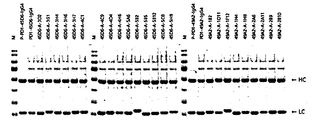
- the cloned pNATVH and pNATVL vectors were cotransfected (co-transfected) into HEK293F cells at a ratio of 6: 4, and the supernatant was collected on day 7 to remove cells and suspended solids through centrifugation and a 0.22 ⁇ m top-filter. The supernatants were collected and protein A affinity chromatography was performed to purify IgG antibodies. After purification, the antibody was isolated through glycine buffer, and the buffer was exchanged so that the final resuspension buffer became PBS. Purified antibodies were quantified by BCA and nano drop, and 15 antibodies were loaded at 5 ug each under reduced and non-reduced conditions, and subjected to SDS-PAGE analysis for purity and mobility of purified proteins. It was confirmed (Fig. 5).
- the dilution of the PD1 / PD-L1 blocking bioassay was performed in a step-diluted manner to restore the reduced signal concentration-dependently.
- the degree of recovery can be represented as EC50 (effective concentration of mAb at 50% level of Recovery signal) and analyzed using Graphpad Prism6 of EC50 in vitro efficacy inhibit recovery capability is shown in FIG.
- the transgenic cell pool expressing PD-1 was transformed into HEK293E with a pcDNA3.1 plasmid containing human PD-1 (NM_005018.2), containing 150 ug / ml Zeocin (# R25001, Thermo Fisher). Screened in selective medium. Each cell pool was identified and selected by fluorescence activated cell sorting (FACS) analysis using each anti-PD-1 (# 557860, BD) and used for functional evaluation such as FACS binding assays or FACS competition assays.
- FACS fluorescence activated cell sorting
- Each pool of transformed cells expressing high human PD-1 was prepared with 0.5-1x10 ⁇ 6 cells per sample, and the antibodies were reacted with the prepared cells for 20 min at 4 ° C. by diluting the antibodies in successive dilutions. The cells were then washed three times with PBS (# LB001-02, welgene) containing 2% fetal bovine serum, and the anti-human IgG antibody (#ITC) bound to the fluorescein isothiocyanate (FITC) phosphor FI-3000, Vectorlabs) and reacted at 4 ° C.
- PBS # LB001-02, welgene
- ITC anti-human IgG antibody
- FITC fluorescein isothiocyanate
- the binding force of the antibody bound in a concentration-dependent manner to human PD-1 overexpressed on the cell surface can be known as mean fluorescence intensity (MFI).
- Example 2 The same procedure as in Example 2 was further selected to have PD1-45D6, 49A2 similar sequence. Table 6 summarizes the characteristics.
- PBST buffer was used to collect the sensogram data during the binding and dissociation process over time while flowing the antibody for 10 minutes at a flow rate of 30 ul / min at different concentrations (30 nM to 0.123 nM).
- the equilibrium dissociation constant (KD) was calculated by plotting and fitting the sensogram data at equilibrium according to the concentration, and showed a high affinity for PD1 antigen with 45D6 of 0.001 nM and 49A2 of 0.019 nM ( 9).
- Antibody optimization involves the addition of 10 5 -10 6 light chain (LC) pools retained by WBIOLOGICS to construct a new LC shuffling library, and LC shuffling, hydrophobicity of heavy chains. Mutations to conserved residues were compared with residues of structurally important sites such as hydrophobic cores, exposed residues, charge clusters, salt bridges, etc. Core packing + LC shuffling followed by LC shuffling, mutations in antibody variable regions can be frequently mutated during in vivo affinity maturation Mutational hot spots were randomly mutated, followed by three methods: CDR hotspot + LC shuffling.
- LC genes of 45D6 and 49A2 antibodies were digested with BstX I and used as vectors, and library pools retained by WBIOLOGICS were digested with BstX I and used as inserts. After ligation with ligase, transformation was performed using the cells for electroporation transformation.
- the antibody libraries were prepared by collecting the transformed cells in a square plate, and various libraries of about 1.5 ⁇ 10 7 were obtained. As a result of sequencing, all of the HC sequences were identical and the LC sequences were different.
- the frame work (FR) portion of the 45D6, 49A2 antibody was replaced with a conserved amanoic acid sequence, followed by cutting the LC gene with BstX I and using it as a vector.
- the library pool retained by Biologics was cut with BstX I and used as an insert.
- transformation was performed using the cells for electroporation transformation.
- the antibody libraries were prepared by collecting the transformed cells in a square plate, and various libraries of about 8.4 ⁇ 10 6 were obtained.
- the sequencing analysis showed that the FR region of HC was replaced with the amanoic acid sequence that was conserved. This different thing was confirmed.
- the frame work (FR) portion of the 45D6 antibody was replaced with a conserved amanoic acid sequence
- the CDR1 hotspot library was cleaved with Sfi I and used as an insert, and then The library pool possessed by Biologics was cut into Sfi I and used as a vector.
- transformation was performed using the electroporation transformation taxa.
- the antibody libraries were prepared by collecting the transformed cells in a square plate, and various libraries of about 5.6x10⁶ were obtained, and sequencing showed that the FR sites of HC were substituted with conserved amanoic acid sequences and hotspots of CDR1. It was confirmed that the amino acids of the sequence was randomly changed and the sequence of the LC is different.
- Blocking was performed after coating PD1-hFc, PD1-mFc produced by YBIOLOGICS and 50 ug of PD1-his (Catalog Number, 10377-H08H) protein antigen purchased from Sino Biological Inc. in an immunosorb tube. .
- Human Antibody Library Phage was infected with bacteria with a human scFv library of 2.7 ⁇ 10 10 diversity and then incubated at 30 ° C. for 16 hours. After incubation, the supernatant was concentrated by PEG, and then dissolved in PBS buffer to prepare a human antibody library. After the library phage was put into the immunotube, the reaction was carried out at room temperature for 2 hours, and then washed with 1XPBS / T and 1XPBS to elute only scFv-phage specifically bound to the antigen.
- a pool of positive phages was obtained through a panning process in which the eluted phages were again infected with E. coli and amplified, and panning for antibody optimization was performed only the first round. As a result, it was confirmed that the number of phages bound to the antigen in the first round panning was slightly increased compared to the input as shown in Table 7.
- Colonies from panning were incubated for 16 hours at 37 ° C. in 1 ml 96-deep well plate (Biononia 90030) in 2 ⁇ YTCM, 2% glucose, 5 mM MgCl 2 medium. Take 100-200 ul of cells so that the value is 0.1 at OD 600 in these grown cells and place in 1 ml of 2xYTCM, 2% glucose, 5 mM MgCl 2 medium, and then measure the value at OD 600 at 37 ° C in a 96-deep well plate. It was incubated for 2-3 hours so that it is 0.5-0.7. M1 helper phages were infected with a MOI of 1:20 and incubated for 16 hours at 30 ° C. in 2 ⁇ YTCMK, 5 mM MgCl 2 1 mM IPTG medium.
- the selected monoclones were subjected to DNA-prep using a DNA purification kit (Qiagen, Germany) to obtain DNA and to request sequencing (solgent). Based on the results of the sequencing analysis, the CDR regions of V H and V L of the selected antibodies were identified, and the similarity between these antibodies and germ line antibody group was determined by NCBI's web page http://www.ncbi.nlm.nih.gov/igblast Investigation was carried out using the Ig BLAST program of / to obtain 25 specific phage antibodies with higher binding capacity than the parent antibody (49A2: 10, 45D6: 15), which are summarized in Table 8 below.
- the antibodies comprising the heavy and light chain CDRs, FR sequences, and heavy and variable chain and light chain variable regions of the selected antibodies are shown in Tables 9 and 10 below.
- PCR was performed on the heavy and light chains (iCycler iQ, BIO-RAD) to convert monoclonal phage antibodies against 25 selected PD1 phages into IgG whole vectors.
- heavy and light chains were obtained, and the restriction enzymes cut the heavy and light chains of the vector and the individual clones.
- Each vector and heavy chain was eluted with a DNA-gel extraction kit (Qiagen).
- Ligation is a vector of 1 ul (10 ng) heavy chain (100-200 ng) 15 ul, 10x buffer 2 ul, ligase (1 U / ul) 1 ul, distilled water and mixed for 1 to 2 hours at room temperature Then, put into transformed cells (competent cells: XL1-blue) and placed on ice for 5 minutes, gave a heat shock (heat shock) at 42 °C for 90 seconds.
- the cloned pNATVH and pNATVL vectors were cotransfected (co-transfected) into HEK293F cells at a ratio of 6: 4, and the supernatant was collected on day 7 to remove cells and suspended solids through centrifugation and a 0.22 ⁇ m top-filter.
- the supernatants were collected and protein A affinity chromatography was performed to purify IgG antibodies. After purification, the antibody was isolated through glycine buffer, and the buffer was exchanged so that the final resuspension buffer became PBS.
- Purified antibodies were quantified by BCA and nano drop, and 25 antibodies were loaded by 5 ug each in reducing and non-reducing conditions, followed by SDS-PAGE analysis for purity and mobility of purified proteins. The state was confirmed. In addition, a portion of the supernatant was loaded on SDS-PAGE to compare the expression rate with the parent antibody and most of the antibody expression rate was increased than the parent antibody, the results can be seen in FIG.
- the activity evaluation experiments of the selected antibodies were conducted using the PD1 / PD-L1 block bioassay kit (promega, J1250).
- CHO cell line with high expression of PD-L1 was plated in a 96-well plate, cultured for 16 hours or more, treated with each antibody serially diluted to a constant concentration, and Jurkat cell line with high expression of human PD-1 for 6 hours. Incubated together.
- the extent of recovery of inhibition of the antibody was determined by the luminescence intensity of luciferase by breaking down the substrate and measured by spectrophotometer (SpectraMax M5 spectraphotometer, Molecular Devices, USA).
- PD-1 antibodies confirmed the activity of the antibody to restore the reduced signal due to PD-1 / PD-L1 complex formation, and 45D6-3D2, 45D6-3H7, 45D6-5B2, 45D6 in the 45D6 antibody.
- 49A2-1B2, 49A2-1H8, 49A2-2A6, 49A2-2B9 increased the activity against the parent antibody and showed similar activity to the control antibody in the 49A2 antibody (FIG. 12).
- the transgenic cell pool expressing human PD-1 was transformed into HEK293E with a pcDNA3.1 plasmid containing human PD-1 (NM_005018.2) or human PD-L1 (NM_014143.2), and 400 ug / Selection was made in selective medium containing ml Zeocin (# R25001, Thermo Fisher). Each cell pool was identified and selected by fluorescence activated cell sorting (FACs) analysis using anti-PD-1 (# 557860, BD), respectively, and used for functional evaluation methods such as FACs binding assays or FACs competition assays. Was used.
- FACs fluorescence activated cell sorting
- Each pool of transformed cells expressing human PD1 was prepared with 0.5-1 ⁇ 10 6 cells per sample, and the antibodies were reacted with the prepared cells for 20 min at 4 ° C. by diluting the antibodies in successive dilutions. The cells were then washed three times with PBS (# LB001-02, welgene) containing 2% fetal bovine serum, and the anti-human IgG antibody (#ITC) bound to the fluorescein isothiocyanate (FITC) phosphor FI-3000, Vectorlabs) and reacted at 4 ° C.
- PBS # LB001-02, welgene
- ITC anti-human IgG antibody
- FITC fluorescein isothiocyanate
- Each pool of transformed cells expressing human PD-1 was prepared with 0.5x10 ⁇ 6 cells per sample, and the antibodies were continuously diluted with a constant dilution factor, and reacted with the prepared cells at 4 ° C. for 20 minutes. The cells were then washed three times with PBS (# LB001-02, welgene) containing 2% fetal bovine serum, and the anti-human IgG antibody (#ITC) bound to the fluorescein isothiocyanate (FITC) phosphor FI-3000, Vectorlabs) and reacted at 4 ° C.
- PBS # LB001-02, welgene
- ITC anti-human IgG antibody
- FITC fluorescein isothiocyanate
- Human PD-1-Fc (S1420, Y-Biologics) or PD-L2-Fc (# 10292-H02H, Sino) was added to the wells of a 96-well immunomicroplate (# 439454, Thermo). Fixed for 16 hours at °C, washed three times with PBS containing 0.05% tween-20 (# P9416, Sigma-Aldrich), followed by a wash solution containing 4% skim milk (# 232120, Becton, Dickinson and Company) Nonspecific binding was blocked by standing at room temperature for 1 hour.
- each antibody serially diluted with a constant dilution factor and human PD-L1-His (S1479, Y-Biologics) or PD-1-His (S1352, Y-Biologics) were reacted at room temperature for 1 hour, and then prepared microplates. And leave for 1 hour at room temperature.
- the anti-Biotin-His antibody (# MA1-21315-BTIN, Thermo) was diluted 1: 2000 and put in the well of the microplate and reacted at room temperature for 1 hour, and then washed in the same manner.
- Streptavidin poly-HRP antibody (# 21140, Pierce) was diluted 1: 5000, put into a well of a microplate, and reacted at room temperature for 1 hour, and washed in the same manner.
- Add 100 ul TMB substrate solution (# T0440, Sigma-Aldrich), block the light, leave at room temperature for 3 minutes, stop the reaction by adding 50 ul 2.5M sulfuric acid (# S1478, Samchun) and stop the reaction with spectrophotometer (# GM3000, Glomax ® Discover System Promega) was used to measure absorbance at 450 nm. The results are shown in FIG.
- PBST buffer was used to collect the sensogram data during the binding and dissociation process over time while flowing the antibody for 10 minutes at a flow rate of 30 ul / min at different concentrations (30 nM to 0.123 nM).
- the equilibrium dissociation constant (KD) was calculated by plotting and plotting the sensogram data at equilibrium according to the concentration, and 49A2 (2B9) showed 0.001 nM with high affinity for the PD1 antigen (Fig. 17).
- Binding kinetics between human PD1 protein and selected antibodies Ab KD (M) Ka (1 / Ms) Kd (1 / s) PD1 49A2 2.371 ⁇ 10 -10 3.953 ⁇ 10 5 9.372 ⁇ 10 -5 PD1 49A2 1H8 1.245 ⁇ 10 -11 2.201 ⁇ 10 5 2.741 ⁇ 10 -6 PD1 49A2 1B2 1.659 ⁇ 10 -10 3.853 ⁇ 10 5 6.390 ⁇ 10 -5 PD1 49A2 2A6 6.907 ⁇ 10 -11 3.101 ⁇ 10 5 2.142 ⁇ 10 -5 PD1 49A2 2B9 1.0 ⁇ 10 -12 3.774 ⁇ 10 5 1.0 ⁇ 10 -7 PD1 45D6 1.0 ⁇ 10 -12 2.701 ⁇ 10 5 1.07 ⁇ 10 -7 PD1 45D6 3D2 1.0 ⁇ 10 -12 1.81 ⁇ 10 5 1.0 ⁇ 10 -7 PD1 45D6 3H7 2.5
- Binding kinetics between monkey's PD1 protein and selected antibodies Ab KD (M) Ka (1 / Ms) Kd (1 / s) PD-1-49A2 1.0 ⁇ 10 -12 1.683 ⁇ 10 5 1.0 ⁇ 10 -7 PD-1-49A2-2B9 1.0 ⁇ 10 -12 1.853 ⁇ 10 5 1.0 ⁇ 10 -7 PD-1-45D6 1.0 ⁇ 10 -12 1.535 ⁇ 10 5 1.0 ⁇ 10 -7 PD-1-45D6-5B2 1.0 ⁇ 10 -12 2.078 ⁇ 10 5 1.0 ⁇ 10 -7
- Binding kinetics measurement between PD1 protein and selected antibodies in mice Ab KD (M) Ka (1 / Ms) Kd (1 / s) PD-1-49A2-2B9 4.231 ⁇ 10 -9 1.478 ⁇ 10 5 6.252 ⁇ 10 -4 PD-1-45D6 2.391 ⁇ 10 -9 5.544 ⁇ 10 4 1.326 ⁇ 10 -4 PD-1-45D6-5B2 4.590 ⁇ 10 -9 1.879 ⁇ 10 5 8.626 ⁇ 10 -4
- Monoclonal scFv-phage binding to the PD1 antigen was incubated for 16 hours at 37 °C in 2xYTCM, 2% glucose (glucose), 5 mM MgCl 2 medium.
- Cells thus grown were placed in 2xYTCM, 2% glucose, 5 mM MgCl 2 medium to a value of 0.1 at OD 600 , and then incubated for 2 to 3 hours at 37 ° C. to a value of 0.5 to 0.7 at OD 6 00 .
- M1 helper phages were infected with a MOI of 1:20 and incubated for 16 hours at 30 ° C. in 2 ⁇ YTCMK, 5 mM MgCl 2 1 mM IPTG medium.
- Each well was digested using 4% skim milk dissolved in PBS after encoding antigen PD1 wild type (WT) or various variants (mutants: FIG. 18) at 4 ° C. for 16 hours in a 96-well immune-plate. Blocking. After washing with 0.2 ml PBS / T for each well, monoclonal scFv-phage (each 100 scFv-phage), which was incubated for 16 hours, was added to 100 ⁇ l of each well and reacted at room temperature for 2 hours.
- each well was washed four times with 0.2 ml PBS / T, and then a second antibody (anti-M13-HRP) was diluted to 1/2000 and reacted at room temperature for 1 hour. After washing with 0.2 ml PBS / T, color development was measured at 490 nm.
- WT antigen PD1 wild type
- FIG. 18 several variants
- the optimized antibody has a relatively uniform and high yield due to its excellent physical properties during production and purification through a temporary expression system. It can be seen that some antibodies have higher production than previously commercialized antibodies (FIG. 22).
- novel antibodies or antigen-binding fragments thereof that bind to PD-1 of the present invention are useful in the development of immunotherapeutic agents for various diseases associated with PD-1 because they can bind to PD-1 and inhibit its activity.
Landscapes
- Health & Medical Sciences (AREA)
- Chemical & Material Sciences (AREA)
- Medicinal Chemistry (AREA)
- Immunology (AREA)
- Life Sciences & Earth Sciences (AREA)
- Organic Chemistry (AREA)
- General Health & Medical Sciences (AREA)
- Proteomics, Peptides & Aminoacids (AREA)
- Microbiology (AREA)
- Molecular Biology (AREA)
- Biophysics (AREA)
- Biochemistry (AREA)
- Engineering & Computer Science (AREA)
- Bioinformatics & Cheminformatics (AREA)
- Genetics & Genomics (AREA)
- Mycology (AREA)
- Pharmacology & Pharmacy (AREA)
- Epidemiology (AREA)
- Animal Behavior & Ethology (AREA)
- Public Health (AREA)
- Veterinary Medicine (AREA)
- Peptides Or Proteins (AREA)
Abstract
Description
| 명칭 | 5'->3’ 서열 | 서열번호 |
| PD1-F | ccaggatggttcttagactcccc | 194 |
| PD1-R | caccagggtttggaactggc | 195 |
| 패닝횟수 | 파지의 유입수 | 파지의 결합수 |
| 1회 | 2×10¹³ | 3.6×10⁷ |
| 2회 | 1.2×10¹³ | 7×10⁷ |
| 3회 | 2×10¹³ | 2×10⁹ |
| 클론명 | VH | 유사성 | VL | 유사성 | 그룹 |
| Nivolumab | VH3-33 | 91.80% | L6 | 98.90% | |
| Pembrolizumab | VH1-2 | 79.60% | L25 | 80.80% | |
| PD1-29A2 | VH3-9 | 91.80% | V2-17 | 86.50% | 1 |
| PD1-29H3 | VH3-9 | 90.80% | V1-11 | 88.50% | 2 |
| PD1-31F3 | VH1-69 | 92.90% | V1-13 | 93.90% | 3 |
| PD1-32A6 | VH1-69 | 87.80% | L5 | 91.60% | 4 |
| PD1-41C9 | VH3-30 | 95.80% | O1 | 92.10% | 5 |
| PD1-42G4 | VH3-11 | 93.80% | O2 | 93.80% | 6 |
| PD1-44B5 | VH3-30 | 99.00% | V1-16 | 85.60% | 7 |
| PD1-45D6 | VH3-30 | 95.80% | O1 | 93.10% | 8 |
| PD1-45F1 | VH1-46 | 91.80% | V2-13 | 93.80% | 9 |
| PD1-45F4 | VH3-9 | 90.80% | V2-1 | 77.70% | 10 |
| PD1-48A9 | VH1-69 | 79.60% | O1 | 96.00% | 11 |
| PD1-49B9 | VH3-9 | 88.70% | V1-2 | 93.90% | 12 |
| PD1-49A2 | VH3-30 | 97.90% | O1 | 93.10% | 13 |
| PD1-51D9 | VH1-3 | 82.70% | A3 | 94.00% | 14 |
| PD1-52E8 | VH3-9 | 91.80% | V2-17 | 90.50% | 15 |


| 클론명 | VH | 유사도 | VL | 유사도 2 | 그룹 |
| PD1-72D10 | VH3-30 | 96.90% | 01 | 94.10% | 1 |
| PD1-74A11 | VH3-30 | 97.96% | 01 | 95.05% | 2 |
| PD1-75C10 | VH3-30 | 96.94% | 01 | 95.05% | 3 |
| PD1-74A01 | VH3-30 | 95.92% | 01 | 92.08% | 4 |
| PD1-74H12 | VH3-30 | 94.90% | 01 | 92.08% | 5 |
| 샘플 | 파지의 유입수 | 파지의 결합수 |
| 45D6 (LS) | 1.3×10¹³ | 2.8×10⁷ |
| 45D6 (Core packing +LS) | 1.1×10¹³ | 4.8×10⁷ |
| 45D6 (CDR hotspot +LS) | 1.1×10¹³ | 3.6×10⁶ |
| 49A2 (LS) | 1.3×10¹³ | 1.8×10⁷ |
| 49A2 (CDR hotspot +LS) | 1.1×10¹³ | 1.6×10⁶ |


| 항체 | EC50 [nM] |
| PD-1-41C9 | 3.91 |
| PD-1-45D6 | 2 |
| PD-1-45D6-A-3D2 | 2.16 |
| PD-1-45D6-A-3G1 | 0.98 |
| PD-1-45D6-A-3H4 | 1.67 |
| PD-1-45D6-A-3H6 | 1.49 |
| PD-1-45D6-A-3H7 | 1.98 |
| PD-1-45D6-A-4C1 | 1.76 |
| PD-1-45D6-A-4C9 | 2.72 |
| PD-1-45D6-A-4D4 | 1.74 |
| PD-1-45D6-A-4H6 | 1.19 |
| PD-1-45D6-A-5A6 | 0.92 |
| PD-1-45D6-A-5B12 | 0.8 |
| PD-1-45D6-A-5B2 | 1.48 |
| PD-1-45D6-A-5B5 | 1.68 |
| PD-1-45D6-A-5C8 | 1.44 |
| PD-1-45D6-A-5H9 | 2 |
| PD-1-48A9 | 8.64 |
| PD-1-49A2 | 3.78 |
| PD-1-49A2-A-1B2 | 1.3 |
| PD-1-49A2-A-1D11 | 2.89 |
| PD-1-49A2-A-1F12 | 1.03 |
| PD-1-49A2-A-1H4 | 0.84 |
| PD-1-49A2-A-1H8 | 1.21 |
| PD-1-49A2-A-2A11 | 0.79 |
| PD-1-49A2-A-2A6 | 1.51 |
| PD-1-49A2-A-2B10 | 0.65 |
| PD-1-49A2-A-2B9 | 1.23 |
| PD-1-51D9 | ~ 4.695e+010 |
| PD-1-52E8 | 8.43 |
| PD-1-62E1 | 2.73 |
| PD1-72D10 | 1.21 |
| PD1-74A11 | 1.31 |
| PD1-75C10 | 0.81 |
| PD1-74A01 | 1.01 |
| PD1-74H12 | 0.98 |
| Ab | KD(M) | Ka(1/Ms) | Kd(1/s) |
| PD1 49A2 | 2.371×10⁻¹⁰ | 3.953×10⁵ | 9.372×10⁻⁵ |
| PD1 49A2 1H8 | 1.245×10⁻¹¹ | 2.201×10⁵ | 2.741×10⁻⁶ |
| PD1 49A2 1B2 | 1.659×10⁻¹⁰ | 3.853×10⁵ | 6.390×10⁻⁵ |
| PD1 49A2 2A6 | 6.907×10⁻¹¹ | 3.101×10⁵ | 2.142×10⁻⁵ |
| PD1 49A2 2B9 | 1.0×10⁻¹² | 3.774×10⁵ | 1.0×10⁻⁷ |
| PD1 45D6 | 1.0×10⁻¹² | 2.701×10⁵ | 1.07×10⁻⁷ |
| PD1 45D6 3D2 | 1.0×10⁻¹² | 1.81×10⁵ | 1.0×10⁻⁷ |
| PD1 45D6 3H7 | 2.53×10⁻¹¹ | 3.076×10⁵ | 7.781×10⁻⁶ |
| PD1 45D6 5B2 | 5.818×10⁻¹¹ | 3.315×10⁵ | 1.928×10⁻⁵ |
| PD1 45D6 5B5 | 4.773×10⁻¹¹ | 2.96×10⁵ | 1.413×10⁻⁵ |
| Ab | KD(M) | Ka(1/Ms) | Kd(1/s) |
| PD-1-49A2 | 1.0×10⁻¹² | 1.683×10⁵ | 1.0×10⁻⁷ |
| PD-1-49A2-2B9 | 1.0×10⁻¹² | 1.853×10⁵ | 1.0×10⁻⁷ |
| PD-1-45D6 | 1.0×10⁻¹² | 1.535×10⁵ | 1.0×10⁻⁷ |
| PD-1-45D6-5B2 | 1.0×10⁻¹² | 2.078×10⁵ | 1.0×10⁻⁷ |
| Ab | KD(M) | Ka(1/Ms) | Kd(1/s) |
| PD-1-49A2-2B9 | 4.231×10⁻⁹ | 1.478×10⁵ | 6.252×10⁻⁴ |
| PD-1-45D6 | 2.391×10⁻⁹ | 5.544×10⁴ | 1.326×10⁻⁴ |
| PD-1-45D6-5B2 | 4.590×10⁻⁹ | 1.879×10⁵ | 8.626×10⁻⁴ |

| Sample | Tm |
| Pembrolizumab | 63 |
| Opdivo | 64 |
| 45D6 | 63 |
| 49A2 | 63 |
| 49A2-2B9 | 64 |
Claims (13)
- 서열번호 1 내지 서열번호 30으로 구성된 군에서 선택되는 서열과 90% 이상의 서열 상동성을 가지는 서열을 포함하는 중쇄 CDR1,서열번호 31 내지 서열번호 56으로 구성된 군에서 선택되는 서열과 90% 이상의 서열 상동성을 가지는 서열을 포함하는 중쇄 CDR2, 및서열번호 57 내지 서열번호 79로 구성된 군에서 선택되는 서열과 90% 이상의 서열 상동성을 가지는 서열을 포함하는 중쇄 CDR3를 포함하는 중쇄 가변영역, 및서열번호 198 내지 서열번호 222로 구성된 군에서 선택되는 서열과 90% 이상의 서열 상동성을 가지는 서열을 포함하는 경쇄 CDR1,서열번호 223 내지 서열번호 241로 구성된 군에서 선택되는 서열과 90% 이상의 서열 상동성을 가지는 서열을 포함하는 경쇄 CDR2, 및서열번호 242 내지 서열번호 269로 구성된 군에서 선택되는 서열과 90% 이상의 서열 상동성을 가지는 서열을 포함하는 경쇄 CDR3를 포함하는 경쇄 가변영역을 포함하는, PD-1에 결합하는 항체 또는 이의 항원 결합단편.
- 제 1항에 있어서,서열번호 1의 중쇄 CDR1, 서열번호 31의 중쇄 CDR2, 및 서열번호 57의 중쇄 CDR3을 포함하는 중쇄 가변영역,서열번호 1의 중쇄 CDR1, 서열번호 32의 중쇄 CDR2, 및 서열번호 58의 중쇄 CDR3을 포함하는 중쇄 가변영역,서열번호 2의 중쇄 CDR1, 서열번호 33의 중쇄 CDR2, 및 서열번호 59의 중쇄 CDR3을 포함하는 중쇄 가변영역,서열번호 2의 중쇄 CDR1, 서열번호 33의 중쇄 CDR2, 및 서열번호 60의 중쇄 CDR3을 포함하는 중쇄 가변영역,서열번호 2의 중쇄 CDR1, 서열번호 33의 중쇄 CDR2, 및 서열번호 61의 중쇄 CDR3을 포함하는 중쇄 가변영역,서열번호 2의 중쇄 CDR1, 서열번호 33의 중쇄 CDR2, 및 서열번호 62의 중쇄 CDR3을 포함하는 중쇄 가변영역,서열번호 3의 중쇄 CDR1, 서열번호 34의 중쇄 CDR2, 및 서열번호 63의 중쇄 CDR3을 포함하는 중쇄 가변영역,서열번호 4의 중쇄 CDR1, 서열번호 35의 중쇄 CDR2, 및 서열번호 64의 중쇄 CDR3을 포함하는 중쇄 가변영역,서열번호 5의 중쇄 CDR1, 서열번호 36의 중쇄 CDR2, 및 서열번호 65의 중쇄 CDR3을 포함하는 중쇄 가변영역,서열번호 6의 중쇄 CDR1, 서열번호 37의 중쇄 CDR2, 및 서열번호 66의 중쇄 CDR3을 포함하는 중쇄 가변영역,서열번호 1의 중쇄 CDR1, 서열번호 32의 중쇄 CDR2, 및 서열번호 67의 중쇄 CDR3을 포함하는 중쇄 가변영역,서열번호 7의 중쇄 CDR1, 서열번호 38의 중쇄 CDR2, 및 서열번호 68의 중쇄 CDR3을 포함하는 중쇄 가변영역,서열번호 8의 중쇄 CDR1, 서열번호 39의 중쇄 CDR2, 및 서열번호 69의 중쇄 CDR3을 포함하는 중쇄 가변영역,서열번호 9의 중쇄 CDR1, 서열번호 40의 중쇄 CDR2, 및 서열번호 70의 중쇄 CDR3을 포함하는 중쇄 가변영역,서열번호 10의 중쇄 CDR1, 서열번호 41의 중쇄 CDR2, 및 서열번호 71의 중쇄 CDR3을 포함하는 중쇄 가변영역,서열번호 11의 중쇄 CDR1, 서열번호 42의 중쇄 CDR2, 및 서열번호 72의 중쇄 CDR3을 포함하는 중쇄 가변영역,서열번호 12의 중쇄 CDR1, 서열번호 43의 중쇄 CDR2, 및 서열번호 73의 중쇄 CDR3을 포함하는 중쇄 가변영역,서열번호 13의 중쇄 CDR1, 서열번호 44의 중쇄 CDR2, 및 서열번호 74의 중쇄 CDR3을 포함하는 중쇄 가변영역,서열번호 14의 중쇄 CDR1, 서열번호 45의 중쇄 CDR2, 및 서열번호 75의 중쇄 CDR3을 포함하는 중쇄 가변영역,서열번호 15의 중쇄 CDR1, 서열번호 46의 중쇄 CDR2, 및 서열번호 76의 중쇄 CDR3을 포함하는 중쇄 가변영역,서열번호 8의 중쇄 CDR1, 서열번호 47의 중쇄 CDR2, 및 서열번호 77의 중쇄 CDR3을 포함하는 중쇄 가변영역,서열번호 16의 중쇄 CDR1, 서열번호 48의 중쇄 CDR2, 및 서열번호 78의 중쇄 CDR3을 포함하는 중쇄 가변영역,서열번호 17의 중쇄 CDR1, 서열번호 49의 중쇄 CDR2, 및 서열번호 58의 중쇄 CDR3을 포함하는 중쇄 가변영역,서열번호 18의 중쇄 CDR1, 서열번호 50의 중쇄 CDR2, 및 서열번호 58의 중쇄 CDR3을 포함하는 중쇄 가변영역,서열번호 19의 중쇄 CDR1, 서열번호 51의 중쇄 CDR2, 및 서열번호 58의 중쇄 CDR3을 포함하는 중쇄 가변영역,서열번호 20의 중쇄 CDR1, 서열번호 52의 중쇄 CDR2, 및 서열번호 58의 중쇄 CDR3을 포함하는 중쇄 가변영역,서열번호 21의 중쇄 CDR1, 서열번호 51의 중쇄 CDR2, 및 서열번호 58의 중쇄 CDR3을 포함하는 중쇄 가변영역,서열번호 22의 중쇄 CDR1, 서열번호 53의 중쇄 CDR2, 및 서열번호 58의 중쇄 CDR3을 포함하는 중쇄 가변영역,서열번호 23의 중쇄 CDR1, 서열번호 49의 중쇄 CDR2, 및 서열번호 58의 중쇄 CDR3을 포함하는 중쇄 가변영역,서열번호 17의 중쇄 CDR1, 서열번호 54의 중쇄 CDR2, 및 서열번호 58의 중쇄 CDR3을 포함하는 중쇄 가변영역,서열번호 24의 중쇄 CDR1, 서열번호 55의 중쇄 CDR2, 및 서열번호 58의 중쇄 CDR3을 포함하는 중쇄 가변영역,서열번호 21의 중쇄 CDR1, 서열번호 51의 중쇄 CDR2, 및 서열번호 58의 중쇄 CDR3을 포함하는 중쇄 가변영역,서열번호 25의 중쇄 CDR1, 서열번호 56의 중쇄 CDR2, 및 서열번호 57의 중쇄 CDR3을 포함하는 중쇄 가변영역,서열번호 26의 중쇄 CDR1, 서열번호 31의 중쇄 CDR2, 및 서열번호 57의 중쇄 CDR3을 포함하는 중쇄 가변영역,서열번호 27의 중쇄 CDR1, 서열번호 31의 중쇄 CDR2, 및 서열번호 57의 중쇄 CDR3을 포함하는 중쇄 가변영역,서열번호 28의 중쇄 CDR1, 서열번호 31의 중쇄 CDR2, 및 서열번호 57의 중쇄 CDR3을 포함하는 중쇄 가변영역,서열번호 29의 중쇄 CDR1, 서열번호 31의 중쇄 CDR2, 및 서열번호 57의 중쇄 CDR3을 포함하는 중쇄 가변영역,서열번호 30의 중쇄 CDR1, 서열번호 31의 중쇄 CDR2, 및 서열번호 57의 중쇄 CDR3을 포함하는 중쇄 가변영역,서열번호 1의 중쇄 CDR1, 서열번호 32의 중쇄 CDR2, 및 서열번호 79의 중쇄 CDR3을 포함하는 중쇄 가변영역, 또는서열번호 1의 중쇄 CDR1, 서열번호 32의 중쇄 CDR2, 및 서열번호 57의 중쇄 CDR3을 포함하는 중쇄 가변영역을 포함하는 항체 또는 이의 항원 결합단편.
- 제 1항에 있어서,서열번호 198의 경쇄 CDR1, 서열번호 223의 경쇄 CDR2, 및 서열번호 242의 경쇄 CDR3를 포함하는 경쇄 가변영역,서열번호 199의 경쇄 CDR1, 서열번호 224의 경쇄 CDR2, 및 서열번호 243의 경쇄 CDR3를 포함하는 경쇄 가변영역,서열번호 200의 경쇄 CDR1, 서열번호 225의 경쇄 CDR2, 및 서열번호 244의 경쇄 CDR3를 포함하는 경쇄 가변영역,서열번호 201의 경쇄 CDR1, 서열번호 226의 경쇄 CDR2, 및 서열번호 245의 경쇄 CDR3를 포함하는 경쇄 가변영역,서열번호 202의 경쇄 CDR1, 서열번호 227의 경쇄 CDR2, 및 서열번호 246의 경쇄 CDR3를 포함하는 경쇄 가변영역,서열번호 203의 경쇄 CDR1, 서열번호 228의 경쇄 CDR2, 및 서열번호 247의 경쇄 CDR3를 포함하는 경쇄 가변영역,서열번호 204의 경쇄 CDR1, 서열번호 229의 경쇄 CDR2, 및 서열번호 248의 경쇄 CDR3를 포함하는 경쇄 가변영역,서열번호 205의 경쇄 CDR1, 서열번호 230의 경쇄 CDR2, 및 서열번호 249의 경쇄 CDR3를 포함하는 경쇄 가변영역,서열번호 206의 경쇄 CDR1, 서열번호 231의 경쇄 CDR2, 및 서열번호 250의 경쇄 CDR3를 포함하는 경쇄 가변영역,서열번호 207의 경쇄 CDR1, 서열번호 232의 경쇄 CDR2, 및 서열번호 251의 경쇄 CDR3를 포함하는 경쇄 가변영역,서열번호 208의 경쇄 CDR1, 서열번호 230의 경쇄 CDR2, 및 서열번호 252의 경쇄 CDR3를 포함하는 경쇄 가변영역,서열번호 209의 경쇄 CDR1, 서열번호 233의 경쇄 CDR2, 및 서열번호 253의 경쇄 CDR3를 포함하는 경쇄 가변영역,서열번호 210의 경쇄 CDR1, 서열번호 234의 경쇄 CDR2, 및 서열번호 254의 경쇄 CDR3를 포함하는 경쇄 가변영역,서열번호 211의 경쇄 CDR1, 서열번호 235의 경쇄 CDR2, 및 서열번호 255의 경쇄 CDR3를 포함하는 경쇄 가변영역,서열번호 212의 경쇄 CDR1, 서열번호 236의 경쇄 CDR2, 및 서열번호 256의 경쇄 CDR3를 포함하는 경쇄 가변영역,서열번호 213의 경쇄 CDR1, 서열번호 230의 경쇄 CDR2, 및 서열번호 257의 경쇄 CDR3를 포함하는 경쇄 가변영역,서열번호 214의 경쇄 CDR1, 서열번호 237의 경쇄 CDR2, 및 서열번호 258의 경쇄 CDR3를 포함하는 경쇄 가변영역,서열번호 215의 경쇄 CDR1, 서열번호 230의 경쇄 CDR2, 및 서열번호 249의 경쇄 CDR3를 포함하는 경쇄 가변영역,서열번호 211의 경쇄 CDR1, 서열번호 238의 경쇄 CDR2, 및 서열번호 259의 경쇄 CDR3를 포함하는 경쇄 가변영역,서열번호 216의 경쇄 CDR1, 서열번호 238의 경쇄 CDR2, 및 서열번호 260의 경쇄 CDR3를 포함하는 경쇄 가변영역,서열번호 217의 경쇄 CDR1, 서열번호 239의 경쇄 CDR2, 및 서열번호 261의 경쇄 CDR3를 포함하는 경쇄 가변영역,서열번호 218의 경쇄 CDR1, 서열번호 240의 경쇄 CDR2, 및 서열번호 262의 경쇄 CDR3를 포함하는 경쇄 가변영역,서열번호 219의 경쇄 CDR1, 서열번호 241의 경쇄 CDR2, 및 서열번호 263의 경쇄 CDR3를 포함하는 경쇄 가변영역,서열번호 220의 경쇄 CDR1, 서열번호 230의 경쇄 CDR2, 및 서열번호 252의 경쇄 CDR3를 포함하는 경쇄 가변영역,서열번호 215의 경쇄 CDR1, 서열번호 230의 경쇄 CDR2, 및 서열번호 252의 경쇄 CDR3를 포함하는 경쇄 가변영역,서열번호 205의 경쇄 CDR1, 서열번호 230의 경쇄 CDR2, 및 서열번호 264의 경쇄 CDR3를 포함하는 경쇄 가변영역,서열번호 205의 경쇄 CDR1, 서열번호 230의 경쇄 CDR2, 및 서열번호 265의 경쇄 CDR3를 포함하는 경쇄 가변영역,서열번호 221의 경쇄 CDR1, 서열번호 230의 경쇄 CDR2, 및 서열번호 266의 경쇄 CDR3를 포함하는 경쇄 가변영역,서열번호 205의 경쇄 CDR1, 서열번호 230의 경쇄 CDR2, 및 서열번호 252의 경쇄 CDR3를 포함하는 경쇄 가변영역,서열번호 205의 경쇄 CDR1, 서열번호 230의 경쇄 CDR2, 및 서열번호 267의 경쇄 CDR3를 포함하는 경쇄 가변영역,서열번호 205의 경쇄 CDR1, 서열번호 230의 경쇄 CDR2, 및 서열번호 257의 경쇄 CDR3를 포함하는 경쇄 가변영역,서열번호 220의 경쇄 CDR1, 서열번호 230의 경쇄 CDR2, 및 서열번호 267의 경쇄 CDR3를 포함하는 경쇄 가변영역,서열번호 222의 경쇄 CDR1, 서열번호 230의 경쇄 CDR2, 및 서열번호 268의 경쇄 CDR3를 포함하는 경쇄 가변영역, 또는서열번호 220의 경쇄 CDR1, 서열번호 230의 경쇄 CDR2, 및 서열번호 269의 경쇄 CDR3를 포함하는 경쇄 가변영역을 포함하는 항체 또는 이의 항원 결합단편.
- 제 1항에 있어서, 서열번호 80 내지 서열번호 95로 구성된 군에서 선택되는 중쇄 가변영역 FR1,서열번호 96 내지 서열번호 113으로 구성된 군에서 선택되는 중쇄 가변영역 FR2,서열번호 114 내지 서열번호 134로 구성된 군에서 선택되는 중쇄 가변영역 FR3, 또는서열번호 135 내지 서열번호 145로 구성된 군에서 선택되는 중쇄 가변영역 FR4를 포함하는 항체 또는 이의 항원 결합단편.
- 제 1항에 있어서, 서열번호 270 내지 서열번호 294로 구성된 군에서 선택되는 경쇄 가변영역 FR1,서열번호 295 내지 서열번호 315로 구성된 군에서 선택되는 경쇄 가변영역 FR2,서열번호 316 내지 서열번호 355로 구성된 군에서 선택되는 경쇄 가변영역 FR3, 또는서열번호 356 내지 서열번호 367로 구성된 군에서 선택되는 경쇄 가변영역 FR4를 포함하는 항체 또는 이의 항원 결합단편.
- 제 1항에 있어서, 서열번호 146 내지 서열번호 193으로 구성된 군에서 선택되는 서열과 90% 이상의 서열 상동성을 가지는 서열을 포함하는 중쇄 가변영역을 포함하는 항체 또는 이의 항원 결합단편.
- 제 1항에 있어서, 서열번호 368 내지 서열번호 420으로 구성된 군에서 선택되는 서열과 90% 이상의 서열 상동성을 가지는 서열을 포함하는 경쇄 가변영역을 포함하는 항체 또는 이의 항원 결합단편.
- 제 1항 내지 제 7항 중 어느 한 항의 항체 또는 이의 항원 결합단편을 코딩하는 핵산.
- 제 8항의 핵산을 포함하는 발현벡터.
- 제 9항의 발현 벡터로 형질전환된 세포.
- 다음 단계를 포함하는 PD-1에 결합하는 항체 또는 그의 항원 결합 단편의 제조방법:(a) 제 10항의 세포를 배양하는 단계; 및(b) 상기 배양된 세포에서 항체 또는 그의 항원 결합 단편을 회수하는 단계.
- 제 1항 내지 제 7항 중 어느 한 항의 항체 또는 그의 항원 결합 단편을 유효성분으로 포함하는 암 예방 또는 치료용 조성물.
- 제 12항에 있어서, 상기 암은 흑색종, 폐암, 간암, 교세포종, 난소암, 대장암, 두경부암, 방광암, 신장세포암, 위암, 유방암, 전이암, 전립선암 및 췌장암으로 구성된 군으로부터 선택되는 것을 특징으로 하는 암 예방 또는 치료용 조성물.
Priority Applications (11)
| Application Number | Priority Date | Filing Date | Title |
|---|---|---|---|
| CN201780055472.9A CN110049998B (zh) | 2016-08-05 | 2017-08-07 | 抗程序性细胞死亡1(pd-1)的抗体及其用途 |
| EP17837299.1A EP3495390A4 (en) | 2016-08-05 | 2017-08-07 | NOVEL ANTIBODY AGAINST PROGRAMMED CELL DEATH PROTEIN (PD-1) AND USE OF IT |
| BR112019002258-9A BR112019002258A2 (pt) | 2016-08-05 | 2017-08-07 | anticorpo que se liga a pd-1 ou fragmento de ligação ao antígeno do anticorpo, método para produzir o mesmo e composição para prevenir ou tratar câncer |
| CA3032783A CA3032783C (en) | 2016-08-05 | 2017-08-07 | Antibody to programmed cell death 1 (pd-1) and use thereof |
| MYPI2019000513A MY189412A (en) | 2016-08-05 | 2017-08-07 | Antibody to programmed cell death 1 (pd-1) and use thereof |
| US16/321,124 US11248048B2 (en) | 2016-08-05 | 2017-08-07 | Antibody to programmed cell death 1 (PD-1) and use thereof |
| JP2019528009A JP6786722B2 (ja) | 2016-08-05 | 2017-08-07 | プログラム化された細胞死蛋白質(pd−1)に対する新規抗体及びその用途 |
| AU2017306506A AU2017306506B2 (en) | 2016-08-05 | 2017-08-07 | Antibody to programmed cell death 1 (PD-1) and use thereof |
| RU2019105648A RU2725950C1 (ru) | 2016-08-05 | 2017-08-07 | Антитела против белка-1 запрограммированной клеточной смерти (pd-1) и их применение |
| UAA201902239A UA125395C2 (uk) | 2016-08-05 | 2017-08-07 | Антитіло проти білка-1 запрограмованої клітинної смерті (pd-1) і його застосування |
| SA519401032A SA519401032B1 (ar) | 2016-08-05 | 2019-02-04 | (pd-1) جسم مضاد لموت الخلية المبرمج1 واستخدامه |
Applications Claiming Priority (4)
| Application Number | Priority Date | Filing Date | Title |
|---|---|---|---|
| KR10-2016-0100210 | 2016-08-05 | ||
| KR20160100210 | 2016-08-05 | ||
| KR10-2017-0099672 | 2017-08-07 | ||
| KR1020170099672A KR102048476B1 (ko) | 2016-08-05 | 2017-08-07 | 프로그램화된 세포 사멸 단백질(pd-1)에 대한 신규 항체 및 이의 용도 |
Publications (1)
| Publication Number | Publication Date |
|---|---|
| WO2018026248A1 true WO2018026248A1 (ko) | 2018-02-08 |
Family
ID=61073832
Family Applications (1)
| Application Number | Title | Priority Date | Filing Date |
|---|---|---|---|
| PCT/KR2017/008494 Ceased WO2018026248A1 (ko) | 2016-08-05 | 2017-08-07 | 프로그램화된 세포 사멸 단백질(pd-1)에 대한 신규 항체 및 이의 용도 |
Country Status (1)
| Country | Link |
|---|---|
| WO (1) | WO2018026248A1 (ko) |
Cited By (6)
| Publication number | Priority date | Publication date | Assignee | Title |
|---|---|---|---|---|
| WO2019197979A1 (en) * | 2018-04-10 | 2019-10-17 | Y-Biologics Inc. | Cell engaging binding molecules |
| US10633458B2 (en) | 2018-04-10 | 2020-04-28 | Y-Biologics Inc. | Cell engaging binding molecules |
| WO2021006199A1 (ja) | 2019-07-05 | 2021-01-14 | 小野薬品工業株式会社 | Pd-1/cd3二重特異性タンパク質による血液がん治療 |
| US10894830B2 (en) | 2015-11-03 | 2021-01-19 | Janssen Biotech, Inc. | Antibodies specifically binding PD-1, TIM-3 or PD-1 and TIM-3 and their uses |
| WO2021025140A1 (ja) | 2019-08-08 | 2021-02-11 | 小野薬品工業株式会社 | 二重特異性タンパク質 |
| US12398209B2 (en) | 2018-01-22 | 2025-08-26 | Janssen Biotech, Inc. | Methods of treating cancers with antagonistic anti-PD-1 antibodies |
Citations (5)
| Publication number | Priority date | Publication date | Assignee | Title |
|---|---|---|---|---|
| US20140294852A1 (en) * | 2005-05-09 | 2014-10-02 | Ono Pharmaceutical Co., Ltd. | Monoclonal antibodies to programmed death 1 (pd-1) |
| US20150203579A1 (en) * | 2014-01-23 | 2015-07-23 | Regeneron Pharmaceuticals, Inc. | Human Antibodies to PD-1 |
| WO2016015685A1 (zh) * | 2014-07-30 | 2016-02-04 | 珠海市丽珠单抗生物技术有限公司 | 抗pd-1抗体及其应用 |
| CN105566496A (zh) * | 2015-11-26 | 2016-05-11 | 大庆东竺明生物技术有限公司 | 阻断人程序性死亡因子1(pd-1)功能的单克隆抗体及其编码基因和应用 |
| US20160222113A1 (en) * | 2013-09-10 | 2016-08-04 | Medimmune Limited | Antibodies Against PD-1 and Uses Thereof |
-
2017
- 2017-08-07 WO PCT/KR2017/008494 patent/WO2018026248A1/ko not_active Ceased
Patent Citations (5)
| Publication number | Priority date | Publication date | Assignee | Title |
|---|---|---|---|---|
| US20140294852A1 (en) * | 2005-05-09 | 2014-10-02 | Ono Pharmaceutical Co., Ltd. | Monoclonal antibodies to programmed death 1 (pd-1) |
| US20160222113A1 (en) * | 2013-09-10 | 2016-08-04 | Medimmune Limited | Antibodies Against PD-1 and Uses Thereof |
| US20150203579A1 (en) * | 2014-01-23 | 2015-07-23 | Regeneron Pharmaceuticals, Inc. | Human Antibodies to PD-1 |
| WO2016015685A1 (zh) * | 2014-07-30 | 2016-02-04 | 珠海市丽珠单抗生物技术有限公司 | 抗pd-1抗体及其应用 |
| CN105566496A (zh) * | 2015-11-26 | 2016-05-11 | 大庆东竺明生物技术有限公司 | 阻断人程序性死亡因子1(pd-1)功能的单克隆抗体及其编码基因和应用 |
Non-Patent Citations (1)
| Title |
|---|
| See also references of EP3495390A4 * |
Cited By (10)
| Publication number | Priority date | Publication date | Assignee | Title |
|---|---|---|---|---|
| US10894830B2 (en) | 2015-11-03 | 2021-01-19 | Janssen Biotech, Inc. | Antibodies specifically binding PD-1, TIM-3 or PD-1 and TIM-3 and their uses |
| US12173064B2 (en) | 2015-11-03 | 2024-12-24 | Janssen Biotech, Inc. | Antibodies specifically binding PD-1, TIM-3 or PD-1 and TIM-3 and their uses |
| US12398209B2 (en) | 2018-01-22 | 2025-08-26 | Janssen Biotech, Inc. | Methods of treating cancers with antagonistic anti-PD-1 antibodies |
| WO2019197979A1 (en) * | 2018-04-10 | 2019-10-17 | Y-Biologics Inc. | Cell engaging binding molecules |
| US10633458B2 (en) | 2018-04-10 | 2020-04-28 | Y-Biologics Inc. | Cell engaging binding molecules |
| US10640576B2 (en) | 2018-04-10 | 2020-05-05 | Y-Biologics Inc. | Cell engaging binding molecules |
| US10654944B2 (en) | 2018-04-10 | 2020-05-19 | Y-Biologics Inc. | Cell engaging binding molecules |
| US10836833B2 (en) | 2018-04-10 | 2020-11-17 | Y-Biologics Inc. | Cell engaging binding molecules |
| WO2021006199A1 (ja) | 2019-07-05 | 2021-01-14 | 小野薬品工業株式会社 | Pd-1/cd3二重特異性タンパク質による血液がん治療 |
| WO2021025140A1 (ja) | 2019-08-08 | 2021-02-11 | 小野薬品工業株式会社 | 二重特異性タンパク質 |
Similar Documents
| Publication | Publication Date | Title |
|---|---|---|
| WO2018026248A1 (ko) | 프로그램화된 세포 사멸 단백질(pd-1)에 대한 신규 항체 및 이의 용도 | |
| WO2015058573A1 (zh) | 拮抗抑制程序性死亡受体pd-1与其配体结合的单克隆抗体及其编码序列与用途 | |
| WO2021020845A1 (en) | Anti-egfr/anti-4-1bb bispecific antibody and use thereof | |
| WO2022039490A1 (en) | Anti-b7-h4/anti-4-1bb bispecific antibodies and use thereof | |
| WO2021020846A1 (en) | Anti-her2/anti-4-1bb bispecific antibody and use thereof | |
| WO2014090053A1 (zh) | 拮抗抑制血管内皮细胞生长因子与其受体结合的单克隆抗体及其编码序列与用途 | |
| WO2016137108A1 (en) | Novel antibody binding to tfpi and composition comprising the same | |
| WO2014077648A1 (ko) | 인간 및 마우스 l1cam 단백질에 특이적으로 결합하는 항체 및 이의 용도 | |
| WO2018194381A1 (ko) | Lrig-1 단백질에 특이적인 결합 분자 및 이의 용도 | |
| WO2022035201A1 (ko) | Il-12 및 항-fap 항체를 포함하는 융합단백질 및 이의 용도 | |
| WO2021071319A1 (ko) | 다중 특이적 융합 단백질 및 이의 용도 | |
| WO2021101346A1 (en) | Anti-ror1/anti-4-1bb bispecific antibodies and uses thereof | |
| WO2022177394A1 (ko) | Pd-l1 및 cd47에 대한 이중특이적 단일 도메인 항체 및 이의 용도 | |
| WO2023277361A1 (ko) | 메소텔린 특이적 항체 및 이의 용도 | |
| WO2010047509A9 (ko) | 친화도와 안정성이 향상된 항 dr5 항체, 및 이를 포함하는 암 예방 또는 치료용 조성물 | |
| WO2022124765A1 (ko) | Gpc3에 특이적인 항체 및 이의 용도 | |
| WO2016200220A1 (ko) | 분리된 비멘틴 유래 펩타이드에 특이적으로 결합하는 항체 또는 상기 펩타이드의 결합 단편 | |
| WO2020101365A1 (ko) | 안정성이 향상된 항 c-met 항체 또는 그의 항원 결합 단편 | |
| WO2021101349A1 (ko) | Ror1 및 b7-h3에 결합하는 항체, 이를 포함하는 항체-약물 접합체 및 그 용도 | |
| WO2023224429A1 (ko) | Light 단백질 및 항-fap 항체를 포함하는 융합단백질 및 이의 용도 | |
| WO2018026249A1 (ko) | 프로그램화된 세포 사멸 단백질 리간드-1 (pd-l1)에 대한 항체 및 이의 용도 | |
| WO2023090704A1 (ko) | 인간화된 cd22에 특이적인 항체 및 이를 이용한 키메라 항원 수용체 | |
| WO2019125070A1 (ko) | 악성 b 세포를 특이적으로 인지하는 항체 또는 그의 항원 결합 단편, 이를 포함하는 키메라 항원 수용체 및 이의 용도 | |
| WO2022085905A1 (ko) | SARS-CoV-2 스파이크 단백질에 특이적으로 결합하는 항체 및 이의 용도 | |
| WO2020209645A1 (ko) | 프로그램화된 세포 사멸 단백질 리간드-1 (pd-l1)에 대한 항체 및 이의 용도 |
Legal Events
| Date | Code | Title | Description |
|---|---|---|---|
| 121 | Ep: the epo has been informed by wipo that ep was designated in this application |
Ref document number: 17837299 Country of ref document: EP Kind code of ref document: A1 |
|
| ENP | Entry into the national phase |
Ref document number: 3032783 Country of ref document: CA Ref document number: 2019528009 Country of ref document: JP Kind code of ref document: A |
|
| NENP | Non-entry into the national phase |
Ref country code: DE |
|
| REG | Reference to national code |
Ref country code: BR Ref legal event code: B01A Ref document number: 112019002258 Country of ref document: BR |
|
| ENP | Entry into the national phase |
Ref document number: 2017837299 Country of ref document: EP Effective date: 20190305 |
|
| ENP | Entry into the national phase |
Ref document number: 2017306506 Country of ref document: AU Date of ref document: 20170807 Kind code of ref document: A |
|
| ENP | Entry into the national phase |
Ref document number: 112019002258 Country of ref document: BR Kind code of ref document: A2 Effective date: 20190204 |