WO2018025404A1 - 診断装置 - Google Patents
診断装置 Download PDFInfo
- Publication number
- WO2018025404A1 WO2018025404A1 PCT/JP2016/073122 JP2016073122W WO2018025404A1 WO 2018025404 A1 WO2018025404 A1 WO 2018025404A1 JP 2016073122 W JP2016073122 W JP 2016073122W WO 2018025404 A1 WO2018025404 A1 WO 2018025404A1
- Authority
- WO
- WIPO (PCT)
- Prior art keywords
- visible light
- image
- unit
- region
- camera
- Prior art date
- Legal status (The legal status is an assumption and is not a legal conclusion. Google has not performed a legal analysis and makes no representation as to the accuracy of the status listed.)
- Ceased
Links
Images


Classifications
-
- A—HUMAN NECESSITIES
- A61—MEDICAL OR VETERINARY SCIENCE; HYGIENE
- A61B—DIAGNOSIS; SURGERY; IDENTIFICATION
- A61B5/00—Measuring for diagnostic purposes; Identification of persons
- A61B5/01—Measuring temperature of body parts ; Diagnostic temperature sensing, e.g. for malignant or inflamed tissue
- A61B5/015—By temperature mapping of body part
-
- A—HUMAN NECESSITIES
- A01—AGRICULTURE; FORESTRY; ANIMAL HUSBANDRY; HUNTING; TRAPPING; FISHING
- A01K—ANIMAL HUSBANDRY; AVICULTURE; APICULTURE; PISCICULTURE; FISHING; REARING OR BREEDING ANIMALS, NOT OTHERWISE PROVIDED FOR; NEW BREEDS OF ANIMALS
- A01K29/00—Other apparatus for animal husbandry
-
- A—HUMAN NECESSITIES
- A61—MEDICAL OR VETERINARY SCIENCE; HYGIENE
- A61B—DIAGNOSIS; SURGERY; IDENTIFICATION
- A61B5/00—Measuring for diagnostic purposes; Identification of persons
- A61B5/0059—Measuring for diagnostic purposes; Identification of persons using light, e.g. diagnosis by transillumination, diascopy, fluorescence
- A61B5/0077—Devices for viewing the surface of the body, e.g. camera, magnifying lens
-
- A—HUMAN NECESSITIES
- A61—MEDICAL OR VETERINARY SCIENCE; HYGIENE
- A61B—DIAGNOSIS; SURGERY; IDENTIFICATION
- A61B5/00—Measuring for diagnostic purposes; Identification of persons
- A61B5/72—Signal processing specially adapted for physiological signals or for diagnostic purposes
- A61B5/7235—Details of waveform analysis
- A61B5/7246—Details of waveform analysis using correlation, e.g. template matching or determination of similarity
-
- A—HUMAN NECESSITIES
- A61—MEDICAL OR VETERINARY SCIENCE; HYGIENE
- A61B—DIAGNOSIS; SURGERY; IDENTIFICATION
- A61B5/00—Measuring for diagnostic purposes; Identification of persons
- A61B5/72—Signal processing specially adapted for physiological signals or for diagnostic purposes
- A61B5/7271—Specific aspects of physiological measurement analysis
- A61B5/7282—Event detection, e.g. detecting unique waveforms indicative of a medical condition
-
- A—HUMAN NECESSITIES
- A61—MEDICAL OR VETERINARY SCIENCE; HYGIENE
- A61B—DIAGNOSIS; SURGERY; IDENTIFICATION
- A61B5/00—Measuring for diagnostic purposes; Identification of persons
- A61B5/74—Details of notification to user or communication with user or patient; User input means
- A61B5/7475—User input or interface means, e.g. keyboard, pointing device, joystick
- A61B5/748—Selection of a region of interest, e.g. using a graphics tablet
- A61B5/7485—Automatic selection of region of interest
-
- G—PHYSICS
- G06—COMPUTING OR CALCULATING; COUNTING
- G06T—IMAGE DATA PROCESSING OR GENERATION, IN GENERAL
- G06T7/00—Image analysis
- G06T7/0002—Inspection of images, e.g. flaw detection
- G06T7/0012—Biomedical image inspection
-
- G—PHYSICS
- G06—COMPUTING OR CALCULATING; COUNTING
- G06T—IMAGE DATA PROCESSING OR GENERATION, IN GENERAL
- G06T7/00—Image analysis
- G06T7/0002—Inspection of images, e.g. flaw detection
- G06T7/0012—Biomedical image inspection
- G06T7/0014—Biomedical image inspection using an image reference approach
-
- G—PHYSICS
- G06—COMPUTING OR CALCULATING; COUNTING
- G06T—IMAGE DATA PROCESSING OR GENERATION, IN GENERAL
- G06T7/00—Image analysis
- G06T7/70—Determining position or orientation of objects or cameras
-
- G—PHYSICS
- G06—COMPUTING OR CALCULATING; COUNTING
- G06V—IMAGE OR VIDEO RECOGNITION OR UNDERSTANDING
- G06V10/00—Arrangements for image or video recognition or understanding
- G06V10/10—Image acquisition
- G06V10/12—Details of acquisition arrangements; Constructional details thereof
- G06V10/14—Optical characteristics of the device performing the acquisition or on the illumination arrangements
- G06V10/143—Sensing or illuminating at different wavelengths
-
- G—PHYSICS
- G06—COMPUTING OR CALCULATING; COUNTING
- G06V—IMAGE OR VIDEO RECOGNITION OR UNDERSTANDING
- G06V10/00—Arrangements for image or video recognition or understanding
- G06V10/20—Image preprocessing
- G06V10/25—Determination of region of interest [ROI] or a volume of interest [VOI]
-
- G—PHYSICS
- G06—COMPUTING OR CALCULATING; COUNTING
- G06V—IMAGE OR VIDEO RECOGNITION OR UNDERSTANDING
- G06V20/00—Scenes; Scene-specific elements
- G06V20/50—Context or environment of the image
- G06V20/52—Surveillance or monitoring of activities, e.g. for recognising suspicious objects
-
- G—PHYSICS
- G06—COMPUTING OR CALCULATING; COUNTING
- G06V—IMAGE OR VIDEO RECOGNITION OR UNDERSTANDING
- G06V40/00—Recognition of biometric, human-related or animal-related patterns in image or video data
- G06V40/10—Human or animal bodies, e.g. vehicle occupants or pedestrians; Body parts, e.g. hands
-
- H—ELECTRICITY
- H04—ELECTRIC COMMUNICATION TECHNIQUE
- H04N—PICTORIAL COMMUNICATION, e.g. TELEVISION
- H04N23/00—Cameras or camera modules comprising electronic image sensors; Control thereof
- H04N23/20—Cameras or camera modules comprising electronic image sensors; Control thereof for generating image signals from infrared radiation only
-
- A—HUMAN NECESSITIES
- A61—MEDICAL OR VETERINARY SCIENCE; HYGIENE
- A61B—DIAGNOSIS; SURGERY; IDENTIFICATION
- A61B2503/00—Evaluating a particular growth phase or type of persons or animals
- A61B2503/40—Animals
-
- A—HUMAN NECESSITIES
- A61—MEDICAL OR VETERINARY SCIENCE; HYGIENE
- A61B—DIAGNOSIS; SURGERY; IDENTIFICATION
- A61B2576/00—Medical imaging apparatus involving image processing or analysis
-
- G—PHYSICS
- G06—COMPUTING OR CALCULATING; COUNTING
- G06T—IMAGE DATA PROCESSING OR GENERATION, IN GENERAL
- G06T2207/00—Indexing scheme for image analysis or image enhancement
- G06T2207/10—Image acquisition modality
- G06T2207/10004—Still image; Photographic image
-
- G—PHYSICS
- G06—COMPUTING OR CALCULATING; COUNTING
- G06T—IMAGE DATA PROCESSING OR GENERATION, IN GENERAL
- G06T2207/00—Indexing scheme for image analysis or image enhancement
- G06T2207/10—Image acquisition modality
- G06T2207/10048—Infrared image
-
- G—PHYSICS
- G16—INFORMATION AND COMMUNICATION TECHNOLOGY [ICT] SPECIALLY ADAPTED FOR SPECIFIC APPLICATION FIELDS
- G16H—HEALTHCARE INFORMATICS, i.e. INFORMATION AND COMMUNICATION TECHNOLOGY [ICT] SPECIALLY ADAPTED FOR THE HANDLING OR PROCESSING OF MEDICAL OR HEALTHCARE DATA
- G16H30/00—ICT specially adapted for the handling or processing of medical images
- G16H30/40—ICT specially adapted for the handling or processing of medical images for processing medical images, e.g. editing
Definitions
- the present invention relates to an apparatus for imaging an animal for diagnosis.
- Non-patent Document 1 There is a technique for grasping the physical condition of a domestic animal such as a cow by measuring the body surface temperature of each part by taking a thermographic image.
- An object of this invention is to improve the measurement precision of the temperature of each site
- the present invention corresponds to an acquisition unit that acquires a visible light image and an infrared image captured by a camera, and a predetermined part of an animal captured by the camera in the visible light image.
- a first image processing unit for specifying a region; a second image processing unit for specifying a region in the infrared image corresponding to the region specified by the first image processing unit; and the second image processing unit.
- a diagnostic device having a diagnostic unit for diagnosing the animal based on the temperature of the specified region.
- the accuracy of measurement is improved for each part to be measured for temperature.
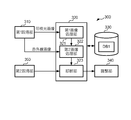
- DESCRIPTION OF SYMBOLS 100 Diagnosis system, 300 ... Information processing apparatus, 310 ... 1st acquisition part, 320 ... Control part, 330 ... Memory
- FIG. 1 shows an overview of the diagnostic system 100.
- the diagnostic system 100 includes a visible light camera 201 (201-1 and 201-2), an infrared camera 202 (202-1 and 202-2), a sensor, and a sensor provided in an area for managing livestock such as cattle and pigs. 400, a cow 500 (a cow 500-A, a cow 500-B, a cow 500-C) and an environment adjusting unit 600 (600-1, 600-1).
- the positions and number of visible light cameras 201, infrared cameras 202, and sensors 400 in FIG. 1 are merely examples.
- the figure shows the example of raising and managing cattle in the outdoor grazing area GR, in the case of livestock managed indoors, all the components of the diagnostic system 100 may be installed indoors. A part may be installed indoors (outdoors).
- Detailed functions of each visible light camera 201 may be the same or different.
- the detailed functions of each environment adjustment unit 600 may be the same or different.
- the sensor 400 measures information about the environment of the grazing area GR, such as illumination amount, wind direction, wind speed, temperature, air temperature, humidity, and atmospheric pressure.
- the environment adjustment unit 600 is a device that changes the environment of the grazing area GR that operates under the control of the information processing device 300, and is, for example, an air conditioner such as a blower or a lighting device.
- the visible light camera 201 includes an optical system such as a lens, a light detection element, an image processor, and the like, and detects light from a subject to generate image data (referred to as visible light image data).
- the infrared camera 202 includes an optical system such as a lens, an infrared detection element, an image processing processor, and the like, and detects infrared rays emitted from the subject of the imaging element to generate infrared image data (thermography).
- An infrared image is a color representation of temperature for each part of a subject.
- At least one of the visible light camera 201 and the infrared camera 202 automatically adjusts the direction of the lens, the angle of view, the focus and zoom, and the transmission timing of the generated image data according to a predetermined image recognition algorithm. The decision may be made.
- the used shooting conditions are transmitted to the information processing apparatus 300 together with the image data. That is, the information processing apparatus 300 always grasps the operating states of all visible light cameras 201 and infrared cameras 202.
- the timing at which the infrared image data and visible light image data are supplied to the information processing apparatus 300 may be independent or synchronized.
- Each of the visible light image and the infrared image may be a still image, or may be one moving image composed of a plurality of still images captured at a plurality of time points.
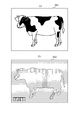
- FIG. 4 shows an example of an image represented by the image data acquired by the first acquisition unit 310.
- the visible light image IM1 and the infrared image IM2 are a visible light image obtained by photographing a certain subject with one visible light camera 201 and an infrared image obtained by photographing the subject with one infrared camera 202, respectively.
- the color difference is represented by the type of hatching.
- the second acquisition unit 350 is implemented as a communication interface, and acquires environmental information indicating the living environment of the cows 500-1, 500-2, and 500-3 that are animals to be monitored from the sensor 400.
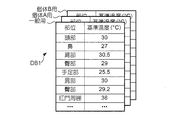
- the storage unit 330 is a storage device implemented as one or more memories or hard disks, and when executed by the processor of the storage unit 330, in addition to a program for realizing the functions of the information processing apparatus 300 described later, A database DB1 describing a plurality of reference temperatures corresponding to each of a plurality of animal parts is stored. This program is downloaded and installed in 300 via a communication network such as the Internet.
- FIG. 6 is an example of information stored in the database DB1.
- the database DB1 in addition to a table (for individual A and for individual B) in which a part and a reference temperature are associated with each individual to be monitored, a general-purpose table (general purpose) applied regardless of the individual ) Is stored.
- the reference temperature is, for example, a temperature in a normal (healthy) state.
- parts registered are an illustration, and can be suitably determined according to the kind etc. of the animal, the content to diagnose.
- the storage unit 330 further stores an algorithm for analyzing the visible light image and the infrared image.
- the storage unit 330 stores installation positions (photographing viewpoints) of all the cameras constituting the diagnostic system 100. Based on the positional relationship between the visible light camera 201 that generated the acquired visible light image and the infrared camera 202 that generated the infrared image, and the imaging conditions of the visible light camera 201 and the infrared camera 202, the control unit 320 is visible. Correspondence between the position of the subject in the optical image data and the position of the subject in the infrared image is determined. In other words, the mapping between the position on the visible light image and the position on the infrared image is performed.
- the control unit 320 is implemented by one or more processors, and performs animal diagnosis based on visible light image data and infrared image data supplied from at least one visible light camera 201 and at least one infrared camera 202. It should be noted that which of the plurality of visible light cameras 201 and infrared cameras 202 uses which image data generated by which visible light camera 201 and which infrared camera 202 is used is a set whose installation positions are necessarily close to each other. It is not necessary to employ image data generated by the visible light camera 201 and the infrared camera 202. In short, it is only necessary that the correspondence between the acquired position on the visible light image and the position on the infrared image can be specified.
- the control unit 320 includes a first image processing unit 321, a second image processing unit 322, and a diagnosis unit 323.
- the first image processing unit 321 is implemented by an image processor and performs image analysis on the visible light image supplied from the first acquisition unit 310. Specifically, the first image processing unit 321 determines whether the monitoring target animal is reflected in the visible light image. Then, the first image processing unit 321 uses a predetermined pattern matching algorithm, and each part predetermined for an animal photographed by each visible light camera 201 in the visible light image supplied from the first acquisition unit 310. The area corresponding to is specified.
- the first image processing unit 321 may identify a plurality of individuals captured by each visible light camera 201. For example, when a tag in which a unique identification code is formed is attached to a predetermined part of each individual, the identification code is read, and the individual is specified with reference to a database stored in the storage unit 330. Alternatively, information regarding the appearance unique to the individual such as the body shape, hair pattern, and shape of the part may be stored in the storage unit 330, and the individual may be identified by recognizing the shape or pattern from the visible light image data. Further, the first image processing unit 321 may specify the positional relationship between the first individual and the second individual.
- the control unit 320 analyzes all visible light image data acquired from the camera 201, and about the animal Other visible light cameras 201 in which all or a part of the at least some of the parts are photographed may be specified, and a visible light image generated by the other visible light cameras 201 may be further used. That is, two or more visible light image data are used for one animal. Specifically, the control unit 320 determines whether the specified part is excessive or insufficient with reference to the DB1, and if there is an insufficient part, the control unit 320 is suitable using information on the arrangement of the visible light camera. Another visible light camera 201 is specified. When there is no video for the identified other visible light camera 201, the visible light image data captured by the other visible light camera 201 may be supplied via the first acquisition unit 310. Good.
- the visible light camera 201 when a certain visible light camera 201 captures an animal from the front, the part behind the body may not be reflected. Even in such a case, the visible light camera 201 installed behind the animal may By using together the visible light image data of the visible light camera 201 that photographed the animal, visible light image data obtained by photographing all parts determined to be necessary for diagnosis of the animal can be obtained.
- the second image processing unit 322 is implemented as an image processing processor, and specifies a region in the infrared image corresponding to the region specified by the first image processing unit 321 based on the image conversion algorithm stored in the storage unit 330. .
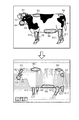
- FIG. 5 shows an example of the areas specified by the first image processing unit 321 and the second image processing unit 322 based on the visible light image and the infrared image captured for the same individual.
- the first image processing unit 321 specifies predetermined parts R1 to R10 on the visible light image IM1 based on the analyzed contours, pattern patterns, and the like, and specifies the specified parts R1 to R10.
- the regions on the infrared image IM2 respectively corresponding to are identified as R1 ′ to R10 ′.
- what is specified by the first image processing unit 321 and the second image processing unit 322 is not an area of a finite size, but may be a single point of coordinates. In short, it is only necessary to measure the temperature at a position determined as a measurement target necessary for performing diagnosis based on temperature.
- each visible light image data is arranged closest to the visible light camera 201 that generated the visible light image.
- the infrared image data generated by the infrared camera 202 is specified, and the temperature is measured for each part specified on the visible light image data.
- the number of visible light image data and infrared image data used does not have to match. This depends on the relationship between the installation position of the infrared camera 202 and the installation position of the visible light camera 201.
- the temperature of all parts specified by one or more visible light cameras 201 for a certain animal may be determined based on one or more infrared image data.
- the diagnosis unit 323 diagnoses an animal based on the temperature of one or more areas specified by the second image processing unit 322. In a preferred embodiment, the diagnosis unit 323 compares the temperatures in the plurality of regions specified by the second image processing unit 322 with each reference temperature, and based on the difference from the reference temperature of the temperature measured for each part, The state of the animal (information such as whether or not the disease has developed, the period in the physiological cycle such as how long it takes to give birth or estrus, and other conditions such as mood, excitement, stress received) judge. For example, when a statistic such as an average value of each part deviation is equal to or greater than a predetermined threshold, it is determined that the patient is not in a healthy state.
- a threshold value is set for each part, and a symptom is associated with one or more target parts, and it is determined that a predetermined symptom is developed.
- the diagnosis unit 323 may output a diagnosis result for each individual.
- the diagnosis unit 323 may refer to the temperature of another measured individual when performing diagnosis for one individual among a plurality of individuals. For example, by performing statistical processing such as calculating the average value and median value of the temperature difference measured in all individuals to be monitored, the temperature measured for a certain individual is corrected using the calculated statistic. Determine the temperature for the individual. Thereby, for example, the state of each individual can be determined in consideration of the characteristic of temperature change commonly seen in a plurality of animals to be monitored. For example, when an increase in body temperature is observed in a plurality of cows 500, there is a high possibility that the result of an increase in outside air temperature is not due to a symptom such as a disease, but an erroneous diagnosis result may be generated. Decrease.
- the diagnosis unit 323 may make a diagnosis in consideration of the environmental information acquired by the second acquisition unit 350 in order to increase the determination accuracy as to whether the temperature change is caused by the environment or the physical condition. Specifically, the reference temperature is corrected according to the temperature, humidity, amount of sunlight, season, etc. measured by the sensor 400. Further, the diagnosis unit 323 may perform diagnosis using information on the positional relationship between animals calculated by the first image processing unit 321. For example, the first image processing unit 321 calculates the total time and frequency of the time when other animals exist within a predetermined distance range from the target animal whose temperature is to be measured, and based on the calculated information, the stress level of the target animal. Is calculated. Alternatively, the first image processing unit 321 may calculate the stress degree by calculating the temporal change (movement) of the positional relationship.
- the diagnosis unit 323 may use a plurality of visible light images and a plurality of infrared images captured for a single individual within a predetermined period. For example, using a total of 10 sets of visible light images and infrared images taken continuously for 10 seconds, each part is subjected to statistical processing (for example, calculation of an average value) with respect to temperatures obtained by 10 measurements. The numerical value obtained through is output. In this way, instantaneous sudden temperature fluctuations and noise effects are removed, and temperature measurement accuracy is improved.
- the temperature change may be measured for a single individual over a period of several days to several weeks, based on the fact that the diagnosis requires information on changes in temperature over time depending on the symptoms and conditions of the animal. By grasping the change tendency of temperature over a long period of time for one individual, the range of medical conditions that can be diagnosed is expanded, or the accuracy of diagnosis is improved.
- the adjustment unit 340 is implemented as a processor and a communication interface, and generates a control signal based on information representing the diagnosis result output from the diagnosis unit 323 and transmits the control signal to one or more environment adjustment units 600. Specifically, the adjustment unit 340 determines the necessity of transmission of control information and the content of control for each environment adjustment unit 600 based on the information indicating the diagnosis result, and determines the necessary one or more environment adjustment units 600. A control signal representing the determined control content is transmitted.
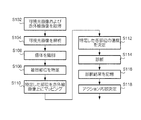
- FIG. 7 shows an operation example of the diagnostic system 100.
- image analysis is executed by the first image processing unit 321. Specifically, it is detected whether or not a predetermined animal to be monitored is shown (S104). If it is shown, an individual of the animal is identified (S106). Further, one or more predetermined regions of interest that are predetermined for the animal are specified (S108). Subsequently, the second image processing unit 322 maps each identified part on the infrared image (S110), and determines the temperature of each identified part based on the infrared image (S112).
- the diagnosis unit 323 refers to the database DB1 and diagnoses the subject based on the difference between the temperature of each part and the reference temperature (S114). 323 stores the diagnosis result in the storage unit 330 (S116), and may update the reference temperature registered in the database DB1 as necessary. Then, the diagnosis unit 323 determines an action to be taken based on the diagnosis result. Specifically, the necessity and contents of control are determined for each environment adjustment unit 600 based on the diagnosis result (S118), and a control signal is transmitted to one or more environment adjustment units 600 as necessary.
- the series of processing from S102 to S118 may be performed each time an image is acquired, or may be performed on a schedule unrelated to the image acquisition timing (for example, periodically) or registered as a monitoring target. It may be repeated until all individuals are detected.
- the position (and region) of the part of the subject can be accurately specified using the visible light image, and the temperature of the specified region can be measured.
- the temperature measurement accuracy for the predetermined part is improved as compared with the case where the part is specified and the temperature is measured only by the thermographic image.
- the state of the monitored animal physical condition such as whether it is healthy or sick, whether or not childbirth is close, mood, excitement, stressed state, etc.
- the diagnostic device of the present invention corresponds to an acquisition unit that acquires a visible light image and an infrared image captured by a camera, and a predetermined part of an animal captured by the camera in the visible light image.
- a first image processing unit for specifying a region; a second image processing unit for specifying a region in the infrared image corresponding to the region specified by the first image processing unit; and the second image processing unit. It is only necessary to have a diagnostic unit that diagnoses the animal based on the temperature of the specified region.
Landscapes
- Engineering & Computer Science (AREA)
- Health & Medical Sciences (AREA)
- Life Sciences & Earth Sciences (AREA)
- Physics & Mathematics (AREA)
- General Health & Medical Sciences (AREA)
- Medical Informatics (AREA)
- General Physics & Mathematics (AREA)
- Theoretical Computer Science (AREA)
- Multimedia (AREA)
- Veterinary Medicine (AREA)
- Public Health (AREA)
- Biophysics (AREA)
- Pathology (AREA)
- Biomedical Technology (AREA)
- Heart & Thoracic Surgery (AREA)
- Molecular Biology (AREA)
- Surgery (AREA)
- Animal Behavior & Ethology (AREA)
- Computer Vision & Pattern Recognition (AREA)
- Signal Processing (AREA)
- Environmental Sciences (AREA)
- Artificial Intelligence (AREA)
- Physiology (AREA)
- Psychiatry (AREA)
- Quality & Reliability (AREA)
- Animal Husbandry (AREA)
- Biodiversity & Conservation Biology (AREA)
- Radiology & Medical Imaging (AREA)
- Nuclear Medicine, Radiotherapy & Molecular Imaging (AREA)
- Human Computer Interaction (AREA)
- Measuring And Recording Apparatus For Diagnosis (AREA)
- Radiation Pyrometers (AREA)
Abstract
Description
本発明は、対象の各部位の温度の測定精度を向上させることを目的とする。
図1における可視光カメラ201、赤外線カメラ202、センサ400の位置や個数は、例示に過ぎない。また、同図では、屋外の放牧エリアGRで牛を飼育・管理する例を示しているが、屋内で管理する家畜の場合は診断システム100の全ての構成要素は屋内に設置されてもよいし、一部を屋内(屋外)に設置されてもよい。
各可視光カメラ201の詳細な機能は、同一であってもよいし異なっていてもよい。同様に、各環境調整部600の詳細の機能は同一であってもよいし異なっていてもよい。
環境調整部600は、情報処理装置300の制御の下で動作する、放牧エリアGRの環境を変化させる装置で、例えば、送風機などの空調機器や照明装置である。
赤外線カメラ202は、レンズ等の光学系や赤外線を検出素子や画像処理プロセッサ等を含み、撮像素子被写体から発せされる赤外線を感知して赤外線画像データ(サーモグラフィー)を生成する。赤外線画像とは、被写体の部位ごとに温度を色によって表わしたものである。
また、900は、センサ400にて測定されたデータを情報処理装置300に送信する。また、900を介し、情報処理装置300から各環境調整部600へ制御信号が供給される。制御信号には。例えば、電源のON/OFFタイミング、送風量(回転数)が含まれる。
基準温度とは、例えば正常(健康)な状態における温度である。なお、登録される部位の位置や数は例示であり、動物の種類、診断したい内容等に応じて適宜定めることができる。なお、個体ごとにテーブルを有する必要はなく、例えば一つの品種の動物に対して一つのテーブルを有していてもよい。
なお、複数の可視光カメラ201および赤外線カメラ202のうちどの可視光カメラ201およびどの赤外線カメラ202で生成された画像データを用いるかは任意であって、必ずしも設置位置が互いに近接している一組の可視光カメラ201および赤外線カメラ202にて生成された画像データを採用する必要はない。要するに、取得した可視光画像上の位置と、赤外線画像上の位置との対応関係が特定できればよい。
さらに、第1画像処理部321は、第1の個体と第2の個体との位置関係を特定してもよい。
ここで、用いる可視光画像データと赤外線画像データの枚数は一致しなくてもよい。赤外線カメラ202の設置位置と可視光カメラ201の設置位置の関係に依存する。要するに、ある動物について1以上の可視光カメラ201にて特定した全ての部位の温度が、1以上の赤外線画像データに基づいて決定されればよい。
また、診断部323は第1画像処理部321にて算出した動物どうしの位置関係の情報を用いて診断を行ってもよい。例えば、第1画像処理部321において温度を計測する対象の動物から所定の距離範囲に他の動物が存在する時間の合計や頻度を算出し、算出した情報に基づいて当該対象の動物のストレス度を算出する。あるいは、第1画像処理部321にて上記位置関係の時間変化(動き)を算出してストレス度を算出してもよい。
あるいは、動物の症状や状態によっては、診断には温度の計時変化の情報が求められることを踏まえ、一つの個体に対し、数日ないし数週間という期間で、温度変化を計測してもよい。一つの個体について長期間にわたる温度の変化傾向を把握することで、診断できる病状の範囲が広がり、あるいは診断の精度が向上する。
続いて、第2画像処理部322は、特定した各部位を赤外線画像上にマッピング(S110)し、赤外線画像に基づいて、特定した各部位の温度を決定する(S112)。
Claims (10)
- カメラにて撮像された、可視光画像および赤外線画像を取得する取得部と、
前記可視光画像において、前記カメラにて撮影された動物の所定の部位に対応する領域を特定する第1画像処理部と、
前記第1画像処理部にて特定された領域に対応する、前記赤外線画像における領域を特定する第2画像処理部と、
前記第2画像処理部にて特定された領域の温度に基づいて、前記動物を診断する診断部と
を有する診断装置。 - 前記動物の複数の部位の各々に対応する複数の基準温度を記憶した記憶部をさらに備え、
前記第1画像処理部は、複数の所定の部位の各々に対応する複数の領域を特定し、
前記診断部は、前記第2画像処理部にて特定された複数の領域における温度と各基準温度とを比較する、
請求項1に記載の診断装置。 - 前記第1画像処理部は、前記カメラにて撮像された複数の個体をそれぞれ識別し、
前記診断部は個体ごとに診断結果を出力する、
請求項1または2に記載の診断装置。 - 前記診断部は、前記複数の個体のうち一の個体について診断を行うに際し、他の個体の温度を用いる、
請求項3に記載の診断装置。 - 前記第1画像処理部は、第1の個体と第2の個体との位置関係を特定し、
前記診断部は前記位置関係を用いる、
請求項3に記載の診断装置。 - 前記動物の生活環境を示す環境情報を取得する第2取得部を更に有し、
前記診断部は前記環境情報を用いる、
請求項1~4のいずれか一つに記載の診断装置。 - 前記可視光画像および前記赤外線画像は、それぞれ複数の時点において撮像され、
前記診断部は、所定の期間内に撮像された複数の可視光画像および複数の赤外線画像を用いる、
請求項1~6のいずれか一つに記載の診断装置。 - 前記診断部にて出力された診断の結果を表す情報に基づいて生活環境を調整する調整部を更に有する、
請求項1~7のいずれか一つに記載の診断装置。 - カメラにて撮像された、可視光画像および赤外線画像を取得するステップと、
前記可視光画像において、前記カメラにて撮影された動物の所定の部位に対応する領域を特定するステップと、
前記特定された前記可視光画像における領域に対応する、前記赤外線画像における領域を特定するステップと、
前記特定された領域の温度に基づいて前記動物を診断するステップと
を有する、動物の診断方法。 - コンピュータに、
カメラにて撮像された、可視光画像および赤外線画像を取得するステップと、
前記可視光画像において、前記カメラにて撮影された動物の所定の部位に対応する領域を特定するステップと、
前記特定された前記可視光画像における領域に対応する、前記赤外線画像における領域を特定するステップと、
前記特定された領域の温度に基づいて前記動物を診断するステップと
を実行させるためのプログラム。
Priority Applications (3)
| Application Number | Priority Date | Filing Date | Title |
|---|---|---|---|
| PCT/JP2016/073122 WO2018025404A1 (ja) | 2016-08-05 | 2016-08-05 | 診断装置 |
| US15/540,065 US10687713B2 (en) | 2016-08-05 | 2016-08-05 | Diagnostic apparatus |
| JP2016563215A JP6101878B1 (ja) | 2016-08-05 | 2016-08-05 | 診断装置 |
Applications Claiming Priority (1)
| Application Number | Priority Date | Filing Date | Title |
|---|---|---|---|
| PCT/JP2016/073122 WO2018025404A1 (ja) | 2016-08-05 | 2016-08-05 | 診断装置 |
Publications (1)
| Publication Number | Publication Date |
|---|---|
| WO2018025404A1 true WO2018025404A1 (ja) | 2018-02-08 |
Family
ID=58363267
Family Applications (1)
| Application Number | Title | Priority Date | Filing Date |
|---|---|---|---|
| PCT/JP2016/073122 Ceased WO2018025404A1 (ja) | 2016-08-05 | 2016-08-05 | 診断装置 |
Country Status (3)
| Country | Link |
|---|---|
| US (1) | US10687713B2 (ja) |
| JP (1) | JP6101878B1 (ja) |
| WO (1) | WO2018025404A1 (ja) |
Cited By (3)
| Publication number | Priority date | Publication date | Assignee | Title |
|---|---|---|---|---|
| CN109029779A (zh) * | 2018-04-28 | 2018-12-18 | 华映科技(集团)股份有限公司 | 一种实时人体温度快速侦测法 |
| WO2020096515A1 (en) * | 2018-11-09 | 2020-05-14 | Bmp Innovation Ab | Methods and systems for accurate temperature readings of animals of interest |
| CN112513915A (zh) * | 2018-08-30 | 2021-03-16 | 松下知识产权经营株式会社 | 动物信息管理系统和动物信息管理方法 |
Families Citing this family (17)
| Publication number | Priority date | Publication date | Assignee | Title |
|---|---|---|---|---|
| WO2018073899A1 (ja) * | 2016-10-18 | 2018-04-26 | 株式会社オプティム | コンピュータシステム、植物の診断方法及びプログラム |
| JP6592613B2 (ja) * | 2016-10-31 | 2019-10-16 | 株式会社オプティム | コンピュータシステム、植物の診断方法及びプログラム |
| JP6441546B2 (ja) * | 2016-10-31 | 2018-12-19 | 株式会社オプティム | コンピュータシステム、物体の診断方法及びプログラム |
| KR101984983B1 (ko) * | 2017-09-22 | 2019-05-31 | 국립생태원 | 야생동물 모니터링 시스템 및 그 방법 |
| EP3669645A4 (en) * | 2017-09-22 | 2020-10-21 | Panasonic Intellectual Property Management Co., Ltd. | LIVESTOCK INFORMATION MANAGEMENT SYSTEM, LIVESTOCK STALL, LIVESTOCK INFORMATION MANAGEMENT PROGRAM AND LIVESTOCK INFORMATION MANAGEMENT PROCESS |
| JP6827393B2 (ja) * | 2017-09-25 | 2021-02-10 | 株式会社トプコン | 動物の健康状態管理システム及び管理方法 |
| KR101931263B1 (ko) * | 2018-04-25 | 2018-12-20 | 주식회사 근옥 | 근거리 무선 통신을 이용한 돼지 사육 시스템 |
| KR101931270B1 (ko) * | 2018-04-25 | 2018-12-20 | 주식회사 근옥 | 영상 분석을 이용한 자돈 사육 시스템 |
| KR102756470B1 (ko) | 2019-01-02 | 2025-01-20 | 엘지이노텍 주식회사 | 사육장 환경 관리 장치 |
| SE543210C2 (en) * | 2019-04-05 | 2020-10-27 | Delaval Holding Ab | Method and control arrangement for detecting a health condition of an animal |
| TWI830907B (zh) * | 2019-06-05 | 2024-02-01 | 日商索尼半導體解決方案公司 | 圖像辨識裝置及圖像辨識方法 |
| GB2591432B (en) * | 2019-10-11 | 2024-04-10 | Caucus Connect Ltd | Animal detection |
| TW202207867A (zh) * | 2020-08-24 | 2022-03-01 | 禾企電子股份有限公司 | 體溫異常個體快篩系統 |
| US12369568B1 (en) * | 2020-12-04 | 2025-07-29 | Jarret Mason New | Livestock, wildlife, and domesticated animal automated temperature screening system and process to monitor health and wellbeing of animals |
| JP7577261B2 (ja) * | 2021-03-02 | 2024-11-05 | 国立大学法人 宮崎大学 | 動物用検温装置およびこれを用いた体調管理システム |
| CN113155292B (zh) * | 2021-03-30 | 2024-06-28 | 芯算一体(深圳)科技有限公司 | 人脸测温方法、人脸测温仪及存储介质 |
| CN115281627B (zh) * | 2022-08-09 | 2025-05-16 | 广州市番禺区中心医院 | 一种基于视觉智能识别的心血管疾病预防诊断系统 |
Citations (2)
| Publication number | Priority date | Publication date | Assignee | Title |
|---|---|---|---|---|
| JP2010194074A (ja) * | 2009-02-25 | 2010-09-09 | Terumo Corp | 赤外線サーモグラフィ装置 |
| JP2014135993A (ja) * | 2013-01-16 | 2014-07-28 | Nippon Avionics Co Ltd | 体温測定装置、体温測定方法及び体温管理システム |
Family Cites Families (6)
| Publication number | Priority date | Publication date | Assignee | Title |
|---|---|---|---|---|
| JPH11120458A (ja) * | 1997-10-14 | 1999-04-30 | Hitachi Eng & Service Co Ltd | 火災検知装置 |
| JP2002022652A (ja) * | 2000-07-10 | 2002-01-23 | Horiba Ltd | 波長分析型赤外画像および可視画像解析装置 |
| JP2002132341A (ja) * | 2000-10-26 | 2002-05-10 | Toshiba Corp | 現場点検装置 |
| JP2003310055A (ja) * | 2002-04-26 | 2003-11-05 | Matsushita Electric Ind Co Ltd | 植物育成装置および植物育成方法、並びにその方法を記録した記録媒体 |
| EP2530442A1 (en) * | 2011-05-30 | 2012-12-05 | Axis AB | Methods and apparatus for thermographic measurements. |
| BR112015012761A2 (pt) * | 2012-12-02 | 2017-07-11 | Agricam Ab | sistema e método para prever o resultado da saúde de um indivíduo em um ambiente, e, uso de um sistema |
-
2016
- 2016-08-05 JP JP2016563215A patent/JP6101878B1/ja active Active
- 2016-08-05 WO PCT/JP2016/073122 patent/WO2018025404A1/ja not_active Ceased
- 2016-08-05 US US15/540,065 patent/US10687713B2/en active Active
Patent Citations (2)
| Publication number | Priority date | Publication date | Assignee | Title |
|---|---|---|---|---|
| JP2010194074A (ja) * | 2009-02-25 | 2010-09-09 | Terumo Corp | 赤外線サーモグラフィ装置 |
| JP2014135993A (ja) * | 2013-01-16 | 2014-07-28 | Nippon Avionics Co Ltd | 体温測定装置、体温測定方法及び体温管理システム |
Non-Patent Citations (1)
| Title |
|---|
| YOJI FUKUI ET AL.: "Infrared Thermographic Analysis of Each Part of Body Surface Temperature in Healthy Cattle, and a Study of the Difference between Left and Right Skin Temperatures", JOURNAL OF THE JAPAN VETERINARY MEDICAL ASSOCIATION, vol. 67, no. 4, 20 May 2014 (2014-05-20), pages 249 - 254, XP055462322 * |
Cited By (3)
| Publication number | Priority date | Publication date | Assignee | Title |
|---|---|---|---|---|
| CN109029779A (zh) * | 2018-04-28 | 2018-12-18 | 华映科技(集团)股份有限公司 | 一种实时人体温度快速侦测法 |
| CN112513915A (zh) * | 2018-08-30 | 2021-03-16 | 松下知识产权经营株式会社 | 动物信息管理系统和动物信息管理方法 |
| WO2020096515A1 (en) * | 2018-11-09 | 2020-05-14 | Bmp Innovation Ab | Methods and systems for accurate temperature readings of animals of interest |
Also Published As
| Publication number | Publication date |
|---|---|
| JPWO2018025404A1 (ja) | 2018-08-02 |
| JP6101878B1 (ja) | 2017-03-22 |
| US10687713B2 (en) | 2020-06-23 |
| US20190159681A1 (en) | 2019-05-30 |
Similar Documents
| Publication | Publication Date | Title |
|---|---|---|
| JP6101878B1 (ja) | 診断装置 | |
| US9922242B2 (en) | Systems and methods for predicting the outcome of a state of a subject | |
| Ma et al. | Development of noncontact body temperature monitoring and prediction system for livestock cattle | |
| Reza et al. | Thermal imaging and computer vision technologies for the enhancement of pig husbandry: a review | |
| US11100642B2 (en) | Computer system, and method and program for diagnosing animals | |
| US12262697B2 (en) | Apparatus and methodologies for improved detection of important biological states in animals | |
| US20210216758A1 (en) | Animal information management system and animal information management method | |
| JP2022529250A (ja) | 動物の健康状態を検出するための方法および制御装置 | |
| Chuang et al. | Goose surface temperature monitoring system based on deep learning using visible and infrared thermal image integration | |
| US12137671B2 (en) | System for measuring body temperature in poultry | |
| KR20130088667A (ko) | 가축생산성 향상을 위한 u―IT기반 원격 화상 진료 장치 | |
| KR101558227B1 (ko) | 가축의 열화상을 이용한 가축의 유두부에 대한 질병 판독 시스템 | |
| Milan et al. | Survey and future prospects in precision dairy farming | |
| CN119941802A (zh) | 基于双光融合的高密度集群饲养生猪体温监测方法及系统 | |
| Yuan et al. | Stress-free detection technologies for pig growth based on welfare farming: A review | |
| Landgraf et al. | Modelling and correction of influences on surface temperature measurements using infrared thermography for animal health and welfare assessments | |
| KR20190075253A (ko) | 열화상 이미지를 활용한 가축 질병 감지 시스템 | |
| US20210145320A1 (en) | Animal physical activity tracking device and system having the same | |
| Zhang et al. | A non-contact rabbit temperature detection model based on improved YOLO11 | |
| KR20210085384A (ko) | IoT센서와 영상정보를 이용한 농작물상태분석시스템 | |
| CN118758409B (zh) | 一种面向畜禽饲养的称重测量方法及其系统、介质 | |
| CN120770783B (zh) | 一种兽医用非接触式红外体温与呼吸频率同步监测仪 | |
| US20260071916A1 (en) | Non-contact variable sensor system for key point temperature evaulation in animals | |
| KR20240066873A (ko) | 군집 사육 가축의 운동 활력도 측정 장치 및 방법 | |
| JP2022148725A (ja) | 位置推定モデル学習方法、位置推定モデル学習装置、位置推定モデル学習プログラム、位置推定方法、位置推定装置、及び位置推定プログラム |
Legal Events
| Date | Code | Title | Description |
|---|---|---|---|
| ENP | Entry into the national phase |
Ref document number: 2016563215 Country of ref document: JP Kind code of ref document: A |
|
| 121 | Ep: the epo has been informed by wipo that ep was designated in this application |
Ref document number: 16911663 Country of ref document: EP Kind code of ref document: A1 |
|
| NENP | Non-entry into the national phase |
Ref country code: DE |
|
| 32PN | Ep: public notification in the ep bulletin as address of the adressee cannot be established |
Free format text: NOTING OF LOSS OF RIGHTS PURSUANT TO RULE 112(1) EPC (EPO FORM 1205 DATED 17.05.2019) |
|
| 122 | Ep: pct application non-entry in european phase |
Ref document number: 16911663 Country of ref document: EP Kind code of ref document: A1 |