WO2018003846A1 - 二次元金属錯体 - Google Patents
二次元金属錯体 Download PDFInfo
- Publication number
- WO2018003846A1 WO2018003846A1 PCT/JP2017/023732 JP2017023732W WO2018003846A1 WO 2018003846 A1 WO2018003846 A1 WO 2018003846A1 JP 2017023732 W JP2017023732 W JP 2017023732W WO 2018003846 A1 WO2018003846 A1 WO 2018003846A1
- Authority
- WO
- WIPO (PCT)
- Prior art keywords
- metal complex
- ligand
- dimensional metal
- compound
- solution
- Prior art date
- Legal status (The legal status is an assumption and is not a legal conclusion. Google has not performed a legal analysis and makes no representation as to the accuracy of the status listed.)
- Ceased
Links
Images


Classifications
-
- C—CHEMISTRY; METALLURGY
- C07—ORGANIC CHEMISTRY
- C07F—ACYCLIC, CARBOCYCLIC OR HETEROCYCLIC COMPOUNDS CONTAINING ELEMENTS OTHER THAN CARBON, HYDROGEN, HALOGEN, OXYGEN, NITROGEN, SULFUR, SELENIUM OR TELLURIUM
- C07F15/00—Compounds containing elements of Groups 8, 9, 10 or 18 of the Periodic Table
- C07F15/04—Nickel compounds
-
- C—CHEMISTRY; METALLURGY
- C07—ORGANIC CHEMISTRY
- C07F—ACYCLIC, CARBOCYCLIC OR HETEROCYCLIC COMPOUNDS CONTAINING ELEMENTS OTHER THAN CARBON, HYDROGEN, HALOGEN, OXYGEN, NITROGEN, SULFUR, SELENIUM OR TELLURIUM
- C07F15/00—Compounds containing elements of Groups 8, 9, 10 or 18 of the Periodic Table
- C07F15/04—Nickel compounds
- C07F15/045—Nickel compounds without a metal-carbon linkage
-
- C—CHEMISTRY; METALLURGY
- C07—ORGANIC CHEMISTRY
- C07F—ACYCLIC, CARBOCYCLIC OR HETEROCYCLIC COMPOUNDS CONTAINING ELEMENTS OTHER THAN CARBON, HYDROGEN, HALOGEN, OXYGEN, NITROGEN, SULFUR, SELENIUM OR TELLURIUM
- C07F15/00—Compounds containing elements of Groups 8, 9, 10 or 18 of the Periodic Table
- C07F15/06—Cobalt compounds
-
- C—CHEMISTRY; METALLURGY
- C25—ELECTROLYTIC OR ELECTROPHORETIC PROCESSES; APPARATUS THEREFOR
- C25B—ELECTROLYTIC OR ELECTROPHORETIC PROCESSES FOR THE PRODUCTION OF COMPOUNDS OR NON-METALS; APPARATUS THEREFOR
- C25B11/00—Electrodes; Manufacture thereof not otherwise provided for
- C25B11/02—Electrodes; Manufacture thereof not otherwise provided for characterised by shape or form
-
- C—CHEMISTRY; METALLURGY
- C25—ELECTROLYTIC OR ELECTROPHORETIC PROCESSES; APPARATUS THEREFOR
- C25B—ELECTROLYTIC OR ELECTROPHORETIC PROCESSES FOR THE PRODUCTION OF COMPOUNDS OR NON-METALS; APPARATUS THEREFOR
- C25B11/00—Electrodes; Manufacture thereof not otherwise provided for
- C25B11/04—Electrodes; Manufacture thereof not otherwise provided for characterised by the material
- C25B11/051—Electrodes formed of electrocatalysts on a substrate or carrier
- C25B11/073—Electrodes formed of electrocatalysts on a substrate or carrier characterised by the electrocatalyst material
- C25B11/075—Electrodes formed of electrocatalysts on a substrate or carrier characterised by the electrocatalyst material consisting of a single catalytic element or catalytic compound
-
- C—CHEMISTRY; METALLURGY
- C25—ELECTROLYTIC OR ELECTROPHORETIC PROCESSES; APPARATUS THEREFOR
- C25B—ELECTROLYTIC OR ELECTROPHORETIC PROCESSES FOR THE PRODUCTION OF COMPOUNDS OR NON-METALS; APPARATUS THEREFOR
- C25B9/00—Cells or assemblies of cells; Constructional parts of cells; Assemblies of constructional parts, e.g. electrode-diaphragm assemblies; Process-related cell features
- C25B9/17—Cells comprising dimensionally-stable non-movable electrodes; Assemblies of constructional parts thereof
- C25B9/19—Cells comprising dimensionally-stable non-movable electrodes; Assemblies of constructional parts thereof with diaphragms
-
- H—ELECTRICITY
- H01—ELECTRIC ELEMENTS
- H01G—CAPACITORS; CAPACITORS, RECTIFIERS, DETECTORS, SWITCHING DEVICES, LIGHT-SENSITIVE OR TEMPERATURE-SENSITIVE DEVICES OF THE ELECTROLYTIC TYPE
- H01G11/00—Hybrid capacitors, i.e. capacitors having different positive and negative electrodes; Electric double-layer [EDL] capacitors; Processes for the manufacture thereof or of parts thereof
- H01G11/02—Hybrid capacitors, i.e. capacitors having different positive and negative electrodes; Electric double-layer [EDL] capacitors; Processes for the manufacture thereof or of parts thereof using combined reduction-oxidation reactions, e.g. redox arrangement or solion
-
- H—ELECTRICITY
- H01—ELECTRIC ELEMENTS
- H01G—CAPACITORS; CAPACITORS, RECTIFIERS, DETECTORS, SWITCHING DEVICES, LIGHT-SENSITIVE OR TEMPERATURE-SENSITIVE DEVICES OF THE ELECTROLYTIC TYPE
- H01G11/00—Hybrid capacitors, i.e. capacitors having different positive and negative electrodes; Electric double-layer [EDL] capacitors; Processes for the manufacture thereof or of parts thereof
- H01G11/22—Electrodes
- H01G11/30—Electrodes characterised by their material
-
- H—ELECTRICITY
- H01—ELECTRIC ELEMENTS
- H01G—CAPACITORS; CAPACITORS, RECTIFIERS, DETECTORS, SWITCHING DEVICES, LIGHT-SENSITIVE OR TEMPERATURE-SENSITIVE DEVICES OF THE ELECTROLYTIC TYPE
- H01G11/00—Hybrid capacitors, i.e. capacitors having different positive and negative electrodes; Electric double-layer [EDL] capacitors; Processes for the manufacture thereof or of parts thereof
- H01G11/22—Electrodes
- H01G11/30—Electrodes characterised by their material
- H01G11/48—Conductive polymers
-
- H—ELECTRICITY
- H01—ELECTRIC ELEMENTS
- H01G—CAPACITORS; CAPACITORS, RECTIFIERS, DETECTORS, SWITCHING DEVICES, LIGHT-SENSITIVE OR TEMPERATURE-SENSITIVE DEVICES OF THE ELECTROLYTIC TYPE
- H01G11/00—Hybrid capacitors, i.e. capacitors having different positive and negative electrodes; Electric double-layer [EDL] capacitors; Processes for the manufacture thereof or of parts thereof
- H01G11/84—Processes for the manufacture of hybrid or EDL capacitors, or components thereof
- H01G11/86—Processes for the manufacture of hybrid or EDL capacitors, or components thereof specially adapted for electrodes
-
- Y—GENERAL TAGGING OF NEW TECHNOLOGICAL DEVELOPMENTS; GENERAL TAGGING OF CROSS-SECTIONAL TECHNOLOGIES SPANNING OVER SEVERAL SECTIONS OF THE IPC; TECHNICAL SUBJECTS COVERED BY FORMER USPC CROSS-REFERENCE ART COLLECTIONS [XRACs] AND DIGESTS
- Y02—TECHNOLOGIES OR APPLICATIONS FOR MITIGATION OR ADAPTATION AGAINST CLIMATE CHANGE
- Y02E—REDUCTION OF GREENHOUSE GAS [GHG] EMISSIONS, RELATED TO ENERGY GENERATION, TRANSMISSION OR DISTRIBUTION
- Y02E60/00—Enabling technologies; Technologies with a potential or indirect contribution to GHG emissions mitigation
- Y02E60/30—Hydrogen technology
- Y02E60/36—Hydrogen production from non-carbon containing sources, e.g. by water electrolysis
Definitions
- the present invention relates to a two-dimensional metal complex.
- the present invention is a metal complex using a ligand having three or more sites coordinated by bidentate, and at least one of the bidentates is NH, and the metal complex is substantially
- the present invention relates to a two-dimensional metal complex in which substantially all atoms and metal nuclei of the ligand formed in the above exist on substantially the same plane.
- the present invention also relates to a material having the above two-dimensional metal complex.
- this invention relates to the element and / or apparatus which have the said two-dimensional metal complex and / or the said material.
- this invention relates to the manufacturing method of the said two-dimensional metal complex.
- Hydrogen is expected as a clean energy source, and the development of an efficient manufacturing method is a technology that forms the basis of clean energy. Platinum is known as an excellent hydrogen generating electrode, but it is expensive and an alternative electrode material is required.
- an object of the present invention is to provide a substance and / or a material that is cheaper than platinum, has a hydrogen generation catalytic ability, has desired oxidation-reduction characteristics, and has a large number of pores. is there.
- the object of the present invention is to provide a substance and / or a material that can be used as a capacitor having characteristics of both a large output density and a high energy density, particularly a redox capacitor. It is to provide.
- the objective of this invention is providing the element and / or apparatus which have the said substance and / or material in addition to the said objective or in addition to the said objective. Moreover, the objective of this invention is providing the manufacturing method of the said substance and / or material in addition to the said objective or in addition to the said objective.
- the ligand preferably has an aryl group.
- the ligand is Ar (NH) n X mn (wherein Ar represents an aryl group, X is composed of S, O, Se, and Te) And at least one selected from the group, m is the number of binders depending on the aryl group and represents an integer of 6 or more, and n is an integer of 3 or more and m or less.
- the ligand is Bz (NH) n X 6-n (wherein Bz represents a benzene ring, X represents S, O, Se, and Te). And n is an integer of 3 to 6, and is preferably represented by the following formula L-1 or L-2.
- the ligand may have 4 or more, preferably 6 or more, more preferably 10 or more, and still more preferably 13 or more.
- the metal nucleus may have 3 or more, preferably 6 or more, more preferably 11 or more, and still more preferably 15 or more.
- the two-dimensional metal complex has the following formula C-1 (Wherein M 1 to M 6 are each independently at least one selected from the group consisting of Ni, Co, Cu, Pt, Pd, Fe, Mn, Re, Ru, Os, Rh, Ir, Ag, and Au. And X n1 to X n6 (n is 1 to 6) each independently represents a coordination atom or a coordination atom group represented by NH, S, O, Se, Te) It is good to have the site
- a two-dimensional metal having a portion represented by the above formula C-1 (wherein M 1 to M 6 and X n1 to X n6 (n is 1 to 6) have the same definition as above) Complex.
- the two-dimensional metal complex is formed of substantially all atoms of the ligand and the metal nucleus that substantially form the complex. area of the surface is 7.2 nm 2 or more, preferably 13.2 nm 2 or more, more preferably not less 18.6 nm 2 or more.
- the conductivity of the two-dimensional metal complex is 10 ⁇ 6 Scm ⁇ 1 or more, preferably 10 ⁇ 3 Scm ⁇ 1 or more, more preferably 10 ⁇ 1 Scm ⁇ . It should be 1 or more.
- the oxidation-reduction potential of the two-dimensional metal complex is ⁇ 3 V to +3 V vs. SHE (standard hydrogen electrode), preferably -2 V to +2 V vs. SHE, more preferably -1V to + 2V vs. It should be within the range of SHE.
- the porosity of the two-dimensional metal complex may be 30% or more, preferably 33% or more, more preferably 35% or more. In the present application, “porosity” refers to the ratio of holes in the area of the substantially same plane.
- ⁇ 13> A material having the two-dimensional metal complex according to any one of ⁇ 1> to ⁇ 12>.
- ⁇ 14> An element or device having the material of ⁇ 13> above.
- ⁇ 15> An element or device having the two-dimensional metal complex according to any one of ⁇ 1> to ⁇ 12>.
- the two-dimensional metal complex according to any one of the above ⁇ 1> to ⁇ 12> preferably the two-dimensional metal complex according to any one of the above ⁇ 2> to ⁇ 12>, more preferably the above ⁇ 3> to ⁇ 12>
- a process for producing any one of the two-dimensional metal complexes of any one of ⁇ 4> to ⁇ 12> above a) preparing the ligand; b) preparing a metal M compound as a raw material of the metal nucleus M; c) Under oxygen-free condition, the ligand prepared in a) and the compound of the metal M prepared in b) are dissolved in the ligand and a soluble solvent of the compound to obtain a solution. And d) contacting the solution obtained in c) with a gas containing oxygen; The said method of forming the said two-dimensional metal complex in a solution interface by having.
- the two-dimensional metal complex according to any one of the above ⁇ 1> to ⁇ 12> preferably the two-dimensional metal complex according to any one of the above ⁇ 2> to ⁇ 12>, more preferably the above ⁇ 3> to ⁇ 12>
- a process for producing any one of the two-dimensional metal complexes of any one of ⁇ 4> to ⁇ 12> above a) preparing the ligand; b) preparing a metal M compound as a raw material of the metal nucleus M; c) Under oxygen-free condition, the ligand prepared in a) and the compound of the metal M prepared in b) are dissolved in the ligand and a soluble solvent of the compound to obtain a solution. And e) providing an anode and a cathode in the solution obtained in c) and applying a current between the anode and the cathode, thereby forming the two-dimensional metal complex on the anode surface.
- the above method a) preparing the ligand; b)
- the application of the current is a constant potential, a potential that is more positive than the oxidation potential of the ligand, and ⁇ 3 to 3 V vs.
- the range of SHE preferably -2 to 2 V vs.
- the range of SHE more preferably ⁇ 1 to 2 V vs. It is preferably carried out within the range of SHE, specifically, 60 mV, preferably 120 mV, more positive than the oxidation potential.
- an electrode having a high conductivity and a wide potential window is preferable as the anode.
- the conductivity is 1 Scm ⁇ 1 or more and the potential window is ⁇ 2 to 1 V vs.
- a material that is SHE is preferable, and specific examples include glassy carbon, graphite, (ITO (Indium Tin Oxide) glass, platinum, gold, conductive diamond, etc.), but are not limited thereto.
- the specific surface area be high, preferably a material having a specific surface area of 50 m 2 / g, more preferably 200 m 2 / g. It can mention, but it is not limited to these.
- ⁇ 20> An electrode having a two-dimensional metal complex obtained by the method of ⁇ 17> to ⁇ 19> above.
- the two-dimensional metal complex according to any one of the above ⁇ 1> to ⁇ 12> preferably the two-dimensional metal complex according to any one of the above ⁇ 2> to ⁇ 12>, more preferably the above ⁇ 3> to ⁇ 12>
- a two-dimensional metal complex that is inexpensive compared with platinum, has a hydrogen generation catalytic ability, has desired redox characteristics, has a large number of vacancies, and / or has a large surface area, and / or Alternatively, a material including the complex can be provided. Further, according to the present invention, in addition to the above effect, or in addition to the above effect, a capacitor having both characteristics of a large output density and a high energy density, particularly a two-dimensional metal complex that can be used as a redox capacitor and / or the above-mentioned effect Materials with complexes can be provided.
- an element and / or device including the above two-dimensional metal complex and / or a material having the complex can be provided.
- the present invention can provide a method for producing the above two-dimensional metal complex and / or a material having the complex.
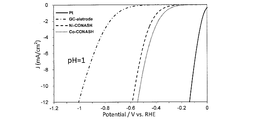
- the horizontal axis represents voltage (V vs. RHE), and the vertical axis represents current density (mA / cm 2 ).
- hydrogen generation catalytic ability of a glassy carbon electrode (indicated by “GC-electrode” in FIG. 1) and platinum (indicated by “Pt” in FIG. 1) is also shown.
- the electrode having the sheet-like substance B1 obtained in Example 2 (indicated by “Ni-CONASH” in FIG. 2) and the electrode having the sheet-like substance B3 obtained in Example 3 (“Co— It is a figure which shows the hydrogen generation catalytic ability in 1M KCl (pH 7).
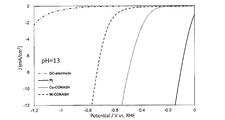
- the horizontal and vertical axes are the same as in FIG.
- An electrode having the sheet-like substance B1 obtained in Example 2 (indicated by “Ni-CONASH” in FIG. 3) and an electrode having the sheet-like substance B3 obtained in Example 3 (in FIG. 3, “Co— It is a figure which shows the hydrogen generation catalytic ability in 0.1M KOH (pH 13).
- the horizontal and vertical axes are the same as those in FIGS.
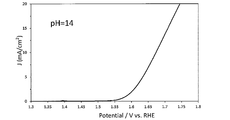
- the horizontal axis represents overvoltage (V vs. RHE), and the vertical axis represents current density (mA / cm 2 ).
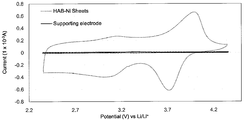
- the electrode having the sheet-like substance B1 obtained in Example 2 (represented by “HAB-Ni Sheets” in FIG. 5) and the electrode not having the sheet-like substance B1 (“Supporting electrode” in FIG. 5)
- the horizontal axis is the potential (V vs. Li + / Li)
- the vertical axis is the current ( ⁇ 10 ⁇ 3 A).
- the horizontal axis represents voltage (V vs. RHE), and the vertical axis represents current density ( ⁇ A / cm 2 ).
- the hydrogen generation catalytic ability of a glassy carbon electrode (indicated by “GC” in FIG. 6) and platinum (indicated by “Pt” in FIG. 6) is also shown.
- the present application discloses a two-dimensional metal complex.
- the present invention has a ligand having three or more sites coordinated by bidentate, and at least one of the bidentate is NH; and a metal nucleus M (M is Ni, A metal complex having at least one selected from the group consisting of Co, Cu, Pt, Pd, Fe, Mn, Re, Ru, Os, Rh, Ir, Ag, and Au.
- M is Ni
- a metal complex having at least one selected from the group consisting of Co, Cu, Pt, Pd, Fe, Mn, Re, Ru, Os, Rh, Ir, Ag, and Au Disclosed is a two-dimensional metal complex in which substantially all atoms of the ligand to be formed and the metal nucleus are present on substantially the same plane.
- the present application also discloses a material having the two-dimensional metal complex.
- the present application discloses an element and / or device comprising the two-dimensional metal complex and / or the material. Moreover, this invention discloses the manufacturing method of the said two-dimensional metal complex.
- the two-dimensional metal complex disclosed in the present application the material having the complex, the element or device including the complex or the material having the complex, and the method for producing the complex will be described in this order.
- the present application discloses a two-dimensional metal complex.
- the two-dimensional metal complex has three or more sites coordinated by bidentate, and a ligand in which at least one of the bidentates is NH; and a metal nucleus M (M is Ni, Co, A metal complex having at least one selected from the group consisting of Cu, Pt, Pd, Fe, Mn, Re, Ru, Os, Rh, Ir, Ag, and Au. Substantially all atoms of the ligand to be formed in the metal nucleus and the metal nucleus are present on substantially the same plane.
- substantially all atoms of the ligand forming the metal complex and the metal nucleus are present on substantially the same plane”, “a configuration that substantially forms the metal complex”. “Substantially all atoms of the ligand” is intended to exclude atoms that do not contribute to the formation of the metal complex as a ligand. Further, “substantially on the same plane” means that the center of all atoms contributing to the formation of the metal complex is contained within a plane width within 10 nm, preferably within 1 nm.
- the ligand has three or more positions coordinated by bidentate, and at least one of the bidentates is NH.
- “bidentate” means that there are two bonds coordinated to the same metal nucleus in the same ligand.
- “having three or more locations coordinated by“ bidentate ”” means that the same ligand has three or more sets having “bidentate” as one set.
- the ligand preferably has an aryl group. Examples of the aryl group include, but are not limited to, the following groups.
- Ar (NH) is good is a compound represented by n X m-n.
- Ar represents an aryl group.
- Ar include, but are not limited to, one or more selected from the group consisting of Ar-1 to Ar-19.
- X is preferably at least one selected from the group consisting of S, O, Se and Te, preferably S or O, more preferably S.
- m is the number of connectors depending on the aryl group, and represents an integer of 6 or more. For example, when Ar is Ar-11, m is 12 at the maximum because there are 12 connectors.
- n represents an integer of 3 to m.
- the ligand of the present invention is preferably a compound represented by Bz (NH) n X 6-n .
- Bz represents a benzene ring
- X and n have the same definition as described above.
- n is preferably 3 or 6, and more preferably 6. That is, the ligand of the present invention is preferably represented by the following formula L-1 or L-2, and more preferably a compound represented by the formula L-1.
- the above-mentioned ligand may have another ligand in addition to the above-mentioned ligand in the two-dimensional metal complex of the present invention.
- a compound having four —NH 2 in the benzene ring that is, a compound represented by the following formula LC-1 or LC-2
- a compound having two —NH 2 in the benzene ring That is, examples include compounds represented by the following formula LC-3, but are not limited thereto.
- a compound represented by the following formulas LC-1 to LC-3 is used as a ligand, it has an action of suppressing the spread of a plane in the two-dimensional metal complex. Therefore, in order to promote the spread of the plane of the two-dimensional metal complex, the amount of these other ligands should be small.
- the number of ligands depends on the spread of the plane of the two-dimensional metal complex, but is 4 or more, preferably 6 or more, more preferably 10 or more, and still more preferably 13 or more. It is good.
- Metal core> M of the metal nucleus M in the two-dimensional metal complex of the present invention is preferably a metal having a planar coordination structure as the coordination structure.
- it may be at least one selected from the group consisting of Ni, Co, Cu, Pt, Pd, Fe, Mn, Re, Ru, Os, Rh, Ir, Ag, and Au.
- the preferred metal nucleus M depends on the properties of the obtained two-dimensional metal complex, such as conductivity, redox potential, etc., but is at least one selected from the group consisting of Ni, Co, Cu, Fe and Mn. More preferably, it is at least one selected from the group consisting of Ni, Co, and Cu.
- the number of metal nuclei depends on the spread of the plane of the two-dimensional metal complex, but is 3 or more, preferably 6 or more, more preferably 11 or more, and still more preferably 15 or more. Is good.
- the two-dimensional metal complex of the present invention has three or more sites coordinated in bidentate, and a ligand in which at least one of the two sites is NH; and metal nucleus M ( M is a metal complex having at least one selected from the group consisting of Ni, Co, Cu, Pt, Pd, Fe, Mn, Re, Ru, Os, Rh, Ir, Ag, and Au. , Substantially all atoms of the ligand forming the metal complex and the metal nucleus are present on substantially the same plane. The structure depends on the number of ligands used, particularly the coordination bond of the ligand.
- a compound represented by Bz (NH) n X 6-n as the ligand for example, the above formula
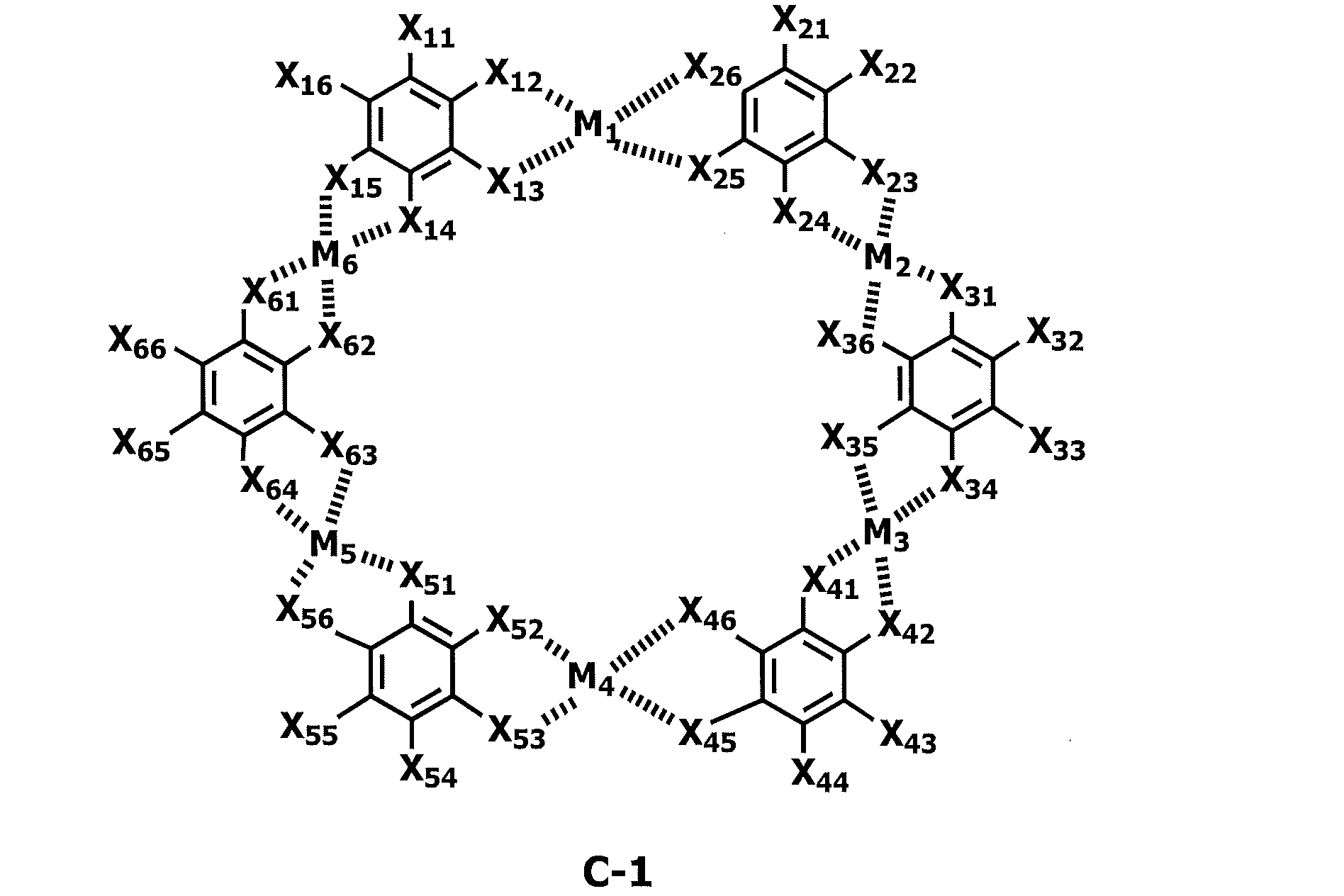
- a compound represented by L-1 or L-2 it preferably has a site represented by the following formula C-1.
- M 1 to M 6 are each independently at least one selected from the group consisting of Ni, Co, Cu, Pt, Pd, Fe, Mn, Re, Ru, Os, Rh, Ir, Ag, and Au. Seeds, X n1 to X n6 (n is 1 to 6) each independently represent a coordination atom or a coordination atom group represented by NH, S, O, Se, or Te.
- the two-dimensional metal complex of the present application may have any one, two, three or more of the following characteristics i) to iv).
- the area of the surface formed by substantially all the atoms of the ligand and the metal nucleus that substantially form the complex is 7.2 nm 2 or more, preferably 13. It should be 2 nm 2 or more, more preferably 18.6 nm 2 or more. The area can be determined from the structure of the ligand used in the two-dimensional metal complex, the atom of the ligand that substantially forms the complex, and the atomic radius of the metal nucleus.
- the conductivity is 10 ⁇ 6 Scm ⁇ 1 or more, preferably 10 ⁇ 3 Scm ⁇ 1 or more, more preferably 10 ⁇ 1 Scm ⁇ 1 or more.
- the conductivity can be determined by a two-terminal or four-terminal conductivity measurement method such as the van der Pauw method.
- Redox potential is -3V to + 3V vs. SHE (standard hydrogen electrode), preferably -2 V to +2 V vs. SHE, more preferably -1V to + 2V vs. It should be within the range of SHE.
- the oxidation-reduction potential can be obtained by electrochemical measurement such as a cyclic voltammetry method.
- the porosity of the two-dimensional metal complex should be 30% or more, preferably 33% or more, more preferably 35% or more.
- porosity refers to the ratio of holes in the area of the substantially same plane. Accordingly, the porosity is obtained from the structure of the ligand used in the two-dimensional metal complex, the atom of the ligand that substantially forms the complex, and the atomic radius of the metal nucleus, similarly to the area of i) above. Can do.
- the present application discloses a material having the two-dimensional metal complex.
- the material having the two-dimensional metal complex include, but are not limited to, a material obtained by providing a two-dimensional metal complex on a predetermined substrate, a self-supporting film made of only the two-dimensional metal complex, and the like.
- Specific examples of a material obtained by providing a two-dimensional metal complex on a predetermined substrate include a two-dimensional metal complex formed on an electrode obtained by electrochemical preparation described later. It is not limited to.
- this application discloses the element or apparatus which has the said 2D metal complex, and the element or apparatus provided with the material which has the said 2D metal complex.
- Such elements or devices include diodes, transistors, phototransistors, resonators, elements or devices with thermoelectric properties, elements or devices with piezoelectric properties, light emitting elements, valettronics, batteries, capacitors (electric double layer capacitors) , A redox capacitor), a photocatalyst, a hydrogen generation catalyst, an oxygen generation catalyst, a carbon dioxide reduction catalyst, and the like, but are not limited thereto.
- the two-dimensional metal complex of the present application when used as a redox capacitor, it can be configured as follows. That is, mention may be made of a film comprising only a two-dimensional metal complex film, a film using the two-dimensional metal complex of the present application as a polymer solid electrolyte film, and a film having a two-dimensional metal complex film disposed between two electrode substrates. Yes, but not limited to.
- the method for producing a two-dimensional metal complex of the present invention involves reacting a metal M compound, which is a raw material of the metal nucleus M, with a ligand under oxidizing conditions. it can. i) a technique using a reaction at the gas-liquid interface; ii) an electrochemical technique; and iii) a technique using a reaction at the liquid-liquid interface.
- a metal M compound which is a raw material of the metal nucleus M
- the two-dimensional metal complex can be obtained by a technique using a reaction at the gas-liquid interface.
- the method a) preparing a ligand; b) preparing a compound of metal M, which is a raw material of metal nucleus M; c) a step of dissolving a ligand prepared in a) and a compound of metal M prepared in b) under oxygen-free condition in a soluble solvent of the ligand and the compound to obtain a solution; and d ) Contacting the solution obtained in c) with a gas containing oxygen; By having a two-dimensional metal complex can be formed at the solution interface.
- “ligand”, “metal nucleus M”, and “compound of metal M” have the same definitions as above.
- Step a) is a step of preparing a ligand.
- the ligand those that can be purchased on the market may be purchased on the market or may be produced separately.
- Step b) is a step of preparing a metal M compound that is a raw material of the metal nucleus M of the two-dimensional metal complex.
- the compound depends on the ligand to be used, the solvent to be used in the reaction, the reactivity with the metal, etc., but acetate, chloride, sulfate, tetrafluoroborate, hexafluorophosphate, peroxide Examples include, but are not limited to, chlorates, acetylacetonate complexes, and ammine complexes.
- a compound there is a relationship with the solvent used in step c) and the ligand used, but there is no solubility in the solvent, no decomposability by light, etc., and when the compound is a complex, For example, the ligand binding is not strong and the ligand exchange reaction is likely to occur. In view of these, the compound should be dissolved and exist stably, and preferably ligand exchange is likely to occur.
- Step c) is a step of obtaining a solution by dissolving the ligand obtained in step a) and the compound of metal M obtained in step b) in the ligand and a soluble solvent for the compound.
- the solution may have additives that promote the reaction in step d), such as ammonia, amines, and the like.
- Step c) is preferably performed under oxygen-free conditions, for example, under an argon gas atmosphere or a nitrogen gas atmosphere.
- Step d) is a step of bringing the solution obtained in c) into contact with a gas containing oxygen.
- the step d) depends on the ligand used and its concentration, the compound of the metal M used and its concentration, the amount of oxygen used, etc., but it is carried out under conditions such as room temperature at 25 ° C. or in the vicinity thereof and pressure of 1 atm. Good.
- a two-dimensional metal complex can be obtained by the above process.
- a step of washing the obtained two-dimensional metal complex may be provided after step d).
- a step of changing the oxygen concentration may be provided between steps c).
- the two-dimensional metal complex can be obtained by an electrochemical method.
- the method a) preparing a ligand; b) preparing a compound of metal M, which is a raw material of metal nucleus M; c) a step of dissolving a ligand prepared in a) and a compound of metal M prepared in b) in an oxygen-free solution in a soluble solvent of the ligand and the compound to obtain a solution; and e
- the step of providing an anode and a cathode in the solution obtained in c) and applying a current between the cathode and the cathode makes it possible to form the two-dimensional metal complex on the surface of the cathode.
- “ligand”, “metal nucleus M”, and “compound of metal M” have the same definitions as above.
- Steps a) to c) are steps having the same definition as described above.
- step c) is preferably performed under oxygen-free conditions, for example, under an argon gas atmosphere or a nitrogen gas atmosphere.
- step a) and / or step b) under oxygen-free conditions, for example, in an argon gas atmosphere or a nitrogen gas atmosphere.
- the solution of step c) may have additives that promote the reaction in step e), such as ammonia, amines and the like.
- Step e) is a step in which an anode and a cathode are provided in the solution obtained in step c), and a current is applied between the anode and the cathode.
- the application of current may be a constant current method performed at a constant current, a constant potential method performed at a constant potential, or a potential sweep method.
- the application of the current is preferably a constant potential, a potential that is more positive than the oxidation potential of the ligand, and ⁇ 3 to 3 V vs.
- SHE preferably -2 to 2 V vs.
- SHE more preferably ⁇ 1 to 2 V vs.
- SHE Tin Oxide
- an electrode having high conductivity and a wide potential window is preferable.
- the conductivity is 1 Scm ⁇ 1 or more and the potential window is ⁇ 2 to 1 V vs.
- a material that is SHE is preferable, and specific examples include glassy carbon, graphite, (ITO (Indium Tin Oxide) glass, platinum, gold, conductive diamond, etc.), but are not limited thereto.
- the specific surface area be high, preferably a material having a specific surface area of 50 m 2 / g, more preferably 200 m 2 / g. It can mention, but it is not limited to these. Also in this method, similarly to the method using the reaction at the gas-liquid interface described above, steps other than the above steps may be provided before step a), between each step, and / or after step e). For example, a step of washing the obtained two-dimensional metal complex may be provided after step e).
- the two-dimensional metal complex formed on the electrode is used as it is, a material having a two-dimensional metal complex, an element or device having a two-dimensional metal complex, or two It can be used as an element or device comprising a material having a dimensional metal complex.
- the two-dimensional metal complex can be obtained by a technique using a reaction at the liquid-liquid interface.
- the method a) preparing a ligand; b) preparing a compound of metal M, which is a raw material of metal nucleus M; c ′)-1) Step of dissolving the ligand prepared in step a) in a first solvent in which the ligand is dissolved to obtain a solution C-1; c ′)-2) a step of dissolving the compound of metal M prepared in step b) in a second solvent that dissolves the compound to obtain solution C-2; and f) solution C-1 and / or solution Dissolving an oxidizing agent in C-2; g) A step of injecting the obtained solution C-1 and the obtained solution C-2 into a container so that the solutions are separated into two phases; The two-dimensional metal complex can be formed at the two-phase interface.
- Steps a) and b) are steps having the same definition as described above.
- the compound of the metal M should be dissolved and exist stably, and preferably ligand exchange is likely to occur.
- the ligand should be dissolved and exist stably, and the coordination power to the metal should be increased by oxidation.
- Step c ′)-1) is a step of obtaining a solution C-1 by dissolving the ligand prepared in step a) in a first solvent in which the ligand is dissolved.
- Step c ′)-2) is a solution C-2 in which the compound of metal M prepared in step b) is dissolved in a second solvent that dissolves the compound.
- the concentration of the ligand in the solution C-1 depends on the ligand to be used, the compound of the metal M to be used, etc., but is adjusted according to the thickness of the target two-dimensional metal complex film, To obtain 0.1 to 2 mM, preferably 0.2 to 1 mM, more preferably 0.3 to 0.7 mM, to obtain a single layer to several layers of ultrathin film, 0.005 to 0.2 mM, Preferably it is 0.01 to 0.15 mM, more preferably 0.05 to 0.1 mM.
- the concentration of the metal M compound in the solution C-2 depends on the ligand used, the metal M compound used, and the like, but is adjusted according to the thickness of the target two-dimensional metal complex film and is 10 nM to It may be 200 ⁇ M, preferably 20 nM to 100 ⁇ M, more preferably 50 nM to 50 ⁇ M.
- the first solvent is a solvent that dissolves the ligand
- the second solvent is a solvent that dissolves the metal M compound.
- the 1st solvent and the 2nd solvent are good to be the solvents which mutually isolate
- Steps c) -1) and c) -2) are preferably performed under oxygen-free conditions, for example, under an argon gas atmosphere or a nitrogen gas atmosphere.
- the steps f) and g) are preferably performed in an oxygen-free environment.
- Step f) is a step of dissolving the oxidizing agent in the solution C-1 and / or the solution C-2.
- the oxidizing agent is not particularly limited as long as it has an effect of oxidizing the ligand.
- Examples of the oxidizing agent include ferrocenium salts and triarylamines, but are not limited thereto.
- the oxidizing agent can be dissolved only in the solution C-1, or only in the solution C-2, or can be dissolved in both solutions, but is preferably dissolved in the solution C-2.
- Step g) is a step of pouring the solution C-1 and solution C-2 obtained above into a container so that the solutions are separated into two phases.
- the specific gravity of the resulting solutions C-1 and C-2 is different, but the relatively heavy specific gravity solution is first injected into the container, and then A relatively light specific solution is poured into the container so as to separate into two phases.
- Step g) depends on the ligand to be used and its concentration, the compound of metal M to be used and its concentration, the structure of the resulting two-dimensional metal complex, such as the thickness, etc., but for 1 hour to 20 days, preferably 1 to It may be performed for 15 days, more preferably 2 to 10 days.
- the temperature in step g) depends on the ligand to be used and its concentration, the compound of the metal M to be used and its concentration, and the structure of the obtained two-dimensional metal complex, such as the thickness, but from the melting point to the boiling point of the solvent. Can be set to any temperature within the range.
- a two-dimensional metal complex can be obtained by the above process. Also in this method, as in the method using the reaction at the gas-liquid interface described above or the electrochemical method, steps other than the above steps are performed before step a), between each step, and / or after step g). It may be provided. For example, a step of washing the obtained two-dimensional metal complex may be provided after step g).
- ligand metal nucleus M
- compound of metal M as a raw material of metal nucleus M soluble solvent of ligand and compound
- oxygen-free oxygen-free
- the above solution is used for the reaction at the gas-liquid interface, the above two-dimensional metal complex can be obtained by bringing the solution into contact with a gas containing oxygen. Before contacting with a gas containing oxygen, if necessary, it may be transferred to a container having a predetermined opening under oxygen free and suitable for forming a two-dimensional metal complex.
- the above-described method is performed by providing an apparatus for performing the electrochemical technique described above, specifically, a predetermined anode and cathode, and a predetermined current application device. By performing the above, the above-described two-dimensional metal complex can be obtained.
- a solution kit having the two solutions is: I) a) a ligand; and a) a first solvent that dissolves the ligand; a) a first solution that dissolves the ligand and exists under oxygen free; and II And c) a second solvent that dissolves the compound and exists in an oxygen-free state; and c) a second solvent that dissolves the compound. ; It is good to have.
- ligand “first solvent”, “first solution”, “metal nucleus M”, “compound of metal M as a raw material of metal nucleus M”, “second solvent”, “Second solution” and “oxygen free” have the same definitions as above.
- the solution kit is used for the reaction at the liquid-liquid interface, in consideration of the specific gravity of the first and second solutions, the two solutions are poured into a container so as to have two phases. By performing the reaction at the interface, the above-described two-dimensional metal complex can be obtained.
- the container to be used is preferably a container having a predetermined opening and suitable for forming a two-dimensional metal complex, if necessary.
- Hexaaminobenzene trihydrochloride was obtained by the method described in the literature (Z.-G. Tao, X. Zhao, X. K. Jiang, Z.-T. Li. Tetra. Lett. 2012, 53, 1840.).
- a 1 mM aqueous solution of hexaaminobenzene trihydrochloride was prepared using degassed water and the hexaaminobenzene trihydrochloride in a glove box under an argon gas atmosphere.
- 0.05M nickel acetate aqueous solution was obtained using degassed water in a glove box under an argon atmosphere, and an equivalent concentrated aqueous ammonia solution was added to obtain a dark blue aqueous solution.
- 10 mL of a 1 mM aqueous solution of hexaaminobenzene trihydrochloride was added onto the aqueous solution, and a solution in which both solutions are mixed by diffusion is prepared. did.
- the obtained mixed aqueous solution vial was closed from the outside by closing the tight lid and then moved from the glove box to the atmosphere.
- the vial lid was twisted little by little to create a slight gap between the vial and the lid, and then allowed to stand. It can be confirmed that oxygen in the atmosphere flows into the gap, diffuses into the argon in the bottle, and collides with the upper surface of the aqueous solution, so that an oxidation reaction proceeds and a sheet-like substance is formed at the interface. It was. 72 hours after the vial lid was twisted to provide a gap, the obtained sheet-like substance A1 was taken out and washed with pure water. Sheet material A1 had a thickness of 25 nm.
- the sheet-like substance A1 is powder X-ray diffraction (PXRD), X-ray photoelectron spectroscopy (XPS), atomic force microscope (AFM), scanning electron microscope (SEM), transmission electron microscope (TEM), etc.
- PXRD powder X-ray diffraction
- XPS X-ray photoelectron spectroscopy
- AFM atomic force microscope
- SEM scanning electron microscope
- TEM transmission electron microscope
- electrochemical synthesis was performed using ITO (or glassy carbon) as a working electrode, a coiled Pt as a counter electrode, and an Ag / Ag + electrode as a reference electrode.
- ITO or glassy carbon
- a coiled Pt as a counter electrode
- an Ag / Ag + electrode as a reference electrode.
- an automatic polarization system HZ-3000 manufactured by Hokuto Denko
- a constant voltage ( ⁇ 0.35 V) for 3 minutes by chronocoulometry a sheet-like substance B1 was formed on the working electrode.
- the sheet-like substance B2 was formed on the working electrode by setting the constant voltage to 0.28V.
- the obtained sheet-like substances B1 and B2 were observed with X-ray photoelectron spectroscopy (XPS), an atomic force microscope (AFM), and a scanning electron microscope (SEM), and compared with the result of Example 1, Ni was It was confirmed that the metal nucleus was a two-dimensional metal complex with hexaaminobenzene as a ligand. Specifically, it was confirmed that the sheet-like substances B1 and B2 have a structure represented by the formula C-1. Further, when the two-dimensional structure is a single layer, it was confirmed that the sheet-like substances B1 and B2 have a plurality of layers.
- the sheet-like substance B1 has a Ni / N ratio of 1: 6
- the sheet-like substance B2 has a Ni / N ratio of 1: 4.
- the obtained electrode having the sheet-like substance B1 and the electrode having the sheet-like substance B2 were washed with ultrapure water and ethanol, and the following electrocatalytic measurement was performed.
- the oxidation-reduction potential was determined by the cyclic voltammetry method (working electrode: electrode having sheet-like substance B1 and electrode having sheet-like substance B2; reference electrode: Ag + / Ag; counter electrode: platinum; 1.0M tetrabutyl perchlorate (Ammonium / acetonitrile) as a result of measurement, 0.15 V vs.
- Example 5 Ag + / Ag (0.83 V vs. SHE (standard hydrogen electrode)). Although the electrical conductivity of the sheet-like substances B1 and B2 has not been measured, it has the same structure as that of Example 1, and the redox potential by the cyclic voltammetry method is also an equivalent value. It was suggested to have equivalent conductivity.
- Electrocatalyst measurement was performed using working electrode: electrode having sheet-like substance B1, counter electrode: coiled Pt, and reference electrode: Ag / AgCl.
- the Ag / AgCl electrode was externally calibrated against Fe (III) / Fe (II) of ferrocene (0.485 V vs Ag / AgCl) in 0.1 M tetrabutylammonium perchlorate in acetonitrile. All potentials for the hydrogen evolution reaction were converted by adding (0.156 + 0.059 ⁇ pH) V to the reversible hydrogen electrode (RHE). The potential of the oxygen generation reaction was converted by adding ( ⁇ 1.074 + 0.059 ⁇ pH) V.
- the graphs obtained with the electrode having the sheet-like substance B1 are the glassy carbon electrodes (“GC” in FIGS. 1 to 3).
- GC glassy carbon electrodes
- -Elctrode platinum
- platinum shown as” Pt "in FIGS. 1 to 3 are located between the graphs. That is, it can be seen that the electrode having the sheet-like substance B1 has a hydrogen generation catalytic ability.
- Redox capacitor characteristics were measured using cyclic voltammetry (working electrode: electrode having sheet material B1 and electrode having sheet material B2; reference electrode: Ag + / Ag; counter electrode: platinum; 1.0M tetrabutyl perchlorate) (Ammonium / acetonitrile).
- working electrode electrode having sheet material B1 and electrode having sheet material B2; reference electrode: Ag + / Ag; counter electrode: platinum; 1.0M tetrabutyl perchlorate) (Ammonium / acetonitrile).
- FIG. 5 the electrode having the sheet-like substance B1 (represented by “HAB-Ni Sheets” in FIG. 5) is 2.5 to 4.5 V vs.
- an electrode that is in the range of Li + / Li and does not have the sheet-like substance B1 represented by “Supporting electrode” in FIG.
- the charge amount per unit area was estimated to be 1.8 ⁇ 10 ⁇ 3 Ccm ⁇ 2 .
- This value is 30 times the value of the electrode having no B1 and 5.1 ⁇ 10 ⁇ 5 Ccm ⁇ 2 , and it can be seen that the electrode having the sheet-like substance B1 is useful as a redox capacitor. Since the electrode having the sheet-like substance B1 has the above characteristics, it can be seen that it is useful as a hydrogen generation catalyst, an oxygen generation catalyst, and a redox capacitor.
- Example 2 Using the same working electrode, counter electrode and reference electrode as in Example 2 and applying a constant voltage ( ⁇ 0.43 V) for 3 minutes by chronocoulometry, a sheet-like substance B3 was formed on the working electrode.
- the sheet-like substance B3 was observed in the same manner as in Example 1, and as a result, it was confirmed that it had the structure represented by C-1. Further, when the two-dimensional structure is a single layer, it was confirmed that the sheet-like substance B3 has a plurality of layers. Furthermore, the Co / N ratio was found to be 1: 4.
- the obtained electrode having the sheet-like substance B3 was washed with ultrapure water and ethanol, and the following electrocatalyst measurement was performed.
- a dichloromethane (CH 2 Cl 2 ) solution (0.5 mM) of Ni (acac) 2 (acac means acetylacetonate; hereinafter the same) was prepared.
- 10 mL of a Ni (acac) 2 dichloromethane solution was added to prepare a liquid-liquid interface, that is, a liquid separated into two phases. It was confirmed that a brown sheet-like substance C1 was formed at the liquid-liquid interface by allowing the obtained liquid separated into two phases to stand for 7 days.
- the obtained sheet-like substance C1 was taken out, washed with water, ethanol and dichloromethane, and dried in vacuum at 120 ° C.
- the sheet material C1 had a thickness of 15 nm.
- the sheet-like substance C1 is a two-dimensional metal complex having Ni as a metal nucleus and a ligand represented by the above formula L-2. It was confirmed. Specifically, it was confirmed that the sheet-like substance C1 has a structure represented by the following formula N1.
- Electrocatalyst measurement was performed using a working electrode: an electrode prepared by dispersing 4 mg of sheet-like substance C1 in 4 mL of ethanol and applying it onto glassy carbon, a counter electrode: coiled Pt, and a reference electrode: Ag / AgCl.
Landscapes
- Engineering & Computer Science (AREA)
- Chemical & Material Sciences (AREA)
- Power Engineering (AREA)
- Organic Chemistry (AREA)
- Microelectronics & Electronic Packaging (AREA)
- Materials Engineering (AREA)
- Chemical Kinetics & Catalysis (AREA)
- Electrochemistry (AREA)
- Metallurgy (AREA)
- Manufacturing & Machinery (AREA)
- Electrolytic Production Of Non-Metals, Compounds, Apparatuses Therefor (AREA)
- Electric Double-Layer Capacitors Or The Like (AREA)
- Organic Low-Molecular-Weight Compounds And Preparation Thereof (AREA)
- Electrodes For Compound Or Non-Metal Manufacture (AREA)
- Catalysts (AREA)
Abstract
本発明は、白金と比較して安価であり、水素発生触媒能を有し、所望の酸化還元特性を有し、多数の空孔を備える物質及び/又は材料を提供する。
本発明は、2座で配位する箇所を3箇所以上有し、前記2座のうちの少なくとも1座がNHである配位子;及び金属核M(Mは、Ni、Co、Cu、Pt、Pd、Fe、Mn、Re、Ru、Os、Rh、Ir、Ag、及びAuからなる群から選ばれる少なくとも1種である)を有する金属錯体であって、前記金属錯体を実質的に形成する前記配位子の実質的に全ての原子と前記金属核とが略同一平面上に存在する、二次元金属錯体を提供する。
Description
本発明は、二次元金属錯体に関する。特に、本発明は、2座で配位する箇所を3箇所以上有し、該2座のうちの少なくとも1座がNHである配位子を用いる金属錯体であって、該金属錯体を実質的に形成する配位子の実質的に全ての原子と金属核とが略同一平面上に存在する二次元金属錯体に関する。
また、本発明は、上記二次元金属錯体を有する材料に関する。
さらに、本発明は、上記二次元金属錯体及び/又は上記材料を有する素子及び/又は装置に関する。
また、本発明は、上記二次元金属錯体の製造方法に関する。
また、本発明は、上記二次元金属錯体を有する材料に関する。
さらに、本発明は、上記二次元金属錯体及び/又は上記材料を有する素子及び/又は装置に関する。
また、本発明は、上記二次元金属錯体の製造方法に関する。
水素はクリーンなエネルギー源として期待されており、その効率的な製造法の開発は、クリーンエネルギーの基盤となる技術である。優れた水素発生電極として白金が知られているが高価であり、代替となる電極材料が求められている。
また、近年、大容量且つ高速な充放電が可能なキャパシタが求められており、リチウムイオンキャパシタや電気二重層キャパシタなどが開発されている。特に、大きな出力密度及び高いエネルギー密度の双方の特性を有するキャパシタの開発が求められている。
そこで、本発明の目的は、白金と比較して安価であり、水素発生触媒能を有し、所望の酸化還元特性を有し、多数の空孔を備える物質及び/又は材料を提供することにある。
また、本発明の目的は、上記目的の他に、又は上記目的に加えて、大きな出力密度及び高いエネルギー密度の双方の特性を有するキャパシタ、特にレドックスキャパシタとして用いることができる物質及び/又は材料を提供することにある。
また、本発明の目的は、上記目的の他に、又は上記目的に加えて、大きな出力密度及び高いエネルギー密度の双方の特性を有するキャパシタ、特にレドックスキャパシタとして用いることができる物質及び/又は材料を提供することにある。
さらに、本発明の目的は、上記目的の他に、又は上記目的に加えて、上記物質及び/又は材料を有する素子及び/又は装置を提供することにある。
また、本発明の目的は、上記目的の他に、又は上記目的に加えて、上記物質及び/又は材料の製造方法を提供することにある。
また、本発明の目的は、上記目的の他に、又は上記目的に加えて、上記物質及び/又は材料の製造方法を提供することにある。
本発明者らは、次の発明を見出した。
<1> 2座で配位する箇所を3箇所以上有し、前記2座のうちの少なくとも1座がNHである配位子;及び金属核M(Mは、Ni、Co、Cu、Pt、Pd、Fe、Mn、Re、Ru、Os、Rh、Ir、Ag、及びAuからなる群から選ばれる少なくとも1種である)を有する金属錯体であって、前記金属錯体を実質的に形成する前記配位子の実質的に全ての原子と前記金属核とが略同一平面上に存在する、二次元金属錯体。
<1> 2座で配位する箇所を3箇所以上有し、前記2座のうちの少なくとも1座がNHである配位子;及び金属核M(Mは、Ni、Co、Cu、Pt、Pd、Fe、Mn、Re、Ru、Os、Rh、Ir、Ag、及びAuからなる群から選ばれる少なくとも1種である)を有する金属錯体であって、前記金属錯体を実質的に形成する前記配位子の実質的に全ての原子と前記金属核とが略同一平面上に存在する、二次元金属錯体。
<2> 上記<1>において、前記配位子が、アリール基を有するのがよい。
<3> 上記<1>又は<2>において、前記配位子が、Ar(NH)nXm-n(式中、Arはアリール基を表し、XはS、O、Se及びTeからなる群から選ばれる少なくとも1種であり、mはアリール基に依存する結合子の数であって6以上の整数を表し、nは3以上m以下の整数を表す)であるのがよい。
<4> 上記<1>~<3>のいずれかにおいて、前記配位子がBz(NH)nX6-n(式中、Bzはベンゼン環を表し、XはS、O、Se及びTeからなる群から選ばれる少なくとも1種であり、nは3~6の整数を表す)であるのがよく、好ましくは下記式L-1又はL-2で表されるのがよい。
<3> 上記<1>又は<2>において、前記配位子が、Ar(NH)nXm-n(式中、Arはアリール基を表し、XはS、O、Se及びTeからなる群から選ばれる少なくとも1種であり、mはアリール基に依存する結合子の数であって6以上の整数を表し、nは3以上m以下の整数を表す)であるのがよい。
<4> 上記<1>~<3>のいずれかにおいて、前記配位子がBz(NH)nX6-n(式中、Bzはベンゼン環を表し、XはS、O、Se及びTeからなる群から選ばれる少なくとも1種であり、nは3~6の整数を表す)であるのがよく、好ましくは下記式L-1又はL-2で表されるのがよい。

<5> 上記<1>~<4>のいずれかにおいて、前記配位子が4以上、好ましくは6以上、より好ましくは10以上、さらに好ましくは13以上有するのがよい。
<6> 上記<1>~<5>のいずれかにおいて、前記金属核が3以上、好ましくは6以上、より好ましくは11以上、さらに好ましくは15以上有するのがよい。
<6> 上記<1>~<5>のいずれかにおいて、前記金属核が3以上、好ましくは6以上、より好ましくは11以上、さらに好ましくは15以上有するのがよい。
<7> 上記<1>~<6>のいずれかにおいて、二次元金属錯体は、下記式C-1
(式中、M1~M6は各々独立にNi、Co、Cu、Pt、Pd、Fe、Mn、Re、Ru、Os、Rh、Ir、Ag、及びAuからなる群から選ばれる少なくとも1種であり、
Xn1~Xn6(nは1~6)は各々独立に、NH、S、O、Se、Teで表される配位原子又は配位原子群を表す)
で表される部位を有するのがよい。
(式中、M1~M6は各々独立にNi、Co、Cu、Pt、Pd、Fe、Mn、Re、Ru、Os、Rh、Ir、Ag、及びAuからなる群から選ばれる少なくとも1種であり、
Xn1~Xn6(nは1~6)は各々独立に、NH、S、O、Se、Teで表される配位原子又は配位原子群を表す)
で表される部位を有するのがよい。
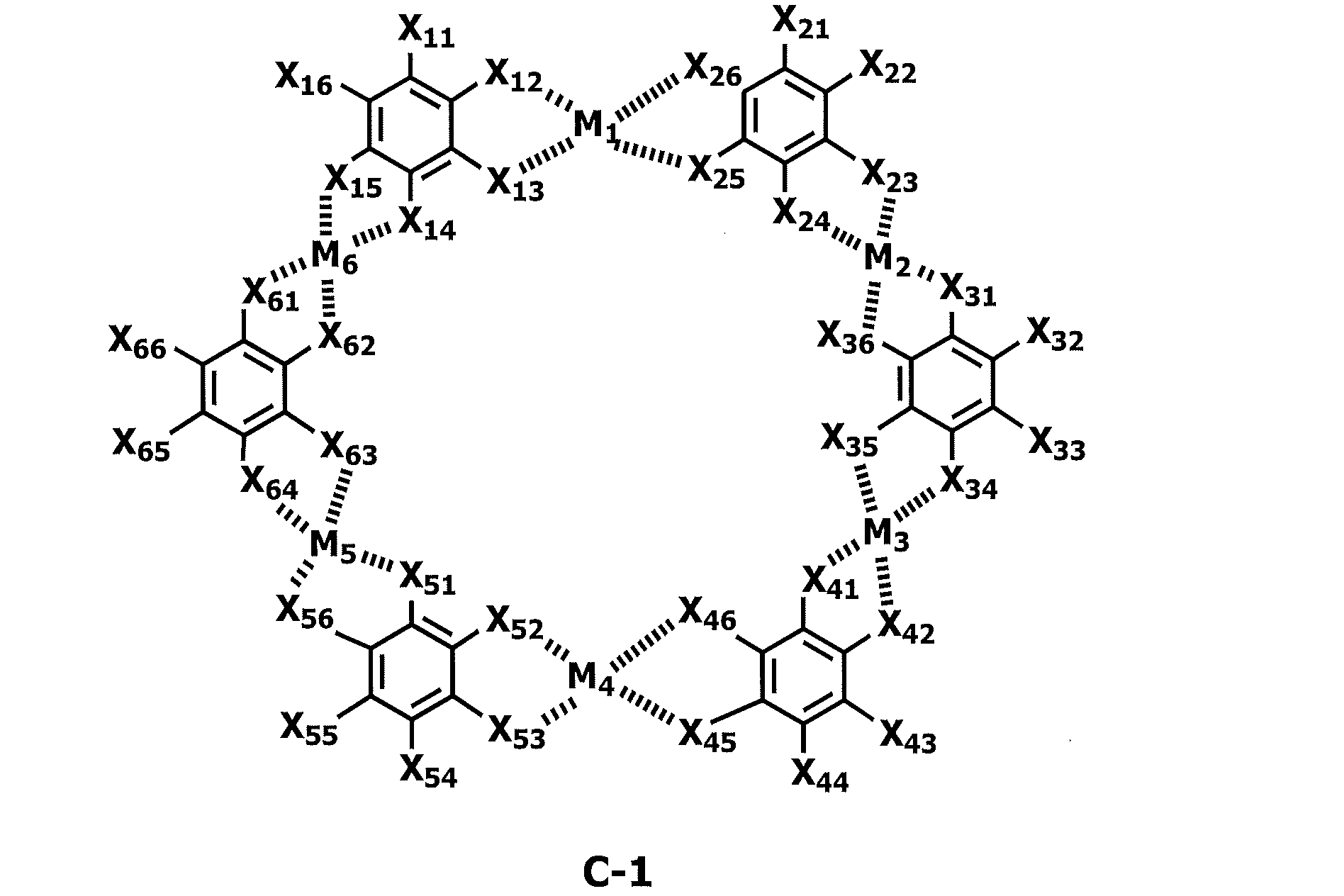
<8> 上記式C-1(式中、M1~M6、及びXn1~Xn6(nは1~6)は、上記と同じ定義を有する)で表される部位を有する二次元金属錯体。
<9> 上記<1>~<8>のいずれかにおいて、二次元金属錯体は、該錯体を実質的に形成する前記配位子の実質的に全ての原子と前記金属核とで形成される面の面積が7.2nm2以上、好ましくは13.2nm2以上、より好ましくは18.6nm2以上であるのがよい。
<10> 上記<1>~<9>のいずれかにおいて、二次元金属錯体の導電率が10-6 Scm-1以上、好ましくは10-3 Scm-1以上、より好ましくは10-1 Scm-1以上であるのがよい。
<9> 上記<1>~<8>のいずれかにおいて、二次元金属錯体は、該錯体を実質的に形成する前記配位子の実質的に全ての原子と前記金属核とで形成される面の面積が7.2nm2以上、好ましくは13.2nm2以上、より好ましくは18.6nm2以上であるのがよい。
<10> 上記<1>~<9>のいずれかにおいて、二次元金属錯体の導電率が10-6 Scm-1以上、好ましくは10-3 Scm-1以上、より好ましくは10-1 Scm-1以上であるのがよい。
<11> 上記<1>~<10>のいずれかにおいて、二次元金属錯体の酸化還元電位が-3V~+3V vs.SHE(標準水素電極)、好ましくは-2V~+2V vs.SHE、より好ましくは-1V~+2V vs.SHEの範囲内であるのがよい。
<12> 上記<1>~<11>のいずれかにおいて、二次元金属錯体の空孔率が30%以上、好ましくは33%以上、より好ましくは35%以上であるのがよい。なお、本願において、「空孔率」とは、前記略同一平面の面積における孔の割合をいう。
<12> 上記<1>~<11>のいずれかにおいて、二次元金属錯体の空孔率が30%以上、好ましくは33%以上、より好ましくは35%以上であるのがよい。なお、本願において、「空孔率」とは、前記略同一平面の面積における孔の割合をいう。
<13> 上記<1>~<12>のいずれかの二次元金属錯体を有する材料。
<14> 上記<13>の材料を有する素子又は装置。
<15> 上記<1>~<12>のいずれかの二次元金属錯体を有する素子又は装置。
<14> 上記<13>の材料を有する素子又は装置。
<15> 上記<1>~<12>のいずれかの二次元金属錯体を有する素子又は装置。
<16> 上記<1>~<12>のいずれかの二次元金属錯体、好ましくは上記<2>~<12>のいずれかの二次元金属錯体、より好ましくは上記<3>~<12>のいずれかの二次元金属錯体、最も好ましくは上記<4>~<12>のいずれかの二次元金属錯体、を製造する方法であって、
a)前記配位子を準備する工程;
b)前記金属核Mの原料である金属Mの化合物を準備する工程;
c)酸素フリー下で、前記a)で準備した前記配位子、及び前記b)で準備した前記金属Mの前記化合物を、該配位子及び該化合物の可溶溶媒に溶解して溶液を得る工程;及び
d)前記c)で得られた溶液を、酸素を含む気体に接触させる工程;
を有することにより、溶液界面に前記二次元金属錯体を形成する、上記方法。
a)前記配位子を準備する工程;
b)前記金属核Mの原料である金属Mの化合物を準備する工程;
c)酸素フリー下で、前記a)で準備した前記配位子、及び前記b)で準備した前記金属Mの前記化合物を、該配位子及び該化合物の可溶溶媒に溶解して溶液を得る工程;及び
d)前記c)で得られた溶液を、酸素を含む気体に接触させる工程;
を有することにより、溶液界面に前記二次元金属錯体を形成する、上記方法。
<17> 上記<1>~<12>のいずれかの二次元金属錯体、好ましくは上記<2>~<12>のいずれかの二次元金属錯体、より好ましくは上記<3>~<12>のいずれかの二次元金属錯体、最も好ましくは上記<4>~<12>のいずれかの二次元金属錯体、を製造する方法であって、
a)前記配位子を準備する工程;
b)前記金属核Mの原料である金属Mの化合物を準備する工程;
c)酸素フリー下で、前記a)で準備した前記配位子、及び前記b)で準備した前記金属Mの前記化合物を、該配位子及び該化合物の可溶溶媒に溶解して溶液を得る工程;及び
e)前記c)で得られた溶液に陽極及び陰極を設け、該陽極及び陰極間に電流を印加する工程;を有することにより、陽極表面に前記二次元金属錯体を形成する、上記方法。
a)前記配位子を準備する工程;
b)前記金属核Mの原料である金属Mの化合物を準備する工程;
c)酸素フリー下で、前記a)で準備した前記配位子、及び前記b)で準備した前記金属Mの前記化合物を、該配位子及び該化合物の可溶溶媒に溶解して溶液を得る工程;及び
e)前記c)で得られた溶液に陽極及び陰極を設け、該陽極及び陰極間に電流を印加する工程;を有することにより、陽極表面に前記二次元金属錯体を形成する、上記方法。
<18> 上記<17>において、前記電流の印加を定電位であり配位子の酸化電位よりも正の電位であり且つ-3~3V vs.SHEの範囲内、好ましくは-2~2V vs.SHEの範囲内、より好ましくは-1~2V vs.SHEの範囲内で行うのがよく、具体的には酸化電位よりも60mV、好ましくは120mV、正の電位で行うのがよい。
<19> 上記<17>又は<18>において、陽極として導電性が高く、電位窓の広い電極がよく、例えば導電率が1Scm-1以上であり且つ電位窓が-2~1V vs.SHEである材料が好ましく、具体的にはグラッシーカーボン、グラファイト、(ITO(Indium Tin Oxide)ガラス、白金、金、導電性ダイヤモンド、などを挙げることができるがこれらに限定されない。また、電極触媒やレドックスキャパシタ用の修飾電極を作製する場合には、比表面積が高いことが望ましく、好ましくは50m2/g、より好ましくは200m2/gである材料であるのがよく、例えば、ポーラスカーボンなどを挙げることができるがこれらに限定されない。
<20> 上記<17>~<19>の方法により得られた、二次元金属錯体を有する電極。
<19> 上記<17>又は<18>において、陽極として導電性が高く、電位窓の広い電極がよく、例えば導電率が1Scm-1以上であり且つ電位窓が-2~1V vs.SHEである材料が好ましく、具体的にはグラッシーカーボン、グラファイト、(ITO(Indium Tin Oxide)ガラス、白金、金、導電性ダイヤモンド、などを挙げることができるがこれらに限定されない。また、電極触媒やレドックスキャパシタ用の修飾電極を作製する場合には、比表面積が高いことが望ましく、好ましくは50m2/g、より好ましくは200m2/gである材料であるのがよく、例えば、ポーラスカーボンなどを挙げることができるがこれらに限定されない。
<20> 上記<17>~<19>の方法により得られた、二次元金属錯体を有する電極。
<21> 上記<1>~<12>のいずれかの二次元金属錯体、好ましくは上記<2>~<12>のいずれかの二次元金属錯体、より好ましくは上記<3>~<12>のいずれかの二次元金属錯体、最も好ましくは上記<4>~<12>のいずれかの二次元金属錯体、を製造する方法であって、
a)前記配位子を準備する工程;
b)前記金属核Mの原料である金属Mの化合物を準備する工程;
c’)-1) 前記a)で準備した前記配位子を、該配位子を溶解する第1の溶媒に溶解させ溶液C-1を得る工程;
c’)-2) 前記b)で準備した前記金属Mの前記化合物を、該化合物を溶解する第2の溶媒に溶解して溶液C-2を得る工程;及び
f)前記溶液C-1及び/又は前記溶液C-2に酸化剤を溶解する工程;
g)得られた溶液C-1及び得られた溶液C-2を、該溶液同士が二相に分離するように、容器に注入する工程;
を有することにより、前記二相の界面に前記二次元金属錯体を形成する、上記方法。
<22> 上記<1>~<12>のいずれかの二次元金属錯体、好ましくは上記<2>~<12>のいずれかの二次元金属錯体、より好ましくは上記<3>~<12>のいずれかの二次元金属錯体、最も好ましくは上記<4>~<12>のいずれかの二次元金属錯体、の製造用溶液であって、
i)前記配位子;
ii)前記金属核Mの原料である金属Mの化合物;及び
iii)前記i)配位子及び前記ii)化合物の可溶溶媒;
を有し、前記i)配位子及び前記ii)化合物を溶解し且つ酸素フリー下で存在する、上記溶液。
<23> 上記<1>~<12>のいずれかの二次元金属錯体、好ましくは上記<2>~<12>のいずれかの二次元金属錯体、より好ましくは上記<3>~<12>のいずれかの二次元金属錯体、最も好ましくは上記<4>~<12>のいずれかの二次元金属錯体、 の製造用溶液キットであって、
I) ア)前記配位子;及びイ)前記ア)配位子を溶解する第1の溶媒;を有し、前記ア)配位子を溶解し且つ酸素フリー下で存在する、第1の溶液;
II) ウ)前記金属核Mの原料である金属Mの化合物;及びエ)前記ウ)化合物を溶解する第2の溶媒;を有し、前記ウ)化合物を溶解し且つ酸素フリー下で存在する、第2の溶液;
を有する、上記キット。
a)前記配位子を準備する工程;
b)前記金属核Mの原料である金属Mの化合物を準備する工程;
c’)-1) 前記a)で準備した前記配位子を、該配位子を溶解する第1の溶媒に溶解させ溶液C-1を得る工程;
c’)-2) 前記b)で準備した前記金属Mの前記化合物を、該化合物を溶解する第2の溶媒に溶解して溶液C-2を得る工程;及び
f)前記溶液C-1及び/又は前記溶液C-2に酸化剤を溶解する工程;
g)得られた溶液C-1及び得られた溶液C-2を、該溶液同士が二相に分離するように、容器に注入する工程;
を有することにより、前記二相の界面に前記二次元金属錯体を形成する、上記方法。
<22> 上記<1>~<12>のいずれかの二次元金属錯体、好ましくは上記<2>~<12>のいずれかの二次元金属錯体、より好ましくは上記<3>~<12>のいずれかの二次元金属錯体、最も好ましくは上記<4>~<12>のいずれかの二次元金属錯体、の製造用溶液であって、
i)前記配位子;
ii)前記金属核Mの原料である金属Mの化合物;及び
iii)前記i)配位子及び前記ii)化合物の可溶溶媒;
を有し、前記i)配位子及び前記ii)化合物を溶解し且つ酸素フリー下で存在する、上記溶液。
<23> 上記<1>~<12>のいずれかの二次元金属錯体、好ましくは上記<2>~<12>のいずれかの二次元金属錯体、より好ましくは上記<3>~<12>のいずれかの二次元金属錯体、最も好ましくは上記<4>~<12>のいずれかの二次元金属錯体、 の製造用溶液キットであって、
I) ア)前記配位子;及びイ)前記ア)配位子を溶解する第1の溶媒;を有し、前記ア)配位子を溶解し且つ酸素フリー下で存在する、第1の溶液;
II) ウ)前記金属核Mの原料である金属Mの化合物;及びエ)前記ウ)化合物を溶解する第2の溶媒;を有し、前記ウ)化合物を溶解し且つ酸素フリー下で存在する、第2の溶液;
を有する、上記キット。
本発明により、白金と比較して安価であり、水素発生触媒能を有し、所望の酸化還元特性を有し、多数の空孔を備え、及び/又は大きな表面積を有する二次元金属錯体及び/又は該錯体を有する材料を提供することができる。
また、本発明により、上記効果の他に、又は上記効果に加えて、大きな出力密度及び高いエネルギー密度の双方の特性を有するキャパシタ、特にレドックスキャパシタとして用いることができる二次元金属錯体及び/又は該錯体を有する材料を提供することができる。
さらに、本発明により、上記効果の他に、又は上記効果に加えて、上記二次元金属錯体及び/又は該錯体を有する材料を備える素子及び/又は装置を提供することができる。
また、本発明により、上記効果の他に、又は上記効果に加えて、上記二次元金属錯体及び/又は該錯体を有する材料の製造方法を提供することができる。
また、本発明により、上記効果の他に、又は上記効果に加えて、大きな出力密度及び高いエネルギー密度の双方の特性を有するキャパシタ、特にレドックスキャパシタとして用いることができる二次元金属錯体及び/又は該錯体を有する材料を提供することができる。
さらに、本発明により、上記効果の他に、又は上記効果に加えて、上記二次元金属錯体及び/又は該錯体を有する材料を備える素子及び/又は装置を提供することができる。
また、本発明により、上記効果の他に、又は上記効果に加えて、上記二次元金属錯体及び/又は該錯体を有する材料の製造方法を提供することができる。
以下、本願に記載する発明を詳細に説明する。
本願は、二次元金属錯体を開示する。具体的には、本発明は、2座で配位する箇所を3箇所以上有し、該2座のうちの少なくとも1座がNHである配位子;及び金属核M(Mは、Ni、Co、Cu、Pt、Pd、Fe、Mn、Re、Ru、Os、Rh、Ir、Ag、及びAuからなる群から選ばれる少なくとも1種である)を有する金属錯体であって、前記金属錯体を実質的に形成する前記配位子の実質的に全ての原子と前記金属核とが略同一平面上に存在する、二次元金属錯体を開示する。
また、本願は、該二次元金属錯体を有する材料を開示する。
さらに、本願は、該二次元金属錯体及び/又は該上記材料を備える素子及び/又は装置を開示する。
また、本発明は、上記二次元金属錯体の製造方法を開示する。
以下、本願で開示する二次元金属錯体、該錯体を有する材料、該錯体又は該錯体を有する材料を備える素子又は装置、該錯体の製造方法の順に説明する。
本願は、二次元金属錯体を開示する。具体的には、本発明は、2座で配位する箇所を3箇所以上有し、該2座のうちの少なくとも1座がNHである配位子;及び金属核M(Mは、Ni、Co、Cu、Pt、Pd、Fe、Mn、Re、Ru、Os、Rh、Ir、Ag、及びAuからなる群から選ばれる少なくとも1種である)を有する金属錯体であって、前記金属錯体を実質的に形成する前記配位子の実質的に全ての原子と前記金属核とが略同一平面上に存在する、二次元金属錯体を開示する。
また、本願は、該二次元金属錯体を有する材料を開示する。
さらに、本願は、該二次元金属錯体及び/又は該上記材料を備える素子及び/又は装置を開示する。
また、本発明は、上記二次元金属錯体の製造方法を開示する。
以下、本願で開示する二次元金属錯体、該錯体を有する材料、該錯体又は該錯体を有する材料を備える素子又は装置、該錯体の製造方法の順に説明する。
<二次元金属錯体>
本願は、二次元金属錯体を開示する。
該二次元金属錯体は、2座で配位する箇所を3箇所以上有し、該2座のうちの少なくとも1座がNHである配位子;及び金属核M(Mは、Ni、Co、Cu、Pt、Pd、Fe、Mn、Re、Ru、Os、Rh、Ir、Ag、及びAuからなる群から選ばれる少なくとも1種である)を有する金属錯体であって、前記金属錯体を実質的に形成する前記配位子の実質的に全ての原子と前記金属核とが略同一平面上に存在する。
本願は、二次元金属錯体を開示する。
該二次元金属錯体は、2座で配位する箇所を3箇所以上有し、該2座のうちの少なくとも1座がNHである配位子;及び金属核M(Mは、Ni、Co、Cu、Pt、Pd、Fe、Mn、Re、Ru、Os、Rh、Ir、Ag、及びAuからなる群から選ばれる少なくとも1種である)を有する金属錯体であって、前記金属錯体を実質的に形成する前記配位子の実質的に全ての原子と前記金属核とが略同一平面上に存在する。
ここで、「金属錯体を実質的に形成する配位子の実質的に全ての原子と金属核とが略同一平面上に存在する」という語のうち、「金属錯体を実質的に形成する配位子の実質的に全ての原子」とは、配位子として、金属錯体の形成に寄与しない原子を除外する意図である。
また、「略同一平面上」とは、平面としての幅が10nm以内、好ましくは1nm以内に、金属錯体の形成に寄与する全ての原子の中心が入っていることをいう。
また、「略同一平面上」とは、平面としての幅が10nm以内、好ましくは1nm以内に、金属錯体の形成に寄与する全ての原子の中心が入っていることをいう。
<配位子>
本願において、配位子は、2座で配位する箇所を3箇所以上有し、該2座のうちの少なくとも1座がNHである。ここで、「2座」とは同一の配位子において、同一の金属核に配位する結合が2つあることをいう。また、『「2座」で配位する箇所を3箇所以上有する』とは、同一の配位子が、「2座」を1組とするものを3組以上有することをいう。
配位子は、アリール基を有するのがよい。該アリール基として、以下の基を挙げることができるがこれらに限定されない。
本願において、配位子は、2座で配位する箇所を3箇所以上有し、該2座のうちの少なくとも1座がNHである。ここで、「2座」とは同一の配位子において、同一の金属核に配位する結合が2つあることをいう。また、『「2座」で配位する箇所を3箇所以上有する』とは、同一の配位子が、「2座」を1組とするものを3組以上有することをいう。
配位子は、アリール基を有するのがよい。該アリール基として、以下の基を挙げることができるがこれらに限定されない。

本発明の配位子は、Ar(NH)nXm-nで表される化合物であるのがよい。
ここで、Arは、アリール基を表す。Arとして、例えば上記Ar-1~Ar-19からなる群から選ばれる1種以上を挙げることができるがこれらに限定されない。
Xは、S、O、Se及びTeからなる群から選ばれる少なくとも1種であるのがよく、好ましくはS又はO、より好ましくはSであるのがよい。
mはアリール基に依存する結合子の数であって6以上の整数を表す。例えば、ArがAr-11である場合、結合子が12個存在するので、mは最大12である。
nは3以上m以下の整数を表す。
ここで、Arは、アリール基を表す。Arとして、例えば上記Ar-1~Ar-19からなる群から選ばれる1種以上を挙げることができるがこれらに限定されない。
Xは、S、O、Se及びTeからなる群から選ばれる少なくとも1種であるのがよく、好ましくはS又はO、より好ましくはSであるのがよい。
mはアリール基に依存する結合子の数であって6以上の整数を表す。例えば、ArがAr-11である場合、結合子が12個存在するので、mは最大12である。
nは3以上m以下の整数を表す。
特に、本発明の配位子は、Bz(NH)nX6-nで表される化合物であるのがよい。
ここで、Bzはベンゼン環を表し、X、nは上述と同じ定義を有する。なお、nは好ましくは3または6、より好ましくは6であるのがよい。即ち、本発明の配位子は、下記式L-1又はL-2で表されるのが好ましく、より好ましくは式L-1で表される化合物であるのがよい。
ここで、Bzはベンゼン環を表し、X、nは上述と同じ定義を有する。なお、nは好ましくは3または6、より好ましくは6であるのがよい。即ち、本発明の配位子は、下記式L-1又はL-2で表されるのが好ましく、より好ましくは式L-1で表される化合物であるのがよい。

上述の配位子は、本発明の二次元金属錯体において、上述の配位子の他に、他の配位子を有してもよい。他の配位子として、例えばベンゼン環に-NH2を4つ有する化合物、即ち、下記式LC-1又はLC-2で表される化合物、例えばベンゼン環に-NH2を2つ有する化合物、即ち、下記式LC-3で表される化合物を挙げることができるが、これらに限定されない。なお、下記式LC-1~LC-3で表される化合物を配位子として用いた場合、二次元金属錯体における平面の広がりを抑える作用を有する。したがって、二次元金属錯体の平面の広がりを促進するためには、これらの他の配位子の量は少ない方がよい。

本発明の二次元金属錯体において、配位子の数は、該二次元金属錯体の平面の広がりに依存するが、4以上、好ましくは6以上、より好ましくは10以上、さらに好ましくは13以上有するのがよい。
<金属核>
本発明の二次元金属錯体における金属核MのMは、配位構造として、平面配位の構造を採る金属であるのがよい。例えば、上述したとおり、Ni、Co、Cu、Pt、Pd、Fe、Mn、Re、Ru、Os、Rh、Ir、Ag、及びAuからなる群から選ばれる少なくとも1種であるのがよい。
好ましい金属核Mは、得られる二次元金属錯体の特性、例えば導電率、酸化還元電位などに依存するが、Ni、Co、Cu、Fe及びMnからなる群から選ばれる少なくとも1種であるのが好ましく、より好ましくはNi、Co、及びCuからなる群から選ばれる少なくとも1種であるのがよい。
本発明の二次元金属錯体において、金属核の数は、該二次元金属錯体の平面の広がりに依存するが、3以上、好ましくは6以上、より好ましくは11以上、さらに好ましくは15以上有するのがよい。
本発明の二次元金属錯体における金属核MのMは、配位構造として、平面配位の構造を採る金属であるのがよい。例えば、上述したとおり、Ni、Co、Cu、Pt、Pd、Fe、Mn、Re、Ru、Os、Rh、Ir、Ag、及びAuからなる群から選ばれる少なくとも1種であるのがよい。
好ましい金属核Mは、得られる二次元金属錯体の特性、例えば導電率、酸化還元電位などに依存するが、Ni、Co、Cu、Fe及びMnからなる群から選ばれる少なくとも1種であるのが好ましく、より好ましくはNi、Co、及びCuからなる群から選ばれる少なくとも1種であるのがよい。
本発明の二次元金属錯体において、金属核の数は、該二次元金属錯体の平面の広がりに依存するが、3以上、好ましくは6以上、より好ましくは11以上、さらに好ましくは15以上有するのがよい。
<二次元金属錯体の構造>
本発明の二次元金属錯体は、上述したように、2座で配位する箇所を3箇所以上有し、該2座のうちの少なくとも1座がNHである配位子;及び金属核M(Mは、Ni、Co、Cu、Pt、Pd、Fe、Mn、Re、Ru、Os、Rh、Ir、Ag、及びAuからなる群から選ばれる少なくとも1種である)を有する金属錯体であって、前記金属錯体を実質的に形成する前記配位子の実質的に全ての原子と前記金属核とが略同一平面上に存在する。
その構造は、用いる配位子、特に配位子が有する配位結合子の数に依存するが、例えば、配位子としてBz(NH)nX6-nで表される化合物、例えば上記式L-1又はL-2で表される化合物を用いた場合、下記式C-1で表される部位を有するのがよい。
式C-1中、M1~M6は各々独立にNi、Co、Cu、Pt、Pd、Fe、Mn, Re、Ru、Os、Rh、Ir、Ag、Auからなる群から選ばれる少なくとも1種であり、
Xn1~Xn6(nは1~6)は各々独立に、NH、S、O、Se、Teで表される配位原子又は配位原子群を表す。
本発明の二次元金属錯体は、上述したように、2座で配位する箇所を3箇所以上有し、該2座のうちの少なくとも1座がNHである配位子;及び金属核M(Mは、Ni、Co、Cu、Pt、Pd、Fe、Mn、Re、Ru、Os、Rh、Ir、Ag、及びAuからなる群から選ばれる少なくとも1種である)を有する金属錯体であって、前記金属錯体を実質的に形成する前記配位子の実質的に全ての原子と前記金属核とが略同一平面上に存在する。
その構造は、用いる配位子、特に配位子が有する配位結合子の数に依存するが、例えば、配位子としてBz(NH)nX6-nで表される化合物、例えば上記式L-1又はL-2で表される化合物を用いた場合、下記式C-1で表される部位を有するのがよい。
式C-1中、M1~M6は各々独立にNi、Co、Cu、Pt、Pd、Fe、Mn, Re、Ru、Os、Rh、Ir、Ag、Auからなる群から選ばれる少なくとも1種であり、
Xn1~Xn6(nは1~6)は各々独立に、NH、S、O、Se、Teで表される配位原子又は配位原子群を表す。
<<二次元金属錯体の特性>>
本願の二次元金属錯体は、以下の特性i)~iv)のうち、いずれか1種、2種、3種又はそれ以上を有するのがよい。
i) 二次元金属錯体は、該錯体を実質的に形成する前記配位子の実質的に全ての原子と前記金属核とで形成される面の面積が7.2nm2以上、好ましくは13.2nm2以上、より好ましくは18.6nm2以上であるのがよい。なお、該面積は、二次元金属錯体に用いられる配位子の構造、錯体を実質的に形成する配位子の原子及び金属核の原子半径から求めることができる。
ii) 導電率が10-6 Scm-1以上、好ましくは10-3 Scm-1以上、より好ましくは10-1 Scm-1以上であるのがよい。なお、導電率は、2端子またはvan der Pauw法などの4端子の導電率測定法により求めることができる。
iii) 酸化還元電位が-3V~+3V vs.SHE(標準水素電極)、好ましくは-2V~+2V vs.SHE、より好ましくは-1V~+2V vs.SHEの範囲内であるのがよい。なお、酸化還元電位は、サイクリックボルタンメトリ法などの電気化学測定により求めることができる。
iv) 二次元金属錯体の空孔率が30%以上、好ましくは33%以上、より好ましくは35%以上であるのがよい。なお、本願において、「空孔率」とは、前記略同一平面の面積における孔の割合をいう。したがって、空孔率は、上記i)の面積と同様に、二次元金属錯体に用いられる配位子の構造、錯体を実質的に形成する配位子の原子及び金属核の原子半径から求めることができる。
本願の二次元金属錯体は、以下の特性i)~iv)のうち、いずれか1種、2種、3種又はそれ以上を有するのがよい。
i) 二次元金属錯体は、該錯体を実質的に形成する前記配位子の実質的に全ての原子と前記金属核とで形成される面の面積が7.2nm2以上、好ましくは13.2nm2以上、より好ましくは18.6nm2以上であるのがよい。なお、該面積は、二次元金属錯体に用いられる配位子の構造、錯体を実質的に形成する配位子の原子及び金属核の原子半径から求めることができる。
ii) 導電率が10-6 Scm-1以上、好ましくは10-3 Scm-1以上、より好ましくは10-1 Scm-1以上であるのがよい。なお、導電率は、2端子またはvan der Pauw法などの4端子の導電率測定法により求めることができる。
iii) 酸化還元電位が-3V~+3V vs.SHE(標準水素電極)、好ましくは-2V~+2V vs.SHE、より好ましくは-1V~+2V vs.SHEの範囲内であるのがよい。なお、酸化還元電位は、サイクリックボルタンメトリ法などの電気化学測定により求めることができる。
iv) 二次元金属錯体の空孔率が30%以上、好ましくは33%以上、より好ましくは35%以上であるのがよい。なお、本願において、「空孔率」とは、前記略同一平面の面積における孔の割合をいう。したがって、空孔率は、上記i)の面積と同様に、二次元金属錯体に用いられる配位子の構造、錯体を実質的に形成する配位子の原子及び金属核の原子半径から求めることができる。
<二次元金属錯体を有する材料>
本願は、上記二次元金属錯体を有する材料を開示する。
上記二次元金属錯体を有する材料として、所定の基板上に二次元金属錯体を設けてなる材料、該二次元金属錯体のみからなる自立性フィルムなどを挙げることができるがこれらに限定されない。
所定の基板上に二次元金属錯体を設けてなる材料として、具体的には、後述する電気化学的に調製することにより得られる電極上に形成される二次元金属錯体を挙げることができるがこれに限定されない。
本願は、上記二次元金属錯体を有する材料を開示する。
上記二次元金属錯体を有する材料として、所定の基板上に二次元金属錯体を設けてなる材料、該二次元金属錯体のみからなる自立性フィルムなどを挙げることができるがこれらに限定されない。
所定の基板上に二次元金属錯体を設けてなる材料として、具体的には、後述する電気化学的に調製することにより得られる電極上に形成される二次元金属錯体を挙げることができるがこれに限定されない。
<二次元金属錯体を有する素子又は装置>、及び<二次元金属錯体を有する材料を備える素子又は装置>
また、本願は、上記二次元金属錯体を有する素子又は装置、及び上記二次元金属錯体を有する材料を備える素子又は装置を開示する。
このような素子又は装置として、ダイオード、トランジスタ、光トランジスタ、共振器、熱電特性を備えた素子又は装置、圧電特性を備えた素子又は装置、発光素子、バレートロニクス、電池、キャパシタ(電気二重層キャパシタ、レドックスキャパシタを含む)、光触媒、水素発生触媒、酸素発生触媒、二酸化炭素還元触媒などを挙げることができるがこれらに限定されない。
また、本願は、上記二次元金属錯体を有する素子又は装置、及び上記二次元金属錯体を有する材料を備える素子又は装置を開示する。
このような素子又は装置として、ダイオード、トランジスタ、光トランジスタ、共振器、熱電特性を備えた素子又は装置、圧電特性を備えた素子又は装置、発光素子、バレートロニクス、電池、キャパシタ(電気二重層キャパシタ、レドックスキャパシタを含む)、光触媒、水素発生触媒、酸素発生触媒、二酸化炭素還元触媒などを挙げることができるがこれらに限定されない。
例えば、本願の二次元金属錯体をレドックスキャパシタとして用いる場合、次のように構成することができる。即ち、二次元金属錯体フィルムのみからなるもの、本願の二次元金属錯体を高分子固体電解質フィルムとして用いるもの、二枚の電極基板間に二次元金属錯体フィルムを配置するもの、などを挙げることができるがこれらに限定されない。
<二次元金属錯体の製造方法>
本願は、上記二次元金属錯体の製造方法を開示する。
本発明の二次元金属錯体の製造方法は、金属核Mの原料である金属Mの化合物と配位子とを酸化条件下で反応させるものであり、大きく分けて次の3つを挙げることができる。
i)気-液界面における反応を用いる手法;ii)電気化学的手法;及びiii)液-液界面における反応を用いる手法;である。
以下、順に説明する。
本願は、上記二次元金属錯体の製造方法を開示する。
本発明の二次元金属錯体の製造方法は、金属核Mの原料である金属Mの化合物と配位子とを酸化条件下で反応させるものであり、大きく分けて次の3つを挙げることができる。
i)気-液界面における反応を用いる手法;ii)電気化学的手法;及びiii)液-液界面における反応を用いる手法;である。
以下、順に説明する。
<<二次元金属錯体の製造方法-気-液界面における反応を用いるもの>>
上記二次元金属錯体は、気-液界面における反応を用いる手法により得ることができる。
該方法は、
a)配位子を準備する工程;
b)金属核Mの原料である金属Mの化合物を準備する工程;
c)酸素フリー下で、a)で準備した配位子、及びb)で準備した金属Mの化合物を、該配位子及び該化合物の可溶溶媒に溶解して溶液を得る工程;及び
d) c)で得られた溶液を、酸素を含む気体に接触させる工程;
を有することにより、溶液界面に二次元金属錯体を形成することができる。
なお、本方法において、「配位子」、「金属核M」、「金属Mの化合物」は上述の定義と同じである。
上記二次元金属錯体は、気-液界面における反応を用いる手法により得ることができる。
該方法は、
a)配位子を準備する工程;
b)金属核Mの原料である金属Mの化合物を準備する工程;
c)酸素フリー下で、a)で準備した配位子、及びb)で準備した金属Mの化合物を、該配位子及び該化合物の可溶溶媒に溶解して溶液を得る工程;及び
d) c)で得られた溶液を、酸素を含む気体に接触させる工程;
を有することにより、溶液界面に二次元金属錯体を形成することができる。
なお、本方法において、「配位子」、「金属核M」、「金属Mの化合物」は上述の定義と同じである。
工程a)は、配位子を準備する工程である。該配位子は、市販購入可能なものは市販購入してもよく、別途、製造してもよい。
工程b)は、二次元金属錯体の金属核Mの原料である金属Mの化合物を準備する工程である。
ここで、化合物は、用いる配位子、反応に用いる溶媒、金属との反応性などに依存するが、酢酸塩、塩化物塩、硫酸塩、テトラフルオロホウ酸塩、ヘキサフルオロリン酸塩、過塩素酸塩、アセチルアセトナート錯体、アンミン錯体などを挙げることができるがこれらに限定されない。なお、化合物の選択に際して、工程c)で用いる溶媒、用いる配位子との関係もあるが、該溶媒への溶解性、光などによる分解性がないこと、化合物が錯体の場合には金属と配位子の結合が強くなく配位子交換反応が起こりやすいこと、などの条件を挙げることができる。
これらを考慮して、化合物は、溶解して安定に存在するのがよく、好ましくは配位子交換が起こりやすいのがよい。
工程b)は、二次元金属錯体の金属核Mの原料である金属Mの化合物を準備する工程である。
ここで、化合物は、用いる配位子、反応に用いる溶媒、金属との反応性などに依存するが、酢酸塩、塩化物塩、硫酸塩、テトラフルオロホウ酸塩、ヘキサフルオロリン酸塩、過塩素酸塩、アセチルアセトナート錯体、アンミン錯体などを挙げることができるがこれらに限定されない。なお、化合物の選択に際して、工程c)で用いる溶媒、用いる配位子との関係もあるが、該溶媒への溶解性、光などによる分解性がないこと、化合物が錯体の場合には金属と配位子の結合が強くなく配位子交換反応が起こりやすいこと、などの条件を挙げることができる。
これらを考慮して、化合物は、溶解して安定に存在するのがよく、好ましくは配位子交換が起こりやすいのがよい。
工程c)は、工程a)で得られた配位子、工程b)で得られた金属Mの化合物を、該配位子及び該化合物の可溶溶媒に溶解して溶液を得る工程である。
溶液は、工程d)でおいて、反応を促進する添加物、例えばアンモニア、アミン類などを有してもよい。
工程c)は、酸素フリーの条件下、例えばアルゴンガス雰囲気下、窒素ガス雰囲気下で行うのがよい。なお、工程a)及び/又は工程b)においても、酸素フリーの条件下、例えばアルゴンガス雰囲気下、窒素ガス雰囲気下で行うのが都合よい。
溶液は、工程d)でおいて、反応を促進する添加物、例えばアンモニア、アミン類などを有してもよい。
工程c)は、酸素フリーの条件下、例えばアルゴンガス雰囲気下、窒素ガス雰囲気下で行うのがよい。なお、工程a)及び/又は工程b)においても、酸素フリーの条件下、例えばアルゴンガス雰囲気下、窒素ガス雰囲気下で行うのが都合よい。
工程d)は、c)で得られた溶液を、酸素を含む気体に接触させる工程である。
工程d)は、用いる配位子及びその濃度、用いる金属Mの化合物及びその濃度、用いる酸素の量などに依存するが、室温25℃又はその近辺、圧力1気圧などの条件下で行うのがよい。
工程d)は、用いる配位子及びその濃度、用いる金属Mの化合物及びその濃度、用いる酸素の量などに依存するが、室温25℃又はその近辺、圧力1気圧などの条件下で行うのがよい。
上記工程により、二次元金属錯体を得ることができる。
なお、工程a)前、各工程間、及び/又は工程d)後に、上述の工程以外の工程を設けてもよい。
例えば、工程d)後に、得られた二次元金属錯体を洗浄する工程を設けてもよい。
また、工程c)間に、酸素の濃度を変化させる工程を設けてもよい。
なお、工程a)前、各工程間、及び/又は工程d)後に、上述の工程以外の工程を設けてもよい。
例えば、工程d)後に、得られた二次元金属錯体を洗浄する工程を設けてもよい。
また、工程c)間に、酸素の濃度を変化させる工程を設けてもよい。
<<二次元金属錯体の製造方法-電気化学的手法によるもの>>
上記二次元金属錯体は、電気化学的手法により得ることができる。
該方法は、
a)配位子を準備する工程;
b)金属核Mの原料である金属Mの化合物を準備する工程;
c)酸素フリー下で、a)で準備した配位子、及びb)で準備した金属Mの化合物を、該配位子及び該化合物の可溶溶媒に溶解して溶液を得る工程;及び
e) c)で得られた溶液に陽極及び陰極を設け、該正極及び陰極間に電流を印加する工程;を有することにより、正極表面に前記二次元金属錯体を形成することができる。
なお、本方法において、「配位子」、「金属核M」、「金属Mの化合物」は上述の定義と同じである。
工程a)~工程c)は、上述と同じ定義を有する工程である。
上記二次元金属錯体は、電気化学的手法により得ることができる。
該方法は、
a)配位子を準備する工程;
b)金属核Mの原料である金属Mの化合物を準備する工程;
c)酸素フリー下で、a)で準備した配位子、及びb)で準備した金属Mの化合物を、該配位子及び該化合物の可溶溶媒に溶解して溶液を得る工程;及び
e) c)で得られた溶液に陽極及び陰極を設け、該正極及び陰極間に電流を印加する工程;を有することにより、正極表面に前記二次元金属錯体を形成することができる。
なお、本方法において、「配位子」、「金属核M」、「金属Mの化合物」は上述の定義と同じである。
工程a)~工程c)は、上述と同じ定義を有する工程である。
本方法において、金属Mの化合物は、溶解して安定に存在するのがよく、好ましくは配位子交換が起こりやすいのがよい。
また、本方法において、配位子は、溶解して安定に存在するのがよく、酸化によって金属への配位力が増加するものであるのがよい。
工程c)は、上述のとおり、酸素フリーの条件下、例えばアルゴンガス雰囲気下、窒素ガス雰囲気下で行うのがよい。なお、工程a)及び/又は工程b)においても、酸素フリーの条件下、例えばアルゴンガス雰囲気下、窒素ガス雰囲気下で行うのが都合よい。
工程c)の溶液は、工程e)でおける反応を促進する添加物、例えばアンモニア、アミン類などを有してもよい。
工程e)は、工程c)で得られた溶液に陽極及び陰極を設け、該陽極及び陰極間に電流を印加する工程である。
電流の印加は、定電流で行う定電流法であっても、定電位で行う定電位法であっても、電位掃引法であってもよい。電流の印加は、好ましくは、定電位であり配位子の酸化電位よりも正の電位であり且つ-3~3V vs.SHEの範囲内、好ましくは-2~2V vs.SHEの範囲内、より好ましくは-1~2V vs.SHEの範囲内で行うのがよく、具体的には酸化電位よりも60mV、好ましくは120mV、正の電位で行うのがよい。
陽極として導電性が高く、電位窓の広い電極がよく、例えば導電率が1Scm-1以上であり且つ電位窓が-2~1V vs.SHEである材料が好ましく、具体的にはグラッシーカーボン、グラファイト、(ITO(Indium Tin Oxide)ガラス、白金、金、導電性ダイヤモンド、などを挙げることができるがこれらに限定されない。また、電極触媒やレドックスキャパシタ用の修飾電極を作製する場合には、比表面積が高いことが望ましく、好ましくは50m2/g、より好ましくは200m2/gである材料であるのがよく、例えば、ポーラスカーボンなどを挙げることができるがこれらに限定されない。
本方法においても、上述の気-液界面における反応を用いる手法と同様に、工程a)前、各工程間、及び/又は工程e)後に、上述の工程以外の工程を設けてもよい。
例えば、工程e)後に、得られた二次元金属錯体を洗浄する工程を設けてもよい。
また、本方法において、配位子は、溶解して安定に存在するのがよく、酸化によって金属への配位力が増加するものであるのがよい。
工程c)は、上述のとおり、酸素フリーの条件下、例えばアルゴンガス雰囲気下、窒素ガス雰囲気下で行うのがよい。なお、工程a)及び/又は工程b)においても、酸素フリーの条件下、例えばアルゴンガス雰囲気下、窒素ガス雰囲気下で行うのが都合よい。
工程c)の溶液は、工程e)でおける反応を促進する添加物、例えばアンモニア、アミン類などを有してもよい。
工程e)は、工程c)で得られた溶液に陽極及び陰極を設け、該陽極及び陰極間に電流を印加する工程である。
電流の印加は、定電流で行う定電流法であっても、定電位で行う定電位法であっても、電位掃引法であってもよい。電流の印加は、好ましくは、定電位であり配位子の酸化電位よりも正の電位であり且つ-3~3V vs.SHEの範囲内、好ましくは-2~2V vs.SHEの範囲内、より好ましくは-1~2V vs.SHEの範囲内で行うのがよく、具体的には酸化電位よりも60mV、好ましくは120mV、正の電位で行うのがよい。
陽極として導電性が高く、電位窓の広い電極がよく、例えば導電率が1Scm-1以上であり且つ電位窓が-2~1V vs.SHEである材料が好ましく、具体的にはグラッシーカーボン、グラファイト、(ITO(Indium Tin Oxide)ガラス、白金、金、導電性ダイヤモンド、などを挙げることができるがこれらに限定されない。また、電極触媒やレドックスキャパシタ用の修飾電極を作製する場合には、比表面積が高いことが望ましく、好ましくは50m2/g、より好ましくは200m2/gである材料であるのがよく、例えば、ポーラスカーボンなどを挙げることができるがこれらに限定されない。
本方法においても、上述の気-液界面における反応を用いる手法と同様に、工程a)前、各工程間、及び/又は工程e)後に、上述の工程以外の工程を設けてもよい。
例えば、工程e)後に、得られた二次元金属錯体を洗浄する工程を設けてもよい。
二次元金属錯体は、電極上に形成することができるため、該電極上に形成された二次元金属錯体をそのまま、二次元金属錯体を有する材料、二次元金属錯体を有する素子又は装置、もしくは二次元金属錯体を有する材料を備える素子又は装置として用いることができる。
<<二次元金属錯体の製造方法-液-液界面における反応を用いるもの>>
上記二次元金属錯体は、液-液界面における反応を用いる手法により得ることができる。
該方法は、
a)配位子を準備する工程;
b)金属核Mの原料である金属Mの化合物を準備する工程;
c’)-1) 工程a)で準備した配位子を、該配位子を溶解する第1の溶媒に溶解させ溶液C-1を得る工程;
c’)-2) 工程b)で準備した金属Mの化合物を、該化合物を溶解する第2の溶媒に溶解して溶液C-2を得る工程;及び
f) 溶液C-1及び/又は溶液C-2に酸化剤を溶解する工程;
g)得られた溶液C-1及び得られた溶液C-2を、該溶液同士が二相に分離するように、容器に注入する工程;
を有することにより、二相の界面に前記二次元金属錯体を形成することができる。
上記二次元金属錯体は、液-液界面における反応を用いる手法により得ることができる。
該方法は、
a)配位子を準備する工程;
b)金属核Mの原料である金属Mの化合物を準備する工程;
c’)-1) 工程a)で準備した配位子を、該配位子を溶解する第1の溶媒に溶解させ溶液C-1を得る工程;
c’)-2) 工程b)で準備した金属Mの化合物を、該化合物を溶解する第2の溶媒に溶解して溶液C-2を得る工程;及び
f) 溶液C-1及び/又は溶液C-2に酸化剤を溶解する工程;
g)得られた溶液C-1及び得られた溶液C-2を、該溶液同士が二相に分離するように、容器に注入する工程;
を有することにより、二相の界面に前記二次元金属錯体を形成することができる。
工程a)及び工程b)は、上述と同じ定義を有する工程である。
なお、本方法において、金属Mの化合物は溶解して安定に存在するのがよく、好ましくは配位子交換が起こりやすいのがよい。
また、本方法において、配位子は、溶解して安定に存在するのがよく、酸化によって金属への配位力が増加するものであるのがよい。
なお、本方法において、金属Mの化合物は溶解して安定に存在するのがよく、好ましくは配位子交換が起こりやすいのがよい。
また、本方法において、配位子は、溶解して安定に存在するのがよく、酸化によって金属への配位力が増加するものであるのがよい。
工程c’)-1)は、工程a)で準備した配位子を、該配位子を溶解する第1の溶媒に溶解させ溶液C-1を得る工程である。
工程c’)-2)は、工程b)で準備した金属Mの化合物を、該化合物を溶解する第2の溶媒に溶解して溶液C-2である。
ここで、溶液C-1における配位子の濃度は、用いる配位子、用いる金属Mの化合物などに依存するが、目的とする二次元金属錯体フィルムの厚みに応じて調整し、多層膜を得るには0.1~2mM、好ましくは0.2~1 mM、より好ましくは0.3~0.7mM、単層から数層の極薄膜を得るには、0.005~0.2mM、好ましくは0.01~0.15mM、より好ましくは0.05~0.1mMであるのがよい。
また、溶液C-2における金属Mの化合物の濃度は、用いる配位子、用いる金属Mの化合物、などに依存するが、目的とする二次元金属錯体フィルムの厚みに応じて調整し、10nM~200μM、好ましくは20nM~100μM、より好ましくは50nM~50μMであるのがよい。
第1の溶媒が配位子を溶解する溶媒であり、第2の溶媒が金属Mの化合物を溶解する溶媒である。また、第1の溶媒及び第2の溶媒は、後述するように、互いに二相に分離する溶媒同士であるのがよい。
工程c)-1)及び工程c)-2)は、酸素フリーの条件下、例えばアルゴンガス雰囲気下、窒素ガス雰囲気下で行うのがよい。なお、工程a)及び/又は工程b)においても、酸素フリーの条件下、例えばアルゴンガス雰囲気下、窒素ガス雰囲気下で行うのが都合よい。さらに、工程f)及び工程g)も、酸素フリーの環境下で行うのがよい。
工程c’)-2)は、工程b)で準備した金属Mの化合物を、該化合物を溶解する第2の溶媒に溶解して溶液C-2である。
ここで、溶液C-1における配位子の濃度は、用いる配位子、用いる金属Mの化合物などに依存するが、目的とする二次元金属錯体フィルムの厚みに応じて調整し、多層膜を得るには0.1~2mM、好ましくは0.2~1 mM、より好ましくは0.3~0.7mM、単層から数層の極薄膜を得るには、0.005~0.2mM、好ましくは0.01~0.15mM、より好ましくは0.05~0.1mMであるのがよい。
また、溶液C-2における金属Mの化合物の濃度は、用いる配位子、用いる金属Mの化合物、などに依存するが、目的とする二次元金属錯体フィルムの厚みに応じて調整し、10nM~200μM、好ましくは20nM~100μM、より好ましくは50nM~50μMであるのがよい。
第1の溶媒が配位子を溶解する溶媒であり、第2の溶媒が金属Mの化合物を溶解する溶媒である。また、第1の溶媒及び第2の溶媒は、後述するように、互いに二相に分離する溶媒同士であるのがよい。
工程c)-1)及び工程c)-2)は、酸素フリーの条件下、例えばアルゴンガス雰囲気下、窒素ガス雰囲気下で行うのがよい。なお、工程a)及び/又は工程b)においても、酸素フリーの条件下、例えばアルゴンガス雰囲気下、窒素ガス雰囲気下で行うのが都合よい。さらに、工程f)及び工程g)も、酸素フリーの環境下で行うのがよい。
工程f)は、溶液C-1及び/又は溶液C-2に酸化剤を溶解する工程である。
該酸化剤は、配位子の酸化を行う作用を奏するものであれば、特に限定されない。酸化剤として、フェロセニウム塩、トリアリールアミン類などを挙げることができるがこれらに限定されない。
酸化剤は、溶液C-1のみに溶解させるか、溶液C-2のみに溶解させるか、又は双方の溶液に溶解させることができるが、好ましくは溶液C-2に溶解させるのがよい。
該酸化剤は、配位子の酸化を行う作用を奏するものであれば、特に限定されない。酸化剤として、フェロセニウム塩、トリアリールアミン類などを挙げることができるがこれらに限定されない。
酸化剤は、溶液C-1のみに溶解させるか、溶液C-2のみに溶解させるか、又は双方の溶液に溶解させることができるが、好ましくは溶液C-2に溶解させるのがよい。
工程g)は、上記で得られた溶液C-1及び溶液C-2を、該溶液同士が二相に分離するように、容器に注入する工程である。
用いる第1の溶媒及び第2の溶媒などに依存して、得られる溶液C-1及びC-2の比重が異なってくるが、相対的に比重の重い溶液をまず容器に注入し、その後、二相に分離するように、相対的に比重の軽い溶液を容器に注入する。
工程g)は、用いる配位子及びその濃度、用いる金属Mの化合物及びその濃度、得られる二次元金属錯体の構造、例えば厚さなどに依存するが、1時間~20日間、好ましくは1~15日間、より好ましくは2~10日間、行うのがよい。
なお、工程g)の温度は、用いる配位子及びその濃度、用いる金属Mの化合物及びその濃度、得られる二次元金属錯体の構造、例えば厚さなどに依存するが、溶媒の融点から沸点までの範囲の任意の温度に設定することができる。
用いる第1の溶媒及び第2の溶媒などに依存して、得られる溶液C-1及びC-2の比重が異なってくるが、相対的に比重の重い溶液をまず容器に注入し、その後、二相に分離するように、相対的に比重の軽い溶液を容器に注入する。
工程g)は、用いる配位子及びその濃度、用いる金属Mの化合物及びその濃度、得られる二次元金属錯体の構造、例えば厚さなどに依存するが、1時間~20日間、好ましくは1~15日間、より好ましくは2~10日間、行うのがよい。
なお、工程g)の温度は、用いる配位子及びその濃度、用いる金属Mの化合物及びその濃度、得られる二次元金属錯体の構造、例えば厚さなどに依存するが、溶媒の融点から沸点までの範囲の任意の温度に設定することができる。
上記工程により、二次元金属錯体を得ることができる。
本方法においても、上述の気-液界面における反応を用いる手法、又は電気化学的手法と同様に、工程a)前、各工程間、及び/又は工程g)後に、上述の工程以外の工程を設けてもよい。
例えば、工程g)後に、得られた二次元金属錯体を洗浄する工程を設けてもよい。
本方法においても、上述の気-液界面における反応を用いる手法、又は電気化学的手法と同様に、工程a)前、各工程間、及び/又は工程g)後に、上述の工程以外の工程を設けてもよい。
例えば、工程g)後に、得られた二次元金属錯体を洗浄する工程を設けてもよい。
<二次元金属錯体製造用溶液>
本願は、上記二次元金属錯体を製造する方法に用いる溶液又は溶液キットを提供する。
該溶液のうち、上述の<<二次元金属錯体の製造方法-気-液界面における反応を用いるもの>>及び/又は<<二次元金属錯体の製造方法-電気化学的手法によるもの>>に用いるものとして、
i)配位子;
ii)金属核Mの原料である金属Mの化合物;及び
iii) i)配位子及びii)化合物の可溶溶媒;
を有し、i)配位子及びii)化合物を溶解する溶液であり且つ該溶液が酸素フリー下で存在する溶液、を挙げることができるが、これに限定されない。
ここで、「配位子」、「金属核M」、「金属核Mの原料である金属Mの化合物」、「配位子及び化合物の可溶溶媒」及び「酸素フリー」は、上述と同じ定義を有する。
なお、上記溶液を気-液界面における反応に用いる場合、該溶液を、酸素を含む気体に接触させることにより、上述の二次元金属錯体を得ることができる。酸素を含む気体に接触させる前に、必要ならば、酸素フリー下で所定の開口を有し二次元金属錯体形成に適した容器に移してもよい。
また、上記溶液を電気化学的手法に用いる場合、該溶液を、上述の電気化学手法を行う装置、具体的には、所定の陽極及び陰極、並びに所定の電流印加装置を設けて、上述の方法を行うことにより、上述の二次元金属錯体を得ることができる。
本願は、上記二次元金属錯体を製造する方法に用いる溶液又は溶液キットを提供する。
該溶液のうち、上述の<<二次元金属錯体の製造方法-気-液界面における反応を用いるもの>>及び/又は<<二次元金属錯体の製造方法-電気化学的手法によるもの>>に用いるものとして、
i)配位子;
ii)金属核Mの原料である金属Mの化合物;及び
iii) i)配位子及びii)化合物の可溶溶媒;
を有し、i)配位子及びii)化合物を溶解する溶液であり且つ該溶液が酸素フリー下で存在する溶液、を挙げることができるが、これに限定されない。
ここで、「配位子」、「金属核M」、「金属核Mの原料である金属Mの化合物」、「配位子及び化合物の可溶溶媒」及び「酸素フリー」は、上述と同じ定義を有する。
なお、上記溶液を気-液界面における反応に用いる場合、該溶液を、酸素を含む気体に接触させることにより、上述の二次元金属錯体を得ることができる。酸素を含む気体に接触させる前に、必要ならば、酸素フリー下で所定の開口を有し二次元金属錯体形成に適した容器に移してもよい。
また、上記溶液を電気化学的手法に用いる場合、該溶液を、上述の電気化学手法を行う装置、具体的には、所定の陽極及び陰極、並びに所定の電流印加装置を設けて、上述の方法を行うことにより、上述の二次元金属錯体を得ることができる。
また、上述の<<二次元金属錯体の製造方法-液-液界面における反応を用いるもの>>に用いる溶液として、本願は、2つの溶液を有する溶液キットを提供する。
該2つの溶液を有する溶液キットは、
I) ア)配位子;及びイ)該配位子を溶解する第1の溶媒;を有し、ア)配位子を溶解し且つ酸素フリー下で存在する、第1の溶液;及び
II) ウ)金属核Mの原料である金属Mの化合物;及びエ)該化合物を溶解する第2の溶媒;を有し、ウ)化合物を溶解し且つ酸素フリー下で存在する、第2の溶液;
を有するのがよい。
ここで、「配位子」、「第1の溶媒」、「第1の溶液」、「金属核M」、「金属核Mの原料である金属Mの化合物」、「第2の溶媒」、「第2の溶液」及び「酸素フリー」は、上述と同じ定義を有する。
なお、該溶液キットを液-液界面における反応に用いる場合、第1及び第2の溶液の比重を考慮して、該2つの溶液が二相となるように、容器に注入し、二相の界面で反応を行うことにより、上述の二次元金属錯体を得ることができる。用いる容器は、必要に応じて、所定の開口を有し二次元金属錯体形成に適した容器を用いるのがよい。
以下、実施例に基づいて、本発明をさらに詳細に説明するが、本発明は本実施例に限定されるものではない。
該2つの溶液を有する溶液キットは、
I) ア)配位子;及びイ)該配位子を溶解する第1の溶媒;を有し、ア)配位子を溶解し且つ酸素フリー下で存在する、第1の溶液;及び
II) ウ)金属核Mの原料である金属Mの化合物;及びエ)該化合物を溶解する第2の溶媒;を有し、ウ)化合物を溶解し且つ酸素フリー下で存在する、第2の溶液;
を有するのがよい。
ここで、「配位子」、「第1の溶媒」、「第1の溶液」、「金属核M」、「金属核Mの原料である金属Mの化合物」、「第2の溶媒」、「第2の溶液」及び「酸素フリー」は、上述と同じ定義を有する。
なお、該溶液キットを液-液界面における反応に用いる場合、第1及び第2の溶液の比重を考慮して、該2つの溶液が二相となるように、容器に注入し、二相の界面で反応を行うことにより、上述の二次元金属錯体を得ることができる。用いる容器は、必要に応じて、所定の開口を有し二次元金属錯体形成に適した容器を用いるのがよい。
以下、実施例に基づいて、本発明をさらに詳細に説明するが、本発明は本実施例に限定されるものではない。
<A-1.気液界面における反応による、Niを金属核とする二次元金属錯体の調製>
ヘキサアミノベンゼン三塩酸塩を、文献(Z.-G. Tao, X. Zhao, X. K. Jiang, Z.-T. Li. Tetra. Lett. 2012, 53, 1840.)記載の方法により得た。アルゴンガス雰囲気下のグローブボックス中、脱気した水と該ヘキサアミノベンゼン三塩酸塩を用いてヘキサアミノベンゼン三塩酸塩の1mM水溶液を調製した。
同様にアルゴン雰囲気下のグローブボックス中、脱気した水を用いて0.05M酢酸ニッケル水溶液を得て、当量の濃アンモニア水溶液を加えて、濃青色の水溶液を得た。
同様にアルゴン雰囲気下のグローブボックス中、ヘキサアミノベンゼン三塩酸塩の1mM水溶液10mLを50mLバイアルに加えた後、該水溶液上に濃青色の水溶液10mLを加え、拡散により両溶液が混合した液を調製した。
得られた混合水溶液のバイアル瓶をきつくふたを閉めて外気と遮断したのち、グローブボックスから大気下にバイアル瓶を移動した。バイアル瓶のふたを少しずつねじって瓶とふたの間にわずかな隙間ができる状態にした後、静置した。大気中の酸素がその隙間から流入して、瓶内のアルゴン中に拡散し、水溶液の上面に衝突することにより、そこで酸化反応が進行し、界面にシート状物質が形成されるのが確認できた。
バイアル瓶のふたをねじり隙間を設けたときから72時間後、得られたシート状物質A1を取り出し、純水により洗浄した。
シート状物質A1は厚さ25nmを有した。また、該シート状物質A1を、粉末X線回折(PXRD)、X線光電子分光(XPS)、原子間力顕微鏡(AFM)、走査型電子顕微鏡(SEM)及び透過型電子顕微鏡(TEM)など、種々の観測を行った結果、Niを金属核としてヘキサアミノベンゼンを配位子とする二次元金属錯体であることを確認した。具体的には、シート状物質A1は、上記式C-1で表される構造を有することを確認した。
導電率及び酸化還元電位を、測定した結果、それぞれ4×10⁻²Scm-1、0.15V vs.Ag+/Ag(0.83V vs.SHE(標準水素電極))であった。
ヘキサアミノベンゼン三塩酸塩を、文献(Z.-G. Tao, X. Zhao, X. K. Jiang, Z.-T. Li. Tetra. Lett. 2012, 53, 1840.)記載の方法により得た。アルゴンガス雰囲気下のグローブボックス中、脱気した水と該ヘキサアミノベンゼン三塩酸塩を用いてヘキサアミノベンゼン三塩酸塩の1mM水溶液を調製した。
同様にアルゴン雰囲気下のグローブボックス中、脱気した水を用いて0.05M酢酸ニッケル水溶液を得て、当量の濃アンモニア水溶液を加えて、濃青色の水溶液を得た。
同様にアルゴン雰囲気下のグローブボックス中、ヘキサアミノベンゼン三塩酸塩の1mM水溶液10mLを50mLバイアルに加えた後、該水溶液上に濃青色の水溶液10mLを加え、拡散により両溶液が混合した液を調製した。
得られた混合水溶液のバイアル瓶をきつくふたを閉めて外気と遮断したのち、グローブボックスから大気下にバイアル瓶を移動した。バイアル瓶のふたを少しずつねじって瓶とふたの間にわずかな隙間ができる状態にした後、静置した。大気中の酸素がその隙間から流入して、瓶内のアルゴン中に拡散し、水溶液の上面に衝突することにより、そこで酸化反応が進行し、界面にシート状物質が形成されるのが確認できた。
バイアル瓶のふたをねじり隙間を設けたときから72時間後、得られたシート状物質A1を取り出し、純水により洗浄した。
シート状物質A1は厚さ25nmを有した。また、該シート状物質A1を、粉末X線回折(PXRD)、X線光電子分光(XPS)、原子間力顕微鏡(AFM)、走査型電子顕微鏡(SEM)及び透過型電子顕微鏡(TEM)など、種々の観測を行った結果、Niを金属核としてヘキサアミノベンゼンを配位子とする二次元金属錯体であることを確認した。具体的には、シート状物質A1は、上記式C-1で表される構造を有することを確認した。
導電率及び酸化還元電位を、測定した結果、それぞれ4×10⁻²Scm-1、0.15V vs.Ag+/Ag(0.83V vs.SHE(標準水素電極))であった。
<B-1.電気化学合成による、Niを金属核とする二次元金属錯体の調製>
本実施例の方法は、全てアルゴンガス雰囲気下で行った。
酢酸ニッケル・4水和物(2.5mg、0.01mmol)、ヘキサアミノベンゼン(HAB)(2.5mg、0.015mmol)、及びテトラフルオロホウ酸ナトリウム(NaBF4)(0.11g、1mmol)をアンモニア水溶液(0.245M)に溶解し、得られた溶液を電気化学合成法に用いる容器に入れた。
上記溶液を含む容器に、作用電極としてITO(又はグラッシーカーボン)、対極としてコイル状Pt、及び参照電極としてAg/Ag+電極を用いて、電気化学合成を行った。合成に際して、オートマチックポラリゼーションシステムHZ-3000(北斗電工社製)を用いた。
クロノクーロメトリーにより3分間、定電圧(-0.35V)を印加することにより、作用電極上にシート状物質B1が形成された。
また、定電圧を0.28Vとすることにより、作用電極上にシート状物質B2が形成された。
本実施例の方法は、全てアルゴンガス雰囲気下で行った。
酢酸ニッケル・4水和物(2.5mg、0.01mmol)、ヘキサアミノベンゼン(HAB)(2.5mg、0.015mmol)、及びテトラフルオロホウ酸ナトリウム(NaBF4)(0.11g、1mmol)をアンモニア水溶液(0.245M)に溶解し、得られた溶液を電気化学合成法に用いる容器に入れた。
上記溶液を含む容器に、作用電極としてITO(又はグラッシーカーボン)、対極としてコイル状Pt、及び参照電極としてAg/Ag+電極を用いて、電気化学合成を行った。合成に際して、オートマチックポラリゼーションシステムHZ-3000(北斗電工社製)を用いた。
クロノクーロメトリーにより3分間、定電圧(-0.35V)を印加することにより、作用電極上にシート状物質B1が形成された。
また、定電圧を0.28Vとすることにより、作用電極上にシート状物質B2が形成された。
得られたシート状物質B1及びB2をX線光電子分光(XPS)及び、原子間力顕微鏡(AFM)、走査型電子顕微鏡(SEM)で観測し、実施例1の結果と比較した結果、Niを金属核としてヘキサアミノベンゼンを配位子とする二次元金属錯体であることを確認した。具体的には、シート状物質B1及びB2は、上記式C-1で表される構造を有することを確認した。また、2次元の構造体を1層とすると、シート状物質B1及びB2は、該層を複数有することを確認した。なお、シート状物質B1は、Ni/N比が1:6であり、シート状物質B2は、Ni/N比が1:4であることが確認された。
得られたシート状物質B1を有する電極及びシート状物質B2を有する電極を超純水及びエタノールで洗浄し、次の電極触媒測定(electrocatalytic measurement)を行った。
酸化還元電位をサイクリックボルタンメトリ法(作用電極:シート状物質B1を有する電極及びシート状物質B2を有する電極;参照電極:Ag+/Ag;対極:白金;1.0M過塩素酸テトラブチルアンモニウム/アセトニトリル)で測定したした結果、実施例1と同様に0.15V vs.Ag+/Ag(0.83V vs.SHE(標準水素電極))であった。
シート状物質B1及びB2の導電率は測定していないが、実施例1と同様の構造を有し、サイクリックボルタンメトリ法による酸化還元電位も同等の値であることから、実施例1と同等の導電率を有することが示唆された。
得られたシート状物質B1を有する電極及びシート状物質B2を有する電極を超純水及びエタノールで洗浄し、次の電極触媒測定(electrocatalytic measurement)を行った。
酸化還元電位をサイクリックボルタンメトリ法(作用電極:シート状物質B1を有する電極及びシート状物質B2を有する電極;参照電極:Ag+/Ag;対極:白金;1.0M過塩素酸テトラブチルアンモニウム/アセトニトリル)で測定したした結果、実施例1と同様に0.15V vs.Ag+/Ag(0.83V vs.SHE(標準水素電極))であった。
シート状物質B1及びB2の導電率は測定していないが、実施例1と同様の構造を有し、サイクリックボルタンメトリ法による酸化還元電位も同等の値であることから、実施例1と同等の導電率を有することが示唆された。
<電極触媒測定>
電極触媒測定を、作用電極:シート状物質B1を有する電極、対極:コイル状Pt、及び参照電極:Ag/AgClを用いて、行った。
Ag/AgCl電極は、0.1M過塩素酸テトラブチルアンモニウムのアセトニトリル溶液中のフェロセンのFe(III)/Fe(II)(0.485V vs Ag/AgCl)に対して、外部検量を行った。水素発生反応の全ての電位は、可逆水素電極(RHE)に(0.156+0.059×pH)Vを付加することにより変換した。また、酸素発生反応の電位は、(-1.074+0.059×pH)Vを付加することにより変換した。
電極触媒測定を、作用電極:シート状物質B1を有する電極、対極:コイル状Pt、及び参照電極:Ag/AgClを用いて、行った。
Ag/AgCl電極は、0.1M過塩素酸テトラブチルアンモニウムのアセトニトリル溶液中のフェロセンのFe(III)/Fe(II)(0.485V vs Ag/AgCl)に対して、外部検量を行った。水素発生反応の全ての電位は、可逆水素電極(RHE)に(0.156+0.059×pH)Vを付加することにより変換した。また、酸素発生反応の電位は、(-1.074+0.059×pH)Vを付加することにより変換した。
<<触媒性水素発生反応>>
触媒性水素発生反応を、0.05M H2SO4(pH=1)、1M KCl(pH=7)及び0.1M KOH(pH=13)で、直線走査ボルタンメトリーで調査した。ボルタモグラムを、+0.2V~-1.2V vsRHEで、走査速度:100mV/sで走査した。
0.05M H2SO4(pH=1)、1M KCl(pH=7)及び0.1M KOH(pH=13)での結果をそれぞれ図1、図2及び図3に示す。
図1~図3から、シート状物質B1を有する電極(図1~図3中、「Ni-CONASH」で示す)で得られたグラフは、グラッシーカーボン電極(図1~図3中、「GC-elctrode」で示す)と白金(図1~図3中、「Pt」で示す)のグラフに挟まれた位置に存在することがわかる。即ち、シート状物質B1を有する電極は、水素発生触媒能を有することがわかる。
触媒性水素発生反応を、0.05M H2SO4(pH=1)、1M KCl(pH=7)及び0.1M KOH(pH=13)で、直線走査ボルタンメトリーで調査した。ボルタモグラムを、+0.2V~-1.2V vsRHEで、走査速度:100mV/sで走査した。
0.05M H2SO4(pH=1)、1M KCl(pH=7)及び0.1M KOH(pH=13)での結果をそれぞれ図1、図2及び図3に示す。
図1~図3から、シート状物質B1を有する電極(図1~図3中、「Ni-CONASH」で示す)で得られたグラフは、グラッシーカーボン電極(図1~図3中、「GC-elctrode」で示す)と白金(図1~図3中、「Pt」で示す)のグラフに挟まれた位置に存在することがわかる。即ち、シート状物質B1を有する電極は、水素発生触媒能を有することがわかる。
<<触媒性酸素発生反応>>
触媒性酸素発生反応を、1M KOH(pH=14)で、直線走査ボルタンメトリーで調査した。ボルタモグラムを、-0.1V~+0.6Vで、走査速度:1mV/sで走査した。
その結果を図4に示す。図4から、シート状物質B1を有する電極は、過電圧:約0.3V vs.RHEで電流が流れ、過電圧:1.67vs.RHEで電流密度:10mA/cm2であることがわかる。この値は、現在知られている最も性能のよい電極触媒、酸化イリジウム(IrO2)の値1.59V、酸化ルテニウム(RuO2)の値1.64Vと比較して、ほぼ同等であるから、シート状物質B1を有する電極は、酸素発生触媒能を有することがわかる。
触媒性酸素発生反応を、1M KOH(pH=14)で、直線走査ボルタンメトリーで調査した。ボルタモグラムを、-0.1V~+0.6Vで、走査速度:1mV/sで走査した。
その結果を図4に示す。図4から、シート状物質B1を有する電極は、過電圧:約0.3V vs.RHEで電流が流れ、過電圧:1.67vs.RHEで電流密度:10mA/cm2であることがわかる。この値は、現在知られている最も性能のよい電極触媒、酸化イリジウム(IrO2)の値1.59V、酸化ルテニウム(RuO2)の値1.64Vと比較して、ほぼ同等であるから、シート状物質B1を有する電極は、酸素発生触媒能を有することがわかる。
<<レドックスキャパシタ特性>>
レドックスキャパシタ特性を、サイクリックボルタンメトリ(作用電極:シート状物質B1を有する電極及びシート状物質B2を有する電極;参照電極:Ag+/Ag;対極:白金;1.0M過塩素酸テトラブチルアンモニウム/アセトニトリル)で調査した。その結果を図5に示す。
図5から、シート状物質B1を有する電極(図5中、「HAB-Ni Sheets」で表される)は、2.5~4.5 V vs.Li+/Liの範囲であり、シート状物質B1を有さない電極(図5中、「Supporting electrode」で表される)と比較して、ファラデー電流と非ファラデー電流が重なった大きな電流が流れることがわかる。この結果から、単位面積当たりの電荷量は1.8x10⁻³Ccm-2と見積もられた。この値は、B1を有さない電極の値、5.1x10⁻⁵Ccm-2の30倍の値であり、シート状物質B1を有する電極は、レドックスキャパシタとして有用であることがわかる。
シート状物質B1を有する電極は、上記特性を有することから、水素発生触媒、酸素発生触媒、レドックスキャパシタとして有用であることがわかる。
レドックスキャパシタ特性を、サイクリックボルタンメトリ(作用電極:シート状物質B1を有する電極及びシート状物質B2を有する電極;参照電極:Ag+/Ag;対極:白金;1.0M過塩素酸テトラブチルアンモニウム/アセトニトリル)で調査した。その結果を図5に示す。
図5から、シート状物質B1を有する電極(図5中、「HAB-Ni Sheets」で表される)は、2.5~4.5 V vs.Li+/Liの範囲であり、シート状物質B1を有さない電極(図5中、「Supporting electrode」で表される)と比較して、ファラデー電流と非ファラデー電流が重なった大きな電流が流れることがわかる。この結果から、単位面積当たりの電荷量は1.8x10⁻³Ccm-2と見積もられた。この値は、B1を有さない電極の値、5.1x10⁻⁵Ccm-2の30倍の値であり、シート状物質B1を有する電極は、レドックスキャパシタとして有用であることがわかる。
シート状物質B1を有する電極は、上記特性を有することから、水素発生触媒、酸素発生触媒、レドックスキャパシタとして有用であることがわかる。
<B-2.電気化学合成による、Coを金属核とする二次元金属錯体の調製>
本実施例の方法は、全てアルゴンガス雰囲気下で行った。
酢酸コバルト・4水和物(2mg、0.008mmol)及びテトラフルオロホウ酸アンモニウム(NH4BF4)(104.84mg、1mmol)を超純水6.8mLに溶解し、得られた溶液に、1Mアンモニア水溶液(3.2mL)及びHAB(1.5mg、0.01mmol)を加え、得られた溶液を電気化学合成法に用いる容器に入れた。
実施例2と同じ作用電極、対極、参照電極を用い、クロノクーロメトリーにより3分間、定電圧(-0.43V)を印加することにより、作用電極上にシート状物質B3が形成された。なお、シート状物質B3について、実施例1と同様に、種々の観測を行った結果、上記C-1で表される構造を有することを確認した。また、2次元の構造体を1層とすると、シート状物質B3は、該層を複数有することを確認した。さらに、Co/N比が1:4であることがわかった。
得られたシート状物質B3を有する電極を超純水及びエタノールで洗浄し、次の電極触媒測定を行った。
さらに、水素発生触媒能について、実施例2と同様に測定した結果、図1~図3に「Co-CONASH」で示すグラフを得られた。図1~図3から、シート状物質B3を有する電極(図1~図3中、「Co-CONASH」)で得られたグラフは、グラッシーカーボン電極(図1~図3中、「GC-elctrode」で示す)と白金(図1~図3中、「Pt」で示す)のグラフに挟まれた位置に存在することがわかる。即ち、シート状物質B3を有する電極は、水素発生触媒能を有することがわかる。
シート状物質B3を有する電極は、上記特性を有することから、水素発生触媒として有用であることがわかる。
本実施例の方法は、全てアルゴンガス雰囲気下で行った。
酢酸コバルト・4水和物(2mg、0.008mmol)及びテトラフルオロホウ酸アンモニウム(NH4BF4)(104.84mg、1mmol)を超純水6.8mLに溶解し、得られた溶液に、1Mアンモニア水溶液(3.2mL)及びHAB(1.5mg、0.01mmol)を加え、得られた溶液を電気化学合成法に用いる容器に入れた。
実施例2と同じ作用電極、対極、参照電極を用い、クロノクーロメトリーにより3分間、定電圧(-0.43V)を印加することにより、作用電極上にシート状物質B3が形成された。なお、シート状物質B3について、実施例1と同様に、種々の観測を行った結果、上記C-1で表される構造を有することを確認した。また、2次元の構造体を1層とすると、シート状物質B3は、該層を複数有することを確認した。さらに、Co/N比が1:4であることがわかった。
得られたシート状物質B3を有する電極を超純水及びエタノールで洗浄し、次の電極触媒測定を行った。
さらに、水素発生触媒能について、実施例2と同様に測定した結果、図1~図3に「Co-CONASH」で示すグラフを得られた。図1~図3から、シート状物質B3を有する電極(図1~図3中、「Co-CONASH」)で得られたグラフは、グラッシーカーボン電極(図1~図3中、「GC-elctrode」で示す)と白金(図1~図3中、「Pt」で示す)のグラフに挟まれた位置に存在することがわかる。即ち、シート状物質B3を有する電極は、水素発生触媒能を有することがわかる。
シート状物質B3を有する電極は、上記特性を有することから、水素発生触媒として有用であることがわかる。
<C-1.液液界面における反応による、Niを金属核とする二次元金属錯体の調製>
本実施例において、全ての作業をアルゴンガス雰囲気下で行った。
下記式L-2で表わされる配位子を含む配位子水溶液(2.4×10⁻⁵M)であって、酸化剤としてテトラフルオロホウ酸フェロセニウム(FcBF4)を4.8×10⁻⁵Mで含み且つアンモニアを4.8×10⁻⁴Mで含む配位子水溶液を準備した。
また、上記配位子水溶液とは別に、Ni(acac)2(acacはアセチルアセトナートを意味する。以降同じ)のジクロロメタン(CH2Cl2)溶液(0.5mM)を準備した。
Ni(acac)2のジクロロメタン溶液10mLを40mm径のガラスバイアルに加えた後、上記リガンド水溶液10mLを加え、液-液界面、即ち二相に分かれた液を調製した。
得られた二相に分かれた液を、7日間静置することにより、液-液界面に茶色のシート状物質C1が形成されるのが確認できた。
得られたシート状物質C1を取り出し、水、エタノール及びジクロロメタンで洗浄し、120℃で真空乾燥した。
シート状物質C1は厚さ15nmを有した。また、該シート状物質C1を、実施例1と同様に、種々の観測を行った結果、Niを金属核として上記式L-2で表される配位子とする二次元金属錯体であることを確認した。具体的には、シート状物質C1は、下記式N1で表される構造を有することを確認した。
導電率及び酸化還元電位を、実施例1と同様に測定した結果、それぞれ温度298Kで 1×10⁻¹Scm?1、-0.1V vs.Ag+/Ag(0.83V vs.SHE(標準水素電極))であった。
本実施例において、全ての作業をアルゴンガス雰囲気下で行った。
下記式L-2で表わされる配位子を含む配位子水溶液(2.4×10⁻⁵M)であって、酸化剤としてテトラフルオロホウ酸フェロセニウム(FcBF4)を4.8×10⁻⁵Mで含み且つアンモニアを4.8×10⁻⁴Mで含む配位子水溶液を準備した。
また、上記配位子水溶液とは別に、Ni(acac)2(acacはアセチルアセトナートを意味する。以降同じ)のジクロロメタン(CH2Cl2)溶液(0.5mM)を準備した。
Ni(acac)2のジクロロメタン溶液10mLを40mm径のガラスバイアルに加えた後、上記リガンド水溶液10mLを加え、液-液界面、即ち二相に分かれた液を調製した。
得られた二相に分かれた液を、7日間静置することにより、液-液界面に茶色のシート状物質C1が形成されるのが確認できた。
得られたシート状物質C1を取り出し、水、エタノール及びジクロロメタンで洗浄し、120℃で真空乾燥した。
シート状物質C1は厚さ15nmを有した。また、該シート状物質C1を、実施例1と同様に、種々の観測を行った結果、Niを金属核として上記式L-2で表される配位子とする二次元金属錯体であることを確認した。具体的には、シート状物質C1は、下記式N1で表される構造を有することを確認した。
導電率及び酸化還元電位を、実施例1と同様に測定した結果、それぞれ温度298Kで 1×10⁻¹Scm?1、-0.1V vs.Ag+/Ag(0.83V vs.SHE(標準水素電極))であった。

<C-2.液液界面における反応による、Niを金属核とする二次元金属錯体の調製>
上記式L-2で表わされる配位子(50nM)および酸化剤としてテトラフルオロホウ酸フェロセニウム(FcBF4)を100nMで含み且つアンモニアを1μM含む配位子水溶液を準備した。
配位子水溶液とは別に、実施例4と同様に、Ni(acac)2のジクロロメタン-酢酸エチル混合液の溶液を準備した。ただし、実施例4の「0.5mM」の代わりに、0.1mMとした。
得られたNi(acac)2の溶液に、配位子水溶液を、室温で、ゆっくり滴下し、2つの溶液が二相になるようにした後、該二相の界面において、シート状物質C2の形成が観察された。
得られたシート状物質C2をLangmuir-Schaefer法を用いてシリコンやHOPG基板上に移した後、水、エタノール及びジクロロメタンにより洗浄した。該シート状物質C2は、厚さ10nmであることを確認した。
シート状物質C2について、実施例1と同様に、種々の観測を行った結果、シート状物質C2は、Niを金属核として上記L-2を配位子とする二次元金属錯体であることを確認した。具体的には、シート状物質C2は、上記式N1で表される構造を有し、且つ該構造は数層が積層されていることが確認された。
<<電極触媒測定>>
電極触媒測定を、作用電極:シート状物質C1 4mgをエタノール 4mLに分散しグラッシーカーボン上に塗布して作製した電極、対極:コイル状Pt、及び参照電極:Ag/AgClを用いて、行った。
上記式L-2で表わされる配位子(50nM)および酸化剤としてテトラフルオロホウ酸フェロセニウム(FcBF4)を100nMで含み且つアンモニアを1μM含む配位子水溶液を準備した。
配位子水溶液とは別に、実施例4と同様に、Ni(acac)2のジクロロメタン-酢酸エチル混合液の溶液を準備した。ただし、実施例4の「0.5mM」の代わりに、0.1mMとした。
得られたNi(acac)2の溶液に、配位子水溶液を、室温で、ゆっくり滴下し、2つの溶液が二相になるようにした後、該二相の界面において、シート状物質C2の形成が観察された。
得られたシート状物質C2をLangmuir-Schaefer法を用いてシリコンやHOPG基板上に移した後、水、エタノール及びジクロロメタンにより洗浄した。該シート状物質C2は、厚さ10nmであることを確認した。
シート状物質C2について、実施例1と同様に、種々の観測を行った結果、シート状物質C2は、Niを金属核として上記L-2を配位子とする二次元金属錯体であることを確認した。具体的には、シート状物質C2は、上記式N1で表される構造を有し、且つ該構造は数層が積層されていることが確認された。
<<電極触媒測定>>
電極触媒測定を、作用電極:シート状物質C1 4mgをエタノール 4mLに分散しグラッシーカーボン上に塗布して作製した電極、対極:コイル状Pt、及び参照電極:Ag/AgClを用いて、行った。
<<触媒性水素発生反応>>
触媒性水素発生反応を、0.05M H2SO4(pH=1)で、直線走査ボルタンメトリーで調査した。ボルタモグラムを、+0.2V~-1.2V vsRHEで、走査速度:100mV/sで走査した。結果を図6に示す。
図6から、シート状物質C2を有する電極(図6中、「N1/GC」で示す)で得られたグラフは、グラッシーカーボン電極(図6中、「GC」で示す)と白金(図6中、「Pt」で示す)のグラフに挟まれた位置に存在することがわかる。即ち、シート状物質C2を有する電極は、水素発生触媒能を有することがわかる。
触媒性水素発生反応を、0.05M H2SO4(pH=1)で、直線走査ボルタンメトリーで調査した。ボルタモグラムを、+0.2V~-1.2V vsRHEで、走査速度:100mV/sで走査した。結果を図6に示す。
図6から、シート状物質C2を有する電極(図6中、「N1/GC」で示す)で得られたグラフは、グラッシーカーボン電極(図6中、「GC」で示す)と白金(図6中、「Pt」で示す)のグラフに挟まれた位置に存在することがわかる。即ち、シート状物質C2を有する電極は、水素発生触媒能を有することがわかる。
Claims (23)
- 2座で配位する箇所を3箇所以上有し、前記2座のうちの少なくとも1座がNHである配位子;及び金属核M(Mは、Ni、Co、Cu、Pt、Pd、Fe、Mn、Re、Ru、Os、Rh、Ir、Ag、及びAuからなる群から選ばれる少なくとも1種である)を有する金属錯体であって、前記金属錯体を実質的に形成する前記配位子の実質的に全ての原子と前記金属核とが略同一平面上に存在する、二次元金属錯体。
- 前記配位子が、アリール基を有する請求項1記載の二次元金属錯体。
- 前記配位子が、Ar(NH)nXm-n(式中、Arはアリール基を表し、XはS、O、Se及びTeからなる群から選ばれる少なくとも1種であり、mはアリール基に依存する結合子の数であって6以上の整数を表し、nは3以上m以下の整数を表す)である請求項1又は2記載の二次元金属錯体。
- 前記配位子がBz(NH)nX6-n(式中、Bzはベンゼン環を表し、XはS、O、Se及びTeからなる群から選ばれる少なくとも1種であり、nは3~6の整数を表す)である請求項1~3のいずれか1項記載の二次元金属錯体。
- 前記配位子が、下記式L-1又はL-2で表される化合物由来である請求項1~4のいずれか1項記載の二次元金属錯体。

- 前記二次元金属錯体において、前記配位子が3以上有する請求項1~5のいずれか1項記載の二次元金属錯体。
- 前記二次元金属錯体において、前記金属核が3以上有する請求項1~6のいずれか1項記載の二次元金属錯体。
- 前記二次元金属錯体は、下記式C-1
(式中、M1~M6は各々独立にNi、Co、Cu、Pt、Pd、Fe、Mn、Re、Ru、Os、Rh、Ir、Ag、及びAuからなる群から選ばれる少なくとも1種であり、
Xn1~Xn6(nは1~6)は各々独立に、NH、S、O、Se、Teで表される配位原子又は配位原子群を表す)
で表される部位を有する請求項1~7のいずれか1項記載の二次元金属錯体。

- 下記式C-1(式中、M1~M6は各々独立にNi、Co、Cu、Pt、Pd、Fe、Mn、Re、Ru、Os、Rh、Ir、Ag、及びAuからなる群から選ばれる少なくとも1種であり、
Xn1~Xn6(nは1~6)は各々独立に、NH、S、O、Se、Teで表される配位原子又は配位原子群を表す)で表される部位を有する二次元金属錯体。

- 前記二次元金属錯体を実質的に形成する前記配位子の実質的に全ての原子と前記金属核とで形成される面の面積が7.2nm2以上である請求項1~9のいずれか1項記載の二次元金属錯体。
- 前記二次元金属錯体の導電率が10-6 Scm-1以上である請求項1~10のいずれか1項記載の二次元金属錯体。
- 前記二次元金属錯体の酸化還元電位が-3V~+3V vs.SHE(標準水素電極)の範囲内である請求項1~11のいずれか1項記載の二次元金属錯体。
- 前記二次元金属錯体の空孔率が30%以上である請求項1~11のいずれか1項記載の二次元金属錯体。
- 請求項1~13のいずれか1項記載の二次元金属錯体を有する材料。
- 請求項14記載の材料を有する素子又は装置。
- 請求項1~13のいずれか1項記載の二次元金属錯体を有する素子又は装置。
- 請求項1~13のいずれか1項記載の二次元金属錯体を製造する方法であって、
a)前記配位子を準備する工程;
b)前記金属核Mの原料である金属Mの化合物を準備する工程;
c)酸素フリー下で、前記a)で準備した前記配位子、及び前記b)で準備した前記金属Mの前記化合物を、該配位子及び該化合物の可溶溶媒に溶解して溶液を得る工程;及び
d)前記c)で得られた溶液を、酸素を含む気体に接触させる工程;
を有することにより、溶液界面に前記二次元金属錯体を形成する、上記方法。 - 請求項1~13のいずれか1項記載の二次元金属錯体を製造する方法であって、
a)前記配位子を準備する工程;
b)前記金属核Mの原料である金属Mの化合物を準備する工程;
c)酸素フリー下で、前記a)で準備した前記配位子、及び前記b)で準備した前記金属Mの前記化合物を、該配位子及び該化合物の可溶溶媒に溶解して溶液を得る工程;及び
e)前記c)で得られた溶液に正極及び負極を設け、該正極及び負極間に電流を印加する工程;を有することにより、正極表面に前記二次元金属錯体を形成する、上記方法。 - 前記電流の印加を-3~3V vs.SHEの範囲内で、配位子の酸化電位より正の定電位で行う請求項18記載の方法。
- 請求項18又は請求項19記載の方法により得られた、二次元金属錯体を有する電極。
- 請求項1~13のいずれか1項記載の二次元金属錯体を製造する方法であって、
a)前記配位子を準備する工程;
b)前記金属核Mの原料である金属Mの化合物を準備する工程;
c’)-1) 前記a)で準備した前記配位子を、該配位子を溶解する第1の溶媒に溶解させ溶液C-1を得る工程;
c’)-2) 前記b)で準備した前記金属Mの前記化合物を、該化合物を溶解する第2の溶媒に溶解して溶液C-2を得る工程;及び
f)前記溶液C-1及び/又は前記溶液C-2に酸化剤を溶解する工程;
g)得られた溶液C-1及び得られた溶液C-2を、該溶液同士が二相に分離するように、容器に注入する工程;
を有することにより、前記二相の界面に前記二次元金属錯体を形成する、上記方法。 - 請求項1~13のいずれか1項記載の二次元金属錯体の製造用溶液であって、
i)前記配位子;
ii)前記金属核Mの原料である金属Mの化合物;及び
iii)前記i)配位子及び前記ii)化合物の可溶溶媒;
を有し、前記i)配位子及び前記ii)化合物を溶解し且つ酸素フリー下で存在する、上記溶液。 - 請求項1~13のいずれか1項記載の二次元金属錯体の製造用溶液キットであって、
I) ア)前記配位子;及びイ)前記ア)配位子を溶解する第1の溶媒;を有し、前記ア)配位子を溶解し且つ酸素フリー下で存在する、第1の溶液;及び
II) ウ)前記金属核Mの原料である金属Mの化合物;及びエ)前記ウ)化合物を溶解する第2の溶媒;を有し、前記ウ)化合物を溶解し且つ酸素フリー下で存在する、第2の溶液;
を有する、上記キット。
Priority Applications (1)
| Application Number | Priority Date | Filing Date | Title |
|---|---|---|---|
| US16/314,011 US20200207795A1 (en) | 2016-06-29 | 2017-06-28 | Two-dimensional metal complex |
Applications Claiming Priority (2)
| Application Number | Priority Date | Filing Date | Title |
|---|---|---|---|
| JP2016-129293 | 2016-06-29 | ||
| JP2016129293A JP2018002623A (ja) | 2016-06-29 | 2016-06-29 | 二次元金属錯体 |
Publications (1)
| Publication Number | Publication Date |
|---|---|
| WO2018003846A1 true WO2018003846A1 (ja) | 2018-01-04 |
Family
ID=60787067
Family Applications (1)
| Application Number | Title | Priority Date | Filing Date |
|---|---|---|---|
| PCT/JP2017/023732 Ceased WO2018003846A1 (ja) | 2016-06-29 | 2017-06-28 | 二次元金属錯体 |
Country Status (3)
| Country | Link |
|---|---|
| US (1) | US20200207795A1 (ja) |
| JP (1) | JP2018002623A (ja) |
| WO (1) | WO2018003846A1 (ja) |
Families Citing this family (6)
| Publication number | Priority date | Publication date | Assignee | Title |
|---|---|---|---|---|
| JP2019120665A (ja) | 2018-01-11 | 2019-07-22 | 横河電機株式会社 | ガス検出器用光源、ガス検出器 |
| US11424083B2 (en) * | 2019-09-30 | 2022-08-23 | Massachusetts Institute Of Technology | Metal-organic frameworks for supercapacitor electrodes |
| CN112795024B (zh) * | 2019-11-13 | 2022-06-07 | 南京理工大学 | 超薄纳米花状的钴/六氨基苯导电聚合物及其应用 |
| JP2023084127A (ja) * | 2021-12-06 | 2023-06-16 | 学校法人東京理科大学 | 配位高分子膜、配位高分子膜の製造方法、水素発生用電極及び水素発生装置 |
| JP2023141102A (ja) * | 2022-03-23 | 2023-10-05 | 学校法人東京理科大学 | 酸素発生用電極及び酸素発生装置 |
| JP7764306B2 (ja) * | 2022-04-14 | 2025-11-05 | トヨタ自動車株式会社 | 金属錯体ナノシート及びその製造方法 |
Citations (1)
| Publication number | Priority date | Publication date | Assignee | Title |
|---|---|---|---|---|
| JP2014507431A (ja) * | 2011-02-04 | 2014-03-27 | ザ リージェンツ オブ ザ ユニバーシティー オブ カリフォルニア | 金属カテコレート骨格体の製造 |
-
2016
- 2016-06-29 JP JP2016129293A patent/JP2018002623A/ja active Pending
-
2017
- 2017-06-28 US US16/314,011 patent/US20200207795A1/en not_active Abandoned
- 2017-06-28 WO PCT/JP2017/023732 patent/WO2018003846A1/ja not_active Ceased
Patent Citations (1)
| Publication number | Priority date | Publication date | Assignee | Title |
|---|---|---|---|---|
| JP2014507431A (ja) * | 2011-02-04 | 2014-03-27 | ザ リージェンツ オブ ザ ユニバーシティー オブ カリフォルニア | 金属カテコレート骨格体の製造 |
Non-Patent Citations (6)
| Title |
|---|
| CAMPBELL, M.G. ET AL.: "Cu3 (hexaiminotriphenylene)2: An electrically conductive 2D metal-organic framework for chemiresistive sensing", ANGEWANDTE CHEMIE INTERNATIONAL EDITION, vol. 54, no. 14, 2015, pages 4349 - 4352, XP055279630 * |
| FLUERSCHEIM, B.: "Hexa-aminobenzene", JOURNAL OF THE CHEMICAL SOCIETY, vol. 330-337, 1929, pages 334 - 335 * |
| HIROYUKI SAGIYAMA ET AL.: "Hexa-aminobenzene to Nickel(II) Ion kara Naru Haii Kobunshi Sakutai no Gosei to Seishitsu", JAPAN SOCIETY OF COORDINATION CHEMISTRY DAI 65 KAI TORONKAI KOEN YOSHISHU, vol. 280, 2015, pages 2PA - 64 * |
| KAMBE, T. ET AL.: "n-Conjugated nickel bis (dithiolene) complex nanosheet", JOURNAL OF THE AMERICAN CHEMICAL SOCIETY, vol. 135, no. 7, 2013, pages 2462 - 2465, XP055279625 * |
| LAHIRI. N. ET AL.: "Hexaaminobenzene as a building block for a Family of 2D Coordination Polymers", JOURNAL OF THE AMERICAN CHEMICAL SOCIETY, vol. 139, 12 December 2016 (2016-12-12), pages 19 - 22, XP055451981 * |
| SHEBERLA, D. ET AL.: "High electrical conductivity in Ni3 (2,3,6,7,10,11- hexaaminotriphenylene)2, a semiconducting metal-organic graphene alanogue", JOURNAL OF THE AMERICAN CHEMICAL SOCIETY, vol. 136, no. 25, 2014, pages 8859 - 8862, XP055237315 * |
Also Published As
| Publication number | Publication date |
|---|---|
| US20200207795A1 (en) | 2020-07-02 |
| JP2018002623A (ja) | 2018-01-11 |
Similar Documents
| Publication | Publication Date | Title |
|---|---|---|
| Zheng et al. | Bimetallic metal–organic-framework/reduced graphene oxide composites as bifunctional electrocatalysts for rechargeable Zn–air batteries | |
| Yu et al. | Efficient hydrogen production on a 3D flexible heterojunction material | |
| Lee et al. | A dual spin-controlled chiral two-/three-dimensional perovskite artificial leaf for efficient overall photoelectrochemical water splitting | |
| Cao et al. | Expanding multinary selenide based high-efficiency oxygen evolution electrocatalysts through combinatorial electrodeposition: Case study with Fe–Cu–Co selenides | |
| Zhou et al. | Construction of polarized carbon–nickel catalytic surfaces for potent, durable, and economic hydrogen evolution reactions | |
| Zafar et al. | Cobalt-based incorporated metals in metal–organic framework-derived nitrogen-doped carbon as a robust catalyst for triiodide reduction in photovoltaics | |
| Anantharaj et al. | Core-oxidized amorphous cobalt phosphide nanostructures: an advanced and highly efficient oxygen evolution catalyst | |
| Fominykh et al. | Iron-doped nickel oxide nanocrystals as highly efficient electrocatalysts for alkaline water splitting | |
| Wu et al. | Non-noble bimetallic NiMoO4 nanosheets integrated Si photoanodes for highly efficient and stable solar water splitting | |
| Weng et al. | A new metal–organic open framework enabling facile synthesis of carbon encapsulated transition metal phosphide/sulfide nanoparticle electrocatalysts | |
| JP2018002623A (ja) | 二次元金属錯体 | |
| Lu et al. | Highly-stable cobalt metal organic framework with sheet-like structure for ultra-efficient water oxidation at high current density | |
| Wang et al. | Advanced electrocatalytic performance of Ni-based materials for oxygen evolution reaction | |
| Fabre et al. | Silicon photoelectrodes prepared by low-cost wet methods for solar photoelectrocatalysis | |
| Lindstrom et al. | Facile synthesis of an efficient Ni–Fe–Co based oxygen evolution reaction electrocatalyst | |
| Sakamaki et al. | One-step synthesis of highly active NiFe electrocatalysts for the oxygen evolution reaction | |
| Muthurasu et al. | Template-Assisted fabrication of ZnO/Co3O4 one-dimensional metal–organic framework array decorated with amorphous iron oxide/hydroxide nanoparticles as an efficient electrocatalyst for the oxygen evolution reaction | |
| Zhang et al. | Bimetallic Co3. 2Fe0. 8N–nitrogen–carbon nanocomposites for simultaneous electrocatalytic oxygen reduction, oxygen evolution, and hydrogen evolution | |
| Wang et al. | Facile synthesis of Ni-Co LDH nanocages with improved electrocatalytic activity for water oxidation reaction | |
| KR20180008942A (ko) | 환원된 산화그래핀과 프루시안 블루를 이용한 전기 촉매의 제조방법 | |
| Chattanahalli Devendrachari et al. | Advancing energy storage competence through copper phthalocyanine-stabilized titanium nitride hybrid nanocomposites for symmetric supercapacitors | |
| Shooshtari Gugtapeh et al. | N-doped graphene quantum dots incorporated into NiCo bimetallic-organic framework as an electrocatalyst for alkaline water splitting | |
| Jeong et al. | Roles of Heterojunction and Cu Vacancies in the Au@ Cu2–x Se for the Enhancement of Electrochemical Nitrogen Reduction Performance | |
| Jung et al. | Direct identification of antisite cation intermixing and correlation with electronic conduction in CuBi2O4 for photocathodes | |
| Oliveira et al. | 2D layered bimetallic phosphorous trisulfides MIMIIIP2S6 (MI= Cu, Ag; MIII= Sc, V, Cr, In) for electrochemical energy conversion |
Legal Events
| Date | Code | Title | Description |
|---|---|---|---|
| 121 | Ep: the epo has been informed by wipo that ep was designated in this application |
Ref document number: 17820200 Country of ref document: EP Kind code of ref document: A1 |
|
| NENP | Non-entry into the national phase |
Ref country code: DE |
|
| 122 | Ep: pct application non-entry in european phase |
Ref document number: 17820200 Country of ref document: EP Kind code of ref document: A1 |