WO2018002538A1 - Composition de caoutchouc comprenant une résine epoxyde et un durcisseur amine spécifique - Google Patents
Composition de caoutchouc comprenant une résine epoxyde et un durcisseur amine spécifique Download PDFInfo
- Publication number
- WO2018002538A1 WO2018002538A1 PCT/FR2017/051749 FR2017051749W WO2018002538A1 WO 2018002538 A1 WO2018002538 A1 WO 2018002538A1 FR 2017051749 W FR2017051749 W FR 2017051749W WO 2018002538 A1 WO2018002538 A1 WO 2018002538A1
- Authority
- WO
- WIPO (PCT)
- Prior art keywords
- rubber composition
- composition according
- group
- phr
- linear
- Prior art date
- Legal status (The legal status is an assumption and is not a legal conclusion. Google has not performed a legal analysis and makes no representation as to the accuracy of the status listed.)
- Ceased
Links
Classifications
-
- C—CHEMISTRY; METALLURGY
- C08—ORGANIC MACROMOLECULAR COMPOUNDS; THEIR PREPARATION OR CHEMICAL WORKING-UP; COMPOSITIONS BASED THEREON
- C08L—COMPOSITIONS OF MACROMOLECULAR COMPOUNDS
- C08L9/00—Compositions of homopolymers or copolymers of conjugated diene hydrocarbons
-
- B—PERFORMING OPERATIONS; TRANSPORTING
- B60—VEHICLES IN GENERAL
- B60C—VEHICLE TYRES; TYRE INFLATION; TYRE CHANGING; CONNECTING VALVES TO INFLATABLE ELASTIC BODIES IN GENERAL; DEVICES OR ARRANGEMENTS RELATED TO TYRES
- B60C1/00—Tyres characterised by the chemical composition or the physical arrangement or mixture of the composition
-
- B—PERFORMING OPERATIONS; TRANSPORTING
- B60—VEHICLES IN GENERAL
- B60C—VEHICLE TYRES; TYRE INFLATION; TYRE CHANGING; CONNECTING VALVES TO INFLATABLE ELASTIC BODIES IN GENERAL; DEVICES OR ARRANGEMENTS RELATED TO TYRES
- B60C1/00—Tyres characterised by the chemical composition or the physical arrangement or mixture of the composition
- B60C1/0008—Compositions of the inner liner
-
- B—PERFORMING OPERATIONS; TRANSPORTING
- B60—VEHICLES IN GENERAL
- B60C—VEHICLE TYRES; TYRE INFLATION; TYRE CHANGING; CONNECTING VALVES TO INFLATABLE ELASTIC BODIES IN GENERAL; DEVICES OR ARRANGEMENTS RELATED TO TYRES
- B60C1/00—Tyres characterised by the chemical composition or the physical arrangement or mixture of the composition
- B60C1/0016—Compositions of the tread
-
- B—PERFORMING OPERATIONS; TRANSPORTING
- B60—VEHICLES IN GENERAL
- B60C—VEHICLE TYRES; TYRE INFLATION; TYRE CHANGING; CONNECTING VALVES TO INFLATABLE ELASTIC BODIES IN GENERAL; DEVICES OR ARRANGEMENTS RELATED TO TYRES
- B60C1/00—Tyres characterised by the chemical composition or the physical arrangement or mixture of the composition
- B60C1/0041—Compositions of the carcass layers
-
- C—CHEMISTRY; METALLURGY
- C08—ORGANIC MACROMOLECULAR COMPOUNDS; THEIR PREPARATION OR CHEMICAL WORKING-UP; COMPOSITIONS BASED THEREON
- C08G—MACROMOLECULAR COMPOUNDS OBTAINED OTHERWISE THAN BY REACTIONS ONLY INVOLVING UNSATURATED CARBON-TO-CARBON BONDS
- C08G59/00—Polycondensates containing more than one epoxy group per molecule; Macromolecules obtained by polymerising compounds containing more than one epoxy group per molecule using curing agents or catalysts which react with the epoxy groups
- C08G59/18—Macromolecules obtained by polymerising compounds containing more than one epoxy group per molecule using curing agents or catalysts which react with the epoxy groups ; e.g. general methods of curing
- C08G59/40—Macromolecules obtained by polymerising compounds containing more than one epoxy group per molecule using curing agents or catalysts which react with the epoxy groups ; e.g. general methods of curing characterised by the curing agents used
- C08G59/50—Amines
- C08G59/5033—Amines aromatic
-
- C—CHEMISTRY; METALLURGY
- C08—ORGANIC MACROMOLECULAR COMPOUNDS; THEIR PREPARATION OR CHEMICAL WORKING-UP; COMPOSITIONS BASED THEREON
- C08K—Use of inorganic or non-macromolecular organic substances as compounding ingredients
- C08K3/00—Use of inorganic substances as compounding ingredients
- C08K3/01—Use of inorganic substances as compounding ingredients characterized by their specific function
- C08K3/013—Fillers, pigments or reinforcing additives
-
- C—CHEMISTRY; METALLURGY
- C08—ORGANIC MACROMOLECULAR COMPOUNDS; THEIR PREPARATION OR CHEMICAL WORKING-UP; COMPOSITIONS BASED THEREON
- C08K—Use of inorganic or non-macromolecular organic substances as compounding ingredients
- C08K3/00—Use of inorganic substances as compounding ingredients
- C08K3/02—Elements
- C08K3/04—Carbon
-
- C—CHEMISTRY; METALLURGY
- C08—ORGANIC MACROMOLECULAR COMPOUNDS; THEIR PREPARATION OR CHEMICAL WORKING-UP; COMPOSITIONS BASED THEREON
- C08L—COMPOSITIONS OF MACROMOLECULAR COMPOUNDS
- C08L63/00—Compositions of epoxy resins; Compositions of derivatives of epoxy resins
-
- C—CHEMISTRY; METALLURGY
- C08—ORGANIC MACROMOLECULAR COMPOUNDS; THEIR PREPARATION OR CHEMICAL WORKING-UP; COMPOSITIONS BASED THEREON
- C08L—COMPOSITIONS OF MACROMOLECULAR COMPOUNDS
- C08L63/00—Compositions of epoxy resins; Compositions of derivatives of epoxy resins
- C08L63/04—Epoxynovolacs
-
- C—CHEMISTRY; METALLURGY
- C08—ORGANIC MACROMOLECULAR COMPOUNDS; THEIR PREPARATION OR CHEMICAL WORKING-UP; COMPOSITIONS BASED THEREON
- C08L—COMPOSITIONS OF MACROMOLECULAR COMPOUNDS
- C08L7/00—Compositions of natural rubber
-
- B—PERFORMING OPERATIONS; TRANSPORTING
- B60—VEHICLES IN GENERAL
- B60C—VEHICLE TYRES; TYRE INFLATION; TYRE CHANGING; CONNECTING VALVES TO INFLATABLE ELASTIC BODIES IN GENERAL; DEVICES OR ARRANGEMENTS RELATED TO TYRES
- B60C1/00—Tyres characterised by the chemical composition or the physical arrangement or mixture of the composition
- B60C2001/005—Compositions of the bead portions, e.g. clinch or chafer rubber or cushion rubber
-
- B—PERFORMING OPERATIONS; TRANSPORTING
- B60—VEHICLES IN GENERAL
- B60C—VEHICLE TYRES; TYRE INFLATION; TYRE CHANGING; CONNECTING VALVES TO INFLATABLE ELASTIC BODIES IN GENERAL; DEVICES OR ARRANGEMENTS RELATED TO TYRES
- B60C1/00—Tyres characterised by the chemical composition or the physical arrangement or mixture of the composition
- B60C2001/0066—Compositions of the belt layers
-
- B—PERFORMING OPERATIONS; TRANSPORTING
- B60—VEHICLES IN GENERAL
- B60C—VEHICLE TYRES; TYRE INFLATION; TYRE CHANGING; CONNECTING VALVES TO INFLATABLE ELASTIC BODIES IN GENERAL; DEVICES OR ARRANGEMENTS RELATED TO TYRES
- B60C1/00—Tyres characterised by the chemical composition or the physical arrangement or mixture of the composition
- B60C2001/0075—Compositions of belt cushioning layers
-
- C—CHEMISTRY; METALLURGY
- C08—ORGANIC MACROMOLECULAR COMPOUNDS; THEIR PREPARATION OR CHEMICAL WORKING-UP; COMPOSITIONS BASED THEREON
- C08G—MACROMOLECULAR COMPOUNDS OBTAINED OTHERWISE THAN BY REACTIONS ONLY INVOLVING UNSATURATED CARBON-TO-CARBON BONDS
- C08G59/00—Polycondensates containing more than one epoxy group per molecule; Macromolecules obtained by polymerising compounds containing more than one epoxy group per molecule using curing agents or catalysts which react with the epoxy groups
- C08G59/02—Polycondensates containing more than one epoxy group per molecule
- C08G59/04—Polycondensates containing more than one epoxy group per molecule of polyhydroxy compounds with epihalohydrins or precursors thereof
- C08G59/06—Polycondensates containing more than one epoxy group per molecule of polyhydroxy compounds with epihalohydrins or precursors thereof of polyhydric phenols
- C08G59/063—Polycondensates containing more than one epoxy group per molecule of polyhydroxy compounds with epihalohydrins or precursors thereof of polyhydric phenols with epihalohydrins
-
- C—CHEMISTRY; METALLURGY
- C08—ORGANIC MACROMOLECULAR COMPOUNDS; THEIR PREPARATION OR CHEMICAL WORKING-UP; COMPOSITIONS BASED THEREON
- C08G—MACROMOLECULAR COMPOUNDS OBTAINED OTHERWISE THAN BY REACTIONS ONLY INVOLVING UNSATURATED CARBON-TO-CARBON BONDS
- C08G59/00—Polycondensates containing more than one epoxy group per molecule; Macromolecules obtained by polymerising compounds containing more than one epoxy group per molecule using curing agents or catalysts which react with the epoxy groups
- C08G59/18—Macromolecules obtained by polymerising compounds containing more than one epoxy group per molecule using curing agents or catalysts which react with the epoxy groups ; e.g. general methods of curing
- C08G59/20—Macromolecules obtained by polymerising compounds containing more than one epoxy group per molecule using curing agents or catalysts which react with the epoxy groups ; e.g. general methods of curing characterised by the epoxy compounds used
- C08G59/22—Di-epoxy compounds
- C08G59/24—Di-epoxy compounds carbocyclic
- C08G59/245—Di-epoxy compounds carbocyclic aromatic
Definitions
- the present invention relates to rubber compositions intended in particular for the manufacture of tires or semi-finished products for tires, in particular rubber compositions having a high rigidity.
- This stiffening can be obtained by increasing the level of reinforcing filler or by incorporating certain reinforcing resins in the rubber compositions constituting the parts of the tire.
- the reinforcing resins conventionally used to increase the stiffness of the compositions are reinforcing resins based on a methylene acceptor / donor system.
- methylene acceptor and "methylene donor” are well known to those skilled in the art and widely used to designate compounds capable of reacting together to generate by condensation a three-dimensional reinforcing resin which is superimposed, interpenetrated with the reinforcing filler / elastomer network on the one hand, with the elastomer / sulfur network on the other hand (if the crosslinking agent is sulfur).
- the methylene acceptor previously described is associated with a hardening agent capable of crosslinking or hardening, also commonly called "methylene donor".
- the crosslinking of the resin is then caused during the firing of the rubber matrix, by formation of methylene bridges between the carbons in the ortho and para positions of the phenolic rings of the resin and the methylene donor, thus creating a three-dimensional resin network. .
- the methylene acceptor is a phenolic resin.
- Phenolic novolac resins have already been described in rubber compositions, - - especially for tires or tire treads, for applications as varied as adhesion or reinforcement: refer for example to patent EP 0 649 446.
- the methylene donors conventionally used are hexa-methylenetetramine (abbreviated to HMT), or hexamethoxymethylmelamine (abbreviated to HMMM or H3M), or hexaethoxymethylmelamine.
- compositions for this purpose, alternative compositions to the compositions comprising the methylene acceptor formolphenol resin couple with a conventional methylene donor HMT or H3M hardener have been developed.
- the application WO 2011/045342 describes compositions comprising an epoxy resin couple with an amino hardener.
- These compositions in addition to the advantage of being free from the formation of formaldehyde, exhibit, after crosslinking, greater rigidity than conventional compositions while maintaining an acceptable rolling resistance.
- compositions according to the present invention have a compromise processability / rigidity much higher than that of known compositions.
- a first subject of the invention relates to a rubber composition based on at least:
- an amine hardener comprising at least two primary amine functions located on at least one six-membered aromatic ring, said at least one six-membered aromatic ring comprising:
- R 1 radicals which are identical or different, chosen from the group consisting of linear or branched C 1 -C 6 alkyl radicals, halogens, and ethers, tertiary amines, thioethers, ketones, esters and amides, substituted by linear or branched C1-C6 alkyl radicals,
- the at least one six-membered aromatic ring does not comprise a hydrogen atom located ortho to the primary amine functions
- said aminated hardener comprising at least a second primary amine function located on said at least one six-membered aromatic ring or a possible six-membered aromatic ring of said amine hardener.
- the invention also relates to finished or semi-finished rubber articles for tires and tires comprising a rubber composition according to the invention, as well as to a process for preparing the composition according to the invention.
- part by weight per hundred parts by weight of elastomer (or phr) is meant for the purposes of the present invention, the part, by mass per hundred parts by weight of elastomer or rubber.
- any range of values designated by the expression "between a and b" represents the range of values from more than a to less than b (i.e. terminals a and b excluded) while any range of values designated by the term “from a to b” means the range from a to b (i.e., including the strict limits a and b).
- the interval represented by the expression "between a and b" is also designated and preferentially.
- composition based on is understood to mean a composition comprising the mixture and / or the reaction product of the various constituents used, some of these basic constituents being capable of or intended to react between they, at least in part, during the various phases of manufacture of the composition, in particular during its crosslinking or vulcanization.
- a composition based on an elastomeric and sulfur matrix comprises the elastomeric matrix and the sulfur before firing, whereas after firing the sulfur is no longer detectable because the latter has reacted with the elastomeric matrix in forming sulfur bridges (polysulfides, disulfides, mono-sulphide).
- a majority compound in the sense of the present invention, it is understood that this compound is predominant among the compounds of the same type in the composition, that is to say that it is the one which represents the largest amount by mass among the compounds of the same type, for example more than 50%, 60%, 70%>, 80%>, 90%>, or even 100% by weight relative to the total weight of the type of compound.
- a majority reinforcing filler is the reinforcing filler representing the largest mass relative to the total weight of the reinforcing fillers in the composition.
- a “minority” compound is a compound that does not represent the largest mass fraction among the compounds of the same type.
- the carbonaceous products mentioned in the description may be of fossil origin or biobased. In the latter case, they can be, partially or totally, derived from biomass or obtained from renewable raw materials derived from biomass. These include polymers, plasticizers, fillers, etc. Elastomeric matrix
- composition of the tire of the invention may contain a single diene elastomer or a mixture of several diene elastomers.
- elastomer or "rubber”, the two terms being considered synonymous
- diene monomers monomers bearing two carbon-carbon double bonds, conjugated or otherwise.
- diene elastomers can be classified into two categories: "essentially unsaturated” or "essentially saturated”.
- essentially unsaturated is generally understood to mean a diene elastomer derived at least in part from conjugated diene monomers, having a level of units or units of diene origin (conjugated dienes) which is greater than 15% (mol%);
- diene elastomers such as butyl rubbers or copolymers of dienes and alpha-olefins of the EPDM type do not fall within the above definition and may in particular be described as "substantially saturated" diene elastomers ( low or very low diene origin, always less than 15%).
- the term “highly unsaturated” diene elastomer is particularly understood to mean a diene elastomer having a content of units of diene origin (conjugated dienes) which is greater than 50%. - -
- iene elastomer can be understood more particularly to be used in the compositions according to the invention:
- diene elastomer any type of diene elastomer
- the person skilled in the tire art will understand that the present invention is preferably implemented with essentially unsaturated diene elastomers, in particular of the type (a) or (b). ) above.
- conjugated dienes 1,3-butadiene, 2-methyl-1,3-butadiene, 2,3-di (C 1 -C 5) alkyl-1,3-butadienes, such as for example 2 3-dimethyl-1,3-butadiene, 2,3-diethyl-1,3-butadiene, 2-methyl-3-ethyl-1,3-butadiene, 2-methyl-3-isopropyl-1, 3-butadiene, aryl-1,3-butadiene, 1,3-pentadiene, 2,4-hexadiene.
- alkyl-1,3-butadienes such as for example 2 3-dimethyl-1,3-butadiene, 2,3-diethyl-1,3-butadiene, 2-methyl-3-ethyl-1,3-butadiene, 2-methyl-3-isopropyl-1, 3-butadiene, aryl-1,3-butadiene, 1,3-pentadiene, 2,4-hexa
- Suitable vinylaromatic compounds are, for example, styrene, ortho-, meta-, para-methylstyrene, the "vinyl-toluene" commercial mixture, para-tertiarybutylstyrene, methoxystyrenes, chlorostyrenes, vinylmesitylene, divinylbenzene, vinylnaphthalene.
- the copolymers may contain between 99% and 20% by weight of diene units and between 80% and 80% by weight of vinylaromatic units.
- Elastomers can have any - - microstructure which is a function of the polymerization conditions used, in particular the presence or absence of a modifying and / or randomizing agent and amounts of modifying and / or randomizing agent used.
- the elastomers can be for example block, statistical, sequenced, microsequenced, and be prepared in dispersion or in solution; they may be coupled and / or starred or functionalized with a coupling agent and / or starring or functionalization.
- alkoxysilane groups as described for example in FR 2,765,882 or US 5,977,238), carboxylic groups (as described for example in WO 01/92402 or US 6,815,473, WO 2004/096865 or US 2006/0089445).
- polyether groups as described for example in EP 1 127 909 or US 6,503,973, WO 2009/000750 and WO 2009/000752).
- elastomers such as SBR, BR, NR or IR of the epoxidized type.
- the diene elastomer of the composition can be chosen, for example, from the group of highly unsaturated diene elastomers constituted by natural rubber (NR), synthetic polyisoprenes (IR) and polybutadienes (abbreviated to "BR"). ), butadiene copolymers, isoprene copolymers and mixtures of these elastomers.
- NR natural rubber
- IR synthetic polyisoprenes
- BR polybutadienes
- Such copolymers are more preferably selected from the group consisting of butadiene-styrene copolymers (SBR), isoprene-butadiene copolymers (BIR), isoprene-styrene copolymers (SIR), isoprene-copolymers butadiene-styrene (SBIR), butadiene-acrylonitrile copolymers (NBR), butadiene-styrene-acrylonitrile copolymers (NSBR) or a mixture of two or more of these compounds.
- SBR butadiene-styrene copolymers
- BIR isoprene-butadiene copolymers
- SIR isoprene-styrene copolymers
- NBR butadiene-acrylonitrile copolymers
- NSBR butadiene-styrene-acrylonitrile copolymers
- the diene elastomer is a predominantly isoprene elastomer.
- isoprene elastomer is meant in known manner a homopolymer or copolymer of isoprene, in other words a - Diene elastomer chosen from the group consisting of natural rubber (NR) which can be plasticized or peptized, synthetic polyisoprenes (IR), the various isoprene copolymers and mixtures of these elastomers.
- NR natural rubber
- IR synthetic polyisoprenes
- isoprene copolymers examples include isobutene-isoprene (butyl rubber IIR), isoprene-styrene (SIR), isoprene-butadiene (BIR) or isoprene-butadiene-styrene ( SBIR).
- IIR butyl rubber
- SIR isoprene-styrene
- BIR isoprene-butadiene
- SBIR isoprene-butadiene-styrene
- the diene elastomer is preferably selected from the group consisting of natural rubber, synthetic polyisoprenes and mixtures thereof.
- synthetic polyisoprenes polyisoprenes having a level (mol%) of 1,4-cis bonds greater than 90%, more preferably still greater than 98%, are preferably used.
- the diene elastomer is natural rubber.
- the level of diene elastomer preferably of isoprene elastomer, preferably natural rubber
- compositions of the invention may be used in combination with any type of synthetic elastomer other than diene, or even with polymers other than elastomers, for example thermoplastic polymers.
- composition of the tire according to the invention advantageously comprises a reinforcing filler, known for its ability to reinforce a rubber composition that can be used for the manufacture of tires.
- the reinforcing filler may comprise carbon black, an organic filler other than carbon black, an inorganic filler or a mixture of at least two of these. - - charges.
- the reinforcing filler may comprise carbon black, a reinforcing inorganic filler, preferably silica, or a mixture of carbon black and reinforcing inorganic filler, preferably silica. More preferably still, the reinforcing filler comprises mainly, or even exclusively, carbon black, in particular in the case where the composition is used in an inner layer.
- the reinforcing filler may also comprise mainly a reinforcing inorganic filler, in particular in the case where the composition is used in a tread.
- Such a reinforcing filler typically consists of particles whose average size (in mass) is less than one micrometer, generally less than 500 nm, most often between 20 and 200 nm, in particular and more preferably between 20 and 150 nm.
- the blacks that can be used in the context of the present invention may be all black conventionally used in tires or their treads (so-called pneumatic grade blacks).
- the reinforcing carbon blacks of the 100, 200, 300 series, or the 500, 600 or 700 series blacks (ASTM grades), for example the blacks NI 15, N134, N234, N326, are especially suitable. N330, N339, N347, N375, N550, N683, N772).
- carbon blacks can be used in the isolated state, as commercially available, or in any other form, for example as a carrier for some of the rubber additives used.
- the carbon blacks could for example already be incorporated into the diene elastomer, in particular isoprene in the form of a masterbatch (see for example applications WO 97/36724 or WO 99/16600).
- the BET surface area of the carbon blacks is measured according to the D6556-10 standard [multipoint method (at least 5 points) - gas: nitrogen - relative pressure range ⁇ / ⁇ 0: 0.1 to 0.3].
- organic fillers other than carbon blacks
- functionalized polyvinyl organic fillers as described in applications WO 2006/069792, WO 2006/069793, WO 2008/003434 and WO 2008/003435. - -
- Reinforcing inorganic filler means any inorganic or mineral filler, irrespective of its color and origin (natural or synthetic), also called “white” filler, “clear” filler or even “non-black” filler. as opposed to carbon black, capable of reinforcing on its own, with no other means than an intermediate coupling agent, a rubber composition intended for the manufacture of pneumatic tires, in other words able to replace, in its function of reinforcement, a conventional carbon black of pneumatic grade; such a filler is generally characterized, in known manner, by the presence of hydroxyl groups (-OH) on its surface.
- the inorganic filler does not make it possible to reinforce or not sufficiently the composition and is therefore not included in the definition of "reinforcing inorganic filler".
- Suitable reinforcing inorganic fillers are in particular mineral fillers of the siliceous type, preferentially silica (SiO 2 ).
- the silica used may be any reinforcing silica known to those skilled in the art, in particular any precipitated or fumed silica having a BET surface and a CTAB specific surface both less than 450 m 2 / g, preferably from 30 to 400 m 2 / g, especially between 60 and 300 m 2 / g.
- HDS highly dispersible precipitated silicas
- the BET surface area is determined in a known manner by gas adsorption using the method of Brunauer-Emmett-Teller described in "The Journal of the American Chemical Society” Flight . 60, page 309, February 1938, specifically according to the French standard NF ISO 9277 of December 1996 (multipoint volumetric method (5 points) - gas: nitrogen - degassing: time at 160 ° C - relative pressure range p / po: 0.05 at 0.17).
- the CTAB specific surface is the external surface determined according to the French standard NF T 45-007 of November 1987 (method B).
- mineral fillers of the aluminous type in particular alumina (Al 2 O 3 ) or aluminum (oxide) hydroxides, or reinforcing titanium oxides, for example described in US Pat. No. 6,610,261 and US 6,747,087.
- the physical state under which the reinforcing inorganic filler is present is indifferent whether in the form of powder, microbeads, granules, beads or any other suitable densified form.
- the term "reinforcing inorganic filler” also refers to mixtures of different reinforcing inorganic fillers, in particular highly dispersible siliceous and / or aluminous fillers as described above.
- an at least bifunctional coupling agent (or bonding agent) is used in a well-known manner to ensure a sufficient chemical and / or physical connection between the inorganic filler (surface of its particles) and the diene elastomer.
- organosilanes or at least bifunctional polyorganosiloxanes are used.
- the content of coupling agent is advantageously less than 12 phr, it being understood that it is generally desirable to use as little as possible.
- the level of coupling agent - - represents from 0.5% to 15% by weight relative to the amount of inorganic filler. Its level is preferably in a range from 0.5 to 12 phr, more preferably in a range from 4 to 8 phr. This level is easily adjusted by those skilled in the art according to the level of inorganic filler used in the composition.
- the level of reinforcing filler preferably the reinforcing filler comprising mainly, or even exclusively, carbon black may be in a range from 20 to 200, preferably from 30 to 200.
- 150 phr preferably 40 to 100 phr, preferably 50 to 80 phr.
- composition according to the invention comprises between 1 and 30 phr of an epoxy resin.
- the epoxy resins useful in the present invention include all polyepoxide compounds. It may be for example aromatic epoxy resins, alicyclic epoxides, and aliphatic epoxides.
- the aromatic epoxy resin may be an amine-aromatic epoxy resin.
- These resins are preferably novolac epoxy resins, that is to say epoxy resins obtained by acid catalysis, as opposed to resole resins, obtained by basic catalysis.
- epoxy resins selected from the group consisting of 2,2 bis [4- (glycidyloxy) phenyl] propane, poly [o-cresylglycidyl ether] -co-formaldehyde, poly are preferred.
- [phenylglycidyl ether] -co-formaldehyde] poly [(phenylglycidyl ether) -co (hydroxybenzaldehyde glycidyl ether)] and mixtures thereof
- the epoxy resin is selected from the group consisting of poly [o-cresylglycidyl ether] -co-formaldehyde], poly [o-phenylglycidyl ether) -co-formaldehyde], aromatic amine epoxy resins and mixtures thereof. of these compounds. - -
- epoxy resins available commercially and usable in the context of the present invention, mention may be made, for example, of the epoxy resin "DEN 439” from Uniqema, the epoxy resin "Tris (4-hydroxyphenyl) methane”. triglycidyl ether “from Sigma-Aldrich, the epoxy cresol epoxy lacquered araldite ECN 1299 from Hunstman.
- the quantity of epoxy resin is between 1 and 30 phr. Given the aminated hardener used in the context of the present invention, below the minimum resin level indicated, the technical effect is insufficient, while beyond the maximum indicated, there is a risk of excessive increase in stiffness and excessive penalty for hysteresis and Mooney plasticity. For all these reasons, the epoxy resin content is between 10 and 25 phr. More preferably, the resin content in the composition according to the invention is between 15 and 20 phr. Amino hardener
- the epoxy resin of the composition of the invention is associated with a particular amine curative which allows the crosslinking of the resin.
- the aminated hardener comprises at least two primary amine functions located on at least one (ie one or more) aromatic ring with six atoms, said at least one aromatic ring with six atoms comprising:
- R 1 radicals which are identical or different, chosen from the group consisting of linear or branched C 1 -C 6 alkyl radicals, halogens, and ethers, tertiary amines, thioethers, ketones, esters and the amides, substituted with linear or branched C1-C6 alkyl radicals, such that the at least one six-membered aromatic ring does not comprise a hydrogen atom situated in the ortho position with respect to the primary amine functions,
- aminated hardener comprising at least a second primary amine function located on said at least one six-membered aromatic ring or a possible six-membered aromatic ring of said amine hardener.
- the aminated hardener comprises one or more six-atom aromatic rings and at least two primary amine functions located on one or distributed over several of these six-atom aromatic rings.
- primary amine function means an amine function in which the nitrogen atom is bonded to two hydrogen atoms.
- the amine hardener comprises from 1 to 3, more preferably 1 or 2 aromatic rings of six atoms.
- the amine hardener comprises from 2 to 4, more preferably 2 primary amine functions located on at least one aromatic ring at six atoms of the amine hardener.
- the amine hardener may comprise a six-atom aromatic ring comprising:
- R 1 radicals which are identical or different, chosen from the group consisting of linear or branched C 1 -C 6 alkyl radicals, halogens, and ethers, tertiary amines, thioethers, ketones, esters and the amides, substituted by linear or branched C1-C6 alkyl radicals, such that said ring does not comprise a hydrogen atom located ortho position with respect to the primary amine functions.
- the aminated hardener may also comprise at least two aromatic rings with six atoms, identical or different, said cycles each comprising:
- At least one primary amine function and at least two R 1 radicals, which may be identical or different, chosen from the group consisting of linear or branched C 1 -C 6 alkyl radicals, halogens, and ethers, tertiary amines, thioethers, ketones, esters and amides, substituted by linear or branched C1-C6 alkyl radicals, such that said rings do not include a hydrogen atom located ortho position with respect to the primary amine functions.
- R 1 radicals which may be identical or different, chosen from the group consisting of linear or branched C 1 -C 6 alkyl radicals, halogens, and ethers, tertiary amines, thioethers, ketones, esters and amides, substituted by linear or branched C1-C6 alkyl radicals, such that said rings do not include a hydrogen atom located ortho position with respect to the primary amine functions.
- the aminated hardener may also comprise several six-atom aromatic rings and at least two primary amine functions situated only on one of the aromatic rings.
- the amine curative comprises several (i.e. at least two) six-membered aromatic rings
- these rings may be the same or different. They may for example differ from one another by the nature of the atoms constituting said cycles and / or by the number of primary amine functions located on said rings and / or by the nature and / or the number of radicals Ri disposed on said rings and or by the position of the primary amine functions and radicals Ri on said rings.
- these rings are identical.
- the aminated hardener comprises at least two radicals R 1, which are identical or different, chosen from the group consisting of linear or branched C 1 -C 6 alkyl radicals, halogens, and ethers, tertiary amines, thio -ethers, ketones, esters and amides, substituted by linear or branched C1-C6 alkyl radicals.
- ethers, tertiary amines, thioethers, ketones, esters and amides, substituted by linear or branched C1-C6 alkyl radicals the skilled person understands that the terms “Substituted by linear or branched C1-C6 alkyl radicals” refers to each of the ethers, tertiary amines, thioethers, ketones, esters and amides.
- the aminated hardener preferably comprises at least two radicals R 1, which are identical or different, chosen from the group consisting of linear or branched C 1 -C 6 alkyl radicals, halogens, and ethers, tertiary amines, thio-ethers, substituted by linear or branched C1-C6 alkyl radicals. More preferably, the aminated hardener comprises at least two radicals R 1, which are identical or different, chosen from the group consisting of linear or branched C 1 -C 6 alkyl radicals, halogens and thioethers substituted by linear or branched alkyl radicals. in C1-C6.
- the radicals R 1, which are identical or different, are chosen from the group consisting of linear or branched C 1 -C 6 alkyl radicals.
- all the radicals R 1 of the amine hardener may be linear or branched C 1 -C 6 alkyl radicals, the linear or branched C 1 -C 6 alkyl radicals preferably being chosen from the group consisting of methyl and ethyl radicals. and propyl.
- the at least one six-membered aromatic ring of the aminated hardener may comprise at least two radicals R 1, identical or different, chosen from the group consisting of halogens and ethers, tertiary amines and thio-ethers, substituted by linear or branched C1-C6 alkyl radicals, and at least one radical Ri chosen from the group consisting of linear or branched C1-C6 alkyl radicals.
- R 1 radicals, or radicals of ethers, tertiary amines, thio-ethers, ketones, esters or amides the linear or branched alkyl radicals in Cl- C6 may be selected from the group consisting of methyl, ethyl, propyl, isopropyl, isobutyl and butyl.
- the linear or branched C1-C6 alkyl radicals are chosen from the group consisting of methyl, ethyl and propyl radicals. More preferably, the linear or branched C1-C6 alkyl radicals are selected from the group consisting of methyl and ethyl radicals.
- the atoms of the aromatic rings to amine hardener may be carbon atoms, and optionally include nitrogen atoms.
- all the atoms of the aromatic rings of the aminated hardener are carbon atoms.
- the aromatic rings with six atoms of the aminated hardener are preferably six-carbon aromatic rings.
- radicals R 1 may be identical or different.
- aminated hardener can correspond to formula (I):
- the amine hardener meets the formula
- the amine hardener can also correspond to formula (III):
- n an integer ranging from 0 to 4, preferably from 1 to 3,
- R1 and R2 which are identical or different, are chosen from the group consisting of a hydrogen atom and a methyl, ethyl, isobutyl or benzyl group, preferably R1 and R2 represent both a hydrogen atom.
- the aminated hardener corresponds to formula (IV):
- n 1 or 2, preferably 1,
- R 1 and R 2 which are identical or different, are chosen from the group consisting of a hydrogen atom, a methyl, ethyl, isobutyl or benzyl group, preferably R 1 and R 2 both represent a hydrogen atom.
- aminated hardener corresponds to formula (V):
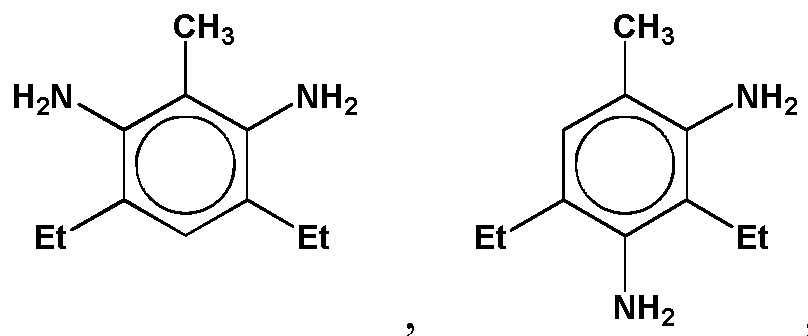
- aminated hardener is chosen from the group consisting of the compounds below and the mixtures of these compounds:
- the amount of aminated hardener is between 1 and 15 phr. Below the minimum indicated, the technical effect has been found to be insufficient, while beyond the maximum indicated, one is exposed to the risk of penalization of the implementation in the raw state of the compositions.
- the level of aminated hardener is in a range from 5 to 10 phr, preferably from 2 to 8 phr.
- the rubber compositions in accordance with the invention may also comprise all or part of the usual additives usually used in elastomer compositions, for example pigments, protective agents such as anti-ozone waxes, anti-ozonants, anti-ozone agents or anti-ozone agents. oxidizing agents, plasticizing agents, anti-fatigue agents, reinforcing resins, a crosslinking system based on either sulfur, sulfur and / or peroxide donors and / or bismaleimides, vulcanization accelerators, vulcanization activators.
- pigments for example pigments, protective agents such as anti-ozone waxes, anti-ozonants, anti-ozone agents or anti-ozone agents.
- oxidizing agents plasticizing agents, anti-fatigue agents, reinforcing resins, a crosslinking system based on either sulfur, sulfur and / or peroxide donors and / or bismaleimides, vulcanization accelerators, vulcanization activators.
- compositions may also contain, in addition to the coupling agents, coupling activators, inorganic charge-covering agents or, more generally, processing aids that can be used in a known manner, thanks to an improvement in the dispersion. of the charge in the rubber matrix and a lowering of the viscosity of the compositions, to improve their ability to use in the green state, these agents being for example hydrolysable silanes such as alkylalkoxysilanes, polyols, polyethers, primary, secondary or tertiary amines, hydroxylated or hydrolysable polyorganosiloxanes.
- hydrolysable silanes such as alkylalkoxysilanes, polyols, polyethers, primary, secondary or tertiary amines, hydroxylated or hydrolysable polyorganosiloxanes.
- the composition according to the invention is a tire inner layer composition
- it is advantageously devoid of antioxidant.
- the composition according to the invention may be devoid of plasticizer or contain less than 5 phr, preferably less than 1 phr.
- the composition of the tire according to the invention further comprises a plasticizer.
- this plasticizer is a solid hydrocarbon resin (or plasticizing resin), an extender oil (or plasticizing oil), or a mixture of both.
- composition of the tire according to the invention may comprise a cobalt salt, in particular in the case where it is used in an inner layer.
- the amine hardeners comprise at least one six-membered aromatic ring comprising at least one radical R 1 chosen from the group consisting of halogens, and ethers, tertiary amines, thioethers, ketones, esters and amides, substituted by linear or branched C1-C6 alkyl radicals, are particularly effective in compositions comprising a cobalt salt.
- the composition according to the invention comprises a cobalt salt and an amine hardener comprising at least one radical R 1 chosen from the group consisting of halogens, and ethers, tertiary amines, thioethers and ketones. esters and amides, substituted by linear or branched C1-C6 alkyl radicals.
- the cobalt salt may be chosen, for example, from the group consisting of abietates, acetylacetonates, tallates, naphthenates, resinates and mixtures of these compounds.
- the cobalt salt content may be, for example, between 0.1 and 6 phr, for example between 0.3 and 4 phr, for example between 0.5 and 2.5 phr.
- the composition according to the invention comprises a crosslinking system.
- the crosslinking system is preferably based on sulfur and a primary vulcanization accelerator, in particular a sulfenamide type accelerator.
- a primary vulcanization accelerator in particular a sulfenamide type accelerator.
- various known secondary accelerators or vulcanization activators such as zinc oxide, stearic acid, guanidine derivatives (in particular diphenylguanidine), etc.
- the sulfur content is preferably between 0.5 and 10.0 phr, that of the primary accelerator is preferably between 0.5 and 5.0 phr.
- accelerator any compound capable of acting as a vulcanization accelerator for diene elastomers in the presence of sulfur, especially thiazole type accelerators and their derivatives, thiuram type accelerators, zinc dithiocarbamates.
- accelerators are more preferably selected from the group consisting of 2-mercaptobenzothiazyl disulfide (abbreviated "MBTS”), N-cyclohexyl-2-benzothiazyl sulfenamide (abbreviated “CBS”), N, N-dicyclohexyl-2-benzothiazyl sulphenamide (abbreviated “DCBS”), N-tert-butyl-2-benzothiazyl sulphenamide (abbreviated “TBBS”), N-tert-butyl-2-benzothiazyl sulphenimide (abbreviated “TBSI”), zinc dibenzyldithiocarbamate (in abbreviated “ZBEC”) and mixtures of these compounds.
- MBTS 2-mercaptobenzothiazyl disulfide
- CBS N-cyclohexyl-2-benzothiazyl sulfenamide
- DCBS N-dicyclohexy
- the invention particularly relates to tires intended to equip motor vehicles of the tourism type, SUV ("Sport Utility Vehicles"), or two wheels (in particular motorcycles), or planes, or industrial vehicles chosen from light trucks, "Poids- "heavy” - that is, metros, buses, road transport vehicles (trucks, tractors, trailers), off-the-road vehicles such as agricultural or civil engineering machinery, and others.
- SUV Sport Utility Vehicles
- Poids- "heavy” - that is, metros, buses, road transport vehicles (trucks, tractors, trailers), off-the-road vehicles such as agricultural or civil engineering machinery, and others.
- the radially inner zone and in contact with the inflation gas this zone being generally constituted by the inflation-gas-tight layer, sometimes called inner waterproof layer or inner liner.
- the inner area of the tire that is to say the area between the outer and inner zones.
- This zone includes layers or plies which are here called internal layers of the tire. These are, for example, carcass plies, tread sub-layers, tire belt plies or any other layer that is not in contact with the ambient air or the inflation gas of the tire.
- composition defined in the present description is particularly well suited to the inner layers and the tread of the tires.
- the previously described rubber composition may be used in the tire as a rigid elastomeric layer in at least a portion of the tire.
- the composition according to the invention may be present in at least one layer chosen from an inner layer and the tread.
- the inner layer may be selected from the group consisting of carcass plies, crown plies, bead fences, toe feet, decoupling layers, tread underlayer and combinations of these inner layers.
- the inner layer is selected from the group consisting of carcass plies, crown plies, bead fences, toe feet, decoupling layers and combinations of these inner layers.
- the invention relates to tires and semi-finished products for tires previously described, rubber articles, both in the raw state (that is to say, before cooking) and in the cooked state (that is to say, before cooking). after crosslinking or vulcanization). - -
- compositions used in the treads of the invention may be manufactured in appropriate mixers, using two successive preparation phases well known to those skilled in the art: a first phase of work or thermomechanical mixing (so-called “no" phase). -productive ”) at high temperature, up to a maximum temperature of between 110 ° C. and 190 ° C., preferably between 130 ° C. and 180 ° C., followed by a second mechanical working phase (" productive "phase). ) to a lower temperature, typically less than 110 ° C, for example between 40 ° C and 100 ° C, finishing phase during which is incorporated the crosslinking system.
- the process for preparing such compositions comprises, for example, the following steps: a) incorporating into a diene elastomer, during a first step (called “non-productive"), a reinforcing filler, by thermomechanically kneading the whole (for example in one or more times) until a maximum temperature of between 110 ° C and 190 ° C is reached;
- the epoxy resin and between 1 and 15 phr of the amine hardener can be introduced, independently of one another, either during the non-productive phase (a) or during the productive phase (c) .
- the epoxy resin is introduced during the non-productive phase (a) and the hardener during the productive phase (c).
- the non-productive phase is carried out in a single thermomechanical step in the course of which, in a suitable mixer such as a conventional internal mixer, all the necessary basic constituents (an elastomer) are first introduced. diene, reinforcing filler, and optionally between 1 and 20 phr of an epoxy resin and between 1 and 15 phr of an amino hardener), then in a - - Second time, for example after one to two minutes of mixing, other additives, optional load-collecting agents or additional implementation, with the exception of the crosslinking system.
- the total mixing time in this non-productive phase is preferably between 1 and 15 minutes.
- the first kneading step is generally carried out by incorporating the reinforcing filler to the elastomer in one or more times by thermomechanically kneading.
- the reinforcing filler in particular carbon black
- the masterbatch is directly kneaded and if necessary is incorporated other elastomers or reinforcing fillers present in the composition that are not in the form of masterbatch, as well as additives other than the crosslinking system.
- the mixture thus obtained After cooling the mixture thus obtained, it is then incorporated in an external mixer such as a roll mill, maintained at low temperature (for example between 40 ° C and 100 ° C), the crosslinking system. The whole is then mixed (productive phase) for a few minutes, for example between 2 and 15 min.
- the final composition thus obtained can then be calendered, for example in the form of a sheet, a plate especially for a characterization in the laboratory, or extruded, for example to form a rubber profile used for the manufacture of a pneumatic.
- the measurements are carried out at 130 ° C. or 115 ° C., in accordance with the French standard NF T 43-005.
- the evolution of the consistency index as a function of time makes it possible to determine the toasting time of the rubber compositions, evaluated according to the above-mentioned standard by the parameter T5 (case of a large rotor), expressed in minutes, and defined as being the time needed to get an increase of - - the consistometric index (expressed in MU) of 5 units above the minimum value measured for this index.
- the Mooney plasticity measurement is carried out according to the following principle: the raw composition (i.e., before firing) is molded in a cylindrical chamber heated to 100 ° C. After one minute of preheating, the rotor rotates within the test tube at 2 revolutions / minute and the useful torque is measured to maintain this movement after 4 minutes of rotation.
- the dynamic properties G * (2%) are measured on a viscoanalyzer (Metravib VA4000), according to ASTM D 5992-96.
- the response of a sample of vulcanized composition (cylindrical specimen 4 mm in thickness and 400 mm 2 in section), subjected to a sinusoidal stress in alternating simple shear, at the frequency of 10 Hz, is recorded under normal conditions.
- temperature 23 ° C
- a strain amplitude sweep of 0.1 to 50% (forward cycle) is performed, followed by 50%> to 1% (return cycle).
- the results exploited are the complex dynamic shear modulus G *.
- the dynamic shear complex modulus G * (2%) at 2% deformation at 40 ° C is indicated.
- the mixture thus obtained is recovered, cooled and then sulfur, a sulfenamide type accelerator and between 1 and 15 phr of aminated hardener, are incorporated on a mixer (homoformer) at 30 ° C., mixing all (productive phase). ) for a suitable time (for example between 5 and 12 min).
- compositions thus obtained are then calendered either in the form of plates (thickness of 2 to 3 mm) or thin sheets of rubber for the measurement of their physical or mechanical properties, or extruded in the form of a profile.
- compositions presented in Table 1 do not cause the formation of formaldehyde during cooking.
- Compositions C.2 to C11 contain an epoxy resin (two different resins were tested) and a polyamine hardener to replace the formophenolic resin / HMT hardener couple contained in the conventional control composition. - -
- Compositions C.5 to C11 according to the present invention contain amine hardeners, different from the amine hardeners of control compositions C.2 to C.4.
- the results based on the roasting time and G * (2%) are presented 100 with respect to the control composition C l.
- the Mooney plasticity results are presented in absolute value.
- compositions C.5 to C 11 allow to obtain an improved Mooney plasticity compared to the formo-phenolic resin / hardener couple (s). ) HMT of the control composition C 1, but also with respect to the pair of epoxy resin / polyamine hardener of the control compositions C.2 to C.4. Moreover, the compositions according to the present invention also make it possible to obtain an improved roasting time or at least equivalent to that of the control composition Cl, while maintaining a rigidity equivalent to that of the control compositions C 1 to C 4. .
- This test illustrates rubber compositions which can be used in particular in internal mixtures such as carcass plies, crown plies, bead fences, toe feet, decoupling layers, tread underlayer, in particular in the carcass plies, the crown plies, the bead stoppers, the toe feet, the decoupling layers, the tread underlayer, areas requiring high rigidity at low deformation.
Landscapes
- Chemical & Material Sciences (AREA)
- Health & Medical Sciences (AREA)
- Chemical Kinetics & Catalysis (AREA)
- Medicinal Chemistry (AREA)
- Polymers & Plastics (AREA)
- Organic Chemistry (AREA)
- Engineering & Computer Science (AREA)
- Mechanical Engineering (AREA)
- Compositions Of Macromolecular Compounds (AREA)
Abstract
Description




Claims


Priority Applications (5)
| Application Number | Priority Date | Filing Date | Title |
|---|---|---|---|
| US16/314,100 US11499036B2 (en) | 2016-06-30 | 2017-06-29 | Rubber composition comprising an epoxide resin and a specific amine hardener |
| RU2018143450A RU2743953C2 (ru) | 2016-06-30 | 2017-06-29 | Композиция каучука, содержащая эпоксидную смолу и аминный отвердитель |
| CN201780041156.6A CN109415540B (zh) | 2016-06-30 | 2017-06-29 | 包含环氧树脂和特定胺硬化剂的橡胶组合物 |
| BR112018077347-6A BR112018077347B1 (pt) | 2016-06-30 | 2017-06-29 | Composição de borracha que compreende uma resina epóxi e um endurecedor de amina específico |
| EP17740450.6A EP3478759B1 (fr) | 2016-06-30 | 2017-06-29 | Composition de caoutchouc comprenant une résine epoxyde et un durcisseur amine spécifique |
Applications Claiming Priority (2)
| Application Number | Priority Date | Filing Date | Title |
|---|---|---|---|
| FR1656142A FR3053344B1 (fr) | 2016-06-30 | 2016-06-30 | Composition de caoutchouc comprenant une resine epoxyde et un durcisseur amine specifique |
| FR16/56142 | 2016-06-30 |
Publications (1)
| Publication Number | Publication Date |
|---|---|
| WO2018002538A1 true WO2018002538A1 (fr) | 2018-01-04 |
Family
ID=56787617
Family Applications (1)
| Application Number | Title | Priority Date | Filing Date |
|---|---|---|---|
| PCT/FR2017/051749 Ceased WO2018002538A1 (fr) | 2016-06-30 | 2017-06-29 | Composition de caoutchouc comprenant une résine epoxyde et un durcisseur amine spécifique |
Country Status (7)
| Country | Link |
|---|---|
| US (1) | US11499036B2 (fr) |
| EP (1) | EP3478759B1 (fr) |
| CN (1) | CN109415540B (fr) |
| BR (1) | BR112018077347B1 (fr) |
| FR (1) | FR3053344B1 (fr) |
| RU (1) | RU2743953C2 (fr) |
| WO (1) | WO2018002538A1 (fr) |
Cited By (11)
| Publication number | Priority date | Publication date | Assignee | Title |
|---|---|---|---|---|
| WO2020008130A1 (fr) | 2018-07-02 | 2020-01-09 | Compagnie Generale Des Etablissements Michelin | Composition de caoutchouc à base de r |
| FR3085955A1 (fr) | 2018-09-17 | 2020-03-20 | Compagnie Generale Des Etablissements Michelin | Composition de caoutchouc a base de resine epoxyde, d’un durcisseur amine et d’un imidazole |
| CN113195632A (zh) * | 2018-12-11 | 2021-07-30 | 伊士曼化工公司 | 包含乙酰乙酰基化树脂的组合物的受控固化 |
| WO2021181033A1 (fr) | 2020-03-10 | 2021-09-16 | Compagnie Generale Des Etablissements Michelin | Composition de caoutchouc a base de résine époxyde et d'un durcisseur à latence élevée |
| WO2021181032A1 (fr) | 2020-03-10 | 2021-09-16 | Compagnie Generale Des Etablissements Michelin | Composition de caoutchouc a base de résine époxyde et d'un durcisseur à latence élevée |
| WO2023062319A1 (fr) | 2021-10-15 | 2023-04-20 | Compagnie Generale Des Etablissements Michelin | Pneumatique avec une bande de roulement comportant des elements de renforcement |
| US11732165B2 (en) | 2017-06-13 | 2023-08-22 | Eastman Chemical Company | Low-temperature curable compositions |
| WO2023174788A1 (fr) | 2022-03-15 | 2023-09-21 | Compagnie Generale Des Etablissements Michelin | Composition de caoutchouc comprenant une résine époxyde et un durcisseur |
| US11920050B2 (en) | 2018-12-11 | 2024-03-05 | Eastman Chemical Company | Self-curable and low temperature curable coating compositions |
| FR3140372A1 (fr) | 2022-10-04 | 2024-04-05 | Compagnie Generale Des Etablissements Michelin | Composition de caoutchouc à base d’un noir de carbone de pyrolyse et d’une résine époxyde |
| US12378434B2 (en) | 2018-12-11 | 2025-08-05 | Eastman Chemical Company | Curable coating compositions |
Families Citing this family (1)
| Publication number | Priority date | Publication date | Assignee | Title |
|---|---|---|---|---|
| FR3145755B1 (fr) * | 2023-02-09 | 2025-02-07 | Michelin & Cie | Composition de caoutchouc a base d’elastomere dienique fortement sature et d’une resine renforçante |
Citations (34)
| Publication number | Priority date | Publication date | Assignee | Title |
|---|---|---|---|---|
| EP0649446A1 (fr) | 1992-07-08 | 1995-04-26 | COMPAGNIE GENERALE DES ETABLISSEMENTS MICHELIN-MICHELIN & CIE | Procede et composition permettant l'emploi de melamines substituees comme durcisseurs de resines novolaques |
| FR2740778A1 (fr) | 1995-11-07 | 1997-05-09 | Michelin & Cie | Composition de caoutchouc a base de silice et de polymere dienique fonctionalise ayant une fonction silanol terminale |
| WO1997036724A2 (fr) | 1996-04-01 | 1997-10-09 | Cabot Corporation | Nouveaux materiaux composites elastomeres, et procede et appareil s'y rapportant |
| FR2765882A1 (fr) | 1997-07-11 | 1999-01-15 | Michelin & Cie | Composition de caoutchouc a base de noir de carbone ayant de la silice fixee a sa surface et de polymere dienique fonctionnalise alcoxysilane |
| WO1999009036A1 (fr) | 1997-08-21 | 1999-02-25 | Osi Specialties, Inc. | Agents de couplage a base de mercaptosilanes bloques, utilises dans des caoutchoucs a charge |
| WO1999016600A1 (fr) | 1997-09-30 | 1999-04-08 | Cabot Corporation | Melanges composites a base d'elastomere et procedes d'elaboration |
| EP1127909A1 (fr) | 2000-02-24 | 2001-08-29 | Société de Technologie Michelin | Composition de caoutchouc vulcanisable, utilisable pour fabriquer un pneumatique, et pneumatique comprenant cette composition |
| WO2001092402A1 (fr) | 2000-05-26 | 2001-12-06 | Societe De Technologie Michelin | Composition de caoutchouc utilisable comme bande de roulement de pneumatique |
| WO2002010269A2 (fr) | 2000-07-31 | 2002-02-07 | Societe De Technologie Michelin | Bande de roulement pour pneumatique |
| WO2002030939A1 (fr) | 2000-10-13 | 2002-04-18 | Societe De Technologie Michelin | Organosilane polyfonctionnel utilisable comme agent de couplage et son procede d'obtention |
| WO2002031041A1 (fr) | 2000-10-13 | 2002-04-18 | Societe De Technologie Michelin | Composition de caoutchouc comportant a titre d'agent de couplage un organosilane polyfonctionnel |
| WO2002083782A1 (fr) | 2001-04-10 | 2002-10-24 | Societe De Technologie Michelin | Pneumatique et bande de roulement comportant comme agent de couplage un tetrasulfure de bis-alkoxysilane |
| WO2003016387A1 (fr) | 2001-08-13 | 2003-02-27 | Societe De Technologie Michelin | Composition de caoutchouc dienique pour pneumatique comprenant une silice specifique comme charge renforcante |
| US6610261B1 (en) | 1997-11-28 | 2003-08-26 | COMPAGNIE GéNéRALE DES ETABLISSEMENTS MICHELIN - MICHELIN & CIE | Reinforcing aluminum-based filler and rubber composition comprising such a filter |
| US6747087B2 (en) | 1999-05-28 | 2004-06-08 | Michelin Recherche Et Technique S.A. | Rubber composition for a tire, based on diene elastomer and a reinforcing titanium oxide |
| WO2004096865A2 (fr) | 2003-04-29 | 2004-11-11 | Societe De Technologie Michelin | Procede d’obtention d’un elastomere greffe a groupes fonctionnels le long de la chaîne et composition de caoutchouc |
| US6849754B2 (en) | 2001-08-06 | 2005-02-01 | Degussa Ag | Organosilicon compounds |
| WO2006023815A2 (fr) | 2004-08-20 | 2006-03-02 | General Electric Company | Compositions cycliques de silanes mercaptofonctionnels bloquees derivees de diol |
| WO2006069792A1 (fr) | 2004-12-31 | 2006-07-06 | Societe De Technologie Michelin | Nanoparticules de polyvinylaromatique fonctionnalise |
| WO2006069793A1 (fr) | 2004-12-31 | 2006-07-06 | Societe De Technologie Michelin | Composition elastomerique renforcee d'une charge de polyvinylaromatique fonctionnalise |
| WO2006125533A1 (fr) | 2005-05-26 | 2006-11-30 | Societe De Technologie Michelin | Compostion de cautchouc pour pneumatique comportant un agent de couplage organosilicique et un agent de recouvrement de charge inorganique |
| WO2006125534A1 (fr) | 2005-05-26 | 2006-11-30 | Societe De Technologie Michelin | Composition de caoutchouc pour pneumatique comportant un systeme de couplage organosilicique |
| WO2006125532A1 (fr) | 2005-05-26 | 2006-11-30 | Societe De Technologie Michelin | Composition de caoutchouc pour pneumatique comportant un agent de couplage organosiloxane |
| WO2007061550A1 (fr) | 2005-11-16 | 2007-05-31 | Dow Corning Corporation | Organosilanes et leur preparation et utilisation dans des compositions d’elastomere |
| WO2007098080A2 (fr) | 2006-02-21 | 2007-08-30 | Momentive Performance Materials Inc. | Composition de matière de charge non agglomérante à base de silane organofonctionnel |
| WO2008003434A1 (fr) | 2006-07-06 | 2008-01-10 | Societe De Technologie Michelin | Nanoparticules de polymere vinylique fonctionnalise |
| WO2008003435A1 (fr) | 2006-07-06 | 2008-01-10 | Societe De Technologie Michelin | Composition élastomèrique renforcée d'une charge de polymère vinylique non aromatique fonctionnalise |
| WO2008055986A2 (fr) | 2006-11-10 | 2008-05-15 | Rhodia Operations | Procede de preparation d'alcoxysilanes (poly)sulfures et nouveaux produits intermediaires dans ce procede |
| WO2008141702A1 (fr) | 2007-04-18 | 2008-11-27 | Societe De Technologie Michelin | Elastomere dienique couple monomodal possedant une fonction silanol en milieu de chaine, son procede d'obtention et composition de caoutchouc le contenant |
| WO2009000750A1 (fr) | 2007-06-28 | 2008-12-31 | Société de Technologie Michelin | Procédé de préparation d'un copolymère diénique à bloc polyéther, copolymère diénique à bloc polyéther, composition de caoutchouc renforcée et pneumatique |
| WO2009000752A1 (fr) | 2007-06-28 | 2008-12-31 | Societe De Technologie Michelin | Procédé de préparation d'un copolymère diénique à bloc polyéther, composition de caoutchouc renforcée et pneumatique |
| WO2010072685A1 (fr) | 2008-12-22 | 2010-07-01 | Societe De Technologie Michelin | Agent de couplage mercaptosilane bloque |
| WO2011045342A1 (fr) | 2009-10-14 | 2011-04-21 | Societe De Technologie Michelin | Composition de caoutchouc comprenant une resine epoxyde |
| WO2014016346A1 (fr) * | 2012-07-25 | 2014-01-30 | Compagnie Generale Des Etablissements Michelin | Composition de caoutchouc comprenant une resine époxyde et un durcisseur poly-imine |
Family Cites Families (11)
| Publication number | Priority date | Publication date | Assignee | Title |
|---|---|---|---|---|
| US5393806A (en) * | 1991-12-26 | 1995-02-28 | Albemarle Corporation | Epoxide system curing agents |
| US5718788A (en) | 1992-07-08 | 1998-02-17 | Compagnie Generale Establissements Michelin - Michelin & Cie | Process and composition for the use of substituted melamines as hardeners of novola resins |
| US6098711A (en) * | 1998-08-18 | 2000-08-08 | Halliburton Energy Services, Inc. | Compositions and methods for sealing pipe in well bores |
| US6875825B2 (en) * | 1999-12-13 | 2005-04-05 | Mitsubishi Rayon Co., Ltd. | Composition of bisphenol or novolak epoxy resin, epoxy resin from monoaromatic backbone and aromatic amine |
| CN1710007A (zh) * | 2005-07-08 | 2005-12-21 | 南京大学 | 室温固化宽温域高强高韧环氧增强丁腈胶 |
| US20120142816A1 (en) * | 2006-11-20 | 2012-06-07 | Dow Global Technologies Inc | Novel epoxy hardeners with improved cure and polymers with enhanced coating properties |
| EP2638088B1 (fr) * | 2010-09-02 | 2015-11-18 | Lonza Ltd | Halogénation des 4,4'-méthylène-bis-anilines |
| US9834670B2 (en) * | 2010-09-24 | 2017-12-05 | Toray Industries, Inc. | Epoxy resin composition for fiber-reinforced composite material, prepreg, and fiber-reinforced composite material |
| DE102011053452A1 (de) * | 2011-09-09 | 2013-03-14 | Continental Reifen Deutschland Gmbh | Schwefelvernetzbare Gummierungsmischung |
| CN104684975B (zh) * | 2012-09-28 | 2016-11-23 | 东丽株式会社 | 预浸料坯和碳纤维增强复合材料 |
| FR2999582B1 (fr) * | 2012-12-17 | 2015-02-13 | Michelin & Cie | Pneumatique comportant une composition de caoutchouc comprenant une resine epoxyde et un poly-acide |
-
2016
- 2016-06-30 FR FR1656142A patent/FR3053344B1/fr not_active Expired - Fee Related
-
2017
- 2017-06-29 BR BR112018077347-6A patent/BR112018077347B1/pt active IP Right Grant
- 2017-06-29 CN CN201780041156.6A patent/CN109415540B/zh active Active
- 2017-06-29 EP EP17740450.6A patent/EP3478759B1/fr active Active
- 2017-06-29 US US16/314,100 patent/US11499036B2/en active Active
- 2017-06-29 RU RU2018143450A patent/RU2743953C2/ru active
- 2017-06-29 WO PCT/FR2017/051749 patent/WO2018002538A1/fr not_active Ceased
Patent Citations (39)
| Publication number | Priority date | Publication date | Assignee | Title |
|---|---|---|---|---|
| EP0649446A1 (fr) | 1992-07-08 | 1995-04-26 | COMPAGNIE GENERALE DES ETABLISSEMENTS MICHELIN-MICHELIN & CIE | Procede et composition permettant l'emploi de melamines substituees comme durcisseurs de resines novolaques |
| FR2740778A1 (fr) | 1995-11-07 | 1997-05-09 | Michelin & Cie | Composition de caoutchouc a base de silice et de polymere dienique fonctionalise ayant une fonction silanol terminale |
| US6013718A (en) | 1995-11-07 | 2000-01-11 | Michelin & Cie | Rubber composition based on silica and on functionalized diene polymer which has a silanol end functional group |
| WO1997036724A2 (fr) | 1996-04-01 | 1997-10-09 | Cabot Corporation | Nouveaux materiaux composites elastomeres, et procede et appareil s'y rapportant |
| FR2765882A1 (fr) | 1997-07-11 | 1999-01-15 | Michelin & Cie | Composition de caoutchouc a base de noir de carbone ayant de la silice fixee a sa surface et de polymere dienique fonctionnalise alcoxysilane |
| US5977238A (en) | 1997-07-11 | 1999-11-02 | Michelin & Cie | Rubber composition based on carbon black having silica fixed to its surface and on diene polymer functionalized with alkoxysilane |
| WO1999009036A1 (fr) | 1997-08-21 | 1999-02-25 | Osi Specialties, Inc. | Agents de couplage a base de mercaptosilanes bloques, utilises dans des caoutchoucs a charge |
| WO1999016600A1 (fr) | 1997-09-30 | 1999-04-08 | Cabot Corporation | Melanges composites a base d'elastomere et procedes d'elaboration |
| US6610261B1 (en) | 1997-11-28 | 2003-08-26 | COMPAGNIE GéNéRALE DES ETABLISSEMENTS MICHELIN - MICHELIN & CIE | Reinforcing aluminum-based filler and rubber composition comprising such a filter |
| US6747087B2 (en) | 1999-05-28 | 2004-06-08 | Michelin Recherche Et Technique S.A. | Rubber composition for a tire, based on diene elastomer and a reinforcing titanium oxide |
| US6503973B2 (en) | 2000-02-24 | 2003-01-07 | Michelin Recherche Et Technique S.A. | Vulcanizable rubber composition usable for the manufacture of a tire, and a tire comprising this composition |
| EP1127909A1 (fr) | 2000-02-24 | 2001-08-29 | Société de Technologie Michelin | Composition de caoutchouc vulcanisable, utilisable pour fabriquer un pneumatique, et pneumatique comprenant cette composition |
| US6815473B2 (en) | 2000-05-26 | 2004-11-09 | Michelin Recherche Et Technique S.A. | Rubber composition usable as a tire tread |
| WO2001092402A1 (fr) | 2000-05-26 | 2001-12-06 | Societe De Technologie Michelin | Composition de caoutchouc utilisable comme bande de roulement de pneumatique |
| WO2002010269A2 (fr) | 2000-07-31 | 2002-02-07 | Societe De Technologie Michelin | Bande de roulement pour pneumatique |
| WO2002031041A1 (fr) | 2000-10-13 | 2002-04-18 | Societe De Technologie Michelin | Composition de caoutchouc comportant a titre d'agent de couplage un organosilane polyfonctionnel |
| WO2002030939A1 (fr) | 2000-10-13 | 2002-04-18 | Societe De Technologie Michelin | Organosilane polyfonctionnel utilisable comme agent de couplage et son procede d'obtention |
| WO2002083782A1 (fr) | 2001-04-10 | 2002-10-24 | Societe De Technologie Michelin | Pneumatique et bande de roulement comportant comme agent de couplage un tetrasulfure de bis-alkoxysilane |
| US6849754B2 (en) | 2001-08-06 | 2005-02-01 | Degussa Ag | Organosilicon compounds |
| WO2003016387A1 (fr) | 2001-08-13 | 2003-02-27 | Societe De Technologie Michelin | Composition de caoutchouc dienique pour pneumatique comprenant une silice specifique comme charge renforcante |
| WO2004096865A2 (fr) | 2003-04-29 | 2004-11-11 | Societe De Technologie Michelin | Procede d’obtention d’un elastomere greffe a groupes fonctionnels le long de la chaîne et composition de caoutchouc |
| US20060089445A1 (en) | 2003-04-29 | 2006-04-27 | Michelin Recherche Et Technique S.A. | Process for obtaining a grafted elastomer having functional groups along the chain and a rubber composition |
| WO2006023815A2 (fr) | 2004-08-20 | 2006-03-02 | General Electric Company | Compositions cycliques de silanes mercaptofonctionnels bloquees derivees de diol |
| WO2006069792A1 (fr) | 2004-12-31 | 2006-07-06 | Societe De Technologie Michelin | Nanoparticules de polyvinylaromatique fonctionnalise |
| WO2006069793A1 (fr) | 2004-12-31 | 2006-07-06 | Societe De Technologie Michelin | Composition elastomerique renforcee d'une charge de polyvinylaromatique fonctionnalise |
| WO2006125533A1 (fr) | 2005-05-26 | 2006-11-30 | Societe De Technologie Michelin | Compostion de cautchouc pour pneumatique comportant un agent de couplage organosilicique et un agent de recouvrement de charge inorganique |
| WO2006125534A1 (fr) | 2005-05-26 | 2006-11-30 | Societe De Technologie Michelin | Composition de caoutchouc pour pneumatique comportant un systeme de couplage organosilicique |
| WO2006125532A1 (fr) | 2005-05-26 | 2006-11-30 | Societe De Technologie Michelin | Composition de caoutchouc pour pneumatique comportant un agent de couplage organosiloxane |
| WO2007061550A1 (fr) | 2005-11-16 | 2007-05-31 | Dow Corning Corporation | Organosilanes et leur preparation et utilisation dans des compositions d’elastomere |
| WO2007098080A2 (fr) | 2006-02-21 | 2007-08-30 | Momentive Performance Materials Inc. | Composition de matière de charge non agglomérante à base de silane organofonctionnel |
| WO2008003434A1 (fr) | 2006-07-06 | 2008-01-10 | Societe De Technologie Michelin | Nanoparticules de polymere vinylique fonctionnalise |
| WO2008003435A1 (fr) | 2006-07-06 | 2008-01-10 | Societe De Technologie Michelin | Composition élastomèrique renforcée d'une charge de polymère vinylique non aromatique fonctionnalise |
| WO2008055986A2 (fr) | 2006-11-10 | 2008-05-15 | Rhodia Operations | Procede de preparation d'alcoxysilanes (poly)sulfures et nouveaux produits intermediaires dans ce procede |
| WO2008141702A1 (fr) | 2007-04-18 | 2008-11-27 | Societe De Technologie Michelin | Elastomere dienique couple monomodal possedant une fonction silanol en milieu de chaine, son procede d'obtention et composition de caoutchouc le contenant |
| WO2009000750A1 (fr) | 2007-06-28 | 2008-12-31 | Société de Technologie Michelin | Procédé de préparation d'un copolymère diénique à bloc polyéther, copolymère diénique à bloc polyéther, composition de caoutchouc renforcée et pneumatique |
| WO2009000752A1 (fr) | 2007-06-28 | 2008-12-31 | Societe De Technologie Michelin | Procédé de préparation d'un copolymère diénique à bloc polyéther, composition de caoutchouc renforcée et pneumatique |
| WO2010072685A1 (fr) | 2008-12-22 | 2010-07-01 | Societe De Technologie Michelin | Agent de couplage mercaptosilane bloque |
| WO2011045342A1 (fr) | 2009-10-14 | 2011-04-21 | Societe De Technologie Michelin | Composition de caoutchouc comprenant une resine epoxyde |
| WO2014016346A1 (fr) * | 2012-07-25 | 2014-01-30 | Compagnie Generale Des Etablissements Michelin | Composition de caoutchouc comprenant une resine époxyde et un durcisseur poly-imine |
Non-Patent Citations (1)
| Title |
|---|
| BRUNAUER-EMMETT-TELLER, THE JOURNAL OF THE AMERICAN CHEMICAL SOCIETY, vol. 60, February 1938 (1938-02-01), pages 309 |
Cited By (27)
| Publication number | Priority date | Publication date | Assignee | Title |
|---|---|---|---|---|
| US11732165B2 (en) | 2017-06-13 | 2023-08-22 | Eastman Chemical Company | Low-temperature curable compositions |
| WO2020008130A1 (fr) | 2018-07-02 | 2020-01-09 | Compagnie Generale Des Etablissements Michelin | Composition de caoutchouc à base de r |
| US12516180B2 (en) | 2018-07-02 | 2026-01-06 | Compagnie Generale Des Etablissements Michelin | Rubber composition based on epoxy resin and an aminobenzoate derivative |
| CN112912257A (zh) * | 2018-09-17 | 2021-06-04 | 米其林集团总公司 | 基于环氧树脂、胺硬化剂和咪唑的橡胶组合物 |
| WO2020058604A1 (fr) | 2018-09-17 | 2020-03-26 | Compagnie Generale Des Etablissements Michelin | Composition de caoutchouc a base de résine époxyde, d'un durcisseur aminé et d'un imidazole |
| FR3085955A1 (fr) | 2018-09-17 | 2020-03-20 | Compagnie Generale Des Etablissements Michelin | Composition de caoutchouc a base de resine epoxyde, d’un durcisseur amine et d’un imidazole |
| JP7459067B2 (ja) | 2018-09-17 | 2024-04-01 | コンパニー ゼネラール デ エタブリッスマン ミシュラン | エポキシ樹脂、アミン硬化剤およびイミダゾールをベースとするゴム組成物 |
| JP2022501469A (ja) * | 2018-09-17 | 2022-01-06 | コンパニー ゼネラール デ エタブリッスマン ミシュラン | エポキシ樹脂、アミン硬化剤およびイミダゾールをベースとするゴム組成物 |
| US20220041843A1 (en) * | 2018-09-17 | 2022-02-10 | Compagnie Generale Des Etablissements Michelin | Rubber composition based on epoxy resin, an amine hardener and an imidazole |
| CN112912257B (zh) * | 2018-09-17 | 2023-02-17 | 米其林集团总公司 | 基于环氧树脂、胺硬化剂和咪唑的橡胶组合物 |
| US11866578B2 (en) | 2018-09-17 | 2024-01-09 | Compagnie Generale Des Etablissements Michelin | Rubber composition based on epoxy resin, an amine hardener and an imidazole |
| CN113195632A (zh) * | 2018-12-11 | 2021-07-30 | 伊士曼化工公司 | 包含乙酰乙酰基化树脂的组合物的受控固化 |
| US12378434B2 (en) | 2018-12-11 | 2025-08-05 | Eastman Chemical Company | Curable coating compositions |
| US11920050B2 (en) | 2018-12-11 | 2024-03-05 | Eastman Chemical Company | Self-curable and low temperature curable coating compositions |
| US11820923B2 (en) | 2018-12-11 | 2023-11-21 | Eastman Chemical Company | Controlled cure for compositions comprising acetoacetylated resins |
| WO2021181032A1 (fr) | 2020-03-10 | 2021-09-16 | Compagnie Generale Des Etablissements Michelin | Composition de caoutchouc a base de résine époxyde et d'un durcisseur à latence élevée |
| JP2023517610A (ja) * | 2020-03-10 | 2023-04-26 | コンパニー ゼネラール デ エタブリッスマン ミシュラン | エポキシ樹脂および高潜在性を有する硬化剤をベースとするゴム組成物 |
| FR3108119A1 (fr) | 2020-03-10 | 2021-09-17 | Compagnie Generale Des Etablissements Michelin | Composition de caoutchouc a base de résine époxyde et d’un durcisseur à latence élevée |
| FR3108118A1 (fr) | 2020-03-10 | 2021-09-17 | Compagnie Generale Des Etablissements Michelin | Composition de caoutchouc a base de résine époxyde et d’un durcisseur à latence élevée |
| JP7734679B2 (ja) | 2020-03-10 | 2025-09-05 | コンパニー ゼネラール デ エタブリッスマン ミシュラン | エポキシ樹脂および高潜在性を有する硬化剤をベースとするゴム組成物 |
| WO2021181033A1 (fr) | 2020-03-10 | 2021-09-16 | Compagnie Generale Des Etablissements Michelin | Composition de caoutchouc a base de résine époxyde et d'un durcisseur à latence élevée |
| FR3128159A1 (fr) | 2021-10-15 | 2023-04-21 | Compagnie Generale Des Etablissements Michelin | Pneumatique avec une bande de roulement comportant des elements de renforcement |
| WO2023062319A1 (fr) | 2021-10-15 | 2023-04-20 | Compagnie Generale Des Etablissements Michelin | Pneumatique avec une bande de roulement comportant des elements de renforcement |
| WO2023174788A1 (fr) | 2022-03-15 | 2023-09-21 | Compagnie Generale Des Etablissements Michelin | Composition de caoutchouc comprenant une résine époxyde et un durcisseur |
| FR3133615A1 (fr) | 2022-03-15 | 2023-09-22 | Compagnie Generale Des Etablissements Michelin | Composition de caoutchouc comprenant une résine époxyde et un durcisseur |
| FR3140372A1 (fr) | 2022-10-04 | 2024-04-05 | Compagnie Generale Des Etablissements Michelin | Composition de caoutchouc à base d’un noir de carbone de pyrolyse et d’une résine époxyde |
| WO2024074401A1 (fr) | 2022-10-04 | 2024-04-11 | Compagnie Generale Des Etablissements Michelin | Composition de caoutchouc à base d'un noir de carbone de pyrolyse et d'une résine époxyde |
Also Published As
| Publication number | Publication date |
|---|---|
| EP3478759B1 (fr) | 2020-08-05 |
| FR3053344A1 (fr) | 2018-01-05 |
| RU2018143450A (ru) | 2020-07-30 |
| FR3053344B1 (fr) | 2018-07-06 |
| RU2743953C2 (ru) | 2021-03-01 |
| US11499036B2 (en) | 2022-11-15 |
| BR112018077347B1 (pt) | 2023-02-14 |
| CN109415540A (zh) | 2019-03-01 |
| EP3478759A1 (fr) | 2019-05-08 |
| CN109415540B (zh) | 2021-09-10 |
| RU2018143450A3 (fr) | 2020-10-09 |
| BR112018077347A2 (pt) | 2019-04-02 |
| US20190241722A1 (en) | 2019-08-08 |
Similar Documents
| Publication | Publication Date | Title |
|---|---|---|
| EP3478759B1 (fr) | Composition de caoutchouc comprenant une résine epoxyde et un durcisseur amine spécifique | |
| EP2488582B1 (fr) | Composition de caoutchouc comprenant une resine epoxyde | |
| EP3592573B1 (fr) | Pneumatique muni d'une composition comprenant un elastomere riche en ethylene, un peroxyde et un derive d'acrylate polyfonctionnel | |
| EP3592808B1 (fr) | Pneumatique muni d'une composition comprenant un elastomere riche en ethylene, un peroxyde et un acrylate de zinc | |
| EP3717561B1 (fr) | Composition de caoutchouc a haut module comprenant un ultra-accelerateur de vulcanisation | |
| EP2547727A1 (fr) | Flanc pour pneumatique | |
| WO2019106293A1 (fr) | Composition de caoutchouc a haut module comprenant un systeme de reticulation au soufre efficace | |
| WO2014095588A1 (fr) | Pneumatique comportant une composition de caoutchouc comprenant une resine époxyde et un poly-acide | |
| EP3853039B1 (fr) | Composition de caoutchouc a base de résine époxyde, d'un durcisseur aminé et d'un imidazole | |
| EP3818103B1 (fr) | Composition de caoutchouc à base de résine époxyde et d'un dérivé d'aminobenzoate. | |
| EP3703956B1 (fr) | Pneumatique pourvu d'une couche interne a base d'au moins un elastomere isoprenique, une resine renforçante et un sel metallique | |
| CA3168388A1 (fr) | Composition de caoutchouc a base de resine epoxyde et d'un durcisseur a latence elevee | |
| WO2018109376A1 (fr) | Pneumatique muni d'une composition comprenant un elastomere dienique, un acrylate de zinc, un peroxyde et un anti-oxydant specifique | |
| WO2017216485A1 (fr) | Composition de caoutchouc renforcee pour pneumatique | |
| EP4118143A1 (fr) | Composition de caoutchouc a base de résine époxyde et d'un durcisseur à latence élevée | |
| EP4493417B1 (fr) | Composition de caoutchouc comprenant une résine époxyde et un durcisseur | |
| WO2018185400A1 (fr) | Composition de caoutchouc a base de resine renforcante et d'un derive d'aminobenzoate | |
| FR3143613A1 (fr) | Composition de caoutchouc comprenant un élastomère diénique fortement saturé |
Legal Events
| Date | Code | Title | Description |
|---|---|---|---|
| 121 | Ep: the epo has been informed by wipo that ep was designated in this application |
Ref document number: 17740450 Country of ref document: EP Kind code of ref document: A1 |
|
| NENP | Non-entry into the national phase |
Ref country code: DE |
|
| REG | Reference to national code |
Ref country code: BR Ref legal event code: B01A Ref document number: 112018077347 Country of ref document: BR |
|
| ENP | Entry into the national phase |
Ref document number: 2017740450 Country of ref document: EP Effective date: 20190130 |
|
| ENP | Entry into the national phase |
Ref document number: 112018077347 Country of ref document: BR Kind code of ref document: A2 Effective date: 20181227 |