WO2018001492A1 - A vacuum insulation panel with improved assemblage - Google Patents
A vacuum insulation panel with improved assemblage Download PDFInfo
- Publication number
- WO2018001492A1 WO2018001492A1 PCT/EP2016/065390 EP2016065390W WO2018001492A1 WO 2018001492 A1 WO2018001492 A1 WO 2018001492A1 EP 2016065390 W EP2016065390 W EP 2016065390W WO 2018001492 A1 WO2018001492 A1 WO 2018001492A1
- Authority
- WO
- WIPO (PCT)
- Prior art keywords
- vacuum insulation
- insulation panel
- wall
- insulating space
- panel
- Prior art date
- Legal status (The legal status is an assumption and is not a legal conclusion. Google has not performed a legal analysis and makes no representation as to the accuracy of the status listed.)
- Ceased
Links
Images

Classifications
-
- F—MECHANICAL ENGINEERING; LIGHTING; HEATING; WEAPONS; BLASTING
- F25—REFRIGERATION OR COOLING; COMBINED HEATING AND REFRIGERATION SYSTEMS; HEAT PUMP SYSTEMS; MANUFACTURE OR STORAGE OF ICE; LIQUEFACTION SOLIDIFICATION OF GASES
- F25D—REFRIGERATORS; COLD ROOMS; ICE-BOXES; COOLING OR FREEZING APPARATUS NOT OTHERWISE PROVIDED FOR
- F25D23/00—General constructional features
- F25D23/06—Walls
-
- F—MECHANICAL ENGINEERING; LIGHTING; HEATING; WEAPONS; BLASTING
- F25—REFRIGERATION OR COOLING; COMBINED HEATING AND REFRIGERATION SYSTEMS; HEAT PUMP SYSTEMS; MANUFACTURE OR STORAGE OF ICE; LIQUEFACTION SOLIDIFICATION OF GASES
- F25D—REFRIGERATORS; COLD ROOMS; ICE-BOXES; COOLING OR FREEZING APPARATUS NOT OTHERWISE PROVIDED FOR
- F25D2201/00—Insulation
- F25D2201/10—Insulation with respect to heat
- F25D2201/14—Insulation with respect to heat using subatmospheric pressure
-
- Y—GENERAL TAGGING OF NEW TECHNOLOGICAL DEVELOPMENTS; GENERAL TAGGING OF CROSS-SECTIONAL TECHNOLOGIES SPANNING OVER SEVERAL SECTIONS OF THE IPC; TECHNICAL SUBJECTS COVERED BY FORMER USPC CROSS-REFERENCE ART COLLECTIONS [XRACs] AND DIGESTS
- Y02—TECHNOLOGIES OR APPLICATIONS FOR MITIGATION OR ADAPTATION AGAINST CLIMATE CHANGE
- Y02B—CLIMATE CHANGE MITIGATION TECHNOLOGIES RELATED TO BUILDINGS, e.g. HOUSING, HOUSE APPLIANCES OR RELATED END-USER APPLICATIONS
- Y02B40/00—Technologies aiming at improving the efficiency of home appliances, e.g. induction cooking or efficient technologies for refrigerators, freezers or dish washers
Definitions
- the present invention relates to a vacuum insulation panel, in particular to a vacuum insulation panel for use in a refrigeration appliance such as a domestic refrigerator.
- a refrigeration appliance generally comprises: a compartment for storing and refrigerating articles; a wall which encloses at least one side of the compartment; and an insulating space for receiving foam material such as polyurethane foam, wherein the insulating space is disposed into the wall.
- foam material such as polyurethane foam
- the foam material is injected into the insulating space in the wall of the refrigeration compartment.
- the thermal insulation capability of the foam material is rather limited.
- the thermal conductivity of a vacuum insulation panel (VIP) is lower than the thermal conductivity of foam material.
- VIP vacuum insulation panel
- a vacuum insulation panel generally comprises: a panel which comprises a core material; and an envelope which seals and protectively covers the panel.
- a VIP generally has a rectangular parallelepiped shape which does not match the shape of the insulating space in the wall of the refrigeration appliance. Therefore, a VIP is commonly used in combination with the foam material in order to fill the gaps.
- the VIP is secured by the assembly operator usually in an upright position into the wall through adhesive tapes, glues or clamps, and thereafter the gap around VIP in the insulating space is filled with the foam material.
- CN201811530 U discloses a refrigerator comprising a vacuum insulation panel and foam material.
- a problem with the prior art refrigerator is that the assemblage of the VIP into the wall is time consuming and difficult for the assembly operator. Thereby, the production costs are increased both in terms of labor and material.
- Another problem with the prior art refrigerator is that the VIP cannot be always securely fixed into the wall through the adhesive tapes, glues, and the like. There are instances where the VIP becomes misaligned, or even falls out. For instance, the use of more adhesive tapes increases the production costs both in terms of labor and material. In case of misalignments in the VIP, the insulating space may not be entirely filled with foam material, and thus the insulation performance decreases.
- An objective of the present invention is to provide a vacuum insulation panel which overcomes the aforementioned problems of the prior art in a cost effective way and which enables an easy, quick and secure assemblage into the insulating space.
- the vacuum insulation panel of the present invention comprises a sufficient amount ferromagnetic material for securing the envelope to the metal surface of the wall through magnetic attraction.
- a major advantageous effect of the present invention is that the vacuum insulation panel can be securely fixed into the insulating space in the wall of the refrigeration appliance by virtue of the magnetic attraction. Thereby, the risk of misalignments/flexing/falling out of the vacuum insulation panel can be eliminated or reduced as much as possible, and thus the insulation performance of the refrigeration appliance can be improved.
- Another major advantageous effect of the present invention is that the vacuum insulation panel of the present invention can be easily and quickly fixed into the insulating space in the wall of the refrigeration appliance by virtue of the magnetic attraction.
- Another major advantageous effect of the present invention is that the need for using adhesive tapes and glues has been obviated. Thereby, the production costs can be reduced both in terms of labor and material.
- Other advantageous effects of the present invention can be taken from the above described embodiments.
- the ferromagnetic material is added to the core material and/or to the envelope.
- These embodiments are particularly advantageous as the shape and volume of the panel remains unchanged, and thus the vacuum insulation panel can be smoothly and securely assembled into the insulating space of an existing refrigeration appliance.
- the bond between the metal surface of the wall, the envelope and the core material can be adequately improved.
- the ferromagnetic material of the core material comprises magnetic nanoparticles including magnetic elements such as iron, nickel, cobalt.
- the magnetic nanoparticles comprise iron oxide nanoparticles.
- the use of the vacuum insulation panel is not limited to refrigeration appliances, and can be alternatively used in other thermal insulation applications relating to the building sector.
- Figure 1 – is a schematic perspective partial view of a refrigeration appliance which comprises a vacuum insulation panel according to an embodiment of the present invention
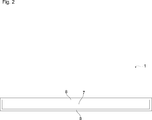
- Figure 2 – is a schematic sectional view of a vacuum insulation panel according to an embodiment of the present invention.
- the vacuum insulation panel (1) is suitable for use in a refrigeration appliance (2) comprising: a compartment (3) for storing and refrigerating articles; a wall (4) which encloses at least one side of the compartment (3), wherein the wall (4) comprises a metal surface (5) which is ferromagnetic; an insulating space for receiving foam material and the vacuum insulating panel (1), wherein the insulating space is disposed into the wall (4) (Fig. 1).
- the vacuum insulation panel (1) comprises: a panel (6) which comprises a core material (7); and an envelope (8) which seals and protectively covers the panel (6) (Fig. 2).
- the vacuum insulation panel (1) of the present invention further comprises: a sufficient amount of ferromagnetic material for securing the envelope to the metal surface (5) through magnetic attraction.
- the refrigeration appliance (2) of the present invention comprises one or more vacuum insulation panels (1).
- the vacuum insulation panel (1) is disposed into the insulating space and embedded in the foam material.
- the ferromagnetic material is mixed with the core material (7) (Fig. 1).
- the ferromagnetic material comprises magnetic nanoparticles.
- the magnetic nanoparticles comprise iron oxide nanoparticles.
- the core material (7) of the vacuum insulation panel (1) further comprises an opacifier, fumed silica and glass fiber.
- the core material (7) further comprises a getter for removing residual gas and/or a desiccant for absorbing any moisture.
- the refrigeration appliance (1) further comprises an inner lining (9) which is manufactured from plastic material and which encloses the compartment (3).
- the insulating space is between the metal surface (5) of the wall (4) and the inner lining (9) (Fig. 2).
- the core material (7) is prepared in form of a powder mixture containing an opacifier, a sufficient amount of the ferromagnetic material in powder form, fumed silica and glass fiber.
- the amount of the ferromagnetic material is determined in accordance with the weight of the vacuum insulation panel (1) so as to achieve the magnetic attraction for secure assemblage.
- a getter and a desiccant can be optionally added to the powder mixture.
- the powder mixture has a density of 230 - 340 Kg per cubic meter. Next, the powder mixture is stirred until it becomes homogeneous. Next, the homogenous powder mixture is filled into a die.
- no harmful binders are used with consideration for the environment.
- the powder mixture in the die is pressed by means of an electromechanical press with a force between 5 to 25 kN for about 1 to 5 minutes so as to form the panel (6).
- the panel (6) is sealed with the envelope (8) while bonding the edges of the envelope (8) under a vacuum between 0.01 to 0.5 mbar.
- a major advantageous effect of the present invention is that the vacuum insulation panel (1) can be securely fixed into the insulating space in the wall (4) of the refrigeration appliance (2) by virtue of the magnetic attraction. Thereby, the risk of misalignments/flexing/falling out of the vacuum insulation panel (1) can be eliminated or reduced as much as possible, and thus the insulation performance of the refrigeration appliance (2) can be improved.
- Another major advantageous effect of the present invention is that the vacuum insulation panel (1) of the present invention can be easily and quickly fixed into the insulating space in the wall (4) of the refrigeration appliance (2) by virtue of the magnetic attraction.
- Another major advantageous effect of the present invention is that the need for using adhesive tapes and glues has been obviated. Thereby, the production costs can be reduced both in terms of labor and material.
- Other advantageous effects of the present invention can be taken from the above described embodiments.
Landscapes
- Engineering & Computer Science (AREA)
- Chemical & Material Sciences (AREA)
- Combustion & Propulsion (AREA)
- Physics & Mathematics (AREA)
- Mechanical Engineering (AREA)
- Thermal Sciences (AREA)
- General Engineering & Computer Science (AREA)
- Refrigerator Housings (AREA)
Abstract
The present invention relates to a vacuunn insulation panel (1) for use in a refrigeration appliance (2) which comprises: a compartment (3) for storing and refrigerating articles; a wall (4) which encloses at least one side of the compartment (3), wherein the wall (4) comprises a metal surface (5) which is ferromagnetic; an insulating space for receiving foam material and the vacuum insulation panel (1 ), wherein the insulating space is disposed into the wall (4). The vacuum insulation panel (1 ) comprises: a panel (6) which comprises a core material (7); and an envelope (8) which seals and protectively covers the panel (6).
Description
The present invention relates to a vacuum insulation panel, in particular to a vacuum insulation panel for use in a refrigeration appliance such as a domestic refrigerator.
Refrigeration appliances such as domestic refrigerators are commonly known in the art. A refrigeration appliance generally comprises: a compartment for storing and refrigerating articles; a wall which encloses at least one side of the compartment; and an insulating space for receiving foam material such as polyurethane foam, wherein the insulating space is disposed into the wall. The foam material is injected into the insulating space in the wall of the refrigeration compartment. The thermal insulation capability of the foam material is rather limited. In contrast thereto, the thermal conductivity of a vacuum insulation panel (VIP) is lower than the thermal conductivity of foam material. Thus, the energy efficiency of a refrigeration appliance can be effectively increased by using a VIP in the insulating space of the wall. Vacuum insulation panels are commonly known in the art. A vacuum insulation panel generally comprises: a panel which comprises a core material; and an envelope which seals and protectively covers the panel. A VIP generally has a rectangular parallelepiped shape which does not match the shape of the insulating space in the wall of the refrigeration appliance. Therefore, a VIP is commonly used in combination with the foam material in order to fill the gaps. When manufacturing the refrigeration appliance in the production line, the VIP is secured by the assembly operator usually in an upright position into the wall through adhesive tapes, glues or clamps, and thereafter the gap around VIP in the insulating space is filled with the foam material.
CN201811530 (U) discloses a refrigerator comprising a vacuum insulation panel and foam material.
A problem with the prior art refrigerator is that the assemblage of the VIP into the wall is time consuming and difficult for the assembly operator. Thereby, the production costs are increased both in terms of labor and material. Another problem with the prior art refrigerator is that the VIP cannot be always securely fixed into the wall through the adhesive tapes, glues, and the like. There are instances where the VIP becomes misaligned, or even falls out. For instance, the use of more adhesive tapes increases the production costs both in terms of labor and material. In case of misalignments in the VIP, the insulating space may not be entirely filled with foam material, and thus the insulation performance decreases.
An objective of the present invention is to provide a vacuum insulation panel which overcomes the aforementioned problems of the prior art in a cost effective way and which enables an easy, quick and secure assemblage into the insulating space.
This objective has been achieved by the vacuum insulation panel as defined in claim 1 and the refrigeration appliance as defined in claim 7. Further achievements have been attained by the subject-matters respectively defined in the dependent claims.
The vacuum insulation panel of the present invention comprises a sufficient amount ferromagnetic material for securing the envelope to the metal surface of the wall through magnetic attraction.
A major advantageous effect of the present invention is that the vacuum insulation panel can be securely fixed into the insulating space in the wall of the refrigeration appliance by virtue of the magnetic attraction. Thereby, the risk of misalignments/flexing/falling out of the vacuum insulation panel can be eliminated or reduced as much as possible, and thus the insulation performance of the refrigeration appliance can be improved. Another major advantageous effect of the present invention is that the vacuum insulation panel of the present invention can be easily and quickly fixed into the insulating space in the wall of the refrigeration appliance by virtue of the magnetic attraction. Another major advantageous effect of the present invention is that the need for using adhesive tapes and glues has been obviated. Thereby, the production costs can be reduced both in terms of labor and material. Other advantageous effects of the present invention can be taken from the above described embodiments.
In an embodiment, the ferromagnetic material is added to the core material and/or to the envelope. These embodiments are particularly advantageous as the shape and volume of the panel remains unchanged, and thus the vacuum insulation panel can be smoothly and securely assembled into the insulating space of an existing refrigeration appliance. In addition, the bond between the metal surface of the wall, the envelope and the core material can be adequately improved.
In alternative embodiments, the ferromagnetic material of the core material comprises magnetic nanoparticles including magnetic elements such as iron, nickel, cobalt. In a version of this embodiment, the magnetic nanoparticles comprise iron oxide nanoparticles. These embodiments are particularly advantages as the magnetic nanoparticles also improve the opaqueness of the vacuum insulation panel, and thus the thermal insulation performance can be further increased.
According to the present invention, the use of the vacuum insulation panel is not limited to refrigeration appliances, and can be alternatively used in other thermal insulation applications relating to the building sector.
Additional features and additional advantageous effects of the vacuum insulation panel and the refrigeration appliance of the present invention will become more apparent with the detailed description of the embodiments with reference to the accompanying drawings in which:
Figure 1 – is a schematic perspective partial view of a refrigeration appliance which comprises a vacuum insulation panel according to an embodiment of the present invention;
Figure 2 – is a schematic sectional view of a vacuum insulation panel according to an embodiment of the present invention.
The reference signs appearing on the drawings relate to the following technical features.
- Vacuum insulation panel (VIP)
- Refrigeration appliance
- Compartment
- Wall
- Metal surface
- Panel
- Core material
- Envelope
- Inner lining
The vacuum insulation panel (1) is suitable for use in a refrigeration appliance (2) comprising: a compartment (3) for storing and refrigerating articles; a wall (4) which encloses at least one side of the compartment (3), wherein the wall (4) comprises a metal surface (5) which is ferromagnetic; an insulating space for receiving foam material and the vacuum insulating panel (1), wherein the insulating space is disposed into the wall (4) (Fig. 1).
The vacuum insulation panel (1) comprises: a panel (6) which comprises a core material (7); and an envelope (8) which seals and protectively covers the panel (6) (Fig. 2).
The vacuum insulation panel (1) of the present invention further comprises: a sufficient amount of ferromagnetic material for securing the envelope to the metal surface (5) through magnetic attraction.
The refrigeration appliance (2) of the present invention comprises one or more vacuum insulation panels (1). In the refrigeration appliance (2) the vacuum insulation panel (1) is disposed into the insulating space and embedded in the foam material.
In an embodiment, the ferromagnetic material is mixed with the core material (7) (Fig. 1).
In another embodiment, the ferromagnetic material comprises magnetic nanoparticles.
In another embodiment, the magnetic nanoparticles comprise iron oxide nanoparticles.
In another embodiment, the core material (7) of the vacuum insulation panel (1) further comprises an opacifier, fumed silica and glass fiber.
In another embodiment, the core material (7) further comprises a getter for removing residual gas and/or a desiccant for absorbing any moisture.
In another embodiment, the refrigeration appliance (1) further comprises an inner lining (9) which is manufactured from plastic material and which encloses the compartment (3). In this embodiment, the insulating space is between the metal surface (5) of the wall (4) and the inner lining (9) (Fig. 2).
In the subsequent description a manufacturing process of the vacuum insulation panel (1) will be briefly explained by way of example.
The core material (7) is prepared in form of a powder mixture containing an opacifier, a sufficient amount of the ferromagnetic material in powder form, fumed silica and glass fiber. The amount of the ferromagnetic material is determined in accordance with the weight of the vacuum insulation panel (1) so as to achieve the magnetic attraction for secure assemblage. In addition, a getter and a desiccant can be optionally added to the powder mixture. The powder mixture has a density of 230 - 340 Kg per cubic meter. Next, the powder mixture is stirred until it becomes homogeneous. Next, the homogenous powder mixture is filled into a die. Herein, no harmful binders are used with consideration for the environment. Next, the powder mixture in the die is pressed by means of an electromechanical press with a force between 5 to 25 kN for about 1 to 5 minutes so as to form the panel (6). Next, the panel (6) is sealed with the envelope (8) while bonding the edges of the envelope (8) under a vacuum between 0.01 to 0.5 mbar.
A major advantageous effect of the present invention is that the vacuum insulation panel (1) can be securely fixed into the insulating space in the wall (4) of the refrigeration appliance (2) by virtue of the magnetic attraction. Thereby, the risk of misalignments/flexing/falling out of the vacuum insulation panel (1) can be eliminated or reduced as much as possible, and thus the insulation performance of the refrigeration appliance (2) can be improved. Another major advantageous effect of the present invention is that the vacuum insulation panel (1) of the present invention can be easily and quickly fixed into the insulating space in the wall (4) of the refrigeration appliance (2) by virtue of the magnetic attraction. Another major advantageous effect of the present invention is that the need for using adhesive tapes and glues has been obviated. Thereby, the production costs can be reduced both in terms of labor and material. Other advantageous effects of the present invention can be taken from the above described embodiments.
Claims (8)
- A vacuum insulation panel (1) for use in a refrigeration appliance (2) comprising: a compartment (3) for storing and refrigerating articles; a wall (4) which encloses at least one side of the compartment (3), wherein the wall (4) comprises a metal surface (5) which is ferromagnetic; an insulating space for receiving foam material and the vacuum insulation panel (1), wherein the insulating space is disposed into the wall (4), the vacuum insulation panel (1) comprising: a panel (6) which comprises a core material (7); and an envelope (8) which seals and protectively covers the panel (6), the vacuum insulation panel (1) characterized by further comprising: a sufficient amount of ferromagnetic material for securing the envelope to the metal surface (5) through magnetic attraction.
- The vacuum insulation panel (1) according to claim 1, characterized in that the ferromagnetic material is mixed with the core material (7).
- The vacuum insulation panel (1) according to claim 1 or 2, characterized in that the ferromagnetic material comprises magnetic nanoparticles.
- The vacuum insulation panel (1) according to claim 3, characterized in that the magnetic nanoparticles comprise iron oxide nanoparticles.
- The vacuum insulation panel (1) according to any one of claims 1 to 4, characterized in that the core material (7) further comprises an opacifier, fumed silica and glass fiber.
- The vacuum insulation panel (1) according to any one of claims 1 to 5, characterized in that the core material (7) further comprises a getter and/or a desiccant.
- A refrigeration appliance (2) comprising: a compartment (3) for storing and refrigerating articles; a wall (4) which encloses at least one side of the compartment (3), wherein the wall (4) comprises a metal surface (5) which is ferromagnetic; an insulating space for receiving foam material, wherein the insulating space is disposed into the wall (4), characterized by further comprising: one or more vacuum insulation panels (1) as defined in any of claims 1 to 6, wherein the vacuum insulation panel (1) is disposed into the insulating space and embedded in the foam material.
- The refrigeration appliance (1) according to claim 8, characterized by further comprising an inner lining (9) which is manufactured from plastic material and which encloses the compartment (3), wherein the insulating space is between the metal surface (5) of the wall (4) and the inner lining (9).
Priority Applications (1)
| Application Number | Priority Date | Filing Date | Title |
|---|---|---|---|
| PCT/EP2016/065390 WO2018001492A1 (en) | 2016-06-30 | 2016-06-30 | A vacuum insulation panel with improved assemblage |
Applications Claiming Priority (1)
| Application Number | Priority Date | Filing Date | Title |
|---|---|---|---|
| PCT/EP2016/065390 WO2018001492A1 (en) | 2016-06-30 | 2016-06-30 | A vacuum insulation panel with improved assemblage |
Publications (1)
| Publication Number | Publication Date |
|---|---|
| WO2018001492A1 true WO2018001492A1 (en) | 2018-01-04 |
Family
ID=56411589
Family Applications (1)
| Application Number | Title | Priority Date | Filing Date |
|---|---|---|---|
| PCT/EP2016/065390 Ceased WO2018001492A1 (en) | 2016-06-30 | 2016-06-30 | A vacuum insulation panel with improved assemblage |
Country Status (1)
| Country | Link |
|---|---|
| WO (1) | WO2018001492A1 (en) |
Cited By (1)
| Publication number | Priority date | Publication date | Assignee | Title |
|---|---|---|---|---|
| WO2020057836A1 (en) * | 2018-09-20 | 2020-03-26 | Arcelik Anonim Sirketi | A core material compound, a vacuum insulation panel and a cooling device |
Citations (5)
| Publication number | Priority date | Publication date | Assignee | Title |
|---|---|---|---|---|
| JPH09166271A (en) * | 1995-12-15 | 1997-06-24 | Fujimori Kogyo Kk | Vacuum insulation panel mounting structure and vacuum insulation panel for heat insulation wall surface |
| EP1944422A2 (en) * | 2007-01-10 | 2008-07-16 | Va-Q-tec AG | Plate-shaped vacuum insulation body and procedure for its manufacture and use |
| CN201811530U (en) | 2010-07-16 | 2011-04-27 | 海信容声(广东)冰箱有限公司 | A fixed structure of vacuum insulation panels in the bubble layer of refrigerators |
| DE102012223547A1 (en) * | 2012-12-18 | 2014-06-18 | BSH Bosch und Siemens Hausgeräte GmbH | Vacuum insulation element for a household refrigerator with a partially arranged in a support body functional component and household refrigeration appliance with a vacuum insulation element |
| WO2016015899A1 (en) * | 2014-07-31 | 2016-02-04 | Arcelik Anonim Sirketi | A vacuum insulation panel with increased insulation effectiveness |
-
2016
- 2016-06-30 WO PCT/EP2016/065390 patent/WO2018001492A1/en not_active Ceased
Patent Citations (5)
| Publication number | Priority date | Publication date | Assignee | Title |
|---|---|---|---|---|
| JPH09166271A (en) * | 1995-12-15 | 1997-06-24 | Fujimori Kogyo Kk | Vacuum insulation panel mounting structure and vacuum insulation panel for heat insulation wall surface |
| EP1944422A2 (en) * | 2007-01-10 | 2008-07-16 | Va-Q-tec AG | Plate-shaped vacuum insulation body and procedure for its manufacture and use |
| CN201811530U (en) | 2010-07-16 | 2011-04-27 | 海信容声(广东)冰箱有限公司 | A fixed structure of vacuum insulation panels in the bubble layer of refrigerators |
| DE102012223547A1 (en) * | 2012-12-18 | 2014-06-18 | BSH Bosch und Siemens Hausgeräte GmbH | Vacuum insulation element for a household refrigerator with a partially arranged in a support body functional component and household refrigeration appliance with a vacuum insulation element |
| WO2016015899A1 (en) * | 2014-07-31 | 2016-02-04 | Arcelik Anonim Sirketi | A vacuum insulation panel with increased insulation effectiveness |
Non-Patent Citations (1)
| Title |
|---|
| WEI WU ET AL: "Magnetic Iron Oxide Nanoparticles: Synthesis and Surface Functionalization Strategies", NANOSCALE RESEARCH LETTERS, vol. 108, no. 11, 1 November 2008 (2008-11-01), pages 2064 - 415, XP055063171, ISSN: 1931-7573, DOI: 10.1007/s11671-008-9174-9 * |
Cited By (1)
| Publication number | Priority date | Publication date | Assignee | Title |
|---|---|---|---|---|
| WO2020057836A1 (en) * | 2018-09-20 | 2020-03-26 | Arcelik Anonim Sirketi | A core material compound, a vacuum insulation panel and a cooling device |
Similar Documents
| Publication | Publication Date | Title |
|---|---|---|
| TWI277707B (en) | Vacuum insulation panel and refrigerator incorporating the same | |
| US20220299257A1 (en) | Encapsulation system for a thermal bridge breaker-to-metal liner | |
| CN108368963A (en) | Vacuum heat insulator, the manufacturing method with its heat insulation device and vacuum heat insulator | |
| CN103502756B (en) | Refrigerating appliance, especially Domestic refrigerator | |
| US12235038B2 (en) | Trim breaker for a structural cabinet that incorporates a structural glass contact surface | |
| TW200404975A (en) | Vacuum heat insulating material and method for producing the same, and refrigerator using the vacuum heat insulating material | |
| JP2005147591A (en) | Refrigerator | |
| EP2554759A2 (en) | High-performance vacuum insulation panel and manufacturing method thereof | |
| JP2005300005A (en) | refrigerator | |
| JP2007218509A (en) | Freezer refrigerator | |
| US20230266053A1 (en) | Barrier layer for insulated structures | |
| EP3615872B1 (en) | Structural cabinet for an appliance | |
| JP2004052774A (en) | Vacuum heat insulating material, refrigerating and cooling/heating apparatus using the same, vacuum heat insulating material core material, and its manufacturing method | |
| JP2016080281A (en) | Insulation box and insulation door | |
| KR101789089B1 (en) | Vacuum Insulation Panel | |
| JP4576197B2 (en) | Vacuum insulation and refrigerator | |
| WO2005040664A1 (en) | Vacuum heat insulator, and refrigerating apparatus and cooling apparatus using the insulator | |
| RU2691890C1 (en) | Refrigerator (versions) | |
| JP2003314786A5 (en) | ||
| KR101477343B1 (en) | Method for manufacturing vacuum insulation panel and vacuum insulation panel | |
| JP2003314786A (en) | Vacuum insulation material, and refrigeration equipment and cooling / heating equipment using the vacuum insulation material | |
| JP5418643B2 (en) | Vacuum insulation | |
| JP2016089963A (en) | Vacuum heat insulation material and refrigeration using vacuum heat insulation material | |
| KR20200086844A (en) | Vacuum Insulation Panel Impregnated with Hollow Glass Microsphere into Glass-Fiber Core | |
| JP3527727B2 (en) | Vacuum insulation material and equipment using the vacuum insulation material |
Legal Events
| Date | Code | Title | Description |
|---|---|---|---|
| 121 | Ep: the epo has been informed by wipo that ep was designated in this application |
Ref document number: 16738697 Country of ref document: EP Kind code of ref document: A1 |
|
| NENP | Non-entry into the national phase |
Ref country code: DE |
|
| 122 | Ep: pct application non-entry in european phase |
Ref document number: 16738697 Country of ref document: EP Kind code of ref document: A1 |