WO2017221999A1 - Specifically substituted benzofuro- and benzothienoquinolines for organic light emitting diodes - Google Patents

Specifically substituted benzofuro- and benzothienoquinolines for organic light emitting diodes Download PDF

Info

Publication number
WO2017221999A1
WO2017221999A1 PCT/JP2017/022938 JP2017022938W WO2017221999A1 WO 2017221999 A1 WO2017221999 A1 WO 2017221999A1 JP 2017022938 W JP2017022938 W JP 2017022938W WO 2017221999 A1 WO2017221999 A1 WO 2017221999A1
Authority
WO
WIPO (PCT)
Prior art keywords
group
substituted
unsubstituted
formula
compound
Prior art date
Legal status (The legal status is an assumption and is not a legal conclusion. Google has not performed a legal analysis and makes no representation as to the accuracy of the status listed.)
Ceased
Application number
PCT/JP2017/022938
Other languages
French (fr)
Inventor
Yuichi Nishimae
Michelle Groarke
Heinz Wolleb
Annemarie Wolleb
Yuki Nakano
Hideaki Nagashima
Tasuku Haketa
Masahiro Kawamura
Takushi Shiomi
Current Assignee (The listed assignees may be inaccurate. Google has not performed a legal analysis and makes no representation or warranty as to the accuracy of the list.)
Idemitsu Kosan Co Ltd
Original Assignee
Idemitsu Kosan Co Ltd
Priority date (The priority date is an assumption and is not a legal conclusion. Google has not performed a legal analysis and makes no representation as to the accuracy of the date listed.)
Filing date
Publication date
Application filed by Idemitsu Kosan Co Ltd filed Critical Idemitsu Kosan Co Ltd
Priority to KR1020187037051A priority Critical patent/KR102447668B1/en
Priority to CN201780038756.7A priority patent/CN109311904B/en
Priority to JP2018566613A priority patent/JP2019521995A/en
Priority to US16/312,378 priority patent/US11691983B2/en
Publication of WO2017221999A1 publication Critical patent/WO2017221999A1/en
Anticipated expiration legal-status Critical
Ceased legal-status Critical Current

Links

Classifications

    • CCHEMISTRY; METALLURGY
    • C07ORGANIC CHEMISTRY
    • C07DHETEROCYCLIC COMPOUNDS
    • C07D491/00Heterocyclic compounds containing in the condensed ring system both one or more rings having oxygen atoms as the only ring hetero atoms and one or more rings having nitrogen atoms as the only ring hetero atoms, not provided for by groups C07D451/00 - C07D459/00, C07D463/00, C07D477/00 or C07D489/00
    • C07D491/02Heterocyclic compounds containing in the condensed ring system both one or more rings having oxygen atoms as the only ring hetero atoms and one or more rings having nitrogen atoms as the only ring hetero atoms, not provided for by groups C07D451/00 - C07D459/00, C07D463/00, C07D477/00 or C07D489/00 in which the condensed system contains two hetero rings
    • C07D491/04Ortho-condensed systems
    • C07D491/044Ortho-condensed systems with only one oxygen atom as ring hetero atom in the oxygen-containing ring
    • C07D491/048Ortho-condensed systems with only one oxygen atom as ring hetero atom in the oxygen-containing ring the oxygen-containing ring being five-membered
    • CCHEMISTRY; METALLURGY
    • C07ORGANIC CHEMISTRY
    • C07DHETEROCYCLIC COMPOUNDS
    • C07D495/00Heterocyclic compounds containing in the condensed system at least one hetero ring having sulfur atoms as the only ring hetero atoms
    • C07D495/02Heterocyclic compounds containing in the condensed system at least one hetero ring having sulfur atoms as the only ring hetero atoms in which the condensed system contains two hetero rings
    • C07D495/04Ortho-condensed systems
    • CCHEMISTRY; METALLURGY
    • C07ORGANIC CHEMISTRY
    • C07DHETEROCYCLIC COMPOUNDS
    • C07D519/00Heterocyclic compounds containing more than one system of two or more relevant hetero rings condensed among themselves or condensed with a common carbocyclic ring system not provided for in groups C07D453/00 or C07D455/00
    • HELECTRICITY
    • H10SEMICONDUCTOR DEVICES; ELECTRIC SOLID-STATE DEVICES NOT OTHERWISE PROVIDED FOR
    • H10KORGANIC ELECTRIC SOLID-STATE DEVICES
    • H10K50/00Organic light-emitting devices
    • H10K50/10OLEDs or polymer light-emitting diodes [PLED]
    • H10K50/18Carrier blocking layers
    • HELECTRICITY
    • H10SEMICONDUCTOR DEVICES; ELECTRIC SOLID-STATE DEVICES NOT OTHERWISE PROVIDED FOR
    • H10KORGANIC ELECTRIC SOLID-STATE DEVICES
    • H10K85/00Organic materials used in the body or electrodes of devices covered by this subclass
    • H10K85/60Organic compounds having low molecular weight
    • H10K85/615Polycyclic condensed aromatic hydrocarbons, e.g. anthracene
    • HELECTRICITY
    • H10SEMICONDUCTOR DEVICES; ELECTRIC SOLID-STATE DEVICES NOT OTHERWISE PROVIDED FOR
    • H10KORGANIC ELECTRIC SOLID-STATE DEVICES
    • H10K85/00Organic materials used in the body or electrodes of devices covered by this subclass
    • H10K85/60Organic compounds having low molecular weight
    • H10K85/615Polycyclic condensed aromatic hydrocarbons, e.g. anthracene
    • H10K85/622Polycyclic condensed aromatic hydrocarbons, e.g. anthracene containing four rings, e.g. pyrene
    • HELECTRICITY
    • H10SEMICONDUCTOR DEVICES; ELECTRIC SOLID-STATE DEVICES NOT OTHERWISE PROVIDED FOR
    • H10KORGANIC ELECTRIC SOLID-STATE DEVICES
    • H10K85/00Organic materials used in the body or electrodes of devices covered by this subclass
    • H10K85/60Organic compounds having low molecular weight
    • H10K85/649Aromatic compounds comprising a hetero atom
    • H10K85/654Aromatic compounds comprising a hetero atom comprising only nitrogen as heteroatom
    • HELECTRICITY
    • H10SEMICONDUCTOR DEVICES; ELECTRIC SOLID-STATE DEVICES NOT OTHERWISE PROVIDED FOR
    • H10KORGANIC ELECTRIC SOLID-STATE DEVICES
    • H10K85/00Organic materials used in the body or electrodes of devices covered by this subclass
    • H10K85/60Organic compounds having low molecular weight
    • H10K85/649Aromatic compounds comprising a hetero atom
    • H10K85/657Polycyclic condensed heteroaromatic hydrocarbons
    • HELECTRICITY
    • H10SEMICONDUCTOR DEVICES; ELECTRIC SOLID-STATE DEVICES NOT OTHERWISE PROVIDED FOR
    • H10KORGANIC ELECTRIC SOLID-STATE DEVICES
    • H10K85/00Organic materials used in the body or electrodes of devices covered by this subclass
    • H10K85/60Organic compounds having low molecular weight
    • H10K85/649Aromatic compounds comprising a hetero atom
    • H10K85/657Polycyclic condensed heteroaromatic hydrocarbons
    • H10K85/6572Polycyclic condensed heteroaromatic hydrocarbons comprising only nitrogen in the heteroaromatic polycondensed ring system, e.g. phenanthroline or carbazole
    • HELECTRICITY
    • H10SEMICONDUCTOR DEVICES; ELECTRIC SOLID-STATE DEVICES NOT OTHERWISE PROVIDED FOR
    • H10KORGANIC ELECTRIC SOLID-STATE DEVICES
    • H10K2101/00Properties of the organic materials covered by group H10K85/00
    • H10K2101/10Triplet emission
    • HELECTRICITY
    • H10SEMICONDUCTOR DEVICES; ELECTRIC SOLID-STATE DEVICES NOT OTHERWISE PROVIDED FOR
    • H10KORGANIC ELECTRIC SOLID-STATE DEVICES
    • H10K50/00Organic light-emitting devices
    • H10K50/10OLEDs or polymer light-emitting diodes [PLED]
    • H10K50/11OLEDs or polymer light-emitting diodes [PLED] characterised by the electroluminescent [EL] layers
    • HELECTRICITY
    • H10SEMICONDUCTOR DEVICES; ELECTRIC SOLID-STATE DEVICES NOT OTHERWISE PROVIDED FOR
    • H10KORGANIC ELECTRIC SOLID-STATE DEVICES
    • H10K50/00Organic light-emitting devices
    • H10K50/10OLEDs or polymer light-emitting diodes [PLED]
    • H10K50/14Carrier transporting layers
    • H10K50/16Electron transporting layers
    • HELECTRICITY
    • H10SEMICONDUCTOR DEVICES; ELECTRIC SOLID-STATE DEVICES NOT OTHERWISE PROVIDED FOR
    • H10KORGANIC ELECTRIC SOLID-STATE DEVICES
    • H10K85/00Organic materials used in the body or electrodes of devices covered by this subclass
    • H10K85/30Coordination compounds
    • H10K85/341Transition metal complexes, e.g. Ru(II)polypyridine complexes
    • H10K85/342Transition metal complexes, e.g. Ru(II)polypyridine complexes comprising iridium
    • HELECTRICITY
    • H10SEMICONDUCTOR DEVICES; ELECTRIC SOLID-STATE DEVICES NOT OTHERWISE PROVIDED FOR
    • H10KORGANIC ELECTRIC SOLID-STATE DEVICES
    • H10K85/00Organic materials used in the body or electrodes of devices covered by this subclass
    • H10K85/60Organic compounds having low molecular weight
    • H10K85/631Amine compounds having at least two aryl rest on at least one amine-nitrogen atom, e.g. triphenylamine
    • HELECTRICITY
    • H10SEMICONDUCTOR DEVICES; ELECTRIC SOLID-STATE DEVICES NOT OTHERWISE PROVIDED FOR
    • H10KORGANIC ELECTRIC SOLID-STATE DEVICES
    • H10K85/00Organic materials used in the body or electrodes of devices covered by this subclass
    • H10K85/60Organic compounds having low molecular weight
    • H10K85/649Aromatic compounds comprising a hetero atom
    • H10K85/657Polycyclic condensed heteroaromatic hydrocarbons
    • H10K85/6574Polycyclic condensed heteroaromatic hydrocarbons comprising only oxygen in the heteroaromatic polycondensed ring system, e.g. cumarine dyes
    • YGENERAL TAGGING OF NEW TECHNOLOGICAL DEVELOPMENTS; GENERAL TAGGING OF CROSS-SECTIONAL TECHNOLOGIES SPANNING OVER SEVERAL SECTIONS OF THE IPC; TECHNICAL SUBJECTS COVERED BY FORMER USPC CROSS-REFERENCE ART COLLECTIONS [XRACs] AND DIGESTS
    • Y02TECHNOLOGIES OR APPLICATIONS FOR MITIGATION OR ADAPTATION AGAINST CLIMATE CHANGE
    • Y02EREDUCTION OF GREENHOUSE GAS [GHG] EMISSIONS, RELATED TO ENERGY GENERATION, TRANSMISSION OR DISTRIBUTION
    • Y02E10/00Energy generation through renewable energy sources
    • Y02E10/50Photovoltaic [PV] energy
    • Y02E10/549Organic PV cells
    • YGENERAL TAGGING OF NEW TECHNOLOGICAL DEVELOPMENTS; GENERAL TAGGING OF CROSS-SECTIONAL TECHNOLOGIES SPANNING OVER SEVERAL SECTIONS OF THE IPC; TECHNICAL SUBJECTS COVERED BY FORMER USPC CROSS-REFERENCE ART COLLECTIONS [XRACs] AND DIGESTS
    • Y02TECHNOLOGIES OR APPLICATIONS FOR MITIGATION OR ADAPTATION AGAINST CLIMATE CHANGE
    • Y02PCLIMATE CHANGE MITIGATION TECHNOLOGIES IN THE PRODUCTION OR PROCESSING OF GOODS
    • Y02P70/00Climate change mitigation technologies in the production process for final industrial or consumer products
    • Y02P70/50Manufacturing or production processes characterised by the final manufactured product

Definitions

  • the present invention relates to specifically substituted benzofuro- and benzothienoquinolines and their use in electronic devices, especially electroluminescent devices.
  • the specifically substituted benzofuro- and benzothienoquinolines may provide improved efficiency, stability, manufacturability, or spectral characteristics of electroluminescent devices and reduced driving voltage of electroluminescent devices.
  • KR 20110083442 concerns an organic optical device comprising an organic layer comprising an organic optical compound of formula A:
  • Xi, X 2 , X3 and X4 are each 0 (zero), Si, Se, O C or N, whereby if any one of Xi and X 2 is 0, the other one is not 0 and if any one of X3 and X4 is 0, the other one is not 0.
  • benzofuro- and benzothienoquinolines having a specific position of N are not disclosed.
  • US 20110266526 discloses compounds comprising a triphenylene moiety and a benzo- or dibenzo-moiety, wherein the benzo- or dibenzo-moiety has in particular a fused substituent.
  • the compounds may be used in organic light emitting devices, particularly in combination with yellow, orange or red emitters. Under numerous examples, one compound of the following formula is mentioned:
  • KR 20120104064 concerns an organic optical device comprising an organic layer comprising an organic optical compound of formula F:
  • KR 20140103007 concerns organic optical compounds of the following formulae, especially thiophene derivatives, and an organic optical device comprising an organic layer comprising at least one of said compounds:
  • US 20140034915 concerns a heterocyclic compound of formula (I) and an organic light emitting c layer comprising the compound of formula (I):
  • WO 2014/024750 A1 concerns heterocyclic compounds of formula (1) and an organic light mpounds:
  • WO 2014/199637 A1 concerns a material for organic electroluminescent elements having one of the following formulae (1), (2) or (3), organic electroluminescent elements using the same and an electronic device comprising said materials.
  • At least one of Ai-As, Bi or B 2 is in formula (1) N;
  • At least one of A1-A1; A9-A13, Bi or B 2 in formula (2) is N; and
  • At least one of A 3, A14 to Ai 8 , Bi or B 3 in formula (3) is N.
  • N There are numerous compounds explicitly mentioned in WO 2014/199637 A1 , wherein no particular preference for the position of N is given and in most cases, the compounds explicitly mentioned are substituted at the A2 position.
  • benzofuro- and benzothienoquinolines having a specific position of N and a specific substitution pattern are not explicitly disclosed.
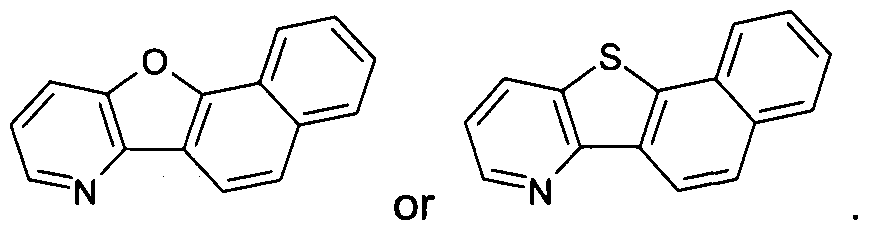
  • A2 concerns benzofuro- and benzothieno/scquinolines of the following formula
  • charge transport materials i.e. hole transport materials and electron transport materials
  • charge/exciton blocker materials i.e. electron/exciton blocker materials and hole/exciton blocker materials
  • the materials should be suitable especially for OLEDs which comprise at least one emitter, which is a phosphorescence emitter and/or a fluorescent emitter, for example at least one blue, green, red or yellow emitter, especially at least one blue emitter (fluorescent system), at least one green emitter or at least one red emitter.
  • emitter which is a phosphorescence emitter and/or a fluorescent emitter, for example at least one blue, green, red or yellow emitter, especially at least one blue emitter (fluorescent system), at least one green emitter or at least one red emitter.
  • the materials should be suitable for providing OLEDs which ensure good efficiencies, good operative lifetimes and a high stability to thermal stress, and a low use and operating voltage of the OLEDs.
  • X is O or S
  • a 2 is N or CR* 2 ;
  • Ai and A 2 are N; preferably, Ai is N and A 2 is CR A2 , or Ai is CR A1 and A 2 is
  • B 2 is CH or N
  • B 3 is CR 3 or N
  • B 4 is CR 4 or N
  • B 5 is CR 5 or N
  • B 6 is CR 6 or N
  • B 7 is CR 7 or N
  • B 8 is CR 8 or N
  • Bi and B 2 or B 2 and B 3 Or B3 and B 4 optionally form together a six membered ring system
  • B5 and B 6 or Be and B 7 or B and Be optionally form together a six membered ring system
  • R A , R A2 , R 1 , R 3 , R 4 , R 5 , R 6 , R 7 , and R 8 are independently of each other H; E; a group of formula-(A 1 )o-(A 2 )p-(A 3 )q-(A 4 ) r -R 20 ; or a CrC 2 5alkyl group, which is unsubstituted or substituted by at least one group E and/or interrupted by D, wherein at least one of R A1 , R 1 ⁇ 2 , R 1 , R 3 , R 4 , R 5 , Re, R 7 , and R 8 is a group of formula-(A ) o -(A ) p -(A 3 ) q -(A ) R 2 0;
  • a 1 , A 2 , A 3 , and A 4 are independently of each other a C6-C 24 arylene group which is unsubstituted or substituted by G or a Ci-C 24 heteroarylene group which is unsubstituted or substituted by G;
  • R 20 is H; E; a C6-C6o aryl group which is unsubstituted or substituted by G; a C1-C60 heteroaryl group which is unsubstituted or substituted by G; or a Ci-C 2 salkyl group which is unsubstituted or substituted by at least one group G and/or interrupted by D;
  • D is -CO-, -COO-, -S-, -SO-, -
  • E is -OR 69 , -SR 69 , -NR65R66, -COR 68 , -COOR 67 , -CONR 65 R 66 , -CN, -SiR 70 R 71 R 72 , halogen or - POR 74 R 75 ; preferably -NR 65 R 66 , -CN, -SiR 0 R R 72 or -POR 74 R 75 ;
  • G is E; a Ci-C24alkyl group; a CrC 24 alkyl group which is interrupted by O; a C6-C6 0 aryl group; a Ce-Ceoaryl group which is substituted by F, -CF 3 , -CF 2 CF 3 , -CF 2 CF 2 CF 3 , -CF(CF 3 ) 2 , - (CF 2 ) 3 CF 3 , or -C(CF 3 ) 3 , a Ci-C 2 4alkyl, or a CrC 2 4alkyl which is interrupted by O; a C 2 -C6oheteroaryl group; or a C 2 -C6oheteroaryl group which is substituted by F, -CF 3 , -CF 2 CF 3 , -CF 2 CF 2 CF 3 , -CF(CF 3 ) 2 , - (CF 2 ) 3 CF 3 , -C(CF 3 ) 3> a Cr
  • R 63 and R 64 are independently of each other a C6-Ci8aryl; a C6-Ci 8 aryl which is substituted by a Ci-Cisalkyl or a Ci-Ci 8 alkoxy; a Ci-Ci 8 alkyl; a Ci-Ci 8 alkyl which is interrupted by -0-; or H; R 65 and R 66 are independently of each other a C6-Ci 8 aryl group; a C6-Ci 8 aryl which is substituted by a Ci-Ci 8 alkyl or a Ci-Ci 8 alkoxy; a Ci-Ci 8 alkyl group; or a CrCi 8 alkyl group which is interrupted by -0-; or
  • R 65 and R 66 together form a five or six membered ring which can be substituted or benzanullated (e.g. carbazole);
  • R 67 is a C 6 -Ci 8 aryl group; a C 6 -Ci 8 aryl group which is substituted by a Ci-Ci 8 alkyl or a Ci-
  • Ciealkoxy a Ci-Ci 8 alkyl group; or a CrCi 8 alkyl group which is interrupted by -0-;
  • R 68 is H; a C6-Ci 8 aryl group; a Ce-Ci 8 aryl group which is substituted by a Ci-Ci 8 alkyl or a Ci-
  • Ci 8 alkoxy a Ci-Ci 8 alkyl group; or a CrCi 8 alkyl group which is interrupted by -0-;
  • R 69 is a C6-Ci 8 aryl; a C6-Ci 8 aryl which is substituted by a Ci-Ci 8 alkyl or a Ci-Ci 8 alkoxy; a Ci-
  • Ci 8 alkyl group or a Ci-Ci 8 alkyl group which is interrupted by -0-;
  • R 70 ' R 71 and R 72 are independently of each other a Ci-Ci 8 alkyl group, a C6-Ci 8 aryl group, or a C6-Ci 8 aryl group which is substituted by a Ci-Ci 8 alkyl;
  • R 73 , R 74 , and R 75 are independently of each other a Ci-Ci 8 alkyl group, a C6-Ci 8 aryl group, or a C6-Ci 8 aryl group which is substituted by a Ci-Ci 8 alkyl;
  • the compounds of formula (1) according to the present invention can be synthesized in fewer steps than similar compounds known in the art.
  • FIG. 1 shows a schematic configuration of one example of the organic EL device of the invention.
  • the specifically substituted compounds of formula (1) according to the present invention are characterized by a higher triplet energy than the compounds disclosed in the related art. Further, the glass transition temperature (TG) of the specifically substituted compounds of the present invention is high, which results in a high stability of a device comprising said compounds.
  • TG glass transition temperature
  • the compounds of the present invention may be used for electrophotographic photoreceptors, photoelectric converters, organic solar cells (organic photovoltaics), switching elements, such as organic transistors, for example, organic FETs and organic TFTs, organic light emitting field effect transistors (OLEFETs), image sensors, dye lasers and electroluminescent devices, such as, for example, organic light-emitting diodes (OLEDs).
  • organic photoreceptors organic solar cells
  • organic photovoltaics organic solar cells
  • switching elements such as organic transistors, for example, organic FETs and organic TFTs, organic light emitting field effect transistors (OLEFETs), image sensors, dye lasers and electroluminescent devices, such as, for example, organic light-emitting diodes (OLEDs).
  • a further subject of the present invention is directed to an electronic device, comprising a compound according to the present invention.
  • the electronic device is preferably an electroluminescent device, such as an organic light-emitting diode (OLED).
  • OLED organic light-emitting diode
  • the compounds of formula (1) can in principal be used in any layer of an EL device, but are preferably used as host, charge transport, i.e. hole transport or electron transport, and/or charge/exciton blocking, i.e. electron/exciton blocking or hole/exciton blocking, material.
  • charge transport i.e. hole transport or electron transport
  • charge/exciton blocking i.e. electron/exciton blocking or hole/exciton blocking
  • the compounds of formula (1) are used as host material for green, red and yellow, preferably green, and red, more preferably red light emitting phosphorescent or fluorescent emitters, preferably phosphorescent emitters and/or as electron transport material, in
  • a further subject of the present invention is directed to a charge transport, i.e. hole transport or electron transport, layer, preferably an electron transport layer, comprising a compound of formula (1 ) according to the present invention.
  • a further subject of the present invention is directed to a charge/exciton blocking, i.e. electron/exciton blocking or hole/exciton blocking, layer, preferably a hole/exciton blocking layer, comprising a compound of formula (1) according to the present invention.
  • a charge/exciton blocking i.e. electron/exciton blocking or hole/exciton blocking, layer, preferably a hole/exciton blocking layer, comprising a compound of formula (1) according to the present invention.
  • a further subject of the present invention is directed to an emitting layer, comprising a
  • a compound of formula (1) is preferably used as host material or as co-host material together with one or more, preferably one, further host materials. More preferably, a combination of a compound of formula (1) and a co-host material together with a phosphorescent emitter is used.
  • a further subject of the present invention is directed to a hole/exciton blocking layer, comprising a compound of formula (1) according to the present invention.
  • a further subject of the present invention is directed to an electron/exciton blocking layer, comprising a compound of formula (1) according to the present invention.
  • halogen alkyl, alkoxy, cycloalkyl, aryl, aryloxy, aralkyl, heteroaryl, arylene,
  • heteroarylene are known in the art and generally have the following meaning, if said groups are not further specified in specific embodiments mentioned below:
  • Halogen is fluorine, chlorine, bromine and iodine, preferably fluorine.
  • Ci-C25alkyl, preferably CrC 2 4alkyl and more preferably CrCi 8 alkyl are typically linear or branched, where possible. Examples are methyl, ethyl, n-propyl, isopropyl, n-butyl, sec-butyl, isobutyl, tert.-butyl, n-pentyl, 2-pentyl, 3-pentyl, 2,2-dimethylpropyl, 1 ,1 ,3,3-tetramethylpentyl, n- hexyl, 1-methylhexyl, 1 ,1 ,3,3,5,5-hexamethylhexyl, n-heptyl, isoheptyl, 1 ,1 ,3,3-tetramethylbutyl, 1-methylheptyl, 3-methylheptyl, n-octyl, 1 ,1 ,3,3-tetramethylbutyl and 2-ethylhexy
  • Ci- Cealkyl is typically methyl, ethyl, n-propyl, isopropyl, n-butyl, sec-butyl, isobutyl, tert.-butyl, n- pentyl, 2-pentyl, 3-pentyl, 2,2-dimethyl-propyl, n-hexyl, n-heptyl, n-octyl, 1 ,1 ,3,3-tetramethylbutyl and 2-ethylhexyl.
  • Ci-C4alkyl is typically methyl, ethyl, n-propyl, isopropyl, n-butyl, sec-butyl, isobutyl, tert.-butyl.
  • alkyl groups mentioned above can optionally be substituted by E and/or interrupted by D.
  • the alkyl groups mentioned above are unsubstituted or can optionally be substituted by E.
  • Ci-C25alkoxy groups and preferably Ci-Ciealkoxy groups are straight-chain or branched alkoxy groups, e.g. methoxy, ethoxy, n-propoxy, isopropoxy, n-butoxy, sec-butoxy, tert-butoxy, amyloxy, isoamyloxy or tert-amyloxy, heptyloxy, octyloxy, isooctyloxy, nonyloxy, decyloxy, undecyloxy, dodecyloxy, tetradecyloxy, pentadecyloxy, hexadecyloxy, heptadecyloxy and octadecyloxy.
  • alkoxy groups e.g. methoxy, ethoxy, n-propoxy, isopropoxy, n-butoxy, sec-butoxy, tert-butoxy, amyloxy, isoamyloxy
  • Ci-Cealkoxy examples are methoxy, ethoxy, n-propoxy, isopropoxy, n-butoxy, sec.-butoxy, isobutoxy, tert.-butoxy, n-pentyloxy, 2-pentyloxy, 3-pentyloxy, 2,2-dimethylpropoxy, n-hexyloxy, n-heptyloxy, n-octyloxy, 1 ,1 ,3,3-tetramethylbutoxy and 2-ethylhexyloxy, preferably Ci-C4alkoxy such as typically methoxy, ethoxy, n-propoxy, isopropoxy, n-butoxy, sec-butoxy, isobutoxy, tert.-butoxy.
  • cycloalkyl group is preferably C5-Ci2cycloalkyl, such as cyclopentyl, cyclohexyl, cycloheptyl, cyclooctyl, cyclononyl, cyclodecyl, cycloundecyl, cyclododecyl, preferably
  • cyclopentyl cyclohexyl, cycloheptyl, or cyclooctyl, which may be unsubstituted or substituted by G.
  • C6-C6oaryl preferably C6-C3oaryl, more preferably C6-C 2 4aryl and most preferably C6-Ciearyl, which is unsubstituted or optionally can be substituted by G
  • G is most preferably phenyl, 4- methylphenyl, 4-methoxyphenyl, naphthyl, especially 1-naphthyl, or 2-naphthyl, biphenylyl, triphenylenyl, fluoranthenyl, terphenylyl, pyrenyl, 2- or 9-fluorenyl, phenanthryl, or anthryl, which may be unsubstituted or substituted by G.
  • Phenyl, 1-naphthyl and 2-naphthyl are examples of a C6-Ci 0 aryl group.
  • Ci-Ceoheteroaryl preferably Ci-C3oheteroaryl, more preferably C 2 -Ci 3 heteroaryl represents a ring with five, six or seven ring atoms or a condensed ring system, wherein nitrogen, oxygen or sulfur are the possible heteroatoms, and is typically a heterocyclic group with five to 60 atoms, preferably with five to 30 atoms, more preferably with five to 13 atoms having at least six conjugated ⁇ -electrons such as thienyl, benzothiophenyl, dibenzothiophenyl, thianthrenyl, fury), furfuryl, 2H-pyranyl, benzofuranyl, isobenzofuranyl, dibenzofuranyl, phenoxythienyl, pyrrolyl, imidazolyl, pyrazolyl, pyridyl, bipyridyl, triazinyl, pyrimidinyl, pyrazinyl,
  • benzotriazolyl benzoxazolyl, phenanthridinyl, acridinyl, pyrimidinyl, phenanthrolinyl, phenazinyl, isothiazolyl, phenothiazinyl, isoxazolyl, furazanyl, 4-imidazo[1 ,2-a]benzimidazolyl, 5- benzimidazo[1 ,2-a]benzimidazolyl, benzimidazolo[2,1-b][1 ,3]benzothiazolyl, carbazolyl, azatriphenylenyl, azadibenzofuryl, azadibenzothiophenyl, azacarbazolyl, quinolonyl,
  • Benzimidazo[1 ,2-a]benzimidazo-5-yl, benzimidazo[1 ,2-a]benzimidazo-2-yl, carbazolyl and dibenzofuranyl are examples of a C2-Ci4heteroaryl group.
  • Ci-C6 0 heteroaryl preferably Ci-C3oheteroaryl, more preferably Ci-C24heteroaryl, most preferably C2-Ci3 heteroaryl, even more preferably C2-C6oheteroaryl, C2-C3oheteroaryl,
  • C 2 -C24heteroaryl, C2-Ci3heteroaryl may be unsubstituted or substituted by G.
  • a -Ci3heteroaryl group is for example, benzimidazo[1 ,2-a]benzimidazo-5-yl
  • benzimidazo[1 ,2-a]benzimidazo-2-yl ( ) ⁇ benzimidazolo[2,1-b][1 ,3]benzothiazolyl, benzimidazolo[2,1-b][1 ,3]benzoxazole, carbazolyl, dibenzofuranyl, or dibenzotihophenyl, which can be unsubstituted or substituted by G,
  • Ci-C6oheteroaryl preferably
  • C2-C13 heteroaryl even more preferably C 2 -C 6 oheteroaryl, C 2 C 3 oheteroaryl, C 2 -C24heteroaryl, C2-Ci3heteroaryl means that the heteroaryl residue comprises at least one, preferably at least 2 carbon atoms and at most 60 carbon atoms in the base skeleton (without substituents).
  • the further atoms in the heteroaryl base skeleton are heteroatoms (N, O and/or S).
  • R 24' is in each case independently Ci-Ciealkyl, such as methyl, ethyl, n-propyl, iso-propyl, n-bu ⁇ yl, isobutyl, sec-butyl, hexyl, octyl, or 2-ethyl-hexyl, or C 6 -Ci 4 aryl, such as phenyl, tolyl, naphthyl, phenanthronyl, triphenylenyl, fluoranthenyl or biphenylyl.
  • Ci-Ciealkyl such as methyl, ethyl, n-propyl, iso-propyl, n-bu ⁇ yl, isobutyl, sec-butyl, hexyl, octyl, or 2-ethyl-hexyl, or C 6 -Ci 4 aryl, such as phenyl, tolyl, naphthyl,
  • Ci-C24heterocyclic group preferably Ci-Ci3heterocyclic group, more preferably
  • C2-C13 heterocyclic group represents a ring with five, six or seven ring atoms or a condensed ring system, wherein nitrogen, oxygen or sulfur are the possible heteroatoms, and is typically a heterocyclic group with five to 24 atoms, preferably with five to 13 atoms.
  • the heterocyclic group may be a Ci-C24heteroaryl group as defined above or a Ci-C24heterocycloalkyl group which may be unsubstituted or substituted by G.
  • Ci-C24heterocycloalkyl groups are oxetan, tetrahydrofuran, tetrahydropyran, oxepane, dioxane, azetidine, pyrrolidine, piperidine, hexahydroazepine, hexahydrodiazepin, tetrahydrothiophene, thietan, tetrahydrothiopyran, thiepan, morpholine as well as bridged heterocycloalkyl systems such as
  • C6-C24arylene groups preferably C6-Ci 0 arylene groups, which optionally can be substituted by G, preferably C6-Ci 0 arylene groups, which optionally can be substituted by G, are more preferably phenylene, 4-methylphenylene, 4-methoxyphenylene, naphthylene, especially 1- naphthylene, or 2-naphthylene, biphenylylene, triphenylenylene, fluoranthenylene,
  • C6-C2 4 arylene groups preferably C6-Ci 0 arylene groups are 1 ,3-phenylene, 3,3'-biphenylylene, 3,3'-m-terphenylene, 2- or 9-fluorenylene, phenanthrylene, which may be unsubstituted or substituted by G.
  • Ci-C3 0 heteroarylene groups preferably C2-Ci4heteroarylene groups, which are unsubstituted or optionally can be substituted by G, represent a ring with five to seven ring atoms or a condensed ring system, wherein nitrogen, oxygen or sulfur are the possible heteroatoms, and is typically a heterocyclic group with five to 30 atoms having at least six conjugated -electrons such as thienylene, benzothiophenylene, dibenzothiophenylene, thianthrenylene, furylene, furfurylene, 2H-pyranylene, benzofuranylene, isobenzofuranylene, dibenzofuranylene, phenoxythienylene, pyrrolylene, imidazolylene, pyrazolylene, pyridylene, bipyridylene, triazinylene, pyrimidinylene, pyrazinylene, pyridazinylene, indolizinylene, iso
  • pteridinylene carbolinylene, benzotriazolylene, benzoxazolylene, phenanthridinylene, acridinylene, pyrimidinylene, phenanthrolinylene, phenazinylene, isothiazolylene,
  • phenothiazinylene isoxazolylene, furazanylene, carbazolylene, benzimidazo[1 ,2- a]benzimidazo-2,5-ylene, or phenoxazinylene, which can be unsubstituted or substituted by G.
  • Preferred C2-C3oheteroarylen groups are pyridylene, triazinylene, pyrimidinylene, carbazolylene, dibenzofuranylene, azatriphenylenylene, azadibenzofurylene, azadibenzothiophenylene, azacarbazolylene, quinolonylene, isoquinolinylene, quinoxalinylene, quinazolinylene, phenanthrolinylene, phenanthridinylene, benzo[h]quinolonylene, benz[h]isoquinolinylene, benzo[f]isoquinolinylene, benzo[f]quinolinylene, benzo[h]quinazolinylene,
  • a substituent occurs more than one time in a group, it can be different in each occurrence.
  • Halo-Ci-Cealkyl is an alkyl group (as defined above) where at least one of the hydrogen atoms is replaced by a halogen atom. Examples are -CF 3 , -CF 2 CF 3 , -CF2CF2CF3, -CF(CF 3 )2, -(CF 2 )3CF3, and -C(CF 3 ) 3 .
  • substituted by G means that one, or more, especially one, two or three
  • substituted by E means that one, or more, especially one, two or three
  • the aforementioned alkyl groups may be substituted by E and/or, if desired, interrupted by D. Interruptions are of course possible only in the case of groups containing at least 2 carbon atoms connected to one another by single bonds; C6-Cisaryl is not interrupted; interrupted arylalkyl contains the unit D in the alkyl moiety.
  • Ci-Ciealkyl substituted by one or more E and/or interrupted by one or more units D is, for example, (CH2CH 2 0)i-9-R x , where R x is H or Ci-Cioalkyl or C 2 -Ci 0 alkanoyl (e.g.
  • R is Ci-Ciealkyl, C5-Ci2cycloalkyl, phenyl, Cz-Cisphenylalkyl, and R y ' embraces the same definitions as R y or is H.
  • An alkyl group substituted by E is, for example, an alkyl group where at least one of the hydrogen atoms is replaced by F.
  • Examples are -CF 3 , -CF2CF3, -CF2CF2CF3, -CF(CF 3 )2, - (CF 2 ) 3 CF 3 , and -C(CF 3 ) 3 .
  • D is preferably -CO-, - COO-,
  • n-propyl iso-propyl, n-butyl, isobutyl, or sec-butyl, or C6-Ci 4 aryl, such as phenyl, tolyl, naphthyl, triphenylenyl or biphenylyl, or C2-C3oheteroaryl, such as, for example, benzimidazo[1 ,2-
  • a]benzimidazo-2-yl carbazolyl, dibenzofuranyl, which can be unsubstituted or substituted especially by C6-Cioaryl, or C6-Cioaryl, which is substituted by Ci-C4alkyl; or
  • E is -OR 69 , -SR 69 , - R65R66, -COR 68 , -COOR 67 , -CONR 65 R 66 , -CN, -SiR 7 °R 7 R 72 , halogen or - POR 74 R 75 ; preferably -NR 65 R 66 , -CN, -SiR 70 R 7 R 72 or -POR 4 R 75 ; wherein R 65 , R 66 , R 67 , R 68 , R 69 , R 70 , R 71 , R 72 , R 73 , R 74 and R 75 are preferably independently of each other Ci-Ci 8 alkyl, such as methyl, ethyl, n-propyl, iso-propyl, n-butyl, isobutyl, sec-butyl, hexyl, octyl, or 2-ethyl-hexyl, or C6
  • G is E, or a Ci-C24alkyl group, a C6-C3 0 aryl group, a C6-C3 0 aryl group, which is substituted by F, Ci-C24alkyl, or Ci-C24alkyl which is interrupted by O; a C2-C6oheteroaryl group, or a C 2 - C6oheteroaryl group, which is substituted by F, Ci-Ciealkyl, or CrCi 8 alkyl which is interrupted by O.
  • G is preferably -OR 69 , -SR 69 , -NR 65 R 66 ; a CrCi 8 alkyl group, a C 6 -Ci 8 aryl group, a C 6 -Ci 8 aryl group, which is substituted by F, or Ci-Ci 8 alkyl; a C2-C24heteroaryl group, or a C2-C24heteroaryl group, which is substituted by F, or Ci-Ciealkyl; wherein R 65 , R 66 and R 69 are independently of each other Ci-Ciealkyl, such as methyl, ethyl, n-propyl, iso-propyl, n-butyl, isobutyl, sec-butyl, hexyl, octyl, or 2-ethyl-hexyl, or Ce-Cuaryl, such as phenyl, tolyl, naphthyl, or biphenylyl.
  • G is a C6-Cisaryl group like phenyl, tolyl, triphenylenyl or biphenylyl, phenanthryl, anthranyl or a C6-C24heteroaryl group like dibenzothiophenylyl, dibenzofuranyl, pyridyl, triazinyl, pyrimidinyl, azatriphenylenyl, azadibenzofuryl, azadibenzothiophenyl, azacarbazolyl, quinolonyl, isoquinolinyl, quinoxalinyl, quinazolinyl, phenanthrolinyl, phenanthridinyl, benzo[h]quinolonyl, benz[h]isoquinolinyl, benzo[f]isoquinolinyl, benzo[f]quinolinyl, benzo[f]quinazolinyl,
  • Ai and A 2 is N; preferably, Ai is N and A 2 is CR A2 , or Ai is CR A1 and A 2 is N.
  • Bi is CR 1 or N, preferably CR 1
  • B 2 is CH or N, preferably CH
  • B 3 is CR 3 or N
  • B 4 is CR 4 or N, preferably CR 4 ;
  • B 5 is CR 5 or N, preferably CR 5 ;
  • B 6 is CR 6 or N, preferably CR 6 ;
  • B 7 is CR 7 or N, preferably CR 7 ; and
  • B 8 is CR 8 or N, preferably CR 8 ;
  • Bi and B2 or B 2 and B3 or B3 and B 4 optionally form together a six membered ring system
  • B5 and Be or ⁇ and B 7 or B 7 and B 8 optionally form together a six membered ring system
  • the six membered ring system is preferably a ring structure of the following formula: wherein G is defined above, and y is 0, 1 , 2, 3 or 4, preferably 0, 1 or 2, more preferably 0 or 1 , most preferably 0; and -are bonding sites to the atoms to which the two adjacent groups of the groups R 1 to R 8 are bonded.
  • the two adjacent groups of the groups R 1 to R 8 may form together with the atoms to which they are bonded an aromatic 6 membered ring structure, which can optionally be substituted by G.
  • 0 or 1 more preferably 0, of the groups Bi and B 2 or B 2 and B 3 or B 3 and B 4 or B 5 and Be or B 6 and B 7 or B 7 and Be optionally form together a six membered ring system, preferably a six membered ring system as defined above.
  • 0, 1 or 2 of Bi to B 8 preferably B 1 and/or B 5 , more preferably 0 or 1 of Bi to Be, preferably B 1 or B 5 , most preferably 0 of Bi to Be are N.
  • a 2 is CR ⁇
  • B 5 is CR 5 or B 6 is CR 6 or B 7 is CR 7 or B 8 is CR 8
  • B 6 is CR 6 or B 7 is CR 7 and the other of Bi , B 2 , B 3 , B 4 , B 5 , B 6 , B 7 , and B 8 are CH
  • Ai is N
  • B 6 is CR 6 or B 7 is CR 7 and the other of Bi , B 2 , B 3 , B 4 , B 5 , B 6 , B 7 , and B 8 are CH
  • Ai is CR A1 .
  • a 2 is CR ⁇ and Bi , B 2 , B 3 , B 4 , B5, Be, B 7 , and B 8 are CH, and A is N;
  • a 2 is N, Bi , B 2 , B 3 , B 4 , B 5 , B 6 , B , and B 8 are CH, and Ai is CR A1 ; or
  • a 2 is CH, B 5 is CR 5 or B 6 is CR 6 or B is CR 7 or B 8 is CR 8 , preferably B 6 is CR 6 and the other of Bi , B 2 , B 3 , B 4 , B 5 , B 6 , B 7 , and
  • R A , R A2 , R 1 , R 3 , R 4 , R 5 , R 6 , R 7 , and R 8 are independently of each other H; E; a group of
  • the groups A 1 , A 2 , A 3 , and A 4 , the indices o, p, q and r and the residue R 20 are defined below.
  • R A1 , R* 2 , R 1 , R 3 , R 4 , R 5 , R 6 , R 7 , and R 8 are independently of each other
  • R 65 , R 8 ⁇ R7Q, R7i _ R7 2> r ? 4 and R75 are preferably independently of each other a CrCi 8 alkyl, such as methyl, ethyl, n-propyl, iso-propyl, n-butyl, isobutyl, sec-butyl, hexyl, octyl, or 2-ethyl-hexyl, or a C6-Ci 4 aryl, such as phenyl, tolyl, naphthyl, triphenylenyl or biphenylyl; Ci-C alkyl, preferably methyl, ethyl, n-propyl, isopropyl, n-butyl, sec-butyl, isobutyl, tert. -buty
  • R A , R ⁇ , R R 3 , R 4 , R 5 , R 6 , R 7 , and R 8 are independently of each other H, CN, methyl, tert-butyl or a group of formula -(A ) 0 -(A 2 ) p -(A 3 ) q -(A 4 ) R °.
  • R A1 , R A2 , R 1 , R 3 , R 4 , R 5 , R 6 , R 7 , and R 8 are independently of each other H or a group of formula -(A 1 ) 0 -(A 2 ) p -(A 3 ) q -(A )rR 2 °.
  • one, two, three or four, preferably one or two, more preferably one of R A1 , R* 2 , R 1 , R 3 , R 4 , R 5 , R 6 , R 7 , and R 8 are independently of each other E; a group of formula -(A ) 0 -(A 2 ) p -(A 3 ) q -(A 4 )rR 20 ; or a d-C 25 alkyl group which is unsubstituted or substituted by at least one group E and/or interrupted by D;
  • R A1 , R A2 , R 1 , R 3 , R 4 , R 5 , R 6 , R 7 , and R 8 are H;
  • R A1 , R* 2 , R 1 , R 3 , R 4 , R 5 , R 6 , R 7 , and R 8 are independently of each other of each other H; -NR 65 R 66 ; -CN; - SiR 70 R 7 R 72 ; -POR R 75 ; wherein R 65 , R 66 , R 70 , R 71 , R 72 , R 74 and R 75 are preferably
  • a CrCi 8 alkyl such as methyl, ethyl, n-propyl, iso-propyl, n-butyl, isobutyl, sec-butyl, hexyl, octyl, or 2-ethyl-hexyl, or a C6-Ci4aryl, such as phenyl, tolyl, naphthyl, triphenylenyl or biphenylyl; a Ci-C4alkyl, preferably methyl, ethyl, n-propyl, isopropyl, n-butyl, sec-butyl, isobutyl, tert.-butyl; or a group of formula -(A 1 ) 0 -(A 2 )p-(A 3 ) q -(A 4 ) r R 20 .
  • one of R A1 , R ⁇ , R R 3 , R 4 , R 5 , R 6 , R 7 , and R 8 is a group of formula -(A 1 ) 0 -(A 2 ) P - (A 3 )q-(A 4 ) r R 20 and the other of R A , R 2 , R R 3 , R 4 , R 5 , Re, R 7 , and R 8 are H, CN, methyl, tert- butyl.
  • one of R A1 , R 2 , R 1 , R 3 , R 4 , R 5 , R 6 , R 7 , and R 8 is a group of formula -
  • one of R A1 , R 1 ⁇ 2 , R 5 , R 6 , R 7 , and R 8 is a group of formula -(A 1 ) 0 -(A 2 ) P -
  • one of R A1 , R 1 ⁇ 2 , R 6 and R 7 is a group of formula -(A 1 ) 0 -(A 2 ) p -(A 3 ) q -
  • one of R A and R ⁇ is a group of formula -(A 1 ) 0 -(A 2 ) p -(A 3 ) q -(A 4 ) R 20 and the other of R A and R ⁇ , R 1 , R 3 , R 4 , R 5 , R 6 , R 7 , and R 8 are H.
  • a 1 , A 2 , A 3 , A 4 are independently of each other a C6-C24 arylene group which is unsubstituted or substituted by G or a C1-C24 heteroarylene group which is unsubstituted or substituted by G.
  • a 1 , A 2 , A 3 , A 4 are preferably independently of each other a C6-C 2 4arylene groups, which optionally can be substituted by G, selected from the group consisting of phenylene,
  • naphthylene especially 1-naphthylene, or 2-naphthylene, biphenylene, triphenylene,
  • terphenylene pyrenylene, 2- or 9-fluorenylene, phenanthrylene, or anthrylene, which may be unsubstituted or substituted by G; or
  • a C5-C24heteroarylene groups which optionally can be substituted by G, characterized by a ring with five to seven ring atoms or a condensed ring system, wherein nitrogen, oxygen or sulfur are the possible heteroatoms, and having at least six conjugated-electrons, preferably selected from benzothiophenylene, thianthrenylene, furylene, furfurylene, 2H-pyranylene,
  • dibenzothiophenyl imidazolylene, pyrazolylene, pyridylene, bipyridylene, triazinylene, pyrimidinylene, pyrazinylene, pyridazinylene, indolizinylene, isoindolylene, indolylene, indazolylene, purinylene, quinolizinylene, quinolylene, isoquinolylene, phthalazinylene, naphthyridinylene, quinoxalinylene, quinazolinylene, cinnolinylene, pteridinylene, carbolinylene, benzotriazolylene, benzoxazolylene, phenanthridinylene, pyrimidinylene, benzimidazo[1 ,2- a]benzimidazo-2,5-ylene, which can be unsubstituted or substituted by G; R 73 is a C6-C24aryl group or a C 2
  • a 1 , A 2 , A 3 , A 4 are independently of each other
  • G which can be unsubstituted or substituted by G, preferably unsubstituted or substituted by 1 , 2, 3 or 4 groups G, more preferably unsubstituted or substituted by 1 or 2 groups G; whereby G is most preferably -NR 65 R 66 , -CN, -SiR 70 R 71 R 72 , a Ci-C 24 alkyl group, an unsubstituted C 6 -C 30 aryl group or a C2-C 3 oheteroaryl group;
  • R 73 is a C6-Cisaryl group; a C6-Ciearyl which is substituted by a Ci-Ciealkyl or a Ci-Ci 8 alkoxy; a Ci-CiealkyI group; or a Ci-Ciealkyl group which is interrupted by -0-; preferably a Ci-Ciealkyl, such as methyl, ethyl, n-propyl, iso-propyl, n-butyl, isobutyl, sec-butyl, hexyl, octyl, or 2-ethyl- hexyl, or a C6-Ci 4 aryl, such as phenyl, tolyl, naphthyl, or biphenylyl;
  • R 38 is a CrC 2 5alkyl group which can optionally be substituted by E and or interrupted by D; a C6-C2 4 aryl group which can optionally be substituted by G; or a Ci-C2 4 heteroaryl group which can optionally be substituted by G; and/or two adjacent groups of the groups may form together with the atom to which they are bonded a ring structure which can optionally be substituted by G;
  • R 30 is independently in each occurrence H, a C6-C 24 arylene group which can optionally be substituted by G, or a Ci-C3oheteroarylene group which can optionally be substituted by G; wherein G is as defined in above; wherein the dotted lines are bonding sites; wherein (C)- has the meaning that the bonding site of the group A 1 , A 2 , A 3 , A 4 is linked to a C- atom, and (N)- has the meaning that the bonding site of the group A 3 , A 4 , A 5 and A 6 is linked to a N-atom, and (C,N) has the meaning that the bonding site of the group A 1 , A 2 , A 3 , A 4 is linked to a C or N-atom.
  • a 1 , A 2 , A 3 , A 4 are more preferably in each occurrence independently of each other a group of the formula:
  • G which can be unsubstituted or substituted by G, preferably unsubstituted or substituted by 1 , 2, 3 or 4 groups G, more preferably unsubstituted or substituted by 1 or 2 groups G, most preferably unsubstituted; whereby G is defined above and is most preferably -NR 65 R 66 , -CN, - Si(R 70 ) 3 , a Ci-C 2 4alkyl group, an unsubstituted C 6 -C 3 oaryl group or a C 2 -C 3 oheteroaryl group; R 73 is a C 6 -Ci 8 aryl group; a C 6 -Ci 8 aryl which is substituted by a Ci-Ci 8 alkyl or a Ci-Ci 8 alkoxy; a CrCi 8 alkyl group; or a Ci-Ci 8 alkyl group which is interrupted by -O-; preferably a Ci-Ci 8 alkyl, such as
  • R 130 is independently in each occurrence H; a C6-C2 4 arylene group which can optionally be substituted by G, or a Ci-C3oheteroarylene group which can optionally be substituted by G; wherein G is as defined in above;
  • a 1 , A 2 , A 3 , A 4 are most preferably in each occurrence independently of each other a group of the formula:
  • G which can be unsubstituted or substituted by G, preferably unsubstituted or substituted by 1 , 2, 3 or 4 groups G, more preferably unsubstituted or substituted by 1 or 2 groups G, most preferably unsubstituted; whereby G is defined above and is most preferably NR 65 R 66 , -CN, a Ci-C24alkyl group, an unsubstituted C6-C3oaryl group or a C2-C3 0 heteroaryl group,
  • a 1 , A 2 , A 3 , A 4 are in each occurrence independently of each other 1 ,3-
  • R 20 is H; CN; E; a C 6 -C 6 o aryl group which is unsubstituted or substituted by G, a Ci-C 6 o heteroaryl group which is unsubstituted or substituted by G, a Ci-C2salkyl group which is unsubstituted or substituted by at least one group G and/or interrupted by D.
  • R 20 is H, -OR 69 , -SiR 70 R 71 R 72 , CN, or a group of the following formula
  • X 1 is S, O, C(R 21 ) 2 , or NR 23 ;
  • R 2 is a Ci-C25alkyl group which can optionally be substituted by E and or interrupted by D; a C6-C24aryl group which can optionally be substituted by G, or a Ci-C24heteroaryl group which can optionally be substituted by G; and/or two adjacent groups of the groups may form together with the atom to which they are bonded a ring structure which can optionally be substituted by G;
  • R 22 is a C6-Cis aryl group which is unsubstituted or substituted by G or a C 2 -Ci 8 heteroaryl group which is unsubstituted or substituted by G;
  • R 23 is H, a Ce-Cis aryl group which is unsubstituted or substituted by G, or a C2-C18 heteroaryl group which is unsubstituted or substituted by G;
  • R 24 and R 25 are independently of each other H, a C6-Cie aryl group which is unsubstituted or substituted by G, a C2-C18 heteroaryl group which is unsubstituted or substituted by G, a d-
  • C25alkyl group which can optionally be substituted by E and or interrupted by D, or -CN;
  • a is 0, 1 , 2 or 3, preferably 0, 1 or 2;
  • b is 0, 1 , 2, 3 or 4, preferably 0, 1 or 2;
  • X 1 , X 2 and X 3 are independently of each other CR 19 or N, wherein in formula (9) at least one of X 1 to X 3 is N, and wherein in formulae (10) and (1 1 ) at least one of X 1 and X 3 is N;
  • Ar 1 and Ar 2 are independently of each other a C6-C24 aryl group which is optionally substituted by G, or a C1-C24 heteroaryl group which is optionally substituted by G;
  • R 17 , R 18 and R 19 are independently of each other H, a C 6 -C 24 aryl group which can be substituted by G, a C1-C24 heteroaryl group which can be substituted by G, or a Ci-C25alkyl group which can optionally be substituted by E and/or interrupted by D; preferably, H;
  • c is 0, 1 , 2, 3 or 4; preferably 0, 1 or 2; more preferably 0 or 1 ;
  • d is 0, 1 , 2 or 3; preferably 0, 1 or 2; more preferably 0;
  • R 26 , R 27 , R 28 and R 29 are independently of each other H, a C 6 -C 2 4 aryl group which can be substituted by G, a C1-C24 heteroaryl group which can be substituted by G, a Ci-C2salkyl group which can optionally be substituted by E and/or interrupted by D, or a substituent E; preferably, H or CN, more preferably H;
  • e is 0, 1 , 2, 3, 4 or 5; preferably 0, 1 , 2 or 3; more preferably 0, 1 or 2;
  • f is 0, 1 , 2 or 3; preferably 0, 1 or 2; more preferably 0;
  • g is 0, 1 , 2, 3 or 4; preferably 0, 1 or 2; more preferably 0 or 1 ;
  • h is 0, 1 or 2, preferably 0 or 1 ; more preferably 0;
  • R 26 , R 27 , R 28 or R 29 may form together with the atoms to which they are bonded a ring structure which may be substituted by G,
  • Preferred groups (4), (5), (6), (7), (8) are:
  • X 1 is O or S
  • Ar 1 and Ar 2 are independently of each other a C 6 -C 2 4 aryl group which is optionally substituted by G, or a C1-C24 heteroaryl group which is optionally substituted by G;
  • are bonding sites to the neighboring groups.
  • the group G is described above.
  • Ar 1 and Ar 2 are unsubstituted phenyl or a group of the following formula
  • are bonding sites to the neighboring groups.
  • Ar 1 and Ar 2 are unsubstituted phenyl.
  • the dotted lines are bonding sites to the neighboring groups.
  • Preferred groups (12), (13), (14), (15), (16), (17), (18), (19), (20), (21), (22), (23), (24), (25), (26), (27), (28), (29), (30), (31), and (32) are
  • are bonding sites to the neighboring groups.
  • R 20 is H or has one of the definitions mentioned below:
  • ⁇ and the dotted lines are bonding sites to the neighboring groups.
  • a 1 , A 2 , A 3 , A 4 , and R 20 are mentioned above.
  • Ai is N and A2 is CR A2 .
  • R A2 is E; a group of formula -(A 1 ) 0 -(A 2 ) p -(A 3 )q-(A 4 ) r R 2 °; or a CrC 25 alkyl group which is unsubstituted or substituted by at least one group E and/or interrupted by D; preferably a group of formula - (A ) o -(A 2 )p-(A 3 ) q -(A 4 ) R 20 , and the residues R 1 , R 3 , R 4 , R 5 , R 6 , R 7 , and R 8 are H.
  • Most preferred are compounds (heterocyclic derivatives) of formula (1 ) having the formula (1 a):
  • Ai is CR A1 and A 2 is N. More preferably, in the compounds (heterocyclic derivatives) of formula (1), R A1 is E; a group of formula -(A 1 ) 0 -(A 2 ) p -(A 3 ) q -(A 4 )rR 20 ; or a Ci-C 25 alkyl group which is unsubstituted or substituted by at least one group E and/or interrupted by D; preferably a group of formula -(A 1 ) 0 -(A 2 ) p -(A 3 ) q -(A ) R 20 , and the residues R 1 , R 3 , R 4 , R 5 , R 6 , R 7 , and R 8 are H. Most preferred are compounds (heterocyclic derivatives) of formula (1) having the formula (1 b):
  • Ai is N and A 2 is CR 2 .
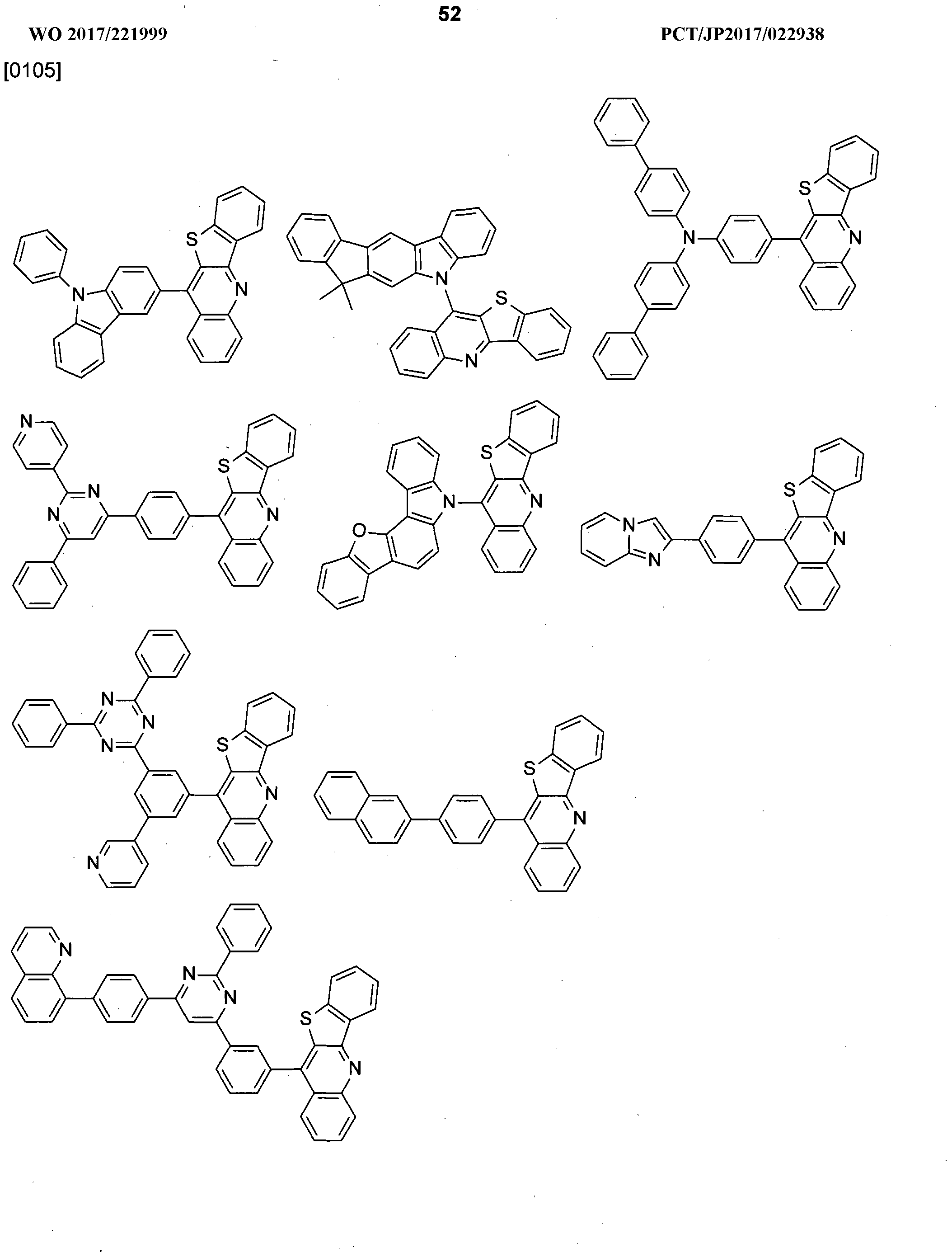
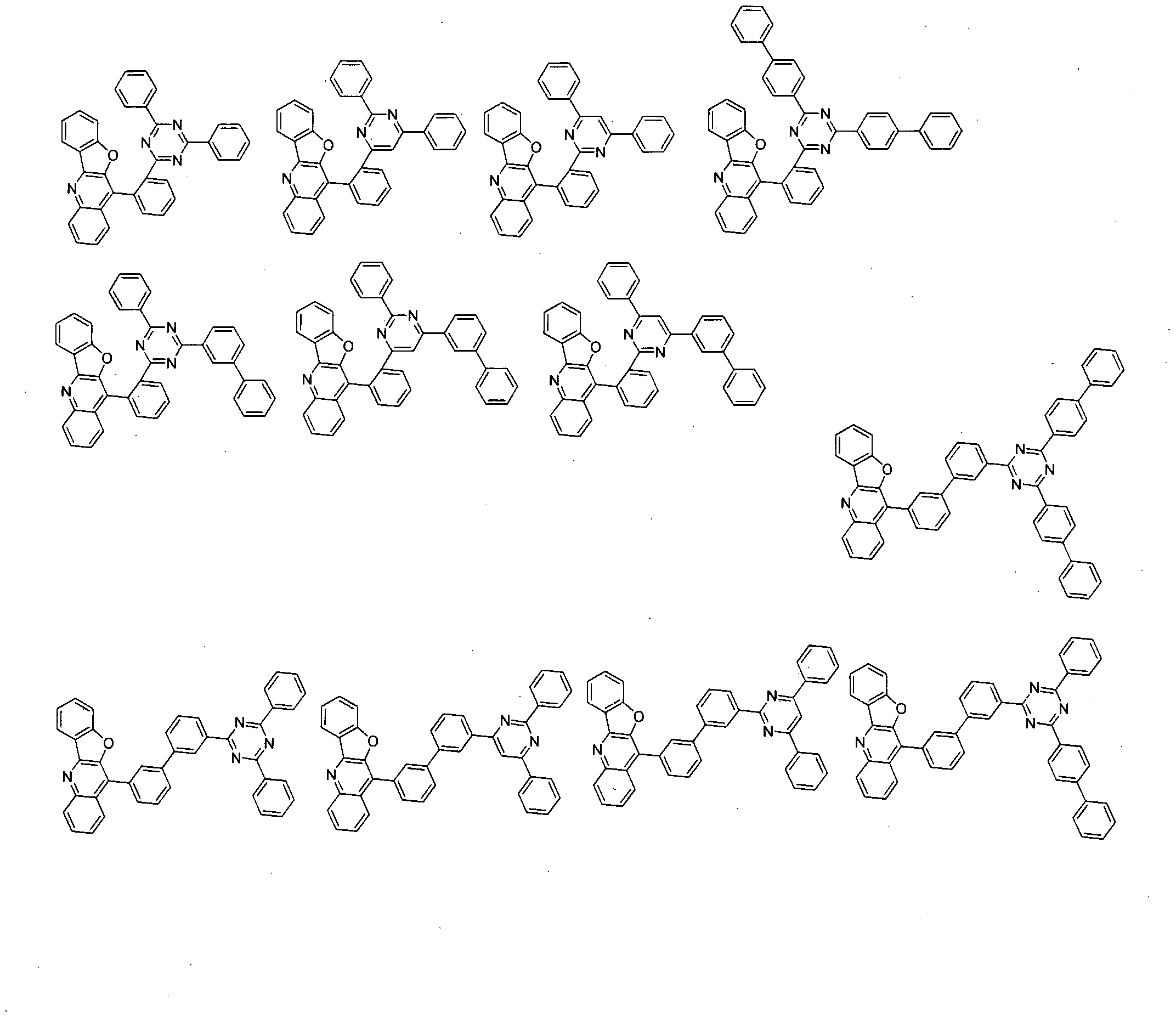
  • Preferred compounds (heterocyclic derivatives) of formula (1) have the following structures:
  • B 2 is CH or N
  • B 3 is CR 3 or N
  • B 4 is CR 4 or N
  • B 5 is CR 5 or N
  • B 6 is CR 6 or N
  • B 7 is CR 7 or N
  • B 8 is CR 8 or N
  • the heterocyclic derivative has one of the formulae (1-1), (1-2), (1-3), (1-4), (1-5), 1- 6), (1-7), (1-8), wherein preferably, A 2 is CR A2 , R 1 ⁇ 2 is E; a group of formula -(A ) 0 -(A 2 ) p -(A 3 ) q - (A 4 ) r R 20 ; or a Ci-C 2 5alkyl group which is unsubstituted or substituted by at least one group E and/or interrupted by D; preferably a group of formula -(A 1 ) 0 -(A 2 )p-(A 3 ) q -(A 4 ) r R 20 , and R 1 , R 3 , R 4 , R 5 , R 6 , R 7 , and R 8 are H.
  • the heterocyclic derivative has one of the formulae (1-1) and (1-2), wherein preferably, A 2 is CR A2 , R* 2 is E; a group of formula -(A ) 0 -(A 2 ) p -(A 3 ) q -(A 4 ) r R 2 °; or a Ci-C 25 alkyl group which is unsubstituted or substituted by at least one group E and/or interrupted by D; preferably a group of formula -(A 1 ) 0 -(A ) p -(A ) q -(A 4 ) r R 2 °, and R ⁇ R 3 , R 4 , R 5 , R 6 , R 7 , and R 8 are H;
  • the heterocyclic derivative has one of the formulae (1-9) and (1-10), wherein preferably, Ai is CR A , R A1 is E; a group of formula -(A ) 0 -(A 2 ) P -(A 3 ) q -(A ) r R 20 ; or a Ci-C 25 alkyl group which is unsubstituted or substituted by at least one group E and/or interrupted by D; preferably a group of formula -(A 1 )o-(A )p-(A 3 ) q -(A 4 ) R 20 , and R 1 , R 3 , R 4 , R 5 , R 6 , R 7 , and R 8 are H;
  • the heterocyclic derivative has one of the formulae (1-1) and (1-2), wherein preferably, A 2 is CR ⁇ , one of R 5 , R 6 , R 7 , and R 8 , preferably R 6 , is E; a group of formula -(A 1 ) 0 -(A 2 ) p -(A 3 ) q -(A 4 )r- R 20 ; or a Ci-C 2 5alkyl group which is unsubstituted or substituted by at least one group E and/or interrupted by D; preferably a group of formula -(A ) 0 -(A 2 ) p -(A 3 ) q -(A ) R 20 , and R ⁇ , R 1 , R 3 , R 4 , and the other of R 5 , R 6 , R 7 , and R 8 are H.
  • X, Bi, B 2 , B 3 , B 4 , B 5 , B 6 , B , B 8 , A 1 , A 2 , A 3 , A 4 , o, p, q, r, and R 20 are defined above with respect to formula (1), provided that one of B 5 , Be, B 7 , and B 8 , preferably Be, is a group of formula C-(A ) 0 -(A 2 ) p -(A 3 ) q -(A 4 ) r R 2 °.
  • Bi, B 2 , B 3 , and B 4 are CH.
  • B 5 , Be, B 7 , and B 8 are CH.
  • B5, Be, B 7 , and B 8 not a group of formula C-(A 1 ) 0 -(A ) p -(A 3 ) q -(A )rR 2 ° are CH.
  • a 1 , A 2 , A 3 , and A 4 are preferably independently of each other a C6-C 24 arylene group which is unsubstituted or substituted by G.
  • C6-C 24 arylene group and G have been described above with respect to formula (1).
  • a 1 , A 2 , A 3 , A 4 are more preferably independently of each other phenylene, naphthylene, biphenylene, or terphenylene, which optionally can be substituted by G
  • a 1 , A 2 , A 3 , A 4 are independently of each other
  • a 1 , A 2 , A 3 , A 4 are even more preferably in each occurrence independently of each other a group of the formula:
  • a group of formula -(A 1 ) 0 - (A 2 )p-(A 3 ) q -(A 4 )r- is preferably a C6-C24 arylene group which is unsubstituted or substituted by G, more preferably phenylene, naphthylene, biphenylene, or terphenylene which is unsubstituted or substituted by G:
  • a group of formula -(A 1 ) 0 -(A 2 ) p -(A 3 ) q -(A 4 ) ⁇ is a group of the formula:
  • o is 0 or 1
  • p is 0 or 1
  • q is 0 or 1
  • r is 0 or 1 , preferably o is 0 or 1
  • p is 0 or 1
  • q is 0, and r is 0, wherein (A 1 ) 0 is a direct bond when o is 0, (A 2 ) p is a direct bond when p is 0, (A 3 ) q is a direct bond when q is 0, and (A 4 ) r is a direct bond when r is 0.
  • R 20 in the compounds of formulae (1a), (1 b), (1c), (1a'), (1b'), and (1c') has been described above with respect to formula (1), and preferably a C6-C6o aryl group which is unsubstituted or substituted by G or a C1-C60 heteroaryl group which is unsubstituted or substituted by G.
  • Ce-Ceo aryl group, Ci-C6 0 heteroaryl group, and G have been described above with respect to formula
  • the C6-C6 0 aryl group is preferably a fused (condensed) Cio-C6o aryl group, more preferably a fused Cio-C3 0 aryl group, and still more preferably a fused Ci4-C25 aryl group, such as anthryl, fluoranthenyl, triphenylenyl, or fluorenyl, which may be unsubstituted or substituted by G.
  • the fused Cio-C6oaryl group is a group of the following formula which may be unsubstituted or substituted b G:
  • X 1 is C(R 21 ) 2 ;
  • R 21 is a Ci-C25alkyl group which can optionally be substituted by E and or interrupted by D, a C6-C24aryl group which can optionally be substituted by G, or a Ci-C24heteroaryl group which can optionally be substituted by G; and/or two adjacent groups of the groups may form together with the atom to which they are bonded a ring structure which can optionally be substituted by G; and
  • the fused Cio-C6o aryl group is a group of the following formula which is unsubstituted or substituted by G:
  • the fused Cio-C6o aryl group is a group of the following formula which may
  • the C1-C60 heteroaryl group is preferably a C1-C30 heteroaryl group, more preferably a C1-C12 heteroaryl group, still more preferably an aromatic heterocyclic ring with six ring atoms, each of which may have a fused ring, wherein the hetero ring atom is N, and each of the heteroaryl group, the ring with six ring atoms and the fused ring is unsubstituted or substituted by G; further more preferably pyridyl which may have a fused ring, pyrimidyl which may have a fused ring, triazinyl, or phenanthrolinyl, which is unsubstituted or substituted by G; still further more preferably pyridyl, pyrimidyl, triazinyl, or phenanthrolinyl, which is unsubstituted or substituted by G; and even further more preferably pyrimidyl, triazinyl,
  • Ci-Ceo heteroaryl group is preferably the group of formula (9), (10), or (19), more preferably the group of formula (9) or (19), which are described above with respect to R 20 of formula (1):
  • X 1 , X 2 and X 3 are independently of each other CR 19 or N, wherein in formula (9) at least one of
  • X 1 to X 3 is N, and wherein in formulae (10) and (19) at least one of X 1 and X 3 is N;
  • Ar 1 and Ar 2 are independently of each other a C6-C2 4 aryl group which is optionally substituted by G, or a Ci-C2 4 heteroaryl group which is optionally substituted by G;
  • R 18 , R 19 , and R 29 are independently of each other H, a C6-C2 4 aryl group which can be substituted by G, a C1-C24 heteroaryl group which can be substituted by G, or a Ci-C2salkyl group which can optionally be substituted by E and/or interrupted by D; preferably, H;
  • c is 0, 1 , 2, 3 or 4; preferably 0, 1 or 2; more preferably 0 or 1 ; still more preferably 0;
  • g is 0, 1 , 2 or 3; preferably 0, 1 or 2; more preferably 0;
  • Preferred groups (9), (10), and (19) are:
  • Ar 1 and Ar 2 are preferably independently of each other a C6-C 2 4 aryl group which is optionally substituted by G, more preferably an unsubstituted C6-C2 4 aryl group, and still more preferably an unsubstituted phenyl or an unsubstituted biphenyl; and
  • are bonding sites.
  • the groups (9) are preferably:
  • the groups (10) are preferably:
  • the groups (19) are preferably:
  • the group of formula -(A ) 0 -(A 2 ) p -(A 3 ) q -(A 4 )r R 20 can be
  • Az is a C1-C60 heteroaryl group, preferably a C1-C30 heteroaryl group, more preferably a C1-C12 heteroaryl group, and still more preferably an aromatic heterocyclic ring with six ring atoms, each of which may have a fused ring; and
  • a a -G 1 corresponds to A 4 which is substituted by G 1 , G 1 being the same as G in formula (1).
  • a 4a -G 1 is preferably a C6-C24 arylene group substituted by G 1 , wherein G 1 is preferably a C6-C60 aryl group, more preferably a fused Cio-C3o aryl group, and still more preferably a fused Ci 4 -C25 aryl group, which are unsubstituted or substituted by G.
  • a 4 of the group A 4a ⁇ G 1 has been described above with respect to A 1 , A 2 , A 3 , A 4 of formulae (1a),
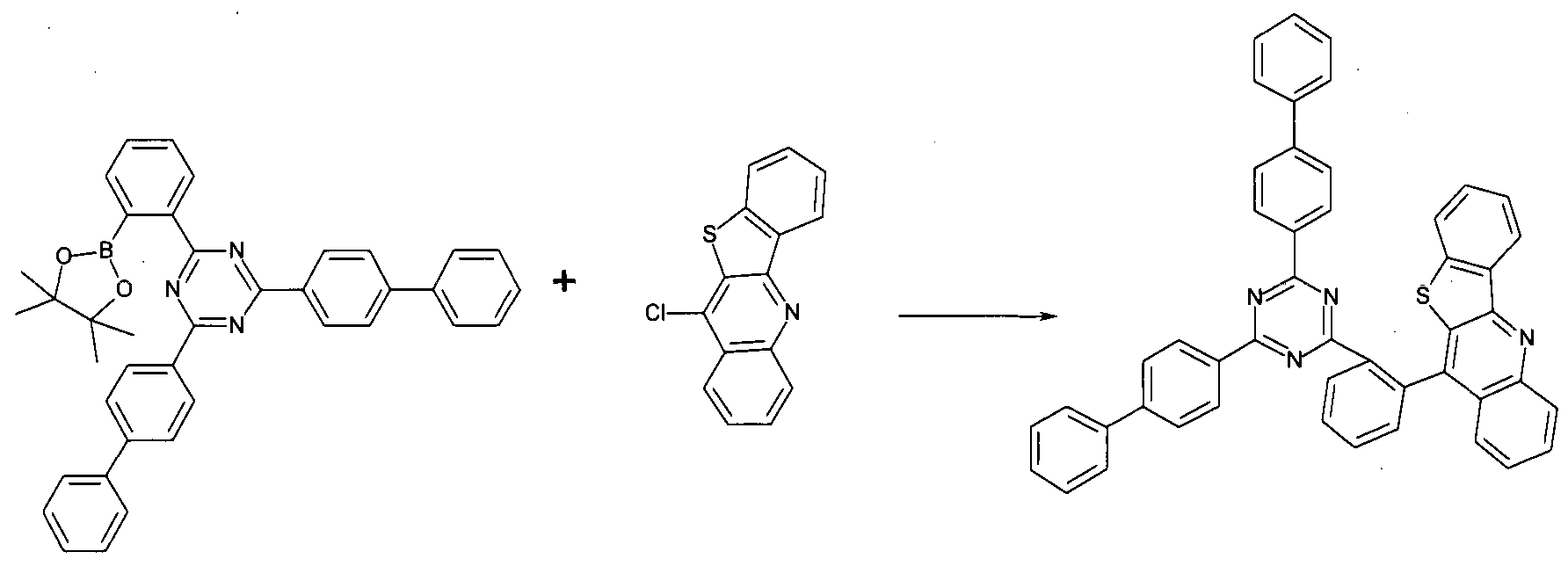
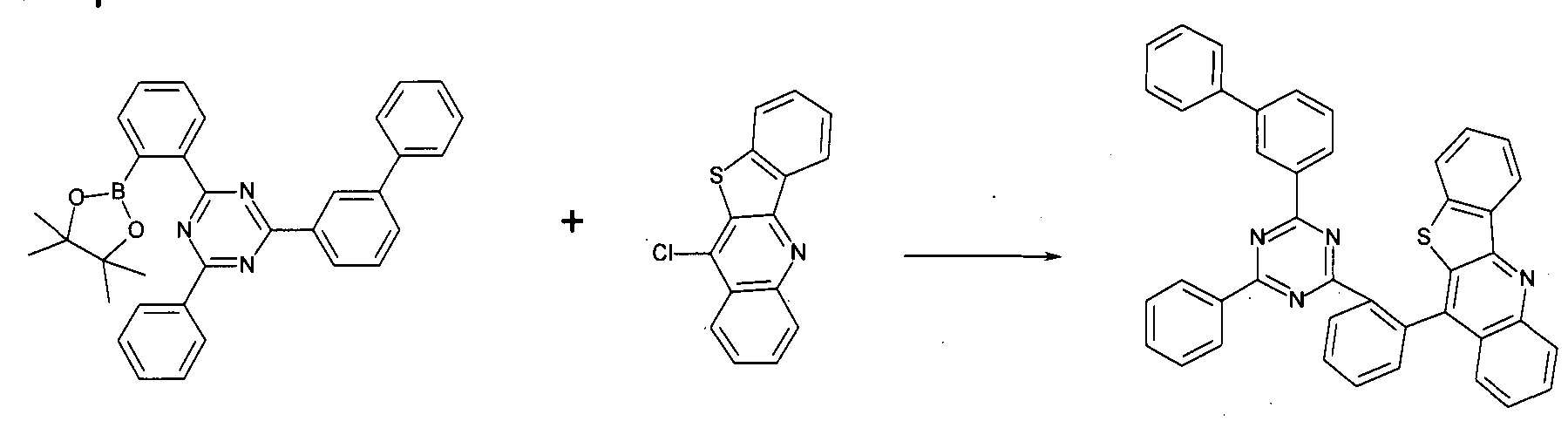
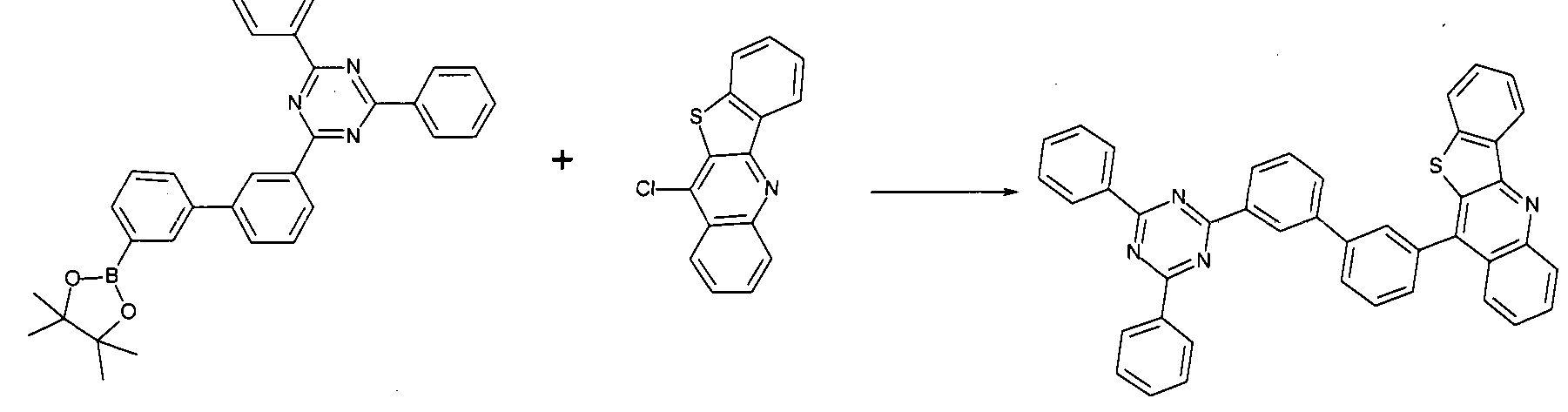
  • the compounds of formula (1) are prepared in analogy to the preparation processes described in the related art, e.g. WO 2014/199637 and J. Med. Chem. 1998,41 , 2754-2764.
  • Bi , B 3 , B 4 , B 5 , Be, B 7 , Be, Ai and A 2 is C-Hal, and all other groups are as defined above, wherein Hal means halogen, preferably F, CI or Br, more preferably CI, is described for example in J. Med. Chem. 1998, 41 , 2754-2764:
  • a functionalization of the basic structure (T) mentioned above with one or more groups R A1 , R* 2 , R 1 , R 3 , R 4 , R 5 , R 6 , R 7 , and R 8 is preferably carried out by coupling the basic structure at the halogenated position with at least one residue X-R A1 , X-R* 2 , X-R 1 , X-R 3 , X-R 4 , X-R 5 , X-R e , X-R 7 , or X-R 8 ,
  • X is -B(OR')2 wherein R' is H or C1-C3 alkyl group or phenyl group, provided that two R' may be same or different, and the two R's may form a ring together with the two oxygen atoms and the boron atom;
  • the coupling is preferably a Suzuki-Miyaura reaction (coupling).
  • the general conditions for the Suzuki-Miyaura reaction are for example disclosed in US2014/0330013. Especially in
  • R' is H, CH 3 , CH(CH 3 )2, CH2CH2CH3, and phenyl, when two R's from a ring together with the boron atom bonded to the two R's via the two oxygen atoms, B(OR')2 preferably includes the following groups
  • the catalyst is a Pd catalyst, e.g. Pd2(dba)3 or Pd(PPh 3 )4.
  • the base is Na 2 C0 3 , K 2 C0 3 or Cs 2 C0 3 .
  • the base is 3PO4, Na 2 C0 3 , K 2 C0 3) Cs 2 C0 3 or NaH.
  • the catalyst is a Pd catalyst, e.g. Pd2(dba) 3 .
  • the base is NaO'Bu or KO*Bu.
  • Preferred ligands are P(tBu) 3 , Xanthophos, Sphos, and Xphos.
  • the present invention therefore further relates to a process for the preparation of the
  • Suitable groups Ai, A 2 , Bi, B 3 , B 4 , B 5 , Be, B 7 , and B 8 are mentioned above, wherein at least one of the groups Ai, A 2 , Bi, B3, B 4 , B 5 , Be, B , and B 8 is C-Hal. Most preferably, the group A 2 is C- Hal.
  • the compounds of the formula (1) are particularly suitable for use in applications in which charge carrier conductivity is required, especially for use in organic electronics applications, for example selected from switching elements such as organic transistors, e.g. organic FETs and organic TFTs, organic solar cells and organic light-emitting diodes (OLEDs).
  • switching elements such as organic transistors, e.g. organic FETs and organic TFTs, organic solar cells and organic light-emitting diodes (OLEDs).
  • organic EL device is used interchangeable with the term organic light-emitting diode (OLED) in the following; i.e. both terms have the same meaning in the sense of the present application.
  • the organic transistor generally includes a semiconductor layer formed from an organic layer with charge transport capacity; a gate electrode formed from a conductive layer; and an insulating layer introduced between the semiconductor layer and the conductive layer. A source electrode and a drain electrode are mounted on this arrangement in order thus to produce the transistor element.
  • further layers known to those skilled in the art may be present in the organic transistor.
  • the layers with charge transport capacity may comprise the compounds of formula (1).
  • the organic solar cell generally comprises an organic layer present between two plate-type electrodes arranged in parallel.
  • the organic layer may be configured on a comb-type electrode.
  • at least one electrode is preferably formed from a transparent electrode, for example an ITO electrode or a fluorine-doped tin oxide electrode.
  • the organic layer is formed from two sublayers, i.e. a layer with p-type semiconductor properties or hole transport capacity, and a layer formed with n-type semiconductor properties or charge transport capacity.
  • the layers with charge transport capacity may comprise the compounds of formula (1).
  • the compounds of formula (1) being particularly suitable in OLEDs for use as matrix material in a light-emitting layer and/or as charge and/or exciton blocker material, i.e.as electron/exciton blocker material or as hole/exciton blocker material, and/or charge transport material, i.e. hole transport material or electron transport material, especially in combination with a
  • inventive compounds of formula (1) are suitable especially for use as matrix and/or charge transport, i.e. hole or electron transport, and/or charge blocker material, i.e. hole or electron blocker material, for blue, green, red and yellow, preferably blue, green and red, more preferably blue and red emitters.
  • the blue emitters employed are usually fluorescent emitters.
  • the other emitters employed are usually fluorescent or phosphorescent emitters, preferably phosphorescent emitters.
  • the compounds of the formula (1) can be used as conductor/complementary materials in organic electronics applications selected from switching elements and organic solar cells. (In the sense of the present application, the terms matrix and host are used interchangeable).
  • the compounds of the formula (1) are used as matrix materials (host materials), preferably in an emission layer of an OLED, more preferably in an emission layer of an OLED comprising at least one compound of the formula (1) and at least one emitter material, wherein the emitter material is preferably a fluorescent or phosphorescent emitter material, more preferably a red fluorescent or phosphorescent emitter material.
  • the present invention therefore relates to an emission layer (light-emitting layer) comprising at least one compound of the formula (1) and at least one emitter material.
  • Suitable emitter materials are mentioned above and below.
  • Suitable structures of the emission layer are mentioned below.
  • the present invention further relates to an OLED comprising an emission layer (light-emitting layer) comprising at least one compound of the formula (1) and at least one emitter material.
  • an emitter material with at least one matrix material of the compound of the formula (1) and one or more, preferably one, further matrix materials (co-host). This may achieve a high quantum efficiency, low driving voltage and/or long lifetime of the OLED devices.
  • the compounds of the formula (1 ) are present in two or three of the following layers: in the light-emitting layer (preferably as matrix material), in the blocking layer (as charge blocker material) and/or in the charge transport layer (as charge transport material).
  • a compound of the formula (1) is used as matrix (host) material in an emission layer and additionally as charge blocking material and/or as charge transport material, owing to the chemical identity or similarity of the materials, an improved interface between the emission layer and the adjacent material, which can lead to a decrease in the voltage with equal luminance and to an extension of the lifetime of the OLED.
  • the use of the same material as charge transport material and/or as charge blocker material and as matrix of an emission layer allows the production process of an OLED to be simplified, since the same source can be used for the vapor deposition process of the material of one of the compounds of the formula the compound of the formula (1 )
  • the compounds of the formula (1) are used as electron transporting materials (electron transport materials), preferably in an OLED, more preferably in an OLED comprising at least one blue fluorescent emitter material.
  • the present invention therefore relates to an electron transporting layer (electron transport layer) comprising least one compound of the formula (1).
  • the present invention further relates to an OLED comprising an electron transporting layer comprising at least one compound of the formula (1) and an emission layer comprising at least one emitter material, preferably a blue fluorescent emitter material.
  • an emitter material preferably a blue fluorescent emitter material.
  • Suitable emitter materials are mentioned above and below.
  • Suitable structures of the electron transporting layer are mentioned below.
  • the electron transporting layer comprising at least one compound of the formula (1) of the invention further comprises a reducing dopant.
  • Examples of the reducing dopant include a donating metal, a donating metal compound, and a donating metal complex.
  • the reducing dopant may be used alone or in combination of two or more.
  • the reducing dopant referred to herein is an electron-donating material.
  • the electron-donating material is a material which generates radical anions by the interaction with a coexisting organic material in the electron transporting layer or an organic material in a layer adjacent to the electron transporting layer, or a material having an electron-donating radical.
  • the donating metal is a metal having a work function of 3.8 eV or less, preferably an alkali metal, an alkaline earth metal, or a rare earth metal, and more preferably Cs, Li, Na, Sr, K, Mg, Ca, Ba, Yb, Eu, or Ce.
  • the donating metal compound is a compound comprising the above donating metal, preferably a compound comprising an alkali metal, an alkaline earth metal, or a rare earth metal, and more preferably a halide, an oxide, a carbonate, or a borate of these metals, for example, a compound represented by MOx (M: donating metal, x: 0.5 to 1.5), MFx (x: 1 to 3), or M(CC>3)x (x: 0.5 to 1.5).
  • MOx donating metal, x: 0.5 to 1.5
  • MFx x: 1 to 3
  • M(CC>3)x x: 0.5 to 1.5
  • the donating metal complex is a complex comprising the above donating metal, preferably an organic metal complex of an alkali metal, an alkaline earth metal or a rare earth metal, and more preferably an organic metal complex represented by formula (I): M-(Q) n ,
  • M is a donating metal
  • Q is a ligand, preferably a carboxylic acid derivative, a diketone derivative, or a quinoline derivative
  • n is an integer of 1 to 4.
  • Examples of the donating metal complex include watermill-shaped tungsten compounds described in JP 2005-72012A and phthalocyanine compounds having an alkali metal or an alkaline earth metal as the central metal, which are described in JP 11-345687A.
  • the reducing dopant is preferably at least one selected from the group consisting of an alkali metal, an alkaline earth metal, a rare earth metal, an alkali metal oxide, an alkali metal halide, an alkaline earth metal oxide, an alkaline earth metal halide, a rare earth metal oxide, a rare earth metal halide, an organic complex having an alkali metal, an organic complex having an alkaline earth metal, and an organic complex having a rare earth metal, and more preferably a 8-quinolinol complex of an alkali metal.
  • alkali metal examples include: Li (lithium, work function: 2.93 eV), Na (sodium, work function: 2.36 eV), K (potassium, work function: 2.3 eV), Rb (rubidium, work function: 2.16 eV), and Cs (cesium, work function: 1.95 eV).
  • alkaline earth metals are: Ca (calcium, work function: 2.9 eV), Mg (magnesium, work function: 3.66 eV), Ba (barium, work function: 2.52 eV), and Sr (strontium, work function: 2.0 to 2.5 eV).
  • strontium is based of Physics of Semiconductor Device (N.Y., Wiley, 1969, p. 366).
  • rare earth metal examples include: Yb (ytterbium, work function: 2.6 eV), Eu (europium, work function: 2.5 eV), Gd (gadolinium, work function: 3.1 eV), and Er (erbium, work function: 2.5 eV).
  • alkali metal oxide examples include Li 2 0, LiO, and NaO.
  • the alkaline earth metal oxide is preferably CaO, BaO, SrO, BeO, or MgO.
  • alkali metal halide examples include a fluoride, for example, LiF, NaF, CsF, and KF and a chloride, for example, LiCI, KCI, and NaCI.
  • the alkaline earth metal halide is preferably a fluoride, such as CaF 2 , BaF 2 , SrF 2 , MgF 2 , and
  • the content of the compound of the formula (1) in the electron transporting layer is preferably 50% by mass or more, i.e. 50 to 100 % by weight and more preferably 60% by mass or more, i.e. 60 to 100 % by weight, based on the weight of the electron transporting layer.
  • the present invention further provides an organic light-emitting diode (OLED) comprising an anode and a cathode and a light-emitting layer arranged between the anode and the cathode, and if appropriate at least one further layer selected from the group consisting of at least one blocking layer for holes/excitons, at least one blocking layer for electrons/excitons, at least one hole injection layer, at least one hole transport layer, at least one electron injection layer and at least one electron transport layer, wherein the at least one compound of the formula (1) is present in the light-emitting layer and/or in at least one of the further layers.
  • the at least one compound of the formula (1) is preferably present in the light-emitting layer and/or the charge blocking layer and/or the charge transport layer.
  • At least one compound of the formula (1) is used as charge transport, i.e. electron transport or hole transport material, especially as electron transport material. Examples of preferred compounds of the formula (1) are shown above.
  • At least one compound of the formula (1) is used as charge/exciton blocker, i.e. electron/exciton blocker or hole/exciton blocker material, especially as hole/exciton blocker material. Examples of preferred compounds of the formula (1) are shown above.
  • the present application further relates to a light-emitting layer comprising at least one compound of the formula (1), preferably as host material or co-host material. Examples of preferred compounds of the formula (1) are shown above.
  • the material for an organic EL device (OLED) of the invention comprises the compound represented by the above formula (1).
  • the content of the above-mentioned compound in the material for an organic EL device is not particularly restricted. For example, it may be 1 mass% or more, preferably 10 mass% or more, more preferably 50 mass% or more, further preferably 80 mass% or more, and particularly preferably 90 mass% or more. The content may be 100 mass%.
  • materials used in the emitting layer, the electron-transporting layer, the hole-transporting layer or the like (mentioned later) can be given.
  • the material for an organic EL device of the invention is effective as the material for an organic EL device, and can be used as a host material or a dopant material in the emitting layer of a fluorescent emitting unit or as a host material in the emitting layer of a phosphorescent emitting unit.
  • the material is effective as a material for an anode-side organic thin film layer provided between an anode and an emitting layer of an organic EL device or as a material for a cathode-side organic thin film layer provided between a cathode and an emitting layer of an organic EL device. That is, it is effective as a material for a hole-transporting layer, a hole-injecting layer, an electron- transporting layer, an electron-injecting layer, a hole-blocking layer, an electron-blocking layer, or the like.
  • the "emitting unit” means the minimum unit that comprises one or more organic layers, one of which being an emitting layer, and can emit light by recombination of holes and electrons injected.
  • OLED Organic EL device
  • the organic EL device as one embodiment of the invention comprises one or more organic thin film layers including an emitting layer between a cathode and an anode, and at least one layer of the organic thin film layers comprises the above-mentioned material for an organic EL device.
  • an anode-side organic thin film layer (hole-transporting layer, hole-injecting layer, or the like), an emitting layer, a cathode-side organic thin film layer (electron-transporting layer, electron-injecting layer, or the like) provided between a cathode and an emitting layer, a spacing layer, a barrier layer or the like
  • anode-side organic thin film layer hole-transporting layer, hole-injecting layer, or the like
  • an emitting layer a cathode-side organic thin film layer (electron-transporting layer, electron-injecting layer, or the like) provided between a cathode and an emitting layer, a spacing layer, a barrier layer or the like
  • a cathode-side organic thin film layer electron-transporting layer, electron-injecting layer, or the like
  • the above-mentioned material for an organic EL device may be contained in any of the above- mentioned layers, and can be used as a host material or a dopant material in the emitting layer of a fluorescent emitting unit, a host material in the emitting layer of a phosphorescent emitting unit, a hole-transporting layer, an electron-transporting layer or the like of an emitting unit.
  • the organic EL device of the invention may be a fluorescent or phosphorescent monochromatic emitting device or may be a fluorescent/phosphorescent hybrid white emitting device. It may be a simple emitting device having a single emitting unit or a tandem emitting device having plural emitting units. Among them, the organic EL device may preferably be a phosphorescent emitting device.
  • the emitting unit mentioned above may be a stacked type emitting unit comprising plural phosphorescent emitting layers or plural fluorescent emitting layers.
  • a spacing layer may be provided between the emitting layers.
  • the phosphorescent or fluorescent emitting layer as mentioned above can emit different colors of light. Specifically, in the stacked emitting layer (d), a layer configuration of the hole- transporting layer/first phosphorescent emitting layer (red emission)/second phosphorescent emitting layer (green emission)/spacing layer/fluorescent emitting layer (blue emission)/electron- transporting layer or the like can be given.
  • an electron- barrier layer may be provided appropriately.
  • a hole-barrier layer may be provided appropriately. Due to provision of an electron-barrier layer or a hole-barrier layer, electrons or holes can be confined within the emitting layer, whereby possibility of recombination of carriers in the emitting layer can be increased, and the life can be improved.
  • the represented device configuration of a tandem organic EL device As the represented device configuration of a tandem organic EL device, the following device configuration can be given.
  • the same emitting units as those mentioned above can independently be given, for example.
  • the intermediate layer is called an intermediate electrode, an intermediate
  • conductive layer a carrier-generating layer, an electron-withdrawing layer, and a known material configuration that supplies electrons to the first emitting unit and supplies holes to the second emitting unit can be used.
  • FIG. 1 shows a schematic configuration of one example of the organic EL device of the invention.
  • the organic EL device 1 comprises a substrate 2, an anode 3, a cathode 4 and an emitting unit 10 provided between the anode 3 and the cathode 4.
  • the emitting unit 10 comprises an emitting layer 5 preferably comprising a host material and a dopant.
  • a hole- injecting and transporting layer 6 or the like may be provided between the emitting layer 5 and the anode 3 and an electron-injecting layer 8 and an electron transporting layer 7 or the like (electron injecting and transporting unit 11) may be provided between the emitting layer 5 and the cathode 4.
  • An electron-barrier layer may be provided on the anode 3 side of the emitting layer 5 and a hole-barrier layer may be provided on the cathode 4 side of the emitting layer 5. Due to such configuration, electrons or holes can be confined in the emitting layer 5, whereby possibility of generation of excitons in the emitting layer 5 can be improved.
  • a host that is combined with a fluorescent dopant is referred to as a fluorescent host and a host that is combined with a phosphorescent dopant is referred to as a phosphorescent host.
  • the fluorescent host and the phosphorescent host are not distinguished only by the molecular structure thereof. That is, the phosphorescent host means a material constituting a phosphorescent emitting layer that contains a phosphorescent dopant and does not mean a material that cannot be used as a material constituting a fluorescent dopant. The same can be applied to a fluorescent host.
  • the organic EL device is usually formed on a transparent substrate.
  • the transparent substrate is a substrate for supporting the organic EL device, and is preferably a flat and smooth substrate having a 400-to-700-nm-visible-light transmittance of 50% or more.
  • Specific examples thereof include glass plates and polymer plates.
  • the glass plate include those obtained by using as raw materials soda-lime glass, barium/strontium-containing glass, lead glass, aluminosilicate glass, borosilicate glass, barium borosilicate glass, quartz, or the like.
  • the polymer plate include those obtained by using as raw materials polycarbonate, acrylic polymer, polyethylene terephthalate, polyethersulfide, polysulfone, or the like.
  • the anode of the organic EL device plays a role for injecting holes into its hole-transporting layer or emitting layer. It is effective to use one having a work function of 4.5 eV or more.
  • the anode material indium tin oxide alloy (ITO), tin oxide (NESA), indium zinc oxide, gold, silver, platinum, copper, and the like can be given.
  • the anode can be formed by forming these electrode materials into a thin film by vapor deposition, sputtering or the like.
  • the transmittance of the anode to the emission is preferably more than 10%.
  • the sheet resistance of the anode is preferably several hundred ⁇ / ⁇ or less.
  • the film thickness of the anode which varies depending upon the material thereof, is usually from 10 nm to 1 ⁇ , preferably from 10 to 200 nm.
  • the cathode plays a role for injecting electrons into its electron-injecting layer, electron- transporting layer or emitting layer.
  • the cathode is preferably formed of a material having a small work function.
  • the cathode material is not particularly restricted.
  • indium, aluminum, magnesium, a magnesium-indium alloy, a magnesium- aluminum alloy, an aluminum-lithium alloy, an aluminum-scandium-lithium alloy, a magnesium- silver alloy or the like can be given.
  • the cathode can be formed by forming the materials into a thin film by a deposition method, a sputtering method or the like. If necessary, emission can be outcoupled from the cathode side.
  • the emitting layer is an organic layer having an emitting function, and where a doping system is used, it comprises a host material and a dopant material.
  • the host material has a function of accelerating recombination of electrons and holes and confining excitons within the emitting layer.
  • the dopant material has a function of emitting efficiently excitons obtained by recombination.
  • the host material has a function of confining excitons mainly generated by a dopant within the emitting layer.
  • a double host (also referred to as a host/cohost) that adjusts the carrier balance in the emitting layer may be used by combining an electron-transporting host and a hole-transporting host or by other methods. It is preferred that the emitting layer comprise a first host material and a second host material and that the first host material be the material for the organic EL device according to the invention.
  • Double dopant may be used in which two or more types of dopant materials having a high quantum yield are incorporated, and each dopant emits light. Specifically, by allowing a host, a red dopant and a green dopant to be co-deposited, yellow emission from the common emitting layer, whereby yellow emission is realized.
  • the emitting layer by allowing plural emitting layers to be a stacked body, electrons and holes are accumulated in the interface of the emitting layers, whereby the recombination region is concentrated in the interface of the emitting layers. As a result, the quantum efficiency is improved.
  • Easiness in injection of holes to the emitting layer and easiness in injection of electrons to the emitting layer may differ. Further, the hole-transporting performance and the electron- transporting performance indicated by the mobility of holes and electrons in the emitting layer may differ from each other.
  • the emitting layer can be formed by a known method such as a deposition method, a spin coating method, a LB method (Langmuir Blodgett method) or the like, for example.
  • the emitting layer can also be formed by forming a solution obtained by dissolving a binder such as a resin and material compounds in a solvent into a thin film by a spin coating method and the like.
  • the emitting layer is preferably a molecular deposited film.
  • the "molecular deposited film” means a thin film formed by deposition of a raw material compound in a vapor phase or a film formed by solidification of a raw material compound in a solution state or a liquid phase state. Normally, this molecular deposited film differs from a thin film (molecular
  • accumulated film formed by a LB method in aggregation structure or high-order structure, or differ in function derived from such difference in structure.
  • the dopant material is usually selected from a known fluorescent dopant showing fluorescent emission or a known phosphorescent dopant showing phosphorescent emission.
  • a phosphorescent dopant (phosphorescent emitting material) that forms the emitting layer is a compound that can emit light from triplet excited state.
  • the phosphorescent dopant is not limited as long as it can emit from triplet excited state.
  • the phosphorescent dopant is preferably an organic metal complex containing at least one metal selected from Ir, Pt, Os, Au, Cu, Re and Ru and a ligand. It is preferred that the ligand have an ortho-metalated bond.
  • the phosphorescent dopant is preferably a compound having a metal atom selected from Ir, Os and Pt.
  • a metal complex such as an iridium complex, an osmium complex and a platinum complex, with an ortho-metalated complex being more preferable.
  • an iridium complex and a platinum complex are more preferable, and an ortho-metalated iridium complex is particularly preferable.
  • the content of the emitter materials (dopants), preferably the phosphorescent emitter materials, in the light emitting layer is not particularly limited and selected according to the use of the device, and preferably 0.1 to 70% by mass, and more preferably 1 to 30% by mass. If being 0.1 % by mass or more, the amount of light emission is sufficient. If being 70% by mass or less, the concentration quenching can be avoided.
  • the further component in the emitting layer is usually one or more host material, which is preferably present in an amount of 30 to 99.9 % by mass, more preferably 70 to 99% by mass, wherein the sum of the emitter material(s) and the host material(s) is 100% by mass.
  • Suitable metal complexes for use in the inventive
  • OLEDs preferably as emitter material, are described, for example, in documents
  • metal complexes are the commercially available metal complexes tris(2- phenylpyridine)iridium(lll), iridium(lll) tris(2-(4-tolyl)pyridinato-N,C 2 '), bis(2- phenylpyridine)(acetylacetonato)iridium(lll), iridium(lll) tris(l-phenylisoquinoline), iridium(lll) bis(2,2'-benzothienyl)pyridinato-N,C 3 ')(acetylacetonate), tris(2-phenylquinoline)iridium(lll), iridium(lll) bis(2-(4,6-difluorophenyl)pyridinato-N,C 2 )picolinate, iridium(lll) bis(1- phenylisoquinoline)(acetylacetonate), bis(2-phenylquinoline)(acett
  • the emitter materials may be used alone or in combination of two or more.
  • the compounds of formula (1) are also useful in combination with fluorescent dopants, especially as electron transport material, preferably in combination with a blue fluorescent dopant.
  • fluorescent dopants especially as electron transport material, preferably in combination with a blue fluorescent dopant.
  • Preferred blue fluorescent dopants that may be present in the light emitting layer of the OLED according to the present invention are for example polycyclic amine derivatives as mentioned in EP 2924029.
  • Particularly preferred aromatic amine derivatives are selected from compounds according to the following formula (20A):
  • Y is a substituted or unsubstituted fused aromatic hydrocarbon group including 10 to 50 ring carbon atoms.
  • Aho-i, and Ano2 are independently a substituted or unsubstituted aryl group including 6 to 50 ring carbon atoms or a substituted or unsubstituted heterocyclic ring group including 5 to 50 ring atoms.
  • Y include the above-mentioned fused aryl group.
  • Y is preferably a substituted or unsubstituted anthryl group, a substituted or unsubstituted pyrenyl group or a substituted or unsubstituted chrysenyl group.
  • n is an integer of 1 to 4. It is preferred that n be an integer of 1 to 2.
  • the above-mentioned formula (20A) is preferably one represented by the following formulas (21A) to (24A).
  • R e , Rf and R g are independently a substituted or unsubstituted alkyl group including 1 to 20 carbon atoms, a substituted or unsubstituted alkenyl group including 2 to 50 carbon atoms, a substituted or unsubstituted alkynyl group including 2 to 50 carbon atoms, a substituted or unsubstituted aralkyl group including 1 to 20 carbon atoms, a substituted or unsubstituted cycloalkyi group including 3 to 20 ring carbon atoms, a substituted or unsubstituted alkoxy group including 1 to 20 carbon atoms, a substituted or unsubstituted aryloxy group including 6 to 20 ring carbon atoms, a substituted or unsubstituted aryl group including 6 to 50 ring carbon atoms, a substituted or unsubstituted silyl group, a substituted or unsubstituted silyl group, a
  • R e , Rf and R g a substituted or unsubstituted aryl group including 6 to 50 ring carbon atoms can be given. More preferably, R e , Rf and R g are a substituted or unsubstituted phenyl group, a substituted or unsubstituted naphthyl group, or the like, t is an integer of 0 to 10. u is an integer of 0 to 8. m is an integer of 0 to 10.
  • Ar 2 oi to Ar 2 ie are independently an aryl group including 6 to 50 ring carbon atoms or a substituted or
  • unsubstituted heterocyclic group including 5 to 50 ring atoms.
  • Ar 2 oi to Ar 2 ie include a substituted or unsubstituted phenyl group, a substituted or unsubstituted dibenzofuranyl group or the like.
  • the substituent of Ar 20 i to ⁇ 2 ⁇ 8 an alkyl group, a cyano group and a substituted or unsubstituted silyl group can be given.
  • alkenyl group including 2 to 50, preferably 2 to 30, more preferably 2 to 20, and particularly preferably 2 to 10, carbon atoms, a vinyl group, an allyl group, a 1-butenyl group, a 2-butenyl group, a 3-butenyl group, a 1 ,3-butanedienyl group, a 1-methylvinyl group, a styryl group, a 2,2-diphenylvinyl group, a 1 ,2-diphenylvinyl group, a 1-methylallyl group, a 1 ,1- dimethylallyl group, a 2-methylallyl group, a 1-phenylallyl group, a 2-phenylallyl group, a 3- phenylallyl group, a 3,3-diphenylallyl group, a 1 ,2-dimethylallyl group, a 1-phenyl-1-butenyl group, a 3-phenyl-1-butenyl group or the like can be given.
  • alkynyl group including 2 to 50 (preferably 2 to 30, more preferably 2 to 20, particularly preferably 2 to 10) carbon atoms a propargyl group, a 3-pentynyl group or the like can be given.
  • alkyl germanium group a methylhydrogermyl group, a trimethylgermyl group, a triethylgermyl group, a tripropylgermyl group, a dimethyl-t-butylgermyl group or the like can be given.
  • aryl germanium group a phenyldihydrogermyl group, a diphenylhydrogermyl group, a triphenylgermyl group, a tritolylgermyl group, a trinaphthylgermyl group or the like can be given.
  • styrylamine compound and the styryldiamine compound those represented by the fo are preferable.
  • Ar3oi is a k-valent group; a k-valent group corresponding to a phenyl group, a naphthyl group, a biphenyl group, a terphenyl group, a stilbene group, a styrylaryl group and a distyrylaryl group.
  • a ⁇ and Ar303 are independently an aryl group including 6 to 20 ring carbon atoms, and Ar 3 oi , Ar302 and Ar303 may be substituted.
  • k is an integer of 1 to 4, with an integer of 1 and 2 being preferable.
  • Any one of Ar3oi to Ar303 is a group including a styryl group. It is further preferred that at least one of Ar302 and Ar303 be substituted by a styryl group.
  • the above-mentioned aryl group can be specifically given.
  • Preferable examples include a phenyl group, a naphthyl group, an anthranyl group, a phenanthryl group, a terphenyl group or the like.
  • Ar304 to Ar306 are a v-valent substituted or unsubstituted aryl group including 6 to 40 ring carbon atoms, v is an integer of 1 to 4, with an integer of 1 and 2 being preferable.
  • aryl group including 6 to 40 ring carbon atoms in the formula (18A) the above- mentioned aryl group can be specifically given.
  • a naphthyl group, an anthranyl group, a chrysenyl group, a pyrenyl group or an aryl group represented by the formula (20A) is preferable.
  • an alkyl group including 1 to 6 carbon atoms, an alkoxy group including 1 to 6 carbon atoms, an aryl group including 6 to 40 ring carbon atoms, an amino group substituted by an aryl group including 6 to 40 ring carbon atoms, an ester group including an aryl group that includes 5 to 40 ring carbon atoms, an ester group including an alkyl group that includes 1 to 6 carbon atoms, a cyano group, a nitro group, a halogen atom or the like can be given.
  • the light-emitting layer may comprise further components in addition to the emitter material.
  • a fluorescent dye may be present in the light-emitting layer in order to alter the emission color of the emitter material.
  • a matrix material can be used.
  • This matrix material may be a polymer, for example poly(N-vinylcarbazole) or polysilane.
  • one or more phosphorescent hosts are employed as host material.
  • the phosphorescent host is a compound which confines the triplet energy of the phosphorescent dopant efficiently in the light emitting layer to cause the phosphorescent dopant to emit light efficiently.
  • the light-emitting layer is formed of at least one emitter material and of at least one of the matrix materials mentioned in this application.
  • the electronic device according to the present invention preferably the OLED according to the present invention, comprises at least one compound of the formula (1) as matrix (host) material.
  • the light-emitting layer comprises at least one emitter material and at least two matrix materials, wherein one of the matrix materials is a compound of the formula (1) and the other matrix material(s) is/are used as co-host(s). Suitable other host materials than the compounds of formula (1) (co-hosts) are mentioned below.
  • the light-emitting layer comprises at least one emitter material and a compound of the formula (1) as a single matrix (host) material.
  • a compound of the formula (1) as a single matrix (host) material. Examples of preferred compounds of formula (1) useful as single host material are shown above.
  • the compounds of the formula (1) are suitable as single host material as well as host material, together with one or more further host materials (co-host). Suitable further host materials are mentioned below. "Further host materials” means in the sense of the present application, host materials different from the compounds of formula (1). However, it is also possible to use two or more different compounds of formula (1) as host material in the light-emitting layer in an OLED of the present application.
  • the light-emitting layer is formed from 0.1 to 70% by weight, preferably 1 to 30% by weight, of at least one of the aforementioned emitter materials and 30 to 99.9% by weight, preferably 70 to 99% by weight, of at least one of the matrix materials mentioned in the specification - in one embodiment at least one compound of the formula (1) - where the sum total of the emitter material and of the matrix material adds up to 100% by weight.
  • the light-emitting layer comprises a compound of formula (1) as matrix material, at least one further matrix material (co-host) and at least one emitter material.
  • the light-emitting layer is formed from 0.1 to 70% by weight, preferably 1 to 30% by weight, of the at least one emitter material and 30 to 99.9% by weight, preferably 70 to 99% by weight, of a compound of the formula (1) and the further matrix material, where the sum total of the at least one emitter material, the further matrix material and of the compound of formula (1) adds up to 100% by weight.
  • the content ratio of the compound of the formula (1) as first host material and the second matrix material as co-host in the light emitting layer is not particularly limited and may be selected accordingly, and the ratio of first host material: second host material is preferably 1 :99 to 99:1 , more preferably 10:90 to 90:10, each based on mass.
  • the phosphorescent host is a compound having a function of allowing a phosphorescent dopant to emit light efficiently by efficiently confining the triplet energy of the
  • the material for an organic EL device according to the invention is preferable as the phosphorescent host.
  • the emitting layer may comprise one kind of the material for an organic EL device according to the invention or may comprise two or more kinds of the material for an organic EL device according to the invention.
  • the emission wavelength of the phosphorescent dopant contained in the emitting layer is not particularly restricted. It is preferred that at least one kind of the
  • phosphorescent dopant materials contained in the emitting layer have a peak of an emission wavelength of 490 nm or more and 700 nm or less, more preferably 490 nm or more and 650 nm or less.
  • the emission color of the emitting layer red, yellow and green are preferable, for example.
  • organic EL device according to the invention other compounds than the material for an organic EL device according to the invention can appropriately be selected as the
  • the material for an organic EL device according to the invention and other compounds may be used in combination as the phosphorescent host material in the same emitting layer.
  • the material for an organic EL device according to the invention is used, and as the phosphorescent host material for one of other emitting layers, other compounds than the material for an organic EL device according to the invention may be used.
  • the material for an organic EL device according to the invention can be used in an organic layer other than the emitting layer. In that case, as the phosphorescent host of the emitting layer, other compounds than the material for an organic EL device according to the invention may be used.
  • the compound other than the material for an organic EL device according to the invention as specific examples of the compound that is preferable as the phosphorescent host, carbazole derivatives, triazole derivatives, oxazole derivatives, oxadiazole derivatives, imidazole
  • the material for an organic EL device according to the invention may be used as the first host material and other compounds than the material for an organic EL device according to the invention may be used as the second host material.
  • the "first host material” and the “second host material” as referred to herein mean that the plural host materials contained in the emitting layer differ from each other in structure, and are not determined by the content of each host material in the emitting layer.
  • the second host material is not particularly restricted, and compounds other than the material for an organic EL device according to the invention and the same compound mentioned above as being preferable as the phosphorescent host can be given.
  • a carbazole derivative, an arylamine derivative, a fluorenone derivative and an aromatic tertiary amine compound are preferable.
  • the organic EL device of the invention may have an emitting layer that contains a fluorescent emitting material (i.e. fluorescent emitting layer).
  • a fluorescent emitting material i.e. fluorescent emitting layer
  • a known fluorescent emitting material can be used.
  • the fluorescent emitting material at least one selected from an anthracene derivative, a fluororanthene derivative, a styrylamine derivative and an arylamine derivative is preferable.
  • An anthracene derivative and an arylamine derivative are more preferable.
  • an anthracene derivative is preferable as a host material, and an arylamine derivative is preferable as a dopant.
  • preferable materials disclosed in WO2010/134350 or WO2010/134352 can be selected.
  • the material for an organic EL device of the invention may be used as a fluorescent emitting material for the fluorescent emitting layer, or may be used as a host material for the fluorescent emitting layer.
  • the ring carbon atoms of the anthracene derivative as a fluorescent emitting layer is preferably 26 to 100, more preferably 26 to 80, and further preferably 26 to 60.
  • an anthracene derivative represented by the following formula (1 OA) is preferable.
  • Ar 31 and Ar 32 are independently a substituted or unsubstituted aryl group including 6 to 50 ring carbon atoms or a heterocyclic group including 5 to 50 ring atoms.
  • R 81 to R 88 are independently a hydrogen atom, a substituted or unsubstituted aryl group including 6 to 50 ring carbon atoms, a substituted or unsubstituted heterocyclic group including 5 to 50 ring atoms, an alkyl group including 1 to 50 carbon atoms, a substituted or unsubstituted alkoxy group including 1 to 50 carbon atoms, a substituted or unsubstituted aralkyl group including 7 to 50 carbon atoms, a substituted or unsubstituted aryloxy group including 6 to 50 ring carbon atoms, a substituted or unsubstituted arylthio group including 6 to 50 ring carbon atoms, a substituted or unsubstituted alkoxycarbonyl group including 2 to 50 carbon atoms, a substituted or unsubstituted silyl group, a carboxy group, a halogen atom, a cyano group, a nitro group
  • any aryl group including 6 to 50 ring carbon atoms an aryl group including 6 to 40 ring carbon atoms is preferable, with an aryl group including 6 to 30 ring carbon atoms being more preferable.
  • alkyl group including 1 to 50 carbon atoms an alkyl group including 1 to 30 carbon atoms is preferable, an alkyl group including 1 to 10 carbon atoms is more preferable, with an alkyl group including 1 to 5 carbon atoms being further preferable.
  • alkoxy group including 1 to 50 carbon atoms an alkoxy group including 1 to 30 carbon atoms is preferable, an alkoxy group including 1 to 10 carbon atoms is more preferable, with an alkoxy group including 1 to 5 carbon atoms being further preferable.
  • an aralkyl group including 7 to 50 carbon atoms an aralkyl group including 7 to 30 carbon atoms is preferable, with an aralkyl group including 7 to 20 carbon atoms being more preferable.
  • an aryloxy group including 6 to 50 ring carbon atoms an aryloxy group including 6 to 40 ring carbon atoms is preferable, with an aryloxy group including 6 to 30 ring carbon atoms being more preferable.
  • an arylthio group including 6 to 50 ring carbon atoms an arylthio group including 6 to 40 ring carbon atoms is preferable, with an arylthio group including 6 to 30 ring carbon atoms being more preferable.
  • alkoxycarbonyl group including 2 to 30 carbon atoms is preferable, an alkoxycarbonyl group including 2 to 10 carbon atoms is more preferable, with an alkoxycarbonyl group including 2 to 5 carbon atoms being further preferable.
  • halogen atom a fluorine atoms, a chlorine atom, a bromine atom or the like may be given.
  • Ar 31 and Ar 32 are preferably a substituted or unsubstituted aryl group including 6 to
  • Ar 33 is a substituted or unsubstituted aryl group including 6 to 50 ring carbon atoms or a heterocyclic group including 5 to 50 ring atoms.
  • R 81 to R 88 are as defined above.
  • R 89 is the same as defined for R 81 to R 88 .
  • a is an integer of 1 to 7.
  • R 81 to R 88 are the same as defined above.
  • R 89 are the same as those for R 8 to R 88 .
  • a is preferably an integer of 1 to 3, with 1 or 2 being more preferable.
  • an aryl group including 6 to 50 ring carbon atoms represented by Ar 33 an aryl group including 6 to 40 ring carbon atoms is preferable, an aryl group including 6 to 30 ring carbon atoms is more preferable, an aryl group including 6 to 20 ring carbon atoms is further preferable, with an aryl group including 6 to 12 ring carbon atoms being particularly preferable.
  • an aryldiamine derivative is preferable, an aryldiamine derivative having a pyrene skeleton is more preferable, and an aryldiamine derivative having a pyrene skeleton and a dibenzofurane skeleton is further preferable.
  • the aryldiamine derivative more specifically, the arylamine derivative represented by the following formula (11 A) is preferable.
  • Ar 34 to Ar 37 are independently a substituted or unsubstituted aryl group including 6 to 50 ring carbon atoms or a substituted or unsubstituted heteroaryl group including 5 to 50 ring atoms.
  • L 21 is a substituted or unsubstituted arylene group including 6 to 50 ring carbon atoms or a substituted or unsubstituted heteroarylene group including 5 to 50 ring atoms.
  • aryl group including 6 to 50 ring carbon atoms an aryl group including 6 to 30 ring carbon atoms is preferable, an aryl group including 6 to 20 ring carbon atoms is more preferable, an aryl group including 6 to 12 ring carbon atoms is further preferable, with a phenyl group and a naphthyl group being particularly preferable.
  • heteroaryl group including 5 to 50 ring atoms a heteroaryl group including 5 to 40 ring atoms is preferable, a heteroaryl group including 5 to 30 ring atoms is more preferable and a heteroaryl group including 5 to 20 ring atoms is further preferable.
  • a heteroaryl group a carbazolyl group, a dibenzofuranyl group, a dibenzofuranyl group or the like can be given, and a dibenzofuranyl group is preferable.
  • an aryl group including 6 to 30 (preferably 6 to 20, more preferably 6 to12) ring carbon atoms can be given, with a phenyl group and a naphthyl group being more preferable.
  • arylene group including 6 to 50 ring carbon atoms an arylene group including 6 to 40 ring carbon atoms is preferable, an arylene group including 6 to 30 ring carbon atoms is more preferable, an arylene group including 6 to 20 ring carbon atoms is further preferable, with a pyrenyl group being particularly preferable.
  • the thickness of the emitting layer is preferably 5 to 50 nm, more preferably 7 to 50 nm, and further preferably 10 to 50 nm. If the thickness is 5 nm or more, the formation of the emitting layer is facilitated. If the thickness is 50 nm or less, an increase in driving voltage can be avoided.
  • an electron-donating dopant be contained in the interfaciai region between the cathode and the emitting unit. Due to such a configuration, the organic EL device can have an increased luminance or a long life.
  • the electron-donating dopant means one having a metal with a work function of 3.8 eV or less.
  • at least one selected from an alkali metal, an alkali metal complex, an alkali metal compound, an alkaline earth metal, an alkaline earth metal complex, an alkaline earth metal compound, a rare earth metal, a rare earth metal complex and a rare earth metal compound or the like can be mentioned.
  • alkali metal Na (work function: 2.36 eV), K (work function: 2.28 eV), Rb (work function: 2.16 eV), Cs (work function: 1.95 eV) and the like can be given.
  • One having a work function of 2.9 eV or less is particularly preferable.
  • K, Rb and Cs are preferable.
  • Rb or Cs is further preferable.
  • Cs is most preferable.
  • Ca work function: 2.9 eV
  • Sr work function: 2.0 eV to 2.5 eV
  • Ba work function: 2.52 eV
  • One having a work function of 2.9 eV or less is particularly preferable.
  • the rare-earth metal Sc, Y, Ce, Tb, Yb and the like can be given.
  • One having a work function of 2.9 eV or less is particularly preferable.
  • Examples of the alkali metal compound include an alkali oxide such as Li 2 0, Cs 2 0 or K 2 0, and an alkali halide such as LiF, NaF, CsF and KF. Among them, LiF, Li 2 0 and NaF are preferable.
  • Examples of the alkaline earth metal compound include BaO, SrO, CaO, and mixtures thereof such as Ba x Sri- x O (0 ⁇ x ⁇ 1) and Ba x Cai- x O (0 ⁇ x ⁇ 1). Among them, BaO, SrO and CaO are preferable.
  • Examples of the rare earth metal compound include YbF 3 , ScF3, SCO3, Y2O3, Ce 2 03, GdF 3 and TbF3. Among these, YbF3, SCF3 and TbF 3 are preferable.
  • the alkali metal complexes, the alkaline earth metal complexes and the rare earth metal complexes are not particularly limited as long as they contain, as a metal ion, at least one of alkali metal ions, alkaline earth metal ions, and rare earth metal ions.
  • preferred examples of the ligand include, but are not limited to, quinolinol, benzoquinolinol, acridinol, phenanthridinol, hydroxyphenyloxazole, hydroxyphenylthiazole, hydroxydiaryloxadiazole, hydroxydiarylthiadiazole, hydroxyphenylpyridine, hydroxyphenylbenzimidazole,
  • the electron-donating dopant be formed in a shape of a layer or an island in the interfacial region.
  • a preferred method for the formation is a method in which an organic compound (a light emitting material or an electron-injecting material) for forming the interfacial region is deposited simultaneously with deposition of the electron-donating dopant by a resistant heating deposition method, thereby dispersing the electron-donating dopant in the organic compound.
  • the dispersion concentration of the organic compound: the electron-donating dopant (molar ratio) is 100:1 to 1 :100, preferably 5:1 to 1 :5.
  • the electron-donating dopant is formed into the shape of a layer
  • the light- emitting material or electron-injecting material which serves as an organic layer in the interface is formed into the shape of a layer.
  • a reductive dopant is solely deposited by the resistant heating deposition method to form a layer preferably having a thickness of from 0.1 nm to 15 nm.
  • the electron-donating dopant is formed into the shape of an island
  • the emitting material or the electron-injecting material which serves as an organic layer in the interface is formed into the shape of an island.
  • the electron-donating dopant is solely deposited by the resistant heating deposition method to form an island preferably having a thickness of from 0.05 nm to 1 nm.
  • the electron-transporting layer is an organic layer that is formed between the emitting layer and the cathode and has a function of transporting electrons from the cathode to the emitting layer.
  • the electron-transporting layer may be formed in contact with the emitting layer or an electron transporting zone, such as another electron transporting layer, a hole blocking layer, and an exciton blocking layer, may be disposed between the emitting layer and the electron transporting layer.
  • an organic layer that is nearer to the cathode is often defined as the electron-injecting layer.
  • the electron-injecting layer has a function of injecting electrons from the cathode efficiently to the organic layer unit.
  • the material for an organic EL device of the invention is also preferable as an electron-transporting layer material that constitutes an electron-transporting layer.
  • an aromatic heterocyclic compound having one or more hetero atoms in the molecule may preferably be used.
  • a nitrogen- containing ring derivative is preferable.
  • an aromatic ring having a nitrogen-containing six-membered or five-membered ring skeleton or a fused aromatic ring compound having a nitrogen-containing six-membered or five-membered ring skeleton is preferable.
  • a nitrogen-containing ring metal chelate complex represented by the following formula (A) is preferable, for example.
  • R 2 to R 7 in the formula (A), that is a nitrogen-containing ring metal chelate complex are independently a hydrogen atom, a heavy hydrogen atom, a hydrogen atom, a hydroxy group, an amino group, a hydrocarbon group including 1 to 40 carbon atoms, an alkoxy group including 1 to 40 carbon atoms, an aryloxy group including 6 to 50 carbon atoms, an alkoxycarbonyl group or an aromatic heterocyclic group including 5 to 50 ring carbon atoms. They may be substituted.
  • halogen atom fluorine, chlorine, bromine, iodine or the like can be given, for example.
  • an alkylamino group an arylamino group and an aralkylamino group can be given.
  • the alkylamino group and the aralkylamino group are represented by -NQ 1 Q 2 .
  • Q 1 and Q 2 are independently an alkyl group including 1 to 20 carbon atoms or an aralkyl group including 1 to 20 carbon atoms.
  • One of Q 1 and Q 2 may be a hydrogen atom or a heavy hydrogen atom.
  • the arylamino group is represented by -NAr 1 Ar 2
  • Ar 1 and Ar 2 are independently a non- fused aromatic hydrocarbon group or fused aromatic hydrocarbon group including 6 to 50 carbon atoms.
  • One of Ar 1 and Ar 2 may be either a hydrogen atom or a heavy hydrogen atom.
  • the hydrocarbon group including 1 to 40 carbon atoms includes an alkyl group, an alkenyl group, a cycloalkyl group, an aryl group and an aralkyl group.
  • the alkoxycarbonyl group is represented by -COOY' and Y' is an alkyl group including 1 to 20 carbon atoms.
  • M is aluminum (Al), gallium (Ga) or indium (In), and M is preferably In.
  • L is a group represented by the following formula ( ⁇ ') or (A").
  • R 8 to R 12 are independently a hydrogen atom, a heavy hydrogen atom or a substituted or unsubstituted hydrocarbon group including 1 to 40 carbon atoms, and adjacent groups may form a ring structure.
  • R 13 to R 27 are independently a hydrogen atom, a heavy hydrogen atom or a substituted or unsubstituted hydrocarbon group including 1 to 40 carbon atoms, and adjacent groups may form a ring structure.
  • the hydrocarbon group including 1 to 40 carbon atoms represented by R 8 to R 12 and R 13 to R 27 in the formulas ( ⁇ ') and (A") is the same as the hydrocarbon group represented by R 2 to R 7 in the formula (A) that is a nitrogen-containing ring metal chelate complex.
  • a divalent group formed when the adjacent groups of R 8 to R 12 and R 13 to R 27 form a ring structure As the divalent group formed when the adjacent groups of R 8 to R 12 and R 13 to R 27 form a ring structure, a
  • tetramethylene group a pentamethylene group, a hexamethylene group, a diphenylmethane- 2,2'-diyl group, a diphenylethane-3,3'-diyl group, a diphenylpropane-4,4'-diyl group or the like can be mentioned.
  • a metal complex of 8-hydroxyquinoline or a derivative thereof, an oxadiazole derivative and a nitrogen-containing heterocyclic derivative are preferable.
  • the metal complex of the 8- hydroxyquinoline or the derivative thereof include metal chelate oxynoid compounds containing a chelate of oxine (generally, 8-quinolinol or 8-hydroxyquinoline).
  • metal chelate oxynoid compounds containing a chelate of oxine generally, 8-quinolinol or 8-hydroxyquinoline.
  • tris(8- quinolinol)aluminum can be used.
  • the oxadiazole derivative the following can be given, for example.
  • Ar 17 , Ar 18 , Ar 19 , Ar 21 , Ar 22 and Ar 25 are independently a substituted or
  • Ar 17 and Ar 18 , Ar 19 and Ar 21 and Ar 22 and Ar 25 may be the same as or different from each other.
  • the aromatic hydrocarbon group or the fused aromatic hydrocarbon group a phenyl group, a naphthyl group, a biphenyl group, an anthranyl group, a perylenyl group, a pyrenyl group or the like can be mentioned.
  • substituent of these groups an alkyl group including 1 to 10 carbon atoms, an alkoxy group including 1 to 10 carbon atoms, a cyano group or the like can be given.
  • Ar 20 , Ar 23 and Ar 24 are independently a substituted or unsubstituted divalent aromatic hydrocarbon group or fused aromatic hydrocarbon group including 6 to 50 carbon atoms, and Ar 23 and Ar 24 may be the same as or different from each other.
  • a divalent aromatic hydrocarbon group or the fused aromatic hydrocarbon group a phenylene group, a naphthylene group, a biphenylene group, an anthranylene group, a perylenylene group, a pyrenylene group or the like can be given.
  • substituent of these an alkyl group including 1 to 10 carbon atoms, an alkoxy group including 1 to 10 carbon atoms, a cyano group or the like can be given.
  • these electron-transmitting compounds those having excellent thin film-forming capability can be preferably used.
  • these electron-transmitting compounds the following can be given.
  • the nitrogen-containing heterocyclic derivative as the electron-transmitting compound is a nitrogen-containing heterocyclic derivative that comprises an organic compound represented by the following formula and is not a metal complex can be given.
  • a five-membered ring or a six-membered ring having a skeleton represented by the following formula (B) or one having a structure represented by the following formula (C) can be mentioned.
  • X is ' a m carbon atom or a nitrogen atom.
  • Zi and Z 2 are independently a group of atoms capable of forming a nitrogen-containing heterocyclic ring.
  • the nitrogen-containing heterocyclic ring derivative is further preferably an organic compound having a nitrogen-containing aromatic polycyclic ring group composed of a five- membered ring or a six-membered ring. Further, in the case of the nitrogen-containing aromatic polycyclic ring group, a nitrogen-containing aromatic polycyclic organic compound having a skeleton obtained by combining the above formulas (B) and (C) or the above formula (B) and the following formula (D) is preferable.
  • the nitrogen-containing group in the nitrogen-containing aromatic polycyclic organic compound can be selected from the nitrogen-containing heterocyclic groups represented by the following formulas, for example.
  • R is an aromatic hydrocarbon group or fused aromatic -hydrocaFbon-group-ineluding-6 to 40-earbon atoms 7 -an-aromatic-heterocyclic group-or fused aromatic heterocyclic group including 3 to 40 carbon atoms, an alkyl group including 1 to 20 carbon atoms or an alkoxy group including 1 to 20 carbon atoms, n is an integer of 0 to 5, and when n is an integer of 2 or more, plural Rs may be the same as or different from each other.
  • a nitrogen-containing heterocyclic derivative represented by the following formula (D1 ) can be mentioned.
  • HAr is a substituted or unsubstituted nitrogen-containing heterocyclic ring group including 3 to 40 carbon atoms
  • L 1 is a single bond, a substituted or unsubstituted aromatic hydrocarbon group or fused aromatic hydrocarbon group including 6 to 40 carbon atoms or a substituted or unsubstituted aromatic heterocyclic group or fused aromatic heterocyclic group including 3 to 40 carbon atoms
  • Ar 1 is a substituted or unsubstituted divalent aromatic hydrocarbon group including 6 to 40 carbon atoms
  • Ar 2 is a substituted or unsubstituted aromatic hydrocarbon group or fused aromatic hydrocarbon group including 6 to 40 carbon atoms or a substituted or unsubstituted aromatic heterocyclic group or fused aromatic heterocyclic group including 3 to 40 carbon atoms.
  • HAr is selected from the following group, for example.
  • L 1 in the above formula (D1) is selected from the following group, for example.
  • Ar 1 in the formula (D1) is selected from the arylanthranyl group in the following formulas (D2) and (D3).
  • R 1 to R 14 are independently a hydrogen atom, a heavy hydrogen atom, a halogen atom, an alkyl group including 1 to 20 carbon atoms, an alkoxy group including 1 to 20 carbon atoms, an aryloxy group including 6 to 40 carbon atoms, a substituted or unsubstituted aromatic hydrocarbon group or fused aromatic hydrocarbon group including 6 to 40 carbon atoms or a substituted or unsubstituted aromatic
  • Ar 3 is a substituted or unsubstituted aromatic hydrocarbon group or fused aromatic
  • the nitrogen-containing heterocyclic derivative may be one in which all of R 1 to R 8 are a hydrogen atom or a heavy hydrogen atom.
  • Ar 2 in the formula (D1 ) is selected from the following group, for example.
  • the nitrogen-containing aromatic polycyclic organic compound as the electron-transmitting compound, in addition to those mentioned above, the following compounds can preferably be used.
  • Ri to R 4 are independently a hydrogen atom, a heavy hydrogen atom, a substituted or unsubstituted aliphatic group including 1 to 20 carbon atoms, a substituted or unsubstituted alicyclic group including 3 to 20 carbon atoms, a substituted or
  • Xi and X 2 are independently an oxygen atom, a sulfur atom or a dicyanomethylene group.
  • the electron-transmitting compound the following compound is preferably used. (D 5 )
  • R 1 , R 2 , R 3 and R 4 are groups that are the same as or different from each other, and are an aromatic hydrocarbon group or a fused aromatic hydrocarbon group represented by the following formula (D6).
  • R 5 , R 6 , R 7 , R 8 and R 9 are groups that are the same as or different from each other, and are a hydrogen atom, a heavy hydrogen atom, a saturated or unsaturated alkoxy group including 1 to 20 carbon atoms, a saturated or unsaturated alkyl group including 1 to 20 carbon atoms, an amino group or an alkylamino group including 1 to 20 carbon atoms. At least one of R 5 , R 6 , R 7 , R 8 and R 9 is a group other than a hydrogen atom or a heavy hydrogen atom.
  • the electron-transmitting compound may be a high molecular compound that comprises the nitrogen-containing heterocyclic group or the nitrogen-containing
  • the electron-transporting layer of the organic EL device according to the invention contains at least one of the nitrogen-containing heterocyclic las (E) to (G):
  • Z Z 2 and Z 3 are independently a nitrogen atom or a carbon atom.
  • R 1 and R 2 are independently a substituted or unsubstituted aryl group including 6 to 50 ring carbon atoms, a substituted or unsubstituted heteroaryl group including 5 to 50 ring atoms, a substituted or unsubstituted alkyl group including 1 to 20 carbon atoms, a substituted or unsubstituted haloalkyl group including 1 to 20 carbon atoms or a substituted or
  • unsubstituted alkoxy group including 1 to 20 carbon atoms.
  • n is an integer of 0 to 5.
  • plural R 1 s may be the same or different.
  • the two adjacent R 1 s may be bonded to each other to form a substituted or unsubstituted hydrocarbon ring.
  • Ar 1 is a substituted or unsubstituted aryl group including 6 to 50 ring carbon atoms or a substituted or unsubstituted heteroaryl group including 5 to 50 ring atoms.
  • Ar 2 is a hydrogen atom, a substituted or unsubstituted alkyl group including 1 to 20 carbon atoms, a substituted or unsubstituted haloalkyi group including 1 to 20 carbon atoms, a substituted or unsubstituted alkoxy group including 1 to 20 carbon atoms, a substituted or unsubstituted aryl group including 6 to 50 ring carbon atoms or a substituted or
  • unsubstituted heteroaryl group including 5 to 50 ring atoms.
  • Ar 1 and Ar 2 is a substituted or unsubstituted fused aromatic hydrocarbon ring group including 10 to 50 ring carbon atoms or a substituted or unsubstituted fused aromatic
  • heterocyclic group including 9 to 50 ring atoms.
  • Ar 3 is a substituted or unsubstituted arylene group including 6 to 50 ring carbon atoms or a substituted or unsubstituted heteroarylene group including 5 to 50 ring atoms.
  • L 1 , L 2 and L 3 are independently a single bond, a substituted or unsubstituted arylene group including 6 to 50 ring carbon atoms or a substituted or unsubstituted divalent fused aromatic heterocyclic group including 9 to 50 ring atoms.
  • aryl group including 6 to 50 ring carbon atoms
  • a phenyl group, a naphthyl group, an anthryl group, a phenanthryl group, a naphthacenyl group, a chrysenyl group, a pyrenyl group, a biphenyl group, a terphenyl group, a tolyl group, a fluoranthenyl group and a fluorenyl group can be mentioned.
  • heteroaryl group including 5 to 50 ring atoms, a pyrrolyl group, a furyl group, a thienyl group, a silolyl group, a pyridyl group, a quinolyl group, an isoquinolyl group, a benzofuryl group, an imidazolyl group, a pyrimidyl group, a carbazolyl group, a selenophenyl group, an
  • oxadiazolyl group a triazolyl group, a pyrazinyl group, a pyridazinyl group, a triazinyl group, a quinoxalinyl group, an acridinyl group, an imidazo[1 ,2-a]pyridinyl group, an imidazo[1 ,2- a]pyrimidinyl group or the like can be given.
  • alkyl group including 1 to 20 carbon atoms
  • a methyl group, an ethyl group, a propyl group, a butyl group, a pentyl group, a hexyl group or the like can be given.
  • haloalkyi group including 1 to 20 carbon atoms a group obtained by substituting one or two or more hydrogen atoms in the alkyl group with at least one halogen atom selected from fluorine, chlorine, iodine and bromine can be given.
  • alkoxy group including 1 to 20 carbon atoms a group having the alkyl group as an alkyl moiety can be given.
  • arylene group including 6 to 50 ring carbon atoms a group obtained by removing one hydrogen atom from the aryl group can be given.
  • the divalent fused aromatic heterocyclic group including 9 to 50 ring atoms a group obtained by removing one hydrogen atom from the fused aromatic heterocyclic group mentioned above as the heteroaryl group can be given.
  • the film thickness of the electron-transporting layer is not particularly restricted, but is preferably 1 nm to 100 nm.
  • the constituting elements of the electron-injecting layer that can be provided in adjacent to the electron-transporting layer, in addition to the nitrogen-containing ring derivative, as an inorganic compound, it is preferable to use an insulator or a semiconductor. If the electron-injecting layer is formed of an insulator or a semiconductor, current leakage can be effectively prevented, whereby electron-injecting properties can be improved.
  • an insulator it is preferable to use at least one metal compound selected from the group consisting of an alkali metal chalcogenide, an alkaline earth metal chalcogenide, a halide of an alkali metal and a halide of an alkaline earth metal. It is preferred that the electron- injecting layer be formed of these alkali metal chalcogenides or the like, since the electron- injecting property can be further improved. Specifically, as preferable alkali metal
  • chalcogenides U2O, K2O, Na2S, Na 2 Se and Na20 can be given.
  • alkaline earth metal chalcogenides CaO, BaO, SrO, BeO, BaS and CaSe can be given, for example.
  • halides of an alkali metal LiF, NaF, KF, LiCI, KCI, NaCI and the like can be given, for example.
  • a fluoride such as CaF2, BaF2, SrF2, MgF 2 and BeF 2 and a halide other than a fluoride can be given, for example.
  • an oxide, a nitride or a nitric oxide containing at least one element selected from Ba, Ca, Sr, Yb, Al, Ga, In, Li, Na, Cd, Mg, Si, Ta, Sb and Zn or the like can be given, for example. They can be used singly or in combination of two or more. Further, it is preferred that an inorganic compound constituting the electron-injecting layer be a finely- crystallized or amorphous insulating thin film. If the electron-injecting layer is formed of these insulting thin films, more homogenous thin film is formed, and hence, pixel defects such as dark spots can be decreased. As such an inorganic compound, alkali metal chalcogenide, alkaline earth metal chalcogenide, a halide of an alkali metal and a halide of an alkaline earth metal or the like can be given, for example.
  • the preferable thickness of the layer is about 0.1 nm to 15 nm.
  • the electron-injecting layer in the invention may preferably comprise the above- mentioned electron-donating dopant.

Landscapes

  • Chemical & Material Sciences (AREA)
  • Organic Chemistry (AREA)
  • Physics & Mathematics (AREA)
  • Spectroscopy & Molecular Physics (AREA)
  • Engineering & Computer Science (AREA)
  • Materials Engineering (AREA)
  • Optics & Photonics (AREA)
  • Electroluminescent Light Sources (AREA)
  • Plural Heterocyclic Compounds (AREA)
  • Heterocyclic Carbon Compounds Containing A Hetero Ring Having Oxygen Or Sulfur (AREA)
  • Nitrogen Condensed Heterocyclic Rings (AREA)
  • Nitrogen And Oxygen Or Sulfur-Condensed Heterocyclic Ring Systems (AREA)

Abstract

Specifically substituted benzofuro- and benzothienoquinolines and their use in electronic devices, especially electroluminescent devices. When used as charge transport material, charge blocker material and/or host material in electroluminescent devices, the specifically substituted benzofuro- and benzothienoquinolines may provide improved efficiency, stability, manufacturability, or spectral characteristics of electroluminescent devices and reduced driving voltage of electroluminescent devices.

Description

DESCRIPTION
Title of Invention: Specifically substituted Benzofuro- and Benzothienoquinolines for Organic Light Emitting Diodes
TECHNICAL FIELD
[0001]
The present invention relates to specifically substituted benzofuro- and benzothienoquinolines and their use in electronic devices, especially electroluminescent devices. When used as charge transport material, charge blocker material and/or host material in electroluminescent devices, the specifically substituted benzofuro- and benzothienoquinolines may provide improved efficiency, stability, manufacturability, or spectral characteristics of electroluminescent devices and reduced driving voltage of electroluminescent devices.
BACKGROUND ART
[0002]
KR 20110083442 concerns an organic optical device comprising an organic layer comprising an organic optical compound of formula A:
Figure imgf000002_0001
wherein Xi, X2, X3 and X4 are each 0 (zero), Si, Se, O C or N, whereby if any one of Xi and X2 is 0, the other one is not 0 and if any one of X3 and X4 is 0, the other one is not 0. However, benzofuro- and benzothienoquinolines having a specific position of N are not disclosed.
[0003]
US 20110266526 discloses compounds comprising a triphenylene moiety and a benzo- or dibenzo-moiety, wherein the benzo- or dibenzo-moiety has in particular a fused substituent. The compounds may be used in organic light emitting devices, particularly in combination with yellow, orange or red emitters. Under numerous examples, one compound of the following formula is mentioned:
Figure imgf000002_0002
However, benzofuro- and benzothienoquinolines having a specific position of N are not disclosed.
[0004]
KR 20120104064 concerns an organic optical device comprising an organic layer comprising an organic optical compound of formula F:
A
Figure imgf000003_0001
n example for the compounds explicitly mentioned is:
However, benzofuro- and benzothienoquinolines having a specific position of N are not disclosed.
[0005]
KR 20140103007 concerns organic optical compounds of the following formulae, especially thiophene derivatives, and an organic optical device comprising an organic layer comprising at least one of said compounds:
Figure imgf000003_0002
Under numerous compounds explicitly mentioned, the following compound is shown
Figure imgf000003_0003
However, benzofuro- and benzothienoquinolines having a specific position of N are not disclosed.
[0006]
US 20140117331 concerns heterocyclic compounds of formula 1 and organic light emitting device including said compounds:
Figure imgf000003_0004
However, benzofuro- and benzothienoquinolines having a specific position of N are not disclosed.
[0007]
US 20140034915 concerns a heterocyclic compound of formula (I) and an organic light emitting c layer comprising the compound of formula (I):
Figure imgf000004_0001
wherein Ai, A2, Bi and B2 form optional rings. However, benzofuro- and benzothienoquinolines having a specific position of N are not disclosed.
[0008]
WO 2014/024750 A1 concerns heterocyclic compounds of formula (1) and an organic light mpounds:
Figure imgf000004_0002
wherein Ar2 may be under numerous substituents
Figure imgf000004_0003
However, benzofuro- and benzothienoquinolines having a specific position of N are not disclosed.
[0009]
WO 2014/199637 A1 concerns a material for organic electroluminescent elements having one of the following formulae (1), (2) or (3), organic electroluminescent elements using the same and an electronic device comprising said materials.
Figure imgf000004_0004
( 1 ) ( 2 ) ( 3 )
Wherein A1-A18 may be H, CRi or N; Br B3 may be H, CR2 or N; wherein
(1) At least one of Ai-As, Bi or B2 is in formula (1) N;
(2) At least one of A1-A1; A9-A13, Bi or B2 in formula (2) is N; and
(3) At least one of A 3, A14 to Ai8, Bi or B3 in formula (3) is N. There are numerous compounds explicitly mentioned in WO 2014/199637 A1 , wherein no particular preference for the position of N is given and in most cases, the compounds explicitly mentioned are substituted at the A2 position. However, benzofuro- and benzothienoquinolines having a specific position of N and a specific substitution pattern are not explicitly disclosed.
[0010]
A2 concerns benzofuro- and benzothieno/scquinolines of the following formula
Figure imgf000005_0001
and an organic light emitting device including said compounds. However, benzofuro- and benzothienoquinolines having a specific position of N and a specific substitution pattern are not disclosed.
CITATION LIST
Patent Literature
[0011]
KR 20110083442
US 20110266526
KR 20120104064
KR 20140103007
US 20140117331
US 20140034915
WO 2014/024750 A1
WO 2014/199637 A1
WO 2015/199489 A2
SUMMARY OF INVENTION TECHNICAL PROBLEM
[0012]
Notwithstanding these developments, there remains a need for organic light emitting devices comprising new materials, especially host ( = matrix) materials, charge transport materials, i.e. -hole-transport materials-and electron transport-materials, and/or-charge/exciton blocker materials, i.e. electron/exciton blocker materials and hole/exciton blocker materials, to provide long lifetimes, improved efficiency, stability, manufacturability, driving voltage and/or spectral characteristics of electroluminescent devices.
[0013]
Accordingly, it is an object of the present invention, with respect to the aforementioned related art, to provide further materials suitable for use in OLEDs and further applications in organic electronics. More particularly, it should be possible to provide charge transport materials, i.e. hole transport materials and electron transport materials, and/or charge/exciton blocker materials, i.e. electron/exciton blocker materials and hole/exciton blocker materials, and host (= matrix) materials for use in OLEDs. The materials should be suitable especially for OLEDs which comprise at least one emitter, which is a phosphorescence emitter and/or a fluorescent emitter, for example at least one blue, green, red or yellow emitter, especially at least one blue emitter (fluorescent system), at least one green emitter or at least one red emitter.
[0014]
Furthermore, the materials should be suitable for providing OLEDs which ensure good efficiencies, good operative lifetimes and a high stability to thermal stress, and a low use and operating voltage of the OLEDs.
SOLUTION TO PROBLEM
[0015]
Said object is solved by a heterocyclic derivative of formulae (1);
Figure imgf000006_0001
wherein
X is O or S;
Figure imgf000006_0002
A2 is N or CR*2;
wherein at least one of Ai and A2 is N; preferably, Ai is N and A2 is CRA2, or Ai is CRA1 and A2 is
N,
Figure imgf000006_0003
B2 is CH or N;
B3 is CR3 or N
B4 is CR4 or N,
B5 is CR5 or N;
B6 is CR6 or N;
B7 is CR7 or N;
B8 is CR8 or N;
wherein Bi and B2 or B2 and B3 Or B3 and B4 optionally form together a six membered ring system;
and/or B5 and B6 or Be and B7 or B and Be optionally form together a six membered ring system;
RA , RA2, R1, R3, R4, R5, R6, R7, and R8 are independently of each other H; E; a group of formula-(A1)o-(A2)p-(A3)q-(A4)r-R20; or a CrC25alkyl group, which is unsubstituted or substituted by at least one group E and/or interrupted by D, wherein at least one of RA1, R½, R1, R3, R4, R5, Re, R7, and R8 is a group of formula-(A )o-(A )p-(A3)q-(A ) R20;
o is 0 or 1 , p is 0 or 1 , q is 0 or 1 , r is 0 or 1 , preferably o is 0 or 1 , p is 0 or 1 , q is 0 and r is 0; A1, A2, A3, and A4 are independently of each other a C6-C24 arylene group which is unsubstituted or substituted by G or a Ci-C24 heteroarylene group which is unsubstituted or substituted by G; R20 is H; E; a C6-C6o aryl group which is unsubstituted or substituted by G; a C1-C60 heteroaryl group which is unsubstituted or substituted by G; or a Ci-C2salkyl group which is unsubstituted or substituted by at least one group G and/or interrupted by D; D is -CO-, -COO-, -S-, -SO-, -SO2-, -0-,-CR63=CR64-, -NR65-, -SiR70R71-, -POR73-, or -C≡C-, preferably -0-, -NR65-, or -SiR70R71-;
E is -OR69, -SR69, -NR65R66, -COR68, -COOR67, -CONR65R66, -CN, -SiR70R71R72, halogen or - POR74R75; preferably -NR65R66, -CN, -SiR 0R R72 or -POR74R75;
G is E; a Ci-C24alkyl group; a CrC24alkyl group which is interrupted by O; a C6-C60aryl group; a Ce-Ceoaryl group which is substituted by F, -CF3, -CF2CF3, -CF2CF2CF3, -CF(CF3)2, - (CF2)3CF3, or -C(CF3)3, a Ci-C24alkyl, or a CrC24alkyl which is interrupted by O; a C2-C6oheteroaryl group; or a C2-C6oheteroaryl group which is substituted by F, -CF3, -CF2CF3, -CF2CF2CF3, -CF(CF3)2, - (CF2)3CF3, -C(CF3)3> a CrC24alkyl or a Ci-C24alkyl which is interrupted by O;
R63 and R64 are independently of each other a C6-Ci8aryl; a C6-Ci8aryl which is substituted by a Ci-Cisalkyl or a Ci-Ci8alkoxy; a Ci-Ci8alkyl; a Ci-Ci8alkyl which is interrupted by -0-; or H; R65 and R66 are independently of each other a C6-Ci8aryl group; a C6-Ci8aryl which is substituted by a Ci-Ci8alkyl or a Ci-Ci8alkoxy; a Ci-Ci8alkyl group; or a CrCi8alkyl group which is interrupted by -0-; or
R65 and R66 together form a five or six membered ring which can be substituted or benzanullated (e.g. carbazole);
R67 is a C6-Ci8aryl group; a C6-Ci8aryl group which is substituted by a Ci-Ci8alkyl or a Ci-
Ciealkoxy; a Ci-Ci8alkyl group; or a CrCi8alkyl group which is interrupted by -0-;
R68 is H; a C6-Ci8aryl group; a Ce-Ci8aryl group which is substituted by a Ci-Ci8alkyl or a Ci-
Ci8alkoxy; a Ci-Ci8alkyl group; or a CrCi8alkyl group which is interrupted by -0-;
R69 is a C6-Ci8aryl; a C6-Ci8aryl which is substituted by a Ci-Ci8alkyl or a Ci-Ci8alkoxy; a Ci-
Ci8alkyl group; or a Ci-Ci8alkyl group which is interrupted by -0-;
R70' R71 and R72 are independently of each other a Ci-Ci8alkyl group, a C6-Ci8aryl group, or a C6-Ci8aryl group which is substituted by a Ci-Ci8alkyl; and
R73, R74, and R75 are independently of each other a Ci-Ci8alkyl group, a C6-Ci8aryl group, or a C6-Ci8aryl group which is substituted by a Ci-Ci8alkyl;
wherein in the case that Ai is CRA and A2 is N, B3 is CH or N and o, p, q and r in the definition of R6 and R7 are 0.
ADVANTAGEOUS EFFECTS OF INVENTION
[0016]
The specific substitution of the benzofuro- and benzothienoquinolines according to formula (1) gives rise to materials, especially host, charge transport or charge blocking materials, that are highly suitable in devices that emit blue, green, red or yellow light, preferably blue, green or red light, more preferably blue and red light. Moreover, a balanced charge transport, i.e. hole transport or electron transport, and/or charge/exciton blocking, i.e. electron/exciton blocking or hole/exciton blocking, in devices is achieved resulting in low voltages and high external quantum efficiencies (EQE's) and/or long lifetimes.
Especially, the compounds of formula (1) according to the present invention can be synthesized in fewer steps than similar compounds known in the art.
BRIEF DESCRIPTION OF DRAWINGS
[0017] FIG. 1 shows a schematic configuration of one example of the organic EL device of the invention.
DESCRIPTION OF EMBODIMENTS
[0018]
The specifically substituted compounds of formula (1) according to the present invention are characterized by a higher triplet energy than the compounds disclosed in the related art. Further, the glass transition temperature (TG) of the specifically substituted compounds of the present invention is high, which results in a high stability of a device comprising said compounds.
[0019]
The compounds of the present invention may be used for electrophotographic photoreceptors, photoelectric converters, organic solar cells (organic photovoltaics), switching elements, such as organic transistors, for example, organic FETs and organic TFTs, organic light emitting field effect transistors (OLEFETs), image sensors, dye lasers and electroluminescent devices, such as, for example, organic light-emitting diodes (OLEDs).
Accordingly, a further subject of the present invention is directed to an electronic device, comprising a compound according to the present invention. The electronic device is preferably an electroluminescent device, such as an organic light-emitting diode (OLED).
[0020]
The compounds of formula (1) can in principal be used in any layer of an EL device, but are preferably used as host, charge transport, i.e. hole transport or electron transport, and/or charge/exciton blocking, i.e. electron/exciton blocking or hole/exciton blocking, material.
Particularly, the compounds of formula (1) are used as host material for green, red and yellow, preferably green, and red, more preferably red light emitting phosphorescent or fluorescent emitters, preferably phosphorescent emitters and/or as electron transport material, in
combination with phosphorescent or fluorescent emitters, preferably fluorescent emitters.
[0021]
Hence, a further subject of the present invention is directed to a charge transport, i.e. hole transport or electron transport, layer, preferably an electron transport layer, comprising a compound of formula (1 ) according to the present invention.
[0022]
Hence, a further subject of the present invention is directed to a charge/exciton blocking, i.e. electron/exciton blocking or hole/exciton blocking, layer, preferably a hole/exciton blocking layer, comprising a compound of formula (1) according to the present invention.
[0023]
A further subject of the present invention is directed to an emitting layer, comprising a
compound of formula (1) according to the present invention. In said embodiment a compound of formula (1) is preferably used as host material or as co-host material together with one or more, preferably one, further host materials. More preferably, a combination of a compound of formula (1) and a co-host material together with a phosphorescent emitter is used.
[0024]
A further subject of the present invention is directed to a hole/exciton blocking layer, comprising a compound of formula (1) according to the present invention.
[0025] A further subject of the present invention is directed to an electron/exciton blocking layer, comprising a compound of formula (1) according to the present invention.
[0026]
The terms halogen, alkyl, alkoxy, cycloalkyl, aryl, aryloxy, aralkyl, heteroaryl, arylene,
heteroarylene are known in the art and generally have the following meaning, if said groups are not further specified in specific embodiments mentioned below:
[0027]
Halogen is fluorine, chlorine, bromine and iodine, preferably fluorine.
[0028]
Ci-C25alkyl, preferably CrC24alkyl and more preferably CrCi8alkyl are typically linear or branched, where possible. Examples are methyl, ethyl, n-propyl, isopropyl, n-butyl, sec-butyl, isobutyl, tert.-butyl, n-pentyl, 2-pentyl, 3-pentyl, 2,2-dimethylpropyl, 1 ,1 ,3,3-tetramethylpentyl, n- hexyl, 1-methylhexyl, 1 ,1 ,3,3,5,5-hexamethylhexyl, n-heptyl, isoheptyl, 1 ,1 ,3,3-tetramethylbutyl, 1-methylheptyl, 3-methylheptyl, n-octyl, 1 ,1 ,3,3-tetramethylbutyl and 2-ethylhexyl, n-nonyl, decyl, undecyl, dodecyl, tridecyl, tetradecyl, pentadecyl, hexadecyl, heptadecyl, or octadecyl. Ci- Cealkyl is typically methyl, ethyl, n-propyl, isopropyl, n-butyl, sec-butyl, isobutyl, tert.-butyl, n- pentyl, 2-pentyl, 3-pentyl, 2,2-dimethyl-propyl, n-hexyl, n-heptyl, n-octyl, 1 ,1 ,3,3-tetramethylbutyl and 2-ethylhexyl. Ci-C4alkyl is typically methyl, ethyl, n-propyl, isopropyl, n-butyl, sec-butyl, isobutyl, tert.-butyl.
The alkyl groups mentioned above can optionally be substituted by E and/or interrupted by D. Preferably, the alkyl groups mentioned above are unsubstituted or can optionally be substituted by E.
[0029]
Ci-C25alkoxy groups and preferably Ci-Ciealkoxy groups are straight-chain or branched alkoxy groups, e.g. methoxy, ethoxy, n-propoxy, isopropoxy, n-butoxy, sec-butoxy, tert-butoxy, amyloxy, isoamyloxy or tert-amyloxy, heptyloxy, octyloxy, isooctyloxy, nonyloxy, decyloxy, undecyloxy, dodecyloxy, tetradecyloxy, pentadecyloxy, hexadecyloxy, heptadecyloxy and octadecyloxy. Examples of Ci-Cealkoxy are methoxy, ethoxy, n-propoxy, isopropoxy, n-butoxy, sec.-butoxy, isobutoxy, tert.-butoxy, n-pentyloxy, 2-pentyloxy, 3-pentyloxy, 2,2-dimethylpropoxy, n-hexyloxy, n-heptyloxy, n-octyloxy, 1 ,1 ,3,3-tetramethylbutoxy and 2-ethylhexyloxy, preferably Ci-C4alkoxy such as typically methoxy, ethoxy, n-propoxy, isopropoxy, n-butoxy, sec-butoxy, isobutoxy, tert.-butoxy.
[0030]
The term "cycloalkyl group" is preferably C5-Ci2cycloalkyl, such as cyclopentyl, cyclohexyl, cycloheptyl, cyclooctyl, cyclononyl, cyclodecyl, cycloundecyl, cyclododecyl, preferably
cyclopentyl, cyclohexyl, cycloheptyl, or cyclooctyl, which may be unsubstituted or substituted by G.
[0031]
C6-C6oaryl, preferably C6-C3oaryl, more preferably C6-C24aryl and most preferably C6-Ciearyl, which is unsubstituted or optionally can be substituted by G, is most preferably phenyl, 4- methylphenyl, 4-methoxyphenyl, naphthyl, especially 1-naphthyl, or 2-naphthyl, biphenylyl, triphenylenyl, fluoranthenyl, terphenylyl, pyrenyl, 2- or 9-fluorenyl, phenanthryl, or anthryl, which may be unsubstituted or substituted by G. Phenyl, 1-naphthyl and 2-naphthyl are examples of a C6-Ci0aryl group. [0032]
Ci-Ceoheteroaryl, preferably Ci-C3oheteroaryl, more preferably C2-Ci 3 heteroaryl represents a ring with five, six or seven ring atoms or a condensed ring system, wherein nitrogen, oxygen or sulfur are the possible heteroatoms, and is typically a heterocyclic group with five to 60 atoms, preferably with five to 30 atoms, more preferably with five to 13 atoms having at least six conjugated π-electrons such as thienyl, benzothiophenyl, dibenzothiophenyl, thianthrenyl, fury), furfuryl, 2H-pyranyl, benzofuranyl, isobenzofuranyl, dibenzofuranyl, phenoxythienyl, pyrrolyl, imidazolyl, pyrazolyl, pyridyl, bipyridyl, triazinyl, pyrimidinyl, pyrazinyl, pyridazinyl, indolizinyl, isoindolyl, indolyl, indazolyl, purinyl, quinolizinyl, quinolyl, isoquinolyl, phthalazinyl,
naphthyridinyl, quinoxalinyl, quinazolinyl, cinnolinyl, pteridinyl, carbazolyl, carbolinyl,
benzotriazolyl, benzoxazolyl, phenanthridinyl, acridinyl, pyrimidinyl, phenanthrolinyl, phenazinyl, isothiazolyl, phenothiazinyl, isoxazolyl, furazanyl, 4-imidazo[1 ,2-a]benzimidazolyl, 5- benzimidazo[1 ,2-a]benzimidazolyl, benzimidazolo[2,1-b][1 ,3]benzothiazolyl, carbazolyl, azatriphenylenyl, azadibenzofuryl, azadibenzothiophenyl, azacarbazolyl, quinolonyl,
isoquinolinyl, quinoxalinyl, quinazolinyl, phenanthrolinyl, phenanthridinyl, benzo[h]quinolonyl, benz[h]isoquinolinyl, benzo[f]isoquinolinyl, benzo[f]quinolinyl, benzo[h]quinazolinyl,
benzo[f]quinazolinyl, dibenzo[f,h]quinolonyl, dibenzo[f,h]isoquinolonyl, dibenzo[f,h]quinoxalinyl, dibenzo[f,h]quinazolinyl or phenoxazinyl, which can be unsubstituted or substituted by G.
Benzimidazo[1 ,2-a]benzimidazo-5-yl, benzimidazo[1 ,2-a]benzimidazo-2-yl, carbazolyl and dibenzofuranyl are examples of a C2-Ci4heteroaryl group.
[0033]
The group Ci-C60heteroaryl, preferably Ci-C3oheteroaryl, more preferably Ci-C24heteroaryl, most preferably C2-Ci3 heteroaryl, even more preferably C2-C6oheteroaryl, C2-C3oheteroaryl,
C2-C24heteroaryl, C2-Ci3heteroaryl may be unsubstituted or substituted by G.
[0034]
A -Ci3heteroaryl group is for example, benzimidazo[1 ,2-a]benzimidazo-5-yl
Figure imgf000010_0001
), benzimidazo[1 ,2-a]benzimidazo-2-yl ( )■ benzimidazolo[2,1-b][1 ,3]benzothiazolyl, benzimidazolo[2,1-b][1 ,3]benzoxazole, carbazolyl, dibenzofuranyl, or dibenzotihophenyl, which can be unsubstituted or substituted by G,
especially by C6-Cioaryl, or C6-Cioaryl, which is substituted by CrC4alkyl; or C2-Ci3heteroaryl. Ci-C6oheteroaryl, preferably
Figure imgf000010_0002
C2-C13 heteroaryl, even more preferably C2-C6oheteroaryl, C2 C3oheteroaryl, C2-C24heteroaryl, C2-Ci3heteroaryl means that the heteroaryl residue comprises at least one, preferably at least 2 carbon atoms and at most 60 carbon atoms in the base skeleton (without substituents). The further atoms in the heteroaryl base skeleton are heteroatoms (N, O and/or S).
R24' is in each case independently Ci-Ciealkyl, such as methyl, ethyl, n-propyl, iso-propyl, n-bu†yl, isobutyl, sec-butyl, hexyl, octyl, or 2-ethyl-hexyl, or C6-Ci4aryl, such as phenyl, tolyl, naphthyl, phenanthronyl, triphenylenyl, fluoranthenyl or biphenylyl.
[0035] Ci-C24heterocyclic group, preferably Ci-Ci3heterocyclic group, more preferably
C2-C13 heterocyclic group represents a ring with five, six or seven ring atoms or a condensed ring system, wherein nitrogen, oxygen or sulfur are the possible heteroatoms, and is typically a heterocyclic group with five to 24 atoms, preferably with five to 13 atoms. The heterocyclic group may be a Ci-C24heteroaryl group as defined above or a Ci-C24heterocycloalkyl group which may be unsubstituted or substituted by G. Typical Ci-C24heterocycloalkyl groups are oxetan, tetrahydrofuran, tetrahydropyran, oxepane, dioxane, azetidine, pyrrolidine, piperidine, hexahydroazepine, hexahydrodiazepin, tetrahydrothiophene, thietan, tetrahydrothiopyran, thiepan, morpholine as well as bridged heterocycloalkyl systems such as
oxabicyclo[4.4.0]decane and azabicyclo[2,2, 1 Jundecane.
[0036]
C6-C24arylene groups, preferably C6-Ci0arylene groups, which optionally can be substituted by G, preferably C6-Ci0arylene groups, which optionally can be substituted by G, are more preferably phenylene, 4-methylphenylene, 4-methoxyphenylene, naphthylene, especially 1- naphthylene, or 2-naphthylene, biphenylylene, triphenylenylene, fluoranthenylene,
terphenylylene, pyrenylene, 2- or 9-fluorenylene, phenanthrylene, or anthrylene, which may be unsubstituted or substituted by G. Preferred C6-C24arylene groups, preferably C6-Ci0arylene groups are 1 ,3-phenylene, 3,3'-biphenylylene, 3,3'-m-terphenylene, 2- or 9-fluorenylene, phenanthrylene, which may be unsubstituted or substituted by G.
[0037]
Ci-C30heteroarylene groups, preferably C2-Ci4heteroarylene groups, which are unsubstituted or optionally can be substituted by G, represent a ring with five to seven ring atoms or a condensed ring system, wherein nitrogen, oxygen or sulfur are the possible heteroatoms, and is typically a heterocyclic group with five to 30 atoms having at least six conjugated -electrons such as thienylene, benzothiophenylene, dibenzothiophenylene, thianthrenylene, furylene, furfurylene, 2H-pyranylene, benzofuranylene, isobenzofuranylene, dibenzofuranylene, phenoxythienylene, pyrrolylene, imidazolylene, pyrazolylene, pyridylene, bipyridylene, triazinylene, pyrimidinylene, pyrazinylene, pyridazinylene, indolizinylene, isoindolylene, indolylene, indazolylene, purinylene, quinolizinylene, quinolylene, isoquinolylene,
phthalazinylene, naphthyridinylene, quinoxalinylene, quinazolinylene, cinnolinylene,
pteridinylene, carbolinylene, benzotriazolylene, benzoxazolylene, phenanthridinylene, acridinylene, pyrimidinylene, phenanthrolinylene, phenazinylene, isothiazolylene,
phenothiazinylene, isoxazolylene, furazanylene, carbazolylene, benzimidazo[1 ,2- a]benzimidazo-2,5-ylene, or phenoxazinylene, which can be unsubstituted or substituted by G. Preferred C2-C3oheteroarylen groups are pyridylene, triazinylene, pyrimidinylene, carbazolylene, dibenzofuranylene, azatriphenylenylene, azadibenzofurylene, azadibenzothiophenylene, azacarbazolylene, quinolonylene, isoquinolinylene, quinoxalinylene, quinazolinylene, phenanthrolinylene, phenanthridinylene, benzo[h]quinolonylene, benz[h]isoquinolinylene, benzo[f]isoquinolinylene, benzo[f]quinolinylene, benzo[h]quinazolinylene,
benzo[f]quinazolinylene, dibenzo[f,h]quinolonylene, dibenzo[f,h]isoquinolonylene,
dibenzo[f,h]quinoxalinylene, dibenzo[f,h]quinazolinylene and benzimidazo[1 ,2-a]benzimidazo-
Figure imgf000012_0001
2,5-ylene ( ), which can be unsubstituted or substituted by G, preferably substituted by C6-Cioaryl, C6-Ci0aryl which is substituted by Ci-C4alkyl; or C2-Ci3heteroaryl.
[0038]
If a substituent occurs more than one time in a group, it can be different in each occurrence.
[0039]
Halo-Ci-Cealkyl is an alkyl group (as defined above) where at least one of the hydrogen atoms is replaced by a halogen atom. Examples are -CF3, -CF2CF3, -CF2CF2CF3, -CF(CF3)2, -(CF2)3CF3, and -C(CF3)3.
[0040]
The wording "substituted by G" means that one, or more, especially one, two or three
substituents G might be present. Preferred substituents G are mentioned below.
[0041]
The wording "substituted by E" means that one, or more, especially one, two or three
substituents E might be present. Preferred substituents E are mentioned below.
[0042]
As described above, the aforementioned alkyl groups may be substituted by E and/or, if desired, interrupted by D. Interruptions are of course possible only in the case of groups containing at least 2 carbon atoms connected to one another by single bonds; C6-Cisaryl is not interrupted; interrupted arylalkyl contains the unit D in the alkyl moiety. Ci-Ciealkyl substituted by one or more E and/or interrupted by one or more units D is, for example, (CH2CH20)i-9-Rx, where Rx is H or Ci-Cioalkyl or C2-Ci0alkanoyl (e.g. CO-CH(C2H5)C4H9), CH2-CH(ORy')-CH2-0-Ry, where R is Ci-Ciealkyl, C5-Ci2cycloalkyl, phenyl, Cz-Cisphenylalkyl, and Ry' embraces the same definitions as Ry or is H.
[0043]
An alkyl group substituted by E is, for example, an alkyl group where at least one of the hydrogen atoms is replaced by F. Examples are -CF3, -CF2CF3, -CF2CF2CF3, -CF(CF3)2, - (CF2)3CF3, and -C(CF3)3.
[0044]
D is -CO-, -COO-, -S-, -SO-, -SO2-, -0-, -NR65-, -SiR70R71-, -POR72-, -CR63=CR64- or -C≡C.
Suitable residues R63, R64, R65, R70 R71 and R72 are mentioned above. D is preferably -CO-, - COO-,
Figure imgf000012_0002
n-propyl, iso-propyl, n-butyl, isobutyl, or sec-butyl, or C6-Ci4aryl, such as phenyl, tolyl, naphthyl, triphenylenyl or biphenylyl, or C2-C3oheteroaryl, such as, for example, benzimidazo[1 ,2-
a]benzimidazo-2-yl (
Figure imgf000012_0003
carbazolyl, dibenzofuranyl, which can be unsubstituted or substituted especially by C6-Cioaryl, or C6-Cioaryl, which is substituted by Ci-C4alkyl; or
C2-Ci3heteroaryl. [0045]
E is -OR69, -SR69, - R65R66, -COR68, -COOR67, -CONR65R66, -CN, -SiR7°R7 R72, halogen or - POR74R75; preferably -NR65R66, -CN, -SiR70R7 R72 or -POR 4R75; wherein R65, R66, R67, R68, R69, R70, R71 , R72, R73, R74 and R75 are preferably independently of each other Ci-Ci8alkyl, such as methyl, ethyl, n-propyl, iso-propyl, n-butyl, isobutyl, sec-butyl, hexyl, octyl, or 2-ethyl-hexyl, or C6-Ci4aryl, such as phenyl, tolyl, naphthyl, triphenylenyl or biphenylyl.
[0046]
G is E, or a Ci-C24alkyl group, a C6-C30aryl group, a C6-C30aryl group, which is substituted by F, Ci-C24alkyl, or Ci-C24alkyl which is interrupted by O; a C2-C6oheteroaryl group, or a C2- C6oheteroaryl group, which is substituted by F, Ci-Ciealkyl, or CrCi8alkyl which is interrupted by O. G is preferably -OR69, -SR69, -NR65R66; a CrCi8alkyl group, a C6-Ci8aryl group, a C6-Ci8aryl group, which is substituted by F, or Ci-Ci8alkyl; a C2-C24heteroaryl group, or a C2-C24heteroaryl group, which is substituted by F, or Ci-Ciealkyl; wherein R65, R66 and R69 are independently of each other Ci-Ciealkyl, such as methyl, ethyl, n-propyl, iso-propyl, n-butyl, isobutyl, sec-butyl, hexyl, octyl, or 2-ethyl-hexyl, or Ce-Cuaryl, such as phenyl, tolyl, naphthyl, or biphenylyl. More preferably, G is a C6-Cisaryl group like phenyl, tolyl, triphenylenyl or biphenylyl, phenanthryl, anthranyl or a C6-C24heteroaryl group like dibenzothiophenylyl, dibenzofuranyl, pyridyl, triazinyl, pyrimidinyl, azatriphenylenyl, azadibenzofuryl, azadibenzothiophenyl, azacarbazolyl, quinolonyl, isoquinolinyl, quinoxalinyl, quinazolinyl, phenanthrolinyl, phenanthridinyl, benzo[h]quinolonyl, benz[h]isoquinolinyl, benzo[f]isoquinolinyl, benzo[f]quinolinyl, benzo[h]quinazolinyl,
benzo[f]quinazolinyl, dibenzo[f,h]quinolonyl, dibenzo[f,h]isoquinolonyl, dibenzo[f,h]quinoxalinyl or dibenzo[f,h]quinazolinyl.
[0047]
In the benzofuro- and benzothienoquinolines according to the present invention, at least one of
Ai and A2 is N; preferably, Ai is N and A2 is CRA2, or Ai is CRA1 and A2 is N.
[0048]
Bi , B2, B3, B4, B5, Ββ, B7, Be
Further, in the benzofuro- and benzothienoquinolines according to formula (1 ) of the present invention, Bi is CR1 or N, preferably CR1 , B2 is CH or N, preferably CH; B3 is CR3 or N,
preferably CR3; B4 is CR4 or N, preferably CR4; B5 is CR5 or N, preferably CR5; B6 is CR6 or N, preferably CR6; B7 is CR7 or N, preferably CR7; and B8 is CR8 or N, preferably CR8;
wherein Bi and B2 or B2 and B3 or B3 and B4 optionally form together a six membered ring system;
and/or B5 and Be or Ββ and B7 or B7 and B8 optionally form together a six membered ring system;
the groups Bi , B2, B3, B4, B5, Ββ, B7, and B8 which are directly connected to each other are usually not at the same time N.
[0049]
The six membered ring system is preferably a ring structure of the following formula:
Figure imgf000013_0001
wherein G is defined above, and y is 0, 1 , 2, 3 or 4, preferably 0, 1 or 2, more preferably 0 or 1 , most preferably 0; and -are bonding sites to the atoms to which the two adjacent groups of the groups R1 to R8 are bonded. Preferably, the two adjacent groups of the groups R1 to R8 may form together with the atoms to which they are bonded an aromatic 6 membered ring structure, which can optionally be substituted by G.
Preferably, 0 or 1 , more preferably 0, of the groups Bi and B2 or B2 and B3 or B3 and B4 or B5 and Be or B6 and B7 or B7 and Be optionally form together a six membered ring system, preferably a six membered ring system as defined above.
[0050]
In a preferred embodiment of the present invention, 0, 1 or 2 of Bi to B8, preferably B1 and/or B5, more preferably 0 or 1 of Bi to Be, preferably B1 or B5, most preferably 0 of Bi to Be are N.
[0051]
Most preferably, A2 is CR^, B5 is CR5 or B6 is CR6 or B7 is CR7 or B8 is CR8, preferably B6 is CR6 or B7 is CR7 and the other of Bi , B2, B3, B4, B5, B6, B7, and B8 are CH, and Ai is N; or A2 is N, B6 is CR6 or B7 is CR7 and the other of Bi , B2, B3, B4, B5, B6, B7, and B8 are CH, and Ai is CRA1. Especially most preferably, A2 is CR^ and Bi , B2, B3, B4, B5, Be, B7, and B8 are CH, and A is N; A2 is N, Bi , B2, B3, B4, B5, B6, B , and B8 are CH, and Ai is CRA1; or A2 is CH, B5 is CR5 or B6 is CR6 or B is CR7 or B8 is CR8, preferably B6 is CR6 and the other of Bi , B2, B3, B4, B5, B6, B7, and
Figure imgf000014_0001
[0052]
RA , RA2, R1, R3, R4, R5, R6, R7, and R8 are independently of each other H; E; a group of
formula-(A1)o-(A2)p-(A3)q-(A4)r-R20; or a CrC25alkyl group which is unsubstituted or substituted by at least one group E and/or interrupted by D, wherein at least one of RA1, RA2, R1, R3, R4, R5, R6, R7, and R8 is a group of formula -(A )0-(A2)p-(A3)q-(A4) R °.
The groups A1, A2, A3, and A4, the indices o, p, q and r and the residue R20 are defined below.
[0053]
Preferably, RA1, R*2, R1, R3, R4, R5, R6, R7, and R8 are independently of each other
H; -NR65R66; -CN; -SiR70R71R72; -POR R75; wherein R65, R8<\ R7Q, R7i _ R72> r?4 and R75 are preferably independently of each other a CrCi8alkyl, such as methyl, ethyl, n-propyl, iso-propyl, n-butyl, isobutyl, sec-butyl, hexyl, octyl, or 2-ethyl-hexyl, or a C6-Ci4aryl, such as phenyl, tolyl, naphthyl, triphenylenyl or biphenylyl; Ci-C alkyl, preferably methyl, ethyl, n-propyl, isopropyl, n-butyl, sec-butyl, isobutyl, tert. -butyl; or a group of formula -(A1)0-(A2)p-(A3)q-(A4)rR20.
More preferably, RA , R∞, R R3, R4, R5, R6, R7, and R8 are independently of each other H, CN, methyl, tert-butyl or a group of formula -(A )0-(A2)p-(A3)q-(A4) R °.
Most preferably, RA1, RA2, R1, R3, R4, R5, R6, R7, and R8 are independently of each other H or a group of formula -(A1)0-(A2)p-(A3)q-(A )rR2°.
[0054]
Preferably, in the compounds of formula (1) according to the present invention, one, two, three or four, preferably one or two, more preferably one of RA1, R*2, R1, R3, R4, R5, R6, R7, and R8 are independently of each other E; a group of formula -(A )0-(A2)p-(A3)q-(A4)rR20; or a d-C25alkyl group which is unsubstituted or substituted by at least one group E and/or interrupted by D;
preferably a group of formula -(A1)0-(A2)p-(A3)q-(A )rR20, and the other of RA1, RA2, R1, R3, R4, R5, R6, R7, and R8 are H;
more preferably one, two, three or four, preferably one or two, more preferably one of RA1, R*2, R1, R3, R4, R5, R6, R7, and R8 are independently of each other of each other H; -NR65R66; -CN; - SiR70R7 R72; -POR R75; wherein R65, R66, R70, R71, R72, R74 and R75 are preferably
independently of each other a CrCi8alkyl, such as methyl, ethyl, n-propyl, iso-propyl, n-butyl, isobutyl, sec-butyl, hexyl, octyl, or 2-ethyl-hexyl, or a C6-Ci4aryl, such as phenyl, tolyl, naphthyl, triphenylenyl or biphenylyl; a Ci-C4alkyl, preferably methyl, ethyl, n-propyl, isopropyl, n-butyl, sec-butyl, isobutyl, tert.-butyl; or a group of formula -(A1)0-(A2)p-(A3)q-(A4)rR20.
[0055]
Most preferably, one of RA1, R∞, R R3, R4, R5, R6, R7, and R8 is a group of formula -(A1)0-(A2)P- (A3)q-(A4)rR20 and the other of RA , R 2, R R3, R4, R5, Re, R7, and R8 are H, CN, methyl, tert- butyl.
Further most preferably, one of RA1, R 2, R1, R3, R4, R5, R6, R7, and R8 is a group of formula -
(A1)o-(A2)p-(A3)q-(A4)rR20 and the other of RA1, R^, R\ R3, R4, R5, R6, R7, and R8 are H.
Still further most preferably, one of RA1, R½, R5, R6, R7, and R8 is a group of formula -(A1)0-(A2)P-
(A )q-(A4)r-R20 and the other of RA1, RA2, R1, R3, R4, R5, R^, R7, and R8 are H.
Even further most preferably, one of RA1, R½, R6 and R7 is a group of formula -(A1)0-(A2)p-(A3)q-
(A4)rR20 and the other of RA1 , R^, R1, R3, R4, R5, R6, R7, and R8 are H.
Especially most preferably, one of RA and R^ is a group of formula -(A1)0-(A2)p-(A3)q-(A4) R20 and the other of RA and R^, R1, R3, R4, R5, R6, R7, and R8 are H.
[0056]
A1, A2, A3, A4
A1, A2, A3, A4 are independently of each other a C6-C24 arylene group which is unsubstituted or substituted by G or a C1-C24 heteroarylene group which is unsubstituted or substituted by G. A1, A2, A3, A4 are preferably independently of each other a C6-C24arylene groups, which optionally can be substituted by G, selected from the group consisting of phenylene,
naphthylene, especially 1-naphthylene, or 2-naphthylene, biphenylene, triphenylene,
terphenylene, pyrenylene, 2- or 9-fluorenylene, phenanthrylene, or anthrylene, which may be unsubstituted or substituted by G; or
a C5-C24heteroarylene groups, which optionally can be substituted by G, characterized by a ring with five to seven ring atoms or a condensed ring system, wherein nitrogen, oxygen or sulfur are the possible heteroatoms, and having at least six conjugated-electrons, preferably selected from benzothiophenylene, thianthrenylene, furylene, furfurylene, 2H-pyranylene,
Figure imgf000015_0001
dibenzothiophenyl
Figure imgf000015_0002
), imidazolylene, pyrazolylene, pyridylene, bipyridylene, triazinylene, pyrimidinylene, pyrazinylene, pyridazinylene, indolizinylene, isoindolylene, indolylene, indazolylene, purinylene, quinolizinylene, quinolylene, isoquinolylene, phthalazinylene, naphthyridinylene, quinoxalinylene, quinazolinylene, cinnolinylene, pteridinylene, carbolinylene, benzotriazolylene, benzoxazolylene, phenanthridinylene, pyrimidinylene, benzimidazo[1 ,2- a]benzimidazo-2,5-ylene, which can be unsubstituted or substituted by G; R73 is a C6-C24aryl group or a C2-C3oheteroaryl group, which can optionally be substituted by G; wherein the lines are bonding sites.
[0057]
More preferably, A1, A2, A3, A4 are independently of each other
Figure imgf000016_0001
which can be unsubstituted or substituted by G, preferably unsubstituted or substituted by 1 , 2, 3 or 4 groups G, more preferably unsubstituted or substituted by 1 or 2 groups G; whereby G is most preferably -NR65R66, -CN, -SiR70R71R72, a Ci-C24alkyl group, an unsubstituted C6-C30aryl group or a C2-C3oheteroaryl group;
R73 is a C6-Cisaryl group; a C6-Ciearyl which is substituted by a Ci-Ciealkyl or a Ci-Ci8alkoxy; a Ci-CiealkyI group; or a Ci-Ciealkyl group which is interrupted by -0-; preferably a Ci-Ciealkyl, such as methyl, ethyl, n-propyl, iso-propyl, n-butyl, isobutyl, sec-butyl, hexyl, octyl, or 2-ethyl- hexyl, or a C6-Ci4aryl, such as phenyl, tolyl, naphthyl, or biphenylyl;
R38 is a CrC25alkyl group which can optionally be substituted by E and or interrupted by D; a C6-C24aryl group which can optionally be substituted by G; or a Ci-C24heteroaryl group which can optionally be substituted by G; and/or two adjacent groups of the groups may form together with the atom to which they are bonded a ring structure which can optionally be substituted by G;
R 30 is independently in each occurrence H, a C6-C24arylene group which can optionally be substituted by G, or a Ci-C3oheteroarylene group which can optionally be substituted by G; wherein G is as defined in above; wherein the dotted lines are bonding sites; wherein (C)- has the meaning that the bonding site of the group A1, A2, A3, A4 is linked to a C- atom, and (N)- has the meaning that the bonding site of the group A3, A4, A5 and A6 is linked to a N-atom, and (C,N) has the meaning that the bonding site of the group A1, A2, A3, A4 is linked to a C or N-atom.
[0058]
A1, A2, A3, A4 are more preferably in each occurrence independently of each other a group of the formula:
Figure imgf000017_0001
Figure imgf000018_0001
Figure imgf000019_0001
which can be unsubstituted or substituted by G, preferably unsubstituted or substituted by 1 , 2, 3 or 4 groups G, more preferably unsubstituted or substituted by 1 or 2 groups G, most preferably unsubstituted; whereby G is defined above and is most preferably -NR65R66, -CN, - Si(R70)3, a Ci-C24alkyl group, an unsubstituted C6-C3oaryl group or a C2-C3oheteroaryl group; R73 is a C6-Ci8aryl group; a C6-Ci8aryl which is substituted by a Ci-Ci8alkyl or a Ci-Ci8alkoxy; a CrCi8alkyl group; or a Ci-Ci8alkyl group which is interrupted by -O-; preferably a Ci-Ci8alkyl, such as methyl, ethyl, n-propyl, iso-propyl, n-butyl, isobutyl, sec-butyl, hexyl, octyl, or 2-ethyl- hexyl, or a C6-Ci4aryl, such as phenyl, tolyl, naphthyl, or biphenylyl;
R130 is independently in each occurrence H; a C6-C24arylene group which can optionally be substituted by G, or a Ci-C3oheteroarylene group which can optionally be substituted by G; wherein G is as defined in above;
wherein (C)- has the meaning that the bonding site of the group A1, A2, A3, A4 is linked to a C- atom, and (N)- has the meaning that the bonding site of the group A1, A2, A3, A4 is linked to a N- atom, and (C,N) has the meaning that the bonding site of the group A1, A2, A3, A4 is linked to a C or N-atom; and the dotted lines are bonding sites.
[0059]
A1, A2, A3, A4 are most preferably in each occurrence independently of each other a group of the formula:
Figure imgf000020_0001
which can be unsubstituted or substituted by G, preferably unsubstituted or substituted by 1 , 2, 3 or 4 groups G, more preferably unsubstituted or substituted by 1 or 2 groups G, most preferably unsubstituted; whereby G is defined above and is most preferably NR65R66, -CN, a Ci-C24alkyl group, an unsubstituted C6-C3oaryl group or a C2-C30heteroaryl group,
wherein the dotted lines are bonding sites.
[0060]
Further most preferably, A1, A2, A3, A4 are in each occurrence independently of each other 1 ,3-
Figure imgf000020_0002
R20 is H; CN; E; a C6-C6o aryl group which is unsubstituted or substituted by G, a Ci-C6o heteroaryl group which is unsubstituted or substituted by G, a Ci-C2salkyl group which is unsubstituted or substituted by at least one group G and/or interrupted by D.
Suitable and preferred groups E, G and D are mentioned before.
Preferably, R20 is H, -OR69, -SiR70R71R72, CN, or a group of the following formula
Figure imgf000021_0001
wherein
X1 is S, O, C(R21)2, or NR23;
R2 is a Ci-C25alkyl group which can optionally be substituted by E and or interrupted by D; a C6-C24aryl group which can optionally be substituted by G, or a Ci-C24heteroaryl group which can optionally be substituted by G; and/or two adjacent groups of the groups may form together with the atom to which they are bonded a ring structure which can optionally be substituted by G;
R22 is a C6-Cis aryl group which is unsubstituted or substituted by G or a C2-Ci 8 heteroaryl group which is unsubstituted or substituted by G;
R23 is H, a Ce-Cis aryl group which is unsubstituted or substituted by G, or a C2-C18 heteroaryl group which is unsubstituted or substituted by G;
R24 and R25 are independently of each other H, a C6-Cie aryl group which is unsubstituted or substituted by G, a C2-C18 heteroaryl group which is unsubstituted or substituted by G, a d-
C25alkyl group which can optionally be substituted by E and or interrupted by D, or -CN;
a is 0, 1 , 2 or 3, preferably 0, 1 or 2;
b is 0, 1 , 2, 3 or 4, preferably 0, 1 or 2;
the dotted lines are bonding sites;
Figure imgf000021_0002
wherein X1, X2 and X3 are independently of each other CR19 or N, wherein in formula (9) at least one of X1 to X3 is N, and wherein in formulae (10) and (1 1 ) at least one of X1 and X3 is N;
Ar1 and Ar2 are independently of each other a C6-C24 aryl group which is optionally substituted by G, or a C1-C24 heteroaryl group which is optionally substituted by G;
R17, R18 and R19 are independently of each other H, a C6-C24 aryl group which can be substituted by G, a C1-C24 heteroaryl group which can be substituted by G, or a Ci-C25alkyl group which can optionally be substituted by E and/or interrupted by D; preferably, H;
c is 0, 1 , 2, 3 or 4; preferably 0, 1 or 2; more preferably 0 or 1 ;
d is 0, 1 , 2 or 3; preferably 0, 1 or 2; more preferably 0;
or
Figure imgf000022_0001
Figure imgf000023_0001
wherein
R26, R27, R28 and R29 are independently of each other H, a C6-C24 aryl group which can be substituted by G, a C1-C24 heteroaryl group which can be substituted by G, a Ci-C2salkyl group which can optionally be substituted by E and/or interrupted by D, or a substituent E; preferably, H or CN, more preferably H;
e is 0, 1 , 2, 3, 4 or 5; preferably 0, 1 , 2 or 3; more preferably 0, 1 or 2;
f is 0, 1 , 2 or 3; preferably 0, 1 or 2; more preferably 0;
g is 0, 1 , 2, 3 or 4; preferably 0, 1 or 2; more preferably 0 or 1 ;
h is 0, 1 or 2, preferably 0 or 1 ; more preferably 0;
or
two adjacent groups R26, R27, R28 or R29 may form together with the atoms to which they are bonded a ring structure which may be substituted by G,
wherein -is a bonding site and the dotted lines are bonding sites.
[0062]
Preferred groups (4), (5), (6), (7), (8) are:
Figure imgf000023_0002
wherein X1 is O or S;
Figure imgf000024_0001
wherein -is a bonding site.
[0064]
Preferred groups (9), (10) and (11)
Figure imgf000024_0002
Figure imgf000025_0001
wherein
Ar1 and Ar2 are independently of each other a C6-C24 aryl group which is optionally substituted by G, or a C1-C24 heteroaryl group which is optionally substituted by G;
~ are bonding sites to the neighboring groups.
The group G is described above.
Preferably, Ar1 and Ar2 are unsubstituted phenyl or a group of the following formula
Figure imgf000025_0002
wherein
~ are bonding sites to the neighboring groups.
Most preferably, Ar1 and Ar2 are unsubstituted phenyl.
[0065]
Most preferably, the groups (9), (10) and (11) are
Figure imgf000025_0003
Figure imgf000026_0001
wherein
the dotted lines are bonding sites to the neighboring groups.
[0066]
Preferred groups (12), (13), (14), (15), (16), (17), (18), (19), (20), (21), (22), (23), (24), (25), (26), (27), (28), (29), (30), (31), and (32) are
Figure imgf000026_0002
Figure imgf000027_0001
wherein
~ are bonding sites to the neighboring groups.
[0067] Most preferred groups (12), (13), (14), (15), (16), (17), (18), (19), (20), (21), (22), (23), (24), (25), (26), (27), (28), (29), (30), (31), and (32) are:
Figure imgf000028_0001
wherein
- are bonding sites to the neighboring groups.
[0068]
Most preferably, R20 is H or has one of the definitions mentioned below:
Figure imgf000028_0002
Figure imgf000029_0001
wherein
~ and the dotted lines are bonding sites to the neighboring groups.
[0069]
The group -(Ai)o-(A2)p-(A3)q-(A4)rR2o
In the group -(A1)o-(A2)p-(A3)q-(A4)rR20o is 0 or 1 , p is 0 or 1 , q is 0 or 1 , r is 0 or 1 , preferably o is 0 or 1 , p is 0 or 1 , q is 0 and r is 0.
Preferred groups, A1, A2, A3, A4, and R20 are mentioned above.
[0070]
Most preferred groups -(A1)o-(A2)p-(A3)q-(A4)rR20 are the following groups:
Figure imgf000029_0002
Figure imgf000030_0001
Figure imgf000031_0001
Figure imgf000032_0001
Figure imgf000033_0001
Figure imgf000034_0001
Figure imgf000035_0001
Figure imgf000036_0001
Figure imgf000037_0001
[0071]
Compounds of formula (1 )
In a preferred embodiment, in the compounds (heterocyclic derivatives) of formula (1), Ai is N and A2 is CRA2. More preferably, in the compounds (heterocyclic derivatives) of formula (1), RA2 is E; a group of formula -(A1)0-(A2)p-(A3)q-(A4)rR2°; or a CrC25alkyl group which is unsubstituted or substituted by at least one group E and/or interrupted by D; preferably a group of formula - (A )o-(A2)p-(A3)q-(A4) R20, and the residues R1, R3, R4, R5, R6, R7, and R8 are H. Most preferred are compounds (heterocyclic derivatives) of formula (1 ) having the formula (1 a):
Figure imgf000037_0002
wherein the groups and residues X, Bi, B2, B3, B4, B5, B6, B7, B8, and RA2 are defined above.
[0072]
In another preferred embodiment, in the compounds (heterocyclic derivatives) of formula (1), Ai is CRA1 and A2 is N. More preferably, in the compounds (heterocyclic derivatives) of formula (1), RA1 is E; a group of formula -(A1)0-(A2)p-(A3)q-(A4)rR20; or a Ci-C25alkyl group which is unsubstituted or substituted by at least one group E and/or interrupted by D; preferably a group of formula -(A1)0-(A2)p-(A3)q-(A ) R20, and the residues R1, R3, R4, R5, R6, R7, and R8 are H. Most preferred are compounds (heterocyclic derivatives) of formula (1) having the formula (1 b):
Figure imgf000038_0001
(1b)
wherein the groups and residues X, Bi, B2, B3, B4> B5, B6, B7, B8, and RA1 are defined above.
[0073]
In still another preferred embodiment, in the compounds (heterocyclic derivatives) of formula (1 ), Ai is N and A2 is CR 2. More preferably, in the compounds (heterocyclic derivatives) of formula (1), one of R5, R6, R7, and R8, preferably R6, is E; a group of formula -(A1)0-(A2)p-(A3)q-(A4)rR20; or a Ci-C25alkyl group which is unsubstituted or substituted by at least one group E and/or interrupted by D; preferably a group of formula -(A1)o-(A2)p-(A3)q-(A4)r-R20, and the other of the residues RA2, R1, R3, R4, R5, R6, R7, and R8 are H. Most preferred are compounds (heterocyclic derivatives) of formula (1) having the formula (1c):
Figure imgf000038_0002
wherein the groups and residues X, Bi, B2, B3, B4, Bs, Ββ, B7, and B8 are defined above.
[0074]
Preferred compounds (heterocyclic derivatives) of formula (1) have the following structures:
Figure imgf000038_0003
Figure imgf000039_0001
wherein
Figure imgf000039_0002
B2 is CH or N;
B3 is CR3 or N;
B4 is CR4 or N;
B5 is CR5 or N;
B6 is CR6 or N;
B7 is CR7 or N;
B8 is CR8 or N;
preferably, the heterocyclic derivative has one of the formulae (1-1), (1-2), (1-3), (1-4), (1-5), 1- 6), (1-7), (1-8), wherein preferably, A2 is CRA2, R½ is E; a group of formula -(A )0-(A2)p-(A3)q- (A4)rR20; or a Ci-C25alkyl group which is unsubstituted or substituted by at least one group E and/or interrupted by D; preferably a group of formula -(A1)0-(A2)p-(A3)q-(A4)rR20, and R1, R3, R4, R5, R6, R7, and R8 are H.
[0075]
More preferably,
the heterocyclic derivative has one of the formulae (1-1) and (1-2), wherein preferably, A2 is CRA2, R*2 is E; a group of formula -(A )0-(A2)p-(A3)q-(A4)rR2°; or a Ci-C25alkyl group which is unsubstituted or substituted by at least one group E and/or interrupted by D; preferably a group of formula -(A1)0-(A )p-(A )q-(A4)rR2°, and R\ R3, R4, R5, R6, R7, and R8 are H;
or
the heterocyclic derivative has one of the formulae (1-9) and (1-10), wherein preferably, Ai is CRA , RA1 is E; a group of formula -(A )0-(A2)P-(A3)q-(A )rR20; or a Ci-C25alkyl group which is unsubstituted or substituted by at least one group E and/or interrupted by D; preferably a group of formula -(A1)o-(A )p-(A3)q-(A4) R20, and R1, R3, R4, R5, R6, R7, and R8 are H;
or
the heterocyclic derivative has one of the formulae (1-1) and (1-2), wherein preferably, A2 is CR^, one of R5, R6, R7, and R8, preferably R6, is E; a group of formula -(A1)0-(A2)p-(A3)q-(A4)r- R20; or a Ci-C25alkyl group which is unsubstituted or substituted by at least one group E and/or interrupted by D; preferably a group of formula -(A )0-(A2)p-(A3)q-(A ) R20, and R^, R1, R3, R4, and the other of R5, R6, R7, and R8 are H.
The groups and residues Ai, A2, R1, R3, R4, R5, R6, R7, and R8 have been described above.
[0076]
Each of formulae (1a), (1-1) and (1-2) is preferably
Figure imgf000040_0001
wherein X, Bi, B2, B3, B4, B5, B6, B7, B8, A1, A2, A3, A4, o, p, q, r, and R20 are defined above with respect to formula (1).
Each of formulae (1 b), (1-9) and (1-10) is preferably
Figure imgf000040_0002
wherein X, Bi, B2, B3, B4, B5, B6, B7, B8, A1, A2, A3, A4, o, p, q, r, and R20 are defined above with respect to formula (1).
Each of formulae (1c), (1-1) and (1-2) is preferably
Figure imgf000040_0003
wherein X, Bi, B2, B3, B4, B5, B6, B , B8, A1, A2, A3, A4, o, p, q, r, and R20 are defined above with respect to formula (1), provided that one of B5, Be, B7, and B8, preferably Be, is a group of formula C-(A )0-(A2)p-(A3)q-(A4)rR2°.
[0077]
In a preferred embodiment, in the compounds of formulae (1a'), (1b'), and (1c'), Bi, B2, B3, and B4 are CH.
In a preferred embodiment, in the compounds of formulae (1a') and (1 b'), B5, Be, B7, and B8 are CH.
In a preferred embodiment, in the compounds of formula (1c'), B5, Be, B7, and B8 not a group of formula C-(A1)0-(A )p-(A3)q-(A )rR2° are CH.
[0078]
In the compounds of formulae (1a), (1 b), (1c), (1a'), (1 b'), and (1c'), A1, A2, A3, and A4 are preferably independently of each other a C6-C24 arylene group which is unsubstituted or substituted by G. C6-C24 arylene group and G have been described above with respect to formula (1).
A1, A2, A3, A4 are more preferably independently of each other phenylene, naphthylene, biphenylene, or terphenylene, which optionally can be substituted by G
[0079]
Still more preferably, A1, A2, A3, A4 are independently of each other
Figure imgf000040_0004
wherein the dotted lines are bonding sites.
[0080] A1, A2, A3, A4 are even more preferably in each occurrence independently of each other a group of the formula:
Figure imgf000041_0001
wherein the dotted lines are bonding sites.
[0081]
In the compounds of formulae (1a), (1 b), (1c), (1a'), (1 b'), and (1c'), a group of formula -(A1)0- (A2)p-(A3)q-(A4)r- is preferably a C6-C24 arylene group which is unsubstituted or substituted by G, more preferably phenylene, naphthylene, biphenylene, or terphenylene which is unsubstituted or substituted by G:
Figure imgf000041_0002
wherein the dotted lines are bonding sites.
[0082]
Still more preferably, a group of formula -(A1)0-(A2)p-(A3)q-(A4)^ is a group of the formula:
Figure imgf000041_0003
Figure imgf000041_0004
Figure imgf000042_0001
wherein the dotted lines are bonding sites.
[0083]
group of formula -(A1)0-(A2)p-(A3)q-(A4),- is a group of the formula:
Figure imgf000042_0002
[0084]
In the compounds of formulae (1a), (1 b), (1c), (1a'), (1 b'), and (1c'), o is 0 or 1 , p is 0 or 1 , q is 0 or 1 , and r is 0 or 1 , preferably o is 0 or 1 , p is 0 or 1 , q is 0, and r is 0, wherein (A1)0 is a direct bond when o is 0, (A2)p is a direct bond when p is 0, (A3)q is a direct bond when q is 0, and (A4)r is a direct bond when r is 0.
[0085]
R20 in the compounds of formulae (1a), (1 b), (1c), (1a'), (1b'), and (1c') has been described above with respect to formula (1), and preferably a C6-C6o aryl group which is unsubstituted or substituted by G or a C1-C60 heteroaryl group which is unsubstituted or substituted by G. Ce-Ceo aryl group, Ci-C60 heteroaryl group, and G have been described above with respect to formula
(1).
[0086]
The C6-C60 aryl group is preferably a fused (condensed) Cio-C6o aryl group, more preferably a fused Cio-C30aryl group, and still more preferably a fused Ci4-C25 aryl group, such as anthryl, fluoranthenyl, triphenylenyl, or fluorenyl, which may be unsubstituted or substituted by G.
[0087]
Preferably, the fused Cio-C6oaryl group is a group of the following formula which may be unsubstituted or substituted b G:
(16a),
Figure imgf000042_0003
wherein
X1 is C(R21)2;
R21 is a Ci-C25alkyl group which can optionally be substituted by E and or interrupted by D, a C6-C24aryl group which can optionally be substituted by G, or a Ci-C24heteroaryl group which can optionally be substituted by G; and/or two adjacent groups of the groups may form together with the atom to which they are bonded a ring structure which can optionally be substituted by G; and
- are bonding sites.
[0088]
More preferably, the fused Cio-C6o aryl group is a group of the following formula which is unsubstituted or substituted by G:
Figure imgf000043_0001
wherein
- are bonding sites.
[0089] Still more preferably, the fused Cio-C6o aryl group is a group of the following formula which may
Figure imgf000044_0001
[0090]
The C1-C60 heteroaryl group is preferably a C1-C30 heteroaryl group, more preferably a C1-C12 heteroaryl group, still more preferably an aromatic heterocyclic ring with six ring atoms, each of which may have a fused ring, wherein the hetero ring atom is N, and each of the heteroaryl group, the ring with six ring atoms and the fused ring is unsubstituted or substituted by G; further more preferably pyridyl which may have a fused ring, pyrimidyl which may have a fused ring, triazinyl, or phenanthrolinyl, which is unsubstituted or substituted by G; still further more preferably pyridyl, pyrimidyl, triazinyl, or phenanthrolinyl, which is unsubstituted or substituted by G; and even further more preferably pyrimidyl, triazinyl, or phenanthrolinyl, which is unsubstituted or substituted by G.
[0091]
The Ci-Ceo heteroaryl group is preferably the group of formula (9), (10), or (19), more preferably the group of formula (9) or (19), which are described above with respect to R20 of formula (1):
Figure imgf000044_0002
wherein
X1, X2 and X3 are independently of each other CR19 or N, wherein in formula (9) at least one of
X1 to X3 is N, and wherein in formulae (10) and (19) at least one of X1 and X3 is N;
Ar1 and Ar2 are independently of each other a C6-C24aryl group which is optionally substituted by G, or a Ci-C24 heteroaryl group which is optionally substituted by G;
R18, R19, and R29 are independently of each other H, a C6-C24 aryl group which can be substituted by G, a C1-C24 heteroaryl group which can be substituted by G, or a Ci-C2salkyl group which can optionally be substituted by E and/or interrupted by D; preferably, H;
c is 0, 1 , 2, 3 or 4; preferably 0, 1 or 2; more preferably 0 or 1 ; still more preferably 0;
g is 0, 1 , 2 or 3; preferably 0, 1 or 2; more preferably 0; and
- are bonding sites.
[0092]
Preferred groups (9), (10), and (19) are:
Figure imgf000044_0003
Figure imgf000045_0001
wherein
Ar1 and Ar2 are preferably independently of each other a C6-C24 aryl group which is optionally substituted by G, more preferably an unsubstituted C6-C24aryl group, and still more preferably an unsubstituted phenyl or an unsubstituted biphenyl; and
~ are bonding sites.
[0093]
The groups (9) are preferably:
Figure imgf000045_0002
Figure imgf000046_0001
wherein the dotted lines are bonding sites; and more preferably:
Figure imgf000046_0002
wherein the dotted lines are bonding sites.
[0094]
The groups (10) are preferably:
Figure imgf000046_0003
wherein the dotted lines are bonding sites. [0095]
The groups (19) are preferably:
Figure imgf000047_0001
wherein the dotted lines are bonding sites; and
more preferably:
Figure imgf000047_0002
wherein the dotted lines are bonding sites.
[0096]
In a preferred embodiment of the present invention, the group of formula -(A )0-(A2)p-(A3)q-(A4)r R20 can be
-(A1 )o-(A2)p-(A3)q-(A4a)-Az wherein
A1, A2, A3, o, p, and q have been described above;
Az is a C1-C60 heteroaryl group, preferably a C1-C30 heteroaryl group, more preferably a C1-C12 heteroaryl group, and still more preferably an aromatic heterocyclic ring with six ring atoms, each of which may have a fused ring; and
A a-G1 corresponds to A4 which is substituted by G1, G1 being the same as G in formula (1). A4a-G1 is preferably a C6-C24 arylene group substituted by G1, wherein G1 is preferably a C6-C60 aryl group, more preferably a fused Cio-C3o aryl group, and still more preferably a fused Ci4-C25 aryl group, which are unsubstituted or substituted by G.
[0097]
The aromatic heterocyclic ring with six ring atoms which may have a fused ring has been described above with respect to R20 of formulae (1a), ( b), (1c), (1a'), (1 b'), and (1c').
[0098]
A4 of the group A4a~G1 has been described above with respect to A1, A2, A3, A4 of formulae (1a),
(1 b), (1c), (1a'), (1 b'), and (1c').
[0099]
The C6-C24 arylene group for G1 has described above with respect to R20 of formulae (1a), (1 b),
(1c), (1a'), (1b'), and (1c').
[0100]
Most preferred compounds of formula (1) are mentioned below:
Figure imgf000049_0001
Figure imgf000050_0001
Figure imgf000051_0001
Figure imgf000052_0001
Figure imgf000053_0001
Figure imgf000054_0001
Figure imgf000055_0001
Figure imgf000056_0001
Figure imgf000057_0001
Figure imgf000058_0001
Figure imgf000059_0001
Figure imgf000060_0001
Figure imgf000061_0001
Figure imgf000062_0001
Figure imgf000063_0001
Figure imgf000064_0001
Figure imgf000065_0001
Figure imgf000066_0001
Figure imgf000067_0001
Figure imgf000068_0001
Figure imgf000069_0001
Figure imgf000070_0001
Figure imgf000071_0001
Figure imgf000072_0001
Figure imgf000073_0001
[0126]
Figure imgf000074_0001
Figure imgf000075_0001
Figure imgf000076_0001
Figure imgf000077_0001
[0130]
Figure imgf000078_0001
Figure imgf000078_0002
Figure imgf000078_0003
Figure imgf000079_0001
[0132]
Most preferred compounds are the specific compounds mentioned above, wherein A2 is CRAr2, wherein RAr2 is a substituent mentioned in the structures above and the other groups B1 to B8 are CH.
[0133]
Further most preferred compounds are the following compounds:
Figure imgf000079_0002
[
Figure imgf000080_0001
[0135]
Other most preferred compounds of formula (1) are mentioned below.
Figure imgf000081_0001
Figure imgf000082_0001
Figure imgf000082_0002
[0138]
Figure imgf000083_0001
Figure imgf000083_0002
Figure imgf000084_0001
Figure imgf000085_0001
Figure imgf000086_0001
Figure imgf000086_0002
[0142]
Figure imgf000087_0001
Figure imgf000088_0001
Figure imgf000089_0001
Figure imgf000090_0001
Figure imgf000090_0002
[0146]
Figure imgf000091_0001
Figure imgf000092_0001
Figure imgf000093_0001
Figure imgf000094_0001
Figure imgf000094_0002
[0150]
Figure imgf000095_0001
Figure imgf000096_0001
[0152]
Synthesis of the compounds of formula (1)
Generally, the compounds of formula (1) are prepared in analogy to the preparation processes described in the related art, e.g. WO 2014/199637 and J. Med. Chem. 1998,41 , 2754-2764.
[0153]
Structure (1):
of the basic structure (1 ')
Figure imgf000097_0001
wherein at least one of Bi , B3, B4, B5, Be, B7, Be, Ai and A2 is C-Hal, and all other groups are as defined above, wherein Hal means halogen, preferably F, CI or Br, more preferably CI, is described for example in J. Med. Chem. 1998, 41 , 2754-2764:
Scheme 4**
Figure imgf000097_0002
27 Z = Q 29 Z = 0 31 Z a O
28 Z = S 30 Z = S 32 Z = S
(a) PPA; (b) POCl3:
It is also possible to introduce Br instead of CI in step (b) by using ΡΟΒΓ3 instead of POCI3.
[0154]
A functionalization of the basic structure (T) mentioned above with one or more groups RA1 , R*2, R1, R3, R4, R5, R6, R7, and R8 is preferably carried out by coupling the basic structure at the halogenated position with at least one residue X-RA1 , X-R*2, X-R1 , X-R3, X-R4, X-R5, X-Re, X-R7, or X-R8,
(i) wherein X is -B(OR')2 wherein R' is H or C1-C3 alkyl group or phenyl group, provided that two R' may be same or different, and the two R's may form a ring together with the two oxygen atoms and the boron atom;
in the presence of a catalyst and in the presence of a base, (general procedure 1 shown below)
or
(ii) wherein X is HMn the .pr_e.senc.e_of a base (general procedure 2 shown below);
or
(iii) wherein X is H in the presence of a catalyst and in the presence of a base and in the
presence of a ligand (general procedure 3 shown below).
The coupling is preferably a Suzuki-Miyaura reaction (coupling). The general conditions for the Suzuki-Miyaura reaction are for example disclosed in US2014/0330013. Especially in
paragraphs [136]-[137].
[0155]
Concerning (i): Preferably, R' is H, CH3, CH(CH3)2, CH2CH2CH3, and phenyl, when two R's from a ring together with the boron atom bonded to the two R's via the two oxygen atoms, B(OR')2 preferably includes the following groups
Figure imgf000098_0001
Preferably, the catalyst is a Pd catalyst, e.g. Pd2(dba)3 or Pd(PPh3)4.
Preferably, the base is Na2C03, K2C03 or Cs2C03.
[0156]
Concerning (ii)
Preferably, the base is 3PO4, Na2C03, K2C03) Cs2C03 or NaH.
[0157]
Concerning (Hi)
Preferably, the catalyst is a Pd catalyst, e.g. Pd2(dba)3.
Preferably, the base is NaO'Bu or KO*Bu.
Preferred ligands are P(tBu)3, Xanthophos, Sphos, and Xphos.
Figure imgf000098_0002
Xanthophos Sphos Xphos
[0158]
General procedure 1 (shown - as a representative example - for a substitution at the A2 position)
Figure imgf000098_0003
wherein X and RA2 and R' are defined above.
[0159]
General procedure 2 (shown - as a representative example - for a substitution at the A2 position)
Figure imgf000098_0004
wherein X and RA2 are defined above.
[0161]
General procedure 3 (shown - as a representative example - for a substitution at the A2 position)
Figure imgf000099_0001
wherein X and RA2 are defined above.
[0162]
Examples for a functionalization of the basic structure are shown below:
The present invention therefore further relates to a process for the preparation of the
compounds of formula (1) comprising the step:
(a) Coupling a compound of formula (T)
Figure imgf000099_0002
wherein at least one of Bi, B3, B4, Ai and A2 is C-Hal, and all other groups are as defined above, wherein Hal means halogen, preferably F, CI or Br, more preferably CI,
(i) with a compound of formula X-RA , X-R*2, X-R1, X-R3, X-R4, X-R5, X-R6, X-R7, or X-R8, wherein X is -B(OR')2 wherein R' is H or C1-C3 alkyl group or phenyl group, provided that two R' may be same or different, and the two R's may form a ring together with the two oxygen atoms and the boron atom;
in the presence of a catalyst and in the presence of a base;
or
(ii) wherein X is H in the presence of a base;
or
(iii) wherein X is H in the presence of a catalyst and in the presence of a base and in the
presence of a ligand.
Suitable groups Ai, A2, Bi, B3, B4, B5, Be, B7, and B8, are mentioned above, wherein at least one of the groups Ai, A2, Bi, B3, B4, B5, Be, B , and B8 is C-Hal. Most preferably, the group A2 is C- Hal.
Details of the reaction step and process conditions are mentioned above and in the examples of the present application.
[0163]
Compounds of formula (1) in organic electronics applications
It has been found that the compounds of the formula (1) are particularly suitable for use in applications in which charge carrier conductivity is required, especially for use in organic electronics applications, for example selected from switching elements such as organic transistors, e.g. organic FETs and organic TFTs, organic solar cells and organic light-emitting diodes (OLEDs).
[0164]
The term organic EL device is used interchangeable with the term organic light-emitting diode (OLED) in the following; i.e. both terms have the same meaning in the sense of the present application.
[0165] The organic transistor generally includes a semiconductor layer formed from an organic layer with charge transport capacity; a gate electrode formed from a conductive layer; and an insulating layer introduced between the semiconductor layer and the conductive layer. A source electrode and a drain electrode are mounted on this arrangement in order thus to produce the transistor element. In addition, further layers known to those skilled in the art may be present in the organic transistor. The layers with charge transport capacity may comprise the compounds of formula (1).
[0166]
The organic solar cell (photoelectric conversion element) generally comprises an organic layer present between two plate-type electrodes arranged in parallel. The organic layer may be configured on a comb-type electrode. There is no particular restriction regarding the site of the organic layer and there is no particular restriction regarding the material of the electrodes. When, however, plate-type electrodes arranged in parallel are used, at least one electrode is preferably formed from a transparent electrode, for example an ITO electrode or a fluorine-doped tin oxide electrode. The organic layer is formed from two sublayers, i.e. a layer with p-type semiconductor properties or hole transport capacity, and a layer formed with n-type semiconductor properties or charge transport capacity. In addition, it is possible for further layers known to those skilled in the art to be present in the organic solar cell. The layers with charge transport capacity may comprise the compounds of formula (1).
[0167]
The compounds of formula (1) being particularly suitable in OLEDs for use as matrix material in a light-emitting layer and/or as charge and/or exciton blocker material, i.e.as electron/exciton blocker material or as hole/exciton blocker material, and/or charge transport material, i.e. hole transport material or electron transport material, especially in combination with a
phosphorescence emitter.
[0168]
In the case of use of the inventive compounds of formula (1) in OLEDs, OLEDs which have good efficiencies and a long lifetime and which can be operated especially at a low use and operating voltage are obtained. The inventive compounds of formula (1) are suitable especially for use as matrix and/or charge transport, i.e. hole or electron transport, and/or charge blocker material, i.e. hole or electron blocker material, for blue, green, red and yellow, preferably blue, green and red, more preferably blue and red emitters. The blue emitters employed are usually fluorescent emitters. The other emitters employed are usually fluorescent or phosphorescent emitters, preferably phosphorescent emitters. Furthermore, the compounds of the formula (1) can be used as conductor/complementary materials in organic electronics applications selected from switching elements and organic solar cells. (In the sense of the present application, the terms matrix and host are used interchangeable).
[0169]
Compounds of the formula (1) as matrix material in an emission layer
Most preferably, the compounds of the formula (1) are used as matrix materials (host materials), preferably in an emission layer of an OLED, more preferably in an emission layer of an OLED comprising at least one compound of the formula (1) and at least one emitter material, wherein the emitter material is preferably a fluorescent or phosphorescent emitter material, more preferably a red fluorescent or phosphorescent emitter material.
[0170] The present invention therefore relates to an emission layer (light-emitting layer) comprising at least one compound of the formula (1) and at least one emitter material. Suitable emitter materials are mentioned above and below. Suitable structures of the emission layer are mentioned below.
[0171]
The present invention further relates to an OLED comprising an emission layer (light-emitting layer) comprising at least one compound of the formula (1) and at least one emitter material.
[0172]
In the emission layer or one of the emission layers of an OLED, it is also possible to combine an emitter material with at least one matrix material of the compound of the formula (1) and one or more, preferably one, further matrix materials (co-host). This may achieve a high quantum efficiency, low driving voltage and/or long lifetime of the OLED devices.
[0173]
It is likewise possible that the compounds of the formula (1 ) are present in two or three of the following layers: in the light-emitting layer (preferably as matrix material), in the blocking layer (as charge blocker material) and/or in the charge transport layer (as charge transport material).
[0174]
When a compound of the formula (1) is used as matrix (host) material in an emission layer and additionally as charge blocking material and/or as charge transport material, owing to the chemical identity or similarity of the materials, an improved interface between the emission layer and the adjacent material, which can lead to a decrease in the voltage with equal luminance and to an extension of the lifetime of the OLED. Moreover, the use of the same material as charge transport material and/or as charge blocker material and as matrix of an emission layer allows the production process of an OLED to be simplified, since the same source can be used for the vapor deposition process of the material of one of the compounds of the formula the compound of the formula (1 )
[0175]
Suitable structures of organic electronic devices, especially organic light-emitting diodes
(OLED), are known to those skilled in the art and are specified below.
[0176]
Compounds of the formula ( 1) as electron transporting material
In a further most preferred embodiment, the compounds of the formula (1) are used as electron transporting materials (electron transport materials), preferably in an OLED, more preferably in an OLED comprising at least one blue fluorescent emitter material.
[0177]
The present invention therefore relates to an electron transporting layer (electron transport layer) comprising least one compound of the formula (1).
[0178]
The present invention further relates to an OLED comprising an electron transporting layer comprising at least one compound of the formula (1) and an emission layer comprising at least one emitter material, preferably a blue fluorescent emitter material. Suitable emitter materials are mentioned above and below. Suitable structures of the electron transporting layer are mentioned below.
[0179] In a preferred embodiment, the electron transporting layer comprising at least one compound of the formula (1) of the invention further comprises a reducing dopant.
Examples of the reducing dopant include a donating metal, a donating metal compound, and a donating metal complex. The reducing dopant may be used alone or in combination of two or more.
[0180]
The reducing dopant referred to herein is an electron-donating material. The electron-donating material is a material which generates radical anions by the interaction with a coexisting organic material in the electron transporting layer or an organic material in a layer adjacent to the electron transporting layer, or a material having an electron-donating radical.
[0181]
The donating metal is a metal having a work function of 3.8 eV or less, preferably an alkali metal, an alkaline earth metal, or a rare earth metal, and more preferably Cs, Li, Na, Sr, K, Mg, Ca, Ba, Yb, Eu, or Ce.
[0182]
The donating metal compound is a compound comprising the above donating metal, preferably a compound comprising an alkali metal, an alkaline earth metal, or a rare earth metal, and more preferably a halide, an oxide, a carbonate, or a borate of these metals, for example, a compound represented by MOx (M: donating metal, x: 0.5 to 1.5), MFx (x: 1 to 3), or M(CC>3)x (x: 0.5 to 1.5).
[0183]
The donating metal complex is a complex comprising the above donating metal, preferably an organic metal complex of an alkali metal, an alkaline earth metal or a rare earth metal, and more preferably an organic metal complex represented by formula (I): M-(Q)n ,
wherein M is a donating metal, Q is a ligand, preferably a carboxylic acid derivative, a diketone derivative, or a quinoline derivative, and n is an integer of 1 to 4.
[0184]
Examples of the donating metal complex include watermill-shaped tungsten compounds described in JP 2005-72012A and phthalocyanine compounds having an alkali metal or an alkaline earth metal as the central metal, which are described in JP 11-345687A.
[0185]
The reducing dopant is preferably at least one selected from the group consisting of an alkali metal, an alkaline earth metal, a rare earth metal, an alkali metal oxide, an alkali metal halide, an alkaline earth metal oxide, an alkaline earth metal halide, a rare earth metal oxide, a rare earth metal halide, an organic complex having an alkali metal, an organic complex having an alkaline earth metal, and an organic complex having a rare earth metal, and more preferably a 8-quinolinol complex of an alkali metal.
[0186]
Examples of the alkali metal includes: Li (lithium, work function: 2.93 eV), Na (sodium, work function: 2.36 eV), K (potassium, work function: 2.3 eV), Rb (rubidium, work function: 2.16 eV), and Cs (cesium, work function: 1.95 eV).
The values of work functions are based on Handbook of Chemistry (Pure Chemistry II, 1984, p.
493, edited by The Chemical Society of Japan). The same applies hereafter.
[0187] Preferred examples of the alkaline earth metals are: Ca (calcium, work function: 2.9 eV), Mg (magnesium, work function: 3.66 eV), Ba (barium, work function: 2.52 eV), and Sr (strontium, work function: 2.0 to 2.5 eV).
The work function of strontium is based of Physics of Semiconductor Device (N.Y., Wiley, 1969, p. 366).
[0188]
Preferred examples of the rare earth metal are: Yb (ytterbium, work function: 2.6 eV), Eu (europium, work function: 2.5 eV), Gd (gadolinium, work function: 3.1 eV), and Er (erbium, work function: 2.5 eV).
[0189]
Examples of the alkali metal oxide include Li20, LiO, and NaO. The alkaline earth metal oxide is preferably CaO, BaO, SrO, BeO, or MgO.
[0190]
Examples of the alkali metal halide include a fluoride, for example, LiF, NaF, CsF, and KF and a chloride, for example, LiCI, KCI, and NaCI.
[0191]
The alkaline earth metal halide is preferably a fluoride, such as CaF2, BaF2, SrF2, MgF2, and
BeF2 and a halide other than fluoride.
[0192]
The content of the compound of the formula (1) in the electron transporting layer is preferably 50% by mass or more, i.e. 50 to 100 % by weight and more preferably 60% by mass or more, i.e. 60 to 100 % by weight, based on the weight of the electron transporting layer.
[0193]
The present invention further provides an organic light-emitting diode (OLED) comprising an anode and a cathode and a light-emitting layer arranged between the anode and the cathode, and if appropriate at least one further layer selected from the group consisting of at least one blocking layer for holes/excitons, at least one blocking layer for electrons/excitons, at least one hole injection layer, at least one hole transport layer, at least one electron injection layer and at least one electron transport layer, wherein the at least one compound of the formula (1) is present in the light-emitting layer and/or in at least one of the further layers. The at least one compound of the formula (1) is preferably present in the light-emitting layer and/or the charge blocking layer and/or the charge transport layer.
[0194]
In a preferred embodiment of the present invention, at least one compound of the formula (1) is used as charge transport, i.e. electron transport or hole transport material, especially as electron transport material. Examples of preferred compounds of the formula (1) are shown above.
[0195]
In a further preferred embodiment of the present invention, at least one compound of the formula (1) is used as charge/exciton blocker, i.e. electron/exciton blocker or hole/exciton blocker material, especially as hole/exciton blocker material. Examples of preferred compounds of the formula (1) are shown above.
[0196] The present application further relates to a light-emitting layer comprising at least one compound of the formula (1), preferably as host material or co-host material. Examples of preferred compounds of the formula (1) are shown above.
[0197]
The material for an organic EL device (OLED) of the invention comprises the compound represented by the above formula (1). The content of the above-mentioned compound in the material for an organic EL device is not particularly restricted. For example, it may be 1 mass% or more, preferably 10 mass% or more, more preferably 50 mass% or more, further preferably 80 mass% or more, and particularly preferably 90 mass% or more. The content may be 100 mass%. As other materials than those represented by the formula (1), materials used in the emitting layer, the electron-transporting layer, the hole-transporting layer or the like (mentioned later) can be given.
[0198]
The material for an organic EL device of the invention is effective as the material for an organic EL device, and can be used as a host material or a dopant material in the emitting layer of a fluorescent emitting unit or as a host material in the emitting layer of a phosphorescent emitting unit. In any of a fluorescent emitting unit and a phosphorescent emitting unit, the material is effective as a material for an anode-side organic thin film layer provided between an anode and an emitting layer of an organic EL device or as a material for a cathode-side organic thin film layer provided between a cathode and an emitting layer of an organic EL device. That is, it is effective as a material for a hole-transporting layer, a hole-injecting layer, an electron- transporting layer, an electron-injecting layer, a hole-blocking layer, an electron-blocking layer, or the like.
[0199]
Meanwhile, the "emitting unit" means the minimum unit that comprises one or more organic layers, one of which being an emitting layer, and can emit light by recombination of holes and electrons injected.
[0200]
Organic EL device (OLED)
The organic EL device as one embodiment of the invention comprises one or more organic thin film layers including an emitting layer between a cathode and an anode, and at least one layer of the organic thin film layers comprises the above-mentioned material for an organic EL device.
[0201]
As examples of the organic thin film layers that comprise the above-mentioned material for an organic EL device, an anode-side organic thin film layer (hole-transporting layer, hole-injecting layer, or the like), an emitting layer, a cathode-side organic thin film layer (electron-transporting layer, electron-injecting layer, or the like) provided between a cathode and an emitting layer, a spacing layer, a barrier layer or the like can be given. The examples are not limited thereto. The above-mentioned material for an organic EL device may be contained in any of the above- mentioned layers, and can be used as a host material or a dopant material in the emitting layer of a fluorescent emitting unit, a host material in the emitting layer of a phosphorescent emitting unit, a hole-transporting layer, an electron-transporting layer or the like of an emitting unit.
[0202] The organic EL device of the invention may be a fluorescent or phosphorescent monochromatic emitting device or may be a fluorescent/phosphorescent hybrid white emitting device. It may be a simple emitting device having a single emitting unit or a tandem emitting device having plural emitting units. Among them, the organic EL device may preferably be a phosphorescent emitting device.
[0203]
As the representative device structure of a simple type organic EL device, the following device configuration can be given.
(1) Anode/emitting unit/cathode
The emitting unit mentioned above may be a stacked type emitting unit comprising plural phosphorescent emitting layers or plural fluorescent emitting layers. In this case, in order to prevent diffusion of excitons generated in the phosphorescent emitting layer to the fluorescent emitting layer, a spacing layer may be provided between the emitting layers. The representative layer configuration of the emitting unit is given below.
(a) Hole-transporting layer/Emitting layer (/Electron-transporting layer)
(b) Hole-transporting layer/First phosphorescent emitting layer/Second phosphorescent emitting layer (/Electron-transporting layer)
(c) Hole-transporting layer/Phosphorescent emitting layer/Spacing layer/Fluorescent emitting layer (/Electron-transporting layer)
(d) Hole-transporting layer/First phosphorescent emitting layer/Second phosphorescent emitting layer/Spacing layer/Fluorescent emitting layer (/Electron-transporting layer)
(e) Hole-transporting layer/First phosphorescent emitting layer/Spacing layer/Second
phosphorescent emitting layer/Spacing layer/Fluorescent emitting layer (/Electron-transporting layer)
(f) Hole-transporting layer/Phosphorescent emitting layer/Spacing layer/First fluorescent emitting layer/Second fluorescent emitting layer (/Electron-transporting layer)
(g) Hole-transporting layer/Electron barrier layer/Emitting layer (/Electron-transporting layer)
(h) Hole-transporting layer/Emitting layer/Hole barrier layer (/Electron-transporting layer)
(i) Hole-transporting layer/Fluorescent emitting layer/Triplet barrier layer (/Electron-transporting layer)
(j) Hole injecting layer/Hole transporting layer/Phosphorescent emitting layer/Electron transporting layer/Electron injecting layer
(k) Hole injecting layer/First hole transporting layer/Second hole transporting layer/Fluorescent emitting layer/First electron transporting layer/Second electron transporting layer/Electron injecting layer
(I) Hole injecting layer/First hole transporting layer/Second hole transporting layer/Fluorescent emitting layer/Electron transporting layer/Electron injecting layer
[0204]
The phosphorescent or fluorescent emitting layer as mentioned above can emit different colors of light. Specifically, in the stacked emitting layer (d), a layer configuration of the hole- transporting layer/first phosphorescent emitting layer (red emission)/second phosphorescent emitting layer (green emission)/spacing layer/fluorescent emitting layer (blue emission)/electron- transporting layer or the like can be given.
[0205] Between each emitting layer and the hole-transporting layer or the spacing layer, an electron- barrier layer may be provided appropriately. Between each emitting layer and the electron- transporting layer, a hole-barrier layer may be provided appropriately. Due to provision of an electron-barrier layer or a hole-barrier layer, electrons or holes can be confined within the emitting layer, whereby possibility of recombination of carriers in the emitting layer can be increased, and the life can be improved.
[0206]
As the represented device configuration of a tandem organic EL device, the following device configuration can be given.
(2) Anode/first emitting unit/intermediate layer/second emitting unit/cathode
Here, as the first emitting unit and the second emitting unit, the same emitting units as those mentioned above can independently be given, for example.
In general, the intermediate layer is called an intermediate electrode, an intermediate
conductive layer, a carrier-generating layer, an electron-withdrawing layer, and a known material configuration that supplies electrons to the first emitting unit and supplies holes to the second emitting unit can be used.
[0207]
FIG. 1 shows a schematic configuration of one example of the organic EL device of the invention. The organic EL device 1 comprises a substrate 2, an anode 3, a cathode 4 and an emitting unit 10 provided between the anode 3 and the cathode 4. The emitting unit 10 comprises an emitting layer 5 preferably comprising a host material and a dopant. A hole- injecting and transporting layer 6 or the like may be provided between the emitting layer 5 and the anode 3 and an electron-injecting layer 8 and an electron transporting layer 7 or the like (electron injecting and transporting unit 11) may be provided between the emitting layer 5 and the cathode 4. An electron-barrier layer may be provided on the anode 3 side of the emitting layer 5 and a hole-barrier layer may be provided on the cathode 4 side of the emitting layer 5. Due to such configuration, electrons or holes can be confined in the emitting layer 5, whereby possibility of generation of excitons in the emitting layer 5 can be improved.
[0208]
Herein, a host that is combined with a fluorescent dopant is referred to as a fluorescent host and a host that is combined with a phosphorescent dopant is referred to as a phosphorescent host. The fluorescent host and the phosphorescent host are not distinguished only by the molecular structure thereof. That is, the phosphorescent host means a material constituting a phosphorescent emitting layer that contains a phosphorescent dopant and does not mean a material that cannot be used as a material constituting a fluorescent dopant. The same can be applied to a fluorescent host.
[0209]
Substrate
The organic EL device is usually formed on a transparent substrate. The transparent substrate is a substrate for supporting the organic EL device, and is preferably a flat and smooth substrate having a 400-to-700-nm-visible-light transmittance of 50% or more. Specific examples thereof include glass plates and polymer plates. Examples of the glass plate include those obtained by using as raw materials soda-lime glass, barium/strontium-containing glass, lead glass, aluminosilicate glass, borosilicate glass, barium borosilicate glass, quartz, or the like. Examples of the polymer plate include those obtained by using as raw materials polycarbonate, acrylic polymer, polyethylene terephthalate, polyethersulfide, polysulfone, or the like.
[0210]
Anode
The anode of the organic EL device plays a role for injecting holes into its hole-transporting layer or emitting layer. It is effective to use one having a work function of 4.5 eV or more. As specific examples of the anode material, indium tin oxide alloy (ITO), tin oxide (NESA), indium zinc oxide, gold, silver, platinum, copper, and the like can be given. The anode can be formed by forming these electrode materials into a thin film by vapor deposition, sputtering or the like. In the case where emission from the emitting layer is taken out through the anode, the transmittance of the anode to the emission is preferably more than 10%. The sheet resistance of the anode is preferably several hundred Ω/π or less. The film thickness of the anode, which varies depending upon the material thereof, is usually from 10 nm to 1 μιη, preferably from 10 to 200 nm.
[0211]
Cathode
The cathode plays a role for injecting electrons into its electron-injecting layer, electron- transporting layer or emitting layer. The cathode is preferably formed of a material having a small work function. The cathode material is not particularly restricted. As specific examples of the cathode material, indium, aluminum, magnesium, a magnesium-indium alloy, a magnesium- aluminum alloy, an aluminum-lithium alloy, an aluminum-scandium-lithium alloy, a magnesium- silver alloy or the like can be given. As in the case of the anode, the cathode can be formed by forming the materials into a thin film by a deposition method, a sputtering method or the like. If necessary, emission can be outcoupled from the cathode side.
[0212]
Emitting layer
The emitting layer is an organic layer having an emitting function, and where a doping system is used, it comprises a host material and a dopant material. The host material has a function of accelerating recombination of electrons and holes and confining excitons within the emitting layer. The dopant material has a function of emitting efficiently excitons obtained by recombination.
[0213]
In the case of a phosphorescent device, the host material has a function of confining excitons mainly generated by a dopant within the emitting layer.
[0214]
Here, in the emitting layer, a double host (also referred to as a host/cohost) that adjusts the carrier balance in the emitting layer may be used by combining an electron-transporting host and a hole-transporting host or by other methods. It is preferred that the emitting layer comprise a first host material and a second host material and that the first host material be the material for the organic EL device according to the invention.
[0215]
Double dopant may be used in which two or more types of dopant materials having a high quantum yield are incorporated, and each dopant emits light. Specifically, by allowing a host, a red dopant and a green dopant to be co-deposited, yellow emission from the common emitting layer, whereby yellow emission is realized.
[0216]
As for the emitting layer, by allowing plural emitting layers to be a stacked body, electrons and holes are accumulated in the interface of the emitting layers, whereby the recombination region is concentrated in the interface of the emitting layers. As a result, the quantum efficiency is improved.
[0217]
Easiness in injection of holes to the emitting layer and easiness in injection of electrons to the emitting layer may differ. Further, the hole-transporting performance and the electron- transporting performance indicated by the mobility of holes and electrons in the emitting layer may differ from each other.
[0218]
The emitting layer can be formed by a known method such as a deposition method, a spin coating method, a LB method (Langmuir Blodgett method) or the like, for example. The emitting layer can also be formed by forming a solution obtained by dissolving a binder such as a resin and material compounds in a solvent into a thin film by a spin coating method and the like.
[0219]
The emitting layer is preferably a molecular deposited film. The "molecular deposited film" means a thin film formed by deposition of a raw material compound in a vapor phase or a film formed by solidification of a raw material compound in a solution state or a liquid phase state. Normally, this molecular deposited film differs from a thin film (molecular
accumulated film) formed by a LB method in aggregation structure or high-order structure, or differ in function derived from such difference in structure.
[0220]
Emitter (dopant material)
The dopant material is usually selected from a known fluorescent dopant showing fluorescent emission or a known phosphorescent dopant showing phosphorescent emission.
[0221]
A phosphorescent dopant (phosphorescent emitting material) that forms the emitting layer is a compound that can emit light from triplet excited state. The phosphorescent dopant is not limited as long as it can emit from triplet excited state. The phosphorescent dopant is preferably an organic metal complex containing at least one metal selected from Ir, Pt, Os, Au, Cu, Re and Ru and a ligand. It is preferred that the ligand have an ortho-metalated bond. In respect of a high phosphorescent quantum yield and capability of improving external quantum yield of an emitting device, the phosphorescent dopant is preferably a compound having a metal atom selected from Ir, Os and Pt. Further preferable are a metal complex such as an iridium complex, an osmium complex and a platinum complex, with an ortho-metalated complex being more preferable. Among them, an iridium complex and a platinum complex are more preferable, and an ortho-metalated iridium complex is particularly preferable.
[0222]
The content of the emitter materials (dopants), preferably the phosphorescent emitter materials, in the light emitting layer is not particularly limited and selected according to the use of the device, and preferably 0.1 to 70% by mass, and more preferably 1 to 30% by mass. If being 0.1 % by mass or more, the amount of light emission is sufficient. If being 70% by mass or less, the concentration quenching can be avoided. The further component in the emitting layer is usually one or more host material, which is preferably present in an amount of 30 to 99.9 % by mass, more preferably 70 to 99% by mass, wherein the sum of the emitter material(s) and the host material(s) is 100% by mass.
[0223]
Suitable metal complexes (dopants, especially phosphorescent dopants) for use in the inventive
OLEDs, preferably as emitter material, are described, for example, in documents
WO 02/60910 A1 , US 2001/0015432 A1 , US 2001/0019782 A1 , US 2002/0055014 A1 ,
US 2002/0024293 A1 , US 2002/0048689 A1 , EP 1 191 612 A2, EP 1 191 613 A2,
EP 1 211 257 A2, US 2002/0094453 A1 , WO 02/02714 A2, WO 00/70655 A2, WO 01/41512 A1 ,
WO 02/15645 A1 , WO 2005/019373 A2, WO 2005/113704 A2, WO 2006/115301 A1 ,
WO 2006/067074 A1 , WO 2006/056418, WO 2006121811 A1 , WO 2007095118 A2,
WO 2007/115970, WO 2007/115981 , WO 2008/000727, WO2010129323, WO2010056669,
W010086089, US2011/0057559, WO2011/106344, US2011/0233528, WO2012/048266 and
WO2012/172482.
[0224]
Further suitable metal complexes are the commercially available metal complexes tris(2- phenylpyridine)iridium(lll), iridium(lll) tris(2-(4-tolyl)pyridinato-N,C2'), bis(2- phenylpyridine)(acetylacetonato)iridium(lll), iridium(lll) tris(l-phenylisoquinoline), iridium(lll) bis(2,2'-benzothienyl)pyridinato-N,C3')(acetylacetonate), tris(2-phenylquinoline)iridium(lll), iridium(lll) bis(2-(4,6-difluorophenyl)pyridinato-N,C2)picolinate, iridium(lll) bis(1- phenylisoquinoline)(acetylacetonate), bis(2-phenylquinoline)(acetylacetonato)iridium(lll), iridium(lll) bis(di-benzo[f,h]quinoxaline)(acetylacetonate), iridium(lll) bis(2-methyldi- benzo[f,h]quinoxaline)(acetylacetonate) and tris(3-methyl-1-phenyl-4-trimethylacetyl-5- pyrazolino)terbium(lll), bis[1-(9,9-dimethyl-9H-fluoren-2-yl)isoquinoline](acetyl- acetonato)iridium(lll), bis(2-phenylbenzothiazolato)(acetylacetonato)iridium(lll), bis(2-(9,9- dihexylfluorenyl)-1-pyridine)(acetylacetonato)iridium(lll), bis(2-benzo[b]thiophen-2-yl- pyridine)(acetylacetonato)iridium(lll).
[0225]
In addition, the following commercially available materials are suitable:
tris(dibenzoylacetonato)mono(phenanthroline)europium(lll), tris(dibenzoylmethane)- mono(phenanthroline)europium(lll), tris(dibenzoylmethane)mono(5-aminophenanthroline)- europium(lll), tris(di-2-naphthoylmethane)mono(phenanthroline)europium(lll), tris(4- bromobenzoylmethane)mono(phenanthroline)europium(lll), tris(di(biphenyl)methane)- mono(phenanthroline)europium(lll), tris(dibenzoylmethane)mono(4,7-diphenyl- phenanthroline)europium(lll), tris(dibenzoylmethane)mono(4,7-di-methyl- phenanthroline)europium(lll), tris(dibenzoylmethane)mono(4,7-dimethylphenanthrolinedisulfonic acid)europium(lll) disodium salt, tris[di(4-(2-(2-ethoxyethoxy)ethoxy)benzoylmethane)]mono- (phenanthroline)europium(lll) and tris[di[4-(2-(2-ethoxyethoxy)ethoxy)benzoylmethane)]mono(5- aminophenanthroline)europium(lll), osmium(ll) bis(3-(trifluoromethyl)-5-(4-tert-butylpyridyl)- 1 ,2,4-triazolato)diphenylmethylphosphine, osmium(ll) bis(3-(trifluoromethyl)-5-(2-pyridyl)-1 ,2,4- triazole)dimethylphenylphosphine, osmium(ll) bis(3-(trifluoromethyl)-5-(4-tert-butylpyridyl)-1 ,2,4- triazolato)dimethylphenylphosphine, osmium(ll) bis(3-(trifluoromethyl)-5-(2-pyridyl)- pyrazolato)dimethylphenylphosphine, tris^^'-di-tert-buty ^^-bipyridineJrutheniumilll), osmium(ll) bis(2-(9,9-dibutylfluorenyl)-1-isoquinoline(acetylacetonate).
[0226]
Particularly suitable metal complexes are described in US2014048784, US2012223295, US2014367667, US2013234119, US2014001446, US2014231794, US2014008633,
WO2012108388 and WO2012108389. The emitters mentioned in US2013234119, paragraph [0222], are exemplified. Selected emitters, especially red emitters, of said emitters mentioned in US2013234119, paragraph [0222], are:
Figure imgf000110_0001
Figure imgf000110_0002
694:
Figure imgf000111_0001
Further suitable Emitters are mentioned in: WO2009100991 :
rs are mentioned in: WO2008101842:
Figure imgf000111_0002
[0228]
Further suitable Emitters are mentioned in: US 20140048784, especially in paragraph [0159]:
Figure imgf000112_0001
Figure imgf000113_0001
Figure imgf000114_0001
Figure imgf000115_0001
Compound 3 ; Compound 4
Figure imgf000116_0001
Figure imgf000117_0001
Compound 13 ' Compound 14 ^ Compound 15
Figure imgf000117_0002
Compound 18 f Compound 19
Figure imgf000117_0003
Compound 20 Compound 21
Figure imgf000118_0001
nd Compound 23
Figure imgf000118_0002
Compound 24
[0230]
The emitter materials (dopants), preferably the phosphorescent emitter materials, may be used alone or in combination of two or more.
[0231]
The compounds of formula (1) are also useful in combination with fluorescent dopants, especially as electron transport material, preferably in combination with a blue fluorescent dopant. Preferred blue fluorescent dopants that may be present in the light emitting layer of the OLED according to the present invention are for example polycyclic amine derivatives as mentioned in EP 2924029. Particularly preferred aromatic amine derivatives are selected from compounds according to the following formula (20A):
Figure imgf000118_0003
(20A)
In the formula (20A), Y is a substituted or unsubstituted fused aromatic hydrocarbon group including 10 to 50 ring carbon atoms.
Aho-i, and Ano2 are independently a substituted or unsubstituted aryl group including 6 to 50 ring carbon atoms or a substituted or unsubstituted heterocyclic ring group including 5 to 50 ring atoms.
Specific examples of Y include the above-mentioned fused aryl group. Y is preferably a substituted or unsubstituted anthryl group, a substituted or unsubstituted pyrenyl group or a substituted or unsubstituted chrysenyl group.
n is an integer of 1 to 4. It is preferred that n be an integer of 1 to 2.
[0232]
The above-mentioned formula (20A) is preferably one represented by the following formulas (21A) to (24A).
Figure imgf000119_0001
In the formulas (21A) to (24A), Re, Rf and Rg are independently a substituted or unsubstituted alkyl group including 1 to 20 carbon atoms, a substituted or unsubstituted alkenyl group including 2 to 50 carbon atoms, a substituted or unsubstituted alkynyl group including 2 to 50 carbon atoms, a substituted or unsubstituted aralkyl group including 1 to 20 carbon atoms, a substituted or unsubstituted cycloalkyi group including 3 to 20 ring carbon atoms, a substituted or unsubstituted alkoxy group including 1 to 20 carbon atoms, a substituted or unsubstituted aryloxy group including 6 to 20 ring carbon atoms, a substituted or unsubstituted aryl group including 6 to 50 ring carbon atoms, a substituted or unsubstituted silyl group, a substituted or unsubstituted alkyl germanium group including 1 to 50 carbon atoms or a substituted or unsubstituted aryl germanium group including 6 to 50 ring carbon atoms. Re, Rf and Rg may independently be bonded to any of the bonding positions of the benzene rings that constitutes the fused polycyclic skeleton.
As preferable examples of Re, Rf and Rg, a substituted or unsubstituted aryl group including 6 to 50 ring carbon atoms can be given. More preferably, Re, Rf and Rg are a substituted or unsubstituted phenyl group, a substituted or unsubstituted naphthyl group, or the like, t is an integer of 0 to 10. u is an integer of 0 to 8. m is an integer of 0 to 10. Ar2oi to Ar2ie are independently an aryl group including 6 to 50 ring carbon atoms or a substituted or
unsubstituted heterocyclic group including 5 to 50 ring atoms.
Preferred examples of Ar2oi to Ar2ie include a substituted or unsubstituted phenyl group, a substituted or unsubstituted dibenzofuranyl group or the like. As preferable examples of the substituent of Ar20i to ΑΓ2Ι8, an alkyl group, a cyano group and a substituted or unsubstituted silyl group can be given.
[0233]
In the formulas (21 A) to (24A), as examples of the alkyl group, the alkoxy group, the aryl group, the aryloxy group and the heterocyclic group, those exemplified above can be given.
As the alkenyl group including 2 to 50, preferably 2 to 30, more preferably 2 to 20, and particularly preferably 2 to 10, carbon atoms, a vinyl group, an allyl group, a 1-butenyl group, a 2-butenyl group, a 3-butenyl group, a 1 ,3-butanedienyl group, a 1-methylvinyl group, a styryl group, a 2,2-diphenylvinyl group, a 1 ,2-diphenylvinyl group, a 1-methylallyl group, a 1 ,1- dimethylallyl group, a 2-methylallyl group, a 1-phenylallyl group, a 2-phenylallyl group, a 3- phenylallyl group, a 3,3-diphenylallyl group, a 1 ,2-dimethylallyl group, a 1-phenyl-1-butenyl group, a 3-phenyl-1-butenyl group or the like can be given. Preferred are a styryl group, a 2,2- diphenylvinyl group, a 1 ,2-diphenylvinyl group or the like.
As the alkynyl group including 2 to 50 (preferably 2 to 30, more preferably 2 to 20, particularly preferably 2 to 10) carbon atoms, a propargyl group, a 3-pentynyl group or the like can be given. As the alkyl germanium group, a methylhydrogermyl group, a trimethylgermyl group, a triethylgermyl group, a tripropylgermyl group, a dimethyl-t-butylgermyl group or the like can be given.
As the aryl germanium group, a phenyldihydrogermyl group, a diphenylhydrogermyl group, a triphenylgermyl group, a tritolylgermyl group, a trinaphthylgermyl group or the like can be given.
[0234]
As the styrylamine compound and the styryldiamine compound, those represented by the fo are preferable.
Figure imgf000120_0001
[0235]
In the formula (17A), Ar3oi is a k-valent group; a k-valent group corresponding to a phenyl group, a naphthyl group, a biphenyl group, a terphenyl group, a stilbene group, a styrylaryl group and a distyrylaryl group. A^ and Ar303 are independently an aryl group including 6 to 20 ring carbon atoms, and Ar3oi , Ar302 and Ar303 may be substituted.
k is an integer of 1 to 4, with an integer of 1 and 2 being preferable. Any one of Ar3oi to Ar303 is a group including a styryl group. It is further preferred that at least one of Ar302 and Ar303 be substituted by a styryl group.
As for the aryl group including 6 to 20 ring carbon atoms, the above-mentioned aryl group can be specifically given. Preferable examples include a phenyl group, a naphthyl group, an anthranyl group, a phenanthryl group, a terphenyl group or the like.
[0236]
In the formula (18A), Ar304 to Ar306 are a v-valent substituted or unsubstituted aryl group including 6 to 40 ring carbon atoms, v is an integer of 1 to 4, with an integer of 1 and 2 being preferable.
Here, as the aryl group including 6 to 40 ring carbon atoms in the formula (18A), the above- mentioned aryl group can be specifically given. A naphthyl group, an anthranyl group, a chrysenyl group, a pyrenyl group or an aryl group represented by the formula (20A) is preferable.
As preferable substituents that substitute on the aryl group, an alkyl group including 1 to 6 carbon atoms, an alkoxy group including 1 to 6 carbon atoms, an aryl group including 6 to 40 ring carbon atoms, an amino group substituted by an aryl group including 6 to 40 ring carbon atoms, an ester group including an aryl group that includes 5 to 40 ring carbon atoms, an ester group including an alkyl group that includes 1 to 6 carbon atoms, a cyano group, a nitro group, a halogen atom or the like can be given.
[0237]
Host (matrix) materials
The light-emitting layer may comprise further components in addition to the emitter material. For example, a fluorescent dye may be present in the light-emitting layer in order to alter the emission color of the emitter material. In addition - in a preferred embodiment - a matrix material can be used. This matrix material may be a polymer, for example poly(N-vinylcarbazole) or polysilane. The matrix material may, however, be a small molecule, for example 4,4'-N,N'- dicarbazolebiphenyl (CDP=CBP) or tertiary aromatic amines, for example tris(4-carbazoyl-9- ylphenyl)amine (TCTA).
[0238]
In the case that one or more phosphorescent emitter materials are used in the light emitting layer, one or more phosphorescent hosts are employed as host material. The phosphorescent host is a compound which confines the triplet energy of the phosphorescent dopant efficiently in the light emitting layer to cause the phosphorescent dopant to emit light efficiently.
[0239]
In a preferred embodiment, the light-emitting layer is formed of at least one emitter material and of at least one of the matrix materials mentioned in this application. According to a preferred embodiment, the electronic device according to the present invention, preferably the OLED according to the present invention, comprises at least one compound of the formula (1) as matrix (host) material.
[0240]
According to one embodiment, the light-emitting layer comprises at least one emitter material and at least two matrix materials, wherein one of the matrix materials is a compound of the formula (1) and the other matrix material(s) is/are used as co-host(s). Suitable other host materials than the compounds of formula (1) (co-hosts) are mentioned below.
According to another embodiment, the light-emitting layer comprises at least one emitter material and a compound of the formula (1) as a single matrix (host) material. Examples of preferred compounds of formula (1) useful as single host material are shown above.
[0241]
The compounds of the formula (1) are suitable as single host material as well as host material, together with one or more further host materials (co-host). Suitable further host materials are mentioned below. "Further host materials" means in the sense of the present application, host materials different from the compounds of formula (1). However, it is also possible to use two or more different compounds of formula (1) as host material in the light-emitting layer in an OLED of the present application.
[0242]
In a more preferred embodiment, the light-emitting layer is formed from 0.1 to 70% by weight, preferably 1 to 30% by weight, of at least one of the aforementioned emitter materials and 30 to 99.9% by weight, preferably 70 to 99% by weight, of at least one of the matrix materials mentioned in the specification - in one embodiment at least one compound of the formula (1) - where the sum total of the emitter material and of the matrix material adds up to 100% by weight.
[0243]
In a further more preferred embodiment, the light-emitting layer comprises a compound of formula (1) as matrix material, at least one further matrix material (co-host) and at least one emitter material. In said embodiment, the light-emitting layer is formed from 0.1 to 70% by weight, preferably 1 to 30% by weight, of the at least one emitter material and 30 to 99.9% by weight, preferably 70 to 99% by weight, of a compound of the formula (1) and the further matrix material, where the sum total of the at least one emitter material, the further matrix material and of the compound of formula (1) adds up to 100% by weight.
[0244]
The content ratio of the compound of the formula (1) as first host material and the second matrix material as co-host in the light emitting layer is not particularly limited and may be selected accordingly, and the ratio of first host material: second host material is preferably 1 :99 to 99:1 , more preferably 10:90 to 90:10, each based on mass.
[0245]
The phosphorescent host is a compound having a function of allowing a phosphorescent dopant to emit light efficiently by efficiently confining the triplet energy of the
phosphorescent dopant in the emitting layer. The material for an organic EL device according to the invention is preferable as the phosphorescent host. The emitting layer may comprise one kind of the material for an organic EL device according to the invention or may comprise two or more kinds of the material for an organic EL device according to the invention.
[0246]
When the material for an organic EL device according to the invention is used as a host material of the emitting layer, the emission wavelength of the phosphorescent dopant contained in the emitting layer is not particularly restricted. It is preferred that at least one kind of the
phosphorescent dopant materials contained in the emitting layer have a peak of an emission wavelength of 490 nm or more and 700 nm or less, more preferably 490 nm or more and 650 nm or less. As for the emission color of the emitting layer, red, yellow and green are preferable, for example. By using the compound according to the invention as the host material and by forming an emitting layer by doping the phosphorescent dopant having such an emission wavelength, it is possible to obtain a long-lived organic EL device.
[0247]
In the organic EL device according to the invention, other compounds than the material for an organic EL device according to the invention can appropriately be selected as the
phosphorescent host according to the above-mentioned purpose. [0248]
The material for an organic EL device according to the invention and other compounds may be used in combination as the phosphorescent host material in the same emitting layer. When plural emitting layers are present, as the phosphorescent host material for one of these emitting layers, the material for an organic EL device according to the invention is used, and as the phosphorescent host material for one of other emitting layers, other compounds than the material for an organic EL device according to the invention may be used. The material for an organic EL device according to the invention can be used in an organic layer other than the emitting layer. In that case, as the phosphorescent host of the emitting layer, other compounds than the material for an organic EL device according to the invention may be used.
[0249]
As for the compound other than the material for an organic EL device according to the invention, as specific examples of the compound that is preferable as the phosphorescent host, carbazole derivatives, triazole derivatives, oxazole derivatives, oxadiazole derivatives, imidazole
derivatives, polyarylalkane derivatives, pyrazoline derivatives, pyrazolone derivatives, phenylenediamine derivatives, arylamine derivatives, amino-substituted chalcone derivatives, styrylanthracene derivatives, fluorenone derivatives, hydrazone derivatives, stilbene derivatives, silazane derivatives, aromatic tertiary amine compounds, styrylamine compounds, aromatic dimethylidene-based compounds, porphyrin-based compounds, anthraquinodimethane derivatives, anthrone derivatives, diphenylquinone derivatives, thiopyrandioxide derivatives, carbodiimide derivatives, fluorenylidene methane derivatives, distyrylpyrazine derivatives and heterocyclic tetracarboxylic anhydrides of naphthaleneperylene or the like, metal complexes of phthalocyanine derivatives and 8-quinolinol derivatives, various metal complex polysilane compounds represented by metal complexes having metal phthalocyanine, benzoxazole or benzothiazole as a ligand, poly(N-vinylcarbazole) derivatives, aniline-based copolymers, conductive polymer oligomers such as thiophene oligomers and polythiophene, and polymer compounds such as polythiophene derivatives, polyphenylene derivatives, polyphenylene vinylene derivatives and polyfluorene derivatives can be given. The phosphorescent host may be used alone or in combination of two or more. As specific examples, the following compounds can be given.
Figure imgf000123_0001
[0250]
If the emitting layer comprises the first host material and the second host material, the material for an organic EL device according to the invention may be used as the first host material and other compounds than the material for an organic EL device according to the invention may be used as the second host material. The "first host material" and the "second host material" as referred to herein mean that the plural host materials contained in the emitting layer differ from each other in structure, and are not determined by the content of each host material in the emitting layer.
[0251]
The second host material is not particularly restricted, and compounds other than the material for an organic EL device according to the invention and the same compound mentioned above as being preferable as the phosphorescent host can be given. As the second host, a carbazole derivative, an arylamine derivative, a fluorenone derivative and an aromatic tertiary amine compound are preferable.
[0252]
The organic EL device of the invention may have an emitting layer that contains a fluorescent emitting material (i.e. fluorescent emitting layer). As the fluorescent emitting layer, a known fluorescent emitting material can be used. As the fluorescent emitting material, at least one selected from an anthracene derivative, a fluororanthene derivative, a styrylamine derivative and an arylamine derivative is preferable. An anthracene derivative and an arylamine derivative are more preferable. In particular, an anthracene derivative is preferable as a host material, and an arylamine derivative is preferable as a dopant. Specifically, preferable materials disclosed in WO2010/134350 or WO2010/134352 can be selected. The material for an organic EL device of the invention may be used as a fluorescent emitting material for the fluorescent emitting layer, or may be used as a host material for the fluorescent emitting layer.
[0253]
The ring carbon atoms of the anthracene derivative as a fluorescent emitting layer is preferably 26 to 100, more preferably 26 to 80, and further preferably 26 to 60. As the anthracene derivative, more specifically, an anthracene derivative represented by the following formula (1 OA) is preferable.
Figure imgf000124_0001
In the formula (10A), Ar31 and Ar32 are independently a substituted or unsubstituted aryl group including 6 to 50 ring carbon atoms or a heterocyclic group including 5 to 50 ring atoms.
R81 to R88 are independently a hydrogen atom, a substituted or unsubstituted aryl group including 6 to 50 ring carbon atoms, a substituted or unsubstituted heterocyclic group including 5 to 50 ring atoms, an alkyl group including 1 to 50 carbon atoms, a substituted or unsubstituted alkoxy group including 1 to 50 carbon atoms, a substituted or unsubstituted aralkyl group including 7 to 50 carbon atoms, a substituted or unsubstituted aryloxy group including 6 to 50 ring carbon atoms, a substituted or unsubstituted arylthio group including 6 to 50 ring carbon atoms, a substituted or unsubstituted alkoxycarbonyl group including 2 to 50 carbon atoms, a substituted or unsubstituted silyl group, a carboxy group, a halogen atom, a cyano group, a nitro group or a hydroxyl group.
[0254]
As the above-mentioned any aryl group including 6 to 50 ring carbon atoms, an aryl group including 6 to 40 ring carbon atoms is preferable, with an aryl group including 6 to 30 ring carbon atoms being more preferable.
[0255]
As the above-mentioned, any heterocyclic group including 5 to 50 ring atoms, a heterocyclic group including 5 to 40 ring atoms is preferable, with a heterocyclic group including 5 to 30 ring atoms being more preferable.
[0256]
As the above-mentioned alkyl group including 1 to 50 carbon atoms, an alkyl group including 1 to 30 carbon atoms is preferable, an alkyl group including 1 to 10 carbon atoms is more preferable, with an alkyl group including 1 to 5 carbon atoms being further preferable.
[0257]
As the above-mentioned alkoxy group including 1 to 50 carbon atoms, an alkoxy group including 1 to 30 carbon atoms is preferable, an alkoxy group including 1 to 10 carbon atoms is more preferable, with an alkoxy group including 1 to 5 carbon atoms being further preferable.
[0258]
As the above-mentioned aralkyl group including 7 to 50 carbon atoms, an aralkyl group including 7 to 30 carbon atoms is preferable, with an aralkyl group including 7 to 20 carbon atoms being more preferable.
[0259]
As the above-mentioned aryloxy group including 6 to 50 ring carbon atoms, an aryloxy group including 6 to 40 ring carbon atoms is preferable, with an aryloxy group including 6 to 30 ring carbon atoms being more preferable.
[0260]
As the above-mentioned arylthio group including 6 to 50 ring carbon atoms, an arylthio group including 6 to 40 ring carbon atoms is preferable, with an arylthio group including 6 to 30 ring carbon atoms being more preferable.
[0261]
As the above-mentioned alkoxycarbonyl group including 2 to 50 carbon atoms, an
alkoxycarbonyl group including 2 to 30 carbon atoms is preferable, an alkoxycarbonyl group including 2 to 10 carbon atoms is more preferable, with an alkoxycarbonyl group including 2 to 5 carbon atoms being further preferable.
[0262]
As the above-mentioned halogen atom, a fluorine atoms, a chlorine atom, a bromine atom or the like may be given.
[0263]
In particular, Ar31 and Ar32 are preferably a substituted or unsubstituted aryl group including 6 to
50 ring carbon atoms.
[0264] In the formula (10A-1), Ar33 is a substituted or unsubstituted aryl group including 6 to 50 ring carbon atoms or a heterocyclic group including 5 to 50 ring atoms. R81 to R88 are as defined above. R89 is the same as defined for R81 to R88. a is an integer of 1 to 7.
[0265]
Preferable examples of R81 to R88 are the same as defined above. Preferable examples of R89 are the same as those for R8 to R88. a is preferably an integer of 1 to 3, with 1 or 2 being more preferable.
[0266]
As the aryl group including 6 to 50 ring carbon atoms represented by Ar33, an aryl group including 6 to 40 ring carbon atoms is preferable, an aryl group including 6 to 30 ring carbon atoms is more preferable, an aryl group including 6 to 20 ring carbon atoms is further preferable, with an aryl group including 6 to 12 ring carbon atoms being particularly preferable.
[0267]
As the arylamine derivative as the fluorescent emitting material, an aryldiamine derivative is preferable, an aryldiamine derivative having a pyrene skeleton is more preferable, and an aryldiamine derivative having a pyrene skeleton and a dibenzofurane skeleton is further preferable.
[0268]
As the aryldiamine derivative, more specifically, the arylamine derivative represented by the following formula (11 A) is preferable.
Figure imgf000126_0001
In the formula (11A), Ar34 to Ar37 are independently a substituted or unsubstituted aryl group including 6 to 50 ring carbon atoms or a substituted or unsubstituted heteroaryl group including 5 to 50 ring atoms.
L21 is a substituted or unsubstituted arylene group including 6 to 50 ring carbon atoms or a substituted or unsubstituted heteroarylene group including 5 to 50 ring atoms.
[0269]
As the aryl group including 6 to 50 ring carbon atoms, an aryl group including 6 to 30 ring carbon atoms is preferable, an aryl group including 6 to 20 ring carbon atoms is more preferable, an aryl group including 6 to 12 ring carbon atoms is further preferable, with a phenyl group and a naphthyl group being particularly preferable.
[0270]
As the heteroaryl group including 5 to 50 ring atoms, a heteroaryl group including 5 to 40 ring atoms is preferable, a heteroaryl group including 5 to 30 ring atoms is more preferable and a heteroaryl group including 5 to 20 ring atoms is further preferable. As the heteroaryl group, a carbazolyl group, a dibenzofuranyl group, a dibenzofuranyl group or the like can be given, and a dibenzofuranyl group is preferable. As the preferable substituent of the heteroaryl group, an aryl group including 6 to 30 (preferably 6 to 20, more preferably 6 to12) ring carbon atoms can be given, with a phenyl group and a naphthyl group being more preferable.
[0271] As the arylene group including 6 to 50 ring carbon atoms, an arylene group including 6 to 40 ring carbon atoms is preferable, an arylene group including 6 to 30 ring carbon atoms is more preferable, an arylene group including 6 to 20 ring carbon atoms is further preferable, with a pyrenyl group being particularly preferable.
[0272]
The thickness of the emitting layer is preferably 5 to 50 nm, more preferably 7 to 50 nm, and further preferably 10 to 50 nm. If the thickness is 5 nm or more, the formation of the emitting layer is facilitated. If the thickness is 50 nm or less, an increase in driving voltage can be avoided.
[0273]
Electron-donating dopant
In the organic EL device according to the invention, it is preferred that an electron-donating dopant be contained in the interfaciai region between the cathode and the emitting unit. Due to such a configuration, the organic EL device can have an increased luminance or a long life. Here, the electron-donating dopant means one having a metal with a work function of 3.8 eV or less. As specific examples thereof, at least one selected from an alkali metal, an alkali metal complex, an alkali metal compound, an alkaline earth metal, an alkaline earth metal complex, an alkaline earth metal compound, a rare earth metal, a rare earth metal complex and a rare earth metal compound or the like can be mentioned.
[0274]
As the alkali metal, Na (work function: 2.36 eV), K (work function: 2.28 eV), Rb (work function: 2.16 eV), Cs (work function: 1.95 eV) and the like can be given. One having a work function of 2.9 eV or less is particularly preferable. Among them, K, Rb and Cs are preferable. Rb or Cs is further preferable. Cs is most preferable. As the alkaline earth metal, Ca (work function: 2.9 eV), Sr (work function: 2.0 eV to 2.5 eV), Ba (work function: 2.52 eV) and the like can be given. One having a work function of 2.9 eV or less is particularly preferable. As the rare-earth metal, Sc, Y, Ce, Tb, Yb and the like can be given. One having a work function of 2.9 eV or less is particularly preferable.
[0275]
Examples of the alkali metal compound include an alkali oxide such as Li20, Cs20 or K20, and an alkali halide such as LiF, NaF, CsF and KF. Among them, LiF, Li20 and NaF are preferable. Examples of the alkaline earth metal compound include BaO, SrO, CaO, and mixtures thereof such as BaxSri-xO (0<x<1) and BaxCai-xO (0<x<1). Among them, BaO, SrO and CaO are preferable. Examples of the rare earth metal compound include YbF3, ScF3, SCO3, Y2O3, Ce203, GdF3 and TbF3. Among these, YbF3, SCF3 and TbF3 are preferable.
[0276]
The alkali metal complexes, the alkaline earth metal complexes and the rare earth metal complexes are not particularly limited as long as they contain, as a metal ion, at least one of alkali metal ions, alkaline earth metal ions, and rare earth metal ions. Meanwhile, preferred examples of the ligand include, but are not limited to, quinolinol, benzoquinolinol, acridinol, phenanthridinol, hydroxyphenyloxazole, hydroxyphenylthiazole, hydroxydiaryloxadiazole, hydroxydiarylthiadiazole, hydroxyphenylpyridine, hydroxyphenylbenzimidazole,
hydroxybenzotriazole, hydroxyfluborane, bipyridyl, phenanthroline, phthalocyanine, porphyrin, cyclopentadiene, β-diketones, azomethines, and derivatives thereof. [0277]
Regarding the addition form of the electron-donating dopant, it is preferred that the electron- donating dopant be formed in a shape of a layer or an island in the interfacial region. A preferred method for the formation is a method in which an organic compound (a light emitting material or an electron-injecting material) for forming the interfacial region is deposited simultaneously with deposition of the electron-donating dopant by a resistant heating deposition method, thereby dispersing the electron-donating dopant in the organic compound. The dispersion concentration of the organic compound: the electron-donating dopant (molar ratio) is 100:1 to 1 :100, preferably 5:1 to 1 :5.
[0278]
In a case where the electron-donating dopant is formed into the shape of a layer, the light- emitting material or electron-injecting material which serves as an organic layer in the interface is formed into the shape of a layer. After that, a reductive dopant is solely deposited by the resistant heating deposition method to form a layer preferably having a thickness of from 0.1 nm to 15 nm. In a case where the electron-donating dopant is formed into the shape of an island, the emitting material or the electron-injecting material which serves as an organic layer in the interface is formed into the shape of an island. After that, the electron-donating dopant is solely deposited by the resistant heating deposition method to form an island preferably having a thickness of from 0.05 nm to 1 nm.
[0279]
The ratio of the main component and the electron-donating dopant in the organic EL device according to the invention is main component : electron-donating dopant = 5 : 1 to 1 : 5 in terms of molar ratio, more preferably 2 : 1 to 1 : 2.
[0280]
Electron-transporting layer
The electron-transporting layer is an organic layer that is formed between the emitting layer and the cathode and has a function of transporting electrons from the cathode to the emitting layer. As described in the application examples below, the electron-transporting layer may be formed in contact with the emitting layer or an electron transporting zone, such as another electron transporting layer, a hole blocking layer, and an exciton blocking layer, may be disposed between the emitting layer and the electron transporting layer. When the electron-transporting layer is formed of plural layers, an organic layer that is nearer to the cathode is often defined as the electron-injecting layer. The electron-injecting layer has a function of injecting electrons from the cathode efficiently to the organic layer unit. The material for an organic EL device of the invention is also preferable as an electron-transporting layer material that constitutes an electron-transporting layer.
[0281]
As the electron-transporting material used in the electron-transporting layer other than the material for an organic EL device of the invention, an aromatic heterocyclic compound having one or more hetero atoms in the molecule may preferably be used. In particular, a nitrogen- containing ring derivative is preferable. As the nitrogen-containing ring derivative, an aromatic ring having a nitrogen-containing six-membered or five-membered ring skeleton or a fused aromatic ring compound having a nitrogen-containing six-membered or five-membered ring skeleton is preferable. [0282]
As the nitrogen-containing ring derivative, a nitrogen-containing ring metal chelate complex represented by the following formula (A) is preferable, for example.
Figure imgf000129_0001
R2 to R7 in the formula (A), that is a nitrogen-containing ring metal chelate complex, are independently a hydrogen atom, a heavy hydrogen atom, a hydrogen atom, a hydroxy group, an amino group, a hydrocarbon group including 1 to 40 carbon atoms, an alkoxy group including 1 to 40 carbon atoms, an aryloxy group including 6 to 50 carbon atoms, an alkoxycarbonyl group or an aromatic heterocyclic group including 5 to 50 ring carbon atoms. They may be substituted.
[0283]
As the halogen atom, fluorine, chlorine, bromine, iodine or the like can be given, for example.
[0284]
As examples of the amino group that may be substituted, an alkylamino group, an arylamino group and an aralkylamino group can be given.
[0285]
The alkylamino group and the aralkylamino group are represented by -NQ1Q2. Q1 and Q2 are independently an alkyl group including 1 to 20 carbon atoms or an aralkyl group including 1 to 20 carbon atoms. One of Q1 and Q2 may be a hydrogen atom or a heavy hydrogen atom.
[0286]
The arylamino group is represented by -NAr1Ar2, and Ar1 and Ar2 are independently a non- fused aromatic hydrocarbon group or fused aromatic hydrocarbon group including 6 to 50 carbon atoms. One of Ar1 and Ar2 may be either a hydrogen atom or a heavy hydrogen atom.
[0287]
The hydrocarbon group including 1 to 40 carbon atoms includes an alkyl group, an alkenyl group, a cycloalkyl group, an aryl group and an aralkyl group.
[0288]
The alkoxycarbonyl group is represented by -COOY' and Y' is an alkyl group including 1 to 20 carbon atoms.
[0289]
M is aluminum (Al), gallium (Ga) or indium (In), and M is preferably In.
[0290]
L is a group represented by the following formula (Α') or (A").
Figure imgf000130_0001
In the formula (Α'), R8 to R12 are independently a hydrogen atom, a heavy hydrogen atom or a substituted or unsubstituted hydrocarbon group including 1 to 40 carbon atoms, and adjacent groups may form a ring structure. In the formula (A"), R13 to R27 are independently a hydrogen atom, a heavy hydrogen atom or a substituted or unsubstituted hydrocarbon group including 1 to 40 carbon atoms, and adjacent groups may form a ring structure.
[0291]
The hydrocarbon group including 1 to 40 carbon atoms represented by R8 to R12 and R13 to R27 in the formulas (Α') and (A") is the same as the hydrocarbon group represented by R2 to R7 in the formula (A) that is a nitrogen-containing ring metal chelate complex. As the divalent group formed when the adjacent groups of R8 to R12 and R13 to R27 form a ring structure, a
tetramethylene group, a pentamethylene group, a hexamethylene group, a diphenylmethane- 2,2'-diyl group, a diphenylethane-3,3'-diyl group, a diphenylpropane-4,4'-diyl group or the like can be mentioned.
[0292]
As the electron-transmitting material used in the electron-transmitting layer, a metal complex of 8-hydroxyquinoline or a derivative thereof, an oxadiazole derivative and a nitrogen-containing heterocyclic derivative are preferable. Specific examples of the metal complex of the 8- hydroxyquinoline or the derivative thereof include metal chelate oxynoid compounds containing a chelate of oxine (generally, 8-quinolinol or 8-hydroxyquinoline). For example, tris(8- quinolinol)aluminum can be used. As the oxadiazole derivative, the following can be given, for example.
N— N
Ar"-£ }— Ar"
O
— N N— N
O O
N— N N—
Ar22-^ }— Ar23— O— Ar«-^ ~ Ar29
O O
[0293]
In the formula, Ar17, Ar18, Ar19, Ar21, Ar22 and Ar25 are independently a substituted or
unsubstituted aromatic hydrocarbon group or fused aromatic hydrocarbon group including 6 to 50 carbon atoms. Ar17 and Ar18, Ar19 and Ar21 and Ar22 and Ar25 may be the same as or different from each other. As the aromatic hydrocarbon group or the fused aromatic hydrocarbon group, a phenyl group, a naphthyl group, a biphenyl group, an anthranyl group, a perylenyl group, a pyrenyl group or the like can be mentioned. As the substituent of these groups, an alkyl group including 1 to 10 carbon atoms, an alkoxy group including 1 to 10 carbon atoms, a cyano group or the like can be given.
[0294]
Ar20, Ar23 and Ar24 are independently a substituted or unsubstituted divalent aromatic hydrocarbon group or fused aromatic hydrocarbon group including 6 to 50 carbon atoms, and Ar23 and Ar24 may be the same as or different from each other. As the divalent aromatic hydrocarbon group or the fused aromatic hydrocarbon group, a phenylene group, a naphthylene group, a biphenylene group, an anthranylene group, a perylenylene group, a pyrenylene group or the like can be given. As the substituent of these, an alkyl group including 1 to 10 carbon atoms, an alkoxy group including 1 to 10 carbon atoms, a cyano group or the like can be given.
[0295]
As these electron-transmitting compounds, those having excellent thin film-forming capability can be preferably used. As specific examples of these electron-transmitting compounds, the following can be given.
Figure imgf000131_0001
[0296]
The nitrogen-containing heterocyclic derivative as the electron-transmitting compound is a nitrogen-containing heterocyclic derivative that comprises an organic compound represented by the following formula and is not a metal complex can be given. For example, a five-membered ring or a six-membered ring having a skeleton represented by the following formula (B) or one having a structure represented by the following formula (C) can be mentioned.
(B)
Figure imgf000131_0002
In the fo.r.mula (C), X is' am carbon atom or a nitrogen atom. Zi and Z2 are independently a group of atoms capable of forming a nitrogen-containing heterocyclic ring.
[0297]
The nitrogen-containing heterocyclic ring derivative is further preferably an organic compound having a nitrogen-containing aromatic polycyclic ring group composed of a five- membered ring or a six-membered ring. Further, in the case of the nitrogen-containing aromatic polycyclic ring group, a nitrogen-containing aromatic polycyclic organic compound having a skeleton obtained by combining the above formulas (B) and (C) or the above formula (B) and the following formula (D) is preferable.
Figure imgf000132_0001
[0298]
The nitrogen-containing group in the nitrogen-containing aromatic polycyclic organic compound can be selected from the nitrogen-containing heterocyclic groups represented by the following formulas, for example.
Figure imgf000132_0002
Figure imgf000132_0003
[0299]
In each of the above formulas, R is an aromatic hydrocarbon group or fused aromatic -hydrocaFbon-group-ineluding-6 to 40-earbon atoms7-an-aromatic-heterocyclic group-or fused aromatic heterocyclic group including 3 to 40 carbon atoms, an alkyl group including 1 to 20 carbon atoms or an alkoxy group including 1 to 20 carbon atoms, n is an integer of 0 to 5, and when n is an integer of 2 or more, plural Rs may be the same as or different from each other.
[0300]
As further preferable specific compounds, a nitrogen-containing heterocyclic derivative represented by the following formula (D1 ) can be mentioned.
HAr-L1-Ar1-Ar2 (D1 )
[0301] In the formula (D1), HAr is a substituted or unsubstituted nitrogen-containing heterocyclic ring group including 3 to 40 carbon atoms, L1 is a single bond, a substituted or unsubstituted aromatic hydrocarbon group or fused aromatic hydrocarbon group including 6 to 40 carbon atoms or a substituted or unsubstituted aromatic heterocyclic group or fused aromatic heterocyclic group including 3 to 40 carbon atoms, Ar1 is a substituted or unsubstituted divalent aromatic hydrocarbon group including 6 to 40 carbon atoms, and Ar2 is a substituted or unsubstituted aromatic hydrocarbon group or fused aromatic hydrocarbon group including 6 to 40 carbon atoms or a substituted or unsubstituted aromatic heterocyclic group or fused aromatic heterocyclic group including 3 to 40 carbon atoms.
[0302]
HAr is selected from the following group, for example.
Figure imgf000133_0001
[0303]
L1 in the above formula (D1) is selected from the following group, for example.
Figure imgf000133_0002
[0304]
Ar1 in the formula (D1) is selected from the arylanthranyl group in the following formulas (D2) and (D3).
Figure imgf000133_0003
[0305]
In the formulas (D2) and (D3), R1 to R14 are independently a hydrogen atom, a heavy hydrogen atom, a halogen atom, an alkyl group including 1 to 20 carbon atoms, an alkoxy group including 1 to 20 carbon atoms, an aryloxy group including 6 to 40 carbon atoms, a substituted or unsubstituted aromatic hydrocarbon group or fused aromatic hydrocarbon group including 6 to 40 carbon atoms or a substituted or unsubstituted aromatic
heterocyclic group or fused aromatic heterocyclic group including 3 to 40 carbon atoms; Ar3 is a substituted or unsubstituted aromatic hydrocarbon group or fused aromatic
hydrocarbon group including 6 to 40 carbon atoms or a substituted or unsubstituted aromatic heterocyclic group or fused aromatic heterocyclic group including 3 to 40 carbon atoms. The nitrogen-containing heterocyclic derivative may be one in which all of R1 to R8 are a hydrogen atom or a heavy hydrogen atom.
[0306]
Ar2 in the formula (D1 ) is selected from the following group, for example.
Figure imgf000134_0001
[0307]
As the nitrogen-containing aromatic polycyclic organic compound as the electron-transmitting compound, in addition to those mentioned above, the following compounds can preferably be used.
Figure imgf000134_0002
[0308]
In the formula (D4), Ri to R4 are independently a hydrogen atom, a heavy hydrogen atom, a substituted or unsubstituted aliphatic group including 1 to 20 carbon atoms, a substituted or unsubstituted alicyclic group including 3 to 20 carbon atoms, a substituted or
unsubstituted aromatic ring group including 6 to 50 carbon atoms or a substituted or unsubstituted heterocyclic group including 3 to 50 carbon atoms; and Xi and X2 are independently an oxygen atom, a sulfur atom or a dicyanomethylene group.
[0309]
As the electron-transmitting compound, the following compound is preferably used.
Figure imgf000134_0003
(D 5 )
In the formula (D5), R1, R2, R3 and R4 are groups that are the same as or different from each other, and are an aromatic hydrocarbon group or a fused aromatic hydrocarbon group represented by the following formula (D6).
Figure imgf000135_0001
In the formula (D6), R5, R6, R7, R8 and R9 are groups that are the same as or different from each other, and are a hydrogen atom, a heavy hydrogen atom, a saturated or unsaturated alkoxy group including 1 to 20 carbon atoms, a saturated or unsaturated alkyl group including 1 to 20 carbon atoms, an amino group or an alkylamino group including 1 to 20 carbon atoms. At least one of R5, R6, R7, R8 and R9 is a group other than a hydrogen atom or a heavy hydrogen atom.
[0310]
Further, the electron-transmitting compound may be a high molecular compound that comprises the nitrogen-containing heterocyclic group or the nitrogen-containing
heterocyclic derivative.
[031 1]
It is particularly preferred that the electron-transporting layer of the organic EL device according to the invention contains at least one of the nitrogen-containing heterocyclic las (E) to (G):
Figure imgf000135_0002
[0312]
In the formulas (E) to (G), Z Z2 and Z3 are independently a nitrogen atom or a carbon atom.
[0313]
R1 and R2 are independently a substituted or unsubstituted aryl group including 6 to 50 ring carbon atoms, a substituted or unsubstituted heteroaryl group including 5 to 50 ring atoms, a substituted or unsubstituted alkyl group including 1 to 20 carbon atoms, a substituted or unsubstituted haloalkyl group including 1 to 20 carbon atoms or a substituted or
unsubstituted alkoxy group including 1 to 20 carbon atoms.
[0314]
n is an integer of 0 to 5. When n is an integer of 2 or more, plural R1s may be the same or different. The two adjacent R1s may be bonded to each other to form a substituted or unsubstituted hydrocarbon ring.
Ar1 is a substituted or unsubstituted aryl group including 6 to 50 ring carbon atoms or a substituted or unsubstituted heteroaryl group including 5 to 50 ring atoms.
[0315] Ar2 is a hydrogen atom, a substituted or unsubstituted alkyl group including 1 to 20 carbon atoms, a substituted or unsubstituted haloalkyi group including 1 to 20 carbon atoms, a substituted or unsubstituted alkoxy group including 1 to 20 carbon atoms, a substituted or unsubstituted aryl group including 6 to 50 ring carbon atoms or a substituted or
unsubstituted heteroaryl group including 5 to 50 ring atoms.
[0316]
Any one of Ar1 and Ar2 is a substituted or unsubstituted fused aromatic hydrocarbon ring group including 10 to 50 ring carbon atoms or a substituted or unsubstituted fused aromatic
heterocyclic group including 9 to 50 ring atoms.
[0317]
Ar3 is a substituted or unsubstituted arylene group including 6 to 50 ring carbon atoms or a substituted or unsubstituted heteroarylene group including 5 to 50 ring atoms.
[0318]
L1, L2 and L3 are independently a single bond, a substituted or unsubstituted arylene group including 6 to 50 ring carbon atoms or a substituted or unsubstituted divalent fused aromatic heterocyclic group including 9 to 50 ring atoms.
[0319]
As the aryl group including 6 to 50 ring carbon atoms, a phenyl group, a naphthyl group, an anthryl group, a phenanthryl group, a naphthacenyl group, a chrysenyl group, a pyrenyl group, a biphenyl group, a terphenyl group, a tolyl group, a fluoranthenyl group and a fluorenyl group can be mentioned.
[0320]
As the heteroaryl group including 5 to 50 ring atoms, a pyrrolyl group, a furyl group, a thienyl group, a silolyl group, a pyridyl group, a quinolyl group, an isoquinolyl group, a benzofuryl group, an imidazolyl group, a pyrimidyl group, a carbazolyl group, a selenophenyl group, an
oxadiazolyl group, a triazolyl group, a pyrazinyl group, a pyridazinyl group, a triazinyl group, a quinoxalinyl group, an acridinyl group, an imidazo[1 ,2-a]pyridinyl group, an imidazo[1 ,2- a]pyrimidinyl group or the like can be given.
[0321]
As the alkyl group including 1 to 20 carbon atoms, a methyl group, an ethyl group, a propyl group, a butyl group, a pentyl group, a hexyl group or the like can be given.
[0322]
As the haloalkyi group including 1 to 20 carbon atoms, a group obtained by substituting one or two or more hydrogen atoms in the alkyl group with at least one halogen atom selected from fluorine, chlorine, iodine and bromine can be given.
[0323]
As the alkoxy group including 1 to 20 carbon atoms, a group having the alkyl group as an alkyl moiety can be given.
[0324]
As the arylene group including 6 to 50 ring carbon atoms, a group obtained by removing one hydrogen atom from the aryl group can be given.
[0325]
As the divalent fused aromatic heterocyclic group including 9 to 50 ring atoms, a group obtained by removing one hydrogen atom from the fused aromatic heterocyclic group mentioned above as the heteroaryl group can be given.
[0326]
The film thickness of the electron-transporting layer is not particularly restricted, but is preferably 1 nm to 100 nm.
[0327]
As the constituting elements of the electron-injecting layer that can be provided in adjacent to the electron-transporting layer, in addition to the nitrogen-containing ring derivative, as an inorganic compound, it is preferable to use an insulator or a semiconductor. If the electron-injecting layer is formed of an insulator or a semiconductor, current leakage can be effectively prevented, whereby electron-injecting properties can be improved.
[0328]
As such an insulator, it is preferable to use at least one metal compound selected from the group consisting of an alkali metal chalcogenide, an alkaline earth metal chalcogenide, a halide of an alkali metal and a halide of an alkaline earth metal. It is preferred that the electron- injecting layer be formed of these alkali metal chalcogenides or the like, since the electron- injecting property can be further improved. Specifically, as preferable alkali metal
chalcogenides, U2O, K2O, Na2S, Na2Se and Na20 can be given. As preferable alkaline earth metal chalcogenides, CaO, BaO, SrO, BeO, BaS and CaSe can be given, for example. As preferable halides of an alkali metal, LiF, NaF, KF, LiCI, KCI, NaCI and the like can be given, for example. As preferable halides of an alkaline earth metal, a fluoride such as CaF2, BaF2, SrF2, MgF2 and BeF2 and a halide other than a fluoride can be given, for example.
[0329]
As the semiconductor, an oxide, a nitride or a nitric oxide containing at least one element selected from Ba, Ca, Sr, Yb, Al, Ga, In, Li, Na, Cd, Mg, Si, Ta, Sb and Zn or the like can be given, for example. They can be used singly or in combination of two or more. Further, it is preferred that an inorganic compound constituting the electron-injecting layer be a finely- crystallized or amorphous insulating thin film. If the electron-injecting layer is formed of these insulting thin films, more homogenous thin film is formed, and hence, pixel defects such as dark spots can be decreased. As such an inorganic compound, alkali metal chalcogenide, alkaline earth metal chalcogenide, a halide of an alkali metal and a halide of an alkaline earth metal or the like can be given, for example.
[0330]
If such an insulator or a semiconductor is used, the preferable thickness of the layer is about 0.1 nm to 15 nm. The electron-injecting layer in the invention may preferably comprise the above- mentioned electron-donating dopant.
[0331]
Hole-transporting layer
The hole-transporting layer is an organic layer that is formed between the emitting layer and the anode, and has a function of transporting holes from the anode to the emitting layer. If the hole- transporting layer is composed of plural layers, an organic layer that is nearer to the anode may often be defined as the hole-injecting layer. The hole-injecting layer has a function of injecting holes efficiently to the organic layer unit from the anode.
[0332] As other materials that form the hole-transporting layer, an aromatic amine compound, for example, an aromatic amine derivative represented by the following formula (H) can preferably be used.
Figure imgf000138_0001
[0333]
In the formula (H), Ar to Ar4 are a substituted or unsubstituted aromatic hydrocarbon group or fused aromatic hydrocarbon group including 6 to 50 ring carbon atoms, a substituted or unsubstituted aromatic heterocyclic group or fused aromatic heterocyclic group including 5 to 50 ring atoms, or a group formed by bonding of these aromatic hydrocarbon group or the fused aromatic hydrocarbon group with an aromatic heterocyclic group or a fused aromatic heterocyclic group.
[0334]
In the formula (H), L is a substituted or unsubstituted aromatic hydrocarbon group or fused aromatic hydrocarbon group including 6 to 50 ring carbon atoms or a substituted or
unsubstituted aromatic heterocyclic group or fused aromatic heterocyclic group including 5 to 50 ring atoms.
[0335]
Specific examples of the compound represented by the formula (H) are shown below.
Figure imgf000139_0001
[0336]
An aromatic amine represented by the following formula (J) is preferably used for forming the hole-transporting layer.
Figure imgf000139_0002
[0337]
In the formula (J), Ar to Ar3 are as defined for Ar to Ar4 in the formula (H). Specific examples of the compound represented by the formula (J) will be shown below. The compound represented by the formula (J) is not limited to these.
[0338]
Figure imgf000140_0001
[0339]
The hole-transporting layer of the organic EL device according to the invention may have a two- layer structure of a first hole-transporting layer (anode side) and a second hole-transporting layer (cathode side).
[0340]
The thickness of the hole-transporting layer is not particularly restricted, but preferably 10 to 200 nm.
[0341]
In the organic EL device according to the invention, a layer comprising an acceptor material may be stacked to the anode side of the hole-transporting layer or the first hole-transporting layer. As a result, a lowering in driving voltage or a decrease in production cost can be expected.
[0342]
As the acceptor material, a compound represented by the following formula (K) is preferable.
Figure imgf000141_0001
[0343]
In the formula (K), R2i to R26, which may be the same as or different from each other, are independently a cyano group, -CONH2, a carboxyl group or -COOR27 (R27 is an alkyl group including 1 to 20 carbon atoms or a cycloalkyi group including 3 to 20 carbon atoms); provided that, one or two or more pairs of R21 and R22; R23 and R24; and R25 and R26 may be bonded together to form a group represented by -CO-O-CO-.
[0344]
As R27, a methyl group, an ethyl group, an n-propyl group, an isopropyl group, an n-butyl group, an isobutyl group, a t-butyl group, a cyclopentyl group, a cyclohexyl group or the like can be given.
[0345]
An example for an acceptor material K is
Figure imgf000141_0002
[0346]
The thickness of the layer that comprises an acceptor material is not particularly limited, but preferably 5 to 20 nm.
[0347]
n/p doping
In the hole-transporting layer or the electron-transporting layer mentioned above, as described in the Japanese Patent No. 3695714, the carrier injecting performance can be adjusted by doping (n) of a donor material or doping (p) of an acceptor material.
[0348]
As representative examples of the n-doping, a method in which an electron-transporting material is doped with a metal such as Li and Cs can be mentioned. As the represented example of the p-doping, a method in which a hole-transporting material is doped with an acceptor material such as F4TCNQ (2,3,5,6-tetrafluoro-7,7,8,8-tetracyanoquinodimethane) can be given.
[0349]
Spacing layer
The spacing layer is a layer provided between the fluorescent emitting layer and the
phosphorescent emitting layer when the fluorescent emitting layer and the phosphorescent emitting layer are stacked in order to prevent diffusion of excitons generated in the phosphorescent emitting layer to the fluorescent emitting layer or in order to adjust the carrier balance. Further, the spacing layer can be provided between the plural phosphorescent emitting layers.
[0350]
Since the spacing layer is provided between the emitting layers, the material for the spacing layer is preferably a material having both electron-transporting properties and hole-transporting properties. In order to prevent diffusion of the triplet energy in adjacent phosphorescent emitting layers, it is preferred that the spacing layer have a triplet energy of 2.6 eV or more. As the material used for the spacing layer, the same material as those used in the above- mentioned hole-transporting layer can be given.
[0351]
Barrier layer
It is preferred that the organic EL device according to the invention have a barrier layer such as an electron-barrier layer, a hole-barrier layer and a triplet barrier layer in a part that is adjacent to the emitting layer. Here, the electron-barrier layer is a layer that serves to prevent leakage of electrons from the emitting layer to the hole-transporting layer, and the hole-barrier layer is a layer that serves to prevent leakage of holes from the emitting layer to the electron-transporting layer.
[0352]
The triplet barrier layer prevents diffusion of triplet excitons generated in the emitting layer to the surrounding layers, and has a function of preventing energy deactivation of triplet excitons on molecules in the electron-transporting layer other than the emitting dopant by confining the triplet excitons within the emitting layer.
[0353]
When the triplet barrier layer is provided, in the phosphorescent emitting device, the following is considered. The triplet energy of the phosphorescent emitting dopant is taken as ETd and the triplet energy of the compound used as the triplet barrier layer is taken as ETTB. If the energy relationship ETo < E½ is satisfied, in respect of energy, the triplet excitons of the
phosphorescent emitting dopant is confined (i.e. the triplet excitons cannot be moved to other molecules), whereby the energy deactivation route other than emission on the dopant is cut off, leading to efficient emission. However, even when the relationship ETd < ETTB is established, if the energy difference ΔΕΤ = ETTB - ETd is small, it is thought that, in an environment at around room temperature where the device is actually driven, due to thermal energy of the surrounding area, the triplet excitons can move to other molecules by endothermically overcoming this energy difference ΔΕΤ. In particular, in the case of phosphorescent emission that has a longer exciton life as compared with fluorescent emission, effects of the endothermic move of excitons relatively tend to appear. Relative to the thermal energy at room temperature, a larger energy difference ΔΕΤ is preferable. The energy difference ΔΕΤ is further preferably 0.1 eV or more, and particularly preferably 0.2 eV or more. On the other hand, in a fluorescent device, as the triplet barrier layer of the TTF device configuration disclosed in WO2010/134350A1 , the material for an organic EL device according to the invention can be used.
[0354] The electron mobility of the material constituting the triplet barrier layer is desirably 106 cm2/Vs or more in a field intensity range of 0.04 to 0.5 MV/cm. As the method for measuring the electron mobility of an organic material, several methods that include the Time of Flight method are known. Here, the electron mobility means an electron mobility that is determined by the impedance spectroscopy.
[0355]
The electron mobility of the electron-injecting layer is desirably 106 cmWs or more in a field intensity range of 0.04 to 0.5 MV/cm. The reason is that, by this electron mobility, injection of electrons from the cathode to the electron-transporting layer is promoted, and as a result, injection of electrons to adjacent barrier layer and emitting layer is promoted, enabling the device to be driven at a lower voltage.
[0356]
The organic EL device of the invention can be used as an emitting device in a panel module used in various displays.
[0357]
The organic EL device according to the invention can be used as a display element of a TV, a mobile phone and a PC; or an electronic apparatus such as lightings or the like.
[0358]
The OLEDs (organic EL devices) can be used in all apparatus in which electroluminescence is useful. Suitable devices are preferably selected from stationary and mobile visual display units and illumination units. Stationary visual display units are, for example, visual display units of computers, televisions, visual display units in printers, kitchen appliances and advertising panels, illuminations and information panels. Mobile visual display units are, for example, visual display units in cellphones, tablet PCs, laptops, digital cameras, MP3 players, vehicles and destination displays on buses and trains. Further devices in which the inventive OLEDs can be used are, for example, keyboards; items of clothing; furniture; wallpaper. In addition, the present invention relates to a device selected from the group consisting of stationary visual display units such as visual display units of computers, televisions, visual display units in printers, kitchen appliances and advertising panels, illuminations, information panels, and mobile visual display units such as visual display units in cellphones, tablet PCs, laptops, digital cameras, MP3 players, vehicles and destination displays on buses and trains; illumination units; keyboards; items of clothing; furniture; wallpaper, comprising at least one inventive organic light-emitting diode or at least one inventive light-emitting layer.
[0359]
The following examples are included for illustrative purposes only and do not limit the scope of the claims. Unless otherwise stated, all parts and percentages are by weight.
[0360]
Examples
I Preparation Examples
[0361]
Compound 1
Intermediate 1-1
Figure imgf000144_0001
1 -1
NaOH (11.7 g, 130 mmol) was dissolved in 1 17 ml H20, then 2-Amino-benzoic acid (98%) (18.2 g, 130 mmol) were added and the brown solution was cooled to 0°C. 25.0 g (130 mmol)
(Phenylthio)acetyl chloride were added within 15 min, keeping the internal temperature below 5°C. The reaction mixture was stirred at 0°C for another hour and then warmed to room temperature. To the brown solution 150 ml of a buffer solution pH 7 were added and the mixture is brought to pH 7 by adding 2M HCI. The mixture was extracted three times with EtOAc (250 ml each). The combined organic phases were dried over Na2S04, filtered and evaporated to yield 37.1 g (1 15% of theory) of intermediate 1-1 as a beige solid with a purity of 85% according to HPLC.
H NMR (300 MHz, DMSO-afe) δ 1 1.79 (s, 1 H), 8.49 (d, J = 8.2 Hz, 1 H), 8.06 - 7.93 (m, 1 H),
7.63 - 7.52 (m, 1 H), 7.44 - 7.26 (m, 5H), 7.27 - 7.04 (m, 2H), 3.98 (s, 2H).
[0362]
Intermediate 1-2
Figure imgf000144_0002
1-1 1-2
Intermediate 1-1 (32.3 g, 1 12.4 mmol) was added to 210 g Polyphosphoric acid (PPA) and heated to 125°C internal temperature during 1.5 hours. The reaction mixture was the poured on
1 I of ice/water. 200 ml of buffer pH 7 were added and the mixture was brought to pH 7 with
25% NaOH solution. The suspension was filtered and the residue was washed five times with
H20 (200 ml each) and then dried at 80°C/125 mbar overnight to yield 24.3 g (86.2% of theory) of intermediate 1-2 as a brown solid with a purity of 75% according to HPLC.
Ή NMR (300 MHz, DMSO-ofe) δ 8.60 - 8.52 (m, 1 H), 8.27 (dd, J= 8.1 , 1.4 Hz, 1 H), 8.14 (dd, J
= 6.8, 1.6 Hz, 1 H), 7.88 - 7.75 (m, 2H), 7.66 (pd, 7= 7.2, 1.5 Hz, 2H), 7.42 (ddd, J= 8.1 , 6.5,
1.5 Hz, 1 H).
[0363]
Intermediate 1-3
Figure imgf000144_0003
1-2 1-3
Intermediate 1-2 (24.34 g, 71.7 mmol) was added to 125 ml POC . To the brown suspension were added PCI5 (15.23 g, 71.7 mmol). The reaction mixture was heated to reflux for 2 h, then cooled to room temperature. The POCb was distilled off on the rotavap and 200 ml Toluene were added to the residue and evaporated again. The residue was dissolved in 500 ml CH2CI2 and made basic with the addition of 2M NaOH. The suspension was filtered and the two phases were separated. The organic phase was washed with Η20 twice (200 ml each), dried over Na2S04, filtered and evaporated to yield 23.1 g of a crude product. The crude product was purified by flash chromatography using Chloroform/Heptane = 8:2 as an eluent to yield 10.5 g of product with a purity of 97% according to HPLC. The product was further purified by Soxhlet extraction using 100 ml of Heptane. The resulting suspension was cooled to RT, filtered and the residue was dried at 80°C / 125 mbar overnight to yield 9.6 g (49.4% of theory) of intermediate 1-3 with a purity of 99.5% according to HPLC.
1H NMR (400 MHz, DMSO-ofe) δ 8.54 (d, J= 7.3 Hz, 1 H), 8.32 (d, J= 8.6 Hz, 2H), 8.18 (d, J= 8.0 Hz, 1 H), 7.95 (ddd, J= 8.5, 6.8, 1.4 Hz, 1 H), 7.85 (ddd, J= 8.1 , 6.8, 1.1 Hz, 1 H), 7.78 (td, J = 7.7, 1.3 Hz, 1 H), 7.72 - 7.64 (m, 1 H).
[0364]
C
Figure imgf000145_0001
1
Intermediate 1-3 (2.67 g, 9.91 mmol) and 3-(9H-carbazol-3-yl)-9-phenyl-carbazole (4.09 g, 9.91 mmol) were added to 80 ml of Xylene. The reaction mixture was evacuated and purged with Argon three times. In a separate vessel 4,5-bis(diphenylphosphino)-9.9-dimethylxanthene (0.35 g, 0.59 mmol) and Pd2(dba)3 (0.27 g, 0.30 mmol) were added to 20 ml Xylene and the solution was evacuated and purged with Argon three times and then added to the reaction mixture with a syringe. Sodium te/f-butoxide (1.9 g, 19.8 mmol) were added and the red reaction mixture was heated to 120°C internal temperature for 20 h. The reaction mixture was diluted with 200 ml Xylene, washed three times with H20 (100 ml each), dried over Na2S04, filtered and evaporated to yield 8.47 g of a crude product that was purified by flash chromatography using
Heptane/EtOAc = 8:2 as an eluent to yield 1.64 g (25.8% of theory) of compound 1 (1-[3-(9- phenylcarbazol-3-yl)carbazol-9-yl]benzothiopheno[3,2-b]quinolone) with a purity of 99.8% according to HPLC.
1H NMR (300 MHz, Chloroform-a) δ 8.82 - 8.74 (m, 1 H), 8.57 (d, J= 1.5 Hz, 1 H), 8.51 (dt, J= 8.7, 0.8 Hz, 1 H), 8.48 (d, J= 1.5 Hz, 1 H), 8.42 - 8.31 (m, 1 H), 8.24 (dt, J= 7.7, 1.1 Hz, 1 H), 7.91 - 7.69 (m, 4H), 7.69 - 7.28 (m, 15H), 7.05 (d, J= 8.5 Hz, 1 H), 7.02 - 6.93 (m, 1 H).
[0365]
Compound 2
Intermediate
Figure imgf000145_0002
2-1
Anthranilic acid (7.0 g, 51.0 mmol) was added to of 60 mL of 2.5 M sodium oxide aqueous solution at 0 °C, and phenoxyacetyl chloride (8.71 g, 51.0 mmol) was added dropwise there. The mixture was stirred at 0 °C for 30 min. The reaction mixture was quenched with 1 M hydrogen chloride to give a solid. The solid was collected by filtration, and it was dissolved in ethyl acetate. The solution was dried with MgS0 , and concentrated to give a solid. The crude product was recrystallized with ethanol to yield 5.60 g (36%) of intermediate 2-1 as a white solid. The product was used for the next reaction without further purification.
[0366]
Intermediate 2-2
Figure imgf000146_0001
2-1 2-2
Intermediate 2-1 (4.49 g, 16.55 mmol) was suspended in polyphosphoric acid (PPA) (21.2 g), and the mixture was stirred at 120 °C for 2 h. The reaction mixture was added dropwise into ice- water and sodium carbonate was added there to give a solid. The solid was collected by filtration, and dried to yield 3.44 g (88%) of intermediate 2-2 as a beige powder. The crude product was used for the next reaction without further purification.
LC-MS (m/z) 235
[0367]
Intermediate 2-3
Figure imgf000146_0002
Intermediate 2-2 (3.5 g, 14.88 mmol) was suspended in 30 mL of toluene, and stirred at 50 °C. Phosphoryl chloride (17.11 g, 111.6 mmol) was added dropwise, and 1 ,8- diazabicyclo[5.4.0]undec-7-ene (4.53 g, 29.76 mmol) was added dropwise there. The mixture was stirred at 120 °C for 15 h. After the reaction mixture was cooled at room temperature, the reaction mixture was slowly poured into ice-water. The aqueous layer was extracted with CHC . After it was washed with brine and dried with Na2S04, it was concentrated to give a solid. The crude product was purified by column chromatography on silica gel eluting with toluene to yield 3.41 g (47%) of intermediate 2-3 as a white solid.
LC-MS (m/z) 253
[0368]
Compound 2
Figure imgf000146_0003
Intermediate 2-3 (2.57 g, 10.13 mmol) and 3-(9H-carbazol-3-yl)-9-phenyl-carbazole (4.14 g, 10.13 mmol) were suspended in 51 mL of N-methylpyrrolidone, and the mixture was=stirred at 130 °C overnight. After the reaction mixture was cooled at room temperature, it was diluted with 51 mL of ethanol and 102 mL of water, and the mixture was stirred at room temperature for 1 h to give a solid. The solid was collected by filtration and washed with water. The crude product was=purified by column chromatography on silica gel eluting with a mixed solvent of heptane- toluene (1 :3) to yield 1.15 g (18%) of compound 2 as a yellow powder.
H NMR (300 MHz, Chloroform-σ) δ 8.60 (d, J= 1.3 Hz, 1 H), 8.54-8.50 (m, 3H), 8.41-8.36 (m, 1 H), 8.27 (dt, J= 1.1 , 7.5 Hz, 1 H), 7.90-7.64 (m, 8H), 7.59 - 7.30 (m, 10H), 7.22-7.18 (m, 1 H), 7.12 (d, J= 8.6 Hz, 1 H), 7.06-7.03 (m, 1 H)
LC-MS (m/z) 626
[0369]
Compound
Figure imgf000147_0001
1-3
[3,5-di(carbazol-9-yl)phenyl]boronic acid (3.1 g, 6.9 mmol)) was combined with intermediate 1-3 (1.7 g, 6.3 mmol) and K2CO3 (1.9 g, 13.9 mmol) in a 3 necked round bottom flask and degassed with N2. Pd(OAc)2 (35 mg, 0.16 mmol) and 2-Dicyclohexylphosphino-2',6'-dimethoxybiphenyl (260 mg, 0.63 mmol) were then added followed by dioxane/H20 (30 ml_, 4:1). The resulting reaction mixture was heated under a stream of N2 at an oil bath temperature of 90 °C. After 2.5 hours, the reaction was complete. The mixture was cooled to room temperature and
concentrated under reduced pressure. The crude residue was taken up in CH2CI2 and washed with water (x2), dried over anhydrous MgS04 and solvent evaporated. The crude product was purified by flash chromatography on silica using 60 % CH2CI2 in heptane as eluent. 3.7 g of purified product was obtained which was further purified by washing the product with acetone to yield 3.2 g of compound 3 (80 %).
1H NMR (400 MHz, Chloroform-o) δ 8.74 (dd, J= 7.4, 1.3 Hz, 1 H), 8.43 (d, J= 8.5 Hz, 1 H), 8.20 (d, J= 7.7 Hz, 4H), 8.16 - 8.09 (m, 2H), 8.00 (d, J= 1.9 Hz, 2H), 7.94 - 7.80 (m, 2H), 7.77 (d, J = 8.2 Hz, 4H), 7.72 - 7.60 (m, 3H), 7.52 (ddd, J= 8.3, 7.2, 1.2 Hz, 4H), 7.37 (t, J= 7.5 Hz, 4H). LC-MS (m/z) 642 (M+1 )
[0370]
Compound
Figure imgf000147_0002
2-3
[3,5-di(carbazol-9-yl)phenyl]boronic acid (3.6 g, 8 mmol) was combined with intermediate 2-3 (2 g, 8 mmol) and K2CO3 (2.2 g, 16 mmol) in a 3 necked round bottom flask and degassed with N2. Pd(OAc)2 (44 mg, 0.2 mmol) and 2-Dicyclohexylphosphino-2',6'-dimethoxybiphenyl (330 mg, 0.8 mmol) were then added followed by dioxane/HbO (50 mL, 4. ). The resulting reaction mixture was heated under a stream of N2 at an oil bath temperature of 90 °C. After 2.5 hours, the reaction was complete. The mixture was cooled to room temperature and was diluted with water and filtered over celite washing well with water. The product as collected by washing the precipitate through with CH2CI2. The crude product was isolated by evaporation of the solvent under reduced pressure. This was then suspended in acetone and stirred in acetone at room temperature for 2 hours. The precipitate was then isolated by filtration washing well with acetone. The product was finally purified by recrystallization from CHCI3 -MeOH to give 4.3 g of compound 4 (86 %).
H NMR (400 MHz, Chloroform-o) δ 8.49 (d, 1 H), 8.43 (dd, J= 8.5, 1.2 Hz, 1 H), 8.35 (dd, J= 8.6, 1.4 Hz, 1 H), 8.21 (m, 4H), 8.13 (m, 3H), 7.83 (dd, J= 8.3, 1.0 Hz, 5H), 7.72 (dd, J= 3.6, 1.8 Hz, 3H), 7.53 (ddd, J= 8.4, 7.2, 1.3 Hz, 5H), 7.37 (td, J= 7.6, 0.9 Hz, 4H).
LC-MS (m/z) 626 (M+1)
[0371]
Compound 5
Figure imgf000148_0001
1-3
2-[3-chloro-5-(9-phenanthryl)phenyl]-4,6-diphenyl-1 ,3,5-triazine (2 g, 3.8 mmol),
Bis(pinacolato)diboron (1.4 g, 5.8 mmol) Pd2dba3 (87 mg, 0.095 mmol) 2- Dicyclohexylphosphino-2',6'-dimethoxybiphenyl (80 mg, 0.19 mmol) and KOAc (1.1 g, 1.14 mmol) were added to a 3 necked round bottom flask followed by ,4-dioxane (50 mL) and the mixture degassed with N2. The reaction was heated at an oil bath temperature of 90 °C for 18 hours. The reaction was allowed to cool to room temperature and the solvent evaporated under reduced pressure. The crude residue was taken up in CH2CI2 and washed with water, saturated aqueous NaHC03 and brine, dried over anhydrous MgS04 and solvent evaporated under reduced pressure. The crude product was triturated with methanol and filtered washing well with methanol. The crude boronic ester thus obtained was used without further purification. Into a 3 necked round bottom flask was added the boronic acid (2 g, 3.3 mmol), intermediate 1-3 (0.97 g, 3.6 mmol) Pd(OAc)2 (18 mg, 0.08 mmol), 2-Dicyclohexylphosphino-2',6'-dimethoxybiphenyl (0.13g, 0.33 mmol) and K2C03 (1 g, 7.2 mmol) followed by 1 ,4-dioxane/H20 (100 mL, 4:1) and the resulting mixture degassed under N2. The reaction was then heated at an oil bath
temperature of 90 °C for 18 hours under N2. The reaction was then allowed to cool to room temperature and the solvent evaporated under reduced pressure. The crude reside was dissolved in warm CHCI3 and washed with water and brine, dried over anhydrous MgS04 and filtered through a plug of silica gel washing through with CHCI3. The solvent was evaporated under reduced pressure. The crude material was suspended in acetone and allowed to stir at room temperature for 1 hour in acetone. The product was collected by filtration and further purified by precipitation from CH2CI2 to give 1.44 g of compound 5 (60 % yield).
!H NMR (400 MHz, Chloroform-d) δ 9.18 (dt, J= 1 1.1 , 1.7 Hz, 2H), 8.90 - 8.72 (m, 7H), 8.49 -
8.39 (m, 1 H), 8.23 - 8.06 (m, 3H), 8.06 - 7.96 (m, 2H), 7.85 (ddd, J= 8.5, 6.6, 1.5 Hz, 2H), 7.81
- 7.48 (m, 13H).
LC-MS (m/z) 720 (M+1)
Figure imgf000149_0001
4,4,5,5-tetramethyl-2-[10-(2-napht'hyl)-9-anthryl]-1 ,3,2-dioxaborolane (1.5 g, 4.3 mmol) was combined with intermediate 2-3 (1.3 g, 5.2 mmol) and K2CO3 (1.2 g, 8.6 mmol) in a 3 necked round bottom flask and degassed with N2. Pd(OAc)2 (19 mg, 0.086 mmol) and 2- Dicyclohexylphosphino-2',6'-dimethoxybiphenyl (140 mg, 0.34 mmol) were then added followed by dioxane/H20 (30 mL, 4:1). The resulting reaction mixture was heated under a stream of N2 at an oil bath temperature of 90 °C. After 2.5 hours, the reaction was complete. The mixture was cooled to room temperature and the solvent was concentrated under reduced pressure. The crude residue was taken up in CH2CI2 and washed with water twice, dried over anhydrous MgSCM and solvent evaporated. The crude product was purified by flash chromatography on silica using CHCI3 as eluent to give 1.2 g of compound 6 (54 % yield).
H NMR (400 MHz, DMSO-ofe) δ 8.51-8.47 (m, 2H), 8.27 (dd, J= 2.6, 9.0 Hz, 1 H), 8.21-8.15 (m, 2H), 8.13-8.08 (m, 1 H), 7.88-7.83 (m, 1 H), 7.79-7.58 (m, 8H), 7.53-7.43 (m, 3H), 7.36-7.34 (m, 4H), 7.26-7.20 (m, 1 H)
LC-MS (m/z) 561 (M+1).
[0373]
Compound 7
Figure imgf000149_0002
1-3 7
The synthesis of compound 3 was repeated except for replacing [3,5-di(carbazol-9- yl)phenyl]boronic acid with 2,4-diphenyl-6-[4-(4,4,5,5-tetramethyl-1 ,3,2-dioxaborolan-2- yl)phenyl]-1 ,3,5-triazine to yield compound 7 (75% yield), which was identified
spectroscopy (m/e=542 to Exact mass: 542.16).
[0374]
Compound 8
Figure imgf000150_0001
The synthesis of compound 3 was repeated except for replacing [3,5-di(carbazol-9- yl)phenyl]boronic acid with 2-phenyl-4-(4-phenylphenyl)-6-[4-(4,4,5,5-tetramethyl-1 ,3,2- dioxaborolan-2-yl)phenyl]-1 ,3,5-triazine to yield compound 8 (71 % yield), which was identified by mass spectroscopy (m/e=618 to Exact mass: 618.19).
[0375]
Compound 9
Figure imgf000150_0002
The synthesis of compound 3 was repeated except for replacing [3,5-di(carbazol-9- yl)phenyl]boronic acid with 2,4-bis(4-phenylphenyl)-6-[4-(4,4,5,5-tetramethyl-1 ,3,2-dioxaborolan- 2-yl)phenyl]-1 ,3,5-triazine to yield compound 9 (66% yield), which was identified by mass spectroscopy (m/e=694 to Exact mass: 694.22).
[0376]
Compound 10
Figure imgf000150_0003
1-3 10
The synthesis of compound 3 was repeated except for replacing [3,5-di(carbazol-9- yl)phenyl]boronic acid with 2-phenyl-4-(3-phenylphenyl)-6-[4-(4,4,5,5-tetramethyl-1 ,3,2- dioxaborolan-2-yl)phenyl]-1 ,3,5-triazine to yield compound 10 (71 % yield), which was identified by mass spectroscopy (m/e=618 to Exact mass: 618.19).
[0377]
Compound 11
Figure imgf000151_0001
1-3 1 1
The synthesis of compound 3 was repeated except for replacing [3,5-di(carbazol-9- yl)phenyl]boronic acid with 2,4-diphenyl-6-[3-(4,4,5,5-tetramethyl-1 ,3,2-dioxaborolan-2- yl)phenyl]-1 ,3,5-triazine to yield compound (72% yield), which was identified by mass spectroscopy (m/e=542 to Exact mass: 542.16).
[0378]
Compound 12
Figure imgf000151_0002
1-3 12
The synthesis of compound 3 was repeated except for replacing [3,5-di(carbazol-9- yl)phenyl]boronic acid with 2-phenyl-4-(4-phenylphenyl)-6-[3-(4,4,5,5-tetramethyl-1 ,3,2- dioxaborolan-2-yl)phenyl]-1 ,3,5-triazine to yield compound 12 (66% yield), which was identified by mass spectroscopy (m/e=618 to Exact mass: 618.19).
[0379]
Compound 13
Figure imgf000151_0003
The synthesis of compound 3 was repeated except for replacing [3,5-di(carbazol-9- yl)phenyl]boronic acid with 2,4-bis(4-phenylphenyl)-6-[3-(4,4,5,5-tetramethyl-1 ,3,2-dioxaborolan- 2-yl)phenyl]-1 ,3,5-triazine to yield compound 13 (72% yield), which was identified by mass spectroscopy (m/e=694 to Exact mass: 694.22). [0380]
Compound 14
Figure imgf000152_0001
1-3 14
The synthesis of compound 3 was repeated except for replacing [3,5-di(carbazol-9- yl)phenyl]boronic acid with 2-phenyl-4-(3-phenylphenyl)-6-[3-(4,4,5,5-tetramethyl-1 ,3,2- dioxaborolan-2-yl)phenyl]-1 ,3,5-triazine to yield compound 14 (73% yield), which was identified by mass spectroscopy (m/e=618 to Exact mass: 618.19).
[0381]
Compound 15
Figure imgf000152_0002
1-3 15
The synthesis of compound 3 was repeated except for replacing [3,5-di(carbazol-9- yl)phenyl]boronic acid with 2,4-diphenyl-6-[2-(4,4,5,5-tetramethyl-1 ,3,2-dioxaborolan-2- yl)phenyl]-1 ,3,5-triazine to yield compound 15 (62% yield), which was identified by mass spectroscopy (m/e=542 to Exact mass: 542.16).
[0382]
Compound 16
Figure imgf000152_0003
1-3 16
The synthesis of compound 3 was repeated except for replacing [3,5-di(carbazol-9- yl)phenyl]boronic acid with 2-phenyl-4-(4-phenylphenyl)-6-[2-(4,4,5,5-tetramethyl-1 ,3,2- dioxaborolan-2-yl)phenyl]-1 ,3,5-triazine to yield compound 16 (60% yield), which was identified by mass spectroscopy (m/e=618 to Exact mass: 618.19).
[0383]
Compound 17
Figure imgf000153_0001
The synthesis of compound 3 was repeated except for replacing [3,5-di(carbazol-9- yl)phenyl]boronic acid with 2,4-bis(4-phenylphenyl)-6-[2-(4,4,5,5-tetramethyl-1 ,3,2-dioxaborolan- 2-yl)phenyl]-1 ,3,5-triazine to yield compound 17 (61 % yield), which was identified by mass spectroscopy (m/e=694 to Exact mass: 694.22).
[0384]
Compound 18
Figure imgf000153_0002
1-3 18
The synthesis of compound 3 was repeated except for replacing [3,5-di(carbazol-9- yl)phenyl]boronic acid with 2-phenyl-4-(3-phenylphenyl)-6-[2-(4,4,5,5-tetramethyl-1 ,3,2- dioxaborolan-2-yl)phenyl]-1 ,3,5-triazine to yield compound 18 (60% yield), which was identified by mass spectroscopy (m/e=618 to Exact mass: 6 8.19).
[0385]
Compound 19
Figure imgf000153_0003
1-3 19
The synthesis of compound 3 was repeated except for replacing [3,5-di(carbazol-9- yl)phenyl]boronic acid with 2,4-diphenyl-6-[3-[3-(4,4,5,5-tetramethyl-1 ,3,2-dioxaborolan-2- yl)phenyl]phenyl]-1 ,3,5-triazine to yield compound 19 (73% yield), which was identified by mass spectroscopy (m/e=618 to Exact mass: 618.19).
[0386] Compound 20
Figure imgf000154_0001
1-3 20
The synthesis of compound 3 was repeated except for replacing [3,5-di(carbazol-9- yl)phenyl]boronic acid with 2,4-diphenyl-6-[4-[4-(4,4,5,5-tetramethyl-1 ,3,2-dioxaborolan-2- yl)phenyl]phenyl]-1 ,3,5-triazine to yield compound 20 (71 % yield), which was identified by mass spectroscopy (m/e=618 to Exact mass: 618.19).
[0387]
Compound 21
Figure imgf000154_0002
1-3 21
The synthesis of compound 3 was repeated except for replacing [3,5-di(carbazol-9- yl)phenyl]boronic acid with 2,4-diphenyl-6-[4-[4-[4-(4,4,5,5-tetramethyl-1 ,3,2-dioxaborolan-2- yl)phenyl]phenyl]phenyl]-1 ,3,5-triazine to yield compound 21 (76% yield), which was identified by mass spectroscopy (m/e=694 to Exact mass: 694.22).
[0388]
Compound 22
intermediate 22-1
Figure imgf000154_0003
1-3 22-1
Under an argon atmosphere, intermediate 1-3 (16.2 g, 59.9 mmol), bis(pinacolato)diboron (18.3 g, 71.9 mmol), tris(dibenzylideneacetone)dipalladium(0) (1.10 g, 2.20 mmol), X-phos (2.29 g, 4,79 mmol), and potassium acetate (120 g, 11.8 mmol) were added to 1 ,4-dioxane (600 ml_). The mixture was stirred and refluxed for 8 h under heating. After the reaction, the reaction mixture was cooled to room temperature, then toluene (300 ml.) and water (300 ml.) were added to the mixture. The phases were separated and the organic phase was concentrated under reduced pressure. The crude product was disolved in dichloromethane and purified by silica gel column chromatography. The solution was concentrated under reduced pressure to yied 16.4 g (45.5 mmol) of intermediate 22-1 (76% yield).
[0389]
Compound 22
Figure imgf000155_0001
22-1 22
The synthesis of compound 3 was repeated except for replacing [3,5-di(carbazol-9- yl)phenyl]boronic acid with intermediate 22-1 and replacing intermediate 1-3 with 2-chloro-4,6- diphenyl-1 ,3,5-triazine to yield compound 22 (54% yield), which was identified by mass spectroscopy (m/e=466 to Exact mass: 466.13).
[0390]
Compound 23
Figure imgf000155_0002
22-1 23
The synthesis of compound 3 was repeated except for replacing [3,5-di(carbazol-9- yl)phenyl]boronic acid with intermediate 22-1 and replacing intermediate 1-3 with 2-chloro-4- phenyl-6-(4-phenylphenyl)-1 ,3,5-triazine to yield compound 23 (58% yield), which was identified by mass spectroscopy (m/e=542 to Exact mass: 542. 6).
[0391]
Compound 24
Figure imgf000155_0003
The synthesis of compound 3 was repeated except for replacing [3,5-di(carbazol-9- yl)phenyl]boronic acid with intermediate 22-1 and replacing intermediate 1-3 with 2-chloro-4,6- bis(4-phenylphenyl)-1 ,3,5-triazine to yield compound 24 (61 % yield), which was identified by mass spectroscopy (m/e=618 to Exact mass: 618.19). [0392]
Compound 25
Figure imgf000156_0001
22-1 25
The synthesis of compound 3 was repeated except for replacing [3,5-di(carbazol-9- yl)phenyl]boronic acid with intermediate 22-1 and replacing intermediate 1-3 with 2-chloro-4- phenyl-6-(3-phenylphenyl)-1 ,3,5-triazine to yield compound 25 (60% yield), which was identified by mass spectroscopy (m/e=542 to Exact mass: 542.16).
[0393]
Compound 26
Figure imgf000156_0002
1-3 26
The synthesis of compound 3 was repeated except for replacing [3,5-di(carbazol-9- yl)phenyl]boronic acid with 2,4-diphenyl-6-[4-(4,4,5,5-tetramethyl-1 ,3,2-dioxaborolan-2- yl)phenyl]pyrimidine to yield compound 26 (71 % yield), which was identified by mass spectroscopy (m/e=541 to Exact mass: 541.16).
[0394]
Compound 27
Figure imgf000156_0003
The synthesis of compound 3 was repeated except for replacing [3,5-di(carbazol-9- yl)phenyl]boronic acid with 2-phenyl-4-(4-phenylphenyl)-6-[4-(4,4,5,5-tetramethyl-1 ,3,2- dioxaborolan-2-yl)phenyl]pyrimidine to yield compound 27 (76% yield), which was identified by mass spectroscopy (m/e=617 to Exact mass: 617.19).
[0395]
Compound 28
Figure imgf000157_0001
22-1 28
The synthesis of compound 3 was repeated except for replacing [3,5-di(carbazol-9- yl)phenyl]boronic acid with intermediate 22-1 and replacing intermediate 1-3 with 4-chloro-2,6- diphenyl-pyrimidine to yield compound 28 (62% yield), which was identified by mass spectroscopy (m/e=465 to Exact mass: 465.13).
[0396]
Compound 29
Figure imgf000157_0002
22-1 29
The synthesis of compound 3 was repeated except for replacing [3,5-di(carbazol-9- yl)phenyl]boronic acid with intermediate 22-1 and replacing intermediate 1-3 with 4-chloro-2- phenyl-6-(4-phenylphenyl)pyrimidine to yield compound 29 (62% yield), which was identified by mass spectroscopy (m/e=541 to Exact mass: 541.16).
[0397]
Compound 30
Figure imgf000157_0003
1-3 30
The synthesis of compound 3 was repeated except for replacing [3,5-di(carbazol-9- yl)phenyl]boronic acid with 2-[4-(4,4,5,5-tetramethyl-1 ,3,2-dioxaborolan-2-yl)phenyl]-1 ,10- phenanthroline to yield compound 30 (51 % yield), which was identified by mass spectroscopy (m/e=489 to Exact mass: 489.13).
[0398]
Compound 31
Figure imgf000158_0001
The synthesis of compound 3 was repeated except for replacing [3,5-di(carbazol-9- yl)phenyl]boronic acid with 2-phenyl-9-[4-(4,4,5,5-tetramethyl-1 ,3,2-dioxaborolan-2-yl)phenyl]- 1 ,10-phenanthroline to yield compound 31 (55% yield), which was identified by mass
spectroscopy (m/e=565 to Exact mass: 565.16).
[0399]
Compound 32
Figure imgf000158_0002
2-3 32
The synthesis of compound 4 was repeated except for replacing [3,5-di(carbazol-9- yl)phenyl]boronic acid with 11-[4-(4,6-diphenyl-1 ,3,5-triazin-2-yl)phenyl]benzofuro[3,2- b]quinoline to yield compound 32 (70% yield), which was identified by mass spectroscopy (m/e=526 to Exact mass: 526.18).
[0400]
Compound 33
Figure imgf000158_0003
33-1 33
The synthesis of compound 3 was repeated except for replacing [3,5-di(carbazoi-9- yl)phenyl]boronic acid with 2,4-diphenyl-6-[4-(4,4,5,5-tetramethyl-1 ,3,2-dioxaborolan-2- yl)phenyl]-1 ,3,5-triazine and replacing intermediate 1-3 with intermediate 33-1 to yield compound 33 (60% yield), which was identified by mass spectroscopy (m/e=526 to Exact mass: 526.18). Intermediate 33-1 was synthesized according to Bulletin of the Chemical Society of Japan, 1980, vol. 53, pp.1057-1060.
[0401]
Compound 34
Figure imgf000159_0001
33-1 34
The synthesis of compound 6 was repeated except for replacing intermediate 2-3 with intermediate 33-1 to yield compound 34 (56% yield), which was identified by mass spectroscopy (m/e=521 to Exact mass: 521.18).
[0402]
Figure imgf000159_0002
1-3 35
The synthesis of compound 3 was repeated except for replacing [3,5-di(carbazol-9- yl)phenyl]boronic acid with (3-fluoranthen-3-ylphenyl)boronic acid to yield compound 35 (75% yield), which was identified by mass spectroscopy (m/e=511 to Exact mass: 511.14).
[0403]
Figure imgf000159_0003
1-3 36
The synthesis of compound 3 was repeated except for replacing [3,5-di(carbazol-9- yl)phenyl]boronic acid with triphenylen-2-ylboronic acid to yield compound 36 (71 % yield), which was identified by mass spectroscopy (m/e=461 to Exact mass: 461.12).
[0404]
Compound 37
Figure imgf000159_0004
1-3 37 The synthesis of compound 3 was repeated except for replacing [3,5-di(carbazol-9- yl)phenyl]boronic acid with 4-[4-(4,4,5,5-tetramethyl-1 ,3,2-dioxaborolan-2-yl)phenyl]benzonitrile to yield compound 37 (61 % yield), which was identified by mass spectroscopy (m/e=412 to Exact mass: 412.10).
[0405]
Compound 38
Figure imgf000160_0001
1-3 38
The synthesis of compound 3 was repeated except for replacing [3,5-di(carbazol-9- yl)phenyl]boronic acid with [4-(2-ethylbenzimidazol-1-yl)phenyl]boronic acid to yield compound 38 (62% yield), which was identified by mass spectroscopy (m/e=455 to Exact mass: 455.15).
[0406]
Figure imgf000160_0002
1-3 39
The synthesis of compound 3 was repeated except for replacing [3,5-di(carbazol-9- yl)phenyl]boronic acid with (9,9-diphenylfluoren-2-yl)boronic acid to yield compound 39 (71 % yield), which was identified by mass spectroscopy (m/e=552 to Exact mass: 551.70).
[0407]
Figure imgf000160_0003
Under an argon atmosphere, a mixture of (5-chloro-2-fluoro-phenyl)boronic acid (9.45 g, 54.2 mmol), 2-chloroquinolin-3-ol (9.73 g, 54.2 mmol), tetrakis(triphenylphosphine)palladium (1.25 g, 1.08 mmol), toluene (170 mL), and an aqueous solution of sodium carbonate (2 M, 80 ml.) was stirred for 9 h under refluxing and heating. Aftere cooling to room temperature, the reaction solution was extracted with toluene. After removing the water phase, the organic phase was washed with saturated brine, dried over magnesium sulfate, and then concentrated. The residue was purified by silica gel column chromatography to yield intermediate A-1 (4.90 g, 17.9 mmol, 33% yield).
[0408]
Intermediate A-2
Figure imgf000161_0001
A-1 A-2
A mixture of intermediate A-1 (4.90 g, 17.9 mmol), N-methyl-2-pyrrolidinone (60 mL), and K2CO3 (4.95 g, 35.8 mmol) was stirred at 120 °C for 2 h. After the reaction, the reaction solution was cooled to room temperature, diluted with toluene, washed with water, and then dried over magnesium sulfate. The residue was purified by silica gel column chromatography to yield intermediate A-2 (2.27 g, 8.95 mmol, 50% yield).
[0409]
Compound ET-5
Figure imgf000161_0002
A-2 ET-5
The synthesis of compound 3 was repeated except for replacing [3,5-di(carbazol-9- yl)phenyl]boronic acid with [10-(2-naphthyl)-9-anthryl]boronic acid and replacing intermediate 1- 3 with intermediate A-2 to yield compound ET-5 (53% yield), which was identified by mass spectroscopy (m/e=521 to Exact mass: 521.18).
[0410]
Figure imgf000161_0003
ET-6
The synthesis of compound 3 was repeated except for replacing [3,5-di(carbazol-9- yl)phenyl]boronic acid with 2,4-diphenyl-6-[4-(4,4,5,5-tetramethyl-1 ,3,2-dioxaborolan-2- yl)phenyl]-1 ,3,5-triazine and replacing intermediate 1-3 with 4-iodobenzothiopheno[3,2- b]pyridine to yield compound ET-6 (42% yield), which was identified by mass spectroscopy (m/e=492 to Exact mass: 492.14).
[0411]
II Application Example
[0412]
Application Example 1 A glass substrate with 120 nm-thick indium-tin-oxide (ITO) transparent electrode (manufactured by Geomatec Co., Ltd.) used as an anode was first cleaned with isopropanol in an ultrasonic bath for 10 min. To eliminate any possible organic residues, the substrate was exposed to an ultraviolet light and ozone for further 30 min. This treatment also improves the hole injection properties of the ITO. The cleaned substrate was mounted on a substrate holder and loaded into a vacuum chamber. Thereafter, the organic materials specified below were applied by vapor deposition to the ITO substrate at a rate of approx. 0.2-1 A/sec at about 106 -108 mbar. As the first layer, 5 nm-thick of electron accepting compound A was vapor-deposited. Then 220 nm-thick of aromatic amine compound B was applied as hole transporting layer. Then, a mixture of 2% by weight of an emitter compound, (Compound D), 98% by weight of a host (compound 1) was applied to form a 40 nm-thick phosphorescent-emitting layer. On the emitting layer, a mixture of 50% by weight of an electron transporting compound, Compound C, 50% by weight of Liq (8-Hydroxyquinolate lithium) was applied to form a 25 nm-thick electron transport layer. Finally, 1 nm-thick Liq was deposited as an electron injection layer and 80 nm-thick Al was then deposited as a cathode to complete the device. The device was sealed with a glass lid and a getter in an inert en.
Figure imgf000162_0001
Compound A Compound B
Figure imgf000162_0002
Compound C Compound D
Figure imgf000162_0003
Compound 1 [0413]
OLED characterization
To characterize the OLED, electroluminescence spectra were recorded at various currents and voltages. In addition, the current-voltage characteristic was measured in combination with the luminance to determine luminous efficiency and external quantum efficiency (EQE). Driving voltage U, EQE and Commission Internationale de I'Eclairage (CIE) coordinate were given at 10m A/cm2 except otherwise stated.
[0414]
Application Example 2
Application Example 1 was repeated except that the host (compound 1 ) was replaced by compound 2. The device results are shown in Table 1.
Figure imgf000163_0001
Compound 2
[0415]
Comparative Examples 1 and 2
Application Example 1 was repeated except that the host (compound 1) was replaced by compound Host-1 (Comparative Example 1 ) or compound Host-2 (Comparative Example 2). The device results are shown in Table 1.
Figure imgf000163_0002
Compound Host-1 Compound Host-2
Figure imgf000163_0003
[0417]
The results are shown in Table 1. The CIE values show that the electroluminescence is originated from the red emitter compound (lr(piq>3), demonstrating that the compound 1 and 2 can be used as a red phosphorescent hosts. The devices wherein compounds 1 and 2 according to the present invention are used into a phosphorescent-emitting layer as a host exhibit decreased driving voltage and higher EQE as compared to the comparative compounds 1 and 2. [0418]
Application Example 3
A glass substrate with 120 nm-thick indium-tin-oxide (ITO) transparent electrode (manufactured by Geomatec Co., Ltd.) used as an anode was first cleaned with isopropanol in an ultrasonic bath for 10 min. To eliminate any possible organic residues, the substrate was exposed to an ultraviolet light and ozone for further 30 min. This treatment also improves the hole injection properties of the ITO. The cleaned substrate was mounted on a substrate holder and loaded into a vacuum chamber. Thereafter, the organic materials specified below were applied by vapor deposition to the ITO substrate at a rate of approx. 0.2-1 A/sec at about 106 -10"8 mbar. As a hole injection layer, 5 nm-thick of compound A was applied. Then 90 nm-thick of aromatic amine compound E was applied as a first hole transporting layer, and 10 nm-thick of aromatic amine compound F was applied as a second hole transporting layer. Then, a mixture of 4% by weight of an emitter compound G, 96% by weight of a host compound H were applied to form a 25 nm-thick fluorescent-emitting layer. On the emitting layer, 5 nm-thick compound 1 was applied as a first electron transport layer. Then 20 nm-thick compound I was applied as a second electron transport layer. Finally, 1 nm-thick LiF was deposited as an electron injection layer and 80 nm-thick Al was then deposited as a cathode to complete the device. The device was sealed with a glass lid and a getter in an inert nitrogen atmosphere with less than 1 ppm of water and oxygen.
Figure imgf000164_0001
Compound A Compound E
Figure imgf000164_0002
Compound F Compound G
Figure imgf000165_0001
Compound H Compound I
[0419]
Application Examples 4 to 12
Application Example 3 was repeated except that compound 1 used in the first electron transport layer was replaced by each of compounds 2 to 4 and 35 to 39. The device results are shown in Table 2.
[0420]
Comparative Examples 3 to 5
n transport in Table 2.
Figure imgf000165_0002
Compound ET-1 Compound ET-2 Compound ET-3
[0421]
Table 2
Figure imgf000165_0003
[0422]
The results are shown in Table 2. The CIE values show that the electroluminescence is originated from the blue emitter compound G. In addition, application examples 3 to 6 and 8 to 12 show EQEs of more than 8%, which exceeds the theoretical limit of 5%. The results demonstrate that the compounds 1 to 4 and 35 to 39 can overcome the pure theoretical limit of 5% by confining triplet excitons in the emitting layer, which enhances triplet-triplet fusion.
[0423]
Application Example 13
The process proceeded similar to Example 3. After putting the emitting layer, on the emitting layer, a mixture of 50% by weight of Compound 6, 50% by weight of Liq was applied to form a 25 nm-thick as an electron transporting layer. Finally, 1 nm-thick Liq was deposited as an electron injection layer and 80 nm-thick Al was then deposited as a cathode to complete the device. The device was sealed with a glass lid and a getter in an inert nitrogen atmosphere with less than 1 ppm of water and oxyg
Figure imgf000166_0001
Compound 6
[0424]
Application Examples 14 to 16
Application Example 13 was repeated except that the host (compound 6) was replaced by compound 30, 31 , or 32. The device results are shown in Table 3.
[0425]
Comparatice Examples 6 and 7
Application Example 13 was repeated except that the host (compound 6) was replaced by Compound ET-4 (Comparative Example 6) or Compound ET-5 (Comparative Example 7). The device results are shown in Table 3.
Figure imgf000166_0002
[0426]
Table 3
Figure imgf000166_0003
[0427] The results are shown in Table 3. The device wherein materials according to the present invention are used into an electron transporting layer exhibit decreased driving voltage and higher EQE as compared to the existing material.
[0428]
Application Example 17
The process proceeded similar to Example 3. After putting the emitting layer, on the emitting layer, 5 nm-thick compound J was applied as a first electron transport layer. Then a mixture of 50% by weight of Compound 5, 50% by weight of Liq was applied to form a 20 nm-thick as a second electron transporting layer. Finally, 1 nm-thick Liq was deposited as an electron injection layer and 80 nm-thick Al was then deposited as a cathode to complete the device. The device was sealed with a glass lid and a getter in an inert nitrogen atmosphere with less than 1 ppm of water and oxygen.
Figure imgf000167_0001
[0429]
Application Examples 18 to 42
Application Example 17 was repeated except that compound 5 was replaced by each of compounds shown in Table 4. The device results are shown in Table 4.
[0430]
Comparatice Examples 8 and 9
Application Example 17 was repeated except that compound 5 was replaced by Compound ET- 6 (Comparative Example 8) or Compound ET-7 (Comparative Example 9). The device results are shown in Tabl
Figure imgf000167_0002
Compound ET-6 Compound ET-7
[0431]
Table 4
Second electron
U (V) EQE (%) CIE x, y
transporting layer
Appl. Ex. 17 Compound 5 + Liq 3.48 9.63 0.14, 0.10
Appl. Ex. 18 Compound 7 + Liq 3.32 9.99 0.14, 0.10
Appl. Ex. 19 Compound 8 + Liq 3.31 10.1 0.14, 0.10
Appl. Ex. 20 Compound 9 + Liq 3.33 9.85 0.14, 0.10
Appl. Ex. 21 Compound 10 + Liq 3.32 9.98 0.14, 0.10
Appl. Ex. 22 Compound 11 + Liq 3.45 9.71 0.14, 0.10
Appl. Ex. 23 Compound 12 + Liq 3.35 9.79 0.14, 0.10 Appl. Ex. 24 Compound 13 + Liq 3.36 9.81 0.14, 0.10
Appl. Ex. 25 Compound 14 + Liq 3.45 9.71 0.14, 0.10
Appl. Ex. 26 Compound 15 + Liq 3.49 9.71 0.14, 0.10
Appl. Ex. 27 Compound 16 + Liq 3.40 9.73 0.14, 0.10
Appl. Ex. 28 Compound 17 + Liq 3.40 9.69 0.14, 0.10
Appl. Ex. 29 Compound 18 + Liq 3.43 9.61 0.14, 0.10
Appl. Ex. 30 Compound 19 + Liq 3.48 9.69 0.14, 0.10
Appl. Ex. 31 Compound 20 + Liq 3.32 10.0 0.14, 0.10
Appl. Ex. 32 Compound 21 + Liq 3.32 9.90 0.14, 0.10
Appl. Ex. 33 Compound 22 + Liq 3.49 9.72 0.14, 0.10
Appl. Ex. 34 Compound 23 + Liq 3.45 9.81 0.14, 0.10
Appl. Ex. 35 Compound 24 + Liq 3.45 9.81 0.14, 0.10
Appl. Ex. 36 Compound 25 + Liq 3.47 9.75 0.14, 0.10
Appl. Ex. 37 Compound 26 + Liq 3.45 9.72 0.14, 0.10
Appl. Ex. 38 Compound 27 + Liq 3.41 9.75 0.14, 0.10
Appl. Ex. 39 Compound 28 + Liq 3.49 9.75 0.14, 0.10
Appl. Ex. 40 Compound 29 + Liq 3.48 9.81 0.14, 0.10
Appl. Ex. 41 Compound 32 + Liq 3.38 9.91 0.14, 0.10
Appl. Ex. 42 Compound 33 + Liq 3.38 9.92 0.14, 0.10
Comp. Ex. 8 Compound ET-6 + Liq 4.05 7.96 0.14, 0.10
Comp. Ex. 9 Compound ET-7 + Liq 3.86 8.15 0.14, 0.10
[0432]
The results are shown in Table 4. The devices wherein compounds according to the present invention are used into a second electron transporting layer exhibit decreased driving voltage and higher EQE as compared with comparative compounds ET-6 and ET-7.
[0433]
Reference Example
The following compounds were computed for LUMO by a molecular orbital method using Gaussian98 at the B3LYP/6-3 G* level.
[0434]
Figure imgf000168_0001
Figure imgf000169_0001
The results of Table 5 demonstrate that the compounds according to the present invention have LUMO about 5.5% or 8.1 % higher than that of the comparative compound that is isomeric to the inventive compounds. The large LUMO of the inventive compounds may allow an optimum amount of electron to be injected into an adjacent layer, thereby improving the carrier balance in a light emitting layer to give an organic EL device.

Claims

Claims
1 . A heterocyclic derivative of formula (1 );
Figure imgf000170_0001
(1 )
wherein
X is O or S;
Figure imgf000170_0002
A2 is N or CRA2;
wherein at least one of Ai and A2 is N; preferably, Ai is N and A2 is CRA2,
Figure imgf000170_0003
B2 is CH or N;
B3 is CR3 or N;
B4 is CR4 or N
B5 is CR5 or N
B6 is CR6 or N,
Br is CR7 or N;
B8 is CR8 or N;
wherein Bi and B2 or B2 and B3 or B3 and B4 optionally form together a six membered ring system;
and/or B5 and B6 or e and B7 or B7 and Be optionally form together a six membered ring system;
RA1, RA2, R1, R3, R4, R5, R6, R7, and R8 are independently of each other H; E; a group of formula -(A1)0-(A2)p-(A3)q-(A4)r-R20; or a Ci-C25alkyl group, which is unsubstituted or substituted by at least one group E and/or interrupted by D, wherein at least one of RA1, RA2, R1, R3, R4, R5, R6, R7, or R8 is a group of formula -(A )0-(A2)p-(A3)q-(A )rR20;
o is 0 or 1 , p is 0 or 1 , q is 0 or 1 , r is 0 or 1 , preferably o is 0 or 1 , p is 0 or 1 , q is 0 and r is 0;
A1, A2, A3, and A4 are independently of each other a C6-C24 arylene group which is unsubstituted or substituted by G, a Ci-C24 heteroarylene group which is unsubstituted or substituted by G;
R20 is H; E; a C6-C6o aryl group which is unsubstituted or substituted by G, a C1-C60 heteroaryl group which is unsubstituted or substituted by G, a Ci-C25a!kyl group, which is unsubstituted or substituted by at least one group G and/or interrupted by D;
D is -CO-, -COO-, -S-, -SO-, -S02-, -0-,-CR63=CR64-, -NR65-, -SiR70R71-, -POR73-, or -C≡C-, preferably -0-, -NR65-, -SiR70R71-;
E is -OR69, -SR69, -NR65R66, -COR68, -COOR67, -CONR^Ree, -CN, -SiR70R 1R72, halogen or -POR74R75; preferably -NR65R66, -CN, -SiR 0R7 R72 or -POR7 R75;
G is E; or a Ci-C24alkyl group; a Ci-C24alkyl group, which is interrupted by O; a C6-C6oaryl group, a Ce-Ceoaryl group, which is substituted by F, -CF3, -CF2CF3, -CF2CF2CF3| - CF(CF3)2, -(CF2)3CF3, -C(CF3)3, a Ci-C24alkyl or a Ci-C24alkyl which is interrupted by O; a C2-C6oheteroaryl group; or a C2-C6oheteroaryl group, which is substituted by F, - CF3, -CF2CF3, -CF2CF2CF3, -CF(CF3)2, -(CF2)3CF3, -C(CF3)3, a CrC24alkyl or a Ci-C24alkyl which is interrupted by O;
R63 and R64 are independently of each other a C6-Ciearyl; a C6-Ciearyl which is substituted by a d-Ciealkyl or a Ci-Ciealkoxy; a Ci-Ciealkyl; or a Ci-Ciealkyl which is interrupted by - 0-; H;
R65 and R66 are independently of each other a C6-Ciearyl group; a C6-Ciearyl which is substituted by a Ci-Ciealkyl or a Ci-Ciealkoxy; a Ci-Ciealkyl group; or a Ci-Ciealkyl group, which is interrupted by -0-; or
R65 and R66 together form a five or six membered ring, which can be substituted or benzanullated (carbazole);
R67 is a C6-Ciearyl group; a C6-Ci8aryl group, which is substituted by a Ci-Ciealkyl, or a Ci-Ciealkoxy; a Ci-Ciealkyl group; or a Ci-Ci8alkyl group, which is interrupted by -0-; R68 is H; a Ce-Ciearyl group; a C6-Ci8aryl group, which is substituted by a Ci-Ci8alkyl or a Ci-Ciealkoxy; a Ci-Ci8alkyl group; or a Ci-Ci8alkyl group, which is interrupted by -0-; R69 is a C6-Ciearyl; a C6-Ciearyl, which is substituted by a Ci-Ciealkyl or a Ci-Ciealkoxy; a Ci-Ciealkyl group; or a Ci-Ciealkyl group, which is interrupted by -0-;
R70' R71 and R72 are independently of each other a Ci-Ci8alkyl group, a C6-Ci8aryl group, or a C6-Ciearyl group, which is substituted by a Ci-Ciealkyl; and
R73, R74, and R75 is a Ci-Ciealkyl group, a C6-Ci8aryl group, or a C6-Ciearyl group, which is substituted by a Ci-Ciealkyl;
wherein in the case that Ai is CRA1 and A2 is N, B3 is CH or N and o, p, q and r in the definition of R6 and R7 are 0.
The heterocyclic derivative according to claim 1 , wherein A1, A2, A3, and A4 are
independently of each other a group of the following formula:
Figure imgf000172_0001
which can be unsubstituted or substituted by G, preferably unsubstituted or substituted by 1 , 2, 3 or 4 groups G, more preferably unsubstituted or substituted by 1 or 2 groups G,; whereby G is most preferably -NR65R66, -CN, -SiR70R7 R72, a Ci-C24alkyl group, an unsubstituted C6-C30aryl group or a C2-C3oheteroaryl group;
R73 is a C6-Ciearyl group; a Ce-Ciearyl which is substituted by a Ci-Ciealkyl or a Ci- Ciealkoxy; a Ci-Ciealkyl group; or a Ci-Ciealkyl group, which is interrupted by -0-, preferably a Ci-Ciealkyl, such as methyl, ethyl, n-propyl, iso-propyl, n-butyl, isobutyl, sec- butyl, hexyl, octyl, or 2-ethyl-hexyl, or a C6-Ci4aryl, such as phenyl, tolyl, naphthyl, or biphenylyl;
R38 is a Ci-C25alkyl group, which can optionally be substituted by E and or interrupted by D; a C6-C24aryl group, which can optionally be substituted by G, or a Ci-C24heteroaryl group, which can optionally be substituted by G; and/or two adjacent groups of the groups may form together with the atom to which they are bonded a ring structure, which can optionally be substituted by G;
R130 is independently in each occurrence H or a Ce-C24arylene group, which can optionally be substituted by G, or a Ci-C3oheteroarylene group, which can optionally be substituted by G; wherein G is as defined in above; wherein the dotted lines are bonding sites;
wherein (C)- has the meaning that the bonding site of the group A1, A2, A3 and A4 is linked to a C-atom, and (N)- has the meaning that the bonding site of the group A1, A2, A3 and A4 is linked to a N-atom, and (C,N) has the meaning that the bonding site of the group A1, A2, A3 and A4 is linked to a C or N-atom.
3. The heterocyclic derivative according to claim 1 or 2, wherein R20 is H, CN, -OR69,
-SiR70R71R72 or a group of the following formula
Figure imgf000173_0001
wherein
X1 is S, O, C(R21)2, NR23;
R21 is a C C25alkyl group, which can optionally be substituted by E and or interrupted by D; a C6-C24aryl group, which can optionally be substituted by G, or a Ci-C24heteroaryl group, which can optionally be substituted by G; and/or two adjacent groups of the groups may form together with the atom to which they are bonded a ring structure, which can optionally be substituted by G;
R22 is a C6-Cie aryl group which is unsubstituted or substituted by G, a C2-Cie heteroaryl group which is unsubstituted or substituted by G;
R23 is H, a C6-Cie aryl group which is unsubstituted or substituted by G, a C2-C18 heteroaryl group which is unsubstituted or substituted by G;
R24 and R25 are independently of each other H, a C6-Cie aryl group which is unsubstituted or substituted by G, a C2-C18 heteroaryl group which is unsubstituted or substituted by G, a Ci-C25alkyl group, which can optionally be substituted by E and or interrupted by D, or - CN;
a is 0, 1 , 2 or 3, preferably 0, 1 or 2;
b is 0, 1 , 2, 3 or 4, preferably 0, 1 or 2;
the dotted lines are bonding sites;
or
Figure imgf000173_0002
wherein
X1, X2 and X3 are independently of each other CR19 or N, wherein in formula (7) at least one of X1 to X3 is N, and wherein in formulae (9) and (10) at least one of X1 and X3 is N; An and Ar2 are independently of each other a C6-C24 aryl group, which is optionally substituted by G, or a C1-C24 heteroaryl group, which is optionally substituted by G;
R17, R18 and R19 are independently of each other H, a C6-C24 aryl group which can be substituted by G, a C1-C24 heteroaryl group which can be substituted by G or a Ci-C2salkyl group, which can optionally be substituted by E and/or interrupted by D; preferably, H; c is 0, 1 , 2, 3 or 4; preferably 0, 1 or 2; more preferably 0 or 1 ;
d is 0, 1 , 2 or 3; preferably 0, 1 or 2; more preferably 0;
or
Figure imgf000175_0001
R26, R27 , R28 and R29 are independently of each other H, a C6-C24 aryl group which can be substituted by G, a C1-C24 heteroaryl group which can be substituted by G or a Ci-C2salkyl group, which can optionally be substituted by E and/or interrupted by D; or a substituent E; preferably, H or CN, more preferably H;
e is 0, 1 , 2, 3, 4 or 5; preferably 0, 1 , 2 or 3; more preferably 0, 1 or 2;
f is 0, 1 , 2 or 3; preferably 0, 1 or 2; more preferably 0;
g is 0, 1 , 2, 3 or 4; preferably 0, 1 or 2; more preferably 0 or 1 ;
h is 0, 1 or 2, preferably 0 or 1 ; more preferably 0;
or
two adjacent groups R26, R27 R28 or R29 may form together with the atoms to which they are bonded a ring structure which may be substituted by G,
wherein ~ is a bonding site.
The heterocyclic derivative according to any one of claims 1 to 3, wherein
Figure imgf000175_0002
R4__R5_RVR , and R8-are independently-Gf each other H-or-a group of formula -(A1)0-(A2)p-(A3)q-(A4) R °.
The heterocyclic derivative according to any one of claims 1 to 4, wherein one of Ai and A2 is N, preferably, Ai is N and A2 is CR*2.
The heterocyclic derivative according to any one of claims 1 to 5, wherein one, two, three or four, preferably one or two, more preferably one of RA1 , RA2, R1, R3, R4, R5, R6, R7, and R8 is independently of each other E; a group of formula -(A1)0-(A2)p-(A3)q-(A4)rR20; or a Ci- C25alkyl group, which is unsubstituted or substituted by at least one group E and/or interrupted by D; preferably a group of formula -(A )0-(A2)p-(A3)q-(A4)rR2°, and the other of RA1, RA2, R , R3, R4, R5, R6, R7, and R8 are H.
The heterocyclic derivative according to any one of claims 1 to 6, wherein RA2 is E; a group of formula -(A1)o-(A2)p-(A3)q-(A4)rR20; or a Ci-C2salkyl group, which is unsubstituted or substituted by at least one group E and/or interrupted by D; preferably a group of formula -(A )0-(A2)p-(A3)q-(A )rR20, and the RA1, R\ R3, R4, R5, R6, R7, and R8 are H.
The heterocyclic derivative according to any one of claims 1 to 7, having one of the following formulae
Figure imgf000176_0001
(1-18)
wherein
Figure imgf000176_0002
B2 is CH or N;
B3 is CR3 or N
B4 is CR4 or N
B5 is CR5 or N
B6 is CR6 or N
B7 is CR7 or N
B8 is CR8 or N; preferably, the heterocyclic derivative has one of the formulae (1-1), (1-2), (1-3), (1-4), (1- 5), (1-6), (1-7), (1-8);
more preferably, the heterocyclic derivative has one of the formulae (1-1), (1-2).
The heterocyclic derivative according to claim 1 , having one of the following formulae:
(1 a
Figure imgf000177_0001
wherein X, Bi , B2, B3, B4, B5, Be, B7, Be, o, p, q, and r are defined in claim 1 ;
A1, A2, A3, and A4 are independently each other a C6-C24 arylene group which is unsubstituted or substituted by G;
R20 is a fused Cio-C3o aryl group which is unsubstituted or substituted by G or an aromatic heterocyclic ring with six ring atoms which may have a fused ring, wherein the hetero ring atom is N, and each of the aromatic heterocyclic ring with six ring atoms and the fused ring is unsubstituted or substituted by G.
10. The heterocyclic derivative according to claim 9, wherein A1, A2, A3, and A4 are
independently each other phenylene, naphthylene, biphenylene, or terphenylene, each of which is unsubstituted or substituted by G.
11. The heterocyclic derivative according to claim 9 or 10, wherein A1, A2, A3, and A4 are independently each other phenylene, biphenylene, or terphenylene, each of which is unsubstituted or substituted by G.
12. The heterocyclic derivative according to any one of claims 9 to 11 , wherein R20 is anthryl, fluoranthenyl, triphenylenyl, or fluorenyl, each of which is unsubstituted or substituted by G.
13. The heterocyclic derivative according to according to any one of claims 9 to 12, wherein R20 is anthryl or fluoranthenyl, each of which is unsubstituted or substituted by G.
14. The heterocyclic derivative according to according to any one of claims 9 to 11 , wherein R20 is pyridyl which may have a fused ring, pyrimidyl which may have a fused ring, triazinyl, or phenanthrolinyl, each of which is unsubstituted or substituted by G. 15. The heterocyclic derivative according to according to any one of claims 9 to 11 and 14, wherein R20 is pyridyl, pyrimidyl, triazinyl, or phenanthrolinyl, each of which is
unsubstituted or substituted by G.
16. The heterocyclic derivative according to according to any one of claims 9 to 11 , 14, and 15, wherein R20 is pyrimidyl, triazinyl, or phenanthrolinyl, each of which is unsubstituted or substituted by G.
17. An organic electronic device, comprising a heterocyclic derivative according to any one of claims 1 to 16.
18. The electronic device according to claim 17, which is an organic electroluminescent
device.
19. The organic electroluminescent device according to claim 18, wherein
the organic electroluminescent device comprises an anode, a cathode, and a light emitting layer arranged between the anode and the cathode;
the light emitting layer comprises an organic metal complex containing at least one metal selected from Ir, Pt, Os, Au, Cu, Re and Ru and the heterocyclic derivative as a host material.
20. The organic electroluminescent device according to claim 18 or 19, wherein
the organic electroluminescent device comprises an electron transporting layer comprising the heterocyclic derivative.
21. The organic electroluminescent device according to according to claim 20, wherein the electron transporting layer is in contact with the light emitting layer.
22. The organic electroluminescent device according to according to claim 20, wherein an electron transporting zone is disposed between the light emitting layer and the electron transporting layer.
23. The organic electroluminescent device according to according to claim 20, wherein the electron transporting layer comprises an alkali metal, an alkaline earth metal, a rare earth metal, a compound comprising an alkali metal, an alkaline earth metal, or a rare earth metal, or a complex comprising an alkali metal, an alkaline earth metal, or a rare earth metal.
24. A charge transport layer, charge/exciton blocking layer, or an emitting layer comprising a heterocyclic derivative according to any one of claims 1 to 16.
25. The emitting layer according to claim 24, comprising a heterocyclic derivative according to any one of claims 1 to 16 as host material in combination with at least one emitter. 26. The charge transport layer according to claim 24, which is an electron transport layer comprising a heterocyclic derivative according to any one of claims 1 to 16 as electron transport material.
An apparatus selected from the group consisting of stationary visual display units; mobile visual display units; illumination units; keyboards; items of clothing; furniture; wallpaper, comprising the organic electronic device according to claim 17 or 18, or the charge transport layer, the charge/exciton blocking layer, or the emitting layer according to claim
24.
28. Use of the heterocyclic derivatives of formula (1) according to any one of claims 1 to 16 for organic electroluminescent devices, electrophotographic photoreceptors, photoelectric converters, organic solar cells, switching elements, organic light emitting field effect transistors, image sensors or dye lasers.
A process for the preparation of a heterocyclic derivative of formula (1 ) according to any one of claims 1 to 16 comprising:
(b) Coupling a compound of formula (1')
Figure imgf000179_0001
wherein at least one of Bi, B3, B4, Ai and A2 is C-Hal,
wherein Hal means halogen, preferably F, CI or Br, more preferably CI,
0) with a compound of formula X-RA1, X-RA2, X-R , X-R3, X-R4, X-R5, X-R6, X-R7, or
X-R8, wherein X is -B(OR')2 wherein R' is H or a C1-C3 alkyl group or phenyl group, provided that two R' may be same or different, and the two R's may form a ring together with the two oxygen atoms and the boron atom;
in the presence of a catalyst and in the presence of a base;
or
(iv) wherein X is H in the presence of a base;
or
(v) wherein X is H in the presence of a catalyst and in the presence of a base and in the presence of a ligand;
wherein
X is O or S;
Figure imgf000179_0002
A2 is N or CRA2;
wherein at least one of Ai and A2 is N and preferably, Ai is N and A2 is CRA2,
Figure imgf000179_0003
B2 is CH or N;
B3 is CR3 or N;
B4 is CR4 or N; B5 is CR5 or N;
B6 is CR6 or N;
B7 is CR7 or N;
B8 is CR8 or N;
wherein Bi and B2 or B2 and B3 or B3 and B4 optionally form together a six membered ring system;
and/or B5 and Be or Be and B7 or B7 and B8 optionally form together a six membered ring system;
RA1 RA2_ R1, R3i R4_ R5 R7> and R8>
are independently of each other H; E; a group of formula -(A1)0-(A2)p-(A3)q-(A4) R20; or a Ci-C25alkyl group, which is unsubstituted or substituted by at least one group E and/or interrupted by D, wherein at least one of RA1, RA2, R1, R3, R4, R5, R6, R7, and R8 is a group of formula-(A1)o-(A2)p-(A3)q-(A4)r-R20;
o is 0 or 1 , p is 0 or 1 , q is 0 or 1 , r is 0 or 1 , preferably o is 0 or 1 , p is 0 or 1 , q is 0 and r is 0;
A1, A2, A3, and A4 are independently of each other a C6-C24 arylene group which is unsubstituted or substituted by G, a Ci-C24 heteroarylene group which is unsubstituted or substituted by G;
R20 is H; E; a C6-C6o aryl group which is unsubstituted or substituted by G, a C1-C60 heteroaryl group which is unsubstituted or substituted by G, a Ci-C2salkyl group, which is unsubstituted or substituted by at least one group G and/or interrupted by D;
D is -CO-, -COO-, -S-, -SO-, -SO2-, -0-,-CR63=CR64-, -NR65-, -SiR70R71-, -POR73-, or
-C≡C-, preferably -0-, -NR65-, -SiR 0R71-;
E is -OR69, -SR69, -NR65R66, -COR68, -COOR67, -C0NR65R66, -CN, -SiR 0R7 R72, halogen or -POR7 R75; preferably -NR65R66, -CN, -SiR70R71R72 or -POR 4R75;
G is E; or a Ci-C24alkyl group; a Ci-C24alkyl group, which is interrupted by O; a C6-C60aryl group, a C6-C6oaryl group, which is substituted by F, -
CF3, -CF2CF3, -CF2CF2CF3, -CF(CF3)2, -(CF2)3CF3, -C(CF3)3, a Ci-C24alkyl or a Ci-C24alkyl which is interrupted by O; a C2-C6oheteroaryl group; or a C2-C6oheteroaryl group, which is substituted by F, -CF3) -CF2CF3, -CF2CF2CF3, -CF(CF3)2, -(CF2)3CF3, -C(CF3)3, a d- C24alkyl or a Ci-C24alkyl which is interrupted by O;
R63 and R64 are independently of each other a C6-Ci8aryl; a C6-Ci8aryl which is substituted by a Ci-Ciealkyl or a Ci-Ciealkoxy; a Ci-Ciealkyl; or a Ci-Ciealkyl which is interrupted by - 0-; H;
R65 and R66 are independently of each other a C6-Ci8aryl group; a C6-Ci8aryl which is substituted by a Ci-Ci8alkyl or a Ci-Ci8alkoxy; a Ci-Ci8alkyl group; or a Ci-Ci8alkyl group, which is interrupted by -0-; or
R65 and R66 together form a five or six membered ring, which can be substituted or benzanullated;
R67 is a C6-Ci8aryl group; a C6-Ci8aryl group, which is substituted by a Ci-Ci8alkyl, or a Ci-Ci8alkoxy; a Ci-Ci8alkyl group; or a Ci-Ci8alkyl group, which is interrupted by -0-; R68 is H; a C6-Ci8aryl group; a C6-Ci8aryl group, which is substituted by a Ci-Ci8alkyl or a CrCi8alkoxy; a CrCi8alkyl group; or a Ci-Ci8alkyl group, which is interrupted by -0-; R69 is a Ce-Ciearyl; a Ce-Ciearyl, which is substituted by a Ci-Ci8alkyl or a CrCi8alkoxy; a Ci-Ci8alkyl group; or a Ci-Ciealkyl group, which is interrupted by -0-;
R70' R71 and R72 are independently of each other a Ci-Ciealkyl group, a Ce-Ciearyl group, or a C6-Ci8aryl group, which is substituted by a Ci-Ciealkyl; and
R73, R74, and R75 is a Ci-Ciealkyl group, a Ce-Ciearyl group, or a C8-Ci8aryl group, which is substituted by a Ci-Ciealkyl;
wherein in the case that Ai is CRA1 and A2 is N, B3 is CH or N and o, p, q and r in the definition of R6 and R7 are 0.
PCT/JP2017/022938 2016-06-22 2017-06-13 Specifically substituted benzofuro- and benzothienoquinolines for organic light emitting diodes Ceased WO2017221999A1 (en)

Priority Applications (4)

Application Number Priority Date Filing Date Title
KR1020187037051A KR102447668B1 (en) 2016-06-22 2017-06-13 Specifically Substituted Benzofuro- and Benzothienoquinolines for Organic Light Emitting Diodes
CN201780038756.7A CN109311904B (en) 2016-06-22 2017-06-13 Certain substituted benzofuro-and benzothienoquinolines for use in organic light emitting diodes
JP2018566613A JP2019521995A (en) 2016-06-22 2017-06-13 Benzofuro- or benzothienoquinoline substituted at specific positions for organic light-emitting diodes
US16/312,378 US11691983B2 (en) 2016-06-22 2017-06-13 Specifically substituted benzofuro- and benzothienoquinolines for organic light emitting diodes

Applications Claiming Priority (2)

Application Number Priority Date Filing Date Title
EP16175773.7 2016-06-22
EP16175773 2016-06-22

Publications (1)

Publication Number Publication Date
WO2017221999A1 true WO2017221999A1 (en) 2017-12-28

Family

ID=56194369

Family Applications (1)

Application Number Title Priority Date Filing Date
PCT/JP2017/022938 Ceased WO2017221999A1 (en) 2016-06-22 2017-06-13 Specifically substituted benzofuro- and benzothienoquinolines for organic light emitting diodes

Country Status (5)

Country Link
US (1) US11691983B2 (en)
JP (1) JP2019521995A (en)
KR (1) KR102447668B1 (en)
CN (1) CN109311904B (en)
WO (1) WO2017221999A1 (en)

Cited By (3)

* Cited by examiner, † Cited by third party
Publication number Priority date Publication date Assignee Title
WO2020040487A1 (en) * 2018-08-24 2020-02-27 주식회사 엘지화학 Organic light emitting diode
US20220402928A1 (en) * 2020-04-14 2022-12-22 Lg Chem, Ltd. Novel compound and organic light emitting device comprising the same
US20230126868A1 (en) * 2020-02-25 2023-04-27 Idemitsu Kosan Co.,Ltd. Organic electroluminescent element and electronic device

Families Citing this family (8)

* Cited by examiner, † Cited by third party
Publication number Priority date Publication date Assignee Title
US11279709B2 (en) * 2016-09-05 2022-03-22 Idemitsu Kosan Co., Ltd. Specifically substituted aza-dibenzofurans and aza-dibenzothiophenes for organic electronic devices
KR102824606B1 (en) * 2018-02-13 2025-06-25 삼성디스플레이 주식회사 Organic light emitting device and display apparatus comprising the same
KR102398016B1 (en) * 2020-04-14 2022-05-16 주식회사 엘지화학 Novel compound and organic light emitting device comprising the same
KR102629146B1 (en) * 2021-01-08 2024-01-24 주식회사 엘지화학 Anthracene compound, and organic light emitting device comprising same
KR102630972B1 (en) * 2021-01-08 2024-01-29 주식회사 엘지화학 Anthracene compound, and organic light emitting device comprising same
KR102922914B1 (en) * 2021-11-29 2026-02-04 주식회사 엘지화학 Novel compound and organic light emitting device comprising the same
US12527153B2 (en) 2022-04-21 2026-01-13 Boe Technology Group Co., Ltd. Organic light-emitting device, display device
CN118974023A (en) * 2022-07-13 2024-11-15 出光兴产株式会社 Compound, material for organic electroluminescent element, organic electroluminescent element and electronic device

Citations (59)

* Cited by examiner, † Cited by third party
Publication number Priority date Publication date Assignee Title
JPH11345687A (en) 1998-06-01 1999-12-14 Canon Inc Light emitting element
WO2000070655A2 (en) 1999-05-13 2000-11-23 The Trustees Of Princeton University Very high efficiency organic light emitting devices based on electrophosphorescence
WO2001041512A1 (en) 1999-12-01 2001-06-07 The Trustees Of Princeton University Complexes of form l2mx as phosphorescent dopants for organic leds
US20010015432A1 (en) 2000-02-10 2001-08-23 Tatsuya Igarashi Light emitting device material comprising iridium complex and light emitting device using same material
US20010019782A1 (en) 1999-12-27 2001-09-06 Tatsuya Igarashi Light-emitting material comprising orthometalated iridium complex, light-emitting device, high efficiency red light-emitting device, and novel iridium complex
WO2002002714A2 (en) 2000-06-30 2002-01-10 E.I. Du Pont De Nemours And Company Electroluminescent iridium compounds with fluorinated phenylpyridines, phenylpyrimidines, and phenylquinolines and devices made with such compounds
WO2002015645A1 (en) 2000-08-11 2002-02-21 The Trustees Of Princeton University Organometallic compounds and emission-shifting organic electrophosphorescence
US20020024293A1 (en) 2000-07-17 2002-02-28 Fuji Photo Film Co., Ltd. Light-emitting element and iridium complex
EP1191612A2 (en) 2000-09-26 2002-03-27 Canon Kabushiki Kaisha Luminescence device, display apparatus and metal coordination compound
EP1191613A2 (en) 2000-09-26 2002-03-27 Canon Kabushiki Kaisha Luminescence device, display apparatus and metal coordination compound
US20020048689A1 (en) 2000-09-21 2002-04-25 Fuji Photo Film Co., Ltd. Light-emitting device and iridium complex
US20020055014A1 (en) 2000-08-24 2002-05-09 Fuji Photo Film Co., Ltd. Light-emitting device and material therefor
EP1211257A2 (en) 2000-12-01 2002-06-05 Canon Kabushiki Kaisha Metal coordination compound, luminescence device and display apparatus
US20020094453A1 (en) 2000-11-29 2002-07-18 Takao Takiguchi Metal coordination compound, luminescence device and display apparatus
WO2002060910A1 (en) 2001-02-01 2002-08-08 Covion Organic Semiconductors Gmbh Method for the production of highly pure, tris-ortho-metalated organo-iridium compounds
WO2005019373A2 (en) 2003-08-19 2005-03-03 Basf Aktiengesellschaft Transition metal complexes comprising carbene ligands serving as emitters for organic light-emitting diodes (oled's)
JP2005072012A (en) 2003-08-27 2005-03-17 Novaled Gmbh Light emitting device and manufacturing method thereof
JP3695714B2 (en) 2000-11-20 2005-09-14 ノヴァレッド・ゲゼルシャフト・ミト・ベシュレンクテル・ハフツング Light emitting device with organic layer
WO2005113704A2 (en) 2004-05-18 2005-12-01 The University Of Southern California Luminescent compounds with carbene ligands
WO2006056418A2 (en) 2004-11-25 2006-06-01 Basf Aktiengesellschaft Use of transition metal carbene complexes in organic light-emitting diodes (oleds)
WO2006067074A1 (en) 2004-12-23 2006-06-29 Ciba Specialty Chemicals Holding Inc. Electroluminescent metal complexes with nucleophilic carbene ligands
WO2006115301A1 (en) 2005-04-25 2006-11-02 Fujifilm Corporation Organic electroluminescent device
WO2006121811A1 (en) 2005-05-06 2006-11-16 Universal Display Corporation Stability oled materials and devices with improved stability
WO2007095118A2 (en) 2006-02-10 2007-08-23 Universal Display Corporation METAL COMPLEXES OF CYCLOMETALLATED IMIDAZO[1,2-f]PHENANTHRIDINE AND DIIMIDAZO[1,2-A:1',2'-C]QUINAZOLINE LIGANDS AND ISOELECTRONIC AND BENZANNULATED ANALOGS THEREOF
WO2007115981A1 (en) 2006-04-04 2007-10-18 Basf Se Transition metal complexes comprising one noncarbene ligand and one or two carbene ligands and their use in oleds
WO2007115970A1 (en) 2006-04-05 2007-10-18 Basf Se Heteroleptic transition metal-carbene complexes and their use in organic light-emitting diodes (oleds)
WO2008000727A1 (en) 2006-06-26 2008-01-03 Basf Se Use in oleds of transition metal carbene complexes that contain no cyclometallation via non-carbenes
WO2008101842A1 (en) 2007-02-23 2008-08-28 Basf Se Electroluminescent metal complexes with benzotriazoles
WO2008109824A2 (en) 2007-03-08 2008-09-12 Universal Display Corporation Phosphorescent materials
WO2009100991A1 (en) 2008-02-12 2009-08-20 Basf Se Electroluminescent metal complexes with dibenzo[f,h]quinoxalines
WO2010056669A1 (en) 2008-11-11 2010-05-20 Universal Display Corporation Phosphorescent emitters
WO2010086089A1 (en) 2009-02-02 2010-08-05 Merck Patent Gmbh Metal complexes
WO2010129323A1 (en) 2009-04-28 2010-11-11 Universal Display Corporation Iridium complex with methyl-d3 substitution
WO2010134350A1 (en) 2009-05-22 2010-11-25 出光興産株式会社 Organic electroluminescent element
WO2010134352A1 (en) 2009-05-22 2010-11-25 出光興産株式会社 Organic electroluminescent element
US20110057559A1 (en) 2007-12-28 2011-03-10 Universal Display Corporation Phosphorescent emitters and host materials with improved stability
KR20110083442A (en) 2010-01-14 2011-07-20 (주)씨에스엘쏠라 Organic optical device and organic photosynthesis for same
WO2011106344A1 (en) 2010-02-25 2011-09-01 Universal Display Corporation Phosphorescent emitters
US20110233528A1 (en) 2010-03-24 2011-09-29 Universal Display Corporation Novel oled display architecture
US20110266526A1 (en) 2010-04-28 2011-11-03 Universal Display Corporation Triphenylene-Benzofuran/Benzothiophene/Benzoselenophene Compounds With Substituents Joining To Form Fused Rings
EP2436679A1 (en) * 2009-05-29 2012-04-04 Idemitsu Kosan Co., Ltd. Anthracene derivative and organic electroluminescent element using the same
WO2012048266A1 (en) 2010-10-08 2012-04-12 Universal Display Corporation Novel 3, 9-linked oligocarbazole-based hosts, containing dbt and dbr fragments, separated by aromatic spacers
WO2012108389A1 (en) 2011-02-07 2012-08-16 出光興産株式会社 Biscarbazole derivative and organic electroluminescent element using same
WO2012108388A1 (en) 2011-02-07 2012-08-16 出光興産株式会社 Biscarbazole derivative and organic electroluminescent element using same
KR20120104064A (en) 2011-03-11 2012-09-20 김도경 The pipe cleaning device equipped with a cylindrical valve
WO2012172482A1 (en) 2011-06-14 2012-12-20 Basf Se Metal complexes comprising azabenzimidazole carbene ligands and the use thereof in oleds
US20130234119A1 (en) 2011-12-05 2013-09-12 Idemitsu Kosan Co., Ltd. Material for organic electroluminescence device and organic electroluminescence device
US20140001446A1 (en) 2011-12-05 2014-01-02 Yumiko Mizuki Material for organic electroluminescence device and organic electroluminescence device
US20140008633A1 (en) 2011-03-24 2014-01-09 Mitsui Chemicals, Inc Bis-carbazole derivative and organic electroluminescent element using same
US20140034915A1 (en) 2012-08-01 2014-02-06 Samsung Display Co. Ltd. Heterocyclic compound and organic light-emitting device including the same
WO2014024750A1 (en) 2012-08-09 2014-02-13 東レ株式会社 Light emitting element material and light emitting element
US20140117331A1 (en) 2012-11-01 2014-05-01 Samsung Display Co., Ltd. Heterocyclic compound and organic light-emitting device including the same
US20140231794A1 (en) 2011-09-28 2014-08-21 Idemitsu Kosan Co., Ltd. Material for organic electroluminescent element, and organic electroluminescent element produced using same
KR20140103007A (en) 2013-02-14 2014-08-25 (주)씨에스엘쏠라 New organic electroluminescent compounds and organic electroluminescent device comprising the same
US20140330013A1 (en) 2011-11-11 2014-11-06 Tosoh Corporation Cyclic azine compound having nitrogen-containing fused aromatic group, method for producing same, and organic electroluminescent element comprising same as constituent component
US20140367667A1 (en) 2012-01-10 2014-12-18 Idemitsu Kosan Co., Ltd. Material for organic electroluminescent element, and element using same
WO2014199637A1 (en) 2013-06-11 2014-12-18 出光興産株式会社 Material for organic electroluminescent elements, organic electroluminescent element using same, and electronic device
EP2924029A1 (en) 2013-03-15 2015-09-30 Idemitsu Kosan Co., Ltd Anthracene derivative and organic electroluminescence element using same
WO2015199489A2 (en) 2014-06-27 2015-12-30 희성소재(주) Heterocyclic compound and organic light emitting device using same

Family Cites Families (75)

* Cited by examiner, † Cited by third party
Publication number Priority date Publication date Assignee Title
SU1051092A1 (en) 1982-07-05 1983-10-30 Ростовский Ордена Трудового Красного Знамени Государственный Университет Им.М.А.Суслова Process for preparing thioquinolidines
JPH02256667A (en) 1988-12-27 1990-10-17 Masatoshi Yamato Condensed quinoline compound and method for producing the same
US5223506A (en) * 1991-06-04 1993-06-29 Glaxo Inc. Cyclic antitumor compounds
WO1998045272A1 (en) 1997-04-07 1998-10-15 Latrobe University Topoisomerase inhibitors
CN1235882C (en) 2003-12-05 2006-01-11 中山大学 Aliphatic amino substituted indole quinoline derivatives, their preparation method and pharmaceutical application
KR20080080306A (en) 2005-12-15 2008-09-03 이데미쓰 고산 가부시키가이샤 Material for organic electroluminescent device and organic electroluminescent device using same
US7651791B2 (en) 2005-12-15 2010-01-26 Idemitsu Kosan Co., Ltd. Material for organic electroluminescence device and electroluminescence device employing the same
US8158646B2 (en) 2006-03-31 2012-04-17 Florida Agricultural And Mechanical University Antifungal and antiparasitic indoloquinoline derivates
US8049411B2 (en) 2008-06-05 2011-11-01 Idemitsu Kosan Co., Ltd. Material for organic electroluminescence device and organic electroluminescence device using the same
KR101408515B1 (en) 2009-07-01 2014-06-17 주식회사 엘지화학 Novel compounds and organic electronic devices using the same
HUE030402T2 (en) * 2009-09-15 2017-05-29 Taigen Biotechnology Co Ltd Hcv protease inhibitors
US9324950B2 (en) 2010-11-22 2016-04-26 Idemitsu Kosan Co., Ltd. Organic electroluminescence device
US20130264561A1 (en) 2010-12-20 2013-10-10 E I Du Pont De Nemours And Company Electroactive compositions for electronic applications
KR101399636B1 (en) 2011-03-11 2014-05-28 (주)씨에스엘쏠라 Organic light compound and organic light device using the same
JP6046884B2 (en) * 2011-08-11 2016-12-21 ユー・ディー・シー アイルランド リミテッド ORGANIC ELECTROLUMINESCENT ELEMENT, ELEMENT MATERIAL, AND LIGHT EMITTING DEVICE, DISPLAY DEVICE AND LIGHTING DEVICE USING THE ELEMENT
KR102261235B1 (en) 2011-11-22 2021-06-04 이데미쓰 고산 가부시키가이샤 Aromatic heterocyclic derivative, material for organic electroluminescent element, and organic electroluminescent element
CN107501244B (en) 2011-11-22 2022-05-03 出光兴产株式会社 Aromatic heterocyclic derivative, material for organic electroluminescent element, and organic electroluminescent element
CN102516355B (en) 2011-12-05 2014-05-07 中山大学 Peptide derivative of benzfuran quinoline and preparation method thereof and application thereof as antitumor medicament
US8718718B2 (en) 2012-03-20 2014-05-06 Alan Siu Kit LEUNG Power WiFi device
JP5182441B1 (en) 2012-05-24 2013-04-17 三菱化学株式会社 Organic electroluminescent device, organic electroluminescent lighting device and organic electroluminescent display device
JP6312960B2 (en) 2012-08-03 2018-04-18 株式会社半導体エネルギー研究所 Light emitting element, light emitting device, electronic device, lighting device, and heterocyclic compound
WO2014044722A1 (en) * 2012-09-20 2014-03-27 Basf Se Azadibenzofurans for electronic applications
CN107011365A (en) * 2012-10-18 2017-08-04 精工爱普生株式会社 Thiadiazoles system compound, light-emitting component compound, light-emitting component, light-emitting device, authentication device and electronic equipment
JP6317544B2 (en) 2013-02-15 2018-04-25 出光興産株式会社 Organic electroluminescence device and electronic device
JP2016122672A (en) 2013-03-18 2016-07-07 出光興産株式会社 Light emitting device
US9735373B2 (en) * 2013-06-10 2017-08-15 Universal Display Corporation Organic electroluminescent materials and devices
KR101593465B1 (en) 2013-06-28 2016-02-12 (주)피엔에이치테크 Novel compound for organic electroluminescent device and organic electroluminescent device comprising the same
JP6421474B2 (en) 2013-06-28 2018-11-14 東ソー株式会社 Cyclic azine compound, method for producing the same, and organic electroluminescent device using the same
KR101653338B1 (en) * 2013-08-05 2016-09-01 제일모직 주식회사 Organic compound and organic optoelectric device and display device
JP6486824B2 (en) 2013-08-09 2019-03-20 出光興産株式会社 Composition for organic electroluminescence, material for organic electroluminescence device, material solution for organic electroluminescence device, and organic electroluminescence device
CN103666452B (en) 2013-09-23 2016-06-29 中山大学 A kind of bioprobe of methyl benzofuran quinolines and its preparation method and application
KR101408632B1 (en) 2013-10-24 2014-06-17 주식회사 엘지화학 New compounds and organic electronic device using the same
KR101550523B1 (en) 2014-01-22 2015-09-07 주식회사 엘지화학 New compounds and organic electronic device using the same
US9755159B2 (en) * 2014-01-23 2017-09-05 Universal Display Corporation Organic materials for OLEDs
US9590194B2 (en) * 2014-02-14 2017-03-07 Universal Display Corporation Organic electroluminescent materials and devices
US9590195B2 (en) * 2014-02-28 2017-03-07 Universal Display Corporation Organic electroluminescent materials and devices
JP2015205235A (en) 2014-04-18 2015-11-19 東ソー株式会社 Method for removing palladium from triazine compounds using activated carbon
KR102250186B1 (en) * 2014-05-19 2021-05-10 삼성전자주식회사 Condensed cyclic compound and organic light emitting device including the same
US9997716B2 (en) * 2014-05-27 2018-06-12 Universal Display Corporation Organic electroluminescent materials and devices
KR101835502B1 (en) 2014-07-21 2018-03-07 삼성에스디아이 주식회사 Composition for organic optoelectric device and organic optoelectric device and display device
KR102270082B1 (en) * 2014-09-05 2021-06-29 삼성디스플레이 주식회사 Condensed-cyclic compound and organic light emitting diode comprising the same
US10749113B2 (en) 2014-09-29 2020-08-18 Universal Display Corporation Organic electroluminescent materials and devices
JP6655870B2 (en) * 2014-10-22 2020-03-04 三星ディスプレイ株式會社Samsung Display Co.,Ltd. Organic electroluminescent element material and organic electroluminescent element using the same
US10868261B2 (en) * 2014-11-10 2020-12-15 Universal Display Corporation Organic electroluminescent materials and devices
EP3220437B1 (en) 2014-11-14 2021-04-14 Hodogaya Chemical Co., Ltd. Organic electroluminescent element
KR101560102B1 (en) 2014-11-20 2015-10-13 주식회사 엘지화학 Organic light emitting device
US9806269B2 (en) * 2014-12-05 2017-10-31 Lg Display Co., Ltd. Delayed fluorescence compound, and organic light emitting diode and display device using the same
KR102291492B1 (en) 2015-01-16 2021-08-20 삼성디스플레이 주식회사 Organic light-emitting device
US10777749B2 (en) * 2015-05-07 2020-09-15 Universal Display Corporation Organic electroluminescent materials and devices
KR101923171B1 (en) * 2015-05-27 2018-11-28 덕산네오룩스 주식회사 Compound for organic electric element, organic electric element comprising the same and electronic device thereof
US20160351817A1 (en) * 2015-05-27 2016-12-01 Samsung Display Co., Ltd. Organic light-emitting device
KR20170007648A (en) 2015-07-10 2017-01-19 삼성디스플레이 주식회사 Organic light emitting device
CN105153193B (en) 2015-07-17 2017-05-31 中节能万润股份有限公司 A kind of organic electroluminescent LED material and its application
US11127905B2 (en) * 2015-07-29 2021-09-21 Universal Display Corporation Organic electroluminescent materials and devices
EP3333241B1 (en) 2015-08-06 2022-10-05 SFC Co., Ltd. Organic light emitting element having high efficiency
EP3136645A1 (en) 2015-08-27 2017-03-01 Gemalto Sa Mixed hardware and software instructions for cryptographic functionalities implementation
KR102458684B1 (en) 2015-10-08 2022-10-26 삼성디스플레이 주식회사 Organic light emitting device
CN108349914B9 (en) 2015-10-27 2021-09-03 株式会社Lg化学 Organic light emitting device
KR101813692B1 (en) 2015-11-19 2017-12-29 (주)랩토 pyrimidine derivatives substituted with heteroaryl-substituted phenyl group, and organic electroluminescent device including the same
KR20170058619A (en) 2015-11-19 2017-05-29 주식회사 랩토 Pyrimidine derivative substituted with phenyl group, and organic electroluminescent device including the same
KR20170061770A (en) 2015-11-26 2017-06-07 삼성디스플레이 주식회사 Organic light emitting device
WO2017092495A1 (en) 2015-12-04 2017-06-08 广州华睿光电材料有限公司 Thermal excitation delay fluorescent materials, polymer, mixture, composition, and organic electronic device
KR102396293B1 (en) 2015-12-29 2022-05-11 삼성디스플레이 주식회사 Organic light-emitting device
KR102419178B1 (en) 2015-12-29 2022-07-11 삼성디스플레이 주식회사 Organic light-emitting device
KR102372232B1 (en) 2016-01-18 2022-03-10 에스에프씨 주식회사 Organic light-emitting compounds and Organic light-emitting device comprising the same
KR102380126B1 (en) 2016-01-18 2022-03-29 에스에프씨 주식회사 Organic light-emitting compounds and Organic light-emitting device comprising the same
KR102394374B1 (en) 2016-01-18 2022-05-04 에스에프씨 주식회사 Organic light-emitting compounds and Organic light-emitting device comprising the same
KR20170086243A (en) 2016-01-18 2017-07-26 에스에프씨 주식회사 Organic light-emitting compounds and Organic light-emitting device comprising the same
US11476426B2 (en) 2016-02-03 2022-10-18 Sfc Co., Ltd. Organic light emitting compounds and organic light emitting devices including the same
TWI821807B (en) 2016-03-17 2023-11-11 德商麥克專利有限公司 Compounds having spirobifluorene structures
KR20170111387A (en) 2016-03-28 2017-10-12 에스에프씨 주식회사 Organic light-emitting compounds and Organic light-emitting device comprising the same
KR102642199B1 (en) 2016-04-07 2024-03-05 삼성디스플레이 주식회사 Organic light emitting device
KR102044942B1 (en) 2016-05-02 2019-11-14 삼성에스디아이 주식회사 Compound for organic optoelectric device and organic optoelectric device and display device
US10522776B2 (en) 2016-05-23 2019-12-31 Universal Display Corporation OLED device structures
US10651403B2 (en) * 2016-06-20 2020-05-12 Universal Display Corporation Organic electroluminescent materials and devices

Patent Citations (62)

* Cited by examiner, † Cited by third party
Publication number Priority date Publication date Assignee Title
JPH11345687A (en) 1998-06-01 1999-12-14 Canon Inc Light emitting element
WO2000070655A2 (en) 1999-05-13 2000-11-23 The Trustees Of Princeton University Very high efficiency organic light emitting devices based on electrophosphorescence
WO2001041512A1 (en) 1999-12-01 2001-06-07 The Trustees Of Princeton University Complexes of form l2mx as phosphorescent dopants for organic leds
US20010019782A1 (en) 1999-12-27 2001-09-06 Tatsuya Igarashi Light-emitting material comprising orthometalated iridium complex, light-emitting device, high efficiency red light-emitting device, and novel iridium complex
US20010015432A1 (en) 2000-02-10 2001-08-23 Tatsuya Igarashi Light emitting device material comprising iridium complex and light emitting device using same material
WO2002002714A2 (en) 2000-06-30 2002-01-10 E.I. Du Pont De Nemours And Company Electroluminescent iridium compounds with fluorinated phenylpyridines, phenylpyrimidines, and phenylquinolines and devices made with such compounds
US20020024293A1 (en) 2000-07-17 2002-02-28 Fuji Photo Film Co., Ltd. Light-emitting element and iridium complex
WO2002015645A1 (en) 2000-08-11 2002-02-21 The Trustees Of Princeton University Organometallic compounds and emission-shifting organic electrophosphorescence
US20020055014A1 (en) 2000-08-24 2002-05-09 Fuji Photo Film Co., Ltd. Light-emitting device and material therefor
US20020048689A1 (en) 2000-09-21 2002-04-25 Fuji Photo Film Co., Ltd. Light-emitting device and iridium complex
EP1191612A2 (en) 2000-09-26 2002-03-27 Canon Kabushiki Kaisha Luminescence device, display apparatus and metal coordination compound
EP1191613A2 (en) 2000-09-26 2002-03-27 Canon Kabushiki Kaisha Luminescence device, display apparatus and metal coordination compound
JP3695714B2 (en) 2000-11-20 2005-09-14 ノヴァレッド・ゲゼルシャフト・ミト・ベシュレンクテル・ハフツング Light emitting device with organic layer
US20020094453A1 (en) 2000-11-29 2002-07-18 Takao Takiguchi Metal coordination compound, luminescence device and display apparatus
EP1211257A2 (en) 2000-12-01 2002-06-05 Canon Kabushiki Kaisha Metal coordination compound, luminescence device and display apparatus
WO2002060910A1 (en) 2001-02-01 2002-08-08 Covion Organic Semiconductors Gmbh Method for the production of highly pure, tris-ortho-metalated organo-iridium compounds
WO2005019373A2 (en) 2003-08-19 2005-03-03 Basf Aktiengesellschaft Transition metal complexes comprising carbene ligands serving as emitters for organic light-emitting diodes (oled's)
JP2005072012A (en) 2003-08-27 2005-03-17 Novaled Gmbh Light emitting device and manufacturing method thereof
WO2005113704A2 (en) 2004-05-18 2005-12-01 The University Of Southern California Luminescent compounds with carbene ligands
WO2006056418A2 (en) 2004-11-25 2006-06-01 Basf Aktiengesellschaft Use of transition metal carbene complexes in organic light-emitting diodes (oleds)
WO2006067074A1 (en) 2004-12-23 2006-06-29 Ciba Specialty Chemicals Holding Inc. Electroluminescent metal complexes with nucleophilic carbene ligands
WO2006115301A1 (en) 2005-04-25 2006-11-02 Fujifilm Corporation Organic electroluminescent device
WO2006121811A1 (en) 2005-05-06 2006-11-16 Universal Display Corporation Stability oled materials and devices with improved stability
WO2007095118A2 (en) 2006-02-10 2007-08-23 Universal Display Corporation METAL COMPLEXES OF CYCLOMETALLATED IMIDAZO[1,2-f]PHENANTHRIDINE AND DIIMIDAZO[1,2-A:1',2'-C]QUINAZOLINE LIGANDS AND ISOELECTRONIC AND BENZANNULATED ANALOGS THEREOF
WO2007115981A1 (en) 2006-04-04 2007-10-18 Basf Se Transition metal complexes comprising one noncarbene ligand and one or two carbene ligands and their use in oleds
WO2007115970A1 (en) 2006-04-05 2007-10-18 Basf Se Heteroleptic transition metal-carbene complexes and their use in organic light-emitting diodes (oleds)
WO2008000727A1 (en) 2006-06-26 2008-01-03 Basf Se Use in oleds of transition metal carbene complexes that contain no cyclometallation via non-carbenes
WO2008101842A1 (en) 2007-02-23 2008-08-28 Basf Se Electroluminescent metal complexes with benzotriazoles
WO2008109824A2 (en) 2007-03-08 2008-09-12 Universal Display Corporation Phosphorescent materials
US20110057559A1 (en) 2007-12-28 2011-03-10 Universal Display Corporation Phosphorescent emitters and host materials with improved stability
WO2009100991A1 (en) 2008-02-12 2009-08-20 Basf Se Electroluminescent metal complexes with dibenzo[f,h]quinoxalines
WO2010056669A1 (en) 2008-11-11 2010-05-20 Universal Display Corporation Phosphorescent emitters
WO2010086089A1 (en) 2009-02-02 2010-08-05 Merck Patent Gmbh Metal complexes
WO2010129323A1 (en) 2009-04-28 2010-11-11 Universal Display Corporation Iridium complex with methyl-d3 substitution
WO2010134350A1 (en) 2009-05-22 2010-11-25 出光興産株式会社 Organic electroluminescent element
WO2010134352A1 (en) 2009-05-22 2010-11-25 出光興産株式会社 Organic electroluminescent element
EP2436679A1 (en) * 2009-05-29 2012-04-04 Idemitsu Kosan Co., Ltd. Anthracene derivative and organic electroluminescent element using the same
KR20110083442A (en) 2010-01-14 2011-07-20 (주)씨에스엘쏠라 Organic optical device and organic photosynthesis for same
WO2011106344A1 (en) 2010-02-25 2011-09-01 Universal Display Corporation Phosphorescent emitters
US20110233528A1 (en) 2010-03-24 2011-09-29 Universal Display Corporation Novel oled display architecture
US20110266526A1 (en) 2010-04-28 2011-11-03 Universal Display Corporation Triphenylene-Benzofuran/Benzothiophene/Benzoselenophene Compounds With Substituents Joining To Form Fused Rings
WO2012048266A1 (en) 2010-10-08 2012-04-12 Universal Display Corporation Novel 3, 9-linked oligocarbazole-based hosts, containing dbt and dbr fragments, separated by aromatic spacers
WO2012108389A1 (en) 2011-02-07 2012-08-16 出光興産株式会社 Biscarbazole derivative and organic electroluminescent element using same
WO2012108388A1 (en) 2011-02-07 2012-08-16 出光興産株式会社 Biscarbazole derivative and organic electroluminescent element using same
US20120223295A1 (en) 2011-02-07 2012-09-06 Idemitsu Kosan Co., Ltd. Biscarbazole derivatives and organic electroluminescence
US20140048784A1 (en) 2011-02-07 2014-02-20 Idemitsu Kosan Co., Ltd. Biscarbazole derivative and organic electroluminescent element using same
KR20120104064A (en) 2011-03-11 2012-09-20 김도경 The pipe cleaning device equipped with a cylindrical valve
US20140008633A1 (en) 2011-03-24 2014-01-09 Mitsui Chemicals, Inc Bis-carbazole derivative and organic electroluminescent element using same
WO2012172482A1 (en) 2011-06-14 2012-12-20 Basf Se Metal complexes comprising azabenzimidazole carbene ligands and the use thereof in oleds
US20140231794A1 (en) 2011-09-28 2014-08-21 Idemitsu Kosan Co., Ltd. Material for organic electroluminescent element, and organic electroluminescent element produced using same
US20140330013A1 (en) 2011-11-11 2014-11-06 Tosoh Corporation Cyclic azine compound having nitrogen-containing fused aromatic group, method for producing same, and organic electroluminescent element comprising same as constituent component
US20130234119A1 (en) 2011-12-05 2013-09-12 Idemitsu Kosan Co., Ltd. Material for organic electroluminescence device and organic electroluminescence device
US20140001446A1 (en) 2011-12-05 2014-01-02 Yumiko Mizuki Material for organic electroluminescence device and organic electroluminescence device
US20140367667A1 (en) 2012-01-10 2014-12-18 Idemitsu Kosan Co., Ltd. Material for organic electroluminescent element, and element using same
US20140034915A1 (en) 2012-08-01 2014-02-06 Samsung Display Co. Ltd. Heterocyclic compound and organic light-emitting device including the same
WO2014024750A1 (en) 2012-08-09 2014-02-13 東レ株式会社 Light emitting element material and light emitting element
US20140117331A1 (en) 2012-11-01 2014-05-01 Samsung Display Co., Ltd. Heterocyclic compound and organic light-emitting device including the same
KR20140103007A (en) 2013-02-14 2014-08-25 (주)씨에스엘쏠라 New organic electroluminescent compounds and organic electroluminescent device comprising the same
EP2924029A1 (en) 2013-03-15 2015-09-30 Idemitsu Kosan Co., Ltd Anthracene derivative and organic electroluminescence element using same
WO2014199637A1 (en) 2013-06-11 2014-12-18 出光興産株式会社 Material for organic electroluminescent elements, organic electroluminescent element using same, and electronic device
EP3010055A1 (en) * 2013-06-11 2016-04-20 Idemitsu Kosan Co., Ltd Material for organic electroluminescent elements, organic electroluminescent element using same, and electronic device
WO2015199489A2 (en) 2014-06-27 2015-12-30 희성소재(주) Heterocyclic compound and organic light emitting device using same

Non-Patent Citations (13)

* Cited by examiner, † Cited by third party
Title
"Pure Chemistry II", 1984, pages: 493
"The work function of strontium is based of Physics of Semiconductor Device", 1969, WILEY, pages: 366
BOATENG C A ET AL: "Benzothieno[3,2-b]quinolinium and 3-(phenylthio)quinolinium compounds: Synthesis and evaluation against opportunistic fungal pathogens", BIOORGANIC & MEDICINAL CHEMISTRY, PERGAMON, GB, vol. 19, no. 1, 1 January 2011 (2011-01-01), pages 458 - 470, XP027577781, ISSN: 0968-0896, [retrieved on 20101228] *
BULLETIN OF THE CHEMICAL SOCIETY OF JAPAN, vol. 53, 1980, pages 1057 - 1060
EDWARD F ELSLAGER ET AL: "Inhibitors of Platelet Aggregation. 3 . { [( Dialkylamino)alkyl]thiof heterocyclic Compounds'", JOURNAL OF MEDICINAL CHEMISTRY, 1 January 1972 (1972-01-01), pages 61 - 65, XP055292550, Retrieved from the Internet <URL:http://pubs.acs.org/doi/pdf/10.1021/jm00271a016> [retrieved on 20160801] *
FURTHER SUITABLE EMITTERS ARE MENTIONED IN: MRS BULLETIN, vol. 32, 2007, pages 694
J. MED. CHEM., vol. 41, 1998, pages 2754 - 2764
LUISA BENATI ET AL: "Cascade Radical Reaction of 2-Alkynyl-Substituted Aryl Radicals with Aryl Isothiocyanates: A Novel Entry to Benzothieno[2,3- b ]quinolines through [alpha]-(Arylsulfanyl)imidoyl Radicals", THE JOURNAL OF ORGANIC CHEMISTRY, vol. 65, no. 25, 1 December 2000 (2000-12-01), US, pages 8669 - 8674, XP055292576, ISSN: 0022-3263, DOI: 10.1021/jo005586m *
S YAMAGUCHI: "The synthesis of benzofuroquinolines. V. Some benzofuro[3,2-B]quinoline derivatives", JOURNAL OF HETEROCYCLIC CHEMISTRY, 1 March 1989 (1989-03-01), pages 285 - 287, XP055292564, Retrieved from the Internet <URL:http://onlinelibrary.wiley.com/doi/10.1002/jhet.5570260204/epdf> [retrieved on 20160801], DOI: 10.1002/jhet.5570260204 *
T TILAK RAJ ET AL: "Synthesis of 4-aminopyrimido[4',5':4,5]thieno[2,3-b]quinolines", J. CHEM. ENG. DATA, 1 October 1988 (1988-10-01), pages 530 - 531, XP055292571, Retrieved from the Internet <URL:http://pubs.acs.org/doi/pdf/10.1021/je00054a040> [retrieved on 20160801], DOI: 10.1021/je00054a040 *
WOLFGANG STADLBAUER ET AL: "Synthese yon Benzofuranen durch Cyclodehydrierung yon Phenylmalonylheterocyclen", MONATSHEFTE FÜR CHEMIE, 1 January 1980 (1980-01-01), pages 1005 - 1013, XP055292697, Retrieved from the Internet <URL:http://download.springer.com/static/pdf/312/art%3A10.1007%2FBF00909657.pdf?originUrl=http://link.springer.com/article/10.1007/BF00909657&token2=exp=1470124819~acl=/static/pdf/312/art%253A10.1007%252FBF00909657.pdf?originUrl=http%3A%2F%2Flink.springer.com%2Farticle%2F10.1007%2FBF00909657*~hmac=f6fa5c> [retrieved on 20160802] *
YANG C L ET AL: "Identification of benzofuro[2,3-b]quinoline derivatives as a new class of antituberculosis agents", EUROPEAN JOURNAL OF MEDICINAL CHEMISTRY, EDITIONS SCIENTIFIQUE ELSEVIER, PARIS, FR, vol. 45, no. 2, 1 February 2010 (2010-02-01), pages 602 - 607, XP026835685, ISSN: 0223-5234, [retrieved on 20091110] *
ZHU ET AL: "Synthesis and evaluation of isosteres of N-methyl indolo[3,2-b]-quinoline (cryptolepine) as new antiinfective agents", BIOORGANIC & MEDICINAL CHEMISTRY, PERGAMON, GB, vol. 15, no. 2, 12 December 2006 (2006-12-12), pages 686 - 695, XP005882789, ISSN: 0968-0896, DOI: 10.1016/J.BMC.2006.10.062 *

Cited By (3)

* Cited by examiner, † Cited by third party
Publication number Priority date Publication date Assignee Title
WO2020040487A1 (en) * 2018-08-24 2020-02-27 주식회사 엘지화학 Organic light emitting diode
US20230126868A1 (en) * 2020-02-25 2023-04-27 Idemitsu Kosan Co.,Ltd. Organic electroluminescent element and electronic device
US20220402928A1 (en) * 2020-04-14 2022-12-22 Lg Chem, Ltd. Novel compound and organic light emitting device comprising the same

Also Published As

Publication number Publication date
CN109311904A (en) 2019-02-05
KR102447668B1 (en) 2022-09-26
US20190161497A1 (en) 2019-05-30
US11691983B2 (en) 2023-07-04
KR20190020683A (en) 2019-03-04
CN109311904B (en) 2022-03-29
JP2019521995A (en) 2019-08-08

Similar Documents

Publication Publication Date Title
KR102447668B1 (en) Specifically Substituted Benzofuro- and Benzothienoquinolines for Organic Light Emitting Diodes
US11279709B2 (en) Specifically substituted aza-dibenzofurans and aza-dibenzothiophenes for organic electronic devices
EP3394062B1 (en) Hetero-condensed phenylquinazolines and their use in electronic devices
JP6195828B2 (en) Material for organic electroluminescence device and organic electroluminescence device using the same
KR102150840B1 (en) Aromatic amine derivative and organic electroluminescent element
KR102430648B1 (en) A Hole Transport Material and an Organic Electroluminescent Device Comprising the Same
KR20140000259A (en) Biscarbazole derivative and organic electroluminescent element using same
KR101882592B1 (en) Compound, material for organic electroluminescent element, organic electroluminescent element, and electronic device
KR20230084444A (en) An organic electroluminescent compound and an organic electroluminescent device comprising the same
US20180291028A1 (en) Benzimidazolo[1,2-a]benzimidazole carrying benzimidazolo[1,2-a]benzimidazolyl groups, carbazolyl groups, benzofurane groups or benzothiophene groups for organic light emitting diodes
KR102312487B1 (en) Multicyclic compound and organic light emitting device comprising the same
US20200227652A1 (en) Organic light emitting device and compounds for use in same
EP3034506A1 (en) 4-functionalized carbazole derivatives for electronic applications
WO2014051004A1 (en) Material for organic electroluminescent elements, and organic electroluminescent element
KR102301359B1 (en) Compound and organic light emitting device comprising the same
WO2017078182A1 (en) Benzimidazole fused heteroaryls
KR102353985B1 (en) Compound and organic light emitting device comprising the same
US11505561B2 (en) Organic light emitting device and materials for use in same
KR102549641B1 (en) Organic Electroluminescent Compound and Organic Electroluminescent Device Comprising the Same
EP3418285B1 (en) Composition comprising a substituted ir complex and a phenylquinazoline bridged with a heteroatom
JP2014196251A (en) Hetero-arene derivative, organic electroluminescence element material, and organic electroluminescence element

Legal Events

Date Code Title Description
121 Ep: the epo has been informed by wipo that ep was designated in this application

Ref document number: 17737650

Country of ref document: EP

Kind code of ref document: A1

ENP Entry into the national phase

Ref document number: 2018566613

Country of ref document: JP

Kind code of ref document: A

ENP Entry into the national phase

Ref document number: 20187037051

Country of ref document: KR

Kind code of ref document: A

NENP Non-entry into the national phase

Ref country code: DE

122 Ep: pct application non-entry in european phase

Ref document number: 17737650

Country of ref document: EP

Kind code of ref document: A1