WO2017187549A1 - メッセージ処理装置、メッセージ処理方法、プログラム、及び、非一時的なコンピュータ読取可能な情報記録媒体 - Google Patents
メッセージ処理装置、メッセージ処理方法、プログラム、及び、非一時的なコンピュータ読取可能な情報記録媒体 Download PDFInfo
- Publication number
- WO2017187549A1 WO2017187549A1 PCT/JP2016/063181 JP2016063181W WO2017187549A1 WO 2017187549 A1 WO2017187549 A1 WO 2017187549A1 JP 2016063181 W JP2016063181 W JP 2016063181W WO 2017187549 A1 WO2017187549 A1 WO 2017187549A1
- Authority
- WO
- WIPO (PCT)
- Prior art keywords
- message
- messages
- template group
- unit
- user
- Prior art date
- Legal status (The legal status is an assumption and is not a legal conclusion. Google has not performed a legal analysis and makes no representation as to the accuracy of the status listed.)
- Ceased
Links
Images




Classifications
-
- G—PHYSICS
- G06—COMPUTING OR CALCULATING; COUNTING
- G06F—ELECTRIC DIGITAL DATA PROCESSING
- G06F16/00—Information retrieval; Database structures therefor; File system structures therefor
-
- G—PHYSICS
- G06—COMPUTING OR CALCULATING; COUNTING
- G06F—ELECTRIC DIGITAL DATA PROCESSING
- G06F40/00—Handling natural language data
- G06F40/10—Text processing
- G06F40/166—Editing, e.g. inserting or deleting
Definitions
- the present invention relates to a message processing device, a message processing method, a program, and a non-transitory computer-readable information recording medium, and more particularly to selection of a message to be added to a template.
- Patent Document 1 discloses a technique for extracting a question sentence that is a candidate for FAQ (Frequently Asked Question) from discourse data.
- the meaning content is estimated from character strings and morphemes in discourse data, and question sentences are extracted based on the result of analyzing discourse structure.
- Patent Document 1 if semantic analysis is performed, the burden on the system is large, and there has been a desire to obtain candidates to be added to the template more easily and appropriately.
- the present invention solves the above-described problems, and a message processing device, a message processing method, a program, and a non-message that can appropriately obtain message candidates to be added to a template based on objective information. It is an object to provide a temporary computer-readable information recording medium.
- a message processing device provides: A presentation unit that presents a template group of messages to a sender user and presents a message selected by the sender user from the template group or a message created by the sender user to a destination user.
- a collection unit for collecting messages created by the sender user;
- a statistic unit for obtaining statistics of lexical characters appearing in the collected messages; From the obtained statistics, a calculation unit that calculates the appearance probability of each message in the collected messages;
- An output unit that outputs, as a candidate to be added to the template group, a message having the calculated appearance probability equal to or higher than a predetermined threshold among the collected messages; It is characterized by providing.
- the message processing device In the messages included in the template group, bilingual translations of a plurality of types of languages are prepared in advance.
- the presenting unit Accepting designation of a first language from the plurality of types of languages from the destination user,
- the message selected from the template group by the sender user is presented to the destination user in the first language.
- the presenting unit From the sender user, a second language specification is accepted from the plurality of languages.
- the template group message is presented to the sender user in the second language.
- the supplementary lexical phrase is presented to the destination user in the second language.
- the statistical unit obtains an appearance probability of the lexical in the collected message;
- the output unit indicates, for each of the output messages, a lexical word having the lowest appearance probability among lexical characters appearing in the message, which is a candidate for a location where the supplementary lexical is arranged in the message. And outputting the message.
- the presenting unit Accepting designation of a first language from the plurality of types of languages from the destination user, From the sender user, a second language specification is accepted from the plurality of languages.
- the message included in the template group is presented to the destination user in the first language and the second language.
- the message processing method is: A message processing method executed by a message processing device,
- the message processing apparatus presents a template group of messages to a sender user, and selects a message selected by the sender user from the template group or a message created by the sender user as a destination.
- the program according to the third aspect of the present invention is: Computer A presentation unit that presents a template group of messages to a sender user and presents a message selected by the sender user from the template group or a message created by the sender user to a destination user. , A collection unit for collecting messages created by the sender user; A statistic unit for obtaining statistics of lexical characters appearing in the collected messages; From the obtained statistics, a calculation unit for calculating the appearance probability of each message in the collected messages, An output unit that outputs, as a candidate to be added to the template group, a message having the calculated appearance probability equal to or higher than a predetermined threshold among the collected messages; It is made to function as.
- a non-transitory computer-readable information recording medium is provided.
- Computer A presentation unit that presents a template group of messages to a sender user and presents a message selected by the sender user from the template group or a message created by the sender user to a destination user.
- a collection unit for collecting messages created by the sender user;
- a statistic unit for obtaining statistics of lexical characters appearing in the collected messages; From the obtained statistics, a calculation unit for calculating the appearance probability of each message in the collected messages,
- An output unit that outputs, as a candidate to be added to the template group, a message having the calculated appearance probability equal to or higher than a predetermined threshold among the collected messages;
- a program characterized by functioning as a program is recorded.
- the non-transitory computer-readable information recording medium can be distributed and sold independently of the computer.
- the non-transitory information recording medium refers to a tangible information recording medium.
- Non-temporary information recording media are, for example, compact disks, flexible disks, hard disks, magneto-optical disks, digital video disks, magnetic tapes, semiconductor memories, and the like.
- the transitory information recording medium refers to the transmission medium (propagation signal) itself.
- the temporary information recording medium is, for example, an electric signal, an optical signal, an electromagnetic wave, or the like.
- the temporary storage area is an area for temporarily storing data and programs, and is, for example, a volatile memory such as a RAM (Random Access Memory).
- a message processing device a message processing method, a program, and a non-transitory computer-readable information record that can appropriately obtain message candidates to be added to a template based on objective information A medium can be provided.
- the message processing apparatus 100 is connected to the Internet 400 as shown in FIG.
- the Internet 400 includes a message processing device 100, shopper terminals 201 and 202 to 20m (hereinafter collectively referred to as “shopper terminal 200”), and shop terminals 301 and 302 to 30n (hereinafter collectively referred to as “shopper terminal 200”). "Shop terminal 300").
- the message processing device 100 is a device that presents an inquiry form to a shopper in the electronic market and presents the inquiry content to a shop or an administrator of the electronic market. Further, the message processing device 100 may have a function of managing an electronic market in which goods and services are bought and sold on the Internet.
- the shopper terminal 200 is a terminal used by a shopper who browses and purchases products sold by a shop in the electronic market. The shopper makes an inquiry about the product or purchase to the shop via the electronic market site.
- Shop terminal 300 is a terminal used by a shop that sells products in the electronic market. The shop accepts inquiries from shoppers via electronic market sites.
- the information processing apparatus 600 includes a CPU (Central Processing Unit) 601, a ROM (Read Only Memory) 602, a RAM (Random Access Memory) 603, a storage device 604, and a NIC (Network Interface Card). 605, an image processing unit 606, an audio processing unit 607, a display 608, a speaker 609, and a controller 610.
- a CPU Central Processing Unit
- ROM Read Only Memory
- RAM Random Access Memory
- NIC Network Interface Card
- the CPU 601 controls the operation of the information processing apparatus 600 as a whole, is connected to each component, and exchanges control signals and data.
- the ROM 602 records an operating system program and various data necessary for operation control of the entire information processing apparatus 600.
- the RAM 603 is for temporarily storing data and programs, and holds programs and data read from the storage device 604 and other data necessary for communication.
- the storage device 604 includes a hard disk, a flash memory, and the like, and stores data to be processed by the information processing device 600. Further, the storage device 604 may be configured to include a device that reads data from a non-transitory computer-readable information recording medium such as a CD (Compact Disc).
- a CD Compact Disc
- the NIC 605 is used to connect the information processing apparatus 600 to a computer communication network such as the Internet, and communicates with other information processing apparatuses and the like via the NIC 605.
- the image processing unit 606 processes the data read from the storage device 604 or the like by an image arithmetic processor included in the CPU 601 or the image processing unit 606 and records the processed data in a frame memory included in the image processing unit 606.
- the image information recorded in the frame memory is converted into a video signal at a predetermined synchronization timing and output to the display 608.
- the audio processing unit 607 converts the data read from the storage device 604 or the like into an analog audio signal and outputs it from the speaker 609.
- the controller 610 receives an instruction input from the user.
- the message processing apparatus 100 realized in the information processing apparatus 600 will be described with reference to FIGS. 1 to 11.
- a program that functions as the message processing apparatus 100 according to the embodiment is executed, and the message processing apparatus 100 according to the embodiment is realized.
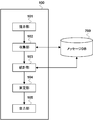
- the message processing device 100 includes a presentation unit 101, a collection unit 102, a statistics unit 103, a calculation unit 104, and an output unit 105.
- the CPU 601 and the NIC 605 cooperate to function as the presentation unit 101, the collection unit 102, the statistics unit 103, and the output unit 105. Further, the CPU 601 functions as the calculation unit 104.
- the presenting unit 101 presents a message template group to the sending source user, and presents a message selected by the sending source user from the template group or a message created by the sending source user to the destination user. To do.
- a sender user is a person who desires to send a message to a destination user, for example, a shopper who makes an inquiry.
- a destination user is a person who receives a message from a sender user, for example, a shop that receives an inquiry.
- the message is a message selected by the sender user from the template group or created by the sender user, and indicates, for example, the contents of the inquiry.
- the template group is a group of messages prepared in advance, for example, a group of messages indicating typical inquiry contents.
- the bilingual table 700a may be included in the message processing apparatus 100 or an external apparatus.
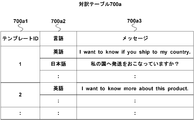
- the parallel translation is registered in the parallel translation table 700a (FIG. 4) stored in the message DB 700.
- a template ID 700a1, a language 700a2, and a message 700a3 for specifying the content of a message included in the template group are registered in association with each other.
- Messages having the same template ID indicate the same meaning.
- the first line of the bilingual translation table 700a in FIG. 4 indicates that the message in which the template with the template ID “1” is written in English is “I want to know if you ship to my country”.
- the presenting unit 101 receives designation of the first language from a plurality of types of languages from the destination user. In addition, the presentation unit 101 receives the designation of the second language from a plurality of types of languages from the sending user.
- the first language is a language that is widely used in the world such as the native language of the destination user or English and can be understood by the destination user.
- the second language is a language that is widely used in the world such as the native language of the sender user or English and can be understood by the sender user.
- the first language and the second language may be the same language, but in many cases, the two languages are different.
- the presentation unit 101 accepts, as the first language, the display language designated by the shop as the destination user on the electronic market site.
- the presenting unit 101 accepts a display language designated by the shopper who is the transmission source user on the site of the electronic market as the second language.
- the first language is Japanese and the second language is English.
- the presenting unit 101 presents the template group message in the second language to the sending source user.
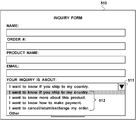
- the presentation unit 101 presents an inquiry form 510 as shown in FIG. 5 to the shopper.
- a shopper Y name “Jack Smith”
- the inquiry form 510 includes a field for entering the name of an inquirer and an e-mail address, a field for specifying a product and an order, and a field for selecting / entering the content of the inquiry.
- a message template group 512 indicating typical inquiry contents is displayed.
- the presentation unit 101 presents messages included in the template group 512 in English as the second language.
- the presenting unit 101 presents a message selected from the template group by the sending user to the destination user in the first language.
- the presentation unit 101 accepts designation of a supplemental lexical for supplementing the content of the selected message, and presents the supplemental lexical in the second language to the destination user.
- Supplementary lexical is a message included in the template group, and is a lexical for supplementing the content of the selected message.
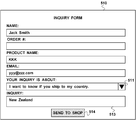
- the presenting unit 101 displays the message “I want to know if you ship to my country.” Selected from the template group and “New Zealand” entered in the column 513. , Send to shop X.
- the presentation unit 101 refers to the bilingual translation table 700a, and as shown in FIG. 7, the bilingual translation of the English message “I want to know if you ship to my country.” Selected from the template group 512 “ Present to shop X: "Do you ship to my country?" In addition, the supplementary lexical phrase is presented to shop X in English.
- the message included in the template group 512 is not selected, the “Other” option is selected, the message created by the shopper Y is entered in the column 513, and the button 514 is displayed.
- the unit 101 transmits a message “I entered” a “wrong” shipping “address.”
- the presentation unit 101 presents the message to the shop X in English.
- the collection unit 102 collects messages created by the sending user.
- the collection unit 102 enters the column 513.
- the collected messages are registered in the collected message table 700b (FIG. 9) stored in the message DB 700.
- a message ID 700b1 for specifying a collected message and a collected message 700b2 are registered in association with each other.
- the first line of the collected message table 700b in FIG. 9 indicates that the message with the message ID “1” is “I entered a wrong shipping address.”.
- Statistic unit 103 obtains statistics on lexical characters that appear in the collected messages.
- the statistical unit 103 obtains the appearance probability of the lexical phrase in the collected message.
- the lexical phrase in the collected message is a word included in each message, and the collected message includes N types of words. If the appearance frequencies of N types of words w 1 , w 2 ,..., W N are o 1 , o 2 ,..., O N , the appearance probability of each word can be expressed as Equation 1. .
- the statistics unit 103 the words appearing in messages collected, obtaining the p i.
- the calculation unit 104 calculates the appearance probability of each message in the collected messages from the obtained statistics.
- Equation 2 the appearance probability of the message m can be expressed as Equation 2.
- the calculation unit 104 calculates p (m) for the collected M messages.
- Equations 1 and 2 are calculated with the appearance probabilities according to the 1-gram model, but the appearance probabilities required by the statistical unit 103 and the calculation unit 104 are not limited to this.
- the appearance probability may be calculated according to a 2-gram model that considers word adjacency or an n-gram model where n is 3 or more.
- the appearance probability of w i w j can be expressed as in Equation 3.
- Equation 4 the appearance probability of the message m can be expressed as in Equation 4.
- the probability of occurrence of w i1 w i2 ⁇ w in can be expressed as the number 5.
- the appearance probability of the message m can be expressed as in Equation 6.
- the output unit 105 outputs a message having a calculated appearance probability equal to or higher than a predetermined threshold among the collected messages as a candidate to be added to the template group.
- a message in which the message p (m) calculated for the M messages collected by the calculation unit 104 exceeds a predetermined threshold is output as a candidate to be added to the template group 512.
- a predetermined threshold for example, 0.001
- an arbitrary number from the top of the value of p (m) among M messages may be output as a candidate to be added to the template group.
- the output unit 105 presents a message whose appearance probability has exceeded a predetermined threshold value included in the page 530 of FIG.
- message candidates to be added to the template group can be appropriately obtained without depending on human experience or intuition.
- a message including personal information such as an address has a low probability of appearance of personal information because the probability of appearance of the personal information is low. Therefore, according to the present embodiment, a message including personal information can be prevented from being output as a candidate to be included in the template, and privacy can be maintained.
- the output unit 105 indicates, for each output message, the lexical phrase having the lowest appearance probability among the lexical phrases appearing in the message is a candidate for the location where the supplemental lexical is arranged in the message.
- a message may be output.
- proper nouns are considered to have a lower appearance probability than other parts of speech.
- the word with the lowest appearance probability is “Indonesia”.
- the output unit 105 displays a message 531 indicating that the position of “Indonesia” on the page 530 (FIG. 10) is a candidate for a place where a supplementary word is placed.
- the word with the lowest appearance probability is “AAA” (product name) in the message “Can I change to AAA?”
- the output unit 105 displays a message 532 indicating that the position of “AAA” on the page 530 is a candidate for the location where the supplemental text is placed.
- the output unit 105 accepts the message “How much is the shipping to my country?” And adds the message to the template group 512.
- the number of messages included in the template group can be reduced. For example, if “How much is the shipping to my country?” Is included in the template group, by specifying the supplementary vocabulary “Indonesia” or “Singapore”, which country are you inquiring about shipping to? Can be shown. Therefore, it is not necessary to include each message that asks the same thing but different place names, such as “How much is the shipping to Indonesia?”, “How much is the shipping to Singapore?”, Etc. .
- presentation unit 101 may present the message included in the template group to the destination user in the first language and the second language.
- the presentation unit 101 displays an English message “I want to know if you ship to my country.” Selected by Shopper Y and a Japanese translation of the message “To my country”. "Do you ship?”
- the destination user who is presented with the message can check the message in the second language selected by the sender user and the translation of the message in the first language.
- the message selected by the sender user in the second language, it is possible to provide information useful for understanding the intention of the supplementary lexical phrase presented in the second language.
- the presentation unit 101 determines whether an inquiry form presentation request has been received (step S101). When the presenting unit 101 determines that the request for presenting the inquiry form has been received (step S101; Yes), the presenting unit 101 presents the inquiry form (step S102). On the other hand, when the presentation unit 101 determines that the inquiry form presentation request has not been received (step S101; No), the output unit 105 determines whether a candidate output request to be added to the template group has been received (step S101; No). Step S108).
- the presentation unit 101 transmits the inquiry form 510 of FIG. 5 to the shopper terminal 200 of the shopper Y.
- the output unit 105 determines whether or not there is a candidate output request to be added to the template group 512.
- the collection unit 102 determines whether an inquiry has been accepted (step S103). When determining that the inquiry has been received (step S103; Yes), the collection unit 102 determines whether the received message is a message included in the template group (step S104). On the other hand, when the collection unit 102 determines that the inquiry is not received (step S103; No), the collection unit 102 waits as it is.
- the collection unit 102 determines that the query has been accepted, and whether or not the message included in the received query is a message included in the template group 512. Determine whether. On the other hand, when the button 514 is not pressed in the inquiry form, the process waits as it is.
- step S104 when the collection unit 102 determines that the received message is a message included in the template group (step S104; Yes), the presentation unit 101 presents a translation of the message (step S107). On the other hand, when the collection unit 102 determines that the received message is not a message included in the template group (step S104; No), the presentation unit 101 presents the message as it is (step S105). Then, the collection unit 102 collects messages (Step S106). When the processes of steps S106 and S107 are completed, the process returns to step S101.
- the presentation unit 101 includes an inquiry including a Japanese translation of “I want to know if you ship to my country.” Message “Do you ship to my country?” The form is presented to the shop terminal 300, and the process returns to step S101.
- the presentation unit 101 presents the supplemental lexical together with the Japanese translation.
- step S108 when the output unit 105 determines that an output request for a candidate to be added to the template group has been received (step S108; Yes), the statistical unit 103 obtains statistics of the lexical characters included in the collected message (step S109). ). On the other hand, when the output unit 105 determines that an output request for a candidate to be added to the template group has not been received (step S108; No), the process returns to step S101.
- the statistical unit 103 appears for each of the words included in the collected M messages. The probability is obtained (Equation 1). On the other hand, if a candidate output request has not been received, the process returns to step S101.
- the calculating unit 104 calculates the appearance probability of each message in the collected messages (step S110).
- the calculation unit 104 obtains the appearance probability of a message including the word based on the appearance probability of the word (Equation 2).
- the output unit 105 outputs a message whose calculated appearance probability is equal to or higher than a predetermined threshold among the collected messages as a candidate to be added to the template group (step S111).
- the output unit 105 selects a message in which the appearance probability of the collected M messages is equal to or higher than a predetermined threshold, and manages the page 530 (FIG. 10) including the message that has made a candidate output request. Present to the person. At this time, the word having the lowest appearance probability may be output as a candidate for the location where the supplemental lexical is arranged in a message of a predetermined threshold value or more.
- the message processing apparatus 100 presents candidates to be added to the template group for messages included in the inquiry form of the electronic market. It is not limited to form.
- the message processing apparatus of the present application is applicable to any situation in which candidate messages to be added to the template group are presented.
Landscapes
- Engineering & Computer Science (AREA)
- Theoretical Computer Science (AREA)
- Physics & Mathematics (AREA)
- General Engineering & Computer Science (AREA)
- General Physics & Mathematics (AREA)
- Databases & Information Systems (AREA)
- Data Mining & Analysis (AREA)
- Health & Medical Sciences (AREA)
- Artificial Intelligence (AREA)
- Audiology, Speech & Language Pathology (AREA)
- Computational Linguistics (AREA)
- General Health & Medical Sciences (AREA)
- Machine Translation (AREA)
- Document Processing Apparatus (AREA)
Abstract
提示部(101)は、送付元ユーザに、メッセージのテンプレート群を提示し、当該テンプレート群の中から、送付元ユーザにより選択されたメッセージ、又は、送付元ユーザにより作成されたメッセージを、宛先ユーザに提示する。収集部(102)は、送付元ユーザにより作成されたメッセージを収集する。統計部(103)は、収集されたメッセージに出現する字句の統計を求める。算定部(104)は、求められた統計から、収集されたメッセージにおける各メッセージの出現確率を算定する。出力部(105)は、収集されたメッセージのうち、算定された出現確率が所定の閾値以上のメッセージを、テンプレート群に追加すべき候補として出力する。
Description
本発明は、メッセージ処理装置、メッセージ処理方法、プログラム、及び、非一時的なコンピュータ読取可能な情報記録媒体に関し、特に、テンプレートに追加すべきメッセージの選択に関するものである。
電子市場において、ショッパーは商品に関する情報を、電話やWEBページを介してショップに問い合わせることがあるが、近年では、日本語を母国語としないショッパーから、日本のショップへの問合せが行われることがある。ショップにとっては、母国語以外での問合せは負担であるので、ショッパーに予め用意された外国語の質問文のテンプレートから質問を選択させて、対応する日本語を電子市場が提供するという試みがなされている。このような、試みにおいて、できるだけ多くのテンプレートを用意することが望まれている。しかしながら、テンプレートを人間が用意するとなると、コストが掛かり、また、経験や直感に頼ることになるので、用意する者によってばらつきが生じるという問題があった。
一方、例えば、特許文献1には、談話データからFAQ(Frequently Asked Questions)の候補となる質問文を抽出する技術が開示されている。特許文献1に開示された技術では、談話データにおける文字列や形態素から意味内容を推測し、談話構造の解析を行った結果に基づいて質問文の抽出を行っている。
しかしながら、特許文献1のように、意味解析を行うと、システムにかかる負担は大きく、より簡易且つ適切に、テンプレートに追加すべき候補を得たいという要望があった。
本発明は、上記のような課題を解決するもので、テンプレートに追加すべきメッセージの候補を、客観的な情報に基づき適切に得ることができるメッセージ処理装置、メッセージ処理方法、プログラム、及び、非一時的なコンピュータ読取可能な情報記録媒体を提供することを目的とする。
本発明の第1の観点に係るメッセージ処理装置は、
送付元ユーザに、メッセージのテンプレート群を提示し、当該テンプレート群の中から、前記送付元ユーザにより選択されたメッセージ、又は、前記送付元ユーザにより作成されたメッセージを、宛先ユーザに提示する提示部と、
前記送付元ユーザにより作成されたメッセージを収集する収集部と、
前記収集されたメッセージに出現する字句の統計を求める統計部と、
前記求められた統計から、前記収集されたメッセージにおける各メッセージの出現確率を算定する算定部と、
前記収集されたメッセージのうち、前記算定された出現確率が所定の閾値以上のメッセージを、前記テンプレート群に追加すべき候補として出力する出力部と、
を備えることを特徴とする。
送付元ユーザに、メッセージのテンプレート群を提示し、当該テンプレート群の中から、前記送付元ユーザにより選択されたメッセージ、又は、前記送付元ユーザにより作成されたメッセージを、宛先ユーザに提示する提示部と、
前記送付元ユーザにより作成されたメッセージを収集する収集部と、
前記収集されたメッセージに出現する字句の統計を求める統計部と、
前記求められた統計から、前記収集されたメッセージにおける各メッセージの出現確率を算定する算定部と、
前記収集されたメッセージのうち、前記算定された出現確率が所定の閾値以上のメッセージを、前記テンプレート群に追加すべき候補として出力する出力部と、
を備えることを特徴とする。
また、上記観点に係るメッセージ処理装置において、
前記テンプレート群に含まれるメッセージには、複数種類の言語の対訳が予め用意されており、
前記提示部は、
前記宛先ユーザから、前記複数種類の言語の中から第1言語の指定を受け付け、
前記宛先ユーザに、前記送付元ユーザにより前記テンプレート群の中から選択されたメッセージを、前記第1言語で提示する
ことを特徴とする。
前記テンプレート群に含まれるメッセージには、複数種類の言語の対訳が予め用意されており、
前記提示部は、
前記宛先ユーザから、前記複数種類の言語の中から第1言語の指定を受け付け、
前記宛先ユーザに、前記送付元ユーザにより前記テンプレート群の中から選択されたメッセージを、前記第1言語で提示する
ことを特徴とする。
また、上記観点に係るメッセージ処理装置において、
前記提示部は、
前記送付元ユーザから、前記複数種類の言語の中から第2言語の指定を受け付け、
前記送付元ユーザに、前記テンプレート群のメッセージを、前記第2言語で提示する
ことを特徴とする。
前記提示部は、
前記送付元ユーザから、前記複数種類の言語の中から第2言語の指定を受け付け、
前記送付元ユーザに、前記テンプレート群のメッセージを、前記第2言語で提示する
ことを特徴とする。
また、上記観点に係るメッセージ処理装置において、
前記送付元ユーザから、前記選択されたメッセージの内容を補充する補充用字句の指定を受け付け、
前記宛先ユーザに、前記補充用字句を、前記第2言語で提示する
ことを特徴とする。
前記送付元ユーザから、前記選択されたメッセージの内容を補充する補充用字句の指定を受け付け、
前記宛先ユーザに、前記補充用字句を、前記第2言語で提示する
ことを特徴とする。
また、上記観点に係るメッセージ処理装置において、
前記統計部は、前記収集されたメッセージにおける前記字句の出現確率を求め、
前記出力部は、前記出力されるメッセージのそれぞれについて、当該メッセージに出現する字句のうち最も出現確率の低い字句を、当該メッセージにおいて、前記補充用字句が配置される箇所の候補であることを示して、前記メッセージを出力する
ことを特徴とする。
前記統計部は、前記収集されたメッセージにおける前記字句の出現確率を求め、
前記出力部は、前記出力されるメッセージのそれぞれについて、当該メッセージに出現する字句のうち最も出現確率の低い字句を、当該メッセージにおいて、前記補充用字句が配置される箇所の候補であることを示して、前記メッセージを出力する
ことを特徴とする。
また、上記観点に係るメッセージ処理装置において、
前記テンプレート群に含まれるメッセージには、複数種類の言語の対訳が予め用意されており、
前記提示部は、
前記宛先ユーザから、前記複数種類の言語の中から第1言語の指定を受け付け、
前記送付元ユーザから、前記複数種類の言語の中から第2言語の指定を受け付け、
前記宛先ユーザに、前記テンプレート群に含まれるメッセージを前記第1言語及び前記第2言語で提示する
ことを特徴とする。
前記テンプレート群に含まれるメッセージには、複数種類の言語の対訳が予め用意されており、
前記提示部は、
前記宛先ユーザから、前記複数種類の言語の中から第1言語の指定を受け付け、
前記送付元ユーザから、前記複数種類の言語の中から第2言語の指定を受け付け、
前記宛先ユーザに、前記テンプレート群に含まれるメッセージを前記第1言語及び前記第2言語で提示する
ことを特徴とする。
本発明の第2の観点に係るメッセージ処理方法は、
メッセージ処理装置が実行するメッセージ処理方法であって、
前記メッセージ処理装置が、送付元ユーザに、メッセージのテンプレート群を提示し、当該テンプレート群の中から、前記送付元ユーザにより選択されたメッセージ、又は、前記送付元ユーザにより作成されたメッセージを、宛先ユーザに提示する提示工程と、
前記メッセージ処理装置が、前記送付元ユーザにより作成されたメッセージを収集する収集工程と、
前記メッセージ処理装置が、前記収集されたメッセージに出現する字句の統計を求める統計工程と、
前記メッセージ処理装置が、前記求められた統計から、前記収集されたメッセージにおける各メッセージの出現確率を算定する算定工程と、
前記メッセージ処理装置が、前記収集されたメッセージのうち、前記算定された出現確率が所定の閾値以上のメッセージを、前記テンプレート群に追加すべき候補として出力する出力工程と、
を備えることを特徴とする。
メッセージ処理装置が実行するメッセージ処理方法であって、
前記メッセージ処理装置が、送付元ユーザに、メッセージのテンプレート群を提示し、当該テンプレート群の中から、前記送付元ユーザにより選択されたメッセージ、又は、前記送付元ユーザにより作成されたメッセージを、宛先ユーザに提示する提示工程と、
前記メッセージ処理装置が、前記送付元ユーザにより作成されたメッセージを収集する収集工程と、
前記メッセージ処理装置が、前記収集されたメッセージに出現する字句の統計を求める統計工程と、
前記メッセージ処理装置が、前記求められた統計から、前記収集されたメッセージにおける各メッセージの出現確率を算定する算定工程と、
前記メッセージ処理装置が、前記収集されたメッセージのうち、前記算定された出現確率が所定の閾値以上のメッセージを、前記テンプレート群に追加すべき候補として出力する出力工程と、
を備えることを特徴とする。
本発明の第3の観点に係るプログラムは、
コンピュータを、
送付元ユーザに、メッセージのテンプレート群を提示し、当該テンプレート群の中から、前記送付元ユーザにより選択されたメッセージ、又は、前記送付元ユーザにより作成されたメッセージを、宛先ユーザに提示する提示部、
前記送付元ユーザにより作成されたメッセージを収集する収集部、
前記収集されたメッセージに出現する字句の統計を求める統計部、
前記求められた統計から、前記収集されたメッセージにおける各メッセージの出現確率を算定する算定部、
前記収集されたメッセージのうち、前記算定された出現確率が所定の閾値以上のメッセージを、前記テンプレート群に追加すべき候補として出力する出力部、
として機能させることを特徴とする。
コンピュータを、
送付元ユーザに、メッセージのテンプレート群を提示し、当該テンプレート群の中から、前記送付元ユーザにより選択されたメッセージ、又は、前記送付元ユーザにより作成されたメッセージを、宛先ユーザに提示する提示部、
前記送付元ユーザにより作成されたメッセージを収集する収集部、
前記収集されたメッセージに出現する字句の統計を求める統計部、
前記求められた統計から、前記収集されたメッセージにおける各メッセージの出現確率を算定する算定部、
前記収集されたメッセージのうち、前記算定された出現確率が所定の閾値以上のメッセージを、前記テンプレート群に追加すべき候補として出力する出力部、
として機能させることを特徴とする。
本発明の第4の観点に係る非一時的なコンピュータ読取可能な情報記録媒体は、
コンピュータを、
送付元ユーザに、メッセージのテンプレート群を提示し、当該テンプレート群の中から、前記送付元ユーザにより選択されたメッセージ、又は、前記送付元ユーザにより作成されたメッセージを、宛先ユーザに提示する提示部、
前記送付元ユーザにより作成されたメッセージを収集する収集部、
前記収集されたメッセージに出現する字句の統計を求める統計部、
前記求められた統計から、前記収集されたメッセージにおける各メッセージの出現確率を算定する算定部、
前記収集されたメッセージのうち、前記算定された出現確率が所定の閾値以上のメッセージを、前記テンプレート群に追加すべき候補として出力する出力部、
として機能させることを特徴とするプログラムを記録する。
コンピュータを、
送付元ユーザに、メッセージのテンプレート群を提示し、当該テンプレート群の中から、前記送付元ユーザにより選択されたメッセージ、又は、前記送付元ユーザにより作成されたメッセージを、宛先ユーザに提示する提示部、
前記送付元ユーザにより作成されたメッセージを収集する収集部、
前記収集されたメッセージに出現する字句の統計を求める統計部、
前記求められた統計から、前記収集されたメッセージにおける各メッセージの出現確率を算定する算定部、
前記収集されたメッセージのうち、前記算定された出現確率が所定の閾値以上のメッセージを、前記テンプレート群に追加すべき候補として出力する出力部、
として機能させることを特徴とするプログラムを記録する。
上記非一時的なコンピュータ読取可能な情報記録媒体は、コンピュータとは独立して配布・販売することができる。ここで、非一時的な(non-transitory)情報記録媒体とは、有形な(tangible)情報記録媒体をいう。非一時的な情報記録媒体は、例えば、コンパクトディスク、フレキシブルディスク、ハードディスク、光磁気ディスク、ディジタルビデオディスク、磁気テープ、半導体メモリ等である。また、一時的な(transitory)情報記録媒体とは、伝送媒体(伝搬信号)それ自体を示す。一時的な情報記録媒体は、例えば、電気信号、光信号、電磁波等である。なお、一時的な(temporary)記憶領域とは、データやプログラムを一時的に記憶するための領域であり、例えば、RAM(Random Access Memory)等の揮発性メモリである。
本発明によれば、テンプレートに追加すべきメッセージの候補を、客観的な情報に基づき適切に得ることができるメッセージ処理装置、メッセージ処理方法、プログラム、及び、非一時的なコンピュータ読取可能な情報記録媒体を提供することができる。
(1.全体構成)
本発明の実施形態に係るメッセージ処理装置100は、図1に示すように、インターネット400に接続される。インターネット400には、メッセージ処理装置100と、ショッパー端末201、202~20m(以下、これらを総称して「ショッパー端末200」という)と、ショップ端末301、302~30n(以下、これらを総称して「ショップ端末300」という)と、が接続されている。
本発明の実施形態に係るメッセージ処理装置100は、図1に示すように、インターネット400に接続される。インターネット400には、メッセージ処理装置100と、ショッパー端末201、202~20m(以下、これらを総称して「ショッパー端末200」という)と、ショップ端末301、302~30n(以下、これらを総称して「ショップ端末300」という)と、が接続されている。
メッセージ処理装置100は、電子市場において、ショッパーに問合せフォームを提示し、問い合わせ内容をショップあるいは電子市場の管理者に提示する装置である。また、メッセージ処理装置100は、インターネット上で商品やサービスの売買が行われる電子市場を管理する機能を有していてもよい。
ショッパー端末200は、電子市場においてショップが販売する商品の閲覧・購入を行うショッパーが使用する端末である。ショッパーは、電子市場のサイトを介して、ショップに商品や購入についての問合せを行う。
ショップ端末300は、電子市場において商品を販売するショップが使用する端末である。ショップは、電子市場のサイトを介して、ショッパーからの問合せを受け付ける。
(2.情報処理装置の概要構成)
本発明の実施形態に係るメッセージ処理装置100が実現される典型的な情報処理装置600の概要構成について説明する。
本発明の実施形態に係るメッセージ処理装置100が実現される典型的な情報処理装置600の概要構成について説明する。
情報処理装置600は、図2に示すように、CPU(Central Processing Unit)601と、ROM(Read Only Memory)602と、RAM(Random Access Memory)603と、記憶装置604と、NIC(Network Interface Card)605と、画像処理部606と、音声処理部607と、ディスプレイ608と、スピーカ609と、コントローラ610と、を備える。
CPU 601は、情報処理装置600全体の動作を制御し、各構成要素と接続され、制御信号やデータをやりとりする。
ROM 602には、情報処理装置600全体の動作制御に必要なオペレーティングシステムのプログラムや各種のデータが記録される。
RAM 603は、データやプログラムを一時的に記憶するためのもので、記憶装置604から読み出したプログラムやデータ、その他、通信に必要なデータ等が保持される。
記憶装置604は、ハードディスクやフラッシュメモリ等から構成され、情報処理装置600で処理するデータを記憶する。また、記憶装置604は、CD(Compact Disc)等の非一時的なコンピュータ読取可能な情報記録媒体からデータを読み出すデバイス等を備えるように構成されてもよい。
NIC 605は、情報処理装置600をインターネット等のコンピュータ通信網に接続するためのものであり、NIC 605を介して他の情報処理装置等とやりとりをする。
画像処理部606は、記憶装置604等から読み出されたデータをCPU 601や画像処理部606が備える画像演算プロセッサによって加工処理し、画像処理部606が備えるフレームメモリに記録する。フレームメモリに記録された画像情報は、所定の同期タイミングでビデオ信号に変換され、ディスプレイ608に出力される。
音声処理部607は、記憶装置604等から読み出されたデータをアナログ音声信号に変換し、スピーカ609から出力させる。
コントローラ610は、ユーザからの指示入力を受け付ける。
以下、上記情報処理装置600において実現されるメッセージ処理装置100について、図1乃至図11を参照して説明する。情報処理装置600に電源が投入されると、実施形態に係るメッセージ処理装置100として機能させるプログラムが実行され、実施形態に係るメッセージ処理装置100が実現される。
(3.実施形態に係るメッセージ処理装置の概要構成)
実施形態に係るメッセージ処理装置100は、図3に示すように、提示部101と、収集部102と、統計部103と、算定部104と、出力部105と、から構成される。
実施形態に係るメッセージ処理装置100は、図3に示すように、提示部101と、収集部102と、統計部103と、算定部104と、出力部105と、から構成される。
本実施形態において、CPU 601及びNIC 605が協働して、提示部101、収集部102、統計部103、及び、出力部105として機能する。また、CPU 601が算定部104として機能する。
提示部101は、送付元ユーザに、メッセージのテンプレート群を提示し、当該テンプレート群の中から、送付元ユーザにより選択されたメッセージ、又は、送付元ユーザにより作成されたメッセージを、宛先ユーザに提示する。
送付元ユーザとは、メッセージを宛先ユーザに送ることを希望する者であり、例えば、問合せを行うショッパーである。
宛先ユーザとは、送付元ユーザからメッセージを受ける者であり、例えば、問合せを受けるショップである。
メッセージとは、送付元ユーザがテンプレート群から選択したもの、又は、送付元ユーザが作成したものであり、例えば、問合せ内容を示すものである。
テンプレート群とは、予め用意されたメッセージの集まりであり、例えば、典型的な問合せ内容を示すメッセージの集まりである。
ここで、テンプレート群に含まれるメッセージには、複数種類の言語の対訳が予め用意されているとする。
例えば、テンプレート群に含まれるメッセージの対訳が、メッセージDB 700に格納されているとする。メッセージの対訳は、人間が翻訳したものとする。なお、対訳テーブル700aはメッセージ処理装置100が有していても良いし、外部の装置であっても良い。
例えば、対訳は、メッセージDB 700に格納される対訳テーブル700a(図4)に登録されているとする。図4の対訳テーブル700aには、テンプレート群に含まれるメッセージの内容を特定するためのテンプレートID700a1と、言語700a2と、メッセージ700a3と、が対応付けて登録されている。同じテンプレートIDを有するメッセージは、同じ意味内容を示す。
図4の対訳テーブル700aの1行目は、テンプレートIDが“1”のテンプレートを英語で表記したメッセージは、“I want to know if you ship to my country”であることを示す。
提示部101は、宛先ユーザから、複数種類の言語の中から第1言語の指定を受け付ける。また、提示部101は、送付元ユーザから、複数種類の言語の中から第2言語の指定を受け付ける。
第1言語とは、宛先ユーザの母国語、又は、英語など世界で広く用いられており、宛先ユーザが理解できる言語である。また、第2言語とは、送付元ユーザの母国語、又は、英語など世界で広く用いられており、送付元ユーザが理解できる言語である。第1言語と第2言語とは、同じ言語である場合もあるが、多くの場合は、両言語は異なる。
例えば、提示部101は、宛先ユーザであるショップが、電子市場のサイトにおいて指定している表示言語を、第1言語として受け付ける。また、提示部101は、送付元ユーザであるショッパーが、電子市場のサイトにおいて指定している表示言語を、第2言語として受け付ける。本実施形態において、第1言語は日本語、第2言語は英語であるとする。
提示部101は、送付元ユーザに、テンプレート群のメッセージを、第2言語で提示する。
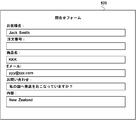
例えば、提示部101は、図5に示すような問合せフォーム510を、ショッパーに提示する。以下、問合せフォーム510を用いて、ショップXへショッパーY(氏名“Jack Smith”)が問合せを行う例を示す。
問合せフォーム510には、問合せを行う者の名前や、Eメールアドレスを記入する欄、商品及び注文を特定するための欄、及び、問い合わせ内容を選択・記入する欄が含まれる。
問合せフォーム510において、ボタン511を押すと、典型的な問合せ内容を示すメッセージのテンプレート群512が表示される。提示部101は、テンプレート群512に含まれるメッセージを、第2言語である英語で提示する。
提示部101は、宛先ユーザに、送付元ユーザによりテンプレート群の中から選択されたメッセージを、第1言語で提示する。
また、提示部101は、選択されたメッセージの内容を補充する補充用字句の指定を受け付け、宛先ユーザに、補充用字句を、第2言語で提示する。
補充用字句とは、テンプレート群に含まれるメッセージであって、選択されたメッセージの内容を補充する字句である。
例えば、図6に示すように、問合せフォーム510において、メッセージ“I want to know if you ship to my country.”が選択され、欄513に“New Zealand”が記入されたとする。これらの記載は、ショッパーYが、ニュージーランドに商品の発送が可能か否かを問い合わせていることを示す。この例では、“New Zealand”が補充用字句である。メッセージ中の“my country”が欄513に記入された“New Zealand”により限定されている。
図6において、ボタン514が押されると、提示部101は、テンプレート群から選択されたメッセージ“I want to know if you ship to my country.”と、欄513に記入された“New Zealand”とを、ショップXに送信する。
そして、提示部101は、対訳テーブル700aを参照し、図7に示すように、テンプレート群512から選択された英語のメッセージ“I want to know if you ship to my country.”の日本語の対訳「私の国へ発送をおこなっていますか?」をショップXに提示する。また、補充用字句を英語のまま、ショップXに提示する。
一方、図8において、テンプレート群512に含まれるメッセージが選択されず、“Other”の選択肢が選択され、欄513に、ショッパーYにより作成されたメッセージが記入されてボタン514が押されると、提示部101は、メッセージ“I entered a wrong shipping address. The correct address is xxx xxx xxx.”をショップXに送信する。そして、提示部101は、当該メッセージを英語のままショップXに提示する。
収集部102は、送付元ユーザにより作成されたメッセージを収集する。
例えば、収集部102は、図8に示すように、“Other”の選択肢が選択され、欄513に、ショッパーYにより作成されたメッセージが記入されてボタン514が押されると、欄513に記入されたメッセージ“I entered a wrong shipping address. The correct address is xxx xxx xxx.”を、メッセージDB 700に格納する。
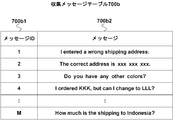
例えば、収集されたメッセージは、メッセージDB 700に格納される収集メッセージテーブル700b(図9)に登録される。図9の収集メッセージテーブル700bには、収集したメッセージを特定するためのメッセージID 700b1と、収集したメッセージ700b2と、が対応付けて登録されている。
図9の収集メッセージテーブル700bの1行目は、メッセージID“1”のメッセージが“I entered a wrong shipping address.”であることを示す。
統計部103は、収集されたメッセージに出現する字句の統計を求める。
ここで、例えば、統計部103は、収集されたメッセージにおける字句の出現確率を求める。
例えば、収集されたメッセージにおける字句とは、各メッセージに含まれる単語であるとし、収集されたメッセージには、N種類の単語が含まれるとする。N種類の単語w1、w2、・・・、wNの出現頻度をo1、o2、・・・、oNとすると、各単語の出現確率は数1のように表すことができる。

すなわち、統計部103は、収集されたメッセージに出現する単語について、piを求める。
算定部104は、求められた統計から、収集されたメッセージにおける各メッセージの出現確率を算定する。
例えば、収集されたメッセージがM個あり、あるメッセージmが、L個の単語ws[1]ws[2]・・・ws[L]から構成されるとする。この場合、メッセージmの出現確率は数2のように表すことができる。

すなわち、算定部104は、収集されたM個のメッセージについて、p(m)を求める。
なお、数1、数2は、1-gramのモデルに従って出現確率を計算したものであるが、統計部103及び算定部104が求める出現確率はこれに限らない。例えば、単語の隣接関係を考慮した2-gramモデルや、nが3以上のn-gramモデルに従って出現確率を計算してもよい。
例えば、2-gramモデルに従う場合、wiwjの出現確率は、数3のように表すことができる。

そして、メッセージmの出現確率は、数4のように表すことができる。

また、n-gramモデルに従う場合、wi1wi2・・・winの出現確率は、数5のように表すことができる。

そして、メッセージmの出現確率は、数6のように表すことができる。

出力部105は、収集されたメッセージのうち、算定された出現確率が所定の閾値以上のメッセージを、テンプレート群に追加すべき候補として出力する。
例えば、算定部104が収集したメッセージM個について算定したメッセージp(m)が、所定の閾値(例えば、0.001)を超えたメッセージを、テンプレート群512に追加すべき候補として、出力する。または、メッセージM個のうちp(m)の値の上位から任意の数を、テンプレート群に追加すべき候補として出力するようにしてもよい。
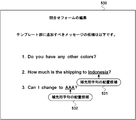
そして、例えば、出力部105は、出現確率が所定の閾値を超えたメッセージを、図10のページ530に含めて提示する。
本実施形態によれば、テンプレート群に追加すべきメッセージの候補を、人間の経験や直感に頼ること無く、適切に得ることができる。
また、例えば住所などの個人情報が含まれるメッセージは、個人情報の出現確率が低いので、そのメッセージの出現確率は極めて低くなる。よって、本実施形態によれば、個人情報を含むメッセージがテンプレートに含めるべき候補として出力されないようにすることができ、プライバシーを保つことができる。
なお、出力部105は、出力されるメッセージのそれぞれについて、当該メッセージに出現する字句のうち最も出現確率の低い字句を、当該メッセージにおいて、補充用字句が配置される箇所の候補であることを示して、メッセージを出力するようにしてもよい。
一般的に、固有名詞は他の品詞と比較して出現確率は低いと考えられる。例えば、テンプレート群に追加すべき候補として出力されたメッセージ“How much is the shipping to Indonesia?”のうち、最も出現確率の低い単語が、“Indonesia”であるとする。出力部105は、ページ530(図10)において“Indonesia”の位置が補充用字句が配置される箇所の候補であることを示すメッセージ531を表示する。また、テンプレート群に追加すべき候補として出力されたメッセージ“Can I change to AAA?”のうち、最も出現確率の低い単語が、“AAA”(商品名)であるとする。出力部105は、ページ530において、“AAA”の位置が補充用字句が配置される箇所の候補であることを示すメッセージ532を表示する。
そして、例えば、問合せフォームの管理者に補充用字句の配置候補が提示されると、管理者は、“How much is the shipping to Indonesia?”の“Indonesia”を“my country”で置換した“How much is the shipping to my country?”をテンプレート群に追加してもよい。また、“Can I change to AAA?”の“AAA”を“another product”で置換した“Can I change to another product?”をテンプレート群に追加してもよい。
例えば、出力部105は、メッセージ“How much is the shipping to my country?”を受け付け、当該メッセージをテンプレート群512に追加する。
補充用字句でメッセージの内容を補充できるメッセージをテンプレートとして用意しておくと、テンプレート群に含めるメッセージの数を抑えることができる。例えば、“How much is the shipping to my country?”がテンプレート群に含まれていれば、補充用字句“Indonesia”や“Singapore”を指定することにより、どこの国への発送について問い合わせているのかを示すことができる。したがって、“How much is the shipping to Indonesia?”、“How much is the shipping to Singapore?”、等のように、地名は異なるが同じ事柄を質問しているメッセージそれぞれをテンプレート群に含める必要はなくなる。
すなわち、このような構成により、テンプレート群に追加すべきメッセージについて、さらに汎用性のあるメッセージへの変更の可能性を示すことができる。
また、補充用字句の配置候補として提示された箇所を他の字句に変更したメッセージを作成してテンプレート群に追加することにより、多数のメッセージをテンプレート群に含む必要がなく、汎用性の高いメッセージをテンプレート群に含むことができる。また、テンプレート群に含めるメッセージ数を抑えることができ、当該メッセージの対訳を用意するコストを下げることができる。
なお、提示部101は、宛先ユーザに、テンプレート群に含まれるメッセージを第1言語及び第2言語で提示するようにしてもよい。
例えば、提示部101は、図7の問合せフォーム520において、ショッパーYが選択した英語のメッセージ“I want to know if you ship to my country.”と、当該メッセージの日本語の対訳「私の国へ発送をおこなっていますか?」を、提示する。
このような構成により、メッセージを提示された宛先ユーザは、送付元ユーザが選択した第2言語のメッセージと、そのメッセージの第1言語での対訳とを対比して確認することができる。また、送付元ユーザが選択したメッセージを第2言語で提示することにより、第2言語で提示される補充用字句の意図を理解する上で有益な情報を提供することができる。
(4.実施形態のメッセージ処理装置の動作)
本実施形態のメッセージ処理装置100の動作について説明する。メッセージ処理装置100は、例えば、電源が投入されると、図11に示すメッセージ処理を開始する。
本実施形態のメッセージ処理装置100の動作について説明する。メッセージ処理装置100は、例えば、電源が投入されると、図11に示すメッセージ処理を開始する。
提示部101は、問合せフォームの提示要求を受け付けたか否かを判断する(ステップS101)。提示部101は、問合せフォームの提示要求を受け付けたと判断すると(ステップS101;Yes)、問合せフォームを提示する(ステップS102)。一方、提示部101は、問合せフォームの提示要求を受け付けていないと判断すると(ステップS101;No)、出力部105は、テンプレート群に追加すべき候補の出力要求を受け付けたか否かを判断する(ステップS108)。
例えば、ショッパーYから問合せフォームの提示要求が送信されると、提示部101は、図5の問合せフォーム510を、ショッパーYのショッパー端末200に送信する。一方、問合せフォームの提示要求を受け付けていない場合、出力部105は、テンプレート群512に追加すべき候補の出力要求があったか否かを判断する。
収集部102は、問合せを受け付けたか否かを判断する(ステップS103)。収集部102は、問合せを受け付けたと判断すると(ステップS103;Yes)、受け付けたメッセージがテンプレート群に含まれるメッセージか否かを判断する(ステップS104)。一方、収集部102は、問合せを受け付けていないと判断すると(ステップS103;No)、そのまま待機する。
例えば、問合せフォームにおいて、問合せの送信を指示するボタン514が押されると、収集部102は、問合せを受け付けたと判断し、受け付けた問合せに含まれるメッセージがテンプレート群512に含まれるメッセージであるか否かを判断する。一方、問合せフォームにおいてボタン514が押されない場合は、そのまま待機する。
ステップS104において、収集部102が、受け付けたメッセージがテンプレート群に含まれるメッセージであると判断すると(ステップS104;Yes)、提示部101は、当該メッセージの対訳を提示する(ステップS107)。一方、収集部102が、受け付けたメッセージがテンプレート群に含まれるメッセージでないと判断すると(ステップS104;No)、提示部101は、メッセージをそのまま提示する(ステップS105)。そして、収集部102は、メッセージを収集する(ステップS106)。ステップS106、S107の処理が終了すると、ステップS101に戻る。
例えば、図6の問合せフォーム510においてボタン514が押されて、テンプレート群512に含まれるメッセージ“I want to know if you ship to my country.”を受け付けたとすると、提示部101は、ショップ端末300の表示言語(ここでは、日本語)を取得し、対訳テーブル700aを参照して、“I want to know if you ship to my country.”のテンプレートID“1”と、表示言語“日本語”とに対応付けられたメッセージを選択する。そして、提示部101は、図7に示すように、“I want to know if you ship to my country.”のメッセージの日本語訳「私の国へ発送をおこなっていますか?」が含まれる問合せフォームをショップ端末300に提示し、ステップS101に戻る。なお、補充用字句が記入されている場合は、提示部101は、日本語訳とあわせて補充用字句を提示する。
一方、図8の問合せフォーム510においてボタン514が押されて、テンプレート群512に含まれないメッセージ“I entered a wrong shipping address. The correct address is xxx xxx xxx.”を受け付けたとすると、提示部101は、メッセージをそのままショップ端末300に提示する。そして、収集部102は、テンプレート群512に含まれないメッセージを、収集メッセージテーブル700bに登録し、ステップS101に戻る。
ステップS108において、出力部105は、テンプレート群に追加すべき候補の出力要求を受け付けたと判断すると(ステップS108;Yes)、統計部103は、収集したメッセージに含まれる字句の統計を求める(ステップS109)。一方、出力部105は、テンプレート群に追加すべき候補の出力要求を受け付けていないと判断すると(ステップS108;No)、ステップS101に戻る。
例えば、電子市場の管理者より、問合せフォームのテンプレート群に追加すべきメッセージの候補の出力要求を受け付けたとすると、統計部103は、収集されたM個のメッセージに含まれる単語のそれぞれについて、出現確率を求める(数1)。一方、候補の出力要求を受け付けていない場合、ステップS101に戻る。
算定部104は、収集されたメッセージにおける各メッセージの出現確率を算定する(ステップS110)。
例えば、算定部104は、単語の出現確率に基づいて、当該単語を含むメッセージの出現確率を求める(数2)。
出力部105は、収集されたメッセージのうち、算定された出現確率が所定の閾値以上のメッセージを、テンプレート群に追加すべき候補として出力する(ステップS111)。
例えば、出力部105は、収集されたM個のメッセージの出現確率が、所定の閾値以上のメッセージを選択し、当該メッセージが含まれるページ530(図10)を、候補の出力要求を行った管理者に提示する。なお、この際に、所定の閾値以上のメッセージにおいて、最も出現確率の低い単語を、補充用字句が配置される箇所の候補として出力してもよい。
なお、本実施形態において、メッセージ処理装置100が、電子市場の問合せフォームに含まれるメッセージについて、テンプレート群に追加すべき候補を提示する例を示したが、メッセージ処理装置100の適用はこのような形態に限らない。本願のメッセージ処理装置は、テンプレート群に追加すべきメッセージの候補を提示する、あらゆる状況に適用可能である。
本発明は、本発明の広義の精神と範囲を逸脱することなく、様々な実施の形態及び変形が可能とされるものである。また、上述した実施の形態は、この発明を説明するためのものであり、本発明の範囲を限定するものではない。すなわち、本発明の範囲は、実施の形態ではなく、特許請求の範囲によって示される。そして、特許請求の範囲内及びそれと同等の発明の意義の範囲内で施される様々な変形が、この発明の範囲内とみなされる。
100 メッセージ処理装置
101 提示部
102 収集部
103 統計部
104 算定部
105 出力部
200、201、202~20m ショッパー端末
300、301、302~30n ショップ端末
400 インターネット
510、520 問合せフォーム
530 ページ
600 情報処理装置
601 CPU
602 ROM
603 RAM
604 記憶装置
605 NIC
606 画像処理部
607 音声処理部
608 ディスプレイ
609 スピーカ
610 コントローラ
700 メッセージDB
101 提示部
102 収集部
103 統計部
104 算定部
105 出力部
200、201、202~20m ショッパー端末
300、301、302~30n ショップ端末
400 インターネット
510、520 問合せフォーム
530 ページ
600 情報処理装置
601 CPU
602 ROM
603 RAM
604 記憶装置
605 NIC
606 画像処理部
607 音声処理部
608 ディスプレイ
609 スピーカ
610 コントローラ
700 メッセージDB
Claims (9)
- 送付元ユーザに、メッセージのテンプレート群を提示し、当該テンプレート群の中から、前記送付元ユーザにより選択されたメッセージ、又は、前記送付元ユーザにより作成されたメッセージを、宛先ユーザに提示する提示部と、
前記送付元ユーザにより作成されたメッセージを収集する収集部と、
前記収集されたメッセージに出現する字句の統計を求める統計部と、
前記求められた統計から、前記収集されたメッセージにおける各メッセージの出現確率を算定する算定部と、
前記収集されたメッセージのうち、前記算定された出現確率が所定の閾値以上のメッセージを、前記テンプレート群に追加すべき候補として出力する出力部と、
を備えることを特徴とするメッセージ処理装置。 - 前記テンプレート群に含まれるメッセージには、複数種類の言語の対訳が予め用意されており、
前記提示部は、
前記宛先ユーザから、前記複数種類の言語の中から第1言語の指定を受け付け、
前記宛先ユーザに、前記送付元ユーザにより前記テンプレート群の中から選択されたメッセージを、前記第1言語で提示する
ことを特徴とする請求項1に記載のメッセージ処理装置。 - 前記提示部は、
前記送付元ユーザから、前記複数種類の言語の中から第2言語の指定を受け付け、
前記送付元ユーザに、前記テンプレート群のメッセージを、前記第2言語で提示する
ことを特徴とする請求項2に記載のメッセージ処理装置。 - 前記提示部は、
前記送付元ユーザから、前記選択されたメッセージの内容を補充する補充用字句の指定を受け付け、
前記宛先ユーザに、前記補充用字句を、前記第2言語で提示する
ことを特徴とする請求項3に記載のメッセージ処理装置。 - 前記統計部は、前記収集されたメッセージにおける前記字句の出現確率を求め、
前記出力部は、前記出力されるメッセージのそれぞれについて、当該メッセージに出現する字句のうち最も出現確率の低い字句を、当該メッセージにおいて、前記補充用字句が配置される箇所の候補であることを示して、前記メッセージを出力する
ことを特徴とする請求項4に記載のメッセージ処理装置。 - 前記テンプレート群に含まれるメッセージには、複数種類の言語の対訳が予め用意されており、
前記提示部は、
前記宛先ユーザから、前記複数種類の言語の中から第1言語の指定を受け付け、
前記送付元ユーザから、前記複数種類の言語の中から第2言語の指定を受け付け、
前記宛先ユーザに、前記テンプレート群に含まれるメッセージを前記第1言語及び前記第2言語で提示する
ことを特徴とする請求項1に記載のメッセージ処理装置。 - メッセージ処理装置が実行するメッセージ処理方法であって、
前記メッセージ処理装置が、送付元ユーザに、メッセージのテンプレート群を提示し、当該テンプレート群の中から、前記送付元ユーザにより選択されたメッセージ、又は、前記送付元ユーザにより作成されたメッセージを、宛先ユーザに提示する提示工程と、
前記メッセージ処理装置が、前記送付元ユーザにより作成されたメッセージを収集する収集工程と、
前記メッセージ処理装置が、前記収集されたメッセージに出現する字句の統計を求める統計工程と、
前記メッセージ処理装置が、前記求められた統計から、前記収集されたメッセージにおける各メッセージの出現確率を算定する算定工程と、
前記メッセージ処理装置が、前記収集されたメッセージのうち、前記算定された出現確率が所定の閾値以上のメッセージを、前記テンプレート群に追加すべき候補として出力する出力工程と、
を備えることを特徴とするメッセージ処理方法。 - コンピュータを、
送付元ユーザに、メッセージのテンプレート群を提示し、当該テンプレート群の中から、前記送付元ユーザにより選択されたメッセージ、又は、前記送付元ユーザにより作成されたメッセージを、宛先ユーザに提示する提示部、
前記送付元ユーザにより作成されたメッセージを収集する収集部、
前記収集されたメッセージに出現する字句の統計を求める統計部、
前記求められた統計から、前記収集されたメッセージにおける各メッセージの出現確率を算定する算定部、
前記収集されたメッセージのうち、前記算定された出現確率が所定の閾値以上のメッセージを、前記テンプレート群に追加すべき候補として出力する出力部、
として機能させることを特徴とするプログラム。 - コンピュータを、
送付元ユーザに、メッセージのテンプレート群を提示し、当該テンプレート群の中から、前記送付元ユーザにより選択されたメッセージ、又は、前記送付元ユーザにより作成されたメッセージを、宛先ユーザに提示する提示部、
前記送付元ユーザにより作成されたメッセージを収集する収集部、
前記収集されたメッセージに出現する字句の統計を求める統計部、
前記求められた統計から、前記収集されたメッセージにおける各メッセージの出現確率を算定する算定部、
前記収集されたメッセージのうち、前記算定された出現確率が所定の閾値以上のメッセージを、前記テンプレート群に追加すべき候補として出力する出力部、
として機能させることを特徴とするプログラムを記録した非一時的なコンピュータ読取可能な情報記録媒体。
Priority Applications (2)
| Application Number | Priority Date | Filing Date | Title |
|---|---|---|---|
| JP2017510677A JP6122236B1 (ja) | 2016-04-27 | 2016-04-27 | メッセージ処理装置、メッセージ処理方法、プログラム、及び、非一時的なコンピュータ読取可能な情報記録媒体 |
| PCT/JP2016/063181 WO2017187549A1 (ja) | 2016-04-27 | 2016-04-27 | メッセージ処理装置、メッセージ処理方法、プログラム、及び、非一時的なコンピュータ読取可能な情報記録媒体 |
Applications Claiming Priority (1)
| Application Number | Priority Date | Filing Date | Title |
|---|---|---|---|
| PCT/JP2016/063181 WO2017187549A1 (ja) | 2016-04-27 | 2016-04-27 | メッセージ処理装置、メッセージ処理方法、プログラム、及び、非一時的なコンピュータ読取可能な情報記録媒体 |
Publications (1)
| Publication Number | Publication Date |
|---|---|
| WO2017187549A1 true WO2017187549A1 (ja) | 2017-11-02 |
Family
ID=58666556
Family Applications (1)
| Application Number | Title | Priority Date | Filing Date |
|---|---|---|---|
| PCT/JP2016/063181 Ceased WO2017187549A1 (ja) | 2016-04-27 | 2016-04-27 | メッセージ処理装置、メッセージ処理方法、プログラム、及び、非一時的なコンピュータ読取可能な情報記録媒体 |
Country Status (2)
| Country | Link |
|---|---|
| JP (1) | JP6122236B1 (ja) |
| WO (1) | WO2017187549A1 (ja) |
Cited By (1)
| Publication number | Priority date | Publication date | Assignee | Title |
|---|---|---|---|---|
| JPWO2023079647A1 (ja) * | 2021-11-04 | 2023-05-11 |
Citations (1)
| Publication number | Priority date | Publication date | Assignee | Title |
|---|---|---|---|---|
| JP2003296345A (ja) * | 2002-04-05 | 2003-10-17 | Hitachi Ltd | テキストdbからの入力テンプレート作成知識抽出方法 |
-
2016
- 2016-04-27 WO PCT/JP2016/063181 patent/WO2017187549A1/ja not_active Ceased
- 2016-04-27 JP JP2017510677A patent/JP6122236B1/ja active Active
Patent Citations (1)
| Publication number | Priority date | Publication date | Assignee | Title |
|---|---|---|---|---|
| JP2003296345A (ja) * | 2002-04-05 | 2003-10-17 | Hitachi Ltd | テキストdbからの入力テンプレート作成知識抽出方法 |
Non-Patent Citations (1)
| Title |
|---|
| SEISHI OKAMOTO ET AL.: "Support System for Customer Center", JOURNAL OF JAPANESE SOCIETY FOR ARTIFICIAL INTELLIGENCE, vol. 15, no. 6, 1 November 2000 (2000-11-01), pages 1027 - 1034 * |
Cited By (3)
| Publication number | Priority date | Publication date | Assignee | Title |
|---|---|---|---|---|
| JPWO2023079647A1 (ja) * | 2021-11-04 | 2023-05-11 | ||
| WO2023079647A1 (ja) * | 2021-11-04 | 2023-05-11 | 日本電信電話株式会社 | 相談支援制御装置、方法およびプログラム |
| JP7647917B2 (ja) | 2021-11-04 | 2025-03-18 | 日本電信電話株式会社 | 相談支援制御装置、方法およびプログラム |
Also Published As
| Publication number | Publication date |
|---|---|
| JP6122236B1 (ja) | 2017-04-26 |
| JPWO2017187549A1 (ja) | 2018-05-17 |
Similar Documents
| Publication | Publication Date | Title |
|---|---|---|
| US10373191B2 (en) | Advertisement translation device, advertisement display device, and method for translating an advertisement | |
| US9484034B2 (en) | Voice conversation support apparatus, voice conversation support method, and computer readable medium | |
| JP2007517338A (ja) | サーチ品質の改善システムおよび改善方法 | |
| JP2006252382A (ja) | 質問応答システム、およびデータ検索方法、並びにコンピュータ・プログラム | |
| CN110287405B (zh) | 情感分析的方法、装置和存储介质 | |
| JP7096172B2 (ja) | キャラクタ性に応じた形容発話を含む対話シナリオを生成する装置、プログラム及び方法 | |
| JP2025001048A (ja) | プログラム、方法、情報処理装置、システム | |
| CN117891927A (zh) | 基于大语言模型的问答方法、装置、电子设备及存储介质 | |
| WO2014147674A1 (ja) | 広告翻訳装置、広告表示装置、および広告翻訳方法 | |
| US20210263915A1 (en) | Search Text Generation System and Search Text Generation Method | |
| JP2015138414A (ja) | 機械翻訳装置、翻訳方法、及び、そのプログラム | |
| JP7720673B1 (ja) | プログラム、方法、情報処理装置、システム | |
| JP6122236B1 (ja) | メッセージ処理装置、メッセージ処理方法、プログラム、及び、非一時的なコンピュータ読取可能な情報記録媒体 | |
| JP2017182646A (ja) | 情報処理装置、プログラム及び情報処理方法 | |
| JP7688440B2 (ja) | プログラム、方法、情報処理装置、システム | |
| JP2004240859A (ja) | 言い換えシステム | |
| JP2020077083A (ja) | 応対支援システム、及び応対支援方法 | |
| JP4659433B2 (ja) | 問題自動作成装置および問題自動作成プログラム | |
| JP6911983B2 (ja) | 情報処理装置、プログラム及び情報処理方法 | |
| JP5856905B2 (ja) | 主題抽出装置およびそのプログラム | |
| WO2021240673A1 (ja) | 対話プログラム、装置、および方法 | |
| WO2017122657A1 (ja) | 音声翻訳装置、音声翻訳方法、及び音声翻訳プログラム | |
| JP2022018724A (ja) | 情報処理装置、情報処理方法、及び情報処理プログラム | |
| Vieira et al. | Everyday machine translation: Across digital and physical environments | |
| CN111967227A (zh) | 协同修改说明书的方法、装置、设备及存储介质 |
Legal Events
| Date | Code | Title | Description |
|---|---|---|---|
| ENP | Entry into the national phase |
Ref document number: 2017510677 Country of ref document: JP Kind code of ref document: A |
|
| NENP | Non-entry into the national phase |
Ref country code: DE |
|
| 121 | Ep: the epo has been informed by wipo that ep was designated in this application |
Ref document number: 16900421 Country of ref document: EP Kind code of ref document: A1 |
|
| 122 | Ep: pct application non-entry in european phase |
Ref document number: 16900421 Country of ref document: EP Kind code of ref document: A1 |