WO2017170928A1 - 複合材料 - Google Patents
複合材料 Download PDFInfo
- Publication number
- WO2017170928A1 WO2017170928A1 PCT/JP2017/013393 JP2017013393W WO2017170928A1 WO 2017170928 A1 WO2017170928 A1 WO 2017170928A1 JP 2017013393 W JP2017013393 W JP 2017013393W WO 2017170928 A1 WO2017170928 A1 WO 2017170928A1
- Authority
- WO
- WIPO (PCT)
- Prior art keywords
- composite material
- temperature
- polyoxyethylene
- responsive
- porous body
- Prior art date
- Legal status (The legal status is an assumption and is not a legal conclusion. Google has not performed a legal analysis and makes no representation as to the accuracy of the status listed.)
- Ceased
Links
Images


Classifications
-
- A—HUMAN NECESSITIES
- A61—MEDICAL OR VETERINARY SCIENCE; HYGIENE
- A61B—DIAGNOSIS; SURGERY; IDENTIFICATION
- A61B5/00—Measuring for diagnostic purposes; Identification of persons
- A61B5/24—Detecting, measuring or recording bioelectric or biomagnetic signals of the body or parts thereof
- A61B5/25—Bioelectric electrodes therefor
- A61B5/263—Bioelectric electrodes therefor characterised by the electrode materials
- A61B5/268—Bioelectric electrodes therefor characterised by the electrode materials containing conductive polymers, e.g. PEDOT:PSS polymers
-
- A—HUMAN NECESSITIES
- A61—MEDICAL OR VETERINARY SCIENCE; HYGIENE
- A61B—DIAGNOSIS; SURGERY; IDENTIFICATION
- A61B5/00—Measuring for diagnostic purposes; Identification of persons
- A61B5/24—Detecting, measuring or recording bioelectric or biomagnetic signals of the body or parts thereof
- A61B5/25—Bioelectric electrodes therefor
- A61B5/263—Bioelectric electrodes therefor characterised by the electrode materials
-
- A—HUMAN NECESSITIES
- A61—MEDICAL OR VETERINARY SCIENCE; HYGIENE
- A61N—ELECTROTHERAPY; MAGNETOTHERAPY; RADIATION THERAPY; ULTRASOUND THERAPY
- A61N1/00—Electrotherapy; Circuits therefor
- A61N1/02—Details
- A61N1/04—Electrodes
- A61N1/05—Electrodes for implantation or insertion into the body, e.g. heart electrode
-
- B—PERFORMING OPERATIONS; TRANSPORTING
- B32—LAYERED PRODUCTS
- B32B—LAYERED PRODUCTS, i.e. PRODUCTS BUILT-UP OF STRATA OF FLAT OR NON-FLAT, e.g. CELLULAR OR HONEYCOMB, FORM
- B32B5/00—Layered products characterised by the non- homogeneity or physical structure, i.e. comprising a fibrous, filamentary, particulate or foam layer; Layered products characterised by having a layer differing constitutionally or physically in different parts
- B32B5/18—Layered products characterised by the non- homogeneity or physical structure, i.e. comprising a fibrous, filamentary, particulate or foam layer; Layered products characterised by having a layer differing constitutionally or physically in different parts characterised by features of a layer of foamed material
-
- C—CHEMISTRY; METALLURGY
- C08—ORGANIC MACROMOLECULAR COMPOUNDS; THEIR PREPARATION OR CHEMICAL WORKING-UP; COMPOSITIONS BASED THEREON
- C08J—WORKING-UP; GENERAL PROCESSES OF COMPOUNDING; AFTER-TREATMENT NOT COVERED BY SUBCLASSES C08B, C08C, C08F, C08G or C08H
- C08J3/00—Processes of treating or compounding macromolecular substances
- C08J3/02—Making solutions, dispersions, lattices or gels by other methods than by solution, emulsion or suspension polymerisation techniques
- C08J3/03—Making solutions, dispersions, lattices or gels by other methods than by solution, emulsion or suspension polymerisation techniques in aqueous media
- C08J3/075—Macromolecular gels
-
- C—CHEMISTRY; METALLURGY
- C08—ORGANIC MACROMOLECULAR COMPOUNDS; THEIR PREPARATION OR CHEMICAL WORKING-UP; COMPOSITIONS BASED THEREON
- C08J—WORKING-UP; GENERAL PROCESSES OF COMPOUNDING; AFTER-TREATMENT NOT COVERED BY SUBCLASSES C08B, C08C, C08F, C08G or C08H
- C08J5/00—Manufacture of articles or shaped materials containing macromolecular substances
- C08J5/12—Bonding of a preformed macromolecular material to the same or other solid material such as metal, glass, leather, e.g. using adhesives
-
- C—CHEMISTRY; METALLURGY
- C08—ORGANIC MACROMOLECULAR COMPOUNDS; THEIR PREPARATION OR CHEMICAL WORKING-UP; COMPOSITIONS BASED THEREON
- C08J—WORKING-UP; GENERAL PROCESSES OF COMPOUNDING; AFTER-TREATMENT NOT COVERED BY SUBCLASSES C08B, C08C, C08F, C08G or C08H
- C08J9/00—Working-up of macromolecular substances to porous or cellular articles or materials; After-treatment thereof
- C08J9/36—After-treatment
- C08J9/40—Impregnation
- C08J9/42—Impregnation with macromolecular compounds
-
- C—CHEMISTRY; METALLURGY
- C08—ORGANIC MACROMOLECULAR COMPOUNDS; THEIR PREPARATION OR CHEMICAL WORKING-UP; COMPOSITIONS BASED THEREON
- C08K—Use of inorganic or non-macromolecular organic substances as compounding ingredients
- C08K3/00—Use of inorganic substances as compounding ingredients
-
- C—CHEMISTRY; METALLURGY
- C08—ORGANIC MACROMOLECULAR COMPOUNDS; THEIR PREPARATION OR CHEMICAL WORKING-UP; COMPOSITIONS BASED THEREON
- C08L—COMPOSITIONS OF MACROMOLECULAR COMPOUNDS
- C08L101/00—Compositions of unspecified macromolecular compounds
- C08L101/12—Compositions of unspecified macromolecular compounds characterised by physical features, e.g. anisotropy, viscosity or electrical conductivity
- C08L101/14—Compositions of unspecified macromolecular compounds characterised by physical features, e.g. anisotropy, viscosity or electrical conductivity the macromolecular compounds being water soluble or water swellable, e.g. aqueous gels
-
- A—HUMAN NECESSITIES
- A61—MEDICAL OR VETERINARY SCIENCE; HYGIENE
- A61B—DIAGNOSIS; SURGERY; IDENTIFICATION
- A61B5/00—Measuring for diagnostic purposes; Identification of persons
- A61B5/24—Detecting, measuring or recording bioelectric or biomagnetic signals of the body or parts thereof
- A61B5/25—Bioelectric electrodes therefor
- A61B5/279—Bioelectric electrodes therefor specially adapted for particular uses
- A61B5/28—Bioelectric electrodes therefor specially adapted for particular uses for electrocardiography [ECG]
Definitions
- the present invention relates to a composite material, and more particularly, to a composite material (for example, a composite electrode body) used for measurement of electrical signals such as electrocardiogram, myoelectricity and electroencephalogram in a living body.
- a composite material for example, a composite electrode body
- the composite material can be easily recovered from the mounting site.
- an electrode that is a part of the device serves as an interface between the device and a living body.
- Patent Document 1 a composite electrode body using an electrode material and a hydrogel excellent in biocompatibility as a substrate has been reported (Patent Document 1 and Non-Patent Document 1).
- the electropolymerization of the conductive polymer is performed with the hydrogel (porous body) placed on the electrode material, and the conductive polymer is elongated from the surface of the electrode material in the vicinity of the electrode material.
- a conductive adhesive layer is formed.
- the electrode material and the hydrogel are firmly bonded to each other when the polymer chain constituting the hydrogel and the conductive polymer are entangled with each other.
- an object of the present invention is to provide a composite material that can be easily recovered from the living body.
- the present inventors have surprisingly used a temperature-responsive porous material as the porous material of the composite material, and generated heat in the composite material.
- the present inventors have found that the composite material can be shrunk and can be easily recovered from the mounting site by containing the conductive particles. Specifically, it has been found that the volume of the composite material can be reduced and easily recovered from the living body by shrinking the temperature-responsive porous body using heat generated from the exothermic particles.
- the present invention is based on these findings.
- the temperature-responsive porous material is an N-substituted (meth) acrylamide derivative (for example, Nn-propylacrylamide, N-isopropylacrylamide, N-ethylacrylamide, N, N-dimethylacrylamide, N-acryloylpyrrolidine, N -Acryloylpiperidine, N-acryloylmorpholine, Nn-propylmethacrylamide, N-isopropylmethacrylamide, N-ethylmethacrylamide, N, N-dimethylmethacrylamide, N-methacryloylpyrrolidine, N-methacryloylpiperidine, or N- Methacryloylmorpholine), polyoxyethylene alkylamine derivatives (for example, hydroxypropyl cellulose, polyvinyl alcohol partially acet
- the polymer extending to the temperature-responsive porous body is poly (3,4-ethylenedioxythiophene), polyacetylene, polypyrrole, polythiophene, polybithiophene, polyisothiophene, polydodecylthiophene, polyisonitethiophene, One or more selected from the group consisting of poly-3-hexylthiophene, polyaniline, polyisothianaphthene, polythiazyl, polyphenylene, polyfluorene, polydiacetylene, polyacene, polyparaphenylene, polythienylene vinylene, and polyphenyle sulfide.
- Conductive polymer or poly (meth) acrylic acid or a salt thereof (for example, poly (meth) acrylic acid or a salt thereof such as polyacrylic acid, polymethacrylic acid, or acrylic acid / alkyl methacrylate copolymer) , Polyethylene glycol di (meth) acrylate polymers (eg, PPEGDA or PPEGDM), polyhydroxyethyl methacrylate, polyacrylamide, poly (N, N-dimethylacrylamide), poly-2-acrylamido-2-methylpropanesulfonic acid, poly (N-isopropylacrylamide), polyvinylpyrrolidone, polystyrene sulfonic acid, polyethylene glycol, carboxyvinyl polymer, alkyl-modified carboxyvinyl polymer, maleic anhydride copolymer, polyalkylene oxide resin, poly (methyl vinyl ether-alt-maleic anhydride) And polyethylene glycol cross-linked, polyethylene glycol cross-linked, N-viny
- Production method [8] The method for producing a composite material according to [6] or [7], wherein the composite material is a composite electrode body, [9] The composite material is obtained by polymerizing a monomer from the surface of the base material into the temperature-responsive porous body, and bonding the base material and the temperature-responsive porous body. [6] to [8 ] The manufacturing method of the composite material in any one of these, [10] The method for producing a composite material according to [9], wherein the monomer is a conductive monomer, and the polymerization is electrolytic polymerization in an electrolyte solution containing a conductive monomer.
- the method for producing a composite material according to [8] or [9], which is a radical polymerization reaction in which a polymerization initiation part in the body is a polymerization initiation point, [12] (1) A step of contracting the composite material by heating the composite material in which the base material and the temperature-responsive porous body are bonded, and (2) collecting the contracted composite material from the attachment site And (13) (A) heating by applying current to the substrate, heating by microwave, or heating by applying heat from the outside, (B) [12]
- the composite material includes magnetic particles and the heating is AC magnetic field or microwave heating, or (C) the composite material includes metal nanoparticles and the heating is a laser beam.
- Composite material recovery method About.
- the composite material of the present invention by containing exothermic particles in the composite material, the composite material can be contracted and recovered from the mounting site in the living body. Therefore, the composite material after use can be easily recovered through a catheter or the like or from a stenosis site in a living body.
- FIG. 3 shows an interpenetrating network hydrogel containing Fe 3 O 4 particles (diameter 1 ⁇ m) in advance.
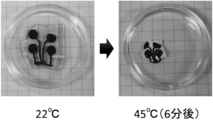
- 4 is a photograph showing that the composite electrode body including the exothermic particle body of the present invention contracts when heated from 22 ° C. to 45 ° C.
- FIG. 4 is a photograph showing that the composite electrode body including the exothermic particle body of the present invention contracts when heated from 22 ° C. to 45 ° C.
- the composite material of the present invention is a composite material in which a substrate and a porous body are bonded, wherein the porous body is a temperature-responsive porous body, and the composite material is exothermic. Contains particles.
- a substrate used in the present invention a conductive substrate or an insulating substrate can be used.
- the composite material of the present invention is preferably a composite electrode body.
- the porous body is preferably bonded by a polymer extending from the substrate to the porous body.
- the exothermic particles can be included in the temperature-responsive porous body of the composite material or the base material. Furthermore, you may fix to the surface of a porous body or a base material.
- the conductive base material used for the composite material is not particularly limited as long as it has conductivity, and examples thereof include metals, carbon materials, conductive polymer materials, stretchable materials, semiconductors, and composite materials thereof. be able to.
- the composite material of the present invention can be used as a composite electrode body.
- the metal include gold, platinum, silver, titanium, aluminum, tungsten, copper, iron, and palladium.
- the carbon material include carbon nanotube, ketjen black, glassy carbon, graphene, fullerene, carbon fiber, carbon fabric, and carbon aerogel.
- Examples of the conductive polymer material include polyaniline, polyacetylene, polypyrrole, poly (3,4-ethylenedioxythiophene), poly (p-phenylene vinylene), polythiophene, or poly (p-phenylene sulfide).
- Examples of the elastic material include urethane, silicone rubber, and fluorine rubber.
- Examples of the semiconductor include silicon (Si), germanium, indium tin oxide (ITO), titanium oxide, copper oxide, and silver oxide. These may be used alone or in combination of two or more.
- the insulating substrate glass or a general resin or a resin composition containing the resin can be used.
- the resin polyurethane, polypropylene, polylactic acid, poly (lactide-co-glycolide) copolymer, polydioxanone, acrylonitrile butadiene styrene copolymer, acrylic acid ester, acrylonitrile ethylene propylene rubber styrene copolymer, acrylonitrile styrene Copolymer, acrylonitrile styrene acrylate, polybutadiene, bismaleimide triazine, cellulose acetate, cellulose acetate butyrate, cellulose acetate propionate, cyclic butyl terephthalate, cresol formaldehyde, carboxymethylcellulose, nitrocellulose, hydrin rubber, cellulose propionate, chlorine Vinyl chloride, chloroprene rubber, casein, cellulose tria
- the glass is as a main component silicates, silicates herein contain SiO 2.
- silicates herein contain SiO 2.
- a conductive material is further used together with the composite material, and the conductive material and the porous body are brought into contact with each other. This allows the composite material to be used as an electrode or sensor.
- a conductive material for example, the material used for the conductive base material can be used without any limitation.
- the temperature-responsive porous body contained in the composite material of the present invention is not limited as long as it is shrunk by heat, but is shrunk by heat in water where water is sufficiently present.
- the temperature at which the temperature-responsive porous body contracts is not particularly limited, but in consideration of use in a living body, those that contract at a temperature equal to or higher than the body temperature are preferable.
- the shrinkage temperature of the temperature-responsive porous body is preferably 38 ° C. or higher, more preferably 40 ° C. or higher, and further preferably 42 ° C. or higher.
- the upper limit of shrinkage temperature is not specifically limited, For example, it is 100 degrees C or less, Preferably it is 70 degrees C or less, More preferably, it is 60 degrees C or less, More preferably, it is 50 degrees C or less.
- N-substituted (meth) acrylamide derivatives for example, Nn-propylacrylamide, N-isopropylacrylamide, N-ethylacrylamide, N, N-dimethylacrylamide, N-acryloylpyrrolidine, N-acryloylpiperidine, N-acryloylmorpholine, Nn-propylmethacrylamide, N-isopropylmethacrylamide, N-ethylmethacrylamide, N, N-dimethylmethacrylamide, N-methacryloylpyrrolidine, N- Methacryloylpiperidine or N-methacryloylmorpholine), polyoxyethylene alkylamine derivatives (for example, hydroxypropyl cellulose, polyvinyl alcohol partially acetylated product, polyvinyl methyl ether) (Polyoxyethylene-polyoxypropylene) block copolymer or polyoxyethylene
- the temperature-sensitive polymers and at least these Copolymers consisting of two monomers can also be used, and copolymers of N-isopropylacrylamide and Nt-butylacrylamide can also be used.
- the polymerizable monomer may be copolymerized in a range having a lower critical solution temperature, and P (N-isopropylacrylamide-co-butylmethacrylate), Pluronic, Poloxamers, or Tetronic can also be used.
- P N-isopropylacrylamide-co-butylmethacrylate
- Pluronic Pluronic
- Poloxamers Pluronic
- Tetronic Tetronic
- N-isopropylacrylamide, N, N-diethylacrylamide, or (polyoxyethylene-polyoxypropylene) block copolymer is particularly preferable because it has a high shrinkage rate due to heat.
- the water content of the temperature-responsive porous material is not particularly limited, but is preferably 60 to 99
- the exothermic particles used in the present invention are not particularly limited as long as they are particles that can generate heat by a specific stimulus.
- AC particles AC particles, magnetic particles that generate heat by microwaves, or light (ultraviolet, visible light) , Infrared) and metal nanotubes that generate heat, and carbon nanotubes that generate heat by near-infrared irradiation.
- the magnetic particles are preferably composed of a magnetic material, ferromagnetic, antiferromagnetic, ferrimagnetic, antiferrimagnetic or superparamagnetic material, more preferably iron oxide (especially superparamagnetic iron oxide), oxide layer Or a material represented by the general formula M (II) Fe 2 O 4 (where M is Co, Ni, Mn, Zn, Cu, Cd, Ba or other ferrites). .
- Magnetic particles made from these materials can be heated by an alternating magnetic field.
- the magnetic particles are composed of iron oxides, in particular magnetite (Fe 3 O 4 ), maghemite ( ⁇ -Fe 2 O 3 ) or a mixture of these two oxides, and are preferably superparamagnetic.
- preferred magnetic particles can be represented by the formula FeO X, where X represents a number from 1 to 2.
- X represents a number from 1 to 2.
- a non-magnetic material such as silicon dioxide (SiO 2 ).
- the particle diameter of the magnetic particles is not particularly limited as long as the effect of the present invention can be obtained, but is preferably 1 nm to 1 ⁇ m, more preferably 2 nm to 500 nm, more preferably 5 nm to 100 nm. More preferably, it is 10 nm to 20 nm.
- the average particle diameter of the magnetic particles is not limited, but is preferably 2 nm to 300 nm, more preferably 5 nm to 30 nm, and further preferably 10 nm to 20 nm.
- the particle shape is not particularly limited, but particles such as a spherical shape, a rod shape, or an indefinite shape can be used.
- the particle diameter of the metal nanoparticles is not particularly limited as long as the effect of the present invention is obtained, but is preferably 1 nm to 1 ⁇ m, more preferably 1 nm to 100 nm, and further preferably 1 nm to 50 nm. It is.
- the average particle diameter of the metal nanoparticles is not limited, but is preferably 2 nm to 300 nm, more preferably 5 nm to 30 nm, and still more preferably 10 nm to 20 nm.
- the particle shape of the metal nanoparticles is not particularly limited, and spherical, rod-shaped, or irregular particles can be used.
- a rod-shaped gold fine particle having a major axis length of 5 to 100 nm, a minor axis length of 3 to 30 nm, an aspect ratio of 2 to 20, and a maximum absorption wavelength of localized surface plasmon resonance of 700 to 2000 nm. Can be used.
- the content of the exothermic particles contained in the composite material is not particularly limited as long as the effect of the present invention is obtained, but is preferably 0.001 with respect to the total amount of the composite material and the exothermic particles. -10% by weight, more preferably 0.002-5% by weight, still more preferably 0.005-1% by weight. When the content of the exothermic particles is within the above range, an appropriate calorific value can be obtained, and the heat-shrinkable porous body can be efficiently contracted.
- the base material and the porous body are preferably bonded to each other by a polymer extending from the base material to the porous body.
- the polymer that binds the base material and the temperature-responsive porous body is not particularly limited, and examples thereof include a conductive polymer or an insulating polymer. When the conductive polymer or the insulating polymer extends from the base material into the temperature-responsive porous body by polymerization, the base material and the temperature-responsive porous body can be firmly bonded.
- the conductive polymer is not particularly limited, but is poly (3,4-ethylenedioxythiophene) (hereinafter sometimes referred to as PEDOT), polyacetylene, polypyrrole, polythiophene, polybithiophene, polyisothione.
- PEDOT poly (3,4-ethylenedioxythiophene)
- polyacetylene polypyrrole
- polythiophene polythiophene
- polybithiophene polybithiophene
- polyisothione polyisothione.
- Thiophene polydodecylthiophene, polyisonitethiophene, poly-3-hexylthiophene, polyaniline, polyisothianaphthene, polythiazyl, polyphenylene, polyfluorene, polydiacetylene, polyacene, polyparaphenylene, polythienylene vinylene, polyphenylylene sulfide, Or a mixture of two or more thereof, preferably poly (3,4-ethylenedioxythiophene) or polypyrrole. These may be used alone or in combination of two or more.
- the insulating polymer is not particularly limited, but poly (meth) acrylic acids such as polyacrylic acid, polymethacrylic acid, acrylic acid / alkyl methacrylate copolymer, and salts thereof; polyethylene glycol di (meth) acrylate Polymer (PPEGDA, PPEGDM), polyhydroxyethyl methacrylate, polyacrylamide, poly (N, N-dimethylacrylamide), poly-2-acrylamide-2-methylpropanesulfonic acid, poly (N-isopropylacrylamide), polyvinylpyrrolidone, Polystyrene sulfonic acid, polyethylene glycol, carboxyvinyl polymer, alkyl-modified carboxyvinyl polymer, maleic anhydride copolymer, polyalkylene oxide resin, poly (methyl vinyl ether) -Alt-maleic anhydride) and polyethylene glycol cross-linked product, polyethylene glycol cross-linked product, N-vinylacetamide cross-linked product, acrylamide cross
- polyacrylamide poly (N, N-dimethylacrylamide), PPEGDA, and PPEGDM are preferred because there is no deformation according to the surrounding environment (the degree of swelling does not change with temperature, pH, etc.). These may be used alone or in combination of two or more.
- the composite material may have a wiring for energization extending from the base material.
- the method for producing a composite material of the present invention includes (1) a step of incorporating exothermic particles into a composite material including a base material and a temperature-responsive porous body. And preferably, the said composite material is obtained by polymerizing a monomer in the temperature-responsive porous body from the surface of a base material, and adhere
- the base material exothermic particles, and temperature-responsive porous body used in the method for producing a composite material of the present invention, those described in the section “[1] Composite material” can be used.
- the monomer which can be used in the manufacturing method of the composite material of this invention is a conductive monomer or an insulating monomer.
- the “conductive monomer” is a monomer that becomes a polymer and becomes the conductive polymer
- the “insulating monomer” is a monomer that becomes a polymer and becomes an insulating polymer.
- the substrate is preferably an electrode, and thus the composite material is preferably a composite electrode body. That is, the composite material obtained by the production method of the present invention is preferably a composite electrode body.
- the porous body is preferably bonded by a polymer extending from the base material to the porous body.
- Exothermic particle-containing step (1) the exothermic particles are contained in the composite material including the base material and the temperature-responsive porous body.
- the exothermic particles can be included in a base material, a temperature-responsive porous body, or a composite material in which the base material and the temperature-responsive porous body are bonded.
- the exothermic particles may be contained inside the base material or the temperature-responsive porous body, and may be fixed to the surface of the base material or the temperature-responsive porous body.
- the base material when the base material contains exothermic particles, the base material can be included in or adsorbed on the base material by immersing the base material in a liquid in which the exothermic particles are suspended.
- the porous body including the exothermic particles can be produced by gelling the raw material of the temperature-responsive porous body including the exothermic particles. it can. Further, by immersing the temperature-responsive porous body in a liquid in which the exothermic particles are suspended, the heat-responsive porous body can contain or adsorb the exothermic particles. Further, by immersing the composite material in which the base material and the temperature-responsive porous body are combined in a liquid in which the thermal particles are suspended, the temperature-responsive porous body and the base material contain exothermic particles, or It can also be adsorbed.
- suspension in which the exothermic particles are suspended can be obtained by immersing, spraying, printing (for example, ink-jet printing or screen printing), injection, vapor deposition, or fuming. It can also be fixed to the surface of a responsive porous body or composite material.
- the exothermic particles when the exothermic particles are impregnated into the base material, the temperature-responsive porous body, or the composite material in which the base material and the temperature-responsive porous body are bonded, the following can be carried out.
- a base, a temperature-responsive porous material, or a composite material is immersed in a dispersion liquid in which exothermic particles are dispersed.
- the exothermic particles are adsorbed on the base, the temperature-responsive porous body, or the composite material.
- the liquid in which the exothermic particles are dispersed is not particularly limited as long as the exothermic particles can be dispersed, but water, an organic solvent, or an ionic liquid can be used.
- the immersion temperature is not particularly limited, but can be performed at 1 to 100 ° C., for example.
- the immersion time is not particularly limited, but for example, the immersion time can be 5 minutes to 48 hours.
- the exothermic particles can also be contained during the production of the temperature-responsive porous body. That is, a temperature-responsive porous body containing exothermic particles can be produced by gelling the raw material of the temperature-responsive porous body containing exothermic particles.
- the amount of the exothermic particles to be contained in the composite material is not particularly limited as long as the effect of the present invention can be obtained, but is preferably 0.001 to the total amount of the composite material and the exothermic particles. It is 10% by weight, more preferably 0.002 to 5% by weight, still more preferably 0.005 to 1% by weight. The impregnation and the like can be adjusted so that the content of the exothermic particles is within the above range.
- the lamination of the base and the temperature-responsive porous body, and the adhesion between the base material and the temperature-responsive porous body can be performed by a method known in the art, but may be performed as follows, for example.
- the base material and the temperature-responsive porous body are bonded by laminating the temperature-responsive porous body on the base material.
- Gelation of the temperature-responsive porous material can be performed according to a known method. That is, it can carry out according to the gelation method of each material. Below, the example of the gelatinization method of a typical temperature-responsive porous body is shown.
- Interpenetrating network hydrogel composed of NIPAAm and alginic acid
- 12.4 g N-isopropylacrylamide, 0.8 g sodium alginate, and 5.1 mg N, N′methylenebisacrylamide crosslinker are dissolved in 100 mL distilled water. Nitrogen gas is introduced into this mixed solution for 5 minutes to deoxygenate, and then 50 ⁇ L tetramethylethylenediamine D and 500 ⁇ L ammonium persulfate are added.
- the mixed solution is filled between glass substrates sandwiched with a 0.5 mm thick silicone sheet as a spacer, and N-isopropylacrylamide gelation is allowed to proceed for 12 hours in a nitrogen atmosphere.
- the obtained hydrogel is immersed in a 100 mM calcium chloride aqueous solution overnight, and a cross-linking reaction of the alginic acid polymer proceeds to obtain an interpenetrating network structure hydrogel.
- the content of the exothermic particles contained in the raw material of the heat-shrinkable porous body is not particularly limited as long as the effect of the present invention is obtained. However, it is preferably 0.001 to 10% by weight, more preferably 0.002 to 5% by weight, and still more preferably 0.001 to 10% by weight based on the total amount of the heat-shrinkable porous material and the exothermic particles. 005 to 1% by weight.
- the base material may be formed on a base material forming substrate.
- the substrate for forming a substrate is not limited as long as the substrate pattern can be formed. Examples of the material include glass, plastic, cloth, and wood, but glass is preferable because it is flat and has low adhesion to the electrode.
- the shape of the substrate for substrate formation is not limited, and a substrate pattern (electrode pattern) may be formed on a plate-shaped substrate, and the substrate pattern (electrode pattern) may be formed on the surface of a rod-shaped substrate. It may be formed.
- the produced temperature-responsive porous body may be laminated
- the formed temperature-responsive porous body may be laminated on an independent substrate. Moreover, you may laminate
- Adhesion process (2) In the bonding step of the present invention, the base material and the temperature-responsive porous body can be bonded by polymerizing the monomer from the surface of the base material into the temperature-responsive porous body.
- the adhesion method is not particularly limited, and examples thereof include adhesion by electrolytic polymerization or adhesion by radical polymerization reaction.
- the electroconductive polymer and the porous material are formed by conducting electropolymerization in an electrolyte solution containing a conductive monomer and forming a conductive polymer adhesive layer from the electroconductive substrate in the porous body.
- Glue the body.
- the conductive polymer monomer include 3,4-ethylenedioxythiophene (hereinafter sometimes referred to as EDOT), acetylene, pyrrole, thiophene, bithiophene, isothiophene, dodecylthiophene, and isonitethiophene.
- a conductive polymer is electrolytically polymerized by dissolving a monomer in a solvent, adding it to a porous gel, and applying a potential to the conductive substrate.
- concentration of the monomer in the solvent can be appropriately determined.
- concentration can be 1 to 500 mM, and preferably 10 to 100 mM.
- the potential applied in the electropolymerization can also be determined as appropriate, but is preferably 0.5 to 1.5V.
- radical polymerization reactions include, but are not limited to, thermal reactions, photoreactions, or redox reactions.
- the polymerization initiator includes alkylphenone type (Irgacure (registered trademark) series), acylphosphine oxide type, intramolecular hydrogen abstraction type, other types such as oxime ester, benzoin ether such as isobutyl benzoin ether and isopropyl benzoin ether Type, benzyl ketal type such as benzyl methyl ketal and hydroxycyclohexyl phenyl ketone, and ketone type such as benzophenone and 2-chlorothioxanthone. These may be used alone or in combination of two or more.
- alkylphenone type Irgacure (registered trademark) series
- acylphosphine oxide type intramolecular hydrogen abstraction type
- other types such as oxime ester
- benzoin ether such as isobutyl benzoin ether and isopropyl benzoin ether Type
- benzyl ketal type such as benzy
- the polymerization initiation part In the introduction of the polymerization initiation part, ozone treatment (carboxyl group introduction), oxygen plasma treatment, corona discharge treatment, UV treatment (for example, introduction of benzophenone), treatment with a silane coupling agent, treatment with a thiol compound, etc. are used.
- the polymerization initiation part may be directly introduced by the treatment of the substrate surface, and the polymerization initiation part is further bonded after the treatment, for example, via an ester bond or an amide bond. May be.
- the above-mentioned base material for example, polyurethane
- the above-mentioned base material for example, polyurethane
- ozone to introduce carboxyl groups on the base material surface
- this carboxyl An ⁇ -hydroxyalkylphenone having a hydroxyl group can be bound to the group using a condensing agent.
- benzophenone is applied to the surface of the base material (for example, polypropylene) placed on a flat plate, and then the base material after application is irradiated with ultraviolet rays to introduce a benzophenone portion on the surface of the base material. be able to.
- the monomer is then impregnated into the temperature-responsive porous body.
- a monomer that can become a polymer and become an insulating polymer is used as the monomer.
- the hydrogel can be impregnated in an aqueous monomer solution.
- the temperature-responsive porous material is a polymer hydrogel
- the polymer hydrogel is once impregnated with water to wash out byproducts such as polymerization reaction by-products and residual monomers ( After removal), the aqueous monomer solution can be impregnated.
- the monomer may be a monomer that can become a polymer and become an insulating polymer, or a monomer that can become a polymer and become a conductive polymer.
- the monomer that can be an insulating polymer may be a monomer that constitutes the above-mentioned insulating polymer.
- (meth) acrylic acids such as acrylic acid, methacrylic acid, acrylic acid / alkyl methacrylate, and salts thereof; polyethylene Glycol di (meth) acrylate (PEGDA, PEGDM), hydroxyethyl methacrylate, acrylamide, N, N-dimethylacrylamide, 2-acrylamido-2-methylpropanesulfonic acid, N-isopropylacrylamide, vinylpyrrolidone, styrenesulfonic acid, ethylene glycol , Maleic anhydride, alkylene oxide, methyl vinyl ether-alt-maleic anhydride, N-vinylacetamide, starch, silanol, and the like. From (swelling degree at a temperature and pH and the like do not change) that, acrylamide, N, N-dimethylacrylamide, PEGDA, PEGDM
- the monomer polymerization reaction is further performed using the polymerization start portion as a polymerization start point.
- the initiation reaction of monomer polymerization include thermal reaction, photoreaction, or oxidation-reduction reaction, and photoreaction is preferable from the viewpoint of easy reaction control. These may be used alone or in combination of two or more.
- the conditions for the polymerization initiation reaction can be appropriately determined according to the characteristics of the polymerization initiation portion.
- the conditions for the polymerization reaction can be appropriately determined according to the characteristics of the monomer.
- Examples of the photoreaction include use of an Irgacure series photopolymerization initiator as a polymerization initiator.
- a porous body containing a monomer is placed on the surface of a conductive base material having a polymerization start portion, and UV (302 nm, intensity: 370 ⁇ W / cm 2 ) is irradiated for 6 minutes, whereby the insulating polymer is polymerized at the polymerization start portion.
- UV (302 nm, intensity: 370 ⁇ W / cm 2 ) is irradiated for 6 minutes, whereby the insulating polymer is polymerized at the polymerization start portion.
- the composite material recovery method of the present invention includes (1) a step of shrinking the composite material by heating the composite material in which the base material and the temperature-responsive porous body are bonded, and (2) including a step of recovering the contracted composite material from the attachment site.
- the composite material is contracted by heating the composite material.
- the method for shrinking the composite material is not particularly limited, but heating by energizing the electrodes, heating by microwaves, heating by applying external heat, heating by an alternating magnetic field, or heating by laser light Can be mentioned.
- the composite material is preferably a composite electrode body.
- the porous body is preferably bonded by a polymer extending from the base material to the porous body.
- the composite material can be contracted by heating by energizing the electrodes, heating by microwaves, or heating by applying heat from the outside. Although the composite material containing no particles can be shrunk by these heating, the composite material containing magnetic particles or metal nanoparticles can be shrunk by these heatings. Heating by energizing the electrode
- the porous body used in the composite material of the present invention is a temperature-responsive porous body. Therefore, it can shrink by heating with Joule heat generated by energization of the electrode. That is, even a composite material using a temperature-responsive porous material that does not contain exothermic particles can be shrunk by heating due to energization of the electrodes.
- the heat-shrinkable porous body can be contracted by vibrating the water molecules in the hydrogel and generating heat.
- the microwave is the shortest wavelength region of radio waves, and generally means a radio wave (electromagnetic wave) having a wavelength of 1 m to 100 ⁇ m and a frequency of 300 MHz to 3 THz.
- a microwave oscillation source a magnetron, a klystron, a traveling wave tube (TWT), a gyrotron, a circuit using a Gunn diode, or the like can be used. Water molecules or magnetic particles generate heat by the microwave, and the hydrogel can be contracted. Using this heat generation, the heat-shrinkable porous body can be shrunk.
- a microwave generation probe used for tissue ablation for example, an electrosurgical unit for cauterization manufactured by Alfresa Pharma
- tissue ablation for example, an electrosurgical unit for cauterization manufactured by Alfresa Pharma
- Heating by applying heat from outside The composite material can be shrunk, for example, by applying heat from outside.
- a heating method by applying far-infrared rays can be mentioned.
- heating can be performed from outside the body using a thermotherapy device.
- a heat therapy apparatus it can heat using the high frequency heating apparatus etc. of an Indiva company or a Physioprime company.
- Heating by microwaves Heat-shrinkable porous bodies can be contracted by generating heat from magnetic particles by using microwaves.
- the microwave is the shortest wavelength region of radio waves, and generally means a radio wave (electromagnetic wave) having a wavelength of 1 m to 100 ⁇ m and a frequency of 300 MHz to 3 THz.
- a microwave oscillation source a magnetron, a klystron, a traveling wave tube (TWT), a gyrotron, a circuit using a Gunn diode, or the like can be used. Water molecules or magnetic particles generate heat by the microwave, and the hydrogel can be contracted.
- the heat-shrinkable porous body can be shrunk.
- a microwave generation probe used for tissue ablation for example, an electrosurgical unit for cauterization manufactured by Alfresa Pharma
- an electrosurgical unit for cauterization manufactured by Alfresa Pharma can be used.
- Heating by an alternating magnetic field Magnetic particles generate heat by converting magnetic energy to heat due to a delay in relaxation of the magnetic moment in an alternating magnetic field.
- the magnitude of the magnetic field amplitude strength is usually 1 mT or more, preferably 5 mT or more, more preferably 10 mT or more, and usually 1000 mT or less, preferably 200 mT or less, more preferably 100 mT or less. If the magnetic field is too small, the heat generation effect may not be obtained. If the magnetic field is too large, the high frequency magnetic field may adversely affect the normal body.
- the frequency of the magnetic field is usually 1 kHz or more, preferably 10 kHz or more, more preferably 100 kHz or more, and usually 1000 kHz or less, preferably 900 kHz or less, more preferably 800 kHz or less. If the frequency is too small, the heat generation effect may not be obtained. If the frequency is too high, the high-frequency magnetic field may adversely affect a normal body.
- the heat-shrinkable porous body can be shrunk by heating the metal nanoparticles with laser light. Laser light is absorbed on the surface of the metal nanoparticles and converted to heat. The heat-shrinkable porous body can be shrunk using the converted heat.
- a fluorescent navigation light source fluorescent imaging system manufactured by KARL STORZ Endoscope
- endoscopic surgery can be used.
- Step to collect (2) the contracted composite material is recovered from the mounting site.
- the contracted composite material composite electrode
- the contracted composite material can be collected through a catheter or the like.
- Example 1 a composite electrode body using an N-isopropylacrylamide gel containing magnetic nanoparticles (Fe 3 O 4 ) was produced.
- N-isopropylacrylamide manufactured by Wako Pure Chemical Industries
- 0.16 g of sodium alginate manufactured by Sigma Aldrich
- 5.1 mg of N, N′methylenebisacrylamide manufactured by Wako Pure Chemical Industries
- Nitrogen gas was introduced into this mixed solution for 5 minutes to deoxygenate, and then 50 ⁇ L tetramethylethylenediamine (manufactured by Wako Pure Chemical Industries) and 500 ⁇ L ammonium persulfate (manufactured by Wako Pure Chemical Industries) were added.
- the mixed solution was filled between glass substrates sandwiched with a 0.5 mm thick silicone sheet as a spacer, and N-isopropylacrylamide was gelled in a nitrogen atmosphere for 12 hours.
- the obtained hydrogel was immersed in a 100 mM calcium chloride aqueous solution (manufactured by Wako Pure Chemical Industries, Ltd.) overnight, and the cross-linking reaction of the alginic acid polymer was advanced to obtain an interpenetrating network structure hydrogel. Next, an electrode was produced.
- the slide glass was cut into an appropriate size, ultrasonically washed with acetone, 86% ethanol-isopropanol, and distilled water in that order for 15 minutes, and stored in isopropanol.
- a 10% by weight polyvinyl alcohol aqueous solution was spin-coated on a slide glass (1000 rpm, 20 seconds), and the solvent was evaporated by heating the substrate using a hot plate at 100 ° C.
- the polymerization solution was 2 mL of 1-butanol, 0.22 mL of 1M EDOT monomer solution, 6.5 mL of 1-butanol solution containing 400 mM Mp-iron (III) -toluenesulfonate (EDOT oxidant, dopant ion), 10 wt. 22.5 mL of a% polyurethane / tetrahydrofuran solution and 4.17 mL of anisole (for solvent evaporation suppression) were mixed.
- EDOT oxidant, dopant ion Mp-iron (III) -toluenesulfonate
- the above polymerization solution was applied to a slide glass in a line shape (width 5 mm, length 10 mm).
- a conductive urethane pattern was formed by heating on a hot plate at 100 ° C. for 10 minutes to promote the evaporation of the solvent and the progress of the polymerization reaction.
- the electrode and the hydrogel were bonded.
- the hydrogel was placed on the surface of the conductive urethane pattern.
- the polymerization solution was prepared by adding EDOT monomer to 50 mM and LiClO4 (dopant ion) to 100 mM in distilled water.
- Nanoparticles were taken into the gel and magnetic nanoparticles were adsorbed into the gel.
- Example 2 a composite electrode body in which magnetic particles (Fe 3 O 4 ) were previously contained in an N-isopropylacrylamide gel was prepared.
- N-isopropylacrylamide manufactured by Wako Pure Chemical Industries
- 0.16 g of sodium alginate manufactured by Sigma Aldrich
- 5.1 mg of N, N′methylenebisacrylamide manufactured by Wako Pure Chemical Industries
- 100 mg of Fe 3 O 4 particles were mixed in the above solution.
- Nitrogen gas was introduced into this mixed solution for 5 minutes to deoxygenate, and then 50 ⁇ L tetramethylethylenediamine (manufactured by Wako Pure Chemical Industries) and 500 ⁇ L ammonium persulfate (manufactured by Wako Pure Chemical Industries) were added.
- the mixed solution was filled between glass substrates sandwiched with a 0.5 mm thick silicone sheet as a spacer, and N-isopropylacrylamide was gelled in a nitrogen atmosphere for 12 hours.
- FIG. 1 shows an interpenetrating network hydrogel previously containing Fe 3 O 4 particles (diameter 1 ⁇ m). Next, an electrode was produced. The slide glass was cut into an appropriate size, ultrasonically washed with acetone, 86% ethanol-isopropanol, and distilled water in that order for 15 minutes, and stored in isopropanol.
- a 10% by weight polyvinyl alcohol aqueous solution was spin-coated on a slide glass (1000 rpm, 20 seconds), and the solvent was evaporated by heating the substrate using a hot plate at 100 ° C. to form a polyvinyl alcohol sacrificial layer.
- the polymerization solution was 2 mL of 1-butanol, 0.22 mL of 1M EDOT monomer solution, 6.5 mL of 1-butanol solution containing 400 mM Mp-iron (III) -toluenesulfonate (EDOT oxidant, dopant ion), 10 wt.
- the polymerization solution was prepared by adding EDOT monomer to 50 mM and LiClO4 (dopant ion) to 100 mM in distilled water. 0.5 mL of the polymerization solution is dropped on the porous body, and a potential of 1.0 V (vs. Ag / AgCl) is applied to the conductive urethane and the polymerization solution to carry out electrolytic oxidation polymerization with a polymerization amount of 300 mC / cm 2 . It was. After PEDOT polymerization, the substrate was immersed in distilled water at room temperature for 30 minutes to dissolve the polyvinyl alcohol sacrificial layer. The hydrogel was peeled from the substrate to obtain a temperature-responsive composite electrode body patterned with conductive urethane.
- This electrode body was also contracted to about 1/4 volume in 6 minutes by being transferred from artificial cerebrospinal fluid (Art Celebrity, manufactured by Otsuka Pharmaceutical Co., Ltd.) at room temperature (22 ° C.) to artificial cerebrospinal fluid at 45 ° C.
- artificial cerebrospinal fluid Art Celebrity, manufactured by Otsuka Pharmaceutical Co., Ltd.
- Example 1 A recovery simulation test was performed using the composite electrode body obtained in Example 1 (FIG. 4). An acrylic chamber with a 1 cm wide inlet was made. The dried composite electrode body was inserted into the chamber from a 1 cm entrance. The chamber was filled with artificial cerebrospinal fluid, and the dried composite electrode body was swollen. By heating the chamber to 45 ° C., the composite electrode body was contracted and collected from the 1 cm entrance.
- the coated composite material of the present invention can be used for measurement of electrical signals generated by a living body such as electrocardiogram, myoelectricity, and electroencephalogram, and control of biological functions by energization (electric stimulation).
- a living body such as electrocardiogram, myoelectricity, and electroencephalogram
- energization electrical stimulation
Landscapes
- Health & Medical Sciences (AREA)
- Chemical & Material Sciences (AREA)
- Life Sciences & Earth Sciences (AREA)
- Engineering & Computer Science (AREA)
- Biomedical Technology (AREA)
- Veterinary Medicine (AREA)
- Organic Chemistry (AREA)
- Heart & Thoracic Surgery (AREA)
- Polymers & Plastics (AREA)
- Medicinal Chemistry (AREA)
- Chemical Kinetics & Catalysis (AREA)
- Animal Behavior & Ethology (AREA)
- General Health & Medical Sciences (AREA)
- Public Health (AREA)
- Surgery (AREA)
- Biophysics (AREA)
- Pathology (AREA)
- Molecular Biology (AREA)
- Medical Informatics (AREA)
- Physics & Mathematics (AREA)
- Dispersion Chemistry (AREA)
- Materials Engineering (AREA)
- Cardiology (AREA)
- Nuclear Medicine, Radiotherapy & Molecular Imaging (AREA)
- Radiology & Medical Imaging (AREA)
- Manufacturing & Machinery (AREA)
- Compositions Of Macromolecular Compounds (AREA)
Abstract
本発明の目的は、生体内から容易に回収することのできる複合材料を提供することである。 前記課題は、本発明の基材と温度応答性多孔質体とが結合している複合材料であって、前記複合材料が発熱性粒子を含むことを特徴とする複合材料によって解決することができる。本発明によれば、複合材料を装着部位から容易に回収することができる。
Description
本発明は、複合材料に関し、特には生体内で心電・筋電・脳電等の電気信号の計測等に用いる複合材料(例えば、複合電極体)に関する。本発明によれば、複合材料を装着部位から容易に回収することができる。
医療における診断・治療の手法として、各種機器を用いた、心電・筋電・脳電等の生体が発する電気信号の計測、及び通電(電気刺激)による生体機能の制御が、既に一般化している。かかる手法では、機器の一部である電極が、機器と生体とのインターフェースとなっている。
最近、電極材料と、生体親和性に優れるハイドロゲルとを基板に用いた複合電極体が報告されている(特許文献1及び非特許文献1)。これらの複合電極体では、電極材料にハイドロゲル(多孔質体)を載せた状態で、導電性高分子の電解重合を行い、電極材料近傍において、電極材料表面から導電性高分子を伸長させることによって、導電性接着層を形成させている。これらの複合電極体では、ハイドロゲルを構成する高分子鎖と導電性高分子とが相互に絡み合うことにより、電極材料とハイドロゲルとが強固に接着することが報告されている。
M. Sasaki, et al., Advanced Healthcare Materials, 2014, 3, 1919.
本発明者らは、更に研究を進め、基材(例えば、電極材料)とハイドロゲル(多孔質体)とを絶縁性ポリマーにより結合させた複合材料(複合電極体)を開発した。
しかしながら、これらの複合材料はその使用時に一定の体積を有するため、生体内における装着部位から、カテーテルなどを通して回収することは容易ではなかった。
従って、本発明の目的は、生体内から容易に回収することのできる複合材料を提供することである。
しかしながら、これらの複合材料はその使用時に一定の体積を有するため、生体内における装着部位から、カテーテルなどを通して回収することは容易ではなかった。
従って、本発明の目的は、生体内から容易に回収することのできる複合材料を提供することである。
本発明者は、生体内から容易に回収することのできる複合材料について、鋭意研究した結果、驚くべきことに、複合材料の多孔質体として温度応答性多孔質体を用い、そして複合材料に発熱性粒子を含有させることによって、複合材料を収縮させ、装着部位から容易に回収できることを見出した。具体的には、発熱性粒子から発生する熱を用いて温度応答性多孔質体を収縮させることにより、複合材料の体積を減少させ、生体内から容易に回収できることを見出した。
本発明は、こうした知見に基づくものである。
従って、本発明は、
[1]基材と温度応答性多孔質体とが結合している複合材料であって、前記複合材料が発熱性粒子を含むことを特徴とする複合材料、
[2]前記温度応答性多孔質体が、N置換(メタ)アクリルアミド誘導体(例えば、Nn-プロピルアクリルアミド、N-イソプロピルアクリルアミド、N-エチルアクリルアミド、N、N-ジメチルアクリルアミド、N-アクリロイルピロリジン、N-アクリロイルピペリジン、N-アクリロイルモルホリン、N-n-プロピルメタクリルアミド、N-イソプロピルメタクリルアミド、N-エチルメタクリルアミド、N、N-ジメチルメタクリルアミド、N-メタクリロイルピロリジン、N-メタクリロイルピペリジン、又はN-メタクリロイルモルホリン)、ポリオキシエチレンアルキルアミン誘導体(例えば、ヒドロキシプロピルセルロース、ポリビニルアルコール部分酢化物、ポリビニルメチルエーテル、(ポリオキシエチレン-ポリオキシプロピレン)ブロックコポリマー、又はポリオキシエチレンラウリルアミン)、ポリオキシエチレンソルビタンエステル誘導体(例えば、ポリオキシエチレンソルビタンラウレート)、(ポリオキシエチレンアルキルフェニルエーテル)(メタ)アクリレート(例えば、(ポリオキシエチレンノニルフェニルエーテル)アクリレート又は(ポリオキシエチレンオクチルフェニルエーテル)メタクリレート)、及びポリオキシエチレン(メタ)アクリル酸エステル誘導体(例えば、(ポリオキシエチレンアルキルエーテル)(メタ)アクリレート)からなる群から選択される温度応答性モノマー由来のポリマー、若しくは前記2つ以上の温度応答性モノマー由来のコポリマー、又はN-イソプロピルアクリルアミド及びN-t-ブチルアクリルアミドのコポリマーを含む温度応答性多孔質体であり、そして前記発熱性粒子が磁性粒子、金属ナノ粒子、及びカーボンナノチューブからなる群から選択される粒子である、[1]に記載の複合材料、
[3]前記複合材料が複合電極体である、[1]又[2]に記載の複合材料、
[4]前記温度応答性多孔質体が基材から多孔質体に伸びるポリマーによって結合している、[1]~[3]のいずれかに記載の複合材料、
[5]前記温度応答性多孔質体に伸びるポリマーが、ポリ(3,4-エチレンジオキシチオフェン)、ポリアセチレン、ポリピロール、ポリチオフェン、ポリビチオフェン、ポリイソチオフェン、ポリドデシルチオフェン、ポリイソナイトチオフェン、ポリ-3-ヘキシルチオフェン、ポリアニリン、ポリイソチアナフテン、ポリチアジル、ポリフェニレン、ポリフルオレン、ポリジアセチレン、ポリアセン、ポリパラフェニレン、ポリチエニレンビニレン、及びポリフェニレスルフィドからなる群から選択される1つ以上の導電性高分子、又はポリ(メタ)アクリル酸若しくはこれらの塩(例えば、ポリアクリル酸、ポリメタクリル酸、又はアクリル酸・メタクリル酸アルキルコポリマー等のポリ(メタ)アクリル酸類若しくはこれらの塩)、ポリエチレングリコールジ(メタ)アクリレートの重合体(例えば、PPEGDA又はPPEGDM)、ポリヒドロキシエチルメタクリレート、ポリアクリルアミド、ポリ(N,N-ジメチルアクリルアミド)、ポリ2-アクリルアミド-2-メチルプロパンスルホン酸、ポリ(N-イソプロピルアクリルアミド)、ポリビニルピロリドン、ポリスチレンスルホン酸、ポリエチレングリコール、カルボキシビニルポリマー、アルキル変性カルボキシビニルポリマー、無水マレイン酸コポリマー、ポリアルキレンオキサイド系樹脂、ポリ(メチルビニルエーテル-alt-マレイン酸無水物)とポリエチレングリコールとの架橋体、ポリエチレングリコール架橋体、N-ビニルアセトアミド架橋体、アクリルアミド架橋体、デンプン・アクリル酸塩グラフトコポリマー架橋物、及びシリコーンからなる群から選択される絶縁性ポリマーである、[4]に記載の複合材料、
[6](1)基材及び温度応答性多孔質体を含む複合材料に発熱性粒子を含有させる工程を含む、複合材料の製造方法、
[7]前記温度応答性多孔質体が、N置換(メタ)アクリルアミド誘導体(例えば、Nn-プロピルアクリルアミド、N-イソプロピルアクリルアミド、N-エチルアクリルアミド、N、N-ジメチルアクリルアミド、N-アクリロイルピロリジン、N-アクリロイルピペリジン、N-アクリロイルモルホリン、N-n-プロピルメタクリルアミド、N-イソプロピルメタクリルアミド、N-エチルメタクリルアミド、N、N-ジメチルメタクリルアミド、N-メタクリロイルピロリジン、N-メタクリロイルピペリジン、又はN-メタクリロイルモルホリン)、ポリオキシエチレンアルキルアミン誘導体(例えば、ヒドロキシプロピルセルロース、ポリビニルアルコール部分酢化物、ポリビニルメチルエーテル、(ポリオキシエチレン-ポリオキシプロピレン)ブロックコポリマー、又はポリオキシエチレンラウリルアミン)、ポリオキシエチレンソルビタンエステル誘導体(例えば、ポリオキシエチレンソルビタンラウレート)、(ポリオキシエチレンアルキルフェニルエーテル)(メタ)アクリレート(例えば、(ポリオキシエチレンノニルフェニルエーテル)アクリレート、又は(ポリオキシエチレンオクチルフェニルエーテル)メタクリレート)及びポリオキシエチレン(メタ)アクリル酸エステル誘導体(例えば、(ポリオキシエチレンアルキルエーテル)(メタ)アクリレート)からなる群から選択される温度応答性モノマー由来のポリマー、若しくは2つ以上の温度応答性モノマー由来のコポリマー、又はN-イソプロピルアクリルアミド及びN-t-ブチルアクリルアミドのコポリマーを含む温度応答性多孔質体であり、そして前記発熱性粒子が磁性粒子、金属ナノ粒子、及びカーボンナノチューブからなる群から選択される粒子である、[6]に記載の複合材料の製造方法、
[8]前記複合材料が複合電極体である、[6]又は[7]に記載の複合材料の製造方法、
[9]前記複合材料が、基材の表面から温度応答性多孔質体中にモノマーを重合させ、基材と温度応答性多孔質体とを接着することによって得られる、[6]~[8]のいずれかに記載の複合材料の製造方法、
[10]前記モノマーが導電性モノマーであり、そして前記重合が導電性モノマーを含む電解質液中での電解重合である、[9]に記載の複合材料の製造方法、
[11]前記基材が、表面に重合開始部が導入された基材であり、前記モノマーが導電性モノマー又は絶縁性モノマーであり、そして前記重合が、モノマーを含浸させた温度応答性多孔質体中における重合開始部を重合開始点としたラジカル重合反応である、[8]又は[9]に記載の複合材料の製造方法、
[12](1)基材と温度応答性多孔質体とが結合している複合材料を加熱することによって、複合材料を収縮させる工程、及び(2)収縮させた複合材料を装着部位から回収する工程、を含む、複合材料回収方法、及び
[13](A)前記加熱が基材に通電することによる加熱、マイクロ波による加熱、若しくは外部からの熱を印加することによる加熱、(B)前記複合材料が磁性粒子を含み、そして加熱が交流磁場、若しくはマイクロ波による加熱、又は(C)前記複合材料が金属ナノ粒子を含み、そして加熱がレーザー光による加熱、である[12]に記載の複合材料回収方法、
に関する。
本発明の複合材料によれば、複合材料に発熱性粒子を含有させることによって、生体内の装着部位から複合材料を収縮させて回収することができる。従って、使用後の複合材料を、カテーテルなどを通して、又は生体内の狭窄部位からも、容易に回収することが可能である。
[1]複合材料
本発明の複合材料は、基材と多孔質体とが結合している複合材料であって、前記多孔質体が温度応答性多孔質体であり、そして複合材料が発熱性粒子を含む。本発明に用いる基材としては、導電性基材、又は絶縁性基材を用いることができる。本発明の複合材料は、好ましくは複合電極体である。また、本発明の複合材料は、好ましくは多孔質体が、基材から多孔質体に伸びるポリマーによって結合されている。
また、発熱性粒子は、複合材料の温度応答性多孔質体、又は基材に含ませることができる。更に、多孔質体、又は基材の表面に固定されていてもよい。
本発明の複合材料は、基材と多孔質体とが結合している複合材料であって、前記多孔質体が温度応答性多孔質体であり、そして複合材料が発熱性粒子を含む。本発明に用いる基材としては、導電性基材、又は絶縁性基材を用いることができる。本発明の複合材料は、好ましくは複合電極体である。また、本発明の複合材料は、好ましくは多孔質体が、基材から多孔質体に伸びるポリマーによって結合されている。
また、発熱性粒子は、複合材料の温度応答性多孔質体、又は基材に含ませることができる。更に、多孔質体、又は基材の表面に固定されていてもよい。
(導電性基材)
複合材料に用いる導電性基材は、導電性を有する限りにおいて、特に限定されるものではないが、例えば金属、炭素材料、導電性ポリマー材料、伸縮性材料、半導体、又はそれらの複合材料を挙げることができる。基材とて、導電性材料を用いることにより、本発明の複合材料を複合電極体として用いることができる。
金属としては、金、白金、銀、チタン、アルミニウム、タングステン、銅、鉄、又はパラジウムを挙げることができる。炭素材料としては、カーボンナノチューブ、ケッチェンブラック、グラッシーカーボン、グラフェン、フラーレン、カーボンファイバ、カーボンファブリック、又はカーボンエアロゲルを挙げることができる。導電性ポリマー材料としては、ポリアニリン、ポリアセチレン、ポリピロール、ポリ(3,4-エチレンジオキシチオフェン)、ポリ(p-フェニレンビニレン)、ポリチオフェン、又はポリ(p-フェニレンスルフィド)を挙げることができる。伸縮性材料としては、ウレタン、シリコーンゴム、又はフッ素ゴムを挙げることができる。半導体としては、シリコン(Si)、ゲルマニウム、酸化インジウムスズ(ITO)、酸化チタン、酸化銅、又は酸化銀を挙げることができる。これらは、1種単独で用いてもよく、2種以上組み合わせて用いてもよい。
(絶縁性基材)
絶縁性基材としては、ガラス、又は一般的な樹脂や該樹脂を含む樹脂組成物を用いることができる。
ここで、樹脂としては、ポリウレタン、ポリプロピレン、ポリ乳酸、ポリ(ラクチド-co-グリコリド)共重合体、ポリジオキサノン、アクリロニトリルブタジエンスチレン共重合体、アクリル酸エステル、アクリロニトリルエチレンプロピレンゴムスチレン共重合体、アクリロニトリルスチレン共重合体、アクリロニトリルスチレンアクリレート、ポリブタジエン、ビスマレイミドトリアジン、セルロースアセテート、セルロースアセテートブチレート、セルロースアセテートプロピオネート、サイクリックブチルテレフタレート、クレゾールホルムアルデヒド、カルボキシメチルセルロース、ニトロセルロース、ヒドリンゴム、セルロースプロピオネート、塩素化塩化ビニル、クロロプレンゴム、カゼイン、セルローストリアセテート、ジアリルフタレート、エチレンクロロトリフルオロエチレン共重合体、エチレンジアミン四酢酸、エチレンエチルアクリレート、エチレンメチルアクリレート、エチレンメタクリル酸、エポキシ樹脂、エチレンプロピレンジエン三元共重合体、エチレンテトラフルオロエチレン共重合体、エチレン酢酸ビニル共重合体、エチルビニルエーテル、パーフルオロゴム、ポリエチレン、ポリスチレン、ブチルゴム、イソプレンゴム、ジフェニルメタンイソシアネート、メラミンホルムアルデヒド、ニトリルゴム、ポリメチルメタクリレート、ポリイミド、ポリエチレンテレフタレート、ポリカーボネート、ポリエーテルエーテルケトン、ポリイソブチレン、ポリメタクリル酸メチル、ポリスチレン、ポリ酢酸ビニル、ポリ塩化ビニル、ナイロン、ポリフッ化ビニリデン、ポリビニルアルコール、ポリビニルピロリドン、スチレンブタジエン、シリコーン、ポリエステル、テフロン(登録商標)、ポリテトラフルオロエチレン等が挙げられ、特に、生体親和性、安定性の観点から、ポリウレタン、ポリプロピレン、ポリエチレン、ポリブタジエン、ポリメチルメタクリレート、ポリエチレンテレフタレート、ポリイミド、シリコーン、ポリエステル、テフロン、ポリテトラフルオロエチレンが好ましい。これらは、1種単独で用いてもよく、2種以上組み合わせて用いてもよい。
また、ガラスは、ケイ酸塩を主成分とするものであるが、本明細書においてケイ酸塩はSiO2を含む。
なお、基材として、絶縁性基材を用いた場合、複合材料を電極又はセンサーとして用いるために、更に導電性材料を複合材料と一緒に用い、導電性材料と多孔質体とを接触させる。これによって、複合材料を電極又はセンサーとして使用することができる。導電性材料としては、例えば、前記導電性基材に用いた、材料を限定することなく、使用することができる。
(温度応答性多孔質体)
本発明の複合材料に含まれる温度応答性多孔質体は、熱によって収縮するものである限りにおいて、限定されるものではないが、水分が充分に存在する水中において熱によって収縮するものである。
温度応答性多孔質体の収縮する温度は、特に限定されるものではないが、生体内で使用することを考慮すると、体温以上の温度で収縮するものが好ましい。従って、温度応答性多孔質体の収縮温度は、好ましくは38℃以上であり、より好ましくは40℃以上であり、更に好ましくは42℃以上である。収縮温度の上限は、特に限定されるものではないが、例えば100℃以下であり、好ましくは70℃以下であり、より好ましくは60℃以下であり、更に好ましくは50℃以下である。
具体的には、温度応答性多孔質体を形成するモノマーとしては、N置換(メタ)アクリルアミド誘導体(例えば、Nn-プロピルアクリルアミド、N-イソプロピルアクリルアミド、N-エチルアクリルアミド、N、N-ジメチルアクリルアミド、N-アクリロイルピロリジン、N-アクリロイルピペリジン、N-アクリロイルモルホリン、N-n-プロピルメタクリルアミド、N-イソプロピルメタクリルアミド、N-エチルメタクリルアミド、N、N-ジメチルメタクリルアミド、N-メタクリロイルピロリジン、N-メタクリロイルピペリジン、又はN-メタクリロイルモルホリン)、ポリオキシエチレンアルキルアミン誘導体(例えば、ヒドロキシプロピルセルロース、ポリビニルアルコール部分酢化物、ポリビニルメチルエーテル、(ポリオキシエチレン-ポリオキシプロピレン)ブロックコポリマー、又はポリオキシエチレンラウリルアミン)、ポリオキシエチレンソルビタンエステル誘導体(例えば、ポリオキシエチレンソルビタンラウレート)、(ポリオキシエチレンアルキルフェニルエーテル)(メタ)アクリレート(例えば、(ポリオキシエチレンノニルフェニルエーテル)アクリレート、又はポリオキシエチレン(メタ)アクリル酸エステル誘導体(例えば、(ポリオキシエチレンアルキルエーテル)(メタ)アクリレート(例えば、(ポリオキシエチレンラウリルエーテル)アクリレート、(ポリオキシエチレンオレイルエーテル)メタクリレート))などの温度応答性モノマーを挙げることができる。これらの温度感受性ポリマー及びこれらの少なくとも2種のモノマーからなるコポリマーも利用できる。また、N-イソプロピルアクリルアミドとN-t-ブチルアクリルアミドとのコポリマーも利用できる。(メタ)アクリルアミド誘導体を含むポリマーを使用する場合、このポリマーにその他の共重合可能なモノマーを、下限臨界溶液温度を有する範囲で共重合してもよい。更に、P(N-isopropylacrylamide-co-butylmethacrylate)、Pluronic、Poloxamers、又はTetronicを用いることもできる。前記の温度応答性モノマーのうち、特にN-イソプロピルアクリルアミド、N、N-ジエチルアクリルアミド、又は(ポリオキシエチレン-ポリオキシプロピレン)ブロックコポリマーは、熱による収縮率が高いため、好ましく使用することができる。
温度応答性多孔質体の含水率は、特に限定されるものではないが、60~99.5質量%が好ましく、より好ましくは70~99質量%であり、更に好ましくは80~99質量%である。
温度応答性多孔質体の含水率は、特に限定されるものではないが、60~99.5質量%が好ましく、より好ましくは70~99質量%であり、更に好ましくは80~99質量%である。
(発熱性粒子)
本発明に用いる発熱性粒子は、特定の刺激により発熱できる粒子である限りにおいて、特に限定されるものではないが、例えば、交流磁場、マイクロ波によって発熱する磁性粒子、又は光(紫外、可視光、赤外)によって発熱する金属ナノ粒子、近赤外線照射で発熱するカーボンナノチューブを挙げることができる。
本発明に用いる発熱性粒子は、特定の刺激により発熱できる粒子である限りにおいて、特に限定されるものではないが、例えば、交流磁場、マイクロ波によって発熱する磁性粒子、又は光(紫外、可視光、赤外)によって発熱する金属ナノ粒子、近赤外線照射で発熱するカーボンナノチューブを挙げることができる。
磁性粒子は、好ましくは磁性材料、強磁性、反強磁性、フェリ磁性、反フェリ磁性又は超常磁性の材料から構成され、より好ましくは鉄酸化物(特に超常磁性の鉄酸化物)、酸化物層を備えた純鉄、又は一般式M(II)Fe2O4(MはCo、Ni、Mn、Zn、Cu、Cd、Baまたは他のフェライトである)で表される材料、から構成される。これらの材料から作製される磁性粒子は、交流磁場によって加熱できる。
例えば、磁性粒子は、鉄酸化物、特にマグネタイト(Fe3O4)、マグヘマイト(γ-Fe2O3)またはこれらの2つの酸化物の混合物から構成され、そして好ましくは超常磁性である。一般に、好ましい磁性粒子は、式FeOX(Xは1~2の数を表す)によって表され得る。しかし、磁性粒子を非磁性材料、例えば、二酸化ケイ素(SiO2)に組み込むことも可能である。磁性粒子の粒子径は、本発明の効果が得られる限りにおいて、特に限定されるものではないが、好ましくは1nm~1μmであり、より好ましくは2nm~500nm、より好ましくは5nm~100nmであり、更に好ましくは10nm~20nmである。磁性粒子の平均粒子径も、限定されるものではないが、好ましくは2nm~300nmであり、より好ましくは5nm~30nmであり、更に好ましくは10nm~20nmである。
粒子形状も特に限定されるものではないが、球状、ロッド状、又は不定形などの粒子を用いることができる。
金属ナノ粒子としては、特に限定されるものではないが、例えば、金ナノ粒子、又は銀ナノ粒子を挙げることができる。金属ナノ粒子の粒子径は、本発明の効果が得られる限りにおいて、特に限定されるものではないが、好ましくは1nm~1μmであり、より好ましくは1nm~100nmであり、更に好ましくは1nm~50nmである。金属ナノ粒子の平均粒子径も、限定されるものではないが、好ましくは2nm~300nmであり、より好ましくは5nm~30nmであり、更に好ましくは10nm~20nmである。
金属ナノ粒子の粒子形状も特に限定されるものではないが、球状、ロッド状、又は不定形などの粒子を用いることができる。例えば、ロッド状金微粒子の長軸長さが5~100nm、短軸長さが3~30nmであり、アスペクト比2~20、局在表面プラズモン共鳴の最大吸収波長が700~2000nmの範囲の粒子を用いることができる。
金属ナノ粒子の粒子形状も特に限定されるものではないが、球状、ロッド状、又は不定形などの粒子を用いることができる。例えば、ロッド状金微粒子の長軸長さが5~100nm、短軸長さが3~30nmであり、アスペクト比2~20、局在表面プラズモン共鳴の最大吸収波長が700~2000nmの範囲の粒子を用いることができる。
複合材料に含まれる発熱性粒子の含有率は、本発明の効果が得られる限りにおいて、特に限定されるものではないが、複合材料及び発熱性粒子の全体量に対して、好ましくは0.001~10重量%であり、より好ましくは0.002~5重量%であり、更に好ましくは0.005~1重量%である。発熱性粒子の含有率が前記の範囲であることにより、適正な発熱量が得られ、熱収縮性多孔質体を効率よく、収縮させることができる。
(ポリマー)
前記基材と多孔質体とは、好ましくは基材から多孔質体に伸びるポリマーによって基材と多孔質体とが結合している。前記基材と温度応答性多孔質体とを結合させるポリマーは、特に限定されるものではないが、導電性高分子又は絶縁性ポリマーを挙げることができる。導電性高分子又は絶縁性ポリマーが基材から重合により温度応答性多孔質体の内部に伸長することにより、前記基材と温度応答性多孔質体とを強固に結合させることができる。
前記基材と多孔質体とは、好ましくは基材から多孔質体に伸びるポリマーによって基材と多孔質体とが結合している。前記基材と温度応答性多孔質体とを結合させるポリマーは、特に限定されるものではないが、導電性高分子又は絶縁性ポリマーを挙げることができる。導電性高分子又は絶縁性ポリマーが基材から重合により温度応答性多孔質体の内部に伸長することにより、前記基材と温度応答性多孔質体とを強固に結合させることができる。
導電性高分子としては、特に限定されるものではないが、ポリ(3,4-エチレンジオキシチオフェン)(以下、PEDOTと称することがある)、ポリアセチレン、ポリピロール、ポリチオフェン、ポリビチオフェン、ポリイソチオフェン、ポリドデシルチオフェン、ポリイソナイトチオフェン、ポリ-3-ヘキシルチオフェン、ポリアニリン、ポリイソチアナフテン、ポリチアジル、ポリフェニレン、ポリフルオレン、ポリジアセチレン、ポリアセン、ポリパラフェニレン、ポリチエニレンビニレン、ポリフェニレスルフィド、又はその2つ以上の混合物を挙げることができ、好ましくはポリ(3,4-エチレンジオキシチオフェン)、又はポリピロールである。これらは、1種単独で用いてもよく、2種以上組み合わせて用いてもよい。
絶縁性ポリマーとしては、特に限定されるものではないが、ポリアクリル酸、ポリメタクリル酸、アクリル酸・メタクリル酸アルキルコポリマー等のポリ(メタ)アクリル酸類及びこれらの塩;ポリエチレングリコールジ(メタ)アクリレートの重合体(PPEGDA、PPEGDM)、ポリヒドロキシエチルメタクリレート、ポリアクリルアミド、ポリ(N,N-ジメチルアクリルアミド)、ポリ2-アクリルアミド-2-メチルプロパンスルホン酸、ポリ(N-イソプロピルアクリルアミド)、ポリビニルピロリドン、ポリスチレンスルホン酸、ポリエチレングリコール、カルボキシビニルポリマー、アルキル変性カルボキシビニルポリマー、無水マレイン酸コポリマー、ポリアルキレンオキサイド系樹脂、ポリ(メチルビニルエーテル-alt-マレイン酸無水物)とポリエチレングリコールとの架橋体、ポリエチレングリコール架橋体、N-ビニルアセトアミド架橋体、アクリルアミド架橋体、デンプン・アクリル酸塩グラフトコポリマー架橋物等の合成高分子;シリコーン;等が挙げられ、特に、周辺環境に応じた変形が無い(温度やpH等で膨潤度が変化しない)ことから、ポリアクリルアミド、ポリ(N,N-ジメチルアクリルアミド)、PPEGDA、PPEGDMが好ましい。これらは、1種単独で用いてもよく、2種以上組み合わせて用いてもよい。
複合材料は、前記基材から伸びる、通電のための配線を有してもよい。
[2]複合材料の製造方法
本発明の複合材料の製造方法は、(1)基材及び温度応答性多孔質体を含む複合材料に発熱性粒子を含有させる工程を含む。そして、好ましくは、前記複合材料は、基材の表面から温度応答性多孔質体中にモノマーを重合させ、基材と温度応答性多孔質体とを接着することによって得られる。本発明の複合材料の製造方法において用いられる基材、発熱性粒子、及び温度応答性多孔質体は、前記「[1]複合材料」の項に記載のものを用いることができる。また、本発明の複合材料の製造方法において用いることのできるモノマーは、導電性モノマー又は絶縁性モノマーである。「導電性モノマー」とは、重合体となって前記導電性ポリマーとなるモノマーであり、「絶縁性モノマー」とは、重合体となって絶縁性ポリマーとなるモノマーである。前記基材は、好ましくは電極であり、従って複合材料は、好ましくは複合電極体である。すなわち、本発明の製造方法によって得られる複合材料は、好ましくは複合電極体である。また、前記複合材料は、好ましくは多孔質体が、基材から多孔質体に伸びるポリマーによって結合されている。
本発明の複合材料の製造方法は、(1)基材及び温度応答性多孔質体を含む複合材料に発熱性粒子を含有させる工程を含む。そして、好ましくは、前記複合材料は、基材の表面から温度応答性多孔質体中にモノマーを重合させ、基材と温度応答性多孔質体とを接着することによって得られる。本発明の複合材料の製造方法において用いられる基材、発熱性粒子、及び温度応答性多孔質体は、前記「[1]複合材料」の項に記載のものを用いることができる。また、本発明の複合材料の製造方法において用いることのできるモノマーは、導電性モノマー又は絶縁性モノマーである。「導電性モノマー」とは、重合体となって前記導電性ポリマーとなるモノマーであり、「絶縁性モノマー」とは、重合体となって絶縁性ポリマーとなるモノマーである。前記基材は、好ましくは電極であり、従って複合材料は、好ましくは複合電極体である。すなわち、本発明の製造方法によって得られる複合材料は、好ましくは複合電極体である。また、前記複合材料は、好ましくは多孔質体が、基材から多孔質体に伸びるポリマーによって結合されている。
《発熱性粒子含有工程(1)》
発熱性粒子含有工程においては、基材及び温度応答性多孔質体を含む複合材料に発熱性粒子を含有させる。
発熱性粒子は、基材、温度応答性多孔質体、又は基材及び温度応答性多孔質体が結合した複合材料に含ませることができる。発熱性粒子は、基材又は温度応答性多孔質体の内部に含まれてもよく、基材又は温度応答性多孔質体の表面に固定されてもよい。
例えば、基材に発熱性粒子を含有させる場合、基材を、発熱性粒子が懸濁した液体に浸漬することによって、基材に発熱性粒子を含ませる、又は吸着させることができる。
また、発熱性粒子を温度応答性多孔質体に含ませる場合、発熱性粒子を含む温度応答性多孔質体の原料をゲル化することによって、発熱性粒子を含む孔質体を作製することができる。更に、温度応答性多孔質体を、発熱性粒子が懸濁した液体に浸漬することによって、温度応答性多孔質体に発熱性粒子を含ませる、又は吸着させることもできる。
更に、基材と温度応答性多孔質体とが結合した複合材料を、熱性粒子が懸濁した液体に浸漬することによって、温度応答性多孔質体及び基材に発熱性粒子を含ませる、又は吸着させることもできる。
更に、発熱性粒子を懸濁した懸濁液を、浸漬法、噴霧法、印刷法(例えば、インクジェット印刷法、又はスクリーン印刷法)、射出法、蒸着法、又は煙霧法によって、基材、温度応答性多孔質体、又は複合材料の表面に固定することもできる。
例えば、基材、温度応答性多孔質体、又は基材及び温度応答性多孔質体が結合した複合材料に、発熱性粒子を含浸させる場合は、以下のように実施することができる。
基剤、温度応答性多孔質体、又は複合材料を、発熱性粒子を分散させた分散液に浸漬させる。発熱性粒子は、基剤、温度応答性多孔質体、又は複合材料に吸着される。
発熱粒子を分散させる液は、発熱性粒子が分散できる限りにおいて特に限定されないが、水、有機溶媒、又はイオン液体を用いることができる。
浸漬温度も、特に限定されないが、例えば1~100℃で行うことができる。また、浸漬時間も特に限定されるものではないが、例えば5分~48時間で行うことができる。
基剤、温度応答性多孔質体、又は複合材料を、発熱性粒子を分散させた分散液に浸漬させる。発熱性粒子は、基剤、温度応答性多孔質体、又は複合材料に吸着される。
発熱粒子を分散させる液は、発熱性粒子が分散できる限りにおいて特に限定されないが、水、有機溶媒、又はイオン液体を用いることができる。
浸漬温度も、特に限定されないが、例えば1~100℃で行うことができる。また、浸漬時間も特に限定されるものではないが、例えば5分~48時間で行うことができる。
また、温度応答性多孔質体に発熱性粒子を含有させる場合は、温度応答性多孔質体の製造時に、発熱性粒子を含有させることもできる。すなわち、発熱性粒子を含む温度応答性多孔質体の原料をゲル化することによって、発熱性粒子を含む温度応答性多孔質体を作製することができる。
複合材料に含有させる発熱性粒子の量は、本発明の効果が得られる限りにおいて、特に限定されるものではないが、複合材料及び発熱性粒子の全体量に対して、好ましくは0.001~10重量%であり、より好ましくは0.002~5重量%であり、更に好ましくは0.005~1重量%である。発熱性粒子の含有率が前記の範囲になるように、含浸等において、調整することができる。
複合材料に含有させる発熱性粒子の量は、本発明の効果が得られる限りにおいて、特に限定されるものではないが、複合材料及び発熱性粒子の全体量に対して、好ましくは0.001~10重量%であり、より好ましくは0.002~5重量%であり、更に好ましくは0.005~1重量%である。発熱性粒子の含有率が前記の範囲になるように、含浸等において、調整することができる。
基剤及び温度応答性多孔質体の積層、並びに基材及び温度応答性多孔質体の接着は、本分野において公知の方法を用いることもできるが、例えば以下のように行ってもよい。
例えば、温度応答性多孔質体を基材に積層することによって、基材及び温度応答性多孔質体を結合させる。
温度応答性多孔質体(熱応答性ハイドロゲル)のゲル化は、公知の方法に従って、行うことができる。すなわち、それぞれの材料のゲル化方法に従って行うことができる。以下に、代表的な温度応答性多孔質体のゲル化方法の例を示す。
例えば、温度応答性多孔質体を基材に積層することによって、基材及び温度応答性多孔質体を結合させる。
温度応答性多孔質体(熱応答性ハイドロゲル)のゲル化は、公知の方法に従って、行うことができる。すなわち、それぞれの材料のゲル化方法に従って行うことができる。以下に、代表的な温度応答性多孔質体のゲル化方法の例を示す。
(NIPAAmとアルギン酸から成る、相互侵入網目構造ハイドロゲル)
12.4gのN-イソプロピルアクリルアミド、0.8gのアルギン酸ナトリウム、及び架橋剤5.1mgのN,N’メチレンビスアクリルアミドを100mLの蒸留水に溶解する。5分間、窒素ガスをこの混合溶液に導入し脱酸素処理した後、50μLテトラメチルエチレンジアミンD、500μL過硫酸アンモニウムを添加する。厚さ0.5mmのシリコーンシートをスペーサーとして挟んだガラス基板間に混合溶液を充填し、窒素雰囲気下で12時間、N-イソプロピルアクリルアミドのゲル化を進行させる。得られたハイドロゲルを100mMの塩化カルシウム水溶液に一晩浸漬し、アルギン酸ポリマの架橋反応を進行させることで相互侵入網目構造ハイドロゲルを得ることができる。
12.4gのN-イソプロピルアクリルアミド、0.8gのアルギン酸ナトリウム、及び架橋剤5.1mgのN,N’メチレンビスアクリルアミドを100mLの蒸留水に溶解する。5分間、窒素ガスをこの混合溶液に導入し脱酸素処理した後、50μLテトラメチルエチレンジアミンD、500μL過硫酸アンモニウムを添加する。厚さ0.5mmのシリコーンシートをスペーサーとして挟んだガラス基板間に混合溶液を充填し、窒素雰囲気下で12時間、N-イソプロピルアクリルアミドのゲル化を進行させる。得られたハイドロゲルを100mMの塩化カルシウム水溶液に一晩浸漬し、アルギン酸ポリマの架橋反応を進行させることで相互侵入網目構造ハイドロゲルを得ることができる。
温度応答性多孔質体に発熱性粒子を含有させる場合、熱収縮性多孔質体の原料に含まれる発熱性粒子の含有量は、本発明の効果が得られる限りにおいて、特に限定されるものではないが、熱収縮性多孔質体及び発熱性粒子の全体量に対して、好ましくは0.001~10重量%であり、より好ましくは0.002~5重量%であり、更に好ましくは0.005~1重量%である。
(基材の形成)
基材は、基材形成用基板の上に形成されてもよい。基材形成用基板は、基材のパターンを形成することができる限りにおいて、限定されるものではない。素材としては、例えばガラス、プラスチック、布、又は木材を挙げることができるが、平坦であり電極との密着性が低いという点でガラスが好ましい。基材形成用基板の形状も、限定されるものではなく、板状の基板に基材パターン(電極パターン)を形成してもよく、棒状の基材の表面に基材パターン(電極パターン)を形成してもよい。
そして、形成された基材に、作製された温度応答性多孔質体を積層してもよい。また、基材上に、温度応答性多孔質体を形成することによって、温度応答性多孔質体を積層してもよい。
また、別の実施態様としては、独立した基材の上に、形成した温度応答性多孔質体を積層してもよい。また、独立した基材上に、温度応答性多孔質体をゲル化して形成することによって、温度応答性多孔質体を積層してもよい。
《接着工程(2)》
本発明の接着工程においては、前記基材の表面から温度応答性多孔質体中にモノマーを重合させることによって、基材と温度応答性多孔質体とを接着することができる。接着方法は、特に限定されるものではないが、電解重合による接着、又はラジカル重合反応による接着を挙げることができる。
本発明の接着工程においては、前記基材の表面から温度応答性多孔質体中にモノマーを重合させることによって、基材と温度応答性多孔質体とを接着することができる。接着方法は、特に限定されるものではないが、電解重合による接着、又はラジカル重合反応による接着を挙げることができる。
《電解重合による接着》
電解重合による接着においては、導電性モノマーを含む電解質液中で電解重合を行い、導電性基材から多孔質体中に導電性高分子接着層を形成させることによって、導電性基材と多孔質体とを接着する。導電性高分子のモノマーとしては、具体的には、3,4-エチレンジオキシチオフェン(以下、EDOTと称することがある)、アセチレン、ピロール、チオフェン、ビチオフェン、イソチオフェン、ドデシルチオフェン、イソナイトチオフェン、3-ヘキシルチオフェン、アニリン、イソチアナフテン、チアジル、フェニレン、フルオレン、ジアセチレン、アセン、パラフェニレン、チエニレンビニレン、フェニレスルフィド、又はその混合物を挙げることができる。
電解重合による接着においては、モノマーを溶媒に溶解し、多孔質体のゲルに加え、導電性基材に電位を印加することによって、導電性高分子を電解重合する。溶媒中のモノマーの濃度は、適宜決定することができるが、例えば1~500mMで行うことができ、好ましくは10~100mMである。電解重合で印加する電位も、適宜決定することができるが、好ましくは0.5~1.5Vである。
《ラジカル重合反応による接着》
ラジカル重合反応としては、限定されるものではないが、熱反応、光反応、又は酸化還元反応を挙げることができる。
ラジカル重合反応としては、限定されるものではないが、熱反応、光反応、又は酸化還元反応を挙げることができる。
(重合開始部導入)
ラジカル重合反応の場合、まず基材表面に重合開始部を導入する。重合開始部としては、(Irgacure(登録商標)シリーズの)アルキルフェノンタイプ、アシルフォスフィンオキサイドタイプ、分子内水素引き抜きタイプ、オキシムエステル等のその他のタイプ、イソブチルベンゾインエーテル、イソプロピルベンゾインエーテル等のベンゾインエーテルタイプ、ベンジルメチルケタール、ヒドロキシシクロヘキシルフェニルケトン等のベンジルケタールタイプ、ベンゾフェノン、2-クロロチオキサントン等のケトンタイプ等が挙げられる。これらは、1種単独で用いてもよく、2種以上組み合わせて用いてもよい。
ラジカル重合反応の場合、まず基材表面に重合開始部を導入する。重合開始部としては、(Irgacure(登録商標)シリーズの)アルキルフェノンタイプ、アシルフォスフィンオキサイドタイプ、分子内水素引き抜きタイプ、オキシムエステル等のその他のタイプ、イソブチルベンゾインエーテル、イソプロピルベンゾインエーテル等のベンゾインエーテルタイプ、ベンジルメチルケタール、ヒドロキシシクロヘキシルフェニルケトン等のベンジルケタールタイプ、ベンゾフェノン、2-クロロチオキサントン等のケトンタイプ等が挙げられる。これらは、1種単独で用いてもよく、2種以上組み合わせて用いてもよい。
重合開始部の導入においては、オゾン処理(カルボキシル基の導入)、酸素プラズマ処理、コロナ放電処理、UV処理(例えば、ベンゾフェノンの導入)、シランカップリング剤による処理、チオール化合物による処理等を用いてよく、また、重合開始部は、上記基材表面の処理により、直接的に導入してもよく、重合開始部は、上記処理後に、例えば、エステル結合やアミド結合等を介して、更に結合させてもよい。具体的には、重合開始部導入工程では、例えば、平板上に置かれた前述の基材(例えば、ポリウレタン)にオゾンを照射して、基材表面にカルボキシル基を導入し、次いで、このカルボキシル基に、ヒドロキシル基を備えるα-ヒドロキシアルキルフェノンを、縮合剤を用いて結合させることができる。
また、例えば、平板上に置かれた前述の基材(例えば、ポリプロピレン)の表面にベンゾフェノンを塗布させ、次いで、塗布後の基材に紫外線を照射して、基材表面にベンゾフェノン部分を導入することができる。
また、例えば、平板上に置かれた前述の基材(例えば、ポリプロピレン)の表面にベンゾフェノンを塗布させ、次いで、塗布後の基材に紫外線を照射して、基材表面にベンゾフェノン部分を導入することができる。
(モノマー含浸)
本実施形態では、次いで、温度応答性多孔質体中にモノマーを含浸させる。ここでは、モノマーとして、重合体となって絶縁性ポリマーとなり得るモノマーを用いている。具体的には、モノマー含浸工程では、例えば、温度応答性多孔質体がハイドロゲルである場合、ハイドロゲルをモノマー水溶液に含浸することができる。
また、例えば、温度応答性多孔質体が高分子ハイドロゲルである場合、高分子ハイドロゲルを、一旦、水に含浸させて、重合反応の副生成物や残存モノマー等の共雑物を洗浄(除去)した後に、モノマー水溶液に含浸することができる。モノマーとしては、重合体となって絶縁性ポリマーとなり得るモノマーとしてもよく、重合体となって導電性ポリマーとなり得るモノマーとしてもよい。
絶縁性ポリマーとなり得るモノマーとしては、前述の絶縁性ポリマーを構成する単量体としてよく、例えば、アクリル酸、メタクリル酸、アクリル酸・メタクリル酸アルキル等の(メタ)アクリル酸類及びこれらの塩;ポリエチレングリコールジ(メタ)アクリレート(PEGDA、PEGDM)、ヒドロキシエチルメタクリレート、アクリルアミド、N,N-ジメチルアクリルアミド、2-アクリルアミド-2-メチルプロパンスルホン酸、N-イソプロピルアクリルアミド、ビニルピロリドン、スチレンスルホン酸、エチレングリコール、無水マレイン酸、アルキレンオキサイド、メチルビニルエーテル-alt-マレイン酸無水物、N-ビニルアセトアミド、デンプン;シラノール;等が挙げられ、特に、周辺環境に応じた変形が無い(温度やpH等で膨潤度が変化しない)ことから、アクリルアミド、N,N-ジメチルアクリルアミド、PEGDA、PEGDMが好ましい。これらは、1種単独で用いてもよく、2種以上組み合わせて用いてもよい。
(ラジカル重合)
本実施形態では、更に、重合開始部を重合開始点としてモノマーの重合反応を行う。モノマーの重合の開始反応としては、熱反応、光反応、又は酸化還元反応が挙げられ、反応制御の容易性から、光反応が好ましい。これらは、1つ単独で用いてもよく、2つ以上組み合わせて用いてもよい。重合開始反応の条件は、重合開始部特性に応じて、適宜定めることができる。重合反応の条件は、モノマーの特性に応じて、適宜定めることができる。
本実施形態では、更に、重合開始部を重合開始点としてモノマーの重合反応を行う。モノマーの重合の開始反応としては、熱反応、光反応、又は酸化還元反応が挙げられ、反応制御の容易性から、光反応が好ましい。これらは、1つ単独で用いてもよく、2つ以上組み合わせて用いてもよい。重合開始反応の条件は、重合開始部特性に応じて、適宜定めることができる。重合反応の条件は、モノマーの特性に応じて、適宜定めることができる。
光反応としては、重合開始部としてIrgacureシリーズの光重合開始剤の使用が挙げられる。重合開始部を有する導電性基材表面に、モノマーを含有させた多孔質体を設置し、UV(302nm、強度:370μW/cm2)を6分間照射することによって、絶縁性ポリマーを重合開始部から多孔質体内に成長させることができる。
[3]複合材料回収方法
本発明の複合材料回収方法は、(1)基材と温度応答性多孔質体とが結合している複合材料を加熱することによって、複合材料を収縮させる工程、及び(2)収縮させた複合材料を装着部位から回収する工程、を含む。
本発明の複合材料回収方法は、(1)基材と温度応答性多孔質体とが結合している複合材料を加熱することによって、複合材料を収縮させる工程、及び(2)収縮させた複合材料を装着部位から回収する工程、を含む。
《複合材料収縮工程(1)》
複合材料の収縮工程(1)においては、複合材料を加熱することによって、複合材料を収縮させる。複合材料を収縮させる方法は、特に限定されるものではないが、電極への通電による加熱、マイクロ波による加熱、外部からの熱を印加することによる加熱、交流磁場による加熱、又はレーザー光による加熱を挙げることができる。
本発明の回収方法において、前記複合材料は、好ましくは複合電極体である。また、前記複合材料は、好ましくは多孔質体が、基材から多孔質体に伸びるポリマーによって結合されている。
複合材料の収縮工程(1)においては、複合材料を加熱することによって、複合材料を収縮させる。複合材料を収縮させる方法は、特に限定されるものではないが、電極への通電による加熱、マイクロ波による加熱、外部からの熱を印加することによる加熱、交流磁場による加熱、又はレーザー光による加熱を挙げることができる。
本発明の回収方法において、前記複合材料は、好ましくは複合電極体である。また、前記複合材料は、好ましくは多孔質体が、基材から多孔質体に伸びるポリマーによって結合されている。
(粒子を含まない場合の加熱(A))
複合材料が、粒子を含まない場合は、電極への通電による加熱、マイクロ波による加熱、又は外部からの熱を印加することによる加熱により、複合材料を収縮させることができる。これらの加熱により粒子を含まない複合材料を収縮させることができるが、磁性粒子又は金属ナノ粒子を含む複合材料もこれらの加熱で収縮させることができる。
電極への通電による加熱
本発明の複合材料に用いる多孔質体は、温度応答性多孔質体である。従って、電極への通電によって発生するジュール熱の加熱により、収縮することができる。すなわち、発熱性粒子を含まない温度応答性多孔質体を用いた複合材料であっても、電極への通電による加熱によって収縮させることが可能である。
マイクロ波による加熱
マイクロ波により、ハイドロゲル中の水分子を振動させそして発熱させるにより、熱収縮性多孔質体を収縮させることができる。マイクロ波は、電波の中で最も短い波長域であり、一般的には波長1mから100μm、周波数300MHzから3THzの電波(電磁波)を意味する。マイクロ波の発振源として、マグネトロン、クライストロン、進行波管(TWT)、ジャイロトロン、又はガンダイオードを用いた回路などを用いることができる。マイクロ波によって、水分子又は磁性粒子が発熱し、ハイドロゲルを収縮させることができる。この発熱を利用して、熱収縮性多孔質体を収縮することができる。
マイクロ波の発生は、例えば組織焼灼用に使うマイクロ波発生プローブ(例えば、アルフレッサファーマ社製の焼灼術用電気手術ユニット)を用いることができる。
外部からの熱を印加することによる加熱
複合材料に対しては、外部から熱を印加することによって、例えばハイドロゲルを収縮させることができる。具体的には、遠赤外線印加による加温法を挙げることができ、例えば温熱療法器具を用いて、体外から加熱することができる。加熱療法器具としては、インディバ社、又はフィジオプライム社の高周波温熱機器などを用いて加熱することができる。
複合材料に対しては、外部から熱を印加することによって、例えばハイドロゲルを収縮させることができる。具体的には、遠赤外線印加による加温法を挙げることができ、例えば温熱療法器具を用いて、体外から加熱することができる。加熱療法器具としては、インディバ社、又はフィジオプライム社の高周波温熱機器などを用いて加熱することができる。
(磁性粒子を含む場合の加熱(B))
マイクロ波による加熱
マイクロ波により、磁性粒子を発熱させることにより、熱収縮性多孔質体を収縮させることができる。マイクロ波は、電波の中で最も短い波長域であり、一般的には波長1mから100μm、周波数300MHzから3THzの電波(電磁波)を意味する。マイクロ波の発振源として、マグネトロン、クライストロン、進行波管(TWT)、ジャイロトロン、又はガンダイオードを用いた回路などを用いることができる。マイクロ波によって、水分子又は磁性粒子が発熱し、ハイドロゲルを収縮させることができる。この発熱を利用して、熱収縮性多孔質体を収縮することができる。
マイクロ波の発生は、例えば組織焼灼用に使うマイクロ波発生プローブ(例えば、アルフレッサファーマ社製の焼灼術用電気手術ユニット)を用いることができる。
交流磁場による加熱
磁性粒子は、交流磁場中で磁気モーメントの緩和が遅れることにより磁気エネルギーが熱に変換され発熱する。磁場振幅強度の大きさとして、通常1mT以上、好ましくは5mT以上、さらに好ましくは10mT以上、また、通常1000mT以下、好ましくは200mT以下、さらに好ましくは100mT以下である。磁場が小さすぎると発熱効果は得られない可能性がある。磁場が大きすぎると高周波磁場が正常な身体に悪影響を及ぼす可能性がある。磁場の周波数は、通常1kHz以上、好ましくは10kHz以上、更に好ましくは100kHz以上、また、通常1000kHz以下、好ましくは900kHz以下、さらに好ましくは800kHz以下である。周波数が小さすぎると発熱効果は得られない可能性がある。周波数が大きすぎると高周波磁場が正常な身体に悪影響を及ぼす可能性がある。
磁性粒子は、交流磁場中で磁気モーメントの緩和が遅れることにより磁気エネルギーが熱に変換され発熱する。磁場振幅強度の大きさとして、通常1mT以上、好ましくは5mT以上、さらに好ましくは10mT以上、また、通常1000mT以下、好ましくは200mT以下、さらに好ましくは100mT以下である。磁場が小さすぎると発熱効果は得られない可能性がある。磁場が大きすぎると高周波磁場が正常な身体に悪影響を及ぼす可能性がある。磁場の周波数は、通常1kHz以上、好ましくは10kHz以上、更に好ましくは100kHz以上、また、通常1000kHz以下、好ましくは900kHz以下、さらに好ましくは800kHz以下である。周波数が小さすぎると発熱効果は得られない可能性がある。周波数が大きすぎると高周波磁場が正常な身体に悪影響を及ぼす可能性がある。
(金属ナノ粒子を含む場合のレーザー光による加熱(C))
熱収縮性多孔質体が金属ナノ粒子を含んでいる場合は、レーザー光により金属ナノ粒子を発熱させ、熱収縮性多孔質体を収縮させることができる。レーザー光は、金属ナノ粒子の表面で吸収され、熱に変換される。この変換された熱を利用して、熱収縮性多孔質体を収縮することができる。
レーザー光の発生は、例えば内視鏡手術時に用いる蛍光ナビゲーション用光源(KARL STORZ Endoskope社製 蛍光イメージングシステム)を用いることができる。
熱収縮性多孔質体が金属ナノ粒子を含んでいる場合は、レーザー光により金属ナノ粒子を発熱させ、熱収縮性多孔質体を収縮させることができる。レーザー光は、金属ナノ粒子の表面で吸収され、熱に変換される。この変換された熱を利用して、熱収縮性多孔質体を収縮することができる。
レーザー光の発生は、例えば内視鏡手術時に用いる蛍光ナビゲーション用光源(KARL STORZ Endoskope社製 蛍光イメージングシステム)を用いることができる。
《回収する工程(2)》
複合材料の回収工程(2)においては、収縮させた複合材料を装着部位から回収する。具体的には、収縮した複合材料(複合電極)を、カテーテルなどを通して、回収することができる。
複合材料の回収工程(2)においては、収縮させた複合材料を装着部位から回収する。具体的には、収縮した複合材料(複合電極)を、カテーテルなどを通して、回収することができる。
以下、実施例によって本発明を具体的に説明するが、これらは本発明の範囲を限定するものではない。
《実施例1》
本実施例では、磁性ナノ粒子(Fe3O4)を含むN-イソプロピルアクリルアミドのゲルを用いた複合電極体を作製した。
まず、12.4gのN-イソプロピルアクリルアミド(和光純薬製)、0.16gのアルギン酸ナトリウム(Sigma Aldrich製)、及び架橋剤5.1mgのN,N’メチレンビスアクリルアミド(和光純薬製)を100mLの蒸留水に溶解した。5分間、窒素ガスをこの混合溶液に導入し脱酸素処理した後、50μLテトラメチルエチレンジアミン(和光純薬製)、500μL過硫酸アンモニウム(和光純薬製)を添加した。厚さ0.5mmのシリコーンシートをスペーサーとして挟んだガラス基板間に混合溶液を充填し、窒素雰囲気下で12時間、N-イソプロピルアクリルアミドをゲル化した。得られたハイドロゲルを100mMの塩化カルシウム水溶液(和光純薬製)に一晩浸漬し、アルギン酸ポリマの架橋反応を進行させることで相互侵入網目構造ハイドロゲルを得た。
次に電極を作製した。スライドガラスを適当なサイズに切り分け、アセトン、86%エタノール-イソプロパノール、蒸留水の順で15分ずつ超音波洗浄し、イソプロパノール中に保管した。スライドガラスに10重量%のポリビニルアルコール水溶液をスピンコート(1000rpm、20秒)し、100℃のホットプレートを用いた基板の加熱により溶媒を蒸発させてポリビニルアルコール犠牲層を形成した。重合溶液は、1-ブタノールを2mL、1MのEDOTモノマー溶液を0.22mL、400m Mp-トルエンスルホン酸鉄(III)含有1-ブタノール溶液を6.5mL(EDOT酸化剤、ドーパントイオン)、10重量%ポリウレタン/テトラヒドロフラン溶液を22.5mL、アニソール(溶媒の蒸発抑制用)を4.17mL混合して調製した。マイクロインジェクター(EzROBO-Ace ST4040、岩下エンジニアリング)を用いてスライドガラスに上記の重合溶液をライン形状(幅5mm、長さ10mm)に塗布した。100℃のホットプレートで10分間加熱し、溶媒の蒸発と重合反応の進行を促すことで導電性ウレタンパターンを形成した。
電極とハイドロゲルを接着した。前記のハイドロゲルを前記の導電性ウレタンパターン表面に設置した。重合溶液は、蒸留水中に、EDOTモノマーを50mM、LiClO4(ドーパントイオン)を100mMとなるように添加して調製した。重合溶液を多孔質体に0.5mL滴下し、導電性ウレタンと重合溶液に、1.0V(vs.Ag/AgCl)の電位を印加して、重合量300mC/cm2、電解酸化重合を行った。PEDOT重合後、基板を室温の蒸留水に30分間浸漬し、ポリビニルアルコール犠牲層を溶解させた。ハイドロゲルを基板から剥離し、導電性ウレタンがパターニングされた温度応答性複合電極体を得た。
得られた温度応答性複合電極体を45℃に加温した蒸留水に浸漬して収縮させた後、Fe3O4磁性ナノ粒子分散水溶液(直径20nm、Cytodiagnostics製)に浸漬し、膨潤過程でゲル内にナノ粒子を取り込ませ、ゲル内に磁性ナノ粒子を吸着させた。
《実施例2》
本実施例では、磁性粒子(Fe3O4)をN-イソプロピルアクリルアミドのゲルに、予め含有させた複合電極体を作製した。
まず、12.4gのN-イソプロピルアクリルアミド(和光純薬製)、0.16gのアルギン酸ナトリウム(Sigma Aldrich製)、及び架橋剤5.1mgのN,N’メチレンビスアクリルアミド(和光純薬製)を100mLの蒸留水に溶解した。100mgのFe3O4粒子(直径1μm、高純度化学研究所)を上記溶液に混合した。5分間、窒素ガスをこの混合溶液に導入し脱酸素処理した後、50μLテトラメチルエチレンジアミン(和光純薬製)、500μL過硫酸アンモニウム(和光純薬製)を添加した。厚さ0.5mmのシリコーンシートをスペーサーとして挟んだガラス基板間に混合溶液を充填し、窒素雰囲気下で12時間、N-イソプロピルアクリルアミドをゲル化した。得られたハイドロゲルを100mMの塩化カルシウム水溶液(和光純薬製)に一晩浸漬し、アルギン酸ポリマの架橋反応を進行させることで相互侵入網目構造ハイドロゲルを得た。図1は、Fe3O4粒子(直径1μm)をあらかじめ含有した相互侵入網目構造ハイドロゲルを示す。
次に電極を作製した。スライドガラスを適当なサイズに切り分け、アセトン、86%エタノール-イソプロパノール、蒸留水の順で15分ずつ超音波洗浄し、イソプロパノール中に保管した。スライドガラスに10重量%のポリビニルアルコール水溶液をスピンコート(1000rpm、20秒)し、100℃のホットプレートを用いた基板の加熱により溶媒を蒸発させてポリビニルアルコール犠牲層を形成した。重合溶液は、1-ブタノールを2mL、1MのEDOTモノマー溶液を0.22mL、400m Mp-トルエンスルホン酸鉄(III)含有1-ブタノール溶液を6.5mL(EDOT酸化剤、ドーパントイオン)、10重量%ポリウレタン/テトラヒドロフラン溶液を22.5mL、アニソール(溶媒の蒸発抑制用)を4.17mL混合して調製した。マイクロインジェクター(EzROBO-Ace ST4040、岩下エンジニアリング)を用いてスライドガラスに上記の重合溶液をライン形状(幅5mm、長さ10mm)に塗布した。100℃のホットプレートで10分間加熱し、溶媒の蒸発と重合反応の進行を促すことで導電性ウレタンパターンを形成した。
電極とハイドロゲルを接着した。前記のハイドロゲルを前記の導電性ウレタンパターン表面に設置した。重合溶液は、蒸留水中に、EDOTモノマーを50mM、LiClO4(ドーパントイオン)を100mMとなるように添加して調製した。重合溶液を多孔質体に0.5mL滴下し、導電性ウレタンと重合溶液に、1.0V(vs.Ag/AgCl)の電位を印加して、重合量300mC/cm2、電解酸化重合を行った。PEDOT重合後、基板を室温の蒸留水に30分間浸漬し、ポリビニルアルコール犠牲層を溶解させた。ハイドロゲルを基板から剥離し、導電性ウレタンがパターニングされた温度応答性複合電極体を得た。
《加熱による収縮試験》
実施例1で得られた複合電極体を加熱によって収縮させる試験を行った(図2)。複合電極体を、室温(22℃)の人工脳髄液(アートセレブ、大塚製薬製)から45℃の人工脳髄液に移すことで、6分で約1/4の体積に収縮した。
また、実施例2で得られた複合電極体を加熱によって収縮させる試験を行った(図3)。この電極体も、室温(22℃)の人工脳髄液(アートセレブ、大塚製薬製)から45℃の人工脳髄液に移すことで、6分で約1/4の体積に収縮した。
実施例1で得られた複合電極体を加熱によって収縮させる試験を行った(図2)。複合電極体を、室温(22℃)の人工脳髄液(アートセレブ、大塚製薬製)から45℃の人工脳髄液に移すことで、6分で約1/4の体積に収縮した。
また、実施例2で得られた複合電極体を加熱によって収縮させる試験を行った(図3)。この電極体も、室温(22℃)の人工脳髄液(アートセレブ、大塚製薬製)から45℃の人工脳髄液に移すことで、6分で約1/4の体積に収縮した。
《回収試験》
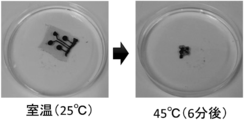
実施例1で得られた複合電極体を用いて回収の模擬試験を行った(図4)。幅1cmの入口を有するアクリル製のチャンバーを作製した。1cmの入り口からチャンバーに乾燥した複合電極体を挿入した。人工脳髄液でチャンバーを満たし、乾燥した複合電極体を膨潤させた。チャンバーを45℃に加温することによって、複合電極体を収縮させ収、1cmの入り口から回収した。
実施例1で得られた複合電極体を用いて回収の模擬試験を行った(図4)。幅1cmの入口を有するアクリル製のチャンバーを作製した。1cmの入り口からチャンバーに乾燥した複合電極体を挿入した。人工脳髄液でチャンバーを満たし、乾燥した複合電極体を膨潤させた。チャンバーを45℃に加温することによって、複合電極体を収縮させ収、1cmの入り口から回収した。
本発明の被覆複合材料は、心電・筋電・脳電等の生体が発する電気信号の計測、及び通電(電気刺激)による生体機能の制御に用いることができる。
以上、本発明を特定の態様に沿って説明したが、当業者に自明の変法や改良は本発明の範囲に含まれる。
以上、本発明を特定の態様に沿って説明したが、当業者に自明の変法や改良は本発明の範囲に含まれる。
Claims (13)
- 基材と温度応答性多孔質体とが結合している複合材料であって、前記複合材料が発熱性粒子を含むことを特徴とする複合材料。
- 前記温度応答性多孔質体が、N置換(メタ)アクリルアミド誘導体(例えば、Nn-プロピルアクリルアミド、N-イソプロピルアクリルアミド、N-エチルアクリルアミド、N、N-ジメチルアクリルアミド、N-アクリロイルピロリジン、N-アクリロイルピペリジン、N-アクリロイルモルホリン、N-n-プロピルメタクリルアミド、N-イソプロピルメタクリルアミド、N-エチルメタクリルアミド、N、N-ジメチルメタクリルアミド、N-メタクリロイルピロリジン、N-メタクリロイルピペリジン、又はN-メタクリロイルモルホリン)、ポリオキシエチレンアルキルアミン誘導体(例えば、ヒドロキシプロピルセルロース、ポリビニルアルコール部分酢化物、ポリビニルメチルエーテル、(ポリオキシエチレン-ポリオキシプロピレン)ブロックコポリマー、又はポリオキシエチレンラウリルアミン)、ポリオキシエチレンソルビタンエステル誘導体(例えば、ポリオキシエチレンソルビタンラウレート)、(ポリオキシエチレンアルキルフェニルエーテル)(メタ)アクリレート(例えば、(ポリオキシエチレンノニルフェニルエーテル)アクリレート又は(ポリオキシエチレンオクチルフェニルエーテル)メタクリレート)、及びポリオキシエチレン(メタ)アクリル酸エステル誘導体(例えば、(ポリオキシエチレンアルキルエーテル)(メタ)アクリレート)からなる群から選択される温度応答性モノマー由来のポリマー、若しくは前記2つ以上の温度応答性モノマー由来のコポリマー、又はN-イソプロピルアクリルアミド及びN-t-ブチルアクリルアミドのコポリマーを含む温度応答性多孔質体であり、そして前記発熱性粒子が磁性粒子、金属ナノ粒子、及びカーボンナノチューブからなる群から選択される粒子である、請求項1に記載の複合材料。
- 前記複合材料が複合電極体である、請求項1又は2に記載の複合材料。
- 前記温度応答性多孔質体が基材から多孔質体に伸びるポリマーによって結合している、請求項1~3のいずれか一項に記載の複合材料。
- 前記温度応答性多孔質体に伸びるポリマーが、ポリ(3,4-エチレンジオキシチオフェン)、ポリアセチレン、ポリピロール、ポリチオフェン、ポリビチオフェン、ポリイソチオフェン、ポリドデシルチオフェン、ポリイソナイトチオフェン、ポリ-3-ヘキシルチオフェン、ポリアニリン、ポリイソチアナフテン、ポリチアジル、ポリフェニレン、ポリフルオレン、ポリジアセチレン、ポリアセン、ポリパラフェニレン、ポリチエニレンビニレン、及びポリフェニレスルフィドからなる群から選択される1つ以上の導電性高分子、又はポリ(メタ)アクリル酸若しくはこれらの塩(例えば、ポリアクリル酸、ポリメタクリル酸、又はアクリル酸・メタクリル酸アルキルコポリマー等のポリ(メタ)アクリル酸類若しくはこれらの塩)、ポリエチレングリコールジ(メタ)アクリレートの重合体(例えば、PPEGDA又はPPEGDM)、ポリヒドロキシエチルメタクリレート、ポリアクリルアミド、ポリ(N,N-ジメチルアクリルアミド)、ポリ2-アクリルアミド-2-メチルプロパンスルホン酸、ポリ(N-イソプロピルアクリルアミド)、ポリビニルピロリドン、ポリスチレンスルホン酸、ポリエチレングリコール、カルボキシビニルポリマー、アルキル変性カルボキシビニルポリマー、無水マレイン酸コポリマー、ポリアルキレンオキサイド系樹脂、ポリ(メチルビニルエーテル-alt-マレイン酸無水物)とポリエチレングリコールとの架橋体、ポリエチレングリコール架橋体、N-ビニルアセトアミド架橋体、アクリルアミド架橋体、デンプン・アクリル酸塩グラフトコポリマー架橋物、及びシリコーンからなる群から選択される絶縁性ポリマーである、請求項4に記載の複合材料。
- 基材及び温度応答性多孔質体を含む複合材料に発熱性粒子を含有させる工程を含む、複合材料の製造方法。
- 前記温度応答性多孔質体が、N置換(メタ)アクリルアミド誘導体(例えば、Nn-プロピルアクリルアミド、N-イソプロピルアクリルアミド、N-エチルアクリルアミド、N、N-ジメチルアクリルアミド、N-アクリロイルピロリジン、N-アクリロイルピペリジン、N-アクリロイルモルホリン、N-n-プロピルメタクリルアミド、N-イソプロピルメタクリルアミド、N-エチルメタクリルアミド、N、N-ジメチルメタクリルアミド、N-メタクリロイルピロリジン、N-メタクリロイルピペリジン、又はN-メタクリロイルモルホリン)、ポリオキシエチレンアルキルアミン誘導体(例えば、ヒドロキシプロピルセルロース、ポリビニルアルコール部分酢化物、ポリビニルメチルエーテル、(ポリオキシエチレン-ポリオキシプロピレン)ブロックコポリマー、又はポリオキシエチレンラウリルアミン)、ポリオキシエチレンソルビタンエステル誘導体(例えば、ポリオキシエチレンソルビタンラウレート)、(ポリオキシエチレンアルキルフェニルエーテル)(メタ)アクリレート(例えば、(ポリオキシエチレンノニルフェニルエーテル)アクリレート、又は(ポリオキシエチレンオクチルフェニルエーテル)メタクリレート)及びポリオキシエチレン(メタ)アクリル酸エステル誘導体(例えば、(ポリオキシエチレンアルキルエーテル)(メタ)アクリレート)からなる群から選択される温度応答性モノマー由来のポリマー、若しくは2つ以上の温度応答性モノマー由来のコポリマー、又はN-イソプロピルアクリルアミド及びN-t-ブチルアクリルアミドのコポリマーを含む温度応答性多孔質体であり、そして前記発熱性粒子が磁性粒子、金属ナノ粒子、及びカーボンナノチューブからなる群から選択される粒子である、請求項6に記載の複合材料の製造方法。
- 前記複合材料が複合電極体である、請求項6又は7に記載の複合材料の製造方法。
- 前記複合材料が、基材の表面から温度応答性多孔質体中にモノマーを重合させ、基材と温度応答性多孔質体とを接着することによって得られる、請求項6~8のいずれか一項に記載の複合材料の製造方法。
- 前記モノマーが導電性モノマーであり、そして前記重合が導電性モノマーを含む電解質液中での電解重合である、請求項9に記載の複合材料の製造方法。
- 前記基材が、表面に重合開始部が導入された基材であり、前記モノマーが導電性モノマー又は絶縁性モノマーであり、そして前記重合が、モノマーを含浸させた温度応答性多孔質体中における重合開始部を重合開始点としたラジカル重合反応である、請求項8又は9に記載の複合材料の製造方法。
- (1)基材と温度応答性多孔質体とが結合している複合材料を加熱することによって、複合材料を収縮させる工程、及び
(2)収縮させた複合材料を装着部位から回収する工程、
を含む、複合材料回収方法。 - (A)前記加熱が基材に通電することによる加熱、マイクロ波による加熱、若しくは外部からの熱を印加することによる加熱、
(B)前記複合材料が磁性粒子を含み、そして加熱が交流磁場、若しくはマイクロ波による加熱、又は
(C)前記複合材料が金属ナノ粒子を含み、そして加熱がレーザー光による加熱、
である請求項12に記載の複合材料回収方法。
Applications Claiming Priority (2)
| Application Number | Priority Date | Filing Date | Title |
|---|---|---|---|
| JP2016069353 | 2016-03-30 | ||
| JP2016-069353 | 2016-03-30 |
Publications (1)
| Publication Number | Publication Date |
|---|---|
| WO2017170928A1 true WO2017170928A1 (ja) | 2017-10-05 |
Family
ID=59965919
Family Applications (1)
| Application Number | Title | Priority Date | Filing Date |
|---|---|---|---|
| PCT/JP2017/013393 Ceased WO2017170928A1 (ja) | 2016-03-30 | 2017-03-30 | 複合材料 |
Country Status (1)
| Country | Link |
|---|---|
| WO (1) | WO2017170928A1 (ja) |
Cited By (7)
| Publication number | Priority date | Publication date | Assignee | Title |
|---|---|---|---|---|
| CN108040454A (zh) * | 2017-11-22 | 2018-05-15 | 东莞市明骏智能科技有限公司 | 一种石墨烯-碳纳米管复合材料的电磁屏蔽帐篷的制造工艺 |
| CN110564113A (zh) * | 2019-10-17 | 2019-12-13 | 重庆金美新材料科技有限公司 | 一种导电母粒及其制备方法 |
| CN111087627A (zh) * | 2019-12-27 | 2020-05-01 | 太原理工大学 | 一种复合水凝胶及其制备方法和应用 |
| JP2021091865A (ja) * | 2019-12-05 | 2021-06-17 | 株式会社日本触媒 | 刺激応答吸水性樹脂組成物及びその製造方法 |
| CN113753879A (zh) * | 2020-06-05 | 2021-12-07 | 重庆科技学院 | 一种温敏聚合物修饰的碳纳米管复合材料及其制备方法 |
| CN114190374A (zh) * | 2021-12-27 | 2022-03-18 | 利民化学有限责任公司 | 微胶囊悬浮制剂和微胶囊悬浮种衣剂及其制备方法 |
| CN121182184A (zh) * | 2025-11-26 | 2025-12-23 | 苏州港睿通纳米材料科技有限公司 | 一种曲面聚苯胺改性3d打印聚氨酯材料及其应用 |
Citations (2)
| Publication number | Priority date | Publication date | Assignee | Title |
|---|---|---|---|---|
| JP2009525768A (ja) * | 2006-01-27 | 2009-07-16 | エム イー ディ インスチィチュート インク | 薬物の制御放出用ナノコンポジットコーティングを伴う器具 |
| WO2014157550A1 (ja) * | 2013-03-28 | 2014-10-02 | 国立大学法人東北大学 | 多孔質基板電極体及びその製造方法 |
-
2017
- 2017-03-30 WO PCT/JP2017/013393 patent/WO2017170928A1/ja not_active Ceased
Patent Citations (2)
| Publication number | Priority date | Publication date | Assignee | Title |
|---|---|---|---|---|
| JP2009525768A (ja) * | 2006-01-27 | 2009-07-16 | エム イー ディ インスチィチュート インク | 薬物の制御放出用ナノコンポジットコーティングを伴う器具 |
| WO2014157550A1 (ja) * | 2013-03-28 | 2014-10-02 | 国立大学法人東北大学 | 多孔質基板電極体及びその製造方法 |
Cited By (10)
| Publication number | Priority date | Publication date | Assignee | Title |
|---|---|---|---|---|
| CN108040454A (zh) * | 2017-11-22 | 2018-05-15 | 东莞市明骏智能科技有限公司 | 一种石墨烯-碳纳米管复合材料的电磁屏蔽帐篷的制造工艺 |
| CN108040454B (zh) * | 2017-11-22 | 2022-05-17 | 东莞市明骏智能科技有限公司 | 一种石墨烯-碳纳米管复合材料的电磁屏蔽帐篷的制造工艺 |
| CN110564113A (zh) * | 2019-10-17 | 2019-12-13 | 重庆金美新材料科技有限公司 | 一种导电母粒及其制备方法 |
| CN110564113B (zh) * | 2019-10-17 | 2021-11-30 | 重庆金美新材料科技有限公司 | 一种导电母粒及其制备方法 |
| JP2021091865A (ja) * | 2019-12-05 | 2021-06-17 | 株式会社日本触媒 | 刺激応答吸水性樹脂組成物及びその製造方法 |
| JP7520647B2 (ja) | 2019-12-05 | 2024-07-23 | 株式会社日本触媒 | 刺激応答吸水性樹脂組成物及びその製造方法 |
| CN111087627A (zh) * | 2019-12-27 | 2020-05-01 | 太原理工大学 | 一种复合水凝胶及其制备方法和应用 |
| CN113753879A (zh) * | 2020-06-05 | 2021-12-07 | 重庆科技学院 | 一种温敏聚合物修饰的碳纳米管复合材料及其制备方法 |
| CN114190374A (zh) * | 2021-12-27 | 2022-03-18 | 利民化学有限责任公司 | 微胶囊悬浮制剂和微胶囊悬浮种衣剂及其制备方法 |
| CN121182184A (zh) * | 2025-11-26 | 2025-12-23 | 苏州港睿通纳米材料科技有限公司 | 一种曲面聚苯胺改性3d打印聚氨酯材料及其应用 |
Similar Documents
| Publication | Publication Date | Title |
|---|---|---|
| EP3437553B1 (en) | Coated composite material | |
| Shit et al. | Mineralized soft and elastic polymer dot hydrogel for a flexible self-powered electronic skin sensor | |
| He et al. | Bio-inspired instant underwater adhesive hydrogel sensors | |
| Chen et al. | Ultrastretchable, tough, antifreezing, and conductive cellulose hydrogel for wearable strain sensor | |
| Guo et al. | Application of conductive polymer hydrogels in flexible electronics | |
| Wang et al. | Tough, adhesive, self-healable, and transparent ionically conductive zwitterionic nanocomposite hydrogels as skin strain sensors | |
| Yang et al. | Hydrogel ionotronics | |
| Yang et al. | Conductive organohydrogels with ultrastretchability, antifreezing, self-healing, and adhesive properties for motion detection and signal transmission | |
| Cha et al. | Materials engineering, processing, and device application of hydrogel nanocomposites | |
| Lim et al. | Highly conductive and stretchable hydrogel nanocomposite using whiskered gold nanosheets for soft bioelectronics | |
| Bi et al. | Tough and strain-sensitive organohydrogels based on MXene and PEDOT/PSS and their effects on mechanical properties and strain-sensing performance | |
| Liu et al. | Ultrasensitive wearable soft strain sensors of conductive, self-healing, and elastic hydrogels with synergistic “soft and hard” hybrid networks | |
| Zhu et al. | Tough and conductive hybrid hydrogels enabling facile patterning | |
| Wei et al. | Near-infrared light-responsive electrochemical protein imprinting biosensor based on a shape memory conducting hydrogel | |
| CN105758909B (zh) | 一种基于金纳米管的柔性可拉伸电极及其制备方法与应用 | |
| JP6284200B2 (ja) | 多孔質基板電極体及びその製造方法 | |
| JP7063485B2 (ja) | 複合材料及びその製造方法 | |
| Du et al. | Bio-inspired homogeneous conductive hydrogel with flexibility and adhesiveness for information transmission and sign language recognition | |
| Chen et al. | Triple‐network‐based conductive polymer hydrogel for soft and elastic bioelectronic interfaces | |
| WO2017170929A1 (ja) | 生体固定用複合材料 | |
| Jiang et al. | Preparation of tough and adhesive PVA/P (AM-AMPS)/glycerol/laponite/Na2SO4 organohydrogels for all-solid-state supercapacitors and self-powered wearable strain sensors | |
| CN110540658A (zh) | 一种基于丙烯酰胺/氧化碳纳米管纳米复合水凝胶传感器及其制备方法 | |
| CN105816881A (zh) | 基于近红外光热剂和温敏性聚合物的组合体系、药物载体和制备方法 | |
| Chen et al. | Hollow polyaniline microsphere functionalized paper with multimodal sensitivity to strain, humidity, and pressure | |
| CN119063885B (zh) | 基于锌离子迁移率调控的快速响应离电式柔性压力传感器 |
Legal Events
| Date | Code | Title | Description |
|---|---|---|---|
| NENP | Non-entry into the national phase |
Ref country code: DE |
|
| 121 | Ep: the epo has been informed by wipo that ep was designated in this application |
Ref document number: 17775462 Country of ref document: EP Kind code of ref document: A1 |
|
| 122 | Ep: pct application non-entry in european phase |
Ref document number: 17775462 Country of ref document: EP Kind code of ref document: A1 |
|
| NENP | Non-entry into the national phase |
Ref country code: JP |