WO2017169017A1 - 歯科用セメント - Google Patents
歯科用セメント Download PDFInfo
- Publication number
- WO2017169017A1 WO2017169017A1 PCT/JP2017/002352 JP2017002352W WO2017169017A1 WO 2017169017 A1 WO2017169017 A1 WO 2017169017A1 JP 2017002352 W JP2017002352 W JP 2017002352W WO 2017169017 A1 WO2017169017 A1 WO 2017169017A1
- Authority
- WO
- WIPO (PCT)
- Prior art keywords
- phosphorylated
- powder
- kneading
- weight
- polysaccharide
- Prior art date
- Legal status (The legal status is an assumption and is not a legal conclusion. Google has not performed a legal analysis and makes no representation as to the accuracy of the status listed.)
- Ceased
Links
Classifications
-
- A—HUMAN NECESSITIES
- A61—MEDICAL OR VETERINARY SCIENCE; HYGIENE
- A61K—PREPARATIONS FOR MEDICAL, DENTAL OR TOILETRY PURPOSES
- A61K6/00—Preparations for dentistry
-
- A—HUMAN NECESSITIES
- A61—MEDICAL OR VETERINARY SCIENCE; HYGIENE
- A61K—PREPARATIONS FOR MEDICAL, DENTAL OR TOILETRY PURPOSES
- A61K6/00—Preparations for dentistry
- A61K6/80—Preparations for artificial teeth, for filling teeth or for capping teeth
- A61K6/849—Preparations for artificial teeth, for filling teeth or for capping teeth comprising inorganic cements
Definitions
- the present invention relates to a dental cement used in the dental field.
- cement containing calcium silicate as a main component for example, refer to Patent Documents 1 and 2
- Portland cement for example, refer to Patent Document 3
- cements are usually composed of a powder component and a liquid component, and are hardened by mixing and kneading both components to form a hardened cement body.
- such a conventional cement contains a powder component and a liquid component in a separated state in a capsule (for example, see Patent Document 4), and after releasing the separated state in use, a kneading device (for example, a patent) It is also practiced that both components are mechanically mixed and kneaded using Reference 5).
- An object of the present invention is to provide a dental cement which can be sufficiently mixed and kneaded even when cement kneading is performed using an apparatus, and which can obtain a kneaded product having excellent properties. .
- the present inventors have mixed and kneaded a powder component containing Portland cement powder and a liquid component containing a phosphorylated polysaccharide, and the viscosity of the phosphorylated polysaccharide is reduced.
- the phosphorylated polysaccharide can be mixed and kneaded sufficiently by quickly passing through the whole kneaded product, and has excellent properties. Can obtain a kneaded product To investigate the door is of the present invention has been completed.
- the present invention is a dental cement comprising a powder component containing Portland cement powder and a liquid component containing phosphorylated polysaccharide and water.
- the ratio of phosphorylated polysaccharide in the liquid component is 0.1 to 20% by weight, operations such as kneading and filling can be performed more reliably and easily, and in addition, the phosphorous polysaccharide should be included in the powder component. Therefore, kneading can be carried out more rapidly, which is preferable. Further, if the ratio of the phosphorylated polysaccharide in the powder component is 0.1 to 15% by weight, the kneaded product has a more appropriate viscosity and is filled.
- phosphorylated pullulan as a phosphorylated polysaccharide, and it is possible to ensure high safety without harm to the human body, and it is difficult to be metabolized by amylase etc. in the oral cavity. preferably it hardly becomes, and the composition of the Portland cement powder, calcium oxide (CaO): 55 ⁇ 85 wt%, silicon dioxide (SiO 2): 10 ⁇ 40 wt%, aluminum oxide (Al 2 O 3): To 15% by weight, of iron oxide (Fe 2 O 3): 0 ⁇ 10 wt%, gypsum: 0 if to 20 wt%, when curing kneaded, filling of the root canal, water such as pulp capping It has also been found that it is preferable that it is cured in a stable state and has an appropriate strength in use under a large amount of conditions.
- the dental cement according to the present invention is a dental cement containing a phosphorylated polysaccharide in a liquid component. Since the phosphorylated polysaccharide has a viscous effect, it is simply mixed by mixing cement powder and water. It is easier to knead compared to the case where the kneaded product is mixed, and even if the liquid component added at the time of kneading is a large amount (low powder-liquid ratio), the kneaded product does not easily drip due to the viscosity of the phosphorylated polysaccharide.
- the phosphorylated polysaccharide can be mixed and kneaded sufficiently by quickly passing through the whole kneaded product, and a kneaded product having excellent properties can be obtained.
- the ratio of phosphorylated polysaccharide in the liquid component is 0.1 to 20% by weight
- operations such as kneading and filling can be performed more reliably and easily, which is preferable.
- the powder component contains the phosphorylated polysaccharide
- the proportion of the phosphorylated polysaccharide in the powder component is 0.1 to 15% by weight
- the operability such as filling is improved and the operability such as filling is improved, and the phosphorylated polysaccharide is a phosphorylated pullulan as the phosphorylated polysaccharide, it is harmless to the human body and can ensure high safety.
- the composition of Portland cement powder is calcium oxide (CaO): 55 to 85% by weight, silicon dioxide (SiO 2 ): 10 to 40 wt%, aluminum oxide (Al 2 O 3): 0 ⁇ 15 wt%, of iron oxide (Fe 2 O 3): 0 ⁇ 10 wt%, gypsum: in 0 ⁇ embodiment is 20 wt%, the kneaded When to be of filling of the root canal, the use of watery conditions such as pulp capping is Preferred to be able to obtain a stable and moderate strength cured state.
- Portland cement powder used in the present invention is primarily tricalcium silicate (alite, 3CaO ⁇ SiO 2), dicalcium silicate (belite, 2CaO ⁇ SiO 2), calcium aluminate (aluminate, 3CaO ⁇ Al 2 O 3 ) and calcium aluminoferrite (ferrite, 4CaO.Al 2 O 3 .Fe 2 O 3 ).
- These main components are calcium oxide (CaO), silicon dioxide (SiO 2 ), aluminum oxide (Al 2 O 3 ), and iron oxide (Fe 2 O 3 ).
- liquid The curing rate and cured body strength of the powder component after kneading with the component are different.
- the Portland cement powder used in the present invention can be used without any particular limitation to the conventional Portland cement powder, but when the kneaded product is hardened, particularly if the composition is as follows, In use under conditions of high moisture content such as capping, it is more preferable because it can be cured in a stable state and an appropriate strength can be obtained.
- Other components such as magnesium oxide and sodium carbonate may be included.
- the phosphorylated polysaccharide used in the present invention has low irritation and high affinity for living tissue.
- phosphorylated polysaccharides have adhesiveness to teeth, and also adhere to metal and ceramics by the chelate bonding of the phosphate groups of phosphorylated polysaccharides.
- phosphorylated polysaccharide used in the present invention those in which a part or all of the hydroxyl groups of the polysaccharide are phosphorylated can be used.
- phosphorylated lactose, phosphorylated sucrose, phosphorylated sucralose, phosphorylated cellobiose, phosphorylated Trehalose, phosphorylated maltose, phosphorylated palatinose (registered trademark), phosphorylated maltotriose, phosphorylated maltodextrin, phosphorylated cyclodextrin, phosphorylated glycosyl sucrose, phosphorylated amylose, phosphorylated amylopectin, phosphorylated cycloamylose, phosphorylated Glycogen, phosphorylated cellulose, phosphorylated agarose, phosphorylated cluster dextrin, phosphorylated mannan, phosphorylated pullulan and the like can be preferably used, and these are used alone or in combination of
- phosphorylated polysaccharides phosphorylated maltodextrin, phosphorylated cyclodextrin, phosphorylated glycosyl sucrose, phosphorylated amylose, phosphorylated amylopectin, phosphorylated cycloamylose, phosphorylated glycogen, phosphorylated cellulose, phosphorylated agarose, phosphorylated
- One or more selected from the group consisting of cluster dextrin, phosphorylated mannan, and phosphorylated pullulan can be preferably used from the viewpoints of adhesion to living hard tissue, strength of cured product, production cost, and the like.
- phosphorylated pullulan is preferable because it is harmless to the human body and can ensure high safety, and is not easily metabolized by amylase or the like in the oral cavity and hardly becomes a nutrient for bacteria.
- Such a phosphorylated polysaccharide can be produced by a known method of phosphorylating the hydroxyl group of the polysaccharide. For example, the method of making it react with sodium metaphosphate, the method of making it react with sodium phosphate, etc. are mentioned. A method of obtaining phosphorylated pullulan by reacting phosphorus pentoxide and pullulan is also used. The structure of the obtained phosphorylated polysaccharide can be confirmed by a known analysis method. The degree of phosphorylation of the phosphorylated polysaccharide can be adjusted by changing the amount of raw material used and the reaction conditions.
- the phosphorylated polysaccharide may be partly or wholly salted, such as sodium salt, potassium salt, calcium salt, magnesium salt, ammonium salt, and the like. Can be prepared according to known methods.
- the phosphorylated polysaccharide is preferably one in which several (number%) to several tens (number%) hydroxyl groups are phosphorylated among all hydroxyl groups contained in one molecule.
- the number ratio of phosphorylated hydroxyl groups in the phosphorylated polysaccharide can be calculated from the phosphorus content by performing elemental analysis of the phosphorylated polysaccharide.
- the proportion of phosphorylated polysaccharide in the liquid component is 0.1 to 20% by weight because operations such as kneading and filling can be performed more reliably and easily. If the proportion of phosphorylated polysaccharide in the liquid component is less than 0.1% by weight, the effect of improving the operability and the adhesiveness to the tooth tend to be insufficient, while it exceeds 20% by weight. When blended, the viscosity becomes too high, and the fluidity of the kneaded product may become low and difficult to handle.
- the phosphorous polysaccharide when the phosphorous polysaccharide is also contained in the powder component, it is preferable that kneading can be performed more rapidly, and when the proportion of the phosphorylated polysaccharide in the powder component is 0.1 to 15% by weight, the kneaded product is obtained. It is preferable because it has a more appropriate viscosity and the operability such as filling is improved.
- the blending ratio of the phosphorylated polysaccharide in the powder component is set to 0.1 to 15% by weight. If it is less than 0.1% by weight, the viscosity may be lowered and the kneaded product may feel slightly lumpy. This is because if it exceeds 15% by weight, the viscosity may become too high.
- the powder component of the dental cement according to the present invention may contain an X-ray contrast material for imparting X-ray contrast properties.
- X-ray contrast media include known powders of bismuth oxide, barium sulfate, tantalum oxide, cerium oxide, tin oxide, zirconium oxide, zinc oxide, ytterbium oxide, ytterbium fluoride, and barium, tantalum, lanthanum, and strontium.
- a radiopaque glass powder or the like can be used, and these can be used alone or in combination.
- the ratio of the X-ray contrast medium is preferably not higher than the ratio of the Portland cement powder, for example, 0.1 to 50% by weight in the powder component. If it is less than 0.1% by weight, the X-ray contrast property of the cured product obtained by kneading with the liquid component tends to be insufficient, and if it exceeds 50% by weight, the strength of the cured product tends to decrease.
- a colorant, a stabilizer, an antibacterial agent, and an antiseptic can be appropriately blended as long as the properties are not affected.
- a powder component and a liquid component are prepared, and a kneading feeling is shown when kneading until uniform using a spatula on kneaded paper. ”.
- the powder component and the liquid component are stored in a capsule, and after mixing and kneading using a kneading apparatus, the“ ease of capsule extrusion ”when the obtained kneaded product is discharged from the capsule, the capsule
- the “kneaded properties” indicating the properties of the kneaded product obtained by mixing kneading using a kneader with a spatula was evaluated.
- dental cement according to the present invention will be described in detail using examples, but the dental cement according to the present invention is not limited to the following examples.
- Table 2 shows the blending ratio of dental cement used in each example and each comparative example.
- bismuth oxide was used as an X-ray contrast agent.
- “Easy capsule extrusion” As described above, the powder component and the liquid component shown in Table 2 were prepared, respectively, and the capsule was filled with 0.3 g of the powder component and 100 ⁇ L of the liquid component, and a dental capsule mixer (Capsule Mixer CM-II; manufactured by GC Corporation) was prepared. After kneading for 20 seconds, the kneaded product was extruded from the capsule using a capsule applier. The ease of extrusion at that time was evaluated as follows. ⁇ Easy extrusion ⁇ Extrusion is slightly heavy ⁇ Cannot be extruded
- Capsule Extrusion Ease Capsule Extrusion Ease
- kneading properties have moderate fluidity and are superior to the comparative examples.
- the beneficial effects such as having been confirmed. This is presumably because the phosphorylated polysaccharide (phosphorylated pullulan) contained in the liquid component diffuses quickly and can be uniformly kneaded quickly.
- Example 1 and Comparative Example 2 Example 2 and Comparative Example 3, Example 3 and Comparative Example 4, respectively, the blending proportions of Portland cement powder and other components are the same, and the respective differences are as follows.
- the example uses “Phosphorylated pullulan” and the comparative example uses “Pullulan” only, but “Hand kneading feeling”, “Ease of capsule extrusion”, “Kneading properties” In each item, there was a large difference in the effect between the example and the comparative example. As a result, it became clear that the effect cannot be expected unless “pullulan” is phosphorylated.
Landscapes
- Health & Medical Sciences (AREA)
- Oral & Maxillofacial Surgery (AREA)
- Epidemiology (AREA)
- Life Sciences & Earth Sciences (AREA)
- Animal Behavior & Ethology (AREA)
- General Health & Medical Sciences (AREA)
- Public Health (AREA)
- Veterinary Medicine (AREA)
- Chemical & Material Sciences (AREA)
- Inorganic Chemistry (AREA)
- Plastic & Reconstructive Surgery (AREA)
- Dental Preparations (AREA)
Abstract
粉液比によって練和のし易さや充填等の操作性が左右され難く、また水分が多い根管の充填や覆髄において、またはシーラーの材料として使用する際に高い接着性が得られ、練和用の装置や器具を使用しても容易に押し出し排出させることができる性状の優れた練和物が得られる歯科用粉末セメントを提供する。 歯科用セメントを、ポルトランドセメント粉末を含む粉末成分と、リン酸化多糖及び水を含む液体成分とから構成させる。またより好ましくは、液体成分中のリン酸化多糖の割合が0.1~20重量%としたり、粉末成分もリン酸化多糖を含むようにしたりする。
Description
本発明は、歯科分野において用いられる歯科用セメントに関する。
歯科分野において、根管の充填や覆髄等の治療に用いられる材料として、ケイ酸カルシウムを主成分とするセメント(例えば、特許文献1、2参照。)やポルトランドセメント(例えば、特許文献3参照。)が用いられている。これらのセメントは、通常粉末成分と液体成分とから構成され、両成分を混合練和することにより硬化しセメント硬化体となる。
しかしながら、従来のセメントは、粉液比(粉末成分の液体成分に対する混合比)を高くすると、練和し難く均一なペーストにすることが困難となり、逆に粉液比を低くすると、練和物のペーストが垂れやすいため充填等の操作が困難となる。このように、従来のセメントにおいては、粉末成分と液体成分との粉液比によって、練和のし易さや充填等の操作性が大きく左右されるため使い勝手が悪いという問題があった。
またこのような従来のセメントは、粉末成分と液体成分とを隔離状態でカプセル内に収納し(例えば、特許文献4参照。)、使用時に隔離状態を解除した後、練和装置(例えば、特許文献5参照。)を用いて両成分を機械的に混合練和して使用することも行われている。
このようなカプセル及び練和装置を用いて従来のセメントの混合練和を行う場合、手練りの場合に比べて十分に練和することが困難であったり、練和物のペーストをカプセル内から排出させることが困難であったりしたことから、より混合練和のし易い歯科用セメントが求められていた。
本発明は前記の問題に鑑み、粉液比によって練和のし易さや充填等の操作性が左右され難く、また、手練りの場合より混合練和がし易いことが求められるカプセル及び練和装置を用いてセメントの混合練和を行う場合であっても、十分に混合練和することができ、性状の優れた練和物を得ることができる歯科用セメントを提供することを課題とする。
本発明者等は前記課題を解決すべく鋭意検討した結果、ポルトランドセメント粉末を含む粉末成分と、リン酸化多糖が含有されてなる液体成分とを混合して練和すれば、リン酸化多糖に粘性効果があることから、単にセメント粉末と水とを混合して練和した場合に比べて練和がし易く、また練和時に混合した液体成分が多量(低粉液比)であっても、リン酸化多糖が有するその粘性によって、練和物が垂れ難く充填等の操作時に支障をきたすことがないので、粉液比によって練和のし易さや充填等の操作性が左右されることなく、カプセル及び練和装置を用いて歯科用セメントの混合練和を行う場合であっても、リン酸化多糖が練和物全体に素早くいきわたることで十分に混合練和することができ、性状の優れた練和物を得ることができることを究明して本発明を完成させたのである。
即ち本発明は、ポルトランドセメント粉末を含む粉末成分と、リン酸化多糖及び水を含む液体成分とからなることを特徴とする歯科用セメントである。
また液体成分中のリン酸化多糖の割合を0.1~20重量%とすれば、練和や充填等の操作がより確実且つ容易にできて好ましく、加えて粉末成分にリン酸化多糖を含むようにすれば、より迅速に練和ができて好ましく、更に粉末成分中のリン酸化多糖の割合を0.1~15重量%とすれば、練和物がより適度な粘性を有するようになり充填等の操作性が向上して好ましく、またリン酸化多糖として、リン酸化プルランを使用すれば、人体に無害で高い安全性を確保でき、また口腔内でのアミラーゼ等による代謝を受けにくく細菌の栄養になり難くて好ましく、そしてポルトランドセメント粉末の組成を、酸化カルシウム(CaO):55~85重量%、二酸化ケイ素(SiO2):10~40重量%、酸化アルミニウム(Al2O3):0~15重量%、酸化鉄(Fe2O3):0~10重量%、石膏:0~20重量%とすれば、練和物を硬化させる際に、根管の充填、覆髄等の水分の多い条件下の使用において、安定した状態で硬化させ且つ適度な強度を得ることができて好ましいことも究明したのである。
本発明に係る歯科用セメントは、液体成分中にリン酸化多糖が含有されてなる歯科用セメントであり、リン酸化多糖に粘性効果があることから、単にセメント粉末と水とを混合して練和した場合に比べて練和がし易く、また練和時に加えた液体成分が多量(低粉液比)であっても、リン酸化多糖が有するその粘性によって、練和物が垂れ難く充填等の操作時に支障をきたすことがないので、粉液比によって練和のし易さや充填等の操作性が左右されることがなく、カプセル及び練和装置を用いて歯科用セメントの混合練和を行う場合であっても、リン酸化多糖が練和物全体に素早くいきわたることで十分に混合練和することができ、性状の優れた練和物を得ることができるのである。
また液体成分中のリン酸化多糖の割合が0.1~20重量%である態様では、練和や充填等の操作がより確実且つ容易にできて好ましいのである。加えて粉末成分にリン酸化多糖を含む態様では、より迅速に練和ができて好ましく、更に粉末成分中のリン酸化多糖の割合が0.1~15重量%である態様では、練和物がより適度な粘性を有するようになり充填等の操作性が向上して好ましく、またリン酸化多糖として、リン酸化多糖がリン酸化プルランである態様では、人体に無害で高い安全性を確保でき、また口腔内でのアミラーゼ等による代謝を受けにくく細菌の栄養になり難くて好ましく、そしてポルトランドセメント粉末の組成が、酸化カルシウム(CaO):55~85重量%、二酸化ケイ素(SiO2):10~40重量%、酸化アルミニウム(Al2O3):0~15重量%、酸化鉄(Fe2O3):0~10重量%、石膏:0~20重量%である態様では、練和物を硬化させる際に、根管の充填、覆髄等の水分の多い条件下の使用において、安定した状態で硬化させ且つ適度な強度を得ることができて好ましいのである。
以下、本発明に係る歯科用セメントについて詳細に説明する。
本発明において使用するポルトランドセメント粉末は、主としてケイ酸三カルシウム(エーライト、3CaO・SiO2)、ケイ酸二カルシウム(ビーライト、2CaO・SiO2)、カルシウムアルミネート(アルミネート、3CaO・Al2O3)、カルシウムアルミノフェライト(フェライト、4CaO・Al2O3・Fe2O3)から構成されている。そしてこれらの主要成分は、酸化カルシウム(CaO)、二酸化ケイ素(SiO2)、酸化アルミニウム(Al2O3)、酸化鉄(Fe2O3)であり、これらの各々の成分の割合により、液体成分と練和した後の粉末成分の硬化速度や硬化体強度が異なる。
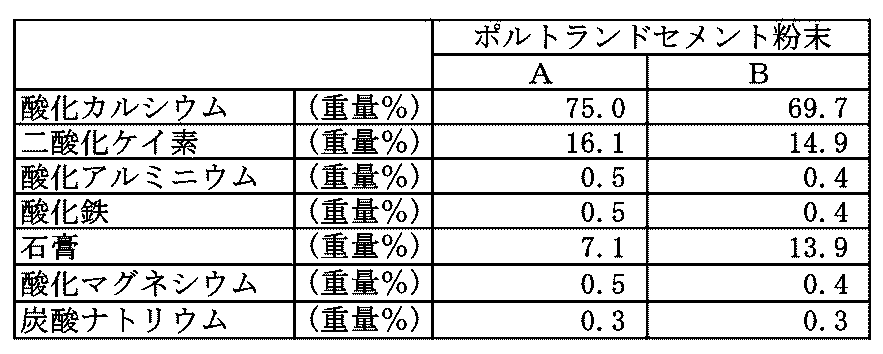
本発明において使用するポルトランドセメント粉末は、従来からあるポルトランドセメント粉末を特に限定することなく使用できるが、特に以下のような組成であれば、練和物を硬化させる際に、根管の充填、覆髄等の水分の多い条件下の使用において、安定した状態で硬化させ且つ適度な強度を得ることができてより好ましいのである。なお酸化マグネシウムや炭酸ナトリウム等の他の成分が含まれていてもよい。
酸化カルシウム(CaO):55~85重量%
二酸化ケイ素(SiO2):10~40重量%
酸化アルミニウム(Al2O3):0~15重量%
酸化鉄(Fe2O3):0~10重量%
石膏:0~20重量%
酸化カルシウム(CaO):55~85重量%
二酸化ケイ素(SiO2):10~40重量%
酸化アルミニウム(Al2O3):0~15重量%
酸化鉄(Fe2O3):0~10重量%
石膏:0~20重量%
本発明において使用するリン酸化多糖は、生体組織に対して低刺激であり親和性が高い。また、リン酸化多糖は歯質に対して接着力があり、金属、セラミックスに対しても、リン酸化多糖のリン酸基がキレート結合することで接着性を示す。
本発明において使用するリン酸化多糖としては、多糖類の一部もしくは全部の水酸基がリン酸化されたものが使用でき、例えば、リン酸化ラクトース、リン酸化スクロース、リン酸化スクラロース、リン酸化セロビオース、リン酸化トレハロース、リン酸化マルトース、リン酸化パラチノース(登録商標)、リン酸化マルトトリオース、リン酸化マルトデキストリン、リン酸化シクロデキストリン、リン酸化グリコシルスクロース、リン酸化アミロース、リン酸化アミロペクチン、リン酸化シクロアミロース、リン酸化グリコーゲン、リン酸化セルロース、リン酸化アガロース、リン酸化クラスターデキストリン、リン酸化マンナン、リン酸化プルラン等が好ましく使用でき、またこれらは、単独で、または2種以上を組み合わせて用いることができる。
これらのリン酸化多糖のうち、リン酸化マルトデキストリン、リン酸化シクロデキストリン、リン酸化グリコシルスクロース、リン酸化アミロース、リン酸化アミロペクチン、リン酸化シクロアミロース、リン酸化グリコーゲン、リン酸化セルロース、リン酸化アガロース、リン酸化クラスターデキストリン、リン酸化マンナン、及びリン酸化プルランからなる群より選択される1種以上が生体硬組織との接着性、硬化物強度及び製造コスト等の点から好ましく使用できる。
特に、リン酸化プルランは、人体に無害で高い安全性を確保でき、また口腔内でのアミラーゼ等による代謝を受けにくく細菌の栄養になり難くて好ましいのである。
このようなリン酸化多糖は、前記多糖類の水酸基をリン酸化する公知の方法により製造することができる。例えば、メタリン酸ナトリウムと反応させる方法や、リン酸ナトリウムと反応させる方法等が挙げられる。また五酸化リンとプルランを反応させてリン酸化プルランを得る方法も用いられる。得られたリン酸化多糖は、公知の分析方法により、その構造を確認することができる。なお、リン酸化多糖のリン酸化の程度は、原料使用量や反応条件を変えることで調整することができる。
また、前記リン酸化多糖は、例えば、ナトリウム塩、カリウム塩、カルシウム塩、マグネシウム塩、アンモニウム塩等のように、その一部または全部が塩になっていてもよく、これらのリン酸化多糖の塩は、公知の方法に従って調製することができる。
リン酸化多糖は、1分子に含まれる全水酸基のうち、数(個数%)~十数(個数%)の水酸基がリン酸化されたものが望ましい。なお、リン酸化多糖におけるリン酸化された水酸基の個数割合は、リン酸化多糖の元素分析を行ってリンの含有量から算出することができる。
本発明に係る歯科用セメントにおいて、液体成分中のリン酸化多糖の割合が0.1~20重量%であれば、練和や充填等の操作がより確実且つ容易にできて好ましい。なお液体成分中のリン酸化多糖の配合割合が0.1重量%未満であると、操作性を良くする効果や歯質への接着性が不足する傾向があり、一方、20重量%を超えて配合すると粘性が高くなり過ぎて、練和物の流動性が低くなり扱い難い場合がある。
また粉末成分中にもリン酸化多糖を含む場合は、より迅速に練和ができて好ましく、更に粉末成分中のリン酸化多糖の割合が0.1~15重量%であれば、練和物がより適度な粘性を有するようになり充填等の操作性が向上して好ましいのである。なお粉末成分中のリン酸化多糖の配合割合を0.1~15重量%としたのは、0.1重量%未満であると、粘性が低くなり練和物がややボソボソした感じになる場合があり、15重量%を超えると、粘性が高くなりすぎる場合があるからである。
本発明に係る歯科用セメントの粉末成分には、X線造影性を付与するためにX線造影材が含まれていてもよい。X線造影材としては、公知の酸化ビスマス、硫酸バリウム、酸化タンタル、酸化セリウム、酸化スズ、酸化ジルコニウム、酸化亜鉛、酸化イッテルビウム、フッ化イッテルビウムの各粉末や、バリウム、タンタル、ランタン、ストロンチウムを含むX線不透過性ガラス粉末等が使用でき、これらは、単独または混合して使用することが可能である。
X線造影材の割合は、ポルトランドセメント粉末の割合に比べて高くならないことが好ましく、例えば粉末成分中に0.1~50重量%であることが好ましい。なお0.1重量%未満では液体成分と練和して得られる硬化体のX線造影性が不十分となりやすく、50重量%を超えると硬化体の強度が低下する傾向がある。
本発明に係る歯科用セメントには、性状等に影響を及ぼさない範囲でその他、着色剤、安定剤等、抗菌剤、防腐剤を適宜配合することもできる。
表2に示した配合(重量%)に従って、粉末成分と液体成分とを作製し、練和紙上でヘラを用いて均一になるまで手練りした際の練和感を示す『手練り練和感』、粉末成分と液体成分とをカプセル内に収納し、練和装置を用いて混合練和した後、得られた練和物をカプセル内から排出した際の『カプセル押し出しやすさ』、前記カプセル及び練和装置を用いた混合練和により得られた練和物をヘラで触った際の性状を示す『練和物性状』を評価した。
以下、実施例を用いて本発明に係る歯科用セメントを具体的に説明するが、本発明に係る歯科用セメントは以下の実施例に限定されるものではない。
『ポルトランドセメント粉末の調製』
ポルトランドセメント粉末A及びBの配合を表1に示す。
ポルトランドセメント粉末A及びBの配合を表1に示す。
『歯科用セメントの調製』
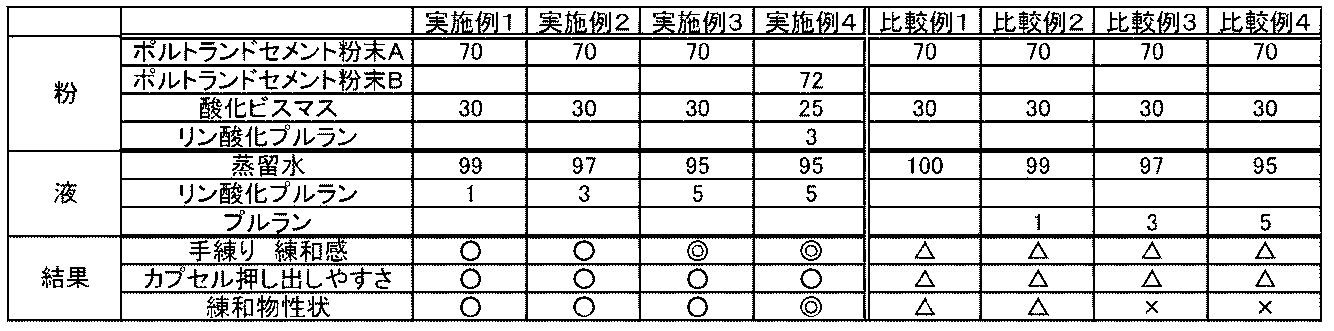
各実施例及び各比較例に用いた歯科用セメントの配合割合を表2に示す。
各実施例及び各比較例に用いた歯科用セメントの配合割合を表2に示す。
なお各粉末成分には、X線造影剤としてそれぞれ酸化ビスマスを使用した。
『手練り練和感』
表2に記載の配合割合で実施例及び比較例の粉末成分及び液体成分を作製し、それぞれ粉末成分0.3g、液体成分100μLを練和紙上に計量し、ヘラを用いて均一になるまで練和し、その際の練和感を『手練り練和感』として以下のように評価した。
◎ 非常に滑らかで適度な流動性
○ 滑らかで適度な流動性
△ 滑らかさ、流動性がやや不適
× 滑らかでない、流動性がない
表2に記載の配合割合で実施例及び比較例の粉末成分及び液体成分を作製し、それぞれ粉末成分0.3g、液体成分100μLを練和紙上に計量し、ヘラを用いて均一になるまで練和し、その際の練和感を『手練り練和感』として以下のように評価した。
◎ 非常に滑らかで適度な流動性
○ 滑らかで適度な流動性
△ 滑らかさ、流動性がやや不適
× 滑らかでない、流動性がない
『カプセル押し出しやすさ』
上述のとおり表2に記載の粉末成分及び液体成分をそれぞれ作製し、カプセルに粉末成分0.3g、液体成分100μLを充填し、歯科用カプセルミキサー(カプセルミキサーCM-II;株式会社ジーシー製)を用いて20秒間練和した後、カプセルアプライヤーを用いて練和物を押し出しカプセルから排出した。その際の押し出しやすさを以下のように評価した。
○ 押し出しが容易
△ 押し出しがやや重い
× 押し出せない
上述のとおり表2に記載の粉末成分及び液体成分をそれぞれ作製し、カプセルに粉末成分0.3g、液体成分100μLを充填し、歯科用カプセルミキサー(カプセルミキサーCM-II;株式会社ジーシー製)を用いて20秒間練和した後、カプセルアプライヤーを用いて練和物を押し出しカプセルから排出した。その際の押し出しやすさを以下のように評価した。
○ 押し出しが容易
△ 押し出しがやや重い
× 押し出せない
『練和物性状』
上記『カプセル押し出しやすさ』の試験で得られた練和物をヘラで触った際の性状を以下のように評価した。
◎ 非常に滑らかで適度な流動性
○ 滑らかで適度な流動性
△ 滑らかさ、流動性がやや不適
× 滑らかでない、流動性がない
上記『カプセル押し出しやすさ』の試験で得られた練和物をヘラで触った際の性状を以下のように評価した。
◎ 非常に滑らかで適度な流動性
○ 滑らかで適度な流動性
△ 滑らかさ、流動性がやや不適
× 滑らかでない、流動性がない
実施例1から3と、比較例1から4とを比較すると、ポルトランドセメント粉末やその他の成分の配合割合に大きな差はなく、相違点は主として液体成分中のリン酸化多糖(リン酸化プルラン)の有無だけであるが、リン酸化多糖(リン酸化プルラン)を加えた実施例の1から3では、比較例に比べて手練りによる練和のし易さ(『手練り練和感』)に大きな差が表れ、またカプセルを使用した練和試験(『カプセル押し出しやすさ』)においても押し出しが容易で、その性状(『練和物性状』)も適度な流動性があり比較例に比べて優れている等の有益な効果が確認できた。これは液体成分中に含まれるリン酸化多糖(リン酸化プルラン)が素早く拡散して迅速に均一な練和ができたためと考えられる。
また実施例4のように粉末成分にもリン酸化多糖(リン酸化プルラン)を加えた場合にはより迅速に練和ができ、練和のし易さ(『手練り練和感』)やカプセルを使用して練和した際の性状(『練和物性状』)に非常に優れた効果が確認できた。
更に実施例1と比較例2、実施例2と比較例3、実施例3と比較例4とをそれぞれ比較すると、ポルトランドセメント粉末やその他の成分の配合割合は同一で、それぞれの相違点は、実施例が「リン酸化プルラン」を使用し、比較例が「プルラン」を使用している点だけであるが、『手練り練和感』、『カプセル押し出しやすさ』、『練和物性状』の各項目において実施例と比較例とではその効果に大きな差があった。これにより「プルラン」がリン酸化されていないと効果が期待できないことが明確となった。
Claims (6)
- ポルトランドセメント粉末を含む粉末成分と、リン酸化多糖及び水を含む液体成分とからなることを特徴とする歯科用セメント。
- 液体成分中のリン酸化多糖の割合が0.1~20重量%である請求項1に記載の歯科用セメント。
- 粉末成分にリン酸化多糖を含む、請求項1又は2に記載の歯科用セメント。
- 粉末成分中のリン酸化多糖の割合が0.1~15重量%である請求項3に記載の歯科用セメント。
- リン酸化多糖がリン酸化プルランである請求項1~4の何れか1項に記載の歯科用セメント。
- ポルトランドセメント粉末の組成が、
酸化カルシウム(CaO):55~85重量%
二酸化ケイ素(SiO2):10~40重量%
酸化アルミニウム(Al2O3):0~15重量%
酸化鉄(Fe2O3):0~10重量%
石膏:0~20重量%
である請求項1~5の何れか1項に記載の歯科用セメント。
Priority Applications (1)
| Application Number | Priority Date | Filing Date | Title |
|---|---|---|---|
| JP2018508448A JPWO2017169017A1 (ja) | 2016-03-29 | 2017-01-24 | 歯科用セメント |
Applications Claiming Priority (2)
| Application Number | Priority Date | Filing Date | Title |
|---|---|---|---|
| JP2016-065692 | 2016-03-29 | ||
| JP2016065692 | 2016-03-29 |
Publications (1)
| Publication Number | Publication Date |
|---|---|
| WO2017169017A1 true WO2017169017A1 (ja) | 2017-10-05 |
Family
ID=59962999
Family Applications (1)
| Application Number | Title | Priority Date | Filing Date |
|---|---|---|---|
| PCT/JP2017/002352 Ceased WO2017169017A1 (ja) | 2016-03-29 | 2017-01-24 | 歯科用セメント |
Country Status (2)
| Country | Link |
|---|---|
| JP (1) | JPWO2017169017A1 (ja) |
| WO (1) | WO2017169017A1 (ja) |
Citations (5)
| Publication number | Priority date | Publication date | Assignee | Title |
|---|---|---|---|---|
| JPH05270876A (ja) * | 1992-03-24 | 1993-10-19 | Kao Corp | セメント混和剤 |
| WO2008010517A1 (fr) * | 2006-07-20 | 2008-01-24 | National University Corporation Okayama University | Composition orale pour applications dentaires |
| WO2011102530A1 (ja) * | 2010-02-22 | 2011-08-25 | 国立大学法人岡山大学 | 生体硬組織接着用キット |
| JP2013053075A (ja) * | 2011-09-01 | 2013-03-21 | Gc Corp | 歯科用セメント組成物 |
| WO2016208457A1 (ja) * | 2015-06-26 | 2016-12-29 | 国立大学法人北海道大学 | 歯科用粉末 |
-
2017
- 2017-01-24 WO PCT/JP2017/002352 patent/WO2017169017A1/ja not_active Ceased
- 2017-01-24 JP JP2018508448A patent/JPWO2017169017A1/ja active Pending
Patent Citations (5)
| Publication number | Priority date | Publication date | Assignee | Title |
|---|---|---|---|---|
| JPH05270876A (ja) * | 1992-03-24 | 1993-10-19 | Kao Corp | セメント混和剤 |
| WO2008010517A1 (fr) * | 2006-07-20 | 2008-01-24 | National University Corporation Okayama University | Composition orale pour applications dentaires |
| WO2011102530A1 (ja) * | 2010-02-22 | 2011-08-25 | 国立大学法人岡山大学 | 生体硬組織接着用キット |
| JP2013053075A (ja) * | 2011-09-01 | 2013-03-21 | Gc Corp | 歯科用セメント組成物 |
| WO2016208457A1 (ja) * | 2015-06-26 | 2016-12-29 | 国立大学法人北海道大学 | 歯科用粉末 |
Non-Patent Citations (1)
| Title |
|---|
| YOSHIDA YASUHIRO ET AL.: "Phosphorylated Pullulan Bioadhesive for Regeneration and Reconstruction of Bone and Tooth", KEY ENGINEERING MATERIALS, vol. 529 - 53, 2013, pages 516 - 521, ISSN: 1013-9826 * |
Also Published As
| Publication number | Publication date |
|---|---|
| JPWO2017169017A1 (ja) | 2019-02-14 |
Similar Documents
| Publication | Publication Date | Title |
|---|---|---|
| Kayahan et al. | Effect of acid etching procedures on the compressive strength of 4 calcium silicate–based endodontic cements | |
| Silva et al. | Push-out bond strength of injectable pozzolan-based root canal sealer | |
| EP2470154B1 (en) | Mineral trioxide aggregate (mta) composition and use | |
| EP3111913B1 (en) | Single paste type dental hydraulic-setting filler composition | |
| Prasad et al. | A comparative evaluation of the effect of various additives on selected physical properties of white mineral trioxide aggregate | |
| JP2013053075A (ja) | 歯科用セメント組成物 | |
| JP6731686B2 (ja) | 歯科用粉末 | |
| JP6310772B2 (ja) | 歯科用水硬性セメント組成物 | |
| Ha et al. | Clinical manipulation of mineral trioxide aggregate: lessons from the construction industry and their relevance to clinical practice | |
| CN102065822B (zh) | 用于牙科学的自中和型氢氧化钙制剂 | |
| JP6368206B2 (ja) | 歯科用セメント組成物 | |
| JPS6219508A (ja) | 歯科用根管充填材 | |
| JPH10248915A (ja) | リン酸カルシウムセメント硬化液及びリン酸カルシウムセメント硬化体用組成物 | |
| WO2017169017A1 (ja) | 歯科用セメント | |
| EP2823800B1 (de) | System zur Füllung eines Zahnwurzelkanals und zur Überdeckung von Pulpa | |
| Primus | Bioactive ceramics for pediatric dentistry | |
| JPH0585914A (ja) | 硬化型糊材 | |
| JP7246444B2 (ja) | 医療用セメント組成物 | |
| JP2626811B2 (ja) | 硬化性糊剤根管充填材 | |
| JPH0585521B2 (ja) | ||
| US1621793A (en) | Composition of matter for capping pulps in teeth and improvements in dental filling materials | |
| WO2022145440A1 (ja) | 歯科用セメント | |
| JP7075058B2 (ja) | 歯科用セメント | |
| JPH0327309A (ja) | 根管充填材 | |
| JPH03215406A (ja) | 硬化性糊剤根管充填材 |
Legal Events
| Date | Code | Title | Description |
|---|---|---|---|
| WWE | Wipo information: entry into national phase |
Ref document number: 2018508448 Country of ref document: JP |
|
| NENP | Non-entry into the national phase |
Ref country code: DE |
|
| 121 | Ep: the epo has been informed by wipo that ep was designated in this application |
Ref document number: 17773567 Country of ref document: EP Kind code of ref document: A1 |
|
| 122 | Ep: pct application non-entry in european phase |
Ref document number: 17773567 Country of ref document: EP Kind code of ref document: A1 |